WO2020116581A1 - フッ素系塗料及び塗膜付き基材の製造方法 - Google Patents
フッ素系塗料及び塗膜付き基材の製造方法 Download PDFInfo
- Publication number
- WO2020116581A1 WO2020116581A1 PCT/JP2019/047694 JP2019047694W WO2020116581A1 WO 2020116581 A1 WO2020116581 A1 WO 2020116581A1 JP 2019047694 W JP2019047694 W JP 2019047694W WO 2020116581 A1 WO2020116581 A1 WO 2020116581A1
- Authority
- WO
- WIPO (PCT)
- Prior art keywords
- fluorine
- group
- coating film
- mass
- block copolymer
- Prior art date
- Legal status (The legal status is an assumption and is not a legal conclusion. Google has not performed a legal analysis and makes no representation as to the accuracy of the status listed.)
- Ceased
Links
Images

Classifications
-
- B—PERFORMING OPERATIONS; TRANSPORTING
- B05—SPRAYING OR ATOMISING IN GENERAL; APPLYING FLUENT MATERIALS TO SURFACES, IN GENERAL
- B05D—PROCESSES FOR APPLYING FLUENT MATERIALS TO SURFACES, IN GENERAL
- B05D5/00—Processes for applying liquids or other fluent materials to surfaces to obtain special surface effects, finishes or structures
-
- B—PERFORMING OPERATIONS; TRANSPORTING
- B05—SPRAYING OR ATOMISING IN GENERAL; APPLYING FLUENT MATERIALS TO SURFACES, IN GENERAL
- B05D—PROCESSES FOR APPLYING FLUENT MATERIALS TO SURFACES, IN GENERAL
- B05D7/00—Processes, other than flocking, specially adapted for applying liquids or other fluent materials to particular surfaces or for applying particular liquids or other fluent materials
- B05D7/24—Processes, other than flocking, specially adapted for applying liquids or other fluent materials to particular surfaces or for applying particular liquids or other fluent materials for applying particular liquids or other fluent materials
-
- C—CHEMISTRY; METALLURGY
- C09—DYES; PAINTS; POLISHES; NATURAL RESINS; ADHESIVES; COMPOSITIONS NOT OTHERWISE PROVIDED FOR; APPLICATIONS OF MATERIALS NOT OTHERWISE PROVIDED FOR
- C09D—COATING COMPOSITIONS, e.g. PAINTS, VARNISHES OR LACQUERS; FILLING PASTES; CHEMICAL PAINT OR INK REMOVERS; INKS; CORRECTING FLUIDS; WOODSTAINS; PASTES OR SOLIDS FOR COLOURING OR PRINTING; USE OF MATERIALS THEREFOR
- C09D127/00—Coating compositions based on homopolymers or copolymers of compounds having one or more unsaturated aliphatic radicals, each having only one carbon-to-carbon double bond, and at least one being terminated by a halogen; Coating compositions based on derivatives of such polymers
- C09D127/02—Coating compositions based on homopolymers or copolymers of compounds having one or more unsaturated aliphatic radicals, each having only one carbon-to-carbon double bond, and at least one being terminated by a halogen; Coating compositions based on derivatives of such polymers not modified by chemical after-treatment
- C09D127/12—Coating compositions based on homopolymers or copolymers of compounds having one or more unsaturated aliphatic radicals, each having only one carbon-to-carbon double bond, and at least one being terminated by a halogen; Coating compositions based on derivatives of such polymers not modified by chemical after-treatment containing fluorine atoms
-
- C—CHEMISTRY; METALLURGY
- C09—DYES; PAINTS; POLISHES; NATURAL RESINS; ADHESIVES; COMPOSITIONS NOT OTHERWISE PROVIDED FOR; APPLICATIONS OF MATERIALS NOT OTHERWISE PROVIDED FOR
- C09D—COATING COMPOSITIONS, e.g. PAINTS, VARNISHES OR LACQUERS; FILLING PASTES; CHEMICAL PAINT OR INK REMOVERS; INKS; CORRECTING FLUIDS; WOODSTAINS; PASTES OR SOLIDS FOR COLOURING OR PRINTING; USE OF MATERIALS THEREFOR
- C09D133/00—Coating compositions based on homopolymers or copolymers of compounds having one or more unsaturated aliphatic radicals, each having only one carbon-to-carbon double bond, and at least one being terminated by only one carboxyl radical, or of salts, anhydrides, esters, amides, imides, or nitriles thereof; Coating compositions based on derivatives of such polymers
- C09D133/04—Homopolymers or copolymers of esters
- C09D133/14—Homopolymers or copolymers of esters of esters containing halogen, nitrogen, sulfur or oxygen atoms in addition to the carboxy oxygen
- C09D133/16—Homopolymers or copolymers of esters containing halogen atoms
-
- C—CHEMISTRY; METALLURGY
- C09—DYES; PAINTS; POLISHES; NATURAL RESINS; ADHESIVES; COMPOSITIONS NOT OTHERWISE PROVIDED FOR; APPLICATIONS OF MATERIALS NOT OTHERWISE PROVIDED FOR
- C09D—COATING COMPOSITIONS, e.g. PAINTS, VARNISHES OR LACQUERS; FILLING PASTES; CHEMICAL PAINT OR INK REMOVERS; INKS; CORRECTING FLUIDS; WOODSTAINS; PASTES OR SOLIDS FOR COLOURING OR PRINTING; USE OF MATERIALS THEREFOR
- C09D153/00—Coating compositions based on block copolymers containing at least one sequence of a polymer obtained by reactions only involving carbon-to-carbon unsaturated bonds; Coating compositions based on derivatives of such polymers
-
- C—CHEMISTRY; METALLURGY
- C09—DYES; PAINTS; POLISHES; NATURAL RESINS; ADHESIVES; COMPOSITIONS NOT OTHERWISE PROVIDED FOR; APPLICATIONS OF MATERIALS NOT OTHERWISE PROVIDED FOR
- C09D—COATING COMPOSITIONS, e.g. PAINTS, VARNISHES OR LACQUERS; FILLING PASTES; CHEMICAL PAINT OR INK REMOVERS; INKS; CORRECTING FLUIDS; WOODSTAINS; PASTES OR SOLIDS FOR COLOURING OR PRINTING; USE OF MATERIALS THEREFOR
- C09D175/00—Coating compositions based on polyureas or polyurethanes; Coating compositions based on derivatives of such polymers
- C09D175/04—Polyurethanes
-
- C—CHEMISTRY; METALLURGY
- C09—DYES; PAINTS; POLISHES; NATURAL RESINS; ADHESIVES; COMPOSITIONS NOT OTHERWISE PROVIDED FOR; APPLICATIONS OF MATERIALS NOT OTHERWISE PROVIDED FOR
- C09D—COATING COMPOSITIONS, e.g. PAINTS, VARNISHES OR LACQUERS; FILLING PASTES; CHEMICAL PAINT OR INK REMOVERS; INKS; CORRECTING FLUIDS; WOODSTAINS; PASTES OR SOLIDS FOR COLOURING OR PRINTING; USE OF MATERIALS THEREFOR
- C09D7/00—Features of coating compositions, not provided for in group C09D5/00; Processes for incorporating ingredients in coating compositions
- C09D7/20—Diluents or solvents
-
- C—CHEMISTRY; METALLURGY
- C09—DYES; PAINTS; POLISHES; NATURAL RESINS; ADHESIVES; COMPOSITIONS NOT OTHERWISE PROVIDED FOR; APPLICATIONS OF MATERIALS NOT OTHERWISE PROVIDED FOR
- C09K—MATERIALS FOR MISCELLANEOUS APPLICATIONS, NOT PROVIDED FOR ELSEWHERE
- C09K3/00—Materials not provided for elsewhere
- C09K3/18—Materials not provided for elsewhere for application to surfaces to minimize adherence of ice, mist or water thereto; Thawing or antifreeze materials for application to surfaces
Definitions
- the present invention relates to a method for producing a fluorine-based paint and a substrate with a coating film.
- a coating layer of a coating material containing a fluoropolymer and an organic solvent is formed on the surface of a base material, and the organic solvent is evaporated from the coating layer, and
- a method of forming dew condensation on the surface and evaporating water droplets generated by dew condensation to form a water/oil repellent film having a plurality of recesses (for example, a honeycomb structure) corresponding to the water droplets Patent Document 1.
- the present inventors formed a coating film using a fluorine-based paint by the method described in Patent Document 1, and found that a plurality of recesses were formed on the surface depending on the type of the fluorine-based paint. It was found that it was difficult to form the coating film that it had.
- the present invention has been made in view of the above problems, and an object of the present invention is to provide a fluorine-based coating material and a base material with a coating film, which are excellent in the ability to suppress icing snow and can easily form a coating film having a plurality of recesses on the surface.
- the present inventors have conducted intensive studies on the above problems, and a fluorine-containing non-block copolymer, a fluorine-containing block copolymer having a fluorine-containing segment and a non-fluorine segment, and a halogen solvent, a fluorine-based coating composition.
- the present invention has been found to be excellent in the ability to suppress snow accretion and to easily form a coating film having a plurality of recesses on the surface when used, and has reached the present invention.
- a fluorine-containing non-block copolymer containing a unit based on a fluoroolefin, a fluorine-containing segment containing a unit based on a monomer having a perfluoroalkyl group, and a fluorine-containing block containing a non-fluorine segment containing no fluorine atom A fluorine-based coating material comprising a copolymer and a halogen solvent.
- the fluorine-based coating material according to any one of [1] to [13] is applied to the surface of the base material to form a coating layer, the halogen solvent contained in the coating layer is evaporated, and the coating layer is coated.
- a method for producing a substrate with a coating film comprising forming a coating film having a plurality of concave portions on the surface by evaporating the water droplets after the water droplets are attached to the surface by dew condensation.
- a fluorine-based coating material and a base material with a coating film, which has an excellent ability to suppress snow accretion and can easily form a coating film having a plurality of recesses on the surface.
- (Meth)acrylate is a generic term for acrylate and methacrylate
- (meth)acrylic is a generic term for acrylic and methacrylic
- (meth)acryloyl is a generic term for acryloyl and methacryloyl.
- the unit is a generic term for an atomic group based on one molecule of the monomer, which is directly formed by polymerizing a monomer, and an atomic group obtained by chemically converting a part of the atomic group.
- the content (mol %) of each unit with respect to all the units contained in the polymer is determined by analyzing the polymer by a nuclear magnetic resonance spectrum (NMR) method.
- NMR nuclear magnetic resonance spectrum
- the acid value and the hydroxyl value are values measured according to the method of JIS K 0070-3 (1992), respectively.
- the number average molecular weight (Mn) and the weight average molecular weight (Mw) are values measured by gel permeation chromatography using polystyrene as a standard substance.
- the glass transition temperature (Tg) is the value of the midpoint glass transition temperature measured by the differential scanning calorimetry (DSC) method.
- a fluorine-containing block copolymer is a polymer composed of a plurality of types of segments in which the types of units included are different, or in the case of the same type, the units have different compositions, and at least one segment contains a fluorine atom. Means a compound.
- the fluorine-containing non-block copolymer is a polymer compound containing a fluorine atom in the molecule, means a copolymer other than the fluorine-containing block copolymer, as a specific example, the bonding order of different units. Is a polymer of random type or alternating type.
- the fluorine atom content means the ratio (%) of the mass of fluorine atoms to the mass of the total solid content contained in the fluorine-based paint.
- the fluorine atom content is obtained by measuring the solid content of the fluorine-based coating material by the automatic sample combustion apparatus-ion chromatography method (AQF-IC method) under the following conditions.
- ⁇ Analysis conditions> ⁇ Automatic sample combustor Device: Mitsubishi Chemical Analytech, Inc., automatic sample combustor AQF-100 Combustion condition: Solid sample mode Sample amount: 2 to 20 mg Ion chromatograph device: Thermo Fisher SCIENTIFIC column: Ionpac AG11HC+Ionpac AS11HC Eluent: KOH 10mN (0-9min), 10-16mN (9-11min), 16mN (11-15min), 16-61mN (15-20min), 60mN (20-25min) Flow rate: 1.0 mL/min Suppressor: ASRS Detector: Conductivity detector Injection volume: 5 ⁇ L
- the solid mass of the paint is the mass obtained by removing the solvent from the paint. It should be noted that components other than the solvent, which make up the solid content of the coating composition, are considered to be solid content even if their properties are liquid.
- the mass of the solid content of the paint is obtained as the mass remaining after heating the paint at 130° C. for 20 minutes.
- the fluorine-based coating material of the present invention (hereinafter, also referred to as the present coating material) is a fluorine-containing non-block copolymer (hereinafter, also referred to as polymer A) containing a unit based on a fluoroolefin, and a monomer having a perfluoroalkyl group. It has a fluorine-containing segment (hereinafter, also referred to as segment 1) containing a unit based on a body (hereinafter, also referred to as monomer B1) and a non-fluorine segment containing no fluorine atom (hereinafter also referred to as segment 2).
- a coating film formed from the present coating material is also referred to as a main coating film.
- the present coating composition it is possible to easily form a coating film having a plurality of concave portions on the surface, which has an excellent ability to suppress icing snow. That is, the present coating material is suitably used for forming a coating film having a plurality of concave portions on the surface.
- the reason for this is not clear, but it is considered as follows.
- the coating composition contains a specific fluorine-containing non-block copolymer and a specific fluorine-containing block copolymer.
- the perfluoroalkyl group possessed by the fluorine-containing block copolymer is oriented on the coating film surface, and the influence of the fluorine atom of the above-mentioned perfluoroalkyl group is adjusted, and the fluorine-containing non-block copolymer is adjusted. It is considered that the fluorine atom contained in the polymer is stably arranged. As a result, the hardness of the coating film is improved, and as a result, the recesses formed by the method for producing the coating film using dew condensation described below are less likely to break.
- the effect of being able to easily form a coating film having a plurality of concave portions on the surface which is excellent in the ability to prevent snow accretion, is the combination of a specific fluorine-containing non-block copolymer and a specific fluorine-containing block copolymer. It is presumed that the effect of (1) and the effect of using the halogen solvent were synergistically exhibited.
- the ability to suppress snow accretion means the ability to suppress at least one of snow and ice from adhering to the coating film.
- Fluoroolefins are olefins in which one or more hydrogen atoms have been replaced by fluorine atoms. In the fluoroolefin, one or more hydrogen atoms which are not substituted with fluorine atoms may be substituted with chlorine atoms.
- the carbon number of the fluoroolefin is preferably 2-8, and particularly preferably 2-4.
- fluoroolefin CF 2 ⁇ CF 2 or CF 2 ⁇ CFCl is preferable from the viewpoint of weather resistance of the present coating film. Two or more fluoroolefins may be used in combination.
- the content of units based on the fluoroolefin is preferably 20 to 70 mol %, and 30 to 70 mol% based on all the units contained in the polymer A. 60 mol% is more preferable, and 45 to 55 mol% is particularly preferable.
- the polymer A is a crosslinkable polymer because, when the present coating material is applied to the method for producing the present coating film to be described later, the hardness of the coating film is improved and the shape of a plurality of recesses formed on the surface is easily maintained. It is preferable to include a unit having a group (hereinafter, also referred to as a unit A1).
- the unit A1 may be a unit based on a monomer having a crosslinkable group (hereinafter, also referred to as a monomer A1), and the crosslinkable group of the fluoropolymer containing the unit A1 may be different from the crosslinkable group. It may be a unit obtained by converting to.
- Such a unit examples include a unit obtained by reacting a fluoropolymer containing a unit having a hydroxyl group with a polycarboxylic acid or an acid anhydride thereof to convert a part or all of the hydroxyl group into a carboxy group.
- the crosslinkable group contained in the monomer A1 is preferably a hydroxyl group, a carboxy group, an alkoxysilyl group, an epoxy group or an amino group, and from the viewpoint of the curability of the polymer A, the hydroxyl group or the carboxy group is particularly preferable.
- Examples of the monomer having a carboxy group include unsaturated carboxylic acid and (meth)acrylic acid.
- the monomer having a carboxy group is preferably a monomer represented by the formula: X 11 -Y 11 (hereinafter, also referred to as monomer A11).
- Examples of the monomer having a hydroxyl group include allyl alcohol or vinyl ether, vinyl ester, allyl ether, allyl ester or (meth)acrylate having a hydroxyl group.
- As the monomer having a hydroxyl group allyl alcohol or a monomer represented by the formula: X 12 -Y 12 (hereinafter, also referred to as monomer A12) is preferable.
- the monomer A1 may be used in combination of two or more kinds.
- X 11 is CH 2 ⁇ CH—, CH(CH 3 ) ⁇ CH— or CH 2 ⁇ C(CH 3 )—, preferably CH 2 ⁇ CH— or CH(CH 3 ) ⁇ CH—.
- Y 11 is a carboxy group or a carboxy group-containing monovalent saturated hydrocarbon group having 1 to 12 carbon atoms, preferably a carboxy group or a carboxyalkyl group having 1 to 10 carbon atoms.
- Y 12 is a monovalent saturated hydrocarbon group having a hydroxyl group and having 2 to 12 carbon atoms.
- the monovalent saturated hydrocarbon group may be linear or branched.
- the monovalent saturated hydrocarbon group may have a ring structure or may include a ring structure.
- the monovalent saturated hydrocarbon group is preferably an alkyl group having 2 to 6 carbon atoms or an alkyl group containing a cycloalkylene group having 6 to 8 carbon atoms.
- the monomer A11 include compounds represented by CH 2 ⁇ CHCOOH, CH(CH 3 ) ⁇ CHCOOH, CH 2 ⁇ C(CH 3 )COOH, and CH 2 ⁇ CH(CH 2 ) n2 COOH (however, , N2 represents an integer of 1 to 10).
- the crosslinking group of the unit A1 serves as a crosslinking point, and the crosslinking reaction between the polymers A, the polymers B, and the polymer A and the polymer B is caused by the curing agent.
- the content of the unit A1 is preferably 0.5 to 35 mol%, more preferably 3 to 25 mol%, further preferably 5 to 20 mol%, and further preferably 5 to 15 mol, based on all the units contained in the polymer A. % Is particularly preferred.
- the polymer A may further contain a unit other than the unit F and the unit A1 (hereinafter, also referred to as a unit A2) from the viewpoint of flexibility of the present coating film.
- a unit A2 include units based on vinyl ether, vinyl ester, allyl ether, allyl ester, (meth)acrylate, etc., which do not contain a crosslinkable group and a fluorine atom.
- the unit A2 is preferably a unit based on a monomer represented by the formula: X 2 —Z 2 (hereinafter, also referred to as monomer A2).
- Z 2 is a monovalent hydrocarbon group having 1 to 24 carbon atoms.
- the monovalent hydrocarbon group may be linear or branched.
- the monovalent hydrocarbon group may have a ring structure or may contain a ring structure.
- the monovalent hydrocarbon group may be a monovalent saturated hydrocarbon group or a monovalent unsaturated hydrocarbon group.
- the monovalent hydrocarbon group is preferably an alkyl group, a cycloalkyl group, an aryl group or an aralkyl group, and is an alkyl group having 2 to 12 carbon atoms, a cycloalkyl group having 6 to 10 carbon atoms, or an aryl group having 6 to 10 carbon atoms.
- an aralkyl group having 7 to 12 carbon atoms is particularly preferable.
- the alkyl group include a methyl group, an ethyl group, a tert-butyl group, a hexyl group, a nonyl group, a decyl group and a dodecyl group.
- a specific example of the cycloalkyl group is a cyclohexyl group.
- a specific example of the aralkyl group is a benzyl group.
- the aryl group include a phenyl group and a naphthyl group.
- the monomer A2 may be used in combination of two or more kinds.
- Specific examples of the monomer A2 include ethyl vinyl ether, isobutyl vinyl ether, tert-butyl vinyl ether, 2-ethylhexyl vinyl ether, cyclohexyl vinyl ether, vinyl acetate, vinyl pivalate, vinyl neononanoate (Hexion trade name "Veova 9" and the like).
- the polymer A contains the unit A2, the content of the unit A2 is preferably 1 to 70 mol% and particularly preferably 10 to 50 mol% based on all the units contained in the polymer A.
- the polymer A contains the unit F, the unit A1 and the unit A2 in the order of 20 to 70 mol %, 0.5 to 35 mol %, and 1 to 70 mol% based on all the units contained in the polymer A. Is preferred, and it is particularly preferred that the unit F, the unit A1 and the unit A2 are included.
- the Tg of the polymer A is preferably 25 to 120°C, more preferably 30 to 100°C.
- Mn of the polymer A is preferably 3,000 to 30,000, more preferably 5,000 to 20,000, and particularly preferably 8,000 to 18,000.
- the acid value of the polymer A is 1 to 1 from the viewpoint that the hardness of the coating film is improved and the shape of a plurality of recesses formed on the surface is easily maintained.
- 150 mgKOH/g is preferable, 3 to 100 mgKOH/g is more preferable, and 10 to 60 mgKOH/g is particularly preferable.
- the polymer A is a polymer containing a hydroxyl group
- the hydroxyl value of the polymer A is 1 to 150 mgKOH from the viewpoint that the hardness of the coating film is improved and the shape of a plurality of recesses formed on the surface is easily maintained.
- /G is preferable, 3 to 100 mgKOH/g is more preferable, and 10 to 60 mgKOH/g is particularly preferable.
- the polymer A may have only one of a hydroxyl value and an acid value, or may have both.
- the content of the polymer A is preferably 20 to 95% by weight, and particularly preferably 30 to 90% by weight, based on the total solid content of the present coating material.
- the polymer A may use 2 or more types together.
- the polymer A can be produced by a known method.
- the polymer A is obtained by polymerizing the above-mentioned monomers in the presence of a polymerization solvent and a polymerization initiator, for example.
- a light stabilizer, a pH adjusting agent and the like may be added if necessary.
- the segment 1 is a homopolymer of the monomer B1, a copolymer of two or more monomers B1, or a copolymer of at least one monomer B1 and at least one non-fluorine-containing monomer.
- it is composed of a polymer, more preferably a homopolymer of the monomer B1 or a copolymer of two or more kinds of the monomer B1, and a homopolymer of the monomer B1.
- the monomer B1 a monomer represented by the formula: X 3 -L 3 -R F (hereinafter, also referred to as monomer B11) is preferable.
- X 3 is CH 2 ⁇ C(R 1 )C(O)O—, CH 2 ⁇ C(R 1 )OCO—, CH 2 ⁇ CHO— or CH 2 ⁇ CHCH 2 O—.
- R 1 is a hydrogen atom, a methyl group, a fluorine atom, or a chlorine atom.
- L 3 is a single bond or a divalent linking group.
- a divalent hydrocarbon group is preferable, a divalent aliphatic hydrocarbon group is more preferable, and a divalent alkylene group is particularly preferable.
- the divalent hydrocarbon group preferably has 1 to 10 carbon atoms, and particularly preferably has 1 to 5 carbon atoms.
- the divalent hydrocarbon group may be linear or branched.
- the divalent hydrocarbon group may have a ring structure or may include a ring structure.
- the ring structure may be an aromatic ring.
- the divalent linking group may be a group in which a divalent hydrocarbon group and —O— are combined.
- R F is a perfluoroalkyl group.
- the carbon number of the perfluoroalkyl group is preferably 1 to 30 and particularly preferably 1 to 6 from the viewpoint of the antifouling property of the present coating film.
- the perfluoroalkyl group may be linear or branched.
- the segment 1 may have a unit based on a non-fluorine-based monomer containing no fluorine atom (hereinafter, also referred to as a monomer B2).
- a monomer B2 an alkyl(meth)acrylate having an alkyl group having 12 to 20 carbon atoms (hereinafter, also referred to as a monomer B22) is preferable.
- the monomer B22 include dodecyl (meth)acrylate, tridecyl (meth)acrylate, tetradecyl (meth)acrylate, pentadecyl (meth)acrylate, hexadecyl (meth)acrylate, octadecyl (meth)acrylate, behenyl (meth).
- An acrylate is mentioned.
- the content of the units constituting the segment 1 in the polymer B is preferably 2 to 40 mol% with respect to all the units contained in the polymer B from the viewpoint of the water repellency of the coating film containing the polymer B. ⁇ 20 mol% is more preferred, and 5 ⁇ 15 mol% is particularly preferred. From the viewpoint of water repellency of the present coating film, the content of the unit B1 in the segment 1 is preferably 80 mol% or more, more preferably 85 mol% or more, and 95 mol% or more with respect to all the units included in the segment 1. Particularly preferred.
- the segment 2 need only contain no fluorine atom, and since the polymer B is easily retained on the surface of the present coating film, a homopolymer of the monomer B2 or a copolymer of two or more monomers B2. It is preferably composed of As the monomer B2, a monomer represented by the formula: X 4 -Y 4 (hereinafter, also referred to as monomer B21) is preferable.
- X 4 is CH 2 ⁇ CHC(O)O— or CH 2 ⁇ C(CH 3 )C(O)O—.
- Y 4 is an alkyl group or substituted alkyl group having 1 to 22 carbon atoms, a cycloalkyl group or substituted cycloalkyl group having 3 to 15 carbon atoms, or a phenyl group or a substituted phenyl group.
- substituents include an alkyl group having 1 to 10 carbon atoms, a hydroxyl group, an ester group, a ketone group, an amino group, an amide group, an imide group, a nitro group, a carboxylic acid group, a thiol group and an ether group.
- the monomer B21 include alkyl(meth)acrylates (methyl(meth)acrylate, ethyl(meth)acrylate, n-propyl(meth)acrylate, isopropyl(meth)acrylate, n-butyl(meth)acrylate, Isobutyl (meth)acrylate, n-pentyl (meth)acrylate, n-hexyl (meth)acrylate, behenyl (meth)acrylate, 2-ethylhexyl (meth)acrylate, cyclohexyl (meth)acrylate, benzyl (meth)acrylate, etc., Hydroxyl group-containing (meth)acrylate (hydroxyethyl (meth)acrylate, diethylene glycol mono(meth)acrylate, polyethylene glycol mono(meth)acrylate, hydroxypropyl(meth)acrylate, dipropylene glycol mono(meth)acrylate, etc.), glycid
- the segment 2 is a crosslinkable group because the hardness of the coating film is improved and the shape of a plurality of recesses formed on the surface is easily maintained when the coating composition is applied to the coating film manufacturing method described later.
- the segment 2 preferably contains a unit having a crosslinkable group.
- Specific examples and preferred embodiments of the crosslinkable group are the same as the specific examples and preferred embodiments of the crosslinkable group described for the monomer A1.
- the unit having a crosslinkable group is preferably a unit based on a hydroxyl group-containing vinyl monomer such as the compounds exemplified above as the hydroxyl group-containing (meth)acrylate.
- the segment 2 is preferably a segment consisting of a unit based on an alkyl (meth)acrylate and a unit based on a hydroxyalkyl (meth)acrylate, and a unit based on a methyl (meth)acrylate and a unit based on a butyl (meth)acrylate.
- a segment consisting of a unit based on hydroxyethyl (meth)acrylate, or a segment consisting of a unit based on hydroxyethyl (meth)acrylate and a unit based on octadecyl (meth)acrylate is preferred.
- the content of the units constituting the segment 2 in the polymer B is preferably 60 to 98 mol%, more preferably 80 to 97 mol%, and further preferably 85 to 95 mol% with respect to all the units contained in the polymer B. Is particularly preferable.
- the content of the unit having a crosslinkable group in the polymer B is such that when the coating composition is applied to the coating film production method described below, the hardness of the coating layer is improved and a plurality of concave portions formed on the surface are formed. From the viewpoint of easily retaining the content of the polymer B, it is preferably from 1 to 25 mol %, particularly preferably from 5 to 20 mol %, based on all units contained in the polymer B.
- the hydroxyl value of the polymer B is a plurality of those which are formed on the surface when the coating composition is applied to the method for producing a coating film described later, because the hardness of the coating film is improved.
- it is preferably 10 to 100 mgKOH/g, more preferably 15 to 90 mgKOH/g, and particularly preferably 30 to 70 mgKOH/g.
- Mn of the polymer B is preferably 5,000 to 1,000,000, more preferably 10,000 to 300,000, and particularly preferably 10,000 to 100,000. ..
- the polymer B may use 2 or more types together.
- Specific examples of the polymer B include MODIPER F206, MODIPER F246, MODIPER F906, MODIPER F3636, MODIPER F226, and MODIPER F606 (all of which are NOF Corporation products).
- a preferable combination of the polymer A and the polymer B includes a mode in which both the polymer A and the polymer B include a unit having a crosslinkable group, and the crosslinkable groups are both hydroxyl groups. According to this aspect, when the present coating material is applied to the method for producing the present coating film to be described later, the hardness of the coating film is improved and it becomes easy to maintain the shape of the plurality of recesses formed on the surface.
- the mass ratio of the polymer B to the total mass of the polymer A is preferably 0.0001 to 10, more preferably 0.001 to 0.01, from the viewpoint that the ability of the present coating film to suppress snow accretion is more excellent. ⁇ 0.1 is more preferable, and 0.02 to 0.09 is particularly preferable.
- the total content of the polymer A and the polymer B with respect to the total mass of the coating composition is preferably 0.01 to 10% by mass, and more preferably 1 to 9% by mass from the viewpoint of easily forming a concave shape on the coating film surface. More preferably, 5 to 8 mass% is particularly preferable.
- This paint contains a halogen solvent as a paint solvent.
- the halogen solvent means an organic solvent containing a halogen atom.
- Specific examples of the halogen solvent include perfluorobenzene (boiling point: 81°C), 1,1,2-trichloro-1,2,2-trifluoroethane (boiling point: 48°C), chloroform (boiling point: 61°C, surface tension).
- HCFO-1233yd(Z) (boiling point: 54° C., surface tension: 22.4 mN/m, (Z)-1-chloro-2,3,3-trifluoropropene), HCFO- 1437 dycc (boiling point: 89° C.), CFO-1214ya (boiling point: 46° C., surface tension: 16.0 mN/m, 1,1-dichloro-2,3,3,3-tetrafluoropropene), HCFO-1224yd (Z ) (Boiling point: 14° C., surface tension: 16.0 mN/m, (Z)-1-chloro-2,3,3,3-tetrafluoropropene), HCFO-1233zd(Z) (boiling point: 40° C., surface) Tension: 18.6 mN/m, (Z)-1-chloro-3,3,3-trifluoropropene),
- the boiling point of the halogen solvent is preferably 15 to 100°C, particularly preferably 20 to 80°C.
- the boiling point of the halogen solvent means a normal boiling point unless otherwise specified.
- the surface tension of the halogen solvent is preferably 13.0 to 32.0 mN/m, particularly preferably 15.0 to 30.0 mN/m. If the boiling point or surface tension of the halogen solvent is within the above range, when the present coating material is applied to the method for producing the coating film described below, concave portions are more likely to be regularly formed, and the ability to suppress icing snow can be suppressed. To improve.
- the content of the halogen solvent is preferably 10 to 99.9% by mass, more preferably 20 to 99.5% by mass, further preferably 25 to 99.3% by mass, and 30 with respect to the total mass of the fluorine-based coating material. It is particularly preferably 9 to 99.0% by mass.
- the content of the halogen solvent is at least the above lower limit value, when the present coating material is applied to the method for producing the coating film described below, concave portions are more likely to be regularly formed, and the ability to suppress icing and snow is further improved. improves.
- the content of the halogen solvent is not more than the above upper limit value
- the hardness of the coating film is improved and a plurality of recessed shapes formed on the surface Will be easier to hold.
- the coating composition preferably contains a curing agent.
- the curing agent has two or more groups capable of reacting with the crosslinkable group in one molecule.
- the polymer is crosslinked by the reaction between the curing agent and the crosslinkable group contained in the polymer.
- the curing agent usually has 2 to 30 groups capable of reacting with the crosslinkable group. Specific examples of the group capable of reacting with the crosslinkable group include an isocyanate group, a blocked isocyanate group, an epoxy group, a carbodiimide group, an oxazoline group, a ⁇ -hydroxyalkylamide group, and a (meth)acryloyloxy group.
- the curing agent may have the same group in two or more in one molecule, or may have two or more different groups in one molecule.
- a curing agent having an isocyanate group or a blocked isocyanate group is preferable.
- a curing agent having an epoxy group, a carbodiimide group, an oxazoline group or a ⁇ -hydroxyalkylamide group is preferable as the curing agent.
- a curing agent further having a (meth)acryloyloxy group is preferable from the viewpoint of improving the structural strength of the recess by using both heat curing and photocuring.
- a polyisocyanate monomer or a polyisocyanate derivative is preferable.
- the polyisocyanate monomer is preferably an alicyclic polyisocyanate, an aliphatic polyisocyanate or an aromatic polyisocyanate.
- the polyisocyanate derivative is preferably a multimer or modified polyisocyanate monomer (biuret body, isocyanurate body or adduct body).
- aliphatic polyisocyanate examples include tetramethylene diisocyanate, pentamethylene diisocyanate, hexamethylene diisocyanate, 2,2,4-trimethyl-1,6-diisocyanatohexane, and aliphatic diisocyanates such as lysine diisocyanate and lysine triisocyanate. Examples thereof include isocyanate, 4-isocyanatomethyl-1,8-octamethylene diisocyanate, and bis(2-isocyanatoethyl)2-isocyanatoglutarate.
- alicyclic polyisocyanate examples include isophorone diisocyanate, 1,3-bis(isocyanatomethyl)-cyclohexane, 4,4′-dicyclohexylmethane diisocyanate, norbornene diisocyanate and hydrogenated xylylene diisocyanate.
- aromatic polyisocyanate examples include aromatic diisocyanates such as 2,4-tolylene diisocyanate, 2,6-tolylene diisocyanate, 4,4'-diphenylmethane diisocyanate, naphthalene diisocyanate and xylylene diisocyanate.
- the curing agent is elastic, and from the viewpoint of obtaining a coating film with less cracks, a modified polyisocyanate monomer is preferable, an adduct of polyisocyanate monomer is more preferable, and hexamethylene diisocyanate is used. Nad adducts are particularly preferred.
- a curing agent having two or more blocked isocyanate groups in one molecule a curing agent in which two or more isocyanate groups of the above-mentioned polyisocyanate monomer or polyisocyanate derivative are blocked by a blocking agent is preferable.
- the blocking agent is a compound having active hydrogen, and specific examples thereof include alcohol, phenol, active methylene, amine, imine, acid amide, lactam, oxime, pyrazole, imidazole, imidazoline, pyrimidine and guanidine.
- the curing agent having two or more epoxy groups in one molecule include bisphenol type epoxy compounds (A type, F type, S type, etc.), diphenyl ether type epoxy compounds, hydroquinone type epoxy compounds, naphthalene type epoxy compounds, biphenyl.
- curing agent having two or more carbodiimide groups in one molecule include alicyclic carbodiimides, aliphatic carbodiimides, aromatic carbodiimides, and multimers and modified products thereof.
- the curing agent having two or more oxazoline groups in one molecule include an addition polymerizable oxazoline having a 2-oxazoline group and a polymer of the addition polymerizable oxazoline.
- the curing agent having two or more ⁇ -hydroxyalkylamide groups in one molecule include N,N,N′,N′-tetrakis-(2-hydroxyethyl)-adipamide (PrimidXL-552, manufactured by EMS). ), N,N,N′,N′-tetrakis-(2-hydroxypropyl)-adipamide (Primid QM1260, manufactured by EMS).
- the curing agent having two or more (meth)acryloyloxy groups in one molecule include polyalkylene glycol poly(meth)acrylate, alkoxylated alkane polyol poly(meth)acrylate, polyalkylene poly(meth)acrylate, and These modified products etc. are mentioned.
- the coating composition comprises, as a curing agent, at least one group selected from an isocyanate group, a blocked isocyanate group, an epoxy group, a carbodiimide group, an oxazoline group, and a ⁇ -hydroxyalkylamide group, and a (meth)acryloyloxy group. It is preferable to use a curing agent having in one molecule an isocyanate group or a blocked isocyanate group and a (meth)acryloyloxy group in one molecule, and it is more preferable to use a curing agent having an isocyanate group and an acryloyloxy group. It is particularly preferable to use a curing agent having and in one molecule. It is more preferable that two or more groups are present in each molecule. In this case, heat curing and photocuring can be used in combination, and sufficient structural strength can be obtained particularly when a coating film is formed by the production method described below.
- the coating composition may contain two or more curing agents.
- the content of the curing agent is preferably 1 to 200 parts by mass, more preferably 10 to 150 parts by mass, and 50 to 50 parts by mass with respect to 100 parts by mass of the polymer A in the coating composition. 100 parts by mass are particularly preferred.
- the paint may contain a curing catalyst.
- the curing catalyst is a compound that accelerates the curing reaction when a curing agent is used, and can be selected from known curing catalysts according to the type of the curing agent.
- the present coating composition preferably contains at least one selected from the group consisting of an ultraviolet absorber and a light stabilizer. That is, the present coating composition may contain both the ultraviolet absorber and the light stabilizer, or may contain only one of them.
- the ultraviolet absorber is a compound that protects the coating film from ultraviolet rays.
- As the ultraviolet absorber salicylic acid ester-based, benzotriazole-based, benzophenone-based, cyanoacrylate-based, and triazine-based ultraviolet absorbers are preferable.
- Specific examples of the ultraviolet absorber include “Tinuvin 326” (molecular weight: 315.8, melting point: 139° C.), “Tinuvin 400” (molecular weight: 647) and “Tinuvin 405” (molecular weight: 583.8, manufactured by BASF.
- the coating composition contains an ultraviolet absorber
- the content of the ultraviolet absorber is preferably 0.001 to 10% by mass with respect to the total solid content of the polymer, from the viewpoint of weather resistance of the coating film. 0.01 to 5 mass% is particularly preferable.
- the light stabilizer is a compound that improves the light resistance of the coating composition.
- a hindered amine light stabilizer is preferable.
- Specific examples of the hindered amine light stabilizers include "Tinuvin 111FDL” (molecular weight: 2,000 to 4,000, melting point: 63°C), “Tinuvin 144” (molecular weight: 685, melting point: 146 to 150°C, manufactured by BASF.
- the present coating material contains a light stabilizer
- the content of the light stabilizer is preferably 0.01 to 15% by mass, and particularly preferably 0.1 to 5% by mass, based on the total solid mass of the present coating material.
- the present coating composition includes components other than the above, for example, amide wax, silane compounds, silicone resins, solvents other than the above halogen solvents, fillers (inorganic fillers such as silica, organic fillers such as resin beads, etc.), and matting agents.
- fillers inorganic fillers such as silica, organic fillers such as resin beads, etc.
- matting agents for example, amide wax, silane compounds, silicone resins, solvents other than the above halogen solvents, fillers (inorganic fillers such as silica, organic fillers such as resin beads, etc.), and matting agents.
- a plasticizer such as polybutadiene may be included.
- the present coating composition may contain an amphipathic polymer from the viewpoint of easily forming a honeycomb structure.
- an amphipathic polymer a non-fluorine-based polymer having a hydrophobic segment having a hydrophobic group and a hydrophilic segment having a hydrophilic group is preferable.
- Specific examples of the amphiphilic polymer include a polymer having polyacrylamide as a main chain skeleton, a dodecyl group as a hydrophobic group, and a lactose group or a carboxy group as a hydrophilic group, a polyethylene glycol and a polypropylene glycol block.
- ionic copolymers of long-chain alkylammonium salts with anionic polymers such as copolymers of heparin, dextran sulfate, nucleic acids (DNA or RNA), water-soluble proteins such as gelatin, collagen, albumin, etc. as hydrophilic groups
- anionic polymers such as copolymers of heparin, dextran sulfate, nucleic acids (DNA or RNA), water-soluble proteins such as gelatin, collagen, albumin, etc. as hydrophilic groups
- examples thereof include a medium polymer.
- Commercially available amphiphilic polymers include Cap polymers (amphiphilic polyacrylamide, manufactured by Tokyo Kasei Kogyo Co., Ltd.) as disclosed in WO 2006/090579.
- the content of fluorine atoms based on the total solid content of the paint is preferably 5 to 40% by mass, more preferably 10 to 30% by mass, and particularly preferably 13 to 20% by mass.
- the fluorine atom content is 5% by mass or more, the weather resistance of the coating film is excellent.
- the content of fluorine atoms is 40% by mass or less, the flexibility of the coating film is excellent.
- the content of fluorine atoms is 5 to 40% by mass and the content of the organic solvent in the present coating material is within the above range, the compatibility of the polymer A and the polymer B is excellent, and the present coating film It is considered that the ability to control the snow accretion of the above is further improved.
- the solid content of the present coating material is preferably 0.01 to 10% by mass, more preferably 0.03 to 9.0% by mass, and 0.05 to 8.0% by mass based on the total mass of the fluorine-based coating material. Is particularly preferable.
- the solid content mass of the fluorine-based paint is at least the above lower limit, the hardness of the paint film is improved when the paint is applied to the method for producing the paint film described below, and a plurality of recesses are formed on the surface. It becomes easier to maintain the shape.
- the solid content mass of the fluorine-based coating material is not more than the above upper limit value, when the coating material is applied to the method for producing the coating film described below, concave portions are more likely to be formed regularly, and The suppression ability is further improved.
- the present paint can be produced, for example, by mixing the polymer A, the polymer B, a halogen solvent, and optional components (for example, a curing agent, an ultraviolet absorber, a light stabilizer).
- the halogen solvent may be a polymerization solvent for producing the polymer A.
- the method for producing a coated substrate in the present invention (hereinafter, also referred to as the present production method) is the same as the above-mentioned method in which a coating layer is formed by applying the above-mentioned main coating on the surface of the substrate to form a coating layer. After the evaporation of the halogen solvent and the attachment of water droplets due to dew condensation on the surface of the coating layer, the water droplets are evaporated to form a coating film having a plurality of concave portions on the surface.
- the present manufacturing method since the above-mentioned present coating material is used, a coating film having a plurality of concave portions on the surface can be easily obtained. Further, since the above-mentioned present coating material is used, the base material with the present coating film is excellent in the ability to suppress icing snow. Since the present coating material used in the present manufacturing method is as described above, its explanation is omitted.
- the base material include organic materials such as resin, rubber and wood, inorganic materials such as concrete, glass, ceramics and stone, iron, iron alloys, aluminum and aluminum alloys.
- the article having the base material include exterior members in buildings, aircrafts, ships, vehicles (for example, railway vehicles, automobiles), traffic signs, traffic lights, power lines, and the like.
- the present coating composition may be applied directly to the surface of the base material, or may be applied to the surface of the base material after subjecting the surface of the base material to a known surface treatment (such as base treatment). Further, after forming an undercoat layer on the substrate, the undercoat layer may be coated on the undercoat layer. Moreover, you may apply this coating material to the article which has the said base material.
- a coating device such as a brush, roller, dipping, spray, roll coater, die coater, applicator, and spin coater.
- Specific examples of the method of evaporating the above-mentioned halogen solvent contained in the present coating from the coating layer include natural drying, heat drying, air drying, and a combination thereof.
- Specific examples of the method of depositing water droplets due to dew condensation on the surface of the coating layer include a method of setting the coating layer in the atmosphere having a humidity of 50 to 100% RH, and air having a humidity of 50 to 100% RH with respect to the coating layer.
- the humidity is more preferably 50 to 95% RH, particularly preferably 70 to 95% RH.
- the flow rate of air during blowing is preferably 10 to 4000 mL/min, more preferably 20 to 1000 mL/min, and particularly preferably 50 to 500 mL/min.
- the evaporation of the halogen solvent and the attachment of water droplets due to dew condensation may be carried out at the same time, or either of them may be carried out first. Preferably.
- the present manufacturing method may include a step of curing the coating layer after evaporating the water droplets.
- this step step of curing the coating layer
- the hardness of the coating film is improved, and the shape of the plurality of recesses formed on the surface can be easily maintained.
- the method of curing the coating layer include a method of heating the coating layer after evaporation of water droplets, a method of irradiating the coating layer after evaporation of water droplets with light (for example, ultraviolet rays), Heating and light irradiation may be used together.
- the heating temperature is preferably 20 to 50°C, particularly preferably 30 to 40°C.
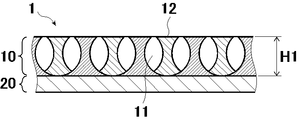
- FIG. 1 is a partial plan view schematically showing an example of the surface of a main coating film (coating film 10) formed by the present manufacturing method.
- FIG. 2 is a partial cross-sectional view schematically showing an example of a cross section of the base material with a coating film (base material 1 with a coating film). Specifically, the II-II line in FIG. It is a cross section when the attached substrate is cut.
- a plurality of recesses 11 and partition walls 12 partitioning the recesses 11 are formed on the surface of the coating film 10.
- the plurality of recesses 11 are regularly arranged along the surface of the coating film 10.
- a honeycomb structure in which one concave portion 11 is the center and the periphery thereof is surrounded by six adjacent concave portions is formed. That is, it can be said that the coating film 10 in FIG. 1 has a honeycomb structure.
- the case where one recess 11 has a honeycomb structure surrounded by six recesses adjacent to each other is shown, but one recess 11 may be surrounded by 3 to 5 recesses. It may be surrounded by one or more recesses.
- the recess 11 may or may not penetrate to the base material 20 (see FIG. 2 ).
- the diameter R1 of the opening of the recess 11 is preferably 0.001 to 10 ⁇ m, more preferably 0.005 to 5 ⁇ m, and particularly preferably 0.01 to 3 ⁇ m.
- the diameter R1 can be adjusted by, for example, the flow rate of air, the humidity at the time of dew condensation, the type of solvent contained in the paint, and the like.
- the shape of the opening is other than a perfect circle, it means the equivalent circle diameter calculated from the area of the opening.
- the partition wall 12 is a constituent member of the coating film 10 formed by the above-mentioned main coating material.
- the coating film 10 is formed on the surface of the base material 20.
- the recesses 11 are connected to other recesses adjacent to each other in the surface direction of the coating film 10 inside the coating film 10, but are not connected to the other recesses adjacent to each other so that each recess is independent. It may be divided by 12.
- the film thickness H1 of the coating film 10 is preferably 0.001 to 50 ⁇ m, more preferably 0.005 to 40 ⁇ m, and particularly preferably 0.01 to 30 ⁇ m. When the film thickness H1 is within the above range, the ability of the present coating film to suppress icing and snow is more excellent.
- the depth of the recess 11 may be the same as the film thickness H1.
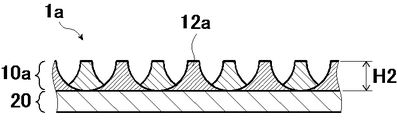
- the present manufacturing method may further include a step of dividing a coating film having a plurality of recesses in the thickness direction to form a coating film having a plurality of protrusions (pillar structure).
- the coating film having a plurality of protrusions formed on the substrate is excellent in the ability to suppress icing snow, like the coating film having a plurality of recesses.
- Specific examples of the method for dividing the coating film include a method in which an adhesive tape is attached to the surface of the coating film having a plurality of recesses and then peeled off, and a coating film having a plurality of recesses intersects the thickness direction (coating film And a method of scraping the surface of the coating film having a plurality of recesses.
- the base material 1a with a coating film of FIG. 3 has a base material 20 and a plurality of protrusions 12a forming the coating film 10a formed on the surface of the base material 20.
- the height H2 of the protrusion 12a is preferably 0.001 to 50 ⁇ m, more preferably 0.005 to 40 ⁇ m, and particularly preferably 0.01 to 30 ⁇ m. When the height H2 is within the above range, the ability of the present coating film to suppress icing and snow is more excellent.
- this coating film Since this coating film has an excellent ability to suppress frost and snow, it can be suitably used for articles such as buildings, aircraft, ships, railway vehicles, traffic signs, traffic lights, power lines, etc. that are to be placed in cold regions for a long time.
- the present coating film has a fine concave structure on the coating film surface and a stable arrangement of fluorine atoms, so that the friction coefficient of the coating film surface is controlled to be low.
- Engine cylinders, bearings, vehicle parts such as brakes and scratches, artificial joints, etc.) can also be preferably used.
- Example 21 Example 21, and Example 22 are examples, and Examples 10 to 12 are comparative examples. However, the present invention is not limited to these examples.
- the compounding quantity of each component in the table mentioned later shows a mass standard.
- CTFE Chlorotrifluoroethylene
- HBVE 4-hydroxybutyl vinyl ether
- CHVE Cyclohexyl vinyl ether
- Curing agent 1 Stabio D-370N (curing agent having two or more isocyanate groups in one molecule, Mitsui Chemicals, Inc. trade name)
- Curing agent 2 Laromer LR 9000 (curing agent having two or more isocyanate groups and acryloyloxy groups in one molecule, BASF trade name)
- Curing catalyst 10,000 times diluted solution of dibutyltin dilaurate
- Polymer B1 Fluorine-containing block copolymer having the following fluorine-containing segment and non-fluorine segment: Fluorine-containing segment: a segment composed of units based on perfluorohexylethyl methacrylate. Non-fluorine segment: a segment consisting of units based on hydroxyethyl methacrylate, units based on butyl methacrylate, and units based on methyl methacrylate.
- the content of the unit based on perfluorohexylethyl methacrylate, the unit based on hydroxyethyl methacrylate, the unit based on butyl methacrylate, and the unit based on methyl methacrylate is 10 mol% and 15 mol% in this order with respect to all the units contained in the polymer B1. 33 mol% and 42 mol%.
- ⁇ Production of Fluorine-Containing Nonblock Copolymer A1 (Polymer A1)> 50 mass% of xylene (503g), ethanol (142g), CTFE (387g), CHVE (326g), HBVE (84.9g), potassium carbonate (12.3g), and tert-butylperoxypivalate in an autoclave.
- a xylene solution (20 mL) was introduced, the temperature was raised, and polymerization was carried out at 65° C. for 11 hours. Then, the solution in the autoclave was filtered to obtain a solution containing the polymer A1 which was a fluorine-containing non-block copolymer, and then the solvent was removed to obtain a polymer A1.
- the polymer A1 was a polymer containing 50 mol%, 39 mol%, and 11 mol% of CTFE-based units, CHVE-based units, and HBVE-based units in this order with respect to all the units contained in the polymer A1. ..
- the hydroxyl value of the polymer A1 was 50 mgKOH/g, Tg was 52° C., and Mn was 10,000.
- Fluorine-based paints 1 to 12 were obtained by mixing the components described in the "Components of Fluorine-based paint” column in Table 1 below in the air using a rocking mill. Further, a fluorine-based coating material 21 was obtained in the same manner as in Example 3 of Table 1 except that the curing agent 1 was used instead of the curing agent 2. Further, a fluorine-based paint 22 was obtained in the same manner as in Example 3 of Table 1 except that the curing agent 1 was not added. In addition, in mixing each component, the polymer B1 was previously dissolved or dispersed uniformly in the coating solvent shown in Table 1, and then the components other than the above were mixed and used. The details of the blending amount of each component are shown in Table 1.
- test pieces 2 to 12, 21, and 22 were obtained in the same manner as in the case of producing the test piece 1. Each of the obtained test pieces 1 to 12, 21, and 22 was subjected to the following evaluations.
Landscapes
- Chemical & Material Sciences (AREA)
- Engineering & Computer Science (AREA)
- Materials Engineering (AREA)
- Organic Chemistry (AREA)
- Life Sciences & Earth Sciences (AREA)
- Wood Science & Technology (AREA)
- Combustion & Propulsion (AREA)
- Chemical Kinetics & Catalysis (AREA)
- Paints Or Removers (AREA)
- Application Of Or Painting With Fluid Materials (AREA)
- Materials Applied To Surfaces To Minimize Adherence Of Mist Or Water (AREA)
Abstract
着氷雪の抑制能に優れ、表面に複数の凹部を有する塗膜を簡便に形成できるフッ素系塗料及び塗膜付き基材の提供。 本発明のフッ素系塗料は、フルオロオレフィンに基づく単位を含む含フッ素非ブロック共重合体と、ペルフルオロアルキル基を有する単量体に基づく単位を含む含フッ素セグメント、及びフッ素原子を含まない非フッ素セグメントを有する含フッ素ブロック共重合体と、ハロゲン溶剤と、を含む。
Description
本発明は、フッ素系塗料及び塗膜付き基材の製造方法に関する。
物品に優れた撥水撥油性を付与する方法として、基材の表面に、含フッ素重合体及び有機溶剤を含む塗料の塗布層を形成し、塗布層から有機溶剤を蒸発させると同時に塗布層の表面で結露させ、結露により生じた水滴を蒸発させて、水滴に対応する複数の凹部(例えば、ハニカム構造)を有する撥水撥油膜を形成する方法が知られている(特許文献1)。
近年、着氷雪の抑制に優れた塗膜が求められている。具体的には、建築物、航空機、船舶、鉄道車両、交通標識、信号機、送電線等の物品が寒冷地で長期間配置又は使用された際に、物品の表面に着氷や着雪が生じる場合がある。その結果、航空機においては揚力の低下、鉄道車両においては車両に付着した雪の落下による事故、交通標識及び信号機においては情報伝達の妨げ、送電線においては断線や鉄塔の倒壊等の問題が発生する場合がある。
このような問題に対して、本発明者らは、特許文献1に記載の方法にてフッ素系塗料を用いた塗膜を形成したところ、フッ素系塗料の種類によっては、表面に複数の凹部を有する塗膜の形成が困難であるのを知見した。
このような問題に対して、本発明者らは、特許文献1に記載の方法にてフッ素系塗料を用いた塗膜を形成したところ、フッ素系塗料の種類によっては、表面に複数の凹部を有する塗膜の形成が困難であるのを知見した。
本発明は、上記課題に鑑みてなされ、着氷雪の抑制能に優れ、表面に複数の凹部を有する塗膜を簡便に形成できるフッ素系塗料及び塗膜付き基材の提供を課題とする。
本発明者らは、上記課題について鋭意検討した結果、含フッ素非ブロック共重合体と、含フッ素セグメント及び非フッ素セグメントを有する含フッ素ブロック共重合体と、ハロゲン溶剤と、を含むフッ素系塗料を用いれば、着氷雪の抑制能に優れ、表面に複数の凹部を有する塗膜を簡便に形成できるのを見出し、本発明に至った。
すなわち、発明者らは、以下の構成により上記課題が解決できることを見出した。
[1]フルオロオレフィンに基づく単位を含む含フッ素非ブロック共重合体と、ペルフルオロアルキル基を有する単量体に基づく単位を含む含フッ素セグメント、及びフッ素原子を含まない非フッ素セグメントを有する含フッ素ブロック共重合体と、ハロゲン溶剤と、を含むことを特徴とする、フッ素系塗料。
[2]上記含フッ素非ブロック共重合体に対する上記含フッ素ブロック共重合体の質量比が、0.0001~10である、[1]のフッ素系塗料。
[3]上記ハロゲン溶剤の含有量が、上記フッ素系塗料の全質量に対して、10~99.9質量%である、[1]又は[2]のフッ素系塗料。
[4]上記ハロゲン溶剤の沸点が15~100℃である、[1]~[3]のいずれかのフッ素系塗料。
[5]上記ハロゲン溶剤の表面張力が13.0~32.0mN/mである、[1]~[4]のいずれかのフッ素系塗料。
[6]上記含フッ素非ブロック共重合体及び上記含フッ素ブロック共重合体の合計含有量が、上記フッ素系塗料の全質量に対して0.01~10質量%である、[1]~[5]のいずれかのフッ素系塗料。
[7]上記含フッ素非ブロック共重合体が、更に、架橋性基を有する単位を含む、[1]~[6]のいずれかのフッ素系塗料。
[8]上記含フッ素ブロック共重合体が、架橋性基を有する単位、及びアルキル(メタ)アクリレートに基づく単位を含む、[1]~[7]のいずれかのフッ素系塗料。
[9]含フッ素非ブロック共重合体及び上記含フッ素ブロック共重合体がいずれも架橋性基を有する単位を含み、上記架橋性基がともに水酸基である、[1]~[8]のいずれかのフッ素系塗料。
[10]更に硬化剤を含む、[1]~[9]のいずれかのフッ素系塗料。
[11]上記硬化剤が、イソシアネート基を有する、[10]のフッ素系塗料。
[12]上記硬化剤が、(メタ)アクリロイルオキシ基を有する、[10]又は[11]のフッ素系塗料。
[13]固形分質量が前記フッ素系塗料の全質量に対して0.01~10質量%であって、該固形分質量に対するフッ素原子含有量が5~40質量%である、[1]~[12]のいずれかのフッ素系塗料。
[14]基材の表面に、[1]~[13]のいずれかのフッ素系塗料を塗布して塗布層を形成して、上記塗布層に含まれる上記ハロゲン溶剤の蒸発と、上記塗布層表面に結露による水滴の付着とを行った後、上記水滴を蒸発させて、表面に複数の凹部を有する塗膜を形成する、塗膜付き基材の製造方法。
[1]フルオロオレフィンに基づく単位を含む含フッ素非ブロック共重合体と、ペルフルオロアルキル基を有する単量体に基づく単位を含む含フッ素セグメント、及びフッ素原子を含まない非フッ素セグメントを有する含フッ素ブロック共重合体と、ハロゲン溶剤と、を含むことを特徴とする、フッ素系塗料。
[2]上記含フッ素非ブロック共重合体に対する上記含フッ素ブロック共重合体の質量比が、0.0001~10である、[1]のフッ素系塗料。
[3]上記ハロゲン溶剤の含有量が、上記フッ素系塗料の全質量に対して、10~99.9質量%である、[1]又は[2]のフッ素系塗料。
[4]上記ハロゲン溶剤の沸点が15~100℃である、[1]~[3]のいずれかのフッ素系塗料。
[5]上記ハロゲン溶剤の表面張力が13.0~32.0mN/mである、[1]~[4]のいずれかのフッ素系塗料。
[6]上記含フッ素非ブロック共重合体及び上記含フッ素ブロック共重合体の合計含有量が、上記フッ素系塗料の全質量に対して0.01~10質量%である、[1]~[5]のいずれかのフッ素系塗料。
[7]上記含フッ素非ブロック共重合体が、更に、架橋性基を有する単位を含む、[1]~[6]のいずれかのフッ素系塗料。
[8]上記含フッ素ブロック共重合体が、架橋性基を有する単位、及びアルキル(メタ)アクリレートに基づく単位を含む、[1]~[7]のいずれかのフッ素系塗料。
[9]含フッ素非ブロック共重合体及び上記含フッ素ブロック共重合体がいずれも架橋性基を有する単位を含み、上記架橋性基がともに水酸基である、[1]~[8]のいずれかのフッ素系塗料。
[10]更に硬化剤を含む、[1]~[9]のいずれかのフッ素系塗料。
[11]上記硬化剤が、イソシアネート基を有する、[10]のフッ素系塗料。
[12]上記硬化剤が、(メタ)アクリロイルオキシ基を有する、[10]又は[11]のフッ素系塗料。
[13]固形分質量が前記フッ素系塗料の全質量に対して0.01~10質量%であって、該固形分質量に対するフッ素原子含有量が5~40質量%である、[1]~[12]のいずれかのフッ素系塗料。
[14]基材の表面に、[1]~[13]のいずれかのフッ素系塗料を塗布して塗布層を形成して、上記塗布層に含まれる上記ハロゲン溶剤の蒸発と、上記塗布層表面に結露による水滴の付着とを行った後、上記水滴を蒸発させて、表面に複数の凹部を有する塗膜を形成する、塗膜付き基材の製造方法。
本発明によれば、着氷雪の抑制能に優れ、表面に複数の凹部を有する塗膜を簡便に形成できるフッ素系塗料及び塗膜付き基材を提供できる。
本発明における用語を以下に説明する。
(メタ)アクリレートとは、アクリレート及びメタクリレートの総称であり、(メタ)アクリルとは、アクリルとメタクリルの総称であり、(メタ)アクリロイルとは、アクリロイルとメタクリロイルの総称である。
単位とは、単量体が重合して直接形成された、上記単量体1分子に基づく原子団と、上記原子団の一部を化学変換して得られる原子団との総称である。なお、重合体が含む全単位に対する、それぞれの単位の含有量(モル%)は、重合体を核磁気共鳴スペクトル(NMR)法により分析して求められる。
酸価及び水酸基価は、それぞれ、JIS K 0070-3(1992)の方法に準じて測定される値である。
数平均分子量(Mn)及び重量平均分子量(Mw)は、ポリスチレンを標準物質としてゲルパーミエーションクロマトグラフィーで測定される値である。
ガラス転移温度(Tg)は、示差走査熱量測定(DSC)法で測定される中間点ガラス転移温度の値である。
(メタ)アクリレートとは、アクリレート及びメタクリレートの総称であり、(メタ)アクリルとは、アクリルとメタクリルの総称であり、(メタ)アクリロイルとは、アクリロイルとメタクリロイルの総称である。
単位とは、単量体が重合して直接形成された、上記単量体1分子に基づく原子団と、上記原子団の一部を化学変換して得られる原子団との総称である。なお、重合体が含む全単位に対する、それぞれの単位の含有量(モル%)は、重合体を核磁気共鳴スペクトル(NMR)法により分析して求められる。
酸価及び水酸基価は、それぞれ、JIS K 0070-3(1992)の方法に準じて測定される値である。
数平均分子量(Mn)及び重量平均分子量(Mw)は、ポリスチレンを標準物質としてゲルパーミエーションクロマトグラフィーで測定される値である。
ガラス転移温度(Tg)は、示差走査熱量測定(DSC)法で測定される中間点ガラス転移温度の値である。
含フッ素ブロック共重合体とは、含まれる単位の種類が異なるか、同じ種類の場合には単位の組成が異なる複数種のセグメントから構成され、かつ、少なくとも1つのセグメントがフッ素原子を含む高分子化合物を意味する。
含フッ素非ブロック共重合体とは、分子中にフッ素原子を含む高分子化合物であって、上記含フッ素ブロック共重合体以外の共重合体を意味し、具体例としては、異なる単位の結合順がランダム型又は交互型である重合体が挙げられる。
含フッ素非ブロック共重合体とは、分子中にフッ素原子を含む高分子化合物であって、上記含フッ素ブロック共重合体以外の共重合体を意味し、具体例としては、異なる単位の結合順がランダム型又は交互型である重合体が挙げられる。
フッ素原子含有量とは、フッ素系塗料が含む全固形分質量に対するフッ素原子の質量の割合(%)を意味する。フッ素原子含有量は、フッ素系塗料が含む固形分を、自動試料燃焼装置-イオンクロマト法(AQF-IC法)によって、下記条件にて測定して得られる。
<分析条件>
・自動試料燃焼装置
装置:三菱ケミカルアナリテック社製、自動試料燃焼装置AQF-100
燃焼条件:固体試料用モード
試料量:2~20mg
・イオンクロマトグラフ
装置:Thermo Fisher SCIENTIFIC社製
カラム:IonpacAG11HC+IonpacAS11HC
溶離液:KOH10mN(0-9min)、10-16mN(9-11min)、16mN(11-15min)、16-61mN(15-20min)、60mN(20-25min)
流速:1.0mL/分
サプレッサ:ASRS
検出器:電導度検出器
注入量:5μL
<分析条件>
・自動試料燃焼装置
装置:三菱ケミカルアナリテック社製、自動試料燃焼装置AQF-100
燃焼条件:固体試料用モード
試料量:2~20mg
・イオンクロマトグラフ
装置:Thermo Fisher SCIENTIFIC社製
カラム:IonpacAG11HC+IonpacAS11HC
溶離液:KOH10mN(0-9min)、10-16mN(9-11min)、16mN(11-15min)、16-61mN(15-20min)、60mN(20-25min)
流速:1.0mL/分
サプレッサ:ASRS
検出器:電導度検出器
注入量:5μL
塗料の固形分質量とは、塗料から溶媒を除去した質量である。なお、溶媒以外の塗料の固形分を構成する成分に関して、その性状が液体状であっても、固形分とみなす。なお、塗料の固形分質量は、塗料を130℃で20分加熱した後に残存する質量として求められる。
本発明のフッ素系塗料(以下、本塗料ともいう。)は、フルオロオレフィンに基づく単位を含む含フッ素非ブロック共重合体(以下、重合体Aともいう。)と、ペルフルオロアルキル基を有する単量体(以下、単量体B1ともいう。)に基づく単位を含む含フッ素セグメント(以下、セグメント1ともいう。)、及びフッ素原子を含まない非フッ素セグメント(以下、セグメント2ともいう。)を有する含フッ素ブロック共重合体(以下、重合体Bともいう。)と、ハロゲン溶剤と、を含む。
重合体Aと重合体Bとをまとめて、単に重合体ともいう。
また、本塗料から形成される塗膜を本塗膜ともいう。
重合体Aと重合体Bとをまとめて、単に重合体ともいう。
また、本塗料から形成される塗膜を本塗膜ともいう。
本塗料によれば、着氷雪の抑制能に優れ、表面に複数の凹部を有する塗膜を簡便に形成できる。すなわち、本塗料は、表面に複数の凹部を有する塗膜の形成に好適に使用される。この理由は必ずしも明確ではないが、以下のように考えられる。
本塗料は、特定の含フッ素非ブロック共重合体と、特定の含フッ素ブロック共重合体とを含む。本塗料から塗膜を形成する際には、含フッ素ブロック共重合体が有するペルフルオロアルキル基が塗膜表面に配向するとともに、上記ペルフルオロアルキル基のフッ素原子による影響が調整され、含フッ素非ブロック共重合体が含むフッ素原子が安定に配置されると考えられる。これにより、塗膜の硬度が良好になる結果、後述の結露を用いた本塗膜の製造方法により形成される凹部が壊れにくくなると考えられる。また、上記のようにフッ素原子が安定的に配置される結果、着氷雪の抑制能に優れた塗膜が形成できたと考えられる。
また、本塗料に含まれるハロゲン溶剤は、蒸発時の吸熱が大きく、塗膜形成時に塗膜中に残留しにくいので、後述の結露を用いた本塗膜の製造方法において、結露に対応する凹部の形成を阻害しにくいと考えられる。これにより、表面に複数の凹部を有する塗膜を形成でき、その結果、このような形状によって着氷雪が生じるのを抑制できたと考えられる。
このように、着氷雪の抑制能に優れ、表面に複数の凹部を有する塗膜を簡便に形成できるという効果は、特定の含フッ素非ブロック共重合体及び特定の含フッ素ブロック共重合体の併用による作用と、ハロゲン溶剤を用いた作用と、が相乗して発揮されたと推測される。
なお、「着氷雪の抑制能」とは、雪及び氷の少なくとも一方が塗膜に付着することを抑制できる性能を意味する。
本塗料は、特定の含フッ素非ブロック共重合体と、特定の含フッ素ブロック共重合体とを含む。本塗料から塗膜を形成する際には、含フッ素ブロック共重合体が有するペルフルオロアルキル基が塗膜表面に配向するとともに、上記ペルフルオロアルキル基のフッ素原子による影響が調整され、含フッ素非ブロック共重合体が含むフッ素原子が安定に配置されると考えられる。これにより、塗膜の硬度が良好になる結果、後述の結露を用いた本塗膜の製造方法により形成される凹部が壊れにくくなると考えられる。また、上記のようにフッ素原子が安定的に配置される結果、着氷雪の抑制能に優れた塗膜が形成できたと考えられる。
また、本塗料に含まれるハロゲン溶剤は、蒸発時の吸熱が大きく、塗膜形成時に塗膜中に残留しにくいので、後述の結露を用いた本塗膜の製造方法において、結露に対応する凹部の形成を阻害しにくいと考えられる。これにより、表面に複数の凹部を有する塗膜を形成でき、その結果、このような形状によって着氷雪が生じるのを抑制できたと考えられる。
このように、着氷雪の抑制能に優れ、表面に複数の凹部を有する塗膜を簡便に形成できるという効果は、特定の含フッ素非ブロック共重合体及び特定の含フッ素ブロック共重合体の併用による作用と、ハロゲン溶剤を用いた作用と、が相乗して発揮されたと推測される。
なお、「着氷雪の抑制能」とは、雪及び氷の少なくとも一方が塗膜に付着することを抑制できる性能を意味する。
以下、重合体Aに関して詳述する。
フルオロオレフィンは、水素原子の1以上がフッ素原子で置換されたオレフィンである。フルオロオレフィンは、フッ素原子で置換されていない水素原子の1以上が塩素原子で置換されていてもよい。フルオロオレフィンの炭素数としては、2~8が好ましく、2~4が特に好ましい。
フルオロオレフィンの例としては、CF2=CF2、CF2=CFCl、CF2=CHF、CH2=CF2、CF2=CFCF3、CF2=CHCF3、CF3-CH=CHF、CF3-CF=CH2が挙げられる。フルオロオレフィンとしては、本塗膜の耐候性の点から、CF2=CF2又はCF2=CFClが好ましい。フルオロオレフィンは、2種以上を併用してもよい。
フルオロオレフィンは、水素原子の1以上がフッ素原子で置換されたオレフィンである。フルオロオレフィンは、フッ素原子で置換されていない水素原子の1以上が塩素原子で置換されていてもよい。フルオロオレフィンの炭素数としては、2~8が好ましく、2~4が特に好ましい。
フルオロオレフィンの例としては、CF2=CF2、CF2=CFCl、CF2=CHF、CH2=CF2、CF2=CFCF3、CF2=CHCF3、CF3-CH=CHF、CF3-CF=CH2が挙げられる。フルオロオレフィンとしては、本塗膜の耐候性の点から、CF2=CF2又はCF2=CFClが好ましい。フルオロオレフィンは、2種以上を併用してもよい。
フルオロオレフィンに基づく単位の含有量は、重合体Aの分散安定性と、本塗膜の耐候性の点から、重合体Aが含む全単位に対して、20~70モル%が好ましく、30~60モル%がより好ましく、45~55モル%が特に好ましい。
重合体Aは、本塗料を後述の本塗膜の製造方法に適用した際に、塗膜の硬度が向上して、表面に形成される複数の凹部形状を保持しやすくなる点から、架橋性基を有する単位(以下、単位A1ともいう。)を含むことが好ましい。単位A1は、架橋性基を有する単量体(以下、単量体A1ともいう。)に基づく単位であってもよく、単位A1を含む含フッ素重合体の架橋性基を、異なる架橋性基に変換させて得られる単位であってもよい。このような単位としては、水酸基を有する単位を含む含フッ素重合体に、ポリカルボン酸やその酸無水物等を反応させて、水酸基の一部又は全部をカルボキシ基に変換させて得られる単位が挙げられる。
単量体A1が有する架橋性基としては、水酸基、カルボキシ基、アルコキシシリル基、エポキシ基又はアミノ基が好ましく、重合体Aの硬化性の点から、水酸基又はカルボキシ基が特に好ましい。
単量体A1が有する架橋性基としては、水酸基、カルボキシ基、アルコキシシリル基、エポキシ基又はアミノ基が好ましく、重合体Aの硬化性の点から、水酸基又はカルボキシ基が特に好ましい。
カルボキシ基を有する単量体としては、不飽和カルボン酸、(メタ)アクリル酸等が挙げられる。カルボキシ基を有する単量体は、式:X11-Y11で表される単量体(以下、単量体A11ともいう。)が好ましい。
水酸基を有する単量体の例示としては、アリルアルコール、又は、水酸基を有する、ビニルエーテル、ビニルエステル、アリルエーテル、アリルエステルもしくは(メタ)アクリレートが挙げられる。水酸基を有する単量体としては、アリルアルコール、又は式:X12-Y12で表される単量体(以下、単量体A12ともいう。)が好ましい。
単量体A1は、2種以上を併用してもよい。
水酸基を有する単量体の例示としては、アリルアルコール、又は、水酸基を有する、ビニルエーテル、ビニルエステル、アリルエーテル、アリルエステルもしくは(メタ)アクリレートが挙げられる。水酸基を有する単量体としては、アリルアルコール、又は式:X12-Y12で表される単量体(以下、単量体A12ともいう。)が好ましい。
単量体A1は、2種以上を併用してもよい。
式中の記号は、以下の意味を示す。
X11は、CH2=CH-、CH(CH3)=CH-又はCH2=C(CH3)-であり、CH2=CH-又はCH(CH3)=CH-が好ましい。
Y11は、カルボキシ基又はカルボキシ基を有する炭素数1~12の1価の飽和炭化水素基であり、カルボキシ基又は炭素数1~10のカルボキシアルキル基が好ましい。
X12は、CH2=CHO-、CH2=CHCH2O-、CH2=CHCOO-又はCH2=C(CH3)COO-である。
Y12は、水酸基を有する炭素数2~12の1価の飽和炭化水素基である。1価の飽和炭化水素基は、直鎖状であってもよく分岐鎖状であってもよい。また、1価の飽和炭化水素基は、環構造からなっていてもよく、環構造を含んでいてもよい。
1価の飽和炭化水素基は、炭素数2~6のアルキル基又は炭素数6~8のシクロアルキレン基を含むアルキル基が好ましい。
X11は、CH2=CH-、CH(CH3)=CH-又はCH2=C(CH3)-であり、CH2=CH-又はCH(CH3)=CH-が好ましい。
Y11は、カルボキシ基又はカルボキシ基を有する炭素数1~12の1価の飽和炭化水素基であり、カルボキシ基又は炭素数1~10のカルボキシアルキル基が好ましい。
X12は、CH2=CHO-、CH2=CHCH2O-、CH2=CHCOO-又はCH2=C(CH3)COO-である。
Y12は、水酸基を有する炭素数2~12の1価の飽和炭化水素基である。1価の飽和炭化水素基は、直鎖状であってもよく分岐鎖状であってもよい。また、1価の飽和炭化水素基は、環構造からなっていてもよく、環構造を含んでいてもよい。
1価の飽和炭化水素基は、炭素数2~6のアルキル基又は炭素数6~8のシクロアルキレン基を含むアルキル基が好ましい。
単量体A11の具体例としては、CH2=CHCOOH、CH(CH3)=CHCOOH、CH2=C(CH3)COOH、CH2=CH(CH2)n2COOHで表される化合物(ただし、n2は1~10の整数を示す。)が挙げられる。
単量体A12の具体例としては、CH2=CHO-CH2-cycloC6H10-CH2OH、CH2=CHCH2O-CH2-cycloC6H10-CH2OH、CH2=CHOCH2CH2OH、CH2=CHCH2OCH2CH2OH、CH2=CHOCH2CH2CH2CH2OH、CH2=CHCH2OCH2CH2CH2CH2OH、CH2=CHCOOCH2CH2OH、CH2=C(CH3)COOCH2CH2OHが挙げられる。なお、「-cycloC6H10-」はシクロへキシレン基を表し、「-cycloC6H10-」の結合部位は、通常1,4-である。
単量体A12の具体例としては、CH2=CHO-CH2-cycloC6H10-CH2OH、CH2=CHCH2O-CH2-cycloC6H10-CH2OH、CH2=CHOCH2CH2OH、CH2=CHCH2OCH2CH2OH、CH2=CHOCH2CH2CH2CH2OH、CH2=CHCH2OCH2CH2CH2CH2OH、CH2=CHCOOCH2CH2OH、CH2=C(CH3)COOCH2CH2OHが挙げられる。なお、「-cycloC6H10-」はシクロへキシレン基を表し、「-cycloC6H10-」の結合部位は、通常1,4-である。
重合体Aが硬化剤を含む場合、単位A1の架橋性基が架橋点となって、重合体A同士、重合体B同士、及び重合体Aと重合体Bと間の架橋反応が硬化剤によって進行し、本塗膜の硬度が好適となるので、表面に形成される複数の凹部形状を保持しやすくなる。
単位A1の含有量は、重合体Aが含む全単位に対して、0.5~35モル%が好ましく、3~25モル%がより好ましく、5~20モル%が更に好ましく、5~15モル%が特に好ましい。
単位A1の含有量は、重合体Aが含む全単位に対して、0.5~35モル%が好ましく、3~25モル%がより好ましく、5~20モル%が更に好ましく、5~15モル%が特に好ましい。
重合体Aは、本塗膜の柔軟性の点から、単位F及び単位A1以外の単位(以下、単位A2ともいう。)を更に含んでいてもよい。単位A2としては、架橋性基及びフッ素原子を含まない、ビニルエーテル、ビニルエステル、アリルエーテル、アリルエステル、(メタ)アクリレート等に基づく単位が挙げられる。
単位A2は、式:X2-Z2で表される単量体(以下、単量体A2ともいう。)に基づく単位が好ましい。
X2は、CH2=CHC(O)O-、CH2=C(CH3)C(O)O-、CH2=CHOC(O)-、CH2=CHCH2OC(O)-、CH2=CHO-又はCH2=CHCH2O-であり、本塗膜の耐候性に優れる点から、CH2=CHOC(O)-、CH2=CHCH2OC(O)-、CH2=CHO-又はCH2=CHCH2O-が好ましい。
単位A2は、式:X2-Z2で表される単量体(以下、単量体A2ともいう。)に基づく単位が好ましい。
X2は、CH2=CHC(O)O-、CH2=C(CH3)C(O)O-、CH2=CHOC(O)-、CH2=CHCH2OC(O)-、CH2=CHO-又はCH2=CHCH2O-であり、本塗膜の耐候性に優れる点から、CH2=CHOC(O)-、CH2=CHCH2OC(O)-、CH2=CHO-又はCH2=CHCH2O-が好ましい。
Z2は炭素数1~24の1価の炭化水素基である。1価の炭化水素基は、直鎖状であってもよく分岐鎖状であってもよい。また、1価の炭化水素基は、環構造からなっていてもよく、環構造を含んでいてもよい。また、1価の炭化水素基は、1価の飽和炭化水素基であってもよく1価の不飽和炭化水素基であってもよい。
1価の炭化水素基は、アルキル基、シクロアルキル基、アリール基又はアラルキル基が好ましく、炭素数2~12のアルキル基、炭素数6~10のシクロアルキル基、炭素数6~10のアリール基又は炭素数7~12のアラルキル基が特に好ましい。
アルキル基の具体例としては、メチル基、エチル基、tert-ブチル基、ヘキシル基、ノニル基、デシル基、ドデシル基が挙げられる。
シクロアルキル基の具体例としては、シクロヘキシル基が挙げられる。
アラルキル基の具体例としては、ベンジル基が挙げられる。
アリール基の具体例としては、フェニル基、ナフチル基が挙げられる。
1価の炭化水素基は、アルキル基、シクロアルキル基、アリール基又はアラルキル基が好ましく、炭素数2~12のアルキル基、炭素数6~10のシクロアルキル基、炭素数6~10のアリール基又は炭素数7~12のアラルキル基が特に好ましい。
アルキル基の具体例としては、メチル基、エチル基、tert-ブチル基、ヘキシル基、ノニル基、デシル基、ドデシル基が挙げられる。
シクロアルキル基の具体例としては、シクロヘキシル基が挙げられる。
アラルキル基の具体例としては、ベンジル基が挙げられる。
アリール基の具体例としては、フェニル基、ナフチル基が挙げられる。
単量体A2は、2種以上を併用してもよい。
単量体A2の具体例としては、エチルビニルエーテル、イソブチルビニルエーテル、tert-ブチルビニルエーテル、2-エチルヘキシルビニルエーテル、シクロヘキシルビニルエーテル、酢酸ビニル、ピバル酸ビニル、ネオノナン酸ビニル(HEXION社商品名「ベオバ9」等)、ネオデカン酸ビニル(HEXION社商品名「ベオバ10」等)、安息香酸ビニル、メチル(メタ)アクリレート、tert-ブチル(メタ)アクリレート、2-エチルヘキシル(メタ)アクリレート、ベンジル(メタ)アクリレートが挙げられる。
重合体Aが単位A2を含む場合、単位A2の含有量は、重合体Aが含む全単位に対して、1~70モル%が好ましく、10~50モル%が特に好ましい。
単量体A2の具体例としては、エチルビニルエーテル、イソブチルビニルエーテル、tert-ブチルビニルエーテル、2-エチルヘキシルビニルエーテル、シクロヘキシルビニルエーテル、酢酸ビニル、ピバル酸ビニル、ネオノナン酸ビニル(HEXION社商品名「ベオバ9」等)、ネオデカン酸ビニル(HEXION社商品名「ベオバ10」等)、安息香酸ビニル、メチル(メタ)アクリレート、tert-ブチル(メタ)アクリレート、2-エチルヘキシル(メタ)アクリレート、ベンジル(メタ)アクリレートが挙げられる。
重合体Aが単位A2を含む場合、単位A2の含有量は、重合体Aが含む全単位に対して、1~70モル%が好ましく、10~50モル%が特に好ましい。
重合体Aは、重合体Aが含む全単位に対して、単位Fと単位A1と単位A2とを、この順に20~70モル%、0.5~35モル%、1~70モル%含むのが好ましく、単位Fと単位A1と単位A2からなるのが特に好ましい。
重合体AのTgは、本塗膜の硬度の点から、25~120℃が好ましく、30~100℃がより好ましい。
重合体AのMnは、本塗膜の耐衝撃性の点から、3,000~30,000が好ましく、5,000~20,000がより好ましく、8,000~18,000が特に好ましい。
重合体AのTgは、本塗膜の硬度の点から、25~120℃が好ましく、30~100℃がより好ましい。
重合体AのMnは、本塗膜の耐衝撃性の点から、3,000~30,000が好ましく、5,000~20,000がより好ましく、8,000~18,000が特に好ましい。
重合体Aがカルボキシ基を含む重合体である場合、重合体Aの酸価は、塗膜の硬度が向上して、表面に形成される複数の凹部形状を保持しやすくなる点から、1~150mgKOH/gが好ましく、3~100mgKOH/gがより好ましく、10~60mgKOH/gが特に好ましい。
重合体Aが水酸基を含む重合体である場合、重合体Aの水酸基価は、塗膜の硬度が向上して、表面に形成される複数の凹部形状を保持しやすくなる点から、1~150mgKOH/gが好ましく、3~100mgKOH/gがより好ましく、10~60mgKOH/gが特に好ましい。
重合体Aは、水酸基価又は酸価のどちらか一方のみを有してもよく、両方を有してもよい。
重合体Aが水酸基を含む重合体である場合、重合体Aの水酸基価は、塗膜の硬度が向上して、表面に形成される複数の凹部形状を保持しやすくなる点から、1~150mgKOH/gが好ましく、3~100mgKOH/gがより好ましく、10~60mgKOH/gが特に好ましい。
重合体Aは、水酸基価又は酸価のどちらか一方のみを有してもよく、両方を有してもよい。
重合体Aの含有量は、本塗膜の耐候性の点から、本塗料の全固形分質量に対して、20~95質量%が好ましく、30~90質量%が特に好ましい。
重合体Aは、2種以上を併用してもよい。
重合体Aは、公知の方法で製造することができる。重合体Aは、例えば、重合溶媒、重合開始剤の存在下で、上述の単量体を重合させて得られる。重合体Aの製造においては、必要に応じて、光安定剤、pH調整剤等を添加してもよい。
重合体Aは、2種以上を併用してもよい。
重合体Aは、公知の方法で製造することができる。重合体Aは、例えば、重合溶媒、重合開始剤の存在下で、上述の単量体を重合させて得られる。重合体Aの製造においては、必要に応じて、光安定剤、pH調整剤等を添加してもよい。
以下、重合体Bに関して詳述する。
セグメント1は、単量体B1の単独重合体、2種以上の単量体B1の共重合体、又は、少なくとも1種の単量体B1と少なくとも1種の非フッ素系単量体の共重合体で構成されることが好ましく、単量体B1の単独重合体又は2種以上の単量体B1の共重合体で構成されることがより好ましく、単量体B1の単独重合体で構成されることが特に好ましい。
単量体B1としては、式:X3-L3-RFで表される単量体(以下、単量体B11ともいう。)が好ましい。
X3は、CH2=C(R1)C(O)O-、CH2=C(R1)OCO-、CH2=CHO-又はCH2=CHCH2O-である。上記R1は、水素原子、メチル基、フッ素原子、又は、塩素原子である。
L3は、単結合又は2価の連結基である。2価の連結基としては、2価の炭化水素基が好ましく、2価の脂肪族炭化水素基がより好ましく、2価のアルキレン基が特に好ましい。2価の炭化水素基の炭素数は、1~10が好ましく、1~5が特に好ましい。2価の炭化水素基は直鎖状であっても分岐鎖状であってもよい。また、2価の炭化水素基は、環構造からなっていてもよく、環構造を含んでいてもよい。上記環構造は、芳香環であってもよい。また、2価の連結基は、2価の炭化水素基と、-O-と、を組み合わせた基であってもよい。
RFは、ペルフルオロアルキル基である。ペルフルオロアルキル基の炭素数は、本塗膜の防汚性の点から、1~30が好ましく、1~6が特に好ましい。ペルフルオロアルキル基は、直鎖状であっても分岐鎖状であってもよい。
セグメント1は、単量体B1の単独重合体、2種以上の単量体B1の共重合体、又は、少なくとも1種の単量体B1と少なくとも1種の非フッ素系単量体の共重合体で構成されることが好ましく、単量体B1の単独重合体又は2種以上の単量体B1の共重合体で構成されることがより好ましく、単量体B1の単独重合体で構成されることが特に好ましい。
単量体B1としては、式:X3-L3-RFで表される単量体(以下、単量体B11ともいう。)が好ましい。
X3は、CH2=C(R1)C(O)O-、CH2=C(R1)OCO-、CH2=CHO-又はCH2=CHCH2O-である。上記R1は、水素原子、メチル基、フッ素原子、又は、塩素原子である。
L3は、単結合又は2価の連結基である。2価の連結基としては、2価の炭化水素基が好ましく、2価の脂肪族炭化水素基がより好ましく、2価のアルキレン基が特に好ましい。2価の炭化水素基の炭素数は、1~10が好ましく、1~5が特に好ましい。2価の炭化水素基は直鎖状であっても分岐鎖状であってもよい。また、2価の炭化水素基は、環構造からなっていてもよく、環構造を含んでいてもよい。上記環構造は、芳香環であってもよい。また、2価の連結基は、2価の炭化水素基と、-O-と、を組み合わせた基であってもよい。
RFは、ペルフルオロアルキル基である。ペルフルオロアルキル基の炭素数は、本塗膜の防汚性の点から、1~30が好ましく、1~6が特に好ましい。ペルフルオロアルキル基は、直鎖状であっても分岐鎖状であってもよい。
単量体B11の具体例としては、CH2=C(R1)C(O)O(CH2)2(CF2)6F、CH2=C(R1)C(O)O(CH2)2(CF2)8F、CH2=C(R1)C(O)O(CH2)2(CF2)10F、CH2=C(R1)C(O)O(CH2)2(CF2)6CF(CF3)2、CH2=C(R1)C(O)O(CH2)2(CF2)8CF(CF3)2、CH2=C(R1)OCOCH2-Ph-O-(CF2)8F(-Ph-は置換基を有してもよいフェニレン基を表す。)が挙げられる。
なお、上記式中、R1の定義は上述の通りである。
なお、上記式中、R1の定義は上述の通りである。
セグメント1は、重合体Aとの相溶性の点から、フッ素原子を含まない非フッ素系単量体(以下、単量体B2ともいう。)に基づく単位を有していてもよい。
単量体B2としては、炭素数12~20のアルキル基を有するアルキル(メタ)アクリレート(以下、単量体B22ともいう。)が好ましい。
単量体B22の具体例としては、ドデシル(メタ)アクリレート、トリデシル(メタ)アクリレート、テトラデシル(メタ)アクリレート、ペンタデシル(メタ)アクリレート、ヘキサデシル(メタ)アクリレート、オクタデシル(メタ)アクリレート、ベヘニル(メタ)アクリレートが挙げられる。
単量体B2としては、炭素数12~20のアルキル基を有するアルキル(メタ)アクリレート(以下、単量体B22ともいう。)が好ましい。
単量体B22の具体例としては、ドデシル(メタ)アクリレート、トリデシル(メタ)アクリレート、テトラデシル(メタ)アクリレート、ペンタデシル(メタ)アクリレート、ヘキサデシル(メタ)アクリレート、オクタデシル(メタ)アクリレート、ベヘニル(メタ)アクリレートが挙げられる。
重合体Bにおける、セグメント1を構成する単位の含有量は、重合体Bを本塗膜の撥水性の点から、重合体Bが含む全単位に対して、2~40モル%が好ましく、3~20モル%がより好ましく、5~15モル%が特に好ましい。
セグメント1における単位B1の含有量は、本塗膜の撥水性の点から、セグメント1が含む全単位に対して、80モル%以上が好ましく、85モル%以上がより好ましく、95モル%以上が特に好ましい。
セグメント1における単位B1の含有量は、本塗膜の撥水性の点から、セグメント1が含む全単位に対して、80モル%以上が好ましく、85モル%以上がより好ましく、95モル%以上が特に好ましい。
セグメント2は、フッ素原子を含まなければよく、重合体Bが本塗膜表面に保持されやすい点から、単量体B2の単独重合体、又は、2種以上の単量体B2の共重合体で構成されるのが好ましい。
単量体B2としては、式:X4-Y4で表される単量体(以下、単量体B21ともいう。)が好ましい。
X4は、CH2=CHC(O)O-又はCH2=C(CH3)C(O)O-である。
Y4は、炭素数1~22のアルキル基もしくは置換アルキル基、炭素数3~15のシクロアルキル基もしくは置換シクロアルキル基、又は、フェニル基もしくは置換フェニル基である。
置換基の具体例としては、炭素数1~10のアルキル基、水酸基、エステル基、ケトン基、アミノ基、アミド基、イミド基、ニトロ基、カルボン酸基、チオール基、エーテル基が挙げられる。
単量体B2としては、式:X4-Y4で表される単量体(以下、単量体B21ともいう。)が好ましい。
X4は、CH2=CHC(O)O-又はCH2=C(CH3)C(O)O-である。
Y4は、炭素数1~22のアルキル基もしくは置換アルキル基、炭素数3~15のシクロアルキル基もしくは置換シクロアルキル基、又は、フェニル基もしくは置換フェニル基である。
置換基の具体例としては、炭素数1~10のアルキル基、水酸基、エステル基、ケトン基、アミノ基、アミド基、イミド基、ニトロ基、カルボン酸基、チオール基、エーテル基が挙げられる。
単量体B21の具体例としては、アルキル(メタ)アクリレート(メチル(メタ)アクリレート、エチル(メタ)アクリレート、n-プロピル(メタ)アクリレート、イソプロピル(メタ)アクリレート、n-ブチル(メタ)アクリレート、イソブチル(メタ)アクリレート、n-ペンチル(メタ)アクリレート、n-ヘキシル(メタ)アクリレート、ベヘニル(メタ)アクリレート、2-エチルヘキシル(メタ)アクリレート、シクロヘキシル(メタ)アクリレート、ベンジル(メタ)アクリレート等)、水酸基含有(メタ)アクリレート(ヒドロキシエチル(メタ)アクリレート、ジエチレングリコールモノ(メタ)アクリレート、ポリエチレングリコールモノ(メタ)アクリレート、ヒドロキシプロピル(メタ)アクリレート、ジプロピレングリコールモノ(メタ)アクリレート等)、グリシジル(メタ)アクリレート、含窒素(メタ)アクリレート(ジメチルアミノエチル(メタ)アクリレート、ジエチルアミノエチル(メタ)アクリレート、4-(メタ)アクリロイルオキシ-2,2,6,6-テトラメチルピペリジン、4-(メタ)アクリロイルアミノ-2,2,6,6-テトラメチルピペリジン等)が挙げられる。
単量体B2としては、上述した中でも、本塗膜の撥水性が持続する点から、アルキル(メタ)アクリレートが好ましい。
単量体B2としては、上述した中でも、本塗膜の撥水性が持続する点から、アルキル(メタ)アクリレートが好ましい。
セグメント2は、本塗料を後述の本塗膜の製造方法に適用した際に、塗膜の硬度が向上して、表面に形成される複数の凹部形状を保持しやすくなる点から、架橋性基を有するのが好ましい。つまり、セグメント2は、架橋性基を有する単位を含むのが好ましい。架橋性基の具体例及び好適態様は、単量体A1で説明した架橋性基の具体例及び好適態様と同じである。
架橋性基を有する単位としては、先に水酸基含有(メタ)アクリレートとして例示した化合物等の水酸基含有ビニル単量体に基づく単位が好ましい。
架橋性基を有する単位としては、先に水酸基含有(メタ)アクリレートとして例示した化合物等の水酸基含有ビニル単量体に基づく単位が好ましい。
セグメント2としては、アルキル(メタ)アクリレートに基づく単位とヒドロキシアルキル(メタ)アクリレートに基づく単位とからなるセグメントが好ましく、メチル(メタ)アクリレートに基づく単位と、ブチル(メタ)アクリレートに基づく単位と、ヒドロキシエチル(メタ)アクリレートに基づく単位とからなるセグメント、又は、ヒドロキシエチル(メタ)アクリレートに基づく単位とオクタデシル(メタ)アクリレートに基づく単位とからなるセグメントが好ましい。
重合体B中における、セグメント2を構成する単位の含有量は、重合体Bが含む全単位に対して、60~98モル%が好ましく、80~97モル%がより好ましく、85~95モル%が特に好ましい。
重合体Bにおける架橋性基を有する単位の含有量は、本塗料を後述の本塗膜の製造方法に適用した際に、塗膜の硬度が向上して、表面に形成される複数の凹部形状を保持しやすくなる点から、重合体Bが含む全単位に対して、1~25モル%が好ましく、5~20モル%が特に好ましい。
重合体Bにおける架橋性基を有する単位の含有量は、本塗料を後述の本塗膜の製造方法に適用した際に、塗膜の硬度が向上して、表面に形成される複数の凹部形状を保持しやすくなる点から、重合体Bが含む全単位に対して、1~25モル%が好ましく、5~20モル%が特に好ましい。
重合体Bが水酸基価を有する場合、重合体Bの水酸基価は、本塗料を後述の本塗膜の製造方法に適用した際に、塗膜の硬度が向上して、表面に形成される複数の凹部形状を保持しやすくなる点から、10~100mgKOH/gが好ましく、15~90mgKOH/gがより好ましく、30~70mgKOH/gが特に好ましい。
重合体BのMnは、本塗膜の柔軟性の点から、5,000~1,000,000が好ましく、10,000~300,000がより好ましく、10,000~100,000が特に好ましい。
重合体BのMnは、本塗膜の柔軟性の点から、5,000~1,000,000が好ましく、10,000~300,000がより好ましく、10,000~100,000が特に好ましい。
重合体Bは、2種以上を併用してもよい。
重合体Bの具体例としては、モディパーF206、モディパーF246、モディパーF906、モディパーF3636、モディパーF226、モディパーF606(以上、全て日油社商品)が挙げられる。
重合体Bの具体例としては、モディパーF206、モディパーF246、モディパーF906、モディパーF3636、モディパーF226、モディパーF606(以上、全て日油社商品)が挙げられる。
重合体Aと重合体Bとの好適な組み合わせとしては、重合体A及び重合体Bがいずれも架橋性基を有する単位を含み、架橋性基がともに水酸基である態様が挙げられる。本態様によれば、本塗料を後述の本塗膜の製造方法に適用した際に、塗膜の硬度が向上して、表面に形成される複数の凹部形状を保持しやすくなる。
重合体Aの全質量に対する重合体Bの質量比は、本塗膜の着氷雪の抑制能がより優れる点から、0.0001~10が好ましく、0.001~1がより好ましく、0.01~0.1が更に好ましく、0.02~0.09が特に好ましい。
本塗料の全質量に対する、重合体Aと重合体Bとの合計含有量は、塗膜表面に凹部形状を形成しやすい点から、0.01~10質量%が好ましく、1~9質量%がより好ましく、5~8質量%が特に好ましい。
本塗料の全質量に対する、重合体Aと重合体Bとの合計含有量は、塗膜表面に凹部形状を形成しやすい点から、0.01~10質量%が好ましく、1~9質量%がより好ましく、5~8質量%が特に好ましい。
本塗料は、塗料溶媒として、ハロゲン溶剤を含む。ハロゲン溶剤とは、ハロゲン原子を含む有機溶剤を意味する。
ハロゲン溶剤の具体例としては、ペルフルオロベンゼン(沸点:81℃)、1,1,2-トリクロロ-1,2,2-トリフルオロエタン(沸点:48℃)、クロロホルム(沸点:61℃、表面張力:27.2mN/m)、HCFO-1233yd(Z)(沸点:54℃、表面張力:22.4mN/m、(Z)-1-クロロ-2,3,3-トリフルオロプロペン)、HCFO-1437dycc(沸点:89℃)、CFO-1214ya(沸点:46℃、表面張力:16.0mN/m、1,1-ジクロロ-2,3,3,3-テトラフルオロプロペン)、HCFO-1224yd(Z)(沸点:14℃、表面張力:16.0mN/m、(Z)-1-クロロ-2,3,3,3-テトラフルオロプロペン)、HCFO-1233zd(Z)(沸点:40℃、表面張力:18.6mN/m、(Z)-1-クロロ-3,3,3-トリフルオロプロペン)、HCFO-1233zd(E)(沸点:19℃、(E)-1-クロロ-3,3,3-トリフルオロプロペン)、HCFO-1223yd(沸点:58℃、表面張力:18.8mN/m、1,3-ジクロロ-2,3,3-トリフルオロプロペン)、CFO-1213ya(沸点:85℃、表面張力:21.8mN/m、1,1,3-トリクロロ-2,3,3-トリフルオロプロペン)、HCFC-225(沸点:54℃、表面張力:16.2mN/m、ジクロロペンタフルオロプロパン)、HCFC-141b(沸点:32℃、表面張力:18.4mN/m、1,1-ジクロロ-1-フルオロエタンフルオロカーボン)、CHF2CF2OCH2CF3(沸点:56℃、表面張力:16.4mN/m)、CH3CH2CH2Br(沸点:71℃、表面張力:25.9mN/m)、アサヒクリン AC-6000(AGC社製、沸点:115℃、表面張力:15.5mN/m)、アサヒクリン AC-2000(AGC社製、沸点:71℃、表面張力:13.4mN/m)、AMOLEA AT1(AGC社製、沸点:42℃)、AMOLEA AT2(AGC社製、沸点:44℃)、ノベック 71DE(3M社製、沸点:41℃、表面張力:16.6mN/m)、ノベック 72DE(3M社製、沸点:43℃、表面張力:19.0mN/m)、ノベック 73DE(3M社製、沸点:48℃、表面張力:19.9mN/m)、ノベック HFE-7100(3M社製、沸点:61℃、表面張力:13.6mN/m)、ノベック HFE-7200(3M社製、沸点:76℃、表面張力:13.6mN/m)、フロリナート FC-72(3M社製、沸点:56℃、表面張力:12.0mN/m)、フロリナート FC-770(3M社製、沸点:95℃、表面張力:14.8mN/m)、フロリナート FC-3283(3M社製、沸点:128℃、表面張力:16.0mN/m)、フロリナート FC-40(3M社製、沸点:155℃、表面張力:16.0mN/m)、ガルデン HT70(Solvey社製、沸点:70℃、表面張力:14.0mN/m)、ガルデン HT90(Solvey社製、沸点:90℃、表面張力:16.0mN/m)、ガルデン HT110(Solvey社製、沸点:110℃、表面張力:16.0mN/m)、ガルデン HT135(Solvey社製、沸点:135℃、表面張力:17.0mN/m)、ガルデン HT200(Solvey社製、沸点:200℃、表面張力:18.0mN/m)、ガルデン HT270(Solvey社製、沸点:270℃、表面張力:20.0mN/m)、Vertrel-XF(Dupont社製、沸点:55℃、表面張力:14.1mN/m)、バートレルサイオン(Chemours社製、沸点:47℃)、トリクロロエチレン(沸点:87℃、表面張力:29.5mN/m)、パークロロエチレン(沸点:121℃、表面張力:32.3mN/m)、塩化メチレン(沸点:40℃、表面張力:27.9mN/m)が挙げられる。
ハロゲン溶剤の具体例としては、ペルフルオロベンゼン(沸点:81℃)、1,1,2-トリクロロ-1,2,2-トリフルオロエタン(沸点:48℃)、クロロホルム(沸点:61℃、表面張力:27.2mN/m)、HCFO-1233yd(Z)(沸点:54℃、表面張力:22.4mN/m、(Z)-1-クロロ-2,3,3-トリフルオロプロペン)、HCFO-1437dycc(沸点:89℃)、CFO-1214ya(沸点:46℃、表面張力:16.0mN/m、1,1-ジクロロ-2,3,3,3-テトラフルオロプロペン)、HCFO-1224yd(Z)(沸点:14℃、表面張力:16.0mN/m、(Z)-1-クロロ-2,3,3,3-テトラフルオロプロペン)、HCFO-1233zd(Z)(沸点:40℃、表面張力:18.6mN/m、(Z)-1-クロロ-3,3,3-トリフルオロプロペン)、HCFO-1233zd(E)(沸点:19℃、(E)-1-クロロ-3,3,3-トリフルオロプロペン)、HCFO-1223yd(沸点:58℃、表面張力:18.8mN/m、1,3-ジクロロ-2,3,3-トリフルオロプロペン)、CFO-1213ya(沸点:85℃、表面張力:21.8mN/m、1,1,3-トリクロロ-2,3,3-トリフルオロプロペン)、HCFC-225(沸点:54℃、表面張力:16.2mN/m、ジクロロペンタフルオロプロパン)、HCFC-141b(沸点:32℃、表面張力:18.4mN/m、1,1-ジクロロ-1-フルオロエタンフルオロカーボン)、CHF2CF2OCH2CF3(沸点:56℃、表面張力:16.4mN/m)、CH3CH2CH2Br(沸点:71℃、表面張力:25.9mN/m)、アサヒクリン AC-6000(AGC社製、沸点:115℃、表面張力:15.5mN/m)、アサヒクリン AC-2000(AGC社製、沸点:71℃、表面張力:13.4mN/m)、AMOLEA AT1(AGC社製、沸点:42℃)、AMOLEA AT2(AGC社製、沸点:44℃)、ノベック 71DE(3M社製、沸点:41℃、表面張力:16.6mN/m)、ノベック 72DE(3M社製、沸点:43℃、表面張力:19.0mN/m)、ノベック 73DE(3M社製、沸点:48℃、表面張力:19.9mN/m)、ノベック HFE-7100(3M社製、沸点:61℃、表面張力:13.6mN/m)、ノベック HFE-7200(3M社製、沸点:76℃、表面張力:13.6mN/m)、フロリナート FC-72(3M社製、沸点:56℃、表面張力:12.0mN/m)、フロリナート FC-770(3M社製、沸点:95℃、表面張力:14.8mN/m)、フロリナート FC-3283(3M社製、沸点:128℃、表面張力:16.0mN/m)、フロリナート FC-40(3M社製、沸点:155℃、表面張力:16.0mN/m)、ガルデン HT70(Solvey社製、沸点:70℃、表面張力:14.0mN/m)、ガルデン HT90(Solvey社製、沸点:90℃、表面張力:16.0mN/m)、ガルデン HT110(Solvey社製、沸点:110℃、表面張力:16.0mN/m)、ガルデン HT135(Solvey社製、沸点:135℃、表面張力:17.0mN/m)、ガルデン HT200(Solvey社製、沸点:200℃、表面張力:18.0mN/m)、ガルデン HT270(Solvey社製、沸点:270℃、表面張力:20.0mN/m)、Vertrel-XF(Dupont社製、沸点:55℃、表面張力:14.1mN/m)、バートレルサイオン(Chemours社製、沸点:47℃)、トリクロロエチレン(沸点:87℃、表面張力:29.5mN/m)、パークロロエチレン(沸点:121℃、表面張力:32.3mN/m)、塩化メチレン(沸点:40℃、表面張力:27.9mN/m)が挙げられる。
ハロゲン溶剤の沸点は、15~100℃が好ましく、20~80℃が特に好ましい。なお、ハロゲン溶剤の沸点は、特に断りのない限り、標準沸点を意味する。
ハロゲン溶剤の表面張力は、13.0~32.0mN/mが好ましく、15.0~30.0mN/mが特に好ましい。
ハロゲン溶剤の沸点又は表面張力が上記範囲内にあれば、本塗料を後述の本塗膜の製造方法に適用した際に、凹部がより規則的に形成されやすくなって、着氷雪の抑制能がより向上する。
ハロゲン溶剤の表面張力は、13.0~32.0mN/mが好ましく、15.0~30.0mN/mが特に好ましい。
ハロゲン溶剤の沸点又は表面張力が上記範囲内にあれば、本塗料を後述の本塗膜の製造方法に適用した際に、凹部がより規則的に形成されやすくなって、着氷雪の抑制能がより向上する。
ハロゲン溶剤の含有量は、フッ素系塗料の全質量に対して、10~99.9質量%が好ましく、20~99.5質量%がより好ましく、25~99.3質量%が更に好ましく、30~99.0質量%が特に好ましい。ハロゲン溶剤の含有量が上記下限値以上であれば、本塗料を後述の本塗膜の製造方法に適用した際に、凹部がより規則的に形成されやすくなって、着氷雪の抑制能がより向上する。又ハロゲン溶剤の含有量が上記上限値以下であれば、本塗料を後述の本塗膜の製造方法に適用した際に、塗膜の硬度が向上して、表面に形成される複数の凹部形状を保持しやすくなる。
本塗料は、硬化剤を含むのが好ましい。
硬化剤は、架橋性基と反応し得る基を1分子中に2以上有する。硬化剤と、重合体が含む架橋性基とが反応することで、重合体が架橋する。硬化剤は、架橋性基と反応し得る基を、通常2~30有する。架橋性基と反応し得る基の具体例としては、イソシアネート基、ブロックイソシアネート基、エポキシ基、カルボジイミド基、オキサゾリン基、β-ヒドロキシアルキルアミド基、(メタ)アクリロイルオキシ基が挙げられる。硬化剤は、同一の基を1分子中に2以上有していてもよく、異なる2以上の基を1分子中に有していてもよい。
重合体が水酸基を有する場合の硬化剤としては、イソシアネート基又はブロック化イソシアネート基を有する硬化剤が好ましい。重合体がカルボキシ基を有する場合の硬化剤としては、エポキシ基、カルボジイミド基、オキサゾリン基又はβ-ヒドロキシアルキルアミド基を有する硬化剤が好ましい。また、加熱硬化と光硬化とを併用して凹部の構造強度を向上させる点からは、(メタ)アクリロイルオキシ基を更に有する硬化剤が好ましい。
硬化剤は、架橋性基と反応し得る基を1分子中に2以上有する。硬化剤と、重合体が含む架橋性基とが反応することで、重合体が架橋する。硬化剤は、架橋性基と反応し得る基を、通常2~30有する。架橋性基と反応し得る基の具体例としては、イソシアネート基、ブロックイソシアネート基、エポキシ基、カルボジイミド基、オキサゾリン基、β-ヒドロキシアルキルアミド基、(メタ)アクリロイルオキシ基が挙げられる。硬化剤は、同一の基を1分子中に2以上有していてもよく、異なる2以上の基を1分子中に有していてもよい。
重合体が水酸基を有する場合の硬化剤としては、イソシアネート基又はブロック化イソシアネート基を有する硬化剤が好ましい。重合体がカルボキシ基を有する場合の硬化剤としては、エポキシ基、カルボジイミド基、オキサゾリン基又はβ-ヒドロキシアルキルアミド基を有する硬化剤が好ましい。また、加熱硬化と光硬化とを併用して凹部の構造強度を向上させる点からは、(メタ)アクリロイルオキシ基を更に有する硬化剤が好ましい。
イソシアネート基を1分子中に2以上有する硬化剤としては、ポリイソシアネート単量体又はポリイソシアネート誘導体が好ましい。
ポリイソシアネート単量体としては、脂環族ポリイソシアネート、脂肪族ポリイソシアネート又は芳香族ポリイソシアネートが好ましい。ポリイソシアネート誘導体としては、ポリイソシアネート単量体の多量体又は変性体(ビウレット体、イソシアヌレート体又はアダクト体)が好ましい。
ポリイソシアネート単量体としては、脂環族ポリイソシアネート、脂肪族ポリイソシアネート又は芳香族ポリイソシアネートが好ましい。ポリイソシアネート誘導体としては、ポリイソシアネート単量体の多量体又は変性体(ビウレット体、イソシアヌレート体又はアダクト体)が好ましい。
脂肪族ポリイソシアネートの具体例としては、テトラメチレンジイソシアネート、ペンタメチレンジイソシアネート、ヘキサメチレンジイソシアネート、2,2,4-トリメチル-1,6-ジイソシアナトヘキサン、及びリジンジイソシアネート等の脂肪族ジイソシアネート、リジントリイソシアネート、4-イソシアナトメチル-1,8-オクタメチレンジイソシアネート、ビス(2-イソシアナトエチル)2-イソシアナトグルタレートが挙げられる。
脂環族ポリイソシアネートの具体例としては、イソホロンジイソシアネート、1,3-ビス(イソシアナトメチル)-シクロヘキサン、4,4’-ジシクロヘキシルメタンジイソシアネート、ノルボルネンジイソシアネート、水添キシリレンジイソシアネート等の脂環族ジイソシアネートが挙げられる。
芳香族ポリイソシアネートの具体例としては、2,4-トリレンジイソシアネート、2,6-トリレンジイソシアネート、4,4’-ジフェニルメタンジイソシアネート、ナフタレンジイソシアネート、キシリレンジイソシアネート等の芳香族ジイソシアネートが挙げられる。
脂環族ポリイソシアネートの具体例としては、イソホロンジイソシアネート、1,3-ビス(イソシアナトメチル)-シクロヘキサン、4,4’-ジシクロヘキシルメタンジイソシアネート、ノルボルネンジイソシアネート、水添キシリレンジイソシアネート等の脂環族ジイソシアネートが挙げられる。
芳香族ポリイソシアネートの具体例としては、2,4-トリレンジイソシアネート、2,6-トリレンジイソシアネート、4,4’-ジフェニルメタンジイソシアネート、ナフタレンジイソシアネート、キシリレンジイソシアネート等の芳香族ジイソシアネートが挙げられる。
硬化剤としては、弾性があり、かつクラックの発生の少ない塗膜が得られる点から、ポリイソシアネート単量体の変性体が好ましく、ポリイソシアネート単量体のアダクト体がより好ましく、ヘキサメチレンジイソシアナートのアダクト体が特に好ましい。
ブロック化イソシアネート基を1分子中に2以上有する硬化剤としては、上述したポリイソシアネート単量体又はポリイソシアネート誘導体が有する2以上のイソシアネート基が、ブロック化剤によってブロックされている硬化剤が好ましい。
ブロック化剤は、活性水素を有する化合物であり、具体例としては、アルコール、フェノール、活性メチレン、アミン、イミン、酸アミド、ラクタム、オキシム、ピラゾール、イミダゾール、イミダゾリン、ピリミジン、グアニジンが挙げられる。
ブロック化剤は、活性水素を有する化合物であり、具体例としては、アルコール、フェノール、活性メチレン、アミン、イミン、酸アミド、ラクタム、オキシム、ピラゾール、イミダゾール、イミダゾリン、ピリミジン、グアニジンが挙げられる。
エポキシ基を1分子中に2以上有する硬化剤の具体例としては、ビスフェノール型エポキシ化合物(A型、F型、S型等)、ジフェニルエーテル型エポキシ化合物、ハイドロキノン型エポキシ化合物、ナフタレン型エポキシ化合物、ビフェニル型エポキシ化合物、フルオレン型エポキシ化合物、水添ビスフェノールA型エポキシ化合物、ビスフェノールA含核ポリオール型エポキシ化合物、ポリプロピレングリコール型エポキシ化合物、グリシジルエステル型エポキシ化合物、グリシジルアミン型エポキシ化合物、グリオキザール型エポキシ化合物、脂環型エポキシ化合物、脂環式多官能エポキシ化合物、複素環型エポキシ化合物(トリグリシジルイソシアヌレート等)が挙げられる。
カルボジイミド基を1分子中に2以上有する硬化剤の具体例としては、脂環族カルボジイミド、脂肪族カルボジイミド、及び芳香族カルボジイミド、並びにこれらの多量体及び変性体が挙げられる。
オキサゾリン基を1分子中に2以上有する硬化剤の具体例としては、2-オキサゾリン基を有する付加重合性オキサゾリン、該付加重合性オキサゾリンの重合体が挙げられる。
β-ヒドロキシアルキルアミド基を1分子中に2以上有する硬化剤の具体例としては、N,N,N’,N’-テトラキス-(2-ヒドロキシエチル)-アジパミド(PrimidXL-552、EMS社製)、N,N,N’,N’-テトラキス-(2-ヒドロキシプロピル)-アジパミド(Primid QM 1260、EMS社製)が挙げられる。
(メタ)アクリロイルオキシ基を1分子中に2以上有する硬化剤の具体例としては、ポリアルキレングリコールポリ(メタ)アクリレート、アルコキシ化アルカンポリオールポリ(メタ)アクリレート、ポリアルキレンポリ(メタ)アクリレート、及びこれらの変性体等が挙げられる。
本塗料は、硬化剤として、イソシアネート基、ブロックイソシアネート基、エポキシ基、カルボジイミド基、オキサゾリン基、及びβ-ヒドロキシアルキルアミド基から選択される少なくとも1種の基と、(メタ)アクリロイルオキシ基と、を1分子中に有する硬化剤を用いるのが好ましく、イソシアネート基又はブロックイソシアネート基と、(メタ)アクリロイルオキシ基とを1分子中に有する硬化剤を用いるのがより好ましく、イソシアネート基とアクリロイルオキシ基とを1分子中に有する硬化剤を用いるのが特に好ましい。上記基は、それぞれ1分子中に2以上あることがより好ましい。
この場合、加熱硬化と光硬化とを併用でき、特に後述する製造方法によって塗膜を形成する際に充分な構造強度を得られる。
この場合、加熱硬化と光硬化とを併用でき、特に後述する製造方法によって塗膜を形成する際に充分な構造強度を得られる。
本塗料は、硬化剤の2種以上を含んでもよい。
本塗料が硬化剤を含む場合、硬化剤の含有量は、本塗料中の重合体Aの100質量部に対して、1~200質量部が好ましく、10~150質量部がより好ましく、50~100質量部が特に好ましい。
本塗料が硬化剤を含む場合、硬化剤の含有量は、本塗料中の重合体Aの100質量部に対して、1~200質量部が好ましく、10~150質量部がより好ましく、50~100質量部が特に好ましい。
本塗料は、硬化触媒を含んでもよい。硬化触媒は、硬化剤を用いた際の硬化反応を促進する化合物であり、硬化剤の種類に応じて、公知の硬化触媒から選択できる。
本塗料は、紫外線吸収剤及び光安定剤からなる群より選択される1種以上を含むのが好ましい。
すなわち、本塗料は、紫外線吸収剤と光安定剤との両方を含んでもよいし、いずれか一方のみを含んでもよい。
すなわち、本塗料は、紫外線吸収剤と光安定剤との両方を含んでもよいし、いずれか一方のみを含んでもよい。
紫外線吸収剤は、紫外線から本塗膜を保護する化合物である。
紫外線吸収剤としては、サリチル酸エステル系、ベンゾトリアゾール系、ベンゾフェノン系、シアノアクリレート系、トリアジン系等の紫外線吸収剤が好ましい。
紫外線吸収剤の具体例としては、BASF製の「Tinuvin 326」(分子量:315.8、融点:139℃)、「Tinuvin 400」(分子量:647)、「Tinuvin 405」(分子量:583.8、融点:74~77℃)、「Tinuvin 460」(分子量:629.8、融点:93~102℃)、「Tinuvin 900」(分子量:447.6、融点:137~141℃)、「Tinuvin 928」(分子量:441.6、融点:109~113℃)、Clariant製の「Sanduvor VSU powder」(分子量:312.0、融点:123~127℃)、Clariant製の「Hastavin PR-25 Gran」(分子量:250.0、融点:55~59℃)が挙げられる。
紫外線吸収剤は、2種以上を併用してもよい。
本塗料が紫外線吸収剤を含む場合、本塗膜の耐候性の点から、紫外線吸収剤の含有量は、重合体の全固形分質量に対して、0.001~10質量%が好ましく、0.01~5質量%が特に好ましい。
紫外線吸収剤としては、サリチル酸エステル系、ベンゾトリアゾール系、ベンゾフェノン系、シアノアクリレート系、トリアジン系等の紫外線吸収剤が好ましい。
紫外線吸収剤の具体例としては、BASF製の「Tinuvin 326」(分子量:315.8、融点:139℃)、「Tinuvin 400」(分子量:647)、「Tinuvin 405」(分子量:583.8、融点:74~77℃)、「Tinuvin 460」(分子量:629.8、融点:93~102℃)、「Tinuvin 900」(分子量:447.6、融点:137~141℃)、「Tinuvin 928」(分子量:441.6、融点:109~113℃)、Clariant製の「Sanduvor VSU powder」(分子量:312.0、融点:123~127℃)、Clariant製の「Hastavin PR-25 Gran」(分子量:250.0、融点:55~59℃)が挙げられる。
紫外線吸収剤は、2種以上を併用してもよい。
本塗料が紫外線吸収剤を含む場合、本塗膜の耐候性の点から、紫外線吸収剤の含有量は、重合体の全固形分質量に対して、0.001~10質量%が好ましく、0.01~5質量%が特に好ましい。
光安定剤は、本塗料の耐光性を向上させる化合物である。
光安定剤としては、ヒンダードアミン系光安定剤が好ましい。ヒンダードアミン系光安定剤の具体例としては、BASF製の「Tinuvin 111FDL」(分子量:2,000~4,000、融点:63℃)、「Tinuvin 144」(分子量:685、融点:146~150℃)、「Tinuvin 152」(分子量:756.6、融点:83~90℃)、「Tinuvin 292」(分子量:508.8)、Clariant製の「Sanduvor 3051 powder」(分子量:364.0、融点:225℃)、Clariant製の「Sanduvor 3070 powder」(分子量:1,500、融点:148℃)、Clariant製の「VP Sanduvor PR-31」(分子量:529、融点:120~125℃)が挙げられる。
光安定剤は、2種以上を併用してもよい。
本塗料が光安定剤を含む場合、光安定剤の含有量は、本塗料の全固形分質量に対して、0.01~15質量%が好ましく、0.1~5質量%が特に好ましい。
光安定剤としては、ヒンダードアミン系光安定剤が好ましい。ヒンダードアミン系光安定剤の具体例としては、BASF製の「Tinuvin 111FDL」(分子量:2,000~4,000、融点:63℃)、「Tinuvin 144」(分子量:685、融点:146~150℃)、「Tinuvin 152」(分子量:756.6、融点:83~90℃)、「Tinuvin 292」(分子量:508.8)、Clariant製の「Sanduvor 3051 powder」(分子量:364.0、融点:225℃)、Clariant製の「Sanduvor 3070 powder」(分子量:1,500、融点:148℃)、Clariant製の「VP Sanduvor PR-31」(分子量:529、融点:120~125℃)が挙げられる。
光安定剤は、2種以上を併用してもよい。
本塗料が光安定剤を含む場合、光安定剤の含有量は、本塗料の全固形分質量に対して、0.01~15質量%が好ましく、0.1~5質量%が特に好ましい。
本塗料は、必要に応じて上記以外の成分、例えば、アマイドワックス、シラン化合物、シリコーン樹脂、上述のハロゲン溶剤以外の溶媒、フィラー(シリカ等の無機フィラー、樹脂ビーズ等の有機フィラー等)、つや消し剤、レベリング剤、表面調整剤、脱ガス剤、充填剤、熱安定剤、増粘剤、分散剤、帯電防止剤、防錆剤、シランカップリング剤、防汚剤、低汚染化処理剤、ポリブタジエン等の可塑剤を含んでもよい。
本塗料は、ハニカム構造を形成しやすい点から、両親媒性重合体を含んでもよい。両親媒性重合体としては、疎水性基を有する疎水性セグメントと親水性基を有する親水性セグメントとを有する非フッ素系の重合体が好ましい。
両親媒性重合体の具体例としては、ポリアクリルアミドを主鎖骨格とし、疎水性基としてドデシル基を有し、且つ親水性基としてラクトース基又はカルボキシ基を有する重合体、ポリエチレングリコールとポリプロピレングリコールブロックの共重合体、ヘパリンやデキストラン硫酸、核酸(DNAやRNA)等のアニオン性高分子と長鎖アルキルアンモニウム塩とのイオンコンプレックス、ゼラチン、コラーゲン、アルブミン等の水溶性タンパク質を親水性基とした両親媒性重合体等が挙げられる。
両親媒性重合体の市販品としては、国際公開2006/090579に開示されるようなCapポリマー(両親媒性ポリアクリルアミド、東京化成工業社製)が挙げられる。
なお、本塗料が、架橋性基を有する単位を含む重合体Bを含む場合、両親媒性重合体を含まなくとも良好なハニカム構造を形成することができる。
両親媒性重合体の具体例としては、ポリアクリルアミドを主鎖骨格とし、疎水性基としてドデシル基を有し、且つ親水性基としてラクトース基又はカルボキシ基を有する重合体、ポリエチレングリコールとポリプロピレングリコールブロックの共重合体、ヘパリンやデキストラン硫酸、核酸(DNAやRNA)等のアニオン性高分子と長鎖アルキルアンモニウム塩とのイオンコンプレックス、ゼラチン、コラーゲン、アルブミン等の水溶性タンパク質を親水性基とした両親媒性重合体等が挙げられる。
両親媒性重合体の市販品としては、国際公開2006/090579に開示されるようなCapポリマー(両親媒性ポリアクリルアミド、東京化成工業社製)が挙げられる。
なお、本塗料が、架橋性基を有する単位を含む重合体Bを含む場合、両親媒性重合体を含まなくとも良好なハニカム構造を形成することができる。
本塗料の全固形分質量に対するフッ素原子含有量は、5~40質量%が好ましく、10~30質量%がより好ましく、13~20質量%が特に好ましい。フッ素原子含有量が5質量%以上であれば、本塗膜の耐候性が優れる。フッ素原子含有量が40質量%以下であれば、本塗膜の柔軟性が優れる。また、フッ素原子含有量が5~40質量%であり、かつ、本塗料における有機溶剤の含有量が上述の範囲内であると、重合体A及び重合体Bの相溶性に優れ、本塗膜の着氷雪の抑制能がより向上すると考えられる。
本塗料の固形分質量は、フッ素系塗料の全質量に対して、0.01~10質量%が好ましく、0.03~9.0質量%がより好ましく、0.05~8.0質量%が特に好ましい。フッ素系塗料の固形分質量が上記下限値以上であれば、本塗料を後述の本塗膜の製造方法に適用した際に、塗膜の硬度が向上して、表面に形成される複数の凹部形状を保持しやすくなる。また、フッ素系塗料の固形分質量が上記上限値以下であれば、本塗料を後述の本塗膜の製造方法に適用した際に、凹部がより規則的に形成されやすくなって、着氷雪の抑制能がより向上する。
本塗料は、例えば、重合体A、重合体B、ハロゲン溶剤、及び任意成分(例えば、硬化剤、紫外線吸収剤、光安定剤)を混合して製造できる。ハロゲン溶剤は、重合体Aを製造する際の重合溶媒であってもよい。
本発明における塗膜付き基材の製造方法(以下、本製造方法ともいう。)は、基材の表面に、上述の本塗料を塗布して塗布層を形成して、塗布層に含まれる上述のハロゲン溶剤の蒸発と、塗布層表面に結露による水滴の付着とを行った後、水滴を蒸発させて、表面に複数の凹部を有する塗膜を形成する方法である。
本製造方法によれば、上述の本塗料を用いるので、表面に複数の凹部を有する塗膜が簡便に得られる。また、上述の本塗料を用いるので、本塗膜付き基材は、着氷雪の抑制能に優れる。
本製造方法で使用する本塗料は、上述の通りであるので、その説明を省略する。
本製造方法によれば、上述の本塗料を用いるので、表面に複数の凹部を有する塗膜が簡便に得られる。また、上述の本塗料を用いるので、本塗膜付き基材は、着氷雪の抑制能に優れる。
本製造方法で使用する本塗料は、上述の通りであるので、その説明を省略する。
基材の具体例としては、樹脂、ゴム、木材等の有機質材料、コンクリート、ガラス、セラミックス、石材等の無機質材料、鉄、鉄合金、アルミニウム、アルミニウム合金が挙げられる。上記基材を有する物品としては、建築物、航空機、船舶、車両(例えば、鉄道車両、自動車)、交通標識、信号機、送電線等における外装部材が挙げられる。
本塗料は、基材の表面に直接塗布してもよく、基材の表面に公知の表面処理(下地処理等)を施した上に塗布してもよい。更に、基材に下塗り層を形成した後、この下塗り層上に塗布してもよい。また、本塗料は、上記基材を有する物品に塗布してもよい。
本塗料の塗布方法の具体例としては、刷毛、ローラー、ディッピング、スプレー、ロールコーター、ダイコーター、アプリケーター、スピンコーター等の塗装装置を使用する方法が挙げられる。
本塗料の塗布方法の具体例としては、刷毛、ローラー、ディッピング、スプレー、ロールコーター、ダイコーター、アプリケーター、スピンコーター等の塗装装置を使用する方法が挙げられる。
塗布層から本塗料に含まれる上述のハロゲン溶剤を蒸発させる方法の具体例としては、自然乾燥、加熱乾燥、風乾、及び、これらを組み合わせた方法が挙げられる。
塗布層表面に結露による水滴を付着させる方法の具体例としては、湿度50~100%RHの大気下に塗布層を設置する方法、及び、湿度50~100%RHの空気を塗布層に対して送風する方法が挙げられる。
上記湿度は、50~95%RHがより好ましく、70~95%RHが特に好ましい。
送風する際の空気の流速は、10~4000mL/分が好ましく、20~1000mL/分がより好ましく、50~500mL/分が特に好ましい。流速が上記範囲内にあれば、ハロゲン溶剤の蒸発が進み、充分な気化熱が得られるので、表面に形成される複数の凹部形状が保持されやすくなる。
上記湿度は、50~95%RHがより好ましく、70~95%RHが特に好ましい。
送風する際の空気の流速は、10~4000mL/分が好ましく、20~1000mL/分がより好ましく、50~500mL/分が特に好ましい。流速が上記範囲内にあれば、ハロゲン溶剤の蒸発が進み、充分な気化熱が得られるので、表面に形成される複数の凹部形状が保持されやすくなる。
ハロゲン溶剤の蒸発と結露による水滴の付着は、同時に実施してもよいし、いずれかを先に実施してもよいが、表面に複数の凹部を有する塗膜が形成しやすい点から、同時に実施するのが好ましい。
水滴を蒸発させる方法の具体例としては、上述のハロゲン化溶剤を蒸発させる方法と同様の方法が挙げられる。
本製造方法は、水滴を蒸発させた後の塗布層を硬化させる工程を含んでいてもよい。特に、本塗料に含まれる重合体A及び重合体Bの少なくとも一方が架橋性基を有する単位を含み、本塗料が上述の硬化剤を含む場合、本工程(塗布層を硬化させる工程)を実施するのが好ましい。これにより、塗膜の硬度が向上して、表面に形成される複数の凹部形状を保持しやすくなる。
塗布層を硬化させる方法の具体例としては、水滴を蒸発させた後の塗布層を加熱する方法、水滴を蒸発させた後の塗布層に光(例えば、紫外線)を照射する方法が挙げられ、加熱及び光照射を併用してもよい。加熱温度としては、20~50℃が好ましく、30~40℃が特に好ましい。
塗布層を硬化させる方法の具体例としては、水滴を蒸発させた後の塗布層を加熱する方法、水滴を蒸発させた後の塗布層に光(例えば、紫外線)を照射する方法が挙げられ、加熱及び光照射を併用してもよい。加熱温度としては、20~50℃が好ましく、30~40℃が特に好ましい。
本製造方法では、結露によって塗布層表面に付着した複数の水滴が鋳型となって、表面に複数の凹部を有する塗膜が形成される。
図1は、本製造方法によって形成される本塗膜(塗膜10)の表面の一例を模式的に示す部分平面図である。また、図2は、本塗膜付き基材(塗膜付き基材1)の断面の一例を模式的に示す部分断面図であり、具体的には図1におけるII-II線で本塗膜付き基材を切断した際の断面である。
図1は、本製造方法によって形成される本塗膜(塗膜10)の表面の一例を模式的に示す部分平面図である。また、図2は、本塗膜付き基材(塗膜付き基材1)の断面の一例を模式的に示す部分断面図であり、具体的には図1におけるII-II線で本塗膜付き基材を切断した際の断面である。
図1に示すように、塗膜10の表面には、複数の凹部11と、凹部11を区画する隔壁部12と、が形成されている。
複数の凹部11は、塗膜10の表面に沿って規則的に配置されている。具体的には、1つの凹部11を中心として、これの周囲が隣接する6つの凹部によって囲まれたハニカム構造を構成している。すなわち、図1の塗膜10は、ハニカム構造を有するともいえる。
図1の例では、1つの凹部11が隣接する6つの凹部によって囲まれたハニカム構造である場合を示したが、1つの凹部11が3~5つの凹部に囲まれていてもよいし、7つ以上の凹部に囲まれていてもよい。
凹部11は、基材20(図2参照)まで貫通していてもよいし、貫通していなくてもよい。
凹部11の開口部の直径R1は、0.001~10μmが好ましく、0.005~5μmがより好ましく、0.01~3μmが特に好ましい。直径R1は、例えば、上述の空気の流速、結露の際の湿度、塗料に含まれる溶剤の種類等によって調整できる。なお、開口部の形状が真円状以外の場合、開口部の面積から算出される円相当径を意味する。
隔壁12は、上述の本塗料によって形成された塗膜10の構成部材である。
複数の凹部11は、塗膜10の表面に沿って規則的に配置されている。具体的には、1つの凹部11を中心として、これの周囲が隣接する6つの凹部によって囲まれたハニカム構造を構成している。すなわち、図1の塗膜10は、ハニカム構造を有するともいえる。
図1の例では、1つの凹部11が隣接する6つの凹部によって囲まれたハニカム構造である場合を示したが、1つの凹部11が3~5つの凹部に囲まれていてもよいし、7つ以上の凹部に囲まれていてもよい。
凹部11は、基材20(図2参照)まで貫通していてもよいし、貫通していなくてもよい。
凹部11の開口部の直径R1は、0.001~10μmが好ましく、0.005~5μmがより好ましく、0.01~3μmが特に好ましい。直径R1は、例えば、上述の空気の流速、結露の際の湿度、塗料に含まれる溶剤の種類等によって調整できる。なお、開口部の形状が真円状以外の場合、開口部の面積から算出される円相当径を意味する。
隔壁12は、上述の本塗料によって形成された塗膜10の構成部材である。
図2に示すように、塗膜10は、基材20の表面に形成されている。
凹部11は、塗膜10の内部において、塗膜10の面方向に沿って隣接する他の凹部と繋がっているが、隣接する他の凹部と繋がっておらず各凹部が独立するように隔壁部12で区画されていてもよい。
塗膜10の膜厚H1は、0.001~50μmが好ましく、0.005~40μmがより好ましく、0.01~30μmが特に好ましい。膜厚H1が上記範囲内にあれば、本塗膜の着氷雪の抑制能がより優れる。なお、凹部11の深さは、膜厚H1と同じであってもよい。
凹部11は、塗膜10の内部において、塗膜10の面方向に沿って隣接する他の凹部と繋がっているが、隣接する他の凹部と繋がっておらず各凹部が独立するように隔壁部12で区画されていてもよい。
塗膜10の膜厚H1は、0.001~50μmが好ましく、0.005~40μmがより好ましく、0.01~30μmが特に好ましい。膜厚H1が上記範囲内にあれば、本塗膜の着氷雪の抑制能がより優れる。なお、凹部11の深さは、膜厚H1と同じであってもよい。
本製造方法では、更に、複数の凹部を有する塗膜を厚み方向で分割して、複数の突起(ピラー構造)を有する塗膜を形成する工程を含んでいてもよい。このようにして、基材上に形成された複数の突起を有する塗膜は、複数の凹部を有する塗膜と同様に、着氷雪の抑制能に優れる。
塗膜を分割する方法の具体例としては、複数の凹部を有する塗膜の表面に接着テープを貼り付けた後に引き剥がす方法、複数の凹部を有する塗膜を厚み方向と交差する方向(塗膜の平面方向)に沿って切断する方法、複数の凹部を有する塗膜の表面を削る方法が挙げられる。
図3は、複数の突起を有する塗膜を有する塗膜付き基材の断面の一例を模式的に示す部分断面図である。
図3の塗膜付き基材1aは、基材20と、基材20の表面に形成された塗膜10aを構成する複数の突起12aと、を有する。
突起12aの高さH2は、0.001~50μmが好ましく、0.005~40μmがより好ましく、0.01~30μmが特に好ましい。高さH2が上記範囲内にあれば、本塗膜の着氷雪の抑制能がより優れる。
塗膜を分割する方法の具体例としては、複数の凹部を有する塗膜の表面に接着テープを貼り付けた後に引き剥がす方法、複数の凹部を有する塗膜を厚み方向と交差する方向(塗膜の平面方向)に沿って切断する方法、複数の凹部を有する塗膜の表面を削る方法が挙げられる。
図3は、複数の突起を有する塗膜を有する塗膜付き基材の断面の一例を模式的に示す部分断面図である。
図3の塗膜付き基材1aは、基材20と、基材20の表面に形成された塗膜10aを構成する複数の突起12aと、を有する。
突起12aの高さH2は、0.001~50μmが好ましく、0.005~40μmがより好ましく、0.01~30μmが特に好ましい。高さH2が上記範囲内にあれば、本塗膜の着氷雪の抑制能がより優れる。
本塗膜は、着氷雪の抑制能に優れるため、寒冷地に長期間配置されるような建築物、航空機、船舶、鉄道車両、交通標識、信号機、送電線等の物品に好適に使用できる。
また、本塗膜は、塗膜表面の微細な凹部構造及びフッ素原子の安定的な配置により、塗膜表面の摩擦係数が低く制御されるため、摩擦抵抗が課題となり得る用途(具体的には、エンジンシリンダ、軸受、ブレーキ、スクラッチ等の車両部品、人工関節等)、離形性が課題となり得る用途(具体的には、マイクロレンズアレイを製造するための転写鋳型やエッチング用マスク等)にも好適に使用できる。
また、本塗膜は、塗膜表面の微細な凹部構造及びフッ素原子の安定的な配置により、塗膜表面の摩擦係数が低く制御されるため、摩擦抵抗が課題となり得る用途(具体的には、エンジンシリンダ、軸受、ブレーキ、スクラッチ等の車両部品、人工関節等)、離形性が課題となり得る用途(具体的には、マイクロレンズアレイを製造するための転写鋳型やエッチング用マスク等)にも好適に使用できる。
以下、例を挙げて本発明を詳細に説明する。例1~例9、例21、例22は実施例であり、例10~例12は比較例である。ただし本発明はこれらの例に限定されない。なお、後述する表中における各成分の配合量は、質量基準を示す。
(化合物等の略称)
クロロトリフルオロエチレン(CTFE)
4-ヒドロキシブチルビニルエーテル(HBVE)
シクロヘキシルビニルエーテル(CHVE)
硬化剤1:スタビオD-370N(イソシアネート基を1分子中に2以上有する硬化剤、三井化学社商品名)
硬化剤2:Laromer LR 9000(イソシアネート基及びアクリロイルオキシ基を1分子中に2以上有する硬化剤、BASF社商品名)
硬化触媒:ジブチルスズジラウラートの10,000倍希釈溶液
クロロトリフルオロエチレン(CTFE)
4-ヒドロキシブチルビニルエーテル(HBVE)
シクロヘキシルビニルエーテル(CHVE)
硬化剤1:スタビオD-370N(イソシアネート基を1分子中に2以上有する硬化剤、三井化学社商品名)
硬化剤2:Laromer LR 9000(イソシアネート基及びアクリロイルオキシ基を1分子中に2以上有する硬化剤、BASF社商品名)
硬化触媒:ジブチルスズジラウラートの10,000倍希釈溶液
(重合体B1)
重合体B1:下記含フッ素セグメントと非フッ素セグメントを有する含フッ素ブロック共重合体
・含フッ素セグメント:ペルフルオロヘキシルエチルメタクリレートに基づく単位からなるセグメント。
・非フッ素セグメント:ヒドロキシエチルメタクリレートに基づく単位、ブチルメタクリレートに基づく単位、及びメチルメタクリレートに基づく単位からなるセグメント。
・重合体B1が含む全単位に対する、ペルフルオロヘキシルエチルメタクリレートに基づく単位、ヒドロキシエチルメタクリレートに基づく単位、ブチルメタクリレートに基づく単位、メチルメタクリレートに基づく単位の含有量は、この順に10モル%、15モル%、33モル%、42モル%である。
重合体B1:下記含フッ素セグメントと非フッ素セグメントを有する含フッ素ブロック共重合体
・含フッ素セグメント:ペルフルオロヘキシルエチルメタクリレートに基づく単位からなるセグメント。
・非フッ素セグメント:ヒドロキシエチルメタクリレートに基づく単位、ブチルメタクリレートに基づく単位、及びメチルメタクリレートに基づく単位からなるセグメント。
・重合体B1が含む全単位に対する、ペルフルオロヘキシルエチルメタクリレートに基づく単位、ヒドロキシエチルメタクリレートに基づく単位、ブチルメタクリレートに基づく単位、メチルメタクリレートに基づく単位の含有量は、この順に10モル%、15モル%、33モル%、42モル%である。
<含フッ素非ブロック共重合体A1(重合体A1)の製造>
オートクレーブ内に、キシレン(503g)、エタノール(142g)、CTFE(387g)、CHVE(326g)、HBVE(84.9g)、炭酸カリウム(12.3g)、及びtert-ブチルペルオキシピバレートの50質量%キシレン溶液(20mL)を導入して昇温し、65℃で11時間重合した。続いて、オートクレーブ内溶液をろ過し、含フッ素非ブロック共重合体である重合体A1を含む溶液を得た後、溶媒を除去して重合体A1を得た。
重合体A1は、重合体A1が含む全単位に対して、CTFEに基づく単位、CHVEに基づく単位、HBVEに基づく単位をこの順に50モル%、39モル%、11モル%含む重合体であった。重合体A1の水酸基価は50mgKOH/gであり、Tgは52℃であり、Mnは10,000であった。
オートクレーブ内に、キシレン(503g)、エタノール(142g)、CTFE(387g)、CHVE(326g)、HBVE(84.9g)、炭酸カリウム(12.3g)、及びtert-ブチルペルオキシピバレートの50質量%キシレン溶液(20mL)を導入して昇温し、65℃で11時間重合した。続いて、オートクレーブ内溶液をろ過し、含フッ素非ブロック共重合体である重合体A1を含む溶液を得た後、溶媒を除去して重合体A1を得た。
重合体A1は、重合体A1が含む全単位に対して、CTFEに基づく単位、CHVEに基づく単位、HBVEに基づく単位をこの順に50モル%、39モル%、11モル%含む重合体であった。重合体A1の水酸基価は50mgKOH/gであり、Tgは52℃であり、Mnは10,000であった。
〔例1~12、21、22〕
<塗料の製造>
後述の表1の「フッ素系塗料の成分」欄に記載の各成分を、大気中において、ロッキングミルを用いて混合して、フッ素系塗料1~12を得た。また、表1の例3において硬化剤1から変更して硬化剤2を用いる以外は同様にして、フッ素系塗料21を得た。更に、表1の例3において硬化剤1を添加しない以外は同様にして、フッ素系塗料22を得た。
なお、各成分の混合においては、重合体B1を、表1に記載の塗料溶媒にあらかじめ均一に溶解又は分散させ、その後に上記以外の成分を混合して用いた。各成分の配合量の詳細を表1に示す。
<塗料の製造>
後述の表1の「フッ素系塗料の成分」欄に記載の各成分を、大気中において、ロッキングミルを用いて混合して、フッ素系塗料1~12を得た。また、表1の例3において硬化剤1から変更して硬化剤2を用いる以外は同様にして、フッ素系塗料21を得た。更に、表1の例3において硬化剤1を添加しない以外は同様にして、フッ素系塗料22を得た。
なお、各成分の混合においては、重合体B1を、表1に記載の塗料溶媒にあらかじめ均一に溶解又は分散させ、その後に上記以外の成分を混合して用いた。各成分の配合量の詳細を表1に示す。
<塗膜付き基材の製造>
200mm×200mmのアルミニウム基材(厚さ1.0mm)に、フッ素系塗料1を20℃にて5mL滴下して、ガラスシャーレの表面にフッ素系塗料1の塗布層を形成した後、塗布層の表面に高湿度空気(湿度70%RH)を流速200mL/分で吹き付けながら、室温(25℃)にて6分間で塗料溶媒を蒸発させて、塗膜付き基材1(塗膜の膜厚4μm)を得て、試験片1とした。なお、塗料溶媒が蒸発するにしたがって、塗布層の表面に結露による複数の水滴が付着して、付着した水滴が徐々に蒸発するのが確認できた。
フッ素系塗料2~12、21、22のそれぞれについても、上記試験片1を作製する場合と同様にして、試験片2~12、21、22をそれぞれ得た。
得られたそれぞれの試験片1~12、21、22について、以下の各評価に供した。
200mm×200mmのアルミニウム基材(厚さ1.0mm)に、フッ素系塗料1を20℃にて5mL滴下して、ガラスシャーレの表面にフッ素系塗料1の塗布層を形成した後、塗布層の表面に高湿度空気(湿度70%RH)を流速200mL/分で吹き付けながら、室温(25℃)にて6分間で塗料溶媒を蒸発させて、塗膜付き基材1(塗膜の膜厚4μm)を得て、試験片1とした。なお、塗料溶媒が蒸発するにしたがって、塗布層の表面に結露による複数の水滴が付着して、付着した水滴が徐々に蒸発するのが確認できた。
フッ素系塗料2~12、21、22のそれぞれについても、上記試験片1を作製する場合と同様にして、試験片2~12、21、22をそれぞれ得た。
得られたそれぞれの試験片1~12、21、22について、以下の各評価に供した。
<評価>
[表面状態]
光学顕微鏡を用いて、試験片の塗膜の形成面を観察して、以下の基準により凹部の形成状態を評価した。
S:塗膜面積の95%以上に複数の凹部が形成されているのが確認できた。
A:塗膜面積の80%以上95%未満に複数の凹部が形成されているのが確認できた。
B:塗膜面積の20%以上80%未満に複数の凹部が形成されているのが確認できた。
C:塗膜面積の80%超に凹部が形成されていなかった。
[表面状態]
光学顕微鏡を用いて、試験片の塗膜の形成面を観察して、以下の基準により凹部の形成状態を評価した。
S:塗膜面積の95%以上に複数の凹部が形成されているのが確認できた。
A:塗膜面積の80%以上95%未満に複数の凹部が形成されているのが確認できた。
B:塗膜面積の20%以上80%未満に複数の凹部が形成されているのが確認できた。
C:塗膜面積の80%超に凹部が形成されていなかった。
[着氷雪1]
自然雪風洞装置を用い、以下の条件にて着氷雪試験を実施した。試験片の塗膜における雪の付着状態に基づいて、以下の基準により着氷雪の抑制能を評価した。
(装置及び条件)
装置名:自然雪風洞装置
型式:エッフェル式
測定洞断面:1m×1m
風速:10m/s
室内冷却温度:-1℃
試験片サイズ:200mm×200mm
試験片設置角度:90度
風雪暴露時間:3時間
(評価基準)
S:試験片の塗膜に雪の付着が見られない
A:試験片の塗膜面積全体の50%未満に雪の付着が見られた。
B:試験片の塗膜面積全体の50%以上80%未満に雪の付着が見られた。
C:試験片の塗膜面積全体の80%以上に雪の付着が見られた。
自然雪風洞装置を用い、以下の条件にて着氷雪試験を実施した。試験片の塗膜における雪の付着状態に基づいて、以下の基準により着氷雪の抑制能を評価した。
(装置及び条件)
装置名:自然雪風洞装置
型式:エッフェル式
測定洞断面:1m×1m
風速:10m/s
室内冷却温度:-1℃
試験片サイズ:200mm×200mm
試験片設置角度:90度
風雪暴露時間:3時間
(評価基準)
S:試験片の塗膜に雪の付着が見られない
A:試験片の塗膜面積全体の50%未満に雪の付着が見られた。
B:試験片の塗膜面積全体の50%以上80%未満に雪の付着が見られた。
C:試験片の塗膜面積全体の80%以上に雪の付着が見られた。
[着氷雪2]
着氷雪1の評価方法において、風雪曝露時間を24時間に変更した以外は同様にして、着氷雪の抑制能を評価した。
着氷雪1の評価方法において、風雪曝露時間を24時間に変更した以外は同様にして、着氷雪の抑制能を評価した。
[構造強度]
試験片の塗膜表面にクロロホルムを滴下し、乾燥させたのち、光学顕微鏡を用いて滴下箇所を観察して、以下の基準により凹部の形成状態を評価した。
S:滴下箇所における面積の80%以上に複数の凹部が形成されているのが確認できた。
A:滴下箇所における面積の60%以上80%未満に複数の凹部が形成されているのが確認できた。
B:滴下箇所における面積の40%以上60%未満に複数の凹部が形成されているのが確認できた。
C:下箇所における面積の60%超に凹部が形成されていなかった。
試験片の塗膜表面にクロロホルムを滴下し、乾燥させたのち、光学顕微鏡を用いて滴下箇所を観察して、以下の基準により凹部の形成状態を評価した。
S:滴下箇所における面積の80%以上に複数の凹部が形成されているのが確認できた。
A:滴下箇所における面積の60%以上80%未満に複数の凹部が形成されているのが確認できた。
B:滴下箇所における面積の40%以上60%未満に複数の凹部が形成されているのが確認できた。
C:下箇所における面積の60%超に凹部が形成されていなかった。
評価結果を表1及び表2に示す。表中、「重合体B/重合体A」は、フッ素系塗料中の重合体A1の質量に対する重合体B1の質量の比であり、「フッ素原子含有量」は、フッ素系塗料の全固形分質量に対するフッ素原子の質量の割合(%)である。


表1及び表2に示す通り、含フッ素非ブロック共重合体と、含フッ素セグメント及び非フッ素セグメントを有する含フッ素ブロック共重合体と、ハロゲン溶剤と、を含むフッ素系塗料を用いれば、着氷雪の抑制能に優れ、表面に複数の凹部を有する塗膜を簡便に形成できるのが確認された。
なお、2018年12月5日に出願された日本特許出願2018-228306号の明細書、特許請求の範囲、図面及び要約書の全内容をここに引用し、本発明の明細書の開示として、取り入れるものである。
なお、2018年12月5日に出願された日本特許出願2018-228306号の明細書、特許請求の範囲、図面及び要約書の全内容をここに引用し、本発明の明細書の開示として、取り入れるものである。
1,1a 塗膜付き基材
10,10a 塗膜
11 凹部
12 隔壁部
12a 突起
20 基材
10,10a 塗膜
11 凹部
12 隔壁部
12a 突起
20 基材
Claims (14)
- フルオロオレフィンに基づく単位を含む含フッ素非ブロック共重合体と、
ペルフルオロアルキル基を有する単量体に基づく単位を含む含フッ素セグメント、及びフッ素原子を含まない非フッ素セグメントを有する含フッ素ブロック共重合体と、
ハロゲン溶剤と、を含むことを特徴とするフッ素系塗料。 - 前記含フッ素非ブロック共重合体に対する前記含フッ素ブロック共重合体の質量比が、0.0001~10である、請求項1に記載のフッ素系塗料。
- 前記ハロゲン溶剤の含有量が、前記フッ素系塗料の全質量に対して、10~99.9質量%である、請求項1又は2に記載のフッ素系塗料。
- 前記ハロゲン溶剤の沸点が15~100℃である、請求項1~3のいずれか1項に記載のフッ素系塗料。
- 前記ハロゲン溶剤の表面張力が13.0~32.0mN/mである、請求項1~4のいずれか1項に記載のフッ素系塗料。
- 前記含フッ素非ブロック共重合体及び前記含フッ素ブロック共重合体の合計含有量が、前記フッ素系塗料の全質量に対して0.01~10質量%である、請求項1~5のいずれか1項に記載のフッ素系塗料。
- 前記含フッ素非ブロック共重合体が、更に架橋性基を有する単位を含む、請求項1~6のいずれか1項に記載のフッ素系塗料。
- 前記含フッ素ブロック共重合体が、架橋性基を有する単位、及びアルキル(メタ)アクリレートに基づく単位を含む、請求項1~7のいずれか1項に記載のフッ素系塗料。
- 前記含フッ素非ブロック共重合体及び前記含フッ素ブロック共重合体がいずれも架橋性基を有する単位を含み、前記架橋性基がともに水酸基である、請求項1~8のいずれか1項に記載のフッ素系塗料。
- 更に硬化剤を含む、請求項1~9のいずれか1項に記載のフッ素系塗料。
- 前記硬化剤がイソシアネート基を有する、請求項10に記載のフッ素系塗料。
- 前記硬化剤が(メタ)アクリロイルオキシ基を有する、請求項10又は11に記載のフッ素系塗料。
- 固形分質量が前記フッ素系塗料の全質量に対して0.01~10質量%であって、該固形分質量に対するフッ素原子含有量が5~40質量%である、請求項1~12のいずれか1項に記載のフッ素系塗料。
- 基材の表面に、請求項1~13のいずれか1項に記載のフッ素系塗料を塗布して塗布層を形成して、前記塗布層に含まれる前記ハロゲン溶剤の蒸発と、前記塗布層表面に結露による水滴の付着とを行った後、前記水滴を蒸発させて、表面に複数の凹部を有する塗膜を形成する、塗膜付き基材の製造方法。
Applications Claiming Priority (2)
| Application Number | Priority Date | Filing Date | Title |
|---|---|---|---|
| JP2018-228306 | 2018-12-05 | ||
| JP2018228306A JP2022028984A (ja) | 2018-12-05 | 2018-12-05 | フッ素系塗料および塗膜付き基材の製造方法 |
Publications (1)
| Publication Number | Publication Date |
|---|---|
| WO2020116581A1 true WO2020116581A1 (ja) | 2020-06-11 |
Family
ID=70973890
Family Applications (1)
| Application Number | Title | Priority Date | Filing Date |
|---|---|---|---|
| PCT/JP2019/047694 Ceased WO2020116581A1 (ja) | 2018-12-05 | 2019-12-05 | フッ素系塗料及び塗膜付き基材の製造方法 |
Country Status (2)
| Country | Link |
|---|---|
| JP (1) | JP2022028984A (ja) |
| WO (1) | WO2020116581A1 (ja) |
Citations (7)
| Publication number | Priority date | Publication date | Assignee | Title |
|---|---|---|---|---|
| JPH0485369A (ja) * | 1990-07-26 | 1992-03-18 | Central Glass Co Ltd | 滑雪性および着氷防止性に優れた被覆塗料組成物 |
| JP2002105152A (ja) * | 2000-09-29 | 2002-04-10 | Nof Corp | フッ素塗料用含フッ素ブロック共重合体 |
| JP2005023122A (ja) * | 2003-06-30 | 2005-01-27 | Asahi Glass Co Ltd | 撥水撥油性薄膜およびその製造方法 |
| WO2013121935A1 (ja) * | 2012-02-14 | 2013-08-22 | 古野電気株式会社 | 自動操舵装置、及び自動操舵方法 |
| WO2016076235A1 (ja) * | 2014-11-11 | 2016-05-19 | 旭硝子株式会社 | 粉体塗料用組成物、粉体塗料および塗装物品 |
| JP2016216585A (ja) * | 2015-05-19 | 2016-12-22 | 国立大学法人 東京大学 | 撥水性コーティング用組成物 |
| JP2018016773A (ja) * | 2016-07-29 | 2018-02-01 | 旭硝子株式会社 | 水性塗料組成物および塗装物品 |
-
2018
- 2018-12-05 JP JP2018228306A patent/JP2022028984A/ja active Pending
-
2019
- 2019-12-05 WO PCT/JP2019/047694 patent/WO2020116581A1/ja not_active Ceased
Patent Citations (7)
| Publication number | Priority date | Publication date | Assignee | Title |
|---|---|---|---|---|
| JPH0485369A (ja) * | 1990-07-26 | 1992-03-18 | Central Glass Co Ltd | 滑雪性および着氷防止性に優れた被覆塗料組成物 |
| JP2002105152A (ja) * | 2000-09-29 | 2002-04-10 | Nof Corp | フッ素塗料用含フッ素ブロック共重合体 |
| JP2005023122A (ja) * | 2003-06-30 | 2005-01-27 | Asahi Glass Co Ltd | 撥水撥油性薄膜およびその製造方法 |
| WO2013121935A1 (ja) * | 2012-02-14 | 2013-08-22 | 古野電気株式会社 | 自動操舵装置、及び自動操舵方法 |
| WO2016076235A1 (ja) * | 2014-11-11 | 2016-05-19 | 旭硝子株式会社 | 粉体塗料用組成物、粉体塗料および塗装物品 |
| JP2016216585A (ja) * | 2015-05-19 | 2016-12-22 | 国立大学法人 東京大学 | 撥水性コーティング用組成物 |
| JP2018016773A (ja) * | 2016-07-29 | 2018-02-01 | 旭硝子株式会社 | 水性塗料組成物および塗装物品 |
Also Published As
| Publication number | Publication date |
|---|---|
| JP2022028984A (ja) | 2022-02-17 |
Similar Documents
| Publication | Publication Date | Title |
|---|---|---|
| JP6840724B2 (ja) | 水性塗料組成物 | |
| JP6540712B2 (ja) | 粉体塗料用組成物、粉体塗料および塗装物品 | |
| US11053407B2 (en) | Fluorinated coating material, method for producing fluorinated coating material, coated article and its production method | |
| JP2011168770A (ja) | 建築塗料用水性樹脂組成物 | |
| WO2019069822A1 (ja) | フッ素系塗料 | |
| JPH0242118B2 (ja) | ||
| WO2023153189A1 (ja) | 塗料用組成物 | |
| JP4441202B2 (ja) | マイケル硬化型撥水性塗料組成物 | |
| US20230312974A1 (en) | Composition for coating materials | |
| WO2021090902A1 (ja) | 被膜形成用組成物及び被膜並びに薬液 | |
| JP2022028984A (ja) | フッ素系塗料および塗膜付き基材の製造方法 | |
| JP7235988B2 (ja) | 着雪防止被膜形成用組成物及び着雪防止被膜 | |
| JP6891366B2 (ja) | 親水性コーティング用樹脂組成物 | |
| JP2003221943A (ja) | 摺動支承構造体 | |
| JP7848791B2 (ja) | 屋根部材 | |
| JP2000026758A (ja) | 滑水性皮膜を形成可能な被覆組成物 | |
| JP2022045989A (ja) | 積層体及び積層体の製造方法 | |
| JP7440793B2 (ja) | 被膜形成用組成物及び被膜並びに薬液 | |
| KR20210148084A (ko) | 블록 공중합체, 박리제 조성물, 박리층, 및 박리 시트 | |
| JP2002309156A (ja) | ウレタン塗膜防水構造体およびそれに用いる塗料用樹脂組成物 | |
| TW202344630A (zh) | 組合物及附有塗膜之基材 | |
| JP2019206696A (ja) | 防曇層形成用組成物、積層体、及び積層体の製造方法 | |
| JPH07133448A (ja) | 補修用塗料組成物 | |
| JP2019214682A (ja) | 組成物、フィルム | |
| JP2019171236A (ja) | 被膜形成方法 |
Legal Events
| Date | Code | Title | Description |
|---|---|---|---|
| 121 | Ep: the epo has been informed by wipo that ep was designated in this application |
Ref document number: 19894344 Country of ref document: EP Kind code of ref document: A1 |
|
| NENP | Non-entry into the national phase |
Ref country code: DE |
|
| 122 | Ep: pct application non-entry in european phase |
Ref document number: 19894344 Country of ref document: EP Kind code of ref document: A1 |
|
| NENP | Non-entry into the national phase |
Ref country code: JP |