WO2020116415A1 - 吸収性物品 - Google Patents
吸収性物品 Download PDFInfo
- Publication number
- WO2020116415A1 WO2020116415A1 PCT/JP2019/047131 JP2019047131W WO2020116415A1 WO 2020116415 A1 WO2020116415 A1 WO 2020116415A1 JP 2019047131 W JP2019047131 W JP 2019047131W WO 2020116415 A1 WO2020116415 A1 WO 2020116415A1
- Authority
- WO
- WIPO (PCT)
- Prior art keywords
- wearer
- sheet
- core
- liquid
- absorbent article
- Prior art date
- Legal status (The legal status is an assumption and is not a legal conclusion. Google has not performed a legal analysis and makes no representation as to the accuracy of the status listed.)
- Ceased
Links
Images







Classifications
-
- A—HUMAN NECESSITIES
- A61—MEDICAL OR VETERINARY SCIENCE; HYGIENE
- A61F—FILTERS IMPLANTABLE INTO BLOOD VESSELS; PROSTHESES; DEVICES PROVIDING PATENCY TO, OR PREVENTING COLLAPSING OF, TUBULAR STRUCTURES OF THE BODY, e.g. STENTS; ORTHOPAEDIC, NURSING OR CONTRACEPTIVE DEVICES; FOMENTATION; TREATMENT OR PROTECTION OF EYES OR EARS; BANDAGES, DRESSINGS OR ABSORBENT PADS; FIRST-AID KITS
- A61F13/00—Bandages or dressings; Absorbent pads
- A61F13/15—Absorbent pads, e.g. sanitary towels, swabs or tampons for external or internal application to the body; Supporting or fastening means therefor; Tampon applicators
- A61F13/51—Absorbent pads, e.g. sanitary towels, swabs or tampons for external or internal application to the body; Supporting or fastening means therefor; Tampon applicators characterised by the outer layers of the pads
- A61F13/511—Topsheet, i.e. the permeable cover or layer facing the skin
-
- A—HUMAN NECESSITIES
- A61—MEDICAL OR VETERINARY SCIENCE; HYGIENE
- A61F—FILTERS IMPLANTABLE INTO BLOOD VESSELS; PROSTHESES; DEVICES PROVIDING PATENCY TO, OR PREVENTING COLLAPSING OF, TUBULAR STRUCTURES OF THE BODY, e.g. STENTS; ORTHOPAEDIC, NURSING OR CONTRACEPTIVE DEVICES; FOMENTATION; TREATMENT OR PROTECTION OF EYES OR EARS; BANDAGES, DRESSINGS OR ABSORBENT PADS; FIRST-AID KITS
- A61F13/00—Bandages or dressings; Absorbent pads
- A61F13/15—Absorbent pads, e.g. sanitary towels, swabs or tampons for external or internal application to the body; Supporting or fastening means therefor; Tampon applicators
- A61F13/53—Absorbent pads, e.g. sanitary towels, swabs or tampons for external or internal application to the body; Supporting or fastening means therefor; Tampon applicators characterised by the absorbing medium
-
- A—HUMAN NECESSITIES
- A61—MEDICAL OR VETERINARY SCIENCE; HYGIENE
- A61F—FILTERS IMPLANTABLE INTO BLOOD VESSELS; PROSTHESES; DEVICES PROVIDING PATENCY TO, OR PREVENTING COLLAPSING OF, TUBULAR STRUCTURES OF THE BODY, e.g. STENTS; ORTHOPAEDIC, NURSING OR CONTRACEPTIVE DEVICES; FOMENTATION; TREATMENT OR PROTECTION OF EYES OR EARS; BANDAGES, DRESSINGS OR ABSORBENT PADS; FIRST-AID KITS
- A61F13/00—Bandages or dressings; Absorbent pads
- A61F13/15—Absorbent pads, e.g. sanitary towels, swabs or tampons for external or internal application to the body; Supporting or fastening means therefor; Tampon applicators
- A61F13/53—Absorbent pads, e.g. sanitary towels, swabs or tampons for external or internal application to the body; Supporting or fastening means therefor; Tampon applicators characterised by the absorbing medium
- A61F13/534—Absorbent pads, e.g. sanitary towels, swabs or tampons for external or internal application to the body; Supporting or fastening means therefor; Tampon applicators characterised by the absorbing medium having an inhomogeneous composition through the thickness of the pad
-
- A—HUMAN NECESSITIES
- A61—MEDICAL OR VETERINARY SCIENCE; HYGIENE
- A61F—FILTERS IMPLANTABLE INTO BLOOD VESSELS; PROSTHESES; DEVICES PROVIDING PATENCY TO, OR PREVENTING COLLAPSING OF, TUBULAR STRUCTURES OF THE BODY, e.g. STENTS; ORTHOPAEDIC, NURSING OR CONTRACEPTIVE DEVICES; FOMENTATION; TREATMENT OR PROTECTION OF EYES OR EARS; BANDAGES, DRESSINGS OR ABSORBENT PADS; FIRST-AID KITS
- A61F13/00—Bandages or dressings; Absorbent pads
- A61F13/15—Absorbent pads, e.g. sanitary towels, swabs or tampons for external or internal application to the body; Supporting or fastening means therefor; Tampon applicators
- A61F13/53—Absorbent pads, e.g. sanitary towels, swabs or tampons for external or internal application to the body; Supporting or fastening means therefor; Tampon applicators characterised by the absorbing medium
- A61F13/534—Absorbent pads, e.g. sanitary towels, swabs or tampons for external or internal application to the body; Supporting or fastening means therefor; Tampon applicators characterised by the absorbing medium having an inhomogeneous composition through the thickness of the pad
- A61F13/537—Absorbent pads, e.g. sanitary towels, swabs or tampons for external or internal application to the body; Supporting or fastening means therefor; Tampon applicators characterised by the absorbing medium having an inhomogeneous composition through the thickness of the pad characterised by a layer facilitating or inhibiting flow in one direction or plane, e.g. a wicking layer
Definitions
- the present invention relates to absorbent articles such as paper diapers, pads, and sanitary napkins.
- an absorbent article is provided with an absorbent body extending in the longitudinal direction connecting the abdomen side and the back side of the wearer.
- excreted liquid such as urine and menstrual blood is absorbed.
- the absorbent article absorbs urine excreted in the top sheet by the absorbent body and absorbs it by the absorbent body. Prevents leaked urine with a back sheet.
- the liquid-permeable material constituting the top sheet for example, non-woven fabric is used. Since a non-woven fabric can realize a soft touch, it is suitable as a material for a top sheet that comes into contact with the wearer's skin.
- urine and menstrual blood, as well as stool and watery feces are excreted from the wearer. Stool is mostly solid, and watery stool is a mixture of solid and liquid.
- the absorber of an absorptive article cannot absorb a solid matter. Therefore, when the wearer of the absorbent article excretes stool or watery feces, the absorbent article is replaced.
- an object of the present invention is to provide an absorbent article capable of improving the absorbability of watery feces. Another object of the present invention is to provide an absorbent article capable of improving the absorbability of watery feces and suppressing the leakage of solid matter.
- the absorber has a pulp amount of 60 g/m 2 or more and a pulp having a size of 500 mm or more in the longitudinal direction and 100 mm or more in the width direction.
- the liquid permeable sheet covering the side surface was wrapped with the core wrap sheet and a part of the core wrap sheet that wraps the absorber, with the coefficient of static friction of the surface contacting the wearer being 0.59 or more.
- the ventilation resistance of each member in the layered portion where the top sheet covering the absorber was overlapped was made smaller than 0.0962 kPa ⁇ sec/m.
- the present invention is an absorbent article that is worn on the crotch of a wearer, including an absorber and a liquid-permeable sheet that covers the wearer-side surface of the absorber, and the absorber is
- the liquid permeable sheet having a pulp amount of 60 g/m 2 or more and a size of 500 mm or more in the longitudinal direction and 100 mm or more in the width direction has a static friction coefficient of 0. 59 or more, and has a laminated portion in which a part of the core wrap sheet that wraps the absorber and a top sheet that covers the absorber that is wrapped in the core wrap sheet are laminated, and the ventilation resistance of each member in the laminated portion Is less than 0.0962 kPa ⁇ sec/m.
- the absorbent has a pulp amount of 60 g/m 2 or more and a pulp having a size of 500 mm or more in the longitudinal direction and 100 mm or more in the width direction.
- the resistance is set to be less than 0.0962 kPa ⁇ sec/m, and the absorber is provided with an opening that forms a recess in the liquid-permeable sheet.
- the present invention is an absorbent article that is worn on the crotch of a wearer, including an absorber and a liquid-permeable sheet that covers the wearer-side surface of the absorber, and the absorber is A liquid permeable sheet having a pulp amount of 60 g/m 2 or more and a size of 500 mm or more in the longitudinal direction and 100 mm or more in the width direction, and the liquid permeable sheet is a part of a core wrap sheet that wraps the absorbent core; It has a laminated part where a top sheet covering the absorber wrapped in a wrap sheet is laminated, and the ventilation resistance of each member in the laminated part is smaller than 0.0962 kPa ⁇ sec/m, and the absorber is liquid-permeable.
- the sheet has an opening that forms a recess in the liquid-permeable sheet by opening toward the sheet.
- the absorbent body is a back body located on the back side from a front body region located on the abdomen side of the wearer when the absorbent article is worn by the wearer, via a crotch region located on the inseam.
- the opening may have a length extending in the region and extend in the longitudinal direction of the absorbent body.
- the absorber has a lower-layer absorber and an upper-layer absorber arranged closer to the top sheet than the lower-layer absorber, and the opening is an opening portion of a hole that penetrates the upper-layer absorber in the thickness direction.
- the opening may be an opening of a hole that penetrates the absorber in the thickness direction.
- liquid-permeable sheet may have a static friction coefficient of 0.59 or more on the surface contacting the wearer.
- the liquid-permeable sheet has one or a plurality of predetermined members between the core wrap sheet and the top sheet, and the ventilation resistance of the laminated portion of each of the predetermined members is smaller than 0.0962 kPa ⁇ sec/m. May be
- the absorber has at least two layers, and the layer on the wearer side may contain a larger amount of particles of SAP, which is a superabsorbent polymer, than the other layers.
- the absorber has two or more layers, and at least one of the layers may be a layer of SAP particles.
- the above-mentioned absorbent article can improve the absorbability of watery feces. Moreover, if it is the above-mentioned absorbent article, it is possible to improve the absorbability of watery feces and suppress the leakage of solid matter.
- FIG. 1 is a perspective view of the diaper according to the first embodiment.
- FIG. 2 is an exploded perspective view of the diaper.
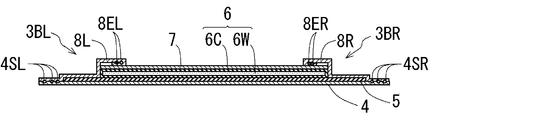
- FIG. 3 is a cross-sectional view of the diaper in a non-wearing state when the center in the longitudinal direction is cut along the width direction.
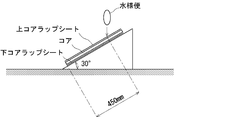
- FIG. 4 is a diagram illustrating a test method for verifying the absorbability of watery feces.
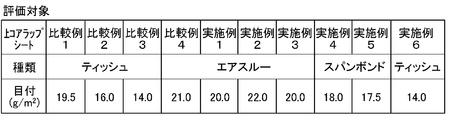
- FIG. 5 is a diagram showing types of core wrap sheets of test samples prepared in this verification.
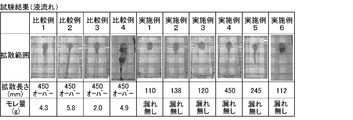
- FIG. 6 is a first diagram showing the test results.
- FIG. 7 is a first diagram showing the measurement results of ventilation resistance.
- FIG. 8 is a second diagram showing the measurement results of the ventilation resistance.
- FIG. 9 is a second diagram showing the test results.
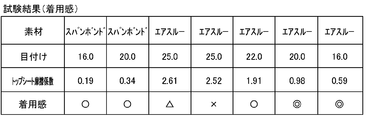
- FIG. 10 is a table showing the results of measuring the feeling of wearing.
- FIG. 10 is a table showing the results of measuring the feeling of wearing.
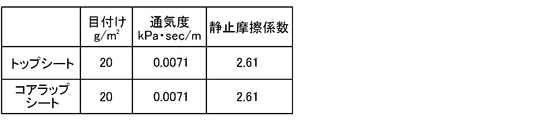
- FIG. 11 is a diagram showing the physical properties of the top sheet and the core wrap sheet used for the verification of the core.
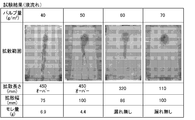
- FIG. 12 is a third diagram showing the test results.
- FIG. 13 is an exploded perspective view of the diaper according to the second embodiment.
- FIG. 14 is a cross-sectional view of the diaper mat according to the second embodiment when the center in the longitudinal direction is cut along the width direction.
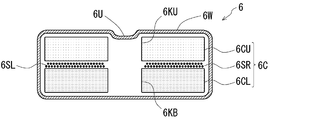
- FIG. 15 is a diagram showing a modification of the diaper mat according to the second embodiment.
- a tape-type disposable diaper (an example of an “absorbent article” in the present application, hereinafter simply referred to as “diaper”) faces a front body and a back arranged to face the wearer's abdomen.
- the direction connecting the rear body arranged in this manner is the longitudinal direction. Inseam that is placed between the front body (one side in the longitudinal direction) and the back body (the other side in the longitudinal direction) (center in the longitudinal direction) in the crotch of the wearer (placed opposite the crotch). The department is located.
- the side facing the wearer's skin is the skin surface side, and the side opposite the skin surface side.
- the (outside when worn) is the non-skin side.
- the direction connecting the skin surface side and the non-skin surface side is the thickness direction, and the direction orthogonal to both the longitudinal direction and the thickness direction is the width direction.
- viewing from the thickness direction is a plan view.
- FIG. 1 is a perspective view of the diaper according to the present embodiment.
- the diaper 1 is a crotch region 1B that corresponds to a crotch region that covers the wearer's pubic area in the worn state, and a front body region 1F that is located on the front side of the crotch region 1B and that corresponds to the wearer's front body.
- a rear body region 1R which is located behind the crotch region 1B and corresponds to the rear body of the wearer.
- Tapes 2L and 2R that can be attached to the front patch 2F provided on the non-skin surface side of the front body region 1F are provided on the left and right edges of the rear body region 1R.
- the tapes 2L, 2R are attached to the front patch 2F.
- It is fixed to the wearer's body while surrounding the wearer's abdominal circumference and thighs. Since the diaper 1 is fixed to the wearer's body in such a form, the wearer can walk while wearing the diaper 1.
- the diaper 1 is mainly provided with a mat 6 capable of absorbing and holding a liquid, centered around the crotch region 1B.
- the three-dimensional gathers 3BL, 3BR are provided around the wearer's thigh. Is provided, and the waist gather 3R is provided in a portion surrounding the abdominal circumference of the wearer.
- the three-dimensional gathers 3BL and 3BR and the waist gather 3R are in close contact with the wearer's skin by the elastic force of the rubber thread. Therefore, the liquid excreted from the pubic area of the wearer is absorbed by the mat 6 of the diaper 1 with almost no leakage from the diaper 1.
- FIG. 2 is an exploded perspective view of the diaper 1.
- FIG. 3 is a cross-sectional view of the diaper 1 in the non-wearing state when the center in the longitudinal direction is cut along the width direction.
- the diaper 1 has a cover sheet 4 that forms an outer surface in the worn state.
- the cover sheet 4 is a sheet-like member having a substantially rectangular outer shape in which constrictions 4KL and 4KR are provided in a portion corresponding to the long side, and forms the exterior surface of the diaper 1.
- the constrictions 4KL and 4KR are provided at positions where the wearer's thighs are located.
- the cover sheet 4 is provided to reinforce the back sheet 5 and to improve the touch.
- a nonwoven fabric made of a liquid-impermeable thermoplastic resin may be used as the material. it can.
- the liquid-impermeable thermoplastic resin include polyethylene (PE) and polypropylene (PP).
- the cover sheet 4 is not limited to a single layer structure and may have a multilayer structure including an inner cover sheet and an outer cover sheet.
- the diaper 1 has a back sheet 5, a mat 6, and a top sheet 7 which are sequentially laminated on the skin side of the cover sheet 4.
- the back sheet 5, the mat 6, and the top sheet 7 are sheet-shaped members each having a substantially rectangular appearance, and are sequentially laminated on the cover sheet 4 in a state where the longitudinal direction matches the longitudinal direction of the cover sheet 4. .
- the back sheet 5 is a sheet formed of a liquid-impermeable thermoplastic resin as a material in order to suppress leakage of excrement.
- the top sheet 7 is a sheet-shaped member that is arranged on the skin side of the wearer so as to cover the water absorbing surface of the mat 6.
- the top sheet 7 has liquid permeability in part or all.
- the liquid excreted from the wearer enters the mat 6 through the top sheet 7 that may come into contact with the wearer's skin, and is absorbed there.
- the top sheet 7 may have hydrophilicity.
- the back sheet 5, mat 6, and top sheet 7 all extend from the front body region 1F to the back body region 1R. Therefore, when the cover sheet 4 in which the back sheet 5, the mat 6 and the top sheet 7 are laminated covers the pubic area of the wearer, both longitudinal end portions of the back sheet 5, the mat 6 and the top sheet 7 are It is located on the ventral and dorsal sides of the. That is, the wearer's genital area is in a state of being covered with the mat 6 from the wearer's ventral side to the back side. Therefore, even if the wearer excretes the liquid out of the body in any of the postures with the belly down and the back down, the excreted liquid contacts the mat 6 through the top sheet 7. It will be.
- Diaper 1 also has elongated strip-shaped side sheets 8L and 8R for forming the above-mentioned three-dimensional gathers 3BL and 3BR.
- the side sheets 8L and 8R are liquid impermeable sheets provided on the long side portions of the top sheet 7. Similar to the three-dimensional gathers 3BL and 3BR of the diaper 1, the side seats 8L and 8R are provided with constrictions 8KL and 8KR at positions where the wearer's thighs are located. Thread rubbers 8EL and 8ER are woven in the side sheets 8L and 8R along the longitudinal direction.
- the side sheets 8L and 8R are attracted in the longitudinal direction by the contracting force of the rubber thread 8EL and 8ER. It becomes a three-dimensional gather that stands up from and prevents the outflow of liquid.
- the rubber thread 9ER for forming the above-mentioned waist gather 3R is provided between the backsheet 5 and the topsheet 7 at a position further back than the end portion of the mat 6.
- the rubber thread 9ER is provided between the back sheet 5 and the top sheet 7 in a direction in which the longitudinal direction that is the stretching direction is the left-right direction of the diaper 1. Therefore, when the tapes 2L and 2R provided on both the left and right sides of the thread rubber 9ER are attached to the front patch 2F on the abdominal side of the wearer, the thread rubber 9ER exerts a contracting force on the diaper 1 for the wearer. The close contact prevents the formation of a gap between the diaper 1 and the wearer's abdominal girth.
- the cover sheet 4 is also provided with thread rubbers 4SL and 4SR that prevent a gap from being formed between the diaper 1 and the wearer's abdominal circumference along the longitudinal direction.
- the rubber thread 4SL, 4SR is provided at an appropriate position in an appropriate number determined according to the elastic force (contractile force) required in the diaper 1 in terms of design.
- the mat 6 contains water in the spaces between short fibers of cellulosic fibers such as pulp fibers, rayon fibers, or cotton fibers, or short fibers obtained by hydrophilizing synthetic fibers such as polyethylene, polypropylene, or polyethylene terephthalate. It has a structure in which a granular absorbent resin such as SAP (super absorbent polymer: Super Absorbent Polymer), which is a hydrophilic polymer having a cross-linked structure that can be absorbed and retained, is retained. Therefore, in the mat 6, the volume change of the absorbent resin before and after absorbing the liquid is basically performed within the short fiber that holds the absorbent resin in the gap. Therefore, from a bird's-eye view of the entire mat 6, it can be said that the expansion coefficient of the thickness of the mat 6 that has absorbed the liquid is not so large as the expansion coefficient of the absorbent resin itself.
- SAP super absorbent polymer: Super Absorbent Polymer
- the SAP particles of the present embodiment refer to a granular resin composition containing SAP.
- resin composition containing SAP refers to both a composition composed only of SAP and a composition containing SAP as a main component and containing another substance to the extent that it does not adversely affect water absorption. Is a concept that includes.
- other substance include an additive (a surface modifier added for the purpose of hydrophobizing the particle surface), an unreacted monomer remaining during the synthesis of SAP, and the like.
- the mat 6 of the above-described embodiment has a core 6C (an example of an “absorbent” in the present application) in which SAP is mixed with crushed pulp (so-called “fluff pulp”). It is wrapped with a core wrap sheet 6W.
- the skin-side surface of the core 6C (corresponding to the "wearer-side surface” in the present application) is wrapped in the core wrap sheet 6W and the part of the core wrap sheet 6W that wraps the core 6C. It is covered by a laminated portion in which the top sheet 7 covering the wrapped core 6C is overlapped. Since both the core wrap sheet 6W and the top sheet 7 are liquid-permeable sheets, the laminated portion has liquid permeability.
- one or a plurality of sheets may be provided between the top sheet 7 and the core wrap sheet 6W.
- the core 6C may have a single-layer structure or a multi-layer structure having two or more layers. In the latter case, at least one layer is composed of SAP particles. It may be a layer. If such a layer composed of SAP particles is provided, the mat 6 can quickly absorb the water of urine or watery feces discharged from the wearer, and allow time for the water to contact the wearer's skin. It can be suppressed as much as possible.
- the SAP layer which is an intermediate layer is arranged above and below. Since it is between layers, the moisture can be diffused by the capillary phenomenon, and since the moisture is absorbed and retained by the SAP in the region, the moisture is absorbed by the core 6C and the moisture flows back to the wearer's skin. It is possible to suppress the contact of water.
- the ventilation resistance of each member in the laminated portion of the core wrap sheet 6W and the top sheet 7 covering the skin side surface of the core 6C is smaller than 0.0962 kPa ⁇ sec/m. Is becoming This ventilation resistance is a value measured by a ventilation tester (KES-F8-AP1) manufactured by Kato Tech Co., Ltd. Further, in the diaper 1 of the present embodiment, the coefficient of static friction on the surface of the top sheet 7 is 0.59 or more. For this reason, the diaper 1 of the present embodiment is superior in the absorbability when watery feces are excreted as follows, as compared with the diaper of the comparative example in which the ventilation resistance or the static friction coefficient is outside this range. ..
- FIG. 4 is a diagram illustrating a test method for verifying the absorbability of watery feces.
- a mat having a width of 280 mm and a length of 560 mm was used as a test sample corresponding to the mat 6.
- the mat is placed on a slope having an inclination angle of 30 degrees with the longitudinal direction aligned with the vertical direction of the slope, and 50 g of a reagent simulating watery feces is placed at a position 450 mm from the lower end of the mat. I dropped it.
- the distance (diffusion length) in which the reagent simulating aqueous feces flows on the mat surface and the amount absorbed by the mat were confirmed.
- 50 g of the reagent is completely absorbed by the mat, and the shorter diffusion length is superior.
- FIG. 5 is a diagram showing types of core wrap sheets of test samples prepared in this verification.
- Examples 1 to 6 those corresponding to the mat 6 of the above-described embodiment are designated as “Examples 1 to 6”, and those corresponding to the comparative examples are designated as “Comparative Examples 1 to 4”.
- Examples 1 to 3 and Comparative Example 4 a non-woven fabric prepared by an air-through method is used for the core wrap sheet.
- the air-through type nonwoven fabric is formed by carding (opening) the raw material fibers and then heat-bonding the fibers by hot air treatment.
- the weight per unit area of the core wrap sheet is 20.0 g/m 2 in Examples 1 and 3, 22.0 g/m 2 in Example 2 , and 21.0 g/m 2 in Comparative Example 4.
- a nonwoven fabric made by the spunbond method is used for the core wrap sheet.
- the weight per unit area of the core wrap sheet is 18.0 g/m 2 in Example 4 and 17.5 g/m 2 in Example 5.
- the spunbond type nonwoven fabric is formed by carding the raw material fibers, entwining the fibers with high pressure water to form a sheet, and drying the sheet.
- Comparative Examples 1 to 3 and Example 6 a tissue is used as the core wrap sheet. Basis weight of the tissue paper, Comparative Example 1 is 19.5 g / m 2, Comparative Example 2 is 16.0 g / m 2, Comparative Example 3 is 14.0 g / m 2, Example 6 14 It is 0.0 g/m 2 .
- the reagent used for this verification was a mixture of bentonite in ion-exchanged water and stirring, and those within 3 days after preparation were used as a simulated product of watery feces.
- the reagent has a water content of 94% by weight (for example, 1 kg of the reagent is prepared by mixing 940 g of water and 60 g of bentonite).
- FIG. 6 is a first diagram showing the test results. What is shown in the column of “diffusion range” in FIG. 6 is a photograph of the surface of the test sample. In addition, what is shown in the column of “diffusion length” in FIG. 6 represents the distance from the position where the reagent has dropped to the position where the reagent has flowed on the surface of the mat. Further, what is shown in the column of “leakage amount” in FIG. 6 shows the amount of the reagent leaked from the mat. The description of "no leakage” in the column of "leakage amount” in FIG. 6 means that all the reagents have been absorbed by the mat.
- Examples 4 and 5 in which the nonwoven fabric produced by the spunbond method was used for the core wrap sheet were also inferior to Examples 1 to 3, but were more absorbent of watery feces than Comparative Examples 1 to 4. It was confirmed to be high. It was also confirmed that Example 6 in which the tissue was used as the core wrap sheet had remarkably high absorbency of watery feces, as in Examples 1 to 3.
- the ventilation resistance of each member in the laminated portion was a value smaller than 0.0962 kPa ⁇ sec/m.
- the ventilation resistance is 0.0962 kPa ⁇ sec/m or more. Therefore, if the liquid-permeable sheet covering the skin side of the core has a ventilation resistance of at least 0.0962 kPa ⁇ sec/m, watery stool attached to the surface of the top sheet will quickly spread the sheet. It can be seen that the light penetrates through and is absorbed by the absorber. Further, as can be seen from FIG. 7, it is more preferable that the liquid permeable sheet covering the skin-side surface of the core has at least ventilation resistance of 0.0352 kPa ⁇ sec/m or less.
- the liquid-permeable sheets that cover the surface of the core on the skin side do not cause SAP leakage when the ventilation resistance is 0.0050 kPa ⁇ sec/m or more.
- the “SAP leak” in FIG. 8 is to close the hole connecting to the absorber with tape, have the ends in the longitudinal direction, and repeat the operation of putting the ends together or separating them in a manner of clapping three times. It was determined that there was SAP leakage when spilled over the number of grains, and no SAP leakage when spilled under 19 grains. Further, “strength” in FIG. 8 is the result of visually confirming the presence or absence of breakage after being worn by a subject having an appropriate body shape for 5 hours in accordance with the NISSEN regulations.
- the ventilation resistance of each member in the laminated portion of the core wrap sheet and the top sheet covering the skin side surface of the absorber is 0.0050 to 0.0962 kPa. It is recognized that the absorbent article within the range of sec/m has excellent absorbability when excreted watery feces and has practical strength as compared with the absorbent article outside this range. ..
- non-woven fabric was prepared by the spunbond method: basis weight 16.0 g / m 2, was prepared by the spun bond method nonwoven basis weight: 18.0 g / m 2, created in basis weight 22.0 g / m 2, an air-through method: the span nonwoven created by bonding method: basis weight 20.0 g / m 2, a nonwoven fabric was prepared by air-through method: basis weight 25.0 g / m 2, a nonwoven fabric was prepared by air-through method nonwoven basis weight: 20.0 g / m 2, a nonwoven fabric was prepared by air-through method: basis weight 18.0 g / m 2, a nonwoven fabric was prepared by air-through method: a basis weight 16.0 g / m 2.
- the tape-type disposable diaper was illustrated, but it is also applicable to absorbent articles of other forms.
- absorbent articles include various types of absorbent articles with gathers such as pants-type disposable diapers, urine pads, and light incontinence pads, and flat absorbent articles without gathers.
- the liquid permeable sheets in the laminated portion such as the top sheet 7 and the core wrap sheet 6W interposed between the wearer and the core 6C are Since the ventilation resistance is less than 0.0962 kPa ⁇ sec/m, moisture can be quickly transferred from the wearer to the core 6C. Moreover, since the coefficient of static friction on the surface of the top sheet 7 is 0.59 or more, the solid content contained in the watery feces is unlikely to slip on the surface of the top sheet 7. Therefore, in the diaper 1 of the above-described embodiment, the possibility of excrement leaking out when the diaper 1 is removed from the wearer can be suppressed as much as possible by improving the absorbability of watery feces. It will be possible.
- FIG. 10 is a table showing the results of measuring the feeling of wearing.
- ⁇ “No discomfort” was 16 or more and 20 or less
- ⁇ “No discomfort” was 11 or more and 15 or less
- ⁇ “No discomfort” was 6 or more and 10 or less
- the topsheet having a surface static friction coefficient of less than 2.52 is good, more preferably 1.91 or less, and further preferably 0.98 or less. It was confirmed.
- the diaper 1 of the above-described embodiment may have any static friction coefficient on the topsheet surface, but more preferably, the static friction coefficient on the topsheet surface is 0. It can be said that it is 59 or more. Further, it can be said that it is more preferable that the coefficient of static friction of the surface is smaller than 2.52.
- FIG. 11 is a diagram showing the physical properties of the top sheet and the core wrap sheet used for the verification of the core. In this verification, the top sheet and the core wrap sheet having the physical properties shown in FIG. 11 were superposed on four types of cores having different amounts of pulp per unit area, and the liquid flow was verified in that state.
- FIG. 12 is a third diagram showing the test results.
- the pulp amount per unit area is formed by 40g / m 2, 50g / m 2, 60g / m 2, 70g / m 2 of pulp from left to right.
- the reagent in each of the cores having a pulp amount of 60 g/m 2 or more, the reagent remained within 450 mm in the longitudinal direction, and the reagent did not flow out to the outside of the mat.
- the amount of pulp in the core was less than 60 g/m 2 , the reagent flowed over a distance longer than 450 mm in the longitudinal direction, and the reagent flowed out of the mat.
- the reagents remained within 100 mm in the width direction. From this, it is recognized that when the pulp amount of the core is at least 60 g/m 2 or more, excellent absorbability is exhibited when excreted watery feces. If the core has a length of at least 500 mm or more in the longitudinal direction and a length of at least 100 mm or more in the width direction, excreted aqueous feces should not flow out of the mat. Is recognized.
- the length in the width direction may be 150 mm or more, more preferably 200 mm or more, in consideration of positional deviation in the width direction when worn, individual differences in the size of the buttocks of the wearer, and the like.
- the core may exist up to the left and right ends of the crotch region 1B of the diaper 1.
- the core 6C is formed of pulp having a pulp amount of 60 g/m 2 or more and a length of 500 mm or more and a width of 100 mm or more, and the static friction of the surface of the top sheet 7 is determined. If the diaper 1 has a coefficient of 0.59 or more and the ventilation resistance of each member in the laminated portion where the core wrap sheet 6W and the top sheet 7 overlap is less than 0.0962 kPa ⁇ sec/m, absorbency of watery feces Is recognized to improve.
- FIG. 13 is an exploded perspective view of the diaper according to the second embodiment.
- the skin-side surface of the mat 6 and the top sheet 7 are provided with elongated recesses 6U extending along the center line of the mat 6 in the longitudinal direction.
- the recess 6U is a portion where the surface of the mat 6 on the skin surface side and the top sheet 7 are recessed. Therefore, the excrement of the wearer is excreted toward the concave portion 6U and its periphery, and then absorbed inside the mat 6 or attached to the skin side surface of the top sheet 7. Details of the recess 6U will be described later.
- FIG. 14 is a cross-sectional view when the mat 6 of the diaper according to the second embodiment is cut along the width direction at the center in the longitudinal direction.
- the core 6C has a multilayer structure. That is, the core 6C has the upper layer core 6CU arranged on the top sheet 7 side and the lower layer core 6CL arranged on the back sheet 5 side.
- the core wrap sheet 6W is laid around the upper core 6CU and the lower core 6CL so as to wrap the entire upper core 6CU and the lower core 6CL. Therefore, the upper layer portion of the core wrap sheet 6W is arranged between the top sheet 7 and the upper layer core 6CU.
- the lower layer portion of the core wrap sheet 6W is arranged between the back sheet 5 and the lower layer core 6CL.
- the core wrap sheet 6W for example, thin paper such as tissue paper or non-woven fabric is used.
- liquid such as urine can be diffused over the entire surface of the core 6C and absorbed by the entire core 6C.
- the upper layer core 6CU arranged on the side of the top sheet 7 can absorb urine more quickly than the lower layer core 6CL.
- fluff pulp For the upper layer core 6CU and the lower layer core 6CL, fluff pulp, SAP particles, hydrophilic sheet, etc. obtained by crushing fibrous materials such as softwood are used, or a combination thereof.
- the SAP particles absorb about 100 to 1000 times the weight of the liquid.
- the SAP particles for example, granular particles having a diameter of about 0.1 to 0.5 mm before liquid absorption are used.
- the core 6C is provided with an upper layer opening 6KU formed by penetrating the upper layer core 6CU in the thickness direction.
- the upper layer opening 6KU is formed so as to extend in the longitudinal direction of the upper layer core 6CU.
- the upper layer opening 6KU is formed substantially in the center of the upper layer core 6CU in the width direction. Further, in plan view, the upper layer opening 6KU has a rectangular shape in which both front and rear ends are formed in an arc shape.
- the front end of the upper layer opening 6KU is located in the middle of the front body region 1F, and the rear end of the upper layer opening 6KU is located in the front part of the rear body region 1R.
- the skin side surface of the core wrap sheet 6W enclosing the core 6C that is, the skin side surface of the mat 6 and the top sheet 7 are formed.
- the above-mentioned concave portion 6U is formed in this area.
- the recess 6U is formed by the upper opening 6KU provided in the upper core 6CU, the solid content or stool contained in the watery feces excreted by the wearer is entirely or partially contained in the recess 6U. Become. Therefore, leakage of solids and stool from the diaper 1 is suppressed. Further, since such an upper layer opening 6KU is formed in the upper layer core 6CU of the core 6C, the liquid such as urine excreted by the wearer flows through the upper layer opening 6KU and is diffused. Further, liquid such as urine excreted on the upper layer core 6CU can be guided to the lower layer core 6CL via the upper layer opening 6KU. As described above, the diaper 1 according to the present embodiment can absorb and hold the liquid by the core 6C having the upper core 6CU and the lower core 6CL.
- the diaper 1 has SAP layers 6SL and 6SR arranged between the upper core 6CU and the lower core 6CL.
- the SAP layers 6SL and 6SR are formed by collecting a plurality of super absorbent polymer (SAP) particles.
- SAP layers 6SL and 6SR include a plurality of SAP particles and can absorb and retain the liquid introduced between the upper core 6CU and the lower core 6CL. As shown in FIG. 4, the SAP layer 6SL is arranged on the left side of the upper layer opening 6KU, and the SAP layer 6SR is arranged on the right side of the upper layer opening 6KU.
- the SAP layers 6SL and 6SR are arranged on both sides of the upper layer opening 6KU so as to extend along the longitudinal direction of the upper layer opening 6KU. Further, in a plan view of the core 6C seen from the skin surface side, the SAP layers 6SL and 6SR are formed in a rectangular shape. The SAP layers 6SL and 6SR may be formed in other polygonal shapes or elliptical shapes instead of the rectangular shape in plan view.
- the diaper 1 can increase the absorption amount of the liquid as a whole by providing the SAP layers 6SL and 6SR.
- the SAP layers 6SL and 6SR are formed by spraying SAP particles on the lower core 6CL. Further, the SAP layers 6SL and 6SR are sandwiched between the upper core 6CU and the lower core 6CL. Therefore, even when the diaper 1 is moved by the action of the wearer, the particles of SAP contained in the SAP layers 6SL and 6SR may move below the upper layer opening 6KU or fall out of the lower layer core 6CL. Can be prevented.
- the effective volume of the upper layer opening 6KU increases, promoting the absorption of the water contained in the excrement into the core 6C and the solid matter into the recess 6U.
- the storage capacity can be increased.
- the water absorption of the SAP layers 6SL and 6SR between the upper core 6CU and the lower core 6CL allows the water to be absorbed and retained at a position far from the wearer's skin, and the reverse flow of the water absorbed in the core 6C. The contact of moisture with the wearer's skin due to is suppressed.
- the upper layer opening 6KU may be formed in another polygonal shape or an elliptical shape instead of a rectangular shape in a plan view.
- the mat 6 may further include not only the upper layer opening 6KU provided in the upper layer core 6CU but also the opening provided in the lower layer core 6CL.
- FIG. 15 is a diagram showing a modification of the diaper mat according to the second embodiment.
- the mat 6 may have a lower layer opening 6KB similar to the upper layer opening 6KU provided in the upper layer core 6CU in the lower layer core 6CL, as shown in FIG. 15, for example.
- the upper layer opening 6KU and the lower layer opening 6KB can be regarded as openings of holes penetrating the core 6C in the thickness direction.
- the opening forming the recess 6U preferably has a width of the recess 6U of 10 mm or more. This is because if the width of the recess 6U is less than 10 mm, not only the solid content storage space is insufficient, but also the top sheet 7 is unlikely to be recessed in the opening where the width of the recess 6U can be formed only less than 10 mm. Further, the opening forming the recess 6U preferably has a width of the recess 6U of 40 mm or less. This is because if the width of the recess 6U is larger than 40 mm, the amount of urine absorbed decreases. Further, it is preferable that the concave portion 6U exists within a radius of 40 mm from the anus.
- the length of the recess 6U is preferably 100 mm or more. This is because if the length of the recess 6U is less than 100 mm, the size of the recess 6U may be insufficient as a space for containing solids.
- the opening corresponding to the upper layer opening 6KU and the lower layer opening 6KB has a width of 25 mm and a lower side of 45 mm upward (dorsal) from an assumed position facing the anus in a worn state ( There is an opening of 75 mm on the abdominal side, the thickness of the portion corresponding to the upper core 6CU is 8 mm, and the thickness of the portion corresponding to the lower core 6CL is 5 mm. This thickness is the thickness measured when no pressure is applied to the mat.
- a mat is placed on a slope having an inclination angle of 30 degrees in a direction such that the longitudinal direction thereof coincides with the vertical direction of the slope, and 50 g of the reagent simulating aqueous feces is placed on the mat. It was dropped on the mat at a position 450 mm from the lower end of the. Others are the same as the verification result of the first embodiment.
Landscapes
- Health & Medical Sciences (AREA)
- Epidemiology (AREA)
- Engineering & Computer Science (AREA)
- Biomedical Technology (AREA)
- Heart & Thoracic Surgery (AREA)
- Vascular Medicine (AREA)
- Life Sciences & Earth Sciences (AREA)
- Animal Behavior & Ethology (AREA)
- General Health & Medical Sciences (AREA)
- Public Health (AREA)
- Veterinary Medicine (AREA)
- Absorbent Articles And Supports Therefor (AREA)
Abstract
本発明は、水様便の吸収性を向上可能な吸収性物品を提供することを目的とする。本発明は、着用者の股下に装着される吸収性物品であって、吸収体(6C)と、吸収体の着用者側の面を覆う液透過性のシート(6W,7)と、を備え、吸収体(6C)は、パルプ量が60g/m2以上で長手方向に500mm以上、幅方向に100mm以上の大きさのパルプを有し、液透過性のシート(6W,7)は、着用者に接触する面の静止摩擦係数が0.59以上であり、吸収体(6C)を包むコアラップシート(6W)の一部と、コアラップシートに包まれた吸収体を覆うトップシート(7)とを重ねた積層部分を有しており、積層部分における各部材の通気抵抗が0.0962kPa・sec/mより小さい。
Description
本発明は、紙おむつやパッド、生理用ナプキンといった吸収性物品に関する。
従来、吸収性物品には、例えば、特許文献1に開示されているように、着用者の腹部側と背部側とを結ぶ長手方向に延びる吸収体が設けられている。この吸収体によって、排泄される尿や経血といった液体が吸収される。吸収性物品は、この吸収体を液透過性のトップシートと液不透過性のバックシートとの間に配置することにより、トップシートに排泄される尿を吸収体で吸収し、吸収体で吸収された尿の漏出をバックシートで防ぐ。
ところで、トップシートを構成する液透過性の素材としては、例えば、不織布が用いられる。不織布であれば、柔らかい肌触りを実現可能なため、着用者の肌に触れるトップシートの素材として好適である。しかし、着用者から排泄されるものとしては、尿や経血の他に、大便及び水様便がある。大便は大部分が固形物であり、水様便は固形物と液体との混合物である。そして、吸収性物品の吸収体は、固形物を吸収できるものではない。よって、吸収性物品の着用者が大便又は水様便を排泄した場合、当該吸収性物品は交換される。
吸収性物品を交換する場合、トップシートに残留する排泄物を吸収性物品から落とさないように交換作業を行う必要がある。しかし、水様便の場合、液体が固形物と混在しているため、尿と比較した場合、トップシートにおける液体の透過に時間を要する。このため、水様便は、尿及び大便と比較した場合、吸収性物品が着用者から取り外された際に漏れ出る可能性が高い。そして、水様便が漏れ出ると、吸収体に吸収されない固形物が共に漏出する可能性がある。
そこで、本発明は、水様便の吸収性を向上可能な吸収性物品を提供することを目的とする。また、本発明は、水様便の吸収性を向上し且つ固形物の漏出を抑制可能な吸収性物品を提供することを目的とする。
上記課題を解決するため、本発明では、吸収体を、パルプ量が60g/m2以上で長手方向に500mm以上、幅方向に100mm以上の大きさのパルプを有するものとし、吸収体の着用者側の面を覆う液透過性のシートを、着用者に接触する面の静止摩擦係数を0.59以上にすると共に、吸収体を包むコアラップシートの一部と、コアラップシートに包まれた吸収体を覆うトップシートとを重ねた積層部分における各部材の通気抵抗を0.0962kPa・sec/mより小さくした。
詳細には、本発明は、着用者の股下に装着される吸収性物品であって、吸収体と、吸収体の着用者側の面を覆う液透過性のシートと、を備え、吸収体は、パルプ量が60g/m2以上で長手方向に500mm以上、幅方向に100mm以上の大きさのパルプを有し、液透過性のシートは、着用者に接触する面の静止摩擦係数が0.59以上であり、吸収体を包むコアラップシートの一部と、コアラップシートに包まれた吸収体を覆うトップシートとを重ねた積層部分を有しており、積層部分における各部材の通気抵抗が0.0962kPa・sec/mより小さい。
また、上記課題を解決するため、本発明では、吸収体を、パルプ量が60g/m2以上で長手方向に500mm以上、幅方向に100mm以上の大きさのパルプを有するものとし、吸収体の着用者側の面を覆う液透過性のシートを、吸収体を包むコアラップシートの一部と、コアラップシートに包まれた吸収体を覆うトップシートとを重ねた積層部分における各部材の通気抵抗を0.0962kPa・sec/mより小さくし、液透過性シートに凹部を形成する開口部を吸収体に設けることにした。
詳細には、本発明は、着用者の股下に装着される吸収性物品であって、吸収体と、吸収体の着用者側の面を覆う液透過性のシートと、を備え、吸収体は、パルプ量が60g/m2以上で長手方向に500mm以上、幅方向に100mm以上の大きさのパルプを有し、液透過性のシートは、吸収体を包むコアラップシートの一部と、コアラップシートに包まれた吸収体を覆うトップシートとを重ねた積層部分を有しており、積層部分における各部材の通気抵抗が0.0962kPa・sec/mより小さく、吸収体は、液透過性のシートに向かって開口することにより、液透過性シートに凹部を形成する開口部を有する。
また、吸収体は、吸収性物品が装着者に装着された状態において該装着者の腹部側に位置する前身頃領域から、股下に位置する股下領域を経由して、背部側に位置する後身頃領域に延在する長さを有し、開口部は、吸収体の長手方向に延びるものであってもよい。
また、吸収体は、下層吸収体と、下層吸収体よりもトップシート側に配置された上層吸収体と、を有し、開口部は、上層吸収体を厚さ方向に貫通する孔の開口部分であってもよい。
また、開口部は、吸収体を厚さ方向に貫通する孔の開口部分であってもよい。
また、液透過性のシートは、着用者に接触する面の静止摩擦係数が0.59以上であってもよい。
また、液透過性のシートは、コアラップシートとトップシートとの間に1又は複数の所定部材を有し、該所定部材における積層部分の通気抵抗がそれぞれ0.0962kPa・sec/mより小さいものであってもよい。
また、吸収体は、少なくとも2以上の層を有しており、着用者側の層に他の層より多量の高吸収性重合体であるSAPの粒子が含有されていてもよい。
また、吸収体は、2以上の層を有しており、少なくとも何れかの層がSAP粒子の層であってもよい。
上記の吸収性物品であれば、水様便の吸収性を向上可能である。また、上記の吸収性物品であれば、水様便の吸収性を向上し且つ固形物の漏出を抑制可能である。
以下に、図面を参照して本発明の実施形態に係る吸収性物品について説明する。なお、以下の実施形態の構成は例示であり、本発明はこれらの実施の形態の構成に限定されるものではない。
<第1実施形態>
本実施形態では、テープ型使い捨ておむつ(本願でいう「吸収性物品」の一例であり、以下、単に「おむつ」という)について、着用者の腹部に対向して配置される前身頃と背部に対向して配置される後身頃とを結ぶ方向を長手方向とする。これらの前身頃(長手方向の一側)と後身頃(長手方向の他側)との間(長手方向の中央)には、着用者の股下に配置(股間に対向して配置)される股下部が位置する。また、紙おむつが着用者に装着された状態(以下「装着状態」と略称する)において、着用者の肌に向かう側(装着された状態で内側)を肌面側とし、肌面側の反対側(装着された状態で外側)を非肌面側とする。さらに、肌面側と非肌面側とを結ぶ方向を厚み方向とし、長手方向と厚み方向の何れにも直交する方向を幅方向とする。そのほか、厚み方向から視ることを平面視とする。
本実施形態では、テープ型使い捨ておむつ(本願でいう「吸収性物品」の一例であり、以下、単に「おむつ」という)について、着用者の腹部に対向して配置される前身頃と背部に対向して配置される後身頃とを結ぶ方向を長手方向とする。これらの前身頃(長手方向の一側)と後身頃(長手方向の他側)との間(長手方向の中央)には、着用者の股下に配置(股間に対向して配置)される股下部が位置する。また、紙おむつが着用者に装着された状態(以下「装着状態」と略称する)において、着用者の肌に向かう側(装着された状態で内側)を肌面側とし、肌面側の反対側(装着された状態で外側)を非肌面側とする。さらに、肌面側と非肌面側とを結ぶ方向を厚み方向とし、長手方向と厚み方向の何れにも直交する方向を幅方向とする。そのほか、厚み方向から視ることを平面視とする。
図1は、本実施形態に係るおむつの斜視図である。おむつ1は、装着状態において着用者の陰部を覆う股下領域に対応する部位である股下領域1Bと、股下領域1Bの前側に位置し、着用者の前身頃に対応する部位である前身頃領域1Fと、股下領域1Bの後ろ側に位置し、着用者の後身頃に対応する部位である後身頃領域1Rとを有する。後身頃領域1Rの左右両側の縁には、前身頃領域1Fの非肌面側の面に設けられたフロントパッチ2Fへ貼着可能なテープ2L,2Rが設けられている。よって、おむつ1は、前身頃領域1Fが着用者の腹側に配置され、後身頃領域1Rが着用者の背側に配置された状態でテープ2L,2Rがフロントパッチ2Fに貼着されると、着用者の腹囲と大腿部を取り巻く状態で着用者の身体に固定される。おむつ1がこのような形態で着用者の身体に固定されるので、着用者はおむつ1を着用した状態で立ち歩き可能である。
おむつ1には、液体を吸収して保持することができるマット6が主に股下領域1B付近を中心に配置されている。また、おむつ1には、おむつ1と着用者の肌との間に液体の流出経路となる隙間が形成されるのを抑制するべく、着用者の大腿部を取り巻く部位に立体ギャザー3BL,3BRが設けられ、着用者の腹囲を取り巻く部位にウェストギャザー3Rが設けられている。立体ギャザー3BL,3BRとウェストギャザー3Rは、糸ゴムの弾性力で着用者の肌に密着する。よって、着用者の陰部から排泄される液体は、おむつ1から殆ど漏出することなくおむつ1のマット6に吸収される。
図2は、おむつ1の分解斜視図である。また、図3は、非装着状態におけるおむつ1を、長手方向の中心を幅方向に沿って切断した場合の断面図である。おむつ1は、装着状態において外表面を形成するカバーシート4を有する。カバーシート4は、長辺に相当する部位に括れ4KL,4KRを設けた略長方形の外観を有するシート状の部材であり、おむつ1の外装面を形成する。括れ4KL,4KRは、着用者の大腿部が位置する箇所に設けられる。カバーシート4は、バックシート5の補強や手触りの向上のために設けられ、例えば、排泄物の漏れを抑制するために、液不透過性の熱可塑性樹脂からなる不織布をその材料として用いることができる。液不透過性の熱可塑性樹脂としては、ポリエチレン(PE)やポリプロピレン(PP)等が例示できる。カバーシート4は、単層構造に限らず、インナカバーシートおよびアウターカバーシートを有する多層構造であってもよい。
そして、おむつ1は、カバーシート4の肌面側の面において順に積層されるバックシート5、マット6、トップシート7を有する。バックシート5、マット6、トップシート7は、何れも略長方形の外観を有するシート状の部材であり、長手方向がカバーシート4の長手方向と一致する状態でカバーシート4に順に積層されている。バックシート5は、カバーシート4と同様に、排泄物の漏れを抑制するために液不透過性の熱可塑性樹脂を材料として形成されたシートである。また、トップシート7は、マット6の吸水面を被覆するように着用者の肌面側に配置される、シート状の部材である。このトップシート7は、その一部又は全部において液透過性を有する。そのため、おむつ1が装着された状態において、着用者から排泄された液体は、着用者の肌に接触し得るトップシート7を通ってマット6に進入し、そこで吸収される。例えば、織布、不織布、多孔質フィルムがトップシート7の材料として材用できる。トップシート7は親水性を有していてもよい。
バックシート5、マット6、トップシート7は、何れも前身頃領域1Fから後身頃領域1Rにまで延在する。よって、バックシート5とマット6とトップシート7が積層されているカバーシート4で着用者の陰部を覆うと、バックシート5とマット6とトップシート7の各長手方向の両端部は、着用者の腹側と背側に位置する状態となる。すなわち、着用者の陰部は、着用者の腹側から背側までマット6に覆われる状態となる。したがって、着用者が腹を下へ向けた姿勢と背を下へ向けた姿勢の何れの姿勢で液体を体外へ排泄しても、排泄された液体はトップシート7を介してマット6に接触することになる。
また、おむつ1は、上述した立体ギャザー3BL,3BRを形成するための細長い帯状のサイドシート8L,8Rを有する。サイドシート8L,8Rは、トップシート7の長辺の部分に設けられる液不透過性のシートである。サイドシート8L,8Rには、おむつ1の立体ギャザー3BL,3BRと同様、着用者の大腿部が位置する箇所に括れ8KL,8KRが設けられる。そして、サイドシート8L,8Rには糸ゴム8EL,8ERが長手方向に沿って編み込まれている。よって、サイドシート8L,8Rは、おむつ1が装着状態の形態、すなわち、おむつ1が側面視U字状の形態になると、糸ゴム8EL,8ERの収縮力で長手方向に引き寄せられてトップシート7から立ち上がり、液体の流出を防ぐ立体ギャザーとなる。
また、上述したウェストギャザー3Rを形成するための糸ゴム9ERは、マット6の端部よりも更に背側の位置において、バックシート5とトップシート7の間に設けられる。糸ゴム9ERは、伸縮方向となる長手方向がおむつ1の左右方向となる向きでバックシート5とトップシート7の間に設けられる。よって、糸ゴム9ERの左右両側に設けられるテープ2L,2Rが、着用者の腹側においてフロントパッチ2Fに貼着されると、糸ゴム9ERは、収縮力を発揮しておむつ1を着用者に密着させ、おむつ1と着用者の腹囲との間に隙間が形成されるのを防ぐ。なお、カバーシート4にも、おむつ1と着用者の腹囲との間に隙間が形成されるのを防ぐ糸ゴム4SL,4SRが長手方向に沿って設けられている。糸ゴム4SL,4SRは、おむつ1において設計上要求される弾性力(収縮力)などに応じて決定された適宜の本数で適宜の位置に設けられる。
マット6は、パルプ繊維、レーヨン繊維、またはコットン繊維のようなセルロース系繊維の短繊維や、ポリエチレン、ポリプロピレン、またはポリエチレンテレフタレート等の合成繊維に親水化処理を施した短繊維の隙間に、水を吸収し保持することのできる架橋構造を持つ親水性ポリマーであるSAP(高吸収性重合体:Super Absorbent Polymer)等の粒状の吸収性樹脂を保持させた構造を有する。よって、マット6では、液体を吸収する前後の吸収性樹脂の体積変動は、基本的には吸収性樹脂を隙間に保持する短繊維内で行われることになる。したがって、マット6全体を俯瞰してみると、液体を吸収したマット6の厚みの膨張率は、吸収性樹脂自体の膨張率ほど大きくはないと言える。
本実施形態のSAP粒子とは、SAPを含む樹脂組成物を粒状としたものを指す。ここで言う「SAPを含む樹脂組成物」とは、SAPのみからなる組成物、SAPを主成分とし、これに吸水性に悪影響を及ぼさない程度に他の物質が含まれた組成物、の双方を包含する概念である。「他の物質」としては、添加剤(粒子表面を疎水化する目的で添加される表面改質剤等)、SAPの合成時に残存した未反応のモノマー等を挙げることができる。
ところで、上記実施形態のマット6は、図3に示すように、粉砕されたパルプ(いわゆる「フラッフパルプ」)にSAPが混合されたコア6C(本願でいう「吸収体」の一例である)をコアラップシート6Wで被包したものである。そして、おむつ1では、コア6Cの肌面側の面(本願でいう「着用者側の面」に相当する)が、コア6Cを包むコアラップシート6Wの一部と、コアラップシート6Wに包まれたコア6Cを覆うトップシート7とを重ねた積層部分によって覆われている。コアラップシート6Wとトップシート7は、何れも液透過性のシートであるため、当該積層部分は液透過性を有する。当該積層部分では、トップシート7とコアラップシート6Wとの間に1又は複数のシート(本願でいう「所定部材」の一例である)が設けられていてもよい。また、コア6Cは、1層構造であってもよいし、或いは、2以上の層を有する複層構造であってもよく、後者の場合には少なくとも何れかの層がSAP粒子で構成される層であってもよい。このようなSAP粒子で構成される層が設けられていれば、着用者から排出される尿や水様便の水分をマット6が速やかに吸収し、水分が着用者の肌に触れる時間を可及的に抑制することができる。コア6Cが、例えば、粉砕されたパルプによって構成される2つの層と、これらの層の間に配置されるSAP層の計3層構造になっている場合、中間層であるSAP層が上下の層間となるため毛細管現象により水分を拡散させることができ、かつ、当該領域においてSAPによる水分の吸収及び保持が行われることになるので、コア6Cに吸収された水分の逆流による着用者の肌への水分の接触が抑制できる。
そして、本実施形態のおむつ1では、コア6Cの肌面側の面を覆うコアラップシート6Wとトップシート7の積層部分において各部材それぞれの通気抵抗が0.0962kPa・sec/mより小さい値となっている。この通気抵抗は、カトーテック株式会社製の通気性試験機(KES-F8-AP1)によって測定される値である。また、本実施形態のおむつ1では、トップシート7表面の静止摩擦係数が0.59以上となっている。このため、本実施形態のおむつ1は、通気抵抗或いは静止摩擦係数がこの範囲外にある比較例のおむつに比べて、水様便が排泄された場合の吸収性が以下のように優れている。
<液流れの検証>
図4は、水様便の吸収性を検証する試験の方法を解説した図である。本検証では、マット6に相当する試験サンプルとして、横幅が280mmで長さが560mmのマットを用いた。そして、傾斜角が30度の斜面に、長手方向が斜面の上下方向と一致するような向きでマットを載置し、水様便を模擬した試薬50gを、マットの下端から450mmの位置でマットに落とした。そして、本検証では、水様便を模擬した試薬がマット表面を流れる距離(拡散長さ)と、マットに吸収された量を確認した。本検証では、試薬50gが全てマットに吸収され、更に、拡散長さのより短いものが優れていることになる。
図4は、水様便の吸収性を検証する試験の方法を解説した図である。本検証では、マット6に相当する試験サンプルとして、横幅が280mmで長さが560mmのマットを用いた。そして、傾斜角が30度の斜面に、長手方向が斜面の上下方向と一致するような向きでマットを載置し、水様便を模擬した試薬50gを、マットの下端から450mmの位置でマットに落とした。そして、本検証では、水様便を模擬した試薬がマット表面を流れる距離(拡散長さ)と、マットに吸収された量を確認した。本検証では、試薬50gが全てマットに吸収され、更に、拡散長さのより短いものが優れていることになる。
本検証では、試験サンプルを10種類用意し、それぞれの吸収性を比較した。10種類の試験サンプルは、コアを包むコアラップシートの種類を互い違いにしたものであり、何れもコアは共通である。コアは、何れもSAPを含有しない目付量260g/cm2のパルプ(横幅が280mmで長さが560mm)である。図5は、本検証で用意した試験サンプルのコアラップシートの種類を示した図である。
図5では、10種類の試験サンプルのうち、上記実施形態のマット6に相当するものを「実施例1~6」とし、比較例に相当するものを「比較例1~4」としている。
実施例1~3及び比較例4では、コアラップシートにエアスルー方式で作成した不織布を用いている。エアスルー方式の不織布は、原料となる繊維をカーディング(開繊)した後に熱風処理で熱融着させることにより形成される。コアラップシートの目付量は、実施例1,3が20.0g/m2であり、実施例2が22.0g/m2であり、比較例4が21.0g/m2である。
また、実施例4,5では、コアラップシートにスパンボンド方式で作成した不織布を用いている。コアラップシートの目付量は、実施例4が18.0g/m2であり、実施例5が17.5g/m2である。スパンボンド方式の不織布とは、原料となる繊維をカーディングした後に高圧の水で繊維同士を絡ませてシート化し、乾燥させることにより形成される。
また、比較例1~3及び実施例6では、コアラップシートにティッシュを用いている。ティッシュの目付量は、比較例1が19.5g/m2であり、比較例2が16.0g/m2であり、比較例3が14.0g/m2であり、実施例6が14.0g/m2である。
また、本検証に用いた試薬は、イオン交換水にベントナイトを入れて撹拌させたものであり、作成後3日以内のものを水様便の模擬品として使用した。試薬は、水分量が重量比で94%である(例えば、1kgの試薬であれば940gの水と60gのベントナイトを混合して作成される)。
これらの10種類の試験サンプルについて、水様便の吸収性を検証したところ、実施例1~6は、何れも比較例1~4より良好な結果が得られた。図6は、試験結果を示した第1の図である。図6の「拡散範囲」の欄に示すものは、試験サンプルの表面を撮影した写真である。また、図6の「拡散長さ」の欄に示すものは、マットの表面における、試薬が落ちた位置から試薬が流れ着いた位置までの距離を表している。また、図6の「モレ量」の欄に示すものは、マットから漏れた試薬の量を表している。図6の「モレ量」の欄において「漏れ無し」と記載されているのは、試薬が全てマットに吸収されたことを意味する。
図6を見ると判るように、比較例1~4では何れも試薬が450mmよりも長い距離を流れ、試薬がマットの外側へ流出した。一方、実施例1~6では何れも試薬が450mm以内に留まり、試薬がマットの外側へは流出しなかった。特に、エアスルー方式で作成した不織布をコアラップシートに用いた実施例1~3では、試薬が流れた距離が最長でも138mm以内であり、比較例1~4に比べると、水様便の吸収性が著しく高いことが確認された。また、スパンボンド方式で作成した不織布をコアラップシートに用いた実施例4,5についても、実施例1~3よりは劣るが、比較例1~4に比べると、水様便の吸収性が高いことが確認された。また、ティッシュをコアラップシートに用いた実施例6についても、実施例1~3と同様に、水様便の吸収性が著しく高いことが確認された。
以下、上記の試験サンプルでコアラップシートとして用いた各素材の物性を確認したので、その確認結果を以下に示す。水様便がマットから流出せずにコアラップシートの表面に留まるか否かは、主に、コアの表面を覆う素材が形成する微細な開口の大きさと、トップシート表面の摩擦係数の2つの要素による影響が大きいと考えられる。そこで、本確認では、開口の大きさに直接的な相関があると考えられる通気度(通気抵抗)、及び、素材表面の摩擦係数の2点について確認を行った。
<通気度>
上記の検証では、トップシートを配置しないで試薬をコアラップシートへ直接落とす形態であった。しかし、本確認では、実際の使用形態により近い形態、すなわち、トップシートとコアラップシートの積層部分における各部材それぞれの通気抵抗を確認した。但し、実施例1~6と比較例1~4の各コアラップシートの通気抵抗の違いを比較するのが本確認の目的なので、各コアラップシートに重ねるトップシートとしては、何れも同種の不織布(RNP社製のKNT20)を用いた。通気抵抗は、カトーテック株式会社製の通気性試験機(KES-F8-AP1)を用いて測定した。図7は、通気抵抗の測定結果を示した第1の図である。また、図8は、通気抵抗の測定結果を示した第2の図である。
上記の検証では、トップシートを配置しないで試薬をコアラップシートへ直接落とす形態であった。しかし、本確認では、実際の使用形態により近い形態、すなわち、トップシートとコアラップシートの積層部分における各部材それぞれの通気抵抗を確認した。但し、実施例1~6と比較例1~4の各コアラップシートの通気抵抗の違いを比較するのが本確認の目的なので、各コアラップシートに重ねるトップシートとしては、何れも同種の不織布(RNP社製のKNT20)を用いた。通気抵抗は、カトーテック株式会社製の通気性試験機(KES-F8-AP1)を用いて測定した。図7は、通気抵抗の測定結果を示した第1の図である。また、図8は、通気抵抗の測定結果を示した第2の図である。
図7を見ると判るように、実施例1~6では、何れも積層部分における各部材の通気抵抗が0.0962kPa・sec/mより小さい値となることが確認された。一方、比較例1~3では、何れも通気抵抗が0.0962kPa・sec/m以上となっている。このことから、コアの肌面側の面を覆う液透過性のシートは、少なくとも通気抵抗が0.0962kPa・sec/mより小さければ、トップシートの表面に付着した水様便が当該シートを速やかに透過し、吸収体に吸収されることが判る。また、図7を見ると判るように、コアの肌面側の面を覆う液透過性のシートは、少なくとも通気抵抗が0.0352kPa・sec/m以下であることがより好ましいことが判る。
また、図8を見ると判るように、コアの肌面側の面を覆う液透過性のシートは、何れも、通気抵抗が0.0050kPa・sec/m以上であれば、SAP漏れが発生しないことが判る。図8の「SAP漏れ」は、吸収体につながる孔をテープで塞ぎ、長手方向端部を持ち、拍手する要領で端部同士を合わせたり離したりする動作を3回繰り返し、SAPの粒子が20粒以上こぼれたらSAP漏れがあるとし、19粒以下こぼれたらSAP漏れが無しとした。また、図8の「強度」は、日衛連規定に基づき適切な体型の被験者に5時間装着させた後、破れの有無を目視で確認した結果である。
この確認結果から、上記実施形態のおむつ1のように、吸収体の肌面側の面を覆うコアラップシートとトップシートの積層部分における各部材それぞれの通気抵抗が0.0050~0.0962kPa・sec/mの範囲内の吸収性物品は、この範囲外の吸収性物品に比べて、水様便が排泄された場合の吸収性に優れ、また実用的な強度を有していると認められる。
<静止摩擦係数>
次に、トップシート表面の静止摩擦係数の確認結果について説明する。静止摩擦係数は、新東科学株式会社製の表面性測定機(トライボギアTYPE:14DR)を用いて測定した。測定方法は、JISK7125に準拠した。本確認では、トップシート表面の静止摩擦係数が水様便の吸収性に及ぼす影響を検証するため、上記検証において水様便の吸収性が最も優れることが確認された実施例1について、静止摩擦係数を互い違いにした複数種のトップシートを重ね、その状態で上述の液流れの検証を行った。図9は、試験結果を示した第2の図である。
次に、トップシート表面の静止摩擦係数の確認結果について説明する。静止摩擦係数は、新東科学株式会社製の表面性測定機(トライボギアTYPE:14DR)を用いて測定した。測定方法は、JISK7125に準拠した。本確認では、トップシート表面の静止摩擦係数が水様便の吸収性に及ぼす影響を検証するため、上記検証において水様便の吸収性が最も優れることが確認された実施例1について、静止摩擦係数を互い違いにした複数種のトップシートを重ね、その状態で上述の液流れの検証を行った。図9は、試験結果を示した第2の図である。
図9に示す試験体の各トップシートの材料は、左から順に、スパンボンド方式で作成した不織布:目付け16.0g/m2、スパンボンド方式で作成した不織布:目付け18.0g/m2、スパンボンド方式で作成した不織布:目付け20.0g/m2、エアスルー方式で作成した不織布:目付け25.0g/m2、エアスルー方式で作成した不織布:目付け22.0g/m2、エアスルー方式で作成した不織布:目付け20.0g/m2、エアスルー方式で作成した不織布:目付け18.0g/m2、エアスルー方式で作成した不織布:目付け16.0g/m2である。
図9を見ると判るように、トップシート表面の静止摩擦係数が0.59以上のものは、何れも試薬が450mm以内に留まり、試薬がマットの外側へは流出しなかった。一方、トップシート表面の静止摩擦係数が0.34以下のものは、試薬が450mmよりも長い距離を流れ、試薬がマットの外側へ流出した。このことから、トップシート表面の静止摩擦係数が0.59以上のものであれば、静止摩擦係数が0.59未満の吸収性物品に比べて、水様便が排泄された場合の吸収性が優れていると認められる。
また、上記実施形態では、テープ型の使い捨ておむつが例示されていたが、その他の形態の吸収性物品においても適用可能である。このような吸収性物品としては、例えば、パンツ型の使い捨ておむつ、尿パッド、軽失禁パッドといったギャザー付きの各種形態の吸収性物品や、ギャザーの無いフラットな吸収性物品を挙げることができる。
上記の検証結果からも判るように、上記実施形態のおむつ1であれば、着用者とコア6Cとの間に介在するトップシート7やコアラップシート6W等の積層部分における各液透過性シートの通気抵抗が0.0962kPa・sec/mより小さいため、水分が着用者からコア6Cへ速やかに移動できる。また、トップシート7表面の静止摩擦係数が0.59以上となっているため、水様便に含まれる固形分がトップシート7の表面を滑りにくい。このため、上記実施形態のおむつ1であれば、水様便の吸収性の向上により、おむつ1が着用者から取り外された際に排泄物が漏れ出る可能性を可及的に抑制することが可能となる。
なお、トップシート表面の静止摩擦係数と着用感との関係について測定を行ったので、その結果を以下に示す。図10は、着用感の測定結果を示した表である。着用感の測定については、20名のパネラーにより、装着時の不快感のなさについて、「不快感がない」又は「不快感がある」の選択で調査を行い、以下の基準により評価を行い、◎及び○を合格とした。
◎:「不快感がない」が16人以上20人以下のとき
○:「不快感がない」が11人以上15人以下のとき
△:「不快感がない」が6人以上10人以下のとき
×:「不快感がない」が0人以上5人以下のとき
◎:「不快感がない」が16人以上20人以下のとき
○:「不快感がない」が11人以上15人以下のとき
△:「不快感がない」が6人以上10人以下のとき
×:「不快感がない」が0人以上5人以下のとき
図10の測定結果に示されるように、トップシートについては、表面の静止摩擦係数が2.52より小さいものが良好であり、より好ましくは1.91以下、更に好ましくは0.98以下が良いことが確認された。
このような静止摩擦係数の確認結果より、上記実施形態のおむつ1は、トップシート表面の静止摩擦係数が如何なるものであってもよいが、より好ましくは、トップシート表面の静止摩擦係数が0.59以上であると言える。また、表面の静止摩擦係数が2.52より小さいと更に好ましいと言える。
なお、コアの条件について検証を行ったので、その結果を以下に示す。上記検証では、コアは、何れもSAPを含有しない目付量260g/cm2のパルプ(横幅が280mmで長さが560mm)であったため、本検証では目付量を互い違いにしたサンプルを複数用意し、各コアにおける水様便の吸収性を検証した。図11は、コアの検証に用いたトップシートとコアラップシートの物性を示した図である。本検証では、単位面積あたりのパルプ量を互い違いにした4種類のコアに、図11に示す物性のトップシートとコアラップシートを重ね、その状態で液流れの検証を行った。図12は、試験結果を示した第3の図である。
図12に示す試験体の各コアは、単位面積あたりのパルプ量が左から順に40g/m2、50g/m2、60g/m2、70g/m2のパルプで形成されている。図12を見ると判るように、コアのパルプ量が60g/m2以上のものは、何れも試薬が長手方向において450mm以内に留まり、試薬がマットの外側へは流出しなかった。一方、コアのパルプ量が60g/m2未満のものは、試薬が長手方向において450mmよりも長い距離を流れ、試薬がマットの外側へ流出した。また、4種類の何れも試薬が幅方向において100mm以下に留まった。このことから、コアのパルプ量が少なくとも60g/m2以上であれば、水様便が排泄された場合に優れた吸収性が発揮されると認められる。また、コアが、長手方向に少なくとも500mm以上の長さを有し、且つ、幅方向に少なくとも100mm以上の長さを有するものであれば、排泄された水様便がマットの外側へ流出しないと認められる。幅方向の長さについては、着用時における幅方向の位置ずれ、着用者の臀部の大きさの個人差等を考慮し、150mm以上、より好ましくは200mm以上であってもよい。左右各々の臀部の頂部間に形成される隙間により、マットに吸収された便が肌に触れにくくなるようにするには、このように幅方向の長さを長めにすることが有効であり、例えば、コアがおむつ1の股下領域1Bの左右両端まで存在していてもよい。
上述した各検証結果より、コア6Cが、パルプ量が60g/m2以上で長手方向に500mm以上、幅方向に100mm以上の大きさのパルプで形成されており、トップシート7の表面の静止摩擦係数が0.59以上であり、コアラップシート6Wとトップシート7とが重なる積層部分における各部材の通気抵抗が0.0962kPa・sec/mより小さいおむつ1であれば、水様便の吸収性が向上すると認められる。このような水様便の吸収性向上効果は、コアラップシート6Wとトップシート7とが重なる積層部分における水分の透過性能と、当該積層部分の下側にあるコア6Cにおける水様便の吸収性能との相乗効果によるものである。
<第2実施形態>
以下、第2実施形態について説明する。本実施形態では、第1実施形態と相違する点についてのみ説明し、その他の構成や効果、各種検証結果(液流れ、水様便の吸収性、トップシートとコアラップシートの積層部分における各部材それぞれの通気抵抗、トップシート表面の静止摩擦係数、コアの条件等)については第1実施形態と同様であるものとする。
以下、第2実施形態について説明する。本実施形態では、第1実施形態と相違する点についてのみ説明し、その他の構成や効果、各種検証結果(液流れ、水様便の吸収性、トップシートとコアラップシートの積層部分における各部材それぞれの通気抵抗、トップシート表面の静止摩擦係数、コアの条件等)については第1実施形態と同様であるものとする。
図13は、第2実施形態に係るおむつの分解斜視図である。本第2実施形態において、マット6の肌面側の面及びトップシート7には、マット6の長手方向の中心線に沿って延在する細長い凹部6Uが形成されている。凹部6Uは、マット6の肌面側の面及びトップシート7を凹状に窪ませている部位である。よって、着用者の排泄物は、この凹部6Uやその周辺に向かって排泄された後、マット6の内部に吸収され或いは及びトップシート7の肌面側の面に付着することになる。凹部6Uの詳細については後述する。
図14は、第2実施形態に係るおむつのマット6を長手方向の中心を幅方向に沿って切断した場合の断面図である。図14では、理解を容易にするため、マット6の断面を厚み方向に引き延ばした状態で図示している。図14に示されるように、コア6Cは、複層構造になっている。すなわち、コア6Cは、トップシート7側に配置された上層コア6CUと、バックシート5側に配置された下層コア6CLとを有している。そして、コアラップシート6Wは、上層コア6CU及び下層コア6CLの全体を包むように、上層コア6CU及び下層コア6CLの周囲に引き回されている。よって、コアラップシート6Wの上層部分は、トップシート7と上層コア6CUとの間に配置されることになる。また、コアラップシート6Wの下層部分は、バックシート5と下層コア6CLとの間に配置されることになる。コアラップシート6Wは、例えば、ティッシュペーパーのような薄葉紙や不織布等が用いられる。そして、本実施形態に係るおむつ1は、コア6Cの全体をコアラップシート6Wで包むことにより、尿等の液体をコア6Cの表面全体に拡散してコア6C全体で吸収することができる。また、コア6Cは、尿等の液体が排泄されたときに、トップシート7側に配置された上層コア6CUが下層コア6CLよりも相対的に尿を迅速に吸収することができる。
上層コア6CU及び下層コア6CLには、針葉樹等の繊維材料を解砕して得られるフラッフパルプやSAP粒子、親水性シート等やこれらを組み合わせたものが用いられる。SAP粒子は、自重の100~1000倍程度の液体を吸収する。SAP粒子には、例えば、液体吸収前の状態において0.1~0.5mm程度の直径を有する粒状のものが用いられる。
そして、コア6Cには、上層コア6CUを厚さ方向に貫通して形成された上層開口部6KUが備わっている。上層開口部6KUは、上層コア6CUの長手方向に延びるように形成されている。また、上層開口部6KUは、上層コア6CUの幅方向略中央に形成されている。また、平面視において、上層開口部6KUは、前後の両端が円弧状に形成された長方形状を有している。上層開口部6KUの前側の端部は、前身頃領域1Fの中程に位置し、上層開口部6KUの後側の端部は、後身頃領域1Rの前部に位置している。コア6Cの上層コア6CUにこのような上層開口部6KUが形成されているため、コア6Cを包むコアラップシート6Wの肌面側の面、すなわち、マット6の肌面側の面及びトップシート7には、上述の凹部6Uが形成されることになる。
上層コア6CUに設けられた上層開口部6KUによって凹部6Uが形成されているため、装着者によって排泄された水様便に含まれる固形分や大便は、凹部6Uに全部または一部が収まることになる。よって、おむつ1からの固形分や大便の漏出が抑制される。またコア6Cの上層コア6CUにこのような上層開口部6KUが形成されているため、装着者によって排泄された尿等の液体は、上層開口部6KU内を流れて拡散される。また、上層コア6CU上に排泄された尿等の液体を、上層開口部6KUを介して下層コア6CLに導くことができる。このように、本実施形態に係るおむつ1は、上層コア6CU及び下層コア6CLを有するコア6Cによって、液体を吸収して保持することができる。
また、おむつ1は、上層コア6CUと下層コア6CLとの間に配置されたSAP層6SL、6SRを有している。SAP層6SL、6SRは、高吸収性重合体(SAP)の粒子が複数集まって形成されている。SAP層6SL、6SRは、SAPの粒子を複数含み、上層コア6CUと下層コア6CLとの間に導かれた液体を吸収して保持することができる。図4に示すように、上層開口部6KUの左方にはSAP層6SLが配置され、上層開口部6KUの右方にはSAP層6SRが配置されている。また、コア6Cを肌面側から見た平面視において、SAP層6SL、6SRは、上層開口部6KUの長手方向に沿うように上層開口部6KUの両側に配置されている。また、コア6Cを肌面側から見た平面視において、SAP層6SL、6SRは、長方形状に形成されている。SAP層6SL、6SRは、平面視において、長方形状ではなく、その他の多角形状や楕円形状に形成されていてもよい。おむつ1は、SAP層6SL、6SRを設けることにより、全体として液体の吸収量を増加させることができる。
SAP層6SL、6SRは、下層コア6CL上にSAPの粒子を散布することにより形成される。また、SAP層6SL、6SRは、上層コア6CUと下層コア6CLとの間に挟持されている。このため、装着者の動作によりおむつ1が動いた場合であってもSAP層6SL、6SRに含まれるSAPの粒子が上層開口部6KUの下方に移動したり、下層コア6CL外に落ちたりするのを防ぐことができる。このようなSAP層6SL、6SRが設けられていることにより、上層コア6CUと下層コア6CLとの間に毛細管現象で水分が広がる。そして、SAP層6SL、6SRが水分を吸収して膨張すると、上層開口部6KUの有効容積が増大し、排泄物に含まれる水分のコア6Cへの吸収の促進、及び、凹部6Uへの固形物の収容量増大が図られる。また、上層コア6CUと下層コア6CLとの間にあるSAP層6SL、6SRの水分吸収により、着用者の肌から遠い位置における水分の吸収及び保持が行われ、コア6Cに吸収された水分の逆流による着用者の肌への水分の接触が抑制される。
なお、上層開口部6KUは、平面視において、長方形状ではなく、その他の多角形状や楕円形状に形成されていてもよい。また、マット6は、上層コア6CUに設けられた上層開口部6KUのみならず、下層コア6CLに設けられた開口部を更に有していてもよい。図15は、第2実施形態に係るおむつのマットの変形例を示した図である。マット6は、例えば、図15に示されるように上層コア6CUに設けられた上層開口部6KUと同様の下層開口部6KBを下層コア6CLに有していてもよい。この場合、上層開口部6KU及び下層開口部6KBは、コア6Cを厚さ方向に貫通する孔の開口部として捉えることができる。
なお、凹部6Uを形成する開口部は、凹部6Uの幅を10mm以上にするものが好ましい。凹部6Uの幅が10mm未満では固形分の収容スペースとして不足するだけでなく、凹部6Uの幅が10mm未満しか形成できない開口部ではトップシート7が凹みにくいためである。また、凹部6Uを形成する開口部は、凹部6Uの幅を40mm以下にするものが好ましい。凹部6Uの幅が40mmより大きいと、尿の吸収量が低下してしまうためである。また、凹部6Uは肛門から半径40mm以内に存在することが好ましい。凹部6Uが肛門から40mmよりも離れた位置にあると凹部6Uに便が到達しない可能性が生じるためである。また、凹部6Uの長さは、100mm以上であることが好ましい。凹部6Uの長さが100mm未満の場合、凹部6Uの大きさが固形分の収容スペースとして不足する可能性が生じるためである。
本第2実施形態においても、第1実施形態の各種検証結果と同様の結果が得られた。なお、<液流れの検証>においては、第1実施形態と同様に、マット6に相当する試験サンプルとして、横幅が280mmで長さが560mmのマットを用いたが、当該マットは、図15に示す変形例に相当するものであり、上層開口部6KUと下層開口部6KBに相当する開口部として、幅25mm、着用状態において肛門に対向する想定位置から上側(背側)に45mmで下側(腹側)に75mmの開口部を有し、上層コア6CUに相当する部分の厚さを8mm、下層コア6CLに相当する部分の厚さを5mmとしたものである。この厚さは、マットに何も圧力を加えないで測定した場合の厚みである。そして、上記第1実施形態と同様、傾斜角が30度の斜面に、長手方向が斜面の上下方向と一致するような向きでマットを載置し、水様便を模擬した試薬50gを、マットの下端から450mmの位置でマットに落とした。その他については第1実施形態の検証結果と同様である。
1・・おむつ
1B・・股下領域
1F・・前身頃領域
1R・・後身頃領域
2F・・フロントパッチ
2L,2R・・テープ
3BL,3BR・・立体ギャザー
3R・・ウェストギャザー
4・・カバーシート
4KL,4KR・・括れ
5・・バックシート
6・・マット
6U・・凹部
6C・・コア
6CU・・上層コア
6CL・・下層コア
6KU・・上層開口部
6KB・・下層開口部
6SL・・SAP層
6SR・・SAP層
6W・・コアラップシート
7・・トップシート
8・・サイドシート
8KL,8KR・・括れ
4SL,4SR,8EL,8ER,9ER・・糸ゴム
1B・・股下領域
1F・・前身頃領域
1R・・後身頃領域
2F・・フロントパッチ
2L,2R・・テープ
3BL,3BR・・立体ギャザー
3R・・ウェストギャザー
4・・カバーシート
4KL,4KR・・括れ
5・・バックシート
6・・マット
6U・・凹部
6C・・コア
6CU・・上層コア
6CL・・下層コア
6KU・・上層開口部
6KB・・下層開口部
6SL・・SAP層
6SR・・SAP層
6W・・コアラップシート
7・・トップシート
8・・サイドシート
8KL,8KR・・括れ
4SL,4SR,8EL,8ER,9ER・・糸ゴム
Claims (9)
- 着用者の股下に装着される吸収性物品であって、
吸収体と、
前記吸収体の前記着用者側の面を覆う液透過性のシートと、を備え、
前記吸収体は、パルプ量が60g/m2以上で長手方向に500mm以上、幅方向に100mm以上の大きさのパルプを有し、
前記液透過性のシートは、
前記着用者に接触する面の静止摩擦係数が0.59以上であり、
前記吸収体を包むコアラップシートの一部と、前記コアラップシートに包まれた前記吸収体を覆うトップシートとを重ねた積層部分を有しており、前記積層部分における各部材の通気抵抗が0.0962kPa・sec/mより小さい、
吸収性物品。 - 着用者の股下に装着される吸収性物品であって、
吸収体と、
前記吸収体の前記着用者側の面を覆う液透過性のシートと、を備え、
前記吸収体は、パルプ量が60g/m2以上で長手方向に500mm以上、幅方向に100mm以上の大きさのパルプを有し、
前記液透過性のシートは、前記吸収体を包むコアラップシートの一部と、前記コアラップシートに包まれた前記吸収体を覆うトップシートとを重ねた積層部分を有しており、前記積層部分における各部材の通気抵抗が0.0962kPa・sec/mより小さく、
前記吸収体は、前記液透過性のシートに向かって開口することにより、前記液透過性シートに凹部を形成する開口部を有する、
吸収性物品。 - 前記吸収体は、前記吸収性物品が装着者に装着された状態において該装着者の腹部側に位置する前身頃領域から、股下に位置する股下領域を経由して、背部側に位置する後身頃領域に延在する長さを有し、
前記開口部は、前記吸収体の長手方向に延びる、
請求項2に記載の吸収性物品。 - 前記吸収体は、下層吸収体と、前記下層吸収体よりも前記トップシート側に配置された上層吸収体と、を有し、
前記開口部は、前記上層吸収体を厚さ方向に貫通する孔の開口部分である、
請求項2又は3に記載の吸収性物品。 - 前記開口部は、前記吸収体を厚さ方向に貫通する孔の開口部分である、
請求項2から4の何れか一項に記載の吸収性物品。 - 前記液透過性のシートは、前記着用者に接触する面の静止摩擦係数が0.59以上である、
請求項2から5の何れか一項に記載の吸収性物品。 - 前記液透過性のシートは、前記コアラップシートと前記トップシートとの間に1又は複数の所定部材を有し、該所定部材における前記積層部分の通気抵抗がそれぞれ0.0962kPa・sec/mより小さい、
請求項1から6の何れか一項に記載の吸収性物品。 - 前記吸収体は、少なくとも2以上の層を有しており、前記着用者側の層に他の層より多量の高吸収性重合体であるSAPの粒子が含有されている、
請求項1から7の何れか一項に記載の吸収性物品。 - 前記吸収体は、2以上の層を有しており、少なくとも何れかの層がSAP粒子の層である、
請求項1から8の何れか一項に記載の吸収性物品。
Priority Applications (1)
| Application Number | Priority Date | Filing Date | Title |
|---|---|---|---|
| CN201980079674.6A CN113164302B (zh) | 2018-12-04 | 2019-12-03 | 吸收性物品 |
Applications Claiming Priority (8)
| Application Number | Priority Date | Filing Date | Title |
|---|---|---|---|
| JP2018-227313 | 2018-12-04 | ||
| JP2018227313 | 2018-12-04 | ||
| JP2018227309 | 2018-12-04 | ||
| JP2018-227309 | 2018-12-04 | ||
| JP2019217693A JP7046895B2 (ja) | 2018-12-04 | 2019-12-02 | 吸収性物品 |
| JP2019-217693 | 2019-12-02 | ||
| JP2019217694A JP7046896B2 (ja) | 2018-12-04 | 2019-12-02 | 吸収性物品 |
| JP2019-217694 | 2019-12-02 |
Publications (1)
| Publication Number | Publication Date |
|---|---|
| WO2020116415A1 true WO2020116415A1 (ja) | 2020-06-11 |
Family
ID=70973834
Family Applications (1)
| Application Number | Title | Priority Date | Filing Date |
|---|---|---|---|
| PCT/JP2019/047131 Ceased WO2020116415A1 (ja) | 2018-12-04 | 2019-12-03 | 吸収性物品 |
Country Status (1)
| Country | Link |
|---|---|
| WO (1) | WO2020116415A1 (ja) |
Citations (11)
| Publication number | Priority date | Publication date | Assignee | Title |
|---|---|---|---|---|
| JPH11323715A (ja) * | 1998-05-14 | 1999-11-26 | Mitsui Chem Inc | 吸収性物品用トップシート材 |
| JP2003220660A (ja) * | 2002-01-31 | 2003-08-05 | Daio Paper Corp | 不織布を有する吸収性物品及びその製造方法 |
| WO2007139154A1 (ja) * | 2006-05-31 | 2007-12-06 | Daio Paper Corporation | 吸収性物品および吸収要素の製造方法 |
| JP2011062227A (ja) * | 2009-09-15 | 2011-03-31 | Kochi Prefecture | 吸収性物品 |
| JP2012034715A (ja) * | 2010-08-03 | 2012-02-23 | Kao Corp | 使い捨ておむつ |
| JP2015112401A (ja) * | 2013-12-13 | 2015-06-22 | 花王株式会社 | 吸収体 |
| WO2016114209A1 (ja) * | 2015-01-13 | 2016-07-21 | 王子ホールディングス株式会社 | 吸収性物品 |
| JP2017080039A (ja) * | 2015-10-27 | 2017-05-18 | 日本製紙クレシア株式会社 | 吸収性物品 |
| JP2017108883A (ja) * | 2015-12-16 | 2017-06-22 | 花王株式会社 | 吸収性物品 |
| JP2018102592A (ja) * | 2016-12-26 | 2018-07-05 | 日本製紙クレシア株式会社 | 吸収性物品 |
| JP2018528015A (ja) * | 2015-09-22 | 2018-09-27 | ザ プロクター アンド ギャンブル カンパニー | 湾曲したチャネルを有する吸収性物品 |
-
2019
- 2019-12-03 WO PCT/JP2019/047131 patent/WO2020116415A1/ja not_active Ceased
Patent Citations (11)
| Publication number | Priority date | Publication date | Assignee | Title |
|---|---|---|---|---|
| JPH11323715A (ja) * | 1998-05-14 | 1999-11-26 | Mitsui Chem Inc | 吸収性物品用トップシート材 |
| JP2003220660A (ja) * | 2002-01-31 | 2003-08-05 | Daio Paper Corp | 不織布を有する吸収性物品及びその製造方法 |
| WO2007139154A1 (ja) * | 2006-05-31 | 2007-12-06 | Daio Paper Corporation | 吸収性物品および吸収要素の製造方法 |
| JP2011062227A (ja) * | 2009-09-15 | 2011-03-31 | Kochi Prefecture | 吸収性物品 |
| JP2012034715A (ja) * | 2010-08-03 | 2012-02-23 | Kao Corp | 使い捨ておむつ |
| JP2015112401A (ja) * | 2013-12-13 | 2015-06-22 | 花王株式会社 | 吸収体 |
| WO2016114209A1 (ja) * | 2015-01-13 | 2016-07-21 | 王子ホールディングス株式会社 | 吸収性物品 |
| JP2018528015A (ja) * | 2015-09-22 | 2018-09-27 | ザ プロクター アンド ギャンブル カンパニー | 湾曲したチャネルを有する吸収性物品 |
| JP2017080039A (ja) * | 2015-10-27 | 2017-05-18 | 日本製紙クレシア株式会社 | 吸収性物品 |
| JP2017108883A (ja) * | 2015-12-16 | 2017-06-22 | 花王株式会社 | 吸収性物品 |
| JP2018102592A (ja) * | 2016-12-26 | 2018-07-05 | 日本製紙クレシア株式会社 | 吸収性物品 |
Similar Documents
| Publication | Publication Date | Title |
|---|---|---|
| JP6399306B2 (ja) | 吸収性物品 | |
| TWI594741B (zh) | Absorbent article | |
| JP4557914B2 (ja) | 使い捨ておむつ | |
| US20110144605A1 (en) | Absorbent article and sanitary napkin | |
| JP5318614B2 (ja) | 吸収性物品 | |
| CN108618896B (zh) | 吸收性物品 | |
| CN105338937A (zh) | 吸收性物品 | |
| JP6320785B2 (ja) | 吸収性物品 | |
| JP5074734B2 (ja) | 吸収性物品 | |
| JP5225818B2 (ja) | 吸収性物品 | |
| JP4883924B2 (ja) | 使い捨ておむつ | |
| JP4519094B2 (ja) | 使い捨ておむつ | |
| JP4646830B2 (ja) | 吸収性物品 | |
| JP2020156754A (ja) | 吸収性物品 | |
| CN113164302B (zh) | 吸收性物品 | |
| JP6575656B2 (ja) | 吸収性物品 | |
| JP2019205864A (ja) | 吸収性物品 | |
| JP2021049079A (ja) | 吸収性物品 | |
| JP7046896B2 (ja) | 吸収性物品 | |
| JP7046895B2 (ja) | 吸収性物品 | |
| WO2020116415A1 (ja) | 吸収性物品 | |
| JP3846991B2 (ja) | 吸収性物品 | |
| JP7342513B2 (ja) | 吸収性物品 | |
| JP2021029600A (ja) | パンツ型吸収性物品 | |
| JP2025174294A (ja) | 吸収性物品 |
Legal Events
| Date | Code | Title | Description |
|---|---|---|---|
| 121 | Ep: the epo has been informed by wipo that ep was designated in this application |
Ref document number: 19893577 Country of ref document: EP Kind code of ref document: A1 |
|
| NENP | Non-entry into the national phase |
Ref country code: DE |
|
| 122 | Ep: pct application non-entry in european phase |
Ref document number: 19893577 Country of ref document: EP Kind code of ref document: A1 |