WO2020105676A1 - スパッタリングターゲット - Google Patents
スパッタリングターゲットInfo
- Publication number
- WO2020105676A1 WO2020105676A1 PCT/JP2019/045407 JP2019045407W WO2020105676A1 WO 2020105676 A1 WO2020105676 A1 WO 2020105676A1 JP 2019045407 W JP2019045407 W JP 2019045407W WO 2020105676 A1 WO2020105676 A1 WO 2020105676A1
- Authority
- WO
- WIPO (PCT)
- Prior art keywords
- less
- sputtering target
- oxygen region
- region
- oxygen concentration
- Prior art date
- Legal status (The legal status is an assumption and is not a legal conclusion. Google has not performed a legal analysis and makes no representation as to the accuracy of the status listed.)
- Ceased
Links
Images
Classifications
-
- C—CHEMISTRY; METALLURGY
- C22—METALLURGY; FERROUS OR NON-FERROUS ALLOYS; TREATMENT OF ALLOYS OR NON-FERROUS METALS
- C22C—ALLOYS
- C22C12/00—Alloys based on antimony or bismuth
-
- C—CHEMISTRY; METALLURGY
- C22—METALLURGY; FERROUS OR NON-FERROUS ALLOYS; TREATMENT OF ALLOYS OR NON-FERROUS METALS
- C22C—ALLOYS
- C22C28/00—Alloys based on a metal not provided for in groups C22C5/00 - C22C27/00
-
- C—CHEMISTRY; METALLURGY
- C22—METALLURGY; FERROUS OR NON-FERROUS ALLOYS; TREATMENT OF ALLOYS OR NON-FERROUS METALS
- C22C—ALLOYS
- C22C30/00—Alloys containing less than 50% by weight of each constituent
-
- C—CHEMISTRY; METALLURGY
- C23—COATING METALLIC MATERIAL; COATING MATERIAL WITH METALLIC MATERIAL; CHEMICAL SURFACE TREATMENT; DIFFUSION TREATMENT OF METALLIC MATERIAL; COATING BY VACUUM EVAPORATION, BY SPUTTERING, BY ION IMPLANTATION OR BY CHEMICAL VAPOUR DEPOSITION, IN GENERAL; INHIBITING CORROSION OF METALLIC MATERIAL OR INCRUSTATION IN GENERAL
- C23C—COATING METALLIC MATERIAL; COATING MATERIAL WITH METALLIC MATERIAL; SURFACE TREATMENT OF METALLIC MATERIAL BY DIFFUSION INTO THE SURFACE, BY CHEMICAL CONVERSION OR SUBSTITUTION; COATING BY VACUUM EVAPORATION, BY SPUTTERING, BY ION IMPLANTATION OR BY CHEMICAL VAPOUR DEPOSITION, IN GENERAL
- C23C14/00—Coating by vacuum evaporation, by sputtering or by ion implantation of the coating forming material
- C23C14/22—Coating by vacuum evaporation, by sputtering or by ion implantation of the coating forming material characterised by the process of coating
- C23C14/34—Sputtering
Definitions
- the present invention relates to a sputtering target used when forming a Ge—Sb—Te alloy film that can be used as a recording film of a phase change recording medium or a semiconductor nonvolatile memory, for example.
- This application claims priority based on Japanese Patent Application No. 2018-217177 filed in Japan on November 20, 2018 and Japanese Patent Application No. 2019-207865 filed in Japan on November 18, 2019. The content of is incorporated herein by reference.
- phase-change recording medium such as a DVD-RAM and a semiconductor nonvolatile memory (Phase Change RAM (PCRAM)
- PCRAM Phase Change RAM
- a recording film made of a phase-change material is used.
- reversible phase change between crystal / amorphous is caused by heating by laser light irradiation or Joule heat, and reflectance or electric resistance between crystal / amorphous is generated.
- Non-volatile storage is realized by associating the difference of 1 with 0.
- a Ge—Sb—Te alloy film is widely used as a recording film made of a phase change material.
- the Ge—Sb—Te alloy film described above is formed by using a sputtering target as shown in Patent Documents 1 to 5, for example.
- a sputtering target as shown in Patent Documents 1 to 5
- a Ge-Sb-Te alloy ingot having a desired composition was produced, and the ingot was crushed to obtain a Ge-Sb-Te alloy powder. It is manufactured by a so-called powder sintering method, in which Sb-Te alloy powder is pressure-sintered.
- Patent Document 1 there are no pores having an average diameter of 1 ⁇ m or more in the sputtering target, and the number of pores having an average diameter of 0.1 to 1 ⁇ m is 100 or less per 4000 ⁇ m 2, and the number of pores existing in the sintered body is small.
- a technique has been proposed that suppresses the occurrence of abnormal discharge by limiting the number.
- Patent Document 2 discloses that the total amount of carbon components such as carbon, nitrogen, oxygen, and sulfur in the sputtering target is limited to 700 ppm or less.
- Patent Documents 3 and 4 propose a technique for suppressing the generation of cracks in the sputtering target when sputtering is performed at a high output by setting the oxygen concentration in the sputtering target to 5000 wtppm or more.
- the oxygen content in the sputtering target is regulated to 1500 to 2500 wtppm and the average particle size of the oxide is regulated to suppress the occurrence of abnormal discharge and suppress the cracking of the sputtering target.
- Technology is proposed.
- Patent Document 1 when the number of pores is limited, the stress generated during machining or the thermal stress generated during bonding to a backing material cannot be relaxed, and during machining or bonding. There was a risk of cracking at times. As described in Patent Document 2, even when the oxygen content is limited to a low level, the number of pores eventually decreases, and there is a possibility that cracks may occur during machining or bonding to a backing material.
- the present invention has been made in view of the above circumstances, and can suppress the occurrence of abnormal discharge, and can suppress the occurrence of cracks during machining or bonding to a backing material.
- An object of the present invention is to provide a sputtering target capable of stably forming a Ge—Sb—Te alloy film.
- a sputtering target of one embodiment of the present invention is a sputtering target containing Ge, Sb, and Te, and has a high oxygen concentration in a high oxygen region, It is characterized in that it has a low oxygen region having an oxygen concentration lower than that of the high oxygen region, and has a structure in which the low oxygen region is dispersed in an island shape in the matrix of the high oxygen region.
- the high oxygen region has a high oxygen concentration and the low oxygen region has a lower oxygen concentration than the high oxygen region, and in the matrix of the high oxygen region, the low oxygen region is Since the structure is dispersed in an island shape, the stress during machining and the thermal stress during bonding are relieved by the high oxygen region, and the occurrence of cracks during machining and bonding can be suppressed. On the other hand, the existence of the low oxygen region having a low oxygen concentration in an island shape can sufficiently suppress the occurrence of abnormal discharge during sputtering.
- voids having a diameter of 0.5 ⁇ m or more and 5.0 ⁇ m or less are present in the range of 0.12 mm 2 and 2 or more and 10 or less in average density.
- two or more voids having a diameter of 0.5 ⁇ m or more and 5.0 ⁇ m or less are present in the range of 0.12 mm 2 as an average density. Therefore, these voids cause stress during machining or bonding during bonding. The thermal stress is relaxed, and the occurrence of cracks during machining or bonding can be further suppressed.
- the number of voids having a diameter of 0.5 ⁇ m or more and 5.0 ⁇ m or less is limited to 10 or less within the range of 0.12 mm 2 as an average density, so that the occurrence of abnormal discharge during sputtering can be further suppressed.
- the sputtering target of the present embodiment further contains one or more additive elements selected from C, In, Si, Ag and Sn, and the total content of the additive elements is 25 atomic% or less.
- the total content of the additional elements may be 3 atomic% or more.
- various characteristics of the sputtering target and the formed Ge—Sb—Te alloy film can be improved by appropriately adding the above-mentioned additional elements, and thus may be appropriately added depending on required characteristics.
- the total content of the additional elements is limited to 25 atomic% or less to sufficiently secure the basic characteristics of the sputtering target and the formed Ge-Sb-Te alloy film. it can.
- the occurrence of abnormal discharge can be suppressed, the occurrence of cracks during machining or bonding to a backing material can be suppressed, and Ge-Sb- can be stably produced. It is possible to provide a sputtering target capable of forming a Te alloy film.
- the sputtering target according to the present embodiment is used, for example, when forming a Ge—Sb—Te alloy film used as a phase change recording film of a phase change recording medium or a semiconductor nonvolatile memory.
- the Ge—Sb—Te alloy film obtained by the present invention is not limited to the one used as the phase change recording film of the phase change recording medium or the semiconductor non-volatile memory, and may be used for other purposes if necessary. It is also possible.
- the sputtering target of the present embodiment contains Ge, Sb, and Te as main components, and specifically, Ge is 10 atom% or more and 30 atom% or less, Sb is 15 atom% or more and 35 atom% or less, It has a composition in which the balance is Te and inevitable impurities.
- the Ge content is more preferably 15 atom% or more and 25 atom% or less, and further preferably 20 atom% or more and 23 atom% or less.
- the Sb content is more preferably 15 atom% or more and 25 atom% or less, and further preferably 20 atom% or more and 23 atom% or less.
- the Te content is more preferably 40 atomic% or more and 65 atomic% or less, and further preferably 53 atomic% or more and 57 atomic% or less.
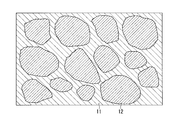
- a high oxygen region 11 having a high oxygen concentration and a low oxygen region 12 having an oxygen concentration lower than that of the high oxygen region 11 are provided.
- the low oxygen region 12 is dispersed in the matrix 11 in the form of islands. It is preferable that the low oxygen region 12 is divided by the high oxygen region 11 and is independent of each other.
- the high oxygen region 11 has, for example, an oxygen concentration within a range of 10,000 mass ppm or more and 15,000 mass ppm or less.
- the low oxygen region 12 has an oxygen concentration within a range of 2000 mass ppm or more and 5000 mass ppm or less. It is preferable that there is almost no region having an oxygen concentration in the range of 5000 mass ppm to 10000 mass ppm.
- the high oxygen region 11 more preferably has an oxygen concentration of 11000 mass ppm or more and 14000 mass ppm or less, and further preferably an oxygen concentration of 12000 mass ppm or more and 13000 mass ppm or less.
- the oxygen concentration of the low oxygen region 12 is more preferably 2500 massppm or more and 4000 massppm or less, and even more preferably the oxygen concentration is 3000 massppm or more and 3500 massppm or less.
- the total oxygen concentration is within the range of 2000 mass ppm or more and 5000 mass ppm or less.
- the lower limit of the oxygen concentration of the entire sputtering target is more preferably 2500 massppm or more, further preferably 3000 massppm or more.
- the upper limit of the oxygen concentration of the entire sputtering target is more preferably 4500 massppm or less, further preferably 4000 massppm or less.
- the area ratio of the low oxygen region 12 is larger than the area ratio of the high oxygen region 11.
- the area ratio of the low oxygen region 12 is in the range of 60% or more and 80% or less, and the rest is the high oxygen region 11.
- the lower limit of the area ratio of the low oxygen region 12 is more preferably 63% or more, further preferably 65% or more.
- the upper limit of the area ratio of the low oxygen region 12 is more preferably 75% or less, further preferably 70% or less.
- the area ratio of the low oxygen region 12 can be calculated by performing image analysis of the observed image with EPMA using analysis software.
- the average size of the hypoxic region 12 in the EPMA observation image corresponds to a diameter of 1 to 20 ⁇ m when converted into a circle of the same area. More preferably, the diameter is 3 to 15 ⁇ m, and further preferably 5 to 10 ⁇ m.
- voids having a diameter of 0.5 ⁇ m or more and 5.0 ⁇ m or less are present in the range of 2 to 10 in the range of 0.12 mm 2 as an average density.
- the average density can be obtained by the following method, for example.
- the observation sample is observed with EPMA, and any three points in the center of the observation material are observed at a magnification of 300 times, and the average value of the number of voids per 0.12 mm 2 is measured.
- an image of the observed secondary electron image is prepared, void portions are extracted by binarization processing of image processing software, and a diameter d of a circle having the same area is calculated as an equivalent circle diameter from the area S of each void.
- the number of voids having a diameter of 0.5 ⁇ m or more and 5.0 ⁇ m or less among the calculated equivalent circle diameters may be checked.
- the lower limit of the number of voids having a diameter of 0.5 ⁇ m or more and 5.0 ⁇ m or less observed in the range of 0.12 mm 2 is, as an average density, more preferably 3 or more, further preferably 4 or more. ..
- the upper limit of the number of voids having a diameter of 0.5 ⁇ m or more and 5.0 ⁇ m or less observed in the range of 0.12 mm 2 is, as an average density, more preferably 9 or less, and 8 or less. More preferable.
- the diameter of the voids described above was the equivalent circle diameter calculated by measuring the cross-sectional area of the observed voids. More preferably, voids having a diameter of 1.0 ⁇ m or more and 5.0 ⁇ m or less are more preferably present in the range of 1 to 9 in the range of 0.12 mm 2 as an average density.
- the lower limit of the number of voids is more preferably 2 or more, further preferably 3 or more.
- the upper limit of the number of voids is more preferably 8 or less, and further preferably 7 or less.
- the sputtering target of the present embodiment contains, in addition to Ge, Sb, and Te, one or more additive elements selected from C, In, Si, Ag, and Sn, if necessary. May be.
- the total content of these additional elements is set to 25 atomic% or less.
- the additive element is added to the sputtering target of the present embodiment, the total content thereof is more preferably 20 atomic% or less, further preferably 15 atomic% or less.
- the lower limit of the additive element is not particularly limited, but in order to surely improve various characteristics, it is more preferably 3 atom% or more, further preferably 5 atom% or more.
- Ge-Sb-Te alloy powder forming step S01 First, the Ge raw material, the Sb raw material, and the Te raw material are weighed so as to have a predetermined mixing ratio.
- the Ge raw material, Sb raw material, and Te raw material each preferably have a purity of 99.9 mass% or more.
- the mixing ratio of the Ge raw material, the Sb raw material, and the Te raw material is appropriately set according to the final target composition of the Ge-Sb-Te alloy film to be formed.
- the Ge raw material, the Sb raw material, and the Te raw material weighed as described above are charged into a melting furnace and melted.
- the Ge raw material, the Sb raw material, and the Te raw material are melted in a vacuum or in an inert gas atmosphere (for example, Ar gas).
- an inert gas atmosphere for example, Ar gas.
- the degree of vacuum is preferably 10 Pa or less.
- the obtained molten metal is poured into a mold to obtain a Ge-Sb-Te alloy ingot.
- the casting method is not particularly limited.
- the Ge-Sb-Te alloy ingot is crushed in an atmosphere of an inert gas (eg, Ar gas) to obtain a Ge-Sb-Te alloy powder (raw material powder) having an average particle size of 0.1 ⁇ m or more and 120 ⁇ m or less.
- the method of crushing the Ge—Sb—Te alloy ingot is not particularly limited, but a vibration mill device can be used in this embodiment.
- the obtained Ge—Sb—Te alloy powder is held in the air atmosphere at room temperature for 20 hours or more and 30 hours or less.
- the surface layer of the Ge-Sb-Te alloy powder is oxidized to form an oxide layer, and the oxygen concentration of the Ge-Sb-Te alloy powder is adjusted.
- the oxidation temperature is more preferably 15 ° C. or higher and 30 ° C. or lower, and further preferably 20 ° C. or higher and 25 ° C. or lower.
- the oxygen concentration in the Ge-Sb-Te alloy powder after being held in the air atmosphere is preferably in the range of 2800 massppm or more and 4500 massppm or less with respect to the total mass of the alloy powder.
- the lower limit of the oxygen concentration in the Ge—Sb—Te alloy powder after holding in the air atmosphere is more preferably 2900 massppm or more, and further preferably 3000 massppm or more.
- the upper limit of the oxygen concentration in the Ge-Sb-Te alloy powder after holding in the air atmosphere is more preferably 4200 massppm or less, and further preferably 4000 massppm or less.
- Step S04 Next, the raw material powder obtained as described above is filled in a molding die, heated while being pressed, and sintered to obtain a sintered body.
- a sintering method hot pressing, HIP, or the like can be applied.
- the water content on the surface of the raw material powder is removed by keeping the temperature in the low temperature region of 280 ° C. or higher and 350 ° C. or lower for 1 hour or longer and 6 hours or shorter, and then raised to the sintering temperature of 560 ° C. or higher and 590 ° C. or lower Then, the temperature is maintained for 6 hours or more and 15 hours or less to advance the sintering.
- the holding time in the low temperature region in the sintering step S04 is set within the range of 1 hour or more and 6 hours or less.
- the lower limit of the holding time in the low temperature region in the sintering step S04 is more preferably 1.5 hours or more, further preferably 2 hours or more.
- the upper limit of the holding time in the low temperature region in the sintering step S04 is more preferably 5.5 hours or less, and further preferably 5 hours or less.
- the holding time at the sintering temperature in the sintering step S04 is set within the range of 6 hours or more and 15 hours or less.
- the lower limit of the holding time at the sintering temperature in the sintering step S04 is more preferably 7 hours or more, further preferably 8 hours or more.
- the upper limit of the holding time at the sintering temperature in the sintering step S04 is more preferably less than 14 hours, further preferably less than 12 hours.
- the sputtering target of this embodiment is manufactured through the above steps.
- the presence of the low oxygen region 12 having a low oxygen concentration can sufficiently suppress the occurrence of abnormal discharge during sputtering.
- the stress during machining and the thermal stress during bonding can be further alleviated, the occurrence of cracks during machining and bonding can be further suppressed, and the occurrence of abnormal discharge during sputtering due to voids can be suppressed.
- the sputtering target according to the present embodiment further contains one or more additive elements selected from C, In, Si, Ag and Sn, and the total content of the additive elements is 25 atomic% or less. If so, it is possible to improve various characteristics of the sputtering target and the formed Ge-Sb-Te alloy film, and to sufficiently improve the basic characteristics of the sputtering target and the formed Ge-Sb-Te alloy film. Can be secured. For example, since the Ge—Sb—Te alloy film of this embodiment is used as a recording film, the above-mentioned additive elements are appropriately added so that a chemical, optical, and electrical response appropriate for the recording film can be obtained. You may.
- the area ratio of the low oxygen region 12 is larger than the area ratio of the high oxygen region 11, so that the occurrence of abnormal discharge during sputtering can be further suppressed. Further, by setting the area ratio of the low oxygen region 12 to 60% or more, the occurrence of abnormal discharge during sputtering can be further suppressed. On the other hand, by setting the area ratio of the low oxygen region 12 to 80% or less, the area ratio of the high oxygen region 11 is secured, and the stress during machining and the thermal stress during bonding are reliably relaxed by the high oxygen region 11. Therefore, it is possible to more reliably suppress the occurrence of cracks during machining or bonding.
- the obtained Ge-Sb-Te alloy powder is held in the atmosphere at room temperature for 20 hours or more and 30 hours or less, and Ge-Sb-Te Since the surface layer of the alloy powder is oxidized to form an oxide layer and the oxygen concentration of the Ge—Sb—Te alloy powder is adjusted, the low oxygen regions 12 are dispersed like islands in the matrix of the high oxygen region 11. A sintered body having a structure can be stably manufactured.
- a Ge raw material, an Sb raw material, and a Te raw material each having a purity of 99.9 mass% or more were prepared. These Ge raw material, Sb raw material, and Te raw material were weighed at the compounding ratio shown in Table 1. The weighed Ge raw material, Sb raw material, and Te raw material were charged into a melting furnace, melted in an Ar gas atmosphere at normal pressure, and the resulting molten metal was poured into an iron mold and allowed to naturally cool to room temperature. A Ge-Sb-Te alloy ingot was obtained. The size of the ingot was 90 mm ⁇ 50 mm ⁇ 40 mm.
- the obtained Ge-Sb-Te alloy ingot was crushed in a normal pressure Ar gas atmosphere using a vibration mill, and passed through a 90 ⁇ m sieve to obtain a Ge-Sb-Te alloy powder (raw material powder).
- the oxygen content of the obtained Ge-Sb-Te alloy powder was adjusted under the conditions shown in Table 2.
- a predetermined amount of the additive element powder was mixed with the Ge—Sb—Te alloy powder after being held in the air atmosphere.
- the raw material powder thus obtained was filled in a carbon hot-press forming die, which was held in a vacuum atmosphere of 5 Pa at a temperature, a holding time and a pressurizing pressure shown in Table 2, and then a sintering temperature shown in Table 2.
- Pressure sintering was carried out with a holding time at the sintering temperature and a pressure to obtain a sintered body.
- the obtained sintered body was machined to produce a sputtering target for evaluation (126 mm ⁇ 178 mm ⁇ 6 mm). Then, the following items were evaluated.
- the observation was performed at a magnification of 1000 times, and the spectroscope was scanned to collect X-ray spectra.
- EPMA semi-quantitative analysis a region having an oxygen concentration of 2000 mass ppm or more and 5000 mass ppm or less was identified as a “low oxygen region”, and a region having an oxygen concentration of 10,000 mass ppm or more and 15000 mass ppm or less was identified as a “high oxygen region”.
- the analysis method is surface analysis in the range of 280 ⁇ m ⁇ 380 ⁇ m.
- the theoretical density of the sputtering target was calculated as follows from the composition of the mixing ratio of the sputtering target.
- the molar ratio of Ge: Sb: Te: (additional element) is a: b: c: d
- the weight Wa when Ge is a mole is calculated, and Ge is calculated from the weight Wa and the density of the metal Ge.
- the volume Va when there are a moles is calculated.
- Chipping during machining The above-mentioned sintered body was processed using a lathe at a rotation speed of 250 rpm and a feed of 0.1 mm, and the occurrence of chipping and cracks during processing was confirmed. The case where chipping or cracks were not confirmed was evaluated as “ ⁇ ”, the case where chipping or cracks were confirmed but sputtering was possible was evaluated as “ ⁇ ”, and the case where sputtering was impossible due to chipping or cracks was evaluated as “x”.
- Comparative Example 1 in which the Ge—Sb—Te alloy powder was kept at 350 ° C. for 6 hours in the air atmosphere, the oxygen concentration in the Ge—Sb—Te alloy powder was 6100 mass ppm.
- the structure after sintering was a structure in which the high oxygen region was dispersed in the matrix of the low oxygen region.
- the oxygen content in the high oxygen region was as high as 58,000 mass ppm, and GeO 2 was confirmed in a part of the low oxygen region.
- cracks were confirmed during bonding. For this reason, the number of occurrences of abnormal discharge was not evaluated.
- the oxygen concentration in the Ge—Sb—Te alloy powder was 2900 mass ppm.
- the structure after sintering was a structure in which the high oxygen region was dispersed in the matrix of the low oxygen region.
- the oxygen amount in the high oxygen region was as high as 45,000 mass ppm, and GeO 2 was confirmed in a part of the low oxygen region.
- cracks were confirmed during bonding. For this reason, the number of occurrences of abnormal discharge was not evaluated.
- Example 1-9 of the present invention in which the Ge-Sb-Te alloy powder was kept at room temperature for 24 hours in the air atmosphere, the oxygen concentration in the Ge-Sb-Te alloy powder was 3100 to 3500 mass ppm. It was The structure after sintering was a structure in which the low oxygen region was dispersed in the high oxygen region matrix. In these Inventive Examples 1-9, no crack was confirmed during bonding. The number of occurrences of abnormal discharge was also suppressed to a small number.
- the pressure applied during sintering was 30 MPa
- the number of voids having a diameter of 0.5 ⁇ m or more and 5.0 ⁇ m or less was 0, and minute cracks were confirmed during machining. Therefore, during sputtering, the number of occurrences of abnormal discharge was relatively large due to minute cracks. Therefore, in order to sufficiently suppress the occurrence of cracks during machining, the pressure applied during sintering is set so that the number of voids having a diameter of 0.5 ⁇ m or more and 5.0 ⁇ m or less is two or more.
- the number of voids (pores) was 12, but the number of abnormal discharges was 12 times, which was larger than the other Inventive Examples, but was within the allowable range.
Landscapes
- Chemical & Material Sciences (AREA)
- Engineering & Computer Science (AREA)
- Materials Engineering (AREA)
- Mechanical Engineering (AREA)
- Metallurgy (AREA)
- Organic Chemistry (AREA)
- Chemical Kinetics & Catalysis (AREA)
- Physical Vapour Deposition (AREA)
Abstract
このスパッタリングターゲットは、GeとSbとTeを含有し、酸素濃度が高い高酸素領域(11)と、この高酸素領域(11)よりも酸素濃度が低い低酸素領域(12)とを有し、高酸素領域(11)のマトリックス内に、低酸素領域(12)が島状に分散した組織を有する。スパッタリングターゲット中には、直径0.5μm以上5.0μm以下の空隙が、平均密度として、0.12mm2の範囲内に2個以上かつ10個以下の範囲内で存在していてもよい。
Description
本発明は、例えば、相変化記録媒体や半導体不揮発メモリの記録膜として利用可能なGe-Sb-Te合金膜を成膜する際に用いられるスパッタリングターゲットに関する。
本願は、2018年11月20日に日本に出願された特願2018-217177号、および2019年11月18日に日本に出願された特願2019-207865号に基づき優先権を主張し、それらの内容をここに援用する。
本願は、2018年11月20日に日本に出願された特願2018-217177号、および2019年11月18日に日本に出願された特願2019-207865号に基づき優先権を主張し、それらの内容をここに援用する。
一般に、DVD-RAMなどの相変化記録媒体や半導体不揮発メモリ(Phase Change RAM(PCRAM))などにおいては、相変化材料からなる記録膜が用いられている。この相変化材料からなる記録膜においては、レーザー光照射による加熱またはジュール熱によって、結晶/非晶質間の可逆的な相変化を生じさせて、結晶/非晶質間の反射率または電気抵抗の違いを1と0に対応させることにより、不揮発の記憶を実現している。相変化材料からなる記録膜としては、Ge-Sb-Te合金膜が広く使用されている。
上述のGe-Sb-Te合金膜は、例えば特許文献1~5に示すように、スパッタリングターゲットを用いて成膜される。
特許文献1~5に記載されたスパッタリングターゲットにおいては、所望の組成のGe-Sb-Te合金のインゴットを作製し、このインゴットを粉砕してGe-Sb-Te合金粉とし、得られたGe-Sb-Te合金粉を加圧焼結する、いわゆる粉末焼結法によって製造されている。
特許文献1~5に記載されたスパッタリングターゲットにおいては、所望の組成のGe-Sb-Te合金のインゴットを作製し、このインゴットを粉砕してGe-Sb-Te合金粉とし、得られたGe-Sb-Te合金粉を加圧焼結する、いわゆる粉末焼結法によって製造されている。
特許文献1においては、スパッタリングターゲット中に、平均直径1μm以上のポアが存在せず、平均直径0.1~1μmのポアの個数が4000μm2あたり100個以下と、焼結体に存在するポアの個数を制限することにより、異常放電の発生を抑制する技術が提案されている。
特許文献2においては、ガス成分である炭素、窒素、酸素、および硫黄のスパッタリングターゲット中の総量を700ppm以下に制限することが開示されている。
特許文献2においては、ガス成分である炭素、窒素、酸素、および硫黄のスパッタリングターゲット中の総量を700ppm以下に制限することが開示されている。
特許文献3,4においては、スパッタリングターゲット中の酸素濃度を5000wtppm以上とすることにより、高出力でスパッタした際におけるスパッタリングターゲットの割れの発生を抑制する技術が提案されている。
特許文献5においては、スパッタリングターゲット中の酸素含有量を1500~2500wtppmに規定するとともに酸化物の平均粒径を規定することにより、異常放電の発生を抑制し、かつ、スパッタリングターゲットの割れを抑制する技術が提案されている。
特許文献5においては、スパッタリングターゲット中の酸素含有量を1500~2500wtppmに規定するとともに酸化物の平均粒径を規定することにより、異常放電の発生を抑制し、かつ、スパッタリングターゲットの割れを抑制する技術が提案されている。
ところで、特許文献1に記載されたように、ポアの個数を制限した場合には、機械加工時に生じる応力やバッキング材へのボンディング時に生じる熱応力を緩和することができず、機械加工時やボンディング時に割れが生じるおそれがあった。
特許文献2に記載されたように、酸素含有量を低く制限した場合にも、結果的にポアの個数が減少し、機械加工時やバッキング材へのボンディング時に割れが生じるおそれがあった。
特許文献2に記載されたように、酸素含有量を低く制限した場合にも、結果的にポアの個数が減少し、機械加工時やバッキング材へのボンディング時に割れが生じるおそれがあった。
特許文献3,4のように、酸素濃度を5000wtppm以上と高く設定した場合には、スパッタ時に異常放電が発生しやすくなり、安定してスパッタ成膜をできないおそれがあった。また、ボンディング時において、熱膨張による割れの発生を抑制できないおそれがあった。
特許文献5においては、酸素含有量を規定するとともに酸化物の粒径を規定しているものの、異常放電の発生を十分に抑制できず、かつ、機械加工時やバッキング材へのボンディング時における割れの発生を十分に抑制することができないおそれがあった。
特許文献5においては、酸素含有量を規定するとともに酸化物の粒径を規定しているものの、異常放電の発生を十分に抑制できず、かつ、機械加工時やバッキング材へのボンディング時における割れの発生を十分に抑制することができないおそれがあった。
この発明は、前述した事情に鑑みてなされたものであって、異常放電の発生を抑制することができ、かつ、機械加工時やバッキング材へのボンディング時における割れの発生を抑制することができ、安定してGe-Sb-Te合金膜を成膜可能なスパッタリングターゲットを提供することを目的とする。
上記課題を解決するために、本発明者らが鋭意検討した結果、酸素濃度が高い高酸素領域の中に、この高酸素領域よりも酸素濃度が低い低酸素領域が島状に存在することにより、機械加工時の応力やボンディング時の熱応力が高酸素領域によって緩和され、機械加工時やボンディング時における割れの発生を抑制可能であり、さらに、低酸素領域が島状に存在することによって異常放電の発生を十分に抑制可能であるとの知見を得た。特許文献1~5のスパッタリングターゲットでは、このような高酸素領域の中に、低酸素領域が島状に存在する構造は知られていない。
本発明は、上述の知見に基づいてなされたものであって、本発明の一態様のスパッタリングターゲットは、GeとSbとTeを含有するスパッタリングターゲットであって、酸素濃度が高い高酸素領域と、この高酸素領域よりも酸素濃度が低い低酸素領域とを有し、前記高酸素領域のマトリックス内に、前記低酸素領域が島状に分散した組織とされていることを特徴としている。
この態様のスパッタリングターゲットによれば、酸素濃度が高い高酸素領域と、この高酸素領域よりも酸素濃度が低い低酸素領域とを有し、前記高酸素領域のマトリックス内に、前記低酸素領域が島状に分散した組織とされているので、機械加工時の応力やボンディング時の熱応力が高酸素領域によって緩和され、機械加工時やボンディング時における割れの発生を抑制できる。一方、酸素濃度が低い低酸素領域が島状に存在することによって、スパッタ時における異常放電の発生を十分に抑制できる。
本態様のスパッタリングターゲットにおいては、直径0.5μm以上5.0μm以下の空隙が、平均密度として、0.12mm2の範囲内に2個以上10個以下の範囲内で存在することが好ましい。
この場合、直径0.5μm以上5.0μm以下の空隙が、平均密度として、0.12mm2の範囲内に2個以上存在しているので、この空隙によって、機械加工時の応力やボンディング時の熱応力が緩和され、機械加工時やボンディング時における割れの発生をさらに抑制できる。一方、直径0.5μm以上5.0μm以下の空隙が、平均密度として、0.12mm2の範囲内に10個以下に制限されているので、スパッタ時における異常放電の発生をさらに抑制できる。
この場合、直径0.5μm以上5.0μm以下の空隙が、平均密度として、0.12mm2の範囲内に2個以上存在しているので、この空隙によって、機械加工時の応力やボンディング時の熱応力が緩和され、機械加工時やボンディング時における割れの発生をさらに抑制できる。一方、直径0.5μm以上5.0μm以下の空隙が、平均密度として、0.12mm2の範囲内に10個以下に制限されているので、スパッタ時における異常放電の発生をさらに抑制できる。
本態様のスパッタリングターゲットにおいては、さらに、C,In,Si,Ag,Snから選択される1種又は2種以上の添加元素を含有し、前記添加元素の合計含有量が25原子%以下であることが好ましい。前記添加元素の合計含有量は3原子%以上であってもよい。
この場合、上述の添加元素を適宜添加することで、スパッタリングターゲット及び成膜されたGe-Sb-Te合金膜の各種特性を向上できるため、要求特性に応じて適宜添加してもよい。上述の添加元素を添加する場合には、添加元素の合計含有量を25原子%以下に制限することにより、スパッタリングターゲット及び成膜されたGe-Sb-Te合金膜の基本的特性を十分に確保できる。
この場合、上述の添加元素を適宜添加することで、スパッタリングターゲット及び成膜されたGe-Sb-Te合金膜の各種特性を向上できるため、要求特性に応じて適宜添加してもよい。上述の添加元素を添加する場合には、添加元素の合計含有量を25原子%以下に制限することにより、スパッタリングターゲット及び成膜されたGe-Sb-Te合金膜の基本的特性を十分に確保できる。
本発明の前記態様によれば、異常放電の発生を抑制することができ、かつ、機械加工時やバッキング材へのボンディング時における割れの発生を抑制することができ、安定してGe-Sb-Te合金膜を成膜可能なスパッタリングターゲットを提供することが可能となる。
以下に、本発明の一実施形態であるスパッタリングターゲットについて図面を参照して説明する。
本実施形態であるスパッタリングターゲットは、例えば、相変化記録媒体や半導体不揮発メモリの相変化記録膜として用いられるGe-Sb-Te合金膜を成膜する際に用いられる。ただし、本発明により得られるGe-Sb-Te合金膜は、相変化記録媒体や半導体不揮発メモリの相変化記録膜として用いられるものに限定はされず、必要な場合には、他の用途に用いることも可能である。
本実施形態であるスパッタリングターゲットは、例えば、相変化記録媒体や半導体不揮発メモリの相変化記録膜として用いられるGe-Sb-Te合金膜を成膜する際に用いられる。ただし、本発明により得られるGe-Sb-Te合金膜は、相変化記録媒体や半導体不揮発メモリの相変化記録膜として用いられるものに限定はされず、必要な場合には、他の用途に用いることも可能である。
本実施形態であるスパッタリングターゲットは、GeとSbとTeを主成分として含有し、具体的には、Geを10原子%以上かつ30原子%以下、Sbを15原子%以上かつ35原子%以下、残部がTe及び不可避不純物である組成を有する。Ge含有量はより好ましくは15原子%以上かつ25原子%以下であり、さらに好ましくは20原子%以上かつ23原子%以下である。Sb含有量はより好ましくは15原子%以上かつ25原子%以下であり、さらに好ましくは20原子%以上かつ23原子%以下である。Te含有量はより好ましくは40原子%以上かつ65原子%以下であり、さらに好ましくは53原子%以上かつ57原子%以下である。
本実施形態であるスパッタリングターゲットにおいては、図1に示すように、酸素濃度が高い高酸素領域11と、この高酸素領域11よりも酸素濃度が低い低酸素領域12とを有し、高酸素領域11のマトリックス内に、低酸素領域12が島状に分散した組織とされている。低酸素領域12は高酸素領域11で分断されて、互いに独立していることが好ましい。
高酸素領域11は、例えば、酸素濃度が10000massppm以上15000massppm以下の範囲内とされている。低酸素領域12は、酸素濃度が2000massppm以上5000massppm以下の範囲内とされている。5000massppm~10000massppmの範囲の酸素濃度を有する領域は殆ど存在しないことが好ましい。
高酸素領域11は、例えば、酸素濃度が10000massppm以上15000massppm以下の範囲内とされている。低酸素領域12は、酸素濃度が2000massppm以上5000massppm以下の範囲内とされている。5000massppm~10000massppmの範囲の酸素濃度を有する領域は殆ど存在しないことが好ましい。
高酸素領域11は、より好ましくは酸素濃度が11000massppm以上かつ14000massppm以下であり、さらに好ましくは酸素濃度が12000massppm以上かつ13000massppm以下である。低酸素領域12は、より好ましくは酸素濃度が2500massppm以上かつ4000massppm以下であり、さらに好ましくは酸素濃度が3000massppm以上かつ3500massppm以下である。
本実施形態であるスパッタリングターゲットにおいては、その全体の酸素濃度が、2000massppm以上5000massppm以下の範囲内とされている。スパッタリングターゲット全体の酸素濃度の下限は、2500massppm以上であることがより好ましく、3000massppm以上であることがさらに好ましい。一方、スパッタリングターゲット全体の酸素濃度の上限は、4500massppm以下であることがより好ましく、4000massppm以下であることがさらに好ましい。
本実施形態においては、低酸素領域12の面積率が、高酸素領域11の面積率よりも大きくなっている。具体的には、低酸素領域12の面積率が60%以上80%以下の範囲内とされ、残部が高酸素領域11とされている。低酸素領域12の面積率の下限は、63%以上であることがより好ましく、65%以上であることがさらに好ましい。一方、低酸素領域12の面積率の上限は、75%以下であることがより好ましく、70%以下であることがさらに好ましい。低酸素領域12の面積率は、EPMAでの観察画像を、解析ソフトを用いて画像解析することで算出できる。
限定はされないが、EPMAでの観察画像における低酸素領域12の平均的な大きさは、同一面積の円に換算した場合に、直径が1~20μmに相当することが好ましい。より好ましくは直径が3~15μmであり、さらに好ましくは直径が5~10μmである。
さらに、本実施形態であるスパッタリングターゲットにおいては、直径0.5μm以上5.0μm以下の空隙が、平均密度として、0.12mm2の範囲内に2個以上10個以下の範囲内で存在することが好ましい。平均密度は、例えば、以下の方法で求めることができる。EPMAで観察試料の観察を行い、観察資料の中央部における任意の3箇所を300倍の倍率で観察し、0.12mm2当たりの空隙の個数の平均値を測定する。この場合、観察した二次電子像の画像を用意し、画像処理ソフトの二値化処理によって空隙部分を抽出し、各空隙の面積Sから同面積の円の直径dを円相当径として算出し(S=πd2より算出)、算出した円相当径の中で直径0.5μm以上5.0μm以下の空隙の個数を調べてもよい。
0.12mm2範囲内で観察される直径0.5μm以上5.0μm以下の空隙の個数の下限は、平均密度として、3個以上とすることがより好ましく、4個以上とすることがさらに好ましい。
一方、0.12mm2範囲内で観察される直径0.5μm以上5.0μm以下の空隙の個数の上限は、平均密度として、9個以下とすることがより好ましく、8個以下とすることがさらに好ましい。
上述の空隙の直径は、観察された空隙の断面積を測定し、この断面積から算出された円相当径とした。
さらに好ましくは、直径1.0μm以上5.0μm以下の空隙が、平均密度として、0.12mm2範囲内に1個以上9個以下の範囲内で存在することがより好ましい。空隙の個数の下限は、2個以上とすることがより好ましく、3個以上とすることがさらに好ましい。一方、空隙の個数の上限は、8個以下とすることがより好ましく、7個以下とすることがさらに好ましい。
0.12mm2範囲内で観察される直径0.5μm以上5.0μm以下の空隙の個数の下限は、平均密度として、3個以上とすることがより好ましく、4個以上とすることがさらに好ましい。
一方、0.12mm2範囲内で観察される直径0.5μm以上5.0μm以下の空隙の個数の上限は、平均密度として、9個以下とすることがより好ましく、8個以下とすることがさらに好ましい。
上述の空隙の直径は、観察された空隙の断面積を測定し、この断面積から算出された円相当径とした。
さらに好ましくは、直径1.0μm以上5.0μm以下の空隙が、平均密度として、0.12mm2範囲内に1個以上9個以下の範囲内で存在することがより好ましい。空隙の個数の下限は、2個以上とすることがより好ましく、3個以上とすることがさらに好ましい。一方、空隙の個数の上限は、8個以下とすることがより好ましく、7個以下とすることがさらに好ましい。
本実施形態であるスパッタリングターゲットにおいては、GeとSbとTeの他に、必要に応じて、C,In,Si,Ag,およびSnから選択される1種又は2種以上の添加元素を含有してもよい。上述の添加元素を添加する場合には、これら添加元素の合計含有量を25原子%以下とする。
本実施形態であるスパッタリングターゲットにおいて添加元素を添加する場合には、その合計含有量を20原子%以下とすることがより好ましく、15原子%以下とすることがさらに好ましい。添加元素の下限値に特に制限はないが、各種特性を確実に向上させるためには、3原子%以上とすることがより好ましく、5原子%以上とすることがさらに好ましい。
本実施形態であるスパッタリングターゲットにおいて添加元素を添加する場合には、その合計含有量を20原子%以下とすることがより好ましく、15原子%以下とすることがさらに好ましい。添加元素の下限値に特に制限はないが、各種特性を確実に向上させるためには、3原子%以上とすることがより好ましく、5原子%以上とすることがさらに好ましい。
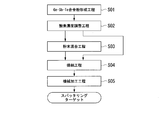
次に、本実施形態であるスパッタリングターゲットの製造方法について、図2のフロー図を参照して説明する。
(Ge-Sb-Te合金粉形成工程S01)
まず、Ge原料とSb原料とTe原料を、所定の配合比となるように秤量する。Ge原料、Sb原料、およびTe原料は、それぞれ純度99.9mass%以上のものを用いることが好ましい。
Ge原料とSb原料とTe原料の配合比は、成膜するGe-Sb-Te合金膜における最終目標組成に応じて、適宜、設定する。
まず、Ge原料とSb原料とTe原料を、所定の配合比となるように秤量する。Ge原料、Sb原料、およびTe原料は、それぞれ純度99.9mass%以上のものを用いることが好ましい。
Ge原料とSb原料とTe原料の配合比は、成膜するGe-Sb-Te合金膜における最終目標組成に応じて、適宜、設定する。
上述のように秤量したGe原料とSb原料とTe原料を、溶解炉に装入して溶解する。Ge原料とSb原料とTe原料の溶解は、真空中あるいは不活性ガス雰囲気(例えばArガス)にて行う。真空中で行う場合には、真空度を10Pa以下とすることが好ましい。不活性ガス雰囲気で行う場合には、10Pa以下までの真空置換を行い、その後、不活性ガス(例えばArガス)を大気圧以下の圧力まで導入することが好ましい。
得られた溶湯を鋳型に注湯して、Ge-Sb-Te合金インゴットを得る。鋳造法には、特に制限はない。
このGe-Sb-Te合金インゴットを、不活性ガス(例えばArガス)の雰囲気中で粉砕し、平均粒径が0.1μm以上120μm以下のGe-Sb-Te合金粉(原料粉)を得る。Ge-Sb-Te合金インゴットの粉砕方法に特に制限はないが、本実施形態では、振動ミル装置を用いることができる。
このGe-Sb-Te合金インゴットを、不活性ガス(例えばArガス)の雰囲気中で粉砕し、平均粒径が0.1μm以上120μm以下のGe-Sb-Te合金粉(原料粉)を得る。Ge-Sb-Te合金インゴットの粉砕方法に特に制限はないが、本実施形態では、振動ミル装置を用いることができる。
(酸素濃度調整工程S02)
次に、得られたGe-Sb-Te合金粉を、室温の大気雰囲気で20時間以上30時間以下の範囲内で保持する。これにより、Ge-Sb-Te合金粉の表層を酸化させて、酸化層を形成し、Ge-Sb-Te合金粉の酸素濃度を調整する。前記酸化温度はより好ましくは15℃以上かつ30℃以下であり、さらに好ましくは20℃以上かつ25℃以下とされる。
大気雰囲気で保持した後のGe-Sb-Te合金粉における酸素濃度は、合金粉の全質量に対して2800massppm以上4500massppm以下の範囲内となることが好ましい。大気雰囲気で保持した後のGe-Sb-Te合金粉における酸素濃度の下限は、2900massppm以上であることがより好ましく、3000massppm以上であることがさらに好ましい。一方、大気雰囲気で保持した後のGe-Sb-Te合金粉における酸素濃度の上限は、4200massppm以下であることがより好ましく、4000massppm以下であることがさらに好ましい。
次に、得られたGe-Sb-Te合金粉を、室温の大気雰囲気で20時間以上30時間以下の範囲内で保持する。これにより、Ge-Sb-Te合金粉の表層を酸化させて、酸化層を形成し、Ge-Sb-Te合金粉の酸素濃度を調整する。前記酸化温度はより好ましくは15℃以上かつ30℃以下であり、さらに好ましくは20℃以上かつ25℃以下とされる。
大気雰囲気で保持した後のGe-Sb-Te合金粉における酸素濃度は、合金粉の全質量に対して2800massppm以上4500massppm以下の範囲内となることが好ましい。大気雰囲気で保持した後のGe-Sb-Te合金粉における酸素濃度の下限は、2900massppm以上であることがより好ましく、3000massppm以上であることがさらに好ましい。一方、大気雰囲気で保持した後のGe-Sb-Te合金粉における酸素濃度の上限は、4200massppm以下であることがより好ましく、4000massppm以下であることがさらに好ましい。
(粉末混合工程S03)
次に、上述の添加元素を添加する場合には、酸素濃度を調整したGe-Sb-Te合金粉に、前記添加元素を有する粉末(一部または全部の添加元素の合金粉末および/または各添加元素の粉末)を混合する。混合方法に特に制限はないが、本実施形態では、ボールミル装置を用いることができる。
次に、上述の添加元素を添加する場合には、酸素濃度を調整したGe-Sb-Te合金粉に、前記添加元素を有する粉末(一部または全部の添加元素の合金粉末および/または各添加元素の粉末)を混合する。混合方法に特に制限はないが、本実施形態では、ボールミル装置を用いることができる。
(焼結工程S04)
次に、上述のようにして得られた原料粉を、成形型に充填し、加圧しながら加熱して焼結し、焼結体を得る。焼結方法としては、ホットプレス、あるいは、HIP等を適用できる。
この焼結工程S04においては、280℃以上350℃以下の低温領域で1時間以上6時間以下保持し、原料粉表面の水分を除去し、その後560℃以上590℃以下の焼結温度まで昇温して6時間以上15時間以下保持し、焼結を進行させる。
次に、上述のようにして得られた原料粉を、成形型に充填し、加圧しながら加熱して焼結し、焼結体を得る。焼結方法としては、ホットプレス、あるいは、HIP等を適用できる。
この焼結工程S04においては、280℃以上350℃以下の低温領域で1時間以上6時間以下保持し、原料粉表面の水分を除去し、その後560℃以上590℃以下の焼結温度まで昇温して6時間以上15時間以下保持し、焼結を進行させる。
焼結工程S04における低温領域での保持時間が1時間未満では、水分の除去が不十分なため、得られた焼結体における酸素濃度が高くなるおそれがある。一方、低温領域での保持時間が6時間を超えると、Ge-Sb-Te合金粉の表層に形成された酸化層が変質してしまい、高酸素領域を形成することができなくなるおそれがある。そこで、本実施形態では、低温領域での保持時間を1時間以上6時間以下の範囲内に設定している。
焼結工程S04における低温領域での保持時間の下限は1.5時間以上とすることがより好ましく、2時間以上とすることがさらに好ましい。一方、焼結工程S04における低温領域での保持時間の上限は5.5時間以下とすることがより好ましく、5時間以下とすることがさらに好ましい。
焼結工程S04における低温領域での保持時間の下限は1.5時間以上とすることがより好ましく、2時間以上とすることがさらに好ましい。一方、焼結工程S04における低温領域での保持時間の上限は5.5時間以下とすることがより好ましく、5時間以下とすることがさらに好ましい。
焼結工程S04における焼結温度での保持時間が6時間未満では、焼結が不十分となり、機械強度が不足し、取り扱い時やスパッタ時に割れが生じるおそれがある。一方、焼結工程S04における焼結温度での保持時間が15時間を超えると、焼結が必要以上に進行してしまうおそれがあった。そこで、本実施形態では、焼結工程S04における焼結温度での保持時間を、6時間以上15時間以下の範囲内に設定している。
焼結工程S04における焼結温度での保持時間の下限は7時間以上とすることがより好ましく、8時間以上とすることがさらに好ましい。一方、焼結工程S04における焼結温度での保持時間の上限は14時間未満とすることがより好ましく、12時間未満とすることがさらに好ましい。
焼結工程S04における焼結温度での保持時間の下限は7時間以上とすることがより好ましく、8時間以上とすることがさらに好ましい。一方、焼結工程S04における焼結温度での保持時間の上限は14時間未満とすることがより好ましく、12時間未満とすることがさらに好ましい。
(機械加工工程S05)
次に、得られた焼結体に対して、所定サイズとなるように、機械加工を行う。
次に、得られた焼結体に対して、所定サイズとなるように、機械加工を行う。
以上の工程により、本実施形態のスパッタリングターゲットが製造される。
以上のような構成とされた本実施形態であるスパッタリングターゲットによれば、図1に示すように、酸素濃度が高い高酸素領域11と、この高酸素領域11よりも酸素濃度が低い低酸素領域12とを有し、高酸素領域11のマトリックス内に、低酸素領域12が島状に分散した組織とされているので、機械加工時の応力やボンディング時の熱応力が高酸素領域11によって緩和され、機械加工時やボンディング時における割れの発生を抑制できる。一方、酸素濃度が低い低酸素領域12が存在することによって、スパッタ時における異常放電の発生を十分に抑制できる。
さらに、本実施形態において、直径0.5μm以上5.0μm以下の空隙が、平均密度として、0.12mm2の範囲内に2個以上10個以下の範囲内で存在する場合には、空隙によって、機械加工時の応力やボンディング時の熱応力が一層緩和され、機械加工時やボンディング時における割れの発生をさらに抑制できるとともに、空隙に起因したスパッタ時における異常放電の発生を抑制できる。
本実施形態であるスパッタリングターゲットにおいて、さらに、C,In,Si,Ag,Snから選択される1種又は2種以上の添加元素を含有し、前記添加元素の合計含有量が25原子%以下とされている場合には、スパッタリングターゲット及び成膜されたGe-Sb-Te合金膜の各種特性を向上できるとともに、スパッタリングターゲット及び成膜されたGe-Sb-Te合金膜の基本的特性を十分に確保できる。
例えば、本実施形態のGe-Sb-Te合金膜は記録膜として使用されることから、記録膜として適切な化学的、光学的、電気的応答が得られるように、上述の添加元素を適宜添加してもよい。
例えば、本実施形態のGe-Sb-Te合金膜は記録膜として使用されることから、記録膜として適切な化学的、光学的、電気的応答が得られるように、上述の添加元素を適宜添加してもよい。
さらに、本実施形態においては、低酸素領域12の面積率が、高酸素領域11の面積率よりも大きくなっているので、スパッタ時における異常放電の発生をさらに抑制できる。
また、低酸素領域12の面積率を60%以上とすることで、スパッタ時における異常放電の発生をさらに抑制できる。一方、低酸素領域12の面積率を80%以下とすることで、高酸素領域11の面積率が確保され、機械加工時の応力やボンディング時の熱応力を高酸素領域11によって確実に緩和することができ、機械加工時やボンディング時における割れの発生をさらに確実に抑制できる。
また、低酸素領域12の面積率を60%以上とすることで、スパッタ時における異常放電の発生をさらに抑制できる。一方、低酸素領域12の面積率を80%以下とすることで、高酸素領域11の面積率が確保され、機械加工時の応力やボンディング時の熱応力を高酸素領域11によって確実に緩和することができ、機械加工時やボンディング時における割れの発生をさらに確実に抑制できる。
また、本実施形態においては、酸素濃度調整工程S02において、得られたGe-Sb-Te合金粉を、室温の大気雰囲気で20時間以上30時間以下の範囲内で保持し、Ge-Sb-Te合金粉の表層を酸化させて、酸化層を形成し、Ge-Sb-Te合金粉の酸素濃度を調整しているので、高酸素領域11のマトリックス内に低酸素領域12が島状に分散した組織の焼結体を安定して製造できる。
以上、本発明の実施形態について説明したが、本発明はこれに限定されることはなく、その発明の技術的思想を逸脱しない範囲で適宜変更可能である。
以下に、本発明の有効性を確認するために行った確認実験の結果について説明する。
(スパッタリングターゲット)
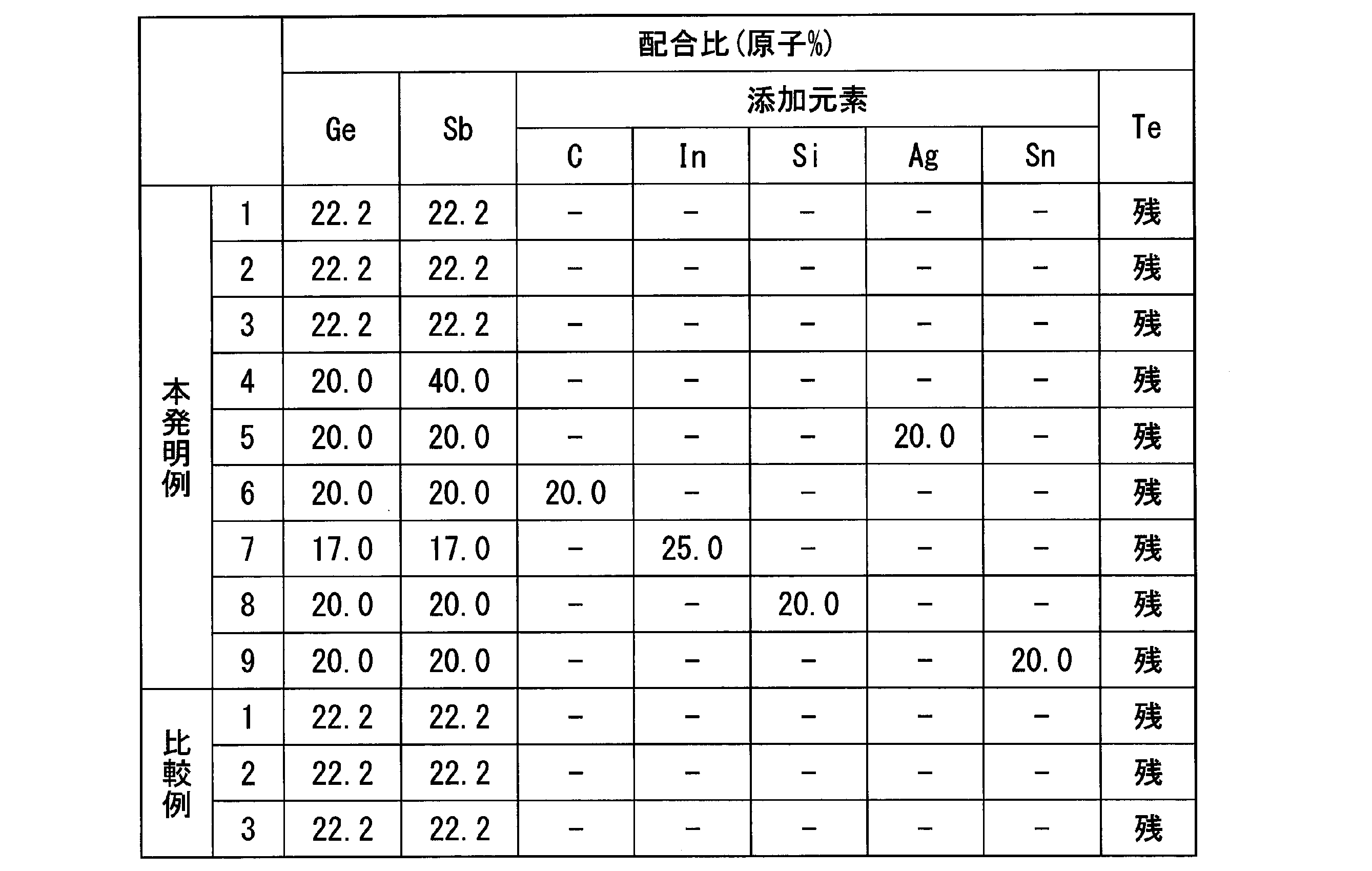
溶解原料として、それぞれ純度99.9mass%以上のGe原料,Sb原料,およびTe原料を準備した。これらGe原料,Sb原料,Te原料を、表1に示す配合比で秤量した。秤量したGe原料とSb原料とTe原料を、溶解炉に装入し、常圧のArガス雰囲気中で溶解し、得られた溶湯を鉄製の鋳型に注湯して、常温まで自然冷却させてGe-Sb-Te合金インゴットを得た。インゴットのサイズは90mm×50mm×40mmとした。
溶解原料として、それぞれ純度99.9mass%以上のGe原料,Sb原料,およびTe原料を準備した。これらGe原料,Sb原料,Te原料を、表1に示す配合比で秤量した。秤量したGe原料とSb原料とTe原料を、溶解炉に装入し、常圧のArガス雰囲気中で溶解し、得られた溶湯を鉄製の鋳型に注湯して、常温まで自然冷却させてGe-Sb-Te合金インゴットを得た。インゴットのサイズは90mm×50mm×40mmとした。
得られたGe-Sb-Te合金インゴットを、常圧のArガス雰囲気中で振動ミルを用いて粉砕し、90μmの篩にかけて通過したGe-Sb-Te合金粉(原料粉)を得た。得られたGe-Sb-Te合金粉に対して、表2に示す条件で、酸素量を調整した。表1に示す添加元素を添加する場合には、大気雰囲気で保持した後のGe-Sb-Te合金粉に所定量の添加元素の粉を混合した。
得られた原料粉を、カーボン製のホットプレス用成形型に充填し、5Paの真空雰囲気で、表2に示す温度、保持時間、加圧圧力で保持した後、表2に示す焼結温度、焼結温度での保持時間、および加圧圧力で、加圧焼結(ホットプレス)を実施し、焼結体を得た。得られた焼結体を機械加工し、評価用のスパッタリングターゲット(126mm×178mm×6mm)を製造した。そして、以下の項目について評価した。
(組織)
得られたスパッタリングターゲットから観察試料を採取し、断面をEPMA(電子線マイクロアナライザー)により観察し、図1に示すように、高酸素領域のマトリックス内に低酸素領域が島状に分散しているか否かを確認した。前記観察試料としては、評価用のスパッタリングターゲットの特定位置:各辺の中央部で外周部分から10mmの位置から4個の10mm×10mm×6mmの試料片をそれぞれ切り出して使用した。使用したEPMAの機種名はJXF-8500Fであり、半定量分析の分析能力は3nm角である。
観察は1000倍の倍率とし、分光器をスキャンさせてX線スペクトルの収集を行った。EPMAの半定量分析により、酸素濃度が2000massppm以上5000massppm以下の範囲内の領域を「低酸素領域」とし、酸素濃度が10000massppm以上15000massppm以下の範囲内の領域を「高酸素領域」として同定した。分析方法は、280μm×380μmの範囲での面分析である。
得られたスパッタリングターゲットから観察試料を採取し、断面をEPMA(電子線マイクロアナライザー)により観察し、図1に示すように、高酸素領域のマトリックス内に低酸素領域が島状に分散しているか否かを確認した。前記観察試料としては、評価用のスパッタリングターゲットの特定位置:各辺の中央部で外周部分から10mmの位置から4個の10mm×10mm×6mmの試料片をそれぞれ切り出して使用した。使用したEPMAの機種名はJXF-8500Fであり、半定量分析の分析能力は3nm角である。
観察は1000倍の倍率とし、分光器をスキャンさせてX線スペクトルの収集を行った。EPMAの半定量分析により、酸素濃度が2000massppm以上5000massppm以下の範囲内の領域を「低酸素領域」とし、酸素濃度が10000massppm以上15000massppm以下の範囲内の領域を「高酸素領域」として同定した。分析方法は、280μm×380μmの範囲での面分析である。
表3においては、高酸素領域のマトリックス内に低酸素領域が島状に分布している組織の場合には「〇」、上述の組織を有していない場合(例えば、低酸素領域あるいは高酸素領域のみが存在する場合、低酸素領域と高酸素領域がそれぞれ局所的に存在する場合、低酸素領域のマトリックス内に高酸素領域が島状に分散している場合)には「×」と記載した。
(空隙)
EPMAで前記観察試料の観察を行い、観察資料の中央部における任意の3箇所を300倍の倍率で観察し、0.12mm2当たりの空隙の個数の平均値を測定した。まず観察した二次電子像の画像を用意し、画像処理ソフトの二値化処理によって空隙部分を抽出し、各空隙の面積Sから同面積の円の直径dを円相当径として算出した(S=πd2より算出)。そして算出した円相当径の中で直径0.5μm以上5.0μm以下の空隙の個数を調べた。評価結果を表3に示す。
EPMAで前記観察試料の観察を行い、観察資料の中央部における任意の3箇所を300倍の倍率で観察し、0.12mm2当たりの空隙の個数の平均値を測定した。まず観察した二次電子像の画像を用意し、画像処理ソフトの二値化処理によって空隙部分を抽出し、各空隙の面積Sから同面積の円の直径dを円相当径として算出した(S=πd2より算出)。そして算出した円相当径の中で直径0.5μm以上5.0μm以下の空隙の個数を調べた。評価結果を表3に示す。
(スパッタリングターゲットの密度)
作製したスパッタリングターゲットから採取した試験片について、ノギスを用いて寸法を測定するとともに電子天秤で重量を測定し、実測密度を算出した。
スパッタリングターゲットの理論密度は、スパッタリングターゲットの配合比の組成から、次のようにして算出した。Ge:Sb:Te:(添加元素)のモル比がa:b:c:dとした場合において、Geがaモルあるときの重量Waを算出し、重量Waと金属Geの密度から、Geがaモルあるときの体積Vaを算出する。同様に、Sbがbモルあるときの重量Wb及び体積Vb、Teがcモルあるときの重量Wc及び体積Vc、(添加元素)がdモルあるときの重量Wd及び体積Vd、を算出する。そして、(各元素の重量の総和=Wa+Wb+Wc+Wd)を(各元素の体積の総和=Va+Vb+Vc+Vd)で割ることにより、理論密度を算出した。得られた理論密度と実測密度から、以下の式によって、相対密度を算出した。評価結果を表3に示す。
(相対密度)=(実測密度)/(理論密度)×100(%)
作製したスパッタリングターゲットから採取した試験片について、ノギスを用いて寸法を測定するとともに電子天秤で重量を測定し、実測密度を算出した。
スパッタリングターゲットの理論密度は、スパッタリングターゲットの配合比の組成から、次のようにして算出した。Ge:Sb:Te:(添加元素)のモル比がa:b:c:dとした場合において、Geがaモルあるときの重量Waを算出し、重量Waと金属Geの密度から、Geがaモルあるときの体積Vaを算出する。同様に、Sbがbモルあるときの重量Wb及び体積Vb、Teがcモルあるときの重量Wc及び体積Vc、(添加元素)がdモルあるときの重量Wd及び体積Vd、を算出する。そして、(各元素の重量の総和=Wa+Wb+Wc+Wd)を(各元素の体積の総和=Va+Vb+Vc+Vd)で割ることにより、理論密度を算出した。得られた理論密度と実測密度から、以下の式によって、相対密度を算出した。評価結果を表3に示す。
(相対密度)=(実測密度)/(理論密度)×100(%)
(酸素濃度)
スパッタリングターゲットの加工時の破材を粉末状に粉砕し、この粉末から測定試料を採取し、ガス分析を実施した。測定結果を表3に示す。ガス分析は、試料を入れた黒鉛るつぼを高周波加熱し、不活性ガス中で融解させ、赤外線吸収法にて検出して分析を行った。
スパッタリングターゲットの加工時の破材を粉末状に粉砕し、この粉末から測定試料を採取し、ガス分析を実施した。測定結果を表3に示す。ガス分析は、試料を入れた黒鉛るつぼを高周波加熱し、不活性ガス中で融解させ、赤外線吸収法にて検出して分析を行った。
(機械加工時の割れ)
上述の焼結体を、旋盤を用いて回転数250rpm、送り0.1mmの条件で加工し、加工時におけるチッピングやクラックの発生状況を確認した。
チッピングやクラックが確認されなかったものを「〇」、チッピングやクラックが確認されたがスパッタ可能な場合を「△」、チッピングやクラックによってスパッタが不可能である場合を「×」と評価した。
上述の焼結体を、旋盤を用いて回転数250rpm、送り0.1mmの条件で加工し、加工時におけるチッピングやクラックの発生状況を確認した。
チッピングやクラックが確認されなかったものを「〇」、チッピングやクラックが確認されたがスパッタ可能な場合を「△」、チッピングやクラックによってスパッタが不可能である場合を「×」と評価した。
(ボンディング時の割れ)
上述のスパッタリングターゲットを、Cu製のバッキングプレートにInはんだを用いてボンディングした。ボンディングは、加熱温度を200℃、印加圧力を3kg、冷却を自然冷却とした条件で行った。ボンディングにおいて割れが確認されなかったものを「〇」、ボンディングにおいて割れが確認されたものを「×」と評価した。
上述のスパッタリングターゲットを、Cu製のバッキングプレートにInはんだを用いてボンディングした。ボンディングは、加熱温度を200℃、印加圧力を3kg、冷却を自然冷却とした条件で行った。ボンディングにおいて割れが確認されなかったものを「〇」、ボンディングにおいて割れが確認されたものを「×」と評価した。
(異常放電)
上述のスパッタリングターゲットを、Cu製のバッキングプレートにInはんだを用いてボンディングした。これを、マグネトロンスパッタ装置に取り付け、1×10⁻⁴Paまで排気した後、Arガス圧0.3Pa、投入電力DC500W、ターゲット-基板間距離70mmの条件で、スパッタを実施した。
スパッタ時の異常放電回数を、MKSインスツルメンツ社製DC電源(型番:RPDG-50A)のアークカウント機能により、放電開始から1時間の異常放電回数として計測した。評価結果を表3に示す。
上述のスパッタリングターゲットを、Cu製のバッキングプレートにInはんだを用いてボンディングした。これを、マグネトロンスパッタ装置に取り付け、1×10⁻⁴Paまで排気した後、Arガス圧0.3Pa、投入電力DC500W、ターゲット-基板間距離70mmの条件で、スパッタを実施した。
スパッタ時の異常放電回数を、MKSインスツルメンツ社製DC電源(型番:RPDG-50A)のアークカウント機能により、放電開始から1時間の異常放電回数として計測した。評価結果を表3に示す。
(抗折強度)
上述のスパッタリングターゲットから測定試料を採取し、JIS R 1601規格に基づいて三点曲げ強度を測定した。評価結果を表3に示す。
上述のスパッタリングターゲットから測定試料を採取し、JIS R 1601規格に基づいて三点曲げ強度を測定した。評価結果を表3に示す。


Ge-Sb-Te合金粉を、大気雰囲気中にて350℃で6時間保持した比較例1においては、Ge-Sb-Te合金粉における酸素濃度が6100massppmとなった。焼結後の組織は、低酸素領域のマトリックス内に高酸素領域が分散した組織となった。高酸素領域の酸素量は58000massppmと非常に高くなっており、低酸素領域の一部においてはGeO2が確認された。
この比較例1においては、ボンディング時に割れが確認された。このため、異常放電の発生回数については評価しなかった。
この比較例1においては、ボンディング時に割れが確認された。このため、異常放電の発生回数については評価しなかった。
Ge-Sb-Te合金粉に対して酸素濃度の調整処理を行わなかった比較例2においては、Ge-Sb-Te合金粉における酸素濃度が1000massppmとなった。焼結後の組織は、低酸素領域のみが存在する組織となった。焼結時の加圧圧力を高く設定することにより、直径0.5μm以上5.0μm以下の空隙の個数が0個とされた。
この比較例2においては、機械加工時、及び、ボンディング時に割れが確認された。このため、異常放電の発生回数については評価しなかった。
この比較例2においては、機械加工時、及び、ボンディング時に割れが確認された。このため、異常放電の発生回数については評価しなかった。
Ge-Sb-Te合金粉を、大気雰囲気中にて350℃で1時間保持した比較例3においては、Ge-Sb-Te合金粉における酸素濃度が2900massppmとなった。焼結後の組織は、低酸素領域のマトリックス内に高酸素領域が分散した組織となった。高酸素領域の酸素量は45000massppmと非常に高くなっており、低酸素領域の一部においてはGeO2が確認された。
この比較例3においては、ボンディング時に割れが確認された。このため、異常放電の発生回数については評価しなかった。
この比較例3においては、ボンディング時に割れが確認された。このため、異常放電の発生回数については評価しなかった。
これに対して、Ge-Sb-Te合金粉を、大気雰囲気中にて室温で24時間保持した本発明例1-9においては、Ge-Sb-Te合金粉における酸素濃度が3100~3500massppmとなった。焼結後の組織は、高酸素領域のマトリックス内に低酸素領域が分散した組織となった。
これら本発明例1-9においては、ボンディング時に割れが確認されなかった。異常放電の発生回数も少なく抑えられていた。
これら本発明例1-9においては、ボンディング時に割れが確認されなかった。異常放電の発生回数も少なく抑えられていた。
焼結時の加圧圧力を30MPaとした本発明例3においては、直径0.5μm以上5.0μm以下の空隙の個数が0個となり、機械加工時に微小な割れが確認された。このため、スパッタ時には、微小な割れに起因して異常放電の発生回数が比較的多くなった。
したがって、機械加工時の割れの発生を十分に抑制するためには、直径0.5μm以上5.0μm以下の空隙の個数が2個以上となるように、焼結時の加圧圧力を設定することが好ましい。
本発明例6は、空隙(ポア)の個数が12個であったが、異常放電の回数は12回であり、他の本発明例と比べて多かったが許容できる範囲ではあった。
したがって、機械加工時の割れの発生を十分に抑制するためには、直径0.5μm以上5.0μm以下の空隙の個数が2個以上となるように、焼結時の加圧圧力を設定することが好ましい。
本発明例6は、空隙(ポア)の個数が12個であったが、異常放電の回数は12回であり、他の本発明例と比べて多かったが許容できる範囲ではあった。
以上のように、本発明例によれば、異常放電の発生を十分に抑制することができ、かつ、機械加工時やバッキング材へのボンディング時における割れの発生を十分に抑制することができ、安定してGe-Sb-Te合金膜を成膜可能なスパッタリングターゲットを提供可能であることが確認された。
11 高酸素領域
12 低酸素領域
12 低酸素領域
Claims (7)
- GeとSbとTeを含有するスパッタリングターゲットであって、
高酸素領域と、この高酸素領域よりも酸素濃度が低い低酸素領域とを有し、
前記高酸素領域のマトリックス内に、前記低酸素領域が島状に分散した構造とされていることを特徴とするスパッタリングターゲット。 - 直径0.5μm以上5.0μm以下の空隙が、平均密度として、0.12mm2の範囲内に2個以上10個以下の範囲内で存在することを特徴とする請求項1に記載のスパッタリングターゲット。
- さらに、C,In,Si,Ag,Snから選択される1種又は2種以上の添加元素を含有し、前記添加元素の合計含有量が25原子%以下であることを特徴とする請求項1又は請求項2に記載のスパッタリングターゲット。
- Geの含有量が10原子%以上30原子%以下、
Sbの含有量が15原子%以上35原子%以下、
残部がTe及び不可避不純物である請求項1または2に記載のスパッタリングターゲット。 - Geの含有量が10原子%以上かつ30原子%以下であり、
Sbの含有量が15原子%以上かつ35原子%以下であり、
前記添加元素の合計含有量が3原子%以上かつ25原子%以下であり、
残部がTe及び不可避不純物である請求項3に記載のスパッタリングターゲット。 - 前記高酸素領域の酸素濃度は10000massppm以上かつ15000massppm以下であり、前記低酸素領域の酸素濃度は2000massppm以上かつ5000massppm以下である請求項1~5の何れか一項に記載のスパッタリングターゲット。
- 前記スパッタリングターゲットの断面を電子線マイクロアナライザーで観察した場合に、前記断面における前記低酸素領域の面積率が60%以上80%以下であり、残部が高酸素領域である請求項1~6のいずれか1項に記載のスパッタリングターゲット。
Priority Applications (3)
| Application Number | Priority Date | Filing Date | Title |
|---|---|---|---|
| CN201980061500.7A CN112739847A (zh) | 2018-11-20 | 2019-11-20 | 溅射靶 |
| KR1020217004703A KR20210092186A (ko) | 2018-11-20 | 2019-11-20 | 스퍼터링 타깃 |
| US17/288,138 US20210381098A1 (en) | 2018-11-20 | 2019-11-20 | Sputtering target |
Applications Claiming Priority (4)
| Application Number | Priority Date | Filing Date | Title |
|---|---|---|---|
| JP2018217177 | 2018-11-20 | ||
| JP2018-217177 | 2018-11-20 | ||
| JP2019-207865 | 2019-11-18 | ||
| JP2019207865A JP6801768B2 (ja) | 2018-11-20 | 2019-11-18 | スパッタリングターゲット |
Publications (1)
| Publication Number | Publication Date |
|---|---|
| WO2020105676A1 true WO2020105676A1 (ja) | 2020-05-28 |
Family
ID=70774140
Family Applications (1)
| Application Number | Title | Priority Date | Filing Date |
|---|---|---|---|
| PCT/JP2019/045407 Ceased WO2020105676A1 (ja) | 2018-11-20 | 2019-11-20 | スパッタリングターゲット |
Country Status (1)
| Country | Link |
|---|---|
| WO (1) | WO2020105676A1 (ja) |
Citations (5)
| Publication number | Priority date | Publication date | Assignee | Title |
|---|---|---|---|---|
| JPH0570937A (ja) * | 1991-04-08 | 1993-03-23 | Mitsubishi Materials Corp | 光デイスク用スパツタリングタ−ゲツト及びその製造方法 |
| JP2001123267A (ja) * | 1999-10-26 | 2001-05-08 | Sanyo Special Steel Co Ltd | Ge−Sb−Te系スパッタリングターゲット材の製造方法 |
| JP2005117002A (ja) * | 2003-09-17 | 2005-04-28 | Mitsubishi Materials Corp | 半導体不揮発メモリー用相変化膜およびこの相変化膜を形成するためのスパッタリングターゲット |
| JP2014029025A (ja) * | 2009-05-27 | 2014-02-13 | Jx Nippon Mining & Metals Corp | 焼結体ターゲット及び焼結体の製造方法 |
| WO2015146394A1 (ja) * | 2014-03-25 | 2015-10-01 | Jx日鉱日石金属株式会社 | Sb-Te基合金焼結体スパッタリングターゲット |
-
2019
- 2019-11-20 WO PCT/JP2019/045407 patent/WO2020105676A1/ja not_active Ceased
Patent Citations (5)
| Publication number | Priority date | Publication date | Assignee | Title |
|---|---|---|---|---|
| JPH0570937A (ja) * | 1991-04-08 | 1993-03-23 | Mitsubishi Materials Corp | 光デイスク用スパツタリングタ−ゲツト及びその製造方法 |
| JP2001123267A (ja) * | 1999-10-26 | 2001-05-08 | Sanyo Special Steel Co Ltd | Ge−Sb−Te系スパッタリングターゲット材の製造方法 |
| JP2005117002A (ja) * | 2003-09-17 | 2005-04-28 | Mitsubishi Materials Corp | 半導体不揮発メモリー用相変化膜およびこの相変化膜を形成するためのスパッタリングターゲット |
| JP2014029025A (ja) * | 2009-05-27 | 2014-02-13 | Jx Nippon Mining & Metals Corp | 焼結体ターゲット及び焼結体の製造方法 |
| WO2015146394A1 (ja) * | 2014-03-25 | 2015-10-01 | Jx日鉱日石金属株式会社 | Sb-Te基合金焼結体スパッタリングターゲット |
Similar Documents
| Publication | Publication Date | Title |
|---|---|---|
| US20170151609A1 (en) | Method for producing a component from an amorphous-phase metal alloy | |
| US20170197246A1 (en) | Method for producing a component from a metal alloy with an amorphous phase | |
| JP2006249578A (ja) | モリブデン合金 | |
| WO2022080319A1 (ja) | 付加製造用金属粉末、これを用いた付加製造物の製造方法及び付加製造物 | |
| WO2020195812A1 (ja) | スパッタリングターゲット | |
| WO2021177469A1 (ja) | 純銅板 | |
| WO2018173450A1 (ja) | タングステンシリサイドターゲット及びその製造方法 | |
| JP6262332B2 (ja) | Al−Te−Cu−Zr合金からなるスパッタリングターゲット及びその製造方法 | |
| JP4061557B2 (ja) | 相変化膜形成用スパッタリングターゲットおよびその製造方法。 | |
| CN113227444A (zh) | 溅射靶 | |
| JP2008255440A (ja) | MoTi合金スパッタリングターゲット材 | |
| JP6801768B2 (ja) | スパッタリングターゲット | |
| JP2011084754A (ja) | スパッタリングターゲットの製造方法 | |
| JP2017025349A (ja) | Te−Ge系スパッタリングターゲット、及び、Te−Ge系スパッタリングターゲットの製造方法 | |
| MXPA04007104A (es) | Productos laminados de pulvimetalurgia de metal refractario de tamano de grano estabilizado. | |
| JP4953168B2 (ja) | パーティクル発生の少ない光記録媒体膜形成用Te系スパッタリングターゲット | |
| JP2021134380A (ja) | スパッタリングターゲット | |
| WO2020170492A1 (ja) | スパッタリングターゲット | |
| JP2021169638A (ja) | スパッタリングターゲット、および、スパッタリングターゲットの製造方法 | |
| JP7763997B1 (ja) | 銅合金粉末、及び該銅合金粉を用いた積層造形物の製造方法 | |
| CN120981588A (zh) | Al-Sc合金和溅射靶和固结方法 | |
| WO2025100263A1 (ja) | アルミニウム合金成形体及びその製造方法 | |
| JP6304615B1 (ja) | 工具 | |
| WO2023195205A1 (ja) | 金属珪化物およびその製造方法、合金材およびその製造方法、発熱体、電気抵抗体 | |
| JP2000053468A (ja) | ZnS−SiO2系焼結体およびその製造方法 |
Legal Events
| Date | Code | Title | Description |
|---|---|---|---|
| 121 | Ep: the epo has been informed by wipo that ep was designated in this application |
Ref document number: 19886254 Country of ref document: EP Kind code of ref document: A1 |
|
| NENP | Non-entry into the national phase |
Ref country code: DE |
|
| 122 | Ep: pct application non-entry in european phase |
Ref document number: 19886254 Country of ref document: EP Kind code of ref document: A1 |