WO2020101008A1 - チタン合金線材およびチタン合金線材の製造方法 - Google Patents
チタン合金線材およびチタン合金線材の製造方法 Download PDFInfo
- Publication number
- WO2020101008A1 WO2020101008A1 PCT/JP2019/044788 JP2019044788W WO2020101008A1 WO 2020101008 A1 WO2020101008 A1 WO 2020101008A1 JP 2019044788 W JP2019044788 W JP 2019044788W WO 2020101008 A1 WO2020101008 A1 WO 2020101008A1
- Authority
- WO
- WIPO (PCT)
- Prior art keywords
- less
- titanium alloy
- alloy wire
- phase
- wire rod
- Prior art date
- Legal status (The legal status is an assumption and is not a legal conclusion. Google has not performed a legal analysis and makes no representation as to the accuracy of the status listed.)
- Ceased
Links
Images


Classifications
-
- C—CHEMISTRY; METALLURGY
- C22—METALLURGY; FERROUS OR NON-FERROUS ALLOYS; TREATMENT OF ALLOYS OR NON-FERROUS METALS
- C22C—ALLOYS
- C22C14/00—Alloys based on titanium
-
- C—CHEMISTRY; METALLURGY
- C21—METALLURGY OF IRON
- C21D—MODIFYING THE PHYSICAL STRUCTURE OF FERROUS METALS; GENERAL DEVICES FOR HEAT TREATMENT OF FERROUS OR NON-FERROUS METALS OR ALLOYS; MAKING METAL MALLEABLE, e.g. BY DECARBURISATION OR TEMPERING
- C21D9/00—Heat treatment, e.g. annealing, hardening, quenching or tempering, adapted for particular articles; Furnaces therefor
- C21D9/52—Heat treatment, e.g. annealing, hardening, quenching or tempering, adapted for particular articles; Furnaces therefor for wires; for strips ; for rods of unlimited length
- C21D9/525—Heat treatment, e.g. annealing, hardening, quenching or tempering, adapted for particular articles; Furnaces therefor for wires; for strips ; for rods of unlimited length for wire, for rods
-
- C—CHEMISTRY; METALLURGY
- C22—METALLURGY; FERROUS OR NON-FERROUS ALLOYS; TREATMENT OF ALLOYS OR NON-FERROUS METALS
- C22F—CHANGING THE PHYSICAL STRUCTURE OF NON-FERROUS METALS AND NON-FERROUS ALLOYS
- C22F1/00—Changing the physical structure of non-ferrous metals or alloys by heat treatment or by hot or cold working
- C22F1/16—Changing the physical structure of non-ferrous metals or alloys by heat treatment or by hot or cold working of other metals or alloys based thereon
- C22F1/18—High-melting or refractory metals or alloys based thereon
-
- C—CHEMISTRY; METALLURGY
- C22—METALLURGY; FERROUS OR NON-FERROUS ALLOYS; TREATMENT OF ALLOYS OR NON-FERROUS METALS
- C22F—CHANGING THE PHYSICAL STRUCTURE OF NON-FERROUS METALS AND NON-FERROUS ALLOYS
- C22F1/00—Changing the physical structure of non-ferrous metals or alloys by heat treatment or by hot or cold working
Definitions
- the present invention relates to a titanium alloy wire and a method for manufacturing the titanium alloy wire.
- Titanium is a material that is lightweight and has high strength, so it has excellent specific strength and corrosion resistance, and is used in various applications such as aircraft, chemical plants, exterior materials for buildings, ornaments, and consumer products.
- ⁇ + ⁇ type titanium alloys such as Ti-6Al-4V, Ti-6Al-6V-2Sn and Ti-6Al-2Sn-4Zr-2Mo have excellent mechanical properties such as specific strength, ductility, toughness and heat resistance. It has been widely used among titanium alloys.
- Patent Document 1 discloses Fe of 0.5% or more and less than 1.4%, 4.4% or more of 5 for the purpose of obtaining a titanium alloy having stable fatigue strength with little variation and high hot workability.
- An ⁇ + ⁇ type titanium alloy has been proposed which comprises less than 0.5% Al, the balance titanium, and impurities.
- High-strength titanium alloy wire rods such as Ti-6Al-4V and Ti-5Al-1Fe used for aircraft fasteners (bolts, nuts, etc.) and automobile valves, etc. require even more excellent fatigue strength and creep strength. Therefore, further improvement is required.
- the present invention has been made in view of the above problems, and an object of the present invention is to provide a titanium alloy wire excellent in fatigue strength and creep strength and titanium that can be manufactured industrially in a stable manner. An object is to provide a method for manufacturing an alloy wire.
- the present inventors have paid attention to the characteristics of the needle-like structure and the equiaxed structure of the titanium alloy wire and the location thereof.
- the acicular structure has excellent creep properties
- the equiaxed structure has excellent fatigue properties.
- a titanium alloy wire rod that simultaneously achieves both excellent fatigue strength and creep strength at an excellent level was found. Further, as a method of arranging a predetermined needle-like structure and equiaxed structure, it was found that the processing heat generated during the production of a titanium alloy wire can be utilized, and as a result of further investigation, the present invention was achieved.
- a titanium alloy wire rod wherein, in a cross section perpendicular to the longitudinal direction, the metal structure in the inner region including the center of gravity from the center of gravity to the position of 20% of the wire diameter is a needle-shaped structure.
- the notation of [elemental symbol] represents the content (mass%) of the corresponding element symbol, and 0 is substituted for the element symbol that does not contain.
- [6] [5] wherein in a cross section perpendicular to the longitudinal direction, the area of the region including the center of gravity in which the average aspect ratio of ⁇ crystal grains is 5.0 or more is 40% or more with respect to the area of the cross section. Titanium alloy wire rod.
- the titanium alloy material has a total area reduction rate of 90.0% or more, and an average area reduction rate of 1% or more per pass in at least one or more passes from the end, and a wire drawing speed. With a processing speed of 5.0 m / s or more, And a method for manufacturing a titanium alloy wire rod.
- the method for producing a titanium alloy wire according to [9] further comprising a heat treatment in a temperature range of ( ⁇ transformation point ⁇ 300) ° C. or higher and ( ⁇ transformation point ⁇ 50) ° C. or lower.
- the present invention it is possible to provide a titanium alloy wire having excellent fatigue strength and creep strength and a method for manufacturing a titanium alloy wire capable of industrially and stably manufacturing a titanium alloy wire.
- FIG. 1 is a perspective sectional view schematically showing a titanium alloy wire rod according to an embodiment of the present invention. It is explanatory drawing which shows typically the state which determines a long axis and a short axis.
- (A)-(e) is explanatory drawing which shows the process in which the titanium alloy wire of this embodiment is manufactured typically in order.
- Titanium alloy wire rod First, the titanium alloy wire rod according to the present embodiment will be described.
- the titanium alloy wire according to the present embodiment is made of an ⁇ + ⁇ type titanium alloy having a chemical composition described later, and has a two-phase structure in which the ⁇ phase is the main component and a small amount of the ⁇ phase exists in the ⁇ phase at room temperature.
- the ⁇ -phase being “mainly” means that the area ratio of the ⁇ -phase is 70% or more.
- the area ratio of the ⁇ phase is about 2% to 30%.
- the metal structure in the outer peripheral region from the surface to the center of gravity up to the position of the wire diameter of 3% has an equiaxed ⁇ with an average crystal grain size of 10 ⁇ m or less.
- the metal structure in the internal region including the center of gravity from the center of gravity to the position of 20% of the wire diameter toward the surface has a needle-like ⁇ It is an acicular structure with crystal grains.
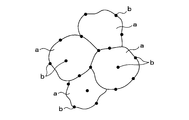
- the equiaxed structure of the ⁇ + ⁇ type titanium alloy has a texture of equiaxed ⁇ crystal grains a, and a fine ⁇ phase exists in the grain boundaries between the ⁇ crystal grains a and in the grains. b exists.
- the acicular structure is an ⁇ -phase metallic structure that develops in acicular form from the grain boundaries due to the cooling of titanium that was in the ⁇ phase at high temperature.
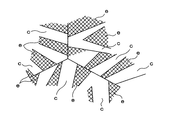
- needle-like ⁇ indicated by symbol c in FIG. 2
- needle-like ⁇ shown in FIG. (Indicated by reference sign e) is a layered structure.
- the titanium alloy wire according to the present embodiment has excellent fatigue strength and creep strength at the same time by arranging the needle-like structure and the equiaxial structure at predetermined positions. More specifically, in the titanium alloy, the acicular structure has excellent creep properties and the equiaxial structure has excellent fatigue properties. The starting point of fatigue fracture occurs near the surface layer (outer periphery) of the titanium alloy wire. Therefore, the present inventors arranged a fine equiaxed structure near the surface layer of the titanium alloy wire to improve fatigue strength, and arranged a needle-shaped structure excellent in creep strength near the center of gravity of the titanium alloy wire. Then, it was remembered to secure the creep strength as a sufficiently excellent one.
- the present inventors as an index of the fine equiaxed structure near the surface layer, pay attention to the average aspect ratio and the average crystal grain size of ⁇ crystal grains in the outer peripheral region of the titanium alloy wire, and these are within a predetermined range. It has been found that the fatigue strength of the titanium alloy wire rod is improved by the existence of a certain one, that is, by forming a fine equiaxed structure region (equixed structure region) in the outer peripheral region.
- the present inventors have focused on the average aspect ratio of the ⁇ crystal grains in the region including the center of gravity as an index of the needle-like structure in the inner region including the center of gravity, and by having a value of a certain value or more, that is, the center of gravity, It was found that the creep strength of the titanium alloy wire rod is improved by forming a needle-shaped structure (a needle-shaped structure region) in the region including the. As a result, it has become possible to improve the creep strength and fatigue strength of the titanium alloy wire at the same time.
- the present inventors have found that the titanium alloy wire rod having the metal structure as described above can be manufactured by the method for manufacturing a titanium alloy wire rod according to the present embodiment, which will be described in detail later, and have arrived at the present invention.
- the metallographic structure of the titanium alloy wire according to this embodiment will be specifically described below.
- FIG. 3 is an explanatory view schematically showing an example of the titanium alloy wire rod 1 according to the present embodiment. It should be noted that the dimensions of each region shown in the drawing are appropriately enlarged or reduced for ease of explanation, and do not show the actual size of each region.
- the titanium alloy wire rod according to the present invention may have any cross-sectional shape, but hereinafter, the titanium alloy wire rod 1 according to the present embodiment has a circular cross section in a cross section perpendicular to the longitudinal direction L. As described below.
- the cross section in the drawing is a cross section perpendicular to the longitudinal direction L of the titanium alloy wire rod 1.
- the outer peripheral region 2 corresponds to 3% of the wire diameter R from the outer peripheral surface 3 toward the center of gravity G in a cross section perpendicular to the longitudinal direction L of the titanium alloy wire rod 1. It is defined as a region up to the depth d.
- oxide scale or the like may be attached to the outer peripheral surface 3 of the titanium alloy wire rod 1.
- the thickness of such an attached substance is used as a measurement starting point of the depth d of the outer peripheral region 2. Not included on the outer peripheral surface of.
- the inner region 4 is 20% of the wire diameter R from the center of gravity G toward the outer peripheral surface 3 in a cross section perpendicular to the longitudinal direction L of the titanium alloy wire rod 1. It is defined as a region including the center of gravity G up to the position of, in the present specification, the center of gravity G in a cross section perpendicular to the longitudinal direction L of the titanium alloy wire rod 1 is defined based on the cross-sectional shape, so-called " It is defined as the "geometric center”.
- the section perpendicular to the longitudinal direction L of the titanium alloy wire rod 1 is a circle, so the center of gravity G shown in FIG. 3 is the center of the circular section.
- the wire diameter R can be defined as the diameter of the circular cross section because the cross section perpendicular to the longitudinal direction L of the titanium alloy wire rod 1 forms a circle.
- the wire diameter R can be defined as the average value of the major axis and the minor axis in the elliptical cross section.
- the titanium alloy wire rod 1 corresponds to 3% of the wire diameter R from the outer peripheral surface 3 of the titanium alloy wire rod 1 toward the center of gravity G in the cross section perpendicular to the longitudinal direction L of the titanium alloy wire rod 1.
- the metal structure in the outer peripheral region 2 up to the depth d exhibits an equiaxed structure having equiaxed ⁇ crystal grains.
- the ductility of the titanium alloy wire rod 1 in the outer peripheral region 2 is improved, the surface properties are improved, and there are few defects that cause fatigue fracture on the surface. Become.
- the metallographic structure in the outer peripheral region 2 of the titanium alloy wire 1 has a needle-shaped structure, the ductility decreases, and as a result, the fatigue strength of the titanium alloy wire 1 cannot be improved.
- the average aspect ratio of the ⁇ crystal grains in the outer peripheral region 2 may be 1.0 or more and less than 3.0, but in order to obtain even more excellent fatigue strength, the preferable upper limit is 2.5, and more preferably It is 2.0.
- the average aspect ratio of the ⁇ crystal grains is theoretically “1” when the metal structure in the outer peripheral region 2 has a perfect equiaxed structure. Therefore, the lower limit of the average aspect ratio of the ⁇ crystal grains in the outer peripheral region 2 is 1.0.
- the average crystal grain size of ⁇ crystal grains in the outer peripheral region is 10.0 ⁇ m or less.
- the metal structure in the outer peripheral region becomes finer, the surface roughness is reduced in combination with the equiaxing of ⁇ crystal grains, and the defects as the starting point of fatigue fracture on the surface are reduced, resulting in the fatigue strength of the titanium alloy wire rod. Is improved.
- the average crystal grain size of the ⁇ crystal grains in the outer peripheral region exceeds 10.0 ⁇ m, the fatigue strength of the titanium alloy wire cannot be made excellent due to an increase in the surface roughness.
- the average crystal grain size of ⁇ crystal grains in the outer peripheral region may be 10.0 ⁇ m or less, but in order to further improve the fatigue strength of the titanium alloy wire, it is preferably 5.0 ⁇ m or less, more preferably 3.0 ⁇ m. It is below.
- the lower limit of the average crystal grain size of ⁇ crystal grains in the outer peripheral region may be 1.0 ⁇ m, for example. If it is less than that, it is difficult to manufacture, and there is a risk that the cost may increase.
- the metal structure of No. 4 has a needle-shaped structure having needle-shaped ⁇ crystal grains.
- the creep strength of the titanium alloy wire rod is improved.
- the metal structure of the inner region 4 of the titanium alloy wire 1 is not sufficiently developed as a needle-shaped structure, the creep strength of the titanium alloy wire 1 will not be sufficient.
- Creep is a phenomenon in which dislocations introduced into a metal structure due to deformation are recovered by diffusion of atoms, so that the material is softened and deformation proceeds. Therefore, the speed of recovery (atomic diffusion speed) affects creep. It is said that the ⁇ / ⁇ interface formed by the needle-like structure has high conformity and the diffusion rate of atoms is slow, so that the needle-like structure has excellent creep strength.
- the creep strength can be improved by making the metallic structure in the inner region 4 including the center of gravity G of the titanium alloy wire 1 into a needle-shaped structure.
- the average aspect ratio of the ⁇ crystal grains in the internal region 4 including the center of gravity G of the titanium alloy wire rod 1 from the center of gravity G to the position of 20% of the wire diameter toward the surface may be 5.0 or more, but the creep strength In order to further improve the above, it is preferably 6.0 or more, more preferably 7.0 or more.
- the upper limit of the average aspect ratio of the ⁇ crystal grains in the inner region 4 including the center of gravity G is not particularly limited, but can be set to 20.0 or less based on actual results.
- a region including the center of gravity G in which the average aspect ratio of ⁇ crystal grains is 5.0 or more in a cross section perpendicular to the longitudinal direction L of the titanium alloy wire 1 (the needle-shaped region including the center of gravity G
- the area ratio of the acicular structure region having ⁇ crystal grains) can be, for example, 20% or more with respect to the area of the cross section of the titanium alloy wire rod 1 perpendicular to the longitudinal direction L.
- the area ratio of the needle-like structure region is preferably 40% or more, and more preferably 50% with respect to the area of the cross section perpendicular to the longitudinal direction L of the titanium alloy wire 1. % Or more.
- a region including the center of gravity G in which the average aspect ratio of ⁇ crystal grains is 5.0 or more in a cross section perpendicular to the longitudinal direction L of the titanium alloy wire 1 (The area ratio of the acicular structure region having acicular ⁇ crystal grains including the center of gravity G) is preferably 90% or less, more preferably the area ratio of the cross section perpendicular to the longitudinal direction L of the titanium alloy wire rod 1. It is 80% or less. It should be noted that, between the outer peripheral region 2 made of the equiaxed tissue and the needle-shaped tissue region including the center of gravity G shown in FIG. 1, it is desirable that the equiaxial tissue continuously changes to the needle-shaped tissue. It may be a mixed organization.
- the average crystal grain size and the average aspect ratio of the ⁇ crystal grains in the cross section perpendicular to the longitudinal direction L of the titanium alloy wire rod 1 can be obtained as follows. First, a cross section of the titanium alloy wire rod 1 perpendicular to the longitudinal direction L is mirror-polished and then etched with a mixed aqueous solution of hydrofluoric acid and nitric acid. The average crystal grain size and the average aspect ratio can be measured by observing an optical micrograph of the surface. The average crystal grain size can be measured by the line segment method (based on JIS G 0551).
- the average grain size is calculated using the number of grain boundaries that cross the line segment, and the average grain size is calculated from the arithmetic average value of the average grain sizes of 10 lines in total.
- the average aspect ratio is 20 from the outer peripheral surface 2 of the titanium alloy wire rod 1 toward the center of gravity G to the depth d corresponding to a wire diameter of 3%, and from the center of gravity G to the surface 3 of the wire diameter R of 20.
- the major axis and the minor axis are measured for 50 arbitrary crystal grains with respect to an optical microscope photograph taken at a magnification of, for example, 500 times, and the major axis is measured. Can be calculated as the average of the values divided by the short axis.
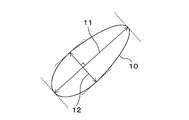
- the “major axis 11” refers to a line segment that connects two arbitrary points on the ⁇ phase grain boundary 10 (contour) and has the maximum length.
- "Short axis 12" means a line segment which is orthogonal to the long axis 11 and which connects any two points on the grain boundary 10 (contour) and has the maximum length.
- the average aspect ratio of the ⁇ crystal grains is measured in a cross section perpendicular to the longitudinal direction L of the titanium alloy wire 1 and in a cross section parallel to the longitudinal direction of the titanium alloy wire 1. Then, it is considered that the values will be similar. However, when measured in a cross section parallel to the longitudinal direction L of the titanium alloy wire rod 1, it becomes difficult to distinguish between a structure having elongated ⁇ crystal grains extended by rolling and a needle structure having acicular ⁇ crystal grains. there is a possibility. Therefore, it is determined by a value measured in a cross section perpendicular to the longitudinal direction L of the titanium alloy wire rod 1.
- the structure having ⁇ crystal grains elongated by rolling it is measured in a cross section perpendicular to the longitudinal direction L of the titanium alloy wire 1 and in a cross section parallel to the longitudinal direction L of the titanium alloy wire 1. It is considered that the value of the aspect ratio of the ⁇ crystal grain is different from that of the case. Specifically, when the structure having ⁇ crystal grains elongated by rolling is measured in a cross section parallel to the longitudinal direction L of the titanium alloy wire rod 1, the aspect ratio is large (for example, 5.0 or more). While ⁇ crystal grains are observed, the ⁇ crystal has a small aspect ratio (for example, about 1.0 to 3.0) when measured in a cross section perpendicular to the longitudinal direction L of the titanium alloy wire rod 1. Grains are observed.
- the average aspect ratio of the ⁇ crystal grains in a cross section perpendicular to the longitudinal direction L of the titanium alloy wire rod 1 whether the ⁇ crystal grains are elongated by rolling or are needle-shaped ⁇ crystal grains. Can be distinguished. Further, when obtaining the average crystal grain size and the average aspect ratio of ⁇ crystal grains, it is considered that ⁇ crystal grains having the same orientation are arranged with a thin needle-like ⁇ phase interposed therebetween. Since it is difficult for EBSD to detect the thin ⁇ phase, it may be difficult for EBSD analysis.
- the center of gravity G exists as a “point” in the cross section perpendicular to the longitudinal direction L of the titanium alloy wire rod 1. Therefore, when observing the average aspect ratio of the ⁇ crystal grains in the inner region 4 including the center of gravity G of the titanium alloy wire 1, the region ⁇ up to 20% of the wire diameter R from the center of gravity G toward the outer peripheral surface 3 is ⁇ . It can be calculated by observing the aspect ratio of the crystal grains and averaging the observed aspect ratios.
- the metallographic structure of the titanium alloy wire rod according to the present embodiment has been described above.
- the chemical composition of the titanium alloy wire according to the present embodiment is not particularly limited as long as it can form a two-phase structure having an ⁇ phase and a ⁇ phase in a temperature environment during use or at room temperature.
- JIS H 4600 or An ⁇ + ⁇ type titanium alloy having various compositions described in JIS H 4650 can be adopted.
- the content is represented by “%”, the “%” indicates mass%.
- Aluminum (Al) is an element that forms a solid solution in the ⁇ phase and strengthens the ⁇ phase.
- the ⁇ + ⁇ -type titanium alloy wire may not contain Al, but may contain 2.0% or more, preferably 2.5% or more Al in order to obtain this effect.
- the ⁇ 2 phase (Ti 3 Al) may precipitate depending on the chemical composition to reduce the ductility, and the amount of the ⁇ phase may increase to improve the hot workability. Since it may decrease, the Al content may be 7.0% or less, preferably 6.5% or less.
- V 0% or more and 6.0% or less Vanadium (V) stabilizes the ⁇ phase and improves hot formability and heat treatment property.
- the ⁇ + ⁇ type titanium alloy wire does not need to contain V, but in order to obtain this effect, V may be contained in an amount of 1.5% or more, preferably 2.0% or more.
- the V content is 6.0% or less. , Preferably 5.5% or less.
- Mo 0% or more and 7.0% or less Molybdenum (Mo) also stabilizes the ⁇ phase and improves hot formability and heat treatment property.
- the ⁇ + ⁇ -type titanium alloy wire may not contain Mo, but in order to obtain this effect, it may contain 1.0% or more, preferably 1.5% or more Mo.
- the Mo content is too large, the volume fraction of the ⁇ phase may increase depending on the chemical composition and the strength of the ⁇ + ⁇ type titanium alloy wire may decrease, so the Mo content should be 7.0% or less. , Preferably 6.0% or less.
- Chromium (Cr) also stabilizes the ⁇ phase and improves hot formability and heat treatability.
- the ⁇ + ⁇ type titanium alloy wire does not have to contain Cr, but may have 2.0% or more, preferably 3.0% or more Cr in order to obtain this effect.
- the Cr content is 7.0% or less. , Preferably 6.0% or less.
- Zr 0% to 5.0% Zirconium (Zr) is an element that simultaneously strengthens the ⁇ phase and the ⁇ phase.
- the ⁇ + ⁇ type titanium alloy wire does not have to contain Zr, but in order to obtain this effect, it may contain 1.5% or more, preferably 2.0% or more Zr.
- the Zr content is 5.0% or less, It may be 4.5% or less.
- Tin (Sn) is an element that simultaneously strengthens the ⁇ phase and the ⁇ phase.
- the ⁇ + ⁇ -type titanium alloy wire does not have to contain Sn, but in order to obtain this effect, it may contain 1.0% or more, preferably 1.5% or more Sn.
- the Sn content is too large, the precipitation of the ⁇ 2 phase (Ti 3 Al) may be promoted and the ductility may be lowered depending on the chemical composition, so the Sn content is 3.0% or less, It may be 2.5% or less.
- Si 0% or more and 0.50% or less Silicon (Si) improves heat resistance.
- the ⁇ + ⁇ type titanium alloy wire may not contain Si, but may contain 0.04% or more, preferably 0.07% or more Si in order to obtain this effect.
- the Si content is 0.50% or less, preferably 0.35% or less. May be
- Cu 0% or more and 1.8% or less Copper (Cu) stabilizes the ⁇ phase and also forms a solid solution in the ⁇ phase to strengthen the ⁇ phase.
- the ⁇ + ⁇ type titanium alloy wire does not have to contain Cu, but in order to obtain this effect, it may contain 0.4% or more, preferably 0.8% or more of Cu.
- the Cu content is 1.8% or less, preferably 1.5%. It may be as follows.
- Niobium (Nb) improves oxidation resistance.
- the ⁇ + ⁇ type titanium alloy wire does not have to contain Nb, but in order to obtain this effect, it may contain 0.1% or more, preferably 0.2% or more Nb.
- the Nb content is too large, the volume fraction of the ⁇ phase may increase depending on the chemical composition and the strength of the ⁇ + ⁇ type titanium alloy wire may decrease, so the Nb content is 1.0% or less. , Preferably 0.8% or less.
- Mn 0% or more and 1.0% or less
- Manganese (Mn) also stabilizes the ⁇ phase and improves hot formability and heat treatability.
- the ⁇ + ⁇ type titanium alloy wire may not contain Mn, but may contain 0.1% or more, preferably 0.2% or more of Mn in order to obtain this effect.
- the Mn content is too large, the volume fraction of the ⁇ phase may increase depending on the chemical composition and the strength of the ⁇ + ⁇ type titanium alloy wire may decrease, so the Mn content is 1.0% or less. , Preferably 0.8% or less.
- Nickel (Ni) also stabilizes the ⁇ phase and improves hot formability and heat treatability.
- the ⁇ + ⁇ type titanium alloy wire does not have to contain Ni, but in order to obtain this effect, it may contain 0.1% or more, preferably 0.2% or more Ni.
- the Ni content is too large, the volume fraction of the ⁇ phase may increase depending on the chemical composition, and the strength of the ⁇ + ⁇ type titanium alloy wire may decrease, so the Ni content should be 1.0% or less. , Preferably 0.8% or less.
- S 0% or more and 0.20% or less Sulfur (S) improves machinability.
- the ⁇ + ⁇ -type titanium alloy wire may not contain S, but in order to obtain this effect, it may contain 0.01% or more, preferably 0.03% or more S.
- the S content is 0.20% or less, preferably 0.10. % Or less.
- REM 0% or more and 0.20% or less
- a rare earth element (REM) is contained together with S to improve machinability.
- the ⁇ + ⁇ type titanium alloy wire does not have to contain REM, but in order to obtain this effect, it may contain 0.01% or more, preferably 0.03% or more of REM.
- the REM content is 0.20% or less, preferably 0.10% or less. % Or less.
- REM specifically, scandium (Sc), yttrium (Y), lanthanum (La), cerium (Ce), praseodymium (Pr), neodymium (Nd), promethium (Pm), samarium (Sm).
- Sc scandium
- Y yttrium
- La lanthanum
- Ce cerium
- Pr praseodymium
- Nd neodymium
- promethium Pm
- Sm samarium
- Eu europium
- Gd gadolinium
- Tb terbium
- Dy dysprosium
- Ho holmium
- Er erbium
- Tm thul
- the REM amount means the total amount of all rare earth elements.
- Fe 0% to 2.10% Iron (Fe) is an element that strengthens the ⁇ phase.
- the ⁇ + ⁇ type titanium alloy wire does not have to contain Fe, but in order to obtain this effect, it may contain 0.50% or more, preferably 0.70% or more Fe.
- the Fe content may be too large, the manufacturability may decrease due to the segregation of Fe or the intermetallic compound (TiFe) may precipitate and the toughness and ductility may decrease depending on the chemical composition.
- the Fe content may be 2.10% or less, preferably 1.50% or less.
- N 0% or more and 0.050% or less Nitrogen (N) is an element that forms a solid solution in the ⁇ phase and strengthens the ⁇ phase.
- the ⁇ + ⁇ type titanium alloy wire does not have to contain N, but in order to obtain this effect, it may contain 0.002% or more, preferably 0.005% or more N.
- the content of N is too large, low density inclusions (TiN) may be generated depending on the chemical composition and may be the starting point of fatigue fracture. Therefore, the content of N is 0.050% or less, preferably May be 0.030% or less.
- Oxygen (O) is an element that forms a solid solution in the ⁇ phase and strengthens the ⁇ phase.
- the ⁇ + ⁇ -type titanium alloy wire may not contain O, but may contain 0.050% or more, preferably 0.100% or more O in order to obtain this effect.
- the O content is 0.250% or less, preferably 0.200%. It may be as follows.
- Carbon (C) strengthens the ⁇ phase by forming a solid solution in the ⁇ phase, and improves the machinability by being contained together with S.
- the ⁇ + ⁇ type titanium alloy wire does not have to contain C, but in order to obtain this effect, it may contain 0.005% or more, preferably 0.010% or more C.
- the content of C is 0.100% or less, preferably 0. It may be 080% or less.
- the balance of the chemical components of the titanium alloy wire according to the present embodiment may be titanium (Ti) and impurities.
- Impurities mean components that are mixed in due to raw materials and other factors when the titanium alloy wire is industrially manufactured, and are allowed within a range that does not adversely affect the titanium alloy wire according to the present embodiment.
- Examples of such impurities include hydrogen (H), tantalum (Ta), cobalt (Co), tungsten (W), palladium (Pd), boron (B), chlorine (Cl), sodium (Na), magnesium (Mg). ), Calcium (Ca), and the like.
- H, Ta, Co, Pd, W, B, Cl, Na, Mg, and Ca are contained as impurities, their contents are, for example, 0.05% or less, respectively, and are 0.10% or less in total. is there.
- the contents of Al, Mo, V, Nb, Fe, Cr, Ni and Mn further satisfy the following formula (1). ⁇ 4.00 ⁇ [Mo] +0.67 [V] +0.28 [Nb] +2.9 [Fe] +1.6 [Cr] +1.1 [Ni] +1.6 [Mn] ⁇ [Al] ⁇ 6 .00 ⁇ ⁇ ⁇ (1)
- the notation of [elemental symbol] represents the content (mass%) of the corresponding element symbol, and 0 is substituted for the element symbol that does not contain.
- the Mo equivalent A represented by the right side of the above formula (1) is each element ( ⁇ stabilizing element) Mo, V, Nb, Fe, Cr, Ni that stabilizes the ⁇ phase described in the formula.
- Mn is used to quantify the degree of stabilization of the ⁇ phase.
- the degree of stabilization of the ⁇ phase by the ⁇ stabilizing elements other than Mo is made relative by a positive coefficient with reference to the degree of stabilization of the ⁇ phase by Mo.
- Al is an element that forms a solid solution in the ⁇ phase and strengthens the ⁇ phase ( ⁇ stabilizing element), in the above Mo equivalent A, the coefficient relating to Al has a negative value.
- the titanium alloy wire according to the present embodiment has Mo, V, Nb, Fe, so that the value of Mo equivalent A represented by the above formula (1) is within the range of -4.00 to 6.00. It contains at least one or more elements selected from the group consisting of Cr, Ni, and Mn.
- the lower limit of the Mo equivalent A is preferably ⁇ 3.50, and more preferably ⁇ 3.00.
- Mo equivalent A exceeds 6.00, a needle-like ⁇ phase is not formed from the ⁇ phase during cooling, the inside becomes a ⁇ single phase structure, and the creep property is not improved.
- the upper limit of Mo equivalent A is preferably 5.00, more preferably 4.00.
- the titanium alloy wire having such a chemical composition is an ⁇ + ⁇ type titanium alloy wire having an ⁇ phase and a ⁇ phase.
- the titanium alloy wire rod is Al: 4.5% or more and 6.5% or less, preferably 4.8% or more, or 6.2% or less, Fe: 0.50% or more and 2.10% or less, preferably 0.70% or more, or 1.50% or less, May be included.
- N 0% or more and 0.050% or less, preferably 0.002% or more, or 0.030% or less
- C 0% or more and 0.100% or less, preferably 0.001% or more, or 0.080% or less, May be
- the titanium alloy wire with such a chemical composition becomes an ⁇ + ⁇ type titanium alloy wire having ⁇ phase and ⁇ phase, and has stable fatigue strength with little variation and high hot workability.
- Examples of titanium alloy wire rods having such a chemical composition include Super-TiX 51AF (Ti-5Al-1Fe, manufactured by Nippon Steel Corporation).
- the titanium alloy wire rod is Al: 2.0% or more and 7.0% or less, preferably 2.5% or more, or 6.5% or less, V: 1.5% or more and 6.0% or less, preferably 2.0% or more, or 5.5% or less, May be included.
- Fe 0% or more and 0.50% or less, preferably 0.03% or more, or 0.30% or less
- N 0% or more and 0.050% or less, preferably 0.002% or more, or 0.030% or less
- O 0% or more and 0.250% or less, preferably 0.100% or more, or 0.200% or less, May be
- the titanium alloy wire with such a chemical composition also becomes an ⁇ + ⁇ type titanium alloy wire containing ⁇ phase and ⁇ phase, and has stable fatigue strength with little variation and high hot workability.
- Examples of the titanium alloy wire having such a chemical composition include Ti-3Al-2.5V, Ti-6Al-4V, SSAT-35 (Ti-3Al-5V, manufactured by Nippon Steel Corporation).
- the titanium alloy wire rod Al 5.0% or more and 7.0% or less, preferably 5.5% or more, or 6.5% or less, Mo: 1.0% or more and 7.0% or less, preferably 1.8% or more, or 6.5% or less, Zr: 3.0% or more and 5.0% or less, preferably 3.6% or more, or 4.4% or less, Sn: 1.0% or more and 3.0% or less, preferably 1.75% or more, or 2.25% or less may be included.
- Si 0% or more and 0.50% or less, preferably 0.06% or more, or 0.10% or less
- Fe 0% or more and 0.50% or less, preferably 0.03% or more, or 0.10% or less
- N 0% or more and 0.050% or less, preferably 0.002% or more, or 0.030% or less
- O 0% or more and 0.250% or less, preferably 0.100% or more, or 0.200% or less
- the titanium alloy wire rod having such a chemical composition becomes an ⁇ + ⁇ type titanium alloy wire rod containing an ⁇ phase and a ⁇ phase, and is particularly excellent in creep characteristics.
- Examples of the titanium alloy wire having such a chemical composition include Ti-6Al-2Sn-4Zr-2Mo-0.08Si and Ti-6Al-2Sn-4Zr-6Mo.
- the chemical composition of the titanium alloy wire rod according to the present embodiment has been described above.
- the wire diameter R of the titanium alloy wire rod 1 according to the present embodiment is not particularly limited, but can be, for example, 2 mm or more and 20 mm or less.
- a needle-shaped structure having needle-shaped ⁇ -grain crystals is formed in the inner region 4 including the center of gravity G, and a fine equiaxed ⁇ is formed in the outer peripheral region 2.
- a fine equiaxed structure having crystal grains can be formed more reliably, and fatigue strength and creep strength can be made more reliable at the same time.
- the lower limit of the wire diameter R of the titanium alloy wire rod 1 according to the present embodiment is preferably 3 mm, and the upper limit of the wire diameter R is preferably 15 mm.
- the shape (cross-sectional shape) of the titanium alloy wire rod according to the present embodiment is not limited to the illustrated mode, and may be a polygonal shape such as an ellipse or a square other than a circle.
- the metal structure in the outer peripheral region 2 has fine equiaxed ⁇ crystal grains having an average crystal grain size of 10 ⁇ m or less. Since the metal structure in the inner region 4 including the center of gravity G is an equiaxed structure and has a needle-shaped structure having needle-shaped ⁇ crystal grains, the titanium alloy wire rod has excellent fatigue strength and creep strength at the same time. ..
- the titanium alloy wire rod according to the present embodiment described above has excellent creep strength and fatigue strength in addition to excellent characteristics, corrosion resistance, specific strength and the like derived from the ⁇ + ⁇ type titanium alloy. Therefore, although the titanium alloy wire according to the present embodiment may be used for any purpose, it can be preferably used for fasteners (fixtures) such as bolts and nuts, valves and the like.
- the titanium alloy wire according to the present embodiment can be particularly preferably used as a fastener or valve material for transportation equipment such as aircraft and automobiles.
- the titanium alloy wire according to the present embodiment described above may be manufactured by any method, but may be manufactured by, for example, the method for manufacturing a titanium alloy wire according to the present embodiment described below.
- the method for manufacturing a titanium alloy wire according to the present embodiment includes a step of heating a titanium alloy material to a temperature of ( ⁇ transformation point ⁇ 200) ° C. or more (heating step), and an ⁇ + ⁇ type titanium alloy material with a total area reduction ratio of 90% or more, and in at least one or more passes from the last, a step (processing step) in which the average area reduction rate per pass is 10% or more and the wire drawing speed is 5 m / s or more, Have.
- each step will be described.
- a titanium alloy material is prepared prior to the above steps.
- the titanium alloy material one having the above-mentioned chemical composition can be used, and one manufactured by a known method can be used.
- the titanium alloy material can be obtained by producing an ingot from titanium sponge by a vacuum arc melting method and hot forging the ingot at a temperature in the ⁇ single phase region.
- the titanium alloy material may be subjected to pretreatment such as cleaning treatment and pickling, if necessary.
- the wire diameter of the titanium alloy material can be appropriately selected according to the area reduction rate planned in the processing step and the wire diameter of the titanium alloy wire material planned.
- the titanium alloy material is heated to a temperature of ( ⁇ transformation point ⁇ 200) ° C. or higher.
- ⁇ transformation point ⁇ 200 a temperature of ( ⁇ transformation point ⁇ 200) ° C. or higher.
- the average aspect ratio of ⁇ crystal grains in the vicinity of the center of gravity can be set to 5.0 or more in the processing step described later.
- the heating temperature in this step is less than ( ⁇ transformation point ⁇ 200) ° C.
- the deformation resistance becomes too large, or the temperature near the center of gravity of the titanium alloy material becomes higher than the ⁇ transformation point in the processing step described later.
- the needle-like structure cannot be sufficiently developed in the vicinity of the center of gravity of the titanium alloy material in some cases, and as a result, the average aspect ratio of ⁇ crystal grains in the vicinity of the center of gravity (inner region) cannot be sufficiently increased.
- the heating temperature in this step may be ( ⁇ transformation point ⁇ 200) ° C. or higher, but from the viewpoint of deformation resistance, it is preferably ( ⁇ transformation point ⁇ 150) ° C. or higher, more preferably ( ⁇ transformation point ⁇ 125). °C or above.
- the upper limit of the heating temperature in this step is not particularly limited, but the heating temperature is preferably ( ⁇ transformation point + 100) ° C. or less, more preferably ( ⁇ transformation point + 50) ° C. or less, from the viewpoint of yield reduction due to scale formation. is there.
- the “ ⁇ transformation point” means the end temperature of ⁇ transformation when the titanium alloy is heated.
- the titanium alloy wire according to the present embodiment and the titanium alloy material that is a raw material thereof are in the ⁇ + ⁇ two-phase region in which an ⁇ phase and a ⁇ phase exist at room temperature and a use environment, and the starting temperature of ⁇ transformation is at these room temperature and It is below the temperature of the operating environment.
- the ⁇ transformation temperature T can be obtained from the phase diagram.
- the phase diagram can be obtained by, for example, the CALPHAD (Computer Coupling of Phase Diagrams and Thermochemistry) method. TI3) can be used.
- This step is a so-called wire drawing step in which the titanium alloy material is drawn by sequentially passing through a plurality of rolling passes.
- This processing step is performed by tandem rolling instead of reverse rolling.
- the tandem rolling is a method in which a rolled material is continuously passed through a plurality of rolling passes arranged in series, and rolling is sequentially performed in one direction in each rolling pass.
- the titanium alloy material has a total area reduction rate of 90% or more, and an average area reduction rate per pass of at least one pass from the last. It is possible to process at 10% or more and a wire drawing speed of 5 m / s or more.
- the metal structure becomes an ⁇ + ⁇ structure or a ⁇ single phase with the ⁇ phase as the main phase by being heated to a temperature of ( ⁇ transformation point ⁇ 200) ° C. or higher.
- a temperature of ( ⁇ transformation point ⁇ 200) ° C. or higher As shown in FIG. 5A, a case of a ⁇ single-phase structure including only ⁇ crystal grains 20 will be described.
- needle-shaped ⁇ crystal grains 21 are formed during the transformation from ⁇ phase to ⁇ phase due to the temperature decrease, and are composed of ⁇ phase and ⁇ phase.
- a needle-like tissue is formed.
- the needle-like tissue is a tissue in which needle-like ⁇ and needle-like ⁇ developed in a needle shape are arranged in layers.
- the needle-shaped ⁇ crystal grains 21 are divided by being processed, and further, due to grain growth, as shown in FIG. 5C, equiaxed ⁇ crystal grains 21 are formed. 22 is formed.
- the wire drawing speed strain speed
- the working heat is small, so that the temperature near the center of gravity does not exceed the ⁇ transformation point (becomes high in the ⁇ single phase region). Therefore, an ⁇ + ⁇ type equiaxed structure in which the equiaxed ⁇ crystal grains 22 and the equiaxed ⁇ crystal grains are mixed is formed.
- the wire drawing speed increases, and due to heat generated during working, the temperature rises above the ⁇ transformation point near the center of gravity.
- the ⁇ phase is transformed into the ⁇ phase, and the ⁇ single-phase structure including only the ⁇ crystal grains 23 is formed.
- titanium alloys have large deformation resistance and relatively large heat generation during processing in the rolling process and wire drawing process.
- the average area reduction rate and the wire drawing speed are relatively large, and thus the working heat generation during passing through the rolling pass is large.
- the heat removal is small with respect to the heat generated by processing, and therefore the temperature in that region rises above the ⁇ transformation point.
- the outer peripheral region in the outer peripheral region, sufficient heat can be removed from the outer peripheral surface even in the latter stage of the processing step, and the metal structure is refined and equiaxed by being processed at a relatively low temperature.
- the ⁇ crystal grains 24 in the outer peripheral region become fine equiaxed grains having an average crystal grain size of 10 ⁇ m or less.
- the metal structure in the outer peripheral region by sufficiently miniaturizing and equiaxing the metal structure in the outer peripheral region as described above, the occurrence of defects on the outer peripheral surface is suppressed, and the occurrence of defects such as breakage during manufacturing is suppressed.
- the titanium alloy material is cooled to near the center of gravity, so as shown in FIG. 5 (e), as the temperature lowers, acicular ⁇ crystals at the time of transformation from ⁇ phase to ⁇ phase Grains 25 are generated and needle-like tissue is formed in the internal region including the center of gravity.
- the metal alloy structure in the outer peripheral region is the fine equiaxed structure 24, and the metal structure in the inner region is the needle-shaped structure 25, the titanium alloy wire of the present embodiment is manufactured.
- the titanium alloy material is made to have a total area reduction rate of 90% or more, an average area reduction rate of 10% or more per pass in at least one or more passes from the end, and wire drawing.
- the titanium alloy wire rod of the present embodiment is manufactured. That is, in the cross section perpendicular to the longitudinal direction L, the metal structure in the outer peripheral region 2 from the surface 3 toward the center of gravity G to the depth d corresponding to the wire diameter 3% has an average crystal grain size of 10 ⁇ m or less, etc.
- a needle having an equiaxed structure having axial ⁇ crystal grains, and the metal structure in the inner region 4 including the center of gravity G from the center of gravity G to the position of 20% of the wire diameter toward the surface 3 has needle-shaped ⁇ crystal grains. It becomes a textured structure. Further, in the cross section perpendicular to the longitudinal direction L, the average aspect ratio of the ⁇ crystal grains in the outer peripheral region 2 is 1.0 or more and less than 3.0, and the average aspect ratio of the ⁇ crystal grains in the inner region 4 is 5. It becomes 0 or more.
- the drawing speed in at least one or more passes from the last described above is much higher than the drawing speed (about 0.2 to 2.0 m / s) adopted in the production of conventional titanium alloy wire rods.
- the inventors of the present invention intentionally adopt such a wire drawing speed together with the above-mentioned average area reduction rate to generate a large amount of processing heat and obtain the metal structure of the titanium alloy wire rod according to the present embodiment described above. I found it possible.
- the average area reduction rate per pass is at least 10% in at least one pass from the end. As a result, at least one or more passes from the end can generate sufficient processing heat. On the other hand, if the average surface reduction rate is less than 10%, sufficient heat generation due to processing cannot be generated, the temperature of the internal region 4 including the center of gravity G cannot be sufficiently increased, and the ⁇ phase Is not fully developed.
- the average surface reduction rate per pass may be 10% or more, but a larger processing heat is generated to form a ⁇ single-phase structure, and a needle-like structure is formed during subsequent cooling. In order to form, it is preferably 15% or more, more preferably 20% or more. Further, the upper limit of the average surface reduction rate per pass is not particularly limited at least in the last one or more passes, but from the viewpoint of the load on the facility, the average surface reduction rate is preferably 45% or less, more preferably Is 35% or less.
- Draw wire speed is 5m / s or more in at least one pass from the last.
- the heat removal amount can be reduced in at least one pass from the last, and the heat generated by the processing heat is accumulated in the inner region 4 including the center of gravity G.
- the temperature of the inner region 4 becomes sufficiently high. can do.
- the wire drawing speed is less than 5 m / s in at least one pass from the last, the amount of heat removal becomes large, and as a result, the heat generated by the processing heat is accumulated in the internal region 4 including the center of gravity G. Therefore, the temperature of the inner region 4 cannot be raised sufficiently. Therefore, the ⁇ -single-phase structure is not formed, and it becomes difficult to form a needle-like structure during the subsequent cooling.
- the wire drawing speed may be 5 m / s or more, but it is preferably 10 m / s in order to sufficiently develop the ⁇ phase and form a needle-like structure during subsequent cooling. Or more, More preferably, it is 20 m / s or more.
- the upper limit of the wire drawing speed is not particularly limited in at least one pass from the last, but the wire drawing speed is preferably 75 m / s or less, and more preferably from the viewpoint of operation stability and load on equipment. Is 50 m / s or less.
- the total area reduction rate of the titanium alloy material processed in this process is 90% or more.
- the metallographic structure in the outer peripheral region 2 is made equiaxed and refined.
- the total area reduction rate of the titanium alloy material is less than 90%, the equiaxed and fine grain structure of the metal structure in the outer peripheral region 2 becomes insufficient.
- the metal structure in the outer peripheral region 2 is equiaxed, the ⁇ crystal grains do not become sufficiently fine and have a large grain size.
- the total area reduction rate may be 90% or more, but is preferably 95% or more, and more preferably 99% or more in order to more surely equiaxeize and refine the metal structure in the outer peripheral region 2. ..
- the area reduction rate per pass refers to the reduction rate of the area after the one pass with respect to the cross-sectional area before the one pass
- the total area reduction rate refers to the cutting of the titanium alloy material before processing in this process.
- the reduction rate of the cross-sectional area after processing with respect to the area is the reduction rate of the cross-sectional area after processing with respect to the area.
- the caliber shape of the roll used in this step is not particularly limited as long as the above-mentioned drawing speed and area reduction ratio can be achieved, and a known caliber shape can be used, for example, a perfect circle, an ellipse, A square shape or the like can be used.
- the number of times the roll is passed in this step is not particularly limited, and may be 5 times or more so that this step can be carried out.
- the titanium alloy wire according to the present embodiment as described above can be manufactured industrially and stably.
- the titanium alloy wire thus obtained may be subjected to the following heat treatment and post-treatment, if necessary.
- the titanium alloy material (titanium alloy wire rod) obtained by each of the above steps is further subjected to heat treatment (annealing treatment) in a temperature range of ( ⁇ transformation point ⁇ 300) ° C. or higher and ( ⁇ transformation point ⁇ 50) ° C. or lower. Good. Thereby, the strain generated in the above-mentioned processing step can be removed, and the fatigue strength of the obtained titanium alloy wire rod can be further improved.
- the temperature of heat treatment is ( ⁇ transformation point -300) ° C or higher.
- the temperature of the heat treatment is preferably ( ⁇ transformation point ⁇ 250) ° C. or higher, more preferably ( ⁇ transformation point ⁇ 200) ° C. or higher.
- the temperature of heat treatment is ( ⁇ transformation point ⁇ 50) ° C. or lower.
- the heat treatment temperature is preferably ( ⁇ transformation point ⁇ 100) ° C. or lower.
- the heat treatment time is not particularly limited and can be appropriately selected. For example, it can be 1 minute or more and 120 minutes or less, preferably 2 minutes or more, or 60 minutes or less.
- the atmosphere during the heat treatment is not particularly limited, and may be the atmosphere, vacuum, or an inert gas (argon, etc.).
- the atmosphere is not an atmosphere that promotes a chemical reaction such as oxidation, then it is possible to deal with it by descaling.
- Examples of the post-treatment include pickling and removal of oxide scale by cutting, washing treatment, and the like, and they can be appropriately applied as necessary.
- the method for manufacturing the titanium alloy wire rod according to the present embodiment has been described above.
- Titanium Alloy Wire Rod First, an ingot having the chemical composition shown in Table 1 was prepared by a vacuum arc melting method, and was hot forged at a temperature in the ⁇ single phase region to obtain a predetermined composition of alloy types A to O. A round titanium rod having a diameter (wire diameter of 22 mm to 180 mm) was obtained. In addition, in each titanium round bar, components other than the composition shown in Table 1 are titanium and impurities. Further, all of the alloy types A to M are ⁇ + ⁇ type titanium alloys that form a two-phase structure having an ⁇ phase and a ⁇ phase at room temperature or a use environment.
- the alloy type N is an ⁇ + ⁇ type titanium alloy in which the ⁇ phase hardly exists at room temperature
- the alloy type O is a metastable ⁇ type titanium alloy having a martensite transformation start temperature of room temperature or lower.
- the alloy types A to M are examples satisfying the composition range defined in claim 1.
- Alloy types A to A4 are examples satisfying the component range defined in claim 2.
- Alloy types B to B5 are examples satisfying the component range defined in claim 3.
- Alloy types C to C9 are examples satisfying the component range defined in claim 4.
- each titanium round bar obtained was heated (heating process) and wire drawing was performed using a roll (processing process). Further, a heat treatment step was performed if necessary (heat treatment step). The heat treatment was performed for 10 minutes in an atmosphere of 100% argon. Thereby, the titanium alloy wire rod according to each example was obtained. Heating temperature (° C) in the heating step, average area reduction rate (%) per pass in at least one or more passes from the last in the processing step, wire drawing speed (m / s), total area reduction rate in the processing step (%), Presence / absence of heat treatment step, and heat treatment temperature (° C.) are shown in Tables 2, 3 and 4.
- the titanium alloy wire rod according to each example was analyzed and evaluated for the following items.
- metallographic structure (microstructure) Regarding the titanium alloy wire according to each example, a cross section perpendicular to the longitudinal direction was observed as follows, and the metallographic structure was an equiaxed structure and a needle in each region of the cross section. It was investigated whether it was a tissue. Further, the average crystal grain size and the average aspect ratio of the ⁇ crystal grains were measured and calculated, and the area ratio of the region in which the average aspect ratio of the ⁇ crystal grains was 5.0 or more to the cross section was obtained. First, the titanium alloy wire according to each example was mirror-polished on a cross section perpendicular to the longitudinal direction, and then etched with a mixed solution of hydrofluoric acid and nitric acid.
- the average crystal grain size and the average aspect ratio were measured by observing an optical micrograph of the surface.
- the average crystal grain size was measured by the line segment method according to JIS G 0551. Specifically, an optical micrograph taken at a magnification of 500 times is divided into five vertical and horizontal line segments, and the average grain size is calculated for each line segment using the number of grain boundaries that cross the line segment. Was calculated from the arithmetic average value of the average crystal grain size of 10 in total.
- the average aspect ratio is the arithmetic average of the values obtained by dividing the major axis by the minor axis by measuring the major axis and minor axis for 50 arbitrary crystal grains in an optical micrograph taken at a magnification of 500 times. Calculated.
- the "major axis” refers to the line segment that connects two arbitrary points on the grain boundary (contour) of the ⁇ phase and has the maximum length
- the “minor axis” means the length. Of the line segments orthogonal to the axis and connecting any two points on the grain boundary (outline), the one having the maximum length is meant.
- the average area reduction rate (%) per pass in at least one or more passes from the last in the working process was 16%, and The speed (m / s) is 25 m / s.
- the metal structure in the outer peripheral region is an equiaxial structure in which the equiaxed ⁇ phase is the parent phase and the fine ⁇ phase is present in the grain boundaries or grains.
- the metallic structure in the inner region was a needle-shaped structure in which needle-like ⁇ phase and ⁇ phase were arranged in layers.
- the metal structure of the inner region was a structure in which the ⁇ phase having ⁇ crystal grains with a relatively small aspect ratio was the parent phase, and the ⁇ phase was hardly present (the ⁇ phase was present in a very small amount). More specifically, the internal region of Comparative Example 1 has a structure in which equiaxed ⁇ phase is finely dispersed in block-shaped ⁇ phase. In Comparative Example 2, the Mo equivalent (Moeq) is larger than 6.0. In Comparative Example 2, both the metal structure of the outer peripheral region and the metal structure of the inner region became a ⁇ single-phase equiaxed structure composed of equiaxed ⁇ crystal grains. In Table 3, since the metal structures of the inner regions of Comparative Examples 1 and 2 and the metal structure of the outer region of Comparative Example 2 are different from the equiaxed structure of the present invention, they are distinguished by adding " * ". did.
- A Improved by 10 MPa or more as compared with the standard fatigue strength.
- B There was a variation in the range of -10 MPa to less than 10 MPa as compared with the standard fatigue strength.
- C More than 10 MPa and 20 MPa or less compared to the standard fatigue strength.
- A Improved by 20 MPa or more as compared with the standard creep strength.
- B Improved by 10 MPa or more and less than 20 MPa as compared with the standard creep strength.
- C There was variation in the range of -10 MPa or more and less than 10 MPa as compared with the standard creep strength.
- the metal structure in the outer peripheral region, the average aspect ratio of ⁇ crystal grains, the average crystal grain size, and Table 2 shows the metal structure in the internal region, the average aspect ratio of ⁇ crystal grains, the area ratio of the acicular structure region, and the fatigue strength and creep strength which are the criteria for evaluation.
- the metal structures in the outer peripheral regions of Invention Examples 1 to 31 (alloy species A to M) and Comparative Examples 1 and 2 (alloy species N and O), average aspect ratio of ⁇ crystal grains, average crystal grain size, and internal Table 3 shows the metallographic structure in the region, the average aspect ratio of ⁇ crystal grains, the area ratio of the acicular structure region, the fatigue strength to be evaluated and the evaluation result, and the creep strength to be evaluated and the evaluation result.
- the evaluation of fatigue strength was either A or B, which was equal to or higher than the standard fatigue strength.
- the evaluation of creep strength was either A or B, which was improved compared with the standard creep strength.
- Comparative Examples 1 and 2 the improvement in creep strength was not sufficient.
- the fatigue strength and creep strength of the alloy types A, B and C were compared and evaluated.
- Inventive Examples 32 to 54 satisfy the present invention in the heating step and the processing step, and in the titanium alloy wire rods of Inventive Examples 32 to 54, the metal structure in the outer peripheral region has the equiaxed ⁇ phase as the parent phase and its grain boundaries It became an equiaxed structure in which fine ⁇ phase was present in the grains and the metallic structure in the inner region became a needle-shaped structure in which needle-like ⁇ phase and ⁇ phase were arranged in layers.
- Comparative Examples 3 to 10 either the heating step or the processing step is outside the scope of the present invention, and the titanium alloy wire rods of Comparative Examples 3 to 10 have a metal structure in the outer peripheral region and an average aspect ratio of ⁇ crystal grains.
- the average crystal grain size of the ⁇ crystal grains, the metal structure of the internal region, or the average aspect ratio of the ⁇ crystal grains was outside the scope of the present invention.
- the wire diameters of Inventive Examples 32 to 54 were 1.5 mm to 22.0 mm.
- Invention Examples 32 to 50, 52 and 53 are examples satisfying the wire diameter of 2.0 mm to 20.0 mm defined in claim 8.
- Inventive Examples 32 to 48 and Inventive Examples 51 to 54 are based on the fatigue strength and creep strength in the example of alloy type A in Table 2, and Inventive Example 49 is the fatigue strength and creep strength in the example of alloy type B in Table 2.
- Inventive Example 50 was evaluated in the grades A to C in the same manner as above, based on the fatigue strength and creep strength in the example of alloy type C in Table 2 based on the above.
- the titanium alloy wires according to Inventive Examples 32 to 54 were excellent in fatigue strength and creep strength at the same time.
- the titanium alloy wire rods according to Inventive Examples 32 to 54 had good creep strength compared to the reference comparative example.
- the titanium alloy wire rods according to Comparative Examples 3 to 10 could not have excellent fatigue strength and creep strength at the same time.
- Comparative Example 3 since the total area reduction rate was less than 90.0%, in the outer peripheral region, a small amount of fine ⁇ phase was present in the ⁇ phase in which the aspect ratio of ⁇ crystal grains and the crystal grain size were increased to some extent. , The organization has not been completed in equiaxed (unequalized). Further, in Comparative Example 3, the wire drawing speed was less than 5.0 m / s, and the heat generation during processing was small. Therefore, in the internal region, ⁇ was included in the ⁇ phase having the ⁇ phase composed of equiaxed ⁇ crystal grains as the parent phase. It became an equiaxed structure in which the phases were finely dispersed.
- Comparative Example 4 since the average surface reduction rate in at least one or more passes from the end was less than 10.0% and the heat generation during processing was small, the ⁇ phase composed of equiaxed ⁇ crystal grains was formed in both the inner region and the outer peripheral region. Was the mother phase, and a small amount of the ⁇ phase was finely dispersed in the ⁇ phase to form an equiaxed structure. In Comparative Example 5, since the total area reduction rate was less than 90.0%, the outer peripheral region was equiaxed with a small amount of fine ⁇ phase in the ⁇ phase in which the aspect ratio of ⁇ crystal grains was increased to some extent.
- Comparative Example 7 since the total area reduction rate was less than 90.0%, the outer peripheral region had the ⁇ phase composed of coarse equiaxed ⁇ crystal grains as the mother phase, and a small amount of ⁇ phase dispersed in the ⁇ phase.
- the inner region became a needle-like structure in which needle-like ⁇ phase and ⁇ phase were arranged in layers.
- Comparative Example 8 since the heating temperature was too low, the ⁇ phase formed of equiaxed ⁇ crystal grains was used as the mother phase in both the inner region and the outer peripheral region, and a small amount of ⁇ phase was finely dispersed in the ⁇ phase to form an equiaxed structure. became.
- the outer peripheral region contained a small amount of fine ⁇ phase in the ⁇ phase in which the aspect ratio of ⁇ crystal grains and the crystal grain size were increased to some extent.
- the tissue was not equiaxed (unequiaxed), and the inner region was a needle-shaped tissue in which needle-like ⁇ phase and ⁇ phase were arranged in layers.
- the outer peripheral region since the total area reduction rate was less than 90.0%, the outer peripheral region had a small amount of fine ⁇ phase in the ⁇ phase with an aspect ratio increased to a certain extent, and the equiaxing was completed.
- the internal region was a needle-like structure in which needle-like ⁇ -phase and ⁇ -phase were arranged in layers.
- the titanium alloy wire rods according to Inventive Examples 32, 33, 36, 39 to 41, and 45 to 52 in which the area ratio of the needle-shaped tissue region including the center of gravity exceeded 40% were excellent in creep strength.
- the titanium alloy wire rods according to Inventive Examples 32 to 35, 39, 40, 42 to 44, 47 to 50, 53 and 54 in which the average grain size of ⁇ crystal grains in the outer peripheral region is 5.0 ⁇ m or less have fatigue strength. Was excellent.
Landscapes
- Chemical & Material Sciences (AREA)
- Engineering & Computer Science (AREA)
- Materials Engineering (AREA)
- Mechanical Engineering (AREA)
- Metallurgy (AREA)
- Organic Chemistry (AREA)
- Physics & Mathematics (AREA)
- Thermal Sciences (AREA)
- Crystallography & Structural Chemistry (AREA)
- Non-Insulated Conductors (AREA)
- Heat Treatment Of Steel (AREA)
- Conductive Materials (AREA)
Abstract
Description
[1]
α相とβ相とを含むチタン合金線材であって、
質量%で、
Al:0%以上7.0%以下、
V:0%以上6.0%以下、
Mo:0%以上7.0%以下、
Cr:0%以上7.0%以下、
Zr:0%以上5.0%以下、
Sn:0%以上3.0%以下、
Si:0%以上0.50%以下、
Cu:0%以上1.8%以下、
Nb:0%以上1.0%以下、
Mn:0%以上1.0%以下、
Ni:0%以上1.0%以下、
S:0%以上0.20%以下、
REM:0%以上0.20%以下、
Fe:0%以上2.10%以下、
N:0%以上0.050%以下、
O:0%以上0.250%以下、
C:0%以上0.100%以下、
残部:Tiおよび不純物であり、
Al、Mo、V、Nb、Fe、Cr、Ni及びMnの含有量が、下記式(1)を満たす化学組成を有し、
長手方向に対して垂直な断面において、表面から重心へ向かって線径の3%の深さまでの外周領域における金属組織が、平均結晶粒径が10μm以下のα結晶粒を有する等軸組織であり、
前記長手方向に対して垂直な断面において、重心から表面に向かって線径の20%の位置までの重心を含む内部領域における金属組織が針状組織である、チタン合金線材。
-4.00≦[Mo]+0.67[V]+0.28[Nb]+2.9[Fe]+1.6[Cr]+1.1[Ni]+1.6[Mn]-[Al]≦6.00 ・・・(1)
なお、式(1)において、[元素記号]の表記は、対応する元素記号の含有量(質量%)を表し、含有しない元素記号については、0を代入するものとする。
[2]
質量%で、
Al:4.5%以上6.5%以下、
Fe:0.50%以上2.10%以下、
を含む、[1]に記載のチタン合金線材。
[3]
質量%で、
Al:2.0%以上7.0%以下、
V :1.5%以上6.0%以下、
を含む、[1]に記載のチタン合金線材。
[4]
質量%で、
Al:5.0%以上7.0%以下、
Mo:1.0%以上7.0%以下、
Zr:3.0%以上5.0%以下、
Sn:1.0%以上3.0%以下、
を含む、[1]に記載のチタン合金線材。
[5]
前記長手方向に対して垂直な断面において、前記外周領域におけるα結晶粒の平均アスペクト比が1.0以上3.0未満であり、前記内部領域におけるα結晶粒の平均アスペクト比が5.0以上である、[1]~[4]の何れか一項に記載のチタン合金線材。
[6]
前記長手方向に対して垂直な断面において、α結晶粒の平均アスペクト比が5.0以上である重心を含む領域の面積が、当該断面の面積に対し40%以上である、[5]に記載のチタン合金線材。
[7]
前記外周領域におけるα結晶粒の平均結晶粒径が5.0μm以下である、[1]~[6]の何れか一項に記載のチタン合金線材。
[8]
線径が、2.0mm以上20.0mm以下である、[1]~[7]のいずれか一項に記載のチタン合金線材。
[9]
チタン合金素材を(β変態点-200)℃以上の温度に加熱する工程と、
前記チタン合金素材を、総減面率が90.0%以上であり、かつ、少なくとも最終から1以上のパスにおいて、1パスあたりの平均減面率が10.0%以上、かつ、伸線速度が5.0m/s以上で加工する工程と、
を有する、チタン合金線材の製造方法。
[10]
さらに、(β変態点-300)℃以上(β変態点-50)℃以下の温度域にて熱処理する工程を有する、[9]に記載のチタン合金線材の製造方法。
<1.
チタン合金線材>
まず、本実施形態に係るチタン合金線材について説明する。
まず、本実施形態に係るチタン合金線材の金属組織について説明する。本実施形態に係るチタン合金線材は、後述する化学組成を有するα+β型チタン合金からなり、室温でα相を主体とし、α相中に少量のβ相が存在する二相組織となる。ここで、α相が「主体」とは、α相の面積率が70%以上であることを意味する。β相の面積率は2%~30%程度である。なお、本発明の各実施形態で着目するチタン合金線材では、β相の面積率の測定が難しく、許容される測定誤差は±5%である。
本実施形態に係るチタン合金線材は、長手方向に対して垂直な断面において、表面から重心へ線径3%位置までの外周領域における金属組織が、平均結晶粒径が10μm以下の等軸のα結晶粒を有する等軸組織であり、前記長手方向に対して垂直な断面において、重心から表面に向かって線径の20%の位置までの重心を含む内部領域における金属組織が、針状のα結晶粒を有する針状組織である。
針状組織は、高温でβ相であったチタンが冷却されたことにより、粒界から針状に発達したα相の金属組織である。図2に示すように、α+β型チタン合金の針状組織では、旧β粒の粒界位置から針状に発達した針状α(図2中の符号cで示す)と針状β(図2中の符号eで示す) が層状に並んだ組織となっている。
このように、金属組織を観察することにより、等軸組織と針状組織は区別することが可能である。
なお、外周領域におけるα結晶粒の平均結晶粒径の下限は例えば1.0μmとしても良い。それ未満は、作製困難であり、コストがかかる恐れがある。
クリープは、変形により金属組織中に導入された転位が、原子の拡散によって回復することで、材料が軟化し、変形が進む現象である。そのため、回復の速度(原子の拡散速度)がクリープに影響する。針状組織で形成されたα/β界面は整合性が高く、原子の拡散速度が遅いため、針状組織はクリープ強度に優れると言われている。チタン合金線材1の重心Gを含む内部領域4における金属組織を針状組織とすることで、クリープ強度を向上させることができる。
なお、図1に示した等軸組織からなる外周領域2と重心Gを含む針状組織領域との間は、等軸組織から針状組織に連続して変化することが望ましいが、それらの組織が混在した組織であっても構わない。
平均結晶粒径は線分法により測定(JIS G 0551に準拠)できる。チタン合金線材1の外周表面3から重心Gへ向かって線径Rの3%に相当する深さdまでの外周領域2において、例えば500倍の倍率で撮影した光学顕微鏡写真に対し、縦横に5本ずつ線分を引き、線分ごとに当該線分を横切る粒界数を用いて平均結晶粒径を算出し、合計10本の平均結晶粒径の算術平均値より求める。
平均アスペクト比は、チタン合金線材1の外周表面3から重心Gへ向かって線径3%に相当する深さdまでの外周領域2、および、重心Gから表面3に向かって線径Rの20%の位置までの重心Gを含む内部領域4において、それぞれ例えば500倍の倍率で撮影した光学顕微鏡写真に対し、任意の結晶粒50個に対して、長軸と短軸を測定し、長軸を短軸で除した値の平均として算出することができる。ここで、図4に示すように、「長軸11」とは、α相の粒界10(輪郭)上の任意の2点を結ぶ線分のうちで、長さが最大になるものをいい、「短軸12」とは、長軸11に直交し、かつ粒界10(輪郭)上の任意の2点を結ぶ線分のうちで、長さが最大になるものをいう。
なお、圧延で伸長したα結晶粒を有する組織では、チタン合金線材1の長手方向Lに対して垂直な断面で測定した場合と、チタン合金線材1の長手方向Lに対して平行な断面で測定した場合とで、α結晶粒のアスペクト比の値が異なるものと考えられる。具体的には、圧延で伸長したα結晶粒を有する組織について、チタン合金線材1の長手方向Lと平行な断面で測定した場合には、アスペクト比が大きい(例えば、5.0以上となる)α結晶粒が観察されるのに対し、チタン合金線材1の長手方向Lと垂直な断面で測定した場合には、アスペクト比が小さい(例えば、1.0~3.0程度となる)α結晶粒が観察される。したがって、α結晶粒の平均アスペクト比をチタン合金線材1の長手方向Lに対して垂直な断面で測定することにより、圧延で伸長したα結晶粒であるか、針状のα結晶粒であるかを区別することができる。
また、α結晶粒の平均結晶粒径および平均アスペクト比を求める場合、細い針状のβ相を挟んで同様の方位を有するα結晶粒が並んでいると考えられる。EBSDでは、細いβ相の検出が困難であるため、EBSDによる解析では困難になる可能性がある。
以上、本実施形態に係るチタン合金線材の金属組織について説明した。
次に、本実施形態に係るチタン合金線材の化学組成について説明する。本実施形態に係るチタン合金線材の化学組成は、使用時の温度環境や室温においてα相とβ相とを有する二相組織を形成可能であれば特に限定されず、例えば、JIS H 4600や、JIS H 4650に記載される各種組成を有するα+β型チタン合金を採用することができる。あるいは、以下に説明する元素を含有させることも可能である。なお、以下の説明を含め本明細書において、特段の明示がない限り、含有量を「%」で表す場合、当該「%」は質量%を示す。
アルミニウム(Al)は、α相に固溶してα相を強化する元素である。α+β型チタン合金線材は、Alを含まなくてもよいが、この効果を得るため、2.0%以上、好ましくは2.5%以上のAlを含んでいてもよい。一方で、Alの含有量が大きすぎると、化学組成によってはα2相(Ti3Al)が析出して延性を低下させる場合があり、またα相の量が増加して熱間加工性が低下する場合があるため、Alの含有量を7.0%以下、好ましくは6.5%以下としてもよい。
バナジウム(V)は、β相を安定化し、熱間成形性および熱処理性を改善する。α+β型チタン合金線材は、Vを含まなくてもよいが、この効果を得るため、1.5%以上、好ましくは2.0%以上のVを含んでいてもよい。一方で、Vの含有量が大きすぎると、化学組成によってはβ相の体積率が増加し、α+β型チタン合金線材の強度が低下する場合があるため、Vの含有量を6.0%以下、好ましくは5.5%以下としてもよい。
モリブデン(Mo)も、β相を安定化し、熱間成形性および熱処理性を改善する。α+β型チタン合金線材は、Moを含まなくてもよいが、この効果を得るため、1.0%以上、好ましくは1.5%以上のMoを含んでいてもよい。一方で、Moの含有量が大きすぎると、化学組成によってはβ相の体積率が増加し、α+β型チタン合金線材の強度が低下する場合があるため、Moの含有量を7.0%以下、好ましくは6.0%以下としてもよい。
クロム(Cr)も、β相を安定化し、熱間成形性および熱処理性を改善する。α+β型チタン合金線材は、Crを含まなくてもよいが、この効果を得るため、2.0%以上、好ましくは3.0%以上のCrを含んでいてもよい。一方で、Crの含有量が大きすぎると、化学組成によってはβ相の体積率が増加し、α+β型チタン合金線材の強度が低下する場合があるため、Crの含有量を7.0%以下、好ましくは6.0%以下としてもよい。
ジルコニウム(Zr)は、α相およびβ相を同時に強化する元素である。α+β型チタン合金線材は、Zrを含まなくてもよいが、この効果を得るため、1.5%以上、好ましくは2.0%以上のZrを含んでいてもよい。一方で、Zrの含有量が大きすぎると、化学組成によってはα2相(Ti3Al)の析出を促進させて延性を低下させる場合があるため、Zrの含有量を5.0%以下、好ましくは4.5%以下としてもよい。
スズ(Sn)は、α相およびβ相を同時に強化する元素である。α+β型チタン合金線材は、Snを含まなくてもよいが、この効果を得るため、1.0%以上、好ましくは1.5%以上のSnを含んでいてもよい。一方で、Snの含有量が大きすぎると、化学組成によってはα2相(Ti3Al)の析出を促進させて延性を低下させる場合があるため、Snの含有量を3.0%以下、好ましくは2.5%以下としてもよい。
シリコン(Si)は、耐熱性を改善する。α+β型チタン合金線材は、Siを含まなくてもよいが、この効果を得るため、0.04%以上、好ましくは0.07%以上のSiを含んでいてもよい。一方で、Siの含有量が大きすぎると、化学組成によっては、シリサイドの析出によるクリープ強度の低下が生じる場合があるため、Siの含有量を0.50%以下、好ましくは0.35%以下としてもよい。
銅(Cu)は、β相を安定化させるとともに、α相にも固溶し、α相を強化する。α+β型チタン合金線材は、Cuを含まなくてもよいが、この効果を得るため、0.4%以上、好ましくは0.8%以上のCuを含んでいてもよい。一方で、Cuの含有量が大きすぎると、化学組成によっては、Ti2Cuの析出により疲労強度が低下する場合があるため、Cuの含有量を1.8%以下、好ましくは1.5%以下としてもよい。
ニオブ(Nb)は、耐酸化性を向上させる。α+β型チタン合金線材は、Nbを含まなくてもよいが、この効果を得るため、0.1%以上、好ましくは0.2%以上のNbを含んでいてもよい。一方で、Nbの含有量が大きすぎると、化学組成によってはβ相の体積率が増加し、α+β型チタン合金線材の強度が低下する場合があるため、Nbの含有量を1.0%以下、好ましくは0.8%以下としてもよい。
マンガン(Mn)も、β相を安定化し、熱間成形性および熱処理性を改善する。α+β型チタン合金線材は、Mnを含まなくてもよいが、この効果を得るため、0.1%以上、好ましくは0.2%以上のMnを含んでいてもよい。一方で、Mnの含有量が大きすぎると、化学組成によってはβ相の体積率が増加し、α+β型チタン合金線材の強度が低下する場合があるため、Mnの含有量を1.0%以下、好ましくは0.8%以下としてもよい。
ニッケル(Ni)も、β相を安定化し、熱間成形性および熱処理性を改善する。α+β型チタン合金線材は、Niを含まなくてもよいが、この効果を得るため、0.1%以上、好ましくは0.2%以上のNiを含んでいてもよい。一方で、Niの含有量が大きすぎると、化学組成によってはβ相の体積率が増加し、α+β型チタン合金線材の強度が低下する場合があるため、Niの含有量を1.0%以下、好ましくは0.8%以下としてもよい。
硫黄(S)は、切削性を改善する。α+β型チタン合金線材は、Sを含まなくてもよいが、この効果を得るため、0.01%以上、好ましくは0.03%以上のSを含んでいてもよい。一方で、Sの含有量が大きすぎると、化学組成によっては、介在物の生成によって熱間成形性が低下する場合があるため、Sの含有量を0.20%以下、好ましくは0.10%以下としてもよい。
希土類元素(REM)は、Sとともに含有されることにより、切削性を改善する。α+β型チタン合金線材は、REMを含まなくてもよいが、この効果を得るため、0.01%以上、好ましくは0.03%以上のREMを含んでいてもよい。一方で、REMの含有量が大きすぎると、化学組成によっては、介在物の生成によって熱間成形性が低下する場合があるため、REMの含有量を0.20%以下、好ましくは0.10%以下としてもよい。
鉄(Fe)は、β相を強化する元素である。α+β型チタン合金線材は、Feを含まなくてもよいが、この効果を得るため、0.50%以上、好ましくは0.70%以上のFeを含んでいてもよい。一方で、Feの含有量が大きすぎると、化学組成によっては、Feの偏析により製造性が低下したり、金属間化合物(TiFe)が析出して靱延性が低下したりする場合があるため、Feの含有量を2.10%以下、好ましくは1.50%以下としてもよい。
窒素(N)は、α相に固溶してα相を強化する元素である。α+β型チタン合金線材は、Nを含まなくてもよいが、この効果を得るため、0.002%以上、好ましくは0.005%以上のNを含んでいてもよい。一方で、Nの含有量が大きすぎると、化学組成によっては低密度介在物(TiN)が生成して疲労破壊の起点となる場合があるため、Nの含有量を0.050%以下、好ましくは0.030%以下としてもよい。
酸素(O)は、α相に固溶してα相を強化する元素である。α+β型チタン合金線材は、Oを含まなくてもよいが、この効果を得るため、0.050%以上、好ましくは0.100%以上のOを含んでいてもよい。一方で、Oの含有量が大きすぎると、化学組成によってはα相が過度に増加して延性が低下する場合があるため、Oの含有量を0.250%以下、好ましくは0.200%以下としてもよい。
炭素(C)は、α相に固溶してα相を強化するとともに、Sとともに含有されることにより切削性を改善する。α+β型チタン合金線材は、Cを含まなくてもよいが、この効果を得るため、0.005%以上、好ましくは0.010%以上のCを含んでいてもよい。一方で、Cの含有量が大きすぎると、化学組成によっては炭化物が過度に増加して熱間成形性が低下する場合があるため、Cの含有量を0.100%以下、好ましくは0.080%以下としてもよい。
かかる不純物としては、例えば、水素(H)、タンタル(Ta)、コバルト(Co)、タングステン(W)、パラジウム(Pd)、ホウ素(B)、塩素(Cl)、ナトリウム(Na)、マグネシウム(Mg)、カルシウム(Ca)等が挙げられる。これらH、Ta、Co、Pd、W、B、Cl、Na、Mg、Caが不純物として含まれる場合、その含有量は、例えば、それぞれ0.05%以下であり、合計0.10%以下である。
本実施形態に係るチタン合金線材の化学成分においては、更に、Al、Mo、V、Nb、Fe、Cr、Ni及びMnの含有量が、下記式(1)を満たす。
-4.00≦[Mo]+0.67[V]+0.28[Nb]+2.9[Fe]+1.6[Cr]+1.1[Ni]+1.6[Mn]-[Al]≦6.00 ・・・(1)
なお、式(1)において、[元素記号]の表記は、対応する元素記号の含有量(質量%)を表し、含有しない元素記号については、0を代入するものとする。
本実施形態に係るチタン合金線材は、上記式(1)で表されるMo当量Aの値が-4.00以上6.00以下の範囲内となるように、Mo、V、Nb、Fe、Cr、Ni、及び、Mnからなる群より選択される少なくとも何れか1つ以上の元素を含有する。上記Mo当量Aの値が-4.00未満である場合には、β相が少なくなりすぎて針状組織を形成しにくくクリープ特性が向上しない。Mo当量Aの下限は、好ましくは-3.50であり、より好ましくは-3.00である。一方、Mo当量Aの値が6.00を超える場合には、冷却時にβ相から針状のα相が形成せず、内部がβ単相組織となり、クリープ特性が向上しない。Mo当量Aの上限は、好ましくは5.00、より好ましくは4.00である。
このような化学組成のチタン合金線材は、α相とβ相とを有するα+β型のチタン合金線材となる。
Al:4.5%以上6.5%以下、好ましくは4.8%以上、または6.2%以下、
Fe:0.50%以上2.10%以下、好ましくは0.70%以上、または1.50%以下、
を含んでもよい。
なお、
N :0%以上0.050%以下、好ましくは0.002%以上、または0.030%以下、
O :0%以上0.250%以下、好ましくは0.100%以上、または0.200%以下、
C :0%以上0.100%以下、好ましくは0.001%以上、または0.080%以下、
であってもよい。
Al:2.0%以上7.0%以下、好ましくは2.5%以上、または6.5%以下、
V :1.5%以上6.0%以下、好ましくは2.0%以上、または5.5%以下、
を含んでもよい。
なお、
Fe:0%以上0.50%以下、好ましくは0.03%以上、または0.30%以下、
N :0%以上0.050%以下、好ましくは0.002%以上、または0.030%以下、
O :0%以上0.250%以下、好ましくは0.100%以上、または0.200%以下、
であってもよい。
Al:5.0%以上7.0%以下、好ましくは5.5%以上、または6.5%以下、
Mo:1.0%以上7.0%以下、好ましくは1.8%以上、または6.5%以下、
Zr:3.0%以上5.0%以下、好ましくは3.6%以上、または4.4%以下、
Sn:1.0%以上3.0%以下、好ましくは1.75%以上、または2.25%以下を含んでもよい。
なお、
Si:0%以上0.50%以下、好ましくは0.06%以上、または0.10%以下、
Fe:0%以上0.50%以下、好ましくは0.03%以上、または0.10%以下、
N :0%以上0.050%以下、好ましくは0.002%以上、または0.030%以下、
O :0%以上0.250%以下、好ましくは0.100%以上、または0.200%以下、
であってもよい。
以上、本実施形態に係るチタン合金線材の化学組成について説明した。
本実施形態に係るチタン合金線材1の線径Rは、特に限定されないが、例えば2mm以上20mm以下とすることができる。チタン合金線材1の線径Rを2mm以上とすることにより、重心Gを含む内部領域4に針状のα粒結晶を有する針状組織を形成しつつ、外周領域2に微細な等軸のα結晶粒を有する微細等軸組織をより確実に形成することができ、より確実に疲労強度とクリープ強度を同時に優れたものとすることができる。また、チタン合金線材1の線径Rを20mm以下とすることにより、高速での伸線加工が可能となり、安定して棒線の中央部が加工発熱しやすくなり、重心付近の内部領域4に針状組織が得られやすくなる。本実施形態に係るチタン合金線材1の線径Rの下限は、好ましくは3mmであり、線径Rの上限は、好ましくは15mmである。
以上説明した本実施形態に係るチタン合金線材は、いかなる方法によって製造されてもよいが、例えば以下に説明する本実施形態に係るチタン合金線材の製造方法により製造することもできる。
次に、本実施形態に係るチタン合金線材の製造方法について説明する。
本実施形態に係るチタン合金線材の製造方法は、チタン合金素材を(β変態点-200)℃以上の温度に加熱する工程(加熱工程)と、α+β型チタン合金素材を、総減面率が90%以上であり、かつ、少なくとも最終から1以上のパスにおいて、1パスあたりの平均減面率が10%以上、かつ、伸線速度が5m/s以上で加工する工程(加工工程)と、を有する。以下、各工程について説明する。
まず、上述した各工程に先立ち、チタン合金素材を準備する。
チタン合金素材としては、上述した化学組成のものを用いることができ、公知の方法により製造されたものを用いることができる。例えば、チタン合金素材は、スポンジチタンから真空アーク溶解法によりインゴットを作製し、これをβ単相域の温度で熱間鍛造することにより得ることができる。なお、チタン合金素材には、必要に応じて洗浄処理、酸洗等の前処理が施されていてもよい。
本工程においては、チタン合金素材を(β変態点-200)℃以上の温度に加熱する。これにより、変形抵抗の減少および後述する加工工程においてチタン合金素材の重心付近の温度をβ変態点以上に維持しやすくなり、チタン合金素材の重心付近における針状組織の発達を促進することができる。この結果、後述する加工工程において、重心付近(内部領域)におけるα結晶粒の平均アスペクト比を5.0以上とすることができる。これに対し、本工程における加熱温度が(β変態点-200)℃未満である場合、変形抵抗が大きくなりすぎたり、後述する加工工程においてチタン合金素材の重心付近の温度をβ変態点以上に維持できない場合がありチタン合金素材の重心付近において針状組織を十分に発達できない結果、重心付近(内部領域)におけるα結晶粒の平均アスペクト比を十分に大きくすることができない。
β変態温度Tは、状態図から取得することができる。状態図は、例えばCALPHAD(Computer Coupling of Phase Diagrams and Thermochemistry)法により取得することができ、例えば、そのためにThermo-Calc Software AB社の統合型熱力学計算システムであるThermo-Calc及び所定のデータベース(TI3)を用いることができる。
本工程は、複数の圧延パスを順次通過させることによりチタン合金素材の伸線を行う、いわゆる伸線加工工程である。
なお、一般にチタン合金は、変形抵抗が大きく、圧延工程や伸線工程において加工発熱が比較的大きい。特に、加工工程の後期においては、平均減面率および伸線速度が比較的大きくなることにより、圧延パス通過時における加工発熱が大きくなる。そして、チタン合金素材の内部領域、例えば、重心付近においては加工発熱に対して抜熱が小さいため、同領域における温度が上昇しβ変態点以上となる。
上記の各工程により得られたチタン合金素材(チタン合金線材)について、さらに(β変態点-300)℃以上(β変態点-50)℃以下の温度域にて熱処理(焼鈍処理)を施してもよい。これにより、上述した加工工程において生じたひずみを除去し、得られるチタン合金線材の疲労強度をより一層向上させることができる。
後処理としては、酸洗や切削による酸化物スケール等の除去や、洗浄処理等が挙げられ、必要に応じて適宜適用することができる。
以上、本実施形態に係るチタン合金線材の製造方法について説明した。
チタン合金線材の製造
まず、真空アーク溶解法により表1の化学組成を有するインゴットを作製し、これをβ単相域の温度で熱間鍛造することにより、合金種A~Oの組成を有する所定の径(線径22mm~180mm)のチタン丸棒を得た。なお、各チタン丸棒において、表1に記載の組成以外の成分は、チタンおよび不純物である。また、合金種A~Mはいずれも、室温や使用環境においてにおいてα相とβ相とを有する二相組織を形成するα+β型チタン合金である。また、合金種Nは、室温でβ相がほとんど存在しないα+β型チタン合金であり、合金種Oは、マルテンサイト変態開始温度が室温以下である準安定β型チタン合金である。
合金種A~Mは、請求項1に規定する成分範囲を満足する例である。
合金種A~A4は、請求項2に規定する成分範囲を満足する例である。
合金種B~B5は、請求項3に規定する成分範囲を満足する例である。
合金種C~C9は、請求項4に規定する成分範囲を満足する例である。

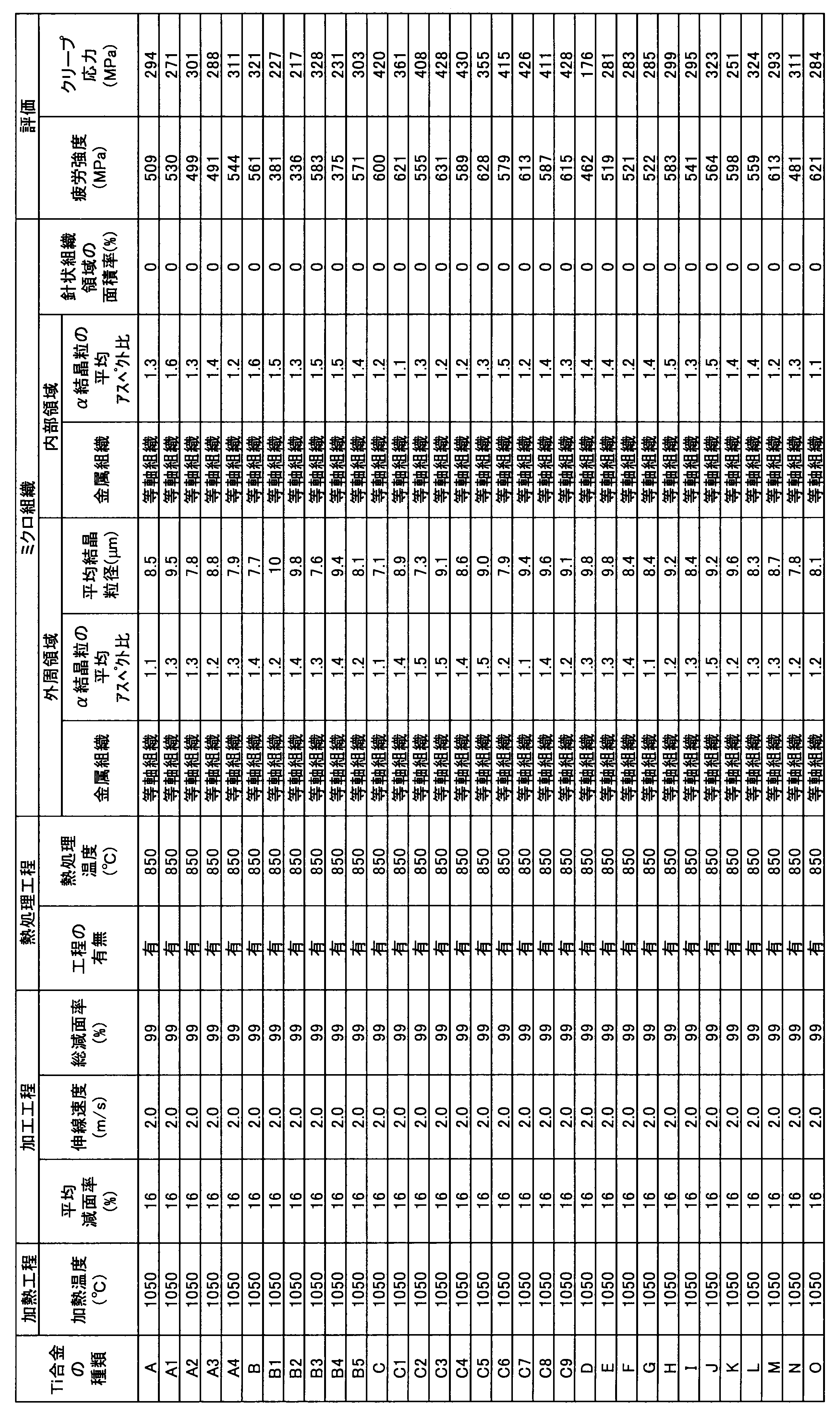
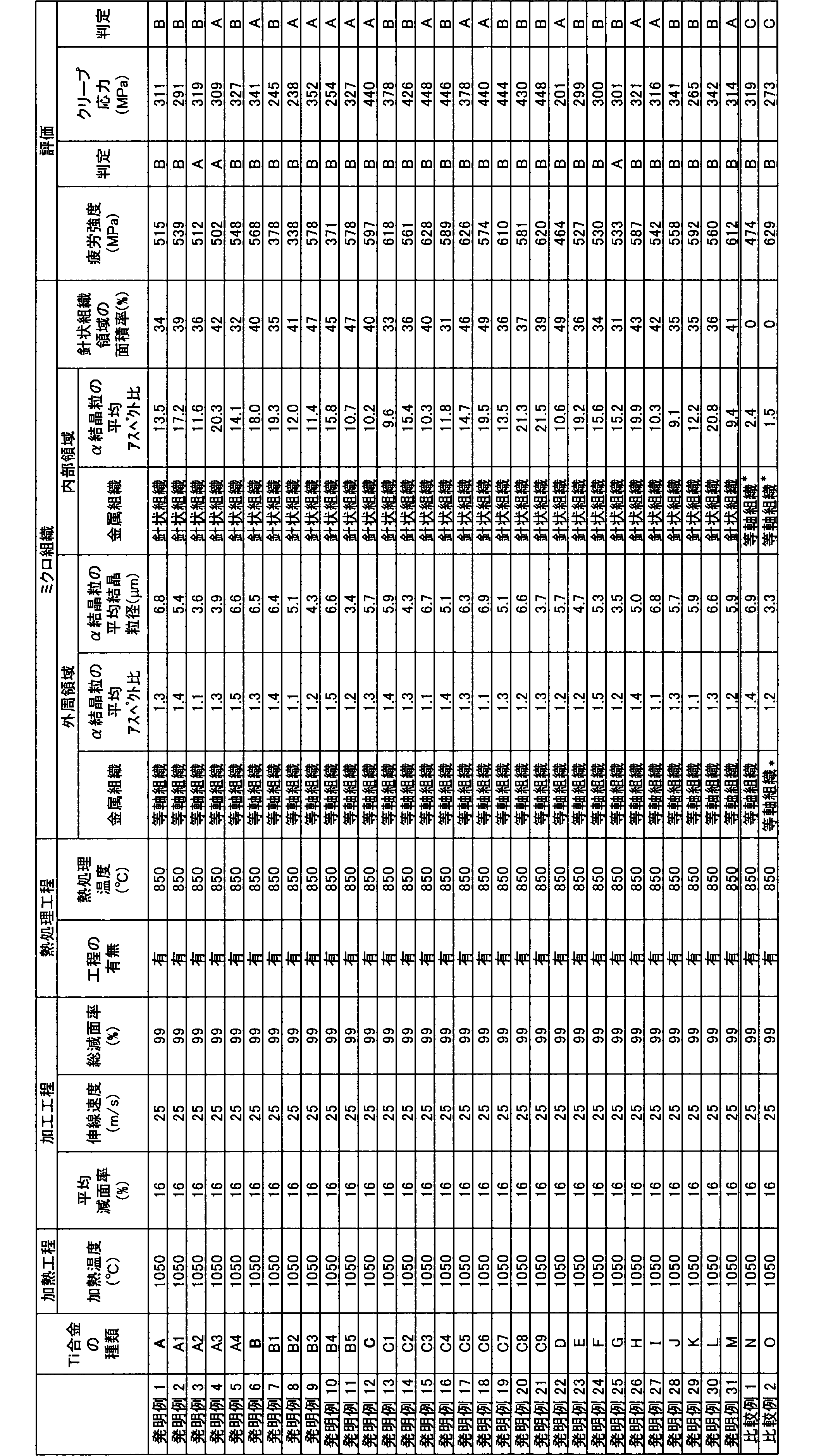
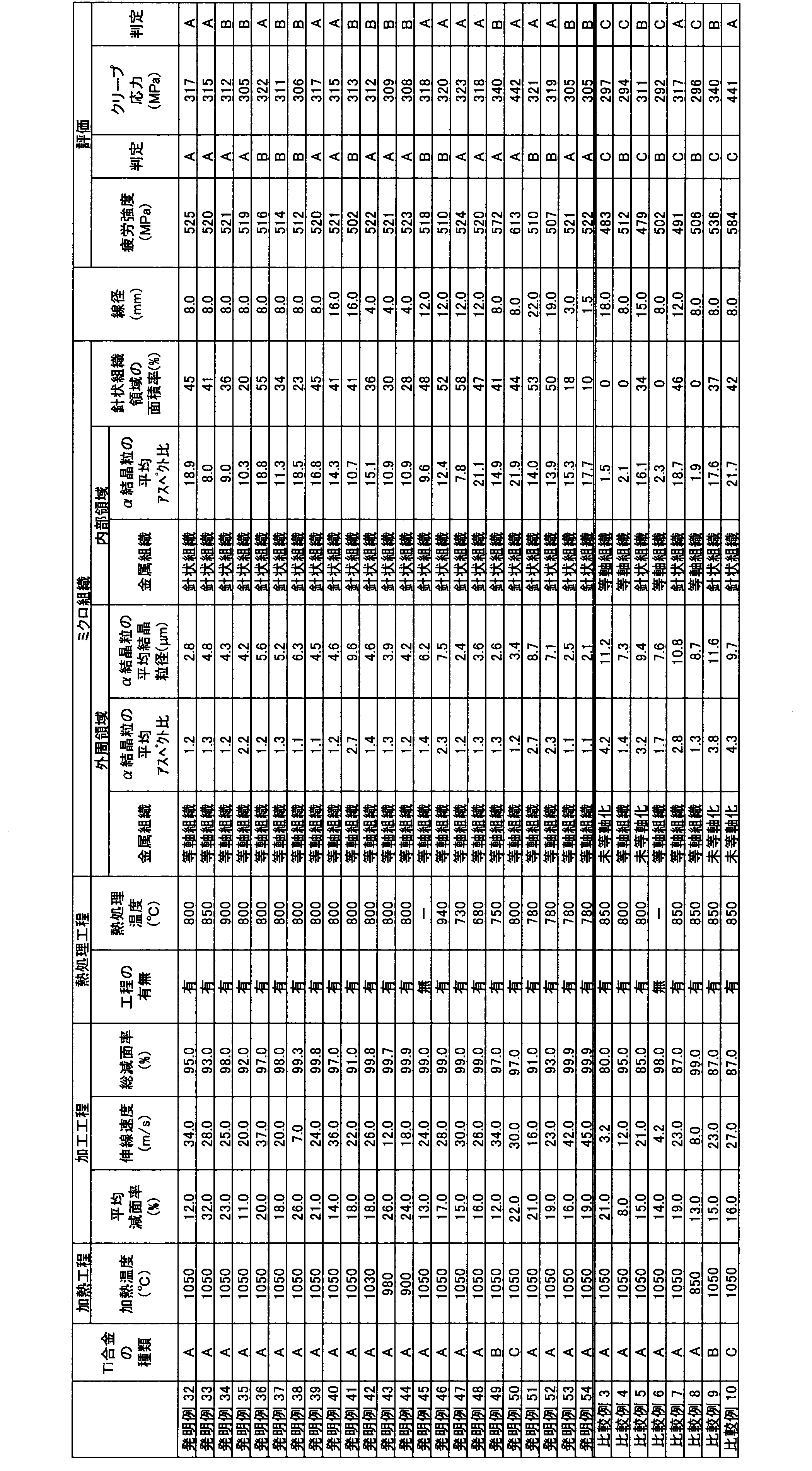
分析・評価
各例に係るチタン合金線材について、以下の項目について分析および評価を行った。
各例に係るチタン合金線材について、以下のように、長手方向に対して垂直な断面を観察し、断面の各領域について金属組織が等軸組織、針状組織のいずれであるかを調べた。また、α結晶粒の平均結晶粒径および平均アスペクト比を測定、算出するとともに、α結晶粒の平均アスペクト比が5.0以上である領域の上記断面に対する面積率を求めた。まず、各例に係るチタン合金線材について長手方向に対して垂直な断面を鏡面研磨後、ふっ酸と硝酸の混合液によりエッチングした。平均結晶粒径および平均アスペクト比は、当該面の光学顕微鏡写真を観察することにより測定した。平均結晶粒径は、JIS G 0551に準拠して、線分法により測定した。具体的には、500倍の倍率で撮影した光学顕微鏡写真に対し、縦横に5本ずつ線分を引き、線分ごとに当該線分を横切る粒界数を用いて平均結晶粒径を算出し、合計10本の平均結晶粒径の算術平均値より求めた。平均アスペクト比は、500倍の倍率で撮影した光学顕微鏡写真に対し、任意の結晶粒50個に対して、長軸と短軸を測定し、長軸を短軸で除した値の算術平均として算出した。ここで、「長軸」とは、α相の粒界(輪郭)上の任意の2点を結ぶ線分のうちで、長さが最大になるものをいい、「短軸」とは、長軸に直交し、かつ粒界(輪郭)上の任意の2点を結ぶ線分のうちで、長さが最大になるものをいう。
疲労強度は、JIS Z 2274:1978に準じて回転曲げ疲労試験を行い、107回まで破断しなかった場合における最大の応力を疲労強度とした。
クリープ強度は、JIS Z 2271:2010に準じてクリープ試験を行った。具体的には、400℃の環境下にて100時間クリープ試験を行った際に、0.2%ひずみに到達する最小の応力をクリープ強度とした。
同一の合金種について従来の製造方法に相当する製造方法によって得られるチタン合金線材との比較を行うために、表2に示す合金種A~Oの例(いずれも比較例)では、加工工程での少なくとも最終から1以上のパスにおける1パスあたりの平均減面率(%)は16%であるが、伸線速度(m/s)を、2.0m/s(5m/s未満)とした。表2に示す例に係るチタン合金線材は、外周領域と内部領域のいずれも、金属組織が等軸組織となった。
一方、表3に示す合金種A~Mの発明例1~31は、加工工程での少なくとも最終から1以上のパスにおける1パスあたりの平均減面率(%)は16%であり、伸線速度(m/s)は25m/sである。表3に示す発明例1~31のチタン合金線材は、外周領域の金属組織が、等軸のα相を母相とし、その粒界や粒内に微細なβ相が存在する等軸組織となり、内部領域の金属組織が針状のα相とβ相が層状に並んだ針状組織となった。
なお、表3に示す合金種N、Oの比較例1、2は、加工工程での少なくとも最終から1以上のパスにおける1パスあたりの平均減面率(%)は16%であり、伸線速度(m/s)は25m/sである。しかしながら、比較例1は、Mo当量(Moeq)が-4.0より小さい。比較例1では、外周領域の金属組織は、等軸のα結晶粒からなるα相を母相とし、β相がほとんど存在しない(ごく微量のβ相が存在する)α単相の等軸組織となり、内部領域の金属組織は、アスペクト比が比較的小さいα結晶粒を有するα相を母相とし、β相がほとんど存在しない(β相がごく微量に存在する)組織になった。より詳細には、比較例1の内部領域では、ブロック状のα相中に等軸のβ相が微細分散した組織となっている。
また、比較例2は、Mo当量(Moeq)が6.0より大きい。比較例2では、外周領域の金属組織、内部領域の金属組織のいずれもが、等軸のβ結晶粒からなるβ単相の等軸組織になった。
なお、表3中、比較例1、2の内部領域の金属組織、および、比較例2の外部領域の金属組織は、本発明の等軸組織とは異なるため、「*」を付して区別した。
B:基準の疲労強度と比較して-10MPa以上10MPa未満の範囲の変動があった。
C:基準の疲労強度と比較して10MPa超20MPa以下低下した。
B:基準のクリープ強度と比較して10MPa以上20MPa未満向上した。
C:基準のクリープ強度と比較して-10MPa以上10MPa未満の範囲の変動があった。
発明例1~31では、疲労強度の評価がA、Bの何れかであり、基準の疲労強度と同等以上であった。また、発明例1~31では、クリープ強度の評価がA、Bの何れかであり、基準のクリープ強度と比較して向上した。
一方、比較例1、2は、クリープ強度の向上が十分でなかった。
一方、比較例3~10は、加熱工程または加工工程の何れかが本発明の範囲外であり、比較例3~10のチタン合金線材は、外周領域の金属組織、α結晶粒の平均アスペクト比、α結晶粒の平均結晶粒径、または、内部領域の金属組織、α結晶粒の平均アスペクト比の何れかが本発明の範囲外となった。
なお、発明例32~54の線径は、1.5mm~22.0mmであった。発明例32~50、52、53は、請求項8に規定する線径2.0mm~20.0mmを満足する例である。
比較例4では、少なくとも最終から1パス以上のパスにおける平均減面率が10.0%よりも少なく、加工発熱が小さかったため、内部領域、外周領域ともに、等軸のα結晶粒からなるα相を母相とし、α相中に少量のβ相が微細分散した等軸組織となった。
比較例5では、総減面率が90.0%未満であったため、外周領域は、α結晶粒のアスペクト比がある程度大きくなったα相中に微細なβ相が少量存在する、等軸化が完了していない組織(未等軸化)となり、内部領域は、針状のα相とβ相が層状に並んだ針状組織となった。
比較例6では、伸線速度が5.0m/s未満であり、加工発熱が小さかったため、内部領域、外周領域ともに、等軸のα結晶粒からなるα相を母相とし、α相中に少量のβ相が微細分散した等軸組織となった。
比較例7では、総減面率が90.0%未満であったため、外周領域は、粗大な等軸のα結晶粒からなるα相を母相とし、α相中に少量のβ相が分散した等軸組織となり、内部領域は、針状のα相とβ相が層状に並んだ針状組織となった。
比較例8では、加熱温度が低すぎたため、内部領域、外周領域ともに、等軸のα結晶粒からなるα相を母相とし、α相中に少量のβ相が微細分散した等軸組織となった。
比較例9では、総減面率が90.0%未満であったため、外周領域は、α結晶粒のアスペクト比および結晶粒径がある程度大きくなったα相中に微細なβ相が少量存在する、等軸化が完了していない組織(未等軸化)となり、内部領域は、針状のα相とβ相が層状に並んだ針状組織となった。
比較例10では、総減面率が90.0%未満であったため、外周領域は、アスペクト比がある程度大きくなったα相中に微細なβ相が少量存在する、等軸化が完了していない組織(未等軸化)となり、内部領域は、針状のα相とβ相が層状に並んだ針状組織となった。
b β相
c 針状α
e 針状β
1 チタン合金線材
L 長手方向
2 外周領域
3 外周表面
4 内部領域
G 重心
R 線径
d 3%に相当する深さ
11 長軸
10 α相の粒界
12 短軸
20 β結晶粒
21 針状のα結晶粒
22 等軸のα結晶粒
23 β結晶粒
24 等軸の微細α結晶粒(微細な等軸組織)
25 針状のα結晶粒(針状組織)
Claims (10)
- α相とβ相とを含むチタン合金線材であって、
質量%で、
Al:0%以上7.0%以下、
V:0%以上6.0%以下、
Mo:0%以上7.0%以下、
Cr:0%以上7.0%以下、
Zr:0%以上5.0%以下、
Sn:0%以上3.0%以下、
Si:0%以上0.50%以下、
Cu:0%以上1.8%以下、
Nb:0%以上1.0%以下、
Mn:0%以上1.0%以下、
Ni:0%以上1.0%以下、
S:0%以上0.20%以下、
REM:0%以上0.20%以下、
Fe:0%以上2.10%以下、
N:0%以上0.050%以下、
O:0%以上0.250%以下、
C:0%以上0.100%以下、
残部:Tiおよび不純物であり、
Al、Mo、V、Nb、Fe、Cr、Ni及びMnの含有量が、下記式(1)を満たす化学組成を有し、
長手方向に対して垂直な断面において、表面から重心へ向かって線径の3%の深さまでの外周領域における金属組織が、平均結晶粒径が10μm以下のα結晶粒を有する等軸組織であり、
前記長手方向に対して垂直な断面において、重心から表面に向かって線径の20%の位置までの重心を含む内部領域における金属組織が針状組織である、
チタン合金線材。
-4.00≦[Mo]+0.67[V]+0.28[Nb]+2.9[Fe]+1.6[Cr]+1.1[Ni]+1.6[Mn]-[Al]≦6.00 ・・・(1)
なお、式(1)において、[元素記号]の表記は、対応する元素記号の含有量(質量%)を表し、含有しない元素記号については、0を代入するものとする。 - 質量%で、
Al:4.5%以上6.5%以下、
Fe:0.50%以上2.10%以下、
を含む、請求項1に記載のチタン合金線材。 - 質量%で、
Al:2.0%以上7.0%以下、
V :1.5%以上6.0%以下、
を含む、請求項1に記載のチタン合金線材。 - 質量%で、
Al:5.0%以上7.0%以下、
Mo:1.0%以上7.0%以下、
Zr:3.0%以上5.0%以下、
Sn:1.0%以上3.0%以下、
を含む、請求項1に記載のチタン合金線材。 - 前記長手方向に対して垂直な断面において、前記外周領域におけるα結晶粒の平均アスペクト比が1.0以上3.0未満であり、前記内部領域におけるα結晶粒の平均アスペクト比が5.0以上である、請求項1~4の何れか一項に記載のチタン合金線材。
- 前記長手方向に対して垂直な断面において、α結晶粒の平均アスペクト比が5.0以上である重心を含む領域の面積が、当該断面の面積に対し40%以上である、請求項5に記載のチタン合金線材。
- 前記外周領域におけるα結晶粒の平均結晶粒径が5.0μm以下である、請求項1~6の何れか一項に記載のチタン合金線材。
- 線径が、2.0mm以上20.0mm以下である、請求項1~7のいずれか一項に記載のチタン合金線材。
- チタン合金素材を(β変態点-200)℃以上の温度に加熱する工程と、
前記チタン合金素材を、総減面率が90.0%以上であり、かつ、少なくとも最終から1以上のパスにおいて、1パスあたりの平均減面率が10.0%以上、かつ、伸線速度が5.0m/s以上で加工する工程と、
を有する、チタン合金線材の製造方法。 - さらに、(β変態点-300)℃以上(β変態点-50)℃以下の温度域にて熱処理する工程を有する、請求項9に記載のチタン合金線材の製造方法。
Priority Applications (3)
| Application Number | Priority Date | Filing Date | Title |
|---|---|---|---|
| KR1020217007688A KR102539690B1 (ko) | 2018-11-15 | 2019-11-14 | 티타늄 합금 선재 및 티타늄 합금 선재의 제조 방법 |
| CN201980072341.0A CN113039299B (zh) | 2018-11-15 | 2019-11-14 | 钛合金线材及钛合金线材的制造方法 |
| JP2020513944A JP7024861B2 (ja) | 2018-11-15 | 2019-11-14 | チタン合金線材およびチタン合金線材の製造方法 |
Applications Claiming Priority (2)
| Application Number | Priority Date | Filing Date | Title |
|---|---|---|---|
| JP2018214669 | 2018-11-15 | ||
| JP2018-214669 | 2018-11-15 |
Publications (1)
| Publication Number | Publication Date |
|---|---|
| WO2020101008A1 true WO2020101008A1 (ja) | 2020-05-22 |
Family
ID=70731829
Family Applications (1)
| Application Number | Title | Priority Date | Filing Date |
|---|---|---|---|
| PCT/JP2019/044788 Ceased WO2020101008A1 (ja) | 2018-11-15 | 2019-11-14 | チタン合金線材およびチタン合金線材の製造方法 |
Country Status (5)
| Country | Link |
|---|---|
| JP (1) | JP7024861B2 (ja) |
| KR (1) | KR102539690B1 (ja) |
| CN (1) | CN113039299B (ja) |
| TW (1) | TWI718763B (ja) |
| WO (1) | WO2020101008A1 (ja) |
Cited By (15)
| Publication number | Priority date | Publication date | Assignee | Title |
|---|---|---|---|---|
| CN113333497A (zh) * | 2021-05-13 | 2021-09-03 | 西部超导材料科技股份有限公司 | 一种冷镦托板螺母用tc16钛合金盘圆丝材的加工方法 |
| US20220186342A1 (en) * | 2020-12-11 | 2022-06-16 | Kabushiki Kaisha Toyota Jidoshokki | Non-magnetic member and method for producing the non-magnetic member |
| JP2022110396A (ja) * | 2021-01-18 | 2022-07-29 | 日本製鉄株式会社 | チタン合金材及びその製造方法 |
| CN114965525A (zh) * | 2021-02-24 | 2022-08-30 | 宝武特种冶金有限公司 | 一种钛合金晶粒等轴度表征方法 |
| WO2022203535A1 (ru) * | 2021-03-26 | 2022-09-29 | Публичное Акционерное Общество "Корпорация Всмпо-Ависма" | Материал для изготовления высокопрочных крепежных изделий и способ его получения |
| CN115369286A (zh) * | 2022-08-29 | 2022-11-22 | 沈阳中核舰航特材科技有限公司 | 紧固件用α+β型钛合金、制备方法及其棒材的制备方法 |
| CN115772616A (zh) * | 2022-12-06 | 2023-03-10 | 西北有色金属研究院 | 一种航空结构件用超高强钛合金 |
| RU2793901C1 (ru) * | 2022-04-11 | 2023-04-07 | Публичное Акционерное Общество "Корпорация Всмпо-Ависма" | Способ получения материала для высокопрочных крепежных изделий |
| JP2023092454A (ja) * | 2021-12-21 | 2023-07-03 | 日本製鉄株式会社 | チタン合金、チタン合金棒、チタン合金板及びエンジンバルブ |
| CN116656983A (zh) * | 2023-04-10 | 2023-08-29 | 宝鸡钛业股份有限公司 | 一种改善β类钛合金材料性能的微合金化方法 |
| JPWO2023210033A1 (ja) * | 2022-04-27 | 2023-11-02 | ||
| US12104226B2 (en) | 2021-05-19 | 2024-10-01 | Karsten Manufacturing Corporation | Beta enhanced titanium alloys and methods of manufacturing beta enhanced titanium alloys |
| US20250019798A1 (en) * | 2023-07-12 | 2025-01-16 | Ati Properties Llc | Titanium alloys |
| CN120738516A (zh) * | 2025-08-19 | 2025-10-03 | 中国机械总院集团沈阳铸造研究所有限公司 | 一种高性能钛合金及其制备方法 |
| WO2025216280A1 (ja) * | 2024-04-12 | 2025-10-16 | 日本製鉄株式会社 | α+β型チタン合金、チタン合金棒、部品およびα+β型チタン合金の製造方法 |
Families Citing this family (15)
| Publication number | Priority date | Publication date | Assignee | Title |
|---|---|---|---|---|
| CN113355559B (zh) * | 2021-08-10 | 2021-10-29 | 北京煜鼎增材制造研究院有限公司 | 一种高强高韧高损伤容限钛合金及其制备方法 |
| CN116136006A (zh) * | 2021-11-17 | 2023-05-19 | 中国石油天然气股份有限公司 | 一种钛合金、一种钛合金钻杆管材及其制造方法 |
| KR102434520B1 (ko) * | 2021-12-29 | 2022-08-22 | 한국재료연구원 | 몰리브덴 및 페로크롬을 이용한 고강도 고성형성 타이타늄 합금 및 그 제조 방법 |
| CN116770127A (zh) * | 2022-03-07 | 2023-09-19 | 华为技术有限公司 | 钛合金及其应用、钛合金制品的mim工艺 |
| CN114941087B (zh) * | 2022-03-28 | 2023-06-09 | 北京科技大学 | 高弹性模量高强度TiAlMoMn钛合金及制备方法 |
| CN114540667B (zh) * | 2022-04-27 | 2022-07-22 | 北京煜鼎增材制造研究院有限公司 | 一种高韧钛合金及其制备方法 |
| CN115433852B (zh) * | 2022-11-09 | 2023-02-24 | 新乡学院 | 一种港口海岸起重机吊臂用钛合金及其制备方法 |
| CN115652141B (zh) * | 2022-11-18 | 2023-09-01 | 厦门九牧研发有限公司 | 一种低成本易切削抗菌钛合金及钛合金龙头的制备方法 |
| CN115874081A (zh) * | 2022-12-02 | 2023-03-31 | 国网福建省电力有限公司 | 一种钛合金材料及其制备方法和所制海缆金属套 |
| CN116770128B (zh) * | 2023-06-16 | 2025-01-24 | 中南大学 | 一种低成本含锡钛锰合金及其制备方法 |
| CN117025994A (zh) * | 2023-08-16 | 2023-11-10 | 湖南湘投金天钛业科技股份有限公司 | 提高钛合金动态性能的微合金化方法、材料及应用 |
| CN117210718B (zh) * | 2023-10-20 | 2024-02-20 | 南京工业大学 | 一种α型钛合金及其制备方法 |
| CN117737503A (zh) * | 2024-01-04 | 2024-03-22 | 西安交通大学 | 一种间隙氮强化的超高强塑Ti-Cr-Zr-Al-N钛合金及制备方法 |
| CN118755996A (zh) * | 2024-06-17 | 2024-10-11 | 北京理工大学 | 一种无淬火工艺制备的1800MPa级超高强度钛合金 |
| CN120905561B (zh) * | 2025-10-10 | 2026-03-06 | 成都先进金属材料产业技术研究院股份有限公司 | 固硫的多元素复合易切削钛合金及其制备方法 |
Citations (6)
| Publication number | Priority date | Publication date | Assignee | Title |
|---|---|---|---|---|
| JPS58148016A (ja) * | 1982-02-27 | 1983-09-03 | Sumitomo Metal Ind Ltd | チタン線またはチタン合金線の製造方法 |
| JPH06184683A (ja) * | 1992-10-21 | 1994-07-05 | Nippon Steel Corp | バルブ製造に好適なチタン合金線とその製造方法 |
| JP2001040462A (ja) * | 1999-07-28 | 2001-02-13 | Sumitomo Metal Ind Ltd | チタンまたはチタン合金細径線材の製造方法 |
| WO2002070763A1 (fr) * | 2001-02-28 | 2002-09-12 | Jfe Steel Corporation | Barre d'alliage de titane et procede de fabrication |
| JP2005089834A (ja) * | 2003-09-18 | 2005-04-07 | Nippon Steel Corp | 電熱線用チタン合金及びその製造方法 |
| WO2018181937A1 (ja) * | 2017-03-31 | 2018-10-04 | 日本発條株式会社 | チタン合金素材 |
Family Cites Families (9)
| Publication number | Priority date | Publication date | Assignee | Title |
|---|---|---|---|---|
| JPS565273B2 (ja) * | 1973-05-24 | 1981-02-04 | ||
| CN1023495C (zh) * | 1989-07-31 | 1994-01-12 | 新日本制铁株式会社 | 细等轴显微组织钛和钛合金制造方法 |
| JPH0681059A (ja) * | 1992-07-16 | 1994-03-22 | Nippon Steel Corp | バルブ製造に適したチタン合金線 |
| JP3076697B2 (ja) | 1993-08-31 | 2000-08-14 | 新日本製鐵株式会社 | α+β型チタン合金 |
| JP4157891B2 (ja) * | 2006-03-30 | 2008-10-01 | 株式会社神戸製鋼所 | 耐高温酸化性に優れたチタン合金およびエンジン排気管 |
| EP2508643B1 (en) * | 2009-12-02 | 2019-01-30 | Nippon Steel & Sumitomo Metal Corporation | Titanium alloy part and method of manufacturing same |
| US20120076611A1 (en) * | 2010-09-23 | 2012-03-29 | Ati Properties, Inc. | High Strength Alpha/Beta Titanium Alloy Fasteners and Fastener Stock |
| JP5605273B2 (ja) | 2011-03-04 | 2014-10-15 | 新日鐵住金株式会社 | 熱間および冷間での加工性に優れた高強度α+β型チタン合金及びその製造方法並びにチタン合金製品 |
| US9956629B2 (en) * | 2014-07-10 | 2018-05-01 | The Boeing Company | Titanium alloy for fastener applications |
-
2019
- 2019-11-14 WO PCT/JP2019/044788 patent/WO2020101008A1/ja not_active Ceased
- 2019-11-14 CN CN201980072341.0A patent/CN113039299B/zh active Active
- 2019-11-14 JP JP2020513944A patent/JP7024861B2/ja active Active
- 2019-11-14 KR KR1020217007688A patent/KR102539690B1/ko active Active
- 2019-11-15 TW TW108141634A patent/TWI718763B/zh active
Patent Citations (6)
| Publication number | Priority date | Publication date | Assignee | Title |
|---|---|---|---|---|
| JPS58148016A (ja) * | 1982-02-27 | 1983-09-03 | Sumitomo Metal Ind Ltd | チタン線またはチタン合金線の製造方法 |
| JPH06184683A (ja) * | 1992-10-21 | 1994-07-05 | Nippon Steel Corp | バルブ製造に好適なチタン合金線とその製造方法 |
| JP2001040462A (ja) * | 1999-07-28 | 2001-02-13 | Sumitomo Metal Ind Ltd | チタンまたはチタン合金細径線材の製造方法 |
| WO2002070763A1 (fr) * | 2001-02-28 | 2002-09-12 | Jfe Steel Corporation | Barre d'alliage de titane et procede de fabrication |
| JP2005089834A (ja) * | 2003-09-18 | 2005-04-07 | Nippon Steel Corp | 電熱線用チタン合金及びその製造方法 |
| WO2018181937A1 (ja) * | 2017-03-31 | 2018-10-04 | 日本発條株式会社 | チタン合金素材 |
Cited By (23)
| Publication number | Priority date | Publication date | Assignee | Title |
|---|---|---|---|---|
| US20220186342A1 (en) * | 2020-12-11 | 2022-06-16 | Kabushiki Kaisha Toyota Jidoshokki | Non-magnetic member and method for producing the non-magnetic member |
| JP2022110396A (ja) * | 2021-01-18 | 2022-07-29 | 日本製鉄株式会社 | チタン合金材及びその製造方法 |
| JP7698181B2 (ja) | 2021-01-18 | 2025-06-25 | 日本製鉄株式会社 | チタン合金材及びその製造方法 |
| CN114965525A (zh) * | 2021-02-24 | 2022-08-30 | 宝武特种冶金有限公司 | 一种钛合金晶粒等轴度表征方法 |
| JP2024518681A (ja) * | 2021-03-26 | 2024-05-02 | パブリックストックカンパニー “ヴイエスエムピーオー アヴィスマ コーポレーション” | 高強度ファスナを製造するための材料およびそれを製造するための方法 |
| WO2022203535A1 (ru) * | 2021-03-26 | 2022-09-29 | Публичное Акционерное Общество "Корпорация Всмпо-Ависма" | Материал для изготовления высокопрочных крепежных изделий и способ его получения |
| CN113333497B (zh) * | 2021-05-13 | 2022-10-04 | 西部超导材料科技股份有限公司 | 一种冷镦托板螺母用tc16钛合金盘圆丝材的加工方法 |
| CN113333497A (zh) * | 2021-05-13 | 2021-09-03 | 西部超导材料科技股份有限公司 | 一种冷镦托板螺母用tc16钛合金盘圆丝材的加工方法 |
| US12104226B2 (en) | 2021-05-19 | 2024-10-01 | Karsten Manufacturing Corporation | Beta enhanced titanium alloys and methods of manufacturing beta enhanced titanium alloys |
| JP2023092454A (ja) * | 2021-12-21 | 2023-07-03 | 日本製鉄株式会社 | チタン合金、チタン合金棒、チタン合金板及びエンジンバルブ |
| RU2793901C1 (ru) * | 2022-04-11 | 2023-04-07 | Публичное Акционерное Общество "Корпорация Всмпо-Ависма" | Способ получения материала для высокопрочных крепежных изделий |
| RU2793901C9 (ru) * | 2022-04-11 | 2023-06-07 | Публичное Акционерное Общество "Корпорация Всмпо-Ависма" | Способ получения материала для высокопрочных крепежных изделий |
| JPWO2023210033A1 (ja) * | 2022-04-27 | 2023-11-02 | ||
| WO2023210033A1 (ja) * | 2022-04-27 | 2023-11-02 | 日本製鉄株式会社 | チタン合金板およびその製造方法 |
| JP7801632B2 (ja) | 2022-04-27 | 2026-01-19 | 日本製鉄株式会社 | チタン合金板およびその製造方法 |
| CN115369286A (zh) * | 2022-08-29 | 2022-11-22 | 沈阳中核舰航特材科技有限公司 | 紧固件用α+β型钛合金、制备方法及其棒材的制备方法 |
| CN115772616A (zh) * | 2022-12-06 | 2023-03-10 | 西北有色金属研究院 | 一种航空结构件用超高强钛合金 |
| CN115772616B (zh) * | 2022-12-06 | 2024-03-19 | 西北有色金属研究院 | 一种航空结构件用超高强钛合金 |
| CN116656983A (zh) * | 2023-04-10 | 2023-08-29 | 宝鸡钛业股份有限公司 | 一种改善β类钛合金材料性能的微合金化方法 |
| US12344918B2 (en) * | 2023-07-12 | 2025-07-01 | Ati Properties Llc | Titanium alloys |
| US20250019798A1 (en) * | 2023-07-12 | 2025-01-16 | Ati Properties Llc | Titanium alloys |
| WO2025216280A1 (ja) * | 2024-04-12 | 2025-10-16 | 日本製鉄株式会社 | α+β型チタン合金、チタン合金棒、部品およびα+β型チタン合金の製造方法 |
| CN120738516A (zh) * | 2025-08-19 | 2025-10-03 | 中国机械总院集团沈阳铸造研究所有限公司 | 一种高性能钛合金及其制备方法 |
Also Published As
| Publication number | Publication date |
|---|---|
| JP7024861B2 (ja) | 2022-02-24 |
| KR20210043652A (ko) | 2021-04-21 |
| JPWO2020101008A1 (ja) | 2021-02-15 |
| TW202024346A (zh) | 2020-07-01 |
| CN113039299B (zh) | 2022-07-19 |
| TWI718763B (zh) | 2021-02-11 |
| CN113039299A (zh) | 2021-06-25 |
| KR102539690B1 (ko) | 2023-06-02 |
Similar Documents
| Publication | Publication Date | Title |
|---|---|---|
| JP7024861B2 (ja) | チタン合金線材およびチタン合金線材の製造方法 | |
| US12000021B2 (en) | α+β type titanium alloy wire and manufacturing method of α+β type titanium alloy wire | |
| EP3524705B1 (en) | Ni-cr-fe alloy | |
| WO2016068009A1 (ja) | オーステナイトステンレス鋼及びその製造方法 | |
| JP2014001421A (ja) | 高強度かつ冷間圧延性に優れたチタン合金材 | |
| JPWO2019054390A1 (ja) | オーステナイト系ステンレス鋼及びその製造方法 | |
| JPWO2018003823A1 (ja) | オーステナイト系ステンレス鋼 | |
| JP6269836B2 (ja) | 加工方向と同一方向への形状変化特性を有するチタン合金部材およびその製造方法 | |
| JP5505214B2 (ja) | 圧延方向の0.2%耐力が大きい高耐食チタン合金とその製造方法 | |
| JP5621571B2 (ja) | 75GPa未満の低ヤング率を有するα+β型チタン合金およびその製造方法 | |
| JP2010111928A (ja) | チタン合金、チタン合金部材、及びチタン合金部材製造方法 | |
| JP2023092454A (ja) | チタン合金、チタン合金棒、チタン合金板及びエンジンバルブ | |
| JP6673121B2 (ja) | α+β型チタン合金棒およびその製造方法 | |
| EP4286551A1 (en) | Titanium alloy plate, titanium alloy coil, method for producing titanium alloy plate and method for producing titanium alloy coil | |
| JP6851147B2 (ja) | チタン合金鍛造材 | |
| JP2017218661A (ja) | チタン合金鍛造材 | |
| JP7131318B2 (ja) | オーステナイト系ステンレス鋼 | |
| JP7678373B2 (ja) | チタン合金板 | |
| JP2017002373A (ja) | チタン合金鍛造材 | |
| JP7670507B2 (ja) | フェライト系ステンレス鋼線 | |
| JP6213014B2 (ja) | β型チタン合金及びその製造方法 | |
| JP2023095120A (ja) | チタン合金材および部品 |
Legal Events
| Date | Code | Title | Description |
|---|---|---|---|
| ENP | Entry into the national phase |
Ref document number: 2020513944 Country of ref document: JP Kind code of ref document: A |
|
| 121 | Ep: the epo has been informed by wipo that ep was designated in this application |
Ref document number: 19883501 Country of ref document: EP Kind code of ref document: A1 |
|
| ENP | Entry into the national phase |
Ref document number: 20217007688 Country of ref document: KR Kind code of ref document: A |
|
| NENP | Non-entry into the national phase |
Ref country code: DE |
|
| 122 | Ep: pct application non-entry in european phase |
Ref document number: 19883501 Country of ref document: EP Kind code of ref document: A1 |