WO2020100579A1 - 吸収性物品 - Google Patents
吸収性物品 Download PDFInfo
- Publication number
- WO2020100579A1 WO2020100579A1 PCT/JP2019/042372 JP2019042372W WO2020100579A1 WO 2020100579 A1 WO2020100579 A1 WO 2020100579A1 JP 2019042372 W JP2019042372 W JP 2019042372W WO 2020100579 A1 WO2020100579 A1 WO 2020100579A1
- Authority
- WO
- WIPO (PCT)
- Prior art keywords
- absorbent article
- display
- diaper
- user
- wearer
- Prior art date
- Legal status (The legal status is an assumption and is not a legal conclusion. Google has not performed a legal analysis and makes no representation as to the accuracy of the status listed.)
- Ceased
Links
Images


Classifications
-
- A—HUMAN NECESSITIES
- A01—AGRICULTURE; FORESTRY; ANIMAL HUSBANDRY; HUNTING; TRAPPING; FISHING
- A01K—ANIMAL HUSBANDRY; AVICULTURE; APICULTURE; PISCICULTURE; FISHING; REARING OR BREEDING ANIMALS, NOT OTHERWISE PROVIDED FOR; NEW BREEDS OF ANIMALS
- A01K23/00—Manure or urine pouches
-
- A—HUMAN NECESSITIES
- A61—MEDICAL OR VETERINARY SCIENCE; HYGIENE
- A61F—FILTERS IMPLANTABLE INTO BLOOD VESSELS; PROSTHESES; DEVICES PROVIDING PATENCY TO, OR PREVENTING COLLAPSING OF, TUBULAR STRUCTURES OF THE BODY, e.g. STENTS; ORTHOPAEDIC, NURSING OR CONTRACEPTIVE DEVICES; FOMENTATION; TREATMENT OR PROTECTION OF EYES OR EARS; BANDAGES, DRESSINGS OR ABSORBENT PADS; FIRST-AID KITS
- A61F13/00—Bandages or dressings; Absorbent pads
- A61F13/15—Absorbent pads, e.g. sanitary towels, swabs or tampons for external or internal application to the body; Supporting or fastening means therefor; Tampon applicators
- A61F13/42—Absorbent pads, e.g. sanitary towels, swabs or tampons for external or internal application to the body; Supporting or fastening means therefor; Tampon applicators with wetness indicator or alarm
-
- A—HUMAN NECESSITIES
- A61—MEDICAL OR VETERINARY SCIENCE; HYGIENE
- A61F—FILTERS IMPLANTABLE INTO BLOOD VESSELS; PROSTHESES; DEVICES PROVIDING PATENCY TO, OR PREVENTING COLLAPSING OF, TUBULAR STRUCTURES OF THE BODY, e.g. STENTS; ORTHOPAEDIC, NURSING OR CONTRACEPTIVE DEVICES; FOMENTATION; TREATMENT OR PROTECTION OF EYES OR EARS; BANDAGES, DRESSINGS OR ABSORBENT PADS; FIRST-AID KITS
- A61F13/00—Bandages or dressings; Absorbent pads
- A61F13/15—Absorbent pads, e.g. sanitary towels, swabs or tampons for external or internal application to the body; Supporting or fastening means therefor; Tampon applicators
- A61F13/51—Absorbent pads, e.g. sanitary towels, swabs or tampons for external or internal application to the body; Supporting or fastening means therefor; Tampon applicators characterised by the outer layers of the pads
- A61F13/514—Backsheet, i.e. the impermeable cover or layer furthest from the skin
-
- A—HUMAN NECESSITIES
- A61—MEDICAL OR VETERINARY SCIENCE; HYGIENE
- A61F—FILTERS IMPLANTABLE INTO BLOOD VESSELS; PROSTHESES; DEVICES PROVIDING PATENCY TO, OR PREVENTING COLLAPSING OF, TUBULAR STRUCTURES OF THE BODY, e.g. STENTS; ORTHOPAEDIC, NURSING OR CONTRACEPTIVE DEVICES; FOMENTATION; TREATMENT OR PROTECTION OF EYES OR EARS; BANDAGES, DRESSINGS OR ABSORBENT PADS; FIRST-AID KITS
- A61F13/00—Bandages or dressings; Absorbent pads
- A61F13/15—Absorbent pads, e.g. sanitary towels, swabs or tampons for external or internal application to the body; Supporting or fastening means therefor; Tampon applicators
- A61F13/56—Supporting or fastening means
Definitions
- the present invention relates to absorbent articles.
- Patent Literature 1 describes a method in which the absorbent article 1 is provided with a coating film 2 that visually changes when it comes into contact with moisture, and a person who replaces the absorbent article 1 can replace the absorbent article 1 without mistake in timing.
- the absorbent article 1 including the words "Mom change diaper” is used.
- the user feels that the replacement of the absorbent article 1 is forced, and there is a fear that he or she may have more negative feelings about the replacement of the absorbent article 1.
- the present invention has been made in view of the above problems, and an object thereof is to provide a user who takes care of a wearer or an animal with a negative impression of the act of exchanging absorbent articles. It's about making it hard to hold.
- a main invention for achieving the above object in a deployed state, has a vertical direction, a left-right direction, and a thickness direction orthogonal to each other, and a ventral waistline portion provided on one side of the vertical direction, and the vertical direction. And a crotch portion provided between the abdominal waistline portion and the back waistline portion, and is provided at the center portion in the left-right direction.
- An absorbent article provided with an absorber, wherein an emotion display that causes a positive emotion to the user, a touch display that prompts the user to touch the skin of the wearer or the animal, or the wearer or the animal is It has at least one indicator of urination by a character string that conveys only the fact that the absorbent article has been urinated, and when the absorbent article is replaced, the at least one of the at least one indicator is provided when the absorbent article is removed from the packaging material. It is an absorbent article characterized in that the display is easily visible.
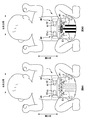
- FIG. 1 is a skin-side plan view of the diaper 1 in a developed and expanded state.
- FIG. 2 is a non-skin side plan view of the diaper 1 in a developed and expanded state.
- FIG. 3 is a view of the diaper 1 taken out from the packaging material, viewed from the abdominal side.
- FIG. 4A is a diagram illustrating a state immediately after the wearer wears a new diaper 1.
- FIG. 4B is a diagram illustrating a state in which the wearer wears the diaper 1 after use.
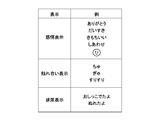
- FIG. 5 is a diagram illustrating an example of emotion display, touch display, and urination display.
- a wearer who cannot express emotions in some cases may cause the user to have a negative emotion, and at least one of the emotion display, the touch display, and the urination display.
- the user looks at the diaper it is possible to prevent the user from having a negative impression of the act of exchanging the diaper.
- the emotion display and the touch display are character strings.
- the user who has read the emotion display and the touch display as "characters" is activated in the prefrontal cortex, which makes it easier to control his / her emotions, and the user can easily exchange the diaper. It is possible to make it difficult to have a negative impression.
- the user who sees the sign of gratitude can easily have a positive impression, and it is difficult for the user to have a negative impression of the act of exchanging the diaper. it can.
- the emotional display includes the words thank you.
- fastening tapes are provided respectively on the lateral end portions of the back waistline portion in the left-right direction, and the at least one display is provided on the abdominal waistline portion.
- the abdominal girth part is easier for the user to visually recognize than the back girth part, and, in a state where the user easily recognizes the wearer's face, emotion display, touch display, Alternatively, by displaying at least one of the urination indications, the user can easily feel as if the wearer actually said it, and the user has a negative impression of the act of exchanging diapers. Can be hardened.
- the abdominal waistline portion and the back waistline portion are connected to each other and a waistline opening portion is formed.
- the at least one display is provided below the fastening tape.
- the user replaces the absorbent article from the worn state, releases the fastening of the fastening tape, and confirms the presence / absence of urination in the worn state.
- the emotion display, the touch display, or the urination display provided on the can be easily visually recognized, and it is possible to prevent the user from having a negative impression of the act of exchanging the diaper.
- Such an absorbent article has an indicator portion that changes color when contacted with moisture, and the at least one display is a part of the indicator portion.
- the absorbent article has an indicator portion that changes color when contacted with water, and the at least one display is provided in a portion surrounded by the indicator portion.
- an absorbent article it is easier to visually recognize the emotion display, the touch display, or the urination display when exchanging the absorbent article than when the absorbent article is taken out from the packaging material. Reduces the risk of making the user who sees the change in color feel remorse for leaving the diaper in a non-replaced state, making it less likely to give a negative impression to the act of exchanging diapers. be able to.
- Such an absorbent article has a pattern visible from the non-skin side, and that the indicator portion and the pattern do not overlap in the thickness direction.
- the wearer can easily read the emotion display, the touch display, or the urination display on the indicator portion, and thus it is possible to make it difficult to give a negative impression to the act of exchanging the diaper. ..
- the at least one display is arranged along the left-right direction.
- the characters of emotion display, touch display, or urination display are arranged in the left-right direction, so that It is easy for the user to read the characters of the emotion display, the touch display, or the urination display easily at the same timing.
- the indicator portion includes a linear portion, the linear portion extends along the longitudinal direction from the crotch portion toward the abdominal waistline portion, and the at least one display is The length in the left-right direction is preferably longer than the length in the left-right direction of the linear portion.
- the length in the left-right direction of the emotion display, the touch display, or the urination display is longer than the length of the straight line portion in the left-right direction.
- a fastening tape is provided on each of the lateral side ends of the back waistline portion, and the at least one display is provided on the fastening tape. It is desirable that the at least one display is provided so as not to be visually recognized in the state of being taken out from.
- the user visually recognizes the emotion display, the touch display, or the urination display provided on the fastening tape when exchanging the absorbent article and operating the locking of the fastening tape. This makes it easier to prevent the user from having a negative impression of the act of exchanging diapers.
- the pair of fastening tapes have the at least one indicia having different designs or characters.
- fastening tapes are provided respectively on the lateral end portions of the back waistline portion in the left-right direction, and the abdominal waistline portion has the emotion display, the touch display, or the urination.
- a first display selected from displays is provided, and the fastening tape is provided with a second display selected from the emotion display, the touch display, or the urination display excluding the first display. Is desirable.
- An absorbent article group having a first absorbent article and a second absorbent article, wherein the first absorbent article and the second absorbent article are the absorbent articles described above, and the first absorbent article
- the sexable article has a size that can be worn by an infant aged 0 to 2 months
- the second absorbent article has a size that can be worn by an infant aged 3 to 6 months.
- the at least one display of the absorbent article does not include the touch display
- the at least one display of the second absorbent article includes the touch display.
- the first absorbent article worn by an infant aged 0 to 2 months which hardly shows a reaction to the touch of the skin
- the first absorbent article displays the touch from the infant who has touched.
- the user feels less anxiety about the absence of the reaction of "2."
- the second absorbent article makes it easier for the user to feel the joy of actual contact, and the user visually recognizes the display according to the wearer.
- An absorbent article group having a first absorbent article and a second absorbent article, wherein the first absorbent article and the second absorbent article are the above-mentioned absorbent articles, and the first absorbent article.
- the second absorbent article has a fastening tape on each of the lateral end portions of the back waistline portion in the left-right direction, and the first absorbent article includes the urination indicator on the ventral waistline portion,
- the fastening tape is provided with the emotional display
- the second absorbent article is provided with the urination display and the emotional display at the abdominal girth
- the fastening tape is provided with at least the touch display. It is a sex article group.
- the first absorbent article worn by a 0- to 2-month-old infant who is unlikely to show a reaction to the touch of the skin, displays other indications instead of the touch indication to indicate the skin contact.
- the first absorbent article displays the touch from the baby who has touched.
- the user feels less anxiety about the absence of the reaction, and the second absorbent article makes it easier for the user to feel the joy of actual touch, and the user who visually recognizes the display according to the wearer.
- the disposable diaper 1 is a so-called tape type (open type) deployable disposable diaper (hereinafter, also simply referred to as “diaper 1”).
- the diaper 1 is suitable for infants who have difficulty expressing their feelings in words, adults who need care, or pets such as dogs and cats.
- an infant aged 3 to 6 months will be referred to as a “wearer”, and a guardian who takes care of the wearer, specifically, a mother or father will be referred to as a “user”.
- FIG. 1 is a skin-side plan view of the diaper 1 in a developed state and an extended state.
- FIG. 2 is a non-skin side plan view of the diaper 1 in a developed and expanded state.
- the unfolded state of the diaper 1 refers to a state in which the entire diaper 1 is unfolded in a plane.
- the stretched state of the diaper 1 is a stretched state such that the wrinkles formed on the diaper 1 are substantially invisible, and the size of each member (for example, the top sheet 3 described later) forming the diaper 1 is The diaper 1 is in a stretched state until the length becomes the same as or close to the size of the single member.
- 1 and 2 show a state in which the diaper 1 is taken out from a packaging material (not shown), unfolded, and stretched.
- the diaper 1 has a longitudinal direction, a left-right direction, and a thickness direction that are orthogonal to each other in the expanded and expanded state shown in FIG. 1 and the like, and from one side in the longitudinal direction, the abdominal waistline portion 1A, the crotch portion 1B, and the back.
- the side waistline portion 1C is arranged side by side.
- the vertical direction is also referred to as “longitudinal direction”.
- the thickness direction is a direction in which the respective members constituting the diaper 1 are stacked, the side in contact with the wearer is referred to as the "skin side", and the opposite side is referred to as the "non-skin side".
- the diaper 1 has a bilaterally symmetrical shape.
- the center line CC is the center in the left-right direction
- the center line CL is the center in the vertical direction.
- the abdominal waistline portion 1A is an abdominal member that covers the abdominal side of the wearer
- the crotch portion 1B is a member that is disposed in the inseam of the wearer
- the back waistline portion 1C is the wearer. Is a back side member that covers the back side of the.
- the crotch portion 1B is the shortest portion in the left-right direction of the absorbent body 2 described below, and portions of the crotch portion 1B that are longer than the left-right length of the absorbent body 2 are respectively the abdominal waistline portion 1A and the back waistline portion. It is called 1C.
- the diaper 1 includes an absorbent body 2 that absorbs excreted liquid such as urine, a liquid-permeable topsheet 3 that covers the absorbent body 2 from the skin side, and a liquid-impermeable leak-proof leak that covers the absorbent body 2 from the non-skin side.
- Examples of the top sheet 3 include an air-through nonwoven fabric
- examples of the leak-proof sheet 4 include a resin film such as polyethylene film
- examples of the back sheet 5 include SMS nonwoven fabric (spunbond / meltblown / spunbond nonwoven fabric).
- the flexible sheet can be exemplified.
- the indicator L is provided on the skin side of the leakproof sheet 4, and the pattern D is provided on the non-skin side.
- the indicator L is a portion whose color changes when it comes into contact with moisture.
- the indicator L is formed of a hot-melt adhesive containing an indicator (for example, a PH indicator) that exhibits a color reaction when contacted with water such as urine.
- the color reaction of the indicator includes a case of changing from white or a color similar to white to a chromatic color such as red and blue, and a case of changing from a chromatic color to a chromatic color.
- the indicator L of the diaper 1 When the indicator L of the diaper 1 comes into contact with moisture, it changes from pale yellow, which is close to white, which is the color of the back sheet 5, and which is pale yellow with a light yellow color, to green.
- the indicator L will be described later.
- the pattern D is a portion having a predetermined design printed on the non-skin side surface of the leak-proof sheet 4 with ink or the like by a known method.
- the design D can be a design of any shape, such as red, blue, or green.
- the pattern D does not overlap the indicator L in the thickness direction, and does not overlap the display M1 described later in the thickness direction. Therefore, it is possible to reduce the risk that the design D interferes with the display of the indicator L, and it becomes easier for the user to visually recognize the color change of the indicator L and the display M1 (described later).
- the absorber 2 has a rectangular shape that is long in the longitudinal direction in a plan view, and has an absorbent core 2A and a core wrap sheet 2B that covers the outer peripheral surface of the absorbent core 2A.
- the absorbent core 2A is formed by molding a liquid absorbent material into a predetermined shape, and has a substantially hourglass shape in a plan view. Examples of the liquid absorbent material include liquid absorbent fibers such as pulp fibers containing a super absorbent polymer (so-called SAP).
- SAP super absorbent polymer
- the core wrap sheet 2B can be exemplified by a liquid-permeable tissue, non-woven fabric, or the like, but the absorbent body 2 may not have the core wrap sheet 2B.
- the diaper 1 is provided with the side sheet 6 and elastic members 51 (for example, rubber thread) which can be expanded and contracted in the longitudinal direction on both sides in the width direction, and constitutes a pair of three-dimensional gathers 50 as leak-proof walls.
- the elastic member 51 is fixed to the side seat 6 in an elongated state in the longitudinal direction. Providing the three-dimensional gathers 50 reduces the risk of excrement leaking from the left-right direction of the diaper 1.
- leg elastic members 7 e.g., rubber thread
- the leg elastic members 7 are provided outside the elastic members 51 for the three-dimensional gathers 50 in the left-right direction in the expanded and expanded state.
- the leg elastic members 7 are fixed to the non-skin side surface of the side seat 6 in an elongated state in the longitudinal direction. Therefore, in the worn state, the left and right side portions of the diaper 1 fit around the legs of the wearer, and leakage of excrement is suppressed.
- the numbers, shapes, materials, etc. of the elastic members 51 and leg elastic members 7 are not limited to those shown in FIG.
- the numbers of the elastic members 51 and the leg elastic members 7 can be set arbitrarily.
- a polyurethane elastic fiber in the form of a thread or an elastic film or an elastic fiber formed by melting a thermoplastic elastomer resin into a film shape can be used.
- the elastic nonwoven fabric may be
- the outer shape of the diaper 1 in the unfolded state is a substantially hourglass shape, and the abdominal waistline portion 1A and the back waistline portion 1C respectively extend to the left and right outside of the crotch portion 1B. It has a pair of side flaps 20, 20 that have come out.
- the side flaps 20 and 30 are formed by the side seat 6 and the back seat 5.
- a fastening tape 40 is fixed to each of the left and right outer ends of the pair of side flaps 30 included in the back waistline portion 1C.
- the fastening tape 40 has a tape base material 41 and a hook material 42.
- the tape base material 41 is, for example, a non-woven fabric member, and has a substantially rectangular shape that is long in the left-right direction.
- the hook material 42 (for example, a male member of a surface fastener) is provided on the skin side surface of the portion of the tape base material 41 that extends outward from the side flap 30 in the left-right direction.
- the diaper 1 in the unfolded state is applied to the wearer, and substantially at the center in the longitudinal direction (around the center line CL). Are folded in two, and the pair of side flaps 30 on the back waistline portion 1C side are folded back inward in the left-right direction. Then, the hook material 42 provided on the fastening tape 40 is locked to the non-skin side surface of the abdominal waistline portion 1A.
- the backsheet 5 is made of non-woven fabric so that the hook member 42 can be directly locked to the backsheet 5.
- the present invention is not limited to this, and a member, such as a female member of a surface fastener, to which the hook member 42 can be locked may be provided separately from the back sheet 5. Further, instead of the hook member 42, for example, an adhesive tape may be provided on the fastening tape 40.
- FIG. 3 is a view of the diaper 1 taken out from the packaging material, viewed from the abdominal side.
- FIG. 4A is a diagram illustrating a state immediately after the wearer wears a new diaper 1.
- FIG. 4B is a diagram illustrating a state in which the wearer wears the diaper 1 after use.
- FIG. 5 is a diagram illustrating an example of emotion display, touch display, and urination display.
- "when exchanging the diaper 1 when exchanging the diaper 1) means that the diaper 1 has been taken out of the packaging material and at least a part of the diaper 1 has been unfolded. This is up to the point when you have finished wearing a new diaper 1 instead of diaper 1.
- the diaper 1 has a display M1, a display M2, and a display M3, and the displays M1 to M3 are emotional displays.
- the emotion display is a display that causes a positive emotion to the user, and can be represented by a character string or a design.
- the emotion display as shown in FIG. 5, like the character string "Thank you", the character string "Suki” (two characters in Japanese Hiragana) and the character string “Kimochii” (Japanese The hiragana of 5 characters), the character string “Shiawase” (4 characters of Japanese hiragana), and the smiling pattern can be mentioned.
- the touch display is a display that prompts the user to touch the wearer (or animal) with the skin, and can be represented by a character string or a design.
- the character string "Chu” two characters in Japanese Hiragana
- the character string "Gyu” two characters in Japanese Hiragana
- "Surisuri” Can be mentioned (4 characters in Japanese hiragana).
- the urination display is a display that conveys only the fact that the wearer (or animal) urinates and can be represented by a character string.
- a character string "Pee pee tayo” (7 characters in Japanese hiragana) and a character string "wet wet” (4 characters in Japanese hiragana) are given. be able to.
- the diaper 1 taken out from the packaging material is obtained by folding the tape base material 41 of the fastening tape 40 of the diaper 1 in the unfolded state and the natural state inward in the left-right direction and further
- the flaps 20 and 30 are folded inward in the left-right direction and are folded in two at the center line CL.
- the shape of the back waistline portion 1C, which cannot be directly visually recognized by the abdominal waistline portion 1A is indicated by a dotted line, and the side flaps 20 and the like of the abdominal waistline portion 1A, which cannot be directly visually recognized, are shown. Are omitted.
- the indicator L of the diaper 1 has a central indicator L1 at the center in the left-right direction and a pair of side indicators L2 on both sides of the central indicator L1 in the left-right direction. Since the indicator L of the diaper 1 shown in FIG. 2 is similar to the color of the back sheet 5, the user can hardly or hardly see the indicators L1 and L2.
- the central indicator L1 and the side indicator L2 are separated from each other.
- the central indicator L1 is longer than the side indicator L2 in the longitudinal direction, is provided continuously from the back waistline portion 1C to the abdominal waistline portion 1A, and has a linear shape along the longitudinal direction.
- the side indicator L2 is provided mainly in the crotch portion 1B and has a linear shape along the longitudinal direction.
- the display M1 is the part that changes color when it comes into contact with moisture.
- the display M1 is formed of the same hot-melt adhesive as the indicator L, which contains an indicator that shows a color reaction when contacted with water such as urine, and when contacted with water, the color of the backsheet 5 is changed. It changes from pale yellow with a pale yellow color, which is close to white, to green.
- the hot-melt adhesive is applied to almost the entire elliptical area, and the character string of 5 characters of Hiragana "Thank you” is provided in a blank state where the hot-melt adhesive is not applied. ing.
- the display M1 is also a part of the indicator L.
- the "thank you" character string is arranged horizontally with the characters arranged side by side.
- the “state immediately after the wearer wears the new diaper 1” shown in FIG. 4A is a state immediately after the wearer wears the diaper 1 taken out from the packaging material, and the user wears the diaper 1 from the packaging material. It is almost the same as the state of the indicator L when it is taken out. In this state, the inside of the diaper 1 is not wet with the excretion part such as urine, and the indicator L is not discolored. It is difficult for the user to recognize the indicator L when the wearer wears the new diaper 1 taken out from the packaging material or when the wearer visually recognizes the state immediately after wearing the new diaper 1. Therefore, it is difficult to visually recognize the display M1.
- the state in which the wearer wears the diaper 1 after use” shown in FIG. 4B is a state in which the wearer excretes while wearing the diaper and the color of the indicator L changes.
- the state in which the color of the indicator L shown in FIG. 4B changes means that 70% or more of the total area of the light yellow indicator L has changed to green. That is, the user is more likely to visually recognize the displays M1 to M3 when exchanging the diaper 1 than when the diaper 1 is taken out from the packaging material.
- the user who looks at the indicator L can not only know that the wearer has excreted, but also visually recognizes the display M1 that displays "Thank you". be able to.
- changing diapers is not a fun act for parents and other users, and it is a rather boring task or a painful task.
- the user when the user tries to replace the diaper 1 after use, the user can express his or her emotions and feelings by visually recognizing the display M1 that displays "Thank you”. The wearer who cannot do this can feel as if he or she is saying "thank you” to the user, and the user is less likely to have a negative impression of changing diapers.
- the user feels that the diaper 1 conveys the emotions and feelings of the wearer on behalf of the wearer by visually recognizing the display M1 having the character "Thank you” indicating the feeling of gratitude. ..
- the display M1 of "thank you” is a characterizing the positive feeling of the wearer to the user who changes the diaper, and is a display that can be regarded as a reward from the wearer to the user.
- the function of the display M1 of the diaper 1 as described above is also referred to as "function as Ancycy”.
- the word "thank you”, which expresses gratitude, is a commonly-used word and is a word that makes it easy for the user to feel positive.
- the wearer When the wearer is a person or an animal who cannot express his / her feelings in words, such as an infant, the wearer has little reaction or appreciation (so-called feedback) to his / her own actions, and the user is "Efficacy" tends to decrease. “Persons or animals who cannot express their feelings in words” are infants 0 to 1 year and 6 months old, adults or animals requiring care. An adult who needs nursing care is an adult who is in a state where it is difficult to transmit his / her intention, such as an unconscious state. Animals are pets such as dogs and cats.
- the diaper 1 is provided with the display M1 that proxyally conveys the emotions and feelings of the wearer like the diaper 1, so that the user can easily feel the self-efficacy. As a result, it becomes easier for the user to have a more positive impression of changing the diaper.
- the user means not only a guardian but also a caregiver, an owner, etc., who wear the diaper 1 or take care of animals.
- the display M1 indicates "Thank you” as an emotional display.
- a touch display is displayed instead of this, a touch between the user and the wearer, that is, a so-called skinship is displayed. It becomes easy to work. In general, changing diapers is a hectic task, and therefore a user who is in a hurry tends to be absorbed in the work, and the action on the wearer such as touching the skin accompanying the changing diapers tends to decrease. It is known that skin ships and voice calls from parents and the like to low-age infants play a very important role in attachment formation and personality formation.
- the user who visually recognizes the touch display provided on the diaper 1 can easily recognize that it is an opportunity to touch the skin with the wearer, and the touch of the skin with the wearer can be easily recognized. It will be an opportunity to do. In other words, changing diapers becomes an opportunity for skinships, and it becomes easier to have a positive impression on changing diapers.
- the display shown in the display M1 may be a urination display.
- the urination display displays only the fact that the wearer urinates, or only the fact of the current physical condition of the wearer due to urination. In other words, only the facts are displayed, but the display requesting replacement of the diaper is not performed. For example, if there is a display saying "You're peeing. Change your diaper.”, The user who sees this may feel that he or she is being forced to change diapers, and it is mandatory to change diapers. There is a risk that you will feel the negative impression that it is gloomy.
- the wearer urinates by displaying only the fact that the wearer urinates or only the fact that the wearer's current physical condition is due to urination.
- the state of urination of the wearer such as an infant, who cannot express his / her condition in words is visualized in text, it is easy for the user to feel that the wearer conveys his / her condition. Become. It becomes easier for the user to feel that he / she can communicate with the wearer, and it becomes easier for the user to feel the self-efficacy of the act of exchanging diapers performed by the user.
- the urination display but also the emotion display and the touch display are character strings.
- users who read emotional display, touch display, or urinary display as "text" in a state where negative emotions are likely to occur activate the prefrontal cortex by the action of reading. This makes it easier to control your emotions. This makes it difficult for the user to have a negative impression of the act of changing diapers. More specifically, since a wearer such as an infant often crys while changing diapers, a user who hears the cry develops the MirrorNeuron system, which easily causes negative emotions.
- the "Mirror Neuron system” is a mirror-like action that replaces the actions of others with their own actions.
- the "Mentalizing Network” which is a series of areas including the user's prefrontal cortex and temporal-parietal junction, becomes active. Be converted. "Mentalizing” is to control one's emotions. Since this Mentalizing Network is a part related to the site where Mentalizing is expressed, it is easy to suppress the Mirror Neuron activity.
- the same hot melt adhesive as the indicator L is applied to the display M1, and the color of the indicator L changes, and the surrounding color of "Thank you” on the display M1 also changes, and the white “Thank you” is displayed.
- the letters "" will be clearly visible.
- the user who visually recognizes that the color of the indicator L has changed can easily feel remorse for having changed the diaper and not having to change it.
- the word "Thank you” on the display M1 can be visually recognized, which makes it difficult to give a negative impression to the diaper change and makes the user feel a self-efficacy for the act of changing diapers. It will be easier.
- “Thank you” on the display M1 is preferably arranged by arranging characters along the left-right direction, and more preferably, the left-right length of the display M1 is longer than the left-right length of the central indicator L1.
- the indicator L that is in contact with water tends to change its color from the crotch portion 1B upward. Therefore, by arranging the characters along the left-right direction and making the length of the display M1 in the left-right direction longer than the length of the center indicator L1 in the left-right direction, it is easy to cause the color change of the display M1 to occur at the same timing. It becomes easier for a person to recognize the "thank you" character.
- the display M1 is provided on the abdominal waistline portion 1A.
- the ventral waistline portion is easier for the user to visually recognize than the back waistline portion.
- the user who visually recognizes the display M1 easily feels as if the wearer actually said that, and the user is informed that the diaper should be changed. It is possible to reduce the negative impression of an act.
- the display M1 is provided below the fastening tape 40 of the abdominal waistline portion 1A.
- the hook material 42 of the fastening tape 40 is locked to the abdominal waistline portion 1A, and when replacing the diaper, the hook material 42 of the fastening tape 40 is first unlocked. Therefore, when unlocking the fastening tape 40 for changing the diaper or confirming the presence or absence of urination of the wearer in the worn state, the user installed the fastening tape 40 below the fastening tape 40 in the abdominal waistline portion 1A.
- the diaper 1 has markings M2 and M3 on the fastening tapes 40 on both sides in the left-right direction. Specifically, on one side in the left-right direction (the right side in FIG. 1), the word “Kimochii” is displayed, and on the other side (the left side in FIG. 1), the smile pattern is displayed. There is.
- the display M1 and the display M2 are printed using ink or the like in the area where the hook member 42 is provided.
- the display M1 and the display M2 are in the expanded state and the expanded state. , Visible from the skin side, but invisible from the non-skin side.
- the displays M2 and M3 are emotion displays.
- the diaper 1 taken out from the packaging material has the side flaps 20 and 30 folded inward in the left-right direction while the fastening tape 40 is folded inward in the left-right direction. Since it is sandwiched between the waistline portion 1A and the back waistline portion 1C, the user cannot visually recognize the display portion M2 and the display M3.
- the user When the user changes diapers, first unfold the diaper 1 in the longitudinal direction in two folds, and then unfold the side flaps 20 and 30 in the left and right directions, respectively. Then, when the fastening tape 40 is unfolded in the left-right direction, the user can visually recognize the display M1 and the display M2. That is, the user can visually recognize the display M1 and the display M2 when changing the diaper so that the wearer can wear the new diaper 1.
- the user first unlocks the fastening tape 40.
- the display M2 and the display M3 provided in the region of the hook member 42 of the removed fastening tape 40 can be visually recognized. That is, the user can visually recognize the display M1 and the display M2 when exchanging the diaper for removing the diaper 1 after use from the wearer.
- the display M2 and the display M3 are also a display that causes a positive feeling to the user, which makes the user feel a self-efficacy and makes it easy to change the impression of the diaper change positively.
- the display M2 and the display M3 have different designs or characters.
- the user can see different designs. For example, as in the diaper 1, by displaying a character string of "feeling good” on the display M2 and displaying a smiling pattern on the display M3, the user can say “feeling good” with a smile. It's easier to feel as if you're saying it, and it's easier to feel self-efficacy. This makes it easier to change the impression of changing diapers.
- the display M1, the display M2, and the display M3 are provided with emotion display, but the display is not limited to this.
- the display M1, the display M2, and the display M3 may be arbitrarily selected and displayed from emotion display, touch display, and urination display, respectively.
- the display M1 provided on the abdominal waistline portion 1A is provided with one display (first display) selected from emotion display, touch display, or urination display, and the display M2 or display M3 provided on the fastening tape 40 is provided.
- the selected display (second display) other than the one display selected in the display M1 (first display) may be used.
- the display M1 may be an emotion display (first display)
- the display M2 and the display M3 may be a touch display (second display).
- the display M1 is a urination display (first display) and the display M2 is an emotion display.
- the (second display) and the display M3 may be touched and displayed (second display). More specifically, from the example shown in FIG.
- the display M1 may be urinary display "pee”
- the display M2 may be emotion display "happy”
- the display M3 may be touch display "Chu”.
- the user can visually recognize a plurality of displays regarding a display that gives a feeling of self-efficacy, a display that shows an opportunity to promote skinship, and a display of facts regarding urination. It is easy to change the impression to be more positive.
- a diaper group having a first diaper (first absorbent article) and a second diaper (second absorbent article) that have a display according to the age of the baby.
- the first diaper has a size that can be worn by an infant aged 0 to 2 months, and is, for example, a neonatal size diaper in Japan.
- the display M1 to display M3 are not touched and displayed. That is, the first diaper is provided with the displays M1 to M3 indicating the emotion display or the urination display.
- the second diaper has a size that can be worn by an infant aged 3 to 6 months, and is, for example, an S size diaper in Japan.
- a touch display is displayed on at least one of the displays M1 to M3 on the second diaper. It is more preferable to form a group of diapers (absorptive article group) in which a plurality of first diapers are contained in a packaging material and a plurality of second diapers are contained in a packaging material.
- infants aged 0 to 2 months are less likely to respond to skin contact. Therefore, by not providing the touch display on the first diaper, it is possible to reduce the possibility that the user may feel anxiety about the lack of reaction from the baby who touches the first diaper.
- an infant aged 3 to 6 months tends to show a reaction (smile) to the skin contact. Therefore, a touch display can be displayed on the second diaper to promote the touch of the skin with the wearer, and the user can easily feel the joy of the touch.
- the user who sees the display according to the growth of the wearer is less likely to have a negative impression of the act of changing the diaper.
- the first diaper in which the display M1 is provided with a urination display and the display M2 and the display M3 are provided with an emotion display, and the display M1 is provided with a urination display and an emotion display, and the display M2 and the display M3 are at least touch display. More preferably, it is a diaper group having a second diaper having one or more.
- the user wears it by visualizing it. This makes it easier for the user to imagine the change in the wearer's condition, and makes it easier for the user to recognize that the wearer has feelings. Further, by displaying an emotional display such as "Thank you” as the display M2 and the display M3 on the fastening tape 40, it becomes easier to feel thanked by the wearer. At this time, by not providing the touch display on the first diaper, it is possible to reduce the fear of causing the user to feel anxiety that there is no reaction from the infant who touches.
- a state related to urination such as "wet” as the display M1 on the abdominal girth 1A of the first diaper worn by an infant aged 0 to 2 months
- the number of characters is increased. It becomes easier for the wearer to feel the growth of the wearer, and it is more likely that the wearer feels more positive emotions as he / she tries to convey more information to the user.
- the touching display is provided on the fastening tape 40 as the display M2 and the display M3, which serves as an opportunity for the user to touch the wearer with the skin. By actually touching the skin, it becomes easier to have a positive impression when changing diapers.
- the diaper 1 has been described as having the three displays M1, M2, and M3, but it is not always necessary to have the three displays.
- the number of displays provided in the diaper 1 can be arbitrarily changed.
- the diaper 1 has at least one of emotion display, touch display, and urination display, and when the diaper 1 is replaced by the user, it is better than when the diaper 1 is taken out from the packaging material. Anything can be used as long as it is easy to see one.
- the display M1 is provided with the hot-melt adhesive on almost the entire elliptical area, and the character string of Hiragana "Thank you” is provided in a white state where the hot-melt adhesive is not applied.
- the display M1 may be a part of the indicator L, and the hiragana character string of "thank you” may be indicated by a hot melt adhesive. That is, as described above, the letter "Thank you” on the display M1 formed from a hot-melt adhesive having a coloration reactivity that changes from pale yellow to green upon contact with water changes the color from pale yellow to green. To do. A user who sees this easily feels a self-efficacy. As a result, it is easy to reduce the risk of feeling remorse for having changed the diaper and not feeling the obligation to change the diaper.
- the color reaction of the indicator L and the display M1 are both changed from pale yellow to green, but the present invention is not limited to this.
- the display M1 may change its color to a color different from that of the indicator L of the person who has a color reaction.
- the so-called deployable disposable diaper has been described, but the present invention is not limited to this.
- it may be a so-called pants-type absorbent article, a pad used together with a deployable disposable diaper, or the like.
- 1 diaper expandable disposable diaper, tape-type disposable diaper, disposable diaper
- 1A abdominal girth 1B crotch, 1C dorsal girth
- 2 absorbent body 3 topsheet, 4 leakproof sheet, 5 backsheet, 6 side seats, 7 leg elastic members, 20 side flaps, 30 side flaps, 40 fastening tapes, 41 tape base materials, 42 hook materials, 50 three-dimensional gathers, 51 elastic members, D design, L1 central indicator, L2 side indicator, M1 display, M2 display, M3 display
Landscapes
- Health & Medical Sciences (AREA)
- Life Sciences & Earth Sciences (AREA)
- Heart & Thoracic Surgery (AREA)
- Vascular Medicine (AREA)
- Veterinary Medicine (AREA)
- Epidemiology (AREA)
- Engineering & Computer Science (AREA)
- Biomedical Technology (AREA)
- Public Health (AREA)
- General Health & Medical Sciences (AREA)
- Animal Behavior & Ethology (AREA)
- Environmental Sciences (AREA)
- Animal Husbandry (AREA)
- Biodiversity & Conservation Biology (AREA)
- Dermatology (AREA)
- Absorbent Articles And Supports Therefor (AREA)
Applications Claiming Priority (2)
| Application Number | Priority Date | Filing Date | Title |
|---|---|---|---|
| JP2018-215405 | 2018-11-16 | ||
| JP2018215405A JP6949805B2 (ja) | 2018-11-16 | 2018-11-16 | 吸収性物品 |
Publications (1)
| Publication Number | Publication Date |
|---|---|
| WO2020100579A1 true WO2020100579A1 (ja) | 2020-05-22 |
Family
ID=67771498
Family Applications (1)
| Application Number | Title | Priority Date | Filing Date |
|---|---|---|---|
| PCT/JP2019/042372 Ceased WO2020100579A1 (ja) | 2018-11-16 | 2019-10-29 | 吸収性物品 |
Country Status (3)
| Country | Link |
|---|---|
| JP (1) | JP6949805B2 (https=) |
| TW (1) | TWM602408U (https=) |
| WO (1) | WO2020100579A1 (https=) |
Cited By (1)
| Publication number | Priority date | Publication date | Assignee | Title |
|---|---|---|---|---|
| WO2022130186A1 (en) * | 2020-12-15 | 2022-06-23 | 3M Innovative Properties Company | Hook laminated body, hook member and diaper |
Families Citing this family (3)
| Publication number | Priority date | Publication date | Assignee | Title |
|---|---|---|---|---|
| JP2021069870A (ja) * | 2019-11-01 | 2021-05-06 | ユニ・チャーム株式会社 | 吸収性物品 |
| WO2023113039A1 (ja) * | 2021-12-17 | 2023-06-22 | ユニ・チャーム株式会社 | 吸収性物品、吸収性物品のパッケージ、吸収性物品の群、及び、吸収性物品のパッケージ群 |
| KR102555872B1 (ko) * | 2022-08-05 | 2023-07-14 | 김정곤 | 천연순면 메쉬가 구비되는 흡수용품 |
Citations (6)
| Publication number | Priority date | Publication date | Assignee | Title |
|---|---|---|---|---|
| US3759261A (en) * | 1972-03-09 | 1973-09-18 | R Wang | Yer diapers disposable diapers and disposable diapers with water proof la |
| JP2006341020A (ja) * | 2005-06-10 | 2006-12-21 | Kao Corp | 吸収性物品及びその製造方法 |
| US20110165543A1 (en) * | 2009-07-22 | 2011-07-07 | Ritblatt Shulamit N | Diaper with graphic illustration/text/image directed to parents/caregivers based on the developmental stage of the infant, toddler or child |
| JP2012105804A (ja) * | 2010-11-17 | 2012-06-07 | Kao Corp | 吸収性物品 |
| JP2012170482A (ja) * | 2011-02-17 | 2012-09-10 | Seiji Kawashima | 紙おむつ |
| JP2015041905A (ja) * | 2013-08-22 | 2015-03-02 | ユニ・チャーム株式会社 | システム、携帯通信端末、プログラム及び使い捨ておむつ |
-
2018
- 2018-11-16 JP JP2018215405A patent/JP6949805B2/ja active Active
-
2019
- 2019-10-29 WO PCT/JP2019/042372 patent/WO2020100579A1/ja not_active Ceased
- 2019-11-12 TW TW108214951U patent/TWM602408U/zh unknown
Patent Citations (6)
| Publication number | Priority date | Publication date | Assignee | Title |
|---|---|---|---|---|
| US3759261A (en) * | 1972-03-09 | 1973-09-18 | R Wang | Yer diapers disposable diapers and disposable diapers with water proof la |
| JP2006341020A (ja) * | 2005-06-10 | 2006-12-21 | Kao Corp | 吸収性物品及びその製造方法 |
| US20110165543A1 (en) * | 2009-07-22 | 2011-07-07 | Ritblatt Shulamit N | Diaper with graphic illustration/text/image directed to parents/caregivers based on the developmental stage of the infant, toddler or child |
| JP2012105804A (ja) * | 2010-11-17 | 2012-06-07 | Kao Corp | 吸収性物品 |
| JP2012170482A (ja) * | 2011-02-17 | 2012-09-10 | Seiji Kawashima | 紙おむつ |
| JP2015041905A (ja) * | 2013-08-22 | 2015-03-02 | ユニ・チャーム株式会社 | システム、携帯通信端末、プログラム及び使い捨ておむつ |
Cited By (1)
| Publication number | Priority date | Publication date | Assignee | Title |
|---|---|---|---|---|
| WO2022130186A1 (en) * | 2020-12-15 | 2022-06-23 | 3M Innovative Properties Company | Hook laminated body, hook member and diaper |
Also Published As
| Publication number | Publication date |
|---|---|
| JP2019141568A (ja) | 2019-08-29 |
| TWM602408U (zh) | 2020-10-11 |
| JP6949805B2 (ja) | 2021-10-13 |
Similar Documents
| Publication | Publication Date | Title |
|---|---|---|
| WO2020100579A1 (ja) | 吸収性物品 | |
| JP6407126B2 (ja) | 愛玩動物用の吸収性物品 | |
| TWI787254B (zh) | 用後即棄式紙尿褲及用後即棄式紙尿褲的包裝袋 | |
| TWI655938B (zh) | 吸收性物品及吸收性物品的包裝袋 | |
| JPH11169403A (ja) | 使い捨ておむつ | |
| JP2007508070A (ja) | 可視的に強調された湿潤感知部材を有する使い捨て吸収性物品 | |
| US7553301B2 (en) | Method for determining the illustration of a diaper | |
| CN112118818A (zh) | 吸收性物品 | |
| JP7433862B2 (ja) | 3000グラム以下の低体重児用展開型使い捨ておむつ | |
| JP2016221255A (ja) | 使い捨ておむつ | |
| JP4975678B2 (ja) | カラーデザインを有する使い捨て紙おむつ | |
| WO2006083595A2 (en) | Absorbent article with logically correlated image and textual graphics | |
| CN107708633A (zh) | 短裤型一次性尿布 | |
| JP2002172136A (ja) | パンツ型の使い捨ておむつ | |
| JP6015519B2 (ja) | 吸収パッド、及び使い捨ておむつ | |
| WO2020085227A1 (ja) | 吸収性物品 | |
| JP2007068819A (ja) | 絵柄模様付おむつ | |
| CN114667123B (zh) | 一次性尿布 | |
| WO2009057011A1 (en) | Package for absorbent articles | |
| JP5008314B2 (ja) | 吸収性物品 | |
| JP3250775U (ja) | 吸収性物品 | |
| JP4496588B2 (ja) | 使いすて吸収性物品 | |
| CN111655211A (zh) | 纸尿裤 | |
| WO2025070249A1 (ja) | 吸収性物品、吸収性物品の製造方法、包装体、及び、包装体群 | |
| US20080125732A1 (en) | Potty pony pals training underpants |
Legal Events
| Date | Code | Title | Description |
|---|---|---|---|
| 121 | Ep: the epo has been informed by wipo that ep was designated in this application |
Ref document number: 19885644 Country of ref document: EP Kind code of ref document: A1 |
|
| NENP | Non-entry into the national phase |
Ref country code: DE |
|
| 122 | Ep: pct application non-entry in european phase |
Ref document number: 19885644 Country of ref document: EP Kind code of ref document: A1 |