WO2020095631A1 - 毛包原基、毛包原基の製造方法、及び毛包原基に含まれる細胞の活性化方法 - Google Patents
毛包原基、毛包原基の製造方法、及び毛包原基に含まれる細胞の活性化方法 Download PDFInfo
- Publication number
- WO2020095631A1 WO2020095631A1 PCT/JP2019/040444 JP2019040444W WO2020095631A1 WO 2020095631 A1 WO2020095631 A1 WO 2020095631A1 JP 2019040444 W JP2019040444 W JP 2019040444W WO 2020095631 A1 WO2020095631 A1 WO 2020095631A1
- Authority
- WO
- WIPO (PCT)
- Prior art keywords
- cells
- hair follicle
- mesenchymal
- hair
- stem cells
- Prior art date
- Legal status (The legal status is an assumption and is not a legal conclusion. Google has not performed a legal analysis and makes no representation as to the accuracy of the status listed.)
- Ceased
Links
Images







Classifications
-
- C—CHEMISTRY; METALLURGY
- C12—BIOCHEMISTRY; BEER; SPIRITS; WINE; VINEGAR; MICROBIOLOGY; ENZYMOLOGY; MUTATION OR GENETIC ENGINEERING
- C12N—MICROORGANISMS OR ENZYMES; COMPOSITIONS THEREOF; PROPAGATING, PRESERVING, OR MAINTAINING MICROORGANISMS; MUTATION OR GENETIC ENGINEERING; CULTURE MEDIA
- C12N5/00—Undifferentiated human, animal or plant cells, e.g. cell lines; Tissues; Cultivation or maintenance thereof; Culture media therefor
- C12N5/06—Animal cells or tissues; Human cells or tissues
- C12N5/0602—Vertebrate cells
- C12N5/0625—Epidermal cells, skin cells; Cells of the oral mucosa
-
- C—CHEMISTRY; METALLURGY
- C12—BIOCHEMISTRY; BEER; SPIRITS; WINE; VINEGAR; MICROBIOLOGY; ENZYMOLOGY; MUTATION OR GENETIC ENGINEERING
- C12N—MICROORGANISMS OR ENZYMES; COMPOSITIONS THEREOF; PROPAGATING, PRESERVING, OR MAINTAINING MICROORGANISMS; MUTATION OR GENETIC ENGINEERING; CULTURE MEDIA
- C12N5/00—Undifferentiated human, animal or plant cells, e.g. cell lines; Tissues; Cultivation or maintenance thereof; Culture media therefor
- C12N5/06—Animal cells or tissues; Human cells or tissues
- C12N5/0602—Vertebrate cells
- C12N5/0625—Epidermal cells, skin cells; Cells of the oral mucosa
- C12N5/0627—Hair cells
- C12N5/0628—Hair stem cells; Hair progenitors
-
- C—CHEMISTRY; METALLURGY
- C12—BIOCHEMISTRY; BEER; SPIRITS; WINE; VINEGAR; MICROBIOLOGY; ENZYMOLOGY; MUTATION OR GENETIC ENGINEERING
- C12N—MICROORGANISMS OR ENZYMES; COMPOSITIONS THEREOF; PROPAGATING, PRESERVING, OR MAINTAINING MICROORGANISMS; MUTATION OR GENETIC ENGINEERING; CULTURE MEDIA
- C12N5/00—Undifferentiated human, animal or plant cells, e.g. cell lines; Tissues; Cultivation or maintenance thereof; Culture media therefor
- C12N5/06—Animal cells or tissues; Human cells or tissues
- C12N5/0602—Vertebrate cells
- C12N5/0652—Cells of skeletal and connective tissues; Mesenchyme
- C12N5/0662—Stem cells
- C12N5/0667—Adipose-derived stem cells [ADSC]; Adipose stromal stem cells
-
- C—CHEMISTRY; METALLURGY
- C12—BIOCHEMISTRY; BEER; SPIRITS; WINE; VINEGAR; MICROBIOLOGY; ENZYMOLOGY; MUTATION OR GENETIC ENGINEERING
- C12N—MICROORGANISMS OR ENZYMES; COMPOSITIONS THEREOF; PROPAGATING, PRESERVING, OR MAINTAINING MICROORGANISMS; MUTATION OR GENETIC ENGINEERING; CULTURE MEDIA
- C12N5/00—Undifferentiated human, animal or plant cells, e.g. cell lines; Tissues; Cultivation or maintenance thereof; Culture media therefor
- C12N5/06—Animal cells or tissues; Human cells or tissues
- C12N5/0697—Artificial constructs associating cells of different lineages, e.g. tissue equivalents
- C12N5/0698—Skin equivalents
-
- C—CHEMISTRY; METALLURGY
- C12—BIOCHEMISTRY; BEER; SPIRITS; WINE; VINEGAR; MICROBIOLOGY; ENZYMOLOGY; MUTATION OR GENETIC ENGINEERING
- C12N—MICROORGANISMS OR ENZYMES; COMPOSITIONS THEREOF; PROPAGATING, PRESERVING, OR MAINTAINING MICROORGANISMS; MUTATION OR GENETIC ENGINEERING; CULTURE MEDIA
- C12N2502/00—Coculture with; Conditioned medium produced by
- C12N2502/09—Coculture with; Conditioned medium produced by epidermal cells, skin cells, oral mucosa cells
-
- C—CHEMISTRY; METALLURGY
- C12—BIOCHEMISTRY; BEER; SPIRITS; WINE; VINEGAR; MICROBIOLOGY; ENZYMOLOGY; MUTATION OR GENETIC ENGINEERING
- C12N—MICROORGANISMS OR ENZYMES; COMPOSITIONS THEREOF; PROPAGATING, PRESERVING, OR MAINTAINING MICROORGANISMS; MUTATION OR GENETIC ENGINEERING; CULTURE MEDIA
- C12N2502/00—Coculture with; Conditioned medium produced by
- C12N2502/13—Coculture with; Conditioned medium produced by connective tissue cells; generic mesenchyme cells, e.g. so-called "embryonic fibroblasts"
- C12N2502/1352—Mesenchymal stem cells
- C12N2502/1382—Adipose-derived stem cells [ADSC], adipose stromal stem cells
Definitions
- the present invention relates to a hair follicle primordium, a method for producing the hair follicle primordia, and a method for activating cells contained in the hair follicle primordia.
- Patent Document 1 a step of seeding mesenchymal cells and epithelial cells on a micro-engraved plate composed of regularly arranged micro-recesses and performing mixed culture while supplying oxygen to form a hair follicle primordium And a method for producing an aggregate of regenerated hair follicle primordia.
- Patent Document 2 describes a method for producing a cell mass that is capable of forming a primitive organ-like structure composed of a plurality of somatic cell types derived from somatic body, and prepares a culture solution containing the plurality of somatic cell types. After mixing the plurality of somatic cell culture solutions, a Wnt signal activator is added to the mixed cell culture solution, and the culture solution containing the Wnt signal activator is subjected to non-planar contact culture for a predetermined period. And replacing the medium of the non-planar contact cultivated culture medium with a Wnt signal activator-free medium, and further culturing for a predetermined period, wherein at least one of the plurality of somatic cells is A method of maintaining an undifferentiated state. Is listed.
- the present invention has been made in view of the above problems, and has a hair follicle primordia having excellent hair growth-related properties, a method for producing the hair follicles primordia, and a method for activating cells contained in the hair follicles primordia. Is one of the purposes.
- the hair follicle primordia for solving the above-mentioned problems includes epithelial cells, mesenchymal cells, and mesenchymal stem cells. According to the present invention, a hair follicle primordia having excellent hair growth-related properties is provided.
- the mesenchymal stem cells may be adipose-derived mesenchymal stem cells.
- the mesenchymal cells may be hair papilla cells and / or hair bulb root sheath cells.
- the hair follicle primordia may be hair follicle primordia spheroids.
- the ratio of the number of mesenchymal stem cells to the total number of the epithelial cells and the mesenchymal cells may be 0.01 or more. In the hair follicle primordium, the ratio of the number of mesenchymal stem cells to the number of epithelial cells may be 0.02 or more. In the hair follicle primordium, the ratio of the number of mesenchymal stem cells to the number of mesenchymal cells may be 0.02 or more.
- a method for producing a hair follicle primordia according to an embodiment of the present invention for solving the above-mentioned problems is to provide a hair follicle primordia by co-culturing epithelial cells, mesenchymal cells, and mesenchymal stem cells. Forming a.
- a method for producing a hair follicle primordia having excellent hair growth-related properties is provided.
- the epithelial cells, the mesenchymal cells, and the mesenchymal stem cells may be co-cultured on a cell-nonadhesive surface.
- the hair follicle primordia formed by the co-culture compared to mesenchymal cells contained in the hair follicle primordia formed by the same method except not using the mesenchymal stem cells,
- the activated mesenchymal cells may be included.
- the expression level of at least one hair growth-related gene is included in the hair follicle primordium formed by the same method except that the mesenchymal stem cells are not used. The number may be higher than that of mesenchymal cells.
- the method for activating mesenchymal cells according to an embodiment of the present invention for solving the above-mentioned problems is a hair follicle primordium formed by co-culture of epithelial cells and mesenchymal cells, wherein mesenchymal cells are By further adding stem cells and performing the co-culture, the mesenchymal cells contained in the hair follicle primordia are activated.
- a method for activating mesenchymal cells which effectively improves hair growth-related properties of mesenchymal cells.
- a hair follicle primordia having excellent hair growth-related properties
- a method for producing the hair follicles primordia and a method for activating cells contained in the hair follicles primordia.
- the hair follicle primordia includes epithelial cells, mesenchymal cells, and mesenchymal stem cells.
- Hair follicle primordium is a cell aggregate formed in vitro. Therefore, the hair follicle primordia are sometimes called regenerated hair follicle primordia.
- Hair follicle primordia have properties associated with hair growth. That is, the hair follicle primordia (more specifically, cells contained in the hair follicle primordia) express a hair growth-related gene.
- the hair growth-related gene is not particularly limited as long as it is a gene related to hair growth (for example, a gene related to promotion of hair growth), and examples thereof include Versican, ALP (alkaline phosphatase), BMP4, Nexin, Notch1, Wnt10b. , LEF1 (LymphoidEnhancerFactor-1), Shh (Sonicedgehog), MSX2 (Mshhomeobox2), and ⁇ -Catenin may be one or more.
- hair follicle primordia develop hair when transplanted into a living body. Therefore, the hair follicle primordia is preferably used for transplantation into a living body. That is, the hair follicle primordia may be the hair follicle primordia for transplantation. The hair follicle primordia may be used for other purposes such as research without being used for transplantation.
- the epithelial cells included in the hair follicle primordium have hair growth-related properties (for example, expression of hair growth-related genes and / or formation of hair follicle primordia by co-culture with mesenchymal cells). If there is, it is not particularly limited.
- the epithelial cell may be a cell derived from hair follicle tissue (for example, the outermost layer of the outer root sheath of the bulge region of the hair follicle tissue, and / or the hair matrix), and is a cell derived from skin tissue.
- the epithelial cells may be primary cells collected from a living body or may be pre-cultured cells (for example, subcultured cells and / or established cells).
- Epithelial cells are identified as, for example, cells expressing cytokeratin.
- the epithelial cells are preferably epithelial stem cells.
- Epithelial stem cells are identified as cells that express, for example, cytokeratin 15 and / or CD34.
- the epithelial cells are preferably derived from humans, but may be derived from non-human animals (animals other than humans).
- the non-human animal is not particularly limited, but it is preferably a non-human vertebrate (vertebrate other than human).
- the non-human vertebrate is not particularly limited, but it is preferably a non-human mammal.
- Non-human mammals include, but are not limited to, primates (eg, monkeys), rodents (eg, mice, rats, hamsters, guinea pigs, rabbits), meats (eg, dogs, cats), or ungulates. (Eg, pig, cow, horse, goat, sheep).
- the mesenchymal cells included in the hair follicle primordium have hair growth-related properties (for example, expression of hair growth-related gene and / or formation of hair follicle primordia by co-culture with epithelial cells). If there is, it is not particularly limited.
- the mesenchymal cells may be cells derived from adult hair follicle tissue (for example, dermal papilla and / or hair bulb sheath), and skin tissue (whether fetus, juvenile, or adult skin tissue) Or a cell derived from a stem cell (for example, iPS cell, ES cell, or EG cell) in vitro.
- the mesenchymal cells may be primary cells collected from a living body, or may be pre-cultured cells (eg, subcultured cells and / or established cells).
- Mesenchymal cells are identified as cells expressing, for example, Versican and ALP.
- the mesenchymal cells are preferably hair papilla cells and / or hair bulb hair root sheath cells. Hair papilla cells and hair bulb sheath cells express Versican and ALP.
- the mesenchymal cells are preferably derived from humans, but may be derived from non-human animals (animals other than humans).
- the non-human animal is not particularly limited, but it is preferably a non-human vertebrate (vertebrate other than human).
- the non-human vertebrate is not particularly limited, but it is preferably a non-human mammal.
- Non-human mammals include, but are not limited to, primates (eg, monkeys), rodents (eg, mice, rats, hamsters, guinea pigs, rabbits), meats (eg, dogs, cats), or ungulates. (Eg, pig, cow, horse, goat, sheep).
- the mesenchymal stem cells contained in the hair follicle primordium are not particularly limited as long as they are somatic stem cells derived from mesodermal tissue (mesenchyma).
- the mesenchymal stem cells may be, for example, bone marrow-derived mesenchymal stem cells, but are preferably adipose-derived mesenchymal stem cells (hereinafter referred to as “adipose-derived stem cells”).
- the adipose-derived stem cell may be a mesenchymal stem cell derived from an adipose tissue of a living body (not limited to subcutaneous fat and may be other adipose tissue), and has an ability to differentiate into the adipose-derived stem cell. It may be a cell derived in vitro from a stem cell (eg, iPS cell, ES cell, or EG cell).
- the adipose-derived stem cell may be a primary cell collected from a living body, or may be a pre-cultured cell (eg, subcultured cell and / or established cell line).
- Adipose-derived stem cells are specified as mesenchymal stem cells that adhere to the bottom surface (surface made of resin such as polystyrene) of a commercially available culture container regarding the adhesion to the substrate in the culture system.
- the adipose-derived stem cell has a differentiating ability, for example, a mesenchymal system having an ability to differentiate into an osteocyte, an adipocyte, and a chondrocyte (that is, capable of differentiating into any of an osteocyte, an adipocyte, and a chondrocyte). Identified as a stem cell.
- Adipose-derived stem cells are identified as, for example, CD73, CD90 and CD105-positive mesenchymal stem cells with respect to their cell surface markers.
- the adipose-derived stem cells may be identified as mesenchymal stem cells that are positive for CD29, CD44, CD73, CD90, CD105 and CD166.
- the adipose-derived stem cells may be identified as mesenchymal stem cells that are positive for CD13, CD29, CD44, CD73, CD90, CD105 and CD166.
- the adipose-derived stem cell is identified as a mesenchymal stem cell that is negative for CD14, CD34, and CD45, or a mesenchymal stem cell that is negative for CD14, CD31, and CD45, in addition to being positive for the above-mentioned cell surface marker. May be.
- the adipose-derived stem cells may be identified as mesenchymal stem cells negative for CD14, CD19, CD34, CD45 and HLA-DR, or mesenchymal stem cells negative for CD14, CD31, CD34 and CD45.
- the adipose-derived stem cell may be specified as a mesenchymal stem cell that is negative for CD11b, CD14, CD19, CD34, CD45, CD79a and HLA-DR.
- the adipose-derived stem cell may be identified by any combination of the above-mentioned positive marker and the above-mentioned negative marker with respect to its cell surface marker.
- the adipose-derived stem cell is identified as a mesenchymal stem cell that is positive for CD73, CD90 and CD105 and is negative for CD11b, CD14, CD19, CD34, CD45, CD79a and HLA-DR. ..
- the adipose-derived stem cells are identified as mesenchymal stem cells that are positive for CD13, CD29, CD44, CD73, CD90, CD105, and CD166 and negative for CD14, CD31, and CD45, for example.
- the adipose-derived stem cells are identified as mesenchymal stem cells that are positive for CD73, CD90 and CD105 and negative for CD14, CD19, CD34, CD45 and HLA-DR, for example.
- the adipose-derived stem cells are identified as mesenchymal stem cells that are positive for CD29, CD44, CD73, CD90, CD105, and CD166 and negative for CD14, CD31, CD34, and CD45, for example.
- the adipose-derived stem cells are preferably derived from humans, but may be derived from non-human animals (animals other than humans).
- the non-human animal is not particularly limited, but it is preferably a non-human vertebrate (vertebrate other than human).
- the non-human vertebrate is not particularly limited, but it is preferably a non-human mammal.
- Non-human mammals include, but are not limited to, primates (eg, monkeys), rodents (eg, mice, rats, hamsters, guinea pigs, rabbits), meats (eg, dogs, cats), or ungulates. (Eg, pig, cow, horse, goat, sheep).
- the numbers of epithelial cells, mesenchymal cells, and mesenchymal stem cells contained in the hair follicle primordium are not particularly limited as long as the effects of the present invention can be obtained, and are appropriately adjusted. That is, in the hair follicle primordium, the ratio of the number of mesenchymal cells to the number of epithelial cells may be, for example, 0.01 or more, preferably 0.05 or more, and 0. It is more preferably 10 or more, still more preferably 0.15 or more, and particularly preferably 0.20 or more.
- the ratio of the number of mesenchymal cells to the number of epithelial cells may be, for example, 10.0 or less, 7.0 or less, or 5.0 or less. Good.
- the ratio of the number of mesenchymal cells to the number of epithelial cells may be specified by arbitrarily combining any of the above lower limits and any of the above upper limits.
- the ratio of the number of mesenchymal stem cells to the total number of epithelial cells and mesenchymal cells may be, for example, 0.01 or more, and 0.05 or more. Is more preferable, 0.10 or more is more preferable, 0.15 or more is still more preferable, and 0.20 or more is particularly preferable.
- the ratio of the number of mesenchymal stem cells to the total number of epithelial cells and mesenchymal cells may be, for example, 3.0 or less, or may be 1.5 or less. ..
- the ratio of the number of mesenchymal stem cells to the total number of epithelial cells and the number of mesenchymal cells may be specified by any combination of any one of the above lower limit values and any of the above upper limit values. ..
- the ratio of the number of mesenchymal stem cells to the number of epithelial cells may be, for example, 0.02 or more, preferably 0.10 or more, and 0.20 or more. Is more preferable, 0.30 or more is still more preferable, and 0.40 or more is particularly preferable.
- the ratio of the number of mesenchymal stem cells to the number of epithelial cells may be, for example, 3.0 or less, or may be 1.5 or less.
- the ratio of the number of mesenchymal stem cells to the number of epithelial cells may be specified by arbitrarily combining any of the above lower limits and any of the above upper limits.
- the ratio of the number of mesenchymal stem cells to the number of mesenchymal cells may be, for example, 0.02 or more, preferably 0.10 or more, and 0.20. It is more preferably at least 0.3, even more preferably at least 0.30, and particularly preferably at least 0.40.
- the ratio of the number of mesenchymal stem cells to the number of mesenchymal cells may be, for example, 3.0 or less, or may be 1.5 or less.
- the ratio of the number of mesenchymal stem cells to the number of mesenchymal cells may be specified by arbitrarily combining any of the above lower limit values and any of the above upper limit values.
- Hair follicle primordia are formed by co-culturing epithelial cells, mesenchymal cells, and mesenchymal stem cells. That is, the method according to the present embodiment (hereinafter referred to as “the method”) is to form a hair follicle primordium by co-culturing epithelial cells, mesenchymal cells, and mesenchymal stem cells. And a method of producing a hair follicle primordium, which comprises: Co-culture is performed by mixing epithelial cells, mesenchymal cells, and mesenchymal stem cells and culturing.
- the method of co-culture is not particularly limited as long as it is a method in which epithelial cells, mesenchymal cells, and mesenchymal stem cells aggregate to form hair follicle primordia, but, for example, the epithelial cells, It is preferable to co-culture the mesenchymal cells and the mesenchymal stem cells on a cell-nonadhesive surface.
- the cell non-adhesive surface is not particularly limited as long as it is a surface on which epithelial cells, mesenchymal cells, and mesenchymal stem cells do not substantially adhere. That is, the cell non-adhesive surface is, for example, a surface in which epithelial cells, mesenchymal cells, and mesenchymal stem cells are maintained in a floating state without adhering, or the epithelial cells, mesenchymal cells, and Although the mesenchymal stem cells adhere loosely, the epithelial cells, mesenchymal cells, and mesenchymal stem cells can be easily processed by flowing the culture solution such as pipetting without performing enzyme treatment such as trypsin treatment. It is the surface to be detached.
- the culture vessel having a cell-non-adhesive surface for example, a commercially available multi-well plate having a cell-non-adhesive coating on the bottom surface of each well can be used.
- the micro intaglio described in International Publication No. 2017/073625 can also be preferably used.
- epithelial cells, mesenchymal cells, and mesenchymal stem cells eg, epithelial cells, mesenchymal cells, and mesenchymal stem cells are dispersed in a culture solution and mixed and cultured
- epithelial cells, mesenchymal cells, and mesenchymal stem cells spontaneously aggregate to form hair follicle primordia.
- the formed hair follicle primordia are formed, for example, by an epithelial cell aggregation portion formed by spontaneous aggregation of epithelial cells and by spontaneous aggregation of mesenchymal cells, and Mesenchymal stem cells that are present in contact with the mesenchymal cells contained in the mesenchymal cell agglomerates, and including.
- the total number of mesenchymal stem cells contained in the hair follicle primordia 50% or more, preferably 70% or more, of mesenchymal stem cells are present in contact with the mesenchymal cell aggregation portion (for example, Of the total number of mesenchymal stem cells contained in the hair follicle primordium, 50% or more, preferably 70% or more, of mesenchymal stem cells are included in the mesenchymal cell aggregation part).
- 50% or more, preferably 70% or more, of the total number of mesenchymal stem cells contained in the hair follicle primordia are present without contacting the epithelial cell aggregation site.
- 50% or more, preferably 70% or more, of the total number of mesenchymal stem cells contained in the hair follicle primordium are not included in the epithelial cell aggregation portion. Good.
- the mesenchymal cell aggregates may form the inner core portion, and the epithelial cell aggregates may form the outer layer that covers the outer periphery of the mesenchymal cell aggregates ( So-called core-shell hair follicle primordia).
- mesenchymal cell aggregating portions and epithelial cell aggregating portions that are adjacent to each other may be present with their outer surfaces partially in contact with each other.
- the hair follicle primordia preferably includes a mesenchymal cell aggregation part and an epithelial cell aggregation part, but in the hair follicle primordium, for example, mesenchymal cells and epithelial cells are respectively It may be arranged in a dispersed manner (so-called random type hair follicle primordia). In these hair follicle primordia, at least some of the mesenchymal stem cells are present in contact with the mesenchymal cells as described above.
- non-adherent hair follicle primordia are produced on the non-cell-adhesive surface.
- the hair follicle primordia in a non-adhesive state is a hair follicle primordium in a floating state that does not adhere to the cell non-adhesive surface, or loosely adheres to the cell non-adhesive surface, but may be treated with trypsin. It is a hair follicle primordium that is easily detached from the cell non-adhesive surface by an operation of flowing a culture solution such as pipetting without performing enzyme treatment.
- the hair follicle primordia may be hair follicle primordia spheroids. Hair follicle primordia spheroids are roughly spherical cell aggregates. Hair follicle primordia spheroids are formed in a non-adherent state and are easily recovered. Therefore, the hair follicle primordia spheroid is preferably used for transplantation into a living body.
- Hair follicle primordia formed by co-culture containing mesenchymal stem cells for example, compared to mesenchymal cells contained in hair follicle primordia formed by the same method except that the mesenchymal stem cells are not used. And includes activated mesenchymal cells.
- activation of mesenchymal cells means improvement of hair growth-related properties of the mesenchymal cells.
- the improvement of hair growth-related properties of mesenchymal cells was achieved by, for example, increasing the expression level of hair growth-related genes of the mesenchymal cells and / or using the mesenchymal cells. It includes improving the hair-growth properties of the hair follicle primordia (for example, increasing the number and / or the length of hairs growing from the hair follicle primordia implanted in the living body).
- mesenchymal cells activated by co-culture with mesenchymal stem cells are formed by the same method except that the expression level of at least one hair growth-related gene is not used. It is increased from that of mesenchymal cells contained in the hair follicle primordia.
- the hair growth-related gene expressed in mesenchymal cells is not particularly limited as long as it is a gene related to the contribution of the mesenchymal cells to hair growth, and includes, for example, Versican, ALP, BMP4, Nexin and Notch1. It may be one or more selected from the group.
- the activated mesenchymal cells contained in the hair follicle primordia containing mesenchymal stem cells have, for example, the expression level of the Versican gene measured by RT-PCR except that the mesenchymal stem cells are not used. May be 1.2 times or more, preferably 1.5 times or more, that of mesenchymal cells contained in the hair follicle primordium formed by the same method, and 1.8 times or more. Is more preferable, and 2.0 times or more is particularly preferable.
- the activated mesenchymal cells contained in the hair follicle primordia containing mesenchymal stem cells have the same expression level of the ALP gene as measured by RT-PCR except that the mesenchymal stem cells are not used. It may be 1.2 times or more, more preferably 1.5 times or more, and preferably 1.7 times or more that of the mesenchymal cells contained in the hair follicle primordium formed by the method of Is particularly preferable.
- the activated mesenchymal cells contained in the hair follicle primordia containing mesenchymal stem cells have the same expression level of the BMP4 gene as measured by RT-PCR, except that the mesenchymal stem cells are not used. It may be 1.1 times or more, more preferably 1.2 times or more, and preferably 1.3 times or more that of the mesenchymal cells contained in the hair follicle primordium formed by the method of Is particularly preferable.
- Hair follicle primordia formed by co-culture containing mesenchymal stem cells for example, compared to epithelial cells contained in the hair follicle primordia formed by the same method except not using the mesenchymal stem cells , Including activated epithelial cells.
- activation of epithelial cells means improvement of hair growth-related properties of the epithelial cells.
- the improvement of hair growth-related properties of epithelial cells is, for example, an increase in the expression level of hair growth-related genes of the epithelial cells, and / or a hair follicle progenitor formed using the epithelial cells.
- Including improved hair growth properties of the group eg, increased number and / or length of hair that grows from the hair follicle primordium implanted in the body).
- epithelial cells activated by co-culture with mesenchymal stem cells are formed by the same method except that the expression level of at least one hair growth-related gene is not used. And that of epithelial cells contained in the hair follicle primordia.
- the hair growth-related gene expressed in epithelial cells is not particularly limited as long as it is a gene related to the contribution of the epithelial cells to hair growth, and includes, for example, Wnt10b, LEF1, Shh, MSX2 and ⁇ -Catenin. It may be one or more selected from the group.
- the activated epithelial cells contained in the hair follicle primordia including mesenchymal stem cells are, for example, hair growth-related genes (eg, Wnt10b, LEF1, Shh, MSX2 and ⁇ -) measured by RT-PCR.
- hair growth-related genes eg, Wnt10b, LEF1, Shh, MSX2 and ⁇ -
- the expression level of one or more selected from the group consisting of Catenin is larger than that of mesenchymal cells contained in the hair follicle primordium formed by the same method except that the mesenchymal stem cells are not used.
- the production of hair follicle primordia by this method can be said to be the production of hair follicle primordia containing activated mesenchymal cells, that is, the production of activated hair follicle primordia. Therefore, the present method is based on the hair follicle primordia formed by co-culture of epithelial cells and mesenchymal cells, by further adding mesenchymal stem cells and performing the co-culture, The method for activating mesenchymal cells, which comprises activating the mesenchymal cells contained in 1.
- the hair follicle primordia according to the present embodiment is preferably used for transplantation into a living body, as described above. That is, according to this method, a hair follicle primordia that produces hair by being transplanted into a living body is produced.
- the living body is not particularly limited and may be a human or a non-human animal.
- the non-human animal is not particularly limited, but it is preferably a non-human mammal.
- Non-human mammals include, but are not limited to, primates (eg, monkeys), rodents (eg, mice, rats, hamsters, guinea pigs, rabbits), meats (eg, dogs, cats), or non-human mammals. It may be a hoof (eg, pig, cow, horse, goat, sheep).
- the transplantation of the hair follicle primordia into the living body is preferably transplantation into the skin of the living body.
- the transplant to the skin may be, for example, a subcutaneous transplant or an intradermal transplant.
- hair follicle primordia and their implantation into animals may be for medical or research purposes. That is, for example, for the treatment or prevention of a disease associated with hair loss, a hair follicle progenitor is produced for the purpose of transplanting into a human patient suffering from or possibly suffering from the disease, or the hair follicle progenitor is It may be transplanted to the human patient.
- Alopecia degeneration, alopecia pityroides, traction alopecia, dysmetabolic alopecia, pressure baldness, alopecia areata, neuronal alopecia, alopecia, systemic alopecia, and symptomatic alopecia It may be one or more selected from the group.
- a hair follicle progenitor is produced, or the hair follicle precursor is produced.
- the group may be transplanted to a non-human animal.
- Hair papilla cells were used as the mesenchymal cells. That is, commercially available human dermal papilla cells (PromoCell) were subcultured, and the human dermal papilla cells of the 4th to 6th passages (P4 to P6) were used. As the culture solution, a commercially available culture medium for dermal papilla cells (PromoCell) was used.
- Adipose-derived stem cells were used as the mesenchymal stem cells. That is, commercially available human adipose-derived stem cells (Lonza) were subcultured, and the human adipose-derived stem cells of the 4th to 6th passages (P4 to P6) were used. A commercially available DMEM culture medium (Sigma) was used as the culture medium.
- epithelial cells and dermal papilla cells are 4 ⁇ 10 3 cells / well, and adipose-derived stem cells are 2 ⁇ 10 3 cells / well (total cell number is 1 ⁇ 10 4 cells / well).
- the mixture was mixed and seeded as described above, and coculture was performed for 3 days.
- a mixed medium prepared by mixing a hair papilla cell culture medium (Follicle Dermal Papilla Cell Growth Medium kit, PromoCell) and HuMedia-KG2 at a volume ratio of 1: 1 was used.
- [result] 1A, 1B, and 1C show fluorescence micrographs of hair follicle primordium formed in one well on the first day of culture, the second day of culture, and the third day of culture, respectively.
- hair follicle primordia shown in FIGS. 1A to 1C, hair papilla cells are fluorescently stained green with the fluorescent reagent VybrantDiO, and adipose-derived stem cells (“ADSC” in the figure) are fluorescently stained red with the fluorescent reagent VybrantDil.
- the epithelial cells spontaneously aggregate to form an epithelial cell aggregate
- the hair papilla cells spontaneously aggregate with each other.
- the hair follicle primordia spheroids were formed by the aggregation of hair papilla cells. In this hair follicle primordia spheroid, many adipose-derived stem cells were distributed in the hair papilla cell aggregates.
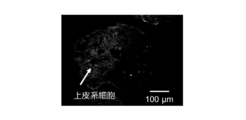
- 2A, 2B, and 2C show fluorescence micrographs of hair follicle primordia formed in one well on day 3 of culture.
- epithelial cells were fluorescently stained green through the anti-cytokeratin 15 antibody, cell nuclei of all cells were fluorescently stained blue with the fluorescent reagent DAPI, and adipose-derived stem cells were fluorescently stained with the fluorescent reagent. It was fluorescently stained red with VybrantDil.
- 2A shows a green fluorescence image corresponding to epithelial cells
- FIG. 2B shows a red fluorescence image corresponding to adipose-derived stem cells
- FIG. 2C shows epithelial cells, dermal papilla cells
- 3 shows three color fluorescence images corresponding to adipose-derived stem cells.
- the epithelial cells formed epithelial cell aggregates as part of the hair follicle primordia.
- the dermal papilla cells formed a dermal papilla cell aggregate as another part of the hair follicle primordium.
- the epithelial cell aggregation portion and the dermal papilla cell aggregation portion were formed so as to be adjacent to each other.
- most of the adipose-derived stem cells were present in the hair papilla cell aggregation portion.
- Adipose-derived stem cells were prepared as mesenchymal stem cells in the same manner as in Example 1 described above.
- a culture container As a culture container, a 96 multiwell plate was used as in Example 1 described above. Then, the epithelial cells, the dermal papilla cells, and the adipose-derived stem cells are changed in the ratio, and the epithelial cells, the dermal papilla cells, and Co-culture of adipose-derived stem cells was performed.
- the mixture was mixed and seeded as described above, and coculture was performed for 3 days.
- the mixture was mixed and seeded as described above, and coculture was performed for 3 days.
- PCR analysis of hair growth-related genes The gene expression level of the hair follicle primordium formed by the culture for 3 days was analyzed by RT-PCR.
- the nucleotide sequences of the primers used in RT-PCR were “5′-GCTGCAAAAGAGGTGTGAAAA-3 ′” for Versican, “5′-AGTGGTAACGAGATGCTTCC-3 ′” for Reverse Primer, and “Forward” for BMP4 as “Forward”.
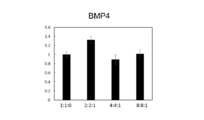
- [result] 3A, 3B, and 3C show the hair follicle primordium Versican gene, BMP4 gene, and ALP formed by co-culture in which the numbers of epithelial cells, dermal papilla cells, and adipose-derived stem cells were changed. The results of each analysis of the gene expression level are shown. Specifically, in FIGS. 3A, 3B, and 3C, the hair follicle primordia (“1: 1: 0” in the figure) and epithelium of Comparative Example 2-1 formed without using adipose-derived stem cells are shown.
- hair follicle primaries formed without using adipose-derived stem cells (“1: 1: 0 ")
- the expression levels of the Versican gene and the ALP gene were increased.
- the amount was remarkably large.
- Example 2-2 (“4: 4: 1” in the figure) and Example 2-3 (“8: 8: 1” in the figure).
- Example 2-1 (“2: 2: 1” in the figure) in which the ratio of adipose-derived stem cells was relatively large, it was formed without using adipose-derived stem cells.
- the expression level of the BMP4 gene was remarkably increased as compared with the hair follicle primordia (“1: 1: 0” in the figure).
- hair growth-related genes of the hair follicle primordia is further performed by further adding adipose-derived stem cells to the co-culture. It was confirmed that the amount (specifically, the amount of expression of Versican gene, BMP4 gene, and ALP gene by the hair papilla cells contained in the hair follicle primordia) can be effectively increased.
- a multi-well culture vessel used for co-culture to form hair follicle primordia spheroids was prepared in the same manner as in Patent Document 1 described above. That is, first, using CAD software (V Carve Pro 6.5), the pattern of the multiwell to be produced was designed by a computer. Then, the olefin resin substrate was cut in accordance with the designed pattern using a cutting machine, thereby producing a concave mold having the pattern. Epoxy resin (Crystal Lysine, manufactured by Nissin Resin Co., Ltd.) was poured into this mold, cured for 1 day, and then released to form a convex mold having the above-described designed pattern.
- the formed convex mold is fixed to the bottom surface of a 24-well plate, polydimethylsiloxane (PDMS) is poured and solidified, and then the mold is released to form a multiwell formed in a regular pattern on the PDMS substrate (each well A multi-well culture container (hereinafter referred to as "PDMS spheroid chip") having a diameter of 1 mm and a depth of 1 mm was prepared.
- PDMS spheroid chip A multi-well culture container having a diameter of 1 mm and a depth of 1 mm was prepared.
- this PDMS spheroid chip has a well formed on a substrate made of PDMS having excellent oxygen permeability, cells and cell aggregates cultured in the well have an appropriate amount of oxygen throughout the culture period. Is supplied.
- Adipose-derived stem cells were prepared as mesenchymal stem cells in the same manner as in Example 1 described above.
- the PDMS spheroid chip manufactured as described above was used as the culture container. Then, in each well of the PDMS spheroid chip, 4 ⁇ 10 3 cells / well of epithelial cells and dermal papilla cells and 2 ⁇ 10 3 cells / well of adipose-derived stem cells (total cell number of 1 ⁇ 10 4 cells / well) were obtained. Wells) were mixed and seeded, and co-cultured for 3 days. As the culture solution, a mixed medium prepared by mixing a hair papilla cell culture medium (Follicle Dermal Papilla Cell Growth Medium kit, PromoCell) and HuMedia-KG2 at a volume ratio of 1: 1 was used.
- a hair papilla cell culture medium Follicle Dermal Papilla Cell Growth Medium kit, PromoCell
- HuMedia-KG2 HuMedia-KG2
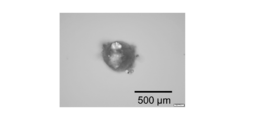
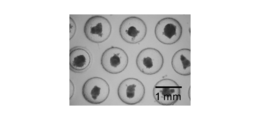
- [result] 4A and 4B show high-magnification phase-contrast micrographs of the hair follicle primordia formed in the wells on day 1 and day 3 of culture, respectively, and in FIG. 4C, day 3 of culture.
- Fig. 4 shows a phase contrast micrograph at low magnification of the hair follicle primordia formed in the well in the eye.
- hair follicle primordium was formed by co-culturing epithelial cells, dermal papilla cells, and adipose-derived stem cells in each well of the PDMS spheroid chip.
- the hair follicle primordia includes epithelial cell aggregates formed by aggregation of epithelial cells and hair papilla cell aggregates formed by aggregation of hair papilla cells.
- Most of the derived stem cells (“ADSC” in the figure) were present in the dermal papilla cell aggregation portion.
- FIG. 4C it was confirmed that a large amount of hair follicle primordia of uniform size can be simultaneously produced by using the PDMS spheroid chip.
- Adipose-derived stem cells were prepared as mesenchymal stem cells in the same manner as in Example 1 described above.
- a culture container As a culture container, a 96 multiwell plate was used as in Example 1 described above. Then, the epithelial cells, dermal papilla cells, and adipose-derived stem cells were co-cultured in each well while changing the ratio of the numbers of epithelial cells, dermal papilla cells, and adipose-derived stem cells.
- a mixed medium prepared by mixing a hair papilla cell culture medium (Follicle Dermal Papilla Cell Growth Medium kit, PromoCell) and HuMedia-KG2 at a volume ratio of 1: 1 was used.
- the mixture was mixed and seeded as described above, and coculture was performed for 3 days.
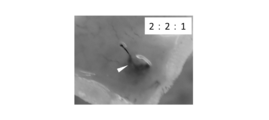
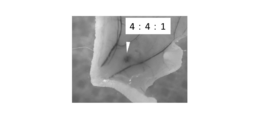
- [result] 5A, 5B, and 5C show the hair follicle primordia (“1: 1: 0” in FIG. 5A) and epithelial cells of Comparative Example 2-1 formed without using adipose-derived stem cells, respectively.
- hair growth from hair follicle primordia not containing adipose-derived stem cells was extremely small.
- the hair growth ability of the hair follicle primordia can be improved by further adding adipose-derived stem cells to epithelial cells and hair papilla cells in the co-culture for forming the hair follicle primordia. It was confirmed that the hair growth ability of the hair follicle primordia can be improved by further adding adipose-derived stem cells to epithelial cells and hair papilla cells in the co-culture for forming the hair follicle primordia. It was
Landscapes
- Health & Medical Sciences (AREA)
- Engineering & Computer Science (AREA)
- Life Sciences & Earth Sciences (AREA)
- Biomedical Technology (AREA)
- Wood Science & Technology (AREA)
- Organic Chemistry (AREA)
- Chemical & Material Sciences (AREA)
- Biotechnology (AREA)
- Zoology (AREA)
- Bioinformatics & Cheminformatics (AREA)
- Genetics & Genomics (AREA)
- Microbiology (AREA)
- Cell Biology (AREA)
- Biochemistry (AREA)
- General Engineering & Computer Science (AREA)
- General Health & Medical Sciences (AREA)
- Developmental Biology & Embryology (AREA)
- Dermatology (AREA)
- Rheumatology (AREA)
- Micro-Organisms Or Cultivation Processes Thereof (AREA)
- Materials For Medical Uses (AREA)
- Medicines Containing Material From Animals Or Micro-Organisms (AREA)
Priority Applications (3)
| Application Number | Priority Date | Filing Date | Title |
|---|---|---|---|
| US17/276,628 US20220041983A1 (en) | 2018-11-08 | 2019-10-15 | Hair Follicle Germs, Method for Producing Hair Follicle Germs, and Method for Activating Cells Included in Hair Follicle Germs |
| CN201980059873.0A CN112703247A (zh) | 2018-11-08 | 2019-10-15 | 毛囊原基、毛囊原基的制造方法、以及毛囊原基中所含的细胞的活化方法 |
| EP19881986.4A EP3878946A4 (en) | 2018-11-08 | 2019-10-15 | Hair follicle germs, method for producing hair follicle germs, and method for activating cells included in hair follicle germs |
Applications Claiming Priority (2)
| Application Number | Priority Date | Filing Date | Title |
|---|---|---|---|
| JP2018210524A JP7246595B2 (ja) | 2018-11-08 | 2018-11-08 | 毛包原基、毛包原基の製造方法、及び毛包原基に含まれる細胞の活性化方法 |
| JP2018-210524 | 2018-11-08 |
Publications (1)
| Publication Number | Publication Date |
|---|---|
| WO2020095631A1 true WO2020095631A1 (ja) | 2020-05-14 |
Family
ID=70612387
Family Applications (1)
| Application Number | Title | Priority Date | Filing Date |
|---|---|---|---|
| PCT/JP2019/040444 Ceased WO2020095631A1 (ja) | 2018-11-08 | 2019-10-15 | 毛包原基、毛包原基の製造方法、及び毛包原基に含まれる細胞の活性化方法 |
Country Status (5)
| Country | Link |
|---|---|
| US (1) | US20220041983A1 (https=) |
| EP (1) | EP3878946A4 (https=) |
| JP (1) | JP7246595B2 (https=) |
| CN (1) | CN112703247A (https=) |
| WO (1) | WO2020095631A1 (https=) |
Cited By (2)
| Publication number | Priority date | Publication date | Assignee | Title |
|---|---|---|---|---|
| JPWO2022114074A1 (https=) * | 2020-11-26 | 2022-06-02 | ||
| WO2023171395A1 (ja) * | 2022-03-09 | 2023-09-14 | 株式会社 資生堂 | 間葉系細胞を含む細胞集団の毛髪再生能を評価する方法 |
Citations (4)
| Publication number | Priority date | Publication date | Assignee | Title |
|---|---|---|---|---|
| WO2008001938A1 (en) * | 2006-06-27 | 2008-01-03 | Shiseido Company, Ltd. | Cell cluster comprising plural kinds of cells derived from soma with ability to form primitive organ-like structure |
| JP2010534072A (ja) * | 2007-07-20 | 2010-11-04 | ドングク・ユニヴァーシティー・インダストリー−アカデミック・コーオペレーション・ファンデーション | 間葉系幹細胞を利用して毛乳頭組職を製造する方法 |
| WO2017073625A1 (ja) | 2015-10-30 | 2017-05-04 | 国立大学法人横浜国立大学 | 再生毛包原基の集合体の製造方法、毛包組織含有シート、及び毛包組織含有シートの製造方法 |
| US20180271913A1 (en) * | 2017-03-21 | 2018-09-27 | National Cheng Kung University | Pharmaceutical compositions for promoting hair follicle regeneration and methods for preparing the same |
Family Cites Families (2)
| Publication number | Priority date | Publication date | Assignee | Title |
|---|---|---|---|---|
| WO2016006788A1 (ko) * | 2014-07-07 | 2016-01-14 | 메디포스트(주) | 작은 크기 줄기세포의 발모 촉진능 및 이의 용도 |
| DE102015119880B4 (de) * | 2015-11-17 | 2018-05-24 | Technische Universität Berlin | Verfahren zur Herstellung von Haarfollikeln und de novo Papillen sowie deren Verwendung für in vitro Tests und in vivo Implantate |
-
2018
- 2018-11-08 JP JP2018210524A patent/JP7246595B2/ja active Active
-
2019
- 2019-10-15 CN CN201980059873.0A patent/CN112703247A/zh active Pending
- 2019-10-15 WO PCT/JP2019/040444 patent/WO2020095631A1/ja not_active Ceased
- 2019-10-15 EP EP19881986.4A patent/EP3878946A4/en not_active Withdrawn
- 2019-10-15 US US17/276,628 patent/US20220041983A1/en not_active Abandoned
Patent Citations (5)
| Publication number | Priority date | Publication date | Assignee | Title |
|---|---|---|---|---|
| WO2008001938A1 (en) * | 2006-06-27 | 2008-01-03 | Shiseido Company, Ltd. | Cell cluster comprising plural kinds of cells derived from soma with ability to form primitive organ-like structure |
| JP2013078344A (ja) | 2006-06-27 | 2013-05-02 | Shiseido Co Ltd | 体性に由来する複数の細胞種からなる原始的な器官様をなし得る細胞塊 |
| JP2010534072A (ja) * | 2007-07-20 | 2010-11-04 | ドングク・ユニヴァーシティー・インダストリー−アカデミック・コーオペレーション・ファンデーション | 間葉系幹細胞を利用して毛乳頭組職を製造する方法 |
| WO2017073625A1 (ja) | 2015-10-30 | 2017-05-04 | 国立大学法人横浜国立大学 | 再生毛包原基の集合体の製造方法、毛包組織含有シート、及び毛包組織含有シートの製造方法 |
| US20180271913A1 (en) * | 2017-03-21 | 2018-09-27 | National Cheng Kung University | Pharmaceutical compositions for promoting hair follicle regeneration and methods for preparing the same |
Non-Patent Citations (4)
| Title |
|---|
| KOH-EI TOYOSHIMA ET AL., NATURE COMMUNICATIONS, vol. 3, 2012, pages 784 |
| See also references of EP3878946A4 |
| TOYOSHIMA, K. ET AL.: "Fully functional hair follicle regeneration through the rearrangement of stem cells and their niches", NATURE COMMUNICATIONS, vol. 3, 2012, pages 784, XP0055557492 * |
| WON, C. H. ET AL.: "Hair growth promoting effects of adipose tissue-derived stem cells", JOURNAL OF DERMATOLOGICAL SCIENCE, vol. 57, 2010, pages 134 - 137, XP026874753 * |
Cited By (4)
| Publication number | Priority date | Publication date | Assignee | Title |
|---|---|---|---|---|
| JPWO2022114074A1 (https=) * | 2020-11-26 | 2022-06-02 | ||
| EP4190891A4 (en) * | 2020-11-26 | 2024-10-09 | Tosoh Corporation | PROCESS FOR PRODUCING A CELLULAR MASS |
| JP7835162B2 (ja) | 2020-11-26 | 2026-03-25 | 東ソー株式会社 | 細胞塊の製造方法 |
| WO2023171395A1 (ja) * | 2022-03-09 | 2023-09-14 | 株式会社 資生堂 | 間葉系細胞を含む細胞集団の毛髪再生能を評価する方法 |
Also Published As
| Publication number | Publication date |
|---|---|
| JP2020074718A (ja) | 2020-05-21 |
| US20220041983A1 (en) | 2022-02-10 |
| JP7246595B2 (ja) | 2023-03-28 |
| EP3878946A4 (en) | 2022-07-27 |
| CN112703247A (zh) | 2021-04-23 |
| EP3878946A1 (en) | 2021-09-15 |
Similar Documents
| Publication | Publication Date | Title |
|---|---|---|
| CN103502440B (zh) | 毛发颜色受控制的移植用再生毛囊原基的制造方法、包含移植用再生毛囊原基的组合物和再生毛囊原基的移植方法 | |
| EP2130909A1 (en) | Method for production of tooth, and tooth produced by the method | |
| JP2013078344A (ja) | 体性に由来する複数の細胞種からなる原始的な器官様をなし得る細胞塊 | |
| EP1954803B1 (en) | Multipotent adult stem cells having an ability of oct4 expression derived from umbilical cord blood and method for preparing the same | |
| WO2020095631A1 (ja) | 毛包原基、毛包原基の製造方法、及び毛包原基に含まれる細胞の活性化方法 | |
| US20220228113A1 (en) | Hair Follicle Primordia and Method for Producing Same | |
| WO2020085023A1 (ja) | 間葉系細胞の培養方法、活性化間葉系細胞の製造方法、毛包原基の製造方法、間葉系細胞の活性化方法、及び上皮系細胞の活性化方法 | |
| JP7444367B2 (ja) | 増幅毛包間葉系細胞の製造方法及びその使用 | |
| WO2023058429A1 (ja) | 毛髪再生能を有する細胞凝集塊の製造方法及びこれに関連する方法 | |
| US20210163918A1 (en) | Cell-Containing Hydrogel Body and Method for Producing Same | |
| JP2008029331A (ja) | 体性に由来する複数の細胞種からなる原始的な器官様をなし得る細胞塊 | |
| JP7158676B2 (ja) | 再生毛の色制御方法、毛の再生方法及び毛包原基の製造方法 | |
| JP2020145990A (ja) | 培養容器、及び細胞−担体複合体の製造方法 | |
| JP2021073932A (ja) | ファイバー担体−細胞含有ゲル複合体及びその製造方法、並びにファイバー担体−細胞含有ゲル複合体製造用キット | |
| JP5249789B2 (ja) | 毛髪の形成方法及び生物材料 | |
| US20210380940A1 (en) | In vitro growth method for hair follicular epithelial stem cells | |
| JP2023056592A (ja) | 移植用毛様組織及びこれに関連する方法 |
Legal Events
| Date | Code | Title | Description |
|---|---|---|---|
| 121 | Ep: the epo has been informed by wipo that ep was designated in this application |
Ref document number: 19881986 Country of ref document: EP Kind code of ref document: A1 |
|
| NENP | Non-entry into the national phase |
Ref country code: DE |
|
| ENP | Entry into the national phase |
Ref document number: 2019881986 Country of ref document: EP Effective date: 20210608 |