WO2020071261A1 - 薬液及び薬液収容体 - Google Patents
薬液及び薬液収容体Info
- Publication number
- WO2020071261A1 WO2020071261A1 PCT/JP2019/038078 JP2019038078W WO2020071261A1 WO 2020071261 A1 WO2020071261 A1 WO 2020071261A1 JP 2019038078 W JP2019038078 W JP 2019038078W WO 2020071261 A1 WO2020071261 A1 WO 2020071261A1
- Authority
- WO
- WIPO (PCT)
- Prior art keywords
- content
- group
- mass
- metal
- chemical solution
- Prior art date
- Legal status (The legal status is an assumption and is not a legal conclusion. Google has not performed a legal analysis and makes no representation as to the accuracy of the status listed.)
- Ceased
Links
Classifications
-
- G—PHYSICS
- G03—PHOTOGRAPHY; CINEMATOGRAPHY; ANALOGOUS TECHNIQUES USING WAVES OTHER THAN OPTICAL WAVES; ELECTROGRAPHY; HOLOGRAPHY
- G03F—PHOTOMECHANICAL PRODUCTION OF TEXTURED OR PATTERNED SURFACES, e.g. FOR PRINTING, FOR PROCESSING OF SEMICONDUCTOR DEVICES; MATERIALS THEREFOR; ORIGINALS THEREFOR; APPARATUS SPECIALLY ADAPTED THEREFOR
- G03F7/00—Photomechanical, e.g. photolithographic, production of textured or patterned surfaces, e.g. printing surfaces; Materials therefor, e.g. comprising photoresists; Apparatus specially adapted therefor
- G03F7/26—Processing photosensitive materials; Apparatus therefor
- G03F7/30—Imagewise removal using liquid means
- G03F7/32—Liquid compositions therefor, e.g. developers
- G03F7/325—Non-aqueous compositions
-
- G—PHYSICS
- G03—PHOTOGRAPHY; CINEMATOGRAPHY; ANALOGOUS TECHNIQUES USING WAVES OTHER THAN OPTICAL WAVES; ELECTROGRAPHY; HOLOGRAPHY
- G03F—PHOTOMECHANICAL PRODUCTION OF TEXTURED OR PATTERNED SURFACES, e.g. FOR PRINTING, FOR PROCESSING OF SEMICONDUCTOR DEVICES; MATERIALS THEREFOR; ORIGINALS THEREFOR; APPARATUS SPECIALLY ADAPTED THEREFOR
- G03F7/00—Photomechanical, e.g. photolithographic, production of textured or patterned surfaces, e.g. printing surfaces; Materials therefor, e.g. comprising photoresists; Apparatus specially adapted therefor
- G03F7/26—Processing photosensitive materials; Apparatus therefor
- G03F7/30—Imagewise removal using liquid means
- G03F7/32—Liquid compositions therefor, e.g. developers
-
- B—PERFORMING OPERATIONS; TRANSPORTING
- B65—CONVEYING; PACKING; STORING; HANDLING THIN OR FILAMENTARY MATERIAL
- B65D—CONTAINERS FOR STORAGE OR TRANSPORT OF ARTICLES OR MATERIALS, e.g. BAGS, BARRELS, BOTTLES, BOXES, CANS, CARTONS, CRATES, DRUMS, JARS, TANKS, HOPPERS, FORWARDING CONTAINERS; ACCESSORIES, CLOSURES, OR FITTINGS THEREFOR; PACKAGING ELEMENTS; PACKAGES
- B65D81/00—Containers, packaging elements, or packages, for contents presenting particular transport or storage problems, or adapted to be used for non-packaging purposes after removal of contents
- B65D81/24—Adaptations for preventing deterioration or decay of contents; Applications to the container or packaging material of food preservatives, fungicides, pesticides or animal repellants
-
- C—CHEMISTRY; METALLURGY
- C11—ANIMAL OR VEGETABLE OILS, FATS, FATTY SUBSTANCES OR WAXES; FATTY ACIDS THEREFROM; DETERGENTS; CANDLES
- C11D—DETERGENT COMPOSITIONS; USE OF SINGLE SUBSTANCES AS DETERGENTS; SOAP OR SOAP-MAKING; RESIN SOAPS; RECOVERY OF GLYCEROL
- C11D17/00—Detergent materials or soaps characterised by their shape or physical properties
- C11D17/08—Liquid soap, e.g. for dispensers; capsuled
-
- C—CHEMISTRY; METALLURGY
- C11—ANIMAL OR VEGETABLE OILS, FATS, FATTY SUBSTANCES OR WAXES; FATTY ACIDS THEREFROM; DETERGENTS; CANDLES
- C11D—DETERGENT COMPOSITIONS; USE OF SINGLE SUBSTANCES AS DETERGENTS; SOAP OR SOAP-MAKING; RESIN SOAPS; RECOVERY OF GLYCEROL
- C11D7/00—Compositions of detergents based essentially on non-surface-active compounds
- C11D7/02—Inorganic compounds
- C11D7/20—Water-insoluble oxides
-
- C—CHEMISTRY; METALLURGY
- C11—ANIMAL OR VEGETABLE OILS, FATS, FATTY SUBSTANCES OR WAXES; FATTY ACIDS THEREFROM; DETERGENTS; CANDLES
- C11D—DETERGENT COMPOSITIONS; USE OF SINGLE SUBSTANCES AS DETERGENTS; SOAP OR SOAP-MAKING; RESIN SOAPS; RECOVERY OF GLYCEROL
- C11D7/00—Compositions of detergents based essentially on non-surface-active compounds
- C11D7/22—Organic compounds
- C11D7/26—Organic compounds containing oxygen
- C11D7/261—Alcohols; Phenols
-
- C—CHEMISTRY; METALLURGY
- C11—ANIMAL OR VEGETABLE OILS, FATS, FATTY SUBSTANCES OR WAXES; FATTY ACIDS THEREFROM; DETERGENTS; CANDLES
- C11D—DETERGENT COMPOSITIONS; USE OF SINGLE SUBSTANCES AS DETERGENTS; SOAP OR SOAP-MAKING; RESIN SOAPS; RECOVERY OF GLYCEROL
- C11D7/00—Compositions of detergents based essentially on non-surface-active compounds
- C11D7/22—Organic compounds
- C11D7/26—Organic compounds containing oxygen
- C11D7/264—Aldehydes; Ketones; Acetals or ketals
-
- C—CHEMISTRY; METALLURGY
- C11—ANIMAL OR VEGETABLE OILS, FATS, FATTY SUBSTANCES OR WAXES; FATTY ACIDS THEREFROM; DETERGENTS; CANDLES
- C11D—DETERGENT COMPOSITIONS; USE OF SINGLE SUBSTANCES AS DETERGENTS; SOAP OR SOAP-MAKING; RESIN SOAPS; RECOVERY OF GLYCEROL
- C11D7/00—Compositions of detergents based essentially on non-surface-active compounds
- C11D7/22—Organic compounds
- C11D7/26—Organic compounds containing oxygen
- C11D7/265—Carboxylic acids or salts thereof
-
- C—CHEMISTRY; METALLURGY
- C11—ANIMAL OR VEGETABLE OILS, FATS, FATTY SUBSTANCES OR WAXES; FATTY ACIDS THEREFROM; DETERGENTS; CANDLES
- C11D—DETERGENT COMPOSITIONS; USE OF SINGLE SUBSTANCES AS DETERGENTS; SOAP OR SOAP-MAKING; RESIN SOAPS; RECOVERY OF GLYCEROL
- C11D7/00—Compositions of detergents based essentially on non-surface-active compounds
- C11D7/22—Organic compounds
- C11D7/26—Organic compounds containing oxygen
- C11D7/266—Esters or carbonates
-
- C—CHEMISTRY; METALLURGY
- C11—ANIMAL OR VEGETABLE OILS, FATS, FATTY SUBSTANCES OR WAXES; FATTY ACIDS THEREFROM; DETERGENTS; CANDLES
- C11D—DETERGENT COMPOSITIONS; USE OF SINGLE SUBSTANCES AS DETERGENTS; SOAP OR SOAP-MAKING; RESIN SOAPS; RECOVERY OF GLYCEROL
- C11D7/00—Compositions of detergents based essentially on non-surface-active compounds
- C11D7/22—Organic compounds
- C11D7/36—Organic compounds containing phosphorus
-
- G—PHYSICS
- G03—PHOTOGRAPHY; CINEMATOGRAPHY; ANALOGOUS TECHNIQUES USING WAVES OTHER THAN OPTICAL WAVES; ELECTROGRAPHY; HOLOGRAPHY
- G03F—PHOTOMECHANICAL PRODUCTION OF TEXTURED OR PATTERNED SURFACES, e.g. FOR PRINTING, FOR PROCESSING OF SEMICONDUCTOR DEVICES; MATERIALS THEREFOR; ORIGINALS THEREFOR; APPARATUS SPECIALLY ADAPTED THEREFOR
- G03F7/00—Photomechanical, e.g. photolithographic, production of textured or patterned surfaces, e.g. printing surfaces; Materials therefor, e.g. comprising photoresists; Apparatus specially adapted therefor
- G03F7/16—Coating processes; Apparatus therefor
-
- G—PHYSICS
- G03—PHOTOGRAPHY; CINEMATOGRAPHY; ANALOGOUS TECHNIQUES USING WAVES OTHER THAN OPTICAL WAVES; ELECTROGRAPHY; HOLOGRAPHY
- G03F—PHOTOMECHANICAL PRODUCTION OF TEXTURED OR PATTERNED SURFACES, e.g. FOR PRINTING, FOR PROCESSING OF SEMICONDUCTOR DEVICES; MATERIALS THEREFOR; ORIGINALS THEREFOR; APPARATUS SPECIALLY ADAPTED THEREFOR
- G03F7/00—Photomechanical, e.g. photolithographic, production of textured or patterned surfaces, e.g. printing surfaces; Materials therefor, e.g. comprising photoresists; Apparatus specially adapted therefor
- G03F7/20—Exposure; Apparatus therefor
-
- G—PHYSICS
- G03—PHOTOGRAPHY; CINEMATOGRAPHY; ANALOGOUS TECHNIQUES USING WAVES OTHER THAN OPTICAL WAVES; ELECTROGRAPHY; HOLOGRAPHY
- G03F—PHOTOMECHANICAL PRODUCTION OF TEXTURED OR PATTERNED SURFACES, e.g. FOR PRINTING, FOR PROCESSING OF SEMICONDUCTOR DEVICES; MATERIALS THEREFOR; ORIGINALS THEREFOR; APPARATUS SPECIALLY ADAPTED THEREFOR
- G03F7/00—Photomechanical, e.g. photolithographic, production of textured or patterned surfaces, e.g. printing surfaces; Materials therefor, e.g. comprising photoresists; Apparatus specially adapted therefor
- G03F7/26—Processing photosensitive materials; Apparatus therefor
-
- G—PHYSICS
- G03—PHOTOGRAPHY; CINEMATOGRAPHY; ANALOGOUS TECHNIQUES USING WAVES OTHER THAN OPTICAL WAVES; ELECTROGRAPHY; HOLOGRAPHY
- G03F—PHOTOMECHANICAL PRODUCTION OF TEXTURED OR PATTERNED SURFACES, e.g. FOR PRINTING, FOR PROCESSING OF SEMICONDUCTOR DEVICES; MATERIALS THEREFOR; ORIGINALS THEREFOR; APPARATUS SPECIALLY ADAPTED THEREFOR
- G03F7/00—Photomechanical, e.g. photolithographic, production of textured or patterned surfaces, e.g. printing surfaces; Materials therefor, e.g. comprising photoresists; Apparatus specially adapted therefor
- G03F7/26—Processing photosensitive materials; Apparatus therefor
- G03F7/42—Stripping or agents therefor
-
- H—ELECTRICITY
- H10—SEMICONDUCTOR DEVICES; ELECTRIC SOLID-STATE DEVICES NOT OTHERWISE PROVIDED FOR
- H10P—GENERIC PROCESSES OR APPARATUS FOR THE MANUFACTURE OR TREATMENT OF DEVICES COVERED BY CLASS H10
- H10P52/00—Grinding, lapping or polishing of wafers, substrates or parts of devices
-
- H—ELECTRICITY
- H10—SEMICONDUCTOR DEVICES; ELECTRIC SOLID-STATE DEVICES NOT OTHERWISE PROVIDED FOR
- H10P—GENERIC PROCESSES OR APPARATUS FOR THE MANUFACTURE OR TREATMENT OF DEVICES COVERED BY CLASS H10
- H10P70/00—Cleaning of wafers, substrates or parts of devices
- H10P70/20—Cleaning during device manufacture
-
- H—ELECTRICITY
- H10—SEMICONDUCTOR DEVICES; ELECTRIC SOLID-STATE DEVICES NOT OTHERWISE PROVIDED FOR
- H10P—GENERIC PROCESSES OR APPARATUS FOR THE MANUFACTURE OR TREATMENT OF DEVICES COVERED BY CLASS H10
- H10P76/00—Manufacture or treatment of masks on semiconductor bodies, e.g. by lithography or photolithography
- H10P76/20—Manufacture or treatment of masks on semiconductor bodies, e.g. by lithography or photolithography of masks comprising organic materials
- H10P76/204—Manufacture or treatment of masks on semiconductor bodies, e.g. by lithography or photolithography of masks comprising organic materials of organic photoresist masks
- H10P76/2041—Photolithographic processes
-
- C—CHEMISTRY; METALLURGY
- C11—ANIMAL OR VEGETABLE OILS, FATS, FATTY SUBSTANCES OR WAXES; FATTY ACIDS THEREFROM; DETERGENTS; CANDLES
- C11D—DETERGENT COMPOSITIONS; USE OF SINGLE SUBSTANCES AS DETERGENTS; SOAP OR SOAP-MAKING; RESIN SOAPS; RECOVERY OF GLYCEROL
- C11D2111/00—Cleaning compositions characterised by the objects to be cleaned; Cleaning compositions characterised by non-standard cleaning or washing processes
- C11D2111/10—Objects to be cleaned
- C11D2111/14—Hard surfaces
- C11D2111/22—Electronic devices, e.g. PCBs or semiconductors
-
- H—ELECTRICITY
- H10—SEMICONDUCTOR DEVICES; ELECTRIC SOLID-STATE DEVICES NOT OTHERWISE PROVIDED FOR
- H10P—GENERIC PROCESSES OR APPARATUS FOR THE MANUFACTURE OR TREATMENT OF DEVICES COVERED BY CLASS H10
- H10P70/00—Cleaning of wafers, substrates or parts of devices
- H10P70/20—Cleaning during device manufacture
- H10P70/27—Cleaning during device manufacture during, before or after processing of conductive materials, e.g. polysilicon or amorphous silicon layers
Definitions
- the present invention relates to a drug solution and a drug solution container.
- a chemical solution containing water and / or an organic solvent is used.
- the organic solvent may contain an antioxidant for the purpose of suppressing decomposition over time.
- an antioxidant for the purpose of suppressing decomposition over time.
- the organic solvent if used in a pure state, there is a problem that radicals are generated in the molecule and are converted to organic acids via peroxides. Antioxidants have been used to control this.
- Various impurities contained in the chemical solution may cause defects of the semiconductor device. Such a defect may cause a reduction in the manufacturing yield of the semiconductor device and an electrical abnormality such as a short circuit.
- Specific examples of such impurities include a plasticizer eluted from a manufacturing apparatus used for manufacturing an organic solvent, and an antioxidant added for stabilizing the organic solvent as disclosed in Patent Document 1.
- Organic impurities, and metal impurities eluted from a production apparatus used in producing an organic solvent.
- the present inventors applied a chemical solution containing an organic solvent to a wiring forming step including photolithography, and found that the content ratio of specific compounds among the organic impurities increases the number of defects containing metal impurities in the wiring substrate. It was clear that there was.
- an object of the present invention is to provide a chemical solution and a chemical solution container having excellent performance of suppressing defects including metal impurities.
- the present inventors have conducted intensive studies on the above problems, and found that a chemical solution containing an organic solvent, an organic impurity including a phosphoric acid ester and an adipic acid ester, and a metallic impurity contained phosphoric acid with respect to the content of the adipic acid ester.
- a chemical solution containing an organic solvent, an organic impurity including a phosphoric acid ester and an adipic acid ester, and a metallic impurity contained phosphoric acid with respect to the content of the adipic acid ester.
- the organic impurities include a phosphoric acid ester and an adipic acid ester, A chemical solution, wherein the mass ratio of the content of the phosphate ester to the content of the adipate ester is 1 or more.
- the drug solution according to [1] wherein the content of the phosphoric acid ester is 0.1 mass ppt to 100 mass ppm with respect to the total mass of the drug solution.
- a mass ratio of the content of the phosphoric acid ester is 1 to 10 4, the drug solution according to any one of [1] to [3].
- the chemical solution according to [5], wherein the content of the phthalate is 0.1 mass ppm to 10 mass ppm based on the total mass of the chemical solution.
- the chemical solution according to [5] or [6], wherein a mass ratio of the content of the phosphate ester to the content of the phthalate ester is 10 ⁇ 2 to 10.
- [14] The drug solution according to any one of [10] to [13], wherein the mass ratio of the content of the adipic ester to the total content of the alcohol and the acetone is 10 -1 to 10 5 .
- [15] Contains more water, To the total of the content of the alcohol and the acetone, the mass ratio of the content of the water is from 1 to 10 9, drug solution according to any one of [10] to [14].
- [16] The chemical solution according to any one of [1] to [15], wherein the content of the metal impurity is 0.1 to 2,000 mass ppt based on the total mass of the chemical solution.
- the chemical solution according to any one of [1] to [16], wherein the metal impurities include metal-containing particles and metal ions.
- the metal nanoparticles include first iron oxide nanoparticles composed of iron oxide, The drug solution according to [18], wherein the number of particles of the first iron oxide nanoparticles per unit volume of the drug solution is 10 to 1.0 ⁇ 10 11 / cm 3 .
- the metal nanoparticles include second iron oxide nanoparticles including iron oxide and an organic compound, In per unit volume of the chemical solution, to the number-containing particles of the first iron oxide nanoparticles, the ratio of the number containing particles of the second iron oxide nanoparticles is 10 to 108, the drug solution according to [19] .
- the organic impurities further include at least one selected from the group consisting of alcohol and acetone, The chemical solution according to any one of [21] to [23], wherein the total mass ratio of the content of the alcohol and the acetone to the content of the stabilizer is 10 ⁇ 7 to 10 3 .
- the stabilizer is dibutylhydroxytoluene, hydroquinone, didodecyl 3,3′-thiodipropionate, dioctadecyl 3,3′-thiodipropionate, ditetradecyl 3,3′-thiodipropionate, 4,4 ′ -Butylidenebis- (6-tert-butyl-3-methylphenol), 2,2'-methylenebis- (4-ethyl-6-tert-butylphenol), butylhydroxyanisole, tris (2-ethylhexyl) phosphite and phosphorous acid
- the drug solution according to any one of [21] to [24], which is at least one antioxidant selected from the group consisting of triisodecyl acid.
- a drug solution container comprising: a container; and the drug solution according to any one of [1] to [28] stored in the container.
- the chemical solution container according to [29] wherein at least a part of the liquid contact part of the container is a fluororesin, electropolished stainless steel, or glass.
- a numerical range represented by using “to” means a range including numerical values described before and after “to” as a lower limit and an upper limit.
- ppm means “parts-per-million (10 ⁇ 6 )”
- ppb means “parts-per-billion (10 ⁇ 9 )”
- ppt means “Parts-per-trillion (10 ⁇ 12 )” means “parts-per-quadrillion (10 ⁇ 15 )”.
- the notation that does not denote substituted or unsubstituted includes those not having a substituent and those having a substituent as long as the effects of the present invention are not impaired.
- the “hydrocarbon group” includes not only a hydrocarbon group having no substituent (unsubstituted hydrocarbon group) but also a hydrocarbon group having a substituent (substituted hydrocarbon group). . This is synonymous with each compound.
- the “radiation” in the present invention means, for example, far ultraviolet rays, extreme ultraviolet (EUV), X-rays, or electron beams.
- light means actinic rays or radiation.
- the term “exposure” in the present invention includes not only exposure with far ultraviolet rays, X-rays or EUV, but also drawing with particle beams such as electron beams or ion beams.
- the chemical solution of the present invention contains an organic solvent, an organic impurity, and a metal impurity, and the organic impurity includes a phosphoric acid ester and an adipic acid ester. And the mass ratio of the content of the phosphate ester to the content of the adipate ester is 1 or more.
- a defect including a metal impurity may remain as a residue on the wafer surface.
- the defect containing a metal impurity include a defect containing only a metal impurity, and a defect formed by incorporating an organic compound (organic impurity) contained in a chemical solution with a metal component (metal impurity) contained in the chemical solution.
- the phosphate ester has a small ability to interact with other elements on its skeleton because the phosphate group is alkylated. That is, the phosphate ester has a property of hardly remaining as a complex after acting on the metal. Therefore, when the mass ratio of the phosphate ester content to the adipate ester content is 1 or more, the phosphate ester complex amount is relatively increased, and as a result, the residue is estimated to be reduced.
- Organic solvent is intended to mean a liquid organic compound contained at a content exceeding 10,000 ppm by mass per component with respect to the total mass of a chemical solution. That is, in this specification, a liquid organic compound contained in an amount exceeding 10,000 ppm by mass with respect to the total mass of the drug solution corresponds to an organic solvent.
- liquid means a liquid at 25 ° C. and atmospheric pressure.
- the type of the organic solvent is not particularly limited, and a known organic solvent is used.
- the organic solvent include alkylene glycol monoalkyl ether carboxylate, alkylene glycol monoalkyl ether, alkyl lactate, alkyl alkoxypropionate, cyclic lactone (preferably having 4 to 10 carbon atoms), and monoketone optionally having a ring Examples include compounds (preferably having 4 to 10 carbon atoms), alkylene carbonate, alkyl alkoxyacetate, and alkyl pyruvate.
- the organic solvent for example, those described in JP-A-2016-057614, JP-A-2014-219664, JP-A-2016-138219, and JP-A-2015-135379 may be used. Good.
- propylene glycol monomethyl ether propylene glycol monoethyl ether
- PGME propylene glycol monopropyl ether
- PMEA propylene glycol monomethyl ether acetate
- EL ethyl lactate
- methyl methoxypropionate cyclopentanone, cyclohexanone (CHN), ⁇ -butyrolactone, diisoamyl ether, butyl acetate (nBA), isoamyl acetate (iAA), isopropanol (IPA), 4-methyl-2-pentanol (MIBC), dimethyl sulfoxide, N-methyl-2- Pyrrolidone (NMP), diethylene glycol, ethylene glycol, dipropylene glycol, propylene glycol, ethylene carbonate, propylene carbonate (PC), sulfora , Cycloheptanone, 1-hexanol, decane, and, at least one selected from the group consisting of
- the content of the organic solvent in the chemical solution is not particularly limited, but is generally preferably 98.0% by mass or more, more preferably 99.0% by mass or more, and preferably 99.9% by mass or more based on the total mass of the chemical solution. More preferably, it is particularly preferably 99.99% by mass or more.
- the upper limit is not particularly limited, but is often less than 100% by mass.
- One organic solvent may be used alone, or two or more organic solvents may be used in combination. When two or more organic solvents are used in combination, the total amount is within the above range.
- the kind and content of the organic solvent in the chemical solution can be measured using a gas chromatograph mass spectrometer.
- the chemical contains organic impurities.
- the organic impurities may be added to the chemical solution or may be unintentionally mixed in the process of manufacturing the chemical solution. Examples of the case where they are unintentionally mixed in the manufacturing process of the chemical solution include, for example, a case where the organic impurities are contained in the raw material (for example, an organic solvent) used for manufacturing the chemical solution, and the case where they are mixed in the manufacturing process of the chemical solution (for example, , Contamination) and the like, but are not limited thereto.
- GCMS gas chromatography mass spectrometer; gas spectrometry mass spectrometry
- the organic impurities in the present invention include a phosphate and an adipate. These components may be added to the drug solution. Further, the phosphoric acid ester is sometimes used as a plasticizer of a rubber member such as an O-ring constituting an organic solvent production device, and is eluted from such a member into the organic solvent and contained in the chemical solution together with the organic solvent. May be used. Further, the adipic acid ester may be contained in the chemical solution together with the organic solvent as a by-product generated during the production of the organic solvent.
- phosphate ester examples include tricresyl phosphate (TCP) and tributyl phosphate (TBP).
- TBP is preferable because it is more excellent in suppressing defects including metal impurities.
- adipates include bis (2-ethylhexyl) adipate (DOA, also known as dioctyl adipate) and monomethyl adipate (MMAD). Adipate is excellent in suppressing defects including metal impurities.
- DOA bis (2-ethylhexyl) acid
- DOA bis (2-ethylhexyl) acid
- the mass ratio of the phosphate ester content to the adipic ester content is 1 or more, and defects including metal impurities (particularly, organic impurities and defects including both metallic impurities, and, from the viewpoint of more excellent suppression of defects) containing an oxide of a metal atom, preferably greater than 1, particularly preferably 1.2 or more, preferably 10 5 or less, particularly 10 3 or less preferable.
- Each of the phosphoric acid ester and the adipic acid ester may be contained alone in the medicinal solution, or two or more thereof may be contained.
- the content of the phosphate ester means the total amount of the phosphate esters contained in the present drug solution.
- the content of the adipic acid ester means the total amount of the adipic acid ester contained in the present drug solution.
- the content of the phosphoric acid ester is preferably 0.05 mass ppt to 150 mass ppm with respect to the total mass of the drug solution, and 0.1 mass ppt to 100 mass ppm is more preferable in terms of suppressing defects including metal impurities. More preferably, the amount is from 1 mass ppt to 100 mass ppm.
- the phosphate ester contains tributyl phosphate (TBP)
- TBP tributyl phosphate
- the content of tributyl phosphate is preferably 0.005 mass ppt to 60 mass ppm with respect to the total mass of the drug solution, and the stability of the drug solution is excellent.
- 0.1 mass ppt to 40 mass ppm is more preferable, and 1 mass ppt to 20 mass ppm is particularly preferable.
- the content of the adipic acid ester is preferably from 0.003 mass ppm to 40 mass ppm with respect to the total mass of the drug solution, and from the point of being superior in suppressing defects including metal impurities, from 0.1 mass ppm to 10 mass ppm. More preferably, the content is 1 mass ppm to 10 ppm by mass.
- the mass ratio of the phosphate ester content to the tributyl phosphate content depends on the defect suppression. from the viewpoint of performance more excellent, 2 is preferably from 1 to 10, 1 to 10 are particularly preferred.
- the organic impurities in the present invention may further contain a phthalic ester.
- the phthalic acid ester may be added to the drug solution.
- phthalic acid esters are sometimes used as a plasticizer for rubber members such as O-rings constituting an organic solvent production apparatus, and are eluted from such members into an organic solvent and contained in a chemical solution together with the organic solvent. May be used.
- Specific examples of phthalic acid esters include dioctyl phthalate (DOP), bis (2-ethylhexyl) phthalate (DEHP), bis (2-propylheptyl) phthalate (DPHP), dibutyl phthalate (DBP), and phthalic acid.
- Examples include benzylbutyl (BBzP), diisodecyl phthalate (DIDP), diisooctyl phthalate (DIOP), diethyl phthalate (DEP), diisobutyl phthalate (DIBP), dihexyl phthalate, and diisononyl phthalate (DINP).
- BBzP benzylbutyl
- DIDP diisodecyl phthalate
- DIOP diisooctyl phthalate
- DEP diethyl phthalate
- DIBP diisobutyl phthalate
- DIBP dihexyl phthalate
- DINP diisononyl phthalate
- the content of the phthalic acid ester is preferably 0.01 mass ppt to 50 mass ppm with respect to the total mass of the present drug solution, and 0.1 mass ppt to 10 mass ppm is more preferable in terms of suppressing defects including metal impurities. More preferably, the content is 1 mass ppm to 10 ppm by mass.
- the content of the phthalate ester means the total amount of the phthalate esters contained in the present drug solution.
- the mass ratio of the phosphate ester content to the phthalate ester content is preferably 10 ⁇ 3 to 10 2, more preferably 10 ⁇ 2 to 10.
- 10 -1 to 10 are particularly preferred.
- the mass ratio is 10 -2 or more, the stability of the chemical solution is excellent.
- the mass ratio is 10 or less, it is more excellent in suppressing defects including metal impurities (especially, defects including oxides of metal atoms).
- the mass ratio of the content of adipic acid ester to the content of phthalic acid ester is preferably 10 ⁇ 4 to 10 2, more preferably 10 ⁇ 3 to 10.
- 10 ⁇ 2 to 10 are particularly preferable.
- the mass ratio is within the range of 10 ⁇ 3 to 10
- defects containing metal impurities particularly, defects containing both organic impurities and metal impurities, and defects containing oxides of metal atoms
- the mass ratio of the content of tributyl phosphate to the content of phthalate ester is controlled by defect suppression. From the viewpoint of more excellent performance, 10 ⁇ 4 to 10 2 is preferable, 10 ⁇ 3 to 10 is more preferable, and 10 ⁇ 2 to 10 is particularly preferable.
- the organic impurities in the present invention may further include at least one selected from the group consisting of alcohol and acetone.
- the organic solvent contained in the present drug solution refers to a liquid organic compound contained in excess of 10,000 ppm by mass with respect to the total mass of the drug solution. Therefore, alcohols and acetone classified as organic impurities mean those whose content per component is 10,000 mass ppm or less based on the total mass of the present drug solution.
- the alcohol as the organic impurity, at least one selected from the group consisting of methanol, ethanol, n-butanol and cyclohexanol is preferable because it is more excellent in suppressing defects including metal impurities.
- the total content of alcohol and acetone as organic impurities is preferably from 0.1 to 3500 ppm by mass, more preferably from 1 to 3000 ppm by mass, and more preferably from 100 to 100 ppm by mass, based on the total mass of the drug solution. 2800 mass ppm is particularly preferred.
- the stability of the drug solution is excellent.
- the total content is 3000 mass ppm or less, the stability of the chemical solution is excellent, and the defects containing metal impurities (particularly, defects containing metal atoms) are more excellent.
- the total content of alcohol and acetone, which are organic impurities means the content of only alcohol when the present drug solution does not contain acetone, and when the present drug solution does not contain alcohol. Means the content of acetone alone.
- the mass ratio of the phosphate ester content to the total content of alcohol and acetone as organic impurities is preferably 10 ⁇ 5 to 10 12. , Preferably from 10 -3 to 10 9 , more preferably from 10 -3 to 10 8 .
- the mass ratio is 10 -3 or more, the stability of the chemical solution is excellent, and the defects containing metal impurities (particularly, defects containing metal atoms) are more excellently suppressed. If the mass ratio is 10 9 or less, excellent stability of the drug solution.
- the mass ratio of the content of adipic ester to the total content of alcohol and acetone as organic impurities is preferably 10 ⁇ 5 to 10 12. And 10 -1 to 10 5 are more preferable, and 10 -1 to 10 4 are particularly preferable.
- the mass ratio is 10 ⁇ 1 or more, defects including metal impurities (particularly, defects including both organic impurities and metal impurities and defects including oxides of metal atoms) are more excellently suppressed. If the mass ratio is 105 or less, defects including metallic impurities (especially, defects including both organic impurities and metallic impurities) excellent in suppression of.
- the mass ratio of the phthalate ester content to the total content of alcohol and acetone as organic impurities is preferably 10 ⁇ 7 to 10 13. And 10 ⁇ 5 to 10 11 are more preferable, and 10 ⁇ 4 to 10 9 is particularly preferable.
- the mass ratio is 10 ⁇ 5 or more, the stability of the chemical solution is excellent and the defects containing metal impurities (particularly, defects containing metal atoms) are more excellently suppressed. If the mass ratio is 10 11 or less, excellent stability of the drug solution.
- the mass ratio of the content of tributyl phosphate to the total content of alcohol and acetone as organic impurities is preferably 10 ⁇ 7 to 10 12 , more preferably 10 ⁇ 4 to 10 2, still more preferably 10 ⁇ 3 to 10, particularly preferably 10 ⁇ 2 to 10, from the viewpoint of more excellent defect suppression performance. preferable.
- the organic impurities in the present invention may include a stabilizer.
- the stabilizer is a component added for the purpose of suppressing the decomposition of the organic solvent with the passage of time, and examples thereof include an antioxidant. Even when the above-mentioned phosphate ester functions as a stabilizer (antioxidant), it is not classified as a stabilizer.
- the boiling point of the stabilizer is preferably from 150 to 500 ° C., particularly preferably from 200 to 480 ° C., from the viewpoint of further improving the stability of the chemical solution. In addition, the boiling point in this specification means a standard boiling point unless otherwise specified.
- Stabilizers include dibutylhydroxytoluene (BHT), hydroquinone, didodecyl 3,3′-thiodipropionate, dioctadecyl 3,3′-thiodipropionate, ditetradecyl 3,3′-thiodipropionate, 4'-butylidenebis- (6-tert-butyl-3-methylphenol), 2,2'-methylenebis- (4-ethyl-6-tert-butylphenol), butylhydroxyanisole, tris (2-ethylhexyl) phosphite and At least one antioxidant selected from the group consisting of triisodecyl phosphite is preferred.
- BHT dibutylhydroxytoluene
- hydroquinone didodecyl 3,3′-thiodipropionate
- dioctadecyl 3,3′-thiodipropionate dioctadecyl 3,3′-
- the content of the stabilizer is preferably from 0 to 10 ppm by mass, particularly preferably from 1 to 5 ppm by mass, based on the total mass of the present drug solution.
- the content of the stabilizer means the total amount of the stabilizers contained in the present drug solution.
- the total mass ratio of the contents of alcohol and acetone, which are organic impurities, to the content of the stabilizer (especially antioxidant) is 10 ⁇ It is preferably from 8 to 10 4 , more preferably from 10 -7 to 10 3 , particularly preferably from 10 -6 to 10 3 .
- the mass ratio is at least 10 ⁇ 7 , defects containing metal impurities (particularly, defects containing both organic impurities and metal impurities) are more effectively suppressed.
- the mass ratio is 10 3 or less, the chemical solution is excellent in stability, and is more excellent in suppressing defects containing metal impurities (particularly, defects containing metal atoms).
- the mass ratio of the content of tributyl phosphate to the content of stabilizer is preferably 10 ⁇ 3 to 10 8 , more preferably 10 ⁇ 2 to 10 7 , and particularly preferably 1 to 10 7 , from the viewpoint of more excellent defect suppression performance.
- Organic impurities other than the above> may include phosphate esters, adipates, alcohols and acetone, and organic impurities other than stabilizers.
- organic impurities may be by-products generated during the synthesis of the organic solvent and / or unreacted raw materials (hereinafter, also referred to as “by-products”). Examples of the by-products and the like include compounds represented by the following formulas IV.
- R 1 and R 2 each independently represent an alkyl group or a cycloalkyl group, or combine with each other to form a ring.
- the alkyl group or cycloalkyl group represented by R 1 and R 2 is preferably an alkyl group having 1 to 12 carbon atoms or a cycloalkyl group having 6 to 12 carbon atoms, and is preferably an alkyl group having 1 to 8 carbon atoms.
- a group or a cycloalkyl group having 6 to 8 carbon atoms is more preferred.
- the ring formed by combining R 1 and R 2 with each other is a lactone ring, preferably a 4- to 9-membered lactone ring, more preferably a 4- to 6-membered lactone ring.
- R 1 and R 2 satisfy the relationship that the compound represented by the formula I has 8 or more carbon atoms.
- R 3 and R 4 each independently represent a hydrogen atom, an alkyl group, an alkenyl group, a cycloalkyl group, or a cycloalkenyl group, or combine with each other to form a ring. However, R 3 and R 4 are not both hydrogen atoms.
- alkyl group represented by R 3 and R 4 for example, an alkyl group having 1 to 12 carbon atoms is preferable, and an alkyl group having 1 to 8 carbon atoms is more preferable.
- the alkenyl group represented by R 3 and R 4 is, for example, preferably an alkenyl group having 2 to 12 carbon atoms, and more preferably an alkenyl group having 2 to 8 carbon atoms.
- the cycloalkyl group represented by R 3 and R 4 is preferably a cycloalkyl group having 6 to 12 carbon atoms, and more preferably a cycloalkyl group having 6 to 8 carbon atoms.
- cycloalkenyl group represented by R 3 and R 4 for example, a cycloalkenyl group having 3 to 12 carbon atoms is preferable, and a cycloalkenyl group having 6 to 8 carbon atoms is more preferable.
- the ring formed by R 3 and R 4 bonded to each other has a cyclic ketone structure, and may be a saturated cyclic ketone or an unsaturated cyclic ketone.
- This cyclic ketone preferably has a 6- to 10-membered ring, more preferably a 6- to 8-membered ring.
- R 3 and R 4 satisfy the relationship that the compound represented by Formula II has 8 or more carbon atoms.
- R 5 represents an alkyl group or a cycloalkyl group.
- the alkyl group represented by R 5 is preferably an alkyl group having 6 or more carbon atoms, more preferably an alkyl group having 6 to 12 carbon atoms, and particularly preferably an alkyl group having 6 to 10 carbon atoms.
- the alkyl group may have an ether bond in the chain, or may have a substituent such as a hydroxy group.
- the cycloalkyl group represented by R 5 is preferably a cycloalkyl group having 6 or more carbon atoms, more preferably a cycloalkyl group having 6 to 12 carbon atoms, and particularly preferably a cycloalkyl group having 6 to 10 carbon atoms.
- R 6 and R 7 each independently represent an alkyl group or a cycloalkyl group, or combine with each other to form a ring.
- an alkyl group having 1 to 12 carbon atoms is preferable, and an alkyl group having 1 to 8 carbon atoms is more preferable.
- cycloalkyl group represented by R 6 and R 7 a cycloalkyl group having 6 to 12 carbon atoms is preferable, and a cycloalkyl group having 6 to 8 carbon atoms is more preferable.
- the ring formed by combining R 6 and R 7 with each other has a cyclic ether structure.
- This cyclic ether structure is preferably a 4- to 8-membered ring, more preferably a 5- to 7-membered ring.
- R 6 and R 7 satisfy the relationship that the compound represented by the formula IV has 8 or more carbon atoms.
- R 8 and R 9 each independently represent an alkyl group or a cycloalkyl group, or combine with each other to form a ring.
- L represents a single bond or an alkylene group.
- alkyl group represented by R 8 and R 9 for example, an alkyl group having 6 to 12 carbon atoms is preferable, and an alkyl group having 6 to 10 carbon atoms is more preferable.
- the cycloalkyl group represented by R 8 and R 9 is preferably a cycloalkyl group having 6 to 12 carbon atoms, and more preferably a cycloalkyl group having 6 to 10 carbon atoms.
- the ring formed by combining R 8 and R 9 with each other has a cyclic diketone structure.
- This cyclic diketone structure is preferably a 6- to 12-membered ring, more preferably a 6- to 10-membered ring.
- alkylene group represented by L for example, an alkylene group having 1 to 12 carbon atoms is preferable, and an alkylene group having 1 to 10 carbon atoms is more preferable.
- R 8 , R 9 and L satisfy the relationship that the compound represented by the formula V has 8 or more carbon atoms.
- the organic solvent is an amide compound, an imide compound, and a sulfoxide compound
- an amide compound, an imide compound, and a sulfoxide compound having 6 or more carbon atoms are used.
- examples of the organic impurities include the following compounds.
- examples of the organic impurities include unreacted raw materials, structural isomers and by-products generated during the production of the organic solvent, and the like.
- the organic impurities include tris (2-ethylhexyl) trimellitate (TEHTM), tris (n-octyl-n-decyl) trimellitate (ATM), dibutyl sebacate (DBS), and dibutyl maleate (DBM).
- Diisobutyl maleate (DIBM), azelaic acid ester, benzoic acid ester, terephthalate (eg, dioctyl terephthalate (DEHT)), 1,2-cyclohexanedicarboxylic acid diisononyl ester (DINCH), epoxidized vegetable oil, sulfonamide (eg, N -(2-hydroxypropyl) benzenesulfonamide (HP BSA), N- (n-butyl) benzenesulfonamide (BBSA-NBBS)), acetylated monoglyceride, triethyl citrate (TEC), acetyl triethyl citrate ( ATEC), tributyl citrate (TBC), acetyl tributyl citrate (ATBC), trioctyl citrate (TOC), acetyl trioctyl citrate (ATOC), trihexyl citrate (THC), tri
- organic impurities are mixed into a substance to be purified or a chemical solution from a filter, a pipe, a tank, an O-ring, a container, or the like that is touched in the purification process.
- compounds other than alkyl olefins are associated with the occurrence of bridge defects.
- the drug solution contains metal impurities (metal components).
- the metal impurities include metal-containing particles and metal ions.
- the content of the metal impurities means the total amount of the metal-containing particles and metal ions.
- a preferred embodiment of the method for producing a chemical solution will be described later.
- the chemical solution can be produced by purifying a substance to be purified containing the solvent and the organic compound described above.
- the metal impurities may be intentionally added in the manufacturing process of the chemical solution, may be originally contained in the substance to be purified, or may be transferred from the manufacturing apparatus of the chemical solution in the manufacturing process of the chemical solution (so-called contamination). National).
- the content of metal impurities is preferably from 0.1 to 2,000 mass ppt, more preferably from 0.1 to 1500 mass ppt, from the viewpoint of excellent stability of the medicament, based on the total mass of the medicinal solution. ppt is particularly preferred.
- the content of the metal impurities is measured by an ICP-MS method described later.
- the drug solution may contain metal-containing particles containing metal atoms.
- the metal atom is not particularly limited, but Pb (lead) atom, Na (sodium) atom, K (potassium) atom, Ca (calcium) atom, Fe (iron) atom, Cu (copper) atom, Mg (magnesium) atom , Mn (manganese) atom, Li (lithium) atom, Al (aluminum) atom, Cr (chromium) atom, Ni (nickel) atom, Ti (titanium) atom, Zn (zinc) atom, and Zr (zirconium) atom Is mentioned.
- Fe atom, Al atom, Cr atom, Ni atom, Pb atom, Ti atom and the like are preferable.
- the content of the metal-containing particles containing Fe atoms, Al atoms, and Ti atoms in the chemical solution is strictly controlled, more excellent defect suppression performance is easily obtained, and the content of the metal-containing particles containing Fe atoms in the chemical solution is increased. If the amount is strictly controlled, more excellent defect suppression performance is likely to be obtained.
- the metal atom at least one selected from the group consisting of Fe atom, Al atom, Cr atom, Ni atom, Pb atom, Ti atom, and the like is preferable, and Fe atom, Al atom, and Ti atom At least one selected from the group consisting of
- the metal-containing particles may contain one kind of the above-mentioned metal atoms alone or may contain two or more kinds thereof in combination.
- the metal-containing particles may include an organic compound (for example, a component derived from the above-described organic impurities) in addition to the metal atom.
- an organic compound for example, a component derived from the above-described organic impurities
- the particle size of the metal-containing particles is not particularly limited.
- the content of particles having a particle size of about 0.1 to 100 nm in the chemical solution may be controlled.
- metal-containing particles having a particle diameter of 0.5 to 17 nm hereinafter, referred to as “metal”. It has been found that by controlling the content of “nanoparticles” in a chemical solution, a chemical solution having excellent defect suppression performance can be easily obtained.
- the number-based particle size distribution of the metal-containing particles is not particularly limited, but is comprised of a range of less than 5 nm, and a range of more than 17 nm, in that a drug solution having better effects of the present invention can be obtained. It is preferable that at least one selected from the group has a maximum value. In other words, it is preferable that the particle diameter has no maximum value in the range of 5 to 17 nm. By not having a maximum value in the range of the particle diameter of 5 to 17 nm, the chemical solution has more excellent defect suppression performance, particularly more excellent bridge defect suppression performance.
- the bridge defect means a defect like a bridge between wiring patterns.
- the particle diameter has a maximum value in the range of 0.5 nm or more and less than 5 nm in the number-based particle diameter distribution, from the viewpoint that a drug solution having a more excellent effect of the present invention can be obtained.
- the chemical solution has more excellent bridge defect suppression performance.
- the content of the metal-containing particles is preferably 0.01 to 1000 mass ppt, more preferably 0.1 to 500 mass ppt, and particularly preferably 0.1 to 100 mass ppt, based on the total mass of the present drug solution.
- the content of the metal-containing particles is in the above range, a chemical solution having excellent defect suppression performance can be obtained.
- the type and content of metal-containing particles in a chemical solution can be measured by the SP-ICP-MS method (Single Nano Particle Inductively Coupled Plasma Mass Spectrometry).
- the SP-ICP-MS method uses an apparatus similar to a normal ICP-MS method (inductively coupled plasma mass spectrometry), and differs only in data analysis. Data analysis of the SP-ICP-MS method can be performed by commercially available software.
- the content of a metal impurity (metal component) to be measured is measured regardless of its existence form. Therefore, the total mass of the metal-containing particles to be measured and the metal ions is quantified as the content of metal impurities.
- the content of metal-containing particles can be measured. Therefore, by subtracting the content of metal-containing particles from the content of metal impurities in the sample, the content of metal ions in the sample can be calculated.
- Agilent 8800 triple quadrupole ICP-MS inductively coupled plasma mass spectrometry, option # 200 for semiconductor analysis, option # 200 manufactured by Agilent Technologies, Inc. is described in Examples. Can be measured by the following method.
- Agilent 8900 manufactured by Agilent Technologies can be used.
- Metal nanoparticles refer to metal-containing particles having a particle diameter of 0.5 to 17 nm.
- the number of metal nanoparticles contained per unit volume of the present drug solution is preferably 1.0 ⁇ 10 ⁇ 1 to 1.0 ⁇ 10 13 / cm 3 , and 1.0 ⁇ 10 to 1.0 ⁇ 10 12 / Cm 3 , more preferably 1.0 ⁇ 10 to 1.0 ⁇ 10 11 / cm 3 .
- the stability of the drug solution is excellent.
- the number of particles of the metal nanoparticles is 1.0 ⁇ 10 12 / cm 3 or less, the ability to suppress residues is excellent.
- the content of the metal nanoparticles in the drug solution can be measured by the method described in Examples, and the number (number) of metal nanoparticles per unit volume of the drug solution is rounded to two significant figures. Ask for it.
- the metal atoms contained in the metal nanoparticles are not particularly limited, but are the same as the atoms already described as the metal atoms contained in the metal-containing particles.
- the metal atom is preferably at least one selected from the group consisting of Fe atom, Al atom, and Ti atom in that a chemical solution having a better effect of the present invention is obtained, and Fe atom is preferable.
- the metal nanoparticles may include a plurality of atoms.
- the term “containing Fe atoms, Al atoms, and Ti atoms” typically means that a chemical solution includes metal nanoparticles containing Fe atoms, metal nanoparticles containing Al atoms, and metal nanoparticles containing Ti atoms. A form including all of them is mentioned.
- the metal nanoparticles only need to contain metal atoms, and the form is not particularly limited.
- a simple substance of a metal atom, a compound containing a metal atom (hereinafter, also referred to as a “metal compound”), a complex thereof, and the like can be given.
- the metal nanoparticles may contain a plurality of metal atoms.
- a metal atom having the largest content (atm%) of the plurality of metals is used as a main component. Therefore, when it refers to iron nanoparticles (Fe nanoparticles), it means that among a plurality of metals, an iron atom (Fe atom) is a main component among a plurality of metals.
- the complex is not particularly limited, but is a so-called core-shell type particle having a simple substance of a metal atom and a metal compound covering at least a part of the simple substance of the metal atom, and a solid solution including the metal atom and another atom.
- Particles, eutectic particles containing metal atoms and other atoms, aggregate particles of a single metal atom and a metal compound, aggregate particles of different types of metal compounds, and continuous or Examples thereof include metal compounds whose composition changes intermittently.
- the atom other than the metal atom contained in the metal compound is not particularly limited, but examples thereof include a carbon atom, an oxygen atom, a nitrogen atom, a hydrogen atom, a sulfur atom, and a phosphorus atom, and among them, an oxygen atom is preferable.
- the form in which the metal compound contains an oxygen atom is not particularly limited, but an oxide of a metal atom is more preferable.
- the metal nanoparticles may include an organic compound (for example, a component derived from the above-described organic impurity) in addition to the metal atom.
- an organic compound for example, a component derived from the above-described organic impurity
- the metal nanoparticles include particles composed of a single metal atom, particles composed of an oxide of a metal atom, and a metal atom simple substance and an oxide of a metal atom. And at least one selected from the group consisting of particles containing metal oxides and organic compounds.
- the drug solution may contain first iron oxide nanoparticles made of iron oxide (that is, particles made of iron oxide and having a particle diameter of 0.5 to 17 nm).
- the number of particles of the first iron oxide nanoparticles per unit volume of the chemical solution is preferably from 1 to 1.0 ⁇ 10 12 / cm 3 , and preferably from 10 to 1.0 ⁇ 10 11 / cm 3. More preferably, it is particularly preferably 10 2 to 10 10 particles / cm 3 .
- the number of the contained particles is 10 or more / cm 3 or more, it is more excellent in suppressing defects including metal impurities (particularly, defects including metal atoms).
- the number of the contained particles is 1.0 ⁇ 10 11 / cm 3 or less, it is more excellent in suppressing defects including metal impurities (particularly, defects including both organic impurities and metal impurities).
- the drug solution may contain second iron oxide nanoparticles containing iron oxide and an organic compound (that is, particles containing iron oxide and an organic compound and having a particle size of 0.5 to 17 nm).
- the organic compound include the above-described organic impurities and components derived therefrom.
- the ratio of the number of particles of the second iron oxide nanoparticles to the number of particles of the first iron oxide nanoparticles per unit volume of the chemical solution (the number of particles of the second iron oxide nanoparticles / the number of the first iron oxides)
- the number of nanoparticles) is preferably 1 to 10 9 , more preferably 10 to 10 8 , and particularly preferably 10 to 10 7 . If the range of the ratio of 10 to 10 8, defects including metallic impurities (especially, defect containing an oxide of a metal atom) excellent in suppression of.
- the drug solution contains iron nanoparticles containing iron atoms (hereinafter also referred to as “Fe nanoparticles”), aluminum nanoparticles containing aluminum atoms (hereinafter also referred to as “Al nanoparticles”), and titanium atoms. At least one kind of metal nanoparticles selected from the group consisting of titanium nanoparticles (hereinafter, also referred to as “Ti nanoparticles”) may be included.
- the total number of particles containing Fe nanoparticles, Al nanoparticles, and Ti nanoparticles per unit volume of the chemical solution is preferably 1 to 1.0 ⁇ 10 15 / cm 3 , and preferably 1 to 1.0 ⁇ 10 13 / cm 3 is more preferable. When the number of the contained particles is within the above range, the residue suppressing performance is more excellent.
- the drug solution may contain metal ions.
- metal ions Pb (lead), Na (sodium), K (potassium), Ca (calcium), Fe (iron), Cu (copper), Mg (magnesium), Mn (manganese), Li (lithium),
- metal ions Pb (lead), Na (sodium), K (potassium), Ca (calcium), Fe (iron), Cu (copper), Mg (magnesium), Mn (manganese), Li (lithium),
- metal ions include ions of metal atoms such as Al (aluminum), Cr (chromium), Ni (nickel), Ti (titanium), Zn (zinc), and Zr (zirconium).
- the content of metal ions is preferably 0.01 to 2000 mass ppt, more preferably 0.1 to 1000 mass ppt, and particularly preferably 0.1 to 300 mass ppt, based on the total mass of the present drug solution.
- the content of the metal ion is 0.01 mass ppt or more, it is more excellent in suppressing defects including metal impurities (especially, defects including metal atoms).
- the content of the metal ion is 2000 mass ppm or less, the stability of the chemical solution is excellent.
- the content of metal ions in the chemical solution is obtained by subtracting the content of metal-containing particles measured by the SP-ICP-MS method from the content of metal impurities in the chemical solution measured by the ICP-MS method. Desired.
- the medicinal solution may contain water.
- the water is not particularly limited, and includes, for example, distilled water, ion-exchanged water, and pure water.
- the water may be added to the chemical solution or may be unintentionally mixed into the chemical solution in the process of manufacturing the chemical solution.
- Examples of the case of being unintentionally mixed in the manufacturing process of the chemical solution include, for example, the case where water is contained in a raw material (for example, an organic solvent) used for manufacturing the chemical solution, and the mixing in the manufacturing process of the chemical solution ( For example, contamination) is not limited to the above.
- the water content is preferably from 0.001 to 0.10% by mass, more preferably from 0.005 to 0.1% by mass, and preferably from 0.01 to 0.1% by mass, based on the total mass of the drug solution. Particularly preferred. When the content of water is within the above range, the performance of suppressing residues is more excellent.
- the water content in the medicinal solution means a water content measured using an apparatus based on the Karl Fischer moisture measurement method.
- the mass ratio of the water content to the total content of alcohol and acetone as organic impurities is preferably 0.1 to 10 10, and more preferably 1 to 10 10 9 is more preferable, and 1 to 108 is particularly preferable. If within the mass ratio is 1 to 109, the stability of the drug solution, and, among the suppression of defects including metallic impurities, at least one more excellent.
- the mass ratio of the content of water is preferably from 10 to 10 5, more preferably from 10 to 10 4, 10 2 ⁇ 10 4 is particularly preferred.
- the mass ratio is 10 or more, the stability of the chemical solution is excellent. If the mass ratio is 105 or less, excellent defect suppression performance.
- the drug solution may contain other components other than the above.
- Other components include, for example, resins.
- the drug solution may contain a resin.
- a resin P having a group that is decomposed by the action of an acid to generate a polar group is more preferable.
- a resin having a repeating unit represented by the following formula (AI) which is a resin whose solubility in a developer containing an organic solvent as a main component is reduced by the action of an acid, is more preferable.
- the resin having a repeating unit represented by the formula (AI) described below has a group that is decomposed by the action of an acid to generate an alkali-soluble group (hereinafter, also referred to as an “acid-decomposable group”).
- the polar group include an alkali-soluble group.
- the alkali-soluble group include a carboxy group, a fluorinated alcohol group (preferably hexafluoroisopropanol group), a phenolic hydroxyl group, and a sulfo group.
- the polar group in the acid-decomposable group is protected by an acid-eliminable group (acid-eliminable group).
- acid-eliminable group examples include —C (R 36 ) (R 37 ) (R 38 ), —C (R 36 ) (R 37 ) (OR 39 ), and —C (R 01 ) (R 02 ) (OR 39 ).
- R 36 to R 39 each independently represent an alkyl group, a cycloalkyl group, an aryl group, an aralkyl group or an alkenyl group.
- R 36 and R 37 may combine with each other to form a ring.
- R 01 and R 02 each independently represent a hydrogen atom, an alkyl group, a cycloalkyl group, an aryl group, an aralkyl group or an alkenyl group.
- the resin P preferably contains a repeating unit represented by the formula (AI).
- Xa 1 represents a hydrogen atom or an alkyl group which may have a substituent.
- T represents a single bond or a divalent linking group.
- Ra 1 to Ra 3 each independently represent an alkyl group (linear or branched) or a cycloalkyl group (monocyclic or polycyclic). Two of Ra 1 to Ra 3 may combine to form a cycloalkyl group (monocyclic or polycyclic).
- Examples of the optionally substituted alkyl group represented by Xa 1 include a methyl group and a group represented by —CH 2 —R 11 .
- R 11 represents a halogen atom (such as a fluorine atom), a hydroxyl group, or a monovalent organic group.
- Xa 1 is preferably a hydrogen atom, a methyl group, a trifluoromethyl group or a hydroxymethyl group.
- Examples of the divalent linking group for T include an alkylene group, a -COO-Rt- group, and a -O-Rt- group.
- Rt represents an alkylene group or a cycloalkylene group.
- T is preferably a single bond or a -COO-Rt- group.
- Rt is preferably an alkylene group having 1 to 5 carbon atoms, more preferably a —CH 2 — group, a — (CH 2 ) 2 — group, or a — (CH 2 ) 3 — group.
- the alkyl group of Ra 1 to Ra 3 preferably has 1 to 4 carbon atoms.
- the cycloalkyl group of Ra 1 to Ra 3 may be a monocyclic cycloalkyl group such as a cyclopentyl group or a cyclohexyl group, or a cycloalkyl group such as a norbornyl group, a tetracyclodecanyl group, a tetracyclododecanyl group, or an adamantyl group. Ring cycloalkyl groups are preferred.
- Examples of the cycloalkyl group formed by bonding two of Ra 1 to Ra 3 include a monocyclic cycloalkyl group such as a cyclopentyl group or a cyclohexyl group, a norbornyl group, a tetracyclodecanyl group, and a tetracyclododecanyl. Or a polycyclic cycloalkyl group such as an adamantyl group. A monocyclic cycloalkyl group having 5 to 6 carbon atoms is more preferable.
- the cycloalkyl group formed by combining two of Ra 1 to Ra 3 is, for example, a group in which one of methylene groups constituting a ring has a hetero atom such as an oxygen atom or a hetero atom such as a carbonyl group. It may be replaced.
- Ra 1 is a methyl group or an ethyl group
- Ra 2 and Ra 3 are bonded to form the above-described cycloalkyl group
- Each of the above groups may have a substituent.
- substituents include an alkyl group (1 to 4 carbon atoms), a halogen atom, a hydroxyl group, an alkoxy group (1 to 4 carbon atoms), a carboxy group, And an alkoxycarbonyl group (having 2 to 6 carbon atoms), preferably having 8 or less carbon atoms.
- the content of the repeating unit represented by the formula (AI) is preferably from 20 to 90 mol%, more preferably from 25 to 85 mol%, particularly preferably from 30 to 80 mol%, based on all repeating units in the resin P. preferable.
- the resin P preferably contains a repeating unit Q having a lactone structure.
- the repeating unit Q having a lactone structure preferably has a lactone structure in a side chain, and more preferably a repeating unit derived from a (meth) acrylic acid derivative monomer.
- a repeating unit derived from a (meth) acrylic acid derivative monomer As the repeating unit Q having a lactone structure, one type may be used alone, or two or more types may be used in combination. However, it is preferable to use one type alone.
- the content of the repeating unit Q having a lactone structure is preferably from 3 to 80 mol%, more preferably from 3 to 60 mol%, based on all repeating units in the resin P.
- the lactone structure preferably has a repeating unit having a lactone structure represented by any of the following formulas (LC1-1) to (LC1-17).
- the lactone structure is preferably a lactone structure represented by the formula (LC1-1), the formula (LC1-4), the formula (LC1-5) or the formula (LC1-8), and is represented by the formula (LC1-4) Lactone structures are more preferred.
- the lactone structure part may have a substituent (Rb 2 ).
- Preferred substituents (Rb 2 ) include an alkyl group having 1 to 8 carbon atoms, a cycloalkyl group having 4 to 7 carbon atoms, an alkoxy group having 1 to 8 carbon atoms, an alkoxycarbonyl group having 2 to 8 carbon atoms, and a carboxy group.
- n 2 represents an integer of 0-4. When n 2 is 2 or more, a plurality of substituents (Rb 2 ) may be the same or different, and a plurality of substituents (Rb 2 ) may combine with each other to form a ring. .
- the resin P may contain a repeating unit having a phenolic hydroxyl group.
- Examples of the repeating unit having a phenolic hydroxyl group include a repeating unit represented by the following general formula (I).
- R 41 , R 42 and R 43 each independently represent a hydrogen atom, an alkyl group, a halogen atom, a cyano group or an alkoxycarbonyl group.
- R 42 may combine with Ar 4 to form a ring, in which case R 42 represents a single bond or an alkylene group.
- X 4 represents a single bond, —COO—, or —CONR 64 —, and R 64 represents a hydrogen atom or an alkyl group.
- L 4 represents a single bond or an alkylene group.
- Ar 4 represents a (n + 1) -valent aromatic ring group, and when it is bonded to R 42 to form a ring, represents an (n + 2) -valent aromatic ring group.
- n represents an integer of 1 to 5.
- Examples of the alkyl group of R 41 , R 42 and R 43 in the general formula (I) include a methyl group, an ethyl group, a propyl group, an isopropyl group, an n-butyl group and a sec-butyl which may have a substituent.
- An alkyl group having 20 or less carbon atoms such as a group, hexyl group, 2-ethylhexyl group, octyl group and dodecyl group is preferred, an alkyl group having 8 or less carbon atoms is more preferred, and an alkyl group having 3 or less carbon atoms is particularly preferred.
- the cycloalkyl group of R 41 , R 42 and R 43 in the general formula (I) may be monocyclic or polycyclic.
- the cycloalkyl group is preferably a monocyclic cycloalkyl group having 3 to 8 carbon atoms, such as a cyclopropyl group, a cyclopentyl group, and a cyclohexyl group, which may have a substituent.
- Examples of the halogen atom of R 41 , R 42 and R 43 in the general formula (I) include a fluorine atom, a chlorine atom, a bromine atom and an iodine atom, and a fluorine atom is preferable.
- alkyl group contained in the alkoxycarbonyl group of R 41 , R 42 and R 43 in the general formula (I) the same alkyl groups as those described above for R 41 , R 42 and R 43 are preferable.
- each of the above groups examples include an alkyl group, a cycloalkyl group, an aryl group, an amino group, an amide group, a ureido group, a urethane group, a hydroxy group, a carboxy group, a halogen atom, an alkoxy group, a thioether group, and an acyl group.
- An acyloxy group, an alkoxycarbonyl group, a cyano group, and a nitro group and the substituent preferably has 8 or less carbon atoms.
- Ar 4 represents an (n + 1) -valent aromatic ring group.
- the divalent aromatic ring group when n is 1 may have a substituent, for example, an arylene group having 6 to 18 carbon atoms such as a phenylene group, a tolylene group, a naphthylene group and an anthracenylene group;
- aromatic ring groups containing a hetero ring such as thiophene, furan, pyrrole, benzothiophene, benzofuran, benzopyrrole, triazine, imidazole, benzimidazole, triazole, thiadiazole and thiazole.
- n is an integer of 2 or more
- specific examples of the (n + 1) -valent aromatic ring group include the above-described specific examples of the divalent aromatic ring group obtained by removing (n-1) arbitrary hydrogen atoms.
- the group consisting of The (n + 1) -valent aromatic ring group may further have a substituent.
- Examples of the substituent which the above-mentioned alkyl group, cycloalkyl group, alkoxycarbonyl group, alkylene group and (n + 1) -valent aromatic ring group may have include, for example, R 41 , R 42 and R 43 in the general formula (I).
- R 64 represents a hydrogen atom or an alkyl group
- the alkyl group for R 64 in, which may have a substituent, a methyl group, an ethyl group, a propyl group, Examples thereof include an alkyl group having 20 or less carbon atoms such as an isopropyl group, an n-butyl group, a sec-butyl group, a hexyl group, a 2-ethylhexyl group, an octyl group, and a dodecyl group, and an alkyl group having 8 or less carbon atoms is more preferable.
- X 4 is preferably a single bond, —COO— or —CONH—, more preferably a single bond or —COO—.
- an alkylene group having 1 to 8 carbon atoms such as a methylene group, an ethylene group, a propylene group, a butylene group, a hexylene group and an octylene group which may have a substituent is preferable.
- Ar 4 is preferably an optionally substituted aromatic ring group having 6 to 18 carbon atoms, more preferably a benzene ring group, a naphthalene ring group or a biphenylene ring group.
- the repeating unit represented by the general formula (I) preferably has a hydroxystyrene structure. That is, Ar 4 is preferably a benzene ring group.
- the content of the repeating unit having a phenolic hydroxyl group is preferably from 0 to 50 mol%, more preferably from 0 to 45 mol%, particularly preferably from 0 to 40 mol%, based on all repeating units in the resin P.
- the resin P may further contain a repeating unit containing an organic group having a polar group, in particular, a repeating unit having an alicyclic hydrocarbon structure substituted with a polar group.
- a repeating unit containing an organic group having a polar group in particular, a repeating unit having an alicyclic hydrocarbon structure substituted with a polar group.
- the alicyclic hydrocarbon structure of the alicyclic hydrocarbon structure substituted with a polar group is preferably an adamantyl group, a diamantyl group or a norbornane group.
- As the polar group a hydroxyl group or a cyano group is preferable.
- the content is preferably from 1 to 50 mol%, more preferably from 1 to 30 mol%, based on all repeating units in the resin P. More preferably, 5 to 25 mol% is further preferable, and 5 to 20 mol% is particularly preferable.
- the resin P may contain a repeating unit represented by the following general formula (VI).
- R 61 , R 62 and R 63 each independently represent a hydrogen atom, an alkyl group, a cycloalkyl group, a halogen atom, a cyano group, or an alkoxycarbonyl group.
- R 62 may be bonded to Ar 6 to form a ring, in which case R 62 represents a single bond or an alkylene group.
- X 6 represents a single bond, —COO—, or —CONR 64 —.
- R 64 represents a hydrogen atom or an alkyl group.
- L 6 represents a single bond or an alkylene group.
- Ar 6 represents an (n + 1) -valent aromatic ring group, and when it is bonded to R 62 to form a ring, represents an (n + 2) -valent aromatic ring group.
- Y 2 independently represents a hydrogen atom or a group capable of leaving by the action of an acid when n ⁇ 2. However, at least one of Y 2 represents a group which is eliminated by the action of an acid.
- n represents an integer of 1 to 4.
- L 1 and L 2 each independently represent a hydrogen atom, an alkyl group, a cycloalkyl group, an aryl group, or a group obtained by combining an alkylene group and an aryl group.
- M represents a single bond or a divalent linking group.
- Q represents an alkyl group, a cycloalkyl group optionally containing a hetero atom, an aryl group optionally containing a hetero atom, an amino group, an ammonium group, a mercapto group, a cyano group or an aldehyde group. At least two members of Q, M and L 1 may combine to form a ring (preferably a 5- or 6-membered ring).
- the repeating unit represented by the general formula (VI) is preferably a repeating unit represented by the following general formula (3).
- Ar 3 represents an aromatic ring group.
- R 3 represents a hydrogen atom, an alkyl group, a cycloalkyl group, an aryl group, an aralkyl group, an alkoxy group, an acyl group, or a heterocyclic group.
- M 3 represents a single bond or a divalent linking group.
- Q 3 represents an alkyl group, a cycloalkyl group, an aryl group, or a heterocyclic group. At least two of Q 3 , M 3 and R 3 may combine to form a ring.
- the aromatic ring group represented by Ar 3 is the same as Ar 6 in the general formula (VI) when n in the general formula (VI) is 1, a phenylene group or a naphthylene group is preferable, and a phenylene group is more preferable. preferable.
- the resin P may further contain a repeating unit having a silicon atom in a side chain.
- the repeating unit having a silicon atom in the side chain include a (meth) acrylate-based repeating unit having a silicon atom and a vinyl-based repeating unit having a silicon atom.
- the repeating unit having a silicon atom in the side chain is typically a repeating unit having a group having a silicon atom in the side chain.
- Examples of the group having a silicon atom include trimethylsilyl, triethylsilyl, and triphenyl Silyl group, tricyclohexylsilyl group, tristrimethylsiloxysilyl group, tristrimethylsilylsilyl group, methylbistrimethylsilylsilyl group, methylbistrimethylsiloxysilyl group, dimethyltrimethylsilylsilyl group, dimethyltrimethylsiloxysilyl group, and the following cyclic Alternatively, a linear polysiloxane, a cage type, a ladder type, or a random type silsesquioxane structure may be used.
- R and R 1 each independently represent a monovalent substituent. * Represents a bond.
- repeating unit having the above group for example, a repeating unit derived from an acrylate compound or a methacrylate compound having the above group, or a repeating unit derived from a compound having the above group and a vinyl group is preferable.
- the resin P has a repeating unit having a silicon atom in the side chain
- its content is preferably from 1 to 30 mol%, more preferably from 5 to 25 mol%, based on all repeating units in the resin P. Is particularly preferably 5 to 20 mol%.
- the weight average molecular weight of the resin P is preferably from 1,000 to 200,000, more preferably from 3,000 to 20,000, more preferably from 5,000 to 15,000 as a polystyrene equivalent value by GPC (Gel Permeation Chromatography). Particularly preferred.
- GPC Gel Permeation Chromatography
- the degree of dispersion is usually 1 to 5, preferably 1 to 3, more preferably 1.2 to 3.0, and particularly preferably 1.2 to 2.0.
- the content of the resin P is preferably 50 to 99.9% by mass, more preferably 60 to 99.0% by mass based on the total solid content.
- the resin P may be used singly or in combination of two or more.
- any known components can be used.
- JP-A-2013-195844, JP-A-2016-057645, JP-A-2015-207006, WO2014 / 148241, JP-A-2016-188385, and JP-A-2017-219818 Components contained in the actinic ray-sensitive or radiation-sensitive resin composition described in the official gazette and the like can be mentioned.
- the number of the objects to be counted having a size of 0.04 ⁇ m or more, which is counted by a light scattering type particle counter in liquid is preferably 2000 / mL or less. It is more preferably 100 / mL or less, and particularly preferably 50 / mL or less, from the viewpoint of being more excellent in suppressing atomic defects).
- an object to be counted having a size of 0.04 ⁇ m or more, which is counted by a light scattering particle counter in liquid is also referred to as “coarse particles”.
- the coarse particles include, for example, particles such as dust and dirt contained in a raw material (for example, an organic solvent) used for manufacturing a chemical solution, and particles such as organic solids and inorganic solids, and contamination during the preparation of the chemical solution. Examples include, but are not limited to, dust, dust, and solid matter (made of organic matter, inorganic matter, and / or metal) that are brought in as objects.
- the coarse particles also include colloidal impurities containing metal atoms.
- the metal atom is not particularly limited, but may be at least one metal atom selected from the group consisting of Na, K, Ca, Fe, Cu, Mg, Mn, Li, Al, Cr, Ni, Zn, and Pb. Is particularly low (for example, when the content of each of the metal atoms in the organic solvent is 1000 mass ppt or less), impurities containing these metal atoms tend to be colloidal.
- This chemical is preferably used for the manufacture of semiconductor devices. In particular, it is more preferably used for forming a fine pattern with a node of 10 nm or less (for example, a step including pattern formation using EUV).
- the chemical solution has a pattern width and / or pattern interval of 17 nm or less (preferably 15 nm or less, more preferably 12 nm or less), and / or an obtained wiring width and / or a wiring interval of 17 nm or less.
- This chemical solution used in the resist process, in other words, a resist having a pattern width and / or pattern interval of 17 nm or less It is particularly preferably used for manufacturing a semiconductor device manufactured using a film.
- an organic material is processed after each process or before moving to the next process.
- it is suitably used as a pre-wet liquid, a developing liquid, a rinsing liquid, a stripping liquid or the like.
- the present chemical solution can be used as a diluting solution of a resin contained in the resist solution and a solvent contained in the resist solution. Further, it may be diluted with another organic solvent and / or water.
- the present chemical liquid can be used for other uses other than the production of semiconductor devices, and can also be used as a developer for polyimide, a resist for sensors, a resist for lenses, and a rinsing liquid.
- the present drug solution can be used as a solvent for medical use or cleaning use. In particular, it can be suitably used for cleaning containers, piping, substrates (eg, wafers, glass, and the like).
- the chemical is selected from the group consisting of a developer, a rinse, a wafer cleaning liquid, a line cleaning liquid, a pre-wet liquid, a resist liquid, a lower layer film forming liquid, an upper layer film forming liquid, and a hard coat forming liquid.
- a developer a rinse
- a wafer cleaning liquid a line cleaning liquid
- a pre-wet liquid a resist liquid
- a lower layer film forming liquid an upper layer film forming liquid
- a hard coat forming liquid a hard coat forming liquid.
- the present chemical liquid when used as a raw material of at least one liquid selected from the group consisting of a developing liquid, a rinsing liquid, a pre-wet liquid and a pipe cleaning liquid, the effect is more exhibited.
- the method for producing the present drug solution is not particularly limited, and a known production method can be used. Among them, the method for producing the present drug solution has a filtration step of obtaining the present drug solution by filtering a substance to be purified containing a solvent using a filter, in that a drug solution showing a better effect of the present invention is obtained. Is preferred.
- the material to be purified used in the filtration step may be procured by purchasing or the like, or may be obtained by reacting the raw materials. It is preferable that the material to be purified has a low impurity content. Examples of such a commercially available product to be purified include a commercially available product called “high-purity grade product”.
- a method for obtaining a purified product typically, a purified product containing an organic solvent
- a known method can be used.
- a method in which one or more raw materials are reacted in the presence of a catalyst to obtain an organic solvent there is no particular limitation on a method for obtaining a purified product (typically, a purified product containing an organic solvent) by reacting the raw materials.
- a known method can be used.
- a method of reacting acetic acid and n-butanol in the presence of sulfuric acid to obtain butyl acetate reacting ethylene, oxygen, and water in the presence of Al (C 2 H 5 ) 3 Reacting cis-4-methyl-2-pentene in the presence of Ipc2BH (Diisopinocampheylborane) to obtain 4-methyl-2-pentanol; propylene oxide, methanol and acetic acid Is reacted in the presence of sulfuric acid to obtain PGMEA (propylene glycol 1-monomethyl ether 2-acetate); acetone and hydrogen are reacted in the presence of copper oxide-zinc oxide-aluminum oxide to give IPA (isopropyl). alcohol) by reacting lactic acid and ethanol to obtain lactic acid. And the like; a method of obtaining a chill.
- the method for producing the present drug solution according to the embodiment of the present invention includes a filtration step of filtering the above-mentioned substance to be purified by using a filter to obtain the present drug solution.
- the method of filtering the object to be purified using a filter is not particularly limited, and the object to be purified is passed through a filter unit having a housing and a filter cartridge housed in the housing with or without pressurization ( Is preferable.
- the pore size of the filter is not particularly limited, and a filter having a pore size usually used for filtering a substance to be purified can be used.
- the pore diameter of the filter is preferably 200 nm or less, more preferably 20 nm or less, and still more preferably 10 nm or less, in that the number of particles (such as metal-containing particles) contained in the present drug solution is easily controlled in a desired range.
- Particularly preferred is 5 nm or less, most preferably 3 nm or less.
- the lower limit is not particularly limited, but is generally preferably 1 nm or more from the viewpoint of productivity.
- the pore size and the pore size distribution of the filter are defined as isopropanol (IPA) or HFE-7200 (“Novec 7200”, manufactured by 3M, hydrofluoroether, C 4 F 9 OC 2).
- H 5 means the pore size and pore size distribution determined by the bubble point.
- the pore size of the filter be 5.0 nm or less, since the number of particles contained in the drug solution can be more easily controlled.
- a filter having a pore size of 5 nm or less is also referred to as a “micropore size filter”.
- the micropore size filter may be used alone, or may be used with a filter having another pore size. Among them, it is preferable to use a filter having a larger pore diameter from the viewpoint of better productivity. In this case, if the object to be purified, which has been filtered through a filter having a larger pore diameter in advance, is passed through a micropore size filter, clogging of the micropore size filter can be prevented. That is, when one filter is used, the pore diameter of the filter is preferably 5.0 nm or less, and when two or more filters are used, the pore diameter of the filter having the smallest pore diameter is 5.0 nm. The following is preferred.
- the form in which two or more types of filters having different pore diameters are sequentially used is not particularly limited, and examples thereof include a method of sequentially arranging the above-described filter units along a pipe through which a substance to be purified is transferred. At this time, if an attempt is made to keep the flow rate of the object to be purified per unit time constant in the entire pipeline, a larger pressure is applied to the filter unit having a smaller pore size as compared with the filter unit having a larger pore size. There is. In this case, a pressure regulating valve, a damper, and the like are arranged between the filter units to make the pressure applied to the filter unit having a small pore diameter constant, or to connect a filter unit containing the same filter to a pipeline. It is preferable to increase the filtration area by arranging the filtration area in parallel. This makes it possible to more stably control the number of particles in the drug solution.
- the material for the filter is not particularly limited, and a known material for the filter can be used. Specifically, when it is a resin, polyamide such as nylon (for example, 6-nylon and 6,6-nylon); polyolefin such as polyethylene and polypropylene; polystyrene; polyimide; polyamideimide; Polytetrafluoroethylene, perfluoroalkoxyalkane, perfluoroethylene propene copolymer, ethylene / tetrafluoroethylene copolymer, ethylene-chlorotrifluoroethylene copolymer, polychlorotrifluoroethylene, polyvinylidene fluoride, and polyvinyl fluoride Fluorocarbon; polyvinyl alcohol; polyester; cellulose; cellulose acetate and the like.
- polyamide such as nylon (for example, 6-nylon and 6,6-nylon)
- polyolefin such as polyethylene and polypropylene
- polystyrene polyimide
- nylon especially, 6,6-nylon is preferred
- polyolefin especially, polyethylene is preferred
- At least one selected from the group consisting of poly (meth) acrylate and polyfluorocarbon among others, polytetrafluoroethylene (PTFE) and perfluoroalkoxyalkane (PFA) is preferable) is preferable.
- PTFE polytetrafluoroethylene
- PFA perfluoroalkoxyalkane
- a polymer eg, nylon-grafted UPE obtained by graft-copolymerizing a polyamide (eg, nylon-6 or nylon-6,6, etc.) with a polyolefin (eg, UPE described later) may be used as the filter material.
- a polyamide eg, nylon-6 or nylon-6,6, etc.
- a polyolefin eg, UPE described later
- the filter may be a surface-treated filter.
- the method for surface treatment is not particularly limited, and a known method can be used. Examples of the surface treatment method include chemical modification treatment, plasma treatment, hydrophobic treatment, coating, gas treatment, and sintering.
- Plasma treatment is preferable because the surface of the filter becomes hydrophilic.
- the water contact angle on the surface of the filter material that has been hydrophilized by plasma treatment is not particularly limited, but the static contact angle at 25 ° C measured by a contact angle meter is preferably 60 ° or less, and more preferably 50 ° or less. , 30 ° or less is particularly preferable.
- a method of introducing an ion exchange group into a substrate is preferable. That is, as the filter, a filter in which each of the above-described materials is used as a base material and an ion exchange group is introduced into the base material is preferable. Typically, a filter including a layer containing a substrate containing an ion exchange group on the surface of the substrate is preferable.
- the surface-modified substrate is not particularly limited, and a filter in which an ion exchange group is introduced into the above polymer is preferable in terms of easier production.
- Examples of the ion exchange group include a cation exchange group such as a sulfonic acid group, a carboxy group, and a phosphate group, and examples of the anion exchange group include a quaternary ammonium group.
- the method for introducing an ion-exchange group into a polymer is not particularly limited, and examples thereof include a method of reacting a compound containing an ion-exchange group and a polymerizable group with a polymer and typically grafting.
- the method of introducing the ion-exchange group is not particularly limited, but the fibers of the above resin are irradiated with ionizing radiation (such as ⁇ -ray, ⁇ -ray, ⁇ -ray, X-ray, and electron beam) to form an active portion ( Radicals).
- ionizing radiation such as ⁇ -ray, ⁇ -ray, ⁇ -ray, X-ray, and electron beam
- the irradiated resin is immersed in a monomer-containing solution to graft-polymerize the monomer onto the substrate.
- a polymer in which this monomer is bonded to the polyolefin fiber as a graft polymerization side chain is produced.
- the resin containing the produced polymer as a side chain is contact-reacted with a compound containing an anion exchange group or a cation exchange group, and an ion exchange group is introduced into the graft-polymerized side chain polymer to give a final product. can get.
- the filter may have a structure in which a woven or nonwoven fabric having an ion exchange group formed by a radiation graft polymerization method is combined with a conventional glass wool, woven or nonwoven fabric filter material.
- the material of the filter containing an ion-exchange group is not particularly limited, and examples thereof include a polyfluorocarbon and a material in which an ion-exchange group is introduced into polyolefin, and a material in which an ion-exchange group is introduced into polyfluorocarbon is more preferable.
- the pore size of the filter containing an ion exchange group is not particularly limited, but is preferably 1 to 30 nm, more preferably 5 to 20 nm.
- the filter containing an ion-exchange group may also serve as the filter having the smallest pore diameter described above, or may be used separately from the filter having the smallest pore diameter.
- the filtration step uses a filter containing an ion-exchange group and a filter having no minimum ion-exchange group and having a minimum pore diameter, in that a medicinal solution exhibiting more excellent effects of the present invention is obtained.
- the form is preferred.
- the material of the filter having the smallest pore diameter already described is not particularly limited, but from the viewpoint of solvent resistance and the like, generally, polyfluorocarbon, and at least one selected from the group consisting of polyolefins are preferable. More preferred.
- the filter used in the filtration step two or more types of filters having different materials may be used.
- polyolefins, polyfluorocarbons, polyamides, and filters made of materials having ion exchange groups introduced therein may be used. Two or more kinds selected from the group may be used.
- the pore structure of the filter is not particularly limited, and may be appropriately selected according to the components in the object to be purified.
- the pore structure of a filter means a pore size distribution, a positional distribution of pores in a filter, and a shape of pores, and is typically controlled by a filter manufacturing method. It is possible.
- a porous film can be obtained by sintering a powder of a resin or the like, and a fiber film can be obtained by a method such as electrospinning, electroblowing, and meltblowing. These have different pore structures.
- a “porous membrane” refers to a membrane that retains components in an object to be purified, such as gels, particles, colloids, cells, and poly-oligomers, but a component that is substantially smaller than the pores passes through the pores.
- the retention of components in the object to be purified by the porous membrane may depend on operating conditions, such as surface velocity, use of surfactant, pH, and combinations thereof, and the pore size of the porous membrane, It may depend on the structure and the size of the particles to be removed, and the structure (hard particles or gels, etc.).
- non-sieving membranes include, but are not limited to, nylon-6 membranes and nylon membranes such as nylon-6,6 membranes.
- non-sieving retention mechanism refers to retention caused by mechanisms such as filter pressure drop or interference, diffusion, and adsorption that are not related to pore size.
- Non-sieve retention includes retention mechanisms, such as obstruction, diffusion, and adsorption, that remove particles to be removed from the object to be purified, regardless of the filter pressure drop or filter pore size.
- the adsorption of particles to the filter surface can be mediated, for example, by intermolecular van der Waals forces and electrostatic forces.
- An interfering effect occurs when particles traveling in a non-sieving membrane layer having a tortuous path are not turned fast enough to avoid contact with the non-sieving membrane.
- Particle transport by diffusion results primarily from random or Brownian motion of small particles, which creates a certain probability that the particles will collide with the filter media. If there is no repulsion between the particles and the filter, the non-sieve retention mechanism can be active.
- UPE (ultra high molecular weight polyethylene) filters are typically sieved membranes.
- a sieve membrane means a membrane that mainly captures particles via a sieve holding mechanism, or a membrane that is optimized for capturing particles via a sieve holding mechanism.
- Typical examples of sieving membranes include, but are not limited to, polytetrafluoroethylene (PTFE) membranes and UPE membranes.
- PTFE polytetrafluoroethylene
- the “sieve holding mechanism” refers to holding the result due to the removal target particles being larger than the pore diameter of the porous membrane.
- the sieve retention is improved by forming a filter cake (agglomeration of the particles to be removed on the surface of the membrane). The filter cake effectively performs the function of a secondary filter.
- the material of the fiber membrane is not particularly limited as long as it is a polymer capable of forming the fiber membrane.
- the polymer include polyamide and the like.
- the polyamide include nylon 6, nylon 6,6, and the like.
- the polymer forming the fiber membrane may be poly (ether sulfone).
- the surface energy of the fiber membrane is preferably higher than the polymer that is the material of the porous membrane on the secondary side.
- An example of such a combination is a case where the material of the fiber membrane is nylon and the porous membrane is polyethylene (UPE).
- the method for producing the fiber membrane is not particularly limited, and a known method can be used.
- Examples of the method for producing a fiber membrane include electrospinning, electroblowing, and meltblowing.
- the pore structure of the porous membrane is not particularly limited, and examples of the pore shape include a lace shape, a string shape, and a node shape.
- Can be The distribution of pore sizes in the porous membrane and the distribution of positions in the membrane are not particularly limited.
- the size distribution may be smaller and the distribution position in the film may be symmetric. Further, the size distribution may be larger and the distribution position in the film may be asymmetric (the above film is also referred to as “asymmetric porous film”).
- asymmetric porous membrane the size of the pores varies in the membrane, and typically the pore size increases from one surface of the membrane to the other surface of the membrane.
- the surface on the side with many pores having a large pore diameter is called “open side”, and the surface on the side with many pores with small pore diameter is also called “tight side”.
- the asymmetric porous membrane include a membrane in which the size of pores is minimized at a certain position within the thickness of the membrane (this is also referred to as an “hourglass shape”).
- the primary side is made to have a larger-sized pore using the asymmetric porous membrane, in other words, if the primary side is made to be the open side, a pre-filtration effect can be produced.
- the porous membrane may include thermoplastic polymers such as PESU (polyethersulfone), PFA (perfluoroalkoxyalkane, copolymer of ethylene tetrafluoride and perfluoroalkoxyalkane), polyamide, and polyolefin. , Polytetrafluoroethylene and the like. Among them, ultrahigh molecular weight polyethylene is preferable as the material of the porous membrane. Ultra-high molecular weight polyethylene means a thermoplastic polyethylene having an extremely long chain, and preferably has a molecular weight of 1,000,000 or more, typically 2,000,000 to 6,000,000.
- a filter used in the filtration step two or more types of filters having different pore structures may be used, or a filter of a porous membrane and a filter of a fiber membrane may be used in combination. Specific examples include a method using a nylon fiber membrane filter and a UPE porous membrane filter.
- the filter is sufficiently washed before use.
- impurities contained in the filter are likely to be brought into the drug solution.
- the impurities contained in the filter include, for example, the above-described organic impurities.
- the filter tends to contain an alkane having 12 to 50 carbon atoms as an impurity.
- a polymer obtained by graft copolymerizing polyamide (nylon or the like) with polyamide such as nylon, polyimide, or polyolefin (UPE or the like) is used for the filter, the filter easily contains an alkene having 12 to 50 carbon atoms as an impurity. .
- the method of washing the filter includes, for example, a method of immersing the filter in an organic solvent having a low impurity content (for example, an organic solvent purified by distillation (eg, PGMEA)) for one week or more.
- an organic solvent purified by distillation eg, PGMEA
- the liquid temperature of the organic solvent is preferably 30 to 90 ° C.
- the substance to be purified may be filtered using a filter whose degree of washing has been adjusted, and the resulting chemical solution may be adjusted to contain a desired amount of organic impurities derived from the filter.
- the filtration step may be a multi-step filtration step in which the object to be purified is passed through two or more filters different in at least one selected from the group consisting of a filter material, a pore diameter, and a pore structure.
- the object to be purified may be passed through the same filter a plurality of times, or the object to be purified may be passed through a plurality of filters of the same type.
- the material of the liquid contacting portion of the purification device used in the filtration step is not particularly limited, but non-metallic materials (such as fluororesin) ) And at least one selected from the group consisting of electrolytically polished metal materials (such as stainless steel) (hereinafter collectively referred to as “corrosion-resistant materials”).
- corrosion-resistant materials the wetted part of a production tank is formed of a corrosion-resistant material, which means that the production tank itself is made of a corrosion-resistant material, or the inner wall of the production tank is coated with a corrosion-resistant material.
- Non-metallic materials include, for example, polyethylene resin, polypropylene resin, polyethylene-polypropylene resin, and fluorine resin (for example, ethylene tetrafluoride resin, ethylene tetrafluoride-perfluoroalkyl vinyl ether copolymer, Hexafluoropropylene copolymer resin, ethylene tetrafluoride-ethylene copolymer resin, ethylene trifluoride ethylene-ethylene copolymer resin, vinylidene fluoride resin, ethylene trifluoride ethylene copolymer resin, and vinyl fluoride resin And the like, but not limited thereto.
- fluorine resin for example, ethylene tetrafluoride resin, ethylene tetrafluoride-perfluoroalkyl vinyl ether copolymer, Hexafluoropropylene copolymer resin, ethylene tetrafluoride-ethylene copolymer resin, ethylene trifluoride ethylene-ethylene copolymer resin
- the metal material is not particularly limited, and a known material can be used.
- the metal material include a metal material in which the total content of chromium and nickel is more than 25% by mass based on the total mass of the metal material, and among them, 30% by mass or more is more preferable.
- the upper limit of the total content of chromium and nickel in the metal material is not particularly limited, but is generally preferably 90% by mass or less.
- the metal material include stainless steel and a nickel-chromium alloy.
- the stainless steel is not particularly limited, and a known stainless steel can be used. Among them, alloys containing nickel at 8% by mass or more are preferable, and austenitic stainless steels containing nickel at 8% by mass or more are more preferable.
- austenitic stainless steel include SUS (Steel Use Stainless) 304 (Ni content 8% by mass, Cr content 18% by mass), SUS304L (Ni content 9% by mass, Cr content 18% by mass), SUS316 ( Ni content 10% by mass, Cr content 16% by mass) and SUS316L (Ni content 12% by mass, Cr content 16% by mass) and the like.
- the nickel-chromium alloy is not particularly limited, and a known nickel-chromium alloy can be used. Among them, a nickel-chromium alloy having a nickel content of 40 to 75% by mass and a chromium content of 1 to 30% by mass is preferable.
- the nickel-chromium alloy include Hastelloy (product name, the same applies hereinafter), Monel (product name, the same applies hereinafter), and Inconel (product name, the same applies hereinafter). More specifically, Hastelloy C-276 (Ni content 63% by mass, Cr content 16% by mass), Hastelloy-C (Ni content 60% by mass, Cr content 17% by mass), Hastelloy C-22 ( Ni content 61% by mass, Cr content 22% by mass). Further, the nickel-chromium alloy may further contain boron, silicon, tungsten, molybdenum, copper, cobalt, and the like, if necessary, in addition to the above alloy.
- the method of electropolishing the metal material is not particularly limited, and a known method can be used.
- a known method can be used.
- the methods described in paragraphs [0011] to [0014] of JP-A-2015-227501 and paragraphs [0036] to [0042] of JP-A-2008-264929 can be used.
- the metal material has a higher chromium content in the passivation layer on the surface than a chromium content in the matrix due to electrolytic polishing. Therefore, it is presumed that the use of a refining device in which the liquid contact portion is formed from a metal material which has been electropolished, makes it difficult for metal-containing particles to flow out into the object to be purified.
- the metal material may be buffed.
- the buffing method is not particularly limited, and a known method can be used.
- the size of the abrasive grains used for the buffing finish is not particularly limited, but is preferably # 400 or less from the viewpoint that irregularities on the surface of the metal material tend to be smaller.
- the buff polishing is preferably performed before the electrolytic polishing.
- the method for producing the present chemical liquid may further include a step other than the filtration step.
- the steps other than the filtration step include, for example, a distillation step, a reaction step, and a charge removal step.
- the distillation step is a step of distilling an object to be purified containing an organic solvent to obtain a distilled object to be purified.
- the method for distilling the object to be purified is not particularly limited, and a known method can be used.
- a distillation column is arranged on the primary side of a purification device provided for a filtration step, and a distilled product to be purified is introduced into a production tank.
- the liquid contact portion of the distillation column is not particularly limited, but is preferably formed of the corrosion-resistant material described above.
- the reaction step is a step of reacting the raw materials to produce a purified product containing an organic solvent as a reactant.
- the method for producing the object to be purified is not particularly limited, and a known method can be used. Typically, there is a method in which a reaction tank is arranged on the primary side of a production tank (or a distillation column) of a purification device provided for a filtration step, and a reactant is introduced into the production tank (or a distillation column). At this time, the liquid contact portion of the production tank is not particularly limited, but is preferably formed of the corrosion-resistant material described above.
- the charge elimination step is a step of removing charges from the object to be purified to reduce the charged potential of the object to be purified.
- the static elimination method is not particularly limited, and a known static elimination method can be used.
- Examples of the charge removal method include a method of contacting the object to be purified with a conductive material.
- the contact time for bringing the object to be purified into contact with the conductive material is preferably 0.001 to 60 seconds, more preferably 0.001 to 1 second, and particularly preferably 0.01 to 0.1 second.
- the conductive material include stainless steel, gold, platinum, diamond, and glassy carbon.
- ⁇ Purification of the object to be purified is preferably performed in a clean room, in which the opening of the container, the cleaning of the container and the device, the storage of the solution, and the analysis are all performed.
- the clean room is preferably a clean room having a class 4 or higher cleanliness specified by International Standard ISO1464-1: 2015 specified by the International Organization for Standardization. Specifically, it is preferable to satisfy any one of ISO class 1, ISO class 2, ISO class 3, and ISO class 4, more preferably to satisfy ISO class 1 or ISO class 2, and to satisfy ISO class 1. Is particularly preferred.
- the storage temperature of the drug solution is not particularly limited, but impurities and the like contained in a small amount in the drug solution are more difficult to elute, and as a result, a superior effect of the present invention can be obtained. preferable.
- a dehydration step may be performed as a step other than the above.
- the dehydration step can be performed using, for example, distillation and molecular sieve.
- the drug solution may be stored in a container and stored until use. Such a container and the present chemical solution contained in the container are collectively referred to as a drug solution container.
- the medicinal solution is taken out from the stored medicinal solution container and used.
- a container for storing the present chemical solution a container having a high degree of cleanness and a small amount of impurities eluted therein for semiconductor device manufacturing applications is preferable.
- Specific examples of usable containers include, but are not limited to, “Clean Bottle” series manufactured by Aicello Chemical Co., Ltd. and “Pure Bottle” manufactured by Kodama Resin Kogyo.
- a multi-layer bottle having a six-layer structure made of six kinds of resins or a seven-layer structure made of six kinds of resins is used for the purpose of preventing impurities from being mixed into the chemical solution (contamination). It is also preferred. Examples of these containers include those described in JP-A-2015-123351.
- the liquid contact part of the container may be a corrosion-resistant material (preferably, electropolished stainless steel or fluororesin) or glass described above. It is preferable that 90% or more of the area of the liquid contact part is made of the above-mentioned material, and it is more preferable that all of the liquid contact part is made of the above-mentioned material from the viewpoint that the superior effects of the present invention can be obtained.
- a corrosion-resistant material preferably, electropolished stainless steel or fluororesin
- the porosity in the container of the chemical solution container is preferably 5 to 99.99% by volume, more preferably 5 to 30% by volume, and particularly preferably 5 to 25% by volume. If the porosity is within the above range, the drug solution is easy to handle because there is an appropriate space.
- the porosity is calculated according to the following equation (X).
- Formula (X): Porosity (% by volume) ⁇ 1 ⁇ (volume of drug solution in container / volume of container in container) ⁇ ⁇ 100
- the container volume is synonymous with the internal volume (capacity) of the container.
- PGMEA propylene glycol monomethyl ether acetate
- PGMEA ultrasonic wave * 1 means that it was immersed in PGMEA and washed at 100 Hz (frequency) for 1 minute
- PGMEA ultrasonic wave * 2 was immersed in PGMEA solution and 50 Hz (frequency) ) Means washing for 3 minutes
- PGMEA ultrasonic wave * 3 means immersion in PGMEA solution and washing at 100 Hz (frequency) for 5 minutes
- PGMEA ultrasonic wave * 4" means PGMEA. It means that it was immersed in the solution and washed at 80 Hz (frequency) for 2 minutes.
- A-1 Atmospheric distillation using a distillation column (the number of theoretical plates: 30) was performed twice.
- A-2 Atmospheric distillation using a distillation column (the number of theoretical plates: 25) was performed twice.
- A-3 Atmospheric distillation using a distillation column (the number of theoretical plates: 20) was performed twice.
- A-4 Atmospheric distillation using a distillation column (the number of theoretical plates: 15) was performed twice.
- A-5 Atmospheric pressure distillation using a distillation column (the number of theoretical plates: 10) was performed twice.
- A-6 The atmospheric distillation using a distillation column (the number of theoretical plates: 8) was performed twice.
- A-7 Atmospheric distillation using a distillation column (the number of theoretical plates: 8) was performed once.
- Filter 1 PTFE 10 nm (polytetrafluoroethylene filter, manufactured by Entegris, pore diameter 10 nm) or PTFE 20 nm (polytetrafluoroethylene filter, manufactured by Integris, pore diameter 20 nm)
- Filter 2 IEX (fiber membrane of polymer of polytetrafluoroethylene and polyethylenesulfonic acid, manufactured by Entegris, pore size: 15 nm) or PTFE 10 nm (polytetrafluoroethylene filter: manufactured by Integris, pore size: 10 nm)
- Filter 3 PTFE 5 nm (polytetrafluoroethylene filter, manufactured by Entegris, pore size 10 nm), Nylon 5 nm (nylon filter, manufactured by PALL, pore size 5 nm), or
- ⁇ Dehydration step> One of the following dehydration steps 1 to 3 was performed as the dehydration step.
- Dehydration 1 A vacuum distillation using a distillation column (the number of theoretical plates: 30) was performed once.
- Dehydration 2 Vacuum distillation using a distillation column (the number of theoretical plates: 30) was performed twice.
- Dehydration 3 Vacuum distillation using a distillation column (the number of theoretical plates: 30) was performed three times.
- a container (a SUS container whose liquid contact part is described later) is installed in a vacuum desiccator having a capacity of 1,000 L, and a chemical liquid such as a vacuum desiccator, a liquid contact part of the container, and a pipe for flowing the chemical liquid into the container.
- a chemical liquid such as a vacuum desiccator, a liquid contact part of the container, and a pipe for flowing the chemical liquid into the container.
- the air in the vacuum desiccator was replaced with nitrogen gas and dried.
- a process in which the inside of the vacuum desiccator was evacuated and then filled with nitrogen gas was repeatedly performed to make the atmosphere in the vacuum desiccator clean.
- the chemical solution purified as described above was accommodated in a container placed in the vacuum desiccator that had been cleaned as described above such that the porosity (volume%) of the container became the value shown in the table. Then, the container was hermetically sealed so that the drug solution in the container did not flow out, and a drug solution container was obtained. After storing the drug solution container at 30 ° C. for one year, the drug solution was taken out from the drug solution container and used for measurement of organic impurities, measurement of metal impurities, and various evaluation tests described later.
- a container for storing the chemical solution a container whose liquid contact part was SUS (stainless steel) was used.
- SUS stainless steel
- the SUS one having a mass ratio of the Cu content to the Fe content (Cu / Fe) of more than 1 and less than 2 was used.
- Organic impurities The type and content of the organic impurities in each chemical solution were measured using a gas chromatograph mass spectrometer (product name “GCMS-2020”, manufactured by Shimadzu Corporation, under the following measurement conditions).
- Metal impurities ⁇ Metal-containing particles> The content of the metal-containing particles in the chemical solution was measured by a method using SP-ICP-MS. The equipment used is as follows. ⁇ Manufacturer: PerkinElmer ⁇ Model: NexION350S The following analysis software was used for the analysis. ⁇ "SP-ICP-MS" Syngistix Nano Application Module
- the content of metal impurities in the chemical solution was measured using an Agilent 8800 triple quadrupole ICP-MS (for semiconductor analysis, option # 200) under the following measurement conditions.
- the content of metal ions in the chemical solution was determined by subtracting the content of metal-containing particles measured by the above-described SP-ICP-MS method from the measured content of metal impurities in the chemical solution.
- Metal nanoparticles The number of particles of metal nanoparticles (metal-containing particles having a particle diameter of 0.5 to 17 nm) in the chemical solution was measured by the following method. First, a 100 nm oxide film is formed on a silicon substrate, each chemical is applied thereon to form a substrate with a chemical layer, and after spin-drying, the substrate with a chemical layer is dry-etched (Japanese Patent Application Laid-Open No. 2009-188333). No. 0015-0067), and the position of the defect was identified by a wafer inspection apparatus “SP-5” manufactured by KLA-Tencor.
- an SiO X layer was formed on a substrate by a CVD (chemical vapor deposition) method, and a chemical layer was formed so as to cover the above layer.
- the composite layer having the SiO X layer and the chemical solution layer applied thereon is dry-etched, and the obtained protrusion is irradiated with light to detect scattered light.
- the method of calculating the volume of the protrusion and calculating the particle diameter of the particle from the volume of the protrusion was used. According to this method, the particle size of the original residue is enlarged, all the defects have a size equal to or higher than the sensitivity of the wafer inspection apparatus “SP-5”, and the particle size of the original residue is 0.5 nm or more.
- the position of a defect existing on the surface of the substrate was specified by a wafer inspection apparatus “SP-5”.
- the particle size of the original residue was measured by a scanning electron microscope (SEM).
- elemental analysis is performed by EDX (energy dispersive X-ray) analysis on the basis of the position of the defect, and the composition of the defect is examined. The number was determined.
- the content of metal nanoparticles (particles having a particle diameter of 0.5 to 17 nm) containing Fe, Al, and Ti atoms in the chemical solution was measured by the following method. First, a predetermined amount of a chemical was applied on a silicon substrate to form a substrate with a chemical layer, and the surface of the substrate with the chemical layer was scanned with laser light to detect scattered light. Thereby, the position and the particle size of the defect existing on the surface of the substrate with the chemical solution layer were specified. Next, based on the position of the defect, elemental analysis was performed by EDX (energy dispersive X-ray) analysis to examine the composition of the defect.
- EDX energy dispersive X-ray
- the number of particles of Fe nanoparticles containing Fe atoms, Al nanoparticles containing Al atoms, and Ti nanoparticles containing Ti atoms on the substrate is determined, and the number of particles per unit volume of the chemical solution ( pieces / cm 3) in terms of, and calculate the total.
- first iron oxide nanoparticles containing only iron oxide (particle diameter 0.5 to 17 nm) and second iron oxide nanoparticles containing iron oxide and an organic compound (particle diameter 0.5 to 17 nm) was also identified.
- a combination of a wafer inspection device “SP-5” manufactured by KLA-Tencor and a fully automatic defect review and classification device “SEMVion G6” manufactured by Applied Materials was used.
- the sample in which particles having a desired particle size could not be detected due to the resolution of the measuring device or the like was detected using the method described in paragraphs 0015 to 0067 of JP-A-2009-188333. That is, an SiO X layer was formed on a substrate by a CVD (chemical vapor deposition) method, and then a chemical solution layer was formed so as to cover the above layer. Next, the composite layer having the SiO X layer and the chemical solution layer applied thereon is dry-etched, and the obtained protrusion is irradiated with light to detect scattered light. The method of calculating the volume of the protrusion and calculating the particle diameter of the particle from the volume of the protrusion was used.
- the number of coarse particles contained in the chemical solution (the number of objects to be counted having a size of 0.04 ⁇ m or more counted by a light-scattering liquid particle counter: number / mL) was measured by the following method. First, the chemical solution stored in the storage tank was allowed to stand at room temperature for one day after storage.
- a light scattering type particle counter in liquid manufactured by Rion Co., Ltd., model number: KS-18F, light source: solid-state laser excited by a semiconductor laser (wavelength: 532 nm, rated output: 500 mW), flow rate: 10 mL / min, measurement
- the principle is based on the dynamic light scattering method.
- Particles having a size of 0.04 ⁇ m or more contained in 1 mL were counted five times, and the average value was used as the number of coarse particles.
- the light scattering type particle counter in liquid was used after calibrating with a PSL (Polystyrene Latex) standard particle liquid.
- the water content (water content) in the chemical solution was measured using an apparatus based on the Karl Fischer moisture measurement method.
- Examples A-1 to A-22 The drug solution was taken out from the drug solution container, and the following various evaluation tests were performed.
- the chemicals of Examples A-1 to A-22 can be used as a developer.
- a 12-inch silicon wafer is prepared, and the number of particles (hereinafter, referred to as “defects”) having a diameter of 19 nm or more existing on the substrate is measured using an on-wafer surface inspection apparatus (SP-5; manufactured by KLA Tencor). It was measured (this is the initial value).
- the respective chemicals were uniformly discharged onto the surface of the substrate using a spin discharge device by using a predetermined amount of each chemical on the substrate. Thereafter, the substrate was spin-dried. The number of defects existing on the substrate after the application of the chemical was measured (this is referred to as a measured value). The difference between the initial value and the measured value was calculated as (measured value ⁇ initial value).
- the obtained results were analyzed using a combination of a fully automatic defect review and classification device “SEMVion G6” manufactured by Applied Materials, and the number of residues per unit area was measured.
- all the residue is analyzed by EDAX (energy dispersive X-ray analyzer) of G6 (a fully automatic defect review and classification device “SEMVision G6”), and a metal residue (a residue containing only a single metal atom) , Metal oxide residues (residues containing metal oxides and not containing organic compounds), organic metal residues (residues containing metal atoms and organic compounds), organic residue (including organic compounds and metal atoms (Residues containing no) were counted.
- the results were evaluated according to the following criteria.
- AA The number of defects was less than 100.
- A The number of defects was 100 or more and less than 150.
- B The number of defects was 150 or more and less than 200.
- C The number of defects was 200 or more and less than 300.
- D The number of defects was 300 or more and less than 500.
- E The number of defects was 500 or more.
- Change rate (%) of the number of defects 100 ⁇ (the number of defects when using the chemical solution after storage ⁇ the number of defects when using the chemical solution before storage) / (the number of defects when using the chemical solution before storage) AA: The change rate of the number of defects is less than 5% A: The change rate of the number of defects is 5% or more and less than 8% B: The change rate of the number of defects is 8% or more and less than 10% C: The change rate of the number of defects is 10% or more Less than 15% D: The change rate of the number of defects is 15% or more
- Examples B-1 to B-22 The medicinal solution was taken out from the medicinal solution container, and various evaluation tests similar to those in Examples A-1 to A-22 were performed.
- the chemicals of Examples B-1 to B-22 can be used as pre-wet liquids.
- Examples C-1 to C-22 The medicinal solution was taken out from the medicinal solution container, and various evaluation tests similar to those in Examples A-1 to A-22 were performed.
- the chemicals of Examples C-1 to C-22 can be used as a pre-wet liquid.
- Examples D-1 to D-22 A 10 L of a chemical solution of Comparative Example 1 described below taken out of the chemical solution container was passed through a pipe (length of the pipe: 20 m, material of a liquid contact portion: EP-SUS) to intentionally contaminate the pipe. Subsequently, 500 L of each of the chemical solutions of Examples D1 to D22 taken out from the chemical solution container was flowed through the above-mentioned pipes, and after the pipes were washed, the respective chemical solutions were collected. Thus, each of the chemical solutions of Examples D1 to D22 was used as a pipe cleaning solution. The same various evaluation tests as in Examples A-1 to A-22 were performed using the collected chemical solutions of Examples D1 to D22.
- Examples E-1 to E-22 The medicinal solution was taken out from the medicinal solution container, and various evaluation tests similar to those in Examples A-1 to A-22 were performed.
- the chemical solutions of Examples E-1 to E-22 can be used as a pre-wet liquid.
- Example F-1, Example G-1, Example H-1, and Comparative Example 1 The drug solutions of Example F-1, Example G-1 and Example H-1 were taken out from the drug solution container and subjected to various evaluation tests similar to those of Examples A-1 to A-22.
- the chemical solutions of Example F-1, Example G-1, and Example H-1 can be used as a pre-wet liquid.
- the drug solution of Comparative Example 1 was taken out from the drug solution container, and various evaluation tests similar to those of Examples A-1 to A-22 were performed. Note that the chemical solution of Comparative Example 1 can be used as a developer.
- a / B is “content of phosphate ester / content of adipate ester”
- a / C is “content of phosphate ester / content of phthalate ester”
- B / C is “content of adipic ester / content of phthalic ester”
- a / D is “content of phosphate ester / content of alcohol or acetone”
- B / D is “Adipic ester content / alcohol or acetone content”
- C / D is “phthalic ester content / alcohol or acetone content”
- Water / D is “water content / "Alcohol or acetone content”
- water / E means “water content / stabilizer content”
- D / E means “alcohol or acetone content / stabilizer content”.
- a / tributyl phosphate is “content of phosphate ester / content of tributyl phosphate”
- tributyl phosphate / C is “content of tributyl phosphate / content of phthalate ester”
- Tributyl phosphate / D means “content of tributyl phosphate / content of alcohol or acetone”
- Tributyl phosphate / E means “content of tributyl phosphate / content of stabilizer”.
- Example A-3 and Examples A-1 and A-22 if the content of the phosphate ester is 0.1 mass ppt to 100 mass ppm with respect to the total mass of the chemical solution, metal It was found that it was more excellent in suppressing defects including impurities. From the comparison between Example A-3 and Examples A-1, A-2, A-21, and A-22, the content of the adipic acid ester was from 0.1 mass ppt to the total mass of the chemical solution. It was found that when the content was 10 mass ppm, it was more excellent in suppressing defects including metal impurities.
- Example A-3 from the comparison of Example A-15, if the mass ratio of the content of the phosphoric acid ester is 1 to 10 4 to the content of adipic acid ester, defects including metallic impurities (especially, It was found that the method was excellent in suppressing defects including both organic impurities and metal impurities, and defects including oxides of metal atoms. From the comparison between Example A-3 and Examples A-1 and A-2, if the content of the phthalic acid ester is 0.1 mass ppm to 10 mass ppm with respect to the total mass of the chemical solution, metal impurities It was found to be superior to the suppression of defects including.
- Example A-3 and Examples A-9 and A-17 if the mass ratio of the content of the phosphoric acid ester to the content of the phthalic acid ester is 10 ⁇ 2 to 10, the stability of the chemical solution is improved. It was found to be superior to at least one of the properties and suppression of defects containing metal impurities (particularly, defects containing oxides of metal atoms). From the comparison between Example A-3 and Example A-15, if the mass ratio of the content of adipic acid ester to the content of phthalic acid ester is 10 ⁇ 3 to 10, defects containing metal impurities (particularly, And defects containing both organic impurities and metal impurities, and defects containing metal atom oxides).
- Example A-3 and Examples A-2 and A-9 the sum of the contents of alcohol and acetone as organic impurities is 1 mass ppt to 3000 mass ppm with respect to the total mass of the chemical solution. For example, it was found to be superior to at least one of stability of the chemical solution and suppression of defects containing metal impurities (particularly, defects containing metal atoms). From the comparison between Example A-3 and Examples A-2 and A-9, the mass ratio of the content of the phosphate ester to the total content of alcohol and acetone as organic impurities is 10 ⁇ 3 to 10 ⁇ 3 . if 109, defects including stability and metallic impurities chemical (particularly, defects including metal atoms) was found to be excellent by at least one of suppression of.
- Example A-3 and Examples A-6 to A-8 and A-15 the mass ratio of the content of adipic acid ester to the total content of alcohol and acetone as organic impurities is as follows: If it is 10 -1 to 10 5 , it is found that the method is excellent in suppressing defects including metal impurities (particularly, defects including both organic impurities and metal impurities and defects including oxides of metal atoms).
- Example A-3 and Examples A-1, A-2, A-8, A-16, A-20 and A-222 it was found that the content of alcohol and acetone as organic impurities was if the mass ratio is 1 to 10 9 of the content of water, it was found that at least one of suppression of defects including stability and metal impurities chemical liquid more excellent.
- Example A-3 and Examples A-4, A-5 and A-8 the number of particles of the first iron oxide nanoparticles per unit volume of the chemical solution is 10 to 1.0 ⁇ 10 It was found that when the number of defects was 11 / cm 3 , defects including metal impurities (particularly, defects including metal atoms and / or defects including both organic impurities and metal impurities) were more effectively suppressed. From the comparison between Example A-3 and Examples A-5 and A-19, the number of particles of the second iron oxide nanoparticles relative to the number of particles of the first iron oxide nanoparticles per unit volume of the chemical solution if the ratio of 10 to 108, was found to be excellent by defects including metallic impurities (especially, defect containing an oxide of a metal atom).
Landscapes
- Chemical & Material Sciences (AREA)
- Engineering & Computer Science (AREA)
- Life Sciences & Earth Sciences (AREA)
- Chemical Kinetics & Catalysis (AREA)
- Oil, Petroleum & Natural Gas (AREA)
- Wood Science & Technology (AREA)
- Organic Chemistry (AREA)
- General Physics & Mathematics (AREA)
- Physics & Mathematics (AREA)
- Health & Medical Sciences (AREA)
- Emergency Medicine (AREA)
- Inorganic Chemistry (AREA)
- Food Science & Technology (AREA)
- Mechanical Engineering (AREA)
- Organic Low-Molecular-Weight Compounds And Preparation Thereof (AREA)
- Photosensitive Polymer And Photoresist Processing (AREA)
- Detergent Compositions (AREA)
- Medical Preparation Storing Or Oral Administration Devices (AREA)
- Materials For Photolithography (AREA)
- Pharmaceuticals Containing Other Organic And Inorganic Compounds (AREA)
- Infusion, Injection, And Reservoir Apparatuses (AREA)
- Compositions Of Macromolecular Compounds (AREA)
Abstract
Description
このような不純物の具体例としては、有機溶剤の製造時に用いる製造装置から溶出した可塑剤、及び、特許文献1に示されているような有機溶剤の安定化のために加えられる酸化防止剤等の有機不純物、並びに、有機溶剤の製造時に用いる製造装置から溶出した金属不純物等が挙げられる。
本発明者らは、フォトリソグラフィを含む配線形成工程に有機溶剤を含有する薬液を適用したところ、有機不純物のうちの特定化合物同士の含有割合によって、配線基板に金属不純物を含む欠陥が増加する場合があることを明らかとした。
すなわち、本発明者らは、以下の構成により上記課題が解決できることを見出した。
有機溶剤と、有機不純物と、金属不純物と、を含有し、
上記有機不純物が、リン酸エステルと、アジピン酸エステルと、を含み、
上記アジピン酸エステルの含有量に対する、上記リン酸エステルの含有量の質量割合が、1以上である、薬液。
[2]
上記リン酸エステルの含有量が、上記薬液の全質量に対して、0.1質量ppt~100質量ppmである、[1]に記載の薬液。
[3]
上記アジピン酸エステルの含有量が、上記薬液の全質量に対して、0.1質量ppt~10質量ppmである、[1]又は[2]に記載の薬液。
[4]
上記アジピン酸エステルの含有量に対する、上記リン酸エステルの含有量の質量割合が、1~104である、[1]~[3]のいずれかに記載の薬液。
[5]
上記有機不純物が、さらに、フタル酸エステルを含む、[1]~[4]のいずれかに記載の薬液。
[6]
上記フタル酸エステルの含有量が、上記薬液の全質量に対して、0.1質量ppt~10質量ppmである、[5]に記載の薬液。
[7]
上記フタル酸エステルの含有量に対する、上記リン酸エステルの含有量の質量割合が、10-2~10である、[5]又は[6]に記載の薬液。
[8]
上記フタル酸エステルの含有量に対する、上記アジピン酸エステルの含有量の質量割合が、10-3~10である、[5]~[7]のいずれかに記載の薬液。
[9]
さらに水を含有し、
上記水の含有量が、上記薬液の全質量に対して、0.001~0.10質量%である、[1]~[8]のいずれかに記載の薬液。
[10]
上記有機不純物が、さらに、アルコール及びアセトンからなる群より選択される少なくとも1種を含有する、[1]~[9]のいずれかに記載の薬液。
[11]
上記アルコールが、メタノール、エタノール、n-ブタノール及びシクロヘキサノールからなる群より選択される少なくとも1種である、[10]に記載の薬液。
[12]
上記アルコール及び上記アセトンの含有量の合計が、上記薬液の全質量に対して、1質量ppt~3000質量ppmである、[10]又は[11]に記載の薬液。
[13]
上記アルコール及び上記アセトンの含有量の合計に対する、上記リン酸エステルの含有量の質量割合が、10-3~109である、[10]~[12]のいずれかに記載の薬液。
[14]
上記アルコール及び上記アセトンの含有量の合計に対する、上記アジピン酸エステルの含有量の質量割合が、10-1~105である、[10]~[13]のいずれかに記載の薬液。
[15]
さらに水を含有し、
上記アルコール及び上記アセトンの含有量の合計に対する、上記水の含有量の質量割合が、1~109である、[10]~[14]のいずれかに記載の薬液。
[16]
上記金属不純物の含有量が、上記薬液の全質量に対して、0.1~2000質量pptである、[1]~[15]のいずれかに記載の薬液。
[17]
上記金属不純物が、金属含有粒子と、金属イオンと、を含む、[1]~[16]のいずれかに記載の薬液。
[18]
上記金属含有粒子が、粒子径が0.5~17nmの金属ナノ粒子を含む、[17]に記載の薬液。
[19]
上記金属ナノ粒子が酸化鉄からなる第1酸化鉄ナノ粒子を含み、
上記薬液の単位体積あたりの上記第1酸化鉄ナノ粒子の含有粒子数が10~1.0×10¹¹個/cm3である、[18]に記載の薬液。
[20]
上記金属ナノ粒子が、酸化鉄および有機化合物を含む第2酸化鉄ナノ粒子を含み、
上記薬液の単位体積あたりにおいて、上記第1酸化鉄ナノ粒子の含有粒子数に対する、上記第2酸化鉄ナノ粒子の含有粒子数の比が、10~108である、[19]に記載の薬液。
[21]
上記有機不純物が、さらに安定化剤を含む、[1]~[20]のいずれかに記載の薬液。
[22]
上記安定化剤が、酸化防止剤である、[21]に記載の薬液。
[23]
さらに水を含有し、
上記安定化剤の含有量に対する、上記水の含有量の質量割合が、10~105である、[21]又は[22]に記載の薬液。
[24]
上記有機不純物が、さらに、アルコール及びアセトンからなる群より選択される少なくとも1種を含み、
上記安定化剤の含有量に対する、上記アルコール及び上記アセトンの含有量の合計の質量割合が、10-7~103である、[21]~[23]のいずれかに記載の薬液。
[25]
上記安定化剤が、ジブチルヒドロキシトルエン、ヒドロキノン、3,3’-チオジプロピオン酸ジドデシル、3,3’-チオジプロピオン酸ジオクタデシル、3,3’-チオジプロピオン酸ジテトラデシル、4,4’-ブチリデンビス-(6-tert-ブチル-3-メチルフェノール)、2,2’-メチレンビス-(4-エチル-6-tert-ブチルフェノール)、ブチルヒドロキシアニソール、トリス(2-エチルヘキシル)ホスファイト及び亜リン酸トリイソデシルからなる群より選択される少なくとも1種の酸化防止剤である、[21]~[24]のいずれかに記載の薬液。
[26]
上記安定化剤の沸点が、150~500℃である、[21]~[25]のいずれかに記載の薬液。
[27]
光散乱式液中粒子計数器によって計数される、0.04μm以上のサイズの被計数体の数が、100個/mL以下である、[1]~[26]のいずれかにに記載の薬液。
[28]
現像液、リンス液、プリウェット液及び配管洗浄液からなる群より選択される少なくとも1種の液の原料として用いられる、[1]~[27]のいずれかに記載の薬液。
[29]
容器と、上記容器内に収容された[1]~[28]のいずれかに記載の薬液と、を有する、薬液収容体。
[30]
上記容器の接液部の少なくとも一部が、フッ素樹脂、電解研磨されたステンレス鋼、又は、ガラスである、[29]に記載の薬液収容体。
[31]
上記薬液収容体における上記容器の空隙率が、5~30体積%である、[29]又は[30]に記載の薬液収容体。
以下に記載する構成要件の説明は、本発明の代表的な実施形態に基づいてなされる場合があるが、本発明はそのような実施形態に限定されるものではない。
なお、本明細書において、「~」を用いて表される数値範囲は、「~」の前後に記載される数値を下限値及び上限値として含む範囲を意味する。
また、本発明において、「ppm」は「parts-per-million(10-6)」を意味し、「ppb」は「parts-per-billion(10-9)」を意味し、「ppt」は「parts-per-trillion(10-12)」を意味し、「ppq」は「parts-per-quadrillion(10-15)」を意味する。
また、本発明における基(原子群)の表記において、置換及び無置換を記していない表記は、本発明の効果を損ねない範囲で、置換基を有さないものと共に置換基を有するものをも包含するものである。例えば、「炭化水素基」とは、置換基を有さない炭化水素基(無置換炭化水素基)のみならず、置換基を有する炭化水素基(置換炭化水素基)をも包含するものである。このことは、各化合物についても同義である。
また、本発明における「放射線」とは、例えば、遠紫外線、極紫外線(EUV;Extreme ultraviolet)、X線、又は、電子線等を意味する。また、本発明において光とは、活性光線又は放射線を意味する。本発明中における「露光」とは、特に断らない限り、遠紫外線、X線又はEUV等による露光のみならず、電子線又はイオンビーム等の粒子線による描画も露光に含める。
本発明の薬液(以下、「本薬液」ともいう。)は、有機溶剤と、有機不純物と、金属不純物と、を含有し、上記有機不純物が、リン酸エステルと、アジピン酸エステルと、を含み、上記アジピン酸エステルの含有量に対する上記リン酸エステルの含有量の質量割合が1以上である。
このような問題に対して検討を重ねたところ、本発明者らは、後述の実施例欄にも示すように、有機不純物であるアジピン酸エステルの含有量に対するリン酸エステルの含有量の質量割合が1以上であれば、金属不純物を含む欠陥の発生を抑制できることを見出した。
より具体的にいえば、アジピン酸エステルの含有量に対するリン酸エステルの含有量の質量割合を制御することで、これに起因する残渣を制御できることを見出した。そのメカニズムは推定になるが、次の理由によるものと考えられる。すなわち、アジピン酸エステルとリン酸エステルはいずれも金属に対して配位能を有する。しかしながら、この配位能はほぼ同等であるが、形成後の錯体の状態は異なる。アジピン酸エステルは、そのカルボキシル由来の骨格を経由しその他の元素(Si基板等)と作用しやすく、結果として残渣となってしまう。一方で、リン酸エステルはリン酸基がアルキル化されているために、その骨格に他元素と相互作用する能力は小さい。つまり、リン酸エステルは金属と作用した後に錯体として残りにくい性質がある。そのため、アジピン酸エステルの含有量に対するリン酸エステルの含有量の質量割合が1以上であれば、リン酸エステルの錯体量が相対的に多くなり、結果として残渣が少なくなったと推定される。
薬液は、有機溶剤を含有する。本明細書において、有機溶剤とは、薬液の全質量に対して、1成分あたり10,000質量ppmを超えた含有量で含有される液状の有機化合物を意図する。つまり、本明細書においては、薬液の全質量に対して10,000質量ppmを超えて含有される液状の有機化合物は、有機溶剤に該当するものとする。
なお、本明細書において液状とは、25℃、大気圧下において、液体であることを意味する。
また、有機溶剤としては、例えば、特開2016-057614号公報、特開2014-219664号公報、特開2016-138219号公報、及び、特開2015-135379号公報に記載のものを用いてもよい。
有機溶剤は1種を単独で用いても、2種以上を併用してもよい。2種以上の有機溶剤を併用する場合には、合計量が上記範囲内である。
なお、薬液中における有機溶剤の種類及び含有量は、ガスクロマトグラフ質量分析計を用いて測定できる。
薬液は、有機不純物を含有する。有機不純物は、薬液中に添加されてもよいし、薬液の製造工程において意図せず混合されるものであってもよい。薬液の製造工程において意図せず混合される場合としては例えば、有機不純物が、薬液の製造に用いる原料(例えば、有機溶剤)に含有されている場合、及び、薬液の製造工程で混合する(例えば、コンタミネーション)等が挙げられるが、上記に制限されない。
本発明における有機不純物は、リン酸エステル及びアジピン酸エステルを含む。これらの成分は、薬液中に添加されたものであってもよい。
また、リン酸エステルは、有機溶剤の製造装置を構成するOリングなどのゴム部材の可塑剤として用いられる場合があり、このような部材から有機溶剤に溶出して、有機溶剤とともに薬液中に含まれるものであってもよい。
また、アジピン酸エステルは、有機溶剤の製造時に生じる副生成物として、有機溶剤とともに薬液中に含まれるものであってもよい。
アジピン酸エステルの具体例としては、アジピン酸ビス(2-エチルヘキシル)(DOA、別名:アジピン酸ジオクチル)およびアジピン酸モノメチル(MMAD)等が挙げられ、金属不純物を含む欠陥抑制により優れる点から、アジピン酸ビス(2-エチルヘキシル)(DOA)が好ましい。
リン酸エステル及びアジピン酸エステルはそれぞれ、本薬液中において、1種を単独で含まれていてもよく、2種以上含まれていてもよい。
本明細書において、本薬液中にリン酸エステルが2種以上含まれている場合、リン酸エステルの含有量は、本薬液中に含まれるリン酸エステルの合計量を意味する。アジピン酸エステルについても同様に、アジピン酸エステルの含有量は、本薬液中に含まれるアジピン酸エステルの合計量を意味する。
リン酸エステルがリン酸トリブチル(TBP)を含む場合、リン酸トリブチルの含有量は、本薬液の全質量に対して、0.005質量ppt~60質量ppmが好ましく、薬液の安定性に優れること、及び、金属不純物を含む欠陥抑制により優れること、の少なくとも一方を満たす点から、0.1質量ppt~40質量ppmがより好ましく、1質量ppt~20質量ppmが特に好ましい。
アジピン酸エステルの含有量は、本薬液の全質量に対して、0.003質量ppt~40質量ppmが好ましく、金属不純物を含む欠陥抑制により優れる点から、0.1質量ppt~10質量ppmがより好ましく、1質量ppt~10質量ppmが特に好ましい。
本発明における有機不純物は、さらに、フタル酸エステルを含有してもよい。フタル酸エステルは、薬液中に添加されたものであってもよい。また、フタル酸エステルは、有機溶剤の製造装置を構成するOリングなどのゴム部材の可塑剤として用いられる場合があり、このような部材から有機溶剤に溶出して、有機溶剤とともに薬液中に含まれるものであってもよい。
フタル酸エステルの具体例としては、フタル酸ジオクチル(DOP)、フタル酸ビス(2-エチルヘキシル)(DEHP)、フタル酸ビス(2-プロピルヘプチル)(DPHP)、フタル酸ジブチル(DBP)、フタル酸ベンジルブチル(BBzP)、フタル酸ジイソデシル(DIDP)、フタル酸ジイソオクチル(DIOP)、フタル酸ジエチル(DEP)、フタル酸ジイソブチル(DIBP)、フタル酸ジヘキシル及びフタル酸ジイソノニル(DINP)等が挙げられる。
本明細書において、本薬液中にフタル酸エステルが2種以上含まれている場合、フタル酸エステルの含有量は、本薬液中に含まれるフタル酸エステルの合計量を意味する。
フタル酸エステルの含有量に対する、アジピン酸エステルの含有量の質量割合(アジピン酸エステルの含有量/フタル酸エステルの含有量)は、10-4~102が好ましく、10-3~10がより好ましく、10-2~10が特に好ましい。上記質量割合が10-3~10の範囲内にあれば、金属不純物を含む欠陥(特に、有機不純物及び金属不純物の両方を含む欠陥、及び、金属原子の酸化物を含む欠陥)の抑制により優れる。
本発明における有機不純物は、さらに、アルコール及びアセトンからなる群より選択される少なくとも1種を含んでもよい。
ここで、上述した通り、本薬液に含まれる有機溶剤は、薬液の全質量に対して10,000質量ppmを超えて含有される液状の有機化合物のことをいう。したがって、有機不純物に分類されるアルコール及びアセトンとは、1成分当りの含有量が本薬液の全質量に対して10,000質量ppm以下であるものを意味する。
なお、本明細書において、有機不純物であるアルコール及びアセトンの含有量の合計とは、本薬液がアセトンを含有しない場合にはアルコールのみの含有量を意味し、本薬液がアルコールを含まない場合には、アセトンのみの含有量を意味する。
有機不純物であるアルコール及びアセトンの含有量の合計に対する、アジピン酸エステルの含有量の質量割合(アジピン酸エステルの含有量/アルコール及びアセトンの含有量の合計)は、10-5~1012が好ましく、10-1~105がより好ましく、10-1~104が特に好ましい。上記質量割合が10-1以上であれば、金属不純物を含む欠陥(特に、有機不純物及び金属不純物の両方を含む欠陥、及び、金属原子の酸化物を含む欠陥)の抑制により優れる。上記質量割合が105以下であれば、金属不純物を含む欠陥(特に、有機不純物及び金属不純物の両方を含む欠陥)の抑制により優れる。
有機不純物であるアルコール及びアセトンの含有量の合計に対する、フタル酸エステルの含有量の質量割合(フタル酸エステルの含有量/アルコール及びアセトンの含有量の合計)は、10-7~1013が好ましく、10-5~1011がより好ましく、10-4~109が特に好ましい。上記質量割合が10-5以上であれば、薬液の安定性に優れ、かつ、金属不純物を含む欠陥(特に、金属原子を含む欠陥)の抑制により優れる。上記質量割合が1011以下であれば、薬液の安定性に優れる。
本発明における有機不純物は、安定化剤を含んでいてもよい。安定化剤は、有機溶剤の経時分解等の抑制を目的として加えられる成分であり、例えば、酸化防止剤が挙げられる。
なお、上述したリン酸エステルが安定化剤(酸化防止剤)として機能する場合であっても、安定化剤には分類しないものとする。
安定化剤の沸点は、薬液の安定性がより向上する点から、150~500℃であるのが好ましく、200~480℃であるのが特に好ましい。なお、本明細書における沸点とは、特に断りのない場合、標準沸点を意味する。
本明細書において、本薬液中に安定化剤が2種以上含まれている場合、安定化剤の含有量は、本薬液中に含まれる安定化剤の合計量を意味する。
有機不純物は、リン酸エステル、アジピン酸エステル、アルコール及びアセトン、並びに、安定化剤以外の有機不純物を含んでいてもよい。
このような有機不純物は、有機溶剤の合成に伴い生成する副生成物、及び/又は、未反応の原料(以下、「副生成物等」ともいう。)等であってもよい。
上記副生成物等としては、例えば、下記の式I~Vで表される化合物等が挙げられる。

上記アルキル基は、鎖中にエーテル結合を有していてもよく、ヒドロキシ基等の置換基を有していてもよい。
なお、R8、R9及びLは、式Vで表される化合物の炭素数が8以上となる関係を満たす。
特に制限されないが、有機溶剤が、アミド化合物、イミド化合物及びスルホキシド化合物である場合は、一形態において、炭素数が6以上のアミド化合物、イミド化合物及びスルホキシド化合物が挙げられる。また、有機不純物としては、例えば、下記化合物も挙げられる。
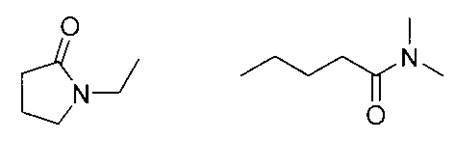
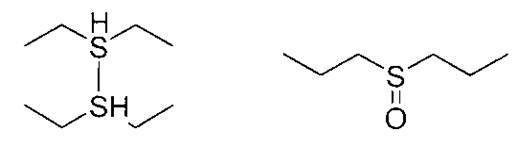
これらの有機不純物は、精製工程で触れるフィルター、配管、タンク、O-ring、及び、容器等から被精製物又は薬液へと混入するものと推定される。特に、アルキルオレフィン以外の化合物は、ブリッジ欠陥の発生に関連する。

本薬液は、金属不純物(金属成分)を含有する。金属不純物としては、金属含有粒子及び金属イオンが挙げられ、例えば、金属不純物の含有量という場合、金属含有粒子及び金属イオンの合計量を意味する。
薬液の製造方法の好適形態は後述するが、一般に薬液は、既に説明した溶剤と、有機化合物とを含有する被精製物を精製して製造できる。金属不純物は、薬液の製造工程において意図的に添加されてもよいし、もともと被精製物に含有されていてもよいし、又は、薬液の製造過程において、薬液の製造装置等から移行(いわゆるコンタミネーション)したものであってもよい。
金属不純物の含有量は、後述のICP-MS法によって測定される。
本薬液は、金属原子を含む金属含有粒子を含有してもよい。
金属原子としては特に制限されないが、Pb(鉛)原子、Na(ナトリウム)原子、K(カリウム)原子、Ca(カルシウム)原子、Fe(鉄)原子、Cu(銅)原子、Mg(マグネシウム)原子、Mn(マンガン)原子、Li(リチウム)原子、Al(アルミニウム)原子、Cr(クロム)原子、Ni(ニッケル)原子、Ti(チタン)原子、Zn(亜鉛)原子、及び、Zr(ジルコニウム)原子が挙げられる。なかでも、Fe原子、Al原子、Cr原子、Ni原子、Pb原子、及び、Ti原子等が好ましい。
特に、Fe原子、Al原子及びTi原子を含む金属含有粒子の薬液中の含有量を厳密に制御すると、より優れた欠陥抑制性能が得られやすく、Fe原子を含む金属含有粒子の薬液中における含有量を厳密に制御すると、更に優れた欠陥抑制性能が得られやすい。
すなわち、金属原子としては、Fe原子、Al原子、Cr原子、Ni原子、Pb原子、及び、Ti原子等からなる群より選択される少なくとも1種が好ましく、Fe原子、Al原子、及び、Ti原子からなる群より選択される少なくとも1種がより好ましい。
なお、金属含有粒子は、上記金属原子を、1種を単独で含んでいてもよく、2種以上を併せて含んでいてもよい。
なかでも本発明者らの検討によれば、特にEUV(極紫外線)露光のフォトレジストプロセスに適用される薬液においては、その粒子径が、0.5~17nmの金属含有粒子(以下、「金属ナノ粒子」ともいう。)の薬液中における含有量を制御することにより、優れた欠陥抑制性能を有する薬液が得られやすいことがわかった。EUV露光のフォトレジストプロセスにおいては、微細なレジスト間隔、レジスト幅、及び、レジストピッチが求められる場合が多い。このような場合、従来のプロセスではあまり問題とならなかった、より微細な粒子をその個数単位で制御することが求められるのである。
言い換えれば、粒子径が5~17nmの範囲には極大値を有しないのが好ましい。粒子径が5~17nmの範囲には極大値を有さないことにより、薬液はより優れた欠陥抑制性能、特に、より優れたブリッジ欠陥抑制性能を有する。ここで、ブリッジ欠陥とは、配線パターン同士の架橋様の不良を意味する。
また、更に優れた本発明の効果を有する薬液が得られる点で、個数基準の粒子径分布において、粒子径が0.5nm以上、5nm未満の範囲に極大値を有するのが特に好ましい。上記により、薬液は更に優れたブリッジ欠陥抑制性能を有する。
ここで、SP-ICP-MS法とは、通常のICP-MS法(誘導結合プラズマ質量分析法)と同様の装置を使用し、データ分析のみが異なる。SP-ICP-MS法のデータ分析は、市販のソフトウェアにより実施できる。
一方、SP-ICP-MS法では、金属含有粒子の含有量が測定できる。したがって、試料中の金属不純物の含有量から、金属含有粒子の含有量を引くと、試料中の金属イオンの含有量が算出できる。
SP-ICP-MS法の装置としては、例えば、アジレントテクノロジー社製、Agilent 8800 トリプル四重極ICP-MS(inductively coupled plasma mass spectrometry、半導体分析用、オプション#200)が挙げられ、実施例に記載した方法により測定できる。上記以外の他の装置としては、PerkinElmer社製 NexION350Sのほか、アジレントテクノロジー社製、Agilent 8900も使用できる。
金属ナノ粒子は、金属含有粒子のうち、その粒子径が0.5~17nmのものをいう。
本薬液の単位体積あたりの金属ナノ粒子の含有粒子数は、1.0×10⁻¹~1.0×10¹³個/cm3が好ましく、1.0×10~1.0×1012個/cm3がより好ましく、1.0×10~1.0×1011個/cm3が特に好ましい。金属ナノ粒子の含有粒子数が1.0×10個/cm3以上であれば、薬液の安定性に優れる。金属ナノ粒子の含有粒子数が1.0×1012個/cm3以下であれば、残渣の抑制性能に優れる。
なお、薬液中における金属ナノ粒子の含有量は、実施例に記載した方法により測定でき、金属ナノ粒子の薬液の単位体積あたりの粒子数(個数)は、有効数字が2桁となるように四捨五入して求める。
ここで、金属ナノ粒子は、複数の原子を含んでいてもよい。例えば、Fe原子、Al原子及びTi原子を含むとは、典型的には、薬液が、Fe原子を含む金属ナノ粒子と、Al原子を含む金属ナノ粒子、及び、Ti原子を含む金属ナノ粒子を全て含む形態が挙げられる。
この場合、薬液の単位体積あたりにおいて、第1酸化鉄ナノ粒子の含有粒子数に対する、第2酸化鉄ナノ粒子の含有粒子数の比(第2酸化鉄ナノ粒子の含有粒子数/第1酸化鉄ナノ粒子の含有粒子数)は、1~109が好ましく、10~108がより好ましく、10~107が特に好ましい。上記比が10~108の範囲にあれば、金属不純物を含む欠陥(特に、金属原子の酸化物を含む欠陥)の抑制により優れる。
この場合、薬液の単位体積あたりの、Feナノ粒子、Alナノ粒子およびTiナノ粒子の含有粒子数の合計は、1~1.0×10¹⁵個/cm3が好ましく、1~1.0×1013個/cm3がより好ましい。上記含有粒子数が上記範囲内にあれば、残渣抑制性能がより優れる。
本薬液は、金属イオンを含有してもよい。
金属イオンとしては、Pb(鉛)、Na(ナトリウム)、K(カリウム)、Ca(カルシウム)、Fe(鉄)、Cu(銅)、Mg(マグネシウム)、Mn(マンガン)、Li(リチウム)、Al(アルミニウム)、Cr(クロム)、Ni(ニッケル)、Ti(チタン)、Zn(亜鉛)、及び、Zr(ジルコニウム)などの金属原子のイオンが挙げられる。
薬液中の金属イオンの含有量は、上述の通り、ICP-MS法で測定した薬液中の金属不純物の含有量から、SP-ICP-MS法で測定した金属含有粒子の含有量を引くことで求められる。
本薬液は、水を含有してもよい。水としては特に制限されず、例えば、蒸留水、イオン交換水、及び、純水等が挙げられる。
水は、薬液中に添加されてもよいし、薬液の製造工程において意図せずに薬液中に混合されるものであってもよい。薬液の製造工程において意図せずに混合される場合としては、例えば、水が、薬液の製造に用いる原料(例えば、有機溶剤)に含有されている場合、及び、薬液の製造工程で混合する(例えば、コンタミネーション)等が挙げられるが、上記に制限されない。
本薬液中における水の含有量は、カールフィッシャー水分測定法を測定原理とする装置を用いて、測定される水分含有量を意味する。
本薬液は、上記以外の他の成分を含有してもよい。他の成分としては、例えば、樹脂等が挙げられる。
本薬液は樹脂を含有してもよい。樹脂としては、酸の作用により分解して極性基を生じる基を有する樹脂Pがより好ましい。上記樹脂としては、酸の作用により有機溶剤を主成分とする現像液に対する溶解性が減少する樹脂である、後述する式(AI)で表される繰り返し単位を有する樹脂がより好ましい。後述する式(AI)で表される繰り返し単位を有する樹脂は、酸の作用により分解してアルカリ可溶性基を生じる基(以下、「酸分解性基」ともいう)を有する。
極性基としては、アルカリ可溶性基が挙げられる。アルカリ可溶性基としては、例えば、カルボキシ基、フッ素化アルコール基(好ましくはヘキサフルオロイソプロパノール基)、フェノール性水酸基、及びスルホ基が挙げられる。
樹脂Pは、式(AI)で表される繰り返し単位を含有することが好ましい。
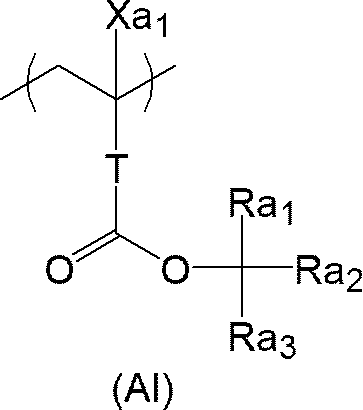
Xa1は、水素原子又は置換基を有していてもよいアルキル基を表す。
Tは、単結合又は2価の連結基を表す。
Ra1~Ra3は、それぞれ独立に、アルキル基(直鎖状又は分岐鎖状)又はシクロアルキル基(単環又は多環)を表す。
Ra1~Ra3の2つが結合して、シクロアルキル基(単環又は多環)を形成してもよい。
Xa1は、水素原子、メチル基、トリフルオロメチル基又はヒドロキシメチル基が好ましい。
Tは、単結合又は-COO-Rt-基が好ましい。Rtは、炭素数1~5のアルキレン基が好ましく、-CH2-基、-(CH2)2-基、又は、-(CH2)3-基がより好ましい。
Ra1~Ra3の2つが結合して形成されるシクロアルキル基としては、シクロペンチル基、若しくはシクロヘキシル基等の単環のシクロアルキル基、又は、ノルボルニル基、テトラシクロデカニル基、テトラシクロドデカニル基、若しくはアダマンチル基等の多環のシクロアルキル基が好ましい。炭素数5~6の単環のシクロアルキル基がより好ましい。
また、樹脂Pは、ラクトン構造を有する繰り返し単位Qを含有することが好ましい。
ラクトン構造を有する繰り返し単位Qは、1種単独で用いてもよく、2種以上を併用していてもよいが、1種単独で用いることが好ましい。
ラクトン構造を有する繰り返し単位Qの含有量は、樹脂P中の全繰り返し単位に対して、3~80モル%が好ましく、3~60モル%がより好ましい。
ラクトン構造としては、下記式(LC1-1)~(LC1-17)のいずれかで表されるラクトン構造を有する繰り返し単位を有することが好ましい。ラクトン構造としては式(LC1-1)、式(LC1-4)、式(LC1-5)、又は式(LC1-8)で表されるラクトン構造が好ましく、式(LC1-4)で表されるラクトン構造がより好ましい。
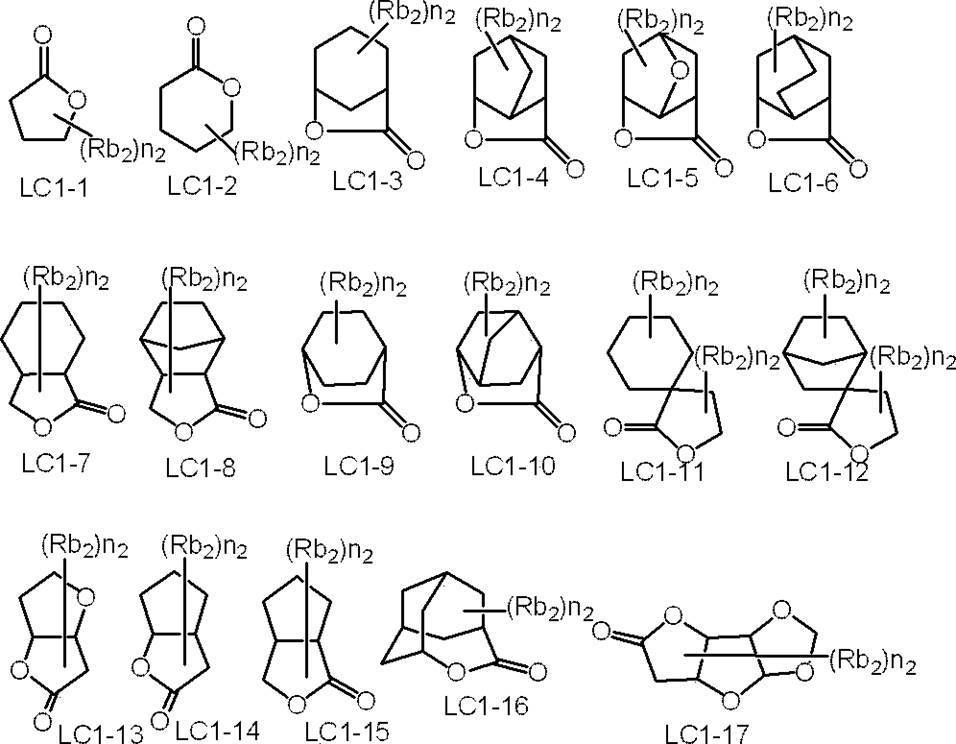
また、樹脂Pは、フェノール性水酸基を有する繰り返し単位を含有していてもよい。
フェノール性水酸基を有する繰り返し単位としては、例えば、下記一般式(I)で表される繰り返し単位が挙げられる。

R41、R42及びR43は、各々独立に、水素原子、アルキル基、ハロゲン原子、シアノ基又はアルコキシカルボニル基を表す。但し、R42はAr4と結合して環を形成していてもよく、その場合のR42は単結合又はアルキレン基を表す。
L4は、単結合又はアルキレン基を表す。
Ar4は、(n+1)価の芳香環基を表し、R42と結合して環を形成する場合には(n+2)価の芳香環基を表す。
nは、1~5の整数を表す。
(n+1)価の芳香環基は、更に置換基を有していてもよい。
樹脂Pは、極性基を有する有機基を含有する繰り返し単位、特に、極性基で置換された脂環炭化水素構造を有する繰り返し単位を更に含有していてもよい。これにより基板密着性、現像液親和性が向上する。
極性基で置換された脂環炭化水素構造の脂環炭化水素構造としては、アダマンチル基、ジアマンチル基又はノルボルナン基が好ましい。極性基としては、水酸基又はシアノ基が好ましい。
樹脂Pは、下記一般式(VI)で表される繰り返し単位を含有していてもよい。
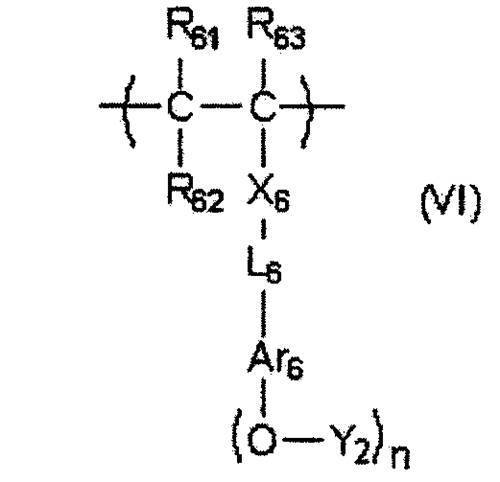
R61、R62及びR63は、各々独立に、水素原子、アルキル基、シクロアルキル基、ハロゲン原子、シアノ基、又はアルコキシカルボニル基を表す。但し、R62はAr6と結合して環を形成していてもよく、その場合のR62は単結合又はアルキレン基を表す。
X6は、単結合、-COO-、又は-CONR64-を表す。R64は、水素原子又はアルキル基を表す。
L6は、単結合又はアルキレン基を表す。
Ar6は、(n+1)価の芳香環基を表し、R62と結合して環を形成する場合には(n+2)価の芳香環基を表す。
Y2は、n≧2の場合には各々独立に、水素原子又は酸の作用により脱離する基を表す。但し、Y2の少なくとも1つは、酸の作用により脱離する基を表す。
nは、1~4の整数を表す。

Mは、単結合又は2価の連結基を表す。
Qは、アルキル基、ヘテロ原子を含んでいてもよいシクロアルキル基、ヘテロ原子を含んでいてもよいアリール基、アミノ基、アンモニウム基、メルカプト基、シアノ基又はアルデヒド基を表す。
Q、M、L1の少なくとも2つが結合して環(好ましくは、5員若しくは6員環)を形成してもよい。
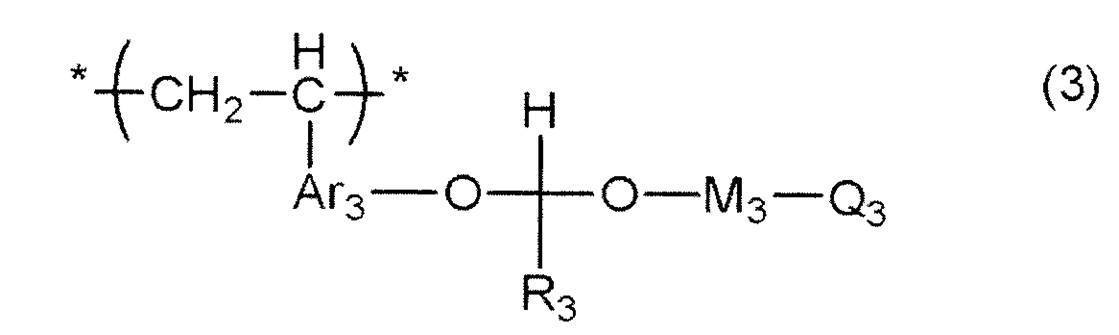
Ar3は、芳香環基を表す。
R3は、水素原子、アルキル基、シクロアルキル基、アリール基、アラルキル基、アルコキシ基、アシル基又はヘテロ環基を表す。
M3は、単結合又は2価の連結基を表す。
Q3は、アルキル基、シクロアルキル基、アリール基又はヘテロ環基を表す。
Q3、M3及びR3の少なくとも二つが結合して環を形成してもよい。
樹脂Pは、更に、側鎖に珪素原子を有する繰り返し単位を含有していてもよい。側鎖に珪素原子を有する繰り返し単位としては、例えば、珪素原子を有する(メタ)アクリレート系繰り返し単位、及び、珪素原子を有するビニル系繰り返し単位などが挙げられる。側鎖に珪素原子を有する繰り返し単位は、典型的には、側鎖に珪素原子を有する基を有する繰り返し単位であり、珪素原子を有する基としては、例えば、トリメチルシリル基、トリエチルシリル基、トリフェニルシリル基、トリシクロヘキシルシリル基、トリストリメチルシロキシシリル基、トリストリメチルシリルシリル基、メチルビストリメチルシリルシリル基、メチルビストリメチルシロキシシリル基、ジメチルトリメチルシリルシリル基、ジメチルトリメチルシロキシシリル基、及び、下記のような環状若しくは直鎖状ポリシロキサン、又はカゴ型あるいははしご型若しくはランダム型シルセスキオキサン構造などが挙げられる。式中、R、及び、R1は各々独立に、1価の置換基を表す。*は、結合手を表す。
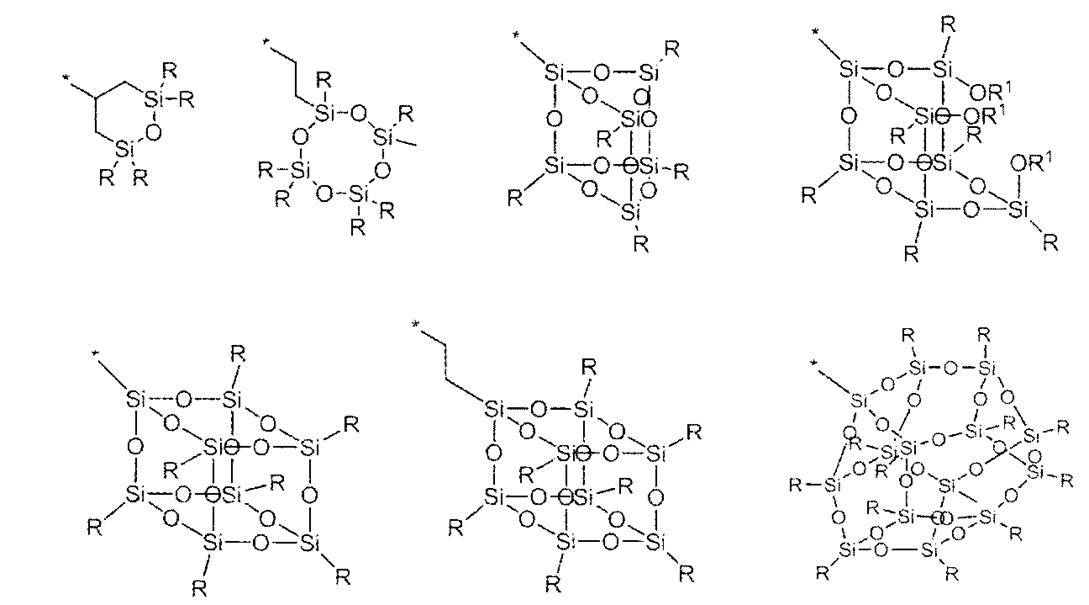
また、薬液中において、樹脂Pは、1種で使用してもよいし、複数併用してもよい。
本薬液は、光散乱式液中粒子計数器によって計数される0.04μm以上のサイズの被計数体の数が、2000個/mL以下であるのが好ましく、金属不純物を含む欠陥(特に、金属原子の酸化物を含む欠陥)の抑制により優れる点から、100個/mL以下であるのがより好ましく、50個/mL以下であるのが特に好ましい。
本明細書において、光散乱式液中粒子計数器によって計数される、0.04μm以上のサイズの被計数体を「粗大粒子」ともいう。
なお、粗大粒子としては、例えば、薬液の製造に用いる原料(例えば、有機溶剤)に含有される塵、埃、及び、有機固形物及び無機固形物等の粒子、並びに、薬液の調製中に汚染物として持ち込まれる塵、埃、及び、固形物(有機物、無機物、及び/又は、金属からなる)等が挙げられるが、これに制限されない。
また、粗大粒子としては、金属原子を含むコロイド化した不純物も含まれる。金属原子としては、特に限定されないが、Na、K、Ca、Fe、Cu、Mg、Mn、Li、Al、Cr、Ni、Zn、及び、Pbからなる群より選択される少なくとも1種の金属原子の含有量が特に低い場合(例えば、有機溶剤中の上記金属原子の含有量が各々1000質量ppt以下の場合)、これらの金属原子を含有する不純物がコロイド化しやすい。
本薬液は、半導体デバイスの製造に用いられることが好ましい。特に、ノード10nm以下の微細パターンを形成するため(例えば、EUVを用いたパターン形成を含む工程)に用いられることがより好ましい。
本薬液は、パターン幅、及び/又は、パターン間隔が17nm以下(好ましくは15nm以下、より好ましくは、12nm以下)、及び/又は、得られる配線幅、及び/又は、配線間隔が17nm以下であるレジストプロセスに使用される本薬液(プリウェット液、現像液、リンス液、レジスト液の溶剤、及び、剥離液等)、言いかえれば、パターン幅、及び/又は、パターン間隔が17nm以下であるレジスト膜を用いて製造される半導体デバイスの製造用として、特に好ましく用いられる。
また、本薬液は、レジスト液に含有される樹脂の希釈液、レジスト液に含有される溶剤としても用いることができる。また、他の有機溶剤、及び/又は、水等により希釈してもよい。
また、本薬液は、医療用途又は洗浄用途の溶媒としても用いることができる。特に、容器、配管、及び、基板(例えば、ウェハ、及び、ガラス等)等の洗浄に好適に用いることができる。
本薬液の製造方法としては特に制限されず、公知の製造方法が使用できる。中でも、より優れた本発明の効果を示す薬液が得られる点で、本薬液の製造方法は、フィルターを用いて溶剤を含有する被精製物をろ過して本薬液を得る、ろ過工程を有するのが好ましい。
より具体的には、例えば、酢酸とn-ブタノールとを硫酸の存在下で反応させ、酢酸ブチルを得る方法;エチレン、酸素、及び、水をAl(C2H5)3の存在下で反応させ、1-ヘキサノールを得る方法;シス-4-メチル-2-ペンテンをIpc2BH(Diisopinocampheylborane)の存在下で反応させ、4-メチル-2-ペンタノールを得る方法;プロピレンオキシド、メタノール、及び、酢酸を硫酸の存在下で反応させ、PGMEA(プロピレングリコール1-モノメチルエーテル2-アセタート)を得る方法;アセトン、及び、水素を酸化銅-酸化亜鉛-酸化アルミニウムの存在下で反応させて、IPA(isopropyl alcohol)を得る方法;乳酸、及び、エタノールを反応させて、乳酸エチルを得る方法;等が挙げられる。
本発明の実施形態に係る本薬液の製造方法は、フィルターを用いて上記被精製物をろ過して本薬液を得るろ過工程を有する。フィルターを用いて被精製物をろ過する方法としては特に制限されないが、ハウジングと、ハウジングに収納されたフィルターカートリッジと、を有するフィルターユニットに、被精製物を加圧又は無加圧で通過させる(通液する)のが好ましい。
フィルターの細孔径としては特に制限されず、被精製物のろ過用として通常使用される細孔径のフィルターが使用できる。中でも、フィルターの細孔径は、本薬液が含有する粒子(金属含有粒子等)の数を所望の範囲により制御しやすい点で、200nm以下が好ましく、20nm以下がより好ましく、10nm以下が更に好ましく、5nm以下が特に好ましく、3nm以下が最も好ましい。下限値としては特に制限されないが、一般に1nm以上が、生産性の観点から好ましい。
なお、本明細書において、フィルターの細孔径、及び、細孔径分布とは、イソプロパノール(IPA)又は、HFE-7200(「ノベック7200」、3M社製、ハイドロフロオロエーテル、C4F9OC2H5)のバブルポイントによって決定される細孔径及び細孔径分布を意味する。
なお、微小孔径フィルターは単独で用いてもよいし、他の細孔径を有するフィルターと使用してもよい。中でも、生産性により優れる観点から、より大きな細孔径を有するフィルターと使用するのが好ましい。この場合、予めより大きな細孔径を有するフィルターによってろ過した被精製物を、微小孔径フィルターに通液させれば、微小孔径フィルターの目詰まりを防げる。
すなわち、フィルターの細孔径としては、フィルターを1つ用いる場合には、細孔径は5.0nm以下が好ましく、フィルターを2つ以上用いる場合、最小の細孔径を有するフィルターの細孔径が5.0nm以下が好ましい。
フィルターの材料としては特に制限されず、フィルターの材料として公知の材料が使用できる。具体的には、樹脂である場合、ナイロン(例えば、6-ナイロン及び6,6-ナイロン)等のポリアミド;ポリエチレン、及び、ポリプロピレン等のポリオレフィン;ポリスチレン;ポリイミド;ポリアミドイミド;ポリ(メタ)アクリレート;ポリテトラフルオロエチレン、パーフルオロアルコキシアルカン、パーフルオロエチレンプロペンコポリマー、エチレン・テトラフルオロエチレンコポリマー、エチレン-クロロトリフロオロエチレンコポリマー、ポリクロロトリフルオロエチレン、ポリフッ化ビニリデン、及び、ポリフッ化ビニル等のポリフルオロカーボン;ポリビニルアルコール;ポリエステル;セルロース;セルロースアセテート等が挙げられる。中でも、より優れた耐溶剤性を有し、得られる本薬液がより優れた欠陥抑制性能を有する点で、ナイロン(中でも、6,6-ナイロンが好ましい)、ポリオレフィン(中でも、ポリエチレンが好ましい)、ポリ(メタ)アクリレート、及び、ポリフルオロカーボン(中でも、ポリテトラフルオロエチレン(PTFE)、パーフルオロアルコキシアルカン(PFA)が好ましい。)からなる群から選択される少なくとも1種が好ましい。これらの重合体は単独で又は二種以上を組み合わせて使用できる。
また、樹脂以外にも、ケイソウ土、及び、ガラス等であってもよい。
他にも、ポリオレフィン(後述するUPE等)にポリアミド(例えば、ナイロン-6又はナイロン-6,6等のナイロン)をグラフト共重合させたポリマー(ナイロングラフトUPE等)をフィルターの材料としてもよい。
すなわち、フィルターとしては、上記で挙げた各材料を基材として、上記基材にイオン交換基を導入したフィルターが好ましい。典型的には、上記基材の表面にイオン交換基を含有する基材を含む層を含むフィルターが好ましい。表面修飾された基材としては特に制限されず、製造がより容易な点で、上記重合体にイオン交換基を導入したフィルターが好ましい。
イオン交換基を含有するフィルターの細孔径としては特に制限されないが、1~30nmが好ましく、5~20nmがより好ましい。イオン交換基を含有するフィルターは、既に説明した最小の細孔径を有するフィルターを兼ねてもよいし、最小の細孔径を有するフィルターとは別に使用してもよい。中でもより優れた本発明の効果を示す本薬液が得られる点で、ろ過工程は、イオン交換基を含有するフィルターと、イオン交換基を有さず、最小の細孔径を有するフィルターとを使用する形態が好ましい。
既に説明した最小の細孔径を有するフィルターの材料としては特に制限されないが、耐溶剤性等の観点から、一般に、ポリフルオロカーボン、及び、ポリオレフィンからなる群より選択される少なくとも1種が好ましく、ポリオレフィンがより好ましい。
フィルターの細孔構造としては特に制限されず、被精製物中の成分に応じて適宜選択すればよい。本明細書において、フィルターの細孔構造とは、細孔径分布、フィルター中の細孔の位置的な分布、及び、細孔の形状等を意味し、典型的には、フィルターの製造方法により制御可能である。
例えば、樹脂等の粉末を焼結して形成すれば多孔質膜が得られ、及び、エレクトロスピニング、エレクトロブローイング、及び、メルトブローイング等の方法により形成すれば繊維膜が得られる。これらは、それぞれ細孔構造が異なる。
なお、本明細書で使用される「非ふるい」による保持機構は、フィルターの圧力降下、又は、細孔径に関連しない、妨害、拡散及び吸着等の機構によって生じる保持を指す。
ふるい膜の典型的な例としては、ポリテトラフルオロエチレン(PTFE)膜とUPE膜が含まれるが、これらに制限されない。
なお、「ふるい保持機構」とは、除去対象粒子が多孔質膜の細孔径よりも大きいことによる結果の保持を指す。ふるい保持力は、フィルターケーキ(膜の表面での除去対象となる粒子の凝集)を形成することによって向上させられる。フィルターケーキは、2次フィルターの機能を効果的に果たす。
多孔質膜における細孔の大きさの分布とその膜中における位置の分布は、特に制限されない。大きさの分布がより小さく、かつ、その膜中における分布位置が対称であってもよい。また、大きさの分布がより大きく、かつ、その膜中における分布位置が非対称であってもよい(上記の膜を「非対称多孔質膜」ともいう。)。非対称多孔質膜では、孔の大きさは膜中で変化し、典型的には、膜一方の表面から膜の他方の表面に向かって孔径が大きくなる。このとき、孔径の大きい細孔が多い側の表面を「オープン側」といい、孔径が小さい細孔が多い側の表面を「タイト側」ともいう。
また、非対称多孔質膜としては、例えば、細孔の大きさが膜の厚さ内のある位置においてで最小となる膜(これを「砂時計形状」ともいう。)が挙げられる。
中でも、多孔質膜の材料としては、超高分子量ポリエチレンが好ましい。超高分子量ポリエチレンは、極めて長い鎖を有する熱可塑性ポリエチレンを意味し、分子量が百万以上、典型的には、200~600万が好ましい。
未洗浄のフィルター(又は十分な洗浄がされていないフィルター)を使用する場合、フィルターが含有する不純物が本薬液に持ち込まれやすい。
フィルターが含有する不純物としては、例えば、上述の有機不純物が挙げられ、未洗浄のフィルター(又は十分な洗浄がされていないフィルター)を使用してろ過工程を実施すると、本薬液中の有機不純物の含有量が、本薬液としての許容範囲を超える場合もある。
例えば、UPE等のポリオレフィン及びPTFE等のポリフルオロカーボンをフィルターに用いる場合、フィルターは不純物として炭素数12~50のアルカンを含有しやすい。
また、ナイロン等のポリアミド、ポリイミド、及び、ポリオレフィン(UPE等)にポリアミド(ナイロン等)をグラフト共重合させたポリマーをフィルターに用いる場合、フィルターは不純物として炭素数12~50のアルケンを含有しやすい。
フィルターの洗浄の方法は、例えば、不純物含有量の少ない有機溶剤(例えば、蒸留精製した有機溶剤(PGMEA等))に、フィルターを1週間以上浸漬する方法が挙げられる。この場合、上記有機溶剤の液温は30~90℃が好ましい。
洗浄の程度を調整したフィルターを用いて被精製物をろ過し、得られる薬液が所望の量のフィルター由来の有機不純物を含有するように調整してもよい。
また、同一のフィルターに被精製物を複数回通過させてもよく、同種のフィルターの複数に、被精製物を通過させてもよい。
非金属材料としては、例えば、ポリエチレン樹脂、ポリプロピレン樹脂、ポリエチレン-ポリプロピレン樹脂、並びに、フッ素樹脂(例えば、四フッ化エチレン樹脂、四フッ化エチレン-パーフルオロアルキルビニルエーテル共重合体、四フッ化エチレン-六フッ化プロピレン共重合樹脂、四フッ化エチレン-エチレン共重合体樹脂、三フッ化塩化エチレン-エチレン共重合樹脂、フッ化ビニリデン樹脂、三フッ化塩化エチレン共重合樹脂、及び、フッ化ビニル樹脂等)からなる群から選択される少なくとも1種が挙げられるが、これに制限されない。
金属材料としては、例えば、クロム及びニッケルの含有量の合計が金属材料全質量に対して25質量%超である金属材料が挙げられ、中でも、30質量%以上がより好ましい。金属材料におけるクロム及びニッケルの含有量の合計の上限値としては特に制限されないが、一般に90質量%以下が好ましい。
金属材料としては例えば、ステンレス鋼、及びニッケル-クロム合金等が挙げられる。
ニッケル-クロム合金としては、例えば、ハステロイ(製品名、以下同じ。)、モネル(製品名、以下同じ)、及びインコネル(製品名、以下同じ)等が挙げられる。より具体的には、ハステロイC-276(Ni含有量63質量%、Cr含有量16質量%)、ハステロイ-C(Ni含有量60質量%、Cr含有量17質量%)、ハステロイC-22(Ni含有量61質量%、Cr含有量22質量%)等が挙げられる。
また、ニッケル-クロム合金は、必要に応じて、上記した合金の他に、更に、ホウ素、ケイ素、タングステン、モリブデン、銅、及びコバルト等を含有していてもよい。
なお、金属材料はバフ研磨されていてもよい。バフ研磨の方法は特に制限されず、公知の方法を使用できる。バフ研磨の仕上げに用いられる研磨砥粒のサイズは特に制限されないが、金属材料の表面の凹凸がより小さくなりやすい点で、#400以下が好ましい。なお、バフ研磨は、電解研磨の前に行われるのが好ましい。
本薬液の製造方法は、ろ過工程以外の工程を更に有していてもよい。ろ過工程以外の工程としては、例えば、蒸留工程、反応工程、及び、除電工程等が挙げられる。
蒸留工程は、有機溶剤を含有する被精製物を蒸留して、蒸留済み被精製物を得る工程である。被精製物を蒸留する方法としては特に制限されず、公知の方法が使用できる。典型的には、ろ過工程に供される精製装置の一次側に、蒸留塔を配置し、蒸留された被精製物を製造タンクに導入する方法が挙げられる。
このとき、蒸留塔の接液部としては特に制限されないが、既に説明した耐腐食材料で形成されるのが好ましい。
反応工程は、原料を反応させて、反応物である有機溶剤を含有する被精製物を生成する工程である。被精製物を生成する方法としては特に制限されず、公知の方法が使用できる。典型的には、ろ過工程に供される精製装置の製造タンク(又は、蒸留塔)の一次側に反応槽を配置し、反応物を製造タンク(又は蒸留塔)に導入する方法が挙げられる。
このとき、製造タンクの接液部としては特に制限されないが、既に説明した耐腐食材料で形成されるのが好ましい。
除電工程は、被精製物を除電して、被精製物の帯電電位を低減させる工程である。
除電方法としては特に制限されず、公知の除電方法を使用できる。除電方法としては、例えば、被精製物を導電性材料に接触させる方法が挙げられる。
被精製物を導電性材料に接触させる接触時間は、0.001~60秒が好ましく、0.001~1秒がより好ましく、0.01~0.1秒が特に好ましい。導電性材料としては、ステンレス鋼、金、白金、ダイヤモンド、及びグラッシーカーボン等が挙げられる。
被精製物を導電性材料に接触させる方法としては、例えば、導電性材料からなる接地されたメッシュを管路内部に配置し、ここに被精製物を通す方法等が挙げられる。
本薬液は、容器に収容されて使用時まで保管してもよい。このような容器と、容器内に収容された本薬液とをあわせて薬液収容体という。保管された薬液収容体からは、本薬液が取り出され使用される。
使用可能な容器としては、具体的には、アイセロ化学(株)製の「クリーンボトル」シリーズ、及び、コダマ樹脂工業製の「ピュアボトル」等が挙げられるが、これらに制限されない。
なお、上記空隙率は、下式(X)に従って計算される。
式(X):空隙率(体積%)={1-(容器内の薬液の体積/容器の容器体積)}×100
上記容器体積とは、容器の内容積(容量)と同義である。
〔被精製物〕
実施例、及び、比較例の薬液の製造のために、以下の有機溶剤を被精製物として使用した。以下の有機溶剤はいずれも市販品を使用した。ただし、複数種の有機溶剤を用いる場合には、それぞれ混合前の有機溶剤を購入し、合計100質量%となるように混合して被精製物とした。
nBA:酢酸ブチル
CHN:シクロヘキサノン
IPA:イソプロパノール
EL:乳酸エチル
PGMEA:プロピレングリコールモノメチルエーテルアセテート
PGME:プロピレングリコールモノエチルエーテル
PC:炭酸プロピレン
上記被精製物を用いて、以下に示す事前処理、蒸留工程、ろ過工程及び脱水工程を後述の表に記載の組み合わせで、この順に実施して、実施例及び比較例の各薬液を得た。
なお、各処理又は工程における通液の回数を適宜変更して、被精製物の精製を行った。また、一連の精製の過程で、被精製物及び薬液を移送する配管は、接液部が電解研磨されたステンレス製の配管を使用した。
事前処理として、ろ過工程で使用するフィルターを、プロピレングリコールモノメチルエーテルアセテート(PGMEA)を用いて表に記載の期間洗浄した。なお、「PGMEA 1週間」という記載が2回登場する例については、フィルターをPGMEAで1週間洗浄した後、新たなPGMEAでさらに1週間フィルターを洗浄したことを意味する。
表中、「PGMEA 超音波*1」とはPGMEAに浸漬して100Hz(振動数)で1分間洗浄したことを意味し、「PGMEA 超音波*2」とはPGMEA液に浸漬し50Hz(振動数)で3分間洗浄したことを意味し、「PGMEA 超音波*3」とはPGMEA液に浸漬し100Hz(振動数)で5分間洗浄したことを意味し、「PGMEA 超音波*4」とはPGMEA液に浸漬し80Hz(振動数)で2分間洗浄したことを意味する。
A-1~A-7のいずれかの蒸留塔を用いて、被精製物の蒸留を行った。
A-1:蒸留塔(理論段数:30段)を用いた常圧蒸留を2回実施した。
A-2:蒸留塔(理論段数:25段)を用いた常圧蒸留を2回実施した。
A-3:蒸留塔(理論段数:20段)を用いた常圧蒸留を2回実施した。
A-4:蒸留塔(理論段数:15段)を用いた常圧蒸留を2回実施した。
A-5:蒸留塔(理論段数:10段)を用いた常圧蒸留を2回実施した。
A-6:蒸留塔(理論段数:8段)を用いた常圧蒸留を2回実施した。
A-7:蒸留塔(理論段数:8段)を用いた常圧蒸留を1回実施した。
被精製物が、フィルター1、フィルター2、フィルター3及びフィルター4をこの順に通液するように、各フィルターを配置した。
フィルター1:PTFE 10nm(ポリテトラフルオロエチレン製フィルター、インテグリス社製、孔径10nm)、又は、PTFE 20nm(ポリテトラフルオロエチレン製フィルター、インテグリス社製、孔径20nm)
フィルター2:IEX(ポリテトラフルオロエチレンとポリエチレンスルホン酸の重合体の繊維膜、インテグリス社製、孔径15nm)、又は、PTFE 10nm(ポリテトラフルオロエチレン製フィルター、インテグリス社製、孔径10nm)
フィルター3:PTFE 5nm(ポリテトラフルオロエチレン製フィルター、インテグリス社製、孔径10nm)、Nylon 5nm(ナイロン製フィルター、PALL社製、孔径5nm)、又は、UPE 3nm(ナイロン/超高分子量ポリエチレングラフト共重合体製フィルター、インテグリス社製、孔径3nm)
フィルター4:UPE 1nm(ナイロン/超高分子量ポリエチレングラフト共重合体製フィルター、インテグリス社製、孔径1nm)
脱水工程として、以下の脱水1~3のいずれかを実施した。
脱水1:蒸留塔(理論段数:30段)を用いた減圧蒸留を1回実施した。
脱水2:蒸留塔(理論段数:30段)を用いた減圧蒸留を2回実施した。
脱水3:蒸留塔(理論段数:30段)を用いた減圧蒸留を3回実施した。

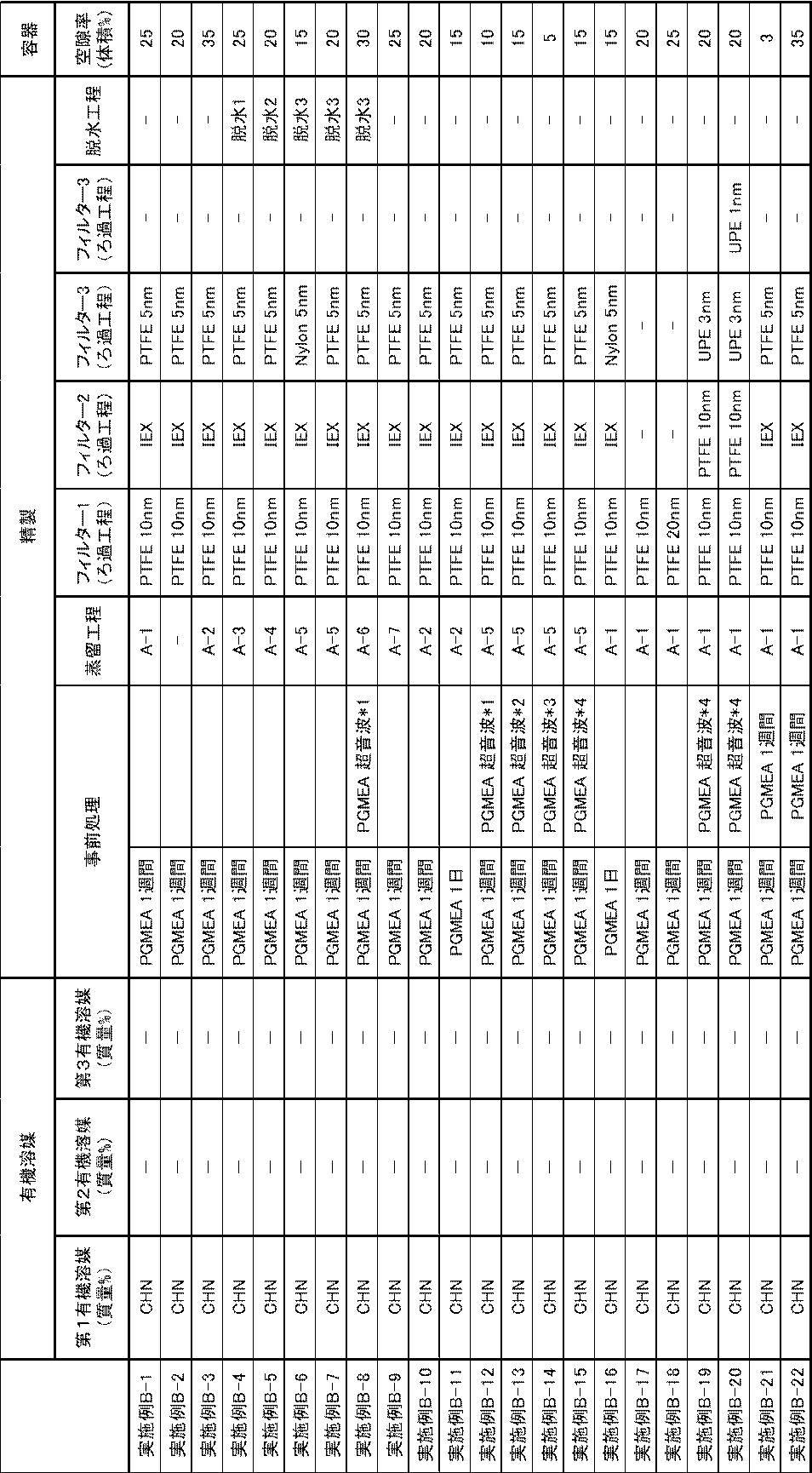

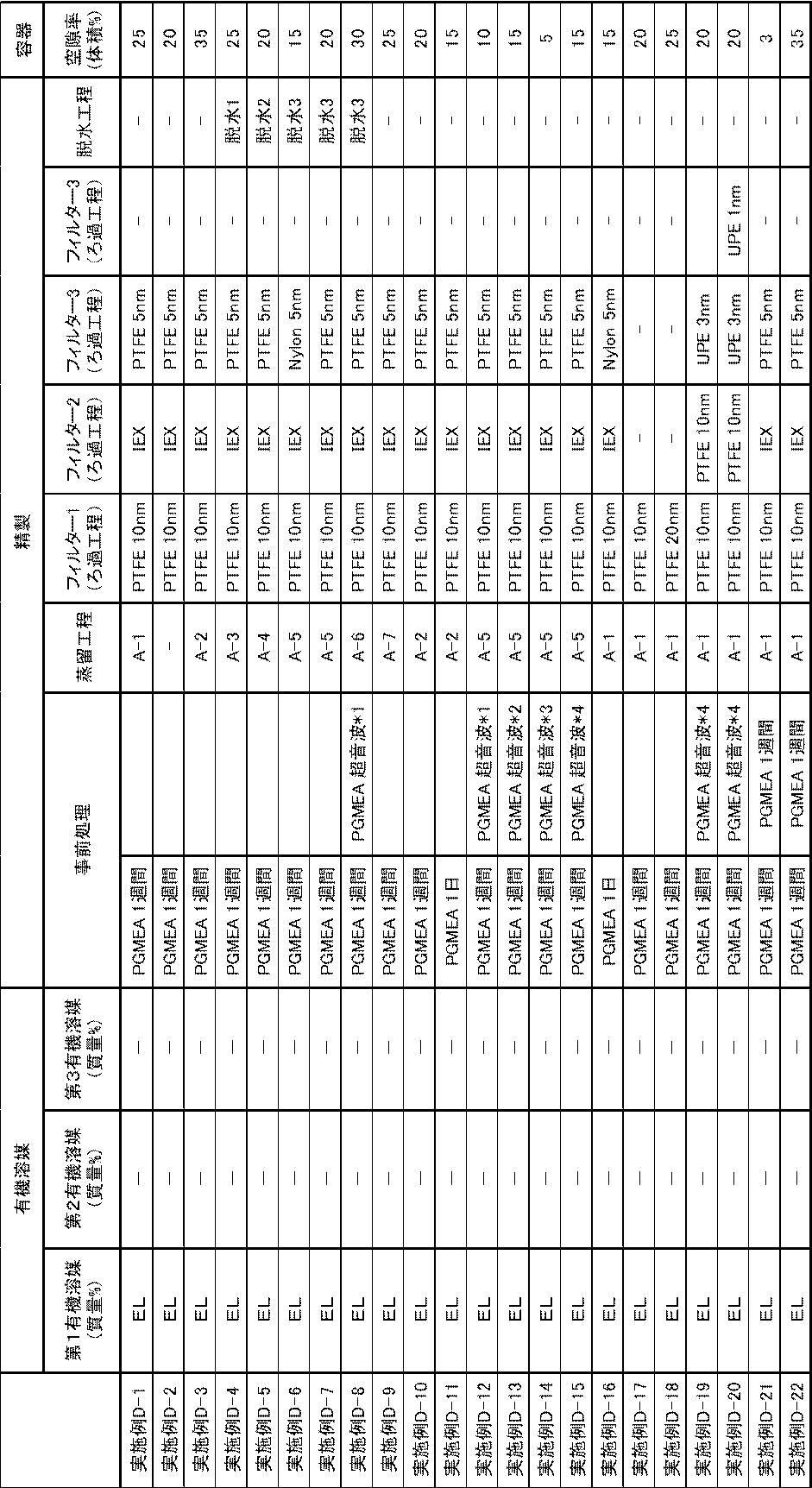


まず、1,000Lの容量の真空デシケータ内に容器(後述の接液部がSUSの容器)を設置し、真空デシケータ、容器の接液部、容器内に薬液を流入するための配管等の薬液と接する可能性がある部材について、半導体グレードの過酸化水素水で洗浄した後、真空デシケータ内の空気を窒素ガスに置換して乾燥した。
次に、真空デシケータ内を真空状態にした後に窒素ガスを充填するという処理を繰り返し行って、真空デシケータ内の雰囲気を清浄な状態にした。
上記のように清浄な状態にした真空デシケータ内に設置した容器に、上記のように精製した薬液を、容器の空隙率(体積%)が表に示す値になるように収容した。そして、容器内の薬液が流出しないように容器を密閉して、薬液収容体を得た。そして、薬液収容体を30℃で1年間保管した後、薬液収容体から薬液を取り出して、後述の有機不純物の測定、金属不純物の測定、及び、各種評価試験に用いた。
薬液を収納する容器としては、接液部がSUS(ステンレス鋼)である容器を使用した。なお、上記SUSとしては、Fe含有量に対するCu含有量の質量割合(Cu/Fe)が1超2未満の規格のものを用いた。
各薬液中の有機不純物の種類及び含有量は、ガスクロマトグラフ質量分析装置(製品名「GCMS-2020」、島津製作所社製、測定条件は以下のとおり)を用いて測定した。
キャピラリーカラム:InertCap 5MS/NP 0.25mmI.D. ×30m df=0.25μm
試料導入法:スプリット 75kPa 圧力一定
気化室温度 :230℃
カラムオーブン温度:80℃(2min)-500℃(13min)昇温速度15℃/min
キャリアガス:ヘリウム
セプタムパージ流量:5mL/min
スプリット比:25:1
インターフェイス温度:250℃
イオン源温度:200℃
測定モード:Scan m/z=85~500
試料導入量:1μL
<金属含有粒子>
薬液中の金属含有粒子の含有量は、SP-ICP-MSを用いる方法により測定した。
使用装置は以下の通りである。
・メーカー:PerkinElmer
・型式:NexION350S
解析には以下の解析ソフトを使用した。
・“SP-ICP-MS”専用Syngistix ナノアプリケーションモジュール
まず、薬液中の金属不純物の含有量について、Agilent 8800 トリプル四重極ICP-MS(半導体分析用、オプション#200)を用いて、以下の測定条件にしたがって測定した。測定した薬液中の金属不純物の含有量から、上述のSP-ICP-MS法で測定した金属含有粒子の含有量を引くことで、薬液中の金属イオンの含有量を求めた。
薬液中の金属不純物に含まれる測定対象原子(Fe原子、Cr原子、Ni原子、及び、Pb原子)の含有量、及び、各原子の含有量についても、Agilent 8800 トリプル四重極ICP-MS(半導体分析用、オプション#200)を用いて、以下の測定条件にしたがって測定した。
(測定条件)
サンプル導入系は石英のトーチと同軸型PFA(パーフルオロアルコキシアルカン)ネブライザ(自吸用)、及び、白金インターフェースコーンを使用した。クールプラズマ条件の測定パラメータは以下のとおりである。
・RF(Radio Frequency)出力(W):600
・キャリアガス流量(L/min):0.7
・メークアップガス流量(L/min):1
・サンプリング深さ(mm):18
薬液中における金属ナノ粒子(粒子径0.5~17nmの金属含有粒子)の含有粒子数は、以下の方法により測定した。
まず、シリコン基板上に100nm酸化膜を成膜し、その上に各薬液を塗布して薬液層付き基板を形成し、スピン乾燥後に薬液層付き基板をドライエッチングした後、(特開2009-188333号公報の0015~0067段落に記載の方法を用いて検出)、KLA-Tencor社製のウェハ検査装置「SP-5」で欠陥の位置を特定した。すなわち、基板上に、CVD(化学気相成長)法によりSiOX層を形成し、上記層上を覆うように薬液層を形成した。次に、上記SiOX層とその上に塗布された薬液層とを有する複合層をドライエッチングして、得られた突起物に対して光照射して、散乱光を検出し、上記散乱光から、突起物の体積を計算し、上記突起物の体積から粒子の粒子径を計算する方法を用いた。この方法により、元々の残渣物の粒子サイズは拡大され、全ての欠陥はウェハ検査装置「SP-5」の感度以上の大きさになり、元々の残渣物の粒子サイズが0.5nm以上である基板の表面に存在する欠陥の位置を、ウェハ検査装置「SP-5」で特定した。なお、元々の残渣物の粒子サイズは、走査型電子顕微鏡(SEM)によって測定した。
次に、その欠陥の位置を基準にEDX(エネルギー分散型X線)分析法により元素分析し、欠陥の組成を調べることで、粒子径0.5~17nmの金属含有粒子(金属ナノ粒子)の個数を求めた。
薬液中におけるFe、Al及びTi原子を含む金属ナノ粒子(粒子径0.5~17nmの粒子)の含有量は、以下の方法により測定した。
まず、シリコン基板上に一定量の薬液を塗布して薬液層付き基板を形成し、薬液層付き基板の表面をレーザ光により走査し、散乱光を検出した。これにより、薬液層付き基板の表面に存在する欠陥の位置及び粒子径を特定した。次に、その欠陥の位置を基準にEDX(エネルギー分散型X線)分析法により元素分析し、欠陥の組成を調べた。この方法により、Fe原子を含むFeナノ粒子、Al原子を含むAlナノ粒子、及び、Ti原子を含むTiナノ粒子の基板上における粒子数を求め、それを薬液の単位体積あたりの含有粒子数(個/cm3)に換算して、その合計を算出した。
また同様にして、酸化鉄のみを含む第1酸化鉄ナノ粒子(粒子径0.5~17nm)、および、酸化鉄および有機化合物を含む第2酸化鉄ナノ粒子(粒子径0.5~17nm)も同定した。
なお、パターンの分析には、KLA-Tencor社製のウェハ検査装置「SP-5」と、アプライドマテリアル社の全自動欠陥レビュー分類装置「SEMVision G6」を組み合わせて使用した。
薬液中に含まれる粗大粒子数(光散乱式液中粒子計数器によって計数される0.04μm以上のサイズの被計数体の数:個/mL)は、以下の方法により測定した。
まず、ストレージタンクに収容した薬液を、収容後、1日間、室温で静置した。静置後の薬液について、光散乱式液中粒子計数器(リオン株式会社製、型番:KS-18F、光源:半導体レーザ励起固体レーザ(波長532nm、定格出力500mW)、流量:10mL/分、測定原理は、動的光散乱法に基づくものである。)を用いて、1mL中に含まれる0.04μm以上のサイズの粒子の計数を5回行い、その平均値を粗大粒子数とした。
なお、上記光散乱式液中粒子計数器は、PSL(Polystyrene Latex)標準粒子液で校正を行った後に用いた。
薬液中における水の含有量(含水量)は、カールフィッシャー水分測定法を測定原理とする装置を用いて測定した。
薬液収容体から薬液を取り出して、以下の各種評価試験を実施した。なお、実施例A-1~A-22の薬液は、現像液として使用できる。
なお、全ての残渣物をG6(全自動欠陥レビュー分類装置「SEMVision G6」)のEDAX(エネルギー分散型X線分析装置)により分析して、金属残渣物(金属原子の単体のみを含む残渣物)、酸化金属残渣物(金属酸化物を含み、有機化合物を含まない残渣物)、有機金属残渣物(金属原子と、有機化合物と、を含む残渣物)、有機物残渣(有機化合物を含み、金属原子を含まない残渣物)の残渣数を計測した。
結果は以下の基準により評価した。
A:欠陥数が100個以上、150個未満だった。
B:欠陥数が150個以上、200個未満だった。
C:欠陥数が200個以上、300個未満だった。
D:欠陥数が300個以上、500個未満だった。
E:欠陥数が500個以上だった。
薬液収容体から薬液を取り出した後、さらに、接液部がPFA(四フッ化エチレンとパーフルオロアルコキシエチレンとの共重合体)製の容器(サンフルオロ社製)にて23℃で1年間保存した後、上述の「金属残渣物、酸化金属残渣物、有機金属残渣物及び有機物残渣の評価試験」と同様の評価を行った。保存前後の薬液の欠陥数の変化率を算出して、以下の基準によって薬液の安定性を評価した。なお、表中、上記各残渣物のうち最も変化率が大きくなった結果を記した。
欠陥数の変化率(%)=100×(保存後の薬液を用いた際の欠陥数-保存前の薬液を用いた際の欠陥数)/(保存前の薬液を用いた際の欠陥数)
AA:欠陥数の変化率が5%未満
A:欠陥数の変化率が5%以上8%未満
B:欠陥数の変化率が8%以上10%未満
C:欠陥数の変化率が10%以上15%未満
D:欠陥数の変化率が15%以上
薬液収容体から薬液を取り出して、実施例A-1~A-22と同様の各種評価試験を実施した。なお、実施例B-1~B-22の薬液は、プリウェット液として使用できる。
薬液収容体から薬液を取り出して、実施例A-1~A-22と同様の各種評価試験を実施した。なお、実施例C-1~C-22の薬液は、プリウェット液として使用できる。
薬液収容体から取り出した後述の比較例1の薬液10Lを配管(配管の長さ20m、接液部の材質:EP-SUS)に流して、意図的に汚染させた。続いて、薬液収容体から取り出した実施例D1~D22の各薬液500Lを上記配管に流して、配管の洗浄を行った後、各薬液を回収した。このように、実施例D1~D22の各薬液を配管洗浄液として使用した。
回収した実施例D1~D22の各薬液を用いて、実施例A-1~A-22と同様の各種評価試験を実施した。
薬液収容体から薬液を取り出して、実施例A-1~A-22と同様の各種評価試験を実施した。なお、実施例E-1~E-22の薬液は、プリウェット液として使用できる。
薬液収容体から実施例F-1、実施例G-1及び実施例H-1の薬液を取り出して、実施例A-1~A-22と同様の各種評価試験を実施した。なお、実施例F-1、実施例G-1及び実施例H-1の薬液は、プリウェット液として使用できる。
また、薬液収容体から比較例1の薬液を取り出して、実施例A-1~A-22と同様の各種評価試験を実施した。なお、比較例1の薬液は、現像液として使用できる。
なお、各表中、「6.7E+00」、「2.5E+01」及び「1.3E-02」等の記載は、指数表示を略記したものである。その具体例として、「6.7E+00」は「6.7」、「2.5E+01」は「2.5×101」、「1.3E-02」は「1.3×10⁻²」を意味する。
また、各表中、「A/B」は「リン酸エステルの含有量/アジピン酸エステルの含有量」、「A/C」は「リン酸エステルの含有量/フタル酸エステルの含有量」、「B/C」は「アジピン酸エステルの含有量/フタル酸エステルの含有量」、「A/D」は「リン酸エステルの含有量/アルコール又はアセトンの含有量」、「B/D」は「アジピン酸エステルの含有量/アルコール又はアセトンの含有量」、「C/D」は「フタル酸エステルの含有量/アルコール又はアセトンの含有量」、「水/D」は「水の含有量/アルコール又はアセトンの含有量」、「水/E」は「水の含有量/安定化剤の含有量」、「D/E」は「アルコール又はアセトンの含有量/安定化剤の含有量」を意味する。また、「A/リン酸トリブチル」は「リン酸エステルの含有量/リン酸トリブチルの含有量」、「リン酸トリブチル/C」は「リン酸トリブチルの含有量/フタル酸エステルの含有量」、「リン酸トリブチル/D」は「リン酸トリブチルの含有量/アルコール又はアセトンの含有量」、「リン酸トリブチル/E」は「リン酸トリブチルの含有量/安定化剤の含有量」を意味する。
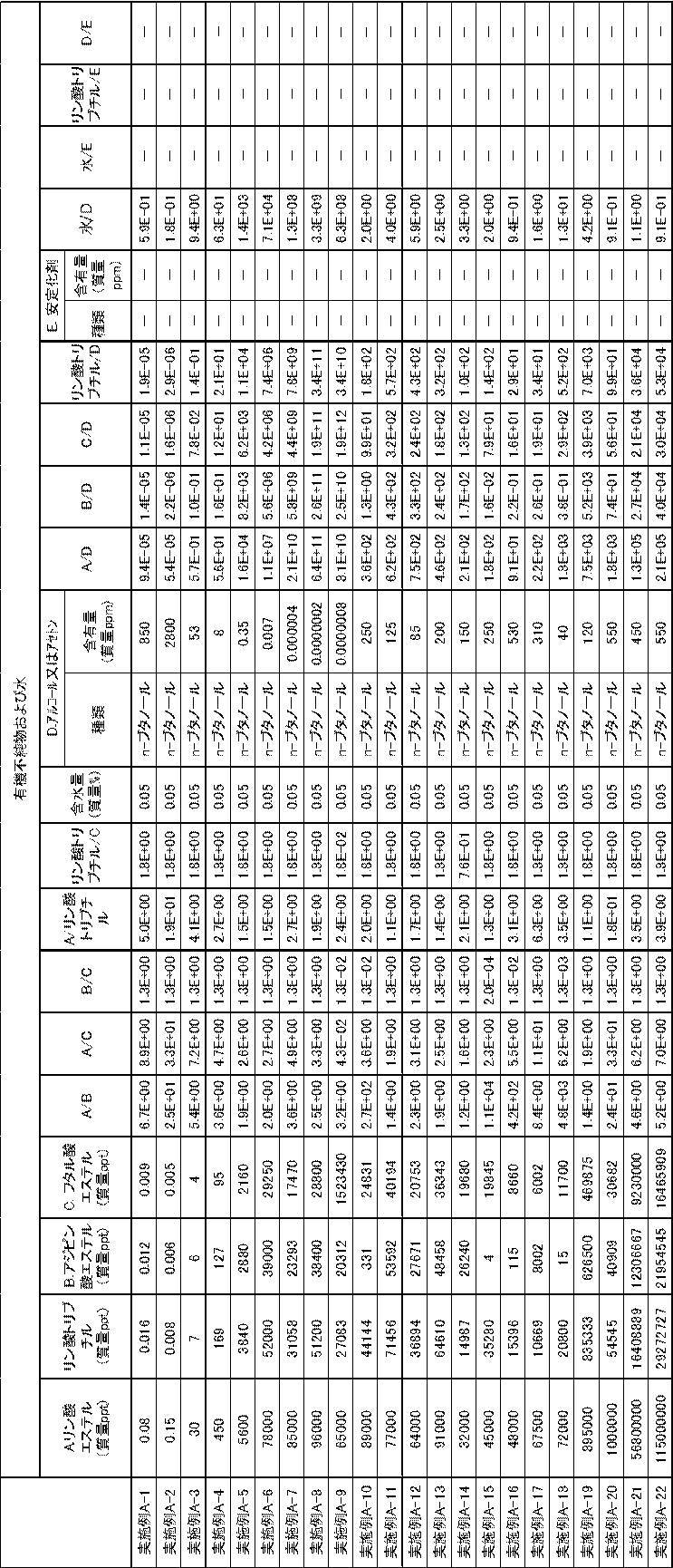
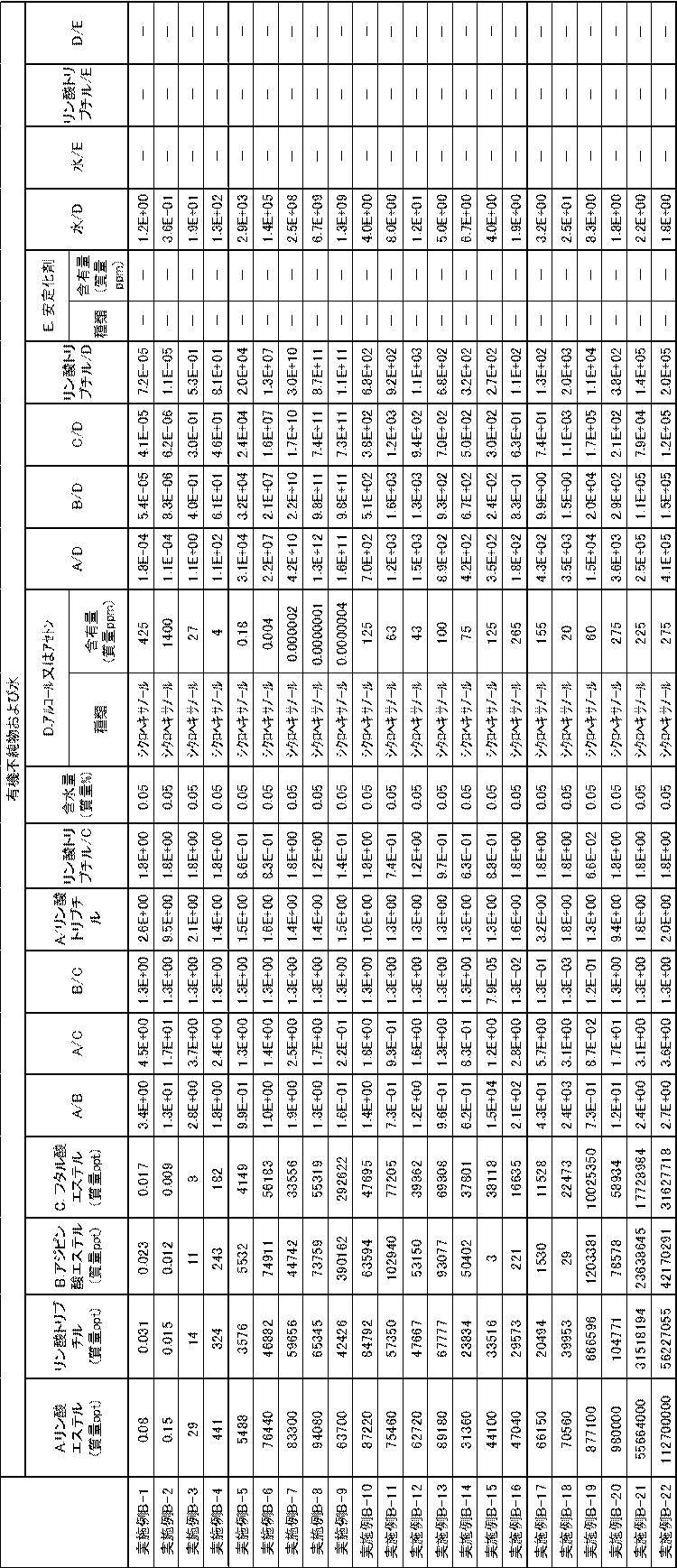
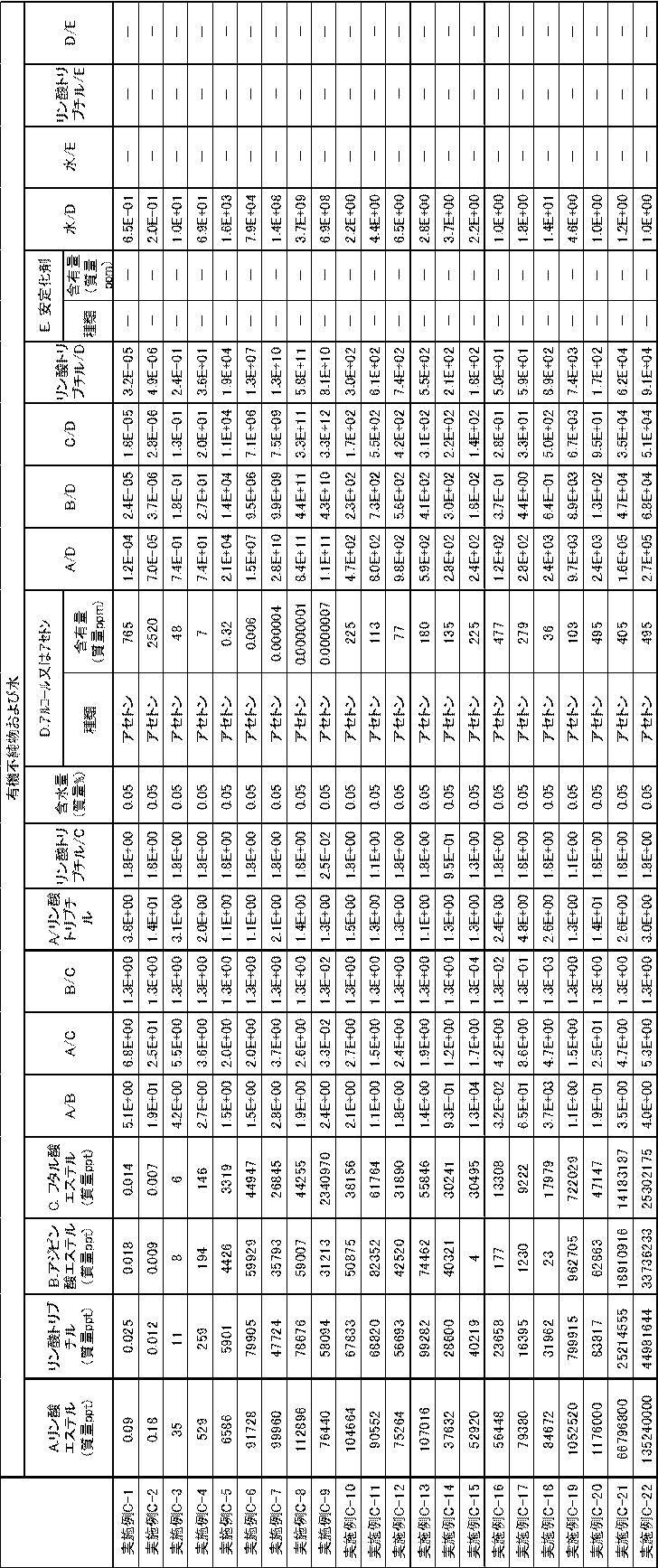




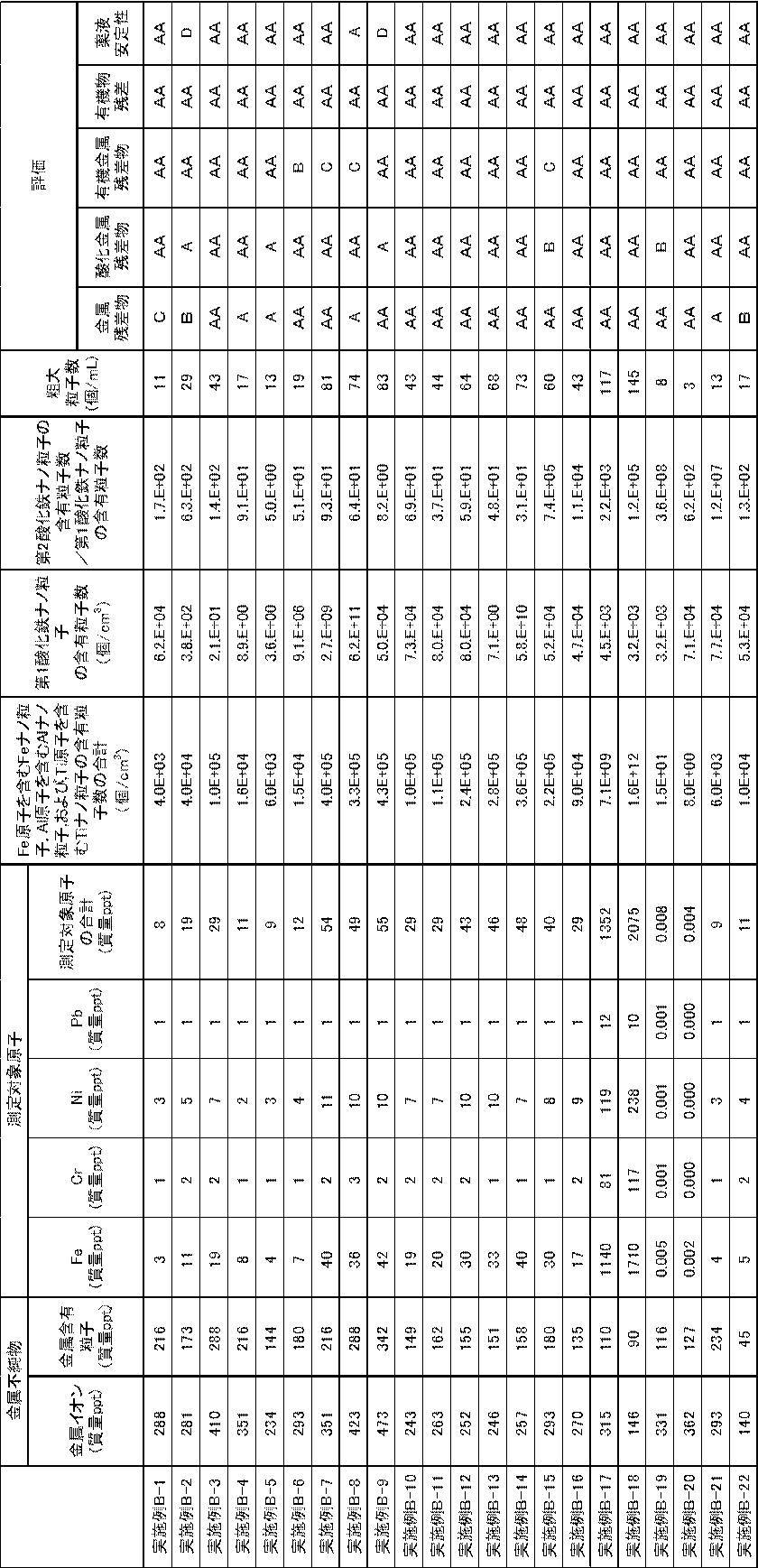


これに対して、薬液中のアジピン酸エステルの含有量に対するリン酸エステルの含有量の質量割合が1未満であると、金属不純物を含む欠陥の抑制性能が劣ることがわかった(比較例)。
実施例A-3と、実施例A-1、A-2、A-21及びA-22と、の対比から、アジピン酸エステルの含有量が薬液の全質量に対して0.1質量ppt~10質量ppmであれば、金属不純物を含む欠陥抑制により優れることがわかった。
実施例A-3と、実施例A-15との対比から、アジピン酸エステルの含有量に対するリン酸エステルの含有量の質量割合が1~104であれば、金属不純物を含む欠陥(特に、有機不純物及び金属不純物の両方を含む欠陥、及び、金属原子の酸化物を含む欠陥)の抑制により優れることがわかった。
実施例A-3と、実施例A-1及びA-2との対比から、フタル酸エステルの含有量が薬液の全質量に対して0.1質量ppt~10質量ppmであれば、金属不純物を含む欠陥抑制により優れることがわかった。
実施例A-3と、実施例A-9及びA-17との対比から、フタル酸エステルの含有量に対するリン酸エステルの含有量の質量割合が10-2~10であれば、薬液の安定性及び金属不純物を含む欠陥(特に、金属原子の酸化物を含む欠陥)の抑制の少なくとも一方により優れることがわかった。
実施例A-3と、実施例A-15との対比から、フタル酸エステルの含有量に対するアジピン酸エステルの含有量の質量割合が10-3~10であれば、金属不純物を含む欠陥(特に、有機不純物及び金属不純物の両方を含む欠陥、及び、金属原子の酸化物を含む欠陥)の抑制により優れることがわかった。
実施例A-3と、実施例A-2及びA-9との対比から、有機不純物であるアルコール及びアセトンの含有量の合計に対する、リン酸エステルの含有量の質量割合が、10-3~109であれば、薬液の安定性及び金属不純物を含む欠陥(特に、金属原子を含む欠陥)の抑制の少なくとも一方により優れることがわかった。
実施例A-3と、実施例A-6~A-8及びA-15との対比から、有機不純物であるアルコール及びアセトンの含有量の合計に対する、アジピン酸エステルの含有量の質量割合が、10-1~105であれば、金属不純物を含む欠陥(特に、有機不純物及び金属不純物の両方を含む欠陥、及び、金属原子の酸化物を含む欠陥の少なくとも一方)の抑制により優れることがわかった。
実施例A-3と、実施例A-1、A-2、A-8、A-16、A-20及びA-222との対比から、有機不純物であるアルコール及びアセトンの含有量の合計に対する水の含有量の質量割合が1~109であれば、薬液の安定性及び金属不純物を含む欠陥の抑制のうち少なくとも一方がより優れることがわかった。
実施例A-3と、実施例A-5及びA-19との対比から、薬液の単位体積あたりにおいて、第1酸化鉄ナノ粒子の含有粒子数に対する、第2酸化鉄ナノ粒子の含有粒子数の比が10~108であれば、金属不純物を含む欠陥(特に、金属原子の酸化物を含む欠陥)により優れることがわかった。
Claims (31)
- 有機溶剤と、有機不純物と、金属不純物と、を含有し、
前記有機不純物が、リン酸エステルと、アジピン酸エステルと、を含み、
前記アジピン酸エステルの含有量に対する、前記リン酸エステルの含有量の質量割合が、1以上である、薬液。 - 前記リン酸エステルの含有量が、前記薬液の全質量に対して、0.1質量ppt~100質量ppmである、請求項1に記載の薬液。
- 前記アジピン酸エステルの含有量が、前記薬液の全質量に対して、0.1質量ppt~10質量ppmである、請求項1又は2に記載の薬液。
- 前記アジピン酸エステルの含有量に対する、前記リン酸エステルの含有量の質量割合が、1~104である、請求項1~3のいずれか1項に記載の薬液。
- 前記有機不純物が、さらに、フタル酸エステルを含む、請求項1~4のいずれか1項に記載の薬液。
- 前記フタル酸エステルの含有量が、前記薬液の全質量に対して、0.1質量ppt~10質量ppmである、請求項5に記載の薬液。
- 前記フタル酸エステルの含有量に対する、前記リン酸エステルの含有量の質量割合が、10-2~10である、請求項5又は6に記載の薬液。
- 前記フタル酸エステルの含有量に対する、前記アジピン酸エステルの含有量の質量割合が、10-3~10である、請求項5~7のいずれか1項に記載の薬液。
- さらに水を含有し、
前記水の含有量が、前記薬液の全質量に対して、0.001~0.10質量%である、請求項1~8のいずれか1項に記載の薬液。 - 前記有機不純物が、さらに、アルコール及びアセトンからなる群より選択される少なくとも1種を含有する、請求項1~9のいずれか1項に記載の薬液。
- 前記アルコールが、メタノール、エタノール、n-ブタノール及びシクロヘキサノールからなる群より選択される少なくとも1種である、請求項10に記載の薬液。
- 前記アルコール及び前記アセトンの含有量の合計が、前記薬液の全質量に対して、1質量ppt~3000質量ppmである、請求項10又は11に記載の薬液。
- 前記アルコール及び前記アセトンの含有量の合計に対する、前記リン酸エステルの含有量の質量割合が、10-3~109である、請求項10~12のいずれか1項に記載の薬液。
- 前記アルコール及び前記アセトンの含有量の合計に対する、前記アジピン酸エステルの含有量の質量割合が、10-1~105である、請求項10~13のいずれか1項に記載の薬液。
- さらに水を含有し、
前記アルコール及び前記アセトンの含有量の合計に対する、前記水の含有量の質量割合が、1~109である、請求項10~14のいずれか1項に記載の薬液。 - 前記金属不純物の含有量が、前記薬液の全質量に対して、0.1~2000質量pptである、請求項1~15のいずれか1項に記載の薬液。
- 前記金属不純物が、金属含有粒子と、金属イオンと、を含む、請求項1~16のいずれか1項に記載の薬液。
- 前記金属含有粒子が、粒子径が0.5~17nmの金属ナノ粒子を含む、請求項17に記載の薬液。
- 前記金属ナノ粒子が酸化鉄からなる第1酸化鉄ナノ粒子を含み、
前記薬液の単位体積あたりの前記第1酸化鉄ナノ粒子の含有粒子数が10~1.0×10¹¹個/cm3である、請求項18に記載の薬液。 - 前記金属ナノ粒子が、酸化鉄および有機化合物を含む第2酸化鉄ナノ粒子を含み、
前記薬液の単位体積あたりにおいて、前記第1酸化鉄ナノ粒子の含有粒子数に対する、前記第2酸化鉄ナノ粒子の含有粒子数の比が、10~108である、請求項19に記載の薬液。 - 前記有機不純物が、さらに安定化剤を含む、請求項1~20のいずれか1項に記載の薬液。
- 前記安定化剤が、酸化防止剤である、請求項21に記載の薬液。
- さらに水を含有し、
前記安定化剤の含有量に対する、前記水の含有量の質量割合が、10~105である、請求項21又は22に記載の薬液。 - 前記有機不純物が、さらに、アルコール及びアセトンからなる群より選択される少なくとも1種を含み、
前記安定化剤の含有量に対する、前記アルコール及び前記アセトンの含有量の合計の質量割合が、10-7~103である、請求項21~23のいずれか1項に記載の薬液。 - 前記安定化剤が、ジブチルヒドロキシトルエン、ヒドロキノン、3,3’-チオジプロピオン酸ジドデシル、3,3’-チオジプロピオン酸ジオクタデシル、3,3’-チオジプロピオン酸ジテトラデシル、4,4’-ブチリデンビス-(6-tert-ブチル-3-メチルフェノール)、2,2’-メチレンビス-(4-エチル-6-tert-ブチルフェノール)、ブチルヒドロキシアニソール、トリス(2-エチルヘキシル)ホスファイト及び亜リン酸トリイソデシルからなる群より選択される少なくとも1種の酸化防止剤である、請求項21~24のいずれか1項に記載の薬液。
- 前記安定化剤の沸点が、150~500℃である、請求項21~25のいずれか1項に記載の薬液。
- 光散乱式液中粒子計数器によって計数される、0.04μm以上のサイズの被計数体の数が、100個/mL以下である、請求項1~26のいずれか1項に記載の薬液。
- 現像液、リンス液、プリウェット液及び配管洗浄液からなる群より選択される少なくとも1種の液の原料として用いられる、請求項1~27のいずれか1項に記載の薬液。
- 容器と、前記容器内に収容された請求項1~28のいずれか1項に記載の薬液と、を有する、薬液収容体。
- 前記容器の接液部の少なくとも一部が、フッ素樹脂、電解研磨されたステンレス鋼、又は、ガラスである、請求項29に記載の薬液収容体。
- 前記薬液収容体における前記容器の空隙率が、5~30体積%である、請求項29又は30に記載の薬液収容体。
Priority Applications (6)
| Application Number | Priority Date | Filing Date | Title |
|---|---|---|---|
| KR1020247008998A KR102837395B1 (ko) | 2018-10-03 | 2019-09-27 | 약액 및 약액 수용체 |
| KR1020257023970A KR20250112923A (ko) | 2018-10-03 | 2019-09-27 | 약액 및 약액 수용체 |
| JP2020550380A JPWO2020071261A1 (ja) | 2018-10-03 | 2019-09-27 | 薬液及び薬液収容体 |
| KR1020217009374A KR102650361B1 (ko) | 2018-10-03 | 2019-09-27 | 약액 및 약액 수용체 |
| US17/219,818 US20210222092A1 (en) | 2018-10-03 | 2021-03-31 | Chemical liquid and chemical liquid storage body |
| JP2023005197A JP7446498B2 (ja) | 2018-10-03 | 2023-01-17 | 薬液及び薬液収容体 |
Applications Claiming Priority (2)
| Application Number | Priority Date | Filing Date | Title |
|---|---|---|---|
| JP2018188530 | 2018-10-03 | ||
| JP2018-188530 | 2018-10-03 |
Related Child Applications (1)
| Application Number | Title | Priority Date | Filing Date |
|---|---|---|---|
| US17/219,818 Continuation US20210222092A1 (en) | 2018-10-03 | 2021-03-31 | Chemical liquid and chemical liquid storage body |
Publications (1)
| Publication Number | Publication Date |
|---|---|
| WO2020071261A1 true WO2020071261A1 (ja) | 2020-04-09 |
Family
ID=70055051
Family Applications (1)
| Application Number | Title | Priority Date | Filing Date |
|---|---|---|---|
| PCT/JP2019/038078 Ceased WO2020071261A1 (ja) | 2018-10-03 | 2019-09-27 | 薬液及び薬液収容体 |
Country Status (5)
| Country | Link |
|---|---|
| US (1) | US20210222092A1 (ja) |
| JP (2) | JPWO2020071261A1 (ja) |
| KR (3) | KR102837395B1 (ja) |
| TW (2) | TWI876617B (ja) |
| WO (1) | WO2020071261A1 (ja) |
Cited By (2)
| Publication number | Priority date | Publication date | Assignee | Title |
|---|---|---|---|---|
| WO2023026969A1 (ja) * | 2021-08-25 | 2023-03-02 | 富士フイルム株式会社 | 薬液、パターン形成方法 |
| KR20240036649A (ko) | 2021-09-17 | 2024-03-20 | 후지필름 가부시키가이샤 | 처리액 및 처리액 수용체 |
Families Citing this family (1)
| Publication number | Priority date | Publication date | Assignee | Title |
|---|---|---|---|---|
| KR102752191B1 (ko) * | 2024-01-23 | 2025-01-10 | 동우 화인켐 주식회사 | 세정액 조성물 및 이를 이용한 포토레지스트 패턴 형성 방법 |
Citations (7)
| Publication number | Priority date | Publication date | Assignee | Title |
|---|---|---|---|---|
| WO2010091045A2 (en) * | 2009-02-05 | 2010-08-12 | Advanced Technology Materials, Inc. | Non-fluoride containing composition for the removal of polymers and other organic material from a surface |
| WO2017170428A1 (ja) * | 2016-03-31 | 2017-10-05 | 富士フイルム株式会社 | 電子材料製造用薬液の製造方法、パターン形成方法、半導体デバイスの製造方法、電子材料製造用薬液、容器、及び、品質検査方法 |
| WO2017188296A1 (ja) * | 2016-04-28 | 2017-11-02 | 富士フイルム株式会社 | 処理液及び処理液収容体 |
| JP2018060193A (ja) * | 2016-09-30 | 2018-04-12 | 富士フイルム株式会社 | パターン形成方法、電子デバイスの製造方法、キット |
| WO2018092760A1 (ja) * | 2016-11-18 | 2018-05-24 | 富士フイルム株式会社 | 薬液、パターン形成方法、及び、キット |
| JP2018081307A (ja) * | 2016-11-07 | 2018-05-24 | 富士フイルム株式会社 | 処理液及びパターン形成方法 |
| WO2018151164A1 (ja) * | 2017-02-20 | 2018-08-23 | 富士フイルム株式会社 | 薬液、薬液収容体、及び、パターン形成方法 |
Family Cites Families (14)
| Publication number | Priority date | Publication date | Assignee | Title |
|---|---|---|---|---|
| JPH0949000A (ja) | 1995-08-07 | 1997-02-18 | Murata Mfg Co Ltd | 洗浄剤組成物 |
| AU2003221077A1 (en) * | 2002-03-27 | 2003-10-08 | Daiso Co., Ltd. | Photopolymer composition for holographic recording material, holographic recording medium, and process for producing the same |
| WO2003102693A1 (en) * | 2002-05-29 | 2003-12-11 | Inphase Technologies, Inc. | High reflective index photoactive compound for optical applications |
| US8163443B2 (en) * | 2006-03-09 | 2012-04-24 | Nippon Steel Chemical Co., Ltd. | Photosensitive resin composition for volume phase hologram recording and optical information recording medium using the same |
| JP2007241144A (ja) * | 2006-03-10 | 2007-09-20 | Fujifilm Corp | 感光性組成物、並びに光記録媒体及びその製造方法、光記録方法、光記録装置 |
| JP5432478B2 (ja) | 2007-07-26 | 2014-03-05 | パナソニック株式会社 | Led照明装置 |
| JP5402266B2 (ja) * | 2008-06-10 | 2014-01-29 | 三菱化学株式会社 | 光反応性組成物、光学材料、ホログラム記録層形成用組成物、ホログラム記録材料およびホログラム記録媒体 |
| CN106796405B (zh) * | 2014-09-30 | 2020-10-09 | 富士胶片株式会社 | 抗蚀剂膜的图案化用有机系处理液的制造方法 |
| JPWO2016208299A1 (ja) * | 2015-06-24 | 2018-04-05 | 富士フイルム株式会社 | 処理液及びパターン形成方法 |
| WO2017057253A1 (ja) * | 2015-09-30 | 2017-04-06 | 富士フイルム株式会社 | 処理液及びパターン形成方法 |
| TWI742152B (zh) * | 2016-09-02 | 2021-10-11 | 日商富士軟片股份有限公司 | 溶液、溶液收容體、感光化射線性或感放射線性樹脂組成物、圖案形成方法、半導體元件的製造方法 |
| KR102374939B1 (ko) * | 2016-09-16 | 2022-03-16 | 가부시키가이샤 아데카 | 경화성 조성물, 경화물 및 경화물의 제조 방법 |
| TWI684606B (zh) * | 2017-10-31 | 2020-02-11 | 法商阿科瑪法國公司 | 以不混溶之反應性組分及嵌段共聚物為主的可固化組成物 |
| WO2019240078A1 (ja) * | 2018-06-11 | 2019-12-19 | 三菱ケミカル株式会社 | ホログラム記録媒体用組成物、ホログラム記録媒体用硬化物、及びホログラム記録媒体 |
-
2019
- 2019-09-27 KR KR1020247008998A patent/KR102837395B1/ko active Active
- 2019-09-27 KR KR1020257023970A patent/KR20250112923A/ko active Pending
- 2019-09-27 KR KR1020217009374A patent/KR102650361B1/ko active Active
- 2019-09-27 WO PCT/JP2019/038078 patent/WO2020071261A1/ja not_active Ceased
- 2019-09-27 JP JP2020550380A patent/JPWO2020071261A1/ja active Pending
- 2019-10-02 TW TW112140652A patent/TWI876617B/zh active
- 2019-10-02 TW TW108135731A patent/TWI822871B/zh active
-
2021
- 2021-03-31 US US17/219,818 patent/US20210222092A1/en active Pending
-
2023
- 2023-01-17 JP JP2023005197A patent/JP7446498B2/ja active Active
Patent Citations (7)
| Publication number | Priority date | Publication date | Assignee | Title |
|---|---|---|---|---|
| WO2010091045A2 (en) * | 2009-02-05 | 2010-08-12 | Advanced Technology Materials, Inc. | Non-fluoride containing composition for the removal of polymers and other organic material from a surface |
| WO2017170428A1 (ja) * | 2016-03-31 | 2017-10-05 | 富士フイルム株式会社 | 電子材料製造用薬液の製造方法、パターン形成方法、半導体デバイスの製造方法、電子材料製造用薬液、容器、及び、品質検査方法 |
| WO2017188296A1 (ja) * | 2016-04-28 | 2017-11-02 | 富士フイルム株式会社 | 処理液及び処理液収容体 |
| JP2018060193A (ja) * | 2016-09-30 | 2018-04-12 | 富士フイルム株式会社 | パターン形成方法、電子デバイスの製造方法、キット |
| JP2018081307A (ja) * | 2016-11-07 | 2018-05-24 | 富士フイルム株式会社 | 処理液及びパターン形成方法 |
| WO2018092760A1 (ja) * | 2016-11-18 | 2018-05-24 | 富士フイルム株式会社 | 薬液、パターン形成方法、及び、キット |
| WO2018151164A1 (ja) * | 2017-02-20 | 2018-08-23 | 富士フイルム株式会社 | 薬液、薬液収容体、及び、パターン形成方法 |
Cited By (4)
| Publication number | Priority date | Publication date | Assignee | Title |
|---|---|---|---|---|
| WO2023026969A1 (ja) * | 2021-08-25 | 2023-03-02 | 富士フイルム株式会社 | 薬液、パターン形成方法 |
| JPWO2023026969A1 (ja) * | 2021-08-25 | 2023-03-02 | ||
| KR20240036649A (ko) | 2021-09-17 | 2024-03-20 | 후지필름 가부시키가이샤 | 처리액 및 처리액 수용체 |
| KR20250164870A (ko) | 2021-09-17 | 2025-11-25 | 후지필름 가부시키가이샤 | 패턴 형성 방법 |
Also Published As
| Publication number | Publication date |
|---|---|
| KR20250112923A (ko) | 2025-07-24 |
| JPWO2020071261A1 (ja) | 2021-09-24 |
| KR20240042154A (ko) | 2024-04-01 |
| TW202523831A (zh) | 2025-06-16 |
| JP7446498B2 (ja) | 2024-03-08 |
| TWI822871B (zh) | 2023-11-21 |
| KR102837395B1 (ko) | 2025-07-23 |
| JP2023052440A (ja) | 2023-04-11 |
| TW202407088A (zh) | 2024-02-16 |
| TWI876617B (zh) | 2025-03-11 |
| US20210222092A1 (en) | 2021-07-22 |
| TW202028451A (zh) | 2020-08-01 |
| KR20210052510A (ko) | 2021-05-10 |
| KR102650361B1 (ko) | 2024-03-22 |
Similar Documents
| Publication | Publication Date | Title |
|---|---|---|
| JP7453435B2 (ja) | 薬液、キット、パターン形成方法、薬液の製造方法及び薬液収容体 | |
| JP7446498B2 (ja) | 薬液及び薬液収容体 | |
| JP7492049B2 (ja) | 薬液、薬液の製造方法、及び、被検液の分析方法 | |
| JP2023015246A (ja) | 薬液、薬液の製造方法 | |
| WO2020040034A1 (ja) | 薬液収容体 | |
| JP2023041701A (ja) | 薬液、及び、薬液の製造方法 | |
| KR102519818B1 (ko) | 약액, 약액 수용체 | |
| KR102958127B1 (ko) | 약액 수용체 |
Legal Events
| Date | Code | Title | Description |
|---|---|---|---|
| 121 | Ep: the epo has been informed by wipo that ep was designated in this application |
Ref document number: 19868556 Country of ref document: EP Kind code of ref document: A1 |
|
| ENP | Entry into the national phase |
Ref document number: 2020550380 Country of ref document: JP Kind code of ref document: A |
|
| ENP | Entry into the national phase |
Ref document number: 20217009374 Country of ref document: KR Kind code of ref document: A |
|
| NENP | Non-entry into the national phase |
Ref country code: DE |
|
| 122 | Ep: pct application non-entry in european phase |
Ref document number: 19868556 Country of ref document: EP Kind code of ref document: A1 |
|
| WWD | Wipo information: divisional of initial pct application |
Ref document number: 1020257023970 Country of ref document: KR |
|
| WWP | Wipo information: published in national office |
Ref document number: 1020257023970 Country of ref document: KR |