WO2020050241A1 - 4環性化合物の製造方法 - Google Patents
4環性化合物の製造方法 Download PDFInfo
- Publication number
- WO2020050241A1 WO2020050241A1 PCT/JP2019/034543 JP2019034543W WO2020050241A1 WO 2020050241 A1 WO2020050241 A1 WO 2020050241A1 JP 2019034543 W JP2019034543 W JP 2019034543W WO 2020050241 A1 WO2020050241 A1 WO 2020050241A1
- Authority
- WO
- WIPO (PCT)
- Prior art keywords
- compound
- formula
- group
- reaction
- solvent
- Prior art date
- Legal status (The legal status is an assumption and is not a legal conclusion. Google has not performed a legal analysis and makes no representation as to the accuracy of the status listed.)
- Ceased
Links
- 0 CC(C)(c([n]c1c2)c3c1ccc2C#N)c(cc(*)c(*)c1)c1C3=O Chemical compound CC(C)(c([n]c1c2)c3c1ccc2C#N)c(cc(*)c(*)c1)c1C3=O 0.000 description 4
- DBQVDCFPPMVBDH-UHFFFAOYSA-N CCc1cc(C(c(c2c3)c(C4(C)C)[nH]c2cc(C#N)c3S(O)(=O)=O)=O)c4cc1N(CC1)CCC1N1CCOCC1 Chemical compound CCc1cc(C(c(c2c3)c(C4(C)C)[nH]c2cc(C#N)c3S(O)(=O)=O)=O)c4cc1N(CC1)CCC1N1CCOCC1 DBQVDCFPPMVBDH-UHFFFAOYSA-N 0.000 description 1
- KDGFLJKFZUIJMX-UHFFFAOYSA-N CCc1cc(C(c2c(C3(C)C)[nH]c4c2ccc(C#N)c4)=O)c3cc1N(CC1)CCC1N1CCOCC1 Chemical compound CCc1cc(C(c2c(C3(C)C)[nH]c4c2ccc(C#N)c4)=O)c3cc1N(CC1)CCC1N1CCOCC1 KDGFLJKFZUIJMX-UHFFFAOYSA-N 0.000 description 1
- ULNYFVQKXJYKEQ-UHFFFAOYSA-N CCc1ccc(C(C)(C)c([nH]c2c3)c(C(OC(C)(C)C)=O)c2ccc3C#N)cc1N(CC1)CCC1N1CCOCC1 Chemical compound CCc1ccc(C(C)(C)c([nH]c2c3)c(C(OC(C)(C)C)=O)c2ccc3C#N)cc1N(CC1)CCC1N1CCOCC1 ULNYFVQKXJYKEQ-UHFFFAOYSA-N 0.000 description 1
Images




Classifications
-
- C—CHEMISTRY; METALLURGY
- C07—ORGANIC CHEMISTRY
- C07D—HETEROCYCLIC COMPOUNDS
- C07D401/00—Heterocyclic compounds containing two or more hetero rings, having nitrogen atoms as the only ring hetero atoms, at least one ring being a six-membered ring with only one nitrogen atom
- C07D401/02—Heterocyclic compounds containing two or more hetero rings, having nitrogen atoms as the only ring hetero atoms, at least one ring being a six-membered ring with only one nitrogen atom containing two hetero rings
- C07D401/04—Heterocyclic compounds containing two or more hetero rings, having nitrogen atoms as the only ring hetero atoms, at least one ring being a six-membered ring with only one nitrogen atom containing two hetero rings directly linked by a ring-member-to-ring-member bond
-
- C—CHEMISTRY; METALLURGY
- C07—ORGANIC CHEMISTRY
- C07D—HETEROCYCLIC COMPOUNDS
- C07D413/00—Heterocyclic compounds containing two or more hetero rings, at least one ring having nitrogen and oxygen atoms as the only ring hetero atoms
- C07D413/02—Heterocyclic compounds containing two or more hetero rings, at least one ring having nitrogen and oxygen atoms as the only ring hetero atoms containing two hetero rings
- C07D413/04—Heterocyclic compounds containing two or more hetero rings, at least one ring having nitrogen and oxygen atoms as the only ring hetero atoms containing two hetero rings directly linked by a ring-member-to-ring-member bond
-
- A—HUMAN NECESSITIES
- A61—MEDICAL OR VETERINARY SCIENCE; HYGIENE
- A61K—PREPARATIONS FOR MEDICAL, DENTAL OR TOILETRY PURPOSES
- A61K31/00—Medicinal preparations containing organic active ingredients
- A61K31/33—Heterocyclic compounds
- A61K31/395—Heterocyclic compounds having nitrogen as a ring hetero atom, e.g. guanethidine or rifamycins
- A61K31/535—Heterocyclic compounds having nitrogen as a ring hetero atom, e.g. guanethidine or rifamycins having six-membered rings with at least one nitrogen and one oxygen as the ring hetero atoms, e.g. 1,2-oxazines
- A61K31/5375—1,4-Oxazines, e.g. morpholine
- A61K31/5377—1,4-Oxazines, e.g. morpholine not condensed and containing further heterocyclic rings, e.g. timolol
-
- C—CHEMISTRY; METALLURGY
- C07—ORGANIC CHEMISTRY
- C07B—GENERAL METHODS OF ORGANIC CHEMISTRY; APPARATUS THEREFOR
- C07B61/00—Other general methods
Definitions
- the present invention relates to a method for producing a tetracyclic compound.
- Anaplastic Lymphoma Kinase is one of the receptor tyrosine kinases belonging to the insulin receptor family (Non-Patent Documents 1 and 2), and is a disease associated with ALK abnormality such as cancer and cancer metastasis.
- Non-patent Document 1 Patent Document 1
- depression depression
- cognitive dysfunction Non-patent Document 2
- ALK inhibitors are useful as therapeutic and preventive agents for those diseases.
- Patent Document 1 As a compound having ALK inhibitory activity, compound (1) (9-ethyl-6,6-dimethyl-8- [4- (morpholin-4-yl) piperidin-1-yl] -11-oxo-6,11- Dihydro-5H-benzo [b] carbazole-3-carbonitrile) is known, and the compound (1) or a pharmaceutically acceptable salt thereof is effective for treating diseases associated with ALK abnormality, and It is known that it is useful as a prophylactic agent (Patent Document 1, Patent Document 2, Patent Document 3, Patent Document 4). As a method for producing the compound (1), for example, a method shown in Production Method III of Patent Document 1 is known. However, the production method of Patent Document 1 has various problems such as the influence of the solvent used on the environment, safety, and the generation of by-products and positional isomers, and further improved production methods have been desired.
- An object of the present invention is to provide an industrially preferable production method which enables the desired product to be obtained more safely and easily in a higher yield than conventional methods.
- Compound (1) In a method for producing a compound represented by the formula, a pharmaceutically acceptable salt thereof, or a solvate thereof, The method comprises reacting a compound of formula VIIIb [R 1a represents a leaving group or an optionally substituted 6-membered saturated cyclic amino group, and R 2 represents a C 1 -C 6 alkyl group.
- the formula VIIIb is a compound of the formula 6-cyano-2- [1- [4-ethyl-3- (4-morpholino-1-piperidyl) phenyl] -1-methyl-ethyl] -1H-indole-3-carboxylic acid
- the compound of formula IXa is 9-ethyl-6,6-dimethyl-8- [4- (morpholin-4-yl) piperidin-1-yl] -11-oxo-6,11-dihydro-5H-benzo [ b]
- the method according to [1] which is carbazole-3-carbonitrile.
- Step 1a Formula I: [In the formula, R 1a represents a leaving group or an optionally substituted 6-membered saturated cyclic amino group, and R 2 represents a C 1 -C 6 alkyl group. ] Is reacted in the presence of an acid to give a compound of formula II: [Wherein, R 1a and R 2 are as defined above, and R A represents a C 1 -C 6 alkyl group.
- Step 1b The compound of formula II is reacted with a base and AcOR B to form a compound of formula III: [Wherein, R 1a , R 2 and R A have the same meanings as described above, and R B represents a C 1 -C 6 alkyl group. ]
- Step 2a Compounds of formula III are represented by formula IV: [In the formula, X represents a leaving group. ] By reacting a compound represented by the formula with a base, Wherein, R 1a, R 2 and R B are as defined above.
- Step 2bc The compound of formula V is reacted with a reducing agent to form a compound of formula VI: Wherein, R 1a, R 2 and R B are as defined above.
- Step 3 The compound of the formula VI is reacted with an optionally substituted 6-membered saturated cyclic amine in the presence of a palladium catalyst to give a compound of the formula VII: [In the formula, R 1 represents a optionally substituted 6-membered saturated cyclic amino group, R 2 and R B are as defined above.
- Step 4 The compound of formula VII is reacted with an acid to give a compound of general formula VIII: [Wherein, R 1 and R 2 are as defined above. ] Producing a compound represented by the formula: The method according to [1], further comprising: [2-1] In the above method, Formula I is 2- (4-ethyl-3-iodo-phenyl) -2-methyl-propanoic acid and Formula II is methyl 2- (4-ethyl-3-iodo-phenyl) -2-methyl-propanoate.
- Formula III is tert-butyl 4- (4-ethyl-3-iodo-phenyl) -4-methyl-3-oxo-pentanoate and Formula IV is 4-fluoro-3-nitrobenzonitrile
- formula V is tert-butyl 6-cyano-2- [1- (4-ethyl-3-iodo-phenyl) -1-methyl-ethyl] -1H-indole-3-carboxylate
- formula VI is tert-butyl -Butyl 6-cyano-2- [1- (4-ethyl-3-iodo-phenyl) -1-methyl-ethyl] -1H-indole-3-carboxylate
- the formula VII is tert-butyl 6-cyano -2 [1- [4-ethyl-3- (4-morpholino-1-piperidyl) phenyl] -1-methyl-ethyl] -1H-indole-3-carbox
- the palladium catalyst in (5) may be a combination of diallyl palladium chloride dimer and 2 ′, 6′-dimethoxy-2- (dicyclohexylphosphino) biphenyl (S-Phos), PEPPSI-IPent, or S-Phos-Pd (Crotyl) Cl, The method according to [2], wherein the reaction of the step 3 is performed in a mixed solvent of tetrahydrofuran and 1,3-dimethyl-2-imidazolidinone.
- the optionally substituted 6-membered saturated cyclic amine in (5) is represented by the formula: Wherein R 1a is an iodo group or a bromo group.
- a simple, efficient and highly robust production method suitable for industrial production of compound (1) and a pharmaceutically acceptable salt, solvate, or salt solvate thereof is provided.
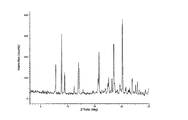
- 7 is a graph showing the results of powder X-ray diffraction measurement of compound (VIa).
- 7 is a graph showing the results of powder X-ray diffraction measurement of compound (VIIa).
- 7 is a graph showing the results of powder X-ray diffraction measurement of compound (VIIa).
- 7 is a graph showing the results of powder X-ray diffraction measurement of compound (VIIa).
- 7 is a graph showing the results of powder X-ray diffraction measurement of compound (VIIa). It is a graph of the measurement result of the powder X-ray diffraction of compound (VIIIa). It is a graph of the measurement result of the powder X-ray diffraction of compound (VIIIa). It is a graph of the measurement result of the powder X-ray diffraction of compound (VIIIa).
- 4 is a graph showing the results of powder X-ray diffraction measurement of compound (1).
- 4 is a graph showing the results of powder X-ray diffraction measurement of compound (1).
- 4 is a graph showing the results of powder X-ray diffraction measurement of compound (1).
- 4 is a graph showing the results of powder X-ray diffraction measurement of compound (1).
- 4 is a graph showing the results of powder X-ray diffraction measurement of compound (1).
- the “pharmaceutically acceptable salt” of the compound (1) includes, for example, hydrochloride, hydrobromide, hydroiodide, phosphate, phosphonate, sulfate, or Sulfonates such as methanesulfonate, p-toluenesulfonate; carboxylate such as acetate, citrate, malate, tartrate, succinate, salicylate; sodium salt, potassium salt, etc.
- Alkaline earth metal salts such as magnesium salts and calcium salts; and ammonium salts such as ammonium salts, alkyl ammonium salts, dialkyl ammonium salts, trialkyl ammonium salts, and tetraalkyl ammonium salts.
- the solvate of the compound (1) or the salt of the compound (1) may be a hydrate or a non-hydrate. , Ethanol, n-propanol), dimethylformamide and the like.
- the “C 1 -C 6 alkyl group” is a monovalent group derived by removing one arbitrary hydrogen atom from a linear or branched aliphatic hydrocarbon having 1 to 6 carbon atoms. .
- it is a C 1 -C 4 alkyl group.
- a condensing agent or a mixed acid anhydride agent used for peptide synthesis can be used.
- condensing agent used for peptide synthesis carbonyldiimidazole (CDI), N, N'-diisopropylcarbodiimide (DIC), propylphosphonic anhydride (T3P), and mixed acid anhydride agents include dialkyl chlorophosphates such as diethyl chlorophosphate.
- the condensing agent is preferably DIC or diethyl chlorophosphate.
- Leaving group refers to a group that is eliminated in a substitution reaction and is replaced by another functional group, such as a halogen group such as a fluoro group, a chloro group, a bromo group or an iodo group, and a triflate group, a mesyl group, or a tosyl group. And the like. Preferably, it is a fluoro, chloro, bromo or iodo group.
- the "6-membered saturated cyclic amino group” is specifically a 6-membered saturated cyclic group bonded via a nitrogen atom such as a piperidyl group, a piperazinyl group, a morpholino group, a thiomorpholino group, and a piperidyl group is preferable.
- a nitrogen atom such as a piperidyl group, a piperazinyl group, a morpholino group, a thiomorpholino group, and a piperidyl group is preferable.
- substituent of the “6-membered saturated cyclic amino group” include a 4- to 10-membered heterocycloalkyl group.
- the 4- to 10-membered heterocycloalkyl group means a 4- to 10-membered saturated ring having 1 to 3 nitrogen, oxygen, and sulfur atoms as a hetero atom, and includes a pyrrolidinyl group, an imidazolidinyl group, a tetrahydrofuranyl group, a piperidyl group, and a piperazinyl group.
- it is a morpholino group.
- the 4- to 10-membered heterocycloalkyl group may further have one or more substituents, and the substituent may be a halogen atom, a C 1 -C 6 alkyl group, an oxo group, a hydroxyl group, or a deuterium.
- the substituent of the “6-membered saturated cyclic amino group” may be a ketal group, such as an acyclic ketal group such as a dimethyl ketal group, or a cyclic ketal group such as a 1,3-dioxolanyl group or a 1,3-dioxanyl group. Groups.
- the "six-membered saturated cyclic amine” specifically includes a six-membered saturated cyclic amine bonded via a nitrogen atom such as piperidine, piperazine, morpholine, and thiomorpholine, with piperidine being preferred.
- a nitrogen atom such as piperidine, piperazine, morpholine, and thiomorpholine, with piperidine being preferred.
- substituent of the “6-membered saturated cyclic amine” include a 4- to 10-membered heterocycloalkyl group.
- the 4- to 10-membered heterocycloalkyl group means a 4- to 10-membered saturated ring having 1 to 3 nitrogen, oxygen, and sulfur atoms as a hetero atom, and includes a pyrrolidinyl group, an imidazolidinyl group, a tetrahydrofuranyl group, a piperidyl group, and a piperazinyl group.
- it is a morpholino group.
- the 4- to 10-membered heterocycloalkyl group may further have one or more substituents, and the substituent may be a halogen atom, a C 1 -C 6 alkyl group, an oxo group, a hydroxyl group, or a deuterium.
- the substituent of the “six-membered saturated cyclic amine” may be a ketal group, such as an acyclic ketal group such as a dimethyl ketal group, or a cyclic ketal group such as a 1,3-dioxolanyl group or a 1,3-dioxanyl group. Is mentioned.
- Examples of the “acid” include acetyl chloride, formic acid, acetic acid, methanesulfonic acid, p-toluenesulfonic acid, benzenesulfonic acid, TFA, hydrochloric acid, sulfuric acid, pyridinium p-toluenesulfonate, TMSCl, and the like. Acetyl or TMSCl.
- base examples include sodium hydroxide, potassium hydroxide, lithium hydroxide, sodium phosphate, potassium phosphate, sodium carbonate, potassium carbonate, cesium carbonate, sodium hydride, LiHMDS, NaHMDS, LDA, lithium dicyclohexylamide, lithium 2,2,6,6-tetramethylpyrrolidide, KHMDS, t-BuOK, t-BuONa, etc.
- a strong base reagent such as LiHMDS, NaHMDS, t-BuOK, DBU, or sodium hydroxide
- Inorganic salt reagents such as potassium phosphate, potassium carbonate or cesium carbonate are preferred.
- iron, zinc, titanium (III) chloride, tin (II) chloride, or sodium hydrosulfite can be used, and sodium hydrosulfite is preferable.
- the “palladium catalyst” include palladium acetate, Pd 2 (dba) 3 , ⁇ monoallyl palladium chloride dimer, PdCl 2 (CH 3 CN) 2 , PdCl 2 (PPh 3 ) 2 , trialkylproazaphosphatran, P (t-Bu) 3 PdBr ⁇ 2 , PPh 3 , P (o-tol) 3 , BINAP, DPPF, P (t-Bu) 3, Dave Phos, John Phos, c-Hexyl John Phos, S-Phos, X-Phos, t-Butyl X-Phos, PEPPSI-IPent, Xantphos, 4,5-bis [bis (3,5-bistrifluoromethylphenyl) phosphanyl
- One embodiment of the present invention is an industrial method for producing the compound (1), which can avoid the use of a substance of very high concern, improve the selectivity of the reaction, and suppress the generation of by-products (impurities).
- R 1a represents an optionally substituted 6-membered saturated cyclic amino group
- R 2 represents a C 1 -C 6 alkyl group.
- the present invention is a method comprising a step of cyclizing compound (VIIIb) to compound (IXa) by a Friedel-Crafts type reaction.
- the carboxyl group in the compound (VIIIb) is treated with a condensing agent such as a mixed acid anhydride (eg, dialkyl chlorophosphate) or a condensing agent (eg, CDI, DIC, T3P) used for peptide synthesis.
- a condensing agent such as a mixed acid anhydride (eg, dialkyl chlorophosphate) or a condensing agent (eg, CDI, DIC, T3P) used for peptide synthesis.
- a condensing agent such as a mixed acid anhydride (eg, dialkyl chlorophosphate) or a condensing agent (eg, CDI, DIC, T3P) used for peptide synthesis.
- the mixed acid anhydride agent can be used in an amount of 1 to 10 equivalents, preferably 1 to 5 equivalents, based on the substrate.
- the condensing agent can be used in an amount of 1 to 10 equivalents, preferably 1
- a preferred mixed anhydride or condensing agent is diethyl chlorophosphate or DIC, and 1 to 5 equivalents based on the substrate can be used.
- an organic base such as TEA, DIPEA and pyridine may be used, and DIPEA is preferable.
- the organic base can be used in an amount of 1 to 10 equivalents, preferably 1 to 8 equivalents, relative to compound (VIIIb) as a substrate. This reaction can be performed without a solvent or in a solvent.
- the solvent used here is toluene, xylene, diethyl ether, THF, CPME, 2-methyltetrahydrofuran, MTBE, DMSO, sulfolane, 1,4-dioxane, acetone, acetonitrile, dichloromethane, 2-butanone, ethyl acetate, or acetic acid.
- Solvents that do not correspond to substances of very high concern, such as isopropyl, and mixtures thereof, and the like, are preferably THF, acetone, or acetonitrile, and mixtures thereof. This reaction can be carried out at a reaction temperature from 0 ° C. to around the boiling point of the solvent, preferably from 40 ° C.
- the reaction can be carried out by stirring the reaction mixture for a certain period of time (for example, 0.1 to 24 hours, preferably 1 to 6 hours).
- a certain period of time for example, 0.1 to 24 hours, preferably 1 to 6 hours.
- the compound (IXa) can be obtained by cyclization using an acid such as polyphosphoric acid, or cyclization by heating from 25 ° C. to near the boiling point of the solvent in a solvent without an additional reagent.
- This reaction can be performed by stirring the reaction mixture for a certain period of time (for example, 0.1 to 24 hours) within a temperature range from 0 ° C. to a temperature near the boiling point of the solvent.
- R 1a is a 4-oxo-1-piperidyl group
- morpholine can be reduced in the presence of a reducing agent according to the method of Borch et al. (J. Am. Chem. Soc., 1971, 93, 2897).
- Compound (1) can be produced by subjecting it to the conditions for the amination reaction.
- the pharmaceutically acceptable salt of the compound (1) is brought into contact with a free form of the compound (1) and an acid or a base that can be used for the production of a medicament corresponding to the pharmaceutically acceptable salt. It can be manufactured by the following.
- a solvate of the compound (1) or a pharmaceutically acceptable salt of the compound (1) can be produced by crystallization using a desired solvent.
- a further aspect of the present invention relates to an industrial production method for producing the compound (1) including a series of steps, wherein the method does not require a great deal of labor for controlling the residual solvent, and further increases the yield of the compound.
- (1) and its synthetic intermediate can be obtained.
- An outline of a series of production methods from the compound (I) to the compound (IX) is shown in Scheme 2, and each step is described below. These are merely examples, and the present invention uses a part of the steps 1 to 5, and may use a known method for the other steps. May be used within a range in which can be achieved.
- a commercially available one may be used, or if necessary, a conventional method may be used for production.
- a commercially available reagent may be used, or if necessary, may be used after being prepared by a conventional method.
- the solvent used in the production may be a commercially available dehydrated solvent or degassed solvent, particularly when handling a compound unstable to moisture, oxygen or carbon dioxide, etc. May be used.
- the solvent may be used by mixing a plurality of solvents as necessary. When handling compounds that are unstable to moisture, oxygen or carbon dioxide, etc.
- the target chemical reaction can be efficiently advanced.
- Preferred inert gases include nitrogen or argon.
- the production method of the present invention may be carried out by changing the temperature of the reaction system depending on the properties and reactivity of the compound.
- the optimal temperature for the reaction is in the range from around ⁇ 100 ° C. cooled with liquid nitrogen to around the boiling point of the solvent.
- X represents a leaving group
- R 1a represents a leaving group or an optionally substituted 6-membered saturated cyclic amino group
- R 1 represents an optionally substituted 6-membered saturated cyclic amino group.
- R 2 represents a C 1 -C 6 alkyl group
- R A and R B each represent a C 1 -C 6 alkyl group.
- Steps 1a and 1b This step is a step of converting carboxylic acid (I) to ⁇ -keto ester (III).
- the carboxylic acid (I) as a raw material compound is obtained by activating an activated carboxylic acid such as an acid chloride, an active ester, or an alkyl ester in a solvent at a reaction temperature of 0 ° C. to a temperature close to the boiling point of the solvent in the presence of an activating agent. (II) can be converted. Thereafter, the activated carboxylic acid (II) is condensed with the enolate of AcOR B at a reaction temperature from ⁇ 20 ° C. to a temperature near the boiling point of the solvent to give ⁇ -keto ester (III).
- the activator can be used in an amount of 1 to 10 equivalents based on the substrate.
- a solvent used for this reaction toluene, xylene, THF, CPME, MTBE, DMSO, sulfolane, 1,4-dioxane, and the like, and a mixture thereof can be used.
- This reaction can be carried out at a reaction temperature from ⁇ 20 ° C. to around the boiling point of the solvent, and can be carried out by stirring the reaction mixture for a fixed time (for example, 0.1 to 24 hours).
- the activator can be used in an amount of 1 to 10 equivalents based on the substrate.
- a solvent used for this reaction toluene, xylene, THF, CPME, MTBE, DMSO, sulfolane, 1,4-dioxane, and the like, and a mixture thereof can be used.
- This reaction can be carried out at a reaction temperature from ⁇ 20 ° C. to around the boiling point of the solvent, and can be carried out by stirring the reaction mixture for a fixed time (for example, 0.1 to 24 hours).
- a condensing agent can be used for the production of the active ester, and the active ester corresponding to the condensing agent obtained here can be similarly used for the production of the ⁇ -ketoester (III).
- the amount of hydrogen chloride gas or acetyl chloride used in this reaction can be 0.1 to 10 equivalents, preferably 2 to 5 equivalents, based on the substrate.
- the solvent used in this reaction may be an alcohol (R A OH).
- This reaction can be carried out at a reaction temperature of ⁇ 20 ° C. to around the boiling point of the solvent, preferably 0 ° C. to 50 ° C. This reaction can be performed by stirring the reaction mixture for a certain period of time (for example, 0.1 to 24 hours, preferably 1 to 4 hours).
- the activated carboxylic acid (II) may be subjected to isolation and purification or may be used continuously for the next reaction without isolation and purification.
- Enolate of conversion reaction from activated carboxylic acid (II) beta-to-ketoester (III) Acor B used in (Step 1b) (R B represents a linear or branched alkyl group of C 1 -C 6) Can be used in an amount of 1 to 5 equivalents, preferably 1 to 2 equivalents, based on the activated carboxylic acid (II) as a substrate.
- a strong base reagent such as LiHMDS, NaHMDS, t-BuOK, or DBU can be used.
- These strong base reagents can be used in an amount of 2 to 5 equivalents, preferably 2 to 4 equivalents, based on the activated carboxylic acid (II) as a substrate.
- the solvent used for this reaction include toluene, xylene, THF, CPME, MTBE, DMSO, sulfolane, 1,4-dioxane and the like, and a mixture thereof, and preferably THF.
- AcOR B is preferably tert-butyl acetate. This reaction can be carried out at ⁇ 40 ° C. to around the boiling point of the solvent, preferably at ⁇ 10 ° C. to 25 ° C. This reaction can be carried out by stirring the reaction mixture for a certain period of time, for example, 0.1 to 24 hours, preferably 0.1 to 2 hours.
- Step 2a aromatic nucleophilic substitution is performed by reacting a ⁇ -ketoester (III) with an aromatic nitro compound (IV) having a leaving group (X) in the presence of a base at a reaction temperature from ⁇ 10 ° C. to a solvent boiling point.
- a method of converting to a compound represented by formula V by a reaction eg, Journal of Heterocyclic Chemistry, 2009, 46 (2), 172-177, or Organic Process Research & Development, 2014, 18 (1), 89-102
- Bases used in this reaction include sodium hydroxide, potassium hydroxide, lithium hydroxide, sodium phosphate, potassium phosphate, sodium carbonate, potassium carbonate, cesium carbonate, sodium hydride, LiHMDS, NaHMDS, LDA, lithium dicyclohexylamide, Lithium 2,2,6,6-tetramethylpyrrolidide, KHMDS, t-BuOK, t-BuONa and the like can be used, preferably sodium hydroxide, t-BuOK, t-BuONa, potassium phosphate, phosphorus Sodium acid, potassium carbonate, or cesium carbonate.
- a solution dissolved in an appropriate solvent may be used as the base.
- the base can be used in an amount of 1 to 10 equivalents, preferably 2 to 7 equivalents, relative to the ⁇ -ketoester (III) of the substrate.
- Solvents used in this reaction include toluene, xylene, MeCN, THF, 2-methyltetrahydrofuran, CPME, MTBE, DMSO, sulfolane, 1,4-dioxane, acetone, 2-butanone, or water, and combinations thereof. , Preferably THF, water and combinations thereof.
- This reaction can be carried out at a reaction temperature from -10 ° C to the boiling point of the solvent, preferably from 0 ° C to 25 ° C.
- This reaction can be carried out by stirring the reaction mixture for a certain period of time (for example, 0.1 to 24 hours, preferably 2 to 8 hours).
- a halogen group such as a fluoro group, a chloro group, a bromo group or an iodo group, a triflate group, a mesyl group, a tosyl group, and the like can be used. It is a fluoro group or a chloro group.
- One to three equivalents of the aromatic nitro compound (IV) can be used based on the ⁇ -ketoester (III) of the substrate.
- phase transfer catalyst When the reaction is performed in a combination of solvents in which the compound is not dissolved, a phase transfer catalyst can be used, and tetramethylammonium chloride, tetramethylammonium bromide, tetramethylammonium hydroxide, tetraethylammonium chloride, tetraethylammonium bromide, and tetraethylammonium can be used.
- Ammonium hydroxide, tetrabutylammonium chloride, tetrabutylammonium bromide, tetrabutylammonium hydroxide and the like can be used.
- the phase transfer catalyst can be used in an amount of 0.01 equivalent to 0.99 equivalent, preferably 0.1 equivalent to 0.4 equivalent based on the substrate.
- Step 2bc This step is a reductive cyclization step in which an indole ring is formed after the reduction of the nitro group.
- This reaction can be carried out by reacting a compound represented by the formula V with a reducing agent at a reaction temperature from 0 ° C. to a temperature around the boiling point of the solvent to reduce the nitro group.
- the reducing agent used in the reaction is iron (Synthesis, 2008, (18), 2943-2952), zinc (Tetrahedron, 2008, 64 (40), 9607-9618), titanium (III) chloride (Organic & Biomolecular Chemistry, 2005, 3).
- the reducing agent may be used in an amount of 1 to 20 equivalents, preferably 2 to 6 equivalents, based on the compound represented by the formula V as a substrate.
- the solvent used in this reaction is a short-chain alkyl alcohol such as methanol or ethanol, THF, water, or a combination thereof, and the mixing ratio of the organic solvent and water is 1: 5 to 1: 0.2.
- This reaction can be carried out at a reaction temperature of 0 ° C. to around the boiling point of the solvent, preferably 10 ° C. to 35 ° C. This reaction can be carried out by stirring the reaction mixture for a certain period of time (for example, 0.1 to 24 hours, preferably 1 to 5 hours). Further, conditions used for reduction of a nitro group by a catalytic reduction reaction or the like (Synlett, 2008, (17), 2689-2691) can be used.
- Step 3 is an aryl-nitrogen atom bonding reaction using a compound represented by the formula VI having a leaving group (R 1a ).
- a compound represented by the formula VI having a leaving group (R 1a ) For example, the method of Buchwald et al. (Organic synthesis, 78, 23; Coll. Vol. 10: 423).
- the reaction is carried out at 0 ° C. in a suitable solvent inert to the compounds of the formula VI and the reagents in the presence of a optionally substituted 6-membered saturated cyclic amine corresponding to R 1 and a base.
- the reaction can be carried out at a reaction temperature near the boiling point of the solvent, preferably from 5 ° C to 55 ° C.
- the reaction for converting the leaving group (R 1a ) to R 1 may be carried out in Step 1, Step 2, Step 4, Step 5 or the compound (IXa) having a leaving group (R 1a ) in addition to Step 3.
- the reaction may be performed within a range that does not adversely affect the reaction.
- a halogen group, a triflate group or the like can be used, and a bromo group or an iodo group is preferable.
- t-BuONa t-BuOK
- LiHMDS LiHMDS
- NaHMDS NaHMDS
- KHMDS potassium phosphate
- sodium carbonate potassium carbonate
- cesium carbonate cesium carbonate
- the base can be used in an amount of 1 to 5 equivalents based on the substrate.
- a solution dissolved in an appropriate solvent may be used.
- a solvent used in this reaction for example, toluene, n-hexane, EtOAc, DMI, DMSO, THF, 1,4-dioxane, and the like, and a mixture thereof can be used.
- This step can be carried out using a catalyst and a ligand.
- the catalyst and the ligand are, for example, palladium acetate, Pd 2 (dba) 3 , Allyl palladium chloride dimer, PdCl 2 (CH 3 CN) 2 , PdCl 2 (PPh 3 ) 2 , trialkylproazaphosphatran, ⁇ P (t-Bu) 3 PdBr ⁇ 2 , PPh 3 , P (o-tol) ) 3 , BINAP, DPPF, P (t-Bu) 3, Dave Phos, John Phos, c-Hexyl John Phos, S-Phos, X-Phos, t-Butyl X-Phos, Xantphos, 4,5-bis [ Bis (3,5-bistrifluoromethylphenyl) phosphanyl] -9,9-dimethyl-9H-xanthene, 1,3-diali Rudihydroimidazolium salts and the like can be used.
- the catalyst and the ligand can be used in an amount of 0.001 equivalent to 0.99 equivalent based on the substrate, preferably 0.003 equivalent to 0.1 equivalent, more preferably 0.003 equivalent to 0.1 equivalent. 05 equivalents.
- the leaving group (R 1a ) is preferably a halogen group, more preferably a bromo group or an iodo group.
- the optionally substituted 6-membered saturated cyclic amine used in this reaction is preferably 4- (4-piperidyl) morpholine, piperidin-4-one, or a ketal form of piperidin-4-one.
- the optionally substituted 6-membered saturated cyclic amine can be used in an amount of 1 equivalent to 5 equivalents, more preferably 1 equivalent to 3 equivalents, based on the substrate.
- This reaction can be carried out at a reaction temperature of 0 ° C. to around the boiling point of the solvent, preferably 5 ° C. to 40 ° C.
- This reaction can be carried out by stirring the reaction mixture for a certain period of time (for example, 0.1 to 24 hours, preferably 0.5 to 2 hours) within the above-mentioned temperature range.
- a salt of the compound represented by the formula VII is preferably used.
- the salt of the compound represented by the formula VII is obtained by converting the free form of the compound represented by the formula VII into a predetermined salt, preferably an acid or base which can be used for production of a medicament corresponding to a pharmaceutically acceptable salt.
- a predetermined salt preferably an acid or base which can be used for production of a medicament corresponding to a pharmaceutically acceptable salt.
- Can be produced by contacting Preferred is the hydrochloride of the compound of formula VII.
- Step 4 the deprotection step of the ester protecting group of the compound represented by the formula VII (R B), a reaction that converts to a compound of the formula VIII, R B is as defined above.
- the ester protecting group (R B ) for example, a C 1 -C 6 alkyl group or the like can be used, but a tert-butyl group is preferable.
- Such deprotection can be carried out, for example, by the method described in “Greene and Wuts,“ Protective Groups in Organic Synthesis ”(5th edition, John Wiley & Sons 2014)”. It may be used.
- ester protecting group (R B ) is a tert-butyl group
- TMSI, TMSCl, BF 3 OEt 2 and the like can be used as the deprotecting reagent.
- the deprotection reagent can be used in an amount of 1 to 10 equivalents, preferably 1.5 to 3 equivalents, based on the substrate.
- the solvent used in this reaction include toluene, xylene, diethyl ether, THF, CPME, MTBE, DMSO, sulfolane, 1,4-dioxane, 2,2,2-trifluoroethanol and the like, and mixtures thereof.
- Preferred is THF, or 2,2,2-trifluoroethanol, and mixtures thereof.
- This reaction can be carried out at a reaction temperature from ⁇ 20 ° C. to around the boiling point of the solvent, preferably from 0 ° C. to 35 ° C. This reaction can be carried out by stirring the reaction mixture for a certain period of time (for example, 0.1 to 24 hours, preferably 1 to 8 hours) within the above-mentioned temperature range.
- Step 5 is a step of scheme 1 described above.
- the hydrochloride of compound (1) can be produced by contacting compound (1) with hydrogen chloride. Compound (1) is dissolved in an appropriate solvent, and hydrogen chloride is added to prepare a solution of the hydrochloride of compound (1).
- a hydrochloride of the compound (1) can be precipitated to produce a hydrochloride of the compound (1).
- a solvent suitable for dissolving the compound (1) acetone, 2-butanone, tetrahydrofuran, dimethylformamide, dimethylacetamide, N-methylpyrrolidone, dimethylsulfoxide, acetic acid, water, or a mixed solvent selected therefrom is used.
- acetone, 2-butanone, tetrahydrofuran, dimethylformamide, dimethylacetamide, N-methylpyrrolidone, dimethylsulfoxide, acetic acid, water, or a mixed solvent selected therefrom is used.
- Preferred is a mixed solvent of 2-butanone, acetic acid, and water.
- Examples of the method of adding hydrogen chloride include a method of adding hydrogen chloride gas and a method of adding a hydrochloric acid solution in which hydrogen chloride is dissolved.
- Examples of the hydrochloric acid solution in which hydrogen chloride is dissolved include a hydrochloric acid aqueous solution, a methanol solution of hydrochloric acid, an ethanol solution of hydrochloric acid, an ethyl acetate solution of hydrochloric acid, and a tetrahydrofuran solution of hydrochloric acid.
- it is a hydrochloric acid ethanol solution.
- Hexane, heptane, petroleum ether, ethanol, water and the like are exemplified as the poor solvent to be added for crystallizing the hydrochloride of the compound (1).
- a hydrochloric acid solution in which hydrogen chloride is dissolved is added to a solution in which compound (1) is dissolved to produce a hydrochloride of compound (1), or compound (1) is added to a hydrochloric acid solution in which hydrogen chloride is dissolved.
- the compound can be used for producing a hydrochloride of the compound (1).
- the hydrochloride of the compound (1) may be an anhydride or may form a solvate such as a hydrate.
- the term ⁇ solvation '' as used herein refers to a phenomenon in which a solute molecule or ion strongly attracts a molecule in the vicinity of the solute molecule in a solution to form one molecular population.For example, if the solvent is water, it is called hydration. The substance obtained by hydration is called a hydrate.
- the solvate may be a hydrate or a non-hydrate.
- the non-hydrate includes a solvate containing an alcohol (eg, methanol, ethanol, n-propanol, 2-propanol), tetrahydrofuran, dimethyl sulfoxide and the like. More specific production methods are described in Japanese Patent No. 4588121, Japanese Patent No. 4918630, and JP-A-2012-126711.
- an alcohol eg, methanol, ethanol, n-propanol, 2-propanol
- tetrahydrofuran dimethyl sulfoxide and the like.
- the production method of the present invention is particularly useful in the following points.
- impurity (X) which is a by-product remaining up to the drug substance, is simultaneously formed. Therefore, control of the remaining amount is indispensable for securing the safety of the drug substance, and a great deal of labor is required.
- the impurity (X) is a compound represented by the compound (1), a pharmaceutically acceptable salt thereof, a solvate thereof, or a pharmaceutically acceptable impurity thereof in a pharmaceutical composition thereof.
- the maximum allowable amount is 0.15% based on the weight of the compound (1) salt or solvate. In the production method of the present invention, it is usually about 0.08% or less, specifically, in the range of 0.001% to about 0.08%, preferably in the range of about 0.001% to about 0.08%, preferably The amount can range from about 0.001% to about 0.05%.
- the compound (X) does not affect the pharmacological properties of the pharmaceutical composition within the specified ratio. Further, the impurity (X) can be a distinctive characteristic (fingerprint) indicating that the compound (1) was produced by the production method of the present invention.
- Amide solvents such as DME, DMF, and DMA which are described as preferred solvents in Patent Document 1, have been reported in recent years to have carcinogenicity, teratogenicity, and the like. It is defined as a substance of very concern (SVHC) in the REACH regulation, which is a substance regulation rule, and its handling may be restricted. Furthermore, in ICHQ3C (Guideline for Residual Solvents of Pharmaceuticals), the allowable amount of amide solvents such as DME, DMF, and DMA in the drug substance is strictly regulated. In actual production technology, great effort is required to control the residual solvent to keep the amount of the residual solvent below the regulated amount.
- SVHC substance of very concern
- ICHQ3C Guardline for Residual Solvents of Pharmaceuticals
- the production method of the present invention does not use a substance of very high concern (SVHC), and the control of the residual solvent is easier.
- SVHC substance of very high concern
- the content of water or alcohol contained in the reaction system greatly affects the reactivity. In order to maintain the reproducibility of the reaction, great effort was required to control the content of water or alcohol contained in the reaction system.
- the production method of the present invention is a catalytic reaction that is hardly affected by the content of water or alcohol contained in the reaction system, and is a highly reproducible catalytic reaction, that is, a highly robust reaction.
- the HPLC purity was analyzed using a Waters H-Class system, Alliance system or Shimadzu LC-10 system.
- a commonly used column such as Waters X-Bridge (BEH 4.6 mm ID ⁇ 150 mm or BEH 4.6 mm ID ⁇ 50 mm) or Sunfire (4.6 mm ID ⁇ 150 mm or 4.6 mm ID ⁇ 50 mm) is used. It was measured. Although the detection of each compound was performed using a photodiode array detector, other methods such as a mass spectrometer and evaporative light scattering detection may be used.
- the residual solvent was analyzed by an internal standard method using GC2010 manufactured by Shimadzu Corporation.
- the water content was measured by a Karl Fischer method (electrolysis method) using a water measurement device (CA-200) manufactured by Mitsubishi Chemical Analytech.
- NMR was measured using a nuclear magnetic resonance apparatus JNM-ECP-500 (manufactured by JEOL).
- the powder X-ray diffraction analysis was measured using an X-ray diffraction device Empyrean (manufactured by PANalytical). The products of each step were analyzed and evaluated by the following analytical methods.
- the powder X-ray diffraction analysis was obtained under the following conditions.
- Counter cathode Cu
- Tube voltage 45 kV
- Tube current 40 mA
- Scanning method continuous
- step width 0.0262606 °
- Scan axis 2 ⁇
- sampling time per step 5.100 seconds
- the internal temperature of the reaction solution was cooled to ⁇ 3 ° C., and acetyl chloride (79 g, 1.01 mol) was added to the reaction solution so that the internal temperature of the reaction solution did not exceed 20 ° C. After the addition was completed, the reaction solution was heated to an internal temperature of 40 ° C. and stirred for 2 hours.
- the obtained solution was concentrated to 160 ml, MTBE (400 ml) and brine (10 wt%, 320 ml) were added, and the organic layer was separated. The obtained organic layer was further washed with a sodium hydrogen carbonate aqueous solution (5 wt%, 320 ml).
- Ethanol 1000 ml was added to the obtained concentrated mixture, and dissolved by raising the internal temperature of the reaction solution to 60 ° C., water (115 ml) was added over 15 minutes, and then the production method described in WO2010143664.
- the obtained compound VIa 524 mg was added as a seed crystal. Crystal precipitation was confirmed, and the mixture was stirred at the same temperature for 1 hour.
- water 230 ml was added dropwise to the slurry over 2 hours, and the internal temperature of the reaction solution was cooled to 20 ° C. over 4 hours.
- the mixture was cooled to an internal temperature of 0 ° C., and NaHMDS (40% THF solution, 280 ml, 545 mmol) was added so that the internal temperature of the reaction solution did not exceed 20 ° C.
- the internal temperature of the reaction solution was set to 25 ° C., and the mixture was stirred for 1 hour.
- Isopropyl acetate (340 ml) and aqueous ammonium chloride solution (15%, 255 g) were added, and the reaction mixture was heated to 50 ° C. and stirred at the same temperature for 1 hour.
- the aqueous layer was drained, and the obtained organic layer was concentrated under reduced pressure at an external temperature of 50 ° C.
- Example 2 Comparison of reaction selectivity and reaction rate depending on reagent and solvent type
- the method described in Example 1 was carried out using a combination of a solvent and a catalyst shown in Table 1, and the yield of the target compound (compound VIIa) and impurity (Z) was obtained.
- Table 1 shows a comparison of reaction selectivity and reaction rate depending on the type of reagent and solvent.
- the impurity (Z) is a compound shown below in which an iodine group which is a leaving group is replaced by a hydrogen atom.
- the intended product can be obtained with a selectivity equal to or higher than that of DME by using THF alone or a mixed solvent with DMI and a predetermined catalyst instead of DME which is a substance of high concern.
- Example 3 (1) 6-cyano-2- [1- [4-ethyl-3- (4-morpholino-1-piperidyl) phenyl] -1-methyl-ethyl] -1H-indole-3-carboxylic acid (VIIIa) Manufacturing [Step 4] A.
- the internal temperature of the reaction solution was cooled to 8 ° C, and acetone (320 ml) was added so that the internal temperature of the reaction solution did not exceed 12 ° C.
- a 1 mol / L aqueous sodium hydroxide solution (241 ml) was added to the obtained solution so that the internal temperature of the reaction solution did not exceed 8 ° C., and after the crystallization, a 10% aqueous solution of dipotassium hydrogen phosphate (80 g) was added to the reaction solution. ) And stirred at the same temperature for 1.5 hours.
- the internal temperature of the reaction solution was cooled to 8 ° C., and acetone (80 ml) was added so that the internal temperature of the reaction solution did not exceed 12 ° C.
- a 1 mol / L aqueous sodium hydroxide solution (61 ml) was added to the obtained solution so that the internal temperature of the reaction solution did not exceed 12 ° C., and after crystal deposition, a 10% aqueous solution of dipotassium hydrogen phosphate (20 g) was added to the reaction solution. ) And stirred at the same temperature for 1.5 hours.
- the wet powder was washed with water (80 ml) and further washed with acetone (80 ml).
- the reaction solution was stirred at the same temperature for 2 hours, the internal temperature of the reaction solution was cooled to 40 ° C, methanol (7.5 ml) was added, and then the internal temperature of the reaction solution was cooled to 35 ° C. Water (12.5 ml) was added to the obtained suspension over 1 hour, and the mixture was stirred at an internal temperature of 30 ° C. for 1 hour.
- the reaction solution was stirred at the same temperature for 6 hours, the internal temperature of the reaction solution was cooled to 40 ° C, methanol (4.5 ml) was added, and then the internal temperature of the reaction solution was cooled to 35 ° C. Water (4.5 ml) was added to the obtained suspension over 0.5 hours, and the mixture was stirred at an internal temperature of 10 ° C. or lower for 1 hour.
- Example 4 Comparison of Selectivity and Yield of Cyclization Reaction Depending on Reagent and Solvent Type
- the method described in Example 3 was carried out using a combination of the reagent and the solvent shown in Table 2, and the target product (compound (1)) and impurities
- the production ratio of (Y) was measured.
- the production ratio (selectivity of the cyclization reaction) between the target compound (compound (1)) and the impurity (Y) was determined by HPLC of the reaction mixture using a Sunfire (4.6 mm ID ⁇ 50 mm) column using an LC-10 system manufactured by Shimadzu Corporation. It was calculated based on the peak area of the analysis.
- HPLC analysis was performed using a linear gradient method (Table 3, flow rate 1 ml / min) using a 0.05% trifluoroacetic acid aqueous solution (A) and a 0.05% trifluoroacetic acid in acetonitrile solution (B), and was performed at 230 nm. Calculated using the absorption peak area at The retention time of each compound was about 6.8 minutes for the target compound (compound (1)) and about 3.8 minutes for the impurity (Y). Table 2 shows a comparison of selectivity and yield of the cyclization reaction depending on the type of reagent and solvent.
- the impurity (Y) is the following compound cyclized by a Friedel-Crafts type reaction at a substitution position different from that of the target compound (compound (1)).
- ratio ratio to total flow rate of 0.05% trifluoroacetic acid aqueous solution
- ratio ratio to total flow rate of 0.05% trifluoroacetic acid solution in acetonitrile
- Example 5 9-ethyl-6,6-dimethyl-8- [4- (morpholin-4-yl) piperidin-1-yl] -11-oxo-6,11-dihydro-5H-benzo [b] carbazole-3-carbo Production of nitrile hydrochloride (hydrochloride of compound (1)) [Step 6] Under a nitrogen atmosphere, 9-ethyl-6,6-dimethyl-8- [4- (morpholin-4-yl) piperidin-1-yl] -11-oxo-6,11-dihydro-5H-benzo [b] carbazole To -3-carbonitrile (compound (1), 35 g, 72.5 mmol), 2-butanone (350 ml), water (122.5 ml), and acetic acid (105 ml) were added and dissolved at an external temperature of 35 ° C.
- This solution was added dropwise to a mixture of 2 mol / L hydrochloric acid (70 ml) and ethanol (350 ml) heated to an internal temperature of 60 ° C. while maintaining the temperature of the mixture at 60 ° C. Further, a mixed solvent of 2-butanone (70 ml), water (24.5 ml), and acetic acid (21 ml) was added dropwise while maintaining the temperature of the mixed solution at 60 ° C. After stirring the reaction solution at the same temperature for 1 hour, the reaction solution was cooled to the internal temperature of 20 ° C. over 2 hours. After stirring the reaction solution for 30 minutes, the resulting solid was collected by filtration, and the obtained wet powder was washed with ethanol (350 ml).
- Impurity (X) generated in the process of producing compound (1) hydrochloride from compound Ia 3-cyano-9-ethyl-6,6-dimethyl-8- (4-morpholino-1-piperidyl) -11-oxo-5H-benzo [b] carbazole-2-sulfonic acid
- the present invention it is possible to configure a more robust and sustainable process in the production of pharmaceuticals without using a solvent having a concern for environmental load and worker's health and by facilitating the control of impurities. Further, a method for producing the compound (1) with high yield is provided.
Landscapes
- Chemical & Material Sciences (AREA)
- Organic Chemistry (AREA)
- Health & Medical Sciences (AREA)
- General Health & Medical Sciences (AREA)
- Pharmacology & Pharmacy (AREA)
- Epidemiology (AREA)
- Life Sciences & Earth Sciences (AREA)
- Animal Behavior & Ethology (AREA)
- Medicinal Chemistry (AREA)
- Public Health (AREA)
- Veterinary Medicine (AREA)
- Pharmaceuticals Containing Other Organic And Inorganic Compounds (AREA)
- Plural Heterocyclic Compounds (AREA)
- Low-Molecular Organic Synthesis Reactions Using Catalysts (AREA)
- Heterocyclic Carbon Compounds Containing A Hetero Ring Having Oxygen Or Sulfur (AREA)
- Nitrogen Condensed Heterocyclic Rings (AREA)
Priority Applications (14)
| Application Number | Priority Date | Filing Date | Title |
|---|---|---|---|
| ES19856540T ES3010145T3 (en) | 2018-09-04 | 2019-09-03 | Method of producing tetracyclic compound |
| PL19856540.0T PL3848361T3 (pl) | 2018-09-04 | 2019-09-03 | Sposób wytwarzania związku tetracyklicznego |
| CA3107270A CA3107270A1 (en) | 2018-09-04 | 2019-09-03 | Method for producing tetracyclic compound |
| EP19856540.0A EP3848361B1 (en) | 2018-09-04 | 2019-09-03 | Method of producing tetracyclic compound |
| BR112021001145-5A BR112021001145A2 (pt) | 2018-09-04 | 2019-09-03 | método para a produção de composto tetracíclico |
| SG11202100983XA SG11202100983XA (en) | 2018-09-04 | 2019-09-03 | Method of producing tetracyclic compound |
| CN201980056366.1A CN112585126B (zh) | 2018-09-04 | 2019-09-03 | 四环化合物的制备方法 |
| AU2019337018A AU2019337018B2 (en) | 2018-09-04 | 2019-09-03 | Method of producing tetracyclic compound |
| HRP20250284TT HRP20250284T1 (hr) | 2018-09-04 | 2019-09-03 | Postupak dobivanja tetracikličkog spoja |
| KR1020217005965A KR102635225B1 (ko) | 2018-09-04 | 2019-09-03 | 4환성 화합물의 제조방법 |
| MX2021002311A MX2021002311A (es) | 2018-09-04 | 2019-09-03 | Metodo para producir un compuesto tetraciclico. |
| US17/271,437 US11939322B2 (en) | 2018-09-04 | 2019-09-03 | Method for producing tetracyclic compound |
| IL281079A IL281079B2 (en) | 2018-09-04 | 2019-09-03 | Method of producing a tetracyclic compound |
| JP2020541220A JP7167171B2 (ja) | 2018-09-04 | 2019-09-03 | 4環性化合物の製造方法 |
Applications Claiming Priority (2)
| Application Number | Priority Date | Filing Date | Title |
|---|---|---|---|
| JP2018165313 | 2018-09-04 | ||
| JP2018-165313 | 2018-09-04 |
Publications (1)
| Publication Number | Publication Date |
|---|---|
| WO2020050241A1 true WO2020050241A1 (ja) | 2020-03-12 |
Family
ID=69722303
Family Applications (1)
| Application Number | Title | Priority Date | Filing Date |
|---|---|---|---|
| PCT/JP2019/034543 Ceased WO2020050241A1 (ja) | 2018-09-04 | 2019-09-03 | 4環性化合物の製造方法 |
Country Status (18)
| Country | Link |
|---|---|
| US (1) | US11939322B2 (https=) |
| EP (1) | EP3848361B1 (https=) |
| JP (1) | JP7167171B2 (https=) |
| KR (1) | KR102635225B1 (https=) |
| CN (1) | CN112585126B (https=) |
| AR (1) | AR116113A1 (https=) |
| AU (1) | AU2019337018B2 (https=) |
| BR (1) | BR112021001145A2 (https=) |
| CA (1) | CA3107270A1 (https=) |
| ES (1) | ES3010145T3 (https=) |
| HR (1) | HRP20250284T1 (https=) |
| HU (1) | HUE070227T2 (https=) |
| IL (1) | IL281079B2 (https=) |
| MX (1) | MX2021002311A (https=) |
| PL (1) | PL3848361T3 (https=) |
| SG (1) | SG11202100983XA (https=) |
| TW (1) | TWI825163B (https=) |
| WO (1) | WO2020050241A1 (https=) |
Cited By (1)
| Publication number | Priority date | Publication date | Assignee | Title |
|---|---|---|---|---|
| WO2022163794A1 (ja) | 2021-01-29 | 2022-08-04 | 中外製薬株式会社 | 小児がん治療用医薬組成物 |
Families Citing this family (3)
| Publication number | Priority date | Publication date | Assignee | Title |
|---|---|---|---|---|
| CN117024410A (zh) * | 2023-08-15 | 2023-11-10 | 上海药坦药物研究开发有限公司 | 一种艾乐替尼中间体及其制备方法 |
| WO2025067412A1 (zh) * | 2023-09-28 | 2025-04-03 | 重庆博腾制药科技股份有限公司 | 一种抗肿瘤药物中间体的制备方法 |
| CN120081779A (zh) * | 2025-02-19 | 2025-06-03 | 江苏天士力帝益药业有限公司 | 一种阿来替尼杂质01a及其控制方法 |
Citations (8)
| Publication number | Priority date | Publication date | Assignee | Title |
|---|---|---|---|---|
| JPS4918630B1 (https=) | 1970-07-29 | 1974-05-11 | ||
| JPS506987B1 (https=) | 1970-02-17 | 1975-03-19 | ||
| JP4588121B1 (ja) | 2009-06-10 | 2010-11-24 | 中外製薬株式会社 | 4環性化合物 |
| JP2012126711A (ja) | 2010-11-22 | 2012-07-05 | Chugai Pharmaceut Co Ltd | 4環性化合物を含む医薬 |
| JP5859712B1 (ja) | 2014-04-25 | 2016-02-10 | 中外製薬株式会社 | 4環性化合物を高用量含有する製剤 |
| WO2017073706A1 (ja) * | 2015-10-30 | 2017-05-04 | 中外製薬株式会社 | ジヒドロナフト[2,3-b]ベンゾフラン誘導体 |
| CN107033124A (zh) * | 2017-04-21 | 2017-08-11 | 湖南博奥德生物医药技术开发有限公司 | 一种艾乐替尼的制备方法 |
| US20170247352A1 (en) * | 2014-11-12 | 2017-08-31 | Suzhou Miracpharma Technolpgy Co., Ltd. | Method for preparing alectinib |
Family Cites Families (42)
| Publication number | Priority date | Publication date | Assignee | Title |
|---|---|---|---|---|
| JPS5859712U (ja) | 1981-10-16 | 1983-04-22 | ニチバン株式会社 | ラベル貼付機 |
| JPH0892090A (ja) | 1994-07-26 | 1996-04-09 | Tanabe Seiyaku Co Ltd | 医薬組成物 |
| EP0695755B1 (en) | 1994-08-04 | 1998-10-21 | F. Hoffmann-La Roche AG | Pyrrolocarbazole |
| EA001450B1 (ru) | 1996-05-01 | 2001-04-23 | Эли Лилли Энд Компани | Галогензамещенные ингибиторы протеинкиназы с |
| ES2292262T3 (es) * | 1998-12-24 | 2008-03-01 | Astellas Pharma Inc. | Compuestos de imidazol y su uso medicinal. |
| EP1178988B1 (en) | 1999-05-14 | 2007-02-28 | The Australian National University | Compounds and therapeutic methods |
| GB0030417D0 (en) | 2000-12-13 | 2001-01-24 | Pharma Mar Sa | An anticancer lead compound isolated from a New Zealand ascidian |
| FR2841138B1 (fr) | 2002-06-25 | 2005-02-25 | Cll Pharma | Composition pharmaceutique solide contenant un principe actif lipophile, son procede de preparation |
| EP1603567A4 (en) | 2003-02-28 | 2006-10-18 | Inotek Pharmaceuticals Corp | TETRACYCLIC BENZAMIDE DERIVATIVES AND METHOD OF USE THEREOF |
| ES2263862T3 (es) | 2003-03-07 | 2006-12-16 | Istituto Nazionale Per Lo Studio E La Cura Dei Tumori | Ensayo de quinasa de linfoma anaplasico, sus reactivos y composiciones. |
| GB0305929D0 (en) | 2003-03-14 | 2003-04-23 | Novartis Ag | Organic compounds |
| EP1648455A4 (en) | 2003-07-23 | 2009-03-04 | Exelixis Inc | MODULATORS OF ALK PROTEIN (ANAPLASTIC LYMPHOMA KINASE) AND METHODS OF USE |
| US7378414B2 (en) | 2003-08-25 | 2008-05-27 | Abbott Laboratories | Anti-infective agents |
| PT1687305E (pt) | 2003-11-21 | 2008-10-17 | Novartis Ag | Derivados de 1h-imidazoquinolina como inibidores de proteína quinase |
| JP2007513890A (ja) | 2003-12-12 | 2007-05-31 | メルク フロスト カナダ リミテツド | カテプシンシステインプロテアーゼ阻害剤 |
| TW200609215A (en) | 2004-03-19 | 2006-03-16 | Speedel Experimenta Ag | Organic compounds |
| WO2005092062A2 (en) * | 2004-03-19 | 2005-10-06 | Myriad Genetics, Inc. | Compounds for neurodegenerative disorders |
| JP2008502595A (ja) | 2004-03-31 | 2008-01-31 | エグゼリクシス, インコーポレイテッド | 未分化リンパ腫キナーゼモジュレータおよびその使用方法 |
| MXPA06014066A (es) * | 2004-06-02 | 2007-02-15 | Pharmacyclics Inc | Inhibicion de factor viia. |
| DE602005020465D1 (de) | 2004-08-26 | 2010-05-20 | Pfizer | Enantiomerenreine aminoheteroaryl-verbindungen als proteinkinasehemmer |
| US7091202B2 (en) | 2004-09-15 | 2006-08-15 | Bristol-Myers Squibb Company | 4-arylspirocycloalkyl-2-aminopyrimidine carboxamide KCNQ potassium channel modulators |
| GB0517329D0 (en) | 2005-08-25 | 2005-10-05 | Merck Sharp & Dohme | Stimulation of neurogenesis |
| RU2008122547A (ru) | 2005-11-07 | 2009-12-20 | Айрм Ллк (Bm) | Соединения и композиции как модуляторы арпп (активированных рецепторов пролифератора пероксисом) |
| US7601716B2 (en) | 2006-05-01 | 2009-10-13 | Cephalon, Inc. | Pyridopyrazines and derivatives thereof as ALK and c-Met inhibitors |
| US8063225B2 (en) | 2006-08-14 | 2011-11-22 | Chembridge Corporation | Tricyclic compound derivatives useful in the treatment of neoplastic diseases, inflammatory disorders and immunomodulatory disorders |
| ES2555803T3 (es) | 2006-10-23 | 2016-01-08 | Cephalon, Inc. | Fusión de derivados bicíclicos 2,4-diaminopirimidina como utilizar inhibidores ALK y c-Met |
| EP2142551B1 (en) | 2007-04-17 | 2015-10-14 | Bristol-Myers Squibb Company | Fused heterocyclic 11-beta-hydroxysteroid dehydrogenase type i inhibitors |
| TWI389893B (zh) | 2007-07-06 | 2013-03-21 | Astellas Pharma Inc | 二(芳胺基)芳基化合物 |
| PT2176231T (pt) | 2007-07-20 | 2016-12-09 | Nerviano Medical Sciences Srl | Derivados de indazol substituídos activos como inibidores de quinases |
| US10047066B2 (en) | 2007-11-30 | 2018-08-14 | Newlink Genetics Corporation | IDO inhibitors |
| US20110038898A1 (en) | 2008-03-13 | 2011-02-17 | Shuichi Yada | Dissolution properties of drug products containing olmesartan medoxomil |
| MX2011011661A (es) | 2009-05-07 | 2011-11-18 | Astrazeneca Ab | Compuestos 1-cianoetilheterociclilcarboxamida sustituidos 750. |
| US8609097B2 (en) | 2009-06-10 | 2013-12-17 | Hoffmann-La Roche Inc. | Use of an anti-Tau pS422 antibody for the treatment of brain diseases |
| GB0910046D0 (en) | 2009-06-10 | 2009-07-22 | Glaxosmithkline Biolog Sa | Novel compositions |
| CN103052386B (zh) | 2010-08-20 | 2016-03-02 | 中外制药株式会社 | 含有四环化合物的组合物 |
| MY170904A (en) | 2012-09-25 | 2019-09-13 | Chugai Pharmaceutical Co Ltd | Ret inhibitor |
| JP6873698B2 (ja) | 2014-04-25 | 2021-05-19 | 中外製薬株式会社 | 4環性化合物の新規結晶 |
| WO2015193309A1 (en) | 2014-06-18 | 2015-12-23 | F. Hoffmann-La Roche Ag | New pharmaceutical composition comprising non-ionic surfactants |
| TWI803187B (zh) | 2014-08-08 | 2023-05-21 | 日商中外製藥股份有限公司 | 包含4環性化合物的非晶質體之固體分散體及製劑 |
| US9573932B2 (en) | 2015-03-02 | 2017-02-21 | Yong Xu | Synthesis of intermediates in the preparation of ALK inhibitor |
| CN106928184B (zh) * | 2017-04-21 | 2019-09-20 | 湖南博奥德药业有限公司 | 一种艾乐替尼的制备方法 |
| CN106928185B (zh) * | 2017-04-21 | 2019-09-20 | 湖南博奥德药业有限公司 | 一种艾乐替尼的制备方法 |
-
2019
- 2019-09-03 PL PL19856540.0T patent/PL3848361T3/pl unknown
- 2019-09-03 CA CA3107270A patent/CA3107270A1/en active Pending
- 2019-09-03 WO PCT/JP2019/034543 patent/WO2020050241A1/ja not_active Ceased
- 2019-09-03 CN CN201980056366.1A patent/CN112585126B/zh active Active
- 2019-09-03 JP JP2020541220A patent/JP7167171B2/ja active Active
- 2019-09-03 MX MX2021002311A patent/MX2021002311A/es unknown
- 2019-09-03 TW TW108131697A patent/TWI825163B/zh active
- 2019-09-03 US US17/271,437 patent/US11939322B2/en active Active
- 2019-09-03 EP EP19856540.0A patent/EP3848361B1/en active Active
- 2019-09-03 HR HRP20250284TT patent/HRP20250284T1/hr unknown
- 2019-09-03 SG SG11202100983XA patent/SG11202100983XA/en unknown
- 2019-09-03 ES ES19856540T patent/ES3010145T3/es active Active
- 2019-09-03 KR KR1020217005965A patent/KR102635225B1/ko active Active
- 2019-09-03 AR ARP190102518A patent/AR116113A1/es unknown
- 2019-09-03 IL IL281079A patent/IL281079B2/en unknown
- 2019-09-03 AU AU2019337018A patent/AU2019337018B2/en active Active
- 2019-09-03 HU HUE19856540A patent/HUE070227T2/hu unknown
- 2019-09-03 BR BR112021001145-5A patent/BR112021001145A2/pt unknown
Patent Citations (9)
| Publication number | Priority date | Publication date | Assignee | Title |
|---|---|---|---|---|
| JPS506987B1 (https=) | 1970-02-17 | 1975-03-19 | ||
| JPS4918630B1 (https=) | 1970-07-29 | 1974-05-11 | ||
| JP4588121B1 (ja) | 2009-06-10 | 2010-11-24 | 中外製薬株式会社 | 4環性化合物 |
| WO2010143664A1 (ja) | 2009-06-10 | 2010-12-16 | 中外製薬株式会社 | 4環性化合物 |
| JP2012126711A (ja) | 2010-11-22 | 2012-07-05 | Chugai Pharmaceut Co Ltd | 4環性化合物を含む医薬 |
| JP5859712B1 (ja) | 2014-04-25 | 2016-02-10 | 中外製薬株式会社 | 4環性化合物を高用量含有する製剤 |
| US20170247352A1 (en) * | 2014-11-12 | 2017-08-31 | Suzhou Miracpharma Technolpgy Co., Ltd. | Method for preparing alectinib |
| WO2017073706A1 (ja) * | 2015-10-30 | 2017-05-04 | 中外製薬株式会社 | ジヒドロナフト[2,3-b]ベンゾフラン誘導体 |
| CN107033124A (zh) * | 2017-04-21 | 2017-08-11 | 湖南博奥德生物医药技术开发有限公司 | 一种艾乐替尼的制备方法 |
Non-Patent Citations (16)
| Title |
|---|
| BORCH ET AL., J. AM. CHEM. SOC., vol. 93, 1971, pages 2897 |
| BUCHWALD ET AL., ORGANIC SYNTHESIS, vol. 78, pages 23 |
| COLL., vol. 10, pages 423 |
| GAZZETTA CHIMICA ITALIANA, vol. 121, no. 11, 1991, pages 499 - 504 |
| GREENEWUTS: "Protective Groups in Organic Synthesis", 2014, JOHN WILEY & SONS |
| JOURNAL OF HETEROCYCLIC CHEMISTRY, vol. 46, no. 2, 2009, pages 172 - 177 |
| JOURNAL OF ORGANIC CHEMISTRY, vol. 58, no. 19, 1993, pages 5209 - 5220 |
| MOUADDIB ET AL., HETEROCYCLES, vol. 51, 1999, pages 2127 |
| NATURE, vol. 448, 2007, pages 561 - 566 |
| NEUROPSYCHOPHARMACOLOGY, vol. 33, 2008, pages 685 - 700 |
| ORGANIC & BIOMOLECULAR CHEMISTRY, vol. 3, no. 2, 2005, pages 213 - 215 |
| ORGANIC PROCESS RESEARCH & DEVELOPMENT, vol. 18, no. 1, 2014, pages 89 - 102 |
| See also references of EP3848361A4 |
| SYNLETT, vol. 17, 2008, pages 2689 - 2691 |
| SYNTHESIS, vol. 18, 2008, pages 2943 - 2952 |
| TETRAHEDRON, vol. 64, no. 40, 2008, pages 9607 - 9618 |
Cited By (1)
| Publication number | Priority date | Publication date | Assignee | Title |
|---|---|---|---|---|
| WO2022163794A1 (ja) | 2021-01-29 | 2022-08-04 | 中外製薬株式会社 | 小児がん治療用医薬組成物 |
Also Published As
| Publication number | Publication date |
|---|---|
| CA3107270A1 (en) | 2020-03-12 |
| AU2019337018B2 (en) | 2024-03-07 |
| IL281079B1 (en) | 2024-08-01 |
| HUE070227T2 (hu) | 2025-05-28 |
| US20220372025A1 (en) | 2022-11-24 |
| CN112585126B (zh) | 2024-05-07 |
| HRP20250284T1 (hr) | 2025-04-25 |
| AR116113A1 (es) | 2021-03-31 |
| EP3848361A1 (en) | 2021-07-14 |
| EP3848361C0 (en) | 2025-01-22 |
| EP3848361A4 (en) | 2022-06-15 |
| EP3848361B1 (en) | 2025-01-22 |
| TW202024050A (zh) | 2020-07-01 |
| KR20210053890A (ko) | 2021-05-12 |
| CN112585126A (zh) | 2021-03-30 |
| JPWO2020050241A1 (ja) | 2021-08-30 |
| JP7167171B2 (ja) | 2022-11-08 |
| IL281079B2 (en) | 2024-12-01 |
| PL3848361T3 (pl) | 2025-07-07 |
| AU2019337018A1 (en) | 2021-03-18 |
| SG11202100983XA (en) | 2021-03-30 |
| ES3010145T3 (en) | 2025-04-01 |
| MX2021002311A (es) | 2021-04-28 |
| BR112021001145A2 (pt) | 2021-04-20 |
| IL281079A (en) | 2021-04-29 |
| TWI825163B (zh) | 2023-12-11 |
| US11939322B2 (en) | 2024-03-26 |
| KR102635225B1 (ko) | 2024-02-07 |
Similar Documents
| Publication | Publication Date | Title |
|---|---|---|
| JP6392436B2 (ja) | 置換された5−フルオロ−1h−ピラゾロピリジン類を製造するための方法 | |
| KR102635225B1 (ko) | 4환성 화합물의 제조방법 | |
| RS64654B1 (sr) | Proces za pripremu n-(5-((4-(4-((dimetilamino)metil)-3-fenil-1h-pirazol-1-il)pirimidin-2-il)amino)-4-metoksi-2- morfolinofenil)akrilamida reakcijom odgovarajućeg amina sa 3-halo-propionil hloridom | |
| TW201738236A (zh) | 一種製備酪胺酸激酶抑制劑及其衍生物的方法 | |
| JP2019069958A (ja) | 3−(5−アミノ−2−メチル−4−オキソキナゾリン−3(4h)−イル)ピペリジン−2,6−ジオンの合成 | |
| BRPI0708560A2 (pt) | processo para a preparação de um composto, e, composto | |
| JP7532420B2 (ja) | 4-フェニル-5-アルコキシカルボニル-2-チアゾール-2-イル-1,4-ジヒドロピリミジン-6-イル]メチル]-3-オキソ-5,6,8,8a-テトラヒドロ-1H-イミダゾ[1,5-a]ピラジン-2-イル]-カルボン酸を調製するための代替方法 | |
| HK40051429A (en) | Method of producing tetracyclic compound | |
| HK40051429B (zh) | 四环化合物的制备方法 | |
| JP5282029B2 (ja) | キノロンカルボン酸誘導体の製法 | |
| WO2008097483A2 (en) | Methods for preparing aryl-substituted ketophosphonates | |
| KR101865868B1 (ko) | 1-이소프로필-3-[5-[1-(3-메톡시프로필) 피페리딘-4-일]-[1,3,4]옥사디아졸-2-일]-1h-인다졸 옥살레이트의 대규모 제조공정 | |
| JP2023033201A (ja) | オラパリブの製造方法 | |
| RU2282632C1 (ru) | Способ получения производных 3,5-дигидро-1,11-диметилфуро[2`,3`:3,4]циклогепта[c]изохинолин-5-она | |
| HK1215436A1 (zh) | 取代的(r)-3-(4-甲基氨基甲酰基-3-氟苯基氨基)四氫呋喃-3-甲酸(變體)和其酯,其製備方法和用途 | |
| WO2012005312A1 (ja) | 三置換インダゾールアクリル酸アミド誘導体の製造方法 | |
| BR112021011084A2 (pt) | Processo para preparar 1-[(3r,4s)-4-cianotetrahidropiran-3-il]-3-[(2-fluoro-6-metoxi-4-piridil)amino]pirazol-4-carboxamida | |
| HK40032181A (en) | Process for preparing aminopyrimidine derivatives | |
| JP2018070607A (ja) | アミノ基で置換されたオキサジアゾール誘導体の製造方法 | |
| HK1167136B (en) | A process for the preparation of 6-(7-((1-aminocyclopropyl)methoxy)-6-methoxyquinolin-4-yloxy)-n-methyl-1-naphthamide and synthetic intermediates thereof | |
| HK1167136A1 (en) | A process for the preparation of 6-(7-((1-aminocyclopropyl)methoxy)-6-methoxyquinolin-4-yloxy)-n-methyl-1-naphthamide and synthetic intermediates thereof |
Legal Events
| Date | Code | Title | Description |
|---|---|---|---|
| 121 | Ep: the epo has been informed by wipo that ep was designated in this application |
Ref document number: 19856540 Country of ref document: EP Kind code of ref document: A1 |
|
| ENP | Entry into the national phase |
Ref document number: 2020541220 Country of ref document: JP Kind code of ref document: A |
|
| ENP | Entry into the national phase |
Ref document number: 3107270 Country of ref document: CA |
|
| REG | Reference to national code |
Ref country code: BR Ref legal event code: B01A Ref document number: 112021001145 Country of ref document: BR |
|
| ENP | Entry into the national phase |
Ref document number: 20217005965 Country of ref document: KR Kind code of ref document: A |
|
| NENP | Non-entry into the national phase |
Ref country code: DE |
|
| ENP | Entry into the national phase |
Ref document number: 2019337018 Country of ref document: AU Date of ref document: 20190903 Kind code of ref document: A |
|
| ENP | Entry into the national phase |
Ref document number: 2019856540 Country of ref document: EP Effective date: 20210406 |
|
| ENP | Entry into the national phase |
Ref document number: 112021001145 Country of ref document: BR Kind code of ref document: A2 Effective date: 20210121 |