WO2020045088A1 - 化学機械研磨用水系分散体及び化学機械研磨方法 - Google Patents
化学機械研磨用水系分散体及び化学機械研磨方法 Download PDFInfo
- Publication number
- WO2020045088A1 WO2020045088A1 PCT/JP2019/031891 JP2019031891W WO2020045088A1 WO 2020045088 A1 WO2020045088 A1 WO 2020045088A1 JP 2019031891 W JP2019031891 W JP 2019031891W WO 2020045088 A1 WO2020045088 A1 WO 2020045088A1
- Authority
- WO
- WIPO (PCT)
- Prior art keywords
- chemical mechanical
- mechanical polishing
- aqueous dispersion
- polishing
- alumina
- Prior art date
- Legal status (The legal status is an assumption and is not a legal conclusion. Google has not performed a legal analysis and makes no representation as to the accuracy of the status listed.)
- Ceased
Links
Images


Classifications
-
- B—PERFORMING OPERATIONS; TRANSPORTING
- B24—GRINDING; POLISHING
- B24B—MACHINES, DEVICES, OR PROCESSES FOR GRINDING OR POLISHING; DRESSING OR CONDITIONING OF ABRADING SURFACES; FEEDING OF GRINDING, POLISHING, OR LAPPING AGENTS
- B24B37/00—Lapping machines or devices; Accessories
-
- C—CHEMISTRY; METALLURGY
- C01—INORGANIC CHEMISTRY
- C01F—COMPOUNDS OF THE METALS BERYLLIUM, MAGNESIUM, ALUMINIUM, CALCIUM, STRONTIUM, BARIUM, RADIUM, THORIUM, OR OF THE RARE-EARTH METALS
- C01F7/00—Compounds of aluminium
- C01F7/02—Aluminium oxide; Aluminium hydroxide; Aluminates
-
- C—CHEMISTRY; METALLURGY
- C09—DYES; PAINTS; POLISHES; NATURAL RESINS; ADHESIVES; COMPOSITIONS NOT OTHERWISE PROVIDED FOR; APPLICATIONS OF MATERIALS NOT OTHERWISE PROVIDED FOR
- C09G—POLISHING COMPOSITIONS; SKI WAXES
- C09G1/00—Polishing compositions
- C09G1/02—Polishing compositions containing abrasives or grinding agents
-
- C—CHEMISTRY; METALLURGY
- C09—DYES; PAINTS; POLISHES; NATURAL RESINS; ADHESIVES; COMPOSITIONS NOT OTHERWISE PROVIDED FOR; APPLICATIONS OF MATERIALS NOT OTHERWISE PROVIDED FOR
- C09K—MATERIALS FOR MISCELLANEOUS APPLICATIONS, NOT PROVIDED FOR ELSEWHERE
- C09K3/00—Materials not provided for elsewhere
- C09K3/14—Anti-slip materials; Abrasives
-
- H—ELECTRICITY
- H10—SEMICONDUCTOR DEVICES; ELECTRIC SOLID-STATE DEVICES NOT OTHERWISE PROVIDED FOR
- H10P—GENERIC PROCESSES OR APPARATUS FOR THE MANUFACTURE OR TREATMENT OF DEVICES COVERED BY CLASS H10
- H10P52/00—Grinding, lapping or polishing of wafers, substrates or parts of devices
Definitions
- the present invention relates to an aqueous dispersion for chemical mechanical polishing and a chemical mechanical polishing method using the same.
- CMP Chemical Mechanical Polishing
- a wiring board in a semiconductor device includes an insulating film material, a wiring material, and a barrier metal material for preventing the wiring material from diffusing into an inorganic material film.
- Silicon dioxide is mainly used as an insulating film material
- copper and tungsten are used as wiring materials
- tantalum nitride and titanium nitride are mainly used as barrier metal materials.
- alumina abrasive grains having high hardness may be used.
- a polishing composition containing alumina abrasive grains mainly composed of ⁇ -alumina, fumed alumina, acid, and water for example, see Patent Document 1.
- the polishing composition described in Patent Document 1 can polish the surface to be polished at a high speed by using alumina abrasive grains having high hardness.
- polishing scratches such as scratches are formed on the surface to be polished.
- the polishing composition described in Patent Literature 1 has a problem that alumina abrasive grains settle out in a short time and dispersion stability is low. When the alumina abrasive grains settle, the alumina abrasive grains aggregate. When the polishing composition containing the aggregated alumina abrasive grains is subjected to chemical mechanical polishing, polishing scratches such as scratches may be generated on the surface to be polished.
- some aspects according to the present invention suppress the occurrence of polishing scratches while polishing a surface to be polished at high speed in chemical mechanical polishing performed at the time of forming wiring of a semiconductor device, and furthermore, the dispersion stability of alumina abrasive grains.
- the present invention also provides a chemical mechanical polishing aqueous dispersion excellent in the above.
- the present invention has been made to solve at least a part of the problems described above, and can be realized as any of the following embodiments.
- component (A) alumina abrasive grains at least partially coated with a silane compound film; (B) an oxidizing agent; Containing Wherein in component (A), the number of moles of silicon M Si, the number of moles of aluminum is taken as M Al, the value of M Si / M Al is 0.01 to 0.2,
- the component (A) has a half value width of a peak portion having a maximum diffraction intensity of 0.3 ° or more and 0.5 ° or less in a range where an incident angle in a powder X-ray diffraction pattern is 25 ° or more and 75 ° or less.
- pH is 1 or more and 6 or less.
- the average primary particle size of the component (A) can be 30 nm or more and 300 nm or less.
- the thickness of the silane compound film may be 1 nm or more and 10 nm or less.
- any embodiment of the chemical mechanical polishing aqueous dispersion It can be for polishing a substrate containing tungsten.
- the substrate may further contain at least one selected from silicon nitride, silicon dioxide, amorphous silicon, copper, cobalt, titanium, ruthenium, titanium nitride, and tantalum nitride.
- One embodiment of the chemical mechanical polishing method according to the present invention includes a step of polishing a tungsten-containing substrate using the chemical mechanical polishing aqueous dispersion according to any one of the above embodiments.
- the substrate may further contain at least one selected from silicon nitride, silicon dioxide, amorphous silicon, copper, cobalt, titanium, ruthenium, titanium nitride, and tantalum nitride.
- the chemical mechanical polishing aqueous dispersion according to the present invention it is possible to suppress the occurrence of polishing scratches while polishing the surface to be polished at a high speed in the chemical mechanical polishing performed at the time of forming the wiring of the semiconductor device. Further, according to the chemical mechanical polishing aqueous dispersion according to the present invention, the dispersion stability of alumina abrasive grains contained as abrasive grains is excellent. Therefore, polishing scratches such as scratches are less likely to occur on the surface to be polished.
- FIG. 1 is a cross-sectional view schematically showing (A) alumina abrasive grains.
- FIG. 2 is a perspective view schematically showing a chemical mechanical polishing apparatus.
- Wiring material refers to conductive metal materials such as aluminum, copper, cobalt, titanium, ruthenium, and tungsten.
- Insulating film material refers to a material such as silicon dioxide, silicon nitride, amorphous silicon, and the like.
- carrier metal material refers to a material such as tantalum nitride or titanium nitride which is used by being laminated with a wiring material for the purpose of improving the reliability of the wiring.
- Aqueous dispersion for chemical mechanical polishing comprises (A) alumina abrasive grains at least partially coated with a silane compound film, (B) an oxidizing agent, contains the in component (a), the number of moles of silicon M Si, the number of moles of aluminum is taken as M Al, the value of M Si / M Al is 0.01 to 0.2,
- the component (A) has a half value width of a peak portion having a maximum diffraction intensity of 0.3 ° or more and 0.5 ° or less in a range where an incident angle in a powder X-ray diffraction pattern is 25 ° or more and 75 ° or less.
- PH is 1 or more and 6 or less.
- Alumina abrasive grains The chemical mechanical polishing aqueous dispersion according to the present embodiment comprises (A) alumina abrasive grains (at least a part of the surface of which is coated with a silane compound film). ) Alumina abrasives ”or“ (A) component ”).
- Alumina abrasives or“ (A) component ”).
- FIG. 1 is a cross-sectional view schematically showing (A) alumina abrasive grains.
- alumina abrasive grains 100 in the alumina abrasive grains 100, at least a part of the surface of the alumina particles 10 is covered with a coating 20 of a silane compound.
- the alumina abrasive grains 100 have a core-shell shape in which the alumina particles 10 are used as the core and the silane compound coating 20 is used as the shell.
- the entire surface of the alumina abrasive grains 100 may be covered with the silane compound film 20, or only a part thereof may be covered, but it is preferable that the entire surface is covered.
- the hardness of the surface of the alumina abrasive grains 100 is moderately moderated. Polishing scratches such as scratches are less likely to occur on the polished surface. Further, in the chemical mechanical polishing aqueous dispersion, aggregation of the alumina abrasive grains is less likely to occur, and the dispersion stability of the alumina abrasive grains is improved.
- the thickness of the coating 20 is preferably 1 nm or more and 10 nm or less.
- the thickness of the coating 20 is within the above range, the occurrence of polishing scratches on the surface to be polished can be suppressed without lowering the polishing rate, and the dispersion stability in the aqueous dispersion for chemical mechanical polishing is improved. It's easy to do.
- the film thickness of the coating 20 is 1 nm or more and 3 nm or more, a decrease in the polishing rate of the surface to be polished is particularly easily suppressed, and when the film thickness of the film 20 is 6 nm or more and 10 nm or less, polishing of the surface to be polished is performed. It is particularly easy to suppress the occurrence of scratches.
- the film thickness of the coating can be determined as an average value obtained by measuring 100 samples of the maximum value of the thickness of the (A) alumina abrasive grains using a transmission electron microscope (TEM).
- the alumina abrasive grains 100 have a half-width of 0.3 ° or more and 0.5 ° or less at the peak portion where the diffraction intensity is maximum when the incident angle in the powder X-ray diffraction pattern is in the range of 25 ° or more and 75 ° or less.
- This half width is preferably 0.3 ° or more and 0.4 ° or less, more preferably 0.32 ° or more and 0.38 ° or less.
- the powder X-ray diffraction pattern of crystalline alumina abrasive grains has an alumina peak at which the diffraction intensity is maximum when the incident angle is in the range of 25 ° to 75 °.
- alumina abrasive grains having a uniform crystallite the peak at which the diffraction intensity is maximum within the above range is sharp, so that the half width of the peak portion tends to be less than 0.3 °.
- alumina abrasive grains having a uniform crystallite having the same value of less than 0.3 ° tend to cause polishing scratches on the surface to be polished.
- alumina abrasive grains having inferior crystallite homogeneity with the same value exceeding 0.5 ° tend to have low polishing characteristics and a low polishing rate on the surface to be polished. Therefore, if the same value is set for the alumina abrasive grains 100 in the above range, it is possible to suppress the occurrence of polishing scratches while polishing the surface to be polished at a high speed.
- Alumina abrasive grains 100, the number of moles of silicon M Si, the number of moles of aluminum is taken as M Al, when the value of M Si / M Al is 0.01 to 0.2, preferably 0.01 It is 0.15 or less, More preferably, it is 0.02 or more and 0.1 or less, Especially preferably, it is 0.03 or more and 0.1 or less. If the value of the molar ratio of silicon to aluminum (M Si / M Al ) contained in the alumina abrasive grains 100 is within the above range, a uniform and appropriate film thickness 20 of the silane compound is formed on the surface of the alumina particles 10. Therefore, it is possible to suppress the occurrence of polishing scratches without lowering the polishing rate of the surface to be polished. Furthermore, the dispersion stability of the alumina abrasive grains 100 in the chemical mechanical polishing aqueous dispersion is likely to be improved.
- the average primary particle size is 10 nm or more and 1000 nm or less, and the half of the peak portion where the diffraction intensity is maximum in the range of 25 ° to 75 ° in the X-ray powder diffraction pattern.
- ⁇ -alumina particles having a value range of 0.3 ° to 0.5 ° are dispersed in water to prepare an aqueous dispersion of ⁇ -alumina particles having a solid content concentration of 1% to 30% by mass (a) And (b) adding 1 to 50 parts by mass of an alkoxysilane compound to the ⁇ -alumina particle aqueous dispersion when the total amount of the ⁇ -alumina particles is 100 parts by mass, (C) growing a silane compound film on the surface of the ⁇ -alumina particles. According to this manufacturing method, it is possible to form a uniform and appropriate film of the silane compound on the surface of the alumina particles.
- ⁇ Step (a)> In the step (a), when the average primary particle size is 10 nm or more and 1000 nm or less, and the half-width of the peak portion where the diffraction intensity is maximum in the range of 25 ° to 75 ° in the powder X-ray diffraction pattern is 0.
- ⁇ -alumina particles having a temperature of 3 ° to 0.5 ° are dispersed in water to prepare an aqueous dispersion of ⁇ -alumina particles having a solid content concentration of 1% to 30% by mass.
- the average primary particle size of the ⁇ -alumina particles used in the step (a) is 10 nm or more and 1000 nm or less. However, as the average primary particle size increases, the surface area per unit weight decreases, and it becomes difficult to form a film. It is preferably from 30 nm to 300 nm, more preferably from 85 nm to 200 nm. When the average primary particle size is in the range of 30 nm or more and 300 nm or less, it is easy to prepare (A) alumina abrasive grains having the above-mentioned value of M Si / M Al of 0.01 or more and 0.2 or less, and the dispersion stability is high. But it is advantageous.
- the average primary particle size of the ⁇ -alumina particles can be determined by, for example, measuring the primary particle size of 100 particles using a transmission electron microscope (TEM) and setting the average value.
- TEM transmission electron microscope
- Examples of the transmission electron microscope include a device model number “HITACHI H-7650” manufactured by Hitachi High-Technologies Corporation and a device model number “JEM2100Plus” manufactured by JEOL Ltd.
- the ⁇ -alumina particles used in the step (a) have a half-value width of 0.3 ° or more at the peak where the diffraction intensity is maximum when the incident angle in the powder X-ray diffraction pattern is in the range of 25 ° or more and 75 ° or less. 0.5 ° or less.
- This half width is preferably 0.3 ° or more and 0.4 ° or less, more preferably 0.32 ° or more and 0.38 ° or less.
- ⁇ -Alumina particles having a uniform crystallite and having the same value of less than 0.3 ° tend to cause polishing scratches on the surface to be polished.
- ⁇ -alumina particles having inferior crystallite homogeneity with the same value exceeding 0.5 ° tend to have low polishing characteristics and a low polishing rate on the surface to be polished. Accordingly, if the ⁇ -alumina particles have the same value in the above range, it is possible to suppress the occurrence of polishing scratches while polishing the surface to be polished at a high speed.
- Examples of a method for producing such ⁇ -alumina particles include a method for producing submicron-sized ⁇ -alumina particles by a sol-gel process.
- a method for producing submicron-sized ⁇ -alumina particles by a sol-gel process For example, Japanese Patent Application Laid-Open Nos. 10-510238 and 10-506669. And Japanese Patent Publication No. 10-504348.
- the means for dispersing the ⁇ -alumina particles in water is not particularly limited, and water is weighed in a container, the ⁇ -alumina particles are gradually charged into the container, and the whole is uniformly mixed with a stirring means such as a magnetic stirrer. What is necessary is just to make it.
- a disperser such as a high-speed shear stirrer, a homogenizer, a planetary mixer, or a kneader may be used.
- the solid content concentration of the aqueous dispersion of ⁇ -alumina particles is 1% by mass or more and 30% by mass or less, and preferably 1% by mass or more and 20% by mass or less.
- the solid content concentration of the aqueous dispersion of ⁇ -alumina particles is in the above range, it becomes easy to prepare (A) alumina abrasive grains having a value of M Si / M Al of 0.01 to 0.2.
- a uniform coating can be formed while suppressing aggregation of the alumina abrasive grains.
- aqueous ammonia as a catalyst to the aqueous dispersion of ⁇ -alumina particles.
- the amount of the aqueous ammonia is not particularly limited, but may be adjusted so that the pH of the aqueous dispersion of ⁇ -alumina particles is 8 to 12. In such a pH range, ammonia functions as a catalyst, and the alkoxyl group of the alkoxysilane compound is hydrolyzed by water present in the surrounding environment to become a hydroxyl group, which is absorbed, hydrogen-bonded, or dehydrated to form ⁇ . Binding to the surface of the alumina particles.
- the surface of the ⁇ -alumina particles is covered with the silane compound film. That is, “covered with a silane compound film” means that a hydroxyl group derived from an alkoxysilane compound is bonded to the surface of alumina particles by adsorption, hydrogen bonding, or dehydration bonding.
- the step (b) is a step of adding 1 to 50 parts by mass of an alkoxysilane compound to the aqueous dispersion of ⁇ -alumina particles when the total amount of the ⁇ -alumina particles is 100 parts by mass. .
- trialkoxysilanes are preferable.
- Specific examples of trialkoxysilanes include methyltrimethoxysilane, methyltriethoxysilane, ethyltrimethoxysilane, ethyltriethoxysilane, n-propyltrimethoxysilane, n-propyltriethoxysilane, i-propyltrimethoxysilane I-propyltriethoxysilane, n-butyltrimethoxysilane, n-butyltriethoxysilane, n-pentyltrimethoxysilane, n-hexyltrimethoxysilane, n-heptyltrimethoxysilane, n-octyltrimethoxysilane, 2-ethylhexyltrimethoxysilane, n-decyltri
- 3-aminopropyltriethoxysilane and N-2- (aminoethyl) -3-aminopropyltrimethoxysilane are preferred.
- Alumina abrasive grains on which a coating derived from 3-aminopropyltriethoxysilane or N-2- (aminoethyl) -3-aminopropyltrimethoxysilane is formed the occurrence of polishing scratches is more easily suppressed, and furthermore, chemical mechanical It is preferable because the dispersion stability is easily improved in the aqueous dispersion for polishing.
- the amount of the alkoxysilane compound added in the step (b) is 1 to 50 parts by mass, and 10 to 35 parts by mass, when the total amount of the ⁇ -alumina particles is 100 parts by mass. Is preferred.
- (A) alumina abrasive grains having a value of M Si / M Al of 0.01 or more and 0.2 or less are prepared while suppressing aggregation of alumina abrasive grains. It will be easier.
- Step (c) is a step of growing a film of a silane compound derived from the alkoxysilane compound on the surface of the ⁇ -alumina particles. Specifically, after the step (b), the aqueous dispersion of ⁇ -alumina particles to which the alkoxysilane compound has been added is stirred at a temperature of 90 ° C. or lower for 1 to 10 hours, so that the surface of the ⁇ -alumina particles is Compound coatings can be grown.
- the upper limit of the temperature of the aqueous dispersion of ⁇ -alumina particles during stirring is preferably 90 ° C, more preferably 70 ° C, still more preferably 60 ° C, even more preferably 50 ° C, and particularly preferably 45 ° C.
- the lower limit of the temperature of the aqueous dispersion of ⁇ -alumina particles during stirring is preferably 20 ° C., more preferably 25 ° C., even more preferably 30 ° C., and particularly preferably 35 ° C.
- a film of the silane compound can be grown on the surface of the ⁇ -alumina particles, but it is preferable to finally cool to room temperature and adjust the pH to 1 to 6 by adding an acid.
- the pH By setting the pH in such a range, an interaction between the surface to be polished and the (A) alumina abrasive grains may be induced, and the polishing rate of the surface to be polished may be further improved.
- the lower limit of the content of the component (A) is preferably 0.05% by mass, more preferably 0.1% by mass, and particularly preferably 0.3% by mass, based on the total mass of the aqueous dispersion for chemical mechanical polishing. preferable. When the content of the component (A) is at least the above value, the polishing rate of the surface to be polished may be improved in some cases.
- the upper limit of the content of the component (A) is preferably 10% by mass, more preferably 5% by mass, and particularly preferably 3% by mass, based on the total mass of the aqueous dispersion for chemical mechanical polishing. When the content of the component (A) is equal to or less than the above value, storage stability tends to be good, and in the chemical mechanical polishing step, flatness of a polished surface and reduction of polishing scratches may be realized.
- the chemical mechanical polishing aqueous dispersion according to this embodiment contains (B) an oxidizing agent (hereinafter, also referred to as “component (B)”). Since the chemical mechanical polishing aqueous dispersion according to the present embodiment contains the component (B), it is possible to oxidize various materials existing on the surface to be polished to create a fragile modified layer, and thus the surface to be polished is Polishing rate is improved.
- component (B) an oxidizing agent
- the oxidizing agent is not particularly limited as long as it oxidizes various materials present on the surface to be polished, and is preferably at least one selected from the group consisting of metal nitrates and hydrogen peroxide. More preferably, it is a metal nitrate. Metal nitrate has a particularly high function of oxidizing a wiring material such as tungsten, and can improve the polishing rate of tungsten or the like.
- the metal nitrate examples include copper nitrate, cobalt nitrate, zinc nitrate, manganese nitrate, iron nitrate, molybdenum nitrate, bismuth nitrate, and cerium nitrate.
- copper nitrate and iron nitrate are preferable, and iron nitrate is more preferable. Since iron nitrate has a particularly high oxidizing power among these metal nitrates, it can polish tungsten or the like at a higher speed.
- These components (B) may be used alone or in combination of two or more.
- the lower limit of the content of the component (B) is preferably 0.001% by mass, more preferably 0.005% by mass, and particularly preferably 0.01% by mass, based on the total mass of the chemical mechanical polishing aqueous dispersion.
- the upper limit of the content of the component (B) is preferably 1% by mass, more preferably 0.8% by mass, and particularly preferably 0.5% by mass, based on the total mass of the aqueous dispersion for chemical mechanical polishing. preferable.
- the chemical mechanical polishing aqueous dispersion according to the present embodiment is at least one type selected from the group consisting of (C) amino-substituted silane and its condensate (hereinafter referred to as “(C ) Component).
- (C ) Component amino-substituted silane and its condensate
- the chemical mechanical polishing aqueous dispersion according to the present embodiment contains the component (C)
- the component (A) and the component (C) interact with each other, whereby the polishing rate of a wiring material or the like can be improved in some cases.
- the component (C) not interacting with the component (A) is presumed to form a condensate with the components (C).
- this condensate Since this condensate is presumed to have a large positive charge, it contributes to an improvement in the dispersibility and dispersion stability of the component (A) having a positive surface potential. As a result, it is considered that the occurrence of polishing scratches on the surface to be polished can be effectively reduced.
- component (C) examples include N- (2-aminoethyl) -3-aminopropylmethyldimethoxysilane, N- (2-aminoethyl) -3-aminopropylmethyldiethoxysilane, N- (2- Aminoethyl) -3-aminopropylmethyldipropoxysilane, N- (2-aminoethyl) -3-aminopropylmethyldiisopropoxysilane, N- (2-aminoethyl) -3-aminopropyltrimethoxysilane, N -(2-aminoethyl) -3-aminopropyltriethoxysilane, N- (2-aminoethyl) -3-aminopropyltripropoxysilane, N- (2-aminoethyl) -3-aminopropyltriisopropoxysilane , N- (2-aminoeth
- aminopropyl trialkoxysilanes are preferable in order to improve the polishing rate of the wiring material and the like and to particularly suppress the generation of polishing scratches on the surface to be polished.
- (2-Aminoethyl) -3-aminopropyltrimethoxysilane, 3-aminopropyltrimethoxysilane and 3-aminopropyltriethoxysilane are preferred, and 3-aminopropyltriethoxysilane is more preferred.
- the component (C) one type may be used alone, or two or more types may be used in combination at any ratio.
- the lower limit of the content of the component (C) is set to 0.1% based on the total mass of the chemical mechanical polishing aqueous dispersion. 005 mass% is preferred, 0.01 mass% is more preferred, and 0.03 mass% is particularly preferred.
- the content of the component (C) is at least the lower limit, interaction with the component (A) is likely to occur, and the polishing rate of the surface to be polished may be further improved.
- the upper limit of the content of the component (C) is preferably 10% by mass, more preferably 5% by mass, and particularly preferably 1% by mass, based on the total mass of the aqueous dispersion for chemical mechanical polishing. When the content of the component (C) is equal to or less than the upper limit, the polishing characteristics may not be easily reduced.
- the chemical mechanical polishing aqueous dispersion according to the present embodiment is, in addition to water as a main liquid medium, if necessary, an organic acid and a salt thereof, a surfactant, a nitrogen-containing heterocyclic compound, and a water-soluble solution. You may contain a hydrophilic polymer, a pH adjuster, etc.
- the chemical mechanical polishing aqueous dispersion according to this embodiment contains water as a main liquid medium.
- the water is not particularly limited, but pure water is preferred. Water only needs to be blended as the balance of the constituent material of the aqueous dispersion for chemical mechanical polishing described above, and the content of water is not particularly limited.
- the chemical mechanical polishing aqueous dispersion according to the present embodiment may contain at least one selected from the group consisting of organic acids and salts thereof.
- organic acids and salts thereof those having coordination ability to ions or atoms composed of elements such as wiring materials are preferable.
- organic acids and salts thereof those having 0 to 1 hydroxyl group and 1 to 2 carboxyl groups in one molecule are more preferred, and 0 to 1 hydroxyl group and carboxyl group in one molecule.
- the compound has 1 to 2 and has a first acid dissociation constant pKa of 1.5 to 4.5. With such an organic acid and its salt, the coordination ability to the surface of the wiring material or the like is high, so that the polishing rate for the wiring material or the like can be sometimes improved.
- organic acids include lactic acid, tartaric acid, fumaric acid, glycolic acid, phthalic acid, maleic acid, formic acid, acetic acid, oxalic acid, citric acid, malic acid, malonic acid, glutaric acid, succinic acid, benzoic acid, p -Hydroxybenzoic acid, quinolinic acid, quinaldic acid, amidosulfuric acid; amino acids such as glycine, alanine, aspartic acid, glutamic acid, lysine, arginine, tryptophan, aromatic amino acids, and heterocyclic amino acids.
- At least one selected from the group consisting of maleic acid, succinic acid, lactic acid, malonic acid, p-hydroxybenzoic acid and glycolic acid is preferable, and at least one selected from the group consisting of maleic acid and malonic acid. More preferably, one type is used.
- the organic acids may be used alone or in any combination of two or more.
- organic acid salt may be a salt of the organic acid, or may be a salt of the organic acid by reacting with a base added separately in the chemical mechanical polishing aqueous dispersion.
- a base examples include hydroxides of alkali metals such as sodium hydroxide, potassium hydroxide, rubidium hydroxide and cesium hydroxide, organic alkali compounds such as tetramethylammonium hydroxide (TMAH) and choline, and ammonia and the like. Is mentioned.
- the chemical mechanical polishing aqueous dispersion according to the present embodiment may contain a surfactant.
- a surfactant By containing a surfactant, an appropriate viscosity may be imparted to the chemical mechanical polishing aqueous dispersion in some cases.
- the surfactant is not particularly limited, and examples thereof include an anionic surfactant, a cationic surfactant, and a nonionic surfactant.
- the anionic surfactant include carboxylic acid salts such as fatty acid soaps and alkyl ether carboxylic acid salts; sulfonic acid salts such as alkyl benzene sulfonic acid salt, alkyl naphthalene sulfonic acid salt and ⁇ -olefin sulfonic acid salt; higher alcohol sulfuric acid Sulfates such as ester salts, alkyl ether sulfates and polyoxyethylene alkyl phenyl ether sulfates; and fluorinated surfactants such as perfluoroalkyl compounds.
- Examples of the cationic surfactant include an aliphatic amine salt and an aliphatic ammonium salt.
- examples of the nonionic surfactant include nonionic surfactants having a triple bond, such as acetylene glycol, acetylene glycol ethylene oxide adduct, and acetylene alcohol; and polyethylene glycol type surfactants. These surfactants may be used alone or in combination of two or more.
- the content of the surfactant is preferably 0.001 to 5 with respect to the total mass of the chemical mechanical polishing aqueous dispersion. %, More preferably 0.001 to 3% by mass, and particularly preferably 0.01 to 1% by mass.
- the chemical mechanical polishing aqueous dispersion according to the present embodiment may contain a nitrogen-containing heterocyclic compound.
- a nitrogen-containing heterocyclic compound By containing the nitrogen-containing heterocyclic compound, excessive etching of the wiring material may be suppressed, and surface roughness after polishing may be prevented.
- Nonrogen-containing heterocyclic compound refers to an organic compound containing at least one heterocyclic ring selected from a five-membered heterocyclic ring and a six-membered heterocyclic ring having at least one nitrogen atom.
- the heterocycle include a five-membered heterocyclic ring such as a pyrrole structure, an imidazole structure, and a triazole structure; and a six-membered heterocyclic ring such as a pyridine structure, a pyrimidine structure, a pyridazine structure, and a pyrazine structure. These heterocycles may form a condensed ring.
- an indole structure an isoindole structure, a benzimidazole structure, a benzotriazole structure, a quinoline structure, an isoquinoline structure, a quinazoline structure, a cinnoline structure, a phthalazine structure, a quinoxaline structure, and an acridine structure.
- a heterocyclic compound having a pyridine structure, a quinoline structure, a benzimidazole structure or a benzotriazole structure is preferable.
- nitrogen-containing heterocyclic compound examples include aziridine, pyridine, pyrimidine, pyrrolidine, piperidine, pyrazine, triazine, pyrrole, imidazole, indole, quinoline, isoquinoline, benzoisoquinoline, purine, pteridine, triazole, triazolidine, benzotriazole, carboxy
- examples include benzotriazole and the like, and further, derivatives having these skeletons. Among these, benzotriazole, triazole, imidazole and carboxybenzotriazole are preferred.
- These nitrogen-containing heterocyclic compounds may be used alone or in a combination of two or more.
- the content of the nitrogen-containing heterocyclic compound is preferably 0 based on the total mass of the chemical mechanical polishing aqueous dispersion. 0.05 to 2% by mass, more preferably 0.1 to 1% by mass, particularly preferably 0.2 to 0.6% by mass.
- the chemical mechanical polishing aqueous dispersion according to the present embodiment may contain a water-soluble polymer.
- a water-soluble polymer By containing a water-soluble polymer, it may be possible to reduce polishing friction by adsorbing to a surface to be polished such as wiring material.
- a polycarboxylic acid is preferable, and polyacrylic acid, polymaleic acid, and a copolymer thereof are more preferable.
- One of these water-soluble polymers may be used alone, or two or more thereof may be used in combination.
- the weight average molecular weight (Mw) of the water-soluble polymer is preferably from 1,000 to 1,000,000, and more preferably from 3,000 to 800,000.
- the “weight average molecular weight (Mw)” refers to a weight average molecular weight in terms of polyethylene glycol measured by GPC (gel permeation chromatography).
- the content of the water-soluble polymer is 0.01 to 1 with respect to the total mass of the chemical mechanical polishing aqueous dispersion. % By mass, more preferably 0.03 to 0.5% by mass.
- the content of the water-soluble polymer also depends on the weight-average molecular weight (Mw) of the water-soluble polymer, but may be adjusted so that the viscosity of the chemical mechanical polishing aqueous dispersion is less than 10 mPa ⁇ s. preferable.
- Mw weight-average molecular weight
- the viscosity of the chemical mechanical polishing aqueous dispersion is less than 10 mPa ⁇ s, it is easy to polish a wiring material at a high speed, and since the viscosity is appropriate, the chemical mechanical polishing aqueous dispersion is stably supplied on the polishing cloth. can do.
- the chemical mechanical polishing aqueous dispersion according to this embodiment may contain a pH adjuster to adjust the pH to 1 or more and 6 or less.
- the pH adjuster include inorganic acids such as nitric acid, hydrochloric acid, and sulfuric acid, and salts thereof; and basic compounds such as potassium hydroxide, ethylenediamine, TMAH (tetramethylammonium hydroxide), and ammonia. Can be used.
- the pH value of the chemical mechanical polishing aqueous dispersion according to this embodiment is 1 or more and 6 or less, preferably 1 or more and 3.5 or less, more preferably 1 or more and 3 or less.
- pH value is in the above range, polishing scratches generated on the surface to be polished are easily reduced.
- the pH is within the above range, when the surface to be polished contains tungsten, the component (A) and the tungsten are easily brought into contact with each other, so that the polishing rate of the surface to be polished containing tungsten is improved. Can be done.
- the pH of the chemical mechanical polishing aqueous dispersion according to the present embodiment may be appropriately increased or decreased, for example, by adding the component (B), the component (C), an organic acid and a salt thereof, and a pH adjuster. Can be adjusted.
- pH refers to a hydrogen ion index
- the value is measured using a commercially available pH meter (for example, a desktop pH meter manufactured by HORIBA, Ltd.) at 25 ° C. and 1 atm. Can be measured.
- the chemical mechanical polishing aqueous dispersion according to the present embodiment can be prepared by dissolving or dispersing the above-described components in a liquid medium such as water.
- the method of dissolving or dispersing is not particularly limited, and any method may be applied as long as it can be uniformly dissolved or dispersed. Further, the mixing order and mixing method of each component described above are not particularly limited.
- the chemical mechanical polishing aqueous dispersion according to the present embodiment can be prepared as a concentrated type stock solution, and can be used after being diluted with a liquid medium such as water at the time of use.
- the aqueous dispersion for chemical mechanical polishing according to the present embodiment contains (A) alumina abrasive grains having an appropriate hardness by forming a silane compound film on the surface as described above, so that the wiring of a semiconductor device is used. In chemical mechanical polishing performed at the time of formation, generation of polishing scratches can be suppressed while polishing the surface to be polished at high speed.
- the chemical mechanical polishing aqueous dispersion according to the present embodiment can further enhance the polishing rate of the polished surface by inducing the interaction between the polished surface and the (A) alumina abrasive grains.
- the aqueous dispersion for chemical mechanical polishing according to this embodiment is a polishing target containing silicon nitride, silicon dioxide, amorphous silicon, tungsten, copper, cobalt, titanium, ruthenium, silicon nitride, titanium nitride, tantalum nitride, and the like. It is suitable as a polishing material for chemically and mechanically polishing a surface, and among these, it is particularly suitable as a polishing material for chemically and mechanically polishing a surface to be polished containing tungsten.
- FIG. 2 is a perspective view schematically showing the polishing apparatus 200.
- a carrier (aqueous dispersion for chemical mechanical polishing) 44 is supplied from a slurry supply nozzle 42 and a carrier head holding a substrate 50 while rotating a turntable 48 to which a polishing cloth 46 is attached. This is carried out by bringing 52 into contact.
- FIG. 2 also shows the water supply nozzle 54 and the dresser 56.
- the polishing load of the carrier head 52 can be selected within a range of 0.7 to 70 psi, and is preferably 1.5 to 35 psi.
- the number of rotations of the turntable 48 and the carrier head 52 can be appropriately selected within a range of 10 to 400 rpm, and is preferably 30 to 150 rpm.
- the flow rate of the slurry (aqueous dispersion for chemical mechanical polishing) 44 supplied from the slurry supply nozzle 42 can be selected within a range of 10 to 1,000 mL / min, and is preferably 50 to 400 mL / min.
- polishing machines examples include, for example, models "EPO-112" and “EPO-222" manufactured by Ebara Corporation; models manufactured by Lapmaster SFT; models “LGP-510” and “LGP-552”; manufactured by Applied Materials.
- alumina abrasive grains ⁇ Production example 1> Saint-Gobain Ceramic Materials, Inc. Water was added to the product name "7992 alumina dispersion" to prepare a dispersion of 27.47 g / L in terms of alumina. 500 mL of this dispersion was placed in a flask, and 5 wt% aqueous ammonia was added to the flask while stirring with a stirrer until the pH reached 10.3. After the dispersion was stirred at room temperature for 30 minutes, 1.77 g of 3-aminopropyltriethoxysilane (APTES) (the molar ratio of silicon to aluminum was 0.06) was added.
- APTES 3-aminopropyltriethoxysilane
- APTES 3-aminopropyltriethoxysilane
- APTES 3-aminopropyltriethoxysilane
- AAPTMS N-2- (aminoethyl) -3-aminopropyltrimethoxysilane
- APTES 3-aminopropyltriethoxysilane
- APTES 3-aminopropyltriethoxysilane
- APTES 3-aminopropyltriethoxysilane
- ⁇ X-ray diffraction intensity measurement> The half-value width of the peak at which the diffraction intensity in the powder X-ray diffraction pattern of the alumina abrasive grains was maximized was measured under the following conditions.
- the separation between the washing solution and the particles was performed by using a centrifuge (CP65 ⁇ manufactured by Hitachi Koki Co., Ltd.) for 1 hour at a temperature of 25 ° C. and 4000 rpm.
- the number of moles of aluminum atoms was calculated from the weight of the washed particles.
- the molar ratio was determined from the number of moles of aluminum and silicon obtained above.
- zeta potential The surface charge (zeta potential) of the alumina abrasive grains contained in the aqueous dispersion for chemical mechanical polishing obtained above was measured by an ultrasonic particle size distribution and zeta potential measurement device (Model “DT-1200” manufactured by Dispersion Technology). It measured using. The results are shown in Table 1 below.
- a substrate with a silicon oxide film (a square silicon substrate with a side length of 4 cm with a silicon oxide film of 1500 nm), a substrate with a silicon nitride film (a 200 nm silicon nitride film)
- a 4 cm-long square silicon substrate) and a tungsten film-attached substrate (a 4 nm-long square silicon substrate having a 350 nm tungsten film) were polished using a chemical mechanical polishing apparatus “Poli-400L” (G & P Technology) under the following conditions. Chemical mechanical polishing was performed.
- polishing conditions -Polishing pad: Nitta Haas Co., Ltd., model number "IC1000 XY-P" ⁇ Carrier head load: 129 g / cm 2 -Platen rotation speed: 100 rpm ⁇ Polishing head rotation speed: 90 rpm -Supply amount of the aqueous dispersion for chemical mechanical polishing: 100 mL / min
- polishing rates of the silicon oxide film, silicon nitride film, and tungsten film were calculated using the following formula.
- ⁇ Polishing rate ( ⁇ / min) polishing amount ( ⁇ ) / polishing time (min)
- a substrate with a silicon oxide film (a square silicon substrate with a 1500 nm silicon oxide film and a side length of 4 cm) was polished by a chemical mechanical polishing apparatus "Poli-400L" (G & P Technology).
- -Polishing pad Nitta Haas Co., Ltd., model number "IC1000 XY-P" ⁇
- Carrier head load 129 g / cm 2
- -Platen rotation speed 100 rpm
- Polishing head rotation speed 90 rpm
- Defect evaluation composition supply amount 100 mL / min
- each component represent parts by mass.
- the total amount of each component in the chemical mechanical polishing aqueous dispersion in the table is 100 parts by mass.
- Abbreviations of the alumina abrasive grain dispersions and the alkoxysilane compounds described in Tables 1 and 2 are as follows.
- ⁇ Alumina abrasive dispersion> -7992 Dispersion Product name "7992 Alumina Dispersion", Saint-Gobain Ceramic Materials, Inc. GEN 4-H: product name, Saint-Gobain Ceramic Materials, Inc.
- ⁇ AAPTMS N-2- (aminoethyl) -3-aminopropyltrimethoxysilane, manufactured by Tokyo Chemical Industry Co., Ltd.
- the aqueous dispersion for chemical mechanical polishing according to the present invention of Examples 1 to 7 has excellent dispersion stability of the aqueous dispersion for chemical mechanical polishing by using alumina abrasive grains coated with a coating of a silane compound. It has been found that a tungsten film as a wiring material can be polished at a high speed. Furthermore, it was found that the defect evaluation compositions of Examples 1 to 7 can reduce the defect rate on the polished surface of the substrate.
- Comparative Example 1 is an example in which an aqueous dispersion for chemical mechanical polishing containing alumina abrasive grains not coated with a silane compound film was used as the abrasive grains.
- the defect rate of the substrate after polishing by using alumina abrasive grains not covered with the silane compound film was large.
- Comparative Example 2 is an example in which the amount of monomer during synthesis was reduced to the amount used for normal particle surface treatment. No polymer coating layer was observed on the surface of the alumina abrasive grains. In the defect evaluation, the use of alumina abrasive grains on which the silane compound film was not sufficiently formed resulted in a defect area ratio of the polished substrate close to that of uncoated alumina (Comparative Example 1), which was considerably higher than those of Examples 1 to 7. It was big.
- Comparative Example 3 is an example in which an aqueous dispersion for chemical mechanical polishing containing small-sized alumina particles not coated with a silane compound film as abrasive grains was used.
- the defect rate of the polished substrate was smaller than the use of large-diameter alumina particles not covered with the silane compound film (Comparative Example 1).
- the defect rate was higher than that of the abrasive grains (Example 1).
- Comparative Example 4 is an example in which alumina abrasive grains coated with the same silane compound as in Example 1 were used as abrasive grains, but a chemical mechanical polishing composition having a pH of 9 was used.
- the absolute value of the zeta potential of the alumina abrasive grains coated with the silane compound is reduced, and these abrasive grains are aggregated, so that the polishing rate of the tungsten film is reduced. Polishing rate increased.
- the defect rate on the surface of the silicon oxide film increased due to the aggregation of the abrasive grains.
- Comparative Example 5 is a chemical mechanical polishing aqueous system containing alumina abrasive grains coated with a silane compound film using calcined alumina AA-04 manufactured by Sumitomo Chemical Co., Ltd. in the same manner as the synthesis method of Example 1 as abrasive grains.
- This is an example using a dispersion. It is estimated that the XRF half width is 0.2685, which is smaller than that of the examples, and the crystal unit is larger than those of the other examples. Therefore, the defect rate was significantly increased to 250%. Further, the stability of the dispersion liquid was significantly deteriorated.
- the present invention is not limited to the above-described embodiment, and various modifications are possible.
- the invention includes configurations substantially the same as the configurations described in the embodiments (for example, a configuration having the same function, method, and result, or a configuration having the same object and effect).
- the invention includes a configuration in which a non-essential part of the configuration described in the embodiment is replaced.
- the invention includes a configuration having the same operational effects as the configuration described in the embodiment or a configuration capable of achieving the same object.
- the invention also includes a configuration in which a known technique is added to the configuration described in the embodiment.
- Reference Signs List 10 alumina abrasive grains (core), 12: silane compound coating (shell), 42: slurry supply nozzle, 44: slurry (aqueous dispersion for chemical mechanical polishing), 46: polishing cloth, 48: turntable Reference numeral 50: substrate, 52: carrier head, 54: water supply nozzle, 56: dresser, 100: alumina abrasive grains, 200: polishing device
Landscapes
- Chemical & Material Sciences (AREA)
- Organic Chemistry (AREA)
- Engineering & Computer Science (AREA)
- Materials Engineering (AREA)
- Life Sciences & Earth Sciences (AREA)
- Geology (AREA)
- Inorganic Chemistry (AREA)
- Mechanical Engineering (AREA)
- Mechanical Treatment Of Semiconductor (AREA)
- Finish Polishing, Edge Sharpening, And Grinding By Specific Grinding Devices (AREA)
Abstract
半導体装置の配線形成時に行われる化学機械研磨において、被研磨面を高速で研磨しながら研磨傷の発生を抑制し、さらに分散安定性にも優れた、化学機械研磨用水系分散体を提供する。 本発明に係る化学機械研磨用水系分散体は、(A)少なくとも表面の一部がシラン化合物の被膜で被覆されたアルミナ砥粒と、(B)酸化剤と、を含有し、前記(A)成分における、ケイ素のモル数をMSi、アルミニウムのモル数をMAlとしたときに、MSi/MAlの値が0.01以上0.2以下であり、前記(A)成分は、粉末X線回折パターンにおける入射角が25°以上75°以下の範囲において、回折強度が最大となるピーク部分の半値幅が0.3°以上0.5°以下であり、pHが1以上6以下である。
Description
本発明は、化学機械研磨用水系分散体及びそれを用いた化学機械研磨方法に関する。
CMP(Chemical Mechanical Polishing)は、半導体装置の製造における平坦化技術などで急速な普及を見せてきた。このCMPは、被研磨体を研磨パッドに圧着し、研磨パッド上に化学機械研磨用水系分散体を供給しながら被研磨体と研磨パッドとを相互に摺動させて、被研磨体を化学的かつ機械的に研磨する技術である。
近年、半導体装置の高精細化に伴い、半導体装置内に形成される配線及びプラグ等からなる配線層の微細化が進んでいる。これに伴い、配線層を化学機械研磨により平坦化する手法が用いられている。半導体装置における配線基板には、絶縁膜材料と、配線材料と、該配線材料の無機材料膜への拡散を防止するためのバリアメタル材料と、が含まれている。絶縁膜材料としては二酸化ケイ素が、配線材料としては銅やタングステンが、バリアメタル材料としては窒化タンタルや窒化チタンが主に使用されている。
このような材料を高速に研磨するために、高硬度を有するアルミナ砥粒が使用されることがある。具体的には、α-アルミナを主成分とするアルミナ砥粒、フュームドアルミナ、酸、及び水を含有する研磨用組成物が提案されている(例えば、特許文献1参照)。
しかしながら、特許文献1に記載される研磨用組成物は、高硬度を有するアルミナ砥粒等を用いることにより、被研磨面を高速で研磨することはできるが、被研磨面にスクラッチ等の研磨傷が発生しやすいという課題があった。このような研磨傷は、歩留まりを低下させる主な要因となっている。
また、特許文献1に記載される研磨用組成物は、アルミナ砥粒が短時間で沈降してしまい、分散安定性が低いという課題もあった。アルミナ砥粒が沈降すると、アルミナ砥粒同士が凝集する。この凝集したアルミナ砥粒を含む研磨用組成物を化学機械研磨に供すると、被研磨面にスクラッチ等の研磨傷を発生させることがあった。
そこで、本発明に係る幾つかの態様は、半導体装置の配線形成時に行われる化学機械研磨において、被研磨面を高速で研磨しながら研磨傷の発生を抑制し、さらにアルミナ砥粒の分散安定性にも優れた、化学機械研磨用水系分散体を提供するものである。
本発明は上述の課題の少なくとも一部を解決するためになされたものであり、以下のいずれかの態様として実現することができる。
本発明に係る化学機械研磨用水系分散体の一態様は、
(A)少なくとも表面の一部がシラン化合物の被膜で被覆されたアルミナ砥粒と、
(B)酸化剤と、
を含有し、
前記(A)成分における、ケイ素のモル数をMSi、アルミニウムのモル数をMAlとしたときに、MSi/MAlの値が0.01以上0.2以下であり、
前記(A)成分は、粉末X線回折パターンにおける入射角が25°以上75°以下の範囲において、回折強度が最大となるピーク部分の半値幅が0.3°以上0.5°以下であり、
pHが1以上6以下である。
(A)少なくとも表面の一部がシラン化合物の被膜で被覆されたアルミナ砥粒と、
(B)酸化剤と、
を含有し、
前記(A)成分における、ケイ素のモル数をMSi、アルミニウムのモル数をMAlとしたときに、MSi/MAlの値が0.01以上0.2以下であり、
前記(A)成分は、粉末X線回折パターンにおける入射角が25°以上75°以下の範囲において、回折強度が最大となるピーク部分の半値幅が0.3°以上0.5°以下であり、
pHが1以上6以下である。
前記化学機械研磨用水系分散体の一態様において、
前記(A)成分の平均一次粒径が30nm以上300nm以下であることができる。
前記(A)成分の平均一次粒径が30nm以上300nm以下であることができる。
前記化学機械研磨用水系分散体のいずれかの態様において、
前記(A)成分における、シラン化合物の被膜の膜厚が1nm以上10nm以下であることができる。
前記(A)成分における、シラン化合物の被膜の膜厚が1nm以上10nm以下であることができる。
前記化学機械研磨用水系分散体のいずれかの態様は、
タングステンを含有する基板研磨用であることができる。
タングステンを含有する基板研磨用であることができる。
前記化学機械研磨用水系分散体のいずれかの態様において、
前記基板が、窒化ケイ素、二酸化ケイ素、アモルファスシリコン、銅、コバルト、チタン、ルテニウム、窒化チタン、及び窒化タンタルから選択される1種以上をさらに含有することができる。
前記基板が、窒化ケイ素、二酸化ケイ素、アモルファスシリコン、銅、コバルト、チタン、ルテニウム、窒化チタン、及び窒化タンタルから選択される1種以上をさらに含有することができる。
本発明に係る化学機械研磨方法の一態様は、前記いずれかの態様の化学機械研磨用水系分散体を用いて、タングステンを含有する基板を研磨する工程を含む。
前記化学機械研磨方法の一態様において、
前記基板が、窒化ケイ素、二酸化ケイ素、アモルファスシリコン、銅、コバルト、チタン、ルテニウム、窒化チタン、及び窒化タンタルから選択される1種以上をさらに含有することができる。
前記基板が、窒化ケイ素、二酸化ケイ素、アモルファスシリコン、銅、コバルト、チタン、ルテニウム、窒化チタン、及び窒化タンタルから選択される1種以上をさらに含有することができる。
本発明に係る化学機械研磨用水系分散体によれば、半導体装置の配線形成時に行われる化学機械研磨において、被研磨面を高速で研磨しながら研磨傷の発生を抑制することができる。また、本発明に係る化学機械研磨用水系分散体によれば、砥粒として含まれるアルミナ砥粒の分散安定性にも優れている。そのため、被研磨面にスクラッチ等の研磨傷がより発生し難くなる。
以下、本発明の好適な実施形態について詳細に説明する。なお、本発明は、下記の実施形態に限定されるものではなく、本発明の要旨を変更しない範囲において実施される各種の変形例も含む。
本明細書において、「~」を用いて記載された数値範囲は、「~」の前後に記載される数値を下限値及び上限値として含む意味である。
「配線材料」とは、アルミニウム、銅、コバルト、チタン、ルテニウム、タングステン等の導電体金属材料のことをいう。「絶縁膜材料」とは、二酸化ケイ素、窒化ケイ素、アモルファスシリコン等の材料のことをいう。「バリアメタル材料」とは、窒化タンタル、窒化チタン等の配線の信頼性を向上させる目的で配線材料と積層させて用いられる材料のことをいう。
1.化学機械研磨用水系分散体
本実施形態に係る化学機械研磨用水系分散体は、(A)少なくとも表面の一部がシラン化合物の被膜で被覆されたアルミナ砥粒と、(B)酸化剤と、を含有し、前記(A)成分における、ケイ素のモル数をMSi、アルミニウムのモル数をMAlとしたときに、MSi/MAlの値が0.01以上0.2以下であり、前記(A)成分は、粉末X線回折パターンにおける入射角が25°以上75°以下の範囲において、回折強度が最大となるピーク部分の半値幅が0.3°以上0.5°以下であり、pHが1以上6以下である。以下、本実施形態に係る化学機械研磨用水系分散体に含まれる各成分について詳細に説明する。
本実施形態に係る化学機械研磨用水系分散体は、(A)少なくとも表面の一部がシラン化合物の被膜で被覆されたアルミナ砥粒と、(B)酸化剤と、を含有し、前記(A)成分における、ケイ素のモル数をMSi、アルミニウムのモル数をMAlとしたときに、MSi/MAlの値が0.01以上0.2以下であり、前記(A)成分は、粉末X線回折パターンにおける入射角が25°以上75°以下の範囲において、回折強度が最大となるピーク部分の半値幅が0.3°以上0.5°以下であり、pHが1以上6以下である。以下、本実施形態に係る化学機械研磨用水系分散体に含まれる各成分について詳細に説明する。
1.1.(A)アルミナ砥粒
本実施形態に係る化学機械研磨用水系分散体は、(A)少なくとも表面の一部がシラン化合物の被膜で被覆されたアルミナ砥粒(本明細書において、単に「(A)アルミナ砥粒」又は「(A)成分」ともいう。)を含有する。以下、(A)アルミナ砥粒について図面を参照しながら説明する。
本実施形態に係る化学機械研磨用水系分散体は、(A)少なくとも表面の一部がシラン化合物の被膜で被覆されたアルミナ砥粒(本明細書において、単に「(A)アルミナ砥粒」又は「(A)成分」ともいう。)を含有する。以下、(A)アルミナ砥粒について図面を参照しながら説明する。
図1は、(A)アルミナ砥粒を模式的に示す断面図である。図1に示すように、アルミナ砥粒100は、アルミナ粒子10の表面の少なくとも一部がシラン化合物の被膜20で被覆されている。このようにアルミナ砥粒100は、アルミナ粒子10をコア部とし、シラン化合物の被膜20をシェル部とするコアシェル状の形状を有している。アルミナ砥粒100の表面は、シラン化合物の被膜20によって、その全面が覆われていてもよいし、その一部のみが覆われていてもよいが、全面が覆われていることが好ましい。アルミナ粒子10の表面の少なくとも一部がシラン化合物の被膜20によって被覆されることによって、アルミナ砥粒100の表面の硬度が適度に緩和されるため、被研磨面の研磨速度を向上させつつ、被研磨面にスクラッチ等の研磨傷が生じ難くなる。また、化学機械研磨用水系分散体中において、アルミナ砥粒の凝集が生じ難くなり、アルミナ砥粒の分散安定性が向上する。
被膜20の膜厚は、1nm以上10nm以下であることが好ましい。被膜20の膜厚が前記範囲であれば、研磨速度が低下することなく、被研磨面の研磨傷の発生を抑制することができ、さらに化学機械研磨用水系分散体中において分散安定性が向上しやすい。ここで、被膜20の膜厚が1nm以上3nm以上である場合、被研磨面の研磨速度の低下を特に抑制しやすく、被膜20の膜厚が6nm以上10nm以下である場合、被研磨面の研磨傷の発生を特に抑制しやすい。なお、被膜の膜厚は、透過型電子顕微鏡(TEM)を用いて(A)アルミナ砥粒の膜厚の最大値を100サンプル測定した値の平均値として求めることができる。
アルミナ砥粒100は、粉末X線回折パターンにおける入射角が25°以上75°以下の範囲において、回折強度が最大となるピーク部分の半値幅が0.3°以上0.5°以下である。この半値幅は、0.3°以上0.4°以下であることが好ましく、0.32°以上0.38°以下がより好ましい。一般的に、結晶性のアルミナ砥粒の粉末X線回折パターンは、入射角が25°以上75°以下の範囲内において回折強度が最大となるアルミナのピークを有する。ここで、結晶子が均質なアルミナ砥粒は、前記範囲内において回折強度が最大となるピークがシャープとなる結果、ピーク部分の半値幅が0.3°未満の値を取りやすい。しかしながら、同値が0.3°未満の値となる結晶子が均質なアルミナ砥粒は、被研磨面に研磨傷を生じさせやすい。一方、同値が0.5°超の値となる結晶子の均質性に劣るアルミナ砥粒は、研磨特性が低下しやすく、被研磨面の研磨速度が低下しやすい。したがって、同値が前記範囲のアルミナ砥粒100であれば、被研磨面を高速で研磨しながら研磨傷の発生を抑制することができる。
粉末X線回折パターンにおける入射角が25°以上75°以下の範囲内において回折強度が最大となるピーク部分の半値幅が0.3°以上0.5°以下であるアルミナ砥粒の製造方法としては、ゾルゲルプロセスによるサブミクロンサイズのα-アルミナの製造方法が挙げられ、例えば、特表平10-510238号公報、特表平10-506669号公報、及び特表平10-504348号公報に記載された製造方法が挙げられる。
アルミナ砥粒100は、ケイ素のモル数をMSi、アルミニウムのモル数をMAlとしたときに、MSi/MAlの値が0.01以上0.2以下であり、好ましくは0.01以上0.15以下であり、より好ましくは0.02以上0.1以下であり、特に好ましくは0.03以上0.1以下である。アルミナ砥粒100に含まれるケイ素とアルミニウムとのモル比(MSi/MAl)の値が前記範囲にあれば、アルミナ粒子10の表面に均質で適度な膜厚のシラン化合物の被膜20が形成されていると推測でき、被研磨面の研磨速度を低下させることなく、研磨傷の発生を抑制することができる。さらに、化学機械研磨用水系分散体中においてアルミナ砥粒100の分散安定性が向上しやすい。
アルミナ砥粒100の製造方法としては、平均一次粒径が10nm以上1000nm以下、かつ、粉末X線回折パターンにおける入射角が25°以上75°以下の範囲において回折強度が最大となるピーク部分の半値幅が0.3°以上0.5°以下であるα-アルミナ粒子を水に分散させて、固形分濃度1質量%以上30質量%以下のα-アルミナ粒子水分散液を調製する工程(a)と、前記α-アルミナ粒子水分散液に、前記α-アルミナ粒子の合計量を100質量部としたときに1質量部以上50質量部以下のアルコキシシラン化合物を添加する工程(b)と、前記α-アルミナ粒子の表面にシラン化合物の被膜を成長させる工程(c)と、を含む方法が挙げられる。この製造方法によれば、アルミナ粒子の表面に均質で適度な膜厚のシラン化合物の被膜を形成することができる。そのため、研磨速度が低下することなく、被研磨面の研磨傷の発生を抑制することができ、さらには化学機械研磨用水系分散体中において分散安定性が向上しやすい。以下、アルミナ砥粒100の製造方法の各工程について説明する。
<工程(a)>
工程(a)は、平均一次粒径が10nm以上1000nm以下、かつ、粉末X線回折パターンにおける入射角が25°以上75°以下の範囲において回折強度が最大となるピーク部分の半値幅が0.3°以上0.5°以下であるα-アルミナ粒子を水に分散させて、固形分濃度1質量%以上30質量%以下のα-アルミナ粒子水分散液を調製する工程である。
工程(a)は、平均一次粒径が10nm以上1000nm以下、かつ、粉末X線回折パターンにおける入射角が25°以上75°以下の範囲において回折強度が最大となるピーク部分の半値幅が0.3°以上0.5°以下であるα-アルミナ粒子を水に分散させて、固形分濃度1質量%以上30質量%以下のα-アルミナ粒子水分散液を調製する工程である。
工程(a)で用いるα-アルミナ粒子の平均一次粒径は、10nm以上1000nm以下であるが、平均一次粒径が大きくなるほど、単位重量当たりの表面積が小さくなり、被膜が形成され難くなるので、30nm以上300nm以下であることが好ましく、85nm以上200nm以下であることがより好ましい。平均一次粒径が30nm以上300nm以下の範囲であれば、前記MSi/MAlの値が0.01以上0.2以下の(A)アルミナ砥粒を調製しやすくなり、分散安定性の点でも有利となる。α-アルミナ粒子の平均一次粒径は、透過型電子顕微鏡(TEM)を用いて例えば100個の粒子の一次粒子径を測定し、その平均値とすることができる。透過型電子顕微鏡としては、例えば、日立ハイテクノロジー社製 装置型番「HITACHI H-7650」、日本電子社製 装置型番「JEM2100Plus」等が挙げられる。
また、工程(a)で用いるα-アルミナ粒子は、粉末X線回折パターンにおける入射角が25°以上75°以下の範囲において、回折強度が最大となるピーク部分の半値幅が0.3°以上0.5°以下である。この半値幅は、0.3°以上0.4°以下であることが好ましく、0.32°以上0.38°以下がより好ましい。同値が0.3°未満の値となる結晶子が均質なα-アルミナ粒子は、被研磨面に研磨傷を生じさせやすい。一方、同値が0.5°超の値となる結晶子の均質性に劣るα-アルミナ粒子は、研磨特性が低下しやすく、被研磨面の研磨速度が低下しやすい。したがって、同値が前記範囲のα-アルミナ粒子であれば、被研磨面を高速で研磨しながら研磨傷の発生を抑制することができる。
このようなα-アルミナ粒子の製造方法としては、ゾルゲルプロセスによるサブミクロンサイズのα-アルミナ粒子の製造方法が挙げられ、例えば、特表平10-510238号公報、特表平10-506669号公報、及び特表平10-504348号公報に記載された製造方法が挙げられる。
α-アルミナ粒子を水に分散させる手段としては、特に制限されず、容器に水を秤量し、その容器にα-アルミナ粒子を徐々に投入して、マグネチックスターラー等の攪拌手段により全体が均一となるようにすればよい。α-アルミナ粒子のダマが残るような場合には、高速剪断攪拌機、ホモジナイザー、プラネタリーミキサー、ニーダー等の分散機を使用してもよい。
α-アルミナ粒子水分散液の固形分濃度は、1質量%以上30質量%以下であるが、1質量%以上20質量%以下であることが好ましい。α-アルミナ粒子水分散液の固形分濃度が前記範囲であれば、前記MSi/MAlの値が0.01以上0.2以下の(A)アルミナ砥粒を調製しやすくなる。また、アルミナ砥粒の凝集を抑制しつつ、均質な被膜を形成することができる。
α-アルミナ粒子水分散液には、触媒としてアンモニア水を添加することが好ましい。アンモニア水の添加量は、特に制限されないが、α-アルミナ粒子水分散液のpHが8~12となるように調整するとよい。このようなpH領域であれば、アンモニアが触媒として機能して、アルコキシシラン化合物のアルコキシル基が周囲環境に存在する水により加水分解されてヒドロキシル基となり、これが吸着、水素結合、または脱水結合によりα-アルミナ粒子の表面と結合する。このようにして、α-アルミナ粒子の表面がシラン化合物の被膜で被覆される。すなわち、「シラン化合物の被膜で被覆される」とは、アルコキシシラン化合物由来のヒドロキシル基が、吸着、水素結合、または脱水結合によりアルミナ粒子の表面と結合することをいう。
<工程(b)>
工程(b)は、前記α-アルミナ粒子水分散液に、前記α-アルミナ粒子の合計量を100質量部としたときに1質量部以上50質量部以下のアルコキシシラン化合物を添加する工程である。
工程(b)は、前記α-アルミナ粒子水分散液に、前記α-アルミナ粒子の合計量を100質量部としたときに1質量部以上50質量部以下のアルコキシシラン化合物を添加する工程である。
工程(b)で用いるアルコキシシラン化合物としては、トリアルコキシシラン類が好ましい。トリアルコキシシラン類の具体例としては、メチルトリメトキシシラン、メチルトリエトキシシラン、エチルトリメトキシシラン、エチルトリエトキシシラン、n-プロピルトリメトキシシラン、n-プロピルトリエトキシシラン、i-プロピルトリメトキシシラン、i-プロピルトリエトキシシラン、n-ブチルトリメトキシシラン、n-ブチルトリエトキシシラン、n-ペンチルトリメトキシシラン、n-ヘキシルトリメトキシシラン、n-ヘプチルトリメトキシシラン、n-オクチルトリメトキシシラン、2-エチルヘキシルトリメトキシシラン、n-デシルトリメトキシシラン、n-ドデシルトリメトキシシラン、ビニルトリメトキシシラン、ビニルトリエトキシシラン、シクロヘキシルトリメトキシシラン、シクロヘキシルトリエトキシシラン、フェニルトリメトキシシラン、フェニルトリエトキシシラン、3-クロロプロピルトリメトキシシラン、3-クロロプロピルトリエトキシシラン、3,3,3-トリフルオロプロピルトリメトキシシラン、3,3,3-トリフルオロプロピルトリエトキシシラン、3-アミノプロピルトリメトキシシラン、3-アミノプロピルトリエトキシシラン、N-2-(アミノエチル)-3-アミノプロピルトリメトキシシラン、N-(2-アミノエチル)-3-アミノプロピルトリエトキシシラン、2-ヒドロキシエチルトリメトキシシラン、2-ヒドロキシエチルトリエトキシシラン、2-ヒドロキシプロピルトリメトキシシラン、2-ヒドロキシプロピルトリエトキシシラン、3-ヒドロキシプロピルトリメトキシシラン、3-ヒドロキシプロピルトリエトキシシラン、3-メルカプトプロピルトリメトキシシラン、3-メルカプトプロピルトリエトキシシラン、3-イソシアナートプロピルトリメトキシシラン、3-イソシアナートプロピルトリエトキシシラン、3-グリシドキシプロピルトリメトキシシラン、3-グリシドキシプロピルトリエトキシシラン、2-(3,4-エポキシシクロヘキシル)エチルトリメトキシシラン、2-(3,4-エポキシシクロヘキシル)エチルトリエトキシシラン、3-(メタ)アクリルオキシプロピルトリメトキシシラン、3-(メタ)アタクリルオキシプロピルトリエトキシシラン、3-ウレイドプロピルトリメトキシシラン、3-ウレイドプロピルトリエトキシシラン、メチルトリアセチルオキシシラン等が挙げられる。これらの中でも、3-アミノプロピルトリエトキシシラン及びN-2-(アミノエチル)-3-アミノプロピルトリメトキシシランが好ましい。3-アミノプロピルトリエトキシシラン又はN-2-(アミノエチル)-3-アミノプロピルトリメトキシシランに由来する被膜が形成されたアルミナ砥粒は、研磨傷の発生がより抑制されやすく、さらに化学機械研磨用水系分散体中において分散安定性が向上しやすく好ましい。
工程(b)におけるアルコキシシラン化合物の添加量は、前記α-アルミナ粒子の合計量を100質量部としたときに1質量部以上50質量部以下であり、10質量部以上35質量部以下であることが好ましい。アルコキシシラン化合物の添加量が前記範囲であれば、アルミナ砥粒の凝集を抑制しつつ、前記MSi/MAlの値が0.01以上0.2以下の(A)アルミナ砥粒を調製しやすくなる。
<工程(c)>
工程(c)は、前記α-アルミナ粒子の表面に前記アルコキシシラン化合物に由来するシラン化合物の被膜を成長させる工程である。具体的には、工程(b)の後、アルコキシシラン化合物が添加されたα-アルミナ粒子水分散液を90℃以下の温度で1~10時間攪拌することにより、α-アルミナ粒子の表面にシラン化合物の被膜を成長させることができる。
工程(c)は、前記α-アルミナ粒子の表面に前記アルコキシシラン化合物に由来するシラン化合物の被膜を成長させる工程である。具体的には、工程(b)の後、アルコキシシラン化合物が添加されたα-アルミナ粒子水分散液を90℃以下の温度で1~10時間攪拌することにより、α-アルミナ粒子の表面にシラン化合物の被膜を成長させることができる。
攪拌時のα-アルミナ粒子水分散液の温度の上限は、90℃が好ましく、70℃がより好ましく、60℃がさらに好ましく、50℃がさらにより好ましく、45℃が特に好ましい。一方、攪拌時のα-アルミナ粒子水分散液の温度の下限は、20℃が好ましく、25℃がより好ましく、30℃がさらにより好ましく、35℃が特に好ましい。前記範囲の温度でシラン化合物の被膜を成長させることにより、添加した触媒としてのアンモニアが飛散せず、アルミナ砥粒の表面に適度な強度を有する被膜を形成することができる。また、アルミナ砥粒の凝集を抑制しつつ、十分な膜厚のシラン化合物の被膜を有する(A)アルミナ砥粒を調製することができる。
このようにして、α-アルミナ粒子の表面にシラン化合物の被膜を成長させることができるが、最後に室温まで冷却し、酸を添加してpHを1~6に調整することが好ましい。このようなpH領域とすることで、被研磨面と(A)アルミナ砥粒との相互作用を誘発させて、被研磨面の研磨速度をより向上できる場合がある。
(A)成分の含有量の下限値は、化学機械研磨用水系分散体の全質量に対して、0.05質量%が好ましく、0.1質量%がより好ましく、0.3質量%が特に好ましい。(A)成分の含有量が前記値以上であると、被研磨面の研磨速度を向上できる場合がある。一方、(A)成分の含有量の上限値は、化学機械研磨用水系分散体の全質量に対して、10質量%が好ましく、5質量%がより好ましく、3質量%が特に好ましい。(A)成分の含有量が前記値以下であると、貯蔵安定性が良好となりやすく、化学機械研磨工程において被研磨面の平坦性や研磨傷の低減を実現できる場合がある。
1.2.(B)酸化剤
本実施形態に係る化学機械研磨用水系分散体は、(B)酸化剤(以下、「(B)成分」ともいう。)を含有する。本実施形態に係る化学機械研磨用水系分散体が(B)成分を含有することにより、被研磨面に存在する各種材料を酸化して脆弱な改質層を作り出すことができるため、被研磨面の研磨速度が向上する。
本実施形態に係る化学機械研磨用水系分散体は、(B)酸化剤(以下、「(B)成分」ともいう。)を含有する。本実施形態に係る化学機械研磨用水系分散体が(B)成分を含有することにより、被研磨面に存在する各種材料を酸化して脆弱な改質層を作り出すことができるため、被研磨面の研磨速度が向上する。
(B)酸化剤としては、被研磨面に存在する各種材料を酸化させるものであれば特に制限されないが、金属硝酸塩及び過酸化水素よりなる群から選択される少なくとも1種であることが好ましく、金属硝酸塩であることがより好ましい。金属硝酸塩は、タングステン等の配線材料を酸化させる機能が特に高く、タングステン等の研磨速度を向上させることができる。
金属硝酸塩としては、例えば、硝酸銅、硝酸コバルト、硝酸亜鉛、硝酸マンガン、硝酸鉄、硝酸モリブデン、硝酸ビスマス、硝酸セリウム等が挙げられる。これらの中でも、硝酸銅及び硝酸鉄が好ましく、硝酸鉄であることがより好ましい。硝酸鉄は、これら金属硝酸塩の中でも特に高い酸化力を有するため、タングステン等をより高速で研磨することができる。これらの(B)成分は、1種単独で用いてもよいし、2種以上を組み合わせて用いてもよい。
(B)成分の含有量の下限値は、化学機械研磨用水系分散体の全質量に対して、0.001質量%が好ましく、0.005質量%がより好ましく、0.01質量%が特に好ましい。一方、(B)成分の含有量の上限値は、化学機械研磨用水系分散体の全質量に対して、1質量%が好ましく、0.8質量%がより好ましく、0.5質量%が特に好ましい。(B)成分の含有量が前記範囲にあると、配線材料、絶縁膜材料又はバリアメタル材料の研磨速度がより向上する。
1.3.(C)アミノ置換シラン及びその縮合体
本実施形態に係る化学機械研磨用水系分散体は、(C)アミノ置換シラン及びその縮合体よりなる群から選択される少なくとも1種(以下、「(C)成分」ともいう。)を含有してもよい。本実施形態に係る化学機械研磨用水系分散体が(C)成分を含有すると、(A)成分と(C)成分とが相互作用することにより、配線材料等の研磨速度を向上できる場合がある。さらに、(A)成分と相互作用していない(C)成分は、(C)成分同士で縮合体を形成するものと推測される。この縮合体は、大きな正電荷を有していると推測されるため、表面電位が正となる(A)成分の分散性及び分散安定性の向上に寄与する。その結果、被研磨面での研磨傷の発生を効果的に低減することができると考えられる。
本実施形態に係る化学機械研磨用水系分散体は、(C)アミノ置換シラン及びその縮合体よりなる群から選択される少なくとも1種(以下、「(C)成分」ともいう。)を含有してもよい。本実施形態に係る化学機械研磨用水系分散体が(C)成分を含有すると、(A)成分と(C)成分とが相互作用することにより、配線材料等の研磨速度を向上できる場合がある。さらに、(A)成分と相互作用していない(C)成分は、(C)成分同士で縮合体を形成するものと推測される。この縮合体は、大きな正電荷を有していると推測されるため、表面電位が正となる(A)成分の分散性及び分散安定性の向上に寄与する。その結果、被研磨面での研磨傷の発生を効果的に低減することができると考えられる。
(C)成分の具体例としては、N-(2-アミノエチル)-3-アミノプロピルメチルジメトキシシラン、N-(2-アミノエチル)-3-アミノプロピルメチルジエトキシシラン、N-(2-アミノエチル)-3-アミノプロピルメチルジプロポキシシラン、N-(2-アミノエチル)-3-アミノプロピルメチルジイソプロポキシシラン、N-(2-アミノエチル)-3-アミノプロピルトリメトキシシラン、N-(2-アミノエチル)-3-アミノプロピルトリエトキシシラン、N-(2-アミノエチル)-3-アミノプロピルトリプロポキシシラン、N-(2-アミノエチル)-3-アミノプロピルトリイソプロポキシシラン、N-(2-アミノエチル)-3-アミノイソブチルジメチルメトキシシラン、N-(2-アミノエチル)-3-アミノイソブチルメチルジメトキシシラン、N-(2-アミノエチル)-11-アミノウンデシルトリメトキシシラン、N-(2-アミノエチル)-3-アミノプロピルシラントリオール、3-アミノプロピルトリメトキシシラン、3-アミノプロピルトリエトキシシラン、3-トリエトキシシリル-N-(1,3-ジメチル-ブチリデン)プロピルアミン、N-フェニル-3-アミノプロピルトリメトキシシラン、N,N-ビス[3-(トリメトキシシリル)プロピル]エチレンジアミン、(アミノエチルアミノエチル)フェニルトリメトキシシラン、(アミノエチルアミノエチル)フェニルトリエトキシシラン、(アミノエチルアミノエチル)フェニルトリプロポキシシラン、(アミノエチルアミノエチル)フェニルトリイソプロポキシシラン、(アミノエチルアミノメチル)フェニルトリメトキシシラン、(アミノエチルアミノメチル)フェニルトリエトキシシラン、(アミノエチルアミノメチル)フェニルトリプロポキシシラン、(アミノエチルアミノメチル)フェニルトリイソプロポキシシラン、N-(ビニルベンジル)-2-アミノエチル-3-アミノプロピルトリメトキシシラン、N-(ビニルベンジル)-2-アミノエチル-3-アミノプロピルメチルジメトキシラン、N-β-(N-ビニルベンジルアミノエチル)-N-γ-(N-ビニルベンジル)-γ-アミノプロピルトリメトキシシラン、N-β-(N-ジ(ビニルベンジル)アミノエチル)-γ-アミノプロピルトリメトキシシラン、N-β-(N-ジ(ビニルベンジル)アミノエチル)-N-γ-(N-ビニルベンジル)-γ-アミノプロピルトリメトキシシラン、メチルベンジルアミノエチルアミノプロピルトリメトキシシラン、ジメチルベンジルアミノエチルアミノプロピルトリメトキシシラン、ベンジルアミノエチルアミノプロピルトリメトキシシラン、ベンジルアミノエチルアミノプロピルトリエトキシシラン、3-ウレイドプロピルトリエトキシシラン、3-(N-フェニル)アミノプロピルトリメトキシシラン、N,N-ビス[3-(トリメトキシシリル)プロピル]エチレンジアミン、(アミノエチルアミノエチル)フェネチルトリメトキシシラン、(アミノエチルアミノエチル)フェネチルトリエトキシシラン、(アミノエチルアミノエチル)フェネチルトリプロポキシシラン、(アミノエチルアミノエチル)フェネチルトリイソプロポキシシラン、(アミノエチルアミノメチル)フェネチルトリメトキシシラン、(アミノエチルアミノメチル)フェネチルトリエトキシシラン、(アミノエチルアミノメチル)フェネチルトリプロポキシシラン、(アミノエチルアミノメチル)フェネチルトリイソプロポキシシラン、N-[2-[3-(トリメトキシシリル)プロピルアミノ]エチル]エチレンジアミン、N-[2-[3-(トリエトキシシリル)プロピルアミノ]エチル]エチレンジアミン、N-[2-[3-(トリプロポキシシリル)プロピルアミノ]エチル]エチレンジアミン、及びN-[2-[3-(トリイソプロポキシシリル)プロピルアミノ]エチル]エチレンジアミンが挙げられる。これらの中でも、配線材料等の研磨速度を向上させるとともに、被研磨面における研磨傷の発生を特に抑制するためには、アミノプロピルトリアルコキシシラン類であることが好ましく、上記類の中でも、N-(2-アミノエチル)-3-アミノプロピルトリメトキシシラン、3-アミノプロピルトリメトキシシラン及び3-アミノプロピルトリエトキシシランが好ましく、3-アミノプロピルトリエトキシシランがより好ましい。(C)成分は、1種単独で用いてもよいし、任意の割合で2種以上を組み合わせて用いてもよい。
本実施形態に係る化学機械研磨用水系分散体が(C)成分を含有する場合、(C)成分の含有量の下限値は、化学機械研磨用水系分散体の全質量に対して、0.005質量%が好ましく、0.01質量%がより好ましく、0.03質量%が特に好ましい。(C)成分の含有量が前記下限値以上であると、(A)成分との相互作用が生じやすくなり、被研磨面の研磨速度をより向上できる場合がある。一方、(C)成分の含有量の上限値は、化学機械研磨用水系分散体の全質量に対して、10質量%が好ましく、5質量%がより好ましく、1質量%が特に好ましい。(C)成分の含有量が前記上限値以下であると、研磨特性の低下が生じ難くなる場合がある。
1.4.その他の成分
本実施形態に係る化学機械研磨用水系分散体は、主要な液状媒体である水の他に、必要に応じて、有機酸及びその塩、界面活性剤、含窒素複素環化合物、水溶性高分子、pH調整剤等を含有してもよい。
本実施形態に係る化学機械研磨用水系分散体は、主要な液状媒体である水の他に、必要に応じて、有機酸及びその塩、界面活性剤、含窒素複素環化合物、水溶性高分子、pH調整剤等を含有してもよい。
<水>
本実施形態に係る化学機械研磨用水系分散体は、主要な液状媒体として水を含有する。水としては、特に制限されるものではないが、純水が好ましい。水は、上述した化学機械研磨用水系分散体の構成材料の残部として配合されていればよく、水の含有量については特に制限はない。
本実施形態に係る化学機械研磨用水系分散体は、主要な液状媒体として水を含有する。水としては、特に制限されるものではないが、純水が好ましい。水は、上述した化学機械研磨用水系分散体の構成材料の残部として配合されていればよく、水の含有量については特に制限はない。
<有機酸及びその塩>
本実施形態に係る化学機械研磨用水系分散体は、有機酸及びその塩よりなる群から選択される少なくとも1種を含有してもよい。有機酸及びその塩としては、配線材料等の元素からなるイオン又は原子に対して配位能力を有するものが好ましい。このような有機酸及びその塩としては、一分子内にヒドロキシル基を0~1個及びカルボキシル基を1~2個有するものがより好ましく、一分子内にヒドロキシル基を0~1個及びカルボキシル基を1~2個有し、かつ、第一酸解離定数pKaが1.5~4.5であるものが特に好ましい。このような有機酸及びその塩であれば、配線材料等の表面に対する配位能力が高いので、配線材料等に対する研磨速度を向上させることができる場合がある。
本実施形態に係る化学機械研磨用水系分散体は、有機酸及びその塩よりなる群から選択される少なくとも1種を含有してもよい。有機酸及びその塩としては、配線材料等の元素からなるイオン又は原子に対して配位能力を有するものが好ましい。このような有機酸及びその塩としては、一分子内にヒドロキシル基を0~1個及びカルボキシル基を1~2個有するものがより好ましく、一分子内にヒドロキシル基を0~1個及びカルボキシル基を1~2個有し、かつ、第一酸解離定数pKaが1.5~4.5であるものが特に好ましい。このような有機酸及びその塩であれば、配線材料等の表面に対する配位能力が高いので、配線材料等に対する研磨速度を向上させることができる場合がある。
有機酸の具体例としては、乳酸、酒石酸、フマル酸、グリコール酸、フタル酸、マレイン酸、ギ酸、酢酸、シュウ酸、クエン酸、リンゴ酸、マロン酸、グルタル酸、コハク酸、安息香酸、p-ヒドロキシ安息香酸、キノリン酸、キナルジン酸、アミド硫酸;グリシン、アラニン、アスパラギン酸、グルタミン酸、リシン、アルギニン、トリプトファン、芳香族アミノ酸、及び複素環型アミノ酸等のアミノ酸が挙げられる。これらの中でも、マレイン酸、コハク酸、乳酸、マロン酸、p-ヒドロキシ安息香酸及びグリコール酸よりなる群から選ばれる少なくとも1種であることが好ましく、マレイン酸及びマロン酸よりなる群から選ばれる少なくとも1種であることがより好ましい。有機酸は、1種単独で用いてもよいし、任意の割合で2種以上を組み合わせて用いてもよい。
また、有機酸塩の具体例としては、上記有機酸の塩であってもよく、化学機械研磨用水系分散体中で別途添加した塩基と反応して上記有機酸の塩となっていてもよい。このような塩基としては、水酸化ナトリウム、水酸化カリウム、水酸化ルビジウム、水酸化セシウム等のアルカリ金属の水酸化物、テトラメチルアンモニウムヒドロキシド(TMAH)、コリン等の有機アルカリ化合物、及びアンモニア等が挙げられる。
<界面活性剤>
本実施形態に係る化学機械研磨用水系分散体は、界面活性剤を含有してもよい。界面活性剤を含有することにより、化学機械研磨用水系分散体に適度な粘性を付与できる場合がある。
本実施形態に係る化学機械研磨用水系分散体は、界面活性剤を含有してもよい。界面活性剤を含有することにより、化学機械研磨用水系分散体に適度な粘性を付与できる場合がある。
界面活性剤としては、特に制限されず、アニオン性界面活性剤、カチオン性界面活性剤、非イオン性界面活性剤等が挙げられる。アニオン性界面活性剤としては、例えば、脂肪酸石鹸、アルキルエーテルカルボン酸塩等のカルボン酸塩;アルキルベンゼンスルホン酸塩、アルキルナフタレンスルホン酸塩、α-オレフィンスルホン酸塩等のスルホン酸塩;高級アルコール硫酸エステル塩、アルキルエーテル硫酸塩、ポリオキシエチレンアルキルフェニルエーテル硫酸塩等の硫酸塩;パーフルオロアルキル化合物等の含フッ素系界面活性剤等が挙げられる。カチオン性界面活性剤としては、例えば、脂肪族アミン塩及び脂肪族アンモニウム塩などが挙げられる。非イオン性界面活性剤としては、例えば、アセチレングリコール、アセチレングリコールエチレンオキサイド付加物、アセチレンアルコール等の三重結合を有する非イオン性界面活性剤;ポリエチレングリコール型界面活性剤等が挙げられる。これらの界面活性剤は、1種単独で用いてもよいし、2種以上を組み合わせて用いてもよい。
本実施形態に係る化学機械研磨用水系分散体が界面活性剤を含有する場合、界面活性剤の含有量は、化学機械研磨用水系分散体の全質量に対して、好ましくは0.001~5質量%であり、より好ましくは0.001~3質量%であり、特に好ましくは0.01~1質量%である。
<含窒素複素環化合物>
本実施形態に係る化学機械研磨用水系分散体は、含窒素複素環化合物を含有してもよい。含窒素複素環化合物を含有することにより、配線材料の過剰なエッチングを抑制し、かつ、研磨後の表面荒れを防ぐことができる場合がある。
本実施形態に係る化学機械研磨用水系分散体は、含窒素複素環化合物を含有してもよい。含窒素複素環化合物を含有することにより、配線材料の過剰なエッチングを抑制し、かつ、研磨後の表面荒れを防ぐことができる場合がある。
「含窒素複素環化合物」とは、少なくとも1個の窒素原子を有する複素五員環及び複素六員環から選択される少なくとも1種の複素環を含む有機化合物のことをいう。前記複素環としては、ピロール構造、イミダゾール構造、トリアゾール構造等の複素五員環;ピリジン構造、ピリミジン構造、ピリダジン構造、ピラジン構造等の複素六員環が挙げられる。これらの複素環は縮合環を形成していてもよい。具体的には、インドール構造、イソインドール構造、ベンゾイミダゾール構造、ベンゾトリアゾール構造、キノリン構造、イソキノリン構造、キナゾリン構造、シンノリン構造、フタラジン構造、キノキサリン構造、アクリジン構造等が挙げられる。このような構造を有する複素環化合物のうち、ピリジン構造、キノリン構造、ベンゾイミダゾール構造またはベンゾトリアゾール構造を有する複素環化合物が好ましい。
含窒素複素環化合物の具体例としては、アジリジン、ピリジン、ピリミジン、ピロリジン、ピペリジン、ピラジン、トリアジン、ピロール、イミダゾール、インドール、キノリン、イソキノリン、ベンゾイソキノリン、プリン、プテリジン、トリアゾール、トリアゾリジン、ベンゾトリアゾール、カルボキシベンゾトリアゾール等が挙げられ、さらに、これらの骨格を有する誘導体が挙げられる。これらの中でも、ベンゾトリアゾール、トリアゾール、イミダゾール及びカルボキシベンゾトリアゾールが好ましい。これらの含窒素複素環化合物は、1種単独で用いてもよいし、2種以上を組み合わせて用いてもよい。
本実施形態に係る化学機械研磨用水系分散体が含窒素複素環化合物を含有する場合、含窒素複素環化合物の含有量は、化学機械研磨用水系分散体の全質量に対して、好ましくは0.05~2質量%であり、より好ましくは0.1~1質量%であり、特に好ましくは0.2~0.6質量%である。
<水溶性高分子>
本実施形態に係る化学機械研磨用水系分散体は、水溶性高分子を含有してもよい。水溶性高分子を含有することにより、配線材料等の被研磨面に吸着して研磨摩擦を低減できる場合がある。水溶性高分子としては、ポリカルボン酸が好ましく、ポリアクリル酸、ポリマレイン酸、及びこれらの共重合体がより好ましい。これらの水溶性高分子は、1種単独で用いてもよいし、2種以上を組み合わせて用いてもよい。
本実施形態に係る化学機械研磨用水系分散体は、水溶性高分子を含有してもよい。水溶性高分子を含有することにより、配線材料等の被研磨面に吸着して研磨摩擦を低減できる場合がある。水溶性高分子としては、ポリカルボン酸が好ましく、ポリアクリル酸、ポリマレイン酸、及びこれらの共重合体がより好ましい。これらの水溶性高分子は、1種単独で用いてもよいし、2種以上を組み合わせて用いてもよい。
水溶性高分子の重量平均分子量(Mw)は、好ましくは1,000以上1,000,000以下であり、より好ましくは3,000以上800,000以下である。水溶性高分子の重量平均分子量が前記範囲にあると、配線材料等の被研磨面に吸着しやすくなり、研磨摩擦をより低減できる場合がある。その結果、被研磨面における研磨傷の発生をより効果的に低減することができる場合がある。なお、「重量平均分子量(Mw)」とは、GPC(ゲルパーミエーションクロマトグラフィー)によって測定されたポリエチレングリコール換算の重量平均分子量のことを指す。
本実施形態に係る化学機械研磨用水系分散体が水溶性高分子を含有する場合、水溶性高分子の含有量は、化学機械研磨用水系分散体の全質量に対して、0.01~1質量%が好ましく、0.03~0.5質量%がより好ましい。
なお、水溶性高分子の含有量は、水溶性高分子の重量平均分子量(Mw)にも依存するが、化学機械研磨用水系分散体の粘度が10mPa・s未満となるように調整することが好ましい。化学機械研磨用水系分散体の粘度が10mPa・s未満であると、配線材料等を高速で研磨しやすく、粘度が適正であるため研磨布上に安定して化学機械研磨用水系分散体を供給することができる。
<pH調整剤>
本実施形態に係る化学機械研磨用水系分散体は、pHを1以上6以下に調整するために、pH調整剤を含有してもよい。pH調整剤としては、硝酸、塩酸、硫酸等の無機酸及びこれらの塩;水酸化カリウム、エチレンジアミン、TMAH(テトラメチルアンモニウムハイドロオキサイド)、アンモニア等の塩基性化合物が挙げられ、これらの1種以上を用いることができる。
本実施形態に係る化学機械研磨用水系分散体は、pHを1以上6以下に調整するために、pH調整剤を含有してもよい。pH調整剤としては、硝酸、塩酸、硫酸等の無機酸及びこれらの塩;水酸化カリウム、エチレンジアミン、TMAH(テトラメチルアンモニウムハイドロオキサイド)、アンモニア等の塩基性化合物が挙げられ、これらの1種以上を用いることができる。
1.5.pH
本実施形態に係る化学機械研磨用水系分散体のpH値は1以上6以下であり、1以上3.5以下であることが好ましく、1以上3以下であることがより好ましい。pH値が前記範囲であると、被研磨面に生じる研磨傷を低減しやすくなる。また、pHが前記範囲であると、被研磨面にタングステンが含まれている場合、(A)成分とタングステンとが接触しやすくなる結果、タングステンが含まれている被研磨面の研磨速度を向上させることができる。
本実施形態に係る化学機械研磨用水系分散体のpH値は1以上6以下であり、1以上3.5以下であることが好ましく、1以上3以下であることがより好ましい。pH値が前記範囲であると、被研磨面に生じる研磨傷を低減しやすくなる。また、pHが前記範囲であると、被研磨面にタングステンが含まれている場合、(A)成分とタングステンとが接触しやすくなる結果、タングステンが含まれている被研磨面の研磨速度を向上させることができる。
また、pHが前記範囲にあれば、タングステンが含まれている被研磨面の研磨速度を向上させつつ、窒化ケイ素、二酸化ケイ素、アモルファスシリコン、銅、コバルト、チタン、ルテニウム、窒化ケイ素、窒化チタン、及び窒化タンタル等の材料が含まれている被研磨面の研磨速度も向上させることができる。これらの材料の中でも、窒化ケイ素及び/又は二酸化ケイ素が含有されている被研磨面の研磨速度を特に向上させることができる。
なお、本実施形態に係る化学機械研磨用水系分散体のpHは、例えば、前記(B)成分、前記(C)成分、有機酸及びその塩、並びにpH調整剤等の添加量を適宜増減することにより調整することができる。
本発明において、pHとは、水素イオン指数のことを指し、その値は、25℃、1気圧の条件下で市販のpHメーター(例えば、株式会社堀場製作所製、卓上型pHメーター)を用いて測定することができる。
1.6.化学機械研磨用水系分散体の調製方法
本実施形態に係る化学機械研磨用水系分散体は、水等の液状媒体に前述した各成分を溶解または分散させることにより調製することができる。溶解または分散させる方法は、特に制限されず、均一に溶解または分散できればどのような方法を適用してもよい。また、前述した各成分の混合順序や混合方法についても特に制限されない。
本実施形態に係る化学機械研磨用水系分散体は、水等の液状媒体に前述した各成分を溶解または分散させることにより調製することができる。溶解または分散させる方法は、特に制限されず、均一に溶解または分散できればどのような方法を適用してもよい。また、前述した各成分の混合順序や混合方法についても特に制限されない。
また、本実施形態に係る化学機械研磨用水系分散体は、濃縮タイプの原液として調製し、使用時に水等の液状媒体で希釈して使用することもできる。
1.7.用途
本実施形態に係る化学機械研磨用水系分散体は、上述したように表面にシラン化合物の被膜を形成することにより適度な硬度を有する(A)アルミナ砥粒を含有するため、半導体装置の配線形成時に行われる化学機械研磨において、被研磨面を高速で研磨しながら研磨傷の発生を抑制することができる。
本実施形態に係る化学機械研磨用水系分散体は、上述したように表面にシラン化合物の被膜を形成することにより適度な硬度を有する(A)アルミナ砥粒を含有するため、半導体装置の配線形成時に行われる化学機械研磨において、被研磨面を高速で研磨しながら研磨傷の発生を抑制することができる。
また、本実施形態に係る化学機械研磨用水系分散体は、被研磨面と(A)アルミナ砥粒との相互作用を誘発させることで、被研磨面の研磨速度をより向上できる。本実施形態に係る化学機械研磨用水系分散体は、特に窒化ケイ素、二酸化ケイ素、アモルファスシリコン、タングステン、銅、コバルト、チタン、ルテニウム、窒化ケイ素、窒化チタン、及び窒化タンタル等が含有される被研磨面を化学機械研磨するための研磨材料として好適であり、これらの中でもタングステンが含有される被研磨面を化学機械研磨するための研磨材料として特に好適である。
上述の化学機械研磨には、例えば図2に示すような研磨装置200を用いることができる。図2は、研磨装置200を模式的に示した斜視図である。上述の化学機械研磨では、スラリー供給ノズル42からスラリー(化学機械研磨用水系分散体)44を供給し、かつ研磨布46が貼付されたターンテーブル48を回転させながら、基板50を保持したキャリアーヘッド52を当接させることにより行う。なお、図2には、水供給ノズル54およびドレッサー56も併せて示してある。
キャリアーヘッド52の研磨荷重は、0.7~70psiの範囲内で選択することができ、好ましくは1.5~35psiである。また、ターンテーブル48及びキャリアーヘッド52の回転数は10~400rpmの範囲内で適宜選択することができ、好ましくは30~150rpmである。スラリー供給ノズル42から供給されるスラリー(化学機械研磨用水系分散体)44の流量は、10~1,000mL/分の範囲内で選択することができ、好ましくは50~400mL/分である。
市販の研磨装置としては、例えば、荏原製作所社製、型式「EPO-112」、「EPO-222」;ラップマスターSFT社製、型式「LGP-510」、「LGP-552」;アプライドマテリアル社製、型式「Mirra」、「Reflexion」;G&P TECHNOLOGY社製、型式「POLI-400L」;AMAT社製、型式「Reflexion LK」;FILTEC社製、型式「FLTec-15」等が挙げられる。
2.実施例
以下、本発明を実施例により説明するが、本発明はこれらの実施例により何ら限定されるものではない。なお、本実施例における「部」及び「%」は、特に断らない限り質量基準である。
以下、本発明を実施例により説明するが、本発明はこれらの実施例により何ら限定されるものではない。なお、本実施例における「部」及び「%」は、特に断らない限り質量基準である。
2.1.アルミナ砥粒の製造例
<製造例1>
Saint-Gobain Ceramic Materials,Inc.製品名「7992アルミナ分散液」に水を加えて、アルミナ換算で27.47g/Lの分散液を調製した。この分散液500mLをフラスコに入れ撹拌子を用いて撹拌しながら、pHが10.3になるまで5wt%のアンモニア水を添加した。この分散液を室温で30分間撹拌後、3-アミノプロピルトリエトキシシラン(APTES)1.77g(アルミニウムに対するケイ素のモル比は0.06)を加えた。次に、40℃に昇温して40℃で5時間撹拌した。次いで、室温まで冷却し、70%硝酸をpH3.0になるまで添加した。このようにして、シラン化合物の被膜で被覆されたアルミナ砥粒分散液Aを得た。なお、XRF半値幅については、被覆前のアルミナ粒子で測定した値を示した。他の評価は、得られたシラン化合物で被覆されたアルミナ砥粒分散液を用いて下記の手法で実施した。その結果を下表1に示す。
<製造例1>
Saint-Gobain Ceramic Materials,Inc.製品名「7992アルミナ分散液」に水を加えて、アルミナ換算で27.47g/Lの分散液を調製した。この分散液500mLをフラスコに入れ撹拌子を用いて撹拌しながら、pHが10.3になるまで5wt%のアンモニア水を添加した。この分散液を室温で30分間撹拌後、3-アミノプロピルトリエトキシシラン(APTES)1.77g(アルミニウムに対するケイ素のモル比は0.06)を加えた。次に、40℃に昇温して40℃で5時間撹拌した。次いで、室温まで冷却し、70%硝酸をpH3.0になるまで添加した。このようにして、シラン化合物の被膜で被覆されたアルミナ砥粒分散液Aを得た。なお、XRF半値幅については、被覆前のアルミナ粒子で測定した値を示した。他の評価は、得られたシラン化合物で被覆されたアルミナ砥粒分散液を用いて下記の手法で実施した。その結果を下表1に示す。
<製造例2>
Saint-Gobain Ceramic Materials,Inc.製品名「7992アルミナ分散液」に水を加えて、アルミナ換算で27.47g/Lの分散液を調製した。この分散液500mLをフラスコに入れ撹拌子を用いて撹拌しながら、pHが10.3になるまで5wt%のアンモニア水を添加した。この分散液を室温で30分間撹拌後、3-アミノプロピルトリエトキシシラン(APTES)2.66g(アルミニウムに対するケイ素のモル比は0.09)を加えた。次に、40℃に昇温して40℃で5時間撹拌した。次いで、室温まで冷却し、70%硝酸をpH3.0になるまで添加した。このようにして、シラン化合物の被膜で被覆されたアルミナ砥粒分散液Bを得た。各種評価は製造例1と同様に実施した。その結果を下表1に示す。
Saint-Gobain Ceramic Materials,Inc.製品名「7992アルミナ分散液」に水を加えて、アルミナ換算で27.47g/Lの分散液を調製した。この分散液500mLをフラスコに入れ撹拌子を用いて撹拌しながら、pHが10.3になるまで5wt%のアンモニア水を添加した。この分散液を室温で30分間撹拌後、3-アミノプロピルトリエトキシシラン(APTES)2.66g(アルミニウムに対するケイ素のモル比は0.09)を加えた。次に、40℃に昇温して40℃で5時間撹拌した。次いで、室温まで冷却し、70%硝酸をpH3.0になるまで添加した。このようにして、シラン化合物の被膜で被覆されたアルミナ砥粒分散液Bを得た。各種評価は製造例1と同様に実施した。その結果を下表1に示す。
<製造例3>
Saint-Gobain Ceramic Materials,Inc.製品名「7992アルミナ分散液」に水を加えて、アルミナ換算で27.47g/Lの分散液を調製した。この分散液500mLをフラスコに入れ撹拌子を用いて撹拌しながら、pHが10.3になるまで5wt%のアンモニア水を添加した。この分散液を室温で30分間撹拌後、3-アミノプロピルトリエトキシシラン(APTES)0.89g(アルミニウムに対するケイ素のモル比は0.03)を加えた。次に、40℃に昇温して40℃で5時間撹拌した。次いで、室温まで冷却し、70%硝酸をpH3.0になるまで添加した。このようにして、シラン化合物の被膜で被覆されたアルミナ砥粒分散液Cを得た。各種評価は製造例1と同様に実施した。その結果を下表1に示す。
Saint-Gobain Ceramic Materials,Inc.製品名「7992アルミナ分散液」に水を加えて、アルミナ換算で27.47g/Lの分散液を調製した。この分散液500mLをフラスコに入れ撹拌子を用いて撹拌しながら、pHが10.3になるまで5wt%のアンモニア水を添加した。この分散液を室温で30分間撹拌後、3-アミノプロピルトリエトキシシラン(APTES)0.89g(アルミニウムに対するケイ素のモル比は0.03)を加えた。次に、40℃に昇温して40℃で5時間撹拌した。次いで、室温まで冷却し、70%硝酸をpH3.0になるまで添加した。このようにして、シラン化合物の被膜で被覆されたアルミナ砥粒分散液Cを得た。各種評価は製造例1と同様に実施した。その結果を下表1に示す。
<製造例4>
Saint-Gobain Ceramic Materials,Inc.製品名「7992アルミナ分散液」に水を加えて、アルミナ換算で27.47g/Lの分散液を調製した。この分散液500mLをフラスコに入れ撹拌子を用いて撹拌しながら、pHが10.3になるまで5wt%のアンモニア水を添加した。この分散液を室温で30分間撹拌後、N-2-(アミノエチル)-3-アミノプロピルトリメトキシシラン(AAPTMS)1.78g(アルミニウムに対するケイ素のモル比は0.06)を加えた。次に、40℃に昇温して40℃で5時間撹拌した。次いで、室温まで冷却し、70%硝酸をpH3.0になるまで添加した。このようにして、シラン化合物の被膜で被覆されたアルミナ砥粒分散液Dを得た。各種評価は製造例1と同様に実施した。その結果を下表1に示す。
Saint-Gobain Ceramic Materials,Inc.製品名「7992アルミナ分散液」に水を加えて、アルミナ換算で27.47g/Lの分散液を調製した。この分散液500mLをフラスコに入れ撹拌子を用いて撹拌しながら、pHが10.3になるまで5wt%のアンモニア水を添加した。この分散液を室温で30分間撹拌後、N-2-(アミノエチル)-3-アミノプロピルトリメトキシシラン(AAPTMS)1.78g(アルミニウムに対するケイ素のモル比は0.06)を加えた。次に、40℃に昇温して40℃で5時間撹拌した。次いで、室温まで冷却し、70%硝酸をpH3.0になるまで添加した。このようにして、シラン化合物の被膜で被覆されたアルミナ砥粒分散液Dを得た。各種評価は製造例1と同様に実施した。その結果を下表1に示す。
<製造例5>
Saint-Gobain Ceramic Materials,Inc.製品名「GEN 4-H」アルミナ分散液に水を加えて、アルミナ換算で27.47g/Lの分散液を調製した。この分散液500mLをフラスコに入れ撹拌子を用いて撹拌しながら、pHが10.3になるまで5wt%のアンモニア水を添加した。この分散液を室温で30分間撹拌後、3-アミノプロピルトリエトキシシラン(APTES)2.66g(アルミニウムに対するケイ素のモル比は0.09)を加えた。次に、40℃に昇温して40℃で5時間撹拌した。次いで、室温まで冷却し、70%硝酸をpH3.0になるまで添加した。このようにして、シラン化合物の被膜で被覆されたアルミナ砥粒分散液Eを得た。各種評価は製造例1と同様に実施した。その結果を下表1に示す。
Saint-Gobain Ceramic Materials,Inc.製品名「GEN 4-H」アルミナ分散液に水を加えて、アルミナ換算で27.47g/Lの分散液を調製した。この分散液500mLをフラスコに入れ撹拌子を用いて撹拌しながら、pHが10.3になるまで5wt%のアンモニア水を添加した。この分散液を室温で30分間撹拌後、3-アミノプロピルトリエトキシシラン(APTES)2.66g(アルミニウムに対するケイ素のモル比は0.09)を加えた。次に、40℃に昇温して40℃で5時間撹拌した。次いで、室温まで冷却し、70%硝酸をpH3.0になるまで添加した。このようにして、シラン化合物の被膜で被覆されたアルミナ砥粒分散液Eを得た。各種評価は製造例1と同様に実施した。その結果を下表1に示す。
<製造例6>
Saint-Gobain Ceramic Materials,Inc.製品名「7992アルミナ分散液」に水を加えて、アルミナ換算で27.47g/Lの分散液を調製した。この分散液500mLをフラスコに入れ撹拌子を用いて撹拌しながら、pHが10.3になるまで5wt%のアンモニア水を添加した。この分散液を室温で30分間撹拌後、3-アミノプロピルトリエトキシシラン(APTES)0.18g(アルミニウムに対するケイ素のモル比は0.006)を加えた。次に、40℃に昇温して40℃で5時間撹拌した。次いで、室温まで冷却し、70%硝酸をpH3.0になるまで添加した。このようにして、シラン化合物の被膜で被覆されたアルミナ砥粒分散液Fを得た。この場合、シラン化合物の被膜が薄すぎたため、TEMによる膜厚の測定は不能であった。各種評価は製造例1と同様に実施した。その結果を下表1に示す。
Saint-Gobain Ceramic Materials,Inc.製品名「7992アルミナ分散液」に水を加えて、アルミナ換算で27.47g/Lの分散液を調製した。この分散液500mLをフラスコに入れ撹拌子を用いて撹拌しながら、pHが10.3になるまで5wt%のアンモニア水を添加した。この分散液を室温で30分間撹拌後、3-アミノプロピルトリエトキシシラン(APTES)0.18g(アルミニウムに対するケイ素のモル比は0.006)を加えた。次に、40℃に昇温して40℃で5時間撹拌した。次いで、室温まで冷却し、70%硝酸をpH3.0になるまで添加した。このようにして、シラン化合物の被膜で被覆されたアルミナ砥粒分散液Fを得た。この場合、シラン化合物の被膜が薄すぎたため、TEMによる膜厚の測定は不能であった。各種評価は製造例1と同様に実施した。その結果を下表1に示す。
<製造例7>
住友化学社製アルミナ粒子「AA-04」に水を加えて、アルミナ換算で27.47g/Lの分散液を調製した。この分散液500mLをフラスコに入れ撹拌子を用いて撹拌しながら、pHが10.3になるまで5wt%のアンモニア水を添加した。この分散液を室温で30分間撹拌後、3-アミノプロピルトリエトキシシラン(APTES)0.6g(アルミニウムに対するケイ素のモル比は0.02)を加えた。次に、40℃に昇温して40℃で5時間撹拌した。次いで、室温まで冷却し、70%硝酸をpH3.0になるまで添加した。このようにして、シラン化合物の被膜で被覆されたアルミナ砥粒分散液Gを得た。製造例1と同様、被膜の膜厚は5nmであった。各種評価は製造例1と同様に実施した。その結果を下表1に示す。
住友化学社製アルミナ粒子「AA-04」に水を加えて、アルミナ換算で27.47g/Lの分散液を調製した。この分散液500mLをフラスコに入れ撹拌子を用いて撹拌しながら、pHが10.3になるまで5wt%のアンモニア水を添加した。この分散液を室温で30分間撹拌後、3-アミノプロピルトリエトキシシラン(APTES)0.6g(アルミニウムに対するケイ素のモル比は0.02)を加えた。次に、40℃に昇温して40℃で5時間撹拌した。次いで、室温まで冷却し、70%硝酸をpH3.0になるまで添加した。このようにして、シラン化合物の被膜で被覆されたアルミナ砥粒分散液Gを得た。製造例1と同様、被膜の膜厚は5nmであった。各種評価は製造例1と同様に実施した。その結果を下表1に示す。
2.2.アルミナ砥粒の物性評価
<平均一次粒径及び膜厚の測定>
上記で得られたアルミナ砥粒について、透過型電子顕微鏡(TEM)(日立ハイテクノロジー社製 装置型番「HITACHI H-7650」)を用いて100個の粒子の一次粒子径を測定し、平均一次粒径を算出した。また、アルミナ砥粒の表面に形成された被膜の膜厚は、TEMのスケールゲージを用いて、上記で得られたアルミナ砥粒の膜厚の最大値を100サンプル測定した値の平均値として求めた。その結果を下表1に示す。
<平均一次粒径及び膜厚の測定>
上記で得られたアルミナ砥粒について、透過型電子顕微鏡(TEM)(日立ハイテクノロジー社製 装置型番「HITACHI H-7650」)を用いて100個の粒子の一次粒子径を測定し、平均一次粒径を算出した。また、アルミナ砥粒の表面に形成された被膜の膜厚は、TEMのスケールゲージを用いて、上記で得られたアルミナ砥粒の膜厚の最大値を100サンプル測定した値の平均値として求めた。その結果を下表1に示す。
<X線回折強度測定>
アルミナ砥粒の粉末X線回折パターンにおける回折強度が最大となるピーク部分の半値幅は、以下の条件で測定した。
・装置:全自動水平型多目的X線回折装置SmartLab(リガク社製)
・X線源:CuKα 3kw(水冷)
・測定方法:ガラス試料板を用いた粉末法
・スリット:PB中分解能
・測定範囲:15deg-120deg
・ステップ:0.05deg
・スキャンスピード:0.5deg/min(連続)
アルミナ砥粒の粉末X線回折パターンにおける回折強度が最大となるピーク部分の半値幅は、以下の条件で測定した。
・装置:全自動水平型多目的X線回折装置SmartLab(リガク社製)
・X線源:CuKα 3kw(水冷)
・測定方法:ガラス試料板を用いた粉末法
・スリット:PB中分解能
・測定範囲:15deg-120deg
・ステップ:0.05deg
・スキャンスピード:0.5deg/min(連続)
<MSi/MAlの測定>
得られたアルミナ砥粒のアルミニウムとケイ素のモル比の測定は以下の方法により行った。上記で得られたアルミナ砥粒分散液を十分に乾燥させてアルミナ砥粒粉体を得た後、同乾燥粉体0.1gに10gのテトラエトキシシランと0.1gの水酸化カリウムを加えて1時間加熱還流させた。上記工程で得られた液体成分を1hPaの減圧下で留去した後、ガスクロマトグラフ(装置:Agilent Technologies社製7890、カラム:BPX-5 30m×250μm×0.25μm)を用いて、3-アミノプロピルトリエトキシシラン又はN-2-(アミノエチル)-3-アミノプロピルトリメトキシシランを定量し、モル数を求めることによりケイ素のモル数を算出した。一方、上記加熱還流工程後の残留物を水酸化カリウム水溶液で洗浄することでケイ素成分を完全に溶かし除去した後、純水で洗浄した。この洗浄液と粒子との分離は、遠心分離機(日立工機社製CP65β)を用い、温度25℃、4000rpmの条件下で1時間処理することにより行った。洗浄後の粒子の重量からアルミニウム原子のモル数を算出した。上記で得られたアルミニウムとケイ素のモル数からモル比を求めた。
得られたアルミナ砥粒のアルミニウムとケイ素のモル比の測定は以下の方法により行った。上記で得られたアルミナ砥粒分散液を十分に乾燥させてアルミナ砥粒粉体を得た後、同乾燥粉体0.1gに10gのテトラエトキシシランと0.1gの水酸化カリウムを加えて1時間加熱還流させた。上記工程で得られた液体成分を1hPaの減圧下で留去した後、ガスクロマトグラフ(装置:Agilent Technologies社製7890、カラム:BPX-5 30m×250μm×0.25μm)を用いて、3-アミノプロピルトリエトキシシラン又はN-2-(アミノエチル)-3-アミノプロピルトリメトキシシランを定量し、モル数を求めることによりケイ素のモル数を算出した。一方、上記加熱還流工程後の残留物を水酸化カリウム水溶液で洗浄することでケイ素成分を完全に溶かし除去した後、純水で洗浄した。この洗浄液と粒子との分離は、遠心分離機(日立工機社製CP65β)を用い、温度25℃、4000rpmの条件下で1時間処理することにより行った。洗浄後の粒子の重量からアルミニウム原子のモル数を算出した。上記で得られたアルミニウムとケイ素のモル数からモル比を求めた。
2.3.化学機械研磨用水系分散体の調製
下表1に記載のアルミナ砥粒分散液を下表1に記載の砥粒添加量となるように容量1リットルのポリエチレン製の瓶に投入し、これに下表1に記載の化合物を添加し、合計100質量部となるように水を加え、十分に攪拌した。その後、必要に応じてpH調整剤を添加し、pHを下表1に示す値となるように調整した。その後、孔径0.3μmのフィルターで濾過し、各化学機械研磨用水系分散体を得た。
下表1に記載のアルミナ砥粒分散液を下表1に記載の砥粒添加量となるように容量1リットルのポリエチレン製の瓶に投入し、これに下表1に記載の化合物を添加し、合計100質量部となるように水を加え、十分に攪拌した。その後、必要に応じてpH調整剤を添加し、pHを下表1に示す値となるように調整した。その後、孔径0.3μmのフィルターで濾過し、各化学機械研磨用水系分散体を得た。
2.4.化学機械研磨用水系分散体の評価
<平均二次粒径の測定>
上記で得られた化学機械研磨用水系分散体に含まれるアルミナ砥粒の平均二次粒径を、DLS(堀場製作所社製、動的光散乱式 粒径分布測定装置、型番「LB550」)を用いて測定した。その結果を下表1に示す。
<平均二次粒径の測定>
上記で得られた化学機械研磨用水系分散体に含まれるアルミナ砥粒の平均二次粒径を、DLS(堀場製作所社製、動的光散乱式 粒径分布測定装置、型番「LB550」)を用いて測定した。その結果を下表1に示す。
<ゼータ電位の測定>
上記で得られた化学機械研磨用水系分散体に含まれるアルミナ砥粒の表面電荷(ゼータ電位)を、超音波方式粒度分布・ゼータ電位測定装置(Dispersion Technology社製、型式「DT-1200」)を用いて測定した。その結果を下表1に示す。
上記で得られた化学機械研磨用水系分散体に含まれるアルミナ砥粒の表面電荷(ゼータ電位)を、超音波方式粒度分布・ゼータ電位測定装置(Dispersion Technology社製、型式「DT-1200」)を用いて測定した。その結果を下表1に示す。
<分散液安定性の評価>
上記で得られた化学機械研磨用水系分散体を、スチロール棒瓶に20mL採取して1気圧、25℃で静置した。粒子が分散し白色に見える化学機械研磨用水系分散体の上層部に、粒子が沈降して粒子が存在しなくなることにより生成する透明層が発現するまでの時間を分散液安定性として比較評価した。
上記で得られた化学機械研磨用水系分散体を、スチロール棒瓶に20mL採取して1気圧、25℃で静置した。粒子が分散し白色に見える化学機械研磨用水系分散体の上層部に、粒子が沈降して粒子が存在しなくなることにより生成する透明層が発現するまでの時間を分散液安定性として比較評価した。
<研磨速度の評価>
上記で得られた化学機械研磨用水系分散体を使用し、シリコン酸化膜付基板(シリコン酸化膜1500nm付の辺長4cmの正方形のシリコン基板)、窒化ケイ素膜付基板(窒化ケイ素膜200nmの辺長4cmの正方形のシリコン基板)、タングステン膜付基板(タングステン膜350nmの辺長4cmの正方形のシリコン基板)を、化学機械研磨装置「Poli-400L」(G&P Technology)を用いて、下記の条件で化学機械研磨を実施した。
(研磨条件)
・研磨パッド:ニッタ・ハース株式会社製、型番「IC1000 XY-P」
・キャリアーヘッド荷重:129g/cm2
・定盤回転数:100rpm
・研磨ヘッド回転数:90rpm
・化学機械研磨用水系分散体供給量:100mL/分
なお、シリコン酸化膜、窒化ケイ素膜、及びタングステン膜の研磨速度は、下記計算式を用いて算出した。
・研磨速度(Å/分)=研磨量(Å)/研磨時間(分)
上記で得られた化学機械研磨用水系分散体を使用し、シリコン酸化膜付基板(シリコン酸化膜1500nm付の辺長4cmの正方形のシリコン基板)、窒化ケイ素膜付基板(窒化ケイ素膜200nmの辺長4cmの正方形のシリコン基板)、タングステン膜付基板(タングステン膜350nmの辺長4cmの正方形のシリコン基板)を、化学機械研磨装置「Poli-400L」(G&P Technology)を用いて、下記の条件で化学機械研磨を実施した。
(研磨条件)
・研磨パッド:ニッタ・ハース株式会社製、型番「IC1000 XY-P」
・キャリアーヘッド荷重:129g/cm2
・定盤回転数:100rpm
・研磨ヘッド回転数:90rpm
・化学機械研磨用水系分散体供給量:100mL/分
なお、シリコン酸化膜、窒化ケイ素膜、及びタングステン膜の研磨速度は、下記計算式を用いて算出した。
・研磨速度(Å/分)=研磨量(Å)/研磨時間(分)
<欠陥評価>
ポリエチレン製容器に下表2に示す組成となるように各成分を添加し、全成分の合計量が100質量部となるように純水で調整した。次いで、下表2に示すpHとなるようにpHメーターで確認しながら、撹拌下に5質量%硝酸水溶液で調整することで、各欠陥評価用組成物を調製した。
ポリエチレン製容器に下表2に示す組成となるように各成分を添加し、全成分の合計量が100質量部となるように純水で調整した。次いで、下表2に示すpHとなるようにpHメーターで確認しながら、撹拌下に5質量%硝酸水溶液で調整することで、各欠陥評価用組成物を調製した。
上記で得られた欠陥評価用組成物を使用し、シリコン酸化膜付基板(シリコン酸化膜1500nm付の辺長4cmの正方形のシリコン基板)を、化学機械研磨装置「Poli-400L」(G&P Technology)を用いて、下記の条件で化学機械研磨を実施した。
・研磨パッド:ニッタ・ハース株式会社製、型番「IC1000 XY-P」
・キャリアーヘッド荷重:129g/cm2
・定盤回転数:100rpm
・研磨ヘッド回転数:90rpm
・欠陥評価用組成物供給量:100mL/分
・研磨パッド:ニッタ・ハース株式会社製、型番「IC1000 XY-P」
・キャリアーヘッド荷重:129g/cm2
・定盤回転数:100rpm
・研磨ヘッド回転数:90rpm
・欠陥評価用組成物供給量:100mL/分
上記の組成物を用いて、研磨が行われたシリコン酸化膜基板について、欠陥検査装置(ニコン製 Eclipse L200N)を用いて、10μm以上の大きさの欠陥面積を測定した。全基板面積に対する前記測定された欠陥面積の比率(以下、「欠陥面積率」ともいう。)を計算した。比較例1で示す、Saint-Gobain Ceramic Materials,Inc.製品名「7992アルミナ分散液」を用いて研磨したシリコン酸化膜基板の欠陥面積率を基準(欠陥面積率=100%)として用いて、下記式により欠陥率を求めた。欠陥率が70%以下である場合、良好であると判断することができる。
・欠陥率(%)=(欠陥面積率(%)/7992アルミナ分散液の欠陥面積率(%))×100
・欠陥率(%)=(欠陥面積率(%)/7992アルミナ分散液の欠陥面積率(%))×100
2.5.評価結果
各アルミナ砥粒分散液の物性、各化学機械研磨用組成物の組成、物性、及び評価結果を下表1~下表2に示す。
各アルミナ砥粒分散液の物性、各化学機械研磨用組成物の組成、物性、及び評価結果を下表1~下表2に示す。

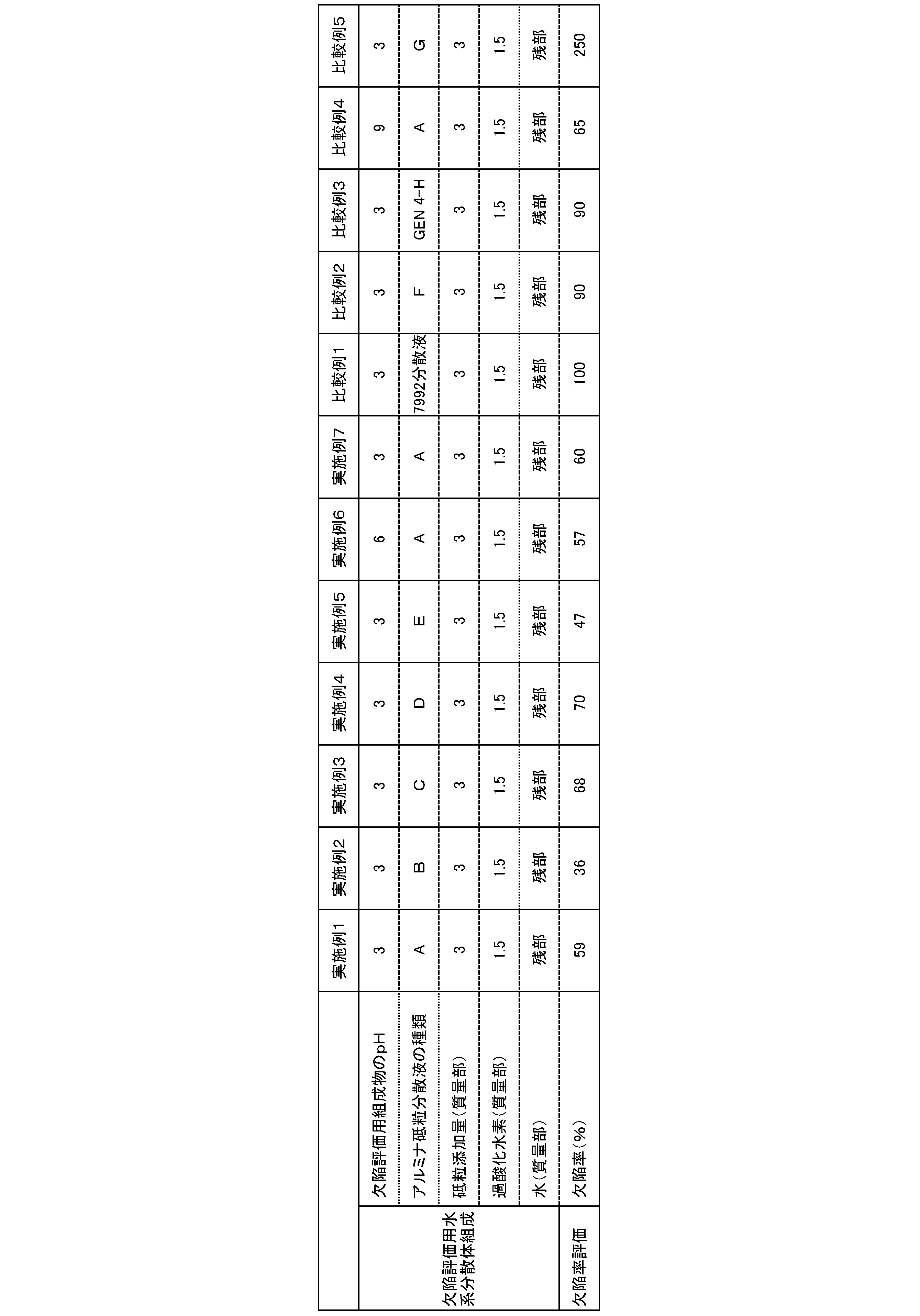
上表1~上表2において、各成分の数値は質量部を表す。各実施例及び各比較例において、表中の化学機械研磨用水系分散体中の各成分の合計量は100質量部となる。上表1~上表2に記載されたアルミナ砥粒分散液及びアルコキシシラン化合物の略称は以下の通りである。
<アルミナ砥粒分散液>
・7992分散液:製品名「7992アルミナ分散液」、Saint-Gobain Ceramic Materials,Inc.製
・GEN 4-H:製品名、Saint-Gobain Ceramic Materials,Inc.製、アルミナ分散液
<アルコキシシラン化合物>
・APTES:東京化成工業株式会社製、3-アミノプロピルトリエトキシシラン
・AAPTMS:東京化成工業株式会社製、N-2-(アミノエチル)-3-アミノプロピルトリメトキシシラン
・7992分散液:製品名「7992アルミナ分散液」、Saint-Gobain Ceramic Materials,Inc.製
・GEN 4-H:製品名、Saint-Gobain Ceramic Materials,Inc.製、アルミナ分散液
<アルコキシシラン化合物>
・APTES:東京化成工業株式会社製、3-アミノプロピルトリエトキシシラン
・AAPTMS:東京化成工業株式会社製、N-2-(アミノエチル)-3-アミノプロピルトリメトキシシラン
実施例1~7の本願発明に係る化学機械研磨用水系分散体では、シラン化合物の被膜で被覆されたアルミナ砥粒を使用することで、化学機械研磨用水系分散体の分散安定性に優れ、配線材料であるタングステン膜を高速で研磨できることがわかった。さらに、実施例1~7の欠陥評価用組成物によれば、基板の被研磨面の欠陥率を低減できることがわかった。
比較例1は、砥粒としてシラン化合物の被膜で被覆されていないアルミナ砥粒を含有する化学機械研磨用水系分散体を使用した例である。この場合の欠陥評価では、シラン化合物の被膜で被覆されていないアルミナ砥粒の使用による研磨後基板の欠陥率が大きかった。
比較例2は、通常の粒子表面処理に用いられる量まで合成時モノマー量を減量した時の例である。アルミナ砥粒表面にはポリマー被覆層は観察されなかった。欠陥評価では、シラン化合物の被膜が十分に形成されていないアルミナ砥粒の使用により、研磨後基板の欠陥面積率が未被覆アルミナ(比較例1)に近く、実施例1~7に比べてかなり大きかった。
比較例3は、砥粒としてシラン化合物の被膜で被覆されていない小粒径アルミナ粒子を含有する化学機械研磨用水系分散体を使用した例である。この場合には、欠陥評価では、シラン化合物の被膜で被覆されていない大粒径アルミナ粒子の使用(比較例1)と比較して、研磨後基板の欠陥率が小さかったが、ポリマー被覆したアルミナ砥粒(実施例1)と比べると欠陥率が大きかった。
比較例4は、砥粒として実施例1と同じシラン化合物で被覆したアルミナ砥粒を使用した例であるが、pHが9である化学機械研磨用組成物を使用している。シラン化合物で被覆されたアルミナ砥粒のゼータ電位の絶対値が小さくなり、これらの砥粒同士が凝集してしまうため、タングステン膜の研磨速度が小さくなったが、シリコン酸化膜と窒化ケイ素膜の研磨速度が大きくなった。また、砥粒の凝集によりシリコン酸化膜表面の欠陥率が増大した。
比較例5は、砥粒として実施例1の合成法と同様に、住友化学社製の焼成アルミナAA-04を用いたシラン化合物の被膜で被覆されたアルミナ砥粒を含有する化学機械研磨用水系分散体を使用した例である。XRF半値幅が0.2685と実施例よりも小さく、他の実施例と比べて結晶の単位が大きいと推定される。そのため、欠陥率が250%と著しく大きくなった。また、分散液の安定性が著しく悪くなった。
本発明は、上述した実施形態に限定されるものではなく、種々の変形が可能である。例えば、本発明は、実施形態で説明した構成と実質的に同一の構成(例えば、機能、方法および結果が同一の構成、あるいは目的および効果が同一の構成)を含む。また、本発明は、実施形態で説明した構成の本質的でない部分を置き換えた構成を含む。また、本発明は、実施形態で説明した構成と同一の作用効果を奏する構成または同一の目的を達成することができる構成を含む。また、本発明は、実施形態で説明した構成に公知技術を付加した構成を含む。
10…アルミナ砥粒(コア部)、12…シラン化合物の被膜(シェル部)、42…スラリー供給ノズル、44…スラリー(化学機械研磨用水系分散体)、46…研磨布、48…ターンテーブル、50…基板、52…キャリアーヘッド、54…水供給ノズル、56…ドレッサー、100…アルミナ砥粒、200…研磨装置
Claims (7)
- (A)少なくとも表面の一部がシラン化合物の被膜で被覆されたアルミナ砥粒と、
(B)酸化剤と、
を含有し、
前記(A)成分における、ケイ素のモル数をMSi、アルミニウムのモル数をMAlとしたときに、MSi/MAlの値が0.01以上0.2以下であり、
前記(A)成分は、粉末X線回折パターンにおける入射角が25°以上75°以下の範囲において、回折強度が最大となるピーク部分の半値幅が0.3°以上0.5°以下であり、
pHが1以上6以下である、化学機械研磨用水系分散体。 - 前記(A)成分の平均一次粒径が30nm以上300nm以下である、請求項1に記載の化学機械研磨用水系分散体。
- 前記(A)成分における、シラン化合物の被膜の膜厚が1nm以上10nm以下である、請求項1または請求項2に記載の化学機械研磨用水系分散体。
- タングステンを含有する基板研磨用である、請求項1ないし請求項3のいずれか一項に記載の化学機械研磨用水系分散体。
- 前記基板が、窒化ケイ素、二酸化ケイ素、アモルファスシリコン、銅、コバルト、チタン、ルテニウム、窒化チタン、及び窒化タンタルから選択される1種以上をさらに含有する、請求項4に記載の化学機械研磨用水系分散体。
- 請求項1ないし請求項3のいずれか一項に記載の化学機械研磨用水系分散体を用いて、タングステンを含有する基板を研磨する工程を含む、化学機械研磨方法。
- 前記基板が、窒化ケイ素、二酸化ケイ素、アモルファスシリコン、銅、コバルト、チタン、ルテニウム、窒化チタン、及び窒化タンタルから選択される1種以上をさらに含有する、請求項6に記載の化学機械研磨方法。
Applications Claiming Priority (2)
| Application Number | Priority Date | Filing Date | Title |
|---|---|---|---|
| JP2018161242A JP7167558B2 (ja) | 2018-08-30 | 2018-08-30 | 化学機械研磨用水系分散体 |
| JP2018-161242 | 2018-08-30 |
Publications (1)
| Publication Number | Publication Date |
|---|---|
| WO2020045088A1 true WO2020045088A1 (ja) | 2020-03-05 |
Family
ID=69643656
Family Applications (1)
| Application Number | Title | Priority Date | Filing Date |
|---|---|---|---|
| PCT/JP2019/031891 Ceased WO2020045088A1 (ja) | 2018-08-30 | 2019-08-13 | 化学機械研磨用水系分散体及び化学機械研磨方法 |
Country Status (3)
| Country | Link |
|---|---|
| JP (1) | JP7167558B2 (ja) |
| TW (1) | TWI826498B (ja) |
| WO (1) | WO2020045088A1 (ja) |
Cited By (1)
| Publication number | Priority date | Publication date | Assignee | Title |
|---|---|---|---|---|
| EP4493635A4 (en) * | 2022-03-18 | 2026-03-11 | Versum Mat Us Llc | MECHANO-CHEMICAL PLANARIZATION USING AMINO-POLYORGANOSILOXANE-COATED ABRASIVES |
Families Citing this family (3)
| Publication number | Priority date | Publication date | Assignee | Title |
|---|---|---|---|---|
| US12138737B2 (en) * | 2021-03-31 | 2024-11-12 | Rohm and Haas Electronic Materials Holdings, Inc. | CMP polishing pad with enhanced rate |
| KR102874526B1 (ko) * | 2022-12-19 | 2025-10-21 | 한남대학교 산학협력단 | Cmp 슬러리의 연마입자 표면에 코팅된 아크릴 폴리머 분산제의 특성연구 |
| TWI908251B (zh) * | 2024-08-12 | 2025-12-11 | 關東鑫林科技股份有限公司 | 研磨組成物及其檢測方式 |
Citations (8)
| Publication number | Priority date | Publication date | Assignee | Title |
|---|---|---|---|---|
| JPH07315832A (ja) * | 1994-05-20 | 1995-12-05 | Catalysts & Chem Ind Co Ltd | シリカ修飾アルミナゾルおよびその製造方法 |
| JP2003511850A (ja) * | 1999-10-06 | 2003-03-25 | サンーゴバン セラミックス アンド プラスティクス,インコーポレイティド | Cmp生成物 |
| JP2003512501A (ja) * | 1999-10-15 | 2003-04-02 | サンーゴバン セラミックス アンド プラスティクス,インコーポレイティド | 改良されたcmp生成物 |
| JP2009504561A (ja) * | 2005-08-18 | 2009-02-05 | クラリアント・インターナシヨナル・リミテッド | シランで表面改質されたナノコランダムの製造方法 |
| JP2009062244A (ja) * | 2007-09-07 | 2009-03-26 | Nissan Motor Co Ltd | 粒子分散溶液およびその樹脂組成物ならびにそれらの製造方法 |
| JP2010197479A (ja) * | 2009-02-23 | 2010-09-09 | Seiko Epson Corp | トナー外添用アルミナ微粒子、トナー、画像形成方法および画像形成装置 |
| JP2014181159A (ja) * | 2013-03-21 | 2014-09-29 | Tokuyama Corp | 球状アルミナ粒子の粉体とその製造方法 |
| WO2018147074A1 (ja) * | 2017-02-08 | 2018-08-16 | 日立化成株式会社 | 研磨液及び研磨方法 |
Family Cites Families (1)
| Publication number | Priority date | Publication date | Assignee | Title |
|---|---|---|---|---|
| JPWO2016024624A1 (ja) * | 2014-08-15 | 2017-07-06 | Dic株式会社 | 研磨材、その製造方法および研磨材組成物 |
-
2018
- 2018-08-30 JP JP2018161242A patent/JP7167558B2/ja active Active
-
2019
- 2019-08-08 TW TW108128257A patent/TWI826498B/zh active
- 2019-08-13 WO PCT/JP2019/031891 patent/WO2020045088A1/ja not_active Ceased
Patent Citations (8)
| Publication number | Priority date | Publication date | Assignee | Title |
|---|---|---|---|---|
| JPH07315832A (ja) * | 1994-05-20 | 1995-12-05 | Catalysts & Chem Ind Co Ltd | シリカ修飾アルミナゾルおよびその製造方法 |
| JP2003511850A (ja) * | 1999-10-06 | 2003-03-25 | サンーゴバン セラミックス アンド プラスティクス,インコーポレイティド | Cmp生成物 |
| JP2003512501A (ja) * | 1999-10-15 | 2003-04-02 | サンーゴバン セラミックス アンド プラスティクス,インコーポレイティド | 改良されたcmp生成物 |
| JP2009504561A (ja) * | 2005-08-18 | 2009-02-05 | クラリアント・インターナシヨナル・リミテッド | シランで表面改質されたナノコランダムの製造方法 |
| JP2009062244A (ja) * | 2007-09-07 | 2009-03-26 | Nissan Motor Co Ltd | 粒子分散溶液およびその樹脂組成物ならびにそれらの製造方法 |
| JP2010197479A (ja) * | 2009-02-23 | 2010-09-09 | Seiko Epson Corp | トナー外添用アルミナ微粒子、トナー、画像形成方法および画像形成装置 |
| JP2014181159A (ja) * | 2013-03-21 | 2014-09-29 | Tokuyama Corp | 球状アルミナ粒子の粉体とその製造方法 |
| WO2018147074A1 (ja) * | 2017-02-08 | 2018-08-16 | 日立化成株式会社 | 研磨液及び研磨方法 |
Cited By (1)
| Publication number | Priority date | Publication date | Assignee | Title |
|---|---|---|---|---|
| EP4493635A4 (en) * | 2022-03-18 | 2026-03-11 | Versum Mat Us Llc | MECHANO-CHEMICAL PLANARIZATION USING AMINO-POLYORGANOSILOXANE-COATED ABRASIVES |
Also Published As
| Publication number | Publication date |
|---|---|
| JP2020035894A (ja) | 2020-03-05 |
| TWI826498B (zh) | 2023-12-21 |
| TW202009281A (zh) | 2020-03-01 |
| JP7167558B2 (ja) | 2022-11-09 |
Similar Documents
| Publication | Publication Date | Title |
|---|---|---|
| TWI814880B (zh) | 化學機械研磨用水系分散體 | |
| JP6797811B2 (ja) | 研磨方法 | |
| TWI826498B (zh) | 化學機械研磨用水系分散體 | |
| WO2019151145A1 (ja) | 化学機械研磨用組成物及び研磨方法 | |
| TWI842954B (zh) | 化學機械研磨用組成物以及化學機械研磨方法 | |
| WO2021117428A1 (ja) | 化学機械研磨用組成物及び研磨方法 | |
| JP2023072344A (ja) | 化学機械研磨用組成物および研磨方法 | |
| TWI788517B (zh) | 化學機械研磨用組成物及研磨方法 | |
| JP6916192B2 (ja) | 研磨用組成物、ならびにこれを用いた研磨方法および半導体基板の製造方法 | |
| TW202403007A (zh) | 研磨粒的製造方法、化學機械研磨用組成物及研磨方法 | |
| JP7167557B2 (ja) | 化学機械研磨用アルミナ砥粒及びその製造方法 | |
| US20230064047A1 (en) | Composition for chemical mechanical polishing, method for chemical mechanical polishing, and method for manufacturing chemical mechanical polishing particles | |
| WO2023085007A1 (ja) | 化学機械研磨用組成物および研磨方法 | |
| TW202007752A (zh) | 化學機械研磨用水系分散體及其製造方法 | |
| TW202106849A (zh) | 磨粒及化學機械研磨用組成物 | |
| TW202525967A (zh) | 化學機械研磨用組成物及研磨方法 | |
| US20230034503A1 (en) | Composition for chemical mechanical polishing, chemical mechanical polishing method, and method for manufacturing particles for chemical mechanical polishing | |
| TW202525969A (zh) | 化學機械研磨用組成物及研磨方法 | |
| JP2025158298A (ja) | 化学機械研磨用組成物及び研磨方法 | |
| JP2025158299A (ja) | 化学機械研磨用組成物及び研磨方法 | |
| WO2026079146A1 (ja) | 砥粒の製造方法、化学機械研磨用組成物および研磨方法 | |
| WO2023085008A1 (ja) | 化学機械研磨用組成物およびその製造方法、ならびに研磨方法 |
Legal Events
| Date | Code | Title | Description |
|---|---|---|---|
| 121 | Ep: the epo has been informed by wipo that ep was designated in this application |
Ref document number: 19854618 Country of ref document: EP Kind code of ref document: A1 |
|
| NENP | Non-entry into the national phase |
Ref country code: DE |
|
| 122 | Ep: pct application non-entry in european phase |
Ref document number: 19854618 Country of ref document: EP Kind code of ref document: A1 |