WO2020032100A1 - フィトケミカル吸収促進用組成物 - Google Patents
フィトケミカル吸収促進用組成物 Download PDFInfo
- Publication number
- WO2020032100A1 WO2020032100A1 PCT/JP2019/031112 JP2019031112W WO2020032100A1 WO 2020032100 A1 WO2020032100 A1 WO 2020032100A1 JP 2019031112 W JP2019031112 W JP 2019031112W WO 2020032100 A1 WO2020032100 A1 WO 2020032100A1
- Authority
- WO
- WIPO (PCT)
- Prior art keywords
- absorption
- composition
- soluble
- poorly water
- promoting
- Prior art date
- Legal status (The legal status is an assumption and is not a legal conclusion. Google has not performed a legal analysis and makes no representation as to the accuracy of the status listed.)
- Ceased
Links
Images


Classifications
-
- A—HUMAN NECESSITIES
- A61—MEDICAL OR VETERINARY SCIENCE; HYGIENE
- A61K—PREPARATIONS FOR MEDICAL, DENTAL OR TOILETRY PURPOSES
- A61K35/00—Medicinal preparations containing materials or reaction products thereof with undetermined constitution
- A61K35/12—Materials from mammals; Compositions comprising non-specified tissues or cells; Compositions comprising non-embryonic stem cells; Genetically modified cells
- A61K35/20—Milk; Whey; Colostrum
-
- A—HUMAN NECESSITIES
- A23—FOODS OR FOODSTUFFS; TREATMENT THEREOF, NOT COVERED BY OTHER CLASSES
- A23C—DAIRY PRODUCTS, e.g. MILK, BUTTER OR CHEESE; MILK OR CHEESE SUBSTITUTES; PREPARATION THEREOF
- A23C9/00—Milk preparations; Milk powder or milk powder preparations
- A23C9/12—Fermented milk preparations; Treatment using microorganisms or enzymes
- A23C9/123—Fermented milk preparations; Treatment using microorganisms or enzymes using only microorganisms of the genus lactobacteriaceae; Yoghurt
- A23C9/1238—Fermented milk preparations; Treatment using microorganisms or enzymes using only microorganisms of the genus lactobacteriaceae; Yoghurt using specific L. bulgaricus or S. thermophilus microorganisms; using entrapped or encapsulated yoghurt bacteria; Physical or chemical treatment of L. bulgaricus or S. thermophilus cultures; Fermentation only with L. bulgaricus or only with S. thermophilus
-
- A—HUMAN NECESSITIES
- A23—FOODS OR FOODSTUFFS; TREATMENT THEREOF, NOT COVERED BY OTHER CLASSES
- A23C—DAIRY PRODUCTS, e.g. MILK, BUTTER OR CHEESE; MILK OR CHEESE SUBSTITUTES; PREPARATION THEREOF
- A23C9/00—Milk preparations; Milk powder or milk powder preparations
- A23C9/12—Fermented milk preparations; Treatment using microorganisms or enzymes
- A23C9/13—Fermented milk preparations; Treatment using microorganisms or enzymes using additives
-
- A—HUMAN NECESSITIES
- A23—FOODS OR FOODSTUFFS; TREATMENT THEREOF, NOT COVERED BY OTHER CLASSES
- A23L—FOODS, FOODSTUFFS OR NON-ALCOHOLIC BEVERAGES, NOT OTHERWISE PROVIDED FOR; PREPARATION OR TREATMENT THEREOF
- A23L33/00—Modifying nutritive qualities of foods; Dietetic products; Preparation or treatment thereof
- A23L33/10—Modifying nutritive qualities of foods; Dietetic products; Preparation or treatment thereof using additives
- A23L33/135—Bacteria or derivatives thereof, e.g. probiotics
-
- A—HUMAN NECESSITIES
- A61—MEDICAL OR VETERINARY SCIENCE; HYGIENE
- A61K—PREPARATIONS FOR MEDICAL, DENTAL OR TOILETRY PURPOSES
- A61K35/00—Medicinal preparations containing materials or reaction products thereof with undetermined constitution
- A61K35/66—Microorganisms or materials therefrom
- A61K35/74—Bacteria
- A61K35/741—Probiotics
- A61K35/744—Lactic acid bacteria, e.g. enterococci, pediococci, lactococci, streptococci or leuconostocs
-
- A—HUMAN NECESSITIES
- A61—MEDICAL OR VETERINARY SCIENCE; HYGIENE
- A61K—PREPARATIONS FOR MEDICAL, DENTAL OR TOILETRY PURPOSES
- A61K35/00—Medicinal preparations containing materials or reaction products thereof with undetermined constitution
- A61K35/66—Microorganisms or materials therefrom
- A61K35/74—Bacteria
- A61K35/741—Probiotics
- A61K35/744—Lactic acid bacteria, e.g. enterococci, pediococci, lactococci, streptococci or leuconostocs
- A61K35/747—Lactobacilli, e.g. L. acidophilus or L. brevis
-
- A—HUMAN NECESSITIES
- A61—MEDICAL OR VETERINARY SCIENCE; HYGIENE
- A61K—PREPARATIONS FOR MEDICAL, DENTAL OR TOILETRY PURPOSES
- A61K9/00—Medicinal preparations characterised by special physical form
- A61K9/0012—Galenical forms characterised by the site of application
- A61K9/0053—Mouth and digestive tract, i.e. intraoral and peroral administration
- A61K9/0056—Mouth soluble or dispersible forms; Suckable, eatable, chewable coherent forms; Forms rapidly disintegrating in the mouth; Lozenges; Lollipops; Bite capsules; Baked products; Baits or other oral forms for animals
-
- A—HUMAN NECESSITIES
- A61—MEDICAL OR VETERINARY SCIENCE; HYGIENE
- A61P—SPECIFIC THERAPEUTIC ACTIVITY OF CHEMICAL COMPOUNDS OR MEDICINAL PREPARATIONS
- A61P3/00—Drugs for disorders of the metabolism
- A61P3/02—Nutrients, e.g. vitamins, minerals
-
- A—HUMAN NECESSITIES
- A23—FOODS OR FOODSTUFFS; TREATMENT THEREOF, NOT COVERED BY OTHER CLASSES
- A23L—FOODS, FOODSTUFFS OR NON-ALCOHOLIC BEVERAGES, NOT OTHERWISE PROVIDED FOR; PREPARATION OR TREATMENT THEREOF
- A23L33/00—Modifying nutritive qualities of foods; Dietetic products; Preparation or treatment thereof
- A23L33/10—Modifying nutritive qualities of foods; Dietetic products; Preparation or treatment thereof using additives
- A23L33/105—Plant extracts, their artificial duplicates or their derivatives
- A23L33/11—Plant sterols or derivatives thereof, e.g. phytosterols
-
- A—HUMAN NECESSITIES
- A23—FOODS OR FOODSTUFFS; TREATMENT THEREOF, NOT COVERED BY OTHER CLASSES
- A23V—INDEXING SCHEME RELATING TO FOODS, FOODSTUFFS OR NON-ALCOHOLIC BEVERAGES AND LACTIC OR PROPIONIC ACID BACTERIA USED IN FOODSTUFFS OR FOOD PREPARATION
- A23V2400/00—Lactic or propionic acid bacteria
- A23V2400/11—Lactobacillus
- A23V2400/123—Bulgaricus
-
- A—HUMAN NECESSITIES
- A23—FOODS OR FOODSTUFFS; TREATMENT THEREOF, NOT COVERED BY OTHER CLASSES
- A23V—INDEXING SCHEME RELATING TO FOODS, FOODSTUFFS OR NON-ALCOHOLIC BEVERAGES AND LACTIC OR PROPIONIC ACID BACTERIA USED IN FOODSTUFFS OR FOOD PREPARATION
- A23V2400/00—Lactic or propionic acid bacteria
- A23V2400/21—Streptococcus, lactococcus
- A23V2400/249—Thermophilus
-
- C—CHEMISTRY; METALLURGY
- C12—BIOCHEMISTRY; BEER; SPIRITS; WINE; VINEGAR; MICROBIOLOGY; ENZYMOLOGY; MUTATION OR GENETIC ENGINEERING
- C12N—MICROORGANISMS OR ENZYMES; COMPOSITIONS THEREOF; PROPAGATING, PRESERVING, OR MAINTAINING MICROORGANISMS; MUTATION OR GENETIC ENGINEERING; CULTURE MEDIA
- C12N1/00—Microorganisms; Compositions thereof; Processes of propagating, maintaining or preserving microorganisms or compositions thereof; Processes of preparing or isolating a composition containing a microorganism; Culture media therefor
- C12N1/20—Bacteria; Culture media therefor
Definitions
- the present invention relates to a composition for promoting absorption of phytochemicals, which has an effect of promoting absorption of poorly water-soluble phytochemicals into the body.
- Phytochemicals generally refer to plant-derived compounds that are not required for normal body function maintenance but have a positive health effect.
- isoflavones which are polyphenols
- quercetin is abundantly contained in onions and have a function of improving blood flow and reducing body fat.
- ⁇ -carotene, a terpenoid is contained in carrots and pumpkins a lot, and it has a function of maintaining visual function, mucous membrane, skin, and immune function in the body
- lycopene is contained in tomatoes a lot, and functions to lower blood cholesterol and blood pressure. Is shown.
- Patent Document 1 discloses resveratrol, hesperetin, lacanca ( Siraitia grosvenorii extract, jujube (Zizyphus jujuba var.inermis) extract, lime (Citrus aurantiifolia) extract, lemon (Citrus limon) extract, pineapple (Ananas comosus) extract, apigenin, glucose, difructose dianhydride III And at least one selected from the group consisting of sucralose, aspartame or a salt thereof, erythritol, inositol, citric acid or a salt thereof, phytic acid or a salt thereof, and gallic acid or a salt thereof.
- Patent Document 2 discloses that a polyphenol such as catechin having low bioavailability is added to fats and carbohydrates having a specific composition to absorb polyphenols such as catechin and to add plasma to plasma. There is a disclosure that the accumulation of data can be improved.
- Patent Document 3 discloses a catechin bioavailability enhancer containing cyclodextrin as an active ingredient.
- Patent Document 4 discloses fermented milk in which catechins and tocopherols are each contained in a yogurt containing a lactic acid bacterium and a bifidobacterium in an amount of about 0.1 to 2,000 ppm, thereby surviving the bifidobacterium. It is said that the property is improved.
- JP-T-2015-527076 discloses a method for producing a dairy-based nutritional composition having a rich texture, which can contain phytochemicals.
- Patent Document 5 discloses a product of a lactic acid bacterium has an action of promoting the absorption of phytochemicals.
- some of the inventors of the present invention are concerned with the incorporation of phytochemicals in which a lactic acid bacterium product containing a polysaccharide is poorly water-soluble into the body, in particular, the rate of translocation into the blood and / or the amount of translocation. And has proposed a composition having an effect of promoting the absorption of poorly water-soluble phytochemicals into the body (PCT / JP2018 / 010366).
- a lactic acid bacterium product containing a polysaccharide produced by a specific strain can take up poorly water-soluble phytochemicals into the body, in particular, the rate of translocation into the blood and / or the amount of translocation. was found to increase significantly more.
- an object of the present invention is to provide a composition for promoting phytochemical absorption, which has an effect of promoting the absorption of poorly water-soluble phytochemicals into the body.
- Another object of the present invention is to provide a food additive comprising the poorly water-soluble composition for promoting phytochemical absorption, and a food or drink or a food or drink composition to which the additive is added.
- the poorly water-soluble composition for promoting phytochemical absorption comprises a product of a lactic acid bacterium containing a polysaccharide as an active ingredient, and the product of lactic acid bacterium is Lactobacillus del Bruky sub. It is characterized by being produced by the species Bvlgarix OLL1251.
- Food additives, foods and drinks, or food and drink compositions according to the present invention comprise the poorly water-soluble composition for promoting phytochemical absorption according to the present invention.
- the present invention also relates to a method for promoting the uptake of poorly water-soluble phytochemicals into the human or animal body, which comprises administering or ingesting a lactic acid bacterium product containing a polysaccharide to a human or animal. .
- the present invention also relates to the use of a polysaccharide-containing lactic acid bacterium product for promoting the uptake of poorly water-soluble phytochemicals into a human or animal body.
- the present invention also relates to the use of a lactic acid bacterium product containing a polysaccharide for the production of the composition for promoting absorption of a poorly water-soluble phytochemical.
- FIG. 4 is a graph showing changes in serum ⁇ cryptoxanthin concentration when rats were administered ⁇ cryptoxanthin alone or ⁇ cryptoxanthin and yogurt simultaneously.
- FIG. 4 is a graph showing changes in serum ⁇ -cryptoxanthin concentration when capsanthin alone or capsanthin and yogurt were simultaneously administered to rats.
- 4 is a graph showing changes in the concentration of hesperetin conjugate in serum when hesperidin alone or hesperidin and yogurt are simultaneously administered to rats.
- phytochemical refers to a natural chemical substance present in a plant and a modified form thereof and a composition containing the same, and is not essential for maintaining normal body functions, A compound or composition that has been taken or will be taken as having a positive effect on maintenance / improvement. Therefore, in the present invention, phytochemicals include, in addition to pure or compounds having a certain degree of purity derived from plants, those in the form of a composition derived from plants containing such compounds as a main component, such as fractions. Shall mean.
- phytochemicals mean, for example, polyphenols, organic sulfur compounds, terpenoids and the like.
- polyphenols include flavonoids, shigetons, tetraterpenes, and the like. Further specific examples thereof include flavonoids such as flavone (eg, apigenin, luteolin, etc.) and isoflavones (eg, Genistein, daidzein, etc.), flavonols (eg, quercetin, myricetin, kaempferol, etc.), flavanones (eg, hesperetin, naringenin, etc.), flavan-3-ols (eg, catechin, epicatechin, etc.), anthocyanins (eg, cyanidin, Delphinidin). Moreover, curcumin is mentioned as shigeton.
- flavonoids such as flavone (eg, apigenin, luteolin, etc.) and isoflavones (eg, Genistein, daidzein, etc.), flavonols (eg, quercetin, myrice
- organic sulfur compound examples include isothiocyanates (for example, sulforaphane), cysteine sulfoxides (for example, methylcysteine sulfoxide), and sulfines (for example, allicin).
- terpenoids include tetraterpenes, and specific examples thereof include carotenoids (for example, ⁇ -carotene, ⁇ -carotene, ⁇ -cryptoxanthin, lycopene, lutein, capsanthin, astaxanthin, etc.).
- carotenoids for example, ⁇ -carotene, ⁇ -carotene, ⁇ -cryptoxanthin, lycopene, lutein, capsanthin, astaxanthin, etc.
- the phytochemicals also include their analogs, and preferred examples thereof include glycosides (genistin) and conjugates (glucuronide conjugate, sulfate conjugate) for genistein, and quercetin
- glycosides proliferin
- conjugates for genistein
- quercetin For the methylated form (isoramnetin), the glycoside (rutin, quercetin glucoside), the conjugate (glucuronide, sulfate conjugate), and for kaempferol, the glycoside (hesperidin) and the conjugate (glucuronide, Sulfate conjugate).
- epicatechin and catechin isomers (catechin), polymers (procyanidin B1, procyanidin B2, procyanidin B5, procyanidin C1, etc.), conjugates (glucuronic acid conjugate, sulfate conjugate) and gallic esters (epicatechin gallate) , Epigallocatechin gallate).
- Hesperetin includes glycosides (hesperidin) and conjugates (glucuronic acid conjugates, sulfate conjugates), and naringenin includes glycosides (kaempferol, astragalin) and conjugates (glucuronic acid conjugates, sulfate conjugates).
- phytochemicals include extracts and concentrates derived from plants.
- phytochemicals are poorly water-soluble.
- the poorly water-soluble phytochemical has a solubility in water of 88% or less, more preferably 50% or less, more preferably 20% or less, and most preferably 1% or less.
- % Phytochemicals the “dissolution rate” in the present invention is an index representing the ease of dissolution of a compound in water, and after dissolving the compound by shaking it in pure water, the concentration of the supernatant centrifuged. The value obtained by dividing (w / v) by the concentration (w / v) before shaking and dissolving is shown as a percentage (%).
- the concentration can be measured using a spectrophotometer.
- a solution prepared by adding 33.3 mg of the phytochemical compound to 10 mL of pure water is used for measuring the “dissolution rate”.
- the “dissolution rate” may be measured using a solution prepared by adding 3.3 mg to 10 mL of pure water.
- the temperature condition of "dissolution rate” measurement is set to 21 ⁇ 2 ° C.
- the poor water solubility of phytochemicals is determined by measuring the “concentration (w / v) of the supernatant obtained by dissolving a compound by shaking it in pure water and then centrifuging it” obtained in the measurement of the “dissolution rate”.
- a water solubility of 88% or less corresponds to 293 mg / 100 g or less. It is considered that it is not essential that the phytochemical targeted for absorption promotion in the present invention is in a form dissolved in water. That is, it is considered that the effect of accelerating absorption according to the present invention can be obtained even for phytochemicals ingested in a solid state or suspended in water.
- composition for promoting absorption of phytochemicals means that phytochemicals are taken up into the body, especially translocated to the blood, as compared with a control in which phytochemicals are ingested without a lactic acid bacterium product containing polysaccharide.
- AUC blood concentration-time curve
- the effect of phytochemical intake can be obtained in a smaller amount or in a shorter time, and the cost of raw materials can be reduced.
- by adding the composition for promoting phytochemical absorption according to the present invention to foods and drinks and food and drink compositions it is possible to increase the added value of foods and drinks and increase the commercial value.
- Lactic acid bacterium product containing a polysaccharide refers to a lactic acid bacterium culture, a lactic acid bacterium metabolite, etc. Broadly means a composition comprising:
- the “polysaccharide” is a sugar chain polymer composed of sugars such as galactose, glucose, rhamnose, mannose, and N-acetylglucosamine.
- the polysaccharide may include an acidic polysaccharide to which a phosphate group is bound, in addition to the neutral polysaccharide.
- the molecular weight is usually in the range of 5000 to 500,000.
- Lactobacillus delbrucky subspecies bulgaricus (Lactobacillus delbrueckii subsp. Bulgaricus) OLL1251 (hereinafter referred to as “Lactobacillus bulgaricus OLL1251”) or “Lactobacillus delbrueckii subsp. "OLL1251” may be used.
- the “lactic acid bacterium product” produced by OLL1251 has a more excellent action of promoting phytochemical absorption as compared with related strains.
- a “lactic acid bacterium product” produced by combining OLL1251 with Streptococcus thermophilus OLS3290 (hereinafter sometimes abbreviated as “OLS3290”).
- OLS3290 Streptococcus thermophilus OLS3290
- a "lactic acid bacteria product” can be efficiently produced, and in particular, a "lactic acid bacteria product” having an excellent phytochemical absorption promoting action in a short fermentation time can be obtained. Is obtained.
- Lactobacillus del Brookie Subspecies Bulgarix OLL1251 was obtained on April 25, 2018 (contract date) by the Patent and Microorganisms Depositary Center for Patent and Microorganisms, National Institute of Technology and Evaluation (Kasusa Kamafusa, Kisarazu-shi, Chiba, Japan) -5-8 @ 122) and deposited under the accession number NITE @ BP-02703 under the Budapest Treaty.
- Streptococcus thermophilus OLS3290 has been internationally deposited under the Budapest Treaty with the Patent and Microorganisms Depositary of the National Institute of Technology and Evaluation under the accession number FERM @ BP-19638 on January 19, 2004 (accession date). .
- the term “fermented lactic acid bacterium” refers to a lactic acid bacterium Lactobacillus delbruchy subspecies bulgaricus OLL1251 or a combination of Lactobacillus delbruchy subspecies bulgaricus OLL1251 and Streptococcus thermophilus OLS3290 as a preferred embodiment. And compositions comprising the same, obtained by fermentation according to the present invention, and the composition after treating the same.
- this fermented lactic acid bacterium includes a fermented product of Lactobacillus delbrookii subspecies Bulgaris OLL1251, or a combination of Lactobacillus delbruchy subspecies Bulgarix OLL1251 and Streptococcus thermophilus OLS3290, and a processed product thereof.
- a culture (filtrate of lactic acid bacteria) is removed by filtration, centrifugation, membrane separation, etc., and a culture filtrate or culture supernatant, a culture filtrate or culture supernatant, a lactic acid bacteria fermentation product, or the like is removed by an evaporator or the like.
- the treatment can be performed by combining one or more of the above treatment steps such as filtration, centrifugation, sterilization treatment such as membrane separation, precipitation, concentration, pasting, dilution, and drying.
- the culture medium include a skim milk powder medium to which a yeast extract has been added, an MRS medium, and the like.
- the lactic acid bacterium product is a lactic acid bacterium Lactobacillus delbruchy subspecies bulgaricus OLL1251, or a milk obtained by combining Lactobacillus delbruchy subspecies bulgaricus OLL1251 with Streptococcus thermophilus OLS3290.
- Particularly preferred are fermentations, milk cultures and milk metabolites. Fermented milk, milk culture, and milk metabolites include, for example, fermented milk (yogurt).
- the fermented milk (yogurt) can be preferably used as the supernatant.
- This fermented milk may contain a thickening agent or a gelling agent such as pectin, guar gum, xanthan gum, carrageenan, and processed starch, in addition to a culture solution such as skim milk powder and whey decomposition product.
- a thickening agent or a gelling agent such as pectin, guar gum, xanthan gum, carrageenan, and processed starch, in addition to a culture solution such as skim milk powder and whey decomposition product.
- milk includes, for example, animal milk such as cow milk, and processed products thereof (for example, skim milk, whole milk powder, skim milk, spinach, casein, whey, fresh cream, compound cream, butter, and butter). Milk powder, cheese, etc.), and vegetable milk such as soybean-derived soymilk.
- animal milk such as cow milk
- processed products thereof for example, skim milk, whole milk powder, skim milk, spinach, casein, whey, fresh cream, compound cream, butter, and butter
- Milk powder, cheese, etc. and vegetable milk such as soybean-derived soymilk.
- the milk may be sterilized or may not be sterilized.
- a fermented milk raw material mix can be used as a raw material for fermented milk (yogurt).
- Fermented milk raw material mix is a mixture containing raw material milk and other components.
- This fermented milk raw material mix includes, for example, raw materials commonly used in the production of fermented milk such as raw milk, water, and other optional components (for example, sugar, sugars, sweeteners, acidulants, minerals, vitamins, and flavors). It is obtained by heating, dissolving and mixing.
- Raw milk may include water, raw milk, pasteurized milk, skim milk, whole fat milk powder, skim milk powder, whole fat concentrated milk, skim concentrated milk, buttermilk, butter, cream, cheese, and the like. Further, the raw milk may contain whey protein concentrate (WPC), whey protein isolate (WPI), ⁇ -lactalbumin ( ⁇ -La), ⁇ -lactoglobulin ( ⁇ -Lg) and the like. .
- WPC whey protein concentrate
- WPI whey protein isolate
- the fermented milk may be prepared by a method commonly used in the art. That is, fermented milk (yogurt) is produced through a process such as a raw material mix preparation process, a raw material mix (heating) sterilization process, a raw material mix cooling process, a starter addition process, a fermentation process, and a fermented milk cooling process. May be. In these steps, ordinary conditions used for producing fermented milk (yogurt) may be appropriately adopted. Further, the (heat) sterilization step of the raw material mix, the cooling step of the raw material mix, the step of adding the starter, the fermentation step, and the cooling step of the fermented milk are preferably performed in this order.
- a lactic acid bacterium is cultured as a medium for culturing a lactic acid bacterium Lactobacillus delbruchy subspecies Bulgaricus OLL1251, or a combination of Lactobacillus delbruchy subspecies Bulgaris OLLL1251 and Streptococcus thermophilus OLS3290.
- a medium commonly used in the art can be used. That is, any medium can be used as long as the medium contains a nitrogen source, inorganic substances, and other nutrients in addition to the main carbon source.
- the carbon source lactose, glucose, sucrose, fructose, starch hydrolyzate, molasses, etc.
- Organic nitrogen-containing substances such as casein hydrolyzate, whey protein hydrolyzate, ⁇ -lactalbumin, ⁇ -lactoglobulin, glycomacropeptide, and soy protein hydrolyzate can be used as the nitrogen source.
- meat extract, fish meat extract, yeast extract and the like can be used as a growth promoter.
- the lactic acid bacterium Lactobacillus delbruchy subspecies Bulgaris OLL1251, or the combination of Lactobacillus delbruchy subspecies Bulgaris OLL1251 and Streptococcus thermophilus OLS3290 may be cultured in an anaerobic state
- the cells may be cultured in a microaerobic state used in liquid stationary culture or the like.
- a culture method under an anaerobic state for example, a known method such as a method of culturing in a carbon gas gas phase can be employed, but other methods may be employed.
- the culture temperature is generally preferably in the range of 30 ° C to 47 ° C, more preferably in the range of 35 ° C to 46 ° C, and even more preferably in the range of 37 ° C to 45 ° C. .
- the pH of the medium during the lactic acid bacteria culture is preferably maintained in the range of 6 or more and 7 or less, but may be in another pH range as long as the bacteria can grow.
- the culturing time of lactic acid bacteria and the like is usually preferably in the range of 1 hour to 48 hours, more preferably in the range of 1.5 hours to 36 hours, and more preferably in the range of 2 hours to 24 hours. It is more preferred that there be.
- the fermented milk typically has a nonfat milk solid content of 8% by weight or more and a lactic acid bacteria count or a yeast count of 10 6 or more and 10 11 or more. / Ml or less.
- composition for promoting absorption refers to a lactic acid bacterium Lactobacillus delbruchy subspecies Bulgaris OLL1251 as a "product of lactic acid bacteria", or It may be used in the form of a fermented product, culture, metabolite, or the like obtained by combining Lactobacillus delbruchy subspecies Bulgaricus OLL1251 and Streptococcus thermophilus OLS3290, but is preferably used in the form of a formulation.
- composition for promoting absorption in the present invention includes, for example, pharmaceuticals as well as those provided in the form of preparations to be taken as it is, preferably taken orally, so-called supplements,
- agents include those used for adding phytochemical absorption promoting action to other foods, foods and drinks by adding to the foods, foods and drinks.
- the present invention also includes foods and drinks comprising the phytochemical absorption promoting composition of the present invention, processed foods and drinks, and food and drink compositions.
- the preparation is a preparation prepared in accordance with a conventional method, preferably as an oral preparation, in combination with an additive acceptable for preparation.
- the preparation may take the form of solid preparations such as tablets, powders, fine granules, granules, capsules, pills, sustained-release preparations, and liquid preparations such as solutions, suspensions and emulsions.
- acceptable additives for formulation include excipients, stabilizers, preservatives, wetting agents, emulsifiers, lubricants, sweeteners, coloring agents, flavors, buffers, antioxidants, pH And a regulator.
- a seasoning such as a processed seasoning, a flavor seasoning, and a cooking mix, is specifically mentioned.
- foods and drinks and food and drink compositions are those processed for eating and drinking of humans and animals, and include oral solutions such as solutions, suspensions, emulsions, powders, and solid molded products. Any form that can be ingested is not particularly limited.
- Examples of foods and drinks and food and drink compositions include, specifically, dairy products such as milk drinks (including processed milk), yogurts, lactic acid bacteria drinks, fermented milk, ice creams, creams, cheeses; Beverages, fruit juice drinks, vegetable drinks, soy milk drinks, coffee drinks, tea drinks, jelly drinks, nutritional drinks, beauty drinks, powdered drinks such as cocoa and smoothies, sports powder drinks, nutritionally enhanced powder drinks, beauty powders Beverages such as food, powdered soup, steamed bread, concentrated beverages, alcoholic beverages, etc .; bread, pasta, noodles, cake mix, fried flour, bread crumbs, etc .; chocolate, gum, candy, cookies, gummy, Snacks, sweets such as sweets, jellies, puddings and other desserts; curry, pasta sauce, potov, stew, Japanese-style retort foods; processed oils and fats Oils and fats such as vegetables, margarine, spreads, and mayonnaise; instant foods such as freeze-dried foods; processed agricultural products such as canned
- foods and drinks and food and drink compositions include functional foods, healthy nutritional foods, health foods, foods for specified health use, functionally labeled foods, nutritionally functional foods, foods for the sick, infant formulas, and pregnant women Alternatively, it is also included in such categories as nursing milk powder or foods and drinks with a disease risk reduction label.
- disease risk reduction label refers to labeling of foods and beverages that may reduce the disease risk, and is based on a standard determined by the FAO / WHO Joint Food Standards Committee (Codex Committee), or It is a specified or approved display with reference to the standard.
- optional components can be added to the food and drink and the food and drink composition as needed.
- Such optional ingredients are not particularly limited, but are usually included in foods and beverages, such as sweeteners, acidulants, juices and extracts of vegetables, fruits and seeds, vitamins, minerals, amino acids and the like.
- Nutrients lactic acid bacteria (excluding essential lactic acid bacteria according to the embodiment of the present invention), useful microorganisms such as bifidobacteria and propionic acid bacteria and their fermented products, functional sugars such as oligosaccharides, royal jelly, glucosamine , Astaxanthin, collagen, polyphenols, and other existing functional materials, flavors, pH adjusters, excipients, acidulants, coloring agents, emulsifiers, preservatives, and the like.
- useful microorganisms such as bifidobacteria and propionic acid bacteria and their fermented products
- functional sugars such as oligosaccharides, royal jelly, glucosamine , Astaxanthin, collagen, polyphenols, and other existing functional materials
- flavors pH adjusters
- excipients acidulants
- coloring agents coloring agents
- emulsifiers preservatives, and the like.
- a lactic acid bacterium product containing a polysaccharide is used for the production of the composition for promoting poor water-soluble phytochemical absorption according to the present invention. Is provided.
- the intake of the phytochemical absorption-enhancing composition may be determined as appropriate, but according to one embodiment of the present invention, the polysaccharide intake is 200 ⁇ g. Or more, preferably in the range of 200 ⁇ g / day to 60,000 ⁇ g / day, more preferably 300 ⁇ g / day to 45000 ⁇ g / day, and more preferably 400 ⁇ g / day. It is more preferably in the range of 30,000 ⁇ g / day or less, and particularly preferably in the range of 500 ⁇ g / day or more and 15000 ⁇ g / day or less.
- the period of ingestion is not particularly limited, either. For example, it is preferable to ingest at least once orally.
- the required dose can be converted from the required dose in an animal experiment (for example, a mouse experiment) into the required dose to the human body using the following formula based on the Food Safety Commission data.
- (Required administration dose to human body (converted value)) (Necessary administration dose to animal) ⁇ (Lower limit of female body weight: 40 kg) ⁇ (Safety factor: 100)
- the method comprises administering or ingesting a lactic acid bacterium product containing a polysaccharide to a human or an animal, which is poorly water-soluble in the human or animal body.
- Methods are provided for promoting uptake of sex phytochemicals.
- use of a lactic acid bacterium product containing a polysaccharide for promoting uptake of a poorly water-soluble phytochemical into a human or animal body.
- Lactobacillus del Brooke Subspecies Bulgarix OLL1247 The strain was deposited on March 6, 2014 (contract date) with the Patent and Microorganisms Depositary Center for Product Evaluation and Technology, Japan (Room No. 2-5-8 Kazusa-Kamashita 122, Kasusa-Kamashita, Kisarazu-shi, Chiba, Japan). It has been internationally deposited as NITE BP-01814 under the Budapest Treaty.
- Lactobacillus del Brooke Subspecies Bulgarix OLL1224 The strain was deposited on July 2, 2009 (accession date) under the deposit number NITE BP-778 at the National Institute of Technology and Evaluation, Patent Microorganisms Depositary under the Budapest Treaty.
- Streptococcus thermophilus OLS3078 The strain was deposited on August 23, 2013 (accession date) with the National Institute of Technology and Evaluation Patent Microorganisms Depositary under the Budapest Treaty under the accession number NITE BP-01697.
- Quercetin conjugate which is a quercetin metabolite, and isorhamnetin conjugate were measured as follows.
- a glucuronidase solution dissolved in 0.1 M sodium acetate buffer (pH 5.0) was dissolved in 45 ⁇ L (10000 U / mL, manufactured by Sigma-Aldrich) and 0.1 M sodium acetate buffer (pH 5.0) in 50 ⁇ L of serum.
- 5 ⁇ L of the 0.1 M ascorbic acid solution was added, and the mixture was heated at 37 ° C. for 2 hours.
- 300 ⁇ L of methanol was added to stop the enzyme reaction, followed by centrifugation (12000 rpm, 10 minutes, 4 ° C.). The supernatant was transferred to another tube and the solvent was removed by centrifugal concentration.
- the sample was dissolved in 300 ⁇ L of a 50% acetonitrile solution containing 0.1% formic acid to prepare a sample for HPLC.
- HPLC used Nexera XR manufactured by Shimadzu Corporation
- MS / MS detector used was 4500QTRAP (manufactured by CYEX).
- As the column ACQUITY UPLC HSS T3 1.8 ⁇ m (2.1 ⁇ 50 mm) (manufactured by Waters) was used, and the column temperature was set to 40 ° C.
- As the mobile phase a 0.1% formic acid solution containing 0.1% formic acid was prepared as solution A, and a 0.1% formic acid containing acetonitrile solution was prepared as solution B. The solution was kept at 30% of solution B for 1 minute, and then a gradient was applied to 45% of solution B over 4.5 minutes to elute the target substance.
- MS / MS analysis was performed in ESI negative mode.
- the MS / MS analysis conditions were set at a curtain gas flow rate of 30 psi, a collision gas flow rate of 9 psi, an ion spray voltage of -4500 V, a turbo gas temperature of 600 ° C., and an ion source gas of 70 psi.
- HPLC HPLC used a 1200 series (manufactured by Agilent Technologies).
- the column used was TSKgel @ ODS-80TsQA (5.0 ⁇ 250 mm) (manufactured by Tosoh Corporation), and the column temperature was set to 40 ° C.
- As the mobile phase a methanol solution containing 30% ethyl acetate and 70% methanol containing 0.1% ammonium acetate was prepared. The flow rate was set at 0.3 mL / min, and the absorption wavelength at 450 nm was measured.
- Absorbance of the centrifuged supernatant (epicatechin, catechin, hesperidin, naringin, naringenin, luteolin is 280 nm, genistein is 260 nm, quercetin, rutin, ⁇ -glucosyl rutin, kaempferol is 360 nm, ⁇ -carotene, ⁇ -carotene, ⁇ cryptoxanthin is 450 nm, Lycopene and capsanthin were measured at 470 nm) using a spectrophotometer. Each compound was dissolved using 80% methanol or methanol, a calibration curve was prepared, and the concentration of the centrifuged supernatant was determined.
- Dissolution rate (%) ((concentration (w / v) of centrifugal supernatant after shaking and dissolution) / (concentration (w / v) of solution before shaking and dissolution) ⁇ 100
- ⁇ -carotene group the group of rats to which ⁇ -carotene was administered (control) is referred to as “ ⁇ -carotene group”, and the group of rats (Example) to which ⁇ -carotene and yogurt (Lactobacillus bulgaricus OLL1251) were administered are referred to as “ ⁇ -carotene + OLL1251 group”.
- a group of rats (comparative example) administered with ⁇ -carotene and yogurt (Lactobacillus bulgaricans OLL1224) was referred to as “ ⁇ -carotene + OLL1224 group”
- ⁇ -carotene + OLL1224 group a group of rats administered with ⁇ -carotene and yogurt (Lactobacillus bulgaricans OLL1247) (comparative example). Is referred to as “ ⁇ -carotene + OLL1247 group”.
- ⁇ -carotene group the group of rats to which ⁇ -carotene was administered (control) is referred to as “ ⁇ -carotene group”, and the group of rats to which ⁇ -carotene and yogurt (Streptococcus thermophilus OLS3290) were administered (Reference Example) are “ ⁇ -carotene + OLS3290 group” and ⁇ -carotene.
- ⁇ -carotene + OLS3078 group a group of rats to which yogurt (Streptococcus thermophilus OLS3078) was administered.
- ⁇ -carotene was administered at 5 mg / kg body weight
- yogurt was administered at 11.3 g / kg body weight.
- Blood was collected from the tail vein before administration and at 60, 120, 240, and 480 minutes after administration to obtain serum.
- the serum concentration of ⁇ -carotene was measured according to the method described above.
- ⁇ -carotene group the group of rats to which ⁇ -carotene was administered (control) is referred to as “ ⁇ -carotene group”, and the group of rats to which ⁇ -carotene and yogurt (Caspian yogurt) were administered (comparative example) is “ ⁇ -carotene + Caspian YG group”.
- a group of rats (comparative example) to which ⁇ -carotene and yogurt Lactobacillus bulgaricus OLL1247 and Streptococcus thermophilus OLS3078 were administered was referred to as “ ⁇ -carotene + OLL1247 ⁇ OLS3078 group”, ⁇ -carotene and yogurt (Lactobacillus bulgaricans OLL1251 and Streptococcus strophycoccus).
- the group of rats (Example) to which OLS3290 was administered is referred to as “ ⁇ -carotene + OLL1251 ⁇ OLS3290 group”.
- Results were as shown in Table 4.
- the area under the blood concentration-time curve (AUC) was significantly increased in the ⁇ -carotene + OLL1247 ⁇ OLS3078 group and the ⁇ -carotene + OLL1251 ⁇ OLS3290 group as compared with the ⁇ -carotene group. This result indicates that ingestion of yogurt promotes absorption of ⁇ -carotene.
- quercetin group the group of rats to which quercetin was administered (control) is referred to as “quercetin group”, and the group of rats (comparative example) to which quercetin and yogurt (Lactobacillus bulgaricus OLL1247 and Streptococcus thermophilus OLS3078) were administered is referred to as “quercetin + OLL1247 ⁇ OLL3078”.
- Group ", and a group of rats (Examples) to which quercetin and yogurt (Lactobacillus bulgaricans OLL1251 and Streptococcus thermophilus OLS3290) were administered are referred to as" quercetin + OLL1251 ⁇ OLL3290 group ".
- ⁇ -carotene group a group of rats administered ⁇ -carotene (control) is referred to as “ ⁇ -carotene group”, and a group of rats administered ⁇ -carotene and a polysaccharide concentrate derived from lactic acid bacteria (Example) is referred to as “ ⁇ -carotene + lactic acid bacteria-derived”.
- ⁇ -carotene + digestible dextrin group The group of rats to which sex dextrin was administered (Comparative Example) is referred to as “ ⁇ -carotene + digestible dextrin group”.
- Results were as shown in Table 6.
- the area under the serum concentration-time curve (AUC) was significantly increased in the ⁇ -carotene + lactic acid bacteria-derived polysaccharide concentrate group as compared to the ⁇ -carotene group.
- the value significantly decreased in the ⁇ -carotene + cyclodextrin group. This result indicates that intake of polysaccharide derived from lactic acid bacteria promotes absorption of ⁇ -carotene as compared with other polysaccharides.
- vegetable juice when vegetable juice is ingested (control), it is referred to as “vegetable juice group”, and when vegetable juice and yogurt are ingested (example), it is referred to as “vegetable juice + yogurt group”. .
- Experimental Example 8 Promotion of carotenoid absorption in humans (addition to preparation containing ⁇ -carotene and lycopene) (1) Yogurt used The yogurt prepared in Experimental Example 7 was used.
- carotenoid preparation group vegetable juice is ingested (control)
- carotenoid preparation + yogurt group the case where carotenoid preparation and yogurt are ingested
- mice (SD, male, 8 weeks old, Japan SLC, Inc.) were acclimated for 7 days, and then the rats were divided into groups of 8 rats. After a 16-hour fast, rats in each group were administered ⁇ -cryptoxanthin, ⁇ -cryptoxanthin and yogurt, respectively. In addition, ⁇ cryptoxanthin was administered at 3 mg / kg body weight, and yogurt was administered at 11.3 g / kg body weight. Blood was collected from the tail vein before administration and at 60, 120, 240, and 480 minutes after administration to obtain serum.
- ⁇ cryptoxanthin group a group of rats administered ⁇ cryptoxanthin (control)
- ⁇ cryptoxanthin + yogurt group a group of rats administered ⁇ cryptoxanthin and yogurt
- Shall be called.
- HPLC analysis conditions The HPLC used was a 1200 series (manufactured by Agilent Technologies). The column used was TSKgel ODS-80TsQA (5.0 ⁇ 250 mm) (manufactured by Tosoh Corporation), and the column temperature was set at 40 ° C. As the mobile phase, a methanol solution containing 30% ethyl acetate and 70% methanol containing 0.1% ammonium acetate was prepared. The flow rate was set at 0.3 mL / min, and the absorption wavelength at 450 nm was measured.
- Experimental Example 10 Yogurt Using Capsanthin Absorption Promotion (1) The yogurt used in Experimental Example 9 was used.
- mice (SD, male, 8 weeks old, Japan SLC, Inc.) were acclimated for 7 days, and then the rats were divided into groups of 8 rats. After a 16-hour fast, rats in each group were administered capsanthin, capsanthin and yogurt, respectively. In addition, capsanthin was administered at 5 mg / kg body weight, and yogurt was administered at 11.3 g / kg body weight. Blood was collected from the tail vein before administration and at 60, 120, 240, and 480 minutes after administration to obtain serum.
- capsanthin group a group of rats to which capsanthin is administered (control)
- capsanthin + yogurt group a group of rats to which capsanthin and yogurt are administered
- HPLC analysis conditions The HPLC used was a 1200 series (manufactured by Agilent Technologies). The column used was TSKgel ODS-80TsQA (5.0 ⁇ 250 mm) (manufactured by Tosoh Corporation), and the column temperature was set at 40 ° C. As the mobile phase, a methanol solution containing 30% ethyl acetate and 70% methanol containing 0.1% ammonium acetate was prepared. The flow rate was set at 0.3 mL / min, and the absorption wavelength at 470 nm was measured.
- Results were as shown in Table 11 and FIG.
- the blood concentration of capsanthin at 60 minutes, 120 minutes, 240 minutes and 480 minutes after the administration was significantly increased in the capsanthin + yogurt group as compared to the capsanthin group.
- the area under the blood curve (AUC) was significantly increased in the capsanthin + yogurt group as compared to the capsanthin group. This result indicates that ingestion of yogurt promotes absorption of capsanthin.
- the symbol “*” indicates that there is a significant difference from the capsanthin group at P ⁇ 0.05.
- Experimental Example 11 Yogurt used for promoting hesperidin absorption (1) The yogurt used in Experimental Example 9 was used.
- mice (SD, male, 8 weeks old, Japan SLC, Inc.) were acclimated for 7 days, and then the rats were divided into groups of 8 rats. After a 16-hour fast, rats in each group were administered hesperidin, hesperidin and yogurt, respectively. Hesperidin was administered at 162 mg / kg body weight, and yogurt was administered at 11.3 g / kg body weight. Before administration, 60 minutes, 120 minutes, and 240 minutes after administration, blood was collected from the tail vein to obtain serum.
- hesperidin group a group of rats to which hesperidin is administered (control)
- hesperidin + yogurt group a group of rats to which hesperidin and yogurt are administered
- Hesperetin conjugate which is a metabolite of hesperidin, was measured as follows.
- a glucuronidase solution dissolved in 0.1 M sodium acetate buffer (pH 5.0) was dissolved in 45 ⁇ L (10000 U / mL, manufactured by Sigma-Aldrich) and 0.1 M sodium acetate buffer (pH 5.0) in 50 ⁇ L of serum.
- 5 ⁇ L of the 0.1 M ascorbic acid solution was added, and the mixture was heated at 37 ° C. for 2 hours.
- 300 ⁇ L of methanol was added to stop the enzyme reaction, followed by centrifugation (12000 rpm, 10 minutes, 4 ° C.). The supernatant was transferred to another tube and the solvent was removed by centrifugal concentration.
- the sample was dissolved in 300 ⁇ L of a 50% acetonitrile solution containing 0.1% formic acid to prepare a sample for HPLC.
- MS / MS analysis was performed in ESI negative mode.
- the MS / MS analysis conditions were set at a curtain gas flow rate of 30 psi, a collision gas flow rate of 9 psi, an ion spray voltage of -4500 V, a turbo gas temperature of 600 ° C., and an ion source gas of 70 psi.
- Results were as shown in Table 12 and FIG.
- the blood concentration of the hesperetin conjugate 60 minutes after administration was significantly higher in the hesperidin + yogurt group than in the hesperidin group.
- the area under the blood curve (AUC) significantly increased in the hesperidin + yogurt group as compared to the hesperidin group.
- the results indicate that ingestion of yogurt promotes absorption of hesperetin conjugate.
- the symbol “*” indicates that there is a significant difference from the hesperidin group at P ⁇ 0.05.
- Experimental Example 12 Change in pH during fermentation of lactic acid bacteria (1) Experimental method A medium containing 10% by mass of non-fat dry milk was inoculated with only Lactobacillus bulgaricans OLL1251, Lactobacillus bulgaricans OLL1251, and Streptococcus thermophilus OLS3290, and the medium was fermented at 43 ° C. and pH was adjusted. Changes were confirmed.
- carrot juice group when carrot juice is ingested (control), it is referred to as “carrot juice group”, and when carrot juice and yogurt are ingested (example), it is referred to as “carrot juice + yogurt group”. .
- tomato juice group when tomato juice is ingested (control) is referred to as “tomato juice group”, and when tomato juice and yogurt are ingested (example) is referred to as “tomato juice + yogurt group”. .
Landscapes
- Health & Medical Sciences (AREA)
- Life Sciences & Earth Sciences (AREA)
- Chemical & Material Sciences (AREA)
- Microbiology (AREA)
- Veterinary Medicine (AREA)
- General Health & Medical Sciences (AREA)
- Animal Behavior & Ethology (AREA)
- Pharmacology & Pharmacy (AREA)
- Medicinal Chemistry (AREA)
- Public Health (AREA)
- Mycology (AREA)
- Engineering & Computer Science (AREA)
- Epidemiology (AREA)
- Molecular Biology (AREA)
- Nutrition Science (AREA)
- Food Science & Technology (AREA)
- Polymers & Plastics (AREA)
- Zoology (AREA)
- General Chemical & Material Sciences (AREA)
- Cell Biology (AREA)
- Nuclear Medicine, Radiotherapy & Molecular Imaging (AREA)
- Chemical Kinetics & Catalysis (AREA)
- Obesity (AREA)
- Hematology (AREA)
- Bioinformatics & Cheminformatics (AREA)
- Biomedical Technology (AREA)
- Biotechnology (AREA)
- Organic Chemistry (AREA)
- Developmental Biology & Embryology (AREA)
- Immunology (AREA)
- Virology (AREA)
- Diabetes (AREA)
- Physiology (AREA)
- Pharmaceuticals Containing Other Organic And Inorganic Compounds (AREA)
- Coloring Foods And Improving Nutritive Qualities (AREA)
- Dairy Products (AREA)
- Medicines Containing Material From Animals Or Micro-Organisms (AREA)
- Acyclic And Carbocyclic Compounds In Medicinal Compositions (AREA)
Abstract
フィトケミカルの体内への取り込み、特に血中への移行の速度および/または移行の量を有意に高めることのできる難水溶性フィトケミカル吸収促進用組成物が開示されている。ラクトバチルス・デルブルッキー・サブスピーシーズ・ブルガリクスOLL1251によって生産される、多糖体を含有する乳酸菌産生物は、フィトケミカルの体内への取り込み、特に血中への移行の速度および/または移行の量を有意に高めることができ、従って、本発明によるフィトケミカル吸収促進用組成物はこれを有効成分とするものである。さらに、このフィトケミカル吸収促進用組成物は、食品添加用組成物として有用であり、またこれらが添加された飲食品または飲食品組成物は、フィトケミカル吸収促進の効果が付加される。
Description
本発明は難水溶性のフィトケミカルの体内への吸収を促進する作用を有するフィトケミカル吸収促進用組成物に関する。
フィトケミカルは、一般的に、通常の身体機能維持には必要とされないが、健康によい影響を与える植物由来の化合物を意味する。例えば、ポリフェノールであるイソフラボンは大豆に多く含まれ、更年期障害改善・骨粗鬆症予防の機能を示し、ケルセチンはたまねぎに多く含まれ、血流改善や体脂肪軽減の機能を示す。また、テルペノイドであるβカロテンはにんじんやかぼちゃに多く含まれ、視機能や体内の粘膜や 皮膚、免疫機能を保つ働きを示し、リコペンはトマトに多く含まれ、血中コレステロールや血圧を低下させる機能を示す。
多くのフィトケミカルは、加工・調理により分解され失われてしまい、さらに難水溶性の成分が多いため、生体内への移行性が低いことが知られている。難水溶性のフィトケミカルの吸収を促進する方法としては、乳化製剤化により溶解性や分散性を向上する方法、粒子径を小さくする方法、非晶化する方法が多く用いられている。
さらに、難水溶性のフィトケミカルの吸収を促進する手法としては、例えば、特開2016-216440号公報(特許文献1)には、カテキン類の吸収促進剤として、レスベラトロール、ヘスペレチン、ラカンカ(Siraitia grosvenorii)抽出物、ナツメ(Zizyphus jujuba var.inermis)抽出物、ライム(Citrus aurantiifolia)抽出物、レモン(Citrus limon)抽出物、パイナップル(Ananas comosus)抽出物、アピゲニン、グルコース、ジフルクトースジアンヒドリドIII、スクラロース、アスパルテーム若しくはその塩、エリスリトール、イノシトール、クエン酸若しくはその塩、フィチン酸若しくはその塩、及び没食子酸若しくはその塩からなる群より選ばれる少なくとも1種が開示されている。
また、特開2016-93143号公報(特許文献2)には、生体利用性が低いカテキン等のポリフェノールを、特定の配合の脂肪及び炭水化物に添加することにより、カテキン等のポリフェノールの吸収および血漿への蓄積を向上することのできるとの開示がある。
また、特表2016-506381号公報(特許文献3)には、シクロデキストリンを有効成分として含む、カテキン生体利用率増進剤が示されている。
しかし、これら文献は、多糖体を有効成分とする乳酸菌の産生物が、フィトケミカルの吸収を促進する作用を有することを開示するものではない。
一方、乳酸菌とフィトケミカルとの組み合わせは、例えば、特開平8-322464号公報(特許文献4)に開示がある。この公報には、乳酸菌と共にビフィドバクテリウム菌を含有するヨーグルトに、カテキン類やトコフェロール類をそれぞれ0.1~2,000ppm程度含有させた発酵乳の開示があり、これによりビフィドバクテリウム菌の生残性が向上するとされている。また、特表2015-527076号公報(特許文献5)には、濃厚なテクスチャの乳製品ベース栄養組成物を製造する方法であって、フィトケミカルを含むことができるとの記載がある。しかしながら、これら特許文献のいずれも、乳酸菌の産生物が、フィトケミカルの吸収を促進する作用を有することを開示するものではない。
また、本発明の発明者らの一部は、先に多糖体を含有する乳酸菌産生物が難水溶性のフィトケミカルの体内への取り込み、特に血中への移行の速度および/または移行の量を有意に高めることを見出し、難水溶性のフィトケミカルの体内への吸収を促進する作用を有する組成物を提案している(PCT/JP2018/010366)。
本発明者らは、今般、特定の菌株により生産された多糖体を含有する乳酸菌産生物が難水溶性のフィトケミカルの体内への取り込み、特に血中への移行の速度および/または移行の量をより有意に高めることを見出した。
また、先に提案したフィトケミカル吸収促進用組成物にあって、特定の菌株を組み合わせることで、多糖体を含有する乳酸菌産生物を効率よく生産できることを見出した。本発明はこれら知見に基づくものである。
従って、本発明は、難水溶性のフィトケミカルの体内への吸収を促進する作用を有するフィトケミカル吸収促進用組成物の提供をその目的としている。
また本発明は、上記難水溶性のフィトケミカル吸収促進用組成物を含んでなる食品添加剤、さらにそれらが添加された飲食品または飲食品組成物の提供をその目的としている。
そして、本発明による難水溶性のフィトケミカル吸収促進用組成物は、多糖体を含有する乳酸菌産生物を有効成分として含んでなるものであって、乳酸菌産生物が、ラクトバチルス・デルブルッキー・サブスピーシーズ・ブルガリクスOLL1251によって生産されるものであることを特徴とするものである。
また、本発明による食品添加剤、飲食品または飲食品組成物は、本発明による難水溶性のフィトケミカル吸収促進用組成物を含んでなるものである。
また、本発明は、多糖体を含有する乳酸菌産生物をヒトまたは動物に投与するまたは摂取させることを含んでなる、当該ヒトまたは動物の体内への難水溶性フィトケミカルの取り込みを促進する方法に関する。
また、本発明は、ヒトまたは動物の体内への難水溶性フィトケミカルの取り込みを促進するための、多糖体を含有する乳酸菌産生物の使用にも関する。
また、本発明は、上記難水溶性フィトケミカル吸収促進用組成物の製造のための、多糖体を含有する乳酸菌産生物の使用にも関する。
フィトケミカル
本発明において、「フィトケミカル」とは、植物中に存在する天然の化学物質およびその修飾体並びにそれらを含む組成物であって、通常の身体機能維持には必須とはされないが、健康維持・改善によい影響を与えるものとして摂取されている、または今後摂取されるものとなる化合物または組成物を意味する。従って、本発明において、フィトケミカルとは、植物由来の純粋なまたはある程度の純度を有する化合物に加え、そのような化合物を主たる成分として含む植物由来の組成物の形態のもの、例えば画分をも意味するものとする。
本発明において、「フィトケミカル」とは、植物中に存在する天然の化学物質およびその修飾体並びにそれらを含む組成物であって、通常の身体機能維持には必須とはされないが、健康維持・改善によい影響を与えるものとして摂取されている、または今後摂取されるものとなる化合物または組成物を意味する。従って、本発明において、フィトケミカルとは、植物由来の純粋なまたはある程度の純度を有する化合物に加え、そのような化合物を主たる成分として含む植物由来の組成物の形態のもの、例えば画分をも意味するものとする。
本発明の好ましい態様によれば、フィトケミカルは、例えば、ポリフェノール、有機硫黄化合物、およびテルペノイドなどを意味する。
本発明において、ポリフェノールの好ましい例としては、フラボノイド類、シゲトン類、テトラテルペンなどが挙げられ、さらにそれらの具体例としては、フラボノイド類として、フラボン(例えば、アピゲニン、ルテオリンなど)、イソフラボン(例えば、ゲニステイン、ダイゼインなど)、フラボノール(例えば、ケルセチン、ミリセチン、ケンフェロールなど)、フラバノン(例えば、ヘスペレチン、ナリンゲニンなど)、フラバン-3-オール(例えば、カテキン、エピカテキンなど)、アントシアニン(例えば、シアニジン、デルフィニジンなど)が挙げられる。また、シゲトン類としてはクルクミンが挙げられる。
また、有機硫黄化合物の好ましい例としては、イソチオシアネート類(例えば、スルフォラファンなど)、システインスルホキシド類(例えば、メチルシステインスルホキシドなど)、スルフィン類(例えば、アリシンなど)が挙げられる。
また、テルペノイドとしては、テトラテルペンが挙げられ、その具体例としてはカロテノイド(例えば、βカロテン、αカロテン、βクリプトキサンチン、リコペン、ルテイン、カプサンチン、アスタキサンチンなど)が挙げられる。
さらに、本発明において、上記フィトケミカルには、それらの類縁体も包含され、その好ましい例としては、ゲニステインについて配糖体(ゲニスチン)および抱合体(グルクロン酸抱合体、硫酸抱合体)が、ケルセチンについてメチル化体(イソラムネチン)、配糖体(ルチン、ケルセチングルコシド)、抱合体(グルクロン酸抱合体、硫酸抱合体)が、ケンフェロールについて配糖体(ヘスペリジン)および抱合体(グルクロン酸抱合体、硫酸抱合体)が挙げられる。さらに、エピカテキンやカテキンについて、異性体(カテキン)、重合体(プロシアニジンB1、プロシアニジンB2、プロシアニジンB5、プロシアニジンC1など)、抱合体(グルクロン酸抱合体、硫酸抱合体)および没食子エステル(エピカテキンガレート、エピガロカテキンガレート)が挙げられる。ヘスペレチンについて配糖体(ヘスペリジン)および抱合体(グルクロン酸抱合体、硫酸抱合体)が、ナリンゲニンについて配糖体(ケンフェロール、アストラガリン)および抱合体(グルクロン酸抱合体、硫酸抱合体)が挙げられる。βカロテンについて異性体(αカロテン、γカロテン)および代謝物(パルミチン酸レチノール、アポ-10-カロテナール、レチノール)が、リコペンについて代謝物(アポ-10-リコペナール)が挙げられる。
さらに、本発明においてフィトケミカルには、植物由来の抽出物や濃縮物も含まれる。その好ましい例として、ゲニステインについては大豆、小豆、えんどう豆、空豆由来の抽出物や濃縮物、ケルセチンについてはたまねぎやりんごの由来の抽出物や濃縮物、ケンフェロールについては茶やブロッコリーの由来の抽出物や濃縮物、エピカテキンやカテキンについてはカカオ豆、茶由来の抽出物や濃縮物、ヘスペレチンについては温州みかん由来の抽出物や濃縮物、ナリンゲニンについてグレープフルーツやオレンジ由来の抽出物や濃縮物、ルテオリンについてエゴマ、シソ、春菊やピーマン由来の抽出物や濃縮物、エピカテキンについてはカカオ豆由来の抽出物や濃縮物、βカロテンについては、人参やほうれんそうの抽出物や濃縮物、αカロテンについては、にんじんの抽出物や濃縮物、リコペンについてはトマト由来の抽出物や濃縮物、ルテインについては黄色にんじん、ほうれんそう、マリゴールドの抽出物や濃縮物、カプサンチンについてはパプリカやピーマンの抽出物や濃縮物が挙げられる。
本発明において、フィトケミカルは難水溶性のものである。本発明の好ましい態様によれば、難水溶性のフィトケミカルとは、水への溶解率が88%以下のものであり、さらに好ましくは50%以下、より好ましくは20%以下、最も好ましくは1%以下のフィトケミカルである。ここで、本発明における「溶解率」とは、化合物の水への溶解しやすさを表した指標であり、化合物を純水に振とうして溶解させた後、遠心分離した上清の濃度(w/v)を、振とう溶解前の濃度(w/v)で除した値を100分率(%)で示したものである。濃度の測定は分光光度計を用いて行うことができる。本発明において好ましくは、フィトケミカル化合物33.3mgに純水10mLに加えて調製した溶液を、「溶解率」の測定のために用いる。より難水溶性のフィトケミカルの場合には、3.3mgを純水10mLに加えて調製した溶液を用いて「溶解率」を測定してもよい。なお、「溶解率」測定の温度条件は21±2℃とする。また、フィトケミカルの難水溶性は、上記「溶解率」の測定にあたり得られた「化合物を純水に振とうして溶解させた後、遠心分離した上清の濃度(w/v)」を指標に表してもよく、この場合、水への溶解率が88%以下は、293mg/100g以下に対応する。なお、本発明において吸収促進の対象とされるフィトケミカルは、水に溶解している態様にあることは必須ではないと考えられる。すなわち、固形の状態または水に懸濁した状態で摂取されたフィトケミカルに対しても、本発明による吸収促進の効果は得られるものと考えられる。
吸収促進用組成物
本発明において、フィトケミカルの吸収促進とは、フィトケミカルを、多糖体を含有する乳酸菌産生物なしで摂取した対照と比較して、体内への取り込み、特に血中への移行の速度および/または移行の量を有意に高めることを意味する。具体的には、投与後、対照と比較して高い血中濃度を生じさせる、または対照と比較して大きな血中濃度-時間曲線下面積(AUC)を生じさせることのいずれかまたは両方を意味する。それにより、より少ない量または短い時間でフィトケミカル摂取の効果が得られ、併せて原料コストを低減できる。また、本発明によるフィトケミカル吸収促進用組成物を飲食品、飲食品組成物に添加することで、飲食品等の付加価値を高め商品価値を上げることができる。
本発明において、フィトケミカルの吸収促進とは、フィトケミカルを、多糖体を含有する乳酸菌産生物なしで摂取した対照と比較して、体内への取り込み、特に血中への移行の速度および/または移行の量を有意に高めることを意味する。具体的には、投与後、対照と比較して高い血中濃度を生じさせる、または対照と比較して大きな血中濃度-時間曲線下面積(AUC)を生じさせることのいずれかまたは両方を意味する。それにより、より少ない量または短い時間でフィトケミカル摂取の効果が得られ、併せて原料コストを低減できる。また、本発明によるフィトケミカル吸収促進用組成物を飲食品、飲食品組成物に添加することで、飲食品等の付加価値を高め商品価値を上げることができる。
多糖体を含有する乳酸菌産生物
本発明において、多糖体を含有する「乳酸菌産生物」とは、乳酸菌発酵物に加え、乳酸菌培養物、乳酸菌代謝物等、乳酸菌の発酵により多糖体を含むことになる組成物を広く意味する。
本発明において、多糖体を含有する「乳酸菌産生物」とは、乳酸菌発酵物に加え、乳酸菌培養物、乳酸菌代謝物等、乳酸菌の発酵により多糖体を含むことになる組成物を広く意味する。
本明細書において「多糖体」とは、ガラクトース、グルコース、ラムノース、マンノース、N-アセチルグルコサミンなどの糖類から構成される糖鎖高分子である。この多糖体には、中性多糖体の他、リン酸基が結合した酸性多糖体が含まれてもよい。また、その分子量は、通常、5000から50万の範囲内である。
そして、本発明にあっては、「乳酸菌産生物」として、ラクトバチルス・デルブルッキー・サブスピーシーズ・ブルガリクス(Lactobacillus・delbrueckii・subsp.・bulgaricus)OLL1251(以下、「ラクトバチルス・ブルガリクスOLL1251」または「OLL1251」と略記することがある)が産生したものを用いる。このOLL1251が産生する「乳酸菌産生物」は、類縁の菌株に比較して、より優れたフィトケミカル吸収促進の作用を有する。
また、本発明の一つの好ましい態様によれば、OLL1251を、ストレプトコッカス・サーモフィラスOLS3290(以下、「OLS3290」と略記することがある)と組み合わせて産生した「乳酸菌産生物」の利用が好ましい。OLL1251とOLS3290とを組合せることで、効率よく「乳酸菌産生物」を産生することができ、とりわけ短い発酵時間で優れたフィトケミカル吸収促進の作用を有する「乳酸菌産生物」を得ることが出来るとの利点が得られる。
上記ラクトバチルス・デルブルッキー・サブスピーシーズ・ブルガリクスOLL1251は、2018年4月25日付(受託日)で、独立行政法人製品評価技術基盤機構特許微生物寄託センター(日本国千葉県木更津市かずさ鎌足2-5-8 122号室)に、受託番号NITE BP-02703として、ブタペスト条約に基づき国際寄託されている。
さらにストレプトコッカス・サーモフィラスOLS3290は、2004年1月19日付(受託日)で、受託番号FERM BP-19638として、独立行政法人製品評価技術基盤機構特許微生物寄託センターに、ブタペスト条約に基づき国際寄託されている。
本明細書において「乳酸菌発酵物」とは、乳酸菌ラクトバチルス・デルブルッキー・サブスピーシーズ・ブルガリクスOLL1251、または好ましい態様としてのラクトバチルス・デルブルッキー・サブスピーシーズ・ブルガリクスOLL1251とストレプトコッカス・サーモフィラスOLS3290の組み合わせによる発酵によって得られた培養物およびそれを含んでなる組成物、およびそれを処理した後の組成物を意味する。従って、この乳酸菌発酵物には、ラクトバチルス・デルブルッキー・サブスピーシーズ・ブルガリクスOLL1251、またはラクトバチルス・デルブルッキー・サブスピーシーズ・ブルガリクスOLL1251とストレプトコッカス・サーモフィラスOLS3290を組み合わせた発酵物およびその処理物、例えば、培養物(乳酸菌発酵物)をろ過・遠心分離もしくは膜分離等で除菌して得られた培養濾液や培養上清液、培養濾液・培養上清液や乳酸菌発酵物等をエバポレーター等により濃縮した濃縮物、ペースト化物、希釈物、または乾燥物(例えば、凍結、加熱、減圧などによるもの)が含まれる。また、処理は、ろ過、遠心分離、膜分離等の除菌処理、沈殿、濃縮、ペースト化、希釈、乾燥などの上記処理工程の1つまたは複数を組み合わせて実施することができる。また、培養用の培地としては、例えば、酵母エキスを添加した脱脂粉乳培地、MRS培地等が挙げられる。
本発明の好ましい態様によれば、乳酸菌産生物は、乳酸菌ラクトバチルス・デルブルッキー・サブスピーシーズ・ブルガリクスOLL1251、またはラクトバチルス・デルブルッキー・サブスピーシーズ・ブルガリクスOLL1251とストレプトコッカス・サーモフィラスOLS3290を組み合わせた乳発酵物、乳培養物、乳代謝物であるのが特に好ましい。乳発酵物、乳培養物、および乳代謝物としては、例えば、発酵乳(ヨーグルト)が挙げられる。本発明において発酵乳(ヨーグルト)は、好ましくはその上清とすることができる。この発酵乳には、脱脂粉乳や、ホエイ分解物等の培養液の他、ペクチン、グアーガム、キサンタンガム、カラギーナン、加工でんぷん等の増粘剤やゲル化剤が添加されていてもよい。
本発明において、乳としては、例えば、牛乳等の獣乳や、その加工品(例えば、脱脂乳、全脂粉乳、脱脂粉乳、れん乳、カゼイン、乳清、生クリーム、コンパウンドクリーム、バター、バターミルクパウダー、チーズ等)、大豆由来の豆乳等の植物性乳等が挙げられる。なお、乳は、殺菌処理されていてもよく、また殺菌処理されていなくてもよい。
本発明の一つの態様によれば、発酵乳(ヨーグルト)の原料として、発酵乳原料ミックスと呼ばれるものを用いることができる。発酵乳原料ミックスとは、原料乳および他の成分を含む混合物である。この発酵乳原料ミックスは、例えば、原料乳、水、他の任意成分(例えば、砂糖、糖類、甘味料、酸味料、ミネラル、ビタミン、香料等)等の発酵乳の製造に常用される原料を加温して溶解し、混合することによって得られる。原料乳には、水、生乳、殺菌乳、脱脂乳、全脂粉乳、脱脂粉乳、全脂濃縮乳、脱脂濃縮乳、バターミルク、バター、クリーム、チーズ等が含まれてもよい。また、原料乳には、ホエイタンパク質濃縮物(WPC)、ホエイタンパク質単離物(WPI)、α-ラクトアルブミン(α-La)、β-ラクトグロブリン(β-Lg)等が含まれてもよい。
本発明において、発酵乳(ヨーグルト)は、当業界において常法とされる方法により調製されてよい。すなわち、発酵乳(ヨーグルト)は、原料ミックスの調合工程、原料ミックスの(加熱)殺菌工程、原料ミックスの冷却工程、スターターの添加工程、発酵工程、発酵乳の冷却工程等の工程を経て製造されてよい。また、これら工程においては発酵乳(ヨーグルト)を製造する際に用いられる通常の条件を適宜採用してよい。また、原料ミックスの(加熱)殺菌工程、原料ミックスの冷却工程、スターターの添加工程、発酵工程および発酵乳の冷却工程は、この順番で実施されることが好ましい。
本発明において、乳酸菌ラクトバチルス・デルブルッキー・サブスピーシーズ・ブルガリクスOLL1251、またはラクトバチルス・デルブルッキー・サブスピーシーズ・ブルガリクスOLL1251とストレプトコッカス・サーモフィラスOLS3290の組み合わせを培養するための培地としては、乳酸菌を培養するため当業界において通常用いられる培地を使用することができる。すなわち、主炭素源のほか窒素源、無機物その他の栄養素を程良く含有する培地であれば、いずれの培地も使用することができる。炭素源としては、使用菌の資化性に応じて、ラクトース、グルコース、スクロース、フラクトース、澱粉加水分解物、廃糖蜜等を使用することができる。窒素源としては、カゼインの加水分解物、ホエイタンパク質加水分解物、α-ラクトアルブミン、β-ラクトグロブリン、グリコマクロペプチド、大豆タンパク質加水分解物等の有機窒素含有物を使用することができる。ほかに増殖促進剤としては、肉エキス、魚肉エキス、酵母エキス等を使用することができる。
本発明において、乳酸菌ラクトバチルス・デルブルッキー・サブスピーシーズ・ブルガリクスOLL1251、またはラクトバチルス・デルブルッキー・サブスピーシーズ・ブルガリクスOLL1251とストレプトコッカス・サーモフィラスOLS3290の組み合わせは、嫌気状態で培養されてもよく、また液体静置培養等で用いられる微好気状態で培養されてもよい。嫌気状態下での培養方法には、例えば、炭素ガス気相下で培養する方法などの公知の手法を採用することができるが、他の方法を採用してもよい。培養温度は一般に30℃以上47℃以下の範囲内であることが好ましく、35℃以上46℃以下の範囲内であることがより好ましく、37℃以上45℃以下の範囲内であることがさらに好ましい。乳酸菌培養中の培地のpHは、6以上7以下の範囲内に維持されることが好ましいが、菌が生育するpHであれば他のpH範囲でもよい。乳酸菌等の培養時間としては、通常、1時間以上48時間以下の範囲内が好ましく、1.5時間以上36時間以下の範囲内であることがより好ましく、2時間以上24時間以下の範囲内であることがさらに好ましい。
本発明の一つの態様によれば、発酵乳(ヨーグルト)は、典型的には、無脂乳固形分が8重量%以上であり、乳酸菌数又は酵母数が106個/ml以上1011個/ml以下の範囲内である。
フィトケミカル吸収促進用組成物の組成、形態、および任意成分
本発明において、「吸収促進用組成物」とは、「乳酸菌産生物」として乳酸菌ラクトバチルス・デルブルッキー・サブスピーシーズ・ブルガリクスOLL1251、またはラクトバチルス・デルブルッキー・サブスピーシーズ・ブルガリクスOLL1251とストレプトコッカス・サーモフィラスOLS3290の組み合わせた発酵物、培養物、代謝物等の形態のまま用いられてもよいが、好ましくは製剤化して用いられる。従って、本発明において「吸収促進用組成物」とは、例えば、医薬品の他、そのまま摂取、好ましくは経口摂取される製剤の形態、いわゆるサプリメントの形態で提供されるものを包含し、また食品添加剤として、他の食品、飲食物に添加して、その食品、飲食物にフィトケミカル吸収促進作用を付加するために用いられるものも含まれる。
本発明において、「吸収促進用組成物」とは、「乳酸菌産生物」として乳酸菌ラクトバチルス・デルブルッキー・サブスピーシーズ・ブルガリクスOLL1251、またはラクトバチルス・デルブルッキー・サブスピーシーズ・ブルガリクスOLL1251とストレプトコッカス・サーモフィラスOLS3290の組み合わせた発酵物、培養物、代謝物等の形態のまま用いられてもよいが、好ましくは製剤化して用いられる。従って、本発明において「吸収促進用組成物」とは、例えば、医薬品の他、そのまま摂取、好ましくは経口摂取される製剤の形態、いわゆるサプリメントの形態で提供されるものを包含し、また食品添加剤として、他の食品、飲食物に添加して、その食品、飲食物にフィトケミカル吸収促進作用を付加するために用いられるものも含まれる。
また、本発明によれば、本発明によるフィトケミカル吸収促進用組成物を含んでなる飲食品、および加工された飲食品、飲食品組成物もまた本発明に包含される。
本発明において、製剤とは、製剤化のために許容されうる添加剤を併用して、常法に従い、好ましくは経口製剤として調製したものである。この製剤は、錠剤、散剤、細粒剤、顆粒剤、カプセル剤、丸剤、徐放剤などの固形製剤、溶液、懸濁液、乳濁液などの液状製剤の形態を採り得る。製剤化のために許容され得る添加剤としては、例えば、賦形剤、安定剤、防腐剤、湿潤剤、乳化剤、滑沢剤、甘味料、着色料、香料、緩衝剤、酸化防止剤、pH調整剤などが挙げられる。なお、食品添加剤としては、具体的には加工調味料、風味調味料、調理ミックス等の調味料等が挙げられる。
また、本発明において、飲食品および飲食品組成物とは、ヒトや動物の飲食のために加工されたものであって、溶液、懸濁液、乳濁液、粉末、固体成形物等の経口摂取可能な形態であればよく、特に限定されない。飲食品および飲食品組成物の例としては、具体的には、乳飲料(加工乳を含む)、ヨーグルト類、乳酸菌飲料、発酵乳、アイスクリーム類、クリーム類、チーズ類などの乳製品;清涼飲料、果汁飲料、野菜飲料、豆乳飲料、コーヒー飲料、茶飲料、ゼリー飲料、栄養ドリンク、美容用の飲料、ココア、スムージーなどの粉末飲料やスポーツ粉末飲料、栄養強化の粉末飲料、美容用の粉末食品、粉末スープ、蒸しパンのもと、濃縮飲料、アルコール飲料などの飲料類;パン、パスタ、麺、ケーキミックス、唐揚げ粉、パン粉などの小麦粉製品;チョコレート、ガム、飴、クッキー、グミ、スナック、和菓子、ゼリー、プリンなどのデザート菓子などの菓子類;カレー、パスタソース、ポトフ、シチュー、和風食品のレトルト食品;加工油脂、バター、マーガリン、スプレッド、マヨネーズなどの油脂類;フリーズドライ食品などの即席食品類;農産缶詰、ジャム・マーマレード類、漬け物、煮豆、シリアル、雑炊などの農産加工品;水産加工品;畜産加工品;ピッツア、ドリア、グラタン、惣菜、フライなど冷凍食品;流動食、半流動食、さらには動物の飼料、タブレット、口腔内に使用する化粧品などが挙げられる。
本発明において、飲食品および飲食品組成物には、機能性食品、健康栄養食品、健康食品、特定保健用食品、機能性表示食品、栄養機能食品、病者用食品、乳幼児用調製粉乳、妊産婦もしくは授乳婦用粉乳、または疾病リスク低減表示を付した飲食品のような分類のものも包含される。ここで、疾病リスク低減の表示とは、疾病リスクを低減する可能性のある飲食品の表示であって、FAO/WHO合同食品規格委員会(コーデックス委員会)の定める規格に基づいて、またはその規格を参考にして、定められた表示または認められた表示である。
本発明において、飲食品および飲食品組成物には、必要に応じて、任意の成分を加えることができる。このような任意の成分としては、特段の制限はないが、通常、飲食品に配合される成分である甘味料、酸味料、野菜や果物や種実の汁やそのエキス、ビタミン、ミネラル、アミノ酸などの栄養素、乳酸菌(本発明の実施の形態に係る必須の乳酸菌を除く。)、ビフィズス菌、プロピオン酸菌などの有用な微生物やその発酵物、オリゴ糖などの機能性をもつ糖類、ローヤルゼリー、グルコサミン、アスタキサンチン、コラーゲン、ポリフェノールなどの既存の機能性素材、香料、pH調整剤、賦形剤、酸味料、着色料、乳化剤、保存料等が挙げられる。
また、以上から明らかなように、本発明の一つの態様によれば、上記した本発明による難水溶性フィトケミカル吸収促進用組成物の製造のための、多糖体を含有する乳酸菌産生物の使用が提供される。
フィトケミカル吸収促進用組成物の摂取方法
本発明において、フィトケミカル吸収促進用組成物の摂取量は、適宜決定されてよいが、本発明の一つの態様によれば、多糖体の摂取量が200μg以上/日となる程度の量とされ、200μg/日以上60000μg/日以下の範囲内であることが好ましく、300μg/日以上45000μg/日以下の範囲内であることがより好ましく、400μg/日以上30000μg/日以下の範囲内であることがさらに好ましく、500μg/日以上15000μg/日以下の範囲内であることが特に好ましい(なお、「質量/日以上」の表記は「質量以上/日」の表記と同義であり、「質量/日以下」の表記は「質量以下/日」の表記と同義である。)。摂取の期間も特に限定されないが、例えば少なくとも1回以上、経口摂取することが好ましい。
本発明において、フィトケミカル吸収促進用組成物の摂取量は、適宜決定されてよいが、本発明の一つの態様によれば、多糖体の摂取量が200μg以上/日となる程度の量とされ、200μg/日以上60000μg/日以下の範囲内であることが好ましく、300μg/日以上45000μg/日以下の範囲内であることがより好ましく、400μg/日以上30000μg/日以下の範囲内であることがさらに好ましく、500μg/日以上15000μg/日以下の範囲内であることが特に好ましい(なお、「質量/日以上」の表記は「質量以上/日」の表記と同義であり、「質量/日以下」の表記は「質量以下/日」の表記と同義である。)。摂取の期間も特に限定されないが、例えば少なくとも1回以上、経口摂取することが好ましい。
本発明の別の態様によれば、必要用量は、動物実験(例えばマウス実験)における必要投与用量から食品安全委員会資料に基づく下式を用いて人体への必要投与用量に換算することもできる。
(人体への必要投与用量(換算値))=(動物への必要投与用量)×(女性体重下限値:40kg)÷(安全係数:100)
(人体への必要投与用量(換算値))=(動物への必要投与用量)×(女性体重下限値:40kg)÷(安全係数:100)
以上から明らかなとおり、本発明の一つの態様によれば、多糖体を含有する乳酸菌産生物をヒトまたは動物に投与するまたは摂取させることを含んでなる、当該ヒトまたは動物の体内への難水溶性フィトケミカルの取り込みを促進する方法が提供される。また、本発明の別の態様によれば、ヒトまたは動物の体内への難水溶性フィトケミカルの取り込みを促進するための、多糖体を含有する乳酸菌産生物の使用が提供される。
以下の実施例において、比較のために下記の菌株を用いた
ラクトバチルス・デルブルッキー・サブスピーシーズ・ブルガリクスOLL1247
当該菌株は、2014年3月6日付(受託日)で、独立行政法人製品評価技術基盤機構特許微生物寄託センター(日本国千葉県木更津市かずさ鎌足2-5-8 122号室)に、受託番号NITE BP-01814として、ブタペスト条約に基づき国際寄託されている。
当該菌株は、2014年3月6日付(受託日)で、独立行政法人製品評価技術基盤機構特許微生物寄託センター(日本国千葉県木更津市かずさ鎌足2-5-8 122号室)に、受託番号NITE BP-01814として、ブタペスト条約に基づき国際寄託されている。
ラクトバチルス・デルブルッキー・サブスピーシーズ・ブルガリクスOLL1224
当該菌株は、2009年7月2日付(受託日)で、受託番号NITE BP-778として独立行政法人製品評価技術基盤機構特許微生物寄託センターに、ブタペスト条約に基づき国際寄託されている。
当該菌株は、2009年7月2日付(受託日)で、受託番号NITE BP-778として独立行政法人製品評価技術基盤機構特許微生物寄託センターに、ブタペスト条約に基づき国際寄託されている。
ストレプトコッカス・サーモフィラスOLS3078
当該菌株は、2013年8月23日付(受託日)で、独立行政法人製品評価技術基盤機構特許微生物寄託センターに、受託番号NITE BP-01697として、ブタペスト条約に基づき国際寄託されている。
当該菌株は、2013年8月23日付(受託日)で、独立行政法人製品評価技術基盤機構特許微生物寄託センターに、受託番号NITE BP-01697として、ブタペスト条約に基づき国際寄託されている。
以下の実施例において、下記の測定方法を共通して適用した。
ヨーグルト中の多糖体含有量の測定
ヨーグルト中の多糖体の含有量は、フェノール硫酸法(Hodgeら,「Methods in carbohydrate chemistry」,第1巻,第338頁(1962年))に従って測定した。具体的には以下の通りである。
ヨーグルト中の多糖体含有量の測定
ヨーグルト中の多糖体の含有量は、フェノール硫酸法(Hodgeら,「Methods in carbohydrate chemistry」,第1巻,第338頁(1962年))に従って測定した。具体的には以下の通りである。
先ず、10gのヨーグルトに1gのトリクロロ酢酸を加えてよく撹拌した。次に、そのトリクロロ酢酸添加ヨーグルトを10000rpm、10分、4℃の条件下で遠心分離処理した後、その上清を別のチューブに移した。次いで、その上清に2倍容量の99.5%エタノールを加えてから、そのエタノール添加上清を冷凍庫で一晩放置したところ、チューブ中に沈殿物が生じていた。この沈殿物を10000rpm、10分、4℃の条件下で遠心分離処理した後、得られた沈殿物に超純水を3mL加えて多糖体抽出液とした。そして、500μLの多糖体抽出液に500μLのフェノール試薬(5%(w/v))を加えてその混合液を撹拌した後に、さらにその混合液に2.5mLの濃硫酸を加えてその混合液を直ぐに10秒間撹拌した。その後、その混合液を室温で20分以上放置してから、分光光度計でその混合液の490nmの吸光度を測定した。対照液は次のとおり調製し、上述と同様にしてその490nmの吸光度を測定した。500μLの標準グルコース溶液に500μLのフェノール試薬(5%(w/v))を加えてその混合液を撹拌した後に、さらにその混合液に2.5mLの濃硫酸を加えてその混合液を直ぐに10秒間撹拌した。その後、その混合液を室温で20分以上放置した。
ケルセチン代謝物の測定
ケルセチン代謝物であるケルセチン抱合体と、イソラムネチン抱合体を以下のとおり測定した。血清50μLに、0.1M酢酸ナトリウム緩衝液(pH5.0)に溶解させたグルクロニダーゼ溶液を45μL(10000U/mL、シグマアルドリッチ社製)、0.1M酢酸ナトリウム緩衝液(pH5.0)に溶解させた0.1Mアスコルビン酸溶液を5μL加え、37℃で2時間加温させた。メタノールを300μL加え、酵素反応を停止させ、遠心分離(12000rpm 、10分、4℃)した。上清を別のチューブに移し、遠心濃縮により溶媒を除去した。300μLの0.1%ギ酸含有の50%アセトニトリル溶液に溶解させ、HPLC用のサンプルを調製した。
ケルセチン代謝物であるケルセチン抱合体と、イソラムネチン抱合体を以下のとおり測定した。血清50μLに、0.1M酢酸ナトリウム緩衝液(pH5.0)に溶解させたグルクロニダーゼ溶液を45μL(10000U/mL、シグマアルドリッチ社製)、0.1M酢酸ナトリウム緩衝液(pH5.0)に溶解させた0.1Mアスコルビン酸溶液を5μL加え、37℃で2時間加温させた。メタノールを300μL加え、酵素反応を停止させ、遠心分離(12000rpm 、10分、4℃)した。上清を別のチューブに移し、遠心濃縮により溶媒を除去した。300μLの0.1%ギ酸含有の50%アセトニトリル溶液に溶解させ、HPLC用のサンプルを調製した。
HPLCは、Nexera XR(島津製作所製)、MS/MS検出器は4500QTRAP(サイエックス社製)を使用した。カラムは、ACQUITY UPLC HSS T3 1.8μm(2.1×50mm)(Waters社製)を使用し、カラム温度は40℃に設定した。移動相はA液として0.1%含有ギ酸溶液、B液として0.1%ギ酸含有アセトニトリル溶液を調製した。B液30%で1分間保持し、その後4.5分間でB液45%までグラジエントをかけ、目的の物質を溶出させた。その後、B液99%でカラムを2分間洗浄し、B液30%で3分間保持した。なお、流速は、0.3mL/分に設定した。MS/MS分析はESIネガティブモードで分析した。MS/MSの分析条件は、カーテンガス流量30psi、コリジョンガス流量9psi、イオンスプレー電圧-4500V、ターボガス温度600℃、イオンソースガス70psiに設定した。
βカロテンの測定
血清50μLに、生理食塩水を90μL加え、ジクロロメタンメタノール溶液(ジクロロメタン:メタノール=1:2)を300μL加えた。さらに、ヘキサンを150μL加えβカロテンを抽出した。上層を別のチューブに移し、窒素還流により溶媒を除去した。150μLの0.1%酢酸アンモニウム含有30%酢酸エチル70%メタノール溶液に溶解させ、HPLC用のサンプルを調製した。
血清50μLに、生理食塩水を90μL加え、ジクロロメタンメタノール溶液(ジクロロメタン:メタノール=1:2)を300μL加えた。さらに、ヘキサンを150μL加えβカロテンを抽出した。上層を別のチューブに移し、窒素還流により溶媒を除去した。150μLの0.1%酢酸アンモニウム含有30%酢酸エチル70%メタノール溶液に溶解させ、HPLC用のサンプルを調製した。
HPLCは、1200シリーズ(アジレントテクノロジーズ社製)を使用した。カラムは、TSKgel ODS―80TsQA(5.0×250mm)(東ソー株式会社製)を使用し、カラム温度は40℃に設定した。移動相は0.1%酢酸アンモニウム含有30%酢酸エチル70%メタノール溶液を調製した。なお、流速は、0.3mL/分に設定し、450nmの吸光波長を測定した。
フィトケミカルの溶解性の評価
(1)実験方法
エピカテキン(シグマアルドリッチ社製)、カテキン(東京化成工業株式会社製)、ケルセチン(和光純薬工業株式会社製)、ゲニステイン(東京化成工業株式会社製)、ルチン(和光純薬工業株式会社製)、αグルコシルルチン(和光純薬工業株式会社製)、ヘスペリジン(和光純薬工業株式会社製)、ナリンジン(シグマアルドリッチ社製)、ナリンゲニン(シグマアルドリッチ社製)、ケンフェロール(Extra Synthase社製)、βカロテン(和光純薬工業株式会社製)、βクリプトキサンチン(和光純薬工業株式会社製)、カプサンチン(東京化成工業株式会社製)、リコペン(和光純薬工業株式会社製)、ルテオリン(東京化成工業株式会社製)を用いた。実験例に用いた投与用量に従い、エピカテキン、カテキン、ケルセチン、ゲニステイン、ナリンゲニン、ケンフェロール、ルテオリンはそれぞれ33.3mgに10mLの超純水を加えた。配糖体のフィトケミカルはアグリコン(配糖体を加水分解すると得られる糖質以外の部分)量として33.3mgと等しくなるように、ルチンは67.3mg(ケルセチンとして33.3mg)、αグルコシルルチンは89.6mg(ケルセチンとして33.3mg)、ヘスペリジンは67.3mg(ヘスペレチンとして33.3mg)、ナリンジンは71.0mg(ナリンゲニンとして33.3mg)に10mLの超純水を加えた。実験例に用いた投与用量に従い、テルペノイドとしては、βカロテン、リコペンをそれぞれ3.3mgに10mLの超純水を加えた。調製した溶液を3時間振とうした後、2000×g、10分間遠心分離した。遠心上清を0.45μLのフィルターを用い濾過した。遠心上清の吸光度(エピカテキン、カテキン、ヘスペリジン、ナリンジン、ナリンゲニン、ルテオリンは280nm、ゲニステインは260nm、ケルセチン、ルチン、αグルコシルルチン、ケンフェロールは360nm、βカロテン、αカロテン、βクリプトキサンチンは450nm、リコペン、カプサンチンは470nm)を、分光光度計を用い測定した。それぞれの化合物を80%メタノールまたはメタノールを用い溶解し、検量線を作成し、遠心上清の濃度を求めた。なお、以上の一連の操作は21±2℃の温度条件下で行った。そして、以下の式に従い、溶解率を算出した。
溶解率(%)=((振とう溶解後の遠心上清液の濃度(w/v)÷(振とう溶解前の溶液の濃度(w/v))× 100
(1)実験方法
エピカテキン(シグマアルドリッチ社製)、カテキン(東京化成工業株式会社製)、ケルセチン(和光純薬工業株式会社製)、ゲニステイン(東京化成工業株式会社製)、ルチン(和光純薬工業株式会社製)、αグルコシルルチン(和光純薬工業株式会社製)、ヘスペリジン(和光純薬工業株式会社製)、ナリンジン(シグマアルドリッチ社製)、ナリンゲニン(シグマアルドリッチ社製)、ケンフェロール(Extra Synthase社製)、βカロテン(和光純薬工業株式会社製)、βクリプトキサンチン(和光純薬工業株式会社製)、カプサンチン(東京化成工業株式会社製)、リコペン(和光純薬工業株式会社製)、ルテオリン(東京化成工業株式会社製)を用いた。実験例に用いた投与用量に従い、エピカテキン、カテキン、ケルセチン、ゲニステイン、ナリンゲニン、ケンフェロール、ルテオリンはそれぞれ33.3mgに10mLの超純水を加えた。配糖体のフィトケミカルはアグリコン(配糖体を加水分解すると得られる糖質以外の部分)量として33.3mgと等しくなるように、ルチンは67.3mg(ケルセチンとして33.3mg)、αグルコシルルチンは89.6mg(ケルセチンとして33.3mg)、ヘスペリジンは67.3mg(ヘスペレチンとして33.3mg)、ナリンジンは71.0mg(ナリンゲニンとして33.3mg)に10mLの超純水を加えた。実験例に用いた投与用量に従い、テルペノイドとしては、βカロテン、リコペンをそれぞれ3.3mgに10mLの超純水を加えた。調製した溶液を3時間振とうした後、2000×g、10分間遠心分離した。遠心上清を0.45μLのフィルターを用い濾過した。遠心上清の吸光度(エピカテキン、カテキン、ヘスペリジン、ナリンジン、ナリンゲニン、ルテオリンは280nm、ゲニステインは260nm、ケルセチン、ルチン、αグルコシルルチン、ケンフェロールは360nm、βカロテン、αカロテン、βクリプトキサンチンは450nm、リコペン、カプサンチンは470nm)を、分光光度計を用い測定した。それぞれの化合物を80%メタノールまたはメタノールを用い溶解し、検量線を作成し、遠心上清の濃度を求めた。なお、以上の一連の操作は21±2℃の温度条件下で行った。そして、以下の式に従い、溶解率を算出した。
溶解率(%)=((振とう溶解後の遠心上清液の濃度(w/v)÷(振とう溶解前の溶液の濃度(w/v))× 100
(2)結果
結果は表1に示される通りであった。カテキン、αグルコシルルチンは溶解率が89%以上であり水溶性のフィトケミカルであった。一方、エピカテキン、ゲニステイン、ケルセチン、ルチン、ケンフェロール、ヘスペリジン、ナリンジン、ナリンゲニン、βカロテン、αカロテン、リコペン、ルテオリン、βクリプトキサンチン、カプサンチンは溶解率が88%以下であり、難水溶性であった。これらの結果は、溶解率が88%以下の難水溶性のフィトケミカルにおいて、多糖体を含有する乳酸菌産生物の摂取がフィトケミカルの吸収を促進させることを意味する。また、溶解率測定にあたり得られた「(振とう溶解後の遠心上清液の濃度(w/v))を「飽和溶解度」と呼び、表1に併せて記載した。なお、配糖体のフィトケミカルは、アグリコン換算値として記した。

結果は表1に示される通りであった。カテキン、αグルコシルルチンは溶解率が89%以上であり水溶性のフィトケミカルであった。一方、エピカテキン、ゲニステイン、ケルセチン、ルチン、ケンフェロール、ヘスペリジン、ナリンジン、ナリンゲニン、βカロテン、αカロテン、リコペン、ルテオリン、βクリプトキサンチン、カプサンチンは溶解率が88%以下であり、難水溶性であった。これらの結果は、溶解率が88%以下の難水溶性のフィトケミカルにおいて、多糖体を含有する乳酸菌産生物の摂取がフィトケミカルの吸収を促進させることを意味する。また、溶解率測定にあたり得られた「(振とう溶解後の遠心上清液の濃度(w/v))を「飽和溶解度」と呼び、表1に併せて記載した。なお、配糖体のフィトケミカルは、アグリコン換算値として記した。
実験例1:βカロテンの吸収促進(OLL1251と他の菌株との対比)
(1)ヨーグルトの調製
10質量%の脱脂粉乳および0.5mMギ酸ナトリウムを含む培地にラクトバチルス・ブルガリクスOLL1251、ラクトバチルス・ブルガリクスOLL1224、ラクトバチルス・ブルガリクスOLL1247をそれぞれ接種した後、その培地を43℃でpH4.6になるまで発酵させて加熱した。このようにして得られたヨーグルトには、多糖体がそれぞれ136μg/g、88μg/g、68μg/g含まれていた。
(1)ヨーグルトの調製
10質量%の脱脂粉乳および0.5mMギ酸ナトリウムを含む培地にラクトバチルス・ブルガリクスOLL1251、ラクトバチルス・ブルガリクスOLL1224、ラクトバチルス・ブルガリクスOLL1247をそれぞれ接種した後、その培地を43℃でpH4.6になるまで発酵させて加熱した。このようにして得られたヨーグルトには、多糖体がそれぞれ136μg/g、88μg/g、68μg/g含まれていた。
(2)実験方法
32匹のラット(SD、雄、8週齢、日本エスエルシー株式会社)を7日間馴化させた後、それらのラットを8匹ずつの群に分けた。16時間の絶食後、各群のラットにβカロテン、βカロテンとヨーグルト(ラクトバチルス・ブルガリクスOLL1251)、βカロテンとヨーグルト(ラクトバチルス・ブルガリクスOLL1224)、βカロテンとヨーグルト(ラクトバチルス・ブルガリクスOLL1247)をそれぞれ投与した。ここで、βカロテンは5mg/kg体重、ヨーグルトは11.3g/kg体重で投与した。投与前、投与後60分、120分、240分、480分に尾静脈より採血を行い、血清を得た。βカロテンの血清中濃度を上記した方法に準じて測定した。
32匹のラット(SD、雄、8週齢、日本エスエルシー株式会社)を7日間馴化させた後、それらのラットを8匹ずつの群に分けた。16時間の絶食後、各群のラットにβカロテン、βカロテンとヨーグルト(ラクトバチルス・ブルガリクスOLL1251)、βカロテンとヨーグルト(ラクトバチルス・ブルガリクスOLL1224)、βカロテンとヨーグルト(ラクトバチルス・ブルガリクスOLL1247)をそれぞれ投与した。ここで、βカロテンは5mg/kg体重、ヨーグルトは11.3g/kg体重で投与した。投与前、投与後60分、120分、240分、480分に尾静脈より採血を行い、血清を得た。βカロテンの血清中濃度を上記した方法に準じて測定した。
以下、βカロテンを投与したラット群(コントロール)を「βカロテン群」と呼び、βカロテンとヨーグルト(ラクトバチルス・ブルガリクスOLL1251)を投与したラット群(実施例)を「βカロテン+OLL1251群」、βカロテンとヨーグルト(ラクトバチルス・ブルガリクスOLL1224)を投与したラット群(比較例)を「βカロテン+OLL1224群」、βカロテンとヨーグルト(ラクトバチルス・ブルガリクスOLL1247)を投与したラット群(比較例)を「βカロテン+OLL1247群」と呼ぶこととする。
(3)結果
結果は表2に示される通りであった。血中濃度-時間曲線下面積(AUC)は、βカロテン群に比べ、βカロテン+OLL1251群、βカロテン+OLL1224群、βカロテン+OLL1247群において有意に増加した。本結果は、ヨーグルトの摂取がβカロテンの吸収を促進させることを意味する。

結果は表2に示される通りであった。血中濃度-時間曲線下面積(AUC)は、βカロテン群に比べ、βカロテン+OLL1251群、βカロテン+OLL1224群、βカロテン+OLL1247群において有意に増加した。本結果は、ヨーグルトの摂取がβカロテンの吸収を促進させることを意味する。
実験例2:βカロテンの吸収促進(ストレプトコッカス・サーモフィラスOLS3290単独)
(1)ヨーグルトの調製
10質量%の脱脂粉乳および0.1重量%のカゼインペプチド(DOMO製)を含む培地にストレプトコッカス・サーモフィラスOLS3290、ストレプトコッカス・サーモフィラスOLS3078を接種した後、その培地を43℃でpH4.6になるまで発酵させて加熱した。このようにして得られたヨーグルトには、多糖体がそれぞれ76.3μg/g、45.8μg/g含まれていた。
(1)ヨーグルトの調製
10質量%の脱脂粉乳および0.1重量%のカゼインペプチド(DOMO製)を含む培地にストレプトコッカス・サーモフィラスOLS3290、ストレプトコッカス・サーモフィラスOLS3078を接種した後、その培地を43℃でpH4.6になるまで発酵させて加熱した。このようにして得られたヨーグルトには、多糖体がそれぞれ76.3μg/g、45.8μg/g含まれていた。
(2)実験方法
24匹のラット(SD、雄、8週齢、日本エスエルシー株式会社)を7日間馴化させた後、それらのラットを8匹ずつの群に分けた。16時間の絶食後、各群のラットにβカロテン、βカロテンとヨーグルト(ストレプトコッカス・サーモフィラスOLS3290)、βカロテンとヨーグルト(ストレプトコッカス・サーモフィラスOLS3078)をそれぞれ投与した。ここで、βカロテンは5mg/kg体重、ヨーグルトは11.3g/kg体重で投与した。投与前、投与後60分、120分、240分、480分に尾静脈より採血を行い、血清を得た。βカロテンの血清中濃度を上記した方法に準じて測定した。
24匹のラット(SD、雄、8週齢、日本エスエルシー株式会社)を7日間馴化させた後、それらのラットを8匹ずつの群に分けた。16時間の絶食後、各群のラットにβカロテン、βカロテンとヨーグルト(ストレプトコッカス・サーモフィラスOLS3290)、βカロテンとヨーグルト(ストレプトコッカス・サーモフィラスOLS3078)をそれぞれ投与した。ここで、βカロテンは5mg/kg体重、ヨーグルトは11.3g/kg体重で投与した。投与前、投与後60分、120分、240分、480分に尾静脈より採血を行い、血清を得た。βカロテンの血清中濃度を上記した方法に準じて測定した。
以下、βカロテンを投与したラット群(コントロール)を「βカロテン群」と呼び、βカロテンとヨーグルト(ストレプトコッカス・サーモフィラスOLS3290)を投与したラット群(参考例)を「βカロテン+OLS3290群」、βカロテンとヨーグルト(ストレプトコッカス・サーモフィラスOLS3078)を投与したラット群(参考例)を「βカロテン+OLS3078群」と呼ぶこととする。
(3)結果
結果は表17に示される通りであった。血中濃度-時間曲線下面積(AUC)は、βカロテン群に比べ、βカロテン+OLS3290群において有意に増加した。本結果は、ヨーグルトの摂取がβカロテンの吸収を促進させることを意味する。

結果は表17に示される通りであった。血中濃度-時間曲線下面積(AUC)は、βカロテン群に比べ、βカロテン+OLS3290群において有意に増加した。本結果は、ヨーグルトの摂取がβカロテンの吸収を促進させることを意味する。
実験例3:βカロテンの吸収促進(ラクトバチルス・ブルガリクスOLL1251およびストレプトコッカス・サーモフィラスOLS3290の組合せ)
(1)ヨーグルトの調製
10質量%の脱脂粉乳を含む培地に、市販のスターター(カスピ海ヨーグルト、フジッコ株式会社製)、ラクトバチルス・ブルガリクスOLL1247およびストレプトコッカス・サーモフィラスOLS3078、ラクトバチルス・ブルガリクスOLL1251およびストレプトコッカス・サーモフィラスOLS3290を接種した後、その培地を43℃でpH4.6に達するまで発酵させて加熱した。このようにして得られたヨーグルトには、多糖体が15μg/g、54μg/g、67μg/g含まれていた。
(1)ヨーグルトの調製
10質量%の脱脂粉乳を含む培地に、市販のスターター(カスピ海ヨーグルト、フジッコ株式会社製)、ラクトバチルス・ブルガリクスOLL1247およびストレプトコッカス・サーモフィラスOLS3078、ラクトバチルス・ブルガリクスOLL1251およびストレプトコッカス・サーモフィラスOLS3290を接種した後、その培地を43℃でpH4.6に達するまで発酵させて加熱した。このようにして得られたヨーグルトには、多糖体が15μg/g、54μg/g、67μg/g含まれていた。
(2)実験方法
32匹のラット(SD、雄、8週齢、日本エスエルシー株式会社)を7日間馴化させた後、それらのラットを8匹ずつの群に分けた。16時間の絶食後、各群のラットにβカロテン、βカロテンとヨーグルト(カスピ海ヨーグルト)βカロテンとヨーグルト(ラクトバチルス・ブルガリクスOLL1247およびストレプトコッカス・サーモフィラスOLS3078)、βカロテンとヨーグルト(ラクトバチルス・ブルガリクスOLL1251およびストレプトコッカス・サーモフィラスOLS3290)をそれぞれ投与した。ここで、βカロテンは5mg/kg体重、ヨーグルトは11.3g/kg体重で投与した。投与前、投与後60分、120分、240分、480分に尾静脈より採血を行い、血清を得た。βカロテンの血清中濃度を上記した方法に準じて測定した。
32匹のラット(SD、雄、8週齢、日本エスエルシー株式会社)を7日間馴化させた後、それらのラットを8匹ずつの群に分けた。16時間の絶食後、各群のラットにβカロテン、βカロテンとヨーグルト(カスピ海ヨーグルト)βカロテンとヨーグルト(ラクトバチルス・ブルガリクスOLL1247およびストレプトコッカス・サーモフィラスOLS3078)、βカロテンとヨーグルト(ラクトバチルス・ブルガリクスOLL1251およびストレプトコッカス・サーモフィラスOLS3290)をそれぞれ投与した。ここで、βカロテンは5mg/kg体重、ヨーグルトは11.3g/kg体重で投与した。投与前、投与後60分、120分、240分、480分に尾静脈より採血を行い、血清を得た。βカロテンの血清中濃度を上記した方法に準じて測定した。
以下、βカロテンを投与したラット群(コントロール)を「βカロテン群」と呼び、βカロテンとヨーグルト(カスピ海ヨーグルト)を投与したラット群(比較例)を「βカロテン+カスピ海YG群」、βカロテンとヨーグルトラクトバチルス・ブルガリクスOLL1247およびストレプトコッカス・サーモフィラスOLS3078)を投与したラット群(比較例)を「βカロテン+OLL1247×OLS3078群」、βカロテンとヨーグルト(ラクトバチルス・ブルガリクスOLL1251およびストレプトコッカス・サーモフィラスOLS3290)を投与したラット群(実施例)を「βカロテン+OLL1251×OLS3290群」と呼ぶこととする。
(5)結果
結果は表4に示される通りであった。血中濃度-時間曲線下面積(AUC)は、βカロテン群に比べ、βカロテン+OLL1247×OLS3078群、βカロテン+OLL1251×OLS3290群において有意に増加した。本結果は、ヨーグルトの摂取がβカロテンの吸収を促進させることを意味する。

結果は表4に示される通りであった。血中濃度-時間曲線下面積(AUC)は、βカロテン群に比べ、βカロテン+OLL1247×OLS3078群、βカロテン+OLL1251×OLS3290群において有意に増加した。本結果は、ヨーグルトの摂取がβカロテンの吸収を促進させることを意味する。
実験例4:ケルセチンの吸収促進(ラクトバチルス・ブルガリクスOLL1251およびストレプトコッカス・サーモフィラスOLS3290の組合せ)
(1)用いたヨーグルト
実験例3で調製したヨーグルトを用いた。
(1)用いたヨーグルト
実験例3で調製したヨーグルトを用いた。
(2)実験方法
24匹のラット(SD、雄、8週齢、日本エスエルシー株式会社)を7日間馴化させた後、それらのラットを8匹ずつの群に分けた。16時間の絶食後、各群のラットにケルセチン、ケルセチンとヨーグルトをそれぞれ投与した。ここで、ケルセチンは50mg/kg体重、ヨーグルトは11.3g/kg体重で投与した。投与前、投与後60分、120分、240分、480分に尾静脈より採血を行い、血清を得た。ケルセチン代謝物であるケルセチン抱合体と、イソラムネチン抱合体の血清中濃度を上記した方法に準じて測定した。
24匹のラット(SD、雄、8週齢、日本エスエルシー株式会社)を7日間馴化させた後、それらのラットを8匹ずつの群に分けた。16時間の絶食後、各群のラットにケルセチン、ケルセチンとヨーグルトをそれぞれ投与した。ここで、ケルセチンは50mg/kg体重、ヨーグルトは11.3g/kg体重で投与した。投与前、投与後60分、120分、240分、480分に尾静脈より採血を行い、血清を得た。ケルセチン代謝物であるケルセチン抱合体と、イソラムネチン抱合体の血清中濃度を上記した方法に準じて測定した。
以下、ケルセチンを投与したラット群(コントロール)を「ケルセチン群」と呼び、ケルセチンとヨーグルト(ラクトバチルス・ブルガリクスOLL1247およびストレプトコッカス・サーモフィラスOLS3078)を投与したラット群(比較例)を「ケルセチン+OLL1247×OLL3078群」、ケルセチンとヨーグルト(ラクトバチルス・ブルガリクスOLL1251およびストレプトコッカス・サーモフィラスOLS3290)を投与したラット群(実施例)を「ケルセチン+OLL1251×OLL3290群」と呼ぶこととする。
(3)結果
結果は表5に示される通りであった。ケルセチン抱合体の血中濃度-時間曲線下面積(AUC)は、ケルセチン群に比べ、ケルセチン+OLL1247×OLS3078群、ケルセチン+OLL1251×OLS3290群において有意に増加した。本結果は、乳酸菌による発酵がケルセチンの吸収を促進させることを意味する。
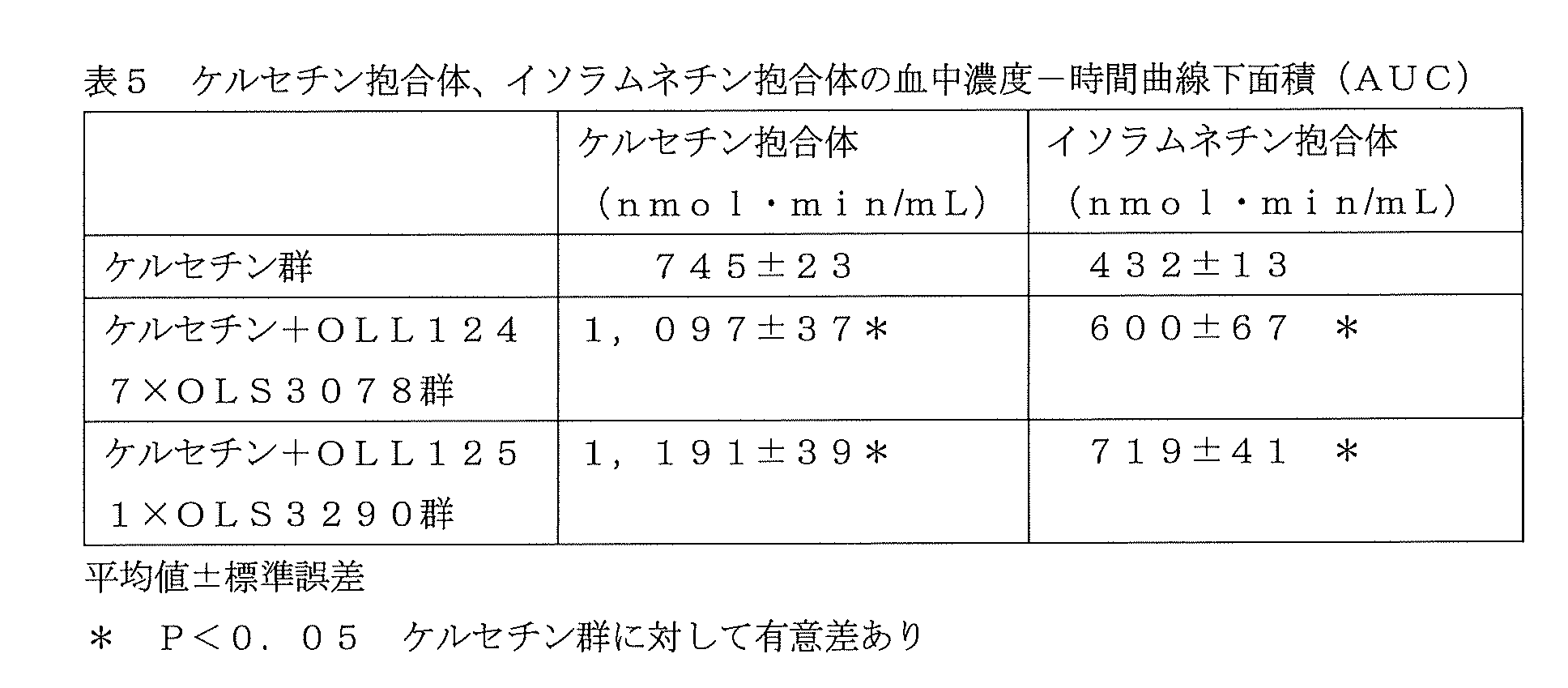
結果は表5に示される通りであった。ケルセチン抱合体の血中濃度-時間曲線下面積(AUC)は、ケルセチン群に比べ、ケルセチン+OLL1247×OLS3078群、ケルセチン+OLL1251×OLS3290群において有意に増加した。本結果は、乳酸菌による発酵がケルセチンの吸収を促進させることを意味する。
実験例5:βカロテンの吸収促進(他の吸収促進剤との比較)
(1)ヨーグルト由来の多糖体濃縮物の調製
実施例4のヨーグルト(ラクトバチルス・ブルガリクスOLL1251およびストレプトコッカス・サーモフィラスOLS3290)の一部を分取し、その上清に3倍量のエタノールを添加して冷凍保管した。その後、その上清を遠心分離処理したところ、沈殿物が得られた。そして、この沈殿物を凍結乾燥して多糖体濃縮物を得た。なお、11.3gのヨーグルト中に70mgの多糖体濃縮物が含まれていた。以下、得られた多糖体濃縮物を「乳酸菌由来多糖体濃縮物」と呼ぶこととする。
(1)ヨーグルト由来の多糖体濃縮物の調製
実施例4のヨーグルト(ラクトバチルス・ブルガリクスOLL1251およびストレプトコッカス・サーモフィラスOLS3290)の一部を分取し、その上清に3倍量のエタノールを添加して冷凍保管した。その後、その上清を遠心分離処理したところ、沈殿物が得られた。そして、この沈殿物を凍結乾燥して多糖体濃縮物を得た。なお、11.3gのヨーグルト中に70mgの多糖体濃縮物が含まれていた。以下、得られた多糖体濃縮物を「乳酸菌由来多糖体濃縮物」と呼ぶこととする。
(2)実験方法
48匹のラット(SD、雄、8週齢、日本エスエルシー株式会社)を7日間馴化させた後、それらのラットを8匹ずつの群に分けた。16時間の絶食後、各群のラットにβカロテン、βカロテンと乳酸菌由来多糖体濃縮物、βカロテンとシクロデキストリン(シクロケム社製)、βカロテンとでんぷん(米由来)(シグマ製)、βカロテンとペクチン(リンゴ由来)(和光純薬工業製)、βカロテンと難消化性デキストリン(松谷化学製)をそれぞれ投与した。なお、βカロテンは5mg/kg体重、多糖体は70mg/kg体重で投与した。投与前、投与後60分、120分、240分、480分に尾静脈より採血を行い、血清を得た。
48匹のラット(SD、雄、8週齢、日本エスエルシー株式会社)を7日間馴化させた後、それらのラットを8匹ずつの群に分けた。16時間の絶食後、各群のラットにβカロテン、βカロテンと乳酸菌由来多糖体濃縮物、βカロテンとシクロデキストリン(シクロケム社製)、βカロテンとでんぷん(米由来)(シグマ製)、βカロテンとペクチン(リンゴ由来)(和光純薬工業製)、βカロテンと難消化性デキストリン(松谷化学製)をそれぞれ投与した。なお、βカロテンは5mg/kg体重、多糖体は70mg/kg体重で投与した。投与前、投与後60分、120分、240分、480分に尾静脈より採血を行い、血清を得た。
以下、説明の便宜上、βカロテンを投与したラット群(コントロール)を「βカロテン群」と呼び、βカロテンと乳酸菌由来多糖体濃縮物を投与したラット群(実施例)を「βカロテン+乳酸菌由来多糖体濃縮物群」、βカロテンとシクロデキストリンを投与したラット群(比較例)を「βカロテン+乳酸菌由来多糖体濃縮物群」、βカロテンとでんぷん(米由来)を投与したラット群(比較例)を「βカロテン+でんぷん(米由来)群」、βカロテンとペクチン(リンゴ由来)を投与したラット群(比較例)を「βカロテン+ペクチン(リンゴ由来)群」、βカロテンと難消化性デキストリンを投与したラット群(比較例)を「βカロテン+難消化性デキストリン群」と呼ぶこととする。
(5)結果
結果は表6に示される通りであった。血清中濃度-時間曲線下面積(AUC)は、βカロテン群に比べ、βカロテン+乳酸菌由来多糖体濃縮物群において有意に増加した。一方、βカロテン群に比べ、βカロテン+シクロデキストリン群において有意に低下した。本結果は、乳酸菌由来の多糖体の摂取が他の多糖体と比べ、βカロテンの吸収を促進させることを意味する。

結果は表6に示される通りであった。血清中濃度-時間曲線下面積(AUC)は、βカロテン群に比べ、βカロテン+乳酸菌由来多糖体濃縮物群において有意に増加した。一方、βカロテン群に比べ、βカロテン+シクロデキストリン群において有意に低下した。本結果は、乳酸菌由来の多糖体の摂取が他の多糖体と比べ、βカロテンの吸収を促進させることを意味する。
実験例6:ヒトにおけるβカロテンの吸収促進(にんじんジュースへの添加)
(1)ヨーグルトの調製
10質量%の脱脂粉乳を含む培地にラクトバチルス・ブルガリクスOLL1251およびストレプトコッカス・サーモフィラスOLS3290を接種した後、その培地を43℃でpH4.6に達するまで発酵させた。
(1)ヨーグルトの調製
10質量%の脱脂粉乳を含む培地にラクトバチルス・ブルガリクスOLL1251およびストレプトコッカス・サーモフィラスOLS3290を接種した後、その培地を43℃でpH4.6に達するまで発酵させた。
(2)実験方法
5名の被験者に、12時間の絶食後、市販のにんじんジュース180g(βカロテン11mg含有)を摂取させ、摂取4時間後の血清を採取した。1週間のウォッシュアウト後、前記にんじんジュース180gとヨーグルト100gを混合したものを摂取させ、摂取4時間後の血清を採取した。得られた血清は、生理食塩水を重層し、超遠心(155,000×g、30分)により直ちに遠心分離し、カイロミクロンを分画した。
5名の被験者に、12時間の絶食後、市販のにんじんジュース180g(βカロテン11mg含有)を摂取させ、摂取4時間後の血清を採取した。1週間のウォッシュアウト後、前記にんじんジュース180gとヨーグルト100gを混合したものを摂取させ、摂取4時間後の血清を採取した。得られた血清は、生理食塩水を重層し、超遠心(155,000×g、30分)により直ちに遠心分離し、カイロミクロンを分画した。
(3)結果
結果は表7に示される通りであった。にんじんジュースの摂取前後のカイロミクロン画分の血漿βカロテン濃度の変化量は、にんじんジュース群に比べ、にんじんジュース+ヨーグルト群において有意に増加した。本結果は、ヒトにおいて、乳酸菌による発酵がにんじんジュース中に含まれるβカロテンの吸収を促進させることを意味する。

結果は表7に示される通りであった。にんじんジュースの摂取前後のカイロミクロン画分の血漿βカロテン濃度の変化量は、にんじんジュース群に比べ、にんじんジュース+ヨーグルト群において有意に増加した。本結果は、ヒトにおいて、乳酸菌による発酵がにんじんジュース中に含まれるβカロテンの吸収を促進させることを意味する。
実験例7:ヒトにおけるカロテノイドの吸収促進(野菜汁への添加)
(1)ヨーグルトの調製
10質量%の脱脂粉乳を含む培地にラクトバチルス・ブルガリクスOLL1251およびストレプトコッカス・サーモフィラスOLS3290を接種した後、その培地を40℃でpH4.2に達するまで発酵させた。このようにして得られたヨーグルトには、多糖体が90μg/g含まれていた。
(1)ヨーグルトの調製
10質量%の脱脂粉乳を含む培地にラクトバチルス・ブルガリクスOLL1251およびストレプトコッカス・サーモフィラスOLS3290を接種した後、その培地を40℃でpH4.2に達するまで発酵させた。このようにして得られたヨーグルトには、多糖体が90μg/g含まれていた。
(2)実験方法
20歳以上35歳未満、BMIが18.5kg/m2以上25.0kg/m2未満の男性被験者10名を対象に試験を実施した。16時間の絶食後、野菜汁100g(市販のほうれんそうピューレ、市販のトマトピューレ、市販のにんじんジュース、αカロテン5mg、βカロテン10mg、ルテイン3mg、リコペン10mgを含む)と水100gを含む飲料、または前記野菜汁100gとヨーグルト100gを含む飲料のいずれかを単回摂取させた。2週間のウォッシュアウト後、1回目の摂取試験で摂取していない飲料を単回摂取させた。試験食品の摂取前、摂取2時間、4時間、6時間、8時間後に採血を行い、血漿を得た。
20歳以上35歳未満、BMIが18.5kg/m2以上25.0kg/m2未満の男性被験者10名を対象に試験を実施した。16時間の絶食後、野菜汁100g(市販のほうれんそうピューレ、市販のトマトピューレ、市販のにんじんジュース、αカロテン5mg、βカロテン10mg、ルテイン3mg、リコペン10mgを含む)と水100gを含む飲料、または前記野菜汁100gとヨーグルト100gを含む飲料のいずれかを単回摂取させた。2週間のウォッシュアウト後、1回目の摂取試験で摂取していない飲料を単回摂取させた。試験食品の摂取前、摂取2時間、4時間、6時間、8時間後に採血を行い、血漿を得た。
以下、説明の便宜上、野菜汁を摂取したしとき(コントロール)を「野菜汁群」と呼び、野菜汁とヨーグルトを摂取したとき(実施例)を「野菜汁+ヨーグルト群」と呼ぶこととする。
(3)結果
結果は表8に示される通りであった。αカロテン、βカロテン、ルテイン、リコペンの血清中濃度-時間曲線下面積(AUC)は、野菜汁群に比べ、野菜汁+ヨーグルト群において、有意に増加した。本結果は、ヒトにおいて、ヨーグルトが野菜汁中に含まれるカロテノイドの吸収を促進させることを意味する。
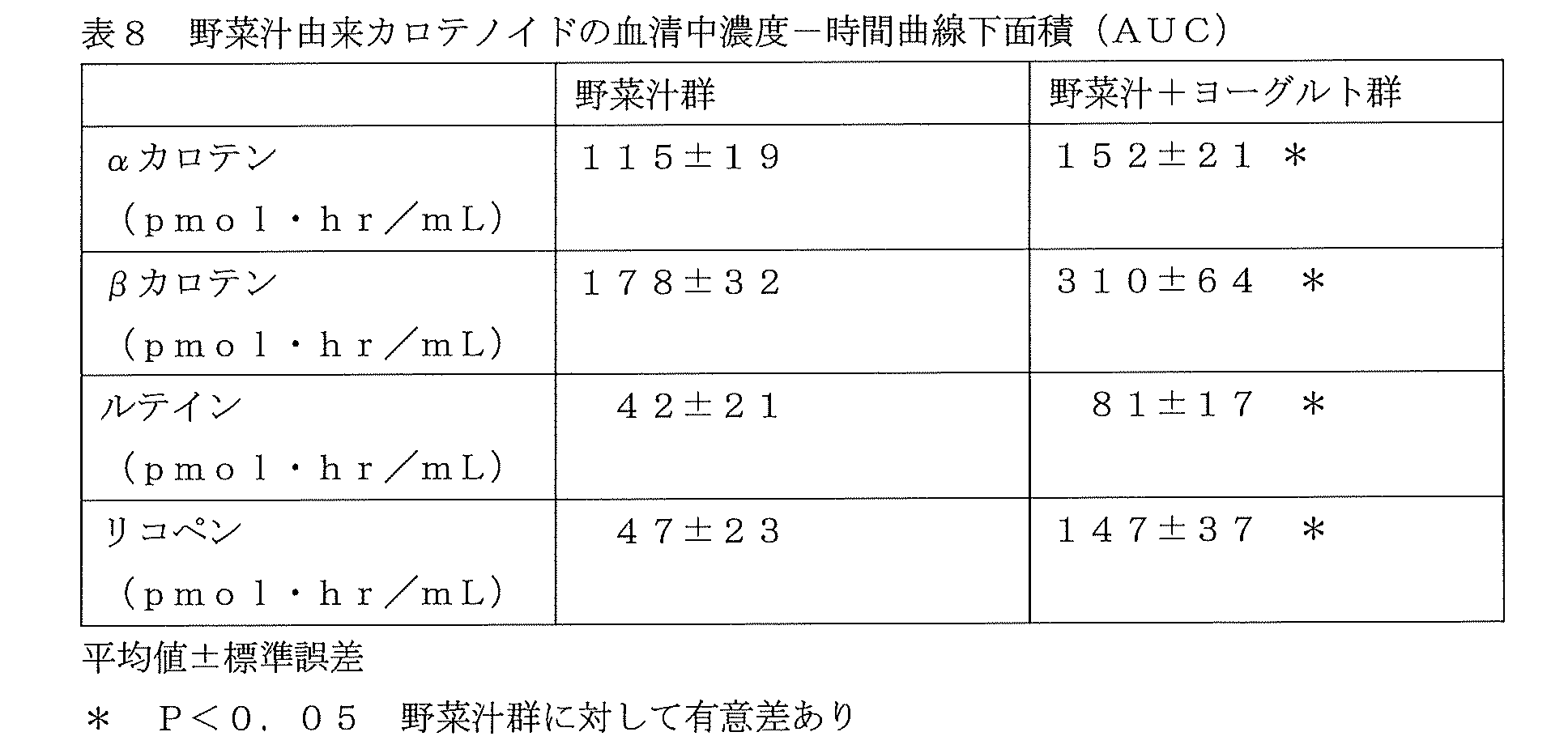
結果は表8に示される通りであった。αカロテン、βカロテン、ルテイン、リコペンの血清中濃度-時間曲線下面積(AUC)は、野菜汁群に比べ、野菜汁+ヨーグルト群において、有意に増加した。本結果は、ヒトにおいて、ヨーグルトが野菜汁中に含まれるカロテノイドの吸収を促進させることを意味する。
実験例8:ヒトにおけるカロテノイドの吸収促進(βカロテン及びリコペンを含む製剤への添加)
(1)用いたヨーグルト
実験例7で調製したヨーグルトを用いた。
(1)用いたヨーグルト
実験例7で調製したヨーグルトを用いた。
(2)実験方法
20歳以上35歳未満、BMIが18.5kg/m2以上25.0kg/m2未満の男性被験者9名を対象に試験を実施した。16時間の絶食後、カロテノイド製剤25g(βカロテン10mg(三栄源エフ・エフ・アイ株式会社製、ニューカロチンベース250)、リコペン10mg(Lycored社製、TOMATO-O-Red 2%SG))と水100gを含む飲料、またはカロテノイド製剤25gとヨーグルト100gを含む飲料のいずれかを単回摂取させた。2週間のウォッシュアウト後、1回目の摂取試験で摂取していない飲料を単回摂取させた。試験食品の摂取前、摂取2時間、4時間、6時間、および8時間後に採血を行い、血漿を得た。
20歳以上35歳未満、BMIが18.5kg/m2以上25.0kg/m2未満の男性被験者9名を対象に試験を実施した。16時間の絶食後、カロテノイド製剤25g(βカロテン10mg(三栄源エフ・エフ・アイ株式会社製、ニューカロチンベース250)、リコペン10mg(Lycored社製、TOMATO-O-Red 2%SG))と水100gを含む飲料、またはカロテノイド製剤25gとヨーグルト100gを含む飲料のいずれかを単回摂取させた。2週間のウォッシュアウト後、1回目の摂取試験で摂取していない飲料を単回摂取させた。試験食品の摂取前、摂取2時間、4時間、6時間、および8時間後に採血を行い、血漿を得た。
以下、説明の便宜上、野菜汁を摂取したしとき(コントロール)を「カロテノイド製剤群」と呼び、カロテノイド製剤とヨーグルトを摂取したとき(実施例)を「カロテノイド製剤+ヨーグルト群」と呼ぶこととする。
(3)結果
結果は表9に示される通りであった。βカロテン、リコペンの血清中濃度-時間曲線下面積(AUC)は、カロテノイド製剤群に比べ、カロテノイド製剤+ヨーグルト群において、有意に増加した。本結果は、ヒトにおいて、ヨーグルトがカロテノイド製剤中に含まれるカロテノイドの吸収を促進させることを意味する。

結果は表9に示される通りであった。βカロテン、リコペンの血清中濃度-時間曲線下面積(AUC)は、カロテノイド製剤群に比べ、カロテノイド製剤+ヨーグルト群において、有意に増加した。本結果は、ヒトにおいて、ヨーグルトがカロテノイド製剤中に含まれるカロテノイドの吸収を促進させることを意味する。
実験例9:βクリプトキサンチンの吸収促進
(1)用いたヨーグルト
10質量%の脱脂粉乳を含む培地に、ラクトバチルス・ブルガリクスOLL1251およびストレプトコッカス・サーモフィラスOLS3290を接種した後、その培地を43℃でpH4.2に達するまで発酵させて加熱した。このようにして得られたヨーグルトには、多糖体が105.8μg/g含まれていた。
(1)用いたヨーグルト
10質量%の脱脂粉乳を含む培地に、ラクトバチルス・ブルガリクスOLL1251およびストレプトコッカス・サーモフィラスOLS3290を接種した後、その培地を43℃でpH4.2に達するまで発酵させて加熱した。このようにして得られたヨーグルトには、多糖体が105.8μg/g含まれていた。
(2)実験方法
16匹のラット(SD、雄、8週齢、日本エスエルシー株式会社)を7日間馴化させた後、それらのラットを8匹ずつの群に分けた。16時間の絶食後、各群のラットにβクリプトキサンチン、βクリプトキサンチンとヨーグルトをそれぞれ投与した。なお、βクリプトキサンチンは3mg/kg体重、ヨーグルトは11.3g/kg体重で投与した。投与前、投与後60分、120分、240分、480分に尾静脈より採血を行い、血清を得た。以下、説明の便宜上、βクリプトキサンチンを投与したラット群(コントロール)を「βクリプトキサンチン群」と呼び、βクリプトキサンチンとヨーグルトを投与したラット群(実施例)を「βクリプトキサンチン+ヨーグルト群」と呼ぶこととする。
16匹のラット(SD、雄、8週齢、日本エスエルシー株式会社)を7日間馴化させた後、それらのラットを8匹ずつの群に分けた。16時間の絶食後、各群のラットにβクリプトキサンチン、βクリプトキサンチンとヨーグルトをそれぞれ投与した。なお、βクリプトキサンチンは3mg/kg体重、ヨーグルトは11.3g/kg体重で投与した。投与前、投与後60分、120分、240分、480分に尾静脈より採血を行い、血清を得た。以下、説明の便宜上、βクリプトキサンチンを投与したラット群(コントロール)を「βクリプトキサンチン群」と呼び、βクリプトキサンチンとヨーグルトを投与したラット群(実施例)を「βクリプトキサンチン+ヨーグルト群」と呼ぶこととする。
(3)βクリプトキサンチンの測定
血清50μLに、生理食塩水を90μL加え、ジクロロメタンメタノール溶液(ジクロロメタン:メタノール=1:2)を300μL加えた。さらに、ヘキサンを150μL加えβカロテンを抽出した。上層を別のチューブに移し、窒素還流により溶媒を除去した。150μLの0.1%酢酸アンモニウム含有30%酢酸エチル70%メタノール溶液に溶解させ、HPLC用のサンプルを調製した。
血清50μLに、生理食塩水を90μL加え、ジクロロメタンメタノール溶液(ジクロロメタン:メタノール=1:2)を300μL加えた。さらに、ヘキサンを150μL加えβカロテンを抽出した。上層を別のチューブに移し、窒素還流により溶媒を除去した。150μLの0.1%酢酸アンモニウム含有30%酢酸エチル70%メタノール溶液に溶解させ、HPLC用のサンプルを調製した。
(4)HPLCの分析条件
HPLCは、1200シリーズ(アジレントテクノロジーズ製)を使用した。カラムは、TSKgel ODS―80TsQA(5.0×250mm)(東ソー製)を使用し、カラム温度は40℃に設定した。移動相は0.1%酢酸アンモニウム含有30%酢酸エチル70%メタノール溶液を調製した。なお、流速は、0.3mL/分に設定し、450nmの吸光波長を測定した。
HPLCは、1200シリーズ(アジレントテクノロジーズ製)を使用した。カラムは、TSKgel ODS―80TsQA(5.0×250mm)(東ソー製)を使用し、カラム温度は40℃に設定した。移動相は0.1%酢酸アンモニウム含有30%酢酸エチル70%メタノール溶液を調製した。なお、流速は、0.3mL/分に設定し、450nmの吸光波長を測定した。
(5)結果
結果は表10および図1に示される通りであった。投与60分、120分、240分後のβクリプトキサンチンの血中濃度は、βクリプトキサンチン群に比べ、βクリプトキサンチン+ヨーグルト群において有意に上昇した。また、血中曲線下面積(AUC)は、βクリプトキサンチン群に比べ、βクリプトキサンチン+ヨーグルト群において有意に増加した。本結果は、ヨーグルトの摂取がβクリプトキサンチンの吸収を促進させることを意味する。なお、図中、「*」の記号はP<0.05でβクリプトキサンチン群に対して有意差があることを示している。

結果は表10および図1に示される通りであった。投与60分、120分、240分後のβクリプトキサンチンの血中濃度は、βクリプトキサンチン群に比べ、βクリプトキサンチン+ヨーグルト群において有意に上昇した。また、血中曲線下面積(AUC)は、βクリプトキサンチン群に比べ、βクリプトキサンチン+ヨーグルト群において有意に増加した。本結果は、ヨーグルトの摂取がβクリプトキサンチンの吸収を促進させることを意味する。なお、図中、「*」の記号はP<0.05でβクリプトキサンチン群に対して有意差があることを示している。
実験例10:カプサンチンの吸収促進
(1)用いたヨーグルト
実験例9で用いたヨーグルトを使用した。
(1)用いたヨーグルト
実験例9で用いたヨーグルトを使用した。
(2)実験方法
16匹のラット(SD、雄、8週齢、日本エスエルシー株式会社)を7日間馴化させた後、それらのラットを8匹ずつの群に分けた。16時間の絶食後、各群のラットにカプサンチン、カプサンチンとヨーグルトをそれぞれ投与した。なお、カプサンチンは5mg/kg体重、ヨーグルトは11.3g/kg体重で投与した。投与前、投与後60分、120分、240分、480分に尾静脈より採血を行い、血清を得た。以下、説明の便宜上、カプサンチンを投与したラット群(コントロール)を「カプサンチン群」と呼び、カプサンチンとヨーグルトを投与したラット群(実施例)を「カプサンチン+ヨーグルト群」と呼ぶこととする。
16匹のラット(SD、雄、8週齢、日本エスエルシー株式会社)を7日間馴化させた後、それらのラットを8匹ずつの群に分けた。16時間の絶食後、各群のラットにカプサンチン、カプサンチンとヨーグルトをそれぞれ投与した。なお、カプサンチンは5mg/kg体重、ヨーグルトは11.3g/kg体重で投与した。投与前、投与後60分、120分、240分、480分に尾静脈より採血を行い、血清を得た。以下、説明の便宜上、カプサンチンを投与したラット群(コントロール)を「カプサンチン群」と呼び、カプサンチンとヨーグルトを投与したラット群(実施例)を「カプサンチン+ヨーグルト群」と呼ぶこととする。
(3)カプサンチンの測定
血清50μLに、生理食塩水を90μL加え、ジクロロメタンメタノール溶液(ジクロロメタン:メタノール=1:2)を300μL加えた。さらに、ヘキサンを150μL加えβカロテンを抽出した。上層を別のチューブに移し、窒素還流により溶媒を除去した。150μLの0.1%酢酸アンモニウム含有30%酢酸エチル70%メタノール溶液に溶解させ、HPLC用のサンプルを調製した。
血清50μLに、生理食塩水を90μL加え、ジクロロメタンメタノール溶液(ジクロロメタン:メタノール=1:2)を300μL加えた。さらに、ヘキサンを150μL加えβカロテンを抽出した。上層を別のチューブに移し、窒素還流により溶媒を除去した。150μLの0.1%酢酸アンモニウム含有30%酢酸エチル70%メタノール溶液に溶解させ、HPLC用のサンプルを調製した。
(4)HPLCの分析条件
HPLCは、1200シリーズ(アジレントテクノロジーズ製)を使用した。カラムは、TSKgel ODS―80TsQA(5.0×250mm)(東ソー製)を使用し、カラム温度は40℃に設定した。移動相は0.1%酢酸アンモニウム含有30%酢酸エチル70%メタノール溶液を調製した。なお、流速は、0.3mL/分に設定し、470nmの吸光波長を測定した。
HPLCは、1200シリーズ(アジレントテクノロジーズ製)を使用した。カラムは、TSKgel ODS―80TsQA(5.0×250mm)(東ソー製)を使用し、カラム温度は40℃に設定した。移動相は0.1%酢酸アンモニウム含有30%酢酸エチル70%メタノール溶液を調製した。なお、流速は、0.3mL/分に設定し、470nmの吸光波長を測定した。
(5)結果
結果は表11および図2に示される通りであった。投与60分、120分、240、480分後のカプサンチンの血中濃度は、カプサンチン群に比べ、カプサンチン+ヨーグルト群において有意に上昇した。また、血中曲線下面積(AUC)は、カプサンチン群に比べ、カプサンチン+ヨーグルト群において有意に増加した。本結果は、ヨーグルトの摂取がカプサンチンの吸収を促進させることを意味する。なお、図中、「*」の記号はP<0.05でカプサンチン群に対して有意差があることを示している。

結果は表11および図2に示される通りであった。投与60分、120分、240、480分後のカプサンチンの血中濃度は、カプサンチン群に比べ、カプサンチン+ヨーグルト群において有意に上昇した。また、血中曲線下面積(AUC)は、カプサンチン群に比べ、カプサンチン+ヨーグルト群において有意に増加した。本結果は、ヨーグルトの摂取がカプサンチンの吸収を促進させることを意味する。なお、図中、「*」の記号はP<0.05でカプサンチン群に対して有意差があることを示している。
実験例11:ヘスペリジンの吸収促進
(1)用いたヨーグルト
実験例9で用いたヨーグルトを使用した。
(1)用いたヨーグルト
実験例9で用いたヨーグルトを使用した。
(2)実験方法
16匹のラット(SD、雄、8週齢、日本エスエルシー株式会社)を7日間馴化させた後、それらのラットを8匹ずつの群に分けた。16時間の絶食後、各群のラットにヘスペリジン、ヘスペリジンとヨーグルトをそれぞれ投与した。なお、ヘスペリジンは162mg/kg体重、ヨーグルトは11.3g/kg体重で投与した。投与前、投与後60分、120分、240分に尾静脈より採血を行い、血清を得た。以下、説明の便宜上、ヘスペリジンを投与したラット群(コントロール)を「ヘスペリジン群」と呼び、ヘスペリジンとヨーグルトを投与したラット群(実施例)を「ヘスペリジン+ヨーグルト群」と呼ぶこととする。
16匹のラット(SD、雄、8週齢、日本エスエルシー株式会社)を7日間馴化させた後、それらのラットを8匹ずつの群に分けた。16時間の絶食後、各群のラットにヘスペリジン、ヘスペリジンとヨーグルトをそれぞれ投与した。なお、ヘスペリジンは162mg/kg体重、ヨーグルトは11.3g/kg体重で投与した。投与前、投与後60分、120分、240分に尾静脈より採血を行い、血清を得た。以下、説明の便宜上、ヘスペリジンを投与したラット群(コントロール)を「ヘスペリジン群」と呼び、ヘスペリジンとヨーグルトを投与したラット群(実施例)を「ヘスペリジン+ヨーグルト群」と呼ぶこととする。
(3)ヘスペレチン代謝物の測定
ヘスペリジン代謝物であるヘスペレチン抱合体を以下のとおり測定した。血清50μLに、0.1M酢酸ナトリウム緩衝液(pH5.0)に溶解させたグルクロニダーゼ溶液を45μL(10000U/mL、シグマアルドリッチ社製)、0.1M酢酸ナトリウム緩衝液(pH5.0)に溶解させた0.1Mアスコルビン酸溶液を5μL加え、37℃で2時間加温させた。メタノールを300μL加え、酵素反応を停止させ、遠心分離(12000rpm 、10分、4℃)した。上清を別のチューブに移し、遠心濃縮により溶媒を除去した。300μLの0.1%ギ酸含有の50%アセトニトリル溶液に溶解させ、HPLC用のサンプルを調製した。
ヘスペリジン代謝物であるヘスペレチン抱合体を以下のとおり測定した。血清50μLに、0.1M酢酸ナトリウム緩衝液(pH5.0)に溶解させたグルクロニダーゼ溶液を45μL(10000U/mL、シグマアルドリッチ社製)、0.1M酢酸ナトリウム緩衝液(pH5.0)に溶解させた0.1Mアスコルビン酸溶液を5μL加え、37℃で2時間加温させた。メタノールを300μL加え、酵素反応を停止させ、遠心分離(12000rpm 、10分、4℃)した。上清を別のチューブに移し、遠心濃縮により溶媒を除去した。300μLの0.1%ギ酸含有の50%アセトニトリル溶液に溶解させ、HPLC用のサンプルを調製した。
(4)HPLCの分析条件
HPLCは、Nexera XR(島津製作所製)、MS/MS検出器は4500QTRAP(サイエックス社製)を使用した。カラムは、ACQUITY UPLC HSS T3 1.8μm(2.1×50mm)(Waters社製)を使用し、カラム温度は40℃に設定した。移動相はA液として0.1%含有ギ酸溶液、B液として0.1%ギ酸含有アセトニトリル溶液を調製した。B液30%で1分間保持し、その後4.5分間でB液45%までグラジエントをかけ、目的の物質を溶出させた。その後、B液99%でカラムを2分間洗浄し、B液30%で3分間保持した。なお、流速は、0.3mL/分に設定した。MS/MS分析はESIネガティブモードで分析した。MS/MSの分析条件は、カーテンガス流量30psi、コリジョンガス流量9psi、イオンスプレー電圧-4500V、ターボガス温度600℃、イオンソースガス70psiに設定した。
HPLCは、Nexera XR(島津製作所製)、MS/MS検出器は4500QTRAP(サイエックス社製)を使用した。カラムは、ACQUITY UPLC HSS T3 1.8μm(2.1×50mm)(Waters社製)を使用し、カラム温度は40℃に設定した。移動相はA液として0.1%含有ギ酸溶液、B液として0.1%ギ酸含有アセトニトリル溶液を調製した。B液30%で1分間保持し、その後4.5分間でB液45%までグラジエントをかけ、目的の物質を溶出させた。その後、B液99%でカラムを2分間洗浄し、B液30%で3分間保持した。なお、流速は、0.3mL/分に設定した。MS/MS分析はESIネガティブモードで分析した。MS/MSの分析条件は、カーテンガス流量30psi、コリジョンガス流量9psi、イオンスプレー電圧-4500V、ターボガス温度600℃、イオンソースガス70psiに設定した。
(5)結果
結果は表12および図3に示される通りであった。投与60分分後のヘスペレチン抱合体の血中濃度は、ヘスペリジン群に比べ、ヘスペリジン+ヨーグルト群において有意に上昇した。また、血中曲線下面積(AUC)は、ヘスペリジン群に比べ、ヘスペリジン+ヨーグルト群において有意に増加した。本結果は、ヨーグルトの摂取がヘスペレチン抱合体の吸収を促進させることを意味する。なお、図中、「*」の記号はP<0.05でヘスペリジン群に対して有意差があることを示している。
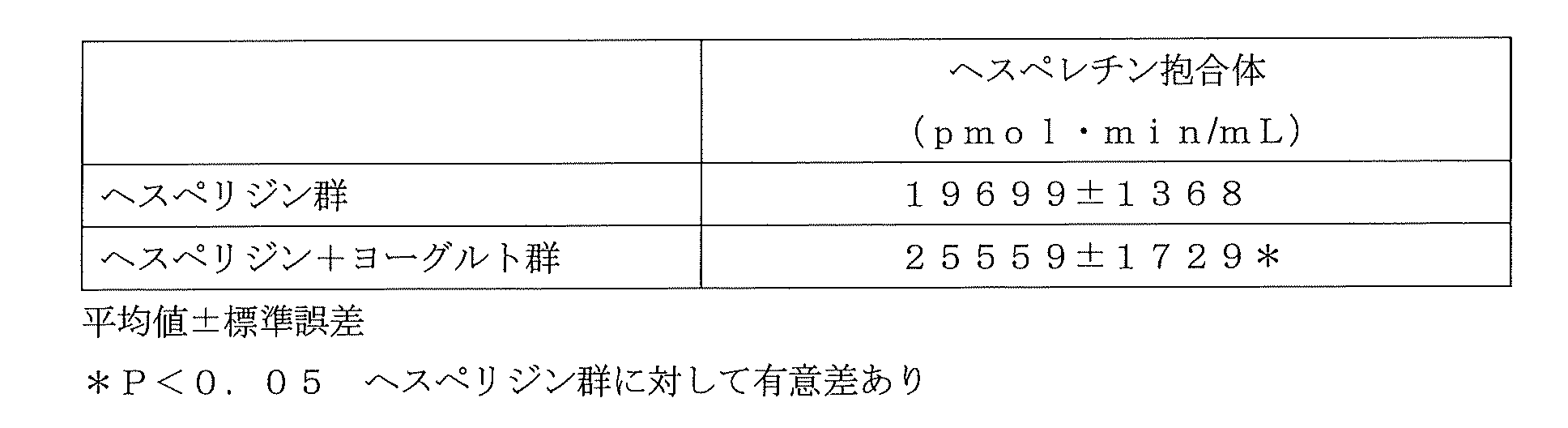
結果は表12および図3に示される通りであった。投与60分分後のヘスペレチン抱合体の血中濃度は、ヘスペリジン群に比べ、ヘスペリジン+ヨーグルト群において有意に上昇した。また、血中曲線下面積(AUC)は、ヘスペリジン群に比べ、ヘスペリジン+ヨーグルト群において有意に増加した。本結果は、ヨーグルトの摂取がヘスペレチン抱合体の吸収を促進させることを意味する。なお、図中、「*」の記号はP<0.05でヘスペリジン群に対して有意差があることを示している。
実験例12:乳酸菌発酵中のpHの推移
(1)実験方法
10質量%の脱脂粉乳を含む培地に、ラクトバチルス・ブルガリクスOLL1251のみ、ラクトバチルス・ブルガリクスOLL1251およびストレプトコッカス・サーモフィラスOLS3290を接種した後、その培地を43℃で発酵させ、pHの変化を確認した。
(1)実験方法
10質量%の脱脂粉乳を含む培地に、ラクトバチルス・ブルガリクスOLL1251のみ、ラクトバチルス・ブルガリクスOLL1251およびストレプトコッカス・サーモフィラスOLS3290を接種した後、その培地を43℃で発酵させ、pHの変化を確認した。
(2)結果
結果は表13に示される通りであった。ラクトバチルス・ブルガリクスOLL1251単独で発酵するよりも、ラクトバチルス・ブルガリクスOLL1251とストレプトコッカス・サーモフィラスOLS3290を組み合わせて発酵することにより、pHの低下が速く進んだ。このことは乳酸菌の活動が活発であることを意味し、さらに多糖体の生産が大であることも意味する。この結果から、菌の組合せによって多糖体を産生するための発酵時間が短縮されることが確認された。

結果は表13に示される通りであった。ラクトバチルス・ブルガリクスOLL1251単独で発酵するよりも、ラクトバチルス・ブルガリクスOLL1251とストレプトコッカス・サーモフィラスOLS3290を組み合わせて発酵することにより、pHの低下が速く進んだ。このことは乳酸菌の活動が活発であることを意味し、さらに多糖体の生産が大であることも意味する。この結果から、菌の組合せによって多糖体を産生するための発酵時間が短縮されることが確認された。
実験例13:ヒトにおけるカロテノイドの吸収促進(にんじん汁への添加)
(1)ヨーグルトの調製
10質量%の脱脂粉乳を含む培地にラクトバチルス・ブルガリクスOLL1251およびストレプトコッカス・サーモフィラスOLS3290を接種した後、その培地を40℃でpH4.2に達するまで発酵させた。このようにして得られたヨーグルトには、多糖体が90μg/g含まれていた。
(1)ヨーグルトの調製
10質量%の脱脂粉乳を含む培地にラクトバチルス・ブルガリクスOLL1251およびストレプトコッカス・サーモフィラスOLS3290を接種した後、その培地を40℃でpH4.2に達するまで発酵させた。このようにして得られたヨーグルトには、多糖体が90μg/g含まれていた。
(2)実験方法
20歳以上35歳未満、BMIが18.5kg/m2以上25.0kg/m2未満の男性被験者16名を対象に試験を実施した。16時間の絶食後、にんじん汁100g(市販のにんじんジュース、αカロテン6mg、βカロテン10mgを含む)と水100gを含む飲料、または前記にんじん汁100gとヨーグルト100gを含む飲料のいずれかを単回摂取させた。2週間のウォッシュアウト後、1回目の摂取試験で摂取していない飲料を単回摂取させた。試験食品の摂取前、摂取2時間、4時間、6時間、8時間後に採血を行い、血漿を得た。
20歳以上35歳未満、BMIが18.5kg/m2以上25.0kg/m2未満の男性被験者16名を対象に試験を実施した。16時間の絶食後、にんじん汁100g(市販のにんじんジュース、αカロテン6mg、βカロテン10mgを含む)と水100gを含む飲料、または前記にんじん汁100gとヨーグルト100gを含む飲料のいずれかを単回摂取させた。2週間のウォッシュアウト後、1回目の摂取試験で摂取していない飲料を単回摂取させた。試験食品の摂取前、摂取2時間、4時間、6時間、8時間後に採血を行い、血漿を得た。
以下、説明の便宜上、にんじん汁を摂取したしとき(コントロール)を「にんじん汁群」と呼び、にんじん汁とヨーグルトを摂取したとき(実施例)を「にんじん汁+ヨーグルト群」と呼ぶこととする。
(3)結果
結果は表14に示される通りであった。αカロテン、βカロテンの血漿中濃度-時間曲線下面積(AUC)は、にんじん汁群に比べ、にんじん汁+ヨーグルト群において、有意に増加した。本結果は、ヒトにおいて、ヨーグルトがにんじん汁中に含まれるカロテノイドの吸収を促進させることを意味する。
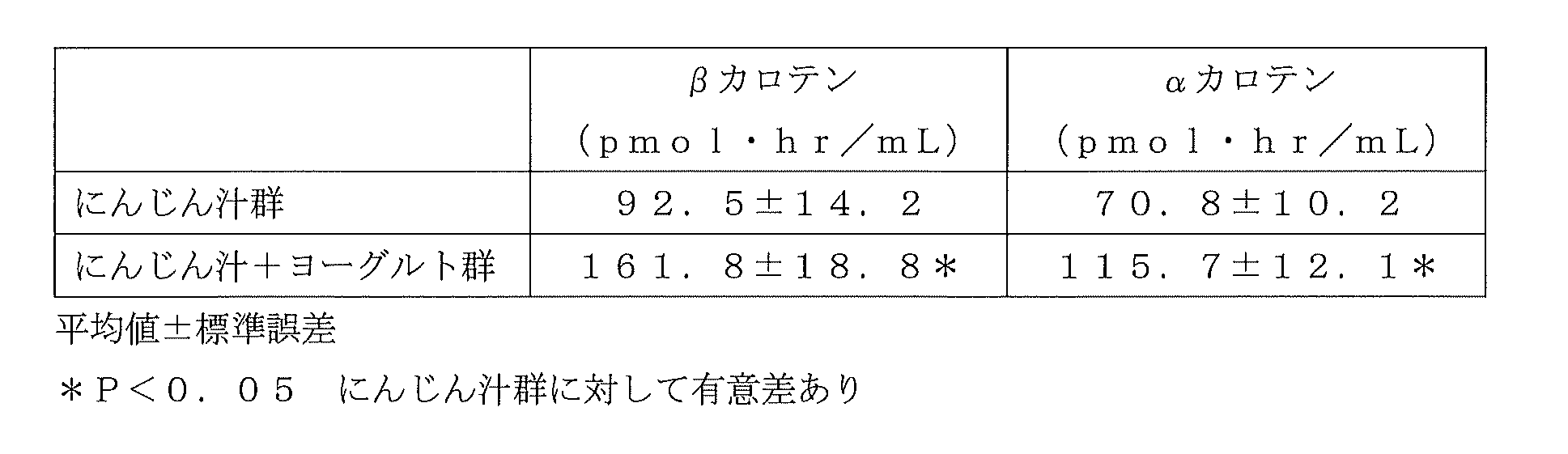
結果は表14に示される通りであった。αカロテン、βカロテンの血漿中濃度-時間曲線下面積(AUC)は、にんじん汁群に比べ、にんじん汁+ヨーグルト群において、有意に増加した。本結果は、ヒトにおいて、ヨーグルトがにんじん汁中に含まれるカロテノイドの吸収を促進させることを意味する。
実験例14:ヒトにおけるカロテノイドの吸収促進(トマト汁への添加)
(1)ヨーグルトの調製
10質量%の脱脂粉乳を含む培地にラクトバチルス・ブルガリクスOLL1251およびストレプトコッカス・サーモフィラスOLS3290を接種した後、その培地を40℃でpH4.2に達するまで発酵させた。このようにして得られたヨーグルトには、多糖体が90μg/g含まれていた。
(1)ヨーグルトの調製
10質量%の脱脂粉乳を含む培地にラクトバチルス・ブルガリクスOLL1251およびストレプトコッカス・サーモフィラスOLS3290を接種した後、その培地を40℃でpH4.2に達するまで発酵させた。このようにして得られたヨーグルトには、多糖体が90μg/g含まれていた。
(2)実験方法
20歳以上35歳未満、BMIが18.5kg/m2以上25.0kg/m2未満の男性被験者15名を対象に試験を実施した。16時間の絶食後、トマト汁100g(市販のトマトジュース(リコペン10mgを含む)と水100gを含む飲料、または前記トマト汁100gとヨーグルト100gを含む飲料のいずれかを単回摂取させた。2週間のウォッシュアウト後、1回目の摂取試験で摂取していない飲料を単回摂取させた。試験食品の摂取前、摂取2時間、4時間、6時間、8時間後に採血を行い、血漿を得た。
20歳以上35歳未満、BMIが18.5kg/m2以上25.0kg/m2未満の男性被験者15名を対象に試験を実施した。16時間の絶食後、トマト汁100g(市販のトマトジュース(リコペン10mgを含む)と水100gを含む飲料、または前記トマト汁100gとヨーグルト100gを含む飲料のいずれかを単回摂取させた。2週間のウォッシュアウト後、1回目の摂取試験で摂取していない飲料を単回摂取させた。試験食品の摂取前、摂取2時間、4時間、6時間、8時間後に採血を行い、血漿を得た。
以下、説明の便宜上、トマト汁を摂取したしとき(コントロール)を「トマト汁群」と呼び、トマト汁とヨーグルトを摂取したとき(実施例)を「トマト汁+ヨーグルト群」と呼ぶこととする。
(3)結果
結果は表15に示される通りであった。リコペンの血漿中濃度-時間曲線下面積(AUC)は、野菜汁群に比べ、トマト汁+ヨーグルト群において、有意に増加した。本結果は、ヒトにおいて、ヨーグルトがトマト汁中に含まれるカロテノイドの吸収を促進させることを意味する。

結果は表15に示される通りであった。リコペンの血漿中濃度-時間曲線下面積(AUC)は、野菜汁群に比べ、トマト汁+ヨーグルト群において、有意に増加した。本結果は、ヒトにおいて、ヨーグルトがトマト汁中に含まれるカロテノイドの吸収を促進させることを意味する。
実験例15:ヒトにおけるカロテノイドの吸収促進(ほうれんそう汁への添加)
(1)ヨーグルトの調製
10質量%の脱脂粉乳を含む培地にラクトバチルス・ブルガリクスOLL1251およびストレプトコッカス・サーモフィラスOLS3290を接種した後、その培地を40℃でpH4.2に達するまで発酵させた。このようにして得られたヨーグルトには、多糖体が90μg/g含まれていた。
(1)ヨーグルトの調製
10質量%の脱脂粉乳を含む培地にラクトバチルス・ブルガリクスOLL1251およびストレプトコッカス・サーモフィラスOLS3290を接種した後、その培地を40℃でpH4.2に達するまで発酵させた。このようにして得られたヨーグルトには、多糖体が90μg/g含まれていた。
(2)実験方法
20歳以上35歳未満、BMIが18.5kg/m2以上25.0kg/m2未満の男性被験者16名を対象に試験を実施した。16時間の絶食後、ほうれんそう汁100g(市販のほうれんそうジュース、ルテイン4.0mg、βカロテン2.4mgを含む)と水100gを含む飲料、または前記ほうれんそう汁100gとヨーグルト100gを含む飲料のいずれかを単回摂取させた。2週間のウォッシュアウト後、1回目の摂取試験で摂取していない飲料を単回摂取させた。試験食品の摂取前、摂取2時間、4時間、6時間、8時間後に採血を行い、血漿を得た。
20歳以上35歳未満、BMIが18.5kg/m2以上25.0kg/m2未満の男性被験者16名を対象に試験を実施した。16時間の絶食後、ほうれんそう汁100g(市販のほうれんそうジュース、ルテイン4.0mg、βカロテン2.4mgを含む)と水100gを含む飲料、または前記ほうれんそう汁100gとヨーグルト100gを含む飲料のいずれかを単回摂取させた。2週間のウォッシュアウト後、1回目の摂取試験で摂取していない飲料を単回摂取させた。試験食品の摂取前、摂取2時間、4時間、6時間、8時間後に採血を行い、血漿を得た。
以下、説明の便宜上、ほうれんそう汁を摂取したしとき(コントロール)を「ほうれんそう汁群」と呼び、ほうれんそう汁とヨーグルトを摂取したとき(実施例)を「ほうれんそう汁+ヨーグルト群」と呼ぶこととする。
(3)結果
結果は表16に示される通りであった。ルテイン、β-カロテンの血漿中濃度-時間曲線下面積(AUC)は、ほうれんそう汁群に比べ、ほうれんそう汁+ヨーグルト群において、有意に増加した。本結果は、ヒトにおいて、ヨーグルトがほうれんそう汁中に含まれるカロテノイドの吸収を促進させることを意味する。
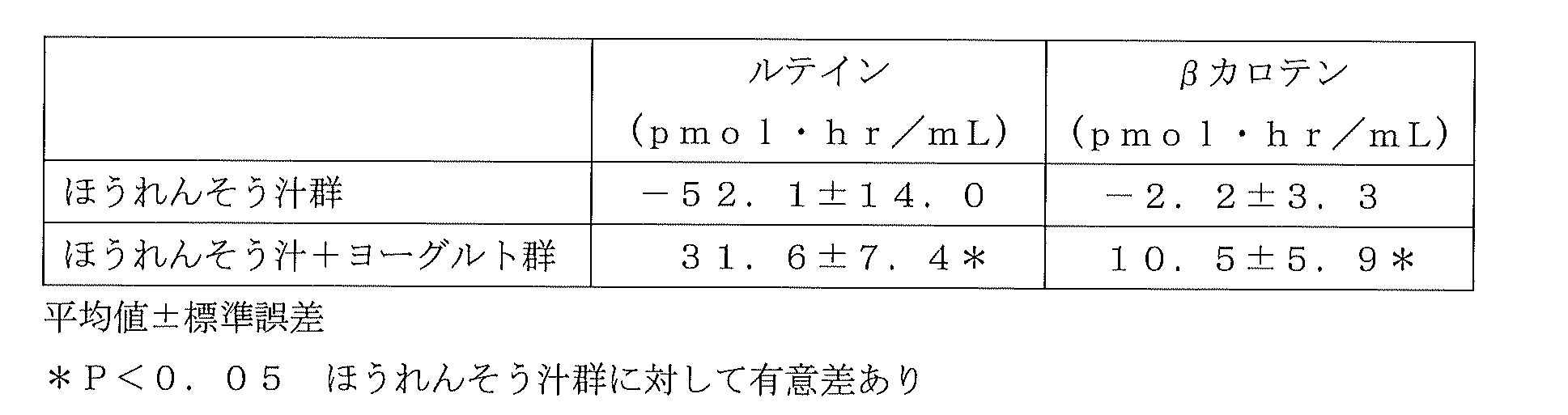
結果は表16に示される通りであった。ルテイン、β-カロテンの血漿中濃度-時間曲線下面積(AUC)は、ほうれんそう汁群に比べ、ほうれんそう汁+ヨーグルト群において、有意に増加した。本結果は、ヒトにおいて、ヨーグルトがほうれんそう汁中に含まれるカロテノイドの吸収を促進させることを意味する。
実験例16:ヒトにおけるカロテノイドの吸収促進(温州みかん汁への添加)
(1)ヨーグルトの調製
10質量%の脱脂粉乳を含む培地にラクトバチルス・ブルガリクスOLL1251およびストレプトコッカス・サーモフィラスOLS3290を接種した後、その培地を40℃でpH4.2に達するまで発酵させた。このようにして得られたヨーグルトには、多糖体が90μg/g含まれていた。
(1)ヨーグルトの調製
10質量%の脱脂粉乳を含む培地にラクトバチルス・ブルガリクスOLL1251およびストレプトコッカス・サーモフィラスOLS3290を接種した後、その培地を40℃でpH4.2に達するまで発酵させた。このようにして得られたヨーグルトには、多糖体が90μg/g含まれていた。
5名の被験者に、12時間の絶食後、市販のみかん汁100g(βクリプトキサンチン3mg含有)を摂取させ、摂取4時間後の血清を採取した。1週間のウォッシュアウト後、前記みかん汁100gとヨーグルト100gを混合したものを摂取させ、摂取4時間後の血清を採取した。
(3)結果
結果は表17に示される通りであった。みかん汁の摂取前後の血漿βクリプトキサンチン濃度の変化量は、みかん汁群に比べ、みかん汁+ヨーグルト群において有意に増加した。本結果は、ヒトにおいて、乳酸菌による発酵がみかん汁中に含まれるカロテノイドの吸収を促進させることを意味する。

結果は表17に示される通りであった。みかん汁の摂取前後の血漿βクリプトキサンチン濃度の変化量は、みかん汁群に比べ、みかん汁+ヨーグルト群において有意に増加した。本結果は、ヒトにおいて、乳酸菌による発酵がみかん汁中に含まれるカロテノイドの吸収を促進させることを意味する。
Claims (18)
- 多糖体を含有する乳酸菌産生物を有効成分として含んでなる、難水溶性フィトケミカル吸収促進用組成物であって、
前記乳酸菌産生物が、ラクトバチルス・デルブルッキー・サブスピーシーズ・ブルガリクスOLL1251によって生産されるものであることを特徴とする、難水溶性フィトケミカル吸収促進用組成物。 - 前記乳酸菌産生物が、ラクトバチルス・デルブルッキー・サブスピーシーズ・ブルガリクスOLL1251およびストレプトコッカス・サーモフィラスOLS3290との組み合わせによって生成されるものである、請求項1に記載の難水溶性フィトケミカル吸収促進用組成物。
- 前記難水溶性フィトケミカルが、その水への溶解率が88%以下のものである、請求項1または2に記載の難水溶性フィトケミカル吸収促進用組成物。
- 前記難水溶性フィトケミカルが、その水への溶解率が50%以下のものである、請求項1または2に記載の難水溶性フィトケミカル吸収促進用組成物。
- 前記難水溶性フィトケミカルが、ポリフェノール、有機硫黄化合物、およびテルペノイドからなる群から選択されるものである、請求項1~4のいずれか一項に記載の難水溶性フィトケミカル吸収促進用組成物。
- 前記ポリフェノールが、フラボノイド類である、請求項5に記載の難水溶性フィトケミカル吸収促進用組成物。
- 前記フラボノイド類が、フラボン、イソフラボン、フラボノール、フラバノン、フラバン-3-オール、およびアントシアニン並びにそれらの類縁体からなる群から選択されるものである、請求項6に記載の難水溶性フィトケミカル吸収促進用組成物。
- 前記フラボノイド類が、フラボン、イソフラボン、フラボノール、フラバノン、フラバン-3-オールまたはそれらの類縁体である、請求項7に記載の難水溶性フィトケミカル吸収促進用組成物。
- 前記テルペノイドがテトラテルペンおよびその類縁体である、請求項5に記載の難水溶性フィトケミカル吸収促進用組成物。
- 前記難水溶性フィトケミカルが、ケルセチン、ゲニステイン、エピカテキン、ルテオリン、ナリンゲニン、ヘスペリジン、βカロテン、αカロテン、βクリプトキサンチン、カプサンチン、ルテイン、およびリコペン並びにそれらの類縁体から選択されるものである、請求項1~9のいずれか一項に記載の難水溶性フィトケミカル吸収促進用組成物。
- 前記乳酸菌産生物が発酵乳である、請求項1~10のいずれか一項に記載の難水溶性フィトケミカル吸収促進用組成物。
- 請求項1~11のいずれか一項に記載の難水溶性フィトケミカル吸収促進用組成物を含んでなる、食品添加剤。
- 請求項1~11のいずれか一項に記載の難水溶性フィトケミカル吸収促進用組成物を含んでなる、飲食品または飲食品組成物。
- 多糖体を含有する乳酸菌産生物をヒトまたは動物に投与するまたは摂取させることを含んでなる、当該ヒトまたは動物の体内への難水溶性フィトケミカルの取り込みを促進する方法。
- 前記多糖体を含有する乳酸菌産生物が、請求項1~11のいずれか一項に記載の難水溶性フィトケミカル吸収促進用組成物の形態である、請求項14に記載の方法。
- ヒトまたは動物の体内への難水溶性フィトケミカルの取り込みを促進するための、多糖体を含有する乳酸菌産生物の使用。
- 請求項1~11のいずれか一項に記載の難水溶性フィトケミカル吸収促進用組成物の製造のための、多糖体を含有する乳酸菌産生物の使用。
- ラクトバチルス・デルブルッキー・サブスピーシーズ・ブルガリクスOLL1251(NITE BP-02703)。
Priority Applications (4)
| Application Number | Priority Date | Filing Date | Title |
|---|---|---|---|
| JP2020535833A JP7385572B2 (ja) | 2018-08-08 | 2019-08-07 | フィトケミカル吸収促進用組成物 |
| US17/266,291 US11684644B2 (en) | 2018-08-08 | 2019-08-07 | Composition for promoting absorption of phytochemicals |
| CN201980066521.8A CN112804886B (zh) | 2018-08-08 | 2019-08-07 | 植物化学物质吸收促进用组合物 |
| US18/132,565 US20230241137A1 (en) | 2018-08-08 | 2023-04-10 | Composition for promoting absorption of phytochemicals |
Applications Claiming Priority (2)
| Application Number | Priority Date | Filing Date | Title |
|---|---|---|---|
| JP2018-149303 | 2018-08-08 | ||
| JP2018149303 | 2018-08-08 |
Related Child Applications (2)
| Application Number | Title | Priority Date | Filing Date |
|---|---|---|---|
| US17/266,291 A-371-Of-International US11684644B2 (en) | 2018-08-08 | 2019-08-07 | Composition for promoting absorption of phytochemicals |
| US18/132,565 Division US20230241137A1 (en) | 2018-08-08 | 2023-04-10 | Composition for promoting absorption of phytochemicals |
Publications (1)
| Publication Number | Publication Date |
|---|---|
| WO2020032100A1 true WO2020032100A1 (ja) | 2020-02-13 |
Family
ID=69415590
Family Applications (1)
| Application Number | Title | Priority Date | Filing Date |
|---|---|---|---|
| PCT/JP2019/031112 Ceased WO2020032100A1 (ja) | 2018-08-08 | 2019-08-07 | フィトケミカル吸収促進用組成物 |
Country Status (4)
| Country | Link |
|---|---|
| US (2) | US11684644B2 (ja) |
| JP (1) | JP7385572B2 (ja) |
| CN (1) | CN112804886B (ja) |
| WO (1) | WO2020032100A1 (ja) |
Cited By (1)
| Publication number | Priority date | Publication date | Assignee | Title |
|---|---|---|---|---|
| JP2023057878A (ja) * | 2021-10-12 | 2023-04-24 | 株式会社明治 | 新規発酵乳及びその利用 |
Families Citing this family (1)
| Publication number | Priority date | Publication date | Assignee | Title |
|---|---|---|---|---|
| CN115267038A (zh) * | 2022-09-30 | 2022-11-01 | 中国农业科学院蜜蜂研究所 | 一种鉴别油菜蜂王浆的方法与应用 |
Citations (3)
| Publication number | Priority date | Publication date | Assignee | Title |
|---|---|---|---|---|
| WO2014091988A1 (ja) * | 2012-12-11 | 2014-06-19 | キッコーマン株式会社 | 豆乳発酵エキスおよび胚軸発酵エキス |
| WO2018016393A1 (ja) * | 2016-07-19 | 2018-01-25 | 株式会社 明治 | デオキシリボ核酸保存用組成物およびその製造方法、デオキシリボ核酸を保存する方法、乳酸菌産生物およびその使用方法 |
| WO2018169027A1 (ja) * | 2017-03-16 | 2018-09-20 | 株式会社明治 | フィトケミカル吸収促進剤 |
Family Cites Families (7)
| Publication number | Priority date | Publication date | Assignee | Title |
|---|---|---|---|---|
| CH676188A5 (ja) * | 1988-10-06 | 1990-12-28 | Nestle Sa | |
| JP5766392B2 (ja) * | 2008-06-19 | 2015-08-19 | 公立大学法人青森県立保健大学 | ケルセチン生体吸収促進用組成物、および、ケルセチン生体吸収促進用飲食物 |
| GB201319525D0 (en) * | 2013-11-05 | 2013-12-18 | Optibiotix Health Ltd | Composition |
| WO2015068790A1 (ja) * | 2013-11-08 | 2015-05-14 | 株式会社明治 | 酸度上昇が抑制された発酵乳およびその製造方法 |
| CN105916974A (zh) * | 2014-03-14 | 2016-08-31 | 株式会社明治 | 制造酸乳的菌母、类低脂无脂冰淇淋食品、及类低脂无脂冰淇淋食品的制造方法 |
| TW201630596A (zh) * | 2015-01-06 | 2016-09-01 | Meiji Co Ltd | 鞘脂質吸收促進劑 |
| ES2902866T3 (es) * | 2016-03-31 | 2022-03-30 | Chr Hansen As | Uso de cepas de streptococcus thermophilus deficientes en glucosa en un proceso para producir productos lácteos fermentados |
-
2019
- 2019-08-07 US US17/266,291 patent/US11684644B2/en active Active
- 2019-08-07 CN CN201980066521.8A patent/CN112804886B/zh active Active
- 2019-08-07 WO PCT/JP2019/031112 patent/WO2020032100A1/ja not_active Ceased
- 2019-08-07 JP JP2020535833A patent/JP7385572B2/ja active Active
-
2023
- 2023-04-10 US US18/132,565 patent/US20230241137A1/en not_active Abandoned
Patent Citations (3)
| Publication number | Priority date | Publication date | Assignee | Title |
|---|---|---|---|---|
| WO2014091988A1 (ja) * | 2012-12-11 | 2014-06-19 | キッコーマン株式会社 | 豆乳発酵エキスおよび胚軸発酵エキス |
| WO2018016393A1 (ja) * | 2016-07-19 | 2018-01-25 | 株式会社 明治 | デオキシリボ核酸保存用組成物およびその製造方法、デオキシリボ核酸を保存する方法、乳酸菌産生物およびその使用方法 |
| WO2018169027A1 (ja) * | 2017-03-16 | 2018-09-20 | 株式会社明治 | フィトケミカル吸収促進剤 |
Non-Patent Citations (3)
| Title |
|---|
| DINGW. K. ET AL.: "Enhancing the Biotransformation of Isoflavones in Soymilk Supplemented with Lactose Using Probiotic Bacteria during Extended Fermentation", JOURNAL OF FOOD SCIENCE, vol. 75, no. 3, 2010, pages M140 - M149, XP055685729 * |
| LEE. N. ET AL.: "Bioconversion Using Lactic Acid Bacteria: Ginsenosides, GABA, and Phenolic Compounds", JOURNAL OF MICROBIOLOGY AND BIOTECHNOLOGY, vol. 27, no. 5, 2017, pages 869 - 877, XP055685731 * |
| OCHANDA S. 0. ET AL.: "Effects of Tea (Camellia sinensis) Phytochemicals on the Yoghurt Cultures (Lactobacillus bulgaricus and Streptococcus thermophilus) During Development and Storage of Tea Fortified Yoghurts", JOURNAL OF FOOD RESEARCH, vol. 4, no. 4, 2015, pages 59 - 73, XP055685734 * |
Cited By (1)
| Publication number | Priority date | Publication date | Assignee | Title |
|---|---|---|---|---|
| JP2023057878A (ja) * | 2021-10-12 | 2023-04-24 | 株式会社明治 | 新規発酵乳及びその利用 |
Also Published As
| Publication number | Publication date |
|---|---|
| US20230241137A1 (en) | 2023-08-03 |
| CN112804886A (zh) | 2021-05-14 |
| JPWO2020032100A1 (ja) | 2021-08-10 |
| US20210299194A1 (en) | 2021-09-30 |
| US11684644B2 (en) | 2023-06-27 |
| JP7385572B2 (ja) | 2023-11-22 |
| CN112804886B (zh) | 2024-02-06 |
Similar Documents
| Publication | Publication Date | Title |
|---|---|---|
| Neri-Numa et al. | Natural prebiotic carbohydrates, carotenoids and flavonoids as ingredients in food systems | |
| RU2721853C2 (ru) | Экстракты стевии | |
| CN111031805B (zh) | 二氢查耳酮对甜菊醇糖苷和罗汉果苷甜味剂的甜度和味道改善 | |
| RU2656390C2 (ru) | Композиции и способы повышения растворимости ребаудиозида м | |
| CN105530960B (zh) | 提供甜度增强的莱鲍迪苷x | |
| CN111372468A (zh) | 甜菊醇糖苷溶解度增强剂 | |
| BR112017013051B1 (pt) | Composto, composição, método para fornecer ou melhorar a doçura a uma composição e método para melhorar a solubilidade de um glicosídeo de esteviol | |
| BR112018010961B1 (pt) | Composição de adoçante, composição de bebida ou de xarope de descarga e método para modificar a característica sensorial de uma composição | |
| JP7107855B2 (ja) | 経口摂取のためのステビオール配糖体組成物または使用 | |
| KR20170102897A (ko) | 단맛을 조정하기 위한 화합물, 조성물 및 방법 | |
| BR112018076303B1 (pt) | Composição adoçante, bebida e método de modificação de uma característica sensorial de uma composição | |
| US20140328997A1 (en) | Production of Enriched Products | |
| Noomhorm et al. | Functional foods and dietary supplements: processing effects and health benefits | |
| CN101103121A (zh) | 槲皮素糖苷组合物及其制备方法 | |
| US20230241137A1 (en) | Composition for promoting absorption of phytochemicals | |
| KR20200021525A (ko) | 구강내 감미제 조성물 및 방법 | |
| JP7177039B2 (ja) | フィトケミカル吸収促進剤 | |
| KR102423025B1 (ko) | 단백질 분해능을 가지는 락토바실러스 람노서스 idcc 3201을 포함하는 식품 조성물 및 건강기능식품 | |
| HK1216826A1 (zh) | 低缓冲营养组合物及其用途 | |
| KR20250084955A (ko) | 인지 및 기분 기능을 개선시키는 방법 및 조성물 | |
| TW201424743A (zh) | Igf-1產生促進劑 | |
| KR102538090B1 (ko) | 단백질 분해능을 가지는 락토바실러스 카제이 idcc 3451을 포함하는 식품 조성물 및 건강기능식품 | |
| JP6849890B2 (ja) | デオキシリボ核酸保存用組成物およびその製造方法、デオキシリボ核酸を保存する方法、乳酸菌産生物およびその使用方法 | |
| WO2023068374A1 (en) | Composition for promoting the assimilation of an oligosaccharide | |
| JP2019142976A (ja) | 免疫賦活剤 |
Legal Events
| Date | Code | Title | Description |
|---|---|---|---|
| 121 | Ep: the epo has been informed by wipo that ep was designated in this application |
Ref document number: 19847222 Country of ref document: EP Kind code of ref document: A1 |
|
| ENP | Entry into the national phase |
Ref document number: 2020535833 Country of ref document: JP Kind code of ref document: A |
|
| NENP | Non-entry into the national phase |
Ref country code: DE |
|
| 122 | Ep: pct application non-entry in european phase |
Ref document number: 19847222 Country of ref document: EP Kind code of ref document: A1 |