WO2020032006A1 - ゲル粒子及びそれを含む皮膚外用剤 - Google Patents
ゲル粒子及びそれを含む皮膚外用剤 Download PDFInfo
- Publication number
- WO2020032006A1 WO2020032006A1 PCT/JP2019/030845 JP2019030845W WO2020032006A1 WO 2020032006 A1 WO2020032006 A1 WO 2020032006A1 JP 2019030845 W JP2019030845 W JP 2019030845W WO 2020032006 A1 WO2020032006 A1 WO 2020032006A1
- Authority
- WO
- WIPO (PCT)
- Prior art keywords
- gel particles
- gel
- gelling agent
- polyol
- water
- Prior art date
- Legal status (The legal status is an assumption and is not a legal conclusion. Google has not performed a legal analysis and makes no representation as to the accuracy of the status listed.)
- Ceased
Links
Classifications
-
- A—HUMAN NECESSITIES
- A61—MEDICAL OR VETERINARY SCIENCE; HYGIENE
- A61K—PREPARATIONS FOR MEDICAL, DENTAL OR TOILETRY PURPOSES
- A61K8/00—Cosmetics or similar toiletry preparations
- A61K8/02—Cosmetics or similar toiletry preparations characterised by special physical form
- A61K8/04—Dispersions; Emulsions
- A61K8/06—Emulsions
-
- A—HUMAN NECESSITIES
- A61—MEDICAL OR VETERINARY SCIENCE; HYGIENE
- A61K—PREPARATIONS FOR MEDICAL, DENTAL OR TOILETRY PURPOSES
- A61K8/00—Cosmetics or similar toiletry preparations
- A61K8/18—Cosmetics or similar toiletry preparations characterised by the composition
- A61K8/30—Cosmetics or similar toiletry preparations characterised by the composition containing organic compounds
- A61K8/33—Cosmetics or similar toiletry preparations characterised by the composition containing organic compounds containing oxygen
- A61K8/34—Alcohols
-
- A—HUMAN NECESSITIES
- A61—MEDICAL OR VETERINARY SCIENCE; HYGIENE
- A61K—PREPARATIONS FOR MEDICAL, DENTAL OR TOILETRY PURPOSES
- A61K8/00—Cosmetics or similar toiletry preparations
- A61K8/18—Cosmetics or similar toiletry preparations characterised by the composition
- A61K8/72—Cosmetics or similar toiletry preparations characterised by the composition containing organic macromolecular compounds
- A61K8/73—Polysaccharides
-
- A—HUMAN NECESSITIES
- A61—MEDICAL OR VETERINARY SCIENCE; HYGIENE
- A61Q—SPECIFIC USE OF COSMETICS OR SIMILAR TOILETRY PREPARATIONS
- A61Q19/00—Preparations for care of the skin
Definitions
- the present invention relates to gel particles and an external preparation for skin containing the same, and more particularly to improvement in the disintegration of gel particles.
- gel particles have been blended into a skin external preparation mainly composed of cosmetics, to enhance the stability over time of the components in the gel particles, or to reduce the appearance of cosmetics and particle collapse when applied to the skin.
- a skin external preparation mainly composed of cosmetics
- Patent No. 3756042 Japanese Patent No. 4637991
- the present invention has been made in view of the problems of the related art, and has as its object to provide gel particles that are compatible with usability such as flexibility and disintegration and production suitability such as stirring durability.
- the present inventors when forming gel particles by using a polysaccharide having galactose as a constituent skeleton, by coexisting a specific polyol, excellent production suitability, moreover, flexibility, disintegration It has been found that gel particles having a high particle size can be obtained, and the present invention has been completed. That is, the gel particles according to the present invention, a hydrophilic gelling agent having galactose as a constituent skeleton, And a gelling agent dispersion medium containing water and a C2 to C5 polyol.
- the gel particles 0.1 to 5% by mass of a hydrophilic polymer gelling agent having galactose as a constituent skeleton; 80% by mass or more of a gelling agent dispersion medium containing water and a C2 to C5 polyol; Including It is preferable that the mass ratio of polyol / (water + polyol) is 0.13 to 0.71, and the number average particle diameter of the gel particles is 0.05 to 3 mm.
- the gel particles further include a water-soluble polymer having an acrylamido-2-methylpropanesulfonic acid group. It is preferable that the gel particles further include an internal oil phase dispersed in a gelling agent dispersion medium.
- the polysaccharide of the gel particles is preferably agar or carrageenan. Further, it is preferable that the gel constituting the gel particles has a yield stress of 50 to 350 g / mm 2 . Further, it is preferable that the yield strain constituting the gel particles is 1.5 to 3.5 mm. Further, the yield energy constituting the gel particles is preferably 500 to 600 g / mm. Further, the hardness constituting the gel particles is preferably 50 to 200 g / mm 3 . Further, the external preparation for skin according to the present invention is characterized in that it contains the gel particles, and the external phase of the gel particles has a viscosity of 10,000 to 100,000 mPa ⁇ s.
- the gel particles according to the present invention include a polysaccharide having galactose as a constituent skeleton and a C2 to C5 polyol to provide not only suitability for production but also a feeling of use such as flexibility and disintegration. Also excellent gel particles can be obtained.
- the gel particles of the present invention are prepared by preparing an aqueous phase containing a hydrophilic polymer gelling agent, dispersing and emulsifying the aqueous phase in an external oil phase to form a W / O emulsion, and solidifying the aqueous phase of the W / O emulsion. To obtain gel particles.
- hydrophilic polymer gelling agent those usually used in cosmetics and pharmaceuticals, etc., can be solidified to form a hydrophilic gel, and are particularly solidified by heating and cooling agar, carrageenan, etc. to form the gel. What is formed is preferable in that it is hardly affected by ions, and the production method is simple and can be uniformly solidified.
- a hydrophilic polymer gelling agent that solidifies by heating and cooling is used as a main component of the gel particles.
- agar and carrageenan are preferable, and agar is particularly preferable in terms of gel properties, stability, feeling of use, and the like.
- the hydrophilic gelling agent to be added is preferably 1.2 to 3% by mass of the gel particles. If the amount is less than 1.2% by mass, the stirring resistance of the gel particles becomes poor. In some cases, the intentional disintegration of the gel particles by fingers may be difficult.
- the hydrophilic polymer gelling agent is dispersed in a gelling agent dispersion medium, and a C2-C5 polyol is used together with water as the dispersion medium.
- glycerin, dipropylene glycol, and 1,3-butylene glycol are exemplified as the C2 to C5 polyol.
- the gelling agent dispersion medium containing water and a C2 to C5 polyol is 80% by mass or more in the gel particles, and the mass ratio of polyol / (water + polyol) is 0.13 to 0.71. It is necessary to be.
- the specific polyol reduces the hardness and yield stress of the gel, but hardly affects the yield energy.
- the susceptibility of the gel particles to damage due to agitation during the production of cosmetics mainly depends on the yield energy, and the greater the yield energy, the less the damage to the gel particles during the production.
- the hardness and the yield stress of the gel particles greatly affect the feel of the cosmetic user when the gel particles are intentionally disintegrated by the fingers, and that the smaller the hardness and the lower the yield stress, the more easily the gel particles collapse.
- the concentration of the gelling agent is the same, the production suitability is almost the same when using the polyol and water as compared with the case where only water is used as the gelling agent dispersion medium, and the disintegration property by the finger is used. Is perceived to be much higher.
- a hydrophilic polymer gelling agent that solidifies by heating and cooling, a hydrophilic polymer gelling agent that solidifies with ions such as Ca and other coagulants, such as alginic acid, curdlan, and hyaluronic acid. It is also possible to mix them within a range not to impair the effects of the present invention.
- ions such as Ca and other coagulants, such as alginic acid, curdlan, and hyaluronic acid. It is also possible to mix them within a range not to impair the effects of the present invention.
- a component or a drug that can be dissolved or dispersed in water can be added.
- the external oil phase of the present invention can be selected from a wide range of commonly used oils from polar oils to non-polar oils if they are liquid as a whole during production without being mixed with the aqueous phase.
- oils for example, hydrocarbon oils, ester oils, higher alcohols, higher fatty acids, natural fats and oils, silicone oils and the like can be mentioned.
- components or drugs that can be dissolved or dispersed in these oils can also be blended.
- a hydrophilic thickener having an acrylamide-2-methylpropanesulfonic acid monomer (AMPS) is dispersed in a gelling agent in order to improve production suitability without increasing the hardness and yield stress of the gel particles. It is preferred to add it to the medium.
- AMPS acrylamide-2-methylpropanesulfonic acid monomer
- the blending amount of the hydrophilic thickener in the gel particles is preferably 0.05 to 0.3% by mass. If the amount is less than 0.05% by mass, the effect of the hydrophilic thickener may not be sufficiently exhibited, and if the amount exceeds 0.3% by mass, the yield stress may increase.
- an O / W emulsion is prepared from the internal oil phase that becomes the encapsulated oil droplets and the gelling agent dispersion medium containing the hydrophilic gelling agent.
- the emulsion is dispersed and emulsified in an oil phase to form an O / W / O emulsion, and the aqueous phase of the O / W / O emulsion is solidified to form gel particles.
- the emulsion In the preparation of the O / W emulsion, which is the first step of the production of the gel particles of the present invention, the emulsion is very fine, having an average particle size of 0.01 to 30 ⁇ m, preferably 0.1 to 5 ⁇ m, and is stable. It is necessary. If the particle size is too large, it is easy for the subsequent O / W / O emulsification to cause fusion of the inner oil phases and coalescence of the inner oil phase and the outer oil phase, so that sufficient emulsification cannot be performed. Further, the loss of the inner oil phase tends to increase.
- an emulsification method using a hydrophilic nonionic surfactant and a water-soluble solvent JP-B-57-292173 is effective. That is, an internal oil phase is added to a water-soluble solvent containing a hydrophilic nonionic surfactant to produce an oil-in-water solvent emulsion, and an aqueous solution of a hydrophilic polymer gelling agent is added to the emulsion. Obtain an O / W emulsion.
- water may be added to the oil-in-water-soluble emulsion to form an O / W emulsion, and then the resultant may be diluted with the aqueous solution of the hydrophilic polymer gelling agent. It is also possible to add a hydrophilic polymer gelling agent in a water-soluble solvent in advance unless a problem occurs.
- the water-soluble solvent has the effect of dissolving the hydrophilic nonionic surfactant and efficiently orienting it to the interface with the internal oil phase to be added later, and is preferably a lower polyhydric alcohol, Lower monohydric alcohols such as ethanol and propanol; and lower polyhydric alcohols such as 1,3-butylene glycol and diethylene glycol.
- the water-soluble solvent may contain a small amount of water, for example, 15% by weight or less of water based on the water-soluble solvent.
- hydrophilic nonionic surfactant a POE addition type or POE / POP addition type nonionic surfactant is preferable, and specific examples thereof include those described in JP-B-57-29213. .
- the preparation of the O / W / O emulsion in the second stage is carried out by dispersing and emulsifying the O / W emulsion in the outer oil phase.
- the emulsifier used at this time is not particularly limited, and a stirring device usually used for emulsification may be appropriately used.
- the lipophilic surfactant any of an ionic surfactant and a nonionic surfactant can be used, and may be appropriately selected from known ones according to the type of the outer oil phase component and the like.
- a gelling agent is prepared by heating and dissolving a hydrophilic polymer gelling agent which solidifies by heating and cooling in water (which may contain other aqueous components as long as there is no problem).
- An aqueous solution is prepared and added to the above oil-in-water-soluble solvent emulsion at a temperature higher than the solidification temperature of the gelling agent to form an O / W emulsion. After preparing the emulsion, it is cooled to a solidification temperature or lower to solidify the aqueous phase to form gel particles.
- the solidification temperature is preferably about 30 ° C.
- the preparation temperature of the gelling agent aqueous solution is preferably from 90 to 100 ° C.
- the emulsion preparation temperature is preferably from about 50 to 90 ° C.
- a metal salt containing the ions or an aqueous solution thereof may be added to the O / W / O emulsion before cooling, and then cooled.
- the gel particles of the present invention can freely set the emulsification conditions in preparing the O / W / O emulsion, Control of particle size is easy.
- the temperature at the time of O / W / O emulsification can be carried out in a wide range from room temperature to about 90 ° C. and the stirring speed from about 100 to 10,000 rpm. There is almost no increase in the oil droplet diameter included by the fusion of the internal oil phase.
- the number average gel particle diameter can be controlled in a wide range of 5 to 5000 ⁇ m, preferably 50 to 3,000 ⁇ m.
- the gel particles when added to an emulsification step or the like, the gel particles may be destroyed.
- the emulsification can also be performed after charging the gel particles as a solid content or as an oily dispersion together with other components. It can also be blended with various other bases.
- the gel particles of the present invention hardly cause the encapsulated oil droplets to infiltrate into the gel particles over time during storage, causing the inner oil phase to seep into the outer oil phase or the gel particles to be broken. Therefore, the stability of the drug can be improved by incorporating an oily drug with low stability in the encapsulated oil droplets.
- easily oxidizable drugs such as retinol and vitamin E
- easily crystallizable oily drugs such as cyclosporine, vitamin C palmitate, and 4-tert-butyl-4'-methoxybenzoylmethane are exemplified.
- the infiltration of the oil droplets contained therein can be significantly suppressed.
- the blending amount of these oily gelling agents is 0.05 to 5% by weight, preferably 0.2 to 1% by weight in the internal oil phase. If the amount is too small, the effect of preventing the oil-based gelling agent from infiltrating is not sufficiently exerted. If the amount is too large, other components may be affected.
- Gel particle-containing cosmetics are not particularly limited, and include, for example, milky lotions, creams, lotions, serums, massages, scrubbings and other basic cosmetics, body soaps, cleansings and other cleansings, foundations, face powders, Makeup cosmetics such as blush, lipstick, eyeshadow, eyebrow, mascara, face powder, etc .;
- the properties include an emulsified state, a solubilized state, a liquid state, a solid state, a gel state, a mousse state, and a spray state. These are not particularly limited as long as the effects of the present invention are not impaired.
- the cosmetics of the present invention may contain components usually used in cosmetics.
- the gel particles of the present invention can be added to another base in the form of an oily dispersion, or after removing part or all of the outer oil phase by a conventional method such as centrifugation or filtration. . It can also be incorporated into solid cosmetics such as foundations and lipsticks, and aqueous bases such as lotions. If the gel particles of the present invention are left for a long period of time while maintaining the solid content, shrinkage may occur. Therefore, it is preferable to stock the gel particles in an aqueous base or an oil base.
- the inner oil phase (liquid paraffin) was gradually added to a mixture of polyol and POE (60) hydrogenated castor oil (a part of water when no polyol was added) to obtain an oil-in-water solvent emulsion.
- Agar was heated and dissolved in ion-exchanged water at 90 ° C to prepare an aqueous agar solution, and cooled to 50 ° C.
- the aqueous agar solution was added to the oil-in-water-soluble emulsion heated to 50 ° C. while stirring to obtain an O / W emulsion.
- the O / W emulsion was added to the outer oil phase (octamethylcyclotetrasiloxane 49 parts by weight, POE methylpolysiloxane copolymer 1 part by weight) and emulsified at 50 ° C. ⁇ 500 rpm to prepare an O / W / O emulsion. . This was gradually cooled to room temperature, and the aqueous phase agar was solidified to obtain an oily dispersion of gel particles.
- Test Example 1-1 Although no polyol was blended in Test Example 1-1, when 1.8% by mass of agar was blended, the formed gel particles were hard to be crushed by fingers, although they had stirring durability. On the other hand, when the agar content is reduced to 0.9% by mass as in Test Example 1-2, the formed gel particles have improved finger disintegratability, but deteriorate in stirring durability. On the other hand, in Test Example 1-3, the disintegration of fingers was improved by maintaining 1.8% by mass of agar and a polyol while maintaining stirring durability.
- Test Example 1-4 the fingers were added by adding AMPS / ACRYLAMIDE (sodium N, N'-dimethylacrylamide-2-acrylamido-2-methylpropanesulfonate-N, N'-methylenebisacrylamide copolymer). Disintegration was further improved. Next, the present inventors studied the type and amount of the polyol. Table 2 shows the results.
- Test Example 2-1 ethyl alcohol which is a monohydric alcohol was used, and in Test Example 2-2, polyglycerin (polyol) having C6 or more carbon atoms was used, but none of them could be applied in view of production suitability.
- Test Examples 1-4, 2-4 and 2-5 when glycerin, dipropylene glycol and 1,3-butylene glycol which are C3-5 polyols were used, all of them were used. Excellent stirring durability and finger disintegration properties were exhibited.
- Test Example 2-3 when the ratio of polyol / (water + polyol) is 11%, sufficient finger disintegration cannot be obtained, but when it is 13%, stirring durability and finger disintegration are not achieved. Both effects were exhibited, and both effects were confirmed up to 71% (Test Example 2-5). However, when the content becomes 77% (Test Example 2-6), the disintegration of fingers decreases, so that the ratio of the polyol is preferably 13 to 71%.
- the present inventors have also studied the amount of gelling agent (agar) added. Table 3 shows the results.
- AMPS / acrylamide having AMPS monomer (SU-GEL manufactured by Toho Chemical Industry), AMPS / behenyl ether added with methacrylic acid POE / VP (Aristoflex-HMB Clariant GMBH), acryloyldimethyltaurine / VP ( Aristoflex-AVD Clariant GMBH) all showed excellent effects.
- the (PEG-240 / decyltetradeceth-20 / HDI) copolymer without AMPS monomer (Adecanol GT-700), xanthan gum (Celtrol), and carboxyvinyl polymer (Carbopol) have the expected effects.
- the thickener suitably used in the present invention contains an AMPS monomer. Further, as shown in Table 5, it is understood that a remarkable effect is exhibited when the compounding amount of the thickener is 0.05 to 0.3% by mass.
- the finger disintegration property of the gel particles is closely related to the viscosity of the composition in which the gel particles are blended. That is, when the gel particles are to be crushed by a finger, they may escape to the side and may not be easily crushed. This “run away to the side” is closely related to the viscosity of the composition to which the gel particles are added. Investigation of the relationship between the gel particles according to the present invention and the viscosity of the composition to be blended revealed that the viscosity of the composition was preferably 10,000 to 100,000 mPa ⁇ s or more.
Landscapes
- Health & Medical Sciences (AREA)
- Life Sciences & Earth Sciences (AREA)
- Veterinary Medicine (AREA)
- Animal Behavior & Ethology (AREA)
- General Health & Medical Sciences (AREA)
- Public Health (AREA)
- Birds (AREA)
- Epidemiology (AREA)
- Dispersion Chemistry (AREA)
- Chemical & Material Sciences (AREA)
- Dermatology (AREA)
- Emergency Medicine (AREA)
- Cosmetics (AREA)
- Medicinal Preparation (AREA)
Abstract
本発明の目的は、柔軟性、崩壊性等の使用適性と、撹拌耐久性などの製造適性の両立を図ったゲル粒子を提供することにある。 ガラクトースを構成骨格に持つ親水性ゲル化剤と、 水およびC2~C5のポリオールを含むゲル化剤分散媒と、を含むことを特徴とするゲル粒子。
Description
本出願は、2018年8月10日付け出願の日本国特許出願2018-151700号の優先権を主張しており、ここに折り込まれるものである。
本発明はゲル粒子及びそれを含む皮膚外用剤、特にゲル粒子の崩壊性の改良に関する。
従来より、化粧品を主体とした皮膚外用剤に対し、ゲル粒子の配合が行われており、ゲル粒子内の成分の経時安定性を高め、或いは化粧品の外観、肌に適用した際の粒子崩壊に伴う独特の感触が注目されている。
しかしながら、特に化粧品に配合されるゲル粒子は、内包した成分の放出を行うにせよ、或いは外観、感触を楽しむにせよ、肌上で手指によりゲル粒子を崩壊させる必要があり、適度な柔軟性と崩壊性を有する必要がある一方、化粧品への配合時にはかなりの強度の撹拌に耐える必要があり、両者の両立は困難であった。
本発明は前記従来技術の課題に鑑みなされたものであり、柔軟性、崩壊性等の使用適性と、撹拌耐久性などの製造適性の両立を図ったゲル粒子を提供することにある。
本発明は前記従来技術の課題に鑑みなされたものであり、柔軟性、崩壊性等の使用適性と、撹拌耐久性などの製造適性の両立を図ったゲル粒子を提供することにある。
前記目的を達成するために本発明者らは、ガラクトースを構成骨格に持つ多糖類によりゲル粒子を形成する際、特定のポリオールを共存させることにより、製造適性に優れ、しかも、柔軟性、崩壊性が高いゲル粒子が得られることを見出し、本発明を完成するに至った。
すなわち、本発明にかかるゲル粒子は、ガラクトースを構成骨格に持つ親水性ゲル化剤と、
水およびC2~C5のポリオールを含むゲル化剤分散媒と、を含むことを特徴とする。
また、前記ゲル粒子は、
ガラクトースを構成骨格に持つ親水性高分子ゲル化剤0.1~5質量%と、
水およびC2~C5のポリオールを含むゲル化剤分散媒80質量%以上と、
を含み、
ポリオール/(水+ポリオール)の質量比が0.13~0.71であり、ゲル粒子の数平均粒子径が0.05~3mmであることが好適である。
また、前記ゲル粒子は、さらにアクリルアミド-2-メチルプロパンスルホン酸基を有する水溶性ポリマーを含むことが好適である。
また、前記ゲル粒子は、さらにゲル化剤分散媒中に分散した内油相を含むことが好適である。
また、前記ゲル粒子の、多糖類は寒天又はカラギーナンであることが好適である。
また、前記ゲル粒子を構成するゲルの降伏応力が50~350g/mm2であることが好適である。
また、前記ゲル粒子を構成する降伏歪みは、1.5~3.5mmであることが好適である。
また、前記ゲル粒子を構成する降伏エネルギーは、500~600g/mmであることが好適である。
また、前記ゲル粒子を構成する硬度は、50~200g/mm3であることが好適である。
また、本発明にかかる皮膚外用剤は、前記ゲル粒子を含み、且つゲル粒子の外相は10000~100000mPa・sの粘度を有することを特徴とする。
以上説明したように、本発明にかかるゲル粒子は、ガラクトースを構成骨格に持つ多糖類と、C2~C5のポリオールと、を含むことにより、製造適性とともに、柔軟性、崩壊性等の使用感にも優れたゲル粒子を得ることができる。
以下、実施例に基づき、本発明の構成を詳細に説明する。
まず、本発明者らは、ガラクトースを構成骨格に持つ多糖類として寒天を用い、ゲル粒子を調製し、その物性について検討を行った。
本発明のゲル粒子は、親水性高分子ゲル化剤を含有する水相を調製し、これを外油相中に分散乳化してW/Oエマルジョンとし、該W/Oエマルジョンの水相を固化してゲル粒子化することにより得ることができる。
まず、本発明者らは、ガラクトースを構成骨格に持つ多糖類として寒天を用い、ゲル粒子を調製し、その物性について検討を行った。
本発明のゲル粒子は、親水性高分子ゲル化剤を含有する水相を調製し、これを外油相中に分散乳化してW/Oエマルジョンとし、該W/Oエマルジョンの水相を固化してゲル粒子化することにより得ることができる。
親水性高分子ゲル化剤としては、化粧品や医薬品等において通常使用されるもので、固化して親水性のゲルを形成できるものであり、特に寒天、カラギーナンなどの加熱冷却により固化してゲルを形成するものは、イオンの影響を受けにくく、また製法が簡便で均一に固化できるという点で好ましい。本発明においては、このような加熱冷却により固化する親水性高分子ゲル化剤をゲル粒子の主成分とすることが好適である。中でも、ゲルの性質、安定性、使用感等の点から、寒天、カラギーナンが好ましく、特に好ましくは寒天である。寒天としては、例えば、伊那寒天PS-84、Z-10、AX-30、AX-100、AX-200、T-1、S-5、M-7、CS-110(伊那食品工業社製)等の市販品を用いることができる。
親水性ゲル化剤の添加量は、ゲル粒子中1.2~3質量%が好ましく、1.2質量%に満たないとゲル粒子の撹拌耐性が劣るようになり、また3質量%を超えると手指によるゲル粒子の意図的崩壊を難しく感じる場合がある。
また、本発明において、前記親水性高分子ゲル化剤をゲル化剤分散媒に分散させるが、分散媒として水と共にC2~C5のポリオールを用いる。
ここで、C2~C5のポリオールとしては、グリセリン、ジプロピレングリコール、1,3-ブチレングリコールが例示される。
また、水およびC2~C5のポリオールを含むゲル化剤分散媒は、ゲル粒子中、80質量%以上であり、また、ポリオール/(水+ポリオール)の質量比が0.13~0.71であることが必要である。
本発明において、特定のポリオールはゲルの硬度、降伏応力を低減させるが、降伏エネルギーにはほとんど影響を与えない。
ここで、化粧品を製造する際の撹拌によるゲル粒子の損傷しやすさは、主に降伏エネルギーに依存し、降伏エネルギーが大きいほど製造中にゲル粒子が受ける損傷が減少する。一方、手指によるゲル粒子の意図的崩壊に際し、化粧品使用者の受ける感触には、ゲル粒子の硬度、降伏応力が大きな影響を与え、硬度、降伏応力が小さいほど崩壊しやすいと把握される。
このため、ゲル化剤の濃度が同一であれば、ゲル化剤分散媒に水のみを用いた場合と比較し、ポリオールと水を用いた場合には、製造適性はほぼ同一、手指による崩壊性ははるかに高くなったものと認識される。
本発明においては、加熱冷却により固化する親水性ゲル化剤と共に、アルギン酸やカードラン、ヒアルロン酸等のように、Ca等のイオンや、その他の凝固剤により固化する親水性高分子ゲル化剤を、本発明の効果を損なわない範囲で配合することも可能である。
水相としては、水の他、水に溶解又は分散可能な成分や薬剤を配合することもできる。
本発明の外油相としては、水相と混合せず、製造時に全体として液状であれば極性油~非極性油まで、通常使用され得る幅広い油分の中から選択することができる。例えば、炭化水素油、エステル油、高級アルコール、高級脂肪酸、天然油脂、シリコーン油等が挙げられる。また、これら油分に溶解又は分散可能な成分や薬剤を配合することもできる。
また、本発明において、ゲル粒子の硬度、降伏応力を増大することなく、製造適性を向上させるため、アクリルアミド-2-メチルプロパンスルホン酸モノマー(AMPS)を有する親水性増粘剤をゲル化剤分散媒に添加することが好適である。親水性増粘剤のゲル粒子への配合量は、0.05~0.3質量%が好ましい。0.05質量%に満たないと、親水性増粘剤の効果が十分に発揮されないことがあり、また0.3質量%を超えて配合すると降伏応力が増大することがある。
また、本発明において、ゲル粒子内に内油相を形成することも好適である。
ゲル粒子内に内油相を形成する場合には、内包油滴となる内油相と、親水性ゲル化剤を含有するゲル化剤分散媒とからO/Wエマルジョンを調製し、これを外油相中に分散乳化してO/W/Oエマルジョンとし、O/W/Oエマルジョンの水相を固化してゲル粒子化する。
なお、内包油滴の外油相への浸潤防止の点から、内油相と外油相の極性に差がある方が好ましい。
本発明のゲル粒子製造の第1段階であるO/Wエマルジョンの調製においては、平均粒径が0.01~30μm、好ましくは0.1~5μmと非常に微細で、しかも安定なエマルジョンとすることが必要である。粒径が大きすぎると、その後のO/W/O乳化で内油相同士の融合や、内油相と外油相との合一を生じやすく、十分な乳化を行うことができない。また、内油相のロスが大きくなる傾向がある。
このようなO/Wエマルジョンを容易に得る方法として、例えば、親水性非イオン界面活性剤と水溶性溶媒とを用いた乳化法(特公昭57-29213号公報)が有効である。すなわち、親水性非イオン界面活性剤を含有する水溶性溶媒中に内油相を添加して水溶性溶媒中油型エマルジョンを製造し、該エマルジョンに親水性高分子ゲル化剤水溶液を添加して、O/Wエマルジョンを得る。親水性高分子ゲル化剤の添加については、水溶性溶媒中油型エマルジョンに水を加えてO/Wエマルジョンとしてから、親水性高分子ゲル化剤水溶液で希釈してもよい。また、特に問題を生じない限り予め水溶性溶媒中に親水性高分子ゲル化剤を添加しておくことも可能である。
前記水溶性溶媒としては、親水性非イオン界面活性剤を溶解し、その後に添加する内油相との界面に効率よく配向させる効果を持つものであり、低級多価アルコール類、具体的にはエタノール、プロパノール等の低級一価アルコール、1,3-ブチレングリコール、ジエチレングリコール等の低級多価アルコールである。なお、水溶性溶媒中に少量の水、例えば水溶性溶媒に対して15重量%以下の水を含有していてもよい。
また、親水性非イオン性界面活性剤としては、POE付加型、又はPOE・POP付加型非イオン性界面活性剤が好ましく、具体的には特公昭57-29213号公報記載のものが例示される。
第2段階のO/W/Oエマルジョンの調製は、O/Wエマルジョンを外油相に分散乳化することにより行う。このとき用いる乳化機は特に限定されず、通常乳化に用いられる攪拌装置を適宜用いればよい。
なお、外油相中には、乳化剤として親油性界面活性剤を配合しておくことが好ましい。親油性界面活性剤としては、イオン性界面活性剤、非イオン性界面活性剤の何れも用いることができ、外油相成分の種類等に応じて公知のものから適宜選択して用いればよい。
第2段階のO/W/Oエマルジョンの調製は、O/Wエマルジョンを外油相に分散乳化することにより行う。このとき用いる乳化機は特に限定されず、通常乳化に用いられる攪拌装置を適宜用いればよい。
なお、外油相中には、乳化剤として親油性界面活性剤を配合しておくことが好ましい。親油性界面活性剤としては、イオン性界面活性剤、非イオン性界面活性剤の何れも用いることができ、外油相成分の種類等に応じて公知のものから適宜選択して用いればよい。
このようなO/W/Oエマルジョンの水相を固化することにより、微細な内包油滴を多数含有するゲル粒子とすることができる。
本発明のゲル粒子の好ましい製法としては、加熱冷却により固化する親水性高分子ゲル化剤を予め水(問題のない限り他の水性成分を含んでいてもよい)に加熱溶解してゲル化剤水溶液を調製しておき、これを前記水溶性溶媒中油型エマルジョンにゲル化剤の固化温度以上で添加してO/Wエマルジョンとし、系の温度を固化温度以上に維持しながらO/W/Oエマルジョンまで調製した後、固化温度以下に冷却して水相を固化し、ゲル粒子とする方法が挙げられる。例えば、寒天やカラギーナンの場合、固化温度は約30℃であり、ゲル化剤水溶液の調製温度は90~100℃、エマルジョンの調製温度は約50~90℃とすることが好適である。
なお、イオン等の添加により固化するものを併用する場合には、冷却前にO/W/Oエマルジョンに、そのイオンを含む金属塩またはその水溶液を添加後、冷却すればよい。
本発明のゲル粒子は、O/Wエマルジョンの段階で内油相を上記のように微細且つ安定に分散しているので、O/W/Oエマルジョン調製時の乳化条件を自由に設定でき、ゲル粒子径のコントロールが容易である。例えば、O/W/O乳化時の温度は室温~約90℃、攪拌速度は約100~10,000rpmの広い範囲で行うことができ、このような場合でも、内油相のロスがなく、内油相の融合による内包油滴径の増大もほとんどない。O/W/O乳化時の温度、攪拌速度が高い程、ゲル粒子径は小さくなり、親水性ゲル化剤濃度や外油相の粘度が高いほど、ゲル粒子径は大きくなる傾向がある。本発明の方法によれば、数平均ゲル粒子径は5~5000μm、好ましくは50~3,000μmの幅広い範囲で制御可能である。
従来のゲル粒子では、乳化工程などに添加するとゲル粒子が破壊されてしまうことがあり、ゲル粒子を乳化系に配合する場合には、予め乳化物を調製し、その後ゆっくりと攪拌しながらゲル粒子を配合する必要があり、工程が煩雑であった。
本発明のゲル粒子は、高速攪拌を伴う乳化工程に添加した場合でもゲル粒子の破壊がほとんど起こらないという、非常に優れた製造適性を有する。従って、乳化系に配合する場合には、ゲル粒子を固形分として、あるいは油性分散物のまま他の成分とともに仕込んでから、乳化を行うこともできる。また、その他種々の基剤にも配合できる。
本発明のゲル粒子は、高速攪拌を伴う乳化工程に添加した場合でもゲル粒子の破壊がほとんど起こらないという、非常に優れた製造適性を有する。従って、乳化系に配合する場合には、ゲル粒子を固形分として、あるいは油性分散物のまま他の成分とともに仕込んでから、乳化を行うこともできる。また、その他種々の基剤にも配合できる。
また、本発明のゲル粒子は、保存中、内包油滴が経時的にゲル粒子内に浸潤して内油相が外油相中にしみ出したり、ゲル粒子が壊れたりすることがほとんどない。従って、内包油滴中に安定性の悪い油性薬剤を配合しておけば、薬剤の安定性を改善することができる。例えば、レチノール、ビタミンE等の易酸化性薬剤や、シクロスポリン、ビタミンCパルミテート、4-tert-ブチル-4’-メトキシベンゾイルメタン等の易結晶性油性薬剤が挙げられる。
特に、O/Wエマルジョン調製時に油性ゲル化剤として油相に高級脂肪酸グリセリル、デキストリン脂肪酸エステル等を配合すると、内包油滴の浸潤を顕著に抑制することができる。なお、これら油性ゲル化剤の配合量としては、内油相中0.05~5重量%、好ましくは0.2~1重量%である。少なすぎるとこれら油性ゲル化剤の浸潤防止効果が十分に発揮されず、多すぎる場合には他の成分に影響を及ぼすことがある。
ゲル粒子配合化粧料としては、特に限定されず、例えば、乳液、クリーム、ローション、美容液、マッサージ料、スクラブ料等の基礎化粧料、ボディソープ、クレンジング料等の洗浄料、ファンデーション、フェイスパウダー、頬紅、口紅、アイシャドウ、アイブロウ、マスカラ、フェイスパウダー等のメークアップ化粧料、ヘアークリーム、へアートニック、トリートメント、育毛料、シャンプー、リンス等の毛髪化粧料等が挙げられる。また、その性状としては乳化状、可溶化状、液状、固形状、ジェル状、ムース状、スプレー状等が挙げられる。これらは、本発明の効果が損なわれない限り特に制限されない。また、本発明の化粧料には、通常化粧料に用いられる成分を配合することができる。
なお、本発明のゲル粒子は、油性分散物の状態で、あるいは、遠心分離、濾過等の常法により外油相の一部あるいは全部を除去してから他の基剤に配合することもできる。また、ファンデーションや口紅等の固形化粧料や、ローション等の水性基剤に配合することも可能である。なお、本発明のゲル粒子を固形分のまま長期にわたって放置すると収縮を生じることがあるので、水性基剤又は油性基剤中でストックすることが好ましい。
以下、具体例を挙げて本発明を説明する。なお、配合量は特に指定のない限り重量%で示す。
(降伏試験)
水相を90℃で加熱溶解し、冷却して厚さ32mmのゲルを調製した。このゲルに対し、TEXTURE ANALYSER TA XT plus(英弘精機(株)製)を用いて円柱状プローブを圧入し、極大応力値を降伏値、極大応力を生じるまでの傾きを硬度、極大応力を生じるまでのエネルギー値を降伏エネルギーとして評価した。
レンジ:350g
テストスピード:10mm/s
プローブ径:10mm
水相を90℃で加熱溶解し、冷却して厚さ32mmのゲルを調製した。このゲルに対し、TEXTURE ANALYSER TA XT plus(英弘精機(株)製)を用いて円柱状プローブを圧入し、極大応力値を降伏値、極大応力を生じるまでの傾きを硬度、極大応力を生じるまでのエネルギー値を降伏エネルギーとして評価した。
レンジ:350g
テストスピード:10mm/s
プローブ径:10mm
(撹拌耐性)
ゲル粒子を乳化工程に添加した場合の安定性(撹拌耐性)について、次のように調べた。すなわち、下記の処方でゲル粒子を配合したW/Oクリームを調製した。W/O乳化はホモミキサーで70℃×9000rpmで行った。
得られたクリーム中のゲル粒子の破壊の有無を顕微鏡にて観察し、ゲル粒子の破壊が認められた場合;撹拌耐性C、やや破壊が認められたが、実使用上問題ない範囲であった場合;撹拌耐性B、破壊が認められなかった場合;撹拌耐性Aとした。
ゲル粒子を乳化工程に添加した場合の安定性(撹拌耐性)について、次のように調べた。すなわち、下記の処方でゲル粒子を配合したW/Oクリームを調製した。W/O乳化はホモミキサーで70℃×9000rpmで行った。
得られたクリーム中のゲル粒子の破壊の有無を顕微鏡にて観察し、ゲル粒子の破壊が認められた場合;撹拌耐性C、やや破壊が認められたが、実使用上問題ない範囲であった場合;撹拌耐性B、破壊が認められなかった場合;撹拌耐性Aとした。
製造適性被験クリーム:
マイクロクリスタリンワックス 9.0重量%
固形パラフィン 2.0
ミツロウ 3.0
ワセリン 5.0
スクワラン 34.0
ヘキサデシルアジピン酸エステル 10.0
プロピレングリコール 5.0
モノオレイン酸グリセリン 3.5
POE(20)ソルビタンモノオレイン酸エステル 1.0
精製水 22.5
ゲル粒子油性分散物 5.0
防腐剤 適量
香料 適量
マイクロクリスタリンワックス 9.0重量%
固形パラフィン 2.0
ミツロウ 3.0
ワセリン 5.0
スクワラン 34.0
ヘキサデシルアジピン酸エステル 10.0
プロピレングリコール 5.0
モノオレイン酸グリセリン 3.5
POE(20)ソルビタンモノオレイン酸エステル 1.0
精製水 22.5
ゲル粒子油性分散物 5.0
防腐剤 適量
香料 適量
(手指崩壊性試験)
ゲル粒子油性分散物0.1gをそれぞれ左右の手首内側にへらでのせた。これを指先でのばす前(塗布前)、のばした直後(塗布直後)について、ゲル粒子残存率を下記の基準で評価した。
評価基準
S:ゲル粒子の残存が全く認められない。
A:ゲル粒子の破片が少量認められる。
B:ゲル粒子の破片が認められ、塗布時に違和感を感じる。
C:ゲル粒子の残存が認められる。
ゲル粒子油性分散物0.1gをそれぞれ左右の手首内側にへらでのせた。これを指先でのばす前(塗布前)、のばした直後(塗布直後)について、ゲル粒子残存率を下記の基準で評価した。
評価基準
S:ゲル粒子の残存が全く認められない。
A:ゲル粒子の破片が少量認められる。
B:ゲル粒子の破片が認められ、塗布時に違和感を感じる。
C:ゲル粒子の残存が認められる。

(ゲル粒子製法)
内油相(流動パラフィン)を、ポリオール及びPOE(60)硬化ヒマシ油の混合物(ポリオール無添加の場合には水の一部)に徐々に添加して、水溶性溶媒中油型エマルジョンを得た。寒天をイオン交換水に90℃で加熱溶解して寒天水溶液を調製し、50℃まで冷却した。50℃に加熱した前記水溶性溶媒中油型エマルジョンに、前記寒天水溶液を攪拌しながら添加して、O/Wエマルジョンを得た。
O/Wエマルジョンを外油相(オクタメチルシクロテトラシロキサン49重量部,POEメチルポリシロキサン共重合体1重量部)に添加して50℃×500rpmで乳化し、O/W/Oエマルジョンを調製した。これを徐々に室温まで冷却し、水相の寒天を固化させることにより、ゲル粒子油性分散物を得た。
試験例1-1にはポリオールが配合されていないが、寒天1.8質量%が配合されていると、形成されたゲル粒子は、撹拌耐久性はあるものの、手指によってはつぶれにくい。これに対し、試験例1-2のように寒天を0.9質量%まで減少させると、形成されたゲル粒子は、手指崩壊性は向上するものの、撹拌耐久性が悪化する。
一方、試験例1-3では、寒天1.8質量%及びポリオールの配合により、撹拌耐久性を維持したまま手指崩壊性を改良している。
さらに、試験例1-4ではAMPS/ACRYLAMIDE(N,N'-ジメチルアクリルアミド-2-アクリルアミド-2-メチルプロパンスルホン酸ナトリウム-N,N'-メチレンビスアクリルアミド共重合体)を加えることにより、手指崩壊性がさらに改善された。
次に本発明者らはポリオールの種類と添加量について検討を行った。結果を表2に示す。
一方、試験例1-3では、寒天1.8質量%及びポリオールの配合により、撹拌耐久性を維持したまま手指崩壊性を改良している。
さらに、試験例1-4ではAMPS/ACRYLAMIDE(N,N'-ジメチルアクリルアミド-2-アクリルアミド-2-メチルプロパンスルホン酸ナトリウム-N,N'-メチレンビスアクリルアミド共重合体)を加えることにより、手指崩壊性がさらに改善された。
次に本発明者らはポリオールの種類と添加量について検討を行った。結果を表2に示す。
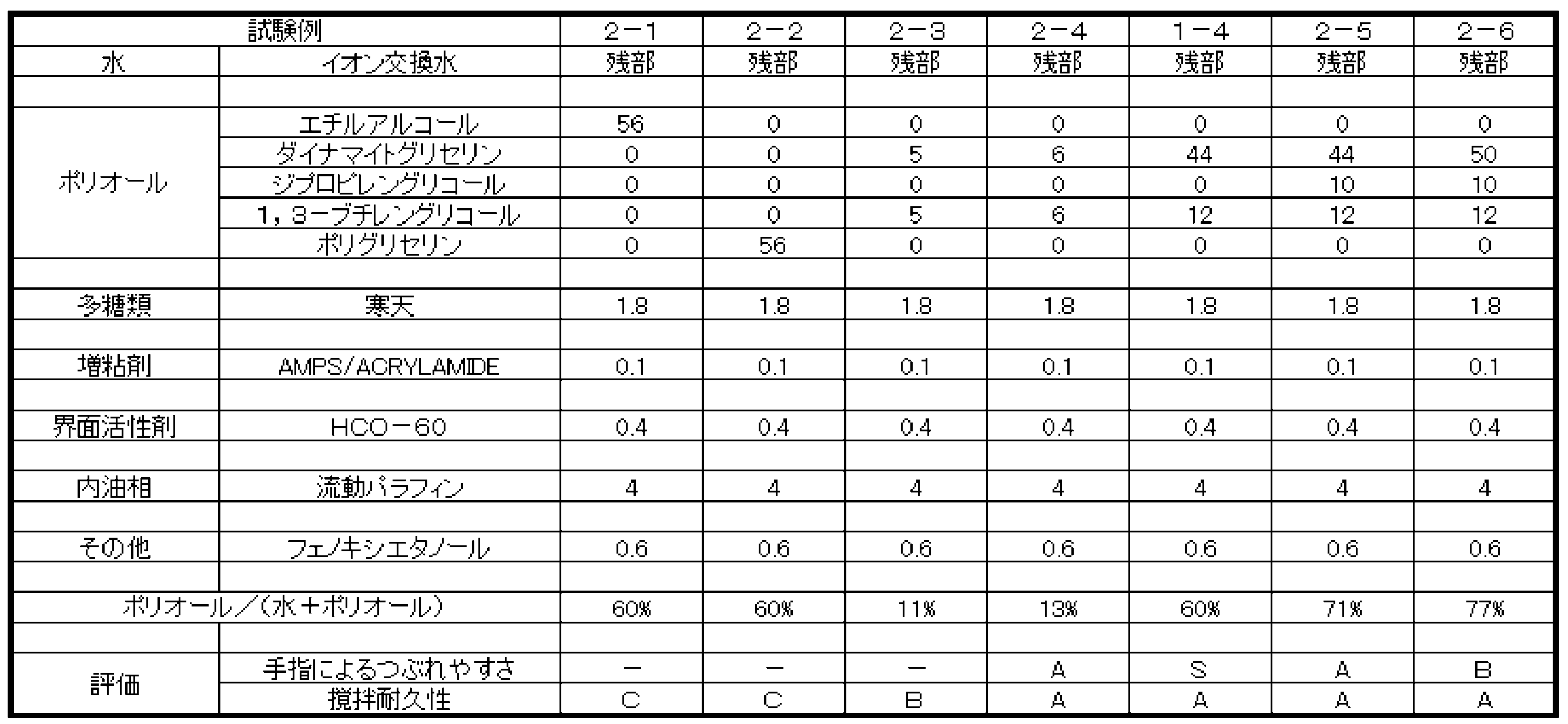
試験例2-1では、一価アルコールであるエチルアルコールを、また試験例2-2では炭素数C6以上のポリグリセリン(ポリオール)を用いたが、いずれも製造適性の点で適用できなかった。
これに対し、試験例1-4,2-4,2-5に示すように、C3~5のポリオールであるグリセリン、ジプロピレングリコール、1,3-ブチレングリコールを用いた場合には、いずれも優れた撹拌耐久性、手指崩壊性を示した。
また、試験例2-3に示すように、ポリオール/(水+ポリオール)が11%であると、十分な手指崩壊性が得られないが、13%であると撹拌耐久性、手指崩壊性のいずれの効果も発現し、71%(試験例2-5)までは両効果の発現が確認された。しかしながら、77%(試験例2-6)となると手指崩壊性が低下するため、ポリオールの割合は13~71%が好ましい。
また、本発明者らは、ゲル化剤(寒天)の添加量について検討を行った。結果を表3に示す。
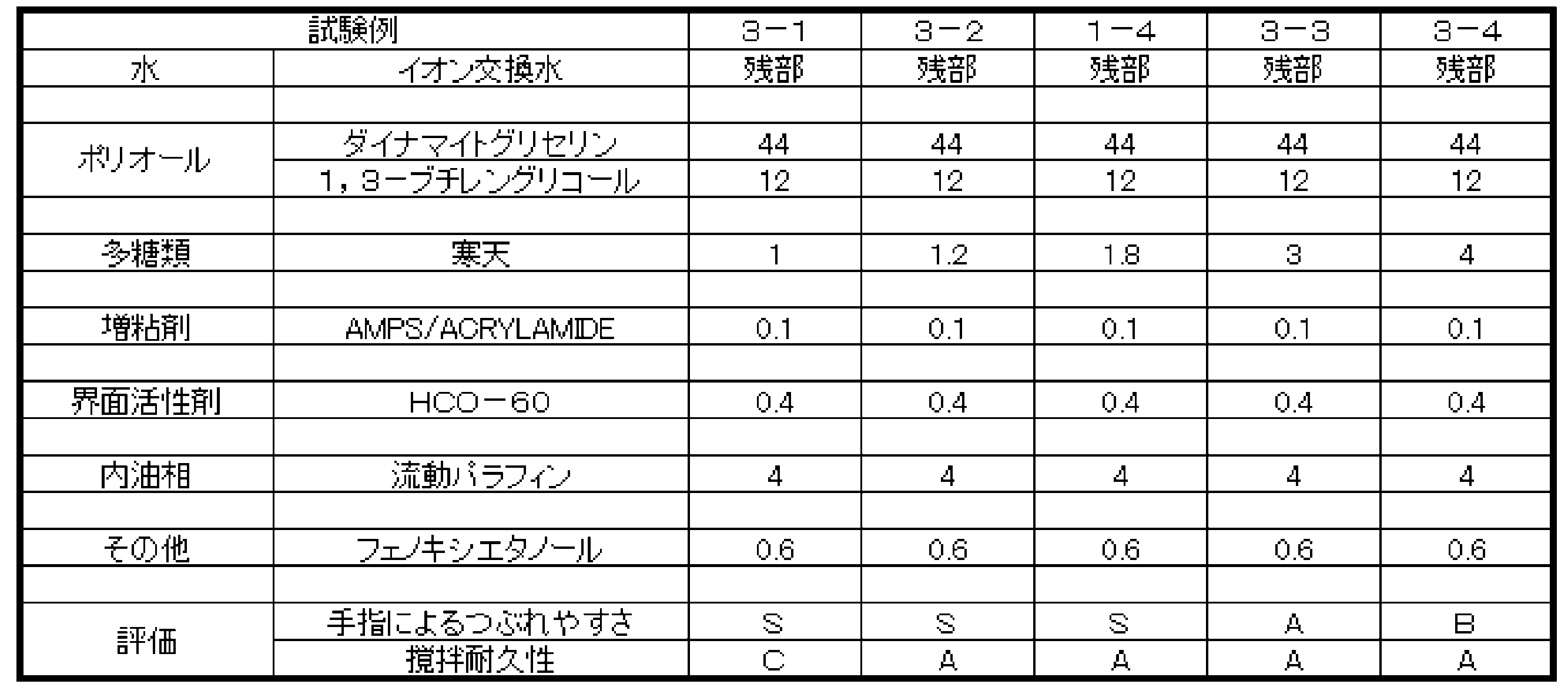
同表に示すように、ゲル化剤の添加量は、ゲル粒子に対し1.2~3質量%で手指による崩壊性と撹拌耐久性の両者を満足させることができた。
また、本発明者らは増粘剤に関し検討を行った。結果を表4,5に示す。

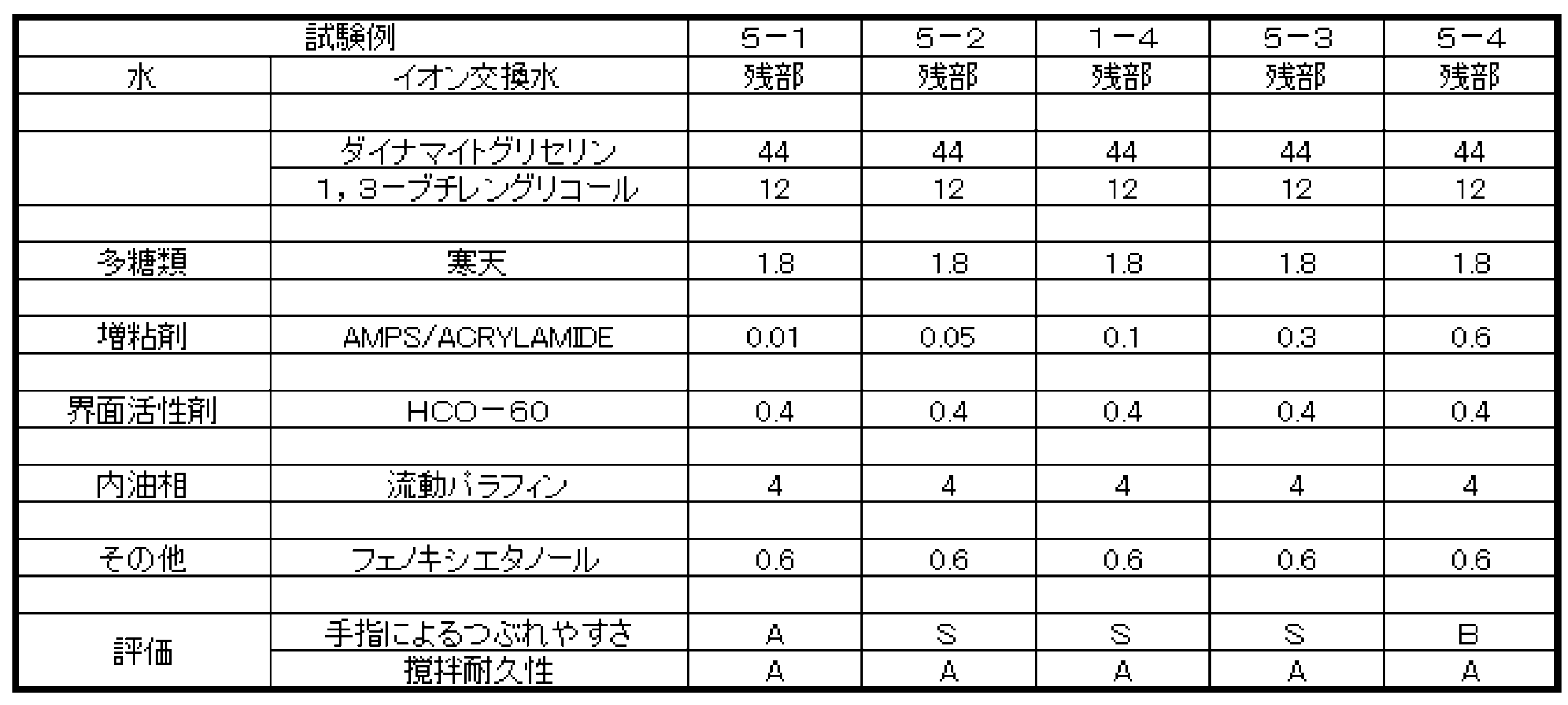
表4より明らかなように、AMPSモノマーを有するAMPS/アクリルアミド(SU-GEL 東邦化学工業製)、AMPS/メタクリル酸POE付加ベヘニルエーテル/VP(Aristoflex-HMB クラリアントGMBH製)、アクリロイルジメチルタウリン/VP(Aristoflex-AVD クラリアント GMBH製)はいずれも優れた効果を示した。一方、AMPSモノマーを有さない(PEG-240/デシルテトラデセス-20/HDI)コポリマー(アデカノールGT-700)、キサンタンガム(ケルトロール)、カルボキシビニルポリマー(カーボポール)は所期の効果を奏さず、本発明において好適に用いられる増粘剤は、AMPSモノマーを含むものである。
また、表5に示すように、増粘剤の配合量は0.05~0.3質量%において顕著な効果を奏することが理解される。
次に本発明者らが検討を行ったところ、ゲル粒子の手指崩壊性は、ゲル粒子が配合される組成物の粘度と密接な関係があることが解った。すなわち、ゲル粒子は手指で潰そうとしたときに、脇に逃げてしまい、潰しにくいことがある。この「脇への逃げ」は、ゲル粒子が添加される組成物の粘度と密接な関係がある。
本発明にかかるゲル粒子に関し、その配合される組成物の粘度との関係を調査したところ、組成物粘度が好ましくは10000~100000mPa・s以上であることが解った。
Claims (10)
- ガラクトースを構成骨格に持つ親水性ゲル化剤と、
水およびC2~C5のポリオールを含むゲル化剤分散媒と、を含むことを特徴とするゲル粒子。 - ガラクトースを構成骨格に持つ親水性高分子ゲル化剤0.1~5質量%と、
水およびC2~C5のポリオールを含むゲル化剤分散媒80質量%以上と、
を含み、
ポリオール/(水+ポリオール)の質量比が0.13~0.71であり、ゲル粒子の数平均粒子径が0.05~3mmであることを特徴とするゲル粒子。 - 請求項1又は2に記載のゲル粒子において、
さらにアクリルアミド-2-メチルプロパンスルホン酸基を有する水溶性ポリマーを含むことを特徴とするゲル粒子。 - 請求項1~3のいずれかに記載のゲル粒子において、さらにゲル化剤分散媒中に分散した内油相を含むことを特徴とするゲル粒子。
- 請求項1~4のいずれかに記載のゲル粒子において、多糖類は寒天又はカラギーナンであることを特徴とするゲル粒子。
- 請求項1~5のいずれかに記載のゲル粒子において、該ゲル粒子を構成するゲルの降伏応力が50~350[g/mm2]単位であることを特徴とするゲル粒子。
- 請求項1~6のいずれかに記載のゲル粒子において、該ゲル粒子を構成するゲルの降伏歪みは1.5~3.5[mm]単位であることを特徴とするゲル粒子。
- 請求項1~7のいずれかに記載のゲル粒子において、該ゲル粒子を構成するゲルの降伏エネルギーは、35~600[g/mm]単位であることを特徴とするゲル粒子。
- 請求項1~8のいずれかに記載のゲル粒子において、該ゲル粒子を構成するゲルの硬度は、50~200[g/mm3]単位であることを特徴とするゲル粒子。
- 請求項1~9のいずれかに記載のゲル粒子を含み、且つゲル粒子の外相は10000~100000mPa・sの粘度を有することを特徴とする皮膚外用剤。
Priority Applications (1)
| Application Number | Priority Date | Filing Date | Title |
|---|---|---|---|
| CN201980052194.0A CN112533582B (zh) | 2018-08-10 | 2019-08-06 | 凝胶粒子及包含该凝胶粒子的皮肤外用剂 |
Applications Claiming Priority (2)
| Application Number | Priority Date | Filing Date | Title |
|---|---|---|---|
| JP2018-151700 | 2018-08-10 | ||
| JP2018151700A JP7221010B2 (ja) | 2018-08-10 | 2018-08-10 | ゲル粒子及びそれを含む皮膚外用剤 |
Publications (1)
| Publication Number | Publication Date |
|---|---|
| WO2020032006A1 true WO2020032006A1 (ja) | 2020-02-13 |
Family
ID=69414779
Family Applications (1)
| Application Number | Title | Priority Date | Filing Date |
|---|---|---|---|
| PCT/JP2019/030845 Ceased WO2020032006A1 (ja) | 2018-08-10 | 2019-08-06 | ゲル粒子及びそれを含む皮膚外用剤 |
Country Status (3)
| Country | Link |
|---|---|
| JP (1) | JP7221010B2 (ja) |
| CN (1) | CN112533582B (ja) |
| WO (1) | WO2020032006A1 (ja) |
Cited By (1)
| Publication number | Priority date | Publication date | Assignee | Title |
|---|---|---|---|---|
| CN117545460A (zh) * | 2021-07-20 | 2024-02-09 | 株式会社资生堂 | 油分散组合物 |
Families Citing this family (1)
| Publication number | Priority date | Publication date | Assignee | Title |
|---|---|---|---|---|
| WO2024142841A1 (ja) * | 2022-12-28 | 2024-07-04 | 株式会社 資生堂 | 組成物 |
Citations (3)
| Publication number | Priority date | Publication date | Assignee | Title |
|---|---|---|---|---|
| JP2001096146A (ja) * | 1999-07-27 | 2001-04-10 | Shiseido Co Ltd | マイクロカプセル及びその製造方法 |
| JP2013513558A (ja) * | 2009-12-10 | 2013-04-22 | ノイブルク スキン ケア ゲーエムベーハー ウント コー カーゲー | 乳化剤を含まない、ポリマーで安定化された泡沫製剤 |
| JP2014210770A (ja) * | 2013-04-03 | 2014-11-13 | 株式会社コーセー | 化粧料 |
Family Cites Families (8)
| Publication number | Priority date | Publication date | Assignee | Title |
|---|---|---|---|---|
| FR2794999B1 (fr) * | 1999-06-18 | 2001-07-13 | Oreal | Gel aqueux solide comprenant un gelifiant hydrophile et des charges particulieres, compositions le contenant, utilisations |
| US6391288B1 (en) * | 1999-07-27 | 2002-05-21 | Shiseido Co., Ltd. | Microcapsule and method of making the same |
| BE1014976A3 (nl) * | 2002-06-21 | 2004-07-06 | Cnci Bvba | Huidverzorgingpreparaat op basis van honing. |
| JP4060663B2 (ja) * | 2002-08-06 | 2008-03-12 | 花王株式会社 | O/w乳化組成物の製造方法 |
| EP2359801B1 (en) * | 2008-12-03 | 2017-06-14 | Shiseido Co., Ltd. | Oil-in-water cosmetic |
| FR3002449B1 (fr) * | 2013-02-25 | 2015-04-03 | Oreal | Composition cosmetique de type gel |
| JP6367586B2 (ja) * | 2013-03-27 | 2018-08-01 | 株式会社コーセー | 透明ゲル状組成物 |
| CN107847419B (zh) * | 2015-08-04 | 2021-03-16 | 住友精化株式会社 | 凝胶状组合物 |
-
2018
- 2018-08-10 JP JP2018151700A patent/JP7221010B2/ja active Active
-
2019
- 2019-08-06 WO PCT/JP2019/030845 patent/WO2020032006A1/ja not_active Ceased
- 2019-08-06 CN CN201980052194.0A patent/CN112533582B/zh active Active
Patent Citations (3)
| Publication number | Priority date | Publication date | Assignee | Title |
|---|---|---|---|---|
| JP2001096146A (ja) * | 1999-07-27 | 2001-04-10 | Shiseido Co Ltd | マイクロカプセル及びその製造方法 |
| JP2013513558A (ja) * | 2009-12-10 | 2013-04-22 | ノイブルク スキン ケア ゲーエムベーハー ウント コー カーゲー | 乳化剤を含まない、ポリマーで安定化された泡沫製剤 |
| JP2014210770A (ja) * | 2013-04-03 | 2014-11-13 | 株式会社コーセー | 化粧料 |
Cited By (1)
| Publication number | Priority date | Publication date | Assignee | Title |
|---|---|---|---|---|
| CN117545460A (zh) * | 2021-07-20 | 2024-02-09 | 株式会社资生堂 | 油分散组合物 |
Also Published As
| Publication number | Publication date |
|---|---|
| CN112533582B (zh) | 2023-09-15 |
| CN112533582A (zh) | 2021-03-19 |
| JP2020026404A (ja) | 2020-02-20 |
| JP7221010B2 (ja) | 2023-02-13 |
Similar Documents
| Publication | Publication Date | Title |
|---|---|---|
| KR100541753B1 (ko) | 마이크로캡슐 및 그 제조방법 | |
| JP5073031B2 (ja) | 皮膚化粧料 | |
| WO2001051558A1 (en) | Microgels and external preparations containing the same | |
| TW200413020A (en) | Vesicle dispersion and cosmetic containing the same | |
| JP6843153B2 (ja) | 高含量のオイルを安定化したナノエマルジョン化粧料組成物 | |
| KR101489701B1 (ko) | 재분산형 분말 분산 화장료 | |
| JP4637991B2 (ja) | マイクロカプセル及びその製造方法 | |
| JP4637992B2 (ja) | マイクロカプセル及びその製造方法 | |
| KR101676696B1 (ko) | 수중유형 화장료 | |
| CA2241305A1 (fr) | Composition a base de vesicules lipidiques et d'un poly(acide 2-acrylamido 2-methylpropane sulfonique) reticule et neutralise a au moins 90% | |
| CN112533582B (zh) | 凝胶粒子及包含该凝胶粒子的皮肤外用剂 | |
| CN111801091A (zh) | 水包油滴型的微细乳液型化妆料 | |
| JP6820463B2 (ja) | 皮膚外用剤および抗シワ剤 | |
| JP4637993B2 (ja) | マイクロカプセル及びその製造方法 | |
| KR100501728B1 (ko) | 나노사이즈의 화장료용 다중액정 막 캡슐 조성물과 그제조 방법 | |
| JP7818899B2 (ja) | 高内油相水中油型乳化組成物 | |
| KR100570497B1 (ko) | 나노크기의 다중액정막으로 캡슐화된 순수 레티놀을포함하는 주름방지용 화장료 조성물과 이의 제조방법 | |
| JP2005089366A (ja) | 毛髪用乳化組成物 | |
| WO2020009078A1 (ja) | メイクアップリムーバー | |
| JP2002145733A (ja) | 固形状油中水型乳化化粧料 | |
| WO2004103324A1 (ja) | 毛髪用乳化組成物 | |
| JP5464818B2 (ja) | 頭皮頭髪用化粧料 | |
| JP2021120366A (ja) | 乳化ハイドロゲル粒子及びその製造方法 | |
| WO2011148640A1 (ja) | 血流促進剤および外用剤 | |
| KR20250167155A (ko) | 마이크로 버블 오일 입자를 갖는 여드름성 피부 개선용 화장료 조성물의 제조방법 및 그 방법에 의해 제조된 화장료 조성물 |
Legal Events
| Date | Code | Title | Description |
|---|---|---|---|
| 121 | Ep: the epo has been informed by wipo that ep was designated in this application |
Ref document number: 19847685 Country of ref document: EP Kind code of ref document: A1 |
|
| NENP | Non-entry into the national phase |
Ref country code: DE |
|
| 122 | Ep: pct application non-entry in european phase |
Ref document number: 19847685 Country of ref document: EP Kind code of ref document: A1 |