WO2020031932A1 - 光学フィルム、フィルム積層体、ディスプレイユニット - Google Patents
光学フィルム、フィルム積層体、ディスプレイユニット Download PDFInfo
- Publication number
- WO2020031932A1 WO2020031932A1 PCT/JP2019/030630 JP2019030630W WO2020031932A1 WO 2020031932 A1 WO2020031932 A1 WO 2020031932A1 JP 2019030630 W JP2019030630 W JP 2019030630W WO 2020031932 A1 WO2020031932 A1 WO 2020031932A1
- Authority
- WO
- WIPO (PCT)
- Prior art keywords
- film
- layer
- dye
- polyester
- optical film
- Prior art date
- Legal status (The legal status is an assumption and is not a legal conclusion. Google has not performed a legal analysis and makes no representation as to the accuracy of the status listed.)
- Ceased
Links
Images

Classifications
-
- G—PHYSICS
- G02—OPTICS
- G02B—OPTICAL ELEMENTS, SYSTEMS OR APPARATUS
- G02B5/00—Optical elements other than lenses
- G02B5/20—Filters
- G02B5/22—Absorbing filters
- G02B5/223—Absorbing filters containing organic substances, e.g. dyes, inks or pigments
-
- B—PERFORMING OPERATIONS; TRANSPORTING
- B32—LAYERED PRODUCTS
- B32B—LAYERED PRODUCTS, i.e. PRODUCTS BUILT-UP OF STRATA OF FLAT OR NON-FLAT, e.g. CELLULAR OR HONEYCOMB, FORM
- B32B27/00—Layered products comprising a layer of synthetic resin
- B32B27/18—Layered products comprising a layer of synthetic resin characterised by the use of special additives
- B32B27/20—Layered products comprising a layer of synthetic resin characterised by the use of special additives using fillers, pigments, thixotroping agents
-
- B—PERFORMING OPERATIONS; TRANSPORTING
- B32—LAYERED PRODUCTS
- B32B—LAYERED PRODUCTS, i.e. PRODUCTS BUILT-UP OF STRATA OF FLAT OR NON-FLAT, e.g. CELLULAR OR HONEYCOMB, FORM
- B32B27/00—Layered products comprising a layer of synthetic resin
- B32B27/28—Layered products comprising a layer of synthetic resin comprising synthetic resins not wholly covered by any one of the sub-groups B32B27/30 - B32B27/42
- B32B27/281—Layered products comprising a layer of synthetic resin comprising synthetic resins not wholly covered by any one of the sub-groups B32B27/30 - B32B27/42 comprising polyimides
-
- B—PERFORMING OPERATIONS; TRANSPORTING
- B32—LAYERED PRODUCTS
- B32B—LAYERED PRODUCTS, i.e. PRODUCTS BUILT-UP OF STRATA OF FLAT OR NON-FLAT, e.g. CELLULAR OR HONEYCOMB, FORM
- B32B27/00—Layered products comprising a layer of synthetic resin
- B32B27/36—Layered products comprising a layer of synthetic resin comprising polyesters
-
- B—PERFORMING OPERATIONS; TRANSPORTING
- B32—LAYERED PRODUCTS
- B32B—LAYERED PRODUCTS, i.e. PRODUCTS BUILT-UP OF STRATA OF FLAT OR NON-FLAT, e.g. CELLULAR OR HONEYCOMB, FORM
- B32B7/00—Layered products characterised by the relation between layers; Layered products characterised by the relative orientation of features between layers, or by the relative values of a measurable parameter between layers, i.e. products comprising layers having different physical, chemical or physicochemical properties; Layered products characterised by the interconnection of layers
- B32B7/02—Physical, chemical or physicochemical properties
- B32B7/023—Optical properties
-
- B—PERFORMING OPERATIONS; TRANSPORTING
- B32—LAYERED PRODUCTS
- B32B—LAYERED PRODUCTS, i.e. PRODUCTS BUILT-UP OF STRATA OF FLAT OR NON-FLAT, e.g. CELLULAR OR HONEYCOMB, FORM
- B32B7/00—Layered products characterised by the relation between layers; Layered products characterised by the relative orientation of features between layers, or by the relative values of a measurable parameter between layers, i.e. products comprising layers having different physical, chemical or physicochemical properties; Layered products characterised by the interconnection of layers
- B32B7/04—Interconnection of layers
- B32B7/12—Interconnection of layers using interposed adhesives or interposed materials with bonding properties
-
- C—CHEMISTRY; METALLURGY
- C08—ORGANIC MACROMOLECULAR COMPOUNDS; THEIR PREPARATION OR CHEMICAL WORKING-UP; COMPOSITIONS BASED THEREON
- C08J—WORKING-UP; GENERAL PROCESSES OF COMPOUNDING; AFTER-TREATMENT NOT COVERED BY SUBCLASSES C08B, C08C, C08F, C08G or C08H
- C08J5/00—Manufacture of articles or shaped materials containing macromolecular substances
- C08J5/18—Manufacture of films or sheets
-
- C—CHEMISTRY; METALLURGY
- C08—ORGANIC MACROMOLECULAR COMPOUNDS; THEIR PREPARATION OR CHEMICAL WORKING-UP; COMPOSITIONS BASED THEREON
- C08J—WORKING-UP; GENERAL PROCESSES OF COMPOUNDING; AFTER-TREATMENT NOT COVERED BY SUBCLASSES C08B, C08C, C08F, C08G or C08H
- C08J7/00—Chemical treatment or coating of shaped articles made of macromolecular substances
- C08J7/04—Coating
- C08J7/044—Forming conductive coatings; Forming coatings having anti-static properties
-
- G—PHYSICS
- G02—OPTICS
- G02B—OPTICAL ELEMENTS, SYSTEMS OR APPARATUS
- G02B1/00—Optical elements characterised by the material of which they are made; Optical coatings for optical elements
- G02B1/04—Optical elements characterised by the material of which they are made; Optical coatings for optical elements made of organic materials, e.g. plastics
-
- G—PHYSICS
- G02—OPTICS
- G02B—OPTICAL ELEMENTS, SYSTEMS OR APPARATUS
- G02B5/00—Optical elements other than lenses
- G02B5/20—Filters
- G02B5/22—Absorbing filters
-
- G—PHYSICS
- G09—EDUCATION; CRYPTOGRAPHY; DISPLAY; ADVERTISING; SEALS
- G09F—DISPLAYING; ADVERTISING; SIGNS; LABELS OR NAME-PLATES; SEALS
- G09F9/00—Indicating arrangements for variable information in which the information is built-up on a support by selection or combination of individual elements
-
- B—PERFORMING OPERATIONS; TRANSPORTING
- B32—LAYERED PRODUCTS
- B32B—LAYERED PRODUCTS, i.e. PRODUCTS BUILT-UP OF STRATA OF FLAT OR NON-FLAT, e.g. CELLULAR OR HONEYCOMB, FORM
- B32B2457/00—Electrical equipment
- B32B2457/20—Displays, e.g. liquid crystal displays, plasma displays
Definitions
- the present invention relates to an optical film and a film laminate suitable for use in combination with an LED light source.
- Polyester films have long been used in various industrial applications, taking advantage of their superior properties such as heat resistance, water resistance, chemical resistance, mechanical strength, and dimensional stability. The applications are expanding and diversifying. I have.
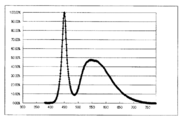
- the emission spectrum of a white LED light source (a type in which a yellow phosphor is emitted by a blue LED) generally used in information terminal equipment generally has a strong emission intensity near 450 nm.
- the emission spectrum of the LED light source is particularly bright (500 nm to 600 nm).
- polyester film used in combination with such an LED light source for example, in Patent Document 1, as a film for protecting a screen using an LED as a light source, a measurement angle of 60 measured using an ellipsometer M-2000D manufactured by Woolam Corporation. There is disclosed a polyester film having a maximum value variation R ⁇ 60 of 0.10 or more and 5.00 or less of the change in amplitude ratio ⁇ at a measurement wavelength of 235 to 255 nm.
- Patent Document 2 discloses that a polyester resin is used as a laminated polyester film for protecting a screen using an LED as a light source, which has an excellent surface quality without color tone unevenness, and further has an optically excellent transparency. And a polyester layer made of a polyester resin different from this, and 30 or more layers are alternately laminated in the thickness direction, and the lamination interface roughness between the polyester layers is 0.2 nm or more and 6.0 nm or less. A laminated polyester film is disclosed.
- a polarizing film containing a polyolefin and a dichroic dye, a first photo-alignment film located on one surface of the polarizing film a polarizing film containing a polyolefin and a dichroic dye, a first photo-alignment film located on one surface of the polarizing film
- An optical film comprising: a first liquid crystal layer positioned on one surface of a photo-alignment film, wherein the polarizing film, the first photo-alignment film, and the first liquid crystal layer have an integrated structure in which they are in close contact with each other. I have.
- Patent Document 4 discloses that in an optical film having at least a hard coat layer on a transparent substrate, the hard coat layer contains at least a binder matrix and a yellow pigment, and has a light wavelength of 440 nm of the hard coat layer.
- An optical film characterized by having a transmittance of not more than 80% is disclosed.
- Patent Document 5 discloses an optical film containing thermochromic vanadium dioxide fine particles, which contains a dye or a pigment that absorbs light having a light wavelength in the range of 650 to 700 nm, and has a light wavelength within the light wavelength range. Wherein the average optical absorptivity of the optical film at 23 ° C. is in the range of 30 to 85%.
- the spectral characteristics required for the image include a continuous spectral spectrum without unevenness in the emission intensity even in different wavelength ranges, and an overall emission intensity.
- a light source eg, sunlight
- the light emission spectrum of the LED light source has a weak emission intensity on the long wavelength side (500 nm or more) in the visible light region, and thus the image is not displayed. There was a case where reading was difficult.
- the LED light source originally has a sufficient emission intensity.
- the emission intensity in the region having the above that is, the region near 450 nm was sometimes reduced.
- the unevenness of the emission intensity causes the unevenness of the color of the display screen. For example, when the emission intensity at 450 nm is stronger than necessary, the color of the display screen tends to be bluish.
- a touch panel system such as a resistive film system or a capacitance system
- a transparent electrode is generally used as a constituent member.
- the transparent electrode is formed by laminating a transparent conductive layer made of a metal oxide such as indium oxide (ITO) or zinc oxide (ZnO) containing tin oxide on a glass or transparent resin film substrate. It is generally composed.
- Such a transparent electrode tends to cause a decrease in transmittance in a visible light short wavelength region due to repeated reflection and absorption of the metal oxide layer, and as a result, tends to be colored yellow or brown. For this reason, in the liquid crystal display device disposed below the touch panel, the color sometimes displays an unexpected color. For this reason, the development of transparent conductive films that focus on other conductive materials such as metal nanoparticles and conductive polymers has also been earnestly studied, but the situation was insufficient to solve the above-mentioned problems.
- the present invention when incorporated into an image display device in combination with an LED light source, it is possible to equalize the emission intensity in the visible light region with respect to the light supplied to the display, and to equalize the color of the display screen. It is possible to prevent the brightness from lowering, and furthermore, when the display unit is configured in combination with the transparent electrode, it is possible to suppress the color change of the display screen due to the aging of the transparent electrode.
- Another object of the present invention is to provide a new optical film and a new film laminate.
- the present invention is a polyester film containing a dye and / or a pigment, the film haze is 6% or less, the light transmittance at 450 nm is 4% or less, the light transmittance at 550 nm is 20% or more, An optical film having a color tone (b *) value of 50 or more is proposed.
- the present invention is also a film laminate in which a resin film is laminated on one side of the optical film proposed by the present invention via an adhesive layer, the film haze of the film laminate is 15% or less, and a light beam of 450 nm
- the present invention proposes a film laminate having a transmittance of 1% or less, a light transmittance at 550 nm of 15% to 30%, and a color tone (b *) value of 70 or more.
- the present invention is also a film laminate in which a resin film is laminated via an adhesive layer on one side of an optical film composed of a polyester film containing a dye and / or a pigment, and the film haze of the film laminate is 15% or less.
- the light transmittance at 450 nm is 1% or less
- the light transmittance at 550 nm is 15% to 30%
- the color tone (b *) value is 70 or more. .
- the optical film proposed by the present invention or the film laminate proposed by the present invention when incorporated into an image display device in combination with an LED light source, light emitted from the LED light source with respect to light supplied to the display ( (Light transmittance) without impairing the light emission intensity of the light emitted from the LED light source, that is, the light emission intensity at 550 nm can be reinforced, so that the light emission intensity can be made uniform without lowering the luminance. Can be planned. That is, the light emitted from the LED light source is inherently biased in the light transmittance for each wavelength region, but by using the optical film proposed by the present invention or the film laminate proposed by the present invention in combination.
- the color of the display screen can be made uniform and the luminance can be improved. Therefore, for example, when a (digital) image is read using light in the visible light region near 550 nm, the (digital) image can be read as a sharper (digital) image without blurring as in the related art.
- the optical film proposed by the present invention or the film laminate proposed by the present invention is mounted as a constituent member of a display from the beginning, the deterioration of the constituent members with the lapse of time in the coming future, for example, the above-mentioned transparent electrode With the deterioration over time, predict the color change of the display screen due to discoloration, adjust the type and amount of dyes and pigments, etc., to adjust the color tone of the optical film proposed by the present invention or the film laminate proposed by the present invention Is adjusted to the same color tone as the color tone after the change, it is possible to synchronize with the hue after the change of the deteriorated member, and as a result, the color change on the display screen can be made inconspicuous. Therefore, it is possible to prevent in advance an unexpected color different from the color that the display screen should originally have.
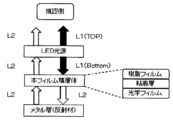
- FIG. 1 is a diagram schematically illustrating a configuration example of a display unit according to an example of an embodiment of the present invention and an example of how light travels in the configuration example. It is the figure which showed typically the example of the way of the light in the display unit in a film laminated body structure which concerns on an example of embodiment of this invention.
- the optical film according to an example of the embodiment of the present invention is a polyester film containing a dye and / or a pigment.
- polyester film means a film provided with a polyester resin layer
- the "polyester resin layer” means a layer containing polyester as a main component resin
- the "main resin” Means a resin having the highest content mass ratio among the resins constituting the layer.
- the present optical film preferably has a film haze of 6% or less, more preferably 4% or less, more preferably 3% or less, and particularly preferably 2% or less, in order to correspond to optical applications.
- the lower limit of the film haze is not limited and may be 0% or more, but is usually about 0.5% or more.
- the present optical film preferably has a color tone (b * value) of 50 or more, more preferably 60 or more, especially 70 or more, and particularly preferably 80 or more, from the viewpoint of preventing a change in color tone due to deterioration with time of the constituent members. More preferably, there is.
- the upper limit is preferably set to about 98 as a guide.
- a film having a color tone (b * ) value in the above range means a film that visually exhibits at least yellow.
- the color tone (b * ) value is about ⁇ 5 to +3 in the case of a polyester film containing no substance that causes any coloring.
- the optical film preferably has a light transmittance of 4% or less at a wavelength of 450 nm and a light transmittance of 20% or more at a wavelength of 550 nm.
- the emission spectrum of the LED light source generally has a strong emission intensity near 450 nm, and the emission intensity around 550 nm is significantly lower than the emission intensity of the spectrum near 450 nm. have. Therefore, when the present optical film has the above light transmittance in the above wavelength region, when the present optical film is combined with an LED light source and incorporated into an image display device, the light emission performance (light transmittance) of light emitted from the LED light source is obtained.
- the light transmittance at a wavelength of 450 nm is preferably 4% or less, more preferably 3% or less, and particularly preferably 2% or less.
- the lower limit of the light transmittance at a wavelength of 450 nm of the present optical film is not limited, and is usually 0% or more, preferably 0.01% or more.
- the light transmittance at a wavelength of 550 nm needs to be 20% or more, and more preferably 25% or more and 80% or less, and more preferably 30% or more or 80% or less.
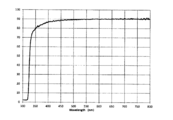
- the light transmittance increases as the wavelength increases. More specifically, it is preferable that the transmittance at each of the measurement wavelengths (1) 400 nm, (2) 550 nm, (3) 650 nm, and (4) 720 nm increases as the wavelength increases.
- the maximum value of the light transmittance in the measurement wavelength range of 400 nm to 480 nm is preferably 3% or less, more preferably 2% or less, and especially 1% or less, from the viewpoint of uniforming the color of the display screen. Is more preferred.
- the maximum value of the light transmittance in the measurement wavelength range of 500 nm to 600 nm is preferably 30 to 85% from the viewpoint of uniforming the color of the display screen, more preferably 40% or more, or 80% or less, and among them, More preferably, it is 50% or more or 70% or less.
- the maximum value of the light transmittance in the measurement wavelength range of 610 nm to 680 nm is preferably 51% to 70%, and more preferably 55% or more, or 70% or less, from the viewpoint of uniforming the color of the display screen. More preferably, it is 60% or more or 70% or less.
- the maximum value of the light transmittance in the measurement wavelength range of 700 nm to 720 nm is preferably 61% to 80% from the viewpoint of uniforming the color of the display screen, and more preferably 65% or more, or 80% or less, and among them, More preferably, it is 70% or more or 80% or less.
- the present optical film in order to control the light transmittance for each specific wavelength region as described above, it is preferable to adjust and control the type and amount of the dye and / or pigment contained in the polyester film.
- the type and amount of the dye and / or pigment contained in the polyester film it is preferable that at least two or more dyes selected from yellow dyes, red dyes, blue dyes, and brown dyes, particularly three or more dyes, and among them, four or more dyes are appropriately selected and contained in the polyester film.
- the present optical film may be a single-layer polyester film composed of a polyester resin layer or a multilayer polyester film composed of two or more polyester resin layers. In this case, three or more layers may be used.
- the present optical film is a polyester film composed of three polyester resin layers
- a polyester resin layer as a surface layer and a polyester resin layer as an intermediate layer for the purpose of effectively improving various properties.
- an example of a configuration in which the raw material is changed to have a three-layer configuration can be given.
- the polyester resin layer constituting the intermediate layer contains a dye and / or a pigment, and both surface layers substantially contain a dye and / or a pigment. Examples of such a case include a polyester resin layer that is not used. With such a configuration, bleed out of the dye and / or the pigment can be prevented.
- polyester film similarly composed of three polyester resin layers
- polyester resin layers constituting the intermediate layer and both surface layers contain a pigment
- surface layer means a layer constituting an exposed surface in a film having the surface layer, and the other layers are referred to as intermediate layers.
- the present optical film can include a functional layer (X) as one film surface layer.
- a configuration may be adopted in which a functional layer (Y) different from the functional layer (X) is provided as one or the other film surface layer.
- a configuration can be adopted in which a functional layer (X) is provided as one film surface layer and the functional layer (Y) is provided as the other film surface layer.
- the functional layer means a layer having various functions, and includes, for example, a layer such as an easy-adhesion layer and an antistatic layer described below.
- the type of the functional layer is not limited to these, and examples thereof include an anti-blocking layer, a release layer, a flame retardant layer, a hard coat layer, and a print layer.
- an anti-blocking layer for example, an example in which an easy-adhesion layer is provided as one film surface layer of the present optical film and an antistatic layer is provided as the other film surface layer can be given.
- the easy adhesion layer and the antistatic layer will be described later.
- the polyester constituting the main component resin of each polyester resin layer may be a homopolyester or a copolyester.
- a homopolyester those obtained by polycondensing an aromatic dicarboxylic acid and an aliphatic glycol are preferred.
- the aromatic dicarboxylic acid include terephthalic acid and 2,6-naphthalenedicarboxylic acid
- examples of the aliphatic glycol include ethylene glycol, diethylene glycol, and 1,4-cyclohexanedimethanol.
- polyethylene terephthalate and the like can be exemplified.
- dicarboxylic acid component of the copolymerized polyester examples include one or more of isophthalic acid, phthalic acid, terephthalic acid, 2,6-naphthalenedicarboxylic acid, adipic acid, and sebacic acid.
- isophthalic acid phthalic acid
- terephthalic acid 2,6-naphthalenedicarboxylic acid
- adipic acid adipic acid
- sebacic acid adipic acid
- glycol diethylene glycol, propylene glycol, butanediol, 4-cyclohexanedimethanol, neopentyl glycol and the like
- PEN polyethylene-2,6-naphthalenedicarboxylate
- the intrinsic viscosity of the polyester constituting the main component resin of each polyester resin layer is usually preferably 0.3 to 0.9 dl / g, more preferably 0.4 dl / g or more and 0.8 dl / g or less. Among them, it is more preferable that the ratio is 0.5 dl / g or more or 0.8 dl / g or less.
- the measuring method of the intrinsic viscosity is a method described in Examples described later.
- the preferred intrinsic viscosity range of the present optical film itself and the preferred intrinsic viscosity range of each polyester resin layer are the same as the above ranges.
- the polyester resin layer preferably contains a dye and / or a pigment.
- the polyester resin layer preferably contains dyes and / or pigments.
- the intermediate layer contains the dye and the surface layer contains substantially no dye from the viewpoint of reducing the bleed-out of the dye.
- substantially not containing means that it is not intentionally contained, and also includes a case where it is unavoidably contained.
- the dye is preferably used in consideration of heat resistance enough to withstand the temperature at the time of producing the present optical film, dispersibility, and the like. From such a viewpoint, dyes such as anthraquinone-based, phthalocyanine-based, perinone-based, and isoquinoline-based dyes are preferable in terms of chemical structure. As a dyeing formulation, dispersible dyes and oil-soluble dyes are preferred. In addition, even if it is generally classified as a pigment, as long as it is soluble in the molten polyester as described above, it can be used as a dye in the present invention. Specific examples include phthalocyanine-based complex salt dyes with metal ions such as copper, cobalt, nickel, zinc, and chromium.
- the classification of the above dyes is based on the classification of "color index" by the British Dyestuff Dyeing Society or the American Society of Textile Chemistry and Dyeing Technology.
- Examples of the combination of the two dyes include yellow dye and red dye, yellow dye and blue dye, yellow dye and brown dye, red dye and blue dye, red dye and brown dye, and combination of blue dye and brown dye. it can.
- Examples of combinations of the three dyes include yellow dyes, red dyes, and blue dyes, yellow dyes, red dyes, and brown dyes, yellow dyes, blue dyes, and brown dyes, and red dyes, blue dyes, and brown dyes. be able to.
- the content of the dye in each layer is preferably 0.01 to 10% by mass, more preferably 0.05% by mass or 7% by mass, and especially 0.1% by mass or more. Alternatively, the content is more preferably 5% by mass or less.
- the dye content in the film is adjusted so as to satisfy (Formula 1) yellow dye ⁇ red dye + blue dye + brown dye (% by mass). Further, the dye content in the film is more preferably adjusted so as to satisfy (Formula 2) yellow dye ⁇ (red dye + blue dye + brown dye) ⁇ 10 (% by mass).
- the yellow dye, the red dye, the blue dye, and the brown dye indicate the content ratio (% by mass) of each dye in the film.
- the type of the above pigment is not particularly limited when imparting a hue to an optical film, and can be appropriately selected according to necessary characteristics.
- particles of titanium dioxide, barium sulfate, calcium carbonate, carbon black and the like are exemplified. These may be surface-treated with an oxide of aluminum, silicon, zinc, or the like from the viewpoint of improving dispersibility in polyester, weather resistance, and the like.
- inorganic coloring pigments include calcium sulfate, asbestin, kaolin, magnesium carbonate, alumina white, zinc white, lead white, basic sulfate, sulfate, lithopone, zinc sulfide, antimony white, triiron tetroxide, and chromic acid.
- organic color pigments may be used, and specific examples thereof include, for example, azo color pigments, phthalocyanine-based, acid dye lakes, basic dye lakes, condensed polycyclic color pigments, nitroso-based, alizarin lake-based, metal Color pigments such as complex salt azomethine, aniline black, and alkali blue can be exemplified.
- azo coloring pigments include monoazo lake-based, monoazo-based, disazo-based, condensed azo-based, and metal complex salt azo-based coloring pigments.
- the condensed polycyclic pigment include anthraquinone-based and thioindigo-based pigments.
- perinone-based, perylene-based, quinacridone-based, dioxazine-based, isoindolinone-based, quinophthalone-based, isoindoline-based phthalocyanine-based, dioxazine-based, and anthraquinone-based coloring pigments are included in the group consisting of: perinone-based, perylene-based, quinacridone-based, dioxazine-based, isoindolinone-based, quinophthalone-based, isoindoline-based phthalocyanine-based, dioxazine-based, and anthraquinone-based coloring pigments.
- the average particle size of the color pigment is preferably 5.0 ⁇ m or less, more preferably 0.01 ⁇ m or more and 4.0 ⁇ m or less, and even more preferably 0.05 ⁇ m or more or 3.0 ⁇ m or less.
- polyester resin layer in addition to the above-mentioned polyester, dye or pigment, particles can be blended, if necessary, mainly for the purpose of imparting lubricity.
- a conventionally known antistatic agent, weathering agent, lightproofing agent, light-blocking agent, antioxidant, heat stabilizer, lubricant, fluorescent whitening agent and the like can be added.
- an ultraviolet absorber particularly a benzoxazinone-based ultraviolet absorber, may be contained.
- a pigment such as a white pigment can be added to enhance visibility.
- the pigment may overlap with the particles as other components, but in the present invention, as long as the particles contribute to (affect) the hue of the optical film, the pigment may be used as a pigment. Shall be treated. At that time, the particles as the pigment may have the function of the particles as other components.
- particles can be blended in the polyester resin layer for the purpose of mainly providing lubricity.
- the type of the particles is not particularly limited as long as the particles can impart lubricity, and specific examples include, for example, silica, titanium oxide, zeolite, silicon nitride, boron nitride, celite, alumina, and calcium carbonate.
- the shape of the particles is not particularly limited, and any one of a spherical shape, a massive shape, a rod shape, a flat shape, and the like may be used. There is no particular limitation on the hardness, specific gravity and the like. These series of particles may be used in combination of two or more as necessary.
- the average particle size of the particles is usually 5 ⁇ m or less, preferably in the range of 0.01 to 3 ⁇ m.
- the content of the particles in the polyester resin layer is usually 5% by mass or less, preferably 0.005 to 4% by mass, more preferably 0.005 to 2% by mass, based on the polyester resin layer containing the particles. Range.
- the method for incorporating particles and colorants into the polyester is not particularly limited.
- a method of adding to a polymerization step, a method of kneading particles and a dye using an extruder to form a master batch, and the like can be mentioned.
- the thickness of the present optical film is preferably 10 to 250 ⁇ m, more preferably 25 ⁇ m or more or 125 ⁇ m or less, more preferably 38 ⁇ m or more or 100 ⁇ m or less.
- a polyester resin composition for forming an intermediate layer is prepared by containing a predetermined amount of a dye and / or a pigment and further containing a predetermined amount of other materials such as particles as necessary, while not containing these dyes and pigments.
- a polyester resin composition for forming a surface layer is prepared, supplied to separate melt extrusion devices, and heated to a temperature equal to or higher than the melting point of each polymer to be melted. Next, the melted polymer is joined and laminated in a laminar flow form in an extrusion die, extruded from a slit-shaped die, and quenched and solidified on a rotary cooling drum to a temperature of a glass transition temperature or less, substantially amorphous.
- An unstretched sheet in a state is obtained.
- the present optical film may be a non-stretched film (sheet) or a stretched film.
- a stretched film is preferable from the viewpoint of heat resistance, physical properties, and the like.
- the film When the film is a stretched film, it may be a uniaxially stretched film or a biaxially stretched film.
- the stretching conditions are described as follows.
- the unstretched sheet is preferably stretched 2 to 6 times in the machine direction at 70 to 120 ° C. to form a uniaxially stretched film, and then 2 to 6 in the transverse direction at 90 to 160 ° C. It is preferable to perform double stretching to form a biaxially stretched film and to perform heat treatment at 150 to 250 ° C. for 1 to 600 seconds. Further, at this time, a method of relaxing in the maximum temperature zone of the heat treatment and / or the cooling zone at the outlet of the heat treatment by 15% or less in the longitudinal direction and / or the transverse direction can be mentioned. Further, re-longitudinal stretching and re-lateral stretching can be added as necessary.
- the easy-adhesion layer is a layer for improving the adhesion to various optical members, and can be provided as needed.
- the composition for forming an easily adhesive layer is preferably a layer containing at least one of a compound having a carbon-carbon double bond and a urethane resin.
- Examples of the compound having a carbon-carbon double bond include compounds having a monofunctional (meth) acrylate group, a difunctional (meth) acrylate group, a polyfunctional (meth) acrylate group, a vinyl group, an allyl group, or the like. it can.
- the expression “(meth) acrylate compound” indicates “acrylate compound and / or methacrylate compound”.
- the monofunctional (meth) acrylate is not particularly limited.
- alkyl e.g., methyl (meth) acrylate, n-butyl (meth) acrylate, 2-ethylhexyl (meth) acrylate, lauryl (meth) acrylate, stearyl (meth) acrylate, cyclohexyl (meth) acrylate, isobornyl (meth) acrylate, etc.
- Hydroxyalkyl (meth) acrylates such as meth) acrylate, hydroxyethyl (meth) acrylate, hydroxypropyl (meth) acrylate, hydroxybutyl (meth) acrylate, methoxyethyl (meth) acrylate, ethoxyethyl (meth) acrylate, methoxypropyl (meth) A) alkoxyalkyl (meth) acrylates such as acrylate and ethoxypropyl (meth) acrylate, benzyl (meth) acrylate, phenoxyethyl (meth) Aromatic (meth) acrylates such as acrylates, diaminoethyl (meth) acrylates, amino group-containing (meth) acrylates such as diethylaminoethyl (meth) acrylate, methoxyethylene glycol (meth) acrylate, phenoxy polyethylene glycol (meth) acrylate, Examples thereof
- the bifunctional (meth) acrylate is not particularly limited.
- the polyfunctional (meth) acrylate is not particularly limited.
- Isocyanuric acid-modified tri (meth) acrylate such as tetra (meth) acrylate, isocyanuric acid ethylene oxide-modified tri (meth) acrylate, ⁇ -caprolactone-modified tris (acryloxyethyl) isocyanurate, pentaerythritol triacrylate hexamethylene diisocyanate urethane prepolymer , Pentaerythritol triacrylate toluen
- These compounds having a monofunctional (meth) acrylate group, compounds having a bifunctional (meth) acrylate group, compounds having a polyfunctional (meth) acrylate group, compounds having a vinyl group, and compounds having a compound having an allyl group are: They may be used alone or in combination of two or more. From the viewpoint of improving adhesion, among these (meth) acrylate compounds, bifunctional (meth) acrylates and polyfunctional (meth) acrylates are preferable, and among them, polyfunctional (meth) acrylate is particularly preferable.
- the ratio of the carbon-carbon double bond to the (meth) acrylate compound is preferably 3% by mass or more, more preferably 5% by mass or more.
- the upper limit is usually 40% by mass.
- the urethane resin may be a polymer compound having a urethane bond in the molecule, and may be a polymer compound obtained by a reaction between a polyol and an isocyanate.
- the polyol include polycarbonate polyols, polyester polyols, polyether polyols, polyolefin polyols, acrylic polyols, and the like. These compounds may be used alone or in combination. From the viewpoint of improving adhesion, polycarbonate polyols or polyester polyols are preferred, and polycarbonate polyols are more preferred.
- polycarbonate polyols constituting the urethane resin include those obtained by a dealcoholation reaction from a polyhydric alcohol and a carbonate compound.
- polyhydric alcohols include ethylene glycol, 1,2-propylene glycol, 1,3-propylene glycol, trimethylolpropane, 1,2-butanediol, 1,3-butanediol, 1,4-butane Diol, 1,5-pentanediol, 1,6-hexanediol, 1,4-cyclohexanediol, 1,4-cyclohexanedimethanol, 1,7-heptanediol, 1,8-octanediol, 1,9-nonane Examples thereof include diol, 1,10-decanediol, neopentyl glycol, 3-methyl-1,5-pentanediol, and 3,3-dimethylolheptane.
- Examples of the carbonate compound include dimethyl carbonate, diethyl carbonate, diphenyl carbonate, and ethylene carbonate.
- Polycarbonate polyols obtained from these reactions include, for example, poly (1,6-hexylene) carbonate and poly ( 3-methyl-1,5-pentylene) carbonate and the like.
- polyester polyols constituting the urethane resin examples include polycarboxylic acids (malonic acid, succinic acid, glutaric acid, adipic acid, pimelic acid, suberic acid, sebacic acid, fumaric acid, maleic acid, terephthalic acid, isophthalic acid, etc.).
- polycarboxylic acids malonic acid, succinic acid, glutaric acid, adipic acid, pimelic acid, suberic acid, sebacic acid, fumaric acid, maleic acid, terephthalic acid, isophthalic acid, etc.
- polyether polyols constituting the urethane resin examples include polyethylene glycol, polypropylene glycol, polyethylene propylene glycol, polytetramethylene ether glycol, and polyhexamethylene ether glycol.
- polyisocyanate constituting the urethane resin examples include aromatic diisocyanates such as tolylene diisocyanate, xylylene diisocyanate, methylene diphenyl diisocyanate, phenylene diisocyanate, naphthalene diisocyanate, and tolidine diisocyanate; ⁇ , ⁇ , ⁇ ′, ⁇ ′-tetra Aliphatic diisocyanates having an aromatic ring such as methylxylylene diisocyanate, methylene diisocyanate, propylene diisocyanate, lysine diisocyanate, trimethylhexamethylene diisocyanate, aliphatic diisocyanates such as hexamethylene diisocyanate, cyclohexane diisocyanate, methylcyclohexane diisocyanate, isophorone diisocyanate, methylene bis (4 -Cyclohexyliso Alicyclic diis
- polyisocyanate compounds may be a dimer, a trimer represented by an isocyanuric ring, or a polymer thereof or more.
- an aliphatic isocyanate or an alicyclic isocyanate is more preferable than an aromatic isocyanate from the viewpoint of improving adhesion to an active energy ray-curable paint and preventing yellowing due to ultraviolet rays.
- a chain extender When synthesizing a urethane resin, a chain extender may be used.
- the chain extender is not particularly limited as long as it has two or more active groups that react with an isocyanate group.
- a chain extender having two amino groups can be mainly used.
- Examples of the chain extender having two hydroxyl groups include aliphatic glycols such as ethylene glycol, propylene glycol, butanediol, and pentanediol, aromatic glycols such as xylylene glycol and bishydroxyethoxybenzene, neopentyl glycol, and neopentyl glycol. Glycols such as ester glycols such as hydroxypivalate can be mentioned.
- chain extender having two amino groups examples include aromatic diamines such as tolylenediamine, xylylenediamine, diphenylmethanediamine, ethylenediamine, propylenediamine, hexanediamine, and 2,2-dimethyl-1,3- Propanediamine, 2-methyl-1,5-pentanediamine, trimethylhexanediamine, 2-butyl-2-ethyl-1,5-pentanediamine, 1,8-octanediamine, 1,9-nonanediamine, 1,10- Aliphatic diamines such as decanediamine, 1-amino-3-aminomethyl-3,5,5-trimethylcyclohexane, dicyclohexylmethanediamine, isoprovilitincyclohexyl-4,4′-diamine, 1,4-diaminocyclohexane, , 3-bisaminomethylcyclohexane, Alicyclic diamines such as isophorone diamine can be
- the urethane resin may be a solvent-based medium or water-based medium.
- an aqueous urethane resin in order to disperse or dissolve the urethane resin in water, there are a forced emulsification type using an emulsifier, a self-emulsification type in which a hydrophilic group is introduced into the urethane resin, and a water-soluble type.
- a self-emulsifying type in which an ionic group is introduced into the skeleton of the urethane resin to form an ionomer is preferable because it has excellent storage stability of the liquid and excellent water resistance, transparency and adhesion of the obtained coating layer.
- Examples of the ionic group to be introduced include various groups such as a carboxyl group, sulfonic acid, phosphoric acid, phosphonic acid, and a quaternary ammonium salt. Among them, a carboxyl group is preferable.
- a method for introducing a carboxyl group into the urethane resin various methods can be adopted in each stage of the polymerization reaction. For example, a method using a resin having a carboxyl group as a copolymerization component at the time of prepolymer synthesis, or a method using a component having a carboxyl group as one component such as a polyol, a polyisocyanate, or a chain extender can be adopted.
- a method in which a desired amount of a carboxyl group is introduced by using a carboxyl group-containing diol depending on the charged amount of this component is preferable.
- the carboxyl group is preferably in the form of a salt neutralized with ammonia, an amine, an alkali metal, an inorganic alkali or the like. Particularly preferred are ammonia, trimethylamine and triethylamine.
- a carboxyl group from which a neutralizing agent has been removed in a drying step of a coating solution can be used as a crosslinking reaction point by another crosslinking agent.
- the stability in a coating liquid state is excellent, and the durability, water resistance, blocking resistance, and the like of the obtained easily adhesive layer can be further improved.
- the composition for forming an easily adhesive layer preferably contains a binder polymer in addition to the urethane resin or the compound having a carbon-carbon double bond, from the viewpoint of improving the appearance of application, transparency, and adhesion.
- a binder polymer is a polymer having a high number-average molecular weight (Mn) of 1000 or more measured by gel permeation chromatography (GPC) according to a flow chart for safety evaluation of polymer compounds (November 1985, sponsored by the Chemical Substances Council). It is a polymer that is a molecular compound and has a film-forming property, and as a necessary condition, a polymer having a number average molecular weight (Mn) of 1000 or more and a polymer having a film-forming property.
- binder polymer examples include, for example, polyester resin, polyvinyl (polyvinyl alcohol, polyvinyl chloride, vinyl chloride vinyl acetate copolymer), polyalkylene glycol, polyalkyleneimine, methylcellulose, hydroxycellulose, starch, and the like. These may be used alone, or two or more of them may be used in combination.
- the polyester resin as the binder polymer may be a resin composed of the following polyvalent carboxylic acid and polyvalent hydroxy compound as main components.
- polycarboxylic acids examples include terephthalic acid, isophthalic acid, orthophthalic acid, phthalic acid, 4,4′-diphenyldicarboxylic acid, 2,5-naphthalenedicarboxylic acid, 1,5-naphthalenedicarboxylic acid, and 2,6-naphthalene Dicarnonic acid, 2,7-naphthalenedicarboxylic acid, 1,4-cyclohexanedicarboxylic acid, 2-potassium sulfoterephthalic acid, 5-sodium sulfoisophthalic acid, adipic acid, azelaic acid, sebacic acid, dodecanedicarboxylic acid, glutar Acids, succinic acid, trimellitic acid, trimesic acid, pyromellitic acid, trimellitic anhydride, phthalic anhydride, p-hydroxybenzoic acid, monopotassium trimellitic acid and their ester-forming derivatives can be used. .
- polyhydroxy compound examples include ethylene glycol, 1,2-propylene glycol, 1,3-propylene glycol, 1,3-propanediol, 1,4-butanediol, 1,6-hexanediol, and Methyl-1,5-pentaneddiol, neopentyl glycol, 1,4-cyclohexanedimethanol, p-xylylene glycol, ethylene glycol-modified bisphenol A, diethylene glycol-modified bisphenol A, diethylene glycol, triethylene glycol, polyethylene Glycol, polypropylene glycol, polytetramethylene glycol, polytetramethylene oxide glycol, dimethylolpropionic acid, glycerin, trimethylolpropane, sodium dimethylolethylsulfonate, dimethyl - potassium Rupuropion acid can be used.
- these polycarboxylic acids and polyhydric hydroxy compounds may be appropriately selected, and
- the polyvinyl alcohol as the binder polymer may be any compound having a polyvinyl alcohol moiety.
- conventionally known polyvinyl alcohols may be used, including modified compounds in which polyvinyl alcohol is partially acetalized or butyralized.
- the degree of polymerization of polyvinyl alcohol is not particularly limited, and is preferably 100 or more, more preferably 300 or more, or 40,000 or less, more preferably 500 or more, or 10,000 or less. By satisfying this range, the water resistance of the coating layer can be secured.
- the saponification degree of the polyvinyl alcohol is not particularly limited, and is preferably 70 mol% or more, more preferably 80 mol% or more or 99.9 mol% or less, among which 86 mol% or more or 97 mol% or less, among which More preferably, it is at most 95 mol%.
- the content of the binder polymer in the composition for forming an easily adhesive layer is preferably 30% by mass or more, more preferably 40% by mass or more, and particularly preferably 50% by mass or more.
- the content of the binder polymer in the composition for forming an easily adhesive layer is preferably 90% by mass or less, particularly preferably 80% by mass or less, and among them, 75% by mass. It is more preferred that:
- composition for forming an easy-adhesion layer further contains a crosslinking agent
- the degree of cross-linking of the easy-adhesion layer obtained after curing can be increased, and the adhesiveness and durability can be increased.
- the crosslinking agent it is preferable to use an oxazoline compound, an isocyanate compound, an epoxy compound, a melamine compound, and a carbodiimide compound. Among them, it is more preferable to use at least one of an oxazoline compound and an isocyanate compound from the viewpoint of improving adhesion.
- the oxazoline compound used for the cross-linking agent is a compound having an oxazoline group in a molecule, and is particularly preferably a polymer containing an oxazoline group, and can be produced by polymerization with an addition-polymerizable oxazoline group-containing monomer alone or another monomer. .
- Addition-polymerizable oxazoline group-containing monomers include 2-vinyl-2-oxazoline, 2-vinyl-4-methyl-2-oxazoline, 2-vinyl-5-methyl-2-oxazoline, 2-isopropenyl-2-oxazoline, Examples thereof include 2-isopropenyl-4-methyl-2-oxazoline, 2-isopropenyl-5-ethyl-2-oxazoline, and the like, and one or a mixture of two or more thereof can be used. Among them, 2-isopropenyl-2-oxazoline is preferred because it is easily available industrially.
- the other monomer is not limited as long as it is a monomer copolymerizable with an addition-polymerizable oxazoline group-containing monomer, and examples thereof include an alkyl (meth) acrylate (as the alkyl group, a methyl group, an ethyl group, an n-propyl group, an isopropyl group, (meth) acrylic esters such as n-butyl group, isobutyl group, t-butyl group, 2-ethylhexyl group and cyclohexyl group); acrylic acid, methacrylic acid, itaconic acid, maleic acid, fumaric acid, crotonic acid, styrene Unsaturated carboxylic acids such as sulfonic acid and salts thereof (sodium salt, potassium salt, ammonium salt, tertiary amine salt, etc.); unsaturated nitriles such as acrylonitrile, methacrylonitrile;
- the amount of the oxazoline group in the oxazoline compound is preferably 0.5 to 10 mmol / g, more preferably 1 mmol / g or more or 9 mmol / g or less, and especially 3 mmol / g or more or 8 mmol / g or less. And more preferably, 4 mmol / g or more or 6 mmol / g or less.
- the isocyanate compound used for the crosslinking agent is a compound having an isocyanate derivative structure represented by isocyanate or blocked isocyanate.
- the isocyanate include aromatic isocyanates such as tolylene diisocyanate, xylylene diisocyanate, methylene diphenyl diisocyanate, phenylene diisocyanate, and naphthalene diisocyanate, and aromatic rings such as ⁇ , ⁇ , ⁇ ′, ⁇ ′-tetramethyl xylylene diisocyanate.
- Aliphatic isocyanates such as aliphatic isocyanate, methylene diisocyanate, propylene diisocyanate, lysine diisocyanate, trimethylhexamethylene diisocyanate, hexamethylene diisocyanate, cyclohexane diisocyanate, methylcyclohexane diisocyanate, isophorone diisocyanate, methylene bis (4-cyclohexyl isocyanate), isopropylidene dicyclohexyl diisocyanate And other alicyclic isocyanates.
- polymers and derivatives such as buret compounds, isocyanurate compounds, uretdione compounds, and carbodiimide modified products of these isocyanates are also included. These may be used alone or in combination of two or more.
- an aliphatic isocyanate or an alicyclic isocyanate is preferable as a countermeasure against yellowing caused by ultraviolet irradiation.
- examples of the blocking agent include bisulfites, phenolic compounds such as phenol, cresol and ethylphenol, propylene glycol monomethyl ether, ethylene glycol, benzyl alcohol, alcohols such as methanol and ethanol.
- Compounds, active methylene compounds such as methyl isobutanoyl acetate, dimethyl malonate, diethyl malonate, methyl acetoacetate, ethyl acetoacetate, acetylacetone, mercaptan compounds such as butyl mercaptan, dodecyl mercaptan, ⁇ -caprolactam, ⁇ -valerolactam, etc.
- Lactam compounds such as diphenylaniline, aniline, ethyleneimine, acetanilide, acid amide compounds of acetate amide, Oxime compounds such as lumaldehyde, acetoaldoxime, acetone oxime, methyl ethyl ketone oxime and cyclohexanone oxime may be mentioned, and these may be used alone or in combination of two or more.
- the isocyanate-based compound may be used alone, or may be used as a mixture or a binder with various polymers. From the viewpoint of improving the dispersibility and crosslinkability of the isocyanate compound, it is preferable to use a mixture or a binder with a polyester resin or a urethane resin.
- the epoxy compound used for the cross-linking agent is a compound having an epoxy group in a molecule, for example, condensation of epichlorohydrin with a hydroxyl group or an amino group such as ethylene glycol, polyethylene glycol, glycerin, polyglycerin, and bisphenol A. And a polyepoxy compound, a diepoxy compound, a monoepoxy compound, a glycidylamine compound and the like.
- polyepoxy compound examples include sorbitol polyglycidyl ether, polyglycerol polyglycidyl ether, pentaerythritol polyglycidyl ether, diglycerol polyglycidyl ether, triglycidyl tris (2-hydroxyethyl) isocyanate, glycerol polyglycidyl ether, and trimethylolpropane.
- polyglycidyl ether and diepoxy compound examples include neopentyl glycol diglycidyl ether, 1,6-hexanediol diglycidyl ether, resorcin diglycidyl ether, ethylene glycol diglycidyl ether, polyethylene glycol diglycidyl ether, and propylene glycol diglycidyl ether.
- Polypropylene glycol diglycidyl ether examples include, for example, allyl glycidyl ether, 2-ethylhexyl glycidyl ether, phenyl glycidyl ether and glycidylamine compounds of N, N, N ′, N′-tetraglycidyl-m-xylyl. Examples thereof include diamine, 1,3-bis (N, N-diglycidylamino) cyclohexane, and the like. From the viewpoint of improving adhesion, a polyether-based epoxy compound is preferable. Further, the amount of the epoxy group is preferably a polyfunctional polyepoxy compound having three or more functional groups rather than two functional groups.
- the melamine compound used for the cross-linking agent is a compound having a melamine skeleton in the compound, for example, an alkylolated melamine derivative, partially or completely etherified by reacting an alcohol with the alkylolated melamine derivative.
- Compounds and mixtures thereof can be used.
- the alcohol used for the etherification methyl alcohol, ethyl alcohol, isopropyl alcohol, n-butanol, isobutanol and the like are preferably used.
- the melamine compound may be any of a monomer, a dimer or a multimer, or a mixture thereof.
- a type in which urea or the like is co-condensed with a part of melamine, or a catalyst can be used in combination to improve the reactivity of the melamine compound.
- the carbodiimide compound used for the cross-linking agent is a compound having a carbodiimide structure, and is a compound having one or more carbodiimide structures in the molecule.
- the polycarbodiimide-based compound having the above is more preferable.
- This carbodiimide compound can be synthesized by a conventionally known technique, and a condensation reaction of a diisocyanate compound is generally used.
- the diisocyanate compound is not particularly limited and may be any of an aromatic type and an aliphatic type.
- tolylene diisocyanate, xylene diisocyanate, diphenylmethane diisocyanate, phenylene diisocyanate, naphthalene diisocyanate, hexa examples thereof include methylene diisocyanate, trimethylhexamethylene diisocyanate, cyclohexane diisocyanate, methylcyclohexane diisocyanate, isophorone diisocyanate, dicyclohexyl diisocyanate, and dicyclohexylmethane diisocyanate.
- the content of the carbodiimide group contained in the carbodiimide compound is preferably 100 to 1000, and more preferably 250 or more, or 800 or less, in terms of carbodiimide equivalent (weight [g] of the carbodiimide compound for giving 1 mol of carbodiimide group). Among them, it is more preferably 300 or more or 700 or less. By using in the above range, the durability of the coating film is improved.
- a surfactant such as a hydroxyalkyl sulfonate
- a hydrophilic monomer such as a hydroxyalkyl sulfonate may be added for use.
- a component for promoting crosslinking at the same time for example, a crosslinking catalyst can be used in combination.
- the easy-adhesion layer is formed in this manner, it can be assumed that an unreacted product of these crosslinking agents, a compound after the reaction, or a mixture thereof is present in the easy-adhesion layer.
- the content of the crosslinking agent in the composition for forming an easily adhesive layer is preferably 10% by mass or more, more preferably 20% by mass or more, and particularly preferably 25% by mass, from the viewpoint of obtaining good coating film strength after curing. More preferably, it is the above.
- the content of the crosslinking agent in the composition for forming an easily adhesive layer is preferably 70% by mass or less, and among them, It is more preferably 60% by mass or less, and particularly preferably 50% by mass or less.
- the composition for forming an easily adhesive layer may contain particles for improving slipperiness and blocking.
- the average particle diameter is preferably 1.0 ⁇ m or less, from the viewpoint of film transparency, more preferably 0.5 ⁇ m or less, and particularly preferably 0.2 ⁇ m or less. preferable.
- the particles contained in the easy adhesion layer include particles such as silica, alumina, kaolin, calcium carbonate, and organic particles.
- the composition for forming an easily adhesive layer contains an antifoaming agent, a coating improver, a thickener, an organic lubricant, an ultraviolet absorber, an antioxidant, a foaming agent, a dye, a pigment, etc., if necessary. Is also good. These additives may be used alone or in combination of two or more as needed.
- the method of providing the easy-adhesion layer is, for example, a reverse gravure coat, a direct gravure coat, a roll coat, a die coat, a bar coat, a curtain coat, etc. Good.
- the easy-adhesion layer can be provided by, for example, in-line coating in which a film surface is treated during a polyester film forming process.
- in-line coating it is preferable to apply a series of the above-mentioned compounds as an aqueous solution or an aqueous dispersion and apply a coating solution having a solid content concentration of about 0.1 to 50% by mass on a polyester film.
- a small amount of an organic solvent may be contained in the coating solution for the purpose of improving dispersibility in water, improving film forming properties, and the like as long as the gist of the present invention is not impaired. Only one type of organic solvent may be used, or two or more types may be used as appropriate.
- the drying and curing conditions for forming the easy-adhesion layer are not particularly limited.
- the easy-adhesion layer-forming composition is provided by off-line coating, it is usually at 80 to 200 ° C. for 3 to 40 seconds.
- the heat treatment is preferably performed at 100 to 180 ° C. for 3 to 40 seconds.
- the composition for forming an easily adhesive layer is provided by in-line coating, it is usually preferable to perform heat treatment at 70 to 280 ° C. for about 3 to 200 seconds.
- heat treatment and irradiation with active energy rays such as ultraviolet irradiation may be used in combination as needed.
- the surface on which the easy-adhesion layer is to be formed may be subjected to a surface treatment such as a corona treatment or a plasma treatment in advance.
- the thickness (after drying) of the easily adhesive layer is preferably 0.002 ⁇ m to 10.0 ⁇ m, more preferably 0.005 ⁇ m or more or 5 ⁇ m or less, among which 0.01 ⁇ m or more or 2 ⁇ m or less, and more preferably 0.01 ⁇ m or more. Alternatively, the thickness is more preferably 0.5 ⁇ m or less.
- the thickness of the easy-adhesion layer is in the above range, adhesion can be ensured, and deterioration of blocking, increase in haze, and the like can be suppressed.
- the antistatic layer may contain an electronic conductive compound.
- the electron conductive organic compound include polyacetylene, polyphenylene, polyaniline, polypyrrole, polyisothianaphthene, and polythiophene.
- polythiophene that is, a polymer obtained by homopolymerization of thiophene or a thiophene derivative, alone or in copolymer, can be mentioned.
- the antistatic layer in addition to the electron conductive compound, polyalkylene oxide, glycerin, polyglycerin, and one or more compounds selected from the group of alkylene oxide adducts to glycerin or polyglycerin or a derivative thereof. It is more preferable that it is contained.
- the coating solution contains, for example, a surfactant, other binders, particles, an antifoaming agent, a coating improver, a thickener, an antioxidant, an ultraviolet absorber, and a foaming agent. , Dyes and pigments. These additives may be used alone. If necessary, two or more kinds may be used in combination.
- the polyester film may be subjected to a chemical treatment, a corona discharge treatment, a plasma treatment or the like.
- the surface resistivity of the present optical film is preferably 1 ⁇ 10 11 ⁇ or less.
- the surface specific resistance exceeds 1 ⁇ 10 11 ⁇ , problems such as peeling charging may occur in the processing step using the optical film.
- the functional layer is preferably formed by in-line coating, in which the film surface is treated during the polyester film forming process.
- in-line coating in which the film surface is treated during the polyester film forming process.
- off-line coating which is applied outside the system on a film once manufactured.
- In-line coating is a method in which coating is performed in the process of producing a polyester film, and specifically, a method in which coating is performed at an optional stage from melt extrusion of polyester to stretching, heat setting, and winding. Usually, it is coated on any of an unstretched sheet obtained by melting and quenching, a stretched uniaxially stretched film, a biaxially stretched film before heat setting, and a film after heat setting and before winding.
- an unstretched sheet obtained by melting and quenching, a stretched uniaxially stretched film, a biaxially stretched film before heat setting, and a film after heat setting and before winding.
- a method of coating a uniaxially stretched film stretched in the longitudinal direction (longitudinal direction) and then stretching it in the transverse direction is excellent.
- the film laminate according to an example of the embodiment of the present invention is a film laminate in which a resin film is laminated on one surface of the optical film via an adhesive layer, and the film haze of the film laminate is 15% or less.
- the light transmittance at 450 nm is 1% or less
- the light transmittance at 550 nm is 15% to 30%
- the color tone (b *) value is 70 or more. Is preferred.
- the present film laminate has a configuration in which an adhesive layer is laminated on one surface of the optical film, and a resin film is laminated on the adhesive layer.
- the “pressure-sensitive adhesive layer” in the present film laminate means a layer composed of a material having tackiness, and a conventionally known material can be used as long as the gist of the present invention is not impaired. As one specific example, a case where an acrylic pressure-sensitive adhesive is used will be described below.
- the acrylic pressure-sensitive adhesive means a pressure-sensitive adhesive layer containing, as a base polymer, an acrylic polymer formed of an acrylic monomer as an essential monomer (monomer) component.
- the acrylic polymer has an alkyl (meth) acrylate and / or an alkoxyalkyl (meth) acrylate having a linear or branched alkyl group as an essential monomer component, and more preferably as a main monomer component.
- the formed acrylic polymer is preferably used.
- the acrylic polymer is preferably an acrylic polymer formed by using an alkyl (meth) acrylate and an alkoxyalkyl acrylate having a linear or branched alkyl group as essential monomer components.
- the resin film in the present film laminate preferably has a color tone (b *) value of 80 or more, more preferably 85 or more, and particularly preferably 90 or more, in order to make the color of the display screen uniform.
- the light transmittance of the resin film is preferably 30 to 80%, more preferably 30 to 70%, and particularly preferably 35% or more and 65% or less.
- the light transmittance at a wavelength of 450 nm is 1% or less, preferably 0.5% or less, more preferably 0.1% or less, and especially 0.05% or less
- the light transmittance at a wavelength of 550 nm is 30 to 80%. %.
- the resin film in the present film laminate can be used as a substrate on which the LED of the LED light source is mounted. Therefore, since the LED itself becomes a heat generating element with the light emission of the LED, it is preferable that the heat resistance is good.
- the glass transition temperature of the resin film is preferably 200 ° C. or higher, more preferably 230 ° C. or higher, and particularly preferably 250 ° C. or higher.
- a polyimide film is particularly preferable.
- the polyimide film a commercially available polyimide film or a film formed by a known method such as a casting method, an injection method, and a stretching method may be used.
- a biphenyltetracarboxylic acid component (particularly 3,3 ′, 4,4′-biphenyltetracarboxylic dianhydride) of 30 mol% or more, particularly 50 mol% or more, is used.
- thermoplastic aromatic polyimide is a polymer having an imide structure in the main chain, and has a glass transition temperature of approximately 150 to 350 ° C., preferably 200 to 300 ° C., and is higher than the glass transition temperature. In the temperature range, the elastic modulus sharply decreases.
- thermoplastic aromatic polyimide benzophenonetetracarboxylic dianhydride and pyromellitic dianhydride can be used as aromatic tetracarboxylic acid components, but 3,3 ′, 4,4′-biphenyltetracarboxylic acid can be used.
- Carboxylic anhydride and 2,3,3 ', 4'-biphenyltetracarboxylic dianhydride are preferred.
- aromatic tetracarboxylic acid component those in which 2,3,3 ′, 4′-biphenyltetracarboxylic dianhydride is used in an amount of at least 30 mol%, particularly at least 50 mol%, of the aromatic tetracarboxylic acid component.
- aromatic diamine component diaminodiphenyl ethers, bis (aminophenoxy) benzenes, bis (aminophenoxyphenyl) sulfones, and bis (aminophenoxyphenyl) propanes are preferable.
- diamine component those using 5 to 25 mol% of diaminosiloxane and 75 to 95 mol% of aromatic diamine are preferably used.
- the thickness of the resin film is not particularly limited. Usually, it is 5 ⁇ m to 150 ⁇ m, particularly preferably 10 ⁇ m or more or 100 ⁇ m or less, more preferably 20 ⁇ m or more or 75 ⁇ m or less.
- the surface of the resin film may be subjected to a plasma treatment, or the surface thereof may be treated with an aminosilane coupling agent at the stage of the polyamic acid film, or may be further subjected to drying and heat treatment.
- the present film laminate preferably has a film haze of 15% or less, more preferably 13% or less, and particularly preferably 12% or less, in order to correspond to optical applications.
- the present film laminate preferably has a color tone (b * value) of 70 or more, more preferably 75 or more, especially 80 or more, and particularly preferably 85 or more, from the viewpoint of preventing a change in color tone due to aging of the constituent members. Is more preferred.
- the upper limit is preferably set to about 98 as a guide.
- a yellow dye is added in a large amount
- a basic color tone is set, and dyes or pigments of other colors are appropriately combined. do it.
- This film laminate preferably has a light transmittance at a wavelength of 450 nm of 1% or less, and a light transmittance at a wavelength of 550 nm of 15% to 30%.
- the emission spectrum of the LED light source generally has a strong emission intensity near 450 nm, and the emission intensity around 550 nm is significantly lower than the emission intensity of the spectrum near 450 nm. have.
- the present film laminate has the above-mentioned light transmittance in the above-mentioned wavelength region
- the light emission performance of the light emitted from the LED light source Without hindering (transmittance)
- the light transmittance at a wavelength of 450 nm is preferably 1% or less, more preferably 0.5% or less, and particularly preferably 0.1% or less, particularly 0.05% or less. Is more preferred.
- the light transmittance at a wavelength of 550 nm is preferably 15% to 30%, more preferably 20% or more and 30% or less, more preferably 25% or more or 30% or less.
- the light transmittance increases as the wavelength increases. More specifically, it is preferable that the transmittance at each of the measurement wavelengths (1) 400 nm, (2) 550 nm, (3) 650 nm, and (4) 720 nm increases as the wavelength increases.
- the maximum value of the light transmittance in the measurement wavelength range of 400 nm to 480 nm is preferably 1% or less, more preferably 0.5% or less, and particularly preferably 0.1% or less, from the viewpoint of uniforming the color of the display screen. % Is more preferable.
- the maximum value of the light transmittance in the measurement wavelength range of 500 nm to 600 nm is preferably 30 to 60% from the viewpoint of uniforming the color of the display screen, more preferably 40% or more, or 60% or less. More preferably, it is 50% or more or 60% or less.
- the maximum value of the light transmittance in the measurement wavelength range of 610 nm to 680 nm is preferably 30% to 60%, and more preferably 35% or more and 60% or less, from the viewpoint of uniforming the color of the display screen. More preferably, it is 40% or more or 60% or less.
- the maximum value of the light transmittance in the measurement wavelength range of 700 nm to 720 nm is preferably 50 to 70%, and more preferably 55% or more, or 70% or less, from the viewpoint of uniforming the color of the display screen. More preferably, it is 60% or more or 70% or less.
- the present film laminate in order to control the light transmittance for each specific wavelength region as described above, for example, it is necessary to adjust and control the type and amount of the dye and / or pigment contained in the present optical film.
- the present film laminate can be manufactured by a method in which the pressure-sensitive adhesive layer is formed on the resin film and the present optical film is bonded.
- a display unit (referred to as “present display unit”) can be configured using the present optical film or the present film laminate.
- the present optical film or the present film laminate is disposed on the lower side of the LED light source, that is, on the opposite side to the viewing side with respect to the position of the LED light source.
- a reflecting material metal layer
- the reflective material By arranging the reflective material, when the light emitted from the LED light source emits only to the upper side (viewing side), even the light leaking to the back side (lower side) unintentionally can be effectively used.
- the light emitted from the LED light source is preferably designed to travel at least in two directions, that is, an upper side and a lower side, that is, two directions, that is, a viewing side and an opposite side.
- the light L1 emitted from the LED light source travels to the upper side, that is, the viewing side, of the light emitted from the LED light source.
- the light L1 that has traveled to the lower side that is, the opposite side to the viewing side, passes through the present optical film or the present film laminated body and becomes light L2 in which a predetermined wavelength has been absorbed.
- the light is reflected, passes through the present optical film or the present film laminate again, and is supplied to the viewing side of the LED light source as light L2 having a predetermined wavelength absorbed. Therefore, according to the present display unit, the light L1 and the light L2 can be supplied to the viewing side.
- the maximum value of the emission spectrum in the wavelength range of 400 nm to 480 nm is larger than the maximum value of the emission spectrum in the wavelength range of 500 nm to 600 nm, for example, 1.5 to 2 times larger.
- the present optical film or the present film laminate selectively absorbs light in the wavelength range of 400 nm to 480 nm and does not selectively absorb light in the wavelength range of 500 nm to 600 nm.
- the difference between the maximum value of the emission spectrum in the wavelength range of 400 nm to 480 nm and the maximum value of the emission spectrum in the wavelength range of 500 nm to 600 nm is reduced to achieve uniform emission spectra.
- the luminance can be increased by adding the light L1 and the light L2.
- the total value (T1 ⁇ 550> + T2 ⁇ 550> ) of the ratio (T1 ⁇ 550 >> ) and the relative radiant intensity (T2 ⁇ 550> ) of the LED light source is 80% or more, especially 90% or more, and especially 95% or more. It can be. Further, it can be 75% or less, especially 70% or less, and especially 65% or less.
- the light of 550 nm is not unnecessarily strengthened and the balance with the light of the longer wavelength side is maintained, it is preferably 75% or less.
- 450> can be 105% or less, especially 103% or less, and among them, 101% or less.
- the relative radiant intensity (T2 ⁇ 550> ) of the LED light source at the wavelength of 550 nm is usually 30 to 50%, and the relative radiant intensity (T2 ⁇ 450> ) of the LED light source at the wavelength of 450 nm is usually 80 to 100%. is there.
- the LED source may be of a direct type in which the light sources are arranged in a parallel plane. At this time, a diffusion plate or the like may be provided between the present optical film or the present film laminate and the LED light source, if necessary. Further, the planar light source is of an edge light type including an LED light source arranged on a peripheral side, and a light guide plate for guiding primary light emitted from the LED light source to a viewing side to emit the primary light. Is also good.
- the display unit may optionally include a known optical member.
- a known diffusion plate, diffusion sheet, prism sheet, light guide plate, or the like can be provided.
- present display unit and a display such as a liquid crystal unit can be combined to form a display device (referred to as “present display device”), for example, a liquid crystal display device.
- the liquid crystal cell unit usually has a configuration in which two liquid crystal cells are sandwiched between polarizing plates. Further, a coating type polarizing plate (circular polarizing plate) may be used.
- the display device further includes a transparent electrode layer (for example, a film sensor), an optical compensation member for performing optical compensation, a color filter substrate, a thin-layer transistor substrate, a lens film, a diffusion sheet, a hard coat layer, An antireflection layer, a low reflection layer, an antiglare layer, a forward scattering layer, a primer layer, an antistatic layer, an undercoat layer, an adhesive layer, and the like can be optionally provided.
- a transparent electrode layer for example, a film sensor
- an optical compensation member for performing optical compensation
- a color filter substrate for example, a thin-layer transistor substrate, a lens film, a diffusion sheet, a hard coat layer
- An antireflection layer, a low reflection layer, an antiglare layer, a forward scattering layer, a primer layer, an antistatic layer, an undercoat layer, an adhesive layer, and the like can be optionally provided.
- the present optical film or the present film laminate is mounted as a display component from the beginning, with the aging of the components in the coming future, for example, with the aging of the transparent electrode as described above, Predict the color change of the display screen due to discoloration, adjust the type and amount of dyes and pigments, etc. to make the color tone of the present optical film or this film laminate as similar to the color tone after the change
- By matching it is possible to synchronize with the hue of the deteriorated member after the change, and as a result, the color change of the display screen can be made inconspicuous.
- the optical film or the film laminate is colored brown using a brown dye in anticipation that the transparent electrode (ITO member) will change its color to yellow or brown with the aging of the transparent electrode. It is good. In this way, even if the color of the transparent electrode (ITO member) changes to a yellowish or brownish color due to the aging of the transparent electrode (ITO member), the color is unexpectedly different from the color that the display screen should have. Can be prevented in advance.
- film includes a “sheet”, and the term “sheet” includes a “film”.
- panel such as an image display panel or a protection panel, it includes a plate, a sheet and a film.
- Red dye 3-methyl-6-[(4-methylphenyl) amino] -3H-dibenzo [f, ij] isoquinoline-2,7-dione having a structure represented by the following formula (Formula 3) is prepared. did.
- the pressure was gradually reduced from the normal pressure, and finally was 0.3 mmHg.
- the reaction was stopped at a time corresponding to an intrinsic viscosity of 0.63 dl / g due to a change in the stirring power of the reaction tank, and the polymer was discharged under nitrogen pressure.
- the intrinsic viscosity of the obtained polyester A was 0.65 dl / g.
- polyester B ⁇ Production method of polyester B>
- a polyester B using the same method as that for producing the polyester A, except that the polycondensation reaction was stopped at a time corresponding to the intrinsic viscosity of 0.65 dl / g.
- the obtained polyester B had an intrinsic viscosity of 0.65 dl / g.
- Polyester A was preliminarily crystallized at 160 ° C., and then subjected to solid-phase polymerization at a temperature of 220 ° C. in a nitrogen atmosphere to obtain polyester C having an intrinsic viscosity of 0.85 dl / g.
- polyester A is supplied to a twin-screw extruder equipped with a vent, and the yellow dye is mixed with the mixture and melt-kneaded to form a chip.
- the dye master has an intrinsic viscosity of 0.65 dl / g and a dye concentration of 9% by mass.
- Polyester D was prepared as a batch.
- polyester E ⁇ Production method of polyester E>
- the polyester A is supplied to a twin-screw extruder equipped with a vent, and each of the dyes is added thereto so as to have a concentration of 0.5% by mass of the red dye, 2.5% by mass of the blue dye and 2% by mass of the brown dye.
- Mixing and melt kneading were performed to form chips, and polyester E was produced as a dye masterbatch having an intrinsic viscosity of 0.65 dl / g and a dye concentration of 5% by mass.
- the outermost layer (outer layer) and layer B were co-extruded on a casting drum cooled to 20 ° C.
- the dye pigment concentration in the polyester film (sample) was 1.216% by mass, and the yellow / red / blue / brown dye mass ratio was 1.152 / 0.006 / 0.032 / 0.026.
- (R) Antistatic agent Diallyl dimethyl ammonium chloride, N-methylol acrylamide and NN dimethyl acrylamide are copolymerized at a mass ratio of 90/5/5, the number average molecular weight is 20,000, and the cation in the main chain Having a cationic group
- polyester layer F1 was produced in the same manner as the polyester film F1 except that the raw material of the layer B was prepared by mixing at a mixing ratio of 93/5/2 (% by mass), and the layer configuration was functional layer X / A layer / B layer / A layer.
- a polyester layer was prepared in the same manner as the polyester film F1 except that the raw material of the layer B was prepared by mixing at a compounding ratio of 94/5/1 (% by mass), and the layer configuration was a functional layer X / A layer / B layer / A layer.
- a functional film Y 0.04 ⁇ m / 15 ⁇ m / 120 ⁇ m / 15 ⁇ m / 0.04 ⁇ m and a 150 ⁇ m thick polyester film (sample) F3 were obtained.
- the dye pigment concentration in the polyester film (sample) was 0.40% by mass, and the yellow / red / blue / brown dye mass ratio was 0.36 / 0.004 / 0.02 / 0.016.
- the dye pigment concentration in the polyester film (sample) was 0.40% by mass, and the yellow / red / blue / brown dye mass ratio was 0.36 / 0.004 / 0.02 / 0.016.
- the dye pigment concentration in the polyester film (sample) was 0.38% by mass, and the yellow / red / blue / brown dye mass ratio was 0.36 / 0.002 / 0.01 / 0.008.
- a layer B was prepared in the same manner as the polyester film F1 except that the raw material of the layer B was prepared by mixing at a mixing ratio of 89/10/1 (mass%), and the layer configuration was functional layer X / A layer / B layer / A layer.
- polyester film (sample) F5 having a thickness of 125 ⁇ m.
- the dye pigment concentration in the polyester film (sample) was 0.76% by mass, and the yellow / red / blue / brown dye mass ratio was 0.72 / 0.004 / 0.02 / 0.016.
- Example 1-1 was manufactured in the same manner as in Example 1-1 except that only the functional layer X was provided instead of providing the functional layers X and Y, and the layer configuration was functional layer X / A layer / B layer.
- / A layer 0.04 ⁇ m / 5 ⁇ m / 40 ⁇ m / 5 ⁇ m and a polyester film (sample) F6 having a thickness of 50 ⁇ m.
- the dye pigment concentration in the polyester film (sample) was 1.216% by mass, and the yellow / red / blue / brown dye mass ratio was 1.152 / 0.006 / 0.032 / 0.026.
- Example 1-1 was manufactured in the same manner as in Example 1-1 except that only the functional layer X was provided instead of providing the functional layers X and Y, and the layer configuration was functional layer X / A layer / B layer.
- / A layer 0.04 ⁇ m / 5 ⁇ m / 40 ⁇ m / 5 ⁇ m and a polyester film (sa
- Example 1-7 ⁇ Production method of polyester film F7>
- the dye pigment concentration in the polyester film (sample) was 1.216% by mass, and the yellow / red / blue / brown dye mass ratio was 1.152 / 0.006 / 0.032 / 0.026.
- Example 1-8 ⁇ Production method of polyester film F8>
- a polyester film (sample) F8 having a layer configuration of layer A / layer B / layer A 5 ⁇ m / 40 ⁇ m / 5 ⁇ m and a thickness of 50 ⁇ m was obtained in the same manner as in Example 1.
- the dye pigment concentration in the polyester film (sample) was 1.216% by mass, and the yellow / red / blue / brown dye mass ratio was 1.152 / 0.006 / 0.032 / 0.026.
- the dye pigment concentration in the polyester film (sample) was 1.216% by mass, and the yellow / red / blue / brown dye mass ratio was 1.152 / 0.006 / 0.032 / 0.026.
- Example 2-1 ⁇ Production of film laminate G1> A coating solution composed of the following adhesive layer forming composition is applied on a 50 ⁇ m-thick polyimide film for electrical insulation (b * value: 96), and then heated at 100 ° C. for 5 minutes using a hot-air circulation furnace. Heat treatment was performed to obtain an adhesive layer having a coating amount (after drying) of 25 ⁇ m. Next, the polyester film (sample) F1 was overlaid on the pressure-sensitive adhesive layer such that the functional layer X side was in contact with the pressure-sensitive adhesive layer, to obtain a film laminate G1 (sample).
- Example 2-2 A film laminate G2 (sample) was produced in the same manner as in Example 2-1 except that the polyester film (sample) F1 was changed to the polyester film (sample) F2.
- Example 2-3 A film laminate G3 (sample) was produced in the same manner as in Example 2-1 except that the polyester film (sample) F1 was changed to the polyester film (sample) F3.
- Example 2-4 A film laminate G4 (sample) was produced in the same manner as in Example 2-1 except that the polyester film (sample) F1 was changed to the polyester film (sample) F4.
- Example 2-5 A film laminate G5 (sample) was produced in the same manner as in Example 2-1 except that the polyester film (sample) F1 was changed to the polyester film (sample) F5.
- Example 2-6 A film laminate G6 (sample) was produced in the same manner as in Example 2-1 except that the polyester film (sample) F1 was changed to the polyester film (sample) F6.
- Example 2-7 A film laminate G7 (sample) was produced in the same manner as in Example 2-1 except that the polyester film (sample) F1 was changed to the polyester film (sample) F7.
- Example 2-8 A film laminate G8 (sample) was produced in the same manner as in Example 2-1 except that the polyester film (sample) F1 was changed to the polyester film (sample) F8.
- Example 2-1 A film laminate G9 (sample) was produced in the same manner as in Example 2-1 except that the polyester film (sample) F1 was changed to the polyester film (sample) F9.
- the obtained film with a hard coat layer is cross-cut into a size of 10 mm ⁇ 10 mm, and a tape of 18 mm width (Cellotape (registered trademark) CT-18, manufactured by Nichiban Co., Ltd.) is stuck thereon, and the 180 ° The peeled surface after abrupt peeling at a peel angle of was observed and evaluated according to the following criteria.
- ⁇ Criteria ⁇ ⁇ very good: The area peeled between the functional layer (X) and the hard coat layer is less than 20%.
- ⁇ (good) The area peeled between the functional layer (X) and the hard coat layer is 20% or more and less than 50%.
- ⁇ (not good) The area peeled between the functional layer (X) and the hard coat layer is 50% or more.
- T1 + T2 the total value (T1 + T2) of T1 and T2 at 450 nm and 550 nm was obtained.
- an aluminum reflector was attached to one side of the double-sided light emitting LED surface light source, the samples of Examples and Comparative Examples were sandwiched between the surface light source and the aluminum reflector, and the side surfaces were masked with a light-shielding tape. Thereafter, the brightness of the light source and the color tone of the light source were sensory-evaluated by visual observation from the LED light source surface on which the aluminum reflector was not attached. Based on the result of the total value of T1 and T2 and the result of the sensory evaluation, judgment was made according to the following criteria.
- ⁇ Criteria ⁇ ((Good): 450 nm: The total value of T1 ⁇ 450> + T2 ⁇ 450> is 105% or less.
- 550 nm The total value of T1 ⁇ 550> + T2 ⁇ 550> is 75% or less. (The color of the display screen looks uniform.)
- the display screen looks like a screen with a strong bluish color.
- 550 nm The total value of T1 ⁇ 550> + T2 ⁇ 550> exceeds 75%. (The color of the display screen looks partially uneven.)
- the appearance of the pattern printing layer when visually observed from the polyester film (sample) or film laminate (sample) side was determined according to the following criteria. ⁇ Criteria ⁇ ((Good): The pattern print layer is difficult to see in synchronization with the film color. ⁇ (usual): Synchronized with the film color, but the outline of the pattern printing layer can be slightly confirmed. X (poor): The pattern printing layer can be clearly confirmed.
- optical characteristics of the reference sample (substitute evaluation of the deteriorated transparent electrode layer) used in this evaluation are as follows. L * value: 64.9 a * value: 13.5 b * value: 96.7
- polyester films (samples) produced in Examples 1-1 to 1-8 and Comparative Example 1-1 were evaluated as described above, that is, the brightness of the display screen, the color tone recognition, the adhesion, and the antistatic property. Based on the determination results in each item of the properties, the polyester films (samples) obtained in Examples and Comparative Examples were comprehensively evaluated according to the following criteria.
- the film laminates (samples) produced in Examples 2-1 to 2-8 and Comparative Example 2-1 were evaluated as described above, that is, the color (uniformity) of the display screen, the color tone recognizability, the adhesiveness, and the charging. Based on the results of the judgments for each item of the preventive properties, comprehensive evaluations of the film laminates (samples) obtained in Examples and Comparative Examples were made according to the following criteria.
- (Judgment criteria) ((Good): All items of brightness, color tone recognition, adhesiveness and antistatic property of the display screen were judged as ⁇ .
- ⁇ not good
- the brightness and color tone recognition of the display screen are both determined as ⁇ , but at least one of the adhesiveness and antistatic property is ⁇ .
- the film haze and color tone (b *) value of the polyester film can be controlled by using a dye and / or a pigment, and further, the light transmittance for each wavelength can be controlled, and the film haze is adjusted to 6% or less.
- the light transmittance at 450 nm is adjusted to 4% or less
- the light transmittance at 550 nm is adjusted to 20% or more
- the color tone (b *) value is adjusted to 50 or more to prepare the present optical film. it can.
- the film laminate in which a resin film is laminated on one surface of an optical film composed of a polyester film containing a dye and / or a pigment via an adhesive layer, and the film haze of the film laminate is 15%.
- the light transmittance at 450 nm is 1% or less
- the light transmittance at 550 nm is 15% to 30%
- the color tone (b *) value is adjusted to 70 or more.
- the light emitted from the LED light source has a bias in the light transmittance for each wavelength, and the light emission intensity tends to be weak particularly in a wavelength region (500 nm to 600 nm) where humans feel bright (FIG. 1).
- the light emitted from the LED light source is not hindered, but rather a wavelength region where the emission intensity is insufficient.
- the purpose is to reinforce and make the whole uniform. As a result, it was found that in order to eliminate and equalize the unevenness of the light transmittance of each wavelength of the LED light source, it is possible to equalize the color of the display screen and further improve the brightness.
- the present optical film or the present film laminate is arranged between the LED light source and the reflecting material (metal layer), and the light emitted from the LED light source is vertically directed in two directions, that is, The effect of the present invention can be further enjoyed in a display unit having a configuration that proceeds in two directions of the present optical film or the present film laminate side and the viewing side.
- the light emitted from the LED light source includes light in two directions, light L1 (Top) traveling toward the viewing side and light L1 (Bottom) traveling downward.
- the wavelength distribution has been corrected so that the light transmittance in the wavelength range of 400 nm to 720 nm gradually increases as the light transmittance gradually increases toward the higher wavelength side. It becomes light L2.
- the reflector metal layer
- the light L2 changes its direction and returns toward the viewing side as it is. Thereafter, the light heads toward the display screen in a state where the light L1 (Top) is merged.
- the amount of light (light L1 (Top) + light L2) on the viewing side of the LED light source as a whole increases and becomes more uniform, so that the color of the display screen can be made uniform and the luminance can be further improved.
- the (digital) image can be read as a clearer (digital) image without blurring.
- the temporal deterioration of the display component for example, the coloring (yellow color) accompanying the temporal deterioration of the transparent electrode (ITO member).
- the display screen may be discolored due to deterioration with time (for example, a transparent electrode) of the constituent member in the future.
- the present optical film or the present film laminate which was designed based on a completely new concept of "reinforcement" of the light emission intensity of the light source while utilizing the light emission performance originally possessed by the LED light source, was developed. By using this, fine selective control of light transmittance and color tone adjustment become possible.
- the present invention is applied to a display (display screen) component member by focusing on the obtained different effects.
- the optical film of this invention and the film laminated body of this invention, what is called light controllability which arbitrarily controls the light transmittance of a specific wavelength area
- region is favorable.
- the light emission performance (light transmittance) of light emitted from the LED light source is not hindered, but rather extends from the short wavelength (400 nm) side to the long wavelength (720 nm) side of the visible light region.
- the object is to selectively reinforce the wavelength region where the light emission intensity is insufficient to make the whole uniform.
- the light emitted from the LED light source has a bias in the light transmittance for each wavelength, which causes a bias in the color of the display screen (for example, when the emission intensity of 450 nm is too strong, the color of the display screen obtained is
- a bias in the color of the display screen for example, when the emission intensity of 450 nm is too strong, the color of the display screen obtained is
- the present optical film or the present film laminate together the unevenness was eliminated and the color of the display screen was improved. Uniformization and further improvement in brightness are possible. For example, even when a (digital) image is read using light having a wavelength in the visible light region near 550 nm, the (digital) image can be read as a clear (digital) image without blurring.
Landscapes
- Chemical & Material Sciences (AREA)
- Physics & Mathematics (AREA)
- Engineering & Computer Science (AREA)
- Medicinal Chemistry (AREA)
- Polymers & Plastics (AREA)
- Organic Chemistry (AREA)
- Health & Medical Sciences (AREA)
- Manufacturing & Machinery (AREA)
- Chemical Kinetics & Catalysis (AREA)
- General Physics & Mathematics (AREA)
- Optics & Photonics (AREA)
- Materials Engineering (AREA)
- Theoretical Computer Science (AREA)
- Laminated Bodies (AREA)
- Optical Filters (AREA)
Abstract
LED光源と組み合わせて画像表示装置に組み込んだ際、可視光領域の発光強度を均一化することができ、表示画面の色彩の均一化することができ、それでいて輝度が低下するのを防ぐことができる光学フィルムとして、染料および/または顔料を含有するポリエステルフィルムであり、フィルムヘーズが6%以下であり、450nmの光線透過率が4%以下であり、550nmの光線透過率が20%以上であり、色調(b*)値が50以上であることを特徴する光学フィルムを提案する。
Description
本発明は、LED光源と組み合わせて使用するのに好適な光学フィルム及びフィルム積層体に関する。
ポリエステルフィルムは、耐熱性、耐水性、耐薬品性、機械的強度、寸法安定性などに優れる長所を活かして、従来から各種工業用途に利用されており、その用途はますます拡大、多様化している。
近年、携帯電話やスマートフォンなどの情報端末機器においては、光源の長寿命化に伴い、LED光源の搭載率が増加している。情報端末機器に一般的に使用されている白色LED光源(青色LEDにより黄色蛍光体を発光させるタイプ)の発光スペクトルは、一般的に450nm近傍に発光強度が強いスペクトルを有している。可視光領域(400nm~720nm)において、LED光源の発光スペクトルは、図1に示すように、450nm近傍のスペクトルの発光強度を100とした場合、特に人が明るいと感じる波長領域(500nm~600nm)の発光強度は50以下程度であり、かなり偏りがある、いわゆる輝線をもつのが特徴的である。
このようなLED光源と組み合わせて使用するポリエステルフィルムに関しては、例えば特許文献1において、LEDを光源とする画面の保護用フィルムとして、ウーラム社製エリプソメーターM-2000Dを使用して測定した測定角60°、測定波長235~255nmにおける振幅比の変化ψの最大値のばらつきRψ60が0.10以上5.00以下であるポリエステルフィルムが開示されている。
また、特許文献2には、色調むらの無い優れた表面品位を有し、さらに光学的に優れた透過性を有する、LEDを光源とする画面の保護などに用いる積層ポリエステルフィルムとして、ポリエステル樹脂からなるポリエステル層と、これとは異なるポリエステル樹脂からなるポリエステル層を有し、厚み方向に交互に30層以上積層され、前記ポリエステル層間の積層界面粗さが0.2nm以上、6.0nm以下である積層ポリエステルフィルムが開示されている。
なお、染料乃至顔料を含有する光学フィルムに関しては、例えば特許文献3において、ポリオレフィンと二色性染料とを含む偏光フィルムと、前記偏光フィルムの一面に位置する第1光配向膜と、前記第1光配向膜の一面に位置する第1液晶層とを含み、前記偏光フィルム、前記第1光配向膜、および前記第1液晶層は、互いに密着した一体型構造を有する、光学フィルムが開示されている。
特許文献4には、透明基材上に、少なくともハードコート層を有する光学フィルムにおいて、前記ハードコート層が、バインダマトリックスと、黄色顔料とを少なくとも含有し、前記ハードコート層の440nmの波長の光の透過率が80%以下であることを特徴とする、光学フィルムが開示されている。
特許文献5には、サーモクロミック性を有する二酸化バナジウム微粒子を含有する光学フィルムであって、光波長650~700nmの範囲内の光を吸収する染料又は顔料を含有し、かつ、前記光波長範囲内における当該光学フィルムの平均光吸収率が、23℃において、30~85%の範囲内であることを特徴とする光学フィルムが開示されている。
特許文献4には、透明基材上に、少なくともハードコート層を有する光学フィルムにおいて、前記ハードコート層が、バインダマトリックスと、黄色顔料とを少なくとも含有し、前記ハードコート層の440nmの波長の光の透過率が80%以下であることを特徴とする、光学フィルムが開示されている。
特許文献5には、サーモクロミック性を有する二酸化バナジウム微粒子を含有する光学フィルムであって、光波長650~700nmの範囲内の光を吸収する染料又は顔料を含有し、かつ、前記光波長範囲内における当該光学フィルムの平均光吸収率が、23℃において、30~85%の範囲内であることを特徴とする光学フィルムが開示されている。
光技術情報誌「ライトエッジ」No.10 1997年6月、第2章 情報機器と光源の役割
表示画面を用いて画像、例えばデジタル画像を読み取る場合、当該画像に要求される分光特性としては、異なる波長域においても発光強度に偏りがなく、連続的な分光スペクトルを持ち、全体的に発光強度が強い光源(例えば太陽光など)が理想的とされる(非特許文献1)。
しかしながら、LED光源を用いて表現される画像の場合、上述のように、LED光源の発光スペクトルが可視光領域のうち長波長側(500nm以上)の発光強度が弱いことに起因して、当該画像の読み取りが困難になることがあった。
このような問題を解決するため、LED光源の発光スペクトル自体を、可視光領域の長波長側(例えば、500nm以上)の発光強度を全体的に上げようとすると、元々LED光源が十分な発光強度を持っていた領域、すなわち450nm近傍領域の発光強度が逆に低下することがあった。このように、可視光領域(400nm~720nm)全体の発光強度を均一に向上させることは簡単なことではなかった。
また、前記発光強度の偏りが、表示画面の色彩の偏りの原因とも考えられている。例えば450nmの発光強度が必要以上に強い場合、表示画面の色彩が青っぽくなる傾向にあった。
ところで、携帯電話やスマートフォンなどの情報端末機器に搭載している液晶ディスプレイ(LCD)において、情報入力する際には抵抗膜方式、静電容量方式等などのタッチパネル方式が一般的に採用されている。
タッチパネル方式には、構成部材として透明電極が使用されるのが一般的である。この透明電極は、例えば、酸化錫を含有するインジウム酸化物(ITO)或いは酸化亜鉛(ZnO)等の金属酸化物から構成される透明導電層を、ガラス或いは透明な樹脂フィルム基材に積層して構成されるのが一般的である。
このような透明電極は、金属酸化物層の反射および吸収の繰り返しに由来する可視光短波長域の透過率低下が起こりやすく、その結果、黄色或いは茶色に着色しやすい傾向にある。そのため、タッチパネル下部に配置される液晶表示装置においては、その色彩が、本来、予想もしない色彩を表示する場合があった。そのため、金属ナノ粒子、導電性高分子など、他の導電材料に着目した透明導電フィルムの開発も鋭意検討されているが、前記課題解決には不十分な状況であった。
そこで本発明は、LED光源と組み合わせて画像表示装置に組み込んだ際、ディスプレイに供給される光に関し、可視光領域の発光強度を均一化することができ、表示画面の色彩の均一化することができ、それでいて輝度が低下するのを防ぐことができ、さらには、透明電極と組み合わせてディスプレイユニットを構成した際に、該透明電極の経時劣化に伴う、表示画面の色彩変化を抑制することが可能な、新たな光学フィルム及び新たなフィルム積層体を提供せんとするものである。
本発明は、染料および/または顔料を含有するポリエステルフィルムであり、フィルムヘーズが6%以下であり、450nmの光線透過率が4%以下であり、550nmの光線透過率が20%以上であり、色調(b*)値が50以上であることを特徴する光学フィルムを提案する。
本発明はまた、本発明が提案する前記光学フィルムの片面に、粘着層を介して樹脂フィルムが積層されたフィルム積層体であり、フィルム積層体のフィルムヘーズが15%以下であり、450nmの光線透過率が1%以下であり、550nmの光線透過率が15%~30%であり、色調(b*)値が70以上であることを特徴するフィルム積層体を提案する。
本発明はまた、染料および/または顔料を含有するポリエステルフィルムからなる光学フィルムの片面に、粘着層を介して樹脂フィルムが積層されたフィルム積層体であり、フィルム積層体のフィルムヘーズが15%以下であり、450nmの光線透過率が1%以下であり、550nmの光線透過率が15%~30%であり、色調(b*)値が70以上であることを特徴するフィルム積層体を提案する。
本発明が提案する光学フィルム又は本発明が提案するフィルム積層体によれば、LED光源と組み合わせて画像表示装置に組み込んだ際、ディスプレイに供給される光に関し、LED光源から発する光の発光性能(光線透過率)を阻害することなく、LED光源から発する光の発光強度が不足する波長領域、すなわち550nmの発光強度を補強することができるから、輝度を低下させることなく、発光強度の均一化を図ることができる。すなわち、LED光源から発する光は、本来的に波長領域ごとに光線透過率に偏りがあるのに対し、本発明が提案する光学フィルム又は本発明が提案するフィルム積層体を組み合わせて使用することで、各波長の光線透過率の偏りを解消して均一化することができるから、表示画面の色彩の均一化を図ることができ、輝度の向上をも図ることができる。よって、例えば550nm近傍の可視光領域の光を用いて、(デジタル)画像を読み取る場合、従来のように(デジタル)画像がぼやけることもなく、より鮮明な(デジタル)画像として、読み取ることが可能となる。
さらに、本発明が提案する光学フィルム又は本発明が提案するフィルム積層体を始めからディスプレイの構成部材として搭載することを前提として、来る将来に構成部材の経時劣化、例えば上述のような透明電極の経時劣化に伴い、変色することによる表示画面の色彩変化を予測し、染料や顔料の種類と量を調整するなどして、本発明が提案する光学フィルム又は本発明が提案するフィルム積層体の色調を、当該変化後の色調と同程度の色調に合わせこんでおくことで、劣化部材の変化後の色相と同調させることができ、その結果、表示画面の色彩変化を目立たなくすることができる。よって、本来、表示画面が有するはずの色彩とは異なる、予期しない色彩になることを事前に防止することができる。
さらに、本発明が提案する光学フィルム又は本発明が提案するフィルム積層体を始めからディスプレイの構成部材として搭載することを前提として、来る将来に構成部材の経時劣化、例えば上述のような透明電極の経時劣化に伴い、変色することによる表示画面の色彩変化を予測し、染料や顔料の種類と量を調整するなどして、本発明が提案する光学フィルム又は本発明が提案するフィルム積層体の色調を、当該変化後の色調と同程度の色調に合わせこんでおくことで、劣化部材の変化後の色相と同調させることができ、その結果、表示画面の色彩変化を目立たなくすることができる。よって、本来、表示画面が有するはずの色彩とは異なる、予期しない色彩になることを事前に防止することができる。
次に、実施の形態例に基づいて本発明を説明する。但し、本発明が次に説明する実施形態に限定されるものではない。
<<本光学フィルム>>
本発明の実施形態の一例に係る光学フィルム(「本光学フィルム」と称する)は、染料および/または顔料を含有するポリエステルフィルムである。
本発明の実施形態の一例に係る光学フィルム(「本光学フィルム」と称する)は、染料および/または顔料を含有するポリエステルフィルムである。
本発明において「ポリエステルフィルム」とは、ポリエステル樹脂層を備えたフィルムを意味し、該「ポリエステル樹脂層」とは、主成分樹脂としてポリエステルを含有する層を意味し、該「主成分樹脂」とは、当該層を構成する樹脂の中で最も含有質量割合の高い樹脂の意である。
<フィルムヘーズ>
本光学フィルムは、光学用途に対応するために、フィルムヘーズが6%以下であるのが好ましく、中でも4%以下、その中でも3%以下、その中でも特に2%以下であるのがさらに好ましい。フィルムヘーズの下限は限定されず、0%以上であればよいが、通常は0.5%以上程度である。
本光学フィルムは、光学用途に対応するために、フィルムヘーズが6%以下であるのが好ましく、中でも4%以下、その中でも3%以下、その中でも特に2%以下であるのがさらに好ましい。フィルムヘーズの下限は限定されず、0%以上であればよいが、通常は0.5%以上程度である。
<色調>
本光学フィルムは、構成部材の経時劣化による色調変化を防止する観点から、その色調(b*値)は50以上であるのが好ましく、中でも60以上、その中でも70以上、その中でも特に80以上であるのがさらに好ましい。なお、上限に関しては、98程度を目安にするのが好ましい。
色調(b*)値が上記範囲であるフィルムとは、視覚的に少なくとも黄色を呈したフィルムを意味する。通常、何ら着色要因となる物質を含有していないポリエステルフィルムであれば、色調(b*)値は-5~+3程度である。
本光学フィルムの色調(b*)値を上記範囲にするためには、例えば黄色染料を多めに配合して、基本となる色調を設定し、その他の色の染料あるいは顔料を適宜組み合わせるなどをすればよい。但し、この方法に限定するものではない。
<光線透過率>
本光学フィルムは、波長450nmの光線透過率が4%以下であり、波長550nmの光線透過率が20%以上であるのが好ましい。
上述のようにLED光源の発光スペクトルは、一般的に450nm近傍に発光強度が強いスペクトルを有しており、450nm近傍のスペクトルの発光強度に比べて、550nm近傍の発光強度は顕著に低いという特徴を有している。そのため、本光学フィルムが上記波長領域において上記光線透過率を有していれば、本光学フィルムをLED光源と組み合わせて画像表示装置に組み込んだ際、LED光源から発する光の発光性能(光線透過率)を阻害することなく、LED光源から発する光の発光強度が不足する波長領域を補強することができるから、輝度を低下させることなく、発光強度の均一化を図ることができる。
かかる観点から、本光学フィルムにおいて、波長450nmの光線透過率は4%以下であるのが好ましく、中でも3%以下、その中でも2%以下であるのがさらに好ましい。
なお、本光学フィルムの波長450nmの光線透過率の下限は限定されず、通常、0%以上であり、好ましくは0.01%以上である。
他方、波長550nmの光線透過率は20%以上である必要があり、中でも25%以上或いは80%以下、その中でも30%以上或いは80%以下であるのがさらに好ましい。
さらに、表示画面の色彩均一化の観点から、少なくとも可視光領域の短波長(400nm)側から長波長(720nm)側に至る領域においては、高波長側になるほど光線透過率が大きいことが好ましい。より具体的には、(1)400nm、(2)550nm、(3)650nm、(4)720nmの各測定波長における透過率が高波長側になるほど大きくなるのが好ましい。
さらに次の(5)~(8)の要件の何れか1つ以上を満足するのが好ましく、(5)~(8)の要件のうち何れか2つ以上を満足するのがより好ましく、(5)~(8)の要件のうち何れか3つ以上を満足するのが更に好ましく、特に(5)~(8)の要件を全て満足するのがより好ましい。
(5)400nm~480nmの測定波長範囲における光線透過率の最大値は、表示画面の色彩均一化の観点から、3%以下であることが好ましく、中でも2%以下、その中でも1%以下であるのがさらに好ましい。
(6)500nm~600nmの測定波長範囲における光線透過率の最大値は、表示画面の色彩均一化の観点から、30~85%であるのが好ましく、中でも40%以上或いは80%以下、その中でも50%以上或いは70%以下であるのがさらに好ましい。
(6)500nm~600nmの測定波長範囲における光線透過率の最大値は、表示画面の色彩均一化の観点から、30~85%であるのが好ましく、中でも40%以上或いは80%以下、その中でも50%以上或いは70%以下であるのがさらに好ましい。
(7)610nm~680nmの測定波長範囲における光線透過率の最大値は、表示画面の色彩均一化の観点から、51~70%であるのが好ましく、中でも55%以上或いは70%以下、その中でも60%以上或いは70%以下であるのがさらに好ましい。
(8)700nm~720nmの測定波長範囲における光線透過率の最大値は、表示画面の色彩均一化の観点から、61~80%であるのが好ましく、中でも65%以上或いは80%以下、その中でも70%以上或いは80%以下であるのがさらに好ましい。
(8)700nm~720nmの測定波長範囲における光線透過率の最大値は、表示画面の色彩均一化の観点から、61~80%であるのが好ましく、中でも65%以上或いは80%以下、その中でも70%以上或いは80%以下であるのがさらに好ましい。
本光学フィルムにおいて、上述のように特定波長領域ごとに光線透過率を制御するためには、ポリエステルフィルムが含有する染料および/または顔料の種類と量を調整して制御するのが好ましい。特に黄色染料、赤色染料、青色染料、茶色染料から選択される、少なくとも2種類以上、中でも3種類以上、その中でも4種類以上の染料を適宜選択してポリエステルフィルム中に含有させるのが好ましい。
<フィルム構成>
本光学フィルムは、ポリエステル樹脂層からなる単層のポリエステルフィルムであってもよいし、2層以上のポリエステル樹脂層からなる複層のポリエステルフィルムであってもよい。この際、3層またはそれ以上の多層であってもよい。
本光学フィルムは、ポリエステル樹脂層からなる単層のポリエステルフィルムであってもよいし、2層以上のポリエステル樹脂層からなる複層のポリエステルフィルムであってもよい。この際、3層またはそれ以上の多層であってもよい。
本光学フィルムが、3層のポリエステル樹脂層からなるポリエステルフィルムである場合の一例として、効果的に各種の特性の向上を図る目的で、表層としてのポリエステル樹脂層と、中間層としてのポリエステル樹脂層の原料を変えて、3層構成にしてなる構成例を挙げることができる。
また、同じく3層のポリエステル樹脂層からなるポリエステルフィルムの一例として、中間層を構成するポリエステル樹脂層のみが染料および/または顔料を含有し、両表層は、染料および/または顔料を実質的に含有しないポリエステル樹脂層から構成する例を挙げることができる。かかる構成とすれば、染料および/または顔料のブリードアウトを防止することができる。
また、同じく3層のポリエステル樹脂層からなるポリエステルフィルムの一例として、中間層及び両表層を構成するポリエステル樹脂層が顔料を含有する構成する例を挙げることができる。
なお、本発明において、「表層」とは、その表層を備えたフィルムにおいて、露出する面を構成する層の意味であり、それ以外の層は中間層と呼ぶ。
(機能層)
本光学フィルムは、一方のフィルム表面層として機能層(X)を備えることができる。
また、一方又は他方のフィルム表面層として、前記機能層(X)とは異なる機能層(Y)を備えた構成とすることもできる。例えば、一方のフィルム表面層として機能層(X)を備え、他方のフィルム表面層として前記機能層(Y)を備えた構成とすることができる。
本光学フィルムは、一方のフィルム表面層として機能層(X)を備えることができる。
また、一方又は他方のフィルム表面層として、前記機能層(X)とは異なる機能層(Y)を備えた構成とすることもできる。例えば、一方のフィルム表面層として機能層(X)を備え、他方のフィルム表面層として前記機能層(Y)を備えた構成とすることができる。
上記機能層とは、各種機能を備えた層の意味であり、例えば、次に説明する易接着層、帯電防止層などの層を挙げることができる。但し、機能層の種類をこれらに限定するものではなく、例えば、ブロッキング防止層、離型層、難燃層、ハードコート層、印刷層等が挙げられる。
具体的な構成例としては、例えば、本光学フィルムの一方のフィルム表面層として易接着層を設け、他方のフィルム表面層として帯電防止層を設ける例を挙げることができる。
易接着層及び帯電防止層については後述する。
具体的な構成例としては、例えば、本光学フィルムの一方のフィルム表面層として易接着層を設け、他方のフィルム表面層として帯電防止層を設ける例を挙げることができる。
易接着層及び帯電防止層については後述する。
<ポリエステル>
本光学フィルムにおいて各ポリエステル樹脂層の主成分樹脂をなすポリエステルは、ホモポリエステルであってもよいし、また、共重合ポリエステルであってもよい。
本光学フィルムにおいて各ポリエステル樹脂層の主成分樹脂をなすポリエステルは、ホモポリエステルであってもよいし、また、共重合ポリエステルであってもよい。
ホモポリエステルからなる場合、芳香族ジカルボン酸と脂肪族グリコールとを重縮合させて得られるものが好ましい。
芳香族ジカルボン酸としては、テレフタル酸、2,6-ナフタレンジカルボン酸などを挙げることができ、脂肪族グリコールとしては、エチレングリコール、ジエチレングリコール、1,4-シクロヘキサンジメタノール等を挙げることができる。
この種の代表的なポリエステルとしては、ポリエチレンテレフタレート等を例示することができる。
芳香族ジカルボン酸としては、テレフタル酸、2,6-ナフタレンジカルボン酸などを挙げることができ、脂肪族グリコールとしては、エチレングリコール、ジエチレングリコール、1,4-シクロヘキサンジメタノール等を挙げることができる。
この種の代表的なポリエステルとしては、ポリエチレンテレフタレート等を例示することができる。
共重合ポリエステルのジカルボン酸成分としては、イソフタル酸、フタル酸、テレフタル酸、2,6-ナフタレンジカルボン酸、アジピン酸、セバシン酸等の一種または二種以上を挙げることができ、グリコール成分として、エチレングリコール、ジエチレングリコール、プロピレングリコール、ブタンジオール、4-シクロヘキサンジメタノール、ネオペンチルグリコール等の一種または二種以上を挙げることができる。
この種の代表的なポリエステルとして、ポリエチレン-2,6-ナフタレンジカルボキシレート(PEN)等を例示することができる。
この種の代表的なポリエステルとして、ポリエチレン-2,6-ナフタレンジカルボキシレート(PEN)等を例示することができる。
本光学フィルムにおいて各ポリエステル樹脂層の主成分樹脂をなすポリエステルの極限粘度は、通常0.3~0.9dl/gであるのが好ましく、中でも0.4dl/g以上或いは0.8dl/g以下、その中でも0.5dl/g以上或いは0.8dl/g以下であるのがさらに好ましい。
ここで、極限粘度の測定方法は、後述する実施例に記載された方法である。
なお、本光学フィルム自体の好ましい極限粘度の範囲、各ポリエステル樹脂層の好ましい極限粘度の範囲についても、上記範囲と同様である。
ここで、極限粘度の測定方法は、後述する実施例に記載された方法である。
なお、本光学フィルム自体の好ましい極限粘度の範囲、各ポリエステル樹脂層の好ましい極限粘度の範囲についても、上記範囲と同様である。
<染料・顔料>
本光学フィルムがポリエステル樹脂層からなる単層構成である場合は、当該ポリエステル樹脂層が染料および/または顔料を含有するのが好ましい。他方、2層以上のポリエステル樹脂層からなる複層構成である場合は、少なくとも何れかのポリエステル樹脂層が染料および/または顔料を含有するのが好ましく、中でも、中間層を構成するポリエステル樹脂層が染料および/または顔料を含有するのが好ましい。特に染料を使用する場合は、染料のブリードアウトを低減させる観点から、中間層が染料を含有し、表層は染料を実質的に含有しない構成とするのが好ましい。
なお、実質的に含有しないとは、意図して含有させないという意味であり、不可避的に含有する場合を包含するという趣旨でもある。
(染料)
上記染料としては、本光学フィルムの製造時の温度に耐えられるだけの耐熱性、並びに、分散性などを考慮して使用するのが好ましい。かかる観点から、化学構造的には、例えばアントラキノン系、フタロシアニン系、ぺリノン系、イソキノリン系等の染料が好ましい。
染色処方的には、分散性染料、油溶性染料が好適である。
なお、一般に顔料として分類されているものであっても、上記のように溶融ポリエステル中で溶解するものであれば、本発明では染料として用いることができる。具体例として、フタロシアニン系などの銅、コバルト、ニッケル、亜鉛、クロムなどの金属イオンとの錯塩染料などを例示することができる。
上記染料としては、本光学フィルムの製造時の温度に耐えられるだけの耐熱性、並びに、分散性などを考慮して使用するのが好ましい。かかる観点から、化学構造的には、例えばアントラキノン系、フタロシアニン系、ぺリノン系、イソキノリン系等の染料が好ましい。
染色処方的には、分散性染料、油溶性染料が好適である。
なお、一般に顔料として分類されているものであっても、上記のように溶融ポリエステル中で溶解するものであれば、本発明では染料として用いることができる。具体例として、フタロシアニン系などの銅、コバルト、ニッケル、亜鉛、クロムなどの金属イオンとの錯塩染料などを例示することができる。
前述のような特定波長領域ごとの光線透過率を制御する観点から、黄色染料、赤色染料、青色染料及び茶色染料のうちの少なくとも2種類以上の染料を組み合わせて使用するのが好ましく、中でも3種類以上の染料を組み合わせて使用するのがさらに好ましく、その中でも特に4種類の染料を組み合わせて使用するのがさらに好ましい。
本発明では、上記染料の分類は、英国染料染色学会、あるいは米国繊維化学技術・染色技術協会による「カラーインデックス」の分類に基づくものである。
本発明では、上記染料の分類は、英国染料染色学会、あるいは米国繊維化学技術・染色技術協会による「カラーインデックス」の分類に基づくものである。
2種類の染料の組み合わせとしては、黄色染料と赤色染料、黄色染料と青色染料、黄色染料と茶色染料、赤色染料と青色染料、赤色染料と茶色染料、青色染料と茶色染料の組み合わせを挙げることができる。
また、3種類の染料の組み合わせとしては、黄色染料と赤色染料と青色染料、黄色染料と赤色染料と茶色染料、黄色染料と青色染料と茶色染料、赤色染料と青色染料と茶色染料の組み合わせを挙げることができる。
また、3種類の染料の組み合わせとしては、黄色染料と赤色染料と青色染料、黄色染料と赤色染料と茶色染料、黄色染料と青色染料と茶色染料、赤色染料と青色染料と茶色染料の組み合わせを挙げることができる。
各層における染料の含有量(2種類以上の場合は総量)は、0.01~10質量%であるの好ましく、中でも0.05質量%以上或いは7質量%以下、その中でも0.1質量%以上或いは5質量%以下であるのがさらに好ましい。
また、上述のように2種類以上の染料を組み合わせて使用する場合、所望する色調確保の観点から、その一例として、黄色染料を多めに配合して、基本となる色調を設定し、その他の色の染料あるいは顔料を適宜組み合わせるなどをすればよい。
具体的には、フィルム中の染料含有量が、(式1)黄色染料≧赤色染料+青色染料+茶色染料(質量%)を満足するように調整するのが好ましい。
さらに、フィルム中の染料含有量が、(式2)黄色染料≧(赤色染料+青色染料+茶色染料)×10(質量%)を満足するように調整するのがより好ましい。
なお、上記(式1)及び(式2)において、黄色染料、赤色染料、青色染料及び茶色染料は、各染料のフィルム中の含有割合(質量%)を示している。
具体的には、フィルム中の染料含有量が、(式1)黄色染料≧赤色染料+青色染料+茶色染料(質量%)を満足するように調整するのが好ましい。
さらに、フィルム中の染料含有量が、(式2)黄色染料≧(赤色染料+青色染料+茶色染料)×10(質量%)を満足するように調整するのがより好ましい。
なお、上記(式1)及び(式2)において、黄色染料、赤色染料、青色染料及び茶色染料は、各染料のフィルム中の含有割合(質量%)を示している。
(顔料)
上記顔料としては、光学フィルムに色相を付与するに際して、特にその種類は限定されるわけではなく、必要特性に応じて、適宜選択することができる。例えば二酸化チタン、硫酸バリウム、炭酸カルシウム、カーボンブラック等の粒子が例示される。これらは、ポリエステル中での分散性、耐候性向上などの観点から、アルミニウム、ケイ素、亜鉛などの酸化物などで表面処理されたものであってもよい。
上記顔料としては、光学フィルムに色相を付与するに際して、特にその種類は限定されるわけではなく、必要特性に応じて、適宜選択することができる。例えば二酸化チタン、硫酸バリウム、炭酸カルシウム、カーボンブラック等の粒子が例示される。これらは、ポリエステル中での分散性、耐候性向上などの観点から、アルミニウム、ケイ素、亜鉛などの酸化物などで表面処理されたものであってもよい。
無機系着色顔料としては、例えば硫酸カルシウム、アスベスチン、カオリン、炭酸マグネシウム、アルミナホワイト、亜鉛華、鉛白、塩基性硫酸塩、硫酸塩、リトポン、硫化亜鉛、アンチモン白、四三酸化鉄、クロム酸バリウム、カドミウムエロー、チタンエロー、黄色酸化鉄、黄土、亜鉄酸亜鉛、雄黄、鉛シアナミド、鉛酸カルシウム、赤口黄鉛、クロムバーミリオン、ベンガラ、アンバー、鉛丹、銀朱、カドミウム赤、カドミウムマーキュリーレッド、アンチモン朱、モリブデートオレンジ、黄鉛、マンガン紫、群青、紺青、セルリアンブルー、呉須、コバルト青、コバルト紫、ジンククロメート、コバルトグリーン、クロムグリーン、ジンクグリーン、酸化クロム、ビリジアン、エメラルドグリーン、珪酸亜鉛、硫化亜鉛カドミウム、硫化カルシウム、硫化ストロンチウム、タングステン酸カルシウム等を例示することができる。
また、有機系着色顔料を使用してもよく、その具体例としては、例えばアゾ着色顔料、フタロシアニン系、酸性染料レーキ、塩基性染料レーキ、縮合多環着色顔料、ニトロソ系、アリザリンレーキ系、金属錯塩アゾメチン系、アニリンブラック、アルカリブルー等の着色顔料を例示することができる。
上記アゾ着色顔料としては、例えばモノアゾレーキ系、モノアゾ系、ジスアゾ系、縮合アゾ系、金属錯塩アゾ系などの着色顔料を挙げることができ、上記縮合多環顔料としては、例えばアンスラキノン系、チオインジゴ系、ペリノン系、ペリレン系、キナクリドン系、ジオキサジン系、イソインドリノン系、キノフタロン系、イソインドリン系フタロシアニン系、ジオキサジン系、アントラキノン系などの着色顔料を挙げることができる。
上記アゾ着色顔料としては、例えばモノアゾレーキ系、モノアゾ系、ジスアゾ系、縮合アゾ系、金属錯塩アゾ系などの着色顔料を挙げることができ、上記縮合多環顔料としては、例えばアンスラキノン系、チオインジゴ系、ペリノン系、ペリレン系、キナクリドン系、ジオキサジン系、イソインドリノン系、キノフタロン系、イソインドリン系フタロシアニン系、ジオキサジン系、アントラキノン系などの着色顔料を挙げることができる。
着色顔料の平均粒径は、5.0μm以下であるのが好ましく、中でも0.01μm以上或いは4.0μm以下、その中でも0.05μm以上或いは3.0μm以下であるのがさらに好ましい。
<その他の成分>
ポリエステル樹脂層は、上記ポリエステル、染料乃至顔料のほか、必要に応じて、易滑性付与を主たる目的として粒子を配合することが可能である。
また、必要に応じて従来公知の帯電防止剤、耐候剤、耐光剤、遮光剤、酸化防止剤、熱安定剤、潤滑剤、蛍光増白剤等を添加することができる。
また用途によっては、紫外線吸収剤、特にベンゾオキサジノン系紫外線吸収剤等を含有させてもよい。例えば視認性を高めるため、白色顔料などの顔料を添加させることができる。
なお、前述した顔料が粒子状である場合、その他の成分としての粒子と重複する場合があるが、本発明においては、光学フィルムの色相に寄与する(影響を及ぼす)粒子であれば、顔料として扱うものとする。その際、当該顔料としての粒子が、その他の成分としての粒子の機能を兼備していてもよい。
(粒子)
上述のように、ポリエステル樹脂層中には、易滑性付与を主たる目的として粒子を配合することが可能である。
上記粒子の種類は、易滑性付与可能な粒子であれば特に限定されるものではなく、具体例としては、例えば、シリカ、酸化チタン、ゼオライト、窒化ケイ素、窒化ホウ素、セライト、アルミナ、炭酸カルシウム、炭酸マグネシウム、炭酸バリウム、硫酸カルシウム、硫酸バリウム、リン酸カルシウム、リン酸リチウム、リン酸マグネシム、フッ化リチウム、酸化ケイ素、カオリン、タルク、カーボンブラック、架橋高分子微粉体を挙げることができる。但し、これらに限定されるものではない。
上述のように、ポリエステル樹脂層中には、易滑性付与を主たる目的として粒子を配合することが可能である。
上記粒子の種類は、易滑性付与可能な粒子であれば特に限定されるものではなく、具体例としては、例えば、シリカ、酸化チタン、ゼオライト、窒化ケイ素、窒化ホウ素、セライト、アルミナ、炭酸カルシウム、炭酸マグネシウム、炭酸バリウム、硫酸カルシウム、硫酸バリウム、リン酸カルシウム、リン酸リチウム、リン酸マグネシム、フッ化リチウム、酸化ケイ素、カオリン、タルク、カーボンブラック、架橋高分子微粉体を挙げることができる。但し、これらに限定されるものではない。
一方、当該粒子の形状に関しても特に限定されるわけではなく、球状、塊状、棒状、扁平状等のいずれを用いてもよい。
また、その硬度、比重等についても特に制限はない。これら一連の粒子は、必要に応じて2種類以上を併用してもよい。
また、その硬度、比重等についても特に制限はない。これら一連の粒子は、必要に応じて2種類以上を併用してもよい。
また、当該粒子の平均粒径は、通常5μm以下、好ましくは0.01~3μmの範囲である。
さらにポリエステル樹脂層中の粒子含有量については、粒子を含有するポリエステル樹脂層に対し、通常、5質量%以下、好ましくは0.005~4質量%、さらに好ましくは0.005~2質量%の範囲である。
<染料、顔料、粒子を含有させる方法>
ポリエステルに粒子や色剤を含有させる方法は、特に限定されるものではない。例えば、重合工程に添加する方法、押出機を用いて粒子や染料を練込みマスターバッチとする方法等を挙げることができる。
ポリエステルに粒子や色剤を含有させる方法は、特に限定されるものではない。例えば、重合工程に添加する方法、押出機を用いて粒子や染料を練込みマスターバッチとする方法等を挙げることができる。
<厚み>
本光学フィルムの厚みは10~250μmであるのが好ましく、中でも25μm以上或いは125μm以下、その中でも38μm以上或いは100μm以下であるのがさらに好ましい。
本光学フィルムの厚みは10~250μmであるのが好ましく、中でも25μm以上或いは125μm以下、その中でも38μm以上或いは100μm以下であるのがさらに好ましい。
<製造方法>
次に、本光学フィルムの製造方法の一例について説明する。
ここでは、本光学フィルムの好ましい形態の一例として、3層のポリエステル樹脂層からなり、その中間層のみに染料および/又は顔料を含有させ、表層には染料及び顔料を含有させない構成のものの製造方法について説明する。但し、このような構成のものに限定するものではない。
次に、本光学フィルムの製造方法の一例について説明する。
ここでは、本光学フィルムの好ましい形態の一例として、3層のポリエステル樹脂層からなり、その中間層のみに染料および/又は顔料を含有させ、表層には染料及び顔料を含有させない構成のものの製造方法について説明する。但し、このような構成のものに限定するものではない。
染料および/又は顔料を所定量含有させ、さらに必要に応じて粒子など他の材料を所定量含有させて、中間層形成用のポリエステル樹脂組成物を調製する一方、これら染料及び顔料を含有させないで表層形成用のポリエステル樹脂組成物を調製して、各々別の溶融押出装置に供給し、それぞれのポリマーの融点以上の温度に加熱し溶融する。次いで、溶融したポリマーを押出口金内において層流状で接合積層させてスリット状のダイから押出し、回転冷却ドラム上でガラス転移温度以下の温度になるように急冷固化し、実質的に非晶状態の未延伸シートを得る。この場合、シートの平面性を向上させるため、シートと回転冷却ドラムとの密着性を高めることが好ましく、静電印加密着法および/または液体塗布密着法を採用するのが好ましい。
本光学フィルムは、無延伸フィルム(シート)であってもよいし、延伸フィルムであってもよい。中でも、耐熱性、物理的特性等の観点から延伸フィルムが好ましい。
また、延伸フィルムである場合、1軸延伸フィルムであってもよいし、2軸延伸フィルムであってもよい。
また、延伸フィルムである場合、1軸延伸フィルムであってもよいし、2軸延伸フィルムであってもよい。
延伸条件について具体的に述べると、前記未延伸シートを好ましくは縦方向に70~120℃で2~6倍に延伸し、一軸延伸フィルムとした後、横方向に90~160℃で2~6倍延伸を行って二軸延伸フィルムとし、150~250℃で1~600秒間熱処理を行うのが好ましい。さらにこの際、熱処理の最高温度ゾーンおよび/または熱処理出口のクーリングゾーンにおいて、縦方向および/または横方向に15%以下で弛緩する方法を挙げることができる。
また、必要に応じて再縦延伸、再横延伸を付加することも可能である。
また、必要に応じて再縦延伸、再横延伸を付加することも可能である。
<機能層>
次に、上記機能層(X)又は(Y)として設けることができる各種機能層として、易接着層、帯電防止層について順次説明する。
次に、上記機能層(X)又は(Y)として設けることができる各種機能層として、易接着層、帯電防止層について順次説明する。
<易接着層>
易接着層は、各種光学部材との接着性を高めるための層であり、必要に応じて設けることができる。
易接着層形成用組成物は、少なくとも炭素-炭素二重結合を有する化合物およびウレタン樹脂のいずれかを含有する層とするのが好ましい。
易接着層は、各種光学部材との接着性を高めるための層であり、必要に応じて設けることができる。
易接着層形成用組成物は、少なくとも炭素-炭素二重結合を有する化合物およびウレタン樹脂のいずれかを含有する層とするのが好ましい。
(炭素-炭素二重結合を有する化合物)
上記炭素-炭素二重結合を有する化合物は、例えば単官能(メタ)アクリレート基、二官能(メタ)アクリレート基、多官能(メタ)アクリレート基、ビニル基、アリル基等を有する化合物を挙げることができる。
なお、「(メタ)アクリレート化合物」の表記は「アクリレート化合物および/またはメタクリレート化合物」を表す。
上記炭素-炭素二重結合を有する化合物は、例えば単官能(メタ)アクリレート基、二官能(メタ)アクリレート基、多官能(メタ)アクリレート基、ビニル基、アリル基等を有する化合物を挙げることができる。
なお、「(メタ)アクリレート化合物」の表記は「アクリレート化合物および/またはメタクリレート化合物」を表す。
単官能(メタ)アクリレートとしては、特に限定されるものではない。例えばメチル(メタ)アクリレート、n-ブチル(メタ)アクリレート、2-エチルヘキシル(メタ)アクリレート、ラウリル(メタ)アクリレート、ステアリル(メタ)アクリレート、シクロヘキシル(メタ)アクリレート、イソボルニル(メタ)アクリレート等のアルキル(メタ)アクリレート、ヒドロキシエチル(メタ)アクリレート、ヒドロキシプロピル(メタ)アクリレート、ヒドロキシブチル(メタ)アクリレート等ヒドロキシアルキル(メタ)アクリレート、メトキシエチル(メタ)アクリート、エトキシエチル(メタ)アクリレート、メトキシプロピル(メタ)アクリレート、エトキシプロピル(メタ)アクリレート等のアルコキシアルキル(メタ)アクリレート、ベンジル(メタ)アクリレート、フェノキシエチル(メタ)アクリレート等の芳香族(メタ)アクリレート、ジアミノエチル(メタ)アクリレート、ジエチルアミノエチル(メタ)アクリレート等のアミノ基含有(メタ)アクリレート、メトキシエチレングリコール(メタ)アクリレート、フェノキシポリエチレングリール(メタ)アクリレート、フェニルフェノールエチレンオキサイド変性(メタ)アクリレート等のエチレンオキサイド変性(メタ)アクリレート、グリシジル(メタ)アクリレート、テトラヒドロフルフリル(メタ)アクリレート、(メタ)アクリル酸等を挙げることができる。
二官能(メタ)アクリレートとしては、特に限定されるものではない。例えば1,4-ブタンジオールジ(メタ)アクリレート、ネオペンチルグリコールジ(メタ)アクリレート、1,6-ヘキサンジオールジ(メタ)アクリレート、1,9-ノナンジオールジ(メタ)アクリレート、トリシクロデカンジメチロールジ(メタ)アクリレート等のアルカンジオールジ(メタ)アクリレート、ビスフェノールAエチレンオキサイド変性ジ(メタ)アクリレート、ビスフェノールFエチレンオキサイド変性ジ(メタ)アクリレート等のビスフェノール変性ジ(メタ)アクリレート、ポリエチレングリコールジ(メタ)アクリレート、ポリプロピレングリコールジ(メタ)アクリレート、ウレタンジ(メタ)アクリレート、エポキシジ(メタ)アクリレート等を挙げることができる。
多官能(メタ)アクリレートとしては、特に限定されるものではない。例えばジペンタエリスリトールヘキサ(メタ)アクリレート、ペンタエリスリトールテトラ(メタ)アクリレート、ジトリメチロールプロパンテトラ(メタ)アクリレート、ペンタエリスリトールトリ(メタ)アクリレート、トリメチロールプロパントリ(メタ)アクリレート、テトラメチロールメタンエチレンオキサイド変性テトラ(メタ)アクリレート、イソシアヌル酸エチレンオキサイド変性トリ(メタ)アクリレート、ε-カプロラクトン変性トリス(アクロキシエチル)イソシアヌレート等のイソシアヌル酸変性トリ(メタ)アクリレート、ペンタエリスリトールトリアクリレートヘキサメチレンジイソシアネートウレタンプレポリマー、ペンタエリスリトールトリアクリレートトルエンジイソシアネートウレタンプレポリマー、ジペンタエリスリトールペンタアクリレートヘキサメチレンジイソシアネートウレタンプレポリマー等のウレタンアクリレート等を挙げることができる。
これら単官能(メタ)アクリレート基を有する化合物、二官能(メタ)アクリレート基を有する化合物、多官能(メタ)アクリレート基を有する化合物、ビニル基を有する化合物及びアリル基を有する化合物を有する化合物は、単独で使用してもよいし、2種以上を組み合わせて併用してもよい。
密着性向上の観点から、これらの(メタ)アクリレート化合物の中でも、二官能(メタ)アクリレートおよび多官能(メタ)アクリレートが好ましく、その中でも多官能(メタ)アクリレートが特に好ましい。
密着性向上の観点から、これらの(メタ)アクリレート化合物の中でも、二官能(メタ)アクリレートおよび多官能(メタ)アクリレートが好ましく、その中でも多官能(メタ)アクリレートが特に好ましい。
(メタ)アクリレート化合物を用いる場合、炭素-炭素二重結合部の(メタ)アクリレート化合物に対する割合は、3質量%以上であるのが好ましく、より好ましくは5質量%以上である。その上限は通常40質量%である。
(ウレタン樹脂)
上記ウレタン樹脂は、ウレタン結合を分子内に有する高分子化合物であればよく、ポリオールとイソシアネートの反応により得られる高分子化合物であればよい。
当該ポリオールとしては、ポリカーボネートポリオール類、ポリエステルポリオール類、ポリエーテルポリオール類、ポリオレフィンポリオール類、アクリルポリオール類などを挙げることができ、これらの化合物は単独で用いても、複数種用いてもよい。密着性向上の観点から、ポリカーボネートポリオール類またはポリエステルポリオール類が好ましく、ポリカーボネートポリオール類がより好ましい。
上記ウレタン樹脂は、ウレタン結合を分子内に有する高分子化合物であればよく、ポリオールとイソシアネートの反応により得られる高分子化合物であればよい。
当該ポリオールとしては、ポリカーボネートポリオール類、ポリエステルポリオール類、ポリエーテルポリオール類、ポリオレフィンポリオール類、アクリルポリオール類などを挙げることができ、これらの化合物は単独で用いても、複数種用いてもよい。密着性向上の観点から、ポリカーボネートポリオール類またはポリエステルポリオール類が好ましく、ポリカーボネートポリオール類がより好ましい。
上記ウレタン樹脂を構成するポリカーボネートポリオール類としては、多価アルコール類とカーボネート化合物とから、脱アルコール反応によって得られるものを挙げることができる。
この際、多価アルコール類としては、エチレングリコール、1,2-プロピレングリコール、1,3-プロピレングリコール、トリメチロールプロパン、1,2-ブタンジオール、1,3-ブタンジオール、1,4-ブタンジオール、1,5-ペンタンジオール、1,6-ヘキサンジオール、1,4-シクロヘキサンジオール、1,4-シクロヘキサンジメタノール、1,7-ヘプタンジオール、1,8-オクタンジオール、1,9-ノナンジオール、1,10-デカンジオール、ネオペンチルグリコール、3-メチル-1,5-ペンタンジオール、3,3-ジメチロールヘプタン等を挙げることができる。
カーボネート化合物としては、ジメチルカーボネート、ジエチルカーボネート、ジフェニルカーボネート、エチレンカーボネート等を挙げることができ、これらの反応から得られるポリカーボネート系ポリオール類としては、例えば、ポリ(1,6-ヘキシレン)カーボネート、ポリ(3-メチル-1,5-ペンチレン)カーボネート等を挙げることができる。
上記ウレタン樹脂を構成するポリエステルポリオール類としては、多価カルボン酸(マロン酸、コハク酸、グルタル酸、アジピン酸、ピメリン酸、スベリン酸、セバシン酸、フマル酸、マレイン酸、テレフタル酸、イソフタル酸等)またはそれらの酸無水物と多価アルコール(エチレングリコール、ジエチレングリコール、トリエチレングリコール、プロピレングリコール、ジプロピレングリコール、トリプロピレングリコール、ブタンジオール、1,3-ブタンジオール、1,4-ブタンジオール、2,3-ブタンジオール、2-メチル-1,3-プロパンジオール、1,5-ペンタンジオール、ネオペンチルグリコール、1,6-ヘキサンジオール、3-メチル-1,5-ペンタンジオール、2-メチル-2,4-ペンタンジオール、2-メチル-2-プロピル-1,3-プロパンジオール、1,8-オクタンジオール、2,2,4-トリメチル-1,3-ペンタンジオール、2-エチル-1,3-ヘキサンジオール、2,5-ジメチル-2,5-ヘキサンジオール、1,9-ノナンジオール、2-メチル-1,8-オクタンジオール、2-ブチル-2-エチル-1,3-プロパンジオール、2-ブチル-2-ヘキシル-1,3-プロパンジオール、シクロヘキサンジオール、ビスヒドロキシメチルシクロヘキサン、ジメタノールベンゼン、ビスヒドロキシエトキシベンゼン、アルキルジアルカノールアミン、ラクトンジオール等)の反応から得られるもの、ポリカプロラクトン等のラクトン化合物の誘導体ユニットを有するもの等を挙げることができる。
上記ウレタン樹脂を構成するポリエーテルポリオール類としては、ポリエチレングリコール、ポリプロピレングリコール、ポリエチレンプロピレングリコール、ポリテトラメチレンエーテルグリコール、ポリヘキサメチレンエーテルグリコール等を挙げることができる。
上記ウレタン樹脂を構成するポリイソシアネート類としては、例えばトリレンジイソシアネート、キシリレンジイソシアネート、メチレンジフェニルジイソシアネート、フェニレンジイソシアネート、ナフタレンジイソシアネート、トリジンジイソシアネート等の芳香族ジイソシアネート、α,α,α’,α’-テトラメチルキシリレンジイソシアネート等の芳香環を有する脂肪族ジイソシアネート、メチレンジイソシアネート、プロピレンジイソシアネート、リジンジイソシアネート、トリメチルヘキサメチレンジイソシアネート、ヘキサメチレンジイソシアネート等の脂肪族ジイソシアネート、シクロヘキサンジイソシアネート、メチルシクロヘキサンジイソシアネート、イソホロンジイソシアネート、メチレンビス(4-シクロヘキシルイソシアネート)、ジシクロヘキシルメタンジイソシアネート、イソプロピリデンジシクロヘキシルジイソシアネート等の脂環族ジイソシアネート等を例示することができる。これらは単独で用いても複数種併用してもよく、これらのポリイソシアネート化合物は2量体やイソシアヌル環に代表されるような3量体、あるいはそれ以上の重合体であってもよい。
また、上記イソシアネートの中でも、活性エネルギー線硬化性塗料との密着性向上、および紫外線による黄変防止の点から、芳香族イソシアネートよりも脂肪族イソシアネートまたは脂環族イソシアネートがより好ましい。
また、上記イソシアネートの中でも、活性エネルギー線硬化性塗料との密着性向上、および紫外線による黄変防止の点から、芳香族イソシアネートよりも脂肪族イソシアネートまたは脂環族イソシアネートがより好ましい。
ウレタン樹脂を合成する際に鎖延長剤を使用してもよく、鎖延長剤としては、イソシアネート基と反応する活性基を2個以上有するものであれば特に制限はなく、一般的には、水酸基またはアミノ基を2個有する鎖延長剤を主に用いることができる。
水酸基を2個有する鎖延長剤としては、例えばエチレングリコール、プロピレングリコール、ブタンジオール、ペンタンジオール等の脂肪族グリコール、キシリレングリコール、ビスヒドロキシエトキシベンゼン等の芳香族グリコール、ネオペンチルグリコール、ネオペンチルグリコールヒドロキシピバレート等のエステルグリコールといったグリコール類を挙げることができる。
また、アミノ基を2個有する鎖延長剤としては、例えば、トリレンジアミン、キシリレンジアミン、ジフェニルメタンジアミン等の芳香族ジアミン、エチレンジアミン、プロピレンジアミン、ヘキサンジアミン、2,2-ジメチル-1,3-プロパンジアミン、2-メチル-1,5-ペンタンジアミン、トリメチルヘキサンジアミン、2-ブチル-2-エチル-1,5-ペンタンジアミン、1,8-オクタンジアミン、1,9-ノナンジアミン、1,10-デカンジアミン等の脂肪族ジアミン、1-アミノ-3-アミノメチル-3,5,5-トリメチルシクロヘキサン、ジシクロヘキシルメタンジアミン、イソプロビリチンシクロヘキシル-4,4’-ジアミン、1,4-ジアミノシクロヘキサン、1,3-ビスアミノメチルシクロヘキサン、イソホロンジアミン等の脂環族ジアミン等を挙げることができる。
ウレタン樹脂は、溶剤を媒体とするものであってもよいし、また、水を媒体とするものでもよい。
水系のウレタン樹脂の場合、ウレタン樹脂を水に分散または溶解させるには、乳化剤を用いる強制乳化型、ウレタン樹脂中に親水性基を導入する自己乳化型あるいは水溶型等がある。特に、ウレタン樹脂の骨格中にイオン基を導入しアイオノマー化した自己乳化タイプが、液の貯蔵安定性や得られる塗布層の耐水性、透明性、密着性に優れており好ましい。
また、導入するイオン基としては、カルボキシル基、スルホン酸、リン酸、ホスホン酸、第4級アンモニウム塩等、種々のものを挙げることができ、中でもカルボキシル基が好ましい。
ウレタン樹脂にカルボキシル基を導入する方法としては、重合反応の各段階の中で種々の方法を採用することができる。例えば、プレポリマー合成時に、カルボキシル基を持つ樹脂を共重合成分として用いる方法や、ポリオールやポリイソシアネート、鎖延長剤などの一成分としてカルボキシル基を持つ成分を用いる方法を採用することができる。特に、カルボキシル基含有ジオールを用いて、この成分の仕込み量によって所望の量のカルボキシル基を導入する方法が好ましい。例えば、ウレタン樹脂の重合に用いるジオールに対して、ジメチロールプロピオン酸、ジメチロールブタン酸、ビス-(2-ヒドロキシエチル)プロピオン酸、ビス-(2-ヒドロキシエチル)ブタン酸等を共重合させることができる。
また、このカルボキシル基はアンモニア、アミン、アルカリ金属類、無機アルカリ類等で中和した塩の形にするのが好ましい。特に好ましいものは、アンモニア、トリメチルアミン、トリエチルアミンである。かかるウレタン樹脂は、塗布液の乾燥工程において中和剤が外れたカルボキシル基を他の架橋剤による架橋反応点として利用できる。これにより、塗布液状態での安定性に優れ、得られる易接着層の耐久性、耐水性、耐ブロッキング性等を更に改善することが可能となる。
(バインダーポリマー)
易接着層形成用組成物は、ウレタン樹脂又は炭素-炭素二重結合を有する化合物の他に、塗布外観、透明性、密着性向上の観点から、バインダーポリマーを含有するのが好ましい。
易接着層形成用組成物は、ウレタン樹脂又は炭素-炭素二重結合を有する化合物の他に、塗布外観、透明性、密着性向上の観点から、バインダーポリマーを含有するのが好ましい。
バインダーポリマーとは、高分子化合物安全性評価フロースキーム(昭和60年11月 化学物質審議会主催)に準じて、ゲルパーミエーションクロマトグラフィー(GPC)測定による数平均分子量(Mn)が1000以上の高分子化合物で、かつ造膜性を有するポリマーであり、必要条件として数平均分子量(Mn)が1000以上の高分子化合物で、かつ造膜性を有するポリマーであればよい。
バインダーポリマーの具体例としては、例えばポリエステル樹脂、ポリビニル(ポリビニルアルコール、ポリ塩化ビニル、塩化ビニル酢酸ビニル共重合体等)、ポリアルキレングリコール、ポリアルキレンイミン、メチルセルロース、ヒドロキシセルロース、でんぷん類等を挙げることができ、これらは単独で用いてもよいし、又、これらのうちの2種類以上を組み合わせて使用してもよい。
バインダーポリマーとしての上記ポリエステル樹脂は、主な構成成分として下記のような多価カルボン酸および多価ヒドロキシ化合物から構成される樹脂であればよい。
多価カルボン酸としては、テレフタル酸、イソフタル酸、オルトフタル酸、フタル酸、4,4’-ジフェニルジカルボン酸、2,5-ナフタレンジカルボン酸、1,5-ナフタレンジカルボン酸および、2,6-ナフタレンジカルnボン酸、2,7-ナフタレンジカルボン酸、1,4-シクロヘキサンジカルボン酸、2-カリウムスルホテレフタル酸、5-ソジウムスルホイソフタル酸、アジピン酸、アゼライン酸、セバシン酸、ドデカンジカルボン酸、グルタル酸、コハク酸、トリメリット酸、トリメシン酸、ピロメリット酸、無水トリメリット酸、無水フタル酸、p-ヒドロキシ安息香酸、トリメリット酸モノカリウム塩およびそれらのエステル形成性誘導体などを用いることができる。
多価ヒドロキシ化合物としては、エチレングリコール、1,2-プロピレングリコール、1,3-プロピレングリコール、1,3-プロパンジオ-ル、1,4-ブタンジオール、1,6-ヘキサンジオ-ル、2-メチル-1,5-ペンタンジオ-ル、ネオペンチルグリコール、1,4-シクロヘキサンジメタノ-ル、p-キシリレングリコ-ル、エチレングリコール変性ビスフェノールA、ジエチレングリコール変性ビスフェノールA、ジエチレングリコール、トリエチレングリコール、ポリエチレングリコ-ル、ポリプロピレングリコ-ル、ポリテトラメチレングリコ-ル、ポリテトラメチレンオキシドグリコ-ル、ジメチロ-ルプロピオン酸、グリセリン、トリメチロ-ルプロパン、ジメチロ-ルエチルスルホン酸ナトリウム、ジメチロ-ルプロピオン酸カリウムなどを用いることができる。これらの多価カルボン酸と多価ヒドロキシ化合物の中からそれぞれ適宜1つ以上を選択し、常法の重縮合反応によりポリエステル樹脂を合成すればよい。
バインダーポリマーとしての上記ポリビニルアルコールは、ポリビニルアルコール部位を有する化合物であればよい。例えば、ポリビニルアルコールに対し、部分的にアセタール化やブチラール化等された変成化合物も含め、従来公知のポリビニルアルコールを使用することができる。
ポリビニルアルコールの重合度は、特に限定されるものではなく、100以上であるのが好ましく、中でも300以上或いは40000以下、その中でも500以上或いは10000以下であるのがさらに好ましい。かかる範囲を満足することで塗布層の耐水性を確保できる。
ポリビニルアルコールのケン化度は、特に限定されなく、70モル%以上であるのが好ましく、中でも80モル%以上或いは99.9モル%以下、その中でも86モル%以上或いは97モル%以下、その中でも95モル%以下であるのがさらに好ましい。
ポリビニルアルコールのケン化度は、特に限定されなく、70モル%以上であるのが好ましく、中でも80モル%以上或いは99.9モル%以下、その中でも86モル%以上或いは97モル%以下、その中でも95モル%以下であるのがさらに好ましい。
易接着層形成用組成物中のバインダーポリマーの含有量は、30質量%以上であるのが好ましく、中でも40質量%以上、その中でも50質量%以上であるのがさらに好ましい。
他方、良好な塗膜強度を得る観点からは、易接着層形成用組成物中のバインダーポリマーの含有量は、90質量%以下であるのが好ましく、中でも80質量%以下、その中でも75質量%以下であるのがさらに好ましい。
他方、良好な塗膜強度を得る観点からは、易接着層形成用組成物中のバインダーポリマーの含有量は、90質量%以下であるのが好ましく、中でも80質量%以下、その中でも75質量%以下であるのがさらに好ましい。
(架橋剤)
易接着層形成用組成物は、さらに架橋剤を含有することにより、硬化後に得られる、易接着層の架橋度を高めて、その接着性及び耐久性を高めることができる。
易接着層形成用組成物は、さらに架橋剤を含有することにより、硬化後に得られる、易接着層の架橋度を高めて、その接着性及び耐久性を高めることができる。
架橋剤としては、オキサゾリン化合物、イソシアネート化合物、エポキシ化合物、メラミン化合物、カルボジイミド化合物を使用することが好ましい。中でも密着性向上の観点から、オキサゾリン化合物またはイソシアネート化合物の少なくとも1種を使用することがより好ましい。
架橋剤に用いる上記オキサゾリン化合物とは、分子内にオキサゾリン基を有する化合物であり、特にオキサゾリン基を含有する重合体が好ましく、付加重合性オキサゾリン基含有モノマー単独もしくは他のモノマーとの重合によって作製できる。付加重合性オキサゾリン基含有モノマーは、2-ビニル-2-オキサゾリン、2-ビニル-4-メチル-2-オキサゾリン、2-ビニル-5-メチル-2-オキサゾリン、2-イソプロペニル-2-オキサゾリン、2-イソプロペニル-4-メチル-2-オキサゾリン、2-イソプロペニル-5-エチル-2-オキサゾリン等を挙げることができ、これらの1種または2種以上の混合物を使用することができる。中でも2-イソプロペニル-2-オキサゾリンが工業的にも入手しやすく好適である。他のモノマーは、付加重合性オキサゾリン基含有モノマーと共重合可能なモノマーであれば制限なく、例えばアルキル(メタ)アクリレート(アルキル基としては、メチル基、エチル基、n-プロピル基、イソプロピル基、n-ブチル基、イソブチル基、t-ブチル基、2-エチルヘキシル基、シクロヘキシル基)等の(メタ)アクリル酸エステル類;アクリル酸、メタクリル酸、イタコン酸、マレイン酸、フマール酸、クロトン酸、スチレンスルホン酸およびその塩(ナトリウム塩、カリウム塩、アンモニウム塩、第三級アミン塩等)等の不飽和カルボン酸類;アクリロニトリル、メタクリロニトリル等の不飽和ニトリル類;(メタ)アクリルアミド、N-アルキル(メタ)アクリルアミド、N,N-ジアルキル(メタ)アクリルアミド、(アルキル基としては、メチル基、エチル基、n-プロピル基、イソプロピル基、n-ブチル基、イソブチル基、t-ブチル基、2-エチルヘキシル基、シクロヘキシル基等)等の不飽和アミド類;酢酸ビニル、プロピオン酸ビニル等のビニルエステル類;メチルビニルエーテル、エチルビニルエーテル等のビニルエーテル類;エチレン、プロピレン等のα-オレフィン類;塩化ビニル、塩化ビニリデン等の含ハロゲンα,β-不飽和モノマー類;スチレン、α-メチルスチレン等のα,β-不飽和芳香族モノマー等を挙げることができ、これらの1種または2種以上のモノマーを使用することができる。
密着性向上の観点から、オキサゾリン化合物のオキサゾリン基量は、0.5~10mmol/gであるのが好ましく、中でも1mmol/g以上或いは9mmol/g以下、その中でも3mmol/g以上或いは8mmol/g以下、その中でも4mmol/g以上或いは6mmol/g以下であるのがさらに好ましい。
密着性向上の観点から、オキサゾリン化合物のオキサゾリン基量は、0.5~10mmol/gであるのが好ましく、中でも1mmol/g以上或いは9mmol/g以下、その中でも3mmol/g以上或いは8mmol/g以下、その中でも4mmol/g以上或いは6mmol/g以下であるのがさらに好ましい。
架橋剤に用いる上記イソシアネート化合物とは、イソシアネート、あるいはブロックイソシアネートに代表されるイソシアネート誘導体構造を有する化合物のことである。イソシアネートとしては、例えば、トリレンジイソシアネート、キシリレンジイソシアネート、メチレンジフェニルジイソシアネート、フェニレンジイソシアネート、ナフタレンジイソシアネート等の芳香族イソシアネート、α,α,α’,α’-テトラメチルキシリレンジイソシアネート等の芳香環を有する脂肪族イソシアネート、メチレンジイソシアネート、プロピレンジイソシアネート、リジンジイソシアネート、トリメチルヘキサメチレンジイソシアネート、ヘキサメチレンジイソシアネート等の脂肪族イソシアネート、シクロヘキサンジイソシアネート、メチルシクロヘキサンジイソシアネート、イソホロンジイソシアネート、メチレンビス(4-シクロヘキシルイソシアネート)、イソプロピリデンジシクロヘキシルジイソシアネート等の脂環族イソシアネート等を例示することができる。
また、これらイソシアネートのビュレット化物、イソシアヌレート化物、ウレトジオン化物、カルボジイミド変性体等の重合体や誘導体も挙げられる。これらは単独で用いても、複数種併用してもよい。上記イソシアネートの中でも、紫外線照射による黄変対策として、脂肪族イソシアネートまたは脂環族イソシアネートが好適である。
また、これらイソシアネートのビュレット化物、イソシアヌレート化物、ウレトジオン化物、カルボジイミド変性体等の重合体や誘導体も挙げられる。これらは単独で用いても、複数種併用してもよい。上記イソシアネートの中でも、紫外線照射による黄変対策として、脂肪族イソシアネートまたは脂環族イソシアネートが好適である。
ブロックイソシアネートの状態で使用する場合、そのブロック剤としては、例えば重亜硫酸塩類、フェノール、クレゾール、エチルフェノールなどのフェノール系化合物、プロピレングリコールモノメチルエーテル、エチレングリコール、ベンジルアルコール、メタノール、エタノールなどのアルコール系化合物、イソブタノイル酢酸メチル、マロン酸ジメチル、マロン酸ジエチル、アセト酢酸メチル、アセト酢酸エチル、アセチルアセトンなどの活性メチレン系化合物、ブチルメルカプタン、ドデシルメルカプタンなどのメルカプタン系化合物、ε‐カプロラクタム、δ‐バレロラクタムなどのラクタム系化合物、ジフェニルアニリン、アニリン、エチレンイミンなどのアミン系化合物、アセトアニリド、酢酸アミドの酸アミド化合物、ホルムアルデヒド、アセトアルドオキシム、アセトンオキシム、メチルエチルケトンオキシム、シクロヘキサノンオキシムなどのオキシム系化合物が挙げられ、これらは単独でも2種以上の併用であってもよい。
イソシアネート系化合物は単体で用いてもよいし、各種ポリマーとの混合物や結合物として用いてもよい。イソシアネート系化合物の分散性や架橋性向上の点において、ポリエステル樹脂やウレタン樹脂との混合物や結合物を使用することが好ましい。
架橋剤に用いる上記エポキシ化合物とは、分子内にエポキシ基を有する化合物であり、例えば、エピクロロヒドリンとエチレングリコール、ポリエチレングリコール、グリセリン、ポリグリセリン、ビスフェノールA等の水酸基やアミノ基との縮合物が挙げられ、ポリエポキシ化合物、ジエポキシ化合物、モノエポキシ化合物、グリシジルアミン化合物等がある。ポリエポキシ化合物としては、例えば、ソルビトールポリグリシジルエーテル、ポリグリセロールポリグリシジルエーテル、ペンタエリスリトールポリグリシジルエーテル、ジグリセロールポリグリシジルエーテル、トリグリシジルトリス(2-ヒドロキシエチル)イソシアネート、グリセロールポリグリシジルエーテル、トリメチロールプロパンポリグリシジルエーテル、ジエポキシ化合物としては、例えば、ネオペンチルグリコールジグリシジルエーテル、1,6-ヘキサンジオールジグリシジルエーテル、レゾルシンジグリシジルエーテル、エチレングリコールジグリシジルエーテル、ポリエチレングリコールジグリシジルエーテル、プロピレングリコールジグリシジルエーテル、ポリプロピレングリコールジグリシジルエーテル、ポリテトラメチレングリコールジグリシジルエーテル、モノエポキシ化合物としては、例えば、アリルグリシジルエーテル、2-エチルヘキシルグリシジルエーテル、フェニルグリシジルエーテル、グリシジルアミン化合物としてはN,N,N’,N’-テトラグリシジル-m-キシリレンジアミン、1,3-ビス(N,N-ジグリシジルアミノ)シクロヘキサン等を挙げることができる。密着性向上の観点から、ポリエーテル系のエポキシ化合物が好ましい。
また、エポキシ基の量としては、2官能より、3官能以上の多官能であるポリエポキシ化合物が好ましい。
また、エポキシ基の量としては、2官能より、3官能以上の多官能であるポリエポキシ化合物が好ましい。
架橋剤に用いる上記メラミン化合物とは、化合物中にメラミン骨格を有する化合物のことであり、例えば、アルキロール化メラミン誘導体、アルキロール化メラミン誘導体にアルコールを反応させて部分的あるいは完全にエーテル化した化合物、およびこれらの混合物を用いることができる。エーテル化に用いるアルコールとしては、メチルアルコール、エチルアルコール、イソプロピルアルコール、n-ブタノール、イソブタノール等が好適に用いられる。
また、メラミン化合物としては、単量体、あるいは2量体以上の多量体のいずれであってもよく、あるいはこれらの混合物を用いてもよい。さらに、メラミンの一部に尿素等を共縮合したタイプ、メラミン化合物の反応性向上のために触媒を併用することもできる。
また、メラミン化合物としては、単量体、あるいは2量体以上の多量体のいずれであってもよく、あるいはこれらの混合物を用いてもよい。さらに、メラミンの一部に尿素等を共縮合したタイプ、メラミン化合物の反応性向上のために触媒を併用することもできる。
架橋剤に用いる上記カルボジイミド化合物とは、カルボジイミド構造を有する化合物のことであり、分子内にカルボジイミド構造を1つ以上有する化合物であるが、より良好な密着性等のために、分子内に2つ以上有するポリカルボジイミド系化合物がより好ましい。
このカルボジイミド化合物は従来公知の技術で合成することができ、一般的には、ジイソシアネート化合物の縮合反応が用いられる。ジイソシアネート化合物としては、特に限定されるものではなく、芳香族系、脂肪族系いずれも使用することができ、具体的には、トリレンジイソシアネート、キシレンジイソシアネート、ジフェニルメタンジイソシアネート、フェニレンジイソシアネート、ナフタレンジイソシアネート、ヘキサメチレンジイソシアネート、トリメチルヘキサメチレンジイソシアネート、シクロヘキサンジイソシアネート、メチルシクロヘキサンジイソシアネート、イソホロンジイソシアネート、ジシクロヘキシルジイソシアネート、ジシクロヘキシルメタンジイソシアネートなどを挙げることができる。
このカルボジイミド化合物は従来公知の技術で合成することができ、一般的には、ジイソシアネート化合物の縮合反応が用いられる。ジイソシアネート化合物としては、特に限定されるものではなく、芳香族系、脂肪族系いずれも使用することができ、具体的には、トリレンジイソシアネート、キシレンジイソシアネート、ジフェニルメタンジイソシアネート、フェニレンジイソシアネート、ナフタレンジイソシアネート、ヘキサメチレンジイソシアネート、トリメチルヘキサメチレンジイソシアネート、シクロヘキサンジイソシアネート、メチルシクロヘキサンジイソシアネート、イソホロンジイソシアネート、ジシクロヘキシルジイソシアネート、ジシクロヘキシルメタンジイソシアネートなどを挙げることができる。
カルボジイミド化合物に含有されるカルボジイミド基の含有量は、カルボジイミド当量(カルボジイミド基1molを与えるためのカルボジイミド化合物の重さ[g])で、100~1000であるのが好ましく、中でも250以上或いは800以下、その中でも300以上或いは700以下であるのがさらに好ましい。上記範囲で使用することで、塗膜の耐久性が向上する。
また、本発明の主旨を損なわない範囲において、ポリカルボジイミド化合物の水溶性や水分散性を向上するために、界面活性剤を添加することや、ポリアルキレンオキシド、ジアルキルアミノアルコールの四級アンモニウム塩、ヒドロキシアルキルスルホン酸塩などの親水性モノマーを添加して用いてもよい。
かかる架橋成分を含有する場合、同時に架橋を促進するための成分、例えば架橋触媒などを併用することができる。
なお、このようにして易接着層を形成すれば、その易接着層中には、これら架橋剤の未反応物、反応後の化合物、あるいはそれらの混合物が存在しているものと推測できる。
易接着層形成用組成物中の架橋剤の含有量は、硬化後に良好な塗膜強度が得られる観点から、10質量%以上であるのが好ましく、中でも20質量%以上、その中でも25質量%以上であるのがさらに好ましい。
他方、粘着剤層など、別の機能層との良好な密着性が得られる観点から、易接着層形成用組成物中の架橋剤の含有量は、70質量%以下であるのが好ましく、中でも60質量%以下、その中でも50質量%以下の範囲であるのがさらに好ましい。
他方、粘着剤層など、別の機能層との良好な密着性が得られる観点から、易接着層形成用組成物中の架橋剤の含有量は、70質量%以下であるのが好ましく、中でも60質量%以下、その中でも50質量%以下の範囲であるのがさらに好ましい。
(含有成分)
易接着層形成用組成物は、滑り性やブロッキングの改良のため、粒子を含有してもよい。
易接着層が粒子を含有する場合、その平均粒径は、フィルム透明性の観点から、1.0μm以下であるのが好ましく、中でも0.5μm以下、その中でも0.2μm以下であるのがさらに好ましい。
易接着層が含有する粒子としては、例えばシリカ、アルミナ、カオリン、炭酸カルシウム、有機粒子等の粒子を挙げることができる。
易接着層形成用組成物は、滑り性やブロッキングの改良のため、粒子を含有してもよい。
易接着層が粒子を含有する場合、その平均粒径は、フィルム透明性の観点から、1.0μm以下であるのが好ましく、中でも0.5μm以下、その中でも0.2μm以下であるのがさらに好ましい。
易接着層が含有する粒子としては、例えばシリカ、アルミナ、カオリン、炭酸カルシウム、有機粒子等の粒子を挙げることができる。
易接着層形成用組成物は、必要に応じて消泡剤、塗布性改良剤、増粘剤、有機系潤滑剤、紫外線吸収剤、酸化防止剤、発泡剤、染料、顔料等を含有してもよい。
これらの添加剤は単独で用いてもよいし、必要に応じて2種類以上を併用してもよい。
これらの添加剤は単独で用いてもよいし、必要に応じて2種類以上を併用してもよい。
(易接着層の形成方法)
易接着層を設ける方法は、例えばリバースグラビアコート、ダイレクトグラビアコート、ロールコート、ダイコート、バーコート、カーテンコート等、従来公知の塗工方式を用いて易接着層形成用組成物を塗工すればよい。
易接着層を設ける方法は、例えばリバースグラビアコート、ダイレクトグラビアコート、ロールコート、ダイコート、バーコート、カーテンコート等、従来公知の塗工方式を用いて易接着層形成用組成物を塗工すればよい。
易接着層は、例えば、ポリエステルフィルムの製膜工程中にフィルム表面を処理する、インラインコーティングによって設けることができる。但し、この形成方法に限定するものではない。
インラインコーティングによって設ける場合、上述の一連の化合物を水溶液または水分散体として、固形分濃度が0.1~50質量%程度を目安に調整した塗布液をポリエステルフィルム上に塗布するようにするのが好ましい。
また、本発明の主旨を損なわない範囲において、水への分散性改良、造膜性改良等を目的として、塗布液中には少量の有機溶剤を含有していてもよい。有機溶剤は1種類のみでもよく、適宜、2種類以上を使用してもよい。
インラインコーティングによって設ける場合、上述の一連の化合物を水溶液または水分散体として、固形分濃度が0.1~50質量%程度を目安に調整した塗布液をポリエステルフィルム上に塗布するようにするのが好ましい。
また、本発明の主旨を損なわない範囲において、水への分散性改良、造膜性改良等を目的として、塗布液中には少量の有機溶剤を含有していてもよい。有機溶剤は1種類のみでもよく、適宜、2種類以上を使用してもよい。
易接着層を形成する際の乾燥および硬化条件に関しては特に限定されるわけではなく、例えば、オフラインコーティングにより易接着層形成用組成物を設ける場合、通常、80~200℃で3~40秒間、好ましくは100~180℃で3~40秒間を目安として熱処理を行うのがよい。
一方、インラインコーティングにより易接着層形成用組成物を設ける場合、通常、70~280℃で3~200秒間を目安として熱処理を行うのがよい。
一方、インラインコーティングにより易接着層形成用組成物を設ける場合、通常、70~280℃で3~200秒間を目安として熱処理を行うのがよい。
また、オフラインコーティングあるいはインラインコーティングに係わらず、必要に応じて熱処理と紫外線照射等の活性エネルギー線照射とを併用してもよい。
なお、易接着層を形成する対象面には、予めコロナ処理、プラズマ処理等の表面処理を施してもよい。
なお、易接着層を形成する対象面には、予めコロナ処理、プラズマ処理等の表面処理を施してもよい。
(厚さ)
易接着層の膜厚(乾燥後)は、0.002μm~10.0μmであるのが好ましく、中でも0.005μm以上或いは5μm以下、その中でも0.01μm以上或いは2μm以下、その中でも0.01μm以上或いは0.5μm以下の範囲であるのがさらに好ましい。
易接着層の膜厚が上記の範囲であれば、密着性を確保することができると共に、ブロッキングの悪化やヘーズ上昇等を抑制することができる。
易接着層の膜厚(乾燥後)は、0.002μm~10.0μmであるのが好ましく、中でも0.005μm以上或いは5μm以下、その中でも0.01μm以上或いは2μm以下、その中でも0.01μm以上或いは0.5μm以下の範囲であるのがさらに好ましい。
易接着層の膜厚が上記の範囲であれば、密着性を確保することができると共に、ブロッキングの悪化やヘーズ上昇等を抑制することができる。
<帯電防止層>
帯電防止層は、電子導電性化合物を含有していればよい。
電子導電性有機化合物としては、例えばポリアセチレン、ポリフェニレン、ポリアニリン、ポリピロール、ポリイソチアナフテン、及びポリチオフェン等が挙げられる。これらの中でポリチオフェン、すなわち、チオフェン若しくはチオフェン誘導体を単独又は共重合して得られる重合体などを挙げることができる。
また、帯電防止層は、上記電子導電性化合物のほかに、ポリアルキレンオキサイド、グリセリン、ポリグリセリン、及びグリセリン又はポリグリセリンへのアルキレンオキサイド付加物の群から選ばれる1種以上の化合物又はその誘導体を含有していると、より好ましい。
帯電防止層は、電子導電性化合物を含有していればよい。
電子導電性有機化合物としては、例えばポリアセチレン、ポリフェニレン、ポリアニリン、ポリピロール、ポリイソチアナフテン、及びポリチオフェン等が挙げられる。これらの中でポリチオフェン、すなわち、チオフェン若しくはチオフェン誘導体を単独又は共重合して得られる重合体などを挙げることができる。
また、帯電防止層は、上記電子導電性化合物のほかに、ポリアルキレンオキサイド、グリセリン、ポリグリセリン、及びグリセリン又はポリグリセリンへのアルキレンオキサイド付加物の群から選ばれる1種以上の化合物又はその誘導体を含有していると、より好ましい。
塗布により帯電防止層を形成する際、その塗布液には、例えば界面活性剤、その他のバインダー、粒子、消泡剤、塗布性改良剤、増粘剤、酸化防止剤、紫外線吸収剤、発泡剤、染料、顔料等である。これらの添加剤は単独で用いてもよい。必要に応じて二種以上を併用してもよい。
また、塗布前にポリエステルフィルムに化学処理やコロナ放電処理、プラズマ処理等を施してもよい。
また、塗布前にポリエステルフィルムに化学処理やコロナ放電処理、プラズマ処理等を施してもよい。
なお、帯電防止層を設けた場合、本光学フィルムの表面固有抵抗は1×10¹¹Ω以下が好ましい。表面固有抵抗は1×10¹¹Ωを越える場合には、光学フィルムを使用する加工工程において、剥離帯電等の不具合を生じる場合がある。
<機能層の形成方法>
上記機能層の形成方法は、各機能層の項目でも記載したように、ポリエステルフィルムの製膜工程中にフィルム表面を処理する、インラインコーティングにより形成することが好ましい。但し、一旦製造したフィルム上に系外で塗布する、オフラインコーティングを採用することも可能である。
上記機能層の形成方法は、各機能層の項目でも記載したように、ポリエステルフィルムの製膜工程中にフィルム表面を処理する、インラインコーティングにより形成することが好ましい。但し、一旦製造したフィルム上に系外で塗布する、オフラインコーティングを採用することも可能である。
インラインコーティングは、ポリエステルフィルム製造の工程内でコーティングを行う方法であり、具体的には、ポリエステルを溶融押出ししてから延伸後熱固定して巻き上げるまでの任意の段階でコーティングを行う方法である。通常は、溶融、急冷して得られる未延伸シート、延伸された一軸延伸フィルム、熱固定前の二軸延伸フィルム、熱固定後で巻上前のフィルムの何れかにコーティングする。以下に限定するものではないが、例えば逐次二軸延伸においては、特に長手方向(縦方向)に延伸された一軸延伸フィルムにコーティングした後に横方向に延伸する方法が優れている。かかる方法によれば、製膜と塗布層形成を同時に行うことができるため製造コスト上のメリットがあり、また、コーティング後に延伸を行うために、塗布層の厚みを延伸倍率により変化させることもでき、オフラインコーティングに比べ、薄膜コーティングをより容易に行うことができる。
<<本フィルム積層体>>
本発明の実施形態の一例に係る本フィルム積層体は、上記本光学フィルムの片面に、粘着層を介して樹脂フィルムが積層されたフィルム積層体であり、フィルム積層体のフィルムヘーズが15%以下であり、450nmの光線透過率が1%以下であり、550nmの光線透過率が15%~30%であり、色調(b*)値が70以上であることを特徴するフィルム積層体であるのが好ましい。
本発明の実施形態の一例に係る本フィルム積層体は、上記本光学フィルムの片面に、粘着層を介して樹脂フィルムが積層されたフィルム積層体であり、フィルム積層体のフィルムヘーズが15%以下であり、450nmの光線透過率が1%以下であり、550nmの光線透過率が15%~30%であり、色調(b*)値が70以上であることを特徴するフィルム積層体であるのが好ましい。
<粘着剤層>
本フィルム積層体は、上記本光学フィルムの片面に粘着層を積層し、この粘着層に樹脂フィルムが積層されてなる構成を備えている。
本フィルム積層体における「粘着剤層」とは、粘着性を有する材料から構成される層を意味し、本発明における主旨を損なわない範囲において、従来から公知の材料を用いることができる。具体例の一つとして、アクリル系粘着剤を使用する場合について、以下に説明する。
本フィルム積層体は、上記本光学フィルムの片面に粘着層を積層し、この粘着層に樹脂フィルムが積層されてなる構成を備えている。
本フィルム積層体における「粘着剤層」とは、粘着性を有する材料から構成される層を意味し、本発明における主旨を損なわない範囲において、従来から公知の材料を用いることができる。具体例の一つとして、アクリル系粘着剤を使用する場合について、以下に説明する。
アクリル系粘着剤とは、アクリル系モノマーを必須の単量体(モノマー)成分として形成されるアクリル系ポリマーをベースポリマーとして含有する粘着層のことを意味する。
当該アクリル系ポリマーは、直鎖又は分岐鎖状のアルキル基を有する(メタ)アクリル酸アルキルエステル及び/又は(メタ)アクリル酸アルコキシアルキルエステルを必須のモノマー成分として、さらに好ましくは、主たるモノマー成分として形成されるアクリル系ポリマーであることが好ましい。
さらに、アクリル系ポリマーは、直鎖又は分岐鎖状のアルキル基を有する(メタ)アクリル酸アルキルエステル及びアクリル酸アルコキシアルキルエステルを必須のモノマー成分として形成されたアクリル系ポリマーであることが好ましい。
当該アクリル系ポリマーは、直鎖又は分岐鎖状のアルキル基を有する(メタ)アクリル酸アルキルエステル及び/又は(メタ)アクリル酸アルコキシアルキルエステルを必須のモノマー成分として、さらに好ましくは、主たるモノマー成分として形成されるアクリル系ポリマーであることが好ましい。
さらに、アクリル系ポリマーは、直鎖又は分岐鎖状のアルキル基を有する(メタ)アクリル酸アルキルエステル及びアクリル酸アルコキシアルキルエステルを必須のモノマー成分として形成されたアクリル系ポリマーであることが好ましい。
<樹脂フィルム>
本フィルム積層体における樹脂フィルムは、表示画面の色彩均一化のため、色調(b*)値で80以上が好ましく、さらに好ましくは85以上、その中でも特に90以上がさらに好ましい。
また、当該樹脂フィルムの光線透過率は30~80%であるのが好ましく、中でも30~70%、その中でも35%以上或いは65%以下であるのが好ましい。特に波長450nmの光線透過率が1%以下、好ましくは0.5%以下、さらに好ましくは0.1%以下、その中でも特に0.05%以下であり、波長550nmの光線透過率が30~80%であるのが好ましい。
当該樹脂フィルムの色調(b*)値及び光線透過率を上記範囲に調整するためには樹脂フィルムを構成するポリマーの骨格を特定構造からなるものを選択するのが好ましい。
本フィルム積層体における樹脂フィルムは、LED光源のLEDを搭載する基板として用いることができる。そのため、LEDの発光に伴い、LED自体が発熱体となるので、耐熱性が良好であることが好ましい。かかる観点から、該樹脂フィルムのガラス転移温度は200℃以上であるのが好ましく、中でも230℃以上、その中でも250℃以上であるのがさらに好ましい。
前記色調(b*)値又はガラス転移温度条件を満足する樹脂フィルムの中でも、特にポリイミドフィルムが好ましい。
前記色調(b*)値又はガラス転移温度条件を満足する樹脂フィルムの中でも、特にポリイミドフィルムが好ましい。
ポリイミドフィルムは、市販のポリイミドフィルムを使用しても、流延法、射出法、延伸法等の公知の方法で形成したものを使用してもよい。
該高耐熱性の芳香族ポリイミドフィルムとしては、30モル%以上、特には50モル%以上のビフェニルテトラカルボン酸成分(特に3,3’,4,4’-ビフェニルテトラカルボン酸二無水物)と、50モル%以上のフェニレンジアミン成分(特にp-フェニレンジアミン)とから、重合およびイミド化によって得られる芳香族ポリイミドであることが、得られるポリイミドフィルムおよび耐熱性、機械的強度などの点から好ましい。
市販品の具体例としては、宇部興産社製の商品名「ユーピレックスS」、鐘淵化学工業社製の商品名「アピカルAH」、「アピカルNPI」、東レ・デュポン社製の商品名「カプトンHタイプ」などが例示される。
該高耐熱性の芳香族ポリイミドフィルムとしては、30モル%以上、特には50モル%以上のビフェニルテトラカルボン酸成分(特に3,3’,4,4’-ビフェニルテトラカルボン酸二無水物)と、50モル%以上のフェニレンジアミン成分(特にp-フェニレンジアミン)とから、重合およびイミド化によって得られる芳香族ポリイミドであることが、得られるポリイミドフィルムおよび耐熱性、機械的強度などの点から好ましい。
市販品の具体例としては、宇部興産社製の商品名「ユーピレックスS」、鐘淵化学工業社製の商品名「アピカルAH」、「アピカルNPI」、東レ・デュポン社製の商品名「カプトンHタイプ」などが例示される。
一方、熱可塑性の芳香族ポリイミドは、主鎖にイミド構造を有するポリマーであって、ガラス転移温度が、概ね150~350℃、好ましくは200~300℃の範囲内にあり、ガラス転移温度以上の温度領域で、弾性率が急激に低下するものである。
上記熱可塑性の芳香族ポリイミドとしては、芳香族テトラカルボン酸成分としてベンゾフェノンテトラカルボン酸二無水物、ピロメリット酸二無水物も使用可能であるが、3,3’,4,4’-ビフェニルテトラカルボン酸二無水物、2,3,3’,4’-ビフェニルテトラカルボン酸二無水物が好ましい。そのなかでも特に芳香族テトラカルボン酸成分として、2,3,3’ ,4’-ビフェニルテトラカルボン二無水物を芳香族テトラカルボン酸成分中30モル%以上、特に50モル%以上使用したものが好ましい。また、芳香族ジアミン成分としては、ジアミノジフェニルエーテル類、ビス(アミノフェノキシ)ベンゼン類、ビス(アミノフェノキシフェニル)スルホン類、ビス(アミノフェノキシフェニル)プロパン類が好ましい。また、ジアミン成分として、5~25モル%のジアミノシロキサンと75~95モル%の芳香族ジアミンとを使用したものが好適に使用される。
上記熱可塑性の芳香族ポリイミドとしては、芳香族テトラカルボン酸成分としてベンゾフェノンテトラカルボン酸二無水物、ピロメリット酸二無水物も使用可能であるが、3,3’,4,4’-ビフェニルテトラカルボン酸二無水物、2,3,3’,4’-ビフェニルテトラカルボン酸二無水物が好ましい。そのなかでも特に芳香族テトラカルボン酸成分として、2,3,3’ ,4’-ビフェニルテトラカルボン二無水物を芳香族テトラカルボン酸成分中30モル%以上、特に50モル%以上使用したものが好ましい。また、芳香族ジアミン成分としては、ジアミノジフェニルエーテル類、ビス(アミノフェノキシ)ベンゼン類、ビス(アミノフェノキシフェニル)スルホン類、ビス(アミノフェノキシフェニル)プロパン類が好ましい。また、ジアミン成分として、5~25モル%のジアミノシロキサンと75~95モル%の芳香族ジアミンとを使用したものが好適に使用される。
樹脂フィルムの厚みは、特に限定されない。通常は5μm~150μmであり、中でも10μm以上或いは100μm以下が好ましく、その中でも20μm以上或いは75μm以下であるのがさらに好ましい。
樹脂フィルムの表面は、プラズマ処理したり、或いは、ポリアミック酸フィルムの段階でその表面をアミノシランカップリング剤で処理したり、さらに乾燥及び加熱処理したものでもよい。
<フィルムヘーズ>
本フィルム積層体は、光学用途に対応するために、フィルムヘーズが15%以下であるのが好ましく、中でも13%以下、その中でも12%以下であるのがさらに好ましい。
本フィルム積層体は、光学用途に対応するために、フィルムヘーズが15%以下であるのが好ましく、中でも13%以下、その中でも12%以下であるのがさらに好ましい。
<色調>
本フィルム積層体は、構成部材の経時劣化による色調変化を防止する観点から、その色調(b*値)は70以上であるのが好ましく、中でも75以上、その中でも80以上、その中でも特に85以上であるのがさらに好ましい。なお、上限に関しては、98程度を目安にするのが好ましい。
本フィルム積層体の色調(b*値)を上記範囲にするためには、例えば黄色染料を多めに配合して、基本となる色調を設定し、その他の色の染料あるいは顔料を適宜組み合わせるなどをすればよい。但し、この方法に限定するものではない。
本フィルム積層体は、構成部材の経時劣化による色調変化を防止する観点から、その色調(b*値)は70以上であるのが好ましく、中でも75以上、その中でも80以上、その中でも特に85以上であるのがさらに好ましい。なお、上限に関しては、98程度を目安にするのが好ましい。
本フィルム積層体の色調(b*値)を上記範囲にするためには、例えば黄色染料を多めに配合して、基本となる色調を設定し、その他の色の染料あるいは顔料を適宜組み合わせるなどをすればよい。但し、この方法に限定するものではない。
<光線透過率>
本フィルム積層体は、波長450nmの光線透過率が1%以下であり、波長550nmの光線透過率が15%~30%であることが好ましい。
上述のようにLED光源の発光スペクトルは、一般的に450nm近傍に発光強度が強いスペクトルを有しており、450nm近傍のスペクトルの発光強度に比べて、550nm近傍の発光強度は顕著に低いという特徴を有している。そのため、本フィルム積層体が上記波長領域において上記光線透過率を有していれば、本フィルム積層体をLED光源と組み合わせて画像表示装置に組み込んだ際、LED光源から発する光の発光性能(光線透過率)を阻害することなく、LED光源から発する光の発光強度が不足する波長領域を補強することができるから、発光強度の均一化を図ることができる。
かかる観点から、本フィルム積層体において、波長450nmの光線透過率は1%以下であるのが好ましく、中でも0.5%以下、その中でも0.1%以下、特に0.05%以下であるのがさらに好ましい。
他方、波長550nmの光線透過率は15%~30%であるのが好ましく、中でも20%以上或いは30%以下、その中でも25%以上或いは30%以下であるのがさらに好ましい。
さらに、表示画面の色彩均一化の観点から、少なくとも可視光領域の短波長(400nm)側から長波長(720nm)側に至る領域においては、高波長側になるほど光線透過率が大きいことが好ましい。より具体的には、(1)400nm、(2)550nm、(3)650nm、(4)720nmの各測定波長における透過率が高波長側になるほど大きくなるのが好ましい。
さらに次の(5)~(8)の要件の何れか1つ以上を満足するのが好ましく、(5)~(8)の要件のうち何れか2つ以上を満足するのがより好ましく、(5)~(8)の要件のうち何れか3つ以上を満足するのが更に好ましく、特に(5)~(8)の要件を全て満足するのがより好ましい。
(5)400nm~480nmの測定波長範囲における光線透過率の最大値は、表示画面の色彩均一化の観点から、1%以下であることが好ましく、中でも0.5%以下、その中でも0.1%以下であるのがさらに好ましい。
(6)500nm~600nmの測定波長範囲における光線透過率の最大値は、表示画面の色彩均一化の観点から、30~60%であるのが好ましく、中でも40%以上或いは60%以下、その中でも50%以上或いは60%以下であるのがさらに好ましい。
(6)500nm~600nmの測定波長範囲における光線透過率の最大値は、表示画面の色彩均一化の観点から、30~60%であるのが好ましく、中でも40%以上或いは60%以下、その中でも50%以上或いは60%以下であるのがさらに好ましい。
(7)610nm~680nmの測定波長範囲における光線透過率の最大値は、表示画面の色彩均一化の観点から、30~60%であるのが好ましく、中でも35%以上或いは60%以下、その中でも40%以上或いは60%以下であるのがさらに好ましい。
(8)700nm~720nmの測定波長範囲における光線透過率の最大値は、表示画面の色彩均一化の観点から、50~70%であるのが好ましく、中でも55%以上或いは70%以下、その中でも60%以上或いは70%以下であるのがさらに好ましい。
(8)700nm~720nmの測定波長範囲における光線透過率の最大値は、表示画面の色彩均一化の観点から、50~70%であるのが好ましく、中でも55%以上或いは70%以下、その中でも60%以上或いは70%以下であるのがさらに好ましい。
本フィルム積層体において、上述のように特定波長領域ごとに光線透過率を制御するためには、例えば、本光学フィルムが含有する染料および/または顔料の種類と量を調整して制御するのが好ましい。特に黄色染料、赤色染料、青色染料、茶色染料から選択される、少なくとも2種類以上、中でも3種類以上、その中でも4種類以上の染料を適宜選択して本光学フィルム中に含有させるのが好ましい。
<本フィルム積層体の製造方法>
本フィルム積層体は、上記樹脂フィルム上に上記粘着剤層を形成し、本光学フィルムを貼り合わせる方法などにより、製造することができる。
本フィルム積層体は、上記樹脂フィルム上に上記粘着剤層を形成し、本光学フィルムを貼り合わせる方法などにより、製造することができる。
<<本ディスプレイユニット>>
本光学フィルム又は本フィルム積層体を用いてディスプレイユニット(「本ディスプレイユニット」と称する)を構成することができる。
本光学フィルム又は本フィルム積層体を用いてディスプレイユニット(「本ディスプレイユニット」と称する)を構成することができる。
本ディスプレイユニットの一例として、図2又は図3に示すように、本光学フィルム又は本フィルム積層体を、LED光源の位置を基準として、LED光源の下側すなわち視認側とは反対側に配置し、本光学フィルム又は本フィルム積層体の下側すなわち視認側とは反対側には反射材(メタル層)を配置する例を挙げることができる。前記反射材を配置することで、LED光源から発光した光線が上側(視認側)にのみ発光する場合、意図せずに背面側(下側)に漏れる光であっても有効利用することができる。そして、前記LED光源から発光した光線は、上側及び下側の2方向、すなわち視認側及びその反対側の2方向に少なくとも進むように設計されているのが好ましい。
上記構成を備えた本ディスプレイユニットであれば、図2又は図3に示すように、前記LED光源から発光した光線のうち上側すなわち視認側には、LED光源から発光した光L1が進む一方、前記LED光源から発光した光線のうち下側すなわち視認側とは反対側に進んだ光L1は、本光学フィルム又は本フィルム積層体を通過して所定の波長が吸収された光L2となり、反射材で反射して、再び本光学フィルム又は本フィルム積層体を通過して、所定の波長が吸収された光L2としてLED光源の視認側に供給される。よって、本ディスプレイユニットによれば、視認側に光L1及び光L2を供給することができる。
LED光源は、通常、400nm~480nmの波長範囲における発光スペクトルの最大値が、500nm~600nmの波長範囲における発光スペクトルの最大値に比べて大きい、例えば1.5~2倍大きいのが普通である。
本光学フィルム又は本フィルム積層体は、400nm~480nmの波長範囲の光線を選択的に吸収し、500nm~600nmの波長範囲の光線を選択的に吸収しないから、本ディスプレイユニットから視認側に供給する光L1及び光L2に関しては、400nm~480nmの波長範囲における発光スペクトルの最大値と、500nm~600nmの波長範囲における発光スペクトルの最大値との差異を小さくして、発光スペクトルの均一化を図ることができると同時に、光L1及び光L2の加算により輝度を高めることができる。
本光学フィルム又は本フィルム積層体は、400nm~480nmの波長範囲の光線を選択的に吸収し、500nm~600nmの波長範囲の光線を選択的に吸収しないから、本ディスプレイユニットから視認側に供給する光L1及び光L2に関しては、400nm~480nmの波長範囲における発光スペクトルの最大値と、500nm~600nmの波長範囲における発光スペクトルの最大値との差異を小さくして、発光スペクトルの均一化を図ることができると同時に、光L1及び光L2の加算により輝度を高めることができる。
よって、本ディスプレイユニットにおいては、十分な発光強度をもつ波長において、不必要にそれ以上、発光強度を強くする必要がないので、550nmの波長においては、本光学フィルム又は本フィルム積層体の光線透過率(T1<550>>)とLED光源の相対放射強度(T2<550>)との合計値(T1<550>+T2<550>)が80%以上、中でも90%以上、その中でも95%以上とすることができる。
また、75%以下、中でも70%以下、その中でも65%以下とすることもできる。550nmの光を不必要に強くし過ぎず、長波長側の光とのバランスを保つ観点からは、このように75%以下であるのが好ましい。
他方、450nmの波長においては、本光学フィルム又は本フィルム積層体の光線透過率(T1<450>)とLED光源の相対放射強度(T2<450>)との合計値(T1<450>+T2<450>)を105%以下、中でも103%以下、その中でも101%以下とすることができる。
ちなみに、550nmの波長におけるLED光源の相対放射強度(T2<550>)は通常30~50%であり、450nmの波長におけるLED光源の相対放射強度(T2<450>)は通常80~100%である。
なお、上記LED源は、平行な平面状に光源を並べて配置された直下型方式のものであってもよい。この際、本光学フィルム又は本フィルム積層体とLED光源との間には、必要に応じて、拡散板などを設けてもよい。
また、上記面状光源は、周側に配置されたLED光源と、該LED光源から出射された一次光を視認側に導光させて出射させる導光板とからなるエッジライト方式のものであってもよい。
また、上記面状光源は、周側に配置されたLED光源と、該LED光源から出射された一次光を視認側に導光させて出射させる導光板とからなるエッジライト方式のものであってもよい。
なお、本ディスプレイユニットは、公知の光学部材を任意に備えてもよい。例えば公知の拡散板や拡散シート、プリズムシート、導光板などを備えることが可能である。
(本ディスプレイ表示装置)
上記本ディスプレイユニットと、ディスプレイ例えば液晶ユニットを組み合わせてディスプレイ表示装置(「本ディスプレイ表示装置」と称する)、例えば液晶表示装置を構成することができる。
上記本ディスプレイユニットと、ディスプレイ例えば液晶ユニットを組み合わせてディスプレイ表示装置(「本ディスプレイ表示装置」と称する)、例えば液晶表示装置を構成することができる。
この際、液晶セルユニットは、液晶セルを2つに偏光板で挟持した構成であるのが通常である。
また、塗布型偏光板(円偏光板)を用いてもよい。
また、塗布型偏光板(円偏光板)を用いてもよい。
本ディスプレイ表示装置は、さらに必要に応じて、透明電極層(例えば、フィルムセンサーなど)、光学補償を行う光学補償部材、カラーフィルター基板、薄層トランジスタ基板、レンズフィルム、拡散シート、ハードコート層、反射防止層、低反射層、アンチグレア層、前方散乱層、プライマー層、帯電防止層、下塗り層、接着層などを任意に設けることが可能である。
上述のように、本光学フィルム又は本フィルム積層体を始めからディスプレイの構成部材として搭載することを前提として、来る将来に構成部材の経時劣化、例えば上述のような透明電極の経時劣化に伴い、変色することによる表示画面の色彩変化を予測し、染料や顔料の種類と量を調整するなどして、本光学フィルム又は本フィルム積層体の色調を、当該変化後の色調と同程度の色調に合わせこんでおくことで、劣化部材の変化後の色相と同調させることができ、その結果、表示画面の色彩変化を目立たなくすることができる。例えば、透明電極(ITO部材)の経時劣化に伴って黄色系あるいは茶色系などに変色することを予想して、茶色染料を使用して本光学フィルム又は本フィルム積層体を茶色系に着色しておけばよい。このようにすれば、透明電極(ITO部材)の経時劣化に伴って黄色系あるいは茶色系などに変色した場合であっても、本来、表示画面が有するはずの色彩とは異なる、予期しない色彩になることを事前に防止することができる。
<<語句の説明>>
本発明においては、「フィルム」と称する場合でも「シート」を含むものとし、「シート」と称する場合でも「フィルム」を含むものとする。
また、画像表示パネル、保護パネル等のように「パネル」と表現する場合、板体、シート及びフィルムを包含するものである。
本発明においては、「フィルム」と称する場合でも「シート」を含むものとし、「シート」と称する場合でも「フィルム」を含むものとする。
また、画像表示パネル、保護パネル等のように「パネル」と表現する場合、板体、シート及びフィルムを包含するものである。
本発明において、「X~Y」(X,Yは任意の数字)と記載した場合、特にことわらない限り「X以上Y以下」の意と共に、「好ましくはXより大きい」或いは「好ましくはYより小さい」の意も包含するものである。
また、「X以上」(Xは任意の数字)と記載した場合、特にことわらない限り「好ましくはXより大きい」の意を包含し、「Y以下」(Yは任意の数字)と記載した場合、特にことわらない限り「好ましくはYより小さい」の意も包含するものである。
また、「X以上」(Xは任意の数字)と記載した場合、特にことわらない限り「好ましくはXより大きい」の意を包含し、「Y以下」(Yは任意の数字)と記載した場合、特にことわらない限り「好ましくはYより小さい」の意も包含するものである。
以下、実施例により本発明を具体的に説明する。但し、本発明は、以下の実施例により何ら限定されるものではない。
<材料>
実施例および比較例において使用した各種材料は、以下のようにして準備したものである。
実施例および比較例において使用した各種材料は、以下のようにして準備したものである。
(茶色染料)
茶色染料として、下記式(化1)で示される構造を有する、[2,3-ビス[[(2-ヒドロキシフェニル)メチレン]アミノ-N]-2-ブテンジニトリラト(2-)]ニッケルを用意した。
茶色染料として、下記式(化1)で示される構造を有する、[2,3-ビス[[(2-ヒドロキシフェニル)メチレン]アミノ-N]-2-ブテンジニトリラト(2-)]ニッケルを用意した。
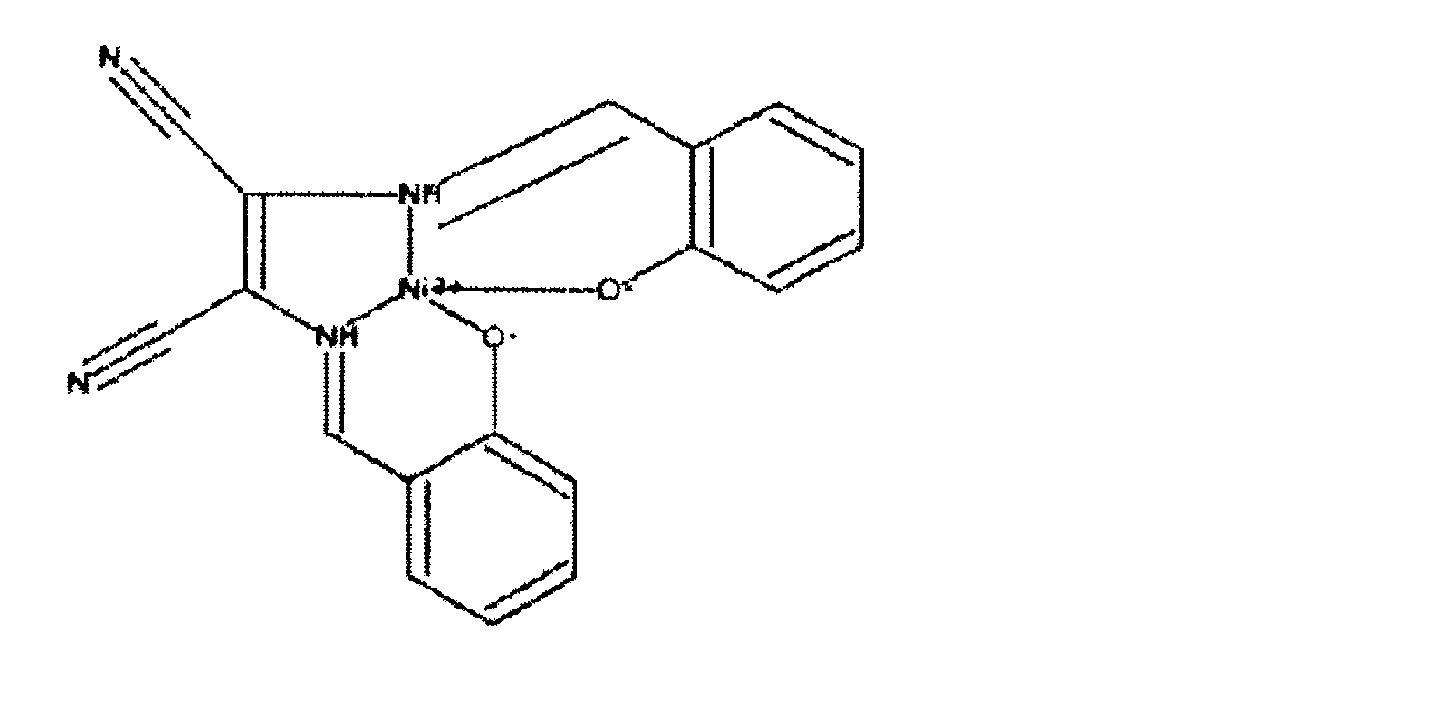
(青色染料)
青色染料として、下記式(化2)で示される構造を有する、4,11-ジアミノ-2-(3-メトキシプロピル)-1H-ナフト[2,3-f]イソインドール-1,3,5,10(2H)-テトラオンを用意した。
青色染料として、下記式(化2)で示される構造を有する、4,11-ジアミノ-2-(3-メトキシプロピル)-1H-ナフト[2,3-f]イソインドール-1,3,5,10(2H)-テトラオンを用意した。
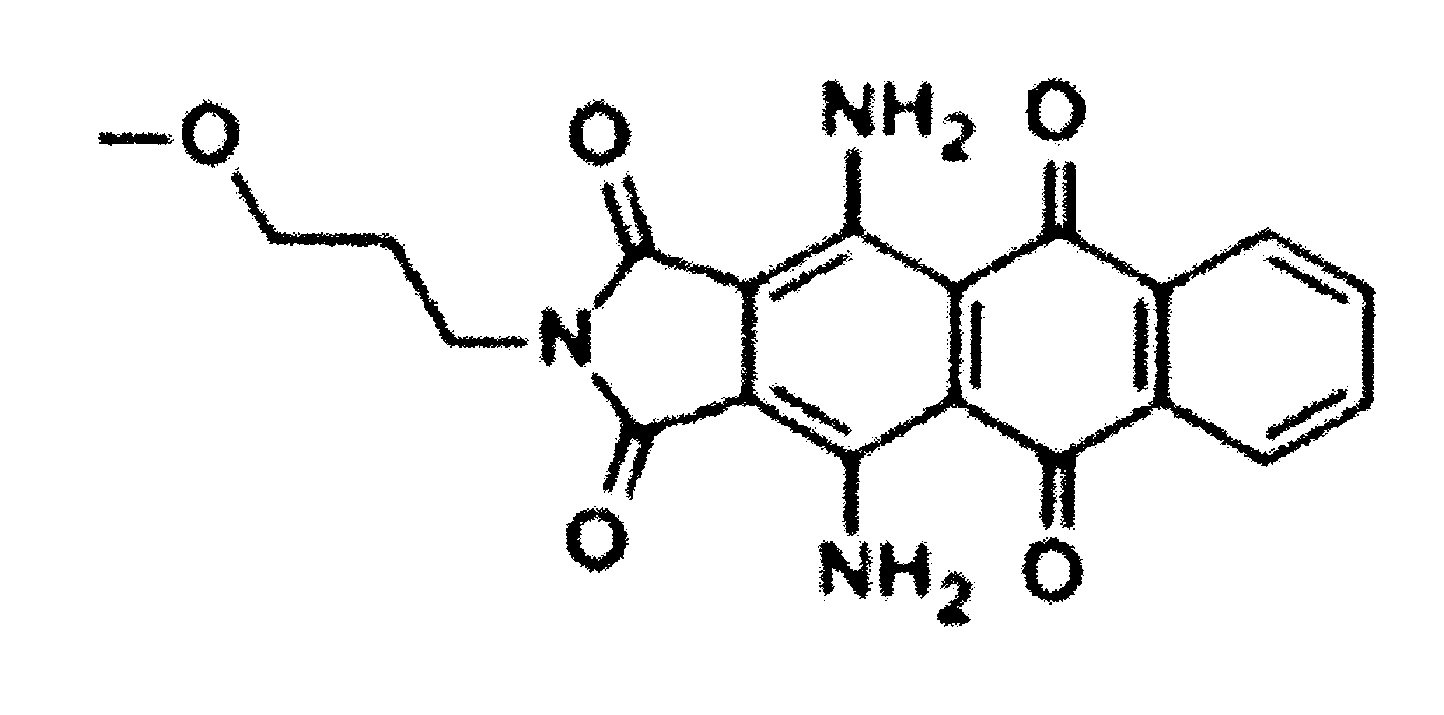
(赤色染料)
赤色染料として、下記式(化3)で示される構造を有する、3‐メチル‐6‐[(4‐メチルフェニル)アミノ]‐3H‐ジベンゾ[f,ij]イソキノリン‐2,7‐ジオンを用意した。
赤色染料として、下記式(化3)で示される構造を有する、3‐メチル‐6‐[(4‐メチルフェニル)アミノ]‐3H‐ジベンゾ[f,ij]イソキノリン‐2,7‐ジオンを用意した。
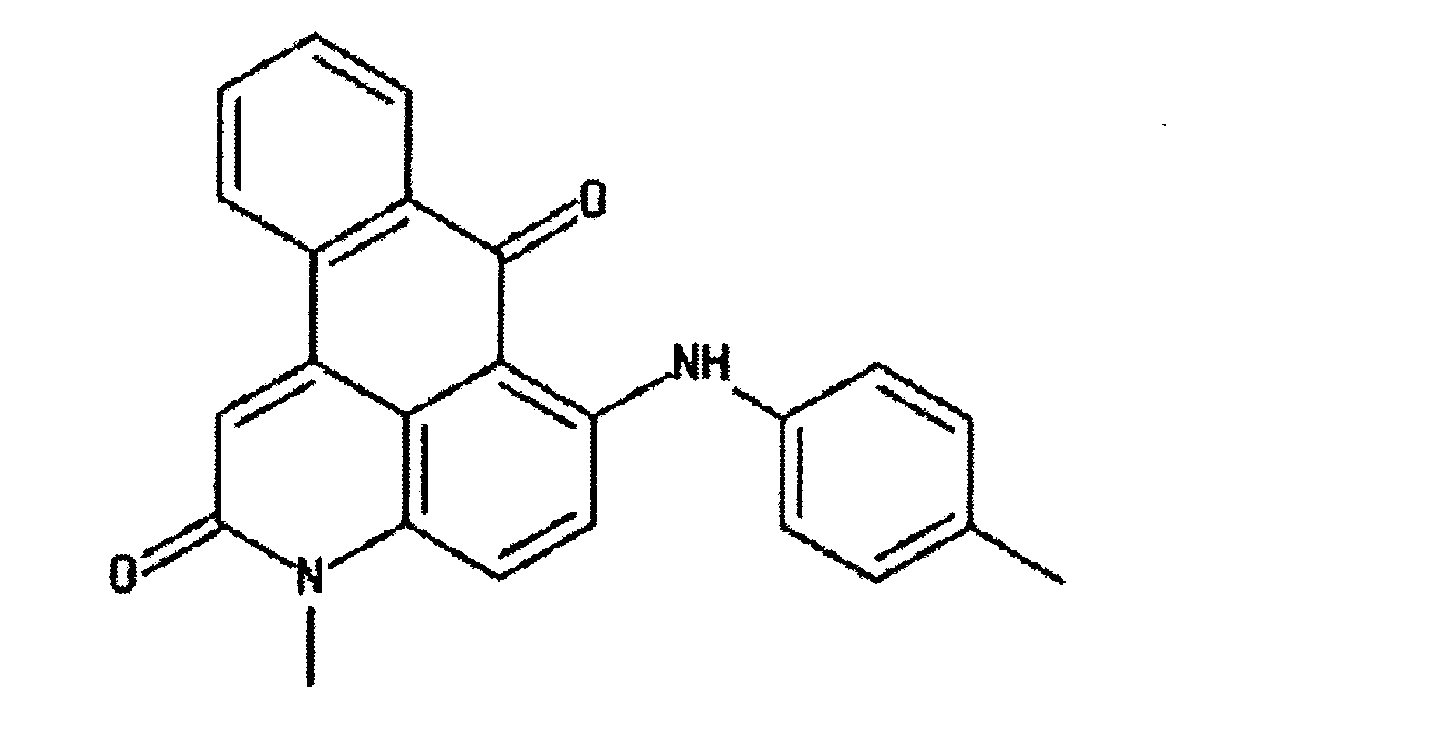
(黄色染料)
黄色染料として、下記式(化4)で示される構造を有する、1,1'-[(6-フェニル-1,3,5-トリアジン-2,4-ジイル)ビス(イミノ)]ビス(9,10-アントラセンジオン)を用意した。
黄色染料として、下記式(化4)で示される構造を有する、1,1'-[(6-フェニル-1,3,5-トリアジン-2,4-ジイル)ビス(イミノ)]ビス(9,10-アントラセンジオン)を用意した。
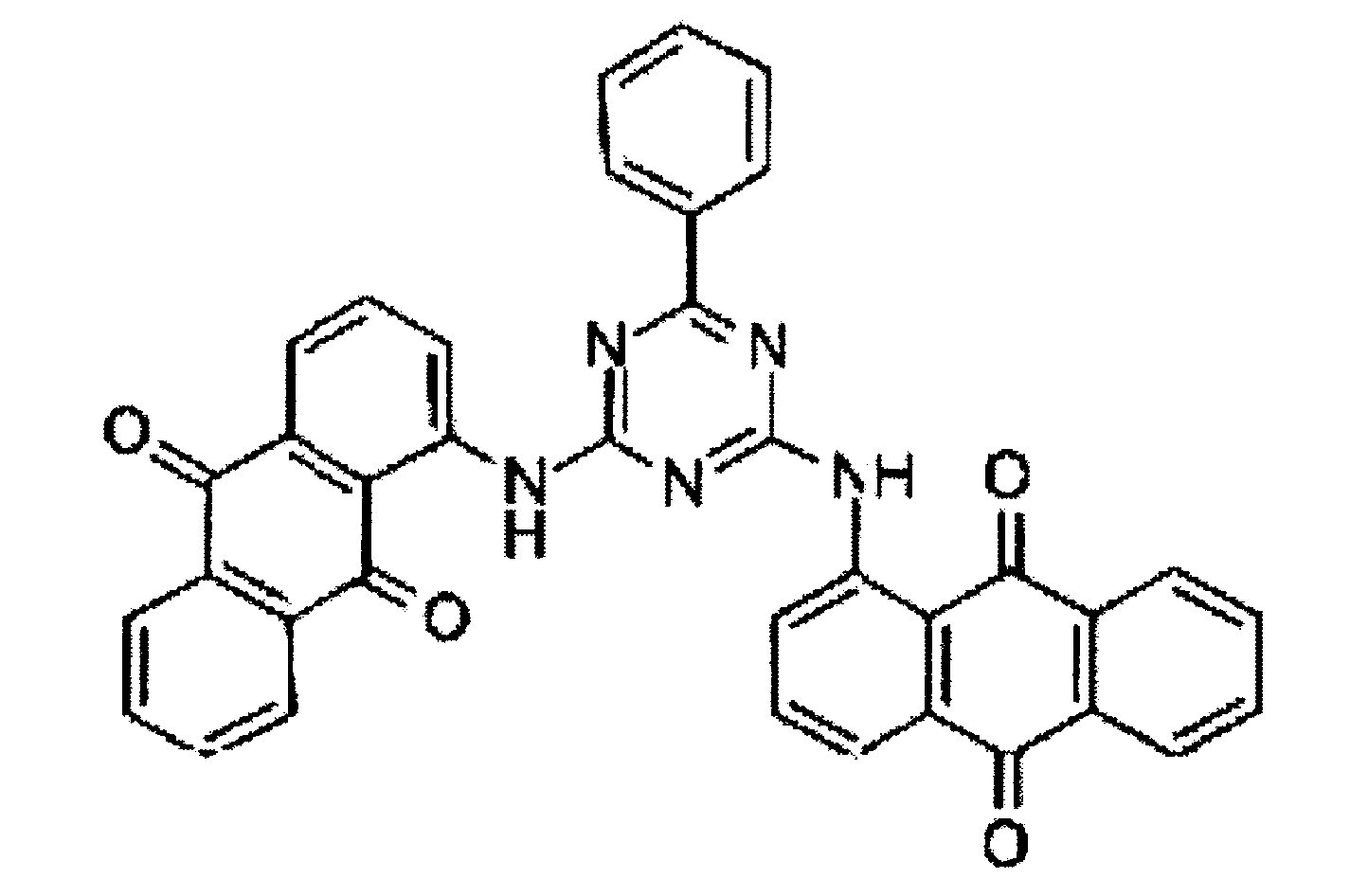
<ポリエステルAの製造方法>
テレフタル酸ジメチル100質量部とエチレングリコール60質量部とを出発原料とし、触媒として酢酸マグネシウム・四水塩0.09質量部を反応器にとり、反応開始温度を150℃とし、メタノールの留去とともに徐々に反応温度を上昇させ、3時間後に230℃とした。4時間後、実質的にエステル交換反応を終了させた。この反応混合物にエチルアシッドフォスフェート0.04質量部を添加した後、三酸化アンチモン0.04質量部を加えて、4時間重縮合反応を行った。すなわち、温度を230℃から徐々に昇温し280℃とした。一方、圧力は常圧より徐々に減じ、最終的には0.3mmHgとした。反応開始後、反応槽の攪拌動力の変化により、極限粘度0.63dl/gに相当する時点で反応を停止し、窒素加圧下ポリマーを吐出させた。得られたポリエステルAの極限粘度は0.65dl/gであった。
テレフタル酸ジメチル100質量部とエチレングリコール60質量部とを出発原料とし、触媒として酢酸マグネシウム・四水塩0.09質量部を反応器にとり、反応開始温度を150℃とし、メタノールの留去とともに徐々に反応温度を上昇させ、3時間後に230℃とした。4時間後、実質的にエステル交換反応を終了させた。この反応混合物にエチルアシッドフォスフェート0.04質量部を添加した後、三酸化アンチモン0.04質量部を加えて、4時間重縮合反応を行った。すなわち、温度を230℃から徐々に昇温し280℃とした。一方、圧力は常圧より徐々に減じ、最終的には0.3mmHgとした。反応開始後、反応槽の攪拌動力の変化により、極限粘度0.63dl/gに相当する時点で反応を停止し、窒素加圧下ポリマーを吐出させた。得られたポリエステルAの極限粘度は0.65dl/gであった。
<ポリエステルBの製造方法>
ポリエステルAの製造方法において、エチルアシッドフォスフェート0.04質量部を添加後、エチレングリコールに分散させた平均粒子径1.6μmのシリカ粒子を0.3質量部、三酸化アンチモン0.04質量部を加えて、極限粘度0.65dl/gに相当する時点で重縮合反応を停止した以外は、ポリエステルAの製造方法と同様の方法を用いてポリエステルBを得た。得られたポリエステルBは、極限粘度0.65dl/gであった。
ポリエステルAの製造方法において、エチルアシッドフォスフェート0.04質量部を添加後、エチレングリコールに分散させた平均粒子径1.6μmのシリカ粒子を0.3質量部、三酸化アンチモン0.04質量部を加えて、極限粘度0.65dl/gに相当する時点で重縮合反応を停止した以外は、ポリエステルAの製造方法と同様の方法を用いてポリエステルBを得た。得られたポリエステルBは、極限粘度0.65dl/gであった。
<ポリエステルCの製造方法>
ポリエステルAをあらかじめ160℃で予備結晶化させた後、温度220℃の窒素雰囲気下で固相重合し、極限粘度0.85dl/gのポリエステルCを得た。
ポリエステルAをあらかじめ160℃で予備結晶化させた後、温度220℃の窒素雰囲気下で固相重合し、極限粘度0.85dl/gのポリエステルCを得た。
<ポリエステルDの製造方法>
ポリエステルAをベント付き二軸押出機に供すると共に、これに上記黄色染料を混合して、溶融混練りを行ってチップ化を行い、極限粘度0.65dl/g、染料濃度9質量%の染料マスターバッチとしてポリエステルDを作製した。
ポリエステルAをベント付き二軸押出機に供すると共に、これに上記黄色染料を混合して、溶融混練りを行ってチップ化を行い、極限粘度0.65dl/g、染料濃度9質量%の染料マスターバッチとしてポリエステルDを作製した。
<ポリエステルEの製造方法>
ポリエステルAをベント付き二軸押出機に供すると共に、これに、上記赤色染料0.5質量%、上記青色染料2.5質量%及び上記茶色染料2質量%の各濃度となるように各染料を混合して、溶融混練りを行ってチップ化を行い、極限粘度0.65dl/g、染料濃度5質量%の染料マスターバッチとしてポリエステルEを作製した。
ポリエステルAをベント付き二軸押出機に供すると共に、これに、上記赤色染料0.5質量%、上記青色染料2.5質量%及び上記茶色染料2質量%の各濃度となるように各染料を混合して、溶融混練りを行ってチップ化を行い、極限粘度0.65dl/g、染料濃度5質量%の染料マスターバッチとしてポリエステルEを作製した。
[実施例1-1]
<ポリエステルフィルムF1の製造方法>
上記ポリエステルA及びBを、ポリエステルA/B=90/10(質量%)の配合比で混合してA層原料を調製する一方、上記ポリエステルA、D及びEを、ポリエステルA/D/E=82.4/16/1.6(質量%)の配合比で混合してB層原料を調製し、それぞれ2台の二軸押出機に供給し、各々285℃で溶融した後、A層を最外層(外層)、B層を中間層として、2種3層の構成で20℃に冷却したキャスティングドラム上に共押出し、冷却固化させて無配向シートを得た。次いで、90℃にて縦方向に3.0倍延伸した後、下記機能層組成物x、yを、塗布量(乾燥後)が0.04g/m2になるように、それぞれシートの両面に塗布し、次いで、テンター内で予熱工程を経て125℃で4.3倍の横延伸を施した後、230℃で5秒間の熱処理を行い、その後140℃で幅方向に4.0%の弛緩を加え、層構成が機能層X/A層/B層/A層/機能層Y=0.04μm/5μm/40μm/5μm/0.04μm、厚み50μmのポリエステルフィルム(サンプル)F1を得た。
なお、ポリエステルフィルム(サンプル)中の染料顔料濃度は1.216質量%であり、黄色/赤色/青色/茶色の染料質量比率は1.152/0.006/0.032/0.026であった。
[機能層組成物x、y]
(P)架橋剤
(P1):ヘキサメトキシメチロールメラミン
(P2):オキサゾリン基およびポリアルキレンオキシド鎖を有するアクリルポリマー
(オキサゾリン基量=4.5mmol/g、株式会社日本触媒製)
(P3):ポリグリセロールポリグリシジルエーテル
(P)架橋剤
(P1):ヘキサメトキシメチロールメラミン
(P2):オキサゾリン基およびポリアルキレンオキシド鎖を有するアクリルポリマー
(オキサゾリン基量=4.5mmol/g、株式会社日本触媒製)
(P3):ポリグリセロールポリグリシジルエーテル
(Q)バインダー樹脂
(Q1):ケン化度が88%の重合度500のポリビニルアルコール
(Q2)ポリエステル樹脂:下記組成で共重合したポリエステル樹脂の水分散体
モノマー組成:(酸成分)テレフタル酸/イソフタル酸/5-ソジウムスルホイソフタル酸//(ジオール成分)エチレングリコール/1,4-ブタンジオール/ジエチレングリコール=56/40/4//70/20/10(mol%)
(Q1):ケン化度が88%の重合度500のポリビニルアルコール
(Q2)ポリエステル樹脂:下記組成で共重合したポリエステル樹脂の水分散体
モノマー組成:(酸成分)テレフタル酸/イソフタル酸/5-ソジウムスルホイソフタル酸//(ジオール成分)エチレングリコール/1,4-ブタンジオール/ジエチレングリコール=56/40/4//70/20/10(mol%)
(R)帯電防止剤
ジアリルジメチルアンモニウムクロライドとN-メチロールアクリルアミドとN-Nジメチルアクリルアミドを質量比率で90/5/5の比率で共重合させた、数平均分量が20000である、主鎖にカチオンを有するカチオン性基含有樹脂
ジアリルジメチルアンモニウムクロライドとN-メチロールアクリルアミドとN-Nジメチルアクリルアミドを質量比率で90/5/5の比率で共重合させた、数平均分量が20000である、主鎖にカチオンを有するカチオン性基含有樹脂
(S)粒子
シリカ粒子(平均粒径:70nm)
シリカ粒子(平均粒径:70nm)
易接着層としての機能層Xを形成する機能層組成物xは、上記P1、P2、Q2及びS(粒子)を、P1/P2/Q2/S=20/20/55/5(質量%)の比率で配合して調製した。
他方、帯電防止層としての機能層Yを形成する機能層組成物yは、上記P2、P3、Q1、R(帯電防止剤)及びS(粒子)を、P2/P3/Q1/R/S=15/15/25/40/5(質量%)の比率で配合して調製した。
他方、帯電防止層としての機能層Yを形成する機能層組成物yは、上記P2、P3、Q1、R(帯電防止剤)及びS(粒子)を、P2/P3/Q1/R/S=15/15/25/40/5(質量%)の比率で配合して調製した。
[実施例1-2]
<ポリエステルフィルムF2の製造方法>
上記ポリエステルA及びBを、ポリエステルA/B=90/10(質量%)の配合比で混合してA層原料を調製する一方、上記ポリエステルA、D及びEを、ポリエステルA/D/E=93/5/2(質量%)の配合比で混合してB層原料を調製した以外は、ポリエステルフィルムF1と同様にして製造し、層構成が機能層X/A層/B層/A層/機能層Y=0.04μm/12.5μm/100μm/12.5μm/0.04μm、厚み125μmのポリエステルフィルム(サンプル)F2を得た。
なお、ポリエステルフィルム(サンプル)中の染料顔料濃度は0.44質量%であり、黄色/赤色/青色/茶色の染料質量比率は0.36/0.008/0.04/0.032であった。
[実施例1-3]
<ポリエステルフィルムF3の製造方法>
上記ポリエステルA及びBを、ポリエステルA/B=90/10(質量%)の配合比で混合してA層原料を調製する一方、上記ポリエステルA、D及びEを、ポリエステルA/D/E=94/5/1(質量%)の配合比で混合してB層原料を調製した以外は、ポリエステルフィルムF1と同様にして製造し、層構成が機能層X/A層/B層/A層/機能層Y=0.04μm/15μm/120μm/15μm/0.04μm、厚み150μmのポリエステルフィルム(サンプル)F3を得た。
なお、ポリエステルフィルム(サンプル)中の染料顔料濃度は0.40質量%であり、黄色/赤色/青色/茶色の染料質量比率は0.36/0.004/0.02/0.016であった。
[実施例1-4]
<ポリエステルフィルムF4の製造方法>
上記ポリエステルA及びBを、ポリエステルA/B=90/10(質量%)の配合比で混合してA層原料を調製する一方、上記ポリエステルA、D及びEを、ポリエステルA/D/E=94.5/5/0.5(質量%)の配合比で混合してB層原料を調製した以外は、ポリエステルフィルムF1と同様にして製造し、層構成が機能層X/A層/B層/A層/機能層Y=0.04μm/18μm/144μm/18μm/0.04μm、厚み180μmのポリエステルフィルム(サンプル)F4を得た。
なお、ポリエステルフィルム(サンプル)中の染料顔料濃度は0.38質量%であり、黄色/赤色/青色/茶色の染料質量比率は0.36/0.002/0.01/0.008であった。
[実施例1-5]
<ポリエステルフィルムF5の製造方法>
上記ポリエステルA及びBを、ポリエステルA/B=90/10(質量%)の配合比で混合してA層原料を調製する一方、上記ポリエステルA、D及びEを、ポリエステルA/D/E=89/10/1(質量%)の配合比で混合してB層原料を調製した以外は、ポリエステルフィルムF1と同様にして製造し、層構成が機能層X/A層/B層/A層/機能層Y=0.04μm/12.5μm/100μm/12.5μm/0.04μm、厚み125μmのポリエステルフィルム(サンプル)F5を得た。
なお、ポリエステルフィルム(サンプル)中の染料顔料濃度は0.76質量%であり、黄色/赤色/青色/茶色の染料質量比率は0.72/0.004/0.02/0.016であった。
[実施例1-6]
<ポリエステルフィルムF6の製造方法>
実施例1-1において、機能層X,Yを設ける代わりに機能層Xのみを設けた以外は、実施例1-1と同様にして製造し、層構成が機能層X/A層/B層/A層=0.04μm/5μm/40μm/5μm、厚み50μmのポリエステルフィルム(サンプル)F6を得た。
なお、ポリエステルフィルム(サンプル)中の染料顔料濃度は1.216質量%であり、黄色/赤色/青色/茶色の染料質量比率は1.152/0.006/0.032/0.026であった。
<ポリエステルフィルムF6の製造方法>
実施例1-1において、機能層X,Yを設ける代わりに機能層Xのみを設けた以外は、実施例1-1と同様にして製造し、層構成が機能層X/A層/B層/A層=0.04μm/5μm/40μm/5μm、厚み50μmのポリエステルフィルム(サンプル)F6を得た。
なお、ポリエステルフィルム(サンプル)中の染料顔料濃度は1.216質量%であり、黄色/赤色/青色/茶色の染料質量比率は1.152/0.006/0.032/0.026であった。
[実施例1-7]
<ポリエステルフィルムF7の製造方法>
実施例1-1において、機能層X,Yを設ける代わりに機能層Yのみを設けた以外は、実施例1-1と同様にして製造し、層構成がA層/B層/A層/機能層Y=5μm/40μm/5μm/0.04μm、厚み50μmのポリエステルフィルム(サンプル)F7を得た。
なお、ポリエステルフィルム(サンプル)中の染料顔料濃度は1.216質量%であり、黄色/赤色/青色/茶色の染料質量比率は1.152/0.006/0.032/0.026であった。
<ポリエステルフィルムF7の製造方法>
実施例1-1において、機能層X,Yを設ける代わりに機能層Yのみを設けた以外は、実施例1-1と同様にして製造し、層構成がA層/B層/A層/機能層Y=5μm/40μm/5μm/0.04μm、厚み50μmのポリエステルフィルム(サンプル)F7を得た。
なお、ポリエステルフィルム(サンプル)中の染料顔料濃度は1.216質量%であり、黄色/赤色/青色/茶色の染料質量比率は1.152/0.006/0.032/0.026であった。
[実施例1-8]
<ポリエステルフィルムF8の製造方法>
実施例1-1において、A層原料配合をポリエステルA/C=90/10(質量%)の配合比に変更して、且つ、機能層X,Yを設けなかった以外は、実施例1-1と同様にして製造し、層構成がA層/B層/A層=5μm/40μm/5μm、厚み50μmのポリエステルフィルム(サンプル)F8を得た。
なお、ポリエステルフィルム(サンプル)中の染料顔料濃度は1.216質量%であり、黄色/赤色/青色/茶色の染料質量比率は1.152/0.006/0.032/0.026であった。
<ポリエステルフィルムF8の製造方法>
実施例1-1において、A層原料配合をポリエステルA/C=90/10(質量%)の配合比に変更して、且つ、機能層X,Yを設けなかった以外は、実施例1-1と同様にして製造し、層構成がA層/B層/A層=5μm/40μm/5μm、厚み50μmのポリエステルフィルム(サンプル)F8を得た。
なお、ポリエステルフィルム(サンプル)中の染料顔料濃度は1.216質量%であり、黄色/赤色/青色/茶色の染料質量比率は1.152/0.006/0.032/0.026であった。
[比較例1-1]
<ポリエステルフィルムF9の製造方法>
実施例1-1のB層原料の調製において、上記ポリエステルA及びDを、ポリエステルA/D=95/5(質量%)の配合比で混合してB層原料を調製した以外は、実施例1-1と同様にして製造し、層構成が機能層X/A層/B層/A層/機能層Y=0.04μm/12.5μm/100μm/12.5μm/0.04μm、厚み125μmのポリエステルフィルム(サンプル)F9を得た。
なお、ポリエステルフィルム(サンプル)中の染料顔料濃度は0.36質量%であり、黄色/赤色/青色/茶色の染料質量比率は0.36/0/0/0であった。
<ポリエステルフィルムF9の製造方法>
実施例1-1のB層原料の調製において、上記ポリエステルA及びDを、ポリエステルA/D=95/5(質量%)の配合比で混合してB層原料を調製した以外は、実施例1-1と同様にして製造し、層構成が機能層X/A層/B層/A層/機能層Y=0.04μm/12.5μm/100μm/12.5μm/0.04μm、厚み125μmのポリエステルフィルム(サンプル)F9を得た。
なお、ポリエステルフィルム(サンプル)中の染料顔料濃度は0.36質量%であり、黄色/赤色/青色/茶色の染料質量比率は0.36/0/0/0であった。
[実施例2-1]
<フィルム積層体G1の製造>
厚み50μmの電気絶縁用ポリイミドフィルム(b*値:96)上に、下記粘着層形成用組成物から構成される塗布液を塗工した後、熱風式循環炉を用いて、100℃、5分間熱処理し、塗布量(乾燥後)が25μmの粘着層を得た。
次に、機能層X側が上記粘着層と接するように、上記粘着層に上記ポリエステルフィルム(サンプル)F1を重ねて貼り合わせて、フィルム積層体G1(サンプル)を得た。
<フィルム積層体G1の製造>
厚み50μmの電気絶縁用ポリイミドフィルム(b*値:96)上に、下記粘着層形成用組成物から構成される塗布液を塗工した後、熱風式循環炉を用いて、100℃、5分間熱処理し、塗布量(乾燥後)が25μmの粘着層を得た。
次に、機能層X側が上記粘着層と接するように、上記粘着層に上記ポリエステルフィルム(サンプル)F1を重ねて貼り合わせて、フィルム積層体G1(サンプル)を得た。
<粘着層形成用組成物>
2-エチルヘキシルアクリレート75質量部と、酢酸ビニル20質量部と、アクリル酸5質量部の3成分をランダム共重合してなるアクリル酸エステル共重合体(Mw=540000 Mn=67000 Mw/Mn=8 理論Tg-50℃)1kgに対し、光重合性開始剤として4-フェニルベンゾフェノンを20g混合して形成用組成物を調製した。
2-エチルヘキシルアクリレート75質量部と、酢酸ビニル20質量部と、アクリル酸5質量部の3成分をランダム共重合してなるアクリル酸エステル共重合体(Mw=540000 Mn=67000 Mw/Mn=8 理論Tg-50℃)1kgに対し、光重合性開始剤として4-フェニルベンゾフェノンを20g混合して形成用組成物を調製した。
[実施例2-2]
上記ポリエステルフィルム(サンプル)F1を、上記ポリエステルフィルム(サンプル)F2に変更した以外、実施例2-1と同様にしてフィルム積層体G2(サンプル)を作製した。
上記ポリエステルフィルム(サンプル)F1を、上記ポリエステルフィルム(サンプル)F2に変更した以外、実施例2-1と同様にしてフィルム積層体G2(サンプル)を作製した。
[実施例2-3]
上記ポリエステルフィルム(サンプル)F1を、上記ポリエステルフィルム(サンプル)F3に変更した以外、実施例2-1と同様にしてフィルム積層体G3(サンプル)を作製した。
上記ポリエステルフィルム(サンプル)F1を、上記ポリエステルフィルム(サンプル)F3に変更した以外、実施例2-1と同様にしてフィルム積層体G3(サンプル)を作製した。
[実施例2-4]
上記ポリエステルフィルム(サンプル)F1を、上記ポリエステルフィルム(サンプル)F4に変更した以外、実施例2-1と同様にしてフィルム積層体G4(サンプル)を作製した。
上記ポリエステルフィルム(サンプル)F1を、上記ポリエステルフィルム(サンプル)F4に変更した以外、実施例2-1と同様にしてフィルム積層体G4(サンプル)を作製した。
[実施例2-5]
上記ポリエステルフィルム(サンプル)F1を、上記ポリエステルフィルム(サンプル)F5に変更した以外、実施例2-1と同様にしてフィルム積層体G5(サンプル)を作製した。
上記ポリエステルフィルム(サンプル)F1を、上記ポリエステルフィルム(サンプル)F5に変更した以外、実施例2-1と同様にしてフィルム積層体G5(サンプル)を作製した。
[実施例2-6]
上記ポリエステルフィルム(サンプル)F1を、上記ポリエステルフィルム(サンプル)F6に変更した以外、実施例2-1と同様にしてフィルム積層体G6(サンプル)を作製した。
上記ポリエステルフィルム(サンプル)F1を、上記ポリエステルフィルム(サンプル)F6に変更した以外、実施例2-1と同様にしてフィルム積層体G6(サンプル)を作製した。
[実施例2-7]
上記ポリエステルフィルム(サンプル)F1を、上記ポリエステルフィルム(サンプル)F7に変更した以外、実施例2-1と同様にしてフィルム積層体G7(サンプル)を作製した。
上記ポリエステルフィルム(サンプル)F1を、上記ポリエステルフィルム(サンプル)F7に変更した以外、実施例2-1と同様にしてフィルム積層体G7(サンプル)を作製した。
[実施例2-8]
上記ポリエステルフィルム(サンプル)F1を、上記ポリエステルフィルム(サンプル)F8に変更した以外、実施例2-1と同様にしてフィルム積層体G8(サンプル)を作製した。
上記ポリエステルフィルム(サンプル)F1を、上記ポリエステルフィルム(サンプル)F8に変更した以外、実施例2-1と同様にしてフィルム積層体G8(サンプル)を作製した。
[比較例2-1]
上記ポリエステルフィルム(サンプル)F1を、上記ポリエステルフィルム(サンプル)F9に変更した以外、実施例2-1と同様にしてフィルム積層体G9(サンプル)を作製した。
上記ポリエステルフィルム(サンプル)F1を、上記ポリエステルフィルム(サンプル)F9に変更した以外、実施例2-1と同様にしてフィルム積層体G9(サンプル)を作製した。
<評価方法>
実施例・比較例で行った各種数値の測定方法について説明する。
実施例・比較例で行った各種数値の測定方法について説明する。
(1)ポリエステルの極限粘度(dl/g)
ポリエステル1gを精秤し、フェノール/テトラクロロエタン=50/50(質量比)の混合溶媒100mlを加えて前記ポリエステルを溶解させて、30℃で極限粘度を測定した。
ポリエステル1gを精秤し、フェノール/テトラクロロエタン=50/50(質量比)の混合溶媒100mlを加えて前記ポリエステルを溶解させて、30℃で極限粘度を測定した。
(2)ポリエステル原料中の粒子の平均粒径(d50:μm)
遠心沈降式粒度分布測定装置(株式会社島津製作所社製SA-CP3型)を使用して、等価球形分布における積算(重量基準)50%の値を測定し、これを平均粒径とした。
遠心沈降式粒度分布測定装置(株式会社島津製作所社製SA-CP3型)を使用して、等価球形分布における積算(重量基準)50%の値を測定し、これを平均粒径とした。
(3)機能層(X)(Y)の膜厚測定方法
実施例1-1~1-8および比較例1-1で作製したポリエステルフィルム(サンプル)、及び、実施例2-1~2-8および比較例2-1で作製したフィルム積層体(サンプル)のそれぞれについて、機能層(X)(Y)の表面をRuO4で染色し、エポキシ樹脂中に包埋した。その後、超薄切片法により作成した切片を再度RuO4染色し、機能層断面を透過型電子顕微鏡(Hitachi社製 H-7650、加速電圧100kV)を用いて測定した。
実施例1-1~1-8および比較例1-1で作製したポリエステルフィルム(サンプル)、及び、実施例2-1~2-8および比較例2-1で作製したフィルム積層体(サンプル)のそれぞれについて、機能層(X)(Y)の表面をRuO4で染色し、エポキシ樹脂中に包埋した。その後、超薄切片法により作成した切片を再度RuO4染色し、機能層断面を透過型電子顕微鏡(Hitachi社製 H-7650、加速電圧100kV)を用いて測定した。
(4)フィルムヘーズ、全光線透過率
実施例1-1~1-8および比較例1-1で作製したポリエステルフィルム(サンプル)、及び、実施例2-1~2-8および比較例2-1で作製したフィルム積層体(サンプル)のそれぞれについて、JIS K 7136に準拠し、日本電色工業(株)製ヘーズメーター DH-2000を使用して、ヘーズ及び全光線透過率を測定した。
実施例1-1~1-8および比較例1-1で作製したポリエステルフィルム(サンプル)、及び、実施例2-1~2-8および比較例2-1で作製したフィルム積層体(サンプル)のそれぞれについて、JIS K 7136に準拠し、日本電色工業(株)製ヘーズメーター DH-2000を使用して、ヘーズ及び全光線透過率を測定した。
(5)光学フィルム及びフィルム積層体の色目評価(b*)
実施例1-1~1-8および比較例1-1で作製したポリエステルフィルム(サンプル)、及び、実施例2-1~2-8および比較例2-1で作製したフィルム積層体(サンプル)のそれぞれについて、分光測色計「CM-3700d」(コニカミノルタ社製)により、色調反射法b*値を測定した。測定に際して、光源にはC光源を使用した。
実施例1-1~1-8および比較例1-1で作製したポリエステルフィルム(サンプル)、及び、実施例2-1~2-8および比較例2-1で作製したフィルム積層体(サンプル)のそれぞれについて、分光測色計「CM-3700d」(コニカミノルタ社製)により、色調反射法b*値を測定した。測定に際して、光源にはC光源を使用した。
(6)接着性の評価方法(実用特性代用評価)
実施例1-1~1-8および比較例1-1で作製したポリエステルフィルム(サンプル)、及び、実施例2-1~2-8および比較例2-1で作製したフィルム積層体(サンプル)のそれぞれについて、紫外線硬化アクリル樹脂であるカヤノーバFOP-1100(日本化薬株式会社製)74質量部とメチルエチルケトン86質量部との混合塗液を、ポリエステルフィルム(サンプル)の機能層(X)形成面に乾燥膜厚が2μmになるように塗布し、70℃で1分間乾燥して溶剤を除去した後、紫外線を60mJ/cm2照射して硬化させ、ハードコート層を形成した。
得られたハードコート層付きフィルムを、10mm×10mmの大きさにクロスカットをして、その上に18mm幅のテープ(ニチバン株式会社製セロテープ(登録商標)CT-18)を貼り付け、180度の剥離角度で急激に剥がした後の剥離面を観察し、下記の基準で評価した。
《判定基準》
〇(very good):機能層(X)とハードコート層の間で剥離した面積が20%未満。
●(good):機能層(X)とハードコート層の間で剥離した面積が20%以上50%未満。
△(not good):機能層(X)とハードコート層の間で剥離した面積が50%以上。
(7)帯電防止性の評価方法
実施例1-1~1-8および比較例1-1で作製したポリエステルフィルム(サンプル)、及び、実施例2-1~2-8および比較例2-1で作製したフィルム積層体(サンプル)のそれぞれについて、日本ヒューレット・パッカード株式会社製高抵抗測定器:HP4339Bおよび測定電極:HP16008Bを使用し、23℃,50%RHの測定雰囲気で、ポリエステルフィルム(サンプル)又はフィルム積層体(サンプル)を30分間調湿後、表面抵抗値を測定した。
《判定基準》
○(good):1×10¹¹Ω以下。
△(not good):1×10¹¹Ωを越える。
実施例1-1~1-8および比較例1-1で作製したポリエステルフィルム(サンプル)、及び、実施例2-1~2-8および比較例2-1で作製したフィルム積層体(サンプル)のそれぞれについて、日本ヒューレット・パッカード株式会社製高抵抗測定器:HP4339Bおよび測定電極:HP16008Bを使用し、23℃,50%RHの測定雰囲気で、ポリエステルフィルム(サンプル)又はフィルム積層体(サンプル)を30分間調湿後、表面抵抗値を測定した。
《判定基準》
○(good):1×10¹¹Ω以下。
△(not good):1×10¹¹Ωを越える。
(8)表示画面の明るさ(均一性)及び色彩(均一性)評価(実用特性代用評価)
実施例1-1~1-8および比較例1-1で作製したポリエステルフィルム(サンプル)について、コニカミノルタ社製分光測色計「CM-3700d」を用いて、400nm~720nmの波長領域において、各測定波長における光線透過率(T1)を測定した。
一方、評価用のLED面光源(TRYTEC社製TREVIEWER A4-500)を用いて、400nm~720nmまでの各測定波長における相対放射強度(T2)を測定した。そして、450nmと550nmにおける、T1とT2との合計値(T1+T2)を求めた。
次に、両面発光型LED面光源の一方にアルミ製反射板を取り付け、面光源とアルミ製反射板との間に、実施例および比較例のサンプルを挟み、側面を遮光テープでマスキングした。その後、アルミ製反射板を取り付けていない側のLED光源面から、目視観察により、光源の明るさおよび光源の色調を官能評価した。T1とT2との合計値の結果と官能評価の結果から、下記基準により判定を行った。
《判定基準》
○(good):450nm:T1<450>+T2<450>の合計値が105%以下。
550nm:T1<550>+T2<550>の合計値が80%以上。 (表示画面が均一に白く鮮やかに見える。)
×(poor):450nm:T1<450>+T2<450>の合計値が105%を超える。
(表示画面が部分的に青みの強い色調の画面に見える。)
又は、
550nm:T1<550>+T2<550>の合計値が80%未満。
(表示画面の明るさがアルミ製反射板を取り付け前と大きく変わらない。)
他方、実施例2-1~2-8および比較例2-1で作製したフィルム積層体(サンプル)については、前記ポリエステルフィルム(サンプル)と同様に、光線透過率(T1)及び相対放射強度(T2)を測定し、そして、450nmと550nmにおける、T1とT2との合計値(T1+T2)を求めた。
次に、前記ポリエステルフィルム(サンプル)と同様に、光源の明るさおよび光源の色調を官能評価し、T1とT2との合計値の結果と官能評価の結果から、表示画面の色彩(均一性)について下記基準により判定を行った。
《判定基準》
○(good):450nm:T1<450>+T2<450>の合計値が105%以下。
550nm:T1<550>+T2<550>の合計値が75%以下。
(表示画面の色彩が均一に見える。)
×(poor):450nm:T1<450>+T2<450>の合計値が105%を超える。
(表示画面が部分的に青みの強い色調の画面に見える。)
又は、
550nm:T1<550>+T2<550>の合計値が75%を超える。
(表示画面の色彩が部分的に不均一に見える。)
(9)色調認識性(実用特性代用評価)
劣化した透明電極層の色調代用評価として、次の試験を行った。
インクジェットプリンターを用いて、A4判サイズの透明ポリエチレンテレフタレート(PET)フィルム基材(100μm)上に茶色系に調色した染料から構成される塗布液をプリンター用インキとして用い、格子状のパターン印刷を行った。
次に、前記格子状のパターン印刷層付き透明フィルムの上に、実施例1-1~1-8および比較例1-1で作製したポリエステルフィルム(サンプル)、又は、実施例2-1~2-8および比較例2-1で作製したフィルム積層体(サンプル)を、樹脂フィルム側が視認側になるように配置した。ポリエステルフィルム(サンプル)又はフィルム積層体(サンプル)側から目視観察した時のパターン印刷層の見え方につき、下記判定基準により、判定を行った。
《判定基準》
○(good):フィルム色と同調して、パターン印刷層が見えにくくなる。
△(usual):フィルム色と同調しているが、パターン印刷層の輪郭がわずかに確認できる。
×(poor):明瞭にパターン印刷層が確認できる。
なお、本評価に用いた基準サンプル(劣化した透明電極層の代用評価)の光学特性は以下の通りである。
L*値:64.9 a*値:13.5 b*値:96.7
L*値:64.9 a*値:13.5 b*値:96.7
(10)総合評価
実施例1-1~1-8および比較例1-1で作製したポリエステルフィルム(サンプル)については、上記評価、すなわち表示画面の明るさ、色調認識性、接着性、帯電防止性の各項目における判定結果に基づき、下記基準により、実施例および比較例で得られたポリエステルフィルム(サンプル)の総合評価をした。
○(good):表示画面の明るさ、色調認識性、接着性、帯電防止性のすべての項目が○判定。
△(not good):表示画面の明るさ及び色調認識性はいずれも〇判定だが、接着性及び帯電防止性のうち、少なくとも1つが△判定。
×(poor):表示画面の明るさ及び色調認識性のうち、少なくとも一つが×判定。
実施例1-1~1-8および比較例1-1で作製したポリエステルフィルム(サンプル)については、上記評価、すなわち表示画面の明るさ、色調認識性、接着性、帯電防止性の各項目における判定結果に基づき、下記基準により、実施例および比較例で得られたポリエステルフィルム(サンプル)の総合評価をした。
○(good):表示画面の明るさ、色調認識性、接着性、帯電防止性のすべての項目が○判定。
△(not good):表示画面の明るさ及び色調認識性はいずれも〇判定だが、接着性及び帯電防止性のうち、少なくとも1つが△判定。
×(poor):表示画面の明るさ及び色調認識性のうち、少なくとも一つが×判定。
他方、実施例2-1~2-8および比較例2-1で作製したフィルム積層体(サンプル)については、上記評価、すなわち表示画面の色彩(均一性)、色調認識性、接着性、帯電防止性の各項目における判定結果に基づき、下記基準により、実施例および比較例で得られたフィルム積層体(サンプル)の総合評価をした。
(判定基準)
○(good):表示画面の明るさ、色調認識性、接着性、帯電防止性のすべての項目が○判定。
△(not good):表示画面の明るさ及び色調認識性はいずれも〇判定だが接着性及び帯電防止性のうち、少なくとも1つが△
×(poor):表示画面の明るさ及び色調認識性のうち、少なくとも一つが×判定。
(判定基準)
○(good):表示画面の明るさ、色調認識性、接着性、帯電防止性のすべての項目が○判定。
△(not good):表示画面の明るさ及び色調認識性はいずれも〇判定だが接着性及び帯電防止性のうち、少なくとも1つが△
×(poor):表示画面の明るさ及び色調認識性のうち、少なくとも一つが×判定。
<評価結果>
実施例1-1~1-8および比較例1-1で作製した各ポリエステルフィルムの特性を下記表1に示し、実施例2-1~2-8および比較例2-1で作製した各フィルム積層体の特性を下記表2に示す。
実施例1-1~1-8および比較例1-1で作製した各ポリエステルフィルムの特性を下記表1に示し、実施例2-1~2-8および比較例2-1で作製した各フィルム積層体の特性を下記表2に示す。

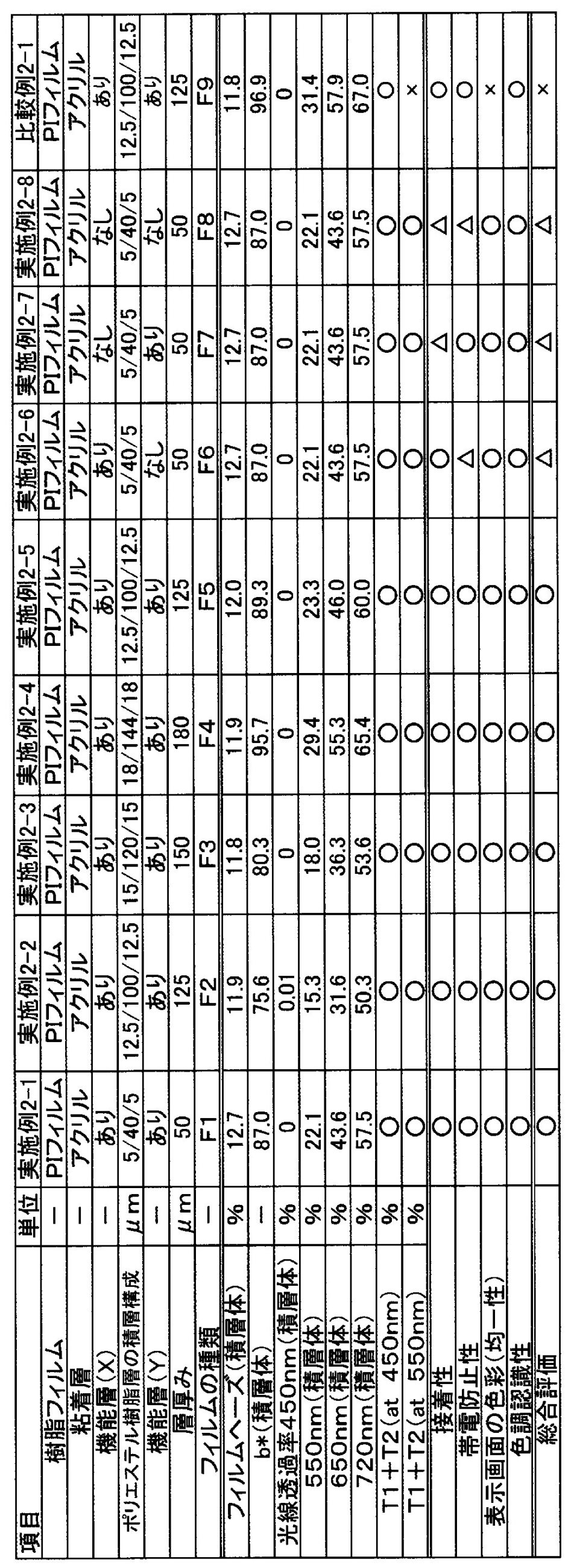
<考察>
比較例1-1、比較例2-1、あるいは参考例(図4)より、光学用途に使用される一般的なフィルム及びフィルム積層体は、測定波長に関係なく、全体的に光線透過率を高く設計する傾向にあることが確認された。さらに、単純にフィルムを着色させただけでは、選択的な光制御機能を持たないことが確認された。例えば分光スペクトルより、測定波長ごとの光線透過率が、ほぼ一定であることが確認された。また、450nm波長の光の発光強度が不必要に強い場合には、得られる表示画面の色彩が部分的に青っぽい色彩となり、均一な白い色彩を有する表示画面を得るのが困難であることも分かった。
これに対し、実施例で得られた光学フィルム(「本光学フィルム」と称する)又はフィルム積層体(「本フィルム積層体」と称する)を用いることにより、特定波長領域における光線透過率を選択的に制御できることがわかった。
上記実施例及びこれまで発明者が行ってきた試験結果から、光学フィルム又はフィルム積層体における特定波長領域の透過率を任意に制御することで、本来、透過させたくない波長領域の光を遮断することができることが分かった。
具体的には、染料および/または顔料を用いてポリエステルフィルムのフィルムヘーズ、色調(b*)値、さらには各波長毎の光線透過率を制御することができ、フィルムヘーズを6%以下に調整し、450nmの光線透過率を4%以下に調整し、550nmの光線透過率を20%以上に調整し、且つ色調(b*)値を50以上に調整して本光学フィルムを調製することができる。
また、具体的には、染料および/または顔料を含有するポリエステルフィルムからなる光学フィルムの片面に粘着層を介して樹脂フィルムが積層されたフィルム積層体であり、フィルム積層体のフィルムヘーズが15%以下であり、450nmの光線透過率が1%以下であり、550nmの光線透過率が15%~30%であり、色調(b*)値が70以上になるように調整して本フィルム積層体を調製することができる。
LED光源から発する光は、波長ごとに光線透過率に偏りがあり、特に人が明るいと感じる波長領域(500nm~600nm)の発光強度が弱い傾向にあった(図1)。しかし、同じ波長領域に発光スペクトルのピークを持つLED光源を本光学フィルム又は本フィルム積層体とともにディスプレイに搭載すると、LED光源から発する光を阻害することなく、むしろ、発光強度が不足する波長領域を補強して、全体を均一化することを目的とする。その結果、LED光源の各波長の光線透過率の偏りを解消、均一化するため、表示画面の色彩の均一化並びにさらなる輝度向上を図ることができることが分かった。
また、図2及び図3に示すように、LED光源と反射材(メタル層)との間に本光学フィルム又は本フィルム積層体を配置し、LED光源から発した光が上下2方向、すなわち、本光学フィルム又は本フィルム積層体側と視認側の2方向に進むようにしてなる構成を備えたディスプレイユニットにおいて、本発明の効果をより一層享受することができる。
LED光源から発する光は、視認側に向かう光L1(Top)と、下側に向かう光L1(Bottom)との2方向の光がある。前記光L1(Bottom)は、本光学フィルム又は本フィルム積層体を通過した後、400nm~720nm波長における光線透過率が段階的に高波長側になるほど、順に大きくなるように波長分布が補正された光L2となる。該光L2は、反射材(メタル層)で反射した後、向きを変えて、そのまま視認側に向かって戻ってくる。その後、前記光L1(Top)と合流した状態で、表示画面へと向かう。その結果、LED光源の視認側の光量(光L1(Top)+光L2)が全体的に増加し、且つ、より均一化することにより、表示画面の色彩の均一化およびさらなる輝度向上が可能となる。例えば、550nm近傍の波長の光を用いて、(デジタル)画像を読み取る際にも、(デジタル)画像がぼやけることもなく、より鮮明な(デジタル)画像として、読み取ることが可能となる。
LED光源から発する光は、視認側に向かう光L1(Top)と、下側に向かう光L1(Bottom)との2方向の光がある。前記光L1(Bottom)は、本光学フィルム又は本フィルム積層体を通過した後、400nm~720nm波長における光線透過率が段階的に高波長側になるほど、順に大きくなるように波長分布が補正された光L2となる。該光L2は、反射材(メタル層)で反射した後、向きを変えて、そのまま視認側に向かって戻ってくる。その後、前記光L1(Top)と合流した状態で、表示画面へと向かう。その結果、LED光源の視認側の光量(光L1(Top)+光L2)が全体的に増加し、且つ、より均一化することにより、表示画面の色彩の均一化およびさらなる輝度向上が可能となる。例えば、550nm近傍の波長の光を用いて、(デジタル)画像を読み取る際にも、(デジタル)画像がぼやけることもなく、より鮮明な(デジタル)画像として、読み取ることが可能となる。
さらに、また、本光学フィルム又は本フィルム積層体自身が茶色系などに着色している場合には、ディスプレイ用構成部材の経時劣化、たとえば、透明電極(ITO部材)の経時劣化に伴う着色(黄色系あるいは茶色系などに変色する現象)により、本来、表示画面が有するはずの色彩とは異なる、予期しない色彩になることを事前に防止することができる。すなわち、本光学フィルム又は本フィルム積層体を、始めからディスプレイの構成部材として搭載することを前提として、来る将来に構成部材の経時劣化(例えば、透明電極)に伴い、変色することによる表示画面の色彩変化を予測し、本光学フィルム又は本フィルム積層体をあらかじめ、同程度の色調に合わせこんでおくことで、劣化部材の変化後の色相と同調することができ、その結果、表示画面の色彩変化を目立たなくすることができる。
前述の通り、本発明者による検討結果より、LED光源が本来有する発光性能を活かしつつ、光源の発光強度の「補強」という、まったく新しい着想により設計された、本光学フィルム又は本フィルム積層体を用いることで、細やかな光線透過率の選択的な制御、および色調調整が可能となる。
また、得られる異質な作用効果に着目して、ディスプレイ(表示画面)用構成部材に応用したのが本願発明である。
また、得られる異質な作用効果に着目して、ディスプレイ(表示画面)用構成部材に応用したのが本願発明である。
本発明の光学フィルム及び本発明のフィルム積層体によれば、特定波長領域の光線透過率を任意に制御する、いわゆる光制御性が良好である。特にLED光源と組み合わせて用いた場合、LED光源から発する光の発光性能(光線透過率)を阻害することなく、むしろ、可視光領域の短波長(400nm)側から長波長(720nm)側に至るまで、発光強度が不足する波長領域を選択的に補強して、全体を均一化することを目的とする。その結果、元々、LED光源から発する光は波長ごとに光線透過率に偏りがあり、そのことが表示画面の色彩の偏り(例えば、450nmの発光強度が強すぎる場合、得られる表示画面の色彩において、青みが強くなる傾向にある。)の原因とも考えられていたが、本光学フィルム又は本フィルム積層体を併用することで、その偏りを解消し、均一化することで、表示画面の色彩の均一化並びにさらなる輝度向上が可能となる。例えば、550nm近傍の可視光領域の波長の光を利用して(デジタル)画像を読み取る場合でも、(デジタル)画像がぼやけることもなく、鮮明な(デジタル)画像として、読み取ることが可能となる。
また、フィルム又はフィルム積層体自体の着色に伴い、透明電極層など、構成部材の経時劣化に伴う、表示画面の予期せぬ色彩変化を抑制することも可能である。さらに機能層をフィルム又はフィルム積層体に設けた場合にはハードコート層などの機能層に対する接着性および帯電防止性を付与することが可能であるため、その工業的価値は高い。
また、フィルム又はフィルム積層体自体の着色に伴い、透明電極層など、構成部材の経時劣化に伴う、表示画面の予期せぬ色彩変化を抑制することも可能である。さらに機能層をフィルム又はフィルム積層体に設けた場合にはハードコート層などの機能層に対する接着性および帯電防止性を付与することが可能であるため、その工業的価値は高い。
Claims (22)
- 染料および/または顔料を含有するポリエステルフィルムであり、フィルムヘーズが6%以下であり、450nmの光線透過率が4%以下であり、550nmの光線透過率が20%以上であり、色調(b*)値が50以上であることを特徴する光学フィルム。
- ポリエステルを主成分樹脂として含有する3層のポリエステル樹脂層から構成される積層ポリエステルフィルムである、請求項1記載の光学フィルム。
- 上記染料が、黄色染料、赤色染料、青色染料及び茶色染料のうちから選択される少なくとも2種類以上の染料である、請求項1又は2に記載の光学フィルム。
- フィルム中の染料含有量(質量%)が、黄色染料≧赤色染料+青色染料+茶色染料(質量%)である、請求項1~3の何れかに記載の光学フィルム。
- フィルム中の染料含有量(質量%)が、黄色染料≧(赤色染料+青色染料+茶色染料)×10(質量%)である、請求項1~4の何れかに記載の光学フィルム。
- 一方のフィルム表面層として機能層(X)を備えた、請求項1~5の何れかに記載の光学フィルム。
- 一方又は他方のフィルム表面層として、前記機能層(X)とは異なる機能層(Y)を備えた、請求項1~6の何れかに記載の光学フィルム。
- 一方のフィルム表面層として機能層(X)を備え、他方のフィルム表面層として前記機能層(Y)を備え、前記機能層(X)が易接着層であり、前記機能層(Y)が帯電防止層である、請求項7に記載の光学フィルム。
- 請求項1~8の何れか記載の光学フィルムを情報端末機器搭載用に用いることを特徴とする光学フィルム。
- 請求項1~9の何れかに記載の光学フィルムの片面に、粘着層を介して樹脂フィルムが積層されたフィルム積層体であり、フィルム積層体のフィルムヘーズが15%以下であり、450nmの光線透過率が1%以下であり、550nmの光線透過率が15%~30%であり、色調(b*)値が70以上であることを特徴するフィルム積層体。
- 染料および/または顔料を含有するポリエステルフィルムからなる光学フィルムの片面に、粘着層を介して樹脂フィルムが積層されたフィルム積層体であり、フィルム積層体のフィルムヘーズが15%以下であり、450nmの光線透過率が1%以下であり、550nmの光線透過率が15%~30%であり、色調(b*)値が70以上であることを特徴するフィルム積層体。
- 前記樹脂フィルムの色調(b*)値が80以上である、請求項10又は11記載のフィルム積層体。
- 前記樹脂フィルムがポリイミドフィルムである、請求項10~12の何れか記載のフィルム積層体。
- 請求項10~13の何れか記載のフィルム積層体を情報端末機器搭載用に用いることを特徴とするフィルム積層体。
- 請求項1~9の何れか記載の光学フィルム又は請求項10~14の何れか記載のフィルム積層体を用いたディスプレイユニット。
- 請求項1~9の何れか記載の光学フィルム又は請求項10~14の何れか記載のフィルム積層体が、当該LED光源の位置を基準として視認側とは反対側に配置されてなる構成を備えたディスプレイユニット。
- 前記LED光源は、400nm~480nmの波長範囲における発光スペクトルの最大値が、500nm~600nmの波長範囲における発光スペクトルの最大値に比べて大きいことを特徴とする、請求項16に記載のディスプレイユニット。
- 前記LED光源から発光した光線は、上側及び下側の2方向、すなわち視認側及びその反対側の2方向に少なくとも進むように設計された、請求項16又は17に記載のディスプレイユニット。
- 前記光学フィルムの550nm波長における光線透過率(T1<550>)と、LED光源の550nm波長における相対放射強度(T2<550>)との合計値(T1<550>+T2<550>)が80%以上である、請求項16~18の何れか記載のディスプレイユニット。
- 前記光学フィルムの450nm波長における光線透過率(T1<450>)と、LED光源の450nm波長における相対放射強度(T2<450>)との合計値(T2<450>+T2<450>)が105%以下である、請求項16~19の何れか記載のディスプレイユニット。
- 前記フィルム積層体の550nm波長における光線透過率(T1<550>)と、LED光源の550nm波長における相対放射強度(T2<550>)との合計値(T1<550>+T2<550>)が75%以下である、請求項16~18の何れか記載のディスプレイユニット。
- 前記フィルム積層体の450nm波長における光線透過率(T1<450>)と、LED光源の450nm波長における相対放射強度(T2<450>)との合計値(T2<450>+T2<450>)が105%以下である、請求項16~18の何れか又は請求項21記載のディスプレイユニット。
Priority Applications (2)
| Application Number | Priority Date | Filing Date | Title |
|---|---|---|---|
| CN201980047437.1A CN112424653B (zh) | 2018-08-07 | 2019-08-05 | 光学薄膜、薄膜层叠体、显示单元 |
| KR1020217004779A KR102757951B1 (ko) | 2018-08-07 | 2019-08-05 | 광학 필름, 필름 적층체, 디스플레이 유닛 |
Applications Claiming Priority (4)
| Application Number | Priority Date | Filing Date | Title |
|---|---|---|---|
| JP2018148403 | 2018-08-07 | ||
| JP2018148402 | 2018-08-07 | ||
| JP2018-148402 | 2018-08-07 | ||
| JP2018-148403 | 2018-08-07 |
Publications (1)
| Publication Number | Publication Date |
|---|---|
| WO2020031932A1 true WO2020031932A1 (ja) | 2020-02-13 |
Family
ID=69413586
Family Applications (1)
| Application Number | Title | Priority Date | Filing Date |
|---|---|---|---|
| PCT/JP2019/030630 Ceased WO2020031932A1 (ja) | 2018-08-07 | 2019-08-05 | 光学フィルム、フィルム積層体、ディスプレイユニット |
Country Status (3)
| Country | Link |
|---|---|
| KR (1) | KR102757951B1 (ja) |
| CN (1) | CN112424653B (ja) |
| WO (1) | WO2020031932A1 (ja) |
Citations (8)
| Publication number | Priority date | Publication date | Assignee | Title |
|---|---|---|---|---|
| JP2002138203A (ja) * | 2000-11-01 | 2002-05-14 | Sumitomo Osaka Cement Co Ltd | 近赤外線遮蔽用樹脂組成物および近赤外線遮蔽用積層体 |
| JP2010170866A (ja) * | 2009-01-23 | 2010-08-05 | Sumitomo Chemical Co Ltd | Led照明カバー用樹脂組成物 |
| JP2013098152A (ja) * | 2011-11-07 | 2013-05-20 | Sanken Electric Co Ltd | 照明装置 |
| JP2014119642A (ja) * | 2012-12-18 | 2014-06-30 | Toray Ind Inc | 反射板用積層フィルム |
| JP2015148813A (ja) * | 1998-01-13 | 2015-08-20 | スリーエム カンパニー | カラーシフトフィルム |
| US20150309368A1 (en) * | 2014-04-23 | 2015-10-29 | Hon Hai Precision Industry Co., Ltd. | Display device having eye protection function |
| JP2017026948A (ja) * | 2015-07-27 | 2017-02-02 | パナソニックIpマネジメント株式会社 | 光カットフィルタ及び照明器具 |
| CN108279455A (zh) * | 2018-02-05 | 2018-07-13 | 深圳市华星光电技术有限公司 | 蓝光截止膜及蓝光显示装置 |
Family Cites Families (16)
| Publication number | Priority date | Publication date | Assignee | Title |
|---|---|---|---|---|
| JP2543051B2 (ja) * | 1986-11-13 | 1996-10-16 | 松下電器産業株式会社 | カラ―フィルタ―の製造方法 |
| DE102005002072A1 (de) * | 2005-01-14 | 2006-07-20 | Röhm GmbH & Co. KG | Witterungsstabile Folie zur Gelbeinfärbung retroreflektierender Formkörper |
| JP5013798B2 (ja) * | 2005-11-11 | 2012-08-29 | 旭ファイバーグラス株式会社 | ポリカーボネート樹脂用ガラスフィラー及びポリカーボネート樹脂組成物 |
| JP5094159B2 (ja) * | 2007-02-26 | 2012-12-12 | 三菱レイヨン株式会社 | 再帰反射シート表皮用着色アクリル樹脂フィルムおよびこれを備えた再帰反射シート |
| TW200900758A (en) * | 2007-03-16 | 2009-01-01 | Toagosei Co Ltd | Optical film layered body, its manufacturing method, and display device using the same |
| JP2012000823A (ja) * | 2010-06-16 | 2012-01-05 | Mitsubishi Plastics Inc | 積層ポリエステルフィルム |
| JP2012155243A (ja) * | 2011-01-28 | 2012-08-16 | Jsr Corp | カラーフィルタ及びカラー液晶表示素子 |
| JP6097619B2 (ja) * | 2012-04-06 | 2017-03-15 | 富士フイルム株式会社 | 光学フィルム、偏光板及びこれを用いた画像表示装置 |
| KR102534378B1 (ko) * | 2015-03-17 | 2023-05-19 | 도레이 카부시키가이샤 | 적층 필름, 그것을 사용한 액정 디스플레이, 터치패널 및 유기 el 디스플레이 |
| JPWO2016158620A1 (ja) | 2015-03-31 | 2018-01-25 | コニカミノルタ株式会社 | 光学フィルム |
| JP6641105B2 (ja) | 2015-06-12 | 2020-02-05 | 株式会社トッパンTomoegawaオプティカルフィルム | 光学フィルム、これを用いた偏光板、タッチパネル、ディスプレイ部材及び表示装置 |
| JP2017043083A (ja) | 2015-08-27 | 2017-03-02 | 東レ株式会社 | 積層ポリエステルフィルム |
| JP6808372B2 (ja) | 2015-09-16 | 2021-01-06 | 三星電子株式会社Samsung Electronics Co.,Ltd. | 光学フィルム、その製造方法および表示装置 |
| EP3381951B1 (en) * | 2015-11-27 | 2021-04-14 | Mitsui Chemicals, Inc. | Polymerizable composition for optical material, and optical material and plastic lens obtained from same |
| JP2017132990A (ja) | 2016-01-22 | 2017-08-03 | 東レ株式会社 | ポリエステルフィルム |
| JP6705583B2 (ja) * | 2016-08-08 | 2020-06-03 | Jxtgエネルギー株式会社 | ポリイミド、ポリアミド酸、ポリアミド酸溶液、及び、ポリイミドフィルム |
-
2019
- 2019-08-05 CN CN201980047437.1A patent/CN112424653B/zh active Active
- 2019-08-05 WO PCT/JP2019/030630 patent/WO2020031932A1/ja not_active Ceased
- 2019-08-05 KR KR1020217004779A patent/KR102757951B1/ko active Active
Patent Citations (8)
| Publication number | Priority date | Publication date | Assignee | Title |
|---|---|---|---|---|
| JP2015148813A (ja) * | 1998-01-13 | 2015-08-20 | スリーエム カンパニー | カラーシフトフィルム |
| JP2002138203A (ja) * | 2000-11-01 | 2002-05-14 | Sumitomo Osaka Cement Co Ltd | 近赤外線遮蔽用樹脂組成物および近赤外線遮蔽用積層体 |
| JP2010170866A (ja) * | 2009-01-23 | 2010-08-05 | Sumitomo Chemical Co Ltd | Led照明カバー用樹脂組成物 |
| JP2013098152A (ja) * | 2011-11-07 | 2013-05-20 | Sanken Electric Co Ltd | 照明装置 |
| JP2014119642A (ja) * | 2012-12-18 | 2014-06-30 | Toray Ind Inc | 反射板用積層フィルム |
| US20150309368A1 (en) * | 2014-04-23 | 2015-10-29 | Hon Hai Precision Industry Co., Ltd. | Display device having eye protection function |
| JP2017026948A (ja) * | 2015-07-27 | 2017-02-02 | パナソニックIpマネジメント株式会社 | 光カットフィルタ及び照明器具 |
| CN108279455A (zh) * | 2018-02-05 | 2018-07-13 | 深圳市华星光电技术有限公司 | 蓝光截止膜及蓝光显示装置 |
Also Published As
| Publication number | Publication date |
|---|---|
| KR102757951B1 (ko) | 2025-01-22 |
| CN112424653A (zh) | 2021-02-26 |
| CN112424653B (zh) | 2023-06-23 |
| KR20210040075A (ko) | 2021-04-12 |
Similar Documents
| Publication | Publication Date | Title |
|---|---|---|
| JP5174606B2 (ja) | 積層ポリエステルフィルム | |
| JP5185092B2 (ja) | 積層ポリエステルフィルム | |
| EP2481580B1 (en) | Laminated polyester film | |
| JP4916339B2 (ja) | 反射防止フィルム用積層ポリエステルフィルム | |
| JP5467752B2 (ja) | 二軸延伸ポリエステルフィルム | |
| WO2010026773A1 (ja) | 積層ポリエステルフィルム | |
| WO2011152173A1 (ja) | 積層ポリエステルフィルム | |
| JP5506962B2 (ja) | 偏光膜保護フィルム用積層ポリエステルフィルムおよび偏光板 | |
| JP2011246663A (ja) | 積層ポリエステルフィルム | |
| US20140011036A1 (en) | Laminated polyester film | |
| KR20130085943A (ko) | 적층 폴리에스테르 필름 | |
| JP7338307B2 (ja) | フィルム積層体 | |
| JP2011016982A (ja) | 積層ポリエステルフィルム | |
| JP6205255B2 (ja) | 偏光子保護フィルム、偏光板及び画像表示装置 | |
| JP7338306B2 (ja) | 光学フィルム | |
| KR102757951B1 (ko) | 광학 필름, 필름 적층체, 디스플레이 유닛 | |
| JP5174592B2 (ja) | 光拡散シート用積層ポリエステルフィルム | |
| JP5385581B2 (ja) | 積層ポリエステルフィルム | |
| JP5726925B2 (ja) | 積層ポリエステルフィルム | |
| JP6717342B2 (ja) | 偏光板 | |
| JP6612191B2 (ja) | 偏光板 | |
| JP6439740B2 (ja) | 積層ポリエステルフィルム | |
| JP2015214158A (ja) | 積層ポリエステルフィルム | |
| JP2015166193A (ja) | 積層ポリエステルフィルム | |
| JP2019056933A (ja) | 偏光膜保護フィルム用積層ポリエステルフィルム |
Legal Events
| Date | Code | Title | Description |
|---|---|---|---|
| 121 | Ep: the epo has been informed by wipo that ep was designated in this application |
Ref document number: 19847917 Country of ref document: EP Kind code of ref document: A1 |
|
| NENP | Non-entry into the national phase |
Ref country code: DE |
|
| 122 | Ep: pct application non-entry in european phase |
Ref document number: 19847917 Country of ref document: EP Kind code of ref document: A1 |