WO2020031840A1 - 潤滑皮膜を有する鋼板およびその製造方法 - Google Patents
潤滑皮膜を有する鋼板およびその製造方法 Download PDFInfo
- Publication number
- WO2020031840A1 WO2020031840A1 PCT/JP2019/030214 JP2019030214W WO2020031840A1 WO 2020031840 A1 WO2020031840 A1 WO 2020031840A1 JP 2019030214 W JP2019030214 W JP 2019030214W WO 2020031840 A1 WO2020031840 A1 WO 2020031840A1
- Authority
- WO
- WIPO (PCT)
- Prior art keywords
- steel sheet
- lubricating film
- fatty acid
- film
- lubricating
- Prior art date
- Legal status (The legal status is an assumption and is not a legal conclusion. Google has not performed a legal analysis and makes no representation as to the accuracy of the status listed.)
- Ceased
Links
- 0 CCC(*C(C)C)N(C)C(C)C Chemical compound CCC(*C(C)C)N(C)C(C)C 0.000 description 1
Images


Classifications
-
- B—PERFORMING OPERATIONS; TRANSPORTING
- B05—SPRAYING OR ATOMISING IN GENERAL; APPLYING FLUENT MATERIALS TO SURFACES, IN GENERAL
- B05D—PROCESSES FOR APPLYING FLUENT MATERIALS TO SURFACES, IN GENERAL
- B05D5/00—Processes for applying liquids or other fluent materials to surfaces to obtain special surface effects, finishes or structures
- B05D5/08—Processes for applying liquids or other fluent materials to surfaces to obtain special surface effects, finishes or structures to obtain an anti-friction or anti-adhesive surface
-
- B—PERFORMING OPERATIONS; TRANSPORTING
- B05—SPRAYING OR ATOMISING IN GENERAL; APPLYING FLUENT MATERIALS TO SURFACES, IN GENERAL
- B05D—PROCESSES FOR APPLYING FLUENT MATERIALS TO SURFACES, IN GENERAL
- B05D7/00—Processes, other than flocking, specially adapted for applying liquids or other fluent materials to particular surfaces or for applying particular liquids or other fluent materials
- B05D7/14—Processes, other than flocking, specially adapted for applying liquids or other fluent materials to particular surfaces or for applying particular liquids or other fluent materials to metal, e.g. car bodies
-
- B—PERFORMING OPERATIONS; TRANSPORTING
- B05—SPRAYING OR ATOMISING IN GENERAL; APPLYING FLUENT MATERIALS TO SURFACES, IN GENERAL
- B05D—PROCESSES FOR APPLYING FLUENT MATERIALS TO SURFACES, IN GENERAL
- B05D7/00—Processes, other than flocking, specially adapted for applying liquids or other fluent materials to particular surfaces or for applying particular liquids or other fluent materials
- B05D7/24—Processes, other than flocking, specially adapted for applying liquids or other fluent materials to particular surfaces or for applying particular liquids or other fluent materials for applying particular liquids or other fluent materials
-
- B—PERFORMING OPERATIONS; TRANSPORTING
- B32—LAYERED PRODUCTS
- B32B—LAYERED PRODUCTS, i.e. PRODUCTS BUILT-UP OF STRATA OF FLAT OR NON-FLAT, e.g. CELLULAR OR HONEYCOMB, FORM
- B32B15/00—Layered products comprising a layer of metal
- B32B15/04—Layered products comprising a layer of metal comprising metal as the main or only constituent of a layer, which is next to another layer of the same or of a different material
-
- C—CHEMISTRY; METALLURGY
- C10—PETROLEUM, GAS OR COKE INDUSTRIES; TECHNICAL GASES CONTAINING CARBON MONOXIDE; FUELS; LUBRICANTS; PEAT
- C10M—LUBRICATING COMPOSITIONS; USE OF CHEMICAL SUBSTANCES EITHER ALONE OR AS LUBRICATING INGREDIENTS IN A LUBRICATING COMPOSITION
- C10M105/00—Lubricating compositions characterised by the base-material being a non-macromolecular organic compound
- C10M105/08—Lubricating compositions characterised by the base-material being a non-macromolecular organic compound containing oxygen
- C10M105/22—Carboxylic acids or their salts
- C10M105/24—Carboxylic acids or their salts having only one carboxyl group bound to an acyclic carbon atom, cycloaliphatic carbon atom or hydrogen
-
- C—CHEMISTRY; METALLURGY
- C23—COATING METALLIC MATERIAL; COATING MATERIAL WITH METALLIC MATERIAL; CHEMICAL SURFACE TREATMENT; DIFFUSION TREATMENT OF METALLIC MATERIAL; COATING BY VACUUM EVAPORATION, BY SPUTTERING, BY ION IMPLANTATION OR BY CHEMICAL VAPOUR DEPOSITION, IN GENERAL; INHIBITING CORROSION OF METALLIC MATERIAL OR INCRUSTATION IN GENERAL
- C23C—COATING METALLIC MATERIAL; COATING MATERIAL WITH METALLIC MATERIAL; SURFACE TREATMENT OF METALLIC MATERIAL BY DIFFUSION INTO THE SURFACE, BY CHEMICAL CONVERSION OR SUBSTITUTION; COATING BY VACUUM EVAPORATION, BY SPUTTERING, BY ION IMPLANTATION OR BY CHEMICAL VAPOUR DEPOSITION, IN GENERAL
- C23C26/00—Coating not provided for in groups C23C2/00 - C23C24/00
-
- C—CHEMISTRY; METALLURGY
- C10—PETROLEUM, GAS OR COKE INDUSTRIES; TECHNICAL GASES CONTAINING CARBON MONOXIDE; FUELS; LUBRICANTS; PEAT
- C10N—INDEXING SCHEME ASSOCIATED WITH SUBCLASS C10M RELATING TO LUBRICATING COMPOSITIONS
- C10N2010/00—Metal present as such or in compounds
- C10N2010/02—Groups 1 or 11
-
- C—CHEMISTRY; METALLURGY
- C10—PETROLEUM, GAS OR COKE INDUSTRIES; TECHNICAL GASES CONTAINING CARBON MONOXIDE; FUELS; LUBRICANTS; PEAT
- C10N—INDEXING SCHEME ASSOCIATED WITH SUBCLASS C10M RELATING TO LUBRICATING COMPOSITIONS
- C10N2030/00—Specified physical or chemical properties which is improved by the additive characterising the lubricating composition, e.g. multifunctional additives
- C10N2030/12—Inhibition of corrosion, e.g. anti-rust agents or anti-corrosives
Definitions
- the present invention relates to a steel sheet having a lubricating film and a method for producing the same.
- the present invention particularly relates to a steel sheet having a lubricating film excellent in press formability and a method for producing the same.
- high-strength steel sheets having a tensile strength (TS) of more than 440 MPa have an increased surface pressure at the time of press forming with an increase in strength, and the hardness of the steel sheet approaches the hardness of the mold.
- TS tensile strength
- galling easily occurs. That is, during continuous press molding, the mold is severely worn, which impairs the appearance of the molded product and has a serious adverse effect on the productivity of automobiles.
- such a high-strength steel sheet tends to be inferior in elongation of the material as the strength increases, and thus the steel sheet is easily broken at the time of press forming.
- Patent Document 1 discloses a technique for forming a lubricating film containing a mixture of zinc stearate and wax as a lubricant on a steel sheet, as an alkali metal borate as a film forming component.
- Patent Document 2 discloses a technique of forming a lubricating film formed on a steel sheet by using lithium silicate as a film component and mixing a lubricant composed of wax and metal soap with the silicate.
- Patent Document 3 discloses a method in which a lubricating film mainly composed of a polyurethane resin containing a silanol group or a polyurethane resin containing a hydroxyl group in a resin chain extender is formed on a steel sheet surface to a thickness of 1 to 15 ⁇ m. Further, a lubricated steel sheet excellent in continuous formability by high surface pressure working is disclosed.
- Patent Document 4 discloses a technique in which an alkali-soluble organic film in which a lubricant is added to an epoxy resin is formed on a steel sheet.
- a zinc phosphate film is formed as a lubricating film on the surface of the steel sheet, and then subjected to a bonde / bondaleube treatment of applying sodium stearate, followed by processing. This is commonly done.
- Patent Documents 1 and 2 contain wax or a sparingly soluble metal soap as a lubricant, and thus are effective for anti-galling, but sometimes have insufficient film removal properties (removability by alkali degreasing). there were.
- components of the lubricant that were not removed by alkali degreasing are brought into the painting process where zinc phosphate treatment and the like are applied, and are removed there, contaminating the zinc phosphate treatment solution, and In some cases, it was not possible to obtain a proper coating film.
- the alkali degreasing solution may be contaminated by mixing the solid components into the alkali degreasing solution.
- the techniques of Patent Literatures 1 and 2 do not sufficiently satisfy the required characteristics for deep drawing and stretch forming.
- Patent Documents 3 and 4 use a polyurethane resin or an epoxy resin, and in some cases, the weldability and the film removal property are not sufficient.
- the bonde-bonder-lube treatment involves an increase in cost due to an increase in the number of treatment steps, a problem of waste liquid treatment, and the like, and is not suitable for press molding for an automobile body. Since a steel sheet for an automobile is used after being subjected to press forming, welding / adhesion, film removal (degreasing), chemical conversion treatment, and electrodeposition coating, it is important at the same time not to hinder such a post-process. Further, after the steel sheet for automobiles is pressed, the body is assembled by welding and bonding. At this time, if the adhesiveness is poor, the body strength after the body assembly is adversely affected, as in the case of poor weldability. , It is required to have excellent adhesion.
- the present invention has been made in view of the above circumstances, and has as its object to provide a steel sheet having a lubricating film excellent in press formability and excellent in film removal and adhesion.
- the present inventors have conducted various studies on the surface treatment of a steel sheet in order to solve the above problems. As a result, they have found that the above-mentioned problems can be solved by forming a lubricating film containing a specific fatty acid salt on the surface of a steel sheet, and have completed the present invention. Furthermore, they have found that particularly excellent lubricating performance is exhibited when the fatty acid salt molecules in the lubricating film are oriented in a specific direction.
- the gist of the present invention is as follows.
- At least one surface of the steel sheet has a lubricating film containing at least one fatty acid salt selected from sodium salts and potassium salts of fatty acids having 4 to 18 carbon atoms in one molecule, A steel sheet having a lubricating film, wherein the fatty acid salt has an adhesion amount per side of the steel sheet of 0.20 g / m 2 or more and 3.00 g / m 2 or less.
- the X-ray diffraction peak intensity of the (001) plane is If , The lubricating layer of the steel sheet after film removal of Fe obtained when performing the thin film X-ray diffraction measurement of the ⁇ -phase of the X-ray diffraction peak (110) of the X-ray diffraction peak intensity of the plane I s,
- I f / (I s ⁇ w ) is 5 or more, a steel sheet having a lubricating coating according to [1].
- the steel sheet in the present invention includes a hot-rolled steel sheet and a cold-rolled steel sheet.
- the steel sheet having the lubricating film of the present invention is also referred to as “lubrication-treated steel sheet”.
- a lubricated steel sheet which is excellent in press formability and excellent in film removal property and adhesiveness can be obtained.
- the coefficient of friction between the lubricated steel sheet and the mold is significantly reduced. For this reason, in a high-strength steel sheet in which the surface pressure during press forming is increased, the sliding resistance is low at the risk of cracking during press forming, and the surface pressure is high, and excellent press forming is performed in the portion where mold galling is expected. Thus, a lubricated steel sheet having a property can be obtained. Further, a lubricated steel sheet having excellent press formability can be obtained stably with respect to a steel sheet having relatively low strength which is subjected to complicated forming.
- the lubricated steel sheet obtained by the present invention has excellent film removal properties, it does not hinder post-treatments such as a chemical conversion treatment after the film removal and a coating step. Further, since it has excellent adhesiveness, it can be applied to parts used by bonding with an adhesive.
- FIG. 3 is a schematic diagram showing evaluation criteria for evaluating the appearance after film formation.
- the lubricated steel sheet of the present invention contains at least one fatty acid salt selected from sodium salts and potassium salts of fatty acids having 4 to 18 carbon atoms in one molecule on the surface of the base steel sheet. It has a lubricating film.
- fatty acid salts selected from sodium salts and potassium salts of fatty acids having 4 to 18 carbon atoms in one molecule are also simply referred to as fatty acid salts.
- the mechanism of lubrication by fatty acid salts is considered as follows. During sliding, a high surface pressure is generated between the mold and the steel sheet, the lubricating oil is eliminated, and a part in direct contact between the mold and the steel sheet is generated. Further, a shear stress is generated on the surface of the steel sheet due to an adhesive force due to direct contact between the mold and the steel sheet. In such a case, the fatty acid salt has an adhesion suppressing force for suppressing direct contact between the mold and the steel sheet. Further, the fatty acid salt forms a lubricating film having a layered structure when the molecules are oriented when the film is formed on the steel sheet. It is considered that such a film structure further improves the adhesion suppressing force and improves the lubricity.
- the fatty acid salt has 4 to 18 carbon atoms in one molecule of the fatty acid.
- the number of carbon atoms of the fatty acid is less than 4, it is difficult to obtain a sufficient effect of improving sliding properties, that is, an effect of improving press formability.
- the number of carbon atoms in the fatty acid exceeds 18, the film-removing property is deteriorated, and the chemical conversion property, which is important in the production of automobiles, may be reduced. Further, the solubility in a solvent is also reduced, and it becomes difficult to form a film.
- the fatty acid preferably has 7 or more carbon atoms.
- the number of carbon atoms of the fatty acid is preferably 16 or less, more preferably 12 or less.
- the attached amount of the fatty acid salt is 0.20 g / m 2 or more and 3.00 g / m 2 or less as the attached amount on one side of the steel sheet. If it is less than 0.20 g / m 2 , sufficient press moldability cannot be obtained. On the other hand, if it exceeds 3.00 g / m 2 , the adhesiveness may be deteriorated.
- the attached amount of the fatty acid salt is preferably 0.50 g / m 2 or more as the attached amount on one side of the steel sheet.
- the amount of the fatty acid salt attached is preferably 2.00 g / m 2 or less as the amount attached to one surface of the steel sheet.
- the amount of fatty acid salt attached can be analyzed by the following method.
- the salt is measured by LC / MS / MS, and the amount of the lubricating film component (fatty acid salt) adhering to the steel sheet surface can be quantitatively analyzed by the calibration curve method.
- the fatty acid salt is a sodium salt or a potassium salt of the fatty acid, or both.
- the metal salt is insoluble in water and is inferior in the film-removing property, and the chemical conversion property after the film removal is reduced.
- the lubricating film may contain components other than the fatty acid salt. However, it is preferable that components other than the fatty acid salt are not contained, for example, from the viewpoint that the film-removing property is further enhanced. That is, the lubricating film is preferably formed only of the fatty acid salt. In this case, the solvent (water, alcohol, etc.) used in producing the lubricating film may remain in the lubricating film after drying.
- the molecular orientation of the fatty acid salt in the lubricating film can be evaluated by the following method.
- the X-ray diffraction peak intensity If of the (001) plane is used as an index for evaluating the molecular orientation of the fatty acid salt.
- the absolute value of the X-ray diffraction peak intensity varies depending on the measurement conditions and the amount of the lubricating film attached. Therefore, the thin-film X-ray diffraction measurement of the steel sheet from which the lubricating film has been removed is performed under the same conditions as the thin-film X-ray diffraction measurement of the lubricating film.
- the present invention using the I f / (I s ⁇ w ) as a molecular orientation of an indicator of the fatty acid salt in the lubricating film in.
- the method of removing the lubricating film is not particularly limited. )), And then rinsed with pure water for 30 seconds to remove the film.
- the amount of adhesion w (g / m 2 ) of the lubricating film per unit area can be determined from the mass of the steel sheet before and after the film is removed and the adhesion area (coating area) of the lubricating film on the steel sheet surface.
- a lubricating film containing a fatty acid salt having 4 or more and 18 or less carbon atoms has an adhesion suppressing force for suppressing direct contact between a mold and a steel sheet. Therefore, the lubricating film by providing the surface, regardless of the value of / I f (I s ⁇ w ), although a steel sheet having excellent press formability is obtained, I f / (I s ⁇ w) is 5
- the interaction between the molecules of the fatty acid salt in the lubricating film is strengthened, whereby the adhesion suppressing force is further strengthened, and further excellent press moldability can be obtained.
- the rust-preventive oil to the surface (upper layer) of the lubricating film in an amount of 0.2 g / m 2 or more and 3.0 g / m 2 or less.
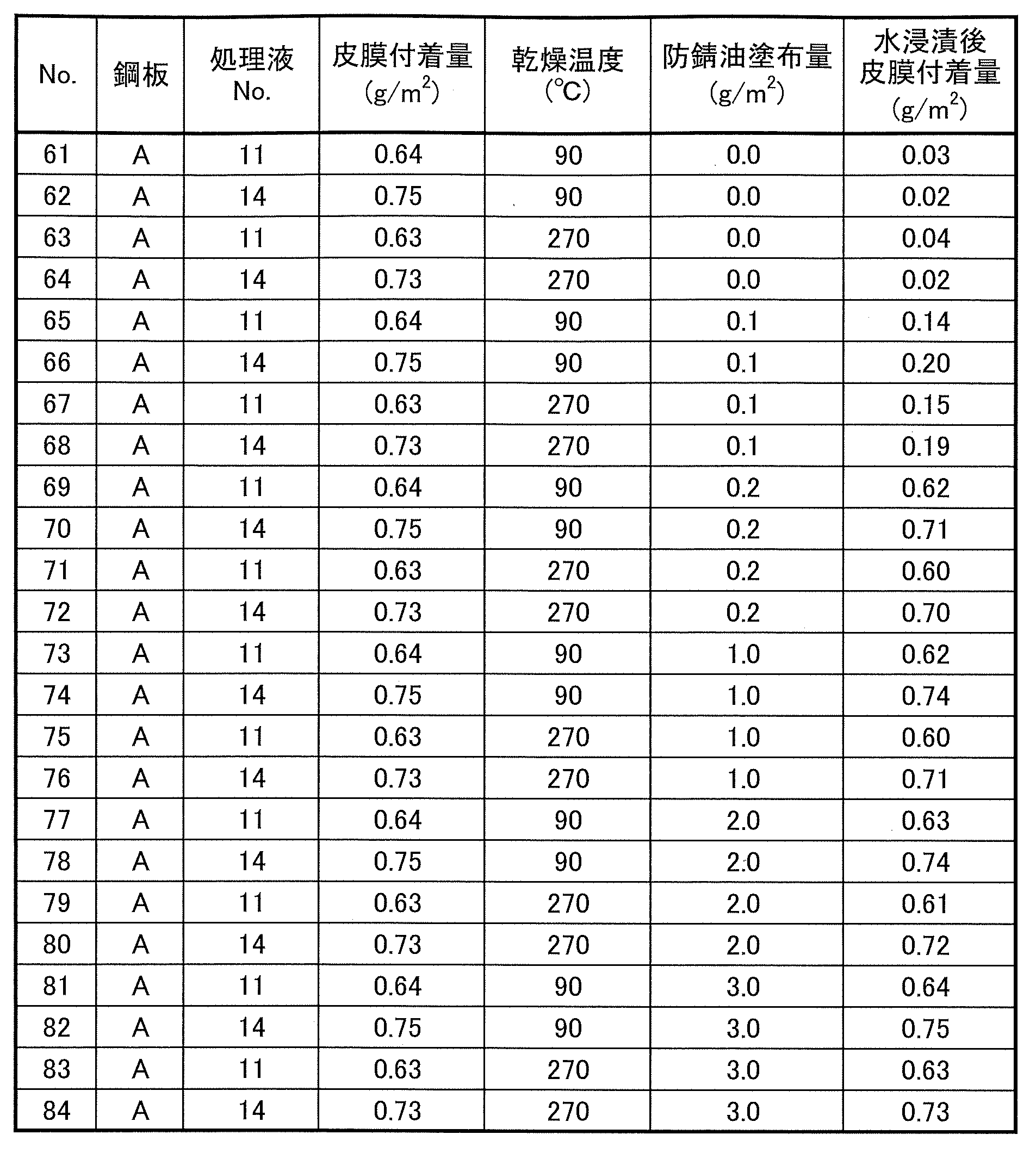
- the fatty acid sodium salt and the fatty acid potassium salt have high water solubility and are excellent in film-removing property, but may fall off when water droplets are formed due to dew condensation or the like during storage or transportation. Therefore, by applying a rust preventive oil to the surface of the lubricating film, the lubricating film is protected, the water resistance is improved, and the lubricating film can be prevented from falling off during storage or transportation.
- the lubricating film of the present invention can be formed by applying the solution of the fatty acid salt to at least one surface of the steel sheet and drying.
- the solution of the fatty acid salt include an aqueous solution and an alcohol solution.
- an alcohol solution of a fatty acid salt By dissolving the fatty acid salt in alcohol, applying the alcohol solution to at least one surface of the steel sheet, and drying, a more uniform lubricating film can be formed.
- the reason for this is considered to be that alcohol has a lower surface tension than water and can dissolve fatty acid salts. Therefore, it is considered that a uniform film can be obtained after drying by spreading uniformly on the steel sheet surface.
- the alcohol include, but are not particularly limited to, methanol, ethanol, and propanol.
- the alcohol solution it is preferable to heat the alcohol solution to 50 ° C. or higher. In the case of an alcohol solution, unevenness in the drying process is less likely to occur than in the case of an aqueous solution. However, in order to form a more uniform film, it is preferable to dry within 5 seconds even when an alcohol solution is used.
- the heating temperature of the alcohol solution is preferably equal to or lower than the boiling point of the alcohol solution.
- the temperature of the steel sheet when the alcohol solution is applied to the steel sheet may be set to 50 ° C. or higher. By setting the temperature of the steel sheet at the time of applying the alcohol solution to the steel sheet to 50 ° C. or higher, it is easier to suppress unevenness in the drying process.
- the temperature of the steel sheet when applying the alcohol solution to the steel sheet is preferably equal to or lower than the boiling point of the alcohol solution.
- the drying method is not particularly limited, but it can be dried by heating the steel sheet with IH (induction heating) or hot air.
- the surface of the steel sheet is heated to 250 ° C. or more after the solution of the fatty acid salt is applied to the steel sheet.
- the fatty acid salt is melted on the steel sheet surface, and when the solidification is performed, a highly oriented lubricating film of fatty acid salt molecules is formed.
- This drying method is preferably used when forming a film using sodium butyrate, which is particularly effective in improving the lubricity by improving the orientation of the fatty acid salt molecules.
- the heating temperature is more preferably 270 ° C. or higher.
- the upper limit of the heating temperature is not particularly limited.
- the heating temperature is preferably 300 ° C. or less. If the steel sheet is heated to 250 ° C. or more when applying the solution of the fatty acid salt, the solvent evaporates at the same time as the application, and it becomes difficult to form a uniform lubricating film. Heating of the steel sheet surface must be during or after drying.
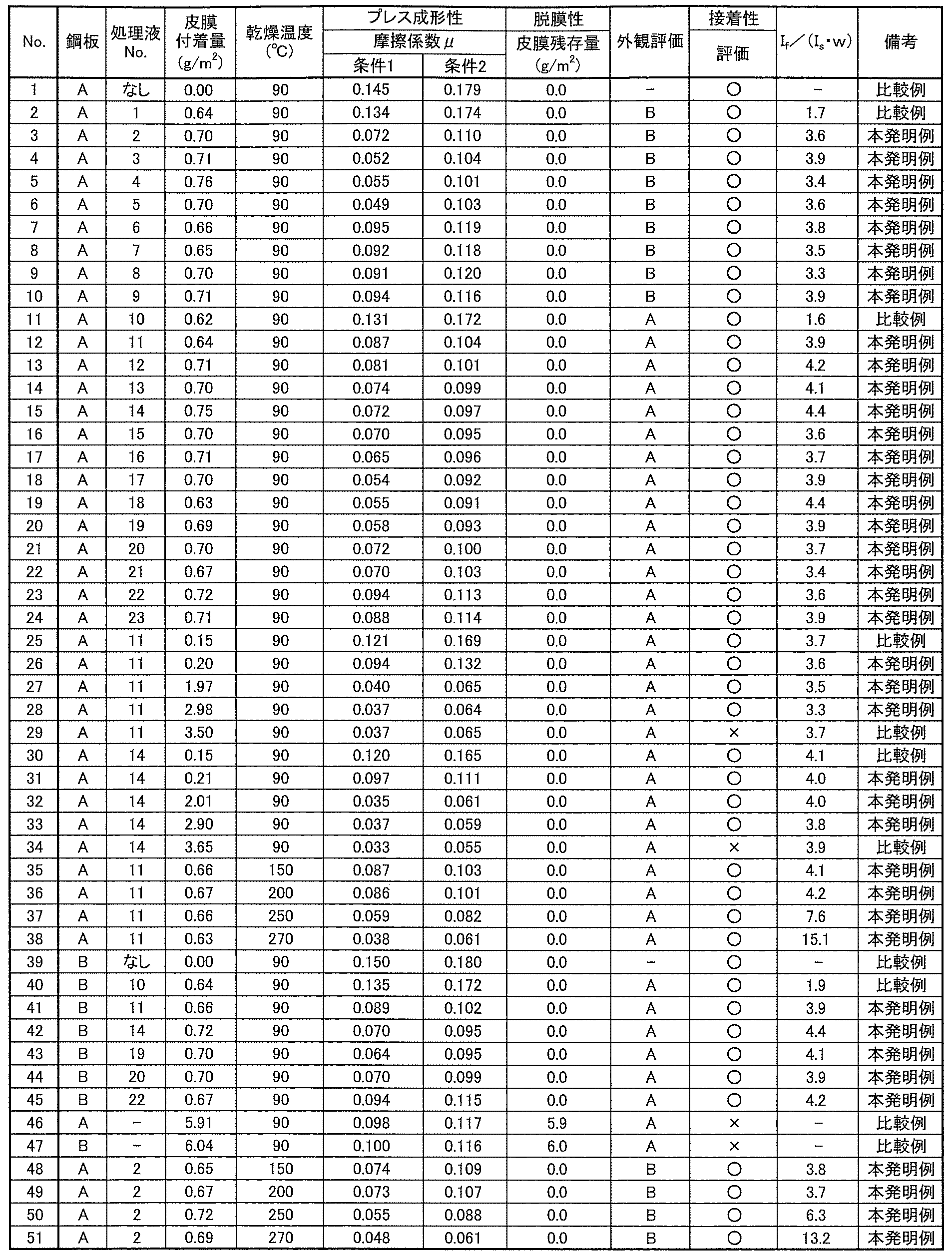
- a treatment liquid shown in Table 1 was applied to a bar. After coating with a coater, the coating was dried with a hot-air drier to form a lubricating film on the surface of the steel sheet.
- the drying temperature (steel plate surface temperature) at the time of drying was as described in Tables 2 and 3.
- the amount of the lubricating film component (fatty acid salt) attached to the surface of the lubricated steel sheet obtained above was measured. Further, as a method of evaluating press formability, a friction coefficient was measured to evaluate sliding characteristics. Further, as a method of evaluating the film removal property, the film removal property by alkali was evaluated. In addition, the water resistance, the adhesion, the molecular orientation of the fatty acid salt in the lubricating film, and the appearance of the film were also evaluated.
- the methods for evaluating the amount of fatty acid salt attached, press moldability (sliding properties), film removal properties, film appearance, water resistance, adhesion, and molecular orientation are as follows.
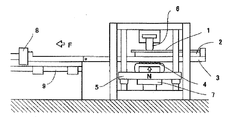
- FIG. 1 is a schematic front view showing a friction coefficient measuring device.
- a sample 1 for friction coefficient measurement (hereinafter, referred to as sample 1) collected from a test material is fixed to a sample table 2, and the sample table 2 is fixed to an upper surface of a horizontally movable slide table 3.
- sample 1 for friction coefficient measurement hereinafter, referred to as sample 1
- sample 2 is fixed to an upper surface of a horizontally movable slide table 3.
- a vertically movable slide table support 5 having a roller 4 in contact with the slide table 3.
- a load N on the sample 1 for friction coefficient measurement by the bead 6 is measured. Is mounted on the slide table support 5.
- a second load cell 8 for measuring a sliding resistance force F for moving the slide table 3 in the horizontal direction while the pressing force is applied is provided above the rail 9 at one end of the slide table 3. Installed. The test was performed by applying a cleaning oil Preton R352L for press manufactured by Sugimura Chemical Industry Co., Ltd. to the surface of the sample 1 as a lubricating oil.
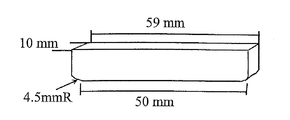
- FIGS. 2 and 3 are schematic perspective views showing the shapes and dimensions of the beads used.
- the lower surface of the bead 6 slides while being pressed against the surface of the sample 1.
- the shape of the bead 6 shown in FIG. 2 has a width of 10 mm, a length of the sample 1 in the sliding direction of 5 mm, a lower portion at both ends in the sliding direction having a curvature of 1.0 mmR, and a lower surface of the bead against which the sample 1 is pressed has a width of 10 mm. It has a plane with a length of 3 mm in the sliding direction.
- the friction coefficient ⁇ under the condition 1 is preferably equal to or less than 0.100, and more preferably equal to or less than 0.090.
- the coefficient of friction ⁇ under the condition 2 is preferably 0.120 or less, more preferably 0.110 or less.
- the film removal property was determined by immersing the test material in an alkaline degreasing solution (FC-E6403, manufactured by Nippon Parkerizing Co., Ltd.) for 30 seconds and then washing the plate with pure water for 30 seconds. The evaluation was made based on the adhesion amount (film remaining amount) of the lubricating film component (fatty acid salt) remaining on the surface. It can be evaluated that the smaller the remaining amount of the film, the more excellent the film removal property.
- FC-E6403 alkaline degreasing solution
- the water resistance is determined by measuring the lubricating film component (fatty acid) remaining on the steel sheet surface after immersing the test material coated with the rust-preventive oil at the coating amount shown in Table 3 in tap water for 30 seconds. Evaluation was made by determining the amount of adhesion of the salt) (the amount of coating after immersion in water). The test was performed using rust preventive oil Antilast P2000 manufactured by JXTG Energy Co., Ltd. as rust preventive oil. When the water resistance is good, the change in the amount of film adhesion before and after immersion in tap water is small.
- the film was used for the following measurements.
- No. Examples 3 to 10, 12 to 24, 26 to 28, 31 to 33, 35 to 38, 41 to 45, and 48 to 51 are examples of the invention, and are excellent in press moldability, and excellent in film removal and adhesion.
- No. 1 was coated with a sodium butyrate solution and dried at 250 ° C. or higher.
- Nos. 37 and 38 have a drying temperature of less than 250 ° C., and have the same film adhesion amount as No. 37.
- the value of I f / (I s ⁇ w ) compared to 12,35,36 molecular orientation of the large fatty acid salt has significantly improved press formability is particularly excellent.
- the original plate having no lubricating film was No. 3; Comparative Examples 1 and 39 are inferior in press formability.
- No. 2, 11, and 40 are comparative examples in that the number of carbon atoms per molecule of the fatty acid salt is less than 4, and are inferior in press moldability.
- No. Nos. 25 and 30 are comparative examples in that the amount of the lubricating film component adhered (the amount of the film adhered) was insufficient, and the press moldability was poor.
- the coating amount exceeds 3.00 g / m 2 and the adhesiveness is poor.
- Reference numerals 46 and 47 are comparative examples in which a Bonde-Vondalube treatment was carried out, which was excellent in lubricity, but was found to be inferior in film-removability and adhesion inferior because the metal soap film was not removed. .
- the lubricated steel sheet of the present invention is excellent in press formability, it can be applied in a wide range of fields mainly for automobile body use.
Landscapes
- Chemical & Material Sciences (AREA)
- Engineering & Computer Science (AREA)
- Wood Science & Technology (AREA)
- Life Sciences & Earth Sciences (AREA)
- Organic Chemistry (AREA)
- Chemical Kinetics & Catalysis (AREA)
- General Chemical & Material Sciences (AREA)
- Oil, Petroleum & Natural Gas (AREA)
- Health & Medical Sciences (AREA)
- Emergency Medicine (AREA)
- Materials Engineering (AREA)
- Mechanical Engineering (AREA)
- Metallurgy (AREA)
- Application Of Or Painting With Fluid Materials (AREA)
- Lubricants (AREA)
- Laminated Bodies (AREA)
- Other Surface Treatments For Metallic Materials (AREA)
- Chemical Treatment Of Metals (AREA)
Abstract
Description
前記脂肪酸塩の鋼板片面あたりの付着量が0.20g/m2以上3.00g/m2以下である、潤滑皮膜を有する鋼板。
[2]前記潤滑皮膜について薄膜X線回折測定を行った際に得られる脂肪酸塩由来のX線回折ピークのうち(001)面のX線回折ピーク強度をIf、
前記潤滑皮膜を脱膜した後の鋼板について薄膜X線回折測定を行った際に得られるFeのX線回折ピークのうちα相の(110)面のX線回折ピーク強度をIs、
前記潤滑皮膜の単位面積あたりの付着量をw(g/m2)としたとき、
If/(Is・w)が5以上である、[1]に記載の潤滑皮膜を有する鋼板。
[3]前記脂肪酸塩が酪酸ナトリウムである、[2]に記載の潤滑皮膜を有する鋼板。
[4]さらに、前記潤滑皮膜の表面に、防錆油を塗布してなり、
前記防錆油の鋼板片面あたりの塗布量が0.2g/m2以上3.0g/m2以下である、[1]~[3]のいずれかに記載の潤滑皮膜を有する鋼板。
[5]前記[1]~[4]のいずれかに記載の潤滑皮膜を有する鋼板の製造方法であって、
1分子中の炭素原子数が4以上18以下である脂肪酸のナトリウム塩およびカリウム塩から選ばれる1種以上の脂肪酸塩を含有する溶液を、鋼板の少なくとも片面に塗布した後、乾燥して、該鋼板の表面に潤滑皮膜を形成する、潤滑皮膜を有する鋼板の製造方法。
[6]前記溶液が、アルコール溶液であり、前記アルコール溶液の温度が、50℃以上、かつ、前記アルコール溶液の沸点以下である、[5]に記載の潤滑皮膜を有する鋼板の製造方法。
[7]前記溶液が、アルコール溶液であり、前記アルコール溶液を鋼板に塗布する時の鋼板の温度が、50℃以上、かつ、前記アルコール溶液の沸点以下である、[5]または[6]に記載の潤滑皮膜を有する鋼板の製造方法。
[8]前記溶液を鋼板に塗布した後、鋼板表面を250℃以上に加熱する、[5]~[7]のいずれかに記載の潤滑皮膜を有する鋼板の製造方法。
なお、薄膜X線回折測定の条件としては、薄膜X線回折装置(Rigaku製RINT1500、Cu線源)を用いて、50kV、250mAの条件でX線を発生させ、各測定試料について2θ=2°~50°、入射角0.5°として測定を行う条件が挙げられる。
また、潤滑皮膜の付着量測定により潤滑皮膜の脱膜が確認されるのならば、脱膜方法は特に限定されないが、例えば潤滑皮膜を有する鋼板をアルカリ脱脂液(FC-E6403、日本パーカライジング(株)製)に30秒間浸漬し、その後純水で30秒間水洗することで脱膜することができる。また、単位面積あたりの潤滑皮膜の付着量w(g/m2)は、脱膜前後の鋼板の質量と、鋼板表面における潤滑皮膜の付着面積(被覆面積)から求めることができる。

鋼板に形成された潤滑皮膜組成および脂肪酸塩の付着量の測定には液体クロマトグラフ/タンデム質量分析計(LC/MS/MS)を使用した。30mm角に採取した潤滑処理鋼板の試料をビーカーに入れ、アセトニトリル/水=1/1(体積比)を40mL加えて30分間超音波抽出した。これを2回繰り返し、100mLに定容した溶液を測定に用いた。そして、予め作成しておいた検量線から、潤滑皮膜成分(脂肪酸塩)の付着量(表2、3中の皮膜付着量)を求めた。
プレス成形性を評価するために、潤滑処理鋼板の各供試材の摩擦係数μを以下のようにして測定した。
[条件1]
図2に示すビードを用い、押し付け荷重N:400kgf、試料の引き抜き速度(スライドテーブル3の水平移動速度):100cm/minとした。
[条件2]
図3に示すビードを用い、押し付け荷重N:400kgf、試料の引き抜き速度(スライドテーブル3の水平移動速度):20cm/minとした。
脱膜性は、供試材をアルカリ脱脂液(FC-E6403、日本パーカライジング(株)製)に30秒間浸漬し、その後純水で30秒間水洗した後の鋼板表面に残存する潤滑皮膜成分(脂肪酸塩)の付着量(皮膜残存量)で評価した。皮膜残存量が少ない程、脱膜性に優れると評価できる。
潤滑皮膜の外観は目視により評価した。図4に示す外観見本を基準として、直径1mm以上の斑点(潤滑皮膜成分が凝集した部分)が存在せず均一な潤滑皮膜をA評価、直径1mm以上の斑点が存在する潤滑皮膜をB評価として評価した。
耐水性は、防錆油を表3に示す塗布量で表面に塗布した供試材を、水道水中に30秒間浸漬した後に鋼板表面に残存する潤滑皮膜成分(脂肪酸塩)の付着量(水浸漬後皮膜付着量)を求めることで評価した。なお、防錆油として、JXTGエネルギー(株)製の防錆油アンチラストP2000を用いて試験を行った。耐水性が良好な場合、水道水への浸漬前後で皮膜付着量の変化が小さい。
潤滑処理鋼板を100×25mmのサイズに加工した試験片を防錆油に浸漬後24時間垂直に立て掛けて余分な油を除去したものを2枚使用し、25mm×13mmの部分にエポキシ系接着剤を0.2mm厚に均一に塗布後、クリップで重ね合わせて挟み、180℃で20分焼付けし、乾燥・硬化させた。冷却後、オートグラフ試験機によりせん断引張試験を行い、せん断接着力を測定した。潤滑皮膜を形成していない鋼板(原板)を2枚使用して同様のせん断引張試験を行った場合を基準として、接着力同等(90%以上)を○(評価合格、接着力に優れる)、劣るもの(90%未満)を×(評価不合格、接着力に劣る)として評価した。
潤滑皮膜中の脂肪酸塩の分子配向性の評価には、20mm角に採取した潤滑処理鋼板の試料を2枚使用し、1枚はアルカリ脱脂液(FC-E6403、日本パーカライジング(株)製)に30秒間浸漬し、その後純水で30秒間水洗して脱膜し、脱膜前後の鋼板の質量と、鋼板表面における潤滑皮膜の付着面積(被覆面積)から、単位面積あたりの潤滑皮膜の付着量w(g/m2)を求めた。また、潤滑皮膜が脱膜したことを確認して以下の測定に使用した。
まず、潤滑皮膜を脱膜していない試料を用いて、薄膜X線回折装置(Rigaku製RINT1500、Cu線源)を使用し、50kV、250mAの条件でX線を発生させ、入射角0.5°として、2θ=2°から50°の範囲で薄膜X線回折測定によりX線回折パターンを得て、脂肪酸塩由来のX線回折ピークのうち(001)面のX線回折ピーク強度Ifを得た。同じ条件で潤滑皮膜を脱膜した試料の薄膜X線回折測定を行い、鋼板由来のFeのX線回折ピークのうちα相の(110)面のX線回折ピーク強度Isを得た。
なお、X線回折ピーク強度の値には測定されたX線回折ピーク強度からバックグラウンドの値を減算した値を使用した。IfとIsの比If/Isを単位面積あたりの潤滑皮膜の付着量w(g/m2)で割ったIf/(Is・w)が大きいほど潤滑皮膜中の脂肪酸塩の分子配向性が高いとして分子配向性を評価した。
2 試料台
3 スライドテーブル
4 ローラ
5 スライドテーブル支持台
6 ビード
7 第1ロードセル
8 第2ロードセル
9 レール
N 押付荷重
F 摺動抵抗力(引き抜き荷重)
Claims (8)
- 鋼板表面の少なくとも片面に、1分子中の炭素原子数が4以上18以下である脂肪酸のナトリウム塩およびカリウム塩から選ばれる1種以上の脂肪酸塩を含有する潤滑皮膜を有し、
前記脂肪酸塩の鋼板片面あたりの付着量が0.20g/m2以上3.00g/m2以下である、潤滑皮膜を有する鋼板。 - 前記潤滑皮膜について薄膜X線回折測定を行った際に得られる脂肪酸塩由来のX線回折ピークのうち(001)面のX線回折ピーク強度をIf、
前記潤滑皮膜を脱膜した後の鋼板について薄膜X線回折測定を行った際に得られるFeのX線回折ピークのうちα相の(110)面のX線回折ピーク強度をIs、
前記潤滑皮膜の単位面積あたりの付着量をw(g/m2)としたとき、
If/(Is・w)が5以上である、請求項1に記載の潤滑皮膜を有する鋼板。 - 前記脂肪酸塩が酪酸ナトリウムである、請求項2に記載の潤滑皮膜を有する鋼板。
- さらに、前記潤滑皮膜の表面に、防錆油を塗布してなり、
前記防錆油の鋼板片面あたりの塗布量が0.2g/m2以上3.0g/m2以下である、請求項1~3のいずれかに記載の潤滑皮膜を有する鋼板。 - 請求項1~4のいずれかに記載の潤滑皮膜を有する鋼板の製造方法であって、
1分子中の炭素原子数が4以上18以下である脂肪酸のナトリウム塩およびカリウム塩から選ばれる1種以上の脂肪酸塩を含有する溶液を、鋼板の少なくとも片面に塗布した後、乾燥して、該鋼板の表面に潤滑皮膜を形成する、潤滑皮膜を有する鋼板の製造方法。 - 前記溶液が、アルコール溶液であり、前記アルコール溶液の温度が、50℃以上、かつ、前記アルコール溶液の沸点以下である、請求項5に記載の潤滑皮膜を有する鋼板の製造方法。
- 前記溶液が、アルコール溶液であり、前記アルコール溶液を鋼板に塗布する時の鋼板の温度が、50℃以上、かつ、前記アルコール溶液の沸点以下である、請求項5または6に記載の潤滑皮膜を有する鋼板の製造方法。
- 前記溶液を鋼板に塗布した後、鋼板表面を250℃以上に加熱する、請求項5~7のいずれかに記載の潤滑皮膜を有する鋼板の製造方法。
Priority Applications (3)
| Application Number | Priority Date | Filing Date | Title |
|---|---|---|---|
| CN201980050413.1A CN112513330B (zh) | 2018-08-07 | 2019-08-01 | 具有润滑被膜的钢板及其制造方法 |
| JP2020506834A JP6933294B2 (ja) | 2018-08-07 | 2019-08-01 | 潤滑皮膜を有する鋼板およびその製造方法 |
| KR1020217003114A KR102612323B1 (ko) | 2018-08-07 | 2019-08-01 | 윤활 피막을 갖는 강판 및 그 제조 방법 |
Applications Claiming Priority (2)
| Application Number | Priority Date | Filing Date | Title |
|---|---|---|---|
| JP2018-148147 | 2018-08-07 | ||
| JP2018148147 | 2018-08-07 |
Publications (1)
| Publication Number | Publication Date |
|---|---|
| WO2020031840A1 true WO2020031840A1 (ja) | 2020-02-13 |
Family
ID=69415322
Family Applications (1)
| Application Number | Title | Priority Date | Filing Date |
|---|---|---|---|
| PCT/JP2019/030214 Ceased WO2020031840A1 (ja) | 2018-08-07 | 2019-08-01 | 潤滑皮膜を有する鋼板およびその製造方法 |
Country Status (4)
| Country | Link |
|---|---|
| JP (1) | JP6933294B2 (ja) |
| KR (1) | KR102612323B1 (ja) |
| CN (1) | CN112513330B (ja) |
| WO (1) | WO2020031840A1 (ja) |
Families Citing this family (2)
| Publication number | Priority date | Publication date | Assignee | Title |
|---|---|---|---|---|
| JP7164063B1 (ja) * | 2021-10-14 | 2022-11-01 | Jfeスチール株式会社 | 鋼板およびその製造方法 |
| US12617951B2 (en) * | 2022-03-25 | 2026-05-05 | Jfe Steel Corporation | Steel sheet and method for producing the same |
Citations (3)
| Publication number | Priority date | Publication date | Assignee | Title |
|---|---|---|---|---|
| JPH0289519A (ja) * | 1988-09-26 | 1990-03-29 | Kawasaki Steel Corp | 冷間圧延鋼板のガウジ疵防止方法 |
| JP2007046126A (ja) * | 2005-08-11 | 2007-02-22 | Sumitomo Metal Ind Ltd | 表面処理鋼帯 |
| JP2011252181A (ja) * | 2010-05-31 | 2011-12-15 | Sumitomo Metal Ind Ltd | 多段成形用高潤滑処理鋼板 |
Family Cites Families (12)
| Publication number | Priority date | Publication date | Assignee | Title |
|---|---|---|---|---|
| US3372117A (en) * | 1965-11-26 | 1968-03-05 | Hooker Chemical Corp | Cold forming lubricant |
| JPH07316575A (ja) * | 1994-05-23 | 1995-12-05 | Daido Kagaku Kogyo Kk | 金属塑性加工用潤滑油組成物 |
| JP3932823B2 (ja) | 2001-04-10 | 2007-06-20 | 住友金属工業株式会社 | 化成処理性、接着性に優れた潤滑処理鋼板 |
| JP4824934B2 (ja) * | 2005-02-14 | 2011-11-30 | 中部キレスト株式会社 | 防錆添加剤および防錆油組成物、並びに金属材の防錆処理法 |
| JP4787625B2 (ja) * | 2006-02-13 | 2011-10-05 | 株式会社神戸製鋼所 | 潤滑組成物被覆金属板 |
| JP4384641B2 (ja) * | 2006-02-28 | 2009-12-16 | 株式会社神戸製鋼所 | 塑性加工用金属材料 |
| JP4923681B2 (ja) | 2006-04-03 | 2012-04-25 | 住友金属工業株式会社 | 潤滑処理鋼板および潤滑皮膜形成用処理液 |
| JP5204467B2 (ja) * | 2007-11-30 | 2013-06-05 | 共栄社化学株式会社 | 乾式伸線用潤滑剤 |
| WO2013008802A1 (ja) * | 2011-07-11 | 2013-01-17 | 共栄社化学株式会社 | 帯状乾式伸線用潤滑材及びその製造方法 |
| WO2014102982A1 (ja) * | 2012-12-27 | 2014-07-03 | 日本パーカライジング株式会社 | アルカリ可溶型潤滑皮膜を有する鋼板、その製造方法および組成物 |
| JP2015189952A (ja) * | 2014-03-28 | 2015-11-02 | 株式会社神戸製鋼所 | 耐食性及び加工性に優れた潤滑皮膜を有する鋼線材 |
| CN106947577B (zh) * | 2017-04-10 | 2020-01-07 | 武汉迪赛鸿印科技有限公司 | 一种用于塑性加工汽车热镀锌钢板的水性润滑液 |
-
2019
- 2019-08-01 CN CN201980050413.1A patent/CN112513330B/zh active Active
- 2019-08-01 JP JP2020506834A patent/JP6933294B2/ja active Active
- 2019-08-01 KR KR1020217003114A patent/KR102612323B1/ko active Active
- 2019-08-01 WO PCT/JP2019/030214 patent/WO2020031840A1/ja not_active Ceased
Patent Citations (3)
| Publication number | Priority date | Publication date | Assignee | Title |
|---|---|---|---|---|
| JPH0289519A (ja) * | 1988-09-26 | 1990-03-29 | Kawasaki Steel Corp | 冷間圧延鋼板のガウジ疵防止方法 |
| JP2007046126A (ja) * | 2005-08-11 | 2007-02-22 | Sumitomo Metal Ind Ltd | 表面処理鋼帯 |
| JP2011252181A (ja) * | 2010-05-31 | 2011-12-15 | Sumitomo Metal Ind Ltd | 多段成形用高潤滑処理鋼板 |
Also Published As
| Publication number | Publication date |
|---|---|
| CN112513330A (zh) | 2021-03-16 |
| CN112513330B (zh) | 2023-01-06 |
| KR102612323B1 (ko) | 2023-12-12 |
| KR20210027437A (ko) | 2021-03-10 |
| JP6933294B2 (ja) | 2021-09-08 |
| JPWO2020031840A1 (ja) | 2020-09-03 |
Similar Documents
| Publication | Publication Date | Title |
|---|---|---|
| US12595390B2 (en) | Steel sheet and production method therefor | |
| EP4431635B1 (en) | Lubricant-coated galvanized steel sheet and method for producing the same | |
| CN106062250A (zh) | 镀锌系钢板及其制造方法 | |
| JP6933294B2 (ja) | 潤滑皮膜を有する鋼板およびその製造方法 | |
| JP6079079B2 (ja) | 冷延鋼板およびその製造方法 | |
| JP6256407B2 (ja) | 鋼板およびその製造方法 | |
| JP7732152B2 (ja) | 亜鉛系めっき鋼板およびその製造方法 | |
| JP6915596B2 (ja) | 潤滑皮膜を有する鋼板およびその製造方法 | |
| JP7567841B2 (ja) | 金属板塗布用塗料 | |
| JP7838724B1 (ja) | 皮膜付き亜鉛系めっき鋼板およびその製造方法 | |
| JP7552576B2 (ja) | 鋼板およびその製造方法 | |
| EP4477410A1 (en) | Steel sheet and method for manufacturing same | |
| JP4100080B2 (ja) | リチウムシリケート系潤滑処理鋼帯 | |
| RU2845547C2 (ru) | Стальной лист с покрытием, предназначенный для горячей штамповки, и водосодержащая жидкость для обработки поверхности, наносимая на него | |
| JP7380963B1 (ja) | 被覆鋼板およびその製造方法 | |
| US20250297124A1 (en) | Coated steel sheet and method of producing same | |
| JP7616392B2 (ja) | 鋼板およびその製造方法 | |
| EP4382589A1 (en) | Coating material for coating metal plate | |
| CN118076703A (zh) | 金属板涂布用涂料 | |
| KR20240142521A (ko) | 유기 수지 피복 강판 | |
| KR20240171147A (ko) | 열간 스탬핑용 코팅 강판 및 이에 도포 가능한 수성 표면 처리액 | |
| WO2023238612A1 (ja) | 被覆鋼板およびその製造方法 |
Legal Events
| Date | Code | Title | Description |
|---|---|---|---|
| ENP | Entry into the national phase |
Ref document number: 2020506834 Country of ref document: JP Kind code of ref document: A |
|
| 121 | Ep: the epo has been informed by wipo that ep was designated in this application |
Ref document number: 19847384 Country of ref document: EP Kind code of ref document: A1 |
|
| ENP | Entry into the national phase |
Ref document number: 20217003114 Country of ref document: KR Kind code of ref document: A |
|
| NENP | Non-entry into the national phase |
Ref country code: DE |
|
| 122 | Ep: pct application non-entry in european phase |
Ref document number: 19847384 Country of ref document: EP Kind code of ref document: A1 |