WO2020031520A1 - 2液硬化型接着剤 - Google Patents
2液硬化型接着剤 Download PDFInfo
- Publication number
- WO2020031520A1 WO2020031520A1 PCT/JP2019/024502 JP2019024502W WO2020031520A1 WO 2020031520 A1 WO2020031520 A1 WO 2020031520A1 JP 2019024502 W JP2019024502 W JP 2019024502W WO 2020031520 A1 WO2020031520 A1 WO 2020031520A1
- Authority
- WO
- WIPO (PCT)
- Prior art keywords
- component
- diisocyanate
- curable adhesive
- polyol
- isocyanate group
- Prior art date
- Legal status (The legal status is an assumption and is not a legal conclusion. Google has not performed a legal analysis and makes no representation as to the accuracy of the status listed.)
- Ceased
Links
Classifications
-
- C—CHEMISTRY; METALLURGY
- C09—DYES; PAINTS; POLISHES; NATURAL RESINS; ADHESIVES; COMPOSITIONS NOT OTHERWISE PROVIDED FOR; APPLICATIONS OF MATERIALS NOT OTHERWISE PROVIDED FOR
- C09J—ADHESIVES; NON-MECHANICAL ASPECTS OF ADHESIVE PROCESSES IN GENERAL; ADHESIVE PROCESSES NOT PROVIDED FOR ELSEWHERE; USE OF MATERIALS AS ADHESIVES
- C09J175/00—Adhesives based on polyureas or polyurethanes; Adhesives based on derivatives of such polymers
- C09J175/04—Polyurethanes
- C09J175/08—Polyurethanes from polyethers
Definitions
- the present invention relates to a two-part curable adhesive.
- Patent Document 1 discloses a two-part curable polyurethane-based adhesive composition having high adhesive strength. It has been disclosed.
- Adhesives may be required to maintain adhesive strength over a wide temperature range.
- the adhesive disclosed in Patent Document 1 has a problem that it is difficult to use the adhesive in a high temperature range because the glass transition temperature is not high.
- the present invention has been made in order to solve the above-mentioned problems, and an object of the present invention is to provide a two-liquid composition having high adhesive strength, glass transition temperature, and elongation, and having both workability during use and low dripping. It is to provide a curable adhesive.
- a two-part curable adhesive has a first component and a second component, and the first component is an aromatic diamine having a molecular weight of 100 to 300 ( A1), wherein the second component contains an isocyanate group-terminated urethane prepolymer (B1) having an isocyanate group content of 2 to 18% by mass. It is obtained by reacting one or both of diisocyanate (B1a) and alicyclic diisocyanate (B1b) with polyol (B1c) having an oxyalkylene group.
- a two-part curable adhesive having high adhesive strength, glass transition temperature, and elongation, and having both workability during use and resistance to sagging.
- a two-part curable adhesive according to an embodiment of the present invention has a first component and a second component, and the first component contains an aromatic diamine (A1) having a molecular weight of 100 to 300.
- the second component contains an isocyanate group-terminated urethane prepolymer (B1) having an isocyanate group content of 2 to 18% by mass, and the isocyanate group-terminated urethane prepolymer (B1) contains at least an aliphatic diisocyanate (B1a). And one or both of an alicyclic diisocyanate (B1b) and a polyol having an oxyalkylene group (B1c).
- the two-component curable adhesive is one in which the adhesive strength after curing, the glass transition temperature, and the elongation are comprehensively improved.
- the two-part curable adhesive is highly workable to maintain a viscosity that can be applied for a certain period of time after mixing, and it is hard to drip even when applied to a vertical surface or the like. Has properties.
- the second component further contains an aromatic diisocyanate (B2), and the sum of the aliphatic diisocyanate (B1a) and the alicyclic diisocyanate (B1b), and the aromatic diisocyanate (B2) Has a mass ratio ((B2) / ((B1a) + (B1b))) of 0.1 to 0.5.
- B2 aromatic diisocyanate
- the amount of the isocyanate group contained in the second component is 70 to 150 mol% with respect to the active hydrogen group contained in the first component.
- the amount of the amino groups contained in the first component is 60 to 100% by mol based on the active hydrogen groups contained in the first component.
- the two-component curable adhesive includes at least a first component and a second component. Since the two-component curable adhesive is cured by mixing the first component and the second component, the function as an adhesive can be exhibited.
- the first component in the two-part curable adhesive according to the present embodiment contains an aromatic diamine (A1) having a molecular weight of 100 to 300.
- the aromatic diamine (A1) is not particularly limited, but is preferably a diamine having a structure in which at least two amino groups are bonded to a toluene structure. Specifically, diethyltoluenediamine, dimethylthiotoluenediamine, diaminotoluene, trimethylphenylenediamine and the like are preferable. These may be used alone or in combination of two or more.
- aromatic diamine (A1) the viewpoint of improving the adhesive strength (adhesive strength), glass transition temperature, and elongation of a two-part curable adhesive, and achieving both workability during use and resistance to sagging.
- diethyltoluenediamine and dimethylthiotoluenediamine are preferred.
- the first component may contain, for example, a polyol.
- the polyol include, but are not particularly limited to, polyhydric alcohol, polyether polyol, polyester polyol, polycarbonate polyol, polyolefin polyol, polyacryl polyol, polyacetal polyol, polybutadiene polyol, polysiloxane polyol, and fluorine polyol.
- the polyol is preferably from 100 to 5,000, more preferably from 200 to 3,000.
- polyhydric alcohol examples include ethylene glycol, diethylene glycol, butanediol, propylene glycol, hexanediol, 3-methyl-1,5-pentanediol, bisphenol A, bisphenol B, bisphenol S, hydrogenated bisphenol A, Bromobisphenol A, 1,4-cyclohexanedimethanol, dihydroxyethyl terephthalate, hydroquinone dihydroxyethyl ether, trimethylolpropane, glycerin, pentaerythritol and the like can be mentioned.
- polyether polyol examples include oxyalkylene derivatives of the above-mentioned polyhydric alcohols, polytetramethylene glycol, polythioether polyol, and the like. Specifically, polyethylene glycol, polypropylene glycol, polyoxyethylene polyoxypropylene glycol, polyoxyethylene bisphenol A, polyoxypropylene bisphenol A, polyoxyethylene polyoxypropylene bisphenol A, polyoxyethylene glyceryl ether, polyoxypropylene glyceryl Ether, polyoxyethylene polyoxypropylene glyceryl ether, polyoxyethylene trimethylolpropane, polyoxypropylene trimethylolpropane, polyoxyethylene polyoxypropylene trimethylolpropane, and the like.
- polyester polyol examples include an esterified product of a hydroxyl group-containing compound such as a polyhydric alcohol and a polyether polyol, and a carboxylic acid derivative such as a polycarboxylic acid, a polycarboxylic anhydride and a polycarboxylic ester.
- a diol selected from ethylene glycol, butanediol, hexanediol, methylpentanol, neopentylglycol and 1,4-cyclohexanedimethanol, and adipic acid, sebacic acid,
- esterified products with at least one dicarboxylic acid selected from isophthalic acid and terephthalic acid As the polyester polyol, castor oil polyol, polycaprolactone polyol and the like can also be used.
- polycarbonate polyol examples include those comprising a carbonate derivative such as dimethyl carbonate and the polyhydric alcohol. Specifically, a polycarbonate polyol comprising dimethyl carbonate and at least one selected from ethylene glycol, butanediol, hexanediol, 3-methyl-1,5-pentanediol and 1,4-cyclohexanediol Is mentioned.
- polystyrene polyol examples include polybutadiene polyol, polyisoprene polyol, and hydrogenated products thereof.
- the first component may include, for example, a filler.
- a filler include, but are not particularly limited to, calcium carbonate, talc, silica, and mica.
- the first component may include a water-absorbing material from the viewpoint of increasing the tensile strength (tensile strength) of the cured adhesive.
- a water-absorbing material from the viewpoint of increasing the tensile strength (tensile strength) of the cured adhesive.
- the water-absorbing material include porous powder, water-absorbing alumina, and calcium oxide. Any of these may be used alone or in combination of two or more.
- porous powder is preferable, and zeolite is more preferable.
- the water absorbing material is not particularly limited, but is preferably used in an amount of 0.5 to 5 parts by mass, more preferably 0.5 to 2 parts by mass, based on 100 parts by mass of the first component.
- the amount of amino groups contained in the first component relative to the active hydrogen groups contained in the first component is not particularly limited. It is preferably at least 70 mol%, more preferably at least 70 mol%, even more preferably at least 80 mol%, even more preferably at least 90 mol%.
- the second component in the two-part curable adhesive according to the present embodiment contains an isocyanate group-terminated urethane prepolymer (B1) having an isocyanate group content of 2 to 18% by mass.
- the isocyanate group content of the isocyanate group-terminated urethane prepolymer (B1) further improves the adhesive strength, glass transition temperature, and elongation of the two-part curable adhesive, and improves workability and sagging during use.
- the content is preferably 3 to 16% by mass, more preferably 4 to 14% by mass, and still more preferably 5 to 12% by mass.
- the isocyanate group-terminated urethane prepolymer (B1) is obtained by reacting at least one or both of an aliphatic diisocyanate (B1a) and an alicyclic diisocyanate (B1b) with a polyol (B1c) having an oxyalkylene group. It is a thing.
- the isocyanate group-terminated urethane prepolymer (B1) is obtained, for example, by mixing one or both of an aliphatic diisocyanate (B1a) and an alicyclic diisocyanate (B1b) with a polyol (B1c) having an oxyalkylene group. It is obtained by reacting at a ratio such that the number of isocyanate groups is excessive relative to the number of active hydrogen groups.
- the active hydrogen group is a functional group that reacts with an isocyanate group, and includes a hydroxyl group and an amino group.
- the aliphatic diisocyanate (B1a) and the alicyclic diisocyanate (B1b) are used for producing the isocyanate group-terminated urethane prepolymer (B1)
- the aliphatic diisocyanate (B1a) and the alicyclic diisocyanate (B1b) are used.
- the mass ratio ((B1b) / ((B1a) + (B1b)))) of the total amount to the alicyclic diisocyanate (B1b) is preferably 0.5 or more, more preferably 0.7 or more, and 0.8 or more. The above is more preferable, 0.9 or more is more preferable, and 0.95 or more is further preferable.
- the aliphatic diisocyanate (B1a) is not particularly limited, but examples thereof include butane diisocyanate, pentane diisocyanate, hexamethylene diisocyanate (hereinafter also referred to as “HDI”), trimethylhexamethylene diisocyanate, and lysine diisocyanate. Any of these may be used alone or in combination of two or more.
- HDI is preferred from the viewpoints of improving the adhesive strength, glass transition temperature, and elongation of the two-part curable adhesive, and achieving both workability during use and resistance to sagging. .
- alicyclic diisocyanate B1b
- isophorone diisocyanate Henceforth "IPDI”
- hydrogenated xylylene diisocyanate hydrogenated diphenylmethane diisocyanate
- hydrogenated MDI hydrogenated diphenylmethane diisocyanate
- 1,4-cyclohexane diisocyanate Any of these may be used alone or in combination of two or more.
- alicyclic diisocyanate (B1b) As the alicyclic diisocyanate (B1b), IPDI, from the viewpoint of improving the adhesive strength, the glass transition temperature, and the elongation of the two-part curable adhesive, and achieving both workability during use and resistance to dripping, Hydrogenated MDI is preferred.
- polyol (B1c) having an oxyalkylene group examples include, but are not particularly limited to, water, propylene glycol, ethylene glycol, glycerin, trimethylolpropane, hexanetriol, triethanolamine, diglycerin, pentaerythritol, ethylenediamine, and methylgluline.
- Those obtained by polymerizing and adding an alkylene oxide (hereinafter, also referred to as “AO”) to an initiator such as kodite, aromatic diamine, sorbitol, sucrose, phosphoric acid and the like can be used. Moreover, you may use these in combination of 2 or more types.
- AO ethylene oxide, propylene oxide and butylene oxide are preferred.
- the molecular weight of the polyol having an oxyalkylene group (B1c) is preferably from 400 to 8000, more preferably from 500 to 7000, more preferably from 500 to 6000, and more preferably from 1,000 to 4,000 from the viewpoint of increasing the tensile strength, glass transition temperature, and adhesive strength. 6000 is more preferred, 1200 to 6000 is more preferred, and 1400 to 6000 is even more preferred.
- molecular weight represents a number average molecular weight of a compound having a molecular weight distribution such as polypropylene glycol.
- the second component may contain an aromatic diisocyanate (B2). This makes it possible to suppress the dripping of the two-component curable adhesive until the curing of the two-component curable adhesive is completed, for example.
- B2 aromatic diisocyanate
- the property showing such ease of sagging is also called sag. Suitable sag depends on the application of the two-part curable adhesive.
- aromatic diisocyanate For example, dialkyl diphenylmethane diisocyanate, tolylene diisocyanate, 2,2'-diphenylmethane diisocyanate, 2,4'-diphenylmethane diisocyanate, 4,4'-diphenylmethane diisocyanate (henceforth, Polymethylene polyphenyl polyisocyanate (hereinafter also referred to as "polymeric MDI”), 4,4'-dibenzyl diisocyanate, 1,5-naphthylene diisocyanate, 1,3-phenylene diisocyanate And 1,4-phenylene diisocyanate.
- polymeric MDI Polymethylene polyphenyl polyisocyanate
- 4,4'-dibenzyl diisocyanate 1,5-naphthylene diisocyanate, 1,3-phenylene diisocyanate And 1,4-phenylene diisocyanate.
- a modified polyisocyanate can be used as the aromatic diisocyanate (B2).
- a modified polyisocyanate a biuret modified product, an adduct modified product, a carbodiimide modified product, a bifunctional modified product, or the like can be used. Any of these may be used alone or in combination of two or more.
- aromatic diisocyanate (B2) monomeric MDI is used from the viewpoint of improving the adhesive strength, glass transition temperature, and elongation of the two-part curable adhesive, and achieving both workability during use and resistance to dripping.
- Polymeric MDI and carbodiimide-modified monomeric MDI are preferred.
- the mass ratio ((B2) / ((B1a) + (B1b))) of the total of the aliphatic diisocyanate (B1a) and the alicyclic diisocyanate (B1b) to the aromatic diisocyanate (B2) is, for example, two-pack curing. From the viewpoints of improving the adhesive strength, glass transition temperature, and elongation of the mold adhesive, and achieving both workability during use and resistance to sagging, it is preferably 0.1 to 0.5. It is more preferably 1 to 0.45, more preferably 0.1 to 0.4, and even more preferably 0.1 to 0.35.
- the amount of the isocyanate group contained in the second component with respect to the active hydrogen group contained in the first component is, for example, to improve the adhesive strength, glass transition temperature, and elongation of the two-part curable adhesive, and From the viewpoint of achieving both workability at the time and difficulty in sagging, it is preferably from 70 to 150 mol%, more preferably from 80 to 130 mol%, even more preferably from 90 to 120 mol%.
- the two-component curable adhesive may contain, for example, additives generally used in polyurethane resin compositions and the like, such as a plasticizer, a pigment, an antifoaming agent, and a curing catalyst.
- additives generally used in polyurethane resin compositions and the like such as a plasticizer, a pigment, an antifoaming agent, and a curing catalyst.
- Table 1 shows the types and amounts of raw materials to be blended to adjust each of the first component and the second component, various ratios of the first component and the second component, and the results of evaluations described later. .
- the "proportion etc.” is the isocyanate group-terminated urethane prepolymer (B1) in terms of the isocyanate group content (% by mass), the total of the aliphatic diisocyanate (B1a) and the alicyclic diisocyanate (B1b), and the aromatic diisocyanate.
- Mass ratio to (B2) ((B2) / ((B1a) + (B1b))
- the amount of the isocyanate groups contained in the second component relative to the active hydrogen groups contained in the first component mol%
- Tack free time (min) The first component and the second component adjusted to 25 ° C. were mixed for 1 minute, and the time from the start of mixing until the surface of the mixture was no longer sticky, that is, the tack free time was measured. Whether or not tack was lost was determined by finger touch.
- Adhesive strength (MPa) The first component and the second component adjusted to 25 ° C. are mixed for 1 minute, and after 2 minutes, the mixture is mixed using an electrodeposition coated steel sheet (ED steel sheet) having a length of 25 mm ⁇ width 100 mm ⁇ thickness 1.6 mm. JIS K 6850: 1999. Specifically, the adhesive test piece applies an adhesive to the surface of the two ED steel plates, and bonds the ED steel plates together so that the overlap area is 25 mm in length and 12.5 mm in width. For 7 days to cure. At this time, the thickness of the adhesive was adjusted to 1 mm. Then, using a digital universal tester (Instron 5581) manufactured by Instron Japan, the lap shear strength (MPa) of the adhesive test piece was measured as the adhesive strength of the adhesive. that time, The test speed was 5 mm / min.
- the adhesive strength after curing, the glass transition temperature, and the elongation are improved in Examples 1 to 14 as compared with Comparative Examples 1 to 4, and in actual use. While suppressing the mixing viscosity (that is, the viscosity of the liquid mixture) to the extent that the workability is not deteriorated, the sagging property has been highly evaluated.
- Example 4 is compared with Examples 1 and 5, when the isocyanate group-terminated urethane prepolymer (B1) is obtained, when the alicyclic diisocyanate (B1b) is used, It can be seen that the tensile strength, glass transition temperature, and adhesive strength are excellent.
- Example 9 comparing Example 9 with Examples 6 to 8, when the molecular weight of the polyol (B1c) having an oxyalkylene group is in the range of 1200 to 6000, the tensile strength, the glass transition temperature, and the adhesive strength It is clear that the tack free time is short and the tack free time is short. In Comparative Example 4, the viscosity was rapidly increased after mixing, and the mixed viscosity could not be measured.
Landscapes
- Chemical & Material Sciences (AREA)
- Organic Chemistry (AREA)
- Adhesives Or Adhesive Processes (AREA)
- Polyurethanes Or Polyureas (AREA)
Abstract
接着強度、ガラス転移温度、および伸び率が高く、かつ使用時の作業性と垂れにくさとを両立した2液硬化型接着剤を提供する。 2液硬化型接着剤は、第1成分および第2成分を有する2液硬化型接着剤であって、前記第1成分は、分子量が100~300の芳香族ジアミン(A1)を含み、前記第2成分は、イソシアネート基含有量が2~18質量%のイソシアネート基末端ウレタンプレポリマー(B1)を含み、前記イソシアネート基末端ウレタンプレポリマー(B1)は、少なくとも、脂肪族ジイソシアネート(B1a)および脂環式ジイソシアネート(B1b)の一方または両方と、オキシアルキレン基を有するポリオール(B1c)と、を反応させて得られたものである、
Description
本発明は、2液硬化型接着剤に関する。
ポリイソシアネートを含む成分と活性水素化合物を含む成分との硬化反応を利用した2液硬化型接着剤は、従来から種々の分野において使用されている。
接着剤には、部材同士を強固に接着することが求められ、たとえば、特表2011-509316号公報(特許文献1)には、接着強度が高い2液硬化型のポリウレタン系接着剤組成物が開示されている。
接着剤には、広い温度範囲に亘って接着強度を維持することが求められる場合がある。しかしながら、上記特許文献1に開示された接着剤では、ガラス転移温度が高くないため、高温度域での使用が難しいという問題があった。
また、従来のポリウレタン系接着剤組成物では、高いガラス転移温度を実現しようとすると、破断に至るまでの伸び率(以下、単に「伸び率」とも称する)が低下する傾向があり、高いガラス転移温度と高い伸び率とを両立することが難しかった。さらに、使用時の作業性と垂れにくさとを両立する必要もあった。
この発明は、上述の課題を解決するためになされたもので、その目的は、接着強度、ガラス転移温度、および伸び率が高く、かつ使用時の作業性と垂れにくさとを両立した2液硬化型接着剤を提供することである。
上記課題を解決するために、この発明のある局面に係る2液硬化型接着剤は、第1成分および第2成分を有し、前記第1成分は、分子量が100~300の芳香族ジアミン(A1)を含み、前記第2成分は、イソシアネート基含有量が2~18質量%のイソシアネート基末端ウレタンプレポリマー(B1)を含み、前記イソシアネート基末端ウレタンプレポリマー(B1)は、少なくとも、脂肪族ジイソシアネート(B1a)および脂環式ジイソシアネート(B1b)の一方または両方と、オキシアルキレン基を有するポリオール(B1c)と、を反応させて得られたものである。
本発明によれば、接着強度、ガラス転移温度、および伸び率が高く、かつ使用時の作業性と垂れにくさとを両立した2液硬化型接着剤を提供することができる。
最初に、本発明の実施形態の内容を列記して説明する。
(1)本発明の実施の形態に係る2液硬化型接着剤は、第1成分および第2成分を有し、前記第1成分は、分子量が100~300の芳香族ジアミン(A1)を含み、前記第2成分は、イソシアネート基含有量が2~18質量%のイソシアネート基末端ウレタンプレポリマー(B1)を含み、前記イソシアネート基末端ウレタンプレポリマー(B1)は、少なくとも、脂肪族ジイソシアネート(B1a)および脂環式ジイソシアネート(B1b)の一方または両方と、オキシアルキレン基を有するポリオール(B1c)と、を反応させて得られたものである。
このような構成により、硬化後の接着強度、ガラス転移温度、および伸び率が高く、かつ使用時の作業性と垂れにくさとを両立した2液硬化型接着剤を得ることができる。より具体的には、当該2液硬化型接着剤は、硬化後の接着強度、ガラス転移温度、および伸び率を総合的に向上させたものである。また、実際の使用に際しては、当該2液硬化型接着剤は、混合後、ある程度の時間、塗布可能な粘度を維持するため作業性が高く、かつ、垂直面などに塗布しても垂れにくいという性質をもつ。
(2)好ましくは、前記第2成分は、さらに、芳香族ジイソシアネート(B2)を含み、前記脂肪族ジイソシアネート(B1a)および脂環式ジイソシアネート(B1b)の合計と、前記芳香族ジイソシアネート(B2)との質量比((B2)/((B1a)+(B1b)))は0.1~0.5である。
このような構成により、硬化後の接着強度、ガラス転移温度、および伸び率がより高く、かつ使用時の作業性と垂れにくさとを両立した2液硬化型接着剤を得ることができる。
(3)好ましくは、前記第1成分に含まれる活性水素基に対する、前記第2成分に含まれるイソシアネート基の量が70~150モル%である。
このような構成により、硬化後の接着強度、ガラス転移温度、および伸び率がより高く、かつ使用時の作業性と垂れにくさとを両立した2液硬化型接着剤を得ることができる。
(4)前記第1成分に含まれる活性水素基に対する、前記第1成分に含まれるアミノ基の量が60~100モル%である。
このような構成により、硬化後の接着強度、ガラス転移温度、および伸び率がより高く、かつ使用時の作業性と垂れにくさとを両立した2液硬化型接着剤を得ることができる。
以下、本発明の実施の形態について具体的に説明する。
[2液硬化型接着剤]
本実施の形態に係る2液硬化型接着剤は、少なくとも、第1成分および第2成分により構成される。2液硬化型接着剤は、その第1成分および第2成分が混合されることにより硬化するため、接着剤としての機能を発揮することができる。
本実施の形態に係る2液硬化型接着剤は、少なくとも、第1成分および第2成分により構成される。2液硬化型接着剤は、その第1成分および第2成分が混合されることにより硬化するため、接着剤としての機能を発揮することができる。
[第1成分]
本実施の形態に係る2液硬化型接着剤における第1成分は、分子量が100~300の芳香族ジアミン(A1)を含む。芳香族ジアミン(A1)としては、特に限定されないが、トルエン構造に少なくとも2つのアミノ基が結合した構造を有するジアミンが好ましい。具体的には、ジエチルトルエンジアミン、ジメチルチオトルエンジアミン、ジアミノトルエン、トリメチルフェニレンジアミン等が好ましい。これらは、いずれか1種を単独で用いてもよいし、2種以上組み合わせて用いてもよい。
本実施の形態に係る2液硬化型接着剤における第1成分は、分子量が100~300の芳香族ジアミン(A1)を含む。芳香族ジアミン(A1)としては、特に限定されないが、トルエン構造に少なくとも2つのアミノ基が結合した構造を有するジアミンが好ましい。具体的には、ジエチルトルエンジアミン、ジメチルチオトルエンジアミン、ジアミノトルエン、トリメチルフェニレンジアミン等が好ましい。これらは、いずれか1種を単独で用いてもよいし、2種以上組み合わせて用いてもよい。
芳香族ジアミン(A1)としては、2液硬化型接着剤の接着強度(接着強さ)、ガラス転移温度、および伸び率を向上させ、かつ使用時の作業性と垂れにくさとを両立させる観点から、ジエチルトルエンジアミン、ジメチルチオトルエンジアミンが好ましい。
上記第1成分は、たとえば、ポリオールを含んでもよい。当該ポリオールとしては、特に限定されないが、たとえば、多価アルコール、ポリエーテルポリオール、ポリエステルポリオール、ポリカーボネートポリオール、ポリオレフィンポリオール、ポリアクリルポリオール、ポリアセタールポリオール、ポリブタジエンポリオール、ポリシロキサンポリオール、フッ素ポリオール等が挙げられる。当該ポリオールは、100~5000が好ましく、200~3000がより好ましい。
上記多価アルコールとしては、たとえば、エチレングリコール、ジエチレングリコール、ブタンジオール、プロピレングリール、ヘキサンジオール、3-メチル-1,5-ペンタンジオール、ビスフェノールA、ビスフェノールB、ビスフェノールS、水素添加ビスフェノールA、ジブロムビスフェノールA、1,4-シクロヘキサンジメタノール、ジヒドロキシエチルテレフタレート、ハイドロキノンジヒドロキシエチルエーテル、トリメチロールプロパン、グリセリン、ペンタエリスリトールなどが挙げられる。
上記ポリエーテルポリオールとしては、たとえば、上記多価アルコールのオキシアルキレン誘導体、ポリテトラメチレングリコール、ポリチオエーテルポリオールなどが挙げられる。具体的には、ポリエチレングリコール、ポリプロピレングリコール、ポリオキシエチレンポリオキシプロピレングリコール、ポリオキシエチレンビスフェノールA、ポリオキシプロピレンビスフェノールA、ポリオキシエチレンポリオキシプロピレンビスフェノールA、ポリオキシエチレングリセリルエーテル、ポリオキシプロピレングリセリルエーテル、ポリオキシエチレンポリオキシプロピレングリセリルエーテル、ポリオキシエチレントリメチロールプロパン、ポリオキシプロピレントリメチロールプロパン、ポリオキシエチレンポリオキシプロピレントリメチロールプロパンなどが挙げられる。
上記ポリエステルポリオールとしては、たとえば、多価アルコールおよびポリエーテルポリオールなどの水酸基含有化合物と、多価カルボン酸、多価カルボン酸無水物および多価カルボン酸エステルなどのカルボン酸誘導体とのエステル化物が挙げられる。具体的には、エチレングリコール、ブタンジオール、ヘキサンジオール、メチルペンタンオール、ネオペンチルグリコ-ルおよび1,4-シクロへキサンジメタノールから選択される少なくとも1種のジオールと、アジピン酸、セバシン酸、イソフタル酸およびテレフタル酸から選択される少なくとも1種のジカルボン酸とのエステル化物、などが挙げられる。また、ポリエステルポリオールとしては、ヒマシ油ポリオール、ポリカプロラクトンポリオールなども用いることができる。
上記ポリカーボネートポリオールとしては、たとえば、ジメチルカーボネートなどのカーボネート誘導体と前記多価アルコールからなるものが挙げられる。具体的には、ジメチルカーボネートと、エチレングリコール、ブタンジオール、ヘキサンジオール、3-メチル-1,5-ペンタンジオールおよび1,4-シクロヘキサンジオールから選択される少なくとも1種とを構成成分とするポリカーボネートポリオールが挙げられる。
上記ポリオレフィンポリオールとしては、たとえば、ポリブタジエンポリオール、ポリイソプレンポリオールやこれらの水素添加物などが挙げられる。
また、上記第1成分は、たとえば、フィラーを含んでもよい。当該フィラーとしては、特に限定されないが、炭酸カルシウム、タルク、シリカ、マイカ等を挙げることができる。フィラーを配合することで、作業時の粘度をさらに調整することができる。
上記第1成分は、硬化した接着剤の引張強度(引張強さ)を高める観点から、吸水材を含んでもよい。吸水材としては、たとえば、多孔質粉体、吸水性アルミナ、酸化カルシウムを挙げることができる。これらは、いずれか1種を単独で用いてもよいし、2種以上組み合わせて用いてもよい。吸水材としては、多孔質粉体が好ましく、ゼオライトがより好ましい。
吸水材は、特に限定されないが、上記第1成分100質量部に対して、0.5~5質量部用いられることが好ましく、0.5~2質量部用いられることがより好ましい。
上記第1成分に含まれる活性水素基に対する、上記第1成分に含まれるアミノ基の量、すなわち上記第1成分に含まれる活性水素基のうちのアミノ基の量は、特に限定されないが、60モル%以上であることが好ましく、70モル%以上であることがより好ましく、80モル%以上であることがより好ましく、90モル%以上であることがさらに好ましい。
[第2成分]
本実施の形態に係る2液硬化型接着剤における第2成分は、イソシアネート基含有量が2~18質量%のイソシアネート基末端ウレタンプレポリマー(B1)を含む。イソシアネート基末端ウレタンプレポリマー(B1)のイソシアネート基含有量は、2液硬化型接着剤の接着強度、ガラス転移温度、および伸び率をさらに向上させ、かつ使用時の作業性と垂れにくさとを両立させる観点から、3~16質量%であることが好ましく、4~14質量%であることがより好ましく、5~12質量%であることがさらに好ましい。
本実施の形態に係る2液硬化型接着剤における第2成分は、イソシアネート基含有量が2~18質量%のイソシアネート基末端ウレタンプレポリマー(B1)を含む。イソシアネート基末端ウレタンプレポリマー(B1)のイソシアネート基含有量は、2液硬化型接着剤の接着強度、ガラス転移温度、および伸び率をさらに向上させ、かつ使用時の作業性と垂れにくさとを両立させる観点から、3~16質量%であることが好ましく、4~14質量%であることがより好ましく、5~12質量%であることがさらに好ましい。
イソシアネート基末端ウレタンプレポリマー(B1)は、少なくとも、脂肪族ジイソシアネート(B1a)および脂環式ジイソシアネート(B1b)の一方または両方と、オキシアルキレン基を有するポリオール(B1c)と、を反応させて得られたものである。
具体的には、イソシアネート基末端ウレタンプレポリマー(B1)は、たとえば、脂肪族ジイソシアネート(B1a)および脂環式ジイソシアネート(B1b)の一方または両方と、オキシアルキレン基を有するポリオール(B1c)とを、活性水素基の数に対してイソシアネート基の数が過剰になるような比率で反応させることにより得られる。なお、活性水素基とは、イソシアネート基と反応する官能基であり、水酸基、アミノ基を含む。
また、イソシアネート基末端ウレタンプレポリマー(B1)の生成に、脂肪族ジイソシアネート(B1a)および脂環式ジイソシアネート(B1b)の両方を用いる場合、脂肪族ジイソシアネート(B1a)および脂環式ジイソシアネート(B1b)の合計量と、脂環式ジイソシアネート(B1b)との質量比((B1b)/((B1a)+(B1b)))は、0.5以上が好ましく、0.7以上がより好ましく、0.8以上がより好ましく、0.9以上がより好ましく、0.95以上がさらに好ましい。
脂肪族ジイソシアネート(B1a)としては、特に限定されないが、ブタンジイソシアネート、ペンタンジイソシアネート、ヘキサメチレンジイソシアネート(以下、「HDI」とも称する。)、トリメチルヘキサメチレンジイソシアネート、リジンジイソシアネート等を挙げることができる。これらは、いずれか1種を単独で用いてもよいし、2種以上組み合わせて用いてもよい。
脂肪族ジイソシアネート(B1a)としては、2液硬化型接着剤の接着強度、ガラス転移温度、および伸び率を向上させ、かつ使用時の作業性と垂れにくさとを両立させる観点から、HDIが好ましい。
脂環式ジイソシアネート(B1b)としては、特に限定されないが、イソホロンジイソシアネート(以下、「IPDI」とも称する。)、水添キシリレンジイソシアネート、水添ジフェニルメタンジイソシアネート(以下、「水添MDI」とも称する。)、1,4-シクロヘキサンジイソシアネート等を挙げることができる。これらは、いずれか1種を単独で用いてもよいし、2種以上組み合わせて用いてもよい。
脂環式ジイソシアネート(B1b)としては、2液硬化型接着剤の接着強度、ガラス転移温度、および伸び率を向上させ、かつ使用時の作業性と垂れにくさとを両立させる観点から、IPDI、水添MDIが好ましい。
オキシアルキレン基を有するポリオール(B1c)としては、特に限定されないが、例えば、水、プロピレングリコール、エチレングリコール、グリセリン、トリメチロールプロパン、ヘキサントリオール、トリエタノールアミン、ジグリセリン、ペンタエリスリトール、エチレンジアミン、メチルグルコジット、芳香族ジアミン、ソルビトール、ショ糖、リン酸等の開始剤にアルキレンオキシド(以下、「AO」とも称する。)を重合付加させて得られたもの使用することができる。また、これらを2種以上組み合わせて使用してもよい。AOとしてはエチレンオキシド、プロピレンオキシドおよびブチレンオキシドが好ましい。
オキシアルキレン基を有するポリオール(B1c)の分子量は、引張強度、ガラス転移温度、および接着強度を高める観点から、400~8000が好ましく、500~7000がより好ましく、500~6000がより好ましく、1000~6000がより好ましく、1200~6000がより好ましく、1400~6000がさらに好ましい。
なお、本開示において、「分子量」は、ポリプロピレングリコール等のように分子量分布を有する化合物については、数平均分子量を表す。
上記第2成分は、芳香族ジイソシアネート(B2)を含んでも良い。これにより、たとえば、2液硬化型接着剤の硬化が完了するまでの、当該2液硬化型接着剤の垂れやすさを抑えることができる。このような垂れやすさを示す性質を垂れ性とも称する。好適な垂れ性は2液硬化型接着剤の用途によって異なる。
芳香族ジイソシアネート(B2)としては、特に限定されないが、たとえば、ジアルキルジフェニルメタンジイソシアネート、トリレンジイソシアネート、2,2’-ジフェニルメタンジイソシアネート、2,4’-ジフェニルメタンジイソシアネート、4,4’-ジフェニルメタンジイソシアネート(以下、「モノメリックMDI」とも称する)、ポリメチレンポリフェニルポリイソシアネート(以下、「ポリメリックMDI」とも称する。)、4,4’-ジベンジルジイソシアネート、1,5-ナフチレンジイソシアネート、1,3-フェニレンジイソシアネート、1,4-フェニレンジイソシアネート等を挙げることができる。
また、芳香族ジイソシアネート(B2)としては、ポリイソシアネートの変性体を用いることができる。当該ポリイソシアネートの変性体としては、ビウレット変性体、アダクト変性体、カルボジイミド変性体、二官能変性体等を使用することができる。これらは、いずれか1種を単独で用いてもよいし、2種以上組み合わせて用いてもよい。
芳香族ジイソシアネート(B2)としては、2液硬化型接着剤の接着強度、ガラス転移温度、および伸び率を向上させ、かつ使用時の作業性と垂れにくさとを両立させる観点から、モノメリックMDI、ポリメリックMDI、モノメリックMDIのカルボジイミド変性体が好ましい。
脂肪族ジイソシアネート(B1a)および脂環式ジイソシアネート(B1b)の合計と、芳香族ジイソシアネート(B2)との質量比((B2)/((B1a)+(B1b)))は、たとえば、2液硬化型接着剤の接着強度、ガラス転移温度、および伸び率を向上させ、かつ使用時の作業性と垂れにくさとを両立させる観点から、0.1~0.5であることが好ましく、0.1~0.45であることがより好ましく、0.1~0.4であることがより好ましく、0.1~0.35であることがさらに好ましい。
上記第1成分に含まれる活性水素基に対する、上記第2成分に含まれるイソシアネート基の量は、たとえば、2液硬化型接着剤の接着強度、ガラス転移温度、および伸び率を向上させ、かつ使用時の作業性と垂れにくさとを両立させる観点から、70~150モル%であことが好ましく、80~130モル%であることがより好ましく、90~120モル%であることがさらに好ましい。
2液硬化型接着剤は、たとえば、可塑剤、顔料、消泡剤、硬化触媒など、ポリウレタン樹脂組成物等に一般的に使用される添加剤を含有してもよい。
以下、実施例により本発明をさらに具体的に説明するが、本発明は以下の実施例に限定されるものではない。なお、以下の実施例及び比較例において、「部」又は「%」とあるのは特に指定しない限り、質量基準とする。
表1は、第1成分および第2成分の各々を調整するために配合する原料の種類およびその量と、第1成分および第2成分に関する各種の割合等と、後述する評価の結果とを示す。
表1では、「割合等」として、イソシアネート基末端ウレタンプレポリマー(B1)のイソシアネート基含有量(質量%)、脂肪族ジイソシアネート(B1a)および脂環式ジイソシアネート(B1b)の合計と前記芳香族ジイソシアネート(B2)との質量比((B2)/((B1a)+(B1b)))、第1成分に含まれる活性水素基に対する第2成分に含まれるイソシアネート基の量(モル%)、および、第1成分に含まれる活性水素基に対する、第1成分に含まれるアミノ基の量(モル%)を示す。
以下に、表1に記載の各原料についての詳細を示す。
(第1成分の原料)
[分子量が100~300の芳香族ジアミン(A1)]
・(A1-1)
ジエチルトルエンジアミン(分子量178)
アルベマール日本社製 エタキュア100
・(A1-2)
ジメチルチオトルエンジアミン(分子量214)
アルベマール日本社製 エタキュア300
・比較用材料(AC-1)
ポリテトラメチレンオキシド-ジ-P-アミノベンゾエート(分子量488)
クミアイ化学工業社製 エラスマー250P
・比較用材料(AC-2)
ポリテトラメチレンオキシド-ジ-P-アミノベンゾエート(分子量1238)
クミアイ化学工業社製 エラスマー1000P
(第1成分の原料)
[分子量が100~300の芳香族ジアミン(A1)]
・(A1-1)
ジエチルトルエンジアミン(分子量178)
アルベマール日本社製 エタキュア100
・(A1-2)
ジメチルチオトルエンジアミン(分子量214)
アルベマール日本社製 エタキュア300
・比較用材料(AC-1)
ポリテトラメチレンオキシド-ジ-P-アミノベンゾエート(分子量488)
クミアイ化学工業社製 エラスマー250P
・比較用材料(AC-2)
ポリテトラメチレンオキシド-ジ-P-アミノベンゾエート(分子量1238)
クミアイ化学工業社製 エラスマー1000P
[ポリオール]
・(C-1)
ポリエーテルポリオール(分子量1500、3官能)
旭硝子社製 エクセノール903
・(C-1)
ポリエーテルポリオール(分子量1500、3官能)
旭硝子社製 エクセノール903
[フィラー]
・(C-2)
炭酸カルシウム
日東粉化工業社製 炭酸カルシウムNS100
・(C-3)
タルク
イメリス スペシャリティーズジャパン社製 ソープストーンA
・(C-2)
炭酸カルシウム
日東粉化工業社製 炭酸カルシウムNS100
・(C-3)
タルク
イメリス スペシャリティーズジャパン社製 ソープストーンA
[吸水材]
・(C-4)
ゼオライト
ユニオン昭和社製 モレキュラーシーブ3AB
・(C-4)
ゼオライト
ユニオン昭和社製 モレキュラーシーブ3AB
(第2成分の原料)
[脂肪族ジイソシアネート(B1a)]
・(B1a―1)
HDI
旭化成社製 デュラネート50MS
[脂肪族ジイソシアネート(B1a)]
・(B1a―1)
HDI
旭化成社製 デュラネート50MS
[脂環式ジイソシアネート(B1b)]
・(B1b-1)
IPDI
デグサジャパン社製 VESTANAT IPDI
・(B1b-2)
水添MDI
デグサジャパン社製 VESTANAT H12MDI
・(B1b-1)
IPDI
デグサジャパン社製 VESTANAT IPDI
・(B1b-2)
水添MDI
デグサジャパン社製 VESTANAT H12MDI
[オキシアルキレン基を有するポリオール(B1c)]
・(B1c-1)
ポリエーテルポリオール(分子量3000、3官能)
旭硝子社製 エクセノール230
・(B1c-2)
ポリエーテルポリオール(分子量5000、3官能)
旭硝子社製 エクセノール827
・(B1c-3)
ポリエーテルポリオール(分子量1500、3官能)
旭硝子社製 エクセノール903
・(B1c-4)
ポリエーテルポリオール(分子量1000、2官能)
旭硝子社製 エクセノール1020
・(B1c-1)
ポリエーテルポリオール(分子量3000、3官能)
旭硝子社製 エクセノール230
・(B1c-2)
ポリエーテルポリオール(分子量5000、3官能)
旭硝子社製 エクセノール827
・(B1c-3)
ポリエーテルポリオール(分子量1500、3官能)
旭硝子社製 エクセノール903
・(B1c-4)
ポリエーテルポリオール(分子量1000、2官能)
旭硝子社製 エクセノール1020
[芳香族ジイソシアネート(B2)]
・(B2-1)
カルボジイミド変性MDI
BASF INOAC ポリウレタン社製 ルプラネートMM-103
・(B2-2)
ポリメリックMDI
日本ポリウレタン工業社製 ミリオネートMR-100
・(B2-1)
カルボジイミド変性MDI
BASF INOAC ポリウレタン社製 ルプラネートMM-103
・(B2-2)
ポリメリックMDI
日本ポリウレタン工業社製 ミリオネートMR-100
[触媒]
・(D-1)
ジオクチルスズジラウレート
日東化成社製、ネオスタンu-810
・(D-1)
ジオクチルスズジラウレート
日東化成社製、ネオスタンu-810
(第1成分および第2成分の調整)
表1に示す配合量(質量部)に従い、実施例1~14および比較例1~4の第1成分および第2成分を調製した。第2成分については、具体的には、撹拌機、還流冷却管、温度計及び窒素吹き込み管を備えた4つ口フラスコ内で、触媒の存在下、脂肪族ジイソシアネート(B1a)および脂環式ジイソシアネート(B1b)の少なくともいずれか一方と、オキシアルキレン基を有するポリオール(B1c)とを、90℃で3時間反応させることにより、イソシアネート基末端ウレタンプレポリマー(B1)を得た。そして、得られたイソシアネート基末端ウレタンプレポリマー(B1)を配合した第2成分調整した。
表1に示す配合量(質量部)に従い、実施例1~14および比較例1~4の第1成分および第2成分を調製した。第2成分については、具体的には、撹拌機、還流冷却管、温度計及び窒素吹き込み管を備えた4つ口フラスコ内で、触媒の存在下、脂肪族ジイソシアネート(B1a)および脂環式ジイソシアネート(B1b)の少なくともいずれか一方と、オキシアルキレン基を有するポリオール(B1c)とを、90℃で3時間反応させることにより、イソシアネート基末端ウレタンプレポリマー(B1)を得た。そして、得られたイソシアネート基末端ウレタンプレポリマー(B1)を配合した第2成分調整した。
(評価)
以下、評価方法について説明する。評価結果についても表1に示す。
以下、評価方法について説明する。評価結果についても表1に示す。
(1)混合粘度(Pa・s)
25℃に調整した第1成分および第2成分を1分間混合した後、25℃環境下に静置し
、混合開始から5分後に粘度を測定した。粘度は、JIS K7117-1:1999に準じ、RVT型粘度計(ブルックフィールド社製)を用いて測定した。なお、混合粘度は、作業性の悪化を防ぐ観点から4000(Pa・s)以下に抑えられていることが好ましい。
25℃に調整した第1成分および第2成分を1分間混合した後、25℃環境下に静置し
、混合開始から5分後に粘度を測定した。粘度は、JIS K7117-1:1999に準じ、RVT型粘度計(ブルックフィールド社製)を用いて測定した。なお、混合粘度は、作業性の悪化を防ぐ観点から4000(Pa・s)以下に抑えられていることが好ましい。
(2)垂れ性
25℃に調整した第1成分および第2成分を1分間混合した後、25℃環境下に静置し、
混合後5分経過時に、ガラス板上の縦100mm、横100mmの領域に膜厚が4mmとなるよう混合物を塗布した。このガラス板を垂直に立てかけ、25℃環境下において30分間静置した後、混合物の垂れ性を判定した。
A:全く垂れない
B:垂れるが、垂れた長さが1cm未満
C:1cm以上垂れる。
25℃に調整した第1成分および第2成分を1分間混合した後、25℃環境下に静置し、
混合後5分経過時に、ガラス板上の縦100mm、横100mmの領域に膜厚が4mmとなるよう混合物を塗布した。このガラス板を垂直に立てかけ、25℃環境下において30分間静置した後、混合物の垂れ性を判定した。
A:全く垂れない
B:垂れるが、垂れた長さが1cm未満
C:1cm以上垂れる。
(3)タックフリータイム(分)
25℃に調整した第1成分および第2成分を1分間混合し、混合開始から混合物の表面の
ベタつきが無くなるまでの時間すなわちタックフリータイムを測定した。タックが無くなったか否かは指触にて判定した。
25℃に調整した第1成分および第2成分を1分間混合し、混合開始から混合物の表面の
ベタつきが無くなるまでの時間すなわちタックフリータイムを測定した。タックが無くなったか否かは指触にて判定した。
(4)引張強さ(N/mm2)および破断時の伸び率(%)
25℃に調整した第1成分および第2成分を1分間混合し、混合後2分経過時に、混合
物を膜厚2mmとなるようにガラス面に塗布した。これを、23℃環境下において7日静置して硬化させた後、ガラス面から剥離することにより、樹脂のシートを得た。得られたシートから、5mm×4cmの試験片を切り出し、JIS A6021-2011:2011に準じ、インストロンジャパン社製のデジタル万能試験機(Instron 5581)にて引張強さ(N/mm2)および破断時の伸び率(%)を測定した。その際、試験速度は20mm/minとした。
25℃に調整した第1成分および第2成分を1分間混合し、混合後2分経過時に、混合
物を膜厚2mmとなるようにガラス面に塗布した。これを、23℃環境下において7日静置して硬化させた後、ガラス面から剥離することにより、樹脂のシートを得た。得られたシートから、5mm×4cmの試験片を切り出し、JIS A6021-2011:2011に準じ、インストロンジャパン社製のデジタル万能試験機(Instron 5581)にて引張強さ(N/mm2)および破断時の伸び率(%)を測定した。その際、試験速度は20mm/minとした。
(5)ガラス転移温度(℃)
25℃に調整した第1成分および第2成分を1分間混合し、混合後2分経過時に混合物を膜厚2mmとなるようにガラス面に塗布した。これを、23℃環境下において7日静置して硬化させた後、ガラス面から剥離することにより、樹脂のシートを得た。得られた樹脂シートから5mm×2cmの試験片を切り出し、JIS K7244-4:1999に準じ、ユービーエム社製のRheogel E-4000にてガラス転移温度を測定した。
25℃に調整した第1成分および第2成分を1分間混合し、混合後2分経過時に混合物を膜厚2mmとなるようにガラス面に塗布した。これを、23℃環境下において7日静置して硬化させた後、ガラス面から剥離することにより、樹脂のシートを得た。得られた樹脂シートから5mm×2cmの試験片を切り出し、JIS K7244-4:1999に準じ、ユービーエム社製のRheogel E-4000にてガラス転移温度を測定した。
(6)接着強さ(MPa)
25℃に調整した第1成分および第2成分を1分間混合し、混合後2分経過時に混合物
を、縦25mm×横100mm×厚さ1.6mmの電着塗装鋼板(ED鋼板)を用いて、JIS K 6850:1999に準拠した接着試験片を作成した。具体的には、接着試験片は、2枚のED鋼板表面に接着剤を塗布し、重なり領域が縦25mm、横12.5mmとなるようED鋼板同士を接着し、これを23℃環境下においてで7日静置して硬化させることで作製した。この際、接着剤の厚みは1mmに調整した。その後、インストロンジャパン社製のデジタル万能試験機(Instron 5581)を用いて、当該接着試験片の重ね合わせせん断強さ(MPa)を、接着剤の接着強さとして測定した。その際、
試験速度は5mm/minとした。
25℃に調整した第1成分および第2成分を1分間混合し、混合後2分経過時に混合物
を、縦25mm×横100mm×厚さ1.6mmの電着塗装鋼板(ED鋼板)を用いて、JIS K 6850:1999に準拠した接着試験片を作成した。具体的には、接着試験片は、2枚のED鋼板表面に接着剤を塗布し、重なり領域が縦25mm、横12.5mmとなるようED鋼板同士を接着し、これを23℃環境下においてで7日静置して硬化させることで作製した。この際、接着剤の厚みは1mmに調整した。その後、インストロンジャパン社製のデジタル万能試験機(Instron 5581)を用いて、当該接着試験片の重ね合わせせん断強さ(MPa)を、接着剤の接着強さとして測定した。その際、
試験速度は5mm/minとした。
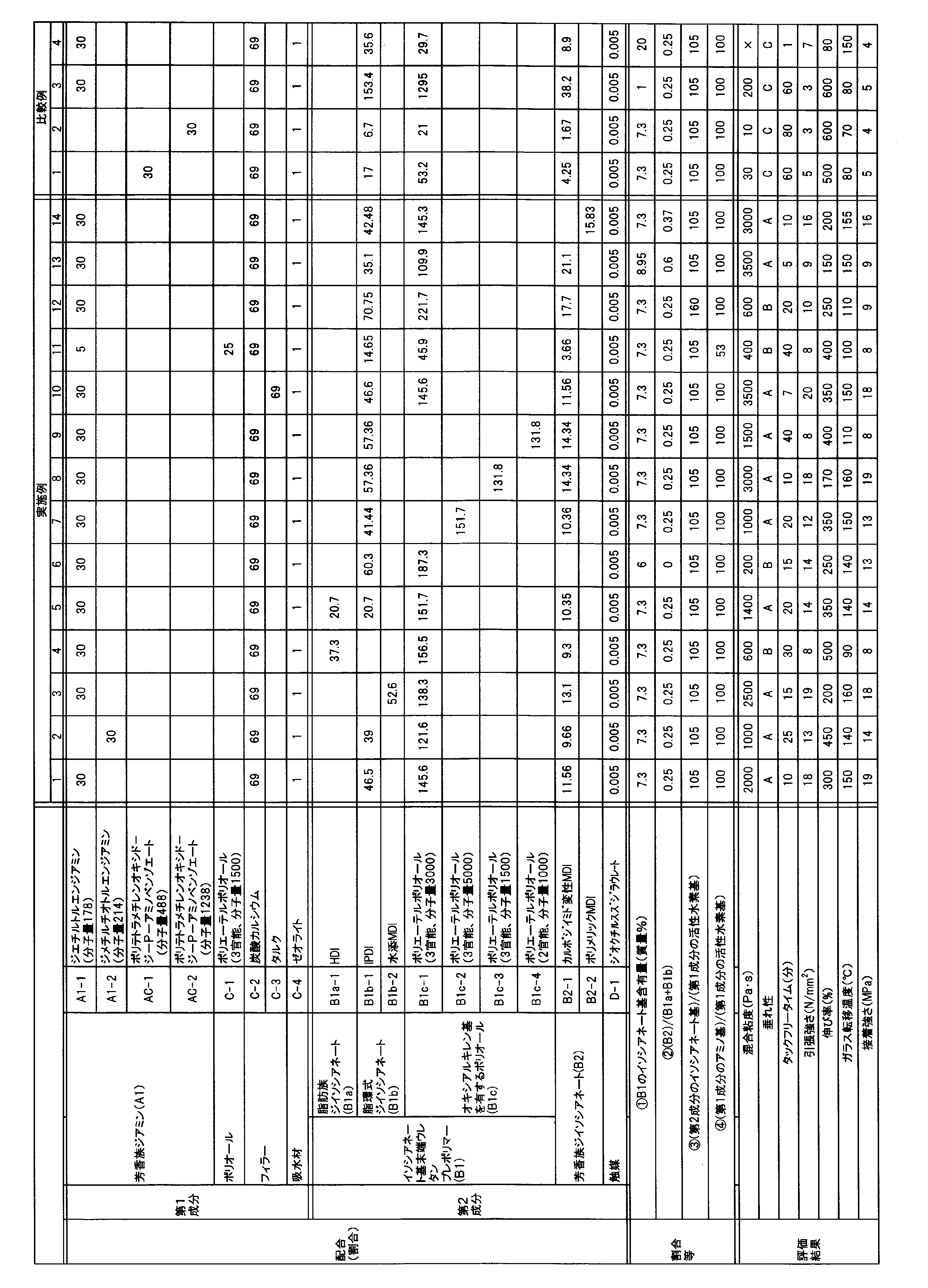
表1を参照して、比較1~4に比べて、実施例1~14は、硬化後の接着強度、ガラス転移温度、および伸び率が総合的に向上しており、また、実際の使用に際して作業性を悪化させない程度に混合粘度(すなわち混合液の粘度)を抑えながら、垂れ性については高い評価を得ている。また、実施例4と、実施例1および5とを比較して、イソシアネート基末端ウレタンプレポリマー(B1)を得る際に、脂環式ジイソシアネート(B1b)を用いると、用いない場合に比べて、引張強さ、ガラス転移温度、および接着強さが優れることが分かる。また、実施例9と、実施例6~8とを比較して、オキシアルキレン基を有するポリオール(B1c)の分子量が1200~6000の範囲にある場合、引張強さ、ガラス転移温度、および接着強さが優れ、かつタックフリータイムが短くなることが分かる。なお、比較例4は、混合後急激に増粘して、混合粘度を測定することができなかったため表1においては「×」と記載した。
Claims (4)
- 第1成分および第2成分を有する2液硬化型接着剤であって、
前記第1成分は、分子量が100~300の芳香族ジアミン(A1)を含み、
前記第2成分は、イソシアネート基含有量が2~18質量%のイソシアネート基末端ウレタンプレポリマー(B1)を含み、
前記イソシアネート基末端ウレタンプレポリマー(B1)は、少なくとも、脂肪族ジイソシアネート(B1a)および脂環式ジイソシアネート(B1b)の一方または両方と、
オキシアルキレン基を有するポリオール(B1c)と、を反応させて得られたものである、2液硬化型接着剤。 - 前記第2成分は、さらに、芳香族ジイソシアネート(B2)を含み、
前記脂肪族ジイソシアネート(B1a)および脂環式ジイソシアネート(B1b)の合計と、前記芳香族ジイソシアネート(B2)との質量比((B2)/((B1a)+(B1b)))は0.1~0.5である、請求項1に記載の2液硬化型接着剤。 - 前記第1成分に含まれる活性水素基に対する、前記第2成分に含まれるイソシアネート基の量が70~150モル%である、請求項1または請求項2に記載の2液硬化型接着剤。
- 前記第1成分に含まれる活性水素基に対する、前記第1成分に含まれるアミノ基の量が60~100モル%である、請求項1から請求項3のいずれか1項に記載の2液硬化型接着剤。
Priority Applications (1)
| Application Number | Priority Date | Filing Date | Title |
|---|---|---|---|
| CN201980049618.8A CN112469799B (zh) | 2018-08-06 | 2019-06-20 | 二液固化型粘接剂 |
Applications Claiming Priority (2)
| Application Number | Priority Date | Filing Date | Title |
|---|---|---|---|
| JP2018-147751 | 2018-08-06 | ||
| JP2018147751A JP6827977B2 (ja) | 2018-08-06 | 2018-08-06 | 2液硬化型接着剤 |
Publications (1)
| Publication Number | Publication Date |
|---|---|
| WO2020031520A1 true WO2020031520A1 (ja) | 2020-02-13 |
Family
ID=69415551
Family Applications (1)
| Application Number | Title | Priority Date | Filing Date |
|---|---|---|---|
| PCT/JP2019/024502 Ceased WO2020031520A1 (ja) | 2018-08-06 | 2019-06-20 | 2液硬化型接着剤 |
Country Status (3)
| Country | Link |
|---|---|
| JP (1) | JP6827977B2 (ja) |
| CN (1) | CN112469799B (ja) |
| WO (1) | WO2020031520A1 (ja) |
Cited By (2)
| Publication number | Priority date | Publication date | Assignee | Title |
|---|---|---|---|---|
| JP2021155566A (ja) * | 2020-03-27 | 2021-10-07 | 横浜ゴム株式会社 | 2液硬化型接着剤組成物 |
| CN116987474A (zh) * | 2023-08-08 | 2023-11-03 | 韦尔通科技股份有限公司 | 一种生物基耐老化聚氨酯胶黏剂 |
Families Citing this family (1)
| Publication number | Priority date | Publication date | Assignee | Title |
|---|---|---|---|---|
| EP4059908A1 (de) * | 2021-03-16 | 2022-09-21 | Hilti Aktiengesellschaft | Chemischer dübel auf isocyanat-amin-basis mit verbesserter lagerstabilität und dessen verwendung |
Citations (4)
| Publication number | Priority date | Publication date | Assignee | Title |
|---|---|---|---|---|
| JPH0543864A (ja) * | 1991-08-12 | 1993-02-23 | Nitta Gelatin Inc | ウレタン系接着剤組成物 |
| JP2010508417A (ja) * | 2006-10-30 | 2010-03-18 | ソシエテ ド テクノロジー ミシュラン | ポリウレタン尿素系 |
| JP2011503143A (ja) * | 2007-11-13 | 2011-01-27 | シーカ・テクノロジー・アーゲー | 芳香族アルジミン、及びアルジミンを含有するポリウレタン組成物 |
| JP2015534590A (ja) * | 2012-09-11 | 2015-12-03 | シーカ・テクノロジー・アーゲー | 2剤型ポリウレタン組成物 |
Family Cites Families (7)
| Publication number | Priority date | Publication date | Assignee | Title |
|---|---|---|---|---|
| US4444976A (en) * | 1982-12-20 | 1984-04-24 | The Goodyear Tire & Rubber Company | Sag resistant two component adhesive and sealant |
| US5002806A (en) * | 1990-01-11 | 1991-03-26 | Ashland Oil, Inc. | Curative for structural urethane adhesive |
| US5183877A (en) * | 1991-10-25 | 1993-02-02 | H. B. Fuller Company | Polyurea or polyurea-urethane adhesive for bonding elastomers |
| JP2003171642A (ja) * | 2001-12-03 | 2003-06-20 | Sekisui Chem Co Ltd | 二液分別塗布型ウレタン系接着剤 |
| CN101781543A (zh) * | 2010-04-15 | 2010-07-21 | 青岛理工大学 | 一种用于喷涂聚脲弹性体的层间粘合剂 |
| CN103694939A (zh) * | 2013-12-26 | 2014-04-02 | 青岛海洋新材料科技有限公司 | 一种室温快固化聚脲粘合剂及其制造方法 |
| CN106497494B (zh) * | 2016-10-14 | 2020-03-17 | 北京工商大学 | 一种喷涂型无溶剂聚氨酯胶黏剂及其制备方法 |
-
2018
- 2018-08-06 JP JP2018147751A patent/JP6827977B2/ja active Active
-
2019
- 2019-06-20 CN CN201980049618.8A patent/CN112469799B/zh active Active
- 2019-06-20 WO PCT/JP2019/024502 patent/WO2020031520A1/ja not_active Ceased
Patent Citations (4)
| Publication number | Priority date | Publication date | Assignee | Title |
|---|---|---|---|---|
| JPH0543864A (ja) * | 1991-08-12 | 1993-02-23 | Nitta Gelatin Inc | ウレタン系接着剤組成物 |
| JP2010508417A (ja) * | 2006-10-30 | 2010-03-18 | ソシエテ ド テクノロジー ミシュラン | ポリウレタン尿素系 |
| JP2011503143A (ja) * | 2007-11-13 | 2011-01-27 | シーカ・テクノロジー・アーゲー | 芳香族アルジミン、及びアルジミンを含有するポリウレタン組成物 |
| JP2015534590A (ja) * | 2012-09-11 | 2015-12-03 | シーカ・テクノロジー・アーゲー | 2剤型ポリウレタン組成物 |
Cited By (3)
| Publication number | Priority date | Publication date | Assignee | Title |
|---|---|---|---|---|
| JP2021155566A (ja) * | 2020-03-27 | 2021-10-07 | 横浜ゴム株式会社 | 2液硬化型接着剤組成物 |
| JP7477752B2 (ja) | 2020-03-27 | 2024-05-02 | 横浜ゴム株式会社 | 2液硬化型接着剤組成物 |
| CN116987474A (zh) * | 2023-08-08 | 2023-11-03 | 韦尔通科技股份有限公司 | 一种生物基耐老化聚氨酯胶黏剂 |
Also Published As
| Publication number | Publication date |
|---|---|
| CN112469799B (zh) | 2022-09-23 |
| CN112469799A (zh) | 2021-03-09 |
| JP2020023602A (ja) | 2020-02-13 |
| JP6827977B2 (ja) | 2021-02-10 |
Similar Documents
| Publication | Publication Date | Title |
|---|---|---|
| EP1857480B1 (en) | Two component polyurethane adhesive | |
| CA2713109C (en) | Liquid polyurethane prepolymers useful in solvent-free adhesives | |
| JP7330820B2 (ja) | 二液硬化型接着剤 | |
| BRPI0808552A2 (pt) | Adesivo com base em poli-isocianato, mistura de reação para preparar o mesmo, e, uso do adesivo com base em poli-isocianato. | |
| JP6850398B2 (ja) | ポリウレタンプレポリマー、接着剤、及び合成擬革 | |
| US11840598B2 (en) | Urethane resin | |
| WO2021132094A1 (ja) | 構造用ポリウレタン接着剤 | |
| JP2018135491A (ja) | ポリウレタン樹脂形成性組成物 | |
| CN107532057A (zh) | 接着剂组合物及使用其的层叠体 | |
| JP2021119223A (ja) | 積層接着剤用のアミノベンゾエート末端材料 | |
| WO2020031520A1 (ja) | 2液硬化型接着剤 | |
| JP2023049921A (ja) | イソシアネート含有組成物および2液反応型ポリウレタン樹脂組成物 | |
| CN102317390B (zh) | 形成于基材上的聚氨酯树脂膜材料组 | |
| JP4736438B2 (ja) | 二成分系常温硬化型液状ウレタン組成物 | |
| EP3580257A1 (en) | Reactive hot-melt adhesive composition containing a polyester-polyurethane | |
| WO2022133635A1 (en) | Oil resistant adhesive composition | |
| JP2012233143A (ja) | ウレタン樹脂接着剤組成物 | |
| JP5707197B2 (ja) | ポリオール組成物及びポリウレタン樹脂 | |
| JP2619449B2 (ja) | ポリウレタン接着剤組成物 | |
| WO2014024262A1 (ja) | ウレタン樹脂接着剤組成物 | |
| JP6846335B2 (ja) | イソシアナート末端プレポリマーを含有する一液型構造用接着剤 | |
| JP2019218496A (ja) | エポキシ樹脂組成物 |
Legal Events
| Date | Code | Title | Description |
|---|---|---|---|
| 121 | Ep: the epo has been informed by wipo that ep was designated in this application |
Ref document number: 19846754 Country of ref document: EP Kind code of ref document: A1 |
|
| NENP | Non-entry into the national phase |
Ref country code: DE |
|
| 122 | Ep: pct application non-entry in european phase |
Ref document number: 19846754 Country of ref document: EP Kind code of ref document: A1 |