WO2020022477A1 - 高強度鋼板 - Google Patents
高強度鋼板 Download PDFInfo
- Publication number
- WO2020022477A1 WO2020022477A1 PCT/JP2019/029384 JP2019029384W WO2020022477A1 WO 2020022477 A1 WO2020022477 A1 WO 2020022477A1 JP 2019029384 W JP2019029384 W JP 2019029384W WO 2020022477 A1 WO2020022477 A1 WO 2020022477A1
- Authority
- WO
- WIPO (PCT)
- Prior art keywords
- less
- rolling
- steel sheet
- strength steel
- content
- Prior art date
- Legal status (The legal status is an assumption and is not a legal conclusion. Google has not performed a legal analysis and makes no representation as to the accuracy of the status listed.)
- Ceased
Links
Classifications
-
- C—CHEMISTRY; METALLURGY
- C21—METALLURGY OF IRON
- C21D—MODIFYING THE PHYSICAL STRUCTURE OF FERROUS METALS; GENERAL DEVICES FOR HEAT TREATMENT OF FERROUS OR NON-FERROUS METALS OR ALLOYS; MAKING METAL MALLEABLE, e.g. BY DECARBURISATION OR TEMPERING
- C21D9/00—Heat treatment, e.g. annealing, hardening, quenching or tempering, adapted for particular articles; Furnaces therefor
- C21D9/46—Heat treatment, e.g. annealing, hardening, quenching or tempering, adapted for particular articles; Furnaces therefor for sheet metals
-
- C—CHEMISTRY; METALLURGY
- C21—METALLURGY OF IRON
- C21D—MODIFYING THE PHYSICAL STRUCTURE OF FERROUS METALS; GENERAL DEVICES FOR HEAT TREATMENT OF FERROUS OR NON-FERROUS METALS OR ALLOYS; MAKING METAL MALLEABLE, e.g. BY DECARBURISATION OR TEMPERING
- C21D6/00—Heat treatment of ferrous alloys
- C21D6/005—Heat treatment of ferrous alloys containing Mn
-
- C—CHEMISTRY; METALLURGY
- C21—METALLURGY OF IRON
- C21D—MODIFYING THE PHYSICAL STRUCTURE OF FERROUS METALS; GENERAL DEVICES FOR HEAT TREATMENT OF FERROUS OR NON-FERROUS METALS OR ALLOYS; MAKING METAL MALLEABLE, e.g. BY DECARBURISATION OR TEMPERING
- C21D6/00—Heat treatment of ferrous alloys
- C21D6/008—Heat treatment of ferrous alloys containing Si
-
- C—CHEMISTRY; METALLURGY
- C21—METALLURGY OF IRON
- C21D—MODIFYING THE PHYSICAL STRUCTURE OF FERROUS METALS; GENERAL DEVICES FOR HEAT TREATMENT OF FERROUS OR NON-FERROUS METALS OR ALLOYS; MAKING METAL MALLEABLE, e.g. BY DECARBURISATION OR TEMPERING
- C21D8/00—Modifying the physical properties of ferrous metals or ferrous alloys by deformation combined with, or followed by, heat treatment
- C21D8/02—Modifying the physical properties of ferrous metals or ferrous alloys by deformation combined with, or followed by, heat treatment during manufacturing of plates or strips
-
- C—CHEMISTRY; METALLURGY
- C21—METALLURGY OF IRON
- C21D—MODIFYING THE PHYSICAL STRUCTURE OF FERROUS METALS; GENERAL DEVICES FOR HEAT TREATMENT OF FERROUS OR NON-FERROUS METALS OR ALLOYS; MAKING METAL MALLEABLE, e.g. BY DECARBURISATION OR TEMPERING
- C21D8/00—Modifying the physical properties of ferrous metals or ferrous alloys by deformation combined with, or followed by, heat treatment
- C21D8/02—Modifying the physical properties of ferrous metals or ferrous alloys by deformation combined with, or followed by, heat treatment during manufacturing of plates or strips
- C21D8/0221—Modifying the physical properties of ferrous metals or ferrous alloys by deformation combined with, or followed by, heat treatment during manufacturing of plates or strips characterised by the working steps
- C21D8/0226—Hot rolling
-
- C—CHEMISTRY; METALLURGY
- C21—METALLURGY OF IRON
- C21D—MODIFYING THE PHYSICAL STRUCTURE OF FERROUS METALS; GENERAL DEVICES FOR HEAT TREATMENT OF FERROUS OR NON-FERROUS METALS OR ALLOYS; MAKING METAL MALLEABLE, e.g. BY DECARBURISATION OR TEMPERING
- C21D8/00—Modifying the physical properties of ferrous metals or ferrous alloys by deformation combined with, or followed by, heat treatment
- C21D8/02—Modifying the physical properties of ferrous metals or ferrous alloys by deformation combined with, or followed by, heat treatment during manufacturing of plates or strips
- C21D8/0221—Modifying the physical properties of ferrous metals or ferrous alloys by deformation combined with, or followed by, heat treatment during manufacturing of plates or strips characterised by the working steps
- C21D8/0236—Cold rolling
-
- C—CHEMISTRY; METALLURGY
- C21—METALLURGY OF IRON
- C21D—MODIFYING THE PHYSICAL STRUCTURE OF FERROUS METALS; GENERAL DEVICES FOR HEAT TREATMENT OF FERROUS OR NON-FERROUS METALS OR ALLOYS; MAKING METAL MALLEABLE, e.g. BY DECARBURISATION OR TEMPERING
- C21D8/00—Modifying the physical properties of ferrous metals or ferrous alloys by deformation combined with, or followed by, heat treatment
- C21D8/02—Modifying the physical properties of ferrous metals or ferrous alloys by deformation combined with, or followed by, heat treatment during manufacturing of plates or strips
- C21D8/0247—Modifying the physical properties of ferrous metals or ferrous alloys by deformation combined with, or followed by, heat treatment during manufacturing of plates or strips characterised by the heat treatment
- C21D8/0263—Modifying the physical properties of ferrous metals or ferrous alloys by deformation combined with, or followed by, heat treatment during manufacturing of plates or strips characterised by the heat treatment following hot rolling
-
- C—CHEMISTRY; METALLURGY
- C22—METALLURGY; FERROUS OR NON-FERROUS ALLOYS; TREATMENT OF ALLOYS OR NON-FERROUS METALS
- C22C—ALLOYS
- C22C38/00—Ferrous alloys, e.g. steel alloys
-
- C—CHEMISTRY; METALLURGY
- C22—METALLURGY; FERROUS OR NON-FERROUS ALLOYS; TREATMENT OF ALLOYS OR NON-FERROUS METALS
- C22C—ALLOYS
- C22C38/00—Ferrous alloys, e.g. steel alloys
- C22C38/001—Ferrous alloys, e.g. steel alloys containing N
-
- C—CHEMISTRY; METALLURGY
- C22—METALLURGY; FERROUS OR NON-FERROUS ALLOYS; TREATMENT OF ALLOYS OR NON-FERROUS METALS
- C22C—ALLOYS
- C22C38/00—Ferrous alloys, e.g. steel alloys
- C22C38/002—Ferrous alloys, e.g. steel alloys containing In, Mg, or other elements not provided for in one single group C22C38/001 - C22C38/60
-
- C—CHEMISTRY; METALLURGY
- C22—METALLURGY; FERROUS OR NON-FERROUS ALLOYS; TREATMENT OF ALLOYS OR NON-FERROUS METALS
- C22C—ALLOYS
- C22C38/00—Ferrous alloys, e.g. steel alloys
- C22C38/005—Ferrous alloys, e.g. steel alloys containing rare earths, i.e. Sc, Y, Lanthanides
-
- C—CHEMISTRY; METALLURGY
- C22—METALLURGY; FERROUS OR NON-FERROUS ALLOYS; TREATMENT OF ALLOYS OR NON-FERROUS METALS
- C22C—ALLOYS
- C22C38/00—Ferrous alloys, e.g. steel alloys
- C22C38/02—Ferrous alloys, e.g. steel alloys containing silicon
-
- C—CHEMISTRY; METALLURGY
- C22—METALLURGY; FERROUS OR NON-FERROUS ALLOYS; TREATMENT OF ALLOYS OR NON-FERROUS METALS
- C22C—ALLOYS
- C22C38/00—Ferrous alloys, e.g. steel alloys
- C22C38/04—Ferrous alloys, e.g. steel alloys containing manganese
-
- C—CHEMISTRY; METALLURGY
- C22—METALLURGY; FERROUS OR NON-FERROUS ALLOYS; TREATMENT OF ALLOYS OR NON-FERROUS METALS
- C22C—ALLOYS
- C22C38/00—Ferrous alloys, e.g. steel alloys
- C22C38/06—Ferrous alloys, e.g. steel alloys containing aluminium
-
- C—CHEMISTRY; METALLURGY
- C22—METALLURGY; FERROUS OR NON-FERROUS ALLOYS; TREATMENT OF ALLOYS OR NON-FERROUS METALS
- C22C—ALLOYS
- C22C38/00—Ferrous alloys, e.g. steel alloys
- C22C38/08—Ferrous alloys, e.g. steel alloys containing nickel
-
- C—CHEMISTRY; METALLURGY
- C22—METALLURGY; FERROUS OR NON-FERROUS ALLOYS; TREATMENT OF ALLOYS OR NON-FERROUS METALS
- C22C—ALLOYS
- C22C38/00—Ferrous alloys, e.g. steel alloys
- C22C38/12—Ferrous alloys, e.g. steel alloys containing tungsten, tantalum, molybdenum, vanadium, or niobium
-
- C—CHEMISTRY; METALLURGY
- C22—METALLURGY; FERROUS OR NON-FERROUS ALLOYS; TREATMENT OF ALLOYS OR NON-FERROUS METALS
- C22C—ALLOYS
- C22C38/00—Ferrous alloys, e.g. steel alloys
- C22C38/14—Ferrous alloys, e.g. steel alloys containing titanium or zirconium
-
- C—CHEMISTRY; METALLURGY
- C22—METALLURGY; FERROUS OR NON-FERROUS ALLOYS; TREATMENT OF ALLOYS OR NON-FERROUS METALS
- C22C—ALLOYS
- C22C38/00—Ferrous alloys, e.g. steel alloys
- C22C38/16—Ferrous alloys, e.g. steel alloys containing copper
-
- C—CHEMISTRY; METALLURGY
- C22—METALLURGY; FERROUS OR NON-FERROUS ALLOYS; TREATMENT OF ALLOYS OR NON-FERROUS METALS
- C22C—ALLOYS
- C22C38/00—Ferrous alloys, e.g. steel alloys
- C22C38/18—Ferrous alloys, e.g. steel alloys containing chromium
- C22C38/38—Ferrous alloys, e.g. steel alloys containing chromium with more than 1.5% by weight of manganese
-
- C—CHEMISTRY; METALLURGY
- C22—METALLURGY; FERROUS OR NON-FERROUS ALLOYS; TREATMENT OF ALLOYS OR NON-FERROUS METALS
- C22C—ALLOYS
- C22C38/00—Ferrous alloys, e.g. steel alloys
- C22C38/18—Ferrous alloys, e.g. steel alloys containing chromium
- C22C38/40—Ferrous alloys, e.g. steel alloys containing chromium with nickel
- C22C38/58—Ferrous alloys, e.g. steel alloys containing chromium with nickel with more than 1.5% by weight of manganese
-
- C—CHEMISTRY; METALLURGY
- C21—METALLURGY OF IRON
- C21D—MODIFYING THE PHYSICAL STRUCTURE OF FERROUS METALS; GENERAL DEVICES FOR HEAT TREATMENT OF FERROUS OR NON-FERROUS METALS OR ALLOYS; MAKING METAL MALLEABLE, e.g. BY DECARBURISATION OR TEMPERING
- C21D2211/00—Microstructure comprising significant phases
- C21D2211/001—Austenite
-
- C—CHEMISTRY; METALLURGY
- C21—METALLURGY OF IRON
- C21D—MODIFYING THE PHYSICAL STRUCTURE OF FERROUS METALS; GENERAL DEVICES FOR HEAT TREATMENT OF FERROUS OR NON-FERROUS METALS OR ALLOYS; MAKING METAL MALLEABLE, e.g. BY DECARBURISATION OR TEMPERING
- C21D2211/00—Microstructure comprising significant phases
- C21D2211/008—Martensite
Definitions
- the present invention relates to a high-strength steel sheet, specifically, a high-strength steel sheet having a tensile strength of 1200 MPa or more and excellent in bake hardenability and weldability, which is suitable for structural members such as automobiles which are mainly used by pressing. It is about.
- a high-strength steel sheet specifically, a high-strength steel sheet having a tensile strength of 1200 MPa or more and excellent in bake hardenability and weldability, which is suitable for structural members such as automobiles which are mainly used by pressing. It is about.
- Priority is claimed on Japanese Patent Application No. 2018-141226 filed on July 27, 2018, the content of which is incorporated herein by reference.
- the material having excellent bake hardenability is a material having a high bake hardening amount and a high strength after bake hardening.
- the bake hardening is performed by interstitial elements (carbon and nitrogen) diffusing into dislocations formed by press molding (hereinafter, also referred to as “prestrain”) during baking at 150 ° C. to 200 ° C. and fixing the dislocations. This is the strain aging phenomenon that occurs.
- Patent Document 1 discloses a high-strength steel sheet mainly composed of bainite and martensite. In the high-strength steel sheet disclosed in Patent Document 1, for example, a predetermined treatment is performed on a steel material. To increase the dislocation density, thereby improving the bake hardenability. Considering these facts, it is considered that even with the same martensite, the baking hardening amount is increased by increasing the concentration of the added carbon.
- Ceq carbon equivalent
- the weldability is secured by precipitating a metal carbide by using a mother phase as tempered martensite or bainite or the like.
- the invention described in Patent Literature 3 has a problem in that since there is a tempering step, the amount of dissolved carbon is reduced, and the bake hardenability is deteriorated.
- an object of the present invention is to provide a high-strength steel sheet having high bake hardenability and excellent weldability.
- the present inventors have attempted to secure the above-mentioned bake hardenability and weldability by the following two approaches. (1) To control the Ceq by appropriately controlling the alloy components to secure the weldability. (2) To secure baking hardenability by using martensite as a mother phase as quenched in order to secure an appropriate amount of dissolved carbon.
- the present inventors have found that by controlling the hot-rolling process, the micro-segregation of Mn is suppressed by having a uniform structure, and the pre-strain is uniform, so that the bake hardenability is greatly improved. Was. In addition, by making the structure uniform, it became difficult to form MA, and the weldability was also improved.
- the high-strength steel sheet excellent in bake hardenability and weldability of the present invention which can achieve the above-mentioned object in this way, is as follows.
- C 0.05 to 0.15%
- Si 1.5% or less
- Mn 2.00 to 5.00%
- P 0.100% or less
- S 0.010% or less
- Al 0.001 to 2.000%
- N 0.010% or less
- Ceq defined by the following formula (1) is less than 0.21
- the two-dimensional homogeneous dispersion ratio S defined by the equation (2) is not less than 0.85 and not more than 1.20;
- High strength steel sheet (6)
- a high-strength steel sheet having excellent weldability and high bake hardenability specifically, by forming a uniform structure of Mn microsegregation in martensite with quenched as controlled alloy components, and specifically, It is possible to provide a high-strength steel sheet whose tensile strength after bake hardening reaches 1350 MPa. After being pressed, it is baked at the time of painting to increase the strength, so it is suitable as a structural field in the field of automobiles and the like.
- the high-strength steel sheet according to the embodiment of the present invention is C: 0.05 to 0.15%, Si: 1.5% or less, Mn: 2.00 to 5.00%, P: 0.100% or less, S: 0.010% or less, Al: 0.001 to 2.000%, N: 0.010% or less, the balance being Fe and impurities, Ceq defined by the following formula (1) is less than 0.21, Contains 98% or more of martensite in area ratio, the remaining structure is 2% or less in area ratio,
- the two-dimensional homogeneous dispersion ratio S defined by the equation (2) is not less than 0.85 and not more than 1.20; It is characterized in that the tensile strength is 1200 MPa or more.
- % which is a unit of the content of each element contained in a high-strength steel sheet and a slab means “% by mass” unless otherwise specified.
- C (C: 0.05% to 0.15%) C has the effect of increasing the amount of dissolved carbon and increasing the bake hardenability. In addition, it has the effect of enhancing the hardenability and increasing the strength by incorporating it into the martensite structure. If the C content is less than 0.05%, a sufficient amount of solute carbon cannot be secured, and the bake hardening amount decreases. Therefore, the C content is set to 0.05% or more, preferably 0.08% or more. On the other hand, if the C content exceeds 0.15%, silicate having a low melting point is generated during welding, which affects the quality of the weld seam. Also, the strength is too high to ensure the moldability. Therefore, the C content is set to 0.15% or less, preferably 0.13% or less, 0.12% or less, 0.11% or less, or 0.10% or less.
- Si (Si: 1.5% or less) Si is a solid solution strengthening element and has a role of suppressing the precipitation of cementite, which is a factor of decreasing the strength. Therefore, it may be included in the high-strength steel sheet of the present invention.
- the Si content is set to 1.5% or less, preferably 1.2% or less.
- the lower limit of the Si content is not particularly limited, the content may be 0.01% or more because it functions as a deoxidizing agent for molten steel.
- Mn is an element for improving hardenability, and is an element necessary for forming a martensite structure without limiting the cooling rate.
- the Mn content is set to 2.00% or more, preferably 2.50% or more.
- the excessive Mn content lowers the low-temperature toughness due to the precipitation of MnS, so the content is made 5.00% or less, preferably 4.50% or less.
- P 0.100% or less
- P is not an essential element and is contained, for example, as an impurity in steel. From the viewpoint of weldability, the lower the P content, the better. In particular, when the P content exceeds 0.100%, the weldability is significantly reduced. Therefore, the P content is set to 0.100% or less, preferably 0.030% or less. Reducing the P content is costly and attempting to reduce it to less than 0.0001% will significantly increase costs. Therefore, the P content may be 0.0001% or more. Further, since P contributes to improvement in strength, the P content may be set to 0.0001% or more from such a viewpoint.
- S is not an essential element but is contained as an impurity in steel, for example. From the viewpoint of weldability, the lower the S content, the better. As the S content increases, the amount of MnS precipitated increases, and the low-temperature toughness decreases. In particular, when the S content exceeds 0.010%, the weldability and the low-temperature toughness are significantly reduced. Therefore, the S content is set to 0.010% or less, preferably 0.003% or less. Cost reduction is required to reduce the S content, and an attempt to reduce the content to less than 0.0001% significantly increases the cost. Therefore, the S content may be 0.0001% or more.
- Al 0.001% to 2.000%
- Al content is set to 0.001% or more, preferably 0.010% or more.
- the Al content is set to 2.000% or less, preferably 1.000% or less.
- N is not an essential element and is contained, for example, as an impurity in steel. From the viewpoint of weldability, the lower the N content, the better. In particular, when the N content exceeds 0.010%, the weldability is significantly reduced. Therefore, the N content is set to 0.010% or less, preferably 0.006% or less. Reducing the N content is costly, and attempting to reduce it to less than 0.0001% significantly increases the cost. Therefore, the N content may be 0.0001% or more.
- the basic component composition of the high-strength steel sheet of the present invention and the slab used for its production are as described above. Further, the high-strength steel sheet of the present invention and the slab used for the production thereof may contain the following optional elements as necessary.
- Ti and Nb contribute to improvement in strength. Therefore, Ti, Nb or any combination thereof may be contained.
- the content of Ti or Nb, or the total content of a combination of these two types is preferably 0.003% or more.
- the content of Ti or Nb, or the total content of a combination of these two types is set to 0.100% or less. That is, the limiting range in the case of each component alone is set to 0.003% to 0.100% for Ti: 0.003% to 0.100% for Nb, and the total content when these are combined is also considered. , 0.003 to 0.100%.
- Cu and Ni contribute to improvement in strength. Therefore, Cu, Ni or a combination thereof may be contained.
- the content of Cu and Ni is preferably in the range of 0.005 to 1.000% when each component is used alone, and the total content when these two types are combined is also considered. , 0.005% or more and 1.000% or less.
- the upper limit of the contents of Cu and Ni, or the total content when these two types are combined is 1.000%. That is, Cu: 0.005% to 1.000% and Ni: 0.005% to 1.000%, and the total content when these are combined is 0.005 to 1.000%.
- W, Ca, Mg, and REM contribute to fine dispersion of inclusions and increase toughness. Therefore, W, Ca, Mg, or REM or any combination thereof may be contained. In order to sufficiently obtain this effect, the total content of W, Ca, Mg, and REM, or any combination of two or more thereof is preferably 0.0003% or more. On the other hand, if the total content of W, Ca, Mg and REM exceeds 0.010%, the surface properties deteriorate. Therefore, the total content of W, Ca, Mg, and REM is set to 0.010% or less. That is, W: 0.005% or less, Ca: 0.005% or less, Mg: 0.005% or less, REM: 0.010% or less, and the total content of any two or more of these is 0. It is preferably from 0.0003 to 0.010%.
- REM rare earth metal
- REM content means the total content of these 17 elements.
- Lanthanoids are industrially added, for example, in the form of misch metal.
- B is a hardenability improving element and is an element useful for forming a martensite structure.
- B is preferably contained at 0.0001% (1 ppm) or more. However, if B is contained in excess of 0.0030% (30 ppm), excessive boron may cause high-temperature brittleness and affect welding performance, so the B content is set to 0.0030% or less. Preferably it is 0.0025% or less.
- Cr is a hardenability improving element and is an element useful for forming a martensite structure. Cr is preferably contained at 0.005% or more. However, if the Cr content exceeds 1.000%, the welding performance may be affected, so the Cr content is set to 1.000% or less. Preferably, it is 0.500%.
- the balance other than the above components consists of Fe and impurities.
- the impurities are components that are mixed due to various factors in the manufacturing process, including raw materials such as ores and scraps, when industrially producing high-strength steel sheets, and according to the present embodiment. It means a component that is not a component intentionally added to a high-strength steel sheet.
- Ceq Ceq is less than 0.21
- the present embodiment is characterized in that Ceq expressed by the following equation (1) is set to be less than a predetermined numerical value in order to enhance weldability. Thereby, weldability can be ensured. In order to further enhance such an effect, it is necessary to ensure that Ceq is less than 0.21. Preferably it is 0.18 or less.
- Ceq C + Si / 90 + (Mn + Cr) /100+1.5P+3S Formula (1)
- the content (% by mass) of each element is substituted for each element symbol in the formula (1), and 0 is substituted when no element is contained.
- martensite 98% or more
- the present embodiment is characterized in that martensite is secured in an area ratio of 98% or more. Thereby, sufficient solid solution carbon can be secured, and as a result, bake hardenability can be improved. In order to further enhance such effects, it is necessary that martensite be 98% or more, for example, it may be 100%.
- the area ratio of martensite is determined as follows. First, a sample was taken using the thickness cross section perpendicular to the rolling direction of the steel sheet as an observation surface, the observation surface was polished, and the structure at a quarter position of the thickness of the steel plate was subjected to SEM-EBSD (electron microscopy) at a magnification of 5000 times. Observation with a scanning electron microscope equipped with an X-ray backscattering diffractometer), image analysis of the image in a visual field of 100 ⁇ m ⁇ 100 ⁇ m and measurement of the area ratio of martensite. It is determined as the area ratio of martensite in the invention.
- SEM-EBSD electron microscopy
- the remaining structure other than martensite has an area ratio of 2% or less.
- the content is preferably set to 0%.
- the residual structure can include any structure and is not particularly limited.
- the residual structure includes or consists of retained austenite.
- a trace amount of retained austenite may be unavoidable depending on the composition of the steel and the production method.
- such a small amount of retained austenite not only does not adversely affect bake hardenability, but also contributes to an improvement in ductility by a TRIP (Transformation Induced Plasticity) effect when subjected to deformation. Can be. Therefore, the remaining structure may include retained austenite in an area ratio of 2% or less.
- the remaining structure preferably does not include residual austenite and is preferably 0%.
- the area ratio of retained austenite is determined by X-ray diffraction measurement. Specifically, a portion from the surface of the steel sheet to a position 1/4 of the thickness of the steel sheet is removed by mechanical polishing and chemical polishing, and MoK ⁇ rays are used as characteristic X-rays to reduce the depth from the surface of the steel sheet to 1/4 depth.
- the X-ray diffraction intensity at the position is measured. From the integrated intensity ratio of the diffraction peaks of (200) and (211) of the body-centered cubic lattice (bcc) phase and (200), (220) and (311) of the face-centered cubic lattice (fcc) phase, Is used to calculate the area ratio of retained austenite.
- S ⁇ (I 200f + I 220f + I 311f ) / (I 200b + I 211b ) ⁇ 100
- S ⁇ is the area ratio of retained austenite
- I 200f , I 220f and I 311f are the intensities of the diffraction peaks of (200), (220) and (311) of the fcc phase, respectively
- I 200b and I 211b are The intensities of the diffraction peaks of (200) and (211) of the bcc phase are shown.
- the two-dimensional homogeneous dispersion ratio is an index for evaluating micro-segregation of an alloy element.
- the two-dimensional homogeneous dispersion ratio indicated by S is measured as follows. The sheet width direction is set to the x direction, the sheet thickness direction is set to the y direction, and the steel sheet is adjusted so that the surface where the rolling direction is the normal direction (that is, the cross section in the thickness direction of the steel sheet) can be observed.
- S Sy 2 / Sx 2 Equation (2)
- the present embodiment is characterized in that the Mn concentration distribution has a uniform structure (for example, checkerboard structure) due to relaxation of microsegregation. If it is less than 0.85, it cannot be said that a sufficiently uniform structure is obtained, and the bake hardenability is low. In addition, MA is generated and the weldability is not good. Therefore, S needs to be 0.85 or more. Preferably it is 0.90 or more, more preferably 0.95 or more.
- the surface with a high concentration of Mn and the surface with a low concentration of Mn are connected in a layered manner in the thickness direction, and this can be homogenized in the thickness direction and the width direction. is important.
- S is set to 1.20 or less. Preferably it is 1.15 or less, more preferably 1.10 or less.
- tensile strength 1200 MPa or more
- a high tensile strength specifically, a tensile strength of 1200 MPa or more
- the tensile strength is preferably at least 1300 MPa, more preferably at least 1400 MPa.
- the high-strength steel sheet of the present invention it is possible to achieve excellent bake hardenability. More specifically, according to the high-strength steel sheet of the present invention, after applying a 2% prestrain, the stress when a test piece heat-treated at 170 ° C. for 20 minutes is re-tensioned is subjected to a stress when a 2% prestrain is applied. Can be attained at 130 MPa or more, preferably 150 MPa or more. If the value of BH is less than 130 MPa, it is difficult to mold and the strength after bake hardening is low. Further, according to the high-strength steel sheet of the present invention, baking hardening is performed such that the stress when a test piece heat-treated at 170 ° C.
- the following description is intended to exemplify a characteristic method for manufacturing the high-strength steel sheet of the present invention, and the high-strength steel sheet of the present invention is manufactured by a manufacturing method as described below. It is not intended to be limited to
- a preferred method of manufacturing a high-strength steel sheet of the present invention is a step of forming a slab by casting molten steel having the chemical composition described above, A rough rolling step of roughly rolling the slab in a temperature range of 1050 ° C. or more and 1250 ° C. or less, wherein the rough rolling is reverse rolling with a rolling reduction of 30% or less per pass in two or more passes and an even number in 16 passes or less.
- the rolling reduction between the two passes during one reciprocation is 20% or less, the even reduction in one reciprocation is 5% or more higher than the odd reduction, and Rough rolling process that is held for more than 5 seconds after
- This is a finish rolling step of finish rolling the rough-rolled steel sheet in a temperature range of 850 ° C.
- finish rolling is performed in four or more continuous rolling stands, and the rolling reduction of the first stand is 15%. % Or more, and a finish rolling step in which the finish-rolled steel sheet is wound in a temperature range of 400 ° C. or less, A cold rolling step of cold rolling the obtained hot-rolled steel sheet at a rolling reduction of 15% or more and 45% or less, The obtained cold-rolled steel sheet is heated at an average heating rate of 10 ° C./sec or more, held at a temperature range of Ac 3 to 1000 ° C. for 10 to 1000 seconds, and then cooled at an average cooling rate of 10 ° C./sec or more.
- a molten steel having the chemical composition of the high-strength steel sheet according to the present invention described above is cast to form a slab to be subjected to rough rolling.
- a normal casting method may be used, and a continuous casting method, an ingot casting method, or the like can be adopted.
- the continuous casting method is preferable in terms of productivity.
- the slab is preferably heated to a solution temperature range of 1000 ° C. or more and 1300 ° C. or less before rough rolling.
- the heating holding time is not particularly limited, but it is preferable to hold the heating temperature for 30 minutes or more in order to reach a predetermined temperature up to the center of the slab.
- the heating holding time is preferably 10 hours or less, more preferably 5 hours or less, in order to suppress excessive scale loss. If the temperature of the slab after casting is 1050 ° C. or more and 1250 ° C. or less, the slab may be directly subjected to rough rolling without being heated and held in the temperature range, and may be directly rolled or directly rolled.
- the Mn segregated portion in the slab formed at the time of solidification in the slab forming step is not formed into a plate-shaped segregated portion extending in one direction, but to a uniform structure. can do.
- the formation of the Mn concentration distribution having such a uniform structure will be described in more detail.
- alloy elements such as Mn are concentrated in a comb-like form.
- portions where alloy elements such as Mn are linearly concentrated are substantially perpendicular to the surface of the slab from both surfaces of the slab toward the inside. Are in a state of being lined up.
- the surface of the slab is extended in the rolling direction in each pass of the rolling.
- the rolling direction is a direction in which the slab advances with respect to the rolling roll.
- the slab surface is extended in the rolling direction in this way, so that the Mn segregated portion growing from the slab surface toward the inside is inclined in the slab traveling direction for each rolling pass.
- the rolling has a function of slightly tilting the Mn segregated portion extending in a comb shape toward the inside of the slab in the direction in which the rolling proceeds.
- the Mn segregation portion is directed in the same direction for each pass while maintaining itself in a substantially straight state.
- the slope gradually increases.
- the Mn segregation portion is in a posture substantially parallel to the surface of the slab while maintaining a substantially straight state, and flat micro segregation is formed.
- the Mn segregated portion inclined in the direction of the immediately preceding pass is in the opposite direction in the next pass.
- the Mn segregation portion has a bent shape.
- the Mn segregated portions are alternately bent in a zigzag shape by repeatedly performing each pass in the opposite direction alternately.
- the “checkered pattern” is a kind of lattice pattern, and is a pattern in which substantially square (or substantially rectangular) of different colors are alternately arranged.
- a structure in which the Mn concentration distribution appears in a checkered pattern is referred to as a checkered pattern structure.
- the rough rolling temperature range is preferably 1050 ° C. or higher. More preferably, the temperature is 1100 ° C. or higher.
- the rough rolling temperature range is preferably 1250 ° C. or less.
- the rolling reduction per pass in the rough rolling exceeds 30%, the shear stress at the time of rolling increases, and the Mn segregated portion becomes non-uniform. Therefore, the rolling reduction per pass in the rough rolling is set to 30% or less.
- the lower the rolling reduction the smaller the shear strain during rolling and the uniform structure, so the lower limit of the rolling reduction is not particularly defined, but is preferably 10% or more from the viewpoint of productivity.
- the reverse rolling is preferably performed in two passes or more, and more preferably in four passes or more.
- it is desirable that the passes in which the traveling directions are opposite to each other are performed the same number of times, that is, the total number of passes is an even number.
- the entry side and the exit side of the rough rolling are located on opposite sides of the roll. Therefore, the number of passes (rolling) in the direction from the entry side to the exit side of the rough rolling increases once.
- the last pass (rolling) the Mn segregated portion has a flat shape, and it is difficult to form a uniform structure.
- the last pass opens a space between rolls and omit rolling.
- the difference in rolling reduction between two passes included in one round trip of reverse rolling is set to 20% or less. Preferably it is 10% or less.
- multi-stage tandem rolling in finish rolling is effective, but flat micro-segregation is easily formed by tandem rolling.
- the effect becomes remarkable when the rolling reduction of the even number of times (return) becomes higher than that of the odd number of times (forward) by 5% or more in one reciprocation of the reverse rolling. Therefore, in one reciprocation of the reverse rolling, it is preferable that the rolling reduction of the even number of times is higher than the rolling reduction of the odd number of times by 5% or more.
- the rolling of the tandem rolling in the finish rolling is increased to thereby reduce the interval of the Mn segregation zone caused by the secondary arm of the dendrite. It is preferably carried out on a rolling stand.
- the finish rolling temperature is lower than 850 ° C., recrystallization does not sufficiently occur, and a structure stretched in the rolling direction is formed. In a later step, a plate-like structure caused by the stretched structure is generated.
- the above is preferred. It is more preferably at least 900 ° C.
- the finish rolling temperature is preferably 1050 ° C. or less. If necessary, the rough-rolled steel sheet may be heated after the rough rolling step and before the finish rolling step, if the temperature is appropriate. Furthermore, when the rolling reduction of the first stand in the finish rolling is set to 15% or more, a large amount of recrystallized grains is generated, and Mn is easily dispersed uniformly by subsequent grain boundary movement. Thus, by limiting not only the rough rolling step but also the finish rolling step, flat Mn microsegregation can be suppressed.
- finish rolling temperature refers to the surface temperature of the steel sheet from the start of finish rolling to the end of finish rolling.
- finish rolling start temperature steel plate temperature in the first pass of finish rolling
- finish rolling end temperature in the last pass of finish rolling
- the winding temperature exceeds 400 ° C., the surface properties are reduced due to internal oxidation, so the winding temperature is preferably 400 ° C. or lower. If the steel sheet structure is a homogeneous structure of martensite or bainite, the winding temperature is more preferably 300 ° C. or less because annealing and the formation of a homogeneous structure are easy.
- Cold rolling process The hot-rolled steel sheet obtained in the finish rolling step is pickled and then subjected to cold rolling to obtain a cold-rolled steel sheet.
- the rolling reduction is preferably 15% or more and 45% or less. If the rolling reduction in the cold rolling step exceeds 45%, fine laths of martensite cannot be maintained, and Mn is less likely to segregate at the grain boundaries, so that Mn segregates in a direction perpendicular to the sheet thickness (that is, in the sheet surface direction). Obi grows.
- the pickling may be a normal pickling.
- the steel sheet obtained through the cold rolling step is subjected to an annealing treatment.
- the temperature is raised at an average heating rate of 10 ° C./sec or more, and the heating is performed in a temperature range of Ac 3 to 1000 ° C. for 10 to 1000 seconds.
- This temperature range and annealing time are for transforming the entire surface of the steel sheet to austenite transformation. If the holding temperature exceeds 1000 ° C. or the annealing time exceeds 1000 seconds, the austenite grain size becomes coarse, martensite having a large lath width is obtained, and the toughness is reduced. Therefore, the annealing temperature is set to Ac 3 or more and 1000 ° C. or less, and the annealing time is set to 10 to 1000 seconds.
- the Ac 3 point is calculated by the following equation.
- the mass% of the element is substituted for the element symbol in the following formula.
- Ac 3 881-335 ⁇ C + 22 ⁇ Si-24 ⁇ Mn-17 ⁇ Ni-1 ⁇ Cr-27 ⁇ Cu
- cooling is performed at an average cooling rate of 10 ° C./sec or more.
- the faster the cooling rate the better to freeze the tissue and effectively cause martensitic transformation.
- the temperature is set to 10 ° C./second or more.
- Cooling stop temperature is 70 ° C or less. This is to produce martensite while being quenched on the entire surface by cooling. If the cooling is stopped at more than 70 ° C., there is a possibility that a structure other than martensite may appear. In addition, even when martensite comes out, precipitates such as iron carbide spheroidized by self-tempering may come out, and in such a case, solid solution carbon decreases and bake hardenability decreases. Therefore, the cooling stop temperature is set to 70 ° C. or lower, preferably 60 ° C. or lower.
- the high-strength steel sheet according to the embodiment of the present invention can be manufactured.
- the conditions in the examples are one condition examples adopted for confirming the operability and effects of the present invention, and the present invention is not limited to these one condition examples.
- the present invention can employ various conditions as long as the object of the present invention is achieved without departing from the gist of the present invention.
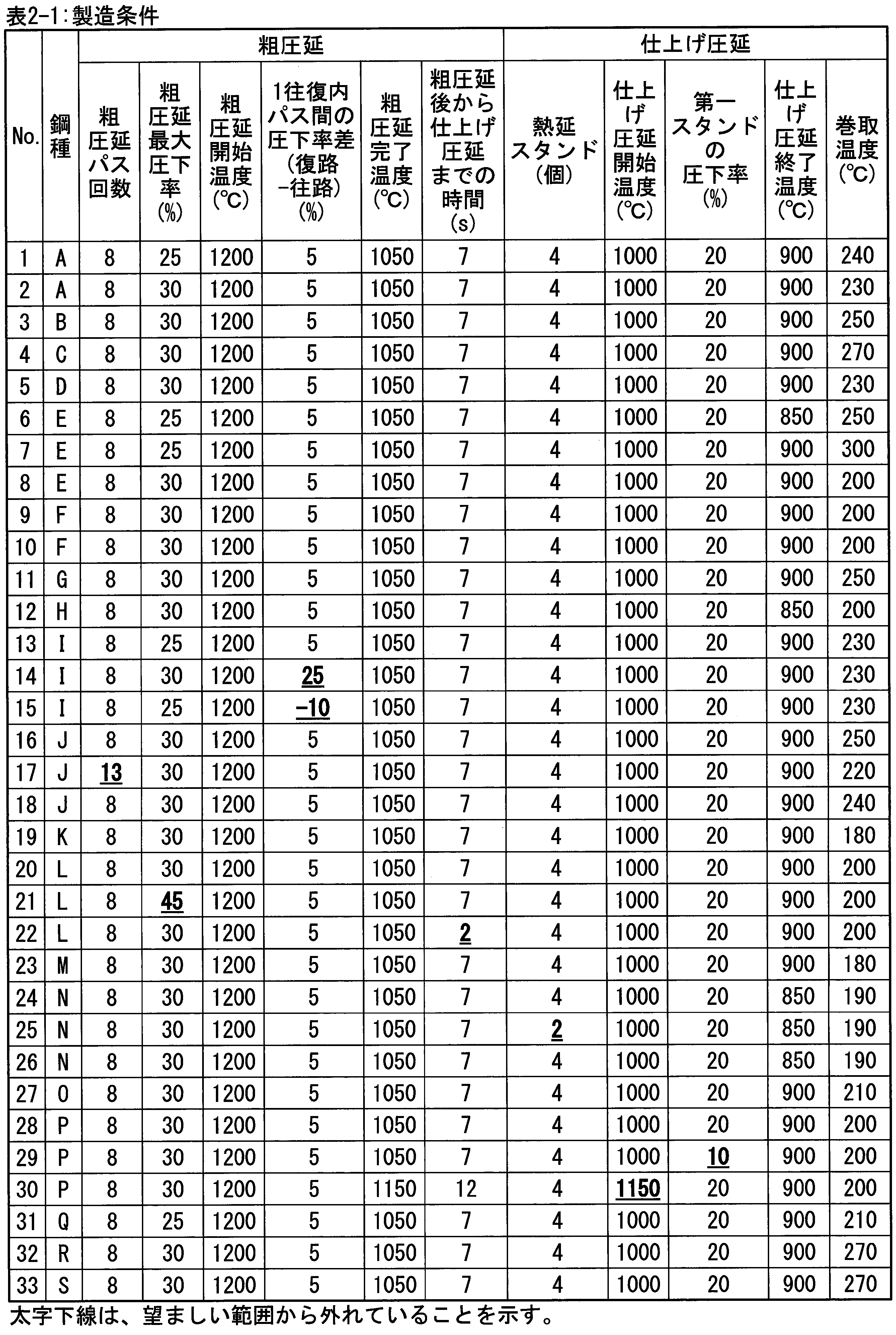
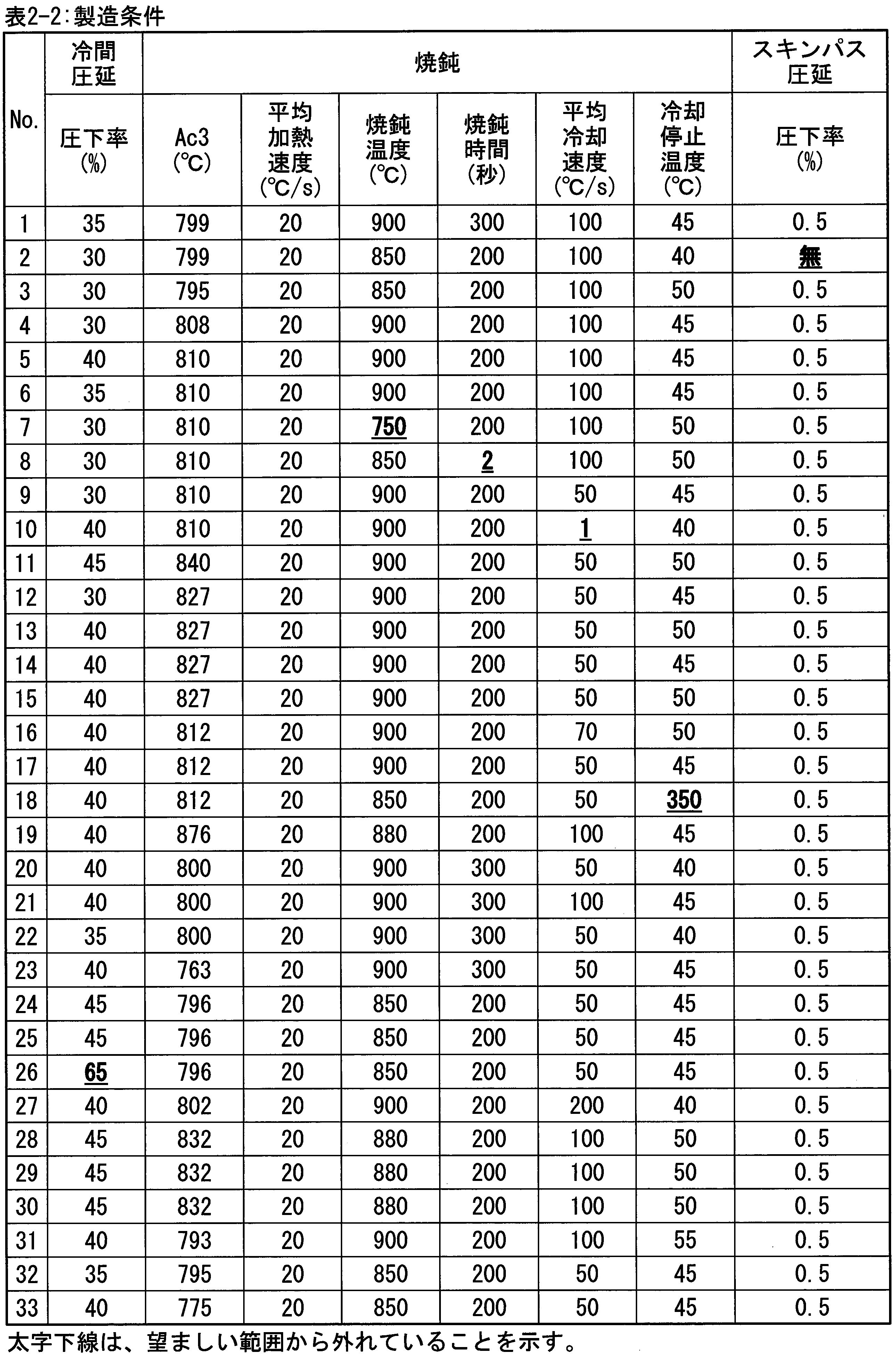
- a slab having the chemical composition shown in Table 1 was manufactured, and the slab was heated to 1300 ° C for 1 hour, and then subjected to rough rolling and finish rolling under the conditions shown in Table 2 to obtain a hot-rolled steel sheet. Thereafter, the hot-rolled steel sheet was pickled and cold-rolled at a rolling reduction shown in Table 2 to obtain a cold-rolled steel sheet. Subsequently, annealing and skin pass rolling were performed under the conditions shown in Table 2. Each temperature shown in Table 2 is a surface temperature of the steel sheet.
- “difference in rolling reduction between one reciprocating pass (return-outgoing)” indicates the difference in rolling reduction between two passes included in one reciprocating rolling in reverse rolling.
- the area ratio of martensite was determined as follows. First, a sample was taken using the thickness section perpendicular to the rolling direction of the steel sheet as an observation surface, the observation surface was polished, and the structure at a quarter position of the thickness of the steel plate was observed with a SEM-EBSD at a magnification of 5000 times. Then, it was image-analyzed in a visual field of 100 ⁇ m ⁇ 100 ⁇ m to measure the martensite area ratio, and the average of these measured values in any five visual fields was determined as the martensite area ratio. The area ratio of retained austenite was determined by X-ray diffraction measurement.
- a portion from the surface of the steel sheet to a position 1/4 of the thickness of the steel sheet is removed by mechanical polishing and chemical polishing, and MoK ⁇ rays are used as characteristic X-rays to reduce the depth from the surface of the steel sheet to 1/4 depth.
- the X-ray diffraction intensity at the position was measured. From the integrated intensity ratio of the diffraction peaks of (200) and (211) of the body-centered cubic lattice (bcc) phase and (200), (220) and (311) of the face-centered cubic lattice (fcc) phase, was used to calculate the area ratio of retained austenite.
- S ⁇ (I 200f + I 220f + I 311f ) / (I 200b + I 211b ) ⁇ 100
- S ⁇ is the area ratio of retained austenite
- I 200f , I 220f and I 311f are the intensities of the diffraction peaks of (200), (220) and (311) of the fcc phase, respectively
- I 200b and I 211b are The intensities of the diffraction peaks of (200) and (211) of the bcc phase are shown.
- tensile strength TS tensile strength TS
- elongation at break EL bake hardening amount BH
- tensile strength BHTS after bake hardening tensile strength BHTS after bake hardening
- a JIS No. 5 tensile test piece whose longitudinal direction is perpendicular to the rolling direction is sampled and conforms to JIS Z # 2241. And a tensile test was performed.
- the bake hardening amount BH is a value obtained by subtracting the stress at the time of applying a 2% pre-strain from the stress at the time of re-tensioning a test piece heat-treated at 170 ° C. for 20 minutes after applying a 2% pre-strain.
- the tensile strength BHTS after bake hardening is the stress when a test piece that has been heat-treated at 170 ° C. for 20 minutes after a 2% prestrain has been applied is re-tensioned.
- the tensile strength is 1200 MPa or more, preferably 1300 MPa or more, and more preferably 1400 MPa or more.
- the elongation is preferably 5% or more for easy molding.
- BH is less than 130 MPa, is difficult to mold, and has low strength after molding. Therefore, in order to have excellent bake hardenability, 130 MPa or more is required. More preferably, it is 150 MPa or more.
- 1350 MPa or more is required to improve the collision performance by baking hardening. More preferably, it is 1400 MPa or more.
- a test piece was sampled in accordance with JIS Z 3137, the same steel plates were spot-welded, and a cross tension test was performed. Specifically, the electrode DR 6 mm-40R, the welding time is 15 cycles / 60 Hz, the pressing force is 400 kgf, the current value is changed, and the cross tension test is performed on the welding material under the condition that the nugget diameter becomes 6 mm. The case of breaking was judged as pass (GOOD), and the case of breaking nugget was judged as fail (BAD).
- Comparative Example 2 there was no skin pass rolling, so retained austenite remained and BH was low.
- Comparative Example 4 since the S content was too large, the Ceq was high and the weldability was poor.
- Comparative Example 7 since the annealing temperature was too low, a ferrite structure appeared and a sufficient martensite structure was not obtained, and as a result, TS, BH and BHTS were low.
- Comparative Example 8 since the annealing time was too short, the entire surface did not have a martensite structure, and similarly, TS, BH, and BHTS were low.
- Comparative Example 10 since the average cooling rate in the annealing step was too slow, the entire surface did not have a martensitic structure, and TS, BH, and BHTS were low. In Comparative Example 11, since the C content was too small, the amount of dissolved carbon was reduced, and TS, BH, and BHTS were low. In Comparative Example 12, the weldability was poor because the P content was too large. In Comparative Example 14, the difference in rolling reduction between the two passes during one reciprocation in the rough rolling process was large, so that the structure did not have a uniform Mn concentration distribution, the BH was low, and the weldability was poor.
- Comparative Example 15 since the rolling reduction of even number of times in one round trip in the rough rolling process was smaller than the rolling reduction of odd number of times, the Mn concentration distribution did not have a uniform structure, the BH was low, and the weldability was poor. .
- Comparative Example 17 since the number of passes of the reverse rolling in the rough rolling step was an odd number, the structure did not have a uniform Mn concentration distribution, the BH was low, and the weldability was poor.
- Comparative Example 18 the structure other than martensite appeared because the cooling stop temperature in the annealing step was high, and the iron carbide was precipitated and the amount of dissolved carbon was reduced, so that the BH was low.
- Comparative Example 19 TS, BH and BHTS were low because the Mn content was too low.
- Comparative Example 21 since the rolling reduction in the reverse rolling in the rough rolling step was high, the Mn concentration distribution was not uniform, the BH was low, and the weldability was poor.
- Comparative Example 22 the time from rough rolling to finish rolling was too short, the Mn concentration distribution became flat, BH was low, and the weldability was poor.
- Comparative Example 23 since the C content was too high, the area ratio of retained austenite ( ⁇ ) was high, BH was low, Ceq was high, and the weldability was poor.
- Comparative Example 25 since the number of rolling stands for finish rolling was small, the Mn concentration distribution was flat, BH and BHTS were low, and the weldability was poor.
- Comparative Example 26 the cold-rolling rate was high, the Mn concentration distribution was elongated in the direction perpendicular to the sheet thickness and became flat, the BH and BHTS were low, and the weldability was poor.
- Comparative Example 29 the rolling reduction of the first stand in the finish rolling was small, the Mn concentration distribution was flat, the BH was low, and the weldability was poor.
- Comparative Example 30 since the finish rolling temperature (the finish rolling start temperature in Table 2) was too high, the Mn concentration distribution became flat, the BH was low, and the weldability was poor. In Comparative Example 31, the weldability was poor because the Al content was too large. In Comparative Example 32, the weldability was poor because the N content was too large. In Comparative Example 33, weldability was poor because Ceq was too high.
- the high-strength steel sheet excellent in bake hardenability and weldability of the present invention can be used as a base material for structural materials of automobiles, particularly in the automobile industry.
Landscapes
- Chemical & Material Sciences (AREA)
- Engineering & Computer Science (AREA)
- Mechanical Engineering (AREA)
- Materials Engineering (AREA)
- Metallurgy (AREA)
- Organic Chemistry (AREA)
- Physics & Mathematics (AREA)
- Thermal Sciences (AREA)
- Crystallography & Structural Chemistry (AREA)
- Heat Treatment Of Sheet Steel (AREA)
Abstract
Description
本願は、2018年7月27日に、日本に出願された特願2018-141226号に基づき優先権を主張し、その内容をここに援用する。
Ceq=C+Si/24+Mn/6+Ni/40+Cr/5+Mo/4+V/14
Ceq=C+Si/90+(Mn+Cr)/100+1.5P+3S
(1)合金成分を適切に制御することでCeqを抑えて溶接性を確保すること。
(2)適切な固溶炭素量を確保するために、焼き入れままマルテンサイトを母相とすることで焼付硬化性を獲得すること。
(1)質量%で、
C:0.05~0.15%、
Si:1.5%以下、
Mn:2.00~5.00%、
P:0.100%以下、
S:0.010%以下、
Al:0.001~2.000%、
N:0.010%以下
を含有し、残部がFe及び不純物からなり、
下記式(1)で定義されるCeqが0.21未満であり、
面積率で98%以上のマルテンサイトを含有し、残部組織が面積率で2%以下であり、
式(2)で定義される2次元均質分散比Sが0.85以上1.20以下であり、
引張強度が1200MPa以上である、高強度鋼板。
Ceq=C+Si/90+(Mn+Cr)/100+1.5P+3S 式(1)
S=Sy2/Sx2 式(2)
ここで、式(1)中の各元素記号には、各元素の含有量(質量%)が代入され、元素を含まない場合は0が代入され、式(2)中のSx2は板幅方向のMn濃度プロファイルデータの分散値であり、Sy2は板厚方向のMn濃度プロファイルデータの分散値である。
(2)前記残部組織が存在する場合には、前記残部組織が残留オーステナイトからなる、(1)に記載の高強度鋼板。
(3)更に、質量%で、
Ti:0.100%以下、
Nb:0.100%以下
の1種又は2種を合計で0.100%以下含有する、(1)又は(2)に記載の高強度鋼板。
(4)更に、質量%で、
Cu:1.000%以下、
Ni:1.000%以下の1種又は2種を合計で1.000%以下含有する、(1)乃至(3)のいずれか一項に記載の高強度鋼板。
(5)更に、質量%で、
W:0.005%以下、
Ca:0.005%以下、
Mg:0.005%以下
希土類金属(REM):0.010%以下
の1種又は2種以上を合計で0.010%以下含有する、(1)乃至(4)のいずれか一項に記載の高強度鋼板。
(6)更に、質量%で、B:0.0030%以下を含有する、(1)乃至(5)のいずれか一項に記載の高強度鋼板。
(7)更に、質量%で、Cr:1.000%以下を含有する、(1)乃至(6)のいずれか一項に記載の高強度鋼板。
本発明の実施形態に係る高強度鋼板は、質量%で、
C:0.05~0.15%、
Si:1.5%以下、
Mn:2.00~5.00%、
P:0.100%以下、
S:0.010%以下、
Al:0.001~2.000%、
N:0.010%以下
を含有し、残部がFe及び不純物からなり、
下記式(1)で定義されるCeqが0.21未満であり、
面積率で98%以上のマルテンサイトを含有し、残部組織が面積率で2%以下であり、
式(2)で定義される2次元均質分散比Sが0.85以上1.20以下であり、
引張強度が1200MPa以上であることを特徴としている。
Ceq=C+Si/90+(Mn+Cr)/100+1.5P+3S 式(1)
S=Sy2/Sx2 式(2)
ここで、式(1)中の各元素記号には、各元素の含有量(質量%)が代入され、元素を含まない場合は0が代入され、式(2)中のSx2は板幅方向のMn濃度プロファイルデータの分散値であり、Sy2は板厚方向のMn濃度プロファイルデータの分散値である。
Cは、固溶炭素量を高め、焼付硬化性を高める作用を有する。また、焼き入れ性を高め、マルテンサイト組織に含有させることにより強度を高める作用を有する。C含有量は0.05%未満であれば、十分な固溶炭素量が確保できず、焼付硬化量が減少する。よって、C含有量は0.05%以上とし、好ましくは0.08%以上とする。一方、C含有量が0.15%超では、溶接中に低い融点を有するケイ酸塩を生成して、溶接継ぎ目の品質に影響を与える。また、強度が高すぎて成形性が担保できない。従って、C含有量は0.15%以下とし、好ましくは0.13%未満、0.12%以下、0.11%以下、又は0.10%以下とする。
Siは固溶強化元素であり、強度の低下因子であるセメンタイト析出を抑制する役割を持つ。そのため、本発明の高強度鋼板に含まれていてもよい。一方、Si含有量が1.5%超では、表面性状が劣化したりしてしまう。従って、Si含有量は1.5%以下とし、好ましくは1.2%以下とする。Si含有量の下限は特に限定されないが、溶鋼の脱酸剤として機能することから、その含有量を0.01%以上としてもよい。
Mnは焼き入れ性向上元素であり、冷却速度を限定せずマルテンサイト組織にするために必要な元素である。この作用を有効に発揮するには、Mn含有量は2.00%以上とし、好ましくは2.50%以上とする。しかし、過剰のMnの含有は、MnSの析出により低温靱性が低下するため、5.00%以下、好ましくは4.50%以下とする。
Pは、必須元素ではなく、例えば鋼中に不純物として含有される。溶接性の観点から、P含有量は低ければ低いほどよい。特に、P含有量が0.100%超で、溶接性の低下が著しい。従って、P含有量は0.100%以下とし、好ましくは0.030%以下とする。P含有量の低減にはコストがかかり、0.0001%未満まで低減しようとすると、コストが著しく上昇する。このため、P含有量は0.0001%以上としてもよい。また、Pは強度の向上に寄与するため、このような観点から、P含有量は0.0001%以上としてもよい。
Sは、必須元素ではなく、例えば鋼中に不純物として含有される。溶接性の観点から、S含有量は低ければ低いほどよい。S含有量が高いほど、MnSの析出量が増加し、低温靭性が低下する。特に、S含有量が0.010%超で、溶接性の低下及び低温靱性の低下が著しい。従って、S含有量は0.010%以下とし、好ましくは0.003%以下とする。S含有量の低減にはコストがかかり、0.0001%未満まで低減しようとすると、コストが著しく上昇する。このため、S含有量は0.0001%以上としてもよい。
Alは、脱酸に対して効果を有する。以上のような作用を有効に発揮させるため、Al含有量は0.001%以上とし、好ましくは0.010%以上とする。一方、Al含有量が2.000%超では、溶接性が低下したり、酸化物系介在物が増加して表面性状が劣化したりする。従って、Al含有量は2.000%以下、好ましくは1.000%以下とする。
Nは、必須元素ではなく、例えば鋼中に不純物として含有される。溶接性の観点から、N含有量は低ければ低いほどよい。特に、N含有量が0.010%超で、溶接性の低下が著しい。従って、N含有量は0.010%以下とし、好ましくは0.006%以下とする。N含有量の低減にはコストがかかり、0.0001%未満まで低減しようとすると、コストが著しく上昇する。このため、N含有量は0.0001%以上としてもよい。
Ti及びNbは強度の向上に寄与する。従って、Ti、Nb又はこれらの任意の組み合わせが含有されていてもよい。この効果を十分に得るために、Ti若しくはNbの含有量、又はこれらの2種の組み合わせの合計含有量は、好ましくは0.003%以上とする。一方、Ti若しくはNbの含有量、又はこれらの2種の組み合わせの合計含有量が0.100%超では、熱間圧延及び冷間圧延が困難になる。従って、Ti含有量若しくはNb含有量、又はこれらの2種の組み合わせの合計含有量は0.100%以下とする。つまり、各成分単独の場合の制限範囲を、Ti:0.003%~0.100%及びNb:0.003%~0.100%とすると共に、これらを組み合わせた場合の合計含有量においても、0.003~0.100%とすることが好ましい。
Cu、Niは強度の向上に寄与する。従って、Cu、Ni又はこれらの組み合わせが含有されていてもよい。この効果を十分に得るために、Cu及びNiの含有量は、各成分単独の場合、0.005~1.000%が好ましい範囲であり、これら2種を組み合わせた場合の合計含有量においても、0.005%以上1.000%以下が満たされることが好ましい。一方、Cu及びNiの含有量、又はこれら2種を組み合わせた場合の合計含有量が1.000%超では、上記作用による効果が飽和して、徒にコストが高くなる。従って、Cu及びNiの含有量、又はこれら2種を組み合わせた場合の合計含有量の上限は1.000%とする。つまり、Cu:0.005%~1.000%及びNi:0.005%~1.000%とすると共に、これらを組み合わせた場合の合計含有量においても、0.005~1.000%であることが好ましい。
W、Ca、Mg及びREMは介在物の微細分散化に寄与し、靭性を高める。従ってW、Ca、Mg若しくはREM又はこれらの任意の組み合わせが含有されていてもよい。この効果を十分に得るために、W、Ca、Mg及びREM、又はこれらの2種以上の任意の組み合わせの合計含有量は、好ましくは0.0003%以上とする。一方、W、Ca、Mg及びREMの合計含有量が0.010%超では、表面性状が劣化する。従って、W、Ca、Mg及びREMの合計含有量は0.010%以下とする。つまり、W:0.005%以下、Ca:0.005%以下、Mg:0.005%以下、REM:0.010%以下であって、これらの任意の2種以上の合計含有量が0.0003~0.010%であることが好ましい。
Bは焼き入れ性向上元素であり、マルテンサイト組織形成に有用な元素である。Bは0.0001%(1ppm)以上含有させるとよい。しかし、Bを0.0030%(30ppm)を超えて含有すると過度のホウ素は高温脆性をもたらし、溶接性能に影響を与える場合があるため、B含有量は0.0030%以下とする。好ましくは0.0025%以下である。
Crは焼き入れ性向上元素であり、マルテンサイト組織形成に有用な元素である。Crは0.005%以上含有させるとよい。しかし、Crを1.000%を超えて含有すると、溶接性能に影響を与える場合があるため、Cr含有量は1.000%以下とする。好ましくは0.500%とする。
本実施形態では、溶接性を高めるために、次式(1)で示されるCeqを所定の数値未満にするところに特徴を有している。これにより、溶接性を確保することができる。このような効果を一層高めるためには、Ceqが0.21未満に確保されることが必要である。好ましくは0.18以下である。
Ceq=C+Si/90+(Mn+Cr)/100+1.5P+3S 式(1)
ここで、式(1)中の各元素記号には、各元素の含有量(質量%)が代入され、元素を含まない場合は0が代入される。
本実施形態では、マルテンサイトが面積率で98%以上確保されているところに特徴を有している。これにより、十分な固溶炭素を確保することができ、その結果として焼付硬化性を高めることができる。このような効果を一層高めるためには、マルテンサイトが98%以上確保されることが必要とされ、例えば100%であってもよい。
本発明によれば、マルテンサイト以外の残部組織は面積率で2%以下である。高強度鋼板の焼付硬化性を一層高めるためには0%とするのが好ましい。残部組織が存在する場合、当該残部組織は、任意の組織を含むことができ特に限定されないが、例えば、残留オーステナイトを含むか又は残留オーステナイトからなることが好ましい。微量の残留オーステナイトは、鋼の成分と製造方法によっては生成を避けられない場合がある。しかしながら、このような微量の残留オーステナイトは、焼付硬化性に不利に影響を及ぼさないだけでなく、変形を受けた際のTRIP(変態誘起塑性:Transformation Induced Plasticity)効果で延性の向上に寄与することができる。そのため、残部組織は面積率で2%以下の範囲で残留オーステナイトを含んでいてもよい。しかし、焼付硬化性を一層高めるためには、残部組織は残留オーステナイトを含まず、0%であることが好ましい。
Sγ=(I200f+I220f+I311f)/(I200b+I211b)×100
上記式において、Sγは残留オーステナイトの面積率、I200f、I220f及びI311fは、それぞれfcc相の(200)、(220)及び(311)の回折ピークの強度、I200b及びI211bは、それぞれbcc相の(200)及び(211)の回折ピークの強度を示す。
2次元均質分散比は、合金元素のミクロ偏析を評価する指標である。Sで示される2次元均質分散比は次のようにして測定する。板幅方向をx方向、板厚方向をy方向とし、鋼板についてその圧延方向が法線方向となる面(すなわち鋼板の厚さ方向断面)を観察できるように調整した後、鏡面研磨し、EPMA(電子プローブマイクロアナライザ)装置により、該鋼板の厚さ方向断面において鋼板の中央部100μm×100μmの範囲について、鋼板の厚さ方向(y方向)に沿って一方の側から他方の側に向かって0.5μm間隔で200点のMn濃度を測定する。また、測定した鋼板の厚さ方向に垂直な方向(x方向)に沿って同様に一方の側から他方の側に向かって0.5μm間隔で200点のMn濃度を測定する。x方向とy方向における各Mn濃度プロファイルから、分散値Sx2とSy2を求める。これらの値を用い次式(2)によりSを求める。
S=Sy2/Sx2 式(2)
ここで、Sx2は、板幅方向のMn濃度プロファイルデータの分散値であり、Sx2=(1/200)×Σ(A-Ai)2で表され、式中、Aはx方向における200点のMn濃度の平均値であり、Aiはx方向のi番目のMn濃度を表す(i=1~200)。同様に、Sy2は板厚方向のMn濃度プロファイルデータの分散値であり、Sy2=(1/200)×Σ(B-Bi)2で表され、式中、Bはy方向における200点のMn濃度の平均値であり、Biはy方向のi番目のMn濃度を表す(i=1~200)。
上記の組成及び組織を有する本発明の高強度鋼板によれば、高い引張強度、具体的には1200MPa以上の引張強度を達成することができる。ここで、引張強度を1200MPa以上とするのは、自動車車体の軽量化の要求を満たすためである。引張強度は好ましくは1300MPa以上であり、より好ましくは1400MPa以上である。
次に、本実施形態に係る好ましい高強度鋼板の製造方法について説明する。
前記スラブを1050℃以上1250℃以下の温度域で粗圧延する粗圧延工程であって、前記粗圧延が1パス当たりの圧下率が30%以下のリバース圧延を2パス以上、16パス以下で偶数回行うことを含み、1往復する際の2パス間の圧下率差が20%以下であり、1往復内の偶数回の圧下率が奇数回の圧下率より5%以上高く、前記粗圧延の後5秒以上保持される粗圧延工程、
粗圧延された鋼板を850℃以上1050℃以下の温度域で仕上げ圧延する仕上げ圧延工程であって、前記仕上げ圧延が4つ以上の連続する圧延スタンドで行われ、第一スタンドの圧下率が15%以上であり、仕上げ圧延された鋼板が400℃以下の温度域で巻き取られる仕上げ圧延工程、
得られた熱延鋼板を15%以上45%以下の圧下率で冷間圧延する冷間圧延工程、
得られた冷延鋼板を10℃/秒以上の平均加熱速度で昇温してAc3以上1000℃以下の温度域で10~1000秒間保持し、次いで10℃/秒以上の平均冷却速度で70℃以下まで冷却する焼鈍工程、及び
得られた鋼板を0.5%以上2.5%以下の圧下率でスキンパス圧延するスキンパス圧延工程を含むことを特徴としている。以下、各工程について説明する。
先ず、上で説明した本発明に係る高強度鋼板の化学成分組成を有する溶鋼を鋳造し、粗圧延に供するスラブを形成する。鋳造方法は、通常の鋳造方法でよく、連続鋳造法、造塊法などを採用できるが、生産性の点で、連続鋳造法が好ましい。
スラブを、粗圧延の前に、1000℃以上1300℃以下の溶体化温度域に加熱するのが好ましい。加熱保持時間は特に規定しないが、スラブ中心部まで所定の温度にするために、加熱温度に30分間以上保持することが好ましい。加熱保持時間は、過度のスケールロスを抑制するため、10時間以下が好ましく、5時間以下がより好ましい。鋳造後のスラブの温度が1050℃以上1250℃以下であれば、該温度域に加熱保持せず、そのまま粗圧延に供し、直送圧延又は直接圧延を行ってもよい。
粗圧延におけるリバース圧延の後、仕上げ圧延におけるタンデム圧延の圧下率を大きくすることによって、デンドライト二次アームに起因するMn偏析帯の間隔を狭小化するために、仕上げ圧延は4つ以上の連続する圧延スタンドで行われることが好ましい。仕上げ圧延温度が850℃未満であると、再結晶が十分に起きず、圧延方向に延伸した組織となり、後工程で、延伸組織に起因した板状組織が生成するので、仕上げ圧延温度は850℃以上が好ましい。より好ましくは900℃以上である。一方、仕上げ圧延温度が1050℃を超えると、オーステナイトの微細な再結晶粒が生成しにくくなり、粒界のMn偏析が困難となり、Mn偏析帯が扁平となりやすくなる。そのため、仕上げ圧延温度は1050℃以下が好ましい。なお、適正温度であれば、必要に応じて、粗圧延された鋼板を粗圧延工程の後でかつ仕上げ圧延工程の前に加熱してもよい。さらに、仕上げ圧延の第一スタンドの圧下率を15%以上にすると、再結晶粒が多量に生成し、その後の粒界移動によって、Mnが均一に分散しやすくなる。このように、粗圧延工程だけでなく、仕上げ圧延工程を限定することによって、扁平なMnのミクロ偏析を抑制できる。なお、「仕上げ圧延温度」とは、仕上げ圧延開始から仕上圧延終了までの鋼板の表面温度を意味する。仕上げ圧延温度が上述の範囲内となるように仕上圧延がされた場合、いわゆる仕上圧延開始温度(仕上圧延の最初のパスでの鋼板温度)、及び仕上圧延終了温度(仕上圧延の最後のパスでの鋼板温度)も、上述された仕上圧延温度の範囲内となる。
仕上げ圧延工程において得られた熱延鋼板を、酸洗後、冷間圧延に供し、冷延鋼板とする。マルテンサイトのラスを維持するため、圧下率は15%以上45%以下が好ましい。冷間圧延工程の圧下率が45%を超えると、マルテンサイトの微細なラスが維持できなくなり、Mnが粒界偏析しにくくなるため、板厚に垂直な方向(即ち板面方向)にMn偏析帯が伸びる。このように扁平な層状のMn偏析帯は、Mnの分散を不均一とするため、Mnの2次元均質分散比が上述の規定値より低くなる。なお、酸洗は、通常の酸洗でよい。
上記冷間圧延工程を経て得られた鋼板に、焼鈍処理を施す。焼鈍温度での加熱は、10℃/秒以上の平均加熱速度で昇温し、Ac3以上1000℃以下の温度域で、10~1000秒加熱保持とする。この温度範囲と焼鈍時間は、鋼板の全面をオーステナイト変態させるためのものである。保持温度が1000℃超又は焼鈍時間が1000秒超になると、オーステナイト粒径が粗大化し、ラス幅が大きいマルテンサイトになってしまい、靱性が低下する。従って、焼鈍温度はAc3以上1000℃以下、焼鈍時間は10~1000秒とする。
Ac3=881-335×C+22×Si-24×Mn-17×Ni-1×Cr-27×Cu
焼鈍工程の後、スキンパス圧延(調質圧延)を施す。これは、均一な構造にしてもなおマルテンサイト内で硬度差があった場合に、軟質なマルテンサイトを加工硬化させて、予ひずみによる転位を均一に入れるために必要である。また、残留オーステナイトが残っていた場合は、塑性加工誘起変態によりマルテンサイト変態することによって、マルテンサイト分率を増加させる役割を持つ。この効果は0.5%未満の圧下率におけるスキンパス圧延では果たされない。よって、圧下率は0.5%以上とする。ただし、板厚制御が困難になるため、2.5%を上限とすることが好ましい。更に好ましくは圧下率を1.0%以下とする。
Ac3=881-335×C+22×Si-24×Mn-17×Ni-1×Cr-27×Cu

Sγ=(I200f+I220f+I311f)/(I200b+I211b)×100
上記式において、Sγは残留オーステナイトの面積率、I200f、I220f及びI311fは、それぞれfcc相の(200)、(220)及び(311)の回折ピークの強度、I200b及びI211bは、それぞれbcc相の(200)及び(211)の回折ピークの強度を示す。

表3に示すように、実施例1、3、5、6、9、13、16、20、24、27及び28では、優れた引張強度、焼付硬化性及び溶接性を得ることができた。いずれも引張強度が1200MPa以上、BHが130MPa以上、BHTSが1350MPa以上、十字引張試験で母材破断となり、高強度、且つ、焼付硬化性に優れ、溶接性にも優れることが示された。
Claims (7)
- 質量%で、
C:0.05~0.15%、
Si:1.5%以下、
Mn:2.00~5.00%、
P:0.100%以下、
S:0.010%以下、
Al:0.001~2.000%、
N:0.010%以下
を含有し、残部がFe及び不純物からなり、
下記式(1)で定義されるCeqが0.21未満であり、
面積率で98%以上のマルテンサイトを含有し、残部組織が面積率で2%以下であり、
下記式(2)で定義される2次元均質分散比Sが0.85以上1.20以下であり、
引張強度が1200MPa以上である、高強度鋼板。
Ceq=C+Si/90+(Mn+Cr)/100+1.5P+3S 式(1)
S=Sy2/Sx2 式(2)
ここで、式(1)中の各元素記号には、各元素の含有量(質量%)が代入され、元素を含まない場合は0が代入され、式(2)中のSx2は板幅方向のMn濃度プロファイルデータの分散値であり、Sy2は板厚方向のMn濃度プロファイルデータの分散値である。 - 前記残部組織が存在する場合には、前記残部組織が残留オーステナイトからなる、請求項1に記載の高強度鋼板。
- 更に、質量%で、
Ti:0.100%以下、
Nb:0.100%以下
の1種又は2種を合計で0.100%以下含有する、請求項1又は2に記載の高強度鋼板。 - 更に、質量%で、
Cu:1.000%以下、
Ni:1.000%以下の1種又は2種を合計で1.000%以下含有する、請求項1乃至3のいずれか一項に記載の高強度鋼板。 - 更に、質量%で、
W:0.005%以下、
Ca:0.005%以下、
Mg:0.005%以下
希土類金属(REM):0.010%以下
の1種又は2種以上を合計で0.010%以下含有する、請求項1乃至4のいずれか一項に記載の高強度鋼板。 - 更に、質量%で、B:0.0030%以下を含有する、請求項1乃至5のいずれか一項に記載の高強度鋼板。
- 更に、質量%で、Cr:1.000%以下を含有する、請求項1乃至6のいずれか一項に記載の高強度鋼板。
Priority Applications (4)
| Application Number | Priority Date | Filing Date | Title |
|---|---|---|---|
| MX2021000354A MX2021000354A (es) | 2018-07-27 | 2019-07-26 | Lamina de acero de alta resistencia. |
| CN201980048444.3A CN112437816B (zh) | 2018-07-27 | 2019-07-26 | 高强度钢板 |
| JP2019563293A JP6652230B1 (ja) | 2018-07-27 | 2019-07-26 | 高強度鋼板 |
| US17/258,704 US11505855B2 (en) | 2018-07-27 | 2019-07-26 | High-strength steel sheet |
Applications Claiming Priority (2)
| Application Number | Priority Date | Filing Date | Title |
|---|---|---|---|
| JP2018141226 | 2018-07-27 | ||
| JP2018-141226 | 2018-07-27 |
Publications (1)
| Publication Number | Publication Date |
|---|---|
| WO2020022477A1 true WO2020022477A1 (ja) | 2020-01-30 |
Family
ID=69180933
Family Applications (1)
| Application Number | Title | Priority Date | Filing Date |
|---|---|---|---|
| PCT/JP2019/029384 Ceased WO2020022477A1 (ja) | 2018-07-27 | 2019-07-26 | 高強度鋼板 |
Country Status (5)
| Country | Link |
|---|---|
| US (1) | US11505855B2 (ja) |
| JP (1) | JP6652230B1 (ja) |
| CN (1) | CN112437816B (ja) |
| MX (1) | MX2021000354A (ja) |
| WO (1) | WO2020022477A1 (ja) |
Citations (3)
| Publication number | Priority date | Publication date | Assignee | Title |
|---|---|---|---|---|
| JPH0387320A (ja) * | 1989-08-29 | 1991-04-12 | Kobe Steel Ltd | 焼付硬化性の優れた超高強度冷延鋼板の製造方法 |
| KR20060132378A (ko) * | 2005-06-18 | 2006-12-21 | 현대자동차주식회사 | 마르텐사이트형 초고강도 냉연강판 조성물 및 이의 제조방법 |
| JP2017504720A (ja) * | 2013-12-23 | 2017-02-09 | ポスコPosco | 強度及び延性に優れた熱処理硬化型鋼板及びその製造方法 |
Family Cites Families (9)
| Publication number | Priority date | Publication date | Assignee | Title |
|---|---|---|---|---|
| JP2609732B2 (ja) | 1989-12-09 | 1997-05-14 | 新日本製鐵株式会社 | 加工性とスポット溶接性に優れた熱延高強度鋼板とその製造方法 |
| JP5008173B2 (ja) | 2006-05-17 | 2012-08-22 | 日産自動車株式会社 | 抵抗溶接用高張力鋼板及びその接合方法 |
| JP4688782B2 (ja) | 2006-12-11 | 2011-05-25 | 株式会社神戸製鋼所 | 焼付硬化用高強度鋼板およびその製造方法 |
| JP5177310B2 (ja) * | 2011-02-15 | 2013-04-03 | Jfeスチール株式会社 | 溶接熱影響部の低温靭性に優れた高張力鋼板およびその製造方法 |
| US9777358B2 (en) * | 2012-09-06 | 2017-10-03 | Jfe Steel Corporation | Thick-walled, high tensile strength steel with excellent CTOD characteristics of the weld heat-affected zone, and manufacturing method thereof |
| CN103146997B (zh) * | 2013-03-28 | 2015-08-26 | 宝山钢铁股份有限公司 | 一种低合金高韧性耐磨钢板及其制造方法 |
| RU2648104C2 (ru) * | 2013-09-18 | 2018-03-22 | Ниппон Стил Энд Сумитомо Метал Корпорейшн | Горячештампованная деталь и способ ее изготовления |
| JP6369537B2 (ja) * | 2014-04-23 | 2018-08-08 | 新日鐵住金株式会社 | テーラードロールドブランク用熱延鋼板、テーラードロールドブランク、及びそれらの製造方法 |
| JP6057028B1 (ja) * | 2015-02-13 | 2017-01-11 | Jfeスチール株式会社 | 高強度溶融亜鉛めっき鋼板及びその製造方法 |
-
2019
- 2019-07-26 US US17/258,704 patent/US11505855B2/en active Active
- 2019-07-26 MX MX2021000354A patent/MX2021000354A/es unknown
- 2019-07-26 JP JP2019563293A patent/JP6652230B1/ja active Active
- 2019-07-26 CN CN201980048444.3A patent/CN112437816B/zh active Active
- 2019-07-26 WO PCT/JP2019/029384 patent/WO2020022477A1/ja not_active Ceased
Patent Citations (3)
| Publication number | Priority date | Publication date | Assignee | Title |
|---|---|---|---|---|
| JPH0387320A (ja) * | 1989-08-29 | 1991-04-12 | Kobe Steel Ltd | 焼付硬化性の優れた超高強度冷延鋼板の製造方法 |
| KR20060132378A (ko) * | 2005-06-18 | 2006-12-21 | 현대자동차주식회사 | 마르텐사이트형 초고강도 냉연강판 조성물 및 이의 제조방법 |
| JP2017504720A (ja) * | 2013-12-23 | 2017-02-09 | ポスコPosco | 強度及び延性に優れた熱処理硬化型鋼板及びその製造方法 |
Also Published As
| Publication number | Publication date |
|---|---|
| US20210269903A1 (en) | 2021-09-02 |
| US11505855B2 (en) | 2022-11-22 |
| CN112437816B (zh) | 2022-06-17 |
| MX2021000354A (es) | 2021-03-25 |
| JPWO2020022477A1 (ja) | 2020-08-06 |
| CN112437816A (zh) | 2021-03-02 |
| JP6652230B1 (ja) | 2020-02-19 |
Similar Documents
| Publication | Publication Date | Title |
|---|---|---|
| KR102119333B1 (ko) | 고강도 강판 및 그 제조 방법 | |
| CN108699660B (zh) | 高强度钢板及其制造方法 | |
| JP4306202B2 (ja) | 高張力冷延鋼板及びその製造方法 | |
| JP5860308B2 (ja) | 温間成形性に優れた高強度鋼板およびその製造方法 | |
| KR102158631B1 (ko) | 강판 | |
| CN102971443A (zh) | 加工性优良的高强度钢板及其制造方法 | |
| JP6677364B1 (ja) | 高強度鋼板 | |
| JP2018090874A (ja) | 焼付硬化性に優れる高強度鋼板および製造方法 | |
| JPWO2020071522A1 (ja) | 冷延鋼板 | |
| JP2013064172A (ja) | 耐面歪性、焼付け硬化性および伸びフランジ性に優れた高張力冷延鋼板およびその製造方法 | |
| KR102455453B1 (ko) | 우수한 연성과 구멍 확장성을 갖는 고강도 강판 | |
| JP5080215B2 (ja) | 等方性と伸びおよび伸びフランジ性に優れた高強度冷延鋼板 | |
| JP2015145521A (ja) | 高強度冷延鋼板およびその製造方法 | |
| KR102590522B1 (ko) | 냉연 강판 및 그 제조 방법 | |
| KR102359706B1 (ko) | 강판 | |
| JP6690804B1 (ja) | 合金化溶融亜鉛めっき鋼板 | |
| JP4324227B1 (ja) | 降伏応力と伸びと伸びフランジ性に優れた高強度冷延鋼板 | |
| JP6652230B1 (ja) | 高強度鋼板 | |
| KR20220083905A (ko) | 성형성 및 표면품질이 우수한 고강도 도금강판 및 그 제조방법 | |
| WO2026094753A1 (ja) | 冷間プレス成形用の鋼板、めっき鋼板、鋼板の製造方法、めっき鋼板の製造方法、部材および部材の製造方法 |
Legal Events
| Date | Code | Title | Description |
|---|---|---|---|
| ENP | Entry into the national phase |
Ref document number: 2019563293 Country of ref document: JP Kind code of ref document: A |
|
| 121 | Ep: the epo has been informed by wipo that ep was designated in this application |
Ref document number: 19842102 Country of ref document: EP Kind code of ref document: A1 |
|
| NENP | Non-entry into the national phase |
Ref country code: DE |
|
| 122 | Ep: pct application non-entry in european phase |
Ref document number: 19842102 Country of ref document: EP Kind code of ref document: A1 |
|
| WWG | Wipo information: grant in national office |
Ref document number: MX/A/2021/000354 Country of ref document: MX |