WO2020017656A1 - 化合物、分散剤、電池用分散組成物、電極、電池 - Google Patents
化合物、分散剤、電池用分散組成物、電極、電池 Download PDFInfo
- Publication number
- WO2020017656A1 WO2020017656A1 PCT/JP2019/028564 JP2019028564W WO2020017656A1 WO 2020017656 A1 WO2020017656 A1 WO 2020017656A1 JP 2019028564 W JP2019028564 W JP 2019028564W WO 2020017656 A1 WO2020017656 A1 WO 2020017656A1
- Authority
- WO
- WIPO (PCT)
- Prior art keywords
- group
- dispersant
- electrode
- dispersion
- carbon material
- Prior art date
- Legal status (The legal status is an assumption and is not a legal conclusion. Google has not performed a legal analysis and makes no representation as to the accuracy of the status listed.)
- Ceased
Links
- MBKONYSBQLEMDI-UHFFFAOYSA-N CC(Nc(cc1)cc(Nc2nc(O)nc(Nc3c(C(O)=O)c4ccccc4cc3)n2)c1Cl)=O Chemical compound CC(Nc(cc1)cc(Nc2nc(O)nc(Nc3c(C(O)=O)c4ccccc4cc3)n2)c1Cl)=O MBKONYSBQLEMDI-UHFFFAOYSA-N 0.000 description 1
- DKRHZDJWCOOOJI-UHFFFAOYSA-N CC(Nc(cccc1)c1Nc1nc(O)nc(Nc(c(C)c2)ccc2C(O)=O)n1)=O Chemical compound CC(Nc(cccc1)c1Nc1nc(O)nc(Nc(c(C)c2)ccc2C(O)=O)n1)=O DKRHZDJWCOOOJI-UHFFFAOYSA-N 0.000 description 1
- BLJGDGXIHWZJEW-UHFFFAOYSA-N CC(Nc1c(C)ccc(Nc2nc(Nc(cc3)c(C(O)=O)c(cc4)c3cc4C(O)=O)nc(O)n2)c1)=O Chemical compound CC(Nc1c(C)ccc(Nc2nc(Nc(cc3)c(C(O)=O)c(cc4)c3cc4C(O)=O)nc(O)n2)c1)=O BLJGDGXIHWZJEW-UHFFFAOYSA-N 0.000 description 1
- LCJHTGDEPFGUHA-UHFFFAOYSA-N CC(Nc1cccc(Nc2nc(O)nc(Nc3cc(C(O)=O)ccc3)n2)c1)=O Chemical compound CC(Nc1cccc(Nc2nc(O)nc(Nc3cc(C(O)=O)ccc3)n2)c1)=O LCJHTGDEPFGUHA-UHFFFAOYSA-N 0.000 description 1
- UBZRGUMIBDHHOK-UHFFFAOYSA-N CCOc(c(NC(c1ccccc1)=O)c1)cc(Nc2nc(O)nc(Nc3ccc(C(O)=O)c(C)c3)n2)c1OCC Chemical compound CCOc(c(NC(c1ccccc1)=O)c1)cc(Nc2nc(O)nc(Nc3ccc(C(O)=O)c(C)c3)n2)c1OCC UBZRGUMIBDHHOK-UHFFFAOYSA-N 0.000 description 1
- QCLPUHQFSFAJLI-UHFFFAOYSA-N OC(c1cccc(Nc2nc(Nc(cc3)cc4c3[nH]cn4)nc(O)n2)c1)=O Chemical compound OC(c1cccc(Nc2nc(Nc(cc3)cc4c3[nH]cn4)nc(O)n2)c1)=O QCLPUHQFSFAJLI-UHFFFAOYSA-N 0.000 description 1
Images

Classifications
-
- C—CHEMISTRY; METALLURGY
- C07—ORGANIC CHEMISTRY
- C07D—HETEROCYCLIC COMPOUNDS
- C07D251/00—Heterocyclic compounds containing 1,3,5-triazine rings
- C07D251/02—Heterocyclic compounds containing 1,3,5-triazine rings not condensed with other rings
- C07D251/12—Heterocyclic compounds containing 1,3,5-triazine rings not condensed with other rings having three double bonds between ring members or between ring members and non-ring members
- C07D251/26—Heterocyclic compounds containing 1,3,5-triazine rings not condensed with other rings having three double bonds between ring members or between ring members and non-ring members with only hetero atoms directly attached to ring carbon atoms
- C07D251/40—Nitrogen atoms
- C07D251/48—Two nitrogen atoms
- C07D251/52—Two nitrogen atoms with an oxygen or sulfur atom attached to the third ring carbon atom
-
- C—CHEMISTRY; METALLURGY
- C07—ORGANIC CHEMISTRY
- C07D—HETEROCYCLIC COMPOUNDS
- C07D403/00—Heterocyclic compounds containing two or more hetero rings, having nitrogen atoms as the only ring hetero atoms, not provided for by group C07D401/00
- C07D403/02—Heterocyclic compounds containing two or more hetero rings, having nitrogen atoms as the only ring hetero atoms, not provided for by group C07D401/00 containing two hetero rings
- C07D403/12—Heterocyclic compounds containing two or more hetero rings, having nitrogen atoms as the only ring hetero atoms, not provided for by group C07D401/00 containing two hetero rings linked by a chain containing hetero atoms as chain links
-
- C—CHEMISTRY; METALLURGY
- C07—ORGANIC CHEMISTRY
- C07D—HETEROCYCLIC COMPOUNDS
- C07D413/00—Heterocyclic compounds containing two or more hetero rings, at least one ring having nitrogen and oxygen atoms as the only ring hetero atoms
- C07D413/02—Heterocyclic compounds containing two or more hetero rings, at least one ring having nitrogen and oxygen atoms as the only ring hetero atoms containing two hetero rings
- C07D413/12—Heterocyclic compounds containing two or more hetero rings, at least one ring having nitrogen and oxygen atoms as the only ring hetero atoms containing two hetero rings linked by a chain containing hetero atoms as chain links
-
- C—CHEMISTRY; METALLURGY
- C07—ORGANIC CHEMISTRY
- C07F—ACYCLIC, CARBOCYCLIC OR HETEROCYCLIC COMPOUNDS CONTAINING ELEMENTS OTHER THAN CARBON, HYDROGEN, HALOGEN, OXYGEN, NITROGEN, SULFUR, SELENIUM OR TELLURIUM
- C07F9/00—Compounds containing elements of Groups 5 or 15 of the Periodic Table
- C07F9/02—Phosphorus compounds
- C07F9/547—Heterocyclic compounds, e.g. containing phosphorus as a ring hetero atom
- C07F9/6558—Heterocyclic compounds, e.g. containing phosphorus as a ring hetero atom containing at least two different or differently substituted hetero rings neither condensed among themselves nor condensed with a common carbocyclic ring or ring system
-
- H—ELECTRICITY
- H01—ELECTRIC ELEMENTS
- H01M—PROCESSES OR MEANS, e.g. BATTERIES, FOR THE DIRECT CONVERSION OF CHEMICAL ENERGY INTO ELECTRICAL ENERGY
- H01M10/00—Secondary cells; Manufacture thereof
- H01M10/05—Accumulators with non-aqueous electrolyte
- H01M10/056—Accumulators with non-aqueous electrolyte characterised by the materials used as electrolytes, e.g. mixed inorganic/organic electrolytes
- H01M10/0564—Accumulators with non-aqueous electrolyte characterised by the materials used as electrolytes, e.g. mixed inorganic/organic electrolytes the electrolyte being constituted of organic materials only
- H01M10/0566—Liquid materials
-
- H—ELECTRICITY
- H01—ELECTRIC ELEMENTS
- H01M—PROCESSES OR MEANS, e.g. BATTERIES, FOR THE DIRECT CONVERSION OF CHEMICAL ENERGY INTO ELECTRICAL ENERGY
- H01M4/00—Electrodes
- H01M4/02—Electrodes composed of, or comprising, active material
-
- H—ELECTRICITY
- H01—ELECTRIC ELEMENTS
- H01M—PROCESSES OR MEANS, e.g. BATTERIES, FOR THE DIRECT CONVERSION OF CHEMICAL ENERGY INTO ELECTRICAL ENERGY
- H01M4/00—Electrodes
- H01M4/02—Electrodes composed of, or comprising, active material
- H01M4/13—Electrodes for accumulators with non-aqueous electrolyte, e.g. for lithium-accumulators; Processes of manufacture thereof
-
- H—ELECTRICITY
- H01—ELECTRIC ELEMENTS
- H01M—PROCESSES OR MEANS, e.g. BATTERIES, FOR THE DIRECT CONVERSION OF CHEMICAL ENERGY INTO ELECTRICAL ENERGY
- H01M4/00—Electrodes
- H01M4/02—Electrodes composed of, or comprising, active material
- H01M4/62—Selection of inactive substances as ingredients for active masses, e.g. binders, fillers
-
- Y—GENERAL TAGGING OF NEW TECHNOLOGICAL DEVELOPMENTS; GENERAL TAGGING OF CROSS-SECTIONAL TECHNOLOGIES SPANNING OVER SEVERAL SECTIONS OF THE IPC; TECHNICAL SUBJECTS COVERED BY FORMER USPC CROSS-REFERENCE ART COLLECTIONS [XRACs] AND DIGESTS
- Y02—TECHNOLOGIES OR APPLICATIONS FOR MITIGATION OR ADAPTATION AGAINST CLIMATE CHANGE
- Y02E—REDUCTION OF GREENHOUSE GAS [GHG] EMISSIONS, RELATED TO ENERGY GENERATION, TRANSMISSION OR DISTRIBUTION
- Y02E60/00—Enabling technologies; Technologies with a potential or indirect contribution to GHG emissions mitigation
- Y02E60/10—Energy storage using batteries
Definitions
- the present disclosure relates to a compound, a dispersant, a dispersion composition for a battery, an electrode, and a battery.
- Patent Literature 1 and Patent Literature 2 a dispersion of a carbon material is prepared using a polymer dispersant such as polyvinylpyrrolidone and polyvinyl butyral and used as a battery composition.
- a polymer dispersant such as polyvinylpyrrolidone and polyvinyl butyral
- Such a polymer dispersant itself has viscosity. Therefore, particularly when a dispersant is used for a carbon material having a high specific surface area, such as carbon nanotubes (CNT), which is known as a highly conductive material, the amount of the required dispersant increases, and the viscosity of the dispersion liquid increases. Will be higher. As a result, the coatability of the dispersion is reduced, and it is difficult to obtain a good electrode.
- CNT carbon nanotubes
- a method of increasing the energy density there is a method of increasing the ratio of the active material in the mixture composition.
- a carbon nanotube having a small average outer diameter when used, a conductive network can be efficiently formed with a small amount. Therefore, the amount of the conductive material contained in the positive electrode and the negative electrode for the lithium ion secondary battery can be reduced, and the energy density can be increased.
- carbon nanotubes having a small average outer diameter have a strong cohesive force and are difficult to disperse. Therefore, it is difficult to obtain a dispersion liquid of carbon nanotubes having sufficient dispersibility.
- multi-walled carbon nanotubes having an outer diameter of 10 nm to several tens of nm are carbon materials that are difficult to disperse, but are becoming relatively inexpensive and are expected to be put to practical use in lithium-ion battery applications.
- a carbon nanotube having a small average outer diameter is used, a conductive network can be efficiently formed with a small amount, and it is expected that the amount of a conductive material contained in an electrode of a lithium ion battery can be reduced.
- carbon nanotubes having a small average outer diameter also have strong cohesive force, it is difficult to obtain a carbon nanotube dispersion having sufficient dispersibility.
- Patent Document 3 proposes dispersion in N-methylpyrrolidone (NMP) using a water-soluble polymer polyvinylpyrrolidone (hereinafter, PVP).
- Patent Literature 4 describes dispersion using a nonionic resin-type dispersant represented by PVP.
- the resin-type dispersant in the battery easily absorbs the electrolyte and swells.
- the contact state between the carbon materials or between the carbon material and the active material or the current collector is broken.
- the appropriately formed conductive path is cut off, causing problems such as deterioration of battery resistance and reduction of cycle life.
- a low molecular dispersant may be used.
- the molecules of the dispersant itself change during storage of the battery under high-temperature conditions, which may adversely affect battery characteristics.
- a dispersant that has excellent dispersibility and can form a dispersion having excellent storage stability is desired. Further, a battery electrode mixture layer having uniform and good coating film properties and low electrode plate resistance is desired. Further, batteries that are excellent in use at high temperatures are desired.
- the present disclosure is excellent in dispersibility as compared with the related art, and can form a dispersion composition that can realize more excellent coating film properties, and in particular, a dispersant that can be suitably used in battery applications. provide.
- the present inventors have conducted intensive studies in order to solve the above-mentioned problems, and as a result, a dispersion composition using a dispersant containing a triazine derivative having a specific structure can form a good conductive path.
- the inventors have found that not only a reduction in resistance but also excellent battery characteristics can be realized, and the present invention has been completed.
- embodiments of the present invention will be described, but the present invention is not limited to the following embodiments and includes various embodiments.
- One embodiment relates to a compound represented by the following general formula (1).
- X 1 to X 5 each independently represent a hydrogen atom, a carboxyl group, or an alkyl group which may be substituted, or two adjacent substituents are combined to form a benzimidazole ring, a benzoindole ring, a benzopyrazole Form a ring or a benzimidazolone ring. However, it has a benzimidazole ring, a benzoindole ring, a benzopyrazole ring, or a benzimidazolone ring in which at least one adjacent two substituents are combined.
- X 6 to X 10 each independently represent a hydrogen atom, a carboxyl group, or a substituted or unsubstituted alkyl group. However, at least one is a carboxyl group.
- One embodiment relates to a dispersant represented by the following general formula (2).
- R 1 represents a group represented by Y 1 -Z 1 .
- Y 1 represents an arylene group which may have a substituent selected from an alkyl group, a halogen group, a nitro group, a carboxyl group, and an alkoxy group.
- Z 1 represents a carboxyl group or a phosphate group.
- One embodiment relates to a dispersant comprising the compound of the above embodiment.
- One embodiment further relates to the dispersant of the above embodiment further comprising at least one of an amine and an inorganic base.
- One embodiment relates to a dispersion composition including a pigment or a carbon material, the dispersant of the above embodiment, and a solvent.
- One embodiment relates to a dispersion composition further comprising a polymer dispersant in the dispersion composition of the above embodiment.
- One embodiment relates to the dispersion composition of the above embodiment, wherein the polymer dispersant has a hydroxyl group.
- One embodiment relates to the dispersion composition of the above embodiment, wherein the polymer dispersant includes at least one of a polyvinyl alcohol-based resin and a cellulose-based resin.
- One embodiment relates to the dispersion composition of the above embodiment, wherein the carbon material includes a carbon nanotube.
- One embodiment relates to a composition for an electrode using the dispersion composition of the above embodiment.
- One embodiment relates to the electrode composition of the above embodiment, further comprising a binder.
- One embodiment further relates to the electrode composition of the above embodiment further including an active material.
- One embodiment relates to an electrode having a mixture layer formed on the current collector from the electrode composition of the above embodiment.
- One embodiment relates to a battery including the electrode of the above embodiment and a non-aqueous electrolyte.
- the present invention it is possible to provide a dispersant having good dispersibility and capable of forming a dispersion composition capable of realizing excellent coating properties.
- the dispersion composition constituted by using this dispersant can be suitably used for battery applications, and can realize excellent battery characteristics.
- FIG. 1 is a 1 H-NMR chart of the triazine derivative A.
- Triazine derivative represented by the general formula (1).
- One embodiment relates to a triazine derivative represented by the general formula (2).
- the triazine derivatives represented by these general formulas (1) and (2) can be suitably used as a dispersant.
- X 1 to X 5 each independently represent a hydrogen atom, a carboxyl group, a substituted or unsubstituted alkyl group, or two adjacent groups are combined with each other to form a benzimidazole ring, benzoindole Forms a ring, a benzopyrazole ring, or a benzimidazolone ring.
- X 1 to X 5 form at least one benzimidazole ring, benzoindole ring, benzopyrazole ring, or benzimidazolone ring formed by combining two adjacent ones.
- the benzene ring structure in the benzimidazole ring, benzoindole ring, benzopyrazole ring, and benzimidazolone ring is derived from the benzene ring to which each of X 1 to X 5 is bonded.
- X 6 to X 10 are each independently a hydrogen atom, a carboxyl group, or a substituted or unsubstituted alkyl group. However, at least one is a carboxyl group.
- two of X 1 to X 5 which are adjacent to each other are preferably combined with each other to form one benzimidazolone ring. It is preferable that the remaining three of X 1 to X 5 each independently represent a hydrogen atom or a substituted or unsubstituted alkyl group. In this embodiment, X 1 and X 5 are more preferably each independently a hydrogen atom or a substituted or unsubstituted alkyl group.
- X 6 to X 10 are each independently a hydrogen atom or a carboxyl group, and the number of carboxyl groups is preferably one or two. Specific examples of such triazine derivatives include derivatives A to E and F described later in Examples.
- R 1 represents a group represented by Y 1 -Z 1 .
- Y 1 represents an arylene group, and the arylene group may have a substituent selected from an alkyl group, a halogen group, a nitro group, a carboxyl group, and an alkoxy group.
- Z 1 represents a carboxyl group or a phosphate group. In one embodiment, Z 1 is preferably a carboxyl group.
- the “substituents” of the optionally substituted arylene group represented by Y 1 may be the same or different. Specific examples of the substituent include a carboxyl group, a phosphoric acid group, a halogen group such as fluorine, chlorine, and bromine, a nitro group, an alkyl group, and an alkoxyl group. Further, the arylene group may have a plurality of substituents.
- substituents include the following structures (a) to (j).
- the symbol * represents a bonding portion with a benzene ring (phenyl group).
- the above structures (a) to (j) may be present at any of the ortho, meta, and para positions starting from the bond between the phenyl group and the nitrogen atom. In one embodiment, the above structures (a) to (d) are preferably present at the meta position and the para position, and the above structures (e) to (j) are more preferably present at the meta position or the para position.
- R2 is a benzimidazole group
- specific examples of such a triazine derivative include a derivative X described later in Examples.
- examples of the substituent include an alkyl group such as a methyl group.
- Specific examples of such a triazine derivative include derivatives Y, Z, AA, AB, AC, and AD described later in Examples.
- X 1 to X 5 are united with each other to form one benzimidazolone ring;
- the remaining three of X 1 to X 5 are each independently a hydrogen atom or a substituted or unsubstituted alkyl group;
- X 6 to X 10 are each independently a hydrogen atom or a carboxyl group;
- a form in which the number of carboxyl groups is one or two is preferred.
- the triazine derivative represented by the general formula (1) or (2) described above (hereinafter, referred to as a triazine derivative) is preferably used in combination with an amine and / or an inorganic base. Accordingly, one embodiment relates to a dispersant comprising a triazine derivative represented by the general formula (1) or (2) and an amine, an inorganic base, or a combination of an amine and an inorganic base.
- Examples of the amine used in combination with the triazine derivative include primary, secondary and tertiary amines having 1 to 40 carbon atoms.
- the amine may have an ether group or a hydroxyl group in the molecule.
- the amine is preferably a primary, secondary or tertiary alkylamine having 1 to 40 carbon atoms.
- the alkyl group in the alkylamine may have either a straight-chain structure or a branched structure.
- the primary amine having 1 to 40 carbon atoms include alkylamines such as propylamine, butylamine, isobutylamine, octylamine, 2-ethylhexylamine, laurylamine, stearylamine, and oleylamine; 2-aminoethanol; -Aminopropanol, 3-ethoxypropylamine, and 3-lauryloxypropylamine.
- Examples of the secondary amine having 1 to 40 carbon atoms include alkylamines such as dibutylamine, diisobutylamine, N-methylhexylamine, dioctylamine, and distearylamine, and 2-methylaminoethanol.
- tertiary amine having 1 to 40 carbon atoms examples include triethylamine, tributylamine, N, N-dimethylbutylamine, N, N-diisopropylethylamine, dimethyloctylamine, trioctylamine, dimethyldecylamine, dimethyllaurylamine, and dimethylmyristylamine.
- alkylamines such as dimethylpalmitylamine, dimethylstearylamine, and dilaurylmonomethylamine, triethanolamine, and 2- (dimethylamino) ethanol.
- amines exemplified above primary, secondary and tertiary alkylamines having 1 to 30 carbon atoms are preferred. Primary, secondary or tertiary alkylamines having 1 to 20 carbon atoms are more preferred.
- the amount of the amine to be added is not particularly limited, but is preferably 0.1 mol equivalent or more and 5 mol equivalent or less relative to 1 mol equivalent of the triazine derivative represented by the general formula (1). More than 3 molar equivalents and less than 2 molar equivalents are more preferable.
- the above amine can be added at the time of producing a dispersant and / or at the time of producing a dispersion composition described later.
- inorganic base examples include an alkali metal hydroxide, an alkaline earth metal hydroxide, an alkali metal carbonate, an alkaline earth metal carbonate, an alkali metal phosphate, Examples include alkaline earth metal phosphates.
- alkali metal hydroxide examples include lithium hydroxide, sodium hydroxide, and potassium hydroxide.
- alkaline earth metal hydroxide examples include magnesium hydroxide, calcium hydroxide, strontium hydroxide, barium hydroxide and the like.
- alkali metal carbonate examples include lithium carbonate, sodium carbonate, sodium hydrogen carbonate, potassium carbonate, potassium hydrogen carbonate and the like.
- alkaline earth metal carbonate examples include magnesium carbonate, calcium carbonate, strontium carbonate, and barium carbonate.
- alkali metal phosphate examples include lithium phosphate, trisodium phosphate, disodium hydrogenphosphate, tripotassium phosphate, dipotassium hydrogenphosphate, and the like.
- alkaline earth metal phosphates include magnesium phosphate, calcium phosphate, strontium phosphate, and barium phosphate.
- the amount of the inorganic base to be added is not particularly limited, but those having a monovalent cation with respect to 1 mol of the triazine derivative represented by the general formula (1) or (2) may be 0.1 to 0.1. 1 mol or more and 2.0 mol or less are preferable, and 0.3 mol or more and 1.0 mol or less are more preferable. Those having a divalent cation are preferably at least 0.05 mol and at most 1.0 mol, more preferably at least 0.15 mol and at most 0.5 mol. Those having a trivalent cation are preferably at least 0.03 mol and at most 0.7 mol, more preferably at least 0.1 mol and at most 0.4 mol.
- the inorganic base can be added at the time of producing a dispersant and / or at the time of producing a dispersion composition described later.
- the dispersant of the above embodiment can be suitably used particularly as a dispersant for carbon materials such as carbon black used in applications such as batteries, capacitors, and capacitors. However, it can be used not only as a carbon material but also as a dispersant for a pigment used in a coloring composition such as various inks, paints, and color filter resists.
- the dispersant containing the triazine derivative of the above embodiment may be used in combination with other dispersants known in the art for the purpose of adjusting film formability and film strength and controlling rheology.
- a triazine derivative may be used in combination with one or more compounds known in the art as a polymer dispersant (polymer dispersant).
- the dispersant may include a triazine derivative and a polymer dispersant.
- polymer dispersant Specific examples of usable polymer dispersants include polyvinyl alcohol, functional groups other than hydroxyl groups, for example, acetyl group, sulfo group, carboxyl group, carbonyl group, and amino group, modified polyvinyl alcohol, and polyvinyl salts modified with various salts. Examples thereof include polyvinyl alcohol-based resins modified by acetal (acetoacetal-modified or butyral-modified) with alcohols, other anion- or cation-modified polyvinyl alcohols, and aldehydes.
- various (meth) acrylic polymers, polymers derived from ethylenically unsaturated hydrocarbons, various cellulosic polymers, and the like, and copolymers thereof can be used. However, it is not limited to these.
- the average degree of polymerization of the polymer dispersant is preferably from 50 to 3,000, more preferably from 100 to 2,000, and still more preferably from 200 to 1,000.
- polyvinyl alcohol-based resin those having a saponification rate of 60 mol% or more to a hydroxyl group are preferable, and those having a saponification rate of 75 mol% or more are more preferable, and 80 mol are used in order to have a suitable affinity for a dispersoid, a dispersion solvent, and an electrolyte solution. % Or more is more preferable.
- polyvinyl alcohol-based resins included in the above range of the amount of hydroxyl groups include the following. Kuraray Povar (Kuraray polyvinyl alcohol resin), Gohsenol, and Gohsenex (Nippon Synthetic Chemical Industry Co., Ltd. polyvinyl alcohol resin), Denka Povar (Denka Corporation polyvinyl alcohol resin), and J-Povar (Nippon Vinegar And various grades can be obtained. Also, modified polyvinyl alcohol having various functional groups can be obtained in the same manner.
- a modified polyvinyl alcohol is synthesized and used, generally, in a solution such as methanol, together with vinyl acetate, a (meth) acrylic monomer such as (meth) acrylic acid, a vinyl ester monomer, and an ⁇ , ⁇ -unsaturated monomer. It is known that a copolymer having a saturated bond and a functional group is copolymerized and then subjected to a saponification reaction to obtain a modified polyvinyl alcohol having a controlled modification rate.
- a modified polyvinyl alcohol-based resin can be obtained by a method in which an acid anhydride is added to the polyvinyl alcohol-based resin or an esterification reaction is performed.
- polyvinyl acetal resins for example, various grades can be obtained under trade names such as Mobital (polyvinyl butyral resin manufactured by Kuraray Co., Ltd.) and Eslek (polyvinyl acetal or polyvinyl butyral manufactured by Sekisui Chemical Co., Ltd.). May be used in order to obtain the above preferred amount of hydroxyl groups.
- Mobital polyvinyl butyral resin manufactured by Kuraray Co., Ltd.
- Eslek polyvinyl acetal or polyvinyl butyral manufactured by Sekisui Chemical Co., Ltd.
- a polyvinyl acetal resin controlled to a predetermined degree of acetalization can be obtained by reacting polyvinyl alcohol with an aldehyde. Further, by changing the carbon number of the aldehyde, the carbon number of the acetal group can be arbitrarily selected.
- cellulose or a resin in which a part of the hydroxyl group of cellulose is modified to an alkyl group, a hydroxyalkyl group, or a carboxyalkyl group or a salt thereof can be used.
- Metrolose Metalcellulose manufactured by Shin-Etsu Chemical Co., Ltd.
- mecelose water-soluble cellulose ether, hydroxyethylmethylcellulose, hydroxypropylmethylcellulose, methylcellulose, manufactured by Tomoe Industries
- sunrose carboxymethylcellulose sodium, manufactured by Nippon Paper Industries
- ethocell ethyl cellulose manufactured by Dow Chemical Company
- Daicel CMC Carboxy methylcellulose sodium manufactured by Daicel FineChem.
- methyl cellulose and ethyl cellulose are preferable from the viewpoint of solubility in an electrolytic solution and swelling.
- the polymer dispersant can be used in the range of 0.01 to 25% by mass based on the entire dispersion composition described below.
- ⁇ Dispersion composition> One embodiment relates to a dispersion composition containing a dispersant, a pigment or a carbon material, and a solvent, and containing, as the dispersant, a triazine derivative represented by the general formula (1) or (2). Another embodiment includes a triazine derivative represented by the general formula (1) or (2) as a dispersant, including a dispersant, a pigment or a carbon material, and a solvent, and a polymer dispersant described above. And a dispersion composition comprising: Although not particularly limited, when a carbon material is used in the above-described dispersion composition, a composition that can be suitably used for battery applications such as electrodes can be formed. Hereinafter, the composition for an electrode will be described more specifically.
- the electrode composition may be a carbon material dispersion containing a dispersant containing a triazine derivative, a carbon material, and a solvent.
- the composition for an electrode may be a carbon material dispersed varnish including a dispersant including a triazine derivative, a polymer dispersant, a carbon material, and a solvent.
- the electrode composition of the above embodiment may be a mixture paste further including a binder and an active material.
- the carbon material is not particularly limited, but when used as a carbon material for a battery, graphite, carbon black, carbon nanotube, carbon nanofiber, carbon fiber, graphene, fullerene, etc. may be used alone or in combination of two or more. It is preferable to use the above in combination. From the viewpoints of conductivity, availability, and cost, it is more preferable to use carbon black or carbon nanotube.
- the carbon black commercially available various products such as furnace black, channel black, thermal black, acetylene black, and Ketjen black can be used alone or in combination of two or more. Further, carbon black or hollow carbon after the oxidation treatment which is usually performed can be used.
- the particle size of the carbon black is preferably 0.01 to 1 ⁇ m, more preferably 0.01 to 0.2 ⁇ m. Here, the particle size indicates an average primary particle size measured by an electron microscope. These physical property values are generally used to express physical properties of carbon black.
- the carbon nanotube is a carbon material having a shape obtained by winding graphene into a cylindrical shape.
- the diameter determined by observing with an electron microscope is about several nm to 100 nm, and the length is about several nm to 1 mm.
- the diameter of the carbon nanotube is preferably 50 nm or less, particularly preferably 20 nm or less, from the viewpoint of exhibiting semiconductor properties, transparency of the coating film, and the like.
- the length of the carbon nanotube is preferably from 100 nm to 1 mm, particularly preferably from 500 nm to 1 mm.
- the carbon nanotube has a single-layer structure or a multi-layer structure, but may have any structure. Further, carbon materials having a fiber diameter of about 100 nm to about 1 ⁇ m, which are classified as carbon nanofibers and observed by an electron microscope, can also be used.
- the above-mentioned graphene is a monoatomic thin film constituting graphite, is a carbon material in which carbon atoms are arranged in a honeycomb lattice (hexagon) on a plane, and includes a multi-layer graphene that is laminated.
- the multi-layer graphene one having 2 to 50 graphene layers can be used.
- solvent As the solvent, one of an aprotic polar solvent, a water-soluble polar solvent, and water may be used alone, or two or more may be used as a mixture.
- an amide solvent is preferable, and particularly, N, N-dimethylformamide, N, N-diethylformamide, N, N-dimethylacetamide, N, N-diethylacetamide, N-methyl-2 -Use of amide aprotic solvents such as pyrrolidone and hexamethyl phosphate is preferred.
- water-soluble polar solvent alcohol-based, ester-based, ether-based, glycol-based, glycol ester-based, and glycol ether-based solvents are preferred.
- Water may be used alone, or a small amount of a water-soluble polar solvent having a low surface tension may be used in combination in order to improve the wettability and coatability of the carbon material, particularly, propylene glycol monoethyl ether and ethylene. It is preferably used in combination with glycol dimethyl ether, diethylene glycol methyl ethyl ether, dipropylene glycol dimethyl ether, propylene glycol monopropyl ether, or N-methyl-2-pyrrolidone.
- the binder is not particularly limited, but ethylene, propylene, vinyl chloride, vinyl acetate, vinyl alcohol, maleic acid, acrylic acid, acrylic acid ester, methacrylic acid, methacrylic acid ester, acrylonitrile, styrene, vinyl butyral, vinyl acetal, and vinyl Polymer or copolymer containing pyrrolidone or the like as a constituent unit, polyurethane resin, polyester resin, phenol resin, epoxy resin, phenoxy resin, urea resin, melamine resin, alkyd resin, acrylic resin, formaldehyde resin, silicon resin, fluorine resin, Cellulose resins such as carboxymethylcellulose; rubbers such as styrene-butadiene rubber and fluorine rubber; and conductive resins such as polyaniline and polyacetylene. Further, modified resins and copolymers of these resins may be used.
- a polymer compound containing a fluorine atom in the molecule for example, polyvinylidene fluoride, polyvinyl fluoride, tetrafluoroethylene, etc. from the viewpoint of resistance.
- These binders can be used alone or in combination of two or more.
- water it is preferable to use these polymer compounds containing a fluorine atom and an emulsion such as styrene-butadiene rubber in combination with carboxymethyl cellulose which also functions as a thickener.
- the binder can be used in the range of 0.001 to 50% by mass based on the entire dispersion composition.
- the active material is a substance that stores or discharges electricity along with an oxidation-reduction reaction in a battery.
- Specific examples of the active material include a positive electrode active material used for a positive electrode and a negative electrode active material used for a negative electrode.
- the positive electrode active material is not particularly limited as long as it functions as an active material for a battery.
- a metal compound such as a metal oxide or metal sulfide capable of doping or intercalating lithium ions, a conductive polymer, or the like can be used.
- a lithium manganese composite oxide for example, Li x Mn 2 O 4 or Li x MnO 2
- a lithium nickel composite oxide for example, Li x NiO 2
- a lithium cobalt composite oxide Li x CoO 2
- lithium nickel cobalt composite oxide e.g., Li x Ni 1-y Co y O 2
- lithium manganese cobalt composite oxides e.g., Li x Mn y Co 1-y O 2
- lithium nickel manganese cobalt composite oxide e.g., Li composite oxide powder of lithium and a transition metal, such as x Ni y Co z Mn 1-yz O 2
- a spinel-type lithium manganese nickel composite oxide eg, Li x Mn 2-y Ni y O 4
- olivine lithium phosphorus oxide powder having a structure (e.g., Li x FePO 4, Li x Fe 1-y Mn PO 4, etc.
- Li x CoPO 4 Li x CoPO 4
- manganese oxide iron oxide, copper oxide, nickel oxide, vanadium oxide (e.g. V 2 O 5, V 6 O 13)
- a transition metal oxide powder such as titanium oxide, iron sulfate (Fe 2 (SO 4 ) 3 ), TiS 2 , and a transition metal sulfide powder such as FeS.
- x, y, and z are numbers, and 0 ⁇ x ⁇ 1, 0 ⁇ y ⁇ 1, 0 ⁇ z ⁇ 1, and 0 ⁇ y + z ⁇ 1.
- conductive polymers such as polyaniline, polyacetylene, polypyrrole, and polythiophene can also be used. These positive electrode active materials can be used alone or in combination of two or more.
- the negative electrode active material is not particularly limited. For example, doping of lithium ions or capable of intercalating metals Li, or alloys thereof, tin alloy, silicon alloy negative electrode, Li X TiO 2, Li X Fe 2 O 3, Li X Fe 3 O 4, Li X WO 2 or the like Metal oxides, conductive polymers such as polyacetylene and poly-p-phenylene, amorphous carbonaceous materials such as soft carbon and hard carbon, artificial graphite such as highly graphitized carbon materials, and carbonaceous materials such as natural graphite Carbon-based materials such as powder, carbon black, mesophase carbon black, resin-fired carbon material, gas-phase grown carbon fiber, and carbon fiber are used.
- x is a number, and 0 ⁇ x ⁇ 1.
- the dispersion composition (composition for an electrode) is a dispersion of a carbon material containing the above-described dispersant, carbon material, and solvent. It is a dispersion varnish.
- the above-mentioned dispersion composition can be used in various fields such as printing inks, paints, plastics, toners, color filter resist inks, and batteries which require uniform and good coating film properties.
- the dispersion composition can provide a uniform and good coating film property and a coating film suitable for an electrode layer having a low surface resistance, it can be suitably used for forming an electrode of a battery. it can.
- the dispersion composition may be used as a constituent material of a base layer provided between the current collector and the mixture layer.
- the dispersion of the carbon material which is one embodiment of the dispersion composition, can be produced by mixing the dispersant, the carbon material, and the solvent. Further, the dispersion varnish of the carbon material can be manufactured by mixing the above-mentioned dispersant, the carbon material, the solvent, and the polymer dispersant.
- the order of addition of each component is not limited. For example, as for the dispersion liquid of the carbon material, (1) a method of collectively mixing and dispersing all the components, and (2) a method of dispersing the carbon material in a solvent in which a dispersant is dispersed and dissolved in advance are exemplified.
- dispersion varnish of the carbon material (1) a method of mixing, dispersing, and dissolving all the components at once, (2) a method of mixing and dissolving a binder powder after preparing a carbon material dispersion in advance, and (3) A) a method of preparing a carbon material dispersion in advance and then mixing the binder solution. Further, the solvent described above may be further added as necessary.
- a disperser generally used for pigment dispersion or the like can be used.
- mixers such as disperser, homomixer, and planetary mixer, homogenizers (such as “Clearmix” manufactured by M Technique, Inc., “Fillmix” manufactured by PRIMIX, and “Abramix” manufactured by Silverson), paint conditioners ( Red Devil Co., Ltd., colloid mills ("PUC colloid mill” manufactured by PUC, “colloid mill MK” manufactured by IKA), cone mills ("corn mill MKO” manufactured by IKA, etc.), ball mills, sand mills (Shinmaru Enterprises Co., Ltd.) "Dino Mill", etc.), Attritor, Pearl Mill (e.g., "DCP Mill”, etc.), Media Type Disperser such as Koball Mill, Wet Jet Mill ("Genus PY”, manufactured by Genus, “Starburst”, manufactured by Sugino Machine) , Nanomizer
- a disperser that has been subjected to a treatment for preventing metal from mixing from the disperser.
- a metal contamination prevention treatment for example, when using a media type disperser, a method using a ceramic or resin disperser in which the agitator and the vessel are made of ceramic, a method of spraying tungsten carbide or resin coating on the surface of the metal agitator and the vessel are used. It is preferable to use a disperser that has been subjected to the above processing.
- the medium it is preferable to use glass beads or ceramic beads such as zirconia beads or alumina beads.
- a roll mill it is preferable to use a ceramic roll. Only one type of disperser may be used, or a plurality of types of apparatuses may be used in combination.
- the electrode composition of the above embodiment preferably has a composition obtained by further adding an active material and a binder to the dispersion composition containing the dispersant, the carbon material, the solvent, and the polymer dispersant.
- the electrode composition having such a composition can be suitably used as a material for forming a mixture layer of an electrode (hereinafter, referred to as “mixture paste”).
- This mixture paste can be produced by mixing the above-mentioned dispersion composition, a binder, and an active material.
- the order of addition of each component is not limited. For example, a method in which all the components are mixed at once, a method in which the remaining components are added to and mixed with the dispersion of the carbon material prepared in advance by the above method, and an active material in the carbon material dispersion varnish prepared in advance by the method described above A method of charging and mixing is exemplified. Further, the solvent described above may be further added as necessary.
- the same apparatus as that used for producing the above-described dispersion composition of the present invention can be used.
- the composition for an electrode of the present invention can be particularly used for an electrode of a lithium ion secondary battery.
- a lithium ion secondary battery will be described, but an electrode using the electrode composition of the present invention is not limited to a lithium ion secondary battery.
- Lithium ion secondary batteries include a positive electrode having a positive electrode mixture layer on a current collector, a negative electrode having a negative electrode mixture layer on a current collector, and a non-aqueous electrolyte composed of an electrolyte containing lithium. .
- the material and shape of the current collector used are not particularly limited, and as the material, metals and alloys such as aluminum, copper, nickel, titanium, and stainless steel are used. Copper is preferably used as the material.
- a flat foil is generally used, but a roughened surface, a perforated foil, and a mesh can also be used.
- a conductive base layer may be provided on the current collector for the purpose of improving contact resistance and adhesion (peeling strength) between the current collector and the mixture layer.
- the mixture layer can be formed by directly applying the mixture paste on a current collector and drying the paste.
- the thickness of the mixture layer is generally 1 ⁇ m or more and 1 mm or less, preferably 100 ⁇ m or more and 500 ⁇ m or less.
- the application method is not particularly limited, and a known method can be used. Specific examples include a die coating method, a dip coating method, a roll coating method, a doctor coating method, a spray coating method, a gravure coating method, a screen printing method, and an electrostatic coating method. After the application, a rolling process using a lithographic press or a calender roll may be performed.
- an electrolytic solution constituting the lithium ion secondary battery a solution obtained by dissolving an electrolyte containing lithium in a non-aqueous solvent is used.
- the electrolyte include LiBF 4 , LiClO 4 , LiPF 6 , LiAsF 6 , LiSbF 6 , LiCF 3 SO 3 , Li (CF 3 SO 2 ) 2 N, LiC 4 F 9 SO 3 , and Li (CF 3 SO 2 ) 3 C. , LiI, LiBr, LiCl, LiAlCl, LiHF 2 , LiSCN, LiBPh 4 (where Ph is a phenyl group) and the like, but is not limited thereto.
- the non-aqueous solvent is not particularly limited, but carbonates such as ethylene carbonate, propylene carbonate, butylene carbonate, dimethyl carbonate, ethyl methyl carbonate and diethyl carbonate, ⁇ -butyrolactone, ⁇ -valerolactone, ⁇ -octanoic lactone Lactones, such as tetrahydrofuran, 2-methyltetrahydrofuran, 1,3-dioxolan, 4-methyl-1,3-dioxolan, 1,2-methoxyethane, 1,2-ethoxyethane, 1,2-dibutoxyethane, etc.
- carbonates such as ethylene carbonate, propylene carbonate, butylene carbonate, dimethyl carbonate, ethyl methyl carbonate and diethyl carbonate, ⁇ -butyrolactone, ⁇ -valerolactone, ⁇ -octanoic lactone Lactones, such as tetrahydrofuran, 2-methyl
- esters such as methyl formate, methyl acetate and methyl propionate
- sulfoxides such as dimethyl sulfoxide and sulfolane
- nitriles such as acetonitrile
- N-methyl-2-pyrrolidone N-methyl-2-pyrrolidone.
- These solvents may be used alone or in combination of two or more.
- a mixture of ethylene carbonate and other solvents having a high dielectric constant and a high dissolving power of the electrolyte is preferable, and as other solvents, propylene carbonate, butylene carbonate, dimethyl carbonate, ethyl methyl carbonate, and linear carbonates such as diethyl carbonate are preferable.
- a system solvent is more preferred.
- the above-mentioned electrolytic solution may be held in a polymer matrix to form a gelled polymer electrolyte.
- the polymer matrix include, but are not limited to, an acrylate resin having a polyalkylene oxide segment, a polyphosphazene resin having a polyalkylene oxide segment, and a polysiloxane having a polyalkylene oxide segment.
- the structure of the battery using the composition of the present invention is not particularly limited, but is usually composed of a positive electrode and a negative electrode, and a separator provided as necessary, and is paper-type, cylindrical-type, square-type, button-type, and laminated. It can be formed into various shapes such as a mold and a wound mold according to the purpose of use.
- a dispersion composition comprising a dispersant, a carbon material, and a solvent
- a ⁇ carbon material dispersion '' comprising a dispersant, a carbon material, a solvent, and a polymer dispersant.
- the dispersion composition is referred to as “carbon material dispersion varnish”, and the battery dispersion composition including the dispersant, the carbon material, the solvent, the polymer dispersant, the binder, and the active material is referred to as “mixture paste”.
- NMP N-methyl-2-pyrrolidone used as a solvent
- mass% is abbreviated as “%”.
- the structures of the triazine derivatives BA to BD used in Comparative Examples are shown below.
- the method for producing the triazine derivatives BA to BD used in Comparative Examples is not particularly limited, and a known method can be applied.
- the method described in JP-A-2004-217842 can be applied.
- the disclosures in the above publications are incorporated herein by reference.
- Denka Black HS100 manufactured by Denka Corporation: acetylene black, the average primary particle diameter determined by observing with an electron microscope is 48 nm, the specific surface area determined by the S-BET equation from the nitrogen adsorption amount is 39 m 2 / g, hereinafter “HS100” Abbreviated.
- super-P manufactured by TIMCAL: furnace black, the average primary particle diameter determined by observing with an electron microscope is 40 nm, and the specific surface area determined by the S-BET equation from the nitrogen adsorption amount is 62 m 2 / g.
- Monarch 800 (manufactured by Cabot Corporation): furnace black, average primary particle diameter determined by observing with an electron microscope is 17 nm, specific surface area determined by S-BET equation from nitrogen adsorption amount is 210 m 2 / g, hereinafter referred to as “M800”.
- M800 specific surface area determined by S-BET equation from nitrogen adsorption amount
- EC-300J manufactured by Lion Specialty Chemicals: Ketjen black, the average primary particle diameter determined by observation with an electron microscope is 40 nm, and the specific surface area determined by the S-BET equation from the amount of adsorbed nitrogen is 800 m 2 / g. .
- Carbon nanotubes multi-walled carbon nanotubes (Flotube7010, manufactured by Cano), fiber diameter: 7 to 11 ⁇ m, hereinafter abbreviated as “FT7010”.
- VGCF manufactured by Showa Denko KK: carbon nanofiber, fiber diameter 150 nm, fiber length 10 to 20 ⁇ m determined by observation with an electron microscope.
- PVDF polyvinylidene fluoride
- PVA-103 (manufactured by Kuraray Co., Ltd.): polyvinyl alcohol, saponification degree 98.0 to 99.0 mol%, average polymerization degree 300 PVA-403 (manufactured by Kuraray): polyvinyl alcohol, saponification degree 78.5 to 81.5 mol%, average polymerization degree 300 KL-506 (manufactured by Kuraray): anion-modified polyvinyl alcohol, saponification degree 74.0 to 80.0 mol%, polymerization degree 600
- GOHSENX L-3266 (manufactured by Nippon Gosei Kagaku): Sulfonic acid-modified polyvinyl alcohol, saponification degree 86.5 to 89.0 mol% (hereinafter abbreviated as L-3266)
- GOHSENX K-434 (manufactured by Nippon Synthetic Chemical Company): cation-modified polyvinyl alcohol, saponification degree 85.5 to 88.0
- Ethocel-10 manufactured by Dow Chemical Company
- Ethyl cellulose viscosity of 5% toluene / ethanol (8/2) solution at 25 ° C. 9.0 to 11.0 mPa ⁇ s
- PVP manufactured by Nippon Shokubai Co., Ltd.
- PVB-A polymer dispersant obtained according to the following synthesis example (synthesis example) A 10% aqueous solution of PVA-103 was prepared, and 0.2 parts by mass of hydrochloric acid and 2 parts by mass of butyraldehyde were added dropwise to 100 parts by mass of the aqueous solution while stirring. Subsequently, the temperature was raised to 80 ° C. and maintained for 1 hour, followed by cooling. This was dried and pulverized to obtain PVB-A having a degree of acetalization of 15 mol%.
- ⁇ Viscosity measurement of carbon material dispersion The viscosity of the dispersion of the carbon material is determined by allowing the dispersion of the carbon material to stand in a constant temperature bath at 25 ° C. for 1 hour or more, stirring the dispersion sufficiently, and then using a viscometer (TOKISANGYO CO. LTD, VISCOMTER, MODEL). BL) at a stirring speed of 60 rpm.
- ⁇ Volume resistivity of electrode film> The positive electrode mixture paste was applied on an aluminum foil using an applicator so that the weight per unit of the electrode was 20 mg / cm 2, and then, in an electric oven at 120 ° C. ⁇ 5 ° C. for 25 minutes. The coating was dried. Thereafter, the surface resistivity ( ⁇ / ⁇ ) of the dried coating film was measured using Loresta GP, MCP-T610 manufactured by Mitsubishi Chemical Analytech Co., Ltd. After the measurement, the volume resistivity ( ⁇ ⁇ cm) of the electrode film was multiplied by the thickness of the electrode mixture layer formed on the aluminum foil.
- the thickness of the electrode mixture layer was calculated by subtracting the thickness of the aluminum foil from the average value measured at three points in the electrode film using a film thickness meter (manufactured by NIKON, DIGIMICRO MH-15M). The volume resistivity ( ⁇ ⁇ cm) was used.
- the laminated lithium secondary battery was set in a constant temperature room at 25 ° C., and charge / discharge measurement was performed using a charge / discharge device (SM-8, manufactured by Hokuto Denko Corporation). After performing constant-current constant-voltage charging (cut-off current 0.6 mA) at a charging end voltage of 4.3 V at a charging current of 12 mA (0.2 C), constant-current discharging is performed at a discharging end voltage of 3 V at a discharging current of 12 mA. went.
- SM-8 charge / discharge device
- a constant current constant voltage charge (cutoff current 0.6 mA) was performed at a charge end voltage of 4.3 V with a charge current of 12 mA (0.2 C), and a discharge current of 12 mA (0.2 C). And a constant current discharge was performed at 120 mA (2 C) until the discharge end voltage reached 3.0 V, and the discharge capacity was determined.
- the rate characteristic is a ratio between the 0.2 C discharge capacity and the 2 C discharge capacity, and can be expressed by the following equation 1.
- Rate characteristics ⁇ 2C discharge capacity / 0.2C discharge capacity ⁇ ⁇ 100 ⁇ (%)
- the laminate type lithium ion secondary battery was set in a constant temperature room at 25 ° C., and charge / discharge measurement was performed using a charge / discharge device (SM-8, manufactured by Hokuto Denko). After performing constant-current constant-voltage charging (cut-off current 0.6 mA) at a charging end voltage of 4.3 V at a charging current of 12 mA (0.2 C), a discharging end voltage of 3 V at a discharging current of 12 mA (0.2 C). At a constant current. This operation was repeated three times, and the third discharge capacity was set to 0.2 C discharge capacity at 25 ° C.
- SM-8 charge / discharge device
- constant-current and constant-voltage charging (cut-off current: 0.6 mA) was performed at a charging end voltage of 4.3 V with a charging current of 12 mA (0.2 C), and stored in a constant temperature room set at 55 ° C. for 7 days.
- a constant current discharge was performed at a discharge current of 12 mA (0.2 C) at a discharge end voltage of 3 V to determine a discharge capacity.
- the high-temperature storage characteristics are the ratio of the 0.2 C discharge capacity at 25 ° C. to the 0.2 C discharge capacity after storage at 55 ° C. for 7 days, and can be expressed by the following formula 2.
- a positive electrode active material manufactured by BASF Toda Battery Materials GK, HED (registered trademark) NCM-111 1100
- acetylene black manufactured by Denka Corporation, Denka Black (registered trademark) HS100
- PVDF (stock) 3 parts by mass of Kureha KF Polymer W # 1300 manufactured by Kureha Battery Materials Japan Co., Ltd
- Examples 1-2 to 1-64, Comparative Examples 1-1 to 1-4 The carbon material dispersions (A2) to (A57) and (B1) to (B1) were prepared in the same manner as in Example 1-1, except that the amount of the triazine derivative, inorganic base or amine listed in Table 1 was changed. B4) was obtained.
- Table 1 shows the evaluation results of the carbon material dispersions prepared in Examples 1-1 to 1-64 and Comparative Examples 1-1 to 1-4.
- the unit of the viscosity described in Table 1 is mPa ⁇ s.
- Example 2-2 to 2-64 Comparative Examples 2-1 to 2-4
- the mixture pastes (A2) to (A64) and (B1) to (B1) were prepared in the same manner as in Example 2-1 except that the carbon material dispersion A1 was changed to each of the carbon material dispersions listed in Table 2. B4) was obtained.
- Example 3-2 to 3-64 The electrode films (A2) to (A64) and (B1) to (B4) were produced in the same manner as in Example 3-1 except that the mixture paste (A1) was changed to each of the mixture pastes listed in Table 3. I got
- Table 4 shows the evaluation results of the electrode films manufactured in Examples 3-1 to 3-64 and Comparative examples 3-1 to 3-4.
- the conductivity was evaluated according to the following criteria. (Evaluation criteria) ++++ (best): volume resistivity ( ⁇ ⁇ cm) of the electrode film is less than 5 +++ (excellent): volume resistivity ( ⁇ ⁇ cm) of the electrode film is 5 or more and less than 10 ++ (good): volume of the electrode film
- the resistivity ( ⁇ ⁇ cm) is 10 or more and less than 20 + (OK):
- the volume resistivity ( ⁇ ⁇ cm) of the electrode film is 20 or more and less than 100-(impossible): The volume resistivity of the electrode film ( ⁇ ⁇ cm) ) Is 100 or more
- Example 3A-1 Production and evaluation of positive electrode (Example 3A-1)
- the electrode film (A1) was rolled by a roll press (3t hydraulic roll press manufactured by Sank Metal Co., Ltd.) to produce a positive electrode having a mixture layer density of 3.1 g / cm 3 .
- Examples 3A-2 to 3A-64, Comparative Examples 3A-1 to 3A-4) A positive electrode was produced in the same manner as in Example 3A-1, except that the electrode film (A1) was changed to each of the electrode films listed in Table 5.
- Example 4-1 The positive electrode (A1) and the standard negative electrode were punched into 45 mm ⁇ 40 mm and 50 mm ⁇ 45 mm, respectively. These and a separator (porous polypropylene film) inserted therebetween were inserted into an aluminum laminate bag, and dried at 60 ° C. for 1 hour in an electric oven. Then, in a glove box filled with argon gas, LiPF 6 was added at a concentration of 1 M to a mixed solvent of an electrolytic solution (a mixture of ethylene carbonate, dimethyl carbonate, and diethyl carbonate at a ratio of 1: 1: 1 (volume ratio)). After injecting 2 mL of the dissolved non-aqueous electrolyte, the aluminum laminate was sealed and a laminated lithium ion secondary battery (A1) was produced.
- LiPF 6 a mixture of ethylene carbonate, dimethyl carbonate, and diethyl carbonate at a ratio of 1: 1: 1 (volume ratio)
- Example 4-2 to 4-64 Comparative Examples 4-1 to 4-4.
- the laminated lithium ion secondary batteries (A2) to (A64) and (B1) to (B1) were manufactured in the same manner as in Example 4-1 except that the positive electrode (A1) was changed to the positive electrode listed in Table 6. B4) was prepared.
- Table 7 shows the evaluation results of the laminated lithium secondary batteries produced in Examples 4-1 to 4-64 and Comparative examples 4-1 to 4-4.
- the evaluation criteria for each characteristic are as follows. (Rate characteristics) +++ (excellent): the rate characteristic is 80% or more ++ (good): the rate characteristic is 70% or more and less than 80% + (acceptable): the rate characteristic is 60% or more and less than 70%-(impossible): the rate characteristic is 60 % (High temperature storage characteristics) +++ (excellent): high-temperature storage characteristics of 80% or more ++ (good): high-temperature storage characteristics of 70% or more and less than 80% + (acceptable): high-temperature storage characteristics of 60% or more and less than 70%-(impossible): high-temperature storage characteristics Is less than 60%
- Table 8 shows the evaluation results of the laminated lithium ion secondary batteries manufactured using the carbon material dispersions used in Examples 1-1 to 1-64 and Comparative Examples 1-1 to 1-4.
- the overall evaluation was based on the sum of the numbers of “+” in the evaluation of the rate characteristics and the high-temperature storage characteristics of the laminated lithium ion secondary battery, and was evaluated in five steps according to the following criteria. 5 (best): the sum of the number of “+” is 6 or more 4 (excellent): the sum of the number of “+” is 5 3 (good): the sum of the number of “+” is 4 2 (acceptable) : The sum of the numbers of "+” is 3 1 (impossible): When the evaluation includes "-"
- the laminated lithium secondary batteries of Examples 4-1 to 4-64 using the triazine derivatives A to AD were the same as those of Comparative Examples 2-1 to 2-4 using the triazine derivatives BA to BD. It was much better than a laminated lithium secondary battery. Therefore, it has been clarified that the present invention can provide a lithium secondary battery having excellent characteristics that cannot be achieved by a conventional dispersant.
- Examples 5-1 to 5-5, Comparative examples 5-1 to 5-5 According to the materials and compositions of the carbon material dispersion shown in Table 9, the carbon material dispersion varnish shown in Table 10, and the positive electrode mixture paste shown in Table 11, the carbon material dispersion was prepared in the same manner as in Example 1-1. A material-dispersed varnish, a mixture paste, an electrode, and a positive electrode were respectively manufactured, a laminated lithium secondary battery was assembled, and rate characteristics and high-temperature characteristics were evaluated. The amount of the dispersant was appropriately determined according to each carbon material.
- Table 12 shows the evaluation results of the rate characteristics and the high-temperature storage characteristics in Examples 5-1 to 5-5 and Comparative examples 5-1 to 5-5.
- Table 14 shows the results of the viscosity evaluation of the dispersions obtained in Examples 6-1 to 6-4 and Comparative Example 6-1.
- Table 16 shows the evaluation results of the rate characteristics and high-temperature characteristics of Examples 7-1 to 7-11 and Comparative example 7-1.
- Example 7-1 to 7-11 the same rate characteristics and high-temperature storage characteristics as those obtained when the polymer dispersant was not used were obtained.
- Comparative Example 7-1 had the same rate characteristics and high-temperature storage characteristics as when no polymer dispersant was used. Further, the same tendency was confirmed when other dispersants of the present invention (triazine derivatives other than triazine derivative A) were used.
- Example 8-1 ⁇ Preparation of negative electrode mixture paste> (Example 8-1)
- a plastic container having a capacity of 150 cm 3 the carbon material dispersion prepared in Example 6-1, CMC, and water were added. Thereafter, the mixture was stirred at 2000 rpm for 30 seconds using a rotation / revolution mixer (manufactured by Shinkey, Nawataro Awari, ARE-310) to obtain a carbon material dispersed varnish C1. Thereafter, the active material was added, and the mixture was stirred at 2000 rpm for 150 seconds using a rotation / revolution mixer (manufactured by Shinky Inc., Awatori Naritaro, ARE-310).
- Example 8-2 to 8-4 Comparative Example 8-1
- the carbon material-dispersed varnishes C2 to C4 the comparative carbon material-dispersed varnish D1
- the negative electrode mixture paste (mixture slurry) C2 To C4 and D1 were obtained.
- all the electrode films using the carbon material-dispersed varnish of the present invention had good conductivity.
- the conductivity of the electrode film was evaluated according to the following criteria.
- volume resistivity ( ⁇ ⁇ cm) of the electrode film is less than 0.3 + (good): volume resistivity ( ⁇ ⁇ cm) of the electrode film is 0.3 or more and less than 0.5 ⁇ (poor) ): Volume resistivity ( ⁇ ⁇ cm) of electrode film is 0.5 or more
- Example 10-1 to 10-4 Laminated lithium secondary batteries C1 to C4 and D1 were produced in the same manner as in Example 4-1 except that a standard positive electrode was used as the positive electrode and the negative electrodes listed in Table 19 were used as the negative electrodes.
- Table 19 shows the evaluation results of the rate characteristics and the high-temperature storage characteristics.
- the evaluation criteria are as follows. (Rate characteristics) +++ (excellent): the rate characteristic is 80% or more. +++ (good): the rate characteristic is 70% or more and less than 80%. + (Acceptable): the rate characteristic is 60% or more and less than 70%. % (High temperature storage characteristics) +++ (excellent): high-temperature storage characteristics of 80% or more ++ (good): high-temperature storage characteristics of 70% or more and less than 80%, + (Possible): high-temperature storage characteristics of 60% or more and less than 70%-(impossible): high-temperature storage characteristics of less than 60%
- the laminated lithium secondary batteries of Examples 10-1 to 10-4 using the triazine derivatives A to D are the laminated lithium secondary batteries of Comparative Example 10-1 using the triazine derivative BD.
- the rate characteristics and the high-temperature storage characteristics were very excellent. From this, it is clear that according to the present invention, it is possible to provide a lithium secondary battery having excellent characteristics that cannot be achieved by a conventional dispersant.
Landscapes
- Chemical & Material Sciences (AREA)
- Organic Chemistry (AREA)
- General Chemical & Material Sciences (AREA)
- Chemical Kinetics & Catalysis (AREA)
- Electrochemistry (AREA)
- Engineering & Computer Science (AREA)
- Inorganic Chemistry (AREA)
- Life Sciences & Earth Sciences (AREA)
- Condensed Matter Physics & Semiconductors (AREA)
- General Physics & Mathematics (AREA)
- Materials Engineering (AREA)
- Manufacturing & Machinery (AREA)
- Health & Medical Sciences (AREA)
- Physics & Mathematics (AREA)
- Biochemistry (AREA)
- General Health & Medical Sciences (AREA)
- Molecular Biology (AREA)
- Battery Electrode And Active Subsutance (AREA)
- Emulsifying, Dispersing, Foam-Producing Or Wetting Agents (AREA)
- Secondary Cells (AREA)
- Plural Heterocyclic Compounds (AREA)
Abstract
一般式(1)又は(2)で表されるトリアジン誘導体と、アミン又は無機塩基とを含む分散剤、また、前記分散剤と、炭素材料と、溶剤とを含んでなる分散組成物、さらに、バインダーを含んでなる前記分散組成物、また、前記分散組成物に、さらに、活物質を含んでなる電極用組成物。
Description
本開示は、化合物、分散剤、電池用分散組成物、電極、及び電池に関する。
電池分野において、炭素材料は導電助剤として広く用いられている。電池の抵抗を下げて高いパフォーマンスを得るためには、炭素材料の分布を高精度にコントロールすることによって、電極中で効率よく導電パスを形成する必要がある。
そのためには、炭素材料を溶液中に均一かつ高濃度で分散する必要がある。しかし、表面積が大きいナノ粒子である炭素材料は、炭素材料同士の凝集力が強く、経時後はもちろん、初期においても、安定な分散液を製造することが難しい。
このような問題の解決に向けて、各種分散剤の研究が盛んに行われている。例えば、特許文献1及び特許文献2では、ポリビニルピロリドン、及びポリビニルブチラール等の高分子分散剤を用いて炭素材料の分散液を作製し、電池用組成物として用いている。
しかしながら、こうした高分子分散剤は、それ自体が粘性を有する。そのため、特に、高導電性材料として知られる、カーボンナノチューブ(CNT)などの高比表面積を有する炭素材料に対して分散剤を用いた場合、必要な分散剤の量が多くなり、分散液の粘度が高くなる。その結果、分散液の塗工性が低下して、良好な電極を得ることが困難となる。
また、電池中の炭素材料が電解液を吸収して膨潤した場合、炭素材料同士、又は炭素材料と活物質あるいは集電体との接触状態が壊れる。その結果、適切に形成されていた導電パスが切れてしまい、電池の抵抗の悪化、及びサイクル寿命の低下といった不具合が生じる。
近年、電池に求められる性能は益々高まっている。例えば、スマートフォン等のモバイル用途では、より複雑なアプリケーションに大画面で対応することが求められ、消費電力が高くなっている。しかし、その一方で、さらなる高速充電、長時間稼働、薄型化、小型化、及び軽量化も求められている。また、時計などのウェアラブル端末の普及に伴い、さらに小さく、エネルギー密度の高い電池が必要とされている。
エネルギー密度を高める方法として、合剤組成において活物質の割合を増やす方法がある。例えば、平均外径が小さいカーボンナノチューブを使用した場合、少量で効率的に導電ネットワークを形成することができる。そのため、リチウムイオン二次電池用の正極及び負極中に含まれる導電材の量を低減することができ、エネルギー密度を高めることができる。しかし、平均外径が小さいカーボンナノチューブは、凝集力が強く、分散が困難である。そのため、十分な分散性を有するカーボンナノチューブの分散液を得ることは困難である。
一方、外径10nm~数10nmの多層カーボンナノチューブは、分散が困難な炭素材料であるが、比較的安価になりつつあり、リチウムイオン電池用途での実用化が期待されている。平均外径が細いカーボンナノチューブを用いた場合、少量で効率的に導電ネットワークを形成することができ、そのことによってリチウムイオン電池の電極中に含まれる導電材の量を低減できることが期待される。しかしながら、平均外径が細いカーボンナノチューブもまた凝集力が強いため、十分な分散性を有するカーボンナノチューブ分散液を得ることが困難である。
上述の問題に対して、様々な分散剤を用いてカーボンナノチューブを分散安定化する方法が提案されている。
例えば、特許文献3は、水溶性高分子ポリビニルピロリドン(以下、PVP)を用いたN-メチルピロリドン(NMP)への分散を提案している。また、特許文献4は、PVPに代表される非イオン性の樹脂型分散剤を用いた分散を記載している。
例えば、特許文献3は、水溶性高分子ポリビニルピロリドン(以下、PVP)を用いたN-メチルピロリドン(NMP)への分散を提案している。また、特許文献4は、PVPに代表される非イオン性の樹脂型分散剤を用いた分散を記載している。
しかし、これらの樹脂型分散剤(高分子分散剤)を用いて高濃度なカーボンナノチューブの分散液を作製した場合、十分な分散性が得られない場合があるとともに、得られる分散液の粘度が非常に高くなる不具合が生じやすい。カーボンナノチューブ分散液の粘度が非常に高い場合、分散液の流動性が悪くなる。そのため、他のバインダー成分及び活物質を添加した状態において、分散液の加工性、均質性、及び塗工性を確保することが困難となり、均一な塗工層を得ることが困難になる。
また、樹脂型分散剤を多量に用いると、電池中の樹脂型分散剤が電解液を吸収して膨潤しやすい。樹脂型分散剤が膨潤した場合、炭素材料同士、又は炭素材料と活物質あるいは集電体との接触状態が壊れる。その結果、適切に形成されていた導電パスが切れてしまい、電池の抵抗の悪化、サイクル寿命の低下といった不具合が生じる。
その他、低分子分散剤を用いることもある。しかし、低分子分散剤を用いた場合、高温条件での電池の保存時に分散剤の分子自体が変化し、電池特性に悪影響を与える恐れがある。
以上のように、電池分野では、分散が困難な炭素材料を使用した場合であっても、分散性に優れ、かつ貯蔵安定性に優れた分散液を形成可能な分散剤が望まれている。また、均質で良好な塗膜物性を有し、電極板抵抗の低い電池電極合剤層が望まれている。さらに、高温下での使用に優れた電池が望まれている。
以上の状況に鑑み、本開示は、従来と比較して、分散性に優れ、さらに優れた塗膜特性を実現できる分散組成物を形成でき、特に、電池の用途で好適に使用できる分散剤を提供する。
本発明者らは、上記課題を解決するため鋭意検討を行った結果、特定の構造を有するトリアジン誘導体を含む分散剤を使用した分散組成物が良好な導電パスを形成でき、そのことにより、電気抵抗の低減だけでなく、優れた電池特性を実現できることを見出し、本発明を完成するに至った。以下、本発明の実施形態を記載するが、本発明は以下の実施形態に限定されず、様々な実施形態を含む。
一実施形態は、下記一般式(1)で表される化合物に関する。
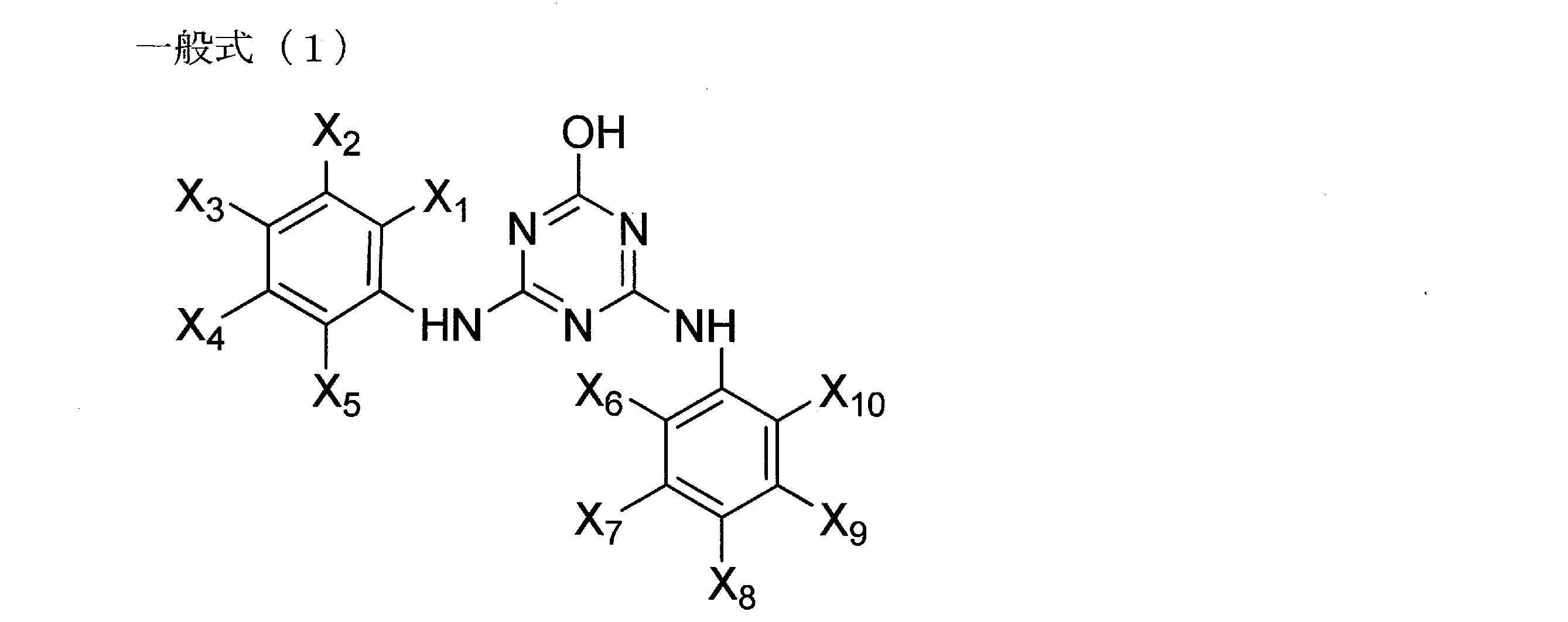
一般式(1)中、
X1~X5は、それぞれ独立に、水素原子、カルボキシル基、置換してもよいアルキル基を表すか、隣り合う2つの置換基同士が合体して、ベンゾイミダゾール環、ベンゾインドール環、ベンゾピラゾール環、又は、ベンゾイミダゾロン環を形成する。ただし、少なくとも1つの、隣り合う2つの置換基同士が合体した、ベンゾイミダゾール環、ベンゾインドール環、ベンゾピラゾール環、又は、ベンゾイミダゾロン環を有する。
X6~X10は、それぞれ独立に、水素原子、カルボキシル基、又は、置換又は非置換のアルキル基を表す。ただし、少なくとも1つは、カルボキシル基である。
X1~X5は、それぞれ独立に、水素原子、カルボキシル基、置換してもよいアルキル基を表すか、隣り合う2つの置換基同士が合体して、ベンゾイミダゾール環、ベンゾインドール環、ベンゾピラゾール環、又は、ベンゾイミダゾロン環を形成する。ただし、少なくとも1つの、隣り合う2つの置換基同士が合体した、ベンゾイミダゾール環、ベンゾインドール環、ベンゾピラゾール環、又は、ベンゾイミダゾロン環を有する。
X6~X10は、それぞれ独立に、水素原子、カルボキシル基、又は、置換又は非置換のアルキル基を表す。ただし、少なくとも1つは、カルボキシル基である。
一実施形態は、下記一般式(2)で表される分散剤に関する。

一般式(2)において、
R1は、Y1-Z1で表される基を表す。Y1は、アルキル基、ハロゲン基、ニトロ基、カルボキシル基、及びアルコキシ基から選ばれる置換基を有してもよい、アリーレン基を表す。Z1は、カルボキシル基又はリン酸基を表す。
R2は、少なくとも-NHC(=O)-を含む置換基を有するフェニル基、ベンゾイミダゾール基、置換基を有してもよいインドール基、又は置換基を有してもよいピラゾール基を表す。
R1は、Y1-Z1で表される基を表す。Y1は、アルキル基、ハロゲン基、ニトロ基、カルボキシル基、及びアルコキシ基から選ばれる置換基を有してもよい、アリーレン基を表す。Z1は、カルボキシル基又はリン酸基を表す。
R2は、少なくとも-NHC(=O)-を含む置換基を有するフェニル基、ベンゾイミダゾール基、置換基を有してもよいインドール基、又は置換基を有してもよいピラゾール基を表す。
一実施形態は、上記実施形態の化合物を含む分散剤に関する。
一実施形態は、さらに、アミン及び無機塩基の少なくとも一方を含む上記実施形態の分散剤に関する。
一実施形態は、顔料又は炭素材料と、上記実施形態の分散剤と、溶剤とを含む分散組成物に関する。
一実施形態は、上記実施形態の分散組成物に、さらにポリマー分散剤を含む、分散組成物に関する。
一実施形態は、上記ポリマー分散剤が、水酸基を有する上記実施形態の分散組成物に関する。
一実施形態は、上記ポリマー分散剤が、ポリビニルアルコール系樹脂及びセルロース系樹脂の少なくとも一方を含む、上記実施形態の分散組成物に関する。
一実施形態は、上記炭素材料が、カーボンナノチューブを含む上記実施形態の分散組成物に関する。
一実施形態は、上記実施形態の分散組成物を用いてなる電極用組成物に関する。
一実施形態は、さらに、バインダーを含んでなる上記実施形態の電極用組成物に関する。
一実施形態は、さらに、活物質を含んでなる上記実施形態の電極用組成物に関する。
一実施形態は、集電体上に、上記実施形態の電極用組成物より形成されてなる合剤層を有する電極に関する。
一実施形態は、上記実施形態の電極と、非水電解液とを具備してなる電池に関する。
本願の開示は、2018年7月20日に出願された日本国特許出願番号2018-136702号に記載の主題と関連しており、その明細書の開示内容は参照のためここに援用される。
本発明によれば、良好な分散性を有し、優れた塗膜特性を実現できる分散組成物を形成できる分散剤を提供できる。この分散剤を用いて構成される分散組成物は、電池の用途で好適に使用でき、優れた電池特性を実現することが可能となる。
以下、本発明の実施形態について詳細に説明する。ただし、本発明は、以下に記載する実施形態に限定されず、様々な実施形態を含む。
<トリアジン誘導体、分散剤>
一実施形態は、一般式(1)で表される化合物(トリアジン誘導体)に関する。また、一実施形態は、一般式(2)で表されるトリアジン誘導体に関する。これらの一般式(1)及び(2)で表されるトリアジン誘導体は、分散剤として好適に使用することができる。
一実施形態は、一般式(1)で表される化合物(トリアジン誘導体)に関する。また、一実施形態は、一般式(2)で表されるトリアジン誘導体に関する。これらの一般式(1)及び(2)で表されるトリアジン誘導体は、分散剤として好適に使用することができる。
一般式(1)中、X1~X5は、それぞれ独立に、水素原子、カルボキシル基、置換又は非置換のアルキル基を表すか、隣り合う2つが互いに合体して、ベンゾイミダゾール環、ベンゾインドール環、ベンゾピラゾール環、又は、ベンゾイミダゾロン環を形成する。ただし、X1~X5は、隣り合う2つが互いに合体して形成される、ベンゾイミダゾール環、ベンゾインドール環、ベンゾピラゾール環、又は、ベンゾイミダゾロン環を少なくとも1つ形成する。ここで、ベンゾイミダゾール環、ベンゾインドール環、ベンゾピラゾール環、及び、ベンゾイミダゾロン環におけるベンゼン環構造は、X1~X5の各々が結合するベンゼン環に由来する。
X6~X10は、それぞれ独立に、水素原子、カルボキシル基、あるいは、置換又は非置換のアルキル基である。ただし、少なくとも1つは、カルボキシル基である。
X6~X10は、それぞれ独立に、水素原子、カルボキシル基、あるいは、置換又は非置換のアルキル基である。ただし、少なくとも1つは、カルボキシル基である。
一実施形態において、X1~X5は、隣り合う2つが互いに合体してベンゾイミダゾロン環を1つ形成することが好ましい。X1~X5における残りの3つは、それぞれ独立して、水素原子、あるいは置換又は非置換のアルキル基を表すことが好ましい。この実施形態において、X1及びX5は、それぞれ独立して、水素原子、あるいは置換又は非置換のアルキル基であることがより好ましい。一方、X6~X10は、それぞれ独立に、水素原子又はカルボキシル基であり、カルボキシル基の数は1又は2つであることが好ましい。このようなトリアジン誘導体の具体例として、実施例で後述する誘導体A~E及びFが挙げられる。
一般式(2)中、R1はY1-Z1で表される基を表す。Y1は、アリーレン基を表し、上記アリーレン基は、アルキル基、ハロゲン基、ニトロ基、カルボキシル基、及びアルコキシ基から選ばれる置換基を有してもよい。Z1は、カルボキシル基又はリン酸基を表す。一実施形態において、Z1は、カルボキシル基であることが好ましい。
R2は、少なくとも-NHC(=O)-を含む置換基を有するフェニル基、ベンゾイミダゾール基、置換又は非置換のインドール基、あるいは置換又は非置換のピラゾール基を表す。
R2は、少なくとも-NHC(=O)-を含む置換基を有するフェニル基、ベンゾイミダゾール基、置換又は非置換のインドール基、あるいは置換又は非置換のピラゾール基を表す。
Y1として表される、置換基を有してもよいアリーレン基の「置換基」は、同一でも異なってもよい。置換基の具体例として、カルボキシル基、リン酸基、フッ素、塩素及び臭素等のハロゲン基、ニトロ基、アルキル基、アルコキシル基などが挙げられる。また、これらアリーレン基に対する置換基は、複数あってもよい。
R2として表される、少なくとも-NHC(=O)-を含む置換基を有するフェニル基、ベンゾイミダゾール基、置換又は非置換のインドール基、あるいは置換又は非置換のピラゾール基について以下に説明する。
R2が少なくとも-NHC(=O)-を含む置換基を有するフェニル基である場合、上記置換基の具体例として以下の構造(a)~(j)が挙げられる。ただし、*印はベンゼン環(フェニル基)との結合部分を表す。
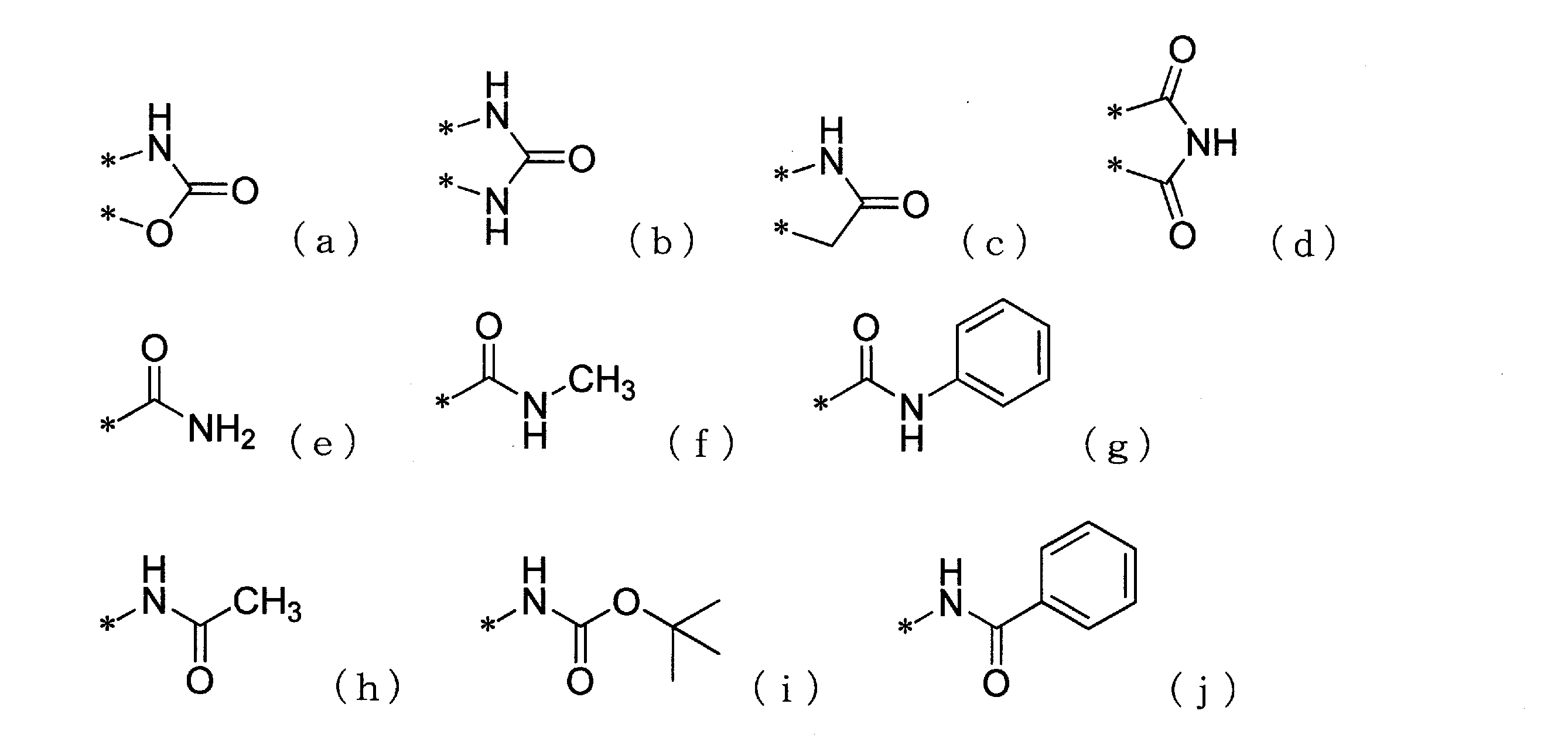
一実施形態において、上記構造(a)~(j)は、フェニル基の窒素原子との結合部を起点として、オルト位、メタ位、及びパラ位のいずれに存在してもよい。一実施形態において、上記構造(a)~(d)はメタ位及びパラ位に存在することが好ましく、上記構造(e)~(j)はメタ位又はパラ位に存在することがより好ましい。
一実施形態において、少なくとも-NHC(=O)-を含む置換基を有するフェニル基は、上記置換基以外の置換基として、メチル基、トリフルオロメチル基、メトキシ基、エトキシ基、フッ素及び塩素などのハロゲン基等を有していてもよい。また、これらの置換基は、複数存在してもよい。このようなトリアジン誘導体の具体例として、実施例で後述する誘導体D及びG~Wが挙げられる。
R2がベンゾイミダゾール基である場合、このようなトリアジン誘導体の具体例として、実施例で後述する誘導体Xが挙げられる。
また、R2が置換又は非置換のインドール基、あるいは置換又は非置換のピラゾール基である場合、上記置換基としては、例えば、メチル基等のアルキル基が挙げられる。このようなトリアジン誘導体の具体例として、実施例で後述する誘導体Y、Z、AA、AB,AC及びADが挙げられる。
また、R2が置換又は非置換のインドール基、あるいは置換又は非置換のピラゾール基である場合、上記置換基としては、例えば、メチル基等のアルキル基が挙げられる。このようなトリアジン誘導体の具体例として、実施例で後述する誘導体Y、Z、AA、AB,AC及びADが挙げられる。
特に限定するものではないが、一実施形態において、トリアジン誘導体のなかでも、一般式(1)において、X1~X5の隣り合う2つが互いに合体してベンゾイミダゾロン環を1つ形成し、X1~X5における残りの3つは、それぞれ独立して、水素原子、あるいは置換又は非置換のアルキル基であり、X6~X10は、それぞれ独立に、水素原子又はカルボキシル基であり、カルボキシル基の数は1又は2つである形態が好ましい。
先に説明した一般式(1)又は(2)で表されるトリアジン誘導体(以下、トリアジン誘導体と称す)は、アミン及び/又は無機塩基と併用することが好ましい。したがって、一実施形態は、一般式(1)又は(2)で表されるトリアジン誘導体と、アミン、無機塩基、又はアミンと無機塩基との組合せとを含む分散剤に関する。
トリアジン誘導体と併用するアミンとしては、炭素数1~40の1級、2級、又は3級のアミンが挙げられる。アミンは、分子内にエーテル基、水酸基を有してよい。一実施形態において、アミンは、炭素数1~40の1級、2級、又は3級のアルキルアミンが好ましい。アルキルアミンにおけるアルキル基は、直鎖構造、及び分岐構造のいずれでもよい。
炭素数1~40の1級アミンの具体例としては、プロピルアミン、ブチルアミン、イソブチルアミン、オクチルアミン、2ーエチルヘキシルアミン、ラウリルアミン、ステアリルアミン、及びオレイルアミン等のアルキルアミン、2-アミノエタノール、3-アミノプロパノール、3-エトキシプロピルアミン、ならびに3-ラウリルオキシプロピルアミン等が挙げられる。
炭素数1~40の2級アミンとしては、ジブチルアミン、ジイソブチルアミン、N-メチルヘキシルアミン、ジオクチルアミン、及びジステアリルアミン等のアルキルアミン、ならびに2-メチルアミノエタノール等が挙げられる。
炭素数1~40の3級アミンとしては、トリエチルアミン、トリブチルアミン、N,N-ジメチルブチルアミン、N,N-ジイソプロピルエチルアミン、ジメチルオクチルアミン、トリオクチルアミン、ジメチルデシルアミン、ジメチルラウリルアミン、ジメチルミリスチルアミン、ジメチルパルミチルアミン、ジメチルステアリルアミン、及びジラウリルモノメチルアミン等のアルキルアミン、トリエタノールアミン、ならびに2-(ジメチルアミノ)エタノール等が挙げられる。
上記例示したアミンのなかでも、炭素数1~30の1級、2級、又は3級のアルキルアミンが好ましい。炭素数1~20の1級、2級又は3級のアルキルアミンがさらに好ましい。
上記アミンの添加量は、特に限定されるものではないが、一般式(1)で表されるトリアジン誘導体1モル当量に対して、0.1モル当量以上、5モル当量以下が好ましく、0.3モル当量以上、2モル当量以下がより好ましい。
上記アミンは、分散剤の製造時、及び/又は後述する分散組成物の製造時に添加することができる。
(無機塩基)
トリアジン誘導体と併用する無機塩基の具体例としては、アルカリ金属の水酸化物、アルカリ土類金属の水酸化物、アルカリ金属の炭酸塩、アルカリ土類金属の炭酸塩、アルカリ金属のリン酸塩、アルカリ土類金属のリン酸塩等が挙げられる。
トリアジン誘導体と併用する無機塩基の具体例としては、アルカリ金属の水酸化物、アルカリ土類金属の水酸化物、アルカリ金属の炭酸塩、アルカリ土類金属の炭酸塩、アルカリ金属のリン酸塩、アルカリ土類金属のリン酸塩等が挙げられる。
アルカリ金属の水酸化物としては、水酸化リチウム、水酸化ナトリウム、水酸化カリウム等が挙げられる。
アルカリ土類金属の水酸化物としては、水酸化マグネシウム、水酸化カルシウム、水酸化ストロンチウム、水酸化バリウム等が挙げられる。
アルカリ金属の炭酸塩としては、炭酸リチウム、炭酸ナトリウム、炭酸水素ナトリウム、炭酸カリウム、炭酸水素カリウム等が挙げられる。
アルカリ土類金属の炭酸塩としては、炭酸マグネシウム、炭酸カルシウム、炭酸ストロンチウム、炭酸バリウム等が挙げられる。
アルカリ金属のリン酸塩としては、リン酸リチウム、リン酸三ナトリウム、リン酸水素二ナトリウム、リン酸三カリウム、リン酸水素二カリウム等が挙げられる。
アルカリ土類金属のリン酸塩としては、リン酸マグネシウム、リン酸カルシウム、リン酸ストロンチウム、リン酸バリウム等が挙げられる。
上記無機塩基の添加量は、特に限定されるものではないが、一般式(1)又は(2)で表されるトリアジン誘導体1モルに対して、1価の陽イオンを持つものは、0.1モル以上、2.0モル以下が好ましく、0.3モル以上、1.0モル以下がより好ましい。2価の陽イオンを持つものは、0.05モル以上、1.0モル以下が好ましく、0.15モル以上、0.5モル以下がより好ましい。3価の陽イオンを持つものは、0.03モル以上、0.7モル以下が好ましく、0.1モル以上、0.4モル以下がより好ましい。
上記無機塩基は、分散剤の製造時、及び/又は後述する分散組成物の製造時に添加することができる。
上記実施形態の分散剤は、特に、電池、コンデンサー、及びキャパシター等の用途で使用される、カーボンブラック等の炭素材料に対する分散剤として好適に使用することができる。しかし、炭素材料に限らず、各種インキ、塗料、カラーフィルターレジスト等の着色組成物に使用される顔料に対する分散剤としても使用することができる。
上記実施形態のトリアジン誘導体を含む分散剤は、成膜性及び膜強度の調整、ならびにレオロジーコントロールを目的として、当技術分野で公知の他の分散剤と併用してもよい。一実施形態において、分散剤として、トリアジン誘導体と、当技術分野でポリマー分散剤(高分子分散剤)として公知の化合物の1種、又は2種以上を併用してもよい。一実施形態において、分散剤は、トリアジン誘導体と、ポリマー分散剤とを含んでよい。
(ポリマー分散剤)
使用可能なポリマー分散剤の具体例として、ポリビニルアルコール、水酸基以外の官能基、例えば、アセチル基、スルホ基、カルボキシル基、カルボニル基、アミノ基を有する、変性ポリビニルアルコール、各種塩によって変性されたポリビニルアルコール、その他アニオン又はカチオン変性されたポリビニルアルコール、及びアルデヒド類によってアセタール変性(アセトアセタール変性又はブチラール変性等)されたポリビニルアルコール系樹脂が挙げられる。また、各種(メタ)アクリル系ポリマー、エチレン性不飽和炭化水素由来のポリマー、及び各種セルロース系ポリマー等、ならびにこれらのコポリマーを使用することができる。ただし、これらに限定されるものではない。
使用可能なポリマー分散剤の具体例として、ポリビニルアルコール、水酸基以外の官能基、例えば、アセチル基、スルホ基、カルボキシル基、カルボニル基、アミノ基を有する、変性ポリビニルアルコール、各種塩によって変性されたポリビニルアルコール、その他アニオン又はカチオン変性されたポリビニルアルコール、及びアルデヒド類によってアセタール変性(アセトアセタール変性又はブチラール変性等)されたポリビニルアルコール系樹脂が挙げられる。また、各種(メタ)アクリル系ポリマー、エチレン性不飽和炭化水素由来のポリマー、及び各種セルロース系ポリマー等、ならびにこれらのコポリマーを使用することができる。ただし、これらに限定されるものではない。
ポリマー分散剤の平均重合度は、低すぎると分散質への吸着力が弱くなる。一方、ポリマー分散剤の平均重合度は、高すぎると粘性が悪くなるだけでなく、分散液中でうまく広がらず、分散安定化効果が低下する。このような観点から、上記平均重合度は、50~3000が好ましく、100~2000がより好ましく、200~1000がさらに好ましい。
ポリビニルアルコール系樹脂としては、分散質、分散溶剤、及び電解液と適度な親和性を持たせるために、水酸基へのけん化率60mol%以上のものが好ましく、75mol%以上のものがより好ましく、80mol%以上のものがさらに好ましい。
上記水酸基量の範囲に含まれる市販のポリビニルアルコール系樹脂としては、例えば、以下が挙げられる。クラレポバール(クラレ社製のポリビニルアルコール樹脂)、ゴーセノール、及びゴーセネックス(日本合成化学工業社製のポリビニルアルコール樹脂)、デンカポバール(デンカ社製のポリビニルアルコール樹脂)、及びJ-ポバール(日本酢ビ・ポバール社製のポリビニルアルコール樹脂)などが挙げられ、種々のグレードを入手することができる。また、各種官能基を有する変性ポリビニルアルコールも同様に入手できる。
市販品を使用せずに合成して用いる場合には、例えば、メタノール溶液中等で酢酸ビニルを所定の重合度まで重合し、得られたポリ酢酸ビニルに水酸化ナトリウム等のアルカリ触媒を加えて、けん化反応させる。このような方法によって、水酸基量をコントロールしたポリビニルアルコールが得られることが一般に知られている。
変性ポリビニルアルコールを合成して用いる場合には、一般に、メタノール等の溶液中で、酢酸ビニルとともに、(メタ)アクリル酸等の(メタ)アクリル系モノマー、ビニルエステル系モノマー、及びα,β-不飽和結合と官能基とを有するモノマーなどを共重合させ、次いで、けん化反応させることによって、変性率をコントロールした変性ポリビニルアルコールが得られることが知られている。また、ポリビニルアルコール系樹脂に対して酸無水物を付加反応させるか、又はエステル化反応させる方法等によって、変性ポリビニルアルコール系樹脂を得ることもできる。
市販のポリビニルアセタール樹脂としては、例えば、モビタール(クラレ社製ポリビニルブチラール樹脂)、エスレック(積水化学工業社製ポリビニルアセタール、又はポリビニルブチラール)などの商品名で、種々のグレードを入手することができるが、上記の好ましい水酸基量を得るために合成して用いてもよい。一般的な合成方法としては、ポリビニルアルコールにアルデヒドを反応させることで、所定のアセタール化度にコントロールしたポリビニルアセタール樹脂を得ることができる。また、アルデヒドの炭素数を変更すればアセタール基の炭素数を任意に選択することができる。
セルロース系樹脂としては、セルロース又は、セルロースの水酸基の一部がアルキル基やヒドロキシアルキル基、カルボキシアルキル基に変性されたものやその塩を用いることができ、例えば、メトローズ(信越化学工業社製メチルセルロース、又はヒドロキシプロピルメチルセルロース)、メセロース(巴工業社製水溶性セルロースエーテル、ヒドロキシエチルメチルセルロース、ヒドロキシプロピルメチルセルロース、メチルセルロース)、サンローズ(日本製紙社製カルボシメチルセルロースナトリウム)、エトセル(ダウケミカル社製エチルセルロース)、ダイセルCMC(ダイセルファインケム社製カルボシメチルセルロースナトリウム)などの商品名で、種々のグレードを入手することができる。特に、電解液への溶解性や膨潤性の観点から、メチルセルロースやエチルセルロースが好ましい。
一実施形態において、ポリマー分散剤は、後述する分散組成物全体に対して、0.01~25質量%の範囲で用いることができる。
<分散組成物>
一実施形態は、分散剤と、顔料又は炭素材料と、溶剤とを含み、上記分散剤として一般式(1)又は(2)で表されるトリアジン誘導体を含む、分散組成物に関する。他の実施形態は、分散剤と、顔料又は炭素材料と、溶剤とを含み、上記分散剤として一般式(1)又は(2)で表されるトリアジン誘導体と、先に説明したポリマー分散剤とを含む、分散組成物に関する。
特に限定するものではないが、上記分散組成物において、炭素材料を使用した場合、電極等の電池の用途で好適に使用することができる組成物を構成することができる。以下、電極用組成物として、より具体的に説明する。
一実施形態は、分散剤と、顔料又は炭素材料と、溶剤とを含み、上記分散剤として一般式(1)又は(2)で表されるトリアジン誘導体を含む、分散組成物に関する。他の実施形態は、分散剤と、顔料又は炭素材料と、溶剤とを含み、上記分散剤として一般式(1)又は(2)で表されるトリアジン誘導体と、先に説明したポリマー分散剤とを含む、分散組成物に関する。
特に限定するものではないが、上記分散組成物において、炭素材料を使用した場合、電極等の電池の用途で好適に使用することができる組成物を構成することができる。以下、電極用組成物として、より具体的に説明する。
<電極用組成物>
一実施形態において、電極用組成物は、トリアジン誘導体を含む分散剤と、炭素材料と、溶剤とを含む炭素材料分散液であってよい。他の実施形態において、電極用組成物は、トリアジン誘導体を含む分散剤と、ポリマー分散剤と、炭素材料と、溶剤とを含む炭素材料分散ワニスであってよい。さらに他の実施形態において、上記実施形態の電極用組成物は、バインダー、及び活物質をさらに含む合剤ペーストであってよい。以下、電極用組成物の構成材料について説明する。
一実施形態において、電極用組成物は、トリアジン誘導体を含む分散剤と、炭素材料と、溶剤とを含む炭素材料分散液であってよい。他の実施形態において、電極用組成物は、トリアジン誘導体を含む分散剤と、ポリマー分散剤と、炭素材料と、溶剤とを含む炭素材料分散ワニスであってよい。さらに他の実施形態において、上記実施形態の電極用組成物は、バインダー、及び活物質をさらに含む合剤ペーストであってよい。以下、電極用組成物の構成材料について説明する。
(炭素材料)
炭素材料は、特に限定されるものではないが、電池用の炭素材料として使用する場合、グラファイト、カーボンブラック、カーボンナノチューブ、カーボンナノファイバー、カーボンファイバー、グラフェン、及びフラーレン等を単独で、又は2種類以上を併せて使用することが好ましい。導電性、入手の容易さ、及びコスト面から、カーボンブラック、又はカーボンナノチューブを使用することがより好ましい。
炭素材料は、特に限定されるものではないが、電池用の炭素材料として使用する場合、グラファイト、カーボンブラック、カーボンナノチューブ、カーボンナノファイバー、カーボンファイバー、グラフェン、及びフラーレン等を単独で、又は2種類以上を併せて使用することが好ましい。導電性、入手の容易さ、及びコスト面から、カーボンブラック、又はカーボンナノチューブを使用することがより好ましい。
上記カーボンブラックとしては、市販のファーネスブラック、チャンネルブラック、サーマルブラック、アセチレンブラック、ケッチェンブラックなどの各種市販品を単独で、又は2種類以上を併せて使用することができる。また、通常実施されている酸化処理後のカーボンブラック、又は中空カーボン等も使用できる。また、カーボンブラックの粒径は、0.01~1μmが好ましく、0.01~0.2μmがより好ましい。ここでいう粒径とは、電子顕微鏡で測定された平均一次粒子径を示す。この物性値は、一般に、カーボンブラックの物理的特性を表すために用いられている。
上記カーボンナノチューブは、グラフェンを筒状に巻いた形状を有する炭素材料である。電子顕微鏡で観察して求めた直径は、数nmから100nm程度であり、長さは、数nmから1mm程度である。半導体特性、塗膜の透明性等を発揮する観点から、カーボンナノチューブの直径は50nm以下、特に20nm以下が好ましい。カーボンナノチューブの長さは、100nmから1mmが好ましく、特に500nmから1mmが好ましい。カーボンナノチューブは、単層構造、又は多層構造を有するが、いずれの構造であってもよい。また、カーボンナノファイバーとして分類される、電子顕微鏡で観察して求めた繊維径が100nmから1μm程度の炭素材料についても使用可能である。
上記グラフェンは、グラファイトを構成する単原子薄膜であり、炭素原子が平面上で蜂の巣格子(六角形)状に並んだ炭素材料であり、これが積層化した多層グラフェンを含む。多層グラフェンとしては、グラフェン層の数が2から50層であるものを使用することができる。
(溶剤)
上記溶剤としては、非プロトン性の極性溶剤、水溶性の極性溶剤、及び水から1種類を単独で用いても、2種類以上を混合して用いてもよい。
非プロトン性の極性溶剤としては、アミド系溶剤が好ましく、特に、N,N-ジメチルホルムアミド、N,N-ジエチルホルムアミド、N,N-ジメチルアセトアミド、N,N-ジエチルアセトアミド、N-メチル-2-ピロリドン、ヘキサメチルリン酸ト等のアミド系非プロトン性溶剤の使用が好ましい。
上記溶剤としては、非プロトン性の極性溶剤、水溶性の極性溶剤、及び水から1種類を単独で用いても、2種類以上を混合して用いてもよい。
非プロトン性の極性溶剤としては、アミド系溶剤が好ましく、特に、N,N-ジメチルホルムアミド、N,N-ジエチルホルムアミド、N,N-ジメチルアセトアミド、N,N-ジエチルアセトアミド、N-メチル-2-ピロリドン、ヘキサメチルリン酸ト等のアミド系非プロトン性溶剤の使用が好ましい。
水溶性の極性溶剤としては、アルコール系、エステル系、エーテル系、グリコール系、グリコールエステル系、グリコールエーテル系が好ましい。水は単独で用いてもよいし、炭素材料の濡れ性や塗工性向上のために、表面張力が低い水溶性の極性溶剤を少量併用してもよく、特に、プロピレングリコールモノエチルエーテル、エチレングリコールジメチルエーテル、ジエチレングリコールメチルエチルエーテル、ジプロピレングリコールジメチルエーテル、プロピレングリコールモノプロピルエーテル、N-メチル-2-ピロリドンとの併用が好ましい。
(バインダー)
バインダーとしては特に限定されないが、エチレン、プロピレン、塩化ビニル、酢酸ビニル、ビニルアルコール、マレイン酸、アクリル酸、アクリル酸エステル、メタクリル酸、メタクリル酸エステル、アクリロニトリル、スチレン、ビニルブチラール、ビニルアセタール、及びビニルピロリドン等を構成単位として含む重合体又は共重合体、ポリウレタン樹脂、ポリエステル樹脂、フェノール樹脂、エポキシ樹脂、フェノキシ樹脂、尿素樹脂、メラミン樹脂、アルキッド樹脂、アクリル樹脂、ホルムアルデヒド樹脂、シリコン樹脂、フッ素樹脂、カルボキシメチルセルロースのようなセルロース樹脂、スチレン-ブタジエンゴム、フッ素ゴムのようなゴム類、ならびに、ポリアニリン及びポリアセチレンのような導電性樹脂等が挙げられる。また、これらの樹脂の変性体及び共重合体でもよい。
バインダーとしては特に限定されないが、エチレン、プロピレン、塩化ビニル、酢酸ビニル、ビニルアルコール、マレイン酸、アクリル酸、アクリル酸エステル、メタクリル酸、メタクリル酸エステル、アクリロニトリル、スチレン、ビニルブチラール、ビニルアセタール、及びビニルピロリドン等を構成単位として含む重合体又は共重合体、ポリウレタン樹脂、ポリエステル樹脂、フェノール樹脂、エポキシ樹脂、フェノキシ樹脂、尿素樹脂、メラミン樹脂、アルキッド樹脂、アクリル樹脂、ホルムアルデヒド樹脂、シリコン樹脂、フッ素樹脂、カルボキシメチルセルロースのようなセルロース樹脂、スチレン-ブタジエンゴム、フッ素ゴムのようなゴム類、ならびに、ポリアニリン及びポリアセチレンのような導電性樹脂等が挙げられる。また、これらの樹脂の変性体及び共重合体でもよい。
特に、電池用途で使用する場合には、耐性面から、分子内にフッ素原子を含む高分子化合物、例えば、ポリフッ化ビニリデン、ポリフッ化ビニル、テトラフルオロエチレン等の使用が好ましい。これらバインダーは、1種又は複数を組み合わせて使用することもできる。また、溶剤に水を用いる場合には、これらフッ素原子を含む高分子化合物及びスチレン-ブタジエンゴムなどのエマルションと、増粘剤としても機能するカルボキシメチルセルロースとを併用することが好ましい。
一実施形態において、上記バインダーは、分散組成物全体に対して、0.001~50質量%の範囲で用いることができる。
(活物質)
活物質は、電池内において、酸化還元反応を伴って蓄電又は放電を行う物質である。活物質の具体例として、正極に用いられる正極活物質、及び負極に用いられる負極活物質が挙げられる。
活物質は、電池内において、酸化還元反応を伴って蓄電又は放電を行う物質である。活物質の具体例として、正極に用いられる正極活物質、及び負極に用いられる負極活物質が挙げられる。
(正極活物質)
正極活物質は、電池用活物質として機能するものであれば、特に限定されない。例えば、リチウムイオン二次電池に使用する場合には、リチウムイオンをドーピング又はインターカレーション可能な金属酸化物、金属硫化物等の金属化合物、及び導電性高分子等を使用することができる。
正極活物質は、電池用活物質として機能するものであれば、特に限定されない。例えば、リチウムイオン二次電池に使用する場合には、リチウムイオンをドーピング又はインターカレーション可能な金属酸化物、金属硫化物等の金属化合物、及び導電性高分子等を使用することができる。
具体的には、リチウムマンガン複合酸化物(例えばLixMn2O4又はLixMnO2)、リチウムニッケル複合酸化物(例えばLixNiO2)、リチウムコバルト複合酸化物(LixCoO2)、リチウムニッケルコバルト複合酸化物(例えばLixNi1-yCoyO2)、リチウムマンガンコバルト複合酸化物(例えばLixMnyCo1-yO2)、リチウムニッケルマンガンコバルト複合酸化物(例えばLixNiyCozMn1-y-zO2)、スピネル型リチウムマンガンニッケル複合酸化物(例えばLixMn2-yNiyO4)等のリチウムと遷移金属との複合酸化物粉末、オリビン構造を有するリチウムリン酸化物粉末(例えばLixFePO4、LixFe1-yMnyPO4、LixCoPO4など)、酸化マンガン、酸化鉄、酸化銅、酸化ニッケル、バナジウム酸化物(例えばV2O5、V6O13)、酸化チタン等の遷移金属酸化物粉末、硫酸鉄(Fe2(SO4)3)、TiS2、及びFeS等の遷移金属硫化物粉末等が挙げられる。ただし、x、y、zは数であり、0<x<1、0<y<1、0<z<1、0<y+z<1である。また、ポリアニリン、ポリアセチレン、ポリピロール、ポリチオフェン等の導電性ポリマーを使用することもできる。これら正極活物質は、1種又は複数を組み合わせて使用することもできる。
<負極活物質>
負極活物質としては特に限定されない。例えば、リチウムイオンをドーピング又はインターカレーション可能な金属Li、又はその合金、スズ合金、シリコン合金負極、LiXTiO2、LiXFe2O3、LiXFe3O4、LiXWO2等の金属酸化物系、ポリアセチレン、ポリ-p-フェニレン等の導電性高分子、ソフトカーボンやハードカーボンといったアモルファス系炭素質材料や、高黒鉛化炭素材料等の人造黒鉛、あるいは天然黒鉛等の炭素質粉末、カーボンブラック、メソフェーズカーボンブラック、樹脂焼成炭素材料、気層成長炭素繊維、炭素繊維などの炭素系材料が用いられる。ただし、xは数であり、0<x<1である。これら負極活物質は、1種又は複数を組み合わせて使用することもできる。
負極活物質としては特に限定されない。例えば、リチウムイオンをドーピング又はインターカレーション可能な金属Li、又はその合金、スズ合金、シリコン合金負極、LiXTiO2、LiXFe2O3、LiXFe3O4、LiXWO2等の金属酸化物系、ポリアセチレン、ポリ-p-フェニレン等の導電性高分子、ソフトカーボンやハードカーボンといったアモルファス系炭素質材料や、高黒鉛化炭素材料等の人造黒鉛、あるいは天然黒鉛等の炭素質粉末、カーボンブラック、メソフェーズカーボンブラック、樹脂焼成炭素材料、気層成長炭素繊維、炭素繊維などの炭素系材料が用いられる。ただし、xは数であり、0<x<1である。これら負極活物質は、1種又は複数を組み合わせて使用することもできる。
以上のように、一実施形態において、分散組成物(電極用組成物)は、上記分散剤、炭素材料、及び溶剤を含む、炭素材料の分散液であり、さらにポリマー分散剤を含む炭素材料の分散ワニスである。上記分散組成物は、均質で良好な塗膜物性が求められる印刷インキ、塗料、プラスチック、トナー、カラーフィルタレジストインキ、及び電池等の様々な分野で使用することができる。特に、上記分散組成物は、均質で良好な塗膜物性と、表面抵抗の低い電極層に適した塗膜を提供することができるため、電池の電極を形成する用途で好適に使用することができる。上記分散組成物は、集電体と合剤層との間に設ける下地層の構成材料として用いてもよい。
<分散組成物の製造方法>
上記分散組成物の一実施形態である炭素材料の分散液は、上記分散剤と、炭素材料と、溶剤とを混合することにより製造することができる。また、炭素材料の分散ワニスは、上記分散剤と、炭素材料と、溶剤と、ポリマー分散剤とを混合することにより製造することができる。各成分の添加順序などについては、限定されない。
例えば、炭素材料の分散液については、(1)全成分を一括に混合・分散する方法、(2)予め分散剤を分散・溶解した溶剤に炭素材料を分散させる方法等が挙げられる。また、炭素材料の分散ワニスについては、(1)全成分を一括に混合・分散・溶解する方法、(2)予め炭素材料分散液を作製した後に、バインダー粉を混合・溶解する方法、(3)予め炭素材料分散液を作製した後に、バインダー溶液を混合する方法等が挙げられる。また、必要に応じて上記に記載の溶剤を更に追加してもよい。
上記分散組成物の一実施形態である炭素材料の分散液は、上記分散剤と、炭素材料と、溶剤とを混合することにより製造することができる。また、炭素材料の分散ワニスは、上記分散剤と、炭素材料と、溶剤と、ポリマー分散剤とを混合することにより製造することができる。各成分の添加順序などについては、限定されない。
例えば、炭素材料の分散液については、(1)全成分を一括に混合・分散する方法、(2)予め分散剤を分散・溶解した溶剤に炭素材料を分散させる方法等が挙げられる。また、炭素材料の分散ワニスについては、(1)全成分を一括に混合・分散・溶解する方法、(2)予め炭素材料分散液を作製した後に、バインダー粉を混合・溶解する方法、(3)予め炭素材料分散液を作製した後に、バインダー溶液を混合する方法等が挙げられる。また、必要に応じて上記に記載の溶剤を更に追加してもよい。
混合、分散、及び溶解に用いる装置としては、顔料分散等に通常用いられている分散機を使用することができる。例えば、ディスパー、ホモミキサー、プラネタリーミキサー等のミキサー類、ホモジナイザー(エム・テクニック社製「クレアミックス」、PRIMIX社「フィルミックス」等、シルバーソン社製「アブラミックス」等)類、ペイントコンディショナー(レッドデビル社製)、コロイドミル(PUC社製「PUCコロイドミル」、IKA社製「コロイドミルMK」)類、コーンミル(IKA社製「コーンミルMKO」等)、ボールミル、サンドミル(シンマルエンタープライゼス社製「ダイノミル」等)、アトライター、パールミル(アイリッヒ社製「DCPミル」等)、コボールミル等のメディア型分散機、湿式ジェットミル(ジーナス社製「ジーナスPY」、スギノマシン社製「スターバースト」、ナノマイザー社製「ナノマイザー」等)、エム・テクニック社製「クレアSS-5」、奈良機械社製「MICROS」等のメディアレス分散機、その他ロールミル等が挙げられる。ただし、これらに限定されるものではない。
また、分散機としては、分散機からの金属混入防止処理を施したものを用いることが好ましい。金属混入防止処理としては、例えばメディア型分散機を使用する場合は、アジテーター及びベッセルがセラミック製又は樹脂製の分散機を使用する方法や、金属製アジテーター及びベッセル表面をタングステンカーバイド溶射や樹脂コーティング等の処理をした分散機を用いることが好ましい。メディアとしては、ガラスビーズ又はジルコニアビーズもしくはアルミナビーズ等のセラミックビーズを用いることが好ましい。また、ロールミルを使用する場合についても、セラミック製ロールを用いることが好ましい。分散機は、1種のみを使用してもよいし、複数種の装置を組み合わせて使用してもよい。
<電極用組成物の製造方法>
上記実施形態の電極用組成物は、上記分散剤、炭素材料、溶剤、及びポリマー分散剤を含む分散組成物に、さらに、活物質、及びバインダーを加えた組成を有することが好ましい。このような組成を有する電極用組成物は、電極の合剤層を形成する材料(以下、「合剤ペースト」と称す)として好適に使用することができる。
上記実施形態の電極用組成物は、上記分散剤、炭素材料、溶剤、及びポリマー分散剤を含む分散組成物に、さらに、活物質、及びバインダーを加えた組成を有することが好ましい。このような組成を有する電極用組成物は、電極の合剤層を形成する材料(以下、「合剤ペースト」と称す)として好適に使用することができる。
この合剤ペーストは、上記分散組成物と、バインダーと、活物質とを混合することにより製造することができる。各成分の添加順序などについては限定されるものではない。例えば、全成分を一括に混合する方法、上述の方法で予め作製した炭素材料の分散液に残りの成分を投入して混合する方法、上述の方法で予め作製した炭素材料分散ワニスに活物質を投入して混合する方法等が挙げられる。また、必要に応じて上記に記載の溶剤を更に追加してもよい。
合剤ペーストを製造するための装置としては、上述した本発明の分散組成物を作製する際に用いられるものと同様のものを使用することができる。
<電池>
次に、本発明の電極用組成物を用いた電池について説明する。本発明の電極用組成物は、特にリチウムイオン二次電池の電極に使用することができる。以下ではリチウムイオン二次電池について説明するが、本発明の電極用組成物を用いた電極はリチウムイオン二次電池に限定されるものではない。
次に、本発明の電極用組成物を用いた電池について説明する。本発明の電極用組成物は、特にリチウムイオン二次電池の電極に使用することができる。以下ではリチウムイオン二次電池について説明するが、本発明の電極用組成物を用いた電極はリチウムイオン二次電池に限定されるものではない。
リチウムイオン二次電池は、集電体上に正極合剤層を有する正極電極と、集電体上に負極合剤層を有する負極電極と、リチウムを含む電解質からなる非水電解液を具備する。
電極について、使用する集電体の材質や形状は特に限定されず、材質としては、アルミニウム、銅、ニッケル、チタン、ステンレス等の金属や合金が用いられるが、特に正極材料としてはアルミニウムが、負極材料としては銅の使用が好ましい。また、形状としては、一般的には平板上の箔が用いられるが、表面を粗面化したものや、穴あき箔状のもの、及びメッシュ状のものも使用できる。また、集電体には、集電体と合剤層との接触抵抗や密着性(剥離強度)を向上させる目的で、導電性の下地層を設けても良い。
合剤層は、集電体上に上記の合剤ペーストを直接塗布し、乾燥することで形成できる。合剤層の厚みとしては、一般的には1μm以上、1mm以下であり、好ましくは100μm以上、500μm以下である。塗布方法については特に制限はなく、公知の方法を用いることができる。具体的には、ダイコーティング法、ディップコーティング法、ロールコーティング法、ドクターコーティング法、スプレーコティング法、グラビアコーティング法、スクリーン印刷法、静電塗装法等が挙げられる。また、塗布後に平版プレスやカレンダーロール等による圧延処理を行ってもよい。
リチウムイオン二次電池を構成する電解液としては、リチウムを含んだ電解質を非水系の溶媒に溶解したものを用いる。電解質としては、LiBF4、LiClO4、LiPF6、LiAsF6、LiSbF6、LiCF3SO3、Li(CF3SO2)2N、LiC4F9SO3、Li(CF3SO2)3C、LiI、LiBr、LiCl、LiAlCl、LiHF2、LiSCN、LiBPh4(ただし、Phはフェニル基である。)等が挙げられるがこれらに限定されない。
非水系の溶媒としては特に限定はされないが、エチレンカーボネート、プロピレンカーボネート、ブチレンカーボネート、ジメチルカーボネート、エチルメチルカーボネート、ジエチルカーボネート等のカーボネート類、γ-ブチロラクトン、γ-バレロラクトン、γ-オクタノイックラクトン等のラクトン類、テトラヒドロフラン、2-メチルテトラヒドロフラン、1,3-ジオキソラン、4-メチル-1,3-ジオキソラン、1,2-メトキシエタン、1,2-エトキシエタン、1,2-ジブトキシエタン等のグライム類、メチルフォルメート、メチルアセテート、メチルプロピオネート等のエステル類、ジメチルスルホキシド、スルホラン等のスルホキシド類、アセトニトリル等のニトリル類、N-メチル-2-ピロリドン等が挙げられる。またこれらの溶媒は、それぞれ単独で使用しても良いが、2種以上を混合して使用しても良い。特に、高誘電率で電解質の溶解力が高いエチレンカーボネートとその他溶媒との混合が好ましく、さらに、その他溶媒としてはプロピレンカーボネート、ブチレンカーボネート、ジメチルカーボネート、エチルメチルカーボネート、ジエチルカーボネート等の直線状のカーボネート系溶媒がより好ましい。
更に上記電解液を、ポリマーマトリクスに保持しゲル状とした高分子電解質とすることもできる。ポリマーマトリクスとしては、ポリアルキレンオキシドセグメントを有するアクリレート系樹脂、ポリアルキレンオキシドセグメントを有するポリホスファゼン系樹脂、ポリアルキレンオキシドセグメントを有するポリシロキサン等が挙げられるがこれらに限定されない。
本発明の組成物を用いた電池の構造については特に限定されないが、通常、正極及び負極と、必要に応じて設けられるセパレーターとから構成され、ペーパー型、円筒型、角型、ボタン型、積層型、巻回型など、使用する目的に応じた種々の形状とすることができる。
以下、実施例に基づき本発明を詳細に説明するが、本発明はその要旨を超えない限り、以下の実施例に限定されるものではない。
また、個々の組成物の違いを明確にするために、分散剤、炭素材料、及び溶剤からなる分散組成物を「炭素材料分散液」、分散剤、炭素材料、溶剤、及びポリマー分散剤からなる分散組成物を「炭素材料分散ワニス」、分散剤、炭素材料、溶剤、ポリマー分散剤、バインダー、及び活物質からなる電池用分散組成物を「合剤ペースト」と呼称することとする。また、特に断わりの無い限り、溶剤として使用したN-メチル-2-ピロリドンを「NMP」、質量%を「%」と略記する。
また、個々の組成物の違いを明確にするために、分散剤、炭素材料、及び溶剤からなる分散組成物を「炭素材料分散液」、分散剤、炭素材料、溶剤、及びポリマー分散剤からなる分散組成物を「炭素材料分散ワニス」、分散剤、炭素材料、溶剤、ポリマー分散剤、バインダー、及び活物質からなる電池用分散組成物を「合剤ペースト」と呼称することとする。また、特に断わりの無い限り、溶剤として使用したN-メチル-2-ピロリドンを「NMP」、質量%を「%」と略記する。
<分散剤>
以下、本発明の一般式(1)又は(2)で表されるトリアジン誘導体A~ADの構造を示す。本発明に用いる一般式(1)又は(2)で表されるトリアジン誘導体A~ADの製造方法としては、特に限定されるものではなく、周知の方法を適用することができる。例えば、特開2004-217842号公報等に記載されている方法を適用することができる。上記公報による開示を参照することにより、本明細書の一部に組み込むものとする。
以下、本発明の一般式(1)又は(2)で表されるトリアジン誘導体A~ADの構造を示す。本発明に用いる一般式(1)又は(2)で表されるトリアジン誘導体A~ADの製造方法としては、特に限定されるものではなく、周知の方法を適用することができる。例えば、特開2004-217842号公報等に記載されている方法を適用することができる。上記公報による開示を参照することにより、本明細書の一部に組み込むものとする。
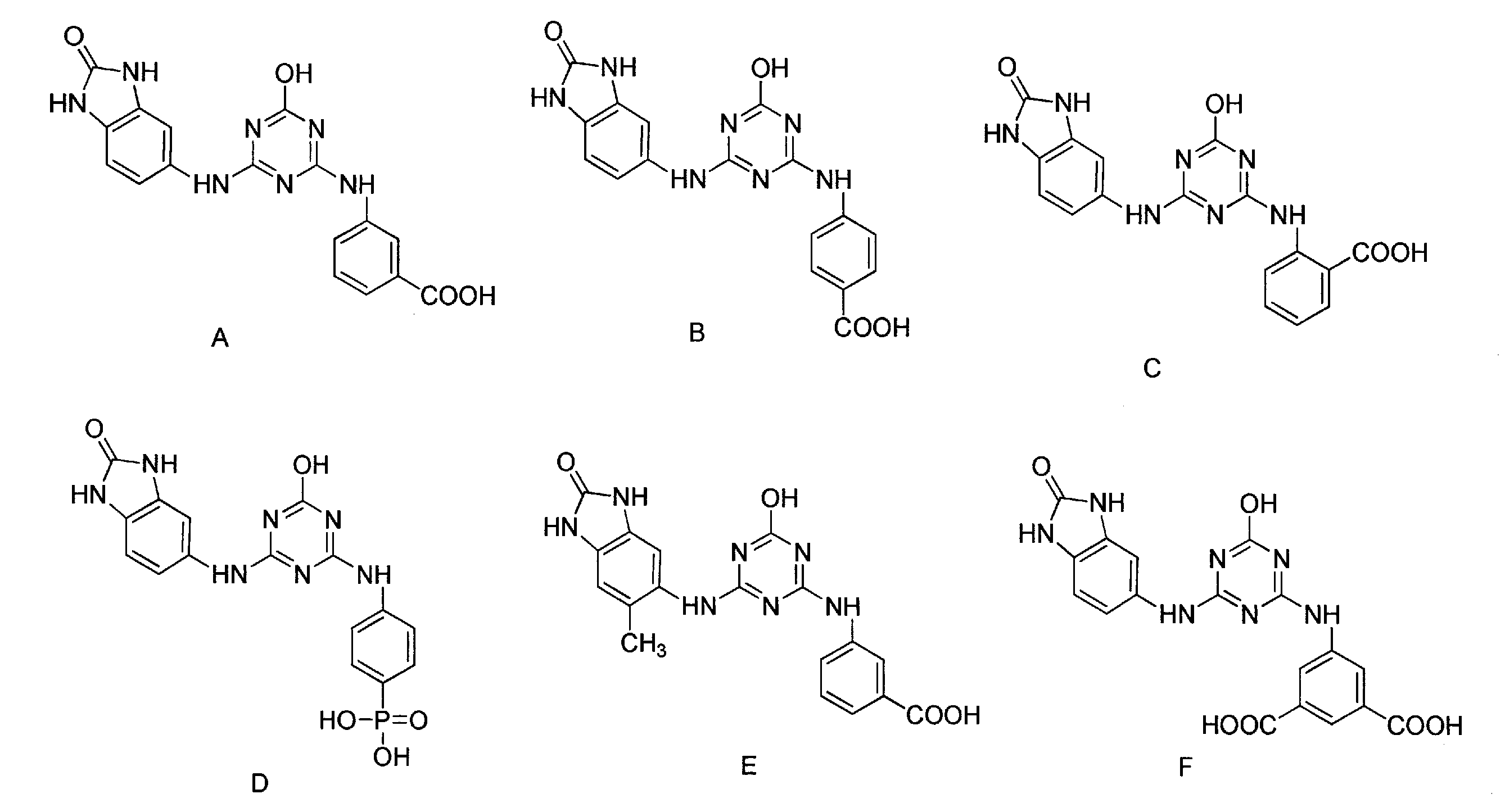
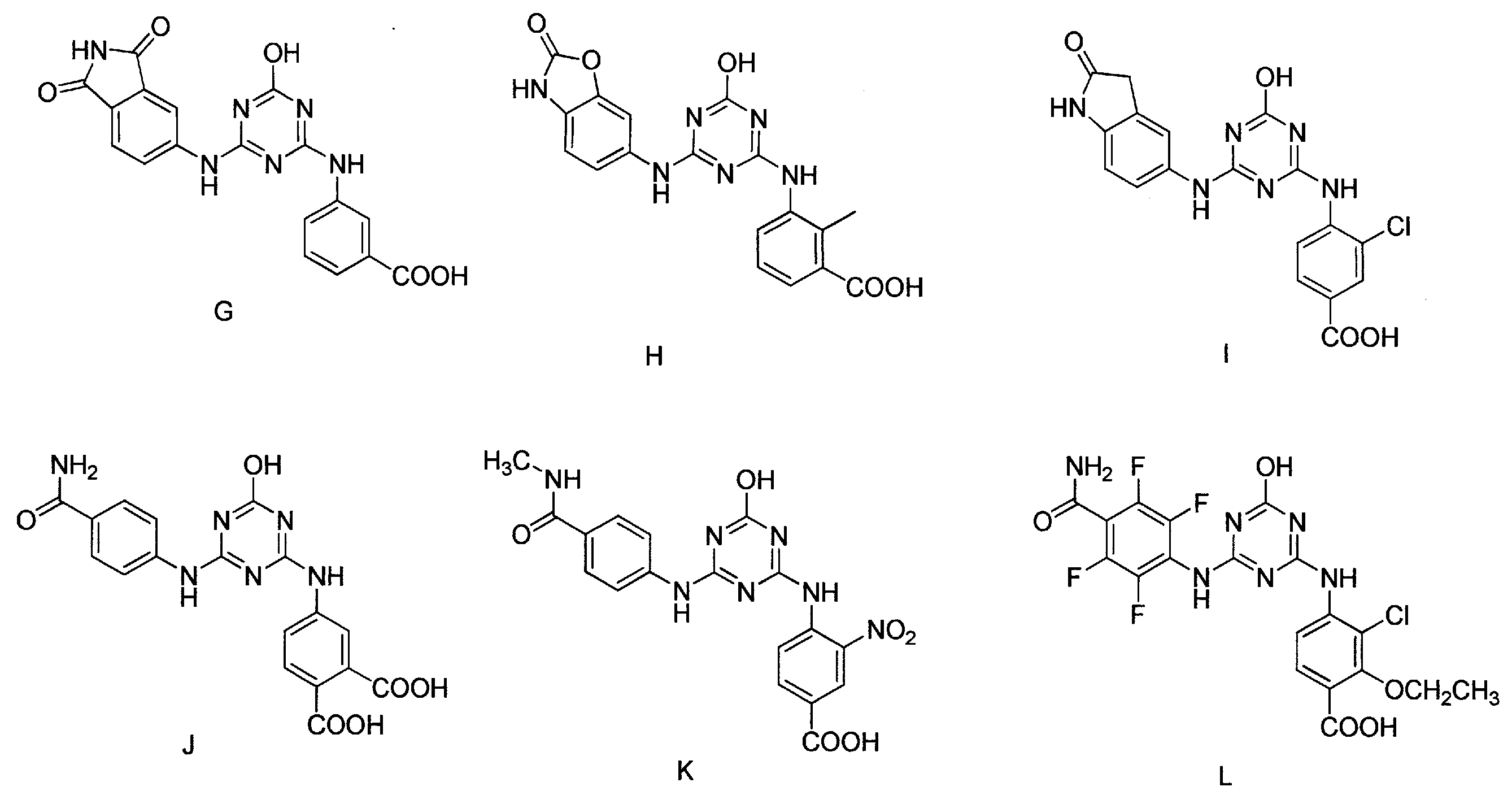
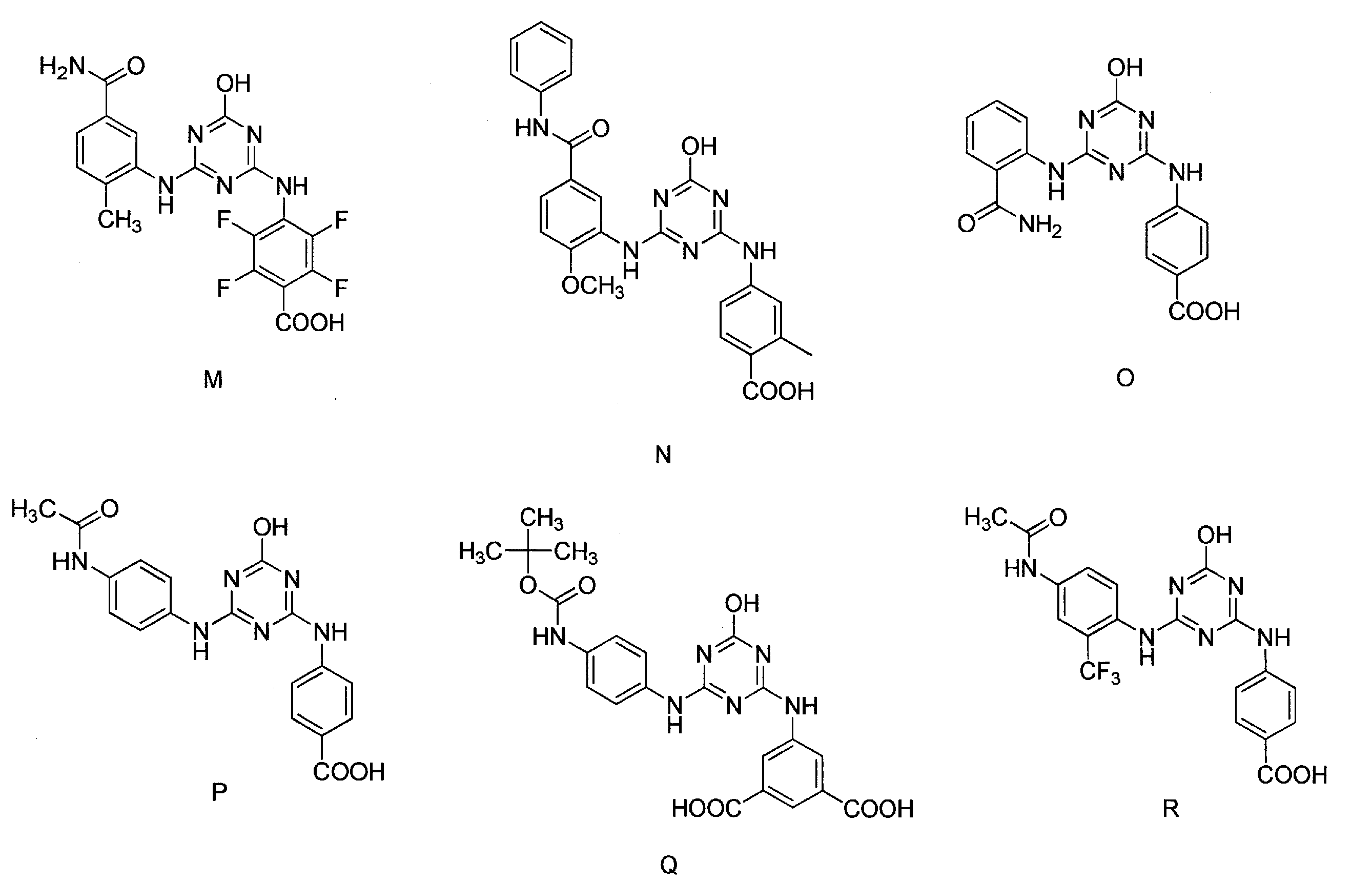

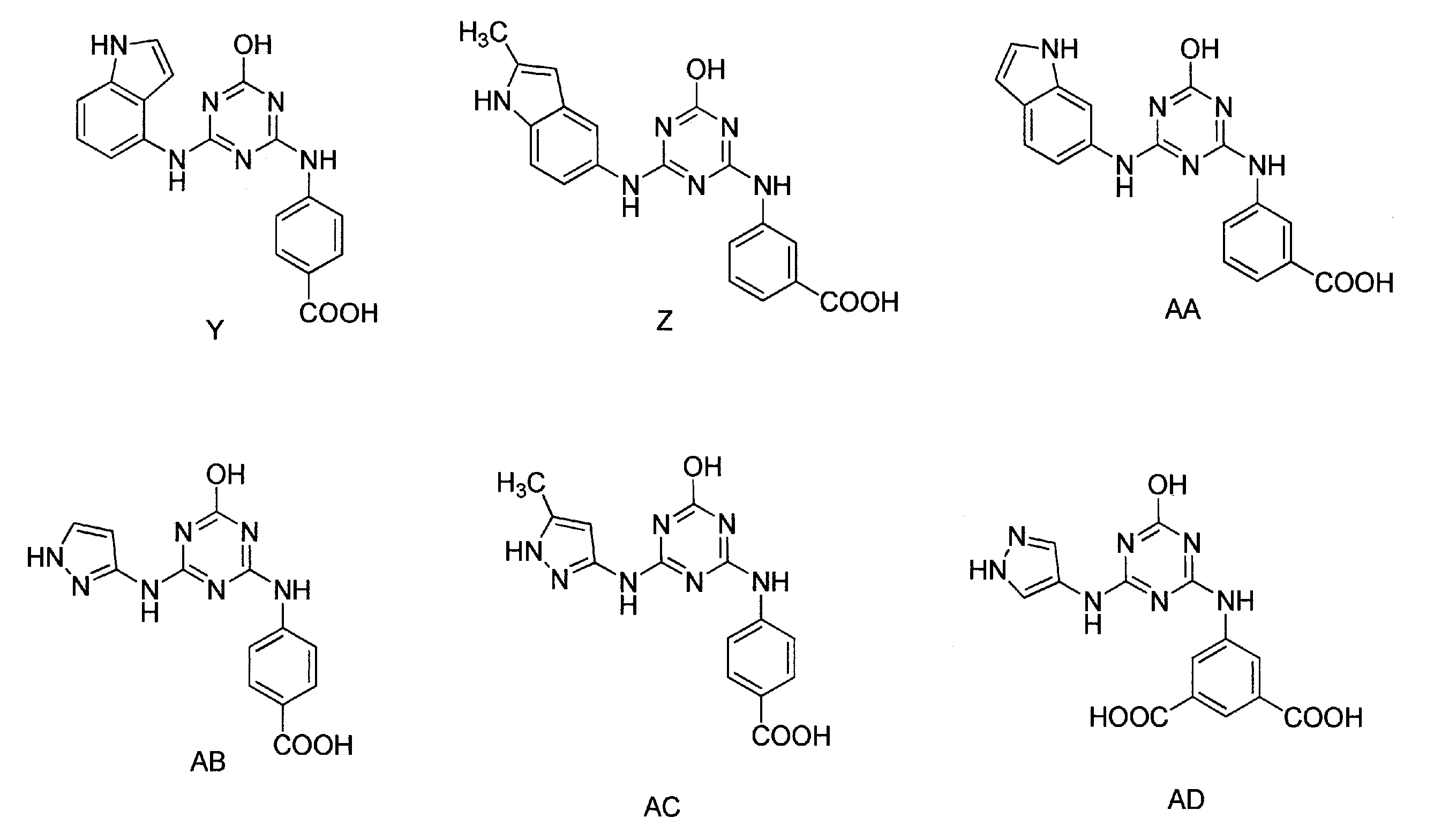
上記トリアジン誘導体A~ADの製造に使用した原料を以下に示す。
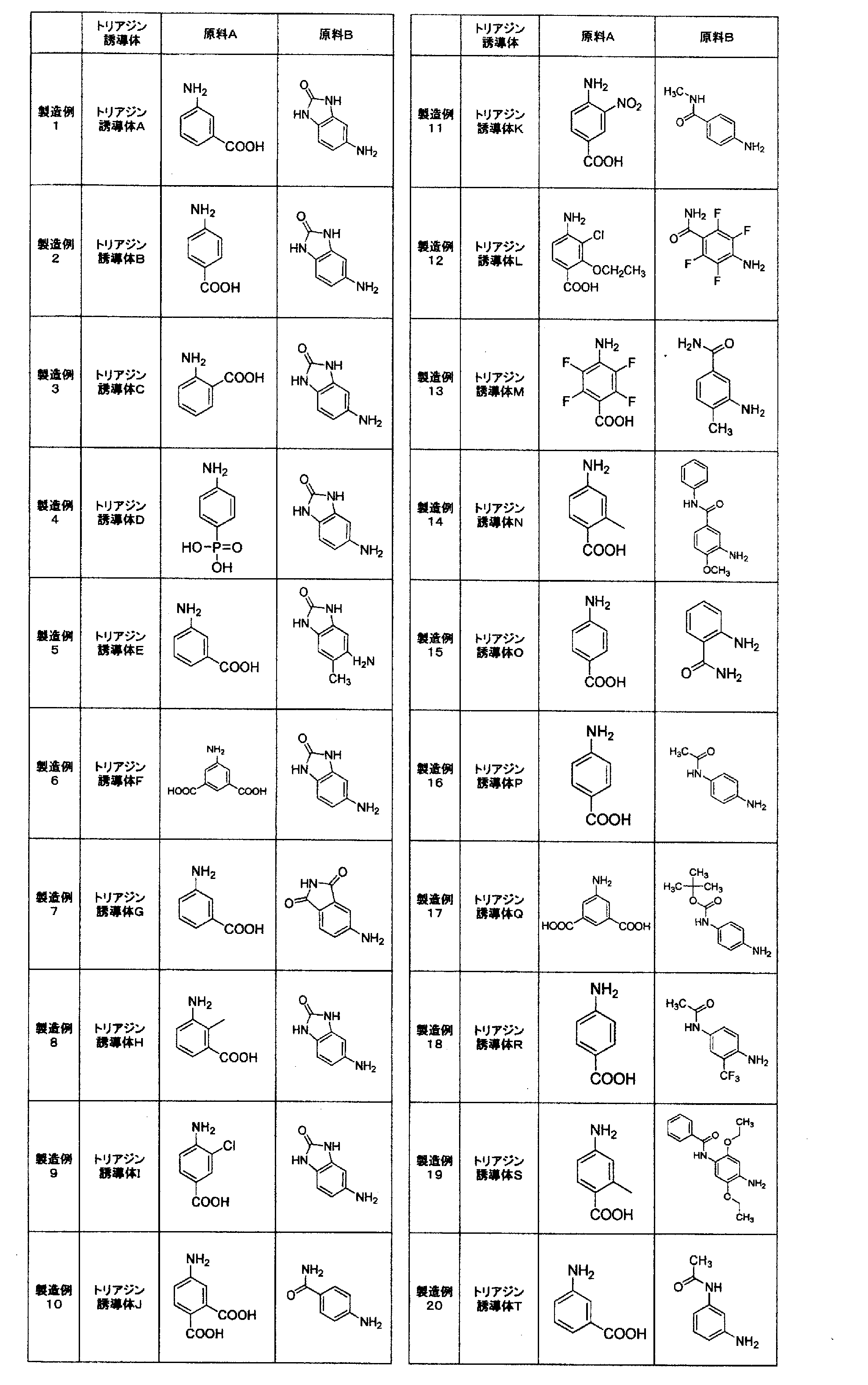
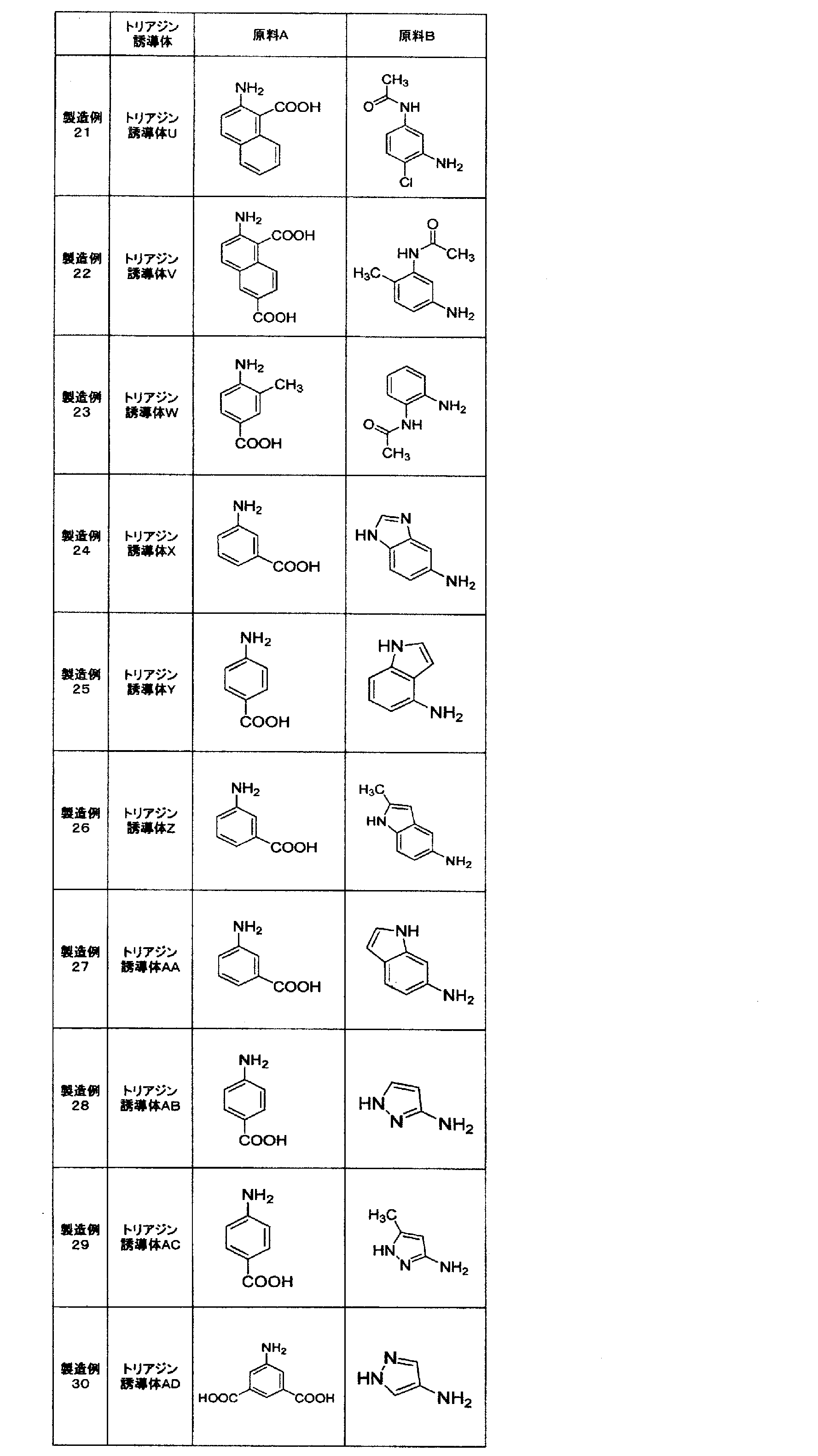
[トリアジン誘導体Aの1H-NMR測定]
トリアジン誘導体を1.0mg計量し、NMRサンプルチューブに入れた。その後、0.4mlのジメチルスルホキシド-d6(関東化学社製、99.9%D、0.03%TMS含有)を20ml入れ、溶解させた。その後、BRUKER社製ULTRA SHIELDTM 400 PLUSを使用し、1H-NMRを測定した。図1にそのチャートを示した。
トリアジン誘導体を1.0mg計量し、NMRサンプルチューブに入れた。その後、0.4mlのジメチルスルホキシド-d6(関東化学社製、99.9%D、0.03%TMS含有)を20ml入れ、溶解させた。その後、BRUKER社製ULTRA SHIELDTM 400 PLUSを使用し、1H-NMRを測定した。図1にそのチャートを示した。
以下、比較例で使用するトリアジン誘導体BA~BDの構造を示す。比較例に用いるトリアジン誘導体BA~BDの製造方法としては、特に限定されるものではなく、周知の方法を適用することができる。例えば、特開2004-217842号公報等に記載されている方法を適用することができる。上記公報による開示を参照することにより、本明細書の一部に組み込むものとする。

後述する実施例及び比較例で示す炭素材料分散液、炭素材料分散ワニス、及び合剤ペーストは、以下に示す材料を用いて作製した。
<炭素材料>
デンカブラックHS100(デンカ社製):アセチレンブラック、電子顕微鏡で観察して求めた平均一次粒子径が48nm、窒素吸着量からS-BET式で求めた比表面積が39m2/g、以下「HS100」と略記する。
super-P(TIMCAL社製):ファーネスブラック、電子顕微鏡で観察して求めた平均一次粒子径が40nm、窒素吸着量からS-BET式で求めた比表面積が62m2/g。
モナーク800(キャボット社製):ファーネスブラック、電子顕微鏡で観察して求めた平均一次粒子径が17nm、窒素吸着量からS-BET式で求めた比表面積が210m2/g、以下「M800」と略記する。
EC-300J(ライオン・スペシャリティ・ケミカルズ社製):ケッチェンブラック、電子顕微鏡で観察して求めた平均一次粒子径が40nm、窒素吸着量からS-BET式で求めた比表面積が800m2/g。
カーボンナノチューブ:多層カーボンナノチューブ(Cnano社製、Flotube7010)、繊維径7~11μm、以下「FT7010」と略記する。
VGCF(昭和電工社製):カーボンナノファイバー、電子顕微鏡で観察して求めた繊維径150nm、繊維長10~20μm。
デンカブラックHS100(デンカ社製):アセチレンブラック、電子顕微鏡で観察して求めた平均一次粒子径が48nm、窒素吸着量からS-BET式で求めた比表面積が39m2/g、以下「HS100」と略記する。
super-P(TIMCAL社製):ファーネスブラック、電子顕微鏡で観察して求めた平均一次粒子径が40nm、窒素吸着量からS-BET式で求めた比表面積が62m2/g。
モナーク800(キャボット社製):ファーネスブラック、電子顕微鏡で観察して求めた平均一次粒子径が17nm、窒素吸着量からS-BET式で求めた比表面積が210m2/g、以下「M800」と略記する。
EC-300J(ライオン・スペシャリティ・ケミカルズ社製):ケッチェンブラック、電子顕微鏡で観察して求めた平均一次粒子径が40nm、窒素吸着量からS-BET式で求めた比表面積が800m2/g。
カーボンナノチューブ:多層カーボンナノチューブ(Cnano社製、Flotube7010)、繊維径7~11μm、以下「FT7010」と略記する。
VGCF(昭和電工社製):カーボンナノファイバー、電子顕微鏡で観察して求めた繊維径150nm、繊維長10~20μm。
<バインダー>
Solef#5130(Solvey社製):、ポリフッ化ビニリデン(PVDF)、以下PVDFと略記する。
Solef#5130(Solvey社製):、ポリフッ化ビニリデン(PVDF)、以下PVDFと略記する。
<ポリマー分散剤>
PVA-103(クラレ社製):ポリビニルアルコール、けん化度98.0~99.0mol%、平均重合度300
PVA-403(クラレ社製):ポリビニルアルコール、けん化度78.5~81.5mol%、平均重合度300
KL-506(クラレ社製):アニオン変性ポリビニルアルコール、けん化度74.0~80.0mol%、重合度600
ゴーセネックスL-3266(日本合成化学社製):スルホン酸変性ポリビニルアルコール、けん化度86.5~89.0mol%(以下、L-3266と略記する)
ゴーセネックスK-434(日本合成化学社製):カチオン変性ポリビニルアルコール、けん化度85.5~88.0mol%(以下、K-434と略記する)
ポリビニルブチラールA: ポリビニルブチラール、ブチラール化度15mol%、水酸基量84mol%、酢酸基1mol%、重合度300(以下、PVB-Aと略記する)
メトローズSM-15(信越化学社製):メチルセルロース、置換度1.8、20℃における2%水溶液の粘度約15mPa・s、(以下、SM-15と略記する)
エトセル‐10(ダウケミカル社製):エチルセルロース、25℃における5%トルエン/エタノール(8/2)溶液の粘度 9.0~11.0mPa・s
PVP(日本触媒社製):ポリビニルピロリドンK30 K値27.0~33.0
PVA-103(クラレ社製):ポリビニルアルコール、けん化度98.0~99.0mol%、平均重合度300
PVA-403(クラレ社製):ポリビニルアルコール、けん化度78.5~81.5mol%、平均重合度300
KL-506(クラレ社製):アニオン変性ポリビニルアルコール、けん化度74.0~80.0mol%、重合度600
ゴーセネックスL-3266(日本合成化学社製):スルホン酸変性ポリビニルアルコール、けん化度86.5~89.0mol%(以下、L-3266と略記する)
ゴーセネックスK-434(日本合成化学社製):カチオン変性ポリビニルアルコール、けん化度85.5~88.0mol%(以下、K-434と略記する)
ポリビニルブチラールA: ポリビニルブチラール、ブチラール化度15mol%、水酸基量84mol%、酢酸基1mol%、重合度300(以下、PVB-Aと略記する)
メトローズSM-15(信越化学社製):メチルセルロース、置換度1.8、20℃における2%水溶液の粘度約15mPa・s、(以下、SM-15と略記する)
エトセル‐10(ダウケミカル社製):エチルセルロース、25℃における5%トルエン/エタノール(8/2)溶液の粘度 9.0~11.0mPa・s
PVP(日本触媒社製):ポリビニルピロリドンK30 K値27.0~33.0
PVB-A:以下の合成例に従って得たポリマー分散剤
(合成例)
PVA-103の10%水溶液を調製し、水溶液100質量部に対し、塩酸0.2質量部、ブチルアルデヒド2質量部を撹拌しながら滴下した。続いて80℃に昇温して1時間保持した後に放冷した。これを乾燥、粉砕してアセタール化度15mol%のPVB-Aを得た。
(合成例)
PVA-103の10%水溶液を調製し、水溶液100質量部に対し、塩酸0.2質量部、ブチルアルデヒド2質量部を撹拌しながら滴下した。続いて80℃に昇温して1時間保持した後に放冷した。これを乾燥、粉砕してアセタール化度15mol%のPVB-Aを得た。
また、後述する実施例及び比較例で示す各種特性の評価は以下のようにして実施した。
<炭素材料の分散液の粘度測定>
炭素材料の分散液の粘度は、炭素材料の分散液を25℃の恒温槽に1時間以上静置した後、分散液を十分に撹拌してから、粘度計(TOKISANGYO CO.LTD、VISCOMETER、MODEL BL)を用いて、撹拌速度60rpmで測定した。
炭素材料の分散液の粘度は、炭素材料の分散液を25℃の恒温槽に1時間以上静置した後、分散液を十分に撹拌してから、粘度計(TOKISANGYO CO.LTD、VISCOMETER、MODEL BL)を用いて、撹拌速度60rpmで測定した。
<電極膜の体積抵抗率>
正極用合剤ペーストを、アプリケーターを用いて、電極の単位当たりの目付量が20mg/cm2となるようにアルミ箔上に塗工した後、電気オーブン中で120℃±5℃で25分間、塗膜を乾燥させた。その後、(株)三菱化学アナリテック社製:ロレスターGP、MCP-T610を用いて乾燥後の塗膜の表面抵抗率(Ω/□)を測定した。測定後、アルミ箔上に形成した電極合剤層の厚みを掛けて、電極膜の体積抵抗率(Ω・cm)とした。電極合剤層の厚みは、膜厚計(NIKON社製、DIGIMICRO MH-15M)を用いて、電極膜中の3点を測定した平均値から、アルミ箔の膜厚を引き算し、電極膜の体積抵抗率(Ω・cm)とした。
正極用合剤ペーストを、アプリケーターを用いて、電極の単位当たりの目付量が20mg/cm2となるようにアルミ箔上に塗工した後、電気オーブン中で120℃±5℃で25分間、塗膜を乾燥させた。その後、(株)三菱化学アナリテック社製:ロレスターGP、MCP-T610を用いて乾燥後の塗膜の表面抵抗率(Ω/□)を測定した。測定後、アルミ箔上に形成した電極合剤層の厚みを掛けて、電極膜の体積抵抗率(Ω・cm)とした。電極合剤層の厚みは、膜厚計(NIKON社製、DIGIMICRO MH-15M)を用いて、電極膜中の3点を測定した平均値から、アルミ箔の膜厚を引き算し、電極膜の体積抵抗率(Ω・cm)とした。
負極用合剤ペーストの場合は、基材として銅箔を用い、目付量が10mg/cm2となるように変更した以外は、正極用合剤ペーストと同様に評価した。
<リチウムイオン二次電池のレート特性>
ラミネート型リチウム二次電池を25℃の恒温室内に設置し、充放電装置(北斗電工社製、SM-8)を用いて充放電測定を行った。充電電流12mA(0.2C)にて充電終止電圧4.3Vで定電流定電圧充電(カットオフ電流0.6mA)を行った後、放電電流12mAにて、放電終止電圧3Vで定電流放電を行った。この操作を3回繰り返した後、充電電流12mA(0.2C)にて充電終止電圧4.3Vで定電流定電圧充電(カットオフ電流0.6mA)を行い、放電電流12mA(0.2C)及び120mA(2C)で放電終止電圧3.0Vに達するまで定電流放電を行って、それぞれ放電容量を求めた。レート特性は0.2C放電容量と2C放電容量の比であり、以下の式1で表すことができる。
ラミネート型リチウム二次電池を25℃の恒温室内に設置し、充放電装置(北斗電工社製、SM-8)を用いて充放電測定を行った。充電電流12mA(0.2C)にて充電終止電圧4.3Vで定電流定電圧充電(カットオフ電流0.6mA)を行った後、放電電流12mAにて、放電終止電圧3Vで定電流放電を行った。この操作を3回繰り返した後、充電電流12mA(0.2C)にて充電終止電圧4.3Vで定電流定電圧充電(カットオフ電流0.6mA)を行い、放電電流12mA(0.2C)及び120mA(2C)で放電終止電圧3.0Vに達するまで定電流放電を行って、それぞれ放電容量を求めた。レート特性は0.2C放電容量と2C放電容量の比であり、以下の式1で表すことができる。
(式1) レート特性 = 2C放電容量/0.2C放電容量 ×100 (%)
<リチウムイオン二次電池の高温保存特性>
ラミネート型リチウムイオン二次電池を25℃の恒温室内に設置し、充放電装置(北斗電工社製、SM-8)を用いて充放電測定を行った。充電電流12mA(0.2C)にて充電終止電圧4.3Vで定電流定電圧充電(カットオフ電流0.6mA)を行った後、放電電流12mA(0.2C)にて、放電終止電圧3Vで定電流放電を行った。この操作を3回繰り返して、3回目の放電容量を25℃における0.2C放電容量とした。その後、充電電流12mA(0.2C)にて充電終止電圧4.3Vで定電流定電圧充電(カットオフ電流0.6mA)を行い、55℃に設定した恒温室内に7日間保存した。最後に、放電電流12mA(0.2C)にて放電終止電圧3Vで定電流放電を行って、放電容量を求めた。高温保存特性は、25℃における0.2C放電容量と55℃7日保存後の0.2C放電容量の比であり、以下の式2で表すことができる。
ラミネート型リチウムイオン二次電池を25℃の恒温室内に設置し、充放電装置(北斗電工社製、SM-8)を用いて充放電測定を行った。充電電流12mA(0.2C)にて充電終止電圧4.3Vで定電流定電圧充電(カットオフ電流0.6mA)を行った後、放電電流12mA(0.2C)にて、放電終止電圧3Vで定電流放電を行った。この操作を3回繰り返して、3回目の放電容量を25℃における0.2C放電容量とした。その後、充電電流12mA(0.2C)にて充電終止電圧4.3Vで定電流定電圧充電(カットオフ電流0.6mA)を行い、55℃に設定した恒温室内に7日間保存した。最後に、放電電流12mA(0.2C)にて放電終止電圧3Vで定電流放電を行って、放電容量を求めた。高温保存特性は、25℃における0.2C放電容量と55℃7日保存後の0.2C放電容量の比であり、以下の式2で表すことができる。
(式2) 高温保存特性 = 55℃7日保存後の0.2C放電容量 /25℃における0.2C放電容量 ×100 (%)
また、後述の実施例及び比較例において使用した標準電極用合剤ペースト及び電極は、以下の方法に従って作製した。
<標準負極用合剤ペーストの作製>
負極活物質として人造黒鉛(日本黒鉛社製、CGB-20)49質量部、2質量%のカルボキシメチルセルロース(ダイセル化学工業社製、#1190)を溶解した水溶液を調製した。この水溶液25質量部(固形分として0.5質量部)をプラネタリーミキサーに入れて混練した後、イオン交換水22質量部、スチレンブタジエンエマルション(JSR株式会社製、TRD2001)1質量部(固形分として0.5質量部)を加えて混合して、標準負極用合剤インキ(ペースト)を得た。
負極活物質として人造黒鉛(日本黒鉛社製、CGB-20)49質量部、2質量%のカルボキシメチルセルロース(ダイセル化学工業社製、#1190)を溶解した水溶液を調製した。この水溶液25質量部(固形分として0.5質量部)をプラネタリーミキサーに入れて混練した後、イオン交換水22質量部、スチレンブタジエンエマルション(JSR株式会社製、TRD2001)1質量部(固形分として0.5質量部)を加えて混合して、標準負極用合剤インキ(ペースト)を得た。
<標準負極の作製>
上述の負極用合剤インキを集電体となる厚さ20μmの銅箔上にアプリケーターを用いて塗工した。その後、電気オーブン中で120℃±5℃で25分間乾燥することによって、電極の単位面積当たりの目付量が12mg/cm2となるように調整した。さらに、ロールプレス(株式会社サンクメタル社製、3t油圧式ロールプレス)による圧延処理を行い、合剤層の密度が1.5g/cm3となる負極を作製した。
上述の負極用合剤インキを集電体となる厚さ20μmの銅箔上にアプリケーターを用いて塗工した。その後、電気オーブン中で120℃±5℃で25分間乾燥することによって、電極の単位面積当たりの目付量が12mg/cm2となるように調整した。さらに、ロールプレス(株式会社サンクメタル社製、3t油圧式ロールプレス)による圧延処理を行い、合剤層の密度が1.5g/cm3となる負極を作製した。
<標準正極用合剤ペーストの作製>
正極活物質(BASF戸田バッテリーマテリアルズ合同会社製、HED(登録商標)NCM-111 1100)93質量部、アセチレンブラック(デンカ株式会社製、デンカブラック(登録商標)HS100)4質量部、PVDF(株式会社社クレハ・バッテリー・マテイラルズ・ジャパン社製、クレハKFポリマー W#1300)3質量部を、容量150cm3のプラスチック容器に加え、ヘラを用いて粉末が均一になるまで混合した。その後、NMPを20.5質量部添加し、自転・公転ミキサー(シンキー社製、あわとり練太郎、ARE-310)を用いて、2000rpmで30秒間撹拌した。その後、プラスチック容器内の混合物を、ヘラを用いて均一になるまで混合し、自転・公転ミキサー(シンキー社製、あわとり練太郎、ARE-310)を用いて、2000rpmで30秒間撹拌した。さらにその後、NMPを14.6質量部添加し、自転・公転ミキサー(シンキー社製、あわとり練太郎、ARE-310)を用いて、2000rpmで30秒間撹拌した。最後に、高速攪拌機を用いて、3000rpmで10分間撹拌し、標準正極用合剤ペーストを得た。
正極活物質(BASF戸田バッテリーマテリアルズ合同会社製、HED(登録商標)NCM-111 1100)93質量部、アセチレンブラック(デンカ株式会社製、デンカブラック(登録商標)HS100)4質量部、PVDF(株式会社社クレハ・バッテリー・マテイラルズ・ジャパン社製、クレハKFポリマー W#1300)3質量部を、容量150cm3のプラスチック容器に加え、ヘラを用いて粉末が均一になるまで混合した。その後、NMPを20.5質量部添加し、自転・公転ミキサー(シンキー社製、あわとり練太郎、ARE-310)を用いて、2000rpmで30秒間撹拌した。その後、プラスチック容器内の混合物を、ヘラを用いて均一になるまで混合し、自転・公転ミキサー(シンキー社製、あわとり練太郎、ARE-310)を用いて、2000rpmで30秒間撹拌した。さらにその後、NMPを14.6質量部添加し、自転・公転ミキサー(シンキー社製、あわとり練太郎、ARE-310)を用いて、2000rpmで30秒間撹拌した。最後に、高速攪拌機を用いて、3000rpmで10分間撹拌し、標準正極用合剤ペーストを得た。
<標準正極の作製>
上述の正極用合剤ペーストを、集電体となる厚さ20μmのアルミ箔上に、アプリケーターを用いて塗工した。その後、電気オーブン中で120℃±5℃で25分間乾燥することによって、電極の単位面積当たりの目付量が20mg/cm2となるように調整した。さらに、ロールプレス(株式会社サンクメタル社製、3t油圧式ロールプレス)による圧延処理を行い、合剤層の密度が3.1g/cm3となる正極を作製した。
上述の正極用合剤ペーストを、集電体となる厚さ20μmのアルミ箔上に、アプリケーターを用いて塗工した。その後、電気オーブン中で120℃±5℃で25分間乾燥することによって、電極の単位面積当たりの目付量が20mg/cm2となるように調整した。さらに、ロールプレス(株式会社サンクメタル社製、3t油圧式ロールプレス)による圧延処理を行い、合剤層の密度が3.1g/cm3となる正極を作製した。
<1>炭素材料の分散液の調製
(実施例1-1)
ガラス瓶(M-225、柏洋硝子株式会社製)に、FT7010を4.0部、トリアジン誘導体Aを0.4部、及び水酸化ナトリウムをトリアジン誘導体Aに対して0.5モル当量の割合で入れた。さらに、NMPを入れて、合計80部になるようにした。また、ジルコニアビーズ(ビーズ径0.5mmφ)80gを仕込み、レッドデビル社製ペイントコンディショナーを用いて6時間分散処理を行った。その後、ジルコニアビーズを分離して、炭素材料分散液(A1)を得た。
(実施例1-1)
ガラス瓶(M-225、柏洋硝子株式会社製)に、FT7010を4.0部、トリアジン誘導体Aを0.4部、及び水酸化ナトリウムをトリアジン誘導体Aに対して0.5モル当量の割合で入れた。さらに、NMPを入れて、合計80部になるようにした。また、ジルコニアビーズ(ビーズ径0.5mmφ)80gを仕込み、レッドデビル社製ペイントコンディショナーを用いて6時間分散処理を行った。その後、ジルコニアビーズを分離して、炭素材料分散液(A1)を得た。
(実施例1-2~1-64、比較例1-1~1-4)
表1に掲載したトリアジン誘導体、無機塩基又はアミンとその添加量に変更した以外は、実施例1-1と同様の方法により、炭素材料分散液(A2)~(A57)、(B1)~(B4)を得た。
表1に掲載したトリアジン誘導体、無機塩基又はアミンとその添加量に変更した以外は、実施例1-1と同様の方法により、炭素材料分散液(A2)~(A57)、(B1)~(B4)を得た。
表1に実施例1-1~1-64、比較例1-1~1-4で作製した炭素材料分散液の評価結果を示す。表1に記載した粘度の単位は、mPa・sである。


<2>合剤ペーストの調製
(実施例2-1)
容量150cm3のプラスチック容器に、PVDF(Solvey社製、Solef#5130)を8質量%溶解したNMPを10.6質量部計量した。その後、炭素材料分散液(A1)を0.5質量部添加し、自転・公転ミキサー(シンキー社製、あわとり練太郎、ARE-310)を用いて、2000rpmで30秒間撹拌した。さらに、炭素材料分散液(A1)を6.5質量部添加し、自転・公転ミキサー(シンキー社製、あわとり練太郎、ARE-310)を用いて、2000rpmで30秒間撹拌して、CNT樹脂組成物(A1)を得た。
さらに、その後、正極活物質(BASF戸田バッテリーマテリアルズ合同会社製、HED(登録商標)NCM-111 1100)を55.1質量部添加し、自転・公転ミキサー(シンキー社製、あわとり練太郎、ARE-310)を用いて、2000rpmで2.5分間撹拌した。最後に、NMP2.3質量部を添加し、自転・公転ミキサー(シンキー社製、あわとり練太郎、ARE-310)を用いて、2000rpmで2.5分間撹拌し、合剤ペースト(A1)を得た。
(実施例2-1)
容量150cm3のプラスチック容器に、PVDF(Solvey社製、Solef#5130)を8質量%溶解したNMPを10.6質量部計量した。その後、炭素材料分散液(A1)を0.5質量部添加し、自転・公転ミキサー(シンキー社製、あわとり練太郎、ARE-310)を用いて、2000rpmで30秒間撹拌した。さらに、炭素材料分散液(A1)を6.5質量部添加し、自転・公転ミキサー(シンキー社製、あわとり練太郎、ARE-310)を用いて、2000rpmで30秒間撹拌して、CNT樹脂組成物(A1)を得た。
さらに、その後、正極活物質(BASF戸田バッテリーマテリアルズ合同会社製、HED(登録商標)NCM-111 1100)を55.1質量部添加し、自転・公転ミキサー(シンキー社製、あわとり練太郎、ARE-310)を用いて、2000rpmで2.5分間撹拌した。最後に、NMP2.3質量部を添加し、自転・公転ミキサー(シンキー社製、あわとり練太郎、ARE-310)を用いて、2000rpmで2.5分間撹拌し、合剤ペースト(A1)を得た。
(実施例2-2~2-64、比較例2-1~2-4)
炭素材料分散液A1を表2に掲載した炭素材料分散液にそれぞれに変更した以外は、実施例2-1と同様の方法により、合剤ペースト(A2)~(A64)、(B1)~(B4)を得た。
炭素材料分散液A1を表2に掲載した炭素材料分散液にそれぞれに変更した以外は、実施例2-1と同様の方法により、合剤ペースト(A2)~(A64)、(B1)~(B4)を得た。
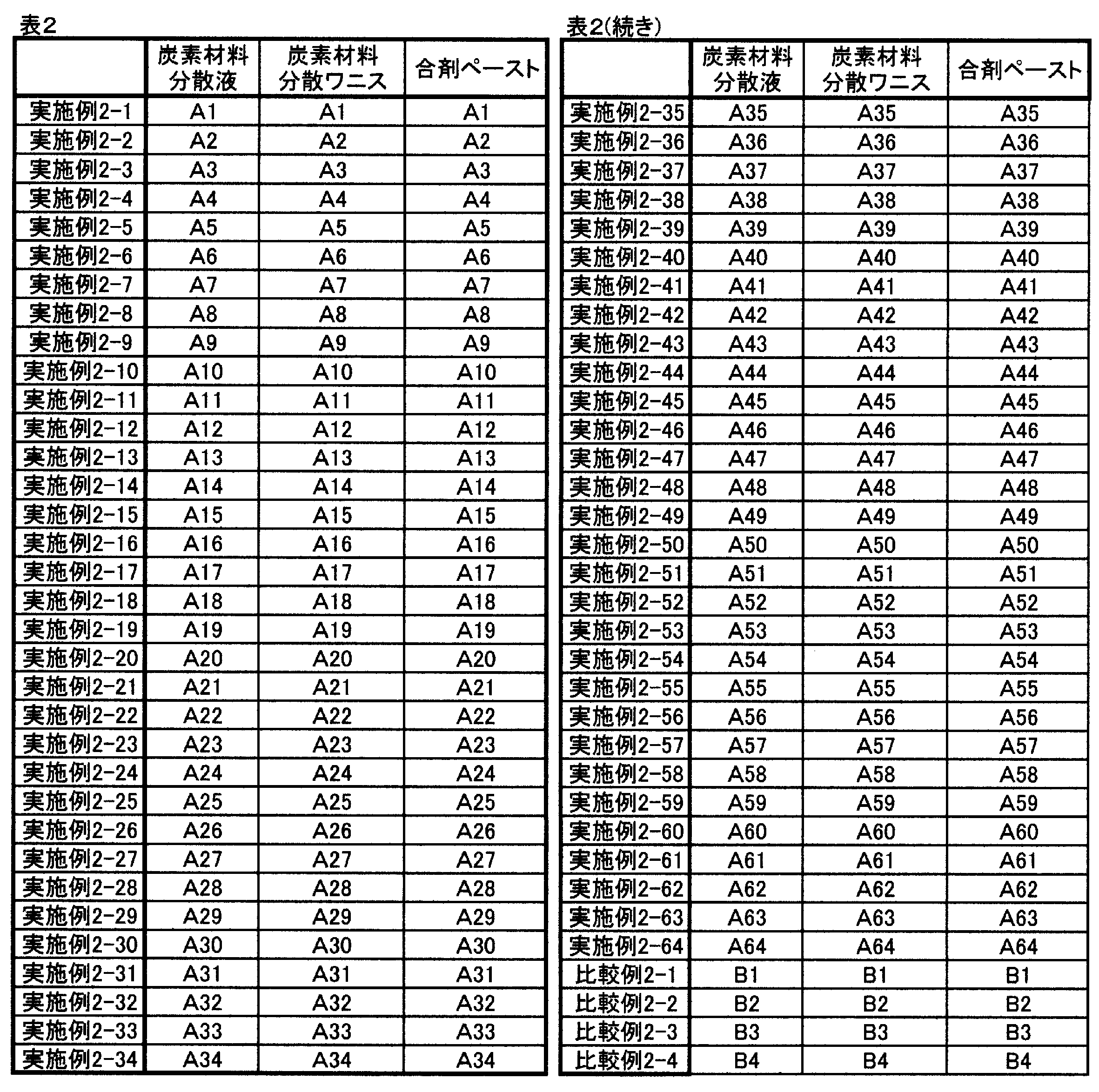
<3>電極膜の作製
(実施例3-1)
合剤ペースト(A1)を、アプリケーターを用いて、電極の単位当たりの目付量が20mg/cm2となるようにアルミ箔上に塗工した、その後、電気オーブン中で120℃±5℃で25分間、塗膜を乾燥させ、電極膜(A1)を得た。
(実施例3-1)
合剤ペースト(A1)を、アプリケーターを用いて、電極の単位当たりの目付量が20mg/cm2となるようにアルミ箔上に塗工した、その後、電気オーブン中で120℃±5℃で25分間、塗膜を乾燥させ、電極膜(A1)を得た。
(実施例3-2~3-64)
合剤ペースト(A1)を表3に掲載した合剤ペーストにそれぞれ変更した以外は、実施例3-1と同様の方法により、電極膜(A2)~(A64)、(B1)~(B4)を得た。
合剤ペースト(A1)を表3に掲載した合剤ペーストにそれぞれ変更した以外は、実施例3-1と同様の方法により、電極膜(A2)~(A64)、(B1)~(B4)を得た。
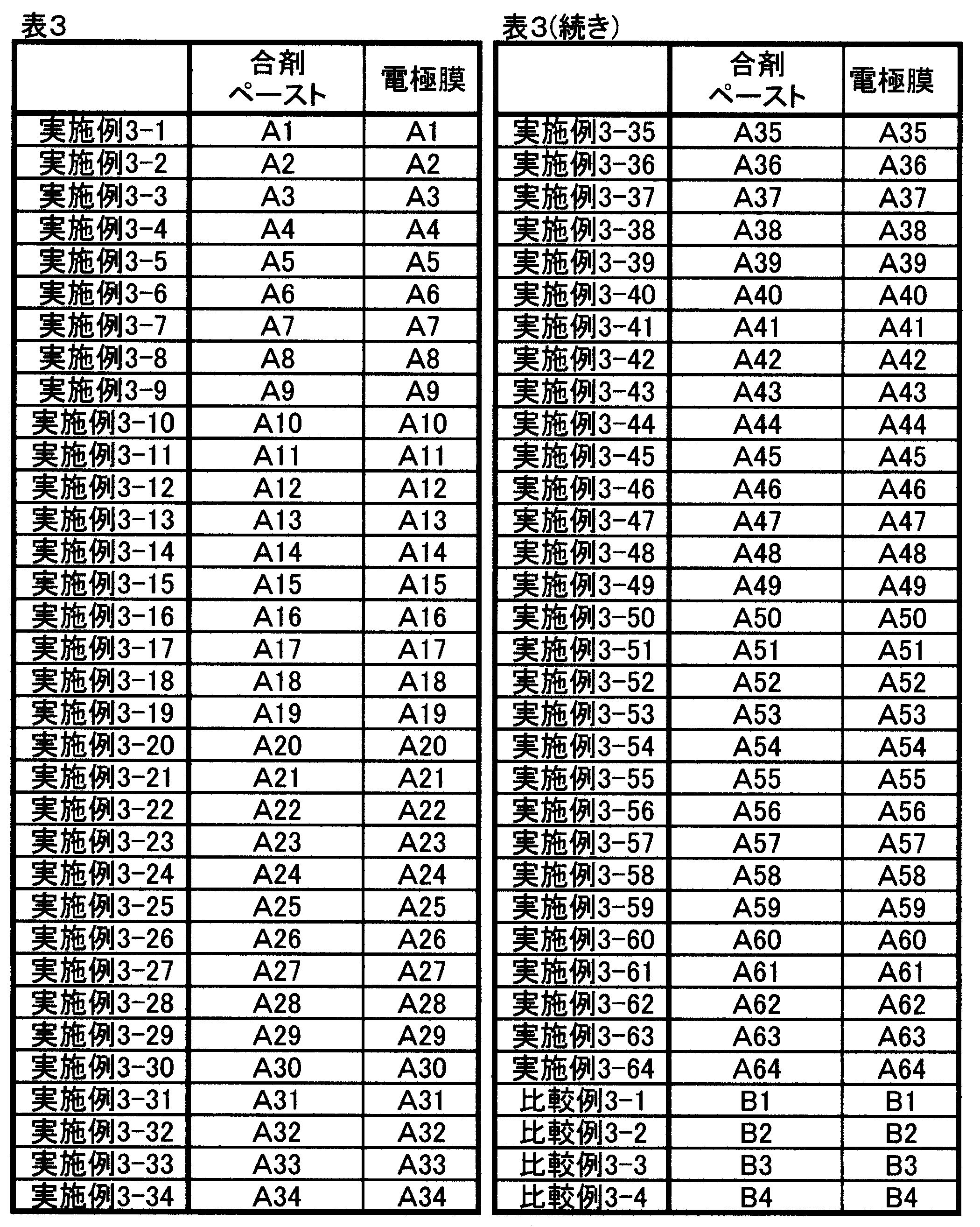
表4に実施例3-1~3-64、比較例3-1~3-4で作製した電極膜の評価結果を示す。導電性の評価は、以下の基準にしたがった。
(評価基準)
++++(最良):電極膜の体積抵抗率(Ω・cm)が5未満
+++(優良):電極膜の体積抵抗率(Ω・cm)が5以上、10未満
++(良):電極膜の体積抵抗率(Ω・cm)が10以上、20未満
+(可):電極膜の体積抵抗率(Ω・cm)が20以上、100未満
-(不可):電極膜の体積抵抗率(Ω・cm)が100以上
(評価基準)
++++(最良):電極膜の体積抵抗率(Ω・cm)が5未満
+++(優良):電極膜の体積抵抗率(Ω・cm)が5以上、10未満
++(良):電極膜の体積抵抗率(Ω・cm)が10以上、20未満
+(可):電極膜の体積抵抗率(Ω・cm)が20以上、100未満
-(不可):電極膜の体積抵抗率(Ω・cm)が100以上

<3A>正極の作製及び評価
(実施例3A-1)
電極膜(A1)をロールプレス(株式会社サンクメタル社製、3t油圧式ロールプレス)による圧延処理を行い、合剤層の密度が3.1g/cm3となる正極を作製した。
(実施例3A-1)
電極膜(A1)をロールプレス(株式会社サンクメタル社製、3t油圧式ロールプレス)による圧延処理を行い、合剤層の密度が3.1g/cm3となる正極を作製した。
(実施例3A-2~3A-64、比較例3A-1~3A-4)
電極膜(A1)を表5に掲載した電極膜にそれぞれ変更した以外は、実施例3A-1と同様の方法にて、正極を作製した。
電極膜(A1)を表5に掲載した電極膜にそれぞれ変更した以外は、実施例3A-1と同様の方法にて、正極を作製した。

(実施例4-1)
正極(A1)と標準負極を各々45mm×40mm、50mm×45mmに打ち抜いた。これらと、その間に挿入されるセパレーター(多孔質ポリプロプレンフィルム)とをアルミ製ラミネート袋に挿入し、電気オーブン中、60℃で1時間乾燥した。その後、アルゴンガスで満たされたグローブボックス内で、電解液(エチレンカーボネートとジメチルカーボネートとジエチルカーボネートを1:1:1(体積比)の割合で混合した混合溶媒に、LiPF6を1Mの濃度で溶解させた非水電解液)を2mL注入した後、アルミ製ラミネートを封口してラミネート型リチウムイオン二次電池(A1)を作製した。
正極(A1)と標準負極を各々45mm×40mm、50mm×45mmに打ち抜いた。これらと、その間に挿入されるセパレーター(多孔質ポリプロプレンフィルム)とをアルミ製ラミネート袋に挿入し、電気オーブン中、60℃で1時間乾燥した。その後、アルゴンガスで満たされたグローブボックス内で、電解液(エチレンカーボネートとジメチルカーボネートとジエチルカーボネートを1:1:1(体積比)の割合で混合した混合溶媒に、LiPF6を1Mの濃度で溶解させた非水電解液)を2mL注入した後、アルミ製ラミネートを封口してラミネート型リチウムイオン二次電池(A1)を作製した。
(実施例4-2~4-64、比較例4-1~4-4)
正極(A1)を表6に掲載された正極にそれぞれ変更した以外は、実施例4-1と同様の方法により、ラミネート型リチウムイオン二次電池(A2)~(A64)、(B1)~(B4)を作製した。
正極(A1)を表6に掲載された正極にそれぞれ変更した以外は、実施例4-1と同様の方法により、ラミネート型リチウムイオン二次電池(A2)~(A64)、(B1)~(B4)を作製した。


表7に実施例4-1~4-64、比較例4-1~4-4で作製したラミネート型リチウム二次電池の評価結果を示す。各特性の評価基準は以下のとおりである。
(レート特性)
+++(優良):レート特性が80%以上
++(良):レート特性が70%以上、80%未満
+(可):レート特性が60%以上、70%未満
-(不可):レート特性が60%未満
(高温保存特性)
+++(優良):高温保存特性が80%以上
++(良):高温保存特性が70%以上80%未満
+(可):高温保存特性が60%以上70%未満
-(不可):高温保存特性が60%未満
(レート特性)
+++(優良):レート特性が80%以上
++(良):レート特性が70%以上、80%未満
+(可):レート特性が60%以上、70%未満
-(不可):レート特性が60%未満
(高温保存特性)
+++(優良):高温保存特性が80%以上
++(良):高温保存特性が70%以上80%未満
+(可):高温保存特性が60%以上70%未満
-(不可):高温保存特性が60%未満

表8に実施例1-1~1-64及び比較例1-1~1-4で用いた炭素材料分散液を使用して作製したラミネートリチウムイオン二次電池の評価結果を示す。
総合評価は、ラミネート型リチウムイオン二次電池のレート特性及び高温保存特性の評価における“+”の数の和に基づき、以下の基準に従って5段階で評価した。
5(最良):“+”の数の和が6個以上
4(優良):“+”の数の和が5個
3(良):“+”の数の和が4個
2(可):“+”の数の和が3個
1(不可):評価に“-”を含む場合
総合評価は、ラミネート型リチウムイオン二次電池のレート特性及び高温保存特性の評価における“+”の数の和に基づき、以下の基準に従って5段階で評価した。
5(最良):“+”の数の和が6個以上
4(優良):“+”の数の和が5個
3(良):“+”の数の和が4個
2(可):“+”の数の和が3個
1(不可):評価に“-”を含む場合
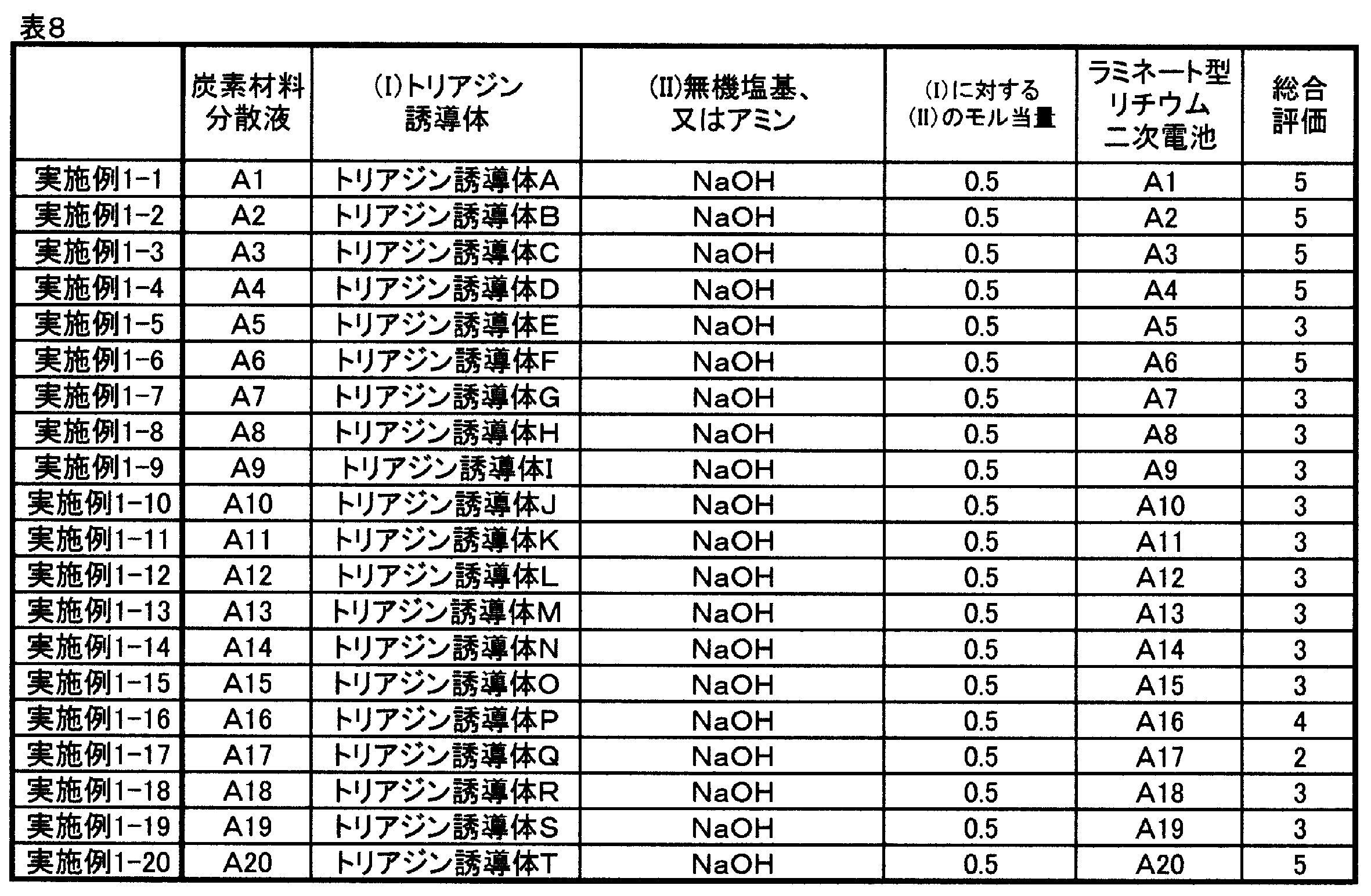

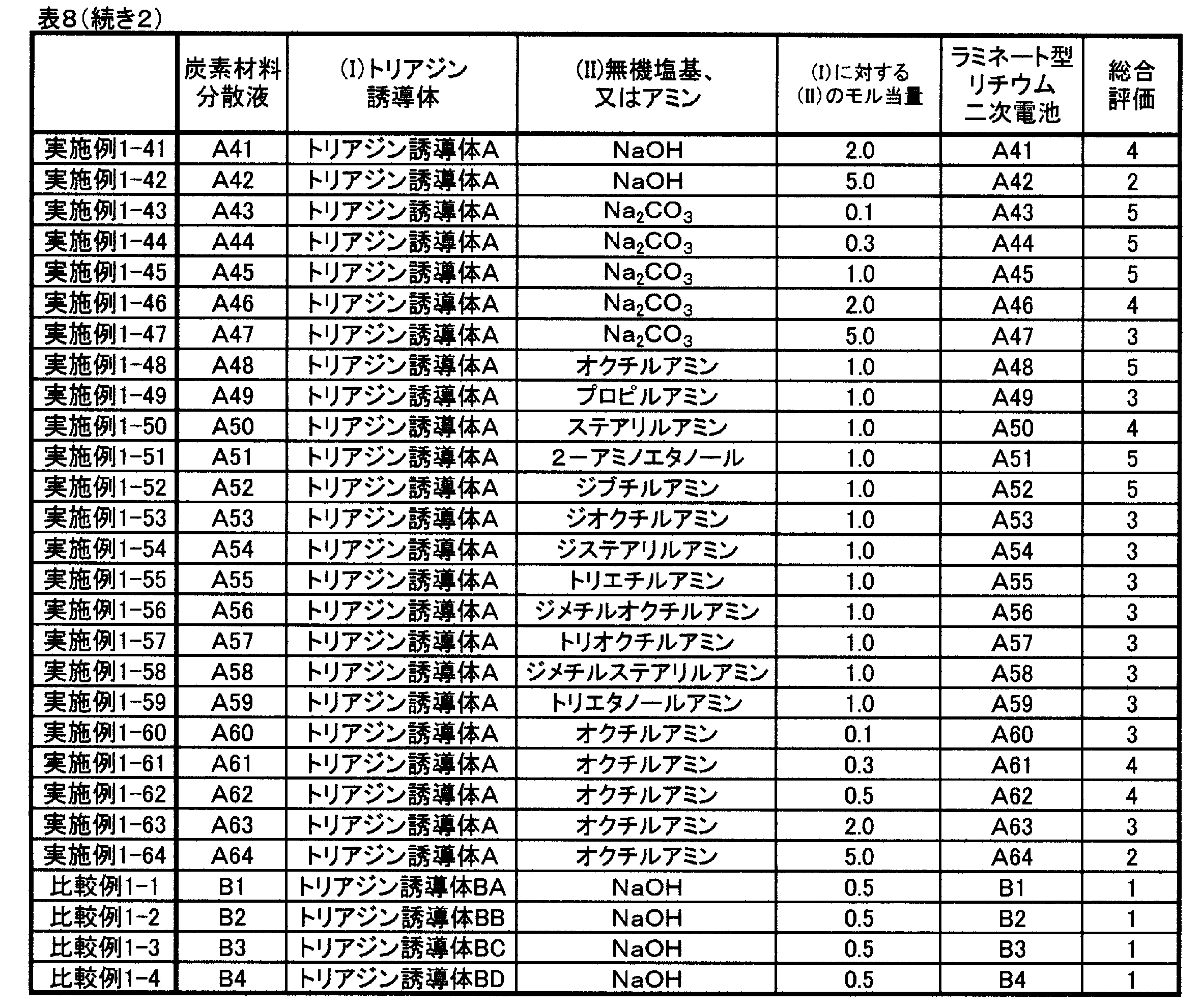
表8から分かる通り、トリアジン誘導体A~ADを用いた実施例4-1~4-64のラミネート型リチウム2次電池は、トリアジン誘導体BA~BDを用いた比較例2-1~2-4のラミネート型リチウム2次電池と比べて非常に優れていた。よって、本発明は従来の分散剤ではなし得ない優れた特性を有するリチウム二次電池を提供できることが明らかとなった。
<炭素材料種の検討>
(実施例5-1~5-5、比較例5-1~5-5)
表9に示した炭素材料分散液、表10に示した炭素材料分散ワニス、表11に示した正極合剤ペーストの材料と組成に従い、実施例1-1と同様にして炭素材料分散液、炭素材料分散ワニス、合剤ペースト、電極、正極をそれぞれ作製し、ラミネート型リチウム2次電池を組み立て、レート特性、高温特性の評価を行った。分散剤の量は、それぞれの炭素材料に合わせて適宜使用量を決定した。
(実施例5-1~5-5、比較例5-1~5-5)
表9に示した炭素材料分散液、表10に示した炭素材料分散ワニス、表11に示した正極合剤ペーストの材料と組成に従い、実施例1-1と同様にして炭素材料分散液、炭素材料分散ワニス、合剤ペースト、電極、正極をそれぞれ作製し、ラミネート型リチウム2次電池を組み立て、レート特性、高温特性の評価を行った。分散剤の量は、それぞれの炭素材料に合わせて適宜使用量を決定した。


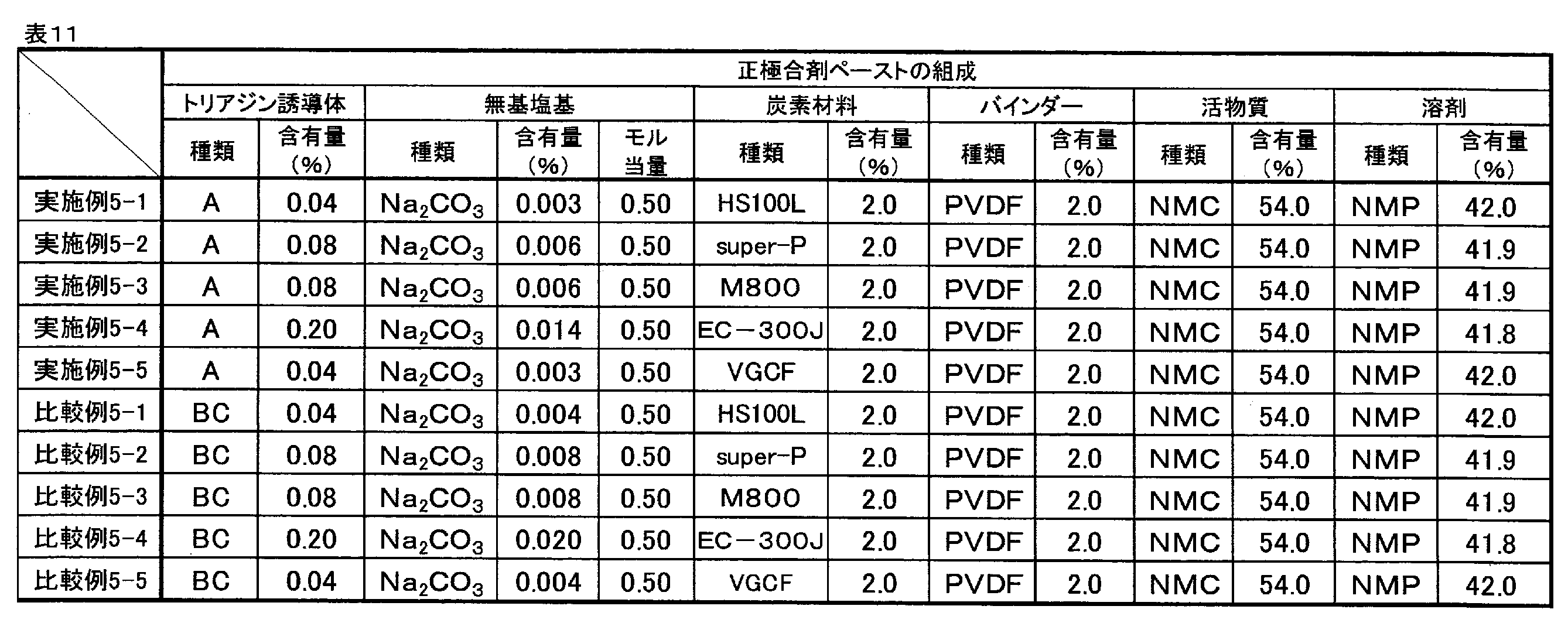
実施例5-1~5-5、比較例5-1~5-5におけるレート特性、及び高温保存特性の評価結果を表12に示す。
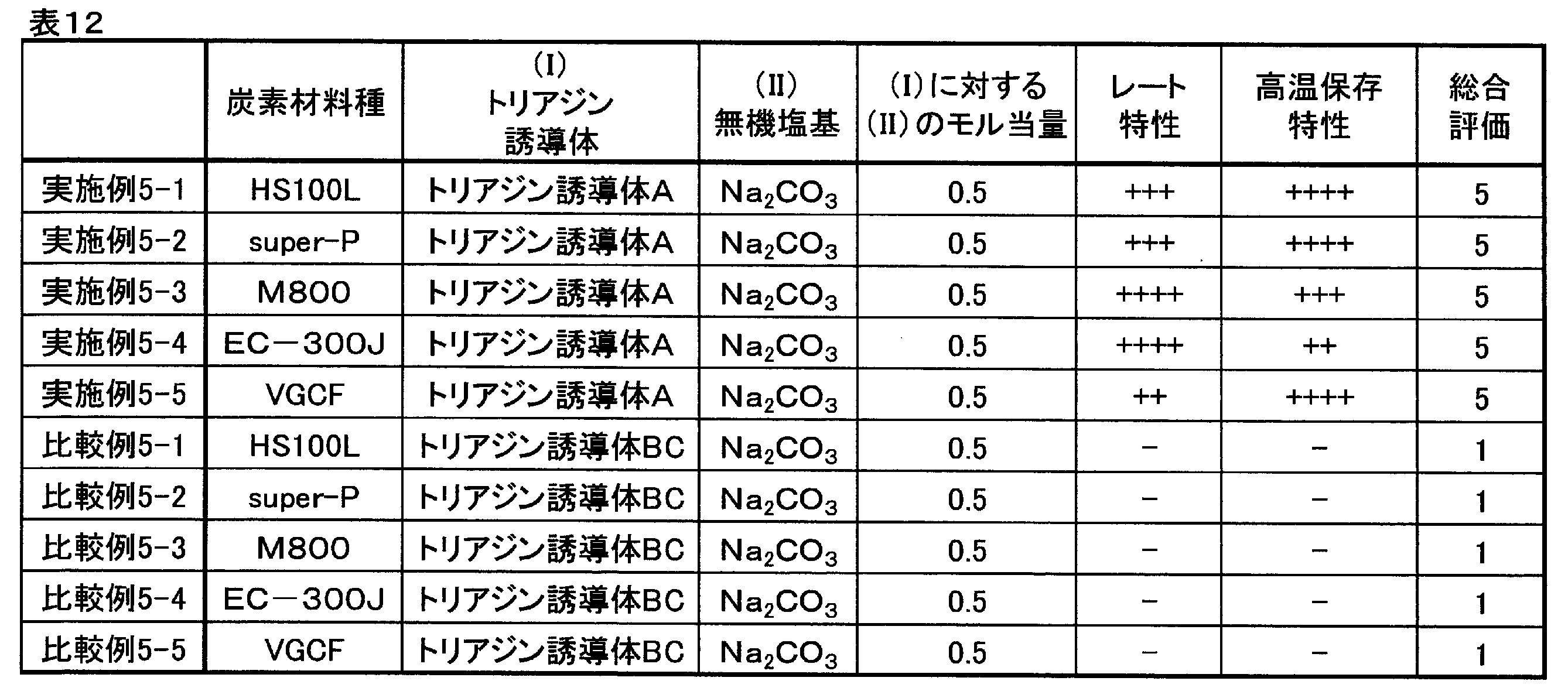
いずれの炭素材料であっても同様の優れたレート特性、高温保存特性が確認できた。実施例5-1~5-5のレート特性、高温保存特性の差異は、炭素材料による差異であると考えられる。
以上の検証から、先に述べた効果は炭素材料種によらないことが確認できた。
<水系分散体の調製>
(実施例6-1~6-4、比較例6-1)
表13に示した炭素材料の分散液の材料と組成に従い、実施例1-1と同様にして、炭素材料の分散液を調製し、粘度の測定を行った。
(実施例6-1~6-4、比較例6-1)
表13に示した炭素材料の分散液の材料と組成に従い、実施例1-1と同様にして、炭素材料の分散液を調製し、粘度の測定を行った。

実施例6-1~6-4、比較例6-1で得た分散液の粘度評価の結果を表14に示す。
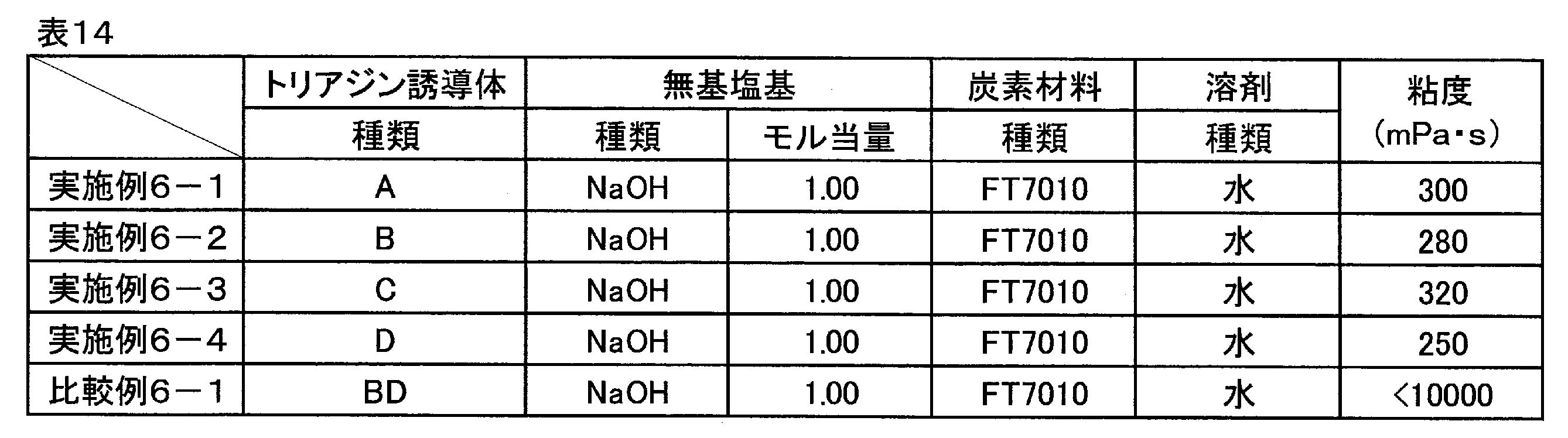
表14から分かる通り、トリアジン誘導体A~Dを用いた実施例6-1~6-4の炭素材料分散液は、比較例6-1と比較して粘度が非常に低く、優れていることが分かる。さらに、本発明の他のトリアジン誘導体を用いても同様の傾向であることが確認できた。
このことから、溶剤を水とした場合でも同様の効果が得られることが確認できた。
<トリアジン誘導体含有分散剤とポリマー分散剤との併用>
(実施例7-1~7-11、比較例7-1)
表15に示した炭素材料分散液の材料と組成に従い、実施例1-1で用いたトリアジン誘導体Aの半量をポリマー分散剤に置き換えた以外は、同様にして、炭素材料分散液、炭素材料分散ワニス、合剤ペースト、電極、正極をそれぞれ作製し、ラミネート型リチウム2次電池を組み立て、レート特性、高温保存特性の評価を行った。評価基準は先に記載したとおりである。
(実施例7-1~7-11、比較例7-1)
表15に示した炭素材料分散液の材料と組成に従い、実施例1-1で用いたトリアジン誘導体Aの半量をポリマー分散剤に置き換えた以外は、同様にして、炭素材料分散液、炭素材料分散ワニス、合剤ペースト、電極、正極をそれぞれ作製し、ラミネート型リチウム2次電池を組み立て、レート特性、高温保存特性の評価を行った。評価基準は先に記載したとおりである。

実施例7-1~7-11、比較例7-1のレート特性、高温特性の評価結果を表16に示す。
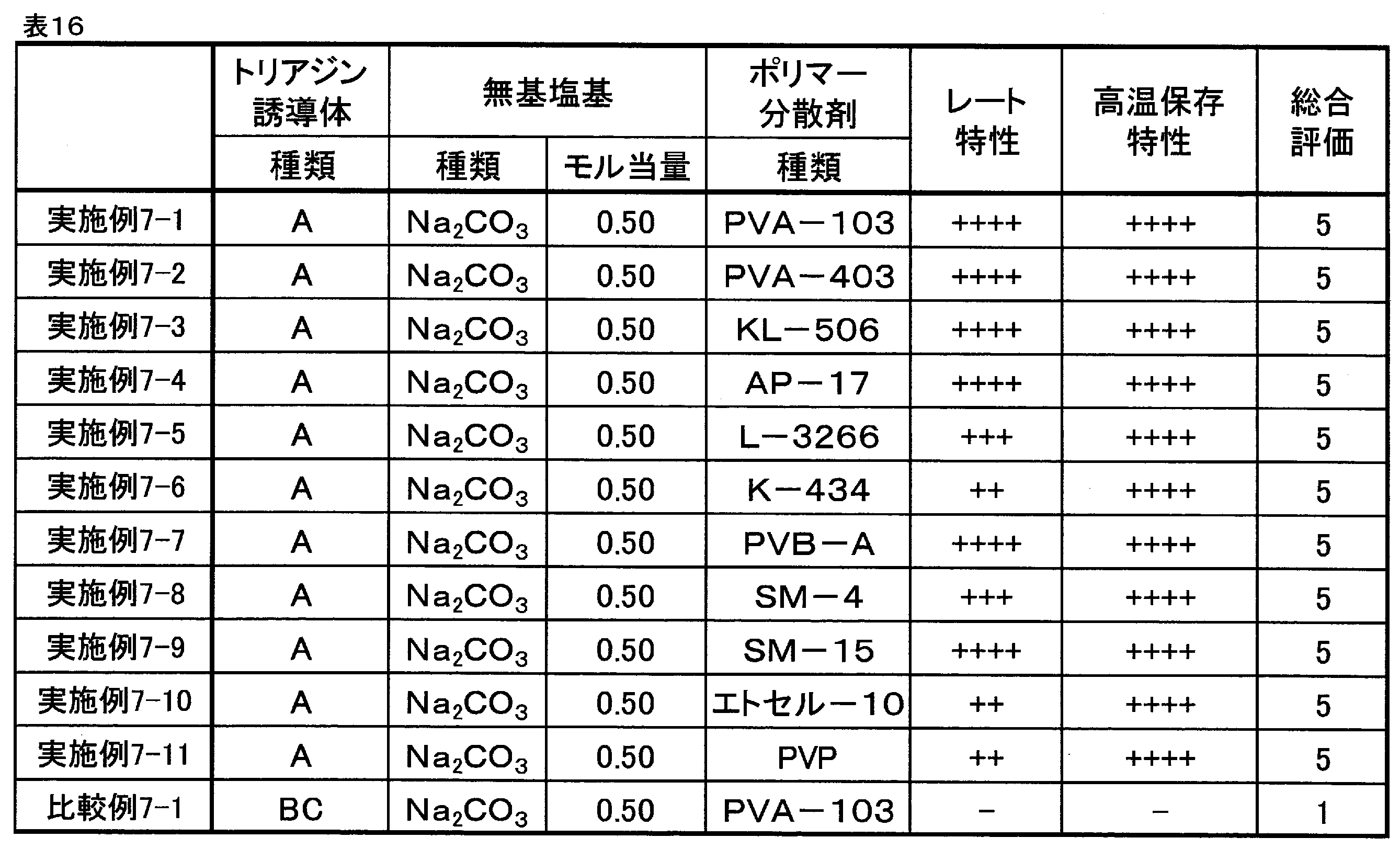
実施例7-1~7-11は、ポリマー分散剤を併用しない場合と同程度のレート特性、及び高温保存特性が得られた。一方、比較例7-1は、ポリマー分散剤を用いない場合と同程度のレート特性、及び高温保存特性であった。さらに、本発明の他の分散剤(トリアジン誘導体A以外のトリアジン誘導体)を用いた場合にも同様の傾向が確認できた。
<負極用合剤ペーストの作製>
(実施例8-1)
容量150cm3のプラスチック容器に、実施例6-1で作製した炭素材料分散液と、CMCと、水とを加えた。その後、自転・公転ミキサー(シンキー社製、あわとり練太郎、ARE-310)を用いて、2000rpmで30秒間撹拌し、炭素材料分散ワニスC1を得た。その後、活物質を添加し、自転・公転ミキサー(シンキー社製、あわとり練太郎、ARE-310)を用いて、2000rpmで150秒間撹拌した。さらにその後、SBRを加えて、自転・公転ミキサー(シンキー社製、あわとり練太郎、ARE-310)を用いて、2000rpmで30秒間撹拌し、負極用合剤ペーストC1を得た。負極用合剤ペースト1の固形分は48質量%とした。負極用合剤ペースト中の活物質:導電材:CMC:SBRの固形分比率は97:0.5:1:1.5とした。
(実施例8-1)
容量150cm3のプラスチック容器に、実施例6-1で作製した炭素材料分散液と、CMCと、水とを加えた。その後、自転・公転ミキサー(シンキー社製、あわとり練太郎、ARE-310)を用いて、2000rpmで30秒間撹拌し、炭素材料分散ワニスC1を得た。その後、活物質を添加し、自転・公転ミキサー(シンキー社製、あわとり練太郎、ARE-310)を用いて、2000rpmで150秒間撹拌した。さらにその後、SBRを加えて、自転・公転ミキサー(シンキー社製、あわとり練太郎、ARE-310)を用いて、2000rpmで30秒間撹拌し、負極用合剤ペーストC1を得た。負極用合剤ペースト1の固形分は48質量%とした。負極用合剤ペースト中の活物質:導電材:CMC:SBRの固形分比率は97:0.5:1:1.5とした。
(実施例8-2~8-4、比較例8-1)
導電材分散体の種類を変更した以外は実施例8-1と同様の方法により、炭素材料分散ワニスC2~C4、及び比較炭素材料分散ワニスD1と、負極用合剤ペースト(合剤スラリー)C2~C4、及びD1とを得た。
表17に示す通り、本発明の炭素材料分散ワニスを用いた電極膜はいずれも導電性が良好であった。電極膜の導電性評価は、以下の基準に従った。
(評価基準)
++(優良):電極膜の体積抵抗率(Ω・cm)が0.3未満
+(良):電極膜の体積抵抗率(Ω・cm)が0.3以上、0.5未満
-(不良):電極膜の体積抵抗率(Ω・cm)が0.5以上
導電材分散体の種類を変更した以外は実施例8-1と同様の方法により、炭素材料分散ワニスC2~C4、及び比較炭素材料分散ワニスD1と、負極用合剤ペースト(合剤スラリー)C2~C4、及びD1とを得た。
表17に示す通り、本発明の炭素材料分散ワニスを用いた電極膜はいずれも導電性が良好であった。電極膜の導電性評価は、以下の基準に従った。
(評価基準)
++(優良):電極膜の体積抵抗率(Ω・cm)が0.3未満
+(良):電極膜の体積抵抗率(Ω・cm)が0.3以上、0.5未満
-(不良):電極膜の体積抵抗率(Ω・cm)が0.5以上

・人造黒鉛:CGB-20(日本黒鉛工業社製)、固形分100%
・CMC:#1190(ダイセルファインケム社製)、固形分100%
・SBR:TRD2001(JSR社製)、固形分48%
・CMC:#1190(ダイセルファインケム社製)、固形分100%
・SBR:TRD2001(JSR社製)、固形分48%
<電極膜の作製>
(実施例9-1~9-4、比較例9-1)
表18に示す合剤ペースト(合剤スラリー)を、アプリケーターを用いて、金属箔上に塗工した後、電気オーブン中で120℃±5℃で25分間、塗膜を乾燥させて電極膜を作製した。その後、電極膜をロールプレス(株式会社サンクメタル社製、3t油圧式ロールプレス)による圧延処理を行った。銅箔を用いて、電極の単位当たりの目付量が10mg/cm2となるように塗工し、乾燥後の電極膜の密度が1.6g/ccとなるように圧延した。
(実施例9-1~9-4、比較例9-1)
表18に示す合剤ペースト(合剤スラリー)を、アプリケーターを用いて、金属箔上に塗工した後、電気オーブン中で120℃±5℃で25分間、塗膜を乾燥させて電極膜を作製した。その後、電極膜をロールプレス(株式会社サンクメタル社製、3t油圧式ロールプレス)による圧延処理を行った。銅箔を用いて、電極の単位当たりの目付量が10mg/cm2となるように塗工し、乾燥後の電極膜の密度が1.6g/ccとなるように圧延した。

<非水電解質二次電池の作製>
(実施例10-1~10-4、比較例10-1)
正極として標準正極を使用し、負極として表19に掲載した負極を使用した以外は実施例4-1と同様にラミネート型リチウム二次電池C1~C4、及びD1を作製した。
(実施例10-1~10-4、比較例10-1)
正極として標準正極を使用し、負極として表19に掲載した負極を使用した以外は実施例4-1と同様にラミネート型リチウム二次電池C1~C4、及びD1を作製した。
表19に、レート特性、及び高温保存特性の評価結果を示す。評価基準は以下のとおりである。
(レート特性)
+++(優良):レート特性が80%以上
++(良):レート特性が70%以上、80%未満
+(可):レート特性が60%以上、70%未満
-(不可):レート特性が60%未満
(高温保存特性)
+++(優良):高温保存特性が80%以上
++(良):高温保存特性が70%以上80%未満、
+(可):高温保存特性が60%以上70%未満
-(不可):高温保存特性が60%未満
(レート特性)
+++(優良):レート特性が80%以上
++(良):レート特性が70%以上、80%未満
+(可):レート特性が60%以上、70%未満
-(不可):レート特性が60%未満
(高温保存特性)
+++(優良):高温保存特性が80%以上
++(良):高温保存特性が70%以上80%未満、
+(可):高温保存特性が60%以上70%未満
-(不可):高温保存特性が60%未満

表19から分かる通り、トリアジン誘導体A~Dを用いた実施例10-1~10-4のラミネート型リチウム2次電池は、トリアジン誘導体BDを用いた比較例10-1のラミネート型リチウム2次電池と比べて、レート特性及び高温保存特性が非常に優れていた。このことから、本発明によれば、従来の分散剤ではなし得ない優れた特性を有するリチウム二次電池を提供できることが明らかである。
Claims (14)
- 下記一般式(1)で表される化合物。
[一般式(1)中、
X1~X5は、それぞれ独立に、水素原子、カルボキシル基、置換基を有してもよいアルキル基を表すか、隣り合う2つの置換基同士が合体して、ベンゾイミダゾール環、ベンゾインドール環、ベンゾピラゾール環、又は、ベンゾイミダゾロン環を形成する。ただし、少なくとも1つの、隣り合う2つの置換基同士が合体した、ベンゾイミダゾール環、ベンゾインドール環、ベンゾピラゾール環、又は、ベンゾイミダゾロン環を有する。
X6~X10は、それぞれ独立に、水素原子、カルボキシル基、又は、置換又は非置換のアルキル基である。ただし、少なくとも1つは、カルボキシル基である。] - 下記一般式(2)で表される分散剤。
[一般式(2)中、
R1は、Y1-Z1で表される基を表す。Y1は、アルキル基、ハロゲン基、ニトロ基、カルボキシル基、及びアルコキシ基から選ばれる置換基を有してもよい、アリーレン基を表す。Z1は、カルボキシル基又はリン酸基を表す。
R2は、少なくとも-NHC(=O)-を含む置換基を有するフェニル基、ベンゾイミダゾール基、置換基を有しもよいインドール基、又は置換基を有してもよいピラゾール基を表す。] - 請求項1に記載の化合物を含む分散剤。
- さらに、アミン及び/又は無機塩基を含む請求項2又は3に記載の分散剤。
- 顔料又は炭素材料と、請求項2~4のいずれか1項に記載の分散剤と、溶剤とを含む分散組成物。
- さらに、ポリマー分散剤を含んでなる請求項5に記載の分散組成物。
- 前記ポリマー分散剤が、水酸基を有する、請求項6に記載の分散組組成物。
- 前記ポリマー分散剤が、ポリビニルアルコール系樹脂及び/又はセルロース系樹脂である請求項6又は7記載の分散組成物。
- 前記炭素材料が、カーボンナノチューブである請求項5~8のいずれか1項に記載の分散組成物。
- 請求項5~9のいずれか1項に記載の分散組成物を用いてなる電極用組成物。
- さらに、バインダーを含んでなる請求項10に記載の電極用組成物。
- さらに、活物質を含んでなる請求項10又は11に記載の電極用組成物。
- 集電体上に、請求項12に記載の電極用組成物より形成されてなる合剤層を有する電極。
- 請求項13に記載の電極と、非水電解液とを具備してなる電池。
Applications Claiming Priority (2)
| Application Number | Priority Date | Filing Date | Title |
|---|---|---|---|
| JP2018136702A JP6524479B1 (ja) | 2018-07-20 | 2018-07-20 | 化合物、分散剤、電池用分散組成物、電極、電池 |
| JP2018-136702 | 2018-07-20 |
Publications (1)
| Publication Number | Publication Date |
|---|---|
| WO2020017656A1 true WO2020017656A1 (ja) | 2020-01-23 |
Family
ID=66730582
Family Applications (1)
| Application Number | Title | Priority Date | Filing Date |
|---|---|---|---|
| PCT/JP2019/028564 Ceased WO2020017656A1 (ja) | 2018-07-20 | 2019-07-19 | 化合物、分散剤、電池用分散組成物、電極、電池 |
Country Status (2)
| Country | Link |
|---|---|
| JP (1) | JP6524479B1 (ja) |
| WO (1) | WO2020017656A1 (ja) |
Cited By (5)
| Publication number | Priority date | Publication date | Assignee | Title |
|---|---|---|---|---|
| WO2023048203A1 (ja) * | 2021-09-23 | 2023-03-30 | 関西ペイント株式会社 | 導電性顔料ペースト、合材ペースト、及びリチウムイオン電池用電極 |
| JP2023046395A (ja) * | 2021-09-23 | 2023-04-04 | 関西ペイント株式会社 | 導電性顔料ペースト、合材ペースト、及びリチウムイオン電池用電極 |
| JP7453487B1 (ja) * | 2022-09-19 | 2024-03-19 | 関西ペイント株式会社 | 導電性顔料ペースト、合材ペースト、及びリチウムイオン電池用電極 |
| WO2024063003A1 (ja) * | 2022-09-19 | 2024-03-28 | 関西ペイント株式会社 | 導電性顔料ペースト、合材ペースト、及びリチウムイオン電池用電極 |
| EP4489137A4 (en) * | 2022-03-04 | 2025-12-10 | Sanyo Color Works | POWDER CONTAINING CARBON NANOTUBE FOR ELECTRODES, ELECTRODE MIXING PASTE, ELECTRODE FOR ENERGY STORAGE DEVICES, AND ENERGY STORAGE DEVICE |
Families Citing this family (10)
| Publication number | Priority date | Publication date | Assignee | Title |
|---|---|---|---|---|
| JP6524479B1 (ja) * | 2018-07-20 | 2019-06-05 | 東洋インキScホールディングス株式会社 | 化合物、分散剤、電池用分散組成物、電極、電池 |
| JP6801806B1 (ja) * | 2019-10-24 | 2020-12-16 | 東洋インキScホールディングス株式会社 | 非水電解質二次電池用カーボンナノチューブ分散液およびそれを用いた樹脂組成物、合材スラリー、電極膜、非水電解質二次電池。 |
| JP2021163626A (ja) * | 2020-03-31 | 2021-10-11 | 花王株式会社 | 正極組成物 |
| JP7109632B1 (ja) | 2021-07-14 | 2022-07-29 | 東洋インキScホールディングス株式会社 | 二次電池電極用樹脂組成物、二次電池電極用合材スラリーの製造方法、電極膜の製造方法、及び二次電池の製造方法 |
| JP7107413B1 (ja) | 2021-07-14 | 2022-07-27 | 東洋インキScホールディングス株式会社 | 二次電池電極用樹脂組成物の製造方法、二次電池電極用合材スラリーの製造方法、電極膜の製造方法、及び二次電池の製造方法 |
| WO2023121093A1 (ko) * | 2021-12-22 | 2023-06-29 | 주식회사 베터리얼 | 탄소나노튜브 분산액, 이의 제조방법, 이를 포함하는 전극 슬러리 조성물, 이를 포함하는 전극 및 이를 포함하는 리튬 이차전지 |
| KR102846758B1 (ko) * | 2021-12-22 | 2025-08-18 | 주식회사 베터리얼 | 탄소나노튜브 분산액, 이의 제조방법, 이를 포함하는 전극 슬러리 조성물, 이를 포함하는 전극 및 이를 포함하는 리튬 이차전지 |
| US20260102749A1 (en) | 2022-02-02 | 2026-04-16 | Artience Co., Ltd. | Dispersion composition production method |
| EP4729163A1 (en) | 2023-06-14 | 2026-04-22 | artience Co., Ltd. | Method for producing dispersion composition |
| JP7568157B1 (ja) | 2023-06-28 | 2024-10-16 | artience株式会社 | カーボンナノチューブ、カーボンナノチューブ分散液、およびそれを用いた二次電池、ならびにカーボンナノチューブの製造方法 |
Citations (4)
| Publication number | Priority date | Publication date | Assignee | Title |
|---|---|---|---|---|
| WO2008108360A1 (ja) * | 2007-03-05 | 2008-09-12 | Toyo Ink Mfg. Co., Ltd. | 電池用組成物 |
| JP2014130694A (ja) * | 2012-12-28 | 2014-07-10 | Toyo Ink Sc Holdings Co Ltd | 二次電池電極形成用組成物、二次電池電極、及び二次電池 |
| JP2017174708A (ja) * | 2016-03-25 | 2017-09-28 | 東洋インキScホールディングス株式会社 | 分散組成物、電池用分散組成物、電池 |
| JP6524479B1 (ja) * | 2018-07-20 | 2019-06-05 | 東洋インキScホールディングス株式会社 | 化合物、分散剤、電池用分散組成物、電極、電池 |
-
2018
- 2018-07-20 JP JP2018136702A patent/JP6524479B1/ja active Active
-
2019
- 2019-07-19 WO PCT/JP2019/028564 patent/WO2020017656A1/ja not_active Ceased
Patent Citations (4)
| Publication number | Priority date | Publication date | Assignee | Title |
|---|---|---|---|---|
| WO2008108360A1 (ja) * | 2007-03-05 | 2008-09-12 | Toyo Ink Mfg. Co., Ltd. | 電池用組成物 |
| JP2014130694A (ja) * | 2012-12-28 | 2014-07-10 | Toyo Ink Sc Holdings Co Ltd | 二次電池電極形成用組成物、二次電池電極、及び二次電池 |
| JP2017174708A (ja) * | 2016-03-25 | 2017-09-28 | 東洋インキScホールディングス株式会社 | 分散組成物、電池用分散組成物、電池 |
| JP6524479B1 (ja) * | 2018-07-20 | 2019-06-05 | 東洋インキScホールディングス株式会社 | 化合物、分散剤、電池用分散組成物、電極、電池 |
Cited By (8)
| Publication number | Priority date | Publication date | Assignee | Title |
|---|---|---|---|---|
| WO2023048203A1 (ja) * | 2021-09-23 | 2023-03-30 | 関西ペイント株式会社 | 導電性顔料ペースト、合材ペースト、及びリチウムイオン電池用電極 |
| JP2023046395A (ja) * | 2021-09-23 | 2023-04-04 | 関西ペイント株式会社 | 導電性顔料ペースト、合材ペースト、及びリチウムイオン電池用電極 |
| JP7362989B2 (ja) | 2021-09-23 | 2023-10-18 | 関西ペイント株式会社 | 導電性顔料ペースト、合材ペースト、及びリチウムイオン電池用電極 |
| CN118103463A (zh) * | 2021-09-23 | 2024-05-28 | 关西涂料株式会社 | 导电性颜料糊剂、复层材料糊剂以及锂离子电池用电极 |
| CN118103463B (zh) * | 2021-09-23 | 2026-04-17 | 关西涂料株式会社 | 导电性颜料糊剂、复层材料糊剂以及锂离子电池用电极 |
| EP4489137A4 (en) * | 2022-03-04 | 2025-12-10 | Sanyo Color Works | POWDER CONTAINING CARBON NANOTUBE FOR ELECTRODES, ELECTRODE MIXING PASTE, ELECTRODE FOR ENERGY STORAGE DEVICES, AND ENERGY STORAGE DEVICE |
| JP7453487B1 (ja) * | 2022-09-19 | 2024-03-19 | 関西ペイント株式会社 | 導電性顔料ペースト、合材ペースト、及びリチウムイオン電池用電極 |
| WO2024063003A1 (ja) * | 2022-09-19 | 2024-03-28 | 関西ペイント株式会社 | 導電性顔料ペースト、合材ペースト、及びリチウムイオン電池用電極 |
Also Published As
| Publication number | Publication date |
|---|---|
| JP2020011934A (ja) | 2020-01-23 |
| JP6524479B1 (ja) | 2019-06-05 |
Similar Documents
| Publication | Publication Date | Title |
|---|---|---|
| WO2020017656A1 (ja) | 化合物、分散剤、電池用分散組成物、電極、電池 | |
| JP6984781B1 (ja) | カーボンナノチューブ分散液およびその利用 | |
| JP7758241B2 (ja) | カーボンナノチューブ分散液およびその利用 | |
| JP7196597B2 (ja) | カーボンナノチューブ分散液およびその利用 | |
| JP5273274B1 (ja) | リチウム二次電池電極形成用組成物、二次電池用電極 | |
| JP5471591B2 (ja) | 電極用導電性組成物 | |
| JP7358967B2 (ja) | カーボンナノチューブ、カーボンナノチューブ分散液およびその利用 | |
| JP2020011873A (ja) | カーボンナノチューブ分散液およびその利用 | |
| JP6274343B1 (ja) | 分散剤、分散組成物、電池用分散組成物、電極、電池 | |
| JP6380642B1 (ja) | 分散剤、分散組成物、電池用分散組成物、電極、電池 | |
| JP2020011872A (ja) | カーボンナノチューブ分散液およびその利用 | |
| JP2010061996A (ja) | 電池用組成物 | |
| JP2020194625A (ja) | 電池用カーボンナノチューブ分散組成物の製造方法 | |
| JP5900111B2 (ja) | 二次電池電極形成用組成物、二次電池電極、及び二次電池 | |
| CN110603089B (zh) | 分散剂、分散剂组合物、分散组合物、电池用分散组合物、电极以及电池 | |
| JP2010061997A (ja) | リチウム二次電池用正極合剤ペースト | |
| JP2014135198A (ja) | 二次電池電極形成用組成物、二次電池用電極および二次電池 | |
| JP2015191760A (ja) | 分散剤、分散組成物、電池用分散組成物、電池 | |
| JP2013073724A (ja) | リチウムイオン二次電池正極用合材ペースト | |
| JP6728851B2 (ja) | 分散組成物、電池用分散組成物、電池 | |
| JP2022165797A (ja) | 下地層用炭素材料分散液、およびそれを用いた下地層用導電性組成物、蓄電デバイス用下地層付き集電体、蓄電デバイス用電極、蓄電デバイス | |
| WO2025047825A1 (ja) | カーボンナノチューブ分散組成物、カーボンナノチューブ樹脂組成物、合材スラリー、電極膜、及び非水電解質二次電池 | |
| JP6375050B1 (ja) | 電池用組成物、電池用分散組成物、電極、電池 | |
| JP7848474B2 (ja) | 非水電解質二次電池用カーボン材料樹脂複合物、それを用いた非水電解質二次電池用分散液、非水電解質二次電池用電極、及び非水電解質二次電池 | |
| JP7619536B1 (ja) | カーボンナノチューブ分散組成物、カーボンナノチューブ樹脂組成物、合材スラリー、電極膜、及び非水電解質二次電池 |
Legal Events
| Date | Code | Title | Description |
|---|---|---|---|
| 121 | Ep: the epo has been informed by wipo that ep was designated in this application |
Ref document number: 19838559 Country of ref document: EP Kind code of ref document: A1 |
|
| NENP | Non-entry into the national phase |
Ref country code: DE |
|
| 122 | Ep: pct application non-entry in european phase |
Ref document number: 19838559 Country of ref document: EP Kind code of ref document: A1 |