WO2020008865A1 - 1,2-ジクロロ-3,3,3-トリフルオロプロペンの製造方法 - Google Patents
1,2-ジクロロ-3,3,3-トリフルオロプロペンの製造方法 Download PDFInfo
- Publication number
- WO2020008865A1 WO2020008865A1 PCT/JP2019/024125 JP2019024125W WO2020008865A1 WO 2020008865 A1 WO2020008865 A1 WO 2020008865A1 JP 2019024125 W JP2019024125 W JP 2019024125W WO 2020008865 A1 WO2020008865 A1 WO 2020008865A1
- Authority
- WO
- WIPO (PCT)
- Prior art keywords
- chlorine
- reaction
- trifluoropropene
- dehydrochlorination
- trifluoropropane
- Prior art date
- Legal status (The legal status is an assumption and is not a legal conclusion. Google has not performed a legal analysis and makes no representation as to the accuracy of the status listed.)
- Ceased
Links
Classifications
-
- C—CHEMISTRY; METALLURGY
- C07—ORGANIC CHEMISTRY
- C07C—ACYCLIC OR CARBOCYCLIC COMPOUNDS
- C07C17/00—Preparation of halogenated hydrocarbons
- C07C17/25—Preparation of halogenated hydrocarbons by splitting-off hydrogen halides from halogenated hydrocarbons
-
- C—CHEMISTRY; METALLURGY
- C07—ORGANIC CHEMISTRY
- C07C—ACYCLIC OR CARBOCYCLIC COMPOUNDS
- C07C21/00—Acyclic unsaturated compounds containing halogen atoms
- C07C21/02—Acyclic unsaturated compounds containing halogen atoms containing carbon-to-carbon double bonds
- C07C21/18—Acyclic unsaturated compounds containing halogen atoms containing carbon-to-carbon double bonds containing fluorine
-
- C—CHEMISTRY; METALLURGY
- C07—ORGANIC CHEMISTRY
- C07B—GENERAL METHODS OF ORGANIC CHEMISTRY; APPARATUS THEREFOR
- C07B61/00—Other general methods
Definitions
- the present invention relates to a method for producing 1,2-dichloro-3,3,3-trifluoropropene.
- # 1,2-Dichloro-3,3,3-trifluoropropene has an unsaturated bond and is expected to function as a cleaning agent or a refrigerant as a hydrochlorofluoroolefin (HCFO) which is easily decomposed in the atmosphere.
- HCFO hydrochlorofluoroolefin
- Non-Patent Document 1 discloses a method of reacting 1,2,3,3,3-pentachloropropene with antimony trifluoride in a liquid phase.
- Non-Patent Document 2 discloses a method in which 1,1,2,3,3-pentachloropropene is reacted with antimony trifluoride in a liquid phase in the presence of antimony pentachloride.
- solid potassium hydroxide is added to liquid 1,2,2-trichloro-3,3,3-trifluoropropane, and this mixture is heated and refluxed to obtain 1,2-dichloromethane.
- a method for producing -3,3,3-trifluoropropene is disclosed.
- 1,2-Dichloro-3,3,3-trifluoropropene can also be synthesized by a gas phase reaction.
- 1,2-dichloro-3,3,3,3 is used as a by-product of fluorination and dehalogenation of 1,1,1,3,3-pentachloropropane. It is stated that trifluoropropene is formed.
- One of the embodiments according to the present invention aims to provide a method for producing 1,2-dichloro-3,3,3-trifluoropropene that is easy to carry out on an industrial scale.
- the present inventors have conducted intensive studies in order to solve the above-mentioned problems, and as a result, have found that 1-chloro-3,3,3-trifluoropropene or 2-chloro-3,3,3 which is industrially available.
- -Trifluoropropene is chlorinated in a liquid phase reaction under pressurized conditions to give 1,1,2-trichloro-3,3,3-trifluoropropane or 1,2,2-trichloro-3,3, respectively.
- 3-trifluoropropane is obtained, and in a subsequent gas phase reaction, a catalyst containing activated carbon (hereinafter, activated carbon catalyst) and 1,1,2-trichloro-3,3,3-trifluoropropane in the presence of chlorine Or that 1,2-dichloro-3,3,3-trifluoropropene can be obtained in high yield by contacting with 1,2,2-trichloro-3,3,3-trifluoropropane.
- activated carbon catalyst 1,1,2-trichloro-3,3,3-trifluoropropane in the presence of chlorine
- 1,2-dichloro-3,3,3-trifluoropropene can be obtained in high yield by contacting with 1,2,2-trichloro-3,3,3-trifluoropropane.
- one embodiment of the present invention relates to a catalyst comprising activated carbon and 1,1,2-trichloro-3,3,3-trifluoropropane and 1,2,2-trichloro-3 in the presence of chlorine.
- the method further comprises adding a chlorine to a halogenated olefin selected from 1-chloro-3,3,3-trifluoropropene and 2-chloro-3,3,3-trifluoropropene to form a halogenated saturated hydrocarbon. May be generated.
- One embodiment of the present invention is selected from 1,1,2-trichloro-3,3,3-trifluoropropane and 1,2,2-trichloro-3,3,3-trifluoropropane.
- the composition contains a halogenated saturated hydrocarbon and chlorine.
- the concentration of chlorine can be 0.1 mol% or more and 30 mol% or less based on the selected halogenated saturated hydrocarbon.
- this composition can be used as a raw material for producing 1,2-dichloro-3,3,3-trifluoropropene.
- 1-chloro-3,3,3-trifluoropropene or 2-chloro-3,3,3-trifluoropropene which can be obtained at low cost, is used as a raw material on an industrial scale with a high yield.
- 2-Dichloro-3,3,3-trifluoropropene can be produced.
- 233da and 233ab are capable of transferring chlorine to 1-chloro-3,3,3-trifluoropropene (hereinafter also referred to as 1233zd) and 2-chloro-3,3,3-trifluoropropene (hereinafter also referred to as 1233xf), respectively. It can be produced by addition (hereinafter, this reaction is referred to as chlorine addition). These reactions are represented by the following reaction formula (I). Further, the production method includes a geometric isomerization of 1223xd. Hereinafter, each reaction will be described.
- 1233xd As a starting material in the chlorine addition, either one of 1233xd and 1233xf, or a mixture containing both can be used. When a mixture is used, the mixture ratio is not limited, and a mixture having an arbitrary mixture ratio may be used.
- the chlorination of 1233xd and 1233xf yields a mixed product containing both 233da and 233ab, which can be dehydrochlorinated to give 1223xd.
- 1233zd includes geometric isomers (E) 1-chloro-3,3,3-trifluoropropene (1233zd (E)) and (Z) 1-chloro-3,3,3-trifluoropropene (1233zd Any of (Z)) may be used. For example, only one of the isomers may be used, or a mixture of these geometric isomers may be used.
- the reaction temperature for chlorine addition is set in the range of 50 ° C or more and 200 ° C or less. By performing the reaction at 50 ° C. or higher, a sufficiently high reaction rate can be obtained, and the reaction can be completed in a short time. Further, by performing the reaction at a temperature of 200 ° C. or less, the generation of by-products is suppressed, and not only can 233 da of high purity and high purity be obtained, but also the amount of chlorine introduced can be easily adjusted. .
- the reaction temperature can be further adjusted within the above temperature range. For example, the reaction temperature can be set within a range of 60 ° C to 150 ° C, 60 ° C to 120 ° C, or 60 ° C to 100 ° C.
- the reaction time of the chlorine addition depends on the ratio of the isomers and the reaction temperature, but can be selected, for example, from 1 hour to 10 hours, 1 hour to 8 hours, or 2 hours to 8 hours. .
- a separate solvent may be used for chlorine addition, but it is not always necessary.
- an operation for removing the solvent is unnecessary, and after the reaction is completed, the reaction solution is washed, if necessary, and transferred to a distillation apparatus for distillation to easily purify 233da or 233ab. can do. Therefore, not only can 233da or 233ab be generated simply and at low cost, but also the burden on the environment can be reduced.
- 1233zd or 1233xf reacts with chlorine at a molar ratio of 1: 1.
- one raw material may be used in excess of the other.
- the charged molar ratio of 1233zd or 1233xf to chlorine can be 0.1: 1 to 5: 1, 0.4: 1 to 2.5: 1, or 0.5: 1 to 2: 1. .
- any of batch, semi-batch and continuous reaction types may be applied.
- the reaction is started by setting the reaction system to the above-mentioned pressure and temperature, and 1233zd, 1233xf and chlorine are not added until the reaction is completed.
- 1233zd or 1233xf and chlorine are intermittently added into the reaction vessel after the start of the reaction.
- chlorine of a mole number lower than 1233zd or 1233xf is added into the reaction vessel, and the reaction is started by setting the reaction system to the above-described pressure and temperature. Thereafter, chlorine is intermittently injected into the reaction vessel.
- 1233zd or 1233xf uses a higher mole number than chlorine at the time of charging
- a side reaction caused by excessive chlorine can be suppressed.
- 1233zd or 1233xf and chlorine are continuously introduced into the reactor at the above molar ratio.
- the introduction rate and the reactor volume are set so that the above-mentioned reaction time is ensured, the reaction system is set at the above-mentioned pressure and temperature, and the reaction is continued, and the reaction mainly comprising 233 da or 233 ab is continuously performed. Extract the product.
- a side reaction caused by excess chlorine of 233da or 233ab can be suppressed.
- a catalyst is optional for chlorine addition. That is, the chlorine addition may be performed in the presence or absence of a catalyst. As described in Examples, since the reaction proceeds almost quantitatively even in the absence of a catalyst, 233da or 233ab can be obtained efficiently without complicating the purification process.
- a chloride, a chloride oxide or a fluorinated chloride of a transition metal can be used as the catalyst.
- Transition metals include iron, titanium, chromium, manganese, cobalt, nickel, copper, zinc and the like.
- the valence of the transition metal is not limited, and a chloride containing a transition metal having a different valence may be used.
- iron chloride either ferrous chloride (FeCl 2 ) or ferric chloride (FeCl 3 ) may be used, or a mixture thereof may be used.
- the chloride may be a mixed chloride containing a plurality of different metals.
- the charged amount of the catalyst may be selected from the range of 0.1 to 30 mol%, 0.5 to 15 mol%, or 1 to 10 mol% with respect to 1233zd or 1233xf. Since the reaction proceeds at a higher rate by adding the catalyst, the reaction time can be significantly reduced.
- the catalyst When a catalyst is used, the catalyst may be used alone, or the catalyst may be supported on a carrier. When supported on a carrier, a porous body such as silica gel, alumina, activated carbon, or zeolite can be used as a simple substance.
- the reaction is completed in a short time without irradiating the reaction system with light. Further, even if a small amount of hydrogen fluoride is produced as a by-product, there is no need to consider corrosion of a window (eg, a quartz window) required for light irradiation, so that it is possible to suppress the complexity of manufacturing equipment and increase in manufacturing cost. .
- a window eg, a quartz window
- the reaction is performed under dark conditions, that is, under light shielding, or does not transmit light. It is preferable to use a reaction vessel.
- 233 da or 233 ab may be purified by distilling the reaction solution.
- the reaction solution may be washed with water, an aqueous solution of sodium hydrogencarbonate, an aqueous solution of sodium thiosulfate, an aqueous solution of sodium hydrogen sulfite, or the like, and may be purified by distillation after washing.
- moisture may be removed by performing a dehydration treatment after the washing.
- the method of the dehydration treatment is not particularly limited, and for example, use of a dehydrating agent can be applied. In the method using a dehydrating agent, the product after chlorine addition is brought into contact with the dehydrating agent.
- the type of the dehydrating agent is not particularly limited, and examples thereof include zeolite and molecular sieve.
- zeolite zeolite in powder, granule, or pellet form can be used. Further, zeolite having a pore diameter of about 2.0 to 6.0 ° can be used.
- the method of drying using zeolite is not particularly limited, but it is efficiently preferable to flow a product containing 233 da or 233 ab in a gaseous or liquid state through a container filled with zeolite. Unreacted 1233zd or 1233xf separated by distillation can be recycled to the chlorination reaction.
- the dehydrochlorination is performed by bringing 233 da or 233ab into contact with an activated carbon catalyst in the gas phase. Specifically, the reaction tube is filled with an activated carbon catalyst, and 233 da or 233 ab in gaseous state is brought into contact with the activated carbon catalyst.
- a system such as a fixed bed type gas phase reaction and a fluidized bed type gas phase reaction can be used.
- Activated carbon catalysts include plant-based activated carbon made from charcoal, coconut shell, palm kernel coal, and ash, coal-based activated carbon made from peat, lignite, lignite, bituminous coal, anthracite, etc., oil residue, oil carbon, etc.
- the activated carbon catalyst used in the present embodiment can be selected from these commercially available activated carbons and used.
- coconut shell charcoal for gas purification catalyst / catalyst carrier (Osaka Gas Chemical Granulated Shirasagi GX, SX, CX, XRC, Toyo Calgon PCB, Taihei Chemical Industry Co., Ltd.
- an activated carbon supporting a metal may be used as the activated carbon catalyst, or an activated carbon not supporting a metal may be used.
- Activated carbon that does not carry metals is advantageous from the viewpoint of cost and waste disposal.
- the activated carbon which does not carry a metal means that the content of the metal in the activated carbon catalyst is 0% by mass or more and 5% by mass or less, preferably 0% by mass or more and 1% by mass or less, more preferably 0% by mass or less. % Of activated carbon.
- examples of the supported metal include aluminum, chromium, titanium, manganese, iron, nickel, cobalt, copper, magnesium, zirconium, molybdenum, zinc, tin, lanthanum, and antimony.
- These metals are supported as fluoride, chloride, fluorinated chloride, oxyfluoride, oxychloride, oxyfluoride chloride, etc., and two or more metal compounds may be supported together.
- the activated carbon catalyst to be used may be granular, and may have a spherical, fibrous, powdery, or honeycomb shape as long as it is compatible with the reactor.
- the specific surface area and the pore volume of the activated carbon are sufficient within the range of the standard of the commercial product, but the specific surface area is desirably larger than 400 m 2 / g, and more preferably 800 m 2 / g or more and 3000 m 2 / g or less. preferable. Further, the pore volume is desirably greater than 0.1 cm 3 / g, and more preferably from 0.2 cm 3 / g to 1.0 cm 3 / g.
- the temperature of dehydrochlorination is from 120 ° C to 350 ° C, preferably from 160 ° C to 350 ° C, more preferably from 200 ° C to 320 ° C. If the temperature is lower than 120 ° C., the reaction hardly progresses or the reaction is extremely slow. If the temperature is higher than 350 ° C., a decomposition reaction or the like progresses and a large amount of by-products may be mixed.
- the contact time of the dehydrochlorination depends on the temperature (reaction temperature), shape and activated carbon catalyst of the reaction tube, the feed rate of the raw material is appropriately adjusted according to the set temperature, the shape of the reaction tube and the type of the activated carbon catalyst. It is desirable to optimize. From the viewpoint of recovery and reuse of unreacted raw materials, it is preferable to employ a contact time at which a raw material conversion rate of 25% or more is obtained, and more preferably, the contact time is optimized so as to obtain a conversion rate of 50% or more.
- the contact time is preferably 1 second to 300 seconds, and more preferably 20 seconds to 150 seconds.
- the contact time exceeds 300 seconds, a side reaction easily occurs, and when the contact time is less than 1 second, the conversion is low.
- a reaction tube filled with an activated carbon catalyst heated to 160 ° C. or more and 350 ° C. or less is passed through 233 da or 233 ab with a contact time of 1 second or more and 300 seconds or less.
- the reaction pressure may be lower than atmospheric pressure, atmospheric pressure, or higher than atmospheric pressure, but is preferably atmospheric pressure.
- the reaction can be performed using an inert gas such as nitrogen or argon as a gas for dilution.
- Dehydrochlorination can be performed in the gas phase using a common chemical reactor.
- the reaction tube, a unit for introducing and discharging various gases, and the like are formed of a material having high resistance to hydrogen chloride.
- Typical examples of such materials include stainless steel materials such as the austenitic type, or high nickel alloys such as Monel®, Hastelloy® and Inconel®, and copper clad steel. But not limited to this.
- dehydrochlorination can be performed under the condition where chlorine is present, whereby the dehydrochlorination can be completed in a short time. That is, dehydrochlorination may be performed using a composition containing chlorine and a halogenated saturated hydrocarbon selected from 233 da or 233 ab as one of the embodiments of the present invention as a raw material.
- the composition may be substantially free of other components and may be composed of a halogenated saturated hydrocarbon selected from 233 da or 233 ab and chlorine.
- high purity 233da or 233ab containing no or substantially no chlorine and purified by an operation such as distillation and chlorine is supplied to the reaction tube, and chlorine is further supplied to the reaction tube.
- the amount of chlorine supplied is arbitrary.
- chlorine can be supplied at a mole number higher or lower than 233 da or 233 ab. If the amount of chlorine is lower than 233 da or 233 ab, the chlorine may be a catalytic amount relative to 233 da or 233 ab. Specifically, a composition containing chlorine of 0.1 mol% or more and 30 mol% or less, 1 mol% or more and 10 mol% or 1 mol% or more and 5 mol% or less of 233 da or 233 ab is used. Good. Therefore, this composition can be recognized as a raw material for producing 1,2-dichloro-3,3,3-trifluoropropene.
- dehydrochlorination When dehydrochlorination is performed in the presence of chlorine, it is not always necessary to use purified 233da or 233ab, and the reaction solution obtained by the chlorine addition is not purified, and this reaction solution in which chlorine remains (crude product) ) May be fed to the subsequent dehydrochlorination. That is, dehydrochlorination may be performed by supplying a crude product containing chlorine to a reaction tube filled with an activated carbon catalyst. Since the crude product contains 233 da or 233 ab obtained by addition of chlorine and chlorine, dehydrochlorination can be performed in the presence of chlorine without newly supplying chlorine. The amount of chlorine contained in the crude product depends on the conditions for chlorine addition, but may be, for example, a catalytic amount.
- the amount of chlorine is 0.1 mol% or more and 30 mol% or less, 1 mol% or more 20 mol%, or 1 mol% or more 10 mol% with respect to the amount of 233 da or 233ab in the crude product. What is necessary is just to adjust the conditions of chlorine addition so that it may become.
- a mechanism for newly supplying chlorine to the reaction tube is not required, so that the structure of the manufacturing apparatus can be prevented from becoming complicated, and as a result, the manufacturing cost is reduced. Can be reduced.
- any of a batch system, a semi-batch system, and a continuous system may be applied. From the viewpoint of industrial production, it is preferable to perform the continuous system.
- the raw material gas is continuously introduced into the reaction system, and the generated 1223xd and hydrogen chloride are continuously discharged out of the reaction system. Thereby, a side reaction caused by hydrogen chloride produced as a by-product can be suppressed. Further, from the viewpoint of suppressing side reactions, it is preferable to supply a raw material gas containing no or substantially no hydrogen chloride to the reaction system.
- 12 1223xd obtained by this production method exists as a liquid at normal temperature and normal pressure.
- the gas obtained after the reaction is passed through a cooled condenser and condensed, the gas obtained after the reaction is subjected to washing with water or an aqueous base solution, drying treatment using molecular sieves, etc., and further precision distillation to obtain high-purity 1223xd.
- Unreacted 233da or 233ab separated by distillation can be recycled to dehydrochlorination.
- the cis-form is obtained as a mixture of geometric isomers of the cis-form (Z) and the trans-form (E).
- the cis-form can be obtained stereoselectively at an extremely high selectivity.
- Non-Patent Document 3 the reaction is carried out by dispersing powdered potassium hydroxide in 1,2,2-trichloro-3,3,3-trifluoropropane in a liquid state. , The yield is low (48%) and the reaction is heterogeneous, so that it is difficult to say that it is efficient in terms of an industrial production method. Further, as described in Patent Document 1, 1,2-dichloro-3,3,3 is obtained by fluorination and dehalogenation of a chlorine-containing compound such as 1,1,1,3,3-pentachloropropane in a gas phase. It is known that 3-trifluoropropene is produced, but it is difficult to obtain 1,2-dichloro-3,3,3-trifluoropropene in an industrially sufficient amount.
- 1,2-dichloro-3,3,3-trifluoropropene can be efficiently produced at low cost on an industrial scale.
- Isomerization 1223xd obtained by dehydrochlorination includes a cis-form and a trans-form, and these isomers can be converted into each other by isomerization, whereby one isomer can be preferentially produced. is there.
- the isomerization method is not particularly limited, and examples thereof include a gas phase reaction using a solid catalyst of a metal, a metal oxide, a metal halide, activated carbon, or a composite thereof (eg, metal-supported activated carbon).
- the metal halide fluorinated alumina, fluorinated chromia, fluorinated titania, fluorinated zirconia, or the like can be used.
- the isomerization may be performed by a radical mechanism. That is, instead of the solid acid catalyst, or together with the solid acid catalyst, a compound serving as a radical source (radical generator) may be used in a catalytic amount to perform isomerization in the gas phase.
- the isomerization by a radical mechanism refers to isomerization of 1223xd in a state where a catalytic amount of a radical is present in a reaction tube system.
- a radical means a chemical species such as an atom, a molecule, or an ion having an unpaired electron, a radical cation having a positive charge of a chemical species, a radical anion having a negative charge, a radical having a neutral charge, Including biradicals and triplet carbene.
- Specific examples include a fluorine radical, a chlorine radical, a bromine radical, an iodine radical, an oxygen radical, a hydrogen radical, a hydroxy radical, a nitroxide radical, a nitrogen radical, an alkyl radical, a difluorocarbene, and a carbon radical. In this isomerization, at least one of the above-mentioned radicals appears in the reaction mechanism.
- isomerization does not substantially proceed in the absence of radicals, but when a small amount of a radical generator is added, isomerization proceeds at a surprising rate. This is a characteristic of this isomerization.
- the equilibrium ratio of 1223xd (Z) and 1223xd (E) can reach the thermodynamic equilibrium point by isomerization by a radical mechanism, and the isomer ratio of 1223xd (Z) and 1223xd (E) (1223xd (E) / If (1223xd (Z)) is greater than the equilibrium ratio, a portion of 1223xd (E) is converted to 1223xd (Z).
- 1223xd (Z) and 1223xd (E) can be separated by precision distillation based on the difference in boiling point, the mixture of 1223xd (Z) and 1223xd (E) is subjected to distillation separation, and 1223xd (Z) is used as a product to obtain 1223xd.
- (E) may be used as a raw material for isomerization. Further, a product containing 1223xd (Z) obtained by isomerization is collected, and each of 1223xd (Z) and 1223xd (E) is isolated by distillation or the like. Use as a raw material for the conversion is rational and preferable from the viewpoint of efficient use of the raw material.
- Isomerization is initiated by generating a radical in the reaction system.
- the method for generating radicals is not particularly limited, and examples thereof include a method for generating radicals by light, heat, and a catalyst.
- a radical is generated by light, a photosensitizer or the like can be used in combination. From the viewpoint of operability, a method of adding a radical generator that easily generates radicals by external energy application is preferable.
- a method in which light or heat is applied to the radical generator to activate the radical generator in advance, and then the radical generator is introduced into the reaction tube, and the radical generator and the raw material, 1223xd A method of introducing a mixture containing (E) into a reaction tube and activating the radical generator with light or heat may be used. In order to generate radicals efficiently and bring them into contact with the raw materials efficiently, the latter method is preferable. For example, a method in which a radical generator and 1223xd (E) are simultaneously supplied to a heated reaction tube and thermal energy is supplied in the reaction tube to thermally generate radicals is simple and industrially preferable.
- an inert gas such as nitrogen may be supplied together with the mixture to the extent that productivity is not reduced by excessive addition.
- the radical generator is not particularly limited as long as it generates a radical by application of external energy such as light or heat.
- halogens such as chlorine and bromine
- oxygen-containing gas such as oxygen, ozone, hydrogen peroxide, and nitrogen oxide
- halogenated carbon When using oxygen, air may be used.
- oxygen, air, or chlorine is preferable because of low cost and availability. Air or oxygen is particularly preferred because it is easily separated from the product.
- Halogenated carbon refers to alkanes such as methane, ethane, propane, butane, pentane, and hexane, alkenes such as ethene, propene, butene, pentene, and hexene; and alkynes such as ethyne, propyne, butyne, pentyne, and hexine.
- a halogenated carbon in which part or all of the hydrogen atoms have been substituted with fluorine, chlorine, bromine or iodine, wherein the halogenated carbon contains at least one or more chlorine, bromine or iodine.
- radicals are generated in a chain by a radical mechanism, isomerization can be performed by adding a catalytic amount of the radical generator. This allows the radical generator to be used efficiently and reduces the load on the separation step between the radical generator and 1223xd (Z) after the reaction. For example, even when air that is relatively easy to separate is used, a decrease in the capacity of the condensation step or the distillation step can be avoided by suppressing the amount of addition.
- chlorine is used, the by-product of a chlorine adduct can be suppressed. Since the compound obtained by adding chlorine to 1223xd (Z) is HCFC, which is a substance that destroys global warming and the ozone layer, it is preferable that the by-product of the chlorine adduct is small.
- the optimal amount of the radical generator depends on the type of the radical generator and the structure of the reaction tube. For example, when air, oxygen, and chlorine are compared, the level of activity as a radical generation source is in the order of chlorine> oxygen> air.
- the collision between the radical generated from the radical generator and 1223xd (E) is very important.
- the collision probability between 1223xd (E) and radicals changes depending on the diameter and length of the reaction tube and the presence or absence of a filler such as a static mixer. Therefore, the optimum addition amount is determined in consideration of the type of the radical generator and the structure of the reaction tube. Specifically, the content is preferably from 0.0001 mol% to 10 mol%, more preferably from 0.0001 mol% to 5 mol%, based on 1223xd (E).
- a batch type or flow type can be applied for the isomerization, but a gas phase flow type having high industrial productivity is preferable.
- the pressure in the isomerization is not particularly limited, but the isomerization is preferably performed at around normal pressure.
- a pressurization reaction of 1 MPa or more is not preferable because not only requires an expensive pressure-resistant apparatus, but also concerns about polymerization of raw materials or products.
- an example of a reactor that can be used for isomerization is an empty column reaction tube having a relatively large length / inner diameter ratio. This is because the contact between the radical and 1223xd (E) can be efficiently performed.
- a reaction tube having a length / inner diameter ratio of 10 or more and 1000 or less, preferably 20 or more and 500 or less is exemplified.
- the length / inner diameter ratio is smaller than 10
- the contact between the radical and the 1223xd (E) may not be sufficient.
- the length / inner diameter ratio is larger than 1000, the apparatus cost may increase or the condition may be increased. Depending on the case, the pressure loss may increase.
- the inner diameter of the reaction tube is selected in the range of 3 mm to 150 mm, the length is selected in the range of 0.1 m to 200 m, the inner diameter is in the range of 5 mm to 60 mm, and the length is in the range of 0.2 m to 50 m.
- empty reaction tubes empty towers.
- the shape of the reaction tube is not particularly limited, and may be a straight tube or a coil, or may be folded back using a joint or the like.
- the reaction tube may be provided with a filler such as a static mixer inert to the reaction, a Raschig ring, a pole ring, a wire mesh, or the like.
- quartz, carbon, ceramics, stainless steel, nickel, Hastelloy (registered trademark), Inconel (registered trademark), Monel (registered trademark), and the like are preferable.
- the method of heating the reaction tube is not particularly limited, and examples thereof include a method of directly heating with an electric heater or a burner, and a method of indirect heating using molten salt or sand.
- the isomerization temperature is 150 ° C to 700 ° C, preferably 200 ° C to 700 ° C, more preferably 300 ° C to 650 ° C. If the reaction temperature is lower than 150 ° C., radicals are not sufficiently generated, so that the reaction rate may be extremely low. On the other hand, when the temperature is higher than 700 ° C., the raw material or the product is changed to an oily high-boiling substance (tarification) or coking is not preferred.
- the contact time in the isomerization is from 0.01 to 50 seconds, preferably from 0.05 to 20 seconds, in order to sufficiently promote the isomerization. If the contact time is shorter than these, the conversion rate may show only a large deviation from the pass-through rate obtained from the equilibrium ratio. Conversely, when the ratio is larger than these, even if the conversion rate is close to the pass-through rate obtained from the equilibrium ratio, the productivity may be deteriorated or tarification may occur.
- the mixture containing 1223xd (Z) obtained by the isomerization is subjected to washing to remove the radical generator and the acid component, dried with zeolite or the like, and then separated by distillation to isolate 1223xd (Z) and 1223xd (E). be able to. Also, the obtained 1223xd (E) can be used as a raw material for another reaction.
- Examples 1 to 5 described below are examples of chlorine addition in the present production method, and Examples 6 to 17 are examples of dehydrochlorination.
- "%" In the composition analysis values described below indicates the area% of the composition obtained by directly measuring the reaction mixture by gas chromatography (the detector is FID unless otherwise specified).
- Example 1 91.23 g (0.70 mol) of 1233zd (E) was added to a SUS316 autoclave (200 mL) manufactured by Pressure Glass. After closing the autoclave, the reaction solution was heated while stirring, and chlorine was injected so that the internal pressure of the autoclave became 0.8 MPa when the internal temperature reached 65 ° C. Thereafter, chlorine was injected intermittently so that the pressure was maintained at around 0.8 MPa. When the amount of chlorine supplied reached 54.30 g (0.77 mol) (after about 4 hours), the supply of chlorine was stopped, the temperature was further raised to 80 ° C., and stirring was continued for 2 hours.
- reaction solution was extracted, washed with water, and analyzed by gas chromatography (Agilent, model number 7890B; the same applies hereinafter). From the results of gas chromatography analysis, the conversion of 1233zd (E) was 99.96%, and the selectivity to 233da was 98.04%. The 233da yield based on 1233zd (E) was 98.00%.
- Example 2 652.45 g (5.00 mol) of 1233zd (E) was added to a SUS316 autoclave (1500 mL) manufactured by Pressure Glass. After sealing the autoclave, the reaction solution was heated while stirring, and when the internal temperature reached 80 ° C., chlorine was injected so that the pressure inside the autoclave became 0.8 MPa. Thereafter, chlorine was injected intermittently so that the pressure was maintained at around 0.8 MPa. When the chlorine supply amount reached 355.00 g (5.00 mol) (after about 5.5 hours), the supply of chlorine was stopped, and stirring was continued for another 2 hours. After cooling, the reaction solution was extracted to obtain 1007.01 g of 233 da.
- Example 3 653.30 g (5.01 mol) of 1233zd (E) was added to a SUS316 autoclave (1500 mL) manufactured by Pressure Glass Co., Ltd., the autoclave was sealed, and 101.50 g (1.43 mol) of chlorine was injected into the autoclave. The reaction solution was heated to 80 ° C. while stirring. The internal pressure at this time was 0.95 MPa. Thereafter, chlorine was intermittently injected so that the internal pressure was maintained at 0.57 MPa or more. After the start of the supply of chlorine, the supply of chlorine was stopped when the total amount of added chlorine reached 359.00 g (5.06 mol) (2.4 hours), and the reaction solution was further heated to 90 ° C. Stirring was continued for hours.
- Example 4 12.87 g (98.62 mmol) of 1233zd (E) was added to a SUS316 autoclave (200 mL) manufactured by Pressure Glass Co., Ltd., the autoclave was sealed, and 2.46 g (34.64 mmol) of chlorine was further injected into the autoclave.
- a pressure drop indicating the progress of the reaction was observed when the internal temperature exceeded about 60 ° C.
- the temperature was maintained at 65 ° C. until no pressure drop was observed, then the temperature was raised to 80 ° C. and stirring was maintained for 2 hours.
- Example 5 40.20 g (308.04 mmol) of 1233zd (Z) was added to a SUS316 autoclave (300 mL) manufactured by Pressure Glass Co., Ltd., the autoclave was closed, and 4.90 g (69.01 mmol) of chlorine was further injected into the autoclave.
- a pressure drop indicating the progress of the reaction was observed when the internal temperature exceeded 65 ° C.
- the temperature was maintained at 65 ° C. until no pressure drop was observed, then the temperature was raised to 70 ° C. and stirring was maintained for 2 hours. After cooling, the reaction solution was extracted and analyzed by gas chromatography without washing.
- the conversion of 1233zd (E) was 6.76%, and the selectivity to 233da was 96.45%.
- the 233da yield based on 1233zd (E) was 6.52%, and the 233da yield based on chlorine was 9.93%.
- Example 6 Gas consisting of a cylindrical reaction tube equipped with a metal electric heater filled with 50 mL of granular activated carbon (Shirasagi G2x4 / 6: manufactured by Nippon Environmental Chemical Co., Ltd., specific surface area: 1200 m 2 / g, pore volume: 0.86 cm 3 / g) The temperature was gradually increased while flowing nitrogen at a flow rate of 10 mL / min through a phase reaction apparatus (made of SUS304, inner diameter 25 mm, length 300 mm), and when the temperature of the reaction tube reached 250 ° C., the chlorine addition crude containing 233 da was added.
- granular activated carbon Shirasagi G2x4 / 6: manufactured by Nippon Environmental Chemical Co., Ltd., specific surface area: 1200 m 2 / g, pore volume: 0.86 cm 3 / g
- the product was vaporized and supplied with 44.5 g of 233 da over 3 hours at a flow rate of about 0.25 g / min (contact time 107 sec). During this time, the temperature inside the reaction tube was 240 ° C. or more and 250 ° C. or less.
- the product gas flowing out of the reaction tube was passed through a water-containing fluororesin gas washing bottle cooled in an ice water bath to absorb hydrogen chloride and collect the reaction product.
- the collected 33.4 g of the crude product was analyzed by gas chromatography to find that the composition was 97.82% for 1223xd (breakdown: 92.74% for 1223xd (Z), 5.08% for 1223xd (E)). Met.
- the yield of 1223xd was 91.4%.
- Example 7 Cylindrical reaction equipped with a metal electric heater filled with 50 mL of granular activated carbon (Shirasagi G2x4 / 6: manufactured by Osaka Gas Chemical Co., Ltd., specific surface area 1150 m 2 / g, pore volume 0.51 cm 3 / g, derived from coconut shell) The temperature was gradually raised while flowing nitrogen at a flow rate of 45 mL / min into a gas phase reactor (SUS304, inner diameter 25 mm, length 300 mm) composed of a tube, and when the temperature of the reaction tube reached 250 ° C., 233 da was included. The crude product of the chlorine addition was vaporized.
- granular activated carbon Shirasagi G2x4 / 6: manufactured by Osaka Gas Chemical Co., Ltd., specific surface area 1150 m 2 / g, pore volume 0.51 cm 3 / g, derived from coconut shell
- the flow rate of the raw material was stabilized while flowing nitrogen at a flow rate of 3 mL / min.
- the supply of nitrogen was stopped, and 39.0 g of 233 da was supplied at a flow rate of about 0.65 g / min over 1 hour (contact time: 42 seconds).
- the temperature inside the reaction tube was 250 ° C.
- the product gas flowing out of the reaction tube was passed through a water-containing fluororesin gas washing bottle cooled in an ice water bath to absorb hydrogen chloride and collect the reaction product.
- Example 8 Cylindrical reaction equipped with a metal electric heater filled with 50 mL of granular activated carbon (Shirasagi C2x4 / 6: Osaka Gas Chemical Co., Ltd., specific surface area 1300 m 2 / g, pore volume 0.53 cm 3 / g, derived from coconut shell) The temperature was gradually raised while flowing nitrogen at a flow rate of 45 mL / min into a gas phase reactor (SUS304, inner diameter 25 mm, length 300 mm) composed of a tube, and when the temperature of the reaction tube reached 250 ° C., 233 da was included. The crude product of the chlorine addition was vaporized. The flow rate of the raw material was stabilized while flowing nitrogen at a flow rate of 3 mL / min.
- granular activated carbon Shirasagi C2x4 / 6: Osaka Gas Chemical Co., Ltd., specific surface area 1300 m 2 / g, pore volume 0.53 cm 3 / g, derived from coconut shell
- Example 9 Cylindrical reaction equipped with a metal electric heater filled with 50 mL of granular activated carbon (Shirasagi GS3x4 / 6: manufactured by Osaka Gas Chemical Co., Ltd., specific surface area 1000 m 2 / g, pore volume 0.45 cm 3 / g, derived from coconut shell) The temperature was gradually raised while flowing nitrogen at a flow rate of 45 mL / min into a gas phase reactor (SUS304, inner diameter 25 mm, length 300 mm) composed of a tube, and when the temperature of the reaction tube reached 250 ° C., 233 da was included. The crude product of the chlorine addition was vaporized.
- granular activated carbon Shirasagi GS3x4 / 6: manufactured by Osaka Gas Chemical Co., Ltd., specific surface area 1000 m 2 / g, pore volume 0.45 cm 3 / g, derived from coconut shell
- the flow rate of the raw material was stabilized while flowing nitrogen at a flow rate of 3 mL / min.
- the supply of nitrogen was stopped, and 40.2 g of 233 da was supplied at a flow rate of about 0.67 g / min over 1 hour (contact time: 40 seconds).
- the temperature inside the reaction tube was 250 ° C.
- the product gas flowing out of the reactor was passed through a fluorine resin gas washing bottle containing water cooled in an ice water bath to absorb hydrogen chloride and collect the reaction product.
- Example 10 Cylindrical reaction equipped with a metal electric heater filled with 50 mL of granular activated carbon (Shirasagi GA3 ⁇ 4/6: manufactured by Osaka Gas Chemical Co., Ltd., specific surface area 750 m 2 / g, pore volume 0.36 cm 3 / g, derived from coconut shell) The temperature was gradually raised while flowing nitrogen at a flow rate of 45 mL / min through a gas phase reactor (SUS304, inner diameter 25 mm, length 300 mm) composed of a tube, and when the temperature of the reaction tube reached 250 ° C., 233 da was increased. The crude product of the chlorine addition was vaporized.
- granular activated carbon Shirasagi GA3 ⁇ 4/6: manufactured by Osaka Gas Chemical Co., Ltd., specific surface area 750 m 2 / g, pore volume 0.36 cm 3 / g, derived from coconut shell
- the flow rate of the raw material was stabilized while flowing nitrogen at a flow rate of 3 mL / min.
- the supply of nitrogen was stopped, and 39.6 g of 233 da was supplied at a flow rate of about 0.66 g / min over 1 hour (contact time 41 seconds).
- the temperature inside the reaction tube was 250 ° C.
- the product gas flowing out of the reactor was passed through a fluorine resin gas washing bottle containing water cooled in an ice water bath to absorb hydrogen chloride and collect the reaction product.
- granular activated carbon Shirasagi WH5x4 / 6: Osaka Gas Chemical Co., Ltd., specific surface area 1000 m 2 / g, pore volume 0.55 cm 3 / g, coal system
- Example 12 A cylindrical reaction tube equipped with a metal electric heater filled with 50 mL of spherical activated carbon (Shirasagi X7100H: manufactured by Osaka Gas Chemical Co., Ltd., specific surface area 1000 m 2 / g, pore volume 0.55 cm 3 / g, coal system) The temperature was gradually increased while flowing nitrogen at a flow rate of 45 mL / min through a gas phase reactor (made of SUS304, inner diameter 25 mm, length 300 mm), and when the temperature of the reaction tube reached 250 ° C., chlorine addition containing 233 da was added. The crude product of was evaporated. The flow rate of the raw material was stabilized while flowing nitrogen at a flow rate of 3 mL / min.
- Example 13 Cylindrical reaction equipped with a metal electric heater filled with 50 mL of granular activated carbon (Shirasagi G2x4 / 6: manufactured by Osaka Gas Chemical Co., Ltd., specific surface area 1150 m 2 / g, pore volume 0.51 cm 3 / g, derived from coconut shell) The temperature was gradually increased while flowing nitrogen at a flow rate of 45 mL / min into a gas phase reactor (SUS304, inner diameter 25 mm, length 300 mm) composed of a tube. When the temperature of the reaction tube reached 275 ° C., 233 da was included. The crude product of the chlorine addition was vaporized.
- granular activated carbon Shirasagi G2x4 / 6: manufactured by Osaka Gas Chemical Co., Ltd., specific surface area 1150 m 2 / g, pore volume 0.51 cm 3 / g, derived from coconut shell
- the flow rate of the raw material was stabilized while flowing nitrogen at a flow rate of 3 mL / min.
- the supply of nitrogen was stopped, and 20.1 g of 233 da was supplied at a flow rate of about 0.67 g / min over 30 minutes (contact time: 40 seconds).
- the temperature in the reaction tube was 275 ° C.
- the product gas flowing out of the reactor was passed through a fluorine resin gas washing bottle containing water cooled in an ice water bath to absorb hydrogen chloride and collect the reaction product.
- Example 14 Cylindrical reaction equipped with a metal electric heater filled with 50 mL of granular activated carbon (Shirasagi G2x4 / 6: manufactured by Osaka Gas Chemical Co., Ltd., specific surface area 1150 m 2 / g, pore volume 0.51 cm 3 / g, derived from coconut shell) The temperature was gradually raised while flowing nitrogen at a flow rate of 45 mL / min into a gas phase reactor (SUS304, inner diameter 25 mm, length 300 mm) composed of a tube. When the temperature of the reaction tube reached 175 ° C., 233 da was included. The crude product of the chlorine addition was vaporized.
- granular activated carbon Shirasagi G2x4 / 6: manufactured by Osaka Gas Chemical Co., Ltd., specific surface area 1150 m 2 / g, pore volume 0.51 cm 3 / g, derived from coconut shell
- the flow rate of the raw material was stabilized while flowing nitrogen at a flow rate of 3 mL / min.
- the supply of nitrogen was stopped, and 22.7 g of 233 da was supplied at a flow rate of about 0.65 g / min over 35 minutes (contact time: 40 seconds).
- the temperature in the reaction tube was 175 ° C.
- the product gas flowing out of the reactor was passed through a fluorine resin gas washing bottle containing water cooled in an ice water bath to absorb hydrogen chloride and collect the reaction product.
- Example 15 Cylindrical reaction equipped with a metal electric heater filled with 50 mL of granular activated carbon (Shirasagi G2x4 / 6: manufactured by Osaka Gas Chemical Co., Ltd., specific surface area 1150 m 2 / g, pore volume 0.51 cm 3 / g, derived from coconut shell) The temperature was gradually raised while flowing nitrogen at a flow rate of 45 mL / min through a gas phase reactor (SUS304, inner diameter 25 mm, length 300 mm) composed of a tube, and when the temperature of the reaction tube reached 150 ° C., 233 da was increased. The crude product of the chlorine addition was vaporized.
- granular activated carbon Shirasagi G2x4 / 6: manufactured by Osaka Gas Chemical Co., Ltd., specific surface area 1150 m 2 / g, pore volume 0.51 cm 3 / g, derived from coconut shell
- the flow rate of the raw material was stabilized while flowing nitrogen at a flow rate of 3 mL / min.
- the supply of nitrogen was stopped, and 19.3 g of 233 da was supplied at a flow rate of about 0.64 g / min over 30 minutes (contact time: 42 seconds).
- the temperature inside the reaction tube was 150 ° C.
- the product gas flowing out of the reactor was passed through a fluorine resin gas washing bottle containing water cooled in an ice water bath to absorb hydrogen chloride and collect the reaction product.
- Example 16 Cylindrical reaction equipped with a metal electric heater filled with 50 mL of granular activated carbon (Shirasagi G2x4 / 6: manufactured by Osaka Gas Chemical Co., Ltd., specific surface area 1150 m 2 / g, pore volume 0.51 cm 3 / g, derived from coconut shell) The temperature was gradually raised while flowing nitrogen at a flow rate of 45 mL / min through a gas phase reactor (SUS304, inner diameter 25 mm, length 300 mm) composed of a tube, and when the temperature of the reaction tube reached 250 ° C., 233 da was increased. The crude product of the chlorine addition was vaporized.
- granular activated carbon Shirasagi G2x4 / 6: manufactured by Osaka Gas Chemical Co., Ltd., specific surface area 1150 m 2 / g, pore volume 0.51 cm 3 / g, derived from coconut shell
- the flow rate of the raw material was stabilized while flowing nitrogen at a flow rate of 3 mL / min.
- the supply of nitrogen was stopped, and 41.2 g of 233 da was supplied at a flow rate of about 1.37 g / min over 30 minutes (contact time: 20 seconds).
- the temperature inside the reaction tube was 250 ° C.
- the product gas flowing out of the reactor was passed through a fluorine resin gas washing bottle containing water cooled in an ice water bath to absorb hydrogen chloride and collect the reaction product.
- Example 17 Cylindrical reaction equipped with a metal electric heater filled with 50 mL of granular activated carbon (Shirasagi G2x4 / 6: manufactured by Osaka Gas Chemical Co., Ltd., specific surface area 1150 m 2 / g, pore volume 0.51 cm 3 / g, derived from coconut shell) The temperature was gradually raised while flowing nitrogen at a flow rate of 45 mL / min through a gas phase reactor (SUS304, inner diameter 25 mm, length 300 mm) composed of a tube, and when the temperature of the reaction tube reached 250 ° C., 233 da was increased. The crude product of the chlorine addition was vaporized.
- granular activated carbon Shirasagi G2x4 / 6: manufactured by Osaka Gas Chemical Co., Ltd., specific surface area 1150 m 2 / g, pore volume 0.51 cm 3 / g, derived from coconut shell
- the flow rate of the raw material was stabilized while flowing nitrogen at a flow rate of 3 mL / min.
- the supply of nitrogen was stopped, and 53.0 g of 233 da was supplied at a flow rate of about 0.88 g / min over 30 minutes (contact time 31 seconds).
- the temperature inside the reaction tube was 250 ° C.
- the product gas flowing out of the reactor was passed through a fluorine resin gas washing bottle containing water cooled in an ice water bath to absorb hydrogen chloride and collect the reaction product.
- Table 1 summarizes the results of Examples 6 to 17. As shown in Table 1, it can be seen that 1223xd (E) can be obtained in a short period of time, highly selectively, and stereoselectively. Further, as suggested from Example 7 and 13 to 15, it was confirmed that the selectivity of the cis-isomer was improved as the reaction temperature was increased.
- reaction tube was heated while flowing nitrogen gas at a flow rate of about 100 mL / min into a gas phase reactor (SUS316L, inner diameter: 6 mm, length: 260 mm) comprising an empty tower cylindrical reaction tube equipped with an external heating device.
- a gas phase reactor SUS316L, inner diameter: 6 mm, length: 260 mm
Landscapes
- Chemical & Material Sciences (AREA)
- Organic Chemistry (AREA)
- Organic Low-Molecular-Weight Compounds And Preparation Thereof (AREA)
Abstract
安価に入手できるハロゲン化オレフィンを原料として、工業的規模で、収率良く1,2-ジクロロ-3,3,3-トリフルオロプロペンを製造する方法を提供する。この方法は、活性炭を含む触媒、および塩素の存在下、1,1,2-トリクロロ-3,3,3-トリフルオロプロパン、および1,2,2-トリクロロ-3,3,3-トリフルオロプロパンから選択されるハロゲン化飽和炭化水素を脱塩化水素することを含む。この方法はさらに、1-クロロ-3,3,3-トリフルオロプロペンと2-クロロ-3,3,3-トリフルオロプロペンから選択されるハロゲン化オレフィンに塩素を付加してハロゲン化飽和炭化水素を生成することを含んでもよい。
Description
本発明は、1,2-ジクロロ-3,3,3-トリフルオロプロペンの製造方法に関する。
1,2-ジクロロ-3,3,3-トリフルオロプロペンは不飽和結合を有し、大気中で分解し易いハイドロクロロフルオロオレフィン(HCFO)として洗浄剤や冷媒としての機能が期待されている。
1,2-ジクロロ-3,3,3-トリフルオロプロペンを製造するための種々の方法が知られている。例えば、非特許文献1では、1,2,3,3,3-ペンタクロロプロペンを三フッ化アンチモンと液相反応させる方法が開示されている。非特許文献2では、五塩化アンチモンの存在下、1,1,2,3,3-ペンタクロロプロペンを三フッ化アンチモンと液相中で反応させる方法が開示されている。非特許文献3では、液体の1,2,2-トリクロロ-3,3,3-トリフルオロプロパンに固体状態の水酸化カリウムを加え、この混合物を加熱しながら還流することで1,2-ジクロロ-3,3,3-トリフルオロプロペンを製造する方法が開示されている。
1,2-ジクロロ-3,3,3-トリフルオロプロペンは気相反応でも合成することができる。例えば特許文献1には、含塩素化合物を原料として用い、フッ素化と脱ハロゲン化によって、一般式:CF3CH=CHZ(ZはCl、またはFである。)で表される含フッ素プロペンの製造方法が開示されており、実施例4には、1,1,1,3,3-ペンタクロロプロパンのフッ素化と脱ハロゲン化の副生成物として、1,2-ジクロロ-3,3,3-トリフルオロプロペンが生成することが記載されている。
ヘン,A.L.(Henneetal,A.L.)他、「ジャーナルオブアメリカンケミカルソサエイティー(Journal Of American Chemical Society)」、(米国)、1941年、第63巻、p.3478-3479
ファーレイ,A.M.(Whaley,A.M.)他、「ジャーナルオブアメリカンケミカルソサエイティー(Journal Of American Chemical Society)」、(米国)、1948年、第70巻、p.1026-1027
ハッシェルディン,R.N.(Haszeldine,R.N.)「ジャーナルオブケミカルソサエイティー(Journal Of Chemical Society」(英国)、1951年、p.2495-2504
本発明に係る実施形態の一つは、工業的規模で実施が容易な1,2-ジクロロ-3,3,3-トリフルオロプロペンの製造方法を提供することを目的とする。
本発明者らは、上記の課題を解決すべく鋭意検討を重ねた結果、工業的に入手可能な1-クロロ-3,3,3-トリフルオロプロペン、あるいは2-クロロ―3,3,3-トリフルオロプロペンを加圧条件下、液相反応にて塩素付加させてそれぞれ1,1,2-トリクロロ-3,3,3-トリフルオロプロパン、あるいは1,2,2-トリクロロ-3,3,3-トリフルオロプロパンを得て、続く気相反応にて、塩素の存在下、活性炭を含む触媒(以下、活性炭触媒)と1,1,2-トリクロロ-3,3,3-トリフルオロプロパン、あるいは1,2,2-トリクロロ-3,3,3-トリフルオロプロパンを接触させることにより1,2-ジクロロ-3,3,3-トリフルオロプロペンを高い収率で得ることができることを見出した。
すなわち本発明の実施形態の一つは、活性炭を含む触媒、および塩素の存在下、1,1,2-トリクロロ-3,3,3-トリフルオロプロパン、および1,2,2-トリクロロ-3,3,3-トリフルオロプロパンから選択されるハロゲン化飽和炭化水素を脱塩化水素することを含む、1,2-ジクロロ-3,3,3-トリフルオロプロペンを製造する方法である。この方法はさらに、1-クロロ-3,3,3-トリフルオロプロペンと2-クロロ―3,3,3-トリフルオロプロペンから選択されるハロゲン化オレフィンに塩素を付加してハロゲン化飽和炭化水素を生成することを含んでもよい。
本発明の実施形態の一つは、1,1,2-トリクロロ-3,3,3-トリフルオロプロパン、および1,2,2-トリクロロ-3,3,3-トリフルオロプロパンから選択されるハロゲン化飽和炭化水素と、塩素とを含む組成物である。この組成物において、塩素の濃度は、選択されたハロゲン化飽和炭化水素に対し、0.1モル%以上30モル%以下とすることができる。またこの組成物は、1,2-ジクロロ-3,3,3-トリフルオロプロペンの製造用原料とすることができる。
本発明によれば、安価に入手できる1-クロロ-3,3,3-トリフルオロプロペンや2-クロロ―3,3,3-トリフルオロプロペンを原料として、工業的規模で、収率良く1,2-ジクロロ-3,3,3-トリフルオロプロペンを製造することができる。
以下、本発明の実施形態について説明する。ただし本発明は、その要旨を逸脱しない範囲において様々な態様で実施することができ、以下に例示する実施形態の記載内容に限定して解釈されるものではない。また、以下の実施形態の態様によりもたらされる作用効果とは異なる他の作用効果であっても、本明細書の記載から明らかなもの、または、当業者において容易に予測し得るものについては、当然に本発明によりもたらされるものと解される。
[1.製造方法の概要]
本実施形態では、1,2-ジクロロ-3,3,3-トリフルオロプロペン(以下、1223xdとも記す)を製造する方法(以下、単に製造方法と記す)を説明する。本製造方法は、1,1,2-トリクロロ-3,3,3-トリフルオロプロパン(以下、233daとも記す)、あるいは1,2,2-トリクロロ-3,3,3-トリフルオロプロパン(以下、233abとも記す)から選択されるハロゲン化飽和炭化水素を脱塩化水素して1223xdを生成することを含む。以下、この反応を脱塩化水素と記す。233daと233abは、それぞれ1-クロロ-3,3,3-トリフルオロプロペン(以下、1233zdとも記す)と2-クロロ-3,3,3-トリフルオロプロペン(以下、1233xfとも記す)に塩素を付加する(以下、この反応を塩素付加と記す)ことで生成することができる。これらの反応は以下の反応式(I)で表される。さらに本製造方法は、1223xdの幾何異性化を含む。以下、それぞれの反応について説明する。

本実施形態では、1,2-ジクロロ-3,3,3-トリフルオロプロペン(以下、1223xdとも記す)を製造する方法(以下、単に製造方法と記す)を説明する。本製造方法は、1,1,2-トリクロロ-3,3,3-トリフルオロプロパン(以下、233daとも記す)、あるいは1,2,2-トリクロロ-3,3,3-トリフルオロプロパン(以下、233abとも記す)から選択されるハロゲン化飽和炭化水素を脱塩化水素して1223xdを生成することを含む。以下、この反応を脱塩化水素と記す。233daと233abは、それぞれ1-クロロ-3,3,3-トリフルオロプロペン(以下、1233zdとも記す)と2-クロロ-3,3,3-トリフルオロプロペン(以下、1233xfとも記す)に塩素を付加する(以下、この反応を塩素付加と記す)ことで生成することができる。これらの反応は以下の反応式(I)で表される。さらに本製造方法は、1223xdの幾何異性化を含む。以下、それぞれの反応について説明する。
[2.塩素付加]
塩素付加における出発物質としては、1233xdと1233xfのいずれか一方、あるいは両者を含む混合物を用いることができる。混合物を用いる場合、その混合比にも制約はなく、任意の混合比の混合物を用いればよい。1233xdと1233xfの塩素化によって233daと233abの両方を含む混合生成物が得られ、この混合生成物を脱塩化水素することで1223xdを得ることができる。1233zdとしては、幾何異性体である(E)1-クロロ-3,3,3-トリフルオロプロペン(1233zd(E))、(Z)1-クロロ-3,3,3-トリフルオロプロペン(1233zd(Z))のいずれを用いてもよい。例えばいずれか一方の異性体のみを用いてもよく、これら幾何異性体の混合物を用いてもよい。
塩素付加における出発物質としては、1233xdと1233xfのいずれか一方、あるいは両者を含む混合物を用いることができる。混合物を用いる場合、その混合比にも制約はなく、任意の混合比の混合物を用いればよい。1233xdと1233xfの塩素化によって233daと233abの両方を含む混合生成物が得られ、この混合生成物を脱塩化水素することで1223xdを得ることができる。1233zdとしては、幾何異性体である(E)1-クロロ-3,3,3-トリフルオロプロペン(1233zd(E))、(Z)1-クロロ-3,3,3-トリフルオロプロペン(1233zd(Z))のいずれを用いてもよい。例えばいずれか一方の異性体のみを用いてもよく、これら幾何異性体の混合物を用いてもよい。
塩素付加は液相で行う。塩素付加の反応温度は50℃以上200℃以下の範囲で設定される。50℃以上で反応させることにより十分に大きな反応速度を得ることができ、短時間で反応を完結させることができる。また、200℃以下の温度で反応を行うことで副生成物の生成が抑制され、高収率で高純度の233daを得ることができるだけでなく、塩素の導入量を容易に調整することができる。上記温度範囲内でさらに反応温度を調整することができ、例えば60℃以上150℃以下、60℃以上120℃以下、あるいは60℃以上100℃以下の範囲で反応温度を設定することができる。
塩素付加は液相で行うため、1233zdや1233xfが安定に液体として存在する条件下で行うことが好ましい。より具体的には、オートクレーブなどの密閉可能な反応容器内に原料である塩素、および1233zdもしくは1233xfを加え、反応容器内が0.1MPa以上5MPa以下、0.2MPa以上2MPa以下、あるいは0.5MPa以上2MPa以下の圧力となるように反応系を加圧して反応を行うことが好ましい。常温、常圧で気体として存在する1233zdや1233xf、塩素もこのような圧力下では液化し、ともに液相状態で塩素と接触することができる。その結果、大きな反応速度を得ることができ、効率よく233da、もしくは233abを生成することができる。
塩素付加の反応時間は、異性体の割合や反応温度にも依存するが、例えば1時間以上10時間以下、1時間以上8時間以下、あるいは2時間以上8時間以下の範囲から選択することができる。
塩素付加では別途溶媒を用いてもよいが、必ずしも必要では無い。溶媒を用いない場合、溶媒を除去するための操作は不要であり、反応終了後、必要に応じて反応液を洗浄し、蒸留装置に移送して蒸留することで容易に233da、もしくは233abを精製することができる。したがって、簡便に、かつ低コストで233da、もしくは233abを生成できるだけでなく、環境に対する負荷を低減することができる。
塩素付加では、1233zd、あるいは1233xfは、塩素と1:1のモル比で反応するが、一方の原料を他方の原料よりも過剰に用いてもよい。例えば1233zd、あるいは1233xfと塩素の仕込みモル比は、0.1:1から5:1、0.4:1から2.5:1、あるいは0.5:1から2:1とすることができる。
塩素付加では、バッチ式、半バッチ式あるいは連続式のいずれの反応形式を適用してもよい。バッチ式では、1233zd、あるいは1233xfと塩素を反応容器内に同時に加えた後、上述した圧力と温度に反応系を設定して反応を開始し、反応終了まで1233zdや1233xf、塩素を追加しない。半バッチ式では、反応開始後、1233zd、あるいは1233xf、および塩素のいずれか一方を断続的に反応容器内に加える。例えば1233zd、あるいは1233xfよりも低いモル数の塩素を反応容器内に加え、反応系を上述した圧力と温度に設定して反応を開始する。その後塩素を断続的に反応容器内に注入する。仕込み時に1233zd、あるいは1233xfを塩素よりも高いモル数を用いる半バッチ式を適用することで、過剰な塩素に起因する副反応を抑制することができる。連続式では1233zd、あるいは1233xf、および塩素を上述したモル比で連続的に反応器内に導入する。上述した反応時間が確保されるように導入速度、反応器容量を設定し、反応系を上述した圧力と温度に設定して反応を継続し、連続的に233da、あるいは233abを主成分とする反応生成物を抜き出す。1233zd、あるいは1233xfの転化率を調整することで、233da、あるいは233abの過剰な塩素に起因する副反応を抑制することができる。
塩素付加では、触媒の使用は任意である。すなわち、塩素付加を触媒の存在下で行ってもよく、非存在下で行ってもよい。実施例でも述べるように、触媒の非存在下でもほぼ定量的に反応が進行するため、精製工程の複雑化を招くことなく、効率よく233da、あるいは233abを得ることができる。
触媒を用いる場合には、触媒として遷移金属の塩化物、塩化酸化物、フッ化塩化酸化物を用いることができる。遷移金属としては鉄、チタン、クロム、マンガン、コバルト、ニッケル、銅、亜鉛などが挙げられる。触媒が、複数の原子価を取ることができる遷移金属の塩化物である場合、遷移金属の価数に制限はなく、異なる価数の遷移金属を含む塩化物を用いてもよい。例えば塩化鉄を用いる場合、塩化第1鉄(FeCl2)や塩化第2鉄(FeCl3)のいずれを用いてもよく、これらの混合物を用いてもよい。また、塩化物は異なる複数の金属を含む混合塩化物でも良い。触媒の仕込み量は、1233zd、あるいは1233xfに対して0.1モル%から30モル%、0.5モル%から15モル%、あるいは1モル%から10モル%の範囲から選択すればよい。触媒を添加することによってより大きな速度で反応が進行するため、反応時間を大幅に短縮することが可能である。
触媒を用いる場合、触媒を単独で用いてもよく、触媒を担体に担持して用いてもよい。担体に担持する場合、単体としてはシリカゲル、アルミナ、活性炭、ゼオライトなどの多孔質体を用いることができる。
本塩素付加では、反応系に対して光照射を行わなくても短時間で反応が完結する。また、微量のフッ化水素が副生しても光照射に必要な窓(石英窓など)の腐食を考慮する必要が無いため、製造設備の複雑化や製造コストの増大を抑制することができる。なお、自然光や室内灯の強度が強い場合、反応系に入射した光に起因してフッ化水素の副生が促進されるため、反応を暗条件、すなわち遮光下で行う、あるいは光を透過しない反応容器を用いることが好ましい。
塩素付加の具体的な実施形態の一つとして、以下のような手順が例示される。オートクレーブなどの密閉可能な反応容器内に1233zd、あるいは1233xfを加える。反応容器を密閉、加熱し、さらに反応容器内の圧力が上述した範囲になるように塩素を断続的に加える。加えた塩素のモル数が1233zd、あるいは1233xfのモル数とほぼ等しくなった時点で塩素の供給を停止し、必要に応じて加熱を維持する。反応容器内の圧力低下が観察されず、圧力が一定となった時点を反応の完結と認識してもよい。この後、反応液を取り出し、精製などの後処理をすることなく次工程の脱塩化水素に供することができる。
なお、反応液を蒸留することで233da、あるいは233abを精製してもよい。あるいは、反応液を水、炭酸水素ナトリウム水溶液、チオ硫酸ナトリウム水溶液、亜硫酸水素ナトリウム水溶液などで洗浄してもよく、洗浄後に蒸留して精製を行ってもよい。洗浄を行う場合には、洗浄後に脱水処理を施して水分を除去してもよい。脱水処理の方法は特に限定されず、例えば脱水剤の使用が適用できる。脱水剤による方法では、塩素付加後の生成物と脱水剤とを接触させる。脱水剤の種類は特に限定されないが、例えば、ゼオライト、モレキュラーシーブなどが挙げられる。ゼオライトとしては、粉状、顆粒状、ペレット状のゼオライトなどを使用することができる。また、細孔径が2.0~6.0Å程度のゼオライトを使用することができる。ゼオライトを用いる乾燥方法については特に限定されないが、ゼオライトを充填した容器に233da、あるいは233abを含む生成物をガス状または液状で流通させるのが効率的に好ましい。蒸留により分離された未反応の1233zd、あるいは1233xfは塩素化反応にリサイクルすることができる。
[3.脱塩化水素]
脱塩化水素は、233da、あるいは233abを気相中にて活性炭触媒と接触させることによって行う。具体的には、反応管に活性炭触媒を充填し、気体状の233da、あるいは233abを活性炭触媒と接触させる。反応の方式としては、固定床型気相反応、流動床型気相反応などの方式をとることができる。
脱塩化水素は、233da、あるいは233abを気相中にて活性炭触媒と接触させることによって行う。具体的には、反応管に活性炭触媒を充填し、気体状の233da、あるいは233abを活性炭触媒と接触させる。反応の方式としては、固定床型気相反応、流動床型気相反応などの方式をとることができる。
活性炭触媒としては、木炭、椰子殻炭、パーム核炭、素灰などを原料とする植物系活性炭、泥炭、亜炭、褐炭、瀝青炭、無煙炭などを原料とする石炭系活性炭、石油残滓、オイルカーボンなどを原料とする石油系活性炭、または炭化ポリ塩化ビニリデンなどを原料とする合成樹脂系活性炭が挙げられる。本実施形態に用いる活性炭触媒は、これら市販の活性炭から選択し使用することができる。例えば、ガス精製用、触媒・触媒担体用椰子殻炭(大阪ガスケミカル製粒状白鷺GX、SX、CX、XRC、東洋カルゴン製PCB、太平化学産業株式会社製ヤシコール、クラレコールGG、GC)などが好適に用いられる。本実施形態では、活性炭触媒として金属が担持された活性炭を用いてもよく、金属を担持しない活性炭を用いてもよい。金属を担持しない活性炭は、コストの観点、廃棄物処理の観点からも有利である。なお、本実施形態においては、金属を担持しない活性炭とは、活性炭触媒における金属の含有量が0質量%以上、5質量%以下、好ましくは0質量%以上1質量%以下、より好ましくは0質量%以上0.1質量%以下である活性炭を示す。
金属が担持された活性炭を使用する場合、担持される金属としては、アルミニウム、クロム、チタン、マンガン、鉄、ニッケル、コバルト、銅、マグネシウム、ジルコニウム、モリブデン、亜鉛、スズ、ランタンおよびアンチモンなどが挙げられる。これらの金属はフッ化物、塩化物、フッ化塩化物、オキシフッ化物、オキシ塩化物、オキシフッ化塩化物などとして担持され、2種以上の金属化合物を併せて担持させてもよい。
使用する活性炭触媒は粒状でもよく、反応器に適合すれば、球状、繊維状、粉体状、ハニカム状の形状を有していてもよい。活性炭の比表面積ならびに細孔容積は、市販品の規格の範囲で十分であるが、比表面積は400m2/gより大きいことが望ましく、800m2/g以上3000m2/g以下であることがさらに好ましい。また、細孔容積は0.1cm3/gより大きいことが望ましく、0.2cm3/g以上1.0cm3/g以下であることがさらに好ましい。
脱塩化水素の温度は、120℃以上350℃以下であり、160℃以上350℃以下が好ましく、200℃以上320℃以下がさらに好ましい。120℃未満では反応がほとんど進行しないか、反応が極めて遅く、350℃を超える温度では分解反応などが進行して副生成物が多く混入する場合がある。
脱塩化水素の反応時間は、以下に説明する「接触時間」によって定義される。すなわち、反応管に充填された活性炭触媒の容積をA、一秒あたりに反応管に導入される原料気体の容積をBとする。Bは、原料気体を理想気体と仮定し、一秒あたりに導入される原料、および希釈ガスのモル数と圧力、温度から算出する。この時、AをBで割った値(=A/B)が接触時間である。反応管中では、塩化水素や他のガスの副生があるためにモル数の変化が起こるが、この変化は接触時間の計算に際しては考慮しないものとする。
脱塩化水素の接触時間は、反応管の温度(反応温度)、形状、活性炭触媒に依存するため、設定した温度、反応管の形状と活性炭触媒の種類ごとに原料の供給速度を適宜調節して最適化することが望ましい。未反応原料の回収、再利用の観点から25%以上の原料転化率が得られる接触時間の採用が好ましく、さらに好ましくは50%以上の転化率となるように接触時間が最適化される。
好適な一例として、上述のように160℃以上350℃以下の範囲に反応温度を維持する場合には、接触時間は1秒以上300秒以下が好ましく、20秒以上150秒以下がさらに好ましい。一方、接触時間が300秒を超えると副反応が生じやすく、接触時間が1秒を下回ると転化率が低い。例えば、160℃以上350℃以下に加熱された活性炭触媒を充填した反応管に、接触時間が1秒以上300秒以下で233da、あるいは233abを通過させる。
反応圧力は、大気圧より低い圧力、大気圧、または大気圧より高い圧力でも良いが、大気圧が好ましい。また、反応は、窒素やアルゴンのような不活性ガスを希釈用のガスとして用いて行なうことができる。
脱塩化水素は、一般的な化学反応装置を使用して気相中で実行することができる。反応管、各種ガスを導入、流出するためのユニットなどは、塩化水素に対して耐性の高い材料から形成される。このような材料の典型例として、オーステナイトタイプの様なステンレス鋼材、またはモネル(登録商標)、ハステロイ(登録商標)、およびインコネル(登録商標)のような高ニッケル合金、および銅クラッド鋼が例示されるが、これに限定されない。
本脱塩化水素は、塩素が存在する条件で行うことができ、これにより、短時間で脱塩化水素を完結させることができる。すなわち、本発明の実施形態の一つである、233da、あるいは233abから選択されるハロゲン化飽和炭化水素と塩素を含む組成物を原料として脱塩化水素を行ってもよい。この組成物は実質的に他の成分を含まず、233da、あるいは233abから選択されるハロゲン化飽和炭化水素と塩素から構成されてもよい。この場合、例えば、塩素、および蒸留などの操作によって精製した、塩素を含まない、あるいは実質的に含まない高純度の233da、あるいは233abを反応管に供給し、さらに塩素を反応管に供給する。供給する塩素の量は任意である。例えば233da、あるいは233abよりも高いモル数、もしくは低いモル数で塩素を供給することができる。塩素の量が233da、あるいは233abよりも低い場合、塩素は233da、あるいは233abに対して触媒量であってもよい。具体的には、233da、あるいは233abに対して0.1モル%以上30モル%以下、1モル%以上10モル%以下、あるいは1モル%以上5モル%以下の塩素を含む組成物を用いればよい。したがってこの組成物は、1,2-ジクロロ-3,3,3-トリフルオロプロペンの製造用原料と認識することができる。
塩素存在下で脱塩化水素を行う場合、必ずしも精製された233daや233abを用いる必要は無く、塩素付加で得られる反応液に対して精製を行わず、塩素が残存するこの反応液(粗生成物)を引き続く脱塩化水素に供給してもよい。すなわち、塩素を含む粗生成物を活性炭触媒が充填された反応管に供給することで脱塩化水素を行えばよい。粗生成物には塩素付加によって得られる233da、あるいは233ab、および塩素が含まれるため、新たに塩素を供給することなく、脱塩化水素を塩素存在下で行うことができる。粗生成物に含まれる塩素の量は、塩素付加の条件にも依存するが、例えば触媒量でもよい。具体的には、粗生成物中の233da、あるいは233abの量に対し、塩素の量が0.1モル%以上30モル%以下、1モル%以上20モル%、あるいは1モル%以上10モル%となるよう、塩素付加の条件を調整すればよい。粗生成物を精製せずに脱塩化水素に用いる場合、新たに塩素を反応管に供給するための機構が必要ないため、製造装置の構造の複雑化を避けることができ、その結果、製造コストを削減することが可能となる。
本脱塩化水素では、バッチ式、半バッチ式あるいは連続式のいずれを適用してもよく、工業的製造の観点では連続式で行うことが好ましい。連続式では、原料気体を連続的に反応系内に導入し、生成する1223xdと塩化水素を連続的に反応系外に排出する。これにより、副生する塩化水素に起因する副反応を抑制することができる。また、副反応を抑制する観点から、反応系には塩化水素を含まない、あるいは実質的に含まない原料気体を供給することが好ましい。
本製造方法で得られる1223xdは、常温、常圧で液体として存在する。反応後に得られた気体の1223xdを冷却したコンデンサーに流通させて凝縮させた後、水や塩基水溶液による洗浄、モレキュラーシーブスなどによる乾燥処理を経て、さらに精密蒸留することで高純度の1223xdを得ることができる。蒸留により分離された未反応の233da、あるいは233abは脱塩化水素にリサイクルすることができる。
1223xdは、シス体(Z)およびトランス体(E)の幾何異性体の混合物として得られるが、本製造方法では、極めて高い選択率で立体選択的にシス体を得ることができる。実施例で示すように、特に脱塩化水素における反応温度を増大させることにより、より熱力学的に安定なシス体をより選択的に製造することが可能である。この理由は不明であるが、共存する塩素によって反応の全て、あるいは一部がラジカル機構で進行し、この反応機構の寄与が温度上昇に伴って増大するためと示唆される。したがって、本脱塩化水素によって得られる生成物をさらに精密蒸留などによって精製することにより、高純度の(Z)-1,2-ジクロロ-3,3,3-トリフルオロプロペン(1223xd(Z))を得ることができる。
上述した非特許文献3に記載の製造方法では、液体状態の1,2,2-トリクロロ-3,3,3-トリフルオロプロパンに粉末状の水酸化カリウムを分散させて反応を行っているが、収率が低く(48%)、不均一反応であるため、工業的な製造方法という点で効率的とは言い難いものである。また、特許文献1に記載のように、気相中において1,1,1,3,3-ペンタクロロプロパンなどの含塩素化合物のフッ素化と脱ハロゲン化によって1,2-ジクロロ-3,3,3-トリフルオロプロペンが生成することが知られているが、工業的に十分な量の1,2-ジクロロ-3,3,3-トリフルオロプロペンを得ることは難しい。
これに対し、本発明の実施形態を適用することにより、低コストで効率良く1,2-ジクロロ-3,3,3-トリフルオロプロペンを工業的規模で製造することが可能となる。
[4.異性化]
脱塩化水素によって得られる1223xdはシス体とトランス体を含むが、これらの異性体を異性化によって相互に変換することができ、これにより、一方の異性体を優先的に生成することが可能である。異性化の方法は特に限定されないが、金属、金属酸化物、金属ハロゲン化物、活性炭、あるいはこれらの複合物(例、金属担持活性炭)の固体触媒を用いる気相反応が挙げられる。金属ハロゲン化物としては、フッ素化アルミナ、フッ素化クロミア、フッ素化チタニア、フッ素化ジルコニアなどを用いることができる。
脱塩化水素によって得られる1223xdはシス体とトランス体を含むが、これらの異性体を異性化によって相互に変換することができ、これにより、一方の異性体を優先的に生成することが可能である。異性化の方法は特に限定されないが、金属、金属酸化物、金属ハロゲン化物、活性炭、あるいはこれらの複合物(例、金属担持活性炭)の固体触媒を用いる気相反応が挙げられる。金属ハロゲン化物としては、フッ素化アルミナ、フッ素化クロミア、フッ素化チタニア、フッ素化ジルコニアなどを用いることができる。
あるいは、ラジカル機構によって異性化を行ってもよい。すなわち、固体酸触媒の替わりに、あるいは、固体酸触媒とともに、ラジカル源となる化合物(ラジカル発生剤)を触媒量用い、気相中で異性化しても良い。ラジカル機構による異性化とは、反応管系内に触媒量のラジカルが存在している状態で1223xdを異性化することを指す。ここで、ラジカルとは、不対電子を有する原子、分子、あるいはイオンなどの化学種を意味し、化学種の電荷がプラスのラジカルカチオン、電荷がマイナスのラジカルアニオン、電荷が中性のラジカル、ビラジカル、三重項カルベンなどを含む。具体的には、フッ素ラジカル、塩素ラジカル、臭素ラジカル、ヨウ素ラジカル、酸素ラジカル、水素ラジカル、ヒドロキシラジカル、ニトロキシドラジカル、窒素ラジカル、アルキルラジカル、ジフルオロカルベン、炭素ラジカルなどが例示される。本異性化では、上述したラジカルの少なくとも一種が反応機構中に出現する。実施例で示すように、200℃から400℃の温度では、ラジカルが存在しない状態では実質的に異性化が進行しないが、ラジカル発生剤をごく少量添加すると、驚くべき速度で異性化が進行することがこの異性化の特徴である。ラジカル機構による異性化によって1223xd(Z)と1223xd(E)の平衡比を熱力学的平衡点に到達させることができ、1223xd(Z)と1223xd(E)の異性体比(1223xd(E)/1223xd(Z))が平衡比よりも大きい場合、1223xd(E)の一部は1223xd(Z)に変換される。
4-1.異性化における出発原料
異性化においては、脱塩化水素後の未精製の1223xdを使用することができる。したがって、1223xd(Z)と1223xd(E)の混合物も使用可能である。目的化合物として1223xd(Z)を得たい場合、つまり、1223xd(E)から1223xd(Z)に変換する場合、原料中に存在する1223xd(E)は、少なくとも50重量%、好ましくは70重量%、より好ましくは90重量%含まれていることが好適である。一方、1223xd(Z)の含有率が高い原料を用いてもよいが、この場合、1223xd(E)から1223xd(Z)への見かけ上の転化率は小さくなる。
異性化においては、脱塩化水素後の未精製の1223xdを使用することができる。したがって、1223xd(Z)と1223xd(E)の混合物も使用可能である。目的化合物として1223xd(Z)を得たい場合、つまり、1223xd(E)から1223xd(Z)に変換する場合、原料中に存在する1223xd(E)は、少なくとも50重量%、好ましくは70重量%、より好ましくは90重量%含まれていることが好適である。一方、1223xd(Z)の含有率が高い原料を用いてもよいが、この場合、1223xd(E)から1223xd(Z)への見かけ上の転化率は小さくなる。
ただし、1223xd(Z)と1223xd(E)は沸点の違いから精密蒸留分離できるので、1223xd(Z)と1223xd(E)の混合物に対して蒸留分離を行い、1223xd(Z)は製品として、1223xd(E)を異性化の原料として使用してもよい。また、異性化により得られた1223xd(Z)を含む生成物を捕集し、1223xd(Z)と1223xd(E)を蒸留などによってそれぞれを単離後、回収された1223xd(E)を再び異性化のための原料として使用することは原料を効率的に使用する観点から合理的で好ましい。
4-2.異性化の方法
(1)概要
異性化は、反応系内にラジカルを発生させることで開始される。ラジカルを発生させる方法は特に制限されないが、例えば、光、熱、触媒によってラジカルを発生させる方法が挙げられる。光によってラジカルを発生させる場合は、光増感剤などを併用することも可能である。操作性の観点から、外部からのエネルギー付与によりラジカルを容易に発生するラジカル発生剤を添加する方法が好ましい。
(1)概要
異性化は、反応系内にラジカルを発生させることで開始される。ラジカルを発生させる方法は特に制限されないが、例えば、光、熱、触媒によってラジカルを発生させる方法が挙げられる。光によってラジカルを発生させる場合は、光増感剤などを併用することも可能である。操作性の観点から、外部からのエネルギー付与によりラジカルを容易に発生するラジカル発生剤を添加する方法が好ましい。
より具体的には、気相反応で異性化を行う場合、ラジカル発生剤に光や熱を加えてラジカル発生剤を予め活性化してから反応管に導入する方法、ラジカル発生剤と原料である1223xd(E)を含む混合物を反応管に導入し、光や熱でラジカル発生剤を活性化させる方法などが挙げられる。ラジカルを効率的に発生させて原料と効率よく接触させるためには、後者の方法が好ましい。例えば、加熱した反応管にラジカル発生剤と1223xd(E)を同時に供給し、反応管内で熱エネルギーを供給して熱的にラジカルを発生させる方法が簡便であり、工業的に好ましい。1223xd(E)を含む原料として含む混合物を供給する際には、過剰に添加して生産性が低下しない範囲で、混合物と一緒に窒素などの不活性ガスを同時に供給してもよい。
(2)ラジカル発生剤
ラジカル発生剤としては、光や熱などの外部エネルギーの付与によってラジカルを発生するものであればよく、特に限定されない。例えば、塩素、臭素などのハロゲン、酸素、オゾン、過酸化水素、窒素酸化物などの酸素含有ガス、または、ハロゲン化炭素などが挙げられる。酸素を用いる場合、空気を用いてもよい。上記のラジカル発生剤の中で、安価で入手のし易さから、酸素、空気、または塩素が好ましい。空気または酸素は、生成物との分離が容易であるので、特に好ましい。
ラジカル発生剤としては、光や熱などの外部エネルギーの付与によってラジカルを発生するものであればよく、特に限定されない。例えば、塩素、臭素などのハロゲン、酸素、オゾン、過酸化水素、窒素酸化物などの酸素含有ガス、または、ハロゲン化炭素などが挙げられる。酸素を用いる場合、空気を用いてもよい。上記のラジカル発生剤の中で、安価で入手のし易さから、酸素、空気、または塩素が好ましい。空気または酸素は、生成物との分離が容易であるので、特に好ましい。
ハロゲン化炭素とは、メタン、エタン、プロパン、ブタン、ペンタン、ヘキサンなどのアルカンやエテン、プロペン、ブテン、ペンテン、ヘキセンなどのアルケンや、エチン、プロピン、ブチン、ペンチン、ヘキシンなどのアルキン中の一部または全部の水素原子をフッ素、塩素、臭素、ヨウ素で置換されたハロゲン化炭素であって、ハロゲン化炭素は、少なくとも一以上の塩素、臭素、ヨウ素を含むものである。ハロゲン化炭素の具体例としては、CH3Cl、CH2Cl2、CHCl3、CCl4、CH3CH2Cl、CH3CCl3、CH2ClCH2Cl、CH2=CCl2、CHCl=CCl2、CCl2=CCl2、CHCl2CHCl2、CCl3CH2Cl、CH3CH2CH2Cl、CH3CHClCH3、CH3CHClCH2Cl、CH3Br、CH2Br2、CHBr3、CBr4、CH3CH2Br、CH3CBr3、CH2BrCH2Br、CH2=CBr2、CHBr=CBr2、CBr2=CBr2、CHBr2CHBr2、CBr3CH2Br、CH3CH2CH2Br、CH3CHBrCH3、CH3CHBrCH2Br、CH3I、CH2I2、CHI3、CH3CH2I、CH3CI3、CH2ICH2I、CH2=CI2、CHI=CI2、CI2=CI2、CHI2CHI2、CI3CH2I、CH3CH2CH2I、CH3CHICH3、CH3CHICH2I、CF2HCl、CF3I、CF2I2、CF3Br、CF2Br2が例示される。
(3)ラジカル発生剤の量
ラジカル機構ではラジカルは連鎖的に生成するので、ラジカル発生剤は触媒量添加することで異性化を行うことができる。これにより、ラジカル発生剤の効率的な使用が可能となり、かつ、反応後におけるラジカル発生剤と1223xd(Z)の分離工程への負荷が軽減される。例えば比較的分離が容易な空気を用いる場合でも、添加量を抑制することで、凝縮工程や蒸留工程の能力の低下を回避することができる。また、塩素を用いる場合、塩素付加体の副生を抑制することができる。1223xd(Z)に塩素が付加した化合物は、地球温暖化、オゾン層破壊物質であるHCFCであるので、塩素付加体の副生は少ない方が好ましい。
ラジカル機構ではラジカルは連鎖的に生成するので、ラジカル発生剤は触媒量添加することで異性化を行うことができる。これにより、ラジカル発生剤の効率的な使用が可能となり、かつ、反応後におけるラジカル発生剤と1223xd(Z)の分離工程への負荷が軽減される。例えば比較的分離が容易な空気を用いる場合でも、添加量を抑制することで、凝縮工程や蒸留工程の能力の低下を回避することができる。また、塩素を用いる場合、塩素付加体の副生を抑制することができる。1223xd(Z)に塩素が付加した化合物は、地球温暖化、オゾン層破壊物質であるHCFCであるので、塩素付加体の副生は少ない方が好ましい。
ラジカル発生剤の最適添加量は、ラジカル発生剤の種類や反応管の構造に依存する。例えば、空気、酸素、塩素を比較した場合、ラジカル発生源としての活性の高さは塩素>酸素>空気の序列となる。また、ラジカル発生剤より発生したラジカルと1223xd(E)の衝突は非常に重要である。反応管の径や長さ、スタティックミキサーなどの充填物の有無によって、1223xd(E)とラジカルとの衝突確率は変化する。したがって、ラジカル発生剤の種類と反応管の構造を考慮し、最適添加量が決定される。具体的には、1223xd(E)に対して0.0001mol%以上10mol%以下、さらには、0.0001mol%以上5mol%以下がより好ましい。
(4)反応装置
異性化はバッチ式または流通式を適用することができるが、工業的に生産性の高い気相流通方式が好ましい。異性化における圧力に特に制限が無いが、異性化は常圧近傍で行うことが好ましい。1MPa以上の加圧反応は高価な耐圧性の装置が必要となるだけでなく、原料または生成物の重合が懸念されるため好ましくない。
異性化はバッチ式または流通式を適用することができるが、工業的に生産性の高い気相流通方式が好ましい。異性化における圧力に特に制限が無いが、異性化は常圧近傍で行うことが好ましい。1MPa以上の加圧反応は高価な耐圧性の装置が必要となるだけでなく、原料または生成物の重合が懸念されるため好ましくない。
これらのことを考慮すると、異性化に用いることができる反応装置の一例として、長さ/内径の比の比較的大きい空塔の反応管が挙げられる。これは、効率的にラジカルと1223xd(E)の接触が可能であるためである。具体的には、長さ/内径の比が10以上1000以下、好ましくは20以上から500以下の反応管が例示される。長さ/内径の比が10より小さい場合は、ラジカルと1223xd(E)の接触が十分でないことがあり、長さ/内径の比が、1000よりも大きいと、装置コストが増大したり、条件によっては圧力損失が大きくなることがある。反応管の内径は3mm以上150mm以下、長さは0.1m以上200m以下の範囲で選択され、内径が5mm以上60mm以下の範囲であり、長さが0.2m以上50mの範囲であり、内部が空の反応管(空塔)が特に好ましい。なお、反応管の形状は特に制限されるものではなく、直管でもコイル状でもよく、継ぎ手などを用いて折り返してもよい。なお、反応管内に反応に不活性なスタティックミキサーやラシヒリング、ポールリング、金網などの充填物を備えてもよい。
反応管の材質としては、石英、カーボン、セラミックス、ステンレス、ニッケル、ハステロイ(登録商標)、インコネル(登録商標)、モネル(登録商標)などが好ましい。
反応管の加熱方法は特に制限されないが、電気ヒーターやバーナーで直接加熱する方法、溶融塩や砂を用いる間接加熱する方法が挙げられる。
(5)異性化条件
1223xd(Z)/1223xd(E)の平衡比は、温度が低い程大きくなる。このため、1223xd(Z)を目的化合物とする場合、異性化の温度は150℃以上700℃以下、好ましくは200℃以上700℃以下、より好ましくは300℃以上650℃以下である。150℃よりも反応温度が低いとラジカルが十分に発生しないので、反応速度が非常に小さくなることがある。一方、700℃よりも高い場合は、原料または生成物がオイル状の高沸物に変化したり(タール化)、コーキングしたりするので好ましくない。
1223xd(Z)/1223xd(E)の平衡比は、温度が低い程大きくなる。このため、1223xd(Z)を目的化合物とする場合、異性化の温度は150℃以上700℃以下、好ましくは200℃以上700℃以下、より好ましくは300℃以上650℃以下である。150℃よりも反応温度が低いとラジカルが十分に発生しないので、反応速度が非常に小さくなることがある。一方、700℃よりも高い場合は、原料または生成物がオイル状の高沸物に変化したり(タール化)、コーキングしたりするので好ましくない。
異性化における接触時間は、十分に異性化を進行させるため、0.01秒以上50秒以下であり、好ましくは0.05秒以上20秒以下である。これらよりも接触時間が短いと平衡比から求められる転嫁率から大きく乖離した転化率しか示さないことがある。逆に、これらよりも大きい場合は、平衡比から求められる転嫁率に近い転化率を示しても、生産性が悪くなる、または、タール化することがある。
異性化で得られた1223xd(Z)を含む混合物は、洗浄によってラジカル発生剤や酸分を除去し、ゼオライトなどで乾燥後、蒸留操作によって1223xd(Z)と1223xd(E)をそれぞれ単離することができる。また得られた1223xd(E)は他の反応の原料として利用することもできる。
以下、上述した実施形態に従った実施例を説明する。以下に述べる実施例1から5は本製造方法の塩素付加の実施例であり、実施例6から17は脱塩化水素の実施例である。以下で述べる組成分析値の「%」は、反応混合物を直接ガスクロマトグラフィー(特に記述のない場合、検出器はFID)によって測定して得られた組成の面積%を表す。
[実施例1]
耐圧硝子社製SUS316オートクレーブ(200mL)に1233zd(E)を91.23g(0.70mol)加えた。オートクレーブを密閉した後、反応液を撹拌しながら加熱し、内温が65℃になった時点でオートクレーブ内の圧力が0.8MPaとなるように塩素を注入した。この後、圧力が0.8MPa付近を維持するよう塩素を断続的に注入した。塩素供給量が54.30g(0.77mol)になった時点(約4時間後)で塩素の供給を停止し、さらに80℃に昇温して2時間攪拌を継続した。冷却後、反応液を抜出し、水で洗浄し、ガスクロマトグラフィー(アジレント社製、型番7890B。以下同じ)で分析を行った。ガスクロマトグラフィーの分析結果から、1233zd(E)の転化率は99.96%であり、233daへの選択率は98.04%であった。また、1233zd(E)基準の233da収率は98.00%であった。
耐圧硝子社製SUS316オートクレーブ(200mL)に1233zd(E)を91.23g(0.70mol)加えた。オートクレーブを密閉した後、反応液を撹拌しながら加熱し、内温が65℃になった時点でオートクレーブ内の圧力が0.8MPaとなるように塩素を注入した。この後、圧力が0.8MPa付近を維持するよう塩素を断続的に注入した。塩素供給量が54.30g(0.77mol)になった時点(約4時間後)で塩素の供給を停止し、さらに80℃に昇温して2時間攪拌を継続した。冷却後、反応液を抜出し、水で洗浄し、ガスクロマトグラフィー(アジレント社製、型番7890B。以下同じ)で分析を行った。ガスクロマトグラフィーの分析結果から、1233zd(E)の転化率は99.96%であり、233daへの選択率は98.04%であった。また、1233zd(E)基準の233da収率は98.00%であった。
本実施例に示すように、本実施形態を適用することにより、1233zd(E)から定量的な収率で233daが高純度で製造できることが分かった。
[実施例2]
耐圧硝子社製SUS316オートクレーブ(1500mL)に1233zd(E)を652.45g(5.00mol)加えた。オートクレーブを密閉した後、反応液を撹拌しながら加熱し、内温が80℃になった時点でオートクレーブ内の圧力が0.8MPaとなるように塩素を注入した。この後、圧力が0.8MPa付近を維持するよう塩素を断続的に注入した。塩素供給量が355.00g(5.00mol)になった時点(約5.5時間後)で塩素の供給を停止し、さらに2時間攪拌を継続した。冷却後、反応液を抜出すことで1007.01gの233daを得た。得られた生成物をガスクロマトグラフィーで分析した結果、1233zd(E)の転化率は99.40%であり、233daへの選択率は96.94%であった。また、1233zd(E)基準の233da収率は96.36%であった。
耐圧硝子社製SUS316オートクレーブ(1500mL)に1233zd(E)を652.45g(5.00mol)加えた。オートクレーブを密閉した後、反応液を撹拌しながら加熱し、内温が80℃になった時点でオートクレーブ内の圧力が0.8MPaとなるように塩素を注入した。この後、圧力が0.8MPa付近を維持するよう塩素を断続的に注入した。塩素供給量が355.00g(5.00mol)になった時点(約5.5時間後)で塩素の供給を停止し、さらに2時間攪拌を継続した。冷却後、反応液を抜出すことで1007.01gの233daを得た。得られた生成物をガスクロマトグラフィーで分析した結果、1233zd(E)の転化率は99.40%であり、233daへの選択率は96.94%であった。また、1233zd(E)基準の233da収率は96.36%であった。
本実施例に示すように、本実施形態を適用することにより、1233zd(E)から定量的な収率で233daが高純度で製造できることが分かった。
[実施例3]
耐圧硝子社製SUS316オートクレーブ(1500mL)に1233zd(E)を653.40g(5.01mol)を加え、オートクレーブを密閉し、さらにオートクレーブに塩素を101.50g(1.43mol)注入した。反応液を撹拌しながら80℃まで昇温した。この時の内圧は0.95MPaであった。その後、内圧が0.57MPa以上を維持するよう、塩素を断続的に注入した。塩素供給の開始後、加えた塩素の総量が359.00g(5.06mol)となった時点(2.4時間)で塩素の供給を停止し、さらに反応液を90℃に昇温して2時間攪拌を継続した。冷却後、反応液を抜出し、1011.42gの233daを得た。生成物をガスクロマトグラフィーで分析した結果、1233zd(E)の転化率は99.82%であり、233daへの選択率は97.27%であった。また、1233zd(E)基準の233da収率は97.09%であった。
耐圧硝子社製SUS316オートクレーブ(1500mL)に1233zd(E)を653.40g(5.01mol)を加え、オートクレーブを密閉し、さらにオートクレーブに塩素を101.50g(1.43mol)注入した。反応液を撹拌しながら80℃まで昇温した。この時の内圧は0.95MPaであった。その後、内圧が0.57MPa以上を維持するよう、塩素を断続的に注入した。塩素供給の開始後、加えた塩素の総量が359.00g(5.06mol)となった時点(2.4時間)で塩素の供給を停止し、さらに反応液を90℃に昇温して2時間攪拌を継続した。冷却後、反応液を抜出し、1011.42gの233daを得た。生成物をガスクロマトグラフィーで分析した結果、1233zd(E)の転化率は99.82%であり、233daへの選択率は97.27%であった。また、1233zd(E)基準の233da収率は97.09%であった。
本実施例に示すように、本実施形態を適用することにより、1233zd(E)から定量的な収率で233daが高純度で製造できることが分かった。
[実施例4]
耐圧硝子社製SUS316オートクレーブ(200mL)に1233zd(E)を12.87g(98.62mmol)加え、オートクレーブを密閉し、さらに塩素を2.46g(34.64mmol)オートクレーブに注入した。反応液を撹拌しながらウォーターバスを用いて昇温したところ、内温が60℃を越えたあたりから、反応の進行を示唆する圧力低下が観察された。圧力低下が観察されなくなるまで温度を65℃に維持し、その後80℃に昇温し、攪拌を2時間維持した。冷却後、反応液を抜出し、10wt%亜硫酸ナトリウム水溶液で洗浄し、ガスクロマトグラフィーで分析を行った。その結果、1233zd(E)の転化率は36.70%であり、233daへの選択率は80.78%であった。また、1233zd(E)基準の233da収率は29.64%であり、塩素基準の233da収率は84.40%であった。
耐圧硝子社製SUS316オートクレーブ(200mL)に1233zd(E)を12.87g(98.62mmol)加え、オートクレーブを密閉し、さらに塩素を2.46g(34.64mmol)オートクレーブに注入した。反応液を撹拌しながらウォーターバスを用いて昇温したところ、内温が60℃を越えたあたりから、反応の進行を示唆する圧力低下が観察された。圧力低下が観察されなくなるまで温度を65℃に維持し、その後80℃に昇温し、攪拌を2時間維持した。冷却後、反応液を抜出し、10wt%亜硫酸ナトリウム水溶液で洗浄し、ガスクロマトグラフィーで分析を行った。その結果、1233zd(E)の転化率は36.70%であり、233daへの選択率は80.78%であった。また、1233zd(E)基準の233da収率は29.64%であり、塩素基準の233da収率は84.40%であった。
[実施例5]
耐圧硝子社製SUS316オートクレーブ(300mL)に1233zd(Z)を40.20g(308.04mmol)加え、オートクレーブを密閉し、さらに塩素を4.90g(69.01mmol)オートクレーブに注入した。反応液を撹拌しながらウォーターバスを用いて昇温したところ、内温が65℃を越えたあたりから、反応の進行を示唆する圧力低下が観察された。圧力低下が観察されなくなるまで温度を65℃に維持し、その後70℃に昇温し、攪拌を2時間維持した。冷却後、反応液を抜出し、未洗浄のままガスクロマトグラフィーで分析を行った。その結果、1233zdの転化率は23.00%であり、233daへの選択率は98.83%であった。また、1233zd(Z)基準の233da収率は22.73%であり、塩素基準の233da収率は100%であった。
耐圧硝子社製SUS316オートクレーブ(300mL)に1233zd(Z)を40.20g(308.04mmol)加え、オートクレーブを密閉し、さらに塩素を4.90g(69.01mmol)オートクレーブに注入した。反応液を撹拌しながらウォーターバスを用いて昇温したところ、内温が65℃を越えたあたりから、反応の進行を示唆する圧力低下が観察された。圧力低下が観察されなくなるまで温度を65℃に維持し、その後70℃に昇温し、攪拌を2時間維持した。冷却後、反応液を抜出し、未洗浄のままガスクロマトグラフィーで分析を行った。その結果、1233zdの転化率は23.00%であり、233daへの選択率は98.83%であった。また、1233zd(Z)基準の233da収率は22.73%であり、塩素基準の233da収率は100%であった。
[比較例1]
耐圧硝子社製SUS316オートクレーブ(200mL)に1233zd(E)を13.04g(99.92mmol)を加え、オートクレーブを氷水で冷却しながら塩素を4.63g(65.21mmol)オートクレーブに加えた。反応温度を0℃に保つために氷で冷却しながら撹拌を行った。この時の圧力は0.15MPaであった。7時間後の圧力は0.15MPaを維持していた。反応液を抜出し、10wt%亜硫酸ナトリウム水溶液で洗浄してからガスクロマトグラフィーで分析を行った。1233zd(E)の転化率は6.76%であり、233daへの選択率は96.45%であった。また、1233zd(E)基準の、233da収率は6.52%であり、塩素基準の、233da収率は9.93%であった。
耐圧硝子社製SUS316オートクレーブ(200mL)に1233zd(E)を13.04g(99.92mmol)を加え、オートクレーブを氷水で冷却しながら塩素を4.63g(65.21mmol)オートクレーブに加えた。反応温度を0℃に保つために氷で冷却しながら撹拌を行った。この時の圧力は0.15MPaであった。7時間後の圧力は0.15MPaを維持していた。反応液を抜出し、10wt%亜硫酸ナトリウム水溶液で洗浄してからガスクロマトグラフィーで分析を行った。1233zd(E)の転化率は6.76%であり、233daへの選択率は96.45%であった。また、1233zd(E)基準の、233da収率は6.52%であり、塩素基準の、233da収率は9.93%であった。
実施例1から5と比較例1から理解されるように、本実施形態を適用することにより反応は液相で進行し、1233zdから高い選択率で233daが速やかに合成できることが分かった。
以下の実施例6から実施例17では、金属を担持していない活性炭を触媒に用い、233daの脱塩化水素による1223xdの合成を行った。これらの実施例では、ハロゲン化オレフィンの塩素付加によって得られた未精製の粗生成物を原料として用いた。したがって、脱塩化水素に用いられる原料にはハロゲン化炭化水素と塩素が含まれており、これは、以下の実施例においては脱塩化水素が塩素存在下で行われたことを意味する。
[実施例6]
粒状活性炭(白鷺G2x4/6:日本エンバイロケミカル株式会社製、比表面積1200m2/g、細孔容積0.86cm3/g)50mLを充填した金属製電気ヒーターを備えた円筒形反応管からなる気相反応装置(SUS304製、内径25mm、長さ300mm)に窒素を10mL/minの流速で流しながら徐々に昇温し、反応管の温度が250℃に達したところで、233daを含む塩素付加の粗生成物を気化させ、約0.25g/minの流速で3時間かけて233da44.5gを供給した(接触時間107秒)。この間の反応管内の温度は240℃以上250℃以下であった。反応管から流出する生成ガスを氷水浴中で冷却した水入りのフッ素樹脂製ガス洗浄瓶に通し、塩化水素の吸収および反応生成物の捕集を行った。捕集された33.4gの粗生成物をガスクロマトグラフィーで分析したところ、組成は、1223xdが97.82%(内訳、1223xd(Z)92.74%、1223xd(E)5.08%)であった。1223xdの収率は、91.4%であった。
粒状活性炭(白鷺G2x4/6:日本エンバイロケミカル株式会社製、比表面積1200m2/g、細孔容積0.86cm3/g)50mLを充填した金属製電気ヒーターを備えた円筒形反応管からなる気相反応装置(SUS304製、内径25mm、長さ300mm)に窒素を10mL/minの流速で流しながら徐々に昇温し、反応管の温度が250℃に達したところで、233daを含む塩素付加の粗生成物を気化させ、約0.25g/minの流速で3時間かけて233da44.5gを供給した(接触時間107秒)。この間の反応管内の温度は240℃以上250℃以下であった。反応管から流出する生成ガスを氷水浴中で冷却した水入りのフッ素樹脂製ガス洗浄瓶に通し、塩化水素の吸収および反応生成物の捕集を行った。捕集された33.4gの粗生成物をガスクロマトグラフィーで分析したところ、組成は、1223xdが97.82%(内訳、1223xd(Z)92.74%、1223xd(E)5.08%)であった。1223xdの収率は、91.4%であった。
[実施例7]
粒状活性炭(白鷺G2x4/6:大阪ガスケミカル株式会社製、比表面積1150m2/g、細孔容積0.51cm3/g、ヤシ殻由来)50mLを充填した金属製電気ヒーターを備えた円筒形反応管からなる気相反応装置(SUS304製、内径25mm、長さ300mm)に窒素を45mL/minの流速で流しながら徐々に昇温し、反応管の温度が250℃に達したところで、233daを含む塩素付加の粗生成物を気化させた。窒素を3mL/minの流速で流しながら原料の流速を安定化させた。原料の流速が安定したところで窒素の供給を停止し、約0.65g/minの流速で1時間かけて233da39.0gを供給した(接触時間42秒)。この間の反応管内の温度は250℃であった。反応管から流出する生成ガスを氷水浴中で冷却した水入りのフッ素樹脂製ガス洗浄瓶に通し、塩化水素の吸収および反応生成物の捕集を行った。捕集された27.4gの粗生成物をガスクロマトグラフィーで分析したところ、組成は、1223xdが97.96%(内訳、1223xd(Z)93.51%、1223xd(E)4.45%)であった。1223xdの収率は、96.5%であった。
粒状活性炭(白鷺G2x4/6:大阪ガスケミカル株式会社製、比表面積1150m2/g、細孔容積0.51cm3/g、ヤシ殻由来)50mLを充填した金属製電気ヒーターを備えた円筒形反応管からなる気相反応装置(SUS304製、内径25mm、長さ300mm)に窒素を45mL/minの流速で流しながら徐々に昇温し、反応管の温度が250℃に達したところで、233daを含む塩素付加の粗生成物を気化させた。窒素を3mL/minの流速で流しながら原料の流速を安定化させた。原料の流速が安定したところで窒素の供給を停止し、約0.65g/minの流速で1時間かけて233da39.0gを供給した(接触時間42秒)。この間の反応管内の温度は250℃であった。反応管から流出する生成ガスを氷水浴中で冷却した水入りのフッ素樹脂製ガス洗浄瓶に通し、塩化水素の吸収および反応生成物の捕集を行った。捕集された27.4gの粗生成物をガスクロマトグラフィーで分析したところ、組成は、1223xdが97.96%(内訳、1223xd(Z)93.51%、1223xd(E)4.45%)であった。1223xdの収率は、96.5%であった。
[実施例8]
粒状活性炭(白鷺C2x4/6:大阪ガスケミカル株式会社製、比表面積1300m2/g、細孔容積0.53cm3/g、ヤシ殻由来)50mLを充填した金属製電気ヒーターを備えた円筒形反応管からなる気相反応装置(SUS304製、内径25mm、長さ300mm)に窒素を45mL/minの流速で流しながら徐々に昇温し、反応管の温度が250℃に達したところで、233daを含む塩素付加の粗生成物を気化させた。窒素を3mL/minの流速で流しながら原料の流速を安定化させた。原料の流速が安定したところで窒素の供給を停止し、約0.67g/minの流速で1時間かけて233da40.3gを供給した(接触時間40秒)。この間の反応管内の温度は250℃であった。反応器から流出する生成ガスを氷水浴中で冷却した水入りのフッ素樹脂製ガス洗浄瓶に通し、塩化水素の吸収および反応生成物の捕集を行った。捕集された28.7gの粗生成物をガスクロマトグラフィーで分析したところ、組成は、1223xdが97.42%(内訳、1223xd(Z)93.11%、1223xd(E)4.31%)であった。1223xdの収率は、96.2%であった。
粒状活性炭(白鷺C2x4/6:大阪ガスケミカル株式会社製、比表面積1300m2/g、細孔容積0.53cm3/g、ヤシ殻由来)50mLを充填した金属製電気ヒーターを備えた円筒形反応管からなる気相反応装置(SUS304製、内径25mm、長さ300mm)に窒素を45mL/minの流速で流しながら徐々に昇温し、反応管の温度が250℃に達したところで、233daを含む塩素付加の粗生成物を気化させた。窒素を3mL/minの流速で流しながら原料の流速を安定化させた。原料の流速が安定したところで窒素の供給を停止し、約0.67g/minの流速で1時間かけて233da40.3gを供給した(接触時間40秒)。この間の反応管内の温度は250℃であった。反応器から流出する生成ガスを氷水浴中で冷却した水入りのフッ素樹脂製ガス洗浄瓶に通し、塩化水素の吸収および反応生成物の捕集を行った。捕集された28.7gの粗生成物をガスクロマトグラフィーで分析したところ、組成は、1223xdが97.42%(内訳、1223xd(Z)93.11%、1223xd(E)4.31%)であった。1223xdの収率は、96.2%であった。
[実施例9]
粒状活性炭(白鷺GS3x4/6:大阪ガスケミカル株式会社製、比表面積1000m2/g、細孔容積0.45cm3/g、ヤシ殻由来)50mLを充填した金属製電気ヒーターを備えた円筒形反応管からなる気相反応装置(SUS304製、内径25mm、長さ300mm)に窒素を45mL/minの流速で流しながら徐々に昇温し、反応管の温度が250℃に達したところで、233daを含む塩素付加の粗生成物を気化させた。窒素を3mL/minの流速で流しながら原料の流速を安定化させた。原料の流速が安定したところで窒素の供給を停止し、約0.67g/minの流速で1時間かけて233da40.2gを供給した(接触時間40秒)。この間の反応管内の温度は250℃であった。反応器から流出する生成ガスを氷水浴中で冷却した水入りのフッ素樹脂製ガス洗浄瓶に通し、塩化水素の吸収および反応生成物の捕集を行った。捕集された27.9gの粗生成物をガスクロマトグラフィーで分析したところ、組成は、1223xdが97.78%(内訳、1223xd(Z)92.64%、1223xd(E)5.14%)であった。1223xdの収率は、95.7%であった。
粒状活性炭(白鷺GS3x4/6:大阪ガスケミカル株式会社製、比表面積1000m2/g、細孔容積0.45cm3/g、ヤシ殻由来)50mLを充填した金属製電気ヒーターを備えた円筒形反応管からなる気相反応装置(SUS304製、内径25mm、長さ300mm)に窒素を45mL/minの流速で流しながら徐々に昇温し、反応管の温度が250℃に達したところで、233daを含む塩素付加の粗生成物を気化させた。窒素を3mL/minの流速で流しながら原料の流速を安定化させた。原料の流速が安定したところで窒素の供給を停止し、約0.67g/minの流速で1時間かけて233da40.2gを供給した(接触時間40秒)。この間の反応管内の温度は250℃であった。反応器から流出する生成ガスを氷水浴中で冷却した水入りのフッ素樹脂製ガス洗浄瓶に通し、塩化水素の吸収および反応生成物の捕集を行った。捕集された27.9gの粗生成物をガスクロマトグラフィーで分析したところ、組成は、1223xdが97.78%(内訳、1223xd(Z)92.64%、1223xd(E)5.14%)であった。1223xdの収率は、95.7%であった。
[実施例10]
粒状活性炭(白鷺GA3x4/6:大阪ガスケミカル株式会社製、比表面積750m2/g、細孔容積0.36cm3/g、ヤシ殻由来)50mLを充填した金属製電気ヒーターを備えた円筒形反応管からなる気相反応装置(SUS304製、内径25mm、長さ300mm)に窒素を45mL/minの流速で流しながら、徐々に昇温し、反応管の温度が250℃に達したところで、233daを含む塩素付加の粗生成物を気化させた。窒素を3mL/minの流速で流しながら原料の流速を安定化させた。原料の流速が安定したところで窒素の供給を停止し、約0.66g/minの流速で1時間かけて233da39.6gを供給した(接触時間41秒)。この間の反応管内の温度は250℃であった。反応器から流出する生成ガスを氷水浴中で冷却した水入りのフッ素樹脂製ガス洗浄瓶に通し、塩化水素の吸収および反応生成物の捕集を行った。捕集された27.7gの粗生成物をガスクロマトグラフィーで分析したところ、組成は、1223xdが97.78%(内訳、1223xd(Z)90.00%、1223xd(E)8.06%)であった。1223xdの収率は、96.3%であった。
粒状活性炭(白鷺GA3x4/6:大阪ガスケミカル株式会社製、比表面積750m2/g、細孔容積0.36cm3/g、ヤシ殻由来)50mLを充填した金属製電気ヒーターを備えた円筒形反応管からなる気相反応装置(SUS304製、内径25mm、長さ300mm)に窒素を45mL/minの流速で流しながら、徐々に昇温し、反応管の温度が250℃に達したところで、233daを含む塩素付加の粗生成物を気化させた。窒素を3mL/minの流速で流しながら原料の流速を安定化させた。原料の流速が安定したところで窒素の供給を停止し、約0.66g/minの流速で1時間かけて233da39.6gを供給した(接触時間41秒)。この間の反応管内の温度は250℃であった。反応器から流出する生成ガスを氷水浴中で冷却した水入りのフッ素樹脂製ガス洗浄瓶に通し、塩化水素の吸収および反応生成物の捕集を行った。捕集された27.7gの粗生成物をガスクロマトグラフィーで分析したところ、組成は、1223xdが97.78%(内訳、1223xd(Z)90.00%、1223xd(E)8.06%)であった。1223xdの収率は、96.3%であった。
[実施例11]
粒状活性炭(白鷺WH5x4/6:大阪ガスケミカル株式会社製、比表面積1000m2/g、細孔容積0.55cm3/g、石炭系)50mLを充填した金属製電気ヒーターを備えた円筒形反応管からなる気相反応装置(SUS304製、内径25mm、長さ300mm)に窒素を45mL/minの流速で流しながら徐々に昇温し、反応管の温度が250℃に達したところで、233daを含む塩素付加の粗生成物を気化させた。窒素を3mL/minの流速で流しながら原料の流速を安定化させた。原料の流速が安定したところで窒素の供給を停止し、約0.66g/minの流速で45分間かけて233da29.8gを供給した(接触時間41秒)。この間の反応管内の温度は250℃であった。反応器から流出する生成ガスを氷水浴中で冷却した水入りのフッ素樹脂製ガス洗浄瓶に通し、塩化水素の吸収および反応生成物の捕集を行った。捕集された19.5gの粗生成物をガスクロマトグラフィーで分析したところ、組成は、1223xdが98.04%(内訳、1223xd(Z)89.11%、1223xd(E)8.93%)であった。1223xdの収率は、94.8%であった。
粒状活性炭(白鷺WH5x4/6:大阪ガスケミカル株式会社製、比表面積1000m2/g、細孔容積0.55cm3/g、石炭系)50mLを充填した金属製電気ヒーターを備えた円筒形反応管からなる気相反応装置(SUS304製、内径25mm、長さ300mm)に窒素を45mL/minの流速で流しながら徐々に昇温し、反応管の温度が250℃に達したところで、233daを含む塩素付加の粗生成物を気化させた。窒素を3mL/minの流速で流しながら原料の流速を安定化させた。原料の流速が安定したところで窒素の供給を停止し、約0.66g/minの流速で45分間かけて233da29.8gを供給した(接触時間41秒)。この間の反応管内の温度は250℃であった。反応器から流出する生成ガスを氷水浴中で冷却した水入りのフッ素樹脂製ガス洗浄瓶に通し、塩化水素の吸収および反応生成物の捕集を行った。捕集された19.5gの粗生成物をガスクロマトグラフィーで分析したところ、組成は、1223xdが98.04%(内訳、1223xd(Z)89.11%、1223xd(E)8.93%)であった。1223xdの収率は、94.8%であった。
[実施例12]
球状活性炭(白鷺X7100H:大阪ガスケミカル株式会社製、比表面積1000m2/g、細孔容積0.55 cm3/g、石炭系)50mLを充填した金属製電気ヒーターを備えた円筒形反応管からなる気相反応装置(SUS304製、内径25mm、長さ300mm)に窒素を45mL/minの流速で流しながら徐々に昇温し、反応管の温度が250℃に達したところで、233daを含む塩素付加の粗生成物を気化させた。窒素を3mL/minの流速で流しながら原料の流速を安定化させた。原料の流速が安定したところで窒素の供給を停止し、約0.66g/minの流速で45分間かけて233da29.8gを供給した(接触時間41秒)。この間の反応管内の温度は250℃であった。反応器から流出する生成ガスを氷水浴中で冷却した水入りのフッ素樹脂製ガス洗浄瓶に通し、塩化水素の吸収および反応生成物の捕集を行った。捕集された19.5gの粗生成物をガスクロマトグラフィーで分析したところ、組成は、1223xdが98.23%(内訳、1223xd(Z)92.17%、1223xd(E)6.06%)であった。1223xdの収率は、94.8%であった。
球状活性炭(白鷺X7100H:大阪ガスケミカル株式会社製、比表面積1000m2/g、細孔容積0.55 cm3/g、石炭系)50mLを充填した金属製電気ヒーターを備えた円筒形反応管からなる気相反応装置(SUS304製、内径25mm、長さ300mm)に窒素を45mL/minの流速で流しながら徐々に昇温し、反応管の温度が250℃に達したところで、233daを含む塩素付加の粗生成物を気化させた。窒素を3mL/minの流速で流しながら原料の流速を安定化させた。原料の流速が安定したところで窒素の供給を停止し、約0.66g/minの流速で45分間かけて233da29.8gを供給した(接触時間41秒)。この間の反応管内の温度は250℃であった。反応器から流出する生成ガスを氷水浴中で冷却した水入りのフッ素樹脂製ガス洗浄瓶に通し、塩化水素の吸収および反応生成物の捕集を行った。捕集された19.5gの粗生成物をガスクロマトグラフィーで分析したところ、組成は、1223xdが98.23%(内訳、1223xd(Z)92.17%、1223xd(E)6.06%)であった。1223xdの収率は、94.8%であった。
[実施例13]
粒状活性炭(白鷺G2x4/6:大阪ガスケミカル株式会社製、比表面積1150m2/g、細孔容積0.51cm3/g、ヤシ殻由来)50mLを充填した金属製電気ヒーターを備えた円筒形反応管からなる気相反応装置(SUS304製、内径25mm、長さ300mm)に窒素を45mL/minの流速で流しながら徐々に昇温し、反応管の温度が275℃に達したところで、233daを含む塩素付加の粗生成物を気化させた。窒素を3mL/minの流速で流しながら原料の流速を安定化させた。原料の流速が安定したところで窒素の供給を停止し、約0.67g/minの流速で30分間かけて233da20.1gを供給した(接触時間40秒)。この間の反応管内の温度は275℃であった。反応器から流出する生成ガスを氷水浴中で冷却した水入りのフッ素樹脂製ガス洗浄瓶に通し、塩化水素の吸収および反応生成物の捕集を行った。捕集された12.5gの粗生成物をガスクロマトグラフィーで分析したところ、組成は、1223xdが97.57%(内訳、1223xd(Z)93.85%、1223xd(E)3.72%)であった。1223xdの収率は、95.0%であった。
粒状活性炭(白鷺G2x4/6:大阪ガスケミカル株式会社製、比表面積1150m2/g、細孔容積0.51cm3/g、ヤシ殻由来)50mLを充填した金属製電気ヒーターを備えた円筒形反応管からなる気相反応装置(SUS304製、内径25mm、長さ300mm)に窒素を45mL/minの流速で流しながら徐々に昇温し、反応管の温度が275℃に達したところで、233daを含む塩素付加の粗生成物を気化させた。窒素を3mL/minの流速で流しながら原料の流速を安定化させた。原料の流速が安定したところで窒素の供給を停止し、約0.67g/minの流速で30分間かけて233da20.1gを供給した(接触時間40秒)。この間の反応管内の温度は275℃であった。反応器から流出する生成ガスを氷水浴中で冷却した水入りのフッ素樹脂製ガス洗浄瓶に通し、塩化水素の吸収および反応生成物の捕集を行った。捕集された12.5gの粗生成物をガスクロマトグラフィーで分析したところ、組成は、1223xdが97.57%(内訳、1223xd(Z)93.85%、1223xd(E)3.72%)であった。1223xdの収率は、95.0%であった。
[実施例14]
粒状活性炭(白鷺G2x4/6:大阪ガスケミカル株式会社製、比表面積1150m2/g、細孔容積0.51cm3/g、ヤシ殻由来)50mLを充填した金属製電気ヒーターを備えた円筒形反応管からなる気相反応装置(SUS304製、内径25mm、長さ300mm)に窒素を45mL/minの流速で流しながら徐々に昇温し、反応管の温度が175℃に達したところで、233daを含む塩素付加の粗生成物を気化させた。窒素を3mL/minの流速で流しながら原料の流速を安定化させた。原料の流速が安定したところで窒素の供給を停止し、約0.65g/minの流速で35分間かけて233da22.7gを供給した(接触時間40秒)。この間の反応管内の温度は175℃であった。反応器から流出する生成ガスを氷水浴中で冷却した水入りのフッ素樹脂製ガス洗浄瓶に通し、塩化水素の吸収および反応生成物の捕集を行った。捕集された14.4gの粗生成物をガスクロマトグラフィーで分析したところ、組成は、1223xdが95.56%(内訳、1223xd(Z)85.66%、1223xd(E)9.90%)であった。1223xdの収率は、92.0%であった。
粒状活性炭(白鷺G2x4/6:大阪ガスケミカル株式会社製、比表面積1150m2/g、細孔容積0.51cm3/g、ヤシ殻由来)50mLを充填した金属製電気ヒーターを備えた円筒形反応管からなる気相反応装置(SUS304製、内径25mm、長さ300mm)に窒素を45mL/minの流速で流しながら徐々に昇温し、反応管の温度が175℃に達したところで、233daを含む塩素付加の粗生成物を気化させた。窒素を3mL/minの流速で流しながら原料の流速を安定化させた。原料の流速が安定したところで窒素の供給を停止し、約0.65g/minの流速で35分間かけて233da22.7gを供給した(接触時間40秒)。この間の反応管内の温度は175℃であった。反応器から流出する生成ガスを氷水浴中で冷却した水入りのフッ素樹脂製ガス洗浄瓶に通し、塩化水素の吸収および反応生成物の捕集を行った。捕集された14.4gの粗生成物をガスクロマトグラフィーで分析したところ、組成は、1223xdが95.56%(内訳、1223xd(Z)85.66%、1223xd(E)9.90%)であった。1223xdの収率は、92.0%であった。
[実施例15]
粒状活性炭(白鷺G2x4/6:大阪ガスケミカル株式会社製、比表面積1150m2/g、細孔容積0.51cm3/g、ヤシ殻由来)50mLを充填した金属製電気ヒーターを備えた円筒形反応管からなる気相反応装置(SUS304製、内径25mm、長さ300mm)に窒素を45mL/minの流速で流しながら、徐々に昇温し、反応管の温度が150℃に達したところで、233daを含む塩素付加の粗生成物を気化させた。窒素を3mL/minの流速で流しながら原料の流速を安定化させた。原料の流速が安定したところで窒素の供給を停止し、約0.64g/minの流速で30分間かけて233da19.3gを供給した(接触時間42秒)。この間の反応管内の温度は150℃であった。反応器から流出する生成ガスを氷水浴中で冷却した水入りのフッ素樹脂製ガス洗浄瓶に通し、塩化水素の吸収および反応生成物の捕集を行った。捕集された13.5gの粗生成物をガスクロマトグラフィーで分析したところ、組成は、1223xdが55.83%(内訳、1223xd(Z)49.74%、1223xd(E)6.09%)であった。1223xdの収率は、54.7%であった。
粒状活性炭(白鷺G2x4/6:大阪ガスケミカル株式会社製、比表面積1150m2/g、細孔容積0.51cm3/g、ヤシ殻由来)50mLを充填した金属製電気ヒーターを備えた円筒形反応管からなる気相反応装置(SUS304製、内径25mm、長さ300mm)に窒素を45mL/minの流速で流しながら、徐々に昇温し、反応管の温度が150℃に達したところで、233daを含む塩素付加の粗生成物を気化させた。窒素を3mL/minの流速で流しながら原料の流速を安定化させた。原料の流速が安定したところで窒素の供給を停止し、約0.64g/minの流速で30分間かけて233da19.3gを供給した(接触時間42秒)。この間の反応管内の温度は150℃であった。反応器から流出する生成ガスを氷水浴中で冷却した水入りのフッ素樹脂製ガス洗浄瓶に通し、塩化水素の吸収および反応生成物の捕集を行った。捕集された13.5gの粗生成物をガスクロマトグラフィーで分析したところ、組成は、1223xdが55.83%(内訳、1223xd(Z)49.74%、1223xd(E)6.09%)であった。1223xdの収率は、54.7%であった。
[実施例16]
粒状活性炭(白鷺G2x4/6:大阪ガスケミカル株式会社製、比表面積1150m2/g、細孔容積0.51cm3/g、ヤシ殻由来)50mLを充填した金属製電気ヒーターを備えた円筒形反応管からなる気相反応装置(SUS304製、内径25mm、長さ300mm)に窒素を45mL/minの流速で流しながら、徐々に昇温し、反応管の温度が250℃に達したところで、233daを含む塩素付加の粗生成物を気化させた。窒素を3mL/minの流速で流しながら原料の流速を安定化させた。原料の流速が安定したところで窒素の供給を停止し、約1.37g/minの流速で30分間かけて233da41.2gを供給した(接触時間20秒)。この間の反応管内の温度は250℃であった。反応器から流出する生成ガスを氷水浴中で冷却した水入りのフッ素樹脂製ガス洗浄瓶に通し、塩化水素の吸収および反応生成物の捕集を行った。捕集された29.3gの粗生成物をガスクロマトグラフィーで分析したところ、組成は、1223xdが96.90%(内訳、1223xd(Z)91.43%、1223xd(E)5.47%)であった。1223xdの収率は、95.3%であった。
粒状活性炭(白鷺G2x4/6:大阪ガスケミカル株式会社製、比表面積1150m2/g、細孔容積0.51cm3/g、ヤシ殻由来)50mLを充填した金属製電気ヒーターを備えた円筒形反応管からなる気相反応装置(SUS304製、内径25mm、長さ300mm)に窒素を45mL/minの流速で流しながら、徐々に昇温し、反応管の温度が250℃に達したところで、233daを含む塩素付加の粗生成物を気化させた。窒素を3mL/minの流速で流しながら原料の流速を安定化させた。原料の流速が安定したところで窒素の供給を停止し、約1.37g/minの流速で30分間かけて233da41.2gを供給した(接触時間20秒)。この間の反応管内の温度は250℃であった。反応器から流出する生成ガスを氷水浴中で冷却した水入りのフッ素樹脂製ガス洗浄瓶に通し、塩化水素の吸収および反応生成物の捕集を行った。捕集された29.3gの粗生成物をガスクロマトグラフィーで分析したところ、組成は、1223xdが96.90%(内訳、1223xd(Z)91.43%、1223xd(E)5.47%)であった。1223xdの収率は、95.3%であった。
[実施例17]
粒状活性炭(白鷺G2x4/6:大阪ガスケミカル株式会社製、比表面積1150m2/g、細孔容積0.51cm3/g、ヤシ殻由来)50mLを充填した金属製電気ヒーターを備えた円筒形反応管からなる気相反応装置(SUS304製、内径25mm、長さ300mm)に窒素を45mL/minの流速で流しながら、徐々に昇温し、反応管の温度が250℃に達したところで、233daを含む塩素付加の粗生成物を気化させた。窒素を3mL/minの流速で流しながら原料の流速を安定化させた。原料の流速が安定したところで窒素の供給を停止し、約0.88g/minの流速で30分間かけて233da53.0gを供給した(接触時間31秒)。この間の反応管内の温度は250℃であった。反応器から流出する生成ガスを氷水浴中で冷却した水入りのフッ素樹脂製ガス洗浄瓶に通し、塩化水素の吸収および反応生成物の捕集を行った。捕集された38.3gの粗生成物をガスクロマトグラフィーで分析したところ、組成は、1223xdが96.90%(内訳、1223xd(Z)93.45%、1223xd(E)4.55%)であった。1223xdの収率は、96.6%であった。
粒状活性炭(白鷺G2x4/6:大阪ガスケミカル株式会社製、比表面積1150m2/g、細孔容積0.51cm3/g、ヤシ殻由来)50mLを充填した金属製電気ヒーターを備えた円筒形反応管からなる気相反応装置(SUS304製、内径25mm、長さ300mm)に窒素を45mL/minの流速で流しながら、徐々に昇温し、反応管の温度が250℃に達したところで、233daを含む塩素付加の粗生成物を気化させた。窒素を3mL/minの流速で流しながら原料の流速を安定化させた。原料の流速が安定したところで窒素の供給を停止し、約0.88g/minの流速で30分間かけて233da53.0gを供給した(接触時間31秒)。この間の反応管内の温度は250℃であった。反応器から流出する生成ガスを氷水浴中で冷却した水入りのフッ素樹脂製ガス洗浄瓶に通し、塩化水素の吸収および反応生成物の捕集を行った。捕集された38.3gの粗生成物をガスクロマトグラフィーで分析したところ、組成は、1223xdが96.90%(内訳、1223xd(Z)93.45%、1223xd(E)4.55%)であった。1223xdの収率は、96.6%であった。
実施例6から17の結果を表1に纏める。表1に示すように、いずれの実施例においても、1223xd(E)を短時間で、高選択的に、かつ、立体選択的に得られることが分かる。また、実施例7、および13から15から示唆されるように、反応温度の上昇に従ってシス体の選択率が向上することが確認された。
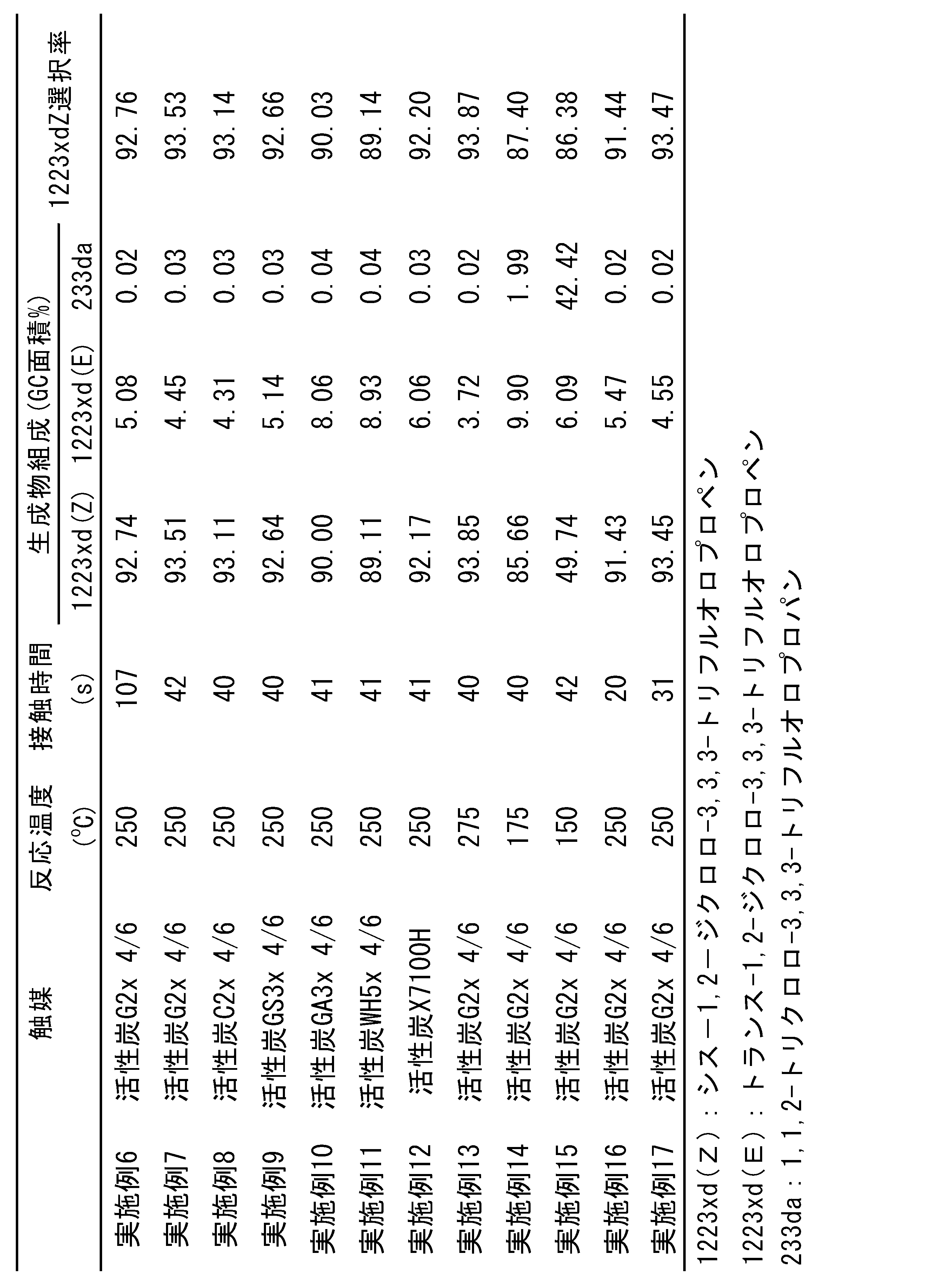
上述した特許文献1に記載されているように、気相中、かつ触媒非存在下において、1,1,1,3,3-ペンタクロロプロパンなどの含塩素化合物のフッ素化と脱ハロゲン化によって1,2-ジクロロ-3,3,3-トリフルオロプロペン(1223xd)が生成することが知られている。しかしながら、この方法で得られる1223xdは極めて微量であり、工業的に十分な量の1223xdを得ることができない。実施例でも示されるように、特許文献1に記載されているような公知の方法と比べると、本発明の実施形態では高収率で、かつ高選択に1223xd(E)を与えることができる。
以下、1223xd(Z)と1223xd(E)の混合物に対し、本発明の実施形態の一つである異性化を行った実施例を説明する。
[実施例18から24]
外部加熱装置を具備する空塔の円筒形反応管からなる気相反応装置(SUS316L製、内径6mm、長さ260mm)に約100mL/分の流速で窒素ガスを流しながら反応管を加熱した。
外部加熱装置を具備する空塔の円筒形反応管からなる気相反応装置(SUS316L製、内径6mm、長さ260mm)に約100mL/分の流速で窒素ガスを流しながら反応管を加熱した。
次に、出発原料として1223xd(Z)(49.55%)と1223xd(E)(50.40%)の混合物を気化して得られたガスにラジカル発生剤を、その濃度が1.0mol%になるように混合した混合ガスを反応管へ供給した。出発原料の流速が安定したところで窒素ガスの導入を停止した。反応開始1時間後に反応が安定したことを確認し、反応管から流出するガスを水中に吹き込んで酸性ガスを除去した後、生成物をガスクロマトグラフィーで分析した。反応温度やラジカル発生剤の種類、添加量などの諸条件は表2に示すとおりである。また、ガスクロマトグラフィーの分析結果も表2に併せて示す。
一方、実施例23、24として、ラジカル発生剤を添加せず、替わりに窒素を添加して同様の実験を行った。これらの結果も表2にまとめる。
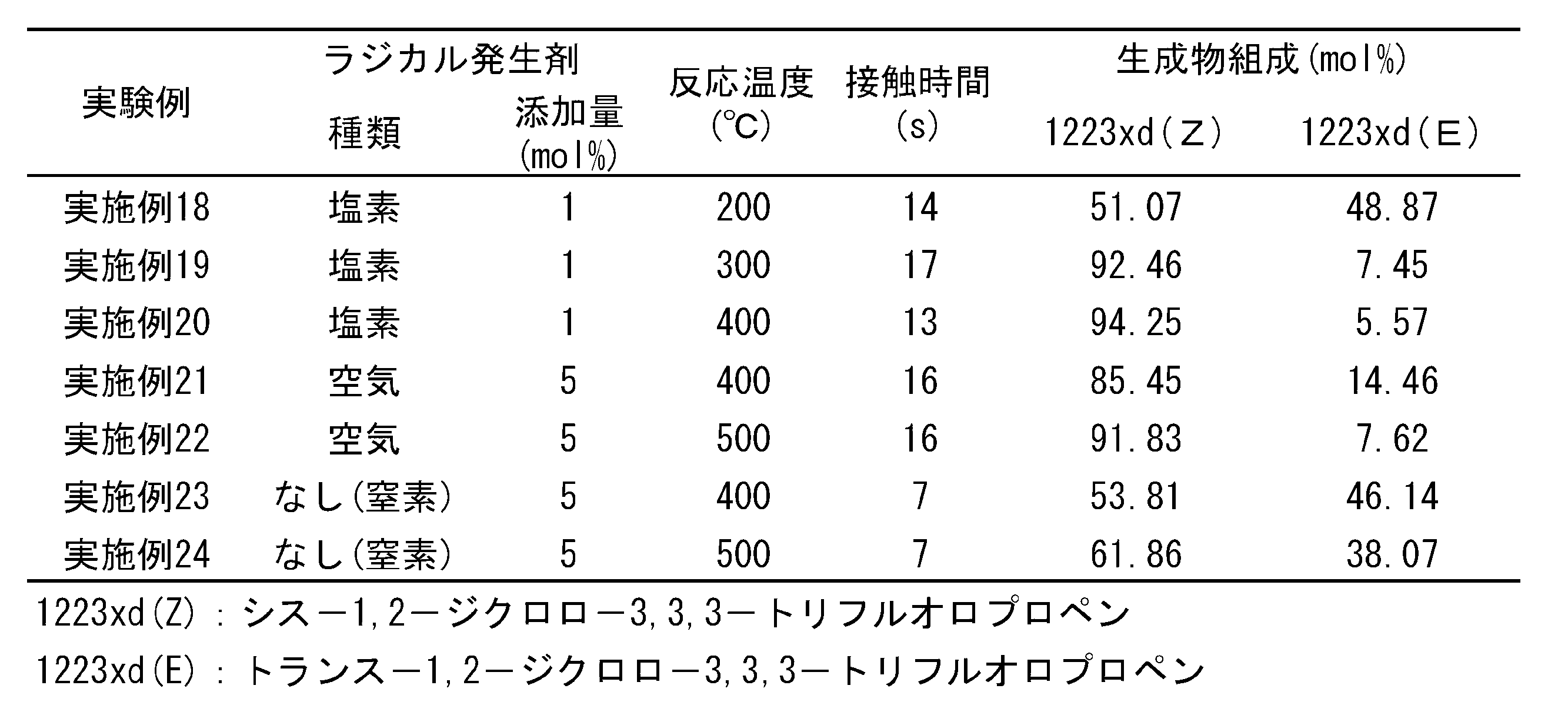
表2に示すように、ラジカル発生剤を添加することで、1223xd(E)の組成が大きく減少し、1223xd(Z)が優先的に得られることが確認された。特に反応温度が300℃以上の時には、異性化によって1223xd(Z)が高い選択率で得られることが分かった。
Claims (18)
- 活性炭を含む触媒、および塩素の存在下、1,1,2-トリクロロ-3,3,3-トリフルオロプロパン、および1,2,2-トリクロロ-3,3,3-トリフルオロプロパンから選択されるハロゲン化飽和炭化水素を脱塩化水素することを含む、1,2-ジクロロ-3,3,3-トリフルオロプロペンを製造する方法。
- 前記ハロゲン化飽和炭化水素は1,1,2-トリクロロ-3,3,3-トリフルオロプロパンである、請求項1に記載の方法。
- 前記脱塩化水素において、前記塩素の量は、前記ハロゲン化飽和炭化水素の量に対して0.1モル%以上30モル%以下である、請求項1に記載の方法。
- 前記脱塩化水素は気相中で行われる、請求項1に記載の方法。
- 前記脱塩化水素は、前記触媒が充填された反応管に気体状の前記ハロゲン化飽和炭化水素を供給することで行う、請求項1に記載の方法。
- 1-クロロ-3,3,3-トリフルオロプロペン、および2-クロロ―3,3,3-トリフルオロプロペンから選択されるハロゲン化オレフィンに塩素を付加して前記ハロゲン化飽和炭化水素を生成することをさらに含む、請求項1に記載の方法。
- 前記ハロゲン化オレフィンは1-クロロ-3,3,3-トリフルオロプロペンである、請求項6に記載の方法。
- 前記塩素の付加は、液相中、50℃以上200℃以下の温度で行われる、請求項6に記載の方法。
- 前記塩素の付加は、0.1MPa以上5MPa以下の圧力下で行われる、請求項6に記載の方法。
- 前記脱塩化水素は、塩素、および精製された前記ハロゲン化飽和炭化水素とを前記反応管に供給することによって行われる、請求項5に記載の方法。
- 前記脱塩化水素は、前記塩素の付加によって得られる粗生成物を精製することなく、前記触媒が充填された反応管に供給することによって行われる、請求項6に記載の方法。
- 前記脱塩化水素は、塩素を追加的に供給することなく行われる、請求項11に記載の方法。
- 1,2-ジクロロ-3,3,3-トリフルオロプロペンを幾何異性化することをさらに含む請求項1に記載の方法。
- 前記幾何異性化は、(E)-1,2-ジクロロ-3,3,3-トリフルオロプロペンの(Z)-1,2-ジクロロ-3,3,3-トリフルオロプロペンへの異性化を含む、請求項13に記載の方法。
- 前記幾何異性化は、ラジカル発生剤の存在下で行う、請求項13に記載の方法。
- 前記ラジカル発生剤が、塩素、酸素、臭素、空気、過酸化水素、オゾン、窒素酸化物、ハロゲン化炭素から選択される、請求項15に記載の方法。
- 1,1,2-トリクロロ-3,3,3-トリフルオロプロパン、および1,2,2-トリクロロ-3,3,3-トリフルオロプロパンから選択されるハロゲン化飽和炭化水素と、塩素とを含む組成物。
- 1,1,2-トリクロロ-3,3,3-トリフルオロプロパン、および1,2,2-トリクロロ-3,3,3-トリフルオロプロパンから選択されるハロゲン化飽和炭化水素と、前記ハロゲン化飽和炭化水素に対し、0.1モル%以上30モル%以下の塩素とを含む、1,2-ジクロロ-3,3,3-トリフルオロプロペン製造用原料組成物。
Priority Applications (1)
| Application Number | Priority Date | Filing Date | Title |
|---|---|---|---|
| JP2020528773A JP7315856B2 (ja) | 2018-07-06 | 2019-06-18 | 1,2-ジクロロ-3,3,3-トリフルオロプロペンの製造方法 |
Applications Claiming Priority (2)
| Application Number | Priority Date | Filing Date | Title |
|---|---|---|---|
| JP2018-128901 | 2018-07-06 | ||
| JP2018128901 | 2018-07-06 |
Publications (1)
| Publication Number | Publication Date |
|---|---|
| WO2020008865A1 true WO2020008865A1 (ja) | 2020-01-09 |
Family
ID=69059607
Family Applications (1)
| Application Number | Title | Priority Date | Filing Date |
|---|---|---|---|
| PCT/JP2019/024125 Ceased WO2020008865A1 (ja) | 2018-07-06 | 2019-06-18 | 1,2-ジクロロ-3,3,3-トリフルオロプロペンの製造方法 |
Country Status (2)
| Country | Link |
|---|---|
| JP (1) | JP7315856B2 (ja) |
| WO (1) | WO2020008865A1 (ja) |
Cited By (2)
| Publication number | Priority date | Publication date | Assignee | Title |
|---|---|---|---|---|
| CN115784834A (zh) * | 2022-10-27 | 2023-03-14 | 万华化学集团股份有限公司 | 一种3,3,3-三氟丙烯的制备方法 |
| CN117342926A (zh) * | 2023-09-04 | 2024-01-05 | 西安近代化学研究所 | 一种合成反式-1,2-二氯-3,3,3-三氟丙烯的方法 |
Citations (5)
| Publication number | Priority date | Publication date | Assignee | Title |
|---|---|---|---|---|
| JP2013087187A (ja) * | 2011-10-18 | 2013-05-13 | Central Glass Co Ltd | 熱サイクル用作動媒体 |
| JP2014210765A (ja) * | 2013-04-02 | 2014-11-13 | セントラル硝子株式会社 | 1,2−ジクロロ−3,3,3−トリフルオロプロペンの製造方法 |
| JP2015500283A (ja) * | 2011-12-07 | 2015-01-05 | ハネウェル・インターナショナル・インコーポレーテッド | 1,1,2−トリクロロ−3,3,3−トリフルオロプロパンに関する方法 |
| JP2015505302A (ja) * | 2011-12-07 | 2015-02-19 | ハネウェル・インターナショナル・インコーポレーテッド | シス−1−クロロ−3,3,3−トリフルオロプロペンに関する方法 |
| WO2017002925A1 (ja) * | 2015-06-30 | 2017-01-05 | 旭硝子株式会社 | ヒドロクロロフルオロオレフィンの製造方法、および2,3,3,3-テトラフルオロプロペンの製造方法 |
-
2019
- 2019-06-18 JP JP2020528773A patent/JP7315856B2/ja active Active
- 2019-06-18 WO PCT/JP2019/024125 patent/WO2020008865A1/ja not_active Ceased
Patent Citations (5)
| Publication number | Priority date | Publication date | Assignee | Title |
|---|---|---|---|---|
| JP2013087187A (ja) * | 2011-10-18 | 2013-05-13 | Central Glass Co Ltd | 熱サイクル用作動媒体 |
| JP2015500283A (ja) * | 2011-12-07 | 2015-01-05 | ハネウェル・インターナショナル・インコーポレーテッド | 1,1,2−トリクロロ−3,3,3−トリフルオロプロパンに関する方法 |
| JP2015505302A (ja) * | 2011-12-07 | 2015-02-19 | ハネウェル・インターナショナル・インコーポレーテッド | シス−1−クロロ−3,3,3−トリフルオロプロペンに関する方法 |
| JP2014210765A (ja) * | 2013-04-02 | 2014-11-13 | セントラル硝子株式会社 | 1,2−ジクロロ−3,3,3−トリフルオロプロペンの製造方法 |
| WO2017002925A1 (ja) * | 2015-06-30 | 2017-01-05 | 旭硝子株式会社 | ヒドロクロロフルオロオレフィンの製造方法、および2,3,3,3-テトラフルオロプロペンの製造方法 |
Cited By (2)
| Publication number | Priority date | Publication date | Assignee | Title |
|---|---|---|---|---|
| CN115784834A (zh) * | 2022-10-27 | 2023-03-14 | 万华化学集团股份有限公司 | 一种3,3,3-三氟丙烯的制备方法 |
| CN117342926A (zh) * | 2023-09-04 | 2024-01-05 | 西安近代化学研究所 | 一种合成反式-1,2-二氯-3,3,3-三氟丙烯的方法 |
Also Published As
| Publication number | Publication date |
|---|---|
| JP7315856B2 (ja) | 2023-07-27 |
| JPWO2020008865A1 (ja) | 2021-07-08 |
Similar Documents
| Publication | Publication Date | Title |
|---|---|---|
| CN102164881B (zh) | 1,3,3,3-四氟丙烯的制造方法 | |
| JP6563450B2 (ja) | フッ化有機化合物の製造方法 | |
| JP5827628B2 (ja) | (e)−1−クロロ−3,3,3−トリフルオロプロペンを製造する統合プロセス及び方法 | |
| JP5143011B2 (ja) | フッ素化有機化合物の製造方法 | |
| JP6245013B2 (ja) | 1,2−ジクロロ−3,3,3−トリフルオロプロペンの製造方法 | |
| US8487144B2 (en) | Process for producing fluorinated propene | |
| JP5453757B2 (ja) | トランス−1,3,3,3−テトラフルオロプロペンの製造方法 | |
| JP6119757B2 (ja) | 1,2−ジクロロ−3,3,3−トリフルオロプロペンの製造方法 | |
| JPH11140002A (ja) | 1,3,3,3−テトラフルオロプロペンの製造法 | |
| JP5515555B2 (ja) | 1,3,3,3−テトラフルオロプロペンの製造方法 | |
| JP6107467B2 (ja) | 1−クロロ−3,3,3−トリフルオロプロペンの製造方法 | |
| JP2014530233A (ja) | 2−クロロ−3,3,3−トリフルオロプロペンの製造方法 | |
| JP2013523882A (ja) | テトラフルオロオレフィンを製造するための方法 | |
| JP2010083818A (ja) | 1,3,3,3−テトラフルオロプロペンの脱水方法 | |
| JP2018524376A (ja) | 2,3,3,3−テトラフルオロプロペン(1234yf)の調製プロセス | |
| JP7315856B2 (ja) | 1,2-ジクロロ-3,3,3-トリフルオロプロペンの製造方法 | |
| JP5187212B2 (ja) | 1,3,3,3−テトラフルオロプロペンの製造方法 | |
| JP5990990B2 (ja) | シス−1,3,3,3−テトラフルオロプロペンの製造方法 | |
| JP2000007591A (ja) | フッ素化プロパンの製造方法 | |
| JP2006193437A (ja) | 1,1,3,3,3−ペンタフルオロプロペンの製造方法 | |
| JP6032085B2 (ja) | 3,3,3−トリフルオロプロピンの製造方法 | |
| JP3154702B2 (ja) | 1,1,1,3,3−ペンタフルオロプロパンの製造方法 |
Legal Events
| Date | Code | Title | Description |
|---|---|---|---|
| 121 | Ep: the epo has been informed by wipo that ep was designated in this application |
Ref document number: 19831357 Country of ref document: EP Kind code of ref document: A1 |
|
| ENP | Entry into the national phase |
Ref document number: 2020528773 Country of ref document: JP Kind code of ref document: A |
|
| NENP | Non-entry into the national phase |
Ref country code: DE |
|
| 122 | Ep: pct application non-entry in european phase |
Ref document number: 19831357 Country of ref document: EP Kind code of ref document: A1 |