WO2020003752A1 - フルクトシルバリルヒスチジンオキシダーゼ活性を有するタンパク質 - Google Patents
フルクトシルバリルヒスチジンオキシダーゼ活性を有するタンパク質 Download PDFInfo
- Publication number
- WO2020003752A1 WO2020003752A1 PCT/JP2019/018491 JP2019018491W WO2020003752A1 WO 2020003752 A1 WO2020003752 A1 WO 2020003752A1 JP 2019018491 W JP2019018491 W JP 2019018491W WO 2020003752 A1 WO2020003752 A1 WO 2020003752A1
- Authority
- WO
- WIPO (PCT)
- Prior art keywords
- protein
- amino acid
- present
- glycated
- acid sequence
- Prior art date
- Legal status (The legal status is an assumption and is not a legal conclusion. Google has not performed a legal analysis and makes no representation as to the accuracy of the status listed.)
- Ceased
Links
Classifications
-
- C—CHEMISTRY; METALLURGY
- C12—BIOCHEMISTRY; BEER; SPIRITS; WINE; VINEGAR; MICROBIOLOGY; ENZYMOLOGY; MUTATION OR GENETIC ENGINEERING
- C12M—APPARATUS FOR ENZYMOLOGY OR MICROBIOLOGY; APPARATUS FOR CULTURING MICROORGANISMS FOR PRODUCING BIOMASS, FOR GROWING CELLS OR FOR OBTAINING FERMENTATION OR METABOLIC PRODUCTS, i.e. BIOREACTORS OR FERMENTERS
- C12M1/00—Apparatus for enzymology or microbiology
- C12M1/34—Measuring or testing with condition measuring or sensing means, e.g. colony counters
-
- C—CHEMISTRY; METALLURGY
- C12—BIOCHEMISTRY; BEER; SPIRITS; WINE; VINEGAR; MICROBIOLOGY; ENZYMOLOGY; MUTATION OR GENETIC ENGINEERING
- C12N—MICROORGANISMS OR ENZYMES; COMPOSITIONS THEREOF; PROPAGATING, PRESERVING, OR MAINTAINING MICROORGANISMS; MUTATION OR GENETIC ENGINEERING; CULTURE MEDIA
- C12N15/00—Mutation or genetic engineering; DNA or RNA concerning genetic engineering, vectors, e.g. plasmids, or their isolation, preparation or purification; Use of hosts therefor
- C12N15/09—Recombinant DNA-technology
- C12N15/63—Introduction of foreign genetic material using vectors; Vectors; Use of hosts therefor; Regulation of expression
-
- C—CHEMISTRY; METALLURGY
- C12—BIOCHEMISTRY; BEER; SPIRITS; WINE; VINEGAR; MICROBIOLOGY; ENZYMOLOGY; MUTATION OR GENETIC ENGINEERING
- C12N—MICROORGANISMS OR ENZYMES; COMPOSITIONS THEREOF; PROPAGATING, PRESERVING, OR MAINTAINING MICROORGANISMS; MUTATION OR GENETIC ENGINEERING; CULTURE MEDIA
- C12N5/00—Undifferentiated human, animal or plant cells, e.g. cell lines; Tissues; Cultivation or maintenance thereof; Culture media therefor
- C12N5/10—Cells modified by introduction of foreign genetic material
-
- C—CHEMISTRY; METALLURGY
- C12—BIOCHEMISTRY; BEER; SPIRITS; WINE; VINEGAR; MICROBIOLOGY; ENZYMOLOGY; MUTATION OR GENETIC ENGINEERING
- C12Q—MEASURING OR TESTING PROCESSES INVOLVING ENZYMES, NUCLEIC ACIDS OR MICROORGANISMS; COMPOSITIONS OR TEST PAPERS THEREFOR; PROCESSES OF PREPARING SUCH COMPOSITIONS; CONDITION-RESPONSIVE CONTROL IN MICROBIOLOGICAL OR ENZYMOLOGICAL PROCESSES
- C12Q1/00—Measuring or testing processes involving enzymes, nucleic acids or microorganisms; Compositions therefor; Processes of preparing such compositions
- C12Q1/26—Measuring or testing processes involving enzymes, nucleic acids or microorganisms; Compositions therefor; Processes of preparing such compositions involving oxidoreductase
Definitions
- the present invention relates to a glycated protein, particularly a fructosyl amino acid oxidase useful for measuring glycated hemoglobin, a method for measuring a glycated protein using the same, a glycated protein measurement kit, and a glycated protein measurement sensor. More specifically, the present invention relates to a fructosyl amino acid oxidase having improved stability to a quaternary ammonium salt, a glycated protein measurement method using the same, a glycated protein measurement kit, and a glycated protein measurement sensor.
- HbA1c hemoglobin A1c
- glycoalbumin which is a glycated protein contained in blood proteins, as a blood sugar control marker.
- Glycated proteins are produced by the reaction between D-glucose present in blood and amino acid residues constituting blood proteins.
- the major glycation sites in blood proteins are the ⁇ -amino group of lysine residues and the ⁇ -amino group of the amino-terminal amino acid of blood proteins.
- glycated proteins can be measured at high throughput, which is useful in the field of clinical testing.
- a glycated protein is hydrolyzed by a protease.
- the resulting glycated amino acids such as fructosyl valine, fructosyl lysine and fructosyl valyl histidine are then oxidatively hydrolyzed by fructosyl valyl histidine oxidase.
- hydrogen peroxide generated by the oxidase reaction is colorimetrically determined by a peroxidase-chromogen reaction system (see Patent Documents 1 to 11).
- fructosyl valyl histidine oxidase which is the main reaction enzyme, is an important factor in the measurement of glycated proteins by the enzymatic assay.
- an enzyme having high specificity for fructosyl valine is desired.
- an enzyme acting on fructosyl valyl histidine is desired.
- fructosyl valyl histidine (fructosyl valyl histidine oxidase) has been extracted and purified from several types of filamentous fungi or their genetically modified products. Also, a gene encoding this fructosyl valyl histidine oxidase has been isolated (see Patent Document 14, Non-patent Document 1, Non-patent Document 2).
- a protease is used to hydrolyze glycated proteins as described above.
- dimethyl sulfoxide as a stabilizing agent for suppressing a decrease in protease activity during storage of a reagent in a liquid state
- Alcohol, calcium, salt, quaternary ammonium salts, quaternary ammonium salt type cationic surfactants and the like are mentioned (Patent Document 16).
- Leuco dyes have the advantage of extremely high measurement sensitivity and are less susceptible to the effects of hemoclobin, bilirubin, and the like in the measurement sample because the absorption maximum is on the longer wavelength side as compared with conventional Trinder reagents.
- the leuco dye does not have sufficient storage stability in a solution, and gradually becomes colored during storage.
- Patent Document 17 a method has been disclosed in which a quaternary ammonium salt-type cationic surfactant is used as a stabilizer for a leuco dye as a stabilizer.
- Hirokawa @ K. , ⁇ Gomi ⁇ K. , ⁇ And ⁇ Kajiyama @ N. Molecular cloning and expression of novel fructosyl peptide oxidases and their application for the measurement of lgrated , @Biochem. ⁇ Biophys. Res. ⁇ Commun. , $ 2003, $ 311 (1), $ 104-111.
- fructosyl valyl histidine oxidase has poor stability in the presence of a quaternary ammonium salt, and further improvement in stability when used in a diagnostic reagent is desired.
- an object of the present invention is to provide a fructosyl bacterium having excellent stability against quaternary ammonium salts, which is useful for measuring glycated proteins, particularly glycated hemoglobin.
- the present inventors have conducted intensive studies to achieve the above object, and as a result, a protein having fructosyl valyl histidine oxidase activity useful for measuring fructosyl amino acid, which is more stable to quaternary ammonium salts than wild type.
- the present inventors have confirmed that it is possible to measure fructosyl amino acid by allowing this mutant protein to act on a fructosyl amino acid-containing specimen and quantifying the generated hydrogen peroxide by a peroxidase reaction.
- the present invention has been completed. That is, the present invention is exemplified as follows.
- a protein having fructosyl valyl histidine oxidase activity according to any one of the following (a) to (c): (A) In the amino acid sequence represented by SEQ ID NO: 1, glutamic acid at at least one site selected from the group consisting of the 101st, 131st, 169th, 245th, and 360th positions is replaced with another amino acid. In the protein (b) consisting of the amino acid sequence (a), one or several amino acids are deleted, substituted or added at positions other than the 101st, 131st, 169th, 245th and 360th positions.
- Item 1 The protein according to Item 1, wherein the amino acid sequence before amino acid substitution in (c) has 90% or more identity with the amino acid sequence shown in SEQ ID NO: 1.
- Item 3. The protein according to Item 1 or 2, wherein the substituted amino acid is any one selected from the group consisting of lysine, arginine and histidine.
- Item 5. A polynucleotide encoding the protein of any one of Items 1 to 4.
- Item 6. Item 6.
- Item 7. Item 7.
- Item 10. A method for producing a protein having fructosyl valyl histidine oxidase activity comprising the step of culturing the transformant of Item 7 to produce a protein having fructosyl valyl histidine oxidase activity, and collecting the protein.
- a method for measuring a glycated protein comprising a step of allowing the protein of any one of Items 1 to 4 to act on a glycated amine.
- Item 10. Item 7. A glycated protein measurement kit comprising the protein according to any one of Items 1 to 4.
- Item 11. Item 11.
- Item 4. A glycated protein measurement sensor for measuring an electric current generated by a reaction of a protein, using an electrode to which the protein according to any one of Items 1 to 4 is immobilized.
- the protein according to the present invention is obtained by substituting at least one of the amino acids corresponding to glutamic acid at positions 101, 131, 169, 245 and 360 in the amino acid sequence represented by SEQ ID NO: 1 and its analogous sequence. And a protein having a substitution oxidase activity of a fructosyl amino acid.
- the protein is particularly effective in providing a protein having fructosyl valyl histidine oxidase activity having excellent stability to quaternary ammonium salts.
- the protein according to the present invention is a protein having fructosyl valyl histidine oxidase activity described in any of the following (a) to (c).
- amino acid sequence (a) consisting of a sequence one or several amino acids are deleted, substituted or added at a site other than the 101st, 131st, 169th, 245th and 360th positions
- At least one selected from the group consisting of the 169th, 245th and 360th Protein is also at least one of glutamic acid corresponding to the site of any one
- the protein according to the present invention exhibits excellent stability even in the presence of a quaternary ammonium salt, as compared with the protein before modification, by constituting the modified amino acid sequence as described above. This is because by replacing the negatively charged amino acid residue located on the enzyme surface with a positively charged amino acid residue, the electric repulsion against quaternary ammonium salts was increased, and the interference with the enzyme was reduced. It is presumed to be the effect of this.
- the sequence having an identity of 85% or more to the amino acid sequence shown in SEQ ID NO: 1 may have a different length from the amino acid sequence shown in SEQ ID NO: 1.
- the amino acid sequence identity can be calculated by using a commercially available or free software such as GENETYX-WIN (manufactured by Genetics) to calculate the proportion (%) of matching sequences by homology search of the two types of sequences. it can.
- amino acid residue substitution sites are 101, 131, 169, and 245 from the amino terminal of the amino acid sequence shown in SEQ ID NO: 1 as long as they have fructosyl valyl histidine oxidase activity.
- the position is not particularly limited as long as it is at least one site of the glutamic acid at the 3rd and 360th positions, and may be a single amino acid at the 5 positions or a combination of these multiple positions.
- the amino acid to be substituted is not particularly limited as long as it has fructosyl valyl histidine oxidase activity, but is preferably lysine, arginine, histidine, and more preferably lysine. No. If the homology is 85% or more with the amino acid sequence shown in SEQ ID NO: 1, sites corresponding to these residues can be determined using, for example, GENETYX-WIN described above.
- the present invention also relates to the amino acid sequence of the protein according to the present invention as described above, which comprises an amino acid sequence in which one or several amino acids have been deleted, substituted and / or added, and has an activity of fructosyl valyl histidine oxidase.
- proteins having the formula: The site where one or several amino acids are deleted, substituted and / or added is a site other than amino acids 101, 131, 169, 245 and 360 from the amino terminus, and If the protein after substitution and / or addition has fructosyl valyl histidine oxidase activity, it may be an amino acid at any position in the amino acid sequence.
- “one or several amino acids” refers specifically to the number of amino acids in a range of 10 or less.
- fructosyl valyl histidine oxidase activity in the present invention is measured by the method described in the section of “Activity measurement method” in Examples described later.
- “having fructosyl valyl histidine oxidase activity” means preferably having an activity of 0.1 U / mg-protein or more, more preferably 1.0 U / mg-protein. It means having the above activity.
- the protein according to the present invention may be produced, for example, using a genetic recombination technique using a polynucleotide and a vector described later, or may be chemically synthesized using an amino acid synthesizer or the like.
- various recombinant protein expression systems suitably used include, but are not limited to, for example, an E. coli expression system, an insect cell expression system, a mammalian cell expression system, and a cell-free expression system. The method for producing the protein or the like of the present invention will be described later.
- the protein according to the present invention may be, for example, one having undergone intermolecular and / or intramolecular cross-linking (for example, disulfide bond), or chemically modified (for example, addition of sugar chain, phosphorylation or other functional group). But not limited thereto, such as those to which a label (for example, a histidine tag or the like) is added, or those to which a fusion protein (for example, streptavidin, cytochrome or GFP) is added.
- the protein and the like according to the present invention may also include a chimeric protein constituted by combining fragments of several kinds of proteins, as long as fructosyl valyl histidine oxidase activity is substantially maintained.
- the fructosyl valyl histidine oxidase agent may be composed of the protein according to the present invention, serum proteins, organic acids, and excipients such as dextran.
- the fructosyl valyl histidine oxidase agent may contain a known component as a component of the enzyme agent.
- the protein according to the present invention is characterized in that the stability in the presence of a quaternary ammonium salt is improved by amino acid substitution as compared to before the amino acid substitution. As a result, long-term storage stability when the protein is used in a diagnostic reagent is improved.
- the quaternary ammonium salt in this case for example, dodecyltrimethylammonium chloride, tetradecyltrimethylammonium chloride, hexadecyltrimethylammonium chloride, octadecyltrimethylammonium chloride, dodecyltrimethylammonium bromide, tetradecyltrimethylammonium bromide, Hexadecyltrimethylammonium, octadecyltrimethylammonium bromide, di (dodecyl) dimethylammonium chloride, di (tetradecyl) dimethylammonium chloride, di (hexadecyl) dimethylammonium chloride, di (octadecyl) dimethylammonium chloride, di (dodecyl) dimethylbromide Ammonium, di (tetradecyl) dimethylammonium bromide, di (hexadecyl)
- the stability in the presence of a quaternary ammonium salt is defined as 0.01 to 1% (W / V), preferably 0.04 to 0.1% (W / V) in a 1 U / ml protein solution. ) At 25 ° C., preferably 30% or more, more preferably 40% or more, when the treatment is carried out at 30 ° C. for 5 to 10 minutes under the condition that a quaternary ammonium salt coexists. % Or more.
- polynucleotide is characterized by comprising a base sequence encoding the protein according to the present invention.
- the base sequence of SEQ ID NO: 3 is exemplified.
- the polynucleotide may exist in the form of DNA (eg, cDNA or genomic DNA) or RNA (eg, mRNA).
- DNA or RNA may be double-stranded or single-stranded.
- Single-stranded DNA or RNA may be a coding strand (sense strand) or a non-coding strand (antisense strand).
- the polynucleotide according to the present invention may be chemically synthesized, and the codon usage (codon usage; Codon usage) may be changed so that the expression of the encoded protein is improved.
- a method for modifying the polynucleotide according to the present invention a commonly used polynucleotide modification method is used. That is, a polynucleotide having the genetic information of the recombinant protein may be prepared by substituting, deleting, and / or adding a specific base of the polynucleotide having the genetic information of the protein.
- a specific method for converting the base of the polynucleotide for example, a commercially available kit (Transformer Site-Directed Mutagenesis Kit; manufactured by Clontech, QuikChange Site Directed Mutagensis Kit; polymerase chain reaction, PCR method, etc.) Use. These methods are known to those skilled in the art.
- the polynucleotide according to the present invention may be substituted with a chemically synthesized base.
- the site where the polynucleotide according to the present invention is substituted is not particularly limited as long as the protein expressed from the base sequence after substitution has suitable properties.
- the polynucleotide according to the present invention may be composed of only the polynucleotide encoding the protein according to the present invention, or may have another base sequence added thereto.
- the base sequence to be added include, but are not limited to, a label (for example, a histidine tag, a Myc tag and a FLAG tag), a fusion protein (for example, GST and MBP), or a signal sequence (for example, an endoplasmic reticulum translocation signal sequence and secretion).
- promoter sequences eg, yeast-derived promoter sequences, phage-derived promoter sequences, E. coli-derived promoter sequences, and the like.
- the site to which these nucleotide sequences are added is not particularly limited as long as the desired function of the translated protein is maintained, but it should be a site corresponding to the N-terminus or C-terminus of the translated protein. Is preferred.
- polynucleotide according to the present invention hybridizes under stringent conditions with the polynucleotide encoding the protein according to the present invention described above, or a polynucleotide consisting of a nucleotide sequence complementary thereto, and has the sequence of SEQ ID NO: 1.
- amino acid sequence in which at least one of the amino acids corresponding to positions 101, 131, 169, 245 and 360 from the amino terminus of the amino acid sequence shown has been substituted with the amino acid sequence shown in SEQ ID NO: 1
- a polynucleotide encoding a protein having fructosyl valyl histidine oxidase activity consisting of Polynucleotides consisting of these sequences can also be obtained by commonly used polynucleotide modification methods.
- stringent conditions refers to conditions under which the nucleic acids hybridize at a temperature ranging from the Tm value of nucleic acids having high homology, for example, perfectly matched hybrids, to 15 ° C., preferably 10 ° C. lower. . As a specific example, it refers to conditions for hybridization in a general hybridization buffer at 68 ° C. for 20 hours.
- the vector according to the present invention contains the above-described polynucleotide according to the present invention.
- Other configurations are not particularly limited as long as they include the polynucleotide according to the present invention.
- a base vector constituting the vector according to the present invention a vector suitable for a host cell can be appropriately selected.
- pBluescript registered trademark
- pUC18 can be used.
- the host microorganism or host cell into which the vector is introduced for example, yeast, Escherichia coli (for example, Escherichia coli (Escherichia coli) W3110, Escherichia coli C600, Escherichia coli JM109, Escherichia coli DH5 ⁇ ), insects Cells and mammalian cells can be used.
- Escherichia coli for example, Escherichia coli (Escherichia coli) W3110, Escherichia coli C600, Escherichia coli JM109, Escherichia coli DH5 ⁇
- insects Cells and mammalian cells can be used.
- the method for introducing the vector according to the present invention into the above-described host microorganism or host cell is not particularly limited.
- the method when introducing a vector into a microorganism belonging to the genus Escherichia as a host microorganism, the method may be carried out in the presence of calcium ions. And a method using an electroporation method.
- gene transfer may be performed using commercially available competent cells (for example, competent high JM109, competent high DH5 ⁇ ; manufactured by Toyobo).
- the vector according to the present invention after separating and purifying the polynucleotide according to the present invention, a fragment of the polynucleotide cut using a restriction enzyme or the like, and the base vector is cut with a restriction enzyme.
- the resulting linear polynucleotide can be constructed by binding and closing. In closing the binding, DNA ligase or the like can be used depending on the properties of the vector and the polynucleotide.
- a transformant containing the polynucleotide of the present invention can be obtained by screening using the markers of the vector and the expression of enzyme activity as indices. Therefore, the vector according to the present invention preferably contains a marker gene such as a drug resistance gene.
- the present invention also encompasses a transformant transformed with the above-described vector of the present invention, that is, a transformant containing the vector of the present invention.
- Host cells transformed with the vector according to the present invention are not particularly limited, and include yeast, Escherichia coli, insect cells, mammalian cells, and the like.
- the method for producing a protein according to the present invention is characterized by including the step of culturing the above-described transformant according to the present invention (referred to as “culturing step”).
- the protein production method according to the present invention may include, in addition to the culturing step, other steps that can be included in the production of a protein using a transformant. Other steps include, for example, a recovery step of recovering the protein produced by the transformant after the culture step, and a purification step of purifying the protein.
- (3-1) Culture step In the culture step, a large amount of recombinant protein can be stably produced by culturing the transformant according to the present invention in a nutrient medium.
- the form of culture of the transformant may be selected in consideration of the nutritional and physiological properties of the host, and in most cases, liquid culture is used. Industrially, it is advantageous to carry out aeration and stirring culture.
- the carbon source may be any assimilable carbon compound, for example, glucose, sucrose, lactose, maltose, lactose, molasses, pyruvic acid and the like.
- the nitrogen source may be any nitrogen compound that can be used, and examples thereof include peptone, meat extract, yeast extract, casein hydrolyzate, and soybean meal alkaline extract.
- salts such as phosphate, carbonate, sulfate, magnesium, calcium, potassium, iron and manganese zinc, amino acids, vitamins and the like may be added to the medium as needed.
- the culture temperature of the transformant according to the present invention can be appropriately changed as long as the transformant can produce the protein according to the present invention.
- Escherichia coli when used as a host, it is preferably used. It is about 20 to 42 ° C.
- the culturing time may be completed at an appropriate time when the protein of the present invention reaches the maximum yield, and is usually about 6 to 48 hours.
- the pH of the medium can be appropriately changed within a range in which the transformant can suitably grow and the protein according to the present invention can be produced, but is preferably in the range of about 6.0 to 9.0.
- the culture contains the protein of the present invention. Therefore, the culture can be used as it is as the protein of the present invention. At this time, the culture solution and the transformant may be separated by, for example, filtration and centrifugation.
- the transformant When the protein according to the present invention is present in a transformant, the transformant is collected from a culture obtained by culturing the transformant by means such as filtration and centrifugation, and the collected transformant is collected. May be destroyed by a mechanical method or an enzymatic method such as lysozyme, and then the target protein may be recovered. If necessary, a protein according to the present invention may be solubilized by adding a chelating agent (eg, EDTA) and a surfactant (eg, Triton-X100), and may be separated and collected as an aqueous solution.
- a chelating agent eg, EDTA
- a surfactant eg, Triton-X100
- the purification step is a step of purifying the protein obtained in the recovery step.
- a specific method of the purification step is not particularly limited, for example, a solution containing the protein according to the present invention is concentrated under reduced pressure, membrane concentrated, salted out (for example, using ammonium sulfate and sodium sulfate), Alternatively, it may be subjected to a fractional precipitation method using a hydrophilic organic solvent (eg, methanol, ethanol, acetone, etc.). By these operations, the target protein of the present invention can be precipitated and purified.
- a hydrophilic organic solvent eg, methanol, ethanol, acetone, etc.
- purification may be performed by heat treatment, isoelectric point treatment, gel filtration, adsorption chromatography, ion exchange chromatography, affinity chromatography, reverse phase chromatography, or a combination thereof.
- the purified enzyme containing the target protein obtained by using these techniques is purified to such an extent that it shows a single band in electrophoresis (SDS-PAGE).
- the above purified enzyme can be powdered by, for example, freeze-drying, vacuum drying, spray drying and the like and distributed.
- the purified enzyme can be used in a state of being appropriately dissolved in a buffer depending on the use.
- a buffer for example, a borate buffer, a phosphate buffer, a Tris-HCl buffer, a GOOD buffer, and the like may be suitably selected according to the properties of the target protein and / or experimental conditions or environment. .
- it can be stabilized by adding amino acids (for example, glutamic acid, glutamine and lysine, etc.), serum albumin and the like to the purified enzyme.
- the protein according to the present invention can be used for a method for measuring fructosyl amino acid. Further, the method for measuring fructosyl amino acid using the protein according to the present invention can be applied to the measurement of glycated proteins such as glycated hemoglobin.
- glycated proteins such as glycated hemoglobin.
- the measurement method of the present invention is characterized by causing the protein of the present invention to act on at least glycated amine.
- the present invention is not limited thereto.
- One embodiment of the measuring method according to the present invention (1) reacting a sample with a protease to degrade glycated protein in the sample and prepare a glycated amine derived from the glycated protein in the sample (referred to as “first step” for convenience); (2) a step of allowing the protein according to the present invention to act on a glycated amine derived from a glycated protein in the sample obtained by the step (1) (for convenience, referred to as a “second step”); (3) A method for measuring a glycated protein comprising a step of measuring the amount of hydrogen peroxide generated in the step (2) or the amount of consumed oxygen (referred to as “third step” for convenience). .
- One specific example of this embodiment is an enzymatic method.
- a glycated protein in a sample is fragmented to a level of amino acids or peptides using an enzyme (for example, a protease) (first step).
- an enzyme for example, a protease
- fructosyl valyl histidine oxidase is added to the resulting glycated amino acid and / or glycated peptide, and hydrogen peroxide is generated by an oxidation-reduction reaction (second step).
- Peroxidase (POD) and a reducing agent that develops color by oxidation are added to this sample, and a redox reaction is caused between hydrogen peroxide and the reducing agent using POD as a catalyst (third step).
- the amount of hydrogen peroxide can be measured by coloring the reducing agent by an oxidation-reduction reaction and measuring the intensity of the coloring (third step).
- the first step is a step of decomposing a glycated protein in a sample to prepare a glycated amine derived from the glycated protein in the sample.
- glycated protein means a protein in which a sugar is bound (glycated) to a part or all of the amino acid residues constituting the protein.
- the glycated protein is not particularly limited, and includes, for example, a protein in which the ⁇ -amino group at the amino terminal of the protein is glycated (eg, HbA1c).
- HbA1c exemplified above is widely used as an index for clinical diagnosis such as diagnosis of diabetes.
- the protease used in the first step is not particularly limited as long as it can degrade a glycated protein contained in a sample into a glycated amino acid or a glycated peptide.
- proteases derived from animals, plants, bacteria such as Bacillus, fungi such as Aspergillus, and yeast are preferred.
- Preferred examples of proteases derived from microorganisms of the genus Bacillus include subtilisin and metalloprotease.
- the ⁇ sample '' used in the present measurement method is not particularly limited as long as it is a target for which the presence or absence or concentration of a glycated protein is to be detected, and for example, besides whole blood, plasma, serum and blood cells, etc. And biological samples such as urine and cerebrospinal fluid (that is, samples collected from a living body), and samples such as drinking water such as juice and foods such as soy sauce and sauce. Since the method of the present invention can be applied to the diagnosis of diabetes, it is particularly useful when measuring a whole blood sample and a blood cell sample among the above.
- hemolyzed sample when measuring glycated hemoglobin in erythrocytes, whole blood is directly lysed or erythrocytes separated from whole blood are lysed, and this hemolyzed sample is used as a sample for measurement. It may be.
- Specific conditions for reacting the sample with the protease are not particularly limited as long as the desired saccharified amine can be prepared, and may vary depending on the concentration and type of the sample and the concentration and type of the protease. Appropriate conditions can be appropriately examined and adopted.
- the concentration of protease that can be suitably used in the measurement method of the present invention is, for example, 0.1 U to 1 MU / ml, more preferably 1 U to 500 KU / ml, and most preferably 5 U to 100 KU / ml.
- the concentration of the protease is not limited, and can be suitably determined by the experimenter or the user depending on the reaction conditions, the type and state of the sample, the procedure of the experimenter, the type of the reagent to be used, and the like.
- the “glycated amine” on which the protein according to the present invention acts includes glycated amino acids and glycated peptides derived from glycated proteins contained in the sample.
- the length of the glycated peptide is not particularly limited, but the length at which the protein of the present invention can act includes, for example, those having about 2 to 6 amino acid residues.
- the second step is a step of allowing the protein according to the present invention to act on a glycated amine derived from a glycated protein in the sample obtained in the first step.
- the fructosyl valyl histidine oxidase activity of the protein according to the present invention is not particularly limited, but the higher the fructosyl valyl histidine oxidase activity, the higher the sensitivity with which glycated amines can be detected.
- the histidine oxidase protein is preferable because the amount of use can be reduced.
- the concentration of the fructosyl valyl histidine oxidase protein used in the measurement method of the present invention is, for example, 0.1 to 500 U / ml, preferably 0.5 to 200 U / ml, and most preferably 1.0 to 200 U / ml. 100100 U / ml.
- the concentration of the above fructosyl valyl histidine oxidase is not particularly limited, and can be appropriately determined according to the reaction conditions, the type and state of the sample, the procedure of the experimenter, the type of the reagent to be used, and the like. .
- the third step is a step of measuring the amount of hydrogen peroxide generated in the second step or the amount of consumed oxygen.
- the specific method of the third step is not particularly limited as long as the method can measure the amount of hydrogen peroxide or the amount of oxygen. Therefore, known methods can be appropriately applied.
- the amount of hydrogen peroxide is measured by adding POD and a reducing agent that develops color by oxidation to the sample obtained in the second step, and measuring the coloring intensity of the reducing agent. .
- suitable PODs include those derived from horseradish and microorganisms. Further, the preferred working concentration of POD is 0.01 to 100 units / mL.
- a suitable method for measuring hydrogen peroxide in the third step is to use a coupler (such as 4-aminoantipyrine (4-AA) and 3-methyl-2-benzothiazolinone hydrazone (MBTH)) in the presence of POD.
- a coupler such as 4-aminoantipyrine (4-AA) and 3-methyl-2-benzothiazolinone hydrazone (MBTH)
- MBTH 3-methyl-2-benzothiazolinone hydrazone
- Trinder reagent that generates a dye by oxidative condensation reaction of a phenol-based, aniline-based or toluidine-based chromogen, and a leuco dye that directly oxidizes and colors in the presence of POD.
- Trinder reagent for example, phenol and its derivatives can be used.
- Couplers that can be suitably used in the third step include 4-aminoantipyrine, aminoantipyrine derivatives, vanillin diamine sulfonic acid, methylbenzthiazolinone hydrazone (MBTH), and sulfonated methylbenzthiazolinone hydrazone (SMBTH). No.
- the leuco dye that can be suitably used in the third step is not particularly limited, but for example, a triphenylmethane derivative, a phenothiazine derivative, a diphenylamine derivative and the like can be used.
- a measuring method using various sensor systems is generally known to those skilled in the art in addition to a coloring method using POD or the like (not limited to, for example, 2001-204494).
- electrodes used for various sensor systems include an oxygen electrode, a carbon electrode, a gold electrode, and a platinum electrode.
- these electrodes on which an enzyme is immobilized are used as working electrodes, and a buffer solution under conditions suitable for the present invention is used together with a counter electrode (for example, a platinum electrode) and a reference electrode (for example, an Ag / Cl electrode).
- a constant voltage is applied to the working electrode while being kept at a constant temperature by inserting it into the working electrode, and a sample is further added to measure an increase in current caused by hydrogen peroxide resulting from the enzymatic reaction.
- a method of measuring with an amperometric system using a carbon electrode, a gold electrode, a platinum electrode, or the like there is a system using an immobilized electron mediator.
- these electrodes in which an enzyme and an electron mediator such as potassium ferricyanide, ferrocene, osmium derivative, and phenazine methosulfate are adsorbed or immobilized on a polymer matrix by a covalent bonding method as a working electrode are used as a counter electrode (for example, a platinum electrode).
- a reference electrode eg, an Ag / AgCl electrode, etc.
- a reference electrode eg, an Ag / AgCl electrode, etc.
- a constant voltage is applied to the working electrode, the sample is added, and the increase in current due to hydrogen peroxide resulting from the enzymatic reaction can be measured.
- the amount of saccharified amine can also be measured by measuring the amount of oxygen consumed in the third step (for example, but not limited to, refer to JP-A-2001-204494). Specifically, using an oxygen electrode, oxygen is immobilized on the electrode surface, and inserted into a buffer solution under conditions suitable for the present invention, and maintained at a constant temperature. The sample is added here, and the decrease value of the current is measured.
- these electrodes on which an enzyme is immobilized are used as a working electrode, and a counter electrode (for example, a platinum electrode or the like) and a reference electrode (for example, , Ag / AgCl electrodes, etc.) and the current increase including the mediator is measured.
- a counter electrode for example, a platinum electrode or the like
- a reference electrode for example, Ag / AgCl electrodes, etc.
- the mediator for example, compounds such as potassium ferricyanide, ferrocene, osmium derivatives, and phenazine methosulfate can be used.
- an inactive protein may be added to the system for performing each step in order to increase the stability of the protein of the present invention.
- Inactive proteins include serum albumins, globulins and fibrous proteins.
- a preferred protein is bovine serum albumin, a preferred concentration is 0.05-1% (W / V).
- Preferred inactive proteins are those that do not contain protease impurities that cause enzymatic degradation.
- Glycated protein measurement kit A glycated protein measurement kit according to the present invention (hereinafter referred to as “kit of the present invention”) is characterized by containing at least the protein according to the present invention.
- the form of the protein according to the present invention provided in the kit of the present invention is not particularly limited.
- a form such as an aqueous solution, a suspension, or a lyophilized powder can be adopted.
- the lyophilized powder can be prepared according to a conventional method.
- the method of compounding the above additives is not particularly limited.
- a method of blending an additive with a buffer containing a protein according to the present invention a method of blending a protein according to the present invention with a buffer containing an additive, or a buffer comprising a protein and a stabilizer according to the present invention in a buffer A method of mixing them at the same time can be used.
- the kit of the present invention is exemplified by an embodiment constituted by a reagent composition comprising at least the protein, peroxidase and chromogen according to the present invention.
- peroxidase reaction for detecting hydrogen peroxide derived from oxidation of fructosyl amino acid. Therefore, peroxidase and a chromogen (hydrogen peroxide coloring reagent) are preferably used in the reagent composition.
- the chromogen (hydrogen peroxide coloring reagent) used in the present invention is preferably stable in solution and has low bilirubin interference.
- the chromogen (hydrogen peroxide coloring reagent) that can be suitably used in the present invention include, for example, 4-aminoantipyrine or 3-methyl-2-benzothiazoline hydrazone (MBTH) and phenol or a derivative thereof, or aniline or a derivative thereof.
- a reagent comprising a combination of The chromogen (hydrogen peroxide coloring reagent) used in the present invention may be a benzidine, a leuco dye, a 4-aminoantipyrine, a phenol, a naphthol, or an aniline derivative.
- the peroxidase preferably used in the present invention is preferably a horseradish peroxidase. This peroxidase is commercially available in high purity and at low cost.
- the enzyme concentration must be high enough for a quick and complete reaction, preferably between 1,000 and 50,000 U / L.
- the reagent composition may contain a buffer (eg, a borate buffer, a phosphate buffer, a Tris-HCl buffer, a GOOD buffer, etc.) in addition to the above components.
- the reagent composition includes chelating reagents (for example, EDTA and O-dianisidine) for capturing ions that interfere with the enzymatic reaction, ascorbate oxidase for eliminating ascorbic acid, which is an interfering substance for the determination of hydrogen peroxide, and various other reagents.
- Surfactants eg, Triton X-100 and NP-40
- various antibacterial and preservatives eg, streptomycin and sodium azide
- These reagents may be a single reagent or a combination of two or more reagents.
- the buffer is not particularly limited, but any buffer having a sufficient buffer capacity in a pH range of 6 to 8.5 can be used.
- buffers include phosphate, tris, bis-trispropane, N-tris (hydroxymethyl) methyl-2-aminoethanesulfonic acid (TES), 2-morpholinoethanesulfonic acid monohydrate ( (MES), piperazine-1,4-bis (2-ethanesulfonic acid) (piperazine-1,4-bis (2-ethanesulfonic acid)) (PIPES), 2- [4- (2-hydroxyethyl) -1- Piperazinyl] ethanesulfonic acid (2- [4- (2-hydroxyethyl) -1-piperazinyl] ethanesulfonic acid) (HEPES), and 3- [N-tris (hydroxymethyl) methylamino] -2-hydroxypropanesulfonic acid ( TAPSO).
- preferred buffers are MES and PIPES.
- the kit of the present invention includes, for example, fructosyl valyl histidine oxidase, a buffer, a protease, a POD, a coloring reagent, a chelating reagent that captures ions that interfere with the enzymatic reaction, and ascorbic acid, a substance that interferes with the determination of hydrogen peroxide.
- Ascorbate oxidase surfactants, stabilizers, excipients, antibacterial agents, preservatives, well plates, fluorescent scanners, automatic analyzers, etc., for eliminating lipase.
- the kit of the present invention can be used for the method for measuring fructosyl amino acid and the measurement of glycated protein according to the present invention, and can be particularly suitably used for measuring glycated hemoglobin.
- the glycated protein measurement sensor according to the present invention is a sensor used for detecting a glycated protein, and includes at least the protein according to the present invention. I have.
- the sensor of the present invention is used for carrying out the measuring method of the present invention. In particular, it can be suitably used for measurement of glycated hemoglobin. Therefore, the sensor of the present invention may be constituted by an article used for performing the measuring method of the present invention.
- the description of the buffering agent and the like in the section of the measuring method of the present invention and the kit of the present invention can be referred to.
- the sensor of the present invention includes an embodiment in which the protein of the present invention is immobilized on a support.
- the support is not particularly limited as long as it can immobilize the protein according to the present invention, and a suitable shape and material may be used according to the properties of the protein.
- the shape of the support is not particularly limited as long as it has a sufficient area on which the protein can be immobilized, and examples thereof include a substrate, beads, and a membrane.
- the material of the support include inorganic materials, natural polymers and synthetic polymers.
- Table 1 shows the composition of the activity measurement reagent used in the following examples.
- the reagents used in the examples were purchased from Nacalai Tesque, unless otherwise specified.
- the enzymatic activity for each substrate was determined by measuring the increase in the absorbance of the dye produced by the peroxidase reaction following the hydrogen peroxide produced by the enzymatic reaction. First, after preliminarily heating 3 ml of the activity measurement reagent at 37 ° C. for 5 minutes, 0.1 ml of an enzyme solution previously diluted with an enzyme diluent (50 mM potassium phosphate buffer (pH 7.5)) was added to the activity measurement reagent. Start the reaction. The reaction is performed at 37 ° C. for 5 minutes, and the change in absorbance at 500 nm is measured ( ⁇ ODtest / min).
- Activity value (U / ml) ⁇ (( ⁇ ODtest / min) ⁇ ( ⁇ ODblank / min)) ⁇ 3.1 ml ⁇ dilution factor ⁇ / (13 ⁇ 1.0 cm ⁇ 0.1 ml) 3.1 ml: total solution volume 13: mmol extinction coefficient 1.0 cm: cell optical path length 0.1 ml: enzyme sample solution volume
- Example 1 Subcloning of Fructosyl valyl histidine oxidase gene from Pheosperia nodrum> Large-scale expression in Escherichia coli of a plasmid containing the gene for fructosyl valyl histidine oxidase derived from Pheosperia nodrum having the nucleotide sequence shown in SEQ ID NO: 2 was attempted. The full-length cDNA region (from the 1st to the 1311th base of the nucleotide sequence shown in SEQ ID NO: 2) excluding the termination codon of the fructosyl valyl histidine oxidase gene derived from Pheospheria nodrum was amplified by PCR.
- an NdeI cleavage site was inserted at the N-terminal side of the amino acid sequence using primer P5 (5′-GGAATTCCATATGGCGCCCTCCAGAGCAAAACACCAGTGTCCATT-3 ′) shown in SEQ ID NO: 4 (“CATATG” in this nucleotide sequence is an NdeI recognition site).
- an XhoI cleavage site was introduced at the C-terminal side of the amino acid sequence using primer P6 (5′-CCGCTCGAGCAAGTTCGCCTCGGCTTATCATGATTCCAACC-3 ′) shown in SEQ ID NO: 5 (“CTCGAG” in this nucleotide sequence is an XhoI recognition site).
- This DNA fragment was subcloned into the NdeI-XhoI site of the pET-23b vector (Novagen) so as to be in the forward direction with the T7 promoter.
- the prepared plasmid was designated as pIE353 as a plasmid for expressing fructosyl valyl histidine oxidase.
- Example 2 Construction, purification, and enzyme assay of a protein having fructosyl valyl histidine oxidase activity by modifying the function of the fructosyl valyl histidine oxidase gene derived from Pheosperia nodrum>
- a mutation treatment operation was performed according to a specified protocol using KOD-Plus Site-Directed Mutagenesis Kit (manufactured by Toyobo) to determine the nucleotide sequence.
- the nucleotide sequence encoding glutamic acid (E) at positions 101, 131, 169, 245 and 360 of the amino acid sequence shown in SEQ ID NO: 1 is substituted with a nucleotide sequence encoding lysine (K).
- Recombinant plasmids pIE353-E101K, pIE353-E131K, pIE353-E169K, pIE353-E245K, and pIE353-E360K
- the transformant was cultured, and the resulting crude enzyme solution was purified to obtain purified enzyme preparations (IE353, IE353-E101K, IE353-E131K, IE353-E169K, IE353-E245K, IE353-E360K).
- the fructosyl valyl histidine oxidase activity of the crude enzyme solution measured using the fructosyl valyl histidine-containing measuring reagent was 9.9 to 24.6 U / ml.
- IE353-E101K, IE353-E131K, IE353-E169K, IE353-E245K, and IE353-E360K have higher stability to quaternary ammonium salts than the wild-type FAOD protein (IE353). Has improved.
- the present invention it is possible to provide fructosyl valyl histidine oxidase having high stability to a quaternary ammonium salt useful for measuring fructosyl amino acid, and therefore, a method for measuring fructosyl amino acid using fructosyl valyl histidine oxidase And a fructosyl amino acid measurement reagent composition and the like. Therefore, the present invention can be widely used in the life science field, including the field of clinical testing based on preventive medicine, the field of diagnostic medicine, the field of pharmaceuticals, and the field of health medicine.
Landscapes
- Health & Medical Sciences (AREA)
- Life Sciences & Earth Sciences (AREA)
- Chemical & Material Sciences (AREA)
- Engineering & Computer Science (AREA)
- Genetics & Genomics (AREA)
- Organic Chemistry (AREA)
- Bioinformatics & Cheminformatics (AREA)
- Zoology (AREA)
- Wood Science & Technology (AREA)
- Biotechnology (AREA)
- Biomedical Technology (AREA)
- General Engineering & Computer Science (AREA)
- General Health & Medical Sciences (AREA)
- Microbiology (AREA)
- Biochemistry (AREA)
- Physics & Mathematics (AREA)
- Analytical Chemistry (AREA)
- Molecular Biology (AREA)
- Proteomics, Peptides & Aminoacids (AREA)
- Biophysics (AREA)
- Sustainable Development (AREA)
- Medicinal Chemistry (AREA)
- Cell Biology (AREA)
- Plant Pathology (AREA)
- Immunology (AREA)
- Enzymes And Modification Thereof (AREA)
- Apparatus Associated With Microorganisms And Enzymes (AREA)
- Micro-Organisms Or Cultivation Processes Thereof (AREA)
- Measuring Or Testing Involving Enzymes Or Micro-Organisms (AREA)
Abstract
第四級アンモニウム塩に対する安定性が向上したフルクトシルアミノ酸オキシダーゼおよびそれを利用した糖化タンパク質の測定方法を提供する。 以下の(a)~(c)のいずれかに記載の、フルクトシルバリルヒスチジンオキシダーゼ活性を有するタンパク質。 (a)配列番号1に示されるアミノ酸配列において、101番目、131番目、169番目、245番目および360番目からなる群から選択される少なくともいずれか1箇所の部位におけるグルタミン酸が他のアミノ酸に置換されたアミノ酸配列からなるタンパク質 (b)アミノ酸配列(I)において、101番目、131番目、169番目、245番目および360番目以外の部位において、1もしくは数個のアミノ酸が欠失、置換、もしくは付加されたアミノ酸配列からなるタンパク質 (c)配列番号1に示されるアミノ酸配列と85.0%以上の同一性を有するアミノ酸配列において、配列番号1の101番目、131番目、169番目、245番目および360番目からなる群から選択される少なくともいずれか1箇所の部位に相当するグルタミン酸が他のアミノ酸に置換されたアミノ酸配列からなるタンパク質
Description
本発明は、糖化タンパク質、特に糖化ヘモグロビンの測定に有用なフルクトシルアミノ酸オキシダーゼおよびそれを用いた糖化タンパク質の測定方法、糖化タンパク質測定キット、糖化タンパク質測定センサーに関する。より具体的には、第四級アンモニウム塩に対する安定性が向上したフルクトシルアミノ酸オキシダーゼおよびそれを用いた糖化タンパク質の測定方法、糖化タンパク質測定キット、糖化タンパク質測定センサーに関する。
糖尿病患者の血糖の測定には、血液タンパク質に含まれる糖化タンパク質であるヘモグロビンA1c(HbA1c)またはグリコアルブミンを血糖コントロールマーカーとして測定する方法が重用されている。糖化タンパク質は、血液中に存在するD-グルコースと、血液タンパク質を構成するアミノ酸残基とが反応して生成される。血液タンパク質における主な糖化部位は、リジン残基のε-アミノ基および血液タンパク質のアミノ末端アミノ酸のα-アミノ基である。HbA1cを測定する場合には、D-グルコースがヘモグロビンβ鎖のアミノ末端アミノ酸であるバリンのα-アミノ基に結合して生じた糖化タンパク質の量を測定する。
近年、血液中の糖化タンパク質を簡便かつ短時間で測定できる酵素的測定法が開発され、既に商品化されている。酵素的測定法を利用することにより、糖化タンパク質をハイスループットに測定することが可能となり、臨床検査分野で役立てられている。酵素的測定法は、まず、プロテアーゼにより糖化タンパク質を加水分解する。次いで、これにより生じたフルクトシルバリン、フルクトシルリジンおよびフルクトシルバリルヒスチジンなどの糖化アミノ酸を、フルクトシルバリルヒスチジンオキシダーゼにより酸化的加水分解する。最後に、オキシダーゼ反応により生じた過酸化水素をペルオキシダーゼ-色原体反応システムにより比色定量する(特許文献1から11参照)。
酵素的測定法による糖化タンパク質の測定では、主反応酵素であるフルクトシルバリルヒスチジンオキシダーゼの基質特異性が重要な要素となる。例えば、HbA1cの測定では、フルクトシルバリンに対する特異性の高い酵素が望まれている。また、糖化ヘモグロビンのβ鎖に特異的な測定を行うためには、フルクトシルバリルヒスチジンに作用する酵素が望まれている。これは、ヘモグロビンα鎖およびβ鎖のアミノ末端アミノ酸が共にバリンであることから、β鎖に特異的な測定を行うためには、アミノ末端アミノ酸2残基(すなわち、フルクトシルバリルヒスチジン)の認識が必要であるためである(特許文献12、特許文献13参照)。
これまでに、フルクトシルバリルヒスチジンに作用するオキシダーゼ(フルクトシルバリルヒスチジンオキシダーゼ)は、数種の糸状菌、またはその遺伝子組換え体より抽出および精製されている。また、このフルクトシルバリルヒスチジンオキシダーゼをコードする遺伝子も単離されている(特許文献14、非特許文献1、非特許文献2参照)。
一方、酵素的測定法においては試料中に大量に存在するヘモグロビンの影響が問題となる。この問題に対する解決手段としては、ピリジニウム塩、ホスホニウム塩、及び第四級アンモニウム塩からなる群より選ばれるカチオン性界面活性剤存在下に反応を行う方法が開示されている(特許文献15)。
また、酵素的測定法においては上述の通り糖化タンパク質を加水分解のためプロテアーゼが使用されるが、特に試薬を液体の状態で保存中にプロテアーゼの活性低下を抑える安定化剤として、ジメチルスルホオキシド、アルコール、カルシウム、食塩、第四級アンモニウム塩及び第四級アンモニウム塩型陽イオン界面活性剤などが挙げられている(特許文献16)。
さらに、酵素的測定法で用いられる呈色試薬としては、ペルオキシダーゼの存在下で直接酸化呈色するロイコ色素を用いる方法が数多く報告されている。ロイコ色素は測定感度が非常に高く、また従来のトリンダー試薬類と比較して吸収極大が長波長側にあるため、測定試料中のヘモクロビンやビリルビン等の影響を受け難いという長所がある。しかしながら、ロイコ色素は溶液中で保存安定性が充分ではなく保存中に徐々に着色してくるという問題がある。この問題に対処するため、ロイコ色素の安定化剤として第四級アンモニウム塩型陽イオン界面活性剤を安定化剤として共存させる方法が開示されている(特許文献17)。このように酵素的測定法においては第四級アンモニウム塩の有用性が認められている。
Hirokawa K., Gomi K., Bakke M., and Kajiyama N., Distribution and properties of novel deglycating enzymes for fructosyl peptide in fungi., Arch. Microbiol., 2003, 180(3), 227-231.
Hirokawa K., Gomi K., and Kajiyama N., Molecular cloning and expression of novel fructosyl peptide oxidases and their application for the measurement of glycated protein., Biochem. Biophys. Res. Commun., 2003, 311(1), 104-111.
しかしながら、従来のフルクトシルバリルヒスチジンオキシダーゼは第四級アンモニウム塩共存下での安定性が悪く、診断薬試薬中に用いた際の安定性について更なる改良が望まれている。
そこで、本発明は上記のような問題点に鑑みてなされたものであり、その目的は、糖化タンパク質、特に糖化ヘモグロビンの測定に有用な、第四級アンモニウム塩に対する安定性に優れたフルクトシルバリルヒスチジンオキシダーゼを新たに創出し、その酵素を利用した糖化タンパク質(糖化ヘモグロビン)の測定方法、および糖化タンパク質(糖化ヘモグロビン)測定用試薬組成物、糖化タンパク質(糖化ヘモグロビン)測定キット、糖化タンパク質(糖化ヘモグロビン)センサーを提供することである。
本発明者らは、上記目的を達成するため鋭意検討を重ねた結果、フルクトシルアミノ酸の測定に有用なフルクトシルバリルヒスチジンオキシダーゼ活性を有するタンパク質で、野生型よりも第四級アンモニウム塩に対する安定性が向上した変異タンパク質を造成することに成功した。さらに本発明者らは、この変異タンパク質をフルクトシルアミノ酸含有検体に作用させ、生じた過酸化水素をペルオキシダーゼ反応により定量することによって、フルクトシルアミノ酸を測定することが可能であることを確認し、本発明を完成させるに至った。すなわち本発明は、以下の通り例示される。
項1.以下の(a)~(c)のいずれかに記載の、フルクトシルバリルヒスチジンオキシダーゼ活性を有するタンパク質。
(a)配列番号1に示されるアミノ酸配列において、101番目、131番目、169番目、245番目および360番目からなる群から選択される少なくともいずれか1箇所の部位におけるグルタミン酸が他のアミノ酸に置換されたアミノ酸配列からなるタンパク質
(b)アミノ酸配列(a)において、101番目、131番目、169番目、245番目および360番目以外の部位において、1もしくは数個のアミノ酸が欠失、置換、もしくは付加されたアミノ酸配列からなるタンパク質
(c)配列番号1に示されるアミノ酸配列と85%以上の同一性を有するアミノ酸配列において、配列番号1の101番目、131番目、169番目、245番目および360番目からなる群から選択される少なくともいずれか1箇所の部位に相当するグルタミン酸が他のアミノ酸に置換されたアミノ酸配列からなるタンパク質
項2.(c)のアミノ酸置換前のアミノ酸配列が、配列番号1に示されるアミノ酸配列と90%以上の同一性を有する項1のタンパク質。
項3.置換されたアミノ酸がリジン、アルギニンおよびヒスチジンからなる群のいずれかから選択されるいずれかである項1または2のタンパク質。
項4.置換されたアミノ酸がリジンである項1~3のいずれかのタンパク質。
項5.項1~4のいずれかのタンパク質をコードするポリヌクレオチド。
項6.項5のポリヌクレオチドを含有する組換えベクター。
項7.項6の組換えベクターにより宿主を形質転換した形質転換体。
項8.項7の形質転換体を培養してフルクトシルバリルヒスチジンオキシダーゼ活性を有するタンパク質を生成させ、当該タンパク質を採取する工程を含む、フルクトシルバリルヒスチジンオキシダーゼ活性を有するタンパク質の製造方法。
項9.糖化アミンに対して項1~4のいずれかのタンパク質を作用させる工程を含む糖化タンパク質の測定方法。
項10.項1~4のいずれかのタンパク質を含む糖化タンパク質測定キット。
項11.さらに、ペルオキダーゼおよび過酸化水素発色試薬を含む項10の糖化タンパク質測定キット。
項12.項1~4のいずれかのタンパク質が固定された電極を用い、該タンパク質の反応により生じた電流を測定する糖化タンパク質測定センサー。
(a)配列番号1に示されるアミノ酸配列において、101番目、131番目、169番目、245番目および360番目からなる群から選択される少なくともいずれか1箇所の部位におけるグルタミン酸が他のアミノ酸に置換されたアミノ酸配列からなるタンパク質
(b)アミノ酸配列(a)において、101番目、131番目、169番目、245番目および360番目以外の部位において、1もしくは数個のアミノ酸が欠失、置換、もしくは付加されたアミノ酸配列からなるタンパク質
(c)配列番号1に示されるアミノ酸配列と85%以上の同一性を有するアミノ酸配列において、配列番号1の101番目、131番目、169番目、245番目および360番目からなる群から選択される少なくともいずれか1箇所の部位に相当するグルタミン酸が他のアミノ酸に置換されたアミノ酸配列からなるタンパク質
項2.(c)のアミノ酸置換前のアミノ酸配列が、配列番号1に示されるアミノ酸配列と90%以上の同一性を有する項1のタンパク質。
項3.置換されたアミノ酸がリジン、アルギニンおよびヒスチジンからなる群のいずれかから選択されるいずれかである項1または2のタンパク質。
項4.置換されたアミノ酸がリジンである項1~3のいずれかのタンパク質。
項5.項1~4のいずれかのタンパク質をコードするポリヌクレオチド。
項6.項5のポリヌクレオチドを含有する組換えベクター。
項7.項6の組換えベクターにより宿主を形質転換した形質転換体。
項8.項7の形質転換体を培養してフルクトシルバリルヒスチジンオキシダーゼ活性を有するタンパク質を生成させ、当該タンパク質を採取する工程を含む、フルクトシルバリルヒスチジンオキシダーゼ活性を有するタンパク質の製造方法。
項9.糖化アミンに対して項1~4のいずれかのタンパク質を作用させる工程を含む糖化タンパク質の測定方法。
項10.項1~4のいずれかのタンパク質を含む糖化タンパク質測定キット。
項11.さらに、ペルオキダーゼおよび過酸化水素発色試薬を含む項10の糖化タンパク質測定キット。
項12.項1~4のいずれかのタンパク質が固定された電極を用い、該タンパク質の反応により生じた電流を測定する糖化タンパク質測定センサー。
本発明に係るタンパク質は、配列番号1に示されるアミノ酸配列およびその類似配列において、101番目、131番目、169番目、245番目および360番目のグルタミン酸に対応するアミノ酸の少なくとも何れか1つが置換されているアミノ酸配列からなり、且つフルクトシルアミノ酸の置換オキシダーゼ活性を有するタンパク質である。該タンパク質は、特に第四級アンモニウム塩に対する優れた安定性を有するフルクトシルバリルヒスチジンオキシダーゼ活性を有するタンパク質を提供できるという効果を奏する。
本発明の実施の形態について、以下に詳細に説明するが、本発明はこれに限定されるものではない。また本明細書中の「~」は「以上、以下」を意味し、例えば明細書中で「A~B(ただし、AおよびBが数値または単位付き数値の場合)」と記載されていれば「A以上、B以下」を示す。また本明細書中の「および/または」は、いずれか一方または両方を意味する。
<1.タンパク質>
本発明に係るタンパク質は、以下の(a)~(c)の何れかに記載のフルクトシルバリルヒスチジンオキシダーゼ活性を有するタンパク質である。
(a)配列番号1に示されるアミノ酸配列において、101番目、131番目、169番目、245番目および360番目からなる群から選択される少なくともいずれか1箇所のグルタミン酸が他のアミノ酸に置換されたアミノ酸配列からなるタンパク質
(b)アミノ酸配列(a)において、101番目、131番目、169番目、245番目および360番目以外の部位において、1もしくは数個のアミノ酸が欠失、置換、もしくは付加されたアミノ酸配列からなるタンパク質
(c)配列番号1に示されるアミノ酸配列と85%、好ましくは90%以上、より好ましくは95%以上の同一性を有するアミノ酸配列において、配列番号1の101番目、131番目、169番目、245番目および360番目からなる群から選択される少なくともいずれか1箇所の部位に相当するグルタミン酸の少なくともいずれか1つが、配列番号1に示されるアミノ酸配列における該何れか他のアミノ酸に置換されたアミノ酸配列からなるタンパク質
本発明に係るタンパク質は、以下の(a)~(c)の何れかに記載のフルクトシルバリルヒスチジンオキシダーゼ活性を有するタンパク質である。
(a)配列番号1に示されるアミノ酸配列において、101番目、131番目、169番目、245番目および360番目からなる群から選択される少なくともいずれか1箇所のグルタミン酸が他のアミノ酸に置換されたアミノ酸配列からなるタンパク質
(b)アミノ酸配列(a)において、101番目、131番目、169番目、245番目および360番目以外の部位において、1もしくは数個のアミノ酸が欠失、置換、もしくは付加されたアミノ酸配列からなるタンパク質
(c)配列番号1に示されるアミノ酸配列と85%、好ましくは90%以上、より好ましくは95%以上の同一性を有するアミノ酸配列において、配列番号1の101番目、131番目、169番目、245番目および360番目からなる群から選択される少なくともいずれか1箇所の部位に相当するグルタミン酸の少なくともいずれか1つが、配列番号1に示されるアミノ酸配列における該何れか他のアミノ酸に置換されたアミノ酸配列からなるタンパク質
本発明に係るタンパク質は、上記のような改変されたアミノ酸配列を構成することにより、改変前のタンパク質と比べて、第四級アンモニウム塩の存在下においても優れた安定性を示すものである。これは、酵素表面に位置する負電荷をもつアミノ酸残基を、正電荷を持つアミノ酸残基に置換したことにより、第4級アンモニウム塩に対する電気的反発力が高まり、酵素に対する干渉力が減じたことによる効果であると推測される。
なお、配列番号1に示されるアミノ酸配列に対する同一性が85%以上である配列には、配列番号1に示されるアミノ酸配列とは異なる長さの配列であってもよい。アミノ酸配列の同一性は例えばGENETYX-WIN(ゼネティックス製)などの市販あるいは無償公開されているソフトウェアを使用して、2種類の配列のホモロジーサーチにより一致する配列の割合(%)を計算することができる。
本発明に係るタンパク質においてアミノ酸残基が置換される部位は、フルクトシルバリルヒスチジンオキシダーゼ活性を有する限りにおいて、配列番号1に示されるアミノ酸配列のアミノ末端から101番目、131番目、169番目、245番目および360番目のグルタミン酸のいずれか1つ以上の部位であれば特に限定されるものではなく、当該5箇所のアミノ酸単独、またはこれら複数箇所の組み合わせであってもよい。なお、置換されるアミノ酸はフルクトシルバリルヒスチジンオキシダーゼ活性を有する限りにおいて特に限定されるものではないが、好ましくは、リジン、アルギニン、ヒスチジンに置換されている場合が挙げられ、より好ましくはリジンが挙げられる。また、配列番号1に示されるアミノ酸配列と相同性が85%以上あれば、例えば上述のGENETYX-WINを使用して、これらの残基に相当する部位を決定することができる。
また本発明には、上記で説示した本発明に係るタンパク質のアミノ酸配列において、1または数個のアミノ酸が欠失、置換および/または付加されたアミノ酸配列からなり、且つフルクトシルバリルヒスチジンオキシダーゼ活性を有するタンパク質をも包含する。1または数個のアミノ酸が欠失、置換および/または付加される部位は、アミノ末端から101番目、131番目、169番目、245番目および360番目のアミノ酸以外の部位であって、アミノ酸の欠失、置換および/または付加後のタンパク質がフルクトシルバリルヒスチジンオキシダーゼ活性を有していれば、アミノ酸配列中のどの部位のアミノ酸であってもよい。ここで「1または数個のアミノ酸」とは、具体的には10個以内の範囲のアミノ酸数をいう。
本発明におけるフルクトシルバリルヒスチジンオキシダーゼ活性は、後述する実施例の「活性測定法」の項において説明される方法によって測定される。なお、本発明の説明において「フルクトシルバリルヒスチジンオキシダーゼ活性を有する」とは、好ましくは0.1U/mg-protein以上の活性を有することを意味し、さらに好ましくは1.0U/mg-protein以上の活性を有することを意味する。
本発明に係るタンパク質は、例えば後述するポリヌクレオチドおよびベクターを利用した遺伝子組み換え技術を用いて生産されてもよいし、アミノ酸合成機などを用いて化学合成されてもよい。遺伝子組み換え技術において、好適に用いられる各種組換えタンパク質発現系は、例えば、大腸菌発現系、昆虫細胞発現系、哺乳類細胞発現系、および無細胞発現系を用いてもよく、これらに限定されない。本発明のタンパク質等の製造方法については後述する。
また本発明に係るタンパク質は、例えば、分子間および/または分子内架橋(例えば、ジスルフィド結合など)が施されたもの、化学修飾(例えば、糖鎖付加、リン酸化またはその他の官能基付加など)されたもの、標識(例えば、ヒスチジンタグなど)が付与されたもの、または融合タンパク質(例えば、ストレプトアビジン、シトクロムおよびGFPなど)が付与されたものなどが含まれるが、特にこれらに限定されない。さらに、本発明に係るタンパク質等は、フルクトシルバリルヒスチジンオキシダーゼ活性が実質的に維持される限り、数種のタンパク質の断片を組み合わせて構成したキメラタンパク質も含み得る。
本発明に係るタンパク質と、血清タンパク質、有機酸、およびデキストランをはじめとする賦形剤等とからフルクトシルバリルヒスチジンオキシダーゼ剤を構成してもよい。このフルクトシルバリルヒスチジンオキシダーゼ剤には、酵素剤の構成成分として公知の成分が含まれていてもよい。
本発明に係るタンパク質は、アミノ酸の置換により、第四級アンモニウム塩の共存下における安定性がアミノ酸の置換前よりも向上していることを特徴とする。その結果として、該タンパク質を診断薬試薬中に用いた場合の長期保存安定性が向上される。この場合の第四級アンモニウム塩としては、例えば、塩化ドデシルトリメチルアンモニウム、塩化テトラデシルトリメチルアンモニウム、塩化ヘキサデシルトリメチルアンモニウム、塩化オクタデシルトリメチルアンモニウム、臭化ドデシルトリメチルアンモニウム、臭化テトラデシルトリメチルアンモニウム、臭化ヘキサデシルトリメチルアンモニウム、臭化オクタデシルトリメチルアンモニウム、塩化ジ(ドデシル)ジメチルアンモニウム、塩化ジ(テトラデシル)ジメチルアンモニウム、塩化ジ(ヘキサデシル)ジメチルアンモニウム、塩化ジ(オクタデシル)ジメチルアンモニウム、臭化ジ(ドデシル)ジメチルアンモニウム、臭化ジ(テトラデシル)ジメチルアンモニウム、臭化ジ(ヘキサデシル)ジメチルアンモニウム、臭化ジ(オクタデシル)ジメチルアンモニウム、塩化ベンザルコニウム、塩化ベンゼトニウム、塩化セチルピリジニウム、塩化デカリニウムが挙げられる。等が挙げられる。好ましくは、塩化ドデシルトリメチルアンモニウム、塩化テトラデシルトリメチルアンモニウム、塩化ヘキサデシルトリメチルアンモニウム、塩化オクタデシルトリメチルアンモニウム、塩化ジ(ドデシル)ジメチルアンモニウム、塩化ジ(テトラデシル)ジメチルアンモニウム、塩化ジ(ヘキサデシル)ジメチルアンモニウム、塩化ジ(オクタデシル)ジメチルアンモニウム、塩化ベンザルコニウム、塩化ベンゼトニウム、塩化セチルピリジニウム、塩化デカリニウムである。
第四級アンモニウム塩の共存下における安定性とは、1U/ml濃度の該タンパク質溶液において、0.01から1%(W/V)、好ましくは0.04から0.1%(W/V)の濃度において、第四級アンモニウム塩が共存する条件下で、30℃で、5分から10分間の処理を行った場合の残存活性が、25%以上、好ましくは30%以上、より好ましくは40%以上を示すものをいう。
<2.ポリヌクレオチド>
本発明に係るポリヌクレオチドは、本発明に係るタンパク質をコードする塩基配列からなることを特徴としている。例えば配列番号3の塩基配列が例示される。
本発明に係るポリヌクレオチドは、本発明に係るタンパク質をコードする塩基配列からなることを特徴としている。例えば配列番号3の塩基配列が例示される。
ここで、ポリヌクレオチドは、DNAの形態(例えば、cDNAもしくはゲノムDNA)、またはRNA(例えば、mRNA)の形態で存在し得る。DNAまたはRNAは二本鎖であっても、一本鎖であってもよい。一本鎖DNAまたはRNAは、コード鎖(センス鎖)であっても、非コード鎖(アンチセンス鎖)であってもよい。
また、本発明に係るポリヌクレオチドは化学的に合成してもよく、コードするタンパク質の発現が向上するように、コドンユーセージ(コドン使用頻度;Codon usage)を変更してもよい。
本発明に係るポリヌクレオチドを改変する方法としては、通常行われるポリヌクレオチド改変方法が用いられる。すなわち、タンパク質の遺伝情報を有するポリヌクレオチドの特定の塩基を置換、欠失、および/または付加することで組換えタンパク質の遺伝情報を有するポリヌクレオチドを作製してよい。ポリヌクレオチドの塩基を変換する具体的な方法としては、例えば市販のキット(Transformer Site-Directed Mutagenesis Kit;Clontech製,QuikChange Site Directed Mutagenesis Kit;Agilent製など)の使用、またはポリメラーゼ連鎖反応法(PCR)の利用が挙げられる。これらの方法は、当業者において公知である。
本発明の一実施形態では、本発明に係るポリヌクレオチドは化学的に合成された塩基で置換されてもよい。また、本発明に係るポリヌクレオチドが置換される部位は特に限定されず、置換後の塩基配列から発現するタンパク質が好適な性質を有していればよい。
本発明に係るポリヌクレオチドは、本発明に係るタンパク質をコードするポリヌクレオチドのみからなるものであってもよいが、その他の塩基配列が付加されていてもよい。付加される塩基配列としては、限定されないが、標識(例えば、ヒスチジンタグ、MycタグおよびFLAGタグなど)、融合タンパク質(例えば、GSTおよびMBPなど)またはシグナル配列(例えば、小胞体移行シグナル配列および分泌配列など)をコードする塩基配列、およびプロモーター配列(例えば、酵母由来プロモーター配列、ファージ由来プロモーター配列および大腸菌由来プロモーター配列など)などが挙げられる。これらの塩基配列が付加される部位は、翻訳されるタンパク質の所望の機能が維持される限り特に限定されるものではないが、翻訳されるタンパク質のN末端またはC末端に相当する部位であることが好ましい。
また本発明に係るポリヌクレオチドには、上述の本発明に係るタンパク質をコードするポリヌクレオチド、またはこれに相補的な塩基配列からなるポリヌクレオチドとストリンジェントな条件でハイブリダイズし、且つ配列番号1に示されるアミノ酸配列のアミノ末端から101番目、131番目、169番目、245番目および360番目に対応するアミノ酸の少なくとも何れか1つが配列番号1に示されるアミノ酸配列と比較して置換されているアミノ酸配列からなるフルクトシルバリルヒスチジンオキシダーゼ活性を有するタンパク質をコードするポリヌクレオチドも含まれる。これらの配列からなるポリヌクレオチドもまた、通常行われるポリヌクレオチド改変方法により取得することができる。
ここで、「ストリンジェントな条件」とは、相同性が高い核酸同士、例えば完全にマッチしたハイブリッドのTm値から15℃、好ましくは10℃低い温度までの範囲の温度でハイブリダイズする条件をいう。具体例としては、一般的なハイブリダイゼーション用緩衝液中で、68℃、20時間の条件でハイブリダイズする条件をいう。
本発明に係るポリヌクレオチドの塩基配列は、Science,1981,214,1205.に記載されたジデオキシ法により決定することができる。
本発明に係るベクターは、上述した本発明に係るポリヌクレオチドを含むものである。本発明に係るポリヌクレオチドを含むものであれば、その他の構成は特に限定されるものではない。本発明に係るベクターを構成するベースとなるベクターとしては、宿主細胞において好適なベクターが適宜選択され得る。本発明に係るベクターとしてプラスミドベクターを用いる場合、例えば、pBluescript(登録商標)およびpUC18などが使用できる。この場合、ベクターが導入される宿主微生物または宿主細胞としては、例えば、酵母、大腸菌(例えば、エシェリヒア・コリー(Escherichia coli)W3110、エシェリヒア・コリーC600、エシェリヒア・コリーJM109、エシェリヒア・コリーDH5α)、昆虫細胞および哺乳類細胞などが利用可能である。
上述の宿主微生物または宿主細胞に本発明に係るベクターを導入する方法としては特に限定されるものではないが、例えば宿主微生物としてエシェリヒア属に属する微生物にベクターを導入する場合は、カルシウムイオンの存在下で組換えDNAを導入する方法、およびエレクトロポレーション法を用いる方法が適用され得る。その他、市販のコンピテントセル(例えば、コンピテントハイJM109、コンピテントハイDH5α;東洋紡製)を用いて遺伝子導入が行われても良い。
本発明に係るベクターを構築するには、本発明に係るポリヌクレオチドを分離および精製した後、制限酵素などを用いて切断した該ポリヌクレオチドの断片と、ベースとなるベクターを制限酵素で切断して得た直鎖ポリヌクレオチドを結合閉鎖させて構築することができる。結合閉鎖する際にはDNAリガーゼなどがベクターおよび該ポリヌクレオチドの性質に応じて使用され得る。本発明のベクターを複製可能な宿主に導入した後、ベクターのマーカーおよび酵素活性の発現を指標としてスクリーニングして、本発明のポリヌクレオチドを含有する形質転換体を得ることができる。よって、本発明に係るベクターには薬剤耐性遺伝子などのマーカー遺伝子が含まれていることが好ましい。
なお本発明は、上述の本発明に係るベクターで形質転換された形質転換体、すなわち本発明に係るベクターを含んでいる形質転換体を包含する。本発明に係るベクターによって形質転換される宿主細胞は、特に限定されないが、酵母、大腸菌、昆虫細胞、および哺乳類細胞などが挙げられる。
<3.タンパク質の製造方法>
本発明に係るタンパク質の製造方法は、上述の本発明に係る形質転換体を培養する工程(「培養工程」という)を含むことを特徴としている。本発明に係るタンパク質の製造方法には、培養工程の他、形質転換体を用いたタンパク質の生産において含まれ得るその他の工程が含まれていてもよい。その他の工程としては、例えば、培養工程後に形質転換体が生産したタンパク質を回収する回収工程およびこのタンパク質を精製する精製工程が挙げられる。
本発明に係るタンパク質の製造方法は、上述の本発明に係る形質転換体を培養する工程(「培養工程」という)を含むことを特徴としている。本発明に係るタンパク質の製造方法には、培養工程の他、形質転換体を用いたタンパク質の生産において含まれ得るその他の工程が含まれていてもよい。その他の工程としては、例えば、培養工程後に形質転換体が生産したタンパク質を回収する回収工程およびこのタンパク質を精製する精製工程が挙げられる。
(3-1)培養工程
培養工程では、本発明に係る形質転換体が栄養培地で培養されることにより、多量の組換えタンパク質を安定して生産し得る。形質転換体の培養形態は、宿主の栄養生理的性質を考慮して培養条件を選択すればよく、多くの場合は液体培養で行う。工業的には通気攪拌培養を行うのが有利である。
培養工程では、本発明に係る形質転換体が栄養培地で培養されることにより、多量の組換えタンパク質を安定して生産し得る。形質転換体の培養形態は、宿主の栄養生理的性質を考慮して培養条件を選択すればよく、多くの場合は液体培養で行う。工業的には通気攪拌培養を行うのが有利である。
培養工程で用いられる栄養培地の栄養源としては、培養に通常用いられるものが広く使用されてよい。炭素源としては資化可能な炭素化合物であればよく、例えば、グルコース、シュークロース、ラクトース、マルトース、ラクトース、糖蜜およびピルビン酸などが使用される。また、窒素源としては利用可能な窒素化合物であればよく、例えば、ペプトン、肉エキス、酵母エキス、カゼイン加水分解物および大豆粕アルカリ抽出物などが使用される。これらに加えて、リン酸塩、炭酸塩、硫酸塩、マグネシウム、カルシウム、カリウム、鉄およびマンガン亜鉛などの塩類、アミノ酸、ならびにビタミンなどが必要に応じて培地に添加されてよい。
本発明に係る形質転換体の培養温度は、形質転換体が本発明に係るタンパク質を生産可能な範囲内であれば適宜変更し得るが、例えば、エシェリヒア・コリーを宿主として利用する場合、好ましくは20~42℃程度である。培養時間は、本発明に係るタンパク質が最高収量に達する適当な時期に培養を完了すればよく、通常は6~48時間程度である。培地のpHは形質転換体が好適に発育し、且つ本発明に係るタンパク質を生産可能な範囲内で適宜変更し得るが、好ましくはpH6.0~9.0程度の範囲である。
(3-2)回収工程
形質転換体がタンパク質を細胞外に分泌する場合、その培養物には本発明のタンパク質が含まれている。よって培養物を本発明に係るタンパク質としてそのまま利用することが可能である。このとき、例えばろ過および遠心分離などにより、培養液と形質転換体とを分離してもよい。
形質転換体がタンパク質を細胞外に分泌する場合、その培養物には本発明のタンパク質が含まれている。よって培養物を本発明に係るタンパク質としてそのまま利用することが可能である。このとき、例えばろ過および遠心分離などにより、培養液と形質転換体とを分離してもよい。
また本発明に係るタンパク質が形質転換体内に存在する場合、形質転換体を培養して得られた培養物からろ過および遠心分離などの手段を用いて形質転換体を採取し、採取した形質転換体を機械的方法またはリゾチームなどの酵素的方法により破壊した後、目的のタンパク質を回収すればよい。また、必要に応じて、キレート剤(例えば、EDTAなど)および界面活性剤(例えば、トリトン-X100など)を添加して本発明に係るタンパク質を可溶化し、水溶液として分離採取してもよい。
(3-3)精製工程
精製工程は、回収工程によって得られたタンパク質を精製する工程である。精製工程の具体的な方法は特に限定されるものではないが、例えば、本発明に係るタンパク質を含む溶液を、減圧濃縮、膜濃縮、塩析処理(例えば、硫酸アンモニウムおよび硫酸ナトリウムなどを用いる)、または親水性有機溶媒(例えばメタノール、エタノールおよびアセトンなど)による分別沈殿法に供すればよい。これらの操作によって、目的である本発明に係るタンパク質を沈殿させ、精製することができる。
精製工程は、回収工程によって得られたタンパク質を精製する工程である。精製工程の具体的な方法は特に限定されるものではないが、例えば、本発明に係るタンパク質を含む溶液を、減圧濃縮、膜濃縮、塩析処理(例えば、硫酸アンモニウムおよび硫酸ナトリウムなどを用いる)、または親水性有機溶媒(例えばメタノール、エタノールおよびアセトンなど)による分別沈殿法に供すればよい。これらの操作によって、目的である本発明に係るタンパク質を沈殿させ、精製することができる。
また、精製工程では、加熱処理、等電点処理、ゲルろ過、吸着クロマトグラフィー、イオン交換クロマトグラフィー、アフィニティクロマトグラフィー、逆相クロマトグラフィー、またはこれらを組み合わせて精製を行ってもよい。
これらの手法を用いて得られた目的のタンパク質を含む精製酵素は、電気泳動(SDS-PAGE)において単一のバンドを示す程度に純化されていることが好ましい。
上記の精製酵素は、例えば凍結乾燥、真空乾燥およびスプレードライなどにより粉末化して流通させることが可能である。また、精製酵素を使用する際は、その用途によって適宜緩衝液に溶解した状態で使用することができる。緩衝液としては、例えば、ホウ酸緩衝液、リン酸緩衝液、トリス塩酸緩衝液、およびGOOD緩衝液などが目的のタンパク質の性質、および/または実験条件もしくは環境に応じて好適に選択されてよい。さらに、アミノ酸(例えば、グルタミン酸、グルタミンおよびリジンなど)、および血清アルブミンなどを精製酵素に添加することにより安定化することができる。
<4.糖化タンパク質の測定方法>
本発明に係るタンパク質は、フルクトシルアミノ酸の測定方法に用いることが可能である。また本発明に係るタンパク質を利用したフルクトシルアミノ酸の測定方法は、糖化ヘモグロビンなどの糖化タンパク質の測定に適用され得る。以下に本発明に係るタンパク質を用いた糖化タンパク質の測定方法(以下「本発明の測定方法」という)を説明する。
本発明に係るタンパク質は、フルクトシルアミノ酸の測定方法に用いることが可能である。また本発明に係るタンパク質を利用したフルクトシルアミノ酸の測定方法は、糖化ヘモグロビンなどの糖化タンパク質の測定に適用され得る。以下に本発明に係るタンパク質を用いた糖化タンパク質の測定方法(以下「本発明の測定方法」という)を説明する。
本発明の測定方法は、少なくとも糖化アミンに本発明に係るタンパク質を作用させることを特徴としている。以下に本発明の測定方法の一実施形態を示すが、これに限定されるものではない。
本発明に係る測定方法の一実施形態は、
(1)試料とプロテアーゼとを反応させて、試料中の糖化タンパク質を分解し、試料中の糖化タンパク質由来の糖化アミンを調製する工程(便宜上「第1工程」という)、
(2)上記(1)の工程によって得られた試料中の糖化タンパク質由来の糖化アミンに本発明に係るタンパク質を作用させる工程(便宜上「第2工程」という)、および、
(3)上記(2)の工程において発生した過酸化水素の量または消費された酸素の量を測定する工程(便宜上「第3工程」という)、を含む糖化タンパク質を測定するための方法である。
(1)試料とプロテアーゼとを反応させて、試料中の糖化タンパク質を分解し、試料中の糖化タンパク質由来の糖化アミンを調製する工程(便宜上「第1工程」という)、
(2)上記(1)の工程によって得られた試料中の糖化タンパク質由来の糖化アミンに本発明に係るタンパク質を作用させる工程(便宜上「第2工程」という)、および、
(3)上記(2)の工程において発生した過酸化水素の量または消費された酸素の量を測定する工程(便宜上「第3工程」という)、を含む糖化タンパク質を測定するための方法である。
この実施形態における一具体例としては、酵素法が挙げられる。酵素法においては、試料中の糖化タンパク質をアミノ酸、またはペプチドのレベルまで酵素(例えば、プロテアーゼ)を用いて断片化する(第1工程)。次に、生じた糖化アミノ酸および/または糖化ペプチドに、フルクトシルバリルヒスチジンオキシダーゼを加え、酸化還元反応により過酸化水素を発生させる(第2工程)。この試料にペルオキシダーゼ(POD)、および酸化により発色する還元剤を添加し、PODを触媒として過酸化水素と還元剤との間で酸化還元反応を生じさせる(第3工程)。酸化還元反応により還元剤を発色させ、この発色強度を測定することにより過酸化水素量を測定できる(第3工程)。
(4-1)第1工程
第1工程は、試料中の糖化タンパク質を分解し、試料中の糖化タンパク質由来の糖化アミンを調製する工程である。
第1工程は、試料中の糖化タンパク質を分解し、試料中の糖化タンパク質由来の糖化アミンを調製する工程である。
本明細書において「糖化タンパク質」とは、タンパク質を構成するアミノ酸残基の一部または全部に糖が結合した(糖化した)タンパク質を意味する。糖化タンパク質としては、特に限定されるものではないが、例えば、タンパク質のアミノ末端のα-アミノ基が糖化されたもの(例えばHbA1c)等が挙げられる。なお上記例示したHbA1cは、糖尿病の診断など臨床診断の指標として広く利用されている。
第1工程において使用するプロテアーゼとしては、試料中に含まれる糖化タンパク質を糖化アミノ酸または糖化ペプチドに分解し得るものであれば、特に限定されるものではない。例えば動物、植物由来、バチルス(Bacillus)属などの細菌由来、アスペルギルス(Aspergillus)などのカビ由来、酵母由来のプロテアーゼがが好適な例として挙げられる。バチルス(Bacillus)属の微生物由来のプロテアーゼとしては例えばズブチリシンやメタロプロテアーゼ等が好適な例として挙げられる。
また本測定方法に使用される「試料」は、糖化タンパク質の有無や濃度を検出すべき対象物であれば特に限定されるものではなく、例えば、全血、血漿、血清および血球等の他に、尿および髄液等の生体試料(すなわち生体から採取された試料)、ならびにジュース等の飲料水、醤油およびソース等の食品類等の試料が挙げられる。本発明の方法は、糖尿病の診断に応用することができるため、上記の中でも特に全血試料および血球試料について測定を行う場合に有用である。特に限定されるものではないが、赤血球内の糖化ヘモグロビンを測定する場合には、全血をそのまま溶血したり、全血から分離した赤血球を溶血したりして、この溶血試料を測定用の試料としてもよい。
試料とプロテアーゼとを反応させる際の具体的な条件は、所望の糖化アミンが調製され得る条件であれば特に限定されるものではなく、試料の濃度および種類、ならびにプロテアーゼの濃度および種類に応じて適宜好適な条件を検討の上、採用することができる。
本発明の測定方法に好適に使用できるプロテアーゼの濃度は、例えば0.1U~1MU/mlであり、より好ましくは1U~500KU/mlであり、最も好ましくは5U~100KU/mlである。プロテアーゼの濃度は、限定されるものではなく、反応条件、試料の種類および状態、実験者の手技ならびに使用する試薬の種類などに応じて、実験者または使用者に好適に決定され得る。
また本発明に係るタンパク質が作用する「糖化アミン」には、試料中に含まれる糖化タンパク質に由来の糖化アミノ酸および糖化ペプチドなどが挙げられる。糖化ペプチドの長さは特に限定されるものではないが、本発明のタンパク質が作用し得る長さとして、例えばアミノ酸残基数が2~6程度の範囲のものが挙げられる。
(4-2)第2工程
第2工程は、第1工程によって得られた試料中の糖化タンパク質由来の糖化アミンに本発明に係るタンパク質を作用させる工程である。
第2工程は、第1工程によって得られた試料中の糖化タンパク質由来の糖化アミンに本発明に係るタンパク質を作用させる工程である。
本発明に係るタンパク質が有するフルクトシルバリルヒスチジンオキシダーゼ活性は特に限定されるものではないが、フルクトシルバリルヒスチジンオキシダーゼ活性が高いほど高感度で糖化アミンを検出することができ、フルクトシルバリルヒスチジンオキシダーゼタンパク質の使用量を少なくすることができるために好ましい。なお本発明の測定方法において使用されるフルクトシルバリルヒスチジンオキシダーゼタンパク質の濃度は、例えば0.1~500U/mlであり、好ましくは0.5~200U/mlであり、最も好ましくは1.0~100U/mlである。ただし上記のフルクトシルバリルヒスチジンオキシダーゼの濃度は、特に限定されるものではなく、反応条件、試料の種類および状態、実験者の手技ならびに使用する試薬の種類などに応じて、適宜、決定され得る。
なお、本発明に係るタンパク質が糖化アミンに作用すると、酸化的加水分解反応により酸素が消費され、過酸化水素が発生する。
(4-3)第3工程
第3工程は、第2工程において発生した過酸化水素の量または消費された酸素の量を測定する工程である。第3工程は過酸化水素の量または酸素の量を測定し得る方法であれば、その具体的方法は特に限定されるものではない。したがって、公知の方法が適宜適用され得る。
第3工程は、第2工程において発生した過酸化水素の量または消費された酸素の量を測定する工程である。第3工程は過酸化水素の量または酸素の量を測定し得る方法であれば、その具体的方法は特に限定されるものではない。したがって、公知の方法が適宜適用され得る。
酵素法を利用している場合には、第2工程によって得られた試料にPOD、および酸化により発色する還元剤を添加し、還元剤の発色強度を測定することにより過酸化水素量を測定する。
この場合に好適なPODは、西洋ワサビ、微生物などに由来するものが挙げられる。また、PODの好適な使用濃度は、0.01~100単位/mLである。
第3工程において好適な過酸化水素の測定方法としては、PODの存在下でのカップラー(4-アミノアンチピリン(4-AA)および3-メチル-2-ベンゾチアゾリノンヒドラゾン(MBTH)など)に対してフェノール系、アニリン系またはトルイジン系の色原体を酸化縮合反応させることにより色素を生成するトリンダー試薬類、およびPODの存在下で直接酸化呈色するロイコ色素が使用され得る。これらの方法は、当業者に公知であり、一般に容易に使用され得る。
トリンダー試薬としては、限定されないが、例えば、フェノールおよびその誘導体を用いることができる。
第3工程において好適に使用可能なカップラーとしては、4-アミノアンチピリン、アミノアンチピリン誘導体、バニリンジアミンスルホン酸、メチルベンズチアゾリノンヒドラゾン(MBTH)およびスルホン化メチルベンズチアゾリノンヒドラゾン(SMBTH)などが挙げられる。
第3工程において好適に使用できるロイコ色素としては、特に限定されないが、例えば、トリフェニルメタン誘導体、フェノチアジン誘導体およびジフェニルアミン誘導体などが使用できる。
第3工程における過酸化水素量の測定において、POD等を用いた発色方法以外に、各種センサー系を用いた測定法が当業者に一般的に知られている(限定されないが、例えば、特開2001-204494号公報を参照のこと)。具体的には、各種センサー系に用いる電極としては、酸素電極、カーボン電極、金電極および白金電極などが挙げられる。本発明において、作用電極として酵素を固定化したこれらの電極を用い、対極(例えば、白金電極など)および参照電極(例えば、Ag/Cl電極など)と共に、本発明に好適な条件下の緩衝液中に挿入して一定温度に保持しながら、作用電極に一定の電圧を加え、さらに試料を添加して、酵素反応の結果生じる過酸化水素に起因する電流の増加値を測定することができる。
また、カーボン電極、金電極および白金電極などを用いてアンペロメトリック系で測定する方法として、固定化電子メディエーターを用いる系がある。例えば、作用電極として酵素およびフェリシアン化カリウム、フェロセン、オスミウム誘導体、およびフェナジンメトサルフェートなどの電子メディエーターを吸着、または共有結合法により高分子マトリクスに固定化したこれらの電極を用い、対極(例えば、白金電極など)および参照電極(例えば、Ag/AgCl電極など)と共に、本発明に好適な条件下の緩衝液中に挿入して一定温度に保持する。続いて、作用電極に一定の電圧を加え、試料を添加して酵素反応の結果生じる過酸化水素に起因する電流の増加値を測定することができる。
第3工程で消費された酸素量を測定することで糖化アミン量を測定することもできる(限定されないが、例えば、特開2001-204494号公報を参照のこと)。具体的には、酸素電極を用い、電極表面に酸素を固定化して、本発明に好適な条件下の緩衝液中に挿入して一定温度に保持する。ここに試料を加えて、電流の減少値を測定する。
カーボン電極、金電極、白金電極などを用いてアンペロメトリック系で測定する場合には、作用電極として酵素を固定化したこれらの電極を用い、対極(例えば、白金電極など)および参照電極(例えば、Ag/AgCl電極など)と共に、メディエーターを含む電流の増加量を測定する。メディエーターとしては、例えば、フェリシアン化カリウム、フェロセン、オスミウム誘導体およびフェナジンメトサルフェートなどの化合物を用いることができる。
本発明の測定法において、各工程を実施する系に本発明のタンパク質の安定性を増すために不活性タンパク質を添加してもよい。不活性タンパク質は、血清アルブミン類、グロブリン類および繊維性タンパク質類を含む。好ましいタンパク質は、ウシ血清アルブミンであり、好ましい濃度は、0.05~1%(W/V)である。好ましい不活性タンパク質は、酵素分解を起こすプロテアーゼ不純物を含まないものである。
フルクトシルアミノ酸濃度の測定は、試料の特定体積および試薬の特定体積を用いて行われる。吸光度測定は、試料ブランクを測定するために、混合後、かつフルクトシルアミノ酸による有意な吸光度変化が起こる前にできるだけ速やかに行われる。0.5~5秒後の第1の吸光度測定が適当である。第2の吸光度測定は、吸光度が定常的になった後、典型的には1mg/dLのフルクトシルアミノ酸濃度において37℃にて3~5分間である。典型的には、該試薬は既知のフルクトシルアミノ酸濃度を有する水性または血清溶液にて標準化される。
<5.糖化タンパク質測定キットおよび糖化タンパク質測定センサー>
(5-1)糖化タンパク質測定キット
本発明に係る糖化タンパク質測定キット(以下「本発明のキット」という)は、少なくとも本発明に係るタンパク質を含んでいることを特徴としている。本発明のキットに備えられている本発明に係るタンパク質の形態は特に限定されるものではないが、例えば、水溶液、懸濁液または凍結乾燥粉末などの形態が採用され得る。凍結乾燥粉末は常法に従って作製され得る。
(5-1)糖化タンパク質測定キット
本発明に係る糖化タンパク質測定キット(以下「本発明のキット」という)は、少なくとも本発明に係るタンパク質を含んでいることを特徴としている。本発明のキットに備えられている本発明に係るタンパク質の形態は特に限定されるものではないが、例えば、水溶液、懸濁液または凍結乾燥粉末などの形態が採用され得る。凍結乾燥粉末は常法に従って作製され得る。
上述の添加物の配合法は特に制限されるものではない。例えば、本発明に係るタンパク質を含む緩衝液に添加剤を配合する方法、添加剤を含む緩衝液に本発明に係るタンパク質を配合する方法、または本発明に係るタンパク質および安定化剤を緩衝液に同時に配合する方法などが挙げられる。
本発明のキットは、少なくとも本発明に係るタンパク質、ペルオキシダーゼ、および色原体を備える試薬組成物により構成される態様が例示される。
本発明の測定方法においてフルクトシルアミノ酸の酸化に由来する過酸化水素の検出には、ペルオキシダーゼ反応を利用する方法であることが好ましい。よって試薬組成物には、ペルオキシダーゼおよび色原体(過酸化水素発色試薬)が好ましく用いられる。
本発明に用いられる色原体(過酸化水素発色試薬)は、溶液において安定であり、且つビリルビン干渉が低いものであることが好ましい。本発明に好適に用いることができる色原体(過酸化水素発色試薬)としては、例えば4-アミノアンチピリンもしくは3-メチル-2-ベンゾチアゾリンヒドラゾン(MBTH)およびフェノールもしくはその誘導体またはアニリンもしくはその誘導体の組み合わせからなる試薬が挙げられる。また、本発明において用いられる色原体(過酸化水素発色試薬)は、ベンジジン類、ロイコ色素類、4-アミノアンチピリン、フェノール類、ナフトール類およびアニリン誘導体類であってもよい。
また本発明において好適に用いられるペルオキシダーゼは、西洋ワサビ由来のペルオキシダーゼが好ましい。このペルオキシダーゼは、高純度かつ低価格のものが商業的に入手可能である。酵素濃度は、迅速かつ完全な反応のために充分高くなければならず、好ましくは、1,000~50,000U/Lである。
また試薬組成物には、上記構成の他、緩衝剤(例えば、ホウ酸緩衝液、リン酸緩衝液、トリス塩酸緩衝液およびGOOD緩衝液など)が含まれていてもよい。さらに試薬組成物中には、酵素反応を妨害するイオンを捕捉するキレート試薬(例えば、EDTAおよびO-ジアニシジンなど)、過酸化水素の定量の妨害物質であるアスコルビン酸を消去するアスコルビン酸オキシダーゼ、各種界面活性剤(例えば、トリトンX-100およびNP-40など)、ならびに各種抗菌剤および防腐剤(例えば、ストレプトマイシンおよびアジ化ナトリウムなど)などが含まれていてもよい。これらの試薬は、単一試薬でも2種類以上の試薬を組み合わせてなるものであってもよい。
緩衝剤としては特に限定されないが、6~8.5のpH範囲において充分な緩衝能力を有する任意の緩衝剤を使用することができる。このような緩衝剤としては、リン酸塩、トリス、ビス-トリスプロパン、N-トリス(ヒドロキシメチル)メチル-2-アミノエタンスルホン酸(TES)、2-モルフォリノエタンスルホン酸1水和物(MES)、ピペラジン-1,4-ビス(2-エタンスルホン酸)(piperazine-1,4-bis(2-ethanesulfonic acid))(PIPES)、2-[4-(2-ヒドロキシエチル)-1-ピペラジニル]エタンスルホン酸(2-[4-(2-Hydroxyethyl)-1-piperazinyl]ethanesulfonic acid)(HEPES)、および3-[N-トリス(ヒドロキシメチル)メチルアミノ]-2-ヒドロキシプロパンスルホン酸(TAPSO)などが挙げられる。特に、好ましい緩衝剤はMESおよびPIPESである。また特に、好ましい濃度範囲は20~200mMであり、好ましいpH範囲はpH6~7である。
本発明のキットには、例えば、フルクトシルバリルヒスチジンオキシダーゼ、緩衝液、プロテアーゼ、POD、発色試薬、酵素反応を妨害するイオンを捕捉するキレート試薬、過酸化水素の定量の妨害物質であるアスコルビン酸を消去するアスコルビン酸オキシダーゼ、界面活性剤、安定化剤、賦形剤、抗菌剤、防腐剤、ウェルプレート、蛍光スキャナー、自動分析機などが含まれていてもよい。
本発明のキットは、本発明に係るフルクトシルアミノ酸の測定方法、および糖化タンパク質の測定に利用し得るものであり、とりわけ、糖化ヘモグロビンの測定に好適に利用し得る。
(5-2)糖化タンパク質測定センサー
本発明に係る糖化タンパク質測定センサー(以下「本発明のセンサー」)は、糖化タンパク質を検出するために用いられるセンサーであり、少なくとも本発明に係るタンパク質を備えている。本発明のセンサーは、本発明の測定方法の実施に用いられる。とりわけ、糖化ヘモグロビンの測定に好適に利用し得る。よって、本発明のセンサーは、本発明の測定方法の実施に用いられる物品により構成されていてもよい。上記物品の説明については、本発明の測定方法および本発明のキットの項における緩衝剤等の説明を援用することができる。
本発明に係る糖化タンパク質測定センサー(以下「本発明のセンサー」)は、糖化タンパク質を検出するために用いられるセンサーであり、少なくとも本発明に係るタンパク質を備えている。本発明のセンサーは、本発明の測定方法の実施に用いられる。とりわけ、糖化ヘモグロビンの測定に好適に利用し得る。よって、本発明のセンサーは、本発明の測定方法の実施に用いられる物品により構成されていてもよい。上記物品の説明については、本発明の測定方法および本発明のキットの項における緩衝剤等の説明を援用することができる。
本発明のセンサーの一実施形態としては、本発明に係るタンパク質を支持体に固定して用いる態様が挙げられる。支持体としては、本発明に係るタンパク質を固定化できるものであれば、特に限定されるものではなく、形状や材質はタンパク質の性質に応じて好適なものを使用してよい。支持体の形状は、タンパク質が固定化できる十分な面積を有するものであれば、特に限定されるものではないが、例えば、基板、ビーズおよび膜などが挙げられる。支持体の材料としては、例えば、無機系材料、天然高分子および合成高分子などが挙げられる。
以下に実施例を示し、本発明の実施の形態についてさらに詳しく説明する。本発明は以下の実施例に限定されるものではなく、細部については様々な態様が可能である。
以下、本発明を実施例により具体的に説明する。表1は、以下の実施例において使用した活性測定試薬の組成を示している。なお、実施例において使用した試薬は特記しない限り、ナカライテスク社より購入したものを用いた。
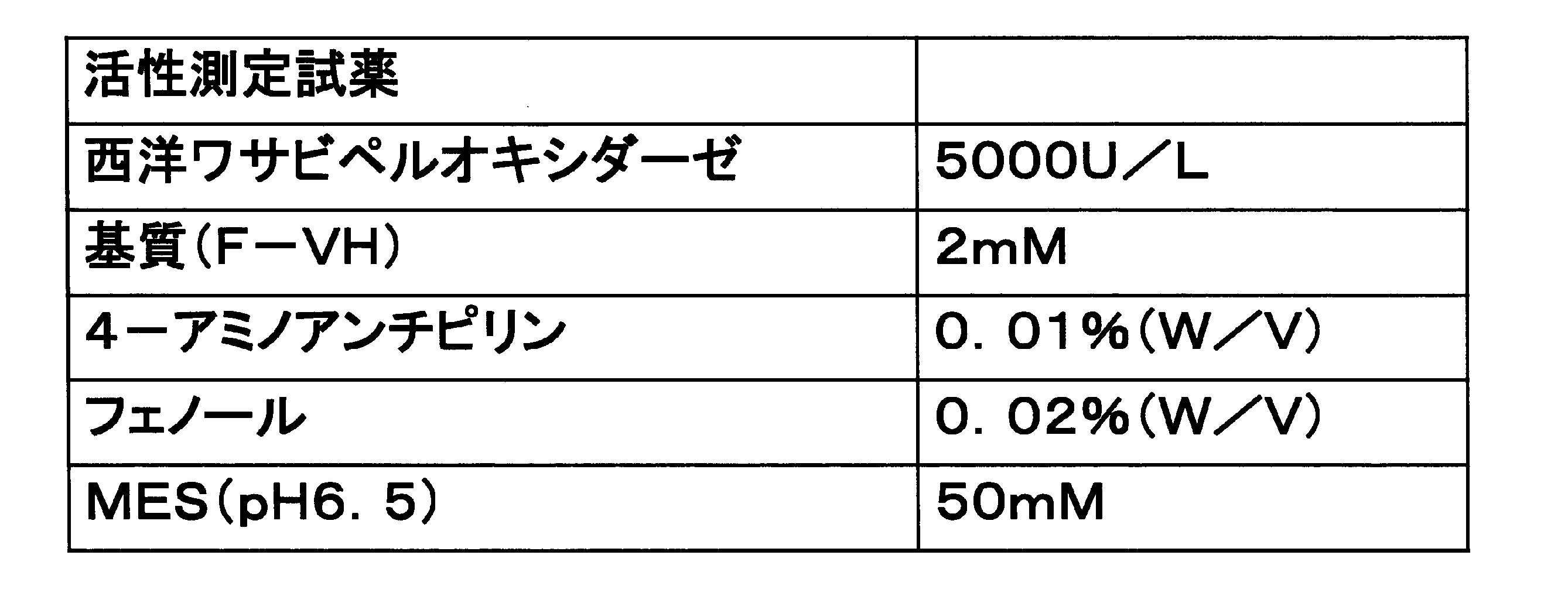
<活性測定>
実施例中における、フルクトシルバリルヒスチジンオキシダーゼの活性測定条件を以下に示す。
実施例中における、フルクトシルバリルヒスチジンオキシダーゼの活性測定条件を以下に示す。
(活性測定法)
各基質に対する酵素活性は、酵素反応により生成される過酸化水素を追随するペルオキシダーゼ反応により生じた色素の吸光度の増加を測定した。まず、活性測定試薬3mlを37℃で5分間予備加温後、この活性測定試薬に、予め酵素希釈液(50mMリン酸カリウム緩衝液(pH7.5))で希釈した酵素溶液0.1mlを加え、反応を開始する。37℃で5分間反応させ、500nmの吸光度変化を測定する(ΔODtest/min)。盲検は酵素溶液の代わりに酵素希釈液0.1mlを加え、上記と同様に操作を行って吸光度変化を測定した(ΔODblank/min)。得られた吸光度変化より、下記計算式に基づき酵素活性を算出した。なお、上記条件で1分間に1マイクロモルの基質を酸化する酵素量を1単位(U)とする。
各基質に対する酵素活性は、酵素反応により生成される過酸化水素を追随するペルオキシダーゼ反応により生じた色素の吸光度の増加を測定した。まず、活性測定試薬3mlを37℃で5分間予備加温後、この活性測定試薬に、予め酵素希釈液(50mMリン酸カリウム緩衝液(pH7.5))で希釈した酵素溶液0.1mlを加え、反応を開始する。37℃で5分間反応させ、500nmの吸光度変化を測定する(ΔODtest/min)。盲検は酵素溶液の代わりに酵素希釈液0.1mlを加え、上記と同様に操作を行って吸光度変化を測定した(ΔODblank/min)。得られた吸光度変化より、下記計算式に基づき酵素活性を算出した。なお、上記条件で1分間に1マイクロモルの基質を酸化する酵素量を1単位(U)とする。
(計算式)
活性値(U/ml)={((ΔODtest/min)-(ΔODblank/min))×3.1ml×希釈倍率}/(13×1.0cm×0.1ml)
3.1ml:全液量
13:ミリモル吸光係数
1.0cm:セルの光路長
0.1ml:酵素サンプル液量
活性値(U/ml)={((ΔODtest/min)-(ΔODblank/min))×3.1ml×希釈倍率}/(13×1.0cm×0.1ml)
3.1ml:全液量
13:ミリモル吸光係数
1.0cm:セルの光路長
0.1ml:酵素サンプル液量
<実施例1:フェオスフェリア・ノドラム由来フルクトシルバリルヒスチジンオキシダーゼ遺伝子のサブクローニング>
配列番号2に示した塩基配列を有するフェオスフェリア・ノドラム由来フルクトシルバリルヒスチジンオキシダーゼ遺伝子を含むプラスミドの大腸菌における大量発現を試みた。フェオスフェリア・ノドラム由来フルクトシルバリルヒスチジンオキシダーゼ遺伝子の終止コドンを除いた全長cDNA領域(配列番号2に示した塩基配列の1番目から1311番目の塩基まで)をPCRで増幅した。その際、配列番号4に示すプライマーP5(5’-GGAATTCCATATGGCGCCCTCCAGAGCAAACACCAGTGTCATT-3’)(この塩基配列における「CATATG」はNdeI認識部位)を用いて、アミノ酸配列のN末端側にNdeI切断部位を挿入した。また、配列番号5に示すプライマーP6(5’-CCGCTCGAGCAAGTTCGCCCTCGGCTTATCATGATTCCAACC-3’)(この塩基配列における「CTCGAG」はXhoI認識部位)を用いて、アミノ酸配列のC末端側にXhoI切断部位を導入した。本DNA断片をpET-23bベクター(ノバジェン社)のNdeI-XhoI部位へT7プロモーターと正方向になるようにサブクローニングした。作製したプラスミドは、フルクトシルバリルヒスチジンオキシダーゼ発現用プラスミドとしてpIE353と命名した。
配列番号2に示した塩基配列を有するフェオスフェリア・ノドラム由来フルクトシルバリルヒスチジンオキシダーゼ遺伝子を含むプラスミドの大腸菌における大量発現を試みた。フェオスフェリア・ノドラム由来フルクトシルバリルヒスチジンオキシダーゼ遺伝子の終止コドンを除いた全長cDNA領域(配列番号2に示した塩基配列の1番目から1311番目の塩基まで)をPCRで増幅した。その際、配列番号4に示すプライマーP5(5’-GGAATTCCATATGGCGCCCTCCAGAGCAAACACCAGTGTCATT-3’)(この塩基配列における「CATATG」はNdeI認識部位)を用いて、アミノ酸配列のN末端側にNdeI切断部位を挿入した。また、配列番号5に示すプライマーP6(5’-CCGCTCGAGCAAGTTCGCCCTCGGCTTATCATGATTCCAACC-3’)(この塩基配列における「CTCGAG」はXhoI認識部位)を用いて、アミノ酸配列のC末端側にXhoI切断部位を導入した。本DNA断片をpET-23bベクター(ノバジェン社)のNdeI-XhoI部位へT7プロモーターと正方向になるようにサブクローニングした。作製したプラスミドは、フルクトシルバリルヒスチジンオキシダーゼ発現用プラスミドとしてpIE353と命名した。
<実施例2:フェオスフェリア・ノドラム由来フルクトシルバリルヒスチジンオキシダーゼ遺伝子の機能改変によるフルクトシルバリルヒスチジンオキシダーゼ活性を有するタンパク質の造成、精製、および酵素アッセイ>
発現プラスミドpIE353および合成オリゴヌクレオチド(配列番号6~15)を用いて、KOD-Plus Site-Directed Mutagenesis Kit(東洋紡製)を使用して、規定のプロトコールに従って変異処理操作を行い、塩基配列を決定して、配列番号1に示したアミノ酸配列の101番目、131番目、169番目、245番目および360番目のグルタミン酸(E)をコードする塩基配列がリジン(K)をコードする塩基配列に置換されたフルクトシルバリルヒスチジンオキシダーゼ変異体をコードする組換えプラスミド(pIE353-E101K、pIE353-E131K、pIE353-E169K、pIE353-E245K、pIE353-E360K)を取得した。
発現プラスミドpIE353および合成オリゴヌクレオチド(配列番号6~15)を用いて、KOD-Plus Site-Directed Mutagenesis Kit(東洋紡製)を使用して、規定のプロトコールに従って変異処理操作を行い、塩基配列を決定して、配列番号1に示したアミノ酸配列の101番目、131番目、169番目、245番目および360番目のグルタミン酸(E)をコードする塩基配列がリジン(K)をコードする塩基配列に置換されたフルクトシルバリルヒスチジンオキシダーゼ変異体をコードする組換えプラスミド(pIE353-E101K、pIE353-E131K、pIE353-E169K、pIE353-E245K、pIE353-E360K)を取得した。
取得したプラスミドを用いてBL21 CodonPlus(DE3)-RILを形質転換した後、アンピシリン耐性を示す形質転換体を選抜した。
形質転換体を培養し、得られた粗酵素液の精製を行うことにより、精製酵素標品(IE353、IE353-E101K、IE353-E131K、IE353-E169K、IE353-E245K、IE353-E360K)を得た。フルクトシルバリルヒスチジン含有測定試薬を用いて測定した粗酵素液のフルクトシルバリルヒスチジンオキシダーゼ活性は、9.9~24.6U/mlであった。
次に、野生型フルクトシルバリルヒスチジンオキシダーゼ(IE353)、およびフルクトシルバリルヒスチジンオキシダーゼ変異体(IE353-E101K、IE353-E131K、IE353-E169K、IE353-E245K、IE353-E360K)の精製酵素標品の酵素活性を、フルクトシルバリルヒスチジン(F-VH)を単独に含有する活性測定試薬を用いて測定し、第四級アンモニウム塩に対する安定性評価を実施した。その結果を表2に示す。
第四級アンモニウム塩に対する安定性評価はそれぞれの精製酵素標品1U/mL-30mMMES/21mM Tris(pH6.5)の溶液を調製し、0.04%または0.1%(W/V)塩化ヘキサデシル塩化メチルアンモニウム(CTAC)共存下で30℃、5分または10分間処理を実施し、以下計算式により安定性(%)を算出した。
安定性(%)=[(CTAC共存下・30℃,5分または10分間処理後活性値)/(処理なし活性値)]×100
安定性(%)=[(CTAC共存下・30℃,5分または10分間処理後活性値)/(処理なし活性値)]×100

表2の結果から明らかなように、IE353-E101K、IE353-E131K、IE353-E169K、IE353-E245K、IE353-E360Kは野生型FAODタンパク質(IE353)と比較して第四級アンモニウム塩に対する安定性が向上している。
本発明によれば、フルクトシルアミノ酸の測定に有用な第四級アンモニウム塩に対する安定性の高いフルクトシルバリルヒスチジンオキシダーゼを提供できるので、フルクトシルバリルヒスチジンオキシダーゼを利用したフルクトシルアミノ酸の測定方法およびフルクトシルアミノ酸測定用試薬組成物等を提供できる。したがって、本発明は、予防医学に基づく臨床検査分野、診断医療分野、製薬分野および保健医学分野をはじめ、生命科学分野の産業に広く利用することができる。
Claims (12)
- 以下の(a)~(c)のいずれかに記載の、フルクトシルバリルヒスチジンオキシダーゼ活性を有するタンパク質。
(a)配列番号1に示されるアミノ酸配列において、101番目、131番目、169番目、245番目および360番目からなる群から選択される少なくともいずれか1箇所の部位におけるグルタミン酸が他のアミノ酸に置換されたアミノ酸配列からなるタンパク質
(b)アミノ酸配列(a)において、101番目、131番目、169番目、245番目および360番目以外の部位において、1もしくは数個のアミノ酸が欠失、置換、挿入もしくは付加されたアミノ酸配列からなるタンパク質
(c)配列番号1に示されるアミノ酸配列と85%以上の同一性を有するアミノ酸配列において、配列番号1の101番目、131番目、169番目、245番目および360番目からなる群から選択される少なくともいずれか1箇所の部位に相当するグルタミン酸が他のアミノ酸に置換されたアミノ酸配列からなるタンパク質 - (c)のアミノ酸置換前のアミノ酸配列が、配列番号1に示されるアミノ酸配列と90%以上の同一性を有する請求項1に記載のタンパク質。
- 置換されたアミノ酸がリジン、アルギニンおよびヒスチジンからなる群のいずれかから選択されるいずれかである請求項1または2に記載のタンパク質。
- 置換されたアミノ酸がリジンである請求項1~3のいずれかに記載のタンパク質。
- 請求項1~4のいずれかに記載のタンパク質をコードするポリヌクレオチド。
- 請求項5に記載のポリヌクレオチドを含有する組換えベクター。
- 請求項6に記載の組換えベクターにより宿主を形質転換した形質転換体。
- 請求項7に記載の形質転換体を培養してフルクトシルバリルヒスチジンオキシダーゼ活性を有するタンパク質を生成させ、当該タンパク質を採取する工程を含む、フルクトシルバリルヒスチジンオキシダーゼ活性を有するタンパク質の製造方法。
- 糖化ペプチドに対して請求項1~4のいずれかに記載のタンパク質を作用させる工程を含む糖化タンパク質の測定方法。
- 請求項1~4のいずれかに記載のタンパク質を含む糖化タンパク質測定キット。
- さらに、ペルオキダーゼおよび過酸化水素発色試薬を含む請求項10に記載の糖化タンパク質測定キット。
- 請求項1~4のいずれかに記載のタンパク質が固定された電極を用い、該タンパク質の反応により生じた電流を測定する糖化タンパク質測定センサー。
Priority Applications (1)
| Application Number | Priority Date | Filing Date | Title |
|---|---|---|---|
| JP2020527249A JP7352838B2 (ja) | 2018-06-27 | 2019-05-09 | フルクトシルバリルヒスチジンオキシダーゼ活性を有するタンパク質 |
Applications Claiming Priority (2)
| Application Number | Priority Date | Filing Date | Title |
|---|---|---|---|
| JP2018-121844 | 2018-06-27 | ||
| JP2018121844 | 2018-06-27 |
Publications (1)
| Publication Number | Publication Date |
|---|---|
| WO2020003752A1 true WO2020003752A1 (ja) | 2020-01-02 |
Family
ID=68985591
Family Applications (1)
| Application Number | Title | Priority Date | Filing Date |
|---|---|---|---|
| PCT/JP2019/018491 Ceased WO2020003752A1 (ja) | 2018-06-27 | 2019-05-09 | フルクトシルバリルヒスチジンオキシダーゼ活性を有するタンパク質 |
Country Status (2)
| Country | Link |
|---|---|
| JP (1) | JP7352838B2 (ja) |
| WO (1) | WO2020003752A1 (ja) |
Citations (3)
| Publication number | Priority date | Publication date | Assignee | Title |
|---|---|---|---|---|
| WO2010041419A1 (ja) * | 2008-10-10 | 2010-04-15 | 東洋紡績株式会社 | 新規なフルクトシルバリルヒスチジンオキシダーゼ活性を有するタンパク質及びその改変体、並びにその利用 |
| WO2015020200A1 (ja) * | 2013-08-09 | 2015-02-12 | キッコーマン株式会社 | 改変型アマドリアーゼ及びその製造法、並びにアマドリアーゼの界面活性剤耐性向上剤及びこれを用いたHbA1c測定用組成物 |
| WO2016063984A1 (ja) * | 2014-10-24 | 2016-04-28 | キッコーマン株式会社 | デヒドロゲナーゼ活性の向上したアマドリアーゼ |
-
2019
- 2019-05-09 JP JP2020527249A patent/JP7352838B2/ja active Active
- 2019-05-09 WO PCT/JP2019/018491 patent/WO2020003752A1/ja not_active Ceased
Patent Citations (3)
| Publication number | Priority date | Publication date | Assignee | Title |
|---|---|---|---|---|
| WO2010041419A1 (ja) * | 2008-10-10 | 2010-04-15 | 東洋紡績株式会社 | 新規なフルクトシルバリルヒスチジンオキシダーゼ活性を有するタンパク質及びその改変体、並びにその利用 |
| WO2015020200A1 (ja) * | 2013-08-09 | 2015-02-12 | キッコーマン株式会社 | 改変型アマドリアーゼ及びその製造法、並びにアマドリアーゼの界面活性剤耐性向上剤及びこれを用いたHbA1c測定用組成物 |
| WO2016063984A1 (ja) * | 2014-10-24 | 2016-04-28 | キッコーマン株式会社 | デヒドロゲナーゼ活性の向上したアマドリアーゼ |
Non-Patent Citations (1)
| Title |
|---|
| FUJIWARA M. ET AL.: "Alteration of Substrate Specificity of Fructosyl-Amino Acid Oxidase from Ulocladium sp", JS-103, JOURNAL OF BIOSCIENCE AND BIOENGINEERING, vol. 102, no. 3, 2006, pages 241 - 243, XP028042246, DOI: 10.1263/jbb.102.241 * |
Also Published As
| Publication number | Publication date |
|---|---|
| JP7352838B2 (ja) | 2023-09-29 |
| JPWO2020003752A1 (ja) | 2021-07-15 |
Similar Documents
| Publication | Publication Date | Title |
|---|---|---|
| JP5438020B2 (ja) | 新規なフルクトシルバリルヒスチジンオキシダーゼ活性を有するタンパク質及びその改変体、並びにその利用 | |
| JP5243878B2 (ja) | フルクトシルバリルヒスチジン測定用酵素、およびその利用法 | |
| JP5350762B2 (ja) | フルクトシルアミノ酸オキシダーゼ、およびその利用法 | |
| JP6759418B2 (ja) | グルコース測定用バイオセンサ | |
| JP5927771B2 (ja) | ヘモグロビンA1cの測定方法 | |
| JP5476021B2 (ja) | フルクトシルアミノ酸オキシダーゼ改変体およびその利用 | |
| JP5465415B2 (ja) | フルクトシルアミノ酸測定用酵素、およびその利用法 | |
| JP2010233502A (ja) | フルクトシルリジンの影響が低減する糖化タンパク質測定用試薬組成物 | |
| US11499143B2 (en) | Amadoriase having enhanced dehydrogenase activity | |
| US7244600B2 (en) | Glucose dehydrogenase | |
| JP5465427B2 (ja) | フルクトシル−l−バリルヒスチジン測定用酵素、およびその利用法 | |
| JPWO2017183717A1 (ja) | HbA1cデヒドロゲナーゼ | |
| JP7352838B2 (ja) | フルクトシルバリルヒスチジンオキシダーゼ活性を有するタンパク質 | |
| JP5622321B2 (ja) | 耐熱性1,5−アンヒドログルシトール脱水素酵素及びそれを用いた1,5−アンヒドログルシトールの測定法 | |
| JP5216889B2 (ja) | 新規l−アミノ酸オキシダーゼ、l−リジンの測定方法、キット及び酵素センサー | |
| JP2010233501A (ja) | フルクトシルバリンの影響が低減する糖化タンパク質測定用試薬組成物 | |
| EP1437411A1 (en) | Glucose dehydrogenase | |
| JP2009000084A (ja) | フルクトシルリジンの測定方法及び試薬 | |
| JP6940149B2 (ja) | フラビン結合型グルコース脱水素酵素 | |
| EP2202304B1 (en) | Modified creatinine amidohydrolase | |
| JP5089058B2 (ja) | 試料中の銅イオン濃度測定用酵素 | |
| US20220098557A1 (en) | Modified glucose dehydrogenase |
Legal Events
| Date | Code | Title | Description |
|---|---|---|---|
| 121 | Ep: the epo has been informed by wipo that ep was designated in this application |
Ref document number: 19824502 Country of ref document: EP Kind code of ref document: A1 |
|
| ENP | Entry into the national phase |
Ref document number: 2020527249 Country of ref document: JP Kind code of ref document: A |
|
| NENP | Non-entry into the national phase |
Ref country code: DE |
|
| 122 | Ep: pct application non-entry in european phase |
Ref document number: 19824502 Country of ref document: EP Kind code of ref document: A1 |