WO2020000530A1 - 一种高品质麦芽糊精的生产方法 - Google Patents
一种高品质麦芽糊精的生产方法 Download PDFInfo
- Publication number
- WO2020000530A1 WO2020000530A1 PCT/CN2018/095880 CN2018095880W WO2020000530A1 WO 2020000530 A1 WO2020000530 A1 WO 2020000530A1 CN 2018095880 W CN2018095880 W CN 2018095880W WO 2020000530 A1 WO2020000530 A1 WO 2020000530A1
- Authority
- WO
- WIPO (PCT)
- Prior art keywords
- starch
- maltodextrin
- branching enzyme
- starch branching
- temperature
- Prior art date
- Legal status (The legal status is an assumption and is not a legal conclusion. Google has not performed a legal analysis and makes no representation as to the accuracy of the status listed.)
- Ceased
Links
Classifications
-
- C—CHEMISTRY; METALLURGY
- C12—BIOCHEMISTRY; BEER; SPIRITS; WINE; VINEGAR; MICROBIOLOGY; ENZYMOLOGY; MUTATION OR GENETIC ENGINEERING
- C12P—FERMENTATION OR ENZYME-USING PROCESSES TO SYNTHESISE A DESIRED CHEMICAL COMPOUND OR COMPOSITION OR TO SEPARATE OPTICAL ISOMERS FROM A RACEMIC MIXTURE
- C12P19/00—Preparation of compounds containing saccharide radicals
- C12P19/18—Preparation of compounds containing saccharide radicals produced by the action of a glycosyl transferase, e.g. alpha-, beta- or gamma-cyclodextrins
-
- C—CHEMISTRY; METALLURGY
- C12—BIOCHEMISTRY; BEER; SPIRITS; WINE; VINEGAR; MICROBIOLOGY; ENZYMOLOGY; MUTATION OR GENETIC ENGINEERING
- C12P—FERMENTATION OR ENZYME-USING PROCESSES TO SYNTHESISE A DESIRED CHEMICAL COMPOUND OR COMPOSITION OR TO SEPARATE OPTICAL ISOMERS FROM A RACEMIC MIXTURE
- C12P19/00—Preparation of compounds containing saccharide radicals
- C12P19/04—Polysaccharides, i.e. compounds containing more than five saccharide radicals attached to each other by glycosidic bonds
-
- C—CHEMISTRY; METALLURGY
- C08—ORGANIC MACROMOLECULAR COMPOUNDS; THEIR PREPARATION OR CHEMICAL WORKING-UP; COMPOSITIONS BASED THEREON
- C08B—POLYSACCHARIDES; DERIVATIVES THEREOF
- C08B30/00—Preparation of starch, degraded or non-chemically modified starch, amylose, or amylopectin
- C08B30/12—Degraded, destructured or non-chemically modified starch, e.g. mechanically, enzymatically or by irradiation; Bleaching of starch
- C08B30/18—Dextrin, e.g. yellow canari, white dextrin, amylodextrin or maltodextrin; Methods of depolymerisation, e.g. by irradiation or mechanically
-
- C—CHEMISTRY; METALLURGY
- C12—BIOCHEMISTRY; BEER; SPIRITS; WINE; VINEGAR; MICROBIOLOGY; ENZYMOLOGY; MUTATION OR GENETIC ENGINEERING
- C12P—FERMENTATION OR ENZYME-USING PROCESSES TO SYNTHESISE A DESIRED CHEMICAL COMPOUND OR COMPOSITION OR TO SEPARATE OPTICAL ISOMERS FROM A RACEMIC MIXTURE
- C12P19/00—Preparation of compounds containing saccharide radicals
- C12P19/16—Preparation of compounds containing saccharide radicals produced by the action of an alpha-1, 6-glucosidase, e.g. amylose, debranched amylopectin
-
- C—CHEMISTRY; METALLURGY
- C12—BIOCHEMISTRY; BEER; SPIRITS; WINE; VINEGAR; MICROBIOLOGY; ENZYMOLOGY; MUTATION OR GENETIC ENGINEERING
- C12N—MICROORGANISMS OR ENZYMES; COMPOSITIONS THEREOF; PROPAGATING, PRESERVING, OR MAINTAINING MICROORGANISMS; MUTATION OR GENETIC ENGINEERING; CULTURE MEDIA
- C12N9/00—Enzymes; Proenzymes; Compositions thereof; Processes for preparing, activating, inhibiting, separating or purifying enzymes
- C12N9/10—Transferases (2.)
- C12N9/1048—Glycosyltransferases (2.4)
- C12N9/1051—Hexosyltransferases (2.4.1)
- C12N9/107—1,4-Alpha-glucan branching enzyme (2.4.1.18)
Definitions
- the invention relates to a method for producing high-quality maltodextrin, and belongs to the technical field of maltodextrin.
- Maltodextrin also known as water-soluble dextrin or enzymatic dextrin, is a starch hydrolysate obtained by acid or enzymatic treatment. Its main components are dextrin, polysaccharides, and oligosaccharides, and it also contains a small amount of maltose and glucose.
- the DE value (reducing sugar equivalent) is usually used to indicate the degree of starch degradation.
- Conventional maltodextrin is a starch hydrolysate with a DE value less than 20. In recent years, maltodextrin has been widely used in the food industry. When the DE value is 2-4, it can produce the texture and taste of fat.
- DE value is 5 At -7, it has the characteristics of low sweetness, low hygroscopicity, and good film-forming properties. It can be used as a thickener, stabilizer, filler, and carrier in food; when the DE value is 9-12, maltodextrin It is not easy to be damp and hard to brown. When used in food, it can improve the touch of food and produce strong viscosity. When DE value is 15-20, maltodextrin has strong fluidity, good solubility, and suitable viscosity. It can be used in candy , Beverages, instant food and canned food.
- the production of maltodextrin at home and abroad uses the enzymatic process, and the acid process has been basically eliminated.
- the maltodextrin produced by the traditional enzymatic process has certain limitations.
- the content of straight-chain molecules of maltodextrin is high.
- the polymerization of macromolecules will show a tendency to regenerate, which will cause the solution to become cloudy.
- many manufacturers still cannot overcome the phenomenon of dextrin regeneration, domestic maltodextrin products still have a large gap compared with some similar products abroad, which makes the production and application of products greatly restricted.
- maltodextrin has a high content of linear molecules, and macromolecules are likely to aggregate during repeated freeze-thaw cycles (FTC) to produce flocculated precipitates, which affects the sensory characteristics and shelf life of maltodextrin-added products.
- FTC freeze-thaw cycles
- Frozen foods will inevitably undergo repeated freezing and thawing processes during transportation or storage, which makes the application of maltodextrin products restricted in frozen foods. Therefore, finding a suitable enzyme to modify maltodextrin to improve its freeze-thaw stability is very important for the application of maltodextrin in food.
- the present invention introduces a Rhodothermus obamensis-derived starch branching enzyme (1,4- ⁇ -glucan branching enzyme; EC 2.4.1.18), which can catalyze starch molecules
- Rhodothermus obamensis-derived starch branching enzyme (1,4- ⁇ -glucan branching enzyme; EC 2.4.1.18)
- EC 2.4.1.18 Rhodothermus obamensis-derived starch branching enzyme
- the short chains that are cleaved are connected to the acceptor chain in the form of ⁇ -1,6-glycosidic bonds through transglycosidation, forming ⁇ -1,6- branching point completes the branching process, thereby enhancing the stability of maltodextrin, making it difficult to regenerate, and also improving the freeze-thaw stability of maltodextrin.
- the invention produces high-quality maltodextrin, which has good solubility, high transparency during storage, good viscosity stability, good freeze-thaw stability, and improves the commercial value of maltodextrin.
- the invention provides a method for producing high-quality maltodextrin, which comprises, in order, pulping, spray liquefaction, starch branching enzymes derived from Rhodothermus obamensis, filtration, decolorization, ion exchange, and concentration steps.
- the method further comprises a spray drying step.
- the method is specifically:
- Spray liquefaction low-pressure steam spray liquefier is used for spraying.
- Starch branching enzyme action After the liquefied liquid in (2) is cooled, starch branching enzyme is added, the pH is adjusted, the reaction is performed at a certain temperature for a period of time, and the reaction solution is obtained after the enzyme is heated to inactivate the enzyme.
- Decoloring adjust the pH of the solution, add activated carbon and stir at a certain temperature to decolorize for a period of time.
- Ion exchange resin is used to remove metal salts and pigments from the solution.
- the starch in (1) is one or more of ordinary corn starch, cassava starch, potato starch, waxy corn starch, sweet potato starch, rice starch, and wheat starch; starch
- the milk concentration is 5-45%; the starch milk is heated to 60-70 ° C for thermal insulation; the addition amount of high temperature resistant ⁇ -amylase is 10-15U / g starch on a dry basis, and the pH is adjusted to 5.5-6.5 after addition ;
- the added amount of calcium chloride is 0.1-0.2% on a dry basis.
- the step (2) includes 2 sprays; after the first spray, the liquid is kept warm and liquefied for a period of time, and the second spray is used to inactivate the enzyme.
- the pressure of the material sprayed for the first time in (2) is 0.35 MPa
- the steam pressure is 0.1 MPa
- the temperature is 102-110 ° C
- the time is 5-15 min
- the temperature is 85- Heat and liquefy at 95 ° C for 10-90min.
- the pressure of the second sprayed material is 0.35MPa
- the steam pressure is 0.3MPa
- the temperature is 130-140 ° C
- the time is 5min.
- the liquefied liquid in (3) must be cooled to below 50 ° C, and starch branching enzyme is added; the source of starch branching enzyme is Rhodothermus obamensis; the added amount is 10-500U / on a dry basis g starch; adjust the pH to 6.0-7.5 after adding starch branching enzyme, and react at 50-70 ° C for 2-12h.
- the pH of the starch branching enzyme in (3) is 6.5-7.5, and the reaction is performed at 65-70 ° C for more than 6 hours.
- the filtering in (4) is filtering using a plate and frame filter press.
- the pH of the solution in (5) is adjusted to 4.0-5.0, the added amount of activated carbon is 1%, and the solution is decolorized by holding at 80-90 ° C for 15-30 minutes.
- the ion exchange resin structure used in (6) is a strongly acidic cation-weak basic anion-strongly acidic cation exchange resin, and the temperature is 40-50 ° C.
- the degree of vacuum in (7) is 80-90 KPa, the temperature is 40-50 ° C, and the solution is concentrated to a concentration of 40-50%.
- the method further includes step (8) spray-drying: spray-drying the concentrated solution obtained in step (7) into a powder, and measuring its DE value.
- the inlet air temperature in (8) is 160-170 ° C
- the outlet air temperature is 75-85 ° C
- the feed flow rate is 18-22mL / min.
- the source of the starch branching enzyme is Rhodothermus obamensis (GenBank: AB060080.1).
- the high-quality maltodextrin produced by the method has a DE value of 2-20.
- the invention also claims high-quality maltodextrin produced by the method.
- the invention also claims the application of the method in the fields of food, chemical industry and medicine.
- the present invention introduces a branch of starch derived from Rhodothermus obamensis on the basis of the process of producing maltodextrin by enzymatic method Enzymes can increase the degree of branching.
- the maltodextrin produced has good solubility, high transparency during storage, good viscosity stability, and improved freeze-thaw stability.
- the maltodextrin of DE10 compared with the traditional method, the maltodextrin obtained by the present invention dissolves faster, the transparency can be increased from 0.2% to 97.6% when stored for 60 days, and the viscosity is very stable during storage, which can meet the needs of the market.
- the present invention can increase the transparency of 1.7% after 5 freeze-thaw cycles to 38.2% without changing its DE value; for DE10 maltodextrin, the present invention does not change On the premise of its DE value, the transparency of 4.1% after 5 freeze-thaw cycles can be increased to 96.8%; for maltodextrin of DE15, the present invention can freeze-thaw cycles 5 times without changing its DE value. The last 52.1% transparency increased to 97.7%.
- the present invention broadens the range of DE value of modifiable maltodextrin, and the starch branch of Rhodothermus obamensis Enzymes acting on maltodextrin with a DE value of 2-20 can significantly increase its dissolution rate, transparency and viscosity stability during storage;
- the maltodextrin obtained by the present invention is at room temperature and refrigerated (4 ° C) Under storage, all have obvious effects;
- the maltodextrin obtained by the present invention can maintain the improvement of transparency for a long time, and the maltodextrin with DE values of 5, 10, and 15 has a transparency of 10 days when stored at 4 ° C.
- the transparency can still reach 53.7%, 97.6%, 98.7%, which is significantly better than the modification effect of starch branching enzymes derived from G. thermoglucosidans; (4) the malt obtained by the present invention; Dextrin not only improves transparency and viscosity stability, but also dissolves faster.
- Example 1 Effect of the amount of starch branching enzyme added on the properties of maltodextrin
- Spray liquefaction The spray is performed using a low-pressure steam spray liquefier.
- the pressure of the first sprayed material is 0.35 MPa
- the steam pressure is 0.1 MPa
- the temperature is 105 ° C
- the time is 8 minutes
- the temperature is maintained at 90 ° C for 40 minutes.
- a second spray of enzyme was performed, the material pressure was 0.35 MPa, the steam pressure was 0.3 MPa, the temperature was 140 ° C, and the time was 5 minutes.
- Starch branching enzyme action After the liquefied liquid in (2) is cooled to below 50 ° C, starch branching enzymes of 100, 200, 300, 400, and 500 U / g Rhodothermus obamensis are added on a dry basis, and the pH is adjusted to 7.0. The reaction was carried out at 65 ° C for 6 hours.
- Decolorization adjust the pH of the solution to 4.5, add 1% activated carbon and stir and decolorize at 85 ° C for 40min.
- Ion exchange At 45 ° C, strong acidic cations-weakly basic anions-strong acidic cation exchange resins are used to remove metal salts and pigments from the solution.
- Control A represents the absence of maltodextrin produced in step (3)
- Control B represents the maltodextrin produced by Rhodothermus obamensis-derived starch branching enzyme in step (3) by replacing the starch branching enzyme derived from G. thermoglucosidans in an amount of 200 U / g;
- Control C represents the use of G.thermoglucosidans-derived starch branching enzyme in place of Rhodothermus obamensis-derived starch branching enzyme in step (3), and the maltodextrin prepared by performing the reaction under the optimal reaction conditions of G.thermoglucosidans; the optimal reaction conditions Specifically, the amount of starch branching enzyme plus enzyme is 0.12 U / g, the reaction temperature is 45 ° C., the reaction time is 4 h, and the reaction pH is adjusted to 6.5.
- Viscosity Viscosity after preparation of 50% maltodextrin aqueous solution, which was placed at 0, 2, 4, 6, 8, and 10 days, respectively.
- FTC freeze-thaw cycle
- the transparency is expressed by a light transmittance measured at 620 nm using a spectrophotometer.
- Spray liquefaction The spray is performed using a low-pressure steam spray liquefier.
- the pressure of the first sprayed material is 0.35 MPa
- the steam pressure is 0.1 MPa
- the temperature is 105 ° C
- the time is 8 minutes
- the temperature is maintained at 90 ° C for 40 minutes.
- a second spray of enzyme was performed, the material pressure was 0.35 MPa, the steam pressure was 0.3 MPa, the temperature was 140 ° C, and the time was 5 minutes.
- Decolorization adjust the pH of the solution to 4.5, add 1% activated carbon and stir and decolorize at 85 ° C for 40min.
- Ion exchange At 45 ° C, strong acidic cations-weakly basic anions-strong acidic cation exchange resins are used to remove metal salts and pigments from the solution.
- Control A represents the absence of maltodextrin produced in step (3)
- Control B represents the maltodextrin produced by Rhodothermus obamensis-derived starch branching enzyme in step (3) of G. thermoglucosidans-derived starch branching enzyme, and the action time is 6 hours;
- Control C represents the use of G.thermoglucosidans-derived starch branching enzyme in place of Rhodothermus obamensis-derived starch branching enzyme in step (3), and the maltodextrin prepared by performing the reaction under the optimal reaction conditions of G.thermoglucosidans; the optimal reaction conditions Specifically, the amount of starch branching enzyme plus enzyme is 0.12 U / g, the reaction temperature is 45 ° C., the reaction time is 4 h, and the reaction pH is adjusted to 6.5.
- Viscosity Viscosity after preparation of 50% maltodextrin aqueous solution, which was placed at 0, 2, 4, 6, 8, and 10 days, respectively.
- FTC freeze-thaw cycle
- the transparency is expressed by a light transmittance measured at 620 nm using a spectrophotometer.
- Example 3 Effect of temperature of starch branching enzyme on properties of maltodextrin
- Spray liquefaction The spray is performed using a low-pressure steam spray liquefier.
- the pressure of the first sprayed material is 0.35 MPa
- the steam pressure is 0.1 MPa
- the temperature is 105 ° C
- the time is 8 minutes
- the temperature is maintained at 90 ° C for 40 minutes.
- a second spray of enzyme was performed, the material pressure was 0.35 MPa, the steam pressure was 0.3 MPa, the temperature was 140 ° C, and the time was 5 minutes.
- Decolorization adjust the pH of the solution to 4.5, add 1% activated carbon and stir and decolorize at 85 ° C for 40min.
- Ion exchange At 45 ° C, strong acidic cations-weakly basic anions-strong acidic cation exchange resins are used to remove metal salts and pigments from the solution.
- Control A represents the absence of maltodextrin produced in step (3)
- Control B represents the maltodextrin produced by G. thermoglucosidans-derived starch branching enzyme replacement step (3) and produced by Rhodothermus obamensis-derived starch branching enzyme at an action temperature of 65 ° C;
- Control C represents the use of G.thermoglucosidans-derived starch branching enzyme in place of Rhodothermus obamensis-derived starch branching enzyme in step (3), and the maltodextrin prepared by performing the reaction under the optimal reaction conditions of G.thermoglucosidans; the optimal reaction conditions Specifically, the amount of starch branching enzyme plus enzyme is 0.12 U / g, the reaction temperature is 45 ° C., the reaction time is 4 h, and the reaction pH is adjusted to 6.5.
- Viscosity Viscosity after preparation of 50% maltodextrin aqueous solution, which was placed at 0, 2, 4, 6, 8, and 10 days, respectively.
- FTC freeze-thaw cycle
- the transparency is expressed by a light transmittance measured at 620 nm using a spectrophotometer.
- Spray liquefaction The spray is performed using a low-pressure steam spray liquefier.
- the pressure of the first sprayed material is 0.35 MPa
- the steam pressure is 0.1 MPa
- the temperature is 105 ° C
- the time is 8 minutes
- the temperature is maintained at 90 ° C for 40 minutes.
- a second spray of enzyme was performed, the material pressure was 0.35 MPa, the steam pressure was 0.3 MPa, the temperature was 140 ° C, and the time was 5 minutes.
- Decolorization adjust the pH of the solution to 4.5, add 1% activated carbon and stir and decolorize at 85 ° C for 40min.
- Control A represents the absence of maltodextrin produced in step (3)
- Control B represents the maltodextrin produced by G. thermoglucosidans-derived starch branching enzyme replacement step (3) and produced by Rhodothermus obamensis-derived starch branching enzyme, with a pH of 7.0;
- Control C represents the use of G.thermoglucosidans-derived starch branching enzyme in place of Rhodothermus obamensis-derived starch branching enzyme in step (3).
- the amount of starch branching enzyme plus enzyme is 0.12 U / g
- the reaction temperature is 45 ° C.
- the reaction time is 4 h
- the reaction pH is adjusted to 6.5.
- Viscosity Viscosity after preparation of 50% maltodextrin aqueous solution, which was placed at 0, 2, 4, 6, 8, and 10 days, respectively.
- FTC freeze-thaw cycle
- the transparency is expressed by a light transmittance measured at 620 nm using a spectrophotometer.
- Example 5 Effects of starch branching enzymes on the properties of maltodextrin with different DE values
- Spray liquefaction The spray is performed using a low-pressure steam jet liquefier.
- the pressure of the first sprayed material is 0.35 MPa
- the steam pressure is 0.1 MPa
- the temperature is 105 ° C
- the time is 8 minutes. After that, the temperature is maintained at 90 ° C and liquefied for 15 minutes. , 40, 60min, the second spray enzyme inactivation was carried out, the material pressure was 0.35MPa, the steam pressure was 0.3MPa, the temperature was 140 ° C, and the time was 5min.
- Decolorization adjust the pH of the solution to 4.5, add 1% activated carbon and stir and decolorize at 85 ° C for 40min.
- Ion exchange At 45 ° C, strong acidic cations-weakly basic anions-strong acidic cation exchange resins are used to remove metal salts and pigments from the solution.
- Control A represents the absence of maltodextrin produced in step (3)
- Control B represents the maltodextrin produced by Rhodothermus obamensis-derived starch branching enzyme in step (3) by replacing the starch branching enzyme derived from G. thermoglucosidans;
- Control C represents the use of G.thermoglucosidans-derived starch branching enzyme in place of Rhodothermus obamensis-derived starch branching enzyme in step (3). Specifically: the amount of starch branching enzyme plus enzyme is 0.12U / g, the reaction temperature is 45 ° C, the reaction time is 4h, and the reaction pH is adjusted to 6.5;
- Controls 1, 2, and 3 respectively represent maltodextrin produced with DE values of 5, 10, and 15 when the holding liquefaction time is 15, 40, and 60 min in step (2).
- Viscosity Viscosity after preparation of 50% maltodextrin aqueous solution, which was placed at 0, 2, 4, 6, 8, and 10 days, respectively.
- FTC freeze-thaw cycle
- the transparency is expressed by a light transmittance measured at 620 nm using a spectrophotometer.
Landscapes
- Chemical & Material Sciences (AREA)
- Organic Chemistry (AREA)
- Life Sciences & Earth Sciences (AREA)
- Engineering & Computer Science (AREA)
- Zoology (AREA)
- Wood Science & Technology (AREA)
- Health & Medical Sciences (AREA)
- Biochemistry (AREA)
- Chemical Kinetics & Catalysis (AREA)
- Genetics & Genomics (AREA)
- General Chemical & Material Sciences (AREA)
- Biotechnology (AREA)
- Microbiology (AREA)
- Bioinformatics & Cheminformatics (AREA)
- General Engineering & Computer Science (AREA)
- General Health & Medical Sciences (AREA)
- Molecular Biology (AREA)
- Crystallography & Structural Chemistry (AREA)
- Materials Engineering (AREA)
- Medicinal Chemistry (AREA)
- Polymers & Plastics (AREA)
- Preparation Of Compounds By Using Micro-Organisms (AREA)
- Polysaccharides And Polysaccharide Derivatives (AREA)
- Coloring Foods And Improving Nutritive Qualities (AREA)
Abstract
一种高品质麦芽糊精的生产方法,其特征在于,所述方法包括调浆、喷射液化、Rhodothermus obamensis来源的淀粉分支酶作用、过滤、脱色、离子交换、浓缩步骤。
Description
本发明涉及一种高品质麦芽糊精的生产方法,属于麦芽糊精技术领域。
麦芽糊精也称水溶性糊精或酶法糊精,是经酸法或酶法处理得到的淀粉水解物,主要成分为糊精、多聚糖、低聚糖,还含有少量的麦芽糖及葡萄糖,通常采用DE值(还原糖当量)来表示淀粉降解的程度,常规的麦芽糊精都是DE值小于20的淀粉水解产物。近年来麦芽糊精在食品工业中具有广泛的应用,DE值在2-4时,可产生脂肪的质构和口感,可作为月饼、沙拉、冰淇淋、香肠等的脂肪替代品;DE值在5-7时,具有低甜度、低吸湿性、成膜性质好等特点,可用作食品中的增稠剂、稳定剂、填充剂及载体等;DE值在9-12时,麦芽糊精不易受潮,难以褐变,在食品中使用,能提高食品的触感,产生较强黏性;DE值在15-20时,麦芽糊精流动性强,溶解性好,黏度适宜,可应用于糖果、饮料、方便食品及罐头食品中。
目前,国内外生产麦芽糊精均采用酶法工艺,酸法工艺已基本被淘汰。但传统酶法工艺生产得到的麦芽糊精存在一定的局限性,麦芽糊精直链分子含量高,在储存过程中大分子聚合会表现出回生的趋势,从而促使溶液浑浊。由于很多厂家仍然克服不了糊精回生的现象,因此国内麦芽糊精产品与国外一些同类产品相比,仍有很大差距,使得产品在生产和应用方面受到了很大的限制。
在前期研究中,发明人团队利用G.thermoglucosidans来源的淀粉分支酶对麦芽糊精进行酶法改性(王驰.淀粉分支酶在枯草芽孢杆菌中的分泌表达及其对麦芽糊精的改性研究[D]:[硕士学位论文].无锡:江南大学,2016.),结果显示,采用该来源的淀粉分支酶改性DE2.6的麦芽糊精后,麦芽糊精溶液在储存过程中的透明度及粘度稳定性得到了一定程度的提高。但是,还存在如下问题:(1)此项研究仅针对于DE2.6的麦芽糊精,未提及应用于其它DE值麦芽糊精的改性效果,在后期研究中,发明人发现采用G.thermoglucosidans来源的淀粉分支酶分别改性DE值为5、10、15的麦芽糊精时几乎无效果;(2)G.thermoglucosidans来源的淀粉分支酶改性后的麦芽糊精溶液在室温下储存透明度及粘度稳定性有所提高,未提及冷藏(4℃)状态下储存的改性效果,在后期研究中,发明人发现在冷藏(4℃)状态下储存时几乎无效果;(3)此项研究中得到的改性麦芽糊精,只能保证在室温下储存10d内有一个较高的透明度,无法保证长时间的储存。
此外,麦芽糊精直链分子含量高,反复的冻融循环(FTC)过程中大分子容易聚合产生絮凝沉淀,影响添加麦芽糊精产品的感官特性及货架期。冷冻食品在运输或储藏过程中,难 免会经历反复的冻结和融化过程,使得添加麦芽糊精产品在冷冻食品应用方面受到了很大的限制。因此寻找一种合适的酶对麦芽糊精进行改性以提高其冻融稳定性对于麦芽糊精在食品中的应用非常重要。
发明内容
为了解决上述问题,本发明在传统酶法生产麦芽糊精工艺基础上,引入Rhodothermus obamensis来源的淀粉分支酶(1,4-α-glucan branching enzyme;EC2.4.1.18),它能催化淀粉分子中α-1,4-糖苷键的断裂,产生具有非还原末端的短链,通过转糖苷作用将切割下的短链以α-1,6-糖苷键的形式连接于受体链上,形成α-1,6-分支点,完成分支化过程,从而增强麦芽糊精的稳定性,使其不易回生,同时还提高了麦芽糊精的冻融稳定性。本发明生产得到高品质麦芽糊精,其溶解性好,在储存过程中透明度高,粘度稳定性好,冻融稳定性好,提高了麦芽糊精的商品价值。
本发明提供了一种高品质麦芽糊精的生产方法,依次包括调浆、喷射液化、Rhodothermus obamensis来源的淀粉分支酶作用、过滤、脱色、离子交换、浓缩步骤。
在本发明的一种实施方式中,所述方法还包括喷雾干燥步骤。
在本发明的一种实施方式中,所述方法具体为:
(1)调浆:将淀粉调制为一定浓度的淀粉乳,加热保温一段时间,加入耐高温α-淀粉酶及氯化钙,搅拌均匀后调节pH。
(2)喷射液化:采用低压蒸汽喷射液化器进行喷射。
(3)淀粉分支酶作用:待(2)中液化液冷却后加入淀粉分支酶,调节pH,于一定温度下反应一段时间,升温灭酶后得到反应液。
(4)过滤:反应液冷却后,经过滤,得到澄清溶液。
(5)脱色:调节溶液pH,加入活性炭于一定温度下搅拌脱色一段时间。
(6)离子交换:采用离子交换树脂,去除溶液中的金属盐及色素。
(7)浓缩:在一定真空度、温度下浓缩溶液。
在本发明的一种实施方式中,所述(1)中淀粉为普通玉米淀粉、木薯淀粉、马铃薯淀粉、蜡质玉米淀粉、甘薯淀粉、大米淀粉、小麦淀粉中的一种或几种;淀粉乳的浓度为5-45%;将淀粉乳加热到60-70℃进行保温;耐高温α-淀粉酶的添加量为以干基计10-15U/g淀粉,加入后调节pH为5.5-6.5;氯化钙的添加量为以干基计0.1-0.2%。
在本发明的一种实施方式中,所述(2)包括2次喷射;第一次喷射后保温液化一段时间,进行第二次喷射灭酶。
在本发明的一种实施方式中,所述(2)中第一次喷射的物料压力为0.35MPa,蒸汽压力 为0.1MPa,温度为102-110℃,时间为5-15min,之后在85-95℃中保温液化10-90min,第二次喷射的物料压力为0.35MPa,蒸汽压力为0.3MPa,温度为130-140℃,时间为5min。
在本发明的一种实施方式中,所述(3)中液化液须冷却至50℃以下,加入淀粉分支酶;淀粉分支酶的来源为Rhodothermus obamensis;添加量为以干基计10-500U/g淀粉;加入淀粉分支酶后调节pH为6.0-7.5,于50-70℃下反应2-12h。
在本发明的一种实施方式中,所述(3)中淀粉分支酶作用的pH为6.5-7.5,于65-70℃下反应6h以上。
在本发明的一种实施方式中,所述(4)中过滤是采用板框压滤机过滤。
在本发明的一种实施方式中,所述(5)中溶液pH调节为4.0-5.0,活性炭的添加量为1%,80-90℃下保温15-30min进行脱色。
在本发明的一种实施方式中,所述(6)中采用的离子交换树脂结构为强酸性阳离子-弱碱性阴离子-强酸性阳离子交换树脂,温度为40-50℃。
在本发明的一种实施方式中,所述(7)中真空度为80-90KPa,温度为40-50℃,溶液浓缩至浓度为40-50%。
在本发明的一种实施方式中,所述方法还包括步骤(8)喷雾干燥:将步骤(7)中所得浓缩液喷雾干燥成粉末,测定其DE值。
在本发明的一种实施方式中,所述(8)中进风温度为160-170℃,出风温度为75-85℃,进料流速为18-22mL/min。
在本发明的一种实施方式中,所述淀粉分支酶的来源为Rhodothermus obamensis(GenBank:AB060080.1)。
在本发明的一种实施方式中,所述方法生产的高品质麦芽糊精DE值为2-20。
本发明还要求保护所述方法生产得到的高品质麦芽糊精。
本发明还要求保护所述方法在食品、化工、医药方面的应用。
本发明的有益效果:
传统酶法生产得到的麦芽糊精在储存过程中,直链大分子聚合出现回生现象,影响麦芽糊精产品的应用,本发明在酶法生产麦芽糊精工艺基础上引入Rhodothermus obamensis来源的淀粉分支酶,提高其分支度,生产得到的麦芽糊精溶解性好,在储存过程中透明度高,粘度稳定性好,冻融稳定性提高。对于DE10的麦芽糊精,与传统方法相比,本发明所得麦芽糊精溶解更快,储存60d时透明度可由0.2%上升至97.6%,且储存过程中粘度非常稳定,可以满足市场需要。此外,对于DE5的麦芽糊精,本发明在不改变其DE值的前提下,可将冻融循环5次后1.7%的透明度提升为38.2%;对于DE10的麦芽糊精,本发明在不改变其DE 值的前提下,可将冻融循环5次后4.1%的透明度提升为96.8%;对于DE15的麦芽糊精,本发明在不改变其DE值的前提下,可将冻融循环5次后52.1%的透明度提升为97.7%。
与发明人团队前期采用G.thermoglucosidans来源的淀粉分支酶处理的效果相比,有以下四个优点:(1)本发明拓宽了可改性麦芽糊精的DE值范围,Rhodothermus obamensis来源的淀粉分支酶作用于DE值为2-20的麦芽糊精,均可明显提高其溶解速度,储存过程中透明度及粘度稳定性;(2)本发明得到的麦芽糊精在室温及冷藏(4℃)状态下储存,均有明显效果;(3)本发明得到的麦芽糊精可在较长时间内保持透明度的提高,DE值为5、10、15的麦芽糊精在4℃下储存10d时透明度分别为99.8%、99.8%、99.9%,储存60d后透明度仍可达到53.7%、97.6%、98.7%,明显优于G.thermoglucosidans来源的淀粉分支酶的改性效果;(4)本发明得到的麦芽糊精不仅透明度及粘度稳定性提高,溶解速度也更快。
实施例1:淀粉分支酶添加量对麦芽糊精性质的影响
(1)调浆:将淀粉调制为35%的淀粉乳,70℃下保温30min,加入以干基计12U/g淀粉的耐高温α-淀粉酶及0.2%氯化钙,搅拌均匀后调节pH为6.5。
(2)喷射液化:采用低压蒸汽喷射液化器进行喷射,第一次喷射的物料压力为0.35MPa,蒸汽压力为0.1MPa,温度为105℃,时间为8min,之后在90℃下保温液化40min,进行第二次喷射灭酶,物料压力为0.35MPa,蒸汽压力为0.3MPa,温度为140℃,时间为5min。
(3)淀粉分支酶作用:待(2)中液化液冷却至50℃以下后分别加入以干基计100、200、300、400、500U/gRhodothermus obamensis来源的淀粉分支酶,调节pH为7.0,在65℃下反应6h,升温灭酶后得到反应液。
(4)过滤:反应液冷却后,经板框压滤机过滤,得到澄清溶液。
(5)脱色:调节溶液pH为4.5,加入1%的活性炭在85℃下搅拌脱色40min。
(6)离子交换:在45℃下,采用强酸性阳离子-弱碱性阴离子-强酸性阳离子交换树脂去除溶液中的金属盐及色素。
(7)浓缩:真空度为85KPa,温度为45℃,将溶液浓缩至浓度为50%。
(8)喷雾干燥:进风温度为170℃,出风温度为85℃,进料流速为18mL/min,在此条件下将(7)中所得浓缩液喷雾干燥成粉末,测定其DE值。
淀粉分支酶添加量对麦芽糊精性质的影响如表1、2所示。引入Rhodothermus obamensis来源的淀粉分支酶后,在不改变麦芽糊精DE值的前提下,其溶解性、透明度和粘度稳定性均显著增强,得到了高品质麦芽糊精。当淀粉分支酶添加量增加至200U/g以上时,麦芽糊精性质差别较小,且增加了生产成本。当引入G.thermoglucosidans来源的淀粉分支酶时,发 现几乎无效果。
对照A代表缺少步骤(3)所生产得到的麦芽糊精;
对照B代表G.thermoglucosidans来源的淀粉分支酶替换步骤(3)中Rhodothermus obamensis来源的淀粉分支酶所生产得到的麦芽糊精,用量为200U/g;
对照C代表采用G.thermoglucosidans来源的淀粉分支酶替换步骤(3)中Rhodothermus obamensis来源的淀粉分支酶,并且在G.thermoglucosidans的最适反应条件下进行反应制备得到的麦芽糊精;最适反应条件具体是:淀粉分支酶加酶量为0.12U/g,反应温度为45℃,反应时间为4h,调节反应pH为6.5。
表1淀粉分支酶添加量对麦芽糊精性质的影响

注:
1溶解性:称取5g样品溶于50mL蒸馏水中,以麦芽糊精完全溶解的时间为指标。
2透明度:配制30%的麦芽糊精水溶液,在冷藏(4℃)状态下储存60d后的透明度。
表2淀粉分支酶添加量对麦芽糊精粘度稳定性的影响

注:
1粘度:配制50%的麦芽糊精水溶液,分别放置0、2、4、6、8、10d后的粘度。
表3淀粉分支酶添加量对麦芽糊精冻融稳定性的影响

注:
1FTC(冻融循环):表示麦芽糊精的冻融稳定性,FTC1、3、5分别表示30%的麦芽糊精经1、3、5次冻融循环后的透明度。
透明度通过采用分光光度计于620nm下测定的透光率表示。
实施例2:淀粉分支酶作用时间对麦芽糊精性质的影响
(1)调浆:将淀粉调制为35%的淀粉乳,70℃下保温30min,加入以干基计12U/g淀粉的耐高温α-淀粉酶及0.2%氯化钙,搅拌均匀后调节pH为6.5。
(2)喷射液化:采用低压蒸汽喷射液化器进行喷射,第一次喷射的物料压力为0.35MPa,蒸汽压力为0.1MPa,温度为105℃,时间为8min,之后在90℃下保温液化40min,进行第二次喷射灭酶,物料压力为0.35MPa,蒸汽压力为0.3MPa,温度为140℃,时间为5min。
(3)淀粉分支酶作用:待(2)中液化液冷却至50℃以下后加入以干基计200U/g Rhodothermus obamensis来源的淀粉分支酶,调节pH为7.0,在65℃下分别反应2、4、6、8、10、12h,升温灭酶后得到反应液。
(4)过滤:反应液冷却后,经板框压滤机过滤,得到澄清溶液。
(5)脱色:调节溶液pH为4.5,加入1%的活性炭在85℃下搅拌脱色40min。
(6)离子交换:在45℃下,采用强酸性阳离子-弱碱性阴离子-强酸性阳离子交换树脂去除溶液中的金属盐及色素。
(7)浓缩:真空度为85KPa,温度为45℃,将溶液浓缩至浓度为50%。
(8)喷雾干燥:进风温度为170℃,出风温度为85℃,进料流速为18mL/min,在此条件下将(7)中所得浓缩液喷雾干燥成粉末,测定其DE值。
淀粉分支酶作用时间对麦芽糊精性质的影响如表3、4所示。引入Rhodothermus obamensis来源的淀粉分支酶后,在不改变麦芽糊精DE值的前提下,其溶解性、透明度和粘度稳定性 均显著增强,得到了高品质麦芽糊精。当淀粉分支酶作用时间增加至6h以上时,麦芽糊精性质差别较小,且增加了生产成本。当引入G.thermoglucosidans来源的淀粉分支酶时,发现几乎无效果。
对照A代表缺少步骤(3)所生产得到的麦芽糊精;
对照B代表G.thermoglucosidans来源的淀粉分支酶替换步骤(3)中Rhodothermus obamensis来源的淀粉分支酶所生产得到的麦芽糊精,作用时间为6h;
对照C代表采用G.thermoglucosidans来源的淀粉分支酶替换步骤(3)中Rhodothermus obamensis来源的淀粉分支酶,并且在G.thermoglucosidans的最适反应条件下进行反应制备得到的麦芽糊精;最适反应条件具体是:淀粉分支酶加酶量为0.12U/g,反应温度为45℃,反应时间为4h,调节反应pH为6.5。
表4淀粉分支酶作用时间对麦芽糊精性质的影响

注:
1溶解性:称取5g样品溶于50mL蒸馏水中,以麦芽糊精完全溶解的时间为指标。
2透明度:配制30%的麦芽糊精水溶液,在冷藏(4℃)状态下储存60d后的透明度。
表5淀粉分支酶作用时间对麦芽糊精粘度稳定性的影响


注:
1粘度:配制50%的麦芽糊精水溶液,分别放置0、2、4、6、8、10d后的粘度。
表6淀粉分支酶作用时间对麦芽糊精冻融稳定性的影响

注:
1FTC(冻融循环):表示麦芽糊精的冻融稳定性,FTC1、3、5分别表示30%的麦芽糊精经1、3、5次冻融循环后的透明度。
透明度通过采用分光光度计于620nm下测定的透光率表示。
实施例3:淀粉分支酶作用温度对麦芽糊精性质的影响
(1)调浆:将淀粉调制为35%的淀粉乳,70℃下保温30min,加入以干基计12U/g淀粉的耐高温α-淀粉酶及0.2%氯化钙,搅拌均匀后调节pH为6.5。
(2)喷射液化:采用低压蒸汽喷射液化器进行喷射,第一次喷射的物料压力为0.35MPa,蒸汽压力为0.1MPa,温度为105℃,时间为8min,之后在90℃下保温液化40min,进行第二次喷射灭酶,物料压力为0.35MPa,蒸汽压力为0.3MPa,温度为140℃,时间为5min。
(3)淀粉分支酶作用:待(2)中液化液冷却至50℃以下后加入200U/gRhodothermus obamensis来源的淀粉分支酶,调节pH为7.0,分别在50、55、60、65、70℃下反应6h,升温灭酶后得到反应液。
(4)过滤:反应液冷却后,经板框压滤机过滤,得到澄清溶液。
(5)脱色:调节溶液pH为4.5,加入1%的活性炭在85℃下搅拌脱色40min。
(6)离子交换:在45℃下,采用强酸性阳离子-弱碱性阴离子-强酸性阳离子交换树脂去除溶液中的金属盐及色素。
(7)浓缩:真空度为85KPa,温度为45℃,将溶液浓缩至浓度为50%。
(8)喷雾干燥:进风温度为170℃,出风温度为85℃,进料流速为18mL/min,在此条件下将(7)中所得浓缩液喷雾干燥成粉末,测定其DE值。
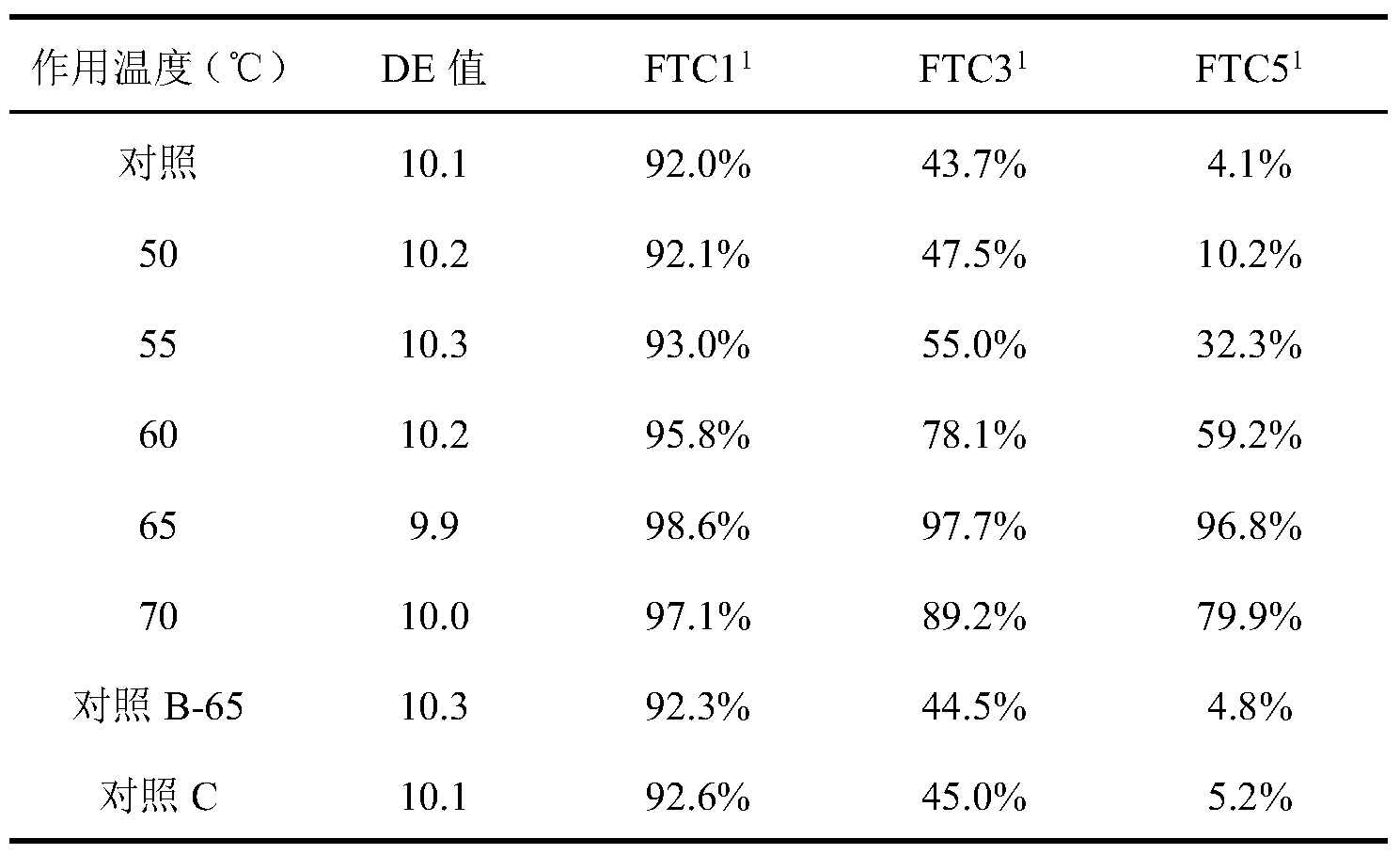
淀粉分支酶作用温度对麦芽糊精性质的影响如表5、6所示。引入Rhodothermus obamensis来源的淀粉分支酶后,在不改变麦芽糊精DE值的前提下,其溶解性、透明度和粘度稳定性均显著增强,得到了高品质麦芽糊精。当淀粉分支酶作用温度为65℃时,麦芽糊精性质最优。当引入G.thermoglucosidans来源的淀粉分支酶时,发现几乎无效果。
对照A代表缺少步骤(3)所生产得到的麦芽糊精;
对照B代表G.thermoglucosidans来源的淀粉分支酶替换步骤(3)中Rhodothermus obamensis来源的淀粉分支酶所生产得到的麦芽糊精,作用温度为65℃;
对照C代表采用G.thermoglucosidans来源的淀粉分支酶替换步骤(3)中Rhodothermus obamensis来源的淀粉分支酶,并且在G.thermoglucosidans的最适反应条件下进行反应制备得到的麦芽糊精;最适反应条件具体是:淀粉分支酶加酶量为0.12U/g,反应温度为45℃,反应时间为4h,调节反应pH为6.5。
表7淀粉分支酶作用温度对麦芽糊精性质的影响

注:
1溶解性:称取5g样品溶于50mL蒸馏水中,以麦芽糊精完全溶解的时间为指标。
2透明度:配制30%的麦芽糊精水溶液,在冷藏(4℃)状态下储存60d后的透明度。
表8淀粉分支酶作用温度对麦芽糊精粘度稳定性的影响


注:
1粘度:配制50%的麦芽糊精水溶液,分别放置0、2、4、6、8、10d后的粘度。
表9淀粉分支酶作用温度对麦芽糊精冻融稳定性的影响
注:
1FTC(冻融循环):表示麦芽糊精的冻融稳定性,FTC1、3、5分别表示30%的麦芽糊精经1、3、5次冻融循环后的透明度。
透明度通过采用分光光度计于620nm下测定的透光率表示。
实施例4:淀粉分支酶作用pH对麦芽糊精性质的影响
(1)调浆:将淀粉调制为35%的淀粉乳,70℃下保温30min,加入以干基计12U/g淀粉的耐高温α-淀粉酶及0.2%氯化钙,搅拌均匀后调节pH为6.5。
(2)喷射液化:采用低压蒸汽喷射液化器进行喷射,第一次喷射的物料压力为0.35MPa,蒸汽压力为0.1MPa,温度为105℃,时间为8min,之后在90℃下保温液化40min,进行第二次喷射灭酶,物料压力为0.35MPa,蒸汽压力为0.3MPa,温度为140℃,时间为5min。
(3)淀粉分支酶作用:待(2)中液化液冷却至50℃以下后加入200U/gRhodothermus obamensis来源的淀粉分支酶,分别调节pH为6.0、6.5、7.0、7.5,在65℃下反应6h,升温灭酶后得到反应液。
(4)过滤:反应液冷却后,经板框压滤机过滤,得到澄清溶液。
(5)脱色:调节溶液pH为4.5,加入1%的活性炭在85℃下搅拌脱色40min。
(6)离子交换:在45℃下,采用强酸性阳离子-弱碱性阴离子-强酸性阳离子交换树脂去 除溶液中的金属盐及色素。
(7)浓缩:真空度为85KPa,温度为45℃,将溶液浓缩至浓度为50%。
(8)喷雾干燥:进风温度为170℃,出风温度为85℃,进料流速为18mL/min,在此条件下将(7)中所得浓缩液喷雾干燥成粉末,测定其DE值。
淀粉分支酶作用pH对麦芽糊精性质的影响如表7、8所示。引入Rhodothermus obamensis来源的淀粉分支酶后,在不改变麦芽糊精DE值的前提下,其溶解性、透明度和粘度稳定性均显著增强,得到了高品质麦芽糊精。当淀粉分支酶作用pH为7.0时,麦芽糊精性质最优。当引入G.thermoglucosidans来源的淀粉分支酶时,发现几乎无效果。
对照A代表缺少步骤(3)所生产得到的麦芽糊精;
对照B代表G.thermoglucosidans来源的淀粉分支酶替换步骤(3)中Rhodothermus obamensis来源的淀粉分支酶所生产得到的麦芽糊精,作用pH为7.0;
对照C代表采用G.thermoglucosidans来源的淀粉分支酶替换步骤(3)中Rhodothermus obamensis来源的淀粉分支酶,并且在G.thermoglucosidans的最适反应条件下进行反应制备得到的麦芽糊精;最适反应条件具体是:淀粉分支酶加酶量为0.12U/g,反应温度为45℃,反应时间为4h,调节反应pH为6.5。
表10淀粉分支酶作用pH对麦芽糊精性质的影响

注:
1溶解性:称取5g样品溶于50mL蒸馏水中,以麦芽糊精完全溶解的时间为指标。
2透明度:配制30%的麦芽糊精水溶液,在冷藏(4℃)状态下储存60d后的透明度。
表11淀粉分支酶作用pH对麦芽糊精粘度稳定性的影响


注:
1粘度:配制50%的麦芽糊精水溶液,分别放置0、2、4、6、8、10d后的粘度。
表12淀粉分支酶作用pH对麦芽糊精冻融稳定性的影响

注:
1FTC(冻融循环):表示麦芽糊精的冻融稳定性,FTC1、3、5分别表示30%的麦芽糊精经1、3、5次冻融循环后的透明度。
透明度通过采用分光光度计于620nm下测定的透光率表示。
实施例5:淀粉分支酶对不同DE值麦芽糊精性质的影响
(1)调浆:将淀粉调制为35%的淀粉乳,70℃下保温30min,加入以干基计12U/g淀粉的耐高温α-淀粉酶及0.2%氯化钙,搅拌均匀后调节pH为6.5。
(2)喷射液化:采用低压蒸汽喷射液化器进行喷射,第一次喷射的物料压力为0.35MPa,蒸汽压力为0.1MPa,温度为105℃,时间为8min,之后分别在90℃下保温液化15、40、60min,进行第二次喷射灭酶,物料压力为0.35MPa,蒸汽压力为0.3MPa,温度为140℃,时间为5min。
(3)淀粉分支酶作用:待(2)中液化液冷却至50℃以下后加入200U/gRhodothermus obamensis来源的淀粉分支酶,调节pH为7.0,在65℃下反应6h,升温灭酶后得到反应液。
(4)过滤:反应液冷却后,经板框压滤机过滤,得到澄清溶液。
(5)脱色:调节溶液pH为4.5,加入1%的活性炭在85℃下搅拌脱色40min。
(6)离子交换:在45℃下,采用强酸性阳离子-弱碱性阴离子-强酸性阳离子交换树脂去除溶液中的金属盐及色素。
(7)浓缩:真空度为85KPa,温度为45℃,将溶液浓缩至浓度为50%。
(8)喷雾干燥:进风温度为170℃,出风温度为85℃,进料流速为18mL/min,在此条件 下将(7)中所得浓缩液喷雾干燥成粉末,测定其DE值。
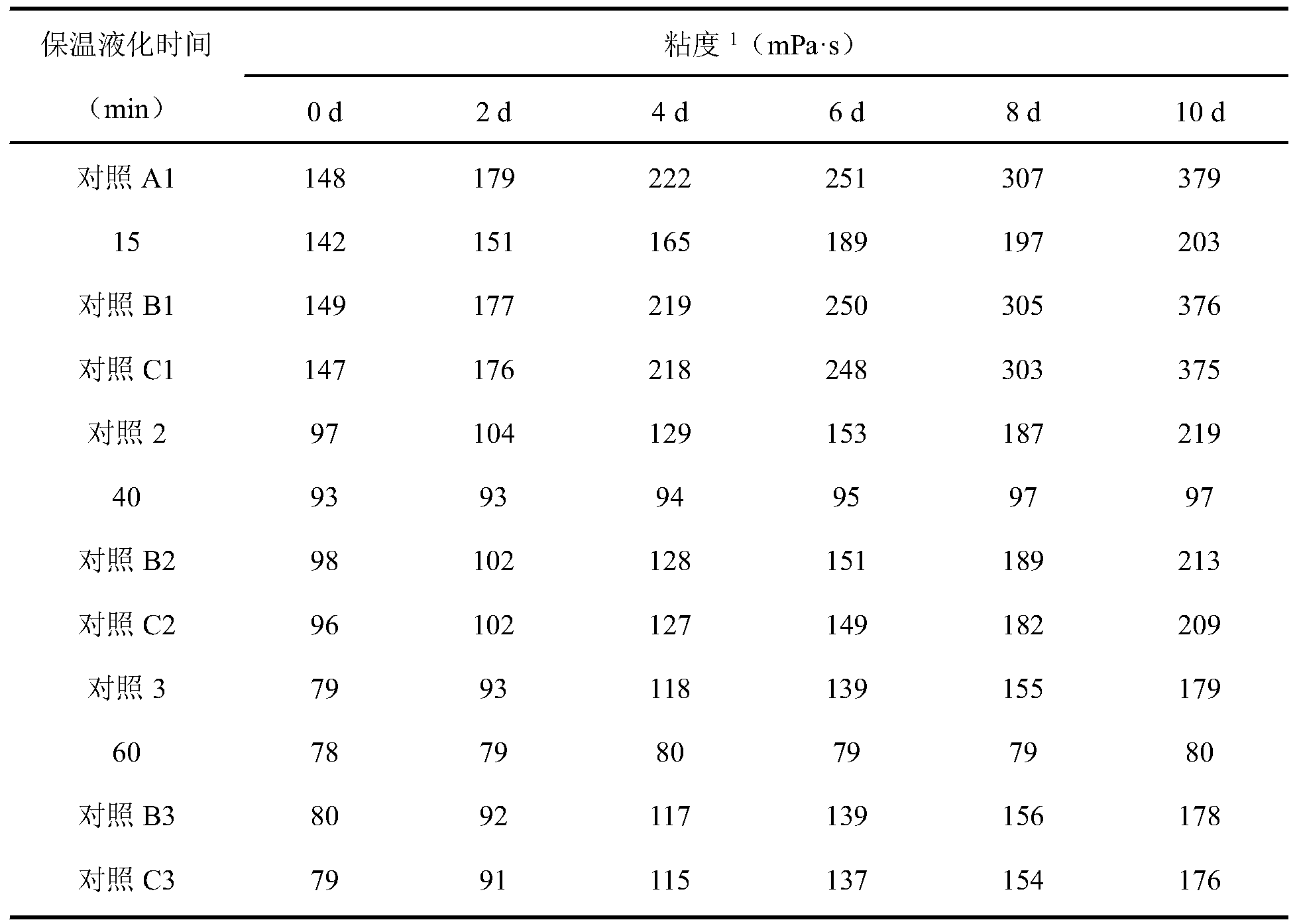
淀粉分支酶对不同DE值麦芽糊精性质的影响如表9、10所示。对于任意DE值的麦芽糊精,引入Rhodothermus obamensis来源的淀粉分支酶均可显著增强其溶解性、透明度和粘度稳定性,得到高品质麦芽糊精。当引入G.thermoglucosidans来源的淀粉分支酶时,发现几乎均无效果。
对照A代表缺少步骤(3)所生产得到的麦芽糊精;
对照B代表G.thermoglucosidans来源的淀粉分支酶替换步骤(3)中Rhodothermus obamensis来源的淀粉分支酶所生产得到的麦芽糊精;
对照C代表采用G.thermoglucosidans来源的淀粉分支酶替换步骤(3)中Rhodothermus obamensis来源的淀粉分支酶,并且在G.thermoglucosidans的最适反应条件下进行反应制备得到的麦芽糊精;最适反应条件具体是:淀粉分支酶加酶量为0.12U/g,反应温度为45℃,反应时间为4h,调节反应pH为6.5;
对照1、2、3分别代表步骤(2)中保温液化时间为15、40、60min时所生产得到的DE值为5、10、15的麦芽糊精。
表13淀粉分支酶对不同DE值麦芽糊精性质的影响

注:
1溶解性:称取5g样品溶于50mL蒸馏水中,以麦芽糊精完全溶解的时间为指标。
2透明度:配制30%的麦芽糊精水溶液,在冷藏(4℃)状态下储存60d后的透明度。
表14淀粉分支酶对不同DE值麦芽糊精粘度稳定性的影响
注:
1粘度:配制50%的麦芽糊精水溶液,分别放置0、2、4、6、8、10d后的粘度。
表15淀粉分支酶对不同DE值麦芽糊精冻融稳定性的影响

注:
1FTC(冻融循环):表示麦芽糊精的冻融稳定性,FTC1、3、5分别表示30%的麦芽糊精经1、3、5次冻融循环后的透明度。
透明度通过采用分光光度计于620nm下测定的透光率表示。
虽然本发明已以较佳实施例公开如上,但其并非用以限定本发明,任何熟悉此技术的人,在不脱离本发明的精神和范围内,都可做各种的改动与修饰,因此本发明的保护范围应该以权利要求书所界定的为准。
Claims (14)
- 一种高品质麦芽糊精的生产方法,其特征在于,所述方法包括调浆、喷射液化、Rhodothermus obamensis来源的淀粉分支酶作用、过滤、脱色、离子交换、浓缩步骤;所述淀粉分支酶的添加量为以干基计10-500U/g淀粉;加入淀粉分支酶后调节pH为6.0-7.5,于50-70℃下反应2-12h。
- 一种高品质麦芽糊精的生产方法,其特征在于,所述方法包括调浆、喷射液化、Rhodothermus obamensis来源的淀粉分支酶作用、过滤、脱色、离子交换、浓缩步骤。
- 根据权利要求2所述的方法,其特征在于,所述方法还包括喷雾干燥步骤。
- 根据权利要求2所述的方法,其特征在于,所述方法具体为:(1)调浆:将淀粉调制为一定浓度的淀粉乳,加热保温一段时间,加入耐高温α-淀粉酶及氯化钙,搅拌均匀后调节pH;(2)喷射液化:采用低压蒸汽喷射液化器进行喷射;(3)淀粉分支酶作用:待(2)中液化液冷却后加入淀粉分支酶,调节pH,于一定温度下反应一段时间,升温灭酶后得到反应液;(4)过滤:反应液冷却后,经过滤,得到澄清溶液;(5)脱色:调节溶液pH,加入活性炭于一定温度下搅拌脱色一段时间;(6)离子交换:采用离子交换树脂,去除溶液中的金属盐及色素;(7)浓缩:在一定真空度、温度下浓缩溶液。
- 根据权利要求4所述的方法,其特征在于,所述(3)中液化液须冷却至50℃以下,加入淀粉分支酶;淀粉分支酶的来源为Rhodothermus obamensis;添加量为以干基计10-500U/g淀粉;加入淀粉分支酶后调节pH为6.0-7.5,于50-70℃下反应2-12h。
- 根据权利要求4所述的方法,其特征在于,所述方法生产的高品质麦芽糊精DE值为2-20。
- 根据权利要求4所述的方法,其特征在于,所述(1)中淀粉为普通玉米淀粉、木薯淀粉、马铃薯淀粉、蜡质玉米淀粉、甘薯淀粉、大米淀粉、小麦淀粉中的一种或几种;淀粉乳的浓度为5-45%;将淀粉乳加热到60-70℃进行保温;耐高温α-淀粉酶的添加量为以干基计10-15U/g淀粉,加入后调节pH为5.5-6.5;氯化钙的添加量为以干基计0.1-0.2%。
- 根据权利要求4所述的方法,其特征在于,所述(2)包括2次喷射;第一次喷射后保温液化一段时间,进行第二次喷射灭酶。
- 根据权利要求4所述的方法,其特征在于,所述(2)中第一次喷射的物料压力为0.35MPa,蒸汽压力为0.1MPa,温度为102-110℃,时间为5-15min,之后在85-95℃中保温液化10-90min,第二次喷射的物料压力为0.35MPa,蒸汽压力为0.3MPa,温度为130-140℃, 时间为5min。
- 根据权利要求4所述的方法,其特征在于,所述(3)中液化液须冷却至50℃以下,加入淀粉分支酶;淀粉分支酶的来源为Rhodothermus obamensis;添加量为以干基计10-500U/g淀粉;加入淀粉分支酶后调节pH为6.0-7.5,于50-70℃下反应2-12h。
- 根据权利要求4所述的方法,其特征在于,所述(3)中淀粉分支酶作用的pH为6.5-7.5,于65-70℃下反应6h以上。
- 根据权利要求4所述的方法,其特征在于,所述(6)中采用的离子交换树脂结构为强酸性阳离子-弱碱性阴离子-强酸性阳离子交换树脂,温度为40-50℃。
- 按照权利要求2-12所述方法生产得到的高品质麦芽糊精。
- 权利要求2-12所述方法在食品、化工、医药方面的应用。
Priority Applications (1)
| Application Number | Priority Date | Filing Date | Title |
|---|---|---|---|
| US16/747,022 US11142781B2 (en) | 2018-06-29 | 2020-01-20 | Method for producing high quality maltodextrin |
Applications Claiming Priority (2)
| Application Number | Priority Date | Filing Date | Title |
|---|---|---|---|
| CN201810695009.7A CN108841896B (zh) | 2018-06-29 | 2018-06-29 | 一种高品质麦芽糊精的生产方法 |
| CN201810695009.7 | 2018-06-29 |
Related Child Applications (1)
| Application Number | Title | Priority Date | Filing Date |
|---|---|---|---|
| US16/747,022 Continuation US11142781B2 (en) | 2018-06-29 | 2020-01-20 | Method for producing high quality maltodextrin |
Publications (1)
| Publication Number | Publication Date |
|---|---|
| WO2020000530A1 true WO2020000530A1 (zh) | 2020-01-02 |
Family
ID=64200642
Family Applications (1)
| Application Number | Title | Priority Date | Filing Date |
|---|---|---|---|
| PCT/CN2018/095880 Ceased WO2020000530A1 (zh) | 2018-06-29 | 2018-07-17 | 一种高品质麦芽糊精的生产方法 |
Country Status (3)
| Country | Link |
|---|---|
| US (1) | US11142781B2 (zh) |
| CN (1) | CN108841896B (zh) |
| WO (1) | WO2020000530A1 (zh) |
Cited By (1)
| Publication number | Priority date | Publication date | Assignee | Title |
|---|---|---|---|---|
| CN117257678A (zh) * | 2023-09-11 | 2023-12-22 | 江门市三木化工有限公司 | 一种乳液及其制备工艺 |
Families Citing this family (10)
| Publication number | Priority date | Publication date | Assignee | Title |
|---|---|---|---|---|
| CN110819671B (zh) * | 2019-11-05 | 2023-09-22 | 山东香驰健源生物科技有限公司 | 一种麦芽糊精及其生产工艺和应用 |
| CN110760532B (zh) * | 2019-11-18 | 2022-08-12 | 南京农业大学 | 一种淀粉分支酶及其基因、含有该基因的工程菌及其应用 |
| CN115087742B (zh) * | 2020-01-07 | 2023-10-24 | 陈乐仁 | 具有低de值和低粘度的麦芽糊精组份及其制备方法 |
| CN111471728A (zh) * | 2020-04-28 | 2020-07-31 | 吉林中粮生化有限公司 | 一种麦芽糊精的制备方法及其应用 |
| CN112391365B (zh) * | 2020-11-30 | 2022-04-15 | 江南大学 | 一种催化活力提高的淀粉分支酶突变体及其应用 |
| KR102682845B1 (ko) | 2021-02-05 | 2024-07-08 | 대상 주식회사 | 백탁이 개선된 분지 덱스트린의 제조방법 |
| CN115820767A (zh) * | 2022-08-25 | 2023-03-21 | 江南大学 | 一种具有冷冻保护效果的糊精的制备及其应用 |
| CN117327753B (zh) * | 2023-10-16 | 2026-06-19 | 上海统益生物科技有限公司 | 一种包埋性能良好、抗吸潮的麦芽糊精及其制备方法 |
| CN117530427A (zh) * | 2023-12-22 | 2024-02-09 | 济南泉康生物科技有限公司 | 一种增稠剂及其制备方法和应用 |
| CN118813736A (zh) * | 2024-08-13 | 2024-10-22 | 江南大学 | 一种双酶协同制备低gi麦芽糊精的方法 |
Citations (9)
| Publication number | Priority date | Publication date | Assignee | Title |
|---|---|---|---|---|
| CN1444660A (zh) * | 2000-07-28 | 2003-09-24 | 诺维信公司 | 用己糖基转移酶制备麦芽糖浆的方法 |
| CN101198703A (zh) * | 2004-09-30 | 2008-06-11 | 江崎格力高株式会社 | 生产糖原的方法 |
| CN101613729A (zh) * | 2009-07-27 | 2009-12-30 | 中南林业科技大学 | 以稻米为原料制取低de值麦芽糊精的方法 |
| CN101696437A (zh) * | 2009-09-10 | 2010-04-21 | 万福生科(湖南)农业开发股份有限公司 | 一种用大米生产麦芽糊精的方法 |
| CN102392064A (zh) * | 2011-09-01 | 2012-03-28 | 河南永昌飞天淀粉糖有限公司 | 一种生物活性麦芽糖浆或麦芽糊精的生产方法 |
| CN103404764A (zh) * | 2013-08-23 | 2013-11-27 | 内蒙古伊利实业集团股份有限公司 | 一种抗性麦芽糊精及其制备方法 |
| US20130323799A1 (en) * | 2010-12-07 | 2013-12-05 | Ezaki Glico Co., Ltd. | Method for industrially producing cyclic-structure-containing branched glucan |
| CN103667388A (zh) * | 2012-09-06 | 2014-03-26 | 王志良 | 一种麦芽糊精的生产工艺 |
| CN107653278A (zh) * | 2017-10-31 | 2018-02-02 | 无锡甜丰食品有限公司 | 一种麦芽糊精的生产工艺 |
Family Cites Families (4)
| Publication number | Priority date | Publication date | Assignee | Title |
|---|---|---|---|---|
| AU2003232182A1 (en) * | 2002-06-17 | 2003-12-31 | Novozymes A/S | Methods for producing dextrins using enzymes |
| CN1260252C (zh) * | 2004-01-15 | 2006-06-21 | 华南理工大学 | 一种控制淀粉糖分子量分布的方法 |
| CN103060402A (zh) * | 2013-01-07 | 2013-04-24 | 安徽友勇生物科技有限公司 | 一种淀粉糖浆生产方法 |
| CN103215325A (zh) * | 2013-03-27 | 2013-07-24 | 保龄宝生物股份有限公司 | 一种高档麦芽糊精的生产方法 |
-
2018
- 2018-06-29 CN CN201810695009.7A patent/CN108841896B/zh active Active
- 2018-07-17 WO PCT/CN2018/095880 patent/WO2020000530A1/zh not_active Ceased
-
2020
- 2020-01-20 US US16/747,022 patent/US11142781B2/en active Active
Patent Citations (9)
| Publication number | Priority date | Publication date | Assignee | Title |
|---|---|---|---|---|
| CN1444660A (zh) * | 2000-07-28 | 2003-09-24 | 诺维信公司 | 用己糖基转移酶制备麦芽糖浆的方法 |
| CN101198703A (zh) * | 2004-09-30 | 2008-06-11 | 江崎格力高株式会社 | 生产糖原的方法 |
| CN101613729A (zh) * | 2009-07-27 | 2009-12-30 | 中南林业科技大学 | 以稻米为原料制取低de值麦芽糊精的方法 |
| CN101696437A (zh) * | 2009-09-10 | 2010-04-21 | 万福生科(湖南)农业开发股份有限公司 | 一种用大米生产麦芽糊精的方法 |
| US20130323799A1 (en) * | 2010-12-07 | 2013-12-05 | Ezaki Glico Co., Ltd. | Method for industrially producing cyclic-structure-containing branched glucan |
| CN102392064A (zh) * | 2011-09-01 | 2012-03-28 | 河南永昌飞天淀粉糖有限公司 | 一种生物活性麦芽糖浆或麦芽糊精的生产方法 |
| CN103667388A (zh) * | 2012-09-06 | 2014-03-26 | 王志良 | 一种麦芽糊精的生产工艺 |
| CN103404764A (zh) * | 2013-08-23 | 2013-11-27 | 内蒙古伊利实业集团股份有限公司 | 一种抗性麦芽糊精及其制备方法 |
| CN107653278A (zh) * | 2017-10-31 | 2018-02-02 | 无锡甜丰食品有限公司 | 一种麦芽糊精的生产工艺 |
Cited By (1)
| Publication number | Priority date | Publication date | Assignee | Title |
|---|---|---|---|---|
| CN117257678A (zh) * | 2023-09-11 | 2023-12-22 | 江门市三木化工有限公司 | 一种乳液及其制备工艺 |
Also Published As
| Publication number | Publication date |
|---|---|
| CN108841896A (zh) | 2018-11-20 |
| US11142781B2 (en) | 2021-10-12 |
| US20200157592A1 (en) | 2020-05-21 |
| CN108841896B (zh) | 2021-01-29 |
Similar Documents
| Publication | Publication Date | Title |
|---|---|---|
| CN108841896B (zh) | 一种高品质麦芽糊精的生产方法 | |
| CN101684504A (zh) | 一种超高麦芽糖浆制备方法 | |
| CN101870991B (zh) | 一种抗消化糊精的制备方法 | |
| US4447532A (en) | Process for the manufacture of low D.E. maltodextrins | |
| CN105612258B (zh) | 半乳寡糖的生产 | |
| CN103060400B (zh) | 一种多孔淀粉及其发酵用糖浆的联合制备方法 | |
| CN104131051B (zh) | 一种低聚异麦芽糖的制备方法 | |
| CN108841895B (zh) | 一种提高麦芽糊精冻融稳定性的方法 | |
| CN111471728A (zh) | 一种麦芽糊精的制备方法及其应用 | |
| NO134356B (zh) | ||
| CN103589760B (zh) | 喷射液化酶法制备低de值的麦芽糊精 | |
| CN101438782B (zh) | 一种保湿糖浆及其制备方法 | |
| CN107811027A (zh) | 一种含冰结构蛋白的速冻肉丸复合抗冻剂 | |
| CN106636257A (zh) | 低泡高熬温淀粉糖浆及其生产工艺 | |
| CN102465161A (zh) | 双酶法生产高纯度麦芽糖的方法 | |
| US3756919A (en) | Process for the production of nonhazing starch conversion syrups | |
| CN111440834A (zh) | 一种低粘度、高麦芽四糖含量低聚麦芽糖浆的制备方法 | |
| US12359235B2 (en) | Method for producing branched dextrin with improved white turbidity | |
| CN114271476A (zh) | 一种烧腊专用糖浆制备方法 | |
| JPS6244162A (ja) | ビ−ルの製法 | |
| CN107897634A (zh) | 一种含冰结构蛋白的速冻汤圆复合抗冻剂 | |
| CN107686853B (zh) | 一种多酶法制备超高麦芽糖浆的方法 | |
| CN202829891U (zh) | 一种连续生产无糖聚葡萄糖的设备及其系统 | |
| CN118063632A (zh) | 一种麦芽糊精的制备方法 | |
| CN108396041A (zh) | 一种提高淀粉液化产物透明度的方法 |
Legal Events
| Date | Code | Title | Description |
|---|---|---|---|
| 121 | Ep: the epo has been informed by wipo that ep was designated in this application |
Ref document number: 18924900 Country of ref document: EP Kind code of ref document: A1 |
|
| NENP | Non-entry into the national phase |
Ref country code: DE |
|
| 122 | Ep: pct application non-entry in european phase |
Ref document number: 18924900 Country of ref document: EP Kind code of ref document: A1 |