WO2019235331A1 - 部分架橋もしくは架橋型ジメチルポリシロキサンを用いた水中油型乳化化粧料 - Google Patents
部分架橋もしくは架橋型ジメチルポリシロキサンを用いた水中油型乳化化粧料 Download PDFInfo
- Publication number
- WO2019235331A1 WO2019235331A1 PCT/JP2019/021371 JP2019021371W WO2019235331A1 WO 2019235331 A1 WO2019235331 A1 WO 2019235331A1 JP 2019021371 W JP2019021371 W JP 2019021371W WO 2019235331 A1 WO2019235331 A1 WO 2019235331A1
- Authority
- WO
- WIPO (PCT)
- Prior art keywords
- oil
- emulsified cosmetic
- cosmetic according
- water
- acid
- Prior art date
- Legal status (The legal status is an assumption and is not a legal conclusion. Google has not performed a legal analysis and makes no representation as to the accuracy of the status listed.)
- Ceased
Links
Classifications
-
- A—HUMAN NECESSITIES
- A61—MEDICAL OR VETERINARY SCIENCE; HYGIENE
- A61K—PREPARATIONS FOR MEDICAL, DENTAL OR TOILETRY PURPOSES
- A61K8/00—Cosmetics or similar toiletry preparations
- A61K8/02—Cosmetics or similar toiletry preparations characterised by special physical form
- A61K8/04—Dispersions; Emulsions
- A61K8/06—Emulsions
- A61K8/062—Oil-in-water emulsions
-
- A—HUMAN NECESSITIES
- A61—MEDICAL OR VETERINARY SCIENCE; HYGIENE
- A61K—PREPARATIONS FOR MEDICAL, DENTAL OR TOILETRY PURPOSES
- A61K8/00—Cosmetics or similar toiletry preparations
- A61K8/18—Cosmetics or similar toiletry preparations characterised by the composition
- A61K8/30—Cosmetics or similar toiletry preparations characterised by the composition containing organic compounds
- A61K8/33—Cosmetics or similar toiletry preparations characterised by the composition containing organic compounds containing oxygen
- A61K8/34—Alcohols
- A61K8/342—Alcohols having more than seven atoms in an unbroken chain
-
- A—HUMAN NECESSITIES
- A61—MEDICAL OR VETERINARY SCIENCE; HYGIENE
- A61K—PREPARATIONS FOR MEDICAL, DENTAL OR TOILETRY PURPOSES
- A61K8/00—Cosmetics or similar toiletry preparations
- A61K8/18—Cosmetics or similar toiletry preparations characterised by the composition
- A61K8/30—Cosmetics or similar toiletry preparations characterised by the composition containing organic compounds
- A61K8/46—Cosmetics or similar toiletry preparations characterised by the composition containing organic compounds containing sulfur
- A61K8/463—Cosmetics or similar toiletry preparations characterised by the composition containing organic compounds containing sulfur containing sulfuric acid derivatives, e.g. sodium lauryl sulfate
-
- A—HUMAN NECESSITIES
- A61—MEDICAL OR VETERINARY SCIENCE; HYGIENE
- A61K—PREPARATIONS FOR MEDICAL, DENTAL OR TOILETRY PURPOSES
- A61K8/00—Cosmetics or similar toiletry preparations
- A61K8/18—Cosmetics or similar toiletry preparations characterised by the composition
- A61K8/72—Cosmetics or similar toiletry preparations characterised by the composition containing organic macromolecular compounds
- A61K8/84—Cosmetics or similar toiletry preparations characterised by the composition containing organic macromolecular compounds obtained by reactions otherwise than those involving only carbon-carbon unsaturated bonds
- A61K8/89—Polysiloxanes
- A61K8/891—Polysiloxanes saturated, e.g. dimethicone, phenyl trimethicone, C24-C28 methicone or stearyl dimethicone
- A61K8/894—Polysiloxanes saturated, e.g. dimethicone, phenyl trimethicone, C24-C28 methicone or stearyl dimethicone modified by a polyoxyalkylene group, e.g. cetyl dimethicone copolyol
-
- A—HUMAN NECESSITIES
- A61—MEDICAL OR VETERINARY SCIENCE; HYGIENE
- A61K—PREPARATIONS FOR MEDICAL, DENTAL OR TOILETRY PURPOSES
- A61K8/00—Cosmetics or similar toiletry preparations
- A61K8/18—Cosmetics or similar toiletry preparations characterised by the composition
- A61K8/92—Oils, fats or waxes; Derivatives thereof, e.g. hydrogenation products thereof
-
- A—HUMAN NECESSITIES
- A61—MEDICAL OR VETERINARY SCIENCE; HYGIENE
- A61Q—SPECIFIC USE OF COSMETICS OR SIMILAR TOILETRY PREPARATIONS
- A61Q19/00—Preparations for care of the skin
-
- A—HUMAN NECESSITIES
- A61—MEDICAL OR VETERINARY SCIENCE; HYGIENE
- A61K—PREPARATIONS FOR MEDICAL, DENTAL OR TOILETRY PURPOSES
- A61K2800/00—Properties of cosmetic compositions or active ingredients thereof or formulation aids used therein and process related aspects
- A61K2800/10—General cosmetic use
Definitions
- the present invention relates to an oil-in-water emulsified cosmetic using a partially crosslinked or crosslinked dimethylpolysiloxane, and more particularly to improving the stability of the cosmetic at low viscosity and improving usability.
- the present invention has been made in view of the above prior art, and the problem to be solved is to improve the stability at low viscosity in an oil-in-water emulsified cosmetic using partially crosslinked or crosslinked dimethylpolysiloxane. And it is providing the oil-in-water type emulsified cosmetics excellent in the usability.
- the oil-in-water cosmetic according to the present invention is characterized by containing the following components (A) to (D) and satisfying the following conditions (1) to (3).
- A Anionic surfactant having a sulfonic acid group represented by the following general formula in the molecule R 1 CO-a- (CH 2 ) n SO 3 M 1
- R 1 CO— represents a saturated or unsaturated fatty acid residue (acyl group) having an average carbon number of 10 to 22
- a represents —O— or —NR 2 — (wherein R 2 represents a hydrogen atom, Or an alkyl group having 1 to 3 carbon atoms)
- M1 represents a hydrogen atom, an alkali metal, an alkaline earth metal, ammonium or an organic amine
- n represents an integer of 1 to 3.
- the emulsified cosmetic further comprises (E) a silicone-based surfactant.
- the silicone-based surfactant is contained in the cosmetic in an amount of 0.05 to 2.0% by mass.
- (D) preferably contains a phenyl group in the molecule.
- (D) is contained in the preparation in an amount of 0.1 to 20% by mass.
- the emulsified cosmetic preferably contains a polyol or sugar alcohol having a Log P of -1.0 to -3.0.
- the emulsified cosmetic preferably contains ester oil and animal and vegetable oil having an IOB value of 0 to 0.2 in the organic conceptual diagram.
- the emulsified cosmetic preferably contains an ester oil that is liquid at 25 ° C. with an IOB value of 0 to 0.2 in the organic conceptual diagram.
- (C) is preferably a linear or branched aliphatic alcohol having 10 to 24 carbon atoms.
- (C) is preferably behenyl alcohol.
- (E) is preferably polyglyceryl-modified silicone.
- (E) is a polyether (3 to 40) -modified polysiloxane.
- the emulsified cosmetic preferably contains (F) a water-soluble thickener.
- the emulsified cosmetic preferably contains a (semi) poorly soluble drug having a Log P value of 10 to 30.
- (quasi) poorly soluble drug having a Log P value of 10 to 30 is selected from coenzyme Q10, stearyl glycyrrhetinate, astaxanthin, tranexamic acid, allantoin, alkoxysalicylic acid, and whitening agent (other ingredients). Is preferred.
- (B) is a (dimethicone / phenylvinyldimethicone) crosspolymer, a poly-silicone-11, or a cross-linked methylpolysiloxane.
- an anionic surfactant having a sulfonic acid group in the molecule (B) a partially crosslinked or crosslinked dimethylpolysiloxane, and (C) an animal or plant-derived or chemically synthesized at 25 ° C.
- a solid oil component (D) silicone oil having a kinematic viscosity of 100 cSt or less at 25 ° C. under specific conditions, it is excellent in stability over time at low viscosity and in water. It has been found that an oil-type emulsified cosmetic can be obtained.
- the oil-in-water emulsified cosmetic according to the present invention contains the following components (A) to (D), and satisfies the following conditions (1) to (3).
- A Anionic surfactant having a sulfonic acid group represented by formula (I) in the molecule
- B Partially crosslinked or crosslinked dimethylpolysiloxane
- C Oily components derived from animals and plants or chemically synthesized and solid at 25 ° C
- D Silicone oil conditions where the kinematic viscosity at 25 ° C is 100 cSt or less (1)
- A) / ((B) + (C) + (D)) 0.01 to 1.0 Condition (2)
- A) / (C) 0.01 ⁇ 1 Condition (3)
- Viscosity at 25 ° C. is 10 to 100,000 mPa ⁇ s
- (A) Anionic surfactant having a sulfonic acid group in the molecule is represented by the following general formula (I).
- R 1 CO— represents a saturated or unsaturated fatty acid residue (acyl group) having an average carbon number of 10 to 22; a represents —O— or —NR 2 — (where R 2 Represents a hydrogen atom or an alkyl group having 1 to 3 carbon atoms); M 1 represents a hydrogen atom, an alkali metal, an alkaline earth metal, ammonium or an organic amine; n represents 1 to 3 Indicates an integer.
- the anionic surfactant (A) having a sulfonic acid group in the molecule of the present invention is preferably 0.1 to 1.5% by mass in the cosmetic when used in an oil-in-water emulsion cosmetic. It is. If it exceeds 1.5 mass%, stickiness may be imparted. If it is less than 0.1% by mass, the emulsion stability may be lowered.
- the anionic surfactant having a sulfonic acid group in the molecule that can be used in the present invention is not particularly limited, but is preferably stearoyl methyl taurine salt, cocoyl methyl taurine salt, or lauroyl methyl taurine salt.
- anionic surfactants having a sulfonic acid group in the molecule commercially available products are NIKKOL® SMT (stearoyl methyl taurine sodium, manufactured by Nikko Chemicals Co., Ltd.), NIKKOL LMT (lauroyl methyl taurine sodium, manufactured by Nikko Chemicals Co., Ltd.). NIKKOL CMT-30 (cocoyl methyl taurine Na, manufactured by Nikko Chemicals Co., Ltd.).
- (B) Dimethylpolysiloxane The (B) dimethylpolysiloxane used in the present invention is characterized by being partially crosslinked or crosslinked.
- the (B) partially crosslinked or crosslinked dimethylpolysiloxane of the present invention is used in an oil-in-water emulsified cosmetic, it is preferably 0.1 to 2% by mass in the cosmetic. More preferably, the content is 0.1 to 0.8% by mass. If it exceeds 2% by mass, aggregation of partially crosslinked or crosslinked dimethylpolysiloxane may occur. If it is less than 0.1% by mass, a smooth and good use feeling may not be obtained.
- Partially cross-linked or cross-linked dimethylpolysiloxane that can be used in the present invention is not particularly limited, but alkyl cross-linked polydimethylsiloxane, poly-silicone-11, cross-linked methyl polysiloxane, (dimethicone / phenylvinyl dimethicone) Cross polymers, cross-linked polyether-modified silicones, and (PEG-15 / lauryl polydimethylsiloxyethyl dimethicone) cross polymers are preferred. Among these, (dimethicone / phenylvinyldimethicone) crosspolymer, polysilicone-11, and cross-linked methylpolysiloxane are excellent.
- Oily component derived from animal or plant or chemically synthesized is solid at 25 ° C. If it is not solid, it is not preferable because it may cause aggregation of partially crosslinked or crosslinked dimethylpolysiloxane.
- oily component (C) derived from animals and plants or chemically synthesized according to the present invention is used in an oil-in-water emulsified cosmetic, it is preferably 0.5% to 10% by mass in the cosmetic. If it exceeds 10%, a smooth and good use feeling may not be obtained. If it is less than 0.5%, the partially crosslinked or crosslinked dimethylpolysiloxane may be aggregated.
- the oily component derived from (C) animals and plants or chemically synthesized that can be used in the present invention is not particularly limited, but is a linear or branched aliphatic alcohol having 10 to 24 carbon atoms, sphingosine, an insulator, Preferred is ceramide or the like.
- These alcohols include lauryl alcohol, cetyl alcohol, stearyl alcohol, behenyl alcohol, myristyl alcohol, oleyl alcohol, cetostearyl alcohol, monostearyl glycerene ether (batyl alcohol), 2-decyltetradecinol, lanolin alcohol, cholesterol, hexyl.
- Examples include dodecanol, isostearyl alcohol, octyldodecanol and the like. Among these, behenyl alcohol, sphingosine, and ceramide are excellent.
- (D) Silicone oil The silicone oil used in the present invention is characterized by a kinematic viscosity at 25 ° C. of 100 cSt or less. If the kinematic viscosity exceeds 100 cSt, the dispersion state of the partially crosslinked or crosslinked dimethylpolysiloxane may deteriorate, which is not preferable.
- the (D) silicone oil of the present invention is used in an oil-in-water emulsified cosmetic, it is preferably 5 to 30% by mass in the cosmetic. If it exceeds 30%, emulsification failure may occur. If it is less than 5%, it may cause aggregation of partially crosslinked or crosslinked dimethylpolysiloxane.
- the silicone oil used in the present invention is not particularly limited, but preferably contains a phenyl group and a methyl group. Among these, it is preferable that a phenyl group is included from the point of compatibility with solid oil.
- silicone oil commercially available products include silicon KF-56 (manufactured by Shin-Etsu Chemical Co., Ltd.), KF-96A-6T (manufactured by Shin-Etsu Chemical Co., Ltd.), and the like.
- the oil-in-water emulsified cosmetic according to the present invention needs to satisfy the following conditions (1) to (3).
- (A) / ((B) + (C) + (D)) is less than 0.01, it is not preferable because it may cause poor emulsification or aggregation of partially crosslinked or crosslinked dimethylpolysiloxane. If (A) / ((B) + (C) + (D)) exceeds 1, it is not preferable because the stickiness during application and the stickiness after application may increase.
- (A) / (C) 0.01 ⁇ 1
- the oil-in-water emulsified cosmetic according to the present invention has a viscosity of 10 to 100,000 mPa ⁇ s at 25 ° C. More preferably, it is 1,000 to 50,000. If it is less than 10 mPa ⁇ s, it may cause aggregation of partially crosslinked or crosslinked dimethylpolysiloxane during long-term storage, which is not preferable. On the other hand, if it exceeds 100,000 mPa ⁇ s, a smooth and good use feeling may not be obtained, which is not preferable.
- the oil-in-water type emulsified cosmetic according to the present invention preferably has an emulsified particle diameter of 100 ⁇ m or less. If it exceeds 100 ⁇ m, it is not preferred because it may cause aggregation of partially crosslinked or crosslinked dimethylpolysiloxane.
- (E) a silicone-based surfactant can be blended.
- the partially crosslinked or crosslinked dimethylpolysiloxane is 0.05 to 2.0% by mass in the cosmetic. This is preferable because of the improvement of the dispersion and the suppression of coalescence of partially crosslinked or crosslinked dimethylpolysiloxane in long-term storage. If it is less than 0.05% by mass, there is no effect on the partial cross-linking or cross-linking dimethylpolysiloxane dispersion and coalescence suppression, which is not preferable. Moreover, when it exceeds 2.0 mass%, the stickiness after application
- the (E) silicone surfactant used in the present invention is not particularly limited, but is preferably polyglyceryl-modified silicone, polyether-modified silicone, polyether-modified / alkyl-modified silicone.
- the silicone surfactant preferably has a silicone chain (siloxane chain) as a main chain and a hydrophilic group having a polyether group as a side chain.
- the silicone surfactant preferably has a pendant (comb) structure in which a plurality of polyoxyalkylene groups (polyether chains) are introduced as side chains into the silicone chain.
- the silicone surfactant has a pendant structure, the dispersion stability of the partially crosslinked or crosslinked dimethylpolysiloxane can be further enhanced.
- polyether (3 to 40) modified polysiloxane is preferable from the viewpoint of suppressing coalescence of partially crosslinked or crosslinked dimethylpolysiloxane.
- Particularly preferred is PEG-10 dimethicone.
- HLB is lower than 10
- silicone surfactants include KF-6017P (PEG-10 dimethicone, manufactured by Shin-Etsu Silicone), KF-6048 (cetyl PEG / PPG-10 / 1 dimethicone, manufactured by Shin-Etsu Silicone) And silicone KF-6109 (bisbutyldimethicone polyglyceryl-3, manufactured by Shin-Etsu Silicone).
- (F) a water-soluble thickener can be blended.
- water-soluble thickener for example, a taurate synthetic polymer and / or an acrylate synthetic polymer can be used.
- a taurate polymer thickener a polymer and / or copolymer (crosslinking) having 2-acrylamido-2-propanesulfonic acid (acryloyldimethyltauric acid) or a salt thereof (AMPS structure) as a structural unit.
- crosslinking 2-acrylamido-2-propanesulfonic acid (acryloyldimethyltauric acid) or a salt thereof (AMPS structure) as a structural unit.
- AMPS structure a salt thereof
- carboxyvinyl polymer (Carbopol 981, manufactured by Lubrizol) (acryloyldimethyltaurine ammonium / Beheneth-25 methacrylate) crosspolymer (Aristoflex® HMB, Clariant Japan), (Acryloyldimethyltaurine ammonium / vinyl pyrrolidone) copolymer (Aristoflex® AVC, Clariant Japan), (Acryloyldimethyltaurine ammonium / carboxylethyl acrylate) crosspolymer (Aristoflex® TAC, Clariant Japan), poly Acrylate cross polymer-11 (Aristoflex (registered trademark) Velvet, Clariant Japan), (Crylamide / acryloyldimethyl 16 taurine sodium) crosspolymer (SU-GEL, Toho Chemical Co., Ltd.), (hydroxyethyl acrylate / acryloyl dimethyl taurine sodium) copolymer
- an (acrylate / steare methacrylate-20) copolymer (ACULYN (registered trademark) 22, Dow Chemical Company), (Acrylates / C10-30 alkyl acrylate) crosspolymer (PEMULEN® TR-2) can be used.
- the content of the water-soluble thickener in the composition of the present disclosure is preferably 0.05% by mass or more and more preferably 0.08% by mass or more with respect to the mass of the composition.
- the content of the water-soluble thickener is preferably 2% by mass or less and more preferably 1.5% by mass or less with respect to the mass of the composition.
- thickening agent may be added as long as the effects of the present invention are not impaired.
- Other thickeners include, for example, gum arabic, carrageenan, caraya gum, gum tragacanth, carob gum, quince seed (quince), casein, dextrin, gelatin, sodium pectate, sodium 17 sodium alginate, methyl cellulose, ethyl cellulose, carboxymethyl cellulose ( CMC), hydroxyethyl cellulose, hydroxypropyl cellulose, polyvinyl alcohol (PVA), polyvinyl methyl ether (PVM), PVP (polyvinylpyrrolidone), sodium polyacrylate, locust bean gum, guar gum, tamarint gum, dialkyldimethylammonium sulfate cellulose, xanthan gum, Magnesium aluminum silicate, bentonite, hectorite, magnesium aluminum silicate Veegum), laponite, and the like silicic anhydride.
- the component (C) in addition to the component (C), when an oily component derived from an animal or plant or chemically synthesized with an IOB value of 0 to 0.2 in an organic conceptual diagram (by Jun Fujita: Organic qualitative analysis) is blended, This is preferable in terms of improving the solubility of oil. If it exceeds 0.2, the solid oil may not dissolve, which is not preferable.
- the oily component derived from animals or plants having an IOB value of 0 to 0.2 or chemically synthesized is not particularly limited, but is preferably an ester oil that is liquid at 25 ° C. for the purpose of improving the solubility of the solid oil. .
- the oily component derived from animals and plants or chemically synthesized with an IOB value of 0 to 0.2 is preferably 1 to 20% by mass in the cosmetic. If it is less than 1% by mass, the solid oil may not be sufficiently dissolved, which is not preferable. Moreover, when it exceeds 20 mass%, a partially crosslinked or crosslinked dimethylpolysiloxane may aggregate, which is not preferable.
- a nonionic surfactant can be blended.
- 0.01 to 1% by mass in the cosmetic is preferable because the emulsifiability is improved. If it is less than 0.01% by mass, the emulsifiability may not change, which is not preferable. On the other hand, if it exceeds 1% by mass, the stickiness during coating and the stickiness after coating may become strong, which is not preferable.
- Nonionic surfactants include polyoxyethylene hydrogenated castor oil, glycerin fatty acid ester, polyoxyethylene fatty acid sorbitan and the like. Among these, alkyl monoglycerides, dialkyl monoglycerides, and fatty acid esters having 10 to 24 sovitan monocarbons having a CCP (average critical filling parameter) of 0.8 to 1.2 are preferable.
- the average critical packing parameter “packing parameter” refers to the occupied volume of the hydrophobic group in the micelle shell V, the length of the hydrophobic group in the micelle shell 1 and the occupied area of the hydrophilic group at the micelle-solution interface.
- A is a parameter for explaining the relationship between the molecular structure and the associating structure with a value represented by V / (l ⁇ a).
- Israelachvili shows the relationship between critical packing parameters and stable association structures (“Intermolecular and Surface Forces, with Applications to Colloidal and Biological Systems” Academic Press, London, 1985, p247; "Power” 2nd edition, written by JN Israel Ativeli, Yasu Kondo, Hiroyuki Oshima, Asakura Shoten, 1996, p368; 1995, p116).
- an amphoteric surfactant can be blended.
- the amphoteric surfactant is added, it is preferably 0.01 to 1% by mass in the cosmetic because the dispersibility of the partially crosslinked or crosslinked dimethylpolysiloxane is improved. If it is less than 0.01% by mass, the dispersibility of partially crosslinked or crosslinked dimethylpolysiloxane may not be affected, which is not preferable. On the other hand, if it exceeds 1% by mass, stickiness may be felt after application, which is not preferable.
- amphoteric surfactants examples include lauryldimethylaminoacetic acid betaine and coconut oil fatty acid acylglycine sodium. Among these, lauryldimethylaminoacetic acid betaine is preferable.
- polyols polyols, sugar alcohols and the like can be included.
- polyols and sugar alcohols examples include glycerin, butylene glycol, and erythritol.
- the water / octanol partition coefficient (log P value) representing water solubility and fat solubility is preferably in the range of -3.0 to -1.0.
- the blending amount of polyol and sugar alcohol is preferably 1 to 30% by mass in the cosmetic. If it is less than 1% by mass, a sufficient moisturizing effect for skin care may not be obtained, which is not preferable. On the other hand, if it exceeds 30% by mass, the stickiness during coating and stickiness after coating may become strong, which is not preferable.
- a hardly soluble drug can be included.
- poorly soluble drugs examples include coenzyme Q10, stearyl glycyrrhetinate, astaxanthin, tranexamic acid, allantoin, alkoxysalicylic acid, and whitening agents (other components).
- the water / octanol partition coefficient (log P value) representing water solubility and fat solubility is preferably in the range of 10-30.
- humectant a water-soluble polymer
- thickener a film agent
- ultraviolet absorber a sequestering agent
- a lower component a humectant, a water-soluble polymer, a thickener, a film agent, an ultraviolet absorber, a sequestering agent, a lower component
- Alcohol polyhydric alcohol, sugar, amino acid, organic amine, polymer emulsion, pH adjuster, skin nutrient, vitamin, antioxidant, antioxidant assistant, fragrance, water etc
- it can be produced by a conventional method.
- humectant examples include polyethylene glycol, propylene glycol, glycerin, 1,3-butylene glycol, xylitol, sorbitol, maltitol, chondroitin sulfate, hyaluronic acid, mucoitin sulfate, caronic acid, atelocollagen, cholesteryl-12-hydroxystearate Sodium lactate, bile salt, dl-pyrrolidone carboxylate, alkylene oxide derivative, short-chain soluble collagen, diglycerin (EO) PO adduct, Izayoi rose extract, yarrow extract, merirot extract and the like.
- EO diglycerin
- natural water-soluble polymers include plant-based polymers (for example, gum arabic, gum tragacanth, galactan, guar gum, carob gum, caraya gum, carrageenan, pectin, agar, quince seed (malmello), alge colloid (guckweed extract), starch (Rice, corn, potato, wheat), glycyrrhizic acid); microbial polymers (eg, xanthan gum, dextran, succinoglucan, bullulan, etc.); animal polymers (eg, collagen, casein, albumin, gelatin, etc.), etc. Is mentioned.
- plant-based polymers for example, gum arabic, gum tragacanth, galactan, guar gum, carob gum, caraya gum, carrageenan, pectin, agar, quince seed (malmello), alge colloid (guckweed extract), starch (Rice, corn, potato, wheat), glycyrrhizic acid);
- Semi-synthetic water-soluble polymers include, for example, starch polymers (eg, carboxymethyl starch, methylhydroxypropyl starch, etc.); cellulose polymers (methylcellulose, ethylcellulose, methylhydroxypropylcellulose, hydroxyethylcellulose, sodium cellulose sulfate) Hydroxypropylcellulose, carboxymethylcellulose, sodium carboxymethylcellulose, crystalline cellulose, cellulose powder and the like); alginic acid polymers (for example, sodium alginate, propylene glycol alginate, etc.) and the like.
- starch polymers eg, carboxymethyl starch, methylhydroxypropyl starch, etc.
- cellulose polymers methylcellulose, ethylcellulose, methylhydroxypropylcellulose, hydroxyethylcellulose, sodium cellulose sulfate Hydroxypropylcellulose, carboxymethylcellulose, sodium carboxymethylcellulose, crystalline cellulose, cellulose powder and the like
- alginic acid polymers for example, sodium
- Synthetic water-soluble polymers include, for example, vinyl polymers (eg, polyvinyl alcohol, polyvinyl methyl ether, polyvinyl pyrrolidone, carboxyvinyl polymer); polyoxyethylene polymers (eg, polyethylene glycol 20,000, 40). , 000, 60,0000 polyoxyethylene polyoxypropylene copolymer, etc.); acrylic polymers (for example, sodium polyacrylate, polyethyl acrylate, polyacrylamide, etc.); polyethyleneimine; cationic polymers and the like.
- vinyl polymers eg, polyvinyl alcohol, polyvinyl methyl ether, polyvinyl pyrrolidone, carboxyvinyl polymer
- polyoxyethylene polymers eg, polyethylene glycol 20,000, 40. , 000, 60,0000 polyoxyethylene polyoxypropylene copolymer, etc.
- acrylic polymers for example, sodium polyacrylate, polyethyl acrylate, polyacrylamide, etc.
- polyethyleneimine
- thickeners examples include gum arabic, carrageenan, caraya gum, gum tragacanth, carob gum, quince seed (malmello), casein, dextrin, gelatin, sodium pectate, sodium alginate, methylcellulose, ethylcellulose, CMC, hydroxyethylcellulose, hydroxypropyl Cellulose, PVA, PVM, PVP, sodium polyacrylate, carboxyvinyl polymer, locust bean gum, guar gum, tamarind gum, cellulose dialkyldimethylammonium sulfate, xanthan gum, magnesium aluminum silicate, bentonite, hectorite, silicate A1Mg (vee gum), Examples thereof include laponite and silicic anhydride.
- ultraviolet absorber examples include benzoic acid-based ultraviolet absorbers (for example, paraaminobenzoic acid (hereinafter abbreviated as PABA), PABA monoglycerin ester, N, N-dipropoxy PABA ethyl ester, N, N-diethoxy PABA ethyl ester.
- PABA paraaminobenzoic acid
- PABA monoglycerin ester N, N-dipropoxy PABA ethyl ester
- N, N-diethoxy PABA ethyl ester examples include benzoic acid-based ultraviolet absorbers (for example, paraaminobenzoic acid (hereinafter abbreviated as PABA), PABA monoglycerin ester, N, N-dipropoxy PABA ethyl ester, N, N-diethoxy PABA ethyl ester.
- PABA paraaminobenzoic acid
- sequestering agent examples include 1-hydroxyethane-1,1-diphosphonic acid, 1-hydroxyethane-1,1-diphosphonic acid tetrasodium salt, disodium edetate, trisodium edetate, and tetrasodium edetate.
- Examples of the lower alcohol include ethanol, propanol, isopropanol, isobutyl alcohol, t-butyl alcohol and the like.
- polyhydric alcohol examples include divalent alcohols (for example, ethylene glycol, propylene glycol, trimethylene glycol, 1,2-butylene glycol, 1,3-butylene glycol, tetramethylene glycol, 2,3-butylene glycol, Pentamethylene glycol, 2-butene-1,4-diol, hexylene glycol, octylene glycol, etc.); trivalent alcohol (eg, glycerin, trimethylolpropane, etc.); tetravalent alcohol (eg, 1, 2, 6) Pentaerythritol such as hexanetriol); pentahydric alcohol (eg xylitol etc.); hexavalent alcohol (eg sorbitol, mannitol etc.); polyhydric alcohol polymer (eg diethylene glycol, dipropylene glycol, triol) Tylene glycol, polypropylene glycol, tetraethylene glycol, diglycerin, polyethylene
- Monosaccharides include, for example, tricarbon sugars (eg, D-glyceryl aldehyde, dihydroxyacetone, etc.); tetracarbon sugars (eg, D-erythrose, D-erythrulose, D-treose, erythritol, etc.); pentose sugars (eg, L-arabinose, D-xylose, L-lyxose, D-arabinose, D-ribose, D-ribulose, D-xylulose, L-xylulose, etc .; hexose (eg, D-glucose, D-talose, D) -Bucicose, D-galactose, D-fructose, L-galactose, L-mannose, D-tagatose, etc.); pentose sugar (eg, aldheptose, heproose, etc.); octo
- oligosaccharides examples include sucrose, gnocyanose, umbelliferose, lactose, planteose, isoliquinoses, ⁇ , ⁇ -trehalose, raffinose, lycnose, umbilicin, stachyose verbus course and the like.
- polysaccharide examples include cellulose, quince seed, chondroitin sulfate, starch, galactan, dermatan sulfate, glycogen, gum arabic, heparan sulfate, hyaluronic acid, tragacanth gum, keratan sulfate, chondroitin, xanthan gum, mucoitin sulfate, guar gum, dextran, kerato sulfate. , Locust bean gum, succinoglucan, caronic acid and the like.
- amino acids examples include neutral amino acids (eg, threonine, cysteine, etc.); basic amino acids (eg, hydroxylysine, etc.) and the like.
- amino acid derivatives include acyl sarcosine sodium (lauroyl sarcosine sodium), acyl glutamate, acyl ⁇ -alanine sodium, glutathione, and pyrrolidone carboxylic acid.
- organic amines include monoethanolamine, diethanolamine, triethanolamine, morpholine, triisopropanolamine, 2-amino-2-methyl-1,3-propanediol, and 2-amino-2-methyl-1-propanol.
- the polymer emulsion include an acrylic resin emulsion, a polyethyl acrylate emulsion, an acrylic resin liquid, a polyacryl alkyl ester emulsion, a polyvinyl acetate resin emulsion, and a natural rubber latex.
- Examples of the pH adjuster include buffers such as lactic acid-sodium lactate, citric acid-sodium citrate, and succinic acid-sodium succinate.
- Examples of vitamins include vitamins A, B1, B2, B6, C, E and derivatives thereof, pantothenic acid and derivatives thereof, biotin and the like.
- Examples of the antioxidant include tocopherols, dibutylhydroxytoluene, butylhydroxyanisole, gallic acid esters and the like.
- antioxidant assistant examples include phosphoric acid, citric acid, ascorbic acid, maleic acid, malonic acid, succinic acid, fumaric acid, kephalin, hexametaphosphate, phytic acid, and ethylenediaminetetraacetic acid.
- Examples of other components that can be added include preservatives (ethyl paraben, butyl paraben, chlorphenesin, phenoxyethanol, etc.); anti-inflammatory agents (eg, glycyrrhizic acid derivatives, glycyrrhetinic acid derivatives, salicylic acid derivatives, hinokitiol, zinc oxide, allantoin ); Whitening agent (eg, placenta extract, saxifrage extract, arbutin, etc.); various extracts (eg, buckwheat, auren, shikon, peonies, assembly, birch, sage, loquat, carrot, aloe, mallow, iris, grape , Yokuinin, Loofah, Lily, Saffron, Senkyu, Pepper, Hypericum, Onionis, Garlic, Pepper, Chimpi, Toki, Seaweed, etc.), Activator (eg, Royal Jelly, Photosensitizer, Choleste
- the product form of the oil-in-water emulsified cosmetic according to the present invention can take any product form.
- skin care cosmetics such as moisturizing gels, massage gels, beauty liquids, lotions, and emulsions, makeup cosmetics, sun care products, hair cosmetics such as hair set agents and hair gels, hair dyes, and other product forms.
- hair cosmetics such as hair set agents and hair gels, hair dyes, and other product forms.
- Method for producing oil-in-water emulsified cosmetic It can be produced by a known method. For example, an anionic active agent is dissolved in water (A). Dissolve the oil at high temperature (B). By mixing A and B, a desired oil-in-water emulsified cosmetic with an appropriate viscosity range can be produced.
- the present invention will be described in more detail with reference to the following examples, but the present invention is not limited thereto. Unless otherwise specified, the blending amount is expressed in mass% with respect to the system in which the component is blended. Prior to the description of the examples, the method for evaluating an oil-in-water emulsified cosmetic according to the present invention will be described.
- Evaluation (1) Evaluation of low-speed stirring Low-speed stirring was performed by evaluating changes in the aggregation state and appearance of partially crosslinked or crosslinked dimethylpolysiloxane by stirring a 200 g sample with a three-one motor at 40 rpm for 4 hours. .
- ⁇ Evaluation criteria> ⁇ : Aggregation of partially crosslinked or crosslinked dimethylpolysiloxane was not observed.
- ⁇ Almost no aggregation of partially crosslinked or crosslinked dimethylpolysiloxane was observed.
- X Aggregation of partially crosslinked or crosslinked dimethylpolysiloxane was observed.
- Evaluation (2) Evaluation of Rolling Test (4 hr) Rolling test was carried out by placing 30 ml of the composition in a 50 ml screw tube and rotating the screw tube at 25 ° C. for 4 hours at a rotation speed of 45 rpm for 4 hours. The change in the aggregation state and appearance of siloxane was evaluated.
Landscapes
- Health & Medical Sciences (AREA)
- Life Sciences & Earth Sciences (AREA)
- Public Health (AREA)
- Veterinary Medicine (AREA)
- Animal Behavior & Ethology (AREA)
- General Health & Medical Sciences (AREA)
- Epidemiology (AREA)
- Birds (AREA)
- Chemical & Material Sciences (AREA)
- Oil, Petroleum & Natural Gas (AREA)
- Emergency Medicine (AREA)
- Dispersion Chemistry (AREA)
- Dermatology (AREA)
- Cosmetics (AREA)
Abstract
(A)スルホン酸基を分子内に持つアニオン性界面活性剤と、(B)部分架橋もしくは架橋型ジメチルポリシロキサンと、(C)動植物由来もしくは化学合成された25℃で固形である油性成分と、(D)25℃での動粘度が100cSt以下であるシリコーン油を配合することを特徴とする水中油型化粧料。
Description
本出願は、2018年6月6日付け出願の日本国特許出願2018-109058号の優先権を主張しており、ここに折り込まれるものである。
本発明は、部分架橋もしくは架橋型ジメチルポリシロキサンを用いた水中油型乳化化粧料に関し、特に、その化粧料の低粘度での安定性の改善と、使用性の向上に関する。
従来、皮膚塗布時におけるべたつき・ヌルつきを感じさせない乳化物の調製法として、少量の油剤を界面活性剤を使用して乳化させる方法、アルキル変性カルボキシビニルポリマー等の水溶性高分子を使用して乳化させる方法、及びそれらを併用する方法などが知られている。また、高級アルコール、アシルスルホン酸塩型アニオン界面活性剤及び極性油を組合せた、安定性が良好でべたつき等がない使用感触に優れた水中油型乳化組成物が報告されている(特許文献1)。
また、低粘度シリコーン油を含有する油剤に架橋型メチルポリシロキサンを配合し、HLB10以上でPOE付加型ノニオン界面活性剤とHLB6以下のノニオン系面活性剤との組合せにより乳化させることで、使用感と保存安定性とを両立した水中油型乳化皮膚化粧料が得られることが、報告されている(特許文献2)。
しかしながら、上記調製法を用いても、べたつき・ヌルつきの問題は不十分であった。また、使用感を向上するために、部分架橋もしくは架橋型ジメチルポリシロキサンを配合した場合には、低粘度の化粧料中では、凝集してしまい、保存安定性に優れないという問題があった。
そこで、本発明は前記従来技術に鑑み行われたものであり、その解決すべき課題は、部分架橋もしくは架橋型ジメチルポリシロキサンを用いた水中油型乳化化粧料における低粘度での安定性の改善と、その使用感に優れた水中油型乳化化粧料を提供することにある。
本発明者らが前述の課題を解決すべく鋭意研究を行った結果、(A)スルホン酸基を分子内に持つアニオン性界面活性剤と、(B)部分架橋もしくは架橋型ジメチルポリシロキサンと、(C)動植物由来もしくは化学合成された25℃で固形である油性成分と、(D)25℃での動粘度が100cSt以下であるシリコーン油を、特定の条件で、配合することで、低粘度での経時安定性に優れ、使用感に優れた水中油型乳化化粧料が得られることを見出した。
すなわち、本発明に係る水中油型化粧料は、下記(A)~(D)成分を含有し、以下の条件(1)~(3)を充たすことを特徴とする。
(A)下記一般式で表されるスルホン酸基を分子内に持つアニオン性界面活性剤
R1CO-a-(CH2)nSO3M1 (I)
〔式(I)中、R1CO-は平均炭素原子数10~22の飽和または不飽和の脂肪酸残基(アシル基)を示し;aは-O-または-NR2-(ただし、R2は水素原子、または炭素原子数1~3のアルキル基を示す)を示し;M1は水素原子、アルカリ金属類、アルカリ土類金属類、アンモニウムまたは有機アミン類を示し;nは1~3の整数を示す。〕
(B)部分架橋もしくは架橋型ジメチルポリシロキサン
(C)動植物由来もしくは化学合成された25℃で固形である油性成分
(D)25℃での動粘度が100cSt以下であるシリコーン油
条件(1) (A)/((B)+(C)+(D))= 0.01 ~ 1.0
条件(2) (A)/(C)=0.01~1.0
条件(3) 25℃における粘度が10~100000mPa・s
前記乳化化粧料において、(A)がステアロイルメチルタウリン塩、ココイルメチルタウリン塩、ラウロイルメチルタウリン塩から選ばれる一種または二種以上であることが好適である。
前記乳化化粧料において、(E)シリコーン系界面活性剤を更に含むことが好適である。
前記乳化化粧料において、(E)シリコーン系界面活性剤が化粧料中に0.05~2.0質量%含むことが好適である。
前記乳化化粧料において、(D)が分子中にフェニル基を含むことが好適である。
前記乳化化粧料において、(D)が製剤中に0.1~20質量%含むことが好適である。
前記乳化化粧料において、Log Pが-1.0~-3.0のポリオール、糖アルコールを含むことが好適である。
前記乳化化粧料において、有機概念図におけるIOB値が0~0.2のエステル油、動植物油を含むことが好適である。
前記乳化化粧料において、有機概念図におけるIOB値が0~0.2の25℃で液状のエステル油を含むことが好適である。
前記乳化化粧料において、(C)が、炭素数10~24の直鎖、もしくは分岐鎖を持つ脂肪族アルコールであることが好適である。
前記乳化化粧料において、(C)がベヘニルアルコールであることが好適である。
前記乳化化粧料において、(E)がポリグリセリル変性シリコーンであることが好適である。
前記乳化化粧料において、(E)がポリエーテル(3~40)変性ポリシロキサンであることが好適である。
前記乳化化粧料において、(F)水溶性増粘剤を含むことが好適である。
前記乳化化粧料において、Log P値が10~30の(準)難溶解性薬剤を含むことが好適である。
前記乳化化粧料において、Log P値が10~30の(準)難溶解性薬剤がコエンザイムQ10、グリチルレチン酸ステアリル、アスタキサンチン、トラネキサム酸、アラントイン、アルコキシサリチル酸、美白剤(その他成分)から選択されることが好適である。
前記乳化化粧料において、(B)が(ジメチコン/フェニルビニルジメチコン)クロスポリマー、ポリシリコーン-11、架橋型メチルポリシロキサンあることが好適である。
本発明によれば、(A)スルホン酸基を分子内に持つアニオン性界面活性剤と、(B)部分架橋もしくは架橋型ジメチルポリシロキサンと、(C)動植物由来もしくは化学合成された25℃で固形である油性成分と、(D)25℃での動粘度が100cSt以下であるシリコーン油を、特定の条件で、配合することで、低粘度での経時安定性優れ、使用感に優れた水中油型乳化化粧料が得られることを見出した。
本発明に係る水中油型乳化化粧料は、以下の(A)~(D)成分を含有し、以下の条件(1)~(3)を充たすことを特徴とする。
(A)一般式(I)で表されるスルホン酸基を分子内に持つアニオン性界面活性剤
(B)部分架橋もしくは架橋型ジメチルポリシロキサン
(C)動植物由来もしくは化学合成された25℃で固形である油性成分
(D)25℃での動粘度が100cSt以下であるシリコーン油
条件(1) (A)/((B)+(C)+(D))=0.01~1.0
条件(2) (A)/(C)=0.01~1
条件(3) 25℃における粘度が10~100000mPa・s
(A)一般式(I)で表されるスルホン酸基を分子内に持つアニオン性界面活性剤
(B)部分架橋もしくは架橋型ジメチルポリシロキサン
(C)動植物由来もしくは化学合成された25℃で固形である油性成分
(D)25℃での動粘度が100cSt以下であるシリコーン油
条件(1) (A)/((B)+(C)+(D))=0.01~1.0
条件(2) (A)/(C)=0.01~1
条件(3) 25℃における粘度が10~100000mPa・s
(A)スルホン酸基を分子内に持つアニオン性界面活性剤
本発明に用いる(A)スルホン酸基を分子内に持つアニオン性界面活性剤は、以下の一般式(I)で表される。
本発明に用いる(A)スルホン酸基を分子内に持つアニオン性界面活性剤は、以下の一般式(I)で表される。
[式1]
R1CO-a-(CH2)nSO3M1 (I)
R1CO-a-(CH2)nSO3M1 (I)
上記式(I)中、R1CO-は平均炭素原子数10~22の飽和または不飽和の脂肪酸残基(アシル基)を示し;aは-O-または-NR2-(ただし、R2は水素原子、または炭素原子数1~3のアルキル基を示す)を示し;M1は水素原子、アルカリ金属類、アルカリ土類金属類、アンモニウムまたは有機アミン類を示し;nは1~3の整数を示す。
本発明の(A)スルホン酸基を分子内に持つアニオン性界面活性剤は、水中油型乳化化粧料に用いる場合は、化粧料中、0.1~1.5質量%であることが好適である。1.5質量%を超えると、べたつきを与える場合がある。0.1質量%を下回ると、乳化安定性が低下する場合がある。
本発明で用いることができるスルホン酸基を分子内に持つアニオン性界面活性剤は、特に限定されないが、ステアロイルメチルタウリン塩、ココイルメチルタウリン塩、ラウロイルメチルタウリン塩であることが好ましい。
スルホン酸基を分子内に持つアニオン性界面活性剤としては、市販品としては、NIKKOL SMT(ステアロイルメチルタウリンナトリウム、日光ケミカルズ株式会社製)、NIKKOL LMT(ラウロイルメチルタウリンナトリウム、日光ケミカルズ株式会社製)、NIKKOL CMT-30(ココイルメチルタウリンNa、日光ケミカルズ株式会社製)などが挙げられる。
(B)ジメチルポリシロキサン
本発明で用いる(B)ジメチルポリシロキサンは、部分架橋もしくは架橋型であることを特徴とする。
本発明で用いる(B)ジメチルポリシロキサンは、部分架橋もしくは架橋型であることを特徴とする。
本発明の(B)部分架橋もしくは架橋型ジメチルポリシロキサンは、水中油型乳化化粧料に用いる場合は、化粧料中、0.1~2質量%であることが好適である。さらに好ましくは、0.1~0.8質量%である。2質量%を超えると、部分架橋もしくは架橋型ジメチルポリシロキサンの凝集を起こす場合がある。0.1質量%を下回ると、なめらかで良好な使用感触が得られない場合がある。
本発明で用いることができる、(B)部分架橋もしくは架橋型ジメチルポリシロキサンは、特に限定されないが、アルキル架橋ポリジメチルシロキサン、ポリシリコーン-11、架橋型メチルポリシロキサン、(ジメチコン/フェニルビニルジメチコン)クロスポリマー、架橋型ポリエーテル変性シリコーン、(PEG-15/ラウリルポリジメチルシロキシエチルジメチコン)クロスポリマーであることが好ましい。
これらの中でも、(ジメチコン/フェニルビニルジメチコン)クロスポリマー、ポリシリコーン-11、架橋型メチルポリシロキサンが優れている。
これらの中でも、(ジメチコン/フェニルビニルジメチコン)クロスポリマー、ポリシリコーン-11、架橋型メチルポリシロキサンが優れている。
(B)部分架橋もしくは架橋型ジメチルポリシロキサンとしては、市販品としては、DOW CORNING(R) 9041 SILICONE ELASTOMER BLEND(ジメチコンクロスポリマー ジメチコン,、東レ・ダウコーニング株式会社製)、Gransil DMG-3(Dimethicone (and) Polysilicone-11、Grant Industry社製)、KSG-210((ジメチコン/(PEG-10/15))クロスポリマー、信越化学工業株式会社製)などが挙げられる。
(C)動植物由来もしくは化学合成された油性成分
本発明で用いる動植物由来もしくは化学合成された油性成分は、25℃で固形であることを特徴とする。固形でない場合だと、部分架橋もしくは架橋型ジメチルポリシロキサンの凝集を起こす場合があるため好ましくない。
本発明で用いる動植物由来もしくは化学合成された油性成分は、25℃で固形であることを特徴とする。固形でない場合だと、部分架橋もしくは架橋型ジメチルポリシロキサンの凝集を起こす場合があるため好ましくない。
本発明の(C)動植物由来もしくは化学合成された油性成分は、水中油型乳化化粧料に用いる場合は、化粧料中、0.5%~10質量%であることが好適である。10%を超えると、なめらかで良好な使用感触が得られない場合がある。0.5%を下回ると、部分架橋もしくは架橋型ジメチルポリシロキサンの凝集を起こす場合がある。
本発明で用いることができる(C)動植物由来もしくは化学合成された油性成分としては、特に限定されないが、炭素数10~24の直鎖、もしくは分岐鎖を持つ脂肪族アルコール、スフィンゴシン、絶縁体、セラミドなどであることが好ましい。
これらのアルコールとしては、ラウリルアルコール、セチルアルコール、ステアリルアルコール、ベヘニルアルコール、ミリスチルアルコール、オレイルアルコール、セトステアリルアルコール、モノステアリルグリセレンエーテル(バチルアルコール)、2-デシルテトラデシノール、ラノリンアルコール、コレステロール、ヘキシルドデカノール、イソステアリルアルコール、オクチルドデカノール等が挙げられる。
これらの中でも、ベヘニルアルコール、スフィンゴシン、セラミドが優れている。
これらのアルコールとしては、ラウリルアルコール、セチルアルコール、ステアリルアルコール、ベヘニルアルコール、ミリスチルアルコール、オレイルアルコール、セトステアリルアルコール、モノステアリルグリセレンエーテル(バチルアルコール)、2-デシルテトラデシノール、ラノリンアルコール、コレステロール、ヘキシルドデカノール、イソステアリルアルコール、オクチルドデカノール等が挙げられる。
これらの中でも、ベヘニルアルコール、スフィンゴシン、セラミドが優れている。
(C)動植物由来もしくは化学合成された油性成分としては、市販品としては、NIKKOL ベヘニルアルコール65(日光ケミカルズ株式会社社製)、ステアリルアルコールNX(高級アルコール工業株式会社製)、NIKKOLバチルアルコールEX(日光ケミカルズ株式会社製)などが挙げられる。
(D)シリコーン油
本発明で用いるシリコーン油は、25℃での動粘度が、100cSt以下であることが特徴である。動粘度が、100cStを超えると、部分架橋もしくは架橋型ジメチルポリシロキサンの分散状態が悪化する場合があるため、好ましくない。
本発明で用いるシリコーン油は、25℃での動粘度が、100cSt以下であることが特徴である。動粘度が、100cStを超えると、部分架橋もしくは架橋型ジメチルポリシロキサンの分散状態が悪化する場合があるため、好ましくない。
本発明の(D)シリコーン油は、水中油型乳化化粧料に用いる場合は、化粧料中、5~30質量%であることが好適である。30%を超えると、乳化不良を起こす場合がある。5%を下回ると、部分架橋もしくは架橋型ジメチルポリシロキサンの凝集を起こす場合がある。
本発明で用いるシリコーン油は、特には限定されないが、フェニル基、メチル基が含まれていることが好ましい。
これらの中でも、固形油との相溶性という点で、フェニル基を含むことが好ましい。
これらの中でも、固形油との相溶性という点で、フェニル基を含むことが好ましい。
(D)シリコーン油としては、市販品としては、シリコンKF-56(信越化学工業株式会社製)、KF-96A-6T(信越化学工業株式会社社製)などが挙げられる。
本発明に係る水中油型乳化化粧料は、以下の条件(1)~(3)を充たす必要がある。
条件(1)
(A)/((B)+(C)+(D))= 0.01 ~ 1
A/(B+C+D)の重量比は、各成分(A)~(D)を安定に乳化できる範囲を示す。成分(A)の配合量に対して、成分(B)~(D)の配合量は、(A)/((B)+(C)+(D))=0.01~1の範囲にあることが必要であり、好ましくは、0.01~0.5、特に好ましくは0.01~0.2である。また、(A)/((B)+(C)+(D))が、0.01未満であると、乳化不良あるいは部分架橋もしくは架橋型ジメチルポリシロキサンの凝集を引き起こす場合があるため好ましくない。そして、(A)/((B)+(C)+(D))が、1を超えると、塗布中のぬるつき・塗布後のべたつきが強くなる場合があるため好ましくない。
条件(2)
(A)/(C)=0.01~1
成分(A)、(C)の含有量は、重量比で、(A)/(C)=0.01~1の範囲にあることが必要であり、好ましくは、0.1~1、特に好ましくは0.1~0.5である。(A)/(C)が、0.01未満であると、乳化不良あるいは部分架橋もしくは架橋型ジメチルポリシロキサンの凝集を引き起こす場合があるため好ましくない。また、(A)/(C)が、1を超えると、塗布中のぬるつき・塗布後のべたつきが強くなる場合があるため好ましくない。
(A)/(C)=0.01~1
成分(A)、(C)の含有量は、重量比で、(A)/(C)=0.01~1の範囲にあることが必要であり、好ましくは、0.1~1、特に好ましくは0.1~0.5である。(A)/(C)が、0.01未満であると、乳化不良あるいは部分架橋もしくは架橋型ジメチルポリシロキサンの凝集を引き起こす場合があるため好ましくない。また、(A)/(C)が、1を超えると、塗布中のぬるつき・塗布後のべたつきが強くなる場合があるため好ましくない。
条件(3)
本発明に係る水中油型乳化化粧料は、25℃における粘度が10~100000mPa・sであることを特徴とする。1000~50000であるとより好ましい。10mPa・s未満でると、長期保存にて部分架橋もしくは架橋型ジメチルポリシロキサンの凝集を起こす場合があり、好ましくない。また、100000mPa・sを超えると、なめらかで良好な使用感触が得られない場合があり、好ましくない。
本発明に係る水中油型乳化化粧料は、25℃における粘度が10~100000mPa・sであることを特徴とする。1000~50000であるとより好ましい。10mPa・s未満でると、長期保存にて部分架橋もしくは架橋型ジメチルポリシロキサンの凝集を起こす場合があり、好ましくない。また、100000mPa・sを超えると、なめらかで良好な使用感触が得られない場合があり、好ましくない。
本発明に係る水中油型乳化化粧料は、乳化粒子径が、100μm以下であることが好ましい。100μmを超えると、部分架橋もしくは架橋型ジメチルポリシロキサンの凝集を起こす場合があるため、好ましくない。
本発明では、(E)シリコーン系界面活性剤を配合することができる。
本発明に係る水中油型乳化化粧料に(E)シリコーン系界面活性剤を配合する場合は、化粧料中、0.05~2.0質量%であると、部分架橋もしくは架橋型ジメチルポリシロキサンの分散向上および長期保存での部分架橋もしくは架橋型ジメチルポリシロキサンの合一の抑制という理由で、好ましい。0.05質量%未満であると、部分架橋もしくは架橋型ジメチルポリシロキサン分散および合一抑制に効果がないため、好ましくない。また、2.0質量%を超えると、塗布後のべたつきが強くなる場合があり、好ましくない。
本発明で用いる(E)シリコーン系界面活性剤は、特には限定されないが、ポリグリセリル変性シリコーン、ポリエーテル変性シリコーン、ポリエーテル変性・アルキル変性シリコーンであることが好ましい。このうち、特に、シリコーン界面活性剤は、シリコーン鎖(シロキサン鎖)を主鎖として有し、ポリエーテル基を有する親水基を側鎖として有すると好ましい。シリコーン界面活性剤は、シリコーン鎖に複数のポリオキシアルキレン基(ポリエーテル鎖)を側鎖として導入したペンダント型(櫛型)構造を有すると好ましい。シリコーン界面活性剤がペンダント型構造を有すると、部分架橋もしくは架橋型ジメチルポリシロキサンの分散安定性をより高めることができる。
これらの中でも部分架橋もしくは架橋型ジメチルポリシロキサンの合一抑制の点で、ポリエーテル(3~40)変性ポリシロキサンであると好ましい。特に好ましくは、PEG-10ジメチコンである。
また、HLBが、10より低いと部分架橋もしくは架橋型ジメチルポリシロキサンの分散性・凝集抑制が向上するという点で好ましい。
これらの中でも部分架橋もしくは架橋型ジメチルポリシロキサンの合一抑制の点で、ポリエーテル(3~40)変性ポリシロキサンであると好ましい。特に好ましくは、PEG-10ジメチコンである。
また、HLBが、10より低いと部分架橋もしくは架橋型ジメチルポリシロキサンの分散性・凝集抑制が向上するという点で好ましい。
(E)シリコーン系界面活性剤としては、市販品としては、KF-6017P(PEG-10ジメチコン、信越シリコーン社製)、KF-6048(セチルPEG/PPG-10/1ジメチコン、信越シリコーン 社製)、シリコーンKF-6109(ビスブチルジメチコンポリグリセリル-3、信越シリコーン社製)などが挙げられる。
本発明では、(F)水溶性増粘剤を配合することができる。
水溶性増粘剤としては、例えば、タウレート系合成高分子及び/又はアクリレート系合成高分子を使用することができる。
例えば、タウレート系高分子系増粘剤としては、2-アクリルアミド-2-プロパンスルホン酸(アクリロイルジメチルタウリン酸)又はその塩(AMPS構造)を構成単位として有する重合体及び/又は共重合体(架橋重合体含む)を使用することができる。このような増粘剤としては、例えば、カルボキシビニルポリマー(カーボポール981、 Lubrizol社製)(アクリロイルジメチルタウリンアンモニウム/メタクリル酸ベヘネス-25)クロスポリマー(Aristoflex(登録商標) HMB、クラリアントジャパン社)、(アクリロイルジメチルタウリンアンモニウム/ビニルピロリドン)コポリマー(Aristoflex(登録商標) AVC、クラリアントジャパン社)、(アクリロイルジメチルタウリンアンモニウム/アクリル酸カルボキシルエチル)クロスポリマー(Aristoflex(登録商標) TAC、クラリアントジャパン社)、ポリアクリレートクロスポリマー-11(Aristoflex(登録商標) Velvet、クラリアントジャパン社)、(ジメチルアクリルアミド/アクリロイルジメチル16タウリンナトリウム)クロスポリマー(SU-GEL、東邦化学社)、(アクリル酸ヒドロキシエチル/アクリロイルジメチルタウリンナトリウム)コポリマー(SEPINOV EMT10ピノブ、SEPPIC社)、(アクリル酸ナトリウム/アクリロイルジメチルタウリン/ジメチルアクリルアミド)クロスポリマー(SEPINOV P88、SEPPIC社)、(アクリル酸ナトリウム/アクリロイルジメチルタウリンナトリウム)コポリマー(SIMULGEL EG、SEPPIC社)、(アクリロイルジメチルタウリンナトリウム/メタクリルアミドラウリン酸)コポリマー(AMO-51、大東化成工業社)、及び(アクリルアミド/アクリロイルジメチルタウリンナトリウム/アクリル酸)コポリマー(アキュダインSCP、ダウケミカル社)から選択される少なくとも1つを使用することができる。
例えば、アクリレート系合成高分子系増粘剤としては、(アクリレート/メタクリル酸ステアレス-20)共重合体(ACULYN(登録商標)22、ダウケミカル社)、(アクリレーツ/C10-30アルキルアクリレート)クロスポリマー(PEMULEN(登録商標)TR-2)を使用することができる。
本開示の組成物における水溶性増粘剤の含有率は、組成物の質量に対して、0.05質量%以上であると好ましく、0.08質量%以上であるとより好ましい。水溶性増粘剤の含有率が0.05質量%未満であると、乳化安定性が低下すると共に、部分架橋もしくは架橋型ジメチルポリシロキサンの分散性が低下してしまう。水溶性増粘剤の含有率は、組成物の質量に対して、2質量%以下であると好ましく、1.5質量%以下であるとより好ましい。水溶性増粘剤の含有率が2質量%を超えると、本開示の組成物が求める使用感が損なわれてしまう。
本発明の効果を阻害しない範囲において、別の増粘剤を添加することもできる。別の増粘剤としては、例えば、アラビアガム、カラギーナン、カラヤガム、トラガカントガム、キャロブガム、クインスシード(マルメロ)、カゼイン、デキストリン、ゼラチン、ペクチン酸ナトリウム、アラギン酸ナト17リウム、メチルセルロース、エチルセルロース、カルボキシメチルセルロース(CMC)、ヒドロキシエチルセルロース、ヒドロキシプロピルセルロース、ポリビニルアルコール(PVA)、ポリビニルメチルエーテル(PVM)、PVP(ポリビニルピロリドン)、ポリアクリル酸ナトリウム、ローカストビーンガム、グアガム、タマリントガム、ジアルキルジメチルアンモニウム硫酸セルロース、キサンタンガム、ケイ酸アルミニウムマグネシウム、ベントナイト、ヘクトライト、ケイ酸アルミニウムマグネシウム(ビーガム)、ラポナイト、無水ケイ酸等が挙げられる。
本発明では、(C)成分とは別に、有機概念図(藤田穆著:有機定性分析)におけるIOB値が、0~0.2である動植物由来もしくは化学合成された油性成分を配合すると、固形油分の溶解性の向上という点で好ましい。0.2を超えると、固形油分が溶解しない場合があり、好ましくない。
IOB値が、0~0.2である動植物由来もしくは化学合成された油性成分は、特には限定されないが、固形油分の溶解性の向上という理由で、25℃で液状のエステル油であると好ましい。
IOB値が、0~0.2である動植物由来もしくは化学合成された油性成分は、化粧料中、1~20質量%であることが好ましい。1質量%未満であると、固形油分が十分に溶解しない場合があり、好ましくない。また、20質量%を超えると、部分架橋もしくは架橋型ジメチルポリシロキサンが凝集する場合があり、好ましくない。
本発明では、非イオン界面活性剤を配合することができる。非イオン界面活性剤を配合する場合は、化粧料中、0.01~1質量%であると、乳化性が向上するという理由で好ましい。0.01質量%未満であると、乳化性が変化しない場合があり、好ましくない。また、1質量%を超えると、塗布中のぬるつき・塗布後のべたつきが強くなる場合があり、好ましくない。
非イオン界面活性剤としては、ポリオキシエチレン硬化ヒマシ油、グリセリン脂肪酸エステル、ポリオキシエチレン脂肪酸ソルビタンなどが挙げられる。
これらの中でも、CCP(平均臨界充填パラメーター)が、0.8~1.2であるアルキルモノグリセリド、ジアルキルモノグリセリド、ソウビタンモノ炭素数が10~24の脂肪酸エステルだと好ましい。
これらの中でも、CCP(平均臨界充填パラメーター)が、0.8~1.2であるアルキルモノグリセリド、ジアルキルモノグリセリド、ソウビタンモノ炭素数が10~24の脂肪酸エステルだと好ましい。
本発明において平均臨界充填パラメータ
「充填パラメータ」とは、ミセル殻中の疎水基の占有容積をV、ミセル殻中の疎水基の長さをl、ミセル-溶液界面での親水基の占有面積をaとすると、V/(l・a)で示される値で、分子構造と会合構造の関係を説明するためのパラメータである。Israelachviliによって、臨界充填パラメータと安定にとり得る会合構造との関係が示されている(「Intermolecular and Surface Forces, with Applications to Colloidal and Biological Systems」Academic Press, London, 1985, p247;「分子間力と表面力」第2版、J.N.イスラエルアチヴェリ著、近藤保、大島広行訳、朝倉書店、1996、p368;「界面活性剤と界面現象」M.J.ローゼン著、坪根和幸、坂本一民監修、フレグランスジャーナル社、1995、p116)。
「充填パラメータ」とは、ミセル殻中の疎水基の占有容積をV、ミセル殻中の疎水基の長さをl、ミセル-溶液界面での親水基の占有面積をaとすると、V/(l・a)で示される値で、分子構造と会合構造の関係を説明するためのパラメータである。Israelachviliによって、臨界充填パラメータと安定にとり得る会合構造との関係が示されている(「Intermolecular and Surface Forces, with Applications to Colloidal and Biological Systems」Academic Press, London, 1985, p247;「分子間力と表面力」第2版、J.N.イスラエルアチヴェリ著、近藤保、大島広行訳、朝倉書店、1996、p368;「界面活性剤と界面現象」M.J.ローゼン著、坪根和幸、坂本一民監修、フレグランスジャーナル社、1995、p116)。
本発明では、両性界面活性剤を配合することができる。両性界面活性剤を配合する場合は、化粧料中、0.01~1質量%であると、部分架橋もしくは架橋型ジメチルポリシロキサンの分散性が向上するため、好ましい。0.01質量%未満であると、部分架橋もしくは架橋型ジメチルポリシロキサンの分散性に影響しない場合があり、好ましくない。また、1質量%を超えると、塗布後にべたつきを感じる場合があり、好ましくない。
両性界面活性剤としては、ラウリルジメチルアミノ酢酸ベタイン、ヤシ油脂肪酸アシルグリシンナトリウムなどが挙げられる。
これらの中でも、ラウリルジメチルアミノ酢酸ベタインが好ましい。
これらの中でも、ラウリルジメチルアミノ酢酸ベタインが好ましい。
本発明では、ポリオール、糖アルコールなどを含むことができる。
ポリオール、糖アルコールなどとしては、グリセリン、ブチレングリコール、エリスリトールなどが挙げられる。特に、水溶性、脂溶性を表す水/オクタノール分配係数(logP値)の値が-3.0~-1.0の範囲であると好ましい。
ポリオール、糖アルコールの配合量は、粧料中、1~30質量%であることが好ましい。1質量%未満でると、スキンケアとして十分な保湿効果を得られない場合があり、好ましくない。また、30質量%を超えると、塗布中のぬるつき・塗布後のべたつきが強くなる場合があり、好ましくない。
本発明では、難溶解性薬剤を含むことができる。
難溶解性薬剤としては、コエンザイムQ10、グリチルレチン酸ステアリル、アスタキサンチン、トラネキサム酸、アラントイン、アルコキシサリチル酸、美白剤(その他成分)などが挙げられる。特に、水溶性、脂溶性を表す水/オクタノール分配係数(logP値)の値が、10~30の範囲であると好ましい。
[その他の各種成分]
本発明にかかる化粧料には、本発明の効果を損なわない範囲において、他の成分、例えば、保湿剤、水溶性高分子、増粘剤、皮膜剤、紫外線吸収剤、金属イオン封鎖剤、低級アルコール、多価アルコール、糖、アミノ酸、有機アミン、高分子エマルジョン、pH調整剤、皮膚栄養剤、ビタミン、酸化防止剤、酸化防止助剤、香料、水等を必要に応じて適宜配合し、目的とする剤形に応じて常法により製造することが出来る。
本発明にかかる化粧料には、本発明の効果を損なわない範囲において、他の成分、例えば、保湿剤、水溶性高分子、増粘剤、皮膜剤、紫外線吸収剤、金属イオン封鎖剤、低級アルコール、多価アルコール、糖、アミノ酸、有機アミン、高分子エマルジョン、pH調整剤、皮膚栄養剤、ビタミン、酸化防止剤、酸化防止助剤、香料、水等を必要に応じて適宜配合し、目的とする剤形に応じて常法により製造することが出来る。
保湿剤としては、例えば、ポリエチレングリコール、プロピレングリコール、グリセリン、1,3-ブチレングリコール、キシリトール、ソルビトール、マルチトール、コンドロイチン硫酸、ヒアルロン酸、ムコイチン硫酸、カロニン酸、アテロコラーゲン、コレステリル-12-ヒドロキシステアレート、乳酸ナトリウム、胆汁酸塩、dl-ピロリドンカルボン酸塩、アルキレンオキシド誘導体、短鎖可溶性コラーゲン、ジグリセリン(EO)PO付加物、イザヨイバラ抽出物、セイヨウノコギリソウ抽出物、メリロート抽出物等が挙げられる。
天然の水溶性高分子としては、例えば、植物系高分子(例えば、アラビアガム、トラガカントガム、ガラクタン、グアガム、キャロブガム、カラヤガム、カラギーナン、ペクチン、カンテン、クインスシード(マルメロ)、アルゲコロイド(カッソウエキス)、デンプン(コメ、トウモロコシ、バレイショ、コムギ)、グリチルリチン酸);微生物系高分子(例えば、キサンタンガム、デキストラン、サクシノグルカン、ブルラン等);動物系高分子(例えば、コラーゲン、カゼイン、アルブミン、ゼラチン等)等が挙げられる。
半合成の水溶性高分子としては、例えば、デンプン系高分子(例えば、カルボキシメチルデンプン、メチルヒドロキシプロピルデンプン等);セルロース系高分子(メチルセルロース、エチルセルロース、メチルヒドロキシプロピルセルロース、ヒドロキシエチルセルロース、セルロース硫酸ナトリウム、ヒドロキシプロピルセルロース、カルボキシメチルセルロース、カルボキシメチルセルロースナトリウム、結晶セルロース、セルロース末等);アルギン酸系高分子(例えば、アルギン酸ナトリウム、アルギン酸プロピレングリコールエステル等)等が挙げられる。
合成の水溶性高分子としては、例えば、ビニル系高分子(例えば、ポリビニルアルコール、ポリビニルメチルエーテル、ポリビニルピロリドン、カルボキシビニルポリマー等);ポリオキシエチレン系高分子(例えば、ポリエチレングリコール20,000、40,000、60,0000のポリオキシエチレンポリオキシプロピレン共重合体等);アクリル系高分子(例えば、ポリアクリル酸ナトリウム、ポリエチルアクリレート、ポリアクリルアミド等);ポリエチレンイミン;カチオンポリマー等が挙げられる。
増粘剤としては、例えば、アラビアガム、カラギーナン、カラヤガム、トラガカントガム、キャロブガム、クインスシード(マルメロ)、カゼイン、デキストリン、ゼラチン、ペクチン酸ナトリウム、アラギン酸ナトリウム、メチルセルロース、エチルセルロース、CMC、ヒドロキシエチルセルロース、ヒドロキシプロピルセルロース、PVA、PVM、PVP、ポリアクリル酸ナトリウム、カルボキシビニルポリマー、ローカストビーンガム、グアガム、タマリントガム、ジアルキルジメチルアンモニウム硫酸セルロース、キサンタンガム、ケイ酸アルミニウムマグネシウム、ベントナイト、ヘクトライト、ケイ酸A1Mg(ビーガム)、ラポナイト、無水ケイ酸等が挙げられる。
紫外線吸収剤としては、例えば、安息香酸系紫外線吸収剤(例えば、パラアミノ安息香酸(以下、PABAと略す)、PABAモノグリセリンエステル、N,N-ジプロポキシPABAエチルエステル、N,N-ジエトキシPABAエチルエステル、N,N-ジメチルPABAエチルエステル、N,N-ジメチルPABAブチルエステル、N,N-ジメチルPABAエチルエステル等);アントラニル酸系紫外線吸収剤(例えば、ホモメンチル-N-アセチルアントラニレート等);サリチル酸系紫外線吸収剤(例えば、アミルサリシレート、メンチルサリシレート、ホモメンチルサリシレート、オクチルサリシレート、フェニルサリシレート、ベンジルサリシレート、p-イソプロパノールフェニルサリシレート等);桂皮酸系紫外線吸収剤(例えば、オクチルメトキシシンナメート、エチル-4-イソプロピルシンナメート、メチル-2,5-ジイソプロピルシンナメート、エチル-2,4-ジイソプロピルシンナメート、メチル-2,4-ジイソプロピルシンナメート、プロピル-p-メトキシシンナメート、イソプロピル-p-メトキシシンナメート、イソアミル-p-メトキシシンナメート、オクチル-p-メトキシシンナメート(2-エチルヘキシル-p-メトキシシンナメート)、2-エトキシエチル-p-メトキシシンナメート、シクロヘキシル-p-メトキシシンナメート、エチル-α-シアノ-β-フェニルシンナメート、2-エチルヘキシル-α-シアノ-β-フェニルシンナメート、グリセリルモノ-2-エチルヘキサノイル-ジパラメトキシシンナメート等);ベンゾフェノン系紫外線吸収剤(例えば、2,4-ジヒドロキシベンゾフェノン、2,2’-ジヒドロキシ-4-メトキシベンゾフェノン、2,2’-ジヒドロキシ-4,4’-ジメトキシベンゾフェノン、2,2’,4,4’-テトラヒドロキシベンゾフェノン、2-ヒドロキシ-4-メトキシベンゾフェノン、2-ヒドロキシ-4-メトキシ-4’-メチルベンゾフェノン、2-ヒドロキシ-4-メトキシベンゾフェノン-5-スルホン酸塩、4-フェニルベンゾフェノン、2-エチルヘキシル-4’-フェニル-ベンゾフェノン-2-カルボキシレート、2-ヒドロキシ-4-n-オクトキシベンゾフェノン、4-ヒドロキシ-3-カルボキシベンゾフェノン等);3-(4’-メチルベンジリデン)-d,l-カンファー、3-ベンジリデン-d,l-カンファー;2-フェニル-5-メチルベンゾキサゾール;2,2’-ヒドロキシ-5-メチルフェニルベンゾトリアゾール;2-(2’-ヒドロキシ-5’-t-オクチルフェニル) ベンゾトリアゾール;2-(2’-ヒドロキシ-5’-メチルフェニルベンゾトリアゾール;ジベンザラジン;ジアニソイルメタン;4-メトキシ-4’-t-ブチルジベンゾイルメタン;5-(3,3-ジメチル-2-ノルボルニリデン)-3-ペンタン-2-オン、ジモルホリノピリダジノ;2-エチルヘキシル-2-シアノ-3,3-ジフェニルアクリレート;2,4-ビス-{[4-(2-エチルヘキシルオキシ)-2-ヒドロキシ]-フェニル}-6-(4-メトキシフェニル)-(1,3,5)-トリアジン等が挙げられる。
金属イオン封鎖剤としては、例えば、1-ヒドロキシエタン-1,1-ジフォスホン酸、1-ヒドロキシエタン-1,1-ジフォスホン酸四ナトリウム塩、エデト酸二ナトリウム、エデト酸三ナトリウム、エデト酸四ナトリウム、クエン酸ナトリウム、ポリリン酸ナトリウム、メタリン酸ナトリウム、グルコン酸、リン酸、クエン酸、アスコルビン酸、コハク酸、エデト酸、エチレンジアミンヒドロキシエチル三酢酸3ナトリウム等が挙げられる。
低級アルコールとしては、例えば、エタノール、プロパノール、イソプロパノール、イソブチルアルコール、t-ブチルアルコール等が挙げられる。
多価アルコールとしては、例えば、2価のアルコール(例えば、エチレングリコール、プロピレングリコール、トリメチレングリコール、1,2-ブチレングリコール、1,3-ブチレングリコール、テトラメチレングリコール、2,3-ブチレングリコール、ペンタメチレングリコール、2-ブテン-1,4-ジオール、ヘキシレングリコール、オクチレングリコール等);3価のアルコール(例えば、グリセリン、トリメチロールプロパン等);4価アルコール(例えば、1,2,6-ヘキサントリオール等のペンタエリスリトール等);5価アルコール(例えば、キシリトール等);6価アルコール(例えば、ソルビトール、マンニトール等);多価アルコール重合体(例えば、ジエチレングリコール、ジプロピレングリコール、トリエチレングリコール、ポリプロピレングリコール、テトラエチレングリコール、ジグリセリン、ポリエチレングリコール、トリグリセリン、テトラグリセリン、ポリグリセリン等);2価のアルコールアルキルエーテル類(例えば、エチレングリコールモノメチルエーテル、エチレングリコールモノエチルエーテル、エチレングリコールモノブチルエーテル、エチレングリコールモノフェニルエーテル、エチレングリコールモノヘキシルエーテル、エチレングリコールモノ2-メチルヘキシルエーテル、エチレングリコールイソアミルエーテル、エチレングリコールベンジルエーテル、エチレングリコールイソプロピルエーテル、エチレングリコールジメチルエーテル、エチレングリコールジエチルエーテル、エチレングリコールジブチルエーテル等);2価アルコールアルキルエーテル類(例えば、ジエチレングリコールモノメチルエーテル、ジエチレングリコールモノエチルエーテル、ジエチレングリコールモノブチルエーテル、ジエチレングリコールジメチルエーテル、ジエチレングリコールジエチルエーテル、ジエチレングリコールブチルエーテル、ジエチレングリコールメチルエチルエーテル、トリエチレングリコールモノメチルエーテル、トリエチレングリコールモノエチルエーテル、プロピレングリコールモノメチルエーテル、プロピレングリコールモノエチルエーテル、プロピレングリコールモノブチルエーテル、プロピレングリコールイソプロピルエーテル、ジプロピレングリコールメチルエーテル、ジプロピレングリコールエチルエーテル、ジプロピレングリコールブチルエーテル等);2価アルコールエーテルエステル(例えば、エチレングリコールモノメチルエーテルアセテート、エチレングリコールモノエチルエーテルアセテート、エチレングリコールモノブチルエーテルアセテート、エチレングリコールモノフェニルエーテルアセテート、エチレングリコールジアジベート、エチレングリコールジサクシネート、ジエチレングリコールモノエチルエーテルアセテート、ジエチレングリコールモノブチルエーテルアセテート、プロピレングリコールモノメチルエーテルアセテート、プロピレングリコールモノエチルエーテルアセテート、プロピレングリコールモノプロピルエーテルアセテート、プロピレングリコールモノフェニルエーテルアセテート等);グリセリンモノアルキルエーテル(例えば、キシルアルコール、セラキルアルコール、バチルアルコール等);糖アルコール(例えば、ソルビトール、マルチトール、マルトトリオース、マンニトール、ショ糖、エリトリトール、グルコース、フルクトース、デンプン分解糖、マルトース、キシリトース、デンプン分解糖還元アルコール等);グリソリッド;テトラハイドロフルフリルアルコール;POE-テトラハイドロフルフリルアルコール;POP-ブチルエーテル;POP・POE-ブチルエーテル;トリポリオキシプロピレングリセリンエーテル;POP-グリセリンエーテル;POP-グリセリンエーテルリン酸;POP・POE-ペンタンエリスリトールエーテル、ポリグリセリン等が挙げられる。
単糖としては、例えば、三炭糖(例えば、D-グリセリルアルデヒド、ジヒドロキシアセトン等);四炭糖(例えば、D-エリトロース、D-エリトルロース、D-トレオース、エリスリトール等);五炭糖(例えば、L-アラビノース、D-キシロース、L-リキソース、D-アラビノース、D-リボース、D-リブロース、D-キシルロース、L-キシルロース等);六炭糖(例えば、D-グルコース、D-タロース、D-ブシコース、D-ガラクトース、D-フルクトース、L-ガラクトース、L-マンノース、D-タガトース等);七炭糖(例えば、アルドヘプトース、ヘプロース等);八炭糖(例えば、オクツロース等);デオキシ糖(例えば、2-デオキシ-D-リボース、6-デオキシ-L-ガラクトース、6-デオキシ-L-マンノース等);アミノ糖(例えば、D-グルコサミン、D-ガラクトサミン、シアル酸、アミノウロン酸、ムラミン酸等);ウロン酸(例えば、D-グルクロン酸、D-マンヌロン酸、L-グルロン酸、D-ガラクツロン酸、L-イズロン酸等)等が挙げられる。
オリゴ糖としては、例えば、ショ糖、グンチアノース、ウンベリフェロース、ラクトース、プランテオース、イソリクノース類、α,α-トレハロース、ラフィノース、リクノース類、ウンビリシン、スタキオースベルバスコース類等が挙げられる。
多糖としては、例えば、セルロース、クインスシード、コンドロイチン硫酸、デンプン、ガラクタン、デルマタン硫酸、グリコーゲン、アラビアガム、ヘパラン硫酸、ヒアルロン酸、トラガントガム、ケラタン硫酸、コンドロイチン、キサンタンガム、ムコイチン硫酸、グアガム、デキストラン、ケラト硫酸、ローカストビーンガム、サクシノグルカン、カロニン酸等が挙げられる。
アミノ酸としては、例えば、中性アミノ酸(例えば、スレオニン、システイン等);塩基性アミノ酸(例えば、ヒドロキシリジン等)等が挙げられる。また、アミノ酸誘導体として、例えば、アシルサルコシンナトリウム(ラウロイルサルコシンナトリウム)、アシルグルタミン酸塩、アシルβ-アラニンナトリウム、グルタチオン、ピロリドンカルボン酸等が挙げられる。
有機アミンとしては、例えば、モノエタノールアミン、ジエタノールアミン、トリエタノールアミン、モルホリン、トリイソプロパノールアミン、2-アミノ-2-メチル-1,3-プロパンジオール、2-アミノ-2-メチル-1-プロパノール等が挙げられる。
高分子エマルジョンとしては、例えば、アクリル樹脂エマルジョン、ポリアクリル酸エチルエマルジョン、アクリルレジン液、ポリアクリルアルキルエステルエマルジョン、ポリ酢酸ビニル樹脂エマルジョン、天然ゴムラテックス等が挙げられる。
高分子エマルジョンとしては、例えば、アクリル樹脂エマルジョン、ポリアクリル酸エチルエマルジョン、アクリルレジン液、ポリアクリルアルキルエステルエマルジョン、ポリ酢酸ビニル樹脂エマルジョン、天然ゴムラテックス等が挙げられる。
pH調整剤としては、例えば、乳酸-乳酸ナトリウム、クエン酸-クエン酸ナトリウム、コハク酸-コハク酸ナトリウム等の緩衝剤等が挙げられる。
ビタミン類としては、例えば、ビタミンA、B1、B2、B6、C、E及びその誘導体、パントテン酸及びその誘導体、ビオチン等が挙げられる。
酸化防止剤としては、例えば、トコフェロール類、ジブチルヒドロキシトルエン、ブチルヒドロキシアニソール、没食子酸エステル類等が挙げられる。
ビタミン類としては、例えば、ビタミンA、B1、B2、B6、C、E及びその誘導体、パントテン酸及びその誘導体、ビオチン等が挙げられる。
酸化防止剤としては、例えば、トコフェロール類、ジブチルヒドロキシトルエン、ブチルヒドロキシアニソール、没食子酸エステル類等が挙げられる。
酸化防止助剤としては、例えば、リン酸、クエン酸、アスコルビン酸、マレイン酸、マロン酸、コハク酸、フマル酸、ケファリン、ヘキサメタフォスフェイト、フィチン酸、エチレンジアミン四酢酸等が挙げられる。
その他の配合可能成分としては、例えば、防腐剤(エチルパラベン、ブチルパラベン、クロルフェネシン、フェノキシエタノール等);消炎剤(例えば、グリチルリチン酸誘導体、グリチルレチン酸誘導体、サリチル酸誘導体、ヒノキチオール、酸化亜鉛、アラントイン等);美白剤(例えば、胎盤抽出物、ユキノシタ抽出物、アルブチン等);各種抽出物(例えば、オウバク、オウレン、シコン、シャクヤク、センブリ、バーチ、セージ、ビワ、ニンジン、アロエ、ゼニアオイ、アイリス、ブドウ、ヨクイニン、ヘチマ、ユリ、サフラン、センキュウ、ショウキュウ、オトギリソウ、オノニス、ニンニク、トウガラシ、チンピ、トウキ、海藻等)、賦活剤(例えば、ローヤルゼリー、感光素、コレステロール誘導体等);血行促進剤(例えば、ノニル酸ワレニルアミド、ニコチン酸ベンジルエステル、ニコチン酸β-ブトキシエチルエステル、カプサイシン、ジンゲロン、カンタリスチンキ、イクタモール、タンニン酸、α-ボルネオール、ニコチン酸トコフェロール、イノシトールヘキサニコチネート、シクランデレート、シンナリジン、トラゾリン、アセチルコリン、ベラパミル、セファランチン、γ-オリザノール等);抗脂漏剤(例えば、硫黄、チアントール等);抗炎症剤(例えば、トラネキサム酸、チオタウリン、ヒポタウリン等)等が挙げられる。
さらに、エデト酸二ナトリウム、エデト酸三ナトリウム、クエン酸ナトリウム、ポリリン酸ナトリウム、メタリン酸ナトリウム、グルコン酸、リンゴ酸等の金属封鎖剤、カフェイン、タンニン、ベラパミル、トラネキサム酸及びその誘導体、甘草、カリン、イチヤクソウ等の各種生薬抽出物、酢酸トコフェロール、グリチルレジン酸、グリチルリチン酸及びその誘導体又はその塩等の薬剤、ビタミンC、アスコルビン酸リン酸マグネシウム、アスコルビン酸グルコシド、アルブチン、コウジ酸等の美白剤、アルギニン、リジン等のアミノ酸及びその誘導体、フルクトース、マンノース、エリスリトール、トレハロース、キシリトール等の糖類等も適宜配合することができる。
本発明にかかる水中油型乳化化粧料の製品形態としては、あらゆる製品形態をとることが可能である。具体的には、保湿ジェル、マッサージジェル、美容液、化粧水、乳液等のスキンケア化粧料、メーキャップ化粧料、サンケア用品、ヘアセット剤やヘアジェル等の毛髪化粧料、染毛剤等の製品形態をとることができる。
[本発明にかかる水中油型乳化化粧料の製造方法]
公知の方法で製造することができる。たとえば、水にアニオン活性剤を溶解する(A)。油を高温で溶解する(B)。AとBを混合することで、適度な粘度領域の目的の水中油型乳化化粧料を製造することが出来る。
公知の方法で製造することができる。たとえば、水にアニオン活性剤を溶解する(A)。油を高温で溶解する(B)。AとBを混合することで、適度な粘度領域の目的の水中油型乳化化粧料を製造することが出来る。
本発明について、以下に実施例を挙げてさらに詳述するが、本発明はこれにより限定されるものではない。配合量は特記しない限り、その成分が配合される系に対する質量%で示す。
実施例の説明に先立ち本発明の係る水中油型乳化化粧料の評価方法について説明する。
実施例の説明に先立ち本発明の係る水中油型乳化化粧料の評価方法について説明する。
評価(1):低速攪拌の評価
低速攪拌は、200gの試料をスリーワンモーターにて40rpm・4時間撹拌することでの部分架橋もしくは架橋型ジメチルポリシロキサンの凝集状態および外観上での変化を評価した。
<評価基準>
○:部分架橋もしくは架橋型ジメチルポリシロキサンの凝集は観察されなかった。
△:部分架橋もしくは架橋型ジメチルポリシロキサンの凝集はほとんど観察されなかった。
×:部分架橋もしくは架橋型ジメチルポリシロキサンの凝集が観察された。
低速攪拌は、200gの試料をスリーワンモーターにて40rpm・4時間撹拌することでの部分架橋もしくは架橋型ジメチルポリシロキサンの凝集状態および外観上での変化を評価した。
<評価基準>
○:部分架橋もしくは架橋型ジメチルポリシロキサンの凝集は観察されなかった。
△:部分架橋もしくは架橋型ジメチルポリシロキサンの凝集はほとんど観察されなかった。
×:部分架橋もしくは架橋型ジメチルポリシロキサンの凝集が観察された。
評価(2):ローリング試験(4hr)の評価
ローリング試験は、組成物30mlを50mlスクリュー管に入れ、そのスクリュー管を25℃において回転速度45rpmで4時間回転させることで部分架橋もしくは架橋型ジメチルポリシロキサンの凝集状態および外観上での変化を評価した。
<評価基準>
○:部分架橋もしくは架橋型ジメチルポリシロキサンの凝集は観察されなかった。
△:部分架橋もしくは架橋型ジメチルポリシロキサンの凝集はほとんど観察されなかった。
×:部分架橋もしくは架橋型ジメチルポリシロキサンの凝集が観察された。
ローリング試験は、組成物30mlを50mlスクリュー管に入れ、そのスクリュー管を25℃において回転速度45rpmで4時間回転させることで部分架橋もしくは架橋型ジメチルポリシロキサンの凝集状態および外観上での変化を評価した。
<評価基準>
○:部分架橋もしくは架橋型ジメチルポリシロキサンの凝集は観察されなかった。
△:部分架橋もしくは架橋型ジメチルポリシロキサンの凝集はほとんど観察されなかった。
×:部分架橋もしくは架橋型ジメチルポリシロキサンの凝集が観察された。

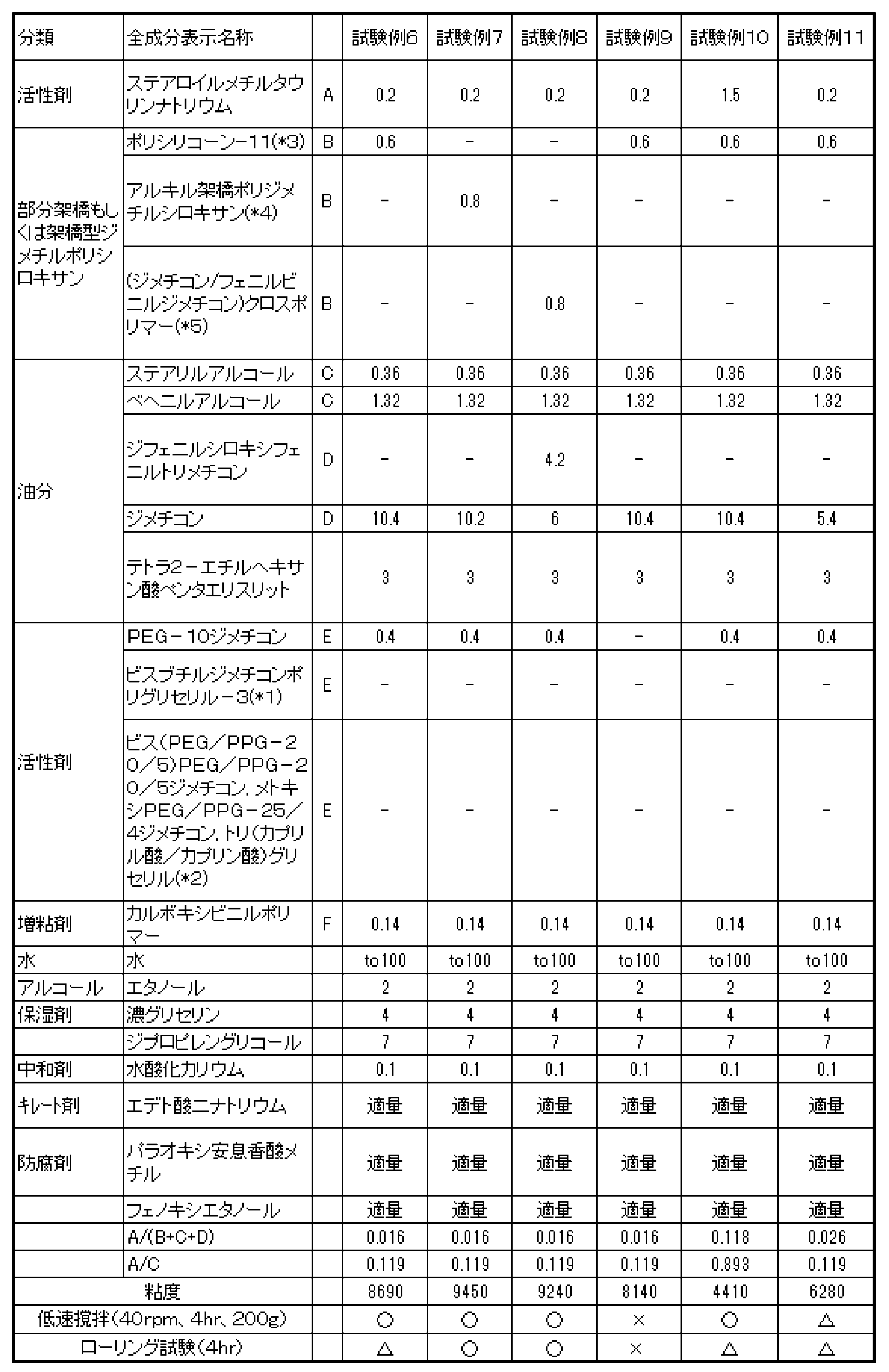
(*1)シリコーン KF-6109(信越化学工業 社製)
(*2)ABIL Care XL 80 (テグサ ジャパン 社製)
(*3)Gransil DMCM-5(Grant Industries Inc社製)
(*4)DOW CORNING(R) 9041 SILICONE ELASTOMER BLEND(東レ・ダウコーニング 社製)
(*5)KSG-18A(信越化学工業 社製)
(*2)ABIL Care XL 80 (テグサ ジャパン 社製)
(*3)Gransil DMCM-5(Grant Industries Inc社製)
(*4)DOW CORNING(R) 9041 SILICONE ELASTOMER BLEND(東レ・ダウコーニング 社製)
(*5)KSG-18A(信越化学工業 社製)
上記試験例より、(E)シリコーン系界面活性剤が配合しない場合は、部分架橋もしくは架橋型ジメチルポリシロキサンの凝集が観察してしまうことが分かった。
Claims (17)
- 下記(A)~(D)成分を含有し、以下の条件(1)~(3)を充たすことを特徴とする水中油型乳化化粧料。
(A)下記一般式で表されるスルホン酸基を分子内に持つアニオン性界面活性剤
R1CO-a-(CH2)nSO3M1 (I)
〔式(I)中、R1CO-は平均炭素原子数10~22の飽和または不飽和の脂肪酸残基(アシル基)を示し;aは-O-または-NR2-(ただし、R2は水素原子、または炭素原子数1~3のアルキル基を示す)を示し;M1は水素原子、アルカリ金属類、アルカリ土類金属類、アンモニウムまたは有機アミン類を示し;nは1~3の整数を示す。〕
(B)部分架橋もしくは架橋型ジメチルポリシロキサン
(C)動植物由来もしくは化学合成された25℃で固形である油性成分
(D)25℃での動粘度が100cSt以下であるシリコーン油
条件(1) (A)/((B)+(C)+(D))=0.01~1.0
条件(2) (A)/(C)=0.01~1.0
条件(3) 25℃における粘度が10~100000mPa・s - 請求項1に記載の乳化化粧料において、(A)がステアロイルメチルタウリン塩、ココイルメチルタウリン塩、ラウロイルメチルタウリン塩から選ばれる一種または二種以上であることを特徴とする水中油型乳化化粧料
- 請求項1または2に記載の乳化化粧料において、(E)シリコーン系界面活性剤を更に含むことを特徴とする水中油型乳化化粧料
- 請求項1~3のいずれかに記載の乳化化粧料において、(E)シリコーン系界面活性剤が化粧料中に0.05~2.0質量%含むことを特徴とする水中油型乳化化粧料
- 請求項1~4のいずれかに記載の乳化化粧料において、(D)が分子中にフェニル基を含むことを特徴とする水中油型乳化化粧料
- 請求項1~5のいずれかに記載の乳化化粧料において、(D)が製剤中に0.1~20質量%含むことを特徴とする水中油型乳化化粧料
- 請求項1~6のいずれかに記載の乳化化粧料において、Log Pが-1.0~-3.0のポリオール、糖アルコールを含むことを特徴とする水中油型乳化化粧料
- 請求項1~7のいずれかに記載の乳化化粧料において、有機概念図におけるIOB値が0~0.2のエステル油、動植物油を含むことを特徴とする水中油型乳化化粧料
- 請求項1~8のいずれかに記載の乳化化粧料において、有機概念図におけるIOB値が0~0.2の25℃で液状のエステル油を含むことを特徴とする水中油型乳化化粧料
- 請求項1~9のいずれかに記載の乳化化粧料において、(C)が、炭素数10~24の直鎖、もしくは分岐鎖を持つ脂肪族アルコールであることを特徴とする水中油型乳化化粧料
- 請求項1~10のいずれかに記載の乳化化粧料において、(C)がベヘニルアルコールであることを特徴とする水中油型乳化化粧料
- 請求項1~11のいずれかに記載の乳化化粧料において、(E)がポリグリセリル変性シリコーンであることを特徴とする水中油型乳化化粧料
- 請求項1~11のいずれかに記載の乳化化粧料において、(E)がポリオキシエチレン(10-100)変性ポリシロキサンであることを特徴とする水中油型乳化化粧料
- 請求項1~13のいずれかに記載の乳化化粧料において、(F)水溶性増粘剤を含むことを特徴とする水中油型乳化化粧料
- 請求項1~14のいずれかに記載の乳化化粧料において、Log P値が10~30の(準)難溶解性薬剤を含むことを特徴とする水中油型乳化化粧料
- 請求項1~15のいずれかに記載の乳化化粧料において、Log P値が10~30の(準)難溶解性薬剤がコエンザイムQ10、グリチルレチン酸ステアリル、アスタキサンチン、トラネキサム酸、アラントイン、アルコキシサリチル酸、美白剤(その他成分)から選択されることを特徴とする水中油型乳化化粧料
- 請求項1~16に記載の乳化化粧料において、(B)が(ジメチコン/フェニルビニルジメチコン)クロスポリマー、ポリシリコーン-11、架橋型メチルポリシロキサンであることを特徴とする水中油型乳化化粧料
Priority Applications (3)
| Application Number | Priority Date | Filing Date | Title |
|---|---|---|---|
| JP2020523658A JP7262455B2 (ja) | 2018-06-06 | 2019-05-29 | 部分架橋もしくは架橋型ジメチルポリシロキサンを用いた水中油型乳化化粧料 |
| CN201980036882.8A CN112165929A (zh) | 2018-06-06 | 2019-05-29 | 使用部分交联或交联型二甲基聚硅氧烷的水包油型乳化化妆品 |
| US16/972,219 US20210220232A1 (en) | 2018-06-06 | 2019-05-29 | Oil-in-water type emulsion cosmetic using partially crosslinked or crosslinked dimethylpolysiloxane |
Applications Claiming Priority (2)
| Application Number | Priority Date | Filing Date | Title |
|---|---|---|---|
| JP2018-109058 | 2018-06-06 | ||
| JP2018109058 | 2018-06-06 |
Publications (1)
| Publication Number | Publication Date |
|---|---|
| WO2019235331A1 true WO2019235331A1 (ja) | 2019-12-12 |
Family
ID=68769321
Family Applications (1)
| Application Number | Title | Priority Date | Filing Date |
|---|---|---|---|
| PCT/JP2019/021371 Ceased WO2019235331A1 (ja) | 2018-06-06 | 2019-05-29 | 部分架橋もしくは架橋型ジメチルポリシロキサンを用いた水中油型乳化化粧料 |
Country Status (5)
| Country | Link |
|---|---|
| US (1) | US20210220232A1 (ja) |
| JP (1) | JP7262455B2 (ja) |
| CN (1) | CN112165929A (ja) |
| TW (1) | TW202005631A (ja) |
| WO (1) | WO2019235331A1 (ja) |
Cited By (1)
| Publication number | Priority date | Publication date | Assignee | Title |
|---|---|---|---|---|
| JPWO2021177400A1 (ja) * | 2020-03-04 | 2021-09-10 |
Citations (3)
| Publication number | Priority date | Publication date | Assignee | Title |
|---|---|---|---|---|
| JP2002087931A (ja) * | 2000-09-13 | 2002-03-27 | Kao Corp | 水中油型乳化化粧料 |
| JP2009102281A (ja) * | 2007-10-25 | 2009-05-14 | Shiseido Co Ltd | 水中油型乳化化粧料 |
| CN105997841A (zh) * | 2016-08-08 | 2016-10-12 | 黄美风 | 一种美颜眼霜及制备方法 |
Family Cites Families (22)
| Publication number | Priority date | Publication date | Assignee | Title |
|---|---|---|---|---|
| US5300286A (en) * | 1992-07-14 | 1994-04-05 | Dow Corning Corporation | Silicone emulsion for personal care application |
| US7381231B2 (en) | 2004-01-29 | 2008-06-03 | 3M Innovative Properties Company | Finishing compositions with reduced volatile organic compounds |
| DE102004008440A1 (de) * | 2004-02-19 | 2005-09-22 | Stockhausen Gmbh | Kosmetisches und/oder dermatologisches Mittel zur Steigerung des endogenen Lipidgehaltes der Haut |
| JP4679350B2 (ja) | 2005-11-24 | 2011-04-27 | 株式会社資生堂 | 水中油型乳化皮膚化粧料 |
| US20090081142A1 (en) * | 2005-11-24 | 2009-03-26 | Shiseido Company Ltd. | External Preparation for Skin |
| EP2101718A1 (en) * | 2007-01-16 | 2009-09-23 | The Procter and Gamble Company | Cosmetic compositions |
| JP5761838B2 (ja) | 2008-01-25 | 2015-08-12 | 株式会社 資生堂 | 水中油型乳化型整髪料 |
| JP5421554B2 (ja) * | 2008-06-24 | 2014-02-19 | 株式会社ファンケル | αゲルを含む組成物 |
| JP4881961B2 (ja) * | 2009-01-08 | 2012-02-22 | 株式会社トキワ | 油中水型日焼け止め化粧料 |
| JP4642905B2 (ja) | 2009-01-22 | 2011-03-02 | 株式会社資生堂 | 乳化化粧料 |
| JP4824121B2 (ja) | 2009-09-17 | 2011-11-30 | 株式会社 資生堂 | 皮膚外用剤 |
| ES2546986T3 (es) * | 2010-03-31 | 2015-09-30 | Shiseido Company, Ltd. | Composición que contiene vesículas |
| JP2013082686A (ja) * | 2011-09-27 | 2013-05-09 | Shiseido Co Ltd | 水中油型乳化皮膚外用剤 |
| WO2013061712A1 (ja) * | 2011-10-24 | 2013-05-02 | 株式会社 資生堂 | O/w乳化組成物の製造方法 |
| EP2786740A4 (en) | 2011-11-30 | 2015-05-27 | Henkel Ag & Co Kgaa | COSMETIC PRODUCT FOR THE HAIR |
| JP5373046B2 (ja) * | 2011-12-19 | 2013-12-18 | 株式会社 資生堂 | 水中油型乳化組成物 |
| JP6172964B2 (ja) * | 2013-02-15 | 2017-08-02 | 株式会社コーセー | 水中油型乳化化粧料 |
| JP2016030725A (ja) | 2014-07-25 | 2016-03-07 | ロート製薬株式会社 | 日焼け止め組成物 |
| JP2016056150A (ja) | 2014-09-12 | 2016-04-21 | 株式会社ノエビア | 粉体含有油中水中油型乳化化粧料 |
| JP2016117666A (ja) | 2014-12-19 | 2016-06-30 | ロレアル | 非粘着性安定組成物 |
| JP6831189B2 (ja) * | 2015-08-20 | 2021-02-17 | 株式会社コーセー | 皮膚外用剤又は化粧料 |
| FR3060327B1 (fr) * | 2016-12-16 | 2020-02-21 | L'oreal | Emulsion h/e comprenant un alcool gras en c16-c30, un tensioactif anionique, une huile, une cire et un solvant hydrophile |
-
2019
- 2019-05-29 WO PCT/JP2019/021371 patent/WO2019235331A1/ja not_active Ceased
- 2019-05-29 JP JP2020523658A patent/JP7262455B2/ja active Active
- 2019-05-29 CN CN201980036882.8A patent/CN112165929A/zh active Pending
- 2019-05-29 US US16/972,219 patent/US20210220232A1/en not_active Abandoned
- 2019-06-03 TW TW108119168A patent/TW202005631A/zh unknown
Patent Citations (3)
| Publication number | Priority date | Publication date | Assignee | Title |
|---|---|---|---|---|
| JP2002087931A (ja) * | 2000-09-13 | 2002-03-27 | Kao Corp | 水中油型乳化化粧料 |
| JP2009102281A (ja) * | 2007-10-25 | 2009-05-14 | Shiseido Co Ltd | 水中油型乳化化粧料 |
| CN105997841A (zh) * | 2016-08-08 | 2016-10-12 | 黄美风 | 一种美颜眼霜及制备方法 |
Cited By (2)
| Publication number | Priority date | Publication date | Assignee | Title |
|---|---|---|---|---|
| JPWO2021177400A1 (ja) * | 2020-03-04 | 2021-09-10 | ||
| JP7762137B2 (ja) | 2020-03-04 | 2025-10-29 | 株式会社 資生堂 | 水中油型乳化組成物 |
Also Published As
| Publication number | Publication date |
|---|---|
| CN112165929A (zh) | 2021-01-01 |
| JP7262455B2 (ja) | 2023-04-21 |
| TW202005631A (zh) | 2020-02-01 |
| JPWO2019235331A1 (ja) | 2021-06-17 |
| US20210220232A1 (en) | 2021-07-22 |
Similar Documents
| Publication | Publication Date | Title |
|---|---|---|
| JP7210462B2 (ja) | 超微細エマルジョンを用いた水中油型乳化化粧料 | |
| EP2027849A1 (en) | External preparation for skin | |
| KR102690231B1 (ko) | 비수계용 증점제 및 증점 조성물 | |
| EP3530722B1 (en) | Detergent composition | |
| EP3556343A1 (en) | Oil-in-water type composition | |
| KR102477212B1 (ko) | 피부 외용제 조성물 | |
| EP3666251B1 (en) | Powder-containing water-based composition and external skin preparation | |
| JP2017190299A (ja) | 日焼け止め化粧料 | |
| AU2017356412A1 (en) | Cosmetic composition | |
| WO2020054827A1 (ja) | 油中水型皮膚外用組成物 | |
| JP7262455B2 (ja) | 部分架橋もしくは架橋型ジメチルポリシロキサンを用いた水中油型乳化化粧料 | |
| JPWO2018079717A1 (ja) | 水中油型皮膚外用組成物 | |
| JP5154904B2 (ja) | 皮膚外用剤 | |
| JP7727346B1 (ja) | ジェル状毛髪洗浄料 | |
| WO2019203040A1 (ja) | 洗浄剤組成物 | |
| JP7368349B2 (ja) | 洗浄剤組成物 | |
| HK40011074A (en) | Skin care composition | |
| HK40012390A (en) | Oil-in-water type composition | |
| JP2018104344A (ja) | 洗浄用組成物 |
Legal Events
| Date | Code | Title | Description |
|---|---|---|---|
| 121 | Ep: the epo has been informed by wipo that ep was designated in this application |
Ref document number: 19815557 Country of ref document: EP Kind code of ref document: A1 |
|
| WWE | Wipo information: entry into national phase |
Ref document number: 2020523658 Country of ref document: JP |
|
| NENP | Non-entry into the national phase |
Ref country code: DE |
|
| 122 | Ep: pct application non-entry in european phase |
Ref document number: 19815557 Country of ref document: EP Kind code of ref document: A1 |