WO2019180922A1 - 電気光学素子のための複合基板 - Google Patents
電気光学素子のための複合基板 Download PDFInfo
- Publication number
- WO2019180922A1 WO2019180922A1 PCT/JP2018/011764 JP2018011764W WO2019180922A1 WO 2019180922 A1 WO2019180922 A1 WO 2019180922A1 JP 2018011764 W JP2018011764 W JP 2018011764W WO 2019180922 A1 WO2019180922 A1 WO 2019180922A1
- Authority
- WO
- WIPO (PCT)
- Prior art keywords
- electro
- substrate
- optic crystal
- crystal substrate
- refractive index
- Prior art date
- Legal status (The legal status is an assumption and is not a legal conclusion. Google has not performed a legal analysis and makes no representation as to the accuracy of the status listed.)
- Ceased
Links
Images







Classifications
-
- G—PHYSICS
- G02—OPTICS
- G02B—OPTICAL ELEMENTS, SYSTEMS OR APPARATUS
- G02B6/00—Light guides; Structural details of arrangements comprising light guides and other optical elements, e.g. couplings
- G02B6/10—Light guides; Structural details of arrangements comprising light guides and other optical elements, e.g. couplings of the optical waveguide type
- G02B6/12—Light guides; Structural details of arrangements comprising light guides and other optical elements, e.g. couplings of the optical waveguide type of the integrated circuit kind
-
- G—PHYSICS
- G02—OPTICS
- G02F—OPTICAL DEVICES OR ARRANGEMENTS FOR THE CONTROL OF LIGHT BY MODIFICATION OF THE OPTICAL PROPERTIES OF THE MEDIA OF THE ELEMENTS INVOLVED THEREIN; NON-LINEAR OPTICS; FREQUENCY-CHANGING OF LIGHT; OPTICAL LOGIC ELEMENTS; OPTICAL ANALOGUE/DIGITAL CONVERTERS
- G02F1/00—Devices or arrangements for the control of the intensity, colour, phase, polarisation or direction of light arriving from an independent light source, e.g. switching, gating or modulating; Non-linear optics
- G02F1/01—Devices or arrangements for the control of the intensity, colour, phase, polarisation or direction of light arriving from an independent light source, e.g. switching, gating or modulating; Non-linear optics for the control of the intensity, phase, polarisation or colour
- G02F1/03—Devices or arrangements for the control of the intensity, colour, phase, polarisation or direction of light arriving from an independent light source, e.g. switching, gating or modulating; Non-linear optics for the control of the intensity, phase, polarisation or colour based on ceramics or electro-optical crystals, e.g. exhibiting Pockels effect or Kerr effect
-
- G—PHYSICS
- G02—OPTICS
- G02F—OPTICAL DEVICES OR ARRANGEMENTS FOR THE CONTROL OF LIGHT BY MODIFICATION OF THE OPTICAL PROPERTIES OF THE MEDIA OF THE ELEMENTS INVOLVED THEREIN; NON-LINEAR OPTICS; FREQUENCY-CHANGING OF LIGHT; OPTICAL LOGIC ELEMENTS; OPTICAL ANALOGUE/DIGITAL CONVERTERS
- G02F1/00—Devices or arrangements for the control of the intensity, colour, phase, polarisation or direction of light arriving from an independent light source, e.g. switching, gating or modulating; Non-linear optics
- G02F1/01—Devices or arrangements for the control of the intensity, colour, phase, polarisation or direction of light arriving from an independent light source, e.g. switching, gating or modulating; Non-linear optics for the control of the intensity, phase, polarisation or colour
- G02F1/03—Devices or arrangements for the control of the intensity, colour, phase, polarisation or direction of light arriving from an independent light source, e.g. switching, gating or modulating; Non-linear optics for the control of the intensity, phase, polarisation or colour based on ceramics or electro-optical crystals, e.g. exhibiting Pockels effect or Kerr effect
- G02F1/035—Devices or arrangements for the control of the intensity, colour, phase, polarisation or direction of light arriving from an independent light source, e.g. switching, gating or modulating; Non-linear optics for the control of the intensity, phase, polarisation or colour based on ceramics or electro-optical crystals, e.g. exhibiting Pockels effect or Kerr effect in an optical waveguide structure
Definitions
- the technology disclosed in this specification relates to a composite substrate for an electro-optical element (for example, an optical modulator) that uses an electro-optical effect.
- an electro-optical element for example, an optical modulator
- an electro-optical element such as an optical modulator
- the electro-optic element can convert an electrical signal into an optical signal by utilizing an electro-optic effect.
- the electro-optic element is employed in, for example, optical wave fusion communication, and its development is being promoted in order to realize high-speed and large-capacity communication.
- Japanese Patent Application Laid-Open No. 2010-85789 discloses an optical modulator.
- This optical modulator includes an electro-optic crystal substrate having an electro-optic effect, and an optical waveguide is formed therein.
- a reinforcing substrate having a dielectric constant lower than that of the electro-optic crystal substrate is bonded to the electro-optic crystal substrate.
- This reinforcing substrate not only mechanically reinforces the electro-optic crystal substrate, but also reduces the dielectric loss, thereby facilitating high-speed operation of the optical modulator and driving at a low voltage.
- a composite substrate in which such an electro-optic crystal substrate and a low dielectric constant substrate are combined can be suitably used not only for an optical modulator but also for various electro-optic elements.
- the electro-optic crystal substrate and the low dielectric constant substrate are bonded by an adhesive.
- the adhesive deteriorates with time, so that the composite substrate may be peeled off, and further, the peeling may cause damage such as cracks.
- an amorphous material composed of the elements of the electro-optic crystal substrate and the elements of the low dielectric constant substrate is interposed between the electro-optic crystal substrate and the low dielectric substrate. A layer is formed.
- This amorphous layer has no crystallinity, optical properties are different from those of both substrates, and the interface between the electro-optic crystal substrate and the amorphous layer is not flat.
- Such a non-flat interface may scatter (for example, irregular reflection or leakage) and absorb light transmitted through the electro-optic crystal substrate.
- the present specification provides a composite substrate that can avoid or reduce the above-described problems and a method for manufacturing the same.
- the composite substrate includes an electro-optic crystal substrate having an electro-optic effect, a low-dielectric substrate having a dielectric constant lower than that of the electro-optic crystal substrate, a low dielectric constant substrate, and an electro-optic substrate.
- a low refractive index layer having a lower refractive index than that of the electro-optic crystal substrate, and a low dielectric constant substrate and the low refractive index layer. It comprises an amorphous layer composed of the constituent elements and the elements constituting the low refractive index layer.
- the above-described composite substrate can be manufactured by the following manufacturing method.
- a step of forming a low refractive index layer having a refractive index lower than that of the electro-optical crystal substrate and a low refractive index layer are formed on the main surface of the electro-optical crystal substrate having an electro-optical effect.
- the direct bonding here means a bonding in which atoms diffuse between two members to be bonded and a covalent bond is formed between the atoms.
- a composite substrate in which an electro-optic crystal substrate and a low dielectric constant substrate are laminated can be manufactured without requiring an adhesive.
- an amorphous layer resulting from direct bonding is formed between the low dielectric constant substrate and the low refractive index layer. That is, a low refractive index layer is interposed between the amorphous layer and the electro-optic crystal substrate, and the amorphous layer does not contact the electro-optic crystal substrate. Accordingly, light traveling through the electro-optic crystal substrate is not scattered or absorbed by the amorphous layer or the non-flat interface between the amorphous layer and the electro-optic crystal substrate.
- the low refractive index layer in contact with the electro-optic crystal substrate has a lower refractive index than the electro-optic crystal substrate, it can suppress leakage of light transmitted through the electro-optic crystal substrate, such as a clad in an optical fiber. it can.
- an electro-optical element that can be driven at high speed and driven at a low voltage can be manufactured.
- a modification of the composite substrate 10 is shown, and electrodes 32 and 34 for forming an electric field on the electro-optic crystal substrate 12 and an optical waveguide region 36 provided in the electro-optic crystal substrate 12 are added.
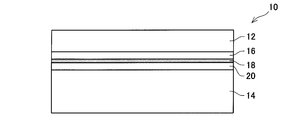
- a modification of the composite substrate 10 is shown, and a second low refractive index layer 20 is added between the low dielectric constant substrate 14 and the amorphous layer 18.
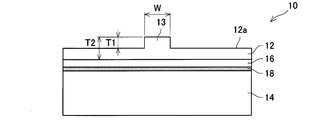
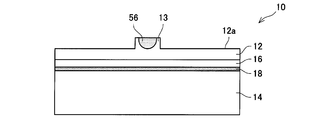
- a modification of the composite substrate 10 is shown, and a ridge portion 13 is formed on the upper surface 12 a of the electro-optic crystal substrate 12.
- a modification of the composite substrate 10 is shown, and a first electrode 42 and a second electrode 44 are added as compared with the modification shown in FIG.
- the c-axis of the electro-optic crystal substrate 12 is parallel to the electro-optic crystal substrate 12.
- a modification of the composite substrate 10 is shown, and a conductive layer 22 is added along the lower surface 14b of the low dielectric constant substrate 14 as compared with the modification shown in FIG.
- a modification of the composite substrate 10 is shown, and a support substrate 24 bonded to the conductive layer 22 is added as compared with the modification shown in FIG.
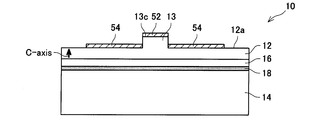
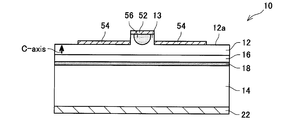
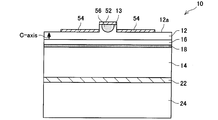
- a modification of the composite substrate 10 is shown, and a first electrode 52 and a second electrode 54 are added as compared with the modification shown in FIG.
- the c-axis (c-axis) of the electro-optic crystal substrate 12 is perpendicular to the electro-optic crystal substrate 12.
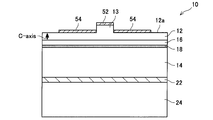
- a modification of the composite substrate 10 is shown, and a conductive layer 22 is added along the lower surface 14b of the low dielectric constant substrate 14 as compared with the modification shown in FIG.
- a modification of the composite substrate 10 is shown, and a support substrate 24 bonded to the conductive layer 22 is added as compared with the modification shown in FIG.
- a modification of the composite substrate 10 is shown, and an optical waveguide region 56 is added in the ridge portion 13 as compared with the modification shown in FIG.
- a modification of the composite substrate 10 is shown, and an optical waveguide region 56 is added in the ridge portion 13 as compared with the modification shown in FIG.
- a modification of the composite substrate 10 is shown, and an optical waveguide region 56 is added in the ridge portion 13 as compared with the modification shown in FIG.
- a modification of the composite substrate 10 is shown, and an optical waveguide region 56 is added in the ridge portion 13 as compared with the modification shown in FIG.
- the low refractive index layer may have a dielectric constant lower than that of the electro-optic crystal substrate. According to such a configuration, dielectric loss in the low refractive index layer can be reduced, and high-speed operation of the electro-optical element and driving at a low voltage can be further facilitated.
- the low refractive index layer can be composed of at least one of silicon oxide, tantalum oxide, aluminum oxide, glass, magnesium fluoride, and calcium fluoride.
- the composite substrate may further include a second low refractive index layer that is located between the low dielectric constant substrate and the amorphous layer and has a refractive index lower than that of the electro-optic crystal substrate.
- the amorphous layer may be composed of an element constituting the low refractive index layer and an element constituting the second low refractive index layer instead of the element constituting the low dielectric constant substrate.
- Such a composite substrate can be manufactured by directly bonding a low dielectric constant substrate on which a second low refractive index layer is formed to an electro-optic crystal substrate on which a low refractive index layer is formed. At this time, if the materials of the low refractive index layer and the second low refractive index layer are the same or have similar structures, high-quality direct bonding can be performed relatively easily.
- a ridge portion may be formed on the surface of the electro-optic crystal substrate.
- an electro-optic element that requires a ridge-type optical waveguide can be easily manufactured.
- an optical waveguide region into which impurities (for example, titanium or zinc) are introduced may be formed in the electro-optic crystal substrate.
- the optical waveguide region into which the impurity is introduced has a small difference in refractive index due to the introduction of the impurity and has a small light confinement effect, so that the near-field image (near field diameter) of the light is relatively large.
- the electro-optic element manufactured from the composite substrate As a result, in the electro-optic element manufactured from the composite substrate, the electric field efficiency is lowered, so that the required driving voltage is increased. This increases the element size.
- the ridge type optical waveguide is preferable from the viewpoint of reducing the driving voltage and size of the electro-optic element.
- the c-axis (that is, the crystal main axis) of the electro-optic crystal substrate may be parallel to the electro-optic crystal substrate. That is, the electro-optic crystal substrate may be an x-cut substrate.
- the composite substrate includes a first electrode provided on one side surface of the ridge portion, and a second electrode provided on the other side surface of the ridge portion and facing the first electrode across the ridge portion. May be further provided. These first and second electrodes can be used as electrodes for applying an electric signal (that is, an electric field) to the ridge-type optical waveguide when an electro-optical element is manufactured from the composite substrate.
- the c-axis (that is, the crystal main axis) of the electro-optic crystal substrate may be perpendicular to the electro-optic crystal substrate. That is, the electro-optic crystal substrate may be a z-cut substrate.
- the composite substrate further includes a first electrode provided on the top surface of the ridge portion and a second electrode provided in a range excluding the ridge portion of the surface of the electro-optic crystal substrate. You may prepare. These first and second electrodes can be used as electrodes for applying an electric signal (that is, an electric field) to the ridge-type optical waveguide when an electro-optical element is manufactured from the composite substrate.
- the composite substrate has a first electrode and a second electrode
- a low refractive index film having a refractive index lower than that of the electro-optic crystal substrate may be formed. According to such a configuration, at the interface between the electro-optic crystal substrate and the first electrode (or second electrode), the light transmitted through the electro-optic crystal substrate is suppressed from being absorbed or scattered by the electrode. Can do.
- an optical waveguide region containing impurities may be formed along the longitudinal direction of the ridge portion. According to such a configuration, a desired optical waveguide can be easily formed by changing the region into which the impurity is introduced without changing the ridge portion.
- the composite substrate may further include a conductive layer positioned on the opposite side of the electro-optic crystal substrate with respect to the low dielectric constant substrate.
- a conductive layer can suppress leakage of an electric field from the low dielectric constant substrate in an electro-optic element manufactured from the composite substrate.
- the composite substrate may further include a support substrate bonded to the conductive layer.
- the thickness of the electro-optic crystal substrate and the low dielectric constant substrate can be reduced while maintaining the mechanical strength of the composite substrate by the support substrate.
- the frequency at which an electric signal resonates in the composite substrate (resonance frequency) can be shifted to the high frequency side as the thickness of the electro-optic crystal substrate and the low dielectric constant substrate decreases.
- the resonance frequency is 300 gigahertz or more.
- the electro-optic element can avoid the problem that an electric signal of a high frequency (so-called millimeter wave band) such as 100 GHz is attenuated by substrate resonance.
- the composite substrate 10 of the present embodiment can be employed in various electro-optic elements such as an optical modulator.
- the composite substrate 10 of the present embodiment is manufactured in the form of a so-called wafer and provided to the electro-optic element manufacturer.
- the diameter of the composite substrate 10 is approximately 10 cm (4 inches).
- a plurality of electro-optic elements are manufactured from one composite substrate 10.
- the composite substrate 10 is not limited to the form of a wafer, and may be manufactured and provided in various forms.
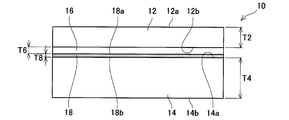
- the composite substrate 10 includes an electro-optic crystal substrate 12.
- the electro-optic crystal substrate 12 has an upper surface 12 a exposed to the outside and a lower surface 12 b located in the composite substrate 10. Part or all of the electro-optic crystal substrate 12 is an optical waveguide that transmits light in the electro-optic element manufactured from the composite substrate 10.
- the electro-optic crystal substrate 12 is made of a crystal of a material having an electro-optic effect. Specifically, when an electric field is applied to the electro-optic crystal substrate 12, the refractive index of the electro-optic crystal substrate 12 changes. In particular, when an electric field is applied along the c-axis of the electro-optic crystal substrate 12, the refractive index of the electro-optic crystal substrate 12 changes greatly.
- the c-axis of the electro-optic crystal substrate 12 may be parallel to the electro-optic crystal substrate 12. That is, the electro-optic crystal substrate 12 may be an x-cut or y-cut substrate, for example. Alternatively, the c-axis of the electro-optic crystal substrate 12 may be perpendicular to the electro-optic crystal substrate 12. That is, the electro-optic crystal substrate 12 may be a z-cut substrate, for example.
- the thickness T2 of the electro-optic crystal substrate 12 is not particularly limited, but may be, for example, 1 micrometer or more and 50 micrometers or less.
- the material composing the electro-optic crystal substrate 12 is not particularly limited, but lithium niobate (LiNbO 3 : LN), lithium tantalate (LiTaO 3 : LT), potassium titanate phosphate (KTiOPO 4 : KTP), niobic acid Potassium / lithium (K x Li (1-x) NbO 2 : KLN), potassium niobate (KNbO 3 : KN), tantalate / potassium niobate (KNb x Ta (1-x) O 3 : KTN), niobium It may be either a solid solution of lithium acid lithium and lithium tantalate.
- the electro-optic crystal substrate 12 may have an electro-optic effect that changes other optical constants in addition to or instead of the refractive index.
- the composite substrate 10 further includes a low dielectric constant substrate 14.
- the low dielectric constant substrate 14 has an upper surface 14a located in the composite substrate 10 and a lower surface 14b exposed to the outside.
- the electro-optic crystal substrate 12 described above is laminated on the upper surface 14 a side.
- the low dielectric constant substrate 14 is made of a material having a dielectric constant lower than that of the electro-optic crystal substrate 12.
- the dielectric constant (relative dielectric constant) of the low dielectric constant substrate 14 is not particularly limited, but is preferably 5 or less.
- examples of the material constituting the low dielectric constant substrate 14 include quartz and glass.
- the thickness T4 of the low dielectric constant substrate 14 is not particularly limited, but may be larger than the thickness T2 of the electro-optic crystal substrate 12.
- the low dielectric constant substrate 14 adjacent to the electro-optic crystal substrate 12 can reduce dielectric loss when an electric field is applied to the electro-optic crystal substrate 12. Therefore, by using the composite substrate 10, an electro-optic element that can be driven at high speed and driven at a low voltage can be manufactured.
- the composite substrate 10 further includes a low refractive index layer 16.
- the low refractive index layer 16 is provided along the lower surface 12 b of the electro-optic crystal substrate 12 and is located between the low dielectric constant substrate 14 and the electro-optic crystal substrate 12.
- the low refractive index layer 16 has a lower refractive index than the electro-optic crystal substrate 12.
- the material which comprises the low-refractive-index layer 16 is not specifically limited, For example, it may be one or more of silicon oxide, tantalum oxide, aluminum oxide, glass, magnesium fluoride, and calcium fluoride.
- the thickness T6 of the low refractive index layer 16 is not particularly limited, but may be, for example, 0.3 micrometers or more and 1 micrometers or less.
- the low refractive index layer 16 in this embodiment has a dielectric loss (less than that of the electro-optic crystal substrate 12) so that the dielectric loss can be suppressed and the effective dielectric constant of the electric signal can be reduced and light can be efficiently modulated.
- tan ⁇ or a material having a low dielectric constant.
- the composite substrate 10 further includes an amorphous layer 18.
- the amorphous layer 18 is located between the low dielectric constant substrate 14 and the low refractive index layer 16.
- the amorphous layer 18 has an amorphous structure, and is composed of an element constituting the low dielectric constant substrate 14 and an element constituting the low refractive index layer 16.
- the thickness T8 of the amorphous layer 18 is not particularly limited, but may be 0.5 nanometers or more and 100 nanometers or less.
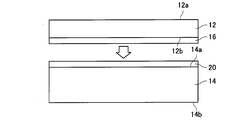
- the composite substrate 10 can be manufactured by directly bonding the low dielectric constant substrate 14 to the electro-optic crystal substrate 12 on which the low refractive index layer 16 is formed.
- the amorphous layer 18 is a layer generated in this direct bonding, and is formed by diffusing atoms of the low refractive index layer 16 and the low dielectric constant substrate 14 respectively. Therefore, the upper surface 18a of the amorphous layer 18 (that is, the interface in contact with the low refractive index layer 16) and the lower surface 18b of the amorphous layer 18 (that is, the interface in contact with the low dielectric constant substrate 14) are not necessarily flat.
- an amorphous layer resulting from direct bonding is composed of elements constituting the material located above and below it, has no crystallinity, and may incorporate different elements from the outside. Different. Further, the interface of the amorphous layer is not flat, and optical absorption and scattering may occur. For this reason, if the amorphous layer 18 is in direct contact with the electro-optic crystal substrate 12, light transmitted through the electro-optic crystal substrate 12 is attenuated by the amorphous layer 18. On the other hand, in the composite substrate 10 of the present embodiment, the low refractive index layer 16 having a thickness that is not affected is interposed between the amorphous layer 18 and the electro-optic crystal substrate 12, and the amorphous layer 18 is formed by the electro-optic crystal substrate.
- the electro-optic crystal substrate 12 is not touching. Therefore, light transmitted through the electro-optic crystal substrate 12 is not scattered by the amorphous layer 18 or the upper surface 18a.
- the low refractive index layer 16 in contact with the electro-optic crystal substrate 12 has a lower refractive index than the electro-optic crystal substrate 12, leakage of light transmitted through the electro-optic crystal substrate 12 is prevented like a clad in an optical fiber. It can be suppressed and propagated in the optical waveguide.
- the low dielectric constant substrate 14 is provided adjacent to the electro-optic crystal substrate 12, so that when the electric field is applied to the electro-optic crystal substrate 12, the dielectric Loss can be reduced. Further, since the electro-optic crystal substrate 12 and the low dielectric constant substrate 14 are directly bonded without using an adhesive, there is no dielectric loss due to the adhesive, and there is no alteration or deformation, so that reliability can be ensured. . Since the amorphous layer 18 resulting from the direct bonding is separated from the electro-optic crystal substrate 12 by the low refractive index layer 16, the light transmitted through the electro-optic crystal substrate 12 can be propagated to the output side without loss. it can.
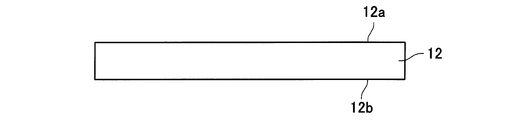
- an electro-optic crystal substrate 12 is prepared.
- the electro-optic crystal substrate 12 may be an x-cut or y-cut substrate (c-axis is parallel to the substrate), and when a polarization inversion portion is formed, the c-axis is an angle within 10 ° with the horizontal plane of the substrate. May be an offset substrate. Alternatively, it may be a z-cut substrate (c-axis is perpendicular to the substrate).
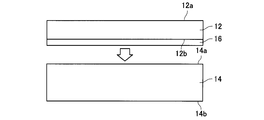
- a low refractive index layer 16 is formed on the lower surface 12 b of the electro-optic crystal substrate 12.
- the film formation of the low refractive index layer 16 is not particularly limited, but can be performed by vapor deposition (physical vapor deposition or chemical vapor deposition).
- the lower surface 12 b of the electro-optic crystal substrate 12 is one main surface of the electro-optic crystal substrate 12.
- a low dielectric constant substrate 14 is prepared, and the low dielectric constant substrate 14 is directly bonded to the lower surface 12b of the electro-optic crystal substrate 12 on which the low refractive index layer 16 is formed.
- the above-described amorphous layer 18 is formed between the low dielectric constant substrate 14 and the low refractive index layer 16.
- the composite substrate 10 shown in FIGS. 1 and 2 is manufactured.
- the composite substrate 10 may be provided with electrodes 32 and 34 for forming an electric field on the electro-optic crystal substrate 12 on the upper surface 12 a of the electro-optic crystal substrate 12.
- the material which comprises the electrodes 32 and 34 should just be a conductor, for example, may be metals, such as gold
- the number, position, and shape of the electrodes 32 and 34 are not particularly limited.
- the number of electrodes 32 and 34 can be appropriately determined according to the number of electro-optic elements manufactured from the composite substrate 10 and the number of electrodes 32 and 34 required for each electro-optic element.
- the manufacturer of the electro-optical element can easily manufacture the electro-optical element from the composite substrate 10.
- the optical waveguide region 36 may be provided in the electro-optic crystal substrate 12 by introducing impurities.
- the refractive index can be selectively increased (that is, locally), whereby the optical waveguide region 36 can be formed.
- the number, position, and shape of the optical waveguide regions 36 are not particularly limited.
- the number of optical waveguide regions 36 can be appropriately determined according to the number of electro-optical elements manufactured from the composite substrate 10 and the number of optical waveguide regions 36 required by each electro-optical element. If the optical waveguide region 36 is provided in advance on the composite substrate 10, the manufacturer of the electro-optical element can easily manufacture the electro-optical element from the composite substrate 10.
- the composite substrate 10 may further include a second low refractive index layer 20.
- the second low refractive index layer 20 is located between the low dielectric constant substrate 14 and the amorphous layer 18 and is made of a material having a refractive index lower than that of the electro-optic crystal substrate 12.
- the second low refractive index layer 20 may be made of a material having a dielectric constant lower than that of the electro-optic crystal substrate 12 in order to suppress dielectric loss.
- the second low refractive index layer 20 can be composed of, for example, at least one of silicon oxide, tantalum oxide, aluminum oxide, glass, magnesium fluoride, and calcium fluoride.
- the second low refractive index layer 20 may be made of the same material as the low refractive index layer 16 or may be formed of a different material.
- FIG. 8 shows a method for manufacturing the composite substrate 10 shown in FIG.
- the second low refractive index layer 20 is formed on the lower surface 12b of the electro-optic crystal substrate 12 on which the low refractive index layer 16 is formed. It can be manufactured by directly bonding the filmed low dielectric constant substrate 14. According to this manufacturing method, the amorphous layer 18 shown in FIG. 7 is formed between the low refractive index layer 16 and the second low refractive index layer 20.
- the materials of the low refractive index layer 16 and the second low refractive index layer 20 are the same or have similar structures, high-quality direct bonding can be performed relatively easily.
- a ridge portion 13 may be formed on the upper surface 12 a of the electro-optic crystal substrate 12.
- the ridge portion 13 is a protruding portion that extends along the upper surface 12a.
- the ridge portion 13 constitutes a ridge type optical waveguide in the electro-optic element in which the composite substrate 10 is manufactured.
- the width W of the ridge portion 13 is not particularly limited, but may be 1 micrometer or more and 10 micrometers or less.
- the height T1 of the ridge portion 13 is not particularly limited, but may be 10% or more and 95% or less of the thickness T2 of the electro-optic crystal substrate 12.
- the number, position, and shape of the ridge portions 13 are not particularly limited.
- the composite substrate 10 is used for manufacturing a Mach-Zehnder type electro-optic modulator, it is preferable to form two ridge portions 13 at least partially extending in parallel.
- the composite substrate 10 having the ridge portion 13 may be further provided with a first electrode 42 and a second electrode 44.
- the first electrode 42 may be provided on one side surface 13 a of the ridge portion 13.
- the second electrode 44 is preferably provided on the other side surface 13 b of the ridge portion 13 and is opposed to the first electrode 42 with the ridge portion 13 interposed therebetween. According to such a configuration, the first electrode 42 and the second electrode 44 can apply an electric field in parallel to the c-axis to the ridge portion 13 serving as an optical waveguide in the electro-optic element.
- the material which comprises the 1st electrode 42 and the 2nd electrode 44 should just be a conductor, for example, may be metal materials, such as gold
- a low refractive index film having a refractive index lower than that of the electro-optic crystal substrate 12 is provided between the first electrode 42 and the electro-optic crystal substrate 12 and between the second electrode 44 and the electro-optic crystal substrate 12. May be. Such a low refractive index film functions as a cladding layer and can suppress loss of light transmitted through the ridge portion 13.
- a conductive layer 22 may be provided on the composite substrate 10 along the lower surface 14 b of the low dielectric constant substrate 14.
- a conductive layer 22 can be used as a ground electrode in the electro-optic element manufactured from the composite substrate 10.
- the conductive layer 22 can suppress the leakage of the electric field applied by the first electrode 42 and the second electrode 44 from the lower surface 14 b of the low dielectric constant substrate 14.
- the material which comprises the electrodes 32 and 34 should just be a conductor, for example, may be metals, such as gold
- the composite substrate 10 may further include a support substrate 24 bonded to the conductive layer 22.
- the thickness of the electro-optic crystal substrate 12 and the low dielectric constant substrate 14 can be reduced while maintaining the mechanical strength of the composite substrate 10 by the support substrate 24.
- the resonance frequency for the electrical signal increases as the thickness of the electro-optic crystal substrate 12 and the low dielectric constant substrate 14 decreases. For example, if the total thickness of the electro-optic crystal substrate 12 and the low dielectric constant substrate 14 is 60 micrometers or less, the resonance frequency is 300 gigahertz or more.
- the electro-optical element can process a high-frequency (so-called millimeter wave band) electric signal such as 100 GHz without any problem.
- the material constituting the support substrate 24 is not particularly limited. However, in order to suppress thermal deformation (particularly warpage) of the composite substrate 10, the linear expansion coefficient of the material forming the support substrate 24 is preferably as close as possible to the linear expansion coefficient of the material forming the electro-optic crystal substrate 12. Although not particularly limited, the linear expansion coefficient of the material constituting the support substrate 24 may be within ⁇ 50 percent of the linear expansion coefficient of the material constituting the electro-optic crystal substrate 12. As an example, the material constituting the support substrate 24 may be the same as the material constituting the electro-optic crystal substrate 12. In addition, the support substrate 24 shown in FIG. 12 can be similarly provided on the above-described other composite substrate 10 together with the conductive layer 22.
- the c-axis of the electro-optic crystal substrate 12 may be perpendicular to the electro-optic crystal substrate 12. Even in this case, the ridge portion 13 may be formed on the upper surface 12 a of the electro-optic crystal substrate 12.
- a first electrode 52 and a second electrode 54 may be provided on the upper surface 12 a of the electro-optic crystal substrate 12.
- the first electrode 52 is preferably provided on the top surface 13 c of the ridge portion 13
- the second electrode 54 is in a range excluding the portion of the ridge portion 13 of the upper surface 12 a of the electro-optic crystal substrate 12. It is good to be provided. According to such a configuration, the first electrode 52 and the second electrode 54 can apply an electric field in parallel to the c-axis to the ridge portion 13 serving as an optical waveguide in the electro-optic element.
- the composite substrate 10 shown in FIG. 13 may also be provided with a conductive layer 22 along the lower surface 14b of the low dielectric constant substrate.
- the conductive layer 22 can be used as a ground electrode in the electro-optic element manufactured from the composite substrate 10.
- a support substrate 24 may be bonded to the conductive layer 22 in the same manner as the composite substrate 10 shown in FIG. 12. Thereby, the thickness of the electro-optic crystal substrate 12 and the low dielectric constant substrate 14 can be reduced while maintaining the mechanical strength of the composite substrate 10.
- the resonance frequency for the electric signal can be made sufficiently higher than a high frequency band such as a millimeter wave band.
- the optical waveguide region 56 containing impurities extends along the longitudinal direction of the ridge portion 13 inside the ridge portion 13. It may be formed.
- the composite substrate 10 shown in FIG. 16 is obtained by adding an optical waveguide region 56 in the ridge portion 13 to the composite substrate 10 shown in FIG.
- the composite substrate 10 shown in FIG. 17 is obtained by adding an optical waveguide region 56 in the ridge portion 13 to the composite substrate 10 shown in FIG.
- the composite substrate 10 shown in FIG. 18 is obtained by adding an optical waveguide region 56 in the ridge portion 13 to the composite substrate 10 shown in FIG.
- a composite substrate 10 shown in FIG. 19 is obtained by adding an optical waveguide region 56 in the ridge portion 13 to the composite substrate 10 shown in FIG.
- an optical waveguide region containing impurities is formed in the ridge portion 13 along the longitudinal direction of the ridge portion 13. May be.
Landscapes
- Physics & Mathematics (AREA)
- Nonlinear Science (AREA)
- Engineering & Computer Science (AREA)
- General Physics & Mathematics (AREA)
- Optics & Photonics (AREA)
- Chemical & Material Sciences (AREA)
- Ceramic Engineering (AREA)
- Crystallography & Structural Chemistry (AREA)
- Microelectronics & Electronic Packaging (AREA)
- Optical Modulation, Optical Deflection, Nonlinear Optics, Optical Demodulation, Optical Logic Elements (AREA)
- Optical Integrated Circuits (AREA)
- Crystals, And After-Treatments Of Crystals (AREA)
Priority Applications (4)
| Application Number | Priority Date | Filing Date | Title |
|---|---|---|---|
| PCT/JP2018/011764 WO2019180922A1 (ja) | 2018-03-23 | 2018-03-23 | 電気光学素子のための複合基板 |
| JP2020507295A JP6736795B2 (ja) | 2018-03-23 | 2018-05-22 | 電気光学素子のための複合基板 |
| PCT/JP2018/019658 WO2019180979A1 (ja) | 2018-03-23 | 2018-05-22 | 電気光学素子のための複合基板 |
| JP2020121585A JP7075448B2 (ja) | 2018-03-23 | 2020-07-15 | 電気光学素子のための複合基板 |
Applications Claiming Priority (1)
| Application Number | Priority Date | Filing Date | Title |
|---|---|---|---|
| PCT/JP2018/011764 WO2019180922A1 (ja) | 2018-03-23 | 2018-03-23 | 電気光学素子のための複合基板 |
Publications (1)
| Publication Number | Publication Date |
|---|---|
| WO2019180922A1 true WO2019180922A1 (ja) | 2019-09-26 |
Family
ID=67986067
Family Applications (2)
| Application Number | Title | Priority Date | Filing Date |
|---|---|---|---|
| PCT/JP2018/011764 Ceased WO2019180922A1 (ja) | 2018-03-23 | 2018-03-23 | 電気光学素子のための複合基板 |
| PCT/JP2018/019658 Ceased WO2019180979A1 (ja) | 2018-03-23 | 2018-05-22 | 電気光学素子のための複合基板 |
Family Applications After (1)
| Application Number | Title | Priority Date | Filing Date |
|---|---|---|---|
| PCT/JP2018/019658 Ceased WO2019180979A1 (ja) | 2018-03-23 | 2018-05-22 | 電気光学素子のための複合基板 |
Country Status (2)
| Country | Link |
|---|---|
| JP (2) | JP6736795B2 (https=) |
| WO (2) | WO2019180922A1 (https=) |
Cited By (10)
| Publication number | Priority date | Publication date | Assignee | Title |
|---|---|---|---|---|
| US20200013765A1 (en) * | 2018-07-03 | 2020-01-09 | Invensas Bonding Technologies, Inc. | Techniques for joining dissimilar materials in microelectronics |
| JP2021149103A (ja) * | 2020-03-16 | 2021-09-27 | 日本碍子株式会社 | 接合体、光導波路基板および光変調器 |
| WO2022071283A1 (ja) * | 2020-09-30 | 2022-04-07 | 住友大阪セメント株式会社 | 光導波路素子及びそれを用いた光変調デバイス並びに光送信装置 |
| US20220390777A1 (en) * | 2019-11-27 | 2022-12-08 | HyperLight Corporation | Electro-optic devices having engineered electrodes |
| US11624965B2 (en) | 2020-08-13 | 2023-04-11 | Fujitsu Optical Components Limited | Optical waveguide device |
| US12009338B2 (en) | 2020-03-19 | 2024-06-11 | Adeia Semiconductor Bonding Technologies Inc. | Dimension compensation control for directly bonded structures |
| US12199069B2 (en) | 2012-08-30 | 2025-01-14 | Adeia Semiconductor Bonding Technologies Inc. | Heterogeneous annealing method and device |
| US12282214B2 (en) | 2019-11-27 | 2025-04-22 | HyperLight Corporation | Thin film lithium niobate optical device having an engineered substrate for heterogeneous integration |
| US12468184B2 (en) | 2020-06-02 | 2025-11-11 | HyperLight Corporation | High performance optical modulators and drivers |
| US12601938B2 (en) | 2019-11-27 | 2026-04-14 | HyperLight Corporation | Electro-optic devices having closely spaced engineered electrodes |
Families Citing this family (3)
| Publication number | Priority date | Publication date | Assignee | Title |
|---|---|---|---|---|
| JP7343347B2 (ja) * | 2019-10-04 | 2023-09-12 | 日本碍子株式会社 | 光変調器用接合体、光変調器および光変調器用接合体の製造方法 |
| WO2021095090A1 (ja) * | 2019-11-11 | 2021-05-20 | オリンパス株式会社 | 対物光学系、撮像装置、内視鏡及び対物光学系の製造方法 |
| JP7752649B2 (ja) * | 2023-01-27 | 2025-10-10 | 日本碍子株式会社 | 複合基板 |
Citations (5)
| Publication number | Priority date | Publication date | Assignee | Title |
|---|---|---|---|---|
| JPH06289346A (ja) * | 1992-09-01 | 1994-10-18 | Matsushita Electric Ind Co Ltd | 誘電体光導波路素子およびその製造方法 |
| JP2004145261A (ja) * | 2002-05-31 | 2004-05-20 | Matsushita Electric Ind Co Ltd | 光学素子およびその製造方法 |
| US20070297732A1 (en) * | 2006-06-07 | 2007-12-27 | Collinear Corporation | Efficient nonlinear optical waveguide using single-mode, high v-number structure |
| JP2012078375A (ja) * | 2010-09-30 | 2012-04-19 | Sumitomo Osaka Cement Co Ltd | 光導波路素子 |
| WO2018008183A1 (ja) * | 2016-07-07 | 2018-01-11 | 日本碍子株式会社 | 光走査素子 |
Family Cites Families (4)
| Publication number | Priority date | Publication date | Assignee | Title |
|---|---|---|---|---|
| US6593212B1 (en) * | 2001-10-29 | 2003-07-15 | The United States Of America As Represented By The Secretary Of The Navy | Method for making electro-optical devices using a hydrogenion splitting technique |
| JP4851122B2 (ja) * | 2005-06-13 | 2012-01-11 | 住友大阪セメント株式会社 | 光学素子及びその製造方法 |
| WO2007114367A1 (ja) * | 2006-03-31 | 2007-10-11 | Sumitomo Osaka Cement Co., Ltd. | 光制御素子 |
| JP6245587B1 (ja) * | 2016-10-28 | 2017-12-13 | 大学共同利用機関法人自然科学研究機構 | レーザー部品 |
-
2018
- 2018-03-23 WO PCT/JP2018/011764 patent/WO2019180922A1/ja not_active Ceased
- 2018-05-22 WO PCT/JP2018/019658 patent/WO2019180979A1/ja not_active Ceased
- 2018-05-22 JP JP2020507295A patent/JP6736795B2/ja active Active
-
2020
- 2020-07-15 JP JP2020121585A patent/JP7075448B2/ja active Active
Patent Citations (5)
| Publication number | Priority date | Publication date | Assignee | Title |
|---|---|---|---|---|
| JPH06289346A (ja) * | 1992-09-01 | 1994-10-18 | Matsushita Electric Ind Co Ltd | 誘電体光導波路素子およびその製造方法 |
| JP2004145261A (ja) * | 2002-05-31 | 2004-05-20 | Matsushita Electric Ind Co Ltd | 光学素子およびその製造方法 |
| US20070297732A1 (en) * | 2006-06-07 | 2007-12-27 | Collinear Corporation | Efficient nonlinear optical waveguide using single-mode, high v-number structure |
| JP2012078375A (ja) * | 2010-09-30 | 2012-04-19 | Sumitomo Osaka Cement Co Ltd | 光導波路素子 |
| WO2018008183A1 (ja) * | 2016-07-07 | 2018-01-11 | 日本碍子株式会社 | 光走査素子 |
Cited By (21)
| Publication number | Priority date | Publication date | Assignee | Title |
|---|---|---|---|---|
| US12199069B2 (en) | 2012-08-30 | 2025-01-14 | Adeia Semiconductor Bonding Technologies Inc. | Heterogeneous annealing method and device |
| US12564106B2 (en) | 2018-07-03 | 2026-02-24 | Adeia Semiconductor Bonding Technologies Inc. | Techniques for joining dissimilar materials in microelectronics |
| US11664357B2 (en) * | 2018-07-03 | 2023-05-30 | Adeia Semiconductor Bonding Technologies Inc. | Techniques for joining dissimilar materials in microelectronics |
| US20200013765A1 (en) * | 2018-07-03 | 2020-01-09 | Invensas Bonding Technologies, Inc. | Techniques for joining dissimilar materials in microelectronics |
| US12601938B2 (en) | 2019-11-27 | 2026-04-14 | HyperLight Corporation | Electro-optic devices having closely spaced engineered electrodes |
| US20220390777A1 (en) * | 2019-11-27 | 2022-12-08 | HyperLight Corporation | Electro-optic devices having engineered electrodes |
| JP2023504784A (ja) * | 2019-11-27 | 2023-02-07 | ハイパーライト・コーポレーション | 改良電極を有する電気光学デバイス |
| JP7701354B2 (ja) | 2019-11-27 | 2025-07-01 | ハイパーライト・コーポレーション | 改良電極を有する電気光学デバイス |
| US12282214B2 (en) | 2019-11-27 | 2025-04-22 | HyperLight Corporation | Thin film lithium niobate optical device having an engineered substrate for heterogeneous integration |
| JP2025027145A (ja) * | 2019-11-27 | 2025-02-26 | ハイパーライト・コーポレーション | 改良電極を有する電気光学デバイス |
| JP2021149103A (ja) * | 2020-03-16 | 2021-09-27 | 日本碍子株式会社 | 接合体、光導波路基板および光変調器 |
| JP7410068B2 (ja) | 2020-03-16 | 2024-01-09 | 日本碍子株式会社 | 接合体、光導波路基板および光変調器 |
| US12341125B2 (en) | 2020-03-19 | 2025-06-24 | Adeia Semiconductor Bonding Technologies Inc. | Dimension compensation control for directly bonded structures |
| US12009338B2 (en) | 2020-03-19 | 2024-06-11 | Adeia Semiconductor Bonding Technologies Inc. | Dimension compensation control for directly bonded structures |
| US12468184B2 (en) | 2020-06-02 | 2025-11-11 | HyperLight Corporation | High performance optical modulators and drivers |
| US11624965B2 (en) | 2020-08-13 | 2023-04-11 | Fujitsu Optical Components Limited | Optical waveguide device |
| JP7484631B2 (ja) | 2020-09-30 | 2024-05-16 | 住友大阪セメント株式会社 | 光導波路素子及びそれを用いた光変調デバイス並びに光送信装置 |
| US20230305325A1 (en) * | 2020-09-30 | 2023-09-28 | Sumitomo Osaka Cement Co., Ltd. | Optical waveguide element, and optical modulation device and optical transmission apparatus that use same |
| US12504655B2 (en) * | 2020-09-30 | 2025-12-23 | Sumitomo Osaka Cement Co., Ltd. | Optical waveguide element, and optical modulation device and optical transmission apparatus that use same |
| JP2022056982A (ja) * | 2020-09-30 | 2022-04-11 | 住友大阪セメント株式会社 | 光導波路素子及びそれを用いた光変調デバイス並びに光送信装置 |
| WO2022071283A1 (ja) * | 2020-09-30 | 2022-04-07 | 住友大阪セメント株式会社 | 光導波路素子及びそれを用いた光変調デバイス並びに光送信装置 |
Also Published As
| Publication number | Publication date |
|---|---|
| JP2020173479A (ja) | 2020-10-22 |
| JPWO2019180979A1 (ja) | 2020-06-11 |
| JP6736795B2 (ja) | 2020-08-05 |
| JP7075448B2 (ja) | 2022-05-25 |
| WO2019180979A1 (ja) | 2019-09-26 |
Similar Documents
| Publication | Publication Date | Title |
|---|---|---|
| WO2019180922A1 (ja) | 電気光学素子のための複合基板 | |
| JP4589354B2 (ja) | 光変調素子 | |
| JP4445977B2 (ja) | 光制御素子 | |
| US8923658B2 (en) | Optical waveguide device | |
| US8391651B2 (en) | Optical waveguide device | |
| JP6650551B1 (ja) | 電気光学素子のための複合基板とその製造方法 | |
| JP6646187B1 (ja) | 電気光学素子のための複合基板とその製造方法 | |
| US20120207425A1 (en) | Optical Waveguide Device | |
| WO2007122877A1 (ja) | 光変調素子 | |
| CN114077009A (zh) | 光波导器件 | |
| US20130039612A1 (en) | Optical modulator | |
| CN100447615C (zh) | 光波导器件以及行波型光学调制器 | |
| WO2021014606A1 (ja) | プラズモニック導波路 | |
| JP7098666B2 (ja) | 電気光学素子のための複合基板とその製造方法 | |
| JP7155848B2 (ja) | 光導波路素子および光変調器 | |
| JP5494400B2 (ja) | 光導波路素子 | |
| JP7331208B2 (ja) | 電気光学素子のための複合基板とその製造方法 | |
| JP2025139243A (ja) | 導波素子の製造方法 |
Legal Events
| Date | Code | Title | Description |
|---|---|---|---|
| 121 | Ep: the epo has been informed by wipo that ep was designated in this application |
Ref document number: 18910712 Country of ref document: EP Kind code of ref document: A1 |
|
| NENP | Non-entry into the national phase |
Ref country code: DE |
|
| 122 | Ep: pct application non-entry in european phase |
Ref document number: 18910712 Country of ref document: EP Kind code of ref document: A1 |
|
| NENP | Non-entry into the national phase |
Ref country code: JP |