WO2019163952A1 - ポリウレタン多孔質体およびポリウレタン多孔質体の製造方法 - Google Patents
ポリウレタン多孔質体およびポリウレタン多孔質体の製造方法 Download PDFInfo
- Publication number
- WO2019163952A1 WO2019163952A1 PCT/JP2019/006817 JP2019006817W WO2019163952A1 WO 2019163952 A1 WO2019163952 A1 WO 2019163952A1 JP 2019006817 W JP2019006817 W JP 2019006817W WO 2019163952 A1 WO2019163952 A1 WO 2019163952A1
- Authority
- WO
- WIPO (PCT)
- Prior art keywords
- compound
- porous body
- water
- polyol
- polyurethane porous
- Prior art date
- Legal status (The legal status is an assumption and is not a legal conclusion. Google has not performed a legal analysis and makes no representation as to the accuracy of the status listed.)
- Ceased
Links
Images
Classifications
-
- C—CHEMISTRY; METALLURGY
- C08—ORGANIC MACROMOLECULAR COMPOUNDS; THEIR PREPARATION OR CHEMICAL WORKING-UP; COMPOSITIONS BASED THEREON
- C08G—MACROMOLECULAR COMPOUNDS OBTAINED OTHERWISE THAN BY REACTIONS ONLY INVOLVING UNSATURATED CARBON-TO-CARBON BONDS
- C08G18/00—Polymeric products of isocyanates or isothiocyanates
-
- C—CHEMISTRY; METALLURGY
- C08—ORGANIC MACROMOLECULAR COMPOUNDS; THEIR PREPARATION OR CHEMICAL WORKING-UP; COMPOSITIONS BASED THEREON
- C08G—MACROMOLECULAR COMPOUNDS OBTAINED OTHERWISE THAN BY REACTIONS ONLY INVOLVING UNSATURATED CARBON-TO-CARBON BONDS
- C08G18/00—Polymeric products of isocyanates or isothiocyanates
- C08G18/06—Polymeric products of isocyanates or isothiocyanates with compounds having active hydrogen
- C08G18/08—Processes
- C08G18/10—Prepolymer processes involving reaction of isocyanates or isothiocyanates with compounds having active hydrogen in a first reaction step
- C08G18/12—Prepolymer processes involving reaction of isocyanates or isothiocyanates with compounds having active hydrogen in a first reaction step using two or more compounds having active hydrogen in the first polymerisation step
-
- C—CHEMISTRY; METALLURGY
- C08—ORGANIC MACROMOLECULAR COMPOUNDS; THEIR PREPARATION OR CHEMICAL WORKING-UP; COMPOSITIONS BASED THEREON
- C08G—MACROMOLECULAR COMPOUNDS OBTAINED OTHERWISE THAN BY REACTIONS ONLY INVOLVING UNSATURATED CARBON-TO-CARBON BONDS
- C08G18/00—Polymeric products of isocyanates or isothiocyanates
- C08G18/06—Polymeric products of isocyanates or isothiocyanates with compounds having active hydrogen
- C08G18/28—Polymeric products of isocyanates or isothiocyanates with compounds having active hydrogen characterised by the compounds used containing active hydrogen
- C08G18/30—Low-molecular-weight compounds
- C08G18/32—Polyhydroxy compounds; Polyamines; Hydroxyamines
-
- C—CHEMISTRY; METALLURGY
- C08—ORGANIC MACROMOLECULAR COMPOUNDS; THEIR PREPARATION OR CHEMICAL WORKING-UP; COMPOSITIONS BASED THEREON
- C08G—MACROMOLECULAR COMPOUNDS OBTAINED OTHERWISE THAN BY REACTIONS ONLY INVOLVING UNSATURATED CARBON-TO-CARBON BONDS
- C08G18/00—Polymeric products of isocyanates or isothiocyanates
- C08G18/06—Polymeric products of isocyanates or isothiocyanates with compounds having active hydrogen
- C08G18/28—Polymeric products of isocyanates or isothiocyanates with compounds having active hydrogen characterised by the compounds used containing active hydrogen
- C08G18/40—High-molecular-weight compounds
-
- C—CHEMISTRY; METALLURGY
- C08—ORGANIC MACROMOLECULAR COMPOUNDS; THEIR PREPARATION OR CHEMICAL WORKING-UP; COMPOSITIONS BASED THEREON
- C08G—MACROMOLECULAR COMPOUNDS OBTAINED OTHERWISE THAN BY REACTIONS ONLY INVOLVING UNSATURATED CARBON-TO-CARBON BONDS
- C08G18/00—Polymeric products of isocyanates or isothiocyanates
- C08G18/06—Polymeric products of isocyanates or isothiocyanates with compounds having active hydrogen
- C08G18/28—Polymeric products of isocyanates or isothiocyanates with compounds having active hydrogen characterised by the compounds used containing active hydrogen
- C08G18/40—High-molecular-weight compounds
- C08G18/4009—Two or more macromolecular compounds not provided for in one single group of groups C08G18/42 - C08G18/64
- C08G18/4018—Mixtures of compounds of group C08G18/42 with compounds of group C08G18/48
-
- C—CHEMISTRY; METALLURGY
- C08—ORGANIC MACROMOLECULAR COMPOUNDS; THEIR PREPARATION OR CHEMICAL WORKING-UP; COMPOSITIONS BASED THEREON
- C08G—MACROMOLECULAR COMPOUNDS OBTAINED OTHERWISE THAN BY REACTIONS ONLY INVOLVING UNSATURATED CARBON-TO-CARBON BONDS
- C08G18/00—Polymeric products of isocyanates or isothiocyanates
- C08G18/06—Polymeric products of isocyanates or isothiocyanates with compounds having active hydrogen
- C08G18/28—Polymeric products of isocyanates or isothiocyanates with compounds having active hydrogen characterised by the compounds used containing active hydrogen
- C08G18/40—High-molecular-weight compounds
- C08G18/42—Polycondensates having carboxylic or carbonic ester groups in the main chain
-
- C—CHEMISTRY; METALLURGY
- C08—ORGANIC MACROMOLECULAR COMPOUNDS; THEIR PREPARATION OR CHEMICAL WORKING-UP; COMPOSITIONS BASED THEREON
- C08G—MACROMOLECULAR COMPOUNDS OBTAINED OTHERWISE THAN BY REACTIONS ONLY INVOLVING UNSATURATED CARBON-TO-CARBON BONDS
- C08G18/00—Polymeric products of isocyanates or isothiocyanates
- C08G18/06—Polymeric products of isocyanates or isothiocyanates with compounds having active hydrogen
- C08G18/28—Polymeric products of isocyanates or isothiocyanates with compounds having active hydrogen characterised by the compounds used containing active hydrogen
- C08G18/40—High-molecular-weight compounds
- C08G18/42—Polycondensates having carboxylic or carbonic ester groups in the main chain
- C08G18/4266—Polycondensates having carboxylic or carbonic ester groups in the main chain prepared from hydroxycarboxylic acids and/or lactones
- C08G18/4269—Lactones
- C08G18/4277—Caprolactone and/or substituted caprolactone
-
- C—CHEMISTRY; METALLURGY
- C08—ORGANIC MACROMOLECULAR COMPOUNDS; THEIR PREPARATION OR CHEMICAL WORKING-UP; COMPOSITIONS BASED THEREON
- C08G—MACROMOLECULAR COMPOUNDS OBTAINED OTHERWISE THAN BY REACTIONS ONLY INVOLVING UNSATURATED CARBON-TO-CARBON BONDS
- C08G18/00—Polymeric products of isocyanates or isothiocyanates
- C08G18/06—Polymeric products of isocyanates or isothiocyanates with compounds having active hydrogen
- C08G18/28—Polymeric products of isocyanates or isothiocyanates with compounds having active hydrogen characterised by the compounds used containing active hydrogen
- C08G18/40—High-molecular-weight compounds
- C08G18/48—Polyethers
-
- C—CHEMISTRY; METALLURGY
- C08—ORGANIC MACROMOLECULAR COMPOUNDS; THEIR PREPARATION OR CHEMICAL WORKING-UP; COMPOSITIONS BASED THEREON
- C08G—MACROMOLECULAR COMPOUNDS OBTAINED OTHERWISE THAN BY REACTIONS ONLY INVOLVING UNSATURATED CARBON-TO-CARBON BONDS
- C08G18/00—Polymeric products of isocyanates or isothiocyanates
- C08G18/06—Polymeric products of isocyanates or isothiocyanates with compounds having active hydrogen
- C08G18/28—Polymeric products of isocyanates or isothiocyanates with compounds having active hydrogen characterised by the compounds used containing active hydrogen
- C08G18/65—Low-molecular-weight compounds having active hydrogen with high-molecular-weight compounds having active hydrogen
- C08G18/66—Compounds of groups C08G18/42, C08G18/48, or C08G18/52
-
- C—CHEMISTRY; METALLURGY
- C08—ORGANIC MACROMOLECULAR COMPOUNDS; THEIR PREPARATION OR CHEMICAL WORKING-UP; COMPOSITIONS BASED THEREON
- C08G—MACROMOLECULAR COMPOUNDS OBTAINED OTHERWISE THAN BY REACTIONS ONLY INVOLVING UNSATURATED CARBON-TO-CARBON BONDS
- C08G18/00—Polymeric products of isocyanates or isothiocyanates
- C08G18/06—Polymeric products of isocyanates or isothiocyanates with compounds having active hydrogen
- C08G18/28—Polymeric products of isocyanates or isothiocyanates with compounds having active hydrogen characterised by the compounds used containing active hydrogen
- C08G18/65—Low-molecular-weight compounds having active hydrogen with high-molecular-weight compounds having active hydrogen
- C08G18/66—Compounds of groups C08G18/42, C08G18/48, or C08G18/52
- C08G18/6603—Compounds of groups C08G18/42, C08G18/48, or C08G18/52 with compounds of group C08G18/32 or polyamines of C08G18/38
- C08G18/6607—Compounds of groups C08G18/42, C08G18/48, or C08G18/52 with compounds of group C08G18/32 or polyamines of C08G18/38 with compounds of group C08G18/3203
-
- C—CHEMISTRY; METALLURGY
- C08—ORGANIC MACROMOLECULAR COMPOUNDS; THEIR PREPARATION OR CHEMICAL WORKING-UP; COMPOSITIONS BASED THEREON
- C08G—MACROMOLECULAR COMPOUNDS OBTAINED OTHERWISE THAN BY REACTIONS ONLY INVOLVING UNSATURATED CARBON-TO-CARBON BONDS
- C08G18/00—Polymeric products of isocyanates or isothiocyanates
- C08G18/06—Polymeric products of isocyanates or isothiocyanates with compounds having active hydrogen
- C08G18/70—Polymeric products of isocyanates or isothiocyanates with compounds having active hydrogen characterised by the isocyanates or isothiocyanates used
- C08G18/72—Polyisocyanates or polyisothiocyanates
-
- C—CHEMISTRY; METALLURGY
- C08—ORGANIC MACROMOLECULAR COMPOUNDS; THEIR PREPARATION OR CHEMICAL WORKING-UP; COMPOSITIONS BASED THEREON
- C08J—WORKING-UP; GENERAL PROCESSES OF COMPOUNDING; AFTER-TREATMENT NOT COVERED BY SUBCLASSES C08B, C08C, C08F, C08G or C08H
- C08J9/00—Working-up of macromolecular substances to porous or cellular articles or materials; After-treatment thereof
- C08J9/28—Working-up of macromolecular substances to porous or cellular articles or materials; After-treatment thereof by elimination of a liquid phase from a macromolecular composition or article, e.g. drying of coagulum
-
- C—CHEMISTRY; METALLURGY
- C08—ORGANIC MACROMOLECULAR COMPOUNDS; THEIR PREPARATION OR CHEMICAL WORKING-UP; COMPOSITIONS BASED THEREON
- C08G—MACROMOLECULAR COMPOUNDS OBTAINED OTHERWISE THAN BY REACTIONS ONLY INVOLVING UNSATURATED CARBON-TO-CARBON BONDS
- C08G2101/00—Manufacture of cellular products
-
- C—CHEMISTRY; METALLURGY
- C08—ORGANIC MACROMOLECULAR COMPOUNDS; THEIR PREPARATION OR CHEMICAL WORKING-UP; COMPOSITIONS BASED THEREON
- C08J—WORKING-UP; GENERAL PROCESSES OF COMPOUNDING; AFTER-TREATMENT NOT COVERED BY SUBCLASSES C08B, C08C, C08F, C08G or C08H
- C08J2375/00—Characterised by the use of polyureas or polyurethanes; Derivatives of such polymers
- C08J2375/04—Polyurethanes
- C08J2375/08—Polyurethanes from polyethers
Definitions
- the present invention relates to a polyurethane porous body and a method for producing a polyurethane porous body.
- Polyurethane porous body is used for cosmetic sponges.
- a wet coagulation method is known as one method for producing such a polyurethane porous body (for example, Patent Document 1).
- a kneaded composition in which a polyurethane resin, a solvent, and an inorganic salt are first kneaded is prepared. Then, the kneaded composition is defoamed to form a molded body. The obtained molded body is solidified in water, and inorganic salts are extracted from the solidified molded body into water and removed. Thereafter, the polyurethane porous body in which a plurality of pores are formed is formed by drying. In the wet solidification method, the pore diameter is controlled by the particle diameter of the inorganic salt.
- the polyurethane porous body as described above is used for a cosmetic sponge, it is preferable to increase flexibility and extensibility in order to improve the texture such as the touch.
- the shrinkage rate of the polyurethane porous body may increase in the molding step, and the flexibility of the polyurethane porous body may decrease.
- an object is to provide a polyurethane porous body having high flexibility and extensibility.
- the polyurethane porous body according to the first aspect of the present invention includes an aqueous urethane polymer.
- the water-based urethane polymer has a polyol compound (A) containing a polyether polyol and a polycaprolactone polyol, a polyisocyanate compound (B), a hydrophilic compound (C) having reactivity with an isocyanate group, and a hydroxyl group in the molecule. It is a reaction product of a component containing two or more short-chain diol compounds (D).
- the method for producing a polyurethane porous body according to the second aspect of the present invention includes a polyol compound containing polyether polyol and polycaprolactone polyol, a polyisocyanate compound, a hydrophilic compound having reactivity with an isocyanate group, and a molecule.
- Preparing a raw material containing a short-chain diol compound having two or more hydroxyl groups therein, a polyol compound, a polyisocyanate compound, a hydrophilic compound having reactivity with an isocyanate group, and a hydroxyl group in the molecule A step of reacting two or more short-chain diol compounds to form a urethane prepolymer, and stirring the urethane prepolymer, water, and a surfactant together to disperse the urethane prepolymer in water to form an O / W (Oil In Water) type emulsion is formed Furthermore, a water-soluble polymer is added to form a urethane prepolymer aqueous dispersion containing water, an O / W emulsion and a water-soluble polymer, and an amine compound is added to the urethane prepolymer aqueous dispersion And a cross-linking reaction to form a water-based urethane poly
- the polyurethane porous body according to the first aspect of the present application includes an aqueous urethane polymer.
- the water-based urethane polymer has a polyol compound (A) containing a polyether polyol and a polycaprolactone polyol, a polyisocyanate compound (B), a hydrophilic compound (C) having reactivity with an isocyanate group, and a hydroxyl group in the molecule. It is a reaction product of a component containing two or more short-chain diol compounds (D).
- the material constituting the polyurethane porous body of the present application includes an aqueous urethane polymer.
- the water-based urethane polymer is a urethane obtained by reacting a polyol compound, a polyisocyanate compound, a hydrophilic compound having reactivity with an isocyanate group, and a short-chain diol compound having two or more hydroxyl groups in the molecule. It is obtained by dispersing a prepolymer in water and causing a crosslinking reaction. The hydroxyl group in the polyol compound reacts with the isocyanate group in the polyisocyanate compound to form a urethane polymer.
- the chain length can be extended to increase the molecular weight of the urethane polymer.
- a hydrophilic compound having reactivity with an isocyanate group By including a hydrophilic compound having reactivity with an isocyanate group, the dispersibility of the urethane prepolymer in water is improved, and fine pores can be provided in the porous body.
- polyether polyol As the polyol compound, a urethane polymer having high flexibility can be obtained. Moreover, a highly strong urethane polymer is obtained by using a polycaprolactone polyol as a polyol compound. By using together polyether polyol and polycaprolactone polyol as the polyol compound, a urethane polymer that is soft and has strength to withstand deformation can be obtained. For this reason, a polyurethane porous body having high flexibility and extensibility can be obtained.
- a polyurethane porous body having high flexibility and extensibility can be provided.
- the hydrophilic compound (C) having reactivity with the isocyanate group may contain a polyhydroxy compound having two or more hydroxyl groups in the molecule.
- a polyhydroxy compound having two or more hydroxyl groups in the molecule as described above, the dispersibility of the urethane prepolymer in water can be further improved, and finer pores can be formed in the porous body.
- the polyisocyanate compound (B) may contain an aromatic polyisocyanate and an aliphatic polyisocyanate.
- the flexibility and extensibility of the polyurethane porous body can be further increased, and a polyurethane porous body in which yellowing is suppressed can be obtained.
- content of aromatic polyisocyanate with respect to the total amount of a polyol compound (A), a polyisocyanate compound (B), a hydrophilic compound (C), and a short chain diol compound (D) is 8 mass%. You may make it be 17 mass% or less.
- content of the aromatic polyisocyanate is 8 mass%.
- both flexibility and extensibility of the polyurethane porous body can be improved.
- content of the aromatic polyisocyanate By setting the content of the aromatic polyisocyanate to 17% by mass or less, yellowing of the polyurethane porous body can be suppressed.
- the mass ratio (polyether polyol / polycaprolactone polyol) between the blending amount of the polyether polyol and the blending amount of the polycaprolactone polyol may be 1 or more and 4 or less.
- a method for producing a polyurethane porous body according to the second aspect of the present application includes a polyol compound containing a polyether polyol and a polycaprolactone polyol, a polyisocyanate compound, a hydrophilic compound having reactivity with an isocyanate group, and a molecule.
- a raw material containing a short-chain diol compound having two or more hydroxyl groups, a polyol compound, a polyisocyanate compound, a hydrophilic compound having reactivity with an isocyanate group, and two hydroxyl groups in the molecule The step of reacting the short-chain diol compound having the above to form a urethane prepolymer, the urethane prepolymer, water and a surfactant are stirred together, and the urethane prepolymer is dispersed in water to obtain O / W (Oil In Water) type emulsion, Adding a soluble polymer, forming a urethane prepolymer aqueous dispersion containing water, an O / W emulsion, and a water-soluble polymer, adding an amine compound to the urethane prepolymer aqueous dispersion, A step of forming a water-based urethane polymer by crosslinking reaction, and a
- the density of the polyurethane porous body can be lowered by increasing the proportion of water in the urethane prepolymer aqueous dispersion to lower the nonvolatile content concentration.
- the proportion of water is increased, the cohesiveness of the O / W emulsion is lowered, and a three-dimensional network structure may not be formed.
- a water-soluble polymer that dissolves in water and has a viscosity is added to the urethane prepolymer aqueous dispersion, and the urethane prepolymer aqueous dispersion is nonvolatile.
- a low-density polyurethane porous body can be formed.
- polyol compound In the method for producing a porous polyurethane body according to the second aspect of the present application, two specific polyol compounds are included as the polyol compound.
- Specific two types of polyol compounds are polyether polyol and polycaprolactone polyol.
- a polyurethane porous body having high flexibility and extensibility can be provided.
- the polyurethane porous body according to the present embodiment includes an aqueous urethane polymer.
- the water-based urethane polymer is obtained by cross-linking a urethane prepolymer aqueous dispersion in which a urethane prepolymer is dispersed in water.
- Content of the water-based urethane polymer in a polyurethane porous body is 80 to 100 mass%.
- the polyurethane porous body in the present embodiment has an open cell structure. More specifically, it has a structure in which pores are formed inside the polyurethane porous body, and small pores are formed on the wall surface defining the pores, and communicated with each other. By doing in this way, a polyurethane porous body can be made lightweight. Moreover, a liquid can be absorbed and a liquid can be hold
- the water-based urethane polymer has a polyol compound (A) containing a polyether polyol and a polycaprolactone polyol, a polyisocyanate compound (B), a hydrophilic compound (C) having reactivity with an isocyanate group, and a hydroxyl group in the molecule. It is a reaction product of a component containing two or more short-chain diol compounds (D). That is, the water-based urethane polymer in the present embodiment is derived from the structural unit derived from the polyol compound (A), the structural unit derived from the polyisocyanate compound (B), and the hydrophilic compound (C) having reactivity with the isocyanate group. And a structural unit derived from a short-chain diol compound (D) having two or more hydroxyl groups in the molecule.
- the polyol compound in the present embodiment includes at least a polyether polyol and a polycaprolactone polyol.
- the content of the polyether polyol and the polycaprolactone polyol with respect to the total amount of the polyol compound (A), the polyisocyanate compound (B), the hydrophilic compound (C) and the short-chain diol compound (D) is preferably 50% by mass or more and 70% by mass. % Or less, more preferably 50% by mass or more and 65% by mass or less, and further preferably 50% by mass or more and 60% by mass or less.
- the mass ratio of the blending amount of the polyether polyol and the blending amount of the polycaprolactone polyol is preferably 1 or more and 4 or less. By setting it as such a range, the softness
- a preferable range of the mass ratio (polyether polyol / polycaprolactone polyol) is 1 or more and 3.8 or less, and more preferably 1 or more and 3.5 or less.
- polyether polyol those obtained by polymerizing alkylene oxide (ethylene oxide, propylene oxide, butylene oxide, etc.) can be used. More specifically, polyethylene glycol, polypropylene glycol, polyethylene-polypropylene (block or random) glycol, polyethylene-tetramethylene glycol (block or random), polytetramethylene glycol, poly-2-methyltetramethylene glycol, polyhexamethylene Glycol and the like. Among these, polytetramethylene glycol can be preferably used.
- polycaprolactone polyol polycaprolactone diol, polycaprolactone triol, or the like can be used. Among these, polycaprolactone diol can be preferably used.
- polyol compound in addition to the polyether polyol and polycaprolactone polyol, it may be used in the production of ordinary polyurethane and may contain a polyol having two or more hydroxyl groups in the molecule.
- polyols include polycarbonate polyols, polyolefin polyols, acrylic polyols, castor oil-based polyols, and silicone-based polyols. These can be used alone or in admixture of two or more.
- the number average molecular weight of the polyol compound is preferably 500 to 5000, more preferably 500 to 4000, and particularly preferably 500 to 3000.
- the number average molecular weight is obtained from a value measured by GPC (gel permeation chromatography) and calculated in terms of polystyrene.
- the hydroxyl value of the polyol compound is preferably 22 mgKOH / g to 340 mgKOH / g, more preferably 28 mgKOH / g to 340 mgKOH / g, particularly preferably 37 mgKOH / g to 340 mgKOH / g.
- the polyisocyanate compound (B) has two or more isocyanate groups at the terminals in the molecule.
- aromatic polyisocyanate and its hydrogenated substance alicyclic polyisocyanate, aliphatic polyisocyanate etc.
- aromatic polyisocyanate and its hydrogenated substance alicyclic polyisocyanate, aliphatic polyisocyanate etc.
- aromatic polyisocyanate and its hydrogenated substance alicyclic polyisocyanate, aliphatic polyisocyanate etc.
- aromatic polyisocyanate and its hydrogenated substance alicyclic polyisocyanate, aliphatic polyisocyanate etc.
- the above can be mixed and used.
- the flexibility and extensibility of the polyurethane porous body can be further increased, and yellowing of the polyurethane porous body can be suppressed.
- the content of the aromatic polyisocyanate with respect to the total amount is preferably 8% by mass to 17% by mass, more preferably 9% by mass to 15% by mass, and further preferably 10% by mass to 15% by mass. .
- content of the aromatic polyisocyanate is preferably 8% by mass or more, both flexibility and extensibility of the polyurethane porous body can be improved.
- yellowing of a polyurethane porous body can be suppressed by content of aromatic polyisocyanate being 17 mass% or less.
- aromatic polyisocyanates and hydrogenated products thereof include 2,4-toluene diisocyanate, 2,6-toluene diisocyanate, 4,4′-diphenylmethane diisocyanate, and 3,3′-dichloro-4,4′-diphenylmethane diisocyanate.
- 4,4'-diphenylmethane diisocyanate can be preferably used.
- Examples of the alicyclic polyisocyanate include 1,4-cyclohexane diisocyanate, isophorone diisocyanate, norbornane diisocyanate, and the like.
- Examples of the aliphatic polyisocyanate include tetramethylene diisocyanate, 1,5-pentamethylene diisocyanate, 1,6-hexamethylene diisocyanate, and the like. Among these, 1,6-hexamethylene diisocyanate can be preferably used.
- an anionic chain length agent for example, an anionic chain length agent, a nonionic chain length agent, a cationic chain length agent and the like can be used. Or a mixture of two or more.
- an anionic chain extender can be preferably used.
- a polyhydroxy compound having two or more hydroxyl groups in the molecule can be used, for example, a polyhydroxy compound having one or more hydrophilic groups (carboxyl group or sulfone group) in the molecule, etc. Is mentioned.
- 2,2-dimethylollactic acid, 2,2-dimethylolpropionic acid, 2,2-dimethylolbutanoic acid, 2,2-dimethylolbutyric acid, 2,2-dimethylolvaleric acid, 1,4- Examples include butanediol-2-sulfonic acid. Among these, 2,2-dimethylolbutanoic acid can be preferably used.
- a nonionic chain length agent an ethylene oxide compound etc. are mentioned, for example.
- examples of the cationic chain extender include N-methyldiethanolamine.
- the content of the hydrophilic compound (C) having reactivity with the isocyanate group with respect to the total amount of the polyol compound (A), polyisocyanate compound (B), hydrophilic compound (C) and short-chain diol compound (D) is preferably It is 1 mass% or more and 2 mass% or less, More preferably, it is 1.3 mass% or more and 1.9 mass% or less, More preferably, it is 1.4 mass% or more and 1.8 mass% or less.
- the hydrophilic compound (C) having reactivity with the isocyanate group contains a hydroxyl group
- the hydroxyl group of the hydrophilic compound (C) having reactivity with the isocyanate group with respect to the isocyanate group of the polyisocyanate compound (B) The molar ratio is preferably 5 mol% to 8 mol%, more preferably 5.5 mol% to 7.5 mol%.
- the short chain diol compound (D) having two or more hydroxyl groups in the molecule is a chain extender and can be used without particular limitation as long as it is used for the production of ordinary polyurethane.
- the short-chain diol compound (D) having two or more hydroxyl groups in the molecule is a compound other than the hydrophilic compound (C) having reactivity with the isocyanate group.
- ethylene glycol diethylene glycol, propylene glycol, dipropylene glycol, 1,3-butanediol, 1,4-butanediol, 1,5-pentanediol, 1,6-hexanediol, neopentyl glycol
- Examples include 3-methyl-1,5-pentanediol, nonanediol, octanediol, dimethylolheptane, and the like. These can be used alone or in admixture of two or more. Among these, 3-methyl-1,5-pentanediol can be preferably used.
- the number average molecular weight of the short-chain diol compound (D) is preferably 500 or less, more preferably 50 to 400, and further preferably 50 to 200.
- the number average molecular weight is obtained from a value measured by GPC and calculated by polystyrene conversion.
- the material constituting the polyurethane porous body in the present embodiment includes an aqueous urethane polymer.
- the water-based urethane polymer is a urethane obtained by reacting a polyol compound, a polyisocyanate compound, a hydrophilic compound having reactivity with an isocyanate group, and a short-chain diol compound having two or more hydroxyl groups in the molecule. It is obtained by dispersing a prepolymer in water and causing a crosslinking reaction. The hydroxyl group in the polyol compound reacts with the isocyanate group in the polyisocyanate compound to form a urethane polymer.
- the chain length can be extended to increase the molecular weight of the urethane polymer.
- a hydrophilic compound having reactivity with an isocyanate group in the above component By including a hydrophilic compound having reactivity with an isocyanate group in the above component, the dispersibility of the urethane prepolymer in water can be improved, and fine pores can be provided in the porous body.
- polyether polyol As the polyol compound, a urethane polymer having high flexibility can be obtained. Moreover, a highly strong urethane polymer is obtained by using a polycaprolactone polyol as a polyol compound. By using together polyether polyol and polycaprolactone polyol as the polyol compound, a urethane polymer that is soft and has strength to withstand deformation can be obtained. For this reason, a polyurethane porous body having high flexibility and extensibility can be obtained.
- a polyurethane porous body having high flexibility and extensibility can be provided.
- the polyurethane porous body in the present embodiment includes a water absorbent roll, a roll for OA equipment, a water absorbent member, a seal member, a mat for bed, a beauty or cosmetic tool, an abrasive sheet, an air cleaning equipment filter, artificial leather, and agricultural materials. It can be suitably used for various products such as electronic equipment manufacturing-related materials and health and welfare products. In particular, when used in a beauty or cosmetic tool (especially a puff for beauty or cosmetics), since it has high flexibility and extensibility, the tactile sensation when touching human skin can be improved.
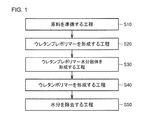
- FIG. 1 is a flowchart showing an outline of a method for producing a polyurethane porous body.
- a step (S10) a polyol compound, a polyisocyanate compound, a hydrophilic compound having reactivity with an isocyanate group, and a short-chain diol compound having two or more hydroxyl groups in the molecule.
- a step of preparing a raw material containing is performed.
- the polyol compound is prepared so as to contain at least a polyether polyol and a polycaprolactone polyol. Specifically, a predetermined amount of the raw material is blended in a flask or the like.
- a step of forming a urethane prepolymer is performed. More specifically, an organic solvent is added to a flask containing the above raw materials, and stirred at a temperature of about 80 ° C. for about 3 hours to form a urethane prepolymer. By adding the organic solvent in this way, the viscosity can be lowered during the formation of the urethane prepolymer.
- various well-known methods can be used as a method of adding an organic solvent and forming a urethane prepolymer.
- organic solvent examples include acetone, methyl ethyl ketone, N-methylpyrrolidone, toluene, tetrahydrofuran, dioxane, N, N′-dimethylformamide, N, N′-diethylformamide, N, N′-dimethylacetamide and the like.
- N, N′-dimethylformamide can be preferably used from the viewpoint of solubility of the urethane prepolymer. From the viewpoint of environmental friendliness, N, N′-diethylformamide having low volatility can be preferably used.
- a step of forming a urethane prepolymer aqueous dispersion is performed. More specifically, the obtained urethane prepolymer is cooled to a temperature of 70 ° C. to 80 ° C., triethylamine or the like is added as a neutralizing agent, and the mixture is stirred for about 15 minutes. Then, an urethane prepolymer is added to an aqueous solution containing a surfactant and an antifoaming agent, and stirred for about 10 minutes with a dispersing device such as a disper mixer, a homomixer, or a homogenizer, and contains an urethane prepolymer dispersed in water.
- a dispersing device such as a disper mixer, a homomixer, or a homogenizer, and contains an urethane prepolymer dispersed in water.
- a / W type emulsion is formed.
- a colorant, an antibacterial agent, an antioxidant, an ultraviolet absorber, a light stabilizer, a pH adjuster, and the like may be further added. You may add these individually or in mixture of 2 or more types.
- the non-volatile content of the urethane prepolymer component in the urethane prepolymer aqueous dispersion is preferably 10% by mass to 25% by mass, more preferably 12% by mass to 20% by mass, and even more preferably 13% by mass to 17% by mass. It is. By setting it as such a range, the density of a polyurethane porous body can be made low.
- the non-volatile content concentration of the urethane prepolymer component of the urethane prepolymer aqueous dispersion is the ratio (mass%) of the solid content of the urethane prepolymer to the urethane prepolymer aqueous dispersion.
- the solid content of the urethane prepolymer is a residue obtained by removing volatile components from the urethane prepolymer.
- an anionic surfactant for example, an anionic surfactant, a nonionic surfactant, a cationic surfactant and the like can be used.
- the anionic surfactant include alkyl ether sulfate ester salt, alkylbenzene sulfonate salt, sulfosuccinic acid dialkyl ester salt and the like.
- Nonionic surfactants include higher alcohol alkylene oxide adducts (polyoxyalkylene alkyl ethers), higher alcohol ethylene oxide adducts (polyoxyethylene lauryl ether, polyoxyethylene cetyl ether, polyoxyethylene stearyl ether, polyoxyethylene oleyl.
- the HLB value of the surfactant in the present embodiment is preferably 10 to 15, more preferably 10 to 14, and further preferably 11 to 13. is there.
- the water-soluble polymer for example, cellulose ethers such as methyl cellulose, hydroxymethyl cellulose, hydroxyethyl cellulose, carboxymethyl cellulose, and hydroxypropyl methyl cellulose can be used. Of these, hydroxypropylmethylcellulose can be preferably used.
- the amount of the water-soluble polymer is preferably 1.8 parts by mass or more and 3.4 parts by mass or less with respect to 100 parts by mass of the solid content of the urethane prepolymer. By setting it as such a compounding quantity, the aggregation state of the O / W type emulsion in water can be kept favorable.
- a step of forming a water-based urethane polymer is performed. More specifically, an amine compound is added to the urethane prepolymer aqueous dispersion and stirred for about 10 seconds. And it casts into a type
- the amine compound is not particularly limited as long as it has two or more active hydrogen atoms in the molecule (contains two or more primary and / or secondary amino groups in one molecule).
- Examples of the amine compound include ethylene diamine, propylene diamine, 1,3-diaminopentane, 1,5-diaminopentane, tetramethylene diamine, hexamethylene diamine, 1,7-diaminoheptane, and 1,5-diamino-2-methyl.
- ethylenediamine can be preferably used.
- the density of the polyurethane porous body can be lowered by increasing the proportion of water in the urethane prepolymer aqueous dispersion to lower the nonvolatile content concentration.
- the proportion of water is increased, the cohesiveness of the O / W emulsion is lowered, and a three-dimensional network structure may not be formed.
- a water-soluble polymer that dissolves in water and has a viscosity is added to the urethane prepolymer aqueous dispersion, and the urethane prepolymer aqueous dispersion is nonvolatile.
- a low-density polyurethane porous body can be formed.
- polyurethane porous body in the method for producing a polyurethane porous body in the present embodiment, two specific polyol compounds are included as the polyol compound.
- Specific two types of polyol compounds are polyether polyol and polycaprolactone polyol.
- Example 1 to Example 3 Each component was mix
- PTMG1500 polytetramethylene glycol
- polycaprolactone diol trade name “Placcel L220AL”, Inc.
- 3-methyl-1,5-pentanediol (trade name “MPD”, manufactured by Kuraray Co., Ltd.) as a short-chain diol compound (D) having a number average molecular weight of 2000 and a hydroxyl group in the molecule.
- MPD a short-chain diol compound having a number average molecular weight of 2000 and a hydroxyl group in the molecule.
- DMBA 2,2-dimethylolbutanoic acid
- C hydrophilic compound having reactivity with the isocyanate group
- 1,6 as the polyisocyanate compound (B).
- urethane prepolymer water is blended with triethylamine, surfactant, antifoaming agent, water-soluble cellulose ether and distilled water.
- a dispersion was obtained. More specifically, the urethane prepolymer obtained above was cooled to a temperature of 70 ° C. to 80 ° C., triethylamine was added as a neutralizing agent, and the mixture was stirred for 15 minutes.
- the urethane prepolymer obtained above was mixed with a nonionic surfactant (trade name “Naroacty CL-70”, manufactured by Sanyo Chemical Industries, HLB: 11.7) and a silicone-based antifoaming agent (trade name “ KS-538 ”(manufactured by Shin-Etsu Chemical Co., Ltd.) was added to a 30 ° C. aqueous solution previously dissolved, and the mixture was stirred with a homomixer for 10 minutes.
- a nonionic surfactant trade name “Naroacty CL-70”, manufactured by Sanyo Chemical Industries, HLB: 11.
- a silicone-based antifoaming agent trade name “ KS-538 ”(manufactured by Shin-Etsu Chemical Co., Ltd.
- Example 5 A urethane porous body was obtained in the same manner as in Example 2 except that the blending amount of water-soluble cellulose ether (trade name “himetrouse 65SH4000”, manufactured by Shin-Etsu Chemical Co., Ltd.) was changed to the blending amount shown in Table 2.
- water-soluble cellulose ether trade name “himetrouse 65SH4000”, manufactured by Shin-Etsu Chemical Co., Ltd.
- Example 6 A urethane porous body was obtained in the same manner as in Example 2 except that the solvent was changed from dimethylformamide to diethylformamide.
- the urethane prepolymer obtained above was heated to 80 ° C., triethylamine was added as a neutralizing agent, and the mixture was stirred for 15 minutes.
- the urethane polymer obtained above was added to a 27 ° C. aqueous solution in which a nonionic surfactant (trade name “Adecatol TN-100”, manufactured by Asahi Denka Kogyo Co., Ltd., HLB: 13.8) was previously dissolved. The mixture was further stirred for 2 minutes.
- the urethane prepolymer to which the neutralizing agent and the surfactant were added was added to distilled water, and the mixture was stirred with a homomixer for 5 minutes to obtain a urethane prepolymer aqueous dispersion.
- urethane polymer aqueous dispersion obtained above 1.5 parts by mass of ethylenediamine was added, and the mixture was stirred for 10 seconds in an environment of room temperature 20 ⁇ 5 ° C. and mixed. Then, in order to shape
- the density, tensile strength, 100% modulus, and elongation rate of the porous urethane material obtained in Examples and Comparative Examples were measured by the following methods.
- Tables 1 to 3 show the compositions of Examples (Examples 1 to 5) and Comparative Examples.
- Table 4 shows the evaluation results of the respective evaluation items.
- the urethane porous body was compared with Comparative Example 1 containing polyol compounds other than those described above.
- the 100% modulus which is an index indicating the hardness of the film, is low and soft.
- the density and the tensile strength are low in Examples 1 to 6.
- the elongation rate which is an index indicating the ease of deformation of the urethane porous body, is improved and is easily deformed. From the above results, it can be said that the urethane porous bodies of Examples 1 to 6 are urethane porous bodies excellent in flexibility and extensibility that are both soft and easy to deform.
- Example 1 in which the content of the aromatic polyisocyanate in the urethane prepolymer is 9% by mass to 15% by mass, the modulus becomes lower by 100% compared to Comparative Example 1, Elongation rate increases. Further, in Example 2, Example 4 and Example 5 in which the blending amount of the water-soluble cellulose ether was changed, 100% modulus was lowered and the elongation ratio was increased as compared with Comparative Example 1. Also in Example 6 in which diethylformamide was used as the organic solvent used for forming the urethane prepolymer, the modulus was reduced 100% and the elongation ratio was increased as compared with Comparative Example 1.
- a polyurethane porous body having high flexibility and extensibility can be provided.
- the polyurethane porous body of the present application can be applied particularly advantageously in a field where it is required to provide a polyurethane porous body having high flexibility and extensibility.
Landscapes
- Chemical & Material Sciences (AREA)
- Health & Medical Sciences (AREA)
- Chemical Kinetics & Catalysis (AREA)
- Medicinal Chemistry (AREA)
- Polymers & Plastics (AREA)
- Organic Chemistry (AREA)
- Engineering & Computer Science (AREA)
- Materials Engineering (AREA)
- Polyurethanes Or Polyureas (AREA)
- Manufacture Of Porous Articles, And Recovery And Treatment Of Waste Products (AREA)
Priority Applications (2)
| Application Number | Priority Date | Filing Date | Title |
|---|---|---|---|
| CN201980002440.1A CN110650998A (zh) | 2018-02-23 | 2019-02-22 | 聚氨基甲酸乙酯多孔质体及聚氨基甲酸乙酯多孔质体的制造方法 |
| KR1020197028537A KR102535128B1 (ko) | 2018-02-23 | 2019-02-22 | 폴리우레탄 다공질체 및 폴리우레탄 다공질체의 제조 방법 |
Applications Claiming Priority (2)
| Application Number | Priority Date | Filing Date | Title |
|---|---|---|---|
| JP2018-030990 | 2018-02-23 | ||
| JP2018030990A JP6596710B2 (ja) | 2018-02-23 | 2018-02-23 | ポリウレタン多孔質体およびポリウレタン多孔質体の製造方法 |
Publications (1)
| Publication Number | Publication Date |
|---|---|
| WO2019163952A1 true WO2019163952A1 (ja) | 2019-08-29 |
Family
ID=67687255
Family Applications (1)
| Application Number | Title | Priority Date | Filing Date |
|---|---|---|---|
| PCT/JP2019/006817 Ceased WO2019163952A1 (ja) | 2018-02-23 | 2019-02-22 | ポリウレタン多孔質体およびポリウレタン多孔質体の製造方法 |
Country Status (4)
| Country | Link |
|---|---|
| JP (1) | JP6596710B2 (enExample) |
| KR (1) | KR102535128B1 (enExample) |
| CN (1) | CN110650998A (enExample) |
| WO (1) | WO2019163952A1 (enExample) |
Families Citing this family (2)
| Publication number | Priority date | Publication date | Assignee | Title |
|---|---|---|---|---|
| CN113861370B (zh) * | 2021-09-16 | 2023-05-09 | 山东一诺威聚氨酯股份有限公司 | 化妆棉用聚氨酯组合料及其制备方法 |
| WO2025089046A1 (ja) * | 2023-10-24 | 2025-05-01 | 東レコーテックス株式会社 | 防水加工布帛およびその製造方法 |
Citations (7)
| Publication number | Priority date | Publication date | Assignee | Title |
|---|---|---|---|---|
| JP2002146181A (ja) * | 2000-08-30 | 2002-05-22 | Asahi Denka Kogyo Kk | 化粧パフ製造用アニオン性水系ポリウレタン樹脂組成物及び化粧パフの製造方法 |
| JP3641270B1 (ja) * | 2003-10-01 | 2005-04-20 | トーヨーポリマー株式会社 | ポリウレタン多孔質体 |
| JP2006265308A (ja) * | 2005-03-22 | 2006-10-05 | Toyo Polymer Co Ltd | マイクロプレート用吸収体 |
| JP2009185137A (ja) * | 2008-02-05 | 2009-08-20 | Tosoh Corp | 水性ポリウレタン分散体及びその製造方法 |
| JP2009249470A (ja) * | 2008-04-04 | 2009-10-29 | Daido Kasei Kogyo Kk | ポリウレタン多孔性構造体及びその製造方法 |
| JP2010024426A (ja) * | 2008-06-16 | 2010-02-04 | Toyo Polymer Co Ltd | ポリウレタン多孔質体の注型成形品及びその製造方法 |
| JP5739627B2 (ja) * | 2010-07-28 | 2015-06-24 | 太陽ホールディングス株式会社 | エポキシ樹脂及びその製造方法 |
Family Cites Families (3)
| Publication number | Priority date | Publication date | Assignee | Title |
|---|---|---|---|---|
| JPS5739627B2 (enExample) * | 1973-06-05 | 1982-08-23 | ||
| JP2860684B2 (ja) * | 1990-02-16 | 1999-02-24 | 三洋化成工業株式会社 | 多孔性シート材料の製造方法 |
| JP6280361B2 (ja) | 2013-12-19 | 2018-02-14 | 株式会社伏見製薬所 | 化粧用スポンジ、ポリウレタン弾性体の製造方法、及び化粧料塗布具 |
-
2018
- 2018-02-23 JP JP2018030990A patent/JP6596710B2/ja active Active
-
2019
- 2019-02-22 WO PCT/JP2019/006817 patent/WO2019163952A1/ja not_active Ceased
- 2019-02-22 KR KR1020197028537A patent/KR102535128B1/ko active Active
- 2019-02-22 CN CN201980002440.1A patent/CN110650998A/zh active Pending
Patent Citations (7)
| Publication number | Priority date | Publication date | Assignee | Title |
|---|---|---|---|---|
| JP2002146181A (ja) * | 2000-08-30 | 2002-05-22 | Asahi Denka Kogyo Kk | 化粧パフ製造用アニオン性水系ポリウレタン樹脂組成物及び化粧パフの製造方法 |
| JP3641270B1 (ja) * | 2003-10-01 | 2005-04-20 | トーヨーポリマー株式会社 | ポリウレタン多孔質体 |
| JP2006265308A (ja) * | 2005-03-22 | 2006-10-05 | Toyo Polymer Co Ltd | マイクロプレート用吸収体 |
| JP2009185137A (ja) * | 2008-02-05 | 2009-08-20 | Tosoh Corp | 水性ポリウレタン分散体及びその製造方法 |
| JP2009249470A (ja) * | 2008-04-04 | 2009-10-29 | Daido Kasei Kogyo Kk | ポリウレタン多孔性構造体及びその製造方法 |
| JP2010024426A (ja) * | 2008-06-16 | 2010-02-04 | Toyo Polymer Co Ltd | ポリウレタン多孔質体の注型成形品及びその製造方法 |
| JP5739627B2 (ja) * | 2010-07-28 | 2015-06-24 | 太陽ホールディングス株式会社 | エポキシ樹脂及びその製造方法 |
Also Published As
| Publication number | Publication date |
|---|---|
| CN110650998A (zh) | 2020-01-03 |
| KR20200123375A (ko) | 2020-10-29 |
| KR102535128B1 (ko) | 2023-05-22 |
| JP2019143096A (ja) | 2019-08-29 |
| JP6596710B2 (ja) | 2019-10-30 |
Similar Documents
| Publication | Publication Date | Title |
|---|---|---|
| ES2984265T3 (es) | Espuma de poliuretano mediante moldeo por inyección reactiva | |
| CN100390214C (zh) | 聚氨酯多孔体 | |
| JP6079945B1 (ja) | 凝固物の製造方法 | |
| JP6596710B2 (ja) | ポリウレタン多孔質体およびポリウレタン多孔質体の製造方法 | |
| WO2020217813A1 (ja) | ウレタン樹脂組成物、発泡ウレタンシート、及び、合成皮革 | |
| JP5413703B1 (ja) | ウレタン樹脂組成物、皮革様シート及び積層体 | |
| JP6501136B1 (ja) | 合成皮革の製造方法 | |
| WO2017208681A1 (ja) | 多孔体の製造方法 | |
| JP5371839B2 (ja) | 発泡体形成用水系ポリウレタン | |
| JP6540914B1 (ja) | 手袋の製造方法 | |
| JP2009249470A (ja) | ポリウレタン多孔性構造体及びその製造方法 | |
| JP6981576B2 (ja) | 繊維基材、及び、人工皮革 | |
| TW201840622A (zh) | 粉撲用片及其製備方法 | |
| WO2017221455A1 (ja) | 凝固物の製造方法 | |
| JP6229918B1 (ja) | 多孔体の製造方法 | |
| JP6323620B1 (ja) | 凝固物の製造方法 | |
| JP2010024426A (ja) | ポリウレタン多孔質体の注型成形品及びその製造方法 | |
| JP2008201871A (ja) | 微細セル軟質ポリウレタンフォーム及びその製造方法 | |
| JP6183577B1 (ja) | 凝固物の製造方法 | |
| JP6231870B2 (ja) | ポリウレタン塗膜材用硬化剤、及びポリウレタン塗膜材用二液型キット | |
| JP2006255315A (ja) | 吸収体 |
Legal Events
| Date | Code | Title | Description |
|---|---|---|---|
| 121 | Ep: the epo has been informed by wipo that ep was designated in this application |
Ref document number: 19758118 Country of ref document: EP Kind code of ref document: A1 |
|
| NENP | Non-entry into the national phase |
Ref country code: DE |
|
| 122 | Ep: pct application non-entry in european phase |
Ref document number: 19758118 Country of ref document: EP Kind code of ref document: A1 |