WO2019151069A1 - 油性化粧料及びその製造方法 - Google Patents
油性化粧料及びその製造方法 Download PDFInfo
- Publication number
- WO2019151069A1 WO2019151069A1 PCT/JP2019/002018 JP2019002018W WO2019151069A1 WO 2019151069 A1 WO2019151069 A1 WO 2019151069A1 JP 2019002018 W JP2019002018 W JP 2019002018W WO 2019151069 A1 WO2019151069 A1 WO 2019151069A1
- Authority
- WO
- WIPO (PCT)
- Prior art keywords
- mass
- oily
- oil
- component
- oily cosmetic
- Prior art date
- Legal status (The legal status is an assumption and is not a legal conclusion. Google has not performed a legal analysis and makes no representation as to the accuracy of the status listed.)
- Ceased
Links
Images


Classifications
-
- A—HUMAN NECESSITIES
- A61—MEDICAL OR VETERINARY SCIENCE; HYGIENE
- A61Q—SPECIFIC USE OF COSMETICS OR SIMILAR TOILETRY PREPARATIONS
- A61Q1/00—Make-up preparations; Body powders; Preparations for removing make-up
- A61Q1/02—Preparations containing skin colorants, e.g. pigments
-
- A—HUMAN NECESSITIES
- A61—MEDICAL OR VETERINARY SCIENCE; HYGIENE
- A61K—PREPARATIONS FOR MEDICAL, DENTAL OR TOILETRY PURPOSES
- A61K8/00—Cosmetics or similar toiletry preparations
- A61K8/18—Cosmetics or similar toiletry preparations characterised by the composition
- A61K8/30—Cosmetics or similar toiletry preparations characterised by the composition containing organic compounds
- A61K8/31—Hydrocarbons
-
- A—HUMAN NECESSITIES
- A61—MEDICAL OR VETERINARY SCIENCE; HYGIENE
- A61K—PREPARATIONS FOR MEDICAL, DENTAL OR TOILETRY PURPOSES
- A61K8/00—Cosmetics or similar toiletry preparations
- A61K8/18—Cosmetics or similar toiletry preparations characterised by the composition
- A61K8/30—Cosmetics or similar toiletry preparations characterised by the composition containing organic compounds
- A61K8/33—Cosmetics or similar toiletry preparations characterised by the composition containing organic compounds containing oxygen
- A61K8/37—Esters of carboxylic acids
-
- A—HUMAN NECESSITIES
- A61—MEDICAL OR VETERINARY SCIENCE; HYGIENE
- A61K—PREPARATIONS FOR MEDICAL, DENTAL OR TOILETRY PURPOSES
- A61K8/00—Cosmetics or similar toiletry preparations
- A61K8/18—Cosmetics or similar toiletry preparations characterised by the composition
- A61K8/72—Cosmetics or similar toiletry preparations characterised by the composition containing organic macromolecular compounds
- A61K8/84—Cosmetics or similar toiletry preparations characterised by the composition containing organic macromolecular compounds obtained by reactions otherwise than those involving only carbon-carbon unsaturated bonds
- A61K8/89—Polysiloxanes
- A61K8/891—Polysiloxanes saturated, e.g. dimethicone, phenyl trimethicone, C24-C28 methicone or stearyl dimethicone
- A61K8/894—Polysiloxanes saturated, e.g. dimethicone, phenyl trimethicone, C24-C28 methicone or stearyl dimethicone modified by a polyoxyalkylene group, e.g. cetyl dimethicone copolyol
-
- A—HUMAN NECESSITIES
- A61—MEDICAL OR VETERINARY SCIENCE; HYGIENE
- A61K—PREPARATIONS FOR MEDICAL, DENTAL OR TOILETRY PURPOSES
- A61K8/00—Cosmetics or similar toiletry preparations
- A61K8/18—Cosmetics or similar toiletry preparations characterised by the composition
- A61K8/92—Oils, fats or waxes; Derivatives thereof, e.g. hydrogenation products thereof
-
- A—HUMAN NECESSITIES
- A61—MEDICAL OR VETERINARY SCIENCE; HYGIENE
- A61Q—SPECIFIC USE OF COSMETICS OR SIMILAR TOILETRY PREPARATIONS
- A61Q17/00—Barrier preparations; Preparations brought into direct contact with the skin for affording protection against external influences, e.g. sunlight, X-rays or other harmful rays, corrosive materials, bacteria or insect stings
- A61Q17/04—Topical preparations for affording protection against sunlight or other radiation; Topical sun tanning preparations
Definitions
- This disclosure relates to an oily cosmetic and a method for producing the same.
- Cosmetics combining a silicone compound and a thickener to enhance the feeling of use are known (for example, see Patent Document 1).
- the aqueous skin cosmetic described in Patent Document 1 contains a silicone compound represented by a specific structural formula and a thickener composed of a microgel produced by a specific manufacturing method.
- ⁇ Skin made with oil-based cosmetics has low wettability to water, so the sweat on makeup tends to be ball-shaped.
- Ball-shaped sweat has a small surface area and is difficult to evaporate.
- the ball-shaped sweat formed on the face without evaporating easily flows down, and the sweat that flows down causes the makeup to collapse. Wiping off the sweat with a towel or the like so that the sweat does not flow down also causes the makeup to collapse.
- Aqueous cosmetics as described in Patent Document 1 have a higher affinity for sweat than oily cosmetics and are likely to cause makeup collapse.
- the silicone compound blended in the aqueous skin cosmetic described in Patent Document 1 is hydrophilic even when trying to blend in an oily cosmetic, so it is difficult to blend in an oily cosmetic because it is hydrophilic. there were. Therefore, a production method for uniformly blending a hydrophilic silicone wax with an oily cosmetic is desired.
- an oily cosmetic containing 4% by mass to 22% by mass of a polyether-modified silicone wax and 40% by mass to 80% by mass of an oily component. 46% by mass or more of the oil component is a volatile oil component.
- the content rate of a volatile oily component is 25 mass% or more with respect to the mass of oily cosmetics.
- a step of dissolving a hydrophilic polyether-modified silicone wax in a first oil component to prepare a solution, and a step of mixing the solution and the second oil component A method for producing an oily cosmetic is provided.
- the oily cosmetic composition of the present disclosure formation of ball-shaped sweat can be suppressed in the area where the cosmetic composition is applied. Thereby, drying of sweat can be promoted. Moreover, makeup collapse due to sweat dripping or sweat wiping can be suppressed. Furthermore, the appearance of sweat can be made inconspicuous.
- an oily cosmetic in which a hydrophilic silicone wax is uniformly blended can be obtained.
- the schematic process drawing of the manufacturing method of oily cosmetics concerning a 2nd embodiment The photograph of the upper part of the face when the cosmetics according to Test Examples 1 and 2 are applied and sweated. A photograph of the lower part of the face when the cosmetics according to Test Examples 1 and 2 are applied and sweated.
- the volatile oil component contains silicone oil.
- the oily cosmetic further contains 10% by mass to 40% by mass of powder with respect to the mass of the oily cosmetic.
- the powder includes an oil-absorbing powder.
- the water content is 5% by mass or less.
- the polyether-modified silicone wax includes a compound represented by the following chemical formula 1.
- the polyether-modified silicone wax contains bisPEG-18 methyl ether dimethylsilane.
- the oil component includes at least one of ester oil and nonvolatile silicone oil.
- the oil component contains an ultraviolet absorber.
- the ratio of the volatile oily component in the oily component is 48% by mass to 74% by mass with respect to the mass of the oily component.
- the content of the volatile oily component is 28% by mass to 46% by mass with respect to the mass of the oily cosmetic.
- the first oil component contains an ultraviolet absorber.
- the second oil component includes a volatile oil component.
- the volatile oil contains silicone oil.
- the polyether-modified silicone wax includes a compound represented by the following chemical formula 2.
- the polyether-modified silicone wax contains bisPEG-18 methyl ether dimethylsilane.
- the oily cosmetic according to the first embodiment of the present disclosure will be described.
- the oily cosmetic contains a polyether-modified silicone wax and an oily component.
- polyether-modified silicone wax for example, polyoxyethylene-modified silicone wax can be used.
- polyoxyethylene-modified silicone wax for example, a compound represented by the following chemical formula 3 can be used.
- the wettability to water can be enhanced. Thereby, it can suppress that ball-shaped sweat is formed on the makeup applied to the skin. That is, sweat can be spread thinly along the makeup surface (skin surface) so as to increase the surface area.
- m and n can be independently an integer of 10 to 24. m and n may be different numbers or the same number.
- silicone wax for example, bisPEG-18 methyl ether dimethylsilane in which m and n are each 18 on average can be used.
- examples of commercially available products of bisPEG-18 methyl ether dimethylsilane include Dow Corning (registered trademark) 2501 Cosmetic Wax (Toray Dow Corning).
- the content of the silicone wax is preferably 4% by mass or more, and more preferably 5% by mass or more with respect to the mass of the oily cosmetic. If the content of the silicone wax is less than 4% by mass, the effect of improving the wettability against sweat cannot be exhibited sufficiently.
- the content of the silicone wax is preferably 7% by mass or more, more preferably 10% by mass or more, and 13% by mass with respect to the mass of the oily cosmetic. More preferably, it is more preferably 15% by mass or more, and further preferably 17% by mass or more.
- the content of the silicone wax is preferably 22% by mass or less and more preferably 20% by mass or less with respect to the mass of the oily cosmetic.
- the content of the silicone wax exceeds 22% by mass, the makeup tends to collapse.
- the content of the silicone wax is preferably 18% by mass or less, more preferably 15% by mass or less, and 13% by mass or less with respect to the mass of the oily cosmetic. More preferably, it is more preferably 10% by mass or less, and further preferably 8% by mass or less.
- Oil component As the oily component used in the oily cosmetic composition of the present disclosure, those that can be generally used in skin external preparations and cosmetics can be used. Specific examples include liquid fats and oils, solid fats and oils, waxes, hydrocarbons, higher fatty acids, higher alcohols, synthetic ester oils, and silicone oils. In this document, the oil component and the component soluble in the oil component are also referred to as “oil-based component”.
- the oil component contains a volatile oil component.
- volatile means that it can be easily volatilized at room temperature, outside temperature or body temperature when applied to the skin.
- silicone oil, hydrocarbon oil, or the like can be used as the volatile oil component.
- volatile silicone oil for example, a silicone oil having a dimethylpolysiloxane structure can be used.
- volatile hydrocarbon oil examples include isododecane, isohexadecane, and isodecane.
- the content of the volatile oily component is preferably 25% by mass or more and 28% by mass or more with respect to the mass of the oily cosmetic. More preferably, it is more preferably 30% by mass or more.
- the volatile oil component is less than 25% by mass, the quick drying property and the makeup feeling are lowered, and the usability is also lowered.
- the content of the volatile oil component can be 35% by mass or more, 40% by mass or more, or 45% by mass or more with respect to the mass of the oily cosmetic. If the content of the volatile oily component is at least 50% by mass or less with respect to the mass of the oily cosmetic, it is possible to maintain sufficient quick-drying and makeup. In order to ensure usability in addition to quick drying and makeup, the content of the volatile oil component is preferably 48% by mass or less, and 46% by mass or less, based on the mass of the oily cosmetic. More preferably, it is more preferably 44% by mass or less, and further preferably 42% by mass or less. When the volatile oil component exceeds 48% by mass, drying is delayed at the time of application to the skin, and the usability is lowered.
- the content of the volatile oily component may be 40% by mass or less, 35% by mass or less, or 30% by mass or less with respect to the mass of the oily cosmetic.
- the volatile oil component in the oil component is preferably 46% by mass or more, more preferably 48% by mass or more, based on the mass of the total oil component, More preferably, it is 50 mass% or more, More preferably, it is 52 mass% or more, More preferably, it is 54 mass% or more.
- the volatile oily component in the oily component can be 80% by mass or less, 75% by mass or less, or 70% by mass or less based on the mass of the oily component, depending on the desired formulation.
- the volatile oil component in the oil component is preferably 46% by mass or more and 48% by mass or more based on the mass of the total oil component. More preferably, it is 50 mass% or more, more preferably 52 mass% or more, and further preferably 54 mass% or more.
- the volatile oily component in the oily component is preferably 74% by mass or less, more preferably 72% by mass or less, more preferably 70% by mass or less, and 68% by mass with respect to the mass of the total oily component. % Or less, more preferably 66% by mass or less.
- Oily cosmetics can contain non-volatile oily ingredients.
- the oily cosmetic of the present disclosure preferably contains a UV absorber.
- the ultraviolet absorber is preferably an ultraviolet absorber having a benzene skeleton.
- the hydrophilic silicone wax can be uniformly dispersed in the oily cosmetic.
- UV absorbers for example selected from the group consisting of 2-ethylhexyl 4-methoxycinnamate, octocrylene, hexyl diethylaminohydroxybenzoate, t-butylmethoxydibenzoylmethane, ethylhexyltriazone, and bisethylhexyloxyphenol methoxyphenyltriazine It is preferable that it is at least one.
- liquid oils examples include avocado oil, camellia oil, turtle oil, macadamia nut oil, corn oil, mink oil, olive oil, rapeseed oil, egg yolk oil, sesame oil, persic oil, wheat germ oil, southern castor oil, castor oil, linseed oil , Safflower oil, cottonseed oil, eno oil, soybean oil, peanut oil, tea seed oil, kaya oil, rice bran oil, cinnagiri oil, Japanese kiri oil, jojoba oil, germ oil, triglycerin and the like.
- solid fat examples include cacao butter, palm oil, horse fat, hydrogenated palm oil, palm oil, beef tallow, sheep fat, hydrogenated beef tallow, palm kernel oil, pork fat, beef bone fat, owl kernel oil, hydrogenated oil, cattle Leg fats, moles, hydrogenated castor oil and the like.
- waxes examples include beeswax, candelilla wax, cotton wax, carnauba wax, bayberry wax, ibota wax, whale wax, montan wax, nuka wax, lanolin, kapok wax, lanolin acetate, liquid lanolin, sugar cane wax, lanolin fatty acid isopropyl, hexyl laurate, and reduced lanolin.
- hydrocarbon oil examples include liquid paraffin, ozokerite, squalane, pristane, paraffin, ceresin, squalene, petrolatum, and microcrystalline wax.
- higher fatty acid examples include lauric acid, myristic acid, palmitic acid, stearic acid, behenic acid, oleic acid, undecylenic acid, toluic acid, isostearic acid, linoleic acid, linolenic acid, eicosapentaenoic acid (EPA), docosahexaenoic acid ( DHA) and the like.
- higher alcohols examples include linear alcohols (eg, lauryl alcohol, cetyl alcohol, stearyl alcohol, behenyl alcohol, myristyl alcohol, oleyl alcohol, cetostearyl alcohol); branched chain alcohols (eg, monostearyl glycerin ether (batyl alcohol) ), 2-decyltetradecinol, lanolin alcohol, cholesterol, phytosterol, hexyl decanol, isostearyl alcohol, octyldodecanol, and the like.
- linear alcohols eg, lauryl alcohol, cetyl alcohol, stearyl alcohol, behenyl alcohol, myristyl alcohol, oleyl alcohol, cetostearyl alcohol
- branched chain alcohols eg, monostearyl glycerin ether (batyl alcohol)
- 2-decyltetradecinol lanolin alcohol
- cholesterol phytosterol
- hexyl decanol isoste
- Synthetic ester oils include isopropyl myristate, cetyl octanoate, octyldodecyl myristate, isopropyl palmitate, butyl stearate, hexyl laurate, myristyl myristate, decyl oleate, hexyl decyl dimethyloctanoate, cetyl lactate, myristyl lactate Lanolin acetate, isocetyl stearate, isocetyl isostearate, cholesteryl 12-hydroxystearate, ethylene glycol di-2-ethylhexanoate, dipentaerythritol fatty acid ester, N-alkyl glycol monoisostearate, neopentyl glycol dicaprate, apple Acid diisostearyl, di-2-heptylundecanoic acid glycerin, tri-2-ethylhexanoic acid
- Silicone oils include dimethylpolysiloxane, methylhydrogenpolysiloxane, methylphenylpolysiloxane, stearoxymethylpolysiloxane, polyether-modified organopolysiloxane, fluoroalkyl / polyoxyalkylene co-modified organopolysiloxane, and alkyl-modified organopolysiloxane.
- silicone compounds such as non-terminally modified organopolysiloxane, fluorine-modified organopolysiloxane, amino-modified organopolysiloxane, silicone gel, acrylic silicone, trimethylsiloxysilicic acid, and silicone RTV rubber.
- ultraviolet absorber examples include benzoic acid-based ultraviolet absorbers (for example, paraaminobenzoic acid (hereinafter abbreviated as PABA), PABA monoglycerin ester, N, N-dipropoxy PABA ethyl ester, N, N-diethoxy PABA ethyl ester.
- PABA paraaminobenzoic acid
- PABA monoglycerin ester N, N-dipropoxy PABA ethyl ester
- N, N-diethoxy PABA ethyl ester examples include benzoic acid-based ultraviolet absorbers (for example, paraaminobenzoic acid (hereinafter abbreviated as PABA), PABA monoglycerin ester, N, N-dipropoxy PABA ethyl ester, N, N-diethoxy PABA ethyl ester.
- PABA paraaminobenzoic acid
- the content of the total oil component is preferably 40% by mass or more based on the mass of the oily cosmetic. If the total oil component is 40% by mass or more, the quick-drying property and long-lasting makeup of the oily cosmetic material can be maintained.
- the content of the total oil component can be 45% by mass or more, 50% by mass or more, 55% by mass or more, 60% by mass or more, or 65% by mass or more with respect to the mass of the oily cosmetic.
- the content of the total oil component is preferably 80% by mass or less, more preferably 75% by mass or less, and further preferably 70% by mass or less with respect to the mass of the oily cosmetic.
- the content of the oily component is at least 80% by mass or less, the quick-drying property and long-lasting makeup of the oily cosmetic can be maintained.
- the total oil component content may be 65% by mass or less, 60% by mass or less, or 55% by mass or less with respect to the mass of the oily cosmetic.
- the oily cosmetic of the present disclosure may further contain a powder.
- the term “powder” is synonymous with “powder”.
- the powder is not particularly limited as long as it can be generally used for cosmetics and the like. Examples of the powder include talc, kaolin, sericite (sericite), muscovite, phlogopite, synthetic mica, synthetic fluorine phlogopite, synthetic fluorine phlogopite, iron mica, biotite, calcined talc, calcined sericite.
- low-order titanium oxide instead of mica as substrate, low-order titanium oxide, colored oxidation in addition to titanium oxide as coating Covered with titanium, iron oxide, alumina, silica, zirconia, zinc oxide, cobalt oxide, aluminum, etc., functional pearl pigments (resin particles, aluminum hydroxide particles, zinc oxide particles, barium sulfate particles, etc.
- metal powder pigments eg, aluminum powder, copper powder, etc.
- Organic pigments such as zirconium, barium or aluminum lakes (for example, red 201, red 202, red 204, red 205, red 220, red 226, red 228, red 405, orange 203, Organic pigments such as orange 204, yellow 205, yellow 401, and blue 404, red 3, red 104, red 106, red 227, red 230, red 401, red 505, orange No. 205, Yellow No. 4, Yellow No. 5, Yellow No. 202, Yellow No. 203, Green No. 3 and Blue No. 1); natural pigments (for example, chlorophyll, ⁇ -carotene and the like) and the like.
- the average particle diameter, specific surface area, specific gravity, particle shape, porous or non-porous, hydrophilic or hydrophobic, presence / absence of surface treatment, etc. of the powder can be appropriately selected according to the purpose.
- a powder oil absorbing powder
- the powder may be a mixture of different types.
- the powder content can be set as appropriate according to the purpose of the oily cosmetic.
- the content rate of a powder can be 5 mass% or more, 10 mass% or more, or 20 mass% or more with respect to the mass of oily cosmetics, for example.
- the content rate of a powder can be 45 mass% or less, 40 mass% or less, or 35 mass% or less with respect to the mass of oil-based cosmetics, for example.
- the oily cosmetic of the present disclosure may further contain water.
- the water content is preferably low, preferably 10% by mass or less, more preferably 5% by mass or less, and more preferably 3% by mass or less, based on the mass of the oily cosmetic. Is more preferable. It is preferable that the oily cosmetic material does not substantially contain water.
- composition of the present disclosure has other components such as alcohol, saccharide, ester, anionic surfactant, cationic surfactant, amphoteric surfactant, and nonionic interface as long as the effects of the present invention are not impaired.
- Activator, thickener, moisturizer, water-soluble polymer, film agent, UV absorber, sequestering agent, amino acid, organic amine, polymer emulsion, pH adjuster, skin nutrient, vitamin, antioxidant, Antioxidant assistants, fragrances and the like can be appropriately contained as necessary.
- the oily cosmetic of the present disclosure can suppress sweat from forming a ball shape even if the applied area is perspired. Since the wettability of the area where the oily cosmetic is applied is increased, sweat is diffused, and drying of the sweat can be promoted. Thereby, since it is not necessary to wipe off the sweat, it is possible to suppress makeup collapse due to wiping. Furthermore, since dripping of sweat can also be suppressed, makeup collapse due to dripping of sweat can also be suppressed. The aesthetic appearance can be enhanced by preventing the ball-shaped sweat from rising.
- the cosmetics of the present disclosure it is possible to suppress sliminess when oily cosmetics are applied to the skin.
- the makeup By adding a makeup component to the oily cosmetic, the makeup itself can have a sweat diffusing function.
- the oily cosmetic of the present disclosure has a fast stop when applied to the skin. Therefore, the user can shorten the application time and obtain a comfortable feeling of use.
- the oily cosmetics of the present disclosure may not be directly identified by the composition or properties of the oily cosmetics, or may be nearly impractical. In this case, it is useful to specify the oily cosmetic of the present disclosure by a manufacturing method or a usage method described later.
- FIG. 1 the schematic process drawing of the manufacturing method of oily cosmetics is shown.
- the hydrophilic silicone wax is dissolved in the first oil component (S1; dissolving step).
- the hydrophilic silicone wax is the above-described silicone wax.
- a liquid ultraviolet absorber can be used as the first oily component.
- an ultraviolet absorber containing a benzene skeleton can be used. Specific examples include 2-ethylhexyl 4-methoxycinnamate, octocrylene, hexyl diethylaminohydroxybenzoate, t-butylmethoxydibenzoylmethane, ethylhexyltriazone, bisethylhexyloxyphenol methoxyphenyltriazine, and the like.
- Silicone wax is preferably added to a heated solvent and dissolved.
- the addition rate of the silicone wax in the dissolving step can be 5% by mass or more, preferably 10% by mass or more with respect to the total mass of the silicone wax and the first oil component.
- the addition rate of the silicone wax in the dissolving step is preferably 80% by mass or less, more preferably 75% by mass or less, and 70% by mass or less with respect to the total mass of the silicone wax and the first oil component. More preferably. If the silicone wax exceeds 80% by mass, insoluble silicone wax will increase.
- the solution in which the silicone wax is dissolved is mixed with the second oil component containing other oil components (S2; mixing step).
- the oily cosmetic contains powder
- the powder is added to the oily component.
- the blending ratio of each component can be the same as in the first embodiment. Thereby, oily cosmetics can be manufactured.
- an oily cosmetic containing a hydrophilic silicone wax can be produced even when the oily cosmetic does not contain an aqueous solvent. Further, the hydrophilic silicone wax can be uniformly dispersed in the oily cosmetic.
- the oily cosmetic material of the present disclosure and the manufacturing method thereof will be described below with examples. However, the oily cosmetic of the present disclosure and the manufacturing method thereof are not limited to the following examples.
- the unit of the content rate shown in each table is mass%.
- Test Examples 1 to 4 oily cosmetics were prepared. In Test Examples 3 and 4, aqueous cosmetics were prepared. Silicone wax was blended in the cosmetics of Test Examples 1 and 3. About each produced cosmetics, it tested about quick-drying property and makeup lasting (continuity of makeup). Table 1 shows the composition and results of the cosmetics. In the following table, “a volatile oil component ratio” indicates a ratio of a volatile oil component in the entire oil component.
- the content of the silicone wax is preferably 4% by mass or more and more preferably 5% by mass or more with respect to the mass of the oily cosmetic.
- the content of the silicone wax is preferably 22% by mass or less and more preferably 20% by mass or less with respect to the mass of the oily cosmetic.
- the silicone wax content is considered to be preferably 13 to 22% by mass, preferably 10 to 20% by mass.
- the content of the silicone wax is considered to be preferably 4% by mass to 12% by mass, preferably 5% by mass to 10% by mass.
- Test Examples 12 to 18 Oily cosmetics with different volatile oily component contents were prepared, and each composition was tested for quick-drying and makeup lasting in the same manner as in Test Examples 1 to 4. In addition to the evaluation items of Test Examples 1 to 4, “goodness of stay” was also used as an evaluation item as usability. The evaluation criteria for usability are shown below. The evaluation criteria for quick-drying and makeup are the same as in Test Examples 1 to 4. Table 3 shows the composition and results.
- the content of the volatile oily component is preferably 25% by mass or more and more preferably 28% by mass or more with respect to the mass of the oily cosmetic.
- the content rate of a volatile oil-based component can be 50 mass% or less with respect to the mass of oil-based cosmetics.
- the content of the volatile oil component is preferably 48% by mass or less, and 46% by mass with respect to the mass of the oily cosmetic. It is more preferable that it is below, more preferably 44% by mass or less, and further more preferably 42% by mass or less.
- the total oil component content is preferably 40% by mass or more based on the mass of the oily cosmetic.
- the content of the total oil component is preferably 80% by mass or less, more preferably 75% by mass or less, and further preferably 70% by mass or less with respect to the mass of the oily cosmetic.
- the ratio of the volatile oily component in the oily component is preferably 46% by mass or more, more preferably 48% by mass or more, more preferably 50% by mass or more, and 52% by mass or more. It is more preferable that it is 54% by mass or more.
- high quick-drying and long-lasting makeup can be realized if the ratio of the volatile oily component in the oily component is at least 80% by mass or less, preferably 75% by mass or less.
- the ratio of the volatile oily component in the oily component is preferably 74% by mass or less, more preferably 70% by mass or less, and further 65% by mass or less. It is considered preferable.
- the oily cosmetic of the present disclosure can be applied as a cosmetic that is applied to a sweating region.
- it can be suitably applied to areas such as the face where makeup is applied.
- the oily cosmetic composition of the present disclosure can be suitably used in periods and places where it is easy to sweat, such as in summer, when going to hot and humid areas, or when doing sports or exercising.
Landscapes
- Health & Medical Sciences (AREA)
- Life Sciences & Earth Sciences (AREA)
- Animal Behavior & Ethology (AREA)
- General Health & Medical Sciences (AREA)
- Public Health (AREA)
- Veterinary Medicine (AREA)
- Birds (AREA)
- Epidemiology (AREA)
- Dermatology (AREA)
- Chemical & Material Sciences (AREA)
- Oil, Petroleum & Natural Gas (AREA)
- Emergency Medicine (AREA)
- Cosmetics (AREA)
Abstract
油性化粧料は、4質量%~22質量のポリエーテル変性シリコーンワックスと、40質量%~80質量%の油性成分と、を含有する。油性成分の46質量%以上が揮発性油性成分である。揮発性油性成分の含有率は、油性化粧料の質量に対して25質量%以上である。
Description
本発明は、日本国特許出願:特願2018-18191号(2018年2月5日出願)の優先権主張に基づくものであり、同出願の全記載内容は引用をもって本書に組み込み記載されているものとする。
本開示は、油性化粧料及びその製造方法に関する。
使用感を高めるためにシリコーン化合物と増粘剤とを組み合わせた化粧料が知られている(例えば、特許文献1参照)。特許文献1に記載の水性皮膚化粧料は、特定の構造式で表されるシリコーン化合物と、特定の製法で作製されたミクロゲルからなる増粘剤と、を含有する。
油性化粧料で化粧した肌は水に対する濡れ性が低くなるため、化粧上の汗は玉状になりやすい。玉状の汗は、表面積が小さく蒸発しにくい。蒸発せずに顔上に形成された玉状の汗は流れ落ちやすく、流れ落ちる汗は化粧崩れの原因となる。汗が流れ落ちないようにタオル等で汗を拭き取ることも化粧崩れの原因となる。さらに、特に女性は、美的観点から顔に玉状の汗が浮き出ている状態を好まない。そこで、汗対策が可能な油性化粧料が望まれている。
特許文献1に記載のような水性化粧料は、油性化粧料よりも汗に対して親和性が高く化粧崩れしやすい。
また、特許文献1に記載の水性皮膚化粧料に配合されたシリコーン化合物は、油性化粧料に配合させようとしても、親水性であるため油性化粧料に均一に分散させて配合することは困難であった。そこで、親水性のシリコーンワックスを油性化粧料に均一に配合する製造方法が望まれている。
本開示の第1視点によれば、4質量%~22質量のポリエーテル変性シリコーンワックスと、40質量%~80質量%の油性成分と、を含有する油性化粧料が提供される。油性成分の46質量%以上が揮発性油性成分である。揮発性油性成分の含有率は、油性化粧料の質量に対して25質量%以上である。
本開示の第2視点によれば、親水性のポリエーテル変性シリコーンワックスを第1の油性成分に溶解させて溶液を作製する工程と、溶液と第2の油性成分とを混合する工程と、を含む、油性化粧料の製造方法が提供される。
本開示の油性化粧料によれば、化粧料を塗布した領域に玉状の汗の形成が形成されることを抑制することができる。これにより、汗の乾燥を促進することができる。また、汗の垂れ落ちや汗の拭き取りによる化粧崩れを抑制することができる。さらに、外見上汗を目立たなくさせることができる。
本開示の油性化粧料の製造方法によれば、親水性シリコーンワックスを均一に配合させた油性化粧料を得ることができる。
上記第1視点の好ましい形態によれば、揮発性油性成分はシリコーン油を含む。
上記第1視点の好ましい形態によれば、油性化粧料は、油性化粧料の質量に対して10質量%~40質量%の粉末をさらに含有する。
上記第1視点の好ましい形態によれば、粉末は吸油性粉末を含む。
上記第1視点の好ましい形態によれば、水の含有率が5質量%以下である。
上記第1視点の好ましい形態によれば、ポリエーテル変性シリコーンワックスは、下記化1で表される化合物を含む。
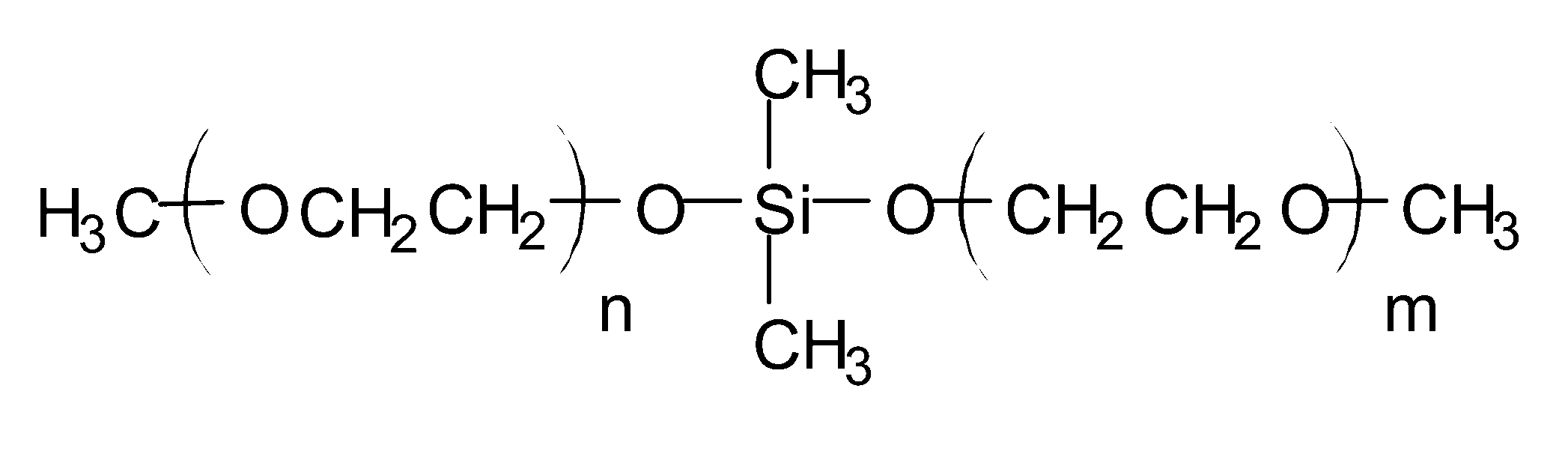
上記第1視点の好ましい形態によれば、ポリエーテル変性シリコーンワックスは、ビスPEG-18メチルエーテルジメチルシランを含む。
上記第1視点の好ましい形態によれば、油性成分は、エステル油及び不揮発性シリコーン油のうちの少なくとも1つを含む。
上記第1視点の好ましい形態によれば、油性成分は紫外線吸収剤を含む。
上記第1視点の好ましい形態によれば、油性成分中の揮発性油性成分の割合は、油性成分の質量に対して48質量%~74質量%である。揮発性油性成分の含有率は、油性化粧料の質量に対して28質量%~46質量%である。
上記第2視点の好ましい形態によれば、第1の油性成分は紫外線吸収剤を含む。
上記第2視点の好ましい形態によれば、第1の油性成分は、4-メトキシケイ皮酸2-エチルヘキシル、オクトクリレン、ジエチルアミノヒドロキシ安息香酸ヘキシル、t-ブチルメトキシジベンゾイルメタン、エチルヘキシルトリアゾン、及びビスエチルヘキシルオキシフェノールメトキシフェニルトリアジンからなる群から選択される少なくとも1つを含む。
上記第2視点の好ましい形態によれば、第2の油性成分は揮発性油性成分を含む。
上記第2視点の好ましい形態によれば、揮発性油分はシリコーン油を含む。
上記第2視点の好ましい形態によれば、ポリエーテル変性シリコーンワックスは、下記化2で表される化合物を含む。
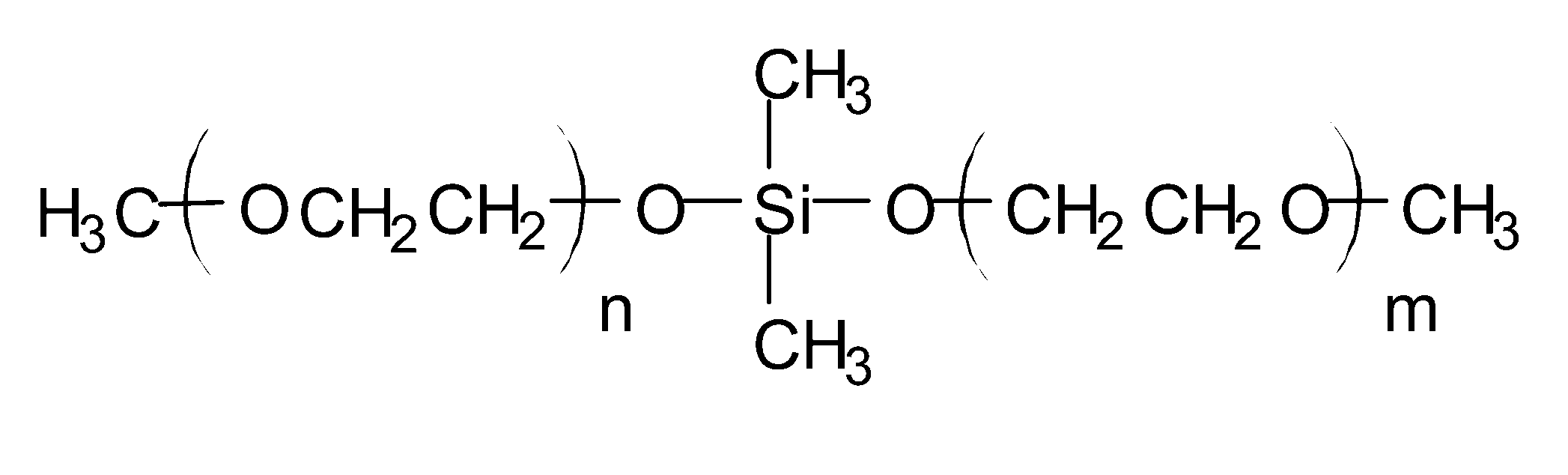
上記第2視点の好ましい形態によれば、ポリエーテル変性シリコーンワックスは、ビスPEG-18メチルエーテルジメチルシランを含む。
本開示の第1実施形態に係る油性化粧料について説明する。油性化粧料は、ポリエーテル変性シリコーンワックスと、油性成分と、を含有する。
[ポリエーテル変性シリコーンワックス]
ポリエーテル変性シリコーンワックスとしては、例えば、ポリオキシエチレン変性シリコーンワックスを使用することができる。ポリオキシエチレン変性シリコーンワックスとしては、例えば、下記化3で表される化合物を使用することができる。
ポリエーテル変性シリコーンワックスとしては、例えば、ポリオキシエチレン変性シリコーンワックスを使用することができる。ポリオキシエチレン変性シリコーンワックスとしては、例えば、下記化3で表される化合物を使用することができる。
ポリオキシエチレン変性シリコーンワックス、特に下記化3で表される化合物、を使用すると、水に対する濡れ性を高めることができる。これによって、肌に塗布した化粧上に玉状の汗が形成されることを抑制することができる。すなわち、表面積が大きくなるように化粧面(肌面)に沿って汗を薄く拡げることができる。
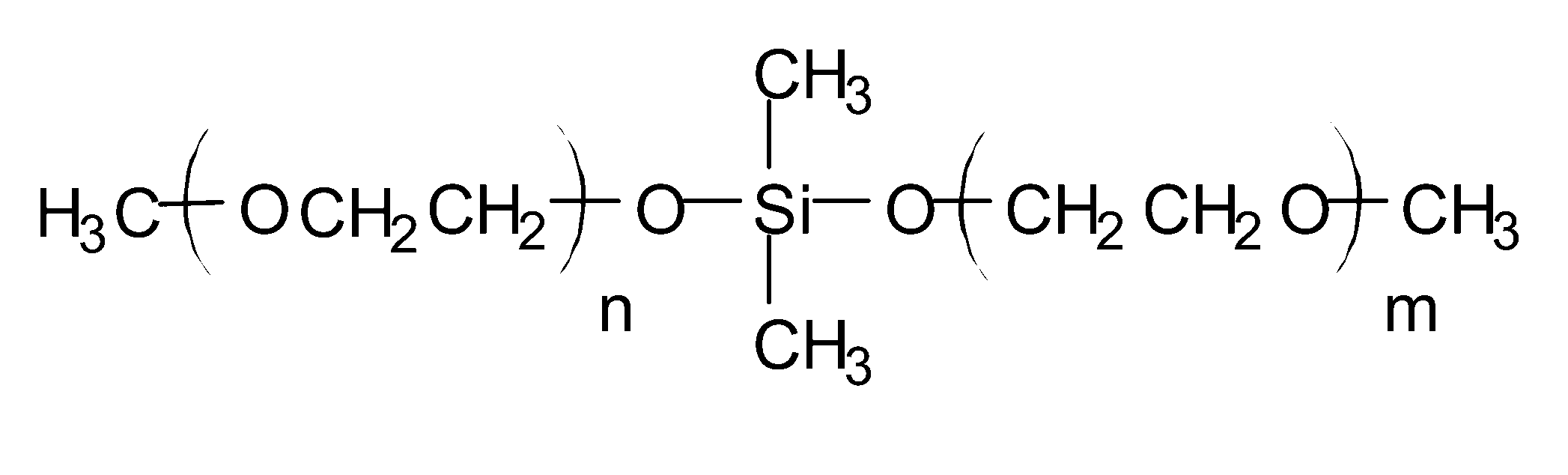
上記化3におけるm及びnは、独立して10~24の整数とすることができる。mとnは、異なる数であってもよいし、同じ数であってもよい。シリコーンワックスとしては、例えば、m及びnがそれぞれ平均18であるビスPEG-18メチルエーテルジメチルシランを使用することができる。ビスPEG-18メチルエーテルジメチルシランの市販品としては、例えば、Dow Corning(登録商標)2501 Cosmetic Wax(東レ・ダウコーニング社)が挙げられる。
シリコーンワックスの含有率は、油性化粧料の質量に対して、4質量%以上であると好ましく、5質量%以上であるとより好ましい。シリコーンワックスの含有率が4質量%未満であると、汗に対して濡れ性を高める効果を十分に発揮することができない。汗の速乾性をより高めたい場合には、シリコーンワックスの含有率は、油性化粧料の質量に対して、7質量%以上であると好ましく、10質量%以上であるとより好ましく、13質量%以上であるとより好ましく、15質量%以上であるとより好ましく、17質量%以上であるとさらに好ましい。シリコーンワックスの含有率は、油性化粧料の質量に対して、22質量%以下であると好ましく、20質量%以下であるとより好ましい。シリコーンワックスの含有率が22質量%を超えると、化粧崩れしやすくなってしまう。化粧崩れをより抑制したい場合には、シリコーンワックスの含有率は、油性化粧料の質量に対して、18質量%以下であると好ましく、15質量%以下であるとより好ましく、13質量%以下であるとより好ましく、10質量%以下であるとより好ましく、8質量%以下であるとさらに好ましい。
[油性成分]
本開示の油性化粧料に用いられる油性成分としては、皮膚外用剤や化粧品に一般に用いられ得るものを用いることができる。具体的には、液体油脂、固体油脂、ロウ、炭化水素、高級脂肪酸、高級アルコール、合成エステル油、シリコーン油等が挙げられる。なお、本書では、油分及び油分に可溶な成分も含めて「油性成分」と称している。
本開示の油性化粧料に用いられる油性成分としては、皮膚外用剤や化粧品に一般に用いられ得るものを用いることができる。具体的には、液体油脂、固体油脂、ロウ、炭化水素、高級脂肪酸、高級アルコール、合成エステル油、シリコーン油等が挙げられる。なお、本書では、油分及び油分に可溶な成分も含めて「油性成分」と称している。
油性成分は、揮発性油性成分を含有する。本開示において「揮発性」とは、肌に塗布したときに、室温、外気温又は体温で容易に揮発可能であることをいう。揮発性油性成分としては、シリコーン油、炭化水素油等を使用することができる。揮発性シリコーン油としては、例えば、ジメチルポリシロキサン構造を有するシリコーン油を使用することができる。揮発性炭化水素油としては、例えば、イソドデカン、イソヘキサデカン、イソデカン等を挙げることができる。
油性化粧料が肌に塗布されると、油性化粧料中の揮発性油性成分の大部分は揮発する。揮発性油性成分が揮発すると揮発性油性成分が存在していた部分は空隙となり、汗の通り道になると考えられる。そこで、汗が油性化粧料上に拡散しやすくするために、揮発性油性成分の含有率は、油性化粧料の質量に対して、25質量%以上であると好ましく、28質量%以上であるとより好ましく、30質量%以上であるとさらに好ましい。揮発性油性成分が25質量%未満であると、速乾性及び化粧もちが低下してしまうと共に、使用性も低下してしまう。揮発性油性成分の含有率は、油性化粧料の質量に対して、35質量%以上、40質量%以上、又は45質量%以上とすることもできる。揮発性油性成分の含有率は、油性化粧料の質量に対して、少なくとも50質量%以下であれば十分な速乾性及び化粧もちを維持することができる。速乾性及び化粧もちに加えて、使用性を確保するためには、揮発性油性成分の含有率は、油性化粧料の質量に対して、48質量%以下であると好ましく、46質量%以下であるとより好ましく、44質量%以下であるとより好ましく、42質量%以下であるとさらに好ましい。揮発性油性成分が48質量%を超えると、肌への塗布時に乾燥が遅くなって使用性が低下してしまう。揮発性油性成分の含有率は、油性化粧料の質量に対して、40質量%以下、35質量%以下、又は30質量%以下とすることもできる。
速乾性及び化粧もちを確保するためには、油性成分中の揮発性油性成分は、全油性成分の質量に対して、46質量%以上であると好ましく、48質量%以上であるとより好ましく、50質量%以上であるとより好ましく、52質量%以上であるとより好ましく、54質量%以上であるとさらに好ましい。油性成分中の揮発性油性成分は、所望の配合に応じて、油性成分の質量に対して、80質量%以下、75質量%以下、又は70質量%以下とすることができる。
速乾性及び化粧もちに加えて使用性を高めるためには、油性成分中の揮発性油性成分は、全油性成分の質量に対して、46質量%以上であると好ましく、48質量%以上であるとより好ましく、50質量%以上であるとより好ましく、52質量%以上であるとより好ましく、54質量%以上であるとさらに好ましい。油性成分中の揮発性油性成分は、全油性成分の質量に対して、74質量%以下であると好ましく、72質量%以下であるとより好ましく、70質量%以下であるとより好ましく、68質量%以下であるとより好ましく、66質量%以下であるとさらに好ましい。
油性化粧料は不揮発性油性成分を含有することができる。
本開示の油性化粧料は紫外線吸収剤を含有すると好ましい。紫外線吸収剤は、以下で例に挙げた化合物のうち、ベンゼン骨格を有する紫外線吸収剤であると好ましい。このような紫外線吸収剤を用いることによって、親水性のシリコーンワックスを油性化粧料中に均一に分散させることができる。紫外線吸収剤、例えば、4-メトキシケイ皮酸2-エチルヘキシル、オクトクリレン、ジエチルアミノヒドロキシ安息香酸ヘキシル、t-ブチルメトキシジベンゾイルメタン、エチルヘキシルトリアゾン、及びビスエチルヘキシルオキシフェノールメトキシフェニルトリアジンからなる群から選択される少なくとも1つであると好ましい。
液体油脂としては、例えば、アボガド油、ツバキ油、タートル油、マカデミアナッツ油、トウモロコシ油、ミンク油、オリーブ油、ナタネ油、卵黄油、ゴマ油、パーシック油、小麦胚芽油、サザンカ油、ヒマシ油、アマニ油、サフラワー油、綿実油、エノ油、大豆油、落花生油、茶実油、カヤ油、コメヌカ油、シナギリ油、日本キリ油、ホホバ油、胚芽油、トリグリセリン等が挙げられる。
固体油脂としては、例えば、カカオ脂、ヤシ油、馬脂、硬化ヤシ油、パーム油、牛脂、羊脂、硬化牛脂、パーム核油、豚脂、牛骨脂、モクロウ核油、硬化油、牛脚脂、モクロウ、硬化ヒマシ油等が挙げられる。
ロウ類としては、例えば、ミツロウ、カンデリラロウ、綿ロウ、カルナウバロウ、ベイベリーロウ、イボタロウ、鯨ロウ、モンタンロウ、ヌカロウ、ラノリン、カポックロウ、酢酸ラノリン、液状ラノリン、サトウキビロウ、ラノリン脂肪酸イソプロピル、ラウリン酸ヘキシル、還元ラノリン、ジョジョバロウ、硬質ラノリン、セラックロウ、POEラノリンアルコールエーテル、POEラノリンアルコールアセテート、POEコレステロールエーテル、ラノリン脂肪酸ポリエチレングリコール、POE水素添加ラノリンアルコールエーテル等が挙げられる。
炭化水素油としては、例えば、流動パラフィン、オゾケライト、スクワラン、プリスタン、パラフィン、セレシン、スクワレン、ワセリン、マイクロクリスタリンワックス等が挙げられる。
高級脂肪酸としては、例えば、ラウリン酸、ミリスチン酸、パルミチン酸、ステアリン酸、ベヘン酸、オレイン酸、ウンデシレン酸、トール酸、イソステアリン酸、リノール酸、リノレイン酸、エイコサペンタエン酸(EPA)、ドコサヘキサエン酸(DHA)等が挙げられる。
高級アルコールとしては、例えば、直鎖アルコール(例えば、ラウリルアルコール、セチルアルコール、ステアリルアルコール、ベヘニルアルコール、ミリスチルアルコール、オレイルアルコール、セトステアリルアルコール等);分枝鎖アルコール(例えば、モノステアリルグリセリンエーテル(バチルアルコール)、2-デシルテトラデシノール、ラノリンアルコール、コレステロール、フィトステロール、ヘキシルドデカノール、イソステアリルアルコール、オクチルドデカノール等)等が挙げられる。
合成エステル油としては、ミリスチン酸イソプロピル、オクタン酸セチル、ミリスチン酸オクチルドデシル、パルミチン酸イソプロピル、ステアリン酸ブチル、ラウリン酸ヘキシル、ミリスチン酸ミリスチル、オレイン酸デシル、ジメチルオクタン酸ヘキシルデシル、乳酸セチル、乳酸ミリスチル、酢酸ラノリン、ステアリン酸イソセチル、イソステアリン酸イソセチル、12-ヒドロキシステアリン酸コレステリル、ジ-2-エチルヘキサン酸エチレングリコール、ジペンタエリスリトール脂肪酸エステル、モノイソステアリン酸N-アルキルグリコール、ジカプリン酸ネオペンチルグリコール、リンゴ酸ジイソステアリル、ジ-2-ヘプチルウンデカン酸グリセリン、トリ-2-エチルヘキサン酸トリメチロールプロパン、トリイソステアリン酸トリメチロールプロパン、テトラ-2-エチルヘキサン酸ペンタエリスリトール、トリ-2-エチルヘキサン酸グリセリン、トリオクタン酸グリセリン、トリイソパルミチン酸グリセリン、トリイソステアリン酸トリメチロールプロパン、セチル2-エチルヘキサノエート、2-エチルヘキシルパルミテート、トリミリスチン酸グリセリン、トリ-2-ヘプチルウンデカン酸グリセライド、ヒマシ油脂肪酸メチルエステル、オレイン酸オレイル、アセトグリセライド、パルミチン酸2-ヘプチルウンデシル、アジピン酸ジイソブチル、N-ラウロイル-L-グルタミン酸-2-オクチルドデシルエステル、アジピン酸ジ-2-ヘプチルウンデシル、エチルラウレート、セバシン酸ジ-2-エチルヘキシル、ミリスチン酸2-ヘキシルデシル、パルミチン酸2-ヘキシルデシル、アジピン酸2-ヘキシルデシル、セバシン酸ジイソプロピル、コハク酸2-エチルヘキシル、クエン酸トリエチル等が挙げられる。
シリコーン油としては、ジメチルポリシロキサン、メチルハイドロジェンポリシロキサン、メチルフェニルポリシロキサン、ステアロキシメチルポリシロキサン、ポリエーテル変性オルガノポリシロキサン、フルオロアルキル・ポリオキシアルキレン共変性オルガノポリシロキサン、アルキル変性オルガノポリシロキサン、未末端変性オルガノポリシロキサン、フッ素変性オルガノポリシロキサン、アミノ変性オルガノポリシロキサン、シリコーンゲル、アクリルシリコーン、トリメチルシロキシケイ酸、シリコーンRTVゴム等のシリコーン化合物等が挙げられる。
紫外線吸収剤としては、例えば、安息香酸系紫外線吸収剤(例えば、パラアミノ安息香酸(以下、PABAと略す)、PABAモノグリセリンエステル、N,N-ジプロポキシPABAエチルエステル、N,N-ジエトキシPABAエチルエステル、N,N-ジメチルPABAエチルエステル、N,N-ジメチルPABAブチルエステル、N,N-ジメチルPABAエチルエステル等);アントラニル酸系紫外線吸収剤(例えば、ホモメンチル-N-アセチルアントラニレート等);サリチル酸系紫外線吸収剤(例えば、アミルサリシレート、メンチルサリシレート、ホモメンチルサリシレート、オクチルサリシレート、フェニルサリシレート、ベンジルサリシレート、p-イソプロパノールフェニルサリシレート等);桂皮酸系紫外線吸収剤(例えば、オクチルメトキシシンナメート、エチル-4-イソプロピルシンナメート、メチル-2,5-ジイソプロピルシンナメート、エチル-2,4-ジイソプロピルシンナメート、メチル-2,4-ジイソプロピルシンナメート、プロピル-p-メトキシシンナメート、イソプロピル-p-メトキシシンナメート、イソアミル-p-メトキシシンナメート、オクチル-p-メトキシシンナメート(2-エチルヘキシル-p-メトキシシンナメート)、2-エトキシエチル-p-メトキシシンナメート、シクロヘキシル-p-メトキシシンナメート、エチル-α-シアノ-β-フェニルシンナメート、2-エチルヘキシル-α-シアノ-β-フェニルシンナメート、グリセリルモノ-2-エチルヘキサノイル-ジパラメトキシシンナメート等);ベンゾフェノン系紫外線吸収剤(例えば、2,4-ジヒドロキシベンゾフェノン、2,2’-ジヒドロキシ-4-メトキシベンゾフェノン、2,2’-ジヒドロキシ-4,4’-ジメトキシベンゾフェノン、2,2’,4,4’-テトラヒドロキシベンゾフェノン、2-ヒドロキシ-4-メトキシベンゾフェノン、2-ヒドロキシ-4-メトキシ-4’-メチルベンゾフェノン、2-ヒドロキシ-4-メトキシベンゾフェノン-5-スルホン酸塩、4-フェニルベンゾフェノン、2-エチルヘキシル-4’-フェニル-ベンゾフェノン-2-カルボキシレート、2-ヒドロキシ-4-n-オクトキシベンゾフェノン、4-ヒドロキシ-3-カルボキシベンゾフェノン等);3-(4’-メチルベンジリデン)-d,l-カンファー、3-ベンジリデン-d,l-カンファー;2-フェニル-5-メチルベンゾキサゾール;2,2’-ヒドロキシ-5-メチルフェニルベンゾトリアゾール;2-(2’-ヒドロキシ-5’-t-オクチルフェニル) ベンゾトリアゾール;2-(2’-ヒドロキシ-5’-メチルフェニルベンゾトリアゾール;ジベンザラジン;ジアニソイルメタン;4-メトキシ-4’-t-ブチルジベンゾイルメタン;5-(3,3-ジメチル-2-ノルボルニリデン)-3-ペンタン-2-オン、ジモルホリノピリダジノ;2-エチルヘキシル-2-シアノ-3,3-ジフェニルアクリレート;2,4-ビス-{[4-(2-エチルヘキシルオキシ)-2-ヒドロキシ]-フェニル}-6-(4-メトキシフェニル)-(1,3,5)-トリアジン等が挙げられる。
全油性成分の含有率は、油性化粧料の質量に対して、40質量%以上であると好ましい。全油性成分が40質量%以上であれば、油性化粧料の速乾性及び化粧持ちを維持することができる。全油性成分の含有率は、油性化粧料の質量に対して、45質量%以上、50質量%以上、55質量%以上、60質量%以上、又は65質量%以上とすることもできる。全油性成分の含有率は、油性化粧料の質量に対して、80質量%以下であると好ましく、75質量%以下であるとより好ましく、70質量%以下であるとさらに好ましい。油性成分の含有率が少なくとも80質量%以下であれば、油性化粧料の速乾性及び化粧持ちを維持することができる。全油性成分の含有率は、油性化粧料の質量に対して、65質量%以下、60質量%以下、又は55質量%以下とすることもできる。
[粉末]
本開示の油性化粧料は、粉末をさらに含有することができる。本明細書において使用する用語「粉末」は「粉体」と同義である。粉体は、化粧料用途等、一般に用い得るものであれば特に限定されるものではない。粉体としては、例えば、タルク、カオリン、絹雲母(セリサイト)、白雲母、金雲母、合成雲母、合成フッ素金雲母、合成フッ素金雲母鉄、紅雲母、黒雲母、焼成タルク、焼成セリサイト、焼成白雲母、焼成金雲母、パーミキュライト、炭酸マグネシウム、炭酸カルシウム、ケイ酸アルミニウム、ケイ酸バリウム、ケイ酸カルシウム、ケイ酸マグネシウム、ケイ酸ストロンチウム、タングステン酸金属塩、マグネシウム、シリカ、ゼオライト、硫酸バリウム、焼成硫酸カルシウム(焼セッコウ)、リン酸カルシウム、弗素アパタイト、ヒドロキシアパタイト、セラミックパウダー、金属石鹸(例えば、ミリスチン酸亜鉛、パルミチン酸カルシウム、ステアリン酸アルミニウムなど)、窒化ホウ素、フォトクロミック性酸化チタン(酸化鉄を焼結した二酸化チタン、)、還元亜鉛華;有機粉末(例えば、シリコーンエラストマー粉末、シリコーン粉末、シリコーンレジン被覆シリコーンエラストマー粉末、ポリアミド樹脂粉末(ナイロン粉末)、ポリエチレン粉末、ポリスチレン粉末、スチレンとアクリル酸の共重合体樹脂粉末、ベンゾグアナミン樹脂粉末、ポリ四弗化エチレン粉末、セルロース粉末等);無機白色顔料(例えば、二酸化チタン、酸化亜鉛等);無機赤色系顔料(例えば、酸化鉄(ベンガラ)、チタン酸鉄等);無機褐色系顔料(例えば、γ-酸化鉄等);無機黄色系顔料(例えば、黄酸化鉄、黄土等);無機黒色系顔料(例えば、黒酸化鉄、低次酸化チタン等);無機紫色系顔料(例えば、マンゴバイオレット、コバルトバイオレット等);無機緑色系顔料(例えば、酸化クロム、水酸化クロム、チタン酸コバルト等);無機青色系顔料(例えば、群青、紺青等);パール顔料(例えば、オキシ塩化ビスマス、魚鱗箔、雲母チタン、酸化鉄被覆雲母チタン、低次酸化チタン被覆雲母チタン、フォトクロミック性を有する雲母チタン、基板として雲母の代わりタルク、ガラス、合成フッ素金雲母、シリカ、オキシ塩化ビスマスなどを使用したもの、被覆物として酸化チタン以外に、低次性酸化チタン、着色酸化チタン、酸化鉄、アルミナ、シリカ、ジルコニア、酸化亜鉛、酸化コバルト、アルミなどを被覆したもの、機能性パール顔料(パール顔料表面に樹脂粒子、水酸化アルミニウム粒子、酸化亜鉛粒子、硫酸バリウム粒子等を被覆したもの)等);金属粉末顔料(例えば、アルミニウムパウダー、カッパーパウダー等);ジルコニウム、バリウム又はアルミニウムレーキ等の有機顔料(例えば、赤色201号、赤色202号、赤色204号、赤色205号、赤色220号、赤色226号、赤色228号、赤色405号、橙色203号、橙色204号、黄色205号、黄色401号、及び青色404号などの有機顔料、赤色3号、赤色104号、赤色106号、赤色227号、赤色230号、赤色401号、赤色505号、橙色205号、黄色4号、黄色5号、黄色202号、黄色203号、緑色3号及び青色1号等);天然色素(例えば、クロロフィル、β-カロチン等)等が挙げられる。
本開示の油性化粧料は、粉末をさらに含有することができる。本明細書において使用する用語「粉末」は「粉体」と同義である。粉体は、化粧料用途等、一般に用い得るものであれば特に限定されるものではない。粉体としては、例えば、タルク、カオリン、絹雲母(セリサイト)、白雲母、金雲母、合成雲母、合成フッ素金雲母、合成フッ素金雲母鉄、紅雲母、黒雲母、焼成タルク、焼成セリサイト、焼成白雲母、焼成金雲母、パーミキュライト、炭酸マグネシウム、炭酸カルシウム、ケイ酸アルミニウム、ケイ酸バリウム、ケイ酸カルシウム、ケイ酸マグネシウム、ケイ酸ストロンチウム、タングステン酸金属塩、マグネシウム、シリカ、ゼオライト、硫酸バリウム、焼成硫酸カルシウム(焼セッコウ)、リン酸カルシウム、弗素アパタイト、ヒドロキシアパタイト、セラミックパウダー、金属石鹸(例えば、ミリスチン酸亜鉛、パルミチン酸カルシウム、ステアリン酸アルミニウムなど)、窒化ホウ素、フォトクロミック性酸化チタン(酸化鉄を焼結した二酸化チタン、)、還元亜鉛華;有機粉末(例えば、シリコーンエラストマー粉末、シリコーン粉末、シリコーンレジン被覆シリコーンエラストマー粉末、ポリアミド樹脂粉末(ナイロン粉末)、ポリエチレン粉末、ポリスチレン粉末、スチレンとアクリル酸の共重合体樹脂粉末、ベンゾグアナミン樹脂粉末、ポリ四弗化エチレン粉末、セルロース粉末等);無機白色顔料(例えば、二酸化チタン、酸化亜鉛等);無機赤色系顔料(例えば、酸化鉄(ベンガラ)、チタン酸鉄等);無機褐色系顔料(例えば、γ-酸化鉄等);無機黄色系顔料(例えば、黄酸化鉄、黄土等);無機黒色系顔料(例えば、黒酸化鉄、低次酸化チタン等);無機紫色系顔料(例えば、マンゴバイオレット、コバルトバイオレット等);無機緑色系顔料(例えば、酸化クロム、水酸化クロム、チタン酸コバルト等);無機青色系顔料(例えば、群青、紺青等);パール顔料(例えば、オキシ塩化ビスマス、魚鱗箔、雲母チタン、酸化鉄被覆雲母チタン、低次酸化チタン被覆雲母チタン、フォトクロミック性を有する雲母チタン、基板として雲母の代わりタルク、ガラス、合成フッ素金雲母、シリカ、オキシ塩化ビスマスなどを使用したもの、被覆物として酸化チタン以外に、低次性酸化チタン、着色酸化チタン、酸化鉄、アルミナ、シリカ、ジルコニア、酸化亜鉛、酸化コバルト、アルミなどを被覆したもの、機能性パール顔料(パール顔料表面に樹脂粒子、水酸化アルミニウム粒子、酸化亜鉛粒子、硫酸バリウム粒子等を被覆したもの)等);金属粉末顔料(例えば、アルミニウムパウダー、カッパーパウダー等);ジルコニウム、バリウム又はアルミニウムレーキ等の有機顔料(例えば、赤色201号、赤色202号、赤色204号、赤色205号、赤色220号、赤色226号、赤色228号、赤色405号、橙色203号、橙色204号、黄色205号、黄色401号、及び青色404号などの有機顔料、赤色3号、赤色104号、赤色106号、赤色227号、赤色230号、赤色401号、赤色505号、橙色205号、黄色4号、黄色5号、黄色202号、黄色203号、緑色3号及び青色1号等);天然色素(例えば、クロロフィル、β-カロチン等)等が挙げられる。
粉末の平均粒径、比表面積、比重、粒子形状、多孔質又は非多孔質、親水性又は疎水性、表面処理の有無等は、目的に応じて適宜選択することができる。例えば、粉末の親油性や吸油性を高めるために、粒子表面を疎水化処理した粉末(吸油性粉末)を使用することができる。粉体は、異なる種類の混合物であってもよい。
粉体の含有率は、油性化粧料の目的に応じて適宜設定することができる。粉体の含有率は、例えば、油性化粧料の質量に対して、5質量%以上、10質量%以上、又は20質量%以上とすることができる。粉体の含有率は、例えば、油性化粧料の質量に対して、45質量%以下、40質量%以下、又は35質量%以下とすることができる。
[水相]
本開示の油性化粧料は、水をさらに含有することができる。汗による化粧崩れを抑制するため、水の含有率は低いと好ましく、油性化粧料の質量に対して、10質量%以下であると好ましく、5質量%以下であるとより好ましく、3質量%以下であるとさらに好ましい。油性化粧料は、水を実質的に含有しないと好ましい。
本開示の油性化粧料は、水をさらに含有することができる。汗による化粧崩れを抑制するため、水の含有率は低いと好ましく、油性化粧料の質量に対して、10質量%以下であると好ましく、5質量%以下であるとより好ましく、3質量%以下であるとさらに好ましい。油性化粧料は、水を実質的に含有しないと好ましい。
[その他の成分]
本開示の組成物は、本発明の効果を阻害しない範囲において、他の成分、例えば、アルコール、糖類、エステル、アニオン性界面活性剤、カチオン性界面活性剤、両性界面活性剤、非イオン性界面活性剤、増粘剤、保湿剤、水溶性高分子、皮膜剤、紫外線吸収剤、金属イオン封鎖剤、アミノ酸、有機アミン、高分子エマルジョン、pH調整剤、皮膚栄養剤、ビタミン、酸化防止剤、酸化防止助剤、香料等を必要に応じて適宜含有することができる。
本開示の組成物は、本発明の効果を阻害しない範囲において、他の成分、例えば、アルコール、糖類、エステル、アニオン性界面活性剤、カチオン性界面活性剤、両性界面活性剤、非イオン性界面活性剤、増粘剤、保湿剤、水溶性高分子、皮膜剤、紫外線吸収剤、金属イオン封鎖剤、アミノ酸、有機アミン、高分子エマルジョン、pH調整剤、皮膚栄養剤、ビタミン、酸化防止剤、酸化防止助剤、香料等を必要に応じて適宜含有することができる。
本開示の油性化粧料は、塗布した領域に汗をかいても汗が玉状になることを抑制することができる。油性化粧料を塗布した領域の濡れ性が高まるため、汗が拡散し、汗の乾燥を促進させることができる。これにより、汗の拭き取りを要しないので、拭き取りによる化粧崩れを抑制することができる。さらに、汗の垂れ落ちも抑制することができるので、汗の垂れ落ちによる化粧崩れも抑制することができる。玉状の汗を浮き上がらせないことによって美的外観を高めることができる。
さらに、本開示の化粧料によれば、油性化粧料を肌に塗布しているときのぬるつきを抑制することもできる。
油性化粧料にメーキャップ成分も配合することにより、メーキャップ自体が汗拡散機能を有することができる。
本開示の油性化粧料は、肌への塗布時にとまりが速い。したがって、使用者は、塗布時間を短縮することができると共に、心地よい使用感を得ることができる。
本開示の油性化粧料について、油性化粧料の組成又は特性により直接特定することが不可能であるか、又はおよそ実際的でない場合が生じる可能性があり得る。この場合には、後述の製造方法や使用方法によって本開示の油性化粧料を特定することが有用である。
第2実施形態として、本開示の第1実施形態に係る油性化粧料の製造方法について説明する。図1に、油性化粧料の製造方法の概略工程図を示す。
まず、親水性シリコーンワックスを第1の油性成分に溶解させる(S1;溶解工程)。親水性シリコーンワックスは上述のシリコーンワックスである。第1の油性成分としては、液状紫外線吸収剤を用いることができる。紫外線吸収剤としては、例えば、ベンゼン骨格を含む紫外線吸収剤を用いることができる。具体的には、例えば、4-メトキシケイ皮酸2-エチルヘキシル、オクトクリレン、ジエチルアミノヒドロキシ安息香酸ヘキシル、t-ブチルメトキシジベンゾイルメタン、エチルヘキシルトリアゾン、ビスエチルヘキシルオキシフェノールメトキシフェニルトリアジン等を挙げることができる。シリコーンワックスは、加熱した溶媒に添加して溶解させると好ましい。
溶解工程におけるシリコーンワックスの添加率は、シリコーンワックスと第1の油性成分との合計質量に対して、5質量%以上、好ましくは10質量%以上とすることができる。溶解工程におけるシリコーンワックスの添加率は、シリコーンワックスと第1の油性成分との合計質量に対して、80質量%以下であると好ましく、75質量%以下であるとより好ましく、70質量%以下であるとさらに好ましい。シリコーンワックスが80質量%を超えると、不溶解のシリコーンワックスが多くなってしまう。
次に、シリコーンワックスを溶解させた溶液を他の油性成分を含む第2の油性成分と混合する(S2;混合工程)。油性化粧料に粉末を含有させる場合には、油性成分に粉末を添加する。各成分の配合割合は、上述の第1実施形態と同様にすることができる。これにより、油性化粧料を製造することができる。
本開示の油性化粧料の製造方法によれば、油性化粧料に水性溶媒が含まれない場合であっても、親水性のシリコーンワックスを含有する油性化粧料を作製することができる。また、油性化粧料中に親水性シリコーンワックスを均一に分散させることができる。
本開示の油性化粧料及びその製造方法について、以下に例を挙げて説明する。しかしながら、本開示の油性化粧料及びその製造方法は以下の例に限定されるものではない。各表に示す含有率の単位は質量%である。
[試験例1~4]
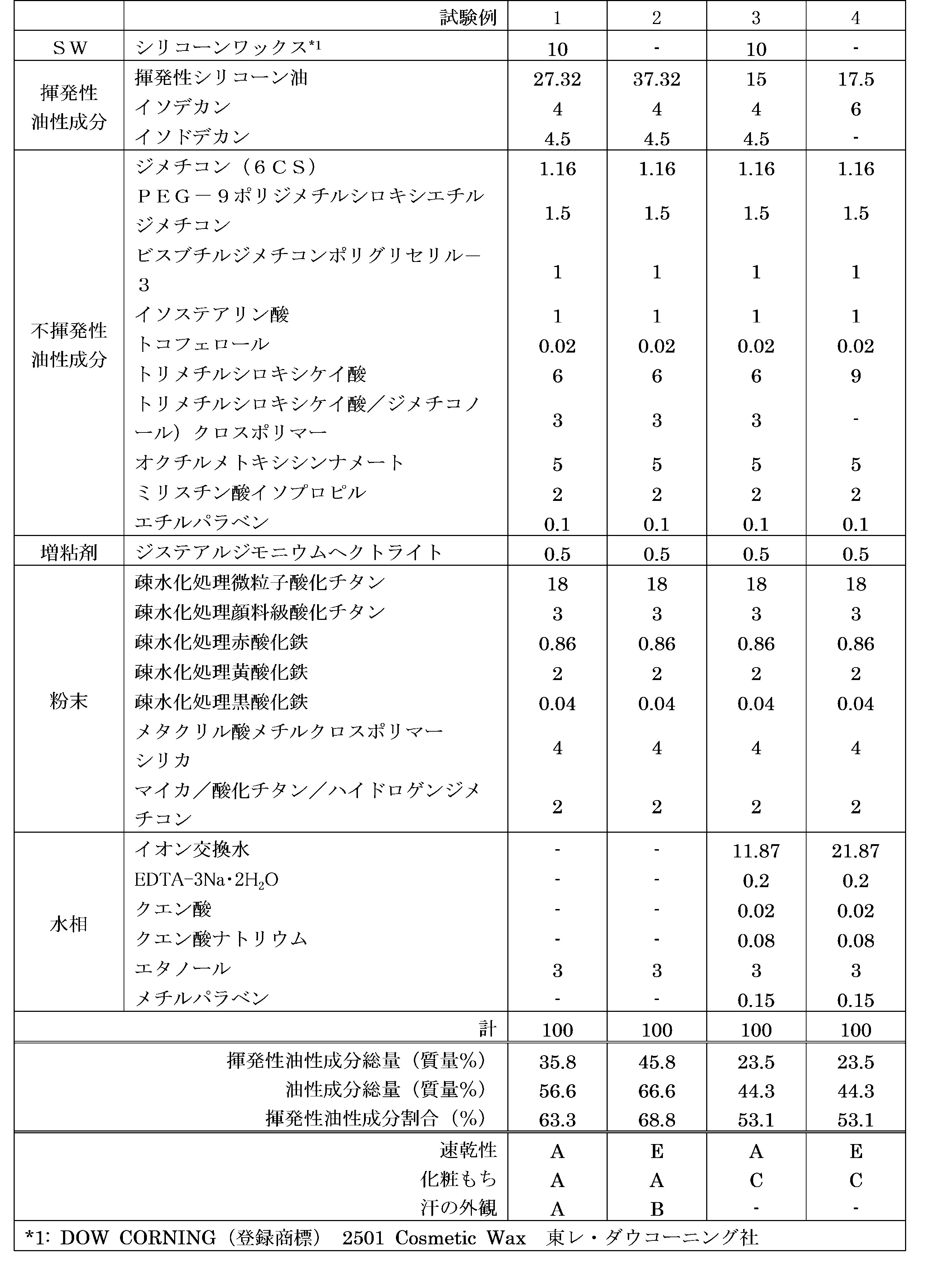
試験例1及び2においては油性化粧料を作製した。試験例3及び4においては水性化粧料を作製した。試験例1及び3の化粧料にはシリコーンワックスを配合した。作製した各化粧料について、速乾性及び化粧持ち(化粧の持続性)について試験した。表1に、化粧料の組成及び結果を示す。以下の表において、「揮発性油性成分割合」とは、油性成分全体における揮発性油性成分の割合を示す。
試験例1及び2においては油性化粧料を作製した。試験例3及び4においては水性化粧料を作製した。試験例1及び3の化粧料にはシリコーンワックスを配合した。作製した各化粧料について、速乾性及び化粧持ち(化粧の持続性)について試験した。表1に、化粧料の組成及び結果を示す。以下の表において、「揮発性油性成分割合」とは、油性成分全体における揮発性油性成分の割合を示す。
試験例1及び3においては、まず、シリコーンワックスをオクチルメトキシシンナメート(4-メトキシ-ケイ皮酸2-エチルヘキシル)に加熱しながら溶解させた。次に、このシリコーンワックスの溶液を他の油性成分に添加して撹拌した。次に、粉末を混合物に添加した。これにより、油性成分中にシリコーンワックスが均一に分散した油性化粧料を作製することができた。試験例3及び4においては、水相は油相中に乳化させた。
[速乾性]
5センチメートル角のポリメタクリル酸メチル樹脂板に化粧料を2μL/cm2の塗布量で塗布した。化粧料を塗布した樹脂板は、37℃で5分間静置して乾燥させた。次に、化粧料を塗布した面の中央付近に、イオン交換水を1滴(40μL)滴下した。滴下後、室温で30分間放置し、滴下した水の乾燥状態を以下の基準で評価した(C以上で合格)。なお、イオン交換水には水溶性の青色染料を微量添加しており、水が乾燥した後においても化粧面での水の拡散状態(濡れ状態)を確認することができるように設計した。
A:水は最も広く拡散し、完全に乾燥していた。
B:水は広く拡散し、完全に乾燥していた。
C:水はやや拡散し、若干の水が残存していた。
D:水は若干拡散していたが、滴下した水は残存していた。
E:水は拡散せず、滴下したほとんどの水が残存していた。
[化粧もち(化粧の持続性)]
10名の化粧品専門パネルに化粧料を肌に塗布してもらい、専門パネルにランニングをさせて汗をかかせた後に、専門評価者3名が、「ヨレ評価」及び「テカリ評価」の評価項目について下記の評価基準に基づき10段階評価した。(化粧持ちが非常に悪い:0点、化粧持ちが非常に良い:10点)。評価平均値を算出して下記の通りに評価付けを行った。
A:評価の平均点が8点以上
B:評価の平均点が6~7点
C:評価の平均点が4~5点
D:評価の平均点が3点未満
10名の化粧品専門パネルに化粧料を肌に塗布してもらい、専門パネルにランニングをさせて汗をかかせた後に、専門評価者3名が、「ヨレ評価」及び「テカリ評価」の評価項目について下記の評価基準に基づき10段階評価した。(化粧持ちが非常に悪い:0点、化粧持ちが非常に良い:10点)。評価平均値を算出して下記の通りに評価付けを行った。
A:評価の平均点が8点以上
B:評価の平均点が6~7点
C:評価の平均点が4~5点
D:評価の平均点が3点未満
シリコーンワックスを配合した試験例1及び3の化粧料を塗布した樹脂板においては、水は乾燥していた。一方、シリコーンワックスを配合していない試験例2及び4の化粧料を塗布した樹脂板においては、水は残存していた。試験例1及び3においては、シリコーンワックスによって濡れ性が高められ、水の表面積が大きくなって乾燥が促進したものと考えられる。
そこで、試験例1及び2の化粧料を実際に被験者の顔に塗布した状態で被験者にランニングをさせて汗をかかせて、化粧料上の汗の状態を観察し、下記の評価基準に基づき汗の外観を評価した。図2及び図3に、汗をかいた状態の被験者の顔の写真を示す。写真の左側(被験者の顔の右側)に試験例1に係る化粧料を塗布し、写真の右側(被験者の顔の左側)に試験例2に係る化粧料を塗布した。
[汗の外観(形状)]
A:水滴が玉状に見えない
B:水滴が玉状に見える
[汗の外観(形状)]
A:水滴が玉状に見えない
B:水滴が玉状に見える
シリコーンワックスを含有する試験例1の化粧料を塗布した肌においては、図2及び図3の左側部分に示すように、玉状の汗は観察されなかった。一方、シリコーンワックスを含有しない試験例2の化粧料を塗布した肌においては、図2及び図3の右側部分の丸印に示すように、通常汗をかいたときのように玉状の汗が観察された。これより、シリコーンワックスを化粧料に配合することによって、皮膚上であっても塗布面の濡れ性を高めて、汗の乾燥を促進させることができることが分かった。また、汗をかいているとしても、汗を目立たなくさせて、まるで汗をかいていないような外観を保持することができた。
水相を配合した試験例3及び4の化粧料を塗布した肌においては、化粧もちの評価が低く、汗による化粧崩れが確認された。一方、水相を配合していない試験例1及び2の化粧料を塗布した肌においては、化粧もちの評価が高く、汗による化粧崩れが少なかったと考えられる。これより、化粧崩れを抑制するためには、油性化粧料にシリコーンワックスを配合することがよいことが分かった。
[試験例5~11]
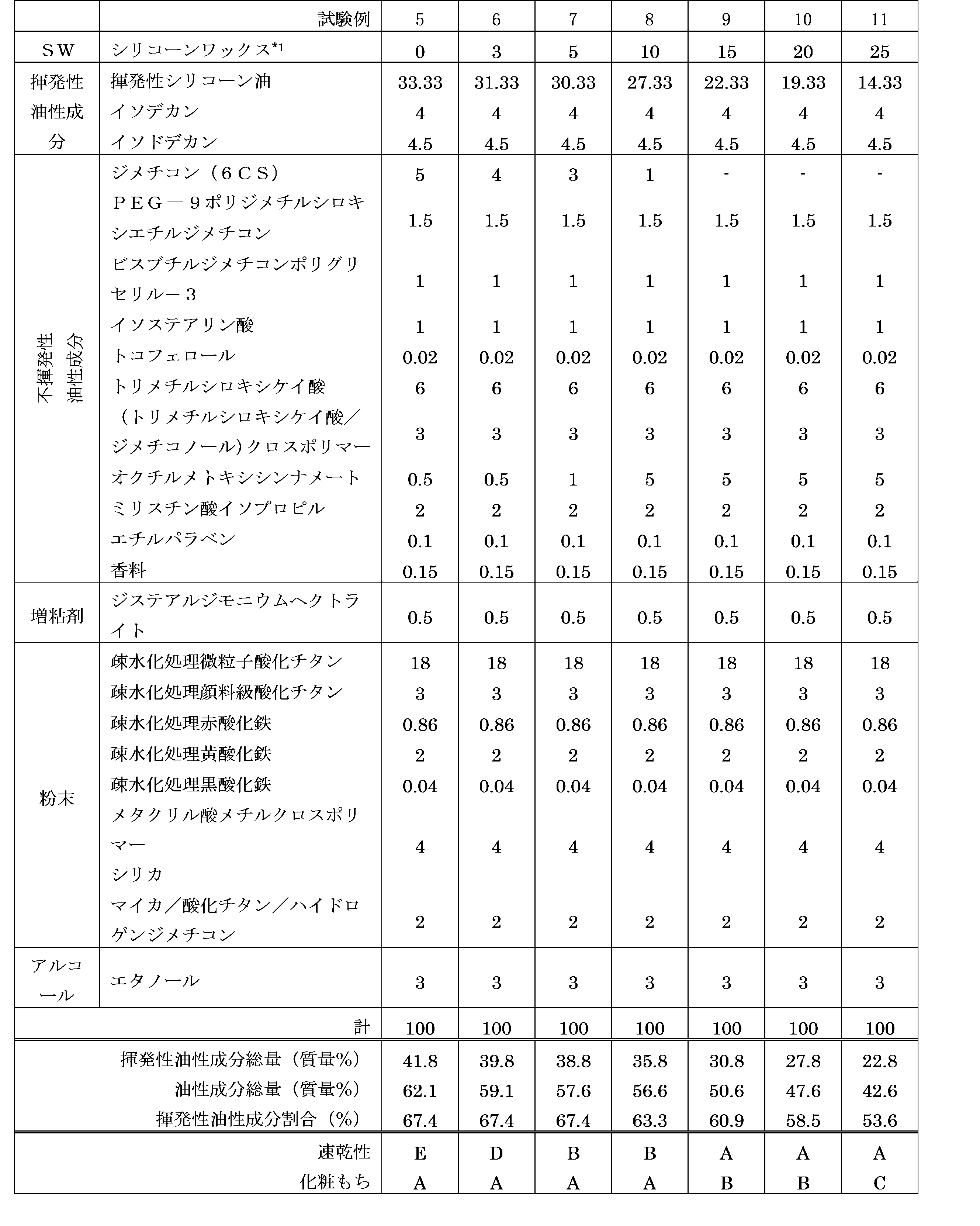
シリコーンワックスの含有率を変えた油性化粧料を作製して、試験例1~4と同様にして各組成物について速乾性及び化粧持ちを試験した。速乾性及び化粧もちの評価基準は試験例1~4と同じである。表2に、組成及び結果を示す。
シリコーンワックスの含有率を変えた油性化粧料を作製して、試験例1~4と同様にして各組成物について速乾性及び化粧持ちを試験した。速乾性及び化粧もちの評価基準は試験例1~4と同じである。表2に、組成及び結果を示す。
シリコーンワックスの含有率を高めると、速乾性を高めることができたが、化粧もちが低下する傾向がみられた。これより、シリコーンワックスの含有率は、油性化粧料の質量に対して、4質量%以上であると好ましく、5質量%以上であるとより好ましいと考えられる。シリコーンワックスの含有率は、油性化粧料の質量に対して、22質量%以下であると好ましく、20質量%以下であるとより好ましいと考えられる。例えば、より速乾性の高い化粧料を望む場合には、シリコーンワックスの含有率は、13質量%~22質量%、好ましくは10質量%~20質量%であると好ましいと考えられる。化粧崩れをより抑制したい場合には、シリコーンワックスの含有率は、4質量%~12質量%、好ましくは5質量%~10質量%であると好ましいと考えられる。
[試験例12~18]
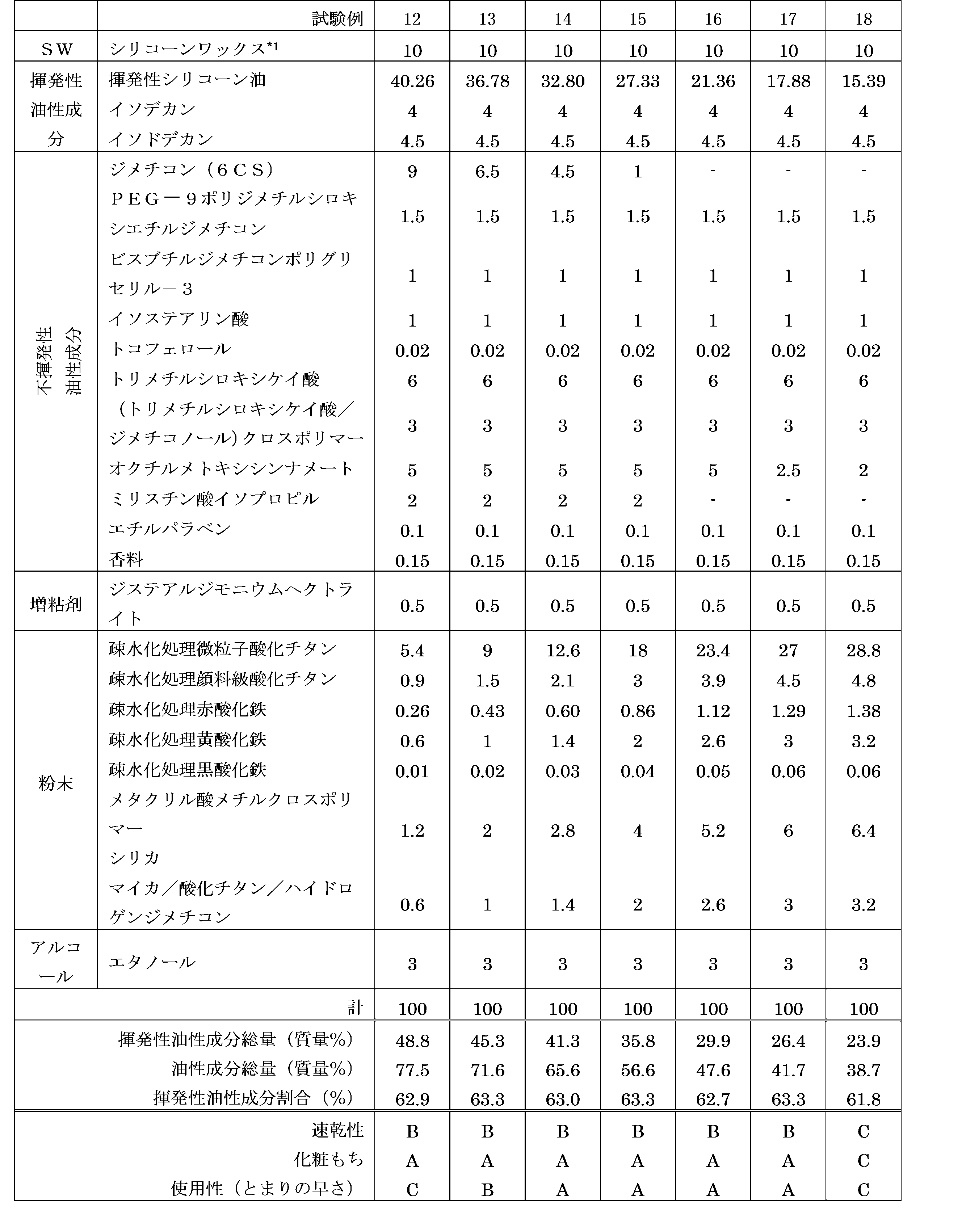
揮発性油性成分の含有率を変えた油性化粧料を作製して、試験例1~4と同様にして各組成物について速乾性及び化粧持ちを試験した。また、試験例1~4の評価項目に加えて、使用性として「とまりのよさ」も評価項目とした。使用性の評価基準を以下に示す。速乾性及び化粧もちの評価基準は試験例1~4と同じである。表3に、組成及び結果を示す。
揮発性油性成分の含有率を変えた油性化粧料を作製して、試験例1~4と同様にして各組成物について速乾性及び化粧持ちを試験した。また、試験例1~4の評価項目に加えて、使用性として「とまりのよさ」も評価項目とした。使用性の評価基準を以下に示す。速乾性及び化粧もちの評価基準は試験例1~4と同じである。表3に、組成及び結果を示す。
[使用性(とまりのよさ)]
A:化粧料を肌に擦り込んだときに、均一に塗布することができた。
B:化粧料を肌に擦り込んだときに、サンプルの乾燥が少し遅く、均一に塗布することがややできなかった。
C:化粧料を肌に擦り込んだときに、サンプルの乾燥が遅く、均一に塗布することができなかった。
A:化粧料を肌に擦り込んだときに、均一に塗布することができた。
B:化粧料を肌に擦り込んだときに、サンプルの乾燥が少し遅く、均一に塗布することがややできなかった。
C:化粧料を肌に擦り込んだときに、サンプルの乾燥が遅く、均一に塗布することができなかった。
油性化粧料中の揮発性油性成分の含有率を低下させると、化粧崩れしやすくなると共に、速乾性の低下が認められた。各試験例の油性化粧料を肌に塗布すると、揮発性油性成分は揮発する。そうすると、揮発性油性成分が存在していた領域は空隙になりやすい。そして、空隙となった箇所に汗が浸透すると共に、油性化粧料中に分散したシリコーンワックスによって濡れ性が高められ、汗は玉状にならずに、肌上に拡がったと考えられる。揮発性油性成分の含有率が低い試験例18においては、皮膚から化粧表面への汗の通り道が減少し、速乾性及び化粧もちの低下につながったと考えられる。また、揮発性油性成分の含有率が低いと、不揮発性成分の相対的増加により使用性の低下も認められた。これより、揮発性油性成分の含有率は、油性化粧料の質量に対して、25質量%以上であると好ましく、28質量%以上であるとより好ましいと考えられる。
試験例12~17においては、いずれも速乾性及び化粧もちは満足できる結果が得られた。これより、少なくとも、揮発性油性成分の含有率は、油性化粧料の質量に対して、50質量%以下にすることができる。しかしながら、揮発性油性成分を多くすると、使用性が低下する傾向が見受けられた。これより、速乾性及び化粧持ちに加えて、使用性を高めるためには、揮発性油性成分の含有率は、油性化粧料の質量に対して、48質量%以下であると好ましく、46質量%以下であるとより好ましく、44質量%以下であるとより好ましく、42質量%以下であるとさらに好ましいと考えられる。
全油性成分の含有率は、油性化粧料の質量に対して、40質量%以上であると好ましいと考えられる。全油性成分の含有率は、油性化粧料の質量に対して、80質量%以下であると好ましく、75質量%以下であるとより好ましく、70質量%以下であるとさらに好ましいと考えられる。
[試験例19~24]
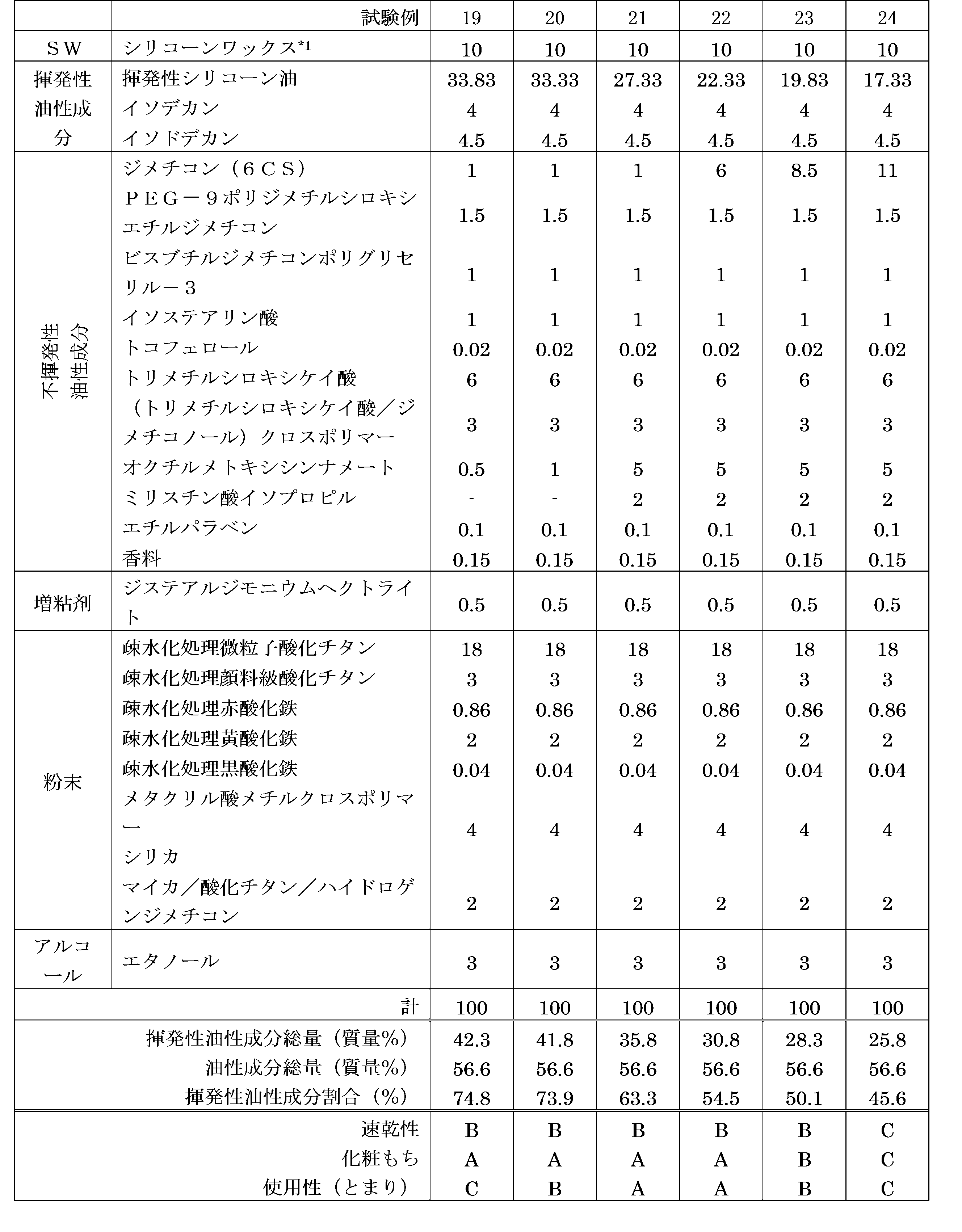
油性成分中の揮発性油分の割合による効果への影響を試験した。各評価試験及び評価基準は上記試験例と同様である。表4に、組成及び結果を示す。
油性成分中の揮発性油分の割合による効果への影響を試験した。各評価試験及び評価基準は上記試験例と同様である。表4に、組成及び結果を示す。
試験例19~24のいずれにおいても十分な速乾性が得られた。しかしながら、揮発性油性成分の割合が低くなるにしたがい、いずれの評価項目も低くなる傾向がみられた。上述のように、汗の通り道が減少したことが原因と考えられる。また、試験例24においては、不揮発性油性成分の相対的増加によって使用時のとまりが悪くなってしまったと考えられる。これより、油性成分中の揮発性油性成分の割合は、46質量%以上であると好ましく、48質量%以上であるとより好ましく、50質量%以上であるとより好ましく、52質量%以上であるとより好ましく、54質量%以上であるとさらに好ましいと考えられる。また、油性成分中の揮発性油性成分の割合は、少なくとも、80質量%以下、好ましくは75質量%以下であれば、高い速乾性及び化粧持ちを実現できることが分かった。
一方、使用性については、油性成分中の揮発性油性成分の割合が高くなりすぎると、乾燥が遅くなって低下してしまった。これより、使用性を高めるためには、油性成分中の揮発性油性成分の割合は、74質量%以下であると好ましく、70質量%以下であるとより好ましく、65質量%以下であるとさらに好ましいと考えられる。
本開示に油性化粧料及びその製造方法は、上記実施形態及び実施例に基づいて説明されているが、上記実施形態及び実施例に限定されることなく、本発明の範囲内において、かつ本発明の基本的技術思想に基づいて、各開示要素(請求の範囲、明細書及び図面に記載の要素を含む)に対し種々の変形、変更及び改良を含むことができる。また、本発明の請求の範囲の範囲内において、各開示要素の多様な組み合わせ・置換ないし選択が可能である。
本発明のさらなる課題、目的及び形態(変更形態含む)は、請求の範囲を含む本発明の全開示事項からも明らかにされる。
本書に記載した数値範囲については、別段の記載のない場合であっても、当該範囲内に含まれる任意の数値ないし範囲が本書に具体的に記載されているものと解釈されるべきである。
本開示の油性化粧料は、汗をかく領域に塗布する化粧料として適用することができる。特に、顔などメーキャップを施す領域に好適に適用することができる。また、本開示の油性化粧料は、夏場、高温多湿の地域に行くとき、スポーツや運動をするとき等、汗をかきやすい時期・場所において好適に使用することができる。
Claims (17)
- 4質量%~22質量のポリエーテル変性シリコーンワックスと、
40質量%~80質量%の油性成分と、
を含有し、
前記油性成分の46質量%以上が揮発性油性成分であり、
前記揮発性油性成分の含有率は、油性化粧料の質量に対して25質量%以上である、油性化粧料。 - 前記揮発性油性成分はシリコーン油を含む、請求項1に記載の油性化粧料。
- 前記油性化粧料の質量に対して10質量%~40質量%の粉末をさらに含有する、請求項1又は2に記載の油性化粧料。
- 前記粉末は吸油性粉末を含む、請求項3に記載の油性化粧料。
- 水の含有率が5質量%以下である、請求項1~4のいずれか一項に記載の油性化粧料。
- 前記ポリエーテル変性シリコーンワックスは、下記化1で表される化合物を含む、請求項1~5のいずれか一項に記載の油性化粧料。

- 前記ポリエーテル変性シリコーンワックスは、ビスPEG-18メチルエーテルジメチルシランを含む、請求項1~6のいずれか一項に記載の油性化粧料。
- 前記油性成分は、エステル油及び不揮発性シリコーン油のうちの少なくとも1つを含む、請求項1~7のいずれか一項に記載の油性化粧料。
- 前記油性成分は紫外線吸収剤を含む、請求項1~8のいずれか一項に記載の油性化粧料。
- 前記油性成分中の前記揮発性油性成分の割合は、前記油性成分の質量に対して48質量%~74質量%であり、
前記揮発性油性成分の含有率は、前記油性化粧料の質量に対して28質量%~46質量%である、請求項1~9のいずれか一項に記載の油性化粧料。 - 親水性のポリエーテル変性シリコーンワックスを第1の油性成分に溶解させて溶液を作製する工程と、
前記溶液と第2の油性成分とを混合する工程と、を含む、油性化粧料の製造方法。 - 前記第1の油性成分は紫外線吸収剤を含む、請求項11に記載の製造方法。
- 前記第1の油性成分は、4-メトキシケイ皮酸2-エチルヘキシル、オクトクリレン、ジエチルアミノヒドロキシ安息香酸ヘキシル、t-ブチルメトキシジベンゾイルメタン、エチルヘキシルトリアゾン、及びビスエチルヘキシルオキシフェノールメトキシフェニルトリアジンからなる群から選択される少なくとも1つを含む、請求項11又は12に記載の製造方法。
- 前記第2の油性成分は揮発性油性成分を含む、請求項11~13のいずれか一項に記載の製造方法。
- 前記揮発性油分はシリコーン油を含む、請求項14に記載の製造方法。
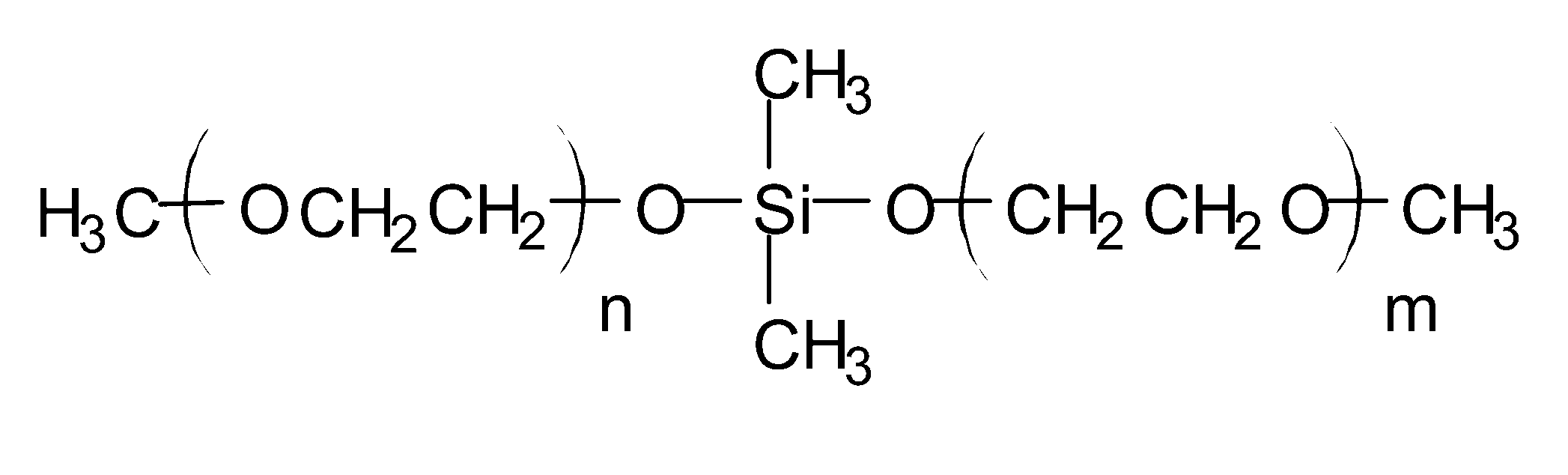
- 前記ポリエーテル変性シリコーンワックスは、下記化2で表される化合物を含む、請求項11~15のいずれか一項に記載の製造方法。
- 前記ポリエーテル変性シリコーンワックスは、ビスPEG-18メチルエーテルジメチルシランを含む、請求項11~16のいずれか一項に記載の製造方法。
Priority Applications (2)
| Application Number | Priority Date | Filing Date | Title |
|---|---|---|---|
| CN201980011588.1A CN111655224B (zh) | 2018-02-05 | 2019-01-23 | 油性化妆品及其制造方法 |
| US16/964,618 US20210052483A1 (en) | 2018-02-05 | 2019-01-23 | Oily cosmetic and method for producing the same |
Applications Claiming Priority (2)
| Application Number | Priority Date | Filing Date | Title |
|---|---|---|---|
| JP2018018191A JP7198584B2 (ja) | 2018-02-05 | 2018-02-05 | 油性化粧料及びその製造方法 |
| JP2018-018191 | 2018-02-05 |
Publications (1)
| Publication Number | Publication Date |
|---|---|
| WO2019151069A1 true WO2019151069A1 (ja) | 2019-08-08 |
Family
ID=67479277
Family Applications (1)
| Application Number | Title | Priority Date | Filing Date |
|---|---|---|---|
| PCT/JP2019/002018 Ceased WO2019151069A1 (ja) | 2018-02-05 | 2019-01-23 | 油性化粧料及びその製造方法 |
Country Status (5)
| Country | Link |
|---|---|
| US (1) | US20210052483A1 (ja) |
| JP (1) | JP7198584B2 (ja) |
| CN (1) | CN111655224B (ja) |
| TW (1) | TWI814774B (ja) |
| WO (1) | WO2019151069A1 (ja) |
Families Citing this family (3)
| Publication number | Priority date | Publication date | Assignee | Title |
|---|---|---|---|---|
| JP7478681B2 (ja) | 2020-01-31 | 2024-05-07 | 花王株式会社 | 皮膚外用剤 |
| WO2022152386A1 (en) | 2021-01-14 | 2022-07-21 | Lvmh Recherche | Liquid cosmetic composition |
| CN114295777A (zh) * | 2021-11-18 | 2022-04-08 | 美之修行信息科技(上海)有限公司 | 一种化妆品持妆效果的测试方法 |
Citations (5)
| Publication number | Priority date | Publication date | Assignee | Title |
|---|---|---|---|---|
| JP2015168635A (ja) * | 2014-03-05 | 2015-09-28 | 株式会社ディーエイチシー | 油中水型乳化化粧料及びその製造方法 |
| WO2017069157A1 (ja) * | 2015-10-20 | 2017-04-27 | ロート製薬株式会社 | 皮膚外用組成物 |
| JP2017137249A (ja) * | 2016-02-02 | 2017-08-10 | 株式会社アリミノ | 整髪料組成物 |
| CN107648056A (zh) * | 2017-09-27 | 2018-02-02 | 广州环亚化妆品科技有限公司 | 一种防晒膏及其制备方法 |
| JP2018090496A (ja) * | 2016-11-30 | 2018-06-14 | 花王株式会社 | 油性化粧料 |
Family Cites Families (12)
| Publication number | Priority date | Publication date | Assignee | Title |
|---|---|---|---|---|
| DE3725080A1 (de) * | 1987-07-29 | 1989-02-09 | Wella Ag | Haarwachs |
| US5531986A (en) * | 1994-07-01 | 1996-07-02 | The Mennen Company | Low residue antiperspirant solid stick composition |
| FR2725366B1 (fr) * | 1994-10-10 | 1996-11-22 | Oreal | Composition cosmetique comprenant des huiles siliconees |
| US5690918A (en) * | 1995-12-19 | 1997-11-25 | Maybelline, Inc. | Solvent-based non-drying lipstick |
| US20030049218A1 (en) * | 2001-08-28 | 2003-03-13 | Amit Patel | Antiperspirant deodorant emulsion |
| DE10311302A1 (de) * | 2003-03-14 | 2004-09-23 | Beiersdorf Ag | Dekorative Kosmetikprodukte mit Effektpigmenten |
| DE102007063352A1 (de) | 2007-12-28 | 2009-07-02 | Henkel Ag & Co. Kgaa | Wasserfreie Antitranspirant-Zusammensetzungen mit verbesserter Wirkstofffreisetzung |
| KR101006778B1 (ko) * | 2009-03-10 | 2011-01-10 | 나오테크(주) | 차량용 와이퍼 블레이드 코팅 조성물 및 차량용 와이퍼 블레이드 |
| KR101787507B1 (ko) * | 2011-07-25 | 2017-10-18 | 주식회사 엘지생활건강 | 저융점 왁스를 함유한 냉장 보관용 화장료 조성물 |
| US9408785B2 (en) * | 2012-10-15 | 2016-08-09 | L'oreal | Hair styling compositions containing aqueous wax dispersions |
| JP6030257B1 (ja) | 2015-09-29 | 2016-11-24 | 株式会社 資生堂 | 化粧料 |
| KR101727027B1 (ko) * | 2016-08-09 | 2017-04-17 | 주식회사 코스온 | 입체 성형 타입의 파우더 메이크업 화장료 조성물 |
-
2018
- 2018-02-05 JP JP2018018191A patent/JP7198584B2/ja active Active
-
2019
- 2019-01-23 WO PCT/JP2019/002018 patent/WO2019151069A1/ja not_active Ceased
- 2019-01-23 US US16/964,618 patent/US20210052483A1/en not_active Abandoned
- 2019-01-23 CN CN201980011588.1A patent/CN111655224B/zh active Active
- 2019-01-25 TW TW108102929A patent/TWI814774B/zh active
Patent Citations (5)
| Publication number | Priority date | Publication date | Assignee | Title |
|---|---|---|---|---|
| JP2015168635A (ja) * | 2014-03-05 | 2015-09-28 | 株式会社ディーエイチシー | 油中水型乳化化粧料及びその製造方法 |
| WO2017069157A1 (ja) * | 2015-10-20 | 2017-04-27 | ロート製薬株式会社 | 皮膚外用組成物 |
| JP2017137249A (ja) * | 2016-02-02 | 2017-08-10 | 株式会社アリミノ | 整髪料組成物 |
| JP2018090496A (ja) * | 2016-11-30 | 2018-06-14 | 花王株式会社 | 油性化粧料 |
| CN107648056A (zh) * | 2017-09-27 | 2018-02-02 | 广州环亚化妆品科技有限公司 | 一种防晒膏及其制备方法 |
Non-Patent Citations (1)
| Title |
|---|
| "Extra UV cream 50+ UV 50+ -O/W H (CPF 2467)", COSMETIC-INFO.JP, 4 December 2017 (2017-12-04), pages 1 - 2, XP055628094, Retrieved from the Internet <URL:https://www.cosmetic-info.jp/form/detail.php?id=965> [retrieved on 20190220] * |
Also Published As
| Publication number | Publication date |
|---|---|
| JP7198584B2 (ja) | 2023-01-04 |
| JP2019135218A (ja) | 2019-08-15 |
| CN111655224A (zh) | 2020-09-11 |
| TW201940154A (zh) | 2019-10-16 |
| TWI814774B (zh) | 2023-09-11 |
| CN111655224B (zh) | 2023-05-30 |
| US20210052483A1 (en) | 2021-02-25 |
Similar Documents
| Publication | Publication Date | Title |
|---|---|---|
| JP5352117B2 (ja) | 水中油型乳化組成物及びその製造方法 | |
| JP7404651B2 (ja) | 水中油型乳化化粧料及びその製造方法 | |
| WO2017209077A1 (ja) | エラストマー | |
| JP4442751B2 (ja) | 透明固形組成物及びこれを基剤として含有する透明固形化粧料 | |
| JPWO2017150519A1 (ja) | 水性化粧料組成物 | |
| CN110868990B (zh) | 彩妆化妆品 | |
| JP7597737B2 (ja) | 粉末固形化粧料の製造方法 | |
| JP7198584B2 (ja) | 油性化粧料及びその製造方法 | |
| JP7597736B2 (ja) | 粉末固形化粧料 | |
| TW202031236A (zh) | 化妝料 | |
| JP2006282632A (ja) | 固形状油中水型乳化化粧料 | |
| WO2017073758A1 (ja) | 組成物 | |
| JPH09124430A (ja) | メーキャップ化粧料 | |
| WO2014185320A1 (ja) | 水中油型乳化化粧料およびその製造法 | |
| JP2002068925A (ja) | 透明部分を含む外用固形組成物 | |
| JP3874325B2 (ja) | 油中水型乳化組成物 | |
| JP2003113015A (ja) | 油性化粧料 | |
| JP7381309B2 (ja) | 粉末固形化粧料 | |
| JP6029401B2 (ja) | 凹凸補正用固形化粧料 | |
| JP4010647B2 (ja) | 日焼け止め化粧料 | |
| JP2000178124A (ja) | ボディー化粧料 | |
| JPH1179938A (ja) | メーキャップ化粧料 | |
| WO2018092175A1 (ja) | 油性組成物および油性化粧料 | |
| JPH1045532A (ja) | マッサージ化粧料 | |
| WO2019107093A1 (ja) | 粉末化粧料 |
Legal Events
| Date | Code | Title | Description |
|---|---|---|---|
| 121 | Ep: the epo has been informed by wipo that ep was designated in this application |
Ref document number: 19747335 Country of ref document: EP Kind code of ref document: A1 |
|
| NENP | Non-entry into the national phase |
Ref country code: DE |
|
| 122 | Ep: pct application non-entry in european phase |
Ref document number: 19747335 Country of ref document: EP Kind code of ref document: A1 |