WO2019150677A1 - 電子写真機器用ブレードの製造方法および電子写真機器用ブレード - Google Patents
電子写真機器用ブレードの製造方法および電子写真機器用ブレード Download PDFInfo
- Publication number
- WO2019150677A1 WO2019150677A1 PCT/JP2018/040467 JP2018040467W WO2019150677A1 WO 2019150677 A1 WO2019150677 A1 WO 2019150677A1 JP 2018040467 W JP2018040467 W JP 2018040467W WO 2019150677 A1 WO2019150677 A1 WO 2019150677A1
- Authority
- WO
- WIPO (PCT)
- Prior art keywords
- blade
- isocyanate
- base material
- blocked isocyanate
- blocked
- Prior art date
- Legal status (The legal status is an assumption and is not a legal conclusion. Google has not performed a legal analysis and makes no representation as to the accuracy of the status listed.)
- Ceased
Links
Images


Classifications
-
- C—CHEMISTRY; METALLURGY
- C08—ORGANIC MACROMOLECULAR COMPOUNDS; THEIR PREPARATION OR CHEMICAL WORKING-UP; COMPOSITIONS BASED THEREON
- C08G—MACROMOLECULAR COMPOUNDS OBTAINED OTHERWISE THAN BY REACTIONS ONLY INVOLVING UNSATURATED CARBON-TO-CARBON BONDS
- C08G18/00—Polymeric products of isocyanates or isothiocyanates
- C08G18/06—Polymeric products of isocyanates or isothiocyanates with compounds having active hydrogen
- C08G18/28—Polymeric products of isocyanates or isothiocyanates with compounds having active hydrogen characterised by the compounds used containing active hydrogen
- C08G18/40—High-molecular-weight compounds
- C08G18/42—Polycondensates having carboxylic or carbonic ester groups in the main chain
- C08G18/4236—Polycondensates having carboxylic or carbonic ester groups in the main chain containing only aliphatic groups
- C08G18/4238—Polycondensates having carboxylic or carbonic ester groups in the main chain containing only aliphatic groups derived from dicarboxylic acids and dialcohols
-
- C—CHEMISTRY; METALLURGY
- C08—ORGANIC MACROMOLECULAR COMPOUNDS; THEIR PREPARATION OR CHEMICAL WORKING-UP; COMPOSITIONS BASED THEREON
- C08G—MACROMOLECULAR COMPOUNDS OBTAINED OTHERWISE THAN BY REACTIONS ONLY INVOLVING UNSATURATED CARBON-TO-CARBON BONDS
- C08G18/00—Polymeric products of isocyanates or isothiocyanates
- C08G18/02—Polymeric products of isocyanates or isothiocyanates of isocyanates or isothiocyanates only
- C08G18/025—Polymeric products of isocyanates or isothiocyanates of isocyanates or isothiocyanates only the polymeric products containing carbodiimide groups
-
- C—CHEMISTRY; METALLURGY
- C08—ORGANIC MACROMOLECULAR COMPOUNDS; THEIR PREPARATION OR CHEMICAL WORKING-UP; COMPOSITIONS BASED THEREON
- C08G—MACROMOLECULAR COMPOUNDS OBTAINED OTHERWISE THAN BY REACTIONS ONLY INVOLVING UNSATURATED CARBON-TO-CARBON BONDS
- C08G18/00—Polymeric products of isocyanates or isothiocyanates
- C08G18/06—Polymeric products of isocyanates or isothiocyanates with compounds having active hydrogen
- C08G18/08—Processes
- C08G18/10—Prepolymer processes involving reaction of isocyanates or isothiocyanates with compounds having active hydrogen in a first reaction step
-
- C—CHEMISTRY; METALLURGY
- C08—ORGANIC MACROMOLECULAR COMPOUNDS; THEIR PREPARATION OR CHEMICAL WORKING-UP; COMPOSITIONS BASED THEREON
- C08G—MACROMOLECULAR COMPOUNDS OBTAINED OTHERWISE THAN BY REACTIONS ONLY INVOLVING UNSATURATED CARBON-TO-CARBON BONDS
- C08G18/00—Polymeric products of isocyanates or isothiocyanates
- C08G18/06—Polymeric products of isocyanates or isothiocyanates with compounds having active hydrogen
- C08G18/08—Processes
- C08G18/16—Catalysts
- C08G18/18—Catalysts containing secondary or tertiary amines or salts thereof
-
- C—CHEMISTRY; METALLURGY
- C08—ORGANIC MACROMOLECULAR COMPOUNDS; THEIR PREPARATION OR CHEMICAL WORKING-UP; COMPOSITIONS BASED THEREON
- C08G—MACROMOLECULAR COMPOUNDS OBTAINED OTHERWISE THAN BY REACTIONS ONLY INVOLVING UNSATURATED CARBON-TO-CARBON BONDS
- C08G18/00—Polymeric products of isocyanates or isothiocyanates
- C08G18/06—Polymeric products of isocyanates or isothiocyanates with compounds having active hydrogen
- C08G18/28—Polymeric products of isocyanates or isothiocyanates with compounds having active hydrogen characterised by the compounds used containing active hydrogen
- C08G18/30—Low-molecular-weight compounds
- C08G18/32—Polyhydroxy compounds; Polyamines; Hydroxyamines
- C08G18/3203—Polyhydroxy compounds
- C08G18/3206—Polyhydroxy compounds aliphatic
-
- C—CHEMISTRY; METALLURGY
- C08—ORGANIC MACROMOLECULAR COMPOUNDS; THEIR PREPARATION OR CHEMICAL WORKING-UP; COMPOSITIONS BASED THEREON
- C08G—MACROMOLECULAR COMPOUNDS OBTAINED OTHERWISE THAN BY REACTIONS ONLY INVOLVING UNSATURATED CARBON-TO-CARBON BONDS
- C08G18/00—Polymeric products of isocyanates or isothiocyanates
- C08G18/06—Polymeric products of isocyanates or isothiocyanates with compounds having active hydrogen
- C08G18/70—Polymeric products of isocyanates or isothiocyanates with compounds having active hydrogen characterised by the isocyanates or isothiocyanates used
- C08G18/72—Polyisocyanates or polyisothiocyanates
- C08G18/74—Polyisocyanates or polyisothiocyanates cyclic
- C08G18/76—Polyisocyanates or polyisothiocyanates cyclic aromatic
- C08G18/7657—Polyisocyanates or polyisothiocyanates cyclic aromatic containing two or more aromatic rings
- C08G18/7692—Polyisocyanates or polyisothiocyanates cyclic aromatic containing two or more aromatic rings containing at least one isocyanate or isothiocyanate group linked to an aromatic ring by means of an aliphatic group
-
- C—CHEMISTRY; METALLURGY
- C08—ORGANIC MACROMOLECULAR COMPOUNDS; THEIR PREPARATION OR CHEMICAL WORKING-UP; COMPOSITIONS BASED THEREON
- C08G—MACROMOLECULAR COMPOUNDS OBTAINED OTHERWISE THAN BY REACTIONS ONLY INVOLVING UNSATURATED CARBON-TO-CARBON BONDS
- C08G18/00—Polymeric products of isocyanates or isothiocyanates
- C08G18/06—Polymeric products of isocyanates or isothiocyanates with compounds having active hydrogen
- C08G18/70—Polymeric products of isocyanates or isothiocyanates with compounds having active hydrogen characterised by the isocyanates or isothiocyanates used
- C08G18/72—Polyisocyanates or polyisothiocyanates
- C08G18/80—Masked polyisocyanates
-
- C—CHEMISTRY; METALLURGY
- C08—ORGANIC MACROMOLECULAR COMPOUNDS; THEIR PREPARATION OR CHEMICAL WORKING-UP; COMPOSITIONS BASED THEREON
- C08G—MACROMOLECULAR COMPOUNDS OBTAINED OTHERWISE THAN BY REACTIONS ONLY INVOLVING UNSATURATED CARBON-TO-CARBON BONDS
- C08G18/00—Polymeric products of isocyanates or isothiocyanates
- C08G18/06—Polymeric products of isocyanates or isothiocyanates with compounds having active hydrogen
- C08G18/70—Polymeric products of isocyanates or isothiocyanates with compounds having active hydrogen characterised by the isocyanates or isothiocyanates used
- C08G18/72—Polyisocyanates or polyisothiocyanates
- C08G18/80—Masked polyisocyanates
- C08G18/8061—Masked polyisocyanates masked with compounds having only one group containing active hydrogen
- C08G18/8093—Compounds containing active methylene groups
-
- C—CHEMISTRY; METALLURGY
- C09—DYES; PAINTS; POLISHES; NATURAL RESINS; ADHESIVES; COMPOSITIONS NOT OTHERWISE PROVIDED FOR; APPLICATIONS OF MATERIALS NOT OTHERWISE PROVIDED FOR
- C09D—COATING COMPOSITIONS, e.g. PAINTS, VARNISHES OR LACQUERS; FILLING PASTES; CHEMICAL PAINT OR INK REMOVERS; INKS; CORRECTING FLUIDS; WOODSTAINS; PASTES OR SOLIDS FOR COLOURING OR PRINTING; USE OF MATERIALS THEREFOR
- C09D175/00—Coating compositions based on polyureas or polyurethanes; Coating compositions based on derivatives of such polymers
- C09D175/04—Polyurethanes
-
- C—CHEMISTRY; METALLURGY
- C09—DYES; PAINTS; POLISHES; NATURAL RESINS; ADHESIVES; COMPOSITIONS NOT OTHERWISE PROVIDED FOR; APPLICATIONS OF MATERIALS NOT OTHERWISE PROVIDED FOR
- C09D—COATING COMPOSITIONS, e.g. PAINTS, VARNISHES OR LACQUERS; FILLING PASTES; CHEMICAL PAINT OR INK REMOVERS; INKS; CORRECTING FLUIDS; WOODSTAINS; PASTES OR SOLIDS FOR COLOURING OR PRINTING; USE OF MATERIALS THEREFOR
- C09D175/00—Coating compositions based on polyureas or polyurethanes; Coating compositions based on derivatives of such polymers
- C09D175/04—Polyurethanes
- C09D175/06—Polyurethanes from polyesters
-
- G—PHYSICS
- G03—PHOTOGRAPHY; CINEMATOGRAPHY; ANALOGOUS TECHNIQUES USING WAVES OTHER THAN OPTICAL WAVES; ELECTROGRAPHY; HOLOGRAPHY
- G03G—ELECTROGRAPHY; ELECTROPHOTOGRAPHY; MAGNETOGRAPHY
- G03G21/00—Arrangements not provided for by groups G03G13/00 - G03G19/00, e.g. cleaning, elimination of residual charge
- G03G21/0005—Arrangements not provided for by groups G03G13/00 - G03G19/00, e.g. cleaning, elimination of residual charge for removing solid developer or debris from the electrographic recording medium
- G03G21/0011—Arrangements not provided for by groups G03G13/00 - G03G19/00, e.g. cleaning, elimination of residual charge for removing solid developer or debris from the electrographic recording medium using a blade; Details of cleaning blades, e.g. blade shape, layer forming
- G03G21/0017—Details relating to the internal structure or chemical composition of the blades
Definitions
- the present invention relates to a method for manufacturing a blade for electrophotographic equipment and a blade for electrophotographic equipment, and more specifically, a method for manufacturing a blade for electrophotographic equipment suitable as a cleaning blade, a layer forming blade, and the like in electrophotographic equipment. This relates to a blade for use.
- cleaning is used to remove residual toner remaining on the surface of the mating member by sliding contact with the mating member such as a photosensitive drum or transfer belt.
- Blades such as a blade and a layer forming blade used for forming a uniform toner layer on the outer peripheral surface of the developing roll are provided.
- Patent Document 1 proposes that a hardened layer is formed by impregnating an abutting portion with a counterpart member with an isocyanate compound and reacting with urethane rubber.
- the nip width with respect to the mating member becomes narrower and the friction coefficient also decreases. Thereby, turning-up and stick-slip are suppressed, and the toner scraping property is improved.
- the nip width with respect to the mating member becomes narrower, the effect of variations in surface hardness at the time of contact increases, leading to chipping of the tip due to stress concentration and toner slippage due to variations in pressing force on the mating member. It becomes easy.
- an isocyanate group is a blocking agent from at least a part of a surface including a portion that contacts a mating member of a blade-like substrate containing urethane rubber.
- a curing step of forming a cured portion in at least a part including a portion in contact with the member, and the gist is that the isocyanate liberated from the blocked isocyanate contains an aromatic isocyanate.
- the molecular weight of the blocked isocyanate is preferably 500 or less.
- the dissociation temperature of the blocking agent in the blocked isocyanate is preferably in the range of 100 to 160 ° C.
- Martens hardness of the cured portion is at 2.0 N / mm 2 or more and variation in the Martens hardness of the cured portion is preferably not more than 1.5 N / mm 2. It is preferable that the Martens hardness with an indentation depth of 50 ⁇ m before the impregnation step is in the range of 0.1 to 1.0 N / mm 2 .
- the urethane rubber of the base material is formed from a cured product of a urethane composition containing a polyol, a polyisocyanate, a chain extender, and a cross-linking agent.
- a urethane composition containing a polyol, a polyisocyanate, a chain extender, and a cross-linking agent.
- the chain extender and the cross-linking agent The chain extender is preferably contained in an amount of 40% by mass or more based on the total.
- the blade for electrophotographic equipment has a blade-like base material containing urethane rubber, and the isocyanate group is a blocking agent from at least a part of the surface including a portion that contacts the mating member of the base material.
- the blocked isocyanate is impregnated, the blocking agent is dissociated from the blocked isocyanate impregnated in the base material to release the isocyanate, and the freed isocyanate is cured in the base material to form the base material.
- the gist is that at least a portion including a portion that contacts the mating member is provided with a cured portion, and the isocyanate liberated from the blocked isocyanate contains an aromatic isocyanate.
- the blocked isocyanate is impregnated in the impregnation step, it is possible to impregnate to a desired impregnation depth while maintaining the activity of the isocyanate group.
- the blocking agent is dissociated from the impregnated blocked isocyanate, and the free isocyanate containing the aromatic isocyanate is cured in the base material, so that a cured portion having sufficiently increased hardness can be uniformly formed. it can.
- the variation in hardness is suppressed in the portion in contact with the mating member, and the slipping of the toner due to the chipping at the tip and the variation in the pressing force on the mating member is suppressed.
- the blocked isocyanate is likely to penetrate into the base material and the surface hardness tends to be high.
- the dissociation temperature of the blocking agent in the blocked isocyanate is in the range of 100 to 160 ° C., it is easy to maintain the activity of the isocyanate group in the impregnation step, and the thermal deterioration of the urethane rubber of the base material is suppressed in the curing step. Cheap.
- the dispersion of the Martens hardness of the cured portion is at 1.5 N / mm 2 or less, the tip portion It is easy to suppress the slipping of toner due to the chipping of the toner and the variation in the pressing force to the mating member. Further, if the Martens hardness with the indentation depth of 50 ⁇ m before the impregnation step is in the range of 0.1 to 1.0 N / mm 2 , turning-up, stick-slip, and scraping of the mating member that is in contact can be easily suppressed. . And when the ratio of the chain extender in the urethane rubber of the base material is the above, the blocked isocyanate is likely to penetrate into the base material and the surface hardness tends to be high.
- the isocyanate containing aromatic isocyanate liberated from the blocked isocyanate impregnated in the base material is cured in the base material, and the cured portion is provided.
- the isocyanate containing the aromatic isocyanate is cured in the base material while maintaining the activity of the isocyanate group to a desired impregnation depth, a cured portion having sufficiently increased hardness can be uniformly formed. .
- the variation in hardness is suppressed in the portion in contact with the mating member, and the slipping of the toner due to the chipping at the tip and the variation in the pressing force on the mating member is suppressed.
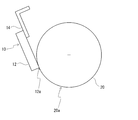
- FIG. 3 is a schematic diagram illustrating a state where an electrophotographic blade according to an embodiment of the present invention slides on an outer peripheral surface of a rotating photosensitive drum. It is sectional drawing which showed an example of the range which performs an impregnation process. It is the schematic diagram which showed the measuring method of the Martens hardness of a hardening part.
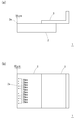
- FIG. 4A is a side view of the blade, and FIG. 4B is a plan view of the blade.
- the blade 1 has a flat blade portion 2 and a holding portion 3 made of a metal fitting having an L-shaped cross section.
- FIG. 1 is a schematic view showing a blade for electrophotographic equipment (hereinafter sometimes referred to as this blade) according to an embodiment of the present invention
- FIG. 2 is a diagram showing the blade sliding on the outer peripheral surface of the photosensitive drum. It is the schematic diagram which showed a mode that it does.
- FIG. 3 is a cross-sectional view showing an example of a range in which the impregnation treatment is performed.
- an electrophotographic apparatus blade (present blade) 10 includes a blade portion 12.
- a holding portion 14 that holds the blade portion 12 is attached to the blade portion 12.
- the blade portion 12 has a flat plate shape (blade shape).
- the holding part 14 is made of a metal fitting having an L-shaped cross section.
- the blade portion 12 is in contact (sliding contact) with the mating member at the tip portion (ridge line portion) 12a. This tip end (ridge line portion) 12a is a contact portion.
- the blade 10 is suitable as a cleaning blade or a layer forming blade in an electrophotographic apparatus.
- the mating member of the cleaning blade include a photosensitive drum and a transfer belt.
- the mating member of the layer forming blade include a developing roll. Both blades are in contact (sliding contact) with the mating member.
- the cleaning blade contacts (sliding) the mating member to remove residual toner.
- the blade portion 12 contacts the outer peripheral surface 20 a of the photosensitive drum 20 at the tip end (ridge line portion) 12 a and slides on the outer peripheral surface 20 a of the rotating photosensitive drum 20. Thereby, the toner remaining on the outer peripheral surface 20a of the photosensitive drum 20 is removed.
- the portion including the front end portion 12a becomes a contact portion that contacts the photosensitive drum 20 that is a member to be cleaned.
- the layer forming blade abuts (slidably contacts) the surface of the developing roll, which is a counterpart member, and forms a uniform toner layer on the outer peripheral surface of the developing roll.
- the base material of the blade part 12 includes urethane rubber.
- the base material of the blade part 12 is comprised with the hardened
- the base material of the blade part 12 is a molded body formed by the urethane composition before the impregnation treatment.
- the isocyanate released from the blocked isocyanate impregnated in the base material from the surface thereof is contained in the base material.
- a cured portion 16 is provided by being cured.
- the blade 10 can be manufactured by a method for manufacturing a blade for an electrophotographic apparatus according to the present invention (hereinafter sometimes referred to as the present manufacturing method). Below, this manufacturing method is demonstrated.
- This manufacturing method includes an impregnation step and a curing step.
- the impregnation step is a step of impregnating the block isocyanate from at least a part of the surface including the portion that contacts the mating member of the blade-like base material containing urethane rubber.
- an isocyanate group is blocked with a blocking agent.
- the blocked isocyanate is one in which the blocking agent is dissociated and the isocyanate is liberated at a temperature equal to or higher than a predetermined dissociation temperature. The liberated isocyanate is the isocyanate that forms the blocked isocyanate.
- isocyanate forming the blocked isocyanate examples include diphenylmethane diisocyanate (MDI), polymethylene polyphenylene polyisocyanate (polymeric MDI), crude MDI (c-MDI) which is a mixture of MDI and polymeric MDI, dicyclohexylmethane diisocyanate (hydrogenated MDI), Tolylene diisocyanate (TDI), hexamethylene diisocyanate (HDI), trimethylhexamethylene diisocyanate (TMHDI), isophorone diisocyanate (IPDI), orthotoluidine diisocyanate (TODI), naphthylene diisocyanate (NDI), xylylene diisocyanate (XDI), para Phenylene diisocyanate (PDI), lysine diisocyanate methyl ester (LDI), dimethyl diisocyanate (DDI), MDI cyanurate is multimeric, HDI isocyanurate (
- NCO terminal urethane prepolymer obtained by making polyisocyanate, such as MDI mentioned above, and a polyol react. These may be used individually by 1 type as isocyanate which forms blocked isocyanate, and may use 2 or more types together.
- aromatic isocyanate is an isocyanate in which an isocyanate group is directly bonded to an aromatic ring.
- examples of the aromatic isocyanate include MDI, polymeric MDI, crude MDI, TDI, TODI, NDI, and PDI.
- the blocked isocyanate preferably has a molecular weight of 500 or less from the viewpoint of being easily immersed in the base material in the impregnation step and easily increasing the surface hardness. More preferably, the molecular weight is 480 or less, and still more preferably the molecular weight is 450 or less.
- the blocked isocyanate preferably has a dissociation temperature of 100 ° C. or higher from the viewpoint that the blocking agent is not dissociated in the impregnation step and the activity of the isocyanate group is easily maintained. More preferably, it is 120 ° C. or higher.
- the dissociation temperature is preferably 160 ° C. or lower from the viewpoint that the heating temperature for dissociating the blocking agent in the curing step can be kept low and the thermal deterioration of the urethane rubber of the base material can be easily suppressed. More preferably, the dissociation temperature is 140 ° C. or lower.
- the blocking agent for forming blocked isocyanate a compound having active hydrogen is used.
- the compound having active hydrogen include oximes, pyrazoles, carbazoles, secondary amines, ⁇ -dicarbonyl compounds, lactams, phenols and the like. These may be used individually by 1 type as a blocking agent which forms blocked isocyanate, and may use 2 or more types together.
- Examples of oximes include aldoximes and ketoximes.
- Examples of the aldoxime include formaldoxime and acetoaldoxime.
- Examples of the ketoxime include dimethyl ketoxime, methyl ethyl ketoxime, methyl isobutyl ketoxime, methyl amyl ketoxime, acetoxime, and cyclohexanone oxime.
- Examples of the pyrazoles include pyrazole, 3-methylpyrazole, 3,5-dimethylpyrazole and the like.
- Examples of the carbazoles include carbazole.
- Secondary amines include dipropylamine, diisopropylamine, dibutylamine, diisobutylamine, di (tert-butyl) amine, ethylpropylamine, ethylisopropylamine, ethylbutylamine, ethylisobutylamine, ethyl (tert-butyl) amine , Dicyclohexylamine, N-methylaniline, diphenylamine, piperidine, 2-methylpiperidine, 2,6-dimethylpiperidine, 2,2,6,6-tetramethylpiperidine and the like.
- Examples of the ⁇ -dicarbonyl compound include malonic acid diesters such as dimethyl malonate and diethyl malonate, and acetoacetate esters such as methyl acetoacetate and ethyl acetoacetate.
- Examples of lactams include ⁇ -caprolactam.
- Examples of phenols include phenol.
- methyl ethyl ketoxime, diisopropylamine, phenol, ⁇ -caprolactam, diethyl malonate, 3,5-dimethylpyrazole from the viewpoints of excellent storage stability of the blocked isocyanate and suitable dissociation temperature of the blocked isocyanate. And ethyl acetoacetate are preferred. Further, 3,5-dimethylpyrazole and methyl ethyl ketoxime are preferable from the viewpoint that the dissociation temperature of the blocked isocyanate tends to be relatively low.
- Block isocyanate can be impregnated into a substrate using a curable composition containing blocked isocyanate.
- This curable composition may contain only the blocked isocyanate, or may contain a solvent or an additive in addition to the blocked isocyanate. Moreover, in the range which does not inhibit this invention, the isocyanate which is not blocked with the blocking agent may be contained.
- the solvent examples include methyl ethyl ketone (MEK), methyl isobutyl ketone (MIBK), toluene, methanol and the like.
- MEK methyl ethyl ketone
- MIBK methyl isobutyl ketone
- the solid content concentration is the concentration (mass%) of the total components other than the solvent.
- the solid content concentration of the curable composition is preferably in the range of 0.1 to 80% by mass. More preferably, it is in the range of 1.0 to 70% by mass, and still more preferably in the range of 3.0 to 60% by mass.
- the impregnation with the blocked isocyanate is performed by, for example, immersing a part or all of the base material of the blade part 12 in a liquid of a curable composition containing the blocked isocyanate for a predetermined time. It can be performed by spraying (spraying) the liquid of the composition with a brush or the like. At this time, if excess liquid of the curable composition remains on the surface of the substrate, it can be removed by wiping or washing with a solvent. Conditions such as time and temperature for impregnation may be appropriately set according to the desired amount of impregnation.
- the depth of impregnation of the blocked isocyanate into the base material of the blade portion 12 may be appropriately adjusted from the viewpoint of maintaining the surface hardness and the physical properties of the base material, but is preferably in the range of 50 ⁇ m or more from the surface. And is in the range of 300 ⁇ m or less from the surface. More preferably, it is in the range of 100 ⁇ m or more from the surface and in the range of 200 ⁇ m or less from the surface. If it is in the range of 50 ⁇ m or more from the surface, it is easy to ensure the surface hardness. It is easy to ensure the physical property of a base material as it is the range of 300 micrometers or less from the surface.
- the curing step dissociates the blocking agent from the blocked isocyanate impregnated into the base material in the impregnation step, cures the liberated isocyanate in the base material, and at least partially includes a portion that contacts the mating member of the base material.
- 16 is a step of forming 16.
- the base material impregnated with the blocked isocyanate is heated to a temperature equal to or higher than the temperature at which the blocking agent is dissociated from the blocked isocyanate.
- the heating temperature is preferably 160 ° C. or less from the viewpoint of easily suppressing the thermal deterioration of the urethane rubber of the base material. More preferably, it is 150 degrees C or less, More preferably, it is 140 degrees C or less.
- the heating temperature is preferably 100 ° C. or higher from the viewpoint that the blocking agent can be efficiently dissociated from the blocked isocyanate. More preferably, it is 110 degreeC or more, More preferably, it is 120 degreeC or more.
- the liberated isocyanate is cured by reacting with a hydroxyl group in the substrate or by self-crosslinking.
- the hardening part 16 is formed in at least one part including the part contact
- the hardened portion 16 of the blade portion 12 preferably has a Martens hardness of 1.5 N / mm 2 or more. More preferably, it is 2.0 N / mm ⁇ 2 > or more, More preferably, it is 3.0 N / mm ⁇ 2 > or more.
- the Martens hardness of the cured portion 16 is 1.5 N / mm 2 or more, the surface hardness is excellent and the toner scraping property is excellent.
- the hardening part 16 of the blade part 12 makes the dispersion
- the variation in Martens hardness of the cured portion 16 is 1.0 N / mm 2 or less.
- Variation in the Martens hardness of the cured portion 16 occurs because the isocyanate used for impregnation reacts with moisture in the substrate and partially deactivates, resulting in occurrence of locations that do not sufficiently react and cure in the curing process. Inferred.
- impregnated with blocked isocyanate instead of unblocked isocyanate it is possible to impregnate to a desired impregnation depth while maintaining the activity of the isocyanate group.
- the blocking agent is dissociated from the impregnated blocked isocyanate, and the released isocyanate is cured in the base material, so that it can be prevented from reacting with moisture in the base material before being partially deactivated.
- the hardened portion 16 having sufficiently increased hardness can be formed uniformly. As a result, the variation in hardness is suppressed in the portion in contact with the mating member, and the slipping of the toner due to the chipping of the tip portion (abutting portion) 12a of the blade portion 12 and the variation in the pressing force to the mating member is suppressed.
- the Martens hardness of the hardening part 16 of the blade part 12 is 50 ⁇ m away from the tip part (ridge line part) 12a on the surface facing the mating member, and both sides from the center position in the direction in which the tip part (ridge line part) 12a extends.
- variation in the Martens hardness of the hardening part 16 can be represented by the difference of the maximum value and minimum value of the Martens hardness of 1 micrometer indentation depth in the position of the total 10 points
- the hardening part 16 of the blade part 12 has a coefficient of friction of 0.9 or less from the viewpoint of suppressing the peeling of the tip part 12a. More preferably, it is 0.8 or less, 0.7 or less, or 0.6 or less.
- the friction coefficient ( ⁇ ) of the hardened portion 16 can be measured using a static friction coefficient meter.
- the friction coefficient ( ⁇ ) of the cured portion 16 is set within a predetermined range depending on the composition of the urethane composition, the type of the blocked isocyanate, the solid content concentration of the curable composition containing the blocked isocyanate, the amount of impregnation (impregnation depth), and the like. can do.
- the base material of the blade part 12 can be produced by injecting a urethane composition into a predetermined molding die and molding it.
- Cast molding can be performed according to a prepolymer method, a semi one-shot method, and a one-shot method.
- the semi-one shot method is preferable because of excellent processability.
- a urethane prepolymer main agent liquid
- a curing agent liquid is prepared by blending polyol, if necessary, chain extender, crosslinking agent, catalyst, additive, etc.
- the base material of the blade portion 12 having a predetermined shape is obtained by mixing the main agent liquid and the curing agent liquid at a predetermined ratio to obtain a urethane composition, and injecting the urethane composition into a molding die to react and cure. Can be produced.
- the holding part 14 is formed by burying a part in the base material of the blade part 12 at the time of molding, or by adhering to a predetermined position using an adhesive after the base material of the blade part 12 is molded. Can be integrated with the substrate.
- the urethane composition forming the base material of the blade part 12 contains a polyol and a polyisocyanate.
- the polyol and polyisocyanate are not particularly limited as long as they are polyol and polyisocyanate for forming urethane rubber used for forming urethane rubber.
- the polyol of the urethane composition is not particularly limited, and examples thereof include polyester polyol, polyether polyol, polycarbonate polyol, and acrylic polyol. Of these, polyester polyol is more preferable.
- the polyester polyol is preferably obtained from a polybasic organic acid and a low molecular weight polyol and having a hydroxyl group as a terminal group.
- a polyester polyol as a polyol for forming polyurethane, it is possible to ensure wear resistance necessary for durability.
- Polybasic organic acids are not particularly limited, but are saturated fatty acids such as oxalic acid, succinic acid, glutaric acid, adipic acid, pimelic acid, suberic acid, azelaic acid, sebacic acid, isosebacic acid, maleic acid, Unsaturated fatty acids such as fumaric acid, dicarboxylic acids such as aromatic acids such as phthalic acid, isophthalic acid and terephthalic acid, acid anhydrides such as maleic anhydride and phthalic anhydride, dialkyl esters such as dimethyl terephthalate, unsaturated fatty acids And dimer acid obtained by dimerization.
- the low molecular weight polyol used together with the polybasic organic acid is not particularly limited.
- ethylene glycol diethylene glycol, triethylene glycol, propylene glycol, dipropylene glycol, butylene glycol, neopentyl glycol, 1,6 Diols such as hexylene glycol, triols such as trimethylolethane, trimethylolpropane, hexanetriol and glycerin, hexaols such as sorbitol, and the like.
- polyester polyol examples include polyethylene adipate (PEA), polybutylene adipate (PBA), polyhexylene adipate (PHA), and a copolymer of ethylene adipate and butylene adipate (PEA / BA).
- PET polyethylene adipate
- PBA polybutylene adipate
- PBA polyhexylene adipate
- PBA copolymer of ethylene adipate and butylene adipate
- PBA polybutylene adipate
- PBA is particularly preferable from the viewpoint of improving wear resistance and durability.
- the polyester polyol preferably has a number average molecular weight of 1000 to 3000.
- the tan ⁇ peak temperature and the tan ⁇ peak value which are indices of the viscoelasticity of polyurethane, it is easy to obtain physical properties and improve moldability. From this viewpoint, the number average molecular weight is more preferably in the range of 1500 to 2500.
- polyether polyols examples include polypropylene glycol (PPG), polytetramethylene glycol (PTMG), these ethylene oxide-modified type polyols, and polyethylene glycol (PEG).
- PPG polypropylene glycol
- PTMG polytetramethylene glycol
- PEG polyethylene glycol
- Mn average molecular weight
- polyisocyanate of the urethane composition examples include diphenylmethane diisocyanate (MDI), polymethylene polyphenylene polyisocyanate (polymeric MDI), crude MDI (c-MDI), which is a mixture of MDI and polymeric MDI, dicyclohexylmethane diisocyanate (hydrogenated MDI), Tolylene diisocyanate (TDI), hexamethylene diisocyanate (HDI), trimethylhexamethylene diisocyanate (TMHDI), isophorone diisocyanate (IPDI), orthotoluidine diisocyanate (TODI), naphthylene diisocyanate (NDI), xylylene diisocyanate (XDI), para Phenylene diisocyanate (PDI), lysine diisocyanate methyl ester (LDI) Dimethyl diisocyanate (DDI), MDI cyanurate is multimeric, HDI isocyanurate (
- MDI 4,4'-diphenylmethane diisocyanate
- NCO-terminated urethane prepolymer obtained by reacting a polyisocyanate such as MDI described above and a polyol may be used. Since the urethane prepolymer used as the polyisocyanate has an NCO terminal, the NCO% is preferably in the range of 5 to 30% by mass. NCO% is calculated by the following equation.
- the blending amount of the polyisocyanate is preferably set so that the NCO index (isocyanate index) is 110 or more from the viewpoint of easy improvement of wear resistance, easy securing of strength, and difficulty in sticking.
- the NCO index is more preferably 115 or more, still more preferably 120 or more, 125 or more, or 130 or more.
- the NCO index is more preferably 200 or less, and still more preferably 180 or less.
- the NCO index is calculated as the equivalent of the isocyanate group with respect to the total equivalent 100 of active hydrogen groups (hydroxyl group, amino group, etc.) that react with the isocyanate group.
- Urethane compositions include polyols, polyisocyanates, chain extenders, crosslinkers, catalysts, foaming agents, surfactants, flame retardants, colorants, fillers, plasticizers, stabilizers, mold release agents, conductive agents. An agent or the like may be included.
- the catalyst is a catalyst used as a catalyst for promoting the urethanization reaction of the urethane composition.
- the chain extender is a bifunctional compound such as diol or diamine that can react with polyurethane. Those having a number average molecular weight of 300 or less are preferred.
- chain extenders 1,4-butanediol (1,4-BD), ethylene glycol (EG), 1,6-hexanediol (1,6-HD), diethylene glycol (DEG), propylene glycol (PG) Diols such as dipropylene glycol (DPG), 1,4-cyclohexanediol, 1,4-cyclohexanedimethanol, xylene glycol, triethylene glycol, and 2,2 ′, 3,3′-tetrachloro-4,4 '-Diaminodiphenylmethane, 3,3'-dichloro-4,4'-diphenylmethane, trimethylene-bis (4-aminobenzoate), 4,4'-diamino-3,3'-diethyl-5,5'-dimethyl
- the tan ⁇ peak temperature and the tan ⁇ peak value which are indicators of the viscoelasticity of the polyurethane, it is easy to obtain physical properties and improve moldability.
- Butanediol (1,4-BD), ethylene glycol (EG), 1,6-hexanediol (1,6-HD) and the like are suitable.
- the crosslinking agent is a trifunctional or higher functional compound such as triol or triamine that can react with polyurethane. Those having a number average molecular weight of 300 or less are preferred.
- the crosslinking agent include trimethylolpropane (TMP), glycerin, pentaerythritol, sorbitol, 1,2,6-hexanetriol, and the like. These may be used alone or in combination of two or more.
- TMP trimethylolpropane
- glycerin glycerin
- pentaerythritol pentaerythritol
- sorbitol 1,2,6-hexanetriol
- the ratio of the chain extender to the crosslinking agent is such that the blocked isocyanate can easily penetrate into the base material (easy to be impregnated), etc. Is preferably 40% by mass or more. More preferably, it is 50 mass% or more.
- the chain extender is preferably 80% by mass or less based on the total of the chain extender and the crosslinking agent. More preferably, it is 75 mass% or less.
- the catalyst is not particularly limited, and examples thereof include amine compounds such as tertiary amines and organometallic compounds such as organotin compounds.
- This catalyst is a catalyst that promotes urethanization and isocyanuration.
- Tertiary amines include, for example, trialkylamines such as triethylamine, tetraalkyldiamines such as N, N, N ′, N′-tetramethyl-1,3-butanediamine, aminoalcohols such as dimethylethanolamine, and ethoxyl.
- TAA triethylenediamine
- N, N-dimethylcyclohexylamine N-methylmorpholine
- N- (2-hydroxypropyl) ) -Morpholine derivatives such as dimethylmorpholine
- piperazine derivatives such as N, N′-diethyl-2-methylpiperazine, N, N′-bis- (2-hydroxypropyl) -2-methyl
- organic tin compound examples include dialkyltin compounds such as dibutyltin dilaurate and dibutyltin di (2-ethylhexoate), stannous 2-ethylcaproate, stannous oleate, and the like. . These may be used alone or in combination of two or more. Among these, triethylenediamine (TEDA) is preferably used from the viewpoint of being difficult to hydrolyze and less contaminated by bleed.
- dialkyltin compounds such as dibutyltin dilaurate and dibutyltin di (2-ethylhexoate), stannous 2-ethylcaproate, stannous oleate, and the like. . These may be used alone or in combination of two or more. Among these, triethylenediamine (TEDA) is preferably used from the viewpoint of being difficult to hydrolyze and less contaminated by bleed.
- TAA triethylenediamine
- the content of the catalyst in the urethane composition is not particularly limited as long as it suitably promotes the urethanization reaction.
- it is preferably in the range of 0.01 to 5 parts by mass with respect to 100 parts by mass of the polyol. More preferably, it is in the range of 0.1 to 3 parts by mass.
- the base material of the blade portion 12 has a Martens hardness of 0.1 N / mm 2 or more from the viewpoint that the tip of the blade portion 12 can be easily prevented from being damaged. More preferably, it is 0.2 N / mm 2 or more.
- the Martens hardness is preferably 1.0 N / mm 2 or less from the viewpoint that the wear and chip of the tip portion 12a of the blade portion 12 can be easily suppressed and the scraping of the abutting counterpart member is easily suppressed. More preferably, it is 0.8 N / mm 2 or less.
- the Martens hardness of the base material of the blade part 12 is the Martens hardness of the base material before the impregnation step.
- the Martens hardness of the base material of the blade part 12 is a Martens hardness with an indentation depth of 50 ⁇ m.
- the Martens hardness should just be a predetermined range in any arbitrary positions of a base material.
- the Martens hardness of the base material of the blade part 12 can be set within a predetermined range by adjusting the urethane composition.
- the block isocyanate is impregnated in the impregnation step, so that it can be impregnated to a desired impregnation depth while maintaining the activity of the isocyanate group.
- the blocking agent is dissociated from the impregnated blocked isocyanate, and the free isocyanate containing the aromatic isocyanate is cured in the base material, so that the cured portion 16 having sufficiently increased hardness is uniformly formed. Can do.
- the variation in hardness is suppressed in the portion in contact with the mating member, and the slipping of the toner due to the chipping of the tip 12a and the variation in the pressing force on the mating member is suppressed.
- a curing agent (hydroxyl value 210 (KOHmg / g)) was prepared by mixing for 60 minutes at 80 ° C. in an atmosphere. Subsequently, the main agent (100 parts by mass) and the curing agent (94 parts by mass) were mixed at 60 ° C. for 3 minutes in a vacuum atmosphere to sufficiently degas. Thereby, a urethane composition was prepared.
- PBA polybutylene adipate
- MDI 4,4′-diphenylmethane diisocyanate
- Millionate MT manufactured by Nippon Polyurethane Industry
- TMP trimethylolpropane
- ⁇ 1,4BD (1,4-butanediol) manufactured by Mitsubishi Chemical Corporation
- ⁇ TEDA triethylenediamine
- MDI Tosoh "Millionate MT”
- TDI Tosoh Cosmonate T100 -Polymeric MDI: BASF INOAC polyurethane “Lupranato M5S” (Block agent) ⁇ Dimethylpyrazole: manufactured by Tokyo Chemical Industry ⁇ MEK oxime (methyl ethyl ketoxime): manufactured by Tokyo Chemical Industry ⁇ Diisopropylamine: manufactured by Tokyo Chemical Industry ⁇ ⁇ -caprolactam: manufactured by Tokyo Chemical Industry
- a plate-like holder is placed in a blade mold, and the prepared urethane composition is poured into the mold, and then heated to 130 ° C. to cure the urethane composition, and then demold and cut.
- a molded body in which the part and the holding part were integrated was produced.
- a predetermined range of the blade portion (tip portion including the contact portion as shown in FIG. 3) is immersed in the prepared curable composition for 30 minutes, and the substrate of the blade portion is impregnated with the curable composition. (Impregnation depth 100 ⁇ m).
- the curable composition remaining (not soaked) on the surface of the substrate of the blade part was washed and removed with MEK.
- the curable composition impregnated in the blade portion was cured by heating at 160 ° C. for 20 minutes. Thus, a blade was produced.
- Comparative Example 1 A blade of Comparative Example 1 was produced in the same manner as in Example except that the base material was not impregnated with blocked isocyanate and isocyanate.
- Comparative Example 2 A blade of Comparative Example 2 was produced in the same manner as in Example except that isocyanate (MDI) was used instead of blocked isocyanate in the curable composition to be impregnated.
- MDI isocyanate
- Comparative Example 3 In the preparation of the curable composition, a blade of Comparative Example 3 was produced in the same manner as in Example except that HDI was used as the base isocyanate. ⁇ HDI: Tosoh "HDI"
- the tip (ridge line) 2a extends at a position 50 ⁇ m away from the tip (ridge line) 2a.
- the Martens hardness with an indentation depth of 1 ⁇ m at a total of 10 points at 5 points with a 20 mm pitch on both sides from the central position, and the average value of 10 points as the Martens hardness of the hardened portion, the maximum and minimum values of 10 points The difference in value was taken as the hardness variation of the cured part.
- the toner slipping prevention effect is particularly good, “ ⁇ ”, although the occurrence of slight fused material on the drum surface can be confirmed.
- the toner slipping prevention effect is good when there are no defects caused by fusion on the image. ”, The occurrence of a fused material on the drum surface can be confirmed, and when a minor image defect caused by fusion occurs on the image, the toner slip-off preventing effect is slightly better.
- the effect of preventing toner from passing through was judged as “x”.
- Example 5 when the molecular weight of the blocked isocyanate is 500 or less, the blocked isocyanate is easily impregnated, the Martens hardness of the cured portion becomes higher, and the toner slipping over the entire contact portion is further improved. Easy to be suppressed. Further, from Example 6 and other examples, when the dissociation temperature of the blocked isocyanate is 140 ° C. or lower, the Martens hardness of the cured portion becomes higher and toner slipping over the entire contact portion is more easily suppressed.
- the base material contains 40% by mass or more of the chain extender with respect to the total of the chain extender and the crosslinking agent, so that the block isocyanate is easily impregnated, and the Martens hardness of the cured portion is increased. And the toner slipping over the entire contact portion is more easily suppressed.
Landscapes
- Chemical & Material Sciences (AREA)
- Organic Chemistry (AREA)
- Polymers & Plastics (AREA)
- Health & Medical Sciences (AREA)
- Chemical Kinetics & Catalysis (AREA)
- Medicinal Chemistry (AREA)
- Life Sciences & Earth Sciences (AREA)
- General Physics & Mathematics (AREA)
- Physics & Mathematics (AREA)
- Engineering & Computer Science (AREA)
- Materials Engineering (AREA)
- Wood Science & Technology (AREA)
- Cleaning In Electrography (AREA)
- Polyurethanes Or Polyureas (AREA)
- Dry Development In Electrophotography (AREA)
- Electrophotography Configuration And Component (AREA)
- Electrostatic Charge, Transfer And Separation In Electrography (AREA)
Abstract
含浸処理を行う場合において先端部の欠けや相手部材への押圧力のばらつきによるトナーのすり抜けが抑えられる電子写真機器用ブレードの製造方法および電子写真機器用ブレードを提供すること。 ウレタンゴムを含むブレード状の基材の相手部材に当接する部分を含む少なくとも一部の表面からイソシアネート基がブロック剤でブロックされたブロックイソシアネートを含浸する含浸工程と、前記含浸工程で前記基材に含浸した前記ブロックイソシアネートから前記ブロック剤を解離し、遊離したイソシアネートを前記基材中で硬化して前記基材の相手部材に当接する部分を含む少なくとも一部に硬化部を形成する硬化工程と、を有し、前記ブロックイソシアネートから遊離するイソシアネートが、芳香族イソシアネートを含む。
Description
本発明は、電子写真機器用ブレードの製造方法および電子写真機器用ブレードに関し、さらに詳しくは、電子写真機器におけるクリーニングブレードや層形成ブレードなどとして好適な電子写真機器用ブレードの製造方法および電子写真機器用ブレードに関するものである。
電子写真方式を採用する複写機、プリンター、ファクシミリなどの電子写真機器において、感光ドラムや転写ベルトなどの相手部材との摺接によって相手部材の表面に残留する残留トナーを除去するために用いられるクリーニングブレードや、現像ロールの外周面に均一なトナー層を形成するために用いられる層形成ブレードなどのブレードが設けられている。
ブレードの基材には、耐摩耗性等の力学的特性に優れるウレタンゴムが用いられることがある。しかし、ウレタンゴムを用いたブレードは、当接する相手部材に対して摩擦が大きく、当接部を中心にめくれやスティックスリップが生じることがある。これにより、トナーのすり抜けなどが生じることがある。また、トナーの小径化に伴い、トナーの掻き取り性を高める必要が生じており、例えば感光ドラムに対してブレードを線当てで当接することが求められている。このため、当接部を中心に、ブレードの先端を高硬度化することが求められている。例えば特許文献1には、相手部材との当接部にイソシアネート化合物を含浸させウレタンゴムと反応させて硬化層を形成することが提案されている。
相手部材との当接部を高硬度化すると、相手部材に対するニップ幅が狭くなり、摩擦係数も低下する。これにより、めくれやスティックスリップが抑えられ、トナーの掻き取り性が向上する。一方で、相手部材に対するニップ幅が狭くなる分、当接時において表面硬度のばらつきの影響が大きくなり、応力集中による先端部の欠けや相手部材への押圧力のばらつきによるトナーのすり抜けが発生しやすくなる。
本発明が解決しようとする課題は、含浸処理を行う場合において先端部の欠けや相手部材への押圧力のばらつきによるトナーのすり抜けが抑えられる電子写真機器用ブレードの製造方法および電子写真機器用ブレードを提供することにある。
上記課題を解決するため本発明に係る電子写真機器用ブレードの製造方法は、ウレタンゴムを含むブレード状の基材の相手部材に当接する部分を含む少なくとも一部の表面からイソシアネート基がブロック剤でブロックされたブロックイソシアネートを含浸する含浸工程と、前記含浸工程で前記基材に含浸した前記ブロックイソシアネートから前記ブロック剤を解離し、遊離したイソシアネートを前記基材中で硬化して前記基材の相手部材に当接する部分を含む少なくとも一部に硬化部を形成する硬化工程と、を有し、前記ブロックイソシアネートから遊離するイソシアネートが、芳香族イソシアネートを含むことを要旨とするものである。
前記ブロックイソシアネートの分子量は、500以下であることが好ましい。前記ブロックイソシアネートにおける前記ブロック剤の解離温度は、100~160℃の範囲内であることが好ましい。前記硬化部のマルテンス硬さは2.0N/mm2以上であり、かつ、前記硬化部のマルテンス硬さのばらつきは1.5N/mm2以下であることが好ましい。前記含浸工程前における前記基材の押し込み深さ50μmのマルテンス硬さが、0.1~1.0N/mm2の範囲内であることが好ましい。前記基材のウレタンゴムは、ポリオール、ポリイソシアネート、鎖延長剤、架橋剤を含むウレタン組成物の硬化物から形成されたものであり、前記ウレタン組成物において、前記鎖延長剤と前記架橋剤の合計に対し前記鎖延長剤が40質量%以上含まれることが好ましい。
そして、本発明に係る電子写真機器用ブレードは、ウレタンゴムを含むブレード状の基材を有し、前記基材の相手部材に当接する部分を含む少なくとも一部の表面からイソシアネート基がブロック剤でブロックされたブロックイソシアネートが含浸され、前記基材に含浸された前記ブロックイソシアネートから前記ブロック剤が解離されてイソシアネートが遊離され、遊離された前記イソシアネートが前記基材中で硬化されて前記基材の相手部材に当接する部分を含む少なくとも一部に硬化部が設けられており、前記ブロックイソシアネートから遊離するイソシアネートが、芳香族イソシアネートを含むことを要旨とするものである。
本発明に係る電子写真機器用ブレードの製造方法によれば、上記含浸工程でブロックイソシアネートを含浸するので、イソシアネート基の活性を維持したまま所望の含浸深さまで含浸することができる。そして、続く硬化工程でその含浸したブロックイソシアネートからブロック剤を解離し、芳香族イソシアネートを含む遊離したイソシアネートを基材中で硬化するので、硬度が十分に上がった硬化部を均一に形成することができる。これにより、相手部材に当接する部分において硬度のばらつきが抑えられ、先端部の欠けや相手部材への押圧力のばらつきによるトナーのすり抜けが抑えられる。
この際、ブロックイソシアネートの分子量が500以下であると、ブロックイソシアネートが基材により浸み込みやすく、表面硬度が高くなりやすい。そして、ブロックイソシアネートにおけるブロック剤の解離温度が100~160℃の範囲内であると、含浸工程においてイソシアネート基の活性を維持しやすく、また、硬化工程において基材のウレタンゴムの熱劣化が抑えられやすい。そして、硬化部のマルテンス硬さが2.0N/mm2以上であると、トナーの掻き取り性に優れ、硬化部のマルテンス硬さのばらつきが1.5N/mm2以下であると、先端部の欠けや相手部材への押圧力のばらつきによるトナーのすり抜けが抑えられやすい。そして、含浸工程前における基材の押し込み深さ50μmのマルテンス硬さが0.1~1.0N/mm2の範囲内であると、めくれやスティックスリップ、当接する相手部材の削れが抑えられやすい。そして、基材のウレタンゴムにおける鎖延長剤の割合が上記であると、ブロックイソシアネートが基材により浸み込みやすく、表面硬度が高くなりやすい。
そして、本発明に係る電子写真機器用ブレードによれば、基材に含浸されたブロックイソシアネートから遊離された芳香族イソシアネートを含むイソシアネートが基材中で硬化されて上記硬化部が設けられていることから、所望の含浸深さまでイソシアネート基の活性を維持した状態で、基材中で芳香族イソシアネートを含むイソシアネートが硬化されているため、硬度が十分に上がった硬化部を均一に形成することができる。これにより、相手部材に当接する部分において硬度のばらつきが抑えられ、先端部の欠けや相手部材への押圧力のばらつきによるトナーのすり抜けが抑えられる。
以下、本発明の実施形態について図面を用いて詳細に説明する。図1は、本発明の一実施形態に係る電子写真機器用ブレード(以下、本ブレードということがある。)を示す模式図であり、図2は、ブレードが感光ドラムの外周面上を摺動する様子を示した模式図である。図3は、含浸処理を行う範囲の一例を示した断面図である。
図1に示すように、本発明の一実施形態に係る電子写真機器用ブレード(本ブレード)10は、ブレード部12を備える。ブレード部12には、ブレード部12を保持する保持部14が取り付けられている。ブレード部12は、平板状(ブレード状)の形状をしている。保持部14は、断面L字状の金属金具などからなる。ブレード部12は、その先端部(稜線部)12aで相手部材に当接(摺接)する。この先端部(稜線部)12aが、当接部となる。
本ブレード10は、電子写真機器におけるクリーニングブレードや層形成ブレードなどとして好適なものである。クリーニングブレードの相手部材としては、感光ドラムや転写ベルトなどが挙げられる。層形成ブレードの相手部材としては、現像ロールなどが挙げられる。いずれのブレードも、相手部材に当接(摺接)する。クリーニングブレードは、相手部材に当接(摺接)して残留トナーを除去する。例えば図2に示すように、ブレード部12は、その先端部(稜線部)12aで感光ドラム20の外周面20aに接触し、回転する感光ドラム20の外周面20a上を摺動する。これにより、感光ドラム20の外周面20a上に残留するトナーを除去する。その先端部12aを含む部分が、クリーニングを受ける被クリーニング部材である感光ドラム20に当接する当接部となる。層形成ブレードは、相手部材である現像ロールの表面に当接(摺接)し、現像ロールの外周面に均一なトナー層を形成する。
ブレード部12の基材は、ウレタンゴムを含む。ブレード部12の基材は、ウレタン組成物の硬化物で構成される。ブレード部12の基材は、含浸処理を行う前のウレタン組成物によって形成された成形体である。図3に示すように、ブレード部12において、基材の先端部12aを含む当接部を含む部分には、その表面から基材に含浸されたブロックイソシアネートから遊離されたイソシアネートが基材中で硬化されてなる硬化部16が設けられている。
本ブレード10は、本発明に係る電子写真機器用ブレードの製造方法(以下、本製造方法ということがある。)により製造することができる。以下に、本製造方法を説明する。本製造方法は、含浸工程と、硬化工程と、を有する。
含浸工程は、ウレタンゴムを含むブレード状の基材の相手部材に当接する部分を含む少なくとも一部の表面からブロックイソシアネートを含浸する工程である。ブロックイソシアネートは、イソシアネート基がブロック剤でブロックされたものである。ブロックイソシアネートは、所定の解離温度以上の温度において、ブロック剤が解離し、イソシアネートが遊離するものである。遊離するイソシアネートは、ブロックイソシアネートを形成するイソシアネートである。
ブロックイソシアネートを形成するイソシアネートとしては、ジフェニルメタンジイソシアネート(MDI)、ポリメチレンポリフェニレンポリイソシアネート(ポリメリックMDI)、MDIやポリメリックMDIの混合物であるクルードMDI(c-MDI)、ジシクロヘキシルメタンジイソシアネート(水添MDI)、トリレンジイソシアネート(TDI)、ヘキサメチレンジイソシアネート(HDI)、トリメチルヘキサメチレンジイソシアネート(TMHDI)、イソホロンジイソシアネート(IPDI)、オルトトルイジンジイソシアネート(TODI)、ナフチレンジイソシアネート(NDI)、キシリレンジイソシアネート(XDI)、パラフェニレンジイソシアネート(PDI)、リジンジイソシアネートメチルエステル(LDI)、ジメチルジイソシアネート(DDI)、多量体であるMDIヌレート、HDIヌレート、TDIヌレート、これらを尿素化、ビュレット化、アロファネート化、カルボジイミド化、ウレタン化などした変性体などが挙げられる。また、上記するMDIなどのポリイソシアネートとポリオールとを反応させて得られるNCO末端のウレタンプレポリマーを用いてもよい。これらは、ブロックイソシアネートを形成するイソシアネートとして1種単独で用いられてもよいし、2種以上を併用してもよい。
ブロックイソシアネートを形成するイソシアネートとして芳香族イソシアネートを含むと、反応性の高い芳香族イソシアネートによって表面硬度が高くなる。したがって、ブロックイソシアネートを形成するイソシアネートとして芳香族イソシアネートを含む。芳香族イソシアネートは、芳香環にイソシアネート基が直接結合するイソシアネートである。芳香族イソシアネートとしては、MDI、ポリメリックMDI、クルードMDI、TDI、TODI、NDI、PDIなどが挙げられる。
ブロックイソシアネートは、含浸工程において基材に浸み込みやすく、表面硬度が上がりやすいなどの観点から、分子量500以下であることが好ましい。より好ましくは、分子量480以下、さらに好ましくは分子量450以下である。
ブロックイソシアネートは、含浸工程においてブロック剤が解離しないでイソシアネート基の活性を維持しやすいなどの観点から、解離温度100℃以上であることが好ましい。より好ましくは120℃以上である。また、硬化工程においてブロック剤が解離するための加熱温度を低く抑えられ、基材のウレタンゴムの熱劣化が抑えられやすいなどの観点から、解離温度160℃以下であることが好ましい。より好ましくは、解離温度140℃以下である。
ブロックイソシアネートを形成するブロック剤としては、活性水素を持つ化合物が用いられる。活性水素を持つ化合物としては、オキシム類、ピラゾール類、カルバゾール類、第二級アミン、β-ジカルボニル化合物、ラクタム類、フェノール類などが挙げられる。これらは、ブロックイソシアネートを形成するブロック剤として1種単独で用いられてもよいし、2種以上を併用してもよい。
オキシム類としては、アルドオキシム、ケトオキシムが挙げられる。アルドオキシムとしては、ホルムアルドオキシム、アセトアルドオキシムなどが挙げられる。ケトオキシムとしては、ジメチルケトオキシム、メチルエチルケトオキシム、メチルイソブチルケトオキシム、メチルアミルケトオキシム、アセトオキシム、シクロヘキサノンオキシムなどが挙げられる。ピラゾール類としては、ピラゾール、3-メチルピラゾール、3,5-ジメチルピラゾールなどが挙げられる。カルバゾール類としては、カルバゾールが挙げられる。第二級アミンとしては、ジプロピルアミン、ジイソプロピルアミン、ジブチルアミン、ジイソブチルアミン、ジ(tert-ブチル)アミン、エチルプロピルアミン、エチルイソプロピルアミン、エチルブチルアミン、エチルイソブチルアミン、エチル(tert-ブチル)アミン、ジシクロヘキシルアミン、N-メチルアニリン、ジフェニルアミン、ピペリジン、2-メチルピペリジン、2,6-ジメチルピペリジン、2,2,6,6-テトラメチルピペリジンなどが挙げられる。β-ジカルボニル化合物としては、マロン酸ジメチル、マロン酸ジエチルなどのマロン酸ジエステルや、アセト酢酸メチル、アセト酢酸エチルなどのアセト酢酸エステルなどが挙げられる。ラクタム類としては、ε-カプロラクタムなどが挙げられる。フェノール類としては、フェノールなどが挙げられる。
ブロック剤としては、ブロックイソシアネートの貯蔵安定性に優れる、ブロックイソシアネートの解離温度が好適であるなどの観点から、メチルエチルケトオキシム、ジイソプロピルアミン、フェノール、ε-カプロラクタム、マロン酸ジエチル、3,5-ジメチルピラゾール、アセト酢酸エチルなどが好ましい。また、比較的ブロックイソシアネートの解離温度が低い傾向にあるなどの観点から、3,5-ジメチルピラゾール、メチルエチルケトオキシムが好ましい。
ブロックイソシアネートは、ブロックイソシアネートを含む硬化性組成物を用いて基材に含浸することができる。この硬化性組成物は、ブロックイソシアネートのみが含まれるものであってもよいし、ブロックイソシアネートの他に、溶剤や添加剤が含まれるものであってもよい。また、本発明を阻害しない範囲において、ブロック剤でブロックされていないイソシアネートが含まれるものであってもよい。
溶剤としては、メチルエチルケトン(MEK)、メチルイソブチルケトン(MIBK)、トルエン、メタノールなどが挙げられる。溶剤を用いることで、固形分濃度を調整し、含浸深さ(含浸量)を調整することができる。固形分濃度とは、溶剤以外の成分合計の濃度(質量%)である。硬化性組成物の固形分濃度としては、0.1~80質量%の範囲内であることが好ましい。より好ましくは1.0~70質量%の範囲内、さらに好ましくは3.0~60質量%の範囲内である。
ブロックイソシアネートの含浸は、例えばブロックイソシアネートを含む硬化性組成物の液中にブレード部12の基材の一部または全部を所定時間浸漬する、ブレード部12の基材の一部または全部に上記硬化性組成物の液を噴射(スプレー)する、刷毛などで塗布することにより、行うことができる。この際、基材表面に上記硬化性組成物の余分な液が残る場合には、拭き取る、溶剤で洗浄することにより除去することができる。含浸する際の時間、温度などの条件は、所望の含浸量に応じて適宜設定すればよい。
ブロックイソシアネートをブレード部12の基材に浸み込ませる深さ(含浸深さ)は、表面硬度と基材の物性維持などの観点から適宜調整すればよいが、好ましくは表面から50μm以上の範囲であり、表面から300μm以下の範囲である。より好ましくは、表面から100μm以上の範囲であり、表面から200μm以下の範囲である。表面から50μm以上の範囲であると、表面硬度を確保しやすい。表面から300μm以下の範囲であると、基材の物性を確保しやすい。
硬化工程は、上記含浸工程で基材に含浸したブロックイソシアネートからブロック剤を解離し、遊離したイソシアネートを基材中で硬化して基材の相手部材に当接する部分を含む少なくとも一部に硬化部16を形成する工程である。硬化工程では、ブロックイソシアネートからブロック剤を解離する温度以上の温度に、ブロックイソシアネートを含浸した基材を加熱する。この際、基材のウレタンゴムの熱劣化が抑えられやすいなどの観点から、加熱温度は160℃以下であることが好ましい。より好ましくは150℃以下、さらに好ましくは140℃以下である。一方、ブロックイソシアネートからブロック剤を効率的に解離することができるなどの観点から、加熱温度は100℃以上であることが好ましい。より好ましくは110℃以上、さらに好ましくは120℃以上である。
硬化工程において、遊離したイソシアネートは、基材中の水酸基と反応し、あるいは自己架橋することで、硬化する。これにより、基材の相手部材に当接する部分を含む少なくとも一部に硬化部16が形成される。
ブレード部12の硬化部16は、マルテンス硬さが1.5N/mm2以上であることが好ましい。より好ましくは2.0N/mm2以上、さらに好ましくは3.0N/mm2以上である。硬化部16のマルテンス硬さが1.5N/mm2以上であると、表面硬度に優れ、トナーの掻き取り性に優れる。そして、ブレード部12の硬化部16は、硬さのばらつきが小さくなるようにする。例えば、硬化部16のマルテンス硬さのばらつきが1.5N/mm2以下であることが好ましい。これにより、ブレード部12の先端部(当接部)12aの欠けや相手部材への押圧力のばらつきによるトナーのすり抜けが抑えられやすい。また、この観点から、より好ましくは、硬化部16のマルテンス硬さのばらつきが1.0N/mm2以下である。
硬化部16のマルテンス硬さのばらつきは、含浸に用いるイソシアネートが基材中の水分と反応し部分的に失活することで、硬化工程において十分に反応・硬化しない箇所が発生するために生じると推察される。本発明では、上記含浸工程で、ブロックされていないイソシアネートではなくブロックイソシアネートを含浸するので、イソシアネート基の活性を維持したまま所望の含浸深さまで含浸することができる。そして、続く硬化工程でその含浸したブロックイソシアネートからブロック剤を解離し、遊離したイソシアネートを基材中で硬化するので、硬化前に基材中の水分と反応し部分的に失活することが抑えられ、硬度が十分に上がった硬化部16を均一に形成することができる。これにより、相手部材に当接する部分において硬度のばらつきが抑えられ、ブレード部12の先端部(当接部)12aの欠けや相手部材への押圧力のばらつきによるトナーのすり抜けが抑えられる。
ブレード部12の硬化部16のマルテンス硬さは、相手部材に向き合う面において、先端部(稜線部)12aから50μm離れた位置で、先端部(稜線部)12aが伸びる方向の中央位置からその両側に20mmピッチで各5点合計10点の位置における押し込み深さ1μmのマルテンス硬さの平均値で表すことができる。そして、硬化部16のマルテンス硬さのばらつきは、その合計10点の位置における押し込み深さ1μmのマルテンス硬さの最大値と最小値の差で表すことができる。
ブレード部12の硬化部16は、先端部12aのメクレを抑えるなどの観点から、摩擦係数は、0.9以下であることが好ましい。より好ましくは0.8以下、0.7以下、0.6以下である。硬化部16の摩擦係数(μ)は、静動摩擦係数計を用いて測定することができる。硬化部16の摩擦係数(μ)は、ウレタン組成物の組成やブロックイソシアネートの種類、ブロックイソシアネートを含む硬化性組成物の固形分濃度、含浸量(含浸深さ)などにより、所定の範囲に設定することができる。
ブレード部12の基材は、ウレタン組成物を所定の成形金型に注入して成形することにより作製することができる。注型成形は、プレポリマー法、セミワンショット法、ワンショット法に準じて行うことができる。加工性に優れるなどから、セミワンショット法が好ましい。セミワンショット法においては、ポリイソシアネートおよびポリオールからウレタンプレポリマー(主剤液)を調製し、ポリオール、必要に応じて鎖延長剤、架橋剤、触媒、添加剤などを配合して硬化剤液を調製し、主剤液および硬化剤液を所定の割合で混合してウレタン組成物とし、このウレタン組成物を成形金型に注入して反応・硬化させることにより、所定の形状のブレード部12の基材を作製することができる。保持部14は、成形時においてブレード部12の基材に一部を埋没させることにより、あるいは、ブレード部12の基材の成形後に接着剤を用いて所定位置に接着することにより、ブレード部12の基材と一体化させることができる。
ブレード部12の基材を形成するウレタン組成物は、ポリオールおよびポリイソシアネートを含有する。ポリオールおよびポリイソシアネートは、ウレタンゴムを形成するために用いられるウレタンゴム形成用のポリオールおよびポリイソシアネートであれば特に限定されるものではない。
ウレタン組成物のポリオールとしては、特に限定されるものではなく、ポリエステルポリオール、ポリエーテルポリオール、ポリカーボネートポリオール、アクリルポリオール等が挙げられる。これらのうちでは、ポリエステルポリオールがより好ましい。
ポリエステルポリオールは、多塩基性有機酸と低分子量のポリオールとから得られ、水酸基を末端基とするものを好適なものとして挙げることができる。ポリウレタンを形成するためのポリオールとしてポリエステルポリオールを用いることで、耐久に必要な耐摩耗性を確保することができる。多塩基性有機酸は、特に限定されるものではないが、シュウ酸,コハク酸,グルタル酸,アジピン酸,ピメリン酸,スベリン酸,アゼライン酸,セバシン酸,イソセバシン酸等の飽和脂肪酸、マレイン酸,フマル酸等の不飽和脂肪酸、フタル酸,イソフタル酸,テレフタル酸等の芳香族酸等のジカルボン酸、無水マレイン酸,無水フタル酸等の酸無水物、テレフタル酸ジメチル等のジアルキルエステル、不飽和脂肪酸の二量化によって得られるダイマー酸等が挙げられる。多塩基性有機酸とともに用いられる低分子量のポリオールとしては、特に限定するものではなく、例えば、エチレングリコール,ジエチレングリコール,トリエチレングリコール,プロピレングリコール,ジプロピレングリコール,ブチレングリコール,ネオペンチルグリコール,1,6-ヘキシレングリコール等のジオール、トリメチロールエタン,トリメチロールプロパン,ヘキサントリオール,グリセリン等のトリオール、ソルビトール等のヘキサオール等が挙げられる。
ポリエステルポリオールとしては、具体的には、ポリエチレンアジペート(PEA)、ポリブチレンアジペート(PBA)、ポリヘキシレンアジペート(PHA)、エチレンアジペートとブチレンアジペートとの共重合体(PEA/BA)などをより好適なものとして挙げることができる。これらは、1種単独で用いられてもよいし、2種以上を併用してもよい。これらのうちでは、耐摩耗性の向上、耐久性の向上などの観点から、ポリブチレンアジペート(PBA)が特に好ましい。
ポリエステルポリオールは、数平均分子量1000~3000のものが好ましい。ポリウレタンの粘弾性の指標となるtanδピーク温度、tanδピーク値を調整して、物性確保、成形性の向上が得られやすい。この観点から、その数平均分子量はより好ましくは1500~2500の範囲内である。
ポリエーテルポリオールとしては、ポリプロピレングリコール(PPG)、ポリテトラメチレングリコール(PTMG)、これらのエチレンオキサイド変性タイプポリオール、ポリエチレングリコール(PEG)等が挙げられる。ポリエーテルポリオールの平均分子量(Mn)は、1000~10000の範囲が好ましい。
ウレタン組成物のポリイソシアネートとしては、ジフェニルメタンジイソシアネート(MDI)、ポリメチレンポリフェニレンポリイソシアネート(ポリメリックMDI)、MDIやポリメリックMDIの混合物であるクルードMDI(c-MDI)、ジシクロヘキシルメタンジイソシアネート(水添MDI)、トリレンジイソシアネート(TDI)、ヘキサメチレンジイソシアネート(HDI)、トリメチルヘキサメチレンジイソシアネート(TMHDI)、イソホロンジイソシアネート(IPDI)、オルトトルイジンジイソシアネート(TODI)、ナフチレンジイソシアネート(NDI)、キシリレンジイソシアネート(XDI)、パラフェニレンジイソシアネート(PDI)、リジンジイソシアネートメチルエステル(LDI)、ジメチルジイソシアネート(DDI)、多量体であるMDIヌレート、HDIヌレート、TDIヌレート、これらを尿素化、ビュレット化、アロファネート化、カルボジイミド化、ウレタン化などした変性体などが挙げられる。これらは、ウレタン組成物のイソシアネートとして1種単独で用いられてもよいし、2種以上を併用してもよい。これらのうちでは、耐摩耗性の向上、取扱いやすさ、入手容易、コストなどの観点から、4,4’-ジフェニルメタンジイソシアネート(MDI)が特に好ましい。
ウレタン組成物のポリイソシアネートは、上記するMDIなどのポリイソシアネートとポリオールとを反応させて得られるNCO末端のウレタンプレポリマーを用いてもよい。ポリイソシアネートとして用いられるウレタンプレポリマーは、NCO末端とするため、NCO%が5~30質量%の範囲内であることが好ましい。NCO%は、下記の式で算出される。

ポリイソシアネートの配合量は、耐摩耗性の向上を図りやすい、強度を確保しやすい、ヘタリにくいなどの観点から、NCOインデックス(イソシアネートインデックス)が110以上となるように設定することが好ましい。NCOインデックスは、より好ましくは115以上、さらに好ましくは120以上、125以上、130以上である。一方、硬くなりすぎない、低温下でクリーニング性を満足する、成形しやすいなどの観点から、NCOインデックスが250以下となるように設定することが好ましい。NCOインデックスは、より好ましくは200以下、さらに好ましくは180以下である。NCOインデックスは、イソシアネート基と反応する活性水素基(水酸基、アミノ基など)の合計当量100に対するイソシアネート基の当量として算出する。
ウレタン組成物には、ポリオール、ポリイソシアネートに加えて、鎖延長剤、架橋剤、触媒、発泡剤、界面活性剤、難燃剤、着色剤、充填剤、可塑剤、安定剤、離型剤、導電剤等を含有させてもよい。触媒は、ウレタン組成物のウレタン化反応を促進する触媒として用いられる触媒である。
鎖延長剤は、ポリウレタンと反応可能な、ジオールやジアミンなどの2官能の化合物である。数平均分子量300以下のものが好ましい。鎖延長剤としては、1,4-ブタンジオール(1,4-BD)、エチレングリコール(EG)、1,6-ヘキサンジオール(1,6-HD)、ジエチレングリコール(DEG)、プロピレングリコール(PG)、ジプロピレングリコール(DPG)、1,4-シクロヘキサンジオール、1,4-シクロヘキサンジメタノール、キシレングリコール、トリエチレングリコールなどのジオールや、2,2‘,3,3’-テトラクロロ-4,4‘-ジアミノジフェニルメタン、3,3’-ジクロロ-4,4‘-ジフェニルメタン、トリメチレン-ビス(4-アミノベンゾエート)、4,4’-ジアミノ-3,3‘-ジエチル-5,5’-ジメチルジフェニルメタン等の芳香族ジアミン等が挙げられる。これらは、1種単独で用いられてもよいし、2種以上を併用してもよい。これらのうちでは、ポリウレタンの硬さ、ポリウレタンの粘弾性の指標となるtanδピーク温度、tanδピーク値を調整して、物性確保、成形性の向上が得られやすいなどの観点から、1,4-ブタンジオール(1,4-BD)、エチレングリコール(EG)、1,6-ヘキサンジオール(1,6-HD)などが好適である。
架橋剤は、ポリウレタンと反応可能な、トリオールやトリアミンなどの3官能以上の化合物である。数平均分子量300以下のものが好ましい。架橋剤としては、トリメチロールプロパン(TMP)、グリセリン、ペンタエリスリトール、ソルビトール、1,2,6-ヘキサントリオールなどが挙げられる。これらは、1種単独で用いられてもよいし、2種以上を併用してもよい。これらのうちでは、ポリウレタンの硬さ、ポリウレタンの粘弾性の指標となるtanδピーク温度、tanδピーク値を調整して、物性確保、成形性の向上が得られやすいなどの観点から、トリメチロールプロパン(TMP)などが好適である。
ウレタン組成物において、鎖延長剤と架橋剤の比率は、ブロックイソシアネートが基材に浸み込みやすくなる(含浸しやすくなる)などの観点から、鎖延長剤と架橋剤の合計に対し鎖延長剤が40質量%以上であることが好ましい。より好ましくは、50質量%以上である。一方、基材の永久変形、成形性などの観点から、鎖延長剤と架橋剤の合計に対し鎖延長剤が80質量%以下であることが好ましい。より好ましくは、75質量%以下である。
触媒としては、特に限定はなく、例えば、第三級アミン等のアミン系化合物、有機錫化合物等の有機金属化合物等があげられる。この触媒は、ウレタン化およびイソシアヌレート化を促進する触媒である。第三級アミンとしては、例えば、トリエチルアミン等のトリアルキルアミン、N,N,N′,N′-テトラメチル-1,3-ブタンジアミン等のテトラアルキルジアミン、ジメチルエタノールアミン等のアミノアルコール、エトキシル化アミン,エトキシル化ジアミン,ビス(ジエチルエタノールアミン)アジペート等のエステルアミン、トリエチレンジアミン(TEDA)、N,N-ジメチルシクロヘキシルアミン等のシクロヘキシルアミン誘導体、N-メチルモルホリン,N-(2-ヒドロキシプロピル)-ジメチルモルホリン等のモルホリン誘導体、N,N′-ジエチル-2-メチルピペラジン,N,N′-ビス-(2-ヒドロキシプロピル)-2-メチルピペラジン等のピペラジン誘導体等が挙げられる。また、有機錫化合物としては、例えば、ジブチル錫ジラウレート、ジブチル錫ジ(2-エチルヘキソエート)等のジアルキル錫化合物や、2-エチルカプロン酸第1錫、オレイン酸第1錫等が挙げられる。これらは、1種単独で用いられてもよいし、2種以上を併用してもよい。これらのなかでは、加水分解しにくい、ブリードによる汚染が少ないなどの観点から、トリエチレンジアミン(TEDA)が好適に用いられる。
ウレタン組成物における触媒の含有量は、ウレタン化反応を好適に促進する範囲であれば特に限定されるものではない。例えば、ポリオール100質量部に対し、0.01~5質量部の範囲内が好ましい。より好ましくは0.1~3質量部の範囲内である。
ブレード部12の基材は、ブレード部12の先端部12aのメクレが抑えられやすいなどの観点から、マルテンス硬さが0.1N/mm2以上であることが好ましい。より好ましくは0.2N/mm2以上である。また、ブレード部12の先端部12aの摩耗や欠けが抑えられやすい、当接する相手部材の削れが抑えられやすいなどの観点から、マルテンス硬さが1.0N/mm2以下が好ましい。より好ましくは0.8N/mm2以下である。ブレード部12の基材のマルテンス硬さは、含浸工程前の基材のマルテンス硬さである。ブレード部12の基材のマルテンス硬さは、押し込み深さ50μmのマルテンス硬さである。基材の任意のいずれの位置においても、マルテンス硬さが所定範囲であればよい。ブレード部12の基材のマルテンス硬さは、ウレタン組成物を調整することにより、所定の範囲に設定することができる。
以上の構成の本製造方法によれば、上記含浸工程でブロックイソシアネートを含浸するので、イソシアネート基の活性を維持したまま所望の含浸深さまで含浸することができる。そして、続く硬化工程でその含浸したブロックイソシアネートからブロック剤を解離し、芳香族イソシアネートを含む遊離したイソシアネートを基材中で硬化するので、硬度が十分に上がった硬化部16を均一に形成することができる。これにより、相手部材に当接する部分において硬度のばらつきが抑えられ、先端部12aの欠けや相手部材への押圧力のばらつきによるトナーのすり抜けが抑えられる。
以上、本発明の実施形態について詳細に説明したが、本発明は上記実施形態に何ら限定されるものではなく、本発明の要旨を逸脱しない範囲で種々の改変が可能である。
以下、実施例を用いて本発明を詳細に説明するが、本発明はこの構成に限定されるものではない。
(実施例1~7)
<ウレタン組成物の調製>
真空脱泡したPBA(44質量部)とMDI(56質量部)を混合し、窒素雰囲気下80℃で180分間反応させることにより、主剤(NCO末端ウレタンプレポリマー、NCO%=17.0%)を調製した。次いで、PBA(87質量部)と、1,4BDとTMPとがモル比5:5で混合された低分子量ポリオール(13質量部)と、硬化触媒としてのTEDA(0.01質量部)を窒素雰囲気下80℃で60分間混合することにより、硬化剤(水酸基価210(KOHmg/g))を調製した。次いで、真空雰囲気下、主剤(100質量部)と硬化剤(94質量部)を60℃で3分間混合し、十分に脱泡した。これにより、ウレタン組成物を調製した。
・PBA(ポリブチレンアジペート):日本ポリウレタン工業製「ニッポラン4010」
・MDI(4,4‘-ジフェニルメタンジイソシアネート):日本ポリウレタン工業製「ミリオネートMT」
・TMP(トリメチロールプロパン):三菱ガス化学製
・1,4BD(1,4-ブタンジオール):三菱化学製
・TEDA(トリエチレンジアミン):東ソー製
<ウレタン組成物の調製>
真空脱泡したPBA(44質量部)とMDI(56質量部)を混合し、窒素雰囲気下80℃で180分間反応させることにより、主剤(NCO末端ウレタンプレポリマー、NCO%=17.0%)を調製した。次いで、PBA(87質量部)と、1,4BDとTMPとがモル比5:5で混合された低分子量ポリオール(13質量部)と、硬化触媒としてのTEDA(0.01質量部)を窒素雰囲気下80℃で60分間混合することにより、硬化剤(水酸基価210(KOHmg/g))を調製した。次いで、真空雰囲気下、主剤(100質量部)と硬化剤(94質量部)を60℃で3分間混合し、十分に脱泡した。これにより、ウレタン組成物を調製した。
・PBA(ポリブチレンアジペート):日本ポリウレタン工業製「ニッポラン4010」
・MDI(4,4‘-ジフェニルメタンジイソシアネート):日本ポリウレタン工業製「ミリオネートMT」
・TMP(トリメチロールプロパン):三菱ガス化学製
・1,4BD(1,4-ブタンジオール):三菱化学製
・TEDA(トリエチレンジアミン):東ソー製
<硬化性組成物の調製>
70℃に加温したベースイソシアネート(芳香族イソシアネート)に対し、温度変化が生じないように2時間かけてブロック剤をゆっくり滴下し、ブロック剤を加え終えた後、70℃を保ったまま1時間反応を続けた。これにより、ブロックイソシアネートを合成した。その後、室温まで冷却し、固形分濃度が10質量%になるようにTHFで希釈することにより、表面処理に用いる硬化性組成物を調製した。
(ベースイソシアネート)
・MDI:東ソー製「ミリオネートMT」
・TDI:東ソー製「コスモネートT100」
・ポリメリックMDI:BASF INOAC ポリウレタン製「ルプラネートM5S」
(ブロック剤)
・ジメチルピラゾール:東京化成製
・MEKオキシム(メチルエチルケトオキシム):東京化成製
・ジイソプロピルアミン:東京化成製
・ε-カプロラクタム:東京化成製
70℃に加温したベースイソシアネート(芳香族イソシアネート)に対し、温度変化が生じないように2時間かけてブロック剤をゆっくり滴下し、ブロック剤を加え終えた後、70℃を保ったまま1時間反応を続けた。これにより、ブロックイソシアネートを合成した。その後、室温まで冷却し、固形分濃度が10質量%になるようにTHFで希釈することにより、表面処理に用いる硬化性組成物を調製した。
(ベースイソシアネート)
・MDI:東ソー製「ミリオネートMT」
・TDI:東ソー製「コスモネートT100」
・ポリメリックMDI:BASF INOAC ポリウレタン製「ルプラネートM5S」
(ブロック剤)
・ジメチルピラゾール:東京化成製
・MEKオキシム(メチルエチルケトオキシム):東京化成製
・ジイソプロピルアミン:東京化成製
・ε-カプロラクタム:東京化成製
<ブレードの作製>
ブレード用成形型内に板状保持具を配置し、調製したウレタン組成物を成形型内に注入した後、130℃に加熱してウレタン組成物を硬化させ、脱型、裁断することにより、ブレード部と保持部とが一体となった成形体を作製した。次いで、調製した上記硬化性組成物中にブレード部の所定範囲(図3に示すように当接部を含む先端部)を30分間浸漬し、ブレード部の基材に上記硬化性組成物を含浸させた(含浸深さ100μm)。次いで、ブレード部の基材の表面に残留する(浸み込んでいない)硬化性組成物をMEKにて洗浄・除去した。次いで、160℃で20分加熱することにより、ブレード部に含浸させた硬化性組成物を硬化させた。以上により、ブレードを作製した。
ブレード用成形型内に板状保持具を配置し、調製したウレタン組成物を成形型内に注入した後、130℃に加熱してウレタン組成物を硬化させ、脱型、裁断することにより、ブレード部と保持部とが一体となった成形体を作製した。次いで、調製した上記硬化性組成物中にブレード部の所定範囲(図3に示すように当接部を含む先端部)を30分間浸漬し、ブレード部の基材に上記硬化性組成物を含浸させた(含浸深さ100μm)。次いで、ブレード部の基材の表面に残留する(浸み込んでいない)硬化性組成物をMEKにて洗浄・除去した。次いで、160℃で20分加熱することにより、ブレード部に含浸させた硬化性組成物を硬化させた。以上により、ブレードを作製した。
(比較例1)
基材に対し、ブロックイソシアネートおよびイソシアネートを含浸しなかった以外は実施例と同様にして、比較例1のブレードを作製した。
基材に対し、ブロックイソシアネートおよびイソシアネートを含浸しなかった以外は実施例と同様にして、比較例1のブレードを作製した。
(比較例2)
含浸させる硬化性組成物において、ブロックイソシアネートではなくイソシアネート(MDI)を用いた以外は実施例と同様にして、比較例2のブレードを作製した。
含浸させる硬化性組成物において、ブロックイソシアネートではなくイソシアネート(MDI)を用いた以外は実施例と同様にして、比較例2のブレードを作製した。
(比較例3)
硬化性組成物の調製において、ベースイソシアネートとしてHDIを用いた以外は実施例と同様にして、比較例3のブレードを作製した。
・HDI:東ソー製「HDI」
硬化性組成物の調製において、ベースイソシアネートとしてHDIを用いた以外は実施例と同様にして、比較例3のブレードを作製した。
・HDI:東ソー製「HDI」
作製した各ブレードについて、硬化部のマルテンス硬さを測定し、硬化部の硬度ばらつきを調べた。また、作製した各ブレードについて、印字間歇耐久試験を行い、トナーすり抜け、先端部欠けの不具合の発生を調べた。ウレタン組成物の配合(質量部)および硬化性組成物の情報とともに評価結果を以下の表に示す。
(硬化部のマルテンス硬さの測定方法)
図4(a)(b)に示すように、作製したブレード1の相手部材に向き合う面において、先端部(稜線部)2aから50μm離れた位置で、先端部(稜線部)2aが伸びる方向の中央位置からその両側に20mmピッチで各5点合計10点の位置における押し込み深さ1μmのマルテンス硬さを測定し、10点の平均値を硬化部のマルテンス硬さとし、10点の最大値と最小値の差を硬化部の硬度ばらつきとした。
図4(a)(b)に示すように、作製したブレード1の相手部材に向き合う面において、先端部(稜線部)2aから50μm離れた位置で、先端部(稜線部)2aが伸びる方向の中央位置からその両側に20mmピッチで各5点合計10点の位置における押し込み深さ1μmのマルテンス硬さを測定し、10点の平均値を硬化部のマルテンス硬さとし、10点の最大値と最小値の差を硬化部の硬度ばらつきとした。
(トナーすり抜け)
クリーニングブレードとしてブレードを市販のレーザープリンター(HP製「Color Laser JetPro M452dw」に組み込み、HH環境(30℃×85%RH)にて、5%印字間歇耐久試験で10,000枚印刷した。軟らかいためにブレードの相手部材に当接する部分全体にわたってトナーがすり抜け、ドラム表面にトナーすり抜けに起因する融着物が見られるか、また、その融着物による画像不具合が発生しているか、確認した。ドラム表面上に融着物の発生が無く、画像上も融着に起因する不具合が発生していない場合を、トナーすり抜け防止効果が特に良好「◎」、ドラム表面上に軽微な融着物の発生は確認できるものの、画像上で融着に起因する不具合が発生していない場合を、トナーすり抜け防止効果が良好「○」、ドラム表面上に融着物の発生が確認でき、画像上で融着に起因する軽微な画像不具合が発生した場合を、トナーすり抜け防止効果がやや良好「△」、ドラム表面上に融着物の発生が確認でき、画像上で融着に起因する画像不具合が発生した場合を、トナーすり抜け防止効果が不良「×」とした。
クリーニングブレードとしてブレードを市販のレーザープリンター(HP製「Color Laser JetPro M452dw」に組み込み、HH環境(30℃×85%RH)にて、5%印字間歇耐久試験で10,000枚印刷した。軟らかいためにブレードの相手部材に当接する部分全体にわたってトナーがすり抜け、ドラム表面にトナーすり抜けに起因する融着物が見られるか、また、その融着物による画像不具合が発生しているか、確認した。ドラム表面上に融着物の発生が無く、画像上も融着に起因する不具合が発生していない場合を、トナーすり抜け防止効果が特に良好「◎」、ドラム表面上に軽微な融着物の発生は確認できるものの、画像上で融着に起因する不具合が発生していない場合を、トナーすり抜け防止効果が良好「○」、ドラム表面上に融着物の発生が確認でき、画像上で融着に起因する軽微な画像不具合が発生した場合を、トナーすり抜け防止効果がやや良好「△」、ドラム表面上に融着物の発生が確認でき、画像上で融着に起因する画像不具合が発生した場合を、トナーすり抜け防止効果が不良「×」とした。
(先端部欠け)
クリーニングブレードとしてブレードを市販のレーザープリンター(HP製「Color Laser JetPro M452dw」に組み込み、LL環境(10℃×10%RH)にて、5%印字間歇耐久試験で10,000枚印刷した。ブレードの先端部(当接部)に深さ2μm以上の欠けが発生し、これによる帯電ロールの汚れに起因する画像不具合を確認した場合を不合格「×」、いずれも確認されなかった場合を合格「○」とした。
クリーニングブレードとしてブレードを市販のレーザープリンター(HP製「Color Laser JetPro M452dw」に組み込み、LL環境(10℃×10%RH)にて、5%印字間歇耐久試験で10,000枚印刷した。ブレードの先端部(当接部)に深さ2μm以上の欠けが発生し、これによる帯電ロールの汚れに起因する画像不具合を確認した場合を不合格「×」、いずれも確認されなかった場合を合格「○」とした。
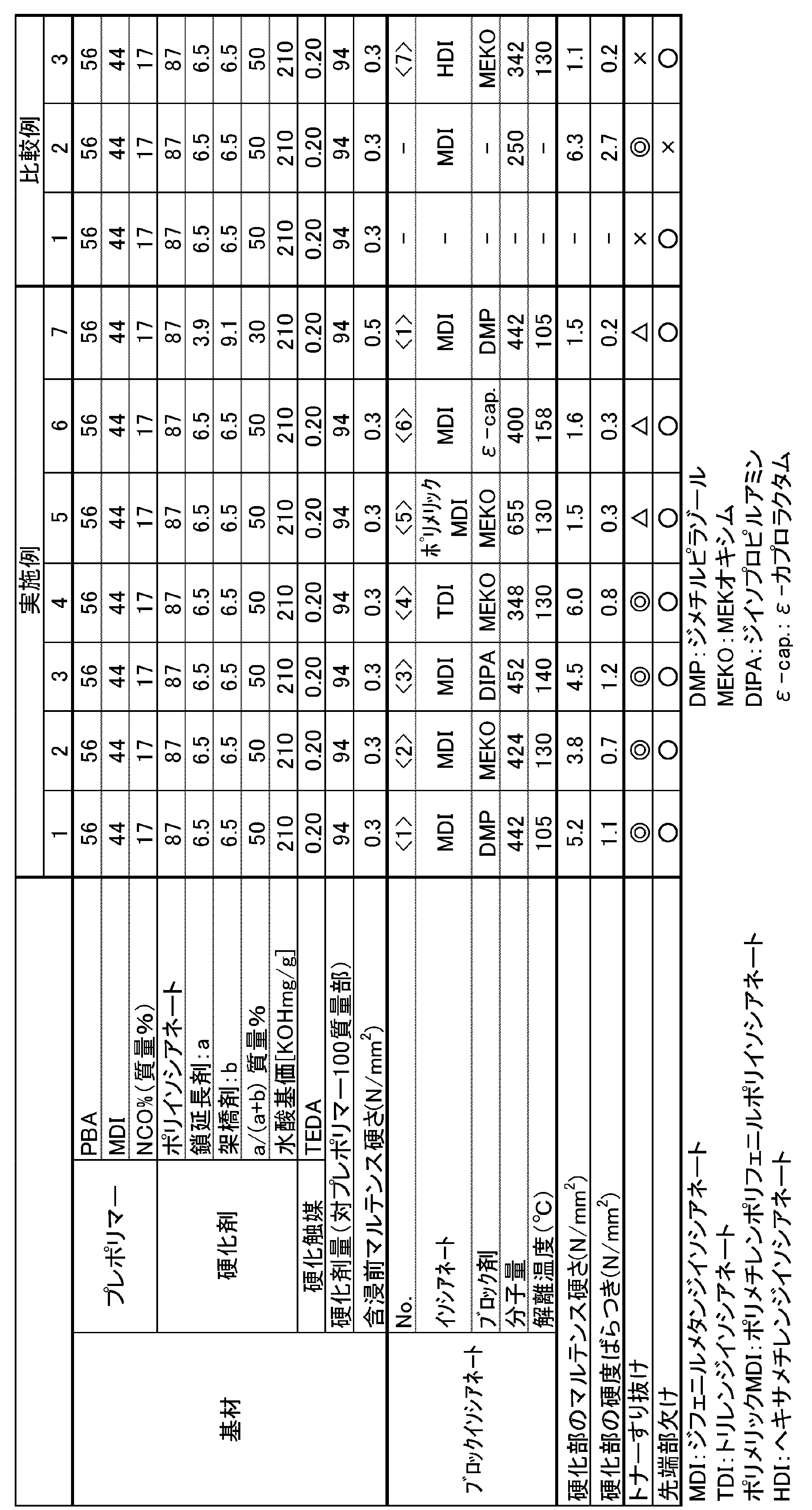
実施例から、ブレード部の当接部を含む範囲にブロックイソシアネートを含浸し、含浸したブロックイソシアネートからブロック剤を解離し、芳香族イソシアネートを含む遊離したイソシアネートをブレード部の基材中で硬化することで、十分な硬度上昇が生じるとともに硬度のばらつきが抑えられ、軟らかいことによる当接部全体にわたるトナーすり抜けも、先端部の欠けによるトナーのすり抜けも抑えられることがわかる。一方、イソシアネートで含浸処理していない場合には、先端部の欠けによるトナーのすり抜けは生じないが、軟らかいことによる当接部全体にわたるトナーすり抜けは抑えられない(比較例1)。また、ブロックされていないイソシアネートを含浸して硬化した場合には、十分な硬度上昇が生じているので、軟らかいことによる当接部全体にわたるトナーすり抜けは生じないが、硬度のばらつきが抑えられず、先端部の欠けによるトナーのすり抜けが抑えられないことがわかる(比較例2)。また、ブロックイソシアネートを含浸して硬化した場合でも、ブロックイソシアネートから遊離するイソシアネートが脂肪族イソシアネートである場合には、十分な硬度上昇が得られず、当接部全体にわたるトナーすり抜けを抑えられない。(比較例3)
そして、実施例5とその他の実施例から、ブロックイソシアネートの分子量が500以下であると、ブロックイソシアネートが含浸しやすくなり、硬化部のマルテンス硬度がより高くなり、当接部全体にわたるトナーすり抜けがより抑えられやすい。また、実施例6とその他の実施例から、ブロックイソシアネートの解離温度が140℃以下であると、硬化部のマルテンス硬度がより高くなり、当接部全体にわたるトナーすり抜けがより抑えられやすい。また、実施例7と実施例1から、基材において、鎖延長剤と架橋剤の合計に対する鎖延長剤が40質量%以上含まれることで、ブロックイソシアネートが含浸しやすくなり、硬化部のマルテンス硬度がより高くなり、当接部全体にわたるトナーすり抜けがより抑えられやすい。
以上、本発明の実施形態について詳細に説明したが、本発明は上記実施例に何ら限定されるものではなく、本発明の要旨を逸脱しない範囲で種々の改変が可能である。
Claims (7)
- ウレタンゴムを含むブレード状の基材の相手部材に当接する部分を含む少なくとも一部の表面からイソシアネート基がブロック剤でブロックされたブロックイソシアネートを含浸する含浸工程と、
前記含浸工程で前記基材に含浸した前記ブロックイソシアネートから前記ブロック剤を解離し、遊離したイソシアネートを前記基材中で硬化して前記基材の相手部材に当接する部分を含む少なくとも一部に硬化部を形成する硬化工程と、を有し、
前記ブロックイソシアネートから遊離するイソシアネートが、芳香族イソシアネートを含むことを特徴とする電子写真機器用ブレードの製造方法。 - 前記ブロックイソシアネートの分子量が500以下であることを特徴とする請求項1に記載の電子写真機器用ブレードの製造方法。
- 前記ブロックイソシアネートにおける前記ブロック剤の解離温度が、100~160℃の範囲内であることを特徴とする請求項1または2に記載の電子写真機器用ブレードの製造方法。
- 前記硬化部のマルテンス硬さが2.0N/mm2以上であり、かつ、前記硬化部のマルテンス硬さのばらつきが1.5N/mm2以下であることを特徴とする請求項1から3のいずれか1項に記載の電子写真機器用ブレードの製造方法。
ただし、
前記硬化部は、相手部材に当接する稜線部を有し、
前記硬化部のマルテンス硬さは、前記相手部材に向き合う面において、前記稜線部から50μm離れた位置で、前記稜線部が伸びる方向の中央位置からその両側に20mmピッチで各5点合計10点の位置における押し込み深さ1μmのマルテンス硬さの平均値であり、
前記硬化部のマルテンス硬さのばらつきは、前記合計10点の位置における押し込み深さ1μmのマルテンス硬さの最大値と最小値の差である。 - 前記含浸工程前における前記基材の押し込み深さ50μmのマルテンス硬さが、0.1~1.0N/mm2の範囲内であることを特徴とする請求項1から4のいずれか1項に記載の電子写真機器用ブレードの製造方法。
- 前記基材のウレタンゴムが、ポリオール、ポリイソシアネート、鎖延長剤、架橋剤を含むウレタン組成物の硬化物から形成されたものであり、前記ウレタン組成物において、前記鎖延長剤と前記架橋剤の合計に対し前記鎖延長剤が40質量%以上含まれることを特徴とする請求項1から5のいずれか1項に記載の電子写真機器用ブレードの製造方法。
- ウレタンゴムを含むブレード状の基材を有し、前記基材の相手部材に当接する部分を含む少なくとも一部の表面からイソシアネート基がブロック剤でブロックされたブロックイソシアネートが含浸され、前記基材に含浸された前記ブロックイソシアネートから前記ブロック剤が解離されてイソシアネートが遊離され、遊離された前記イソシアネートが前記基材中で硬化されて前記基材の相手部材に当接する部分を含む少なくとも一部に硬化部が設けられており、前記ブロックイソシアネートから遊離するイソシアネートが、芳香族イソシアネートを含むことを特徴とする電子写真機器用ブレード。
Priority Applications (2)
| Application Number | Priority Date | Filing Date | Title |
|---|---|---|---|
| CN201880060041.6A CN111095126B (zh) | 2018-01-31 | 2018-10-31 | 电子照相设备用刮板的制造方法以及电子照相设备用刮板 |
| US16/923,119 US10942482B2 (en) | 2018-01-31 | 2020-07-08 | Method for manufacturing blade for electrophotographic devices |
Applications Claiming Priority (2)
| Application Number | Priority Date | Filing Date | Title |
|---|---|---|---|
| JP2018014616A JP6948957B2 (ja) | 2018-01-31 | 2018-01-31 | 電子写真機器用ブレードの製造方法および電子写真機器用ブレード |
| JP2018-014616 | 2018-01-31 |
Related Child Applications (1)
| Application Number | Title | Priority Date | Filing Date |
|---|---|---|---|
| US16/923,119 Continuation US10942482B2 (en) | 2018-01-31 | 2020-07-08 | Method for manufacturing blade for electrophotographic devices |
Publications (1)
| Publication Number | Publication Date |
|---|---|
| WO2019150677A1 true WO2019150677A1 (ja) | 2019-08-08 |
Family
ID=67478187
Family Applications (1)
| Application Number | Title | Priority Date | Filing Date |
|---|---|---|---|
| PCT/JP2018/040467 Ceased WO2019150677A1 (ja) | 2018-01-31 | 2018-10-31 | 電子写真機器用ブレードの製造方法および電子写真機器用ブレード |
Country Status (4)
| Country | Link |
|---|---|
| US (1) | US10942482B2 (ja) |
| JP (1) | JP6948957B2 (ja) |
| CN (1) | CN111095126B (ja) |
| WO (1) | WO2019150677A1 (ja) |
Families Citing this family (3)
| Publication number | Priority date | Publication date | Assignee | Title |
|---|---|---|---|---|
| CN116457384B (zh) | 2020-11-09 | 2025-09-09 | 佳能株式会社 | 电子照相用清洁刮板、处理盒和电子照相图像形成设备 |
| JP2024115148A (ja) * | 2023-02-14 | 2024-08-26 | キヤノン株式会社 | 電子写真クリーニングブレード、プロセスカートリッジ及び電子写真画像形成装置 |
| JP2025111236A (ja) * | 2024-01-17 | 2025-07-30 | 富士フイルムビジネスイノベーション株式会社 | 成形体、複合体、管状定着部材、定着装置及び画像形成装置 |
Citations (10)
| Publication number | Priority date | Publication date | Assignee | Title |
|---|---|---|---|---|
| JPH08248851A (ja) * | 1995-03-09 | 1996-09-27 | Bando Chem Ind Ltd | 電子写真装置用ブレードおよびその製造法 |
| JP2004245944A (ja) * | 2003-02-12 | 2004-09-02 | Canon Inc | 導電性部材 |
| JP2006111676A (ja) * | 2004-10-13 | 2006-04-27 | Canon Chemicals Inc | 負荷電制御樹脂およびそれを用いた電子写真機能部品 |
| JP2007156093A (ja) * | 2005-12-05 | 2007-06-21 | Canon Chemicals Inc | 電子写真装置機能部品用樹脂 |
| JP2010134310A (ja) * | 2008-11-07 | 2010-06-17 | Ricoh Co Ltd | クリーニングブレード、画像形成装置、プロセスカートリッジ、及び、画像形成方法 |
| US20140153987A1 (en) * | 2012-11-30 | 2014-06-05 | Samsung Electronics Co., Ltd | Cleaning blades having excellent cleaning performance and durability, cleaning units, electrophotographic imaging apparatuses and electrophotographic cartridges employing the same |
| JP2015158654A (ja) * | 2014-01-23 | 2015-09-03 | 株式会社リコー | クリーニングブレードの製造方法、クリーニングブレード、画像形成装置、プロセスカートリッジ |
| JP2015191084A (ja) * | 2014-03-28 | 2015-11-02 | 住友理工株式会社 | ブレード部材の製造方法およびブレード部材 |
| JP2017097220A (ja) * | 2015-11-26 | 2017-06-01 | 住友理工株式会社 | 電子写真機器用クリーニングブレード |
| JP2017226828A (ja) * | 2016-06-17 | 2017-12-28 | ローム アンド ハース エレクトロニック マテリアルズ シーエムピー ホウルディングス インコーポレイテッド | 高除去速度ケミカルメカニカル研磨パッド及び製造方法 |
Family Cites Families (10)
| Publication number | Priority date | Publication date | Assignee | Title |
|---|---|---|---|---|
| JP2001075451A (ja) * | 1999-09-07 | 2001-03-23 | Canon Inc | クリーニングブレードおよびその製造方法 |
| JP4227909B2 (ja) | 2003-02-28 | 2009-02-18 | キヤノン化成株式会社 | クリーニングブレードの製造方法、該製造方法で製造されたクリーニングブレードおよび該クリーニングブレードを組み込んでなる電子写真装置 |
| JP2015111249A (ja) * | 2013-10-31 | 2015-06-18 | 株式会社リコー | クリーニングブレードおよび画像形成装置 |
| KR101885450B1 (ko) * | 2014-04-09 | 2018-08-03 | 가부시키가이샤 리코 | 클리닝 블레이드의 제조 방법, 클리닝 블레이드, 화상 형성 장치 및 프로세스 카트리지 |
| EP2977820B1 (en) * | 2014-07-25 | 2021-02-17 | Canon Kabushiki Kaisha | Cartridge and image forming apparatus |
| JP6375203B2 (ja) * | 2014-10-28 | 2018-08-15 | 住友理工株式会社 | 電子写真機器用導電性部材 |
| US9851682B2 (en) * | 2015-07-03 | 2017-12-26 | Ricoh Company, Ltd. | Cleaning blade including modified portion including impregnated portion and surface layer, and process cartridge and image forming apparatus including the cleaning blade |
| JP6149075B2 (ja) * | 2015-07-30 | 2017-06-14 | 住友理工株式会社 | 電子写真機器用クリーニングブレード用組成物および電子写真機器用クリーニングブレード |
| JP2017062311A (ja) * | 2015-09-24 | 2017-03-30 | 富士ゼロックス株式会社 | クリーニングブレード及び画像形成装置 |
| JP2017102248A (ja) * | 2015-12-01 | 2017-06-08 | 株式会社リコー | クリーニングブレード、及び画像形成装置 |
-
2018
- 2018-01-31 JP JP2018014616A patent/JP6948957B2/ja active Active
- 2018-10-31 WO PCT/JP2018/040467 patent/WO2019150677A1/ja not_active Ceased
- 2018-10-31 CN CN201880060041.6A patent/CN111095126B/zh active Active
-
2020
- 2020-07-08 US US16/923,119 patent/US10942482B2/en active Active
Patent Citations (10)
| Publication number | Priority date | Publication date | Assignee | Title |
|---|---|---|---|---|
| JPH08248851A (ja) * | 1995-03-09 | 1996-09-27 | Bando Chem Ind Ltd | 電子写真装置用ブレードおよびその製造法 |
| JP2004245944A (ja) * | 2003-02-12 | 2004-09-02 | Canon Inc | 導電性部材 |
| JP2006111676A (ja) * | 2004-10-13 | 2006-04-27 | Canon Chemicals Inc | 負荷電制御樹脂およびそれを用いた電子写真機能部品 |
| JP2007156093A (ja) * | 2005-12-05 | 2007-06-21 | Canon Chemicals Inc | 電子写真装置機能部品用樹脂 |
| JP2010134310A (ja) * | 2008-11-07 | 2010-06-17 | Ricoh Co Ltd | クリーニングブレード、画像形成装置、プロセスカートリッジ、及び、画像形成方法 |
| US20140153987A1 (en) * | 2012-11-30 | 2014-06-05 | Samsung Electronics Co., Ltd | Cleaning blades having excellent cleaning performance and durability, cleaning units, electrophotographic imaging apparatuses and electrophotographic cartridges employing the same |
| JP2015158654A (ja) * | 2014-01-23 | 2015-09-03 | 株式会社リコー | クリーニングブレードの製造方法、クリーニングブレード、画像形成装置、プロセスカートリッジ |
| JP2015191084A (ja) * | 2014-03-28 | 2015-11-02 | 住友理工株式会社 | ブレード部材の製造方法およびブレード部材 |
| JP2017097220A (ja) * | 2015-11-26 | 2017-06-01 | 住友理工株式会社 | 電子写真機器用クリーニングブレード |
| JP2017226828A (ja) * | 2016-06-17 | 2017-12-28 | ローム アンド ハース エレクトロニック マテリアルズ シーエムピー ホウルディングス インコーポレイテッド | 高除去速度ケミカルメカニカル研磨パッド及び製造方法 |
Also Published As
| Publication number | Publication date |
|---|---|
| JP6948957B2 (ja) | 2021-10-13 |
| JP2019132982A (ja) | 2019-08-08 |
| CN111095126B (zh) | 2022-07-22 |
| CN111095126A (zh) | 2020-05-01 |
| US10942482B2 (en) | 2021-03-09 |
| US20200333740A1 (en) | 2020-10-22 |
Similar Documents
| Publication | Publication Date | Title |
|---|---|---|
| JP5364251B2 (ja) | 電子写真装置用ブレード及びその製造方法 | |
| KR101291473B1 (ko) | 전자 사진 장치용 클리닝 블레이드 및 그의 제조 방법 | |
| US10942482B2 (en) | Method for manufacturing blade for electrophotographic devices | |
| JP6527453B2 (ja) | 電子写真機器用クリーニングブレード | |
| US7619052B2 (en) | Blade for electrophotographic apparatus | |
| JP5175486B2 (ja) | クリーニングブレード | |
| US10030167B2 (en) | Method for producing blade member | |
| JP2018036363A (ja) | 電子写真機器用クリーニングブレード | |
| JP2009080167A (ja) | 電子写真式画像形成装置用ウレタンブレード部材の製造方法及び電子写真式画像形成装置用ウレタンブレード部材 | |
| JP2008139743A (ja) | クリーニングブレード | |
| US10203648B2 (en) | Cleaning blade for electrophotographic equipment | |
| JP2019082586A (ja) | クリーニングブレード用組成物およびクリーニングブレード | |
| JP6800697B2 (ja) | クリーニングブレード、プロセスカートリッジ及び電子写真画像形成装置 | |
| JP3666331B2 (ja) | クリーニングブレード | |
| JP4330599B2 (ja) | 電子写真装置用クリーニングブレード | |
| JP2005242191A (ja) | 発泡弾性体ローラ及びその製造方法 | |
| JP3978768B2 (ja) | 熱硬化性ポリウレタンエラストマーの製造方法 | |
| JP6637925B2 (ja) | 電子写真機器用ブレードおよびその製造方法 | |
| JP4812094B2 (ja) | クリーニングブレード | |
| CN120693575A (zh) | 电子照相清洁刮板、处理盒和电子照相图像形成设备 | |
| JPH0934215A (ja) | 導電性ローラ | |
| JP4532220B2 (ja) | 電子写真装置用ブレードの製造方法 | |
| JP2021113871A (ja) | 電子写真用ブレードの製造方法 | |
| JP2009204792A (ja) | 電子写真機器用クリーニングブレード及びその製造方法 | |
| JP2001106759A (ja) | 電子写真用低硬度ローラ |
Legal Events
| Date | Code | Title | Description |
|---|---|---|---|
| 121 | Ep: the epo has been informed by wipo that ep was designated in this application |
Ref document number: 18903734 Country of ref document: EP Kind code of ref document: A1 |
|
| NENP | Non-entry into the national phase |
Ref country code: DE |
|
| 122 | Ep: pct application non-entry in european phase |
Ref document number: 18903734 Country of ref document: EP Kind code of ref document: A1 |