WO2019131997A1 - 容器詰飲料 - Google Patents
容器詰飲料 Download PDFInfo
- Publication number
- WO2019131997A1 WO2019131997A1 PCT/JP2018/048439 JP2018048439W WO2019131997A1 WO 2019131997 A1 WO2019131997 A1 WO 2019131997A1 JP 2018048439 W JP2018048439 W JP 2018048439W WO 2019131997 A1 WO2019131997 A1 WO 2019131997A1
- Authority
- WO
- WIPO (PCT)
- Prior art keywords
- beverage
- container
- coffee
- filled
- packed
- Prior art date
- Legal status (The legal status is an assumption and is not a legal conclusion. Google has not performed a legal analysis and makes no representation as to the accuracy of the status listed.)
- Ceased
Links
Classifications
-
- A—HUMAN NECESSITIES
- A23—FOODS OR FOODSTUFFS; TREATMENT THEREOF, NOT COVERED BY OTHER CLASSES
- A23F—COFFEE; TEA; THEIR SUBSTITUTES; MANUFACTURE, PREPARATION, OR INFUSION THEREOF
- A23F3/00—Tea; Tea substitutes; Preparations thereof
- A23F3/16—Tea extraction; Tea extracts; Treating tea extract; Making instant tea
-
- A—HUMAN NECESSITIES
- A23—FOODS OR FOODSTUFFS; TREATMENT THEREOF, NOT COVERED BY OTHER CLASSES
- A23F—COFFEE; TEA; THEIR SUBSTITUTES; MANUFACTURE, PREPARATION, OR INFUSION THEREOF
- A23F5/00—Coffee; Coffee substitutes; Preparations thereof
- A23F5/24—Extraction of coffee; Coffee extracts; Making instant coffee
Definitions
- the present invention relates to a packaged beverage and a method of manufacturing the same.
- the present invention relates to a container-packed beverage capable of maintaining a fresh flavor such as freshness, which is characteristic of a targeted beverage, and a method for producing the same.
- Container-packed beverages are widely spread and consumed mainly in cans, bottles, plastic bottles, chilled cups and the like.
- container-packed beverages may be heat-sterilized so as to withstand long-term distribution or storage, and the heat-killed content may reduce the flavor components or degrade the flavor components during storage or distribution.
- the fresh flavor that is characteristic of beverages, such as freshly made becomes difficult to feel during drinking.
- Patent Document 1 describes that the deterioration with time of the container-packed beverage is suppressed by adjusting the amount of dissolved oxygen in the temporary heating / deoxygenation step to 0.1 to 3.0 ppm.
- Patent Document 2 describes that by processing coffee beans in advance with steam at a constant temperature, a drip coffee beverage having excellent long-term storability can be obtained.
- Patent Document 3 is to obtain a beverage container suitable for long-term storage by forming a resin beverage container in multiple layers and providing an oxygen absorbing layer and an oxygen blocking layer.
- Patent Document 4 proposes that a beverage container suitable for container storage be obtained by improving the light transmittance of the container.
- an object of the present invention is to develop a technique for suppressing the decrease in flavor quality due to heating and aging of the packaged beverage.
- volatile compounds containing sulfur that imparts a characteristic flavor to nonanal which is a component that imparts a characteristic flavor to tea beverages, and coffee (also contain sulfur-containing aroma components).
- polyphenols such as catechins contained in tea beverages and chlorogenic acid contained in coffee are spatially separated, and the total polyphenol concentration of the beverage composition to be filled in one beverage container is stored in another beverage container By making it higher than the total polyphenol concentration of the drink composition to fill, it discovered that the flavor degradation in heating and aging of tea and coffee could be suppressed effectively.
- the present invention includes the following aspects.
- a container-packed coffee beverage or a container-packed tea beverage wherein two or more beverage compositions having different component compositions are respectively filled in two or more beverage containers, and the beverage composition filled in a certain beverage container The above beverage, wherein the total polyphenol concentration of the product is higher than the total polyphenol concentration filled in another beverage container.
- the beverage according to (1) which is a concentrate-type beverage which is diluted after diluting two or more beverage compositions filled in the beverage container.
- the beverage according to (1) or (2), wherein two or more beverage compositions filled in the beverage container are mixed and then taken.
- a container-packed coffee beverage wherein the sulfur-containing aroma component concentration of the beverage composition filled in one beverage container is higher than the sulfur-containing aroma component concentration of the beverage composition filled in another beverage container
- a container-packed coffee beverage wherein the sulfur-containing aroma component concentration of the combined composition after sterilizing the beverage composition filled in two or more kinds of beverage containing parts respectively combines the beverage composition.
- the beverage according to any one of (1) to (5) which is higher than when it is sterilized after being put into place.
- a container-packed tea beverage wherein the nonanal concentration of a beverage composition filled in one beverage container is lower than the nonanal concentration of a beverage composition filled in another beverage container, The beverage according to any one of 1) to (4).
- a container-packed tea beverage wherein the nonanal concentration of the combined composition after sterilizing each of the beverage compositions filled in the two or more types of beverage containing parts united the beverage composition The beverage according to any one of (1) to (4) and (7), which is higher than when sterilized later.
- a method for producing the beverage according to any one of (1) to (8) which comprises the steps of filling two or more beverage compositions having different compositions into two or more beverage containers, respectively. , The above method.
- the present invention unlike conventional container-packed beverages, it is possible to effectively suppress the heating of the container-packed beverages and the deterioration of the flavor quality over time.
- the flavor characteristic of the targeted beverage can be easily maintained, and therefore, the added value of the packaged beverage can be improved.
- the present invention it is possible to suppress the deterioration of the flavor quality of the beverage due to heat sterilization at the time of manufacture or deterioration with time during storage and distribution, so the loss of flavor components in the beverage is suppressed to improve the raw material yield. It can also be expected to
- the container-packed beverage according to the present invention is a container-packed beverage in which two or more beverage compositions having different compositions are respectively filled in two or more beverage containers, and a beverage composition filled in one beverage container.
- the total polyphenol concentration of is higher than the total polyphenol concentration of the beverage composition filled in another beverage container.
- the beverage according to the present invention is a container-packed beverage, and in the present invention, a container provided with two or more beverage containers is used. There is no particular limitation as long as there are two or more beverage containers, but the number of beverage containers is preferably 4 or less, more preferably 3 or less, and even more preferably 2.
- the container-packed beverage according to the present invention is one in which two or more types of beverage compositions different in composition are filled in separate beverage containers respectively, and by doing so, deterioration of the flavor over time of the beverage is achieved. It can be suppressed.
- each beverage container is not particularly limited, but may be, for example, 1 to 100 ml, preferably 2 to 60 ml, more preferably 3 to 50 ml, still more preferably 4 to 40 ml, and may be 5 to 30 ml. .
- the capacity of each beverage container may be the same or different.
- the container-packed beverage of the present invention is, in a preferred embodiment, mixed after drinking two or more beverage compositions filled in the beverage container.
- the container-packed beverage according to the present invention is drinkable after diluting the two or more beverage compositions filled in the beverage container, in which case the beverage composition filled in the beverage container Is typically a concentrated (type) beverage.
- the beverage is diluted, not only water but also carbonated water, alcohol (ethanol) aqueous solution and milk can be suitably used.
- ethanol aqueous solution and milk
- the dilution factor when diluting the packaged beverage according to the present invention with a diluent is not particularly limited, but a dilution of 2.0 to 20.0 times is preferable, and a dilution of 3.0 to 10.0 times is more preferable, and 4. A 0-8.0 fold dilution is more preferred.
- the container-packed beverage according to the present invention is characterized in that it is mixed after being heated. Even when stored at ordinary temperature for a long time, compared with pre-mixed and heated ones, it is possible to maintain the fresh flavor created and the flavor characteristic of the targeted beverage.
- the material, shape, and the like of the container used in the present invention are not particularly limited as long as there are two or more beverage containers.
- any of materials commonly used for beverage containers such as aluminum cans, metal containers such as steel cans, resin containers such as PET bottles, glass bottles, paper containers, etc. can be used.
- the beverage container according to the invention is made of resin.
- the packaged beverage according to the present invention may be filled in a container after heat sterilization of the beverage composition, or may be heat sterilized after filling the container.
- aseptic filling may be performed at a low temperature or the like.
- the conditions at the time of heat sterilization are not particularly limited, but the treatment specified in the Food Sanitation Law may be carried out.
- retort sterilization eg, heat sterilization at 121 ° C. for 7 minutes while pressurizing appropriately
- UHT sterilization for example, holding a beverage composition at 120 to 150 ° C. for 1 second to several tens of seconds etc.
- You may use it as needed.
- the sterilizing step in producing the container-packed beverage of the present invention is preferably carried out separately for each of the beverage compositions to be filled in the respective beverage containers, in order to prevent unintended mixing and contamination prior to filling. Thus, it is possible to minimize the flavor deterioration up to the filling step.
- the container-packed beverage of the present invention is produced, for example, by the steps of preparing two or more beverage compositions, and filling the prepared two or more beverage compositions into separate beverage containers, respectively. can do.
- it is possible to change the order of each step or to appropriately add a new step for example, a sterilizing step can be provided, or a step of removing a residue or the like by filtration can be inserted.
- the beverage composition according to the present invention refers to a liquid composition prepared for drinking purpose.
- known mixing devices such as, for example, a paddle mixer and a homomixer, and, if necessary, a high pressure homomixer, can be freely used.
- raw materials of the composition common beverage raw materials such as coffee extract, tea extract, fruit extract, vegetable extract, synthetic flavor and natural flavor, sugars, sweeteners, seasonings, antioxidants, thickening agents It may contain an alcohol such as an agent, an emulsifying agent, a pH adjusting agent, and a liqueur. If necessary, solid and semi-solid substances such as pulp, pulp and jelly may be dispersed.
- nonanal which is a component that imparts a characteristic flavor to tea beverages, and sulfur-containing volatile compounds, which impart a characteristic flavor to coffee, have the property of being easily deteriorated by heating and aging, and react with polyphenols and the like Deterioration is promoted by doing. Therefore, in the present invention, after coffee, chlorogenic acids, coffee melonidin which is also called brown component, tea extract, catechins and tannic acid and flavor components are localized in separate beverage compositions ( To make the concentration of ingredients higher than other beverage compositions) By storing them separately, the reduction of flavor components is minimized, and flavor deterioration due to heating and aging is effectively suppressed.
- Two or more beverage compositions are separately filled into two or more beverage containers, and the beverage composition is localized with polyphenols, sulfur-containing compounds such as thiols and sulfides, or short-chain fatty aldehydes and terpenes Increase the concentration of aldehydes such as aldehydes in the beverage composition on the side where polyphenols are not unevenly distributed, that is, among the plurality of beverage compositions, the easily degradable flavor component is present on the side with less component promoting deterioration By doing this, it is possible to make the deterioration suppressing effect according to the present invention particularly large.
- a flavor ingredient a ingredient which mainly affects a flavor as well as a ingredient which affects a taste is mentioned.
- a highly reactive compound which is easily degraded and denatured into one beverage composition for example, an antioxidant functional component such as astaxanthin, tocophenol and vitamin C, and various pigment components May be localized in one beverage composition, in a plurality, or all.
- the total polyphenol concentration of the at least one beverage composition filled in the at least one beverage container is higher than the beverage composition filled in another beverage container.
- the total polyphenol concentration of the beverage composition filled in one beverage container is preferably at least 1.2 times greater than the beverage composition filled in another beverage container, 1.5 times or more Or it may be 1.8 times or more.
- the upper limit is not particularly limited.
- the containerized beverage of the present invention can be a containerized coffee beverage, wherein at least one beverage composition comprises coffee extract.
- the beverage composition filled in one beverage container will have a higher total polyphenol content than the beverage composition filled in another beverage container.
- the coffee extract refers to an extract of roasted coffee beans, and includes one obtained by drying a coffee extract and processing it into a powder.
- the roasted coffee beans used as the raw material of the coffee extract of this invention are not specifically limited. Direct fire type, hot air type, half hot air type, charcoal type, far infrared type, microwave type, superheated steam type, etc., horizontal (horizontal) drum type, vertical (vertical) drum type, vertical rotation ball type, flow It is sufficient to finish the roasting degree according to a predetermined purpose according to the type of coffee beans using a floor type or pressure type apparatus.
- a roasted coffee bean roasted to about 35 to about 60, preferably about 45 to about 50, using a value measured with an Agtron color meter (Agtron value) as an index is an example of a preferred embodiment.
- the type of coffee beans is not limited either, and any of arabica species and lobsta species can be used.
- the coffee extract is obtained by extracting the above-mentioned roasted coffee beans according to a conventional method using a water-soluble solvent such as warm water.
- coffee beverage refers to a beverage product produced using coffee as a raw material.
- the type of product is not particularly limited, but mainly includes “coffee,” “coffee beverage,” and “coffee-containing soft drink,” which are the definition of "fair competition rules for labeling of coffee beverages,” approved in 1977.
- milk beverages those with a milk solids content of 3.0% by mass or more are treated as “milk beverages", subject to the application of the "fair competition code on labeling of drinking milk”. Is included in the coffee beverage in the present invention.
- the term “coffee fraction” refers to a solution containing components derived from coffee beans, and for example, a coffee extract, ie, a solution obtained by extracting roasted and crushed coffee beans using water or warm water, etc. It can be mentioned. Moreover, the solution which adjusted the coffee extract which concentrated the coffee extract, the instant coffee etc. which dried the coffee extract, etc. to suitable quantity with water, warm water, etc. is also mentioned as a coffee ingredient.
- a roast incense etc. are mentioned as what characterizes a coffee-like smell.
- "Coffee-like roasted coffee” is the smell of freshly brewed coffee, and refers to the fragrant smell that passes through the oral cavity and into the nasal cavity when drinking.
- components contributing to the roasted aroma of coffee for example, there are volatile compounds containing sulfur such as 3-mercapto-3-methylbutyl-formate and 2-furfurylthiol.
- coffee contains polyphenols such as chlorogenic acid, but polyphenols have the property of deteriorating the flavor component containing sulfur (3-mercapto-3-methylbutyl-formate), and deterioration occurs when the total amount of polyphenols is large. Promoted.
- the packaged beverage according to the present invention may contain caffeine.
- caffeine In beverages such as coffee beverages, the presence of caffeine is regarded as important from the viewpoint of its flavor, and if the amount of caffeine is too large, the flavor as a beverage may be lost.
- the lower limit of the caffeine content in the beverage is preferably 10 mg, more preferably 15 mg, still more preferably 20 mg, still more preferably 25 mg, still more preferably 30 mg, per 100 mL of the beverage.
- the value may be preferably 100 mg, more preferably 95 mg, more preferably 90 mg, still more preferably 85 mg, and still more preferably 80 mg.
- the grinding treatment is preferably performed within 24 hours, preferably within 20 hours, more preferably within 15 hours, particularly preferably 10 hours after roasting.
- the dry pulverization treatment is preferably carried out after coarse crushing to a median diameter of 1 mm or less and then fine crushing.
- coarsely pulverizing in advance before pulverizing it is possible to pulverize more efficiently in a short time, and it is possible to minimize scattering of coffee flavor (flavor).
- the particle size distribution can be narrowed.
- Coarse grinding is performed to a median diameter of about 1 mm or less, preferably 0.5 mm or less, but the method is not particularly limited.
- Various types of grinders can be used, such as roll mills, ball mills, mills and the like.
- the degree of comminution of the roasted coffee beans can be controlled by the median diameter.
- the lower limit value of the median value is preferably 50 ⁇ m, more preferably 70 ⁇ m, still more preferably 80 ⁇ m, and still more preferably 90 ⁇ m.
- the coffee beans can be pulverized so that the median value of the particle size of the finely pulverized product is 300 ⁇ m or less, more preferably 250 ⁇ m or less, and even more preferably 200 ⁇ m or less.
- the texture such as texture and texture may be uncomfortable.
- the method of pulverization is also not particularly limited, and various types of pulverizers can be used, such as a roll pulverizer, an impact pulverizer such as a bar hammer or pin hammer, an air flow pulverizer, etc.
- a pulverizer is preferably used.
- the particle size is generally represented as a distribution of the abundance ratio of each of the particle sizes, and this is called a particle size distribution.
- the reference of the abundance ratio there are a volume reference, a number reference, and the like, but in the present specification, it is expressed by the abundance ratio on a volume basis, and can be measured by a measuring device based on a laser diffraction / scattering method.
- An example of the measuring apparatus is a microtrack particle size distribution measuring apparatus (manufactured by Nikkiso Co., Ltd.).
- the particle diameter of the finely ground material of the roasted coffee beans is expressed by the median diameter, but the median diameter is 50% of the accumulated data of the particle diameter, and the powder is When divided into one, the larger side and the smaller side are the diameters that become equal.
- the container-packed beverage of the present invention can be a container-packed tea beverage, wherein at least one beverage composition comprises a tea extract.
- the beverage composition filled in one beverage container will have a higher total polyphenol content than the beverage composition filled in another beverage container.
- the tea extract refers to an extract of tea leaves, including those obtained by drying the tea leaf extract and processing it into powder.
- the tea leaf extract is obtained by extracting the components by immersing the tea leaf in an extraction solvent.
- the extraction method is not particularly limited, and known methods can be selected, and for example, extraction can be performed by immersion in an extraction solvent.
- a predetermined organic solvent other than hot water or cold water can be selected as the extraction solvent, water is preferable as the extraction solvent because it is used for a beverage.
- treatments such as squeezing, filtration, and centrifugation can also be performed as necessary.
- the tea extract is a solid in which the component contained in the plant is extracted by the extraction solvent, or, if necessary, the extract is concentrated or dried to extract the extract. It is good.
- the plant body may be in the form of a processed plant material that has been processed through steps such as cutting, heating, and drying, as necessary.
- Uri incense is mentioned as an aroma that characterizes the aroma of fresh tea.
- Uri indense is a characteristic incense of Gyokuro, which is a high-grade tea, and the odor component that is the source of Uri incense is nonanal and disulfide, etc., and it is contained as much as senior new tea. It is said that high-grade new tea contains a large amount of green leaf alcohol etc. and is involved in the aroma of new tea.
- tea beverages contain polyphenols such as catechins. However, polyphenols have the property of deteriorating flavor components such as nonanal, and deterioration is promoted when the total amount of polyphenols is large.
- tea leaves is not particularly limited, and can be suitably selected, for example, as long as it is tea tree (Camellia sinensis).
- the tea leaves may be fresh tea leaves, but they may be processed by heating the raw leaves by steaming or roasting them, or by performing a so-called rough tea processing process such as tanning, or the above-mentioned rough tea.
- green tea obtained by finish-processing, tea making such as Gyokuro (finishing tea), semi-fermented tea such as oolong tea, and fermented tea such as black tea.
- the tea extract when the tea extract is a liquid as a beverage composition, the extract can be used as it is.
- a form obtained by concentrating the extract or a solid obtained by drying may be used again to be dissolved in a solvent such as water at a predetermined concentration.
- the beverage composition can contain additives as described later.
- the packaged beverage according to the present invention may be a carbonated beverage containing carbon dioxide gas at the time of drinking.
- the pressure of carbon dioxide gas is preferably a pressure at which a refreshing sensation derived from carbon dioxide gas can be felt, and the liquid temperature is preferably 0.5 to 4.5 kgf / cm 2 at 20 ° C., and 1.0 to 4. more preferably 0 kgf / cm 2, more preferably 1.5 ⁇ 3.5kgf / cm 2.
- the container-packed beverage according to the present invention after the container-packed beverage according to the present invention is opened, it can be made into a carbonated beverage by diluting with carbonated water.
- the packaged beverage according to the present invention can be used as a beverage containing fat and oil components such as milk fat and vegetable fat and oil.
- fat and oil components such as milk fat and vegetable fat and oil.
- a beverage containing milk As a beverage containing milk, a beverage containing both milk fat and non-fat milk solid components is generally preferred. Recently, from the viewpoint of milk fat stability, price, etc., beverages in which part or all of milk fat has been replaced with vegetable oil have been developed.
- a milk-containing beverage refers to a beverage manufactured using non-fat milk solid components, milk fat and / or vegetable fats and oils as raw materials.
- the milk in the milk-containing coffee beverage refers to a component added to impart milk flavor and texture to the beverage
- raw materials for supplying non-fat milk solid components include raw milk, milk, special milk and partially skimmed milk , Processed milk, cream, concentrated milk, sugar-free milk, whole milk powder, cream powder, butter milk powder, adjusted milk powder, skimmed milk, skimmed milk, concentrated whey, skimmed concentrated milk, sugared skimmed milk, skimmed milk powder, whey powder etc.
- Raw materials to supply milk fat include raw milk, milk, special milk, partially skimmed milk, processed milk, cream, concentrated milk, non-sugar milk, whole milk powder, cream powder, butter milk powder, modified milk powder etc.
- Vegetable fats and oils may be used instead of part or all of milk fat.
- vegetable fats and oils include rapeseed oil, rapeseed hydrogenated oil, rice oil, soybean oil, corn oil, safflower oil, sunflower oil, cottonseed oil, sesame oil, olive oil, palm oil, palm kernel oil, coconut oil, coconut hydrogenated oil, etc.
- the content of the milk component in the milk-containing beverage of the present invention is not particularly limited, it is preferably 0.1 to 10% by mass in terms of solid content at the time of drinking.
- the solid content as referred to herein means a dried product after drying a component derived from milk using a general drying method (lyophilization, evaporation, etc.) to remove water.
- the lower limit of the amount of lipids in the beverage based on the nutrition indication criteria of the method of improving nutrition is preferably 0.4 g, more preferably 0.45 g, still more preferably per 100 g of beverage Is 0.5 g, and the upper limit is preferably 1.0 g, more preferably 0.9 g, and still more preferably 0.8 g.
- additives and the like may be blended alone or in combination, as in a normal beverage, as long as the effects of the present invention are not impaired.
- additives include acidulants, flavors, vitamins, dyes, antioxidants, emulsifiers, preservatives, seasonings, extracts, pH adjusters, thickeners, quality stabilizers, etc. it can.
- the beverage of the present invention may contain sugars such as glucose.
- the beverage of the present invention may use one or more natural sweeteners and artificial sweeteners.
- the beverage of the present invention comprises fructose-glucose liquid sugar.
- the pH adjuster is a component capable of alleviating the pH drop at the time of sterilization, and refers to a substance that exhibits alkalinity when dissolved in water.
- sodium bicarbonate sodium hydrogen carbonate
- potassium carbonate potassium carbonate
- the addition amount thereof is 0.1% by weight or less, preferably 0.05% by weight or less, based on the whole beverage.
- a sweetening component means the component which exhibits sweetness.
- sucrose isomerized sugar, glucose, fructose, lactose, maltose, xylose, isomerized lactose, fructooligosaccharide, maltooligosaccharide, isomaltoligosaccharide, galactooligosaccharide, coupling sugar, palatinose, maltitol, sorbitol, erythritol, xylitol And lactitol, palatinit, reduced starch saccharide, stevia, glycyrrhizin, thaumatin, monelin, aspartame, alitame, saccharin, acesulfame K, sucralose, ducurtin and the like.
- the packaged beverage according to the present invention has a Brix value (Brix) of 1 to 6, more preferably 2 to 5, and still more preferably 2 to 4, including alcohol in a preferred embodiment at the time of drinking.
- the upper limit of the brix value of the beverage including alcohol may be 7, and the lower limit may be 1.
- the soluble solid content can be evaluated by the Brix value obtained using a sugar degree meter or refractometer, and the Brix value is the refractive index measured at 20 ° C. of the ICUMSA (International Committee for Sugar Analysis Method). It is the value converted into the mass / mass percentage of sucrose solution based on the conversion table. The unit is displayed as "° Bx", "%" or "degree".
- the beverage of the present invention may be a low solute beverage with a low potential solid concentration, and is a so-called calorie-off type beverage, which is displayed as “zero saccharides”, “zero saccharides”, “calories off”, etc. May be
- indications such as “zero saccharides”, “zero saccharides”, “calorie off”, etc. are defined in the nutrition indication standard under the provisions of the Health Promotion Law.
- Saccharides zero means that the amount of saccharides (monosaccharides or disaccharides but not sugar alcohols) contained in the beverage is less than 0.5 g per 100 g of beverage It is a thing.
- Carbohydrate zero is displayed when the density
- Carbohydrate is one of the three major nutrient carbohydrates, which is a generic term for carbohydrates excluding dietary fiber.
- the pH of the beverage of the present invention can be adjusted to the acidic side in a preferred embodiment from the viewpoint of long-term storage and microbial contamination.
- the pH of the beverage is preferably 1.5 to 5.0, more preferably pH 1.8 to 4.5, still more preferably pH 2.1 to 4.0, and pH 2.4 to 3. 5 may be used.
- Test Example 1 Preparation and evaluation of container-packed beverage (coffee beverage) (1) Preparation of container-packed beverage [Example] Using coffee beans as a raw material, a coffee extract having a solids concentration of about 45% (a coffee concentrate in which roasted coffee beans were pressurized with hot water and coffee components were extracted) was produced. The coffee extract was diluted with ion-exchanged water, and an overlay (sodium hydrogen carbonate) was added to adjust the pH to about 6.0, and the solid concentration to be 20% by weight, to obtain a solution A.
- an overlay sodium hydrogen carbonate
- a slurry of ground roasted coffee beans developed in water was brought into contact with water vapor with an alternating current using an SCC (spinning corn column) device and continuously distilled at 100 ° C. to produce a coffee steam distillate.
- Steam distillation is a method of blowing steam into an organic compound (in this case, coffee) which has a high boiling point and hardly dissolves in water and distills the compound together with the steam, and a coffee steam distilled liquid is coffee beans Is a distillate obtained by steam distillation.
- the coffee steam distilled solution was diluted with ion exchanged water, adjusted to have a solid content concentration of 0.02% by weight, and a pH of about 5.5, and used as solution B.
- each of the solution A and the solution B was separately filled in separate beverage containers and retort sterilized (123 ° C., 10 minutes) to produce a concentrated type containerized coffee beverage. Thereafter, the container-packed beverage was stored at normal temperature (23 ° C.) for 20 days, and then A solution and B solution were mixed in equal amounts, and diluted with ion exchange water to a solid content concentration of 1% to prepare a coffee beverage.
- the inlet temperature is 250 ° C
- the column flow rate is 1mL / min
- the detector temperature is 260 ° C
- the hydrogen flow rate is 40mL / min
- the air flow rate is 60mL / min.
- the temperature was raised to 250 ° C. as early as min and held for 7.5 minutes for measurement.
- the samples were preheated (60 ° C., 5 minutes), then extracted (60 ° C., 20 minutes) and desorbed (250 ° C., 2 minutes) for extraction and analysis. Sulfur-containing aroma components were evaluated by peak area.
- the total polyphenol concentration was 25165 ppm (standard deviation: 353) in the example (solution A), 11 ppm in the example (solution B), and 12534 ppm (standard deviation: 179) in the comparative example.
- Coffee extract (Liquid A) and coffee steam distilled liquid (Liquid B) were prepared in the same manner as in (1) above, and each was filled into separate beverage containers and stored (Example). Moreover, it carried out similarly to said (1), manufactured the container-packed drink of a concentration type, and was stored (comparative example).
- Test Example 2 Preparation and evaluation of container-packed beverage (tea beverage) (1) Preparation of container-packed beverage [Example] Green tea powder (powder obtained by spray-drying a green tea extract), sodium bicarbonate (sodium hydrogen carbonate), and sodium ascorbate are dissolved in deionized water to adjust the solid content concentration to 6% by weight, It was solution A.
- Green tea steam distillation liquid was manufactured by making water vapor
- solution A and the solution B were respectively filled in separate beverage containers, and retort-sterilized (123 ° C., 10 minutes) to produce a concentrated container-packed tea beverage. Then, after storing at normal temperature (23 ° C.) for 20 days, solution A and solution B were mixed in equal amounts, and diluted with ion exchanged water to a solid content concentration of 0.3% to prepare a tea beverage.
- amino acid concentrations in the beverages combined with the solutions A and B described in the examples and the beverages of the comparative examples were measured using HPLC under the following conditions. Specifically, eight types of amino acids, aspartic acid, glutamic acid, serine, glycine, threonine, alanine, proline, and theanine were quantified using a standard substance, and the total amount was calculated.
Landscapes
- Life Sciences & Earth Sciences (AREA)
- Chemical & Material Sciences (AREA)
- Engineering & Computer Science (AREA)
- Food Science & Technology (AREA)
- Polymers & Plastics (AREA)
- Tea And Coffee (AREA)
- Non-Alcoholic Beverages (AREA)
Abstract
本発明の課題は、容器詰飲料の経時的な香味品質の低下を抑制する技術を開発することである。 本発明によって、組成が異なる2種以上の飲料組成物を2つ以上の飲料収容部にそれぞれ充填した容器詰飲料が提供される。本発明の容器詰飲料においては、ある飲料収容部に充填された飲料組成物の総ポリフェノール濃度が、別の飲料収容部に充填された総ポリフェノール濃度よりも高くなっている。
Description
本発明は、容器詰飲料およびその製造方法に関する。特に本発明は、対象となる飲料に特徴的な、作りたてのようなフレッシュな香味品質を維持できるような容器詰飲料およびその製造方法に関する。
容器詰飲料は、缶、瓶、ペットボトル、チルドカップなどを中心に広く普及し飲用されている。しかし、容器詰飲料は、長時間の流通や保管に耐えうるように加熱殺菌がなされることもあり、加熱殺菌によって香味成分が減少したり、保管や流通において香味成分が劣化したりすることによって、飲料に特徴的な、作りたてのようなフレッシュな香味が飲用時に感じにくくなることがあった。
これまでに、容器詰飲料の香味を向上させる技術が種々提案されている。例えば、特許文献1には、一時加熱・脱酸素工程における溶存酸素量を0.1~3.0ppmに調整することによって容器詰飲料の経時劣化を抑制することが記載されている。また、特許文献2には、一定温度の水蒸気によって予めコーヒー豆を処理しておくことによって長期保存性に優れたドリップコーヒー飲料が得られる旨が記載されている。さらに、容器の観点からの提案もなされており、例えば、特許文献3には、樹脂製飲料容器を多層化し、酸素吸収層と酸素遮断層を設けることによって長期保存に適した飲料容器を得ること、特許文献4には、容器の光透過性を向上させることによって容器保存に適した飲料容器を得ることが提案されている。
一般に、飲料の香味成分の経時劣化に関しては、溶存酸素や包材透過酸素による酸化、光によって生成するラジカルによる劣化などが代表的な原因と考えられている。コーヒー飲料に関しては、例えば、コーヒーメラノイジンの共存下でコーヒーの香味成分が不活性化することが報告がされている(非特許文献1)。
Journal of Agricultural and Food Chemistry, 2002, 50, pages 319-326
容器詰飲料の加熱および経時による香味品質の低下については、これまでに種々の技術が提案されているが、いまだ十分な解決には至っていない。このような事情に鑑み、本発明の課題は、容器詰飲料の加熱および経時による香味品質の低下を抑制する技術を開発することである。
上記課題について鋭意検討したところ、本発明者らは、茶飲料に特徴的な香味を付与する成分であるノナナールやコーヒーに特徴的な香味を付与する硫黄を含む揮発性化合物(含硫香気成分ともいう)と、茶飲料に含まれるカテキン類やコーヒーに含まれるクロロゲン酸等のポリフェノール類を空間的に分離し、ある飲料収容部に充填する飲料組成物の総ポリフェノール濃度を別の飲料収容部に充填する飲料組成物の総ポリフェノール濃度よりも高くすることで、茶やコーヒーの加熱および経時における香味劣化を効果的に抑制できることを見出した。
これに限定されるものではないが、本発明は下記の態様を包含する。
(1) 成分組成が異なる2種以上の飲料組成物を2つ以上の飲料収容部にそれぞれ充填した、容器詰コーヒー飲料または容器詰茶飲料であって、ある飲料収容部に充填された飲料組成物の総ポリフェノール濃度が、別の飲料収容部に充填された総ポリフェノール濃度よりも高くなっている、上記飲料。
(2) 飲料収容部に充填された2種以上の飲料組成物を希釈してから飲用する濃縮型飲料である、(1)に記載の飲料。
(3) 飲料収容部に充填された2種以上の飲料組成物を混合してから飲用する、(1)または(2)に記載の飲料。
(4) 前記容器が、2つの飲料収容部を備えた容器である、(1)~(3)のいずれかに記載の飲料。
(5) 容器詰コーヒー飲料であって、ある飲料収容部に充填された飲料組成物の含硫香気成分濃度が、別の飲料収容部に充填された飲料組成物の含硫香気成分濃度よりも低くなっている、(1)~(4)のいずれかに記載の飲料。
(6) 容器詰コーヒー飲料であって、2種以上の飲料収容部に充填された飲料組成物をそれぞれ殺菌した後で合一させた組成物の含硫香気成分濃度が、飲料組成物を合一させた後で殺菌した場合と比較して高くなる、(1)~(5)のいずれかに記載の飲料。
(7) 容器詰茶飲料であって、ある飲料収容部に充填された飲料組成物のノナナール濃度が、別の飲料収容部に充填された飲料組成物のノナナール濃度よりも低くなっている、(1)~(4)のいずれかに記載の飲料。
(8) 容器詰茶飲料であって、2種以上の飲料収容部に充填された飲料組成物をそれぞれ殺菌した後で合一させた組成物のノナナール濃度が、飲料組成物を合一させた後で殺菌した場合と比較して高くなる、(1)~(4)および(7)のいずれかに記載の飲料。
(9) (1)~(8)のいずれかに記載の飲料を製造する方法であって、組成が異なる2種以上の飲料組成物を2つ以上の飲料収容部にそれぞれ充填する工程を含む、上記方法。
(1) 成分組成が異なる2種以上の飲料組成物を2つ以上の飲料収容部にそれぞれ充填した、容器詰コーヒー飲料または容器詰茶飲料であって、ある飲料収容部に充填された飲料組成物の総ポリフェノール濃度が、別の飲料収容部に充填された総ポリフェノール濃度よりも高くなっている、上記飲料。
(2) 飲料収容部に充填された2種以上の飲料組成物を希釈してから飲用する濃縮型飲料である、(1)に記載の飲料。
(3) 飲料収容部に充填された2種以上の飲料組成物を混合してから飲用する、(1)または(2)に記載の飲料。
(4) 前記容器が、2つの飲料収容部を備えた容器である、(1)~(3)のいずれかに記載の飲料。
(5) 容器詰コーヒー飲料であって、ある飲料収容部に充填された飲料組成物の含硫香気成分濃度が、別の飲料収容部に充填された飲料組成物の含硫香気成分濃度よりも低くなっている、(1)~(4)のいずれかに記載の飲料。
(6) 容器詰コーヒー飲料であって、2種以上の飲料収容部に充填された飲料組成物をそれぞれ殺菌した後で合一させた組成物の含硫香気成分濃度が、飲料組成物を合一させた後で殺菌した場合と比較して高くなる、(1)~(5)のいずれかに記載の飲料。
(7) 容器詰茶飲料であって、ある飲料収容部に充填された飲料組成物のノナナール濃度が、別の飲料収容部に充填された飲料組成物のノナナール濃度よりも低くなっている、(1)~(4)のいずれかに記載の飲料。
(8) 容器詰茶飲料であって、2種以上の飲料収容部に充填された飲料組成物をそれぞれ殺菌した後で合一させた組成物のノナナール濃度が、飲料組成物を合一させた後で殺菌した場合と比較して高くなる、(1)~(4)および(7)のいずれかに記載の飲料。
(9) (1)~(8)のいずれかに記載の飲料を製造する方法であって、組成が異なる2種以上の飲料組成物を2つ以上の飲料収容部にそれぞれ充填する工程を含む、上記方法。
本発明によれば、従来の容器詰飲料とは異なり、容器詰飲料の加熱および経時的な香味品質の低下を効果的に抑制することができる。特に本発明によれば、対象となる飲料に特徴的な香味を維持しやすくなるため、容器詰飲料の付加価値を向上させることができる。
また、本発明によれば、製造時の加熱殺菌や保管流通時の経時劣化などによって飲料の香味品質が低下することを抑制できるため、飲料中の香味成分の消失を抑制して原料歩留まりを向上させることも期待できる。
本発明に係る容器詰飲料は、組成が異なる2種以上の飲料組成物を2つ以上の飲料収容部にそれぞれ充填した容器詰飲料であって、1つの飲料収容部に充填された飲料組成物の総ポリフェノール濃度が、別の飲料収容部に充填された飲料組成物の総ポリフェノール濃度よりも高くなっている。
容器詰飲料
本発明に係る飲料は容器詰飲料であり、本発明においては、2つ以上の飲料収容部を備えた容器を使用する。飲料収容部が2つ以上あれば特に制限されないが、飲料収容部の数は好ましくは4以下、より好ましくは3以下、さらに好ましくは2つである。本発明に係る容器詰飲料は、組成が異なる2種以上の飲料組成物をそれぞれ別々の飲料収容部に充填したものであって、このようにすることによって、飲料の経時的な香味の劣化を抑制することができる。それぞれの飲料収容部の容量は特に制限されないが、例えば、1~100mlとすることができ、2~60mlが好ましく、3~50mlがより好ましく、4~40mlがさらに好ましく、5~30mlとしてもよい。それぞれの飲料収容部の容量は、同じであっても異なっていてもよい。
本発明に係る飲料は容器詰飲料であり、本発明においては、2つ以上の飲料収容部を備えた容器を使用する。飲料収容部が2つ以上あれば特に制限されないが、飲料収容部の数は好ましくは4以下、より好ましくは3以下、さらに好ましくは2つである。本発明に係る容器詰飲料は、組成が異なる2種以上の飲料組成物をそれぞれ別々の飲料収容部に充填したものであって、このようにすることによって、飲料の経時的な香味の劣化を抑制することができる。それぞれの飲料収容部の容量は特に制限されないが、例えば、1~100mlとすることができ、2~60mlが好ましく、3~50mlがより好ましく、4~40mlがさらに好ましく、5~30mlとしてもよい。それぞれの飲料収容部の容量は、同じであっても異なっていてもよい。
本発明の容器詰飲料は、好ましい態様において、飲料収容部に充填された2種以上の飲料組成物を混合してから飲用される。また、好ましい態様において、本発明に係る容器詰飲料は、飲料収容部に充填された2種以上の飲料組成物を希釈してから飲用され、この場合、飲料収容部に充填される飲料組成物は典型的には濃縮(型)飲料である。飲料を希釈する場合、水はもちろん、炭酸水やアルコール(エタノール)水溶液、乳を好適に使用することができる。例えば、容器詰茶飲料の場合、希釈する液体として乳を用いるとミルクティーなどとして飲用することが可能である。コーヒーについても同様である。本発明に係る容器詰飲料を希釈液で希釈する際の希釈倍率は特に限定されないが、2.0~20.0倍希釈が好ましく、3.0~10.0倍希釈がより好ましく、4.0~8.0倍希釈がさらに好ましい。
本発明の容器詰飲料を混合および/または希釈してから飲用する場合、飲用時に別容器に注ぐことによって飲用に供することが好ましい。本発明に係る容器詰飲料は加熱した後で混合させることを特徴とする。予め混合させた後で加熱したものと比較して、常温で長期保存しても、作りたての新鮮(フレッシュ)な香味や対象となる飲料に特徴的な香味を維持することができる。
本発明に用いる容器は、飲料収容部が2つ以上あれば、材質や形状などは特に制限されない。容器の材質としては、アルミ缶、スチール缶などの金属製容器、PETボトルなどの樹脂製容器、ガラス瓶、紙容器など、飲料容器に通常用いられる材質のいずれも用いることができる。特に好ましい態様において、本発明に係る飲料容器は樹脂製である。
本発明に係る容器詰飲料は、飲料組成物を加熱殺菌した後に容器に充填してもよいし、容器に充填した後に加熱殺菌してもよい。また本発明においては、低温などで無菌充填を行う態様としてもよい。加熱殺菌する際の条件は特に制限されないが、食品衛生法に定められた処理を行えばよく、例えば、缶飲料の場合にはレトルト殺菌(例えば、適宜加圧しながら121℃で7分間加熱殺菌するなど)、樹脂製容器の場合にはUHT殺菌(例えば、飲料組成物を120~150℃で1秒~数十秒保持するなど)などを行うようにすればよいが、ホットパック、膜殺菌などを必要に応じて使用してもよい。例えば、レトルト殺菌の場合、110~130℃で10~30分程度、好ましくは120~125℃で10~20分間程度、UHT殺菌の場合、120~150℃で1~120秒間程度、好ましくは130~145℃で30~120秒間程度の条件で処理することができる。本発明の容器詰め飲料を作る際の殺菌工程は、充填前の意図しない混合やコンタミネーションを防ぐため、それぞれの飲料収容部に充填される飲料組成物のそれぞれについて個別に行うことが好ましく、これによって、充填工程までの香味劣化を極少化することができる。
本発明の容器詰飲料は、例えば、2種以上の飲料組成物を調製する工程、調製した2種以上の飲料組成物をそれぞれ別々の飲料収容部に充填する工程、を備えた製造工程によって製造することができる。また、各工程の順序を入れ替えたり、適宜新たな工程を入れたりすることも可能で、例えば、殺菌工程を設けることもできるし、濾過などによって残渣などを取り除く工程を挿入することもできる。
本発明に係る容器詰飲料に充填される飲料組成物は少なくとも2つあり、それぞれの組成は互いに異なるものである。本発明に係る飲料組成物とは、飲用を目的として調整された液体組成物を指す。飲料組成物を調製する際は、例えば、パドルミキサーやホモミキサー、必要であれば高圧ホモミキサーなど、公知の混合装置を自由に用いることができる。組成物の原料として、コーヒー抽出物、茶抽出物、果実抽出物、野菜抽出物などの一般的な飲料原料や、合成香料および天然香料、糖類、甘味料、調味料、酸化防止剤、増粘剤、乳化剤、pH調整剤、リキュールなどのアルコールを含んでもよい。必要に応じて、果肉、パルプ、ゼリーといった固形・半固形物を分散させてもよい。
一般に、茶飲料に特徴的な香味を付与する成分であるノナナールやコーヒーに特徴的な香味を付与する硫黄を含む揮発性化合物は、加熱および経時によって劣化しやすい性質があり、ポリフェノール類などと反応することによって劣化が促進される。そこで本発明では、コーヒーであれば、クロロゲン酸類、褐色成分とも呼ばれるコーヒーメラノイジン、茶抽出物であればカテキン類およびタンニン酸と香味成分をそれぞれ別々の飲料組成物に偏在化させた上で(その成分の濃度を他の飲料組成物よりも高くする)、
それぞれ隔離して保存することによって、香味成分の減少を最小限にし、加熱および経時による香味劣化が効果的に抑制される。
それぞれ隔離して保存することによって、香味成分の減少を最小限にし、加熱および経時による香味劣化が効果的に抑制される。
2種以上の飲料組成物を2つ以上の飲料収容部にそれぞれ分けて充填し、飲料組成物にポリフェノール類を偏在化させ、チオール類ならびにサルファイド類といった含硫化合物、もしくは短鎖脂肪酸アルデヒドならびにテルペンアルデヒドといったアルデヒド類の濃度をポリフェノール類が偏在していない側の飲料組成物において高くする、つまり、劣化しやすい香味成分を複数の飲料組成物のうち、劣化を促進させる成分が少ない側に多く存在させることによって、本発明による劣化抑制効果を特に大きく発揮させることが可能になる。
香味成分としては、主に香りに影響を及ぼす成分はもちろんのこと、主に味覚に影響を及ぼす成分も挙げられる。その他にも、例えば、反応性が高く劣化変性しやすい化合物を1つの飲料組成物に偏在化させることが好ましく、例えば、アスタキサンチン、トコフェノール、ビタミンCをはじめとした抗酸化機能成分や各種色素成分を、1つの飲料組成物に偏在化させても、複数に入っていても、全てに入っていてもよい。
本発明においては、少なくとも1つの飲料収容部に充填された少なくとも1種の飲料組成物の総ポリフェノール濃度を別の飲料収容部に充填された飲料組成物よりも高くする。好ましい態様において、ある飲料収容部に充填された飲料組成物の総ポリフェノール濃度は、別の飲料収容部に充填された飲料組成物よりも1.2倍以上大きいことが好ましく、1.5倍以上や1.8倍以上としてもよい。上限は特に制限されない。
容器詰コーヒー飲料
本発明の好ましい態様において、本発明の容器詰飲料を容器詰コーヒー飲料とすることができ、少なくとも1つの飲料組成物がコーヒー抽出物を含んでなる。この態様では、1つの飲料収容部に充填された飲料組成物が、別の飲料収容部に充填された飲料組成物よりも総ポリフェノール量が多いことになる。ここで、コーヒー抽出物とは、焙煎コーヒー豆の抽出物をいい、コーヒー抽出液を乾燥させて粉末状に加工したものも含む。
本発明の好ましい態様において、本発明の容器詰飲料を容器詰コーヒー飲料とすることができ、少なくとも1つの飲料組成物がコーヒー抽出物を含んでなる。この態様では、1つの飲料収容部に充填された飲料組成物が、別の飲料収容部に充填された飲料組成物よりも総ポリフェノール量が多いことになる。ここで、コーヒー抽出物とは、焙煎コーヒー豆の抽出物をいい、コーヒー抽出液を乾燥させて粉末状に加工したものも含む。
本発明のコーヒー抽出液の原料となる焙煎コーヒー豆は、特に限定されない。直火式、熱風式、半熱風式、炭火式、遠赤外線式、マイクロ波式、過熱水蒸気式などの方法で、水平(横)ドラム型、垂直(縦)ドラム型、垂直回転ボール型、流動床型、加圧型などの装置を用い、コーヒー豆の種別に対応して、所定の目的に応じた焙煎度に仕上げればよい。アグトロンカラーメーターで測定した値(アグトロン値)を指標として、35~60程度、好ましくは45~50程度となるように焙煎された焙煎コーヒー豆は好適な態様の一例である。なお、コーヒー豆の種別についても、限定されるものではなく、アラビカ種、ロブスタ種のいずれも使用できる。コーヒー抽出液は、上記の焙煎コーヒー豆に温水等の水溶性溶媒を用いて定法により抽出することにより得られる。
本明細書でいう「コーヒー飲料」とは、コーヒー分を原料として使用して製造される飲料製品のことをいう。製品の種類は特に限定されないが、1977年に認定された「コーヒー飲料等の表示に関する公正競争規約」の定義である「コーヒー」「コーヒー飲料」「コーヒー入り清涼飲料」が主に挙げられる。また、コーヒー分を原料とした飲料においても、乳固形分が3.0質量%以上のものは「飲用乳の表示に関する公正競争規約」の適用を受け、「乳飲料」として取り扱われるが、これは、本発明におけるコーヒー飲料に含まれるものとする。
ここで、コーヒー分とは、コーヒー豆由来の成分を含有する溶液のことをいい、例えば、コーヒー抽出液、すなわち、焙煎、粉砕されたコーヒー豆を水や温水などを用いて抽出した溶液が挙げられる。また、コーヒー抽出液を濃縮したコーヒーエキス、コーヒー抽出液を乾燥したインスタントコーヒーなどを、水や温水などで適量に調整した溶液も、コーヒー分として挙げられる。
コーヒーらしい香りを特徴づけるものとして、ロースト香などがあげられる。「コーヒーらしいロースト香」とはコーヒーの煎りたての香りで、飲用時に口腔内から鼻腔に抜けていく香ばしい香りのことをさす。コーヒーのロースト香に寄与する成分として、例えば、3-メルカプト-3-メチルブチル-フォルメート、2-フルフリルチオールなどの硫黄を含む揮発性化合物がある。またコーヒーにはクロロゲン酸などのポリフェノール類が含まれるが、ポリフェノール類には硫黄を含む香味成分(3-メルカプト-3-メチルブチル-フォルメート)を劣化させる性質があり、総ポリフェノール量が多いと劣化が促進される。
本発明に係る容器詰飲料は、カフェインを含有してもよい。コーヒー飲料などの飲料では、その風味上の観点から、カフェインの存在が重要視されており、カフェインの量が多すぎると、飲料として香味が損なわれる場合がある。好ましい態様において、飲料中のカフェイン含量の下限値は、飲料100mLに対して好ましくは10mg、より好ましくは15mg、さらに好ましくは20mg、よりさらに好ましくは25mg、その上さらに好ましくは30mgであり、上限値は好ましくは100mg、より好ましくは95mg、さらに好ましくは90mg、よりさらに好ましくは85mg、その上さらに好ましくは80mgとしてもよい。
この焙煎コーヒー豆を粉砕処理して使用することも可能である。粉砕処理は、焙煎後、24時間以内、好ましくは20時間以内、より好ましくは15時間以内、特に好ましくは10時間に行うことが好ましい。焙煎後の放置時間が長いと、油脂成分がコーヒー豆表面に析出しやすくなる。乾式での粉砕処理は、メジアン径で1mm以下に粗粉砕した後、微粉砕することが好ましい。微粉砕をする前に、予め粗粉砕することにより、一層効率よく短時間に微粉砕することができ、コーヒーの香り(フレーバー)の飛散を最小限に抑えることができる。また、粒度分布を狭くできるという利点もある。粗粉砕は、メジアン径で約1mm以下、好ましくは0.5mm以下になるように粉砕するが、その方法は特に制限されない。ロール式ミル、ボール式ミル、石臼式ミル等、種々の形式の粉砕機を使用することができる。
焙煎コーヒー豆の微粉砕の程度は、メジアン径で制御することができる。メジアン値の下限値は好ましくは50μm、より好ましくは70μm、さらに好ましくは80μm、さらにより好ましくは90μmとすることができる。また、好ましい態様において、微粉砕物の粒子径のメジアン値が300μm以下、より好ましくは250μm以下、さらにより好ましくは200μm以下となるようにコーヒー豆を微粉砕することができる。微粉砕した粉末のメジアン径が300μmを超えると、食感や舌触りなどのテクスチャーに違和感を与えることがある。また、コーヒー豆を微粉砕処理し過ぎた場合には、保存安定効果が得られない傾向がある。微粉砕の方法も特に制限されず、ロール式粉砕機、バーハンマー式やピンハンマー式等の衝撃式粉砕機、気流式粉砕機など、種々の形式の粉砕機を使用することができるが、ロール式粉砕機が好ましく用いられる。
粒子径は、多数個の測定結果を粒子径毎の存在比率の分布として表すのが一般的であり、これを粒子径分布という。存在比率の基準としては体積基準と個数基準などがあるが、本明細書では体積基準での存在比率で表わし、レーザー回折・散乱法に基づいた測定装置にて測定することができる。測定装置の例としては、マイクロトラック粒度分布測定装置(日機装株式会社製)である。そして、本明細書において焙煎コーヒー豆の微粉砕物の粒子径をメジアン径で表わしているが、メジアン径とは粒子径の累積データの50%径であり、粉体をある粒子径から2つに分けたとき、大きい側と小さい側が等量となる径のことである。
容器詰茶飲料
本発明の好ましい態様において、本発明の容器詰飲料を容器詰茶飲料とすることができ、少なくとも1つの飲料組成物が茶抽出物を含んでなる。この態様では、1つの飲料収容部に充填された飲料組成物が、別の飲料収容部に充填された飲料組成物よりも総ポリフェノール量が多いことになる。ここで、茶抽出物とは、茶葉の抽出物をいい、茶葉抽出液を乾燥させて粉末状に加工したものも含む。
本発明の好ましい態様において、本発明の容器詰飲料を容器詰茶飲料とすることができ、少なくとも1つの飲料組成物が茶抽出物を含んでなる。この態様では、1つの飲料収容部に充填された飲料組成物が、別の飲料収容部に充填された飲料組成物よりも総ポリフェノール量が多いことになる。ここで、茶抽出物とは、茶葉の抽出物をいい、茶葉抽出液を乾燥させて粉末状に加工したものも含む。
本発明において茶葉抽出物は、茶葉を抽出溶媒に浸漬するなどによって、含有成分を抽出したものである。抽出方法については特に制限されず、公知の手法を選択可能であり、例えば、抽出溶媒に浸漬することによって抽出することができる。抽出溶媒としては熱水、冷水の他、所定の有機溶媒を選択することもできるが、飲料に用いることから、抽出溶媒は水が好ましい。また、抽出時においては、必要に応じ圧搾、ろ過、及び遠心分離等の処理を行うこともできる。
また、本実施形態において茶抽出物とは、前記抽出溶媒に植物体の含有成分が抽出された状態のもの、若しくは必要に応じこれを濃縮、又は乾燥して抽出成分を取り出した固形物であっても良い。また、前記植物体は必要に応じて裁断、加熱、乾燥等の工程を経て加工された植物体加工物の形態であってもよい。
フレッシュな茶の香りを特徴づける香りとして、「ウリ香」があげられる。ウリ香は高級茶である玉露の特徴香であり、ウリ香の元になる香り成分はノナナールやジサルファイドなどで、上級新茶ほど多く含まれている。上級新茶には青葉アルコールなども多く含まれ、新茶の香りに関与しているといわれている。また茶飲料にはカテキン類などのポリフェノール類が含まれるが、ポリフェノール類にはノナナールなどの香味成分を劣化させる性質があり、総ポリフェノール量が多いと劣化が促進される。
茶葉の品種は特に限定されず、例えばチャノキ(カメリア シネンシス:Camellia sinensis)であれば好適に選択できる。茶葉は生の茶葉であっても良いが、生葉を蒸したり、炒ったりするなどによって加熱する処理、揉捻処理等、所謂荒茶加工工程を経ることで加工された荒茶、若しくは前記荒茶を更に仕上げ加工して得られる煎茶、玉露等の製茶(仕上げ茶)、その他、烏龍茶等の半発酵茶、及び紅茶等の発酵茶等を用いることも可能である。
本実施形態において飲料組成物として、茶抽出物が液体である場合、抽出物をそのまま用いることができる。また、これら抽出物を濃縮した形態、若しくは乾燥させた固形物を再度水等の溶媒に所定濃度で溶解させたものを用いても良い。飲料組成物には茶抽出物の他、後述するような添加物を含有させることができる。
本明細書でいう「茶飲料」について、茶を原料とした飲料においても、乳固形分が3.0質量%以上のものは「飲用乳の表示に関する公正競争規約」の適用を受け、「乳飲料」として取り扱われるが、これは、本発明における茶飲料に含まれるものとする。
(炭酸)
本発明に係る容器詰飲料は、飲用時において炭酸ガスを含有する炭酸飲料としてもよい。炭酸ガスの圧力は、炭酸ガスに由来する爽快感が感じられる程度の圧力であることが好ましく、液温が20℃において0.5~4.5kgf/cm2が好ましく、1.0~4.0kgf/cm2がより好ましく、1.5~3.5kgf/cm2がさらに好ましい。好ましい態様において、本発明に係る容器詰飲料を開封した後、炭酸水を用いて希釈することによって炭酸飲料とすることができる。
本発明に係る容器詰飲料は、飲用時において炭酸ガスを含有する炭酸飲料としてもよい。炭酸ガスの圧力は、炭酸ガスに由来する爽快感が感じられる程度の圧力であることが好ましく、液温が20℃において0.5~4.5kgf/cm2が好ましく、1.0~4.0kgf/cm2がより好ましく、1.5~3.5kgf/cm2がさらに好ましい。好ましい態様において、本発明に係る容器詰飲料を開封した後、炭酸水を用いて希釈することによって炭酸飲料とすることができる。
(乳)
好ましい態様において本発明の容器詰飲料は、乳脂肪や植物油脂等の油脂成分を配合した飲料にして飲用することができる。飲料に乳成分を配合することによって、飲料に乳の風味や食感を付与することはもちろん、口当たりをマイルドにしたり、胃に対する刺激を和らげたりすることができる。
好ましい態様において本発明の容器詰飲料は、乳脂肪や植物油脂等の油脂成分を配合した飲料にして飲用することができる。飲料に乳成分を配合することによって、飲料に乳の風味や食感を付与することはもちろん、口当たりをマイルドにしたり、胃に対する刺激を和らげたりすることができる。
乳を含む飲料は、一般的に乳脂肪と無脂乳固形成分とを両方含む飲料が好まれている。最近は、乳脂肪の安定性、価格等の観点から、乳脂肪の一部又は全部を植物油脂に代替した飲料も開発されている。本発明において乳入り飲料という場合、無脂乳固形成分と乳脂肪及び/又は植物油脂を原料として使用して製造される飲料を表す。乳入りコーヒー飲料における乳とは、飲料に乳風味や乳感を付与するために添加される成分を指し、無脂乳固形成分を供給する原料としては、生乳、牛乳、特別牛乳、部分脱脂乳、加工乳、クリーム、濃縮乳、無糖れん乳、全粉乳、クリームパウダー、バターミルクパウダー、調整粉乳、脱脂乳、濃縮ホエイ、脱脂濃縮乳、加糖脱脂れん乳、脱脂粉乳、ホエイパウダーなどが挙げられ、乳脂肪を供給する原料としては、生乳、牛乳、特別牛乳、部分脱脂乳、加工乳、クリーム、濃縮乳、無糖れん乳、全粉乳、クリームパウダー、バターミルクパウダー、調整粉乳などが挙げられる。乳脂肪の一部又は全部に替えて植物油脂を用いてもよい。植物油脂としては、例えば、ナタネ油、ナタネ硬化油、コメ油、大豆油、コーン油、サフラワー油、ヒマワリ油、綿実油、ゴマ油、オリーブ油、パーム油、パーム核油、ヤシ油、ヤシ硬化油等の植物油脂と、それらの水素添加油、それらの1種以上の混合物によるエステル交換油等が挙げられる。本発明の乳入り飲料における乳成分の含有量は、特に限定されないが、飲用時において、好ましくは固形分換算で0.1~10質量%である。ここでいう固形分とは、乳由来の成分を一般的な乾燥法(凍結乾燥、蒸発乾固等)を用いて乾燥させて水分を除いた後の、乾固物のことをいう。
本発明の容器詰飲料は、一つの態様において、栄養改善法の栄養表示基準に基づく飲料中の脂質量の下限値は飲料100gあたり好ましくは0.4g、より好ましくは0.45g、さらにより好ましくは0.5gで、上限値は好ましくは1.0g、より好ましくは0.9g、さらにより好ましくは0.8gである。
(その他の成分)
本発明の容器詰飲料には、本発明の効果を妨げない範囲で、通常の飲料と同様に、各種添加剤などを単独あるいは併用して配合してもよい。各種添加剤としては、例えば、酸味料、香料、ビタミン類、色素類、酸化防止剤、乳化剤、保存料、調味料、エキス類、pH調整剤、増粘剤、品質安定剤などを挙げることができる。
本発明の容器詰飲料には、本発明の効果を妨げない範囲で、通常の飲料と同様に、各種添加剤などを単独あるいは併用して配合してもよい。各種添加剤としては、例えば、酸味料、香料、ビタミン類、色素類、酸化防止剤、乳化剤、保存料、調味料、エキス類、pH調整剤、増粘剤、品質安定剤などを挙げることができる。
本発明の飲料は、ぶどう糖をはじめとする糖類を含有してもよい。本発明の飲料は、天然甘味料や人工甘味料を1つまたは複数使用することができる。好ましい態様において、本発明の飲料は、果糖ぶどう糖液糖を含む。
pH調整剤とは、殺菌時におけるpH低下を緩和しうる成分で、水に溶解した時にアルカリ性を示す物質を指す。具体的には、重曹(炭酸水素ナトリウム)、炭酸カリウム、水酸化カリウム、リン酸三ナトリウム、リン酸三カリウムなどが挙げられる。pH調整剤として重曹を用いる場合には、その添加量は、飲料全体に対し0.1重量%以下、好ましくは0.05重量%以下がよい。
甘味成分とは、甘味を呈する成分のことをいう。例えば、ショ糖、異性化糖、ブドウ糖、果糖、乳糖、麦芽糖、キシロース、異性化乳糖、フラクトオリゴ糖、マルトオリゴ糖、イソマルトオリゴ糖、ガラクトオリゴ糖、カップリングシュガー、パラチノース、マルチトール、ソルビトール、エリスリトール、キシリトール、ラクチトール、パラチニット、還元デンプン糖化物、ステビア、グリチルリチン、タウマチン、モネリン、アスパルテーム、アリテーム、サッカリン、アセスルファムK、スクラロース、ズルチンなどが挙げられる。
本発明の容器詰飲料は、飲用時において、好ましい態様においてアルコールを含めたブリックス値(Brix)が1~6であり、より好ましくは2~5であり、さらに好ましくは2~4である。アルコールを含めた飲料のブリックス値は、上限値を7としてもよく、下限値を1としてもよい。糖度計や屈折計などを用いて得られるブリックス値によって可溶性固形分濃度を評価することができ、ブリックス値は、20℃で測定された屈折率を、ICUMSA(国際砂糖分析法統一委員会)の換算表に基づいてショ糖溶液の質量/質量パーセントに換算した値である。単位は「°Bx」、「%」または「度」で表示される。
本発明の飲料は、可能性固形分濃度の低い低溶質飲料であってもよく、「糖類ゼロ」、「糖質ゼロ」、「カロリーオフ」等と表示される、いわゆるカロリーオフタイプ飲料であってもよい。なお、「糖類ゼロ」、「糖質ゼロ」、「カロリーオフ」等の表示は、健康増進法の規定による栄養表示基準に定義されている。例えば、「糖類ゼロ」との表示は、飲料に含まれる糖類(単糖類又は二糖類であって、糖アルコールでないもの)の量が、飲料100gあたり0.5g未満のものに対して付与されるものである。また、「糖質ゼロ」との表示は、飲料に含まれる糖質の濃度が0.5g/100mL未満である場合に表示される。糖質は、3大栄養素の炭水化物の一つであり、炭水化物から食物繊維を除いたものの総称である。
本発明の飲料は、長期保存や微生物汚染の観点から、好ましい態様においてそのpHを酸性側に調整することができる。具体的には、飲料のpHを1.5~5.0とすることが好ましく、pH1.8~4.5がより好ましく、pH2.1~4.0がさらに好ましく、pH2.4~3.5としてもよい。
以下、具体的な試験例を示しつつ、本発明をより詳細に説明するが、本発明は下記の試験例に限定されるものではない。また、本明細書において特に記載しない限り、濃度などは重量基準であり、数値範囲はその端点を含むものとして記載される。
試験例1:容器詰飲料の調製と評価(コーヒー飲料)
(1)容器詰飲料の調製
[実施例]
コーヒー豆を原料として、固形分濃度が約45%のコーヒーエキス(焙煎したコーヒー豆を熱水で圧力をかけてコーヒー成分を抽出したコーヒー濃縮液)を製造した。コーヒーエキスをイオン交換水で希釈し、重層(炭酸水素ナトリウム)を添加して、pHが約6.0、固形分濃度が20重量%となるように調整し、A液とした。
(1)容器詰飲料の調製
[実施例]
コーヒー豆を原料として、固形分濃度が約45%のコーヒーエキス(焙煎したコーヒー豆を熱水で圧力をかけてコーヒー成分を抽出したコーヒー濃縮液)を製造した。コーヒーエキスをイオン交換水で希釈し、重層(炭酸水素ナトリウム)を添加して、pHが約6.0、固形分濃度が20重量%となるように調整し、A液とした。
粉砕した焙煎コーヒー豆を水に展開したスラリーに対して、SCC(スピニングコーンカラム)装置を用いて、対交流で水蒸気を接触させて100℃にて連続蒸留し、コーヒー水蒸気蒸留液を製造した。水蒸気蒸留とは、沸点が高く水にはほとんど溶けない有機化合物(この場合はコーヒー)に水蒸気を吹き込み、水蒸気とともにその化合物を留出させる方法のことであり、コーヒー水蒸気蒸留液とは、コーヒー豆を水蒸気蒸留して得られた留出液である。コーヒー水蒸気蒸留液をイオン交換水で希釈し、固形分濃度が0.02重量%、pHが約5.5となるように調整し、B液とした。
次いで、A液とB液のそれぞれを、別々の飲料収容部にそれぞれ充填し、レトルト殺菌(123℃、10分間)して、濃縮型の容器詰コーヒー飲料を製造した。その後、容器詰飲料を常温(23℃)で20日間保管した後、A液とB液を等量で混合し、イオン交換水にて固形分濃度1%に希釈してコーヒー飲料を調製した。
[比較例]
実施例と同じコーヒーエキスおよびコーヒー水蒸気蒸留液を実施例と同じ比率で混合し、イオン交換水を用いて希釈し、重曹を添加してpHが約6.0、固形分濃度が10重量%となるように調整した。次いで、1つの容器に充填し、レトルト殺菌(123℃、10分間)して、濃縮型の容器詰コーヒー飲料を製造した。その後、容器詰飲料を常温(23℃)で20日間保管した後、開栓し、イオン交換水にて固形分濃度1%に希釈してコーヒー飲料を調製した。
実施例と同じコーヒーエキスおよびコーヒー水蒸気蒸留液を実施例と同じ比率で混合し、イオン交換水を用いて希釈し、重曹を添加してpHが約6.0、固形分濃度が10重量%となるように調整した。次いで、1つの容器に充填し、レトルト殺菌(123℃、10分間)して、濃縮型の容器詰コーヒー飲料を製造した。その後、容器詰飲料を常温(23℃)で20日間保管した後、開栓し、イオン交換水にて固形分濃度1%に希釈してコーヒー飲料を調製した。
(2)含硫香気成分の分析
ガスクロマトグラフィー(GC-2010Plus、島津製作所製)を用い、検出器(FPD、島津製作所製)、オートサンプラー(AOC-6000、島津製作所製)、カラム(InertCap Pure-WAX0.18mm×20m、膜圧0.18μm、ジーエルサイエンス製)、SPMEファイバー(50/30μmDVB/CAR/PDMS、Stable flex 2cm)を装着し、含硫香気成分を分析した。注入口温度を250℃、カラム流量を1mL/min、検出器温度を260℃、水素流量を40mL/min、空気流量を60mL/minの条件で、40℃で5分間保持した後、12℃/minの早さで250℃まで昇温させた後7.5分保持して、測定した。サンプルは事前加熱(60℃、5分間)した後、吸着(60℃、20分間)および脱着(250℃、2分間)をして抽出し、分析をした。含硫香気成分はピーク面積によって評価した。
ガスクロマトグラフィー(GC-2010Plus、島津製作所製)を用い、検出器(FPD、島津製作所製)、オートサンプラー(AOC-6000、島津製作所製)、カラム(InertCap Pure-WAX0.18mm×20m、膜圧0.18μm、ジーエルサイエンス製)、SPMEファイバー(50/30μmDVB/CAR/PDMS、Stable flex 2cm)を装着し、含硫香気成分を分析した。注入口温度を250℃、カラム流量を1mL/min、検出器温度を260℃、水素流量を40mL/min、空気流量を60mL/minの条件で、40℃で5分間保持した後、12℃/minの早さで250℃まで昇温させた後7.5分保持して、測定した。サンプルは事前加熱(60℃、5分間)した後、吸着(60℃、20分間)および脱着(250℃、2分間)をして抽出し、分析をした。含硫香気成分はピーク面積によって評価した。
(3)総ポリフェノール濃度の定量
総ポリフェノール濃度を測定した。具体的には、試験管に8.3mlの水を採り、この上に測定するサンプル0.2mlを加え、均一にした。没食子酸―水和物を水に溶かして、0mg/L、100mg/L、300mg/L、500mg/Lの没食子酸水溶液を調整し、標準試料とした。サンプルおよび標準試料について、フェノール試薬(和光純薬、279―08895)を加え、5分以内に10%無水炭酸ナトリウム溶液を1ml加え、直後に攪拌を行い均一とした後、30℃で30分間反応させた。反応後、セルに移し分光光度計(島津製作所、UV-1600)で吸光度を測定した(吸光度760nm)。標準試料の結果を元に検量線を作成し、それをもとに総ポリフェノール濃度を定量した。
総ポリフェノール濃度を測定した。具体的には、試験管に8.3mlの水を採り、この上に測定するサンプル0.2mlを加え、均一にした。没食子酸―水和物を水に溶かして、0mg/L、100mg/L、300mg/L、500mg/Lの没食子酸水溶液を調整し、標準試料とした。サンプルおよび標準試料について、フェノール試薬(和光純薬、279―08895)を加え、5分以内に10%無水炭酸ナトリウム溶液を1ml加え、直後に攪拌を行い均一とした後、30℃で30分間反応させた。反応後、セルに移し分光光度計(島津製作所、UV-1600)で吸光度を測定した(吸光度760nm)。標準試料の結果を元に検量線を作成し、それをもとに総ポリフェノール濃度を定量した。
(4)容器詰飲料の評価
実施例と比較例の香味について、訓練された評価パネラー5名により官能評価を行った。コーヒーらしいロースト香について、6段階で評価を行い、各パネラーの評価点を平均した。評価基準は、下記のとおりであり、数値が大きい程、「コーヒーらしいロースト香」が強いことを意味する。
・5点:コーヒーらしいロースト香を強く感じる
・4点:コーヒーらしいロースト香を十分に感じる
・3点:コーヒーらしいロースト香を感じる
・2点:コーヒーらしいロースト香をやや感じる
・1点:コーヒーらしいロースト香がほとんどしない
・0点:コーヒーらしいロースト香がしない
実施例と比較例の香味について、訓練された評価パネラー5名により官能評価を行った。コーヒーらしいロースト香について、6段階で評価を行い、各パネラーの評価点を平均した。評価基準は、下記のとおりであり、数値が大きい程、「コーヒーらしいロースト香」が強いことを意味する。
・5点:コーヒーらしいロースト香を強く感じる
・4点:コーヒーらしいロースト香を十分に感じる
・3点:コーヒーらしいロースト香を感じる
・2点:コーヒーらしいロースト香をやや感じる
・1点:コーヒーらしいロースト香がほとんどしない
・0点:コーヒーらしいロースト香がしない
(5)分析結果と香味の評価結果
「コーヒーらしいロースト香」を官能評価したところ、実施例は4.0(標準偏差:0.09)であったのに対し、比較例は3.4(標準偏差:0.22)であり、本発明によって「コーヒー飲料のロースト香」を有意に増強できることが確認された。また、実施例のコーヒー飲料は、比較例と比べて含硫香気成分を20%以上も多く含んでおり、コーヒーらしいロースト香に関与する香味成分が多く含まれていることが確認された(実施例のピーク面積値:7927460、比較例のピーク面積値:6546445)。
「コーヒーらしいロースト香」を官能評価したところ、実施例は4.0(標準偏差:0.09)であったのに対し、比較例は3.4(標準偏差:0.22)であり、本発明によって「コーヒー飲料のロースト香」を有意に増強できることが確認された。また、実施例のコーヒー飲料は、比較例と比べて含硫香気成分を20%以上も多く含んでおり、コーヒーらしいロースト香に関与する香味成分が多く含まれていることが確認された(実施例のピーク面積値:7927460、比較例のピーク面積値:6546445)。
なお、総ポリフェノール濃度は、実施例(A液)が25165ppm(標準偏差:353)、実施例(B液)が11ppm、比較例が12534ppm(標準偏差:179)であった。

(6)含硫香気成分の分析(希釈前)
上記(1)と同様にして、コーヒーエキス(A液)とコーヒー水蒸気蒸留液(B液)を調製し、それぞれを別々の飲料収容部に充填して保管した(実施例)。また、上記(1)と同様にして、濃縮型の容器詰飲料を製造して保管した(比較例)。
上記(1)と同様にして、コーヒーエキス(A液)とコーヒー水蒸気蒸留液(B液)を調製し、それぞれを別々の飲料収容部に充填して保管した(実施例)。また、上記(1)と同様にして、濃縮型の容器詰飲料を製造して保管した(比較例)。
上記(2)と同様にして、希釈前の濃縮液について含硫香気成分を分析した結果を以下に示す。下表から明らかなように、コーヒーエキス(A液)とコーヒー水蒸気蒸留液(B液)をそれぞれ別々の飲料収容部に充填して保管した場合(実施例)、コーヒーエキス(A液)とコーヒー水蒸気蒸留液(B液)を混合してから保管した場合(比較例)と比べて、コーヒー水蒸気蒸留液(B液)に含まれる含硫香気成分が保管後においても多く残留しており、本発明によって、コーヒーらしいロースト香を長期間維持できることが確認された。

試験例2:容器詰飲料の調製と評価(茶飲料)
(1)容器詰飲料の調製
[実施例]
緑茶パウダー(緑茶抽出物を噴霧乾燥して得られたパウダー)、重曹(炭酸水素ナトリウム)、アスコルビン酸ナトリウムをイオン交換水に溶解させて、固形分濃度が6重量%となるように調整し、A液とした。
(1)容器詰飲料の調製
[実施例]
緑茶パウダー(緑茶抽出物を噴霧乾燥して得られたパウダー)、重曹(炭酸水素ナトリウム)、アスコルビン酸ナトリウムをイオン交換水に溶解させて、固形分濃度が6重量%となるように調整し、A液とした。
緑茶水蒸気蒸留液をイオン交換水に溶解させて、固形分濃度がほぼゼロになるように調整し、B液とした。緑茶水蒸気蒸留液は、SCC(スピニングコーンカラム)装置を用いて、対向流で水蒸気を緑茶液に接触させて100℃にて連続蒸留して製造した。
A液とB液のそれぞれを、別々の飲料収容部にそれぞれ充填し、レトルト殺菌(123℃、10分間)して、濃縮型の容器詰茶飲料を製造した。その後、常温(23℃)で20日間保管した後、A液とB液を等量で混合し、イオン交換水にて固形分濃度0.3%に希釈して茶飲料を調製した。
[比較例]
実施例と同じ緑茶パウダー、緑茶水蒸気蒸留液、重曹(炭酸水素ナトリウム)、アスコルビン酸ナトリウムイオン交換水に溶解させて、固形分濃度が3重量%となるように調整した(緑茶パウダーと緑茶水蒸気蒸留液の比率は実施例と同じ)。次いで、1つの容器に充填し、レトルト殺菌(123℃、10分間)して、濃縮型の容器詰茶飲料を製造した。その後、常温(23℃)で20日間保管した後、開栓し、イオン交換水にて固形分濃度0.3%に希釈して茶飲料を調製した。
実施例と同じ緑茶パウダー、緑茶水蒸気蒸留液、重曹(炭酸水素ナトリウム)、アスコルビン酸ナトリウムイオン交換水に溶解させて、固形分濃度が3重量%となるように調整した(緑茶パウダーと緑茶水蒸気蒸留液の比率は実施例と同じ)。次いで、1つの容器に充填し、レトルト殺菌(123℃、10分間)して、濃縮型の容器詰茶飲料を製造した。その後、常温(23℃)で20日間保管した後、開栓し、イオン交換水にて固形分濃度0.3%に希釈して茶飲料を調製した。
(2)ノナナール濃度の測定
実施例と比較例のイオン交換水で希釈する前の飲料(試料溶液)に含まれるノナナールの濃度(ppb)について、試料溶液を10mlバイアル瓶(容量20ml)に入れ、3gのNaClを加え、MVM(Multi Volatile Method)法によりGC-MS(アジレント社製)を用いて、以下に示す条件で定量した。
・装置:GC:Agilent Technologies社製 GC7890B
MS: Agilent Technologies 社製 5977A
HS:Gestel 社製 MPS
Tube:Tenax TA, Carbon bx1000
・カラム:HP-INNOWAX 60m x 0.25mmi.d. df=0.25μm
・定量イオン:ヘキサナール 56.0m/z
・温度条件 40℃(4分)~5℃/分~260℃
・キャリアガス流量:He 1.5ml/分
・注入法:スプリットレス
・イオン源温度:260℃
実施例と比較例のイオン交換水で希釈する前の飲料(試料溶液)に含まれるノナナールの濃度(ppb)について、試料溶液を10mlバイアル瓶(容量20ml)に入れ、3gのNaClを加え、MVM(Multi Volatile Method)法によりGC-MS(アジレント社製)を用いて、以下に示す条件で定量した。
・装置:GC:Agilent Technologies社製 GC7890B
MS: Agilent Technologies 社製 5977A
HS:Gestel 社製 MPS
Tube:Tenax TA, Carbon bx1000
・カラム:HP-INNOWAX 60m x 0.25mmi.d. df=0.25μm
・定量イオン:ヘキサナール 56.0m/z
・温度条件 40℃(4分)~5℃/分~260℃
・キャリアガス流量:He 1.5ml/分
・注入法:スプリットレス
・イオン源温度:260℃
(3)アミノ酸含有量
実施例に記載のA液とB液および比較例の飲料に組まれる飲料中のアミノ酸濃度について、HPLCを用いて、以下の条件で測定した。具体的には、標準物質を用いて、アスパラギン酸、グルタミン酸、セリン、グリシン、トレオニン、アラニン、プロリン、テアニンの8種のアミノ酸を定量し、その合計量を算出した。
・HPLC装置:Waters アミノ酸分析装置2695
・カラム:AccQ-Tagカラム(3.9mm×150mm)
・カラム温度:40℃
・移動相A:AccQ-TagA(pH5.8)
・移動相B:アセトニトリル
・移動層C:水/メタノール=9/1
・検出:EX250nm EM395nm Gain100
・注入量:5μL
・グラジエントプログラム:
時間(分) 流速(ml/min) %A %B %C
0 1 100 0 0
1 1 99 1 0
16 1 97 3 0
25 1 94 6 0
35 1 86 14 0
40 1 86 14 0
50 1 82 18 0
51 1 0 60 40
54 1 100 0 0
75 1 0 60 40
110 0 0 60 40
実施例に記載のA液とB液および比較例の飲料に組まれる飲料中のアミノ酸濃度について、HPLCを用いて、以下の条件で測定した。具体的には、標準物質を用いて、アスパラギン酸、グルタミン酸、セリン、グリシン、トレオニン、アラニン、プロリン、テアニンの8種のアミノ酸を定量し、その合計量を算出した。
・HPLC装置:Waters アミノ酸分析装置2695
・カラム:AccQ-Tagカラム(3.9mm×150mm)
・カラム温度:40℃
・移動相A:AccQ-TagA(pH5.8)
・移動相B:アセトニトリル
・移動層C:水/メタノール=9/1
・検出:EX250nm EM395nm Gain100
・注入量:5μL
・グラジエントプログラム:
時間(分) 流速(ml/min) %A %B %C
0 1 100 0 0
1 1 99 1 0
16 1 97 3 0
25 1 94 6 0
35 1 86 14 0
40 1 86 14 0
50 1 82 18 0
51 1 0 60 40
54 1 100 0 0
75 1 0 60 40
110 0 0 60 40
(4)容器詰飲料の評価
実施例と比較例の香味について、訓練された評価パネラー5名により官能評価を行った。フレッシュな茶の香りを特徴づける「ウリ香」(玉露に特徴的な香り)について、6段階で評価を行い、各パネラーの評価点を平均した。評価基準は、下記のとおりであり、数値が大きい程、「ウリ香」が強いことを意味する。
・5点:ウリ香を強く感じる
・4点:ウリ香を十分に感じる
・3点:ウリ香を感じる
・2点:ウリ香をやや感じる
・1点:ウリ香がほとんどしない
・0点:ウリ香がしない
実施例と比較例の香味について、訓練された評価パネラー5名により官能評価を行った。フレッシュな茶の香りを特徴づける「ウリ香」(玉露に特徴的な香り)について、6段階で評価を行い、各パネラーの評価点を平均した。評価基準は、下記のとおりであり、数値が大きい程、「ウリ香」が強いことを意味する。
・5点:ウリ香を強く感じる
・4点:ウリ香を十分に感じる
・3点:ウリ香を感じる
・2点:ウリ香をやや感じる
・1点:ウリ香がほとんどしない
・0点:ウリ香がしない
(5)分析結果と香味の評価結果
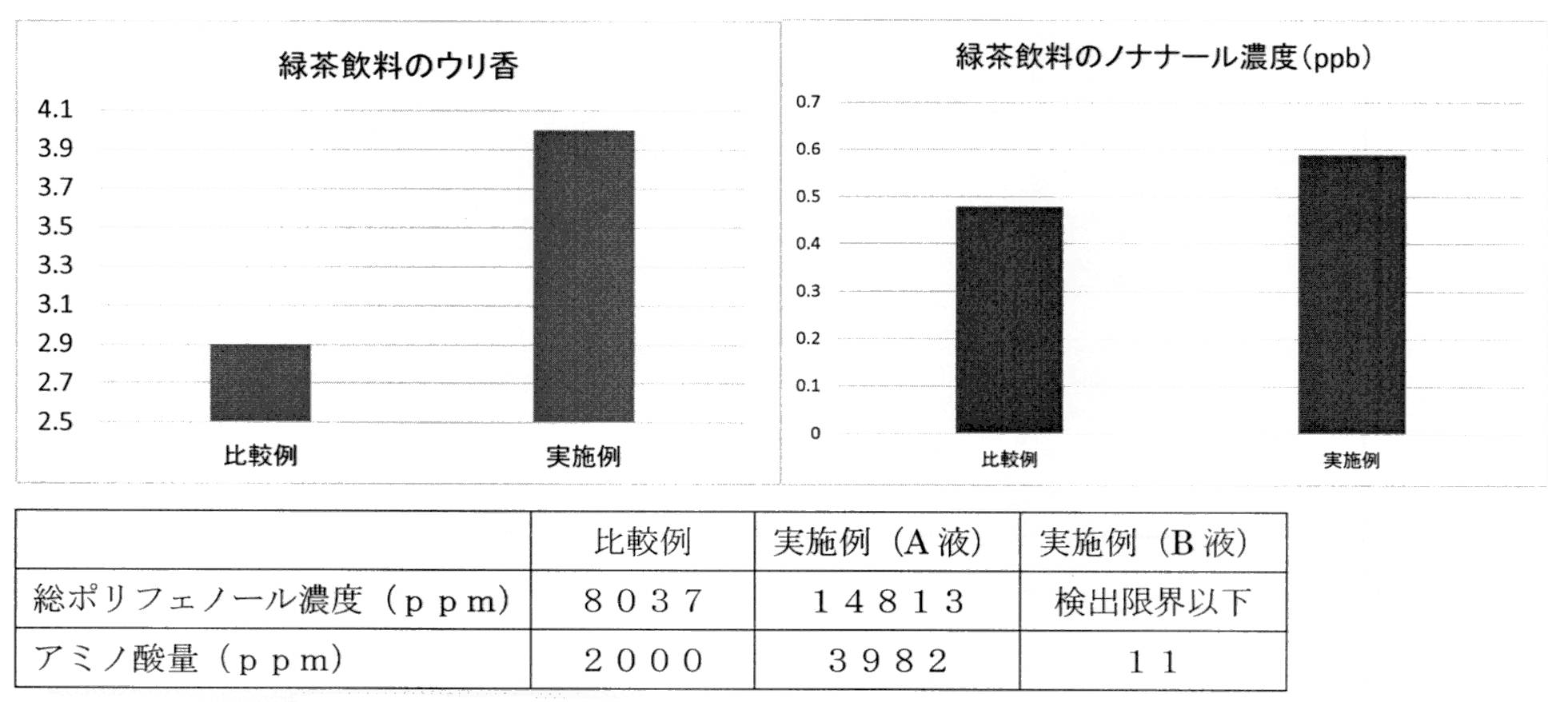
緑茶飲料のウリ香を官能評価したところ、実施例は4.0(標準偏差:0.7)であったのに対し、比較例は2.9(標準偏差:0.8)であり、本発明によれば、緑茶飲料のウリ香を有意に増強できることが確認された。また、実施例の飲料は、比較例と比べてノナナールを20%以上も多く含んでおり、ウリ香に関与する香味成分が多く含まれていることが確認された(実施例のノナナール濃度:0.59ppb、比較例のノナナール濃度:0.48ppb)。
緑茶飲料のウリ香を官能評価したところ、実施例は4.0(標準偏差:0.7)であったのに対し、比較例は2.9(標準偏差:0.8)であり、本発明によれば、緑茶飲料のウリ香を有意に増強できることが確認された。また、実施例の飲料は、比較例と比べてノナナールを20%以上も多く含んでおり、ウリ香に関与する香味成分が多く含まれていることが確認された(実施例のノナナール濃度:0.59ppb、比較例のノナナール濃度:0.48ppb)。
ノナナール濃度、総ポリフェノール濃度およびアミノ酸濃度の分析結果を以下に示す。
(6)ノナナール濃度の測定(希釈前)
上記(1)と同様にして、緑茶パウダー溶液(A液)と緑茶水蒸気蒸留液(B液)を調製し、それぞれを別々の飲料収容部に充填して保管した(実施例)。また、上記(1)と同様にして、濃縮型の容器詰飲料を製造して保管した(比較例)。
上記(1)と同様にして、緑茶パウダー溶液(A液)と緑茶水蒸気蒸留液(B液)を調製し、それぞれを別々の飲料収容部に充填して保管した(実施例)。また、上記(1)と同様にして、濃縮型の容器詰飲料を製造して保管した(比較例)。
上記(2)と同様にして、希釈前の濃縮液についてノナナール濃度を分析した結果を以下に示す。下表から明らかなように、緑茶パウダー溶液(A液)と緑茶水蒸気蒸留液(B液)をそれぞれ別々の飲料収容部に充填して保管した場合(実施例)、緑茶パウダー溶液(A液)と緑茶水蒸気蒸留液(B液)を混合してから保管した場合(比較例)と比べて、緑茶水蒸気蒸留液(B液)に含まれるノナナールの濃度が保管後においても高く、本発明によって、ウリ香に関与する香味成分を長期間維持できることが確認された。

Claims (9)
- 成分組成が異なる2種以上の飲料組成物を2つ以上の飲料収容部にそれぞれ充填した、容器詰コーヒー飲料または容器詰茶飲料であって、
ある飲料収容部に充填された飲料組成物の総ポリフェノール濃度が、別の飲料収容部に充填された総ポリフェノール濃度よりも高くなっている、上記飲料。 - 飲料収容部に充填された2種以上の飲料組成物を希釈してから飲用する濃縮型飲料である、請求項1に記載の飲料。
- 飲料収容部に充填された2種以上の飲料組成物を混合してから飲用する、請求項1または2に記載の飲料。
- 前記容器が、2つの飲料収容部を備えた容器である、請求項1~3のいずれかに記載の飲料。
- 容器詰コーヒー飲料であって、ある飲料収容部に充填された飲料組成物の含硫香気成分濃度が、別の飲料収容部に充填された飲料組成物の含硫香気成分濃度よりも低くなっている、請求項1~4のいずれかに記載の飲料。
- 容器詰コーヒー飲料であって、2種以上の飲料収容部に充填された飲料組成物をそれぞれ殺菌した後で合一させた組成物の含硫香気成分濃度が、飲料組成物を合一させた後で殺菌した場合と比較して高くなる、請求項1~5のいずれかに記載の飲料。
- 容器詰茶飲料であって、ある飲料収容部に充填された飲料組成物のノナナール濃度が、別の飲料収容部に充填された飲料組成物のノナナール濃度よりも低くなっている、請求項1~4のいずれかに記載の飲料。
- 容器詰茶飲料であって、2種以上の飲料収容部に充填された飲料組成物をそれぞれ殺菌した後で合一させた組成物のノナナール濃度が、飲料組成物を合一させた後で殺菌した場合と比較して高くなる、請求項1~4および7のいずれかに記載の飲料。
- 請求項1~8のいずれかに記載の飲料を製造する方法であって、
組成が異なる2種以上の飲料組成物を2つ以上の飲料収容部にそれぞれ充填する工程を含む、上記方法。
Priority Applications (3)
| Application Number | Priority Date | Filing Date | Title |
|---|---|---|---|
| JP2019525918A JP6556975B1 (ja) | 2017-12-28 | 2018-12-28 | 容器詰飲料 |
| MYPI2020003287A MY196338A (en) | 2017-12-28 | 2018-12-28 | Packaged Beverage |
| SG11202005013PA SG11202005013PA (en) | 2017-12-28 | 2018-12-28 | Packaged beverage |
Applications Claiming Priority (2)
| Application Number | Priority Date | Filing Date | Title |
|---|---|---|---|
| JP2017-253688 | 2017-12-28 | ||
| JP2017253688 | 2017-12-28 |
Publications (1)
| Publication Number | Publication Date |
|---|---|
| WO2019131997A1 true WO2019131997A1 (ja) | 2019-07-04 |
Family
ID=67063776
Family Applications (1)
| Application Number | Title | Priority Date | Filing Date |
|---|---|---|---|
| PCT/JP2018/048439 Ceased WO2019131997A1 (ja) | 2017-12-28 | 2018-12-28 | 容器詰飲料 |
Country Status (4)
| Country | Link |
|---|---|
| JP (1) | JP6556975B1 (ja) |
| MY (1) | MY196338A (ja) |
| SG (1) | SG11202005013PA (ja) |
| WO (1) | WO2019131997A1 (ja) |
Cited By (3)
| Publication number | Priority date | Publication date | Assignee | Title |
|---|---|---|---|---|
| JP2021073909A (ja) * | 2019-11-08 | 2021-05-20 | サントリーホールディングス株式会社 | 非甘味性飲料、および非甘味性飲料の製造方法 |
| JP7064645B1 (ja) | 2020-12-28 | 2022-05-10 | サントリーホールディングス株式会社 | エピガロカテキンガレートを含有する容器詰緑茶飲料 |
| WO2024228324A1 (ja) | 2023-05-01 | 2024-11-07 | サントリーホールディングス株式会社 | 多液型容器詰め液状食品 |
Citations (7)
| Publication number | Priority date | Publication date | Assignee | Title |
|---|---|---|---|---|
| JPH05168407A (ja) * | 1991-12-24 | 1993-07-02 | Toyo Seikan Kaisha Ltd | 容器詰緑茶類飲料の製造方法 |
| JP2004049086A (ja) * | 2002-07-18 | 2004-02-19 | Kao Corp | コーヒー抽出液の製造法 |
| JP2011125286A (ja) * | 2009-12-18 | 2011-06-30 | Kao Corp | 容器詰ブラックコーヒー飲料 |
| JP2015208303A (ja) * | 2014-04-28 | 2015-11-24 | 株式会社 伊藤園 | 容器詰飲料の製造方法及び容器詰飲料の呈味及び/又は香味劣化抑制方法 |
| JP2015228816A (ja) * | 2014-06-04 | 2015-12-21 | 花王株式会社 | 容器詰コーヒー飲料 |
| WO2016027577A1 (ja) * | 2014-08-22 | 2016-02-25 | 三菱瓦斯化学株式会社 | 多層プラスチック容器 |
| JP2016154500A (ja) * | 2015-02-25 | 2016-09-01 | キリン株式会社 | 優れた香味と旨味が持続する容器詰茶飲料の製造方法 |
-
2018
- 2018-12-28 WO PCT/JP2018/048439 patent/WO2019131997A1/ja not_active Ceased
- 2018-12-28 JP JP2019525918A patent/JP6556975B1/ja active Active
- 2018-12-28 SG SG11202005013PA patent/SG11202005013PA/en unknown
- 2018-12-28 MY MYPI2020003287A patent/MY196338A/en unknown
Patent Citations (7)
| Publication number | Priority date | Publication date | Assignee | Title |
|---|---|---|---|---|
| JPH05168407A (ja) * | 1991-12-24 | 1993-07-02 | Toyo Seikan Kaisha Ltd | 容器詰緑茶類飲料の製造方法 |
| JP2004049086A (ja) * | 2002-07-18 | 2004-02-19 | Kao Corp | コーヒー抽出液の製造法 |
| JP2011125286A (ja) * | 2009-12-18 | 2011-06-30 | Kao Corp | 容器詰ブラックコーヒー飲料 |
| JP2015208303A (ja) * | 2014-04-28 | 2015-11-24 | 株式会社 伊藤園 | 容器詰飲料の製造方法及び容器詰飲料の呈味及び/又は香味劣化抑制方法 |
| JP2015228816A (ja) * | 2014-06-04 | 2015-12-21 | 花王株式会社 | 容器詰コーヒー飲料 |
| WO2016027577A1 (ja) * | 2014-08-22 | 2016-02-25 | 三菱瓦斯化学株式会社 | 多層プラスチック容器 |
| JP2016154500A (ja) * | 2015-02-25 | 2016-09-01 | キリン株式会社 | 優れた香味と旨味が持続する容器詰茶飲料の製造方法 |
Cited By (7)
| Publication number | Priority date | Publication date | Assignee | Title |
|---|---|---|---|---|
| JP2021073909A (ja) * | 2019-11-08 | 2021-05-20 | サントリーホールディングス株式会社 | 非甘味性飲料、および非甘味性飲料の製造方法 |
| JP7312674B2 (ja) | 2019-11-08 | 2023-07-21 | サントリーホールディングス株式会社 | 非甘味性飲料、および非甘味性飲料の製造方法 |
| JP7064645B1 (ja) | 2020-12-28 | 2022-05-10 | サントリーホールディングス株式会社 | エピガロカテキンガレートを含有する容器詰緑茶飲料 |
| JP2022104532A (ja) * | 2020-12-28 | 2022-07-08 | サントリーホールディングス株式会社 | エピガロカテキンガレートを含有する容器詰緑茶飲料 |
| JP2022104484A (ja) * | 2020-12-28 | 2022-07-08 | サントリーホールディングス株式会社 | エピガロカテキンガレートを含有する容器詰緑茶飲料 |
| WO2024228324A1 (ja) | 2023-05-01 | 2024-11-07 | サントリーホールディングス株式会社 | 多液型容器詰め液状食品 |
| EP4706402A1 (en) | 2023-05-01 | 2026-03-11 | Suntory Holdings Limited | Liquid food packaged in container for several liquids |
Also Published As
| Publication number | Publication date |
|---|---|
| SG11202005013PA (en) | 2020-07-29 |
| JPWO2019131997A1 (ja) | 2019-12-26 |
| MY196338A (en) | 2023-03-24 |
| JP6556975B1 (ja) | 2019-08-07 |
Similar Documents
| Publication | Publication Date | Title |
|---|---|---|
| JP7179704B2 (ja) | フルフリルメチルスルフィドを含む容器詰めコーヒー飲料 | |
| JP5816337B2 (ja) | 呈味改善剤及びこれを含む茶飲料 | |
| JP6556975B1 (ja) | 容器詰飲料 | |
| JP6392966B1 (ja) | フルフリルメチルスルフィドを含む容器詰めコーヒー飲料 | |
| JP6310625B1 (ja) | ティリロサイド及びクロロゲン酸類を含有する飲料 | |
| WO2023162633A1 (ja) | ピリジンを含有する容器詰めコーヒー飲料 | |
| JP2021119762A (ja) | 飲料および飲料の乳臭さの抑制方法 | |
| JP6771411B2 (ja) | 容器詰め濃縮コーヒー飲料 | |
| CN113573591B (zh) | 饮料组合物 | |
| WO2020138232A1 (ja) | コーヒー抽出液 | |
| JP7134899B2 (ja) | カフェイン由来の苦味が軽減された飲料 | |
| JP7267768B2 (ja) | カフェイン由来の苦味が軽減された飲料 | |
| JP7282544B2 (ja) | タンニン由来の苦味が低減された飲料 | |
| JP7767436B2 (ja) | 風味が改善されたコーヒー豆抽出物、飲食品、容器詰め飲料及び該コーヒー豆抽出物の製造方法 | |
| JP6767748B2 (ja) | 容器詰めコーヒー飲料およびその製造方法 | |
| JP2020130173A (ja) | カテキン類由来の苦味が軽減された飲料 | |
| JP2020130110A (ja) | カテキン類由来の苦味が軽減された飲料 | |
| WO2024095804A1 (ja) | 保存劣化抑制剤及び飲食品の保存劣化抑制方法 | |
| JP2025138202A (ja) | 後苦味が抑制されたコーヒー飲料、及びその製造方法 | |
| JP2025138259A (ja) | 後苦味が抑制された乳成分入りコーヒー飲料、及びその製造方法 | |
| JP2024142514A (ja) | 嗜好性飲料及びインスタント嗜好性飲料用組成物 | |
| JP2026047126A (ja) | 風味が改善された茶飲料及びその製造方法 | |
| JP2025015509A (ja) | コーヒー飲料及びインスタントコーヒー飲料用組成物 | |
| JP2022109837A (ja) | 乳固形分含有透明容器詰めコーヒー飲料 | |
| JP2020130109A (ja) | タンニン由来の苦味が低減された飲料 |
Legal Events
| Date | Code | Title | Description |
|---|---|---|---|
| ENP | Entry into the national phase |
Ref document number: 2019525918 Country of ref document: JP Kind code of ref document: A |
|
| 121 | Ep: the epo has been informed by wipo that ep was designated in this application |
Ref document number: 18895863 Country of ref document: EP Kind code of ref document: A1 |
|
| NENP | Non-entry into the national phase |
Ref country code: DE |
|
| 122 | Ep: pct application non-entry in european phase |
Ref document number: 18895863 Country of ref document: EP Kind code of ref document: A1 |