WO2019131964A1 - Il-2改変体 - Google Patents
Il-2改変体 Download PDFInfo
- Publication number
- WO2019131964A1 WO2019131964A1 PCT/JP2018/048361 JP2018048361W WO2019131964A1 WO 2019131964 A1 WO2019131964 A1 WO 2019131964A1 JP 2018048361 W JP2018048361 W JP 2018048361W WO 2019131964 A1 WO2019131964 A1 WO 2019131964A1
- Authority
- WO
- WIPO (PCT)
- Prior art keywords
- amino acid
- formula
- residue
- peg
- acid sequence
- Prior art date
- Legal status (The legal status is an assumption and is not a legal conclusion. Google has not performed a legal analysis and makes no representation as to the accuracy of the status listed.)
- Ceased
Links
- 0 CCCCCCC(C*)C(CC1)CC1C(C)CCC1CC(CC)C1 Chemical compound CCCCCCC(C*)C(CC1)CC1C(C)CCC1CC(CC)C1 0.000 description 14
- CHWXEVICPDJYPZ-VAEVFMIZSA-N CC(CCOCCCOCCNC(CCN(C(CC1SC[C@@H](C(O)=O)NC([C@H](CCCCN)NC([C@H](CC(O)=O)NC([C@H](CC(O)=O)NC([C@H](CC(O)=O)NC([C@H](CC(O)=O)NC([C@H](CCCCN)NC([C@H](Cc(cc2)ccc2O)NC([C@H](CC(O)=O)N)=O)=O)=O)=O)=O)=O)=O)=O)=O)C1=O)=O)=O Chemical compound CC(CCOCCCOCCNC(CCN(C(CC1SC[C@@H](C(O)=O)NC([C@H](CCCCN)NC([C@H](CC(O)=O)NC([C@H](CC(O)=O)NC([C@H](CC(O)=O)NC([C@H](CC(O)=O)NC([C@H](CCCCN)NC([C@H](Cc(cc2)ccc2O)NC([C@H](CC(O)=O)N)=O)=O)=O)=O)=O)=O)=O)=O)=O)C1=O)=O)=O CHWXEVICPDJYPZ-VAEVFMIZSA-N 0.000 description 1
- GSVDZENISSRBGR-LURJTMIESA-N CC([C@H](CS)NC(C)=O)=O Chemical compound CC([C@H](CS)NC(C)=O)=O GSVDZENISSRBGR-LURJTMIESA-N 0.000 description 1
Images







Classifications
-
- A—HUMAN NECESSITIES
- A61—MEDICAL OR VETERINARY SCIENCE; HYGIENE
- A61K—PREPARATIONS FOR MEDICAL, DENTAL OR TOILETRY PURPOSES
- A61K47/00—Medicinal preparations characterised by the non-active ingredients used, e.g. carriers or inert additives; Targeting or modifying agents chemically bound to the active ingredient
- A61K47/50—Medicinal preparations characterised by the non-active ingredients used, e.g. carriers or inert additives; Targeting or modifying agents chemically bound to the active ingredient the non-active ingredient being chemically bound to the active ingredient, e.g. polymer-drug conjugates
- A61K47/51—Medicinal preparations characterised by the non-active ingredients used, e.g. carriers or inert additives; Targeting or modifying agents chemically bound to the active ingredient the non-active ingredient being chemically bound to the active ingredient, e.g. polymer-drug conjugates the non-active ingredient being a modifying agent
- A61K47/54—Medicinal preparations characterised by the non-active ingredients used, e.g. carriers or inert additives; Targeting or modifying agents chemically bound to the active ingredient the non-active ingredient being chemically bound to the active ingredient, e.g. polymer-drug conjugates the non-active ingredient being a modifying agent the modifying agent being an organic compound
- A61K47/549—Sugars, nucleosides, nucleotides or nucleic acids
-
- A—HUMAN NECESSITIES
- A61—MEDICAL OR VETERINARY SCIENCE; HYGIENE
- A61K—PREPARATIONS FOR MEDICAL, DENTAL OR TOILETRY PURPOSES
- A61K38/00—Medicinal preparations containing peptides
- A61K38/16—Peptides having more than 20 amino acids; Gastrins; Somatostatins; Melanotropins; Derivatives thereof
- A61K38/17—Peptides having more than 20 amino acids; Gastrins; Somatostatins; Melanotropins; Derivatives thereof from animals; from humans
- A61K38/19—Cytokines; Lymphokines; Interferons
- A61K38/20—Interleukins [IL]
-
- A—HUMAN NECESSITIES
- A61—MEDICAL OR VETERINARY SCIENCE; HYGIENE
- A61K—PREPARATIONS FOR MEDICAL, DENTAL OR TOILETRY PURPOSES
- A61K38/00—Medicinal preparations containing peptides
- A61K38/16—Peptides having more than 20 amino acids; Gastrins; Somatostatins; Melanotropins; Derivatives thereof
- A61K38/17—Peptides having more than 20 amino acids; Gastrins; Somatostatins; Melanotropins; Derivatives thereof from animals; from humans
- A61K38/19—Cytokines; Lymphokines; Interferons
- A61K38/20—Interleukins [IL]
- A61K38/2013—IL-2
-
- A—HUMAN NECESSITIES
- A61—MEDICAL OR VETERINARY SCIENCE; HYGIENE
- A61K—PREPARATIONS FOR MEDICAL, DENTAL OR TOILETRY PURPOSES
- A61K47/00—Medicinal preparations characterised by the non-active ingredients used, e.g. carriers or inert additives; Targeting or modifying agents chemically bound to the active ingredient
- A61K47/50—Medicinal preparations characterised by the non-active ingredients used, e.g. carriers or inert additives; Targeting or modifying agents chemically bound to the active ingredient the non-active ingredient being chemically bound to the active ingredient, e.g. polymer-drug conjugates
- A61K47/51—Medicinal preparations characterised by the non-active ingredients used, e.g. carriers or inert additives; Targeting or modifying agents chemically bound to the active ingredient the non-active ingredient being chemically bound to the active ingredient, e.g. polymer-drug conjugates the non-active ingredient being a modifying agent
- A61K47/54—Medicinal preparations characterised by the non-active ingredients used, e.g. carriers or inert additives; Targeting or modifying agents chemically bound to the active ingredient the non-active ingredient being chemically bound to the active ingredient, e.g. polymer-drug conjugates the non-active ingredient being a modifying agent the modifying agent being an organic compound
-
- A—HUMAN NECESSITIES
- A61—MEDICAL OR VETERINARY SCIENCE; HYGIENE
- A61K—PREPARATIONS FOR MEDICAL, DENTAL OR TOILETRY PURPOSES
- A61K47/00—Medicinal preparations characterised by the non-active ingredients used, e.g. carriers or inert additives; Targeting or modifying agents chemically bound to the active ingredient
- A61K47/50—Medicinal preparations characterised by the non-active ingredients used, e.g. carriers or inert additives; Targeting or modifying agents chemically bound to the active ingredient the non-active ingredient being chemically bound to the active ingredient, e.g. polymer-drug conjugates
- A61K47/51—Medicinal preparations characterised by the non-active ingredients used, e.g. carriers or inert additives; Targeting or modifying agents chemically bound to the active ingredient the non-active ingredient being chemically bound to the active ingredient, e.g. polymer-drug conjugates the non-active ingredient being a modifying agent
- A61K47/54—Medicinal preparations characterised by the non-active ingredients used, e.g. carriers or inert additives; Targeting or modifying agents chemically bound to the active ingredient the non-active ingredient being chemically bound to the active ingredient, e.g. polymer-drug conjugates the non-active ingredient being a modifying agent the modifying agent being an organic compound
- A61K47/545—Heterocyclic compounds
-
- A—HUMAN NECESSITIES
- A61—MEDICAL OR VETERINARY SCIENCE; HYGIENE
- A61K—PREPARATIONS FOR MEDICAL, DENTAL OR TOILETRY PURPOSES
- A61K47/00—Medicinal preparations characterised by the non-active ingredients used, e.g. carriers or inert additives; Targeting or modifying agents chemically bound to the active ingredient
- A61K47/50—Medicinal preparations characterised by the non-active ingredients used, e.g. carriers or inert additives; Targeting or modifying agents chemically bound to the active ingredient the non-active ingredient being chemically bound to the active ingredient, e.g. polymer-drug conjugates
- A61K47/51—Medicinal preparations characterised by the non-active ingredients used, e.g. carriers or inert additives; Targeting or modifying agents chemically bound to the active ingredient the non-active ingredient being chemically bound to the active ingredient, e.g. polymer-drug conjugates the non-active ingredient being a modifying agent
- A61K47/56—Medicinal preparations characterised by the non-active ingredients used, e.g. carriers or inert additives; Targeting or modifying agents chemically bound to the active ingredient the non-active ingredient being chemically bound to the active ingredient, e.g. polymer-drug conjugates the non-active ingredient being a modifying agent the modifying agent being an organic macromolecular compound, e.g. an oligomeric, polymeric or dendrimeric molecule
- A61K47/59—Medicinal preparations characterised by the non-active ingredients used, e.g. carriers or inert additives; Targeting or modifying agents chemically bound to the active ingredient the non-active ingredient being chemically bound to the active ingredient, e.g. polymer-drug conjugates the non-active ingredient being a modifying agent the modifying agent being an organic macromolecular compound, e.g. an oligomeric, polymeric or dendrimeric molecule obtained otherwise than by reactions only involving carbon-to-carbon unsaturated bonds, e.g. polyureas or polyurethanes
- A61K47/60—Medicinal preparations characterised by the non-active ingredients used, e.g. carriers or inert additives; Targeting or modifying agents chemically bound to the active ingredient the non-active ingredient being chemically bound to the active ingredient, e.g. polymer-drug conjugates the non-active ingredient being a modifying agent the modifying agent being an organic macromolecular compound, e.g. an oligomeric, polymeric or dendrimeric molecule obtained otherwise than by reactions only involving carbon-to-carbon unsaturated bonds, e.g. polyureas or polyurethanes the organic macromolecular compound being a polyoxyalkylene oligomer, polymer or dendrimer, e.g. PEG, PPG, PEO or polyglycerol
-
- A—HUMAN NECESSITIES
- A61—MEDICAL OR VETERINARY SCIENCE; HYGIENE
- A61K—PREPARATIONS FOR MEDICAL, DENTAL OR TOILETRY PURPOSES
- A61K47/00—Medicinal preparations characterised by the non-active ingredients used, e.g. carriers or inert additives; Targeting or modifying agents chemically bound to the active ingredient
- A61K47/50—Medicinal preparations characterised by the non-active ingredients used, e.g. carriers or inert additives; Targeting or modifying agents chemically bound to the active ingredient the non-active ingredient being chemically bound to the active ingredient, e.g. polymer-drug conjugates
- A61K47/51—Medicinal preparations characterised by the non-active ingredients used, e.g. carriers or inert additives; Targeting or modifying agents chemically bound to the active ingredient the non-active ingredient being chemically bound to the active ingredient, e.g. polymer-drug conjugates the non-active ingredient being a modifying agent
- A61K47/56—Medicinal preparations characterised by the non-active ingredients used, e.g. carriers or inert additives; Targeting or modifying agents chemically bound to the active ingredient the non-active ingredient being chemically bound to the active ingredient, e.g. polymer-drug conjugates the non-active ingredient being a modifying agent the modifying agent being an organic macromolecular compound, e.g. an oligomeric, polymeric or dendrimeric molecule
- A61K47/61—Medicinal preparations characterised by the non-active ingredients used, e.g. carriers or inert additives; Targeting or modifying agents chemically bound to the active ingredient the non-active ingredient being chemically bound to the active ingredient, e.g. polymer-drug conjugates the non-active ingredient being a modifying agent the modifying agent being an organic macromolecular compound, e.g. an oligomeric, polymeric or dendrimeric molecule the organic macromolecular compound being a polysaccharide or a derivative thereof
-
- A—HUMAN NECESSITIES
- A61—MEDICAL OR VETERINARY SCIENCE; HYGIENE
- A61P—SPECIFIC THERAPEUTIC ACTIVITY OF CHEMICAL COMPOUNDS OR MEDICINAL PREPARATIONS
- A61P37/00—Drugs for immunological or allergic disorders
- A61P37/02—Immunomodulators
- A61P37/04—Immunostimulants
-
- C—CHEMISTRY; METALLURGY
- C07—ORGANIC CHEMISTRY
- C07K—PEPTIDES
- C07K14/00—Peptides having more than 20 amino acids; Gastrins; Somatostatins; Melanotropins; Derivatives thereof
- C07K14/435—Peptides having more than 20 amino acids; Gastrins; Somatostatins; Melanotropins; Derivatives thereof from animals; from humans
- C07K14/52—Cytokines; Lymphokines; Interferons
- C07K14/54—Interleukins [IL]
- C07K14/55—IL-2
-
- A—HUMAN NECESSITIES
- A61—MEDICAL OR VETERINARY SCIENCE; HYGIENE
- A61K—PREPARATIONS FOR MEDICAL, DENTAL OR TOILETRY PURPOSES
- A61K38/00—Medicinal preparations containing peptides
Definitions
- the present invention relates to an IL-2 variant, a method for producing the IL-2 variant, a composition containing the IL-2 variant and a therapeutic agent, and a method for improving the affinity of IL-2 to an IL-2R alpha subunit
- the present invention relates to a method of reducing the affinity of IL-2 to at least one of IL-2R ⁇ and ⁇ subunits, and a method of selectively activating regulatory T cells.
- Treg Regulatory T cells
- CD4 positive T cells characterized by expressing the transcription factor Foxp3 (forkhead box P3).
- Treg produces inhibitory cytokines such as IL-10 and TGF- ⁇ , cytolysis via cytotoxic proteins such as perforin and granzymes, regulates the function of antigen-presenting cells via CTLA-4, etc., competes for using IL-2 It inhibits activation of effector T cells (Teff) by various mechanisms such as depletion by B., and negatively regulates excess immune responses (Non-patent Document 1).
- Treg due to Foxp3 mutation causes IPEX (immune dysregulation, polyendocrinopathy, enteropathy, X-linked) syndrome with severe systemic autoimmune reaction.
- IPEX immune dysregulation, polyendocrinopathy, enteropathy, X-linked
- Treg-mediated immune control failure contributes to pathogenesis (Non-patent document 2, Non-patent document 3) ).
- IL-2 Interleukin-2
- Interleukin-2 is a cytokine produced mainly from activated T cells and contributes to the proliferation and activation of various immune cells.
- the molecular weight of the mature body in human is about 15 kDa (133 residues) and has a four-helix bundle structure composed of four ⁇ -helices (Non-patent Document 4).
- the IL-2 receptor is composed of three molecules, CD25 (IL-2R ⁇ ), CD122 (IL-2R ⁇ ), and CD132 ( ⁇ c ), and has moderate affinity to IL-2 sex (K D ⁇ 10 -9 M) heterodimeric receptor indicating the (IL-2R ⁇ ) or high affinity (K D ⁇ 10 -11 M) hetero trimer receptor indicating the (IL-2R ⁇ Signal) when it is formed.
- CD25 alone binds to IL-2 with low affinity (K D 1010 ⁇ 8 M), it can not transmit a signal (Non-patent Document 5).
- IL-2R The expression pattern of IL-2R differs from immune cell to immune cell.
- CD56 low NK cells and naive T cells expression of CD25 is very low, and IL-2R functions as IL-2R ⁇ .
- CD25 is expressed in Treg and CD56 high NK cells, and IL-2R functions as IL-2R ⁇ (Non-patent Document 6).
- IL-2 In the binding of IL-2 and IL-2R ⁇ , IL-2 first binds to CD25, and then CD122 and CD132 sequentially to cause trimerization of IL-2R.
- the dimerization of CD122 and CD132 by IL-2 promotes the recruitment of JAK1 to the CD122 intracellular domain and the recruitment of JAK3 to the CD132 intracellular domain, which in turn causes STAT5 phosphorylation.
- Phosphorylated STAT5 (pSTAT5) forms a dimer and then translocates into the nucleus to promote transcription of a target gene (Non-patent Document 7, Non-patent Document 8).
- IL-2 signaling plays an important role in the maintenance of Treg homeostasis.
- PSTAT5 produced by IL-2 stimulation directly promotes Foxp3 expression, thereby enhancing Treg growth promotion, stabilization and Teff activation suppression function.
- Treg has high protein phosphatase 1 (PP) 1 and PP2A activities that positively control IL-2 signal, so it is stimulated by IL-2 stimulation
- Phosphorylation of Tret STAT5 and gene expression downstream thereof are caused at a concentration range about 10 to 100 times lower than that of memory T cells (Non-patent Document 6, Non-patent Document 9).
- Non-Patent Document 10 Non-Patent Document 11
- Non-Patent Document 12 Non-Patent Document 12
- Non-Patent Document 13 Non-Patent Document 14, Non-Patent Document 15.
- Non-patent Document 14 Non-patent Document 15, Non Patent Literature 16.
- Patent Document 1 Patent Document 2
- Patent Document 3 Patent Document 4
- Patent Document 5 Patent Document 6
- Patent Document 17 Non-Patent Document 17
- Patent Document 2 Patent Document 4, Patent Document 7, Non-Patent Document 18
- Patent Document 8 Patent Document 9, Patent Document 10, Patent Document 11, Non-Patent Document 19, Non-Patent Document 20.
- Patent Document 12 Patent Document 13, Patent Document 14
- Non-patent Document 19 modification of IL-2 with polyethylene glycol results in a decrease in biological activity.
- NKTR-358 A Selective, First-in-Class IL-2 Pathway Agonist Which Increases Number and Suppressive Function of Regulatory T Cells for the Treatment of Immune Inflammatory Disorders, Langowski, J., et al. Http://www.nektar.com/application/files/6315/1001/4171/NKTR-358_2017ACR_ABS2715.pdf Biotechnology (N Y), 1990. 8 (4): 343-346
- An object of the present invention is to provide a novel IL-2 variant which has improved selectivity to IL-2R ⁇ and selectively activates Treg.
- the present invention is as follows.
- Modified Interleukin-2 hereinafter abbreviated as IL-2.
- the IL-2 variant according to (1) which is an IL-2 variant linked with a sugar chain and / or an IL-2 variant linked with polyethylene glycol (PEG).
- IL-2R Modified Interleukin-2
- the sugar chain is at least one selected from sugar chains having a structure represented by the following (formula 4) to (formula 8), (formula Y1), (formula Y2) or (formula Y3) 2)
- the IL-2 variant according to any one of (2) to (5), which comprises an amino acid sequence substituted by a group derived from a linked cysteine residue or asparagine residue.
- At least one amino acid residue selected from the group consisting of amino acid residues 91 and 119 includes an amino acid sequence in which a group derived from a sugar chain-bound cysteine residue or asparagine residue is substituted ((2 The IL-2 variant according to any one of (1) to (6). (8) The IL-2 variant according to (6) or (7), wherein the group derived from a cysteine residue to which a sugar chain is linked has a structure represented by the following (formula 1).
- At least one amino acid residue selected from the group consisting of the amino acid residues at positions 4, 5, 6, 7, 8, 60, 78, 79, 99, 100, 101 and 129 in the amino acid sequence of IL-2
- amino acid sequence represented by SEQ ID NO: 1 or the amino acid sequence represented by SEQ ID NO: 1, wherein the 125th amino acid residue of amino acid sequence is substituted with a serine residue, positions 4, 5, 8, 78 and 129 Any of (2), (3), (12) and (13), wherein at least one amino acid residue selected from the group consisting of amino acid residues of is substituted with an amino acid residue to which PEG is attached The IL-2 variant according to 1 or 2.
- the non-natural amino acid residue to which PEG is attached is a group derived from an amino acid residue having a thiol group (-SH) to which PEG is attached, or a group derived from an amino acid residue having an azide group to which PEG is attached , (17).
- the attached PEG is an average molecular weight of 10 kDa, 20 kDa, 30 kDa, 40 kDa, 50 kDa, 60 kDa, 70 kDa or 80 kDa.
- the attached PEG is represented by the following (formula 13), (formula 14), (formula 15), (formula 16), (formula X7), (formula X8), (formula X9), (formula X10) , (Formula X11), (formula X13), (formula X14) or (formula X15), having a structure represented by at least one formula, described in any one of (2), (10) to (26) IL-2 variant of
- (31) A method for producing an IL-2 variant according to any one of (1) to (30).
- a therapeutic agent for immune diseases which comprises the IL-2 variant according to any one of (1) to (30).
- a method for improving the selectivity of IL-2 for IL-2R ⁇ . (35) The method according to (34), which comprises attaching a sugar chain and / or PEG to IL-2. (36) Positions 11, 12, 13, 15, 16, 18, 19, 20, 84, 87, 88, 91, 92, 108, 115, 119, 122, 123 and 130 in the amino acid sequence of IL-2.
- the sugar chain is at least one selected from sugar chains having a structure represented by the following (formula 4) to (formula 8), (formula Y1), (formula Y2) or (formula Y3) The method as described in (35) or (36).
- IL-2 comprising an amino acid sequence represented by SEQ ID NO: 1 or an amino acid sequence in which the 125th amino acid residue of the amino acid sequence represented by SEQ ID NO: 1 is substituted with a serine residue 11, 12, 13, 15, 16, 18, 19, 20, 84, 88, 91, 92, 108, 115, 119, 122, 123 and at least one selected from the group consisting of amino acid residues
- Saccharide shows a sugar chain.
- the amino acid sequence represented by SEQ ID NO: 1 or the amino acid sequence in which the 125th amino acid residue of the amino acid sequence represented by SEQ ID NO: 1 is substituted with a serine residue The method according to (42), wherein the amino acid sequence in which at least one amino acid residue selected from the group consisting of amino acid residues is substituted with an amino acid residue to which PEG is attached.
- At least one amino acid residue selected from the group consisting of the amino acid residues at positions 4, 5, 6, 7, 8, 60, 78, 79, 99, 100, 101 and 129 in the amino acid sequence of IL-2
- the non-natural amino acid residue to which PEG is attached is a group derived from an amino acid residue having a thiol group (-SH) to which PEG is attached, or a group derived from an amino acid residue having an azide group to which PEG is attached , The method described in (48).
- the attached PEG is represented by the following (formula 13), (formula 14), (formula 15), (formula 16), (formula X7), (formula X8), (formula X9), (formula X10) , (Formula X11), (Formula X13), (Formula X14) or (Formula X15), having a structure represented by at least one formula, described in any one of (35), (42) to (57) the method of.
- the IL-2 variant of the present invention selectively binds to IL-2R ⁇ highly expressed on Treg to selectively activate Treg.
- an IL-2 variant, a method for producing said IL-2 variant, a composition comprising said IL-2 variant and a therapeutic agent for immune diseases selection of IL-2 to IL-2R ⁇ Method of increasing the affinity, method of improving the affinity of IL-2 for the IL-2R.alpha.
- Subunits, and control Methods can be provided to selectively activate sexual T cells.
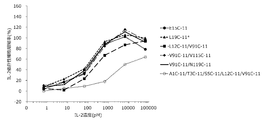
- FIG. 1A is a diagram showing Treg growth promoting activity of various sugar chain-bound IL-2 variants.
- Black circles indicate IL-2 [hereinafter referred to as IL-2 (P)] manufactured by Peprotech, black triangles indicate H16C-2, black squares indicate L19C-9, and black bars indicate N88C-2 activity.
- the abscissa represents the IL-2 concentration (pM), and the ordinate represents the IL-2 dependent cell proliferation rate (%).
- FIG. 1B is a diagram showing the Treg growth promoting activity of various sugar chain-bound IL-2 variants.
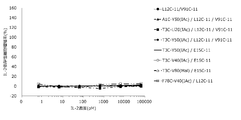
- FIG. 1C is a view showing the Treg growth promoting activity of various Cys-PEGylated and glycosylated IL-2 variants.
- Black circles indicate A1C-Y50 (IAc) / L12C-11 / V91C-11, black triangles indicate T3C-Li20 (IAc) / L12C-11 / V91C-11, black squares indicate T3C-Y50 (IAc) / L12C-11 / V91C -11, black diamond is T3C-Y50 (IAc) / E15C-11, black bar is T3C-V40 (IAc) / E15C-11, white circle is T3C-V80 (Mal) / E15C-11, white triangle is F78C-V40 (IAc) / L12C-11 activity is shown.
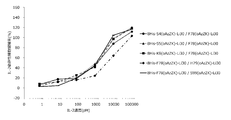
- FIG. 1D shows Treg growth promoting activity of various PEG-linked IL-2 variants. Black circles show the activity of 8His-IL-2, black triangles show the activity of 8His-F78 (oAzZK) -Li20, and black squares show the activity of 8His-I129 (oAzZK) -Li20.
- the abscissa represents the IL-2 concentration (pM), and the ordinate represents the IL-2 dependent cell proliferation rate (%).
- FIG. 1E is a diagram showing the Treg growth promoting activity of various PEG-linked IL-2 variants.
- FIG. 1F is a diagram showing Treg growth promoting activity of various PEG-linked IL-2 variants.
- FIG. 1G shows the Treg growth promoting activity of various PEG-linked IL-2 variants.
- FIG. 1H is a diagram showing the Treg growth promoting activity of various PEG-linked IL-2 variants.
- Black circles are 8His-F78 (oAzZK) -V40, black triangles are 8His-F78 (oAzZK) -W40, black squares are 8His-I129 (oAzZK) -Li40, black diamonds are 8His-I129 (oAzZK) -V40, black bars 8His-I129 (oAzZK) -W40, open circle 8His-I129 (oAzZK) -Y50, open triangle I129 (oAzZK) -V40, open square I129 (oAzZK) -W80, open diamond I129C-V40 (Mal) It shows activity.
- FIG. 1I shows the Treg growth promoting activity of various PEG-conjugated IL-2 variants.
- the black circle is 8His-S4 (oAzZK) -Li30 / I129 (oAzZK) -Li30
- the black triangle is S4 (oAzZK) -Y50 / I129 (oAzZK) -Y50
- the black square is 8His-S5 (oAzZK) -Li30 / I129 (oAzZK) ) -Li30
- black diamond is S5 (oAzZK) -Y50 / I129 (oAzZK) -Y50
- black bar is 8His-K8 (oAzZK) -Li30 / I129 (oAzZK) -Li30
- white circle is K8 (oAzZK
- FIG. 1J is a diagram showing Treg growth promoting activity of various PEG-linked IL-2 variants.
- the black circle is 8His-S4 (oAzZK) -Li30 / F78 (oAzZK) -Li30
- the black triangle is 8His-S5 (oAzZK) -Li30 / F78 (oAzZK) -Li30
- the black square is 8His-K8 (oAzZK) -Li30 / F78
- the black diamonds show the activity of 8His-F78 (oAzZK) -Li30 / H79 (oAzZK) -Li30
- the black bars show the activity of 8His-F78 (oAzZK) -Li30 / S99 (oAzZK) -Li30.
- FIG. 2A is a diagram showing the NK cell proliferation promoting activity of various sugar chain-bound IL-2 variants. Black diamonds indicate IL-2 (P) activity, black squares indicate H16C-2, black triangles indicate L19C-9, and black circles indicate N88C-2 activity.
- the abscissa represents the IL-2 concentration (pM), and the ordinate represents the IL-2 dependent cell proliferation rate (%).
- FIG. 2B is a diagram showing the NK cell proliferation promoting activity of various PEG-linked IL-2 variants.
- FIG. 2C is a diagram showing the NK cell growth promoting activity of various PEG-conjugated IL-2 variants.
- FIG. 2D is a diagram showing the NK cell growth promoting activity of various PEG-conjugated IL-2 variants.
- FIG. 2E is a diagram showing the NK cell proliferation promoting activity of various PEG-conjugated IL-2 variants.
- FIG. 2F is a diagram showing the NK cell growth promoting activity of various PEG-conjugated IL-2 variants.
- Black circles are 8His-F78 (oAzZK) -V40, black triangles are 8His-F78 (oAzZK) -W40, black squares are 8His-I129 (oAzZK) -Li40, black diamonds are 8His-I129 (oAzZK) -V40, black horizontal bars Shows activity of 8His-I129 (oAzZK) -W40, white circle shows 8His-I129 (oAzZK) -Y50, white triangle shows I129 (oAzZK) -W80, and white square shows I129C-V40 (Mal).
- FIG. 2G is a diagram showing the NK cell growth promoting activity of various PEG-conjugated IL-2 variants.
- the black circle is 8His-S4 (oAzZK) -Li30 / I129 (oAzZK) -Li30
- the black triangle is S4 (oAzZK) -Y50 / I129 (oAzZK) -Y50
- the black square is 8His-S5 (oAzZK) -Li30 / I129 (oAzZK) ) -Li30
- black diamond is S5 (oAzZK) -Y50 / I129 (oAzZK) -Y50
- black horizontal bar is 8His-K8 (oAzZK) -Li30 / I129 (oAzZK) -Li30
- white circle is K8 (oAzZK) -Y50 / Y50 / The activity of I129 (oAzZK) -Y50 is shown.
- FIG. 2H is a diagram showing the NK cell proliferation promoting activity of various sugar chain-linked IL-2 variants and various Cys-PEGylated and sugar chain-linked IL-2 variants.
- Black circles indicate L12C-11 / V91C-11, black triangles indicate A1C-Y50 (IAc) / L12C-11 / V91C-11, black squares indicate T3C-Li20 (IAc) / L12C-11 / V91C-11, black diamonds indicate T3C -Y50 (IAc) / L12C-11 / V91C-11, black bar is T3C-Y50 (IAc) / E15C-11, white circle is T3C-V40 (IAc) / E15C-11, white triangle is T3C-V80 (Mal) / E15C-11, open squares show the activity of F78C-V40 (IAc) / L12C-11.
- FIG. 2I is a diagram showing the NK cell growth promoting activity of various PEG-linked IL-2 variants.
- the black circle is IL-2 (P)
- the black triangle is I129 (oAzZK)-V40
- the black square is 8His-F78 (oAzZK)-Li30 / I129 (oAzZK)-Li30
- the black diamond is 8His-H79 (oAzZK)-Li30 /
- a black bar indicates the activity of 8His-S99 (oAzZK) -Li30 / I129 (oAzZK) -Li30.
- FIG. 2I is a diagram showing the NK cell growth promoting activity of various PEG-linked IL-2 variants.
- the black circle is 8His-S4 (oAzZK) -Li30 / F78 (oAzZK) -Li30
- the black triangle is 8His-S5 (oAzZK) -Li30 / F78 (oAzZK) -Li30
- the black square is 8His-K8 (oAzZK) -Li30 / F78
- the black diamonds show the activity of 8His-F78 (oAzZK) -Li30 / H79 (oAzZK) -Li30
- the black bars show the activity of 8His-F78 (oAzZK) -Li30 / S99 (oAzZK) -Li30.
- FIG. 2K is a diagram showing the NK cell proliferation promoting activity of various sugar chain-bound IL-2 variants.
- the abscissa represents the IL-2 concentration (pM), and the ordinate represents the IL-2 dependent cell proliferation rate (%).
- FIG. 3 shows the proliferation rate of responder T cells (Tresp) in the presence of unstimulated Treg or various IL-2 variant-stimulated Treg.
- FIG. 3 (A) shows the proliferation rate of CD4 positive Tresp
- FIG. 3 (B) shows the proliferation rate of CD8 positive Tresp.
- the horizontal axis indicates the abundance ratio of Tresp to Treg
- the vertical axis indicates the growth rate (%) of Tresp.
- White diamonds are unstimulated
- black diamonds are IL-2 (P)
- black squares are H16C-2
- black triangles are L19C-9
- black circles are N88C-2.
- 4 (A) to 4 (E) show cytokine concentrations in the culture supernatant when various IL-2 variants were added to human PBMC reconstituted with autologous plasma and cultured.
- the abscissa shows the concentration of added IL-2 (pM), and the ordinate shows the amount of cytokine production (pg / mL).
- FIG. 4 (F) shows the results of evaluation of Treg selective proliferative activity.
- the abscissa shows the added IL-2 concentration.
- white diamonds are unstimulated, black diamonds are IL-2 (P), black squares are H16C-2, black triangles are L19C-9, and black circles are N88C-2.
- Treg or “Treg cells” refers to regulatory T cells. Regulatory T cells are a class of T cells that suppress the activity of other immune cells and are defined by the cell marker phenotype CD4 + CD25 + FOXP3 + using flow cytometry.
- CD4 + CD25 + CD127 low is a cell surface phenotype to define viable Tregs. Can be used.
- Tregs also include various Treg subclasses, such as tTreg (thymus derived) and pTreg (derived from the periphery and differentiated from peripheral naive T cells). Although all Tregs express IL-2R ⁇ and proliferate in an IL-2 dependent manner, the IL-2 variants of the present invention can selectively activate at least one Treg subclass, preferably Can selectively activate any subclass.
- IL-2 may be either wild type IL-2 or an IL-2 variant.
- the "wild-type IL-2” includes any one of the following 1) to 3) IL-2.
- the amino acid modification of the above 2) includes, for example, modification to attach a methionine residue encoded by the initiation codon to the N terminus of the amino acid sequence shown in SEQ ID NO: 1 to express IL-2 in E. coli, A modification in which an amino acid sequence represented by MHHHHHHHH (polyhistidine bound with methionine) is linked to the N-terminus of the amino acid sequence represented by SEQ ID NO: 1 in order to express IL-2 and conveniently purify it, In order to enhance the physical properties of -2, modifications such as substitution of the 125th amino acid residue of human-derived wild-type mature IL-2 with an alanine residue or a serine residue can be mentioned.
- the IL-2 in which the amino acid residue at the N terminus of IL-2 is deleted is the alanine residue at the N terminus of the amino acid sequence represented by SEQ ID NO: 1, or an alanine residue and proline residue, for example. And IL-2 having a deleted amino acid sequence.
- wild-type IL-2 is represented by the amino acid sequence represented by SEQ ID NO: 1, the amino acid sequence in which a methionine residue is bound to the N terminus of the amino acid sequence represented by SEQ ID NO: 1, SEQ ID NO: 1
- Amino acid sequence in which the amino acid sequence represented by MHHHHHHHH is bound to the N terminus of the amino acid sequence, amino acid sequence in which the alanine residue at the N terminus of the amino acid sequence represented by SEQ ID NO: 1 is deleted represented by SEQ ID NO: 1
- amino acid sequence at the N-terminal side and the 125th serine residue of the amino acid sequence represented by SEQ ID NO: 1 are tolerated from the viewpoint of protein expression or protein stability without affecting the activity of IL-2 Variation of the present amino acid sequence, and the variation of the present amino acid sequence is also included in the IL-2 variant of the present invention.
- the numbers of the amino acid residues of IL-2 described in the present invention indicate the numbers (positions) of the amino acid residues based on the amino acid sequence of IL-2 represented by SEQ ID NO: 1 . Accordingly, the alanine residue at the N-terminus of the amino acid sequence shown by SEQ ID NO: 1 is defined as the first, the proline residue as the second, and the methionine residue linked to the N-terminus as the -1st.
- IL-2 variant includes all proteins having the function of wild-type IL-2, which are produced by adding some modification to wild-type IL-2.
- an IL-2 variant in which wild-type IL-2 has been modified by amino acid modification eg, substitution, deletion, addition, etc.
- an IL- in which wild-type IL-2 has been modified by sugar chain modification 2 variants IL-2 variants in which wild-type IL-2 has been modified by chemical modification, and the like.
- the above modifications include any naturally occurring modifications and artificial modifications.
- “Function of wild-type IL-2” refers to binding to IL-2R ⁇ , binding to IL-2R ⁇ , activation of intracellular signal transduction pathways via intracellular regions of CD122 and CD132, and phosphorylation of JAK1 Oxidation, phosphorylation of JAK3, phosphorylation of STAT5, phosphorylation of STAT3, phosphorylation of PI3K, phosphorylation of MEK, stimulation of Foxp3 expression, stimulation of Foxp3-regulated genes, stimulation of Foxp3-regulated genes, TSDR of Foxp3 gene Treg-specific demethylation region) region of the DNA demethylation promoting, IL-2R [beta] [gamma] proliferation and survival of immune cells expressing cytokine production promoting immune cell expressing IL-2R [beta] [gamma], expressing the IL-2R ⁇ expressing growth and survival of immune cells, the IL-2R ⁇ Cytokine production promoting disease cells, Treg proliferation and survival, as well as
- an IL-2 variant in which a sugar chain is linked to a predetermined region of IL-2 and an IL-2 variant in which PEG is linked to a predetermined region of IL-2
- the bond includes, for example, covalent bond, non-covalent bond and the like, but the bonding mode does not matter.
- amino acid residue may be either a naturally occurring amino acid residue or a non-naturally occurring amino acid residue.
- the "natural amino acid residue” refers to a selenocysteine residue and the following 20 ⁇ -amino acid residues: alanine residue, asparagine residue, aspartic acid residue, glutamine residue, glutamic acid residue, glycine residue Histidine residue, isoleucine residue, leucine residue, lysine residue, methionine residue, phenylalanine residue, proline residue, serine residue, threonine residue, tryptophan residue, tyrosine residue, valine residue, or Cysteine residues are included. Natural amino acid residues include both L and D forms, and in humans, L form is preferred.
- Non-naturally occurring amino acid residue refers to all amino acid residues other than naturally occurring amino acid residues. Examples of non-naturally occurring amino acid residues include amino acid residues obtained by modifying natural amino acid residues, and artificially designed amino acid residues.
- Modification includes all modifications such as chemical modification and post-translational modification.
- One embodiment of the IL-2 variant of the present invention includes an IL-2 variant with improved selectivity for IL-2R ⁇ .
- the IL-2 variant selectivity for IL-2R ⁇ is improved, it is possible to selectively activate Treg expressing IL-2R ⁇ .
- “Selectivity for IL-2R ⁇ ” refers to the property of IL-2 to selectively bind to IL-2R ⁇ over IL-2R ⁇ .
- the "selectivity for IL-2R ⁇ is improved” means that compared to the wild-type IL-2, selectivity for IL-2 variant of the IL-2R ⁇ has improved .
- the selectivity for IL-2R ⁇ , or selectivity for IL-2R ⁇ are improved can be determined by the method described in example below.
- IL-2R EC 50 for Arufabetaganma is smaller than the EC 50 for IL-2R [beta] [gamma], or EC 50 ratio values (IL-2R ⁇ EC 50 / IL-2R ⁇ EC 50) if is greater than 1, the IL-2 is It can be judged that there is selectivity for IL-2R ⁇ .
- wild-type than EC 50 ratio values of IL-2 is greater EC 50 ratio values of IL-2 variants, or standardized EC 50 ratio values (IL-2 variant of the EC 50 ratio value / wild-type IL-2
- the EC 50 ratio value of (1) is greater than 1, it can be judged that the IL-2 variant has improved selectivity for IL-2R ⁇ .
- the standardized EC 50 ratio value is greater than 1, 5 or more, 10 or more, 11 or more, 12 or more, 13 or more, 14 or more, 15 or more, 16 or more, 17 or more, 18 or more, 19 or more, 20 or more, 21 or more, 22 or more, 23 or more, 24 or more, 25 or more, 26 or more, 27 or more, 28 or more, 29 or more, preferably 30 or more.
- IL-2 variants having EC 50 ratio values equivalent to wild type IL-2 may be used.
- the method for measuring the EC 50 value include methods according to the procedures shown in the following (A) to (C). More specific methods include the methods described later in the Examples.
- Biacore has affinity for the IL-2R extracellular domain (ECD) -Fc fusion protein CD25ECD-Fc, IL-2R ⁇ ECD-Fc for each of wild-type IL-2 and IL-2 variants taking measurement.
- ECD extracellular domain
- K D values of CD25ECD-Fc is small, and / or when a large K D values of IL-2R ⁇ ECD-Fc, the IL-2 variant IL-2R ⁇ It can be judged that the selectivity to is improved.
- K D values for IL-2R ⁇ ECD-Fc for K D values of CD25ECD-Fc is when increasing at IL-2 variant than the wild-type, the IL-2 variant IL It can also be judged that the selectivity to -2R ⁇ is improved.
- “To selectively activate Treg” refers to at least one of the following (a) to (c).
- (C) The amount of production of inflammatory cytokines is lower in IL-2 variants than in wild-type IL-2 and / or the amount of production of anti-inflammatory cytokines is increased.
- an IL-2 variant having an activity equivalent to that of wild type IL-2 may be used instead of wild type IL-2.
- Treg proliferative activity and NK cell proliferative activity can be measured, for example, by the method described below.
- Treg or NK cells were seeded in a 96-well plate, RLU value of well added control IL-2 was 100%, RLU value of well added medium without IL-2 was 0%, with test substance
- the Treg or NK cell proliferation rate of certain IL-2 variants is calculated. More specific methods include the methods described later in the Examples.
- Treg (%) / Teff (%) can be measured, for example, by the method described below.
- Human peripheral blood mononuclear cells hereinafter also referred to as PBMC
- PBMC Human peripheral blood mononuclear cells
- the anti-CD3 antibody OKT3 is added thereto and seeded on a 96-well plate, and then various IL-2 is added and cultured.
- a fluorescence labeled anti-human CD4 antibody, a fluorescence labeled CD25 antibody, and a fluorescence labeled anti-Foxp3 antibody measure various fluorescence intensities with a flow cytometer (for example, LSRFortessa manufactured by BD Biosciences) .
- a flow cytometer for example, LSRFortessa manufactured by BD Biosciences
- the obtained data is analyzed using data analysis software (for example, FLowJo, version 7.6.5 made by TreeStar Co., Ltd.) and CD25 + Foxp3 high fraction is Treg, CD25 + Foxp3 low in the CD4 positive fraction.
- data analysis software for example, FLowJo, version 7.6.5 made by TreeStar Co., Ltd.
- CD25 + Foxp3 high fraction is Treg, CD25 + Foxp3 low in the CD4 positive fraction.
- the abundance ratio [Treg (%) / Teff (%)] is calculated using the fraction as effector T cells (Teff). More specific methods include the methods described later in the Examples.
- the production amount of various cytokines can be measured, for example, by the method described below.
- Human PBMCs are suspended in autologous plasma, and the anti-CD3 antibody OKT3 is added and seeded on a 96-well plate, and then various IL-2 is added and cultured, and the amount of cytokine production in the supernatant is quantified. More specific methods include the methods described later in the Examples.
- an IL-2 variant modified by the binding of a sugar chain to IL-2 (hereinafter abbreviated as a “glycan-linked IL-2 variant”), IL IL-2 variants modified by the attachment of PEG to -2 (hereinafter also abbreviated as PEG-linked IL-2 variants) can be mentioned.
- a sugar chain to IL-2 hereinafter abbreviated as a “glycan-linked IL-2 variant”
- IL IL-2 variants modified by the attachment of PEG to -2 (hereinafter also abbreviated as PEG-linked IL-2 variants) can be mentioned.
- PEG-linked IL-2 variants modified by the attachment of PEG to -2
- Linked IL-2 variant One embodiment of the IL-2 variant of the present invention is 11, 12, 13, 15, 16, 18, 19, 20, 84, 88, 91, 92, 108, in the amino acid sequence of IL-2. Preferred is an IL-2 variant in which a sugar chain is bound to at least one amino acid residue selected from the amino acid residues 115, 119, 122, 123 and 130.
- sugar chain refers to a monosaccharide or one in which two or more monosaccharides are linked via a glycosidic bond, and any sugar chain can be used.
- the sugar chain binding to IL-2 is, for example, a group consisting of a sugar chain having a structure represented by the following (formula 4) to (formula 8) and (formula Y1) to (formula Y3) There is at least one selected.
- a sugar chain having a structure represented by the following (formula 4) to (formula 8) and (formula Y1) to (formula Y3) There is at least one selected.
- G1 N-acetylglucosamine
- Sial non-reducing terminal Sialic acid
- One embodiment of the IL-2 variant of the present invention is 11, 12, 13, 15, 16, 18, 19, 20, 84, 87, 88, 91, 92 in the amino acid sequence of wild-type IL-2.
- at least one amino acid residue selected from the group consisting of amino acid residues 108, 115, 119, 122, 123 and 130 is substituted with a group derived from a cysteine residue or asparagine residue to which a sugar chain is bound
- IL-2 variant comprising the amino acid sequence is preferably selected from at least one selected from the group consisting of the amino acid residues 12, 13, 15, 16, 19, 88, 91 and 119 in the amino acid sequence of wild-type IL-2
- An IL-2 modification comprising an amino acid sequence in which one amino acid residue is substituted with a group derived from a sugar chain-bound cysteine residue or asparagine residue The body is more preferable.
- the amino acid sequence of wild-type IL-2 is the amino acid sequence represented by SEQ ID NO: 1 or the amino acid residue at amino acid residue 125 of the amino acid sequence represented by SEQ ID NO: 1 More preferred is a substituted amino acid sequence.
- the group derived from a cysteine residue or an asparagine residue refers to a group in which the side chain amide of the side chain thiol or asparagine residue of the cysteine residue is modified, respectively.
- the group derived from a cysteine residue or asparagine residue to which a sugar chain is linked refers to a group in which a sugar chain is linked to a side chain thiol of a cysteine residue or a side chain amide of an asparagine residue by chemical modification.
- the group derived from the cysteine residue or asparagine residue may be modified by a linker or the like, and the cysteine residue or asparagine residue may be linked to the sugar chain via the linker.
- an amino acid having a structure in which a sugar chain is linked to the side chain thiol of the cysteine residue via a CH 2 CONH linker Residues can be mentioned.
- the side chain thiol of the cysteine residue and the sugar chain may be linked without a linker.
- Saccharide represents a sugar chain.
- Examples of the group derived from an asparagine residue to which a sugar chain is linked include, for example, a structure in which a sugar chain is linked to a side chain amide of an asparagine residue by chemical modification as shown in (Formula 2) below.
- the side chain amide of the asparagine residue and the sugar chain may be linked via a linker.
- Saccharide represents a sugar chain.
- One embodiment of the IL-2 variant of the present invention is, for example, 11, 12, 13, 15, 16, 18, 19, 20, 84, 87, 88, 91, in the amino acid sequence of wild-type IL-2.
- An IL-2 variant in which at least one amino acid residue selected from the group consisting of amino acid residues 92, 108, 115, 119, 122, 123 and 130 is substituted with a sugar chain-bound amino acid residue is It can be mentioned.
- IL-2 variants in which one sugar chain is linked to wild type IL-2 include those described below.
- -An IL-2 variant in which the amino acid residue at amino acid residue 12 in the amino acid sequence of wild-type IL-2 is substituted with a sugar chain-bound amino acid residue.
- -An IL-2 variant in which the amino acid residue at position 20 in the amino acid sequence of wild-type IL-2 is substituted with a sugar chain-bound amino acid residue.
- -An IL-2 variant in which the 84th amino acid residue in the amino acid sequence of wild-type IL-2 is substituted with a sugar chain-bound amino acid residue.
- -An IL-2 variant in which the 88th amino acid residue in the amino acid sequence of wild-type IL-2 is substituted with a sugar chain-bound amino acid residue.
- the sugar chain to which it is bound may be any sugar chain, for example, (formula 4), (formula 5), (formula 6), (formula 7), (formula 8) Or a sugar chain having a structure represented by (formula Y3).
- the amino acid residue at position 19 in the amino acid sequence of wild type IL-2 is substituted with a group derived from a cysteine residue to which a sugar chain shown in (Formula 1) is bound, and the structure of Saccharide of (Formula 1)
- One embodiment of the present invention also includes an IL-2 variant in which at least two sugar chains are linked to wild type IL-2.
- Examples of binding of two sugar chains to wild-type IL-2 include 1, 3, 4, 5, 8, 11, 12, 13, 15, 16, 18, 19 in the amino acid sequence of wild-type IL-2. , 20, 23, 32, 38, 51, 76, 84, 87, 88, 91, 92, 100, 102, 104, 108, 115, 119, 122, 123, 127 and 130: a group consisting of amino acid residues
- IL-2 variants comprising an amino acid sequence in which at least two amino acid residues selected from are substituted with a group derived from a sugar chain-bound cysteine residue or asparagine residue.
- Examples of IL-2 variants in which two sugar chains are bound to wild type IL-2 include 1, 3, 4, 5, 8, 11, 12, 13, 15, in the amino acid sequence of wild type IL-2. 16, 18, 19, 20, 23, 32, 38, 51, 76, 84, 87, 88, 91, 92, 100, 102, 104, 108, 115, 119, 122, 123, 127 and 130 From the group consisting of one amino acid residue selected from the group consisting of residues and the 11, 12, 18, 20, 84, 87, 88, 91, 108, 115, 119, 122 and 123 amino acid residues Preferred is an IL-2 variant comprising an amino acid sequence in which one amino acid residue to be selected is substituted with a group derived from a sugar chain-bound cysteine residue or asparagine residue.
- One embodiment of a specific IL-2 variant of the present invention includes the following.
- -An IL-2 variant in which amino acid residues at positions 19 and 23 in the amino acid sequence of wild type IL-2 are substituted with amino acid residues to which sugar chains are linked, respectively.
- -An IL-2 variant in which amino acid residues at positions 12 and 119 in the amino acid sequence of wild type IL-2 are substituted with amino acid residues to which sugar chains are linked respectively.
- -An IL-2 variant in which the 19th and 115th amino acid residues in the amino acid sequence of wild-type IL-2 are each substituted with a sugar chain-bound amino acid residue.
- -An IL-2 variant in which amino acid residues at positions 91 and 115 in the amino acid sequence of wild type IL-2 are each substituted with a sugar chain-bound amino acid residue.
- -An IL-2 variant in which amino acid residues at positions 91 and 119 in the amino acid sequence of wild type IL-2 are substituted with amino acid residues to which sugar chains are bound, respectively.
- the linked sugar chain may be any sugar chain, and examples thereof include a sugar chain having a structure represented by (formula 4) or (formula 8).
- One embodiment of the present invention also includes an IL-2 variant in which at least three sugar chains are linked to wild type IL-2.
- Examples of binding of three sugar chains to wild-type IL-2 include 1, 3, 4, 5, 8, 11, 12, 13, 15, 16, 18, 19 in the amino acid sequence of wild-type IL-2. , 20, 23, 32, 38, 51, 76, 84, 87, 88, 91, 92, 100, 102, 104, 108, 115, 119, 122, 123, 127 and 130: a group consisting of amino acid residues
- IL-2 variants comprising an amino acid sequence in which at least three amino acid residues selected from are substituted with a group derived from a sugar chain-bound cysteine residue or asparagine residue.
- 1, 3, 4, 5, 8, 11, 12, 13, 15, 16, 18, in the amino acid sequence of wild type IL-2 is bound to wild type IL-2. It consists of the amino acid residue of 19, 20, 23, 32, 38, 51, 76, 84, 88, 91, 92, 100, 102, 104, 108, 115, 119, 122, 123, 127 and 130 At least one selected from the group consisting of at least one amino acid residue selected from the group consisting of the amino acid residues at positions 11, 12, 18, 20, 84, 87, 88, 91, 108, 115, 119, 122 and 123; More preferred is an IL-2 variant comprising an amino acid sequence in which one amino acid residue is substituted with a group derived from a sugar chain-bound cysteine residue or asparagine residue.
- One embodiment of the present invention also includes an IL-2 variant in which at least four sugar chains are linked to wild type IL-2.
- Examples of binding of four sugar chains to wild-type IL-2 include 1, 3, 4, 5, 8, 11, 12, 13, 15, 16, 18, 19 in the amino acid sequence of wild-type IL-2. , 20, 23, 32, 38, 51, 76, 84, 87, 88, 91, 92, 100, 102, 104, 108, 115, 119, 122, 123, 127 and 130: a group consisting of amino acid residues
- IL-2 variants comprising an amino acid sequence in which at least four amino acid residues selected from are substituted with a group derived from a sugar chain-bound cysteine residue or asparagine residue.
- 1, 3, 4, 5, 8, 11, 12, 13, 15, 16, 18, in the amino acid sequence of wild type IL-2 It consists of the amino acid residue of 19, 20, 23, 32, 38, 51, 76, 84, 88, 91, 92, 100, 102, 104, 108, 115, 119, 122, 123, 127 and 130 At least one selected from the group consisting of at least one amino acid residue selected from the group consisting of the amino acid residues at positions 11, 12, 18, 20, 84, 87, 88, 91, 108, 115, 119, 122 and 123; More preferred is an IL-2 variant comprising an amino acid sequence in which one amino acid residue is substituted with a group derived from a sugar chain-bound cysteine residue or asparagine residue.
- One embodiment of the present invention also includes an IL-2 variant in which at least five sugar chains are linked to wild type IL-2.
- Examples of binding of five sugar chains to wild-type IL-2 include 1, 3, 4, 5, 8, 11, 12, 13, 15, 16, 18, 19 in the amino acid sequence of wild-type IL-2. , 20, 23, 32, 38, 51, 76, 84, 87, 88, 91, 92, 100, 102, 104, 108, 115, 119, 122, 123, 127 and 130: a group consisting of amino acid residues
- IL-2 variants comprising an amino acid sequence in which five amino acid residues selected from are substituted with a group derived from a sugar chain-bound cysteine residue or asparagine residue.
- 1, 3, 4, 5, 8, 11, 12, 13, 15, 16, 18, in the amino acid sequence of wild type IL-2 is bound to wild type IL-2. It consists of the amino acid residue of 19, 20, 23, 32, 38, 51, 76, 84, 88, 91, 92, 100, 102, 104, 108, 115, 119, 122, 123, 127 and 130 At least one amino acid residue selected from the group consisting of at least one amino acid residue selected from the group and the amino acid residues at 1, 3, 5, 12, 32, 51, 76, 91, 100, 102 and 104 More preferred is an IL-2 variant comprising an amino acid sequence substituted by a group derived from a sugar chain-bound cysteine residue or asparagine residue.
- One embodiment of the IL-2 variant of the present invention includes the following.
- -IL-2 variant in which the third, twelfth, 32nd, 76th and 91st amino acid residues in the amino acid sequence of wild type IL-2 are each substituted with a sugar chain-bound amino acid residue .
- -IL-2 variant in which the third, twelfth, 51st, 91st and 100th amino acid residues in the amino acid sequence of wild type IL-2 are substituted with amino acid residues to which sugar chains are bound respectively .
- -An IL-2 variant in which the third, twelfth, 76th, 91st and 100th amino acid residues in the amino acid sequence of wild type IL-2 are each substituted with a sugar chain-bound amino acid residue .
- the sugar chain bound thereto may be any sugar chain, and examples thereof include a sugar chain having a structure represented by (Formula 8).
- the amino acid sequence of wild-type IL-2 is the amino acid sequence represented by SEQ ID NO: 1 or the amino acid residue at amino acid residue 125 of the amino acid sequence represented by SEQ ID NO: 1 More preferred is a substituted amino acid sequence.
- Method for producing glycosylated IL-2 variant As a method for producing a sugar chain-linked IL-2 variant, a method of chemically synthesizing a sugar chain-binding peptide and then folding it (chemical synthesis method) or an amino acid residue at a sugar introduction position in the amino acid sequence of wild type IL-2 A method of binding a sugar chain to an amino acid residue capable of binding to a sugar chain after expression of an IL-2 variant in which an amino acid residue capable of binding a sugar chain is expressed by a host cell such as E. coli Can be mentioned.
- peptide refers to one in which a plurality of amino acid residues are linked via a peptide bond.
- the side chain of each amino acid residue may contain a protecting group, and the amino group at the N-terminus and the carboxyl group at the C-terminus may be modified.
- Glycosylated IL-2 variants may be produced by a combination of chemical synthesis and expression methods. Each method will be described below.
- glycosylated IL-2 variant by chemical synthesis
- chemical synthesis method it is preferable to produce a glycosylated IL-2 variant by sequentially linking at least one or more carbohydrate-binding peptide fragments and a peptide fragment and then folding them.
- glycoconjugate peptide fragments and peptide fragments may be thioesterified and linked as glycoconjugate peptide thioesters and peptide thioesters.
- pseudoproline J. Am. Chem. Soc., 1996, 118, 9218-9227
- isopeptide Angew. Chem. Int.
- a method for synthesizing a peptide fragment for example, polymerase chain amplification reaction (PCR), preparation of plasmid DNA, cleavage of DNA by restriction enzyme, preparation of oligonucleotide, ligation of DNA, according to a conventionally known method. Isolation of mRNA, acquisition of transformants by introduction of DNA into appropriate host cells, method of production by recombinant DNA methods including culture of transformants, or cell-free protein expression method (Current Opinion in Biotechnology 2002, 13: 297-303) and the like. Examples of methods for synthesizing peptide thioesters include the methods described in (Proc Natl Acad Sci USA 1998, 95: 6705-6710) and the like.
- a method of linking a sugar chain to a peptide fragment for example, when a sugar chain is linked to a side chain thiol of a cysteine residue of a peptide fragment, the method described in Patent No. 4607017 or the like can be mentioned. Also, for example, when a sugar chain is attached to the side chain amide of an asparagine residue of a peptide fragment, the method described in Japanese Patent No. 4119428 and the like can be mentioned. Moreover, as a method for producing a sugar chain, for example, the method described in WO 03/008431 and the like can be mentioned.
- NCL native chemical ligation
- Linkage of peptide fragments and / or carbohydrate-binding peptide fragments can be carried out at any position, but when NCL method is used, a cysteine residue and an alanine residue as the N-terminal amino acid residue of the C-terminal side peptide fragment The group is preferred, more preferably a cysteine residue.
- the sugar chain-linked IL-2 variant is, for example, polymerase chain amplification reaction (PCR), preparation of plasmid DNA, cleavage of DNA with restriction enzyme, preparation of oligonucleotide, DNA It can be produced by ligation, isolation of mRNA, preparation of transformants by introduction of DNA into appropriate host cells, recombinant DNA methods including culture of transformants, and glycosylation by chemical modification.
- PCR polymerase chain amplification reaction
- a sugar chain-linked IL-2 variant has an expression comprising a nucleotide sequence encoding an amino acid sequence in which a mutation has been introduced so as to contain an amino acid residue to which a sugar chain can bind.
- nucleotide sequence encoding wild type IL-2 used for preparation of the above expression vector NCBI accession No. 2 is described.
- IL-2 For the nucleotide sequence encoding IL-2, appropriate primers are designed from artificial gene synthesis and sequences registered in gene banks such as Japan DNA Data Bank (DDBJ), and mRNA extracted from cells or tissues of the animal, etc. It can be obtained by performing RT-PCR.
- DDBJ Japan DNA Data Bank
- mRNA extracted from cells or tissues of the animal etc. It can be obtained by performing RT-PCR.
- the sugar chain-linked IL-2 variant can also be obtained by introducing the above expression vector into a host cell capable of biosynthesizing the target sugar chain.
- the expression vector is, for example, downstream of the promoter in a vector suitable for expression in which the nucleotide sequence encoding IL-2 into which the mutation has been introduced is incorporated at a desired position (for example, the 5 'end).
- a desired position for example, the 5 'end.
- the expression vector may have a secretion signal according to the host.
- a known method can be used as a method for site-directed mutagenesis of the amino acid sequence of wild-type IL-2 so as to include an amino acid residue to which a sugar chain can be bound (US Patent Application Publication 2004/0171154 Storici et al, 2001, Nature Biotechnology, 19, p. 773-776: Kren et al, 1998, Nat. Med., Vol. 4, p. 285-290; Calissano and Macino, 1996, Fungal Genet News lett., Vol. 43, p. 15-16).
- a commercially available kit may be used for introducing a site-specific mutation.
- an IL-2 variant in which the amino acid residue of wild-type IL-2 is substituted with a cysteine residue is disclosed in US Pat. It can be prepared according to the method described in the specification of 5206344, WO 2016/025385 and the like, and the conjugation of the sugar chain to the modified IL-2 is carried out according to the method described in Japanese Patent No. 4607017 Can.
- the region containing the nucleotide sequence encoding IL-2 may have a translation initiation codon at the 5 'end and may have a translation termination codon at the 3' end.
- the promoter is not particularly limited as long as it corresponds to the host used for gene expression.
- Bacillus subtilis for example, SP01, SP02 and PenP promoters may be mentioned.
- yeast for example, PH05, PGK, GAP and ADH promoters may be mentioned.
- E. coli trp promoter (Ptrp), lac promoter and the like can be mentioned.
- promoters derived from SV40 and promoters of retroviruses can be mentioned.
- the IL-2 protein is E. coli.
- E. coli can also be expressed without a signal sequence, and the protein can be recovered from inclusion bodies and refolded into an active form. Such expression systems are described in US Pat. No. 7,105,653.
- Signal sequences can also be used to facilitate expression of the IL-2 protein.
- a signal sequence of mammalian cells for example, a natural human IL-2 signal sequence, a signal sequence homologous to a TCR coding sequence, and a signal sequence homologous to a mouse IL-2 coding sequence can be mentioned.
- suitable signal sequences / host cell pairs for example, B. for secretion in B. subtilis B. subtilis sacB signal sequence, and Saccharomyces cerevisiae alpha mating factor signal sequence for secretion by P. pastoris, or P. pastoris acid phosphatase phoI signal sequence.
- the signal sequence may be connected directly to the protein coding sequence through a sequence encoding a signal peptidase cleavage site, or through a short nucleotide bridge.
- Elements to enhance transcription and translation of eukaryotic protein expression systems may also be used, for example, transcription in plant cells by placing the cauliflower mosaic virus (CaMV) promoter on both sides of the heterologous promoter at 1000 bp. Levels can be increased 10 to 400 times.
- CaMV cauliflower mosaic virus
- Host cells are not particularly limited, and include prokaryotic cells and eukaryotic cells.
- Preferred host cells include, for example, E. coli.
- prokaryotic cells such as E. coli, Bacillus subtillus, and animal cells such as HEK, J558, NSO, SP2-O, CHO, COS, KB, NIH3T3, BALB / c3T3, umbilical vein endothelial cells, and S. coli.
- Yeast strains such as S. cerevisiae, Pichia pastoris, and insect cells such as Sf9 or Tn.
- the host cell may be one that has been modified so as to allow biosynthesis of the target sugar chain.
- Transformation of the host may be carried out by any method commonly used or adaptable to each host.
- the host is E. coli or yeast
- an expression vector containing the recombinant DNA is introduced into competent cells prepared by the lithium method or the like by the temperature shock method or the electroporation method.
- the host is an animal cell
- an expression vector containing the recombinant DNA is introduced into cells in the growth phase by the calcium phosphate method, lipofection method or electroporation method.
- the transformant obtained in this manner is cultured in a medium generally used for each host or an applicable culture solution to express a protein, and further chemically modified as necessary.
- Carbohydrate-linked IL-2 protein can be produced by binding a carbohydrate chain.
- the culture solution is, for example, a culture solution such as LB medium when the host is E. coli, a culture solution such as YPD medium when the host is yeast, and Dulbecco's MEM when the host is an animal cell.
- the culture solution which added the serum is mentioned.
- Culturing may be performed under commonly used conditions or applicable conditions for each host.
- cultivation can be performed at about 25 to 37 ° C. for about 12 hours to 2 weeks, and aeration or agitation can be added as needed.
- culture is carried out at 37 ° C., 5% carbon dioxide gas, 100% humidity for about 24 hours to 2 weeks, and if necessary, the gas phase conditions may be changed or agitated.
- the amino acid residues 4, 5, 6, 7, 8, 60, 78, 79, 99, 100, 101 and 129 in the amino acid sequence of IL-2 are left Group is preferably a variant in which PEG is bound to at least one amino acid residue selected from the group consisting of groups, more preferably an IL-2 variant in which PEG is bound to at least one of the 78th and 129th amino acid residues. preferable.
- the 4, 5, 6, 7, 8, 60, 78, 79, 99, 100, 101 and 129 of the amino acid sequence of wild-type IL-2 An IL-2 variant comprising an amino acid sequence in which at least one amino acid residue selected from the group consisting of amino acid residues is substituted by an amino acid residue to which PEG is attached is preferred, and at least one of amino acids 78 and 129 More preferred is an IL-2 variant comprising an amino acid sequence in which the residue is replaced by an amino acid residue attached to PEG.
- the amino acid sequence of wild type IL-2 is the amino acid sequence represented by SEQ ID NO: 1, the amino acid sequence in which a methionine residue is bound to the N terminus of the amino acid sequence represented by SEQ ID NO: 1, SEQ ID NO: 1
- An amino acid sequence in which the N-terminal alanine residue of the amino acid sequence represented by is deleted, an amino acid sequence in which the N-terminal alanine residue of the amino acid sequence represented by SEQ ID NO: 1 is deleted and a methionine residue is linked
- position 125 The amino acid sequence in which the N-terminal alanine residue of the amino acid sequence shown by SEQ ID NO: 1 is deleted and the methionine residue is linked,
- PEG is a poly (ethylene glycol) molecule which is a water-soluble polymer containing a structure in which ethylene glycol polymerized by “— (CH 2 CH 2 O) n —” (n is 2 or more) is polymerized.
- the PEG is preferably PEG4 having an average molecular weight of 10 kDa or more, and examples thereof include, but not particularly limited to, an average molecular weight of 10 kDa, 20 kDa, 30 kDa, 40 kDa, 50 kDa, 60 kDa, 70 kDa, 80 kDa, 90 kDa, 100 kDa and 200 kDa.
- PEG poly(ethylene glycol)
- linear shape may be sufficient and branched shape may be sufficient, it is not limited to these.
- Chemical selectivity of PEG to the amino acid residue in the amino acid sequence of IL-2 can improve selectivity for IL-2R ⁇ .
- Treg can be selectively activated by an IL-2 variant with improved selectivity for IL-2R ⁇ .
- amino acid residues to which PEG is attached examples include cysteine residues to which PEG is attached and unnatural amino acid residues.
- non-natural amino acid residue to which PEG is attached examples include a group derived from an amino acid residue having a thiol group to which PEG is attached and a group derived from an amino acid residue having an azide group to which PEG is attached.
- Specific examples of the amino acid residue having a thiol group include, but are not limited to, acetylcysteine, homocysteine and the like.
- Specific examples of the amino acid residue having an azide group include o-Az-Z-Lys residue, m-Az-Z-Lys residue, N 6 -diazolidine and p-azidophenylalanine. It is not limited to these.
- Non-natural amino acid residues see, for example, WO 2017/030156, [Nature. 2017 Nov 29; 551 (7682): 644-647.], WO 2013/068874, US Patent Application Publication 2014 Chem., 2014, 25 (2), pp 351-361], WO 2014/044872, [Bioconj. Chem. 2015 Nov 18; 26 (11): 2249-60]. ], Non-naturally occurring amino acid residues described in WO 2014/124258, [Proc Natl Acad Sci US A. 2011 Jun 28; 108 (26): 10437-42] and the like.
- PEG and the above non-natural amino acid residue may be linked via a linker.
- the said linker can be suitably changed according to the kind of PEG or a nonnatural amino acid residue.
- the o-Az-Z-Lys residue is an amino acid residue having a structure represented by the following (Formula 10).
- the m-Az-Z-Lys residue is an amino acid residue having a structure represented by the following (Formula XX1).
- the group derived from the o-Az-Z-Lys residue or the group derived from the m-Az-Z-Lys residue to which PEG is bound is specifically, for example, the following (Formula 11) and / or (Formula 12), Or the structure represented by the following (formula Y4) and / or (formula Y5) is mentioned.
- various PEG can be used by the average molecular weight and structure of PEG.
- Examples thereof include, but are not limited to, structures represented by the following (Formula X2) in the case of X1), an average molecular weight of 80 kDa, or (Formula X3) in the case of an average molecular weight of 40 kDa.
- PEG is represented by the following (formula X2) in the case of X1),
- a group derived from a cysteine residue to which PEG is bound is a group of the following (formula Y6) and / or (formula Y6) in which PEG is linked via a linker formed by reacting maleimide with thiol group of cysteine residue.
- a structure represented by the formula Y7) and / or (formula Y8), a structure represented by the following (formula Y9) or the like in which PEG is linked via a linker formed by reacting a haloacetyl group to a thiol group of a cysteine residue But not limited thereto.
- PEG is specifically represented by, for example, (formula X7) when the average molecular weight is 40 kDa, (formula X7) when the average molecular weight is 80 kDa, or (formula X8) when the average molecular weight is 80 kDa Are not limited to these.
- the IL-2 variant described below is preferred.
- IL-2 variant of the present invention includes the IL-2 variants described below, for example, one PEG attached to IL-2.
- -An IL-2 variant in which the amino acid residue at the 5th amino acid residue in the amino acid sequence of wild type IL-2 is substituted with an amino acid residue to which PEG is bound.
- An IL-2 variant in which the amino acid residue at position 60 in the amino acid sequence of wild-type IL-2 is substituted with an amino acid residue to which PEG is attached.
- the size of PEG to be bound is preferably PEG having an average molecular weight of 20 kDa or more, for example, PEG having an average molecular weight of 20, 30, 40, 50, 60, 70 or 80 kDa.
- IL-2 variants of the invention also includes the IL-2 variants described below, for example, one PEG attached to IL-2.
- the amino acid residue of wild type IL-2 has an average molecular weight of 20 kDa or an average molecular weight of 30 kDa (formula 14), an average molecular weight of 40 kDa (formula X0), an average molecular weight of 50 kDa In some cases (formula 15), average molecular weight 40 kDa or 80 kDa (formula 16), average molecular weight 40 kDa (formula X1), average molecular weight 80 kDa (formula X2) or average molecular weight 40 kDa An IL-2 variant substituted with a group derived from a PEG-bonded o-Az-Z-Lys residue represented by (formula X3) in one case.
- the amino acid residue at amino acid residue 99 in the amino acid sequence of wild type IL-2 is a group derived from the PEG-bonded o-Az-Z-Lys residue represented by (formula 14) when the average molecular weight is 30 kDa IL-2 variant substituted by.
- amino acid residue at position 129 in the amino acid sequence of wild-type IL-2 is substituted with a group derived from the PEG-bonded o-Az-Z-Lys residue represented by (formula 16) when it is 40 kDa IL-2 variants.
- the amino acid residue at amino acid residue 129 in the amino acid sequence of wild-type IL-2 has an average molecular weight of 40 kDa or 80 kDa, and the PEG represented by (Formula X7) and / or (Formula X8) is attached An IL-2 variant substituted to a group derived group.
- the IL-2 variant described below in which at least two PEGs are bound to IL-2 is preferred.
- the size of PEG to be bound is preferably PEG having an average molecular weight of 20 kDa or more, for example, PEG having an average molecular weight of 20, 30, 40, 50, 60, 70 or 80 kDa.
- IL-2 variants described below in which at least two PEGs are bound to IL-2 are also preferred.
- the eighth and 78th amino acid residues are represented by (Expression 14) when the average molecular weight is 30 kDa respectively (Formula 14) and (Expression X0) when the average molecular weight is 40 kDa
- the fourth and 129th amino acid residues respectively have an average molecular weight of 30 kDa (formula 14), an average molecular weight of 40 kDa (formula X0) or an average molecular weight of 50 kDa
- the fifth and 129th amino acid residues respectively have an average molecular weight of 30 kDa (formula 14), an average molecular weight of 40 kDa (formula X0) or an average molecular weight of 50 kDa
- the amino acid sequence of wild type IL-2 is the amino acid sequence represented by SEQ ID NO: 1, the amino acid sequence in which a methionine residue is bound to the N terminus of the amino acid sequence represented by SEQ ID NO: 1, SEQ ID NO: 1
- SEQ ID NO: 1 An amino acid sequence in which the N-terminal alanine residue of the amino acid sequence represented by SEQ ID NO: 1 is deleted; an amino acid sequence in which the N-terminal alanine residue of the amino acid sequence represented by SEQ ID NO: 1 is deleted and a methionine residue is linked;
- An amino acid sequence in which a methionine residue is bound to the N terminus of the amino acid sequence represented by SEQ ID NO: 1 or the amino acid sequence represented by SEQ ID NO: 1, an amino acid sequence lacking the N terminal alanine residue of the amino acid sequence represented by SEQ ID NO: 1
- P the amino acid sequence in which the N-terminal alanine residue of the amino acid sequence shown by SEQ ID NO: 1 is deleted and the
- Methods for producing PEG-linked IL-2 variants include chemical synthesis methods and expression methods.
- PEG-linked IL-2 variants may be produced by a combination of chemical synthesis and expression methods. Each method will be described below.
- PEG-conjugated IL-2 variant by chemical synthesis for example, a chemical that enables site-specific PEGylation of a protein at the amino acid residue at the PEG introduction position in the amino acid sequence of wild-type IL-2
- a method of producing a PEG-linked IL-2 variant by attaching PEG to an IL-2 variant obtained by chemically synthesizing a peptide substituted to a reactive amino acid residue and then folding it, and PEG There is a method of producing a PEG-conjugated IL-2 variant by chemically synthesizing a conjugated peptide fragment followed by folding.
- PEG-conjugated peptide fragments can be produced by a method of introducing PEG into amino acid residues having chemical reactivity that enables site-specific PEGylation of proteins in the peptide fragment.
- amino acid residues having chemical reactivity that allow site-specific PEGylation of proteins include amino acid residues having a thiol group and amino acid residues having an azide group.
- amino acid residues having a thiol group include, but are not limited to, cysteine, acetylcysteine, homocysteine and the like.
- amino acid residues having an azide group examples include, but are not limited to, o-Az-Z-Lys residue, m-Az-Z-Lys residue, N 6 -azidolysine, p-azidophenylalanine .
- WO 2017/030156 [Nature. 2017 Nov 29; 551 (7682): 644-647.]
- WO 2013/068874 US Patent Application Publication No. 2014/0046030, [Bioconj. Chem., 2014, 25 (2), pp 351-361], WO 2014/044872, [Bioconj. Chem. 2015 Nov 18; 26 (11): 2249-60], WO 2014 / No. 124,258 [Proc Natl Acad Sci US A. 2011 Jun 28; 108 (26): 10437-42].
- PEG and the above non-natural amino acid residue may be linked via a linker.
- the linker is a hydrocarbon group having 1 to 20 carbon atoms, and carbon may be modified with oxygen, nitrogen, sulfur or the like, and carbon may be substituted with oxygen, nitrogen, sulfur.
- the said linker can be suitably changed according to the kind of PEG or a nonnatural amino acid residue.
- the amino acid residue at the PEG introduction position in the amino acid sequence of wild-type IL-2 the amino acid residue having a thiol group such as cysteine and / or the o-Az-Z-Lys residue
- Chemical synthesis of a peptide substituted to an amino acid residue having an azido group such as a group, and then a method of producing a PEG-linked IL-2 variant by introducing PEG to the IL-2 variant obtained by folding is mentioned.
- a method of attaching PEG to an IL-2 variant having a cysteine residue introduced the method described in US Pat. No. 5,206,344 and the like can be mentioned.
- a peptide obtained by substituting an amino acid residue at a PEG introduction position in the amino acid sequence of wild-type IL-2 into a cysteine or a nonnatural amino acid residue is chemically synthesized and then obtained by folding
- a method of introducing PEG to produce a PEG-linked IL-2 variant can be mentioned.
- a PEG reagent represented by the following (Formula XX2) can be used for the synthesis of a PEG-linked IL-2 variant.
- X represents a functional group reactive with a thiol group, a functional group reactive with an azide group, and a functional group selectively reactive with an N-terminal amino group.
- thiol group examples include, for example, thiol group, maleimide group, acrylic group, iodoacetyl group, bromoacetyl group, chloroacetyl group and the like, preferably iodoacetyl group and maleimide group. Is good.
- the functional group having reactivity with azide include, for example, acetylene group, DBCO group, DBN group, and cycloalkynes containing a hetero atom on the middle ring structure (Angew. Chem. Int. Ed. 2015, 54 , 1190-1194), a thioester group, etc., preferably DBCO.
- Linker is a hydrocarbon group having 1 to 20 carbon atoms, carbon may be modified by oxygen, nitrogen, sulfur or the like, and carbon may be substituted by oxygen, nitrogen, sulfur.
- n 0 or 1.
- PEG is a poly (ethylene glycol) molecule which is a water-soluble polymer having a structure in which ethylene glycol represented by “— (CH 2 CH 2 O) m —” (m is 2 or more) is polymerized. is there.
- Examples of the molecular weight of PEG include, but are not particularly limited to, PEG4, average molecular weight 20 kDa, 30 kDa, 40 kDa, 50 kDa, 60 kDa, 70 kDa, 80 kDa, 90 kDa, 100 kDa, or 200 kDa.
- a shape of PEG although linear shape may be sufficient and branched shape may be sufficient, it is not limited to these.
- stereoisomers, optical isomers, geometric isomers and the like may be formed, but these isomers may be separated and used by known methods, or may be used as a mixture. Since the resulting IL-2 variant is a macromolecule, the structural differences of the isomers of these partial structures are considered to have little effect.
- a PEG reagent prepared from a commercially available PEG reagent can be prepared by condensing an amine having reactivity with a thiol group or an azide group to a PEG reagent having a carboxyl group or a carboxylic acid equivalent such as N-hydroxysuccinimide ester at the end .
- PEG-conjugated IL-2 variant by expression method As a method for producing a PEG-linked IL-2 variant by an expression method, for example, a chemical reaction which enables site-specific PEGylation of a protein at the amino acid residue at the PEG introduction position in the amino acid sequence of wild-type IL-2 After expressing by a host cell such as E. coli an IL-2 variant in which the amino acid residue having the amino acid residue has been substituted, and then chemically modifying PEG to the amino acid residue in the IL-2 variant. -2 methods for producing variants.
- the site of the protein at the PEG introduction position in the amino acid sequence of wild type IL-2 An expression cassette comprising a base sequence encoding an amino acid sequence into which substitution for an amino acid residue having chemical reactivity capable of specific PEGylation has been introduced is incorporated into a suitable expression vector, and the expression vector is transformed into E. coli etc.
- the transformant is obtained by introducing it into a host cell of SEQ ID NO: 1, and the transformant is made to express an IL-2 variant, and the PEG residue is chemically modified to a cysteine residue or a non-natural amino acid residue of the IL-2 variant.
- a linker may be introduced to the N-terminus of wild-type IL-2 to construct an expression cassette for expression efficiency, purification of the produced protein, and the like.
- the linker include methionine residues, eight polyhistidines, and eight polyhistidines containing methionine residues.
- a method for producing an IL-2 variant wherein the amino acid residue of IL-2 is substituted with o-Az-Z-Lys residue or m-Az-Z-Lys residue o-Az-Z-Lys residue, and, as a method of attaching PEG to the IL-2 variant, for example, the method described in WO 2017/030156 can be mentioned.
- IL-2 variant in which a PEG or a sugar chain is further bound to a sugar chain-linked IL-2 variant or a PEG-linked IL-2 variant, and a method for producing the same The glycosylated IL-2 variant described above may further have PEG attached thereto.
- a sugar chain may be further bound to the above-described PEG-linked IL-2 variant.
- These IL-2 variants can be produced by combining the above-mentioned [Method for producing a glycosylated IL-2 variant] and [Method for producing a PEG-linked IL-2 variant].
- PEG can also be selectively introduced into the N-terminal amino group according to WO 2012/065086 and the like.
- an IL-2 variant comprising an amino acid sequence in which a sugar chain is bound to at least one amino acid residue selected from the group consisting of the 91st, 92nd, 108, 115, 119, 122, 123 and 130th amino acid residues More preferably, an IL-2 variant in which a sugar chain is bound to at least one amino acid residue selected from the group consisting of the 12, 115 and 119 amino acid residues is more preferable.
- an IL-2 variant comprising an amino acid sequence in which at least one amino acid residue selected from the group consisting of the 99th, 100th, 101st and 129th amino acid residues is substituted with a PEG-bound amino acid residue
- More preferred is an IL-2 variant comprising an amino acid sequence in which at least one amino acid residue selected from the group consisting of the 1, 3, 51 and 78 amino acid residues is substituted with a PEG-bound amino acid residue .
- amino acid residue to which PEG is attached examples include a group derived from a cysteine residue to which PEG is attached, a group derived from an N-terminal amino acid residue, and a non-natural amino acid residue.
- the group derived from a cysteine residue or the group derived from an N-terminal amino acid residue refers to a group in which PEG is bonded to the side chain thiol group of the cysteine residue or the main chain amino group of the N-terminal amino acid residue by chemical modification or the like.
- PEG and a group derived from a cysteine residue or a group derived from an N-terminal amino acid residue may be linked via a linker.
- the said linker can be suitably changed according to the kind of PEG or a nonnatural amino acid residue.
- Examples of the unnatural amino acid residue to which PEG is bound include a group derived from an amino acid residue having a thiol group or a group derived from an amino acid residue having an azide group by chemical modification or the like.
- Examples of the group derived from the amino acid residue having a thiol group include, but are not limited to, a group derived from an acetylcysteine residue to which PEG is bound, a group derived from a homocysteine residue to which PEG is bound, and the like.
- a group derived from an amino acid residue having an azide group to which PEG is attached for example, a group derived from o-Az-Z-Lys residue to which PEG is attached, a group derived from m-Az-Z-Lys residue to which PEG is attached Groups, groups derived from N 6 -diazolidine residues to which PEG is attached, groups from p-azidophenylalanine residues to which PEG is attached, and the like, but not limited thereto.
- non-natural amino acid residues see, for example, WO 2017/030156, [Nature. 2017 Nov 29; 551 (7682): 644-647.], WO 2013/068874, US Patent Application Publication 2014 Chem., 2014, 25 (2), pp 351-361], WO 2014/044872, [Bioconj. Chem. 2015 Nov 18; 26 (11): 2249-60]. ], WO 2014/124258, [Proc Natl Acad Sci US A. 2011 Jun 28; 108 (26): 10437-42], etc. may be used.
- PEG and the above non-natural amino acid residue may be linked via a linker.
- the said linker can be suitably changed according to the kind of PEG or a nonnatural amino acid residue.
- a group derived from a cysteine residue to which PEG is attached a group derived from an o-Az-Z-Lys residue to which PEG is attached, m to which PEG is attached
- a group derived from an Az-Z-Lys residue is preferred, and a group derived from a cysteine residue to which PEG is bound is more preferred.
- the group derived from the N-terminal amino acid residue to which PEG is attached is a group in which PEG is attached via a linker formed by reacting an aldehyde to the main chain amino group of an alanine residue ( The structure etc. which are represented by Formula Z0 are mentioned.
- PEG in the formula include, but are not limited to, the structures represented by the following (Formula X00) when the average molecular weight is 20 kDa.
- a group derived from a cysteine residue to which PEG is attached is a compound of the following formula (formula (formula) in which PEG is attached via a linker formed by reacting a haloacetyl group to a side chain thiol group of a cysteine residue
- the structure represented by X4), the following (formula X5) and / or (formula X6) and / or (formula X7) to which PEG is linked via a linker formed by reacting maleimide may be mentioned.
- a group derived from an acetylcysteine residue to which PEG is attached is exemplified below by a PEG formed by reacting a side chain thiol group of an acetylcysteine residue with a haloacetyl group, and A structure represented by (Formula XX3), the following (Formula X8) and / or (Formula X9) and / or (Formula X10) in which PEG is linked via a linker formed by reacting maleimide may be mentioned.
- PEG means, for example, the above (formula X11) when the average molecular weight is 40 kDa, the above (formula X13) when the average molecular weight is 40 kDa, the above (formula X13) when the average molecular weight is 80 kDa
- the structure represented by Formula X13), the above (Formula X14) when the average molecular weight is 80 kDa, and the above (Formula X15) when the average molecular weight is 50 kDa can be mentioned, but not limited thereto.
- the IL-2 variant described below is preferred.
- the 11th amino acid residue is substituted with a sugar chain-bound amino acid residue, and the first amino acid residue is substituted with a PEG-bound amino acid residue IL-2 variant.
- the 19th amino acid residue is substituted with a sugar chain-bound amino acid residue, and the first amino acid residue is substituted with a PEG-bound amino acid residue IL-2 variant.
- the 38th amino acid residue is substituted with a sugar chain-bound amino acid residue, and the first amino acid residue is substituted with a PEG-bound amino acid residue IL-2 variant.
- the 91st amino acid residue is substituted with a sugar chain-bound amino acid residue, and the first amino acid residue is substituted with a PEG-bound amino acid residue IL-2 variant.
- the 15th amino acid residue is substituted with a sugar chain-bound amino acid residue
- the third amino acid residue is substituted with a PEG-bound amino acid residue IL-2 variant.
- the 12th amino acid residue is substituted with a sugar chain-bound amino acid residue
- the 78th amino acid residue is substituted with a PEG-bound amino acid residue IL-2 variant.
- the 15th amino acid residue is substituted with a sugar chain-bound amino acid residue
- the 78th amino acid residue is substituted with a PEG-bound amino acid residue IL-2 variant.
- PEGylation of the present invention a sugar chain to be linked to a sugar chain-linked IL-2 variant, and PEG can be used in combination of various ones described above.
- the 11th amino acid residue is substituted with a group derived from a cysteine residue to which a sugar chain shown in (Formula 1) is bound, and the structure of Saccharide of (Formula 1) Is a structure represented by (Formula 7), and the first amino acid residue is substituted with a group derived from the N-terminal amino acid residue to which PEG shown in (Formula X0) is attached, and (Formula X0)
- An IL-2 variant which is a structure represented by (Formula X00), in which the structure of PEG is an average molecular weight of 20 kDa.
- the twelfth amino acid residue is substituted with a group derived from a cysteine residue to which a sugar chain shown in (Formula 1) is bound, and the structure of Saccharide of (Formula 1) Is a structure represented by (Formula 7), and the first amino acid residue is substituted with a group derived from the N-terminal amino acid residue to which PEG shown in (Formula X0) is attached, and (Formula X0)
- An IL-2 variant which is a structure represented by (Formula X00), in which the structure of PEG is an average molecular weight of 20 kDa.
- the 38th amino acid residue is substituted with a group derived from a cysteine residue to which a sugar chain shown in (Formula 1) is bound, and the structure of Saccharide of (Formula 1) Is a structure represented by (Formula 7), and the first amino acid residue is substituted with a group derived from the N-terminal amino acid residue to which PEG shown in (Formula X0) is attached, and (Formula X0)
- An IL-2 variant which is a structure represented by (Formula X00), in which the structure of PEG is an average molecular weight of 20 kDa.
- the 91st amino acid residue is substituted with a group derived from a cysteine residue to which a sugar chain shown in (Formula 1) is bound, and the structure of Saccharide of (Formula 1) Is a structure represented by (Formula 7), and the first amino acid residue is substituted with a group derived from the N-terminal amino acid residue to which PEG shown in (Formula X0) is attached, and (Formula X0)
- An IL-2 variant which is a structure represented by (Formula X00), in which the structure of PEG is an average molecular weight of 20 kDa.
- the 12th and 91st amino acid residues are substituted with a group derived from a cysteine residue to which a sugar chain shown in (Formula 1) is bound
- the structure of Saccharide of Formula 1) is a structure represented by (Formula 8), and the first amino acid residue is substituted with a group derived from an acetylcysteine residue to which PEG represented by (Formula XX3) is bound
- an IL-2 variant which is a structure represented by (formula X13) when the structure of PEG of (formula XX3) is 40 kDa or (formula X15) when it is 50 kDa.
- the amino acid residue at position 19 in the amino acid sequence of wild type IL-2 is substituted with a group derived from a cysteine residue to which a sugar chain shown in (Formula 1) is bound, and the structure of Saccharide of (Formula 1) Is a structure represented by (Formula 8), and the first amino acid residue is substituted with a group derived from an acetylcysteine residue to which PEG represented by (Formula XX3) is attached, and (Formula XX3)
- the IL-2 variant which is a structure represented by (formula X15) when the structure of PEG of (iii) has an average molecular weight of 50 kDa, or (formula X13) when it has an average molecular weight of 40 kDa.
- the 12th and 91st amino acid residues are substituted with a group derived from a cysteine residue to which a sugar chain shown in (Formula 1) is bound, and
- the structure of Saccharide of Formula 1) is a structure represented by (Formula 8), and the third amino acid residue is substituted with a group derived from a cysteine residue to which PEG represented by (Formula X4) is attached.
- the structure of the PEG of (Formula X4) has an average molecular weight of 20 kDa (Formula X11), or the structure having an average molecular weight of 40 kDa (Formula X11), or when the average molecular weight is 40 kDa (Formula X13), Or an IL-2 variant, which is a structure represented by (Formula X14) when the average molecular weight is 40 kDa, or (Formula X15) when the average molecular weight is 50 kDa.
- the 12th and 91st amino acid residues are substituted with a group derived from a cysteine residue to which a sugar chain shown in (Formula 1) is bound, and
- the structure of Saccharide of Formula 1) is a structure represented by (Formula 8), and the third amino acid residue is represented by (Formula X5) and / or (Formula X6) and / or (Formula X7)
- the structure of PEG of (Formula X5) and / or (Formula X6) and / or (Formula X7) is substituted with a group derived from a cysteine residue to which PEG is attached (Formula X15) IL-2 variant, which is a structure shown in).
- the amino acid residue at position 15 is substituted with a group derived from a cysteine residue to which a sugar chain shown in (Formula 1) is bound, and the structure of Saccharide of (Formula 1) Is a structure represented by (Formula 8), and the third amino acid residue is a cysteine residue to which is attached a PEG represented by (Formula X5) and / or (Formula X6) and / or (Formula X7).
- PEG of (Formula X5) and / or (Formula X6) and / or (Formula X7) is an average molecular weight of 80 kDa, and is a structure represented by (Formula X13) , IL-2 variants.
- the 12th and 91st amino acid residues are substituted with a group derived from a cysteine residue to which a sugar chain shown in (Formula 1) is bound, and
- the structure of Saccharide of Formula 1) is a structure represented by (Formula 8), and the 51st amino acid residue is substituted with a group derived from a cysteine residue to which PEG represented by (Formula X4) is attached.
- IL-2 variant which is a structure represented by (formula X4) when the structure of PEG of (formula X4) has an average molecular weight of 40 kDa, or (formula X15) when it has an average molecular weight of 50 kDa.
- the twelfth amino acid residue is substituted with a group derived from a cysteine residue to which a sugar chain shown in (Formula 1) is bound, and the structure of Saccharide of (Formula 1) Is a structure represented by (Formula 8), and the 78th amino acid residue is substituted with a group derived from a cysteine residue to which PEG is bonded represented by (Formula X4), and (Formula X4)
- An IL-2 variant which is a structure represented by (formula X11) when the structure of PEG of formula (IV) has an average molecular weight of 40 kDa, or (formula X13) when it has an average molecular weight of 40 kDa.
- the twelfth amino acid residue is substituted with a group derived from a cysteine residue to which a sugar chain shown in (Formula 1) is bound, and the structure of Saccharide of (Formula 1) Is a structure represented by (Formula 8), and to a group derived from a cysteine residue to which PEG is attached, represented by (Formula X5) and / or (Formula X6) and / or (Formula X7) at 78th
- the structure of PEG of (Formula X5) and / or (Formula X6) and / or (Formula X7) has an average molecular weight of 40 kDa or 80 kDa (Formula X13), or when the average molecular weight is 80 kDa
- the IL-2 variant which is a structure represented by (Formula X14)
- the amino acid sequence of wild type IL-2 is the amino acid sequence represented by SEQ ID NO: 1, the amino acid sequence in which a methionine residue is bound to the N terminus of the amino acid sequence represented by SEQ ID NO: 1, SEQ ID NO: 1
- An amino acid sequence in which the N-terminal alanine residue of the amino acid sequence represented by is deleted, an amino acid sequence in which the N-terminal alanine residue of the amino acid sequence represented by SEQ ID NO: 1 is deleted and a methionine residue is linked
- the half-life in blood can be controlled by binding a kinetic improvement element generally known to improve pharmacokinetics to the IL-2 variant of the present invention.
- the kinetic improvement element include sugar chains, peptides, proteins, lipids and the like, and the methods described in [Therapeutic Proteins (Roland Kontermann, Ed., Wiley Blackwell, 2012)] can be used in combination. Specifically, sialylation, HESylation, O-glycosylation, peptide as PEG immic, protein fusion, so as not to affect the selectivity of Treg cell growth activity of the IL-2 variant of the present invention.
- Fusion of antibody constant region or Fc region, fusion with serum protein such as albumin including methods of lipid transfer and fusion with albumin), or binding to phospholipid, nanoparticle, sealing to nanoparticle, etc.
- serum protein such as albumin (including methods of lipid transfer and fusion with albumin)
- binding to phospholipid, nanoparticle, sealing to nanoparticle, etc. The half-life in blood can be controlled by the method.
- the biological activity of the IL-2 variants can be assessed by any suitable method known in the art.
- the evaluation methods include those described in the examples below.
- Specific examples of the method for evaluating the biological activity of the IL-2 variant include the following methods (a) to (e). These methods can also be used to determine the therapeutic efficacy, efficacy and pharmacodynamic properties of IL-2 variants.
- (A) Method of measuring proliferation activity of Treg cells stimulated by IL-2 variant Treg cells are cultured in a medium to which IL-2 variant or wild type IL-2 is added, and proliferation rate of Treg cells is measured Do.
- a method of measuring the proliferation activity of Treg cells for example, a method of measuring an increase in the number of Treg cells in a mixed cell population by flow cytometry, and a CD4 + CD25 + FOXP3 + marker phenotype or CD4 + Method of measuring the abundance ratio of the CD25 + CD127 low marker phenotype; measurement by incorporation of tritiated thymidine into isolated Treg cells; expression in Treg cells of cell cycle proteins related to proliferation such as Ki-67 Methods of measuring the increase; methods of measuring dilution related to cell division of a biofluorescent dye such as carboxyfluorescein succinimidyl ester (CFSE) in Treg cells by flow cytometry.
- CFSE carboxyfluorescein succinimidyl ester
- (B) Method of measuring proliferation activity of NK cells stimulated by IL-2 variant NK cells are cultured in a medium to which IL-2 variant or wild type IL-2 is added, and proliferation rate of NK cells is measured Do.
- a method of measuring the proliferation activity of NK cells for example, a method of measuring an increase in the number of NK cells in a mixed cell population by flow cytometry, and a method of measuring the abundance ratio of the CD56 + marker phenotype
- the method includes measuring the dilution associated with cell division of the fluorescent dye by flow cytometry.
- the IL-2 variant of the present invention has high Treg proliferation activity and / or low NK cell proliferation activity as compared to wild type IL-2.
- an IL-2 variant having Treg proliferation activity and / or NK cell proliferation activity equivalent to wild type IL-2 may be used.
- Treg responder T cells
- Treg stimulated by IL-2 variant
- Treg is cultured in a medium supplemented with IL-2 variant or wild type IL-2
- Growth rate of Tresp when cocultured with Tresp (CD4 + Tresp, CD8 + Tresp) in the presence of an appropriate TCR stimulus and growth of Tresp by an IL-2 variant compared to wild-type IL-2 Evaluate the inhibition rate.
- the IL-2 variant of the present invention propagate Treg having at least equivalent growth inhibitory activity of Tresp as compared to wild type IL-2.
- an IL-2 variant that propagates Treg having the growth inhibitory activity of Tresp equivalent to that of wild-type IL-2 may be used.
- PBMC are cultured in a medium supplemented with IL-2 variant or wild type IL-2, The amount of cytokine production in the culture supernatant is measured. In addition, the production amount of anti-inflammatory cytokine may be measured by the same method.
- the IL-2 variant of the present invention preferably reduces the production of inflammatory cytokines and / or increases the production of anti-inflammatory cytokines as compared to wild-type IL-2. Instead of wild-type IL-2, IL-2 variants that produce inflammatory cytokines and / or anti-inflammatory cytokines equivalent to wild-type IL-2 may be used.
- the IL-2 variant of the present invention has an improved Treg / Teff ratio as compared to wild-type IL-2.
- an IL-2 variant having a Treg / Teff ratio equivalent to wild type IL-2 may be used.
- compositions comprising an effective amount of the IL-2 variant of the present invention.
- compositions include, for example, pharmaceutical compositions and reagents.
- a composition comprising the IL-2 variant of the present invention is a composition having an immunosuppressive action. It can be suitably used as an embodiment of the present invention, there is provided a therapeutic agent for an immune disease comprising the IL-2 variant of the present invention.
- compositions of the present invention examples include systemic lupus erythematosus, psoriasis, chronic graft-versus-host disease, acute graft-versus-host disease, Crohn's disease, ulcerative colitis, inflammatory bowel disease, multiple inflammatory bowel disease Sclerosis, celiac disease, idiopathic thrombotic thrombocytopenic purpura, myasthenia gravis, Sjogren's syndrome, scleroderma, asthma, uveitis, epidermal hyperplasia, alopecia areata, Behcet's disease, Takayasu's arteritis, Cartilage inflammation, bone degradation, arthritis, juvenile arthritis, juvenile rheumatoid arthritis, small joint juvenile rheumatoid arthritis, articulated juvenile rheumatoid arthritis, generalized onset juvenile rheumatoid arthritis, juvenile ankylosing spondylitis, juvenile Enteropathic
- composition in the present invention can be formulated by known pharmaceutical methods.
- known pharmaceutical methods for example, capsules, tablets, pills, solutions, powders, granules, fine granules, film coatings, pellets, troches, sublingual agents, lozenges, buccal agents, pastes, syrups, suspensions, Use orally or parenterally as elixir, emulsion, coating, ointment, plaster, patch, transdermal preparation, lotion, suction, aerosol, injection, suppository, etc.
- pharmacologically acceptable carriers specifically, for example, sterile water and saline, vegetable oils, solvents, bases, emulsifiers, suspensions, surfactants, stabilizers, flavors, Fragrance, excipient, vehicle, preservative, binder, diluent, tonicity agent, soothing agent, bulking agent, disintegrant, buffer, coating agent, lubricant, coloring agent, sweetener, viscosity It can be appropriately combined with a thickening agent, a flavoring agent, a solubilizing agent or other additives.
- a syringe may be used to administer the composition in the present invention
- other devices may be used.
- the device include an injector pen, an auto injector device, a needleless device, a subcutaneous patch device and the like.
- the composition of the present invention can be used for animals including humans, but is not particularly limited as non-human animals, and various livestock, poultry, pets, experimental animals, etc. can be targeted it can. Specific examples thereof include, but are not limited to, pigs, cows, horses, sheep, goats, chickens, ducks, ostrich, ducks, dogs, cats, rabbits, hamsters, mice, rats, monkeys and the like. In addition, it may be in a healthy state or in a diseased state. However, when the composition of the present invention is a pharmaceutical composition, a diseased animal is used as a subject.
- the effective amount of IL-2 variant in the composition depends, for example, on the context and purpose of the treatment.
- the appropriate dosage depends on the indication for which the IL-2 variant is used, the route of administration, and the size (body weight, body surface or organ size) and / or condition (age and health) of the subject to be administered. Can be adjusted.
- the dose or intake per dose is generally 1 ng / kg body weight to 100 mg / kg body weight, preferably 0.01 ⁇ g / kg body weight to 1 mg / kg body weight.
- the products (pharmaceuticals, reagents) of the composition of the present invention or instructions therefor may be labeled with an indication that they are used to suppress immunity.
- "indicating the indication on the product or instruction” means that the indication is attached to the main body of the product, the container, the package or the like, or the instruction, the package insert, the advertisement, the other printed matter disclosing the information of the product. It means that the display is attached to etc.
- One embodiment of the present invention is a method of improving the selectivity of IL-2 over IL-2R ⁇ .
- the selectivity of IL-2 to IL-2R ⁇ can be improved by attaching a sugar chain or PEG to IL-2 and modifying it according to the method described above.
- the affinity of the IL-2 variant for IL-2R ⁇ subunit is higher than that of wild-type IL-2 and In some cases, the affinity of the IL-2 variant for at least one of the IL-2R ⁇ and the ⁇ subunit may be lower than that of wild-type IL-2.
- One embodiment of the present invention is a method of enhancing the affinity of IL-2 for IL-2R alpha subunit.
- the affinity of IL-2 for the IL-2R alpha subunit is improved means that the affinity of the IL-2 variant for the IL-2R alpha subunit is improved as compared to wild-type IL-2.
- the IL-2R ⁇ subunit of the produced IL-2 variant is generated more than wild type IL-2.
- the affinity can be improved, and the selectivity of IL-2 to IL-2R ⁇ can be improved.
- the affinity of IL-2 to the IL-2R ⁇ subunit is assessed by measuring the binding of IL-2 to IL-2R ⁇ (CD25) by Biacore and determining the dissociation constant K D using the steady state model be able to.
- the binding of IL-2 to IL-2R ⁇ by Biacore can be measured by the method described later in the Examples.
- K D of the IL-2 variant for IL-2R [alpha is preferably lower than the variants of the wild-type IL-2.
- an IL-2 variant having an affinity to IL-2R alpha equivalent to that of wild-type IL-2 may be used.
- One embodiment of the invention is a method of reducing the affinity of IL-2 for at least one of IL-2R ⁇ and ⁇ subunits.
- the affinity of IL-2 for at least one of IL-2R ⁇ and ⁇ subunits is decreased means that at least one of IL-2R ⁇ and ⁇ subunits of the IL-2 variant is reduced compared to wild-type IL-2. It means that the affinity to one side is reduced.
- IL-2R ⁇ and IL-2R ⁇ of the produced IL-2 variant as compared to wild-type IL-2 by linking and modifying a sugar chain or PEG to IL-2 by the method described above
- the affinity to at least one of the ⁇ subunits can be reduced, and the selectivity of IL-2 to IL-2R ⁇ can be improved.
- the affinity of IL-2 to IL-2R ⁇ subunit is evaluated by measuring the binding of IL-2 to IL-2R ⁇ by Biacore and determining the dissociation constant K D using a 1: 1 binding model can do.
- the binding of IL-2 to IL-2R ⁇ by Biacore can be measured by the method described later in the Examples.
- K D of IL-2 for IL-2R [beta] [gamma] is preferably higher compared to wild-type IL-2.
- IL-2 variants with similar affinity to IL-2R ⁇ subunits as wild-type IL-2 can be used.
- One embodiment of the present invention is a method of selectively activating regulatory T cells using the IL-2 variant of the present invention.
- the IL-2 variant of the present invention can be administered to a subject to selectively activate regulatory T cells.
- Example 1 Synthesis of sugar chain-bound IL-2 variant Various IL-2 variants shown in Tables 1 to 5 were prepared by the method described below.
- Carbohydrate binding position Position from the N terminus of the amino acid sequence of wild type mature human IL-2 (SEQ ID NO: 1) (hereinafter, also simply described as wild type IL-2) Cys mutation position: Table in SEQ ID NO: 1 Position 125 from the N-terminus of the amino acid sequence to be mutated: Indicates the presence or absence of a mutation at the 125th amino acid residue from the N-terminus of the amino acid sequence shown by SEQ ID NO: 1. When no mutation is added-, when a mutation that substitutes an amino acid residue from cysteine to serine is described as S.
- the C-sugar (GlcNAc, glucose, lactose, trisaccharide, pentasaccharide, asialo, disialo, tetrasialo) is represented by the following (formula 1) in which a sugar chain is introduced to the side chain thiol of cysteine via a CH 2 CONH linker. Indicate that the structure is
- Saccharide shows a sugar chain.
- the N-sugar indicates a structure represented by the following (Formula 2) in which a sugar chain is introduced to the side chain amide of asparagine.
- Saccharide shows a sugar chain.
- GlcNAc shows the structure represented by the following (formula Y1).
- Glucose indicates a structure represented by the following (formula Y2).
- Lactose shows the structure represented by the following (Formula 4).
- trisaccharide refers to a structure represented by the following (formula 5).
- the pentasaccharide shows the structure represented by the following (Formula 6).
- Asialo indicates a structure represented by the following (formula 7).
- Disialo indicates a structure represented by the following (formula 8).
- Tetrasialo represents a structure represented by the following (formula Y3).
- Mutation position Position 125 from the N-terminus of the amino acid sequence shown by SEQ ID NO: 1 mutation: Indicates the presence or absence of a mutation of the 125th amino acid residue from the N-terminus of the amino acid sequence shown by SEQ ID NO. When no mutation is added-, when a mutation that substitutes an amino acid residue from cysteine to serine is described as S.
- Step 1 Synthesis of Peptide Segment 1 A peptide thioester or a glycoconjugate peptide thioester of the IL-2 amino acid sequence 1-57 was prepared by the following method.
- Step 1-1a-1 Synthesis of Peptide Hydrazide
- a tritylhydrazine resin obtained according to the method described in [Angew. Chem. Int. Ed. 2014, 53, 6978-6981] was prepared by adding Fmoc-Gln (Trt) -OH
- the first amino acid residue was supported on the resin in DMF using (5 equivalents), 1-hydroxybenzotriazole (5 equivalents), N, N'-diisopropylcarbodiimide (5 equivalents).
- a peptide hydrazide was prepared in which the position at which the sugar chain was introduced was mutated to cysteine.
- a peptide hydrazide in which one was mutated to cysteine and the other to S-acetamide methyl cysteine was prepared.
- Step 1-1a-2 Synthesis of Cys-sugar chain linked peptide hydrazide or Cys-acetamide linked peptide hydrazide Bromoacetyl sugar chain to the peptide hydrazide obtained in (step 1-1 a-1)
- the sugar chain introduction using the method described in 010053 is carried out by the method described in [Tetrahedron Lett., 2004, 45, 3287-3290, Carbohydr. Res. 2009, 344, 762-770].
- the target carbohydrate linked peptide hydrazide was synthesized.
- Step 1-1b Synthesis of Asn-carbohydrate-linked peptide hydrazide
- Glycosylation Asn (prepared according to the method described in WO 2004/005330) was extended by the method described in WO 2004/005330.
- Elongated peptides were removed from the resin with trifluoroacetic acid (TFA), triisopropylsilane (TIPS), water, and after removing the side chain protecting group, dropped into ice-cold ether, and the resulting precipitate Were collected by centrifugation. Purification was carried out using a reverse phase HPLC column [proteonavi (trade name), manufactured by Shiseido Co., Ltd.] to synthesize Asn-glycolinked peptide hydrazide.
- Step 1-2a Synthesis of Peptide Thioester or Carbohydrate-Linked Peptide Thioester
- Step 1-2 b Synthesis of Two Types of Sugar Chain-Linked Peptide Thioester
- acetic acid is added to the reaction solution of the sugar chain linked peptide hydrazide obtained in (Step 1-1 a-2).
- the suspended silver acetate was added and stirred for 6 hours to remove the S-acetamidomethyl group.
- dithiothreitol the supernatant obtained by centrifugation was subjected to solvent exchange by gel filtration (Superdex G-75) into 4 mol / L guanidine hydrochloride, 5 mmol / L phosphate buffer (pH 5).
- a second type of sugar chain is introduced into the obtained sugar chain-bound peptide thioester according to the method described in (Step 1-1a-2), reverse phase HPLC column [proteanavi (trade name), manufactured by Shiseido Co., Ltd. And purified two types of sugar chain-bound peptide thioester.
- Step 2 Synthesis of Peptide Segment 2 A peptide hydrazide or a glycoconjugate peptide hydrazide of IL-2 amino acid sequence 58-104 was prepared by the following method.
- Step 2-1a-1 Synthesis of peptide hydrazide To the tritylhydrazine resin obtained according to the method described in [Angew. Chem. Int. Ed. 2014, 53, 6978-6981], Fmoc-Met-OH (5 equivalents) The 1st amino acid residue was supported on the resin using DMF, 1-hydroxybenzotriazole (5 equivalents) and N, N'-diisopropylcarbodiimide (5 equivalents).
- Elongated peptides were removed from the resin with trifluoroacetic acid (TFA), triisopropylsilane (TIPS), water, and after removing the side chain protecting group, dropped into ice-cold ether, and the resulting precipitate Were collected by centrifugation. It refine
- TFA trifluoroacetic acid
- TIPS triisopropylsilane
- Step 2-1a-2 Synthesis of Synthesis of Cys-sugar chain linked peptide hydrazide or Cys-acetamide linked peptide hydrazide Bromoacetyl sugar chain to the peptide hydrazide obtained in (Step 2-1 a-1)
- Step 2-1b Synthesis of Asn-sugar chain linked peptide hydrazide Asn-sugar chain linked peptide hydrazide was prepared in the same manner as (Step 1-1 b).
- Step 3 Synthesis of Peptide Segment 3 A peptide or a glycoconjugate peptide of IL-2 amino acid sequence 105-133 was prepared by the following method.
- Step 3-1 Preparation of Solubilization Tag (HC (Npys) RRRRR-NH 2 ) Rink-amide resin, Fmoc amino acid in DMF (5.3 equivalents), HCTU (5 equivalents), N- The amino acid was elongated by repeating the elongation of the amino acid with methyl morpholine (5 equivalents) and the deprotection with a 20% piperidine-DMF solution.
- Solubilization Tag HC (Npys) RRRRR-NH 2
- Fmoc amino acid in DMF 5.3 equivalents
- HCTU HCTU
- N- The amino acid was elongated by repeating the elongation of the amino acid with methyl morpholine (5 equivalents) and the deprotection with a 20% piperidine-DMF solution.
- Elongated peptides were removed from the resin with trifluoroacetic acid (TFA), triisopropylsilane (TIPS), water, and after removing the side chain protecting group, dropped into ice-cold ether, and the resulting precipitate was collected by centrifugation to prepare a solubilization tag (HC (Npys) RRRRR-NH 2 ).
- TFA trifluoroacetic acid
- TIPS triisopropylsilane
- HC solubilization tag
- Step 3-2 Synthesis of Solubilized Tag-Introduced Peptide
- a peptide of IL-2 amino acid sequence 105-133 was prepared by the following method. HMPB-ChemMatrix resin to Fmoc-Thr (tBu) -OH (5 equivalents), 1- (mesitylene-2-sulfonyl) -3-nitro-1,2,4-triazole (5 equivalents), 1-methylimidazole (5 equivalents)
- the amino acid residue of the first residue was loaded onto the resin using 3.5 equivalents).
- Elongated peptides were removed from the resin with trifluoroacetic acid (TFA), triisopropylsilane (TIPS), water, and after removing the side chain protecting group, dropped into ice-cold ether, and the resulting precipitate was collected by centrifugation to obtain a crude purified product of the peptide.
- TFA trifluoroacetic acid
- TIPS triisopropylsilane
- the solubilized tag (3 equivalents relative to the crude peptide product) obtained in (Step 3-1) is dissolved in 6.8 mol / L guanidine hydrochloride, 310 mmol / L phosphate buffer (pH 7), 5 equivalents The acetic anhydride of was added, and it stirred under room temperature for 1 hour. After 10 equivalents of arginine hydrochloride were added, the above crude peptide product dissolved in 8 mol / L guanidine hydrochloride, 250 mmol / L aqueous trishydroxymethylaminomethane hydrochloride (pH 8) was added, and the mixture was stirred for 1 hour at room temperature. It refine
- Step 3-3 Carbohydrate Introduction to Solubilized Tag-Introduced Peptide
- the solubilized tag-introduced peptide obtained in (Step 3-2) is 8 mol / L guanidine hydrochloride, 5 mmol / L tris (2-carboxyethyl) phosphine Dissolved in 200 mmol / L phosphate buffer (pH 6), 6 mol / L guanidine hydrochloride of bromoacetyl sugar chain (5 equivalents, prepared by the method described in WO 2005/010053), 200 mmol / L phosphorus
- the acid buffer (pH 7) solution was added and allowed to react for 5 hours.
- methoxyamine hydrochloride dissolved in 6 mol / L guanidine hydrochloride, 200 mmol / L phosphate buffer (pH 7) 300 equivalents
- methoxyamine hydrochloride was added, adjusted to pH 4 with 2 mol / L hydrochloric acid, and allowed to react for 1 hour. It refine
- Step 4 Synthesis of IL-2 variant and sugar chain-linked IL-2 variant (step 4-1) Ligation reaction of peptide segments 1 and 2 With the peptide segment 1 obtained in the above (step 1) and the above (step 2) (1. 1 equivalent) and 8 mol / L guanidine hydrochloride, 100 mM tris (2-carboxyethyl) phosphine, 100 mM ascorbic acid, 50 mmol / L 4-mercaptophenylacetic acid, 200 mmol / L After being dissolved in L phosphate buffer (pH 7) and reacted, purification was carried out using a reverse phase HPLC column (ProteoNavi (trade name), manufactured by Shiseido Co., Ltd.) to synthesize a conjugate of peptide segments 1 and 2.
- a reverse phase HPLC column ProteoNavi (trade name), manufactured by Shiseido Co., Ltd.
- Step 4-2 Thioesterification of conjugate of peptide segments 1 and 2
- the conjugate of peptide segments 1 and 2 obtained in the above (Step 4-1) is subjected to the same procedure as (Step 1-2a). Thioesterified.
- Step 4-3 Linkage with Peptide Segment 3
- the peptide thioester obtained in the above (Step 4-2) and the peptide segment 3 (1 equivalent) obtained in the above (Step 3) are each 8 mol / L guanidine hydrochloride Salt, dissolved in 100 mM tris (2-carboxyethyl) phosphine, 100 mM ascorbic acid, 50 mmol / L 4-mercaptophenylacetic acid, 200 mmol / L phosphate buffer (pH 7), reacted, and then reverse phase HPLC column [Proteo Navi (trade name), manufactured by Shiseido Co., Ltd.] to synthesize a conjugate of peptide segments 1, 2 and 3.
- Step 4-4 Deprotection of Acetamidomethyl Group If the cysteine of the conjugate of peptide segments 1, 2 and 3 obtained in the above (Step 4-3) is protected with an acetamide methyl group, acetamide methyl methyl is selected according to the method shown below. The group was removed.
- the conjugates of peptide segments 1, 2 and 3 were dissolved in 6 mol / L urea, 5 mmol / L phosphate buffer (pH 5), and silver acetate (420 equivalents) suspended in acetic acid was added and stirred for 5 hours. After adding an excess amount of dithiothreitol, the supernatant obtained by centrifugation was purified with a reverse phase HPLC column [proteanavi (trade name), manufactured by Shiseido Co., Ltd.] to obtain a deacetamidomethyl compound.
- Step 4-5 Deprotection of Sialic Acid Benzyl Ester
- the sialic acid side chain carboxylic acid on the sugar chain of the conjugate of peptide segments 1, 2 and 3 obtained in the above (Step 4-3) is protected by a benzyl group If it has been used, the benzyl group is removed according to the method described in WO 2004/005330, and then purified with a reverse phase HPLC column [ProteoNavi (trade name), manufactured by Shiseido Co., Ltd.] to remove the debenzylated product. I got
- Step 4-6 Synthesis of IL-2 variant, sugar chain-binding IL-2 variant Peptide segment 1, 2 synthesized in (Step 4-3) or (Step 4-4) or (Step 4-5) After dissolving the conjugates of and 3 in 6 mol / L guanidine hydrochloride, 100 mmol / L trishydroxymethylaminomethane hydrochloride (pH 8), 100 mmol / L trishydroxymethylaminomethane hydrochloride, 10 mmol / L reduced glutathione, 1 mmol / L oxidized glutathione (pH 8) was added and stirred at room temperature for 18 hours. Purification was carried out using a reverse phase HPLC column [proteonavi (trade name), manufactured by Shiseido Co., Ltd.] to obtain an IL-2 variant and a sugar chain-linked IL-2 variant.
- a reverse phase HPLC column [proteonavi (trade name), manufactured by Shiseido Co., Ltd.]
- the obtained IL-2 variant and the sugar chain-linked IL-2 variant are identical in mass spectrometry to the calculated value and actual value, and / or the CD spectrum is consistent with wild-type IL-2
- Example 2 N-terminal PEGylation, synthesis of sugar chain-linked IL-2 variant
- the N-terminal PEGylation shown in Table 7 and sugar chain-linked IL-2 were prepared by the method described below.
- Carbohydrate binding position, PEG conjugation position Position from the N terminus of amino acid sequence of wild type mature human IL-2 (SEQ ID NO: 1) (hereinafter, also simply described as wild type IL-2)
- Mutation at position 125 Sequence Indicates the presence or absence of a mutation of the 125th amino acid residue from the N-terminus of the amino acid sequence represented by No. 1. When no mutation is added-, when a mutation that substitutes an amino acid residue from cysteine to serine is described as S.
- the structures described in the column of amino acid residues after substitution of the sugar chain binding position are shown below.
- the C-sugar indicates a structure represented by the following (Formula 1) in which a sugar chain is introduced to the side chain thiol of cysteine via a CH 2 CONH linker.
- saccharide represents a sugar chain.
- Asialo indicates a structure represented by the following (formula 7).
- A1-PEG (CHO) [Li20 (CHO)] indicates that the structure is represented by the following (formula Z0) in which PEG is introduced to the alanine main chain amino group via a (CH 2 ) 3 linker .
- Li20 indicates that in the above (formula Z0), PEG has a structure represented by the following (formula X00) and having an average molecular weight of about 20 kDa.
- the purity of the purified N-terminal PEGylated and glycosylated IL-2 variant was confirmed by SDS-PAGE. As a result, in all the variants, a single band with increased molecular weight of PEG was observed, and it was confirmed that highly pure N-terminal PEGylated and glycosylated IL-2 variant were obtained.
- glycosylation position 1 and 2 position from the N-terminus of the amino acid sequence of wild type mature human IL-2 (SEQ ID NO: 1) (hereinafter, also simply described as wild type IL-2)-125 Mutation: Indicates the presence or absence of a mutation at the 125th amino acid residue from the N-terminus of the amino acid sequence shown by SEQ ID NO: 1.
- SEQ ID NO: 1 wild type mature human IL-2
- SEQ ID NO: 1 (hereinafter, also simply described as wild type IL-2)-125 Mutation: Indicates the presence or absence of a mutation at the 125th amino acid residue from the N-terminus of the amino acid sequence shown by SEQ ID NO: 1.
- SEQ ID NO: 1 wild type mature human IL-2
- SEQ ID NO: 1 (hereinafter, also simply described as wild type IL-2)-125 Mutation: Indicates the presence or absence of a mutation at the 125th amino acid residue from the N-terminus of the amino acid sequence
- the C-sugar indicates a structure represented by the following (formula 1) in which a sugar chain is introduced to the side chain thiol of cysteine via a CH 2 CONH linker.
- Saccharide represents a sugar chain.
- Lactose shows the structure represented by the following (Formula 4).
- disialo indicates a structure represented by the following (formula 8).
- C-PEG (IAc) [Li20 (IAc), Li40 (IAc), V40 (IAc), W40 (IAc), Y50 (IAc)] contains a CH 2 CONH (CH 2 ) 3 O linker in the cysteine side chain It shows that it is a structure represented by the following (formula X4) in which PEG was introduced via
- C-PEG (Mal) [V40 (Mal), V80 (Mal), W80 (Mal), Y50 (Mal)] and 3- (3-thio-2,5-dioxopyrrolidine-1) in the cysteine side chain It is shown that the structure is represented by the following (formula X5) in which PEG is introduced via -yl) -propyloxy linker.
- C-PEG (Mal) may be a structure represented by (Formula X6) or (Formula X7) in which the dioxopyrrolidine ring is opened.
- AcC-PEG (IAc) [Li40 (IAc), Y50 (IAc)] is a table below (Formula XX3) in which PEG is introduced to the acetylcysteine side chain via a CH 2 CONH (CH 2 ) 3 O linker. Indicate that the structure is
- AcC-PEG (Mal) [V80 (Mal), W80 (Mal), Y50 (Mal)] refers to 3- (3-thio-2,5-dioxopyrrolidin-1-yl) in the N-acetylcysteine side chain It shows that it is a structure represented by the following (formula X8) in which PEG was introduced via the) -propyloxy linker.
- AcC-PEG (Mal) may be a structure represented by (Formula X9) or (Formula X10) in which the dioxopyrrolidine ring is opened.
- Li20 indicates that PEG has a structure represented by the following (formula X11) and having an average molecular weight of about 20 kDa,
- Li40 represents that PEG has a structure represented by the above (formula X11) and having an average molecular weight of about 40 kDa,
- V40 represents a structure represented by the following (formula X13) having an average molecular weight of about 40 kDa in the above (formula X4) to (formula X10),
- V80 indicates that PEG has a structure represented by the above (formula X13) and having an average molecular weight of about 80 kDa;
- Y50 is a PEG having an average molecular weight of 10 kDa as (CH 2 CH 2 O) m and an average molecular weight of (CH 2 CH 2 O) n as 20 kDa;
- the structure is represented by (Formula X15).
- Step 2 Synthesis of Cys-PEGylated, modified glycan linked IL-2 1 mmol / L EDTA, 20 mmol / L phosphate buffer solution (pH 5.5) of modified glycan IL-2 shown in Table 5 PEG-haloacetyl (5 equivalents, compound synthesized in step 1 above or SUNBRIGHT ME-200IA; NOF Corporation or SUNBRIGHT ME-400IA; NOF Corporation) or PEG-maleimide (5.0 nmol, SUNBRIGHT) at room temperature.
- PEG-haloacetyl 5 equivalents, compound synthesized in step 1 above or SUNBRIGHT ME-200IA; NOF Corporation or SUNBRIGHT ME-400IA; NOF Corporation
- PEG-maleimide 5.0 nmol, SUNBRIGHT
- Az-Z-Lys introduction position position from the N terminus of the amino acid sequence shown by SEQ ID NO: 1
- Modification at position 1 modification of the first alanine residue from the N terminus of the amino acid sequence shown by SEQ ID NO: 1
- Mutation at position 125 Indicates the presence or absence of a mutation at the 125th amino acid residue from the N-terminus of the amino acid sequence represented by SEQ ID NO: 1. When no mutation is added-, when a mutation that substitutes an amino acid residue from cysteine to serine is described as S.
- M-Az-Z-Lys represents a structure represented by the following (Formula XX1).
- IL-2 the amino acid residue at position 125 of the wild type mature human IL-2 amino acid sequence shown in SEQ ID NO: 1 is replaced with cysteine to serine, and a methionine and polyhistidine sequence (HHHHHHHH) tag at the N terminus
- the above expression vector was prepared based on 8His-IL-2 (amino acid sequence: SEQ ID NO: 2, base sequence encoding the amino acid sequence: SEQ ID NO: 3) consisting of the amino acid sequence to which was attached.
- pFLAG in which a base sequence of pyrrolidine tRNA and a base sequence encoding pyrrolidinyl tRNA synthetase (hereinafter also referred to as Pyl tRNA, tRNA Pyl ) is inserted immediately downstream of the lac repressor gene lacI of pFLAG-CTS (manufactured by SIGMA) E.
- pFLAG-CTS-Pyl TS — 8His-hIL-2 was constructed.
- a nucleotide sequence in which a codon corresponding to a site for introducing o-Az-Z-Lys or m-Az-Z-Lys based on the nucleotide sequence of 8His-IL-2 is substituted with an amber (TAG) codon (SEQ ID NO: 4 to 18, 27 to 37) were prepared by PCR method or artificial gene synthesis (Nippon Gene Withs Co., Ltd.). The obtained nucleotide sequence was replaced with the nucleotide sequence of 8His-IL-2 of pFLAG-CTS-Pyl TS-8His-hIL-2.
- Example 5 Preparation of 8His-IL-2 and o-Az-Z-Lys-introduced IL-2 and m-Az-Z-Lys-introduced 8His-IL-2 8His-IL-2 and o- shown in Table 10 Az-Z-Lys-introduced 8His-IL-2 and m-Az-Z-Lys-introduced 8His-IL-2 were prepared by the following method.
- Az-Z-Lys introduction position position from the N terminus of the amino acid sequence shown by SEQ ID NO: 1
- Modification at position 1 modification of the first alanine residue from the N terminus of the amino acid sequence shown by SEQ ID NO: 1
- Mutation at position 125 Indicates the presence or absence of a mutation at the 125th amino acid residue from the N-terminus of the amino acid sequence represented by SEQ ID NO: 1. When no mutation is added-, when a mutation that substitutes an amino acid residue from cysteine to serine is described as S.
- M-Az-Z-Lys represents a structure represented by the following (Formula XX1).
- Add 100 ng of 8His-IL-2 expression vector and various o-Az-Z-Lys-introduced 8His-IL-2 expression vector or m-Az-Z-Lys-introduced 8His-IL-2 expression vector to 100 ⁇ L of competent cells Mix gently and let stand on ice for 30 minutes.
- IPTG isopropyl- ⁇ -thiogalactopyranoside
- the bacterial cell solution after culture is centrifuged (CR21E (manufactured by Hitachi, Ltd.), 7000 rpm, 4 ° C., 5 minutes) to recover E. coli cells, and then 40 mL of B-PER Bacterial Protein Extraction Reagent (manufactured by Thermo Scientific) ) was added to cause lysis, and centrifugation (12000 ⁇ g, 4 ° C., 5 minutes) was performed to obtain inclusion bodies.
- C21E manufactured by Hitachi, Ltd.
- B-PER Bacterial Protein Extraction Reagent manufactured by Thermo Scientific
- the obtained inclusion body was dissolved in 32 mL of Inclusion Body Solubilization Reagent (manufactured by Thermo Scientific), and then centrifuged again (12000 ⁇ g, 4 ° C., 30 minutes) to recover a supernatant.
- the above eluate is diluted 3-fold with refolding buffer [100 mmol / L Tris-HCl buffer (pH 8.0) containing 1 mmol / L oxidized glutathione (Sigma-Aldrich)], and allowed to stand overnight at 4 ° C. Placed. Thereafter, it was concentrated with Amicon Ultra-4 (3 kDa) (manufactured by Merck Millipore).
- the obtained fraction was diluted 2-fold with D-PBS (manufactured by Nacalai Tesque), allowed to stand at room temperature for 6 hours, and buffer-replaced with D-PBS by ultrafiltration using Amicon Ultra-4 (3 kDa).
- Example 6 Preparation of o-Az-Z-Lys-introduced IL-2 Expression Vector for E. coli
- the o-Az-Z-Lys-introduced IL-2 expression vector for E. coli shown in Table 11 was prepared by the following method.
- Az-Z-Lys introduction position position from the N terminus of the amino acid sequence shown by SEQ ID NO: 1
- Modification at position 1 modification of the first alanine residue from the N terminus of the amino acid sequence shown by SEQ ID NO: 1
- MA represents that methionine is bound to the N-terminal alanine residue.
- M represents that a mutation has been added to replace the amino acid residue from alanine to methionine.
- Mutation at position 125 Indicates the presence or absence of a mutation at the 125th amino acid residue from the N-terminus of the amino acid sequence represented by SEQ ID NO: 1. When no mutation is added-, when a mutation that substitutes an amino acid residue from cysteine to serine is described as S.
- o-Az-Z-Lys described in the column of amino acid residues after substitution means a structure represented by the following (Formula 10).
- an IL- consisting of an amino acid sequence in which the amino acid residue at position 125 of the wild type mature human IL-2 amino acid sequence shown in SEQ ID NO: 1 is replaced with cysteine to serine and 2 (amino acid sequence: SEQ ID NO: 38, base sequence encoding the amino acid sequence: SEQ ID NO: 39), or the 125th amino acid residue of the wild type mature human IL-2 amino acid sequence represented by SEQ ID NO: 1 from cysteine
- An IL-2 consisting of an amino acid sequence (Amino acid sequence: SEQ ID NO: 40, base sequence encoding the amino acid sequence: SEQ ID NO: 41) substituted for serine, deleted at the first alanine residue, and methionine linked at the N terminus
- a nucleotide sequence in which a codon corresponding to a site for introducing o-Az-Z-Lys is substituted for an amber (TAG) codon between the NdeI restriction enzyme site and the SalI restriction enzyme site of pFLAG-CTS-Pyl TS (SEQ ID NO: 42)
- TAG amber
- pFLAG-CTS-Pyl TS_hIL-2 various o-Az-Z-Lys-introduced IL-2 expression vectors for E. coli
- Example 7 Preparation of o-Az-Z-Lys-introduced IL-2 o-Az-Z-Lys in which any amino acid residue of IL-2 shown in Table 12 is substituted with o-Az-Z-Lys residue Lys-introduced IL-2 was prepared by the following method.
- o-Az-Z-Lys described in the column of amino acid residues after substitution means a structure represented by the following (Formula 10).
- the o-Az-Z-Lys-introduced IL-2 expression vector for E. coli prepared in Example 6 was used as E. coli B-95. It was introduced into delA [Sci Rep, 2015. 5 (9699)], and an inclusion body lysate was prepared by the method described in Example 5.
- Oxidized glutathione was added to 2 mmol / L and allowed to stand overnight at 4 ° C. Then, the solution is concentrated with Amicon Ultra-4 (3 kDa) (manufactured by Merck Millipore), and 10 mmol containing 0.4 w / v arginine hydrochloride and 5 w / v% trehalose using a NAP column (made by GE Healthcare). / L The buffer was replaced with acetate buffer (pH 4.5).
- the prepared o-Az-Z-Lys-introduced IL-2 was confirmed by SDS-PAGE to have a molecular weight predicted from the amino acid sequence.
- Example 8 PEGylation of o-Az-Z-Lys-introduced 8His-IL-2 or m-Az-Z-Lys-introduced 8His-IL-2 or o-Az-Z-Lys-introduced IL-2 Table 13- PEGylated form of o-Az-Z-Lys-introduced 8His-IL-2 or m-Az-Z-Lys-introduced 8His-IL-2 or o-Az-Z-Lys-introduced IL-2 shown in 15 An IL-2 variant is described in the following manner.
- (OAzZK) -PEG (PEG4, Li20, Li30, Li40, V40, V80, W40, W80, Y50, IIII40) is a compound in which PEG is introduced to the side chain amino group of lysine via a linker (formula 11) Or a structure represented by formula (12),
- (MAzZK) -PEG (V40) indicates a structure represented by the following (Formula XX4) or (Formula XX5) in which PEG is introduced to the side chain amino group of lysine via a linker.
- PEG4 is a structure represented by the following (formula 13),
- Li20 represents a structure represented by the following (formula 15) when the average molecular weight is about 20 kDa,
- Li30 represents a structure represented by the above (formula 15) when the average molecular weight is about 30 kDa,
- Li40 is a structure represented by the following (formula X105) having an average molecular weight of about 40 kDa,
- Y50 is a structure represented by the following (formula X107) in which the average molecular weight of (CH 2 CH 2 O) m is 10 kDa and the average molecular weight of (CH 2 CH 2 O) n is 20 kDa ,
- V40 represents a structure represented by the following (formula X109) having an average molecular weight of 40 kDa,
- V80 represents a structure represented by the above (formula X109) having an average molecular weight of 80 kDa,
- W40 is a structure represented by the following (formula X111) in which the average molecular weight of (CH 2 CH 2 O) m is 5 kDa and the average molecular weight of (CH 2 CH 2 O) n is 7.5 kDa Show,
- W80 is a structure represented by the following (formula X112) in which the average molecular weight of (CH 2 CH 2 O) m is 5 kDa and the average molecular weight of (CH 2 CH 2 O) n is 17.5 kDa Show,
- IIII40 shows that it is a structure represented by the following (Formula X113) whose average molecular weight is 40 kDa.
- Step 1a Preparation of PEG-DBCO 1
- PEG-carboxylic acid mPEG-AA 40K; manufactured by Creative PEG Works
- 1-Ethyl-3- (3-dimethylaminopropyl) carbodiimide Hydrochloride 5 equivalents
- 4-dimethylaminopyridine 5 equivalents
- Dibenzocyclooctyne-amine 5 equivalents, A2763; Tokyo Chemical Industry Co., Ltd.
- Ether-isopropanol 1/1 was added, and the precipitated solid was collected by filtration to synthesize PEG-DBCO.
- Step 2 Preparation of PEG-conjugated IL-2 variant PEG-DBCO (DBCO-PEG4-FLAG (DYKDDDDK) (manufactured by Jena Bioscience), DBCO-PEG 20 kDa (manufactured by Click Chemistry Tools), DBCO-PEG 30 kDa (Click Or PEG-DBCO prepared in step 1a or step 1b is dissolved in D-PBS, and this is introduced with o-Az-Z-Lys introduced 8His-IL-2 or m-Az-Z-Lys introduced 20 mol equivalent of 8His-IL-2 or o-Az-Z-Lys-introduced IL-2 was added, and allowed to stand overnight at room temperature.
- DBCO-PEG4-FLAG DYKDDDDK
- DBCO-PEG 20 kDa manufactured by Click Chemistry Tools
- DBCO-PEG 30 kDa lick Or PEG-DBCO prepared in step 1a or step 1
- the PEG-conjugated IL-2 variant to which DBCO-PEG4-FLAG was conjugated was purified using ANTI-FLAG M2 Affinity Agarose Gel (manufactured by Sigma-Aldrich) according to the procedure described in the manufacturer's manual.
- the PEG-conjugated IL-2 variant to which PEG other than DBCO-PEG4-FLAG was attached was first subjected to cation exchange chromatography using Mono S 5/50 GL (manufactured by GE Healthcare) to remove unreacted PEG.
- a mobile phase 50 mmol / L phosphate buffer (pH 3.0) was used.
- the PEG-conjugated IL-2 variant was fractionated by size exclusion chromatography using Superrose 6 increase 10 / 30GL (manufactured by GE Healthcare).
- 100 mmol / L Tris-HCl buffer (pH 8.0) containing 2 mol / L guanidine hydrochloride was used.
- the obtained PEG-conjugated IL-2 variant is subjected to ultrafiltration using Amicon Ultra-4 (3 kDa) or NAP column with D-PBS or 10 mM acetate buffer (pH 4.5) containing 5 w / v% trehalose or 0 Buffer substitution was carried out with 10 mM acetate buffer (pH 4.5) containing 4 mol / L arginine hydrochloride, 5 w / v% trehalose.
- Example 9 Preparation of I129C mutant IL-2 expression vector The first amino acid residue in the wild type mature human IL-2 amino acid sequence shown in SEQ ID NO: 1 is deleted, and the 125th amino acid residue is changed from cysteine to serine And IL-2 (amino acid sequence: SEQ ID NO: 51, base sequence encoding the amino acid sequence: SEQ ID NO: 52), wherein the amino acid residue at position 129 is substituted from isoleucine to cysteine, and methionine is bound to the N terminus
- the above expression vector was prepared based on the following expression (IL-2_I129C).
- the nucleotide sequence (SEQ ID NO: 52) of IL-2_I129C was prepared by artificial gene synthesis (Lagous Japan Ltd.), and it was between the NdeI restriction enzyme site and the BamHI restriction enzyme site of pET-22b (+) (manufactured by Novagen)
- An IL-2_I129C expression vector for E. coli (hereinafter referred to as pET-22b (+)-hIL-2_I129C) was prepared.
- Cys mutation position position from the N terminus of SEQ ID NO: 1
- Modification at position 1 represents modification of the first alanine residue from the N terminus of the amino acid sequence represented by SEQ ID NO: 1.
- M indicates that an amino acid residue is substituted from alanine to methionine.
- Mutation at position 125 Indicates the presence or absence of a mutation at the 125th amino acid residue from the N-terminus of the amino acid sequence represented by SEQ ID NO: 1. When no mutation of amino acid residue is added, it is described as S when a mutation that substitutes an amino acid residue from cysteine to serine is added.
- Example 10 Preparation of IL-2_I129C IL-2_I129C was prepared by the method described below.
- the pET-22b (+)-hIL-2_I129C for E. coli prepared in Example 9 was introduced into E. coli BL21 (DE3) (manufactured by Novagen), and an inclusion body was obtained by the method described in Example 5.
- inclusion body is dissolved in 15 mL of 6 mmol / L guanidine hydrochloride, 5 mmol / L DTT, 5 mmol / L EDTA in 100 mmol / L Tris-HCl buffer (pH 8.0), and then at 60 ° C. for 30 minutes. The supernatant was recovered by warming and centrifugation (19000 ⁇ g, 4 ° C., 30 minutes) (inclusion body lysate).
- Refolding was performed in the following manner. After buffer exchange of the monomeric IL-2_I129C prepared above to 100 mmol / L Tris-HCl buffer (pH 8.0) containing 6 mol / L guanidine hydrochloride using a NAP column, 2 mol / L guanidine hydrochloride, 10 vol % Glycerol, 6.9 mmol / L reduced glutathione, and 0.7 mmol / L oxidized glutathione was added to 100 mmol / L Tris-HCl buffer (pH 8.0), and allowed to stand overnight at room temperature. Thereafter, the refolding fraction was fractionated by reverse phase HPLC using Proteovavi (manufactured by Shiseido Co., Ltd.), and lyophilized.
- Proteovavi manufactured by Shiseido Co., Ltd.
- the purity of the produced IL-2_I129C was confirmed by SDS-PAGE. As a result, a single band having a molecular weight predicted from the amino acid sequence was identified.
- Example 11 PEGylation of IL-2_I129C
- a PEG-conjugated IL-2 variant was prepared by the following method.
- -PEG introduced position the position from the N-terminus of SEQ ID NO: 1.
- Modification at position 1 represents modification of the first alanine residue from the N-terminus of the amino acid sequence represented by SEQ ID NO: 1.
- M indicates that an amino acid residue is substituted from alanine to methionine.
- Mutation at position 125 Indicates the presence or absence of a mutation at the 125th amino acid residue from the N-terminus of SEQ ID NO: 1. When no mutation of amino acid residue is added, it is described as S when a mutation that substitutes an amino acid residue from cysteine to serine is added.
- C-PEG (Mal) (V40, V80, W80)
- PEG was introduced to the cysteine side chain via a 3- (3-thio-2,5-dioxopyrrolidin-1-yl) -propyloxy linker It shows that it is a structure represented by the following (formula X119).
- C-PEG (Mal) may be a structure represented by (Formula X120) or (Formula X121) in which the dioxopyrrolidine ring is opened.
- V40 represents a structure represented by the following (formula X122) having an average molecular weight of about 40 kDa in the above (formula X119) to (formula X121),
- V80 represents that PEG has a structure represented by the above (formula X122) and having an average molecular weight of about 80 kDa;
- the lyophilized product of IL-2_I129C prepared in Example 10 was dissolved in 20 mmol / L Tris-HCl buffer (pH 7.0) containing 2 mol / L guanidine hydrochloride, 1 mmol / L EDTA.
- PEG-maleimide (SUNBRIGHT GL2-400MA; NOF Corporation or SUNBRIGHT GL2-800MA; NOF Corporation or SUNBRIGHT GL4-800MA; NOF Corporation) is dissolved in D-PBS and this is added to IL-2_I129C. 20 mol equivalent was added and left to stand overnight at room temperature.
- PEG-conjugated IL-2_I129C was purified by the method described in Example 8.
- the obtained PEG-conjugated IL-2_I129C was buffer-replaced with 10 mM acetate buffer (pH 4.5) containing 0.4 mol / L arginine hydrochloride, 5 w / v% trehalose using a NAP column.
- Example 12 Evaluation of IL-2R ⁇ Selectivity The selectivity of the prepared IL-2 variant to human IL-2R ⁇ was evaluated by the following method.
- human IL-2R ⁇ or human IL-2R ⁇ in the mouse pro B cell line Ba / F3 (RCB 0805), a human IL-2 dependent viable cell line was generated.
- Each cell is human IL-2R ⁇ linked human CD25, human CD122, human CD132 and monomeric Azami-Green through furin cleavage sequence (RAKR) and 2A peptide sequence (APVKQTLNFDLLKLAGDVESNPGP) derived from foot-and-mouth-disease virus Gene sequence (SEQ ID NO: 20) encoding the amino acid sequence (SEQ ID NO: 19) of the Azamigreen fusion or human CD122, human CD132 and monomeric Azami-Green, furin cleavage sequence and 2A peptide sequence from foot-and-mouth-disease virus human IL-2R ⁇ -Azamigreen fusion amino acid sequence of linked via a (SEQ ID NO: 21) was obtained by introducing a pDELTA vector having the gene sequence to be expressed (SEQ ID
- Ba / F3-hIL-2R ⁇ and Ba / F3-hIL-2R ⁇ were collected in a centrifuge tube, and after centrifugation at 1200 rpm for 3 minutes, the supernatant was removed by aspiration. After washing four times with D-PBS, 50 mL of inactivated FBS (GIBCO) and 5 mL of a penicillin-streptomycin mixed solution (Nacalai Tesque) were added to 500 mL of assay medium [RPMI 1640 (Nacalai Tesque)]. The cells were suspended at 5.0 ⁇ 10 4 cells / mL in medium] and seeded at 100 ⁇ L / well in a 96-well white flat bottom plate (manufactured by Sumitomo Bakelite Co., Ltd.).
- Assay medium (0% control), commercial IL-2 solution (final concentration 65 nmol / L, 100% control) diluted to 390 nmol / L in assay medium, and 6 times the final concentration in assay medium Diluted commercial IL-2 Peprotech's IL-2 [hereinafter described as IL-2 (P)] and Thermo Fisher Scientific IL-2 [hereinafter described as IL-2 (T)] or 20 ⁇ L / well of various sugar chain-bound IL-2 solutions (maximum final concentration 65 nM, 9 conditions with a 10-fold dilution series) were added, and the cells were cultured at 37 ° C. under 5% CO 2 for 24 to 48 hours.
- P commercial IL-2
- T Thermo Fisher Scientific IL-2
- the ratio (EC 50 ⁇ / EC 50 ⁇ ) of the EC 50 values (EC 50 ⁇ ) was defined as EC 50 ratio values and used as an indicator of IL-2R ⁇ selectivity.
- IL-2 and EC 50 ratio value (P) or IL-2 (T) when a 1 the EC 50 ratio values of the various sugar chain binding IL-2 variant as standardized EC 50 ratio values, Table 18 - Shown at 20.
- sugar chain-linked IL-2 variants and N-terminal PEGylation, sugar chain linked IL-2 and Cys-PEGylation, sugar chain linked IL-2 are IL-2 (P)
- the variant is higher in IL-2R ⁇ selectivity than IL-2 (T).
- Table 21 and Table 22 show the results of calculating the standardized EC 50 ratio values by measuring the IL-2 dependent cell growth rate in the same manner for various PEG-linked IL-2 variants.
- the control of the carbohydrate-linked IL-2 variant was IL-2 (P) or IL-2 (T)
- the control of the PEG-linked IL-2 variant was IL-2 (P) or 8His-IL-2 was used.
- Treg proliferation activity Cell proliferation activity of various IL-2 against human Treg was measured by the following method.
- various IL-2 as a sugar chain binding IL-2 variant, H16C-2, E15C-11, L19C-9, L19C-11, N88C-2, L12C-11 / V91C-11, V91C-11 / V115C-11 , V91C-11 / N119C-11 and A1C-11 / T3C-11 / S5C-11 / L12C-11 / V91C-11, Cys-PEGylated, as a glycoconjugate IL-2 variant, A1C-Y50 (IAc) / L12C-11 / V91C-11, T3C-Li20 (IAc) / L12C-11 / V91C-11, T3C-Y50 (IAc) / L12C-11 / V91C-11, T3C-Y50 (IAc) / E15C-11, T3C-V40 (IA
- PBMC peripheral blood mononuclear cells
- cell sorter SH800 The CD4 + CD25 + CD127 low fraction (Treg) was separated with SONY).
- Treg and CD3 / CD28 Dynabeads (Thermo Fischer SCIENTIFIC) washed three times with the culture medium, and suspend each with 3.4 ⁇ 10 4 cells / mL of culture medium, 150 ⁇ L / well was seeded in a 96-well U-bottom plate (manufactured by Corning).
- Various IL-2 solutions diluted to a final concentration of 4 times with culture medium were added at 50 ⁇ L / well each, and culture was started at 37 ° C. under 5% CO 2 .
- the RLU value of a well containing control IL-2 (P) or 8His-IL-2 at a final concentration of 65 nmol / L is 100%, and the RLU value of a well containing IL-2 free medium is 0%, Treg proliferation rates of various IL-2 were calculated.
- FIGS. 1A-J The results obtained are shown in FIGS. 1A-J.
- IL-2 P
- the sugar chain binding IL-2 modification was shown H16C-2, E15C-11, L19C-9, L19C-11 *, N88C-2, L12C-11 / V91C-11, V91C-11 / V115C-11 and V91C-11 / N119C-11
- Cys- The PEGylated, sugar chain-linked IL-2 variant T3C-Y50 (IAc) / E15C-11 showed an IL-2-dependent cell proliferation rate of 80% or more at an IL-2 concentration of 650 to 6500 pmol / L. .
- L12C-11 / F78C-V40 which is a Cys-PEGylated, sugar chain-linked IL-2 variant, has an IL-2 dependent cell proliferation rate of 80% or more at an IL-2 concentration of 65 nmol / L. showed that.
- A1C-11 / T3C-11 / S5C-11 / L12C-11 / V91C-11 which is a sugar chain linked IL-2 variant, Cys-PEGylated
- A1C-Y50 which is a sugar chain linked IL-2 variant (IAc) / L12C-11 / V91C-11
- T3C-Li20 IAc
- T3C-Y50 IAc) / L12C-11 / V91C-11
- T3C-V40 IAc) / E15C -11 and T3C-V80
- E15C-11 exhibited an IL-2 dependent cell growth rate of 80% or less even at an IL-2 concentration of 65 nmol / L.
- 8His-IL-2 as a control exhibited an IL-2-dependent cell proliferation rate of 80% or more at an IL-2 concentration of 6500 pmol / L, whereas it showed PEG-conjugated IL.
- IL-2 variants have cell proliferation activity of Treg.
- various IL-2 variants, and A1C-11 / T3C-11 / S5C which are sugar chain-bound IL-2 variants, relative to the control IL-2 (P) or 8His-IL-2 (P) -11 / L12C-11 / V91C-11, Cys-PEGylated, A1C-Y50 (IAc) / L12C-11 / V91C-11, T3C-Li20 (IAc) / L12C-, which is a sugar chain-linked IL-2 variant 11 / V91C-11, T3C-Y50 (IAc) / L12C-11 / V91C-11, T3C-V40 (IAc) / E15C-11, T3C-V80 (Mal) / E15C-11 and F78C-V40 (IAc) / L12 C-11, a PEG-conjugated IL-2 variant, I129 (oAzZK) -W80, 8His-IL-2 variant
- NK Cell Proliferation Activity Cell proliferation activity of human NK cells of various types of IL-2 was measured by the following method.
- IL-2 variants as a sugar chain binding IL-2 variant, H16C-2, E15C-11, L19C-9, L19C-11 *, N88C-2, L12C-11 / V91C-11, V91C-11 / V115C-11, V91C-11 / N119C-11 and A1C-11 / T3C-11 / S5C-11 / L12C-11 / V91C-11, Cys-PEGylated, A1C- as a glycoconjugate IL-2 variant Y50 (IAc) / L12C-11 / V91C-11, T3C-Li20 (IAc) / L12C-11 / V91C-11, T3C-Y50 (IAc) / L12C-11 / V91C-11, T3C-Y50 (IAc) / E15C-11, T3C-V
- NK cells from human PBMC was separated by the following method. Frozen human PBMCs were thawed by the method described in Example 13, and CD56 + NK cells were separated using NK Cell Isolation Kit human (manufactured by Miltenyi Biotech). The separated cells were washed three times with culture medium (1500 rpm, room temperature, 5 minutes), and subjected to the following proliferation assay.
- the isolated NK cells are suspended in culture medium or X-vivo 10 SFM (manufactured by Lonza) to 1.3 ⁇ 10 5 cells / mL, and 150 ⁇ L / well (2 ⁇ 10 4 cells) in a 96-well U-bottom plate. / Well). 50 ⁇ L / well of IL-2 solution diluted to a final concentration of 4 times with culture medium or X-vivo 10 SFM was added thereto, and the cells were cultured at 37 ° C. under 5% CO 2 for 4 to 6 days. Thereafter, the NK cell proliferation rates of various IL-2 were calculated by the method described in Example 13.
- FIGS. 2A-H The results obtained using the growth medium are shown in FIGS. 2A-H and the results obtained using X-vivo 10 SFM are shown in FIGS. 2I-K.
- IL-2 (P) showed an IL-2 dependent cell growth rate of 80% or more in the growth medium at an IL-2 concentration of 6500 pmol / L
- the chain-binding IL-2 variants H16C-2 and L19C-9 have an IL-2 dependent cell growth rate of 20% or more but less than 80% even at an IL-2 concentration of 65 nmol / L, N88C-2 and L12C-11 / V91C-11 which are IL-2 variants, Cys-PEGylated, A1C-Y50 (IAc) / L12C-11 / V91C-11 which is a sugar chain-linked IL-2 variant , T3C-Li20 (IAc) / L12C-11 / V91C-11, T3C-Y50 (IAc) / L12C-11 / V91C-11, T3C-Y50 (IAc) / E15C-11, T3C -V40 (IAc
- IL-2 (P) showed an IL-2-dependent cell growth rate of 80% or more in X-vivo 10 SFM at an IL-2 concentration of 65 pmol / L
- a sugar chain-bound IL-2 variant E15C-11 shows an IL-2-dependent cell growth rate of 80% or more at an IL-2 concentration of 6500 pmol / L
- L19C-11 *, V91C-11 / V115C-11 and V91C-11 / N119C-11 show an IL-2-dependent cell growth rate of 80% or more at an IL-2 concentration of 65 nmol / L
- A1C-11 / T3C-11 / S5C-11 / L12C-11 / V91C-11 had an IL-2 dependent cell growth rate of 20% or less even at an IL-2 concentration of 65 nmol / L.
- 8His-IL-2 showed an IL-2-dependent cell proliferation rate at an IL-2 concentration of 6500 pmol / L as in IL-2 (P) in growth medium. While 80% or more was shown, the PEG-conjugated IL-2 variant, 8His-S4 (oAzZK) -Li20, 8His-S5 (oAzZK) -Li20, 8His-S6 (oAzZK) -Li20, 8His-T7 (OAzZK) -Li20, 8His-K8 (oAzZK) -Li20, 8His-E60 (oAzZK) -Li20, 8His-F78 (oAzZK) -Li20, 8His-H79 (oAzZK) -Li20, 8His-R81 (oAzZK) -Li20 , 8His
- IL-2 showed an IL-2-dependent cell growth rate of 80% or more in X-vivo 10 SFM at an IL-2 concentration of 65 pmol / L, it was I129 (oAzZK) -V40, 8His-S5 (oAzZK) -Li30 / F78 (oAzZK) -Li30 and 8His-F78 (oAzZK) -Li30 / S99 (oAzZK) -Li30 at IL-2 concentrations of 65 nmol / L -8-dependent cell growth rate is 80% or more, and is a PEG-conjugated IL-2 variant, 8His-S4 (oAzZK) -Li30 / F78 (oAzZK) -Li30, 8His-K8 (oAzZK) -Li30 / F78 (OAzZK) -Li30, 8His-F78 (oA
- Tregs express IL-2R ⁇
- NK cells express IL-2R ⁇ . From the results of Examples 13 and 14, it is apparent that all the IL-2 variants evaluated selectively propagate Treg expressing IL-2R ⁇ , but not NK cells expressing IL-2R ⁇ . became.
- Example 15 Growth Inhibitory Activity of Tresp by IL-2-Stimulated Treg
- the growth inhibitory activity of human Tresp by human Treg stimulated and expanded with various IL-2 was measured by the method described below. All cells were separated from the same lot of frozen human PBMC.
- As various IL-2s a glycan-bound IL-2 variant H16C-2, L19C-9, and N88C-2 and IL-2 (P) as a control were used.
- Treg was separated from frozen human PBMCs by the method described in Example 13.
- the resulting cells were used as IL-2 stimulated Tregs.
- Treg was isolated from frozen human PBMC by the method described in Example 13, and this was designated as unstimulated Treg.
- the cells After separating CD3 + CD25 - T cells from frozen human PBMC using EasySep Human T Cell Enrichment Kit (STEMCELL Technologies) and EasySep Human Pan-CD 25 Positive Selection and Depletion Kit (STEMCELL Technologies), the cells contain 10% FBS.
- the cells were labeled by reacting Celltrace violet (manufactured by Thermo Fischer SCIENTIFIC) diluted in RPMI 1640 medium to 40 ⁇ mol / L for 5 minutes at room temperature.
- HLA-DR + cells were separated from frozen human PBMC using Anti-HLA-DR MicroBeads, human (manufactured by Miltenyi Biotec). The obtained cells were used as APC (Antigen presenting cells).
- the cells are stained with anti-human CD4-APC (BD Pharmingen) and anti-human CD8-PE (BD Pharmingen) for 15 minutes at room temperature, and then flow cytometer FACS Canto II (BD Biosciences) The various fluorescence intensities were measured by the company.
- anti-human CD4-APC BD Pharmingen
- anti-human CD8-PE BD Pharmingen
- flow cytometer FACS Canto II BD Biosciences
- the obtained data is output as an FCS file and analyzed using the data analysis software FLowJo (TreeStar, version 7.6.5) about the division index value, which is the average number of cell divisions in CD4 + Tresp or CD8 + Tresp. went.
- the division index value of Treg-free wells is 100% control, and the division index value of wells added Tresp only is 0%, unstimulated Treg, or Tres at the time of IL-2 stimulation Treg addition Cell proliferation rate was calculated.
- the obtained results are shown in FIG. 3 (A) and FIG. 3 (B).
- IL-2-stimulated Tregs proliferation of CD4 + Tresp was inhibited up to about 40 to 60%, and proliferation of CD8 + Tresp was inhibited up to about 30 to 40%.
- the commercially available IL-2 stimulated Tregs and the carbohydrate-linked IL-2 variant stimulated Tregs had similar growth inhibition rates to Tresp.
- Example 16 Ex vivo assay The production amount of various cytokines of human PBMC stimulated with various IL-2 was measured by the method described below. As various IL-2s, a sugar chain-bound IL-2 variant H16C-2, L19C-9, and N88C-2 and IL-2 (P) as a positive control were used.
- Human peripheral blood was dispensed into a 15 mL centrifuge tube, centrifuged at 2000 rpm for 10 minutes, and the supernatant was collected to obtain human plasma.
- the obtained plasma was filter-sterilized using a 0.22 ⁇ m filter.
- PBS was added to peripheral blood in equal amounts to the collected plasma and diluted, human PBMC was obtained by density gradient centrifugation using Ficoll Paque plus (manufactured by GE Healthcare).
- the resulting human PBMCs were suspended in autologous plasma at 5 ⁇ 10 6 cells / mL, to which an anti-CD3 antibody OKT3 was added to a final concentration of 0.5 ⁇ g / mL. After seeding in a 96-well U-bottom plate at 180 ⁇ l / well, 20 ⁇ l / well of various IL-2 diluted to a final concentration of 10 times with 0.1% BSA-PBS was added. After culturing for 5 days at 37 ° C. under 5% CO 2 , the culture supernatant was collected, and the cytokine production amount in the supernatant was quantified using Human Th1 / 2/17 CBA kit (manufactured by BD Biosciences).
- Treg selective proliferative activity of various IL-2 was measured by the method described below using the obtained human PBMC.
- cells are fixed and permeabilized using PerFix EXPOSE Buffer 1 and PerFix EXPOSE Buffer 2 of PerFix-EXPOSE Phospho Epitope Exposure Kit (Beckman Coulter).
- PerFix EXPOSE Buffer 3 containing anti-human CD25-PE (manufactured by BD Biosciences) and anti-human Foxp3 Alexa 647 (manufactured by Biolegend, Cat # 320214) was added to stain cells (light blocking, room temperature, 60 minutes) .
- the obtained data was output as an FCS file, and then analyzed using data analysis software FLowJo (manufactured by TreeStar, version 7.6.5).
- the CD25 + Foxp3 high fraction is Treg
- the CD25 + Foxp3 low fraction is effector T cells (Teff)
- the abundance ratio [Treg (%) / Teff (%)] is calculated, Treg was used as an indicator of selective growth activity.
- IL-2 (P) is one of all the cytokines of IL-4, IL-6, IL-10, IFN ⁇ and TNF ⁇ among the measured cytokines. It was promoting production.
- the amount of IL-6 and IL-10 produced in the sugar chain-linked IL-2 variant was comparable to that of commercial IL-2, but the production of IL-4, IFN ⁇ and TNF ⁇ was reduced. Production of IL-17A was below the detection limit in any culture condition.
- IL-10 is an anti-inflammatory cytokine
- IL-6, IL-4, IFN ⁇ , and TNF ⁇ are inflammatory cytokines.
- the obtained Treg / Teff ratio is shown in FIG. 4 (F).
- the Treg / Teff ratio was about 0.2 to 0.3 when stimulated with IL-2 (P).
- the Treg / Teff ratio in the case of stimulation with the oligosaccharide chain bound IL-2 variants H16C-2, L19C-9, and N88C-2 was all about 0.3 to 0.5.
- the glycosylated IL-2 variant produced selects Treg more than Teff compared to IL-2 (P). It became clear that it was made to grow. Although both Treg and Teff express IL-2R ⁇ , the IL-2 variant has the property of selectively proliferating Treg over Teff, and is a desirable IL-2 for suppressing inflammation. It is a variant.
- Example 17 Affinity Analysis The affinity of various IL-2 to human CD25 ECD-Fc and human IL-2R ⁇ ECD-Fc was measured by the following method.
- various IL-2 glycan-binding IL-2 variants L12C-2, L12C-9, L12C-11, H16C-2, L19C-9, L12C-11, N88C-2 and V91C-11, and wild type as a control The types IL-2, 8His-IL-2 and IL-2 (P) were used.
- the human CD25 ECD-Fc-Avitag expression vector for mammalian cells was constructed by inserting the designed base sequence (SEQ ID NO: 24) into the BglII restriction enzyme site and the BamHI restriction enzyme site of the INPEP4 vector.
- CD122 ECD-Fc (Knob) -Avitag-8His consisting of human IgG1-derived Fc region having the extracellular region of human CD122 and Y354C / T366W mutation and Avitag sequence and polyhistidine tag sequence (HHHHHHHH) at the C-terminus
- human CD132 CD132 ECD-Fc (hole) -FLAG consisting of the extracellular region of the mouse, the Y349C / T366S / L368A / Y407V mutation and a human IgG1-derived Fc region having a FLAG tag sequence at the C-terminus, a furin cleavage sequence and a foot-and-mouth-disease virus
- SEQ ID NO: 25 amino acid sequence of human CD122 ECD-Fc-Avitag-8His_human CD132 ECD-Fc-FLAG linked via the derived 2A peptide sequence
- IL-2 (P) diluted to an optimal concentration with HBS-EP (+) buffer was added as an analyte to the flow cell for affinity measurement and the flow cell for reference to obtain a sensorgram. 3 mol / L MgCl 2 was used for the regeneration reaction of the flow cell.
- Biacore T-100 Evaluation software was used to calculate the kinetic constant from the obtained sensorgram.
- a steady state model was used for analysis of binding to CD25 ECD-Fc, and the dissociation constant K D was determined.
- 1: 1 binding model was used, and binding rate constant k a and dissociation rate constant k d and K D were determined respectively.
- the obtained K D is shown in Table 23.
- K D values for CD25 were comparable between the glycan-linked IL-2 variant and IL-2 (P).
- the K D value for IL-2R ⁇ was higher for the glycoconjugate IL-2 variant than for IL-2 (P).
- Example 18 Influence of sugar chain and PEG structure
- Example 1 The standardized EC 50 ratio values of L19C, L19C-acetamide, L19N, and various o-Az-z-Lys-introduced 8His-IL-2 prepared in Example 5 were measured in the same manner as described in Example 12. It was measured. The obtained results are shown in Table 24.
- the standardized EC 50 ratio values of L19C, L19C-acetamide, and L19N were 5 to 30, respectively.
- the standardized EC 50 ratio values of L19C-2, L19C-9, L19C-11 and L19C-11 * were 30 or more, so L19C-2, L19C-9, L19C-11 and It was revealed that L19C-11 * has improved selectivity for IL-2R ⁇ by sugar chain binding.
- the standardized EC 50 ratio values of the o-Az-Z-Lys-introduced 8His-IL-2 variants other than 8His-Q126 (oAzZK) were 5 or less.
- SEQ ID NO: 1 Amino acid sequence of wild type mature human IL-2
- SEQ ID NO: 2 Amino acid sequence of 8His-IL-2
- SEQ ID NO: 3 Base sequence of 8His-IL-2 Base of SEQ ID NO: 4: 8 His-S4 (oAzZK)
- SEQ ID NO: 5 8His-S5 (oAzZK) base sequence
- SEQ ID NO: 6 8His-S6 (oAzZK) base sequence
Landscapes
- Health & Medical Sciences (AREA)
- Life Sciences & Earth Sciences (AREA)
- Chemical & Material Sciences (AREA)
- Medicinal Chemistry (AREA)
- General Health & Medical Sciences (AREA)
- Bioinformatics & Cheminformatics (AREA)
- Veterinary Medicine (AREA)
- Engineering & Computer Science (AREA)
- Pharmacology & Pharmacy (AREA)
- Animal Behavior & Ethology (AREA)
- Public Health (AREA)
- Epidemiology (AREA)
- Immunology (AREA)
- Organic Chemistry (AREA)
- Gastroenterology & Hepatology (AREA)
- Proteomics, Peptides & Aminoacids (AREA)
- Zoology (AREA)
- Biochemistry (AREA)
- Molecular Biology (AREA)
- Chemical Kinetics & Catalysis (AREA)
- Genetics & Genomics (AREA)
- Biophysics (AREA)
- Toxicology (AREA)
- General Chemical & Material Sciences (AREA)
- Nuclear Medicine, Radiotherapy & Molecular Imaging (AREA)
- Peptides Or Proteins (AREA)
- Medicines That Contain Protein Lipid Enzymes And Other Medicines (AREA)
- Medicinal Preparation (AREA)
- Micro-Organisms Or Cultivation Processes Thereof (AREA)
- Preparation Of Compounds By Using Micro-Organisms (AREA)
Priority Applications (7)
| Application Number | Priority Date | Filing Date | Title |
|---|---|---|---|
| CA3086842A CA3086842A1 (en) | 2017-12-27 | 2018-12-27 | Il-2 variant |
| US16/958,045 US12280118B2 (en) | 2017-12-27 | 2018-12-27 | IL-2 variant |
| KR1020207018206A KR102740971B1 (ko) | 2017-12-27 | 2018-12-27 | Il-2 개변체 |
| EP18897857.1A EP3733693A4 (en) | 2017-12-27 | 2018-12-27 | IL-2 VARIANT |
| JP2019562482A JP7275049B2 (ja) | 2017-12-27 | 2018-12-27 | Il-2改変体 |
| AU2018394189A AU2018394189B2 (en) | 2017-12-27 | 2018-12-27 | IL-2 variant |
| CN201880083560.4A CN111868079B (zh) | 2017-12-27 | 2018-12-27 | Il-2变体 |
Applications Claiming Priority (2)
| Application Number | Priority Date | Filing Date | Title |
|---|---|---|---|
| JP2017252224 | 2017-12-27 | ||
| JP2017-252224 | 2017-12-27 |
Publications (1)
| Publication Number | Publication Date |
|---|---|
| WO2019131964A1 true WO2019131964A1 (ja) | 2019-07-04 |
Family
ID=67067530
Family Applications (1)
| Application Number | Title | Priority Date | Filing Date |
|---|---|---|---|
| PCT/JP2018/048361 Ceased WO2019131964A1 (ja) | 2017-12-27 | 2018-12-27 | Il-2改変体 |
Country Status (9)
| Country | Link |
|---|---|
| US (1) | US12280118B2 (https=) |
| EP (1) | EP3733693A4 (https=) |
| JP (1) | JP7275049B2 (https=) |
| KR (1) | KR102740971B1 (https=) |
| CN (1) | CN111868079B (https=) |
| AU (1) | AU2018394189B2 (https=) |
| CA (1) | CA3086842A1 (https=) |
| TW (1) | TW201930345A (https=) |
| WO (1) | WO2019131964A1 (https=) |
Cited By (15)
| Publication number | Priority date | Publication date | Assignee | Title |
|---|---|---|---|---|
| US10676516B2 (en) | 2017-05-24 | 2020-06-09 | Pandion Therapeutics, Inc. | Targeted immunotolerance |
| US10946068B2 (en) | 2017-12-06 | 2021-03-16 | Pandion Operations, Inc. | IL-2 muteins and uses thereof |
| US10961310B2 (en) | 2017-03-15 | 2021-03-30 | Pandion Operations, Inc. | Targeted immunotolerance |
| WO2021143572A1 (zh) * | 2020-01-15 | 2021-07-22 | 天津键凯科技有限公司 | 一种制备结合位点可控的peg化生物分子的方法 |
| US11091526B2 (en) | 2017-12-06 | 2021-08-17 | Pandion Operations, Inc. | IL-2 muteins and uses thereof |
| US20210340207A1 (en) * | 2020-04-22 | 2021-11-04 | Merck Sharp & Dohme Corp. | HUMAN INTERLEUKIN-2 CONJUGATES BIASED FOR THE INTERLEUKIN-2 RECEPTOR BETA GAMMAc DIMER AND CONJUGATED TO A NONPEPTIDIC, WATER-SOLUBLE POLYMER |
| WO2021245130A1 (en) * | 2020-06-03 | 2021-12-09 | Ascendis Pharma Oncology Division A/S | Il-2 sequences and uses thereof |
| WO2022081728A3 (en) * | 2020-10-14 | 2022-06-02 | Cytimm Therapeutics, Inc. | Modified interleukin 2 (il-2) polypeptides, and methods of making and using the same |
| JP2022544591A (ja) * | 2019-08-15 | 2022-10-19 | サイティム セラピューティクス, インコーポレイテッド | 改変インターロイキン2(il-2)ポリペプチド、コンジュゲート及びそれらの使用 |
| EP4023666A4 (en) * | 2019-12-17 | 2023-03-22 | Leto Laboratories Co., Ltd | INTERLEUKIN-2 DERIVATIVES |
| US11739146B2 (en) | 2019-05-20 | 2023-08-29 | Pandion Operations, Inc. | MAdCAM targeted immunotolerance |
| US11981715B2 (en) | 2020-02-21 | 2024-05-14 | Pandion Operations, Inc. | Tissue targeted immunotolerance with a CD39 effector |
| WO2025009591A1 (ja) * | 2023-07-06 | 2025-01-09 | 株式会社糖鎖工学研究所 | 難水溶性タンパク質用可溶化基 |
| USRE50550E1 (en) | 2017-12-06 | 2025-08-26 | Pandion Operations, Inc. | IL-2 muteins and uses thereof |
| US12565525B2 (en) | 2018-03-28 | 2026-03-03 | Ascendis Pharma Oncology Division A/S | IL-2 conjugates |
Families Citing this family (13)
| Publication number | Priority date | Publication date | Assignee | Title |
|---|---|---|---|---|
| KR20240141853A (ko) | 2017-08-03 | 2024-09-27 | 신톡스, 인크. | 자가면역 질환의 치료를 위한 사이토카인 접합체 |
| AU2019301697A1 (en) * | 2018-07-13 | 2021-01-07 | Il-2Rx, Inc. | Compounds, compositions, methods, and uses for treating cancer and immunological disorders |
| CA3098930A1 (en) | 2018-09-21 | 2020-03-26 | Innovent Biologics (Suzhou) Co., Ltd. | Novel interleukin-2 and use thereof |
| SG11202102930YA (en) | 2018-11-08 | 2021-04-29 | Synthorx Inc | Interleukin 10 conjugates and uses thereof |
| EP3923974A4 (en) | 2019-02-06 | 2023-02-08 | Synthorx, Inc. | IL-2 CONJUGATES AND METHODS OF USE THEREOF |
| EP4017540A1 (en) | 2019-08-23 | 2022-06-29 | Synthorx, Inc. | Il-15 conjugates and uses thereof |
| US12234271B2 (en) | 2019-09-10 | 2025-02-25 | Synthorx, Inc. | Il-2 conjugates and methods of use to treat autoimmune diseases |
| CN113698468B (zh) * | 2021-09-01 | 2022-10-11 | 浙江新码生物医药有限公司 | 人白细胞介素2-聚乙二醇偶联物及其应用 |
| EP4406965A4 (en) * | 2021-09-22 | 2025-12-17 | Fortvita Biologics Singapore Pte Ltd | INTERLEUKIN-2 MUTANT AND FUSION PROTEIN OF WHICH |
| CN116769013A (zh) * | 2022-03-10 | 2023-09-19 | 广东菲鹏制药股份有限公司 | 白细胞介素2突变体以及含有其的复合物 |
| CN115850436B (zh) * | 2022-10-14 | 2026-02-03 | 海徕科(北京)生物技术有限公司 | 白介素2突变体及其应用 |
| CN120603842A (zh) * | 2022-11-30 | 2025-09-05 | 砭石生物制药有限公司 | Il-2突变体及其用途 |
| WO2025148785A1 (en) * | 2024-01-08 | 2025-07-17 | Fbd Biologics Limited | Engineered il-2 variants and methods of use thereof |
Citations (27)
| Publication number | Priority date | Publication date | Assignee | Title |
|---|---|---|---|---|
| JPS526344B1 (https=) | 1971-06-01 | 1977-02-21 | ||
| JPS62503171A (ja) * | 1985-06-26 | 1987-12-17 | シタス コ−ポレイシヨン | ポリマ−接合を利用する医薬組成物用蛋白質の可溶化 |
| US4902502A (en) | 1989-01-23 | 1990-02-20 | Cetus Corporation | Preparation of a polymer/interleukin-2 conjugate |
| JPH04503604A (ja) * | 1989-02-28 | 1992-07-02 | イー・アイ・デュポン・ドゥ・ヌムール・アンド・カンパニー | N―連結グリコシル化部位含有il―2アナローグ |
| US5206344A (en) | 1985-06-26 | 1993-04-27 | Cetus Oncology Corporation | Interleukin-2 muteins and polymer conjugation thereof |
| US5312903A (en) | 1990-06-01 | 1994-05-17 | E. I. Du Pont De Nemours And Company | Lysine-glycosylated recombinant interleukin-2 |
| US5417970A (en) | 1988-10-21 | 1995-05-23 | Sanofi | Drugs containing a glycosylated interleukin-2 |
| WO2003008431A1 (en) | 2001-06-19 | 2003-01-30 | Otsuka Chemical Co.,Ltd. | Process for producing sugar chain asparagine derivative |
| WO2004005330A1 (ja) | 2002-07-05 | 2004-01-15 | Otsuka Chemical Co., Ltd. | 糖鎖アスパラギンを有する糖ペプチドの製造法及び該糖ペプチド |
| US20040171154A1 (en) | 2001-07-27 | 2004-09-02 | Francesca Storici | Systems for in vivo site-directed mutagenesis using oligonucleotides |
| WO2005007121A2 (en) * | 2003-07-18 | 2005-01-27 | Massachusetts Institute Of Technology | Mutant interleukin-2(il-2) polypeptides |
| WO2005010053A1 (ja) | 2003-07-28 | 2005-02-03 | Otsuka Chemical Co., Ltd. | アミノ化複合型糖鎖誘導体及びその製造方法 |
| US7105653B2 (en) | 1998-05-15 | 2006-09-12 | Shanafelt Armen B | IL-2 selective agonists and antagonists |
| US7186804B2 (en) | 2001-12-04 | 2007-03-06 | Emd Lexigen Research Center Corp. | IL-2 fusion proteins with modulated selectivity |
| WO2010085495A1 (en) | 2009-01-21 | 2010-07-29 | Amgen Inc. | Compositions and methods of treating inflammatory and autoimmune diseases |
| JP2011519882A (ja) * | 2008-05-08 | 2011-07-14 | アイクリス ゲーエムベーハー ウント コー.カーゲー | 自己免疫疾患の治療および/または予防のための薬剤、ならびに制御性t細胞形成のための薬剤 |
| WO2012065086A1 (en) | 2010-11-12 | 2012-05-18 | Nektar Therapeutics | Conjugates of an il-2 moiety and a polymer |
| WO2013068874A1 (en) | 2011-11-11 | 2013-05-16 | Pfizer Inc. | Antibody-drug conjugates |
| US20140046030A1 (en) | 2012-06-08 | 2014-02-13 | Sutro Biopharma, Inc. | Antibodies comprising site-specific non-natural amino acid residues, methods of their preparation and methods of their use |
| WO2014028748A1 (en) | 2012-08-15 | 2014-02-20 | Irm Llc | Interleukin 2 antibodies and antibody complexes |
| WO2014044872A1 (en) | 2012-09-24 | 2014-03-27 | Allozyne, Inc | Cell lines |
| WO2014124258A2 (en) | 2013-02-08 | 2014-08-14 | Irm Llc | Specific sites for modifying antibodies to make immunoconjugates |
| WO2014153111A2 (en) | 2013-03-14 | 2014-09-25 | Amgen Inc. | Interleukin-2 muteins for the expansion of t-regulatory cells |
| WO2015109212A1 (en) | 2014-01-17 | 2015-07-23 | Pfizer Inc. | Anti-il-2 antibodies and compositions and uses thereof |
| WO2016025385A1 (en) | 2014-08-11 | 2016-02-18 | Delinia, Inc. | Modified il-2 variants that selectively activate regulatory t cells for the treatment of autoimmune diseases |
| US20170051029A1 (en) | 2014-07-21 | 2017-02-23 | Delinia, Inc. | Molecules that selectively activate regulatory t cells for the treatment of autoimmune diseases |
| WO2017030156A1 (ja) | 2015-08-19 | 2017-02-23 | 国立研究開発法人理化学研究所 | 非天然アミノ酸導入抗体 |
Family Cites Families (6)
| Publication number | Priority date | Publication date | Assignee | Title |
|---|---|---|---|---|
| US4766106A (en) | 1985-06-26 | 1988-08-23 | Cetus Corporation | Solubilization of proteins for pharmaceutical compositions using polymer conjugation |
| ES2297889T3 (es) * | 1997-07-14 | 2008-05-01 | Bolder Biotechnology, Inc. | Derivados de hormona de crecimiento y proteinas relacionadas. |
| US7070959B1 (en) * | 1999-06-08 | 2006-07-04 | Regeneron Pharmaceuticals, Inc. | Modified chimeric polypeptides with improved pharmacokinetic properties |
| DE602004017726D1 (de) * | 2003-06-30 | 2008-12-24 | Domantis Ltd | Pegylierte Single-domain-antikörper (dAb) |
| CN1930300A (zh) * | 2004-03-05 | 2007-03-14 | 希龙公司 | 预测患者治疗药物耐受性的体外试验系统 |
| JP7422480B2 (ja) * | 2016-05-04 | 2024-01-26 | アムジエン・インコーポレーテツド | 制御性t細胞の増殖のためのインターロイキン-2変異タンパク質 |
-
2018
- 2018-12-27 US US16/958,045 patent/US12280118B2/en active Active
- 2018-12-27 EP EP18897857.1A patent/EP3733693A4/en active Pending
- 2018-12-27 CA CA3086842A patent/CA3086842A1/en active Pending
- 2018-12-27 JP JP2019562482A patent/JP7275049B2/ja active Active
- 2018-12-27 TW TW107147546A patent/TW201930345A/zh unknown
- 2018-12-27 WO PCT/JP2018/048361 patent/WO2019131964A1/ja not_active Ceased
- 2018-12-27 KR KR1020207018206A patent/KR102740971B1/ko active Active
- 2018-12-27 AU AU2018394189A patent/AU2018394189B2/en active Active
- 2018-12-27 CN CN201880083560.4A patent/CN111868079B/zh active Active
Patent Citations (36)
| Publication number | Priority date | Publication date | Assignee | Title |
|---|---|---|---|---|
| JPS526344B1 (https=) | 1971-06-01 | 1977-02-21 | ||
| JPS62503171A (ja) * | 1985-06-26 | 1987-12-17 | シタス コ−ポレイシヨン | ポリマ−接合を利用する医薬組成物用蛋白質の可溶化 |
| US5206344A (en) | 1985-06-26 | 1993-04-27 | Cetus Oncology Corporation | Interleukin-2 muteins and polymer conjugation thereof |
| US5417970A (en) | 1988-10-21 | 1995-05-23 | Sanofi | Drugs containing a glycosylated interleukin-2 |
| US4902502A (en) | 1989-01-23 | 1990-02-20 | Cetus Corporation | Preparation of a polymer/interleukin-2 conjugate |
| JPH04503604A (ja) * | 1989-02-28 | 1992-07-02 | イー・アイ・デュポン・ドゥ・ヌムール・アンド・カンパニー | N―連結グリコシル化部位含有il―2アナローグ |
| US5153310A (en) | 1989-02-28 | 1992-10-06 | Du Pont Merck Pharmaceutical Company | Il-2 analogs containing n-linked glycosylation sites |
| US5312903A (en) | 1990-06-01 | 1994-05-17 | E. I. Du Pont De Nemours And Company | Lysine-glycosylated recombinant interleukin-2 |
| US7105653B2 (en) | 1998-05-15 | 2006-09-12 | Shanafelt Armen B | IL-2 selective agonists and antagonists |
| WO2003008431A1 (en) | 2001-06-19 | 2003-01-30 | Otsuka Chemical Co.,Ltd. | Process for producing sugar chain asparagine derivative |
| US20040171154A1 (en) | 2001-07-27 | 2004-09-02 | Francesca Storici | Systems for in vivo site-directed mutagenesis using oligonucleotides |
| US7186804B2 (en) | 2001-12-04 | 2007-03-06 | Emd Lexigen Research Center Corp. | IL-2 fusion proteins with modulated selectivity |
| WO2004005330A1 (ja) | 2002-07-05 | 2004-01-15 | Otsuka Chemical Co., Ltd. | 糖鎖アスパラギンを有する糖ペプチドの製造法及び該糖ペプチド |
| JP4119428B2 (ja) | 2002-07-05 | 2008-07-16 | 大塚化学株式会社 | 糖鎖アスパラギンを有する糖ペプチドの製造法及び該糖ペプチド |
| WO2005007121A2 (en) * | 2003-07-18 | 2005-01-27 | Massachusetts Institute Of Technology | Mutant interleukin-2(il-2) polypeptides |
| WO2005010053A1 (ja) | 2003-07-28 | 2005-02-03 | Otsuka Chemical Co., Ltd. | アミノ化複合型糖鎖誘導体及びその製造方法 |
| JP4607017B2 (ja) | 2003-07-28 | 2011-01-05 | 大塚化学株式会社 | アミノ化複合型糖鎖誘導体及びその製造方法 |
| JP2011519882A (ja) * | 2008-05-08 | 2011-07-14 | アイクリス ゲーエムベーハー ウント コー.カーゲー | 自己免疫疾患の治療および/または予防のための薬剤、ならびに制御性t細胞形成のための薬剤 |
| US20150374788A1 (en) | 2008-05-08 | 2015-12-31 | Aicuris Gmbh & Co. Kg | Agent for the treatment and/or prophylaxis of an autoimmune disease and for the formation of regulatory t cells |
| JP2012515778A (ja) * | 2009-01-21 | 2012-07-12 | アムジェン インコーポレイテッド | 炎症性疾患および自己免疫疾患の処置の組成物および方法 |
| WO2010085495A1 (en) | 2009-01-21 | 2010-07-29 | Amgen Inc. | Compositions and methods of treating inflammatory and autoimmune diseases |
| WO2012065086A1 (en) | 2010-11-12 | 2012-05-18 | Nektar Therapeutics | Conjugates of an il-2 moiety and a polymer |
| JP2014506116A (ja) * | 2010-11-12 | 2014-03-13 | ウェルズ ファーゴ バンク ナショナル アソシエイション | Il−2部分とポリマーとのコンジュゲート |
| JP2016202187A (ja) | 2010-11-12 | 2016-12-08 | ネクター セラピューティクス | Il−2部分とポリマーとのコンジュゲート |
| WO2013068874A1 (en) | 2011-11-11 | 2013-05-16 | Pfizer Inc. | Antibody-drug conjugates |
| US20140046030A1 (en) | 2012-06-08 | 2014-02-13 | Sutro Biopharma, Inc. | Antibodies comprising site-specific non-natural amino acid residues, methods of their preparation and methods of their use |
| WO2014028748A1 (en) | 2012-08-15 | 2014-02-20 | Irm Llc | Interleukin 2 antibodies and antibody complexes |
| WO2014044872A1 (en) | 2012-09-24 | 2014-03-27 | Allozyne, Inc | Cell lines |
| WO2014124258A2 (en) | 2013-02-08 | 2014-08-14 | Irm Llc | Specific sites for modifying antibodies to make immunoconjugates |
| JP2016518823A (ja) * | 2013-03-14 | 2016-06-30 | アムジエン・インコーポレーテツド | 制御性t細胞の増殖のためのインターロイキン−2ムテイン |
| WO2014153111A2 (en) | 2013-03-14 | 2014-09-25 | Amgen Inc. | Interleukin-2 muteins for the expansion of t-regulatory cells |
| WO2015109212A1 (en) | 2014-01-17 | 2015-07-23 | Pfizer Inc. | Anti-il-2 antibodies and compositions and uses thereof |
| US20170051029A1 (en) | 2014-07-21 | 2017-02-23 | Delinia, Inc. | Molecules that selectively activate regulatory t cells for the treatment of autoimmune diseases |
| WO2016025385A1 (en) | 2014-08-11 | 2016-02-18 | Delinia, Inc. | Modified il-2 variants that selectively activate regulatory t cells for the treatment of autoimmune diseases |
| JP2017528444A (ja) * | 2014-08-11 | 2017-09-28 | デリニア, インコーポレイテッド | 自己免疫疾患の処置のために調節性t細胞を選択的に活性化させる改変il−2変異体 |
| WO2017030156A1 (ja) | 2015-08-19 | 2017-02-23 | 国立研究開発法人理化学研究所 | 非天然アミノ酸導入抗体 |
Non-Patent Citations (47)
| Title |
|---|
| "Experimental Chemistry Course", vol. 16, 2005, article "Synthesis of Organic Compounds IV: Carboxylic acid/Amino acid/Peptide" |
| "NCBI", Database accession no. NM_000586 |
| "Therapeutic Proteins", 2012, WILEY BLACKWELL |
| ANGEW. CHEM. INT. ED., vol. 53, 2014, pages 6978 - 6981 |
| ANGEW. CHEM. INT. ED., vol. 54, 2015, pages 1190 - 1194 |
| ANN RHEUM DIS, vol. 74, no. 4, 2015, pages 791 - 792 |
| AUTOIMMUN REV, vol. 14, no. 2, 2015, pages 105 - 116 |
| BIOCONJ. CHEM., vol. 25, no. 2, 2014, pages 351 - 361 |
| BIOCONJ. CHEM., vol. 26, no. 11, 18 November 2015 (2015-11-18), pages 2249 - 60 |
| BIOMATERIALS, vol. 22, 2001, pages 405 - 417 |
| BIOTECHNOLOGY, vol. 8, no. 4, 1990, pages 343 - 346 |
| BLOOD, vol. 124, no. 24, 4 December 2014 (2014-12-04), pages 3572 - 6 |
| CALISSANOMACINO, FUNGAL GENET. NEWS LETT., vol. 43, 1996, pages 15 - 16 |
| CARBOHYDR. RES., vol. 344, 2009, pages 762 - 770 |
| CURR DIAB REP, vol. 14, no. 12, 2014, pages 553 |
| CURR PHARM DES, vol. 8, no. 24, 2002, pages 2171 - 83 |
| CURRENT OPINION IN BIOTECHNOLOGY, vol. 13, 2002, pages 297 - 303 |
| DIABETES, vol. 64, no. 6, 2015, pages 2172 - 2183 |
| FRONT IMMUNOL, vol. 4, no. 378, 2013 |
| IMMUNITY, vol. 38, no. 1, 2013, pages 13 - 25 |
| INT. J. MOL. SCI., vol. 16, 2015, pages 25831 - 25864 |
| J AUTOIMMUN, vol. 56, 2015, pages 66 - 80 |
| J BIOL CHEM, vol. 272, no. 50, 1997, pages 31821 - 31828 |
| J IMMUNOL, vol. 193, no. 5, 2014, pages 2168 - 2177 |
| J. AM. CHEM. SOC., vol. 118, 1996, pages 9218 - 9227 |
| J. AM. CHEM. SOC., vol. 128, 2006, pages 8820 |
| J. PHARM. SCI., vol. 105, 2016, pages 460 - 475 |
| KREN ET AL., NAT. MED., vol. 4, 1998, pages 285 - 290 |
| LANGOWSKI J. L. ET AL.: "NKTR-358: a selective, first-in-class IL -2 pathway agonist, which increases number and suppressive function of regulatory T cells for the treatment of immune inflammatory disorders", 2017 ACR/ARHP ANNUAL MEETING, 18 September 2017 (2017-09-18), pages 1 - 10, XP055623344 * |
| LANGOWSKI, J. ET AL.: "A Selective, First-in-Class IL-2 Pathway Agonist Which Increases Number and Suppressive Function of Regulatory T Cells for the Treatment of Immune Inflammatory Disorders", AMERICAN COLLEGE OF RHEUMATOLOGY ANNUAL MEETING, article "Poster Abstract 2715: NKTR-358" |
| LUCA D. DIANDREA ET AL.: "Chemical Ligation: Tools for Biomolecule Synthesis and Modification", vol. 1, 2, 2017, WILEY |
| N ENGL J MED, vol. 365, no. 22, 2011, pages 2055 - 2066 |
| NAT REV IMMUNOL, vol. 14, no. 5, 2014, pages 343 - 349 |
| NAT REV IMMUNOL., vol. 12, no. 3, 17 February 2012 (2012-02-17), pages 180 - 90 |
| NAT REV IMMUNOL., vol. 15, no. 5, May 2015 (2015-05-01), pages 283 - 94 |
| NATURE, vol. 551, no. 7682, 29 November 2017 (2017-11-29), pages 644 - 647 |
| ORG. LETT., vol. 2, 2000, pages 1939 |
| PROC NATL ACAD SCI U S A., vol. 108, no. 26, 28 June 2011 (2011-06-28), pages 10437 - 42 |
| PROC NATL ACAD SCI US A., vol. 108, no. 26, 28 June 2011 (2011-06-28), pages 10437 - 42 |
| PROC NATL ACAD SCI USA, vol. 94, no. 7, 1997, pages 3168 - 3171 |
| PROC NATL ACAD SCI USA, vol. 95, 1998, pages 6705 - 6710 |
| PROC NATL ACAD SCI USA., vol. 108, no. 26, 28 June 2011 (2011-06-28), pages 10437 - 42 |
| REV IMMUNOL, vol. 26, 2008, pages 453 - 479 |
| STORICI ET AL., NATURE BIOTECHNOLOGY, vol. 19, 2001, pages 773 - 776 |
| TAKAHASHI ET AL.: "Molecular Hiving technology", J. ORG. CHEM., vol. 78, 2013, pages 320 - 327 |
| TETRAHEDRON LETT., vol. 45, 2004, pages 3287 - 3290 |
| TETRAHEDRON LETT., vol. 53, 2012, pages 1936 |
Cited By (25)
| Publication number | Priority date | Publication date | Assignee | Title |
|---|---|---|---|---|
| US10961310B2 (en) | 2017-03-15 | 2021-03-30 | Pandion Operations, Inc. | Targeted immunotolerance |
| US10676516B2 (en) | 2017-05-24 | 2020-06-09 | Pandion Therapeutics, Inc. | Targeted immunotolerance |
| US11466068B2 (en) | 2017-05-24 | 2022-10-11 | Pandion Operations, Inc. | Targeted immunotolerance |
| USRE50550E1 (en) | 2017-12-06 | 2025-08-26 | Pandion Operations, Inc. | IL-2 muteins and uses thereof |
| US11091526B2 (en) | 2017-12-06 | 2021-08-17 | Pandion Operations, Inc. | IL-2 muteins and uses thereof |
| US11091527B2 (en) | 2017-12-06 | 2021-08-17 | Pandion Operations, Inc. | IL-2 muteins and uses thereof |
| US11945852B2 (en) | 2017-12-06 | 2024-04-02 | Pandion Operations, Inc. | IL-2 muteins and uses thereof |
| US10946068B2 (en) | 2017-12-06 | 2021-03-16 | Pandion Operations, Inc. | IL-2 muteins and uses thereof |
| US11779632B2 (en) | 2017-12-06 | 2023-10-10 | Pandion Operation, Inc. | IL-2 muteins and uses thereof |
| US11965008B2 (en) | 2017-12-06 | 2024-04-23 | Pandion Operations, Inc. | IL-2 muteins and uses thereof |
| US12565525B2 (en) | 2018-03-28 | 2026-03-03 | Ascendis Pharma Oncology Division A/S | IL-2 conjugates |
| US11739146B2 (en) | 2019-05-20 | 2023-08-29 | Pandion Operations, Inc. | MAdCAM targeted immunotolerance |
| JP2022544591A (ja) * | 2019-08-15 | 2022-10-19 | サイティム セラピューティクス, インコーポレイテッド | 改変インターロイキン2(il-2)ポリペプチド、コンジュゲート及びそれらの使用 |
| EP4023666A4 (en) * | 2019-12-17 | 2023-03-22 | Leto Laboratories Co., Ltd | INTERLEUKIN-2 DERIVATIVES |
| WO2021143572A1 (zh) * | 2020-01-15 | 2021-07-22 | 天津键凯科技有限公司 | 一种制备结合位点可控的peg化生物分子的方法 |
| US11981715B2 (en) | 2020-02-21 | 2024-05-14 | Pandion Operations, Inc. | Tissue targeted immunotolerance with a CD39 effector |
| US20210340207A1 (en) * | 2020-04-22 | 2021-11-04 | Merck Sharp & Dohme Corp. | HUMAN INTERLEUKIN-2 CONJUGATES BIASED FOR THE INTERLEUKIN-2 RECEPTOR BETA GAMMAc DIMER AND CONJUGATED TO A NONPEPTIDIC, WATER-SOLUBLE POLYMER |
| US11827684B2 (en) * | 2020-04-22 | 2023-11-28 | Merck Sharp & Dohme Llc | Human interleukin-2 conjugates biased for the interleukin-2 receptor beta GAMMAc dimer and conjugated to a nonpeptidic, water-soluble polymer |
| US11879001B2 (en) | 2020-06-03 | 2024-01-23 | Ascendis Pharma Oncology Division A/S | Conjugate comprising an IL-2 moiety |
| JP2023527919A (ja) * | 2020-06-03 | 2023-06-30 | アセンディス ファーマ オンコロジー ディヴィジョン エー/エス | Il-2配列及びその使用 |
| US12428461B2 (en) | 2020-06-03 | 2025-09-30 | Ascendis Pharma Oncology Division A/S | Treating cancer with a conjugate comprising an IL-2 moiety |
| WO2021245130A1 (en) * | 2020-06-03 | 2021-12-09 | Ascendis Pharma Oncology Division A/S | Il-2 sequences and uses thereof |
| JP2023545302A (ja) * | 2020-10-14 | 2023-10-27 | サイティム セラピューティクス, インコーポレイテッド | 改変されたインターロイキン2(il-2)ポリペプチド、ならびにそれを作製および使用する方法 |
| WO2022081728A3 (en) * | 2020-10-14 | 2022-06-02 | Cytimm Therapeutics, Inc. | Modified interleukin 2 (il-2) polypeptides, and methods of making and using the same |
| WO2025009591A1 (ja) * | 2023-07-06 | 2025-01-09 | 株式会社糖鎖工学研究所 | 難水溶性タンパク質用可溶化基 |
Also Published As
| Publication number | Publication date |
|---|---|
| US20210060169A1 (en) | 2021-03-04 |
| KR102740971B1 (ko) | 2024-12-11 |
| EP3733693A4 (en) | 2021-12-22 |
| AU2018394189A1 (en) | 2020-07-16 |
| US12280118B2 (en) | 2025-04-22 |
| KR20200103681A (ko) | 2020-09-02 |
| JP7275049B2 (ja) | 2023-05-17 |
| TW201930345A (zh) | 2019-08-01 |
| JPWO2019131964A1 (ja) | 2020-12-10 |
| CN111868079A (zh) | 2020-10-30 |
| CN111868079B (zh) | 2025-06-17 |
| CA3086842A1 (en) | 2019-07-04 |
| EP3733693A1 (en) | 2020-11-04 |
| AU2018394189B2 (en) | 2023-12-21 |
Similar Documents
| Publication | Publication Date | Title |
|---|---|---|
| JP7275049B2 (ja) | Il-2改変体 | |
| US11535869B2 (en) | CD8-specific antibody constructs and compositions thereof | |
| ES2807260T3 (es) | Variantes de IL-2 modificadas que activan selectivamente las células T reguladoras para el tratamiento de enfermedades autoinmunes | |
| ES3000558T3 (en) | Heterodimeric fc-fused cytokine and pharmaceutical composition comprising the same | |
| ES3052836T3 (en) | Multimeric t-cell modulatory polypeptides and methods of use thereof | |
| ES2754432T3 (es) | Proteínas agonistas de receptor CD40 de cadena sencilla | |
| JP2020147591A (ja) | 赤血球結合治療剤 | |
| JP2013514795A (ja) | 治療における使用のための四価cd47抗体定常領域融合タンパク質 | |
| CN103282380A (zh) | 红细胞结合性治疗剂 | |
| JP2024105344A (ja) | 多量体t細胞調節ポリペプチド及びその使用方法 | |
| IL300638A (en) | Modified IL-18 polypeptides and uses thereof | |
| JP2025508824A (ja) | 活性化可能なil-18ポリペプチド | |
| WO2020132365A2 (en) | T-cell modulatory multimeric polypeptides with conjugation sites and methods of use thereof | |
| WO2020132366A2 (en) | T-cell modulatory multimeric polypeptides with conjugation sites and methods of use thereof | |
| KR20210063351A (ko) | 항-cd3 항체 폴레이트 생체접합체 및 이들의 용도 | |
| US20090105133A1 (en) | Gamma-Delta T Cell Receptors | |
| HK40038441A (en) | Il-2 variant | |
| EP4454710A1 (en) | Bispecific fusion proteins with immunosuppressive activity | |
| US20250186594A1 (en) | Il-18 polypeptides modified with polymers | |
| JP4524816B2 (ja) | Il−6レセプター・il−6直結融合蛋白質 | |
| WO2023005859A1 (zh) | 针对抗原ssx2的高亲和力t细胞受体 |
Legal Events
| Date | Code | Title | Description |
|---|---|---|---|
| 121 | Ep: the epo has been informed by wipo that ep was designated in this application |
Ref document number: 18897857 Country of ref document: EP Kind code of ref document: A1 |
|
| ENP | Entry into the national phase |
Ref document number: 2019562482 Country of ref document: JP Kind code of ref document: A |
|
| ENP | Entry into the national phase |
Ref document number: 3086842 Country of ref document: CA |
|
| NENP | Non-entry into the national phase |
Ref country code: DE |
|
| ENP | Entry into the national phase |
Ref document number: 2018394189 Country of ref document: AU Date of ref document: 20181227 Kind code of ref document: A |
|
| ENP | Entry into the national phase |
Ref document number: 2018897857 Country of ref document: EP Effective date: 20200727 |
|
| WWG | Wipo information: grant in national office |
Ref document number: 16958045 Country of ref document: US |
|
| WWG | Wipo information: grant in national office |
Ref document number: 201880083560.4 Country of ref document: CN |