WO2019130772A1 - 黒色遮光膜形成用粉末及びその製造方法 - Google Patents
黒色遮光膜形成用粉末及びその製造方法 Download PDFInfo
- Publication number
- WO2019130772A1 WO2019130772A1 PCT/JP2018/039664 JP2018039664W WO2019130772A1 WO 2019130772 A1 WO2019130772 A1 WO 2019130772A1 JP 2018039664 W JP2018039664 W JP 2018039664W WO 2019130772 A1 WO2019130772 A1 WO 2019130772A1
- Authority
- WO
- WIPO (PCT)
- Prior art keywords
- powder
- mass
- shielding film
- black
- magnesium
- Prior art date
- Legal status (The legal status is an assumption and is not a legal conclusion. Google has not performed a legal analysis and makes no representation as to the accuracy of the status listed.)
- Ceased
Links
Classifications
-
- C—CHEMISTRY; METALLURGY
- C01—INORGANIC CHEMISTRY
- C01G—COMPOUNDS CONTAINING METALS NOT COVERED BY SUBCLASSES C01D OR C01F
- C01G25/00—Compounds of zirconium
-
- G—PHYSICS
- G02—OPTICS
- G02B—OPTICAL ELEMENTS, SYSTEMS OR APPARATUS
- G02B1/00—Optical elements characterised by the material of which they are made; Optical coatings for optical elements
-
- B—PERFORMING OPERATIONS; TRANSPORTING
- B22—CASTING; POWDER METALLURGY
- B22F—WORKING METALLIC POWDER; MANUFACTURE OF ARTICLES FROM METALLIC POWDER; MAKING METALLIC POWDER; APPARATUS OR DEVICES SPECIALLY ADAPTED FOR METALLIC POWDER
- B22F9/00—Making metallic powder or suspensions thereof
- B22F9/16—Making metallic powder or suspensions thereof using chemical processes
- B22F9/18—Making metallic powder or suspensions thereof using chemical processes with reduction of metal compounds
- B22F9/20—Making metallic powder or suspensions thereof using chemical processes with reduction of metal compounds starting from solid metal compounds
- B22F9/22—Making metallic powder or suspensions thereof using chemical processes with reduction of metal compounds starting from solid metal compounds using gaseous reductors
-
- C—CHEMISTRY; METALLURGY
- C01—INORGANIC CHEMISTRY
- C01B—NON-METALLIC ELEMENTS; COMPOUNDS THEREOF; METALLOIDS OR COMPOUNDS THEREOF NOT COVERED BY SUBCLASS C01C
- C01B21/00—Nitrogen; Compounds thereof
- C01B21/06—Binary compounds of nitrogen with metals, with silicon, or with boron, or with carbon, i.e. nitrides; Compounds of nitrogen with more than one metal, silicon or boron
- C01B21/076—Binary compounds of nitrogen with metals, with silicon, or with boron, or with carbon, i.e. nitrides; Compounds of nitrogen with more than one metal, silicon or boron with titanium or zirconium or hafnium
-
- C—CHEMISTRY; METALLURGY
- C01—INORGANIC CHEMISTRY
- C01B—NON-METALLIC ELEMENTS; COMPOUNDS THEREOF; METALLOIDS OR COMPOUNDS THEREOF NOT COVERED BY SUBCLASS C01C
- C01B21/00—Nitrogen; Compounds thereof
- C01B21/06—Binary compounds of nitrogen with metals, with silicon, or with boron, or with carbon, i.e. nitrides; Compounds of nitrogen with more than one metal, silicon or boron
- C01B21/076—Binary compounds of nitrogen with metals, with silicon, or with boron, or with carbon, i.e. nitrides; Compounds of nitrogen with more than one metal, silicon or boron with titanium or zirconium or hafnium
- C01B21/0766—Preparation by pyrolysis of nitrogen containing titanium, zirconium or hafnium compounds
-
- C—CHEMISTRY; METALLURGY
- C08—ORGANIC MACROMOLECULAR COMPOUNDS; THEIR PREPARATION OR CHEMICAL WORKING-UP; COMPOSITIONS BASED THEREON
- C08K—Use of inorganic or non-macromolecular organic substances as compounding ingredients
- C08K3/00—Use of inorganic substances as compounding ingredients
- C08K3/28—Nitrogen-containing compounds
-
- C—CHEMISTRY; METALLURGY
- C08—ORGANIC MACROMOLECULAR COMPOUNDS; THEIR PREPARATION OR CHEMICAL WORKING-UP; COMPOSITIONS BASED THEREON
- C08L—COMPOSITIONS OF MACROMOLECULAR COMPOUNDS
- C08L101/00—Compositions of unspecified macromolecular compounds
-
- C—CHEMISTRY; METALLURGY
- C09—DYES; PAINTS; POLISHES; NATURAL RESINS; ADHESIVES; COMPOSITIONS NOT OTHERWISE PROVIDED FOR; APPLICATIONS OF MATERIALS NOT OTHERWISE PROVIDED FOR
- C09D—COATING COMPOSITIONS, e.g. PAINTS, VARNISHES OR LACQUERS; FILLING PASTES; CHEMICAL PAINT OR INK REMOVERS; INKS; CORRECTING FLUIDS; WOODSTAINS; PASTES OR SOLIDS FOR COLOURING OR PRINTING; USE OF MATERIALS THEREFOR
- C09D201/00—Coating compositions based on unspecified macromolecular compounds
-
- C—CHEMISTRY; METALLURGY
- C09—DYES; PAINTS; POLISHES; NATURAL RESINS; ADHESIVES; COMPOSITIONS NOT OTHERWISE PROVIDED FOR; APPLICATIONS OF MATERIALS NOT OTHERWISE PROVIDED FOR
- C09D—COATING COMPOSITIONS, e.g. PAINTS, VARNISHES OR LACQUERS; FILLING PASTES; CHEMICAL PAINT OR INK REMOVERS; INKS; CORRECTING FLUIDS; WOODSTAINS; PASTES OR SOLIDS FOR COLOURING OR PRINTING; USE OF MATERIALS THEREFOR
- C09D5/00—Coating compositions, e.g. paints, varnishes or lacquers, characterised by their physical nature or the effects produced; Filling pastes
-
- C—CHEMISTRY; METALLURGY
- C09—DYES; PAINTS; POLISHES; NATURAL RESINS; ADHESIVES; COMPOSITIONS NOT OTHERWISE PROVIDED FOR; APPLICATIONS OF MATERIALS NOT OTHERWISE PROVIDED FOR
- C09D—COATING COMPOSITIONS, e.g. PAINTS, VARNISHES OR LACQUERS; FILLING PASTES; CHEMICAL PAINT OR INK REMOVERS; INKS; CORRECTING FLUIDS; WOODSTAINS; PASTES OR SOLIDS FOR COLOURING OR PRINTING; USE OF MATERIALS THEREFOR
- C09D5/00—Coating compositions, e.g. paints, varnishes or lacquers, characterised by their physical nature or the effects produced; Filling pastes
- C09D5/32—Radiation-absorbing paints
-
- C—CHEMISTRY; METALLURGY
- C09—DYES; PAINTS; POLISHES; NATURAL RESINS; ADHESIVES; COMPOSITIONS NOT OTHERWISE PROVIDED FOR; APPLICATIONS OF MATERIALS NOT OTHERWISE PROVIDED FOR
- C09D—COATING COMPOSITIONS, e.g. PAINTS, VARNISHES OR LACQUERS; FILLING PASTES; CHEMICAL PAINT OR INK REMOVERS; INKS; CORRECTING FLUIDS; WOODSTAINS; PASTES OR SOLIDS FOR COLOURING OR PRINTING; USE OF MATERIALS THEREFOR
- C09D7/00—Features of coating compositions, not provided for in group C09D5/00; Processes for incorporating ingredients in coating compositions
- C09D7/40—Additives
-
- C—CHEMISTRY; METALLURGY
- C09—DYES; PAINTS; POLISHES; NATURAL RESINS; ADHESIVES; COMPOSITIONS NOT OTHERWISE PROVIDED FOR; APPLICATIONS OF MATERIALS NOT OTHERWISE PROVIDED FOR
- C09D—COATING COMPOSITIONS, e.g. PAINTS, VARNISHES OR LACQUERS; FILLING PASTES; CHEMICAL PAINT OR INK REMOVERS; INKS; CORRECTING FLUIDS; WOODSTAINS; PASTES OR SOLIDS FOR COLOURING OR PRINTING; USE OF MATERIALS THEREFOR
- C09D7/00—Features of coating compositions, not provided for in group C09D5/00; Processes for incorporating ingredients in coating compositions
- C09D7/40—Additives
- C09D7/60—Additives non-macromolecular
- C09D7/61—Additives non-macromolecular inorganic
-
- G—PHYSICS
- G02—OPTICS
- G02F—OPTICAL DEVICES OR ARRANGEMENTS FOR THE CONTROL OF LIGHT BY MODIFICATION OF THE OPTICAL PROPERTIES OF THE MEDIA OF THE ELEMENTS INVOLVED THEREIN; NON-LINEAR OPTICS; FREQUENCY-CHANGING OF LIGHT; OPTICAL LOGIC ELEMENTS; OPTICAL ANALOGUE/DIGITAL CONVERTERS
- G02F1/00—Devices or arrangements for the control of the intensity, colour, phase, polarisation or direction of light arriving from an independent light source, e.g. switching, gating or modulating; Non-linear optics
- G02F1/01—Devices or arrangements for the control of the intensity, colour, phase, polarisation or direction of light arriving from an independent light source, e.g. switching, gating or modulating; Non-linear optics for the control of the intensity, phase, polarisation or colour
- G02F1/13—Devices or arrangements for the control of the intensity, colour, phase, polarisation or direction of light arriving from an independent light source, e.g. switching, gating or modulating; Non-linear optics for the control of the intensity, phase, polarisation or colour based on liquid crystals, e.g. single liquid crystal display cells
- G02F1/133—Constructional arrangements; Operation of liquid crystal cells; Circuit arrangements
- G02F1/1333—Constructional arrangements; Manufacturing methods
- G02F1/1335—Structural association of cells with optical devices, e.g. polarisers or reflectors
-
- G—PHYSICS
- G03—PHOTOGRAPHY; CINEMATOGRAPHY; ANALOGOUS TECHNIQUES USING WAVES OTHER THAN OPTICAL WAVES; ELECTROGRAPHY; HOLOGRAPHY
- G03F—PHOTOMECHANICAL PRODUCTION OF TEXTURED OR PATTERNED SURFACES, e.g. FOR PRINTING, FOR PROCESSING OF SEMICONDUCTOR DEVICES; MATERIALS THEREFOR; ORIGINALS THEREFOR; APPARATUS SPECIALLY ADAPTED THEREFOR
- G03F7/00—Photomechanical, e.g. photolithographic, production of textured or patterned surfaces, e.g. printing surfaces; Materials therefor, e.g. comprising photoresists; Apparatus specially adapted therefor
- G03F7/004—Photosensitive materials
- G03F7/0042—Photosensitive materials with inorganic or organometallic light-sensitive compounds not otherwise provided for, e.g. inorganic resists
-
- G—PHYSICS
- G03—PHOTOGRAPHY; CINEMATOGRAPHY; ANALOGOUS TECHNIQUES USING WAVES OTHER THAN OPTICAL WAVES; ELECTROGRAPHY; HOLOGRAPHY
- G03F—PHOTOMECHANICAL PRODUCTION OF TEXTURED OR PATTERNED SURFACES, e.g. FOR PRINTING, FOR PROCESSING OF SEMICONDUCTOR DEVICES; MATERIALS THEREFOR; ORIGINALS THEREFOR; APPARATUS SPECIALLY ADAPTED THEREFOR
- G03F7/00—Photomechanical, e.g. photolithographic, production of textured or patterned surfaces, e.g. printing surfaces; Materials therefor, e.g. comprising photoresists; Apparatus specially adapted therefor
- G03F7/004—Photosensitive materials
- G03F7/0045—Photosensitive materials with organic non-macromolecular light-sensitive compounds not otherwise provided for, e.g. dissolution inhibitors
-
- B—PERFORMING OPERATIONS; TRANSPORTING
- B22—CASTING; POWDER METALLURGY
- B22F—WORKING METALLIC POWDER; MANUFACTURE OF ARTICLES FROM METALLIC POWDER; MAKING METALLIC POWDER; APPARATUS OR DEVICES SPECIALLY ADAPTED FOR METALLIC POWDER
- B22F2201/00—Treatment under specific atmosphere
- B22F2201/01—Reducing atmosphere
- B22F2201/016—NH3
-
- B—PERFORMING OPERATIONS; TRANSPORTING
- B22—CASTING; POWDER METALLURGY
- B22F—WORKING METALLIC POWDER; MANUFACTURE OF ARTICLES FROM METALLIC POWDER; MAKING METALLIC POWDER; APPARATUS OR DEVICES SPECIALLY ADAPTED FOR METALLIC POWDER
- B22F2201/00—Treatment under specific atmosphere
- B22F2201/02—Nitrogen
-
- B—PERFORMING OPERATIONS; TRANSPORTING
- B22—CASTING; POWDER METALLURGY
- B22F—WORKING METALLIC POWDER; MANUFACTURE OF ARTICLES FROM METALLIC POWDER; MAKING METALLIC POWDER; APPARATUS OR DEVICES SPECIALLY ADAPTED FOR METALLIC POWDER
- B22F2201/00—Treatment under specific atmosphere
- B22F2201/10—Inert gases
-
- B—PERFORMING OPERATIONS; TRANSPORTING
- B22—CASTING; POWDER METALLURGY
- B22F—WORKING METALLIC POWDER; MANUFACTURE OF ARTICLES FROM METALLIC POWDER; MAKING METALLIC POWDER; APPARATUS OR DEVICES SPECIALLY ADAPTED FOR METALLIC POWDER
- B22F2302/00—Metal Compound, non-Metallic compound or non-metal composition of the powder or its coating
- B22F2302/20—Nitride
-
- C—CHEMISTRY; METALLURGY
- C01—INORGANIC CHEMISTRY
- C01P—INDEXING SCHEME RELATING TO STRUCTURAL AND PHYSICAL ASPECTS OF SOLID INORGANIC COMPOUNDS
- C01P2002/00—Crystal-structural characteristics
- C01P2002/50—Solid solutions
- C01P2002/52—Solid solutions containing elements as dopants
-
- C—CHEMISTRY; METALLURGY
- C01—INORGANIC CHEMISTRY
- C01P—INDEXING SCHEME RELATING TO STRUCTURAL AND PHYSICAL ASPECTS OF SOLID INORGANIC COMPOUNDS
- C01P2002/00—Crystal-structural characteristics
- C01P2002/50—Solid solutions
- C01P2002/52—Solid solutions containing elements as dopants
- C01P2002/54—Solid solutions containing elements as dopants one element only
-
- C—CHEMISTRY; METALLURGY
- C01—INORGANIC CHEMISTRY
- C01P—INDEXING SCHEME RELATING TO STRUCTURAL AND PHYSICAL ASPECTS OF SOLID INORGANIC COMPOUNDS
- C01P2004/00—Particle morphology
- C01P2004/60—Particles characterised by their size
- C01P2004/61—Micrometer sized, i.e. from 1-100 micrometer
-
- C—CHEMISTRY; METALLURGY
- C01—INORGANIC CHEMISTRY
- C01P—INDEXING SCHEME RELATING TO STRUCTURAL AND PHYSICAL ASPECTS OF SOLID INORGANIC COMPOUNDS
- C01P2006/00—Physical properties of inorganic compounds
- C01P2006/12—Surface area
-
- G—PHYSICS
- G02—OPTICS
- G02B—OPTICAL ELEMENTS, SYSTEMS OR APPARATUS
- G02B1/00—Optical elements characterised by the material of which they are made; Optical coatings for optical elements
- G02B1/10—Optical coatings produced by application to, or surface treatment of, optical elements
-
- G—PHYSICS
- G02—OPTICS
- G02B—OPTICAL ELEMENTS, SYSTEMS OR APPARATUS
- G02B5/00—Optical elements other than lenses
- G02B5/003—Light absorbing elements
-
- G—PHYSICS
- G02—OPTICS
- G02F—OPTICAL DEVICES OR ARRANGEMENTS FOR THE CONTROL OF LIGHT BY MODIFICATION OF THE OPTICAL PROPERTIES OF THE MEDIA OF THE ELEMENTS INVOLVED THEREIN; NON-LINEAR OPTICS; FREQUENCY-CHANGING OF LIGHT; OPTICAL LOGIC ELEMENTS; OPTICAL ANALOGUE/DIGITAL CONVERTERS
- G02F1/00—Devices or arrangements for the control of the intensity, colour, phase, polarisation or direction of light arriving from an independent light source, e.g. switching, gating or modulating; Non-linear optics
- G02F1/01—Devices or arrangements for the control of the intensity, colour, phase, polarisation or direction of light arriving from an independent light source, e.g. switching, gating or modulating; Non-linear optics for the control of the intensity, phase, polarisation or colour
- G02F1/13—Devices or arrangements for the control of the intensity, colour, phase, polarisation or direction of light arriving from an independent light source, e.g. switching, gating or modulating; Non-linear optics for the control of the intensity, phase, polarisation or colour based on liquid crystals, e.g. single liquid crystal display cells
- G02F1/133—Constructional arrangements; Operation of liquid crystal cells; Circuit arrangements
- G02F1/1333—Constructional arrangements; Manufacturing methods
- G02F1/1335—Structural association of cells with optical devices, e.g. polarisers or reflectors
- G02F1/133509—Filters, e.g. light shielding masks
- G02F1/133512—Light shielding layers, e.g. black matrix
Definitions
- the present invention relates to a powder for forming a black light-shielding film mainly composed of zirconium nitride, which is suitably used as an insulating black pigment, and a method for producing the same. More specifically, as a black pigment, a black light shielding film having excellent ultraviolet ray transmittance and high resolution patterning characteristics is formed, and the black light shielding film formed has high light shielding performance and high weatherability, and a powder for forming a black light shielding film It relates to the manufacturing method.
- This international application claims priority based on Japanese Patent Application No. 248647 filed on Dec. 26, 2017 (Japanese Patent Application No. 2017-248647), and the entire contents of Japanese Patent Application No. 2017-248647 It is incorporated into this international application.
- a black pigment of this type is dispersed in a photosensitive resin to prepare a black photosensitive composition, the composition is applied to a substrate to form a photoresist film, and the photoresist film is exposed by photolithography.
- a black light shielding film having patterning properties hereinafter also referred to as a patterning film
- it is used as a black matrix of an image forming element such as a color filter of a liquid crystal display. Since carbon black as a conventional black pigment is conductive, it is not suitable for applications requiring insulation.
- Patent Document 1 discloses a high resistance black powder containing the following. According to this black powder, when made into a black film, it has a high resistance value and is excellent in the light shielding property, and thus is considered to be suitable as a black matrix of a color filter.
- the diffraction angle 2 ⁇ of the peak derived from the (200) plane of at least one type of titanium nitride particles when titanium nitride particles are contained as a light shielding material and CuK ⁇ radiation is used as an X-ray source is 42.5 ° or more
- a black resin composition having a crystallite size of 10 nm or more and 20 nm or less which is 42.8 ° or less and whose crystallite size is determined from the half width of the X-ray diffraction peak derived from the (200) plane of the titanium nitride particles.
- This black resin composition is achromatic, but a resin black matrix having a high OD value and a high resistance value is obtained, and a color filter which enables blackish black appearance when used in a liquid crystal display device It is said that it can be provided.
- a black powder consisting of one or two kinds of oxynitride of vanadium or niobium, which has an oxygen content of 16 wt% or less and a nitrogen content of 10 wt% or more, and a transmission of 450 nm in a dispersion liquid transmission spectrum of 50 ppm of powder concentration
- a blue-screened black powder having a transmittance ratio Z (X / Z) of 650 nm at 1.5 or less is disclosed (see, for example, Patent Document 3).
- This blue-screened black powder is considered to have high blackness and excellent light-shielding property to blue light, and more preferably have high insulation.
- an insulating black pigment containing zirconium nitride has a peak of low-order zirconium oxide and a peak of zirconium nitride in an X-ray diffraction profile and has a specific surface area of 10 to 60 m 2 / g.
- a particulate low-order lower zirconium oxide-zirconium nitride composite has been disclosed (see, for example, Patent Document 4).
- This particulate low-order zirconium oxide-zirconium nitride complex is a mixture of zirconium dioxide or zirconium hydroxide, magnesium oxide and metallic magnesium in nitrogen gas or an inert gas stream containing nitrogen gas at 650 to 800 ° C.
- the fine particle low-order zirconium oxide-zirconium nitride composite can be used as a black particle material having a low electric conductivity, and more conductive to a black matrix or the like for a display such as a television using carbon black or the like. Is said to be usable as a fine particle black pigment having a low particle size, and according to the above-mentioned production method, it is believed that the fine particle low-order zirconium oxide-zirconium nitride complex can be produced (mass production) on an industrial scale. .
- JP, 2008-266045 A (claim 1, paragraph [0002], paragraph [0010]) JP, 2009-58946, A (summary) JP, 2012-96945, A (claim 1, claim 2, paragraph [0008]) JP, 2009-091205, A (claim 1, claim 2, paragraph [0015], paragraph [0016])
- the black powder referred to as titanium black shown in Patent Document 1 the black resin composition containing titanium nitride particles shown in Patent Document 2, the oxynitride of vanadium or niobium shown in Patent Document 3
- a black photosensitive composition is prepared by increasing the pigment concentration to obtain higher light shielding properties.
- the composition is applied to a substrate to form a photoresist film, and the photoresist film is exposed to light by a photolithographic method to form a black patterned film.
- the ultraviolet rays do not reach the bottom of the photoresist film, and an undercut occurs at the bottom. , There is a problem that it is impossible to form a patterned film of high resolution.
- the fine particle low-order zirconium oxide-zirconium nitride complex shown in Patent Document 4 has a problem that the oxidation resistance is weakened when the particle diameter is reduced, and the blackness is lowered in the moisture and heat resistance test, that is, the weatherability is deteriorated. was there.
- the object of the present invention is to form a black light-shielding film having excellent light-shielding performance and high weatherability, while forming a black light-shielding film excellent in ultraviolet ray permeability and having high resolution patterning characteristics as a black pigment. And providing a method of manufacturing the same.
- the present inventors have found that when magnesium and / or aluminum is contained in a powder for forming a black light-shielding film containing zirconium nitride as a main component, an oxide film layer of aluminum or magnesium is formed on the electrode surface layer of zirconium nitride particles made into nanoparticles.
- the present invention was achieved focusing on the fact that high light resistance can be obtained.
- a first aspect of the present invention is a powder for forming a black light-shielding film, which has a specific surface area measured by BET method of 20 to 90 m 2 / g, is mainly composed of zirconium nitride and contains magnesium and / or aluminum.
- the content ratio of the magnesium is 0.01 to 1.0% by mass with respect to 100% by mass of the black light-shielding film-forming powder, and when the aluminum is contained, the content of the aluminum is
- the black light shielding film-forming powder is characterized in that the content ratio is 0.01 to 1.0 mass% with respect to 100 mass% of the black light shielding film-forming powder.
- a zirconium dioxide powder, a metal magnesium powder, a magnesium oxide powder, an aluminum oxide powder or an aluminum nitride powder wherein said metal magnesium is 25 to 150 parts by mass with respect to 100 mass% of said zirconium dioxide %
- the magnesium oxide is 15 to 500% by mass with respect to 100% by mass of the zirconium dioxide
- the aluminum oxide or the aluminum nitride is 0.02 to 5.0% by mass with respect to 100% by mass of the zirconium dioxide
- the mixed powder obtained is mixed in an atmosphere of nitrogen gas alone, in a mixed gas atmosphere of nitrogen gas and hydrogen gas, in a mixed gas atmosphere of nitrogen gas and ammonia gas, or in a mixed gas atmosphere of nitrogen gas and inert gas.
- the mixed powder is obtained by firing at a temperature of 650 to 900 ° C. under an atmosphere Which is a method of producing a powder for a black light shielding film formed by reduction.
- a third aspect of the present invention is a black photosensitive composition containing, as a black pigment, the black light shielding film-forming powder of the first aspect or the black light shielding film-forming powder produced by the method of the second aspect.
- a fourth aspect of the present invention is a method of forming a black light shielding film using the black photosensitive composition of the third aspect.
- the powder for forming a black light-shielding film according to the first aspect of the present invention has a specific surface area of 20 m 2 / g or more, so it has the effect of suppressing sedimentation when used as a resist, and is 90 m 2 / g or less. There is an effect of having a light shielding property.
- zirconium nitride as a main component, it has the feature of further transmitting ultraviolet light.
- a patterned film of high resolution can be formed as a black pigment, and the formed patterned film has high light shielding performance.
- the weatherability is remarkably improved without reducing the light shielding performance of the black light shielding film formed when the black light shielding film is formed as a black pigment.
- magnesium in a proportion of 0.01 to 1.0% by mass, it is possible to similarly improve the weather resistance without reducing the light shielding performance of the black light shielding film.
- the zirconium dioxide powder, the metal magnesium powder, the magnesium oxide powder, and the aluminum oxide powder or aluminum nitride powder are fired at a predetermined ratio.
- a powder for forming a black light-shielding film containing 0.01 to 1.0% by mass of magnesium and 0.01 to 1.0% by mass of aluminum is manufactured.
- the reduction reaction is further promoted, the reaction efficiency is further enhanced, and a powder for forming a black light-shielding film having zirconium nitride as a main component even with a smaller amount of metal magnesium can be produced. it can.
- the black photosensitive composition of the third aspect of the present invention since zirconium nitride powder is a main component as a black pigment, if a black patterning film is formed using this composition, a high resolution patterning film can be obtained. Since the formed patterning film has high light shielding performance and further contains aluminum in the zirconium nitride powder, the formed patterning film has high weather resistance.
- a black light shielding film having high resolution patterning characteristics can be formed, and the formed black light shielding film has high light shielding performance and high weather resistance. Become to have.
- each powder of zirconium dioxide (ZrO2), metallic magnesium (metallic Mg), magnesium oxide (MgO) and aluminum oxide (Al2O3) is used as a starting material, and fired at a predetermined temperature and time in a predetermined atmosphere.
- ZrO2 zirconium dioxide
- metallic Mg metallic magnesium
- MgO magnesium oxide
- Al2O3 aluminum oxide
- a powder for forming a black light-shielding film containing zirconium nitride (ZrN) as a main component is manufactured.
- Aluminum nitride (AlN) powder may be used instead of aluminum oxide powder.
- zirconium dioxide powder As the zirconium dioxide powder of the present embodiment, any powder of zirconium dioxide such as monoclinic system zirconium dioxide, cubic system zirconium dioxide, yttrium-stabilized zirconium dioxide, etc. can be used. From the viewpoint of increasing the rate, monoclinic zirconium dioxide powder is preferred.
- Metal magnesium powder If the particle size of the metallic magnesium powder of this embodiment is too small, the reaction proceeds rapidly and the risk in operation increases, so particles with a particle size of 100 to 1000 ⁇ m in the mesh pass of the sieve are preferable, In particular, particles having a particle size of 100 to 500 ⁇ m are preferable. However, 80% by mass or more, particularly 90% by mass or more of the metal magnesium may be in the above-mentioned range, even if not all in the above-mentioned particle diameter range.
- the amount of addition of the metallic magnesium powder to the zirconium dioxide powder affects the reduction power of zirconium dioxide. If the amount of metallic magnesium is too low, it is difficult to obtain the desired zirconium nitride powder due to insufficient reduction, and if too much, the reaction temperature may rise sharply due to the excess metallic magnesium, which may cause grain growth of the powder. It becomes uneconomical with
- the metallic magnesium powder is mixed with the metallic magnesium powder by adding the metallic magnesium powder to the zirconium dioxide powder such that the metallic magnesium is in a proportion of 25 to 150% by mass with respect to 100% by mass of the zirconium dioxide depending on the particle size.
- the reducing power of zirconium dioxide will be insufficient, and if it exceeds 150% by mass, the reaction temperature will rise sharply due to excess metallic magnesium, which may cause grain growth of the powder and it will be uneconomical.
- it is 40 to 100% by mass.
- the magnesium oxide powder of the present embodiment relaxes the reducing power of metallic magnesium at the time of firing to prevent sintering and grain growth of the zirconium nitride powder.
- the magnesium oxide powder is added to and mixed with zirconium dioxide so that the proportion of magnesium oxide is 15 to 500% by mass with respect to 100% by mass of zirconium dioxide depending on the size of the particle size. If it is less than 15% by mass, sintering of the zirconium nitride powder will not be prevented, and if it exceeds 500% by mass, the amount of use of the acidic solution required for acid cleaning after firing will increase, which is uneconomical. Preferably, it is 25 to 400% by mass.
- the magnesium oxide powder preferably has an average primary particle diameter of 1000 nm or less, which is spherically converted from the measured value of the specific surface area, and in terms of handleability of the powder, the average primary particle diameter of 500 nm or less is preferably 10 nm or more.
- magnesium oxide but also magnesium nitride is effective for preventing the sintering of zirconium nitride, it is also possible to use magnesium oxide mixed with magnesium nitride in part.
- the content of magnesium in the powder for forming a black light-shielding film described later is 0.01 to 1.0 mass% according to the addition amounts of the metallic magnesium and the magnesium oxide.
- the aluminum oxide powder of the present embodiment improves the weather resistance of the black light shielding film when the black light shielding film is formed using the black light shielding film-forming powder containing the aluminum oxide powder as a black pigment.
- the reducing power of metallic magnesium is relaxed during firing to prevent sintering and grain growth of the zirconium nitride powder.
- the aluminum oxide powder is added to and mixed with zirconium dioxide so that the ratio of aluminum oxide is 0.02 to 5.0% by mass with respect to 100% by mass of zirconium dioxide depending on the size of the particle size. If the amount is less than 0.02% by mass, the weather resistance of the black light-shielding film is not improved.
- the amount is more than 5.0% by mass, the light-shielding performance of the black light-shielding film is reduced. Preferably, it is 0.05 to 1.0% by mass.
- the aluminum oxide powder preferably has an average primary particle diameter of 1000 nm or less, which is spherically converted from the measured value of the specific surface area, and in terms of handleability of the powder, the average primary particle diameter of 500 nm or less is preferably 10 nm or more.
- aluminum nitride powder is also used instead of aluminum oxide powder in order to improve the weather resistance of the black light shielding film when the black light shielding film is formed using the black light shielding film forming powder containing this aluminum nitride powder as a black pigment.
- the addition ratio of the aluminum nitride powder is the same as that of the aluminum oxide powder.
- the content of aluminum in the powder for forming a black light-shielding film described later is 0.01 to 1.0% by mass.
- the temperature at the time of the reduction reaction with metallic magnesium to form the zirconium nitride powder of the present embodiment is 650 to 900 ° C., preferably 700 to 800 ° C. 650 ° C. is the melting temperature of metallic magnesium, and if the temperature is lower than that, the reduction reaction of zirconium dioxide does not occur sufficiently. In addition, even if the temperature is higher than 900 ° C., the effect is not increased, and waste of thermal energy and sintering of the particles proceed unfavorably.
- the reduction reaction time is preferably 10 to 90 minutes, more preferably 15 to 60 minutes.
- the reaction vessel for carrying out the reduction reaction is preferably one having a lid so that the raw materials and products do not scatter during the reaction. This is because when the melting of metallic magnesium is started, the reduction reaction proceeds rapidly, the temperature rises accordingly, and the gas inside the container expands, whereby the inside of the container scatters to the outside It is because there is a fear.
- the atmosphere gas at the time of the reduction reaction of the present embodiment is an atmosphere of nitrogen gas alone, an atmosphere of mixed gas of nitrogen gas and hydrogen gas, an atmosphere of mixed gas of nitrogen gas and ammonia gas, or an atmosphere of nitrogen gas and inert gas. It is.
- the inert gas includes argon, helium, neon, krypton, xenon and the like. Of these, argon is most preferred.
- nitrogen gas and hydrogen gas may be used in combination, nitrogen gas and ammonia gas may be used in combination, or hydrogen gas atmosphere may be used first, besides using nitrogen gas and inert gas in combination.
- the reduction reaction may be performed in an ammonia gas atmosphere or an inert gas atmosphere, and then the reduction reaction may be performed in an atmosphere of nitrogen gas alone.
- the reduction reaction is performed in a stream of the mixed gas.
- This mixed gas has a role of preventing the contact of metallic magnesium or a reduction product with oxygen, preventing their oxidation, and reacting nitrogen with zirconium to form zirconium nitride.
- the remaining amount of magnesium can be adjusted to the range of 0.01 to 1.0% by mass of the present invention.
- the acid washing is preferably performed at a pH of 0.5 or more, particularly at a pH of 0.7 or more, and at a temperature of 90 ° C. or less. This is because if the acidity is too strong or the temperature is too high, zirconium nitride may be oxidized.
- the pH is adjusted to 5 to 6 with aqueous ammonia or the like, the solid content is separated by filtration or centrifugation, the solid content is dried, and then ground to make zirconium nitride a main component. A powder for forming a black light-shielding film is obtained.
- Magnesium and / or aluminum are contained in the finally obtained powder for forming a black light-shielding film by the amount of each of the addition amounts of the metal magnesium powder, the magnesium oxide powder, and the aluminum oxide powder or aluminum nitride powder. That is, when the addition amounts of the metallic magnesium powder and / or the magnesium oxide powder are large, 0.01 to 1.0% by mass of magnesium is contained in the black light-shielding film-forming powder. On the other hand, if the amount of each of the metallic magnesium powder and / or the magnesium oxide powder added is small, magnesium is not contained in the black light-shielding film-forming powder.
- the powder for forming a black light-shielding film obtained in the present embodiment contains zirconium nitride as a main component, and contains magnesium and aluminum.
- the black light-shielding film-forming powder has a specific surface area of 20 to 90 m 2 / g as measured from the BET value.
- the specific surface area of the black light shielding film-forming powder is less than 20 m 2 / g, the pigment precipitates during long-term storage when it is made a black resist, and when it exceeds 90 m 2 / g, a patterned film is formed as a black pigment Insufficient light shielding. 25 to 80 m 2 / g is more preferable.
- the average particle diameter calculated from the BET specific surface area is preferably 10 to 50 nm.
- L is an average particle diameter ( ⁇ m)
- ⁇ is a powder density (g / cm 3)
- the content ratio of magnesium when containing magnesium is 0.01 to 1.0% by mass, preferably 0.05 to 0.5% by mass with respect to 100% by mass of the black light shielding film-forming powder, and contains aluminum.
- the content ratio of aluminum at this time is 0.01 to 1% by mass, preferably 0.05 to 0.5% by mass with respect to 100% by mass of the black light shielding film-forming powder. If the content ratio of magnesium is less than 0.01% by mass, the weather resistance of the black light-shielding film formed when the black light-shielding film is formed as a black pigment can not be improved, and if it exceeds 1.0% by mass
- the content ratio of zirconium decreases, and the light shielding property decreases.
- the content ratio of aluminum is less than 0.01 mass%, the weather resistance of the black light shielding film formed when forming a black light shielding film as a black pigment can not be improved, and if it exceeds 1.0 mass%, Decrease the light shielding performance of the black light shielding film.
- a method of forming a patterned film represented by a black matrix using the above-mentioned powder for forming a black light-shielding film as a black pigment will be described.
- the black light shielding film-forming powder is dispersed in a photosensitive resin to prepare a black photosensitive composition.
- the black photosensitive composition is applied onto a substrate and then prebaked to evaporate the solvent, thereby forming a photoresist film.
- the photoresist film is exposed to a predetermined pattern shape through a photomask, and then developed using an alkaline developer to dissolve and remove unexposed portions of the photoresist film, and then preferably post-baked Thus, a predetermined black patterning film, that is, a black light shielding film is formed.
- An optical density that is, an OD (Optical Density) value
- an index representing the light shielding property (attenuation of transmittance) of the formed patterning film (black light shielding film).
- the patterning film formed using the powder for black light shielding film formation of this embodiment has a high OD value.
- the OD value is a logarithmic expression of the degree to which light is absorbed when passing through the patterning film, and is defined by the following equation (2).
- I is a transmitted light quantity
- I0 an incident light quantity.
- OD value -log10 (I / I0) (2)
- the substrate examples include glass, silicon, polycarbonate, polyester, aromatic polyamide, polyamideimide, polyimide and the like. Further, if necessary, the substrate may be subjected to appropriate pretreatment such as chemical treatment with a silane coupling agent, plasma treatment, ion plating, sputtering, gas phase reaction method, vacuum deposition and the like.
- an appropriate application method such as spin coating, cast application, roll application, etc. can be employed.
- the coating thickness is usually 0.1 to 10 ⁇ m, preferably 0.2 to 7.0 ⁇ m, and more preferably 0.5 to 6.0 ⁇ m, as the film thickness after drying.
- the radiation used when forming the patterning film in the present embodiment, radiation having a wavelength in the range of 250 to 370 nm is preferable.
- the irradiation energy amount of radiation is preferably 10 to 10,000 J / m 2.
- the above-mentioned alkali developer for example, sodium carbonate, sodium hydroxide, potassium hydroxide, tetramethyl ammonium hydroxide, choline, 1,8-diazabicyclo- [5.4.0] -7-undecene, 1,5
- An aqueous solution such as -diazabicyclo- [4.3.0] -5-nonene is preferred.
- a water-soluble organic solvent such as methanol or ethanol or a surfactant
- washing is usually carried out.
- a developing method a shower developing method, a spray developing method, a dip (immersion) developing method, a paddle (liquid accumulation) developing method or the like can be applied, and the developing conditions are preferably 5 to 300 seconds at normal temperature.
- the patterning film thus formed is a high definition liquid crystal, a black matrix material for an organic EL, and a light shielding material for an image sensor. It is suitably used for a light shielding material for an optical member, a light shielding filter, an IR cut filter, and the like.
- Example 1 In 7.4 g of monoclinic zirconium dioxide powder having an average primary particle diameter of 50 nm calculated from the specific surface area measured by the BET method, 7.3 g of metallic magnesium powder having an average primary particle diameter of 100 ⁇ m and an average primary particle diameter 3.6 g of 20 nm magnesium oxide powder was added, and further 0.04 g of aluminum oxide powder having an average primary particle diameter of 20 nm was added, and uniformly mixed by a reactor in which a boat of graphite was mounted in a quartz glass tube.
- the addition amount of metallic magnesium is 98% by mass with respect to 100% by mass of zirconium dioxide
- the addition amount of magnesium oxide is 49% by mass with respect to 100% by mass of zirconium dioxide
- the addition amount of aluminum oxide is zirconium dioxide It was 0.5 mass% with respect to 100 mass%.
- the mixture was fired at a temperature of 700 ° C. for 60 minutes under a nitrogen gas atmosphere to carry out the nitridation reaction of zirconium dioxide to obtain a fired product.
- the calcined product is dispersed in 1 liter of water, and 17.5% hydrochloric acid is gradually added thereto to wash it at a pH of 1 or more and a temperature of 100 ° C. or less, and then pH 7 with 25% aqueous ammonia.
- the filtered solid was re-dispersed in water at 400 g / liter, again subjected to acid washing, pH adjustment with aqueous ammonia as described above, and filtered.
- the filtrate is dispersed in ion-exchanged water at 500 g / L in terms of solid content, and after heating and stirring at 60 ° C. and adjustment to pH 7
- the resultant is filtered with a suction filtration device, further washed with an equal amount of ion exchanged water, and dried with a hot air drier at a set temperature of 120 ° C. to obtain a powder for forming a black light shielding film mainly composed of zirconium nitride.
- Example 2 Instead of the aluminum oxide powder, 0.06 g of aluminum nitride powder having an average primary particle diameter of 100 nm was used. At this time, the addition amount of aluminum nitride was 0.8% by mass with respect to 100% by mass of zirconium dioxide. A black light-shielding film-forming powder containing zirconium nitride as the main component was obtained in the same manner as in Example 1 except the above.
- Comparative Example 1 In 7.4 g of monoclinic zirconium dioxide powder having an average primary particle diameter of 50 nm calculated from the specific surface area measured by the BET method, 7.3 g of metallic magnesium powder having an average primary particle diameter of 100 ⁇ m and an average primary particle diameter 0.7 g of 20 nm magnesium oxide powder was added, and further 0.04 g of aluminum oxide powder having an average primary particle diameter of 20 nm was added, and uniformly mixed by a reactor in which a boat of graphite was mounted in a quartz glass tube.
- the addition amount of metallic magnesium is 98% by mass with respect to 100% by mass of zirconium dioxide
- the addition amount of magnesium oxide is 10% by mass with respect to 100% by mass of zirconium dioxide
- the addition amount of aluminum oxide is zirconium dioxide It was 0.5 mass% with respect to 100 mass%.
- the mixture was fired at a temperature of 700 ° C. for 60 minutes under a nitrogen gas atmosphere to carry out the nitridation reaction of zirconium dioxide to obtain a fired product.
- the calcined product is dispersed in 1 liter of water, and 17.5% hydrochloric acid is gradually added thereto to wash it at a pH of 0.5 and a temperature of 100 ° C. or less, and then with 25% ammonia water.
- the pH was adjusted to 7-8 and filtered.
- the filtered solid was re-dispersed in water at 400 g / liter, acid-washed three times as above, pH-adjusted with aqueous ammonia, and filtered.
- the filtrate is dispersed in ion-exchanged water at 500 g / L in terms of solid content, and after heating and stirring at 60 ° C.
- the black light-shielding film of Comparative Example 1 which is mainly composed of zirconium nitride, is formed by filtering with a suction filtration device, washing with an equal volume of ion-exchanged water, and drying with a hot-air drier at a set temperature of 120 ° C. The powder for was obtained.
- Examples 3 to 6 and Comparative Examples 2 to 6 similarly to Example 1, metal magnesium powder, magnesium oxide powder, aluminum oxide powder, the addition ratio (mass%) of aluminum nitride powder to zirconium dioxide, atmosphere gas As shown in Table 1, the types of reaction gases and the proportions by volume ratio thereof, and the baking temperature and the baking time were set to manufacture a black light shielding film-forming powder.
- Comparative Example 2 since the content ratio of aluminum in the powder for forming a black light-shielding film of the final product was too small at 0.002 mass%, the OD under high temperature and high humidity was compared with the OD value at room temperature, like magnesium. The values decreased by 0.5 at both center wavelengths at 560 nm and 650 nm, and the final product was inferior in weatherability.
- Comparative Example 3 since the content ratio of aluminum in the powder for forming a black light-shielding film of the final product is too large at 1.50 mass%, the OD value at room temperature and the OD value at high temperature and high humidity also become 2.9 or less. The final product was inferior to the light shielding property.
- the specific surface area of the powder for forming the black light-shielding film of the final product is 20 to 90 m 2 / g, and each light transmittance of wavelength 370 nm and wavelength 550 nm in the dispersion with 50 ppm of powder concentration
- the values are 10.1 to 29.6% and 3.0 to 6.8%, and the OD value at room temperature and the OD value at high temperature and high humidity are 3.0 or more, and compared with the OD value at room temperature.
- the OD value under high temperature and high humidity hardly changed.
- the powder for forming a black light-shielding film of the final product in each of Examples 1 to 6 was excellent in the ultraviolet light transmittance, the visible light transmittance, the light shielding property and the weather resistance.
- the powder for forming a black light shielding film mainly composed of zirconium nitride according to the present invention can be used as a high definition liquid crystal, black matrix material for organic EL, light shielding material for image sensor, light shielding material for optical members, light shielding filter, IR cut filter, etc. It can be used.
Landscapes
- Chemical & Material Sciences (AREA)
- Organic Chemistry (AREA)
- Physics & Mathematics (AREA)
- Inorganic Chemistry (AREA)
- Engineering & Computer Science (AREA)
- Materials Engineering (AREA)
- Life Sciences & Earth Sciences (AREA)
- Wood Science & Technology (AREA)
- General Physics & Mathematics (AREA)
- Chemical Kinetics & Catalysis (AREA)
- Medicinal Chemistry (AREA)
- Nonlinear Science (AREA)
- Optics & Photonics (AREA)
- Polymers & Plastics (AREA)
- Health & Medical Sciences (AREA)
- Mathematical Physics (AREA)
- Crystallography & Structural Chemistry (AREA)
- Spectroscopy & Molecular Physics (AREA)
- General Chemical & Material Sciences (AREA)
- Optical Filters (AREA)
- Inorganic Compounds Of Heavy Metals (AREA)
- Paints Or Removers (AREA)
- Liquid Crystal (AREA)
- Compositions Of Macromolecular Compounds (AREA)
- Mechanical Engineering (AREA)
- Metallurgy (AREA)
Abstract
BET法により測定される比表面積が20~90m2/gであって、窒化ジルコニウムを主成分とし、マグネシウム及び/又はアルミニウムを含有する黒色遮光膜形成用粉末である。マグネシウムを含有するとき、マグネシウムの含有割合が黒色遮光膜形成用粉末100質量%に対して0.01~1.0質量%であり、アルミニウムを含有するとき、アルミニウムの含有割合が黒色遮光膜形成用粉末100質量%に対して0.01~1.0質量%である。
Description
本発明は、絶縁性の黒色顔料として好適に用いられる窒化ジルコニウムを主成分とする黒色遮光膜形成用粉末及びその製造方法に関する。更に詳しくは、黒色顔料として紫外線透過性に優れて高解像度のパターニング特性を有する黒色遮光膜を形成するとともに形成した黒色遮光膜が高い遮光性能と高い耐候性を有する黒色遮光膜形成用粉末及びその製造方法に関する。なお、本国際出願は、2017年12月26日に出願した日本国特許出願第248647号(特願2017-248647)に基づく優先権を主張するものであり、特願2017-248647の全内容を本国際出願に援用する。
この種の黒色顔料は、感光性樹脂に分散されて黒色感光性組成物に調製され、この組成物を基板に塗布してフォトレジスト膜を形成し、フォトリソグラフィー法でフォトレジスト膜に露光してパターニング特性を有する黒色遮光膜(以下、パターニング膜ということもある。)を形成することで、液晶ディスプレイのカラーフィルター等の画像形成素子のブラックマトリックスに用いられる。従来の黒色顔料としてのカーボンブラックは導電性があるため、絶縁性が要求される用途には向かない。
従来、絶縁性の高い黒色顔料として、特定の組成のチタンブラックとも称されるチタン酸窒化物からなる黒色粉末と、Y2O3、ZrO2、Al2O3、SiO2、TiO2、V2O5を少なくとも1種からなる絶縁粉末とを含有する高抵抗黒色粉末が開示されている(例えば、特許文献1参照。)。この黒色粉末によれば、黒色膜にしたときに、抵抗値が高く、遮光性に優れるので、カラーフィルターのブラックマトリックスとして好適であるとされている。
また、遮光材としてチタン窒化物粒子を含有し、CuKα線をX線源とした場合の少なくとも1種のチタン窒化物粒子の(200)面に由来するピークの回折角2θが42.5°以上42.8°以下であり、かつ該チタン窒化物粒子の(200)面に由来するX線回折ピークの半値幅より求めた結晶子サイズが10nm以上20nm以下である黒色樹脂組成物が開示されている(例えば、特許文献2参照。)。この黒色樹脂組成物は、無彩色でありながら、高OD値、かつ、高抵抗値を有する樹脂ブラックマトリクスが得られ、液晶表示装置に用いた際に黒らしい黒表示が可能となるカラーフィルターを提供できるとされている。
また、バナジウム又はニオブの一種又は二種の酸窒化物からなる黒色粉末であり、酸素含有量16wt%以下及び窒素含有量10wt%以上であって、粉末濃度50ppmの分散液透過スペクトルにおいて450nmの透過率Xが10.0%以下であることを特徴とし、450nmの透過率Xと550nmの透過率Yの比(X/Y)が2.0以下であり、及び/又は450nmの透過率Xと650nmの透過率Zの比(X/Z)が1.5以下である青色遮蔽黒色粉末が開示されている(例えば、特許文献3参照。)。この青色遮蔽黒色粉末は、高い黒色度と青色光に対する優れた遮光性を有し、更に好ましくは高い絶縁性を有するとされている。
更に、絶縁性の黒色顔料であって窒化ジルコニウムを含むものとして、X線回折プロファイルにおいて、低次酸化ジルコニウムのピークと窒化ジルコニウムのピークを有し、比表面積が10~60m2/gであることを特徴とする微粒子低次酸化ジルコニウム・窒化ジルコニウム複合体が開示されている(例えば、特許文献4参照。)。この微粒子低次酸化ジルコニウム・窒化ジルコニウム複合体は、二酸化ジルコニウム又は水酸化ジルコニウムと、酸化マグネシウムと、金属マグネシウムとの混合物を、窒素ガス又は窒素ガスを含む不活性ガス気流中、650~800℃で焼成する工程を経て製造される。上記微粒子低次酸化ジルコニウム・窒化ジルコニウム複合体は、黒色系で電気伝導性の低い微粒子材料として使用でき、カーボンブラックなどが使用されているテレビなどのディスプレイ用のブラックマトリクスなどへ、より電気伝導性の低い微粒子黒色顔料として使用することができるとされ、また上記製造方法によれば、上記微粒子低次酸化ジルコニウム・窒化ジルコニウム複合体を工業的規模で製造(量産)することができるとされている。
しかしながら、特許文献1に示されるチタンブラックと称される黒色粉末、特許文献2に示されるチタン窒化物粒子を含有する黒色樹脂組成物、特許文献3に示されるバナジウム又はニオブの酸窒化物からなる黒色粉末、並びに特許文献4に示される微粒子低次酸化ジルコニウム・窒化ジルコニウム複合体は、黒色顔料として用いる場合、より高い遮光性を得るために顔料濃度を高くして黒色感光性組成物を調製し、この組成物を基板に塗布してフォトレジスト膜を形成し、フォトリソグラフィー法でフォトレジスト膜に露光して黒色パターニング膜を形成するときにフォトレジスト膜中の黒色顔料が紫外線であるi線(波長365nm)も遮蔽してしまうため、紫外線がフォトレジスト膜の底部まで届かず、底部にアンダーカットが発生し、高解像度のパターニング膜を形成することができない問題があった。
また特許文献4に示される微粒子低次酸化ジルコニウム・窒化ジルコニウム複合体は、粒径が細かくなると、耐酸化性が弱くなり、耐湿耐熱性試験で黒色度が低下する、即ち耐候性が低下する問題があった。
本発明の目的は、黒色顔料として紫外線透過性に優れて高解像度のパターニング特性を有する黒色遮光膜を形成するとともに形成した黒色遮光膜が高い遮光性能と高い耐候性を有する黒色遮光膜形成用粉末及びその製造方法を提供することにある。
本発明者らは、窒化ジルコニウムを主成分とする黒色遮光膜形成用粉末にマグネシウム及び/又はアルミニウムを含ませると、ナノ粒子化した窒化ジルコニウム粒子の極表面層にアルミニウムないしはマグネシウムの酸化被膜層又は窒化被膜層が生じて、この粉末を黒色顔料として形成した黒色遮光膜が高い遮光性能を発揮することに加えて、高い耐光性が得られることに着目し、本発明に到達した。
本発明の第1の観点は、BET法により測定される比表面積が20~90m2/gであって、窒化ジルコニウムを主成分とし、マグネシウム及び/又はアルミニウムを含有する黒色遮光膜形成用粉末であって、前記マグネシウムを含有するとき、前記マグネシウムの含有割合が前記黒色遮光膜形成用粉末100質量%に対して0.01~1.0質量%であり、前記アルミニウムを含有するとき、前記アルミニウムの含有割合が前記黒色遮光膜形成用粉末100質量%に対して0.01~1.0質量%であることを特徴とする黒色遮光膜形成用粉末である。
本発明の第2の観点は、二酸化ジルコニウム粉末と、金属マグネシウム粉末と、酸化マグネシウム粉末と、酸化アルミニウム粉末又は窒化アルミニウム粉末とを、前記金属マグネシウムが前記二酸化ジルコニウム100質量%に対して25~150質量%、前記酸化マグネシウムが前記二酸化ジルコニウム100質量%に対して15~500質量%、前記酸化アルミニウム又は前記窒化アルミニウムが前記二酸化ジルコニウム100質量%に対して0.02~5.0質量%の各割合になるように、混合し、得られた混合粉末を窒素ガス単体の雰囲気下、窒素ガスと水素ガスの混合ガス雰囲気下、窒素ガスとアンモニアガスの混合ガス雰囲気下又は窒素ガスと不活性ガス雰囲気下で650~900℃の温度で焼成することにより、前記混合粉末を還元して黒色遮光膜形成用粉末を製造する方法である。
本発明の第3の観点は、第1の観点の黒色遮光膜形成用粉末又は第2の観点の方法により製造された黒色遮光膜形成用粉末を黒色顔料として含む黒色感光性組成物である。
本発明の第4の観点は、第3の観点の黒色感光性組成物を用いて黒色遮光膜を形成する方法である。
本発明の第1の観点の黒色遮光膜形成用粉末は、比表面積が20m2/g以上であるため、レジストとした場合の沈降抑制の効果があり、また90m2/g以下であるため、十分な遮光性を有する効果がある。窒化ジルコニウムを主成分とすることにより、紫外線をより一層透過する特長がある。この結果、黒色顔料として高解像度のパターニング膜を形成することができ、しかも形成したパターニング膜は高い遮光性能を有するようになる。またアルミニウムを0.01~1.0質量%含有することにより、黒色顔料として黒色遮光膜を形成したときに形成した黒色遮光膜の遮光性能を低下させずに、その耐候性を著しく向上させることができる。更にマグネシウムも0.01~1.0質量%の割合で含有することにより、同様に上記黒色遮光膜の遮光性能を低下させずに、その耐候性を向上させる効果がある。
本発明の第2の観点の黒色遮光膜形成用粉末の製造方法では、二酸化ジルコニウム粉末と、金属マグネシウム粉末と、酸化マグネシウム粉末と、酸化アルミニウム粉末又は窒化アルミニウム粉末とを所定の割合で焼成することにより、マグネシウムが0.01~1.0質量%、アルミニウムが0.01~1.0質量%含有する黒色遮光膜形成用粉末が製造される。また所定のガス雰囲気下で焼成することにより、還元反応がより促進され、反応効率がより高まって、より少ない金属マグネシウム量でも窒化ジルコニウムを主成分とする黒色遮光膜形成用粉末を製造することができる。
本発明の第3の観点の黒色感光性組成物によれば、黒色顔料として窒化ジルコニウム粉末が主成分であるため、この組成物を用いて黒色パターニング膜を形成すれば、高解像度のパターニング膜を形成することができ、形成したパターニング膜が高い遮光性能を有し、更に窒化ジルコニウム粉末中にアルミニウムを含有するため、形成したパターニング膜が高い耐候性を有するようになる。
本発明の第4の観点の黒色遮光膜の形成方法によれば、高解像度のパターニング特性を有する黒色遮光膜を形成することができ、しかも形成した黒色遮光膜が高い遮光性能と高い耐候性を有するようになる。
次に本発明を実施するための形態を説明する。
〔ZrO2、金属Mg、MgO、Al2O3の焼成による黒色遮光膜形成用粉末の製法〕
本実施形態では、二酸化ジルコニウム(ZrO2)、金属マグネシウム(金属Mg)、酸化マグネシウム(MgO)及び酸化アルミニウム(Al2O3)の各粉末を出発原料として用い、所定の雰囲気下、所定の温度と時間で焼成することにより、窒化ジルコニウム(ZrN)を主成分とする黒色遮光膜形成用粉末を製造する。酸化アルミニウム粉末の代わりに窒化アルミニウム(AlN)粉末を用いてもよい。
本実施形態では、二酸化ジルコニウム(ZrO2)、金属マグネシウム(金属Mg)、酸化マグネシウム(MgO)及び酸化アルミニウム(Al2O3)の各粉末を出発原料として用い、所定の雰囲気下、所定の温度と時間で焼成することにより、窒化ジルコニウム(ZrN)を主成分とする黒色遮光膜形成用粉末を製造する。酸化アルミニウム粉末の代わりに窒化アルミニウム(AlN)粉末を用いてもよい。
〔二酸化ジルコニウム粉末〕
本実施形態の二酸化ジルコニウム粉末としては、例えば、単斜晶系二酸化ジルコニウム、立方晶系二酸化ジルコニウム、イットリウム安定化二酸化ジルコニウム等の二酸化ジルコニウムの粉末がいずれも使用可能であるが、窒化ジルコニウム粉末の生成率が高くなる観点から、単斜晶系二酸化ジルコニウム粉末が好ましい。
本実施形態の二酸化ジルコニウム粉末としては、例えば、単斜晶系二酸化ジルコニウム、立方晶系二酸化ジルコニウム、イットリウム安定化二酸化ジルコニウム等の二酸化ジルコニウムの粉末がいずれも使用可能であるが、窒化ジルコニウム粉末の生成率が高くなる観点から、単斜晶系二酸化ジルコニウム粉末が好ましい。
〔金属マグネシウム粉末]
本実施形態の金属マグネシウム粉末は、粒子径が小さ過ぎると、反応が急激に進行して操作上危険性が高くなるので、粒子径が篩のメッシュパスで100~1000μmの粒状のものが好ましく、特に100~500μmの粒状のものが好ましい。ただし、金属マグネシウムは、すべて上記粒子径範囲内になくても、その80質量%以上、特に90質量%以上が上記範囲内にあればよい。
本実施形態の金属マグネシウム粉末は、粒子径が小さ過ぎると、反応が急激に進行して操作上危険性が高くなるので、粒子径が篩のメッシュパスで100~1000μmの粒状のものが好ましく、特に100~500μmの粒状のものが好ましい。ただし、金属マグネシウムは、すべて上記粒子径範囲内になくても、その80質量%以上、特に90質量%以上が上記範囲内にあればよい。
二酸化ジルコニウム粉末に対する金属マグネシウム粉末の添加量の多寡は、二酸化ジルコニウムの還元力に影響を与える。金属マグネシウムの量が少な過ぎると、還元不足で目的とする窒化ジルコニウム粉末が得られにくくなり、多過ぎると、過剰な金属マグネシウムにより反応温度が急激に上昇し、粉末の粒成長を引き起こす恐れがあるとともに不経済となる。金属マグネシウム粉末は、その粒子径の大きさによって、金属マグネシウムが二酸化ジルコニウム100質量%に対して25~150質量%の割合になるように、金属マグネシウム粉末を二酸化ジルコニウム粉末に添加して混合する。25質量%未満では、二酸化ジルコニウムの還元力が不足し、150質量%を超えると、過剰な金属マグネシウムにより反応温度が急激に上昇し、粉末の粒成長を引き起こす恐れがあるとともに不経済となる。好ましくは40~100質量%である。
〔酸化マグネシウム粉末〕
本実施形態の酸化マグネシウム粉末は、焼成時に金属マグネシウムの還元力を緩和して、窒化ジルコニウム粉末の焼結及び粒成長を防止する。酸化マグネシウム粉末は、その粒子径の大きさによって、酸化マグネシウムが二酸化ジルコニウム100質量%に対して15~500質量%の割合になるように、二酸化ジルコニウムに添加して混合する。15質量%未満では窒化ジルコニウム粉末の焼結防止にならず、500質量%を超えると、焼成後の酸洗浄時に要する酸性溶液の使用量が増加し不経済である。好ましくは25~400質量%である。酸化マグネシウム粉末は、比表面積の測定値から球形換算した平均一次粒子径1000nm以下であることが好ましく、粉末の取扱い易さから、平均一次粒子径500nm以下で10nm以上であることが好ましい。なお、酸化マグネシウムのみではなく、窒化マグネシウムも窒化ジルコニウムの焼結予防に有効であるため、酸化マグネシウムに一部窒化マグネシウムを混合して使用することも可能である。金属マグネシウム及び酸化マグネシウムの上記添加量により、後述する黒色遮光膜形成用粉末中のマグネシウムの含有量を0.01~1.0質量%になる。
本実施形態の酸化マグネシウム粉末は、焼成時に金属マグネシウムの還元力を緩和して、窒化ジルコニウム粉末の焼結及び粒成長を防止する。酸化マグネシウム粉末は、その粒子径の大きさによって、酸化マグネシウムが二酸化ジルコニウム100質量%に対して15~500質量%の割合になるように、二酸化ジルコニウムに添加して混合する。15質量%未満では窒化ジルコニウム粉末の焼結防止にならず、500質量%を超えると、焼成後の酸洗浄時に要する酸性溶液の使用量が増加し不経済である。好ましくは25~400質量%である。酸化マグネシウム粉末は、比表面積の測定値から球形換算した平均一次粒子径1000nm以下であることが好ましく、粉末の取扱い易さから、平均一次粒子径500nm以下で10nm以上であることが好ましい。なお、酸化マグネシウムのみではなく、窒化マグネシウムも窒化ジルコニウムの焼結予防に有効であるため、酸化マグネシウムに一部窒化マグネシウムを混合して使用することも可能である。金属マグネシウム及び酸化マグネシウムの上記添加量により、後述する黒色遮光膜形成用粉末中のマグネシウムの含有量を0.01~1.0質量%になる。
〔酸化アルミニウム粉末又は窒化アルミニウム粉末〕
本実施形態の酸化アルミニウム粉末は、この酸化アルミニウム粉末を含む黒色遮光膜形成用粉末を黒色顔料として黒色遮光膜を形成したときに、この黒色遮光膜の耐候性を向上させる。また焼成時に金属マグネシウムの還元力を緩和して、窒化ジルコニウム粉末の焼結及び粒成長を防止する。酸化アルミニウム粉末は、その粒子径の大きさによって、酸化アルミニウムが二酸化ジルコニウム100質量%に対して0.02~5.0質量%の割合になるように、二酸化ジルコニウムに添加して混合する。0.02質量%未満では上記黒色遮光膜の耐候性が向上せず、5.0質量%を超えると、上記黒色遮光膜の遮光性能が低下する。好ましくは0.05~1.0質量%である。酸化アルミニウム粉末は、比表面積の測定値から球形換算した平均一次粒子径1000nm以下であることが好ましく、粉末の取扱い易さから、平均一次粒子径500nm以下で10nm以上であることが好ましい。なお、窒化アルミニウム粉末も、この窒化アルミニウム粉末を含む黒色遮光膜形成用粉末を黒色顔料として黒色遮光膜を形成したときに、上記黒色遮光膜の耐候性の向上させるため、酸化アルミニウム粉末の代わりに、窒化アルミニウム粉末を使用することも可能である。窒化アルミニウム粉末の添加割合は酸化アルミニウム粉末と同じである。酸化アルミニウム粉末又は窒化アルミニウム粉末の上記添加量により、後述する黒色遮光膜形成用粉末中のアルミニウムの含有量が0.01~1.0質量%になる。
本実施形態の酸化アルミニウム粉末は、この酸化アルミニウム粉末を含む黒色遮光膜形成用粉末を黒色顔料として黒色遮光膜を形成したときに、この黒色遮光膜の耐候性を向上させる。また焼成時に金属マグネシウムの還元力を緩和して、窒化ジルコニウム粉末の焼結及び粒成長を防止する。酸化アルミニウム粉末は、その粒子径の大きさによって、酸化アルミニウムが二酸化ジルコニウム100質量%に対して0.02~5.0質量%の割合になるように、二酸化ジルコニウムに添加して混合する。0.02質量%未満では上記黒色遮光膜の耐候性が向上せず、5.0質量%を超えると、上記黒色遮光膜の遮光性能が低下する。好ましくは0.05~1.0質量%である。酸化アルミニウム粉末は、比表面積の測定値から球形換算した平均一次粒子径1000nm以下であることが好ましく、粉末の取扱い易さから、平均一次粒子径500nm以下で10nm以上であることが好ましい。なお、窒化アルミニウム粉末も、この窒化アルミニウム粉末を含む黒色遮光膜形成用粉末を黒色顔料として黒色遮光膜を形成したときに、上記黒色遮光膜の耐候性の向上させるため、酸化アルミニウム粉末の代わりに、窒化アルミニウム粉末を使用することも可能である。窒化アルミニウム粉末の添加割合は酸化アルミニウム粉末と同じである。酸化アルミニウム粉末又は窒化アルミニウム粉末の上記添加量により、後述する黒色遮光膜形成用粉末中のアルミニウムの含有量が0.01~1.0質量%になる。
〔金属マグネシウム粉末による還元反応〕
本実施形態の窒化ジルコニウム粉末を生成させるための金属マグネシウムによる還元反応時の温度は、650~900℃、好ましくは700~800℃である。650℃は金属マグネシウムの溶融温度であり、温度がそれより低いと、二酸化ジルコニウムの還元反応が十分に生じない。また、温度を900℃より高くしても、その効果は増加せず、熱エネルギーの無駄になるとともに粒子の焼結が進行し好ましくない。また還元反応時間は10~90分が好ましく、15~60分が更に好ましい。
本実施形態の窒化ジルコニウム粉末を生成させるための金属マグネシウムによる還元反応時の温度は、650~900℃、好ましくは700~800℃である。650℃は金属マグネシウムの溶融温度であり、温度がそれより低いと、二酸化ジルコニウムの還元反応が十分に生じない。また、温度を900℃より高くしても、その効果は増加せず、熱エネルギーの無駄になるとともに粒子の焼結が進行し好ましくない。また還元反応時間は10~90分が好ましく、15~60分が更に好ましい。
上記還元反応を行う際の反応容器は、反応時に原料や生成物が飛び散らないように、蓋を有するものが好ましい。これは、金属マグネシウムの溶融が開始されると、還元反応が急激に進行し、それに伴って温度が上昇して、容器内部の気体が膨張し、それによって、容器の内部のものが外部に飛び散るおそれがあるからである。
〔金属マグネシウム粉末による還元反応時の雰囲気ガス〕
本実施形態の上記還元反応時の雰囲気ガスは、窒素ガス単体の雰囲気下、窒素ガスと水素ガスの混合ガス雰囲気下、窒素ガスとアンモニアガスの混合ガス雰囲気下又は窒素ガスと不活性ガス雰囲気下である。不活性ガスとしてはアルゴン、ヘリウム、ネオン、クリプトン、キセノン等が挙げられる。これらの中でアルゴンが最も好ましい。混合ガスの場合、上記還元反応中、窒素ガスと水素ガスを併用するか、窒素ガスとアンモニアガスを併用すうか、又は窒素ガスと不活性ガスを併用する方法の他に、最初に水素ガス雰囲気、アンモニアガス雰囲気又は不活性ガス雰囲気で還元反応させて続いて窒素ガス単体の雰囲気で還元反応させてもよい。上記還元反応は上記混合ガスの気流中で行われる。この混合ガスは、金属マグネシウムや還元生成物と酸素との接触を防ぎ、それらの酸化を防ぐとともに、窒素をジルコニウムと反応させ、窒化ジルコニウムを生成させる役割を有する。
本実施形態の上記還元反応時の雰囲気ガスは、窒素ガス単体の雰囲気下、窒素ガスと水素ガスの混合ガス雰囲気下、窒素ガスとアンモニアガスの混合ガス雰囲気下又は窒素ガスと不活性ガス雰囲気下である。不活性ガスとしてはアルゴン、ヘリウム、ネオン、クリプトン、キセノン等が挙げられる。これらの中でアルゴンが最も好ましい。混合ガスの場合、上記還元反応中、窒素ガスと水素ガスを併用するか、窒素ガスとアンモニアガスを併用すうか、又は窒素ガスと不活性ガスを併用する方法の他に、最初に水素ガス雰囲気、アンモニアガス雰囲気又は不活性ガス雰囲気で還元反応させて続いて窒素ガス単体の雰囲気で還元反応させてもよい。上記還元反応は上記混合ガスの気流中で行われる。この混合ガスは、金属マグネシウムや還元生成物と酸素との接触を防ぎ、それらの酸化を防ぐとともに、窒素をジルコニウムと反応させ、窒化ジルコニウムを生成させる役割を有する。
〔焼成後の反応物の処理〕
二酸化ジルコニウム粉末と、金属マグネシウム粉末と、酸化マグネシウム粉末と、酸化アルミニウム粉末又は窒化アルミニウム粉末の混合物を上記混合ガスの雰囲気下又は窒素ガス雰囲気下、或いは水素ガス雰囲気、アンモニアガス雰囲気又は不活性ガス雰囲気に続いて窒素ガス単体の雰囲気下で焼成することにより得られた反応物は、反応容器から取り出し、最終的には室温まで冷却した後、塩酸水溶液などの酸溶液で洗浄して、金属マグネシウムの酸化によって生じた酸化マグネシウムや生成物の焼結防止のため反応当初から含まれていた酸化マグネシウム、酸化アルミニウム又は窒化アルミニウムを除去する。ここで、洗浄時間、洗浄pHを調整することにより、マグネシウムの残存量を本発明の範囲である0.01~1.0質量%に調整することができる。この酸洗浄に関しては、pH0.5以上、特にpH0.7以上、温度は90℃以下で行うのが好ましい。これは酸性度が強過ぎる、又は温度が高過ぎると窒化ジルコニウムが酸化してしまうおそれがあるためである。そして、その酸洗浄後、アンモニア水などでpHを5~6に調整した後、濾過又は遠心分離により固形分を分離し、その固形分を乾燥した後、粉砕して窒化ジルコニウムを主成分とする黒色遮光膜形成用粉末を得る。
二酸化ジルコニウム粉末と、金属マグネシウム粉末と、酸化マグネシウム粉末と、酸化アルミニウム粉末又は窒化アルミニウム粉末の混合物を上記混合ガスの雰囲気下又は窒素ガス雰囲気下、或いは水素ガス雰囲気、アンモニアガス雰囲気又は不活性ガス雰囲気に続いて窒素ガス単体の雰囲気下で焼成することにより得られた反応物は、反応容器から取り出し、最終的には室温まで冷却した後、塩酸水溶液などの酸溶液で洗浄して、金属マグネシウムの酸化によって生じた酸化マグネシウムや生成物の焼結防止のため反応当初から含まれていた酸化マグネシウム、酸化アルミニウム又は窒化アルミニウムを除去する。ここで、洗浄時間、洗浄pHを調整することにより、マグネシウムの残存量を本発明の範囲である0.01~1.0質量%に調整することができる。この酸洗浄に関しては、pH0.5以上、特にpH0.7以上、温度は90℃以下で行うのが好ましい。これは酸性度が強過ぎる、又は温度が高過ぎると窒化ジルコニウムが酸化してしまうおそれがあるためである。そして、その酸洗浄後、アンモニア水などでpHを5~6に調整した後、濾過又は遠心分離により固形分を分離し、その固形分を乾燥した後、粉砕して窒化ジルコニウムを主成分とする黒色遮光膜形成用粉末を得る。
金属マグネシウム粉末と、酸化マグネシウム粉末と、酸化アルミニウム粉末又は窒化アルミニウム粉末の各添加量の多寡により、最終的に得られた黒色遮光膜形成用粉末中にマグネシウム及び/又はアルミニウムが含まれる。即ち、金属マグネシウム粉末及び/又は酸化マグネシウム粉末の各添加量が多ければ、黒色遮光膜形成用粉末中にマグネシウムが0.01~1.0質量%含まれる。一方、金属マグネシウム粉末及び/又は酸化マグネシウム粉末の各添加量が少なければ、黒色遮光膜形成用粉末中にマグネシウムは含まれない。同様に、酸化アルミニウム粉末又は窒化アルミニウム粉末の各添加量が多ければ、黒色遮光膜形成用粉末中にアルミニウムが0.01~1.0質量%含まれる。一方、酸化アルミニウム粉末又は窒化アルミニウム粉末の添加量が少なければ、黒色遮光膜形成用粉末中にアルミニウムは含まれない。
<得られた黒色遮光膜形成用粉末の特性>
本実施形態で得られた黒色遮光膜形成用粉末は、窒化ジルコニウムを主成分とし、マグネシウム及びアルミニウムを含有する。この黒色遮光膜形成用粉末は、BET値より測定される比表面積が20~90m2/gである。黒色遮光膜形成用粉末の上記比表面積が20m2/g未満では、黒色レジストとしたときに、長期保管時に顔料が沈降し、90m2/gを超えると、黒色顔料としてパターニング膜を形成したときに、遮光性が不足する。25~80m2/gがより好ましい。上記比表面積値から次の式(1)により球状に見なした平均粒子径を算出することができる。このBET比表面積値から算出される平均粒子径は10~50nmが好ましい。式(1)中、Lは平均粒子径(μm)、ρは粉末の密度(g/cm3)、Sは粉末の比表面積値(m2/g)である。
L=6/(ρ×S) (1)
本実施形態で得られた黒色遮光膜形成用粉末は、窒化ジルコニウムを主成分とし、マグネシウム及びアルミニウムを含有する。この黒色遮光膜形成用粉末は、BET値より測定される比表面積が20~90m2/gである。黒色遮光膜形成用粉末の上記比表面積が20m2/g未満では、黒色レジストとしたときに、長期保管時に顔料が沈降し、90m2/gを超えると、黒色顔料としてパターニング膜を形成したときに、遮光性が不足する。25~80m2/gがより好ましい。上記比表面積値から次の式(1)により球状に見なした平均粒子径を算出することができる。このBET比表面積値から算出される平均粒子径は10~50nmが好ましい。式(1)中、Lは平均粒子径(μm)、ρは粉末の密度(g/cm3)、Sは粉末の比表面積値(m2/g)である。
L=6/(ρ×S) (1)
マグネシウムを含有するときのマグネシウムの含有割合は黒色遮光膜形成用粉末100質量%に対して0.01~1.0質量%、好ましくは0.05~0.5質量%であり、アルミニウムを含有するときのアルミニウムの含有割合は黒色遮光膜形成用粉末100質量%に対して0.01~1質量%、好ましくは0.05~0.5質量%である。マグネシウムの含有割合が0.01質量%未満では、黒色顔料として黒色遮光膜を形成したときに形成した黒色遮光膜の耐候性を向上させることができず、1.0質量%を超えると、窒化ジルコニウムの含有割合が減少し、遮光性が低下する。アルミニウムの含有割合が0.01質量%未満では、黒色顔料として黒色遮光膜を形成したときに形成した黒色遮光膜の耐候性を向上させることができず、1.0質量%を超えると、上記黒色遮光膜の遮光性能を低下させる。
〔黒色遮光膜形成用粉末を黒色顔料として用いたパターニング膜の形成方法〕
上記黒色遮光膜形成用粉末を黒色顔料として用いた、ブラックマトリックスに代表されるパターニング膜の形成方法について述べる。先ず、上記黒色遮光膜形成用粉末を感光性樹脂に分散して黒色感光性組成物に調製する。次いでこの黒色感光性組成物を基板上に塗布した後、プリベークを行って溶剤を蒸発させて、フォトレジスト膜を形成する。次にこのフォトレジスト膜にフォトマスクを介して所定のパターン形状に露光したのち、アルカリ現像液を用いて現像して、フォトレジスト膜の未露光部を溶解除去し、その後好ましくはポストベークを行うことにより、所定の黒色パターニング膜、即ち黒色遮光膜が形成される。
上記黒色遮光膜形成用粉末を黒色顔料として用いた、ブラックマトリックスに代表されるパターニング膜の形成方法について述べる。先ず、上記黒色遮光膜形成用粉末を感光性樹脂に分散して黒色感光性組成物に調製する。次いでこの黒色感光性組成物を基板上に塗布した後、プリベークを行って溶剤を蒸発させて、フォトレジスト膜を形成する。次にこのフォトレジスト膜にフォトマスクを介して所定のパターン形状に露光したのち、アルカリ現像液を用いて現像して、フォトレジスト膜の未露光部を溶解除去し、その後好ましくはポストベークを行うことにより、所定の黒色パターニング膜、即ち黒色遮光膜が形成される。
形成されたパターニング膜(黒色遮光膜)の遮光性(透過率の減衰)を表す指標として光学濃度、即ちOD(Optical Density)値が知られている。本実施形態の黒色遮光膜形成用粉末を用いて形成されたパターニング膜は高いOD値を有する。ここでOD値は、光がパターニング膜を通過する際に吸収される度合を対数で表示したものであって、次の式(2)で定義される。式(2)中、Iは透過光量、I0は入射光量である。
OD値=-log10(I/I0) (2)
OD値=-log10(I/I0) (2)
上記基板としては、例えば、ガラス、シリコン、ポリカーボネート、ポリエステル、芳香族ポリアミド、ポリアミドイミド、ポリイミド等を挙げることができる。また上記基板には、所望により、シランカップリング剤等による薬品処理、プラズマ処理、イオンプレーティング、スパッタリング、気相反応法、真空蒸着等の適宜の前処理を施しておくこともできる。黒色感光性組成物を基板に塗布する際には、回転塗布、流延塗布、ロール塗布等の適宜の塗布法を採用することができる。塗布厚さは、乾燥後の膜厚として、通常、0.1~10μm、好ましくは0.2~7.0μm、更に好ましくは0.5~6.0μmである。パターニング膜を形成する際に使用される放射線としては、本実施形態では、波長が250~370nmの範囲にある放射線が好ましい。放射線の照射エネルギー量は、好ましくは10~10,000J/m2 である。また上記アルカリ現像液としては、例えば、炭酸ナトリウム、水酸化ナトリウム、水酸化カリウム、テトラメチルアンモニウムハイドロオキサイド、コリン、1,8-ジアザビシクロ-[5.4.0]-7-ウンデセン、1,5-ジアザビシクロ-[4.3.0]-5-ノネン等の水溶液が好ましい。上記アルカリ現像液には、例えばメタノール、エタノール等の水溶性有機溶剤や界面活性剤等を適量添加することもできる。なお、アルカリ現像後は、通常、水洗する。現像処理法としては、シャワー現像法、スプレー現像法、ディップ(浸漬)現像法、パドル(液盛り)現像法等を適用することができ、現像条件は、常温で5~300秒が好ましい。このようにして形成されたパターニング膜は、高精細の液晶、有機EL用ブラックマトリックス材、イメージセンサー用遮光材。光学部材用遮光材、遮光フィルター、IRカットフィルター等に好適に用いられる。
次に本発明の実施例を比較例とともに詳しく説明する。
<実施例1>
BET法により測定される比表面積から算出される平均一次粒子径が50nmの単斜晶系二酸化ジルコニウム粉末7.4gに、平均一次粒子径が100μmの金属マグネシウム粉末7.3gと平均一次粒子径が20nmの酸化マグネシウム粉末3.6gを添加し、更に平均一次粒子径が20nmの酸化アルミニウム粉末0.04gを添加し、石英製ガラス管に黒鉛のボートを内装した反応装置により均一に混合した。このとき金属マグネシウムの添加量は二酸化ジルコニウム100質量%に対して98質量%であり、酸化マグネシウムの添加量は二酸化ジルコニウム100質量%に対して49質量%であり、酸化アルミニウムの添加量は二酸化ジルコニウム100質量%に対して0.5質量%であった。上記混合物を窒素ガス雰囲気下、700℃の温度で60分間焼成することにより、二酸化ジルコニウムの窒化反応を実施して焼成物を得た。この焼成物を、1リットルの水に分散し、17.5%塩酸を徐々に添加して、pHを1以上で、温度を100℃以下に保ちながら洗浄した後、25%アンモニア水にてpH7~8に調整し、濾過した。その濾過固形分を水中に400g/リットルに再分散し、もう一度、前記と同様に酸洗浄、アンモニア水でのpH調整をした後、濾過した。このように酸洗浄-アンモニア水によるpH調整を2回繰り返した後、濾過物をイオン交換水に固形分換算で500g/リットルで分散させ、60℃での加熱攪拌とpH7への調整をした後、吸引濾過装置で濾過し、更に等量のイオン交換水で洗浄し、設定温度が120℃の熱風乾燥機にて乾燥することにより、窒化ジルコニウムを主成分とする黒色遮光膜形成用粉末を得た。
BET法により測定される比表面積から算出される平均一次粒子径が50nmの単斜晶系二酸化ジルコニウム粉末7.4gに、平均一次粒子径が100μmの金属マグネシウム粉末7.3gと平均一次粒子径が20nmの酸化マグネシウム粉末3.6gを添加し、更に平均一次粒子径が20nmの酸化アルミニウム粉末0.04gを添加し、石英製ガラス管に黒鉛のボートを内装した反応装置により均一に混合した。このとき金属マグネシウムの添加量は二酸化ジルコニウム100質量%に対して98質量%であり、酸化マグネシウムの添加量は二酸化ジルコニウム100質量%に対して49質量%であり、酸化アルミニウムの添加量は二酸化ジルコニウム100質量%に対して0.5質量%であった。上記混合物を窒素ガス雰囲気下、700℃の温度で60分間焼成することにより、二酸化ジルコニウムの窒化反応を実施して焼成物を得た。この焼成物を、1リットルの水に分散し、17.5%塩酸を徐々に添加して、pHを1以上で、温度を100℃以下に保ちながら洗浄した後、25%アンモニア水にてpH7~8に調整し、濾過した。その濾過固形分を水中に400g/リットルに再分散し、もう一度、前記と同様に酸洗浄、アンモニア水でのpH調整をした後、濾過した。このように酸洗浄-アンモニア水によるpH調整を2回繰り返した後、濾過物をイオン交換水に固形分換算で500g/リットルで分散させ、60℃での加熱攪拌とpH7への調整をした後、吸引濾過装置で濾過し、更に等量のイオン交換水で洗浄し、設定温度が120℃の熱風乾燥機にて乾燥することにより、窒化ジルコニウムを主成分とする黒色遮光膜形成用粉末を得た。
<実施例2>
酸化アルミニウム粉末の代わりに、平均一次粒子径が100nmの窒化アルミニウム粉末0.06gを用いた。このとき窒化アルミニウムの添加量は二酸化ジルコニウム100質量%に対して0.8質量%であった。これ以外は実施例1と同様にして、窒化ジルコニウムを主成分とする黒色遮光膜形成用粉末を得た。
酸化アルミニウム粉末の代わりに、平均一次粒子径が100nmの窒化アルミニウム粉末0.06gを用いた。このとき窒化アルミニウムの添加量は二酸化ジルコニウム100質量%に対して0.8質量%であった。これ以外は実施例1と同様にして、窒化ジルコニウムを主成分とする黒色遮光膜形成用粉末を得た。
<比較例1>
BET法により測定される比表面積から算出される平均一次粒子径が50nmの単斜晶系二酸化ジルコニウム粉末7.4gに、平均一次粒子径が100μmの金属マグネシウム粉末7.3gと平均一次粒子径が20nmの酸化マグネシウム粉末0.7gを添加し、更に平均一次粒子径が20nmの酸化アルミニウム粉末0.04gを添加し、石英製ガラス管に黒鉛のボートを内装した反応装置により均一に混合した。このとき金属マグネシウムの添加量は二酸化ジルコニウム100質量%に対して98質量%であり、酸化マグネシウムの添加量は二酸化ジルコニウム100質量%に対して10質量%であり、酸化アルミニウムの添加量は二酸化ジルコニウム100質量%に対して0.5質量%であった。上記混合物を窒素ガス雰囲気下、700℃の温度で60分間焼成することにより、二酸化ジルコニウムの窒化反応を実施して焼成物を得た。この焼成物を、1リットルの水に分散し、17.5%塩酸を徐々に添加して、pHを0.5で、温度を100℃以下に保ちながら洗浄した後、25%アンモニア水にてpH7~8に調整し、濾過した。その濾過固形分を水中に400g/リットルに再分散し、もう三度、前記と同様に酸洗浄、アンモニア水でのpH調整をした後、濾過した。このように酸洗浄-アンモニア水によるpH調整を2回繰り返した後、濾過物をイオン交換水に固形分換算で500g/リットルで分散させ、60℃での加熱攪拌とpH7への調整をした後、吸引濾過装置で濾過し、更に等量のイオン交換水で洗浄し、設定温度が120℃の熱風乾燥機にて乾燥することにより、窒化ジルコニウムを主成分とする比較例1の黒色遮光膜形成用粉末を得た。
BET法により測定される比表面積から算出される平均一次粒子径が50nmの単斜晶系二酸化ジルコニウム粉末7.4gに、平均一次粒子径が100μmの金属マグネシウム粉末7.3gと平均一次粒子径が20nmの酸化マグネシウム粉末0.7gを添加し、更に平均一次粒子径が20nmの酸化アルミニウム粉末0.04gを添加し、石英製ガラス管に黒鉛のボートを内装した反応装置により均一に混合した。このとき金属マグネシウムの添加量は二酸化ジルコニウム100質量%に対して98質量%であり、酸化マグネシウムの添加量は二酸化ジルコニウム100質量%に対して10質量%であり、酸化アルミニウムの添加量は二酸化ジルコニウム100質量%に対して0.5質量%であった。上記混合物を窒素ガス雰囲気下、700℃の温度で60分間焼成することにより、二酸化ジルコニウムの窒化反応を実施して焼成物を得た。この焼成物を、1リットルの水に分散し、17.5%塩酸を徐々に添加して、pHを0.5で、温度を100℃以下に保ちながら洗浄した後、25%アンモニア水にてpH7~8に調整し、濾過した。その濾過固形分を水中に400g/リットルに再分散し、もう三度、前記と同様に酸洗浄、アンモニア水でのpH調整をした後、濾過した。このように酸洗浄-アンモニア水によるpH調整を2回繰り返した後、濾過物をイオン交換水に固形分換算で500g/リットルで分散させ、60℃での加熱攪拌とpH7への調整をした後、吸引濾過装置で濾過し、更に等量のイオン交換水で洗浄し、設定温度が120℃の熱風乾燥機にて乾燥することにより、窒化ジルコニウムを主成分とする比較例1の黒色遮光膜形成用粉末を得た。
<実施例3~6及び比較例2~6>
実施例3~6及び比較例3~6について、実施例1と同様に、金属マグネシウム粉末、酸化マグネシウム粉末、酸化アルミニウム粉末、窒化アルミニウム粉末の二酸化ジルコニウムに対する添加割合(質量%)、雰囲気ガスである反応ガスの種類とその体積%の割合、焼成温度と焼成時間を表1に示すように、それぞれ設定して、黒色遮光膜形成用粉末を製造した。
実施例3~6及び比較例3~6について、実施例1と同様に、金属マグネシウム粉末、酸化マグネシウム粉末、酸化アルミニウム粉末、窒化アルミニウム粉末の二酸化ジルコニウムに対する添加割合(質量%)、雰囲気ガスである反応ガスの種類とその体積%の割合、焼成温度と焼成時間を表1に示すように、それぞれ設定して、黒色遮光膜形成用粉末を製造した。

<比較試験と評価その1>
実施例1~6及び比較例1~6で得られた最終製品の黒色遮光膜形成用粉末をそれぞれ試料として、以下に詳述する方法で、(1) 比表面積、(2) マグネシウム及び/又はアルミニウムの含有量、(3) 粉末濃度50ppmの分散液における光透過率、(4) 製造後室温下に保持したときのOD値、及び(5) 製造後85℃、相対湿度85%の高温高湿雰囲気下で500時間保持したときのOD値を測定した。それぞれの測定結果を表2に示す。
実施例1~6及び比較例1~6で得られた最終製品の黒色遮光膜形成用粉末をそれぞれ試料として、以下に詳述する方法で、(1) 比表面積、(2) マグネシウム及び/又はアルミニウムの含有量、(3) 粉末濃度50ppmの分散液における光透過率、(4) 製造後室温下に保持したときのOD値、及び(5) 製造後85℃、相対湿度85%の高温高湿雰囲気下で500時間保持したときのOD値を測定した。それぞれの測定結果を表2に示す。
(1) 比表面積: 全ての試料について、比表面積測定装置(柴田化学社製、SA-1100)を用いて、窒素吸着によるBET1点法により比表面積値を測定した。
(2) マグネシウム及び/又はアルミニウムの含有量:
ICP発光分光測定(PerkinElmer社製Optima 4300DV)によりマグネシウム、アルミニウムの含有量を測定した。
ICP発光分光測定(PerkinElmer社製Optima 4300DV)によりマグネシウム、アルミニウムの含有量を測定した。
(3) 粉末濃度50ppmの分散液における分光曲線: 実施例1~6と比較例1~6の各試料について、これらの試料を循環式横型ビーズミル(メディア:ジルコニア)に各別に入れ、アミン系分散剤を添加して、プロピレングリコールモノメチルエーテルアセテート(PGM-Ac)溶剤中での分散処理を行った。得られた11種類の分散液を10万倍に希釈し粉末濃度を50ppmに調整した。この希釈した分散液における各試料の光透過率を日立ハイテクフィールディング((株)(UH-4150)を用い、波長240nmから1300nmの範囲で測定し、i線(365nm)近傍の波長370nmと、波長550nmにおける各光透過率(%)を求めた。
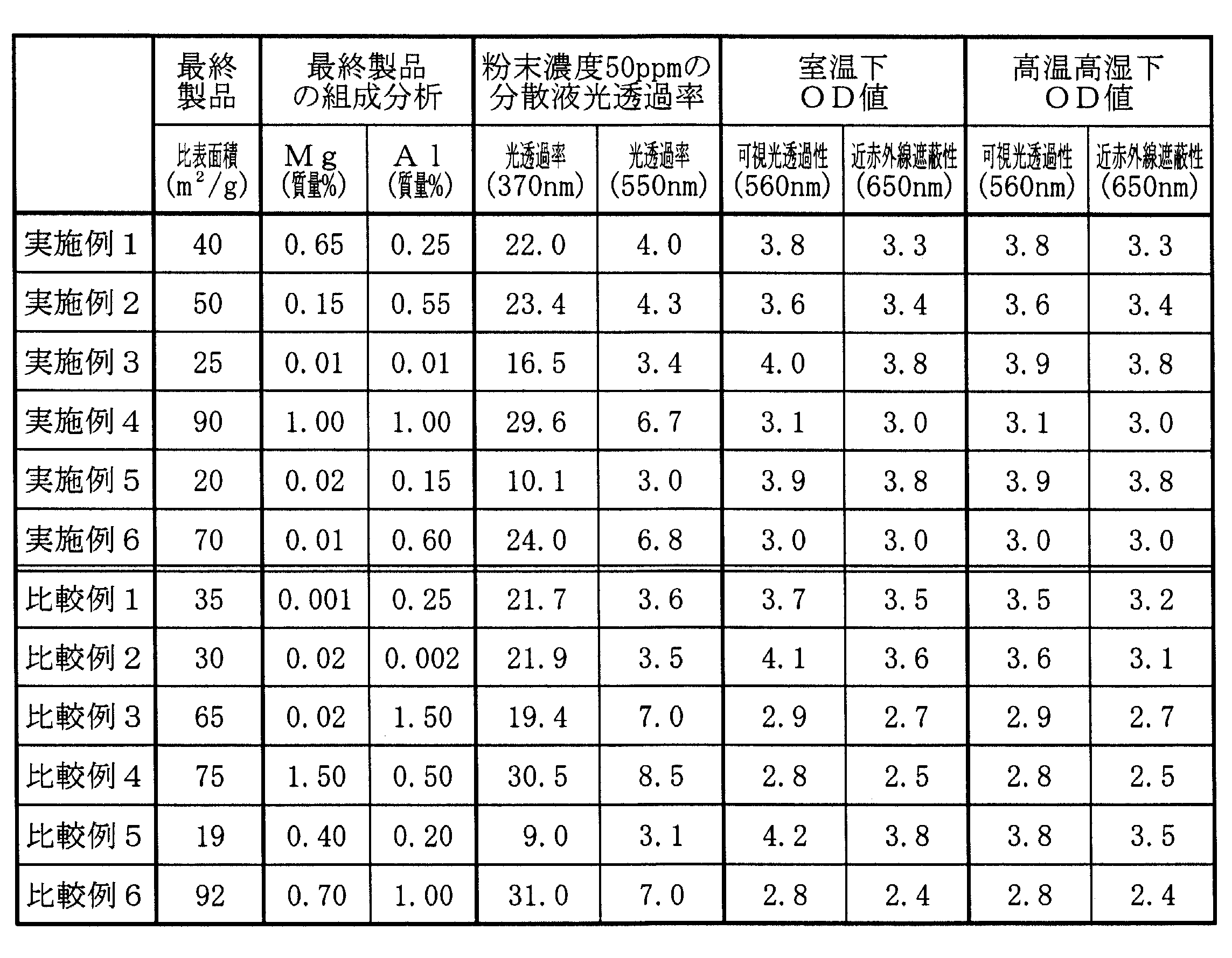
<比較試験と評価その2>
実施例1~6、比較例1~6で得られた試料を光透過率の測定に用いた分散液にアクリル樹脂を、質量比で黒色顔料:樹脂=6:4となる割合で添加し混合して黒色感光性組成物を調製した。この組成物をガラス基板上に焼成後の膜厚が1μmになるようにスピンコートし、250℃の温度で60分間焼成して被膜を形成した。この被膜を室温下に保持し、その状態で被膜の可視光(中心波長560nm及び中心波長650nm)のOD値を、前述した式(2)に基づき、マクベス社製のX-Rite 361T(V)濃度計を用いて、測定した。また同一の被膜を85℃、相対湿度85%の高温高湿雰囲気下で500時間保持したときのOD値を同様に測定した。その結果を表2に示す。
実施例1~6、比較例1~6で得られた試料を光透過率の測定に用いた分散液にアクリル樹脂を、質量比で黒色顔料:樹脂=6:4となる割合で添加し混合して黒色感光性組成物を調製した。この組成物をガラス基板上に焼成後の膜厚が1μmになるようにスピンコートし、250℃の温度で60分間焼成して被膜を形成した。この被膜を室温下に保持し、その状態で被膜の可視光(中心波長560nm及び中心波長650nm)のOD値を、前述した式(2)に基づき、マクベス社製のX-Rite 361T(V)濃度計を用いて、測定した。また同一の被膜を85℃、相対湿度85%の高温高湿雰囲気下で500時間保持したときのOD値を同様に測定した。その結果を表2に示す。
表2から明らかなように、比較例1では、焼成物を洗浄するときのpHを0.5と低くしたため、最終製品の黒色遮光膜形成用粉末におけるマグネシウムの含有割合が0.001質量%と極めて少なくなった。このため、室温下のOD値と比較して高温高湿下のOD値は、中心波長が560nm及び650nmにおいて、それぞれ0.2及び0.3ずつ低くなり、最終製品は耐候性に劣っていた。
比較例2では、最終製品の黒色遮光膜形成用粉末におけるアルミニウムの含有割合が0.002質量%と少な過ぎたため、マグネシウムと同様に、室温下のOD値と比較して高温高湿下のOD値は、中心波長が560nm及び650nmの双方において、0.5ずつ低くなり、最終製品は耐候性に劣っていた。
比較例3では、最終製品の黒色遮光膜形成用粉末におけるアルミニウムの含有割合が1.50質量%と多過ぎたため、室温下のOD値も高温高湿下のOD値も2.9以下となり、最終製品は遮光性に劣っていた。
比較例4では、最終製品の黒色遮光膜形成用粉末におけるマグネシウムの含有割合が1.5質量%と多過ぎたため、室温下のOD値も高温高湿下のOD値も2.8以下となり、最終製品は遮光性に劣っていた。
比較例5では、最終製品の黒色遮光膜形成用粉末の比表面積が19m2/gと小さ過ぎたため、粉末濃度50ppmの分散液における波長370nmの光透過率が9.0%と低く、紫外線透過率が悪かった。
比較例6では、最終製品の黒色遮光膜形成用粉末の比表面積が92m2/gと大き過ぎたため、粉末濃度50ppmの分散液における波長550nmの光透過率が7.0%と高く、可視光透過率が悪かった。
これに対して、実施例1~6では、最終製品の黒色遮光膜形成用粉末の比表面積が20~90m2/gであり、粉末濃度50ppmの分散液における波長370nm及び波長550nmの各光透過率が10.1~29.6%と3.0~6.8%であり、室温下のOD値も高温高湿下のOD値も3.0以上あって、室温下のOD値と比較して高温高湿下のOD値は殆ど変化がなかった。その結果、実施例1~6における最終製品の黒色遮光膜形成用粉末は、紫外線透過率、可視光透過率、遮光性及び耐候性に優れていることが判った。
本発明の窒化ジルコニウムを主成分とする黒色遮光膜形成用粉末は、高精細の液晶、有機EL用ブラックマトリックス材、イメージセンサー用遮光材、光学部材用遮光材、遮光フィルター、IRカットフィルター等に利用することができる。
Claims (4)
- BET法により測定される比表面積が20~90m2/gであって、窒化ジルコニウムを主成分とし、マグネシウム及び/又はアルミニウムを含有する黒色遮光膜形成用粉末であって、
前記マグネシウムを含有するとき、前記マグネシウムの含有割合が前記黒色遮光膜形成用粉末100質量%に対して0.01~1.0質量%であり、前記アルミニウムを含有するとき、前記アルミニウムの含有割合が前記黒色遮光膜形成用粉末100質量%に対して0.01~1.0質量%であることを特徴とする黒色遮光膜形成用粉末。 - 二酸化ジルコニウム粉末と、金属マグネシウム粉末と、酸化マグネシウム粉末又は窒化マグネシウムと、酸化アルミニウム粉末又は窒化アルミニウム粉末とを、前記金属マグネシウムが前記二酸化ジルコニウム100質量%に対して25~150質量%、前記酸化マグネシウムが前記二酸化ジルコニウム100質量%に対して15~500質量%、前記酸化アルミニウム又は前記窒化アルミニウムが前記二酸化ジルコニウム100質量%に対して0.02~5.0質量%の各割合になるように、混合し、得られた混合粉末を窒素ガス単体の雰囲気下、窒素ガスと水素ガスの混合ガス雰囲気下、窒素ガスとアンモニアガスの混合ガス雰囲気下又は窒素ガスと不活性ガス雰囲気下で650~900℃の温度で焼成することにより、前記混合粉末を還元して黒色遮光膜形成用粉末を製造する方法。
- 請求項1記載の黒色遮光膜形成用粉末又は請求項2記載の方法により製造された黒色遮光膜形成用粉末を黒色顔料として含む黒色感光性組成物。
- 請求項3記載の黒色感光性組成物を用いて黒色遮光膜を形成する方法。
Priority Applications (4)
| Application Number | Priority Date | Filing Date | Title |
|---|---|---|---|
| CN201880083877.8A CN111511680B (zh) | 2017-12-26 | 2018-10-25 | 黑色遮光膜形成用粉末及其制备方法 |
| EP18895023.2A EP3733595A4 (en) | 2017-12-26 | 2018-10-25 | POWDER TO FORM A PROTECTIVE FILM AGAINST DARK LIGHT AND ITS MANUFACTURING PROCESS |
| KR1020207016420A KR102629669B1 (ko) | 2017-12-26 | 2018-10-25 | 흑색 차광막 형성용 분말 및 그 제조 방법 |
| US16/957,197 US11835679B2 (en) | 2017-12-26 | 2018-10-25 | Powder for forming black light-shielding film and method for manufacturing same |
Applications Claiming Priority (2)
| Application Number | Priority Date | Filing Date | Title |
|---|---|---|---|
| JP2017248647A JP6971834B2 (ja) | 2017-12-26 | 2017-12-26 | 黒色遮光膜形成用粉末及びその製造方法 |
| JP2017-248647 | 2017-12-26 |
Publications (1)
| Publication Number | Publication Date |
|---|---|
| WO2019130772A1 true WO2019130772A1 (ja) | 2019-07-04 |
Family
ID=67063390
Family Applications (1)
| Application Number | Title | Priority Date | Filing Date |
|---|---|---|---|
| PCT/JP2018/039664 Ceased WO2019130772A1 (ja) | 2017-12-26 | 2018-10-25 | 黒色遮光膜形成用粉末及びその製造方法 |
Country Status (6)
| Country | Link |
|---|---|
| US (1) | US11835679B2 (ja) |
| EP (1) | EP3733595A4 (ja) |
| JP (1) | JP6971834B2 (ja) |
| KR (1) | KR102629669B1 (ja) |
| CN (1) | CN111511680B (ja) |
| WO (1) | WO2019130772A1 (ja) |
Cited By (5)
| Publication number | Priority date | Publication date | Assignee | Title |
|---|---|---|---|---|
| CN114507073A (zh) * | 2020-11-16 | 2022-05-17 | 三菱综合材料电子化成株式会社 | 氮化锆粉末及其制备方法 |
| JP2022092173A (ja) * | 2020-12-10 | 2022-06-22 | 日清エンジニアリング株式会社 | 複合粒子 |
| WO2022210175A1 (ja) | 2021-03-29 | 2022-10-06 | 富士フイルム株式会社 | 黒色感光性組成物、黒色感光性組成物の製造方法、硬化膜、カラーフィルタ、遮光膜、光学素子、固体撮像素子、ヘッドライトユニット |
| JP2023047637A (ja) * | 2021-09-27 | 2023-04-06 | 三菱マテリアル株式会社 | 被覆窒化ジルコニウム粒子および黒色紫外線硬化型有機組成物 |
| WO2024210149A1 (ja) * | 2023-04-04 | 2024-10-10 | 日本製鉄株式会社 | 表面処理鋼板 |
Families Citing this family (8)
| Publication number | Priority date | Publication date | Assignee | Title |
|---|---|---|---|---|
| KR102548102B1 (ko) * | 2017-09-25 | 2023-06-28 | 도레이 카부시키가이샤 | 착색 수지 조성물, 착색막, 컬러필터 및 액정 표시 장치 |
| US12110634B2 (en) * | 2018-06-19 | 2024-10-08 | Tronox Llc | Treated titanium dioxide pigment, process of making thereof and use thereof in paper manufacture |
| JP7623808B2 (ja) * | 2019-10-07 | 2025-01-29 | 日東電工株式会社 | 光硬化性粘着剤組成物、両面粘着シートおよびその製造方法、ならびに光学デバイスおよびその製造方法 |
| JP7529510B2 (ja) * | 2020-09-28 | 2024-08-06 | 三菱マテリアル電子化成株式会社 | 窒化ジルコニウム粉末及びその製造方法 |
| WO2022092274A1 (ja) | 2020-11-02 | 2022-05-05 | 三菱マテリアル株式会社 | ジルコニウム含有窒化物粉末及び黒色紫外線硬化型有機組成物 |
| DE112022004682T5 (de) | 2021-09-28 | 2024-07-11 | Mitsubishi Materials Corporation | Aluminiumoxid-basierte zusammensetzung enthaltendes zirkoniumnitridpulver, und verfahren zur herstellung desselben |
| JP7699023B2 (ja) * | 2021-09-28 | 2025-06-26 | 三菱マテリアル電子化成株式会社 | 酸化アルミニウム系組成物含有窒化ジルコニウム粉末及びその製造方法 |
| JP7837755B2 (ja) * | 2022-03-10 | 2026-03-31 | 三菱マテリアル電子化成株式会社 | 窒化ジルコニウム粉末及びその製造方法 |
Citations (8)
| Publication number | Priority date | Publication date | Assignee | Title |
|---|---|---|---|---|
| JPS60186407A (ja) * | 1984-03-06 | 1985-09-21 | Toyo Soda Mfg Co Ltd | 窒化ジルコニウム微粉末の製造法 |
| JPH046102A (ja) * | 1990-04-23 | 1992-01-10 | Tokuyama Soda Co Ltd | 窒化ジルコニウム粉末の製造方法 |
| CN1546370A (zh) * | 2003-11-28 | 2004-11-17 | 中国科学院上海硅酸盐研究所 | 一种立方相纳米氮化锆粉体的还原氮化制备方法 |
| JP2008266045A (ja) | 2007-04-17 | 2008-11-06 | Mitsubishi Materials Corp | 高抵抗黒色粉末およびその分散液、塗料、黒色膜 |
| JP2009058946A (ja) | 2007-08-03 | 2009-03-19 | Toray Ind Inc | 黒色樹脂組成物、樹脂ブラックマトリクス、カラーフィルターおよび液晶表示装置 |
| JP2009091205A (ja) | 2007-10-10 | 2009-04-30 | Tayca Corp | 微粒子低次酸化ジルコニウム・窒化ジルコニウム複合体およびその製造方法 |
| JP2012096945A (ja) | 2010-10-29 | 2012-05-24 | Mitsubishi Materials Corp | 青色遮蔽黒色粉末とその製造方法および用途 |
| JP2017222559A (ja) * | 2016-09-29 | 2017-12-21 | 三菱マテリアル電子化成株式会社 | 窒化ジルコニウム粉末及びその製造方法 |
Family Cites Families (16)
| Publication number | Priority date | Publication date | Assignee | Title |
|---|---|---|---|---|
| US2461019A (en) * | 1945-03-02 | 1949-02-08 | Metal Hydrides Inc | Production of zirconium nitride |
| JP3724269B2 (ja) | 1998-08-31 | 2005-12-07 | 東レ株式会社 | 黒色被覆組成物、樹脂ブラックマトリックス、カラーフィルターおよび液晶表示装置 |
| ATE367232T1 (de) * | 2002-03-23 | 2007-08-15 | Metal Nanopowders Ltd | Verfahren zur erzeugung von pulver |
| JP2006523383A (ja) | 2003-03-04 | 2006-10-12 | ピクセリジェント・テクノロジーズ・エルエルシー | フォトリソグラフィ用のナノサイズ半導体粒子の応用 |
| KR100540171B1 (ko) * | 2003-05-20 | 2006-01-10 | 한국전자통신연구원 | 지상파 디지털 텔레비젼 방송신호를 위한 동일채널중계장치 및 그 방법 |
| KR101067206B1 (ko) | 2004-09-21 | 2011-09-22 | 스미토모 오사카 세멘토 가부시키가이샤 | 흑색 재료, 흑색 미립자 분산액과 이것을 이용한 흑색차광막 및 흑색 차광막 부착 기재 |
| US7776303B2 (en) * | 2006-08-30 | 2010-08-17 | Ppg Industries Ohio, Inc. | Production of ultrafine metal carbide particles utilizing polymeric feed materials |
| US8047288B2 (en) * | 2007-07-18 | 2011-11-01 | Oxane Materials, Inc. | Proppants with carbide and/or nitride phases |
| JP2012247518A (ja) | 2011-05-26 | 2012-12-13 | Sumitomo Metal Mining Co Ltd | 黒色耐熱遮光フィルム、および、それを用いた絞り、シャッター羽根、光量調整モジュール用絞り羽根並びに遮光テープ |
| CN104176716B (zh) | 2013-05-22 | 2016-01-06 | 安徽港铭新材料科技有限公司 | 一种氮化锆的制备方法 |
| CN103555003A (zh) | 2013-11-08 | 2014-02-05 | 北京京东方光电科技有限公司 | 改性功能材料、蓝色光阻材料、彩色滤光片及它们的制备方法、显示器件 |
| JPWO2015146892A1 (ja) * | 2014-03-27 | 2017-04-13 | 三菱マテリアル電子化成株式会社 | 黒色酸窒化チタン顔料及びその製造方法並びに黒色酸窒化チタン顔料を用いた半導体封止用樹脂化合物 |
| WO2017150093A1 (ja) | 2016-02-29 | 2017-09-08 | 富士フイルム株式会社 | 組成物、組成物の製造方法、硬化膜、カラーフィルタ、遮光膜、固体撮像素子および画像表示装置 |
| JP6667422B2 (ja) * | 2016-11-22 | 2020-03-18 | 三菱マテリアル電子化成株式会社 | 黒色膜形成用混合粉末及びその製造方法 |
| JP2019104651A (ja) * | 2017-12-13 | 2019-06-27 | テイカ株式会社 | 窒化ジルコニウム系黒色フィラー及びその製造方法、そのフィラーを含有する塗料組成物及びその塗膜 |
| US12163032B2 (en) * | 2017-12-19 | 2024-12-10 | Nisshin Engineering Inc. | Composite particles and method for producing composite particles |
-
2017
- 2017-12-26 JP JP2017248647A patent/JP6971834B2/ja active Active
-
2018
- 2018-10-25 EP EP18895023.2A patent/EP3733595A4/en active Pending
- 2018-10-25 US US16/957,197 patent/US11835679B2/en active Active
- 2018-10-25 WO PCT/JP2018/039664 patent/WO2019130772A1/ja not_active Ceased
- 2018-10-25 KR KR1020207016420A patent/KR102629669B1/ko active Active
- 2018-10-25 CN CN201880083877.8A patent/CN111511680B/zh active Active
Patent Citations (8)
| Publication number | Priority date | Publication date | Assignee | Title |
|---|---|---|---|---|
| JPS60186407A (ja) * | 1984-03-06 | 1985-09-21 | Toyo Soda Mfg Co Ltd | 窒化ジルコニウム微粉末の製造法 |
| JPH046102A (ja) * | 1990-04-23 | 1992-01-10 | Tokuyama Soda Co Ltd | 窒化ジルコニウム粉末の製造方法 |
| CN1546370A (zh) * | 2003-11-28 | 2004-11-17 | 中国科学院上海硅酸盐研究所 | 一种立方相纳米氮化锆粉体的还原氮化制备方法 |
| JP2008266045A (ja) | 2007-04-17 | 2008-11-06 | Mitsubishi Materials Corp | 高抵抗黒色粉末およびその分散液、塗料、黒色膜 |
| JP2009058946A (ja) | 2007-08-03 | 2009-03-19 | Toray Ind Inc | 黒色樹脂組成物、樹脂ブラックマトリクス、カラーフィルターおよび液晶表示装置 |
| JP2009091205A (ja) | 2007-10-10 | 2009-04-30 | Tayca Corp | 微粒子低次酸化ジルコニウム・窒化ジルコニウム複合体およびその製造方法 |
| JP2012096945A (ja) | 2010-10-29 | 2012-05-24 | Mitsubishi Materials Corp | 青色遮蔽黒色粉末とその製造方法および用途 |
| JP2017222559A (ja) * | 2016-09-29 | 2017-12-21 | 三菱マテリアル電子化成株式会社 | 窒化ジルコニウム粉末及びその製造方法 |
Cited By (9)
| Publication number | Priority date | Publication date | Assignee | Title |
|---|---|---|---|---|
| CN114507073A (zh) * | 2020-11-16 | 2022-05-17 | 三菱综合材料电子化成株式会社 | 氮化锆粉末及其制备方法 |
| JP2022092173A (ja) * | 2020-12-10 | 2022-06-22 | 日清エンジニアリング株式会社 | 複合粒子 |
| JP7566606B2 (ja) | 2020-12-10 | 2024-10-15 | 日清エンジニアリング株式会社 | 複合粒子 |
| WO2022210175A1 (ja) | 2021-03-29 | 2022-10-06 | 富士フイルム株式会社 | 黒色感光性組成物、黒色感光性組成物の製造方法、硬化膜、カラーフィルタ、遮光膜、光学素子、固体撮像素子、ヘッドライトユニット |
| JP2023047637A (ja) * | 2021-09-27 | 2023-04-06 | 三菱マテリアル株式会社 | 被覆窒化ジルコニウム粒子および黒色紫外線硬化型有機組成物 |
| JP7825399B2 (ja) | 2021-09-27 | 2026-03-06 | 三菱マテリアル株式会社 | 被覆窒化ジルコニウム粒子および黒色紫外線硬化型有機組成物 |
| WO2024210149A1 (ja) * | 2023-04-04 | 2024-10-10 | 日本製鉄株式会社 | 表面処理鋼板 |
| JPWO2024210149A1 (ja) * | 2023-04-04 | 2024-10-10 | ||
| JP7688317B2 (ja) | 2023-04-04 | 2025-06-04 | 日本製鉄株式会社 | 表面処理鋼板 |
Also Published As
| Publication number | Publication date |
|---|---|
| US11835679B2 (en) | 2023-12-05 |
| JP6971834B2 (ja) | 2021-11-24 |
| EP3733595A4 (en) | 2021-10-13 |
| EP3733595A1 (en) | 2020-11-04 |
| US20200319373A1 (en) | 2020-10-08 |
| KR102629669B1 (ko) | 2024-01-25 |
| JP2019112275A (ja) | 2019-07-11 |
| KR20200100630A (ko) | 2020-08-26 |
| CN111511680A (zh) | 2020-08-07 |
| CN111511680B (zh) | 2023-10-24 |
Similar Documents
| Publication | Publication Date | Title |
|---|---|---|
| WO2019130772A1 (ja) | 黒色遮光膜形成用粉末及びその製造方法 | |
| KR102411232B1 (ko) | 질화지르코늄 분말 및 그 제조 방법 | |
| US10974963B2 (en) | Zirconium nitride powder and production method therefor | |
| JP6667422B2 (ja) | 黒色膜形成用混合粉末及びその製造方法 | |
| KR102801142B1 (ko) | 흑색 재료 및 그 제조 방법, 흑색 감광성 조성물 및 그 제조 방법, 그리고 흑색 패터닝막 및 그 형성 방법 | |
| JP6949604B2 (ja) | 黒色膜形成用混合粉末の製造方法 | |
| JP2020019691A (ja) | 表面処理された窒化ジルコニウム粉末及びその表面処理方法 | |
| JP7529510B2 (ja) | 窒化ジルコニウム粉末及びその製造方法 | |
| HK40093242A (zh) | 氮化锆粉末及其制造方法 | |
| HK40027150A (en) | Powder for forming black light-shielding film and method for manufacturing same | |
| HK40005093A (en) | Zirconium nitride powder and method for producing same |
Legal Events
| Date | Code | Title | Description |
|---|---|---|---|
| 121 | Ep: the epo has been informed by wipo that ep was designated in this application |
Ref document number: 18895023 Country of ref document: EP Kind code of ref document: A1 |
|
| NENP | Non-entry into the national phase |
Ref country code: DE |
|
| ENP | Entry into the national phase |
Ref document number: 2018895023 Country of ref document: EP Effective date: 20200727 |