WO2019065869A1 - 二次電池電極用組成物 - Google Patents
二次電池電極用組成物 Download PDFInfo
- Publication number
- WO2019065869A1 WO2019065869A1 PCT/JP2018/036017 JP2018036017W WO2019065869A1 WO 2019065869 A1 WO2019065869 A1 WO 2019065869A1 JP 2018036017 W JP2018036017 W JP 2018036017W WO 2019065869 A1 WO2019065869 A1 WO 2019065869A1
- Authority
- WO
- WIPO (PCT)
- Prior art keywords
- group
- secondary battery
- composition
- polyvinyl acetal
- acetal resin
- Prior art date
- Legal status (The legal status is an assumption and is not a legal conclusion. Google has not performed a legal analysis and makes no representation as to the accuracy of the status listed.)
- Ceased
Links
Classifications
-
- C—CHEMISTRY; METALLURGY
- C08—ORGANIC MACROMOLECULAR COMPOUNDS; THEIR PREPARATION OR CHEMICAL WORKING-UP; COMPOSITIONS BASED THEREON
- C08F—MACROMOLECULAR COMPOUNDS OBTAINED BY REACTIONS ONLY INVOLVING CARBON-TO-CARBON UNSATURATED BONDS
- C08F216/00—Copolymers of compounds having one or more unsaturated aliphatic radicals, each having only one carbon-to-carbon double bond, and at least one being terminated by an alcohol, ether, aldehydo, ketonic, acetal or ketal radical
- C08F216/38—Copolymers of compounds having one or more unsaturated aliphatic radicals, each having only one carbon-to-carbon double bond, and at least one being terminated by an alcohol, ether, aldehydo, ketonic, acetal or ketal radical by an acetal or ketal radical
-
- C—CHEMISTRY; METALLURGY
- C08—ORGANIC MACROMOLECULAR COMPOUNDS; THEIR PREPARATION OR CHEMICAL WORKING-UP; COMPOSITIONS BASED THEREON
- C08F—MACROMOLECULAR COMPOUNDS OBTAINED BY REACTIONS ONLY INVOLVING CARBON-TO-CARBON UNSATURATED BONDS
- C08F116/00—Homopolymers of compounds having one or more unsaturated aliphatic radicals, each having only one carbon-to-carbon double bond, and at least one being terminated by an alcohol, ether, aldehydo, ketonic, acetal or ketal radical
- C08F116/38—Homopolymers of compounds having one or more unsaturated aliphatic radicals, each having only one carbon-to-carbon double bond, and at least one being terminated by an alcohol, ether, aldehydo, ketonic, acetal or ketal radical by a acetal or ketal radical
-
- H—ELECTRICITY
- H01—ELECTRIC ELEMENTS
- H01M—PROCESSES OR MEANS, e.g. BATTERIES, FOR THE DIRECT CONVERSION OF CHEMICAL ENERGY INTO ELECTRICAL ENERGY
- H01M10/00—Secondary cells; Manufacture thereof
- H01M10/05—Accumulators with non-aqueous electrolyte
- H01M10/052—Li-accumulators
- H01M10/0525—Rocking-chair batteries, i.e. batteries with lithium insertion or intercalation in both electrodes; Lithium-ion batteries
-
- H—ELECTRICITY
- H01—ELECTRIC ELEMENTS
- H01M—PROCESSES OR MEANS, e.g. BATTERIES, FOR THE DIRECT CONVERSION OF CHEMICAL ENERGY INTO ELECTRICAL ENERGY
- H01M4/00—Electrodes
- H01M4/02—Electrodes composed of, or comprising, active material
- H01M4/13—Electrodes for accumulators with non-aqueous electrolyte, e.g. for lithium-accumulators; Processes of manufacture thereof
- H01M4/131—Electrodes based on mixed oxides or hydroxides, or on mixtures of oxides or hydroxides, e.g. LiCoOx
-
- H—ELECTRICITY
- H01—ELECTRIC ELEMENTS
- H01M—PROCESSES OR MEANS, e.g. BATTERIES, FOR THE DIRECT CONVERSION OF CHEMICAL ENERGY INTO ELECTRICAL ENERGY
- H01M4/00—Electrodes
- H01M4/02—Electrodes composed of, or comprising, active material
- H01M4/13—Electrodes for accumulators with non-aqueous electrolyte, e.g. for lithium-accumulators; Processes of manufacture thereof
- H01M4/139—Processes of manufacture
- H01M4/1391—Processes of manufacture of electrodes based on mixed oxides or hydroxides, or on mixtures of oxides or hydroxides, e.g. LiCoOx
-
- H—ELECTRICITY
- H01—ELECTRIC ELEMENTS
- H01M—PROCESSES OR MEANS, e.g. BATTERIES, FOR THE DIRECT CONVERSION OF CHEMICAL ENERGY INTO ELECTRICAL ENERGY
- H01M4/00—Electrodes
- H01M4/02—Electrodes composed of, or comprising, active material
- H01M4/36—Selection of substances as active materials, active masses, active liquids
- H01M4/362—Composites
-
- H—ELECTRICITY
- H01—ELECTRIC ELEMENTS
- H01M—PROCESSES OR MEANS, e.g. BATTERIES, FOR THE DIRECT CONVERSION OF CHEMICAL ENERGY INTO ELECTRICAL ENERGY
- H01M4/00—Electrodes
- H01M4/02—Electrodes composed of, or comprising, active material
- H01M4/62—Selection of inactive substances as ingredients for active masses, e.g. binders, fillers
- H01M4/621—Binders
- H01M4/622—Binders being polymers
-
- C—CHEMISTRY; METALLURGY
- C08—ORGANIC MACROMOLECULAR COMPOUNDS; THEIR PREPARATION OR CHEMICAL WORKING-UP; COMPOSITIONS BASED THEREON
- C08F—MACROMOLECULAR COMPOUNDS OBTAINED BY REACTIONS ONLY INVOLVING CARBON-TO-CARBON UNSATURATED BONDS
- C08F216/00—Copolymers of compounds having one or more unsaturated aliphatic radicals, each having only one carbon-to-carbon double bond, and at least one being terminated by an alcohol, ether, aldehydo, ketonic, acetal or ketal radical
- C08F216/02—Copolymers of compounds having one or more unsaturated aliphatic radicals, each having only one carbon-to-carbon double bond, and at least one being terminated by an alcohol, ether, aldehydo, ketonic, acetal or ketal radical by an alcohol radical
- C08F216/04—Acyclic compounds
- C08F216/06—Polyvinyl alcohol ; Vinyl alcohol
-
- Y—GENERAL TAGGING OF NEW TECHNOLOGICAL DEVELOPMENTS; GENERAL TAGGING OF CROSS-SECTIONAL TECHNOLOGIES SPANNING OVER SEVERAL SECTIONS OF THE IPC; TECHNICAL SUBJECTS COVERED BY FORMER USPC CROSS-REFERENCE ART COLLECTIONS [XRACs] AND DIGESTS
- Y02—TECHNOLOGIES OR APPLICATIONS FOR MITIGATION OR ADAPTATION AGAINST CLIMATE CHANGE
- Y02E—REDUCTION OF GREENHOUSE GAS [GHG] EMISSIONS, RELATED TO ENERGY GENERATION, TRANSMISSION OR DISTRIBUTION
- Y02E60/00—Enabling technologies; Technologies with a potential or indirect contribution to GHG emissions mitigation
- Y02E60/10—Energy storage using batteries
Definitions
- the present invention relates to a composition for a secondary battery electrode capable of producing a high capacity secondary battery, which is excellent in the dispersibility and adhesiveness of the active material, can prevent the deterioration and failure of the battery due to moisture absorption. .
- lithium secondary battery using lithium or a lithium alloy as a negative electrode as a secondary battery are actively conducted.
- This lithium secondary battery has the excellent features of high energy density, low self-discharge and light weight.
- an active material and a binder are kneaded together with a solvent, the active material is dispersed to form a slurry, and the slurry is applied onto a current collector by a doctor blade method or the like and dried to form a thin film. It is formed by
- a fluorine resin represented by polyvinylidene fluoride (PVDF) is most widely used as a binder for electrodes of lithium secondary batteries.
- PVDF polyvinylidene fluoride
- Patent Document 1 describes a binder for non-aqueous secondary batteries comprising a copolymer of an acidic functional group-containing monomer and an amide group-containing monomer.
- a binder for non-aqueous secondary batteries comprising a copolymer of an acidic functional group-containing monomer and an amide group-containing monomer.
- the dispersibility of the active material is lowered and the viscosity of the composition for an electrode is increased, so that it takes time for paste filtration and the process time is prolonged, and coating is performed at the time of coating Unevenness was apt to occur.
- the density of the active material in the electrode is lowered, the capacity of the obtained battery is insufficient.
- the flexibility of the electrode becomes low, and cracking and peeling from the current collector occur, resulting in a problem of lowering the battery durability.
- Patent Document 2 discloses a composition of a binder for a secondary battery positive electrode containing a predetermined amount of an aromatic vinyl unit, a nitrile group unit, a hydrophilic group unit, and a linear alkylene unit.
- a composition for an electrode is prepared in a state where the water content is high, acid gas may be generated from the inside of the battery due to the influence of water, which may cause expansion, ignition and explosion of the battery.
- the density of the active material in the electrode is lowered, the capacity of the obtained battery is insufficient.
- the present invention is excellent in the dispersibility and adhesiveness of the active material, can prevent the deterioration and failure of the battery due to moisture absorption, and can be used as a composition for a secondary battery electrode capable of producing a high capacity secondary battery. Intended to be provided.
- the present invention is a composition for a secondary battery electrode comprising an active material, a binder and an organic solvent,
- the binder contains a polyvinyl acetal resin, and the polyvinyl acetal resin has an electron donating group having an acid dissociation constant of less than 16 in water and an electron withdrawing group, and has a polymerization degree of 250 to 800, It is a composition for a secondary battery electrode, wherein the amount of hydroxyl groups is 35 to 70 mol%.
- the present inventor uses the polyvinyl acetal resin having a predetermined electron donating group and an electron attracting group as a binder for forming a secondary battery electrode, thereby achieving the dispersibility of the active material and the adhesion. It found that it was excellent in the sex. In addition, it has been found that deterioration and failure of the battery due to moisture absorption can be prevented, and a high capacity secondary battery can be produced even when the amount of binder added is small, and the present invention has been completed.
- the composition for a secondary battery electrode of the present invention contains an active material.
- the composition for a secondary battery electrode of the present invention may be used for either positive electrode or negative electrode, or may be used for both positive electrode and negative electrode. Therefore, as the active material, there are a positive electrode active material and a negative electrode active material.
- the positive electrode active material examples include lithium nickel oxide, lithium cobalt oxide, lithium manganese oxide, Ni ⁇ Co ⁇ Mn ternary Li-containing oxide, Ni ⁇ Co ⁇ Al ternary Li-containing oxide, etc. And lithium-containing composite metal oxides. Specifically, for example, LiNiO 2 , LiCoO 2 , LiMn 2 O 4 , lithium iron phosphate and the like can be mentioned. In addition, these may be used independently and may use 2 or more types together.
- the negative electrode active material for example, materials conventionally used as a negative electrode active material of a secondary battery can be used.
- materials conventionally used as a negative electrode active material of a secondary battery can be used.
- spherical natural graphite, natural graphite, artificial graphite, amorphous carbon, carbon black, or What added the different element to these components etc. are mentioned.
- the composition for a secondary battery electrode of the present invention preferably contains a conductivity imparting agent (conductive auxiliary agent).
- a conductivity imparting agent include carbon materials such as graphite, acetylene black, carbon black, ketjen black, and vapor grown carbon fiber.
- acetylene black and carbon black are preferable as the conductivity imparting agent for the positive electrode
- acetylene black and flake graphite are preferable as the conductivity imparting agent for the negative electrode.
- the composition for a secondary battery electrode of the present invention contains a polyvinyl acetal resin.
- a polyvinyl acetal resin as a binder (binding agent)
- an attractive interaction acts between the hydroxyl group of the polyvinyl acetal resin and the oxygen atom of the positive electrode active material, and the polyvinyl acetal resin surrounds the positive electrode active material.
- another hydroxyl group in the same molecule exerts an attractive interaction with the conductivity imparting agent, and the distance between the active material and the conductivity imparting agent can be kept within a certain range.
- the dispersibility of the active material is greatly improved by adopting a characteristic structure with a suitable distance between the active material and the conductivity imparting agent.
- the adhesion to the current collector can be improved as compared with the case of using a resin such as PVDF.
- it has the advantage of excellent solvent solubility and broadening the range of choice of solvents.
- the polyvinyl acetal resin has an electron donating group whose acid dissociation constant in water is less than 16.
- the electron conductivity can be enhanced and the electrical resistance can be suppressed by using the above-mentioned electron donating group and the electron withdrawing group described later in combination.
- the “electron donating group” is a functional group having a para effect ⁇ p in Hammett's substituent constant less than 0, and the “electron withdrawing group” is a para effect ⁇ p. Is a functional group of 0 or more. Further, a hydroxyl group and an acetyl group are not included in the electron donating group and the electron withdrawing group.
- the electron donating group has an acid dissociation constant (pKa) of less than 16 in water.
- pKa acid dissociation constant
- the above pKa is preferably less than 12. Further, the pKa is preferably 0.1 or more.
- the pKa of the electron donating group can be measured by potentiometry or neutralization titration.
- the bonding position of the electron donating group is not particularly limited, but may be a structure directly bonded to carbon which is the main chain, or may be a structure bonded via a linking group.
- bonded with the acetal group may be sufficient.
- it may be a structure in which a graft chain having an electron donating group is bonded, or a structure in which an electron donating group is bonded to the terminal of the resin.
- a structure directly bonded to carbon which is a main chain and a structure bonded to carbon which is a main chain via a linking group are preferable.
- the electron donating group examples include lower alkoxy groups, ether groups, amino groups, alkylamino groups, -S- and functional groups having a lactam structure.
- the lower alkoxy group is a linear or branched alkoxy group having 1 to 6 carbon atoms.
- the electron donating group is preferably a functional group having a lactam structure.
- the polyvinyl acetal resin can have excellent resistance to an electrolytic solution, adhesion to a current collector, and ion conductivity by having an electron donating group, and even when the amount of binder added is reduced. There is an advantage that high capacity secondary batteries can be manufactured. In addition, deterioration due to moisture absorption during long-term storage can be prevented, and there is an advantage that storage stability is excellent.
- the lactam structure means a structure having a lactam group.
- the lactam group means a group obtained by removing a hydrogen atom or an alkyl group bonded to a nitrogen atom of a lactam compound.
- Examples of the lactam compounds include caprolactam, N-alkylcaprolactams, pyrrolidones, piperidone and the like.
- N-alkylcaprolactam examples include N-methylcaprolactam, N-ethylcaprolactam, N-isopropylcaprolactam, N-isobutylcaprolactam, N-normal propylcaprolactam, N-normal butylcaprolactam, N-cyclohexylcaprolactam and the like.
- Examples of the pyrrolidones include 2-pyrrolidone, N-methyl-2-pyrrolidone (NMP), N-ethyl-2-pyrrolidone, N-isopropyl-2-pyrrolidone, N-isobutyl-2-pyrrolidone, N-normal propyl- Examples include 2-pyrrolidone, N-normal butyl-2-pyrrolidone, N-cyclohexyl-2-pyrrolidone and the like.
- Examples of the above piperidone include 2-piperidone, N-methyl-2-piperidone, N-ethyl-2-piperidone, N-isopropyl-2-piperidone and the like.
- the lactam group may be substituted, for example, with a substituent such as a halogen atom, a hydroxyl group, a carboxyl group, an amido group, an alkyl group, an alkyl ester group, an alkylamide group, a nitro group or a salt thereof.
- a substituent such as a halogen atom, a hydroxyl group, a carboxyl group, an amido group, an alkyl group, an alkyl ester group, an alkylamide group, a nitro group or a salt thereof.
- the lactam structure is preferably a structure represented by the following formula (1).
- n is an integer of 1 to 5 and R 1 represents a single bond or a saturated or unsaturated hydrocarbon having 1 to 10 carbon atoms.
- the lactam structure represented by the above formula (1) has a structure in which a lactam group is bonded to the main chain via a saturated or unsaturated hydrocarbon, the lactam structure is mainly obtained via a saturated or unsaturated hydrocarbon. Less susceptible to chain effects.
- R 1 is preferably a single bond.
- R 1 is a single bond or a saturated or unsaturated hydrocarbon having 1 to 10 carbon atoms.
- R ⁇ 1 > a linear or branched alkylene group, an arylene group, etc. are mentioned, for example.
- a linear alkylene group is preferable, and an alkylene group having 1 to 6 carbon atoms is preferable.
- methylene, ethylene, propylene and the like are preferable.
- the lactam structure is preferably a three- to seven-membered ring, more preferably at least one cyclic structure selected from a three-, four-, five-, and six-membered ring.
- n is preferably an integer of 1 to 5, and n is more preferably 1 or 2.
- the hydrocarbon constituting the cyclic structure of the lactam structure is preferably unsubstituted or the hydrogen atom is substituted by a saturated or unsaturated hydrocarbon having 1 to 10 carbon atoms.
- ⁇ hydrogen and ⁇ hydrogen are preferable.
- the saturated or unsaturated hydrocarbon having 1 to 10 carbon atoms is preferably a methyl group, an ethyl group, an isopropyl group, a dimethyl group, an allyl group or a phenyl group.
- the number of hydrogen atoms to be substituted may be one, or two or more.
- the preferable lower limit of the content of the constituent unit having an electron donating group in the polyvinyl acetal resin is 0.01 mol%, and the preferable upper limit is 10 mol%. Adhesiveness can be improved by the said content being 0.01 mol% or more, and a raise of a viscosity can be prevented by the said content being 10 mol% or less.
- the more preferable lower limit of the content is 0.05 mol%, and the more preferable upper limit is 8 mol%.
- a further preferable upper limit is 6 mol%.
- the polyvinyl acetal resin has an electron withdrawing group.
- the electron-withdrawing group preferably has an acid dissociation constant (pKa) in water of less than 25. Electrons can be efficiently received because the pKa is less than 25.
- the above pKa is more preferably less than 20. Moreover, it is preferable that said pKa is 1.0 or more.
- the pKa of the electron withdrawing group can be measured by potentiometry or neutralization titration.
- the bonding position of the electron withdrawing group is not particularly limited, but it may be a structure directly bonded to carbon which is the main chain, or may be a structure bonded via a linking group. Moreover, the structure couple
- Examples of the electron withdrawing group include an acid group such as carboxyl group, phosphoric acid group, boronic acid and boronic acid ester, nitrogen-containing group such as nitro group (-NO 2 ), amide group and nitrile group, sulfo group
- an acid group such as carboxyl group, phosphoric acid group, boronic acid and boronic acid ester
- nitrogen-containing group such as nitro group (-NO 2 ), amide group and nitrile group
- sulfur-containing groups such as sulfonyl group and sulfinyl group, formyl group (-CHO), fluorinated alkyl group, halogen and the like can be mentioned.
- a carboxyl group is preferable.
- the preferable lower limit of the content of the constituent unit having an electron withdrawing group in the polyvinyl acetal resin is 0.01 mol%, and the preferable upper limit is 10 mol%.
- the content By setting the content to 0.01 mol% or more, the dispersibility of the active material and the conductive auxiliary can be improved, and by setting the content to 10 mol% or less, an increase in viscosity can be prevented.
- the more preferable lower limit of the content is 0.05 mol%, and the more preferable upper limit is 8 mol%.
- a further preferable upper limit is 6 mol%.
- Ratio of content of constituent unit having electron withdrawing group to content of constituent unit having electron donating group in the polyvinyl acetal resin is preferably 0.001 to 1000. By setting it in the said range, electronic conductivity can be improved and an electrical resistance can be suppressed. Preferably, it is 0.01 to 100.
- the difference between the acid dissociation constant of the electron donating group and the acid dissociation constant of the electron withdrawing group in the above polyvinyl acetal resin is 1 It is preferably from 0 to 20. By setting it in the said range, electronic conductivity can be improved and an electrical resistance can be suppressed. Preferably, it is 1.5 to 15.0.
- the ratio of the content of the constituent unit having an electron withdrawing group to the amount of hydroxyl group in the polyvinyl acetal resin (the content of the constituent unit having an electron donating group / the amount of hydroxyl group) is 1.00 ⁇ 10 ⁇ 4 It is preferably -4.5 ⁇ 10 -1 . By setting it in the said range, transfer of an electron can be performed efficiently and conductivity can be raised.
- the polyvinyl acetal resin has a structural unit having an acetal group.
- the content (acetalization degree) of the structural unit having an acetal group in the polyvinyl acetal resin is preferably 20 to 70 mol%.
- the solubility in a solvent is improved, and the composition can be suitably used.
- the degree of acetalization is 40 to 65 mol%. More preferably, it is 45 to 65 mol%.
- the degree of acetalization means the ratio of the number of hydroxyl groups acetalized with butyraldehyde to the number of hydroxyl groups of polyvinyl alcohol. Moreover, since the calculation method of the degree of acetalization is formed by acetalizing the acetal group of polyvinyl acetal resin from two hydroxyl groups, it is acetalized by adopting a method of counting the two acetalized hydroxyl groups Calculate mole% of degree. In addition, in this specification, acetalization degree means content of the structural unit which has an acetal group with respect to whole polyvinyl acetal resin.
- the structural unit having an acetal group can be obtained by acetalization using an aldehyde.
- the preferable lower limit of the number of carbons (the number of carbons excluding the aldehyde group) of the aldehyde is 1, and the preferable upper limit is 11.
- the aldehyde include aldehydes having a vinyl group (vinyl aldehyde) such as acetaldehyde, butyraldehyde, benzaldehyde, propionaldehyde and acrolein.
- the acetal group is preferably at least one selected from the group consisting of a butyral group, a benzacetal group, an acetoacetal group, a propionacetal group and a vinylacetal group.
- the polyvinyl acetal resin preferably has a ratio of a portion acetalized with acetaldehyde to a portion acetalized with butyraldehyde is 0/100 to 50/50. As a result, the polyvinyl acetal resin becomes flexible and the adhesion to the current collector becomes good. More preferably, the ratio between the acetalized portion with acetaldehyde and the acetalized portion with butyraldehyde is 0/100 to 20/80.
- the polyvinyl acetal resin has a structural unit having a hydroxyl group.
- the lower limit of the content (hydroxyl group content) of the constituent unit having a hydroxyl group in the polyvinyl acetal resin is 35 mol%, and the upper limit is 70 mol%.
- the amount of hydroxyl groups is 35 mol% or more, resistance to the electrolytic solution is improved, and elution of the resin into the electrolytic solution can be prevented, and by setting it to 70 mol% or less, the flexibility of the resin is improved. Adhesion to the current collector is sufficient.
- the preferable lower limit of the amount of hydroxyl groups is 40 mol%, and the preferable upper limit is 65 mol%.
- a more preferable lower limit is 45 mol%, and a more preferable upper limit is 60 mol%.
- the amount of hydroxyl groups means content of the structural unit which has a hydroxyl group with respect to whole polyvinyl acetal resin.
- the said polyvinyl acetal resin has a structural unit which has an acetyl group.
- the preferable lower limit of the content (acetyl group amount) of the structural unit having an acetyl group in the polyvinyl acetal resin is 0.1 mol%, and the preferable upper limit is 15 mol%.
- the more preferable lower limit of the amount of acetyl groups is 1 mol%, and the more preferable upper limit is 10 mol%.
- the amount of acetyl groups means content of the structural unit which has an acetyl group with respect to whole polyvinyl acetal resin.
- the ratio of the content of a constituent unit having an electron donating group to the content of a constituent unit having a hydroxyl group is preferably 0.0001 to 1.50.
- the electrical resistance value of the composition for secondary battery electrodes can be suppressed. More preferably, it is 0.01 to 0.89, and still more preferably 0.01 to 0.43.
- the lower limit of the degree of polymerization of the polyvinyl acetal resin is 250, and the upper limit is 800. By obtaining the degree of polymerization of 250 or more, industrial availability becomes easy. By setting the degree of polymerization to 800 or less, it is possible to reduce the solution viscosity and sufficiently disperse the active material.
- the preferable lower limit of the degree of polymerization is 280, and the preferable upper limit is 600.
- a polyvinyl acetal resin has an electron donating group and an electron withdrawing group
- an electron donating group and an electron withdrawing group are contained in the same polyvinyl acetal resin.
- the electron donating group and the electron withdrawing group are provided in separate polyvinyl acetal resins.
- the “degree of polymerization of polyvinyl acetal resin” is calculated by dividing the degree of polymerization of each resin by the mixing ratio. Represent.
- content of the said polyvinyl acetal resin in the composition for secondary battery electrodes of this invention is not specifically limited, A preferable minimum is 0.2 weight% and a preferable upper limit is 5 weight%.
- content of the said polyvinyl acetal resin 0.2 weight% or more the adhesive force to a collector can be improved, and the discharge capacity of a secondary battery is improved by setting it as 5 weight% or less. It can be done. More preferably, it is 0.5 to 3% by weight.
- the polyvinyl acetal resin is obtained by acetalizing polyvinyl alcohol with an aldehyde.
- a method of producing the polyvinyl acetal resin a method of preparing a polyvinyl alcohol having the electron donating group and the electron withdrawing group and then acetalizing the polyvinyl alcohol, the electron donating group and the electron withdrawing group After acetalizing polyvinyl alcohol which does not have, the method etc. of adding the said electron donating group and an electron withdrawing group are mentioned.
- a mixed polyvinyl alcohol containing the polyvinyl alcohol having the electron donating group and the polyvinyl alcohol having the electron withdrawing group may be prepared and then acetalized.
- vinyl such as an electron donor group containing monomer, an electron withdrawing group containing monomer, vinyl acetate etc.
- the method etc. which add an acid or an alkali to the alcohol solution of the obtained copolymer, and saponify are mentioned.
- Examples of the electron donating group-containing monomer include lactam group-containing monomers.
- Examples of the lactam group-containing monomer include N-vinyl-pyrrolidone, N-vinyl-2-piperidone, N-vinyl-2-caprolactam, N-vinyl-3-methyl-2-pyrrolidone, N-vinyl- 3-methyl-2-piperidone and the like. Also, N-vinyl-3-methyl-2-caprolactam, N-vinyl-4-methyl-2-pyrrolidone, N-vinyl-4-methyl-2-piperidone, N-vinyl-4-methyl-2-caprolactam And N-vinyl-5-methyl-2-pyrrolidone and the like.
- N-vinyl-5-methyl-2-piperidone, N-vinyl-5-methyl-2-caprolactam, N-vinyl-3-ethyl-2-pyrrolidone, N-vinyl-4,5-dimethyl-2- Pyrrolidone, N-vinyl-3,3,5-trimethyl-2-pyrrolidone and the like can be mentioned.
- an electron donating group containing monomer or electron can be added to the polyvinyl acetal resin not having the above electron donating group and electron withdrawing group.
- the method etc. which make a withdrawing group containing monomer etc. react are mentioned.
- the polyvinyl alcohol which does not have the said electron donor and electron withdrawing group can be obtained by saponifying the copolymer of vinyl ester and ethylene, for example.
- the vinyl ester include vinyl formate, vinyl acetate, vinyl propionate, vinyl pivalate and the like. Among them, vinyl acetate is preferable from the viewpoint of economy.
- composition for a secondary battery electrode of the present invention may further contain a polyvinylidene fluoride resin in addition to the polyvinyl acetal resin.
- a polyvinylidene fluoride resin in addition to the polyvinyl acetal resin.
- the weight ratio of the polyvinyl acetal resin to the polyvinylidene fluoride resin is preferably 0.5: 9.5 to 7: 3. By setting it in such a range, it is possible to impart resistance to the electrolytic solution while having an adhesive power to the current collector which is extremely lacking in polyvinylidene fluoride.
- the weight ratio of the polyvinyl acetal resin to the polyvinylidene fluoride resin is more preferably 1: 9 to 4: 6.
- the content of the polyvinyl acetal resin in the composition for a secondary battery electrode of the present invention is preferably 0.01 parts by weight with respect to 100 parts by weight of the active material, and 20 parts by weight with a preferable upper limit.
- the content of the polyvinyl acetal resin in the composition for a secondary battery electrode of the present invention is preferably 0.01 parts by weight with respect to 100 parts by weight of the conductive additive, and 200 parts by weight with a preferable upper limit.
- the content of the entire binder in the composition for a secondary battery electrode of the present invention is not particularly limited, but a preferable lower limit is 1% by weight, and a preferable upper limit is 30% by weight.
- a preferable lower limit is 1% by weight
- a preferable upper limit is 30% by weight.
- the composition for a secondary battery electrode of the present invention contains an organic solvent.
- the organic solvent is not particularly limited as long as it can dissolve the polyvinyl acetal resin.
- cyclohexanone, methyl ethyl ketone, methyl isobutyl ketone, tetrahydrofuran, toluene, isopropyl alcohol, N-methyl pyrrolidone, ethanol, distillation Water etc. are mentioned. Among them, N-methyl pyrrolidone is preferable.
- the organic solvents may be used alone or in combination of two or more.
- content of the organic solvent in the composition for secondary battery electrodes of this invention is not specifically limited, A preferable minimum is 20 weight% and a preferable upper limit is 50 weight%.
- a preferable minimum is 20 weight% and a preferable upper limit is 50 weight%.
- composition for a secondary battery electrode of the present invention in addition to the above-mentioned active material, polyvinyl acetal resin, and organic solvent, if necessary, a flame retardant auxiliary, a thickener, an antifoamer, a leveling agent, and adhesion Additives such as additives may be added.
- the binder which contains the said active material, polyvinyl acetal resin, an organic solvent, and various additives added as needed are planetata
- the composition for a secondary battery electrode of the present invention is, for example, applied on a conductive substrate and dried to form an electrode.
- a secondary battery using the composition for a secondary battery electrode of the present invention is also one of the present invention.
- a Ni-Cd battery, a nickel hydrogen battery, a lithium secondary battery, an all-solid-state battery, a fuel cell etc. are mentioned, for example. Among them, lithium secondary batteries are preferable.
- coating the composition for secondary battery electrodes of this invention on an electroconductive base various coating including an extrusion coater, a dip coater, a spin coater, a reverse roller, a doctor blade, an applicator etc. The method can be adopted.
- the present invention while being excellent in the dispersibility and adhesiveness of the active material, it is possible to prevent deterioration and failure of the battery due to moisture absorption, and a composition for a secondary battery electrode capable of producing a high capacity secondary battery.
- the composition for a secondary battery electrode of the present invention is excellent in viscosity and can prevent decomposition and deterioration when a voltage is applied to the electrode, and a highly flexible secondary battery electrode can be produced. .
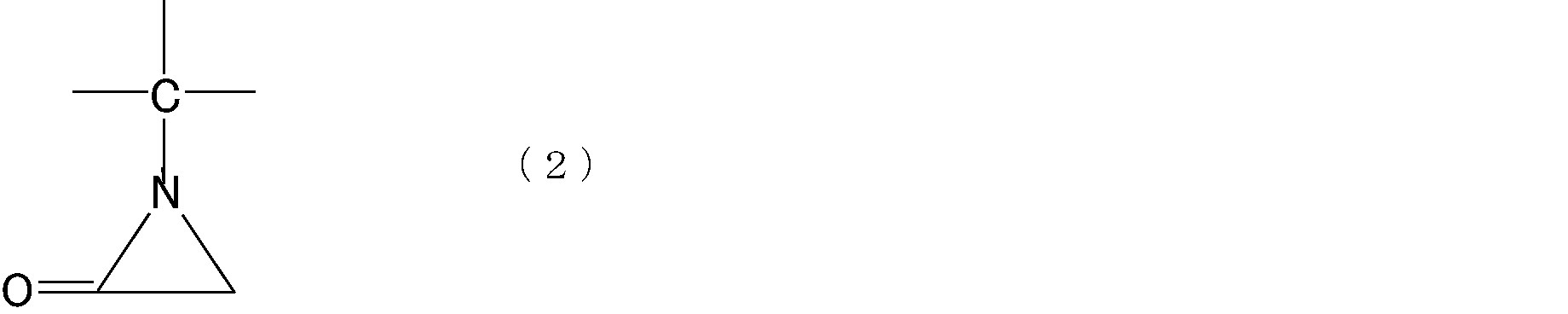
- the polyvinyl alcohol has a content of a structural unit having a lactam structure represented by the following formula (2) [the amount of an electron donating group] is 0.01 mol%, and a content of a structural unit having a carboxyl group [an electron charge The amount of attractive groups] is 10 mol%.
- the solution is cooled to 40 ° C., and 230 parts of hydrochloric acid having a concentration of 35% by weight is added thereto, the temperature is lowered to 5 ° C., 53.1 parts by weight of n-butyraldehyde is added, and this temperature is maintained The acetalization reaction was carried out to precipitate a reaction product. Thereafter, the liquid temperature is maintained at 30 ° C.
- the obtained polyvinyl acetal resin A was acetalized by using FT-IR to measure the amount of hydroxyl groups, the degree of acetalization, the amount of electron withdrawing groups, and the amount of electron donating groups.
- the degree (butyralization degree) was 53.1 mol%, the amount of acetyl groups was 1.7 mol%, the amount of electron donating groups was 0.01 mol%, and the amount of electron withdrawing groups was 10 mol%.
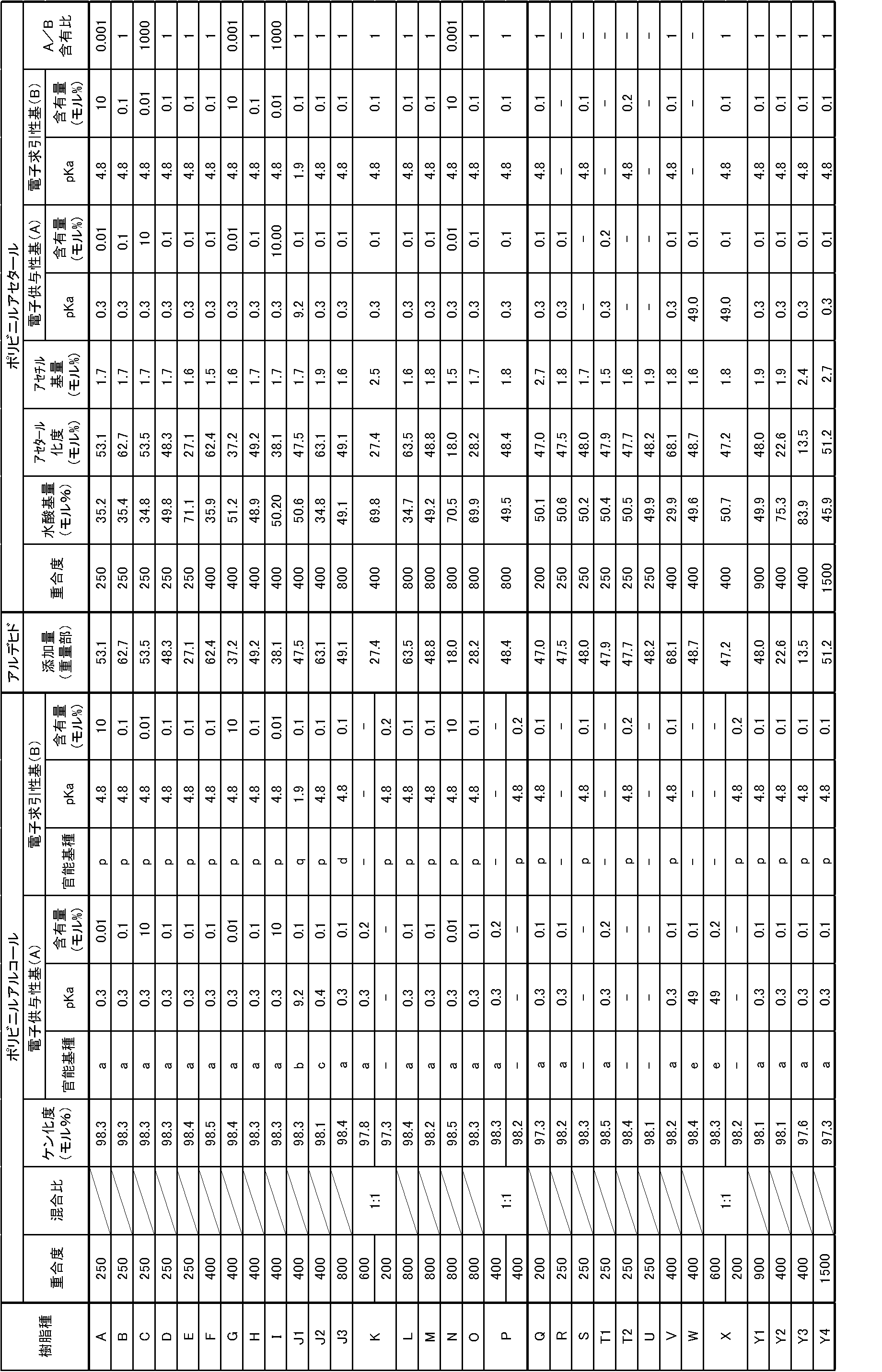
- Polyvinyl Acetal resins B to I, L to O, Q to V, Y 1 to 4 were synthesized in the same manner as the polyvinyl acetal resin A except that the polyvinyl alcohol (type) and the aldehyde (addition amount) shown in Table 1 were used. .
- polyvinyl acetal resin J1 (Synthesis of polyvinyl acetal resin J1) In the same manner as polyvinyl acetal resin A, except that polyvinyl alcohol J1 (polymerization degree 400, saponification degree 98.3 mol%) is used instead of polyvinyl alcohol A and aldehyde (addition amount) shown in Table 1 is used. And polyvinyl acetal resin J1 were synthesized. In the polyvinyl alcohol J1, the content of the structural unit having an amino group [the amount of the electron donating group] is 0.1 mol%, and the content of the structural unit having the sulfo group [the amount of the electron withdrawing group] is 0. It is 1 mol%.
- polyvinyl acetal resin J2 (Synthesis of polyvinyl acetal resin J2) In the same manner as polyvinyl acetal resin A, except that polyvinyl alcohol J2 (polymerization degree 400, saponification degree 98.1 mol%) is used instead of polyvinyl alcohol A and aldehyde (addition amount) shown in Table 1 is used. And polyvinyl acetal resin J2 were synthesized.
- polyvinyl acetal resin J3 (Synthesis of polyvinyl acetal resin J3) In the same manner as polyvinyl acetal resin A, except that polyvinyl alcohol J3 (polymerization degree 800, saponification degree 98.4 mol%) is used instead of polyvinyl alcohol A and aldehyde (addition amount) shown in Table 1 is used. And polyvinyl acetal resin J3 were synthesized.
- the polyvinyl alcohol J3 has a content of a structural unit having a lactam structure represented by the above formula (2) [amount of electron donating group] is 0.1 mol%, and a content of a structural unit having an amide group [electron The amount of attractive groups] is 0.1 mol%.
- the polyvinyl alcohol having a structural unit having an electron donating group (lactam structure represented by the above formula (2)) has a degree of polymerization of 600, a degree of saponification of 97.8 mol%, and is represented by the above formula (2)
- the content of the constituent unit having a lactam structure [the amount of the electron donating group] is 0.2 mol%.
- the polyvinyl alcohol having a structural unit having an electron withdrawing group (carboxyl group) has a degree of polymerization of 200, a degree of saponification of 97.3 mol%, a content of a structural unit having a carboxyl group [amount of electron withdrawing group ] Is 0.2 mol%.
- polyvinyl acetal resin P was synthesized in the same manner as polyvinyl acetal resin A except that mixed polyvinyl alcohol P was used and the aldehyde (addition amount) shown in Table 1 was used.
- polyvinyl alcohol W (polymerization degree 400, saponification degree 98.4 mol%, content of constituent unit having methyl group [amount of electron donating group] 0.1 mol%) is used, A polyvinyl acetal resin W was synthesized in the same manner as the polyvinyl acetal resin A except that the aldehyde (addition amount) shown in Table 1 was used.
- polyvinyl alcohol having a structural unit having an electron donating group (methyl group) and polyvinyl alcohol having a structural unit having an electron attracting group (carboxyl group) are mixed at 1: 1.
- Mixed polyvinyl alcohol X was used. And except having set it as the aldehyde (addition amount) shown in Table 1, it carried out similarly to polyvinyl acetal resin A, and synthesize
- the polyvinyl alcohol having a constituent unit having an electron donating group has a degree of polymerization of 600, a degree of saponification of 98.3 mol%, and a content of a constituent unit having a methyl group [amount of electron donating group] 0.2 mol%.
- the polyvinyl alcohol having a structural unit having an electron withdrawing group has a degree of polymerization of 200, a degree of saponification of 98.2 mol%, and a content of a structural unit having a carboxyl group [amount of electron withdrawing group ] Is 0.2 mol%.
- Example 1 Preparation of composition for secondary battery electrode 50 parts by weight of lithium cobaltate (Celseed C-5H, manufactured by Nippon Chemical Industrial Co., Ltd.) as an active material in 20 parts by weight of the resin solution containing the obtained polyvinyl acetal resin A (polyvinyl acetal resin: 2.5 parts by weight)
- As an auxiliary agent 5 parts by weight of acetylene black (Denka Black manufactured by Denki Kagaku Kogyo Co., Ltd.) and 26 parts by weight of N-methylpyrrolidone were added. Subsequently, it mixed by Shinki Co., Ltd. foam taking Reitaro, and obtained the composition for secondary battery electrodes.
- Example 2 Comparative Examples 1 to 3, 5 to 12
- a composition for a secondary battery electrode was obtained in the same manner as in Example 1 except that the polyvinyl acetal resin (resin type, addition amount) shown in Table 2 was used.
- composition for a secondary battery electrode was obtained in the same manner as in Example 1 except that the polyvinyl acetal resins T1 and T2 shown in Table 1 were mixed and used.
- a is a functional group having a lactam structure (aziridine group)
- b is an amino group
- c is a functional group having a lactam structure (pyrrolidone group)
- d is an amide group
- e is a methyl group
- P represents a carboxyl group
- q represents a sulfo group.
- b, d, e, p and q has a structure in which each functional group is directly bonded to carbon of the main chain.
- Electrolyte resistance (solvent solubility) (Preparation of electrode sheet)
- the composition for a secondary battery electrode obtained in Examples and Comparative Examples was coated and dried on a release-treated polyethylene terephthalate (PET) film so that the film thickness after drying was 20 ⁇ m, and then dried. Was produced.
- PET polyethylene terephthalate
- the electrode sheet was cut into 2 cm square to prepare an electrode sheet test piece.
- the elution amount of the resin was calculated from the weight change before and after the test, the elution rate of the resin was calculated from the ratio of the elution amount and the weight of the resin calculated in advance, and the evaluation was made based on the following criteria.
- ⁇ Dissolution rate less than 1% 1%: Dissolution rate 1% or more and less than 2%
- ⁇ Dissolution rate 2% or more
- Electrode resistance measurement The electrode resistance value was measured using the electrode resistance measuring device (made by Hioki Electric Co., Ltd.) about the electrode sheet obtained by said "(1) adhesiveness", and the following references
- ⁇ electrode resistance less than 1000 ⁇ / sq
- ⁇ electrode resistance more than 1000 ⁇ / sq
- the present invention while being excellent in the dispersibility and adhesiveness of the active material, it is possible to prevent deterioration and failure of the battery due to moisture absorption, and a composition for a secondary battery electrode capable of producing a high capacity secondary battery.
Landscapes
- Chemical & Material Sciences (AREA)
- Chemical Kinetics & Catalysis (AREA)
- Electrochemistry (AREA)
- General Chemical & Material Sciences (AREA)
- Engineering & Computer Science (AREA)
- Materials Engineering (AREA)
- Manufacturing & Machinery (AREA)
- Health & Medical Sciences (AREA)
- Medicinal Chemistry (AREA)
- Polymers & Plastics (AREA)
- Organic Chemistry (AREA)
- Composite Materials (AREA)
- Battery Electrode And Active Subsutance (AREA)
Abstract
本発明は、活物質の分散性、接着性に優れるとともに、吸湿による電池の劣化、故障を防ぐことができ、高容量の二次電池を作製することが可能な二次電池電極用組成物を提供することを目的とする。
本発明は、活物質、バインダー及び有機溶媒を含有し、前記バインダーは、ポリビニルアセタール樹脂を含有し、前記ポリビニルアセタール樹脂は、水中における酸解離定数が16未満である電子供与性基と、電子求引性基とを有し、重合度が250~800、水酸基量が35~70モル%である二次電池電極用組成物である。
Description
本発明は、活物質の分散性、接着性に優れるとともに、吸湿による電池の劣化、故障を防ぐことができ、高容量の二次電池を作製することが可能な二次電池電極用組成物に関する。
近年、携帯型ビデオカメラや携帯型パソコン等の携帯型電子機器の普及に伴い、移動用電源としての二次電池の需要が急増している。また、このような二次電池に対する小型化、軽量化、高エネルギー密度化の要求は非常に高い。
このように、繰り返し充放電が可能な二次電池としては、従来、鉛電池、ニッケル-カドミウム電池等の水溶系電池が主流であるが、これらの水溶系電池は、充放電特性は優れているが、電池重量やエネルギー密度の点では、携帯型電子機器の移動用電源として充分満足できる特性を有しているとはいえない。
このように、繰り返し充放電が可能な二次電池としては、従来、鉛電池、ニッケル-カドミウム電池等の水溶系電池が主流であるが、これらの水溶系電池は、充放電特性は優れているが、電池重量やエネルギー密度の点では、携帯型電子機器の移動用電源として充分満足できる特性を有しているとはいえない。
そこで、二次電池として、リチウム又はリチウム合金を負極電極に用いたリチウム二次電池の研究開発が盛んに行われている。このリチウム二次電池は、高エネルギー密度を有し、自己放電も少なく、軽量であるという優れた特徴を有している。
リチウム二次電池の電極は、通常、活物質とバインダーを溶媒と共に混練し、活物質を分散させてスラリーとした後、このスラリーをドクターブレード法等によって集電体上に塗布し乾燥して薄膜化することにより形成されている。
リチウム二次電池の電極は、通常、活物質とバインダーを溶媒と共に混練し、活物質を分散させてスラリーとした後、このスラリーをドクターブレード法等によって集電体上に塗布し乾燥して薄膜化することにより形成されている。
現在、特に、リチウム二次電池の電極用のバインダーとして最も広範に用いられているのが、ポリフッ化ビニリデン(PVDF)に代表されるフッ素系樹脂である。
しかしながら、フッ素系樹脂をバインダーとして用いた場合、可撓性を有する薄膜を作製可能な一方で、集電体と活物質の結着性が劣るため、電池製造工程時に活物質の一部又は全部が集電体から剥離、脱落する恐れがあった。また、電池の充放電が行われる際、活物質内ではリチウムイオンの挿入、放出が繰り返され、それに伴い、集電体から活物質の剥離、脱落の問題が起こり得るという問題もあった。
しかしながら、フッ素系樹脂をバインダーとして用いた場合、可撓性を有する薄膜を作製可能な一方で、集電体と活物質の結着性が劣るため、電池製造工程時に活物質の一部又は全部が集電体から剥離、脱落する恐れがあった。また、電池の充放電が行われる際、活物質内ではリチウムイオンの挿入、放出が繰り返され、それに伴い、集電体から活物質の剥離、脱落の問題が起こり得るという問題もあった。
このような問題を解決するため、PVDF以外のバインダーを使用することも試みられている。しかしながら、従来の樹脂を用いた場合、電極に電圧を負荷した際に、樹脂の分解や劣化が生じてしまうという問題が新たに生じていた。このような樹脂の劣化が生じた場合は、充放電容量が低下したり、電極の剥離が発生したりするという問題が生じていた。
これに対して、特許文献1には、酸性官能基含有モノマー及びアミド基含有モノマーの共重合体からなる非水二次電池用バインダーが記載されている。
しかしながら、このようなバインダーを使用する場合、活物質の分散性が低くなり、電極用組成物の粘度が高くなることから、ペースト濾過に時間を要し工程時間が長くなるとともに、塗工時に塗工むらが発生しやすいものとなっていた。また、電極中の活物質密度が低下することから、得られる電池の容量が不充分なものとなっていた。
更に、このような樹脂を用いた場合、電極の柔軟性が低いものとなり、ひび割れや、集電体からの剥がれが発生するため、電池耐久性の低下を招くという問題があった。
しかしながら、このようなバインダーを使用する場合、活物質の分散性が低くなり、電極用組成物の粘度が高くなることから、ペースト濾過に時間を要し工程時間が長くなるとともに、塗工時に塗工むらが発生しやすいものとなっていた。また、電極中の活物質密度が低下することから、得られる電池の容量が不充分なものとなっていた。
更に、このような樹脂を用いた場合、電極の柔軟性が低いものとなり、ひび割れや、集電体からの剥がれが発生するため、電池耐久性の低下を招くという問題があった。
特許文献2には、所定量の芳香族ビニル単位、ニトリル基単位、親水性基単位及び直鎖アルキレン単位を含有する二次電池正極用バインダーの組成物が開示されている。
しかしながら、このような組成物を用いた場合でも、活物質の分散性が低くなることから、ペースト濾過に時間を要し工程時間が長くなるとともに、塗工時に塗工むらが発生しやすいものとなっていた。また、含水率が高い状態で電極用組成物を調製すると、水分の影響で電池内部から酸性ガスが発生し、電池の膨張や発火、爆発を誘発する恐れがある。
更に、電極中の活物質密度が低下することから、得られる電池の容量が不充分なものとなっていた。
しかしながら、このような組成物を用いた場合でも、活物質の分散性が低くなることから、ペースト濾過に時間を要し工程時間が長くなるとともに、塗工時に塗工むらが発生しやすいものとなっていた。また、含水率が高い状態で電極用組成物を調製すると、水分の影響で電池内部から酸性ガスが発生し、電池の膨張や発火、爆発を誘発する恐れがある。
更に、電極中の活物質密度が低下することから、得られる電池の容量が不充分なものとなっていた。
本発明は、活物質の分散性、接着性に優れるとともに、吸湿による電池の劣化、故障を防ぐことができ、高容量の二次電池を作製することが可能な二次電池電極用組成物を提供することを目的とする。
本発明は、活物質、バインダー及び有機溶媒を含有する二次電池電極用組成物であって、
前記バインダーは、ポリビニルアセタール樹脂を含有し、前記ポリビニルアセタール樹脂は、水中における酸解離定数が16未満である電子供与性基と、電子求引性基とを有し、重合度が250~800、水酸基量が35~70モル%である二次電池電極用組成物である。
以下に本発明を詳述する。
前記バインダーは、ポリビニルアセタール樹脂を含有し、前記ポリビニルアセタール樹脂は、水中における酸解離定数が16未満である電子供与性基と、電子求引性基とを有し、重合度が250~800、水酸基量が35~70モル%である二次電池電極用組成物である。
以下に本発明を詳述する。
本発明者は、鋭意検討の結果、二次電池電極形成用のバインダーとして、所定の電子供与性基と電子求引性基とを有するポリビニルアセタール樹脂を用いることで、活物質の分散性、接着性に優れることを見出した。また、吸湿による電池の劣化、故障を防ぐことができ、バインダーの添加量が少ない場合でも高容量の二次電池を作製できることを見出し、本発明を完成させるに至った。
本発明の二次電池電極用組成物は、活物質を含有する。
本発明の二次電池電極用組成物は、正極、負極のいずれの電極に使用してもよく、また、正極および負極の両方に使用してもよい。従って、活物質としては、正極活物質、負極活物質がある。
本発明の二次電池電極用組成物は、正極、負極のいずれの電極に使用してもよく、また、正極および負極の両方に使用してもよい。従って、活物質としては、正極活物質、負極活物質がある。
上記正極活物質としては、例えば、リチウムニッケル酸化物、リチウムコバルト酸化物、リチウムマンガン酸化物、Ni・Co・Mn三元系Li含有酸化物、Ni・Co・Al三元系Li含有酸化物等のリチウム含有複合金属酸化物が挙げられる。具体的には例えば、LiNiO2、LiCoO2、LiMn2O4、リン酸鉄リチウム等が挙げられる。
なお、これらは単独で用いてもよく、2種以上を併用してもよい。
なお、これらは単独で用いてもよく、2種以上を併用してもよい。
上記負極活物質としては、例えば、従来から二次電池の負極活物質として用いられている材料を用いることができ、例えば、球状天然黒鉛、天然グラファイト、人造グラファイト、 アモルファス炭素、カーボンブラック、または、これらの成分に異種元素を添加したもの等が挙げられる。
本発明の二次電池電極用組成物は、導電付与剤(導電助剤)を含有することが好ましい。
上記導電付与剤としては、例えば、黒鉛、アセチレンブラック、カーボンブラック、ケッチェンブラック、気相成長炭素繊維などの炭素材料が挙げられる。特に、正極用の導電付与剤としては、アセチレンブラック、カーボンブラックが好ましく、負極用の導電付与剤としては、アセチレンブラック、鱗片状黒鉛が好ましい。
上記導電付与剤としては、例えば、黒鉛、アセチレンブラック、カーボンブラック、ケッチェンブラック、気相成長炭素繊維などの炭素材料が挙げられる。特に、正極用の導電付与剤としては、アセチレンブラック、カーボンブラックが好ましく、負極用の導電付与剤としては、アセチレンブラック、鱗片状黒鉛が好ましい。
本発明の二次電池電極用組成物は、ポリビニルアセタール樹脂を含有する。本発明では、バインダー(結着剤)としてポリビニルアセタール樹脂を用いることで、ポリビニルアセタール樹脂の水酸基と正極活物質の酸素原子間に引力的相互作用が働き、正極活物質をポリビニルアセタール樹脂が取り囲む構造をとる。また、同一分子内の別の水酸基が導電付与剤とも引力的相互作用を及ぼし、活物質、導電付与剤間距離をある一定範囲にとどめることが出来る。このように活物質と導電付与剤を程よい距離に特徴的な構造をとることで、活物質の分散性が大幅に改善される。また、PVDF等の樹脂を用いる場合と比較して、集電体との接着性を向上させることができる。更に、溶剤溶解性に優れ、溶剤の選択の範囲が広がるという利点が得られる。
上記ポリビニルアセタール樹脂は、水中における酸解離定数が16未満である電子供与性基を有する。
本発明では、上記電子供与性基と後述する電子求引性基を併用することで、電子伝導性を高め、電気抵抗を抑制することができる。
なお、本発明において、「電子供与性基」とは、ハメット(Hammett)の置換基定数におけるパラ効果σpが0未満である官能基であり、「電子求引性基」とは、パラ効果σpが0以上である官能基である。
また、上記電子供与性基、電子求引性基には、水酸基、アセチル基は含まれないものとする。
本発明では、上記電子供与性基と後述する電子求引性基を併用することで、電子伝導性を高め、電気抵抗を抑制することができる。
なお、本発明において、「電子供与性基」とは、ハメット(Hammett)の置換基定数におけるパラ効果σpが0未満である官能基であり、「電子求引性基」とは、パラ効果σpが0以上である官能基である。
また、上記電子供与性基、電子求引性基には、水酸基、アセチル基は含まれないものとする。
上記電子供与性基は、水中における酸解離定数(pKa)が16未満である。
上記pKaが16未満であることで、電子を放出しやすくすることができる。上記pKaは12未満が好ましい。また、上記pKaは0.1以上であることが好ましい。
なお、電子供与性基のpKaは電位差測定法や中和滴定法により測定することができる。
上記pKaが16未満であることで、電子を放出しやすくすることができる。上記pKaは12未満が好ましい。また、上記pKaは0.1以上であることが好ましい。
なお、電子供与性基のpKaは電位差測定法や中和滴定法により測定することができる。
上記電子供与性基の結合位置については特に限定されないが、主鎖である炭素に直接結合した構造であってもよく、連結基を介して結合した構造であってもよい。また、アセタール基に結合した構造であってもよい。更に、電子供与性基を有するグラフト鎖が結合した構造や、電子供与性基が樹脂の末端に結合した構造であってもよい。
なかでも、主鎖である炭素に直接結合した構造や、主鎖である炭素に連結基を介して結合した構造であることが好ましい。
なかでも、主鎖である炭素に直接結合した構造や、主鎖である炭素に連結基を介して結合した構造であることが好ましい。
上記電子供与性基としては、例えば、低級アルコキシ基、エーテル基、アミノ基、アルキルアミノ基、-S-、ラクタム構造を有する官能基等が挙げられる。本発明において低級アルコキシ基とは、直鎖状または分岐状の炭素数1~6のアルコキシ基である。
上記電子供与性基は、ラクタム構造を有する官能基であることが好ましい。
上記ポリビニルアセタール樹脂が、電子供与性基を有することで、優れた電解液への耐性、集電体との接着性、またイオン伝導性を有することができ、バインダーの添加量を減らした場合でも高容量の二次電池を製造できるという利点がある。
また、長期保管時の吸湿による劣化を防止することができ、保管性に優れるという利点を有する。
上記ポリビニルアセタール樹脂が、電子供与性基を有することで、優れた電解液への耐性、集電体との接着性、またイオン伝導性を有することができ、バインダーの添加量を減らした場合でも高容量の二次電池を製造できるという利点がある。
また、長期保管時の吸湿による劣化を防止することができ、保管性に優れるという利点を有する。
本発明において、ラクタム構造とは、ラクタム基を有する構造を意味する。
上記ラクタム基とは、ラクタム化合物の窒素原子に結合する水素原子やアルキル基を除去して得られる基を意味する。
上記ラクタム化合物としては、例えば、カプロラクタム、N-アルキルカプロラクタム類、ピロリドン類、ピペリドン類等が挙げられる。
上記N-アルキルカプロラクタム類としては、N-メチルカプロラクタム、N-エチルカプロラクタム、N-イソプロピルカプロラクタム、N-イソブチルカプロラクタム、N-ノルマルプロピルカプロラクタム、N-ノルマルブチルカプロラクタム、N-シクロヘキシルカプロラクタム等が挙げられる。
上記ピロリドン類としては、2-ピロリドン、N-メチル-2-ピロリドン(NMP)、N-エチル-2-ピロリドン、N-イソプロピル-2-ピロリドン、N-イソブチル-2-ピロリドン、N-ノルマルプロピル-2-ピロリドン、N-ノルマルブチル-2-ピロリドン、N-シクロヘキシル-2-ピロリドン等が挙げられる。
上記ピペリドン類としては、2-ピペリドン、N-メチル-2-ピペリドン、N-エチル-2-ピペリドン、N-イソプロピル-2-ピペリドン等が挙げられる。
なお、上記ラクタム基は、例えば、ハロゲン原子、水酸基、カルボキシル基、アミド基、アルキル基、アルキルエステル基、アルキルアミド基、ニトロ基等の置換基やその塩で置換されていてもよい。
上記ラクタム基とは、ラクタム化合物の窒素原子に結合する水素原子やアルキル基を除去して得られる基を意味する。
上記ラクタム化合物としては、例えば、カプロラクタム、N-アルキルカプロラクタム類、ピロリドン類、ピペリドン類等が挙げられる。
上記N-アルキルカプロラクタム類としては、N-メチルカプロラクタム、N-エチルカプロラクタム、N-イソプロピルカプロラクタム、N-イソブチルカプロラクタム、N-ノルマルプロピルカプロラクタム、N-ノルマルブチルカプロラクタム、N-シクロヘキシルカプロラクタム等が挙げられる。
上記ピロリドン類としては、2-ピロリドン、N-メチル-2-ピロリドン(NMP)、N-エチル-2-ピロリドン、N-イソプロピル-2-ピロリドン、N-イソブチル-2-ピロリドン、N-ノルマルプロピル-2-ピロリドン、N-ノルマルブチル-2-ピロリドン、N-シクロヘキシル-2-ピロリドン等が挙げられる。
上記ピペリドン類としては、2-ピペリドン、N-メチル-2-ピペリドン、N-エチル-2-ピペリドン、N-イソプロピル-2-ピペリドン等が挙げられる。
なお、上記ラクタム基は、例えば、ハロゲン原子、水酸基、カルボキシル基、アミド基、アルキル基、アルキルエステル基、アルキルアミド基、ニトロ基等の置換基やその塩で置換されていてもよい。
上記ラクタム構造は、下記式(1)に示す構造であることであることが好ましい。

上記式(1)で表されるラクタム構造が、飽和或いは不飽和の炭化水素を介して、ラクタム基が主鎖に結合した構造を有する場合は、飽和或いは不飽和の炭化水素を介することにより主鎖の影響を受けづらい。なお、R1は、単結合であることが好ましい。
上記R1は、単結合又は炭素数1~10の飽和或いは不飽和の炭化水素である。上記R1としては、例えば、直鎖状又は分岐鎖状のアルキレン基、アリーレン基等が挙げられる。
上記アルキレン基としては、直鎖状アルキレン基が好ましく、炭素数が1~6のアルキレン基が好ましい。なかでも、メチレン基、エチレン基、プロピレン基等が好ましい。
上記アルキレン基としては、直鎖状アルキレン基が好ましく、炭素数が1~6のアルキレン基が好ましい。なかでも、メチレン基、エチレン基、プロピレン基等が好ましい。
上記ラクタム構造は、三員環~七員環であることが好ましく、三員環、四員環、五員環及び六員環から選択される少なくとも1つの環状構造を有することがより好ましい。これにより、環状構造の立体障害により活物質や導電助剤の再凝集を阻害し、経時粘度変化率の少ないペーストを作製することができる。また、nは1~5の整数であることが好ましく、nは1、2であることがより好ましい。
上記ラクタム構造の環状構造を構成する炭化水素は、無置換であるか、又は、水素原子が炭素数1~10の飽和若しくは不飽和炭化水素で置換されていることが好ましい。
上記ラクタム構造の環状構造を構成する炭化水素の水素原子が置換されている場合、置換される水素としては、α水素、β水素が好ましい。
また、炭素数1~10の飽和若しくは不飽和炭化水素としては、メチル基、エチル基、イソブロピル基、ジメチル基、アリル基、フェニル基が好ましい。なお、置換される水素原子は1箇所であってもよく、2箇所以上であってもよい。
上記ラクタム構造の環状構造を構成する炭化水素の水素原子が置換されている場合、置換される水素としては、α水素、β水素が好ましい。
また、炭素数1~10の飽和若しくは不飽和炭化水素としては、メチル基、エチル基、イソブロピル基、ジメチル基、アリル基、フェニル基が好ましい。なお、置換される水素原子は1箇所であってもよく、2箇所以上であってもよい。
上記ポリビニルアセタール樹脂における電子供与性基を有する構成単位の含有量の好ましい下限は0.01モル%、好ましい上限は10モル%である。上記含有量を0.01モル%以上とすることで、接着性を向上することができ、上記含有量を10モル%以下とすることで、粘度の上昇を防止できる。上記含有量のより好ましい下限は0.05モル%、より好ましい上限は8モル%である。更に好ましい上限は6モル%である。
上記ポリビニルアセタール樹脂は電子求引性基を有する。
上記電子求引性基は、水中における酸解離定数(pKa)が25未満であることが好ましい。
上記pKaが25未満であることで、電子を効率的に受け取ることができる。上記pKaは20未満がより好ましい。また、上記pKaは1.0以上であることが好ましい。
なお、電子求引性基のpKaは電位差測定法や中和滴定法により測定することができる。
上記電子求引性基は、水中における酸解離定数(pKa)が25未満であることが好ましい。
上記pKaが25未満であることで、電子を効率的に受け取ることができる。上記pKaは20未満がより好ましい。また、上記pKaは1.0以上であることが好ましい。
なお、電子求引性基のpKaは電位差測定法や中和滴定法により測定することができる。
上記電子求引性基の結合位置については特に限定されないが、主鎖である炭素に直接結合した構造であってもよく、連結基を介して結合した構造であってもよい。また、アセタール基に結合した構造であってもよい。更に、電子求引性基を有するグラフト鎖が結合した構造や、電子求引性基が樹脂の末端に結合した構造であってもよい。なかでも、主鎖である炭素に直接結合した構造や、主鎖である炭素に連結基を介して結合した構造であることが好ましい。
上記電子求引性基としては、例えば、カルボキシル基、リン酸基、ボロン酸、ボロン酸エステル等の酸性基、ニトロ基(-NO2)、アミド基、ニトリル基等の窒素含有基、スルホ基、スルホニル基、スルフィニル基等の硫黄含有基のほか、ホルミル基(-CHO)、フッ素化アルキル基、ハロゲン等が挙げられる。
なかでも、カルボキシル基であることが好ましい。
なかでも、カルボキシル基であることが好ましい。
上記ポリビニルアセタール樹脂における電子求引性基を有する構成単位の含有量の好ましい下限は0.01モル%、好ましい上限は10モル%である。上記含有量を0.01モル%以上とすることで、活物質や導電助剤の分散性を向上することができ、上記含有量を10モル%以下とすることで、粘度の上昇を防止できる。上記含有量のより好ましい下限は0.05モル%、より好ましい上限は8モル%である。更に好ましい上限は6モル%である。
上記ポリビニルアセタール樹脂における電子供与性基を有する構成単位の含有量に対する電子求引性基を有する構成単位の含有量の比率(電子求引性基を有する構成単位の含有量/電子供与性基を有する構成単位の含有量)は、0.001~1000であることが好ましい。上記範囲内とすることで、電子伝導性を高め、電気抵抗を抑制することができる。好ましくは0.01~100である。
上記ポリビニルアセタール樹脂における電子供与性基の酸解離定数と、電子求引性基の酸解離定数との差(電子求引性基の酸解離定数-電子供与性基の酸解離定数)は、1.0~20であることが好ましい。上記範囲内とすることで、電子伝導性を高め、電気抵抗を抑制することができる。好ましくは1.5~15.0である。
また、上記ポリビニルアセタール樹脂における電子求引性基を有する構成単位の含有量と水酸基量との比率(電子供与性基を有する構成単位の含有量/水酸基量)は、1.00×10―4~4.5×10―1であることが好ましい。上記範囲内とすることで、電子の授受を効率的に行うことができ、導電率を高めることができる。
また、上記ポリビニルアセタール樹脂における電子求引性基を有する構成単位の含有量と水酸基量との比率(電子供与性基を有する構成単位の含有量/水酸基量)は、1.00×10―4~4.5×10―1であることが好ましい。上記範囲内とすることで、電子の授受を効率的に行うことができ、導電率を高めることができる。
上記ポリビニルアセタール樹脂は、アセタール基を有する構成単位を有する。
上記ポリビニルアセタール樹脂における上記アセタール基を有する構成単位の含有量(アセタール化度)は20~70モル%であることが好ましい。上記アセタール化度を20モル%以上とすることで、溶媒への溶解性が向上し、組成物として好適に使用することができる。上記アセタール化度を70モル%以下とすることで、電解液に対する耐性が充分なものとなり、電極を電解液中に浸漬した際、樹脂成分が電解液中に溶出することを防止できる。より好ましくは40~65モル%である。更に好ましくは45~65モル%である。
なお、本明細書において、アセタール化度とは、ポリビニルアルコールの水酸基数のうち、ブチルアルデヒドでアセタール化された水酸基数の割合のことである。また、アセタール化度の計算方法は、ポリビニルアセタール樹脂のアセタール基が2個の水酸基からアセタール化されて形成されていることから、アセタール化された2個の水酸基を数える方法を採用してアセタール化度のモル%を算出する。
なお、本明細書において、アセタール化度は、ポリビニルアセタール樹脂全体に対するアセタール基を有する構成単位の含有量を意味する。
上記ポリビニルアセタール樹脂における上記アセタール基を有する構成単位の含有量(アセタール化度)は20~70モル%であることが好ましい。上記アセタール化度を20モル%以上とすることで、溶媒への溶解性が向上し、組成物として好適に使用することができる。上記アセタール化度を70モル%以下とすることで、電解液に対する耐性が充分なものとなり、電極を電解液中に浸漬した際、樹脂成分が電解液中に溶出することを防止できる。より好ましくは40~65モル%である。更に好ましくは45~65モル%である。
なお、本明細書において、アセタール化度とは、ポリビニルアルコールの水酸基数のうち、ブチルアルデヒドでアセタール化された水酸基数の割合のことである。また、アセタール化度の計算方法は、ポリビニルアセタール樹脂のアセタール基が2個の水酸基からアセタール化されて形成されていることから、アセタール化された2個の水酸基を数える方法を採用してアセタール化度のモル%を算出する。
なお、本明細書において、アセタール化度は、ポリビニルアセタール樹脂全体に対するアセタール基を有する構成単位の含有量を意味する。
上記アセタール基を有する構成単位は、アルデヒドを用いてアセタール化することで得られる。
上記アルデヒドの炭素数(アルデヒド基を除く炭素数)の好ましい下限は1、好ましい上限は11である。炭素数を上記範囲内とすることで、樹脂の疎水性が低くなるため、精製効率が向上しNaイオンの含有量を減らすことができる。
上記アルデヒドとしては、具体的には例えば、アセトアルデヒド、ブチルアルデヒド、ベンズアルデヒド、プロピオンアルデヒド、アクロレイン等のビニル基を有するアルデヒド(ビニルアルデヒド)等が挙げられる。
また、上記アセタール基は、ブチラール基、ベンズアセタール基、アセトアセタール基、プロピオンアセタール基及びビニルアセタール基からなる群より選択される少なくとも1種であることが好ましい。
上記アルデヒドの炭素数(アルデヒド基を除く炭素数)の好ましい下限は1、好ましい上限は11である。炭素数を上記範囲内とすることで、樹脂の疎水性が低くなるため、精製効率が向上しNaイオンの含有量を減らすことができる。
上記アルデヒドとしては、具体的には例えば、アセトアルデヒド、ブチルアルデヒド、ベンズアルデヒド、プロピオンアルデヒド、アクロレイン等のビニル基を有するアルデヒド(ビニルアルデヒド)等が挙げられる。
また、上記アセタール基は、ブチラール基、ベンズアセタール基、アセトアセタール基、プロピオンアセタール基及びビニルアセタール基からなる群より選択される少なくとも1種であることが好ましい。
上記ポリビニルアセタール樹脂は、アセトアルデヒドでアセタール化された部分とブチルアルデヒドでアセタール化された部分との割合が0/100~50/50であることが好ましい。これにより、ポリビニルアセタール樹脂が柔軟になり、集電体への接着力が良好になる。より好ましくは、アセトアルデヒドでアセタール化された部分とブチルアルデヒドでアセタール化された部分の割合が0/100~20/80である。
上記ポリビニルアセタール樹脂は、水酸基を有する構成単位を有する。
上記ポリビニルアセタール樹脂における上記水酸基を有する構成単位の含有量(水酸基量)の下限は35モル%、上限は70モル%である。上記水酸基量を35モル%以上とすることで、電解液への耐性が向上し、電解液中に樹脂が溶出することを防止でき、70モル%以下とすることで、樹脂の柔軟性が向上し、集電体への接着力が充分なものとなる。
上記水酸基量の好ましい下限は40モル%であり、好ましい上限は65モル%である。より好ましい下限は45モル%、より好ましい上限は60モル%である。
なお、本明細書において、水酸基量は、ポリビニルアセタール樹脂全体に対する水酸基を有する構成単位の含有量を意味する。
上記ポリビニルアセタール樹脂における上記水酸基を有する構成単位の含有量(水酸基量)の下限は35モル%、上限は70モル%である。上記水酸基量を35モル%以上とすることで、電解液への耐性が向上し、電解液中に樹脂が溶出することを防止でき、70モル%以下とすることで、樹脂の柔軟性が向上し、集電体への接着力が充分なものとなる。
上記水酸基量の好ましい下限は40モル%であり、好ましい上限は65モル%である。より好ましい下限は45モル%、より好ましい上限は60モル%である。
なお、本明細書において、水酸基量は、ポリビニルアセタール樹脂全体に対する水酸基を有する構成単位の含有量を意味する。
上記ポリビニルアセタール樹脂は、アセチル基を有する構成単位を有することが好ましい。
上記ポリビニルアセタール樹脂におけるアセチル基を有する構成単位の含有量(アセチル基量)の好ましい下限は0.1モル%、好ましい上限は15モル%である。上記アセチル基量を0.1モル%以上とすることで、樹脂の柔軟性が向上し、集電体への接着力を充分なものすることができ、上記アセチル基量を15モル%以下とすることで、電解液への耐性が向上し、電解液へ溶出して短絡することを防止することができる。上記アセチル基量のより好ましい下限は1モル%、より好ましい上限は10モル%である。
なお、本明細書において、アセチル基量は、ポリビニルアセタール樹脂全体に対するアセチル基を有する構成単位の含有量を意味する。
上記ポリビニルアセタール樹脂におけるアセチル基を有する構成単位の含有量(アセチル基量)の好ましい下限は0.1モル%、好ましい上限は15モル%である。上記アセチル基量を0.1モル%以上とすることで、樹脂の柔軟性が向上し、集電体への接着力を充分なものすることができ、上記アセチル基量を15モル%以下とすることで、電解液への耐性が向上し、電解液へ溶出して短絡することを防止することができる。上記アセチル基量のより好ましい下限は1モル%、より好ましい上限は10モル%である。
なお、本明細書において、アセチル基量は、ポリビニルアセタール樹脂全体に対するアセチル基を有する構成単位の含有量を意味する。
上記ポリビニルアセタール樹脂において、水酸基を有する構成単位の含有量に対する、電子供与性基を有する構成単位の含有量の比率(電子供与性基を有する構成単位の含有量/水酸基を有する構成単位の含有量)は、0.0001~1.50であることが好ましい。上記範囲内とすることで、二次電池電極用組成物の電気抵抗値を抑制することができる。
より好ましくは、0.01~0.89であり、更に好ましくは、0.01~0.43である。
より好ましくは、0.01~0.89であり、更に好ましくは、0.01~0.43である。
上記ポリビニルアセタール樹脂の重合度の下限は250、上限は800である。上記重合度を250以上とすることで、工業的な入手が容易となる。上記重合度を800以下とすることで、溶液粘度を低下させて、活物質を充分に分散させることが可能となる。上記重合度の好ましい下限は280、好ましい上限は600である。
本発明において、「ポリビニルアセタール樹脂が、電子供与性基と、電子求引性基とを有する」とは、電子供与性基及び電子求引性基を同一のポリビニルアセタール樹脂中に有する場合のほか、電子供与性基及び電子求引性基を別々のポリビニルアセタール樹脂中に有する場合も含む。なお、電子供与性基及び電子求引性基を別々のポリビニルアセタール樹脂中に有する場合、「ポリビニルアセタール樹脂の重合度」は、各樹脂の重合度を混合比で按分して算出した重合度を表す。
本発明の二次電池電極用組成物中の上記ポリビニルアセタール樹脂の含有量は特に限定されないが、好ましい下限は0.2重量%、好ましい上限は5重量%である。上記ポリビニルアセタール樹脂の含有量を0.2重量%以上とすることで、集電体への接着力を向上させることができ、5重量%以下とすることで、二次電池の放電容量を向上させることができる。より好ましくは、0.5~3重量%である。
上記ポリビニルアセタール樹脂は、ポリビニルアルコールをアルデヒドでアセタール化してなるものである。
特に、上記ポリビニルアセタール樹脂を製造する方法としては、上記電子供与性基及び電子求引性基を有するポリビニルアルコールを用意し、その後アセタール化する方法、上記電子供与性基及び電子求引性基を有しないポリビニルアルコールをアセタール化した後、上記電子供与性基及び電子求引性基を付加する方法等が挙げられる。
また、上記電子供与性基を有するポリビニルアルコールと、上記電子求引性基を有するポリビニルアルコールとを含有する混合ポリビニルアルコールを用意し、その後アセタール化する方法を用いてもよい。
特に、上記ポリビニルアセタール樹脂を製造する方法としては、上記電子供与性基及び電子求引性基を有するポリビニルアルコールを用意し、その後アセタール化する方法、上記電子供与性基及び電子求引性基を有しないポリビニルアルコールをアセタール化した後、上記電子供与性基及び電子求引性基を付加する方法等が挙げられる。
また、上記電子供与性基を有するポリビニルアルコールと、上記電子求引性基を有するポリビニルアルコールとを含有する混合ポリビニルアルコールを用意し、その後アセタール化する方法を用いてもよい。
上記電子供与性基及び電子求引性基を有するポリビニルアルコールを作製する方法としては、例えば、電子供与性基含有単量体と、電子求引性基含有単量体と、酢酸ビニル等のビニルエステルとを共重合した後、得られた共重合体のアルコール溶液に酸またはアルカリを添加してケン化する方法等が挙げられる。
上記電子供与性基含有単量体としては、例えば、ラクタム基含有単量体が挙げられる。
上記ラクタム基含有単量体としては、例えば、N-ビニル-ピロリドン、N-ビニル-2-ピペリドン、N-ビニル-2-カプロラクタム、N-ビニル-3-メチル-2-ピロリドン、N-ビニル-3-メチル-2-ピペリドン等が挙げられる。また、N-ビニル-3-メチル-2-カプロラクタム、N-ビニル-4-メチル-2-ピロリドンまた、N-ビニル-4-メチル-2-ピペリドン、N-ビニル-4-メチル-2-カプロラクタム、N-ビニル-5-メチル-2-ピロリドン等が挙げられる。更に、N-ビニル-5-メチル-2-ピペリドン、N-ビニル-5-メチル-2-カプロラクタム、N-ビニル-3-エチル-2-ピロリドン、N-ビニル-4,5-ジメチル-2-ピロリドン、N-ビニル-3,3,5-トリメチル-2-ピロリドン等が挙げられる。
上記ラクタム基含有単量体としては、例えば、N-ビニル-ピロリドン、N-ビニル-2-ピペリドン、N-ビニル-2-カプロラクタム、N-ビニル-3-メチル-2-ピロリドン、N-ビニル-3-メチル-2-ピペリドン等が挙げられる。また、N-ビニル-3-メチル-2-カプロラクタム、N-ビニル-4-メチル-2-ピロリドンまた、N-ビニル-4-メチル-2-ピペリドン、N-ビニル-4-メチル-2-カプロラクタム、N-ビニル-5-メチル-2-ピロリドン等が挙げられる。更に、N-ビニル-5-メチル-2-ピペリドン、N-ビニル-5-メチル-2-カプロラクタム、N-ビニル-3-エチル-2-ピロリドン、N-ビニル-4,5-ジメチル-2-ピロリドン、N-ビニル-3,3,5-トリメチル-2-ピロリドン等が挙げられる。
また、上記電子供与性基及び電子求引性基を付加する方法としては、例えば、上記電子供与性基及び電子求引性基を有しないポリビニルアセタール樹脂に電子供与性基含有単量体や電子求引性基含有単量体等を反応させる方法等が挙げられる。
上記電子供与性基及び電子求引性基を有しないポリビニルアルコールは、例えば、ビニルエステルとエチレンの共重合体をケン化することにより得ることができる。上記ビニルエステルとしては、例えば、蟻酸ビニル、酢酸ビニル、プロピオン酸ビニル、ピバリン酸ビニル等が挙げられる。なかでも、経済性の観点から酢酸ビニルが好適である。
本発明の二次電池電極用組成物は、上記ポリビニルアセタール樹脂に加えて、更に、ポリフッ化ビニリデン樹脂を含有していてもよい。
上記ポリフッ化ビニリデン樹脂を併用することで、電解液への耐性が更に向上し、放電容量を向上させることが出来る。
上記ポリフッ化ビニリデン樹脂を併用することで、電解液への耐性が更に向上し、放電容量を向上させることが出来る。
上記ポリフッ化ビニリデン樹脂を含有する場合、上記ポリビニルアセタール樹脂とポリフッ化ビニリデン樹脂との重量比は、0.5:9.5~7:3であることが好ましい。
このような範囲内とすることで、ポリフッ化ビニリデンに著しく不足している集電体への接着力を有しながら、電解液への耐性を付与することが出来る。
より好ましい上記ポリビニルアセタール樹脂とポリフッ化ビニリデン樹脂との重量比は1:9~4:6である。
このような範囲内とすることで、ポリフッ化ビニリデンに著しく不足している集電体への接着力を有しながら、電解液への耐性を付与することが出来る。
より好ましい上記ポリビニルアセタール樹脂とポリフッ化ビニリデン樹脂との重量比は1:9~4:6である。
本発明の二次電池電極用組成物におけるポリビニルアセタール樹脂の含有量は、活物質100重量部に対して好ましい下限が0.01重量部、好ましい上限は20重量部である。上記ポリビニルアセタール樹脂の含有量を0.01重量部以上とすることで、集電体への接着力を向上させることができ、20重量部以下とすることで、二次電池の放電容量を向上させることが可能となる。
また、本発明の二次電池電極用組成物におけるポリビニルアセタール樹脂の含有量は、導電助剤100重量部に対して、好ましい下限が0.01重量部、好ましい上限は200重量部である。
更に、本発明の二次電池電極用組成物中のバインダー全体の含有量は特に限定されないが、好ましい下限は1重量%、好ましい上限は30重量%である。上記バインダーの含有量を1重量%以上とすることで、集電体への接着力を向上させることができ、30重量%以下とすることで、二次電池の放電容量を向上させることが可能となる。
また、本発明の二次電池電極用組成物におけるポリビニルアセタール樹脂の含有量は、導電助剤100重量部に対して、好ましい下限が0.01重量部、好ましい上限は200重量部である。
更に、本発明の二次電池電極用組成物中のバインダー全体の含有量は特に限定されないが、好ましい下限は1重量%、好ましい上限は30重量%である。上記バインダーの含有量を1重量%以上とすることで、集電体への接着力を向上させることができ、30重量%以下とすることで、二次電池の放電容量を向上させることが可能となる。
本発明の二次電池電極用組成物は、有機溶媒を含有する。
上記有機溶媒としては、上記ポリビニルアセタール樹脂を溶解させることができるものであれば特に限定されず、例えば、シクロヘキサノン、メチルエチルケトン、メチルイソブチルケトン、テトラヒドロフラン、トルエン、イソプロピルアルコール、N-メチルピロリドン、エタノール、蒸留水等が挙げられる。なかでも、N-メチルピロリドンが好ましい。
上記有機溶媒は単独で用いてもよく、2種以上を併用してもよい。
上記有機溶媒としては、上記ポリビニルアセタール樹脂を溶解させることができるものであれば特に限定されず、例えば、シクロヘキサノン、メチルエチルケトン、メチルイソブチルケトン、テトラヒドロフラン、トルエン、イソプロピルアルコール、N-メチルピロリドン、エタノール、蒸留水等が挙げられる。なかでも、N-メチルピロリドンが好ましい。
上記有機溶媒は単独で用いてもよく、2種以上を併用してもよい。
本発明の二次電池電極用組成物中の有機溶媒の含有量は特に限定されないが、好ましい下限は20重量%、好ましい上限は50重量%である。上記有機溶媒の含有量を20重量%以上とすることで、粘度を低下させて、ペーストの塗工を容易にすることができ、50重量%以下とすることで、溶剤乾燥時にムラが生じることを防止できる。より好ましい下限は25重量%、より好ましい上限は40重量%である。
本発明の二次電池電極用組成物には、上述した活物質、ポリビニルアセタール樹脂、有機溶媒以外にも、必要に応じて、難燃助剤、増粘剤、消泡剤、レベリング剤、密着性付与剤のような添加剤を添加してもよい。
本発明の二次電池電極用組成物を製造する方法としては、特に限定されず、例えば、上記活物質、ポリビニルアセタール樹脂を含有するバインダー、有機溶媒及び必要に応じて添加する各種添加剤をプラネタリーミキサー、ディスパー、ボールミル、ブレンダーミル、3本ロール等の各種混合機を用いて混合する方法が挙げられる。
本発明の二次電池電極用組成物は、例えば、導電性基体上に塗布し、乾燥する工程を経ることで、電極が形成される。
本発明の二次電池電極用組成物を用いてなる二次電池もまた本発明の一つである。
上記二次電池としては、例えば、ニッカド電池、ニッケル水素電池、リチウム二次電池、全固体電池、燃料電池等が挙げられる。なかでも、リチウム二次電池が好ましい。
本発明の二次電池電極用組成物を導電性基体上に塗布する際の塗布方法としては、例えば、押出しコーター、ディップコーター、スピンコーター、リバースローラー、ドクターブレード、アプリケーターなどをはじめ、各種の塗布方法を採用することができる。
本発明の二次電池電極用組成物を用いてなる二次電池もまた本発明の一つである。
上記二次電池としては、例えば、ニッカド電池、ニッケル水素電池、リチウム二次電池、全固体電池、燃料電池等が挙げられる。なかでも、リチウム二次電池が好ましい。
本発明の二次電池電極用組成物を導電性基体上に塗布する際の塗布方法としては、例えば、押出しコーター、ディップコーター、スピンコーター、リバースローラー、ドクターブレード、アプリケーターなどをはじめ、各種の塗布方法を採用することができる。
本発明によれば、活物質の分散性、接着性に優れるとともに、吸湿による電池の劣化、故障を防ぐことができ、高容量の二次電池を作製することが可能な二次電池電極用組成物を提供できる。また、本発明の二次電池電極用組成物は、粘性に優れるとともに、電極に電圧を負荷した際の分解や劣化を防ぐことができ、柔軟性の高い二次電池電極を作製することができる。
以下に実施例を掲げて本発明を更に詳しく説明するが、本発明はこれら実施例のみに限定されるものではない。
(ポリビニルアセタール樹脂Aの合成)
電子供与性基(下記式(2)で表されるラクタム構造、式(1)中のn=1)を有する構成単位と電子求引性基(カルボキシル基)を有する構成単位を有するポリビニルアルコール(重合度250、ケン化度98.3モル%)350重量部を純水3000重量部に加え、90℃で約2時間撹拌し、溶解した。なお、ポリビニルアルコールは、下記式(2)で表されるラクタム構造を有する構成単位の含有量[電子供与性基量]が0.01モル%、カルボキシル基を有する構成単位の含有量[電子求引性基量]が10モル%である。
この溶液を40℃に冷却し、これに濃度35重量%の塩酸230部を添加した後、液温を5℃に下げてn-ブチルアルデヒド53.1重量部を添加しこの温度を保持してアセタール化反応を行い、反応生成物を析出させた。その後、液温を30℃、3時間保持して反応を完了させ、常法により中和、水洗および乾燥を経て、ポリビニルアセタール樹脂の白色粉末を得た。
得られたポリビニルアセタール樹脂Aは、FT-IRを用いて水酸基量、アセタール化度、電子求引性基量、電子供与性基量を測定したところ、水酸基量は35.2モル%、アセタール化度(ブチラール化度)は53.1モル%、アセチル基量1.7モル%、電子供与性基は0.01モル%、電子求引性基量は10モル%であった。
電子供与性基(下記式(2)で表されるラクタム構造、式(1)中のn=1)を有する構成単位と電子求引性基(カルボキシル基)を有する構成単位を有するポリビニルアルコール(重合度250、ケン化度98.3モル%)350重量部を純水3000重量部に加え、90℃で約2時間撹拌し、溶解した。なお、ポリビニルアルコールは、下記式(2)で表されるラクタム構造を有する構成単位の含有量[電子供与性基量]が0.01モル%、カルボキシル基を有する構成単位の含有量[電子求引性基量]が10モル%である。
この溶液を40℃に冷却し、これに濃度35重量%の塩酸230部を添加した後、液温を5℃に下げてn-ブチルアルデヒド53.1重量部を添加しこの温度を保持してアセタール化反応を行い、反応生成物を析出させた。その後、液温を30℃、3時間保持して反応を完了させ、常法により中和、水洗および乾燥を経て、ポリビニルアセタール樹脂の白色粉末を得た。
得られたポリビニルアセタール樹脂Aは、FT-IRを用いて水酸基量、アセタール化度、電子求引性基量、電子供与性基量を測定したところ、水酸基量は35.2モル%、アセタール化度(ブチラール化度)は53.1モル%、アセチル基量1.7モル%、電子供与性基は0.01モル%、電子求引性基量は10モル%であった。
(ポリビニルアセタール樹脂B~I、L~O、Q~V、Y1~4の合成)
表1に示すポリビニルアルコール(種類)、アルデヒド(添加量)とした以外は、ポリビニルアセタール樹脂Aと同様にして、ポリビニルアセタール樹脂B~I、L~O、Q~V、Y1~4を合成した。
表1に示すポリビニルアルコール(種類)、アルデヒド(添加量)とした以外は、ポリビニルアセタール樹脂Aと同様にして、ポリビニルアセタール樹脂B~I、L~O、Q~V、Y1~4を合成した。
(ポリビニルアセタール樹脂J1の合成)
ポリビニルアルコールAに代えて、ポリビニルアルコールJ1(重合度400、ケン化度98.3モル%)を使用し、表1に示すアルデヒド(添加量)とした以外は、ポリビニルアセタール樹脂Aと同様にして、ポリビニルアセタール樹脂J1を合成した。なお、ポリビニルアルコールJ1は、アミノ基を有する構成単位の含有量[電子供与性基量]が0.1モル%、スルホ基を有する構成単位の含有量[電子求引性基量]が0.1モル%である。
ポリビニルアルコールAに代えて、ポリビニルアルコールJ1(重合度400、ケン化度98.3モル%)を使用し、表1に示すアルデヒド(添加量)とした以外は、ポリビニルアセタール樹脂Aと同様にして、ポリビニルアセタール樹脂J1を合成した。なお、ポリビニルアルコールJ1は、アミノ基を有する構成単位の含有量[電子供与性基量]が0.1モル%、スルホ基を有する構成単位の含有量[電子求引性基量]が0.1モル%である。
(ポリビニルアセタール樹脂J2の合成)
ポリビニルアルコールAに代えて、ポリビニルアルコールJ2(重合度400、ケン化度98.1モル%)を使用し、表1に示すアルデヒド(添加量)とした以外は、ポリビニルアセタール樹脂Aと同様にして、ポリビニルアセタール樹脂J2を合成した。なお、ポリビニルアルコールJ2は、ラクタム構造[式(1)中のn=3、ピロリドン変性]の含有量[電子供与性基量]が0.1モル%、カルボキシル基を有する構成単位の含有量[電子求引性基量]が0.1モル%である。
ポリビニルアルコールAに代えて、ポリビニルアルコールJ2(重合度400、ケン化度98.1モル%)を使用し、表1に示すアルデヒド(添加量)とした以外は、ポリビニルアセタール樹脂Aと同様にして、ポリビニルアセタール樹脂J2を合成した。なお、ポリビニルアルコールJ2は、ラクタム構造[式(1)中のn=3、ピロリドン変性]の含有量[電子供与性基量]が0.1モル%、カルボキシル基を有する構成単位の含有量[電子求引性基量]が0.1モル%である。
(ポリビニルアセタール樹脂J3の合成)
ポリビニルアルコールAに代えて、ポリビニルアルコールJ3(重合度800、ケン化度98.4モル%)を使用し、表1に示すアルデヒド(添加量)とした以外は、ポリビニルアセタール樹脂Aと同様にして、ポリビニルアセタール樹脂J3を合成した。なお、ポリビニルアルコールJ3は、上記式(2)で表されるラクタム構造を有する構成単位の含有量[電子供与性基量]が0.1モル%、アミド基を有する構成単位の含有量[電子求引性基量]が0.1モル%である。
ポリビニルアルコールAに代えて、ポリビニルアルコールJ3(重合度800、ケン化度98.4モル%)を使用し、表1に示すアルデヒド(添加量)とした以外は、ポリビニルアセタール樹脂Aと同様にして、ポリビニルアセタール樹脂J3を合成した。なお、ポリビニルアルコールJ3は、上記式(2)で表されるラクタム構造を有する構成単位の含有量[電子供与性基量]が0.1モル%、アミド基を有する構成単位の含有量[電子求引性基量]が0.1モル%である。
(ポリビニルアセタール樹脂K、Pの合成)
ポリビニルアルコールAに代えて、電子供与性基(上記式(2)で表されるラクタム構造)を有する構成単位を有するポリビニルアルコールと、電子求引性基(カルボキシル基)を有する構成単位を有するポリビニルアルコールとを1:1で混合した混合ポリビニルアルコールKを使用した。そして、表1に示すアルデヒド(添加量)とした以外は、ポリビニルアセタール樹脂Aと同様にして、ポリビニルアセタール樹脂Kを合成した。
なお、電子供与性基(上記式(2)で表されるラクタム構造)を有する構成単位を有するポリビニルアルコールは、重合度600、ケン化度97.8モル%、上記式(2)で表されるラクタム構造を有する構成単位の含有量[電子供与性基量]が0.2モル%である。
また、電子求引性基(カルボキシル基)を有する構成単位を有するポリビニルアルコールは、重合度200、ケン化度97.3モル%、カルボキシル基を有する構成単位の含有量[電子求引性基量]が0.2モル%である。
同様に、混合ポリビニルアルコールPを使用し、表1に示すアルデヒド(添加量)とした以外は、ポリビニルアセタール樹脂Aと同様にして、ポリビニルアセタール樹脂Pを合成した。
ポリビニルアルコールAに代えて、電子供与性基(上記式(2)で表されるラクタム構造)を有する構成単位を有するポリビニルアルコールと、電子求引性基(カルボキシル基)を有する構成単位を有するポリビニルアルコールとを1:1で混合した混合ポリビニルアルコールKを使用した。そして、表1に示すアルデヒド(添加量)とした以外は、ポリビニルアセタール樹脂Aと同様にして、ポリビニルアセタール樹脂Kを合成した。
なお、電子供与性基(上記式(2)で表されるラクタム構造)を有する構成単位を有するポリビニルアルコールは、重合度600、ケン化度97.8モル%、上記式(2)で表されるラクタム構造を有する構成単位の含有量[電子供与性基量]が0.2モル%である。
また、電子求引性基(カルボキシル基)を有する構成単位を有するポリビニルアルコールは、重合度200、ケン化度97.3モル%、カルボキシル基を有する構成単位の含有量[電子求引性基量]が0.2モル%である。
同様に、混合ポリビニルアルコールPを使用し、表1に示すアルデヒド(添加量)とした以外は、ポリビニルアセタール樹脂Aと同様にして、ポリビニルアセタール樹脂Pを合成した。
(ポリビニルアセタール樹脂Wの合成)
ポリビニルアルコールAに代えて、ポリビニルアルコールW(重合度400、ケン化度98.4モル%、メチル基を有する構成単位の含有量[電子供与性基量]0.1モル%)を使用し、表1に示すアルデヒド(添加量)とした以外は、ポリビニルアセタール樹脂Aと同様にして、ポリビニルアセタール樹脂Wを合成した。
ポリビニルアルコールAに代えて、ポリビニルアルコールW(重合度400、ケン化度98.4モル%、メチル基を有する構成単位の含有量[電子供与性基量]0.1モル%)を使用し、表1に示すアルデヒド(添加量)とした以外は、ポリビニルアセタール樹脂Aと同様にして、ポリビニルアセタール樹脂Wを合成した。
(ポリビニルアセタール樹脂Xの合成)
ポリビニルアルコールAに代えて、電子供与性基(メチル基)を有する構成単位を有するポリビニルアルコールと、電子求引性基(カルボキシル基)を有する構成単位を有するポリビニルアルコールとを1:1で混合した混合ポリビニルアルコールXを使用した。そして、表1に示すアルデヒド(添加量)とした以外は、ポリビニルアセタール樹脂Aと同様にして、ポリビニルアセタール樹脂Xを合成した。
なお、電子供与性基(メチル基)を有する構成単位を有するポリビニルアルコールは、重合度600、ケン化度98.3モル%、メチル基を有する構成単位の含有量[電子供与性基量]が0.2モル%である。
また、電子求引性基(カルボキシル基)を有する構成単位を有するポリビニルアルコールは、重合度200、ケン化度98.2モル%、カルボキシル基を有する構成単位の含有量[電子求引性基量]が0.2モル%である。
ポリビニルアルコールAに代えて、電子供与性基(メチル基)を有する構成単位を有するポリビニルアルコールと、電子求引性基(カルボキシル基)を有する構成単位を有するポリビニルアルコールとを1:1で混合した混合ポリビニルアルコールXを使用した。そして、表1に示すアルデヒド(添加量)とした以外は、ポリビニルアセタール樹脂Aと同様にして、ポリビニルアセタール樹脂Xを合成した。
なお、電子供与性基(メチル基)を有する構成単位を有するポリビニルアルコールは、重合度600、ケン化度98.3モル%、メチル基を有する構成単位の含有量[電子供与性基量]が0.2モル%である。
また、電子求引性基(カルボキシル基)を有する構成単位を有するポリビニルアルコールは、重合度200、ケン化度98.2モル%、カルボキシル基を有する構成単位の含有量[電子求引性基量]が0.2モル%である。
(実施例1)
(二次電池電極用組成物の調製)
得られたポリビニルアセタール樹脂Aを含有する樹脂溶液20重量部(ポリビニルアセタール樹脂:2.5重量部)に活物質としてコバルト酸リチウム(日本化学工業社製、セルシードC-5H)50重量部、導電助剤としてアセチレンブラック(電気化学工業社製、デンカブラック)を5重量部、N-メチルピロリドン26重量部を加えた。次いで、シンキー社製泡取練太郎にて混合し、二次電池電極用組成物を得た。
(二次電池電極用組成物の調製)
得られたポリビニルアセタール樹脂Aを含有する樹脂溶液20重量部(ポリビニルアセタール樹脂:2.5重量部)に活物質としてコバルト酸リチウム(日本化学工業社製、セルシードC-5H)50重量部、導電助剤としてアセチレンブラック(電気化学工業社製、デンカブラック)を5重量部、N-メチルピロリドン26重量部を加えた。次いで、シンキー社製泡取練太郎にて混合し、二次電池電極用組成物を得た。
(実施例2~18、比較例1~3、5~12)
表2に示すポリビニルアセタール樹脂(樹脂種、添加量)とした以外は実施例1と同様にして二次電池電極用組成物を得た。
表2に示すポリビニルアセタール樹脂(樹脂種、添加量)とした以外は実施例1と同様にして二次電池電極用組成物を得た。
(比較例4)
表1に示すポリビニルアセタール樹脂T1およびT2を混合して使用した以外は、実施例1と同様にして二次電池電極用組成物を得た。
表1に示すポリビニルアセタール樹脂T1およびT2を混合して使用した以外は、実施例1と同様にして二次電池電極用組成物を得た。
<評価>
実施例及び比較例で得られた二次電池電極用組成物について以下の評価を行った。結果を表2に示した。なお、各実施例・比較例において、ポリビニルアセタール樹脂の白色粉末が適切に得られた場合を「○」、粒子の結着等が生じて白色粉末が適切に得られなかった場合を「×」として評価した(樹脂粉末化評価)。
実施例及び比較例で得られた二次電池電極用組成物について以下の評価を行った。結果を表2に示した。なお、各実施例・比較例において、ポリビニルアセタール樹脂の白色粉末が適切に得られた場合を「○」、粒子の結着等が生じて白色粉末が適切に得られなかった場合を「×」として評価した(樹脂粉末化評価)。
(1)接着性(剥離力)
実施例、比較例で得られた二次電池電極用組成物については、アルミ箔に対する接着性を評価した。
アルミ箔(厚み20μm)の上に、乾燥後の膜厚が20μmとなるように電極用組成物を塗工、乾燥し、アルミ箔上に電極がシート状に形成された試験片を得た。
このサンプルを縦1cm、横2cmに切り出し、AUTOGRAPH(島津製作所社製、「AGS-J」)を用い、試験片を固定しながら電極シートを引き上げ、アルミ箔から完全に電極シートが剥離するまでに要する剥離力(N)を計測した後、以下の基準で判定した。
○:剥離力が8.0Nを超える
△:剥離力が5.0~8.0N
×:剥離力が5.0N未満
実施例、比較例で得られた二次電池電極用組成物については、アルミ箔に対する接着性を評価した。
アルミ箔(厚み20μm)の上に、乾燥後の膜厚が20μmとなるように電極用組成物を塗工、乾燥し、アルミ箔上に電極がシート状に形成された試験片を得た。
このサンプルを縦1cm、横2cmに切り出し、AUTOGRAPH(島津製作所社製、「AGS-J」)を用い、試験片を固定しながら電極シートを引き上げ、アルミ箔から完全に電極シートが剥離するまでに要する剥離力(N)を計測した後、以下の基準で判定した。
○:剥離力が8.0Nを超える
△:剥離力が5.0~8.0N
×:剥離力が5.0N未満
(2)分散性(表面粗さ)
上記「(1)接着性」で得られた試験片について、JIS B 0601(1994)に基づいて表面粗さRaを測定し、電極の表面粗さを以下の基準で評価した。なお、一般的には、活物質の分散性が高いほど、表面粗さは小さくなるとされている。
○:Raが3μm未満
△:Raが3μm以上、4μm未満
×:Raが4μm以上
上記「(1)接着性」で得られた試験片について、JIS B 0601(1994)に基づいて表面粗さRaを測定し、電極の表面粗さを以下の基準で評価した。なお、一般的には、活物質の分散性が高いほど、表面粗さは小さくなるとされている。
○:Raが3μm未満
△:Raが3μm以上、4μm未満
×:Raが4μm以上
(3)耐電解液耐性(溶媒溶解性)
(電極シートの作製)
離型処理されたポリエチレンテレフタレート(PET)フィルム上に、乾燥後の膜厚が20μmとなるように実施例及び比較例で得られた二次電池電極用組成物を塗工、乾燥して電極シートを作製した。
その電極シートを2cm角に切り出し、電極シート試験片を作製した。
(電極シートの作製)
離型処理されたポリエチレンテレフタレート(PET)フィルム上に、乾燥後の膜厚が20μmとなるように実施例及び比較例で得られた二次電池電極用組成物を塗工、乾燥して電極シートを作製した。
その電極シートを2cm角に切り出し、電極シート試験片を作製した。
(溶出率評価)
得られた試験片の重量を正確に計量し、シートに含まれる成分重量比から試験片に含まれる樹脂の重量を算出した。その後、試験片を袋状のメッシュに入れ、メッシュ袋と試験片の合計重量を正確に計測した。
次いで、試験片の入っているメッシュ袋を電解液溶剤であるジエチルカーボネート:エチレンカーボネート=1:1混合溶剤に浸し、60℃にて5時間放置した。放置後メッシュ袋を取り出し、150℃、8時間の条件で乾燥させ、完全に溶剤を乾燥させた。
乾燥機から取り出した後、室温にて1時間放置し、重量を計測した。試験前後の重量変化から樹脂の溶出量を算出し、その溶出量とあらかじめ算出しておいた樹脂の重量の比から樹脂の溶出率を算出し、以下の基準で評価した。
○:溶出率が1%未満
△:溶出率が1%以上2%未満
×:溶出率が2%以上
得られた試験片の重量を正確に計量し、シートに含まれる成分重量比から試験片に含まれる樹脂の重量を算出した。その後、試験片を袋状のメッシュに入れ、メッシュ袋と試験片の合計重量を正確に計測した。
次いで、試験片の入っているメッシュ袋を電解液溶剤であるジエチルカーボネート:エチレンカーボネート=1:1混合溶剤に浸し、60℃にて5時間放置した。放置後メッシュ袋を取り出し、150℃、8時間の条件で乾燥させ、完全に溶剤を乾燥させた。
乾燥機から取り出した後、室温にて1時間放置し、重量を計測した。試験前後の重量変化から樹脂の溶出量を算出し、その溶出量とあらかじめ算出しておいた樹脂の重量の比から樹脂の溶出率を算出し、以下の基準で評価した。
○:溶出率が1%未満
△:溶出率が1%以上2%未満
×:溶出率が2%以上
(4)吸湿性
上記「(3)耐電解液耐性」で得られた試験片の重量を正確に計測した。
その後、試験片を相対湿度95%、30℃で24時間放置した。取り出したのち試験片の重量を正確に計量した。試験前後の重量変化から含水率を算出し、以下の基準で評価した。
○:含水率が5%未満
△:含水率が5%以上7%未満
×:含水率が7%以上
上記「(3)耐電解液耐性」で得られた試験片の重量を正確に計測した。
その後、試験片を相対湿度95%、30℃で24時間放置した。取り出したのち試験片の重量を正確に計量した。試験前後の重量変化から含水率を算出し、以下の基準で評価した。
○:含水率が5%未満
△:含水率が5%以上7%未満
×:含水率が7%以上
(5)電極抵抗測定
上記「(1)接着性」で得られた電極シートについて、電極抵抗測定器(日置電機株式会社製)を用いて電極抵抗値を測定し、以下の基準で評価した。
○:電極抵抗値が1000Ω/sq未満
×:電極抵抗値が1000Ω/sq以上
上記「(1)接着性」で得られた電極シートについて、電極抵抗測定器(日置電機株式会社製)を用いて電極抵抗値を測定し、以下の基準で評価した。
○:電極抵抗値が1000Ω/sq未満
×:電極抵抗値が1000Ω/sq以上

本発明によれば、活物質の分散性、接着性に優れるとともに、吸湿による電池の劣化、故障を防ぐことができ、高容量の二次電池を作製することが可能な二次電池電極用組成物を提供できる。
Claims (13)
- 活物質、バインダー及び有機溶媒を含有する二次電池電極用組成物であって、
前記バインダーは、ポリビニルアセタール樹脂を含有し、
前記ポリビニルアセタール樹脂は、水中における酸解離定数が16未満である電子供与性基と、電子求引性基とを有し、重合度が250~800、水酸基量が35~70モル%である
ことを特徴とする二次電池電極用組成物。 - 電子供与性基は、ラクタム構造を有する官能基であることを特徴とする請求項1記載の二次電池電極用組成物。
- ラクタム構造は、三員環、四員環、五員環及び六員環から選択される少なくとも1つの環状構造であることを特徴とする請求項2記載の二次電池電極用組成物。
- ラクタム構造は、下記式(1)に示す構造であることを特徴とする請求項2記載の二次電池電極用組成物。

- ラクタム構造の環状構造を構成する炭化水素は、無置換であるか、又は、水素原子が炭素数1~10の飽和若しくは不飽和炭化水素で置換されていることを特徴とする請求項3又は4記載の二次電池電極用組成物。
- ポリビニルアセタール樹脂は、電子供与性基を有する構成単位の含有量が0.01~10モル%であることを特徴とする請求項1、2、3、4又は5記載の二次電池電極用組成物。
- 電子求引性基は、カルボキシル基であることを特徴とする請求項1記載の二次電池電極用組成物。
- ポリビニルアセタール樹脂は、電子求引性基を有する構成単位の含有量が0.01~10モル%であることを特徴とする請求項1又は7記載の二次電池電極用組成物。
- ポリビニルアセタール樹脂は、アセタール化度が20~70モル%であることを特徴とする請求項1、2、3、4、5、6、7又は8記載の二次電池電極用組成物。
- ポリビニルアセタール樹脂は、アセチル基量が15モル%以下であることを特徴とする請求項1、2、3、4、5、6、7、8又は9記載の二次電池電極用組成物。
- ポリビニルアセタール樹脂を活物質100重量部に対して、0.01~20重量部含有することを特徴とする請求項1、2、3、4、5、6、7、8、9又は10記載の二次電池電極用組成物。
- 更に、ポリフッ化ビニリデン樹脂を含有することを特徴とする請求項1、2、3、4、5、6、7、8、9、10又は11記載の二次電池電極用組成物。
- 請求項1、2、3、4、5、6、7、8、9、10、11又は12記載の二次電池電極用組成物を用いてなることを特徴とする二次電池。
Priority Applications (3)
| Application Number | Priority Date | Filing Date | Title |
|---|---|---|---|
| CN201880063369.3A CN111149239B (zh) | 2017-09-28 | 2018-09-27 | 二次电池电极用组合物 |
| JP2018553172A JP6600420B2 (ja) | 2017-09-28 | 2018-09-27 | 二次電池電極用組成物 |
| US16/647,905 US11239467B2 (en) | 2017-09-28 | 2018-09-27 | Composition for secondary battery electrode |
Applications Claiming Priority (2)
| Application Number | Priority Date | Filing Date | Title |
|---|---|---|---|
| JP2017188697 | 2017-09-28 | ||
| JP2017-188697 | 2017-09-28 |
Publications (1)
| Publication Number | Publication Date |
|---|---|
| WO2019065869A1 true WO2019065869A1 (ja) | 2019-04-04 |
Family
ID=65903587
Family Applications (1)
| Application Number | Title | Priority Date | Filing Date |
|---|---|---|---|
| PCT/JP2018/036017 Ceased WO2019065869A1 (ja) | 2017-09-28 | 2018-09-27 | 二次電池電極用組成物 |
Country Status (4)
| Country | Link |
|---|---|
| US (1) | US11239467B2 (ja) |
| JP (1) | JP6600420B2 (ja) |
| CN (1) | CN111149239B (ja) |
| WO (1) | WO2019065869A1 (ja) |
Families Citing this family (2)
| Publication number | Priority date | Publication date | Assignee | Title |
|---|---|---|---|---|
| DE112021006034T5 (de) * | 2020-11-18 | 2023-08-31 | Nissan Chemical Corporation | Sekundärbatterieelektrodenadditiv |
| CN116568746B (zh) * | 2021-03-29 | 2025-10-31 | 积水化学工业株式会社 | 树脂组合物 |
Citations (9)
| Publication number | Priority date | Publication date | Assignee | Title |
|---|---|---|---|---|
| JP2012195289A (ja) * | 2011-02-28 | 2012-10-11 | Sekisui Chem Co Ltd | リチウム二次電池電極用組成物 |
| JP2013065509A (ja) * | 2011-09-20 | 2013-04-11 | Kuraray Co Ltd | 電池用電極およびそれを用いたリチウムイオン二次電池 |
| JP2015141883A (ja) * | 2014-01-30 | 2015-08-03 | 積水化学工業株式会社 | リチウム二次電池電極用組成物 |
| JP2015196755A (ja) * | 2014-03-31 | 2015-11-09 | 積水化学工業株式会社 | 変性ポリビニルアセタール樹脂 |
| JP2016076485A (ja) * | 2014-10-08 | 2016-05-12 | 積水化学工業株式会社 | リチウム二次電池電極用組成物 |
| JP2016076374A (ja) * | 2014-10-06 | 2016-05-12 | 積水化学工業株式会社 | リチウム二次電池電極用組成物 |
| WO2017047662A1 (ja) * | 2015-09-17 | 2017-03-23 | 積水化学工業株式会社 | 蓄電デバイス電極用バインダー |
| JP2018031015A (ja) * | 2016-08-23 | 2018-03-01 | 積水化学工業株式会社 | 水溶性樹脂組成物及び水溶性樹脂フィルム |
| JP2018060774A (ja) * | 2016-09-30 | 2018-04-12 | 積水化学工業株式会社 | 二次電池電極用組成物 |
Family Cites Families (5)
| Publication number | Priority date | Publication date | Assignee | Title |
|---|---|---|---|---|
| US3836410A (en) | 1972-03-31 | 1974-09-17 | Ppg Industries Inc | Method of treating titanium-containing structures |
| WO2012043273A1 (ja) * | 2010-09-29 | 2012-04-05 | 積水化学工業株式会社 | スラリー組成物の製造方法 |
| JP6044773B2 (ja) | 2012-01-30 | 2016-12-14 | 日本ゼオン株式会社 | 二次電池正極用バインダー組成物、二次電池正極用スラリー組成物、二次電池正極及び二次電池 |
| KR101868240B1 (ko) | 2013-09-24 | 2018-06-15 | 토요잉크Sc홀딩스주식회사 | 비수 이차전지용 바인더, 비수 이차전지용 수지 조성물, 비수 이차전지 세퍼레이터, 비수 이차전지 전극 및 비수 이차전지 |
| US10008724B2 (en) * | 2014-03-27 | 2018-06-26 | Sekisui Chemical Co., Ltd. | Binder for power storage device electrode |
-
2018
- 2018-09-27 WO PCT/JP2018/036017 patent/WO2019065869A1/ja not_active Ceased
- 2018-09-27 US US16/647,905 patent/US11239467B2/en active Active
- 2018-09-27 JP JP2018553172A patent/JP6600420B2/ja active Active
- 2018-09-27 CN CN201880063369.3A patent/CN111149239B/zh active Active
Patent Citations (9)
| Publication number | Priority date | Publication date | Assignee | Title |
|---|---|---|---|---|
| JP2012195289A (ja) * | 2011-02-28 | 2012-10-11 | Sekisui Chem Co Ltd | リチウム二次電池電極用組成物 |
| JP2013065509A (ja) * | 2011-09-20 | 2013-04-11 | Kuraray Co Ltd | 電池用電極およびそれを用いたリチウムイオン二次電池 |
| JP2015141883A (ja) * | 2014-01-30 | 2015-08-03 | 積水化学工業株式会社 | リチウム二次電池電極用組成物 |
| JP2015196755A (ja) * | 2014-03-31 | 2015-11-09 | 積水化学工業株式会社 | 変性ポリビニルアセタール樹脂 |
| JP2016076374A (ja) * | 2014-10-06 | 2016-05-12 | 積水化学工業株式会社 | リチウム二次電池電極用組成物 |
| JP2016076485A (ja) * | 2014-10-08 | 2016-05-12 | 積水化学工業株式会社 | リチウム二次電池電極用組成物 |
| WO2017047662A1 (ja) * | 2015-09-17 | 2017-03-23 | 積水化学工業株式会社 | 蓄電デバイス電極用バインダー |
| JP2018031015A (ja) * | 2016-08-23 | 2018-03-01 | 積水化学工業株式会社 | 水溶性樹脂組成物及び水溶性樹脂フィルム |
| JP2018060774A (ja) * | 2016-09-30 | 2018-04-12 | 積水化学工業株式会社 | 二次電池電極用組成物 |
Also Published As
| Publication number | Publication date |
|---|---|
| CN111149239B (zh) | 2023-09-19 |
| US20200220175A1 (en) | 2020-07-09 |
| JPWO2019065869A1 (ja) | 2019-11-14 |
| JP6600420B2 (ja) | 2019-10-30 |
| CN111149239A (zh) | 2020-05-12 |
| US11239467B2 (en) | 2022-02-01 |
Similar Documents
| Publication | Publication Date | Title |
|---|---|---|
| EP3439088B1 (en) | Composition for lithium secondary battery electrodes | |
| KR101815710B1 (ko) | 리튬 이차 전지용 음극, 이의 제조 방법 및 이를 포함하는 리튬 이차 전지 | |
| KR102948562B1 (ko) | 전고체 전지용 바인더 용액, 이를 포함하는 전고체 전지용 전극 슬러리 및 이를 이용한 전고체 전지의 제조방법 | |
| US20150140424A1 (en) | Active electrode material composition, electrode and lithium-ion secondary battery | |
| JP7269295B2 (ja) | 二次電池電極用組成物 | |
| KR20180056588A (ko) | 축전 디바이스 전극용 바인더 | |
| WO2017047662A1 (ja) | 蓄電デバイス電極用バインダー | |
| JP6600420B2 (ja) | 二次電池電極用組成物 | |
| WO2018029907A1 (ja) | リチウムイオン二次電池 | |
| WO2020066917A1 (ja) | 二次電池電極用組成物 | |
| JP2018014209A (ja) | リチウムイオン二次電池 | |
| KR20170129092A (ko) | 리튬 이차 전지 전극용 조성물 | |
| WO2024150812A1 (ja) | 電極形成用組成物、添加剤およびゲル化抑制剤 | |
| JP2016076485A (ja) | リチウム二次電池電極用組成物 | |
| KR20180007544A (ko) | 고분자, 및 이를 포함하는 전해질과 리튬 전지 | |
| JP2020057602A (ja) | 全固体電池用組成物 | |
| EP4651238A1 (en) | Composition for electrode formation and additive | |
| JP7271240B2 (ja) | 二次電池電極用組成物 | |
| WO2026053578A1 (ja) | 電極形成用組成物、添加剤およびゲル化抑制剤 | |
| WO2026044653A1 (zh) | 一种二次电池及电子装置 | |
| WO2024040489A1 (zh) | 功能聚合物、电极浆料、电极极片、电池及用电装置 | |
| WO2025263249A1 (ja) | 電極形成用組成物、添加剤、及びゲル化抑制剤 | |
| WO2025241315A1 (zh) | 一种锂一次电池及其制备方法 | |
| JP2006278171A (ja) | 非水電解質二次電池 |
Legal Events
| Date | Code | Title | Description |
|---|---|---|---|
| ENP | Entry into the national phase |
Ref document number: 2018553172 Country of ref document: JP Kind code of ref document: A |
|
| 121 | Ep: the epo has been informed by wipo that ep was designated in this application |
Ref document number: 18861523 Country of ref document: EP Kind code of ref document: A1 |
|
| NENP | Non-entry into the national phase |
Ref country code: DE |
|
| 122 | Ep: pct application non-entry in european phase |
Ref document number: 18861523 Country of ref document: EP Kind code of ref document: A1 |