WO2019065766A1 - 非水電解質二次電池用負極活物質及び非水電解質二次電池 - Google Patents
非水電解質二次電池用負極活物質及び非水電解質二次電池 Download PDFInfo
- Publication number
- WO2019065766A1 WO2019065766A1 PCT/JP2018/035762 JP2018035762W WO2019065766A1 WO 2019065766 A1 WO2019065766 A1 WO 2019065766A1 JP 2018035762 W JP2018035762 W JP 2018035762W WO 2019065766 A1 WO2019065766 A1 WO 2019065766A1
- Authority
- WO
- WIPO (PCT)
- Prior art keywords
- negative electrode
- mol
- active material
- electrode active
- silicate
- Prior art date
- Legal status (The legal status is an assumption and is not a legal conclusion. Google has not performed a legal analysis and makes no representation as to the accuracy of the status listed.)
- Ceased
Links
Images

Classifications
-
- H—ELECTRICITY
- H01—ELECTRIC ELEMENTS
- H01M—PROCESSES OR MEANS, e.g. BATTERIES, FOR THE DIRECT CONVERSION OF CHEMICAL ENERGY INTO ELECTRICAL ENERGY
- H01M4/00—Electrodes
- H01M4/02—Electrodes composed of, or comprising, active material
- H01M4/36—Selection of substances as active materials, active masses, active liquids
- H01M4/362—Composites
- H01M4/364—Composites as mixtures
-
- H—ELECTRICITY
- H01—ELECTRIC ELEMENTS
- H01M—PROCESSES OR MEANS, e.g. BATTERIES, FOR THE DIRECT CONVERSION OF CHEMICAL ENERGY INTO ELECTRICAL ENERGY
- H01M4/00—Electrodes
- H01M4/02—Electrodes composed of, or comprising, active material
- H01M4/13—Electrodes for accumulators with non-aqueous electrolyte, e.g. for lithium-accumulators; Processes of manufacture thereof
- H01M4/136—Electrodes based on inorganic compounds other than oxides or hydroxides, e.g. sulfides, selenides, tellurides, halogenides or LiCoFy
-
- H—ELECTRICITY
- H01—ELECTRIC ELEMENTS
- H01M—PROCESSES OR MEANS, e.g. BATTERIES, FOR THE DIRECT CONVERSION OF CHEMICAL ENERGY INTO ELECTRICAL ENERGY
- H01M4/00—Electrodes
- H01M4/02—Electrodes composed of, or comprising, active material
- H01M4/13—Electrodes for accumulators with non-aqueous electrolyte, e.g. for lithium-accumulators; Processes of manufacture thereof
- H01M4/134—Electrodes based on metals, Si or alloys
-
- H—ELECTRICITY
- H01—ELECTRIC ELEMENTS
- H01M—PROCESSES OR MEANS, e.g. BATTERIES, FOR THE DIRECT CONVERSION OF CHEMICAL ENERGY INTO ELECTRICAL ENERGY
- H01M4/00—Electrodes
- H01M4/02—Electrodes composed of, or comprising, active material
- H01M4/36—Selection of substances as active materials, active masses, active liquids
- H01M4/362—Composites
- H01M4/366—Composites as layered products
-
- H—ELECTRICITY
- H01—ELECTRIC ELEMENTS
- H01M—PROCESSES OR MEANS, e.g. BATTERIES, FOR THE DIRECT CONVERSION OF CHEMICAL ENERGY INTO ELECTRICAL ENERGY
- H01M4/00—Electrodes
- H01M4/02—Electrodes composed of, or comprising, active material
- H01M4/36—Selection of substances as active materials, active masses, active liquids
- H01M4/38—Selection of substances as active materials, active masses, active liquids of elements or alloys
- H01M4/386—Silicon or alloys based on silicon
-
- H—ELECTRICITY
- H01—ELECTRIC ELEMENTS
- H01M—PROCESSES OR MEANS, e.g. BATTERIES, FOR THE DIRECT CONVERSION OF CHEMICAL ENERGY INTO ELECTRICAL ENERGY
- H01M4/00—Electrodes
- H01M4/02—Electrodes composed of, or comprising, active material
- H01M4/36—Selection of substances as active materials, active masses, active liquids
- H01M4/58—Selection of substances as active materials, active masses, active liquids of inorganic compounds other than oxides or hydroxides, e.g. sulfides, selenides, tellurides, halogenides or LiCoFy; of polyanionic structures, e.g. phosphates, silicates or borates
- H01M4/5825—Oxygenated metallic salts or polyanionic structures, e.g. borates, phosphates, silicates, olivines
-
- H—ELECTRICITY
- H01—ELECTRIC ELEMENTS
- H01M—PROCESSES OR MEANS, e.g. BATTERIES, FOR THE DIRECT CONVERSION OF CHEMICAL ENERGY INTO ELECTRICAL ENERGY
- H01M4/00—Electrodes
- H01M4/02—Electrodes composed of, or comprising, active material
- H01M4/62—Selection of inactive substances as ingredients for active masses, e.g. binders, fillers
-
- H—ELECTRICITY
- H01—ELECTRIC ELEMENTS
- H01M—PROCESSES OR MEANS, e.g. BATTERIES, FOR THE DIRECT CONVERSION OF CHEMICAL ENERGY INTO ELECTRICAL ENERGY
- H01M4/00—Electrodes
- H01M4/02—Electrodes composed of, or comprising, active material
- H01M4/62—Selection of inactive substances as ingredients for active masses, e.g. binders, fillers
- H01M4/624—Electric conductive fillers
- H01M4/625—Carbon or graphite
-
- H—ELECTRICITY
- H01—ELECTRIC ELEMENTS
- H01M—PROCESSES OR MEANS, e.g. BATTERIES, FOR THE DIRECT CONVERSION OF CHEMICAL ENERGY INTO ELECTRICAL ENERGY
- H01M10/00—Secondary cells; Manufacture thereof
- H01M10/05—Accumulators with non-aqueous electrolyte
- H01M10/052—Li-accumulators
- H01M10/0525—Rocking-chair batteries, i.e. batteries with lithium insertion or intercalation in both electrodes; Lithium-ion batteries
-
- H—ELECTRICITY
- H01—ELECTRIC ELEMENTS
- H01M—PROCESSES OR MEANS, e.g. BATTERIES, FOR THE DIRECT CONVERSION OF CHEMICAL ENERGY INTO ELECTRICAL ENERGY
- H01M4/00—Electrodes
- H01M4/02—Electrodes composed of, or comprising, active material
- H01M2004/026—Electrodes composed of, or comprising, active material characterised by the polarity
- H01M2004/027—Negative electrodes
-
- Y—GENERAL TAGGING OF NEW TECHNOLOGICAL DEVELOPMENTS; GENERAL TAGGING OF CROSS-SECTIONAL TECHNOLOGIES SPANNING OVER SEVERAL SECTIONS OF THE IPC; TECHNICAL SUBJECTS COVERED BY FORMER USPC CROSS-REFERENCE ART COLLECTIONS [XRACs] AND DIGESTS
- Y02—TECHNOLOGIES OR APPLICATIONS FOR MITIGATION OR ADAPTATION AGAINST CLIMATE CHANGE
- Y02E—REDUCTION OF GREENHOUSE GAS [GHG] EMISSIONS, RELATED TO ENERGY GENERATION, TRANSMISSION OR DISTRIBUTION
- Y02E60/00—Enabling technologies; Technologies with a potential or indirect contribution to GHG emissions mitigation
- Y02E60/10—Energy storage using batteries
Definitions
- the present disclosure relates to a negative electrode active material for non-aqueous electrolyte secondary batteries and a non-aqueous electrolyte secondary battery.
- silicon material such as silicon oxide represented by silicon (Si) or SiO x can occlude a large amount of lithium ions per unit volume as compared with a carbon material such as graphite.
- Patent Document 1 discloses a non-aqueous electrolyte secondary battery in which SiO x is mixed with graphite to make a negative electrode active material.
- an object of the present disclosure is to provide a negative electrode active material for nonaqueous electrolyte secondary battery capable of suppressing deterioration of charge / discharge cycle characteristics of a nonaqueous electrolyte secondary battery using silicon particles as the negative electrode active material, and nonaqueous
- An object of the present invention is to provide an electrolyte secondary battery.
- the negative electrode active material for a non-aqueous electrolyte secondary battery includes a silicate phase containing Li, Si, and M x (M x is an alkali metal, an alkaline earth metal, or an element other than Si). And Si particles dispersed in the silicate phase, and the content of each element with respect to the total of elements other than oxygen in the silicate phase is 3 to 45 mol% of Li, and Si is It is 40 to 78 mol%, and M x is 1 to 40 mol%. Furthermore, when the alkaline earth metal M is contained, the content of M is 1 to 10 mol%.
- silicon particles have a large volume change due to the above-described charge and discharge reaction, and therefore, when charge and discharge cycles are repeated, the particle structure is broken and the charge and discharge cycle characteristics of the battery are degraded. Therefore, as a result of intensive investigations, the present inventors disperse silicon particles in a silicate phase having high hardness (for example, Vickers hardness) and high ion conductivity, thereby suppressing the volume change of silicon particles accompanying charge-discharge reaction, The inventors have found that destruction of the structure can be suppressed, and came to conceive of a negative electrode active material for a non-aqueous electrolyte secondary battery of the embodiment shown below.
- a negative electrode active material for a non-aqueous electrolyte secondary battery which is one embodiment of the present disclosure, has a silicate phase containing Li, Si, and M x (M x alkali metal, alkaline earth metal, elements other than Si)
- a mother particle having silicon particles dispersed in the silicate phase, and the content of each element with respect to the total of elements other than oxygen in the silicate phase is 3 to 45 mol% of Li, and 40 of Si
- M x is 1 to 40 mol%
- the alkaline earth metal M is contained, the content of M is 1 to 10 mol%.
- This silicate phase has high Vickers hardness (eg, 648 Hv or more) and high ionic conductivity.
- the volume change associated with the charge and discharge reaction is reduced, and the destruction of the particle structure due to the charge and discharge cycle is suppressed, so that the deterioration of the charge and discharge cycle characteristics of the battery is suppressed.
- the non-aqueous electrolyte secondary battery which is an example of an embodiment is provided with the negative electrode containing the said negative electrode active material, a positive electrode, and a non-aqueous electrolyte. It is preferable to provide a separator between the positive electrode and the negative electrode.
- a non-aqueous electrolyte secondary battery the structure where the non-aqueous electrolyte and the electrode body which a positive electrode and a negative electrode are wound via a separator, and a non-aqueous electrolyte are mentioned.
- another form of electrode body may be applied, such as a stacked type electrode body in which a positive electrode and a negative electrode are stacked via a separator.
- the non-aqueous electrolyte secondary battery may be in any form such as, for example, a cylindrical, square, coin, button, or laminate type.
- the positive electrode is preferably composed of, for example, a positive electrode current collector made of metal foil or the like, and a positive electrode mixture layer formed on the current collector.
- a positive electrode current collector a foil of a metal stable in the potential range of the positive electrode such as aluminum, a film in which the metal is disposed on the surface, or the like can be used.
- the positive electrode mixture layer preferably contains a conductive material and a binder in addition to the positive electrode active material.
- the particle surface of the positive electrode active material may be covered with fine particles of an oxide such as aluminum oxide (Al 2 O 3 ), an inorganic compound such as a phosphoric acid compound, or a boric acid compound.
- the lithium transition metal oxide containing transition metal elements such as Co, Mn, Ni
- transition metal elements such as Co, Mn, Ni
- Lithium transition metal oxides for example, Li x CoO 2, Li x NiO 2, Li x MnO 2, Li x Co y Ni 1-y O 2, Li x Co y M 1-y O z, Li x Ni 1- y M y O z, Li x Mn 2 O 4, Li x Mn 2-y M y O 4, LiMPO 4, Li 2 MPO 4 F (M; Na, Mg, Sc, Y, Mn, Fe, Co, Ni And at least one of Cu, Zn, Al, Cr, Pb, Sb, and B, 0 ⁇ x ⁇ 1.2, 0 ⁇ y ⁇ 0.9, 2.0 ⁇ z ⁇ 2.3). These may be used singly or in combination of two or more.
- Examples of the conductive material include carbon materials such as carbon black, acetylene black, ketjen black, and graphite. These may be used alone or in combination of two or more.
- binder examples include fluorine resins such as polytetrafluoroethylene (PTFE) and polyvinylidene fluoride (PVdF), polyacrylonitrile (PAN), polyimide resins, acrylic resins, polyolefin resins and the like. Also, these resins, carboxymethylcellulose (CMC) or a salt thereof (CMC-Na, CMC-K, CMC-NH 4 etc., or a partially neutralized salt), polyethylene oxide (PEO) etc. May be used in combination. These may be used alone or in combination of two or more.
- fluorine resins such as polytetrafluoroethylene (PTFE) and polyvinylidene fluoride (PVdF), polyacrylonitrile (PAN), polyimide resins, acrylic resins, polyolefin resins and the like.
- the negative electrode is preferably constituted of, for example, a negative electrode current collector made of metal foil or the like, and a negative electrode mixture layer formed on the current collector.
- a negative electrode current collector a foil of a metal stable in the potential range of the negative electrode such as copper, a film in which the metal is disposed on the surface, or the like can be used.
- the negative electrode mixture layer preferably contains a binder in addition to the negative electrode active material.
- the binder as in the case of the positive electrode, fluorine resin, PAN, polyimide resin, acrylic resin, polyolefin resin, etc. can be used.
- CMC CMC-Na, CMC-K, CMC-NH 4 or the like, or a partially neutralized salt
- SBR rubber
- PAA polyacrylic acid
- PAA-Na, PAA-K, etc. may be a partially neutralized salt
- PVA polyvinyl alcohol
- FIG. 1 shows a cross-sectional view of negative electrode active material particles as an example of the embodiment.
- a negative electrode active material particle 10 shown in FIG. 1 includes base particles 13 having a silicate phase 11 and silicon particles 12 dispersed in the phase.
- the mother particle 13 has, for example, a sea-island structure in which fine silicon particles 12 are dispersed in a matrix of silicate.
- the negative electrode active material particle 10 shown in FIG. 1 preferably has a conductive layer 14 formed on the surface of the base particle 13.
- the silicon particles 12 can occlude more lithium ions than carbon materials such as graphite, and thus the negative electrode active material particles 10 contribute to the increase in capacity of the battery by applying them to the negative electrode active material.
- the negative electrode active material particles 10 may be used alone as a negative electrode active material, or another active material may be used in combination.
- a carbon material such as graphite is preferable.
- the ratio of the negative electrode active material particles 10 to the carbon material is preferably 1:99 to 30:70 in mass ratio, from the viewpoint of increasing capacity and improving charge / discharge cycle characteristics.
- the content of the silicon particles 12 in the mother particles 13 is preferably 20 mass% to 95 mass% with respect to the total mass of the mother particles 13 from the viewpoint of increasing the capacity and improving the cycle characteristics, etc., 35 mass% -75 mass% is more preferable. If the content of the silicon particles 12 is too low, for example, the charge and discharge capacity may be reduced, and the load characteristics may be reduced due to the poor diffusion of lithium ions. If the content of the silicon particles 12 is too high, for example, the reduction suppressing effect of the charge and discharge cycle characteristics may be reduced.
- the average particle diameter of the silicon particles 12 is, for example, 500 nm or less before initial charge, preferably 200 nm or less, and more preferably 50 nm or less. After charge and discharge, 400 nm or less is preferable, and 100 nm or less is more preferable. By miniaturizing the silicon particles 12, the volume change at the time of charge and discharge becomes small, and it becomes easy to suppress the collapse of the electrode structure.
- the average particle diameter of the silicon particles 12 is measured by observing the cross section of the negative electrode active material particles 10 using a scanning electron microscope (SEM) or a transmission electron microscope (TEM), and specifically 100 silicons. It can be determined by averaging the longest diameter of the particles 12.
- the silicate phase 11 contains Li, Si, and M x (M x alkali metal, alkaline earth metal, elements other than Si), and the content of each element with respect to the elements other than oxygen in the silicate phase 11 is Li is 3 to 45 mol%, Si is 40 to 78 mol%, and M x is 1 to 40 mol%.
- M is an element which comprises MO of the arbitrary elements which may be contained in the silicate phase 11, and the said M is alkaline-earth metal.
- the silicate phase 11 has high Vickers hardness and high ion conductivity, as described above.
- M x is any one of M 1, M 2, M 3 and M 4
- M 1, M 2, M 3 and M 4 are each M 1 2 O 3
- M 2 O 2 is an element constituting the M 3 2 O 5 and M 4 O. That is, the silicate phase 11 is believed Li 2 O, and SiO 2, and M 1 2 O 3, M 2 O 2, M 3 2 O 5 and M 4 O 3 oxides such like are structures connected with each other Be
- the content of each element with respect to the total of elements other than oxygen in the silicate phase 11 is, for example, 5 to 23 mol% of Li and 45 to Si in that deterioration of charge / discharge cycle characteristics can be further suppressed. It is preferably 78 mol% and 2 to 35 mol% of M 1 , M 2 , M 3 and M 4 .
- Silicate phase 11 for example, by prepared by sintering a mixture of M 1 2 O 3, preferably includes a M 1.
- M 1 2 O 3 causes the mixture by sintering at least any one of Al 2 O 3, B 2 O 3, Bi 2 O 3, La 2 O 3 and Sb 2 O 3
- the silicate phase 11 contains any one element of Al, B, Bi, La and Sb.
- the silicate phase 11 preferably contains M 2 , for example, by mixing and sintering M 2 O 2 .
- M 2 O 2 is obtained by mixing and sintering at least one of ZrO 2 , GeO 2 and TiO 2
- the silicate phase 11 is any one of Zr, Ge and Ti. It is preferable to contain an element.
- the hardness for example, Vickers hardness
- ion conductivity of the silicate phase 11 is increased, and the deterioration of the charge / discharge cycle characteristics can be further suppressed or the capacity of the battery can be increased. is there.
- the silicate phase 11 preferably contains M 3 , for example, by mixing and sintering M 3 2 O 5 .
- M 3 2 O 5 is by mixing and sintering the at least any one of P 2 O 5 and V 2 O 5, silicates phase 11 of any one of the P and V It is preferable to contain an element.
- the hardness for example, Vickers hardness
- ion conductivity of the silicate phase 11 is increased, and the deterioration of the charge / discharge cycle characteristics can be further suppressed or the capacity of the battery can be increased. is there.
- the silicate phase 11 preferably contains M 4 , for example, by mixing and sintering M 4 O 3 . Specifically, it is preferable that the silicate phase 11 contains W by mixing and sintering M 4 O 3 with WO 3 .
- the hardness for example, Vickers hardness
- ion conductivity of the silicate phase 11 is increased, and the deterioration of the charge / discharge cycle characteristics can be further suppressed or the capacity of the battery can be increased. is there.
- the silicate phase 11 may contain an alkaline earth metal M, for example, by mixing and sintering MO (M is an alkaline earth metal).
- M is an alkaline earth metal.
- the content of M with respect to the total of elements excluding oxygen in the silicate phase 11 is 1 to 10 mol%, preferably 1 to 5 mol%.
- the content of M in the silicate phase 11 exceeds 10 mol%, the ion conductivity may be reduced, and the decrease in charge-discharge cycle characteristics may not be sufficiently suppressed.
- M contains at least one of Be, Mg, Ca, Sr, Ba, Ra, Pb and Cu.
- it can be manufactured by mixing and sintering at least one of BeO, MgO, CaO, SrO, BaO, RaO, PbO and CuO as MO.
- the hardness for example, Vickers hardness
- the ion conductivity of the silicate phase 11 is increased, and the deterioration of the charge / discharge cycle characteristics is further suppressed or the battery is high. Capacitance may be achieved.
- the content of each element contained in the silicate phase 11 can be determined, for example, by the following method.
- the sample is completely dissolved with a heated acid solution (a mixed acid of hydrofluoric acid, nitric acid, and sulfuric acid), and the resulting carbon is removed by filtration, and the resulting filtrate is subjected to inductively coupled plasma emission spectrometry
- the spectrum intensity of each metal element is measured by analysis (ICP-AES).
- a calibration curve is prepared using a standard solution of metal element commercially available, and the content of each metal element contained in the silicate phase 11 is calculated. For silicon and boron, melt with sodium carbonate and measure similarly after filtration.
- the content of each metal oxide in the silicate phase 11 can be estimated, for example, from the measured content of each metal element.
- the metal element is Al
- the metal element is Ca
- the amount of CaO calculated assuming that all the Ca forms CaO is taken as the estimated amount of Ca oxide.
- the Vickers hardness of the silicate phase 11 can be measured as follows.
- the silicate phase 11 is embedded in a thermosetting resin and polished with a No. 400 abrasive paper to expose the cross section of the silicate phase 11. Further, the cross section is mirror-finished by No. 2000 abrasive paper and buffing. Since the silicate phase 11 may be dissolved in water, polishing is performed without using water.
- the Vickers hardness is measured with a load of 1 kg and a holding time of 15 seconds using a Vickers hardness tester for the cross section after polishing.
- the average particle diameter of the negative electrode active material particles 10 is preferably 1 to 15 ⁇ m, and more preferably 4 to 10 ⁇ m, from the viewpoint of, for example, increasing the capacity and improving the cycle characteristics.
- the average particle diameter of the negative electrode active material particles 10 is the particle diameter of the primary particles, and the volume in the particle size distribution measured by a laser diffraction scattering method (for example, using “LA-750” manufactured by HORIBA) It means the particle size (volume average particle size) at which the integrated value becomes 50%.
- the average particle size of the negative electrode active material particles 10 is too small, the surface area is large, and therefore, the amount of reaction with the electrolyte tends to increase and the capacity tends to decrease.
- the conductive layer 14 on the surface of the negative electrode active material particle 10 (base particle 13), since the thickness of the conductive layer 14 is thin, it does not affect the average particle diameter of the negative electrode active material particle 10 ( Particle size of negative electrode active material particle 10 ⁇ particle size of mother particle 13).
- the mother particles 13 are produced, for example, through the following steps 1 to 4.
- the following steps are preferably performed in an inert atmosphere, but step 1 can also be performed in the air.
- a mixture of a predetermined amount of a raw material containing at least one of a Li raw material, an Si raw material, an M 1 raw material, an M 2 raw material, an M 2 raw material, an M 3 raw material and an M 4 raw material The melt is allowed to flake through a metal roll to make a silicate. Thereafter, the flaked silicate is crystallized by heat treatment in the air atmosphere at a temperature not less than the glass transition point and not more than the melting point. The flaked silicate can also be used without crystallization.
- the silicate by solid phase reaction by firing at a temperature below the crystal melting point without melting the mixture mixed in a predetermined amount.
- the Li raw material include lithium oxide, lithium carbonate, lithium hydroxide and the like.
- the Si source include silicon oxide and the like.
- the M 1 raw material, the M 2 raw material, the M 3 raw material, and the M 4 raw material include oxides, hydroxides, and carbonates of elements other than alkali metals, alkaline earth metals, and Si.
- the M raw material include oxides, hydroxides and carbonates of alkaline earth metals. When an alkali metal (such as sodium or potassium) other than lithium coexists in the silicate, the ion conductivity is reduced.
- silicate powder obtained by grinding the above-mentioned silicate to an average particle size of several ⁇ m to several tens of ⁇ m and the Si powder having an average particle size of several ⁇ m to several tens of ⁇ m, for example, 20:80 The mixture is made by mixing in a weight ratio of ⁇ 95: 5.
- the above mixture is pulverized into fine particles using a ball mill.
- the pulverization time was set to a time for which the crystallite size calculated by the Scherrer formula is 25 nm or less from the half value width of the diffraction peak of the Si (111) plane of the XRD pattern obtained by XRD measurement of the pulverized powder.
- Specific conditions for measuring crystallite size are as follows.
- the silicate produced in the above (1) constitutes the aforementioned silicate phase 11, and has a high Vickers hardness. Therefore, in the above (3), since the silicate powder having a high hardness and the Si powder are in contact with each other, the Si powder is likely to be finely divided, and it is possible to shorten the time until reaching the specified grinding level.
- the conductive material constituting the conductive layer 14 is preferably electrochemically stable, and is preferably at least one selected from the group consisting of carbon materials, metals, and metal compounds. Similar to the conductive material of the positive electrode mixture layer, carbon black, acetylene black, ketjen black, graphite, and a mixture of two or more of these can be used as the carbon material. As the metal, copper, nickel, alloys thereof, and the like stable in the potential range of the negative electrode can be used. A copper compound, a nickel compound, etc. can be illustrated as the said metallic compound (The layer of a metal or a metallic compound can be formed on the surface of the base particle 13 by electroless plating, for example). Among them, it is particularly preferable to use a carbon material.
- a CVD method using acetylene, methane or the like, coal pitch, petroleum pitch, phenol resin, etc. may be mixed with the mother particle 13 to perform heat treatment .
- carbon black, ketjen black or the like may be fixed to the surface of the base particle 13 using a binder.
- the conductive layer 14 preferably covers substantially the entire surface of the base particle 13.
- the thickness of the conductive layer 14 is preferably 1 to 200 nm, and more preferably 5 to 100 nm, in consideration of securing of conductivity and diffusion of lithium ions to the base particle 13.
- the thickness of the conductive layer 14 is too thin, the conductivity is reduced and it becomes difficult to uniformly coat the base particles 13.
- the thickness of the conductive layer 14 is too thick, the diffusion of lithium ions to the mother particle 13 is inhibited, and the capacity tends to be reduced.
- the thickness of the conductive layer 14 can be measured by observing the cross section of the particles using SEM or TEM.
- the non-aqueous electrolyte comprises a non-aqueous solvent and an electrolyte salt dissolved in the non-aqueous solvent.
- the non-aqueous electrolyte is not limited to a liquid electrolyte (non-aqueous electrolyte), and may be a solid electrolyte using a gel-like polymer or the like.
- the non-aqueous solvent for example, esters, ethers, nitriles such as acetonitrile, amides such as dimethylformamide, mixed solvents of two or more of them, and the like can be used.
- the non-aqueous solvent may contain a halogen substitute wherein at least a part of hydrogen of these solvents is substituted with a halogen atom such as fluorine.
- esters examples include ethylene carbonate (EC), propylene carbonate (PC), cyclic carbonates such as butylene carbonate, dimethyl carbonate (DMC), methyl ethyl carbonate (EMC), diethyl carbonate (DEC), methyl propyl carbonate , Cyclic carbonates such as ethyl propyl carbonate and methyl isopropyl carbonate, cyclic carboxylic acid esters such as ⁇ -butyrolactone (GBL) and ⁇ -valerolactone (GVL), methyl acetate, ethyl acetate, propyl acetate, methyl propionate (MP And chain carboxylic acid esters such as ethyl propionate and ⁇ -butyrolactone.
- EC ethylene carbonate
- PC propylene carbonate
- cyclic carbonates such as butylene carbonate, dimethyl carbonate (DMC), methyl ethyl carbonate (EMC), diethyl carbonate (DEC
- ethers examples include 1,3-dioxolane, 4-methyl-1,3-dioxolane, tetrahydrofuran, 2-methyltetrahydrofuran, propylene oxide, 1,2-butylene oxide, 1,3-dioxane, 1,4 -Dioxane, 1,3,5-trioxane, furan, 2-methyl furan, 1,8-cineole, cyclic ether such as crown ether, 1,2-dimethoxyethane, diethyl ether, dipropyl ether, diisopropyl ether, dibutyl ether , Dihexyl ether, ethyl vinyl ether, butyl vinyl ether, methyl phenyl ether, ethyl phenyl ether, butyl phenyl ether, pentyl phenyl ether, methoxytoluene, benzyl ethyl ether, diphenyl ether, dipheny
- a fluorinated cyclic carbonate such as fluoroethylene carbonate (FEC), a fluorinated linear carbonate, a fluorinated linear carboxylic ester such as methyl fluoropropionate (FMP), and the like.
- FEC fluoroethylene carbonate
- FMP fluorinated linear carboxylic ester
- FEC fluoroethylene carbonate
- FMP fluorinated linear carboxylic ester
- the electrolyte salt is preferably a lithium salt.
- the lithium salt LiBF 4, LiClO 4, LiPF 6, LiAsF 6, LiSbF 6, LiAlCl 4, LiSCN, LiCF 3 SO 3, LiCF 3 CO 2, Li (P (C 2 O 4) F 4), LiPF 6-x (C n F 2 n + 1 ) x (1 ⁇ x ⁇ 6, n is 1 or 2), LiB 10 Cl 10 , LiCl, LiBr, LiI, lithium chloroborane, lithium lower aliphatic carboxylate, Li 2 B 4 O 7, Li (B ( C 2 O 4) F 2) boric acid salts such as, LiN (SO 2 CF 3) 2, LiN (C l F 2l + 1 SO 2) (C m F 2m + 1 SO 2) ⁇ l , M is an integer of 0 or more ⁇ , and the like.
- lithium salts may be used singly or in combination of two or more. Among these, it is preferable to use LiPF 6 from the viewpoint of ion conductivity, electrochemical stability and the like.
- concentration of the lithium salt is preferably 0.8 to 1.8 mol per liter of the non-aqueous solvent.
- a porous sheet having ion permeability and insulation is used.
- the porous sheet include a microporous thin film, a woven fabric, a non-woven fabric and the like.
- olefin resins such as polyethylene and polypropylene, cellulose and the like are preferable.
- the separator may be a laminate having a cellulose fiber layer and a thermoplastic resin fiber layer such as an olefin resin.
- Example 1 [Preparation of negative electrode active material]
- This mixture is dissolved in an inert atmosphere at 1500 ° C. for 5 hours, the melt is flaked through a metal roller, crystallized by heat treatment at 750 ° C. for 5 hours, and Li, Si, Ca, B, A silicate containing Al was prepared.
- the Vickers hardness of the said silicate was 708 Hv.
- the above silicate was pulverized until the average particle size became 10 ⁇ m to obtain a silicate powder. Then, in an inert atmosphere, Si powder (3N, 10 ⁇ m pulverized product) and the above silicate powder are mixed at a mass ratio of 42: 58, and a pot (made of SUS, volume of made of SUS (Pitch made by Fritsch) is made : 500 mL). Twenty-four SUS balls (diameter 20 mm) were put in the pot, the lid was closed, and the mixture was ground at 200 rpm for 25 hours. Thereafter, the powder was taken out in an inert atmosphere, and heat treatment was performed for 4 hours in an inert atmosphere at a temperature of 600.degree.
- the heat-treated powder (hereinafter referred to as mother particles) is crushed, passed through a 40 ⁇ m mesh, mixed with coal pitch (MCP 250, manufactured by JFE Chemical), and heated at 800 ° C. for 5 hours under inert atmosphere. Heat treatment was performed, and the surface of the base particle was coated with carbon to form a conductive layer. The coated amount of carbon is 5% by mass with respect to the total mass of the particles including the base particles and the conductive layer. Then, the negative electrode active material which adjusted the average particle diameter to 5 micrometers was obtained using the sieve.
- the Si content was calculated from the Si peak integral value in the XRD analysis of the powder. From the measurement results, the amount of Si element in the lithium silicate phase was measured by calculation.
- the content of each element in the silicate phase is 34.6 mol% of Li, 56.7 mol% of Si, 0.8 mol% of Ca, and 3.1 mol% of B, and Al is It was 4.7 mol%.
- a negative electrode active material and a non-aqueous electrolyte secondary battery were produced under the same conditions as in Example 1 except that the above-mentioned silicate was used, and the pulverizing time by the ball mill was 19 hours.
- the average particle diameter of the Si particles was less than 100 nm.
- Li is 28.9 mol%
- Si is 44.7 mol%
- B is 13.2 mol%.
- a negative electrode active material and a non-aqueous electrolyte secondary battery were produced under the same conditions as in Example 1 except that the above-mentioned silicate was used and the pulverizing time by the ball mill was 18 hours.
- the average particle diameter of the Si particles was less than 100 nm.
- Li is 28.9 mol%
- Si is 31.6 mol%
- B is 19.7 mol%. Yes, A was 19.7 mol%.
- a negative electrode active material and a non-aqueous electrolyte secondary battery were produced under the same conditions as in Example 1 except that the above-mentioned silicate was used and the pulverizing time by the ball mill was 26 hours.
- the average particle diameter of the Si particles was less than 100 nm.
- Li is 36.1 mol%
- Si is 59.8 mol%
- Mg is 4.1 mol% there were.
- the Vickers hardness of the said silicate was 740 Hv.
- a negative electrode active material and a non-aqueous electrolyte secondary battery were produced under the same conditions as in Example 1 except that the above-mentioned silicate was used and the pulverizing time by the ball mill was set to 20 hours.
- the average particle diameter of the Si particles was less than 100 nm.
- Li is 36.1 mol%
- Si is 59.8 mol%
- Zr is 4.1 mol%. there were.
- a negative electrode active material and a non-aqueous electrolyte secondary battery were produced under the same conditions as in Example 1 except that the above-mentioned silicate was used and the pulverizing time by the ball mill was set to 32 hours.
- the average particle diameter of the Si particles was less than 100 nm.
- Li is 36.1 mol%
- Si is 59.8 mol%
- Ti is 4.1 mol%. there were.
- a negative electrode active material and a non-aqueous electrolyte secondary battery were produced under the same conditions as in Example 1 except that the above-mentioned silicate was used, and the pulverizing time by the ball mill was 40 hours.
- the average particle diameter of the Si particles was less than 100 nm.
- Li is 34.6 mol%
- Si is 57.5 mol%
- P is 7.9 mol%. there were.
- the Vickers hardness of the said silicate was 650 Hv.
- a negative electrode active material and a non-aqueous electrolyte secondary battery were produced under the same conditions as in Example 1 except that the above-mentioned silicate was used and the pulverizing time by the ball mill was set to 35 hours.
- the average particle diameter of the Si particles was less than 100 nm.
- Li is 36.1 mol%
- Si is 59.8 mol%
- W is 4.1 mol% there were.
- the Vickers hardness of the said silicate was 720 Hv.
- a negative electrode active material and a non-aqueous electrolyte secondary battery were produced under the same conditions as in Example 1 except that the above-mentioned silicate was used and the pulverizing time by the ball mill was set to 20 hours.
- the average particle diameter of the Si particles was less than 100 nm.
- Li is 34.6 mol%
- Si is 57.5 mol%
- La is 7.9 mol%. there were.
- a silicate containing Li, Si, Ca, B, Al, and La was produced under the same conditions as in Example 1 except that the mixture was made to be 1/2/3/3.
- the Vickers hardness of the said silicate was 735 Hv.
- a negative electrode active material and a non-aqueous electrolyte secondary battery were produced under the same conditions as in Example 1 except that the above-mentioned silicate was used and the pulverizing time by the ball mill was set to 20 hours.
- the average particle diameter of the Si particles was less than 100 nm.
- Li is 32.6 mol%
- Si is 54.3 mol%
- Ca is 0.8 mol%.
- B was 3.1 mol%
- Al was 4.7 mol%
- La was 4.7 mol%.
- a negative electrode active material and a non-aqueous electrolyte secondary battery were produced under the same conditions as in Example 1 except that the above-mentioned silicate was used and the pulverizing time by the ball mill was 23 hours.
- the average particle diameter of the Si particles was less than 100 nm.
- Li is 32.1 mol%
- Si is 40.1 mol%
- Ca is 1.5 mol%.
- a negative electrode active material and a non-aqueous electrolyte secondary battery were produced under the same conditions as in Example 1 except that the above-mentioned silicate was used and the pulverizing time by the ball mill was 17 hours.
- the average particle diameter of the Si particles was less than 100 nm.
- Li is 22.2 mol%
- Si is 48.1 mol%
- B is 14.8 mol%.
- a negative electrode active material and a non-aqueous electrolyte secondary battery were produced under the same conditions as in Example 1 except that the above-mentioned silicate was used, and the pulverizing time by the ball mill was 16 hours.
- the average particle diameter of the Si particles was less than 100 nm.
- the content of each element in the silicate phase by ICP emission spectrometry it is 12.5 mol% of Li, 56.3 mol% of Si, and 15.6 mol% of B. There were 15.6 mol% of Al.
- a negative electrode active material and a non-aqueous electrolyte secondary battery were produced under the same conditions as in Example 1 except that the above-mentioned silicate was used, and the pulverizing time by the ball mill was 15 hours.
- the average particle diameter of the Si particles was less than 100 nm.
- Li is 4.9 mol%
- Si is 62.6 mol%
- B is 16.3 mol%.
- a silicate containing Si, Si and B was produced.
- the Vickers hardness of the said silicate was 658 Hv.
- a negative electrode active material and a non-aqueous electrolyte secondary battery were produced under the same conditions as in Example 1 except that the above-mentioned silicate was used and the pulverizing time by the ball mill was set to 35 hours.
- the average particle diameter of the Si particles was less than 100 nm.
- Li is 43.1 mol%
- Si is 30.7 mol%
- B is 26.1 mol%. there were.
- a negative electrode active material and a non-aqueous electrolyte secondary battery were produced under the same conditions as in Example 1 except that the above-mentioned silicate was used and the pulverizing time by a ball mill was set to 50 hours.
- the average particle diameter of the Si particles was less than 100 nm.
- Li was 66.7 mol% and Si was 33.3 mol%.
- a negative electrode active material and a non-aqueous electrolyte secondary battery were produced under the same conditions as in Example 1 except that the above-mentioned silicate was used, and the pulverizing time by the ball mill was 65 hours.
- the average particle diameter of the Si particles was less than 100 nm.
Landscapes
- Chemical & Material Sciences (AREA)
- Chemical Kinetics & Catalysis (AREA)
- Electrochemistry (AREA)
- General Chemical & Material Sciences (AREA)
- Composite Materials (AREA)
- Engineering & Computer Science (AREA)
- Materials Engineering (AREA)
- Inorganic Chemistry (AREA)
- Crystallography & Structural Chemistry (AREA)
- Manufacturing & Machinery (AREA)
- Battery Electrode And Active Subsutance (AREA)
Abstract
負極活物質粒子10は、Li2Oと、SiO2と、M1
2O3、M2O2、M3
2O5及びM4O3(M1、M2、M3,M4はアルカリ金属、アルカリ土類金属、Si以外の元素)のうちの少なくともいずれか1つから選択される酸化物と、任意要素のMO(Mはアルカリ土類金属)と、を含むシリケート相11と、シリケート相11中に分散したシリコン粒子12と、を有する母粒子13を備え、シリケート相11における各元素の含有量は、Liが3~33モル%であり、Sが40~78モル%であり、M1、M2、M3及びM4は1~40モル%であり、前記MOを含む場合、前記シリケート相におけるMの含有量は、1~10モル%である。
Description
本開示は、非水電解質二次電池用負極活物質及び非水電解質二次電池に関する。
シリコン(Si)、SiOxで表されるシリコン酸化物などのシリコン材料は、黒鉛などの炭素材料と比べて単位体積当りに多くのリチウムイオンを吸蔵できることが知られている。
例えば、特許文献1には、SiOxを黒鉛と混合して負極活物質とした非水電解質二次電池が開示されている。
ところで、シリコン粒子を負極活物質として用いた非水電解質二次電池においては、充放電サイクル特性の改善が望まれている。
そこで、本開示の目的は、シリコン粒子を負極活物質として用いた非水電解質二次電池の充放電サイクル特性の低下を抑制することが可能な非水電解質二次電池用負極活物質および非水電解質二次電池を提供することにある。
本開示の一態様である非水電解質二次電池用負極活物質は、Liと、Siと、Mx(Mxはアルカリ金属、アルカリ土類金属、Si以外の元素)と、を含むシリケート相と、前記シリケート相中に分散したシリコン粒子と、を有する母粒子を備え、前記シリケート相における酸素以外の元素の合計に対する各元素の含有量は、Liが3~45モル%であり、Siが40~78モル%であり、Mxが1~40モル%である。さらに、アルカリ土類金属Mを含む場合、Mの含有量は、1~10モル%である。
本開示の一態様によれば、シリコン粒子を負極活物質として用いた非水電解質二次電池の充放電サイクル特性の低下を抑制することが可能となる。
負極活物質としてシリコン粒子を用いた場合、電池の充放電時には、例えば、下記の反応が起こる。
充電:Si+4Li++4e- → Li4Si
放電:Li4Si → Si+4Li++4e-
充電:Si+4Li++4e- → Li4Si
放電:Li4Si → Si+4Li++4e-
通常、シリコン粒子は、上記の充放電反応に伴う体積変化が大きいため、充放電サイクルを重ねると粒子構造が破壊され、電池の充放電サイクル特性が低下する。そこで、本発明者らは鋭意検討した結果、硬度(例えば、ビッカース硬度)及びイオン伝導性の高いシリケート相にシリコン粒子を分散させることで、充放電反応に伴うシリコン粒子の体積変化を抑え、粒子構造の破壊を抑制することができることを見出し、以下に示す態様の非水電解質二次電池用負極活物質を想到するに至った。
本開示の一態様である非水電解質二次電池用負極活物質は、Liと、Siと、Mx(Mxアルカリ金属、アルカリ土類金属、Si以外の元素)と、を含むシリケート相と、前記シリケート相中に分散したシリコン粒子と、を有する母粒子を備え、前記シリケート相における酸素以外の元素の合計に対する各元素の含有量は、Liが3~45モル%であり、Siが40~78モル%であり、Mxが1~40モル%であり、アルカリ土類金属Mを含む場合、Mの含有量は、1~10モル%である。このシリケート相は、高いビッカース硬度(例えば、648Hv以上)及び高いイオン伝導性を有している。したがって、このシリケート相に分散したシリコン粒子は、充放電反応に伴う体積変化が低減され、充放電サイクルによる粒子構造の破壊が抑制されるため、電池の充放電サイクル特性の低下が抑制される。
以下、実施形態の一例について詳細に説明する。実施形態の説明で参照する図面は、模式的に記載されたものであり、図面に描画された構成要素の寸法比率などは、現物と異なる場合がある。具体的な寸法比率等は、以下の説明を参酌して判断されるべきである。
実施形態の一例である非水電解質二次電池は、上記負極活物質を含む負極と、正極と、非水電解質とを備える。正極と負極との間には、セパレータを設けることが好適である。非水電解質二次電池の構造の一例としては、正極及び負極がセパレータを介して巻回されてなる電極体と、非水電解質とが外装体に収容された構造が挙げられる。或いは、巻回型の電極体の代わりに、正極及び負極がセパレータを介して積層されてなる積層型の電極体など、他の形態の電極体が適用されてもよい。非水電解質二次電池は、例えば円筒型、角型、コイン型、ボタン型、ラミネート型など、いずれの形態であってもよい。
[正極]
正極は、例えば金属箔等からなる正極集電体と、当該集電体上に形成された正極合材層とで構成されることが好適である。正極集電体には、アルミニウムなどの正極の電位範囲で安定な金属の箔、当該金属を表層に配置したフィルム等を用いることができる。正極合材層は、正極活物質の他に、導電材及び結着材を含むことが好適である。また、正極活物質の粒子表面は、酸化アルミニウム(Al2O3)等の酸化物、リン酸化合物、ホウ酸化合物等の無機化合物の微粒子で覆われていてもよい。
正極は、例えば金属箔等からなる正極集電体と、当該集電体上に形成された正極合材層とで構成されることが好適である。正極集電体には、アルミニウムなどの正極の電位範囲で安定な金属の箔、当該金属を表層に配置したフィルム等を用いることができる。正極合材層は、正極活物質の他に、導電材及び結着材を含むことが好適である。また、正極活物質の粒子表面は、酸化アルミニウム(Al2O3)等の酸化物、リン酸化合物、ホウ酸化合物等の無機化合物の微粒子で覆われていてもよい。
正極活物質としては、Co、Mn、Ni等の遷移金属元素を含有するリチウム遷移金属酸化物が例示できる。リチウム遷移金属酸化物は、例えばLixCoO2、LixNiO2、LixMnO2、LixCoyNi1-yO2、LixCoyM1-yOz、LixNi1-yMyOz、LixMn2O4、LixMn2-yMyO4、LiMPO4、Li2MPO4F(M;Na、Mg、Sc、Y、Mn、Fe、Co、Ni、Cu、Zn、Al、Cr、Pb、Sb、Bのうち少なくとも1種、0<x≦1.2、0<y≦0.9、2.0≦z≦2.3)である。これらは、1種単独で用いてもよいし、複数種を混合して用いてもよい。
導電材としては、カーボンブラック、アセチレンブラック、ケッチェンブラック、黒鉛等の炭素材料等が例示できる。これらは、単独で用いてもよく、2種類以上を組み合わせて用いてもよい。
結着材としては、ポリテトラフルオロエチレン(PTFE)、ポリフッ化ビニリデン(PVdF)等のフッ素系樹脂、ポリアクリロニトリル(PAN)、ポリイミド系樹脂、アクリル系樹脂、ポリオレフィン系樹脂等が例示できる。また、これらの樹脂と、カルボキシメチルセルロース(CMC)又はその塩(CMC-Na、CMC-K、CMC-NH4等、また部分中和型の塩であってもよい)、ポリエチレンオキシド(PEO)等が併用されてもよい。これらは、単独で用いてもよく、2種類以上を組み合わせて用いてもよい。
[負極]
負極は、例えば金属箔等からなる負極集電体と、当該集電体上に形成された負極合材層とで構成されることが好適である。負極集電体には、銅などの負極の電位範囲で安定な金属の箔、当該金属を表層に配置したフィルム等を用いることができる。負極合材層は、負極活物質の他に、結着材を含むことが好適である。結着剤としては、正極の場合と同様にフッ素系樹脂、PAN、ポリイミド系樹脂、アクリル系樹脂、ポリオレフィン系樹脂等を用いることができる。水系溶媒を用いて合材スラリーを調製する場合は、CMC又はその塩(CMC-Na、CMC-K、CMC-NH4等、また部分中和型の塩であってもよい)、スチレン-ブタジエンゴム(SBR)、ポリアクリル酸(PAA)又はその塩(PAA-Na、PAA-K等、また部分中和型の塩であってもよい)、ポリビニルアルコール(PVA)等を用いることが好ましい。
負極は、例えば金属箔等からなる負極集電体と、当該集電体上に形成された負極合材層とで構成されることが好適である。負極集電体には、銅などの負極の電位範囲で安定な金属の箔、当該金属を表層に配置したフィルム等を用いることができる。負極合材層は、負極活物質の他に、結着材を含むことが好適である。結着剤としては、正極の場合と同様にフッ素系樹脂、PAN、ポリイミド系樹脂、アクリル系樹脂、ポリオレフィン系樹脂等を用いることができる。水系溶媒を用いて合材スラリーを調製する場合は、CMC又はその塩(CMC-Na、CMC-K、CMC-NH4等、また部分中和型の塩であってもよい)、スチレン-ブタジエンゴム(SBR)、ポリアクリル酸(PAA)又はその塩(PAA-Na、PAA-K等、また部分中和型の塩であってもよい)、ポリビニルアルコール(PVA)等を用いることが好ましい。
図1に実施形態の一例である負極活物質粒子の断面図を示す。図1に示す負極活物質粒子10は、シリケート相11と、当該相中に分散したシリコン粒子12と、を有する母粒子13を備える。母粒子13は、例えば、シリケートのマトリックス中に微細なシリコン粒子12が分散した海島構造を有している。図1に示す負極活物質粒子10は、母粒子13の表面に形成された導電層14を有することが好適である。
シリコン粒子12は、黒鉛等の炭素材料と比べてより多くのリチウムイオンを吸蔵できることから、負極活物質粒子10を負極活物質に適用することで電池の高容量化に寄与する。負極合材層には、負極活物質として負極活物質粒子10のみを単独で用いてもよいし、その他の活物質を併用してもよい。他の活物質としては、例えば黒鉛等の炭素材料が好ましい。炭素材料を併用する場合、負極活物質粒子10と炭素材料との割合は、高容量化及び充放電サイクル特性の向上等の点から、質量比で1:99~30:70が好ましい。
母粒子13におけるシリコン粒子12の含有量は、高容量化及びサイクル特性の向上等の観点から、母粒子13の総質量に対して20質量%~95質量%であることが好ましく、35質量%~75質量%がより好ましい。シリコン粒子12の含有量が低すぎると、例えば充放電容量が低下し、またリチウムイオンの拡散不良により負荷特性が低下する場合がある。シリコン粒子12の含有量が高すぎると、例えば、充放電サイクル特性の低下抑制効果が低減する場合がある。
シリコン粒子12の平均粒径は、例えば初回充電前において500nm以下であり、200nm以下が好ましく、50nm以下がより好ましい。充放電後においては、400nm以下が好ましく、100nm以下がより好ましい。シリコン粒子12を微細化することにより、充放電時の体積変化が小さくなり電極構造の崩壊を抑制し易くなる。シリコン粒子12の平均粒径は、負極活物質粒子10の断面を走査型電子顕微鏡(SEM)又は透過型電子顕微鏡(TEM)を用いて観察することにより測定され、具体的には100個のシリコン粒子12の最長径を平均して求められる。
シリケート相11は、Liと、Siと、Mx(Mxアルカリ金属、アルカリ土類金属、Si以外の元素)と、を含み、シリケート相11における酸素以外の元素に対する各元素の含有量は、Liが3~45モル%であり、Siが40~78モル%であり、Mxが1~40モル%である。なお、Mは、シリケート相11に含まれる場合がある任意要素のMOを構成する元素であり、当該Mはアルカリ土類金属である。シリケート相11は、既述したように、高いビッカース硬度及び高いイオン伝導性を有する。このようなシリケート相11に分散したシリコン粒子12は、充放電反応に伴う体積変化が低減され、充放電サイクルによる粒子構造の破壊が抑制されるため、電池の充放電サイクル特性の低下が抑制される。なお、Mxは、M1、M2、M3及びM4のいずれか一つであり、M1、M2、M3及びM4は、それぞれM1
2O3、M2O2、M3
2O5及びM4Oを構成する元素である。つまり、シリケート相11は、Li2O、SiO2と、M1
2O3、M2O2、M3
2O5及びM4O3等の酸化物等が互いに結合した構造であると考えられる。
シリケート相11における酸素以外の元素の合計に対する各元素の含有量は、例えば、充放電サイクル特性の低下をより抑制することができる点で、Liが5~23モル%であり、Siが45~78モル%であり、M1、M2、M3及びM4が2~35モル%であることが好ましい。
シリケート相11は、例えばM1
2O3を混合し焼結させて製造することによって、M1を含むことが好ましい。具体的には、M1
2O3は、Al2O3、B2O3、Bi2O3、La2O3及びSb2O3のうちの少なくともいずれか1つを混合し焼結させることによって、シリケート相11がAl、B、Bi、La及びSbのいずれか一つの元素を含むことが好ましい。上記酸化物を混合し、焼結させることによって、シリケート相11の硬度(例えば、ビッカース硬度)或いはイオン伝導性が上昇し、充放電サイクル特性の低下がより抑制されたり電池の高容量化が図られたりする場合がある。
シリケート相11は、例えばM2O2を混合し焼結させて製造することによって、M2を含むことが好ましい。具体的には、M2O2は、ZrO2、GeO2及びTiO2のうちの少なくともいずれか1つを混合し焼結させることによって、シリケート相11がZr、Ge及びTiのいずれか一つの元素を含むことが好ましい。上記酸化物を含むことにより、シリケート相11の硬度(例えば、ビッカース硬度)或いはイオン伝導性が上昇し、充放電サイクル特性の低下がより抑制されたり電池の高容量化が図られたりする場合がある。
シリケート相11は、例えばM3
2O5混合し焼結させて製造することによって、M3を含むことが好ましい。具体的には、M3
2O5は、P2O5及びV2O5のうちの少なくともいずれか1つを混合し焼結させることによって、シリケート相11がP及びVのいずれか一つの元素を含むことが好ましい。上記酸化物を含むことにより、シリケート相11の硬度(例えば、ビッカース硬度)或いはイオン伝導性が上昇し、充放電サイクル特性の低下がより抑制されたり電池の高容量化が図られたりする場合がある。
シリケート相11は、例えばM4O3を混合し焼結させて製造することによって、M4を含むことが好ましい。具体的には、M4O3はWO3混合し焼結させることによって、シリケート相11がWを含むことが好ましい。上記酸化物を含むことにより、シリケート相11の硬度(例えば、ビッカース硬度)或いはイオン伝導性が上昇し、充放電サイクル特性の低下がより抑制されたり電池の高容量化が図られたりする場合がある。
シリケート相11は、例えばMO(Mはアルカリ土類金属)を混合し焼結させることによって、アルカリ土類金属Mを含んでいてもよい。シリケート相11がMを含む場合、シリケート相11における酸素を除く元素の合計に対するMの含有量は、1~10モル%であり、1~5モル%であることが好ましい。シリケート相11におけるMの含有量が10モル%を超えると、イオン伝導性が低下し、充放電サイクル特性の低下が十分に抑制されない場合がある。
シリケート相11がアルカリ土類金属Mを含む場合、Mは、Be、Mg,Ca、Sr、Ba、Ra、Pb及びCuのうちすくなとも一つを含む。その場合、例えば、MOとして、BeO、MgO、CaO、SrO、BaO、RaO、PbO及びCuOのうちの少なくともいずれか1つを混合し、焼結することによって製造することができる。上記酸化物の含有量を所定の値よりも小さくすることによって、シリケート相11の硬度(例えば、ビッカース硬度)或いはイオン伝導性が上昇し、充放電サイクル特性の低下がより抑制されたり電池の高容量化が図られたりする場合がある。
シリケート相11に含まれる各元素の含有量は、例えば、以下の手法により求められる。
まずシリケート相11を加熱した酸溶液(フッ化水素酸と硝酸、硫酸の混酸)で試料を全溶解し、溶解残渣の炭素をろ過して除去後、得られたろ液を誘導結合プラズマ発光分析法(ICP-AES)にて分析して各金属元素のスペクトル強度を測定する。市販されている金属元素の標準溶液を用いて検量線を作成し、シリケート相11に含まれる各金属元素の含有量を算出する。シリコン、ホウ素については炭酸ナトリウムで融解して、ろ過後に同様に測定する。
なお、シリケート相11における各金属酸化物の含有量は、例えば、上記測定した各金属元素の含有量から推定することが可能である。例えば、金属元素がAlである場合、全てのAlがAl2O3を形成していると仮定して算出したAl2O3量を推定Al酸化物量とする。また、金属元素がCaである場合、全てのCaがCaOを形成していると仮定して算出したCaO量を推定Ca酸化物量とする。
シリケート相11のビッカース硬度は以下のように測定することができる。シリケート相11を熱硬化性樹脂に埋め込み、400番の研磨紙で研磨してシリケート相11の断面を表出させる。さらに2000番の研磨紙、バフ研磨で断面を鏡面仕上げする。シリケート相11は水に溶解する可能性があるため、水を用いずに研磨を行う。研磨後の断面をビッカース硬度計を用い、荷重1kg、保持時間15秒でビッカース硬度を測定する。
負極活物質粒子10の平均粒径は、高容量化及びサイクル特性の向上等の観点から、1~15μmが好ましく、4~10μmがより好ましい。ここで、負極活物質粒子10の平均粒径とは、一次粒子の粒径であって、レーザー回折散乱法(例えば、HORIBA製「LA-750」を用いて)で測定される粒度分布において体積積算値が50%となる粒径(体積平均粒径)を意味する。負極活物質粒子10の平均粒径が小さくなり過ぎると、表面積が大きくなるため、電解質との反応量が増大して容量が低下する傾向にある。一方、平均粒径が大きくなり過ぎると、充放電による体積変化量が大きくなるため、充放電サイクル特性の低下抑制効果が低減する場合がある。なお、負極活物質粒子10(母粒子13)の表面には、導電層14を形成することが好ましいが、導電層14の厚みは薄いため、負極活物質粒子10の平均粒径に影響しない(負極活物質粒子10の粒径≒母粒子13の粒径)。
母粒子13は、例えば下記の工程1~4を経て作製される。以下の工程は、いずれも不活性雰囲気中で行うことが好ましいが、工程1は大気雰囲気で行うことも可能である。
(1)Li原料と、Si原料と、M1原料、M2原料、M3原料及M4原料の少なくともいずれか1つを含む原料、及びM原料を、所定量混合した混合物を加熱溶融し、融液を金属ロールに通してフレーク化してシリケートを作製する。その後フレーク化したシリケートを大気雰囲気で、ガラス転移点以上融点以下の温度で熱処理により結晶化させる。なおフレーク化したシリケートは結晶化させずに使用することも可能である。また所定量混合した混合物を溶融させずに、結晶融点以下の温度で焼成して固相反応によりシリケートを製造することも可能である。Li原料は、例えば、酸化リチウム、炭酸リチウム、水酸化リチウム等が挙げられる。Si原料は、酸化ケイ素等が挙げられる。M1原料、M2原料、M3原料及M4原料は、アルカリ金属、アルカリ土類金属、Si以外の元素の酸化物、水酸化物、炭酸化合物等が挙げられる。M原料は、アルカリ土類金属の酸化物、水酸化物、炭酸化合物等が挙げられる。リチウム以外のアルカリ金属(ナトリウム、カリウムなど)がシリケートに共存するとイオン伝導が低下するため、可能な限りリチウム以外のアルカリ金属がシリケートに混入を避けることが好ましい。しかし、不可避の不純物としてリチウム以外のアルカリ金属がシリケートに混入してしまう場合は、およそ3mol%までは電池の性能に大きく悪影響はしないので許容される。
(2)上記シリケートを平均粒径が数μm~数十μm程度に粉砕することにより得られたシリケート粉末と、平均粒径が数μm~数十μm程度のSi粉末とを、例えば20:80~95:5の重量比で混合して混合物を作製する。
(3)次に、ボールミルを用いて上記混合物を粉砕し微粒子化する。なお、それぞれの原料粉末を微粒子化してから、混合物を作製することも可能である。粉砕処理時間は粉砕した粉末をXRD測定により得られるXRDパターンのSi(111)面の回折ピークの半値幅からシェラーの式により算出される結晶子サイズが25nm以下となる時間とした。具体的な結晶子サイズの測定条件等は、下記のとおりである。
測定装置:試料水平型多目的X線回折装置 UltimaIV(株式会社リガク社製)
解析ソフト:統合粉末X線解析ソフトウェアPDXL(株式会社リガク社製)
測定条件:20~90°、Si(111)面の回折ピーク(2θ=28~29°)を使用、ピークトップ5000count以上
対陰極:Cu-Kα
管電流/電圧:40mA/40kV
計数時間:1.0s
発散スリット:2/3°
発散縦制限スリット:10mm
散乱スリット: 2/3°
受光スリット:0.3mm
試料回転:60rpm
(4)粉砕された混合物を、例えば600~1000℃で熱処理する。当該熱処理では、ホットプレスのように圧力を印加して上記混合物の焼結体を作製してもよい。また、ボールミルを使用せず、Si粉末及びシリケート粉末を混合して熱処理を行うことで母粒子13を作製することも可能である。
(1)Li原料と、Si原料と、M1原料、M2原料、M3原料及M4原料の少なくともいずれか1つを含む原料、及びM原料を、所定量混合した混合物を加熱溶融し、融液を金属ロールに通してフレーク化してシリケートを作製する。その後フレーク化したシリケートを大気雰囲気で、ガラス転移点以上融点以下の温度で熱処理により結晶化させる。なおフレーク化したシリケートは結晶化させずに使用することも可能である。また所定量混合した混合物を溶融させずに、結晶融点以下の温度で焼成して固相反応によりシリケートを製造することも可能である。Li原料は、例えば、酸化リチウム、炭酸リチウム、水酸化リチウム等が挙げられる。Si原料は、酸化ケイ素等が挙げられる。M1原料、M2原料、M3原料及M4原料は、アルカリ金属、アルカリ土類金属、Si以外の元素の酸化物、水酸化物、炭酸化合物等が挙げられる。M原料は、アルカリ土類金属の酸化物、水酸化物、炭酸化合物等が挙げられる。リチウム以外のアルカリ金属(ナトリウム、カリウムなど)がシリケートに共存するとイオン伝導が低下するため、可能な限りリチウム以外のアルカリ金属がシリケートに混入を避けることが好ましい。しかし、不可避の不純物としてリチウム以外のアルカリ金属がシリケートに混入してしまう場合は、およそ3mol%までは電池の性能に大きく悪影響はしないので許容される。
(2)上記シリケートを平均粒径が数μm~数十μm程度に粉砕することにより得られたシリケート粉末と、平均粒径が数μm~数十μm程度のSi粉末とを、例えば20:80~95:5の重量比で混合して混合物を作製する。
(3)次に、ボールミルを用いて上記混合物を粉砕し微粒子化する。なお、それぞれの原料粉末を微粒子化してから、混合物を作製することも可能である。粉砕処理時間は粉砕した粉末をXRD測定により得られるXRDパターンのSi(111)面の回折ピークの半値幅からシェラーの式により算出される結晶子サイズが25nm以下となる時間とした。具体的な結晶子サイズの測定条件等は、下記のとおりである。
測定装置:試料水平型多目的X線回折装置 UltimaIV(株式会社リガク社製)
解析ソフト:統合粉末X線解析ソフトウェアPDXL(株式会社リガク社製)
測定条件:20~90°、Si(111)面の回折ピーク(2θ=28~29°)を使用、ピークトップ5000count以上
対陰極:Cu-Kα
管電流/電圧:40mA/40kV
計数時間:1.0s
発散スリット:2/3°
発散縦制限スリット:10mm
散乱スリット: 2/3°
受光スリット:0.3mm
試料回転:60rpm
(4)粉砕された混合物を、例えば600~1000℃で熱処理する。当該熱処理では、ホットプレスのように圧力を印加して上記混合物の焼結体を作製してもよい。また、ボールミルを使用せず、Si粉末及びシリケート粉末を混合して熱処理を行うことで母粒子13を作製することも可能である。
上記(1)で作製したシリケートは、前述のシリケート相11を構成するものであり、高いビッカース硬度を有する。したがって、上記(3)においては、高い硬度を有するシリケート粉末とSi粉末とが接触するため、Si粉末が微粒子化し易く、規定の粉砕レベルに達するまでの時間を短縮することができる。
導電層14を構成する導電材料としては、電気化学的に安定なものが好ましく、炭素材料、金属、及び金属化合物からなる群より選択される少なくとも1種であることが好ましい。当該炭素材料には、正極合材層の導電材と同様に、カーボンブラック、アセチレンブラック、ケッチェンブラック、黒鉛、及びこれらの2種以上の混合物などを用いることができる。当該金属には、負極の電位範囲で安定な銅、ニッケル、及びこれらの合金などを用いることができる。当該金属化合物としては、銅化合物、ニッケル化合物等が例示できる(金属又は金属化合物の層は、例えば無電解めっきにより母粒子13の表面に形成できる)。中でも、炭素材料を用いることが特に好ましい。
母粒子13の表面を炭素材料で被覆する方法としては、アセチレン、メタン等を用いたCVD法、石炭ピッチ、石油ピッチ、フェノール樹脂等を母粒子13と混合し、熱処理を行う方法などが例示できる。また、カーボンブラック、ケッチェンブラック等を結着材を用いて母粒子13の表面に固着させてもよい。
導電層14は、母粒子13の表面の略全域を覆っていることが好適である。導電層14の厚みは、導電性の確保と母粒子13へのリチウムイオンの拡散性を考慮して、1~200nmが好ましく、5~100nmがより好ましい。導電層14の厚みが薄くなり過ぎると、導電性が低下し、また母粒子13を均一に被覆することが難しくなる。一方、導電層14の厚みが厚くなり過ぎると、母粒子13へのリチウムイオンの拡散が阻害されて容量が低下する傾向にある。導電層14の厚みは、SEM又はTEM等を用いた粒子の断面観察により計測できる。
[非水電解質]
非水電解質は、非水溶媒と、非水溶媒に溶解した電解質塩とを含む。非水電解質は、液体電解質(非水電解液)に限定されず、ゲル状ポリマー等を用いた固体電解質であってもよい。非水溶媒には、例えばエステル類、エーテル類、アセトニトリル等のニトリル類、ジメチルホルムアミド等のアミド類、及びこれらの2種以上の混合溶媒等を用いることができる。非水溶媒は、これら溶媒の水素の少なくとも一部をフッ素等のハロゲン原子で置換したハロゲン置換体を含有していてもよい。
非水電解質は、非水溶媒と、非水溶媒に溶解した電解質塩とを含む。非水電解質は、液体電解質(非水電解液)に限定されず、ゲル状ポリマー等を用いた固体電解質であってもよい。非水溶媒には、例えばエステル類、エーテル類、アセトニトリル等のニトリル類、ジメチルホルムアミド等のアミド類、及びこれらの2種以上の混合溶媒等を用いることができる。非水溶媒は、これら溶媒の水素の少なくとも一部をフッ素等のハロゲン原子で置換したハロゲン置換体を含有していてもよい。
上記エステル類の例としては、エチレンカーボネート(EC)、プロピレンカーボネート(PC)、ブチレンカーボネート等の環状炭酸エステル、ジメチルカーボネート(DMC)、メチルエチルカーボネート(EMC)、ジエチルカーボネート(DEC)、メチルプロピルカーボネート、エチルプロピルカーボネート、メチルイソプロピルカーボネート等の鎖状炭酸エステル、γ-ブチロラクトン(GBL)、γ-バレロラクトン(GVL)等の環状カルボン酸エステル、酢酸メチル、酢酸エチル、酢酸プロピル、プロピオン酸メチル(MP)、プロピオン酸エチル、γ-ブチロラクトン等の鎖状カルボン酸エステルなどが挙げられる。
上記エーテル類の例としては、1,3-ジオキソラン、4-メチル-1,3-ジオキソラン、テトラヒドロフラン、2-メチルテトラヒドロフラン、プロピレンオキシド、1,2-ブチレンオキシド、1,3-ジオキサン、1,4-ジオキサン、1,3,5-トリオキサン、フラン、2-メチルフラン、1,8-シネオール、クラウンエーテル等の環状エーテル、1,2-ジメトキシエタン、ジエチルエーテル、ジプロピルエーテル、ジイソプロピルエーテル、ジブチルエーテル、ジヘキシルエーテル、エチルビニルエーテル、ブチルビニルエーテル、メチルフェニルエーテル、エチルフェニルエーテル、ブチルフェニルエーテル、ペンチルフェニルエーテル、メトキシトルエン、ベンジルエチルエーテル、ジフェニルエーテル、ジベンジルエーテル、o-ジメトキシベンゼン、1,2-ジエトキシエタン、1,2-ジブトキシエタン、ジエチレングリコールジメチルエーテル、ジエチレングリコールジエチルエーテル、ジエチレングリコールジブチルエーテル、1,1-ジメトキシメタン、1,1-ジエトキシエタン、トリエチレングリコールジメチルエーテル、テトラエチレングリコールジメチルエーテル等の鎖状エーテル類などが挙げられる。
上記ハロゲン置換体としては、フルオロエチレンカーボネート(FEC)等のフッ素化環状炭酸エステル、フッ素化鎖状炭酸エステル、フルオロプロピオン酸メチル(FMP)等のフッ素化鎖状カルボン酸エステル等を用いることが好ましい。
電解質塩は、リチウム塩であることが好ましい。リチウム塩の例としては、LiBF4、LiClO4、LiPF6、LiAsF6、LiSbF6、LiAlCl4、LiSCN、LiCF3SO3、LiCF3CO2、Li(P(C2O4)F4)、LiPF6-x(CnF2n+1)x(1<x<6,nは1又は2)、LiB10Cl10、LiCl、LiBr、LiI、クロロボランリチウム、低級脂肪族カルボン酸リチウム、Li2B4O7、Li(B(C2O4)F2)等のホウ酸塩類、LiN(SO2CF3)2、LiN(ClF2l+1SO2)(CmF2m+1SO2){l,mは0以上の整数}等のイミド塩類などが挙げられる。リチウム塩は、これらを1種単独で用いてもよいし、複数種を混合して用いてもよい。これらのうち、イオン伝導性、電気化学的安定性等の観点から、LiPF6を用いることが好ましい。リチウム塩の濃度は、非水溶媒1L当り0.8~1.8molとすることが好ましい。
[セパレータ]
セパレータには、イオン透過性及び絶縁性を有する多孔性シートが用いられる。多孔性シートの具体例としては、微多孔薄膜、織布、不織布等が挙げられる。セパレータの材質としては、ポリエチレン、ポリプロピレン等のオレフィン系樹脂、セルロースなどが好適である。セパレータは、セルロース繊維層及びオレフィン系樹脂等の熱可塑性樹脂繊維層を有する積層体であってもよい。
セパレータには、イオン透過性及び絶縁性を有する多孔性シートが用いられる。多孔性シートの具体例としては、微多孔薄膜、織布、不織布等が挙げられる。セパレータの材質としては、ポリエチレン、ポリプロピレン等のオレフィン系樹脂、セルロースなどが好適である。セパレータは、セルロース繊維層及びオレフィン系樹脂等の熱可塑性樹脂繊維層を有する積層体であってもよい。
以下、実施例により本開示をさらに説明するが、本開示はこれらの実施例に限定されるものではない。
<実施例1>
[負極活物質の作製]
酸化リチウム、二酸化ケイ素、酸化カルシウム、酸化ホウ素、及び酸化アルミニウムをモル比として、Li2O/SiO2/CaO/B2O3/Al2O3=22/72/1/2/3となるように混合した。この混合物を、不活性雰囲気中で、1500℃、5時間溶解し、融液を金属ローラーを通してフレーク状とし、750℃、5時間の熱処理により結晶化しLiと、Siと、Caと、Bと、Alとを含むシリケートを作製した。また、当該シリケートのビッカース硬度は708Hvであった。
[負極活物質の作製]
酸化リチウム、二酸化ケイ素、酸化カルシウム、酸化ホウ素、及び酸化アルミニウムをモル比として、Li2O/SiO2/CaO/B2O3/Al2O3=22/72/1/2/3となるように混合した。この混合物を、不活性雰囲気中で、1500℃、5時間溶解し、融液を金属ローラーを通してフレーク状とし、750℃、5時間の熱処理により結晶化しLiと、Siと、Caと、Bと、Alとを含むシリケートを作製した。また、当該シリケートのビッカース硬度は708Hvであった。
上記シリケートを平均粒径が10μmになるまで粉砕し、シリケート粉末を得た。そして、不活性雰囲気中で、Si粉末(3N、10μm粉砕品)及び上記シリケート粉末を、42:58の質量比で混合し、遊星ボールミル(フリッチュ製、P-5)のポット(SUS製、容積:500mL)に充填した。当該ポットにSUS製ボール(直径20mm)を24個入れてフタを閉め、200rpmで25時間粉砕処理した。その後、不活性雰囲気中で粉末を取り出し、温度600℃の条件で、不活性雰囲気・4時間の熱処理を行った。熱処理した粉末(以下、母粒子という)を粉砕し、40μmのメッシュに通した後、石炭ピッチ(JFEケミカル製、MCP250)と混合して、温度800℃の条件で、不活性雰囲気・5時間の熱処理を行い、母粒子の表面を炭素で被覆して導電層を形成した。炭素の被覆量は、母粒子、導電層を含む粒子の総質量に対して5質量%である。その後、篩を用いて平均粒径を5μmに調整した負極活物質を得た。
[負極活物質の分析]
負極活物質の粒子断面をSEMで観察した結果、Si粒子の平均粒径は100nm未満であった。また、ICP発光分光分析法により、シリケート相における各元素の含有量を算出した。なお、シリケート相におけるSi元素の含有量は、Si粒子が含まれないように、これと区別して算出する必要がある。具体的には、以下のようにして算出した。まず、ICP発光分光分析法により、負極活物質全体に含まれるSi量を測定した。そして、リチウムシリケート相に分散したSi粒子を、真空雰囲気中において930℃×10時間加熱して結晶化させ、その粉末のXRD分析におけるSiピーク積分値よりSi含有量を算出した。測定結果から、演算によってリチウムシリケート相中のSi元素の量を測定した。シリケート相における各元素の含有量は、Liが34.6モル%であり、Siが56.7モル%であり、Caが0.8モル%、Bが3.1モル%であり、Alが4.7モル%であった。
負極活物質の粒子断面をSEMで観察した結果、Si粒子の平均粒径は100nm未満であった。また、ICP発光分光分析法により、シリケート相における各元素の含有量を算出した。なお、シリケート相におけるSi元素の含有量は、Si粒子が含まれないように、これと区別して算出する必要がある。具体的には、以下のようにして算出した。まず、ICP発光分光分析法により、負極活物質全体に含まれるSi量を測定した。そして、リチウムシリケート相に分散したSi粒子を、真空雰囲気中において930℃×10時間加熱して結晶化させ、その粉末のXRD分析におけるSiピーク積分値よりSi含有量を算出した。測定結果から、演算によってリチウムシリケート相中のSi元素の量を測定した。シリケート相における各元素の含有量は、Liが34.6モル%であり、Siが56.7モル%であり、Caが0.8モル%、Bが3.1モル%であり、Alが4.7モル%であった。
[負極の作製]
次に、上記負極活物質及びポリアクリロニトリル(PAN)を、95:5の質量比で混合し、N-メチル-2-ピロリドン(NMP)を添加した後、混合機(シンキー製、あわとり練太郎)を用いて攪拌して、負極合材スラリーを調製した。そして、銅箔の片面に負極合材層の1m2当りの質量が25gとなるように当該スラリーを塗布し、大気中、105℃で塗膜を乾燥した後、圧延することにより負極を作製した。負極合材層の充填密度は、1.50g/cm3とした。
次に、上記負極活物質及びポリアクリロニトリル(PAN)を、95:5の質量比で混合し、N-メチル-2-ピロリドン(NMP)を添加した後、混合機(シンキー製、あわとり練太郎)を用いて攪拌して、負極合材スラリーを調製した。そして、銅箔の片面に負極合材層の1m2当りの質量が25gとなるように当該スラリーを塗布し、大気中、105℃で塗膜を乾燥した後、圧延することにより負極を作製した。負極合材層の充填密度は、1.50g/cm3とした。
[非水電解液の調製]
エチレンカーボネート(EC)と、ジエチルカーボネート(DEC)とを、3:7の体積比で混合した混合溶媒に、LiPF6を濃度が1.0mol/Lとなるように添加して非水電解液を調製した。
エチレンカーボネート(EC)と、ジエチルカーボネート(DEC)とを、3:7の体積比で混合した混合溶媒に、LiPF6を濃度が1.0mol/Lとなるように添加して非水電解液を調製した。
[非水電解質二次電池の作製]
不活性雰囲気中で、Niタブを取り付けた上記負極及びリチウム金属箔を、ポリエチレン製セパレータを介して対向配置させることにより電極体とした。当該電極体をアルミニウムラミネートフィルムで構成される電池外装体内に入れ、非水電解液を電池外装体内に注入し、電池外装体を封止して非水電解質二次電池を作製した。
不活性雰囲気中で、Niタブを取り付けた上記負極及びリチウム金属箔を、ポリエチレン製セパレータを介して対向配置させることにより電極体とした。当該電極体をアルミニウムラミネートフィルムで構成される電池外装体内に入れ、非水電解液を電池外装体内に注入し、電池外装体を封止して非水電解質二次電池を作製した。
<実施例2>
酸化リチウム、二酸化ケイ素、酸化ホウ素、及び酸化アルミニウムをモル比として、Li2O/SiO2/B2O3/Al2O3=22/68/10/10となるように混合したこと以外は、実施例1と同様の条件とし、Liと、Siと、Bと、Alとを含むシリケートを作製した。当該シリケートのビッカース硬度は742Hvであった。
酸化リチウム、二酸化ケイ素、酸化ホウ素、及び酸化アルミニウムをモル比として、Li2O/SiO2/B2O3/Al2O3=22/68/10/10となるように混合したこと以外は、実施例1と同様の条件とし、Liと、Siと、Bと、Alとを含むシリケートを作製した。当該シリケートのビッカース硬度は742Hvであった。
上記シリケートを用いたこと、ボールミルによる粉砕処理時間を19時間としたこと以外は、実施例1と同様の条件で、負極活物質及び非水電解質二次電池を作製した。負極活物質の粒子断面をSEMで観察した結果、Si粒子の平均粒径は100nm未満であった。また、ICP発光分光分析法により、シリケート相における各元素の含有量を測定した結果、Liが28.9モル%であり、Siが44.7モル%であり、Bが13.2モル%であり、Alが13.2モル%であった。
<実施例3>
酸化リチウム、二酸化ケイ素、酸化ホウ素、及び酸化アルミニウムをモル比として、Li2O/SiO2/B2O3/Al2O3=22/48/15/15となるように混合したこと以外は、実施例1と同様の条件とし、Liと、Siと、Bと、Alとを含むシリケートを作製した。当該シリケートのビッカース硬度は753Hvであった。
酸化リチウム、二酸化ケイ素、酸化ホウ素、及び酸化アルミニウムをモル比として、Li2O/SiO2/B2O3/Al2O3=22/48/15/15となるように混合したこと以外は、実施例1と同様の条件とし、Liと、Siと、Bと、Alとを含むシリケートを作製した。当該シリケートのビッカース硬度は753Hvであった。
上記シリケートを用いたこと、ボールミルによる粉砕処理時間を18時間としたこと以外は、実施例1と同様の条件で、負極活物質及び非水電解質二次電池を作製した。負極活物質の粒子断面をSEMで観察した結果、Si粒子の平均粒径は100nm未満であった。また、ICP発光分光分析法により、シリケート相における各元素の含有量を測定した結果、Liが28.9モル%であり、Siが31.6モル%であり、Bが19.7モル%であり、Aが19.7モル%であった。
<実施例4>
酸化リチウム、二酸化ケイ素、酸化ホウ素をモル比として、Li2O/SiO2/B2O3=22/73/5となるように混合したこと以外は、実施例1と同様の条件とし、Liと、Siと、Mgとを含むシリケートを作製した。当該シリケートのビッカース硬度は710Hvであった。
酸化リチウム、二酸化ケイ素、酸化ホウ素をモル比として、Li2O/SiO2/B2O3=22/73/5となるように混合したこと以外は、実施例1と同様の条件とし、Liと、Siと、Mgとを含むシリケートを作製した。当該シリケートのビッカース硬度は710Hvであった。
上記シリケートを用いたこと、ボールミルによる粉砕処理時間を26時間としたこと以外は、実施例1と同様の条件で、負極活物質及び非水電解質二次電池を作製した。負極活物質の粒子断面をSEMで観察した結果、Si粒子の平均粒径は100nm未満であった。また、ICP発光分光分析法により、シリケート相における各元素の含有量を測定した結果、Liが36.1モル%であり、Siが59.8モル%であり、Mgは4.1モル%であった。
<実施例5>
酸化リチウム、二酸化ケイ素、酸化ジルコニウムをモル比として、Li2O/SiO2/ZrO2=22/73/5となるように混合したこと以外は、実施例1と同様の条件とし、Liと、Siと、Zrとを含むシリケートを作製した。当該シリケートのビッカース硬度は740Hvであった。
酸化リチウム、二酸化ケイ素、酸化ジルコニウムをモル比として、Li2O/SiO2/ZrO2=22/73/5となるように混合したこと以外は、実施例1と同様の条件とし、Liと、Siと、Zrとを含むシリケートを作製した。当該シリケートのビッカース硬度は740Hvであった。
上記シリケートを用いたこと、ボールミルによる粉砕処理時間を20時間としたこと以外は、実施例1と同様の条件で、負極活物質及び非水電解質二次電池を作製した。負極活物質の粒子断面をSEMで観察した結果、Si粒子の平均粒径は100nm未満であった。また、ICP発光分光分析法により、シリケート相における各元素の含有量を測定した結果、Liが36.1モル%であり、Siが59.8モル%であり、Zrが4.1モル%であった。
<実施例6>
酸化リチウム、二酸化ケイ素、酸化チタンをモル比として、Li2O/SiO2/TiO2=22/73/5となるように混合したこと以外は、実施例1と同様の条件とし、Liと、Siと、Tiとを含むシリケートを作製した。当該シリケートのビッカース硬度は680Hvであった。
酸化リチウム、二酸化ケイ素、酸化チタンをモル比として、Li2O/SiO2/TiO2=22/73/5となるように混合したこと以外は、実施例1と同様の条件とし、Liと、Siと、Tiとを含むシリケートを作製した。当該シリケートのビッカース硬度は680Hvであった。
上記シリケートを用いたこと、ボールミルによる粉砕処理時間を32時間としたこと以外は、実施例1と同様の条件で、負極活物質及び非水電解質二次電池を作製した。負極活物質の粒子断面をSEMで観察した結果、Si粒子の平均粒径は100nm未満であった。また、ICP発光分光分析法により、シリケート相における各元素の含有量を測定した結果、Liが36.1モル%であり、Siが59.8モル%であり、Tiが4.1モル%であった。
<実施例7>
酸化リチウム、二酸化ケイ素、五酸化リンをモル比として、Li2O/SiO2/P2O5=22/73/5となるように混合したこと以外は、実施例1と同様の条件とし、Liと、Siと、Pとを含むシリケートを作製した。当該シリケートのビッカース硬度は600Hvであった。
酸化リチウム、二酸化ケイ素、五酸化リンをモル比として、Li2O/SiO2/P2O5=22/73/5となるように混合したこと以外は、実施例1と同様の条件とし、Liと、Siと、Pとを含むシリケートを作製した。当該シリケートのビッカース硬度は600Hvであった。
上記シリケートを用いたこと、ボールミルによる粉砕処理時間を40時間としたこと以外は、実施例1と同様の条件で、負極活物質及び非水電解質二次電池を作製した。負極活物質の粒子断面をSEMで観察した結果、Si粒子の平均粒径は100nm未満であった。また、ICP発光分光分析法により、シリケート相における各元素の含有量を測定した結果、Liが34.6モル%であり、Siが57.5モル%であり、Pが7.9モル%であった。
<実施例8>
酸化リチウム、二酸化ケイ素、酸化タングステンをモル比として、Li2O/SiO2/WO3=22/73/5となるように混合したこと以外は、実施例1と同様の条件とし、Liと、Siと、Wとを含むシリケートを作製した。当該シリケートのビッカース硬度は650Hvであった。
酸化リチウム、二酸化ケイ素、酸化タングステンをモル比として、Li2O/SiO2/WO3=22/73/5となるように混合したこと以外は、実施例1と同様の条件とし、Liと、Siと、Wとを含むシリケートを作製した。当該シリケートのビッカース硬度は650Hvであった。
上記シリケートを用いたこと、ボールミルによる粉砕処理時間を35時間としたこと以外は、実施例1と同様の条件で、負極活物質及び非水電解質二次電池を作製した。負極活物質の粒子断面をSEMで観察した結果、Si粒子の平均粒径は100nm未満であった。また、ICP発光分光分析法により、シリケート相における各元素の含有量を測定した結果、Liが36.1モル%であり、Siが59.8モル%であり、Wが4.1モル%であった。
<実施例9>
酸化リチウム、二酸化ケイ素、酸化ランタンをモル比として、Li2O/SiO2/La2O3=22/73/5となるように混合したこと以外は、実施例1と同様の条件とし、Liと、Siと、Laとを含むシリケートを作製した。当該シリケートのビッカース硬度は720Hvであった。
酸化リチウム、二酸化ケイ素、酸化ランタンをモル比として、Li2O/SiO2/La2O3=22/73/5となるように混合したこと以外は、実施例1と同様の条件とし、Liと、Siと、Laとを含むシリケートを作製した。当該シリケートのビッカース硬度は720Hvであった。
上記シリケートを用いたこと、ボールミルによる粉砕処理時間を20時間としたこと以外は、実施例1と同様の条件で、負極活物質及び非水電解質二次電池を作製した。負極活物質の粒子断面をSEMで観察した結果、Si粒子の平均粒径は100nm未満であった。また、ICP発光分光分析法により、シリケート相における各元素の含有量を測定した結果、Liが34.6モル%であり、Siが57.5モル%であり、Laが7.9モル%であった。
<実施例10>
酸化リチウム、二酸化ケイ素、酸化カルシウム、酸化ホウ素、酸化アルミニウム、酸化ランタンをモル比として、Li2O/SiO2/CaO/B2O3/Al2O3/La2O3=21/70/1/2/3/3となるように混合したこと以外は、実施例1と同様の条件とし、Liと、Siと、Caと、Bと、Al、Laとを含むシリケートを作製した。当該シリケートのビッカース硬度は735Hvであった。
酸化リチウム、二酸化ケイ素、酸化カルシウム、酸化ホウ素、酸化アルミニウム、酸化ランタンをモル比として、Li2O/SiO2/CaO/B2O3/Al2O3/La2O3=21/70/1/2/3/3となるように混合したこと以外は、実施例1と同様の条件とし、Liと、Siと、Caと、Bと、Al、Laとを含むシリケートを作製した。当該シリケートのビッカース硬度は735Hvであった。
上記シリケートを用いたこと、ボールミルによる粉砕処理時間を20時間としたこと以外は、実施例1と同様の条件で、負極活物質及び非水電解質二次電池を作製した。負極活物質の粒子断面をSEMで観察した結果、Si粒子の平均粒径は100nm未満であった。また、ICP発光分光分析法により、シリケート相における各元素の含有量を測定した結果、Liが32.6モル%であり、Siが54.3モル%であり、Caが0.8モル%であり、Bが3.1モル%であり、Alが4.7モル%であり、Laが4.7モル%であった。
<実施例11>
酸化リチウム、二酸化ケイ素、酸化カルシウム、酸化マグネシウム、酸化ホウ素、酸化アルミニウム、酸化ジルコニウム、酸化チタン、五酸化リン、酸化タングステンをモル比として、Li2O/SiO2/CaO/MgO/B2O3/Al2O3/ZrO2/TiO2/P2O5/WO3=22/55/2/3/5/5/1/1/5/1となるように混合したこと以外は、実施例1と同様の条件とし、Liと、Siと、Caと、Mgと、Bと、Alと、Zrと、Tiと、Pと、Wを含むシリケートを作製した。当該シリケートのビッカース硬度は733Hvであった。
酸化リチウム、二酸化ケイ素、酸化カルシウム、酸化マグネシウム、酸化ホウ素、酸化アルミニウム、酸化ジルコニウム、酸化チタン、五酸化リン、酸化タングステンをモル比として、Li2O/SiO2/CaO/MgO/B2O3/Al2O3/ZrO2/TiO2/P2O5/WO3=22/55/2/3/5/5/1/1/5/1となるように混合したこと以外は、実施例1と同様の条件とし、Liと、Siと、Caと、Mgと、Bと、Alと、Zrと、Tiと、Pと、Wを含むシリケートを作製した。当該シリケートのビッカース硬度は733Hvであった。
上記シリケートを用いたこと、ボールミルによる粉砕処理時間を23時間としたこと以外は、実施例1と同様の条件で、負極活物質及び非水電解質二次電池を作製した。負極活物質の粒子断面をSEMで観察した結果、Si粒子の平均粒径は100nm未満であった。また、ICP発光分光分析法により、シリケート相における各元素の含有量を測定した結果、Liが32.1モル%であり、Siが40.1モル%であり、Caが1.5モル%であり、Mgが2.2モル%であり、Bが7.3モル%であり、Alは7.3モル%であり、Zrが0.7モル%であり、Tiが0.7モル%であり、Pは7.3モル%であり、Wが0.7モル%であった。
<実施例12>
酸化リチウム、二酸化ケイ素、酸化ホウ素、酸化アルミニウムをモル比として、Li2O/SiO2/B2O3/Al2O3=15/65/10/10となるように混合したこと以外は、実施例1と同様の条件とし、Liと、Siと、Bと、Alを含むシリケートを作製した。当該シリケートのビッカース硬度は750Hvであった。
酸化リチウム、二酸化ケイ素、酸化ホウ素、酸化アルミニウムをモル比として、Li2O/SiO2/B2O3/Al2O3=15/65/10/10となるように混合したこと以外は、実施例1と同様の条件とし、Liと、Siと、Bと、Alを含むシリケートを作製した。当該シリケートのビッカース硬度は750Hvであった。
上記シリケートを用いたこと、ボールミルによる粉砕処理時間を17時間としたこと以外は、実施例1と同様の条件で、負極活物質及び非水電解質二次電池を作製した。負極活物質の粒子断面をSEMで観察した結果、Si粒子の平均粒径は100nm未満であった。また、ICP発光分光分析法により、シリケート相における各元素の含有量を測定した結果、Liが22.2モル%であり、Siが48.1モル%であり、Bが14.8モル%であり、Alが14.8モル%であった。
<実施例13>
酸化リチウム、二酸化ケイ素、酸化ホウ素、酸化アルミニウムをモル比として、Li2O/SiO2/B2O3/Al2O3=8/72/10/10となるように混合したこと以外は、実施例1と同様の条件で、Liと、Siと、Bと、Alを含むシリケートを作製した。当該シリケートのビッカース硬度は763Hvであった。
酸化リチウム、二酸化ケイ素、酸化ホウ素、酸化アルミニウムをモル比として、Li2O/SiO2/B2O3/Al2O3=8/72/10/10となるように混合したこと以外は、実施例1と同様の条件で、Liと、Siと、Bと、Alを含むシリケートを作製した。当該シリケートのビッカース硬度は763Hvであった。
上記シリケートを用いたこと、ボールミルによる粉砕処理時間を16時間としたこと以外は、実施例1と同様の条件で、負極活物質及び非水電解質二次電池を作製した。負極活物質の粒子断面をSEMで観察した結果、Si粒子の平均粒径は100nm未満であった。また、ICP発光分光分析法により、シリケート相における各元素の含有量を測定した結果、Liが12.5モル%であり、Siが56.3モル%であり、Bが15.6モル%であり、Alが15.6モル%であった。
<実施例14>
酸化リチウム、二酸化ケイ素、酸化ホウ素、酸化アルミニウムをモル比として、Li2O/SiO2/B2O3/Al2O3=3/77/10/10となるように混合したこと以外は、実施例1と同様の条件とし、Liと、Siと、Bと、Alを含むシリケートを作製した。当該シリケートのビッカース硬度は770Hvであった。
酸化リチウム、二酸化ケイ素、酸化ホウ素、酸化アルミニウムをモル比として、Li2O/SiO2/B2O3/Al2O3=3/77/10/10となるように混合したこと以外は、実施例1と同様の条件とし、Liと、Siと、Bと、Alを含むシリケートを作製した。当該シリケートのビッカース硬度は770Hvであった。
上記シリケートを用いたこと、ボールミルによる粉砕処理時間を15時間としたこと以外は、実施例1と同様の条件で、負極活物質及び非水電解質二次電池を作製した。負極活物質の粒子断面をSEMで観察した結果、Si粒子の平均粒径は100nm未満であった。また、ICP発光分光分析法により、シリケート相における各元素の含有量を測定した結果、Liが4.9モル%であり、Siが62.6モル%であり、Bが16.3モル%であり、Alが16.3モル%であった。
<実施例15>
酸化リチウム、二酸化ケイ素、酸化ホウ素をモル比として、Li2O/SiO2/B2O3=33/47/20となるように混合したこと以外は、実施例1と同様の条件で、Liと、Siと、Bを含むシリケートを作製した。当該シリケートのビッカース硬度は658Hvであった。
酸化リチウム、二酸化ケイ素、酸化ホウ素をモル比として、Li2O/SiO2/B2O3=33/47/20となるように混合したこと以外は、実施例1と同様の条件で、Liと、Siと、Bを含むシリケートを作製した。当該シリケートのビッカース硬度は658Hvであった。
上記シリケートを用いたこと、ボールミルによる粉砕処理時間を35時間としたこと以外は、実施例1と同様の条件で、負極活物質及び非水電解質二次電池を作製した。負極活物質の粒子断面をSEMで観察した結果、Si粒子の平均粒径は100nm未満であった。また、ICP発光分光分析法により、シリケート相における各元素の含有量を測定した結果、Liが43.1モル%であり、Siが30.7モル%であり、Bが26.1モル%であった。
<比較例1>
酸化リチウム、二酸化ケイ素をモル比として、Li2O/SiO2=50/50となるように混合したこと以外は、実施例1と同様の条件とし、Liと、Siと、を含むシリケートを作製した。当該シリケートのビッカース硬度は481Hvであった。
酸化リチウム、二酸化ケイ素をモル比として、Li2O/SiO2=50/50となるように混合したこと以外は、実施例1と同様の条件とし、Liと、Siと、を含むシリケートを作製した。当該シリケートのビッカース硬度は481Hvであった。
上記シリケートを用いたこと、ボールミルによる粉砕処理時間を50時間としたこと以外は、実施例1と同様の条件で、負極活物質及び非水電解質二次電池を作製した。負極活物質の粒子断面をSEMで観察した結果、Si粒子の平均粒径は100nm未満であった。また、ICP発光分光分析法により、シリケート相における各元素の含有量を測定した結果、Liが66.7モル%であり、Siが33.3モル%であった。
<比較例2>
酸化リチウム、二酸化ケイ素をモル比として、Li2O/SiO2=33/67となるように混合したこと以外は、実施例1と同様の条件とし、Liと、Siと、を含むシリケートを作製した。当該シリケートのビッカース硬度は544Hvであった。
酸化リチウム、二酸化ケイ素をモル比として、Li2O/SiO2=33/67となるように混合したこと以外は、実施例1と同様の条件とし、Liと、Siと、を含むシリケートを作製した。当該シリケートのビッカース硬度は544Hvであった。
上記シリケートを用いたこと、ボールミルによる粉砕処理時間を65時間としたこと以外は、実施例1と同様の条件で、負極活物質及び非水電解質二次電池を作製した。負極活物質の粒子断面をSEMで観察した結果、Si粒子の平均粒径は100nm未満であった。また、ICP発光分光分析法により、シリケート相における各元素の含有量を測定した結果、Liが50モル%であり、Siが50モル%であった。
[充放電サイクル試験]
各実施例及び各比較例の電池について、以下の方法で充放電サイクル試験を行った。
・充電
1It(800mA)の電流で電圧が4.2Vになるまで定電流充電を行い、その後4.2Vの定電圧で電流が1/20It(40mA)になるまで定電圧充電した。
・放電
1It(800mA)の電流で電圧が2.75Vになるまで定電流放電を行った。
・休止
上記充電と上記放電との間の休止期間は10分とした。
・充放電サイクル
上記充放電を100サイクル行った。
各実施例及び各比較例の電池について、以下の方法で充放電サイクル試験を行った。
・充電
1It(800mA)の電流で電圧が4.2Vになるまで定電流充電を行い、その後4.2Vの定電圧で電流が1/20It(40mA)になるまで定電圧充電した。
・放電
1It(800mA)の電流で電圧が2.75Vになるまで定電流放電を行った。
・休止
上記充電と上記放電との間の休止期間は10分とした。
・充放電サイクル
上記充放電を100サイクル行った。
表1、2に、シリケート相に関する事項、及び以下の式により算出した容量維持率の結果をまとめた。なお、容量維持率が高いほど充放電サイクル特性の低下が抑制されたことを示している。
容量維持率(%)=(100サイクル目の放電容量/1サイクル目の放電容量)×100
容量維持率(%)=(100サイクル目の放電容量/1サイクル目の放電容量)×100

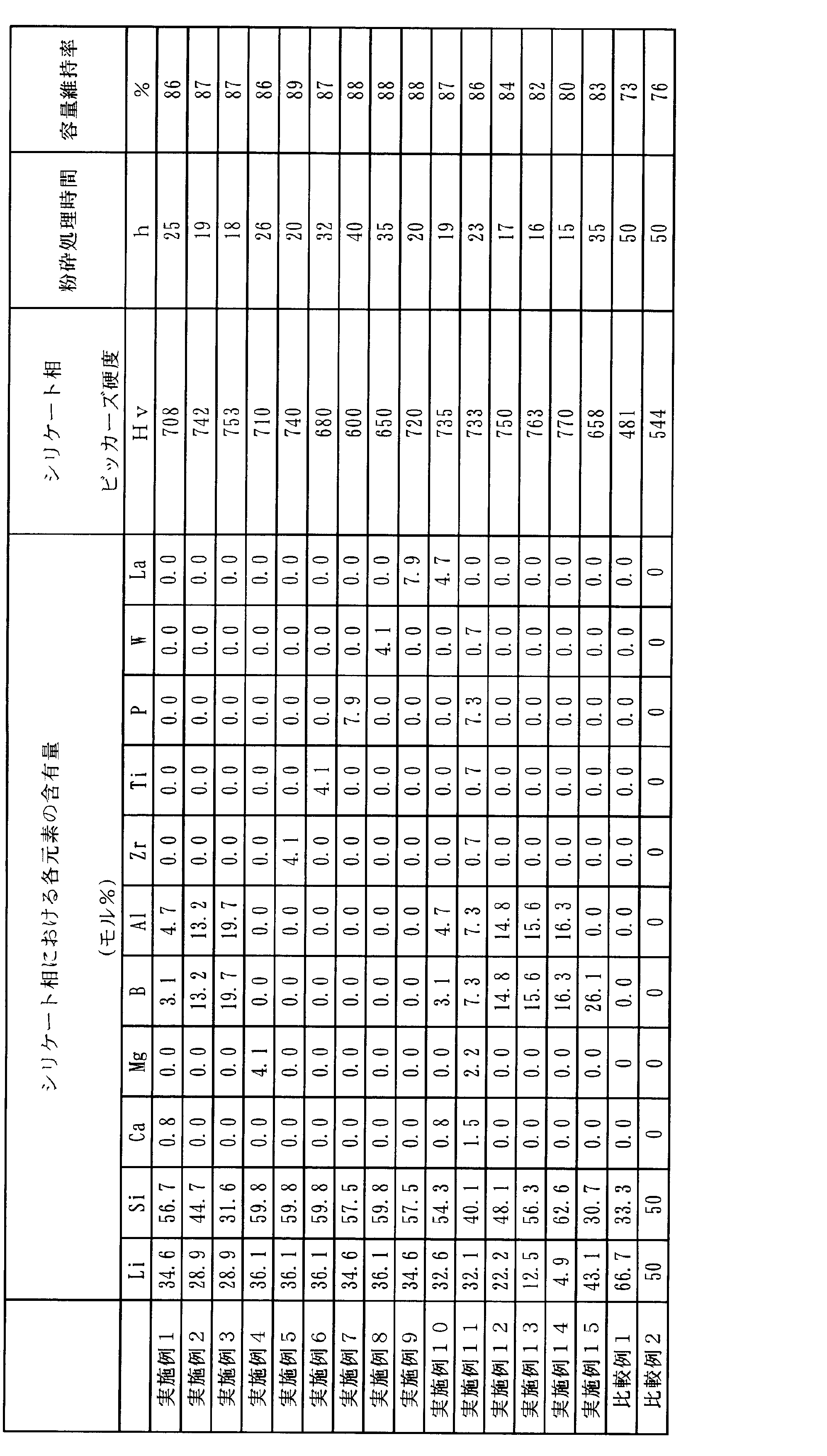
表2に示すように、実施例1~15の電池はいずれも、比較例1~2の電池と比べて、充放電サイクル特性の低下が抑制された。なお、各実施例及び各比較例いずれも、Si粒子の平均粒径は100nm未満となっているが、実施例のボールミルによる粉砕処理時間は、比較例のボールミルによる粉砕処理時間より短い時間である。これは、実施例で作製したシリケートを用いて負極活物質を製造した方が、比較例で作製したシリケートを用いて負極活物質を製造するより、短時間で規定の粉砕レベルに達することを示している。
10 負極活物質粒子、11 リチウムシリケート相、12 シリコン粒子、13 母粒子、14 導電層。
Claims (8)
- Liと、Siと、Mx(Mx:アルカリ金属、アルカリ土類金属、Si以外の元素)と、を含むシリケート相と、
前記シリケート相中に分散したシリコン粒子と、を有する母粒子を備え、
前記シリケート相における酸素以外の元素の合計に対する各元素の含有量は、Liが3~45モル%であり、Siが40~78モル%であり、Mxが1~40モル%である、非水電解質二次電池用負極活物質。 - 前記シリケート相は、アルカリ土類金属Mを含み、
前記シリケート相における酸素以外の元素の合計に対するMの含有量は、1~5モル%である、請求項1に記載の非水電解質二次電池用負極活物質。 - 前記シリケート相における酸素以外の元素の合計に対する各元素の含有量は、Liが5~23モル%であり、Siが45~78モル%であり、Mxが2~35モル%である、請求項1又は2に記載の非水電解質二次電池用負極活物質。
- 前記Mxは、Al、B、Bi、Sb、Ge、Zr、Ti、P、V、W、及びLaのうちの少なくとも一つを含む、請求項1~3のいずれか1項に記載の非水電解質二次電池用負極活物質。
- 前記Mxは、Al、B、Zr、Ti、P、La及びWのうちの少なくとも1つを含む請求項4に記載の非水電解質二次電池用負極活物質。
- 前記Mxは、Al、B、Z及びTiのうちの少なくとも1つを含む請求項5に記載の非水電解質二次電池用負極活物質。
- 前記母粒子の表面には、導電層が形成されている、請求項1~6のいずれか1項に記載の非水電解質二次電池用負極活物質。
- 請求項1~7のいずれか1項に記載の非水電解質二次電池用負極活物質を有する負極と、正極と、非水電解質と、を備えた非水電解質二次電池。
Priority Applications (3)
| Application Number | Priority Date | Filing Date | Title |
|---|---|---|---|
| JP2019545579A JP7165926B2 (ja) | 2017-09-29 | 2018-09-26 | 非水電解質二次電池用負極活物質及び非水電解質二次電池 |
| CN201880062431.7A CN111133615A (zh) | 2017-09-29 | 2018-09-26 | 非水电解质二次电池用负极活性物质及非水电解质二次电池 |
| US16/650,236 US11715822B2 (en) | 2017-09-29 | 2018-09-26 | Negative electrode active material for non-aqueous electrolyte secondary cell, and non-aqueous electrolyte secondary cell |
Applications Claiming Priority (2)
| Application Number | Priority Date | Filing Date | Title |
|---|---|---|---|
| JP2017-190855 | 2017-09-29 | ||
| JP2017190855 | 2017-09-29 |
Publications (1)
| Publication Number | Publication Date |
|---|---|
| WO2019065766A1 true WO2019065766A1 (ja) | 2019-04-04 |
Family
ID=65900907
Family Applications (1)
| Application Number | Title | Priority Date | Filing Date |
|---|---|---|---|
| PCT/JP2018/035762 Ceased WO2019065766A1 (ja) | 2017-09-29 | 2018-09-26 | 非水電解質二次電池用負極活物質及び非水電解質二次電池 |
Country Status (4)
| Country | Link |
|---|---|
| US (1) | US11715822B2 (ja) |
| JP (1) | JP7165926B2 (ja) |
| CN (1) | CN111133615A (ja) |
| WO (1) | WO2019065766A1 (ja) |
Cited By (13)
| Publication number | Priority date | Publication date | Assignee | Title |
|---|---|---|---|---|
| WO2020045256A1 (ja) * | 2018-08-30 | 2020-03-05 | パナソニックIpマネジメント株式会社 | 二次電池用負極活物質および二次電池 |
| WO2020045257A1 (ja) * | 2018-08-30 | 2020-03-05 | パナソニックIpマネジメント株式会社 | 二次電池用負極活物質および二次電池 |
| WO2020045255A1 (ja) * | 2018-08-30 | 2020-03-05 | パナソニックIpマネジメント株式会社 | 二次電池用負極活物質および二次電池 |
| WO2020044931A1 (ja) * | 2018-08-30 | 2020-03-05 | パナソニックIpマネジメント株式会社 | 非水電解質二次電池用負極活物質、非水電解質二次電池用負極、及び非水電解質二次電池 |
| CN111048770A (zh) * | 2019-12-27 | 2020-04-21 | 中国科学院化学研究所 | 一种三元掺杂的硅基复合材料及其制备方法和应用 |
| JPWO2021153077A1 (ja) * | 2020-01-31 | 2021-08-05 | ||
| JPWO2021192575A1 (ja) * | 2020-03-26 | 2021-09-30 | ||
| CN114175315A (zh) * | 2019-07-31 | 2022-03-11 | 松下知识产权经营株式会社 | 非水电解质二次电池用负极材料和非水电解质二次电池 |
| JPWO2022137732A1 (ja) * | 2020-12-23 | 2022-06-30 | ||
| JP2023041247A (ja) * | 2021-09-13 | 2023-03-24 | トヨタ自動車株式会社 | 被覆負極活物質および全固体電池 |
| WO2023053946A1 (ja) * | 2021-09-30 | 2023-04-06 | パナソニックIpマネジメント株式会社 | 二次電池 |
| WO2024048099A1 (ja) | 2022-08-29 | 2024-03-07 | パナソニックIpマネジメント株式会社 | 二次電池用負極活物質および二次電池 |
| JP2024512113A (ja) * | 2021-12-29 | 2024-03-18 | 貝特瑞新材料集団股▲ふん▼有限公司 | 負極材料、その調製方法およびリチウムイオン電池 |
Families Citing this family (2)
| Publication number | Priority date | Publication date | Assignee | Title |
|---|---|---|---|---|
| US12567579B2 (en) * | 2020-09-30 | 2026-03-03 | Panasonic Intellectual Property Management Co., Ltd. | Negative electrode for secondary battery, and secondary battery |
| WO2024116847A1 (ja) * | 2022-11-30 | 2024-06-06 | パナソニックIpマネジメント株式会社 | 非水電解質二次電池用負極活物質および非水電解質二次電池 |
Citations (6)
| Publication number | Priority date | Publication date | Assignee | Title |
|---|---|---|---|---|
| JP2007500421A (ja) * | 2003-07-29 | 2007-01-11 | エルジー・ケム・リミテッド | リチウム二次電池用の負活性材料およびその製造方法 |
| JP2014187005A (ja) * | 2013-02-19 | 2014-10-02 | Nippon Electric Glass Co Ltd | 蓄電デバイス用負極活物質 |
| JP2015125815A (ja) * | 2013-12-25 | 2015-07-06 | 信越化学工業株式会社 | 非水電解質二次電池用負極活物質及びその製造方法 |
| JP2015170438A (ja) * | 2014-03-06 | 2015-09-28 | 株式会社豊田自動織機 | 電極活物質材料及びその製造方法 |
| WO2016121320A1 (ja) * | 2015-01-28 | 2016-08-04 | 三洋電機株式会社 | 非水電解質二次電池用負極活物質及び非水電解質二次電池 |
| WO2016136180A1 (ja) * | 2015-02-23 | 2016-09-01 | 三洋電機株式会社 | 非水電解質二次電池用負極活物質、非水電解質二次電池用負極、及び非水電解質二次電池 |
Family Cites Families (5)
| Publication number | Priority date | Publication date | Assignee | Title |
|---|---|---|---|---|
| JP4868556B2 (ja) | 2010-04-23 | 2012-02-01 | 日立マクセルエナジー株式会社 | リチウム二次電池 |
| KR20160101932A (ko) | 2013-12-25 | 2016-08-26 | 신에쓰 가가꾸 고교 가부시끼가이샤 | 비수 전해질 2차 전지용 부극 활물질 및 그의 제조 방법 |
| CN107112534B (zh) * | 2015-01-28 | 2021-06-25 | 三洋电机株式会社 | 非水电解质二次电池用负极活性物质和非水电解质二次电池 |
| KR101586816B1 (ko) * | 2015-06-15 | 2016-01-20 | 대주전자재료 주식회사 | 비수전해질 이차전지용 음극재, 이의 제조방법, 및 이를 포함하는 비수전해질 이차전지 |
| PL3343677T3 (pl) * | 2016-06-02 | 2023-10-30 | Lg Energy Solution, Ltd. | Materiał aktywny katody, zawierająca go katoda i zawierająca go litowa bateria akumulatorowa |
-
2018
- 2018-09-26 WO PCT/JP2018/035762 patent/WO2019065766A1/ja not_active Ceased
- 2018-09-26 US US16/650,236 patent/US11715822B2/en active Active
- 2018-09-26 JP JP2019545579A patent/JP7165926B2/ja active Active
- 2018-09-26 CN CN201880062431.7A patent/CN111133615A/zh active Pending
Patent Citations (6)
| Publication number | Priority date | Publication date | Assignee | Title |
|---|---|---|---|---|
| JP2007500421A (ja) * | 2003-07-29 | 2007-01-11 | エルジー・ケム・リミテッド | リチウム二次電池用の負活性材料およびその製造方法 |
| JP2014187005A (ja) * | 2013-02-19 | 2014-10-02 | Nippon Electric Glass Co Ltd | 蓄電デバイス用負極活物質 |
| JP2015125815A (ja) * | 2013-12-25 | 2015-07-06 | 信越化学工業株式会社 | 非水電解質二次電池用負極活物質及びその製造方法 |
| JP2015170438A (ja) * | 2014-03-06 | 2015-09-28 | 株式会社豊田自動織機 | 電極活物質材料及びその製造方法 |
| WO2016121320A1 (ja) * | 2015-01-28 | 2016-08-04 | 三洋電機株式会社 | 非水電解質二次電池用負極活物質及び非水電解質二次電池 |
| WO2016136180A1 (ja) * | 2015-02-23 | 2016-09-01 | 三洋電機株式会社 | 非水電解質二次電池用負極活物質、非水電解質二次電池用負極、及び非水電解質二次電池 |
Cited By (30)
| Publication number | Priority date | Publication date | Assignee | Title |
|---|---|---|---|---|
| US12119481B2 (en) | 2018-08-30 | 2024-10-15 | Panasonic Intellectual Property Management Co., Ltd. | Negative electrode active material for secondary batteries and secondary battery |
| WO2020045257A1 (ja) * | 2018-08-30 | 2020-03-05 | パナソニックIpマネジメント株式会社 | 二次電池用負極活物質および二次電池 |
| WO2020045255A1 (ja) * | 2018-08-30 | 2020-03-05 | パナソニックIpマネジメント株式会社 | 二次電池用負極活物質および二次電池 |
| WO2020044931A1 (ja) * | 2018-08-30 | 2020-03-05 | パナソニックIpマネジメント株式会社 | 非水電解質二次電池用負極活物質、非水電解質二次電池用負極、及び非水電解質二次電池 |
| WO2020045256A1 (ja) * | 2018-08-30 | 2020-03-05 | パナソニックIpマネジメント株式会社 | 二次電池用負極活物質および二次電池 |
| US12155061B2 (en) | 2018-08-30 | 2024-11-26 | Panasonic Intellectual Property Management Co., Ltd. | Negative electrode active material for secondary batteries, and secondary battery |
| US12113216B2 (en) | 2018-08-30 | 2024-10-08 | Panasonic Intellectual Property Management Co., Ltd. | Negative electrode active material for secondary batteries, and secondary battery |
| US11978896B2 (en) | 2018-08-30 | 2024-05-07 | Panasonic Intellectual Property Management Co., Ltd. | Negative electrode active material for nonaqueous electrolyte secondary batteries, negative electrode for nonaqueous electrolyte secondary batteries, and nonaqueous electrolyte secondary battery |
| US12412889B2 (en) | 2019-07-31 | 2025-09-09 | Panasonic Intellectual Property Management Co., Ltd. | Negative electrode material for nonaqueous electrolyte secondary batteries, and nonaqueous electrolyte secondary battery |
| EP4007013A4 (en) * | 2019-07-31 | 2022-09-14 | Panasonic Intellectual Property Management Co., Ltd. | NEGATIVE ELECTRODE MATERIAL FOR ANHYDROUS ELECTROLYTE SECONDARY BATTERY AND ANHYDROUS ELECTROLYTE SECONDARY BATTERY |
| CN114175315A (zh) * | 2019-07-31 | 2022-03-11 | 松下知识产权经营株式会社 | 非水电解质二次电池用负极材料和非水电解质二次电池 |
| CN111048770A (zh) * | 2019-12-27 | 2020-04-21 | 中国科学院化学研究所 | 一种三元掺杂的硅基复合材料及其制备方法和应用 |
| CN111048770B (zh) * | 2019-12-27 | 2020-12-08 | 中国科学院化学研究所 | 一种三元掺杂的硅基复合材料及其制备方法和应用 |
| WO2021153077A1 (ja) * | 2020-01-31 | 2021-08-05 | パナソニックIpマネジメント株式会社 | 二次電池用負極活物質およびその製造方法、ならびに二次電池 |
| JP7813998B2 (ja) | 2020-01-31 | 2026-02-16 | パナソニックIpマネジメント株式会社 | 二次電池用負極活物質およびその製造方法、ならびに二次電池 |
| EP4098614A4 (en) * | 2020-01-31 | 2023-11-01 | Panasonic Intellectual Property Management Co., Ltd. | NEGATIVE ELECTRODE ACTIVE SUBSTANCE FOR SECONDARY BATTERY, METHOD FOR PRODUCING SAME AND SECONDARY BATTERY |
| JPWO2021153077A1 (ja) * | 2020-01-31 | 2021-08-05 | ||
| JPWO2021192575A1 (ja) * | 2020-03-26 | 2021-09-30 | ||
| JP7780733B2 (ja) | 2020-03-26 | 2025-12-05 | パナソニックIpマネジメント株式会社 | 二次電池用負極および二次電池 |
| WO2021192575A1 (ja) * | 2020-03-26 | 2021-09-30 | パナソニックIpマネジメント株式会社 | 二次電池用負極および二次電池 |
| JP7756342B2 (ja) | 2020-12-23 | 2025-10-20 | パナソニックIpマネジメント株式会社 | 非水電解質二次電池用の複合粒子および非水電解質二次電池 |
| WO2022137732A1 (ja) * | 2020-12-23 | 2022-06-30 | パナソニックIpマネジメント株式会社 | 非水電解質二次電池用の複合粒子および非水電解質二次電池 |
| JPWO2022137732A1 (ja) * | 2020-12-23 | 2022-06-30 | ||
| JP7582135B2 (ja) | 2021-09-13 | 2024-11-13 | トヨタ自動車株式会社 | 被覆負極活物質および全固体電池 |
| JP2023041247A (ja) * | 2021-09-13 | 2023-03-24 | トヨタ自動車株式会社 | 被覆負極活物質および全固体電池 |
| EP4411883A4 (en) * | 2021-09-30 | 2025-08-06 | Panasonic Ip Man Co Ltd | SECONDARY BATTERY |
| WO2023053946A1 (ja) * | 2021-09-30 | 2023-04-06 | パナソニックIpマネジメント株式会社 | 二次電池 |
| JP2024512113A (ja) * | 2021-12-29 | 2024-03-18 | 貝特瑞新材料集団股▲ふん▼有限公司 | 負極材料、その調製方法およびリチウムイオン電池 |
| JP7760605B2 (ja) | 2021-12-29 | 2025-10-27 | 貝特瑞新材料集団股▲ふん▼有限公司 | 負極材料、その調製方法およびリチウムイオン電池 |
| WO2024048099A1 (ja) | 2022-08-29 | 2024-03-07 | パナソニックIpマネジメント株式会社 | 二次電池用負極活物質および二次電池 |
Also Published As
| Publication number | Publication date |
|---|---|
| JP7165926B2 (ja) | 2022-11-07 |
| US20210202930A1 (en) | 2021-07-01 |
| JPWO2019065766A1 (ja) | 2020-09-10 |
| CN111133615A (zh) | 2020-05-08 |
| US11715822B2 (en) | 2023-08-01 |
Similar Documents
| Publication | Publication Date | Title |
|---|---|---|
| JP7165926B2 (ja) | 非水電解質二次電池用負極活物質及び非水電解質二次電池 | |
| JP7182132B2 (ja) | 二次電池用負極活物質及び二次電池 | |
| JP7182133B2 (ja) | 二次電池用負極活物質及び二次電池 | |
| US10516153B2 (en) | Negative-electrode active material for non-aqueous electrolyte secondary battery and non-aqueous electrolyte secondary battery | |
| US10312516B2 (en) | Negative-electrode active material for non-aqueous electrolyte secondary battery, and non-aqueous electrolyte secondary battery | |
| JP6847667B2 (ja) | 非水電解質二次電池用負極活物質及び非水電解質二次電池 | |
| US10312507B2 (en) | Negative-electrode active material for non-aqueous electrolyte secondary battery, and non-aqueous electrolyte secondary battery | |
| JP7257626B2 (ja) | 二次電池用負極活物質及び二次電池 | |
| JP6613250B2 (ja) | 非水電解質二次電池用負極活物質及び非水電解質二次電池 | |
| US20200365879A1 (en) | Negative electrode active substance for nonaqueous electrolyte secondary battery and nonaqueous electrolyte secondary battery | |
| US10516158B2 (en) | Negative-electrode active material for non-aqueous electrolyte secondary battery and non-aqueous electrolyte secondary battery | |
| CN111357138B (zh) | 锂离子电池用负极活性物质和锂离子电池 |
Legal Events
| Date | Code | Title | Description |
|---|---|---|---|
| 121 | Ep: the epo has been informed by wipo that ep was designated in this application |
Ref document number: 18860354 Country of ref document: EP Kind code of ref document: A1 |
|
| ENP | Entry into the national phase |
Ref document number: 2019545579 Country of ref document: JP Kind code of ref document: A |
|
| NENP | Non-entry into the national phase |
Ref country code: DE |
|
| 122 | Ep: pct application non-entry in european phase |
Ref document number: 18860354 Country of ref document: EP Kind code of ref document: A1 |