WO2019059239A1 - 組成物 - Google Patents
組成物 Download PDFInfo
- Publication number
- WO2019059239A1 WO2019059239A1 PCT/JP2018/034680 JP2018034680W WO2019059239A1 WO 2019059239 A1 WO2019059239 A1 WO 2019059239A1 JP 2018034680 W JP2018034680 W JP 2018034680W WO 2019059239 A1 WO2019059239 A1 WO 2019059239A1
- Authority
- WO
- WIPO (PCT)
- Prior art keywords
- meth
- mass
- parts
- composition
- general formula
- Prior art date
- Legal status (The legal status is an assumption and is not a legal conclusion. Google has not performed a legal analysis and makes no representation as to the accuracy of the status listed.)
- Ceased
Links
Images

Classifications
-
- C—CHEMISTRY; METALLURGY
- C08—ORGANIC MACROMOLECULAR COMPOUNDS; THEIR PREPARATION OR CHEMICAL WORKING-UP; COMPOSITIONS BASED THEREON
- C08F—MACROMOLECULAR COMPOUNDS OBTAINED BY REACTIONS ONLY INVOLVING CARBON-TO-CARBON UNSATURATED BONDS
- C08F220/00—Copolymers of compounds having one or more unsaturated aliphatic radicals, each having only one carbon-to-carbon double bond, and only one being terminated by only one carboxyl radical or a salt, anhydride ester, amide, imide or nitrile thereof
- C08F220/02—Monocarboxylic acids having less than ten carbon atoms; Derivatives thereof
- C08F220/10—Esters
- C08F220/20—Esters of polyhydric alcohols or phenols, e.g. 2-hydroxyethyl (meth)acrylate or glycerol mono-(meth)acrylate
-
- C—CHEMISTRY; METALLURGY
- C08—ORGANIC MACROMOLECULAR COMPOUNDS; THEIR PREPARATION OR CHEMICAL WORKING-UP; COMPOSITIONS BASED THEREON
- C08F—MACROMOLECULAR COMPOUNDS OBTAINED BY REACTIONS ONLY INVOLVING CARBON-TO-CARBON UNSATURATED BONDS
- C08F220/00—Copolymers of compounds having one or more unsaturated aliphatic radicals, each having only one carbon-to-carbon double bond, and only one being terminated by only one carboxyl radical or a salt, anhydride ester, amide, imide or nitrile thereof
- C08F220/02—Monocarboxylic acids having less than ten carbon atoms; Derivatives thereof
- C08F220/10—Esters
- C08F220/12—Esters of monohydric alcohols or phenols
- C08F220/14—Methyl esters, e.g. methyl (meth)acrylate
-
- C—CHEMISTRY; METALLURGY
- C08—ORGANIC MACROMOLECULAR COMPOUNDS; THEIR PREPARATION OR CHEMICAL WORKING-UP; COMPOSITIONS BASED THEREON
- C08F—MACROMOLECULAR COMPOUNDS OBTAINED BY REACTIONS ONLY INVOLVING CARBON-TO-CARBON UNSATURATED BONDS
- C08F222/00—Copolymers of compounds having one or more unsaturated aliphatic radicals, each having only one carbon-to-carbon double bond, and at least one being terminated by a carboxyl radical and containing at least one other carboxyl radical in the molecule; Salts, anhydrides, esters, amides, imides, or nitriles thereof
- C08F222/10—Esters
- C08F222/1006—Esters of polyhydric alcohols or polyhydric phenols
- C08F222/102—Esters of polyhydric alcohols or polyhydric phenols of dialcohols, e.g. ethylene glycol di(meth)acrylate or 1,4-butanediol dimethacrylate
-
- C—CHEMISTRY; METALLURGY
- C09—DYES; PAINTS; POLISHES; NATURAL RESINS; ADHESIVES; COMPOSITIONS NOT OTHERWISE PROVIDED FOR; APPLICATIONS OF MATERIALS NOT OTHERWISE PROVIDED FOR
- C09J—ADHESIVES; NON-MECHANICAL ASPECTS OF ADHESIVE PROCESSES IN GENERAL; ADHESIVE PROCESSES NOT PROVIDED FOR ELSEWHERE; USE OF MATERIALS AS ADHESIVES
- C09J11/00—Features of adhesives not provided for in group C09J9/00, e.g. additives
- C09J11/02—Non-macromolecular additives
- C09J11/06—Non-macromolecular additives organic
-
- C—CHEMISTRY; METALLURGY
- C09—DYES; PAINTS; POLISHES; NATURAL RESINS; ADHESIVES; COMPOSITIONS NOT OTHERWISE PROVIDED FOR; APPLICATIONS OF MATERIALS NOT OTHERWISE PROVIDED FOR
- C09J—ADHESIVES; NON-MECHANICAL ASPECTS OF ADHESIVE PROCESSES IN GENERAL; ADHESIVE PROCESSES NOT PROVIDED FOR ELSEWHERE; USE OF MATERIALS AS ADHESIVES
- C09J4/00—Adhesives based on organic non-macromolecular compounds having at least one polymerisable carbon-to-carbon unsaturated bond ; adhesives, based on monomers of macromolecular compounds of groups C09J183/00 - C09J183/16
-
- C—CHEMISTRY; METALLURGY
- C09—DYES; PAINTS; POLISHES; NATURAL RESINS; ADHESIVES; COMPOSITIONS NOT OTHERWISE PROVIDED FOR; APPLICATIONS OF MATERIALS NOT OTHERWISE PROVIDED FOR
- C09J—ADHESIVES; NON-MECHANICAL ASPECTS OF ADHESIVE PROCESSES IN GENERAL; ADHESIVE PROCESSES NOT PROVIDED FOR ELSEWHERE; USE OF MATERIALS AS ADHESIVES
- C09J4/00—Adhesives based on organic non-macromolecular compounds having at least one polymerisable carbon-to-carbon unsaturated bond ; adhesives, based on monomers of macromolecular compounds of groups C09J183/00 - C09J183/16
- C09J4/06—Organic non-macromolecular compounds having at least one polymerisable carbon-to-carbon unsaturated bond in combination with a macromolecular compound other than an unsaturated polymer of groups C09J159/00 - C09J187/00
-
- H—ELECTRICITY
- H04—ELECTRIC COMMUNICATION TECHNIQUE
- H04R—LOUDSPEAKERS, MICROPHONES, GRAMOPHONE PICK-UPS OR LIKE ACOUSTIC ELECTROMECHANICAL TRANSDUCERS; ELECTRIC HEARING AIDS; PUBLIC ADDRESS SYSTEMS
- H04R1/00—Details of transducers, loudspeakers or microphones
-
- C—CHEMISTRY; METALLURGY
- C08—ORGANIC MACROMOLECULAR COMPOUNDS; THEIR PREPARATION OR CHEMICAL WORKING-UP; COMPOSITIONS BASED THEREON
- C08K—Use of inorganic or non-macromolecular organic substances as compounding ingredients
- C08K5/00—Use of organic ingredients
- C08K5/0091—Complexes with metal-heteroatom-bonds
-
- C—CHEMISTRY; METALLURGY
- C08—ORGANIC MACROMOLECULAR COMPOUNDS; THEIR PREPARATION OR CHEMICAL WORKING-UP; COMPOSITIONS BASED THEREON
- C08K—Use of inorganic or non-macromolecular organic substances as compounding ingredients
- C08K5/00—Use of organic ingredients
- C08K5/04—Oxygen-containing compounds
- C08K5/09—Carboxylic acids; Metal salts thereof; Anhydrides thereof
- C08K5/098—Metal salts of carboxylic acids
-
- C—CHEMISTRY; METALLURGY
- C08—ORGANIC MACROMOLECULAR COMPOUNDS; THEIR PREPARATION OR CHEMICAL WORKING-UP; COMPOSITIONS BASED THEREON
- C08K—Use of inorganic or non-macromolecular organic substances as compounding ingredients
- C08K5/00—Use of organic ingredients
- C08K5/16—Nitrogen-containing compounds
- C08K5/17—Amines; Quaternary ammonium compounds
- C08K5/18—Amines; Quaternary ammonium compounds with aromatically bound amino groups
-
- C—CHEMISTRY; METALLURGY
- C08—ORGANIC MACROMOLECULAR COMPOUNDS; THEIR PREPARATION OR CHEMICAL WORKING-UP; COMPOSITIONS BASED THEREON
- C08K—Use of inorganic or non-macromolecular organic substances as compounding ingredients
- C08K5/00—Use of organic ingredients
- C08K5/16—Nitrogen-containing compounds
- C08K5/34—Heterocyclic compounds having nitrogen in the ring
- C08K5/3412—Heterocyclic compounds having nitrogen in the ring having one nitrogen atom in the ring
- C08K5/3432—Six-membered rings
Definitions
- the present invention relates to compositions such as, for example, adhesive compositions.
- a room temperature curing adhesive that cures at room temperature for a short time tends to increase year by year for labor saving, resource saving, energy saving and the like.
- a second generation acrylic adhesive hereinafter referred to as SGA
- SGA second generation acrylic adhesive
- SGA is a two-component type, it does not require accurate metering of the two components, and it works in several minutes or several minutes at normal temperature, even with incomplete measurement or mixing, sometimes even just contact with the two components. Excellent. Moreover, since SGA has high impact adhesive strength and good curing of the bent portion, it is suitable for bonding for assembling a speaker part (Patent Document 1).
- the UV curable adhesive generally cures in a few seconds, but there is a problem that the portion which is not exposed to the UV light is not cured.
- Patent Document 2 shows a composition for temporary fixation in which members obtained by immersing and bonding a cured product of a composition used for bonding members to each other in water are removed by immersion in water, and (A) a multifunctional A composition containing (meth) acrylate, (B) monofunctional (meth) acrylate, (C) organic peroxide, (D) decomposition accelerator, (E) photopolymerization initiator and (G) particulate material
- a two-part composition is described in which the first agent contains at least (C) and the second agent contains at least (D).
- Patent Document 2 only generally describes the type and the mixing ratio of (meth) acrylic monomers, and can not be assumed to be used as a damper material for which hardness is required.
- Patent Document 3 includes (A) nitrile butadiene rubber, (B) (meth) acrylic composition, (C) a compound having an enal structure, and (F) a first agent containing a radical polymerization initiator, (A A composition comprising a nitrile butadiene rubber, (B) (meth) acrylic composition, (D) a compound having an amine structure, and (E) a second agent containing a compound containing copper is described .
- Patent Document 3 only generally describes the type and the mixing ratio of the (meth) acrylic monomer, and can not be assumed to be used as a damper material for which hardness is required.
- the Example of patent document 3 uses methacrylic acid, and does not use (meth) acrylic acid ester.
- JP 2000-159835 A International Publication No. 2013/039226 International Publication No. 2010/041710
- the present invention can provide the following.
- a composition containing the following (1) to (5) (1) 10 to 70 parts by mass, (1-2) 10 to 60 parts by mass in 100 parts by mass of the polymerizable vinyl monomer, 10 to 60 parts by mass of (1-3) Polymerizable vinyl monomer (1-1) containing (meth) acrylic monomer represented by the general formula (A) General formula (A) Z-O-R 1 (Wherein, Z represents a (meth) acryloyl group and R 1 represents an alkyl group) (1-2) (Meth) acrylic monomers represented by the general formula (B) (1-3) (Meth) acrylic monomers that are (meth) acrylic acid esters of polyhydric alcohols (2) thermal radical polymerization initiators (3) photoradical polymerization initiators (4) aromatic amines and / or pyridine derivatives (5) Organic metal salts
- composition according to ⁇ 1> wherein the (meth) acrylic monomer that is a (meth) acrylic acid ester of a polyhydric alcohol is trimethylolpropane tri (meth) acrylate.
- composition according to ⁇ 1> or ⁇ 2> wherein the organic metal salt is one or more of the group consisting of a ⁇ -diketone chelate, a ⁇ -ketoester chelate, and an organic acid metal salt.
- composition according to any one of ⁇ 4> ⁇ 1> to ⁇ 3> is divided into a first agent and a second agent, and the first agent contains at least (2) a thermal radical polymerization initiator, A two-part composition in which the second agent contains at least (4) an aromatic amine and / or a pyridine derivative and (5) an organic metal salt.
- An adhesive composition comprising the composition according to any one of ⁇ 5> ⁇ 1> to ⁇ 4>.
- the bonded body which joins a to-be-adhered body by the adhesive composition as described in ⁇ 7> ⁇ 5> or ⁇ 6>.
- the joined body as described in ⁇ 7> whose ⁇ 8> adherend is a damper material.
- composition of the present invention is excellent in curability, adhesiveness and hardness.
- the polymerizable vinyl monomer may be capable of radical polymerization.
- the polymerizable vinyl monomer is preferably a (meth) acrylic monomer.
- the (meth) acrylic monomer refers to, for example, a (meth) acrylic acid derivative monomer.
- (1) 100 parts by mass of the polymerizable vinyl monomer is preferably a total of 100 parts by mass of (1-1), (1-2) and (1-3).
- the (1) 100 parts by mass of the polymerizable vinyl monomer is preferably a total of 100 parts by mass of the (1) polymerizable vinyl monomer in the first agent and the (1) polymerizable vinyl monomer in the second agent.
- 70 parts by mass or more is preferable, 100 parts by mass or more is preferable, 85 parts by mass or more is more preferable, and 100 parts by mass is most preferable in 100 parts by mass of the polymerizable vinyl monomer.
- the polymerizable vinyl monomer (1) used in the present embodiment contains the following (1-1) to (1-3).
- R 1 is preferably an alkyl group having 1 to 10 carbon atoms, and more preferably an alkyl group having 1 to 3 carbon atoms. When the number of carbon atoms is 10 or less, the surface curability is improved, there is no stickiness, and the curing speed is improved.
- R 1 is preferably a non-substituted hydrocarbon group.
- R 1 is preferably a chain group.
- R 1 is preferably a saturated group.
- Examples of such (meth) acrylic monomers include methyl (meth) acrylate, ethyl (meth) acrylate, propyl (meth) acrylate and isopropyl (meth) acrylate, and one or more of these can be used.
- methyl (meth) acrylate is preferable in terms of inexpensiveness and good adhesion.
- R 2 and R 2 ′ are each preferably an alkylene group having 2 to 6 carbon atoms, and more preferably an ethylene group having 2 carbon atoms.
- R 3 and R 3 ′ are preferably a methyl group.
- m + n is preferably 0-40, more preferably 1-30, most preferably 3-20, and still more preferably 4-17. Adhesiveness improves that m + n is 40 or less.
- (meth) acrylic monomers 2,2-bis (4- (meth) acryloxyphenyl) propane, 2,2-bis (4- (meth) acryloxyethoxyphenyl) propane, 2,2 -Bis (4- (meth) acryloxydiethoxyphenyl) propane, 2,2-bis (4- (meth) acryloxypropoxyphenyl) propane, 2,2-bis (4- (meth) acryloxytetraethoxyphenyl And propane) and 2,2-bis (4- (meth) acryloxypolyethoxyphenyl) propane and the like, and one or more of these can be used.
- 2,2-bis (4- (meth) acryloxypolyethoxyphenyl) propane is preferable in terms of adhesion and curing rate.
- (meth) acrylic monomers for example, one of the group consisting of (meth) acrylates represented by general formula (C), general formula (D), general formula (E) or general formula (F) More than species are preferred.
- non-cyclic polyfunctional (meth) acrylates are preferred.
- the polyfunctional (meth) acrylate refers to a compound having two or more (meth) acryloyl groups.
- (meth) acrylic monomers for example, trimethylolpropane tri (meth) acrylate, neopentyl glycol di (meth) acrylate, pentaerythritol tri (meth) acrylate, pentaerythritol tetra (meth) acrylate and dipenta Erythritol hexa (meth) acrylate etc. are mentioned.
- trimethylolpropane tri (meth) acrylate is preferred in view of hardness and curing rate.
- the amount of (1-1) used is preferably 10 to 70 parts by mass, more preferably 20 to 60 parts by mass, and most preferably 30 to 50 parts by mass in 100 parts by mass of the total of (1). If it is 10 parts by mass or more, the hardness does not become too high, and if it is 70 parts by mass or less, the curing speed is fast and the hardness is not excessively lowered.
- the amount of (1-2) used is preferably 10 to 60 parts by mass, more preferably 17 to 50 parts by mass, and most preferably 20 to 40 parts by mass in 100 parts by mass of (1). If the amount is 10 parts by mass or more, the curing speed is fast, the adhesiveness is large, the hardness is not excessively reduced, and if the amount is 60 parts by mass or less, the hardness is not excessively reduced.
- the use amount of (1-3) is preferably 10 to 60 parts by mass, more preferably 17 to 50 parts by mass, and most preferably 20 to 40 parts by mass in 100 parts by mass of (1).
- the amount is 10 parts by mass or more, the curing speed is fast, the adhesion is large, and when the amount is 60 parts by mass or less, the hardness is not too high, and the adhesion is large.
- Thermal radical polymerization initiators used in this embodiment include cumene hydroperoxide, paramenthane hydroperoxide, tertiary butyl hydroperoxide, diisopropylbenzene dihydroperoxide, methyl ethyl ketone peroxide, benzoyl peroxide and Organic peroxides such as tertiary butyl peroxybenzoate are preferred, and one or more of these can be used.
- cumene hydroperoxide is preferable in terms of reactivity with the component (1).
- the amount of the component (2) used in the present embodiment is preferably 0.5 to 10 parts by mass, and more preferably 1 to 7 parts by mass with respect to 100 parts by mass of the component (1).
- the amount is 0.5 parts by mass or more, the curing speed is increased, and when the amount is 10 parts by mass or less, the storage stability is improved.
- Photoradical polymerization initiators used in this embodiment include benzoin derivatives such as benzyl, benzoin, benzoin benzoic acid, benzoin ethyl ether, benzoin isopropyl ether and benzoin isobutyl ether, benzophenones such as benzophenone and 4-phenylbenzophenone Derivatives, alkylacetophenone derivatives such as 2,2-diethoxyacetophenone and benzyldimethyl ketal, 1-hydroxycyclohexyl phenyl ketone, 1- (4-isopropylphenyl) 2-hydroxy-2-methylpropan-1-one, 1- ( ⁇ -hydroxy such as 4- (2-hydroxyethoxy) -phenyl) -2-hydroxy-2-methyl-1-propan-1-one, 2-hydroxy-2-methyl-1-phenylpropan-1-one Cetophenone derivatives, bisdiethylaminobenzophenone, 2-methyl-1- (4- (methylthio) phenyl) -2
- alkyl acetophenone derivatives at least one selected from the group consisting of alkyl acetophenone derivatives, ⁇ -hydroxyacetophenones and phosphine oxides is preferable, and alkyl acetophenone derivatives are more preferable, from the viewpoint of excellent curing speed.
- alkylacetophenone derivatives benzyl dimethyl ketal is preferred. These can be used in combination of one or more.
- the amount of the component (3) used in the present embodiment is preferably 0.5 to 10 parts by mass, and more preferably 1 to 7 parts by mass with respect to 100 parts by mass of the component (1).
- the amount is 0.5 parts by mass or more, the curing speed is increased, and when the amount is 10 parts by mass or less, the storage stability is improved.
- Examples of the (4) aromatic amine and / or pyridine derivative used in the present embodiment include the following.
- Examples of aromatic amines include N, N-dimethylaniline, N, N-dimethyl-p-toluidine and N, N-dioxyethyl-p-toluidine.
- Examples of pyridine derivatives include 2,4-pyridinediamine and the like. One or more of these can be used. Among these, aromatic amines are preferred in terms of reactivity with the component (1). Among the aromatic amines, N, N-dimethylaniline is preferred.
- the amount of component (4) used is preferably 0.05 to 5 parts by mass, and more preferably 0.1 to 1 parts by mass with respect to 100 parts by mass of component (1).
- the amount is 0.05 parts by mass or more, the curing speed is increased, and when the amount is 5 parts by mass or less, the storage stability is improved.
- the component (5) organic metal salt used in the present embodiment is preferably at least one selected from the group consisting of ⁇ -diketone chelates, ⁇ -ketoester chelates, and organic acid metal salts.
- ⁇ -diketone chelate a chelate of acetylacetonate is preferred.
- a chelate of acetylacetonate vanadyl acetylacetonate, cobalt acetylacetonate, copper acetylacetonate and the like can be mentioned.
- vanadyl acetylacetonate vanadyl acetylacetonate is preferred.
- Examples of ⁇ -ketoester chelates include ethyl acetoacetate chelate, copper naphthenic acid, vanadyl naphthenate and the like.
- As the organic acid metal salt aliphatic carboxylic acids are preferable.
- Examples of aliphatic carboxylic acids include copper 2-ethylhexylate and vanadyl stearate. One or more of these can be used.
- metal salts having reducibility are preferable in view of reactivity with the component (2), and one or more kinds of ⁇ -diketone chelates and ⁇ -ketoester chelates are more preferable, and ⁇ -diketone chelates are the most preferable. preferable.
- the amount of the component (5) used is preferably 0.05 to 5 parts by mass, and more preferably 0.1 to 1 parts by mass with respect to 100 parts by mass of the component (1).
- the amount is 0.05 parts by mass or more, the curing speed is fast, the adhesion is large, and when the amount is 5 parts by mass or less, unreacted components are not left, and the adhesion is improved.
- the adhesive composition is divided into a first agent and a second agent, and the first agent is used as a first agent
- At least component (2) is stored separately in at least component (4) and component (5) in a second agent.
- Component (3) may be stored in either the first agent or the second agent. In this case, it can be used as a two-part adhesive composition by applying both agents simultaneously or separately to an adherend, and making contact and curing.
- the first agent and the second agent in a ratio (weight ratio) of 2: 1 to 1: 2, and preferably 1.5: 1 to 1: 1. It is more preferable to mix in a ratio of 5 (mass ratio), and it is most preferable to mix in a ratio of 1: 1 (mass ratio).
- a one-part type is obtained by previously incorporating a (meth) acrylic monomer and other optional components in either one or both of the first agent and the second agent, and mixing both at the time of use. It can be used as an adhesive composition of
- the adhesive composition of the present embodiment can be cured by irradiation of energy rays using the following light source.
- the light source used for curing and bonding of the adhesive composition in the present embodiment is not particularly limited, but halogen lamps, metal halide lamps, high power metal halide lamps (containing indium etc.), low pressure mercury lamps, high pressure mercury lamps Ultra high pressure mercury lamp, xenon lamp, xenon excimer lamp, xenon flash lamp, light emitting diode (hereinafter referred to as LED), and the like.
- These light sources are preferable in that they can efficiently irradiate energy beams corresponding to the reaction wavelengths of the respective radical photopolymerization initiators.
- the light sources have different emission wavelengths and energy distributions. Therefore, the light source is appropriately selected depending on the reaction wavelength of the photo radical polymerization initiator and the like.
- natural light can also be a reaction initiation light source.
- the light source may perform direct irradiation, focused irradiation by a reflecting mirror or the like, focused irradiation by a fiber or the like.
- a low wavelength cut filter, a heat ray cut filter, a cold mirror or the like can also be used.
- irradiating an energy beam when curing composition, it is preferable to irradiate to cure the composition at an intensity of 10 ⁇ 1000mW / cm 2 at a wavelength of 365nm, illuminance of 50 ⁇ 500mW / cm 2 at a wavelength of 365nm It is more preferable to irradiate and cure the composition, and it is most preferable to irradiate and cure the composition at an illuminance of 100 to 200 mW / cm 2 at a wavelength of 365 nm.
- the composition of this embodiment is preferably used for bonding of a damper material.
- the damper material in the present specification means a material used for a speaker damper.
- the speaker damper supports, for example, the diaphragm of the speaker so as to be able to vibrate.
- the speaker damper is manufactured by impregnating a cloth material made of a fiber material or the like with a resin and subjecting the material to heat molding processing. Among cloth materials, cotton is preferred.
- the resins phenolic resins are preferred in view of moldability.
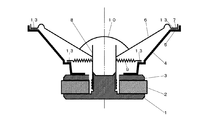
- the loudspeaker shows the structure of FIG.
- the frame 4 is coupled to the field portion obtained by laminating and bonding the bottom plate 1, the ring-shaped magnet 2 and the ring-shaped top plate 3, and the peripheral portion 5 of the frame 4
- the peripheral portion (cone edge) 7 is connected, the voice coil 8 is connected to the central portion of the cone 6, the middle portion of the voice coil 8 is held by the damper 9, and the lower portion of the voice coil 8 is the central portion of the bottom plate 1 It is configured to fit into the department.
- the speaker is configured by sticking a dust cap 10 on the central upper surface of the cone 6.
- the bonding of the three points of the speaker consisting of the cone 6, the voice coil 8 and the damper 9 is, for example, as shown in FIG.
- the voice coil 8 is constructed by winding the paper tape 11 around the voice coil 8 and further winding the coil 12 around the paper tape 11 (in the figure, the portion clearly indicated by a circle represents the bonding point of the three speaker speaker points)
- the three points of the speaker are glued with adhesive composition 13).
- Z and Z 'each represent a methacryloyl group
- R 2 and R 2 ' each represent an ethylene group
- R 3 and R 3 'each represent a methyl group.
- Fixation time Apply a mixture of equal amounts of the first agent and the second agent on one side of the damper material, and then overlap the damper material (a material obtained by impregnating a cloth material with a phenolic resin, using cotton as a cloth) and laminating them together
- the sample was used as a sample.
- ultraviolet rays (mercury xenon lamp: manufactured by Execure 3000 HOYA, wavelength: 365 nm, illuminance: 150 mW / cm 2 ) were irradiated for a predetermined time.
- the fixation time of the sample (unit: second) is pulled with a push-pull gauge (Model S, manufactured by Komura) under an environment of temperature 23 ° C. and humidity 50%, and until immediately after bonding, strength of 2N or more is measured Time was measured.
- a strength of 2N or more is developed within 10 seconds.
- the hardness is preferably Shore D 61 or more and 71 or less in terms of the sound quality and vibration resistance of the speaker.
- SPCC / SPCC tensile shear adhesive strength (tensile shear adhesive strength)] Apply a mixture of equal amounts of the first agent and the second agent on one side of a test piece (100 mm ⁇ 25 mm ⁇ 1.6 mm t, SPCC-D sandblasted) according to JIS K 6856: 1994, and then immediately test the other side.
- the pieces (100 mm ⁇ 25 mm ⁇ 1.6 mm, SPCC-D sandblasted) were stacked and bonded, and then aged for 24 hours under an environment of a temperature of 23 ° C. and a relative humidity of 50% as a sample.
- the tensile shear adhesive strength (unit: MPa) of the sample was measured at a tensile rate of 10 mm / min under an environment of a temperature of 23 ° C. and a relative humidity of 50%.
- the tensile shear adhesive strength is preferably 4.2 MPa or more in terms of adhesion.
- the present embodiment is excellent in curability and adhesiveness.
- the Shore D (hardness) is 61 or more and 71 or less, the sound quality and the vibration resistance of the speaker are excellent (Experimental Examples 1 to 10).
- the effects of (1-1) to (1-3) can be further enhanced by setting the use amounts to 30 to 50 parts by mass, 20 to 40 parts by mass, and 20 to 40 parts by mass, respectively. It improves (comparison of Experimental Examples 1 to 4 with Experimental Examples 5 to 10).
- (1-1) is not used, the hardness is too high and the adhesion is small (Experimental Example 11).
- methacrylic acid is used instead of (1-1
- the adhesion is small (Example 18).
- (1-2) is not used, the adhesion is small (Experimental Example 17).
- (1-3) is not used, the photo radical curability is small and the adhesion is small (Experimental Example 16). It does not cure unless (2) is used (Experimental Example 12).
- (3) is not used, photocurability is small (Experimental example 13).
- (4) is not used, the photo radical curability is small and the hardness is small (Experimental Example 14). It does not harden unless (5) is used (Experimental example 15).
- the present embodiment is suitable for bonding for assembling speaker parts, has a high curing speed, and has the effect of being able to shorten the production tact such as speaker assembly.
- the present embodiment can provide a composition having optimum hardness and excellent in sound quality and vibration resistance of the speaker.
- This embodiment can provide an adhesive composition having the excellent performance of the SGA adhesive and the quick curing property of the photocurable adhesive, and the industrial advantage is extremely large.
Landscapes
- Chemical & Material Sciences (AREA)
- Organic Chemistry (AREA)
- Health & Medical Sciences (AREA)
- Chemical Kinetics & Catalysis (AREA)
- Medicinal Chemistry (AREA)
- Polymers & Plastics (AREA)
- Physics & Mathematics (AREA)
- Engineering & Computer Science (AREA)
- Acoustics & Sound (AREA)
- Signal Processing (AREA)
- Adhesives Or Adhesive Processes (AREA)
- Addition Polymer Or Copolymer, Post-Treatments, Or Chemical Modifications (AREA)
- Manufacture Of Macromolecular Shaped Articles (AREA)
- Audible-Bandwidth Dynamoelectric Transducers Other Than Pickups (AREA)
Abstract
硬化性と接着性が優れる組成物の提供。下記(1)~(5)を含有する組成物。 (1)(1)重合性ビニルモノマー100質量部中、(1-1)10~70質量部、(1-2)10~60質量部であり、(1-3)10~60質量部を含有する重合性ビニルモノマー (1-1)一般式(A)で示される(メタ)アクリル系モノマー 一般式(A) Z-O-R1 (式中、Zは(メタ)アクリロイル基を示し、R1はアルキル基を示す。) (1-2)一般式(B)で示される(メタ)アクリル系モノマー (式中、Z、Z'は(メタ)アクリロイル基を示し、R2、R2'はアルキレン基を示す。R2、R2'は同一でも良く、異なっていても良い。R3、R3'は水素原子又は炭素数1~4個のアルキル基を示す。R3、R3'は同一でも良く、異なっていても良い。mとnはアルキレンオキサイドの平均付加モル数(付加率)を示す。) (1-3)多価アルコールの(メタ)アクリル酸エステルである(メタ)アクリル系モノマー (2)熱ラジカル重合開始剤 (3)光ラジカル重合開始剤 (4)芳香族アミン及び/又はピリジン誘導体 (5)有機金属塩
Description
本発明は、例えば、接着剤組成物等の組成物に関する。
常温かつ短時間で硬化する常温硬化型接着剤への要求は、省力化、省資源及び省エネルギー等のために年々増大する傾向にある。従来、常温硬化型接着剤として例えば、第二世代アクリル系接着剤(以下SGAという)が知られている。
SGAは二剤型であるが、二剤の正確な計量を必要とせず、不完全な計量や混合、時には二剤の接触だけでも、常温で数分又は数十分で硬化するため、作業性に優れる。しかもSGAは衝撃接着強さが高く、ハミ出し部分の硬化も良好であるために、スピーカー部品の組み立て用の接着に好適である(特許文献1)。
しかしながら、最近では、さらに生産タクトを短縮するために、数秒単位での硬化速度が求められている。
紫外線硬化型接着剤は一般的に数秒で硬化するものもあるが、紫外線が当たらない部分は硬化しないという問題がある。
特許文献2には、部材同士の接着に使用する組成物の硬化体を水に浸漬して接着した部材同士を水に浸漬し取り外す仮固定用の組成物であり、かつ、(A)多官能(メタ)アクリレート、(B)単官能(メタ)アクリレート、(C)有機過酸化物、(D)分解促進剤、(E)光重合開始剤及び(G)粒状物質を含有する組成物を二剤に分け、第一剤が少なくとも(C)を含有し、第二剤が少なくとも(D)を含有する二剤型の組成物が記載されている。しかし特許文献2は、(メタ)アクリル系モノマーの種類や配合割合については概括的に記載しているのみであって、硬度が要求されるダンパー材としての使用を想定できるものでもない。
特許文献3には、(A)ニトリルブタジエンラバー、(B)(メタ)アクリル系組成物、(C)エナール構造を有する化合物及び(F)ラジカル重合開始剤を含有する第一剤と、(A)ニトリルブタジエンラバー、(B)(メタ)アクリル系組成物、(D)アミン構造を有する化合物及び(E)銅を含む化合物を含有する第二剤と、を含有する組成物が記載されている。しかし、特許文献3も(メタ)アクリル系モノマーの種類や配合割合については概括的に記載しているのみであって、硬度が要求されるダンパー材としての使用を想定できるものでもない。また特許文献3の実施例は、メタクリル酸を使用するものであり、(メタ)アクリル酸エステルを使用しない。
従来技術では上述した課題を解決できないことに鑑み、例えば、硬化性、硬度、接着性が両立できる組成物が求められている。
即ち、本発明は、以下を提供できる。
<1>下記(1)~(5)を含有する組成物。
(1)(1)重合性ビニルモノマー100質量部中、(1-1)10~70質量部、(1-2)10~60質量部であり、(1-3)10~60質量部を含有する重合性ビニルモノマー
(1-1)一般式(A)で示される(メタ)アクリル系モノマー
一般式(A)
Z-O-R1
(式中、Zは(メタ)アクリロイル基を示し、R1はアルキル基を示す。)
(1-2)一般式(B)で示される(メタ)アクリル系モノマー

(1-3)多価アルコールの(メタ)アクリル酸エステルである(メタ)アクリル系モノマー
(2)熱ラジカル重合開始剤
(3)光ラジカル重合開始剤
(4)芳香族アミン及び/又はピリジン誘導体
(5)有機金属塩
(1)(1)重合性ビニルモノマー100質量部中、(1-1)10~70質量部、(1-2)10~60質量部であり、(1-3)10~60質量部を含有する重合性ビニルモノマー
(1-1)一般式(A)で示される(メタ)アクリル系モノマー
一般式(A)
Z-O-R1
(式中、Zは(メタ)アクリロイル基を示し、R1はアルキル基を示す。)
(1-2)一般式(B)で示される(メタ)アクリル系モノマー
(2)熱ラジカル重合開始剤
(3)光ラジカル重合開始剤
(4)芳香族アミン及び/又はピリジン誘導体
(5)有機金属塩
<2>(1-3)多価アルコールの(メタ)アクリル酸エステルである(メタ)アクリル系モノマーが、トリメチロールプロパントリ(メタ)アクリレートである<1>記載の組成物。
<3>(5)有機金属塩がβ-ジケトンキレート、β-ケトエステルキレート、有機酸金属塩からなる群の1種以上である<1>又は<2>記載の組成物。
<4><1>~<3>のうちの1項記載の組成物を第一剤と第二剤の二剤に分け、第一剤が少なくとも(2)熱ラジカル重合開始剤を含有し、第二剤が少なくとも(4)芳香族アミン及び/又はピリジン誘導体と(5)有機金属塩を含有する二剤型の組成物。
<5><1>~<4>のうちの1項記載の組成物からなる接着剤組成物。
<6>ダンパー材の接着に使用する<5>記載の接着剤組成物。
<7><5>又は<6>記載の接着剤組成物により被着体を接合する接合体。
<8>被着体がダンパー材である<7>記載の接合体。
本発明の組成物は、硬化性と接着性と硬度に優れる。
以下、本実施形態を詳細に説明する。本明細書における数値範囲は、別段の定めのないかぎり、その上限値と下限値を含むものとする。
(1)重合性ビニルモノマーは、ラジカル重合可能であればよい。重合性ビニルモノマーは、(メタ)アクリル系モノマーが好ましい。(メタ)アクリル系モノマーとは、例えば、(メタ)アクリル酸誘導体モノマーをいう。
(1)重合性ビニルモノマー100質量部とは、(1-1)、(1-2)及び(1-3)の合計100質量部であることが好ましい。(1)重合性ビニルモノマー100質量部とは、第一剤中の(1)重合性ビニルモノマーと第二剤中の(1)重合性ビニルモノマーの合計100質量部であることが好ましい。
(メタ)アクリル系モノマーの含有量は重合性ビニルモノマー100質量部中、70質量部以上が好ましく、85質量部以上がより好ましく、100質量部が最も好ましい。
(1)重合性ビニルモノマーの含有量は、組成物100質量部中、70質量部以上が好ましく、85質量部以上が好ましく、90質量部以上が最も好ましい。
本実施形態で使用する(1)重合性ビニルモノマーは下記の(1-1)~(1-3)を含有する。
(1-1)一般式(A)で示される(メタ)アクリル系モノマー
一般式(A)
Z-O-R1
(式中、Zは(メタ)アクリロイル基を示し、R1はアルキル基を示す。)
一般式(A)
Z-O-R1
(式中、Zは(メタ)アクリロイル基を示し、R1はアルキル基を示す。)
R1は、炭素数1~10のアルキル基が好ましく、炭素数1~3のアルキル基がより好ましい。炭素数10以下だと表面硬化性が向上してベタツキがなく、硬化速度が向上する。R1は、非置換の炭化水素基が好ましい。R1は、鎖式基が好ましい。R1は、飽和基が好ましい。
このような(メタ)アクリル系モノマーとしては、メチル(メタ)アクリレート、エチル(メタ)アクリレート、プロピル(メタ)アクリレート及びイソプロピル(メタ)アクリレート等が挙げられ、これらの1種以上が使用できる。これらの中では、安価で接着性が良好な点で、メチル(メタ)アクリレートが好ましい。
(1-2)一般式(B)で示される(メタ)アクリル系モノマー
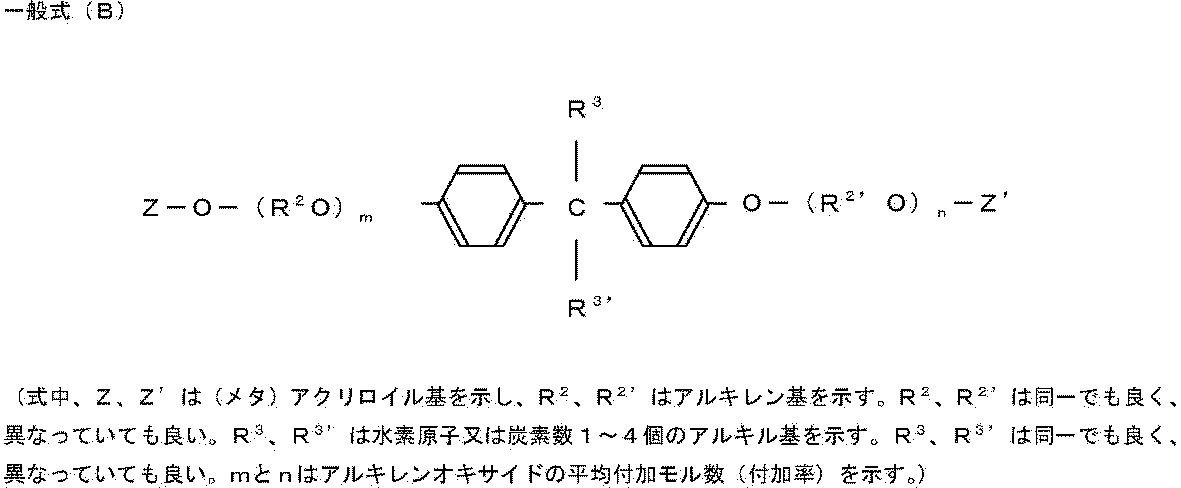
R2、R2’は炭素数2~6個のアルキレン基が好ましく、炭素数2個のエチレン基がより好ましい。R3、R3’はメチル基が好ましい。m+nは0~40が好ましく、1~30がより好ましく、3~20が最も好ましく、4~17が尚更好ましい。m+nが40以下であると接着性が向上する。
このような(メタ)アクリル系モノマーとしては、2,2-ビス(4-(メタ)アクリロキシフェニル)プロパン、2,2-ビス(4-(メタ)アクリロキシエトキシフェニル)プロパン、2,2-ビス(4-(メタ)アクリロキシジエトキシフェニル)プロパン、2,2-ビス(4-(メタ)アクリロキシプロポキシフェニル)プロパン、2,2-ビス(4-(メタ)アクリロキシテトラエトキシフェニル)プロパン及び2,2-ビス(4-(メタ)アクリロキシポリエトキシフェニル)プロパン等が挙げられ、これらの1種以上が使用できる。これらの中では、接着性と硬化速度の点で、2,2-ビス(4-(メタ)アクリロキシポリエトキシフェニル)プロパンが好ましい。
(1-3)多価アルコールの(メタ)アクリル酸エステルである(メタ)アクリル系モノマー。
このような(メタ)アクリル系モノマーとしては、例えば、一般式(C)、一般式(D)、一般式(E)又は一般式(F)で表される(メタ)アクリレートからなる群の1種以上が好ましい。
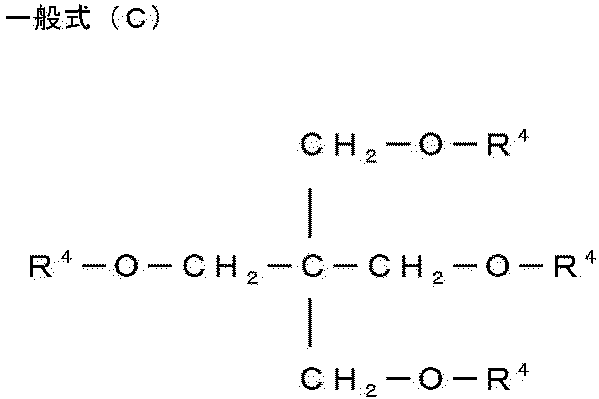


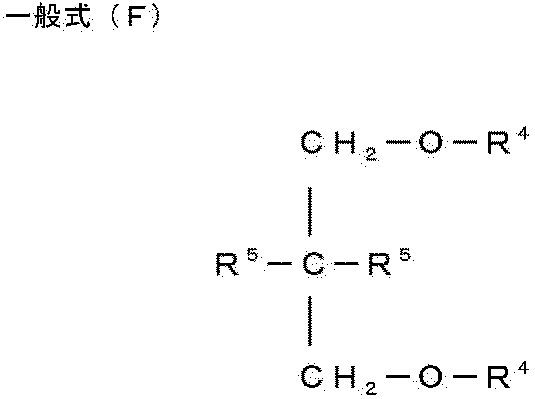
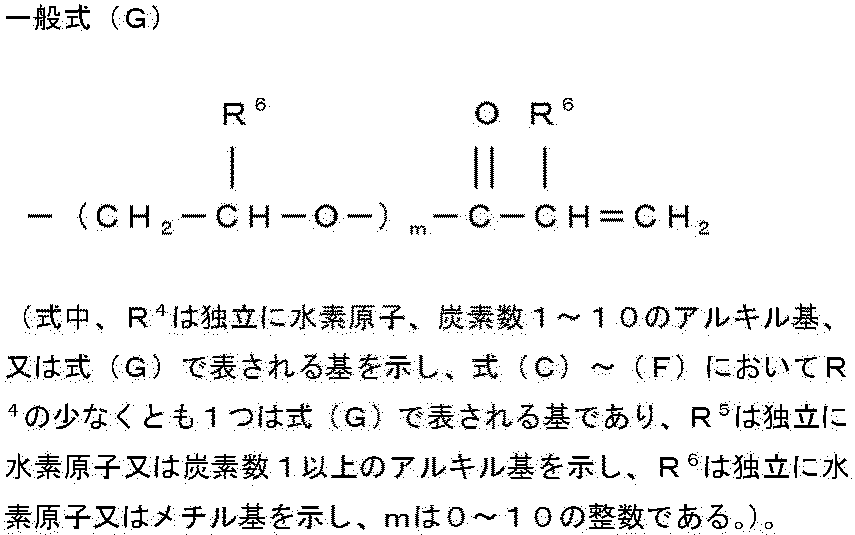
一般式(C)~(F)においてR4のうちの少なくとも2つは一般式(G)で表される基であることが好ましい。一般式(C)~(E)においてR4のうちの3つは一般式(G)で表される基であることがより好ましい。
これらの中では、非環式の多官能(メタ)アクリレートが好ましい。多官能(メタ)アクリレートとは、(メタ)アクリロイル基を2個以上有する化合物をいう。
このような(メタ)アクリル系モノマーとしては、例えば、トリメチロールプロパントリ(メタ)アクリレート、ネオペンチルグリコールジ(メタ)アクリレート、ペンタエリスリトールトリ(メタ)アクリレート、ペンタエリスリトールテトラ(メタ)アクリレート及びジペンタエリスリトールヘキサ(メタ)アクリレート等が挙げられる。これらの中では、硬度と硬化速度の点で、トリメチロールプロパントリ(メタ)アクリレートが好ましい。
(1-1)の使用量は、(1)の合計100質量部中、10~70質量部が好ましく、20~60質量部がより好ましく、30~50質量部が最も好ましい。10質量部以上だと硬度が高くなりすぎず、70質量部以下だと硬化速度が早く、硬度が低下しすぎない。
(1-2)の使用量は、(1)100質量部中、10~60質量部が好ましく、17~50質量部がより好ましく、20~40質量部が最も好ましい。10質量部以上だと硬化速度が早く、接着性が大きく、硬度も低下しすぎず、60質量部以下だと硬度が低下しすぎない。
(1-3)の使用量は、(1)100質量部中、10~60質量部が好ましく、17~50質量部がより好ましく、20~40質量部が最も好ましい。10質量部以上だと硬化速度が早く、接着性が大きく、60質量部以下だと硬度が高くなりすぎず、接着性が大きい。
本実施形態で使用する(2)熱ラジカル重合開始剤としては、クメンハイドロパーオキサイド、パラメンタンハイドロパーオキサイド、ターシャリーブチルハイドロパーオキサイド、ジイソプロピルベンゼンジハイドロパーオキサイド、メチルエチルケトンパーオキサイド、ベンゾイルパーオキサイド及びターシャリーブチルパーオキシベンゾエート等の有機過酸化物が好ましく、これらの1種以上が使用できる。これらの中では、成分(1)との反応性の点で、クメンハイドロパーオキサイドが好ましい。
本実施形態で使用する成分(2)の使用量は、成分(1)100質量部に対して、0.5~10質量部が好ましく、1~7質量部がより好ましい。0.5質量部以上だと硬化速度が早くなり、10質量部以下だと貯蔵安定性が良くなる。
本実施形態で使用する(3)光ラジカル重合開始剤としては、ベンジル、ベンゾイン、ベンゾイン安息香酸、ベンゾインエチルエーテル、ベンゾインイソプロピルエーテル、ベンゾインイソブチルエーテル等のベンゾイン誘導体、ベンゾフェノン、4-フェニルベンゾフェノン等のベンゾフェノン誘導体、2,2-ジエトキシアセトフェノン、ベンジルジメチルケタール等のアルキルアセトフェノン誘導体、1-ヒドロキシシクロヘキシルフェニルケトン、1-(4-イソプロピルフェニル)2-ヒドロキシ-2-メチルプロパン-1-オン、1-(4-(2-ヒドロキシエトキシ)-フェニル)-2-ヒドロキシ-2-メチル-1-プロパン-1-オン、2-ヒドロキシ-2-メチル-1-フェニルプロパン-1-オン等のα-ヒドロキシアセトフェノン誘導体、ビスジエチルアミノベンゾフェノン、2-メチル-1-(4-(メチルチオ)フェニル)-2-モルフォリノプロパン-1-オン、2-ベンジル-2-ジメチルアミノ-1-(4-モルフォリノフェニル)-1-ブタノン-1等のα-アミノアルキルアセトフェノン誘導体、イソブチリル-メチルフォスフィン酸メチルエステル、イソブチリル-フェニルフォスフィン酸メチルエステル、ピバロイル-フェニルフォスフィン酸メチルエステル、2-エチルヘキサノイル-フェニルフォスフィン酸メチルエステル、ピバロイル-フェニルフォスフィン酸イソプロピルエステル、p-トルイル-フェニルフォスフィン酸メチルエステル、o-トルイル-フェニルフォスフィン酸メチルエステル、2,4-ジメチルベンゾイル-フェニルフォスフィン酸メチルエステル、p-3級ブチルベンゾイル-フェニルフォスフィン酸イソプロピルエステル、ビバロイル-(4-メチルフェニル)-フォスフィン酸メチルエステル、ピバロイル-フェニルフォスフィン酸ビニルエステル、(メタ)アクリロイル-フェニルフォスフィン酸メチルエステル、イソブチリル-ジフェニルフォスフィンオキサイド、ピバロイル-ジフェニルフォスフィンオキサイド、1-メチル-1-シクロヘキサノイル-ジフェニルフォスフィンオキサイド、2-エチルヘキサノイル-ジフェニルフォスフィンオキサイド、p-トルイル-ジフェニルフォスフィンオキサイド、o-トルイル-ジフェニルフォスフィンオキサイド、p-3級ブチルベンゾイル-ジフェニルフォスフィンオキサイド、(メタ)アクリロイルジフェニルフォスフィンオキサイド、ベンゾイル-ジフェニルフォスフィンオキサイド、2,2-ジメチル-ヘプタノイル-ジフェニルフォスフィンオキサイド、テレフタロイル-ビス-ジフェニルフォスフィンオキサイド、アジポイル-ビス-ジフェニルフォスフィンオキサイド、2,6-ジメチルベンゾイル-ジフェニルフォスフィンオキサイド、2,6-ジメトキシベンゾイル-フェニルフォスフィン酸メチルエステル、2,6-ジメチルベンゾイル-ジフェニルフォスフィンオキサイド、2,6-ジメトキシベンゾイル-ジフォスフィンオキサイド、2,4,6-トリメチルベンゾイル-フェニルフォスフィン酸メチルエステル、2,4,6-トリメチルベンゾイル-ジフェニルフォスフィンオキサイド、2,3,6-トリメチルベンゾイル-ジフェニルフォスフィンオキサイド、2,4,6-トリメチルベンゾイル-トリフォスフィン酸メチルエステル、2,4,6-トリメトキシベンゾイル-ジフェニルフォスフィンオキサイド、2,6-ジクロルベンゾイル-フェニルフォスフィン酸エステル、2,6-ジクロルベンゾイル-ジフェニルフォスフィンオキサイド、2,3,4,6-テトラメチルベンゾイル-ジフェニルフォスフィンオキサイド、2,6-ジブロムベンゾイル-ジフェニルフォスフィンオキサイド、2,6-ジメチルベンゾイル-ジフェニルフォスフィンオキサイド、2,4,6-トリメチルベンゾイルジフェニルフォスフィンオキサイド、2,4,6-トリメチルベンゾイル-フェニルフォスフィン酸メチルエステル、2,6-ジクロルベンゾイル-若しくは2,6-ジメトキシベンゾイル-ジフェニルフォスフィンオキサイド、ビス(2,4,6-トリメチルベンゾイル)-フェニルフォスフィンオキサイド、ビス(2,6-ジメトキシベンゾイル)-2,4,4-トリメチル-ペンチルフォスフィンオキサイド等のアシルフォスフィンオキサイド誘導体、1,2-オクタンジオン,1-〔-4-(フェニルチオ)-,2-(O-ベンゾイルオキシム)〕、エタノン1-[9-エチル-6-(2-メチルベンゾイル)-9H-カルバゾール-3-イル]-1-(O-アセチルオキシム)等のオキシムエステル化合物が挙げられる。これらの中では、硬化速度に優れる点で、アルキルアセトフェノン誘導体、α-ヒドロキシアセトフェノン類、ホスフィンオキサイド類からなる群の1種以上が好ましく、アルキルアセトフェノン誘導体がより好ましい。アルキルアセトフェノン誘導体の中では、ベンジルジメチルケタールが好ましい。これらは1種以上組み合わせて用いることができる。
本実施形態で使用する成分(3)の使用量は、成分(1)100質量部に対して、0.5~10質量部が好ましく、1~7質量部がより好ましい。0.5質量部以上だと硬化速度が早くなり、10質量部以下だと貯蔵安定性が良くなる。
本実施形態で使用する(4)芳香族アミン及び/又はピリジン誘導体としては、以下が挙げられる。芳香族アミンとして、N,N-ジメチルアニリン、N,N-ジメチル-p-トルイジン及びN,N-ジオキシエチル-p-トルイジン等が挙げられる。ピリジン誘導体としては、2,4-ピリジンジアミン等が挙げられる。これらの1種以上が使用できる。
これらの中では、成分(1)との反応性の点で、芳香族アミンが好ましい。芳香族アミンの中では、N,N-ジメチルアニリンが好ましい。
これらの中では、成分(1)との反応性の点で、芳香族アミンが好ましい。芳香族アミンの中では、N,N-ジメチルアニリンが好ましい。
成分(4)の使用量は、成分(1)100質量部に対して、0.05~5質量部が好ましく、0.1~1質量部がより好ましい。0.05質量部以上だと硬化速度が早くなり、5質量部以下だと貯蔵安定性が良くなる。
本実施形態で使用する成分(5)有機金属塩としては、β-ジケトンキレート、β-ケトエステルキレート、有機酸金属塩からなる群の1種以上が好ましい。β-ジケトンキレートとしては、アセチルアセトネートのキレートが好ましい。アセチルアセトネートのキレートとしては、バナジルアセチルアセトネート、コバルトアセチルアセトネート及び銅アセチルアセトネート等が挙げられる。アセチルアセトネートのキレートの中では、バナジルアセチルアセトネートが好ましい。β-ケトエステルキレートとしては、アセト酢酸エチルのキレート、ナフテン酸(naphthenic acid)銅、ナフテン酸バナジル等が挙げられる。有機酸金属塩としては、脂肪族カルボン酸が好ましい。脂肪族カルボン酸としては、2-エチルヘキシル酸銅、ステアリン酸バナジル等が挙げられる。これらの1種以上が使用できる。これらの中では、成分(2)との反応性の点で、還元性を有する金属塩が好ましく、β-ジケトンキレート、β-ケトエステルキレートからなる1種以上がより好ましく、β-ジケトンキレートが最も好ましい。
成分(5)の使用量は、成分(1)100質量部に対して、0.05~5質量部が好ましく、0.1~1質量部がより好ましい。0.05質量部以上だと硬化速度が早く、接着性が大きく、5質量部以下だと未反応の成分が残らず、接着性が向上する。
本実施態様としては、硬化性組成物として使用することが挙げられる。本実施態様としては、硬化性樹脂組成物として使用することが挙げられる。本実施態様としては、二剤型の組成物として使用することが挙げられる。本実施態様としては、接着剤組成物として使用することが挙げられる。
本実施態様の中では、貯蔵安定性に優れる点で、二剤型の接着剤組成物として使用することが好ましい。
二剤型の接着剤組成物については、本実施形態の接着剤組成物の必須成分全てを貯蔵中は混合せず、接着剤組成物を第一剤及び第二剤に分け、第一剤に少なくとも成分(2)を、第二剤に少なくとも成分(4)と成分(5)を別々に貯蔵する。成分(3)は第一剤、第二剤のどちらに貯蔵しても構わない。この場合、両剤を同時に又は別々に被着体に塗布して接触、硬化することによって、二剤型の接着剤組成物として使用できる。
二剤型の接着剤組成物については、第一剤及び第二剤を、2:1~1:2の割合(質量比)で混合することが好ましく、1.5:1~1:1.5の割合(質量比)で混合することがより好ましく、1:1の割合(質量比)で混合することが最も好ましい。
別の実施態様としては、第一剤及び第二剤のいずれか一方又は両方に(メタ)アクリル系モノマー及びその他の任意の成分を予め含有せしめ、使用時に両者を混合することによって、一剤型の接着剤組成物として使用できる。
本実施形態の接着剤組成物は、下記の光源を用いたエネルギー線の照射により、硬化することができる。
本実施形態において、接着剤組成物の硬化、接着に用いられる光源としては、特に限定されないが、ハロゲンランプ、メタルハライドランプ、ハイパワーメタルハライドランプ(インジウム等を含有する)、低圧水銀ランプ、高圧水銀ランプ、超高圧水銀ランプ、キセノンランプ、キセノンエキシマランプ、キセノンフラッシュランプ、ライトエミッティングダイオード(以下、LEDという)等が挙げられる。これらの光源は、それぞれの光ラジカル重合開始剤の反応波長に対応したエネルギー線の照射を効率よく行える点で、好ましい。
上記光源は、各々放射波長、エネルギー分布が異なる。そのため、上記光源は光ラジカル重合開始剤の反応波長等により適宜選択される。又、自然光(太陽光)も反応開始光源になり得る。
上記光源は、直接照射、反射鏡等による集光照射、ファイバー等による集光照射を行ってもよい。低波長カットフィルター、熱線カットフィルター、コールドミラー等も用いることもできる。
エネルギー線を照射して、組成物を硬化させる際は、波長365nmにおいて10~1000mW/cm2の照度で組成物に照射し硬化させることが好ましく、波長365nmにおいて50~500mW/cm2の照度で組成物に照射し硬化させることがより好ましく、波長365nmにおいて100~200mW/cm2の照度で組成物に照射し硬化させることが最も好ましい。
本実施形態の組成物は、ダンパー材の接着に使用することが好ましい。本明細書におけるダンパー材とは、スピーカー用ダンパーに使用する材料をいう。スピーカー用ダンパーは、例えば、スピーカーの振動板を振動可能になるように支持する。スピーカー用ダンパーは、繊維材料等からなる布材に樹脂を含浸した後、加熱成型加工することにより、製造している。布材の中では、綿が好ましい。樹脂の中では、成型性の点で、フェノール樹脂が好ましい。
スピーカーは、例えば、図1の構造を示す。スピーカーは、ボトムプレート1、リング状のマグネット2、リング状のトッププレート3を積層し、接着することにより得られる界磁部にフレーム4を結合し、このフレーム4の周縁部5にコーン6の周縁部(コーンエッジ)7を結合し、このコーン6の中央部にボイスコイル8を結合し、このボイスコイル8の中間部をダンパー9で保持してボイスコイル8の下部をボトムプレート1の中央部にはまりこむように構成している。スピーカーは、コーン6の中央上面にダストキャップ10を貼り付けて構成している。
コーン6、ボイスコイル8及びダンパー9からなるスピーカー3点部の接着は、例えば、図2に示すようになっている。ボイスコイル8は、ボイスコイル8の外周に紙テープ11を巻き付け、さらに紙テープ11の外周にコイル12を巻き付けて構成している(図中、丸印で明示した部分はスピーカー3点部の接着箇所を示す。スピーカー3点部は接着剤組成物13により接着している)。
以下の実験例により本実施形態を詳細に説明する。以下、各使用材料の使用量の単位は質量部で示す。
使用材料は、表1~4に示した。
組成物や評価に使用した材料を以下に示した。
[使用材料]
メタクリル酸メチル
メタクリル酸
2,2-ビス(4-メタクリロキシポリエトキシフェニル)プロパン:m、nは、一般式(B)のm、nをいう。一般式(B)において、Z、Z’はメタクリロイル基を示し、R2、R2’はエチレン基を示し、R3、R3’はメチル基を示す。
トリメチロールプロパントリメタクリレート
トリメチロールプロパントリアクリレート
クメンハイドロパーオキサイド
ベンジルジメチルケタール
N,N-ジメチルアニリン
バナジルアセチルアセトネート
SPCC:市販品、SPCC-Dブラスト処理鋼板
[使用材料]
メタクリル酸メチル
メタクリル酸
2,2-ビス(4-メタクリロキシポリエトキシフェニル)プロパン:m、nは、一般式(B)のm、nをいう。一般式(B)において、Z、Z’はメタクリロイル基を示し、R2、R2’はエチレン基を示し、R3、R3’はメチル基を示す。
トリメチロールプロパントリメタクリレート
トリメチロールプロパントリアクリレート
クメンハイドロパーオキサイド
ベンジルジメチルケタール
N,N-ジメチルアニリン
バナジルアセチルアセトネート
SPCC:市販品、SPCC-Dブラスト処理鋼板
各物性については、以下のようにして測定した。特記しない限り、温度23℃、相対湿度50%の環境下において、測定した。
[固着時間]
ダンパー材の片方に第一剤と第二剤を等量混合したものを塗布し、その後ダンパー材(布材にフェノール樹脂を含浸させた素材、布として綿を使用)同士を重ね合わせて貼り合わせたものを試料とした。貼り合わせ(接着面積:10mm×10mm)直後に、紫外線(水銀キセノンランプ:Execure3000 HOYA社製、波長:365nm、照度:150mW/cm2)を所定の時間照射した。試料の固着時間(単位:秒)は、温度23℃、湿度50%の環境下で、プッシュプルゲージ(ModelS、Komura社製)で引っ張り、貼り合わせ直後から、2N以上の強度が測定されるまでの時間を測定した。
ダンパー材の片方に第一剤と第二剤を等量混合したものを塗布し、その後ダンパー材(布材にフェノール樹脂を含浸させた素材、布として綿を使用)同士を重ね合わせて貼り合わせたものを試料とした。貼り合わせ(接着面積:10mm×10mm)直後に、紫外線(水銀キセノンランプ:Execure3000 HOYA社製、波長:365nm、照度:150mW/cm2)を所定の時間照射した。試料の固着時間(単位:秒)は、温度23℃、湿度50%の環境下で、プッシュプルゲージ(ModelS、Komura社製)で引っ張り、貼り合わせ直後から、2N以上の強度が測定されるまでの時間を測定した。
固着時間においては、硬化性の点で、10秒以内に2N以上の強度が発現することが好ましい。
[硬度]
JIS K6253-3:2012に則り、第一剤と第二剤を等量混合したものを、直径:100mm、厚さ2mmの円型枠(シリコーンシート)に塗布し、PETフィルム(188μm)にて、両面を貼り合わせ、温度23℃、相対湿度50%の環境下で、24時間硬化させた樹脂を、同環境雰囲気下で硬度計(高分子機器株式会社社製 タイプDデュロメーター)にて測定を行った。測定開始から3秒後の数値を記載した。
JIS K6253-3:2012に則り、第一剤と第二剤を等量混合したものを、直径:100mm、厚さ2mmの円型枠(シリコーンシート)に塗布し、PETフィルム(188μm)にて、両面を貼り合わせ、温度23℃、相対湿度50%の環境下で、24時間硬化させた樹脂を、同環境雰囲気下で硬度計(高分子機器株式会社社製 タイプDデュロメーター)にて測定を行った。測定開始から3秒後の数値を記載した。
硬度は、スピーカーの音質と耐振動性の点で、ショアーD61以上71以下が好ましい。
[SPCC/SPCC引張剪断接着強さ(引張剪断接着強さ)]
JIS K6856:1994に従い、試験片(100mm×25mm×1.6mmt、SPCC-Dサンドブラスト処理)の片方に第一剤と第二剤を等量混合したものを塗布し、その後、直ちにもう片方の試験片(100mm×25mm×1.6mmt、SPCC-Dサンドブラスト処理)を重ね合わせて貼り合わせた後、温度23℃、相対湿度50%の環境下において、24時間養生したものを試料とした。試料の引張剪断接着強さ(単位:MPa)は、温度23℃、相対湿度50%の環境下において、引張速度10mm/分で測定した。
JIS K6856:1994に従い、試験片(100mm×25mm×1.6mmt、SPCC-Dサンドブラスト処理)の片方に第一剤と第二剤を等量混合したものを塗布し、その後、直ちにもう片方の試験片(100mm×25mm×1.6mmt、SPCC-Dサンドブラスト処理)を重ね合わせて貼り合わせた後、温度23℃、相対湿度50%の環境下において、24時間養生したものを試料とした。試料の引張剪断接着強さ(単位:MPa)は、温度23℃、相対湿度50%の環境下において、引張速度10mm/分で測定した。
引張剪断接着強さは、接着性の点で、4.2MPa以上が好ましい。
[実験例1~18]
表1~4の組成(質量部で示す)で各使用材料を混合して、第一剤と第二剤からなる接着剤組成物を調製し、測定結果を表1~4に併記した。
表1~4の組成(質量部で示す)で各使用材料を混合して、第一剤と第二剤からなる接着剤組成物を調製し、測定結果を表1~4に併記した。


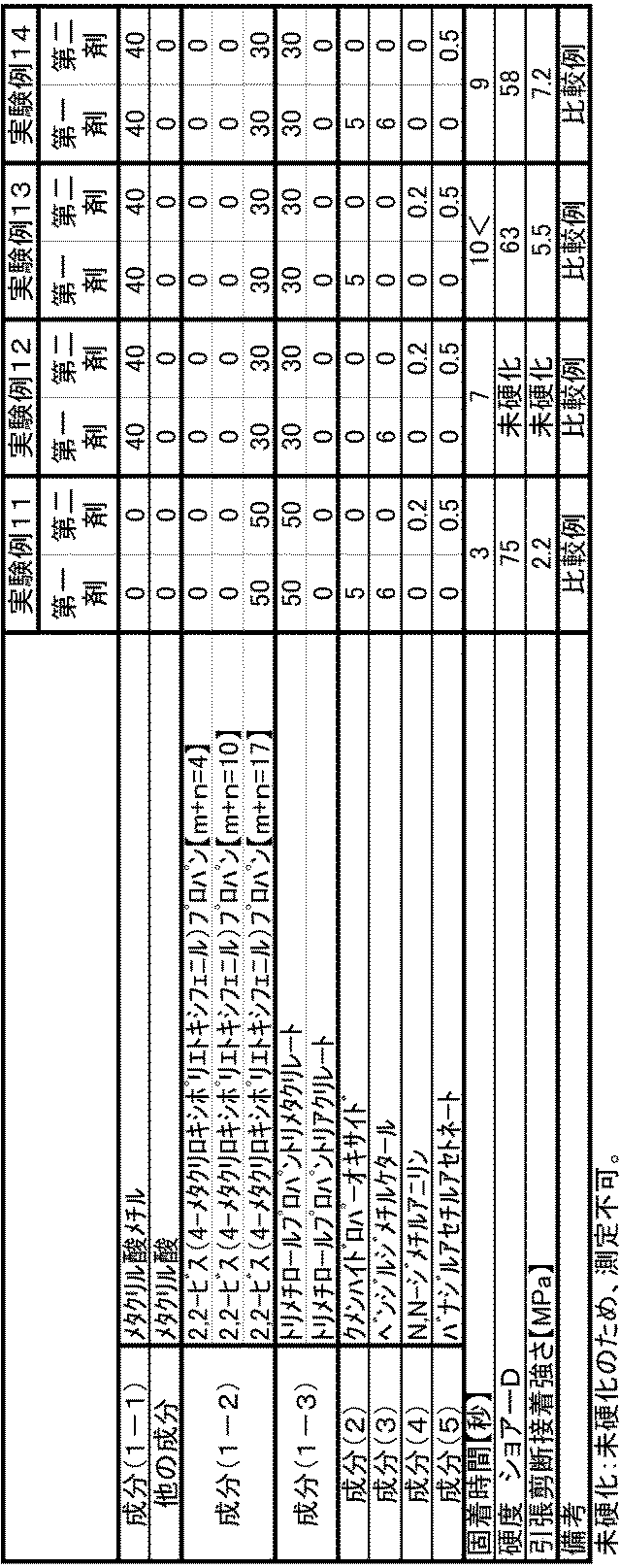

本実施形態は、硬化性と接着性が優れる。本実施形態は、ショアーD(硬度)が61以上71以下であるので、スピーカーの音質と耐振動性が優れる(実験例1~10)。また本実施形態は、(1-1)~(1-3)の使用量を更にそれぞれ30~50質量部、20~40質量部、20~40質量部の範囲とすることにより、一段と効果が向上する(実験例1~4と実験例5~10との対比)。
(1-1)を使用しないと、硬度が大きすぎ、接着性が小さい(実験例11)。(1-1)の代わりに、メタクリル酸を使用すると、接着性が小さい(実験例18)。(1-2)を使用しないと、接着性が小さい(実験例17)。(1-3)を使用しないと、光ラジカル硬化性が小さく、接着性が小さい(実験例16)。(2)を使用しないと、硬化しない(実験例12)。(3)を使用しないと、光ラジカル硬化性が小さい(実験例13)。(4)を使用しないと、光ラジカル硬化性が小さく、硬度が小さい(実験例14)。(5)を使用しないと、硬化しない(実験例15)。
本実施形態は、スピーカー部品の組み立て用の接着に好適であり、硬化速度が速く、スピーカー組立等の生産タクトを短縮できる効果を奏する。
本実施形態は、紫外線を照射する事により、数秒で次工程に移る際の振動等で位置ズレを発生しない強度を確保でき、更に、紫外線が当たらない箇所でも良好な硬化性を示すため、生産性に優れるという効果を奏する。
本実施形態は、最適な硬度を有し、スピーカーの音質や耐振動性に優れる組成物を提供できる。
本実施形態は、SGA接着剤の優れた性能と光硬化型接着剤の速硬化性を有する接着剤組成物を提供でき、産業上の有益性は極めて大きい。
1 ボトムプレート
2 マグネット
3 トッププレート
4 フレーム
5 フレームの周縁部
6 コーン
7 コーンの周縁部(コーンエッジ)
8 ボイスコイル
9 ダンパー
10 ダストキャップ
11 紙テープ
12 コイル
13 接着剤組成物
2 マグネット
3 トッププレート
4 フレーム
5 フレームの周縁部
6 コーン
7 コーンの周縁部(コーンエッジ)
8 ボイスコイル
9 ダンパー
10 ダストキャップ
11 紙テープ
12 コイル
13 接着剤組成物
Claims (8)
- 下記(1)~(5)を含有する組成物。
(1)(1)重合性ビニルモノマー100質量部中、(1-1)10~70質量部、(1-2)10~60質量部であり、(1-3)10~60質量部を含有する重合性ビニルモノマー
(1-1)一般式(A)で示される(メタ)アクリル系モノマー
一般式(A)
Z-O-R1
(式中、Zは(メタ)アクリロイル基を示し、R1はアルキル基を示す。)
(1-2)一般式(B)で示される(メタ)アクリル系モノマー

(2)熱ラジカル重合開始剤
(3)光ラジカル重合開始剤
(4)芳香族アミン及び/又はピリジン誘導体
(5)有機金属塩 - (1-3)多価アルコールの(メタ)アクリル酸エステルである(メタ)アクリル系モノマーが、トリメチロールプロパントリ(メタ)アクリレートである請求項1記載の組成物。
- (5)有機金属塩がβ-ジケトンキレート、β-ケトエステルキレート、有機酸金属塩からなる群の1種以上である請求項1又は2記載の組成物。
- 請求項1~3のうちの1項記載の組成物を第一剤と第二剤の二剤に分け、第一剤が少なくとも(2)熱ラジカル重合開始剤を含有し、第二剤が少なくとも(4)芳香族アミン及び/又はピリジン誘導体と(5)有機金属塩を含有する二剤型の組成物。
- 請求項1~4のうちの1項記載の組成物からなる接着剤組成物。
- ダンパー材の接着に使用する請求項5記載の接着剤組成物。
- 請求項5又は6記載の接着剤組成物により被着体を接合する接合体。
- 被着体がダンパー材である請求項7記載の接合体。
Priority Applications (3)
| Application Number | Priority Date | Filing Date | Title |
|---|---|---|---|
| JP2019543679A JP7038129B2 (ja) | 2017-09-20 | 2018-09-19 | 組成物 |
| CN201880044513.9A CN110831989A (zh) | 2017-09-20 | 2018-09-19 | 组合物 |
| US16/628,899 US11945891B2 (en) | 2017-09-20 | 2018-09-19 | Speaker having an adhesive composition |
Applications Claiming Priority (2)
| Application Number | Priority Date | Filing Date | Title |
|---|---|---|---|
| JP2017-179741 | 2017-09-20 | ||
| JP2017179741 | 2017-09-20 |
Publications (1)
| Publication Number | Publication Date |
|---|---|
| WO2019059239A1 true WO2019059239A1 (ja) | 2019-03-28 |
Family
ID=65809806
Family Applications (1)
| Application Number | Title | Priority Date | Filing Date |
|---|---|---|---|
| PCT/JP2018/034680 Ceased WO2019059239A1 (ja) | 2017-09-20 | 2018-09-19 | 組成物 |
Country Status (4)
| Country | Link |
|---|---|
| US (1) | US11945891B2 (ja) |
| JP (2) | JP7038129B2 (ja) |
| CN (1) | CN110831989A (ja) |
| WO (1) | WO2019059239A1 (ja) |
Citations (4)
| Publication number | Priority date | Publication date | Assignee | Title |
|---|---|---|---|---|
| JPH02501637A (ja) * | 1987-09-11 | 1990-06-07 | フラマトーム | 光重合による樹脂製物品の製法およびその利用 |
| JPH04239004A (ja) * | 1991-01-11 | 1992-08-26 | Kuraray Co Ltd | 重合性組成物 |
| JPH08209058A (ja) * | 1995-02-03 | 1996-08-13 | Mitsubishi Rayon Co Ltd | 硬化性組成物およびそれを用いた道路マーキング用組成物 |
| JP2004043427A (ja) * | 2002-05-23 | 2004-02-12 | Tokuyama Corp | 接着キット |
Family Cites Families (10)
| Publication number | Priority date | Publication date | Assignee | Title |
|---|---|---|---|---|
| JP3037451B2 (ja) * | 1991-03-04 | 2000-04-24 | 日本石油化学株式会社 | 延伸装置 |
| JP3698574B2 (ja) | 1997-12-12 | 2005-09-21 | 電気化学工業株式会社 | 接着剤組成物、接合体、スピーカー及び接着方法 |
| EP1454921B1 (en) * | 2001-09-21 | 2021-07-28 | Tokuyama Corporation | Radical polymerization catalysts and adhesive kit for dental use |
| FR2838048B1 (fr) * | 2002-04-03 | 2005-05-27 | Prod Dentaires Pierre Rolland | Produit dentaire reticulable/dereticulable |
| AU2005275246B2 (en) * | 2004-07-14 | 2011-10-06 | 3M Deutschland Gmbh | Dental compositions containing carbosilane monomers |
| JP5406845B2 (ja) | 2008-10-08 | 2014-02-05 | 電気化学工業株式会社 | 接着剤組成物及び接着方法 |
| JP5728859B2 (ja) * | 2010-09-10 | 2015-06-03 | 住友ベークライト株式会社 | 半導体用フィルムおよび半導体装置の製造方法 |
| WO2013039226A1 (ja) | 2011-09-14 | 2013-03-21 | 電気化学工業株式会社 | 組成物及びそれを用いた部材の仮固定方法 |
| KR102269152B1 (ko) * | 2014-10-07 | 2021-06-25 | 삼성전자주식회사 | 스피커 |
| JP7146324B2 (ja) * | 2019-11-25 | 2022-10-04 | サミー株式会社 | 弾球遊技機 |
-
2018
- 2018-09-19 JP JP2019543679A patent/JP7038129B2/ja active Active
- 2018-09-19 WO PCT/JP2018/034680 patent/WO2019059239A1/ja not_active Ceased
- 2018-09-19 CN CN201880044513.9A patent/CN110831989A/zh active Pending
- 2018-09-19 US US16/628,899 patent/US11945891B2/en active Active
-
2021
- 2021-05-17 JP JP2021083461A patent/JP7128320B2/ja active Active
Patent Citations (4)
| Publication number | Priority date | Publication date | Assignee | Title |
|---|---|---|---|---|
| JPH02501637A (ja) * | 1987-09-11 | 1990-06-07 | フラマトーム | 光重合による樹脂製物品の製法およびその利用 |
| JPH04239004A (ja) * | 1991-01-11 | 1992-08-26 | Kuraray Co Ltd | 重合性組成物 |
| JPH08209058A (ja) * | 1995-02-03 | 1996-08-13 | Mitsubishi Rayon Co Ltd | 硬化性組成物およびそれを用いた道路マーキング用組成物 |
| JP2004043427A (ja) * | 2002-05-23 | 2004-02-12 | Tokuyama Corp | 接着キット |
Also Published As
| Publication number | Publication date |
|---|---|
| CN110831989A (zh) | 2020-02-21 |
| JP7128320B2 (ja) | 2022-08-30 |
| JP7038129B2 (ja) | 2022-03-17 |
| JP2021120467A (ja) | 2021-08-19 |
| US11945891B2 (en) | 2024-04-02 |
| JPWO2019059239A1 (ja) | 2020-09-10 |
| US20200231726A1 (en) | 2020-07-23 |
Similar Documents
| Publication | Publication Date | Title |
|---|---|---|
| RU2394059C2 (ru) | Уплотненные цианакрилатные композиции | |
| TW201831445A (zh) | 過氧化肉桂酸酯衍生物、含有該化合物的聚合性組合物及其固化物與製備方法 | |
| JP2011515528A5 (ja) | ||
| JP5654026B2 (ja) | 嫌気硬化性組成物 | |
| US6676795B1 (en) | Bonded assembly and method for preparing same | |
| ATE474003T1 (de) | Flachdruckplattenvorläufer | |
| JP3668310B2 (ja) | 光学的立体造形用樹脂組成物 | |
| CN108884181B (zh) | 可光固化的含有贫电子烯烃的组合物 | |
| US7067601B2 (en) | Multi-functional alpha-alkoxyalkyl acrylate and methacrylate ester compositions and reworkable polymers formed therefrom | |
| JP5550818B2 (ja) | 光学部品用接着剤 | |
| JP7128320B2 (ja) | 組成物 | |
| JP4638869B2 (ja) | 高厚コーティングの製造のための透明な光重合可能なシステム | |
| JPH0239525B2 (ja) | ||
| TW201439182A (zh) | 光學的立體造型用光硬化性組成物、以及造型物的製造方法 | |
| CN1879060A (zh) | 感光性树脂组合物、感光性组件、抗蚀图的形成方法及印刷电路板的制造方法 | |
| JPWO2019240106A1 (ja) | 重合性組成物、インクジェット用インク、耐熱性可溶部材、支持部付き立体構造物、および立体造形物の製造方法 | |
| JP5573329B2 (ja) | 感光性樹脂組成物、感光性樹脂ワニス、感光性樹脂フィルム、感光性樹脂硬化物、及び可視光導光路 | |
| US20020107349A1 (en) | Radical-curable adhesive compositions, reaction products of which demonstrate superior resistance to thermal degradation | |
| JP2005082691A (ja) | 硬化性組成物、硬化物及び物品 | |
| TW201620979A (zh) | 液狀抗焊劑組成物及被覆印刷線路板(二) | |
| WO2014103687A1 (ja) | 管状成形体内面の補修用硬化性材料及び補修方法 | |
| JP6545968B2 (ja) | レジンアクセサリー用の感光性樹脂組成物及びこれを用いたレジンアクセサリー | |
| JP2009256633A (ja) | 自己光重合性化合物を含有する光硬化性組成物及びその硬化方法 | |
| JP7668073B2 (ja) | ベンゾイルギ酸アミド誘導体 | |
| JP2010254984A (ja) | 重合性組成物およびその硬化物 |
Legal Events
| Date | Code | Title | Description |
|---|---|---|---|
| 121 | Ep: the epo has been informed by wipo that ep was designated in this application |
Ref document number: 18858955 Country of ref document: EP Kind code of ref document: A1 |
|
| ENP | Entry into the national phase |
Ref document number: 2019543679 Country of ref document: JP Kind code of ref document: A |
|
| NENP | Non-entry into the national phase |
Ref country code: DE |
|
| 122 | Ep: pct application non-entry in european phase |
Ref document number: 18858955 Country of ref document: EP Kind code of ref document: A1 |