WO2019044189A1 - 防湿性自己接着シリコーンゴムシートおよび自己接着シリコーンゴムシート封入体 - Google Patents
防湿性自己接着シリコーンゴムシートおよび自己接着シリコーンゴムシート封入体 Download PDFInfo
- Publication number
- WO2019044189A1 WO2019044189A1 PCT/JP2018/026128 JP2018026128W WO2019044189A1 WO 2019044189 A1 WO2019044189 A1 WO 2019044189A1 JP 2018026128 W JP2018026128 W JP 2018026128W WO 2019044189 A1 WO2019044189 A1 WO 2019044189A1
- Authority
- WO
- WIPO (PCT)
- Prior art keywords
- self
- silicone rubber
- rubber sheet
- adhesive silicone
- adhesive
- Prior art date
- Legal status (The legal status is an assumption and is not a legal conclusion. Google has not performed a legal analysis and makes no representation as to the accuracy of the status listed.)
- Ceased
Links
- 0 C*(C)N(C)*(C)C Chemical compound C*(C)N(C)*(C)C 0.000 description 1
Images


Classifications
-
- B—PERFORMING OPERATIONS; TRANSPORTING
- B32—LAYERED PRODUCTS
- B32B—LAYERED PRODUCTS, i.e. PRODUCTS BUILT-UP OF STRATA OF FLAT OR NON-FLAT, e.g. CELLULAR OR HONEYCOMB, FORM
- B32B25/00—Layered products comprising a layer of natural or synthetic rubber
- B32B25/20—Layered products comprising a layer of natural or synthetic rubber comprising silicone rubber
-
- B—PERFORMING OPERATIONS; TRANSPORTING
- B32—LAYERED PRODUCTS
- B32B—LAYERED PRODUCTS, i.e. PRODUCTS BUILT-UP OF STRATA OF FLAT OR NON-FLAT, e.g. CELLULAR OR HONEYCOMB, FORM
- B32B27/00—Layered products comprising a layer of synthetic resin
-
- B—PERFORMING OPERATIONS; TRANSPORTING
- B32—LAYERED PRODUCTS
- B32B—LAYERED PRODUCTS, i.e. PRODUCTS BUILT-UP OF STRATA OF FLAT OR NON-FLAT, e.g. CELLULAR OR HONEYCOMB, FORM
- B32B7/00—Layered products characterised by the relation between layers; Layered products characterised by the relative orientation of features between layers, or by the relative values of a measurable parameter between layers, i.e. products comprising layers having different physical, chemical or physicochemical properties; Layered products characterised by the interconnection of layers
- B32B7/04—Interconnection of layers
- B32B7/06—Interconnection of layers permitting easy separation
-
- C—CHEMISTRY; METALLURGY
- C09—DYES; PAINTS; POLISHES; NATURAL RESINS; ADHESIVES; COMPOSITIONS NOT OTHERWISE PROVIDED FOR; APPLICATIONS OF MATERIALS NOT OTHERWISE PROVIDED FOR
- C09J—ADHESIVES; NON-MECHANICAL ASPECTS OF ADHESIVE PROCESSES IN GENERAL; ADHESIVE PROCESSES NOT PROVIDED FOR ELSEWHERE; USE OF MATERIALS AS ADHESIVES
- C09J183/00—Adhesives based on macromolecular compounds obtained by reactions forming in the main chain of the macromolecule a linkage containing silicon, with or without sulfur, nitrogen, oxygen, or carbon only; Adhesives based on derivatives of such polymers
- C09J183/04—Polysiloxanes
-
- C—CHEMISTRY; METALLURGY
- C09—DYES; PAINTS; POLISHES; NATURAL RESINS; ADHESIVES; COMPOSITIONS NOT OTHERWISE PROVIDED FOR; APPLICATIONS OF MATERIALS NOT OTHERWISE PROVIDED FOR
- C09J—ADHESIVES; NON-MECHANICAL ASPECTS OF ADHESIVE PROCESSES IN GENERAL; ADHESIVE PROCESSES NOT PROVIDED FOR ELSEWHERE; USE OF MATERIALS AS ADHESIVES
- C09J7/00—Adhesives in the form of films or foils
Definitions
- the present invention relates to a moisture-proof, self-adhesive silicone rubber sheet having a moisture-proof structure and a self-adhesive silicone rubber sheet enclosure containing the same.
- FIG. 4 shows a cross-sectional view (4A) of a conventionally known self-adhesive silicone rubber sheet before use and a cross-sectional view (4B) of a release sheet peeled off from the self-adhesive silicone rubber sheet at the time of use.
- the self-adhesive silicone rubber sheet 10 before use is coated with release sheets 12 and 12 in the upper and lower surfaces so as not to react with moisture in the air and to be cured, And, it is enclosed in a moisture-proof bag 16.
- the moisture-proof bag 16 is opened, the self-adhesive silicone rubber sheet 10 is taken out therefrom, and as shown in FIG.
- the self-adhesive silicone rubber sheet The release sheets 12, 12 coated on both sides of 10 are peeled off, one surface side of the self-adhesive silicone rubber sheet 10 is attached to a target location such as an outer wall, and a tile or stone is attached to the other surface side.
- the above conventionally known self-adhesive silicone rubber sheet 10 has a problem to be improved.
- the self-adhesive silicone rubber sheet 10 is taken out of the moisture-proof bag 16 in order to improve the efficiency of the sticking operation, and pasting for a while There are a lot of cases to start. In such a case, the self-adhesive silicone rubber sheet 10 removed from the moisture-proof bag 16 may be left for a long time.
- the self-adhesive silicone rubber sheet 10 which has been left can suppress moisture permeation from the upper and lower surfaces covered with the release sheets 12 and 12, it permeates moisture from the side surface of the self-adhesive silicone rubber sheet 10, gradually toward the inside By moisture permeation, the adhesive ability of the self-adhesive silicone rubber sheet 10 may be degraded. In order to prevent the problem, the self-adhesive silicone rubber sheet 10 can be sealed in the moisture-proof bag 16 until immediately before use, but the working efficiency is reduced. Furthermore, although it is conceivable to attach release sheets to both side surfaces of the self-adhesive silicone rubber sheet 10, the increase in the number of release sheets and the presence of narrow release sheets make the application work cumbersome. There will be no situation.
- the present invention solves the above-mentioned problems, that is, a self-adhesive silicone which can suppress moisture permeation even in a state of being taken out from a moisture-proof bag without increasing the complexity of the sticking operation of a self-adhesive silicone rubber sheet. It is an object of the present invention to provide a rubber sheet and a self-adhesive silicone rubber sheet enclosure containing the rubber sheet.
- a moisture-proof, self-adhesive silicone rubber sheet comprises at least one of a self-adhesive silicone rubber sheet in an uncured state and two wide faces of the self-adhesive silicone rubber sheet.
- Release sheet which covers two wide sides and peels off when using a self-adhesive silicone rubber sheet, and water formed from at least one side of the self-adhesive silicone rubber sheet inward from the side of the self-adhesive silicone rubber sheet And a moisture permeation suppressing layer for suppressing permeation.
- the moisture permeation suppressing layer is preferably a silicone-based adhesive layer.
- the self-adhesive silicone rubber sheet is a long sheet provided with a release sheet only on the wide surface on one side thereof, and the release sheet Preferably, it is wound with the wide side not having the inside facing the inside.
- the self-adhesive silicone rubber sheet enclosure which concerns on one Embodiment is a state which enclosed one of the above-mentioned moisture-proof self-adhesive silicone rubber sheets in a moisture-proof bag.
- moisture permeation can be suppressed even in a state of being taken out from a moisture-proof bag without increasing the complexity of the work of attaching a self-adhesive silicone rubber sheet.
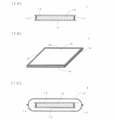
- FIG. 1 is a cross-sectional view (1A) when the moisture-proof self-adhesive silicone rubber sheet according to the first embodiment is cut in the thickness direction, and a perspective view of the moisture-proof self-adhesive silicone rubber sheet with the release sheet removed therefrom.
- disconnected in the thickness direction are each shown.
- FIG. 2 shows a cross-sectional view of the moistureproof self-adhesive silicone rubber sheet according to the second embodiment, as viewed in the same manner as the front view.
- FIG. 3 is a cross-sectional view (3A) of the moisture-proof self-adhesive silicone rubber sheet according to the third embodiment and the same view, a side view (3B) of the moisture-proof self-adhesive silicone rubber sheet, and a moisture-proof self-adhesive silicone rubber sheet
- FIG. 3C is a partially transparent side view (3C) of the state in which the is housed in a moisture-proof bag.
- FIG. 4 shows a cross-sectional view (4A) of a conventionally known self-adhesive silicone rubber sheet before use and a cross-sectional view (4B) of a release sheet peeled off from the self-adhesive silicone rubber sheet at the time of use.
- FIG. 1 is a cross-sectional view (1A) when the moisture-proof, self-adhesive silicone rubber sheet according to the first embodiment is cut in the thickness direction;
- FIG. 2 is a perspective view (1B) of the self-adhesive silicone rubber sheet enclosure according to the first embodiment and a cross-sectional view (1C) of the same in a thickness direction.
- the moisture-proof self-adhesive silicone rubber sheet 1 is provided with a non-cured self-adhesive silicone rubber sheet 10, a moisture permeation suppressing layer 14, and release sheets 12 and 12.
- the release sheet 12 is a sheet which covers at least one of the two wide sides of the self-adhesive silicone rubber sheet 10 and peels off when the self-adhesive silicone rubber sheet 10 is used.
- the moisture permeation suppressing layer 14 is formed on at least one side surface of the self-adhesive silicone rubber sheet 10 and is a layer that suppresses permeation of water inward from the side surface of the self-adhesive silicone rubber sheet 10.
- the self-adhesive silicone rubber sheet 10 with the moisture permeation suppressing layer 14 is sealed in a moisture-proof bag (hereinafter, also simply referred to as a "moisture-proof bag") 16 with the release sheets 12, 12 attached. There is.
- a moisture-proof bag for example, a polyethylene terephthalate film laminated with aluminum can be used.
- the self-adhesive silicone rubber sheet 10 is enclosed in the moisture-proof bag 16, so that high adhesion can be maintained even after long-term storage.
- the self-adhesive silicone rubber sheet 10 is taken out of the moisture-proof bag 16 and, even if left for a while, the entire peripheral surface of the self-adhesive silicone rubber sheet 10 is covered with the release sheets 12 and 12 and the moisture permeation restraining layer 14 Therefore, the moisture in the air hardly penetrates into the self-adhesive silicone rubber sheet 10 through the release sheets 12 and 12 and the moisture permeation suppressing layer 14. Therefore, the curing due to moisture permeation of the self-adhesive silicone rubber sheet 10 can be suppressed.
- the “self-adhesive silicone rubber” in this embodiment is a kind of solvent-free silicone-based adhesive and has high adhesion, heat stability, weather resistance, good water resistance, and excellent flexibility.
- the uncured (pre-cured) self-adhesive silicone rubber can maintain a freestanding shape and is deformable according to the pressure (being a solid with plasticity). For this reason, the self-adhesive silicone rubber sheet in the uncured state can be deformed according to the unevenness and the curved surface of the place to be disposed, and can be brought into close contact with the place to be disposed, and has high adhesive strength.
- the self-adhesive silicone rubber sheet 10 preferably has a Williams plasticity at 25 ° C. in the range of 50 to 500, more preferably in the range of 50 to 350, and in the range of 50 to 250 Even more preferred.
- Williams plasticity is measured according to the measuring method prescribed
- the self-adhesive silicone rubber is a condensation reaction type silicone rubber and is preferably cured by a simple means such as standing at ordinary temperature (reaction with water in the air).
- the self-adhesive silicone rubber sheet 10 shown in FIG. 1 (1A) is obtained by forming a condensation reaction type self-adhesive silicone rubber in an uncured state into a sheet.
- the sheet 10 may be a sheet in which an addition reaction self-adhesive silicone rubber is partially present in a condensation reaction self-adhesive silicone rubber.
- known release sheets such as paper, cloth, glass cloth, resin and the like without particular restrictions can be used.
- a film made of a resin such as polyethylene terephthalate, polypropylene, polyethylene, polystyrene or polyvinyl chloride can be used.
- the release sheets 12, 12 are preferably sized such that their ends protrude from the self-adhesive silicone rubber sheet 10. This is because when peeling the release sheets 12 12, the protruding portion is gripped so that the release sheets 12 can be easily peeled.
- Self-Adhesive Silicone Rubber Sheet a condensation reaction type self-adhesive silicone rubber that constitutes the self-adhesive silicone rubber sheet 10 that can be suitably used in this embodiment and the following embodiments will be described.
- Condensation reaction type self-adhesive silicone rubber is mainly composed of the following components.
- Organopolysiloxane This is a main component of condensation reaction type self-adhesive silicone rubber and is a diorganopolysiloxane represented by the following chemical formula (1) or chemical formula (2).
- R is a monovalent hydrocarbon group.
- an alkyl group methyl group, ethyl group, propyl group, butyl group, 2-ethylbutyl group, octyl group etc.
- cycloalkyl group cyclohexyl group, cyclopentyl group etc.
- alkenyl group vinyl group, propenyl group, Butenyl group, heptenyl group, hexenyl group, allyl group etc.
- aryl group phenyl group, tolyl group, xylyl group, naphthyl group, diphenyl group etc.
- aralkyl group benzyl group, phenylethyl group etc.
- It is selected from those in which at least a part of hydrogen atoms bonded to carbon atoms of hydrogen groups are substituted with halogen or cyano group etc.
- A is an oxygen atom or a polymethylene group (including a methylene group) represented by-(CH 2 ) m- (m is 1 to 8).
- A is preferably an oxygen atom or an ethylene group.
- n is an arbitrary number for making the kinematic viscosity at 25 ° C. of the component (a) within the range of 100 to 1,000,000 cm 2 / s.
- the kinematic viscosity is more preferably in the range of 500 to 500,000 cm 2 / s.
- B is a hydrolyzable group.
- alkoxy group methoxy group, ethoxy group, propoxy group, butoxy group etc.
- ketoxime group dimethyl ketoxime group, methyl ethyl ketoxime group etc.
- acyloxy group acetoxy group etc.
- alkenyloxy group isopropenyloxy group
- isobutenyloxy group etc. can be mentioned.
- x is 2 or 3.
- the component (a) can be produced by a known method (for example, a method by equilibrium reaction using a cyclic siloxane or linear oligomer and an acid catalyst or a base catalyst).
- a silane or siloxane containing at least one of an SiO 3/2 unit and an SiO 4/2 unit during polymerization is routinely used.
- a method may be used in which the diorganopolysiloxane is added so as not to gel.
- the component (a) is preferably used after removing the low molecular weight siloxane by washing or the like in order to reduce dirt.
- crosslinking agent a silane having two or more, preferably three or more, hydrolyzable groups in one molecule, or a partial hydrolytic condensate of the silane is used.
- hydrolyzable groups include alkoxy (such as methoxy, ethoxy and butoxy), ketoxime (such as dimethyl ketoxime and methyl ethyl ketoxime), acyloxy (such as acetoxy), and alkenyloxy (such as iso-butyl).
- Examples include propenyloxy group, isobutenyloxy group, etc., amino group (N-butylamino group, N, N-diethylamino group etc.), and amide group (N-methylacetamide group etc.).
- the compounding amount of the crosslinking agent is preferably in the range of 1 to 50 parts by mass, more preferably in the range of 2 to 30 parts by mass, and more preferably 5 to 20 parts by mass with respect to 100 parts by mass of the component (a). It is even more preferred to be in the range of parts.
- the curing catalyst is not essential, the curing of the self-adhesive silicone rubber can be promoted by using the curing catalyst.
- the curing catalyst include alkyl tin ester compounds (dibutyl tin diacetate, dibutyl tin dilaurate, dibutyl tin dioctoate, etc.), titanate esters or titanium chelate compounds (tetraisopropoxy titanium, tetra n-butoxy titanium, tetrakis (2- Ethylhexoxy) titanium, dipropoxybis (acetylacetona) titanium, titanium isopropoxy octylene glycol etc., and other suitable organometallic compounds (zinc naphthenate, zinc stearate, zinc 2-ethyl octoate, iron-2 -Ethyl hexoate, cobalt 2-ethyl hexoate, manganese 2-ethyl hex
- the compounding amount of the curing catalyst is preferably in the range of 0 to 20 parts by mass, more preferably in the range of 0.001 to 10 parts by mass, with respect to 100 parts by mass of the component (a). It is even more preferred to be in the range of 01-5 parts by weight.
- filler is not essential, it can be suitably used for the purpose of reinforcement and the like.
- fillers include reinforcing agents (fumed silica, precipitated silica, silica obtained by hydrophobizing the surface of these silicas with organic silicon compounds, quartz powder, talc, zeolite, bentonite, etc.), fibrous fillers ( Asbestos, glass fibers, organic fibers and the like), basic fillers (calcium carbonate, zinc carbonate, zinc oxide, magnesium oxide, celite and the like) can be mentioned.
- silica, calcium carbonate and zeolite it is preferable to use silica, calcium carbonate and zeolite, and it is more preferable to use fumed silica and calcium carbonate whose surfaces have been subjected to hydrophobic treatment.
- the blending amount of the above-mentioned filler can be selected according to the purpose and the kind of the filler, but it is in the range of 1 to 90% by volume with respect to the component (a) and in the range of 5 to 60% by volume Is preferred.
- adhesion-imparting component is not essential but is preferably used.
- adhesion imparting components include amino group-containing organoalkoxysilanes ( ⁇ -aminopropyltrimethoxysilane, ⁇ - (2-aminoethyl) aminopropyltrimethoxysilane, etc.), epoxy group-containing organoalkoxysilanes ( ⁇ -gly) Mention may be made of reaction mixtures of dihydroxy-containing trimethoxysilane, etc., mercapto-containing organoalkoxysilanes ( ⁇ -mercaptopropyltrimethoxysilane, etc.), amino-containing organoalkoxysilanes and epoxy-containing organoalkoxysilanes.
- the compounding amount of the adhesion imparting component is preferably in the range of 0.1 to 5 parts by mass with respect to 100 parts by mass of the component (a).
- the self-adhesive silicone rubber sheet 10 is mainly formed into a sheet by preparing the above-mentioned condensation reaction type self-adhesive silicone rubber.
- all side surfaces of the self-adhesive silicone rubber sheet 10 are provided with a moisture permeation suppressing layer 14 which suppresses the permeation of moisture in the air.
- the moisture permeation suppressing layer 14 is preferably mainly formed of a tacky adhesive.
- known pressure-sensitive adhesives for example, various pressure-sensitive adhesives such as acrylic pressure-sensitive adhesives, urethane-based and silicone-based can be used.
- the moisture permeation suppressing layer 14 is a layer having low moisture permeability or that does not easily cure even if moisture permeation is performed.
- the moisture permeation suppressing layer 14 is preferably made of a material that has high affinity with the self-adhesive silicone rubber sheet 10 and does not easily separate from the sheet 10 and that is integrated.
- the moisture permeation suppressing layer 14 is more preferably a silicone-based adhesive layer mainly composed of a silicone-based adhesive.
- the moisture permeation suppressing layer 14 (urethane adhesive layer) made of a urethane adhesive can be used because it is superior to the silicone adhesive layer in suppressing moisture permeation.
- the self-adhesive silicone rubber sheet 10 may be provided with a moisture permeation suppressing layer 14 mainly composed of a rubber-based pressure-sensitive adhesive.
- a rubber-based pressure-sensitive adhesive or a silicone-based pressure-sensitive adhesive is preferable because the formed moisture permeation suppressing layer 14 can follow the plastic deformation of the uncured self-adhesive silicone rubber sheet 10.
- rubber-based pressure-sensitive adhesives include rubber (natural rubber, styrene butadiene rubber, isoprene rubber, chloroprene rubber, butyl rubber, acrylonitrile rubber, acrylic rubber, etc.), styrene butadiene copolymer, styrene isoprene block copolymer, styrene Ethylene / propylene copolymers, styrene-based block copolymers (styrene / isoprene / ethylene / propylene copolymers, etc.), and any one or a mixture of these hydrogenated products can be mentioned.
- Rubber-based adhesives include tackifying resins (rosin, rosin derivatives, polyterpene resins, phenol resins, petroleum hydrocarbon resins, etc.), softeners (polybutene, liquid paraffin, naphthenic oils, aromatic oils, etc.), Antioxidants (amine-based, phenol-based, phosphorus-based antioxidants, etc.) and fillers (calcium carbonate, silica, clay, talc, titanium oxide, magnesium oxide, etc.) can be added.
- tackifying resins rosin, rosin derivatives, polyterpene resins, phenol resins, petroleum hydrocarbon resins, etc.
- softeners polybutene, liquid paraffin, naphthenic oils, aromatic oils, etc.
- Antioxidants amine-based, phenol-based, phosphorus-based antioxidants, etc.
- fillers calcium carbonate, silica, clay, talc, titanium oxide, magnesium oxide, etc.
- examples of the silicone-based pressure-sensitive adhesive include those containing a silicone rubber containing an addition type organopolysiloxane having a siloxane bond as a main skeleton and an alkenyl group as a component.
- this alkenyl group include allyl group, propenyl group, butenyl group, pentenyl group, hexenyl group, heptenyl group, octenyl group and the like.
- it may have an organic group having no addition reactivity.
- examples of such organic groups include alkyl groups such as methyl, ethyl and propyl, and aryl groups such as phenyl.
- the degree of polymerization of the organopolysiloxane contained in the silicone rubber is not particularly limited, but it is preferably 500 to 10,000, and more preferably 2,000 to 8,000.
- the platinum catalyst has a function of initiating the above addition reaction of the alkenyl group and a function of promoting the addition reaction.
- platinum catalysts include platinum black, platinum chloride, chloroplatinic acid, reaction products of chloroplatinic acid and monohydric alcohol, complexes of chloroplatinic acid and olefins, platinum bisacetoacetate, etc. .
- the content of the platinum catalyst in the silicone-based pressure-sensitive adhesive is preferably 0.01 to 3 parts by mass per 100 parts by mass of the silicone rubber. The function of a platinum catalyst is stably exhibited by setting it as this range.
- the content of the platinum catalyst in the silicone-based pressure-sensitive adhesive is more preferably 0.05 to 2.00 parts by mass per 100 parts by mass of silicone rubber, and 0 It is particularly preferable that it is 10 to 1.00 parts by mass.
- the silicone-based pressure-sensitive adhesive preferably contains a silicone resin, that is, a branched organopolysiloxane in the molecule.
- a silicone resin that is, a branched organopolysiloxane in the molecule.
- the bonding strength to the self-adhesive silicone rubber sheet 10 can be enhanced.
- the silicone resin is contained in the silicone-based pressure-sensitive adhesive, the content of the silicone resin is 10 to 100 parts by mass per 100 parts by mass of silicone rubber from the viewpoint of appropriately setting the degree of the bonding strength. Is preferable, 15 to 75 parts by mass is more preferable, and 20 to 50 parts by mass is even more preferable.
- the silicone-based pressure-sensitive adhesive can contain various components as long as the function of suppressing water permeation can be exhibited.
- crosslinking agents having hydrosilyl group coloring materials such as crosslinking accelerators, dyes and pigments, antioxidants such as anilides and phenols, UV absorbers such as benzophenones and benzotriazoles, talc, titanium dioxide, silica -Filler components such as starch, plasticizers, antioxidants, light stabilizers, dispersants, leveling agents and the like can be mentioned.
- a condensation reaction type self-adhesive silicone rubber is molded to prepare a prismatic body, an adhesive is applied on all the side surfaces thereof to form the moisture permeation suppressing layer 14, and then the prismatic body is sliced to obtain a predetermined thickness. A sheet is formed, and then both upper and lower surfaces of the sheet are covered with release sheets 12. Also by such a method, the self-adhesive silicone rubber sheet 10 with the release sheets 12, 12 can be obtained.
- the release sheets 12, 12 are attached to both upper and lower surfaces thereof. good.
- a method of applying an adhesive to both end portions using a high viscosity dispenser such as a caulking gun may be employed. Thereafter, the release sheets 12, 12 can be attached by the method described above.
- the self-adhesive silicone rubber sheet 10 is covered on both upper and lower sides (two wide sides) with the release sheets 12 and 12 and the moisture permeation suppressing layer 14 is provided on all sides, moisture in the air is absorbed. Entry into the self-adhesive silicone rubber sheet 10 can be suppressed. Even when the self-adhesive silicone rubber sheet 10 is taken out of the moisture-proof bag 16 and exposed to the atmosphere at the time of use, the moisture permeation from the side can be suppressed by the presence of the moisture permeation suppressing layer 14, so even if it is left for a long time, As long as the release sheets 12, 12 are not removed, there is no problem in use.
- FIG. 2 shows a cross-sectional view of the moistureproof self-adhesive silicone rubber sheet according to the second embodiment, as viewed in the same manner as the front view.
- the release sheet 12 is easily releasable from the self-adhesive silicone rubber sheet 10.
- the substrate 18 can not be easily peeled off from the self-adhesive silicone rubber sheet 10.
- the substrate 18 can be formed of, for example, paper, cloth, resin, glass cloth or the like.
- the base 18 may be decorated in advance. All side surfaces of the self-adhesive silicone rubber sheet 10 are provided with a moisture permeation suppressing layer 14 as in the first embodiment.
- the moisture permeation suppressing layer 14 provided on the side surface of the self-adhesive silicone rubber sheet 10 has a function of suppressing the permeation of water from the side direction of the sheet 10, and therefore contributes to maintaining the adhesive ability of the sheet 10 high.
- FIG. 3 is a cross-sectional view (3A) of the moisture-proof self-adhesive silicone rubber sheet according to the third embodiment and the same view, a side view (3B) of the moisture-proof self-adhesive silicone rubber sheet, and a moisture-proof self-adhesive silicone rubber sheet
- FIG. 3C is a partially transparent side view (3C) of the state in which the is housed in a moisture-proof bag.
- the moisture-proof self-adhesive silicone rubber sheet 1b includes a long self-adhesive silicone rubber sheet 10 in an uncured state.
- the self-adhesive silicone rubber sheet 10 is provided with the release sheet 12 only on one wide surface, and is wound with the wide surface not having the release sheet 12 inside.
- FIG. 3 (3 A) although it looks as if the release sheets 12 and 12 are provided on the upper and lower wide surfaces of the long self-adhesive silicone rubber sheet 10, the lower release sheet 12 is self overlapping in the vertical direction. It is a release sheet 12 of the adhesive silicone rubber sheet 10 itself.
- the release sheet 12 is a sheet having substantially the same width as the width direction of the self-adhesive silicone rubber sheet 10.
- the release sheet 12 may be one that does not protrude from the side surface of the self-adhesive silicone rubber sheet 10.
- the self-adhesive silicone rubber sheet 10 is in the form of a band, and is provided with the moisture permeation suppressing layers 14 and 14 on both side surfaces in the width direction.
- the self-adhesive silicone rubber sheet 10 provided with the moisture permeation suppressing layers 14 and 14 is spirally wound around the cylindrical core portion 20, as shown in FIG. 3 (3B).
- the cylindrical core portion 20 may be omitted. Even in the spirally wound self-adhesive silicone rubber sheet 10, there is a risk that the side surface is always exposed to air.
- the moisture permeation suppressing layer 14 on the side surface it is possible to suppress the entry of moisture into the self-adhesive silicone rubber sheet 10 from the side surface.
- the moisture permeation suppressing layer 14 is provided on all sides or both sides in the width direction of the self-adhesive silicone rubber sheet 10, the side of a part of the whole sides or both sides in the width It may be provided only on one side of the In such a case, it is preferable that the surface not provided with the moisture permeation suppressing layer 14 be in a state where it is difficult to contact moisture in the air by some means represented by the peeling sheet 12 rather than an exposed state. .
- the components in the various embodiments described above can be arbitrarily combined unless they can be combined with one another.
- the base 18 used in the second embodiment may be provided in the moisture-proof self-adhesive silicone rubber sheet 1b according to the third embodiment.
- the present invention can be used, for example, in place of a liquid adhesive.
Landscapes
- Chemical & Material Sciences (AREA)
- Organic Chemistry (AREA)
- Chemical Kinetics & Catalysis (AREA)
- Laminated Bodies (AREA)
- Adhesive Tapes (AREA)
- Adhesives Or Adhesive Processes (AREA)
Abstract
【課題】 自己接着シリコーンゴムシートの貼付作業の煩雑さを増加させることなく、防湿性の袋から取り出した状態でも透湿を抑制可能な自己接着シリコーンゴムシートおよびそれを封入した自己接着シリコーンゴムシート封入体を提供する。 【解決手段】 本発明は、未硬化状態の自己接着シリコーンゴムシート10と、自己接着シリコーンゴムシート10の2つの幅広面の内の少なくとも1つの幅広面を被覆して、自己接着シリコーンゴムシート10の使用時に剥離する剥離シート12と、自己接着シリコーンゴムシート10の少なくとも1つの側面に形成されており自己接着シリコーンゴムシート10の側面から内方への水分の透過を抑制する透湿抑制層14と、を備える防湿性自己接着シリコーンゴムシート1、および当該シート1を防湿性の袋16に封入した状態の自己接着シリコーンゴムシート封入体3に関する。
Description
本出願は、2017年8月31日に日本国において出願された特願2017-167015に基づき優先権を主張し、当該出願に記載された内容は、本明細書に援用する。また、本願において引用した特許、特許出願及び文献に記載された内容は、本明細書に援用する。
本発明は、防湿構造を有する防湿性自己接着シリコーンゴムシートおよびそれを封入した自己接着シリコーンゴムシート封入体に関するものである。
従来から、建造物の外壁等の装飾や保護を目的として外壁等にタイルや石材が貼られている。タイルや石材を外壁等に貼る際に、シリコーン系接着剤を用いる方法が既に知られている(例えば、特許文献1を参照)。また、液状の接着剤に代えて使用可能な半固形のシート状の自己接着シリコーンゴムシートも知られている。
図4は、従来から公知の自己接着シリコーンゴムシートの使用前の状態の断面図(4A)および使用時に自己接着シリコーンゴムシートから剥離シートを剥がす状態の断面図(4B)をそれぞれ示す。図4(4A)に示すように、使用前の自己接着シリコーンゴムシート10は、空気中の水分と反応して硬化しないように、その上下面を剥離シート12,12にて被覆した状態で、かつ防湿性の袋16内に封入されている。自己接着シリコーンゴムシート10を使用する際には、防湿性の袋16を開封して、その中から自己接着シリコーンゴムシート10を取り出し、図4(4B)に示すように、自己接着シリコーンゴムシート10の両面に被覆されている剥離シート12,12を剥離し、外壁等の目的場所に自己接着シリコーンゴムシート10の一面側を貼着し、もう一面側にタイルや石材を貼り付ける。
しかし、上記従来から公知の自己接着シリコーンゴムシート10には、改善すべき課題を有する。自己接着シリコーンゴムシート10を建造物の所定場所に貼り付ける際に、貼付作業の効率化を図るべく、自己接着シリコーンゴムシート10を防湿性の袋16から取り出しておき、しばらくしてから貼付作業を開始する場合が少なくない。かかる場合、防湿性の袋16から取り出された自己接着シリコーンゴムシート10は、長時間、放置される場合もある。放置された自己接着シリコーンゴムシート10は、剥離シート12,12で被覆された上下面からの透湿を抑制できるものの、自己接着シリコーンゴムシート10の側面から透湿し、徐々に内部に向かって透湿することによって、自己接着シリコーンゴムシート10の接着能が劣化するおそれがある。その問題を防止するために、自己接着シリコーンゴムシート10を使用直前まで防湿性の袋16の中に密封しておくこともできるが、作業効率が低下する。さらに、自己接着シリコーンゴムシート10の両側面にも剥離シートを貼り付けておく方法も考えられるが、剥離シートの枚数の増加と幅狭の剥離シートの存在とにより、貼付作業が煩わしさに堪えない状況になる。
そこで、本発明は、前記課題を解決すること、すなわち、自己接着シリコーンゴムシートの貼付作業の煩雑さを増加させることなく、防湿性の袋から取り出した状態でも透湿を抑制可能な自己接着シリコーンゴムシートおよびそれを封入した自己接着シリコーンゴムシート封入体を提供することを目的とする。
(1)前記目的を達成するための一実施形態に係る防湿性自己接着シリコーンゴムシートは、未硬化状態の自己接着シリコーンゴムシートと、自己接着シリコーンゴムシートの2つの幅広面の内の少なくとも1つの幅広面を被覆して自己接着シリコーンゴムシートの使用時に剥離する剥離シートと、自己接着シリコーンゴムシートの少なくとも1つの側面に形成されており自己接着シリコーンゴムシートの側面から内方への水分の透過を抑制する透湿抑制層と、を備える。
(2)別の実施形態に係る防湿性自己接着シリコーンゴムシートでは、さらに、透湿抑制層は、シリコーン系粘着層であるのが好ましい。
(3)別の実施形態に係る防湿性自己接着シリコーンゴムシートでは、また、自己接着シリコーンゴムシートは、その片側の幅広面のみに剥離シートを備えた長尺状のシートであって、剥離シートを備えていない幅広面を内側にして巻かれているのが好ましい。
(4)また、一実施形態に係る自己接着シリコーンゴムシート封入体は、上述のいずれかの防湿性自己接着シリコーンゴムシートを、防湿性の袋に封入した状態のものである。
本発明によれば、自己接着シリコーンゴムシートの貼付作業の煩雑さを増加させることなく、防湿性の袋から取り出した状態でも透湿を抑制可能となる。
1,1a,1b 防湿性自己接着シリコーンゴムシート
3,30 自己接着シリコーンゴムシート封入体
10 未硬化状態の自己接着シリコーンゴムシート
12 剥離シート
14 透湿抑制層(一例として、シリコーン系粘着層)
16 防湿袋(防湿性の袋)
3,30 自己接着シリコーンゴムシート封入体
10 未硬化状態の自己接着シリコーンゴムシート
12 剥離シート
14 透湿抑制層(一例として、シリコーン系粘着層)
16 防湿袋(防湿性の袋)
以下、本発明の防湿性自己接着シリコーンゴムシートおよび自己接着シリコーンゴムシート封入体の各実施形態について図面を参照して説明する。なお、以下に説明する各実施形態は、特許請求の範囲に係る発明を限定するものではない。また、各実施形態の中で説明されている諸要素およびその組み合わせの全てが本発明の解決手段に必須であるとは限らない。
(第1実施形態)
1.概略構造
図1は、第1実施形態に係る防湿性自己接着シリコーンゴムシートをその厚さ方向に切断したときの断面図(1A)、当該防湿性自己接着シリコーンゴムシートから剥離シートを除去した状態の斜視図(1B)及び第1実施形態に係る自己接着シリコーンゴムシート封入体をその厚さ方向に切断したときの断面図(1C)である。
1.概略構造
図1は、第1実施形態に係る防湿性自己接着シリコーンゴムシートをその厚さ方向に切断したときの断面図(1A)、当該防湿性自己接着シリコーンゴムシートから剥離シートを除去した状態の斜視図(1B)及び第1実施形態に係る自己接着シリコーンゴムシート封入体をその厚さ方向に切断したときの断面図(1C)である。
防湿性自己接着シリコーンゴムシート1は、未硬化状態の自己接着シリコーンゴムシート10と、透湿抑制層14と、剥離シート12,12とを備える。剥離シート12,12は、自己接着シリコーンゴムシート10の2つの幅広面の内の少なくとも1つの幅広面を被覆して、自己接着シリコーンゴムシート10の使用時に剥離するシートである。透湿抑制層14は、自己接着シリコーンゴムシート10の少なくとも1つの側面に形成されており、自己接着シリコーンゴムシート10の側面から内方への水分の透過を抑制する層である。また、透湿抑制層14付きの自己接着シリコーンゴムシート10は、剥離シート12,12を貼り付けた状態にて防湿性の袋(以後、単に「防湿袋」ともいう。)16に封入されている。この状態のものを、自己接着シリコーンゴムシート封入体3と称する。防湿袋16には、例えば、アルミニウムがラミネートされたポリエチレンテレフタレートフィルム等を用いることができる。使用前には、自己接着シリコーンゴムシート10は、防湿袋16に封入されているので、長期間保存後でも接着能を高く維持できる。また、使用時に、防湿袋16から自己接着シリコーンゴムシート10を取り出し、しばらく放置しても、自己接着シリコーンゴムシート10の全周面が剥離シート12,12及び透湿抑制層14で被覆されているので、空気中の水分は剥離シート12,12及び透湿抑制層14を透過して自己接着シリコーンゴムシート10内には進入しにくい。したがって、自己接着シリコーンゴムシート10の透湿による硬化を抑制できる。
この実施形態における「自己接着シリコーンゴム」は、無溶剤のシリコーン系接着剤の一種であり、高い接着力とともに、熱安定性、耐候性、良好な耐水性、優れた可撓性を有する。未硬化状態(硬化前)の自己接着シリコーンゴムは、自立した形状を保持でき、かつ、押圧力に従って変形可能である(可塑性を有する固体状である)。このため、未硬化状態の自己接着シリコーンゴムシートは、配置する場所の凹凸や曲面に応じて変形させ、配置する場所に密着させることが可能であり、高い接着力を有する。
自己接着シリコーンゴムシート10は、25℃におけるウイリアムス可塑度が50~500の範囲内にあることが好ましく、50~350の範囲内にあることがより好ましく、50~250の範囲内にあることがさらにより好ましい。なお、ウイリアムス可塑度は、平行板可塑度計(ウイリアムスプラストメーター)を使用し、JIS K 6249「未硬化および硬化シリコーンゴムの試験方法」に規定の測定方法に準じて測定されるものである。自己接着シリコーンゴムは、縮合反応型のシリコーンゴムであり、好ましくは常温での放置(空気中の水分との反応)という手軽な手段により硬化する。
図1(1A)に示す自己接着シリコーンゴムシート10は、未硬化状態の縮合反応型の自己接着シリコーンゴムをシート状に成形したものである。ただし、当該シート10を、縮合反応型の自己接着シリコーンゴムに付加反応型の自己接着シリコーンゴムを部分的に存在せしめたシートとしても良い。自己接着シリコーンゴムシート10の上下面を被覆する剥離シート12,12には、紙、布、ガラスクロス、樹脂等の特に制約のない公知の剥離シートを使用できるが、好ましくは、樹脂、とりわけ、ポリエチレンテレフタレート、ポリプロピレン、ポリエチレン、ポリスチレン、ポリ塩化ビニル等の樹脂からなるフィルムを用いることができる。剥離シート12,12は、好ましくは、その端部を自己接着シリコーンゴムシート10からはみ出すような大きさである。これは、剥離シート12,12を剥離する際に、当該はみ出している部分を把持して、剥離シート12,12を簡単に剥離できるようにするためである。
2.自己接着シリコーンゴムシート
以下、この実施形態および以後の実施形態にて好適に使用可能な自己接着シリコーンゴムシート10を構成する縮合反応型の自己接着シリコーンゴムについて説明する。
以下、この実施形態および以後の実施形態にて好適に使用可能な自己接着シリコーンゴムシート10を構成する縮合反応型の自己接着シリコーンゴムについて説明する。
縮合反応型の自己接着シリコーンゴム
縮合反応型の自己接着シリコーンゴムは、主に以下の成分から構成される。
縮合反応型の自己接着シリコーンゴムは、主に以下の成分から構成される。
(a)オルガノポリシロキサン
縮合反応型の自己接着シリコーンゴムの主剤成分であり、下記の化学式(1)または化学式(2)により表されるジオルガノポリシロキサンである。
縮合反応型の自己接着シリコーンゴムの主剤成分であり、下記の化学式(1)または化学式(2)により表されるジオルガノポリシロキサンである。

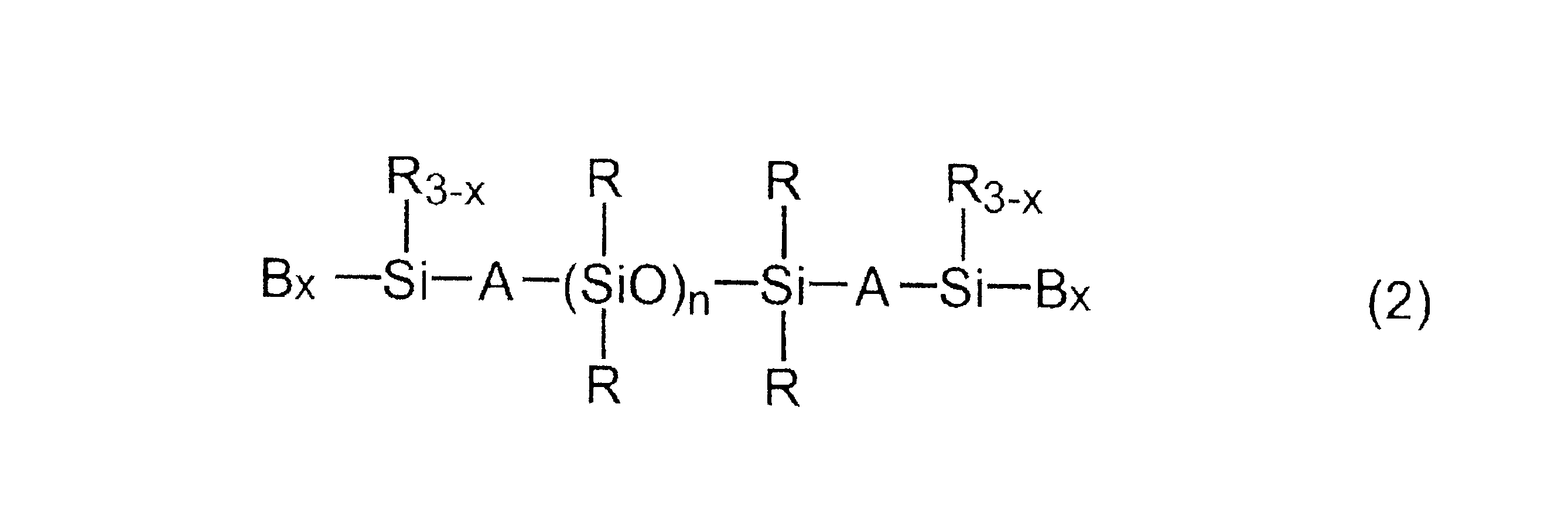
上記の化学式(1),(2)において、Rは一価の炭化水素基である。Rとしては、アルキル基(メチル基、エチル基、プロピル基、ブチル基、2-エチルブチル基、オクチル基等)、シクロアルキル基(シクロヘキシル基、シクロペンチル基等)、アルケニル基(ビニル基、プロペニル基、ブテニル基、ヘプテニル基、ヘキセニル基、アリル基等)、アリール基(フェニル基、トリル基、キシリル基、ナフチル基、ジフェニル基等)、アラルキル基(ベンジル基、フェニルエチル基等)、および、上記炭化水素基の炭素原子に結合している水素原子の少なくとも一部をハロゲンやシアノ基等で置換したもの(クロロメチル基、トリフルオロプロピル基、2-シアノエチル基、3-シアノプロピル基等)から選択される一または複数の炭化水素基を挙げることができる。Rの炭素数としては、1~12であることが好ましく、1~10であることが一層好ましい。上記の化学式(1),(2)においては、Aは酸素原子または-(CH2)m-(mは1~8)で表されるポリメチレン基(メチレン基を含む)である。Aは、酸素原子またはエチレン基であることが好ましい。
上記の化学式(1),(2)において、nは(a)成分の25℃における動粘度を100~1000000cm2/sの範囲内とする任意の数である。当該動粘度は、500~500000cm2/sの範囲内とすることが一層好ましい。
上記の化学式(1),(2)において、Bは加水分解性基である。Bとしては、アルコキシ基(メトキシ基、エトキシ基、プロポキシ基、ブトキシ基等)、ケトオキシム基(ジメチルケトオキシム基、メチルエチルケトオキシム基等)、アシルオキシ基(アセトキシ基等)、アルケニルオキシ基(イソプロペニルオキシ基、イソブテニルオキシ基等)を挙げることができる。なお、上記の化学式(1),(2)におけるxは2または3である。
上記(a)成分は、公知の方法(例えば、環状シロキサンまたは線状オリゴマーと酸触媒または塩基触媒とを用いた平衡反応による方法)により製造することができる。
なお、(a)成分であるジオルガノポリシロキサンに分岐構造を導入する場合には、常法として、重合中にSiO3/2単位およびSiO4/2単位のうち少なくとも一方を含むシランまたはシロキサンをジオルガノポリシロキサンがゲル化しない程度に添加する方法を用いることができる。(a)成分については、汚れを低減するため、洗浄等により低分子シロキサンを除去してから用いることが好ましい。
(b)架橋剤
架橋剤としては、加水分解性基を1分子中に2個以上、好ましくは3個以上有するシラン、または、当該シランの部分加水分解縮合物を用いる。加水分解性基の例としては、アルコキシ基(メトキシ基、エトキシ基、ブトキシ基等)、ケトオキシム基(ジメチルケトオキシム基、メチルエチルケトオキシム基等)、アシルオキシ基(アセトキシ基等)、アルケニルオキシ基(イソプロペニルオキシ基、イソブテニルオキシ基等)、アミノ基(N-ブチルアミノ基、N,N-ジエチルアミノ基等)、アミド基(N-メチルアセトアミド基等)を挙げることができる。これらの中では、アルコキシ基、ケトオキシム基、アシルオキシ基、アルケニルオキシ基を用いることが好ましい。架橋剤の配合量は、(a)成分100質量部に対して1~50質量部の範囲内にあることが好ましく、2~30質量部の範囲内にあることが一層好ましく、5~20質量部の範囲内にあることがより一層好ましい。
架橋剤としては、加水分解性基を1分子中に2個以上、好ましくは3個以上有するシラン、または、当該シランの部分加水分解縮合物を用いる。加水分解性基の例としては、アルコキシ基(メトキシ基、エトキシ基、ブトキシ基等)、ケトオキシム基(ジメチルケトオキシム基、メチルエチルケトオキシム基等)、アシルオキシ基(アセトキシ基等)、アルケニルオキシ基(イソプロペニルオキシ基、イソブテニルオキシ基等)、アミノ基(N-ブチルアミノ基、N,N-ジエチルアミノ基等)、アミド基(N-メチルアセトアミド基等)を挙げることができる。これらの中では、アルコキシ基、ケトオキシム基、アシルオキシ基、アルケニルオキシ基を用いることが好ましい。架橋剤の配合量は、(a)成分100質量部に対して1~50質量部の範囲内にあることが好ましく、2~30質量部の範囲内にあることが一層好ましく、5~20質量部の範囲内にあることがより一層好ましい。
(c)硬化触媒
硬化触媒は必須ではないが、硬化触媒を用いることにより、自己接着シリコーンゴムの硬化を促進することができる。硬化触媒の例としては、アルキル錫エステル化合物(ジブチル錫ジアセテート、ジブチル錫ジラウレート、ジブチル錫ジオクトエート等)、チタン酸エステルまたはチタンキレート化合物(テトライソプロポキシチタン、テトラn-ブトキシチタン、テトラキス(2-エチルヘキソキシ)チタン、ジプロポキシビス(アセチルアセトナ)チタン、チタニウムイソプロポキシオクチレングリコール等)、その他の適切な有機金属化合物(ナフテン酸亜鉛、ステアリン酸亜鉛、亜鉛-2-エチルオクトエート、鉄-2-エチルヘキソエート、コバルト-2-エチルヘキソエート、マンガン-2-エチルヘキソエート、ナフテン酸コバルト、アルコキシアルミニウム化合物等)、アミノアルキル基置換アルコキシシラン(3-アミノプロピルトリエトキシシラン、N-β(アミノエチル)γ-アミノプロピルトリメトキシシラン等)、アミン化合物またはその塩(ヘキシルアミン、リン酸ドデシルアミン等)、第4級アンモニウム塩(ベンジルトリエチルアンモニウムアセテート等)、アルカリ金属の低級脂肪酸塩(酢酸カリウム、酢酸ナトリウム、シュウ酸リチウム等)、のアルカリ金属の低級脂肪酸塩、ジアルキルヒドロキシルアミン(ジメチルヒドロキシルアミン、ジエチルヒドロキシルアミン等)、グアニジル基を有するシランまたはシロキサン(テトラメチルグアニジルプロピルトリメトキシシラン、テトラメチルグアニジルプロピルメチルジメトキシシラン、テトラメチルグアニジルプロピルトリス(トリメチルシロキシ)シラン等)を挙げることができる。これらは、1種のみで用いてもよいし、2種以上の混合物として用いてもよい。硬化触媒の配合量は、(a)成分100質量部に対して0~20質量部の範囲内にあることが好ましく、0.001~10質量部の範囲内にあることが一層好ましく、0.01~5質量部の範囲内にあることがより一層好ましい。
硬化触媒は必須ではないが、硬化触媒を用いることにより、自己接着シリコーンゴムの硬化を促進することができる。硬化触媒の例としては、アルキル錫エステル化合物(ジブチル錫ジアセテート、ジブチル錫ジラウレート、ジブチル錫ジオクトエート等)、チタン酸エステルまたはチタンキレート化合物(テトライソプロポキシチタン、テトラn-ブトキシチタン、テトラキス(2-エチルヘキソキシ)チタン、ジプロポキシビス(アセチルアセトナ)チタン、チタニウムイソプロポキシオクチレングリコール等)、その他の適切な有機金属化合物(ナフテン酸亜鉛、ステアリン酸亜鉛、亜鉛-2-エチルオクトエート、鉄-2-エチルヘキソエート、コバルト-2-エチルヘキソエート、マンガン-2-エチルヘキソエート、ナフテン酸コバルト、アルコキシアルミニウム化合物等)、アミノアルキル基置換アルコキシシラン(3-アミノプロピルトリエトキシシラン、N-β(アミノエチル)γ-アミノプロピルトリメトキシシラン等)、アミン化合物またはその塩(ヘキシルアミン、リン酸ドデシルアミン等)、第4級アンモニウム塩(ベンジルトリエチルアンモニウムアセテート等)、アルカリ金属の低級脂肪酸塩(酢酸カリウム、酢酸ナトリウム、シュウ酸リチウム等)、のアルカリ金属の低級脂肪酸塩、ジアルキルヒドロキシルアミン(ジメチルヒドロキシルアミン、ジエチルヒドロキシルアミン等)、グアニジル基を有するシランまたはシロキサン(テトラメチルグアニジルプロピルトリメトキシシラン、テトラメチルグアニジルプロピルメチルジメトキシシラン、テトラメチルグアニジルプロピルトリス(トリメチルシロキシ)シラン等)を挙げることができる。これらは、1種のみで用いてもよいし、2種以上の混合物として用いてもよい。硬化触媒の配合量は、(a)成分100質量部に対して0~20質量部の範囲内にあることが好ましく、0.001~10質量部の範囲内にあることが一層好ましく、0.01~5質量部の範囲内にあることがより一層好ましい。
(d)充填剤
充填剤は、必須ではないが、補強等の目的で好適に用いることができる。充填剤の例としては、補強剤(ヒュームドシリカ、沈降性シリカ、これらのシリカの表面を有機珪素化合物で疎水化処理したシリカ、石英粉末、タルク、ゼオライト、ベントナイト等)、繊維質充填剤(アスベスト、ガラス繊維、有機繊維等)、塩基性充填剤(炭酸カルシウム、炭酸亜鉛、酸化亜鉛、酸化マグネシウム、セライト等)を挙げることができる。これらの中では、シリカ、炭酸カルシウムおよびゼオライトを用いることが好ましく、表面を疎水化処理したヒュームドシリカおよび炭酸カルシウムを用いることが一層好ましい。上記充填剤の配合量は、目的や充填剤の種類により選択することができるが、(a)成分に対して1~90体積%の範囲内にあり、5~60体積%の範囲内にあることが好ましい。
充填剤は、必須ではないが、補強等の目的で好適に用いることができる。充填剤の例としては、補強剤(ヒュームドシリカ、沈降性シリカ、これらのシリカの表面を有機珪素化合物で疎水化処理したシリカ、石英粉末、タルク、ゼオライト、ベントナイト等)、繊維質充填剤(アスベスト、ガラス繊維、有機繊維等)、塩基性充填剤(炭酸カルシウム、炭酸亜鉛、酸化亜鉛、酸化マグネシウム、セライト等)を挙げることができる。これらの中では、シリカ、炭酸カルシウムおよびゼオライトを用いることが好ましく、表面を疎水化処理したヒュームドシリカおよび炭酸カルシウムを用いることが一層好ましい。上記充填剤の配合量は、目的や充填剤の種類により選択することができるが、(a)成分に対して1~90体積%の範囲内にあり、5~60体積%の範囲内にあることが好ましい。
(e)接着性付与成分
接着性付与成分は必須ではないが好適に用いられる。接着性付与成分の例としては、アミノ基含有オルガノアルコキシシラン(γ-アミノプロピルトリメトキシシラン、γ-(2-アミノエチル)アミノプロピルトリメトキシシラン等)、エポキシ基含有オルガノアルコキシシラン(γ-グリシドキシプロピルトリメトキシシラン等)、メルカプト含有オルガノアルコキシシラン(γ-メルカプトプロピルトリメトキシシラン等)、アミノ基含有オルガノアルコキシシランとエポキシ基含有オルガノアルコキシシランとの反応混合物を挙げることができる。接着性付与成分の配合量は、(a)成分100質量部に対して0.1~5質量部の範囲内にあることが好ましい。
接着性付与成分は必須ではないが好適に用いられる。接着性付与成分の例としては、アミノ基含有オルガノアルコキシシラン(γ-アミノプロピルトリメトキシシラン、γ-(2-アミノエチル)アミノプロピルトリメトキシシラン等)、エポキシ基含有オルガノアルコキシシラン(γ-グリシドキシプロピルトリメトキシシラン等)、メルカプト含有オルガノアルコキシシラン(γ-メルカプトプロピルトリメトキシシラン等)、アミノ基含有オルガノアルコキシシランとエポキシ基含有オルガノアルコキシシランとの反応混合物を挙げることができる。接着性付与成分の配合量は、(a)成分100質量部に対して0.1~5質量部の範囲内にあることが好ましい。
自己接着シリコーンゴムシート10は、主として、上記の縮合反応型の自己接着シリコーンゴムを調製し、シート状に形成したものである。
3.透湿抑制層
次に、自己接着シリコーンゴムシート10の側面に備える透湿抑制層14について説明する。
次に、自己接着シリコーンゴムシート10の側面に備える透湿抑制層14について説明する。
図1(1B)に示すように、この実施形態では、自己接着シリコーンゴムシート10の全側面は、空気中の水分の透過を抑制する透湿抑制層14を備える。透湿抑制層14は、好ましくは、粘着性を有する粘着剤から主として形成されている。粘着剤としては、公知の粘着剤、例えば、アクリル系粘着剤、ウレタン系、シリコーン系の各種粘着剤を用いることができる。透湿抑制層14は、先に説明した自己接着シリコーンゴム10と異なり、透湿性が低いか、若しくは透湿しても容易に硬化しない層である。透湿抑制層14は、自己接着シリコーンゴムシート10との親和性が高く、当該シート10から容易に分離せずに、一体的になる材料から成るのが好ましい。この点では、透湿抑制層14を、シリコーン系粘着剤から主として構成されるシリコーン系粘着層とするのがより好ましい。一方、ウレタン系粘着剤から成る透湿抑制層14(ウレタン系粘着層)は、透湿を抑制する点で上記シリコーン系粘着層に勝るので使用可能である。また、ゴム系粘着剤から主に構成される透湿抑制層14を自己接着シリコーンゴムシート10に備えても良い。
ゴム系粘着剤やシリコーン系粘着剤は、形成した透湿抑制層14が未硬化の自己接着シリコーンゴムシート10の塑性変形に追随できるので好ましい。ゴム系粘着剤としては、例えばゴム(天然ゴム、スチレン・ブタジエンゴム、イソプレンゴム、クロロプレンゴム、ブチルゴム、アクリロニトリルゴム、アクリルゴム等)、スチレン・ブタジエン共重合体、スチレン・イソプレンブロック共重合体、スチレン・エチレン・プロピレン共重合体、スチレン系ブロック共重合体(スチレン・イソプレン・エチレン・プロピレン共重合体等)、及びこれらの水添物のいずれか又は混合物を挙げることができる。ゴム系粘着剤中には、粘着付与樹脂(ロジン、ロジン誘導体、ポリテルペン樹脂、フェノール樹脂、石油系炭化水素樹脂等)、軟化剤(ポリブテン、流動パラフィン、ナフテン系オイル、芳香族系オイル等)、酸化防止剤(アミン系、フェノール系、リン系の酸化防止剤等)、充填材(炭酸カルシウム、シリカ、クレー、タルク、酸化チタン、酸化マグネシウム等)を添加することができる。
また、シリコーン系粘着剤には、例えば、シロキサン結合を主骨格としアルケニル基を有する付加型のオルガノポリシロキサンを構成成分として含むシリコーンゴムを含有するものを挙げることができる。このアルケニル基の具体例として、アリル基、プロペニル基、ブテニル基、ペンテニル基、ヘキセニル基、ヘプテニル基、オクテニル基等が挙げられる。更に、付加反応性を有さない有機基を有していても良い。このような有機基の具体例としては、メチル基、エチル基、プロピル基等のアルキル基、フェニル基等などのアリール基等を挙げることができる。上記のシリコーンゴムに含まれるオルガノポリシロキサンの重合度は特に制限されないが、通常、500~10000、更には2000~8000であることが好ましい。
また、上記シリコーン系粘着剤には、白金触媒を含有することが好ましい。白金触媒は、上記のアルケニル基の付加反応を開始させる機能や当該付加反応を促進する機能を有する。白金触媒の種類として、白金黒、塩化第2白金、塩化白金酸、塩化白金酸と1価アルコールとの反応物、塩化白金酸とオレフィン類との錯体、白金ビスアセトアセテート等を挙げることができる。白金触媒のシリコーン系粘着剤中の含有量は、シリコーンゴム100質量部当たり0.01~3質量部とすることが好ましい。かかる範囲とすることで、白金触媒の機能が安定的に発揮される。白金触媒の機能をより安定的に発揮させる観点から、シリコーン系粘着剤中の白金触媒の含有量は、シリコーンゴム100質量部あたり0.05~2.00質量部であることがより好ましく、0.10~1.00質量部であることが特に好ましい。
シリコーン系粘着剤には、シリコーンレジン、すなわち、分子中に分岐状オルガノポリシロキサンを含有することが好ましい。このようなシリコーンレジンを含有することにより、自己接着シリコーンゴムシート10に対する結合力を高めることができる。当該結合力の程度を適切に設定する観点から、シリコーン系粘着剤中に上記シリコーンレジンを含有する場合には、シリコーンレジンの含有量は、シリコーンゴム100質量部当たり10~100質量部とすることが好ましく、15~75質量部とすることがより好ましく、20~50質量部とすることがさらにより好ましい。
シリコーン系粘着剤は、水分透過の抑制機能を発揮できる限り、各種の成分を含有できる。例えば、ヒドロシリル基を有する架橋剤、架橋促進剤・染料・顔料等の着色材料、アニリド系・フェノール系等の酸化防止剤、ベンゾフェノン系・ベンゾトリアゾール系等の紫外線吸収剤、タルク・二酸化チタン・シリカ・でんぷん等のフィラー成分、可塑剤、酸化防止剤、光安定剤、分散剤、レベリング剤等を挙げることができる。
4.製法
以上、説明してきた未硬化状態の縮合反応型の自己接着シリコーンゴム、粘着剤及び剥離シート12を用いて、図1(1A)に示す防湿構造を有する自己接着シリコーンゴムシート10を製造する場合には、インサート成形を適用可能である。例えば、以下の要領にて製造可能である。まず、自己接着シリコーンゴム用の硬化性組成物を成形して所定厚さのシート体を得た後、このシート体を金型に入れて、シート体の全側面領域に粘着剤を供給する。その後、金型成形を行って、側面全面に透湿抑制層14を備えた自己接着シリコーンゴムシート10を得る。その後、当該シート10の上下両面に剥離シート12,12を貼り付ける。
以上、説明してきた未硬化状態の縮合反応型の自己接着シリコーンゴム、粘着剤及び剥離シート12を用いて、図1(1A)に示す防湿構造を有する自己接着シリコーンゴムシート10を製造する場合には、インサート成形を適用可能である。例えば、以下の要領にて製造可能である。まず、自己接着シリコーンゴム用の硬化性組成物を成形して所定厚さのシート体を得た後、このシート体を金型に入れて、シート体の全側面領域に粘着剤を供給する。その後、金型成形を行って、側面全面に透湿抑制層14を備えた自己接着シリコーンゴムシート10を得る。その後、当該シート10の上下両面に剥離シート12,12を貼り付ける。
また、縮合反応型の自己接着シリコーンゴムを成形して角柱体を作製し、その全側面に粘着剤を塗布して透湿抑制層14を形成した後、角柱体をスライスして所定厚さのシートとし、次いでシートの上下両面を剥離シート12,12で被覆する。このような方法によっても、剥離シート12,12付きの自己接着シリコーンゴムシート10を得ることができる。
また、金型成形以外の成形、例えば、押出成形によって、全側面に透湿抑制層14を備えた自己接着シリコーンゴムシート10を得て、その上下両面に剥離シート12,12を貼り付けても良い。また、自己接着シリコーンゴムシート10を押出あるいはカレンダーロールにてシート状に成形後、その両端部分にコーキングガンのような高粘度ディスペンサを使って粘着剤を塗布する方法を採用しても良い。その後、先に述べた方法にて剥離シート12,12を貼り付けることができる。
5.作用・効果
自己接着シリコーンゴムシート10は、その上下両面(2つの幅広面)を剥離シート12,12に覆われ、全側面に透湿抑制層14が備えられているので、空気中の水分が自己接着シリコーンゴムシート10内に進入することを抑制できる。自己接着シリコーンゴムシート10は、使用時に防湿袋16から出されて大気に晒されても、透湿抑制層14の存在により側面からの透湿を抑制できるので、そのまま長時間放置しても、剥離シート12,12を剥がさない限り、使用に際して支障が無い。
自己接着シリコーンゴムシート10は、その上下両面(2つの幅広面)を剥離シート12,12に覆われ、全側面に透湿抑制層14が備えられているので、空気中の水分が自己接着シリコーンゴムシート10内に進入することを抑制できる。自己接着シリコーンゴムシート10は、使用時に防湿袋16から出されて大気に晒されても、透湿抑制層14の存在により側面からの透湿を抑制できるので、そのまま長時間放置しても、剥離シート12,12を剥がさない限り、使用に際して支障が無い。
(第2実施形態)
次に、本発明の第2実施形態について説明する。ただし、第2実施形態において、第1実施形態と共通する構成については同一の符号を付し、重複した説明を省略する。
次に、本発明の第2実施形態について説明する。ただし、第2実施形態において、第1実施形態と共通する構成については同一の符号を付し、重複した説明を省略する。
図2は、第2実施形態に係る防湿性自己接着シリコーンゴムシートの前示と同視の断面図を示す。
第2実施形態に係る防湿性自己接着シリコーンゴムシート1aは、自己接着シリコーンゴムシート10の上下の幅広面の内の一方の面のみを剥離シート12に被覆される一方、他方の面を基材18にて覆われている。剥離シート12は、自己接着シリコーンゴムシート10から容易に剥離可能である。しかし、基材18は、自己接着シリコーンゴムシート10から容易に剥離できない。基材18は、例えば、紙、布、樹脂、ガラスクロス等にて形成可能である。基材18には予め装飾を施しておいても良い。自己接着シリコーンゴムシート10の全側面は、第1実施形態と同様、透湿抑制層14を備えている。このため、防湿袋16から取り出した自己接着シリコーンゴムシート10を空気中に放置しても、剥離シート12を剥離しない限り、同シート10の内部への空気中の水分の透過を抑制できる。自己接着シリコーンゴムシート10の側面に備える透湿抑制層14は、同シート10の側面方向からの水分の透過を抑える機能を有するので、同シート10の接着能を高く維持するのに寄与する。
(第3実施形態)
次に、本発明の第3実施形態について説明する。ただし、第3実施形態において、先の各実施形態と共通する構成については同一の符号を付し、重複した説明を省略する。
次に、本発明の第3実施形態について説明する。ただし、第3実施形態において、先の各実施形態と共通する構成については同一の符号を付し、重複した説明を省略する。
図3は、第3実施形態に係る防湿性自己接着シリコーンゴムシートの前示と同視の断面図(3A)、防湿性自己接着シリコーンゴムシートの側面図(3B)および防湿性自己接着シリコーンゴムシートを防湿性の袋に収納した状態の一部透過側面図(3C)をそれぞれ示す。
第3実施形態に係る防湿性自己接着シリコーンゴムシート1bは、未硬化状態の長尺状の自己接着シリコーンゴムシート10を備える。当該自己接着シリコーンゴムシート10は、その片側の幅広面のみに剥離シート12を備え、剥離シート12を備えていない幅広面を内側にして巻かれている。図3(3A)では、長尺状の自己接着シリコーンゴムシート10の上下両幅広面に剥離シート12,12を備えているように見えるが、下側の剥離シート12は、上下方向に重なる自己接着シリコーンゴムシート10自身の剥離シート12である。なお、剥離シート12は、この実施形態では、自己接着シリコーンゴムシート10の幅方向とほぼ同じ幅のシートである。このように、剥離シート12は、自己接着シリコーンゴムシート10の側面からはみ出さないものであっても良い。
この実施形態では、自己接着シリコーンゴムシート10は、帯状であって、その幅方向両側面に透湿抑制層14,14を備える。透湿抑制層14,14を備える自己接着シリコーンゴムシート10は、図3(3B)に示すように、筒状芯部20に対してスパイラル状に巻かれている。ただし、筒状芯部20は無くとも良い。スパイラル状に巻かれた状態の自己接着シリコーンゴムシート10でも、その側面は常に空気に晒される危険性がある。しかし、当該側面に透湿抑制層14を備えることによって、当該側面から自己接着シリコーンゴムシート10内への水分の進入を抑制することができる。スパイラル状に巻かれた状態の自己接着シリコーンゴムシート10を保管する場合、図3(3B)に示すように、防湿袋16内に封入することが好ましい。この状態のものを、自己接着シリコーンゴムシート封入体30と称する。
(その他の実施形態)
以上、本発明の好適な各実施形態について説明したが、本発明は上記各実施形態に限定されることなく、種々変更して実施可能である。
以上、本発明の好適な各実施形態について説明したが、本発明は上記各実施形態に限定されることなく、種々変更して実施可能である。
例えば、透湿抑制層14は、自己接着シリコーンゴムシート10の全側面あるいは幅方向にある両側面に備えられるのが好ましいが、当該全側面の内の一部の側面あるいは上記幅方向の両側面の内の一方の面のみに備えられていても良い。そのような場合、透湿抑制層14を備えていない面は、露出した状態よりは、剥離シート12に代表される何らかの手段によって空気中の水分に接触困難な状況におかれている方が望ましい。
また、上述の各種実施形態における構成要素は、互いに組み合わせられない場合を除き、任意に組み合わせ可能である。例えば、第2実施形態において用いられる基材18は、第3実施形態に係る防湿性自己接着シリコーンゴムシート1bに備えられていても良い。
本発明は、例えば、液状の接着剤の代わりに用いることができる。
Claims (4)
- 未硬化状態の自己接着シリコーンゴムシートと、
前記自己接着シリコーンゴムシートの2つの幅広面の内の少なくとも1つの幅広面を被覆して、前記自己接着シリコーンゴムシートの使用時に剥離する剥離シートと、
前記自己接着シリコーンゴムシートの少なくとも1つの側面に形成されており前記自己接着シリコーンゴムシートの側面から内方への水分の透過を抑制する透湿抑制層と、
を備える防湿性自己接着シリコーンゴムシート。 - 前記透湿抑制層は、シリコーン系粘着層であることを特徴とする請求項1に記載の防湿性自己接着シリコーンゴムシート。
- 前記自己接着シリコーンゴムシートは、その片側の前記幅広面のみに前記剥離シートを備えた長尺状のシートであって、前記剥離シートを備えていない前記幅広面を内側にして巻かれていることを特徴とする請求項1または2に記載の防湿性自己接着シリコーンゴムシート。
- 請求項1から3のいずれか1項に記載の防湿性自己接着シリコーンゴムシートを、防湿性の袋に封入した状態の自己接着シリコーンゴムシート封入体。
Priority Applications (1)
| Application Number | Priority Date | Filing Date | Title |
|---|---|---|---|
| JP2019539031A JP6754905B2 (ja) | 2017-08-31 | 2018-07-11 | 防湿性自己接着シリコーンゴムシートおよび自己接着シリコーンゴムシート封入体 |
Applications Claiming Priority (2)
| Application Number | Priority Date | Filing Date | Title |
|---|---|---|---|
| JP2017167015 | 2017-08-31 | ||
| JP2017-167015 | 2017-08-31 |
Publications (1)
| Publication Number | Publication Date |
|---|---|
| WO2019044189A1 true WO2019044189A1 (ja) | 2019-03-07 |
Family
ID=65525357
Family Applications (1)
| Application Number | Title | Priority Date | Filing Date |
|---|---|---|---|
| PCT/JP2018/026128 Ceased WO2019044189A1 (ja) | 2017-08-31 | 2018-07-11 | 防湿性自己接着シリコーンゴムシートおよび自己接着シリコーンゴムシート封入体 |
Country Status (2)
| Country | Link |
|---|---|
| JP (1) | JP6754905B2 (ja) |
| WO (1) | WO2019044189A1 (ja) |
Cited By (1)
| Publication number | Priority date | Publication date | Assignee | Title |
|---|---|---|---|---|
| JP2024053292A (ja) * | 2022-10-03 | 2024-04-15 | 信越ポリマー株式会社 | マグネットシール |
Citations (7)
| Publication number | Priority date | Publication date | Assignee | Title |
|---|---|---|---|---|
| JPH01245078A (ja) * | 1988-03-25 | 1989-09-29 | Toyoda Gosei Co Ltd | 粘着テープ |
| JPH01245079A (ja) * | 1988-03-25 | 1989-09-29 | Toyoda Gosei Co Ltd | 粘着テープ |
| JPH1161100A (ja) * | 1997-08-26 | 1999-03-05 | Shin Etsu Polymer Co Ltd | シリコーンシーリング材 |
| JPH11106738A (ja) * | 1997-09-30 | 1999-04-20 | Shin Etsu Polymer Co Ltd | シリコーンシーリング材 |
| JP2004175959A (ja) * | 2002-11-28 | 2004-06-24 | Shin Etsu Polymer Co Ltd | 硬化性定形シリコーンゴム組成物 |
| WO2010134485A1 (ja) * | 2009-05-18 | 2010-11-25 | 株式会社タイカ | 光学用透明粘着体、光学用透明粘着積層体及びその製造方法 |
| JP2015512960A (ja) * | 2012-02-03 | 2015-04-30 | エルジー・ケム・リミテッド | 接着フィルム |
-
2018
- 2018-07-11 JP JP2019539031A patent/JP6754905B2/ja active Active
- 2018-07-11 WO PCT/JP2018/026128 patent/WO2019044189A1/ja not_active Ceased
Patent Citations (7)
| Publication number | Priority date | Publication date | Assignee | Title |
|---|---|---|---|---|
| JPH01245078A (ja) * | 1988-03-25 | 1989-09-29 | Toyoda Gosei Co Ltd | 粘着テープ |
| JPH01245079A (ja) * | 1988-03-25 | 1989-09-29 | Toyoda Gosei Co Ltd | 粘着テープ |
| JPH1161100A (ja) * | 1997-08-26 | 1999-03-05 | Shin Etsu Polymer Co Ltd | シリコーンシーリング材 |
| JPH11106738A (ja) * | 1997-09-30 | 1999-04-20 | Shin Etsu Polymer Co Ltd | シリコーンシーリング材 |
| JP2004175959A (ja) * | 2002-11-28 | 2004-06-24 | Shin Etsu Polymer Co Ltd | 硬化性定形シリコーンゴム組成物 |
| WO2010134485A1 (ja) * | 2009-05-18 | 2010-11-25 | 株式会社タイカ | 光学用透明粘着体、光学用透明粘着積層体及びその製造方法 |
| JP2015512960A (ja) * | 2012-02-03 | 2015-04-30 | エルジー・ケム・リミテッド | 接着フィルム |
Cited By (1)
| Publication number | Priority date | Publication date | Assignee | Title |
|---|---|---|---|---|
| JP2024053292A (ja) * | 2022-10-03 | 2024-04-15 | 信越ポリマー株式会社 | マグネットシール |
Also Published As
| Publication number | Publication date |
|---|---|
| JPWO2019044189A1 (ja) | 2020-03-26 |
| JP6754905B2 (ja) | 2020-09-16 |
Similar Documents
| Publication | Publication Date | Title |
|---|---|---|
| CN101735618B (zh) | 室温可固化的有机基聚硅氧烷组合物 | |
| US12305085B2 (en) | Compositions which are cross-linkable by heating, and corresponding self-adhesive articles | |
| CN101223257B (zh) | 压敏粘合剂及其制备方法 | |
| CN109642078B (zh) | 弹性体组合物及其应用 | |
| KR102065201B1 (ko) | 실온경화성 폴리오르가노실록산 조성물 및 전기·전자기기 | |
| CN101098900A (zh) | 通过有机基硼烷胺络合物固化的硅氧烷和硅烷 | |
| JP7557268B2 (ja) | 室温硬化性オルガノポリシロキサン組成物の製造方法、室温硬化性オルガノポリシロキサン組成物及び物品、並びに自動車ヘッドライト用シーリング材 | |
| KR20170130501A (ko) | 실리콘 점착제용 박리제 조성물, 박리 필름 및 적층체 | |
| CN106459586A (zh) | 室温固化性有机聚硅氧烷组合物和为该室温固化性有机聚硅氧烷组合物的固化物的成型物 | |
| JP6213600B2 (ja) | 物品の製造方法および接着シート | |
| CN105849201A (zh) | 室温下可固化的有机硅橡胶组合物及其用途以及修复电子设备的方法 | |
| WO1995020019A1 (en) | Adhesive composition and method of curing the same | |
| CN101228333A (zh) | 结构固定介质 | |
| CN116457410A (zh) | 密封剂组合物 | |
| US20230193098A1 (en) | Heat-crosslinkable adhesive composition forming a heat-stable adhesive seal | |
| JP2003221506A (ja) | 室温硬化性オルガノポリシロキサン組成物 | |
| JP2001192641A (ja) | シーリング材組成物 | |
| WO2019044189A1 (ja) | 防湿性自己接着シリコーンゴムシートおよび自己接着シリコーンゴムシート封入体 | |
| KR20200129727A (ko) | 실리콘계 점착성 보호 필름 및 이를 포함하는 광학 부재 | |
| JP4096174B2 (ja) | 建築用ゴム部材 | |
| JP3808279B2 (ja) | 接着方法 | |
| CN119522255B (zh) | 施涂密封剂组合物的方法 | |
| JP7121661B2 (ja) | コンクリート構造物用被覆剤 | |
| JPH11100239A (ja) | 接着性封口部材及びこれを用いてなる複層ガラス | |
| JP6639870B2 (ja) | 封止方法 |
Legal Events
| Date | Code | Title | Description |
|---|---|---|---|
| 121 | Ep: the epo has been informed by wipo that ep was designated in this application |
Ref document number: 18851948 Country of ref document: EP Kind code of ref document: A1 |
|
| ENP | Entry into the national phase |
Ref document number: 2019539031 Country of ref document: JP Kind code of ref document: A |
|
| NENP | Non-entry into the national phase |
Ref country code: DE |
|
| 122 | Ep: pct application non-entry in european phase |
Ref document number: 18851948 Country of ref document: EP Kind code of ref document: A1 |