WO2019026689A1 - 樹脂組成物、成形品および電線 - Google Patents
樹脂組成物、成形品および電線 Download PDFInfo
- Publication number
- WO2019026689A1 WO2019026689A1 PCT/JP2018/027687 JP2018027687W WO2019026689A1 WO 2019026689 A1 WO2019026689 A1 WO 2019026689A1 JP 2018027687 W JP2018027687 W JP 2018027687W WO 2019026689 A1 WO2019026689 A1 WO 2019026689A1
- Authority
- WO
- WIPO (PCT)
- Prior art keywords
- resin composition
- mass
- styrene
- parts
- composition according
- Prior art date
- Legal status (The legal status is an assumption and is not a legal conclusion. Google has not performed a legal analysis and makes no representation as to the accuracy of the status listed.)
- Ceased
Links
Classifications
-
- B—PERFORMING OPERATIONS; TRANSPORTING
- B32—LAYERED PRODUCTS
- B32B—LAYERED PRODUCTS, i.e. PRODUCTS BUILT-UP OF STRATA OF FLAT OR NON-FLAT, e.g. CELLULAR OR HONEYCOMB, FORM
- B32B1/00—Layered products having a non-planar shape
-
- B—PERFORMING OPERATIONS; TRANSPORTING
- B32—LAYERED PRODUCTS
- B32B—LAYERED PRODUCTS, i.e. PRODUCTS BUILT-UP OF STRATA OF FLAT OR NON-FLAT, e.g. CELLULAR OR HONEYCOMB, FORM
- B32B27/00—Layered products comprising a layer of synthetic resin
-
- B—PERFORMING OPERATIONS; TRANSPORTING
- B32—LAYERED PRODUCTS
- B32B—LAYERED PRODUCTS, i.e. PRODUCTS BUILT-UP OF STRATA OF FLAT OR NON-FLAT, e.g. CELLULAR OR HONEYCOMB, FORM
- B32B27/00—Layered products comprising a layer of synthetic resin
- B32B27/18—Layered products comprising a layer of synthetic resin characterised by the use of special additives
-
- C—CHEMISTRY; METALLURGY
- C08—ORGANIC MACROMOLECULAR COMPOUNDS; THEIR PREPARATION OR CHEMICAL WORKING-UP; COMPOSITIONS BASED THEREON
- C08K—Use of inorganic or non-macromolecular organic substances as compounding ingredients
- C08K3/00—Use of inorganic substances as compounding ingredients
- C08K3/18—Oxygen-containing compounds, e.g. metal carbonyls
- C08K3/20—Oxides; Hydroxides
- C08K3/22—Oxides; Hydroxides of metals
-
- C—CHEMISTRY; METALLURGY
- C08—ORGANIC MACROMOLECULAR COMPOUNDS; THEIR PREPARATION OR CHEMICAL WORKING-UP; COMPOSITIONS BASED THEREON
- C08K—Use of inorganic or non-macromolecular organic substances as compounding ingredients
- C08K5/00—Use of organic ingredients
- C08K5/04—Oxygen-containing compounds
- C08K5/09—Carboxylic acids; Metal salts thereof; Anhydrides thereof
- C08K5/098—Metal salts of carboxylic acids
-
- C—CHEMISTRY; METALLURGY
- C08—ORGANIC MACROMOLECULAR COMPOUNDS; THEIR PREPARATION OR CHEMICAL WORKING-UP; COMPOSITIONS BASED THEREON
- C08K—Use of inorganic or non-macromolecular organic substances as compounding ingredients
- C08K5/00—Use of organic ingredients
- C08K5/49—Phosphorus-containing compounds
-
- C—CHEMISTRY; METALLURGY
- C08—ORGANIC MACROMOLECULAR COMPOUNDS; THEIR PREPARATION OR CHEMICAL WORKING-UP; COMPOSITIONS BASED THEREON
- C08L—COMPOSITIONS OF MACROMOLECULAR COMPOUNDS
- C08L23/00—Compositions of homopolymers or copolymers of unsaturated aliphatic hydrocarbons having only one carbon-to-carbon double bond; Compositions of derivatives of such polymers
- C08L23/02—Compositions of homopolymers or copolymers of unsaturated aliphatic hydrocarbons having only one carbon-to-carbon double bond; Compositions of derivatives of such polymers not modified by chemical after-treatment
- C08L23/04—Homopolymers or copolymers of ethene
- C08L23/06—Polyethylene
-
- C—CHEMISTRY; METALLURGY
- C08—ORGANIC MACROMOLECULAR COMPOUNDS; THEIR PREPARATION OR CHEMICAL WORKING-UP; COMPOSITIONS BASED THEREON
- C08L—COMPOSITIONS OF MACROMOLECULAR COMPOUNDS
- C08L53/00—Compositions of block copolymers containing at least one sequence of a polymer obtained by reactions only involving carbon-to-carbon unsaturated bonds; Compositions of derivatives of such polymers
- C08L53/02—Compositions of block copolymers containing at least one sequence of a polymer obtained by reactions only involving carbon-to-carbon unsaturated bonds; Compositions of derivatives of such polymers of vinyl-aromatic monomers and conjugated dienes
-
- C—CHEMISTRY; METALLURGY
- C08—ORGANIC MACROMOLECULAR COMPOUNDS; THEIR PREPARATION OR CHEMICAL WORKING-UP; COMPOSITIONS BASED THEREON
- C08L—COMPOSITIONS OF MACROMOLECULAR COMPOUNDS
- C08L71/00—Compositions of polyethers obtained by reactions forming an ether link in the main chain; Compositions of derivatives of such polymers
- C08L71/08—Polyethers derived from hydroxy compounds or from their metallic derivatives
- C08L71/10—Polyethers derived from hydroxy compounds or from their metallic derivatives from phenols
- C08L71/12—Polyphenylene oxides
-
- H—ELECTRICITY
- H01—ELECTRIC ELEMENTS
- H01B—CABLES; CONDUCTORS; INSULATORS; SELECTION OF MATERIALS FOR THEIR CONDUCTIVE, INSULATING OR DIELECTRIC PROPERTIES
- H01B3/00—Insulators or insulating bodies characterised by the insulating materials; Selection of materials for their insulating or dielectric properties
- H01B3/18—Insulators or insulating bodies characterised by the insulating materials; Selection of materials for their insulating or dielectric properties mainly consisting of organic substances
- H01B3/30—Insulators or insulating bodies characterised by the insulating materials; Selection of materials for their insulating or dielectric properties mainly consisting of organic substances plastics; resins; waxes
- H01B3/42—Insulators or insulating bodies characterised by the insulating materials; Selection of materials for their insulating or dielectric properties mainly consisting of organic substances plastics; resins; waxes polyesters; polyethers; polyacetals
-
- H—ELECTRICITY
- H01—ELECTRIC ELEMENTS
- H01B—CABLES; CONDUCTORS; INSULATORS; SELECTION OF MATERIALS FOR THEIR CONDUCTIVE, INSULATING OR DIELECTRIC PROPERTIES
- H01B3/00—Insulators or insulating bodies characterised by the insulating materials; Selection of materials for their insulating or dielectric properties
- H01B3/18—Insulators or insulating bodies characterised by the insulating materials; Selection of materials for their insulating or dielectric properties mainly consisting of organic substances
- H01B3/30—Insulators or insulating bodies characterised by the insulating materials; Selection of materials for their insulating or dielectric properties mainly consisting of organic substances plastics; resins; waxes
- H01B3/44—Insulators or insulating bodies characterised by the insulating materials; Selection of materials for their insulating or dielectric properties mainly consisting of organic substances plastics; resins; waxes vinyl resins; acrylic resins
-
- H—ELECTRICITY
- H01—ELECTRIC ELEMENTS
- H01B—CABLES; CONDUCTORS; INSULATORS; SELECTION OF MATERIALS FOR THEIR CONDUCTIVE, INSULATING OR DIELECTRIC PROPERTIES
- H01B7/00—Insulated conductors or cables characterised by their form
- H01B7/17—Protection against damage caused by external factors, e.g. sheaths or armouring
- H01B7/29—Protection against damage caused by extremes of temperature or by flame
- H01B7/295—Protection against damage caused by extremes of temperature or by flame using material resistant to flame
Definitions
- the present invention relates to a resin composition, a molded article and an electric wire.
- Polyphenylene ether resins are known as engineering plastics excellent in permeability, mechanical properties, heat resistance, dimensional stability, low water absorption and electrical properties, but they are inferior in impact resistance. For this reason, polyphenylene ether resins are often used in combination with other polymers for the purpose of taking advantage of the advantages and compensating for the disadvantages.
- Other polymers include, for example, styrene-olefin block copolymers.
- Patent Document 1 mainly includes (a) polyphenylene ether, (b) polystyrene, and (c) at least two polymer blocks A mainly composed of a vinyl aromatic compound and a conjugated diene compound.
- a resin composition comprising a hydrogenated block copolymer obtained by hydrogenating a block copolymer comprising at least one polymer block B, wherein the (a) polyphenylene ether is the entire polyphenylene ether.
- the component (c) includes a component having a molecular weight of 50,000 or more in an amount of 5 to 20% by mass and a component having a molecular weight of 8,000 or less in an amount of 12 to 30% by mass;
- the number average molecular weight (Mnc) of the combination is 100,000 or less, and the number average molecular weight (MncA) of the polymer block A in the (c) hydrogenated block copolymer is
- the content of the component (a) is 50% by mass or more based on 100% by mass of the components (a) and (b), and the components (a) to (c)
- a resin composition in which the total content of the components (a) and (b) is 1 to 99 mass% and the content of the component (c) is 99 to 1 mass% with
- the present invention is intended to solve such problems, and relates to a resin composition in which whitening at the time of bending a molded article is effectively suppressed, and a molded article and an electric wire using the same. .
- styrene-olefin block copolymer having a number average molecular weight of less than 100,000 and a content of a structural unit derived from styrene of 15 to 40% by mass in a polyphenylene ether resin It has been found that the above problems can be solved by blending Specifically, the above problem has been solved by the following means ⁇ 1>, preferably by ⁇ 2> to ⁇ 11>.
- ⁇ 1> 50 to 99 parts by mass of polyphenylene ether resin and 50 to 1 parts by mass of a styrene-olefin block copolymer having a number average molecular weight of less than 100,000 and a content of a structural unit derived from styrene of 15 to 40% by mass , Resin composition.
- the resin composition as described in ⁇ 1> whose width
- ⁇ 6> The resin composition according to ⁇ 5>, wherein the flame retardancy based on the UL94 combustion test when molded into a UL94 combustion test piece having a thickness of 1.6 mm is V-1 or more.
- ⁇ 7> The resin composition according to any one of ⁇ 1> to ⁇ 6>, which has a deflection temperature under load of 80 ° C. or higher when measured under a load of 0.45 MPa according to ISO75.
- ⁇ 8> The resin composition according to any one of ⁇ 1> to ⁇ 7>, wherein a nominal strain according to ISO 527 is 40% or more.
- ⁇ 9> The resin composition according to any one of ⁇ 1> to ⁇ 8>, which is a wire covering material.
- the molded article formed from the resin composition as described in any one of ⁇ 10> ⁇ 1>- ⁇ 9>.
- the electric wire which has a coating layer formed from the resin composition as described in any one of ⁇ 11> ⁇ 1>- ⁇ 9>.
- the resin composition of the present invention comprises 50 to 99 parts by mass of a polyphenylene ether resin, a styrene-olefin block copolymer 50 to 1 having a number average molecular weight of less than 100,000 and a content of structural units derived from styrene of 15 to 40% by mass. It is characterized by including a mass part. With such a configuration, whitening of a bent portion when the resin composition is molded and the obtained molded product is bent is effectively suppressed. Furthermore, it becomes possible to obtain a resin composition in which the nominal strain of the resulting molded article is high. For this reason, when used as a wire coating, the coating is less likely to be broken.
- the polyphenylene ether resin used in the resin composition of the present invention is a polymer having a structural unit represented by the following formula in its main chain, and may be either a homopolymer or a copolymer.
- R a each independently represent a hydrogen atom, a halogen atom, a primary or secondary alkyl group, an aryl group, an aminoalkyl group, a haloalkyl group, a hydrocarbon oxy group, or a halohydrocarbon oxy
- R b independently represents a hydrogen atom, a halogen atom, a primary or secondary alkyl group, an aryl group, a haloalkyl group, a hydrocarbon oxy group, or a halohydrocarbon oxy group.
- the two R a together never become a hydrogen atom.
- R a and R b a hydrogen atom, a primary or secondary alkyl group, and an aryl group are preferable.
- Preferred examples of the primary alkyl group include methyl group, ethyl group, n-propyl group, n-butyl group, n-amyl group, isoamyl group, 2-methylbutyl group, 2,3-dimethylbutyl group, 2 And 3-, 4- or 4-methyl pentyl or heptyl.
- Preferred examples of the secondary alkyl group include, for example, isopropyl group, sec-butyl group or 1-ethylpropyl group.
- R a is preferably a primary or secondary C 1 -C 4 alkyl group or a phenyl group.
- R b is preferably a hydrogen atom.
- Suitable homopolymers of polyphenylene ether resin include, for example, poly (2,6-dimethyl-1,4-phenylene ether), poly (2,6-diethyl-1,4-phenylene ether), poly (2,2, 6-dipropyl-1,4-phenylene ether), poly (2-ethyl-6-methyl-1,4-phenylene ether), poly (2-methyl-6-propyl-1,4-phenylene ether) 2 And polymers of 6, 6-dialkyl phenylene ethers.
- copolymer 2,6-dimethylphenol / 2,3,6-trimethylphenol copolymer, 2,6-dimethylphenol / 2,3,6-triethylphenol copolymer, 2,6-diethylphenol / 2,3,6-trimethylphenol copolymer, 2,6-dipropylphenol / 2,3,6-trimethylphenol copolymer
- Polymer graft copolymer obtained by graft-polymerizing styrene on poly (2,6-dimethyl-1,4-phenylene ether), styrene as 2,6-dimethylphenol / 2,3,6-trimethylphenol copolymer
- polyphenylene ether resin in the present invention poly (2,6-dimethyl-1,4-phenylene ether) and 2,6-dimethylphenol / 2,3,6-trimethylphenol random copolymer are particularly preferable.
- polyphenylene ether resins in which the number of terminal groups and the copper content are as described in JP-A-2005-344065 can be suitably used.
- the polyphenylene ether resin preferably has an intrinsic viscosity of 0.2 to 0.8 dl / g at 30 ° C. measured in chloroform, and more preferably 0.3 to 0.6 dl / g.
- an intrinsic viscosity 0.2 to 0.8 dl / g at 30 ° C. measured in chloroform, and more preferably 0.3 to 0.6 dl / g.
- the mechanical strength of the resin composition tends to be further improved, and by setting it to 0.8 dl / g or less, the flowability is further improved, and the molding process It tends to be easier.
- two or more kinds of polyphenylene ether resins different in intrinsic viscosity may be used in combination to set the range of the intrinsic viscosity.
- the method for producing the polyphenylene ether resin used in the present invention is not particularly limited, and for example, a method of oxidatively polymerizing a monomer such as 2,6-dimethylphenol in the presence of an amine copper catalyst according to a known method
- the intrinsic viscosity can be controlled within a desired range by selecting the reaction conditions. Control of the intrinsic viscosity can be achieved by selecting conditions such as polymerization temperature, polymerization time, and catalyst amount.
- the resin composition of the present invention preferably contains a polyphenylene ether resin in a proportion of 40% by mass or more, more preferably 43% by mass or more, and more preferably 50% by mass or more and 60% by mass or more. It may be The upper limit is, for example, 90% by mass or less, and may be 85% by mass or less, 80% by mass or less, and 75% by mass or less.
- one type of polyphenylene ether resin may be used alone, or two or more types may be mixed and used. When it contains 2 or more types, it is preferable that a total amount becomes said range.
- the styrene-olefin block copolymer used in the present invention has a region mainly composed of a structural unit derived from styrene in a molecule, preferably at least one end of the molecule, more preferably at both ends of the molecule (styrene block And further includes a region (olefin block) containing an olefin-derived structural unit as a main component.
- having a structural unit derived from styrene as a main component means that 90% by mass or more of the styrene block is composed of a structural unit derived from styrene. The same applies to the olefin block.
- the styrene-olefin block copolymer used in the present invention may contain other regions other than the styrene block and the olefin block, but the ratio of the other region is usually 5 or more of the styrene-olefin block copolymer. It is less than mass%.
- the content of the structural unit derived from styrene is 15 to 40% by mass
- the lower limit of the content of the structural unit derived from styrene is 20% by mass or more Is preferably 25% by mass or more.
- the upper limit value of the content of the structural unit derived from styrene is preferably 35% by mass or less, more preferably 33% by mass or less, and still more preferably 30% by mass or less.
- the styrene-olefin block copolymer used in the present invention has a number average molecular weight of less than 100,000. With such a configuration, whitening can be effectively suppressed.
- the lower limit of the number average molecular weight is not particularly limited, but is, for example, 10,000 or more, and further 30,000 or more.
- the styrene-olefin block copolymer is preferably terminal-modified, more preferably terminal-modified with an amino group, and still more preferably terminal-modified with a hydroxyl group. The terminal modification tends to further improve the dispersibility in the polyphenylene ether resin.
- olefins examples include ethylene, propylene, 1-butene, 2-butene, butadiene, isoprene and the like.
- the olefin contained in the styrene-olefin block copolymer may be only one or two or more.
- styrene-olefin block copolymer examples include styrene-ethylene-propylene copolymer (SEP), styrene-butadiene-styrene copolymer (SBS), styrene-ethylene-butylene-styrene copolymer (SEBS) Styrene-ethylene-propylene-styrene copolymer (SEPS), styrene-ethylene-ethylene-propylene-styrene copolymer (SEEPS), styrene-isoprene-styrene copolymer (SIS), polystyrene-vinyl-polyisoprene Examples thereof include bonded triblock copolymers (PS-VPI) and the like, with a styrene-ethylene-ethylene-propylene-styrene copolymer (SEEPS) being preferred.
- SEP styrene-ethylene-propy
- the blend ratio of the polyphenylene ether resin and the styrene-olefin block copolymer in the resin composition of the present invention is 50 to 1 part by mass of the styrene-olefin block copolymer with respect to 50 to 99 parts by mass of the polyphenylene ether resin.
- the blend ratio is preferably 45 to 5 parts by mass with respect to 55 to 95 parts by mass, more preferably 40 to 10 parts by mass with respect to 60 to 90 parts by mass, and still more preferably 65 to 85 parts by mass
- the amount is 35 to 15 parts by mass, and more preferably 40 to 20 parts by mass with respect to 70 to 80 parts by mass.
- the blend ratio is 50 parts by mass to 35 parts by mass of a styrene-olefin block copolymer with respect to 50 parts by mass or more and less than 65 parts by mass It is preferable to make it the range which exceeds part.
- the blend ratio is preferably 35 to 15 parts by mass with respect to 65 to 85 parts by mass.
- the resin composition of the present invention contains two or more types of polyphenylene ether resin and / or styrene-olefin block copolymer, the total amount preferably satisfies the above-mentioned blend ratio.
- the resin composition of the present invention preferably contains a polyphenylene ether resin and a styrene-olefin block copolymer in total of 80% by mass or more, and more preferably 85% by mass or more. As an upper limit value, although 100 mass% may be sufficient, 95 mass% or less is preferable.
- the resin composition of the present invention may contain other resin components other than polyphenylene ether resin and styrene-olefin block copolymer.
- thermoplastic resins such as olefin resins such as resins, polyethylene resins and polypropylene resins, and thermosetting resins such as epoxy resins, melamine resins and silicone resins. These thermoplastic resins and thermosetting resins can also be used in combination of 2 or more types.
- the present invention may be configured to be substantially free of resin components other than the polyphenylene ether resin and the styrene-olefin block copolymer.
- substantially free means that the content is 1% by mass or less of the resin component contained in the resin composition of the present invention.
- the resin composition of the present invention preferably contains a phosphorus-based flame retardant.
- a phosphorus flame retardant a phosphate ester flame retardant and a phosphazene flame retardant are illustrated, and a phosphate ester flame retardant is preferable.
- the phosphate ester type compound represented by following formula (II) is preferable.
- R 1 , R 2 , R 3 and R 4 are each independently an alkyl group having 1 to 6 carbon atoms or an aryl group having 6 to 20 carbon atoms which may be substituted by an alkyl group
- p, q, r and s are each independently 0 or 1
- t is an integer of 0 to 5
- X is an arylene group.
- examples of the aryl group of R 1 to R 4 include a phenyl group and a naphthyl group.
- examples of an arylene group of X a phenylene group and a naphthylene group are mentioned.
- the compound represented by formula (II) is a phosphoric acid ester, and when t is larger than 0, it is a condensed phosphoric acid ester (including a mixture).
- condensed phosphoric acid esters are suitably used in the present invention.
- phosphate ester flame retardant examples include trimethyl phosphate, triethyl phosphate, tributyl phosphate, trioctyl phosphate, tributoxyethyl phosphate, triphenyl phosphate, tricresyl phosphate, and tricresyl phosphate.
- triphenyl phosphate bisphenol A tetraphenyl phosphate, resorcinol tetraphenyl phosphate, resorcinol tetra-2,6-xylenol phosphate and the like.
- the content of the phosphorus-based flame retardant in the resin composition of the present invention is preferably 1 part by mass or more, and 5 parts by mass with respect to 100 parts by mass in total of the polyphenylene ether resin and the styrene-olefin block copolymer. It is more preferable that it is part or more. Further, it is preferably 30 parts by mass or less, more preferably 25 parts by mass or less, and 20 parts by mass or less based on 100 parts by mass of the total amount of the polyphenylene ether resin and the styrene-olefin block copolymer. More preferably, it may be 15 parts by mass or less.
- the phosphorus-based flame retardant may be used alone or in combination of two or more. When using 2 or more types, it is preferable that a total amount becomes said range.
- the resin composition of the present invention may contain a fatty acid metal salt.
- a fatty acid metal salt By including a fatty acid metal salt, formation of snail on extrusion is more effectively suppressed.
- Fatty acid metal salts are salts of higher fatty acids and metals.
- Higher fatty acids refer to fatty acids having 12 or more carbon atoms. Examples of higher fatty acids include stearic acid, oleic acid, octanoic acid, lauric acid, behenic acid, ricinoleic acid, naphthenic acid and the like, with stearic acid being preferred.
- Examples of the metal include lithium, zinc, calcium, magnesium, nickel, copper, strontium, barium, cadmium and the like, and calcium or magnesium is preferable, and magnesium is more preferable.
- Examples of fatty acid metal salts include lithium stearate, magnesium stearate, calcium stearate, calcium laurate, calcium ricinoleate, strontium stearate, barium stearate, barium laurate, barium ricinoleate, cadmium stearate, cadmium laurate, Cadmium ricinoleate, cadmium naphthenate, cadmium 2-ethylhexanoate, zinc stearate, zinc laurate, zinc ricinoleate, zinc 2-ethylhexanoate, lead stearate, dibasic lead stearate, lead naphthenate, etc. It can be mentioned.
- the content of the fatty acid metal salt in the resin composition of the present invention is preferably 0.01 parts by mass or more, relative to 100 parts by mass of the total amount of the polyphenylene ether resin and the styrene-olefin block copolymer.
- the content is more preferably 0.55 parts by mass or more, further preferably 0.1 parts by mass or more.
- the amount is preferably 10 parts by mass or less, more preferably 5 parts by mass or less, and 3 parts by mass or less based on 100 parts by mass of the total amount of the polyphenylene ether resin and the styrene-olefin block copolymer. More preferably, it may be 1 part by mass or less.
- the fatty acid metal salt may be used alone or in combination of two or more. When using 2 or more types, it is preferable that a total amount becomes said range.
- the resin composition of the present invention may contain polyethylene wax.
- polyethylene wax By including the polyethylene wax, formation of pores at the time of extrusion is more effectively suppressed.
- the polyethylene wax include polyethylene waxes such as low molecular weight polyethylene and low molecular weight polyethylene copolymers, and modified polyethylene waxes in which polar groups are introduced by oxidatively modifying or acid modifying these.
- the number average molecular weight of the polyethylene is preferably 500 to 15,000, and more preferably 1,000 to 10,000.
- Polyethylene wax such as low molecular weight polyethylene or low molecular weight polyethylene copolymer is a method of directly polymerizing ethylene or ethylene and ⁇ -olefin with a Ziegler catalyst, a method of obtaining it as a by-product in producing high molecular weight polyethylene or copolymer And high molecular weight polyethylene or copolymers by thermal decomposition.
- a polyethylene wax a copolymer-type polyethylene wax of 50 to 99% by mole of ethylene and 1 to 50% by mole of ⁇ -olefin is preferable, and a particularly preferable polyethylene wax is a polyethylene wax in which the ⁇ -olefin is propylene.
- the oxidized modified polyethylene wax is a polyethylene wax treated with peroxide, oxygen or the like to introduce a polar group such as a carboxyl group or a hydroxyl group.
- the acid-modified polyethylene wax is obtained by introducing a polar group such as a carboxyl group or a sulfonic acid group by treating with an inorganic acid, an organic acid or an unsaturated carboxylic acid in the presence of peroxide or oxygen if necessary. It is.
- These polyethylene waxes are commercially available under the names such as general type high density polyethylene wax, general type low density polyethylene wax, low oxidation type polyethylene wax, high oxidation type polyethylene wax, acid modified type polyethylene wax or special monomer modified type It is easy to obtain.
- the content of the polyethylene wax in the resin composition of the present invention is preferably 0.05 parts by mass or more with respect to 100 parts by mass of the total amount of the polyphenylene ether resin and the styrene-olefin block copolymer. It is more preferable that it is 1 mass part or more, and it is further more preferable that it is 0.5 mass part or more.
- the amount is preferably 10 parts by mass or less, more preferably 8 parts by mass or less, and 4 parts by mass or less based on 100 parts by mass of the total amount of the polyphenylene ether resin and the styrene-olefin block copolymer. More preferably, it may be 2 parts by mass or less.
- the polyethylene wax may be used alone or in combination of two or more. When using 2 or more types, it is preferable that a total amount becomes said range.
- the blending ratio of fatty acid metal salt to polyethylene wax is preferably 0.1 to 0.4, and is 0.15 to 0.35. Is more preferable, and 0.2 to 0.3 is more preferable. By setting it as such a combination ratio, the effect of the present invention is exhibited more effectively.
- the resin composition of the present invention preferably contains zinc oxide.
- the content of zinc oxide in the resin composition of the present invention is preferably 0.01 parts by mass or more with respect to 100 parts by mass of the total amount of the polyphenylene ether resin and the styrene-olefin block copolymer.
- the content is more preferably 05 parts by mass or more, further preferably 0.1 parts by mass or more.
- the amount is preferably 10 parts by mass or less, more preferably 5 parts by mass or less, and 3 parts by mass or less based on 100 parts by mass of the total amount of the polyphenylene ether resin and the styrene-olefin block copolymer. More preferably, it may be 1 part by mass or less.
- the zinc oxide may be used alone or in combination of two or more. When using 2 or more types, it is preferable that a total amount becomes said range.
- the resin composition of the present invention may contain other components other than the above.
- the resin composition of the present invention is a flame retardant other than the above (halogen flame retardant, organic metal flame retardant, etc.), a heat stabilizer, a dye and pigment, a mold release agent other than the above (silicone oil, fatty acid (Fatty acid ester etc.), antioxidant, weather resistance improver, nucleating agent, impact modifier, plasticizer, flow improver, etc. may be contained.
- the total content thereof is preferably in the range of 0.01 to 5% by mass of the resin composition.
- the resin composition of the present invention can particularly satisfy the following characteristics. Specifically, for example, the resin composition of the present invention is molded into a 1.6 mm thick UL94 combustion test piece, and the width of the white line crease formed when bent 20 times back and forth at 180 degrees is 5.0 mm or less (preferably) It can be set as the resin composition which is 1.0 mm or less. In addition, for example, when the resin composition of the present invention is formed into a UL94 combustion test piece having a thickness of 1.6 mm, the resin composition can have a flame retardancy of V-1 or more based on the UL94 combustion test.
- the deflection temperature under load when the resin composition of the present invention is measured at a load of 0.45 MPa according to ISO 75 is 80 ° C. or higher (preferably 85 ° C. or higher, more preferably 90 ° C. or higher, still more preferably 95)
- the resin composition may have a temperature of at least 100 ° C., for example, at most 120 ° C., preferably at most 115 ° C.
- the nominal strain according to ISO 527 of the resin composition of the present invention is 40% or more (preferably 50% or more, more preferably 55% or more, still more preferably 60% or more, for example 90%
- the resin composition may be 85% or less).
- the resin composition of the present invention is widely used in applications in which a polyphenylene ether resin, in particular, a blend of a polyphenylene ether resin and a styrenic resin, is generally used.
- a polyphenylene ether resin in particular, a blend of a polyphenylene ether resin and a styrenic resin
- automobile exterior and exterior parts, automobile interior parts, and automobile underhood parts may be mentioned.
- exterior / exterior parts such as bumpers, fenders, door panels, moldings, emblems, engine hoods, wheel covers, roofs, spoilers, engine covers, under hood parts, instrument panels, console box trims, etc. Suitable for interior parts etc.
- the resin composition of the present invention is preferably used for applications selected from the group consisting of the following (1) to (4).
- the resin composition of the present invention is used as a wire covering material.
- the molded article of the present invention is formed from the resin composition of the present invention.
- a wire having a coating layer formed from the resin composition of the present invention is preferable.
- the molded article of the present invention can be obtained by molding according to conventionally known various methods such as injection molding, extrusion molding (sheet, film) and hollow molding.
- ⁇ Raw material> Polyphenylene ether resin: PX100L, polyxylenol manufactured by Singapore (B) Styrene-olefin block copolymer: Septon HG-252 (terminal OH modified SEEPS), Kuraray Septon 2005 (SEPS), Kuraray Septon 2063 (SEPS), Kuraray Septon 4033 (SEEPS), Kuraray Hybler 7311 (PS-VPI), Kuraray Hybler 7125 (PS-VPI), Kuraray (C) phosphorus based flame retardant: PX-200 (resorcinol bis dixylenyl phosphate), Daihachi chemical (D) stearate: Mg stearate (E) Polyethylene wax: Sanwax 151P, Sanyo Chemical Industries, Ltd. (F) Zinc oxide: Honso Chemical Co., Ltd.
- ⁇ Number average molecular weight of (B) component> The number average molecular weight of the (B) styrene-olefin block copolymer is shown as follows. It showed as follows. A: Less than 100,000 B: More than 100,000 and less than 200,000 C: More than 200,000
- A The width of the white line was 1.0 mm or less or no white line was formed.
- B The width of the white line exceeded 1.0 mm and was 5.0 mm or less.
- C The width of the white line exceeded 5.0 mm or the surface of the test piece peeled off.
- ⁇ Tension nominal strain> The pellets obtained by the above manufacturing method are dried at 80 ° C. for 5 hours, and then the injection molding machine (“EC75SX” manufactured by Toshiba Machine Co., Ltd.) is used under the conditions of a cylinder temperature of 270 ° C. and a mold temperature of 60 ° C. ISO tensile bars (4 mm thick) were injection molded. The nominal tensile strain was measured at a temperature of 23 ° C. using the above-mentioned ISO tensile test piece (4 mm thick) in accordance with ISO 527. The unit is indicated by%.
- ⁇ Flexural modulus> The pellets obtained by the above manufacturing method are dried at 70 ° C. for 3 hours, and then the injection molding machine (manufactured by Toshiba Machine Co., Ltd., “EC75SX”) is used under the conditions of a cylinder temperature of 270 ° C. and a mold temperature of 60 ° C. ISO tensile bars (4 mm thick) were injection molded.
- the flexural modulus (unit: MPa) was measured at a temperature of 23 ° C. using the above-mentioned ISO tensile test piece (4 mm thick) in accordance with ISO 178.
- ⁇ Load deflection temperature> The pellets obtained by the above manufacturing method are dried at 70 ° C. for 3 hours, and then the injection molding machine (manufactured by Toshiba Machine Co., Ltd., “EC75SX”) is used under the conditions of a cylinder temperature of 270 ° C. and a mold temperature of 60 ° C. ISO tensile bars (4 mm thick) were injection molded.
- the deflection temperature under load (unit: ° C.) at a load of 0.45 MPa was measured using the above-mentioned ISO tensile test piece (4 mm thick) according to ISO 75-1 and 2 standards.
Landscapes
- Chemical & Material Sciences (AREA)
- Health & Medical Sciences (AREA)
- Chemical Kinetics & Catalysis (AREA)
- Medicinal Chemistry (AREA)
- Polymers & Plastics (AREA)
- Organic Chemistry (AREA)
- Physics & Mathematics (AREA)
- Spectroscopy & Molecular Physics (AREA)
- Engineering & Computer Science (AREA)
- Mechanical Engineering (AREA)
- Compositions Of Macromolecular Compounds (AREA)
Abstract
折り曲げた際の白化が効果的に抑制された成形品を提供可能な樹脂組成物、ならびに、これを用いた成形品および電線の提供。ポリフェニレンエーテル樹脂50~99質量部と、数平均分子量10万未満かつスチレン由来の構成単位の含有量が15~40質量%のスチレン-オレフィンブロック共重合体50~1質量部とを含む、樹脂組成物。
Description
本発明は、樹脂組成物、成形品および電線に関する。
ポリフェニレンエーテル樹脂は、透過性、機械的特性、耐熱性、寸法安定性、低吸水性および電気特性に優れたエンジニアリングプラスチックとして知られているが、耐衝撃性に劣る。このため、ポリフェニレンエーテル樹脂は、その長所を生かし、かつ欠点を補う目的で他のポリマーと混合して用いられることが多い。他のポリマーとしては、例えば、スチレン-オレフィンブロック共重合体が挙げられる。
具体的には、例えば、特許文献1には、(a)ポリフェニレンエーテル、(b)ポリスチレン、および(c)ビニル芳香族化合物を主体とする少なくとも2個の重合体ブロックAと共役ジエン化合物を主体とする少なくとも1個の重合体ブロックBとからなるブロック共重合体を水素添加してなる水添ブロック共重合体を含む樹脂組成物であって、前記(a)ポリフェニレンエーテルが、ポリフェニレンエーテル全体に対して、分子量50,000以上の成分を5~20質量%の量で含み、かつ、分子量8,000以下の成分を12~30質量%の量で含み、前記(c)水添ブロック共重合体の数平均分子量(Mnc)が100,000以下であり、前記(c)水添ブロック共重合体における重合体ブロックAの数平均分子量(MncA)が8,000以上であり、前記(a)および(b)成分の合計100質量%に対して、前記(a)成分の含有量が50質量%以上であり、前記(a)~(c)成分の合計100質量%に対して、前記(a)および(b)成分の合計含有量が1~99質量%であり、かつ前記(c)成分の含有量が99~1質量%である樹脂組成物が開示されている。
具体的には、例えば、特許文献1には、(a)ポリフェニレンエーテル、(b)ポリスチレン、および(c)ビニル芳香族化合物を主体とする少なくとも2個の重合体ブロックAと共役ジエン化合物を主体とする少なくとも1個の重合体ブロックBとからなるブロック共重合体を水素添加してなる水添ブロック共重合体を含む樹脂組成物であって、前記(a)ポリフェニレンエーテルが、ポリフェニレンエーテル全体に対して、分子量50,000以上の成分を5~20質量%の量で含み、かつ、分子量8,000以下の成分を12~30質量%の量で含み、前記(c)水添ブロック共重合体の数平均分子量(Mnc)が100,000以下であり、前記(c)水添ブロック共重合体における重合体ブロックAの数平均分子量(MncA)が8,000以上であり、前記(a)および(b)成分の合計100質量%に対して、前記(a)成分の含有量が50質量%以上であり、前記(a)~(c)成分の合計100質量%に対して、前記(a)および(b)成分の合計含有量が1~99質量%であり、かつ前記(c)成分の含有量が99~1質量%である樹脂組成物が開示されている。
しかしながら、ポリフェニレンエーテル樹脂と、スチレン-オレフィンブロック共重合体とを含む樹脂組成物を成形して得られた成形品を折り曲げた時、折り曲げた部分が白化してしまう場合があることが分かった。
本発明はかかる課題を解決することを目的とするものであって、成形した成形品を折り曲げた際の白化が効果的に抑制された樹脂組成物、ならびに、これらを用いた成形品および電線に関する。
本発明はかかる課題を解決することを目的とするものであって、成形した成形品を折り曲げた際の白化が効果的に抑制された樹脂組成物、ならびに、これらを用いた成形品および電線に関する。
上記課題のもと、本発明者が検討を行った結果、ポリフェニレンエーテル樹脂に、数平均分子量10万未満かつスチレン由来の構成単位の含有量が15~40質量%のスチレン-オレフィンブロック共重合体を配合することにより、上記課題を解決しうることを見出した。具体的には、下記手段<1>により、好ましくは<2>~<11>により、上記課題は解決された。
<1>ポリフェニレンエーテル樹脂50~99質量部と、数平均分子量10万未満かつスチレン由来の構成単位の含有量が15~40質量%のスチレン-オレフィンブロック共重合体50~1質量部とを含む、樹脂組成物。
<2>厚み1.6mmのUL94燃焼試験片に成形し、180度に20往復折り曲げた時に形成される白線折り目の幅が5.0mm以下である、<1>に記載の樹脂組成物。
<3>スチレン-オレフィンブロック共重合体が末端変性されている、<1>または<2>に記載の樹脂組成物。
<4>さらに、リン系難燃剤、脂肪酸金属塩、ポリエチレンワックス、および、酸化亜鉛から選択される少なくとも1種を含む、<1>~<3>のいずれか1つに記載の樹脂組成物。
<5>前記ポリフェニレンエーテル樹脂と前記スチレン-オレフィンブロック共重合体の合計量100質量部に対して、リン系難燃剤を1~30質量部含む、<4>に記載の樹脂組成物。
<6>厚み1.6mmのUL94燃焼試験片に成形したときのUL94燃焼試験に基づく難燃性がV-1以上である、<5>に記載の樹脂組成物。
<7>ISO75に従った荷重0.45MPaで測定したときの荷重たわみ温度が80℃以上である、<1>~<6>のいずれか1つに記載の樹脂組成物。
<8>ISO527に従った引張呼びひずみが40%以上である、<1>~<7>のいずれか1つに記載の樹脂組成物。
<9>電線被覆材である、<1>~<8>のいずれか1つに記載の樹脂組成物。
<10><1>~<9>のいずれか1つに記載の樹脂組成物から形成される成形品。
<11><1>~<9>のいずれか1つに記載の樹脂組成物から形成された被覆層を有する電線。
<1>ポリフェニレンエーテル樹脂50~99質量部と、数平均分子量10万未満かつスチレン由来の構成単位の含有量が15~40質量%のスチレン-オレフィンブロック共重合体50~1質量部とを含む、樹脂組成物。
<2>厚み1.6mmのUL94燃焼試験片に成形し、180度に20往復折り曲げた時に形成される白線折り目の幅が5.0mm以下である、<1>に記載の樹脂組成物。
<3>スチレン-オレフィンブロック共重合体が末端変性されている、<1>または<2>に記載の樹脂組成物。
<4>さらに、リン系難燃剤、脂肪酸金属塩、ポリエチレンワックス、および、酸化亜鉛から選択される少なくとも1種を含む、<1>~<3>のいずれか1つに記載の樹脂組成物。
<5>前記ポリフェニレンエーテル樹脂と前記スチレン-オレフィンブロック共重合体の合計量100質量部に対して、リン系難燃剤を1~30質量部含む、<4>に記載の樹脂組成物。
<6>厚み1.6mmのUL94燃焼試験片に成形したときのUL94燃焼試験に基づく難燃性がV-1以上である、<5>に記載の樹脂組成物。
<7>ISO75に従った荷重0.45MPaで測定したときの荷重たわみ温度が80℃以上である、<1>~<6>のいずれか1つに記載の樹脂組成物。
<8>ISO527に従った引張呼びひずみが40%以上である、<1>~<7>のいずれか1つに記載の樹脂組成物。
<9>電線被覆材である、<1>~<8>のいずれか1つに記載の樹脂組成物。
<10><1>~<9>のいずれか1つに記載の樹脂組成物から形成される成形品。
<11><1>~<9>のいずれか1つに記載の樹脂組成物から形成された被覆層を有する電線。
本発明により、折り曲げた時の折り曲げた部分の白化が効果的に抑制された成形品を提供可能な樹脂組成物、ならびに、これらを用いた成形品および電線を提供可能になった。
以下において、本発明の内容について詳細に説明する。なお、本明細書において「~」とはその前後に記載される数値を下限値および上限値として含む意味で使用される。
本発明の樹脂組成物は、ポリフェニレンエーテル樹脂50~99質量部と、数平均分子量10万未満かつスチレン由来の構成単位の含有量が15~40質量%のスチレン-オレフィンブロック共重合体50~1質量部とを含むことを特徴とする。このような構成とすることにより、樹脂組成物を成形し、得られた成形品を折り曲げた時の折り曲げた部分の白化が効果的に抑制される。さらに、得られる成形品の引張呼びひずみが高い樹脂組成物とすることが可能となる。このため、電線被覆として用いられたときに被覆が破れにくくなる。
<ポリフェニレンエーテル樹脂>
本発明の樹脂組成物に用いられるポリフェニレンエーテル樹脂は、下記式で表される構成単位を主鎖に有する重合体であって、単独重合体または共重合体のいずれであってもよい。
本発明の樹脂組成物に用いられるポリフェニレンエーテル樹脂は、下記式で表される構成単位を主鎖に有する重合体であって、単独重合体または共重合体のいずれであってもよい。
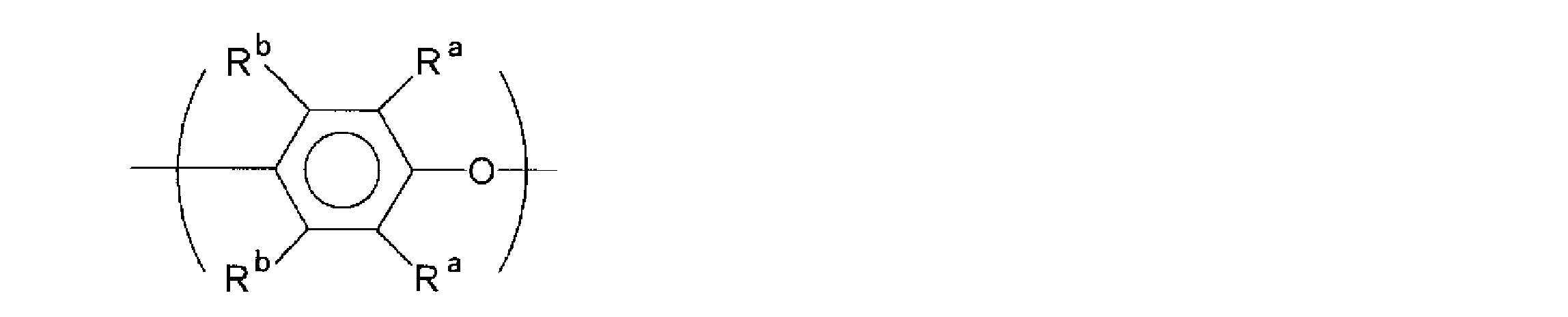
RaおよびRbとしては、水素原子、第1級若しくは第2級アルキル基、アリール基が好ましい。第1級アルキル基の好適な例としては、メチル基、エチル基、n-プロピル基、n-ブチル基、n-アミル基、イソアミル基、2-メチルブチル基、2,3-ジメチルブチル基、2-、3-若しくは4-メチルペンチル基またはヘプチル基が挙げられる。第2級アルキル基の好適な例としては、例えば、イソプロピル基、sec-ブチル基または1-エチルプロピル基が挙げられる。特に、Raは第1級若しくは第2級の炭素数1~4のアルキル基またはフェニル基であることが好ましい。Rbは水素原子であることが好ましい。
好適なポリフェニレンエーテル樹脂の単独重合体としては、例えば、ポリ(2,6-ジメチル-1,4-フェニレンエーテル)、ポリ(2,6-ジエチル-1,4-フェニレンエーテル)、ポリ(2,6-ジプロピル-1,4-フェニレンエーテル)、ポリ(2-エチル-6-メチル-1,4-フェニレンエーテル)、ポリ(2-メチル-6-プロピル-1,4-フェニレンエーテル)等の2,6-ジアルキルフェニレンエーテルの重合体が挙げられる。共重合体としては、2,6-ジメチルフェノール/2,3,6-トリメチルフェノール共重合体、2,6-ジメチルフェノール/2,3,6-トリエチルフェノール共重合体、2,6-ジエチルフェノール/2,3,6-トリメチルフェノール共重合体、2,6-ジプロピルフェノール/2,3,6-トリメチルフェノール共重合体等の2,6-ジアルキルフェノール/2,3,6-トリアルキルフェノール共重合体、ポリ(2,6-ジメチル-1,4-フェニレンエーテル)にスチレンをグラフト重合させたグラフト共重合体、2,6-ジメチルフェノール/2,3,6-トリメチルフェノール共重合体にスチレンをグラフト重合させたグラフト共重合体等が挙げられる。
本発明におけるポリフェニレンエーテル樹脂としては、特に、ポリ(2,6-ジメチル-1,4-フェニレンエーテル)、2,6-ジメチルフェノール/2,3,6-トリメチルフェノールランダム共重合体が好ましい。また、特開2005-344065号公報に記載されているような末端基数と銅含有率を規定したポリフェニレンエーテル樹脂も好適に使用できる。
ポリフェニレンエーテル樹脂は、クロロホルム中で測定した30℃の固有粘度が0.2~0.8dl/gのものが好ましく、0.3~0.6dl/gのものがより好ましい。固有粘度を0.2dl/g以上とすることにより、樹脂組成物の機械的強度がより向上する傾向にあり、0.8dl/g以下とすることにより、流動性がより向上し、成形加工がより容易になる傾向にある。また、固有粘度の異なる2種以上のポリフェニレンエーテル樹脂を併用して、この固有粘度の範囲としてもよい。
本発明に使用されるポリフェニレンエーテル樹脂の製造方法は、特に限定されるものではなく、公知の方法に従って、例えば、2,6-ジメチルフェノール等のモノマーをアミン銅触媒の存在下、酸化重合する方法を採用することができ、その際、反応条件を選択することにより、固有粘度を所望の範囲に制御することができる。固有粘度の制御は、重合温度、重合時間、触媒量等の条件を選択することにより達成できる。
本発明の樹脂組成物は、ポリフェニレンエーテル樹脂を組成物中に40質量%以上の割合で含むことが好ましく、43質量%以上の割合で含むことがより好ましく、50質量%以上、60質量%以上であってもよい。上限については、例えば、90質量%以下であり、85質量%以下、80質量%以下、75質量%以下であってもよい。
本発明において、ポリフェニレンエーテル樹脂は1種を単独で用いてもよく、2種以上を混合して用いてもよい。2種以上含む場合は、合計量が上記範囲となることが好ましい。
本発明において、ポリフェニレンエーテル樹脂は1種を単独で用いてもよく、2種以上を混合して用いてもよい。2種以上含む場合は、合計量が上記範囲となることが好ましい。
<スチレン-オレフィンブロック共重合体>
本発明で用いるスチレン-オレフィンブロック共重合体は、分子中に、好ましくは分子の少なくとも一方の末端に、より好ましくは分子の両末端に、スチレン由来の構成単位を主成分とする領域(スチレンブロック)を有し、さらに、オレフィン由来の構成単位を主成分とする領域(オレフィンブロック)を有するものである。ここで、スチレン由来の構成単位を主成分とするとは、前記スチレンブロックの90質量%以上が、スチレン由来の構成単位からなることを言う。オレフィンブロックについても同様である。
本発明で用いるスチレン-オレフィンブロック共重合体は、スチレンブロックおよびオレフィンブロック以外の他の領域を含んでいても良いが、前記他の領域の割合は、通常、スチレン-オレフィンブロック共重合体の5質量%以下である。
本発明で用いるスチレン-オレフィンブロック共重合体は、スチレン由来の構成単位の含有量が15~40質量%である、前記スチレン由来の構成単位の含有量の下限値は、20質量%以上であることが好ましく、25質量%以上であることがより好ましい。前記スチレン由来の構成単位の含有量の上限値は、35質量%以下であることが好ましく、33質量%以下であることがより好ましく、30質量%以下であることがさらに好ましい。
本発明で用いるスチレン-オレフィンブロック共重合体は、分子中に、好ましくは分子の少なくとも一方の末端に、より好ましくは分子の両末端に、スチレン由来の構成単位を主成分とする領域(スチレンブロック)を有し、さらに、オレフィン由来の構成単位を主成分とする領域(オレフィンブロック)を有するものである。ここで、スチレン由来の構成単位を主成分とするとは、前記スチレンブロックの90質量%以上が、スチレン由来の構成単位からなることを言う。オレフィンブロックについても同様である。
本発明で用いるスチレン-オレフィンブロック共重合体は、スチレンブロックおよびオレフィンブロック以外の他の領域を含んでいても良いが、前記他の領域の割合は、通常、スチレン-オレフィンブロック共重合体の5質量%以下である。
本発明で用いるスチレン-オレフィンブロック共重合体は、スチレン由来の構成単位の含有量が15~40質量%である、前記スチレン由来の構成単位の含有量の下限値は、20質量%以上であることが好ましく、25質量%以上であることがより好ましい。前記スチレン由来の構成単位の含有量の上限値は、35質量%以下であることが好ましく、33質量%以下であることがより好ましく、30質量%以下であることがさらに好ましい。
本発明で用いるスチレン-オレフィンブロック共重合体は、数平均分子量10万未満である。このような構成とすることにより、白化を効果的に抑制することができる。上記数平均分子量の下限値は特に定めるものではないが、例えば、1万以上であり、さらには3万以上である。
スチレン-オレフィンブロック共重合体は、末端変性されていることが好ましく、アミノ基で末端変性されていることがより好ましく、ヒドロキシル基で末端変性されていることがさらに好ましい。末端変性することにより、ポリフェニレンエーテル樹脂中の分散性がより向上する傾向にある。
スチレン-オレフィンブロック共重合体は、末端変性されていることが好ましく、アミノ基で末端変性されていることがより好ましく、ヒドロキシル基で末端変性されていることがさらに好ましい。末端変性することにより、ポリフェニレンエーテル樹脂中の分散性がより向上する傾向にある。
上記オレフィンとしては、エチレン、プロピレン、1-ブテン、2-ブテン、ブタジエン、イソプレン等が例示される。スチレン-オレフィンブロック共重合体に含まれるオレフィンは、1種のみであっても、2種以上であってもよい。
スチレン-オレフィンブロック共重合体の具体例としては、スチレン-エチレン・プロピレン共重合体(SEP)、スチレン-ブタジエン-スチレン共重合体(SBS)、スチレン-エチレン・ブチレン-スチレン共重合体(SEBS)、スチレン-エチレン・プロピレン-スチレン共重合体(SEPS)、スチレン-エチレン・エチレン・プロピレン-スチレン共重合体(SEEPS)、スチレン-イソプレン-スチレン共重合体(SIS)、ポリスチレン-ビニル-ポリイソプレンが結合したトリブロック共重合体(PS-VPI)等が挙げられ、スチレン-エチレン・エチレン・プロピレン-スチレン共重合体(SEEPS)が好ましい。
スチレン-オレフィンブロック共重合体の具体例としては、スチレン-エチレン・プロピレン共重合体(SEP)、スチレン-ブタジエン-スチレン共重合体(SBS)、スチレン-エチレン・ブチレン-スチレン共重合体(SEBS)、スチレン-エチレン・プロピレン-スチレン共重合体(SEPS)、スチレン-エチレン・エチレン・プロピレン-スチレン共重合体(SEEPS)、スチレン-イソプレン-スチレン共重合体(SIS)、ポリスチレン-ビニル-ポリイソプレンが結合したトリブロック共重合体(PS-VPI)等が挙げられ、スチレン-エチレン・エチレン・プロピレン-スチレン共重合体(SEEPS)が好ましい。
<ポリフェニレンエーテル樹脂とスチレン-オレフィンブロック共重合体のブレンド比>
本発明の樹脂組成物におけるポリフェニレンエーテル樹脂とスチレン-オレフィンブロック共重合体のブレンド比は、ポリフェニレンエーテル樹脂50~99質量部に対し、スチレン-オレフィンブロック共重合体50~1質量部である。上記ブレンド比は、好ましくは55~95質量部に対し、45~5質量部であり、より好ましくは60~90質量部に対し、40~10質量部であり、さらに好ましくは65~85質量部に対し、35~15質量部であり、一層好ましくは70~80質量部に対し、40~20質量部である。
特に、得られる樹脂組成物の柔軟性をより高めたい場合には、上記ブレンド比は、ポリフェニレンエーテル樹脂50質量部以上65質量部未満に対し、スチレン-オレフィンブロック共重合体50質量部以下35質量部を超える範囲とすることが好ましい。
一方、得られる樹脂組成物の難燃性をより高めたい場合には、上記ブレンド比は、65~85質量部に対し、35~15質量部とすることが好ましい。
本発明の樹脂組成物がポリフェニレンエーテル樹脂および/またはスチレン-オレフィンブロック共重合体を2種以上含む場合、合計量が上記ブレンド比を満たすことが好ましい。
本発明の樹脂組成物におけるポリフェニレンエーテル樹脂とスチレン-オレフィンブロック共重合体のブレンド比は、ポリフェニレンエーテル樹脂50~99質量部に対し、スチレン-オレフィンブロック共重合体50~1質量部である。上記ブレンド比は、好ましくは55~95質量部に対し、45~5質量部であり、より好ましくは60~90質量部に対し、40~10質量部であり、さらに好ましくは65~85質量部に対し、35~15質量部であり、一層好ましくは70~80質量部に対し、40~20質量部である。
特に、得られる樹脂組成物の柔軟性をより高めたい場合には、上記ブレンド比は、ポリフェニレンエーテル樹脂50質量部以上65質量部未満に対し、スチレン-オレフィンブロック共重合体50質量部以下35質量部を超える範囲とすることが好ましい。
一方、得られる樹脂組成物の難燃性をより高めたい場合には、上記ブレンド比は、65~85質量部に対し、35~15質量部とすることが好ましい。
本発明の樹脂組成物がポリフェニレンエーテル樹脂および/またはスチレン-オレフィンブロック共重合体を2種以上含む場合、合計量が上記ブレンド比を満たすことが好ましい。
<樹脂成分>
本発明の樹脂組成物は、ポリフェニレンエーテル樹脂とスチレン-オレフィンブロック共重合体を合計で80質量%以上含むことが好ましく、85質量%以上含むことがより好ましい。上限値としては、100質量%であってもよいが、95質量%以下が好ましい。
本発明の樹脂組成物は、ポリフェニレンエーテル樹脂とスチレン-オレフィンブロック共重合体以外の他の樹脂成分を含んでいてもよい。
他の樹脂成分としては、例えば、上記以外のスチレン系樹脂(例えば、ゴム変性スチレン樹脂など)、ポリアミド樹脂、ポリエステル樹脂、ポリフェニレンサルファイド樹脂、液晶ポリエステル樹脂、ポリカーボネート樹脂、ポリアセタール樹脂、ポリアクリロニトリル樹脂、アクリル樹脂、ポリエチレン樹脂、ポリプロピレン樹脂等のオレフィン系樹脂等の熱可塑性樹脂や、エポキシ樹脂、メラミン樹脂、シリコーン樹脂等の熱硬化性樹脂等が挙げられる。これらの熱可塑性樹脂および熱硬化性樹脂は、2種以上を組み合わせて使用することもできる。
本発明では、ポリフェニレンエーテル樹脂とスチレン-オレフィンブロック共重合体以外の樹脂成分を実質的に含まない構成とすることもできる。実質的に含まないとは、本発明の樹脂組成物に含まれる樹脂成分の1質量%以下であることをいう。
本発明の樹脂組成物は、ポリフェニレンエーテル樹脂とスチレン-オレフィンブロック共重合体を合計で80質量%以上含むことが好ましく、85質量%以上含むことがより好ましい。上限値としては、100質量%であってもよいが、95質量%以下が好ましい。
本発明の樹脂組成物は、ポリフェニレンエーテル樹脂とスチレン-オレフィンブロック共重合体以外の他の樹脂成分を含んでいてもよい。
他の樹脂成分としては、例えば、上記以外のスチレン系樹脂(例えば、ゴム変性スチレン樹脂など)、ポリアミド樹脂、ポリエステル樹脂、ポリフェニレンサルファイド樹脂、液晶ポリエステル樹脂、ポリカーボネート樹脂、ポリアセタール樹脂、ポリアクリロニトリル樹脂、アクリル樹脂、ポリエチレン樹脂、ポリプロピレン樹脂等のオレフィン系樹脂等の熱可塑性樹脂や、エポキシ樹脂、メラミン樹脂、シリコーン樹脂等の熱硬化性樹脂等が挙げられる。これらの熱可塑性樹脂および熱硬化性樹脂は、2種以上を組み合わせて使用することもできる。
本発明では、ポリフェニレンエーテル樹脂とスチレン-オレフィンブロック共重合体以外の樹脂成分を実質的に含まない構成とすることもできる。実質的に含まないとは、本発明の樹脂組成物に含まれる樹脂成分の1質量%以下であることをいう。
<難燃剤>
本発明の樹脂組成物はリン系難燃剤を含むことが好ましい。
リン系難燃剤としては、リン酸エステル系難燃剤およびホスファゼン系難燃剤が例示され、リン酸エステル系難燃剤が好ましい。
本発明の樹脂組成物はリン系難燃剤を含むことが好ましい。
リン系難燃剤としては、リン酸エステル系難燃剤およびホスファゼン系難燃剤が例示され、リン酸エステル系難燃剤が好ましい。
リン酸エステル系難燃剤としては、下記の式(II)で表されるリン酸エステル系化合物が好ましい。

式(II)において、R1~R4のアリール基としては、フェニル基、ナフチル基等が挙げられる。また、Xのアリーレン基としては、フェニレン基、ナフチレン基が挙げられる。tが0の場合、式(II)で表される化合物はリン酸エステルであり、tが0より大きい場合は縮合リン酸エステル(混合物を含む)である。本発明には、特に縮合リン酸エステルが好適に用いられる。
リン酸エステル系難燃剤としては、具体的には、トリメチルフォスフェート、トリエチルフォスフェート、トリブチルフォスフェート、トリオクチルフォスフェート、トリブトキシエチルフォスフェート、トリフェニルフォスフェート、トリクレジルフォスフェート、トリクレジルフェニルフォスフェート、オクチルジフェニルフォスフェート、ジイソプロピルフェニルフォスフェート、トリス(クロルエチル)フォスフェート、トリス(ジクロルプロピル)フォスフェート、トリス(クロルプロピル)フォスフェート、ビス(2,3-ジブロモプロピル)フォスフェート、ビス(2,3-ジブロモプロピル)-2,3-ジクロルフォスフェート、ビス(クロルプロピル)モノオクチルフォスフェート、ビスフェノールAテトラフェニルフォスフェート、ビスフェノールAテトラクレジルジフォスフェート、ビスフェノールAテトラキシリルジフォスフェート、ヒドロキノンテトラフェニルジフォスフェート、ヒドロキノンテトラクレジルフォスフェート、ヒドロキノンテトラキシリルジフォスフェート、レゾルシノールテトラフェニルフォスフェート、レゾルシノールテトラ-2,6-キシレノールフォスフェート、レゾルシノールビスジキシレニルホスフェート等の種々のものが例示される。これらのうち好ましくは、トリフェニルフォスフェート、ビスフェノールAテトラフェニルフォスフェート、レゾルシノールテトラフェニルフォスフェート、レゾルシノールテトラ-2,6-キシレノールフォスフェート等が挙げられる。
ホスファゼン系難燃剤は、分子中に-P=N-結合を有する有機化合物であり、ホスファゼン系難燃剤としては、特開2013-237798号公報の段落0049~0061の記載を参酌でき、これらの内容は本明細書に組み込まれる。
本発明の樹脂組成物における、リン系難燃剤の含有量は、ポリフェニレンエーテル樹脂とスチレン-オレフィンブロック共重合体の合計量100質量部に対して、1質量部以上であることが好ましく、5質量部以上であることがより好ましい。また、ポリフェニレンエーテル樹脂とスチレン-オレフィンブロック共重合体の合計量100質量部に対して、30質量部以下であることが好ましく、25質量部以下であることがより好ましく、20質量部以下であることがさらに好ましく、15質量部以下であってもよい。
このような範囲とすることにより、得られる成形品の難燃性をより向上させることが可能になる。
リン系難燃剤は、1種のみ用いてもよく、2種以上を用いてもよい。2種以上用いる場合、合計量が上記範囲となることが好ましい。
このような範囲とすることにより、得られる成形品の難燃性をより向上させることが可能になる。
リン系難燃剤は、1種のみ用いてもよく、2種以上を用いてもよい。2種以上用いる場合、合計量が上記範囲となることが好ましい。
<脂肪酸金属塩>
本発明の樹脂組成物は、脂肪酸金属塩を含んでいてもよい。脂肪酸金属塩を含むことにより、押出時のメヤニ生成がより効果的に抑制される。
脂肪酸金属塩は、高級脂肪酸と金属との塩である。高級脂肪酸とは、炭素数が12以上である脂肪酸をいう。高級脂肪酸としては、ステアリン酸、オレイン酸、オクタン酸、ラウリン酸、べへニン酸、リシノール酸、ナフテン酸などが挙げられ、ステアリン酸が好ましい。金属としては、リチウム、亜鉛、カルシウム、マグネシウム、ニッケル、銅、ストロンチウム、バリウム、カドミウムなどが挙げられ、カルシウムまたはマグネシウムが好ましく、マグネシウムがより好ましい。
脂肪酸金属塩としては、例えば、ステアリン酸リチウム、ステアリン酸マグネシウム、ステアリン酸カルシウム、ラウリン酸カルシウム、リシノール酸カルシウム、ステアリン酸ストロンチウム、ステアリン酸バリウム、ラウリン酸バリウム、リシノール酸バリウム、ステアリン酸カドミウム、ラウリン酸カドミウム、リシノール酸カドミウム、ナフテン酸カドミウム、2-エチルヘキサン酸カドミウム、ステアリン酸亜鉛、ラウリン酸亜鉛、リシノール酸亜鉛、2-エチルヘキサン酸亜鉛、ステアリン酸鉛、2塩基性ステアリン酸鉛、ナフテン酸鉛等が挙げられる。
本発明の樹脂組成物は、脂肪酸金属塩を含んでいてもよい。脂肪酸金属塩を含むことにより、押出時のメヤニ生成がより効果的に抑制される。
脂肪酸金属塩は、高級脂肪酸と金属との塩である。高級脂肪酸とは、炭素数が12以上である脂肪酸をいう。高級脂肪酸としては、ステアリン酸、オレイン酸、オクタン酸、ラウリン酸、べへニン酸、リシノール酸、ナフテン酸などが挙げられ、ステアリン酸が好ましい。金属としては、リチウム、亜鉛、カルシウム、マグネシウム、ニッケル、銅、ストロンチウム、バリウム、カドミウムなどが挙げられ、カルシウムまたはマグネシウムが好ましく、マグネシウムがより好ましい。
脂肪酸金属塩としては、例えば、ステアリン酸リチウム、ステアリン酸マグネシウム、ステアリン酸カルシウム、ラウリン酸カルシウム、リシノール酸カルシウム、ステアリン酸ストロンチウム、ステアリン酸バリウム、ラウリン酸バリウム、リシノール酸バリウム、ステアリン酸カドミウム、ラウリン酸カドミウム、リシノール酸カドミウム、ナフテン酸カドミウム、2-エチルヘキサン酸カドミウム、ステアリン酸亜鉛、ラウリン酸亜鉛、リシノール酸亜鉛、2-エチルヘキサン酸亜鉛、ステアリン酸鉛、2塩基性ステアリン酸鉛、ナフテン酸鉛等が挙げられる。
本発明の樹脂組成物における、脂肪酸金属塩の含有量は、ポリフェニレンエーテル樹脂とスチレン-オレフィンブロック共重合体の合計量100質量部に対して、0.01質量部以上であることが好ましく、0.05質量部以上であることがより好ましく、0.1質量部以上であることがさらに好ましい。また、ポリフェニレンエーテル樹脂とスチレン-オレフィンブロック共重合体の合計量100質量部に対して、10質量部以下であることが好ましく、5質量部以下であることがより好ましく、3質量部以下であることがさらに好ましく、1質量部以下であってもよい。
脂肪酸金属塩は、1種のみ用いてもよく、2種以上を用いてもよい。2種以上用いる場合、合計量が上記範囲となることが好ましい。
脂肪酸金属塩は、1種のみ用いてもよく、2種以上を用いてもよい。2種以上用いる場合、合計量が上記範囲となることが好ましい。
<ポリエチレンワックス>
本発明の樹脂組成物は、ポリエチレンワックスを含んでいてもよい。ポリエチレンワックスを含むことにより、押出時のメヤニ生成がより効果的に抑制される。
ポリエチレンワックスとしては、低分子量ポリエチレン若しくは低分子量ポリエチレン共重合体などのポリエチレンワックス、これらを酸化変性または酸変性することによって極性基を導入した変性ポリエチレンワックスなどが挙げられる。ポリエチレンの数平均分子量は、好ましくは500~15000であり、より好ましくは1000~10000である。
本発明の樹脂組成物は、ポリエチレンワックスを含んでいてもよい。ポリエチレンワックスを含むことにより、押出時のメヤニ生成がより効果的に抑制される。
ポリエチレンワックスとしては、低分子量ポリエチレン若しくは低分子量ポリエチレン共重合体などのポリエチレンワックス、これらを酸化変性または酸変性することによって極性基を導入した変性ポリエチレンワックスなどが挙げられる。ポリエチレンの数平均分子量は、好ましくは500~15000であり、より好ましくは1000~10000である。
低分子量ポリエチレンまたは低分子量ポリエチレン共重合体などのポリエチレンワックスは、エチレンまたはエチレンとα-オレフィンとをチーグラー触媒などで直接重合する方法、高分子量ポリエチレンあるいは共重合体製造時の副成物として得る方法、高分子量ポリエチレンあるいは共重合体を熱分解する方法などにより製造することができる。こうしたポリエチレンワックスとしては、エチレン50~99モル%とα-オレフィン1~50モル%との共重合体型ポリエチレンワックスが好ましく、特に好ましいポリエチレンワックスは、α-オレフィンがプロピレンであるポリエチレンワックスである。
酸化変性ポリエチレンワックスは、ポリエチレンワックスをパーオキシドや酸素などで処理してカルボキシル基や水酸基などの極性基を導入したものである。酸変性ポリエチレンワックスは、必要と有ればパーオキシドや酸素の存在下に、無機酸、有機酸あるいは不飽和カルボン酸などで処理することにより、カルボキシル基やスルホン酸基などの極性基を導入したものである。これらのポリエチレンワックス類は、一般型高密度ポリエチレンワックス、一般型低密度ポリエチレンワックス、低酸化型ポリエチレンワックス、高酸化型ポリエチレンワックス、酸変性型ポリエチレンワックスあるいは特殊モノマー変性型などの名称で市販されており、容易に入手することができる。
本発明の樹脂組成物における、ポリエチレンワックスの含有量は、ポリフェニレンエーテル樹脂とスチレン-オレフィンブロック共重合体の合計量100質量部に対して、0.05質量部以上であることが好ましく、0.1質量部以上であることがより好ましく、0.5質量部以上であることがさらに好ましい。また、ポリフェニレンエーテル樹脂とスチレン-オレフィンブロック共重合体の合計量100質量部に対して、10質量部以下であることが好ましく、8質量部以下であることがより好ましく、4質量部以下であることがさらに好ましく、2質量部以下であってもよい。
ポリエチレンワックスは、1種のみ用いてもよく、2種以上を用いてもよい。2種以上用いる場合、合計量が上記範囲となることが好ましい。
ポリエチレンワックスは、1種のみ用いてもよく、2種以上を用いてもよい。2種以上用いる場合、合計量が上記範囲となることが好ましい。
本発明の樹脂組成物において、脂肪酸金属塩とポリエチレンワックスの配合比率(脂肪酸金属塩/ポリエチレンワックス)は、0.1~0.4であることが好ましく、0.15~0.35であることがより好ましく、0.2~0.3であることがさらに好ましい。このような配合比率とすることにより、本発明の効果がより効果的に発揮される。
<酸化亜鉛>
本発明の樹脂組成物は、酸化亜鉛を含むことが好ましい。
本発明の樹脂組成物における、酸化亜鉛の含有量は、ポリフェニレンエーテル樹脂とスチレン-オレフィンブロック共重合体の合計量100質量部に対して、0.01質量部以上であることが好ましく、0.05質量部以上であることがより好ましく、0.1質量部以上であることがさらに好ましい。また、ポリフェニレンエーテル樹脂とスチレン-オレフィンブロック共重合体の合計量100質量部に対して、10質量部以下であることが好ましく、5質量部以下であることがより好ましく、3質量部以下であることがさらに好ましく、1質量部以下であってもよい。
酸化亜鉛は、1種のみ用いてもよく、2種以上を用いてもよい。2種以上用いる場合、合計量が上記範囲となることが好ましい。
本発明の樹脂組成物は、酸化亜鉛を含むことが好ましい。
本発明の樹脂組成物における、酸化亜鉛の含有量は、ポリフェニレンエーテル樹脂とスチレン-オレフィンブロック共重合体の合計量100質量部に対して、0.01質量部以上であることが好ましく、0.05質量部以上であることがより好ましく、0.1質量部以上であることがさらに好ましい。また、ポリフェニレンエーテル樹脂とスチレン-オレフィンブロック共重合体の合計量100質量部に対して、10質量部以下であることが好ましく、5質量部以下であることがより好ましく、3質量部以下であることがさらに好ましく、1質量部以下であってもよい。
酸化亜鉛は、1種のみ用いてもよく、2種以上を用いてもよい。2種以上用いる場合、合計量が上記範囲となることが好ましい。
<他の添加剤>
本発明の樹脂組成物は、上記以外の他の成分を含んでいてもよい。
具体的には、本発明の樹脂組成物は、上記以外の難燃剤(ハロゲン系難燃剤、有機金属系難燃剤等)、熱安定剤、染顔料、上記以外の離型剤(シリコーンオイル、脂肪酸、脂肪酸エステル等)、酸化防止剤、耐候性改良剤、増核剤、耐衝撃改良剤、可塑剤、流動性改良剤等を含んでいてもよい。これらの成分を含有する場合、その含有量は、合計で、樹脂組成物の0.01~5質量%の範囲とすることが好ましい。
本発明の樹脂組成物は、上記以外の他の成分を含んでいてもよい。
具体的には、本発明の樹脂組成物は、上記以外の難燃剤(ハロゲン系難燃剤、有機金属系難燃剤等)、熱安定剤、染顔料、上記以外の離型剤(シリコーンオイル、脂肪酸、脂肪酸エステル等)、酸化防止剤、耐候性改良剤、増核剤、耐衝撃改良剤、可塑剤、流動性改良剤等を含んでいてもよい。これらの成分を含有する場合、その含有量は、合計で、樹脂組成物の0.01~5質量%の範囲とすることが好ましい。
<樹脂組成物の特性>
本発明の樹脂組成物は、特に以下の特性を満たすものとすることができる。
具体的には、例えば、本発明の樹脂組成物を厚み1.6mmのUL94燃焼試験片に成形し、180度に20往復折り曲げた時に形成される白線折り目の幅が5.0mm以下(好ましくは1.0mm以下)である樹脂組成物とすることができる。
また、例えば、本発明の樹脂組成物を厚み1.6mmのUL94燃焼試験片に成形したときのUL94燃焼試験に基づく難燃性がV-1以上である樹脂組成物とすることができる。
さらに、例えば、本発明の樹脂組成物を、ISO75に従った荷重0.45MPaで測定したときの荷重たわみ温度が80℃以上(好ましくは85℃以上、より好ましくは90℃以上、さらに好ましくは95℃以上、一層好ましくは100℃以上、また、例えば、120℃以下、さらには、115℃以下)である樹脂組成物とすることができる。
さらにまた、例えば、本発明の樹脂組成物をISO527に従った引張呼び歪が40%以上(好ましくは50%以上、より好ましくは55%以上、さらに好ましくは60%以上、また、例えば、90%以下、さらには、85%以下)である樹脂組成物とすることができる。
本発明の樹脂組成物は、特に以下の特性を満たすものとすることができる。
具体的には、例えば、本発明の樹脂組成物を厚み1.6mmのUL94燃焼試験片に成形し、180度に20往復折り曲げた時に形成される白線折り目の幅が5.0mm以下(好ましくは1.0mm以下)である樹脂組成物とすることができる。
また、例えば、本発明の樹脂組成物を厚み1.6mmのUL94燃焼試験片に成形したときのUL94燃焼試験に基づく難燃性がV-1以上である樹脂組成物とすることができる。
さらに、例えば、本発明の樹脂組成物を、ISO75に従った荷重0.45MPaで測定したときの荷重たわみ温度が80℃以上(好ましくは85℃以上、より好ましくは90℃以上、さらに好ましくは95℃以上、一層好ましくは100℃以上、また、例えば、120℃以下、さらには、115℃以下)である樹脂組成物とすることができる。
さらにまた、例えば、本発明の樹脂組成物をISO527に従った引張呼び歪が40%以上(好ましくは50%以上、より好ましくは55%以上、さらに好ましくは60%以上、また、例えば、90%以下、さらには、85%以下)である樹脂組成物とすることができる。
<樹脂組成物の用途>
本発明の樹脂組成物は、ポリフェニレンエーテル樹脂、特に、ポリフェニレンエーテル樹脂とスチレン系樹脂のブレンド物が一般的に用いられる用途に広く用いられる。
例えば、自動車外装・外板部品、自動車内装部品、自動車アンダーフード部品が挙げられる。具体的には、バンパー、フェンダー、ドアパネル、モール、エンブレム、エンジンフード、ホイルカバー、ルーフ、スポイラー、エンジンカバー等の外装・外板部品、アンダーフード部品や、インストゥルメントパネル、コンソールボックストリム等の内装部品等に適している。
また、各種コンピューターおよびその周辺機器、その他のOA機器、テレビ、ビデオ、各種ディスクプレーヤー等のキャビネット、シャーシ、冷蔵庫、エアコン、液晶プロジェクター等としても用いることができる。
さらに、金属導体または光ファイバーに被覆して得られる電線・ケーブルの被覆材、固体メタノール電池用燃料ケース、二次電池電槽、燃料電池配水管、水冷用タンク、ボイラー外装ケース、インクジェットプリンターのインク周辺部品・部材およびシャーシ、および水配管、継ぎ手などの成形体、シート・フィルムを延伸して得られるリチウムイオン電池用セパレータとして利用できる。
本発明の樹脂組成物は、下記の(1)~(4)からなる群より選ばれる用途に用いられることが好ましい。
(1)シート・フィルムまたは延伸シート・フィルム
(2)自動車外装・外板部品、自動車内装部品、または自動車アンダーフード部品
(3)樹脂組成物で金属導体または光ファイバーを被覆して得られる電線・ケーブル
(4)インクジェットプリンターのインク周辺の部品・部材またはシャーシ
より好ましくは、本発明の樹脂組成物は、電線被覆材として用いられる。
本発明の樹脂組成物は、ポリフェニレンエーテル樹脂、特に、ポリフェニレンエーテル樹脂とスチレン系樹脂のブレンド物が一般的に用いられる用途に広く用いられる。
例えば、自動車外装・外板部品、自動車内装部品、自動車アンダーフード部品が挙げられる。具体的には、バンパー、フェンダー、ドアパネル、モール、エンブレム、エンジンフード、ホイルカバー、ルーフ、スポイラー、エンジンカバー等の外装・外板部品、アンダーフード部品や、インストゥルメントパネル、コンソールボックストリム等の内装部品等に適している。
また、各種コンピューターおよびその周辺機器、その他のOA機器、テレビ、ビデオ、各種ディスクプレーヤー等のキャビネット、シャーシ、冷蔵庫、エアコン、液晶プロジェクター等としても用いることができる。
さらに、金属導体または光ファイバーに被覆して得られる電線・ケーブルの被覆材、固体メタノール電池用燃料ケース、二次電池電槽、燃料電池配水管、水冷用タンク、ボイラー外装ケース、インクジェットプリンターのインク周辺部品・部材およびシャーシ、および水配管、継ぎ手などの成形体、シート・フィルムを延伸して得られるリチウムイオン電池用セパレータとして利用できる。
本発明の樹脂組成物は、下記の(1)~(4)からなる群より選ばれる用途に用いられることが好ましい。
(1)シート・フィルムまたは延伸シート・フィルム
(2)自動車外装・外板部品、自動車内装部品、または自動車アンダーフード部品
(3)樹脂組成物で金属導体または光ファイバーを被覆して得られる電線・ケーブル
(4)インクジェットプリンターのインク周辺の部品・部材またはシャーシ
より好ましくは、本発明の樹脂組成物は、電線被覆材として用いられる。
<成形品>
本発明の成形品は、本発明の樹脂組成物から形成される。特に、本発明の樹脂組成物から形成された被覆層を有する電線であることが好ましい。
本発明の成形品は、従来より公知の種々の方法、例えば、射出成形、押出成形(シート、フィルム)、中空成形により成形して得られる。
本発明の成形品は、本発明の樹脂組成物から形成される。特に、本発明の樹脂組成物から形成された被覆層を有する電線であることが好ましい。
本発明の成形品は、従来より公知の種々の方法、例えば、射出成形、押出成形(シート、フィルム)、中空成形により成形して得られる。
以下に実施例を挙げて本発明をさらに具体的に説明する。以下の実施例に示す材料、使用量、割合、処理内容、処理手順等は、本発明の趣旨を逸脱しない限り、適宜、変更することができる。従って、本発明の範囲は以下に示す具体例に限定されるものではない。
<原料>
(A)ポリフェニレンエーテル樹脂:PX100L、ポリキシレノールシンガポール社製
(B)スチレン-オレフィンブロック共重合体:
セプトンHG-252(末端OH基変性SEEPS)、クラレ製
セプトン2005(SEPS)、クラレ製
セプトン2063(SEPS)、クラレ製
セプトン4033(SEEPS)、クラレ製
ハイブラー7311(PS-VPI)、クラレ製
ハイブラー7125(PS-VPI)、クラレ製
(C)リン系難燃剤:PX-200(レゾルシノールビスジキシレニルホスフェート)、大八化学
(D)ステアリン酸塩:ステアリン酸Mg
(E)ポリエチレンワックス:サンワックス151P、三洋化成社製
(F)酸化亜鉛:本荘ケミカル社製
(A)ポリフェニレンエーテル樹脂:PX100L、ポリキシレノールシンガポール社製
(B)スチレン-オレフィンブロック共重合体:
セプトンHG-252(末端OH基変性SEEPS)、クラレ製
セプトン2005(SEPS)、クラレ製
セプトン2063(SEPS)、クラレ製
セプトン4033(SEEPS)、クラレ製
ハイブラー7311(PS-VPI)、クラレ製
ハイブラー7125(PS-VPI)、クラレ製
(C)リン系難燃剤:PX-200(レゾルシノールビスジキシレニルホスフェート)、大八化学
(D)ステアリン酸塩:ステアリン酸Mg
(E)ポリエチレンワックス:サンワックス151P、三洋化成社製
(F)酸化亜鉛:本荘ケミカル社製
実施例1~4、比較例1~5
下記表1に示す割合(質量基準)で各成分を混合し、二軸押出機(東芝機械社製:TEM18SS)を用いて、シリンダー温度280℃、スクリュー回転数350rpmで溶融混練を行い、樹脂組成物(ペレット)を得た。
得られた樹脂組成物(ペレット)を用いて、下記評価を行った。結果を表1に示した。
下記表1に示す割合(質量基準)で各成分を混合し、二軸押出機(東芝機械社製:TEM18SS)を用いて、シリンダー温度280℃、スクリュー回転数350rpmで溶融混練を行い、樹脂組成物(ペレット)を得た。
得られた樹脂組成物(ペレット)を用いて、下記評価を行った。結果を表1に示した。
<(B)成分の数平均分子量>
(B)スチレン-オレフィンブロック共重合体の数平均分子量は、以下の通り示した。
以下の通り示した。
A:10万未満
B:10万以上20万未満
C:20万以上
(B)スチレン-オレフィンブロック共重合体の数平均分子量は、以下の通り示した。
以下の通り示した。
A:10万未満
B:10万以上20万未満
C:20万以上
<燃焼試験片の20往復折り曲げ時の白線生成>
上記で得られた樹脂組成物(ペレット)を70℃で3時間乾燥した後、射出成形機(東芝機械社製、「EC75SX」)にて、シリンダー温度270℃、金型温度60℃の条件で127mm×12.7mm×1.6mmのUL94燃焼試験片を作製した。
UL94燃焼試験片を長手方向の両端が重なるように、180度に折り曲げ、元に戻す作業を20回行った。その後、UL94燃焼試験片の中央部に形成された折り目に由来する白線の幅(長手方向の幅)を測定した。
A:白線の幅が1.0mm以下であるかまたは白線が形成されなかった。
B:白線の幅が1.0mmを超え5.0mm以下であった。
C:白線の幅が5.0mmを超えるか、試験片表層が剥離した。
上記で得られた樹脂組成物(ペレット)を70℃で3時間乾燥した後、射出成形機(東芝機械社製、「EC75SX」)にて、シリンダー温度270℃、金型温度60℃の条件で127mm×12.7mm×1.6mmのUL94燃焼試験片を作製した。
UL94燃焼試験片を長手方向の両端が重なるように、180度に折り曲げ、元に戻す作業を20回行った。その後、UL94燃焼試験片の中央部に形成された折り目に由来する白線の幅(長手方向の幅)を測定した。
A:白線の幅が1.0mm以下であるかまたは白線が形成されなかった。
B:白線の幅が1.0mmを超え5.0mm以下であった。
C:白線の幅が5.0mmを超えるか、試験片表層が剥離した。
<引張呼びひずみ>
上記の製造方法で得られたペレットを80℃で5時間乾燥させた後、射出成形機(東芝機械社製、「EC75SX」)にて、シリンダー温度270℃、金型温度60℃の条件で、ISO引張り試験片(4mm厚)を射出成形した。
ISO527に準拠して、上記ISO引張り試験片(4mm厚)を用いて、23℃の温度で引張呼びひずみを測定した。単位は、%で示した。
上記の製造方法で得られたペレットを80℃で5時間乾燥させた後、射出成形機(東芝機械社製、「EC75SX」)にて、シリンダー温度270℃、金型温度60℃の条件で、ISO引張り試験片(4mm厚)を射出成形した。
ISO527に準拠して、上記ISO引張り試験片(4mm厚)を用いて、23℃の温度で引張呼びひずみを測定した。単位は、%で示した。
<曲げ弾性率>
上記の製造方法で得られたペレットを70℃で3時間乾燥させた後、射出成形機(東芝機械社製、「EC75SX」)にて、シリンダー温度270℃、金型温度60℃の条件で、ISO引張り試験片(4mm厚)を射出成形した。
ISO178に準拠して、上記ISO引張り試験片(4mm厚)を用いて、23℃の温度で曲げ弾性率(単位:MPa)を測定した。
上記の製造方法で得られたペレットを70℃で3時間乾燥させた後、射出成形機(東芝機械社製、「EC75SX」)にて、シリンダー温度270℃、金型温度60℃の条件で、ISO引張り試験片(4mm厚)を射出成形した。
ISO178に準拠して、上記ISO引張り試験片(4mm厚)を用いて、23℃の温度で曲げ弾性率(単位:MPa)を測定した。
<荷重たわみ温度>
上記の製造方法で得られたペレットを70℃で3時間乾燥させた後、射出成形機(東芝機械社製、「EC75SX」)にて、シリンダー温度270℃、金型温度60℃の条件で、ISO引張り試験片(4mm厚)を射出成形した。
ISO75-1、2規格に準じて、上記ISO引張り試験片(4mm厚)を用いて、荷重0.45MPaにおける荷重たわみ温度(単位:℃)を測定した。
上記の製造方法で得られたペレットを70℃で3時間乾燥させた後、射出成形機(東芝機械社製、「EC75SX」)にて、シリンダー温度270℃、金型温度60℃の条件で、ISO引張り試験片(4mm厚)を射出成形した。
ISO75-1、2規格に準じて、上記ISO引張り試験片(4mm厚)を用いて、荷重0.45MPaにおける荷重たわみ温度(単位:℃)を測定した。
<難燃性(UL94燃焼試験)>
上記で得られた樹脂組成物(ペレット)を70℃で3時間乾燥した後、射出成形機(東芝機械社製、「EC75SX」)にて、シリンダー温度270℃、金型温度60℃の条件で127mm×12.7mm×1.6mmの試験片を作製し、UL94燃焼試験に基づき測定を行った。V-0が最も難燃性に優れており、V-1、V-2と順に劣る。
上記で得られた樹脂組成物(ペレット)を70℃で3時間乾燥した後、射出成形機(東芝機械社製、「EC75SX」)にて、シリンダー温度270℃、金型温度60℃の条件で127mm×12.7mm×1.6mmの試験片を作製し、UL94燃焼試験に基づき測定を行った。V-0が最も難燃性に優れており、V-1、V-2と順に劣る。
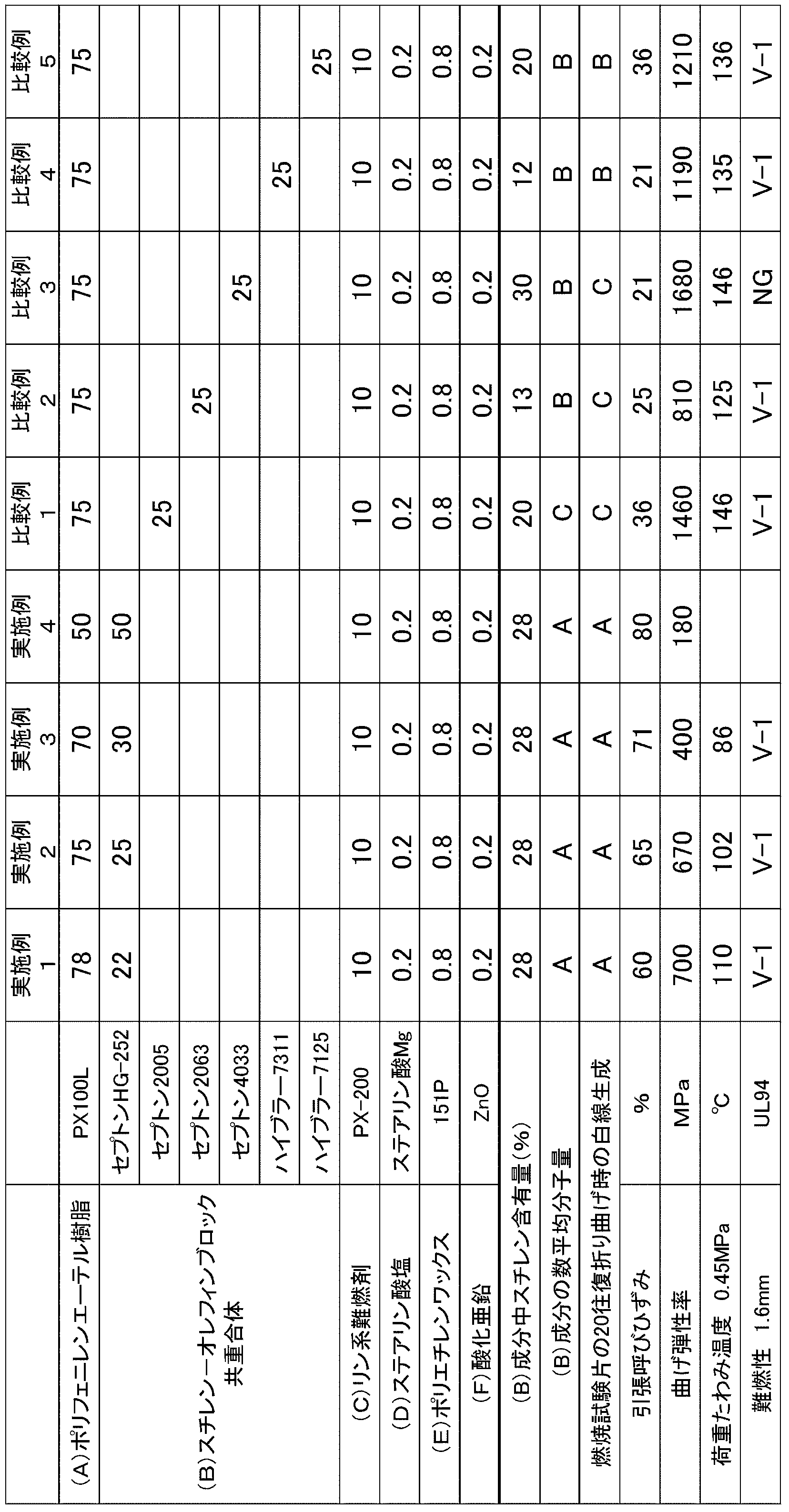
これに対し、スチレン-オレフィンブロック共重合体として、数平均分子量が10万を超えるものを用いた場合、スチレン-オレフィンブロック共重合体におけるスチレン由来の構成単位の含有量が15~40質量%の範囲内であっても、範囲外であっても、白化が十分に抑制できなかった(比較例1~5)。
Claims (11)
- ポリフェニレンエーテル樹脂50~99質量部と、数平均分子量10万未満かつスチレン由来の構成単位の含有量が15~40質量%のスチレン-オレフィンブロック共重合体50~1質量部とを含む、樹脂組成物。
- 厚み1.6mmのUL94燃焼試験片に成形し、180度に20往復折り曲げた時に形成される白線折り目の幅が5.0mm以下である、請求項1に記載の樹脂組成物。
- スチレン-オレフィンブロック共重合体が末端変性されている、請求項1または2に記載の樹脂組成物。
- さらに、リン系難燃剤、脂肪酸金属塩、ポリエチレンワックス、および、酸化亜鉛から選択される少なくとも1種を含む、請求項1~3のいずれか1項に記載の樹脂組成物。
- 前記ポリフェニレンエーテル樹脂と前記スチレン-オレフィンブロック共重合体の合計量100質量部に対して、リン系難燃剤を1~30質量部含む、請求項4に記載の樹脂組成物。
- 厚み1.6mmのUL94燃焼試験片に成形したときのUL94燃焼試験に基づく難燃性がV-1以上である、請求項5に記載の樹脂組成物。
- ISO75に従った荷重0.45MPaで測定したときの荷重たわみ温度が80℃以上である、請求項1~6のいずれか1項に記載の樹脂組成物。
- ISO527に従った引張呼びひずみが40%以上である、請求項1~7のいずれか1項に記載の樹脂組成物。
- 電線被覆材である、請求項1~8のいずれか1項に記載の樹脂組成物。
- 請求項1~9のいずれか1項に記載の樹脂組成物から形成される成形品。
- 請求項1~9のいずれか1項に記載の樹脂組成物から形成された被覆層を有する電線。
Priority Applications (2)
| Application Number | Priority Date | Filing Date | Title |
|---|---|---|---|
| JP2019534057A JP7142636B2 (ja) | 2017-08-03 | 2018-07-24 | 樹脂組成物、成形品および電線 |
| CN201880048939.1A CN110997809A (zh) | 2017-08-03 | 2018-07-24 | 树脂组合物、成型品及电线 |
Applications Claiming Priority (2)
| Application Number | Priority Date | Filing Date | Title |
|---|---|---|---|
| JP2017150444 | 2017-08-03 | ||
| JP2017-150444 | 2017-08-03 |
Publications (1)
| Publication Number | Publication Date |
|---|---|
| WO2019026689A1 true WO2019026689A1 (ja) | 2019-02-07 |
Family
ID=65232538
Family Applications (1)
| Application Number | Title | Priority Date | Filing Date |
|---|---|---|---|
| PCT/JP2018/027687 Ceased WO2019026689A1 (ja) | 2017-08-03 | 2018-07-24 | 樹脂組成物、成形品および電線 |
Country Status (3)
| Country | Link |
|---|---|
| JP (1) | JP7142636B2 (ja) |
| CN (1) | CN110997809A (ja) |
| WO (1) | WO2019026689A1 (ja) |
Cited By (2)
| Publication number | Priority date | Publication date | Assignee | Title |
|---|---|---|---|---|
| JP6990344B1 (ja) * | 2020-03-06 | 2022-01-13 | 三菱エンジニアリングプラスチックス株式会社 | 樹脂組成物、成形品、および、電線 |
| WO2024075507A1 (ja) | 2022-10-04 | 2024-04-11 | グローバルポリアセタール株式会社 | 樹脂組成物、ペレット、および、成形体 |
Citations (10)
| Publication number | Priority date | Publication date | Assignee | Title |
|---|---|---|---|---|
| JP2012041502A (ja) * | 2010-08-23 | 2012-03-01 | Mitsubishi Engineering Plastics Corp | ポリフェニレンエーテル/スチレン系樹脂組成物及びその成形品 |
| WO2014075291A1 (en) * | 2012-11-16 | 2014-05-22 | Sabic Innovative Plastics Ip B.V. | Flexible, wrinkle resistant poly(phenylene ether) cable jacketing composition |
| JP2015071652A (ja) * | 2013-10-01 | 2015-04-16 | 旭化成ケミカルズ株式会社 | 樹脂組成物及びその成形体 |
| JP2015071653A (ja) * | 2013-10-01 | 2015-04-16 | 旭化成ケミカルズ株式会社 | 樹脂組成物及びその成形体 |
| JP2015091938A (ja) * | 2013-10-01 | 2015-05-14 | 旭化成ケミカルズ株式会社 | 樹脂組成物及びその成形体 |
| JP2015120891A (ja) * | 2013-11-20 | 2015-07-02 | 旭化成ケミカルズ株式会社 | 難燃性熱可塑性樹脂組成物及びその成形品 |
| JP2016102217A (ja) * | 2011-05-20 | 2016-06-02 | 旭化成ケミカルズ株式会社 | 難燃樹脂フィルム及びそれを用いた太陽電池バックシート |
| WO2016208896A2 (ko) * | 2015-06-17 | 2016-12-29 | (주) 엘지화학 | 폴리(아릴렌 에테르) 수지 조성물 및 이로 피복된 케이블 |
| JP2017071677A (ja) * | 2015-10-06 | 2017-04-13 | 旭化成株式会社 | ペレット及びその製造方法 |
| JP2017160328A (ja) * | 2016-03-09 | 2017-09-14 | 住友電気工業株式会社 | ハロゲンフリー難燃性樹脂組成物及びハロゲンフリー難燃絶縁電線 |
Family Cites Families (14)
| Publication number | Priority date | Publication date | Assignee | Title |
|---|---|---|---|---|
| US5294655A (en) * | 1992-05-15 | 1994-03-15 | General Electric Company | Polyphenylene ether electrical insulation compositions |
| JPH06287446A (ja) * | 1993-03-31 | 1994-10-11 | Nippon G Ii Plast Kk | 熱可塑性樹脂組成物 |
| US5397822A (en) * | 1993-08-18 | 1995-03-14 | General Electric Company | Thermoplastic compositions containing polyphenylene ether resin and characterized by improved elongation and flexibility employing a blend of multiblock copolymers |
| JP4024363B2 (ja) * | 1997-10-31 | 2007-12-19 | 旭化成ケミカルズ株式会社 | ブロック共重合体を含有する熱可塑性樹脂組成物 |
| US7022777B2 (en) * | 2001-06-28 | 2006-04-04 | General Electric | Moldable poly(arylene ether) thermosetting compositions, methods, and articles |
| JP4249461B2 (ja) * | 2002-10-23 | 2009-04-02 | 旭化成ケミカルズ株式会社 | 熱可塑性樹脂組成物及びその製法 |
| JP2004161929A (ja) * | 2002-11-14 | 2004-06-10 | Ge Plastics Japan Ltd | ワイヤ・ケーブル被覆材用樹脂組成物 |
| JP4574150B2 (ja) * | 2003-09-19 | 2010-11-04 | Sabicイノベーティブプラスチックスジャパン合同会社 | 柔軟性に優れる樹脂組成物 |
| JP4828240B2 (ja) * | 2006-01-23 | 2011-11-30 | リケンテクノス株式会社 | 難燃性熱可塑性樹脂組成物及びその成形体 |
| CN101649032B (zh) * | 2008-08-14 | 2011-04-13 | 张发饶 | 一种聚苯醚为基材的相容剂体系制备方法 |
| WO2012049743A1 (ja) * | 2010-10-13 | 2012-04-19 | 旭化成ケミカルズ株式会社 | ポリフェニレンエーテル、並びに樹脂組成物及びその成形体 |
| US9783675B2 (en) * | 2013-10-01 | 2017-10-10 | Asahi Kasei Kabushiki Kaisha | Resin composition and molded article thereof |
| TWI633147B (zh) * | 2013-11-25 | 2018-08-21 | Kuraray Co., Ltd. | 丙烯酸樹脂薄膜及其製造方法 |
| KR102013180B1 (ko) * | 2015-06-17 | 2019-08-22 | 주식회사 엘지화학 | 폴리(아릴렌 에테르) 수지 조성물 및 이로 피복된 케이블 |
-
2018
- 2018-07-24 JP JP2019534057A patent/JP7142636B2/ja active Active
- 2018-07-24 WO PCT/JP2018/027687 patent/WO2019026689A1/ja not_active Ceased
- 2018-07-24 CN CN201880048939.1A patent/CN110997809A/zh active Pending
Patent Citations (10)
| Publication number | Priority date | Publication date | Assignee | Title |
|---|---|---|---|---|
| JP2012041502A (ja) * | 2010-08-23 | 2012-03-01 | Mitsubishi Engineering Plastics Corp | ポリフェニレンエーテル/スチレン系樹脂組成物及びその成形品 |
| JP2016102217A (ja) * | 2011-05-20 | 2016-06-02 | 旭化成ケミカルズ株式会社 | 難燃樹脂フィルム及びそれを用いた太陽電池バックシート |
| WO2014075291A1 (en) * | 2012-11-16 | 2014-05-22 | Sabic Innovative Plastics Ip B.V. | Flexible, wrinkle resistant poly(phenylene ether) cable jacketing composition |
| JP2015071652A (ja) * | 2013-10-01 | 2015-04-16 | 旭化成ケミカルズ株式会社 | 樹脂組成物及びその成形体 |
| JP2015071653A (ja) * | 2013-10-01 | 2015-04-16 | 旭化成ケミカルズ株式会社 | 樹脂組成物及びその成形体 |
| JP2015091938A (ja) * | 2013-10-01 | 2015-05-14 | 旭化成ケミカルズ株式会社 | 樹脂組成物及びその成形体 |
| JP2015120891A (ja) * | 2013-11-20 | 2015-07-02 | 旭化成ケミカルズ株式会社 | 難燃性熱可塑性樹脂組成物及びその成形品 |
| WO2016208896A2 (ko) * | 2015-06-17 | 2016-12-29 | (주) 엘지화학 | 폴리(아릴렌 에테르) 수지 조성물 및 이로 피복된 케이블 |
| JP2017071677A (ja) * | 2015-10-06 | 2017-04-13 | 旭化成株式会社 | ペレット及びその製造方法 |
| JP2017160328A (ja) * | 2016-03-09 | 2017-09-14 | 住友電気工業株式会社 | ハロゲンフリー難燃性樹脂組成物及びハロゲンフリー難燃絶縁電線 |
Cited By (2)
| Publication number | Priority date | Publication date | Assignee | Title |
|---|---|---|---|---|
| JP6990344B1 (ja) * | 2020-03-06 | 2022-01-13 | 三菱エンジニアリングプラスチックス株式会社 | 樹脂組成物、成形品、および、電線 |
| WO2024075507A1 (ja) | 2022-10-04 | 2024-04-11 | グローバルポリアセタール株式会社 | 樹脂組成物、ペレット、および、成形体 |
Also Published As
| Publication number | Publication date |
|---|---|
| CN110997809A (zh) | 2020-04-10 |
| JP7142636B2 (ja) | 2022-09-27 |
| JPWO2019026689A1 (ja) | 2020-07-27 |
Similar Documents
| Publication | Publication Date | Title |
|---|---|---|
| JP3062402B2 (ja) | マルチブロック共重合体の配合物の使用により改善された伸び及び可撓性を示すポリフェニレンエーテル樹脂含有熱可塑性樹脂組成物 | |
| JP4330085B2 (ja) | 難燃性樹脂組成物 | |
| JP6854873B2 (ja) | 樹脂組成物、樹脂組成物の製造方法及び成形体 | |
| KR20170005055A (ko) | 폴리(페닐렌 에테르)-폴리실록산 공중합체 조성물을 포함하는 물품 | |
| EP0467113A1 (en) | Thermoplastic compositions containing polyphenylene ether resin and characterized by improved elongation and flexibility | |
| CN111164155B (zh) | 树脂组合物及成型品 | |
| JP6561122B2 (ja) | 樹脂組成物及び成形体 | |
| JP2019073600A (ja) | 熱可塑性樹脂組成物、太陽光発電モジュール用接続構造体 | |
| JP2009030045A (ja) | 液晶ポリエステル系樹脂組成物 | |
| JP3457042B2 (ja) | ポリマー組成物 | |
| JP2017214491A (ja) | 樹脂組成物及び成形体 | |
| JPH07224193A (ja) | ポリマーの組成物 | |
| JP7142636B2 (ja) | 樹脂組成物、成形品および電線 | |
| JP2023024329A (ja) | 樹脂組成物 | |
| CN108117738B (zh) | 树脂组合物 | |
| JP6243795B2 (ja) | 難燃性樹脂組成物を含む成形体 | |
| JP2015078275A (ja) | 成形体 | |
| JP2008101200A (ja) | 熱可塑性樹脂組成物 | |
| JP5556064B2 (ja) | 難燃性ポリフェニレンエーテル系樹脂組成物及びその成形品 | |
| EP4382571A1 (en) | Resin composition | |
| JP2014210839A (ja) | 難燃性樹脂組成物 | |
| JP6990344B1 (ja) | 樹脂組成物、成形品、および、電線 | |
| JP7844899B2 (ja) | 樹脂組成物 | |
| JP7844898B2 (ja) | 樹脂組成物 | |
| JP2010138215A (ja) | 樹脂組成物、その製造方法並びにこれからなる成形品、ケーブル用被覆材及びケーブル |
Legal Events
| Date | Code | Title | Description |
|---|---|---|---|
| 121 | Ep: the epo has been informed by wipo that ep was designated in this application |
Ref document number: 18841584 Country of ref document: EP Kind code of ref document: A1 |
|
| ENP | Entry into the national phase |
Ref document number: 2019534057 Country of ref document: JP Kind code of ref document: A |
|
| NENP | Non-entry into the national phase |
Ref country code: DE |
|
| 122 | Ep: pct application non-entry in european phase |
Ref document number: 18841584 Country of ref document: EP Kind code of ref document: A1 |