WO2019003756A1 - 固形粉末化粧料 - Google Patents
固形粉末化粧料 Download PDFInfo
- Publication number
- WO2019003756A1 WO2019003756A1 PCT/JP2018/020374 JP2018020374W WO2019003756A1 WO 2019003756 A1 WO2019003756 A1 WO 2019003756A1 JP 2018020374 W JP2018020374 W JP 2018020374W WO 2019003756 A1 WO2019003756 A1 WO 2019003756A1
- Authority
- WO
- WIPO (PCT)
- Prior art keywords
- powder
- titanium dioxide
- mass
- acid
- component
- Prior art date
- Legal status (The legal status is an assumption and is not a legal conclusion. Google has not performed a legal analysis and makes no representation as to the accuracy of the status listed.)
- Ceased
Links
Images
Classifications
-
- A—HUMAN NECESSITIES
- A61—MEDICAL OR VETERINARY SCIENCE; HYGIENE
- A61K—PREPARATIONS FOR MEDICAL, DENTAL OR TOILETRY PURPOSES
- A61K8/00—Cosmetics or similar toiletry preparations
- A61K8/18—Cosmetics or similar toiletry preparations characterised by the composition
- A61K8/19—Cosmetics or similar toiletry preparations characterised by the composition containing inorganic ingredients
- A61K8/29—Titanium; Compounds thereof
-
- A—HUMAN NECESSITIES
- A61—MEDICAL OR VETERINARY SCIENCE; HYGIENE
- A61K—PREPARATIONS FOR MEDICAL, DENTAL OR TOILETRY PURPOSES
- A61K8/00—Cosmetics or similar toiletry preparations
- A61K8/18—Cosmetics or similar toiletry preparations characterised by the composition
- A61K8/72—Cosmetics or similar toiletry preparations characterised by the composition containing organic macromolecular compounds
- A61K8/81—Cosmetics or similar toiletry preparations characterised by the composition containing organic macromolecular compounds obtained by reactions involving only carbon-to-carbon unsaturated bonds
-
- A—HUMAN NECESSITIES
- A61—MEDICAL OR VETERINARY SCIENCE; HYGIENE
- A61K—PREPARATIONS FOR MEDICAL, DENTAL OR TOILETRY PURPOSES
- A61K8/00—Cosmetics or similar toiletry preparations
- A61K8/18—Cosmetics or similar toiletry preparations characterised by the composition
- A61K8/72—Cosmetics or similar toiletry preparations characterised by the composition containing organic macromolecular compounds
- A61K8/84—Cosmetics or similar toiletry preparations characterised by the composition containing organic macromolecular compounds obtained by reactions otherwise than those involving only carbon-carbon unsaturated bonds
- A61K8/89—Polysiloxanes
- A61K8/896—Polysiloxanes containing atoms other than silicon, carbon, oxygen and hydrogen, e.g. dimethicone copolyol phosphate
- A61K8/898—Polysiloxanes containing atoms other than silicon, carbon, oxygen and hydrogen, e.g. dimethicone copolyol phosphate containing nitrogen, e.g. amodimethicone, trimethyl silyl amodimethicone or dimethicone propyl PG-betaine
-
- A—HUMAN NECESSITIES
- A61—MEDICAL OR VETERINARY SCIENCE; HYGIENE
- A61Q—SPECIFIC USE OF COSMETICS OR SIMILAR TOILETRY PREPARATIONS
- A61Q1/00—Make-up preparations; Body powders; Preparations for removing make-up
- A61Q1/02—Preparations containing skin colorants, e.g. pigments
- A61Q1/10—Preparations containing skin colorants, e.g. pigments for eyes, e.g. eyeliner, mascara
-
- A—HUMAN NECESSITIES
- A61—MEDICAL OR VETERINARY SCIENCE; HYGIENE
- A61Q—SPECIFIC USE OF COSMETICS OR SIMILAR TOILETRY PREPARATIONS
- A61Q1/00—Make-up preparations; Body powders; Preparations for removing make-up
- A61Q1/12—Face or body powders for grooming, adorning or absorbing
-
- A—HUMAN NECESSITIES
- A61—MEDICAL OR VETERINARY SCIENCE; HYGIENE
- A61Q—SPECIFIC USE OF COSMETICS OR SIMILAR TOILETRY PREPARATIONS
- A61Q15/00—Anti-perspirants or body deodorants
Definitions
- the present invention relates to a solid powder cosmetic, and more particularly to a solid powder cosmetic having an excellent finish and usability, a function of transmitting light in a long wavelength region (red light selective transmission function) while maintaining hiding power. .
- Titanium dioxide is widely used as a white pigment for paints, plastics, etc. because it has a high refractive index and is excellent in whiteness, hiding power and coloring power.
- titanium dioxide can be used as a UV absorber or UV screening agent as a substance that blocks UV light by controlling its particle size or light activity, as a UV absorber or UV screening agent in applications such as cosmetics and catalysts. Due to the fact, in recent years, research and development for these applications have been actively conducted.
- the cosmetic of the present invention can be obtained by using titanium dioxide powder of apparent specific average particle size formed from small spherical particles of titanium dioxide of marimo-like specific average particle size formed from a large number of titanium dioxide. It is known that titanium dioxide becomes a functional material capable of imparting good slidability and excellent light resistance which are not present in titanium dioxide. (Patent Document 1).
- titanium oxide having enhanced transmittance of light on the long wavelength side of light in the form of particles in which rod-like particles are oriented and aggregated in a bundle, apparent average major axis length of oriented and aggregated particles 80 to 300 nm, orientation aggregation Rutile showing a specific surface area of 120 to 180 m 2 / g with an apparent average minor axis length of 30 to 150 nm and an apparent average major axis ratio represented by apparent average major axis length / apparent average minor axis length of 1.1 to 4 It is known that a strip-like or a bundle-like rutile-type titanium oxide which is a type titanium oxide has been developed, and it is known that both the transparency and the ultraviolet shielding ability are high (Patent Document 4).
- this titanium dioxide is an aggregate of rod-like particles and there are many voids in the secondary aggregate, the apparent refractive index is lowered, and the hiding power is actually required to be added to cosmetics. It was inadequate.
- the apparent particle size of secondary aggregates is also less than 100 nm, which is clearly smaller than the particle size that maximizes the scattering effect of titanium oxide based on Mie's theory. Therefore, this also causes a small hiding power.
- the present invention has been made in view of the above-mentioned prior art, and the problem to be solved is to transmit light in a long wavelength region while maintaining the hiding power while being excellent in impact resistance and usability. It is providing the solid powder cosmetics excellent in the function (red light selective transmission function).
- titanium dioxide having a specific particle diameter, a specific crystallite diameter, and a specific surface area which is obtained by firing a specific titanium dioxide, is a cosmetic. It has been found that the red light selective transmission function is excellent while having sufficient hiding power required for food. And what blended the specific surface-treated talc and the spherical powder into the titanium dioxide, while having excellent usability and impact resistance, has a natural finish and no white floating when applied to the skin I understood.
- the titanium dioxide powder according to the present invention has an apparent average particle diameter of 100 nm or more and less than 500 nm, an average crystallite diameter of 15 to 30 nm measured by X-ray diffractometry, and a specific surface area of 10 to 30 m 2 / g
- titanium dioxide powder 1 to 30% by mass of titanium dioxide powder to be characterized 5 to 30% by mass of spherical powder, It is characterized in that it comprises 5 to 40% by mass of an elastomer or metal soap surface-treated powder consisting of the following components (A) and (B).
- the component (A) is a side chain type amino-modified silicone represented by the following general formula (1) .
- X is an alkyl group having 1 to 18 carbon atoms
- R and R ′ are alkyl groups.
- Powder powder cosmetics. In the formula, R 1 and R 2 each represent a methyl group or a group represented by the following [Chemical formula 3], which contains 1 to 100 in one molecule, and y represents an integer of 1 to 50,000.
- the solid powder cosmetic composition according to the present invention has an average crystallite diameter of 15 to 30 nm, a specific surface area of 10 to 30 m 2 / g, and a 450 nm reflectance value of 650 nm as measured by X-ray diffraction method.
- Rutile titanium dioxide powder having a color difference ( ⁇ E) of not more than 1.3 times the value of reflectance, and 1 to 30% by mass, 5 to 30% by mass of spherical powder, It is characterized in that it comprises 5 to 40% by mass of an elastomer or metal soap surface-treated powder consisting of the following components (A) and (B).
- the color difference ( ⁇ E) is obtained by dispersing and mixing titanium dioxide powder in a nitrocellulose lacquer so as to have a concentration of 5%, and the obtained dispersion being 0.101 ⁇ m on a black-and-white hiding factor test paper JIS-K5400.
- test sample coated and dried by film thickness and the test sample was obtained.
- the obtained test sample was subjected to colorimetry on the surface of the coating on white and black paper with a spectrocolorimeter.
- the color difference ( ⁇ E) in the Hunter Lab color space was calculated.
- the solid powder cosmetic composition according to the present invention is a rutile titanium dioxide powder obtained by firing rutile titanium dioxide having needle-like projections on the surface of particles satisfying the following (a) to (c), 1 to 30 mass% of titanium dioxide powder having an average particle diameter of 100 nm or more and less than 500 nm, an average crystallite diameter of 15 to 30 nm measured by X-ray diffraction, and a specific surface area of 10 to 30 m 2 / g , 5 to 30% by mass of spherical powder, It is characterized in that it comprises 5 to 40% by mass of an elastomer or metal soap surface-treated powder consisting of the following components (A) and (B). And solid powder cosmetics characterized in that it contains.
- (A) Apparent average particle diameter is 100 nm or more and less than 500 nm (b) Average crystallite diameter is 1 to 25 nm as measured by X-ray diffraction (C) The specific surface area is 40 to 200 m 2 / g (A) a silicone polymer having an amino group, (B) a silicone polymer having a carboxyl group or an acrylic polymer having a carboxyl group, Wherein the molar ratio of amino groups to carboxyl groups is Y / X 0.1 to 1.2 (Y is the molar amount of carboxyl groups contained in component (B), X is (A)
- the solid powder cosmetic composition according to the present invention which is in the range of the molar amount of amino group contained in the component), comprises calcinated rutile titanium dioxide having needle-like projections on the particle surface satisfying the following (a) to (c) Rutile type titanium dioxide powder obtained by sintering, wherein the specific surface area of the rutile type titanium dioxide powder after calcination is 8
- solid powder cosmetics characterized in that it contains.
- A Apparent average particle diameter is 100 nm or more and less than 500 nm
- B Average crystallite diameter is 1 to 25 nm as measured by X-ray diffraction
- the specific surface area is 40 to 200 m 2 / g
- A a silicone polymer having an amino group
- B a silicone polymer having a carboxyl group or an acrylic polymer having a carboxyl group
- Y is the molar amount of carboxyl groups contained in component (B)
- X is
- the calcining temperature of titanium dioxide is 500 ° C. to 800 ° C. in the solid powder cosmetic composition in the range of the molar amount of the amino group contained in the component).
- the calcination temperature of titanium dioxide is preferably 550 ° C. to 750 ° C.
- a solid powder cosmetic composition excellent in impact stability, finish and usability, and a function (red light selective transmission function) capable of transmitting light in a long wavelength region while maintaining hiding power. can do.
- the titanium dioxide powder according to the present invention can be obtained by firing titanium dioxide having needle-like projections on the surface of particles in which rod-like or needle-like particles are oriented and aggregated radially, at 500 to 800 ° C., more preferably 550 to 750 ° C. Titanium dioxide powder having an average crystallite diameter of 15 to 30 nm as measured by X-ray diffraction, and an apparent average particle diameter of titanium dioxide of 100 to 500 nm, preferably 200 to 400 nm, specific surface area Is 10 to 30 m 2 / g.
- Tianium dioxide used for mother nucleus The crystal form of titanium dioxide used for the mother nucleus is anatase type and rutile type due to the difference in crystal structure.
- the crystal form of titanium dioxide used in the present invention needs to be a rutile type having a high photocatalytic activity and a high hiding power due to a high refractive index.
- the rutile type titanium dioxide used for the mother nucleus is titanium dioxide having a red light transmitting function.
- the apparent average particle size of titanium dioxide used for the mother nucleus realizes the hiding power by the scattering of titanium dioxide obtained in the present invention and the excellent red transmission function, considering that the shrinkage phenomenon generally occurs after firing.
- the thickness is preferably 100 nm or more and less than 500 nm, and more preferably 200 to 400 nm.
- Examples of the shape of rutile type titanium dioxide used for the mother nucleus include a bowl shape, a bowl bundle shape, a strip shape, a spherical shape, a needle shape, a rod shape and the like.
- the specific surface area of titanium dioxide used for the mother nucleus is preferably 40 to 200 m 2 / g from the viewpoint of efficient apparent refractive index improvement by firing.
- the rutile type titanium dioxide used for the mother nucleus preferably has an average crystallite diameter of 1 to 25 nm as measured by X-ray diffraction.
- the titanium dioxide used for the mother nucleus may be a commercially available product.
- ST700 series manufactured by Titanium Industry Co., Ltd. may be mentioned.
- ST710 and the like can be mentioned.
- titanium dioxide powder used in the present invention The titanium dioxide powder of the present invention is obtained by calcining titanium dioxide used as a mother nucleus.
- the firing temperature is determined by an apparatus for performing firing, and needle-like protrusions protruding radially from the particle surface existing before firing are present in the particles which are coagulated by firing, and are coagulated by the firing, so as to be between the needle-like particles. It is desirable that the temperature conditions be such that the existing voids are reduced, and the needle particles are sintered together so that the average crystallite size measured by the X-ray diffraction method does not excessively increase. This makes it possible to achieve both sufficient hiding power and the red light selective transmission function.
- the titanium dioxide powder used in the present invention is characterized in that the needle-like projections protruding radially from the particle surface existing before firing are in the shape of particles condensed by firing. And, it is characterized in that the ratio (major axis / minor axis) of the minor axis to the major axis of the particle is 1.0 or more and less than 2.5. More preferably, it is 1.0 to 2.0.
- the suitable firing temperature varies depending on the firing apparatus, it is desirable to perform firing in the range of 500 to 800 ° C., more preferably 550 to 750 ° C. when firing in a muffle furnace or rotary kiln which is a general firing furnace.
- the temperature is lower than 500 ° C., the hiding power is not sufficient because the voids existing before firing are not sufficiently reduced, and when the temperature exceeds 800 ° C., sintering progresses excessively and the red light selective transmission function is lost.
- the titanium dioxide of the present invention needs to have an average crystallite diameter of 15 to 30 nm as measured by X-ray diffraction.
- the crystallite diameter of less than 15 nm is not preferable because sufficient hiding power can not be obtained.
- it exceeds 30 nm it is unpreferable at the point that sintering will advance and a sufficient red light selective transmission function will be lost.
- the titanium dioxide powder of the present invention has an average particle diameter of 100 nm or more and less than 500 nm, more preferably 200 to 400 nm, from the viewpoint of effectively realizing hiding power due to scattering and excellent red transmission function. It is necessary to be there.
- the specific surface area of the titanium dioxide powder used in the present invention is an index indicating the decrease in porosity and the progress of sintering of the obtained titanium oxide particles, and the specific surface area of the titanium dioxide powder to be the mother core after firing is The range of 8 to 50% compared to that before firing (100%) is preferable. More preferably, it is 8 to 30%.
- the specific surface area of the titanium dioxide powder of the present invention is required to be 10 to 30 m 2 / g. If it is less than 10 m 2 / g, sintering proceeds, which is not preferable in that sufficient red light selective transmission function is lost. Moreover, when it exceeds 30 m ⁇ 2 > / g, a space
- the titanium dioxide powder of the present invention can also be subjected to surface treatment after firing. By performing the surface treatment, it is possible to obtain titanium dioxide excellent in usability while improving the viscosity, the dispersibility in oil, and the cosmetic durability associated with water repellency.
- Examples of the inorganic substance that can be used as the surface treatment agent include hydrated oxides or oxides of metals such as aluminum, silicon, zinc, titanium, zirconium, iron, cerium and tin.
- the metal salt used for this is not particularly limited.
- Fatty acids such as acid, myristic acid, palmitic acid and behenic acid, methyl hydrogen polysiloxane, dimethicone, alkyl (C8 to C18 etc.) trialkoxysilane, amino modified silicone, silicone compound such as carboxyl modified silicone, perfluoroalkyl alkyl phosphate
- fluorine compounds such as salts, dextrin myristate, dextrin palmitate, amino acid derivatives such as lauroyl lysine and lauroyl glutaminate, and the like.
- These surface treatment agents are preferably 1 to 10% by mass with respect to the titanium dioxide powder because of high hiding power.
- the titanium dioxide powder used in the present invention can be widely blended in cosmetics, pigments, inks, paints and the like.
- the compounding amount of titanium dioxide used in the present invention is 1 to 30% by mass, more preferably 5 to 15% by mass, with respect to the total weight of the powder cosmetic. If it is less than 1% by mass, the effect of the titanium dioxide composition of the present invention may not be obtained, and if it exceeds 30% by mass, the finish may be unnatural.
- the raw material of the spherical powder compounded with respect to the cosmetics of this invention will not be specifically limited if it is a raw material of the spherical powder which can be normally mix
- elastic spherical powder for example, refill, urepearl, plastic powder
- examples thereof include ethylene, silicon dioxide (silica), a copolymer resin of styrene and acrylic acid, benzoguanamine resin, cellulose and the like.
- the said spherical powder may be surface-treated.
- the surface treatment include silicone compound treatment, fluorine modified silicone compound treatment, fluorine compound treatment, higher fatty acid treatment, higher alcohol treatment, fatty acid ester treatment, metal soap treatment, metal soap treatment, amino acid treatment, alkyl phosphate treatment and the like.
- KSP 100 Shin-Etsu Chemical Co., Ltd.
- KSP-300 Shin-Etsu Chemical Co., Ltd.
- nylon SP-500 Toray Co., Ltd.
- D-400 T ⁇ color pigment Co., Ltd.
- the particle diameter (average particle diameter) of the spherical powder is preferably in the range of 1 to 30 ⁇ m in terms of feel in use, and particularly preferably in the range of 3 to 20 ⁇ m.
- the cosmetic of the present invention may contain one or more spherical powders.
- the blending amount of the spherical powder in the cosmetic of the present invention is 5 to 30% by mass, preferably 10 to 20% by mass with respect to the cosmetic. If the compounding amount exceeds 30% by mass, the formability tends to be extremely deteriorated, and if it is less than 5% by mass, it becomes difficult to impart sufficient extensibility to the product.
- the amount of the elas otomer-treated or metal soap-treated talc is preferably 5 to 40% by mass in the cosmetic, and more preferably 15 to 35% by mass. If the amount is more than 40% by mass, removal of the cosmetic may be deteriorated. If it is less than 5% by mass, a cosmetic having sufficient impact resistance may not be obtained.
- the elastomer according to the present invention is produced by mixing and heating a silicone polymer having an amino group and a silicone polymer having a carboxyl group.
- the silicone polymer having (A) amino group used in the present invention is a side-chain amino-modified silicone represented by the following general formula (1).
- X is an alkyl group having 1 to 18 carbon atoms, and R and R ′ are alkyl groups.
- m is preferably 20 to 2,000 because the hardness of the resulting elastomer is suitable. If it is less than 20, it is not preferable in that the elastomer may not be formed. Moreover, when it exceeds 2000, it is not preferable at the point which may produce the difficulty of handling and the difficulty of manufacture.
- n is preferably 1 to 100 because the hardness of the resulting elastomer is suitable. If it is less than 1, it may be undesirable in that it may not form an elastomer. If it exceeds 100, it may be undesirable in that the elastomer may be too hard.
- an alkyl chain is preferably used as R, and a propyl group is preferable because of mass productivity.
- an alkyl chain is preferably used as R ′, and an ethyl group is preferable because of mass productivity.
- the amino group equivalent of the silicone polymer (A) having an amino group is preferably 500 g / mol to 20000 g / mol because the hardness of the resulting elastomer is suitable.
- An amino group equivalent of less than 500 is not preferable in that the elastomer may be too hard.
- an amino group equivalent exceeds 20000, it is unpreferable at the point which does not form an elastomer.
- Examples of commercially available (A) amino group-containing silicone polymers include KF-8004, KF-8005S, and KF-867S (Shin-Etsu Chemical Co., Ltd.), XF42-B1989 (MOMENTIVE company), ADM1650, and ADM1370 (Asahi Kasei) Wacker Silicone Co., Ltd., SF8452C, SS3551 (Toray Dow Corning Co., Ltd.) and the like.
- the amino group equivalent represents a value representing the weight of the substance per mole of amino group relative to the substance containing an amino group.
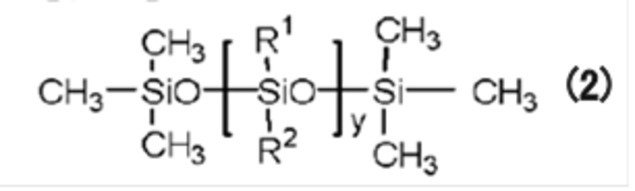
- the carboxyl group equivalent represented by the following general formula (2) is 1,000 g / mol It is a side chain type carboxyl modified silicone having a weight of 4 to 40,000 g / mol.
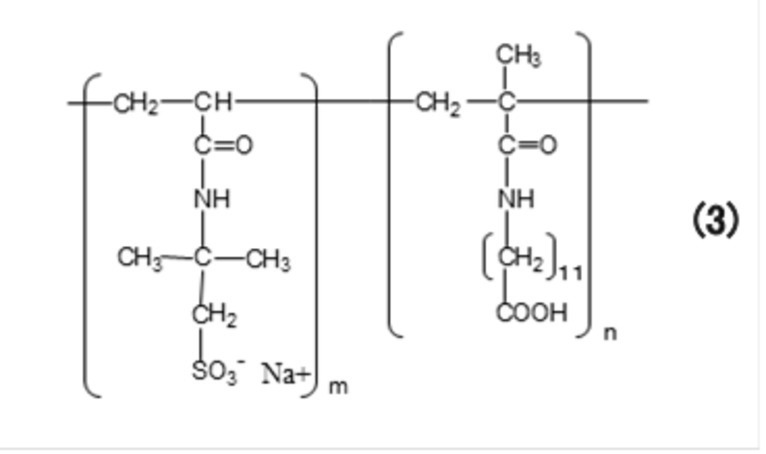
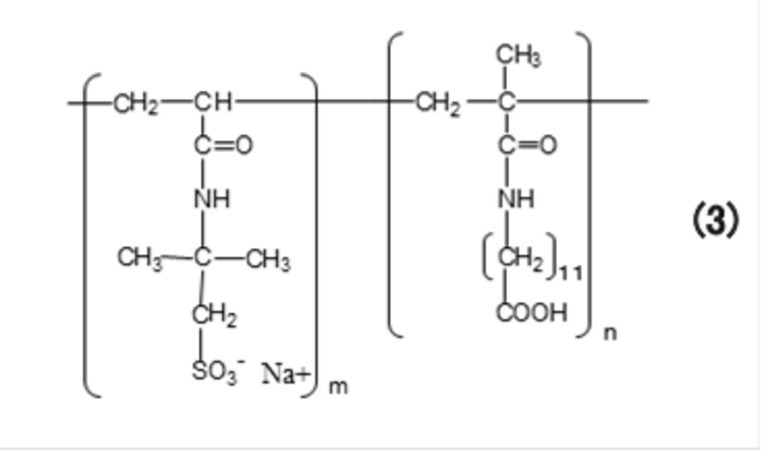
- the acrylic polymer having a carboxyl group (B) used in the present invention is a side-chain carboxyl-modified acrylic polymer having a carboxyl group equivalent represented by the following general formula (3) and having a weight of 200 g / mol to 1000 g / mol.
- the said carboxyl group equivalent represents the numerical value showing the weight of the substance per 1 carboxyl group with respect to the substance containing a carboxyl group.
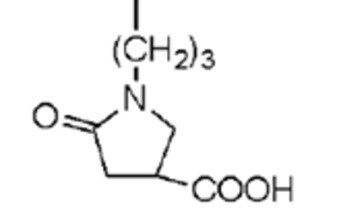
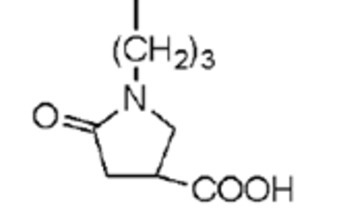
- R 1 and R 2 each represent a methyl group or a group represented by the following [Chemical formula 3], which contains 1 to 100 in one molecule, and y represents an integer of 1 to 50,000. )
- the acrylic polymer having a carboxyl group represented by the general formula (3) can be synthesized using a known method.
- a known method As a specific example, 12-methacrylamide dodecanoic acid (MAD) / 2-acrylamido-2-methylpropane sulfonic acid (AMPS) copolymer (90/10), 12-methacrylamide dodecanoic acid (MAD) 18.50 g (65) .37 mmol), 2-acrylamido-2-methylpropane sulfonic acid (AMPS: manufactured by Sigma-Aldrich Japan) 1.50 g (7.24 mmol), sodium hydroxide 0.29 g (7.25 mmol), azobisisobutyric acid 0.30 g (1.83 mmol) of ronitrile (manufactured by Nacalai Tesque) was dissolved in 60.0 g of methanol.
- AMPS 2-acrylamido-2-methylpropane sulfonic acid
- Azobisisobutyronitrile was used by recrystallization from methanol according to a conventional method. Degassing was performed by bubbling argon for 60 minutes, the vessel was capped with a septum, and polymerization was carried out by heating at 60 ° C. for 20 hours. After completion of the polymerization reaction, the reaction solution was dropped into a large excess of diethyl ether, and the precipitate was collected by suction filtration. After drying under reduced pressure, 15.2 g of random MAD / AMPS copolymer (90/10) was obtained (yield: 75.1%). The weight average molecular weight was 50000.
- the carboxyl group equivalent of the component (B) is preferably 200 to 40000 because the hardness of the resulting elastomer is suitable. If it is less than 200, it is not preferable in that the elastomer may be too hard. Moreover, when it exceeds 40000, it is unpreferable in the point which may not form an elastomer.
- the amount of elastomer coated on talc is 0.5 to 20% by weight, more preferably 1 to 15% by weight, based on talc. It is not preferable that the content exceeds 20% by mass because fusion of talc and reduction of the formability of the powder cosmetic composition may occur. Moreover, it is unpreferable in the point that the improvement effect of a touch may not be acquired as a compounding quantity is less than 0.5 mass%.
- the elastomer-treated talc according to the present invention can be obtained by mixing talc and (A) a silicone polymer having an amino group, and (B) mixing and heating a silicone polymer having a carboxyl group.
- the elastomer-treated talc can be obtained by a known method for producing a coated powder.
- talc and a silicone polymer having an amino group (A) are added to the Henshal mixer and mixed at a low speed for 10 minutes.
- (B) a silicone polymer having a carboxyl group is added thereto, mixed at a low speed for 10 minutes, and heated, whereby an elastomer-coated inorganic powder according to the present invention can be obtained.
- the elastomer-coated inorganic powder according to the present invention can be obtained even if the order of addition of the components (A) and (B) is reversed.
- Metal soap treated talc As the metal soap-treated talc used in the present invention, various metal soap-treated talc can be used. Examples of the metal soap treatment include metal decyltrisiloxane carboxylic acid treatment such as zinc decyltrisiloxane carboxylic acid, calcium stearate treatment, magnesium stearate treatment and the like.
- decyltrisiloxane carboxylic acid metal-treated talc is obtained by surface-treating a metal salt of a carboxydecyltrisiloxane derivative with talc.
- a metal salt of the carboxy decyl trisiloxane derivative the terminal carboxyl group of the said derivative and all or one part form a metal salt.
- divalent or trivalent metal atoms include Zn, Mg, Ca, Ba, Mn, Fe, Co, Al, Ni, Cu, V, Mo, Nb, Ti and the like.
- Zn or Mg can be suitably used.
- the carboxydecyl trisiloxane used in the present invention is a kind of carboxylic acid-modified silicone and is represented by the following general formula (4).
- the amount of metal soap treatment coated on talc is 0.5 to 20% by weight, more preferably 1 to 15% by weight, based on talc. It is not preferable that the content exceeds 20% by mass because fusion of talc and reduction of the formability of the powder cosmetic composition may occur. Moreover, it is unpreferable in the point that the improvement effect of a touch may not be acquired as a compounding quantity is less than 0.5 mass%.
- the zinc salt of decyltrisiloxanecarboxylate can be obtained by a known method for producing a coated powder. As a specific example, it is carried out by the following two types of dry method and wet method. However, it is not limited to these.
- the organosiloxane derivative of the above chemical formula 5 is converted to a sodium salt in a 1% aqueous sodium hydroxide solution, and then salt exchange is carried out by the addition of a 1% aqueous zinc chloride solution, and the Zn salt of the organosiloxane derivative is obtained.
- Salt exchange is carried out by the addition of a 1% aqueous zinc chloride solution, and the Zn salt of the organosiloxane derivative is obtained.
- 15 g of talc and 5 g of the Zn salt of the organosiloxane derivative are ground and mixed.
- a surface treatment by a wet method is more preferably employed.
- the mixing temperature is preferably 60 to 80.degree.
- the mixing time varies depending on the amount of treatment and the type of powder, but usually 1 to Preferably 3 hours
- the elastomer treatment and the metal soap treatment may be powders other than talc.
- inorganic powders boron nitride, sericite, natural mica, calcined mica, synthetic mica, synthetic cericite, alumina, mica, kaolin, bentonite, smectite, calcium carbonate, magnesium carbonate, calcium phosphate, anhydrous silicic acid, magnesium oxide , Tin oxide, iron oxide, yttrium oxide, chromium oxide, titanium oxide, zinc oxide, cerium oxide, aluminum oxide, magnesium oxide, chromium hydroxide, bitumen, ultramarine, calcium phosphate, aluminum hydroxide, barium sulfate, magnesium sulfate, silicate , Aluminum magnesium silicate, calcium silicate, barium silicate, magnesium silicate, aluminum silicate, strontium silicate, silicon carbide, magnesium fluoride, metal tungstate, magnesium aluminate Magnesium aluminometasilicate
- polyester powder As organic powder, polyester powder, polyethylene powder, polypropylene powder, polymethyl methacrylate powder, polystyrene powder, polyurethane powder, benzoguanamine powder, polymethyl methacrylate powder, polymethylbenzoguanamine powder, polytetrafluoroethylene powder, cellulose, silk powder , Nylon powder, 12 nylon powder, 6 nylon powder, styrene / acrylic acid copolymer powder, divinylbenzene / styrene copolymer powder, vinyl resin powder, urea resin powder, phenol resin powder, fluorocarbon resin powder, acrylic resin powder, Examples thereof include melamine resin powder, epoxy resin powder, polycarbonate resin powder, microcrystalline fiber powder, starch powder, lauroyl lysine powder and the like.
- surfactant metal salt powder examples include zinc stearate, aluminum stearate, calcium stearate, magnesium stearate, zinc myristate, magnesium myristate, zinc cetyl phosphate, calcium cetyl phosphate, zinc sodium cetyl phosphate and the like.
- solid powder cosmetic composition according to the present invention, other components such as an ester, an anionic surfactant, a cationic surfactant, an amphoteric surfactant, a nonionic surfactant, as long as the effects of the present invention are not impaired.
- Moisturizer, water soluble polymer, thickener, film agent, UV absorber, sequestering agent, lower alcohol, polyhydric alcohol, sugar, amino acid, organic amine, polymer emulsion, pH adjuster, skin nutrition agent, Vitamins, antioxidants, antioxidant aids, perfumes, water and the like can be appropriately blended, if necessary, and can be produced by an ordinary method according to the intended dosage form.
- Specific components which can be blended are listed below, but the above-mentioned essential blending components and any one or more of the following components can be blended to prepare a solid powder cosmetic.
- fatty acid soap eg, sodium laurate, sodium palmitate etc.
- higher alkyl sulfate ester salt eg, sodium lauryl sulfate, potassium lauryl sulfate etc.
- alkyl ether sulfate ester salt eg, POE-lauryl sulfate triethanolamine, POE-sodium lauryl sulfate, etc.
- N-acyl sarcosic acid eg, lauroyl sarcosine sodium etc.
- higher fatty acid amide sulfonate eg, N-myristoyl-N-methyl taurine sodium, coconut Oil fatty acid methyl taurid sodium, lauryl methyl taurid sodium etc .
- phosphate ester salt POE-oleyl ether sodium phosphate, POE-stearyl ether phosphoric acid etc
- sulfosuccinate sodium di-2-ethylhex
- alkyl trimethyl ammonium salt for example, stearyl trimethyl ammonium chloride, lauryl trimethyl ammonium chloride and the like
- alkyl pyridinium salt for example, cetyl pyridinium chloride and the like
- distearyl dimethyl ammonium dialkyl dimethyl ammonium salt Poly (N, N'-dimethyl-3,5-methylene piperidinium chloride); alkyl quaternary ammonium salt; alkyl dimethyl benzyl ammonium salt; alkyl isoquinolinium salt; dialkyl morophonium salt; POE-alkyl amine; Alkylamine salts; polyamine fatty acid derivatives; amyl alcohol fatty acid derivatives; benzalkonium chloride; benzethonium chloride and the like.
- amphoteric surfactants examples include imidazoline amphoteric surfactants (eg, 2-undecyl-N, N, N- (hydroxyethylcarboxymethyl) -2-imidazoline sodium, 2-cocoyl-2-imidazolinium hydroxide). Side-1-carboxyethyloxy disodium salt and the like); betaine surfactants (eg, 2-heptadecyl-N-carboxymethyl-N-hydroxyethylimidazolinium betaine, lauryl dimethylaminoacetic acid betaine, alkyl betaine, amido betaine) And sulfobetaine etc.).
- imidazoline amphoteric surfactants eg, 2-undecyl-N, N, N- (hydroxyethylcarboxymethyl) -2-imidazoline sodium, 2-cocoyl-2-imidazolinium hydroxide.
- Side-1-carboxyethyloxy disodium salt and the like
- lipophilic nonionic surfactants include sorbitan fatty acid esters (eg, sorbitan monooleate, sorbitan monoisostearate, sorbitan monolaurate, sorbitan monopalmitate, sorbitan monostearate, sorbitan sesquioleate, Sorbitan trioleate, diglycerol sorbitan penta-2-ethylhexyl acid, diglycerol sorbitan tetra-2-ethylhexyl acid, etc.
- sorbitan fatty acid esters eg, sorbitan monooleate, sorbitan monoisostearate, sorbitan monolaurate, sorbitan monopalmitate, sorbitan monostearate, sorbitan sesquioleate, Sorbitan trioleate, diglycerol sorbitan penta-2-ethylhexyl acid, diglycerol sorbitan tetra-2-eth
- Glycerin polyglycerin fatty acids eg mono cotton seed oil fatty acid glycerin, monoerlucate glycerin, sesquioleic acid glycerin, monostearin Acid glycerin, ⁇ , ⁇ '-oleic acid pyroglutamic acid glycerin, monostearic acid glycerin malic acid, etc .
- propylene glycol fatty acid esters eg, Examples thereof include propylene glycol monostearate and the like; hardened castor oil derivatives; glycerin alkyl ether and the like.
- hydrophilic nonionic surfactants include POE-sorbitan fatty acid esters (for example, POE-sorbitan monooleate, POE-sorbitan monostearate, POE-sorbitan monooleate, POE-sorbitan tetraoleate, etc.) POE-Sorbit fatty acid esters (eg, POE-Sorbit monolaurate, POE-Sorbit monooleate, POE-Sorbit pentaoleate, POE-Sorbit monostearate etc.); POE-glycerin fatty acid esters (eg, POE) -Glycerin monostearate, POE-glycerin monoisostearate, POE-POE-monooleate such as POE-glycerin triisostearate, etc.); POE-fatty acid esters (eg POE-distearate) POE-monodioleate, ethylene glycol distearate, etc .; POE
- a moisturizing agent for example, polyethylene glycol, propylene glycol, glycerin, 1,3-butylene glycol, xylitol, sorbitol, maltitol, chondroitin sulfate, hyaluronic acid, mucotin sulfate, caronic acid, atelocollagen, cholesteryl-12-hydroxystearate And sodium lactate, bile salts, dl-pyrrolidone carboxylates, alkylene oxide derivatives, short chain soluble collagen, diglycerin (EO) PO adducts, extract of Izayoira, extract of Yarrow extract, extract of Meriloto, and the like.
- EO diglycerin
- Naturally occurring water-soluble polymers include plant-based polymers (eg, gum arabic, tragacanth gum, galactan, guar gum, carob gum, karaya gum, carrageenan, pectin, agarten, quince seed (marmelo), alge colloid (kasou extract), starch (Rice, corn, potato, wheat), glycyrrhizinic acid; microbial polymers (for example, xanthan gum, dextran, succinoglucan, bullan etc.); animal polymers (for example, collagen, casein, albumin, gelatin etc) Can be mentioned.
- plant-based polymers eg, gum arabic, tragacanth gum, galactan, guar gum, carob gum, karaya gum, carrageenan, pectin, agarten, quince seed (marmelo), alge colloid (kasou extract), starch (Rice, corn, potato, wheat), glycyrrhizinic acid
- semi-synthetic water-soluble polymers include starch-based polymers (for example, carboxymethyl starch, methyl hydroxypropyl starch and the like); cellulose-based polymers (methyl cellulose, ethyl cellulose, methyl hydroxypropyl cellulose, hydroxyethyl cellulose, cellulose sodium sulfate) And hydroxypropyl cellulose, carboxymethyl cellulose, sodium carboxymethyl cellulose, crystalline cellulose, cellulose powder, etc .; alginic acid based polymers (eg, sodium alginate, alginic acid propylene glycol ester etc.) and the like.
- starch-based polymers for example, carboxymethyl starch, methyl hydroxypropyl starch and the like
- cellulose-based polymers methyl cellulose, ethyl cellulose, methyl hydroxypropyl cellulose, hydroxyethyl cellulose, cellulose sodium sulfate
- alginic acid based polymers eg, sodium al
- Examples of synthetic water-soluble polymers include vinyl polymers (eg, polyvinyl alcohol, polyvinyl methyl ether, polyvinyl pyrrolidone, carboxyvinyl polymer, etc.); polyoxyethylene polymers (eg, polyethylene glycol 20,000, 40) And polyoxyethylene polyoxypropylene copolymers etc .; acrylic polymers (for example, sodium polyacrylate, polyethyl acrylate, polyacrylamide etc.); polyethyleneimines; cationic polymers etc.
- vinyl polymers eg, polyvinyl alcohol, polyvinyl methyl ether, polyvinyl pyrrolidone, carboxyvinyl polymer, etc.
- polyoxyethylene polymers eg, polyethylene glycol 20,000, 40
- acrylic polymers for example, sodium polyacrylate, polyethyl acrylate, polyacrylamide etc.
- polyethyleneimines for example, sodium polyacrylate, polyethyl
- a thickener for example, gum arabic, carrageenan, karaya gum, tragacanth gum, carob gum, quince seed (mallo), casein, dextrin, gelatin, sodium pectate, sodium aluminate, methyl cellulose, ethyl cellulose, CMC, hydroxyethyl cellulose, hydroxypropyl Cellulose, PVA, PVM, PVP, sodium polyacrylate, carboxyvinyl polymer, locust bean gum, guar gum, tamarint gum, dialkyldimethyl ammonium cellulose, xanthan gum, magnesium aluminum silicate, bentonite, hectorite, A1 Mg silicate (bee gum), Laponite, silicic acid anhydride and the like can be mentioned.
- a thickener for example, gum arabic, carrageenan, karaya gum, tragacanth gum, carob gum, quince seed (mallo), casein, dextrin,
- UV absorbers examples include benzoic acid UV absorbers (for example, paraaminobenzoic acid (hereinafter referred to as PABA), PABA monoglycerin ester, N, N-dipropoxy PABA ethyl ester, N, N-diethoxy PABA ethyl ester N, N-dimethyl PABA ethyl ester, N, N-dimethyl PABA butyl ester, N, N-dimethyl PABA ethyl ester, etc.); anthranilic acid ultraviolet light absorbers (eg, homomentyl-N-acetyl anthranilate etc.); Salicylic acid UV absorbers (eg, amyl salicylate, menthyl salicylate, homomentyl salicylate, octyl salicylate, phenyl salicylate, benzyl salicylate, p-isopropanol phenyl salicylate, etc.); cinnamic acid UV absorber
- the sequestering agent for example, 1-hydroxyethane-1,1-diphosphonic acid, 1-hydroxyethane-1,1-diphosphonic acid tetrasodium salt, edetate disodium, edetate trisodium, edetate tetrasodium Sodium citrate, sodium polyphosphate, sodium metaphosphate, gluconic acid, phosphoric acid, citric acid, ascorbic acid, succinic acid, edetic acid, trisodium ethylenediaminehydroxyethyl triacetate and the like.
- the lower alcohol includes, for example, ethanol, propanol, isopropanol, isobutyl alcohol, t-butyl alcohol and the like.
- polyhydric alcohols for example, dihydric alcohols (eg ethylene glycol, propylene glycol, trimethylene glycol, 1,2-butylene glycol, 1,3-butylene glycol, tetramethylene glycol, 2,3-butylene glycol, Pentamethylene glycol, 2-butene-1,4-diol, hexylene glycol, octylene glycol etc .; trihydric alcohols (eg glycerin, trimethylolpropane etc.); tetrahydric alcohols (eg 1,2,6) -Pentaerythritol such as hexanetriol etc.); pentahydric alcohol (eg, xylitol etc.); hexahydric alcohol (eg, sorbitol, mannitol etc.); polyhydric alcohol polymer (eg, diethylene glycol, dipropylene glycol, toto) Lily glycol, polypropylene glycol, tetraethylene
- monosaccharides include tricarbon sugars (eg, D-glyceryl aldehyde, dihydroxyacetone etc.); tetracarbon sugars (eg, D-erythrose, D-erythrulose, D-Treose, erythritol etc.); , L-arabinose, D-xylose, L-lyxose, D-arabinose, D-ribose, D-ribulose, D-xylulose, L-xylulose, etc .; 6-carbon sugar (eg, D-glucose, D-talose, D -Bushicose, D-galactose, D-fructose, L-galactose, L-mannose, D-tagatose etc .; heptacarbon sugar (eg aldoheptose, heprose etc); octacarbon sugar (eg octulose etc); deoxy sugar For
- oligosaccharides include sucrose, gunthianose, umbelliferous, lactose, planteos, isolycinos, ⁇ , ⁇ -trehalose, raffinose, lycnose, umbilicin, stachyose vervascose and the like.
- polysaccharides include cellulose, quince seed, chondroitin sulfate, starch, galactan, dermatan sulfate, glycogen, gum arabic, heparan sulfate, hyaluronic acid, tragacanth gum, keratan sulfate, chondroitin, xanthan gum, mucotin sulfate, guar gum, dextran, kerato sulfate Locust bean gum, succinoglucan, caronic acid and the like.
- amino acids examples include neutral amino acids (for example, threonine, cysteine and the like); basic amino acids (for example, hydroxylysine and the like) and the like.
- amino acid derivative examples include acylsarcosine sodium (lauroyl sarcosine sodium), acyl glutamate, acyl ⁇ -alanine sodium, glutathione, pyrrolidone carboxylic acid and the like.
- organic amines examples include monoethanolamine, diethanolamine, triethanolamine, morpholine, triisopropanolamine, 2-amino-2-methyl-1,3-propanediol, 2-amino-2-methyl-1-propanol and the like.
- polymer emulsion examples include acrylic resin emulsions, ethyl polyacrylate emulsions, acrylic resin solutions, polyacrylic alkyl ester emulsions, polyvinyl acetate resin emulsions, natural rubber latex and the like.
- pH adjusters examples include buffers such as lactic acid-sodium lactate, citric acid-sodium citrate, and succinic acid-sodium succinate.
- vitamins examples include vitamin A, B1, B2, B6, C, E and derivatives thereof, pantothenic acid and derivatives thereof, biotin and the like.
- antioxidant examples include tocopherols, dibutylhydroxytoluene, butylhydroxyanisole, gallic acid esters and the like.
- antioxidant aid examples include phosphoric acid, citric acid, ascorbic acid, maleic acid, malonic acid, succinic acid, fumaric acid, kephalin, hexametaphosphate, phytic acid, ethylenediaminetetraacetic acid and the like.
- preservatives ethylparaben, butylparaben, chlorphenesin, phenoxyethanol, etc.
- anti-inflammatory agents eg, glycyrrhizinic acid derivatives, glycyrrhetinic acid derivatives, salicylic acid derivatives, hinokitiol, zinc oxide, allantoin etc.
- Whitening agents eg, placenta extract, yukinoshita extract, arbutin etc.
- various extracts eg., Oubac, ouren, sikon, peony, semen, birch, sage, loquat, carrot, aloe, zenia oyster, iris, grape
- Yokuinin, pomace lily, saffron, sage, sage, oatsliosis, onynis, onynis, garlic, pepper, chipping, seaweed, etc.
- activator eg, royal jelly, photosensitizer, cholesterol derivative, etc.
- metal sequestering agents such as disodium edetate, trisodium edetate, sodium citrate, sodium polyphosphate, sodium metaphosphate, gluconic acid, malic acid, caffeine, tannin, verapamil, tranexamic acid and its derivatives, licorice, Various herbal extracts such as cullin, Itabi, etc., drugs such as tocopherol acetate, glycyrrhizinic acid, glycyrrhizinic acid and its derivatives or salts thereof, vitamin C, magnesium ascorbate phosphate, ascorbic acid glucoside, albicans, kojic acid and other skin lightening agents Amino acids such as arginine and lysine and derivatives thereof, saccharides such as fructose, mannose, erythritol, trehalose, xylitol and the like can be appropriately blended.
- the product form of the solid powder cosmetic according to the present invention can be any product form in the category of powder cosmetic. Specifically, a product form such as foundation, eye shadow, teak color, body powder, perfume powder, baby powder, pressed powder, deodorant powder, or powder can be taken.
- Evaluation (1) Method of measuring average crystallite diameter A sample was measured with an X-ray diffractometer (Geigerflex, manufactured by Rigaku Denki Co., Ltd.), and the average crystallite diameter was calculated by applying a Scherrer formula.
- Evaluation (2) Evaluation of hiding power
- the titanium dioxide powder is dispersed and mixed in a nitrocellulose lacquer to a concentration of 5%, and the obtained dispersion is 0.101 ⁇ m on a black-and-white hiding ratio test paper JIS-K5400
- the test sample was obtained by coating and drying with a film thickness of
- the test samples obtained were subjected to colorimetry on the surface of the coating on white and black paper with a spectrophotometer (CM-2600, manufactured by Konica Minolta).
- CM-2600 spectrophotometer
- the color difference ( ⁇ E) in the Hunter Lab color space was calculated and evaluated as the hiding power.
- ⁇ E (Evaluation criteria) ⁇ : 25 ⁇ E ⁇ : 22 ⁇ E ⁇ 25 ⁇ : ⁇ E ⁇ 22
- Evaluation (3) Evaluation of Red Permeability With red permeability, among the spectral reflectances at each wavelength obtained by measurement on black paper as in the above-mentioned hiding power, the reflectance at the wavelength of 450 nm and the wavelength are The reflectance ratio at 650 nm (reflectance at a wavelength of 450 nm / reflectance at 650 nm: R450 / R650) was calculated. Higher R450 / R650 indicates higher red transmission and lower R450 / R650 indicates lower red transmission.
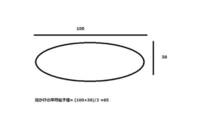
- Evaluation (5) Measuring Method of Apparent Average Particle Size By the method shown in FIG. 1, the average value of the lengths of the major and minor axes of the particles is taken.
- Both rutile-type pigment-grade titanium oxide and anatase-type pigment-grade titanium oxide had low red transmittance. Moreover, even if these were baked at high temperature, red permeability was low.
- the present inventors examined whether it is possible to produce a highly excellent hiding power using rutile-type titanium oxide having high red color permeability.
- the present inventors have prepared two types of titanium dioxide having different particle diameters, each having needle-like projections on the surface of the particles in which needle-like particles are radially oriented and aggregated, using the method of Patent Document (Japanese Patent Laid-Open No. 2010-173863). did.
- Titanium oxide A (specific surface area: 101 m 2 / g, crystallite diameter: 5 nm, apparent average particle diameter: 0.2 to 0.3 ⁇ m, needle shape), titanium oxide B (specific surface area) 117 m 2 / g, crystallite diameter: 11 nm, apparent average particle diameter: 0.3 ⁇ m, needle-like protrusion shape).
- titanium dioxide C (specific surface area: 98 m 2 / g, crystal) having needle-like projections on the particle surface in which needle-like particles which are commercially available products (ST-730; made by titanium industry) are oriented and aggregated radially
- the particle diameter is 6 nm
- the apparent average particle diameter is 0.5 ⁇ m, and it is referred to as a needle-like protrusion).
- titanium dioxide D (84 m 2 / g, crystallite diameter: a titanium dioxide having needle-like projections on the particle surface in which needle-like particles which are commercially available products (ST-750: manufactured by Titanium Kogyo Co., Ltd.) are oriented and aggregated radially.
- titanium oxide which is a commercially available product (MT062; manufactured by Tayca Industries, Ltd.) in the form of needles is titanium oxide E (specific surface area: 47 m 2 / g, crystallite diameter: 23.3 nm, apparent average particle diameter) : 65 nm, needle-like protrusion shape) is called.
- Titanium dioxide powder was obtained using each titanium dioxide by the following method.
- the obtained titanium dioxide powder was evaluated by the above evaluation method, and the relationship between the type of titanium dioxide before firing and the firing temperature was examined. The results are shown in Tables 2 to 6.
- a titanium dioxide powder was obtained by placing 100 g of titanium dioxide to be used as a mother nucleus in a quartz crucible and firing in a muffle furnace at each temperature for 1 hour.
- Titanium oxide A (specific surface area: 101 m 2 / g, crystallite diameter: 5 nm, apparent average particle diameter: 0.2 to 0.3 ⁇ m, needle-like protrusion shape)
- Titanium oxide B (Specific surface area: 117 m 2 / g, Crystallite diameter: 11 nm, Apparent average particle diameter: 0.3 ⁇ m, Needle-like protrusion shape)
- Titanium oxide C (specific surface area: 98 m 2 / g, crystallite diameter: 6 nm, apparent average particle diameter: 0.5 ⁇ m, needle-like protrusion shape)
- Titanium oxide D (specific surface area: 84 m 2 / g, crystallite diameter: 8.6 nm, apparent average particle diameter: 1 ⁇ m, needle-like protrusion shape)
- Titanium oxide E (specific surface area: 47 m 2 / g, crystallite diameter: 23.3 nm, apparent average particle diameter: 65 nm, needle-like protrusion shape)
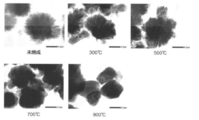
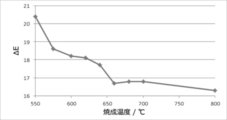
- the hiding power was improved by raising the firing temperature. Since the specific surface area decreases as the temperature rises, the voids formed in the particles are reduced by the condensation of the radially oriented aggregated needle-like particles present before firing. Recognize. This causes an apparent refractive index improvement, and the hiding power is improved.
- the red permeability gradually decreased. In particular, sintering at a high temperature caused excessive sintering, and the initial red color permeability was significantly reduced. In particular, with respect to titanium oxide C having a large average particle size, the red transmittance was substantially lost at 700 ° C.
- titanium oxide D in which needle-like particles are oriented and aggregated in the same manner as titanium oxides A to C has an apparent particle diameter although the specific surface area decreases in the same manner as titanium oxides A to C with an increase in firing temperature.
- the improvement of the hiding power was extremely small because Furthermore, the red particle transmission also remained low regardless of before and after firing because the apparent particle size was extremely large, and the desired red particle transmission was not obtained.
- titanium oxide E having a small average particle size before firing and consisting of single needle-like particles the shape does not significantly change even after firing and the red transmittance is maintained, but the hiding power is not improved at all.
- titanium dioxide which is a commercial product (TTO 55 (A); manufactured by Ishihara Sangyo Co., Ltd.) and whose particles are granular, titanium oxide F (specific surface area: 37 m 2 / g, crystallite diameter: 24.8 nm, apparent average) Particle size: 50 nm, granular).
- titanium dioxide G specific surface area: 132 m 2 / g, crystallite diameter: 8.6 nm, apparent
- ST 643 manufactured by Titanium Kogyo Co., Ltd.
- Titanium oxide F (specific surface area: 37 m 2 / g, crystallite diameter: 24.8 nm, apparent average particle diameter: 50 nm, granular)
- titanium oxide G (specific surface area: 132 m 2 / g, crystallite diameter: 8.6 nm, apparent average particle diameter: 200 nm, in the form of wrinkles).
- the titanium oxide used in Test Example 7-1 is (a) an apparent average particle diameter, (b) an average crystallite measured by X-ray diffraction method, similarly to titanium dioxide used for the mother nucleus of the present invention.
- the diameter (c) satisfies the specific surface area but does not have needle-like projections on the surface of the particles. Furthermore, since the ratio of the minor axis to the major axis is as large as 2.5, sufficient red color permeability and hiding power can not be realized even after firing.
- titanium oxide B that has a wide acceptable temperature range from the viewpoint of improving the hiding power and maintaining the red transmittance as the titanium oxide of the mother nucleus used in the present invention.
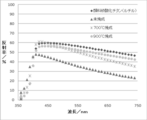
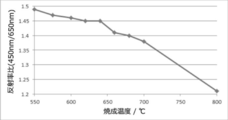
- the measurement results of the spectral reflectances of rutile type pigment grade titanium oxide (* 1) and titanium oxide B (unbaked, firing temperature: 700 ° C., 900 ° C.) are shown in FIG.
- the measurement was carried out by dispersing and mixing titanium dioxide powder in a nitrocellulose lacquer so as to have a concentration of 5%, and applying the obtained dispersion on a black-and-white hiding factor test paper JIS-K5400 with a film thickness of 0.101 ⁇ m. -Dried to obtain a test sample.
- the test sample thus obtained was subjected to colorimetry on the surface of the coated film on black paper with a spectrocolorimeter (CM-2600, manufactured by Konica Minolta Co., Ltd.) to obtain a spectral reflectance.
- CM-2600 manufactured by Konica Minolta Co., Ltd.
- an appropriate temperature range is preferably 500 to 800 ° C., particularly 500 to 700 ° C.
- the inventors examined the firing temperature in the range of 500 ° C. to 800 ° C. finely using titanium oxide B as a mother nucleus. That is, the inventor evaluated the titanium dioxide powder in which the firing temperature was changed by the above evaluation method. The results are shown in Tables 5 and 6.
- the firing was performed in a rotary firing furnace (rotary kiln) that is closer to mass production and has a high firing efficiency.
- rotary firing furnace rotary kiln
- the rotary firing furnace has a high firing efficiency and can obtain the same fired state at a lower temperature than when fired in a muffle furnace which is fired by standing.
- the specific surface area is an index indicating the decrease in porosity of the obtained titanium oxide particles and the progress of sintering
- the titanium dioxide used in the present invention has a specific surface area by firing titanium dioxide powder which is a mother core.
- the preferred range is 8 to 30% of that before firing (100%).
- the baking temperature is preferably 550 to 700 ° C., and more preferably 575 to 660 ° C. that the shielding power and the red color permeability are excellent.
- Solid powder cosmetic Furthermore, the present inventors used solid titanium dioxide obtained by the method of surface treatment described below using titanium dioxide obtained at a firing temperature of 660 ° C. in Table 6 as a solid powder cosmetic, respectively. Adjusted by law. And the obtained cosmetics were evaluated by the following evaluation method.
- Evaluation (6) Natural Finish 10 experts applied the sample to the face and evaluated the feeling of use after application. A: Seven or more out of 10 panelists answered that the finish is natural. B: 5 or more and less than 7 out of 10 panelists answered that the finish is natural. C: Less than 5 out of 10 panelists answered that the finish is natural.
- Evaluation (7) Good Elongation Ten professional panels applied the sample to the face and evaluated the feeling of use after application. A: Seven or more out of ten panelists answered that there is good growth. B: 5 or more and less than 7 out of 10 panelists answered that there is good growth. C: Less than 5 out of 10 panelists answered that there is good growth.
- Evaluation (8) No Happiness Ten professional panels applied the sample to the face and evaluated the feeling of use after application. A: Seven or more out of ten panelists answered that no whitening was observed. B: 5 or more out of 10 panelists answered that there was no whitening. C: Less than 5 out of 10 panelists answered that the pores were not whitened.
- OTS-2 STN-1 (* 10) Daito Kasei Kogyo Co., Ltd.
- OTS-2 BL-100 (* 11) To-Color Pigment Co., Ltd. D-400 (* 12) Shin-Etsu Chemical Co., Ltd. KSP-100
- the solid powder cosmetic using the titanium dioxide of the present invention and the surface-treated talc of the present invention can be highly blended with spherical powder and is excellent in usability and impact stability. While it was found to have a natural finish and no whitening when applied to the skin.
- Test Example 7-3 when titanium dioxide used as a mother nucleus is used as it is, it is inferior in coverage of stains and freckles and noticeable in texture.
- the use of a powder which has not been subjected to the metal soap surface treatment represented by the present invention is inferior to Test Examples 7-4 to 7-5 in the point of impact stability.
Landscapes
- Health & Medical Sciences (AREA)
- Life Sciences & Earth Sciences (AREA)
- Animal Behavior & Ethology (AREA)
- General Health & Medical Sciences (AREA)
- Public Health (AREA)
- Veterinary Medicine (AREA)
- Birds (AREA)
- Epidemiology (AREA)
- Chemical & Material Sciences (AREA)
- Inorganic Chemistry (AREA)
- Cosmetics (AREA)
Abstract
その解決すべき課題は、衝撃安定性、仕上がりと使用性に優れ、隠蔽力を維持しつつ、長波長領域の光をより透過する機能(赤色光選択透過機能)に優れた固形粉末化粧料を提供する。 見かけ上の平均粒子径が100nm以上、500nm未満、X線回折法で測定される平均結晶子径が15~30nm、比表面積が10~30m2/gであって、放射状に突出した針状の突起が凝結した形状を有する粒子であって、形状短径と長径の比(長径/短径)が1.0~2.5である二酸化チタン粉体を1~30質量%と、 球状粉末5~30質量%と、 下記(A)成分と(B)成分からなるエラストマーまたは金属石鹸表面処理された粉末を5~40質量%と、を含むことを特徴とする固形粉末化粧料。 (A)アミノ基を有するシリコーンポリマーと、 (B)カルボキシル基を有するシリコーンポリマー又はカルボキシル基を有するアクリルポリマーと、 からなるエラストマーであって、アミノ基とカルボキシル基のモル比が、Y/X=0.1~1.2 (Yは、(B)成分に含まれるカルボキシル基のモル量、Xは、(A)成分に含まれるアミノ基のモル量)の範囲にある
Description
本出願は、2017年6月26日付け出願の日本国特許出願2017-124674号の優先権を主張しており、ここに折り込まれるものである。
本発明は固形粉末化粧料に関し、特に、仕上がりと使用性に優れ、隠蔽力を維持しつつ、長波長領域の光をより透過する機能(赤色光選択透過機能)に優れた固形粉末化粧料に関する。
二酸化チタンは、屈折率が高く、白色度、隠蔽力、着色力に優れていることから、塗料、プラスチックなどの白色顔料として広く使用されている。また、二酸化チタンは、その粒子径または光活性度をコントロールすることにより、紫外線を遮蔽する物質として、紫外線吸収剤や紫外線遮蔽剤として化粧料や触媒などでの用途にも利用することが可能であることから、近年、これらの用途での研究開発が盛んに行われている。
多数の二酸化チタンから形成されるマリモ状の特定平均一次粒子径の二酸化チタンの小球状粒子から形成される見掛け上の特定平均粒子径の二酸化チタン粉体を、化粧料に使用すれば、従来の二酸化チタンにはない良好な滑り性や優れた耐光性を付与することができる機能性材料になることが知られている。(特許文献1)。
また、平均粒径が0.2~0.4μmで、平均摩擦係数(MIU値)が0.4~0.6であるルチル型酸化チタン凝集粒子1~15質量%と半固形油分1~40質量%を含有する唇用化粧料が、ツヤがあり、唇のシワの目立ちを抑え、化粧持ちに優れていることが知られている(特許文献2)。
また、化粧料として用いられる色材として、可視光領域でも長波長側の光(波長630~700nm)の吸収率の小さいものを配合することで、肌内部での光透過性が素肌と近くなり、自然な仕上がりを実現できることが知られている(特許文献3)。
また、平均粒径が0.2~0.4μmで、平均摩擦係数(MIU値)が0.4~0.6であるルチル型酸化チタン凝集粒子1~15質量%と半固形油分1~40質量%を含有する唇用化粧料が、ツヤがあり、唇のシワの目立ちを抑え、化粧持ちに優れていることが知られている(特許文献2)。
また、化粧料として用いられる色材として、可視光領域でも長波長側の光(波長630~700nm)の吸収率の小さいものを配合することで、肌内部での光透過性が素肌と近くなり、自然な仕上がりを実現できることが知られている(特許文献3)。
このように、光の長波長側の光の透過率を高めた酸化チタンとして、棒状粒子が束状に配向凝集した粒子形態で、配向凝集した粒子の見掛け平均長軸長80~300nm、配向凝集した粒子の見掛け平均短軸長30~150nm、見掛け平均長軸長/見掛け平均短軸長で表される見掛け平均軸比1.1~4で、比表面積が120~180m2/gを示すルチル型酸化チタンである短冊状あるいは藁束状ルチル型酸化チタンが開発されており、透明性並びに紫外線遮蔽能とも高いことが知られている(特許文献4)。
しかし、この二酸化チタンは、棒状粒子の凝集体であり、二次凝集体中の空げきも多いことから、見かけの屈折率が低下してしまい、実際に化粧料に配合するには隠ぺい力が不十分であった。また、紫外線防御に目的の主眼が置かれているため、二次凝集体の見かけの粒子径も100nm未満であり、Mieの理論に基づく酸化チタンの散乱効果を最大化させる粒子径より明らかに小さいため、このことも隠ぺい力が小さい要因となってしまう。
しかし、この二酸化チタンは、棒状粒子の凝集体であり、二次凝集体中の空げきも多いことから、見かけの屈折率が低下してしまい、実際に化粧料に配合するには隠ぺい力が不十分であった。また、紫外線防御に目的の主眼が置かれているため、二次凝集体の見かけの粒子径も100nm未満であり、Mieの理論に基づく酸化チタンの散乱効果を最大化させる粒子径より明らかに小さいため、このことも隠ぺい力が小さい要因となってしまう。
一方で、粉体表面をオルガノポリシロキサン誘導体で処理することによって、肌へ塗布した際の使用感触が改善されることが報告されていた。
しかし、このオルガノポリシロキサン誘導体処理粉体に、従来の二酸化チタンを配合しても、肌のシミ等の隠蔽力が高い反面、隠ぺい力を高めるために多量に配合した場合、不自然な仕上がりとなり、肌上の凹凸は、素肌よりも目立たせてしまうことがある。
しかし、このオルガノポリシロキサン誘導体処理粉体に、従来の二酸化チタンを配合しても、肌のシミ等の隠蔽力が高い反面、隠ぺい力を高めるために多量に配合した場合、不自然な仕上がりとなり、肌上の凹凸は、素肌よりも目立たせてしまうことがある。
このような事情から、二酸化チタンを配合し、耐衝撃性と使用性に優れつつ、さらに、肌へ塗布した際に、自然な仕上がりとなるような固形粉末化粧料の開発が望まれている。
そこで、本発明は前記従来技術に鑑み行われたものであり、その解決すべき課題は、耐衝撃性と使用性に優れつつ、隠蔽力を維持しつつ、長波長領域の光をより透過する機能(赤色光選択透過機能)に優れた固形粉末化粧料を提供することにある。
本発明者らが前述の課題を解決すべく鋭意研究を行った結果、特定の二酸化チタンを焼成し、特定の粒子径、特定の結晶子径と、特定の比表面積とした二酸化チタンが、化粧料に求められる隠ぺい力を十分有しつつ、赤色光選択透過機能に優れたものであることを見出した。そして、その二酸化チタンに、特定の表面処理したタルクと球状粉末を配合したものが、使用性と耐衝撃性に優れつつ、肌へ塗布した際に自然な仕上がりと白浮きのなさを有することが分かった。
すなわち、本発明にかかる二酸化チタン粉体は、見かけ上の平均粒子径が100nm以上、500nm未満、X線回折法で測定される平均結晶子径が15~30nm、比表面積が10~30m2/gであって、放射状に突出した針状の突起が凝結した形状を有する粒子であって、形状短径と長径の比(長径/短径)が1.0以上、2.5未満であることを特徴とする二酸化チタン粉体を1~30質量%と、
球状粉末5~30質量%と、
下記(A)成分と(B)成分からなるエラストマーまたは金属石鹸表面処理された粉末を5~40質量%と、を含むことを特徴とする。
(A)アミノ基を有するシリコーンポリマーと、
(B)カルボキシル基を有するシリコーンポリマー又はカルボキシル基を有するアクリルポリマーと、
からなるエラストマーであって、アミノ基とカルボキシル基のモル比が、Y/X=0.1~1.2 (Yは、(B)成分に含まれるカルボキシル基のモル量、Xは、(A)成分に含まれるアミノ基のモル量)の範囲にある
前記固形粉末化粧料において、(A)成分が、下記一般式(1)で示される側鎖型アミノ変性シリコーンであることが好適である。

(一般式(1)中、Xは炭素数1~18のアルキル基、R,R’はアルキル基である。)
前記記載の固形粉末化粧料において、(B)成分が、下記一般式(2)で表されるカルボキシル基を有するシリコーンポリマー又は下記一般式(3)カルボキシル基を有するアクリルポリマーであることを特徴とする固形粉末化粧料。
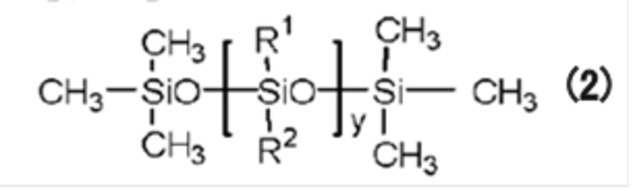
(式中R1及びR2は、メチル基若しくは下記の[化3]で表される基を示し、該基を1分子中に1~100含有し、yは1~50,000の整数を表す。)
本発明にかかる固形粉末化粧料は、X線回折法で測定される平均結晶子径が15~30nm、比表面積が10~30m2/gであって、450nmの反射率の値が、650nmの反射率の値の1.3倍以上であり、色差(ΔE)が22以下であるルチル型二酸化チタン粉体を1~30質量%と、
球状粉末5~30質量%と、
下記(A)成分と(B)成分からなるエラストマーまたは金属石鹸表面処理された粉末 を5~40質量%と、を含むことを特徴とする。
(A)アミノ基を有するシリコーンポリマーと、
(B)カルボキシル基を有するシリコーンポリマー又はカルボキシル基を有するアクリルポリマーと、
からなるエラストマーであって、アミノ基とカルボキシル基のモル比が、Y/X=0.1~1.2 (Yは、(B)成分に含まれるカルボキシル基のモル量、Xは、(A)成分に含まれるアミノ基のモル量)の範囲にある。
なお、色差(ΔE)は、二酸化チタン粉体を5%の濃度になるようにニトロセルロースラッカーに分散混合し、得られた分散物を白黒の隠蔽率試験紙JIS-K5400上に0.101μmの膜厚で塗布・乾燥して試験サンプルを得た。得られた試験サンプルを分光測色機にて、白と黒紙上の塗膜表面をそれぞれ測色した。Hunter Lab色空間における、色差(ΔE)を算出した。
本発明にかかる固形粉末化粧料は、下記の(a)~(c)を満たす粒子表面に針状突起を有するルチル型二酸化チタンを焼成して得られるルチル型二酸化チタン粉体であって、見かけ上の平均粒子径が100nm以上、500nm未満、X線回折法で測定される平均結晶子径が15~30nm、比表面積が10~30m2/gである二酸化チタン粉体を1~30質量%と、
球状粉末5~30質量%と、
下記(A)成分と(B)成分からなるエラストマーまたは金属石鹸表面処理された粉末を5~40質量%と、を含むことを特徴とする。
と、を含むことを特徴とする固形粉末化粧料。
(a)見かけ上の平均粒子径が100nm以上、500nm未満
(b)X線回折法で測定される平均結晶子径が1~25nm
(c)比表面積が40~200m2/g
(A)アミノ基を有するシリコーンポリマーと、
(B)カルボキシル基を有するシリコーンポリマー又はカルボキシル基を有するアクリルポリマーと、
からなるエラストマーであって、アミノ基とカルボキシル基のモル比が、Y/X=0.1~1.2 (Yは、(B)成分に含まれるカルボキシル基のモル量、Xは、(A)成分に含まれるアミノ基のモル量)の範囲にある
本発明にかかる固形粉末化粧料は、下記の(a)~(c)を満たす粒子表面に針状突起を有するルチル型二酸化チタンを焼成して得られるルチル型二酸化チタン粉体であって、焼成後のルチル型二酸化チタン粉体の比表面積が、焼成前に対して8~50%であることを特徴とする二酸化チタン粉体を1~30質量%と、
球状粉末5~30質量%と、
下記(A)成分と(B)成分からなるエラストマーまたは金属石鹸表面処理された粉末 を5~40質量%と、を含むことを特徴とする。
と、を含むことを特徴とする固形粉末化粧料。
(a)見かけ上の平均粒子径が100nm以上、500nm未満
(b)X線回折法で測定される平均結晶子径が1~25nm
(c)比表面積が40~200m2/g
(A)アミノ基を有するシリコーンポリマーと、
(B)カルボキシル基を有するシリコーンポリマー又はカルボキシル基を有するアクリルポリマーと、
からなるエラストマーであって、アミノ基とカルボキシル基のモル比が、Y/X=0.1~1.2 (Yは、(B)成分に含まれるカルボキシル基のモル量、Xは、(A)成分に含まれるアミノ基のモル量)の範囲にある
前記固形粉末化粧料において、二酸化チタンの焼成温度が、500℃~800℃であることが好適である。
前記固形粉末化粧料において、二酸化チタンの焼成温度が、550℃~750℃であることが好適である。
球状粉末5~30質量%と、
下記(A)成分と(B)成分からなるエラストマーまたは金属石鹸表面処理された粉末を5~40質量%と、を含むことを特徴とする。
(A)アミノ基を有するシリコーンポリマーと、
(B)カルボキシル基を有するシリコーンポリマー又はカルボキシル基を有するアクリルポリマーと、
からなるエラストマーであって、アミノ基とカルボキシル基のモル比が、Y/X=0.1~1.2 (Yは、(B)成分に含まれるカルボキシル基のモル量、Xは、(A)成分に含まれるアミノ基のモル量)の範囲にある
前記固形粉末化粧料において、(A)成分が、下記一般式(1)で示される側鎖型アミノ変性シリコーンであることが好適である。
前記記載の固形粉末化粧料において、(B)成分が、下記一般式(2)で表されるカルボキシル基を有するシリコーンポリマー又は下記一般式(3)カルボキシル基を有するアクリルポリマーであることを特徴とする固形粉末化粧料。
球状粉末5~30質量%と、
下記(A)成分と(B)成分からなるエラストマーまたは金属石鹸表面処理された粉末 を5~40質量%と、を含むことを特徴とする。
(A)アミノ基を有するシリコーンポリマーと、
(B)カルボキシル基を有するシリコーンポリマー又はカルボキシル基を有するアクリルポリマーと、
からなるエラストマーであって、アミノ基とカルボキシル基のモル比が、Y/X=0.1~1.2 (Yは、(B)成分に含まれるカルボキシル基のモル量、Xは、(A)成分に含まれるアミノ基のモル量)の範囲にある。
なお、色差(ΔE)は、二酸化チタン粉体を5%の濃度になるようにニトロセルロースラッカーに分散混合し、得られた分散物を白黒の隠蔽率試験紙JIS-K5400上に0.101μmの膜厚で塗布・乾燥して試験サンプルを得た。得られた試験サンプルを分光測色機にて、白と黒紙上の塗膜表面をそれぞれ測色した。Hunter Lab色空間における、色差(ΔE)を算出した。
本発明にかかる固形粉末化粧料は、下記の(a)~(c)を満たす粒子表面に針状突起を有するルチル型二酸化チタンを焼成して得られるルチル型二酸化チタン粉体であって、見かけ上の平均粒子径が100nm以上、500nm未満、X線回折法で測定される平均結晶子径が15~30nm、比表面積が10~30m2/gである二酸化チタン粉体を1~30質量%と、
球状粉末5~30質量%と、
下記(A)成分と(B)成分からなるエラストマーまたは金属石鹸表面処理された粉末を5~40質量%と、を含むことを特徴とする。
と、を含むことを特徴とする固形粉末化粧料。
(a)見かけ上の平均粒子径が100nm以上、500nm未満
(b)X線回折法で測定される平均結晶子径が1~25nm
(c)比表面積が40~200m2/g
(A)アミノ基を有するシリコーンポリマーと、
(B)カルボキシル基を有するシリコーンポリマー又はカルボキシル基を有するアクリルポリマーと、
からなるエラストマーであって、アミノ基とカルボキシル基のモル比が、Y/X=0.1~1.2 (Yは、(B)成分に含まれるカルボキシル基のモル量、Xは、(A)成分に含まれるアミノ基のモル量)の範囲にある
本発明にかかる固形粉末化粧料は、下記の(a)~(c)を満たす粒子表面に針状突起を有するルチル型二酸化チタンを焼成して得られるルチル型二酸化チタン粉体であって、焼成後のルチル型二酸化チタン粉体の比表面積が、焼成前に対して8~50%であることを特徴とする二酸化チタン粉体を1~30質量%と、
球状粉末5~30質量%と、
下記(A)成分と(B)成分からなるエラストマーまたは金属石鹸表面処理された粉末 を5~40質量%と、を含むことを特徴とする。
と、を含むことを特徴とする固形粉末化粧料。
(a)見かけ上の平均粒子径が100nm以上、500nm未満
(b)X線回折法で測定される平均結晶子径が1~25nm
(c)比表面積が40~200m2/g
(A)アミノ基を有するシリコーンポリマーと、
(B)カルボキシル基を有するシリコーンポリマー又はカルボキシル基を有するアクリルポリマーと、
からなるエラストマーであって、アミノ基とカルボキシル基のモル比が、Y/X=0.1~1.2 (Yは、(B)成分に含まれるカルボキシル基のモル量、Xは、(A)成分に含まれるアミノ基のモル量)の範囲にある
前記固形粉末化粧料において、二酸化チタンの焼成温度が、500℃~800℃であることが好適である。
前記固形粉末化粧料において、二酸化チタンの焼成温度が、550℃~750℃であることが好適である。
本発明によれば、衝撃安定姓、仕上がりと使用性に優れ、隠蔽力を維持しつつ、長波長領域の光をより透過する機能(赤色光選択透過機能)に優れた固形粉末化粧料を提供することができる。
本発明に係る二酸化チタン粉体は、棒状もしくは針状粒子が放射状に配向凝集した粒子表面に針状突起を有する二酸化チタンを500~800℃、より好ましくは550~750℃で焼成して得られる二酸化チタン粉体であって、X線回折法で測定される平均結晶子径が15~30nm、二酸化チタンの見掛け上の平均粒子径が100nm以上、500nm未満、より好ましくは200~400nm、比表面積が10~30m2/gであることを特徴とする。
[母核に用いる二酸化チタン]
母核に用いる二酸化チタンの結晶型は、結晶構造の違いから、アナターゼ型とルチル型がある。ここで本発明に用いる二酸化チタンの結晶型は、光触媒活性が低く、屈折率が高いため隠ぺい力が高いルチル型である必要がある。
母核に用いる二酸化チタンの結晶型は、結晶構造の違いから、アナターゼ型とルチル型がある。ここで本発明に用いる二酸化チタンの結晶型は、光触媒活性が低く、屈折率が高いため隠ぺい力が高いルチル型である必要がある。
母核に用いるルチル型二酸化チタンは、赤色光透過機能を有する二酸化チタンが用いられる。母核に用いる二酸化チタンの見かけの平均粒子径は、焼成後に一般的に収縮現象が起こることを考慮すると、本発明で得られた二酸化チタンの散乱による隠ぺい力と優れた赤色透過機能を実現するという観点から、100nm以上、500nm未満が好ましく、より好ましくは200~400nmであることが望ましい。
母核に用いるルチル型二酸化チタンの形状としては、繭状、藁束状、短冊状、球状、針状、棒状等が挙げられる。本発明では、好ましくは、棒状もしくは針状粒子が放射状に配向凝集した粒子表面に針状突起を有することが好ましい。
母核に用いる二酸化チタンの比表面積は、焼成による効率的な見かけの屈折率向上の観点から40~200m2/gであることが望ましい。
母核に用いるルチル型二酸化チタンは、X線回折法で測定される平均結晶子径が 1~25nmであることが好ましい。
母核に用いる二酸化チタンは、市販品でもよい。たとえば、チタン工業株式会社製 ST700シリーズが挙げられる。その中でも、ST710などが挙げられる。
[本発明に用いる二酸化チタン粉体]
本発明の二酸化チタン粉体は、母核に用いる二酸化チタンを焼成することによって、得られる。
焼成温度は焼成を行う装置によって、焼成前に存在する粒子表面から放射状に飛び出ていた針状の突起が、焼成することで凝結した粒子にあって、焼成により凝結することで針状粒子間に存在する空げきを減らし、かつ、針状粒子同士が焼結して、X線回折法で測定される平均結晶子径が過度に増大しない温度条件であることが望ましい。これにより、十分な隠ぺい力と赤色光選択透過機能の両立が可能となる。
本発明の二酸化チタン粉体は、母核に用いる二酸化チタンを焼成することによって、得られる。
焼成温度は焼成を行う装置によって、焼成前に存在する粒子表面から放射状に飛び出ていた針状の突起が、焼成することで凝結した粒子にあって、焼成により凝結することで針状粒子間に存在する空げきを減らし、かつ、針状粒子同士が焼結して、X線回折法で測定される平均結晶子径が過度に増大しない温度条件であることが望ましい。これにより、十分な隠ぺい力と赤色光選択透過機能の両立が可能となる。
本発明に用いる二酸化チタン粉体は、焼成前に存在する粒子表面から放射状に飛び出ていた針状突起が、焼成することで凝結した粒子の形状であることを特徴とする。そして、その粒子の短径と長径の比(長径/短径)が1.0以上、2.5未満であることを特徴とする。さらに好ましくは、1.0~2.0である。
適切な焼成温度は、焼成装置によって異なるが、一般的な焼成炉であるマッフル炉やロータリーキルンで焼成した場合は、500~800℃、より好ましくは550~750℃の範囲で焼成することが望ましい。500℃を下回ると、焼成前に存在する空げきが十分減っていないために隠ぺい力が十分でなく、800℃を超えると、過度に焼結が進行し、赤色光選択透過機能が失われる。
本発明の二酸化チタンはX線回折法で測定される平均結晶子径が15~30nmであることが必要である。
上記結晶子径が15nm未満の場合は、十分な隠ぺい力が得られないという理由で好ましくない。また、30nmを超える場合は、焼結が進行し、十分な赤色光選択透過機能が失われるという点で好ましくない。
上記結晶子径が15nm未満の場合は、十分な隠ぺい力が得られないという理由で好ましくない。また、30nmを超える場合は、焼結が進行し、十分な赤色光選択透過機能が失われるという点で好ましくない。
また、本発明の二酸化チタン粉体は、見掛け上の平均粒子径が散乱による隠ぺい力と優れた赤色透過機能を効果的に実現するという観点から100nm以上、500nm未満、より好ましくは200~400nmであることが必要である。
本発明に用いる二酸化チタン粉体の比表面積は、得られた酸化チタン粒子の空隙率の低下と焼結の進行を示す指標であり、母核となる二酸化チタン粉体を焼成後の比表面積が焼成前(100%)に比べて8~50%になる範囲が好ましい。より好ましくは、8~30%である。
また、本発明の二酸化チタン粉体の比表面積は、10~30m2/g、であることが必要である。10m2/g未満であると、焼結が進行し、十分な赤色光選択透過機能が失われるという点で好ましくない。また、30m2/gを超えると、空隙が過度に存在し、十分な隠ぺい力が達成できないという点で好ましくない。
本発明の二酸化チタン粉体は、焼成後に、表面処理を行うこともできる。表面処理を行うことにより、粘度、油への分散性、撥水性に伴う化粧持ちを向上させつつ、使用性に優れた二酸化チタンを得ることができる。
表面処理剤として使用できる無機物としては、例えば、アルミニウム、ケイ素、亜鉛、チタニウム、ジルコニウム、鉄、セリウム及び錫等の金属の含水酸化物又は酸化物が挙げられる。これに用いられる前記金属塩は特に限定はない。
表面処理剤として使用できる有機物としては、例えば、水酸化アルミニウムや酸化アルミニウムなどの金属酸化物、金属水酸化物で表面処理したのちに、親油性を付加するために、ステアリン酸、オレイン酸、イソステアリン酸、ミリスチン酸、パルミチン酸、ベヘニン酸などの脂肪酸、メチルハイドロジェンポリシロキサン、ジメチコン、アルキル(C8~C18など)トリアルコキシシラン、アミノ変性シリコーン、カルボキシル変性シリコーンなどシリコーン化合物、パーフルオロアルキルアルキルリン酸塩などのフッ素化合物、ミリスチン酸デキストリン、パルミチン酸デキストリン、ラウロイルリシン、ラウロイルグルタミネートなどのアミノ酸誘導体等が挙げられる。
これらの表面処理剤は、二酸化チタン粉体に対して1~10質量%であると、隠蔽力が高いため好ましい。
本発明に用いる二酸化チタン粉体は、化粧料、顔料、インク、塗料などに広く配合することができる。
本発明に用いる二酸化チタンの配合量は、粉末化粧料の総重量に対し、1~30質量%、より好ましくは5-15質量%である。1質量%より少ないと本発明の二酸化チタン配合による効果が得られない場合があり、30量%を超えると仕上がりが不自然になる場合がある。
[球状粉末]
本発明の化粧料に対して配合する球状粉末の素材は、通常化粧料に配合され得る球状粉末の素材であれば特に限定されない。例えば、弾性球状粉末(例えば、レフィル、ウレパール、プラスティックパウダー)、ポリエチレン、ポリプロピレン、ポリスチレン、ポリメタクリル酸メチル、ポリアミド樹脂(ナイロン)、ウレタン、シリコーン樹脂、シリコーンゴム、シリコーン樹脂被覆ゴム、ポリ四フッ化エチレン、二酸化ケイ素(シリカ)、スチレンとアクリル酸との共重合体樹脂、ベンゾグアナミン樹脂、セルロース等が例示される。
本発明の化粧料に対して配合する球状粉末の素材は、通常化粧料に配合され得る球状粉末の素材であれば特に限定されない。例えば、弾性球状粉末(例えば、レフィル、ウレパール、プラスティックパウダー)、ポリエチレン、ポリプロピレン、ポリスチレン、ポリメタクリル酸メチル、ポリアミド樹脂(ナイロン)、ウレタン、シリコーン樹脂、シリコーンゴム、シリコーン樹脂被覆ゴム、ポリ四フッ化エチレン、二酸化ケイ素(シリカ)、スチレンとアクリル酸との共重合体樹脂、ベンゾグアナミン樹脂、セルロース等が例示される。
さらに、当該球状粉末は、表面処理がなされていてもよい。表面処理は、例えば、シリコーン化合物処理、フッ素変性シリコーン化合物処理、フッ素化合物処理、高級脂肪酸処理、高級アルコール処理、脂肪酸エステル処理、金属石鹸処理、アミノ酸処理、アルキルフォスフェート処理等が挙げられる。
球状粉末の市販品としては、KSP100(信越化学工業株式会社製)、KSP-300(信越化学工業株式会社製)、ナイロンSP-500(東レ株式会社製)、D-400(東色ピグメント株式会社製)
などが挙げられる。
などが挙げられる。
また、当該球状粉末の粒径(平均粒径)は、1~30μmの範囲内であることが使用感触上好適であり、3~20μmの範囲内であることが特に好適である。本発明の化粧料には、球状粉末を1種又は2種以上配合することができる
本発明の化粧料における球状粉末の配合量は、化粧料に対して5~30質量%であり、好適には10~20質量%である。当該配合量が30質量%を超えると成形性が極端に悪くなる傾向があり、5質量%未満であると、製品に十分な伸展性を付与することが困難になる。
本発明に用いるタルク、エラスオトマー処理または金属石鹸処理をして用いる。エラスオトマー処理または金属石鹸処理タルクの配合量は、化粧料中5~40質量%が好ましく、15~35質量%であるとより好ましい。40質量%より多いと、化粧料の取れが悪くなる場合がある。 5質量%より少ないと、十分な耐衝撃性を有する化粧料が得られない場合がある。
[エラストマー処理タルク]
本発明で用いるタルクをエラストマー処理するための、エラストマーは、以下の方法によって得られる。
本発明で用いるタルクをエラストマー処理するための、エラストマーは、以下の方法によって得られる。
本発明に係るエラストマーは、アミノ基を有するシリコーンポリマーと、カルボキシル基を有するシリコーンポリマーとを混合し、加熱することによって製造されるものである。
(A)アミノ基を有するシリコーンポリマー
本発明に使用される(A)アミノ基を有するシリコーンポリマーは、下記一般式(1)で示される側鎖型アミノ変性シリコーンである。
本発明に使用される(A)アミノ基を有するシリコーンポリマーは、下記一般式(1)で示される側鎖型アミノ変性シリコーンである。

(一般式(1)中、Xは炭素数1~18のアルキル基、R,R’はアルキル基である。)
一般式(1)中、mは、20~2000であると、得られるエラストマーの硬さが好適という理由で好ましい。20未満であると、エラストマーを形成しない場合がある点で好ましくない。また、2000を超えると、ハンドリングの困難さ、製造の困難さを生じる場合がある点で好ましくない。
一般式(1)中、nは、1~100であると、得られるエラストマーの硬さが好適という理由で好ましい。1未満であると、エラストマーを形成しない場合がある点で好ましくない場合がある。また、100を超えると、エラストマーが硬すぎる場合がある点で好ましくない場合がある。
一般式(1)中、Rは、アルキル鎖が好適に用いられ、プロピル基が量産性という理由で好ましい。
一般式(1)中、R’は、アルキル鎖が好適に用いられ、エチル基が量産性という理由で好ましい。
一般式(1)中、R’は、アルキル鎖が好適に用いられ、エチル基が量産性という理由で好ましい。
(A)アミノ基を有するシリコーンポリマーのアミノ基当量は、500g/mol~20000g/molであると、得られるエラストマーの硬さが好適という理由で好ましい。アミノ基当量が500未満であると、エラストマーが硬すぎる場合がある点で好ましくない。また、アミノ基当量が20000を超えると、エラストマーを形成しない場合がある点で好ましくない。
(A)アミノ基を有するシリコーンポリマーの市販品としては、例えば、KF-8004、KF-8005S、KF-867S(信越化学工業社製)、XF42-B1989(MOMENTIVE社製)、ADM1650、ADM1370(旭化成ワッカーシリコーン社製)、SF8452C、SS3551(東レ・ダウコーニング社製)等が挙げられる。
上記アミノ基当量とは、アミノ基を含む物質に対して、1モルのアミノ基あたりのその物質の重量を表す数値を表す。
(B)カルボキシル基を有するシリコーンポリマー又はカルボキシル基を有するアクリルポリマー
本発明に使用される(B)カルボキシル基を有するシリコーンポリマーとしては、下記一般式(2)で示されるカルボキシル基当量が1000g/mol~40000g/molである側鎖型カルボキシル変性シリコーンである。
本発明に使用される(B)カルボキシル基を有するアクリルポリマーとしては、下記一般式(3)で示されるカルボキシル基当量が200g/mol~1000g/molである側鎖型カルボキシル変性アクリルポリマーである。
本発明に使用される(B)カルボキシル基を有するシリコーンポリマーとしては、下記一般式(2)で示されるカルボキシル基当量が1000g/mol~40000g/molである側鎖型カルボキシル変性シリコーンである。
本発明に使用される(B)カルボキシル基を有するアクリルポリマーとしては、下記一般式(3)で示されるカルボキシル基当量が200g/mol~1000g/molである側鎖型カルボキシル変性アクリルポリマーである。
上記カルボキシル基当量とは、カルボキシル基を含む物質に対して、1モルのカルボキシル基あたりのその物質の重量を表す数値を表す。
一般式(2)は、次の化学式2と化学式3からなる。
一般式(3)は、次の化学式4からなる。
一般式(2)で示されるカルボキシル基を有するシリコーンポリマーの市販品としては、例えば、センサシルPCA(クローダ社製)等が挙げられる。
一般式(3)で示されるカルボキシル基を有するアクリルポリマーは、公知の方法を用いて合成できる。
具体例を挙げれば、12-メタクリルアミドドデカン酸(MAD)/2-アクリルアミド-2-メチルプロパンスルホン酸(AMPS)コポリマー(90/10)、12-メタクリルアミドドデカン酸(MAD)18.50g(65.37mmol)、2-アクリルアミド-2-メチルプロパンスルホン酸(AMPS:シグマ-アルドリッチ・ジャパン社製)1.50g(7.24mmol)、水酸化ナトリウム0.29g(7.25mmol)、アゾビスイソブチロニトリル(ナカライテスク社製)0.30g(1.83mmol)を、メタノール60.0gに溶解した。アゾビスイソブチロニトリルは、定法に従い、メタノールから再結晶して用いた。60分間アルゴンをバブルして脱気を行い、セプタムで容器に蓋をして60℃で20時間加熱して重合した。重合反応終了後に大過剰のジエチルエーテル中に反応溶液を滴下して沈殿物を吸引ろ過で回収した。減圧乾燥の後、ランダム状のMAD/AMPSコポリマー(90/10)15.2gを得た(収率:75.1%)。重量平均分子量は50000だった。
具体例を挙げれば、12-メタクリルアミドドデカン酸(MAD)/2-アクリルアミド-2-メチルプロパンスルホン酸(AMPS)コポリマー(90/10)、12-メタクリルアミドドデカン酸(MAD)18.50g(65.37mmol)、2-アクリルアミド-2-メチルプロパンスルホン酸(AMPS:シグマ-アルドリッチ・ジャパン社製)1.50g(7.24mmol)、水酸化ナトリウム0.29g(7.25mmol)、アゾビスイソブチロニトリル(ナカライテスク社製)0.30g(1.83mmol)を、メタノール60.0gに溶解した。アゾビスイソブチロニトリルは、定法に従い、メタノールから再結晶して用いた。60分間アルゴンをバブルして脱気を行い、セプタムで容器に蓋をして60℃で20時間加熱して重合した。重合反応終了後に大過剰のジエチルエーテル中に反応溶液を滴下して沈殿物を吸引ろ過で回収した。減圧乾燥の後、ランダム状のMAD/AMPSコポリマー(90/10)15.2gを得た(収率:75.1%)。重量平均分子量は50000だった。
(B)成分のカルボキシル基当量は、200~40000であると、得られるエラストマーの硬さが好適という理由で好ましい。200未満であると、エラストマーが硬すぎる場合がある点で好ましくない。また、40000を超えると、エラストマーを形成しない場合がある点で好ましくない。
(A)アミノ基を有するシリコーンポリマー中のアミノ基と、(B)カルボキシル基を有するシリコーンポリマー又はカルボキシル基を有するアクリルポリマーのカルボキシル基のモル比は、Y/X=0.1~1.2(Yは、(B)成分に含まれるカルボキシル基のモル量、Xは(A)成分に含まれるアミノ基のモル量)である必要がある。より好ましくは、0.1~0.8である。0.1未満であると、エラストマーを形成しない場合があるため好ましくない。また、1.2より大きいと、エラストマーを形成しない場合があるため好ましくない。
タルクに被覆されているエラストマーの量は、タルクに対して、0.5~20質量%、より好ましくは1~15質量%である。20質量%を超えて配合すると、タルクの融着や粉末化粧料の成形性の低下を生じる場合がある点で好ましくない。また、配合量が0.5質量%未満であると、感触の改善効果が得られない場合がある点で好ましくない。
[エラストマー処理タルクの製造方法]
タルクと、(A)アミノ基を有するシリコーンポリマーを混合する工程と、(B)カルボキシル基を有するシリコーンポリマーを混合し、加熱する工程によって本発明に係るエラストマー処理タルクを得ることができる。
タルクと、(A)アミノ基を有するシリコーンポリマーを混合する工程と、(B)カルボキシル基を有するシリコーンポリマーを混合し、加熱する工程によって本発明に係るエラストマー処理タルクを得ることができる。
エラストマー処理タルクは、公知の被覆粉末の製造方法で得ることができる。具体例を挙げると、ヘンシャルミキサーに、タルクと、(A)アミノ基を有するシリコーンポリマーを加え、低速にて、10分間混合する。そして、そこに、(B)カルボキシル基を有するシリコーンポリマーを加えて、低速にて10分間混合し、加熱することで、本発明に係るエラストマー被覆無機粉末を得ることができる。
また、(A)成分と(B)成分の添加順序は、逆でも本発明に係るエラストマー被覆無機粉末を得ることができる。
また、(A)成分と(B)成分の添加順序は、逆でも本発明に係るエラストマー被覆無機粉末を得ることができる。
[金属石鹸処理タルク]
本発明に用いる金属石鹸処理タルクは、様々な金属石鹸処理されたタルクを用いることができる。金属石鹸処理としては、デシルトリシロキサンカルボン酸亜鉛等のデシルトリシロキサンカルボン酸金属処理、ステアリン酸カルシウム処理、ステアリン酸マグネシウム処理等が挙げられる。
本発明に用いる金属石鹸処理タルクは、様々な金属石鹸処理されたタルクを用いることができる。金属石鹸処理としては、デシルトリシロキサンカルボン酸亜鉛等のデシルトリシロキサンカルボン酸金属処理、ステアリン酸カルシウム処理、ステアリン酸マグネシウム処理等が挙げられる。
たとえば、デシルトリシロキサンカルボン酸金属処理タルクは、カルボキシデシルトリシロキサン誘導体の金属塩をタルクに表面処理したものである。カルボキシデシルトリシロキサン誘導体の金属塩としては、前記誘導体の末端カルボキシル基と全部又は一部が金属塩を形成している。かかる2価又は3価の金属原子としては、例えば、Zn,Mg,Ca,Ba、Mn,Fe,Co,Al,Ni,Cu,V,Mo,Nb,Ti等が挙げられる。これら2価又は3価の金属原子のうち、特にZn又はMgを好適に用いることができる。
本発明に使用されるカルボキシデシルトリシロキサンは、カルボン酸変性シリコーンの一種であって、下記一般式(4)で表される。
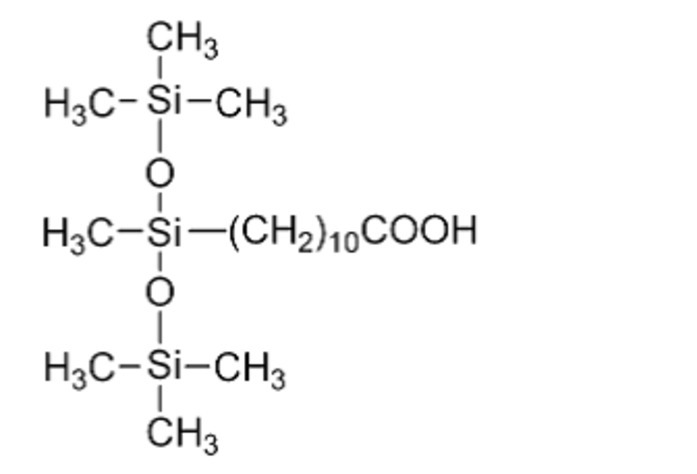
その化学名は、3-(10-カルボキシデシル)-1,1,1,3,5,5,5-ヘプタメチルトリシロキサンであり、公知のカルボキシ変性シリコーンである。本発明においては、「DOW CORNING TORAY OP-1800MF CARBOXY FLUID(東レ・ダウコーニンング)等の市販品を好ましく使用される。
タルクに被覆されている金属石鹸処理の量は、タルクに対して、0.5~20質量%、より好ましくは1~15質量%である。20質量%を超えて配合すると、タルクの融着や粉末化粧料の成形性の低下を生じる場合がある点で好ましくない。また、配合量が0.5質量%未満であると、感触の改善効果が得られない場合がある点で好ましくない。
[デシルトリシロキサンカルボン酸亜鉛処理タルクの製造方法]
デシルトリシロキサンカルボン酸亜鉛処理タルクは、公知の被覆粉末の製造方法で得ることができる。具体例を挙げると、以下のような乾式法と湿式法の2種類によって実施される。ただし、これらに限定されるものではない。
デシルトリシロキサンカルボン酸亜鉛処理タルクは、公知の被覆粉末の製造方法で得ることができる。具体例を挙げると、以下のような乾式法と湿式法の2種類によって実施される。ただし、これらに限定されるものではない。
乾式法
上記化式5のオルガノシロキサン誘導体を、1%水酸化ナトリウム水溶液中でナトリ
ウム塩と変換した後、さらに1%塩化亜鉛水溶液を添加することによって塩交換を行い、該オルガノシロキサン誘導体のZn塩を調製する。その後、タルク15g、前記オルガノシロキサン誘導体のZn塩5gを粉砕混合する。
上記化式5のオルガノシロキサン誘導体を、1%水酸化ナトリウム水溶液中でナトリ
ウム塩と変換した後、さらに1%塩化亜鉛水溶液を添加することによって塩交換を行い、該オルガノシロキサン誘導体のZn塩を調製する。その後、タルク15g、前記オルガノシロキサン誘導体のZn塩5gを粉砕混合する。
湿式法
タルク100g、1%水酸化ナトリウム水溶液30.5g、上記化合物1のオルガノシロキサン誘導体3g、1%塩化亜鉛水溶液156mlを順次添加して混合物を分散させる。ここまでの反応は、70℃にて行う。その後、ろ過により表面処理された粉体を単離し、水洗、乾燥し(105℃、12時間)、粉砕機を用いて粉砕する。
タルク100g、1%水酸化ナトリウム水溶液30.5g、上記化合物1のオルガノシロキサン誘導体3g、1%塩化亜鉛水溶液156mlを順次添加して混合物を分散させる。ここまでの反応は、70℃にて行う。その後、ろ過により表面処理された粉体を単離し、水洗、乾燥し(105℃、12時間)、粉砕機を用いて粉砕する。
湿式法による表面処理がより好ましく採用される。湿式法において、その混合温度は60~80℃であ
ることが好ましい。また、混合時間は、処理量、粉体の種類によって異なるが、通常1~
3時間であることが好ましい
ることが好ましい。また、混合時間は、処理量、粉体の種類によって異なるが、通常1~
3時間であることが好ましい
ここで、エラストマー処理、金属石鹸処理は、タルク以外の粉末もすることができる。
例えば、無機粉末としては、窒化硼素、セリサイト、天然マイカ、焼成マイカ、合成マイカ、合成セリサイト、アルミナ、マイカ、カオリン、ベントナイト、スメクタイト、炭酸カルシウム、炭酸マグネシウム、リン酸カルシウム、無水ケイ酸、酸化マグネシウム、酸化スズ、酸化鉄、酸化イットリウム、酸化クロム、酸化チタン、酸化亜鉛、酸化セリウム、酸化アルミニウム、酸化マグネシウム、水酸化クロム、紺青、群青、リン酸カルシウム、水酸化アルミニウム、硫酸バリウム、硫酸マグネシウム、ケイ酸、ケイ酸アルミニウムマグネシウム、ケイ酸カルシウム、ケイ酸バリウム、ケイ酸マグネシウム、ケイ酸アルミニウム、ケイ酸ストロンチウム、炭化ケイ素、フッ化マグネシウム、タングステン酸金属塩、アルミン酸マグネシウム、メタケイ酸アルミン酸マグネシウム、クロルヒドロキシアルミニウム、クレー、ゼオライト、ヒドロキシアパタイト、セラミックパウダー、スピネル、ムライト、コージェライト、窒化アルミニウム、窒化チタン、窒化ケイ素、ランタン、サマリウム、タンタル、テルビウム、ユーロピウム、ネオジウム、Mn-Znフェライト、Ni-Znフェライト、シリコーンカーバイート、チタン酸コバルト、チタン酸バリウム、チタン酸鉄、リチウムコバルトチタネート、アルミン酸コバルト、アンチモン含有酸化スズ、スズ含有酸化インジウム、マグネタイト、アルミニウム粉、金粉、銀粉、白金粉、銅粉、貴金属コロイド、鉄粉、亜鉛粉、コバルトブルー、コバルトバイオレット、コバルトグリーン、低次酸化チタン、微粒子酸化チタン、バタフライ状硫酸バリウム、花びら状酸化亜鉛、テトラポッド状酸化亜鉛、微粒子酸化亜鉛、パール顔料としては酸化チタン被覆雲母、酸化チタン被覆マイカ、酸化チタン被覆合成マイカ、酸化チタン被覆シリカ、酸化チタン被覆合成マイカ、酸化チタン被覆タルク、酸化亜鉛被覆シリカ、酸化チタン被覆着色雲母、ベンガラ被覆雲母チタン、ベンガラ・黒酸化鉄被覆雲母チタン、カルミン被覆雲母チタン、コンジョウ被覆雲母チタン等が挙げられる。
これらのうち、マイカ、セリサイト、カオリン、酸化チタン、酸化鉄、酸化亜鉛等が好ましく用いられる。
有機粉体として、ポリエステル粉末、ポリエチレン粉末、ポリプロピレン粉末、ポリメタクリル酸メチル粉末、ポリスチレン粉末、ポリウレタン粉末、ベンゾグアナミン粉末、ポリメタクリル酸メチル粉末、ポリメチルベンゾグアナミン粉末、ポリテトラフルオロエチレン粉末、セルロース、シルク粉末、ナイロン粉末、12ナイロン粉末、6ナイロン粉末、スチレン・アクリル酸共重合体粉末、ジビニルベンゼン・スチレン共重合体粉末、ビニル樹脂粉末、尿素樹脂粉末、フェノール樹脂粉末、フッ素樹脂粉末、アクリル樹脂粉末、メラミン樹脂粉末、エポキシ樹脂粉末、ポリカーボネート樹脂粉末、微結晶繊維粉体、デンプン末、ラウロイルリジン粉末等が例示される。
界面活性剤金属塩粉体として、ステアリン酸亜鉛、ステアリン酸アルミニウム、ステアリン酸カルシウム、ステアリン酸マグネシウム、ミリスチン酸亜鉛、ミリスチン酸マグネシウム、セチルリン酸亜鉛、セチルリン酸カルシウム、セチルリン酸亜鉛ナトリウム等が例示される。
[その他の成分]
本発明にかかる固形粉末化粧料には、本発明の効果を損なわない範囲において、他の成分、例えば、エステル、アニオン界面活性剤、カチオン界面活性剤、両性界面活性剤、非イオン界面活性剤、保湿剤、水溶性高分子、増粘剤、皮膜剤、紫外線吸収剤、金属イオン封鎖剤、低級アルコール、多価アルコール、糖、アミノ酸、有機アミン、高分子エマルジョン、pH調整剤、皮膚栄養剤、ビタミン、酸化防止剤、酸化防止助剤、香料、水等を必要に応じて適宜配合し、目的とする剤形に応じて常法により製造することが出来る。
以下に具体的な配合可能成分を列挙するが、上記必須配合成分と、下記成分の任意の一種又は二種以上とを配合して固形粉末化粧料を調製できる。
アニオン界面活性剤としては、例えば、脂肪酸セッケン(例えば、ラウリン酸ナトリウム、パルミチン酸ナトリウム等);高級アルキル硫酸エステル塩(例えば、ラウリル硫酸ナトリウム、ラウリル硫酸カリウム等);アルキルエーテル硫酸エステル塩(例えば、POE-ラウリル硫酸トリエタノールアミン、POE-ラウリル硫酸ナトリウム等);N-アシルサルコシン酸(例えば、ラウロイルサルコシンナトリウム等);高級脂肪酸アミドスルホン酸塩(例えば、N-ミリストイル-N-メチルタウリンナトリウム、ヤシ油脂肪酸メチルタウリッドナトリウム、ラウリルメチルタウリッドナトリウム等);リン酸エステル塩(POE-オレイルエーテルリン酸ナトリウム、POE-ステアリルエーテルリン酸等);スルホコハク酸塩(例えば、ジ-2-エチルヘキシルスルホコハク酸ナトリウム、モノラウロイルモノエタノールアミドポリオキシエチレンスルホコハク酸ナトリウム、ラウリルポリプロピレングリコールスルホコハク酸ナトリウム等);アルキルベンゼンスルホン酸塩(例えば、リニアドデシルベンゼンスルホン酸ナトリウム、リニアドデシルベンゼンスルホン酸トリエタノールアミン、リニアドデシルベンゼンスルホン酸等);高級脂肪酸エステル硫酸エステル塩(例えば、硬化ヤシ油脂肪酸グリセリン硫酸ナトリウム等);N-アシルグルタミン酸塩(例えば、N-ラウロイルグルタミン酸モノナトリウム、N-ステアロイルグルタミン酸ジナトリウム、N-ミリストイル-L-グルタミン酸モノナトリウム等);硫酸化油(例えば、ロート油等);POE-アルキルエーテルカルボン酸;POE-アルキルアリルエーテルカルボン酸塩;α-オレフィンスルホン酸塩;高級脂肪酸エステルスルホン酸塩;二級アルコール硫酸エステル塩;高級脂肪酸アルキロールアミド硫酸エステル塩;ラウロイルモノエタノールアミドコハク酸ナトリウム;N-パルミトイルアスパラギン酸ジトリエタノールアミン;カゼインナトリウム等が挙げられる。
カチオン界面活性剤としては、例えば、アルキルトリメチルアンモニウム塩(例えば、塩化ステアリルトリメチルアンモニウム、塩化ラウリルトリメチルアンモニウム等);アルキルピリジニウム塩(例えば、塩化セチルピリジニウム等);塩化ジステアリルジメチルアンモニウムジアルキルジメチルアンモニウム塩;塩化ポリ(N,N’-ジメチル-3,5-メチレンピペリジニウム);アルキル四級アンモニウム塩;アルキルジメチルベンジルアンモニウム塩;アルキルイソキノリニウム塩;ジアルキルモリホニウム塩;POE-アルキルアミン;アルキルアミン塩;ポリアミン脂肪酸誘導体;アミルアルコール脂肪酸誘導体;塩化ベンザルコニウム;塩化ベンゼトニウム等が挙げられる。
両性界面活性剤としては、例えば、イミダゾリン系両性界面活性剤(例えば、2-ウンデシル-N,N,N-(ヒドロキシエチルカルボキシメチル)-2-イミダゾリンナトリウム、2-ココイル-2-イミダゾリニウムヒドロキサイド-1-カルボキシエチロキシ2ナトリウム塩等);ベタイン系界面活性剤(例えば、2-ヘプタデシル-N-カルボキシメチル-N-ヒドロキシエチルイミダゾリニウムベタイン、ラウリルジメチルアミノ酢酸ベタイン、アルキルベタイン、アミドベタイン、スルホベタイン等)等が挙げられる。
親油性非イオン界面活性剤としては、例えば、ソルビタン脂肪酸エステル類(例えば、ソルビタンモノオレエート、ソルビタンモノイソステアレート、ソルビタンモノラウレート、ソルビタンモノパルミテート、ソルビタンモノステアレート、ソルビタンセスキオレエート、ソルビタントリオレエート、ペンタ-2-エチルヘキシル酸ジグリセロールソルビタン、テトラ-2-エチルヘキシル酸ジグリセロールソルビタン等);グリセリンポリグリセリン脂肪酸類(例えば、モノ綿実油脂肪酸グリセリン、モノエルカ酸グリセリン、セスキオレイン酸グリセリン、モノステアリン酸グリセリン、α,α'-オレイン酸ピログルタミン酸グリセリン、モノステアリン酸グリセリンリンゴ酸等);プロピレングリコール脂肪酸エステル類(例えば、モノステアリン酸プロピレングリコール等);硬化ヒマシ油誘導体;グリセリンアルキルエーテル等が挙げられる。
親水性非イオン界面活性剤としては、例えば、POE-ソルビタン脂肪酸エステル類(例えば、POE-ソルビタンモノオレエート、POE-ソルビタンモノステアレート、POE-ソルビタンモノオレエート、POE-ソルビタンテトラオレエート等);POE-ソルビット脂肪酸エステル類(例えば、POE-ソルビットモノラウレート、POE-ソルビットモノオレエート、POE-ソルビットペンタオレエート、POE-ソルビットモノステアレート等);POE-グリセリン脂肪酸エステル類(例えば、POE-グリセリンモノステアレート、POE-グリセリンモノイソステアレート、POE-グリセリントリイソステアレート等のPOE-モノオレエート等);POE-脂肪酸エステル類(例えば、POE-ジステアレート、POE-モノジオレエート、ジステアリン酸エチレングリコール等);POE-アルキルエーテル類(例えば、POE-ラウリルエーテル、POE-オレイルエーテル、POE-ステアリルエーテル、POE-ベヘニルエーテル、POE-2-オクチルドデシルエーテル、POE-コレスタノールエーテル等);プルロニック型類(例えば、プルロニック等);POE・POP-アルキルエーテル類(例えば、POE・POP-セチルエーテル、POE・POP-2-デシルテトラデシルエーテル、POE・POP-モノブチルエーテル、POE・POP-水添ラノリン、POE・POP-グリセリンエーテル等);テトラPOE・テトラPOP-エチレンジアミン縮合物類(例えば、テトロニック等);POE-ヒマシ油硬化ヒマシ油誘導体(例えば、POE-ヒマシ油、POE-硬化ヒマシ油、POE-硬化ヒマシ油モノイソステアレート、POE-硬化ヒマシ油トリイソステアレート、POE-硬化ヒマシ油モノピログルタミン酸モノイソステアリン酸ジエステル、POE-硬化ヒマシ油マレイン酸等);POE-ミツロウ・ラノリン誘導体(例えば、POE-ソルビットミツロウ等);アルカノールアミド(例えば、ヤシ油脂肪酸ジエタノールアミド、ラウリン酸モノエタノールアミド、脂肪酸イソプロパノールアミド等);POE-プロピレングリコール脂肪酸エステル;POE-アルキルアミン;POE-脂肪酸アミド;ショ糖脂肪酸エステル;アルキルエトキシジメチルアミンオキシド;トリオレイルリン酸等が挙げられる。
保湿剤としては、例えば、ポリエチレングリコール、プロピレングリコール、グリセリン、1,3-ブチレングリコール、キシリトール、ソルビトール、マルチトール、コンドロイチン硫酸、ヒアルロン酸、ムコイチン硫酸、カロニン酸、アテロコラーゲン、コレステリル-12-ヒドロキシステアレート、乳酸ナトリウム、胆汁酸塩、dl-ピロリドンカルボン酸塩、アルキレンオキシド誘導体、短鎖可溶性コラーゲン、ジグリセリン(EO)PO付加物、イザヨイバラ抽出物、セイヨウノコギリソウ抽出物、メリロート抽出物等が挙げられる。
天然の水溶性高分子としては、例えば、植物系高分子(例えば、アラビアガム、トラガカントガム、ガラクタン、グアガム、キャロブガム、カラヤガム、カラギーナン、ペクチン、カンテン、クインスシード(マルメロ)、アルゲコロイド(カッソウエキス)、デンプン(コメ、トウモロコシ、バレイショ、コムギ)、グリチルリチン酸);微生物系高分子(例えば、キサンタンガム、デキストラン、サクシノグルカン、ブルラン等);動物系高分子(例えば、コラーゲン、カゼイン、アルブミン、ゼラチン等)等が挙げられる。
半合成の水溶性高分子としては、例えば、デンプン系高分子(例えば、カルボキシメチルデンプン、メチルヒドロキシプロピルデンプン等);セルロース系高分子(メチルセルロース、エチルセルロース、メチルヒドロキシプロピルセルロース、ヒドロキシエチルセルロース、セルロース硫酸ナトリウム、ヒドロキシプロピルセルロース、カルボキシメチルセルロース、カルボキシメチルセルロースナトリウム、結晶セルロース、セルロース末等);アルギン酸系高分子(例えば、アルギン酸ナトリウム、アルギン酸プロピレングリコールエステル等)等が挙げられる。
合成の水溶性高分子としては、例えば、ビニル系高分子(例えば、ポリビニルアルコール、ポリビニルメチルエーテル、ポリビニルピロリドン、カルボキシビニルポリマー等);ポリオキシエチレン系高分子(例えば、ポリエチレングリコール20,000、40,000、60,0000のポリオキシエチレンポリオキシプロピレン共重合体等);アクリル系高分子(例えば、ポリアクリル酸ナトリウム、ポリエチルアクリレート、ポリアクリルアミド等);ポリエチレンイミン;カチオンポリマー等が挙げられる。
増粘剤としては、例えば、アラビアガム、カラギーナン、カラヤガム、トラガカントガム、キャロブガム、クインスシード(マルメロ)、カゼイン、デキストリン、ゼラチン、ペクチン酸ナトリウム、アラギン酸ナトリウム、メチルセルロース、エチルセルロース、CMC、ヒドロキシエチルセルロース、ヒドロキシプロピルセルロース、PVA、PVM、PVP、ポリアクリル酸ナトリウム、カルボキシビニルポリマー、ローカストビーンガム、グアガム、タマリントガム、ジアルキルジメチルアンモニウム硫酸セルロース、キサンタンガム、ケイ酸アルミニウムマグネシウム、ベントナイト、ヘクトライト、ケイ酸A1Mg(ビーガム)、ラポナイト、無水ケイ酸等が挙げられる。
紫外線吸収剤としては、例えば、安息香酸系紫外線吸収剤(例えば、パラアミノ安息香酸(以下、PABAと略す)、PABAモノグリセリンエステル、N,N-ジプロポキシPABAエチルエステル、N,N-ジエトキシPABAエチルエステル、N,N-ジメチルPABAエチルエステル、N,N-ジメチルPABAブチルエステル、N,N-ジメチルPABAエチルエステル等);アントラニル酸系紫外線吸収剤(例えば、ホモメンチル-N-アセチルアントラニレート等);サリチル酸系紫外線吸収剤(例えば、アミルサリシレート、メンチルサリシレート、ホモメンチルサリシレート、オクチルサリシレート、フェニルサリシレート、ベンジルサリシレート、p-イソプロパノールフェニルサリシレート等);桂皮酸系紫外線吸収剤(例えば、オクチルメトキシシンナメート、エチル-4-イソプロピルシンナメート、メチル-2,5-ジイソプロピルシンナメート、エチル-2,4-ジイソプロピルシンナメート、メチル-2,4-ジイソプロピルシンナメート、プロピル-p-メトキシシンナメート、イソプロピル-p-メトキシシンナメート、イソアミル-p-メトキシシンナメート、オクチル-p-メトキシシンナメート(2-エチルヘキシル-p-メトキシシンナメート)、2-エトキシエチル-p-メトキシシンナメート、シクロヘキシル-p-メトキシシンナメート、エチル-α-シアノ-β-フェニルシンナメート、2-エチルヘキシル-α-シアノ-β-フェニルシンナメート、グリセリルモノ-2-エチルヘキサノイル-ジパラメトキシシンナメート等);ベンゾフェノン系紫外線吸収剤(例えば、2,4-ジヒドロキシベンゾフェノン、2,2’-ジヒドロキシ-4-メトキシベンゾフェノン、2,2’-ジヒドロキシ-4,4’-ジメトキシベンゾフェノン、2,2’,4,4’-テトラヒドロキシベンゾフェノン、2-ヒドロキシ-4-メトキシベンゾフェノン、2-ヒドロキシ-4-メトキシ-4’-メチルベンゾフェノン、2-ヒドロキシ-4-メトキシベンゾフェノン-5-スルホン酸塩、4-フェニルベンゾフェノン、2-エチルヘキシル-4’-フェニル-ベンゾフェノン-2-カルボキシレート、2-ヒドロキシ-4-n-オクトキシベンゾフェノン、4-ヒドロキシ-3-カルボキシベンゾフェノン等);3-(4’-メチルベンジリデン)-d,l-カンファー、3-ベンジリデン-d,l-カンファー;2-フェニル-5-メチルベンゾキサゾール;2,2’-ヒドロキシ-5-メチルフェニルベンゾトリアゾール;2-(2’-ヒドロキシ-5’-t-オクチルフェニル) ベンゾトリアゾール;2-(2’-ヒドロキシ-5’-メチルフェニルベンゾトリアゾール;ジベンザラジン;ジアニソイルメタン;4-メトキシ-4’-t-ブチルジベンゾイルメタン;5-(3,3-ジメチル-2-ノルボルニリデン)-3-ペンタン-2-オン、ジモルホリノピリダジノ;2-エチルヘキシル-2-シアノ-3,3-ジフェニルアクリレート;2,4-ビス-{[4-(2-エチルヘキシルオキシ)-2-ヒドロキシ]-フェニル}-6-(4-メトキシフェニル)-(1,3,5)-トリアジン等が挙げられる。
金属イオン封鎖剤としては、例えば、1-ヒドロキシエタン-1,1-ジフォスホン酸、1-ヒドロキシエタン-1,1-ジフォスホン酸四ナトリウム塩、エデト酸二ナトリウム、エデト酸三ナトリウム、エデト酸四ナトリウム、クエン酸ナトリウム、ポリリン酸ナトリウム、メタリン酸ナトリウム、グルコン酸、リン酸、クエン酸、アスコルビン酸、コハク酸、エデト酸、エチレンジアミンヒドロキシエチル三酢酸3ナトリウム等が挙げられる。
低級アルコールとしては、例えば、エタノール、プロパノール、イソプロパノール、イソブチルアルコール、t-ブチルアルコール等が挙げられる。
多価アルコールとしては、例えば、2価のアルコール(例えば、エチレングリコール、プロピレングリコール、トリメチレングリコール、1,2-ブチレングリコール、1,3-ブチレングリコール、テトラメチレングリコール、2,3-ブチレングリコール、ペンタメチレングリコール、2-ブテン-1,4-ジオール、ヘキシレングリコール、オクチレングリコール等);3価のアルコール(例えば、グリセリン、トリメチロールプロパン等);4価アルコール(例えば、1,2,6-ヘキサントリオール等のペンタエリスリトール等);5価アルコール(例えば、キシリトール等);6価アルコール(例えば、ソルビトール、マンニトール等);多価アルコール重合体(例えば、ジエチレングリコール、ジプロピレングリコール、トリエチレングリコール、ポリプロピレングリコール、テトラエチレングリコール、ジグリセリン、ポリエチレングリコール、トリグリセリン、テトラグリセリン、ポリグリセリン等);2価のアルコールアルキルエーテル類(例えば、エチレングリコールモノメチルエーテル、エチレングリコールモノエチルエーテル、エチレングリコールモノブチルエーテル、エチレングリコールモノフェニルエーテル、エチレングリコールモノヘキシルエーテル、エチレングリコールモノ2-メチルヘキシルエーテル、エチレングリコールイソアミルエーテル、エチレングリコールベンジルエーテル、エチレングリコールイソプロピルエーテル、エチレングリコールジメチルエーテル、エチレングリコールジエチルエーテル、エチレングリコールジブチルエーテル等);2価アルコールアルキルエーテル類(例えば、ジエチレングリコールモノメチルエーテル、ジエチレングリコールモノエチルエーテル、ジエチレングリコールモノブチルエーテル、ジエチレングリコールジメチルエーテル、ジエチレングリコールジエチルエーテル、ジエチレングリコールブチルエーテル、ジエチレングリコールメチルエチルエーテル、トリエチレングリコールモノメチルエーテル、トリエチレングリコールモノエチルエーテル、プロピレングリコールモノメチルエーテル、プロピレングリコールモノエチルエーテル、プロピレングリコールモノブチルエーテル、プロピレングリコールイソプロピルエーテル、ジプロピレングリコールメチルエーテル、ジプロピレングリコールエチルエーテル、ジプロピレングリコールブチルエーテル等);2価アルコールエーテルエステル(例えば、エチレングリコールモノメチルエーテルアセテート、エチレングリコールモノエチルエーテルアセテート、エチレングリコールモノブチルエーテルアセテート、エチレングリコールモノフェニルエーテルアセテート、エチレングリコールジアジベート、エチレングリコールジサクシネート、ジエチレングリコールモノエチルエーテルアセテート、ジエチレングリコールモノブチルエーテルアセテート、プロピレングリコールモノメチルエーテルアセテート、プロピレングリコールモノエチルエーテルアセテート、プロピレングリコールモノプロピルエーテルアセテート、プロピレングリコールモノフェニルエーテルアセテート等);グリセリンモノアルキルエーテル(例えば、キシルアルコール、セラキルアルコール、バチルアルコール等);糖アルコール(例えば、ソルビトール、マルチトール、マルトトリオース、マンニトール、ショ糖、エリトリトール、グルコース、フルクトース、デンプン分解糖、マルトース、キシリトース、デンプン分解糖還元アルコール等);グリソリッド;テトラハイドロフルフリルアルコール;POE-テトラハイドロフルフリルアルコール;POP-ブチルエーテル;POP・POE-ブチルエーテル;トリポリオキシプロピレングリセリンエーテル;POP-グリセリンエーテル;POP-グリセリンエーテルリン酸;POP・POE-ペンタンエリスリトールエーテル、ポリグリセリン等が挙げられる。
単糖としては、例えば、三炭糖(例えば、D-グリセリルアルデヒド、ジヒドロキシアセトン等);四炭糖(例えば、D-エリトロース、D-エリトルロース、D-トレオース、エリスリトール等);五炭糖(例えば、L-アラビノース、D-キシロース、L-リキソース、D-アラビノース、D-リボース、D-リブロース、D-キシルロース、L-キシルロース等);六炭糖(例えば、D-グルコース、D-タロース、D-ブシコース、D-ガラクトース、D-フルクトース、L-ガラクトース、L-マンノース、D-タガトース等);七炭糖(例えば、アルドヘプトース、ヘプロース等);八炭糖(例えば、オクツロース等);デオキシ糖(例えば、2-デオキシ-D-リボース、6-デオキシ-L-ガラクトース、6-デオキシ-L-マンノース等);アミノ糖(例えば、D-グルコサミン、D-ガラクトサミン、シアル酸、アミノウロン酸、ムラミン酸等);ウロン酸(例えば、D-グルクロン酸、D-マンヌロン酸、L-グルロン酸、D-ガラクツロン酸、L-イズロン酸等)等が挙げられる。
オリゴ糖としては、例えば、ショ糖、グンチアノース、ウンベリフェロース、ラクトース、プランテオース、イソリクノース類、α,α-トレハロース、ラフィノース、リクノース類、ウンビリシン、スタキオースベルバスコース類等が挙げられる。
多糖としては、例えば、セルロース、クインスシード、コンドロイチン硫酸、デンプン、ガラクタン、デルマタン硫酸、グリコーゲン、アラビアガム、ヘパラン硫酸、ヒアルロン酸、トラガントガム、ケラタン硫酸、コンドロイチン、キサンタンガム、ムコイチン硫酸、グアガム、デキストラン、ケラト硫酸、ローカストビーンガム、サクシノグルカン、カロニン酸等が挙げられる。
アミノ酸としては、例えば、中性アミノ酸(例えば、スレオニン、システイン等);塩基性アミノ酸(例えば、ヒドロキシリジン等)等が挙げられる。また、アミノ酸誘導体として、例えば、アシルサルコシンナトリウム(ラウロイルサルコシンナトリウム)、アシルグルタミン酸塩、アシルβ-アラニンナトリウム、グルタチオン、ピロリドンカルボン酸等が挙げられる。
有機アミンとしては、例えば、モノエタノールアミン、ジエタノールアミン、トリエタノールアミン、モルホリン、トリイソプロパノールアミン、2-アミノ-2-メチル-1,3-プロパンジオール、2-アミノ-2-メチル-1-プロパノール等が挙げられる。
高分子エマルジョンとしては、例えば、アクリル樹脂エマルジョン、ポリアクリル酸エチルエマルジョン、アクリルレジン液、ポリアクリルアルキルエステルエマルジョン、ポリ酢酸ビニル樹脂エマルジョン、天然ゴムラテックス等が挙げられる。
高分子エマルジョンとしては、例えば、アクリル樹脂エマルジョン、ポリアクリル酸エチルエマルジョン、アクリルレジン液、ポリアクリルアルキルエステルエマルジョン、ポリ酢酸ビニル樹脂エマルジョン、天然ゴムラテックス等が挙げられる。
pH調整剤としては、例えば、乳酸-乳酸ナトリウム、クエン酸-クエン酸ナトリウム、コハク酸-コハク酸ナトリウム等の緩衝剤等が挙げられる。
ビタミン類としては、例えば、ビタミンA、B1、B2、B6、C、E及びその誘導体、パントテン酸及びその誘導体、ビオチン等が挙げられる。
酸化防止剤としては、例えば、トコフェロール類、ジブチルヒドロキシトルエン、ブチルヒドロキシアニソール、没食子酸エステル類等が挙げられる。
ビタミン類としては、例えば、ビタミンA、B1、B2、B6、C、E及びその誘導体、パントテン酸及びその誘導体、ビオチン等が挙げられる。
酸化防止剤としては、例えば、トコフェロール類、ジブチルヒドロキシトルエン、ブチルヒドロキシアニソール、没食子酸エステル類等が挙げられる。
酸化防止助剤としては、例えば、リン酸、クエン酸、アスコルビン酸、マレイン酸、マロン酸、コハク酸、フマル酸、ケファリン、ヘキサメタフォスフェイト、フィチン酸、エチレンジアミン四酢酸等が挙げられる。
その他の配合可能成分としては、例えば、防腐剤(エチルパラベン、ブチルパラベン、クロルフェネシン、フェノキシエタノール等);消炎剤(例えば、グリチルリチン酸誘導体、グリチルレチン酸誘導体、サリチル酸誘導体、ヒノキチオール、酸化亜鉛、アラントイン等);美白剤(例えば、胎盤抽出物、ユキノシタ抽出物、アルブチン等);各種抽出物(例えば、オウバク、オウレン、シコン、シャクヤク、センブリ、バーチ、セージ、ビワ、ニンジン、アロエ、ゼニアオイ、アイリス、ブドウ、ヨクイニン、ヘチマ、ユリ、サフラン、センキュウ、ショウキュウ、オトギリソウ、オノニス、ニンニク、トウガラシ、チンピ、トウキ、海藻等)、賦活剤(例えば、ローヤルゼリー、感光素、コレステロール誘導体等);血行促進剤(例えば、ノニル酸ワレニルアミド、ニコチン酸ベンジルエステル、ニコチン酸β-ブトキシエチルエステル、カプサイシン、ジンゲロン、カンタリスチンキ、イクタモール、タンニン酸、α-ボルネオール、ニコチン酸トコフェロール、イノシトールヘキサニコチネート、シクランデレート、シンナリジン、トラゾリン、アセチルコリン、ベラパミル、セファランチン、γ-オリザノール等);抗脂漏剤(例えば、硫黄、チアントール等);抗炎症剤(例えば、トラネキサム酸、チオタウリン、ヒポタウリン等)等が挙げられる。
さらに、エデト酸二ナトリウム、エデト酸三ナトリウム、クエン酸ナトリウム、ポリリン酸ナトリウム、メタリン酸ナトリウム、グルコン酸、リンゴ酸等の金属封鎖剤、カフェイン、タンニン、ベラパミル、トラネキサム酸及びその誘導体、甘草、カリン、イチヤクソウ等の各種生薬抽出物、酢酸トコフェロール、グリチルレジン酸、グリチルリチン酸及びその誘導体又はその塩等の薬剤、ビタミンC、アスコルビン酸リン酸マグネシウム、アスコルビン酸グルコシド、アルブチン、コウジ酸等の美白剤、アルギニン、リジン等のアミノ酸及びその誘導体、フルクトース、マンノース、エリスリトール、トレハロース、キシリトール等の糖類等も適宜配合することができる。
本発明にかかる固形粉末化粧料の製品形態としては、粉末化粧料の範疇のあらゆる製品形態をとることが可能である。具体的には、ファンデーション、アイシャドウ、チークカラー、ボディーパウダー、パフュームパウダー、ベビーパウダー、プレスドパウダー、デオドラントパウダー、おしろい等の製品形態をとることができる。
[固形粉末化粧料の製造方法]
〈乾式の製造方法〉
無機粉末成分、油性成分とその他の成分をあらかじめヘンシェルミキサーにて混合した後、パルペライザーにて二回解砕する。そして、得られた混合物を樹脂製の中皿容器に充填し、公知の方法で乾式プレス成型を行ない、本発明の酸化チタンを化粧料に配合した固形状の粉末化粧料を得ることができる。
〈その他の製造方法〉
本発明の酸化チタンを化粧料に配合して製造する方法としては、公知の方法を用いることができる。たとえば、特許第5422092号に記載の揮発性溶媒を用いたスラリーを乾燥して作製する製造方法、特許第5972437号に記載の揮発性溶媒を用いたスラリーを充填後除去して作製する製造方法でも好適に得ることができる。
本発明について、以下に実施例を挙げてさらに詳述するが、本発明はこれにより限定されるものではない。配合量は特記しない限り、その成分が配合される系に対する質量%で示す。
実施例の説明に先立ち本発明で用いた二酸化チタンの試験の評価方法について説明する。
実施例の説明に先立ち本発明で用いた二酸化チタンの試験の評価方法について説明する。
評価(1):平均結晶子径の測定方法
試料をX線回折装置(Geigerflex、理学電機社製)で測定し、シェラー式を適用することにより、平均結晶子径を算出した。
試料をX線回折装置(Geigerflex、理学電機社製)で測定し、シェラー式を適用することにより、平均結晶子径を算出した。
評価(2):隠蔽力の評価
二酸化チタン粉体を5%の濃度になるようにニトロセルロースラッカーに分散混合し、得られた分散物を白黒の隠蔽率試験紙JIS-K5400上に0.101μmの膜厚で塗布・乾燥して試験サンプルを得た。得られた試験サンプルを分光測色機(CM-2600、コニカミノルタ社製)にて、白と黒紙上の塗膜表面をそれぞれ測色した。Hunter Lab色空間における、色差(ΔE)を算出し、これを隠蔽力として評価した。なお、ΔEが高いほど、隠ぺい力が小さく、ΔEが低いほど、隠蔽力が高いことを示す。
ΔE=

(評価基準)
×:25<ΔE
△:22 <ΔE≦25
○:ΔE≦22
二酸化チタン粉体を5%の濃度になるようにニトロセルロースラッカーに分散混合し、得られた分散物を白黒の隠蔽率試験紙JIS-K5400上に0.101μmの膜厚で塗布・乾燥して試験サンプルを得た。得られた試験サンプルを分光測色機(CM-2600、コニカミノルタ社製)にて、白と黒紙上の塗膜表面をそれぞれ測色した。Hunter Lab色空間における、色差(ΔE)を算出し、これを隠蔽力として評価した。なお、ΔEが高いほど、隠ぺい力が小さく、ΔEが低いほど、隠蔽力が高いことを示す。
ΔE=
(評価基準)
×:25<ΔE
△:22 <ΔE≦25
○:ΔE≦22
評価(3):赤色透過性の評価
赤色透過性とは、前述の隠ぺい力と同様に黒紙上での測定により得られる各波長での分光反射率のうち、波長が450nmにおける反射率と波長が650nmにおける反射率比(波長が450nmにおける反射率/650nmにおける反射率:R450/R650)を算出した。
R450/R650が高いほど、赤色透過性が高く、R450/R650が低いほど赤色透過性が低いことを示す。
(評価基準)
×:R450/R650≦1.3
△:1.3<R450/R650≦1.35
○:1.35<R450/R650≦1.4
◎:1.4<R450/R650
赤色透過性とは、前述の隠ぺい力と同様に黒紙上での測定により得られる各波長での分光反射率のうち、波長が450nmにおける反射率と波長が650nmにおける反射率比(波長が450nmにおける反射率/650nmにおける反射率:R450/R650)を算出した。
R450/R650が高いほど、赤色透過性が高く、R450/R650が低いほど赤色透過性が低いことを示す。
(評価基準)
×:R450/R650≦1.3
△:1.3<R450/R650≦1.35
○:1.35<R450/R650≦1.4
◎:1.4<R450/R650
評価(4):比表面積の測定方法
単位質量当たりの比表面積は、国際基準ISO 5794/1(付録D)に相当するThe Journal of the American Chemical Society、60巻、309頁、1938年2月に記載のBET(ブルナウアー-エメット-テラー)法として知られる窒素吸着法によって求めることができる。
単位質量当たりの比表面積は、国際基準ISO 5794/1(付録D)に相当するThe Journal of the American Chemical Society、60巻、309頁、1938年2月に記載のBET(ブルナウアー-エメット-テラー)法として知られる窒素吸着法によって求めることができる。
評価(5):見掛けの平均粒子径の測定方法
図1に示した方法で、粒子の長軸と短軸の長さの平均値をとっている。
図1に示した方法で、粒子の長軸と短軸の長さの平均値をとっている。
[母核に用いる酸化チタンの選定]
はじめに、本発明者らは、市販品として入手可能な顔料級のルチル型とアナターゼ型の酸化チタンを用いて、上記評価方法にて評価した。結果を表1に示す。

*1:タイペーク CR-50(石原産業社製、見掛け上の平均粒子径:200nm、形状:不定形)
*2:バイエルチタンA(バイエル社製、見掛け上の平均粒子径:400nm、形状:不定形)
ルチル型の顔料級酸化チタンとアナターゼ型の顔料級酸化チタンは、いずれも赤色透過性が低かった。また、これらを高温で焼成しても、赤色透過性は低かった。
本発明者らは、赤色透過性の高いルチル型酸化チタンを用いて、隠蔽力に優れるものを製造できないかについて検討を行った。
本発明者らは、特許文献(特開2010-173863号公報)の手法を用いて、針状粒子が放射状に配向凝集した粒子表面に針状突起を有する粒径の異なる二酸化チタンを2種合成した。
得られた酸化チタンそれぞれを、酸化チタンA(比表面積:101m2/g、結晶子径:5 nm、見掛け上の平均粒子径:0.2~0.3μm、針状突起形状)、酸化チタンB(比表面積:117m2/g、結晶子径:11nm、見掛け上の平均粒子径:0.3μm、針状突起形状)と称する。
本発明者らは、特許文献(特開2010-173863号公報)の手法を用いて、針状粒子が放射状に配向凝集した粒子表面に針状突起を有する粒径の異なる二酸化チタンを2種合成した。
得られた酸化チタンそれぞれを、酸化チタンA(比表面積:101m2/g、結晶子径:5 nm、見掛け上の平均粒子径:0.2~0.3μm、針状突起形状)、酸化チタンB(比表面積:117m2/g、結晶子径:11nm、見掛け上の平均粒子径:0.3μm、針状突起形状)と称する。
また、市販品(ST-730;チタン工業株式会社製)である針状粒子が放射状に配向凝集した粒子表面に針状突起を有する二酸化チタンを、酸化チタンC(比表面積:98m2/g、結晶子径:6nm、見掛け上の平均粒子径:0.5μm、針状突起形状)と称する。
また、市販品(ST-750:チタン工業株式会社製)である針状粒子が放射状に配向凝集した粒子表面に針状突起を有する二酸化チタンを、酸化チタンD(84m2/g、結晶子径:8.6nm、見掛け上の平均粒子径:1.0μm、針状突起形状)と称する。
また、市販品(MT062;テイカ工業株式会社製)である粒子が針状である酸化チタンを、酸化チタンE(比表面積:47m2/g、結晶子径:23.3nm、見掛け上の平均粒子径:65nm、針状突起形状)と称する。
また、市販品(ST-750:チタン工業株式会社製)である針状粒子が放射状に配向凝集した粒子表面に針状突起を有する二酸化チタンを、酸化チタンD(84m2/g、結晶子径:8.6nm、見掛け上の平均粒子径:1.0μm、針状突起形状)と称する。
また、市販品(MT062;テイカ工業株式会社製)である粒子が針状である酸化チタンを、酸化チタンE(比表面積:47m2/g、結晶子径:23.3nm、見掛け上の平均粒子径:65nm、針状突起形状)と称する。
各二酸化チタンを用いて、以下の方法により、二酸化チタン粉体を得た。得られた二酸化チタン粉末を、上記評価方法にて評価し、焼成前の二酸化チタンの種類と、焼成温度との関係について検討した。結果を表2~表6に示す。
(二酸化チタン粉体の製造方法)
母核に用いる二酸化チタン100gを石英製のるつぼに入れ、マッフル炉にて各温度で1時間焼成を行うことにより、二酸化チタン粉末を得た。
母核に用いる二酸化チタン100gを石英製のるつぼに入れ、マッフル炉にて各温度で1時間焼成を行うことにより、二酸化チタン粉末を得た。
酸化チタンA(比表面積:101m2/g、結晶子径:5 nm、見掛け上の平均粒子径:0.2~0.3μm、針状突起形状)

酸化チタンB(比表面積:117m2/g、結晶子径:11nm、見掛け上の平均粒子径:0.3μm、針状突起形状)
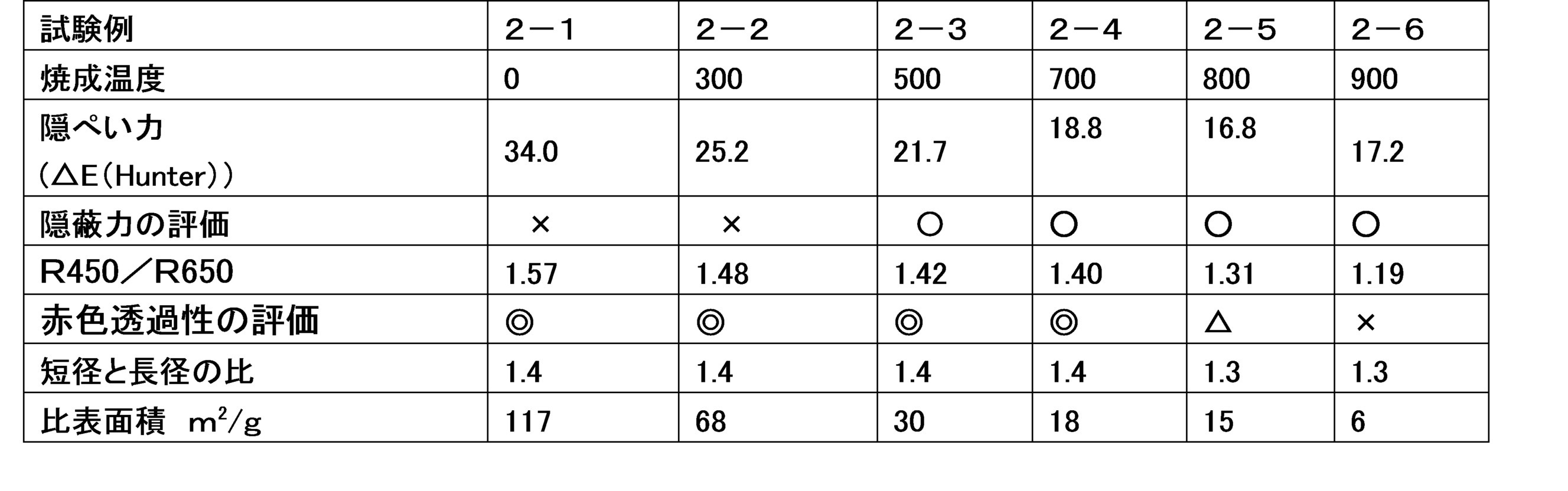
酸化チタンC(比表面積:98m2/g、結晶子径:6nm、見掛け上の平均粒子径:0.5μm、針状突起形状)
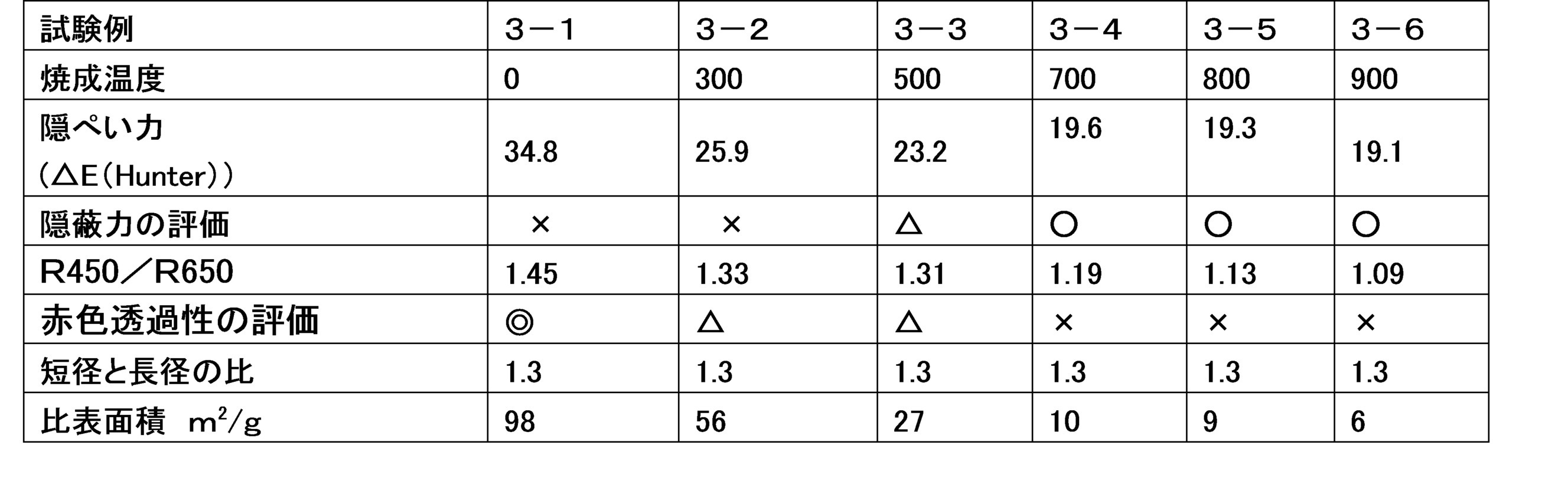
酸化チタンD(比表面積:84m2/g、結晶子径:8.6nm、見掛け上の平均粒子径:1μm、針状突起形状)
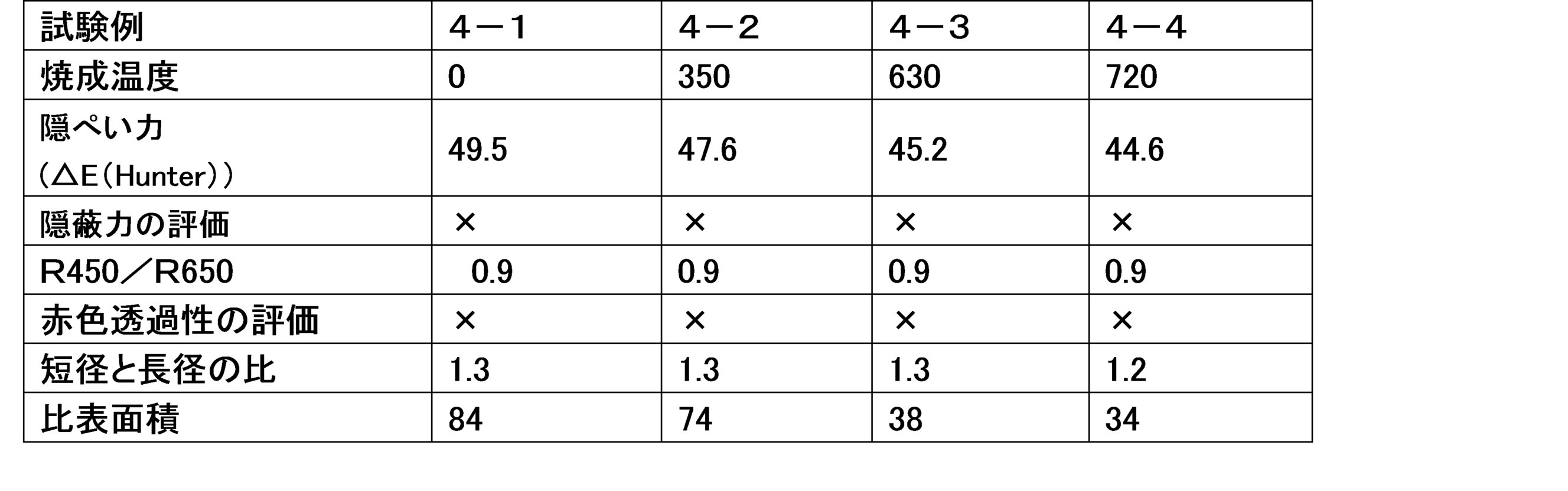
酸化チタンE(比表面積:47m2/g、結晶子径:23.3nm、見掛け上の平均粒子径:65nm、針状突起形状)
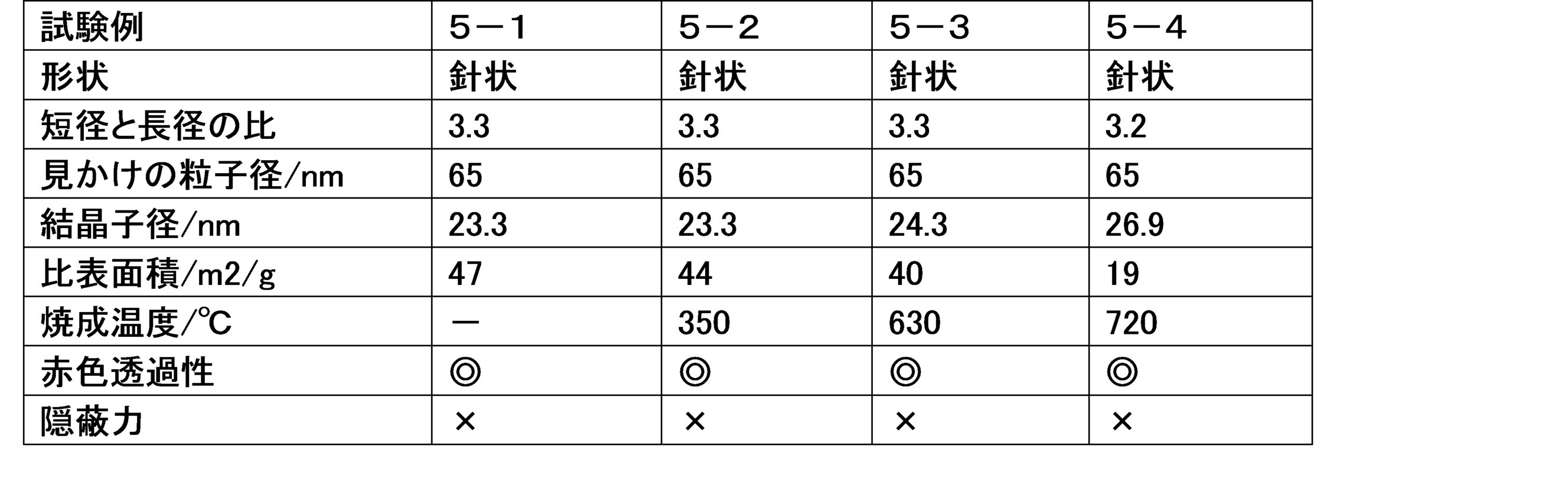
酸化チタンA~Cではいずれも焼成温度を上昇させることで、隠ぺい力は向上した。温度の上昇に伴い、比表面積は減少していることから、焼成前に存在した放射状に配向凝集した針状粒子同士が凝結することで、粒子中に存在する空げきが減少していることがわかる。これが見かけの屈折率向上を引き起こして、隠ぺい力が向上している。しかし、赤色透過性は徐々に減少していった。特に高温で焼成すると過度に焼結が起こり、当初の赤色透過性が著しく低下した。
特に、平均粒子径が大きい酸化チタンCについては、700℃で赤色透過性はほぼ失われていた。
また、酸化チタンA~Cと同様に針状粒子が放射状に配向凝集した酸化チタンDは、焼成温度の上昇に伴い、比表面積は酸化チタンA~Cと同様に減少するものの、見かけの粒子径が著しく大きいために、隠ぺい力の向上は極めて微小であった。さらに、赤色透過性についても見かけの粒子径が著しく大きいために、焼成前後に関わらず低いままであり、望まれる赤色透過性は得られなかった。
また、焼成前の平均粒子径が小さく、単一の針状粒子からなる酸化チタンEについては、焼成後も形状が大きく変化せず赤色透過性は維持されたが、隠蔽力が全く向上しなかった。
さらに、異なる形状の二酸化チタンについて検討した。
また、市販品(TTO55(A);石原産業株式会社製)である粒子が粒状である二酸化チタンを、酸化チタンF(比表面積:37m2/g、結晶子径:24.8nm、見掛け上の平均粒子径:50nm、粒状)と称する。
また、市販品(ST643:チタン工業株式会社製)である棒状粒子が藁束状に配向凝集した二酸化チタンを、酸化チタンG(比表面積:132m2/g、結晶子径:8.6nm、見掛け上の平均粒子径:200nm、藁束状)と称する。
また、市販品(ST643:チタン工業株式会社製)である棒状粒子が藁束状に配向凝集した二酸化チタンを、酸化チタンG(比表面積:132m2/g、結晶子径:8.6nm、見掛け上の平均粒子径:200nm、藁束状)と称する。
酸化チタンF(比表面積:37m2/g、結晶子径:24.8nm、見掛け上の平均粒子径:50nm、粒状)
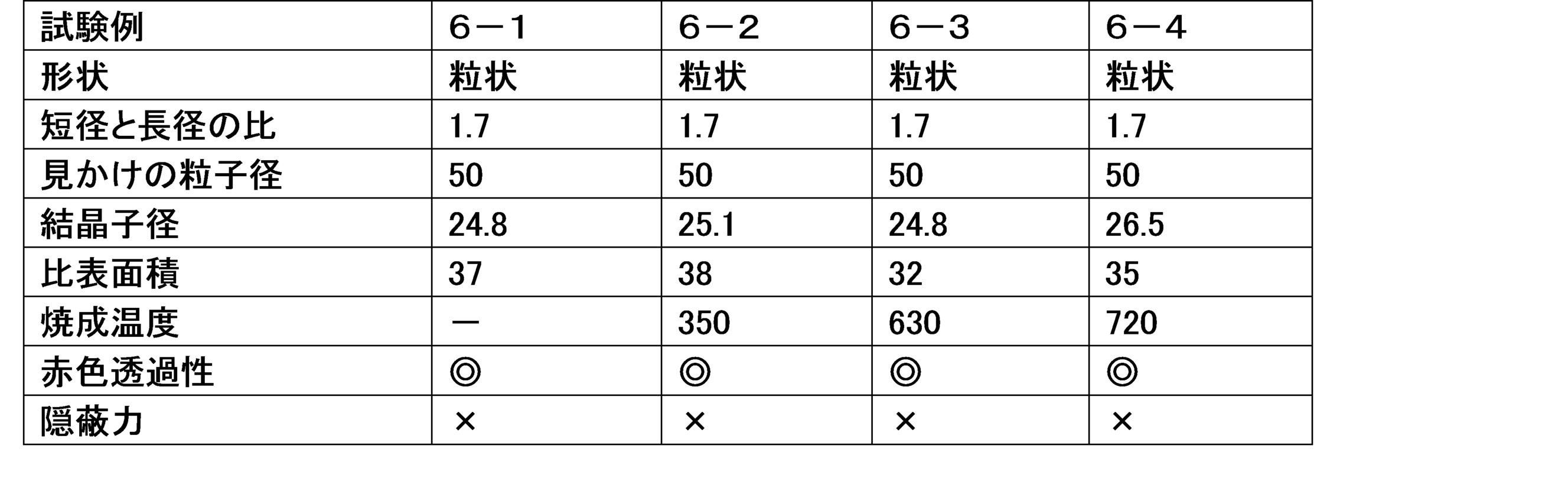
試験例6-1~6-4から分かるように、粒状である酸化チタンを350℃~720℃で焼成した場合は、結晶子径が変化せず、比表面積も結晶子径も本発明の焼成後の酸化チタンにはならない。
したがって、赤色透過性を有するが、望まれる隠蔽力は得られなかった。
したがって、赤色透過性を有するが、望まれる隠蔽力は得られなかった。
酸化チタンG(比表面積:132m2/g、結晶子径:8.6nm、見掛け上の平均粒子径:200nm、藁束状)と称する。
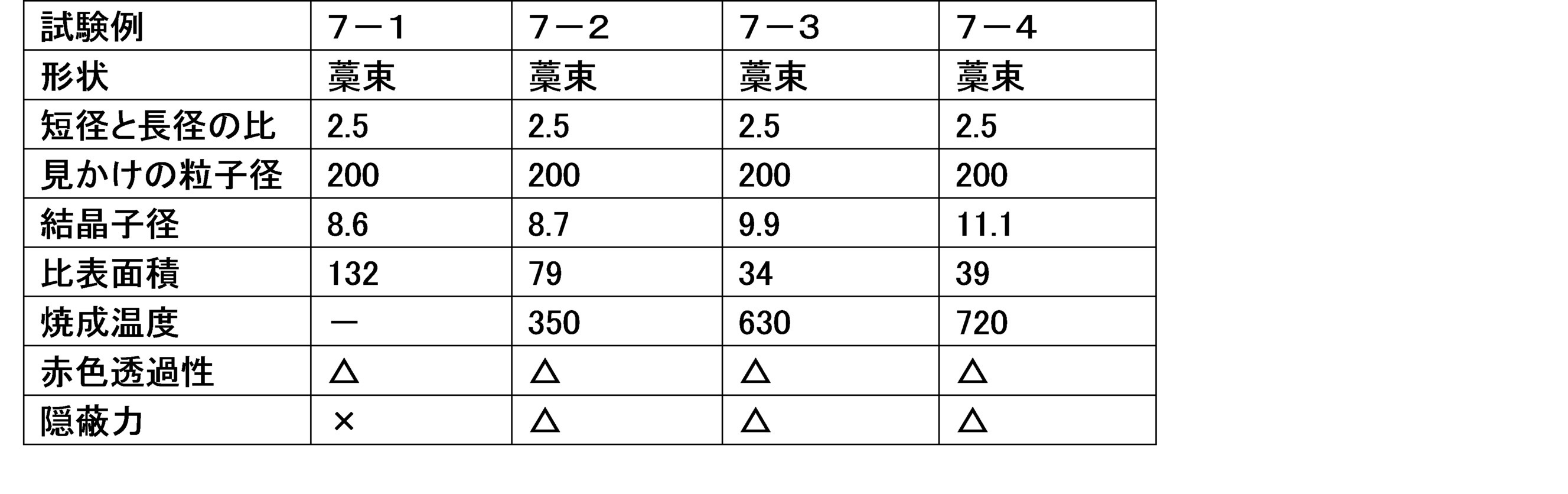
試験例7-1で用いた酸化チタンは、本発明の母核に用いる二酸化チタンと同じように、(a)見かけ上の平均粒子径、(b)X線回折法で測定される平均結晶子径、(c)比表面積を満たすが、粒子の表面に針状の突起を有さない。さらに、短径と長径の比が2.5と大きいため、焼成後も十分な赤色透過性と隠ぺい力を実現することができない。
これらの検討から、本発明に用いる母核の酸化チタンとして適切なのは、隠ぺい性の向上と赤色透過性の維持の観点から許容できる温度幅が広いのは酸化チタンBであった。
ルチル型顔料級酸化チタン(*1)および酸化チタンB(未焼成、焼成温度:700℃、900℃)の分光反射率を測定した結果を図2に示す。なお、測定は、二酸化チタン粉末を5%の濃度になるようにニトロセルロースラッカーに分散混合し、得られた分散物を白黒の隠蔽率試験紙JIS-K5400上に0.101μmの膜厚で塗布・乾燥して試験サンプルを得た。得られた試験サンプルを分光測色機(CM-2600、コニカミノルタ社製)にて、黒紙上の塗膜表面をそれぞれ測色し、分光反射率を得た。
そこで、二酸化チタンBについて、未焼成のもの、焼成したもの(焼成温度:300℃、500℃、700℃、900℃)のTEM像を撮影した。結果を図3に示す。
また、二酸化チタンBについて、ロータリーキルンでの焼成温度変化による隠蔽力、赤色透過性を測定した。結果を、それぞれ図4、図5に示す。
また、二酸化チタンBについて、ロータリーキルンでの焼成温度変化による隠蔽力、赤色透過性を測定した。結果を、それぞれ図4、図5に示す。
以上の結果から、マッフル炉で焼成した場合は、適切な温度範囲は500~800℃、特に500~700℃がより望ましい。
次に、本発明者らは、酸化チタンBを母核にして、細かく500℃~800℃の範囲で焼成温度を検討した。すなわち、本発明者は、焼成温度を変化させた二酸化チタン粉体を上記評価方法にて評価した。結果を表5、表6に示す。
焼成はより量産に近く、焼成効率の高い、回転式焼成炉(ロータリーキルン)で行った。
一般的に回転式焼成炉は焼成効率が高く、静置で焼成するマッフル炉で焼成した場合よりも低い温度で同様の焼成状態を得ることができることが知られている。
一般的に回転式焼成炉は焼成効率が高く、静置で焼成するマッフル炉で焼成した場合よりも低い温度で同様の焼成状態を得ることができることが知られている。

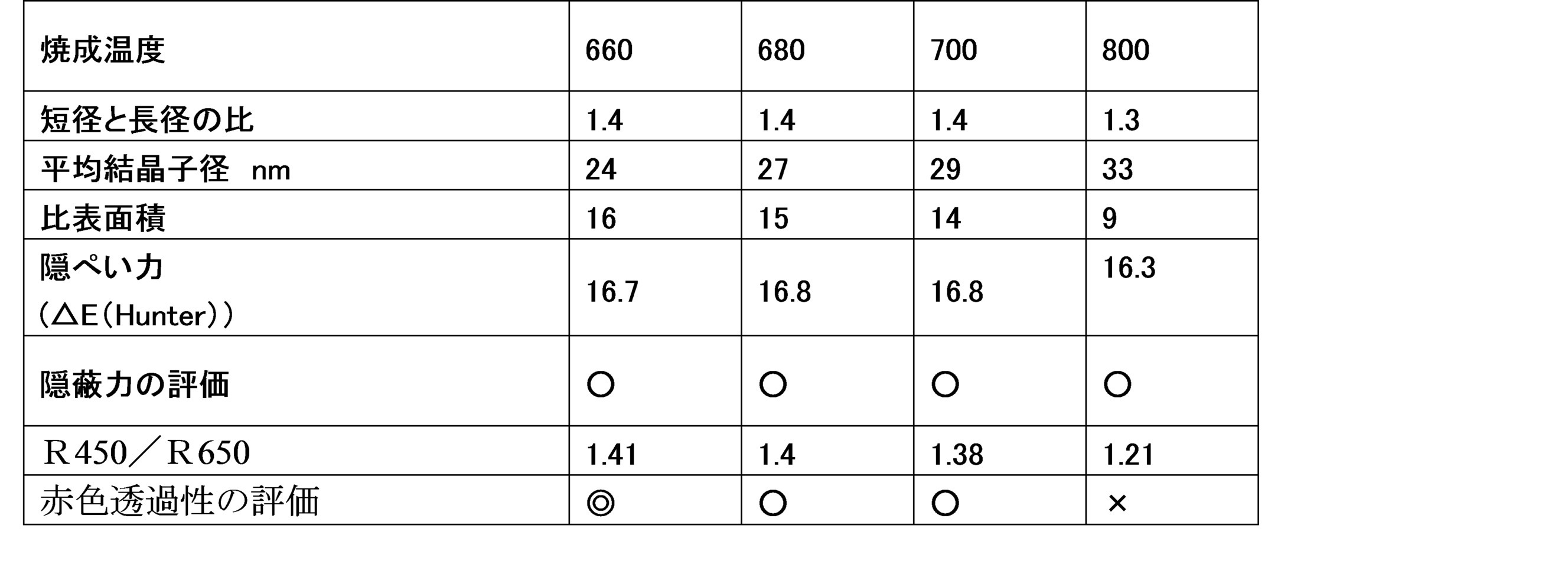
比表面積は、得られた酸化チタン粒子の空隙率の低下と焼結の進行を示す指標であり、本発明に用いる二酸化チタンは、母核となる二酸化チタン粉体を焼成することでその比表面積が焼成前(100%)に比べて8~30%になる範囲が好ましい。
これらの結果より、隠蔽力および赤色透過性に優れているのは、焼成温度が、550~700℃であることが好ましく、575~660℃であることがより好ましいことが分かった。
[デシルトリシロキサンカルボン酸亜鉛処理タルクの製造方法]
最初に、本発明者らは、オルガノシロキサン誘導体として上記化式4のZn塩を用いて、タルク(商品名JA68R、浅田製粉株式社製)に対して表面処理を施し、表面処理粉体を調製した。
最初に、本発明者らは、オルガノシロキサン誘導体として上記化式4のZn塩を用いて、タルク(商品名JA68R、浅田製粉株式社製)に対して表面処理を施し、表面処理粉体を調製した。
[エラストマー処理タルクの製造方法]
ヘンシャルミキサーに、(C)タルクと、カルボキシル基を有するシリコーンポリマーを加え、低速にて、10分間混合する。そして、そこに、アミノ基を有するシリコーンポリマーを加えて、低速にて10分間混合し、加熱することで、エラストマー処理タルクを得た。
ヘンシャルミキサーに、(C)タルクと、カルボキシル基を有するシリコーンポリマーを加え、低速にて、10分間混合する。そして、そこに、アミノ基を有するシリコーンポリマーを加えて、低速にて10分間混合し、加熱することで、エラストマー処理タルクを得た。
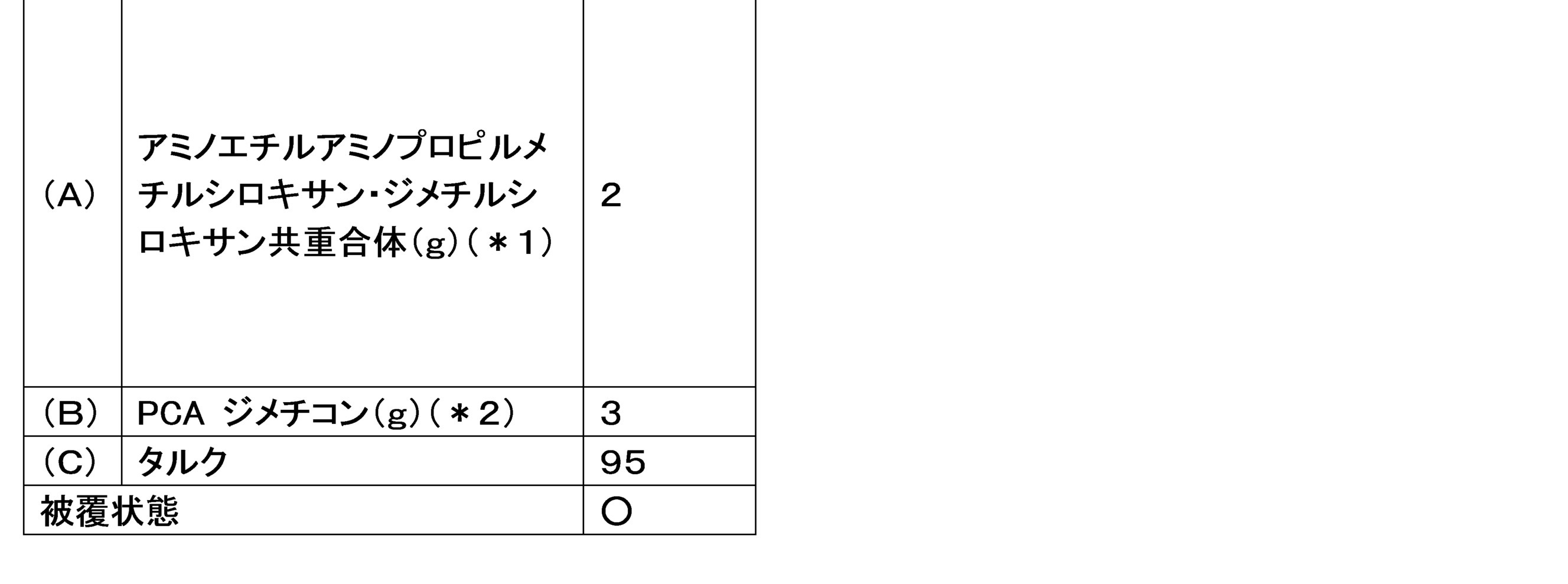
[固形粉末化粧料]
さらに、本発明者は、表6の焼成温度660℃で得られた二酸化チタンを用いて、下記の表面処理の方法で得られた疎水化処理二酸化チタンを配合した固形粉末化粧料を、それぞれ常法で調整した。そして、得られた化粧料を下記評価方法で評価した。
さらに、本発明者は、表6の焼成温度660℃で得られた二酸化チタンを用いて、下記の表面処理の方法で得られた疎水化処理二酸化チタンを配合した固形粉末化粧料を、それぞれ常法で調整した。そして、得られた化粧料を下記評価方法で評価した。
[二酸化チタン粉体の表面処理方法]
得られた二酸化チタン粉体をイオン交換水に分散させ、加温したのち、ステアリン酸を3質量%吸着させ、その後脱水・洗浄・乾燥させることで表面処理二酸化チタンを得た。
得られた二酸化チタン粉体をイオン交換水に分散させ、加温したのち、ステアリン酸を3質量%吸着させ、その後脱水・洗浄・乾燥させることで表面処理二酸化チタンを得た。
[固形粉末化粧料の製造方法]
[固形粉末化粧料の製造方法]
〈乾式の製造方法〉
無機粉末成分、油性成分とその他の成分をあらかじめヘンシェルミキサーにて混合した後、パルペライザーにて二回解砕する。そして、得られた混合物を樹脂製の中皿容器に充填し、公知の方法で乾式プレス成型を行ない、本発明の酸化チタンを化粧料に配合した固形状の粉末化粧料を得ることができる。
〈その他の製造方法〉
本発明の酸化チタンを化粧料に配合して製造する方法としては、公知の方法を用いることができる。たとえば、特許第5422092号に記載の揮発性溶媒を用いたスラリーを乾燥して作製する製造方法、特許第5972437号に記載の揮発性溶媒を用いたスラリーを充填後除去して作製する製造方法でも好適に得ることができる。
[固形粉末化粧料の評価方法]
評価(6):自然な仕上がり
専門パネル10名が顔に試料を塗布し、塗布後の使用感を評価した。
A:パネル10名中7名以上が自然な仕上がりであると回答した。
B:パネル10名中5名以上7名未満が自然な仕上がりであると回答した。
C:パネル10名中5名未満が自然な仕上がりであると回答した。
評価(6):自然な仕上がり
専門パネル10名が顔に試料を塗布し、塗布後の使用感を評価した。
A:パネル10名中7名以上が自然な仕上がりであると回答した。
B:パネル10名中5名以上7名未満が自然な仕上がりであると回答した。
C:パネル10名中5名未満が自然な仕上がりであると回答した。
評価(7):伸びの良さ
専門パネル10名が顔に試料を塗布し、塗布後の使用感を評価した。
A:パネル10名中7名以上が伸びの良さがあると回答した。
B:パネル10名中5名以上7名未満が伸びの良さがあると回答した。
C:パネル10名中5名未満が伸びの良さがあると回答した。
専門パネル10名が顔に試料を塗布し、塗布後の使用感を評価した。
A:パネル10名中7名以上が伸びの良さがあると回答した。
B:パネル10名中5名以上7名未満が伸びの良さがあると回答した。
C:パネル10名中5名未満が伸びの良さがあると回答した。
評価(8):白浮きのなさ
専門パネル10名が顔に試料を塗布し、塗布後の使用感を評価した。
A:パネル10名中7名以上が白浮きがないと回答した。
B:パネル10名中5名以上7名未満が白浮きがない回答した。
C:パネル10名中5名未満が毛穴が白浮きがないと回答した。
専門パネル10名が顔に試料を塗布し、塗布後の使用感を評価した。
A:パネル10名中7名以上が白浮きがないと回答した。
B:パネル10名中5名以上7名未満が白浮きがない回答した。
C:パネル10名中5名未満が毛穴が白浮きがないと回答した。
評価(9):色ムラのなさ
専門パネル10名が顔に試料を塗布し、塗布後の使用感を評価した。
A:パネル10名中7名以上が色ムラがないと回答した。
B:パネル10名中5名以上7名未満が色ムラがないと回答した。
C:パネル10名中5名未満が色ムラがないと回答した。
専門パネル10名が顔に試料を塗布し、塗布後の使用感を評価した。
A:パネル10名中7名以上が色ムラがないと回答した。
B:パネル10名中5名以上7名未満が色ムラがないと回答した。
C:パネル10名中5名未満が色ムラがないと回答した。
評価(10):衝撃安定姓
固形粉末化粧料を化粧品用のコンパクト容器にセットし、化粧料面が下向きの状態で50cmの高さから金属板上に落下させ、割れるまでの回数を調べた。各化粧料につき、試験数(N)=3の平均値が5回以上で十分な耐衝撃性を有すると評価した。
○・・・5回以上
×・・・5回未満
固形粉末化粧料を化粧品用のコンパクト容器にセットし、化粧料面が下向きの状態で50cmの高さから金属板上に落下させ、割れるまでの回数を調べた。各化粧料につき、試験数(N)=3の平均値が5回以上で十分な耐衝撃性を有すると評価した。
○・・・5回以上
×・・・5回未満
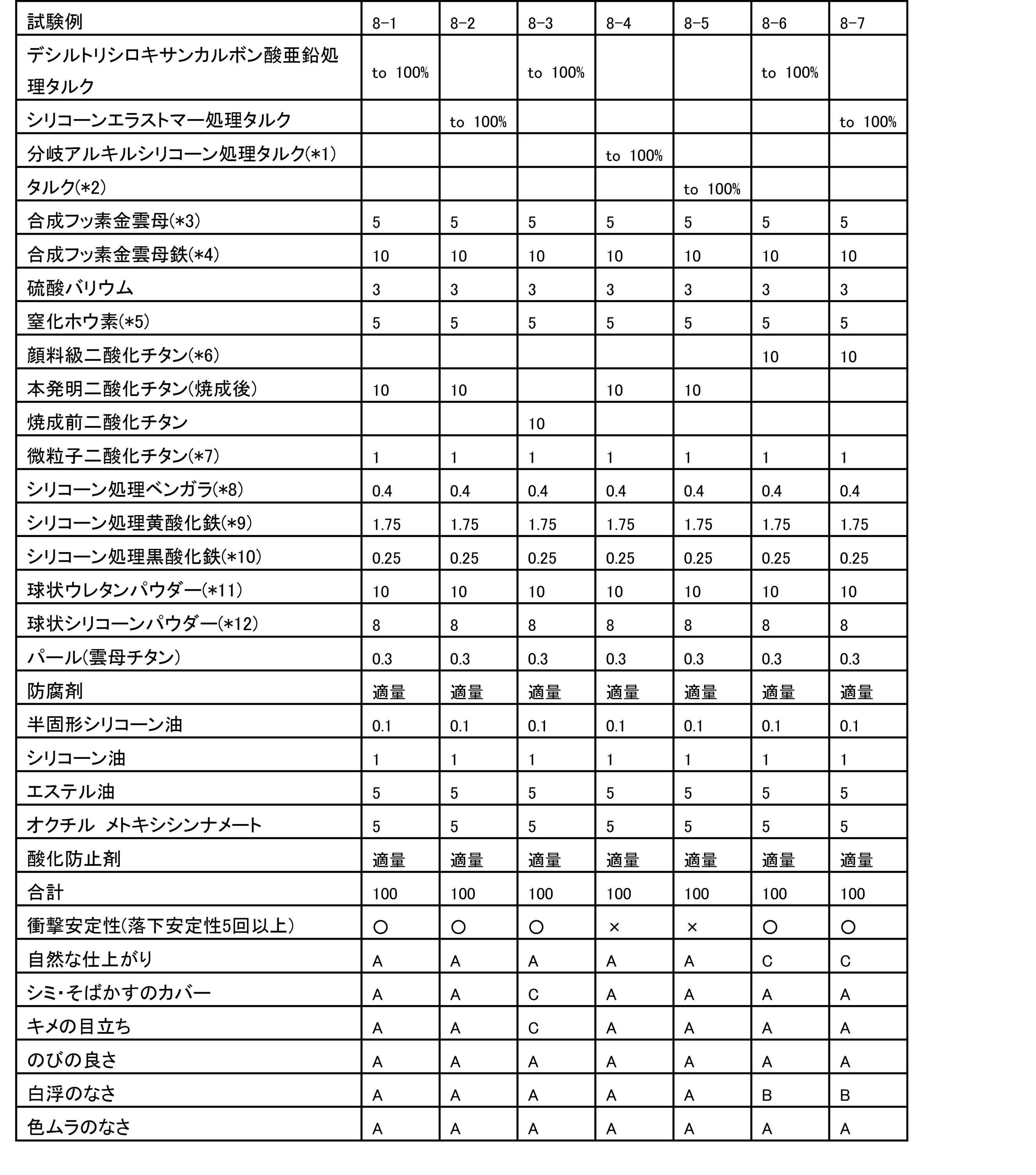
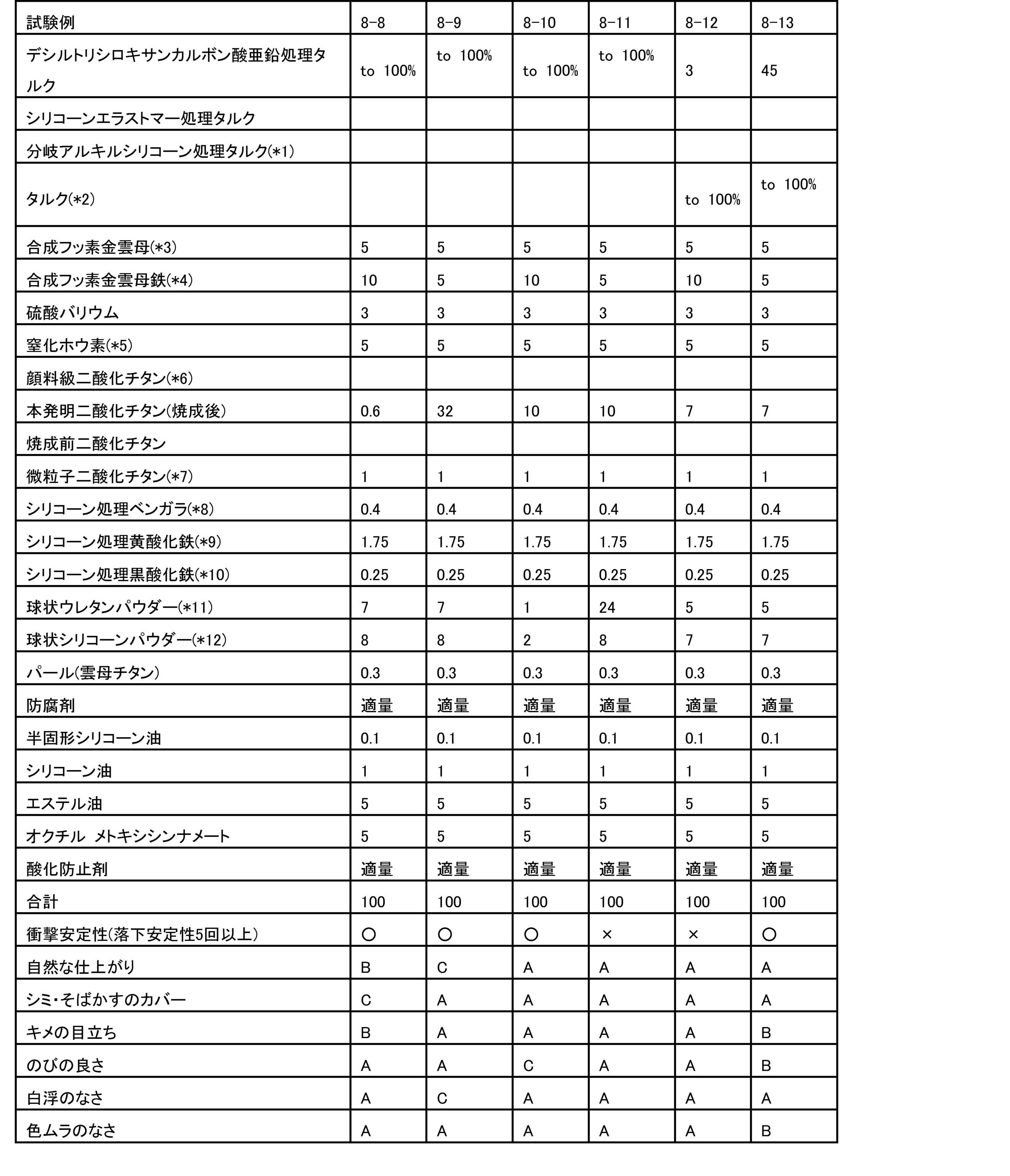
(*1)三好化成株式会社製 BAE-タルク JA-68R
(*2)浅田製粉性 タルクJA-68R
(*3)トピー工業株式会社製 PDM-9WA
(*4)トピー工業株式会社製 PDM-FE
(*5)メルク株式会社製 Ronaflair Boroneige SF-12
(*6)石原産業株式会社製 タイペークCR-50
(*7)テイカ株式会社製 MT-100TV
(*8)大東化成工業株式会社製 OTS-2ベンガラNo. 216P
(*9)大東化成工業株式会社製 OTS-2 STN-1
(*10)大東化成工業株式会社製OTS-2 BL-100
(*11)東色ピグメント株式会社製 D-400
(*12)信越化学株式会製 KSP-100
(*2)浅田製粉性 タルクJA-68R
(*3)トピー工業株式会社製 PDM-9WA
(*4)トピー工業株式会社製 PDM-FE
(*5)メルク株式会社製 Ronaflair Boroneige SF-12
(*6)石原産業株式会社製 タイペークCR-50
(*7)テイカ株式会社製 MT-100TV
(*8)大東化成工業株式会社製 OTS-2ベンガラNo. 216P
(*9)大東化成工業株式会社製 OTS-2 STN-1
(*10)大東化成工業株式会社製OTS-2 BL-100
(*11)東色ピグメント株式会社製 D-400
(*12)信越化学株式会製 KSP-100
試験例7-1~7-2より、本発明の二酸化チタンと、本発明の表面処理をしたタルクを用いた固形粉末化粧料は、球状粉末を高配合できて使用性と衝撃安定性に優れつつ、肌へ塗布した際に自然な仕上がりと白浮きのなさを有することが分かった。
試験例7-3より、母核に用いる二酸化チタンをそのまま用いた場合は、シミ、そばかすのカバー力、キメの目立ちという点で劣っている。
試験例7-4~7-5より、本発明に代表される金属石鹸表面処理がされていない粉末を使用した場合は、衝撃安定性という点で劣っている。
試験例7-6~7-7より、従来の顔料級チタンを用いた場合は、肌へ塗布した際に自然な仕上がりと白浮きのなさの点で劣ることが分かった。
試験例7-8より、本発明の二酸化チタンの量が本発明の範囲より少ないと、シミ・そばかすのカバーの点で劣り、自然な仕上がりが得られないことが分かった。
試験例7-9より、本発明の二酸化チタンの量が本発明の範囲より多いと、自然な仕上がり、白浮きのなさの点て劣ることが分かった。
試験例7-10より、球状粉末の量が本発明の範囲より少ないと、のびの良さの点で劣ることが分かった。
試験例7-11より、球状粉末の量が本発明の範囲より多いと、衝撃安定性で劣ることが分かった。
試験例7-12より、エラスオトマー処理または金属石鹸処理をして用いるタルクの量が本発明の範囲より少ないと、衝撃安定性で劣ることが分かった
試験例7-13より、エラスオトマー処理または金属石鹸処理をして用いるタルクの量が本発明の範囲より多いと、化粧料の取れが悪くなり、のびの良さの点で劣ることが分かった。
Claims (8)
- 見かけ上の平均粒子径が100nm以上、500nm未満、X線回折法で測定される平均結晶子径が15~30nm、比表面積が10~30m2/gであって、放射状に突出した針状の突起が凝結した形状を有する粒子であって、形状短径と長径の比(長径/短径)が1.0以上、2.5未満であることを特徴とする二酸化チタン粉体を1~30質量%と、
球状粉末5~30質量%と、
下記(A)成分と(B)成分からなるエラストマーまたは金属石鹸表面処理された粉末を5~40質量%と、を含むことを特徴とする固形粉末化粧料。
(A)アミノ基を有するシリコーンポリマーと、
(B)カルボキシル基を有するシリコーンポリマー又はカルボキシル基を有するアクリルポリマーと、
からなるエラストマーであって、アミノ基とカルボキシル基のモル比が、Y/X=0.1~1.2 (Yは、(B)成分に含まれるカルボキシル基のモル量、Xは、(A)成分に含まれるアミノ基のモル量)の範囲にある - 請求項1に記載の固形粉末化粧料において、(A)成分が、下記一般式(1)で示される側鎖型アミノ変性シリコーンであることを特徴とする固形粉末化粧料。

- 請求項1に記載の固形粉末化粧料において、(B)成分が、下記一般式(2)で表されるカルボキシル基を有するシリコーンポリマー又は下記一般式(3)カルボキシル基を有するアクリルポリマーであることを特徴とする固形粉末化粧料。
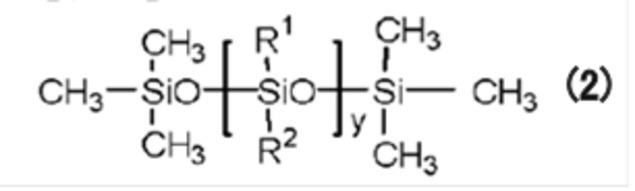
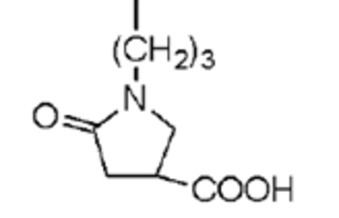
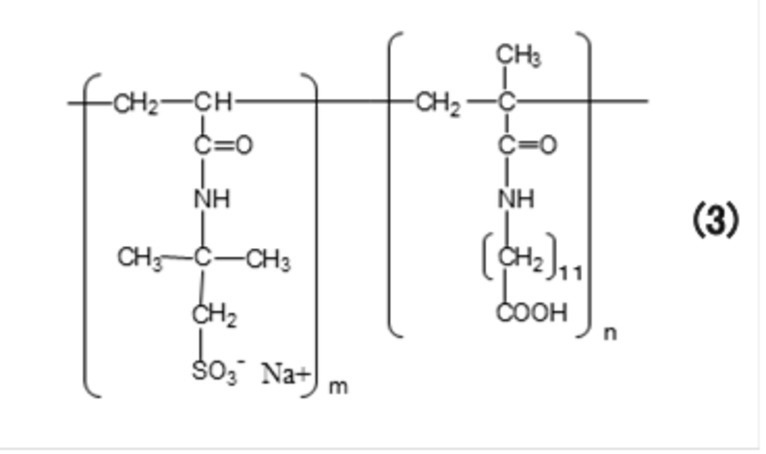
- X線回折法で測定される平均結晶子径が15~30nm、比表面積が10~30m2/gであって、450nmの反射率の値が、650nmの反射率の値の1.3倍以上であり、色差(ΔE)が22以下であるルチル型二酸化チタン粉体を1~30質量%と、
球状粉末5~30質量%と、
下記(A)成分と(B)成分からなるエラストマーまたは金属石鹸表面処理された粉末 を5~40質量%と、を含むことを特徴とする固形粉末化粧料。
(A)アミノ基を有するシリコーンポリマーと、
(B)カルボキシル基を有するシリコーンポリマー又はカルボキシル基を有するアクリルポリマーと、
からなるエラストマーであって、アミノ基とカルボキシル基のモル比が、Y/X=0.1~1.2 (Yは、(B)成分に含まれるカルボキシル基のモル量、Xは、(A)成分に含まれるアミノ基のモル量)の範囲にある。
なお、色差(ΔE)は、二酸化チタン粉体を5%の濃度になるようにニトロセルロースラッカーに分散混合し、得られた分散物を白黒の隠蔽率試験紙JIS-K5400上に0.101μmの膜厚で塗布・乾燥して試験サンプルを得た。得られた試験サンプルを分光測色機にて、白と黒紙上の塗膜表面をそれぞれ測色した。Hunter Lab色空間における、色差(ΔE)を算出した。 - 下記の(a)~(c)を満たす針状粒子が放射状に配向凝集した粒子表面に針状突起を有するルチル型二酸化チタンを焼成して得られるルチル型二酸化チタン粉体であって、見かけ上の平均粒子径が100nm以上、500nm未満、X線回折法で測定される平均結晶子径が15~30nm、比表面積が10~30m2/gである二酸化チタン粉体を1~30質量%と、
球状粉末5~30質量%と、
下記(A)成分と(B)成分からなるエラストマーまたは金属石鹸表面処理された粉末を5~40質量%と、を含むことを特徴とする固形粉末化粧料。
と、を含むことを特徴とする固形粉末化粧料。
(a)見かけ上の平均粒子径が100nm以上、500nm未満
(b)X線回折法で測定される平均結晶子径が1~25nm
(c)比表面積が40~200m2/g
(A)アミノ基を有するシリコーンポリマーと、
(B)カルボキシル基を有するシリコーンポリマー又はカルボキシル基を有するアクリルポリマーと、
からなるエラストマーであって、アミノ基とカルボキシル基のモル比が、Y/X=0.1~1.2 (Yは、(B)成分に含まれるカルボキシル基のモル量、Xは、(A)成分に含まれるアミノ基のモル量)の範囲にある - 下記の(a)~(c)を満たす粒子表面に針状突起を有するルチル型二酸化チタンを焼成して得られるルチル型二酸化チタン粉体であって、焼成後のルチル型二酸化チタン粉体の比表面積が、焼成前に対して8~50%であることを特徴とする二酸化チタン粉体を1~30質量%と、
球状粉末5~30質量%と、
下記(A)成分と(B)成分からなるエラストマーまたは金属石鹸表面処理された粉末 を5~40質量%と、を含むことを特徴とする固形粉末化粧料。
と、を含むことを特徴とする固形粉末化粧料。
(a)見かけ上の平均粒子径が100nm以上、500nm未満
(b)X線回折法で測定される平均結晶子径が1~25nm
(c)比表面積が40~200m2/g
(A)アミノ基を有するシリコーンポリマーと、
(B)カルボキシル基を有するシリコーンポリマー又はカルボキシル基を有するアクリルポリマーと、
からなるエラストマーであって、アミノ基とカルボキシル基のモル比が、Y/X=0.1~1.2 (Yは、(B)成分に含まれるカルボキシル基のモル量、Xは、(A)成分に含まれるアミノ基のモル量)の範囲にある - 請求項5又は6に記載の固形粉末化粧料において、二酸化チタンの焼成温度が、500℃~800℃であることを特徴とする固形粉末化粧料。
- 請求項7に記載の固形粉末化粧料において、二酸化チタンの焼成温度が、550℃~750℃であることを特徴とする固形粉末化粧料。
Priority Applications (1)
| Application Number | Priority Date | Filing Date | Title |
|---|---|---|---|
| CN201880041549.1A CN110769802B (zh) | 2017-06-26 | 2018-05-28 | 固体粉末化妆品 |
Applications Claiming Priority (2)
| Application Number | Priority Date | Filing Date | Title |
|---|---|---|---|
| JP2017124674A JP7010607B2 (ja) | 2017-06-26 | 2017-06-26 | 固形粉末化粧料 |
| JP2017-124674 | 2017-06-26 |
Publications (1)
| Publication Number | Publication Date |
|---|---|
| WO2019003756A1 true WO2019003756A1 (ja) | 2019-01-03 |
Family
ID=64741342
Family Applications (1)
| Application Number | Title | Priority Date | Filing Date |
|---|---|---|---|
| PCT/JP2018/020374 Ceased WO2019003756A1 (ja) | 2017-06-26 | 2018-05-28 | 固形粉末化粧料 |
Country Status (4)
| Country | Link |
|---|---|
| JP (1) | JP7010607B2 (ja) |
| CN (1) | CN110769802B (ja) |
| TW (1) | TW201904555A (ja) |
| WO (1) | WO2019003756A1 (ja) |
Families Citing this family (5)
| Publication number | Priority date | Publication date | Assignee | Title |
|---|---|---|---|---|
| US11318084B2 (en) | 2016-05-31 | 2022-05-03 | Shiseido Company, Ltd. | Elastomer |
| JP7154007B2 (ja) | 2017-11-28 | 2022-10-17 | 株式会社 資生堂 | 乳化化粧料 |
| JP7091059B2 (ja) * | 2017-11-29 | 2022-06-27 | 株式会社 資生堂 | 粉末化粧料 |
| JP7091058B2 (ja) * | 2017-11-29 | 2022-06-27 | 株式会社 資生堂 | 粉末化粧料 |
| JP7610702B2 (ja) * | 2021-05-14 | 2025-01-08 | テイカ株式会社 | 表面処理粉体 |
Citations (13)
| Publication number | Priority date | Publication date | Assignee | Title |
|---|---|---|---|---|
| JPH04364117A (ja) * | 1991-06-10 | 1992-12-16 | Shiseido Co Ltd | ホトクロミック性紫外線遮蔽粉体及びその製造方法、皮膚外用剤 |
| JPH09221411A (ja) * | 1996-02-13 | 1997-08-26 | Kose Corp | 二酸化チタン及びこれを含有する組成物 |
| JPH10182397A (ja) * | 1996-12-27 | 1998-07-07 | Kose Corp | 紫外線防御化粧料 |
| JP2000191325A (ja) * | 1998-12-25 | 2000-07-11 | Tayca Corp | 二酸化チタンの小球状粒子から形成される球状二酸化チタン集合体およびその製造方法 |
| JP2003192349A (ja) * | 2001-09-28 | 2003-07-09 | Shiseido Co Ltd | 毬栗状酸化チタン粉体及びその製造方法 |
| JP2007302800A (ja) * | 2006-05-12 | 2007-11-22 | Kao Corp | 被覆粉体及びこれを含有する化粧料 |
| JP2010163375A (ja) * | 2009-01-14 | 2010-07-29 | Kao Corp | 表面処理粉体及び化粧料 |
| JP2010173863A (ja) * | 2009-01-27 | 2010-08-12 | Titan Kogyo Kk | 藁束状ルチル型酸化チタン、それを使用した化粧料及びトナー用外添剤 |
| JP2013227207A (ja) * | 2012-03-29 | 2013-11-07 | Shiseido Co Ltd | 凹凸補正効果を有する酸化チタン |
| JP2014084251A (ja) * | 2012-10-24 | 2014-05-12 | Titan Kogyo Kk | ルチル型酸化チタン及びそれを使用した化粧料 |
| JP2016037469A (ja) * | 2014-08-07 | 2016-03-22 | 花王株式会社 | 粉末化粧料 |
| JP2016155881A (ja) * | 2014-08-08 | 2016-09-01 | 株式会社 資生堂 | 固形粉末化粧料の製造方法 |
| WO2016157869A1 (ja) * | 2015-03-30 | 2016-10-06 | 株式会社コーセー | 固形粉末化粧料 |
Family Cites Families (2)
| Publication number | Priority date | Publication date | Assignee | Title |
|---|---|---|---|---|
| JP4018770B2 (ja) * | 1997-02-28 | 2007-12-05 | チタン工業株式会社 | 扇状酸化チタン、及び扇状又は盤状酸化チタンの製造方法、並びにその用途 |
| WO2017111136A1 (ja) * | 2015-12-25 | 2017-06-29 | 株式会社 資生堂 | 二酸化チタン粉体およびそれを配合した化粧料 |
-
2017
- 2017-06-26 JP JP2017124674A patent/JP7010607B2/ja active Active
-
2018
- 2018-05-28 CN CN201880041549.1A patent/CN110769802B/zh active Active
- 2018-05-28 WO PCT/JP2018/020374 patent/WO2019003756A1/ja not_active Ceased
- 2018-06-04 TW TW107119170A patent/TW201904555A/zh unknown
Patent Citations (13)
| Publication number | Priority date | Publication date | Assignee | Title |
|---|---|---|---|---|
| JPH04364117A (ja) * | 1991-06-10 | 1992-12-16 | Shiseido Co Ltd | ホトクロミック性紫外線遮蔽粉体及びその製造方法、皮膚外用剤 |
| JPH09221411A (ja) * | 1996-02-13 | 1997-08-26 | Kose Corp | 二酸化チタン及びこれを含有する組成物 |
| JPH10182397A (ja) * | 1996-12-27 | 1998-07-07 | Kose Corp | 紫外線防御化粧料 |
| JP2000191325A (ja) * | 1998-12-25 | 2000-07-11 | Tayca Corp | 二酸化チタンの小球状粒子から形成される球状二酸化チタン集合体およびその製造方法 |
| JP2003192349A (ja) * | 2001-09-28 | 2003-07-09 | Shiseido Co Ltd | 毬栗状酸化チタン粉体及びその製造方法 |
| JP2007302800A (ja) * | 2006-05-12 | 2007-11-22 | Kao Corp | 被覆粉体及びこれを含有する化粧料 |
| JP2010163375A (ja) * | 2009-01-14 | 2010-07-29 | Kao Corp | 表面処理粉体及び化粧料 |
| JP2010173863A (ja) * | 2009-01-27 | 2010-08-12 | Titan Kogyo Kk | 藁束状ルチル型酸化チタン、それを使用した化粧料及びトナー用外添剤 |
| JP2013227207A (ja) * | 2012-03-29 | 2013-11-07 | Shiseido Co Ltd | 凹凸補正効果を有する酸化チタン |
| JP2014084251A (ja) * | 2012-10-24 | 2014-05-12 | Titan Kogyo Kk | ルチル型酸化チタン及びそれを使用した化粧料 |
| JP2016037469A (ja) * | 2014-08-07 | 2016-03-22 | 花王株式会社 | 粉末化粧料 |
| JP2016155881A (ja) * | 2014-08-08 | 2016-09-01 | 株式会社 資生堂 | 固形粉末化粧料の製造方法 |
| WO2016157869A1 (ja) * | 2015-03-30 | 2016-10-06 | 株式会社コーセー | 固形粉末化粧料 |
Also Published As
| Publication number | Publication date |
|---|---|
| JP7010607B2 (ja) | 2022-01-26 |
| CN110769802B (zh) | 2023-11-07 |
| TW201904555A (zh) | 2019-02-01 |
| CN110769802A (zh) | 2020-02-07 |
| JP2019006715A (ja) | 2019-01-17 |
Similar Documents
| Publication | Publication Date | Title |
|---|---|---|
| KR102488855B1 (ko) | 이산화티탄 분체 및 이를 배합한 분말 화장료 | |
| JP7010607B2 (ja) | 固形粉末化粧料 | |
| US10696563B2 (en) | Hexagonal plate-shaped zinc oxide particles, method for production of the same, and cosmetic, filler, resin composition, infrared reflective material, and coating composition containing the same | |
| WO2019003755A1 (ja) | 二酸化チタン粉体を配合した化粧料 | |
| EP2420221A1 (en) | Powdered solid cosmetic and manufacturing method therefor | |
| EP3178466B1 (en) | Solid powder cosmetic | |
| EP3395764A1 (en) | Titanium dioxide powder and cosmetic formulated therewith | |
| JP2014084251A (ja) | ルチル型酸化チタン及びそれを使用した化粧料 | |
| KR101345079B1 (ko) | 박편상 입자 및 화장료 | |
| KR20130105619A (ko) | 산화아연 입자 및 화장료 | |
| JP2008239588A (ja) | 化粧品用粉体 | |
| US11179300B2 (en) | Emulsion cosmetic containing titanium dioxide powder | |
| EP3718971B1 (en) | Granular composite containing keratin and hexagonal plate-like zinc oxide | |
| JP2014088351A (ja) | 希土類ドープ硫酸バリウムおよび化粧料 | |
| JP2023147613A (ja) | 水系分散体及び化粧料 | |
| JP7337457B2 (ja) | 金属酸化物中空粒子を用いた化粧料組成物 | |
| JP7325346B2 (ja) | ルチル型酸化チタン中空粒子を用いた化粧料組成物 |
Legal Events
| Date | Code | Title | Description |
|---|---|---|---|
| 121 | Ep: the epo has been informed by wipo that ep was designated in this application |
Ref document number: 18823558 Country of ref document: EP Kind code of ref document: A1 |
|
| NENP | Non-entry into the national phase |
Ref country code: DE |
|
| 122 | Ep: pct application non-entry in european phase |
Ref document number: 18823558 Country of ref document: EP Kind code of ref document: A1 |