WO2018207634A1 - 液晶組成物の製造方法 - Google Patents
液晶組成物の製造方法 Download PDFInfo
- Publication number
- WO2018207634A1 WO2018207634A1 PCT/JP2018/016955 JP2018016955W WO2018207634A1 WO 2018207634 A1 WO2018207634 A1 WO 2018207634A1 JP 2018016955 W JP2018016955 W JP 2018016955W WO 2018207634 A1 WO2018207634 A1 WO 2018207634A1
- Authority
- WO
- WIPO (PCT)
- Prior art keywords
- mass
- liquid crystal
- compound
- crystal composition
- group
- Prior art date
- Legal status (The legal status is an assumption and is not a legal conclusion. Google has not performed a legal analysis and makes no representation as to the accuracy of the status listed.)
- Ceased
Links
Classifications
-
- C—CHEMISTRY; METALLURGY
- C09—DYES; PAINTS; POLISHES; NATURAL RESINS; ADHESIVES; COMPOSITIONS NOT OTHERWISE PROVIDED FOR; APPLICATIONS OF MATERIALS NOT OTHERWISE PROVIDED FOR
- C09K—MATERIALS FOR MISCELLANEOUS APPLICATIONS, NOT PROVIDED FOR ELSEWHERE
- C09K19/00—Liquid crystal materials
-
- G—PHYSICS
- G02—OPTICS
- G02F—OPTICAL DEVICES OR ARRANGEMENTS FOR THE CONTROL OF LIGHT BY MODIFICATION OF THE OPTICAL PROPERTIES OF THE MEDIA OF THE ELEMENTS INVOLVED THEREIN; NON-LINEAR OPTICS; FREQUENCY-CHANGING OF LIGHT; OPTICAL LOGIC ELEMENTS; OPTICAL ANALOGUE/DIGITAL CONVERTERS
- G02F1/00—Devices or arrangements for the control of the intensity, colour, phase, polarisation or direction of light arriving from an independent light source, e.g. switching, gating or modulating; Non-linear optics
- G02F1/01—Devices or arrangements for the control of the intensity, colour, phase, polarisation or direction of light arriving from an independent light source, e.g. switching, gating or modulating; Non-linear optics for the control of the intensity, phase, polarisation or colour
- G02F1/13—Devices or arrangements for the control of the intensity, colour, phase, polarisation or direction of light arriving from an independent light source, e.g. switching, gating or modulating; Non-linear optics for the control of the intensity, phase, polarisation or colour based on liquid crystals, e.g. single liquid crystal display cells
Definitions
- the present invention relates to a method for producing a liquid crystal composition useful as a constituent member of a liquid crystal display element.
- Liquid crystal display elements are used in various measuring instruments, automobile panels, electronic notebooks, computers, etc., including televisions and mobile phones.
- Typical liquid crystal display methods include TN (twisted nematic) type, STN (super twisted nematic) type, IPS (In-plane switching) type, FFS type (Fringe field switching) type, VA (Vertical-alignment).
- PSA Polymer Sustained Alignment
- DS Dynamic Light Scattering
- GH Guest / Host
- FLC Fluorroelectric Liquid Crystal
- the liquid crystal composition used for these is usually prepared by mixing two or more kinds of compounds.
- the physical properties of the liquid crystal composition (nematic phase temperature range, refractive index anisotropy ( ⁇ n), dielectric anisotropy ( ⁇ ), viscosity, elastic constant, etc.) and electro-optical characteristics (response time, threshold voltage, steepness of VT curve, etc.), various values depending on the display method and driving method of the liquid crystal display element
- the mixing ratio is determined to meet the requirements.
- Patent Document 1 As a general method for producing a liquid crystal composition, all the components of the liquid crystal composition are put into a mixing vessel and dissolved by heat conduction from an external high-temperature medium through the mixing vessel wall, and are reduced in pressure or inert.
- a general method is mixing by rotating a stirring blade or the container itself in a gas atmosphere.
- Patent Document 2 proposes a method in which a liquid crystal compound is placed in a mixing vessel and heated by irradiation with microwaves.
- JP 2006-139059 A Japanese Patent Application No. 55-103347 JP 2007-94207 A
- Patent Document 1 and Patent Document 2 are unsuitable for orientation depending on the production scale of the liquid crystal composition.
- the method of rotating the mixing container while rotating at high speed (planetary stirring) is difficult to increase in size due to the principle of the apparatus, and is not suitable for producing a large batch exceeding 100 kilograms.
- the shape of the mixing container cannot be complicated in order to withstand the load when revolving while rotating at high speed. For this reason, the mixing container cannot be equipped with a nozzle, a cock, or the like for transferring the liquid crystal composition to the next process, and as a result, there is a problem that the working efficiency until the final liquid crystal composition is obtained deteriorates.
- the conventional method that is, each compound is charged into a mixing vessel and dissolved by heat conduction from an external high-temperature medium through the mixing vessel wall.
- the method of mixing by rotating the stirring blade or the container itself under reduced pressure or in an inert gas atmosphere is still used.
- most liquid crystal compounds used in general liquid crystal compositions are powder or crystalline solids, they can be mixed in a liquid state or with a stirring blade after being put into a mixing container. In order to make the liquid and solid coexist, it is necessary to perform heating for a long time.
- a metal container such as SUS or a glass container is used as the mixing container.
- a method using an organic solvent as a dissolution aid is also unsuitable as a method for producing a liquid crystal composition in a large batch exceeding 100 kilograms. That is, there has been a demand for a method for efficiently producing a large batch of liquid crystal compositions, particularly a method for efficiently producing a high-speed response liquid crystal composition containing a large amount of low-viscosity compounds without a decrease in reliability.
- the problem to be solved by the present invention is to provide a method for more efficiently producing a liquid crystal composition comprising two or more liquid crystal compounds mixed without impairing the reliability of the liquid crystal composition. It is to be.
- the invention of the present application is a method for producing a liquid crystal composition containing at least two or more types of compounds, and is capable of transitioning to a phase higher than the normal fluidity of the constituent compound alone among the constituent compounds of the liquid crystal composition.
- the step (I) of preparing the dissolution promoting component changed to a phase higher than the fluidity in the normal state of the reference compound alone by causing the reference compound to respond to an external stimulus and the liquid crystal composition different from the reference compound
- a step (II) of mixing the compound for promoting the dissolution and the component for promoting dissolution and a method for producing a liquid crystal composition.
- the production method of the present invention does not impair the reliability of the liquid crystal composition or can suppress a decrease in reliability.
- the liquid crystal composition containing a compound exhibiting viscosity near room temperature is used without suppressing the decrease in specific resistance without using a dissolution aid such as an organic solvent, and the generation of impurities is small.
- a dissolution aid such as an organic solvent
- the first aspect of the present invention is a method for producing a liquid crystal composition containing at least two kinds of compounds, which can be transferred to a phase higher than the normal fluidity of the compound alone among the constituent compounds of the liquid crystal composition.
- a reference compound which is a constituent component of the liquid crystal composition and a step (I) of preparing a dissolution promoting component that has changed into a phase higher than the fluidity in the normal state of the reference compound alone by causing the reference compound to respond to an external stimulus
- a step (II) of mixing the compound constituting the liquid crystal composition different from the above and the dissolution accelerating component is a method for producing a liquid crystal composition containing at least two kinds of compounds, which can be transferred to a phase higher than the normal fluidity of the compound alone among the constituent compounds of the liquid crystal composition.
- the reference compound in the normal state is prepared by causing a reference compound capable of transitioning to a phase higher than the fluidity in the normal state of the compound alone among the constituent compounds of the liquid crystal composition to respond to an external stimulus. It is a step of preparing a dissolution promoting component that has changed to a phase higher than the single fluidity.
- the liquid crystal composition according to the present invention is preferably a nematic liquid crystal composition, preferably including at least two kinds of liquid crystal compounds, preferably including two or more kinds of 30 or less kinds of liquid crystal compounds, and more preferably of three kinds or more and 25 kinds or less. 4 or more and 20 or less liquid crystal compounds are preferable, 5 or more and 18 or less liquid crystal compounds are preferable, and 6 or more and 15 or less liquid crystal compounds are included. It is preferable.
- liquid crystal compounds constituting the liquid crystal composition according to the present invention do not have to exhibit a nematic phase in a normal state, and a liquid crystal composition including two or more compounds preferably exhibits a nematic phase as a whole.
- phase higher than the fluidity in the normal state of the compound alone means a phase having a higher fluidity than the phase state of the compound alone at room temperature (25 ° C.).
- a powdered solid means a smectic phase, a nematic phase, or a liquid phase (also referred to as an isotropic phase) that is a fluid phase higher than the solid phase, and the compound should be a smectic phase at room temperature.
- nematic phase or isotropic phase that has a higher fluidity than the smectic phase
- the compound if it is a nematic phase at room temperature, it means an isotropic phase that has a higher fluidity than the nematic phase.
- “change to a phase higher than the fluidity in the normal state of the compound alone” means that each of the plurality of reference compounds is in the normal state of each compound alone. A change to a more fluid phase.
- fluidity in this specification refers to the viscosity (viscosity) of a continuum, and does not indicate the difference between the fluidity of a non-continuous aggregate such as powder and the fluidity of a continuum.
- Step (I) of the present invention is a step included in a method for producing a liquid crystal composition containing at least two kinds of compounds, and among all the compounds constituting the liquid crystal composition, in response to an external stimulus.
- the reference compound After selecting a reference compound capable of transitioning to a phase exhibiting higher fluidity than normal fluidity according to the external stimulus and / or the composition of the liquid crystal composition, the reference compound responds to the external stimulus and the reference compound alone It is preferable to be a step of preparing a dissolution promoting component that has changed to a phase higher than the normal fluidity.
- the dissolution accelerating component according to the present invention is a component including one in which one or more of the reference compounds that are constituent components of the liquid crystal composition is changed to a phase having high fluidity.
- the reference compound according to the present invention is a liquid crystal compound that constitutes a liquid crystal composition, and if the reference compound is a solid phase (eg, a powdered solid) at room temperature, it is a smectic that has a higher fluidity than the solid phase.
- Phase, nematic phase or isotropic phase and if the reference compound is a smectic phase at room temperature, it can be transferred to the nematic or isotropic phase, which is a more fluid phase than the smectic phase, and the reference compound If is a nematic phase at room temperature, it can be transferred to an isotropic phase, which is a more fluid phase than the nematic phase.
- the metastasis is performed in response to an external stimulus.
- the liquid crystal compound selected as the reference compound among all the compounds constituting the liquid crystal composition is a compound that changes to a solubility-promoting component having high solubility, that is, the other compound constituting the liquid crystal composition. It is preferable to select a compound having high compatibility with the compound. When transferred to the dissolution accelerating component, it has a role as an aid for assisting dissolution of the compound contained in the liquid crystal composition. Therefore, it is preferable to select a compound having high compatibility with other compounds constituting the liquid crystal composition.
- a reference compound that is a constituent component of a liquid crystal composition suitable for a dissolution promoting component when selecting a reference compound that is a constituent component of a liquid crystal composition suitable for a dissolution promoting component from a liquid crystal composition containing two or more compounds, it is selected according to the external stimulus and / or the composition of the liquid crystal composition.
- a compound that changes to a dissolution promoting component having high solubility in the liquid crystal compound is preferably used as the reference compound.
- the chemical structure of the reference compound 2) the chemical structure of the reference compound, (3) the melting point of the reference compound, (4) the proportion of the reference compound in the liquid crystal composition, (5) normal temperature ( 25) or near normal temperature (10-40 ° C), the phase state of the reference compound (nematic phase, smectic phase, solid (powder, etc.)), and (6) the total number of types of reference compound It is preferable to select a reference compound that is a constituent component of the liquid crystal composition suitable for the accelerating component.
- the melting point refers to a temperature at which a nematic phase is obtained, and in the case of a compound that does not have a nematic phase, it refers to a temperature at which a solid phase becomes an isotropic phase. Therefore, for example, in the case of a compound having a solid phase-smectic phase-nematic phase-isotropic phase, the temperature from the smectic phase to the nematic phase is called the melting point, and the compound having the solid phase-nematic phase-isotropic phase In this case, the temperature from the solid phase to the nematic phase is called the melting point.
- the reference compound according to the present invention preferably has at least one partial chemical structure selected from the group consisting of the following general formulas (S-1) to (S-8).
- X s1 to X s4 each independently represents a hydrogen atom or a fluorine atom, and X s3 and X s4 are preferably fluorine atoms, It is preferable that at least one of X s1 or X s2 is a fluorine atom, and * in the above general formulas (S-1) to (S-8) represents a bonding portion with a group.
- the alkyl group in the general formula (S-1) is preferably linear. Further, a straight chain having 1 to 8 carbon atoms is preferable, and a straight chain having 1 to 6 carbon atoms is preferable.
- the alkenyl group in the general formula (S-2) is preferably linear. Further, a straight chain having 2 to 8 carbon atoms is preferable, a straight chain having 2 to 6 carbon atoms is preferable, and the straight chain may be selected from groups represented by any one of formulas (R1) to (R5). preferable. (The black dots in each formula represent carbon atoms in the ring structure.)
- the reference compound according to the present invention is preferably a bicyclic to tricyclic liquid crystal compound, and more preferably a bicyclic liquid crystal compound.
- a compound other than the bicyclic compound is used as the reference compound according to the present invention, it preferably has an asymmetric structure in the major axis or minor axis direction, and is tricyclic and in the major axis or minor axis direction. More preferably, it has an asymmetric structure.
- the reference compound according to the present invention is preferably a compound represented by the general formula (Y-1).
- R Y11 and R Y12 each independently represent a cyano group (—CN), a cyanato group (—OCN), —C ⁇ CCN, a halogen atom, or a carbon atom number of 1 to 12).
- Any —CH 2 — present in the alkyl group is —O—, —CH ⁇ CH—, —CH ⁇ CF—, —CF ⁇ CH—, —CF ⁇ CF— or —C
- Any hydrogen atom present in the group may be replaced by a fluorine atom or a trifluoromethoxy group;
- a Y11 and A Y12 are each independently substituted with a trans-1,4-cyclohexylene group, a transdecahydronaphthalene-trans-2,6-diyl group, or one or more fluorine atoms.
- a Y11 and A Y12 are each independently substituted by a trans-1,4-cyclohexylene group, a transdecahydronaphthalene-trans-2,6-diyl group, or a fluorine atom.
- An optionally substituted naphthalene-2,6-diyl group or a 1,4-phenylene group optionally substituted by 1 to 2 fluorine atoms is preferred.
- R Y11 and R Y12 each independently represent a linear alkyl group having 1 to 7 carbon atoms, a linear 1-alkenyl group having 2 to 7 carbon atoms, carbon A linear 3-alkenyl group having 4 to 7 atoms, and an alkyl group having 1 to 5 carbon atoms substituted with an alkoxyl group having 1 to 3 carbon atoms at the end are preferable. Further, when asymmetric carbon is generated by branching, the compound may be optically active or racemic.
- L Y11 is preferably a single bond, an ethylene group, —COO—, —OCF 2 —, —CF 2 O—, —CF ⁇ CF— or —C ⁇ C—, A bond, an ethylene group or —COO— is more preferable.
- the reference compound according to the present invention preferably contains one or more bicyclic compounds.
- the bicyclic compound is preferably a compound represented by the general formula (Y-1), and is represented by the following general formulas (Y-1-1) to (Y-1-3).
- One or more bicyclic liquid crystal compounds selected from the group consisting of compounds are more preferred, and compounds represented by formula (Y-1-1) are particularly preferred.
- R Y111, R Y112, R Y121, R Y122, R Y131 and R Y132 are independently 1-7 carbon atoms alkyl group, an alkenyl group or an alkoxy group having 1 to 7 carbon atoms of the carbon atoms 2 ⁇ 7, X Y121, X Y122, X Y131, X Y132, X Y133 and X Y134 are independently hydrogen Represents an atom or a fluorine atom.
- Examples of the compound represented by the general formula (Y-1-1) include compounds represented by the formula (i-1-1.1) to the formula (i-1-1.5), the formula (i-1 -2.1) to compounds represented by formula (i-1-2.4), compounds represented by formulas (i-1-3.1) to (i-1-3.13), and formulas A compound selected from the compounds represented by formulas (i-1-6.1) to (i-1-6.3) is preferable.
- the lower limit of the preferable content of the compound represented by formula (i-1-1.1) to formula (i-1-1.5) with respect to the total amount of the composition of the present invention is 1% by mass. Yes, 2% by weight, 3% by weight, 5% by weight, 7% by weight, and 10% by weight.
- the upper limit of the preferable content is 20% by mass, 15% by mass, 13% by mass, 10% by mass, 8% by mass, and 7% by mass with respect to the total amount of the composition of the present invention. % By mass, 6% by mass, 5% by mass, and 3% by mass. Moreover, you may combine 2 or more types of compounds chosen from the said compound.
- the lower limit value of the preferable content of the compound represented by the compound represented by the formula (i-1-2.1) to the formula (i-1-2.4) with respect to the total amount of the composition of the present invention is 10% by mass, 15% by mass, 18% by mass, 20% by mass, 23% by mass, 25% by mass, 27% by mass, 30% by mass, 33% by mass, Mass%, 35 mass%, 38 mass%, and 40 mass%.
- the upper limit of the preferable content is 60% by mass, 55% by mass, 50% by mass, 45% by mass, 43% by mass, and 40% by mass with respect to the total amount of the composition of the present invention. % By mass, 38% by mass, 35% by mass, 32% by mass, 30% by mass, 20% by mass, 15% by mass and 10% by mass. Moreover, you may combine 2 or more types of compounds chosen from the said compound.
- the lower limit of the preferable content of the compounds represented by formulas (i-1-3.1) to (i-1-3.13) with respect to the total amount of the composition of the present invention is 1% by mass. Yes, 2 wt%, 3 wt%, 5 wt%, 7 wt%, 10 wt%, 13 wt%, 15 wt%, 18 wt%, 20% by mass.
- the upper limit of the preferable content is 20% by mass, 17% by mass, 15% by mass, 13% by mass, 10% by mass, and 8% by mass with respect to the total amount of the composition of the present invention. % By mass, 7% by mass, and 6% by mass. Moreover, you may combine 2 or more types of compounds chosen from the said compound.
- the lower limit of the preferred content of the compounds represented by formulas (i-1-4.1) to (i-1-5.3) with respect to the total amount of the composition of the present invention is 1% by mass. Yes, 2 wt%, 3 wt%, 5 wt%, 7 wt%, 10 wt%, 13 wt%, 15 wt%, 18 wt%, 20% by mass.
- the upper limit of the preferable content is 20% by mass, 17% by mass, 15% by mass, 13% by mass, 10% by mass, and 8% by mass with respect to the total amount of the composition of the present invention. % By mass, 7% by mass, and 6% by mass. Moreover, you may combine 2 or more types of compounds chosen from the said compound.
- the lower limit of the preferable content of the compound represented by the formula (i-1-6.1) to the formula (i-1-6.3) with respect to the total amount of the composition of the present invention is 1% by mass. Yes, 5% by weight, 10% by weight, 15% by weight, 17% by weight, 20% by weight, 23% by weight, 25% by weight, 27% by weight, 30% by mass and 35% by mass.
- the upper limit of the preferable content is 60% by mass, 55% by mass, 50% by mass, 45% by mass, 42% by mass, and 40% by mass with respect to the total amount of the composition of the present invention. % By mass, 38% by mass, 35% by mass, 33% by mass, and 30% by mass. Moreover, you may combine 2 or more types of compounds chosen from the said compound.
- the compounds represented by the above (Y-1-2) are represented by the formulas (N-1-1) to (i-2.7) and the formula (N-1-1.1) to the formula (N-1-1). .23) is preferably a compound selected from the compounds represented by
- the compounds represented by formulas (N-1-1.1) to (N-1-1.22) can be used alone or in combination.
- the lower limit of the preferable content of these compounds alone or with respect to the total amount is 5% by mass, 10% by mass, 13% by mass, 15% by mass, 17% by mass, and 20% by mass. %, 23% by mass, 25% by mass, 27% by mass, 30% by mass, 33% by mass, and 35% by mass.
- the upper limit of the preferable content is 50% by mass, 40% by mass, 38% by mass, 35% by mass, 33% by mass, and 30% with respect to the total amount of the composition of the present invention.
- the lower limit of the preferable content of the compound represented by formula (i-2.1) to formula (i-2.7) with respect to the total amount of the composition of the present invention is 1% by mass, %, 3% by mass, 5% by mass, 7% by mass, and 10% by mass.
- the upper limit of the preferable content is 20% by mass, 15% by mass, 13% by mass, 10% by mass, 8% by mass, and 7% by mass with respect to the total amount of the composition of the present invention.
- Examples of the compound represented by the general formula (Y-1-3) include compounds represented by the formula (L-3.1) to the formula (L-3.4) and the formula (N-1-4.1). ) To a compound selected from the compounds represented by formula (N-1-4.14).
- the lower limit of the preferable content of the compounds represented by the formulas (L-3.1) to (L-3.4) with respect to the total amount of the composition of the present invention is 1% by mass, %, 3% by mass, 5% by mass, 7% by mass, and 10% by mass.
- the upper limit of the preferable content is 20% by mass, 15% by mass, 13% by mass, 10% by mass, 8% by mass, and 7% by mass with respect to the total amount of the composition of the present invention. % By mass, 6% by mass, 5% by mass, and 3% by mass.
- the compounds represented by the formulas (N-1-4.1) to (N-1-4.14) can be used alone or in combination, but the compounds of the present invention
- the lower limit of the preferable content of these compounds alone or with respect to the total amount is 3% by mass, 5% by mass, 7% by mass, 10% by mass, 13% by mass, 15% by mass %, 17% by mass, and 20% by mass.
- the upper limit of the preferable content is 35% by mass, 30% by mass, 28% by mass, 25% by mass, 23% by mass, and 20% by mass with respect to the total amount of the composition of the present invention.
- one of preferred embodiments for preparing a dissolution promoting component by mixing a plurality of types of reference compounds that are constituent components of a liquid crystal composition includes a compound represented by the general formula (Y-1) and a general formula (S- It is preferable to mix a compound having one or more chemical structures selected from the group consisting of compounds represented by 1) to (S-8).
- the upper limit of the melting point of the reference compound according to the present invention is preferably 120 ° C. or lower, more preferably 100 ° C. or lower, and 90 ° C. or lower. More preferably, it is particularly preferably 80 ° C. or lower.
- the lower limit of the melting point is preferably 20 ° C. or higher, particularly preferably 20 ° C. or higher and 40 ° C. or lower.
- the melting point of the reference compound is preferably 100 ° C. or less, more preferably 90 ° C. or less, and particularly preferably 80 ° C. or less. It is preferably 20 ° C. or higher and 80 ° C. or lower, and more particularly preferably.
- the content of the reference compound is preferably 5 to 60% by mass when the entire liquid crystal composition is 100% by mass. % Is more preferable, 15 to 50% by mass is further preferable, and 20 to 45% by mass is particularly preferable.
- phase state of the reference compound according to the present invention at normal temperature (25 ° C.) or near normal temperature (10 to 40 ° C.), it is preferable to exhibit a solid (including powder) or smectic phase. More preferably.
- the reference compound according to the present invention is preferably composed of one to five liquid crystal compounds, more preferably one to four liquid crystal compounds, and one to three liquid crystals. It is more preferably composed of a compound, even more preferably composed of one or two kinds of liquid crystal compounds, and particularly preferably composed of one kind of liquid crystal compound.
- a preferred embodiment of the reference compound according to the present invention satisfies at least one condition selected from the group consisting of the following (A) to (F).
- the upper limit of the melting point of the reference compound according to the present invention is 120 ° C. or less.
- the content of the reference compound in the liquid crystal composition is
- the phase state of the reference compound at normal temperature (25 ° C.) or near normal temperature (10 to 40 ° C.) is a solid (including powder) or smectic phase
- the reference compound is composed of 1 to 4 kinds of liquid crystal compounds.
- the selection of the reference compound suitable for the dissolution accelerating component from the liquid crystal composition containing two or more kinds of compounds is as described in (A) to (F) above. Any one or more or two or more conditions It is preferable to. Especially, it is preferable to consider the characteristic of (A), (B), (C) or (E).
- the external stimulus according to the present invention refers to a change in the external environment of physicochemical, specifically, a group consisting of heat, microwave, and contact with a compound that is a constituent of a liquid crystal composition different from a reference compound. It is preferable that it is at least 1 type selected from. Therefore, “the reference compound that is a component of the liquid crystal composition changes to a more fluid phase than the normal state of the compound alone in response to an external stimulus” means that the reference compound that is a component of the liquid crystal composition is heated.
- the heating means when the external stimulus is heat, a method that prevents local overheating is useful when heating, and the heating means (temperature is adjusted in step (I) according to the present invention).
- the temperature control means known heating means and / or temperature control means may be employed. Specifically, a general-purpose thermostat, a clean oven, a hot plate, an oil bath, a water bath, a jacket heater, a mantle heater, a method using a Peltier element, a method in which an exothermic probe is directly buried in a compound container, or a compound Direct induction heating of filled metal container walls, hot air / cold air circulating thermostatic oven, microwave or (far) infrared heater, heated roll for temperature control, heat pipe roll, metal belt, hot press, etc.
- a heating means although it can select suitably by the shape of the container filled with the compound, a clean oven or a Peltier device is preferable and a clean oven is more preferable.
- a clean oven it is preferable to have a temperature raising / lowering program function, a decompression pipe, and an inert gas purge pipe.
- the lower limit of the temperature at which the reference compound is changed to a highly fluid phase by the heating means and / or temperature control means is preferably 60 ° C., more preferably 75 ° C., and preferably 80 ° C. More preferably, it is more preferably 85 ° C, and particularly preferably 90 ° C.
- the upper limit of the temperature of the heating means and / or temperature control means is preferably 150 ° C., more preferably 115 ° C., further preferably 110 ° C., and even more preferably 105 ° C. Preferably, it is 100 degreeC.
- the holding time for holding the heating is appropriately selected according to the melting point of the liquid crystal compound, the material and shape of the container storing the compound, and the heat capacity of the entire container filled with the reference compound.
- it is preferably 10 minutes to 30 hours, more preferably 20 minutes to 25 hours, further preferably 30 minutes to 20 hours, still more preferably 1 hour to 15 hours, and particularly preferably 2 hours to 12 hours.
- the atmosphere when heating the reference compound is appropriately selected according to the ease of oxidation of the reference compound itself. For example, in the case of a liquid crystal compound having no unsaturated bond, it can be heated in a clean air atmosphere.
- the heating by the heating means is preferably performed in a clean air atmosphere, a reduced pressure or an inert gas atmosphere, more preferably in a reduced pressure or an inert gas atmosphere, and in an inert gas atmosphere.
- a reduced pressure or an inert gas atmosphere particularly preferably in a reduced pressure or an inert gas atmosphere, and in an inert gas atmosphere.
- Preferable inert gases include nitrogen gas and argon gas.
- the microwave irradiation means includes a microwave oscillator using a known oscillation element such as a magnetron or a klystron.
- the microwave is an electromagnetic wave having a frequency of about 300 MHz to 3 THz and a wavelength of about 100 ⁇ m to 1 m, and includes, for example, frequencies of about 950 MHz, 2.45 GHz, and 5.8 GHz.
- the vibration means there is a method of vibrating and stirring using an ultrasonic device.
- a planetary stirring device specifically, a shaker, a laboratory mixer, a stirring propeller, a shaker, a rotary evaporator, or the like can be used.
- a planetary stirring device is preferable.
- the planetary stirring device refers to a stirring device that revolves while rotating a container containing materials, and is also referred to as a rotation / revolution stirring device.
- the planetary stirring device is also called a planetary stirring and defoaming device because it has a defoaming function.
- an ultrasonic irradiation apparatus can be used.
- the material of the container used in the stirring means is preferably a material that does not easily cause harmful impurities to the liquid crystal composition, such as glass, stainless steel, titanium, and Teflon (registered trademark).
- the glass container include a method in which a pressure is reduced using a separable flask and a magnetic stirrer is placed and stirred, and a method is used in which stirring is performed using a stirring propeller.
- a method in which an eggplant-shaped flask or the like is depressurized with a rotary evaporator or the like and the eggplant-shaped flask is rotated to be stirred.
- the compound serving as the external stimulus is a compound other than the reference compound among the compounds constituting the liquid crystal composition
- a compound that generates a eutectic phenomenon upon contact with a reference compound is preferred.
- the compound which is an external stimulus is preferably a compound whose eutectic point with the reference compound is 10 ° C. to 40 ° C.
- eutectic refers to a phenomenon in which a reference compound of the present invention and a compound that is an external stimulus of the present invention come into contact with each other to cause a phase transition
- the eutectic melting point is a temperature range in which the eutectic phenomenon occurs.
- the reference compound of the present invention and the compound which is an external stimulus of the present invention come into contact with each other, it is preferably melted and transformed into a smectic phase or a nematic phase.
- Specific examples of the compound that serves as an external stimulus are preferably one or more compounds selected from the group consisting of the following general formulas (S-9) to (S-14).
- X s1 to X s4 each independently represent a hydrogen atom or a fluorine atom
- R s6 represents an alkyl group having 1 to 5 carbon atoms
- R s7 and R s8 each independently represents an alkyl group having 1 to 5 carbon atoms, an alkenyl group having 1 to 5 carbon atoms, or an alkyl group having 1 to 5 carbon atoms.
- the compound represented by the general formula (S-9) is preferably a compound represented by the formula (L-4.1) to the formula (L-4.5), for example.
- the lower limit of the preferable content of the compound represented by the formula (S-9) with respect to the total amount of the composition of the present invention is 1% by mass, 2% by mass, 3% by mass, % By mass, 7% by mass, 10% by mass, 14% by mass, 16% by mass, 20% by mass, 23% by mass, 26% by mass, 30% by mass It is 35% by mass and 40% by mass.
- the upper limit of the preferable content of the compound represented by the formula (S-9) with respect to the total amount of the composition of the present invention is 50% by mass, 40% by mass, 35% by mass, 30% % By mass, 20% by mass, 15% by mass, 10% by mass, and 5% by mass.
- the compound represented by the general formula (S-10) is a compound represented by the formula (L-3.1) to the formula (L-3.4) and the formula (N-1-4.1).
- a compound selected from the compounds represented by (N-1-4.14) is preferable.
- the lower limit of the preferable content of the compounds represented by the formulas (L-3.1) to (L-3.7) with respect to the total amount of the composition of the present invention is 1% by mass, %, 3% by mass, 5% by mass, 7% by mass, and 10% by mass.
- the upper limit of the preferable content is 20% by mass, 15% by mass, 13% by mass, 10% by mass, 8% by mass, and 7% by mass with respect to the total amount of the composition of the present invention. % By mass, 6% by mass, 5% by mass, and 3% by mass.
- the compounds represented by the formulas (N-1-4.1) to (N-1-4.14) can be used alone or in combination, but the compounds of the present invention
- the lower limit of the preferable content of these compounds alone or with respect to the total amount is 3% by mass, 5% by mass, 7% by mass, 10% by mass, 13% by mass, 15% by mass %, 17% by mass, and 20% by mass.
- the upper limit of the preferable content is 35% by mass, 30% by mass, 28% by mass, 25% by mass, 23% by mass, and 20% by mass with respect to the total amount of the composition of the present invention.
- the compounds represented by the above (S-11) are represented by the formulas (i-2.1) to (i-2.7) and the formulas (N-1-1.1) to the formula (N-1-1.23). It is preferable that it is a compound chosen from the compound represented by this.
- the compounds represented by formulas (N-1-1.1) to (N-1-1.22) can be used alone or in combination.
- the lower limit of the preferable content of these compounds alone or with respect to the total amount is 5% by mass, 10% by mass, 13% by mass, 15% by mass, 17% by mass, and 20% by mass.
- the upper limit of the preferable content is 50% by mass, 40% by mass, 38% by mass, 35% by mass, 33% by mass, and 30% with respect to the total amount of the composition of the present invention.
- the lower limit of the preferable content of the compound represented by formula (i-2.1) to formula (i-2.7) with respect to the total amount of the composition of the present invention is 1% by mass, %, 3% by mass, 5% by mass, 7% by mass, and 10% by mass.
- the upper limit of the preferable content is 20% by mass, 15% by mass, 13% by mass, 10% by mass, 8% by mass, and 7% by mass with respect to the total amount of the composition of the present invention. % By mass, 6% by mass, 5% by mass, and 3% by mass.
- the compound represented by the general formula (S-12) is preferably a compound represented by the formula (M-1.1) to the formula (M-1.4). -1.1) or a compound represented by formula (M-1.2) is preferred, and a compound represented by formula (M-1.2) is more preferred. It is also preferred to use the compounds represented by formula (M-1.1) or formula (M-1.2) at the same time.
- the lower limit of the preferable content of the compound represented by the formula (S-12) with respect to the total amount of the composition of the present invention is 1% by mass, 2% by mass, 5% by mass, % By mass.
- the upper limit of the preferable content is 30% by mass, 25% by mass, 23% by mass, 20% by mass, 18% by mass, 15% by mass, and 13% by mass, 10% by mass and 8% by mass.
- the lower limit value of the total content of the compounds represented by the formulas (M-1.1) and (M-1.2) with respect to the total amount of the composition of the present invention is 1% by mass, 2% by mass, 5% by mass, and 6% by mass.
- the upper limit of the preferable content is 30% by mass, 25% by mass, 23% by mass, 20% by mass, 18% by mass, 15% by mass, and 13% by mass, 10% by mass and 8% by mass.
- the compound represented by the general formula (S-13) is preferably a compound represented by the formula (M-6.21) to the formula (M-6.34).
- the lower limit of the preferable content of the compound represented by the formula (S-13) with respect to the total amount of the composition of the present invention is 1% by mass, 2% by mass, 4% by mass, 5% % By mass, 8% by mass, 10% by mass, 13% by mass, 15% by mass, 18% by mass and 20% by mass.
- the upper limit of the preferable content is 30% by mass, 28% by mass, 25% by mass, 23% by mass, 20% by mass, 18% by mass, and 15% by mass, 13% by mass, 10% by mass, 8% by mass, and 5% by mass.
- the compound represented by the general formula (S-14) is preferably a compound represented by the formula (M-7.1) to the formula (M-7.14).
- the lower limit of the preferable content of the compound of the general formula (S-14) with respect to the total amount of the composition of the present invention is 1% by mass, 2% by mass, 4% by mass, 5% by mass 8% by mass, 10% by mass, 13% by mass, 15% by mass, 18% by mass, and 20% by mass.
- the upper limit of the preferable content is 30% by mass, 28% by mass, 25% by mass, 23% by mass, 20% by mass, 18% by mass, and 15% by mass, 13% by mass, 10% by mass, 8% by mass, and 5% by mass.
- the compound in contact with the reference compound is a compound different from the reference compound among the compounds constituting the liquid crystal composition. Therefore, as a preferred embodiment of the step (I) of the present invention, among all the compounds constituting the liquid crystal composition, at least one condition selected from the group consisting of the above (1 ′) to (6 ′) is satisfied. It is preferable to prepare a dissolution-promoting component by bringing the selected reference compound into contact with a compound having a chemical structure other than the reference compound to change it into a highly fluid phase.
- the reference compound represented by the general formula (Y-1) and the general formula (Y-1) A solution-promoting component is prepared by bringing into contact with a compound having a chemical structure other than that to change into a highly fluid phase.
- the reference compound represented by the general formula (Y-1-1) and the general formula (S-9) ) To (S-14) are brought into contact with one or two or more compounds selected from the group consisting of (S-14) to change into a highly fluid phase to prepare a dissolution promoting component.
- step (I) of the present invention among all the compounds constituting the liquid crystal composition, a reference compound represented by the general formula (Y-1-2) and a general formula (S-9) ) To (S-10) and one or more compounds selected from the group consisting of general formulas (S-12) to (S-14) to change into a highly fluid phase. To prepare a solution promoting component.
- the reference compound represented by the general formula (Y-1-3) and the general formula (S-9) ) And (S-11) to (S-14) are brought into contact with one or more compounds selected from the group consisting of (S-11) to change into a highly fluid phase to prepare a dissolution-promoting component.
- step (I) when the external stimulus is contact between the compounds, the heating means, the stirring means, the vibration means, or the micro, as necessary, before, during or after the contact between the compounds. Wave irradiation may be performed.
- the atmospheric condition in the step (I) according to the present invention may be an air atmosphere or an oxygen-blocked nitrogen or inert gas atmosphere, but from the viewpoint of protecting the liquid crystal compound, it is an inert gas atmosphere. Is preferred.
- the atmospheric pressure condition in the step (I) according to the present invention is not particularly limited, and can be performed under reduced pressure, normal pressure or increased pressure. Usually, it may be carried out under a pressure in the vicinity of atmospheric pressure (about 0.1 MPa), but the step (I) can proceed smoothly even under a reduced pressure of less than 0.1 MPa.
- step (I) when preparing a dissolution-promoting component that has changed from a normal state of the compound alone to a fluid phase by applying heat to the compound that is a constituent of the liquid crystal composition as an external stimulus, is it performed under reduced pressure from the beginning to the end?
- a part of the step (I) may be performed under reduced pressure.
- step (I) according to the present invention.
- One preferred embodiment of the step (I) according to the present invention is a component of the liquid crystal composition with respect to the reference compound that is a component of the liquid crystal composition, and an external stimulus different from the reference compound. It is preferable to prepare a dissolution-promoting component by bringing a total of 2 to 5 kinds of compounds into contact with each other.
- a dissolution-promoting component containing for example, nematic phase
- a more fluid phase for example, nematic phase
- the time for transition to a highly fluid phase may be shortened by using ultrasonic vibration and stirring means together.
- the mixture may be heated as an external stimulus when or after mixing two to three compounds constituting the liquid crystal composition. Since a plurality of types of liquid crystal compounds are mixed, the dissolution promoting component can be prepared with a minimum amount of heating due to a melting point drop, so that thermal decomposition of the compound can be reduced.
- One of the more preferred embodiments of the step (I) according to the present invention is a constituent component of the liquid crystal composition, and the general formula (S) is compared with the reference compound represented by the general formula (Y-1-1). -9) to (S-14) are contacted with one or more compounds selected from the group consisting of (S-14) to prepare a dissolution-promoting component that has changed to a more fluid phase from the normal state of the reference compound alone. It is preferable. Further, if necessary, one or more of the reference compounds represented by the general formula (Y-1-1) using ultrasonic vibration or stirring means, and the general formulas (S-9) to (S-14) One or two or more compounds selected from the group consisting of may be mixed.
- One of the more preferred embodiments of the step (I) according to the present invention is a constituent component of the liquid crystal composition and is a compound represented by the general formula (S-9) to the reference compound that exhibits a smectic phase at 25 ° C. It is preferable to prepare a dissolution promoting component that has changed to a nematic phase by contacting one or more compounds selected from the group consisting of (S-14). If necessary, one or more selected from the group consisting of a reference compound exhibiting a smectic phase at 25 ° C. using ultrasonic vibration and stirring means, and general formulas (S-9) to (S-14) These compounds may be mixed.
- One of the preferred embodiments of the step (I) according to the present invention is the dissolution of the reference compound, which is a constituent component of the liquid crystal composition, into a phase having higher fluidity than the normal state of the reference compound alone by heating means. It is preferred to prepare an accelerating component.
- the reference compound transitions to a more fluid phase (eg, nematic phase) than the normal state (eg, solid or smectic phase) of the reference compound (eg, A dissolution enhancing component (of the nematic phase) can be prepared. Therefore, since the dissolution promoting component itself plays the role of a solvent and a heat medium, the liquid crystal composition can be prepared without applying more heat than necessary to other compounds constituting the liquid crystal composition. The thermal decomposition of can be reduced.
- a more fluid phase eg, nematic phase
- the normal state eg, solid or smectic phase
- the liquid crystal composition can be prepared without applying more heat than necessary to other compounds constituting the liquid crystal composition. The thermal decomposition of can be reduced.
- each of the reference compounds is heated to change into a highly fluid phase, and after each dissolution promoting component is prepared, they are mixed.
- the dissolution promoting component may be prepared by mixing the reference compound and then heating to change to a highly fluid phase.
- One of the more preferred embodiments of the step (I) according to the present invention is a constituent component of the liquid crystal composition, and a heating means is used for the reference compound represented by the general formula (Y-1-1). It is preferable to prepare a dissolution promoting component that has changed to a more fluid phase than the normal state of the reference compound alone.
- One of the more preferred embodiments of the step (I) according to the present invention is a component of the liquid crystal composition, which is changed to a nematic phase by heating means with respect to a reference compound that exhibits a smectic phase at 25 ° C. It is preferred to prepare a dissolution promoting component. More specifically, in the step (I) according to the present invention, one or more compounds exhibiting a smectic phase represented by the general formula (Y-1-1) among the constituent components of the liquid crystal composition are selected. The step of preparing a reference compound and preparing a dissolution promoting component in which the reference compound is heated to 40 to 120 ° C. and transferred to a more fluid nematic phase is preferred.
- a reference compound that is a constituent component of the liquid crystal composition is a constituent component of the liquid crystal composition and a compound that is different from the reference compound.
- a solution-promoting component it is preferable to prepare a solution-promoting component by mixing a total of 2 to 5 compounds with heating.
- a eutectic phenomenon occurs due to contact between different compounds that are external stimuli, and the normal state of the reference compound (for example, a solid state)
- a dissolution-promoting component containing the above-mentioned two to three compounds for example, nematic phase
- a more fluid phase for example, nematic phase
- the dissolution promoting component can be prepared with minimal heating, such as thermal decomposition of the compound. Can be reduced.
- one compound exhibiting a smectic phase represented by the general formula (Y-1-1) is used as a reference compound, which is different from the reference compound.
- a step of preparing a dissolution promoting component in which the reference compound and / or a compound different from the reference compound is heated to 40 to 120 ° C. and transferred to a more fluid nematic phase is preferable. .
- Step (I) comprises 2 to 5 compounds, preferably 2 to 4 compounds exhibiting a smectic phase represented by the general formula (Y-1-1) among the constituent components of the liquid crystal composition.
- 2 to 3 kinds are used as reference compounds, and when contacting with a compound different from the reference compound, the reference compound and / or a compound different from the reference compound is heated to 40 to 120 ° C. for more fluidity.
- a step of preparing a dissolution promoting component that has been transferred to a high nematic phase is preferred.
- a known antioxidant may be added to the dissolution accelerating component in the step (I) of the present invention.
- a known compound is known for the reference compound.
- a solution promoting component having high fluidity may be prepared in a state where the antioxidant is added. Examples of the antioxidant include compounds described in the following step (II).
- the order of the reference compound to be mixed is not particularly limited.
- Step (II) is a step (II) of mixing a compound constituting the liquid crystal composition different from the reference compound which is a constituent component of the liquid crystal composition and the dissolution promoting component.
- the dissolution promoting component obtained by changing the reference compound itself, which is also a constituent component of the liquid crystal composition, into a highly fluid phase also functions as a solvent or a heat medium, a compound constituting a liquid crystal composition different from the reference compound can be easily obtained. It can be dissolved and reduced in reliability (for example, it can be efficiently produced without impurities resulting from thermal decomposition of the compound by unnecessary heating.
- the compound constituting the liquid crystal composition different from the reference compound which is a constituent component of the liquid crystal composition is a constituent compound of the liquid crystal composition excluding the reference compound among all liquid crystal compounds contained in the liquid crystal composition of the present invention.
- a compound as a constituent component of the liquid crystal composition when used for external stimulation with respect to the reference compound, it refers to a constituent compound of the liquid crystal composition excluding the reference compound and the compound as a constituent component of the liquid crystal composition that is the external stimulus.
- the compound constituting the liquid crystal composition different from the reference compound is preferably a compound having a lower fluidity than the dissolution promoting component.
- the dissolution promoting component is also a solvent and a heat medium exhibiting high solubility, the thermal decomposition of the compound due to unnecessary heating can be reduced.
- a method for mixing the compound that is different from the above-mentioned reference compound and that constitutes the liquid crystal composition and the dissolution accelerating component is not particularly limited, and known methods such as stirring means and vibration means in the above step (I) are known. Can be used. Moreover, you may mix, heating or temperature-controlling using the heating means in said process (I).
- step (II) a compound constituting the liquid crystal composition different from the reference compound may be added to and mixed with the dissolution promoting component, or the dissolution promoting component may be different from the reference compound. You may add and mix in the compound which comprises the said liquid-crystal composition.
- the step (II) according to the present invention can be performed under normal pressure, but may be performed under reduced pressure from the beginning to the end, or a part thereof may be performed under reduced pressure.
- step (II) of the present invention a known antioxidant may be added to the dissolution promoting component, or an antioxidant having a terminal structure represented by the following general formula (IV) may be added. More preferred.
- Examples of the compound constituting the liquid crystal composition different from the reference compound which is a constituent component of the liquid crystal composition include hindered phenols represented by the general formulas (H-1) to (H-4). .
- R H1 represents an alkyl group having 1 to 10 carbon atoms, an alkoxy group having 1 to 10 carbon atoms, or an alkenyl group having 2 to 10 carbon atoms. or represents an alkenyloxy group having 2 to 10 carbon atoms, one -CH present in group 2 - or non-adjacent two or more -CH 2 - are each independently -O- or -S It may be substituted with-, and one or more hydrogen atoms present in the group may be independently substituted with a fluorine atom or a chlorine atom.
- alkyl group having 2 to 7 carbon atoms an alkoxy group having 2 to 7 carbon atoms, an alkenyl group having 2 to 7 carbon atoms, or an alkenyloxy group having 2 to 7 carbon atoms.
- An alkyl group having 3 to 7 carbon atoms or an alkenyl group having 2 to 7 carbon atoms is more preferable.
- M H4 One in the alkylene group (the alkylene group having from 1 to 15 carbon atoms or two or more -CH 2 -, as the oxygen atoms are not directly adjacent, -O -, - CO -, - COO -, - OCO- may be substituted in), -.
- a 1,4-phenylene group (any hydrogen atom in the 1,4-phenylene group may be substituted by a fluorine atom) or a trans-1,4-cyclohexylene group Represents an alkylene group having 1 to 14 carbon atoms, In consideration of the development, a large number of carbon atoms is preferable, but in consideration of viscosity, it is preferable that the number of carbon atoms is not too large.
- 2 to 12 carbon atoms are more preferable, and 3 to 10 carbon atoms are further preferable.
- it has 4 to 10 carbon atoms, more preferably 5 to 10 carbon atoms, and still more preferably 6 to 10 carbon atoms.
- one or more non-adjacent —CH ⁇ in the 1,4-phenylene group may be substituted by —N ⁇ .
- each hydrogen atom in the 1,4-phenylene group may be independently substituted with a fluorine atom or a chlorine atom.
- each hydrogen atom in the 1,4-cyclohexylene group may be independently substituted with a fluorine atom or a chlorine atom.
- the liquid crystal composition of the present invention contains an antioxidant, it is preferably 10 ppm by mass or more, preferably 20 ppm by mass or more, and more preferably 50 ppm by mass or more.
- the upper limit when the antioxidant is contained is 10,000 ppm by mass, preferably 2000 ppm by mass or less, more preferably 1000 ppm by mass or less, and particularly preferably 500 ppm by mass.
- the above-mentioned antioxidant may be added to the dissolution accelerating component.
- An antioxidant may be added.
- the constituent compounds of the liquid crystal composition excluding the reference compound are almost dielectrically as follows.
- Neutral compound ⁇ value is ⁇ 2 to 2
- dielectrically negative compound sign of ⁇ is negative and its absolute value is greater than 2
- dielectrically positive compound ⁇ is greater than 2 It is preferably one or more compounds selected from the group consisting of:
- the constituent compounds of the liquid crystal composition according to the present invention in addition to the compounds represented by the general formulas (Y-1-1) to (Y-1-3), for example, the general formula (L- 3) to (L-4), general formula (L-7), general formulas (N-1-2) to (N-1-22), general formulas (N-2-1) to (N-2-) 3) one selected from the group consisting of general formula (N-3-2), general formulas (M-1) to (M-18) and general formulas (K-1) to (K-6) or Two or more are preferred.
- the constituent compound of the liquid crystal composition according to the present invention includes one compound represented by the following general formulas (L-3) to (L-4) and one represented by the general formula (L-7). Or it is preferable to contain 2 or more types. These compounds correspond to dielectrically nearly neutral compounds ( ⁇ value is ⁇ 2 to 2).
- the constituent compound of the liquid crystal composition according to the present invention is preferably a compound represented by the general formula (L-3).
- R L41 is an alkyl group having 1 to 5 carbon atoms
- R L42 is an alkyl group having 1 to 5 carbon atoms, an alkenyl group having 4 to 5 carbon atoms, or an alkoxy group having 1 to 4 carbon atoms.
- the lower limit of the preferable content of the compound represented by the formula (L-3) with respect to the total amount of the composition of the present invention is 1%, 2%, 3%, 5% 7%, 10%, 14%, 16%, 20%, 23%, 26%, 30%, 35%, 40% .
- the upper limit of the preferable content of the compound represented by the formula (L-3) with respect to the total amount of the composition of the present invention is 50%, 40%, 35%, and 30%. 20%, 15%, 10%, 5%.
- the constituent compound of the liquid crystal composition according to the present invention is preferably a compound represented by the general formula (L-4).
- X L61 and X L62 each independently represent a hydrogen atom or a fluorine atom.
- R L61 and R L62 are each independently preferably an alkyl group having 1 to 5 carbon atoms or an alkenyl group having 2 to 5 carbon atoms, and one of X L61 and X L62 is a fluorine atom and the other is a hydrogen atom. Is preferred.
- the lower limit of the preferable content of the compound represented by the formula (L-4) with respect to the total amount of the composition of the present invention is 1%, 2%, 3%, 5% 7%, 10%, 14%, 16%, 20%, 23%, 26%, 30%, 35%, 40% .
- the upper limit of the preferable content of the compound represented by the formula (L-4) with respect to the total amount of the composition of the present invention is 50%, 40%, 35%, and 30%. 20%, 15%, 10%, 5%.
- the constituent compound of the liquid crystal composition according to the present invention is preferably a compound represented by the general formula (L-7).
- R L71 and R L72 are each independently a carbon atom number of 1 to 5, an alkenyl group or an alkoxy group having 1 to 4 carbon atoms of 2 to 5 carbon atoms preferably, A L71 and A L72 is each independently preferably a 1,4-cyclohexylene group or a 1,4-phenylene group, and the hydrogen atoms on A L71 and A L72 may each independently be substituted with a fluorine atom, and Z L71 may be A single bond or —COO— is preferable, a single bond is preferable, and X L71 and X L72 are preferably a hydrogen atom.
- the constituent compounds of the liquid crystal composition according to the present invention include the following general formulas (N-1-2) to (N-1-22), general formulas (N-2-1) to (N-2-3) and One or more compounds selected from the group consisting of general formula (N-3-2) are preferable. These compounds correspond to dielectrically negative compounds (the sign of ⁇ is negative
- the constituent compound of the liquid crystal composition according to the present invention is preferably a compound represented by the general formula (N-1-2).
- RN121 is preferably an alkyl group having 1 to 5 carbon atoms or an alkenyl group having 2 to 5 carbon atoms, and preferably an ethyl group, a propyl group, a butyl group or a pentyl group.
- RN122 has 1 carbon atom
- An alkyl group having 5 to 5 carbon atoms, an alkenyl group having 4 to 5 carbon atoms or an alkoxy group having 1 to 4 carbon atoms is preferable, and a methyl group, a propyl group, a methoxy group, an ethoxy group, or a propoxy group is preferable.
- the lower limit of the preferable content of the compound represented by the formula (N-1-2) with respect to the total amount of the composition of the present invention is 5%, 7%, 10%, 13% 15%, 17%, 20%, 23%, 25%, 27%, 30%, 33%, 35%, 37% 40% and 42%.
- the upper limit of the preferable content is 50%, 48%, 45%, 43%, 40%, 38%, and 35% with respect to the total amount of the composition of the present invention. %, 33%, 30%, 28%, 25%, 23%, 20%, 18%, 15%, 13%, 10% %, 8%, 7%, 6%, 5%.
- the compound represented by the general formula (N-1-3) is preferably the following compound.
- RN 131 is preferably an alkyl group having 1 to 5 carbon atoms or an alkenyl group having 2 to 5 carbon atoms, and preferably an ethyl group, a propyl group or a butyl group.
- RN 132 is an alkyl group having 1 to 5 carbon atoms.
- An alkyl group, an alkenyl group having 4 to 5 carbon atoms, or an alkoxy group having 1 to 4 carbon atoms is preferable, and an ethoxy group, a propoxy group, or a butoxy group is preferable.
- the lower limit of the preferable content of the compound represented by the formula (N-1-3) with respect to the total amount of the composition of the present invention is 5%, 10%, 13%, 15% 17% and 20%.
- the upper limit of the preferable content is 35%, 30%, 28%, 25%, 23%, 20%, and 18% with respect to the total amount of the composition of the present invention. %, 15%, and 13%.
- the constituent compound of the liquid crystal composition according to the present invention is preferably the following compound represented by the general formula (N-1-5).
- R N151 and R N152 are each independently an alkyl group having 1 to 5 carbon atoms, an alkenyl group having 4 to 5 carbon atoms, or an alkoxy group having 1 to 4 carbon atoms, preferably an ethyl group, propyl Group or butyl group is preferred.
- the lower limit of the preferable content of the compound represented by the formula (N-1-5) with respect to the total amount of the composition of the present invention is 5%, 8%, 10%, 13% 15%, 17%, 20%.
- the upper limit of the preferable content is 35%, 33%, 30%, 28%, 25%, 23%, and 20% with respect to the total amount of the composition of the present invention. %, 18%, 15% and 13%.
- the constituent compound of the liquid crystal composition according to the present invention is preferably a compound represented by the general formula (N-1-10).
- R N1101 is preferably an alkyl group having 1 to 5 carbon atoms or an alkenyl group having 2 to 5 carbon atoms, and preferably an ethyl group, a propyl group, a butyl group, a vinyl group, or a 1-propenyl group.
- R N1102 Is preferably an alkyl group having 1 to 5 carbon atoms, an alkenyl group having 4 to 5 carbon atoms or an alkoxy group having 1 to 4 carbon atoms, and preferably an ethoxy group, a propoxy group or a butoxy group.
- the lower limit of the preferable content of the compound represented by the formula (N-1-10) with respect to the total amount of the composition of the present invention is 5% by mass, 10% by mass, and 13% by mass. 15 mass%, 17 mass%, and 20 mass%.
- the upper limit of the preferable content is 35% by mass, 30% by mass, 28% by mass, 25% by mass, 23% by mass, and 20% by mass with respect to the total amount of the composition of the present invention. Mass%, 18 mass%, 15 mass%, and 13 mass%.
- the constituent compound of the liquid crystal composition according to the present invention is preferably a compound represented by the general formula (N-1-11).
- R N1111 is preferably an alkyl group or an alkenyl group having 2 to 5 carbon atoms having 1 to 5 carbon atoms, an ethyl group, a propyl group, a butyl group, a vinyl group or a 1-propenyl group are preferable .
- R N1112 Is preferably an alkyl group having 1 to 5 carbon atoms, an alkenyl group having 4 to 5 carbon atoms or an alkoxy group having 1 to 4 carbon atoms, and preferably an ethoxy group, a propoxy group or a butoxy group.
- the lower limit of the preferable content of the compound represented by the formula (N-1-11) with respect to the total amount of the composition of the present invention is 5% by mass, 10% by mass, and 13% by mass. 15 mass%, 17 mass%, and 20 mass%.
- the upper limit of the preferable content is 35% by mass, 30% by mass, 28% by mass, 25% by mass, 23% by mass, and 20% by mass with respect to the total amount of the composition of the present invention. Mass%, 18 mass%, 15 mass%, and 13 mass%.
- the constituent compound of the liquid crystal composition according to the present invention is preferably a compound represented by the general formula (N-1-12).
- R N1121 is preferably an alkyl group having 1 to 5 carbon atoms or an alkenyl group having 2 to 5 carbon atoms, and preferably an ethyl group, a propyl group or a butyl group.
- R N1122 is a group having 1 to 5 carbon atoms.
- An alkyl group, an alkenyl group having 4 to 5 carbon atoms, or an alkoxy group having 1 to 4 carbon atoms is preferable, and an ethoxy group, a propoxy group, or a butoxy group is preferable.
- the lower limit of the preferable content of the compound represented by the formula (N-1-12) with respect to the total amount of the composition of the present invention is 5% by mass, 10% by mass, and 13% by mass. 15 mass%, 17 mass%, and 20 mass%.
- the upper limit of the preferable content is 35% by mass, 30% by mass, 28% by mass, 25% by mass, 23% by mass, and 20% by mass with respect to the total amount of the composition of the present invention. Mass%, 18 mass%, 15 mass%, and 13 mass%.
- the constituent compound of the liquid crystal composition according to the present invention is preferably a compound represented by the general formula (N-1-13).
- R N1131 is preferably an alkyl group having 1 to 5 carbon atoms or an alkenyl group having 2 to 5 carbon atoms, and preferably an ethyl group, a propyl group, or a butyl group.
- R N1132 has 1 to 5 carbon atoms.
- An alkyl group, an alkenyl group having 4 to 5 carbon atoms, or an alkoxy group having 1 to 4 carbon atoms is preferable, and an ethoxy group, a propoxy group, or a butoxy group is preferable.
- the lower limit of the preferable content of the compound represented by the formula (N-1-13) with respect to the total amount of the composition of the present invention is 5% by mass, 10% by mass, and 13% by mass.
- the upper limit of the preferable content is 35% by mass, 30% by mass, 28% by mass, 25% by mass, 23% by mass, and 20% by mass with respect to the total amount of the composition of the present invention. Mass%, 18 mass%, 15 mass%, and 13 mass%.
- the constituent compound of the liquid crystal composition according to the present invention is preferably a compound represented by the general formula (N-1-14).
- R N1141 is preferably an alkyl group having 1 to 5 carbon atoms or an alkenyl group having 2 to 5 carbon atoms, and preferably an ethyl group, a propyl group, or a butyl group.
- R N1142 has 1 to 5 carbon atoms.
- An alkyl group, an alkenyl group having 4 to 5 carbon atoms, or an alkoxy group having 1 to 4 carbon atoms is preferable, and an ethoxy group, a propoxy group, or a butoxy group is preferable.
- the lower limit of the preferable content of the compound represented by the formula (N-1-14) with respect to the total amount of the composition of the present invention is 5% by mass, 10% by mass, and 13% by mass.
- the upper limit of the preferable content is 35% by mass, 30% by mass, 28% by mass, 25% by mass, 23% by mass, and 20% by mass with respect to the total amount of the composition of the present invention. Mass%, 18 mass%, 15 mass%, and 13 mass%.
- the constituent compound of the liquid crystal composition according to the present invention is preferably a compound represented by the general formula (N-1-15).
- R N1151 is preferably an alkyl group having 1 to 5 carbon atoms or an alkenyl group having 2 to 5 carbon atoms, and preferably an ethyl group, a propyl group or a butyl group.
- R N1152 has 1 to 5 carbon atoms.
- An alkyl group, an alkenyl group having 4 to 5 carbon atoms, or an alkoxy group having 1 to 4 carbon atoms is preferable, and an ethoxy group, a propoxy group, or a butoxy group is preferable.
- the lower limit of the preferable content of the compound represented by the formula (N-1-15) with respect to the total amount of the composition of the present invention is 5% by mass, 10% by mass, and 13% by mass.
- the upper limit of the preferable content is 35% by mass, 30% by mass, 28% by mass, 25% by mass, 23% by mass, and 20% by mass with respect to the total amount of the composition of the present invention. Mass%, 18 mass%, 15 mass%, and 13 mass%.
- the constituent compound of the liquid crystal composition according to the present invention is preferably a compound represented by the general formula (N-1-16).
- R N1161 is preferably an alkyl group having 1 to 5 carbon atoms or an alkenyl group having 2 to 5 carbon atoms, and preferably an ethyl group, a propyl group or a butyl group.
- R N1162 has 1 to 5 carbon atoms.
- An alkyl group, an alkenyl group having 4 to 5 carbon atoms, or an alkoxy group having 1 to 4 carbon atoms is preferable, and an ethoxy group, a propoxy group, or a butoxy group is preferable.
- the lower limit of the preferable content of the compound represented by the formula (N-1-16) with respect to the total amount of the composition of the present invention is 5% by mass, 10% by mass, and 13% by mass.
- the upper limit of the preferable content is 35% by mass, 30% by mass, 28% by mass, 25% by mass, 23% by mass, and 20% by mass with respect to the total amount of the composition of the present invention. Mass%, 18 mass%, 15 mass%, and 13 mass%.
- the constituent compound of the liquid crystal composition according to the present invention is preferably a compound represented by the general formula (N-1-17).
- R N1171 is preferably an alkyl group having 1 to 5 carbon atoms or an alkenyl group having 2 to 5 carbon atoms, and preferably an ethyl group, a propyl group or a butyl group.
- R N1172 has 1 to 5 carbon atoms.
- An alkyl group, an alkenyl group having 4 to 5 carbon atoms, or an alkoxy group having 1 to 4 carbon atoms is preferable, and an ethoxy group, a propoxy group, or a butoxy group is preferable.
- the lower limit of the preferable content of the compound represented by the formula (N-1-17) with respect to the total amount of the composition of the present invention is 5% by mass, 10% by mass, and 13% by mass.
- the upper limit of the preferable content is 35% by mass, 30% by mass, 28% by mass, 25% by mass, 23% by mass, and 20% by mass with respect to the total amount of the composition of the present invention. Mass%, 18 mass%, 15 mass%, and 13 mass%.
- the constituent compound of the liquid crystal composition according to the present invention is preferably a compound represented by the general formula (N-1-18).
- R N1181 is preferably an alkyl group having 1 to 5 carbon atoms or an alkenyl group having 2 to 5 carbon atoms, and preferably a methyl group, an ethyl group, a propyl group or a butyl group.
- R N1182 has 1 carbon atom.
- An alkyl group having 5 to 5 carbon atoms, an alkenyl group having 4 to 5 carbon atoms or an alkoxy group having 1 to 4 carbon atoms is preferable, and an ethoxy group, a propoxy group or a butoxy group is preferable.
- the lower limit of the preferable content of the compound represented by the formula (N-1-18) with respect to the total amount of the composition of the present invention is 5% by mass, 10% by mass, and 13% by mass. 15 mass%, 17 mass%, and 20 mass%.
- the upper limit of the preferable content is 35% by mass, 30% by mass, 28% by mass, 25% by mass, 23% by mass, and 20% by mass with respect to the total amount of the composition of the present invention. Mass%, 18 mass%, 15 mass%, and 13 mass%.
- the constituent compound of the liquid crystal composition according to the present invention is preferably a compound represented by the general formula (N-1-20).
- R N1201 and R N1202 are each independently preferably an alkyl group having 1 to 5 carbon atoms or an alkenyl group having 2 to 5 carbon atoms, and preferably an ethyl group, a propyl group or a butyl group.
- the lower limit of the preferable content of the compound represented by the formula (N-1-20) with respect to the total amount of the composition of the present invention is 5% by mass, 10% by mass, and 13% by mass. 15 mass%, 17 mass%, and 20 mass%.
- the upper limit of the preferable content is 35% by mass, 30% by mass, 28% by mass, 25% by mass, 23% by mass, and 20% by mass with respect to the total amount of the composition of the present invention. Mass%, 18 mass%, 15 mass%, and 13 mass%.
- the constituent compound of the liquid crystal composition according to the present invention is preferably a compound represented by the general formula (N-1-21).
- R N1211 and R N1212 are each independently preferably an alkyl group having 1 to 5 carbon atoms or an alkenyl group having 2 to 5 carbon atoms, and preferably an ethyl group, a propyl group or a butyl group.
- the lower limit of the preferable content of the compound represented by the formula (N-1-21) with respect to the total amount of the composition of the present invention is 5% by mass, 10% by mass, and 13% by mass. 15 mass%, 17 mass%, and 20 mass%.
- the upper limit of the preferable content is 35% by mass, 30% by mass, 28% by mass, 25% by mass, 23% by mass, and 20% by mass with respect to the total amount of the composition of the present invention. Mass%, 18 mass%, 15 mass%, and 13 mass%.
- the constituent compound of the liquid crystal composition according to the present invention is preferably a compound represented by the general formula (N-1-22).
- R N1221 and R N1222 are each independently preferably an alkyl group having 1 to 5 carbon atoms or an alkenyl group having 2 to 5 carbon atoms, and preferably an ethyl group, a propyl group or a butyl group.
- the lower limit of the preferable content of the compound represented by the formula (N-1-22) with respect to the total amount of the composition of the present invention is 1% by mass, 5% by mass, and 10% by mass. , 13% by mass, 15% by mass, 17% by mass and 20% by mass.
- the upper limit of the preferable content is 35% by mass, 30% by mass, 28% by mass, 25% by mass, 23% by mass, and 20% by mass with respect to the total amount of the composition of the present invention.
- the constituent compound of the liquid crystal composition according to the present invention is preferably a compound represented by the general formula (N-2-1).
- R N211 and R N212 are each independently preferably an alkyl group or an alkenyl group having 2 to 5 carbon atoms having 1 to 5 carbon atoms, a propyl group or pentyl group.
- the constituent compound of the liquid crystal composition according to the present invention is preferably a compound represented by the general formula (N-2-2).
- R N221 and R N222 are each independently preferably an alkyl group or an alkenyl group having 2 to 5 carbon atoms having 1 to 5 carbon atoms, a propyl group or pentyl group.
- the constituent compound of the liquid crystal composition according to the present invention is preferably a compound represented by the general formula (N-2-3).
- R N231 and R N232 are each independently preferably an alkyl group or an alkenyl group having 2 to 5 carbon atoms having 1 to 5 carbon atoms, a propyl group or pentyl group.
- the constituent compound of the liquid crystal composition according to the present invention is preferably a compound selected from the group of compounds represented by formula (N-3-2).
- R N321 and R N322 are preferably an alkyl group having 1 to 5 carbon atoms or an alkenyl group having 2 to 5 carbon atoms, and preferably a propyl group or a pentyl group.
- the lower limit of the preferable content of the compound represented by the formula (N-3-2) with respect to the total amount of the composition of the present invention is 3% by mass, 5% by mass, and 10% by mass. 13% by mass, 15% by mass, 17% by mass, 20% by mass, 23% by mass, 25% by mass, 27% by mass, 30% by mass, 33% by mass, % By mass and 35% by mass.
- the upper limit of the preferable content is 50% by mass, 40% by mass, 38% by mass, 35% by mass, 33% by mass, and 30% with respect to the total amount of the composition of the present invention.
- the constituent compound of the liquid crystal composition according to the present invention is one selected from the group consisting of the following general formulas (M-1) to (M-18) and general formulas (K-1) to (K-6) Or it is preferable that they are 2 or more types of compounds. These compounds correspond to dielectrically positive compounds ( ⁇ is greater than 2).
- the constituent compound of the liquid crystal composition according to the present invention is preferably a compound selected from, for example, a compound group represented by the general formula (M-1).
- R M11 represents an alkyl group having 1 to 5 carbon atoms, an alkenyl group having 2 to 5 carbon atoms, or an alkoxy group having 1 to 4 carbon atoms
- X M11 to X M15 each independently represents hydrogen. represents an atom or a fluorine atom
- Y M11 represents a fluorine atom or OCF 3.
- the lower limit of the preferable content of the compound represented by the formula (M-1) with respect to the total amount of the composition of the present invention is 1%, 2%, 5%, 8% 10%, 13%, 15%, 18%, 20%, 22%, 25%, 30%.
- the upper limit of the preferred content is 30%, 28%, 25%, 23%, 20%, 18%, 15%, 13%, 10% 8% and 5%.
- the constituent compound of the liquid crystal composition according to the present invention is preferably a compound selected from the group of compounds represented by formula (M-2), for example.
- R M21 represents an alkyl group having 1 to 5 carbon atoms, an alkenyl group having 2 to 5 carbon atoms, or an alkoxy group having 1 to 4 carbon atoms
- X M21 and X M22 each independently represent hydrogen represents an atom or a fluorine atom
- Y M21 represents a fluorine atom, a chlorine atom or OCF 3.
- the lower limit of the preferable content of the compound represented by the formula (M-2) with respect to the total amount of the composition of the present invention is 1%, 2%, 5%, 8% 10%, 13%, 15%, 18%, 20%, 22%, 25%, 30%.
- the upper limit of the preferred content is 30%, 28%, 25%, 23%, 20%, 18%, 15%, 13%, 10% 8% and 5%.
- the constituent compound of the liquid crystal composition according to the present invention is preferably a compound represented by the general formula (M-3).
- R M31 represents an alkyl group having 1 to 5 carbon atoms, an alkenyl group having 2 to 5 carbon atoms, or an alkoxy group having 1 to 4 carbon atoms
- X M31 to X M36 are each independently hydrogen. represents an atom or a fluorine atom
- Y M31 represents a fluorine atom, a chlorine atom or OCF 3.
- the lower limit of the preferable content of the compound represented by the formula (M-3) with respect to the total amount of the composition of the present invention is 1%, 2%, 4%, 5% 8%, 10%, 13%, 15%, 18%, and 20%.
- the upper limit of the preferable content is 20%, 18%, 15%, 13%, 10%, 8%, and 5%.
- constituent compound of the liquid crystal composition according to the present invention is preferably a compound selected from the group represented by formula (M-4).
- R M41 represents an alkyl group having 1 to 5 carbon atoms, an alkenyl group having 2 to 5 carbon atoms, or an alkoxy group having 1 to 4 carbon atoms
- X M41 to X M48 are each independently fluorine.
- Y M41 represents a fluorine atom, a chlorine atom or OCF 3.
- the lower limit of the preferable content of the compound represented by the formula (M-4) with respect to the total amount of the composition of the present invention is 1%, 2%, 4%, 5% 8%, 10%, 13%, 15%, 18%, and 20%.
- the upper limit of the preferred content is 30%, 28%, 25%, 23%, 20%, 18%, 15%, 13%, 10% 8% and 5%.
- the constituent compound of the liquid crystal composition according to the present invention is preferably a compound represented by the general formula (M-5).
- R M51 represents an alkyl group having 1 to 5 carbon atoms, an alkenyl group having 2 to 5 carbon atoms, or an alkoxy group having 1 to 4 carbon atoms
- X M51 and X M52 are each independently hydrogen. represents an atom or a fluorine atom
- Y M51 represents a fluorine atom, a chlorine atom or OCF 3.
- the lower limit of the preferable content of the compound represented by the formula (M-5) with respect to the total amount of the composition of the present invention is 1%, 2%, 5%, 8% 10%, 13%, 15%, 18%, 20%, 22%, 25%, 30%.
- the upper limit of the preferable content is 50%, 45%, 40%, 35%, 33%, 30%, 28%, 25%, 23% 20%, 18%, 15%, 13%, 10%, 8%, 5%.
- the constituent compound of the liquid crystal composition according to the present invention is preferably a compound represented by the general formula (M-6).
- R M61 represents an alkyl group having 1 to 5 carbon atoms, an alkenyl group having 2 to 5 carbon atoms, or an alkoxy group having 1 to 4 carbon atoms
- X M61 to X M64 are each independently fluorine.
- Y M61 represents a fluorine atom, a chlorine atom or OCF 3
- the lower limit of the preferable content of the compound represented by the formula (M-6) with respect to the total amount of the composition of the present invention is 1%, 2%, 4%, 5% 8%, 10%, 13%, 15%, 18%, and 20%.
- the upper limit of the preferred content is 30%, 28%, 25%, 23%, 20%, 18%, 15%, 13%, 10% 8% and 5%.
- the constituent compound of the liquid crystal composition according to the present invention is preferably a compound selected from the group of compounds represented by formula (M-7).
- X M71 to X M76 each independently represents a fluorine atom or a hydrogen atom
- R M71 represents an alkyl group having 1 to 5 carbon atoms, an alkenyl group having 2 to 5 carbon atoms, or 1 to 4 represents an alkoxy group
- Y M71 represents a fluorine atom or OCF 3.
- the lower limit of the preferable content of the compound represented by the formula (M-7) with respect to the total amount of the composition of the present invention is 1%, 2%, 4%, 5% 8%, 10%, 13%, 15%, 18%, and 20%.
- the upper limit of the preferred content is 30%, 28%, 25%, 23%, 20%, 18%, 15%, 13%, 10% 8% and 5%.
- constituent compound of the liquid crystal composition according to the present invention is preferably represented by a compound represented by the general formula (M-8).
- X M81 to X M84 each independently represents a fluorine atom or a hydrogen atom
- Y M81 represents a fluorine atom, a chlorine atom or —OCF 3
- R M81 represents an alkyl group having 1 to 5 carbon atoms
- a M81 and A M82 each independently represents a 1,4-cyclohexylene group, a 1,4-phenylene group, or
- the hydrogen atom on the 1,4-phenylene group may be substituted with a fluorine atom.
- the lower limit of the preferable content of the compound represented by formula (M-8) with respect to the total amount of the composition of the present invention is 1%, 2%, 4%, 5% Yes, 8%, 10%, 13%, 15%, 18%, 20%.
- the upper limit of the preferred content is 30%, 28%, 25%, 23%, 20%, 18%, 15%, 13%, 10% 8% and 5%.
- the constituent compound of the liquid crystal composition according to the present invention is preferably represented by a compound represented by the general formula (M-10).
- X M101 and X M102 each independently represent a fluorine atom or a hydrogen atom
- Y M101 represents a fluorine atom, a chlorine atom or —OCF 3
- R M101 represents an alkyl group having 1 to 5 carbon atoms
- W M101 and W M102 each independently represent —CH 2 — or —O—.
- the lower limit of the preferable content of the compound represented by the general formula (M-10) with respect to the total amount of the composition of the present invention is 1%, 2%, 4%, 5% Yes, 8%, 10%, 13%, 15%, 18%, 20%.
- the upper limit of the preferred content is 30%, 28%, 25%, 23%, 20%, 18%, 15%, 13%, 10% 8% and 5%.
- the constituent compound of the liquid crystal composition according to the present invention is preferably represented by a compound represented by the general formula (M-11).
- X M111 to X M114 each independently represents a fluorine atom or a hydrogen atom
- Y M111 represents a fluorine atom, a chlorine atom or —OCF 3
- R M111 represents an alkyl group having 1 to 5 carbon atoms
- the lower limit of the preferable content of the compound represented by the general formula (M-11) with respect to the total amount of the composition of the present invention is 1%, 2%, 4%, 5% Yes, 8%, 10%, 13%, 15%, 18%, 20%.
- the upper limit of the preferred content is 30%, 28%, 25%, 23%, 20%, 18%, 15%, 13%, 10% 8% and 5%.
- the constituent compound of the liquid crystal composition according to the present invention is preferably a compound represented by the general formula (M-12).
- X M121 and X M122 each independently represent a fluorine atom or a hydrogen atom
- Y M121 represents a fluorine atom, a chlorine atom or —OCF 3
- R M121 represents an alkyl group having 1 to 5 carbon atoms
- W M121 and W M122 each independently represent —CH 2 — or —O—.
- the lower limit of the preferable content of the compound represented by formula (M-12) with respect to the total amount of the composition of the present invention is 1%, 2%, 4%, 5% Yes, 8%, 10%, 13%, 15%, 18%, 20%.
- the upper limit of the preferred content is 30%, 28%, 25%, 23%, 20%, 18%, 15%, 13%, 10% 8% and 5%.
- the constituent compound of the liquid crystal composition according to the present invention is preferably a compound represented by the general formula (M-13).
- X M131 to X M134 each independently represents a fluorine atom or a hydrogen atom
- Y M131 represents a fluorine atom, a chlorine atom or —OCF 3
- R M131 represents an alkyl group having 1 to 5 carbon atoms
- W M131 and W M132 each independently represent —CH 2 — or —O—.
- the lower limit of the preferable content of the compound represented by formula (M-13) with respect to the total amount of the composition of the present invention is 1%, 2%, 4%, 5% Yes, 8%, 10%, 13%, 15%, 18%, 20%.
- the upper limit of the preferred content is 30%, 28%, 25%, 23%, 20%, 18%, 15%, 13%, 10% 8% and 5%.
- the constituent compound of the liquid crystal composition according to the present invention is preferably a compound represented by the general formula (M-14).
- X M141 to X M144 each independently represents a fluorine atom or a hydrogen atom
- Y M141 represents a fluorine atom, a chlorine atom or —OCF 3
- R M141 represents an alkyl group having 1 to 5 carbon atoms
- the lower limit of the preferable content of the compound represented by the general formula (M-14) with respect to the total amount of the composition of the present invention is 1%, 2%, 4%, 5% Yes, 8%, 10%, 13%, 15%, 18%, 20%.
- the upper limit of the preferred content is 30%, 28%, 25%, 23%, 20%, 18%, 15%, 13%, 10% 8% and 5%.
- the constituent compound of the liquid crystal composition according to the present invention is preferably a compound represented by the general formula (M-15).
- X M151 and X M152 each independently represent a fluorine atom or a hydrogen atom
- Y M151 represents a fluorine atom, a chlorine atom or —OCF 3
- R M151 represents an alkyl group having 1 to 5 carbon atoms
- W M151 and W M152 each independently represent —CH 2 — or —O—.
- the lower limit of the preferred content of the compound represented by formula (M-15) with respect to the total amount of the composition of the present invention is 1%, 2%, 4%, 5% Yes, 8%, 10%, 13%, 15%, 18%, 20%.
- the upper limit of the preferred content is 30%, 28%, 25%, 23%, 20%, 18%, 15%, 13%, 10% 8% and 5%.
- the constituent compound of the liquid crystal composition according to the present invention is preferably a compound represented by the general formula (M-16).
- X M161 to X M164 each independently represents a fluorine atom or a hydrogen atom
- Y M161 represents a fluorine atom, a chlorine atom or —OCF 3
- R M161 represents an alkyl group having 1 to 5 carbon atoms
- the lower limit of the preferable content of the compound represented by formula (M-16) with respect to the total amount of the composition of the present invention is 1%, 2%, 4%, 5% Yes, 8%, 10%, 13%, 15%, 18%, 20%.
- the upper limit of the preferred content is 30%, 28%, 25%, 23%, 20%, 18%, 15%, 13%, 10% 8% and 5%.
- the compound represented by the general formula (M-17) is as follows.
- X M171 ⁇ X M174 are each independently a fluorine atom or a hydrogen atom, Y M171 fluorine atom, a chlorine atom or -OCF 3,
- R M171 is an alkyl group having 1 to 5 carbon atoms, Represents an alkenyl group having 2 to 5 carbon atoms or an alkoxy group having 1 to 4 carbon atoms, and
- W M171 and W M172 each independently represent —CH 2 — or —O—.
- the lower limit of the preferable content of the compound represented by formula (M-17) with respect to the total amount of the composition of the present invention is 1%, 2%, 4%, 5% Yes, 8%, 10%, 13%, 15%, 18%, 20%.
- the upper limit of the preferred content is 30%, 28%, 25%, 23%, 20%, 18%, 15%, 13%, 10% 8% and 5%.
- the constituent compound of the liquid crystal composition according to the present invention is preferably a compound represented by the general formula (M-18).
- X M181 to X M186 each independently represents a fluorine atom or a hydrogen atom
- Y M181 represents a fluorine atom, a chlorine atom or —OCF 3
- R M181 represents an alkyl group having 1 to 5 carbon atoms
- the lower limit of the preferred content of the compound represented by formula (M-18) with respect to the total amount of the composition of the present invention is 1%, 2%, 4%, 5% Yes, 8%, 10%, 13%, 15%, 18%, 20%.
- the upper limit of the preferred content is 30%, 28%, 25%, 23%, 20%, 18%, 15%, 13%, 10% 8% and 5%.
- the lower limit of the preferable content of the compound represented by the formula (K) with respect to the total amount of the composition of the present invention is 1%, 10%, 20%, 30%, 40% %, 50%, 55%, 60%, 65%, 70%, 75%, 80%.
- the upper limit of the preferable content is, for example, 95%, 85%, 75%, 65%, and 55% with respect to the total amount of the composition of the present invention. Yes, 45%, 35%, 25%.
- the constituent compound of the liquid crystal composition according to the present invention is preferably a compound selected from the group of compounds represented by formula (K-1), for example.
- R K11 represents an alkyl group having 1 to 5 carbon atoms, an alkenyl group having 2 to 5 carbon atoms, or an alkoxy group having 1 to 4 carbon atoms
- X K11 to X K14 are each independently hydrogen. represents an atom or a fluorine atom
- Y K11 represents a fluorine atom or OCF 3.
- the lower limit of the preferable content of the compound represented by the formula (K-1) with respect to the total amount of the composition of the present invention is 1%, 2%, 5%, 8% 10%, 13%, 15%, 18%, 20%, 22%, 25%, 30%.
- the upper limit of the preferred content is 30%, 28%, 25%, 23%, 20%, 18%, 15%, 13%, 10% 8% and 5%.
- the constituent compound of the liquid crystal composition according to the present invention is preferably a compound selected from, for example, a compound group represented by the general formula (K-2).
- R K21 represents an alkyl group having 1 to 5 carbon atoms, an alkenyl group having 2 to 5 carbon atoms, or an alkoxy group having 1 to 4 carbon atoms
- X K21 to X K24 are each independently hydrogen. represents an atom or a fluorine atom
- Y K21 represents a fluorine atom or OCF 3.
- the lower limit of the preferable content of the compound represented by the formula (K-2) with respect to the total amount of the composition of the present invention is 1%, 2%, 5%, 8% 10%, 13%, 15%, 18%, 20%, 22%, 25%, 30%.
- the upper limit of the preferred content is 30%, 28%, 25%, 23%, 20%, 18%, 15%, 13%, 10% 8% and 5%.
- the constituent compound of the liquid crystal composition according to the present invention is preferably a compound selected from the group of compounds represented by formula (K-3), for example.
- R K31 represents an alkyl group having 1 to 5 carbon atoms, an alkenyl group having 2 to 5 carbon atoms, or an alkoxy group having 1 to 4 carbon atoms
- X K31 to X K36 are each independently hydrogen.
- Y K31 represents a fluorine atom or OCF 3.
- the lower limit of the preferable content of the compound represented by the formula (K-3) with respect to the total amount of the composition of the present invention is 1%, 2%, 5%, 8% 10%, 13%, 15%, 18%, 20%, 22%, 25%, 30%.
- the upper limit of the preferred content is 30%, 28%, 25%, 23%, 20%, 18%, 15%, 13%, 10% 8% and 5%.
- the constituent compound of the liquid crystal composition according to the present invention is preferably a compound selected from the group of compounds represented by formula (K-4), for example.
- R K41 represents an alkyl group having 1 to 5 carbon atoms, an alkenyl group having 2 to 5 carbon atoms, or an alkoxy group having 1 to 4 carbon atoms
- X K41 to X K46 are each independently hydrogen.
- An atom or a fluorine atom Y K41 represents a fluorine atom or OCF 3
- Z K41 represents —OCH 2 —, —CH 2 O—, —OCF 2 —, or —CF 2 O—.
- the lower limit of the preferable content of the compound represented by the formula (K-4) with respect to the total amount of the composition of the present invention is 1%, 2%, 5%, 8% 10%, 13%, 15%, 18%, 20%, 22%, 25%, 30%.
- the upper limit of the preferred content is 30%, 28%, 25%, 23%, 20%, 18%, 15%, 13%, 10% 8% and 5%.
- the constituent compound of the liquid crystal composition according to the present invention is preferably a compound selected from, for example, a compound group represented by the general formula (K-5).
- R K51 represents an alkyl group having 1 to 5 carbon atoms, an alkenyl group having 2 to 5 carbon atoms, or an alkoxy group having 1 to 4 carbon atoms
- X K51 to X K56 are each independently hydrogen.
- An atom or a fluorine atom Y K51 represents a fluorine atom or OCF 3
- Z K51 represents —OCH 2 —, —CH 2 O—, —OCF 2 —, or —CF 2 O—.
- the lower limit of the preferable content of the compound represented by the formula (K-5) with respect to the total amount of the composition of the present invention is 1%, 2%, 5%, 8% 10%, 13%, 15%, 18%, 20%, 22%, 25%, 30%.
- the upper limit of the preferred content is 30%, 28%, 25%, 23%, 20%, 18%, 15%, 13%, 10% 8% and 5%.
- the constituent compound of the liquid crystal composition according to the present invention is preferably a compound selected from, for example, a compound group represented by formula (K-6).
- R K61 represents an alkyl group having 1 to 5 carbon atoms, an alkenyl group having 2 to 5 carbon atoms, or an alkoxy group having 1 to 4 carbon atoms
- X K61 to X K68 are each independently hydrogen. represents an atom or a fluorine atom
- Y K61 represents a fluorine atom or OCF 3
- Z K61 is -OCH 2 -, - CH 2 O -, - OCF 2 - or an -CF 2 O-).
- the lower limit of the preferable content of the compound represented by the formula (K-6) with respect to the total amount of the composition of the present invention is 1%, 2%, 5%, 8% 10%, 13%, 15%, 18%, 20%, 22%, 25%, 30%.
- the upper limit of the preferred content is 30%, 28%, 25%, 23%, 20%, 18%, 15%, 13%, 10% 8% and 5%.
- One preferred form of the method for producing a liquid crystal composition according to the present invention is a constituent component of the liquid crystal composition with respect to one or more reference compounds that are constituent components of the liquid crystal composition, and A step (I) of preparing a dissolution-promoting component by bringing a total of 2 to 5 kinds of compounds into contact using a heating means and / or a stirring means as necessary by contacting with a compound as an external stimulus different from the reference compound (I )When, And a step (II) of mixing a compound constituting the liquid crystal composition different from a reference compound which is a constituent component of the liquid crystal composition and the dissolution accelerating component.
- One of the other preferable forms of the method for producing a liquid crystal composition according to the present invention is that the reference compound, which is a constituent of the liquid crystal composition, is heated to a phase having higher fluidity than the normal state of the reference compound alone by heating means.
- the reference compound represented by the general formula (Y-1) which is a constituent component of the liquid crystal composition is heated by a heating means.
- Step (II) mixing the constituting compound and the dissolution promoting component is performed by a heating means.
- a preferable modification of another embodiment of the method for producing a liquid crystal composition according to the present invention is that one of the constituents of the liquid crystal composition that exhibits a smectic phase represented by the general formula (Y-1-1) or A step (I) wherein two or more kinds of reference compounds are used as reference compounds, and the reference compounds are heated to 40 to 120 ° C. to prepare a dissolution promoting component transferred to a more fluid nematic phase using a stirring means, if necessary; And a step (II) of mixing a compound constituting the liquid crystal composition different from a reference compound which is a constituent component of the liquid crystal composition and the dissolution accelerating component.
- One of the other preferable embodiments of the method for producing a liquid crystal composition according to the present invention is a constituent component of the liquid crystal composition with respect to one or more reference compounds which are constituent components of the liquid crystal composition,
- a total of 2 to 5 compounds are mixed and changed to a phase having higher fluidity than the normal state of the reference compound alone by heating means.
- a preferable modification of another embodiment of the method for producing a liquid crystal composition according to the present invention is that one kind of compound exhibiting a smectic phase represented by the general formula (Y-1-1) is selected from the constituent components of the liquid crystal composition.
- a reference compound When a reference compound is brought into contact with a compound different from the reference compound, the reference compound and / or a compound different from the reference compound is heated to 40 to 120 ° C. to be transferred to a more fluid nematic phase.
- smectic phase represented by the general formula (Y-1-1) among the constituent components of the liquid crystal composition.
- Species preferably 2 to 4 species, more preferably 2 to 3 species, are used as reference compounds, and when contacting a compound different from the reference compound, the reference compound and / or a compound different from the reference compound is used.
- Step (I) in which a dissolution promoting component heated to ⁇ 120 ° C. and transferred to a more fluid nematic phase is prepared by using a stirring means if necessary, and is different from the reference compound which is a constituent of the liquid crystal composition
- (II) mixing the compound constituting the liquid crystal composition and the dissolution promoting component.
- the reference compound satisfies at least one condition selected from the group consisting of the following (A) to (F).
- the upper limit of the melting point of the reference compound according to the present invention is 120 ° C. or less.
- the content of the reference compound in the liquid crystal composition is (E)
- the phase state of the reference compound at normal temperature (25 ° C.) or near normal temperature (10 to 40 ° C.) is a solid (including powder) or smectic phase
- the reference compound is composed of 1 to 4 kinds of liquid crystal compounds Among the above (A) to (B), the reference compound is composed of (A), (B), (C) and (E) Satisfy one or more conditions selected from the group More preferably, the reference compound according to the present invention is a compound represented by the general formula (Y-1) and / or a phase state of the reference compound at normal temperature (25 ° C.) or near normal temperature (10 to 40 ° C.). It is particularly preferable to exhibit a solid (including powder) or smectic phase.
- the compound as an external stimulus that is a component of the liquid crystal composition and is different from the reference compound is represented by the general formulas (S-9) to (S— It is preferable that it is 1 type, or 2 or more types of compounds selected from the group which consists of 14).
- an antioxidant may be added to the dissolution accelerating component in step (I) if necessary, and further in step (I), if necessary
- a dissolution promoting component with high fluidity may be prepared with an antioxidant added to the compound.
- an antioxidant may be added before step (II), during step (II) or after step (II), if necessary.
- the liquid crystal composition prepared by the method of the present invention was evaluated by measuring the following items. Specific resistance value ( ⁇ ⁇ cm) of liquid crystal composition: Volume resistivity at the time of applying DC 1 V at room temperature was measured using an electrometer. Impurity amount (ppm): The total amount of impurities other than the main component (mixed liquid crystal compound) in the liquid crystal composition was measured by gas chromatography. Voltage holding ratio (%): The liquid crystal composition was injected into a 3.5 micron TN cell, and the voltage holding ratio at 60 ° C. and 1 V-0.6 Hz was measured.
- Particle amount (number / g): A liquid crystal composition diluted in a solvent was measured with a particle counter in liquid, and the number of particles of 0.5 microns or more per gram of liquid crystal was determined.
- Example 1 In a clean room of Class 1000 (American Federal Standard Fed. Std. 209D), compounds No. 2 to No. 11 in Table 2 below are weighed and put into a 20-liter separable flask in the order shown in Table 2. did.
- the compound No. 1 (reference compound) was replaced with an inert gas and heated in a clean oven set at 90 ° C. for 3 hours to change to a liquid state to prepare a dissolution promoting component.
- Compound No. 1 exhibited an isotropic phase at the end of heating (heat as an external stimulus).
- This liquid-state dissolution promoting component is put into a separable flask containing the compounds Nos. 2 to 11 and further mixed with a liquid crystal mixture obtained by mixing the compounds Nos. 1 to 11 to a motor outside the separable flask.
- the connected impeller with thermocouple was buried and sealed. At this point, the mixture was almost liquefied.
- the gas chromatographic purity of compounds Nos. 1 to 11 in Table 2 was 99.9% or more.
- Example 2 To compound No. 1 (reference compound), 500 ppm of the antioxidant represented by the following formula (IV-1) is added, heated with an inert gas, and heated in a clean oven set at 120 ° C. for 2 hours. Thus, 15 kg of a liquid crystal composition was produced in the same procedure as in Example 1 except that the dissolution promoting component was prepared by changing to a liquid state. Table 3 shows the results of measuring each process time and the quality of the obtained liquid crystal composition.
- Example 3 Add 200 ppm of the antioxidant represented by the above formula (IV-1) to compound No. 1 (reference compound), replace with inert gas, and heat in a clean oven set at 90 ° C. for 2 hours.
- Table 3 shows the results of measuring each process time and the quality of the obtained liquid crystal composition.
- Example 4 In a clean room of Class 1000 (American Federal Standard Fed. Std. 209D), the following compound numbers 2 and 4 to 11 were weighed in a 20-liter separable flask in the order shown in the table. On the other hand, at the same time, the compound No. 1 (first reference compound) and the compound No. 3 are replaced with an inert gas and heated in a separate clean oven set at 90 ° C. for 3 hours to change to a liquid state. Thus, a first dissolution promoting component and a second dissolution promoting component were prepared. The gas chromatographic purity of these compounds is 99.9% or more. The first reference compound and the second reference compound exhibited an isotropic phase at the end of heating.
- Class 1000 American Federal Standard Fed. Std. 209D
- the first dissolution accelerating component and the second dissolution accelerating component (the first reference compound and the second reference compound in the liquid state) are charged into the separable flask in the order shown in the table, A stirring blade with a thermocouple connected to a motor was sealed in a state where it was buried in the mixture. Thereafter, a jacket heater was wound around the separable flask, and the heating was started by setting the inner temperature to 90 ° C. At the same time, the inside of the separable flask was depressurized and purged with nitrogen gas. After confirming that the stirring blade rotation speed was set to 30 rpm and stirring was possible, the rotation speed was set to 300 rpm and the liquid crystal was heated and stirred to confirm that the liquid crystal composition had a uniform appearance. After confirming, the stirring step was stopped. Table 6 shows the results of measuring the process time and the quality of the obtained liquid crystal composition.
- Example 5" 15 kg of a liquid crystal composition was produced in the same procedure as in Example 1, except that 500 ppm of the antioxidant represented by formula (IV-2) was added to the first reference compound and the heating condition was 120 ° C. for 2 hours. did. Table 5 shows the results of measuring the process time and the quality of the obtained liquid crystal composition.
- Example 6 15 kg of a liquid crystal composition was produced in the same procedure as in Example 1 except that 200 ppm of the antioxidant represented by the formula (IV-2) was added to Compound 1 and the heating condition was 90 ° C. for 2 hours. Table 6 shows the results of measuring the process time and the quality of the obtained liquid crystal composition.
- “Comparative Example 3” In a clean room of Class 1000 (American Federal Standard Fed. Std. 209D), the following compound numbers 1 to 9 were weighed in a 20-liter separable flask in the charging order shown in the table. The gas chromatographic purity of the charged compounds is 99.9% or more. Furthermore, a stirring blade with a thermocouple connected to a motor outside the separable flask was sealed in a state where it was buried in the liquid crystal mixture. Thereafter, a jacket heater was wound around the separable flask, the internal temperature was set to 90 ° C., and heating was started. At the same time, the inside of the separable flask was put under reduced pressure.
- Example 7 In a clean room of class 1000 (US federal standard Fed. Std. 209D), the following compound numbers 1 to 3 were placed in a SUS bezel with a lid of 20 liters in the order of compound numbers 1 to 3 and weighed. . The gas chromatographic purity of the introduced compound is 99.9% or more.
- This bezel was set in a tornado type vibration stirrer having a vacuum defoaming function, and after reducing the pressure to a vacuum, a dissolution promoting component was prepared by a tornado type stirring at a rotation speed of 500 rpm for 10 minutes with the top of the lid as a fulcrum (by external stimulation) Mixing with certain compounds No. 2 and No. 3).
- the dissolution-promoting component as a mixture showed a homogeneous nematic state without crystal floating or the like.
- the following compounds Nos. 4 to 9 were weighed in the order of introduction described in the table.
- the gas chromatographic purity of the charged compounds is 99.9% or more.
- a stirring blade with a thermocouple connected to a motor was set on the bezel lid, and the stirring blade was buried in the liquid crystal mixture and sealed. Thereafter, a jacket heater was wound around the bezel, and the internal temperature was set to 90 ° C. to start heating, and at the same time, the inside of the separable flask was brought into a reduced pressure state.
- “Comparative Example 4” In a clean room of class 1000 (US federal standard Fed. Std. 209D), the following compound numbers 1 to 9 were weighed in a charging order shown in the table on a 20-liter covered SUS bezel. The gas chromatographic purity of the charged compounds is 99.9% or more. Further, a thermocoupled stirring blade connected to a motor outside the SUS bezel was sealed in a state where it was buried in the liquid crystal mixture. Thereafter, a jacket heater was wound around the SUS bezel, and the internal temperature was set to 90 ° C., and heating was started. At the same time, the inside of the SUS bezel was decompressed.
- Example 8 In a clean room of class 1000 (US federal standard Fed. Std. 209D), the following compounds Nos. 1, 3, and 4 were weighed in the charging order shown in the table on a SUS bezel with a lid having a capacity of 20 liters. The gas chromatographic purity of the introduced compound is 99.9% or more.
- This bezel was set in a tornado type vibration stirrer having a vacuum defoaming function, and after reducing the pressure to a vacuum, a dissolution promoting component was prepared by a tornado type stirring at a rotation speed of 500 rpm for 10 minutes with the top of the lid as a fulcrum (by external stimulation) Mixing with certain compound No. 3 and Compound No. 4).
- “Comparative Example 5” In a clean room of class 1000 (US federal standard Fed. Std. 209D), the following compounds Nos. 1 to 12 were weighed in the charging order shown in the table on a SUS bezel with a lid having a capacity of 20 liters. The gas chromatographic purity of the charged compounds is 99.9% or more. Further, a thermocoupled stirring blade connected to a motor outside the SUS bezel was sealed in a state where it was buried in the liquid crystal mixture. Thereafter, a jacket heater was wound around the SUS bezel, and the internal temperature was set to 95 ° C. to start heating, and at the same time, the inside of the SUS bezel was in a reduced pressure state.
- Example 9 In a clean room of Class 1000 (US federal standard Fed. Std. 209D), the following compounds No. 1, 5, and 7 were weighed in a charging order shown in the table on a SUS bezel with a capacity of 20 liters. The gas chromatographic purity of the introduced compound is 99.9% or more.
- This bezel was set in a tornado type vibration stirrer having a vacuum defoaming function, and after reducing the pressure to a vacuum, a dissolution promoting component was prepared by a tornado type stirring at a rotation speed of 500 rpm for 10 minutes with the top of the lid as a fulcrum (by external stimulation) Mixing with certain compound numbers 5 and 7).
- the production method of the present example does not impair the reliability of the liquid crystal composition or can suppress a decrease in reliability.
Landscapes
- Chemical & Material Sciences (AREA)
- Physics & Mathematics (AREA)
- Crystallography & Structural Chemistry (AREA)
- Nonlinear Science (AREA)
- Engineering & Computer Science (AREA)
- Materials Engineering (AREA)
- Organic Chemistry (AREA)
- General Physics & Mathematics (AREA)
- Optics & Photonics (AREA)
- Liquid Crystal Substances (AREA)
Abstract
2種以上の液晶化合物を混合してなる液晶組成物の製造において、液晶組成物の信頼性を損ねることなく、より効率的に製造する方法を提供することである。 少なくとも2種以上の化合物を含む液晶組成物を製造する方法であって、 前記液晶組成物の構成化合物のうち前記構成化合物単独の常態における流動性より高い相への転移が可能な基準化合物を、外部刺激に応答させることにより前記基準化合物単独の常態における流動性より高い相へ変化した溶解促進成分を調製する工程(I)と、 前記基準化合物とは異なる前記液晶組成物を構成する化合物および前記溶解促進成分を混合する工程(II)と、を含むことを特徴とする、液晶組成物の製造方法を提供する。
Description
本発明は、液晶表示素子の構成部材として有用な液晶組成物の製造方法に関する。
液晶表示素子は、テレビ、携帯電話をはじめとして、各種測定機器、自動車用パネル、電子手帳、コンピューター、等に用いられるようになっている。液晶表示方式としては、その代表的なものにTN(捩れネマチック)型、STN(超捩れネマチック)型、IPS(In-plane switching)型、FFS型(Fringe field switching)型、VA(Vertical-alignment)型、PSA(Polymer sustained alignment)型、DS(動的光散乱)型、GH(ゲスト・ホスト)型あるいは高速応答が可能なFLC(強誘電性液晶)等を挙げることができる。また駆動方式としてもスタティック駆動、マルチプレックス駆動があり、さらに単純マトリックス方式、アクティブマトリックス方式が実用化されている。
これらに用いられる液晶組成物は、通常2種類以上の化合物を混合して作られており、液晶組成物の物性(ネマチック相温度範囲、屈折率異方性(Δn)、誘電率異方性(Δε)、粘度、弾性定数等)や電気光学的特性(応答時間、閾値電圧、V-T曲線の急峻性等)を目的とする液晶表示素子の表示方式や駆動方式に応じて、種々の値に合わせるため混合比が決められている。一方、昨今の液晶表示素子は動画表示を主体とした使用が前提とされていることから、実用上十分に高速な応答速度を達成する目的で、相対的に低い粘性を有する化合物、具体的には2つの環を有する化合物(2環化合物)、3つの環を有する液晶化合物(3環化合物)が多用されており、中でも誘電的に中性な成分の含有比率が高くなる傾向にある。特に、例えば3Dテレビなど、倍速(120Hz)駆動が必要で、極めて速い応答速度が必要とされる液晶表示素子に対しては、より粘性の低い、誘電的に中性な2環化合物の含有率を高めた液晶組成物が用いられている。
液晶組成物の一般的な製造方法としては、液晶組成物の構成要素の全ての化合物を混合容器に投入し、外部高温媒体から混合容器壁を経由した熱伝導によって溶解させ、減圧下あるいは不活性ガス雰囲気下において攪拌翼あるいは容器自体の回転等によって混合する方法が一般的である。それ以外の製造方法としては、特許文献1に記載のように、液晶化合物を混合した容器を自転と公転させて脱泡しながら、加熱することなく液晶組成物を得る方法(遊星式攪拌)や、特許文献2の混合容器に液晶化合物を投入しマイクロ波を照射して加熱する方法などが提案されている。
また、液晶表示素子の応答速度に対する要求の高まりから、液晶組成物中に用いられる低粘性化合物の含有量は増大する傾向である。しかし、相対的に低い粘性を有する化合物は、粘着性を有するというその性状上の理由から、粉体や結晶状固体と同様の手順で取り扱う事は困難であるため、混合容器へ投入する際の工程時間は他の化合物の投入工程と比較して長時間を要する。特に、相対的に低い粘性を有する化合物の含有量が多い高速応答用液晶組成物においては、その作業効率の悪化が顕著であり、効率的な製造を妨げる要因となっている。こういった非効率的な液晶組成物の製造方法及び長い工程時間を改善する目的で、特許文献3のような、有機溶媒に液晶化合物を溶解させ混合した後に有機溶剤を除去する方法などが提案されている。
これは、液晶化合物間の相溶化を助ける流動性助剤として有効な方法であり、極めて短時間で複数の液晶化合物が均一に溶解した母液を得ることができる。
しかしながら、特許文献1および特許文献2に記載の方法は、液晶組成物の製造スケールに応じて向き不向きがある。混合容器を高速で自転させながら公転させる方法(遊星式攪拌)は、装置の原理上、大型化が困難であり、100キログラムを超えるような大バッチを製造するのには不向きである。また、高速で自転させながら公転させる際の負荷に耐えられるようにするため混合容器の形状を複雑化させることができない。そのため、液晶組成物を次工程へ移送するためのノズルやコック等を混合容器に備え付けることができず、結果として最終液晶組成物を得るまでの作業効率は悪化するという問題がある。マイクロ波を照射する方法も、その原理上、誘電率異方性の大きい化合物ほど加熱されやすいため混合系内の場所によって温度ムラが生じやすくなる。このため部分的な過加熱による品質不良を招くことがあり、やはり100キログラムを超えるような大バッチの製造方法として適しているとは言えない。
従って、100キログラムを超えるような大バッチでの液晶組成物の製造には、従来の方法、即ち、各化合物を混合容器に投入し、外部高温媒体から混合容器壁を経由した熱伝導によって溶解させ、減圧下あるいは不活性ガス雰囲気下において攪拌翼あるいは容器自体の回転等によって混合する方法、が引き続き用いられているのが現状である。しかしながら、一般的な液晶組成物に用いられる液晶化合物は、大半が粉体または結晶状の固体であるため、混合容器へ投入した後、それらを液体状態あるいは攪拌翼等で混合が可能な程度に液体と固体が混在した状態にするためには、長時間の加熱を行う必要が生ずる。混合容器にはSUS等の金属容器、或いはガラス容器を用いるのが一般的であるが、ガラス容器を用いた場合はその熱伝導性の低さから、さらに長い加熱時間が必要となり効率的な製造を妨げる一因となる。また、液晶化合物の耐熱性は様々であり、熱信頼性に優れる化合物と、熱信頼性に劣る化合物を同様に長時間加熱することは、製造工程上必要ではあるものの、液晶組成物の品質を低下させる一因となる。また、工程時間が長いことは、周囲の雰囲気との接触時間が長くなり、意図しないパーティクル類の混入を招く危険性を高める。
また特許文献3に記載のように有機溶媒を溶解助剤として使用する場合は、有機溶媒を除去する工程が発生し、専用の設備が必要となるため装置が大型化する。また有機溶媒の選択によっては液晶組成物にとって好ましくない不純物が残存する恐れがあり、液晶組成物の比抵抗値低下や液晶パネルの電圧保持率(VHR)低下という問題が発生する。これを避けるため、カラム処理した高抵抗溶媒、例えばノルマルヘキサンやトルエン等を用いる方法が考えられるが、静電気対策が必要となり装置はさらに大がかりなものとなる。こういった理由から、有機溶剤を溶解助剤として用いる方法も100キログラムを超えるような大バッチでの液晶組成物の製造方法としては不向きであった。すなわち、大バッチの液晶組成物を効率的に製造する方法、特に低粘性化合物を多く含む高速応答用の液晶組成物を信頼性の低下なく効率的に製造する方法が求められていた。
そこで、本願発明が解決しようとする課題は、2種以上の液晶化合物を混合してなる液晶組成物の製造において、液晶組成物の信頼性を損ねることなく、より効率的に製造する方法を提供することである。
上記課題の解決について本願発明者らは鋭意検討した結果、本願発明の完成に至った。本願発明は、少なくとも2種以上の化合物を含む液晶組成物を製造する方法であって、前記液晶組成物の構成化合物のうち前記構成化合物単独の常態における流動性より高い相への転移が可能な基準化合物を、外部刺激に応答させることにより前記基準化合物単独の常態における流動性より高い相へ変化した溶解促進成分を調製する工程(I)と、前記基準化合物とは異なる前記液晶組成物を構成する化合物および前記溶解促進成分を混合する工程(II)と、を含むことを特徴とする、液晶組成物の製造方法を提供する。
本発明の製造方法は、液晶組成物の信頼性を損ねることないまたは信頼性の低下を抑制することができる。
本発明の製造方法は、室温付近において粘調性を呈する化合物を含有する液晶組成物を、有機溶剤等の溶解助剤を用いることなく、比抵抗の低下を抑え、不純物の生成が少なく、パーティクル類の混入を抑制しながら、大バッチの液晶組成物の効率的な製造を可能にする。そのため、高い信頼性が求められている液晶組成物の製造に非常に実用的である。
本発明の第一は、少なくとも2種以上の化合物を含む液晶組成物を製造する方法であって、前記液晶組成物の構成化合物のうち化合物単独の常態における流動性より高い相への転移が可能な基準化合物を、外部刺激に応答させることにより前記基準化合物単独の常態における流動性より高い相へ変化した溶解促進成分を調製する工程(I)と、前記液晶組成物の構成成分である基準化合物とは異なる前記液晶組成物を構成する化合物と前記溶解促進成分とを混合する工程(II)と、を含むことを特徴とする、液晶組成物の製造方法である。
液晶組成物の構成成分でもある基準化合物自体を流動性の高い相に変化させた状態で、前記化合物とは異なる液晶組成物を構成する化合物と混合し溶解を促進するため、例えば、不要な加熱による液晶化合物の熱分解や当該熱分解に起因する不純物の発生を抑制・防止することで、液晶組成物の信頼性の低下を防止し、効率的に製造することができる。
以下各工程について説明する。
「工程(I)」
本発明に係る工程(I)は、液晶組成物の構成化合物のうち化合物単独の常態における流動性より高い相への転移が可能な基準化合物を、外部刺激に応答させることにより常態における前記基準化合物単独の流動性より高い相へ変化した溶解促進成分を調製する工程である。
本発明に係る工程(I)は、液晶組成物の構成化合物のうち化合物単独の常態における流動性より高い相への転移が可能な基準化合物を、外部刺激に応答させることにより常態における前記基準化合物単独の流動性より高い相へ変化した溶解促進成分を調製する工程である。
製造される液晶組成物の構成成分でもある基準化合物自体が、外部刺激に応答して流動性の高い相に相転位し、かつ当該相転移した基準化合物(=溶解促進成分)が当該液晶化合物以外の液晶化合物を溶解させる助剤としての役割を担うため、複数の液晶化合物を混合して液体化させるための物理的因子などを効率的に系内に与えることができる。これにより、液晶組成物を構成する化合物の分解・劣化を抑制・防止することができる。
本発明に係る液晶組成物は、ネマチック液晶組成物が好ましく、少なくとも2種以上の液晶化合物を含むことが好ましく、2種以上30種類以下の液晶化合物を含むことが好ましく、3種以上25種類以下の液晶化合物を含むことが好ましく、4種以上20種類以下の液晶化合物を含むことが好ましく、5種以上18種類以下の液晶化合物を含むことが好ましく、6種以上15種類以下の液晶化合物を含むことが好ましい。
また、本発明に係る液晶組成物を構成する液晶化合物は、それぞれが常態でネマチック相を示す必要はなく、2種以上の化合物を含む液晶組成物が全体としてネマチック相を示すことが好ましい。
本明細書において「化合物単独の常態における流動性より高い相」とは、室温(25℃)における化合物単独での相状態より流動性が高い相を意味しており、化合物が室温で固相(例えば、粉末状固体など)であれば、当該固相より流動性が高い相であるスメクチック相、ネマチック相または液相(アイソトロピック相とも称する。)を意味し、化合物が室温でスメクチック相であれば、当該スメクチック相より流動性が高い相であるネマチック相またはアイソトロピック相を意味し、化合物が室温でネマチック相であれば、当該ネマチック相より流動性が高い相であるアイソトロピック相を意味している。また、液晶組成物の構成成分である基準化合物が複数の化合物を表す場合の「化合物単独の常態における流動性より高い相へ変化」とは、複数のそれぞれの基準化合物がそれぞれの化合物単独の常態より流動性の高い相へ変化することをいう。
また、本明細書における流動性とは、連続体の粘性(粘度)をいい、粉体などの非連続体の集合物の流動性と連続体の流動性との差を示すものではない。
本発明の工程(I)は、少なくとも2種以上の化合物を含む液晶組成物を製造する方法に含まれる工程であって、前記液晶組成物を構成する全化合物のうち、外部刺激に応答して常態の流動性より高い流動性を示す相へ転移できる基準化合物を、前記外部刺激および/または液晶組成物の組成に応じて選択した後、前記基準化合物が外部刺激に応答して前記基準化合物単独の常態の流動性より高い相へ変化した溶解促進成分を調製する工程であることが好ましい。なお、液晶組成物を構成する全化合物のうち、外部刺激に応答して化合物単独の常態より流動性の高い相へ変化した溶解促進成分に使用される基準化合物(=溶解促進成分の候補化合物)は、化合物単体であっても複数の化合物(=化合物群)であってもよい。したがって、本発明に係る溶解促進成分は、液晶組成物の構成成分である基準化合物の1種以上が、流動性の高い相へ変化したものを含む成分である。
本発明に係る基準化合物は、液晶組成物を構成する液晶化合物であり、基準化合物が室温で固相(例えば、粉末状固体など)であれば、当該固相より流動性が高い相であるスメクチック相、ネマチック相またはアイソトロピック相へ転移可能であり、基準化合物が室温でスメクチック相であれば、当該スメクチック相より流動性が高い相であるネマチック相またはアイソトロピック相へ転移可能であり、基準化合物が室温でネマチック相であれば、当該ネマチック相より流動性が高い相であるアイソトロピック相へ転移可能である。また、当該転移の際には外部刺激に応答して転移することが好ましい。
本発明の工程(I)において、液晶組成物を構成する全化合物のうち基準化合物として選択される液晶化合物は、溶解性が高い溶解促進成分に変化する化合物、すなわち液晶組成物を構成する他の化合物との相溶性が高い化合物を選択することが好ましい。溶解促進成分に転移すると液晶組成物に含まれる化合物の溶解を助ける助剤としての役割を備えるため、液晶組成物を構成する他の化合物との相溶性が高い化合物を選択することが好ましい。
本発明において、2種以上の化合物を含む液晶組成物から溶解促進成分に適した液晶組成物の構成成分である基準化合物を選択する場合、外部刺激および/または液晶組成物の組成に応じて選択されることが好ましく、液晶化合物に対する溶解性が高い溶解促進成分に変化する化合物を基準化合物とすることが好ましい。具体的には、(1)基準化合物が有する化学構造、2)基準化合物の化学構造、(3)基準化合物の融点、(4)液晶組成物中における基準化合物の占める割合、(5)常温(25℃)や常温近傍(10~40℃)における基準化合物の相状態(ネマチック相、スメクチック相、固体(粉体など))、(6)基準化合物の種類数などを総合的に勘案して溶解促進成分に適した液晶組成物の構成成分である基準化合物を選択することが好ましい。
なお、本明細書における融点とは、ネマチック相になる温度を言い、ネマチック相を有さない化合物の場合は、固相からアイソトロピック相になる温度を言う。そのため、例えば、固相-スメクチック相-ネマチック相-アイソトロピック相を備えた化合物の場合は、スメクチック相からネマチック相になる温度を融点と呼び、固相-ネマチック相-アイソトロピック相を備えた化合物の場合は、固相からネマチック相になる温度を融点と呼ぶ。
本発明に係る基準化合物は、以下の一般式(S-1)~(S-8)からなる群から選択される少なくとも一つの部分化学構造を備えることが好ましい。

(上記一般式(S-1)~(S-8)中、Xs1~Xs4はそれぞれ独立して、水素原子またはフッ素原子を表し、Xs3およびXs4がフッ素原子であることが好ましく、Xs1またはXs2の少なくとも一つがフッ素原子であることが好ましい。また、上記一般式(S-1)~(S-8)中の*は、基との結合部分を表す。)
上記一般式(S-1)中のアルキル基は、直鎖状が好ましい。また、炭素原子数1~8の直鎖状が好ましく、炭素原子数1~6の直鎖状が好ましい。
上記一般式(S-1)中のアルキル基は、直鎖状が好ましい。また、炭素原子数1~8の直鎖状が好ましく、炭素原子数1~6の直鎖状が好ましい。
上記一般式(S-2)中のアルケニル基は、直鎖状が好ましい。また、炭素原子数2~8の直鎖状が好ましく、炭素原子数2~6の直鎖状が好ましく、式(R1)から式(R5)のいずれかで表される基から選ばれることが好ましい。(各式中の黒点は環構造中の炭素原子を表す。)

また、本発明に係る基準化合物は、2環~3環の液晶化合物であることが好ましく、2環の液晶化合物がより好ましい。本発明に係る基準化合物として、前記2環化合物以外の化合物を使用する場合、長軸または短軸方向に非対称構造を備えていることが好ましく、3環であり、かつ長軸または短軸方向に非対称構造を備えていることがより好ましい。
本発明に係る基準化合物は、一般式(Y-1)で表される化合物が好ましい。

(上記一般式(Y-1)中、RY11およびRY12はそれぞれ独立して、シアノ基(-CN)、シアナト基(-OCN)、-C≡CCN、ハロゲン原子または炭素原子数1~12のアルキル基を表し、前記アルキル基内に存在する任意の-CH2-は-O-、-CH=CH-、-CH=CF-、-CF=CH-、-CF=CF-又は-C≡C-により交換されていてもよく、基内に存在する任意の水素原子はフッ素原子又はトリフルオロメトキシ基により置換されていてもよく、
AY11及びAY12はそれぞれ独立して、トランス-1,4-シクロへキシレン基、トランスデカヒドロナフタレン-トランス-2,6-ジイル基、1個または2個以上のフッ素原子により置換されていてもよい1,4-フェニレン基、1個または2個以上のフッ素原子により置換されていてもよいナフタレン-2,6-ジイル基、1個または2個以上のフッ素原子により置換されていてもよいテトラヒドロナフタレン-2,6-ジイル基、フッ素原子により置換されていてもよい1,4-シクロヘキセニレン基、1,3-ジオキサン-トランス-2,5-ジイル基、ピリミジン-2,5-ジイル基又はピリジン-2,5-ジイル基を表し、
LY11は連結基であって、それぞれ独立して、単結合、エチレン基(-CH2CH2-)、1,2-プロピレン基(-CH(CH3)CH2-及び-CH2CH(CH3)-)、1,4-ブチレン基、-COO-、-OCO-、-OCF2-、-CF2O-、-CH=CH-、-CH=CF-、-CF=CH-、-CF=CF-、-C≡C-、-OCH2-、-CH2O-又は-CH=NN=CH-を表す。)
上記一般式(Y-1)において、AY11及びAY12はそれぞれ独立して、トランス-1,4-シクロへキシレン基、トランスデカヒドロナフタレン-トランス-2,6-ジイル基、フッ素原子により置換されていてもよいナフタレン-2,6-ジイル基又は1~2個のフッ素原子により置換されていてもよい1,4-フェニレン基が好ましい。
AY11及びAY12はそれぞれ独立して、トランス-1,4-シクロへキシレン基、トランスデカヒドロナフタレン-トランス-2,6-ジイル基、1個または2個以上のフッ素原子により置換されていてもよい1,4-フェニレン基、1個または2個以上のフッ素原子により置換されていてもよいナフタレン-2,6-ジイル基、1個または2個以上のフッ素原子により置換されていてもよいテトラヒドロナフタレン-2,6-ジイル基、フッ素原子により置換されていてもよい1,4-シクロヘキセニレン基、1,3-ジオキサン-トランス-2,5-ジイル基、ピリミジン-2,5-ジイル基又はピリジン-2,5-ジイル基を表し、
LY11は連結基であって、それぞれ独立して、単結合、エチレン基(-CH2CH2-)、1,2-プロピレン基(-CH(CH3)CH2-及び-CH2CH(CH3)-)、1,4-ブチレン基、-COO-、-OCO-、-OCF2-、-CF2O-、-CH=CH-、-CH=CF-、-CF=CH-、-CF=CF-、-C≡C-、-OCH2-、-CH2O-又は-CH=NN=CH-を表す。)
上記一般式(Y-1)において、AY11及びAY12はそれぞれ独立して、トランス-1,4-シクロへキシレン基、トランスデカヒドロナフタレン-トランス-2,6-ジイル基、フッ素原子により置換されていてもよいナフタレン-2,6-ジイル基又は1~2個のフッ素原子により置換されていてもよい1,4-フェニレン基が好ましい。
上記一般式(Y-1)において、RY11およびRY12はそれぞれ独立して、炭素原子数1~7の直鎖状アルキル基、炭素原子数2~7の直鎖状1-アルケニル基、炭素原子数4~7の直鎖状3-アルケニル基、末端が炭素原子数1~3のアルコキシル基により置換された炭素原子数1~5のアルキル基が好ましい。また、分岐により不斉炭素が生じる場合には、化合物として光学活性であってもラセミ体であってもよい。
上記一般式(Y-1)において、LY11は、単結合、エチレン基、-COO-、-OCF2-、-CF2O-、-CF=CF-又は-C≡C-が好ましく、単結合、エチレン基又は-COO-がより好ましい。
本発明に係る基準化合物は、1種または2種以上の2環の化合物が含まれていることが好ましい。当該2環の化合物としては、上記の通り、一般式(Y-1)で表される化合物が好ましく、以下の一般式(Y-1-1)~(Y-1-3)で表される化合物からなる群から選択される1種または2種以上の2環の液晶化合物がより好ましく、一般式(Y-1-1)で表される化合物が特に好ましい。
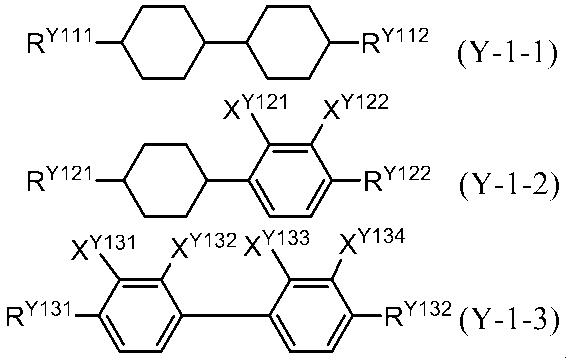
(上記一般式(Y-1-1)~(Y-1-3)中、RY111、RY112、RY121、RY122、RY131およびRY132はそれぞれ独立して、炭素原子数1~7のアルキル基、炭素原子数2~7のアルケニル基または炭素原子数1~7のアルコキシ基を表し、XY121、XY122、XY131、XY132、XY133およびXY134はそれぞれ独立して、水素原子またはフッ素原子を表す。)
上記一般式(Y-1-1)で表される化合物としては、式(i-1-1.1)から式(i-1-1.5)で表される化合物、式(i-1-2.1)から式(i-1-2.4)で表される化合物、式(i-1-3.1)~式(i-1-3.13)で表される化合物および式(i-1-6.1)から式(i-1-6.3)で表される化合物から選ばれる化合物であることが好ましい。
上記一般式(Y-1-1)で表される化合物としては、式(i-1-1.1)から式(i-1-1.5)で表される化合物、式(i-1-2.1)から式(i-1-2.4)で表される化合物、式(i-1-3.1)~式(i-1-3.13)で表される化合物および式(i-1-6.1)から式(i-1-6.3)で表される化合物から選ばれる化合物であることが好ましい。
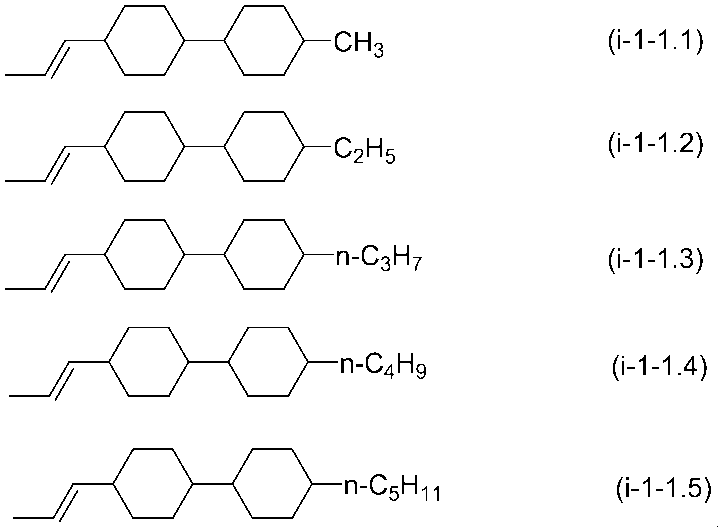
本発明の組成物の総量に対しての式(i-1-1.1)から式(i-1-1.5)で表される化合物の好ましい含有量の下限値は、1質量%であり、2質量%であり、3質量%であり、5質量%であり、7質量%であり、10質量%である。好ましい含有量の上限値は、本発明の組成物の総量に対して、20質量%であり、15質量%であり、13質量%であり、10質量%であり、8質量%であり、7質量%であり、6質量%であり、5質量%であり、3質量%である。また、上記化合物から選ばれる2種以上の化合物を組み合わせてもよい。
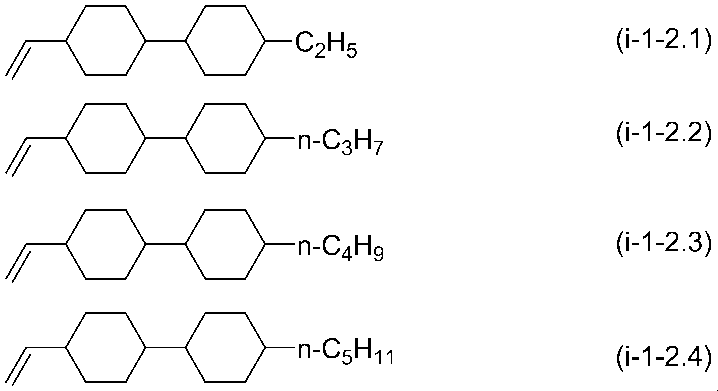
本発明の組成物の総量に対しての式(i-1-2.1)から式(i-1-2.4)で表される化合物で表される化合物の好ましい含有量の下限値は、10質量%であり、15質量%であり、18質量%であり、20質量%であり、23質量%であり、25質量%であり、27質量%であり、30質量%であり、33質量%であり、35質量%であり、38質量%であり、40質量%である。好ましい含有量の上限値は、本発明の組成物の総量に対して、60質量%であり、55質量%であり、50質量%であり、45質量%であり、43質量%であり、40質量%であり、38質量%であり、35質量%であり、32質量%であり、30質量%であり、20質量%であり、15質量%であり、10質量%である。また、上記化合物から選ばれる2種以上の化合物を組み合わせてもよい。

本発明の組成物の総量に対しての式(i-1-3.1)~式(i-1-3.13)で表される化合物の好ましい含有量の下限値は、1質量%であり、2質量%であり、3質量%であり、5質量%であり、7質量%であり、10質量%であり、13質量%であり、15質量%であり、18質量%であり、20質量%である。好ましい含有量の上限値は、本発明の組成物の総量に対して、20質量%であり、17質量%であり、15質量%であり、13質量%であり、10質量%であり、8質量%であり、7質量%であり、6質量%である。また、上記化合物から選ばれる2種以上の化合物を組み合わせてもよい。
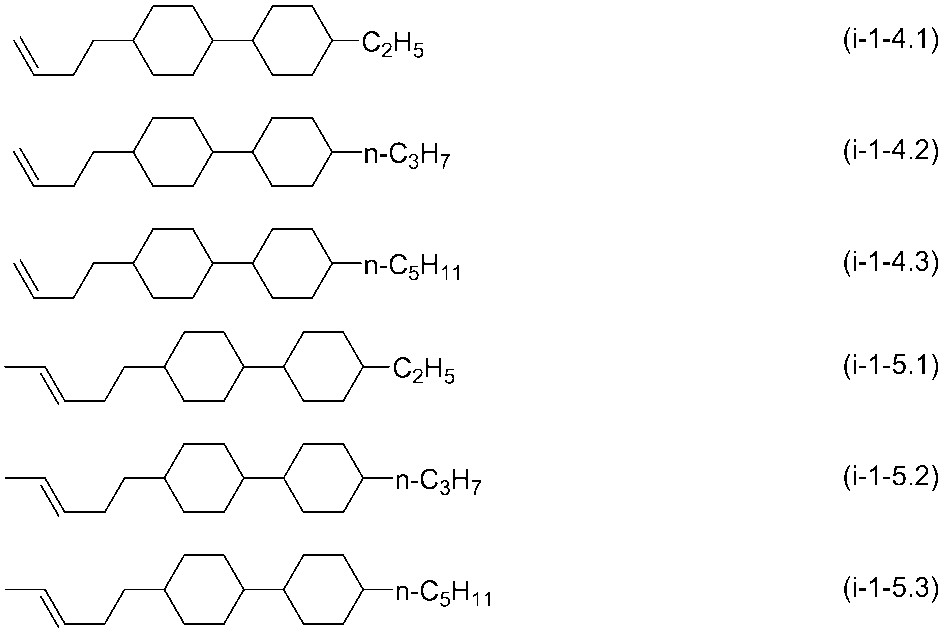
本発明の組成物の総量に対しての式(i-1-4.1)~式(i-1-5.3)で表される化合物の好ましい含有量の下限値は、1質量%であり、2質量%であり、3質量%であり、5質量%であり、7質量%であり、10質量%であり、13質量%であり、15質量%であり、18質量%であり、20質量%である。好ましい含有量の上限値は、本発明の組成物の総量に対して、20質量%であり、17質量%であり、15質量%であり、13質量%であり、10質量%であり、8質量%であり、7質量%であり、6質量%である。また、上記化合物から選ばれる2種以上の化合物を組み合わせてもよい。
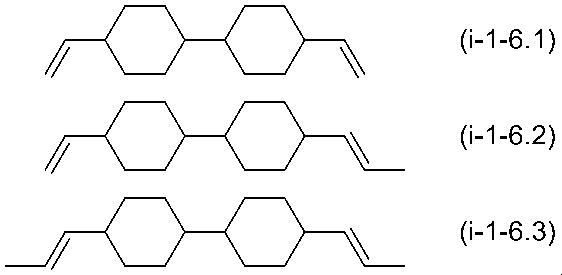
本発明の組成物の総量に対しての式(i-1-6.1)から式(i-1-6.3)で表される化合物の好ましい含有量の下限値は、1質量%であり、5質量%であり、10質量%であり、15質量%であり、17質量%であり、20質量%であり、23質量%であり、25質量%であり、27質量%であり、30質量%であり、35質量%である。好ましい含有量の上限値は、本発明の組成物の総量に対して、60質量%であり、55質量%であり、50質量%であり、45質量%であり、42質量%であり、40質量%であり、38質量%であり、35質量%であり、33質量%であり、30質量%である。また、上記化合物から選ばれる2種以上の化合物を組み合わせてもよい。
上記(Y-1-2)で表される化合物は、式(i-2.1)~(i-2.7)および式(N-1-1.1)から式(N-1-1.23)で表される化合物から選ばれる化合物であることが好ましい。
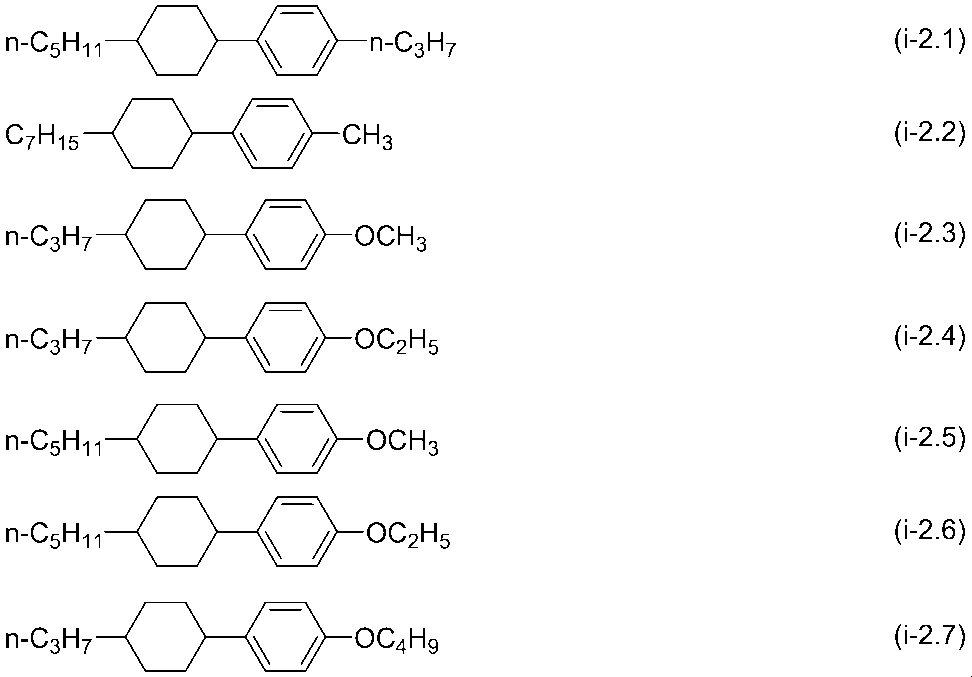

式(N-1-1.1)~(N-1-1.22)で表される化合物は単独で使用することも、組み合わせて使用することも可能であるが、本発明の組成物の総量に対しての単独又はこれら化合物の好ましい含有量の下限値は、5質量%であり、10質量%であり、13質量%であり、15質量%であり、17質量%であり、20質量%であり、23質量%であり、25質量%であり、27質量%であり、30質量%であり、33質量%であり、35質量%である。好ましい含有量の上限値は、本発明の組成物の総量に対して、50質量%であり、40質量%であり、38質量%であり、35質量%であり、33質量%であり、30質量%であり、28質量%であり、25質量%であり、23質量%であり、20質量%であり、18質量%であり、15質量%であり、13質量%であり、10質量%であり、8質量%であり、7質量%であり、6質量%であり、5質量%であり、3質量%である。また、上記化合物から選ばれる2種以上の化合物を組み合わせてもよい。
本発明の組成物の総量に対しての式(i-2.1)から式(i-2.7)で表される化合物の好ましい含有量の下限値は、1質量%であり、2質量%であり、3質量%であり、5質量%であり、7質量%であり、10質量%である。好ましい含有量の上限値は、本発明の組成物の総量に対して、20質量%であり、15質量%であり、13質量%であり、10質量%であり、8質量%であり、7質量%であり、6質量%であり、5質量%であり、3質量%である。また、上記化合物から選ばれる2種以上の化合物を組み合わせてもよい。
上記一般式(Y-1-3)で表される化合物としては、式(L-3.1)~式(L-3.4)で表される化合物および式(N-1-4.1)から式(N-1-4.14)で表される化合物から選ばれる化合物であることが好ましい。

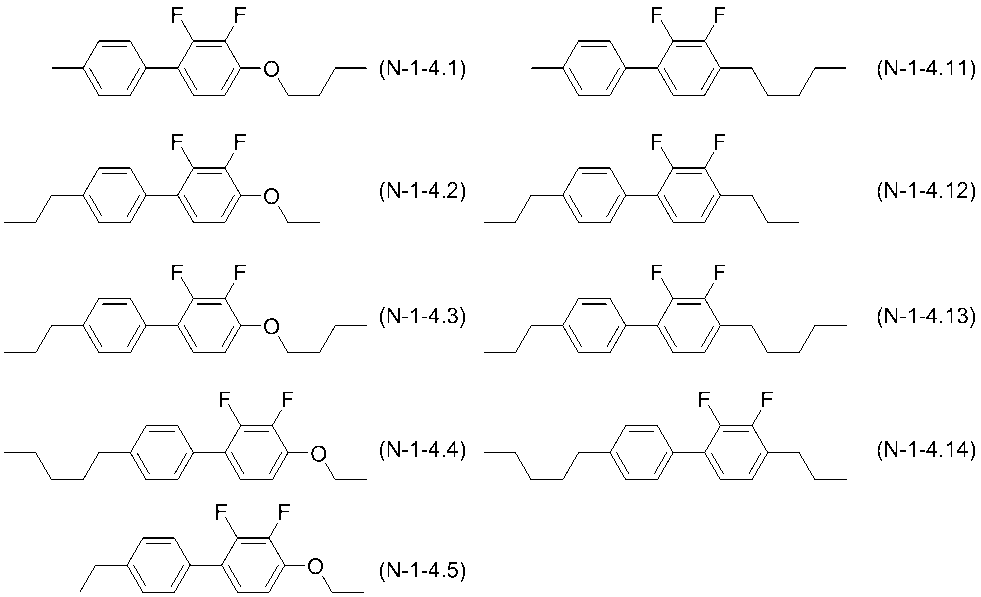
本発明の組成物の総量に対しての式(L-3.1)~式(L-3.4)で表される化合物の好ましい含有量の下限値は、1質量%であり、2質量%であり、3質量%であり、5質量%であり、7質量%であり、10質量%である。好ましい含有量の上限値は、本発明の組成物の総量に対して、20質量%であり、15質量%であり、13質量%であり、10質量%であり、8質量%であり、7質量%であり、6質量%であり、5質量%であり、3質量%である。
式(N-1-4.1)~(N-1-4.14)で表される化合物は単独で使用することも、組み合わせて使用することも可能であるが、本発明の組成物の総量に対しての単独又はこれら化合物の好ましい含有量の下限値は、3質量%であり、5質量%であり、7質量%であり、10質量%であり、13質量%であり、15質量%であり、17質量%であり、20質量%である。好ましい含有量の上限値は、本発明の組成物の総量に対して、35質量%であり、30質量%であり、28質量%であり、25質量%であり、23質量%であり、20質量%であり、18質量%であり、15質量%であり、13質量%であり、11質量%であり、10質量%であり、8質量%である。
なお、液晶組成物の構成成分である基準化合物を複数種類混合して溶解促進成分を調製する好ましい態様の一つは、一般式(Y-1)で表される化合物と、一般式(S-1)~(S-8)で表される化合物からなる群から選択される1種または2種以上の化学構造を備える化合物と、を混合することが好ましい。
本発明に係る基準化合物の融点(常態より流動性の高い相へ変化する転移温度)の上限値は、120℃以下であることが好ましく、100℃以下であることがより好ましく、90℃以下であることがさらに好ましく、80℃以下であることが特に好ましい。また、前記融点の下限値は、20℃以上であることが好ましく、20℃以上かつ40℃以下であることが特に好ましい。 本発明に係る基準化合物の融点が120℃以下であると、流動性の高い相へ変化させるための外部刺激に対する応答性が良好となるため好ましく、特に外部刺激として加熱を用いた場合の相変化が容易になる点で好ましい。外部刺激として加熱以外に他の化合物との共融を用いる場合は、基準化合物の融点は100℃以下であることが好ましく、90℃以下であることがより好ましく、80℃以下であることが特に好ましく、20℃以上80℃以下であることがより特に好ましい。
本発明に係る液晶組成物中における基準化合物の占める割合については、液晶組成物全体を100質量%とすると当該基準化合物の含有量は、5~60質量%であることが好ましく、10~55質量%であることがより好ましく、15~50質量%であることがさらに好ましく、20~45質量%であることが特に好ましい。
本発明に係る基準化合物の常温(25℃)または常温近傍(10~40℃)における化合物の相状態については、固体(粉体を含む)またはスメクチック相を呈していることが好ましく、スメクチック相を呈していることがより好ましい。
本発明に係る基準化合物は、1種類~5種類の液晶化合物で構成されていることが好ましく、1種類~4種類の液晶化合物で構成されていることがより好ましく、1種類~3種類の液晶化合物で構成されていることがさらに好ましく、1~2種類の液晶化合物で構成されていることがよりさらに好ましく、1種類の液晶化合物で構成されていることが特に好ましい。
以上のことから、本発明に係る基準化合物の好ましい態様は、以下の(A)~(F)からなる群から選択される少なくとも1つの条件を満たしている。
(A)上記一般式(S-1)~(S-8)からなる群から選択される少なくとも一つの部分化学構造を備えること
(B)上記一般式(Y-1)で表される化合物であること
(C)本発明に係る基準化合物の融点(常態より流動性の高い相へ変化する転移温度)の上限値が120℃以下であること
(D)液晶組成物における基準化合物の含有量が5~60質量%であること
(E)基準化合物の常温(25℃)または常温近傍(10~40℃)における相状態は、固体(粉体を含む)またはスメクチック相を呈していること
(F)基準化合物は、1~4種類の液晶化合物で構成されていること
2種以上の化合物を含む液晶組成物から溶解促進成分に適した基準化合物の選択は、上記(A)~(F)のいずれか1つ以上または2つ以上の条件を有することが好ましい。
なかでも、(A)、(B)、(C)または(E)の特性を考慮することが好ましい。
(B)上記一般式(Y-1)で表される化合物であること
(C)本発明に係る基準化合物の融点(常態より流動性の高い相へ変化する転移温度)の上限値が120℃以下であること
(D)液晶組成物における基準化合物の含有量が5~60質量%であること
(E)基準化合物の常温(25℃)または常温近傍(10~40℃)における相状態は、固体(粉体を含む)またはスメクチック相を呈していること
(F)基準化合物は、1~4種類の液晶化合物で構成されていること
2種以上の化合物を含む液晶組成物から溶解促進成分に適した基準化合物の選択は、上記(A)~(F)のいずれか1つ以上または2つ以上の条件を有することが好ましい。
なかでも、(A)、(B)、(C)または(E)の特性を考慮することが好ましい。
また、上記(A)~(F)の条件を併用する態様として特に制限はないが、(A)と(B)及び(C)を同時に備えることが好ましく、(A)と(B)と(C)及び(D)を同時に備えることがより好ましく、(A)と(B)と(C)と(D)及び(E)を同時に備えることが特に好ましい。
本発明に係る外部刺激とは、物理化学的な外部環境の変化を言い、具体的には、熱、マイクロ波および基準化合物とは異なる液晶組成物の構成成分である化合物との接触からなる群から選択される少なくとも1種であることが好ましい。したがって、「液晶組成物の構成成分である基準化合物が外部刺激に応答して化合物単独の常態より流動性の高い相へ変化」することは、液晶組成物の構成成分である基準化合物が、熱、マイクロ波または液晶組成物の構成成分であり、かつ基準化合物とは異なる他の化合物との接触などの外部環境の変化(=外部刺激)を当該基準化合物が感知して、常態より流動性の高い相変化を生じることをいう。また、必要により、基準化合物が外部刺激に応答する際および/または基準化合物と当該基準化合物とは異なる他の化合物とを混合する際に、振動手段や撹拌手段を行っても良い。
上記外部刺激が、熱である場合の加熱手段としては、加熱する際には、局所的な過加熱を防いだ方法が有用であり、本発明に係る工程(I)における加熱手段(温度を調整する温度制御手段)としては、公知の加熱手段および/または温度制御手段が採用されうる。具体的には、汎用の恒温機、クリーンオーブン、ホットプレート、オイルバス、ウォーターバス、ジャケットヒーター、マントルヒーター、ペルチエ素子を用いる方法、発熱プローブを化合物の容器内に直接埋没させる方法、あるいは化合物を充填した金属容器壁を直接誘導加熱する方法、熱風・冷風循環式恒温オーブン、マイクロ波または(遠)赤外線ヒーター、温度調節用に加熱されたロール、ヒートパイプロール、金属ベルト、ホットプレスなどが挙げられる。また、加熱手段としては、化合物を充填した容器の形状により適宜選択できるが、クリーンオーブンまたはペルチエ素子が好ましく、クリーンオーブンがより好ましい。また、クリーンオーブンの場合には、昇降温プログラム機能と減圧用配管および不活性ガスパージ用配管を具備していることが好ましい。
上記加熱手段および/または温度制御手段により基準化合物を流動性の高い相に変化させる温度の下限値は、60℃であることが好ましく、75℃であることがより好ましく、80℃であることがさらに好ましく、85℃であることがよりさらに好ましく、90℃であることが特に好ましい。当該加熱手段および/または温度制御手段の温度の上限値は、150℃であることが好ましく、115℃であることがより好ましく、110℃であることがさらに好ましく、105℃であることがよりさらに好ましく、100℃であることが特に好ましい。
また、上記加熱手段において、加熱を保持する保持時間は、液晶化合物の融点や化合物を貯蔵している容器の材質と形状、及び基準化合物が充填された容器全体の熱容量に応じて適宜選択することができるが、10分~30時間が好ましく、20分~25時間がより好ましく、30分~20時間が更に好ましく、1時間~15時間がより更に好ましく、2時間~12時間が特に好ましい。また、基準化合物を加熱する際の雰囲気は、基準化合物自体の酸化のされ易さに応じて適宜選択することが好ましい。例えば、不飽和結合を有さない液晶化合物の場合は、クリーンエアー雰囲気下で加温することもできる。一方、酸化されやすい基を有する化合物の場合は雰囲気から可能な限り酸素を除去しておくことが好ましく、酸素の除去が不十分だと予期せぬ液晶化合物の劣化を招く場合がある。上記加熱手段による加熱は、クリーンエアー雰囲気下、減圧化または不活性ガス雰囲気下で行うことが好ましく、減圧下または不活性ガス雰囲気下で行うことがより好ましく、不活性ガス雰囲気下で行うことが特に好ましい。好ましい不活性ガスとしては、窒素ガス、アルゴンガスが挙げられる。
外部刺激がマイクロ波である場合のマイクロ波照射手段としては、マグネトロンやクライストロン等の公知の発振素子を用いてなるマイクロ波発振器を備えて構成される。ここで、マイクロ波とは、周波数が300MHz~3THz程度であり、波長が100μm~1m程度の電磁波であり、例えば、950MHz、2.45GHz、5.8GHz程度の周波数が含まれる。
上記振動手段としては、超音波装置を用いて振動させ撹拌させる方法もある。また、上記撹拌手段としては、具体的には、遊星式撹拌装置、振とう機、ラボミキサー、撹拌プロペラ、シェーカー又はロータリーエバポレーター等が使用できる。中でも、遊星式攪拌装置が好ましい。尚、本願発明において遊星式撹拌装置とは、材料の入った容器を自転させながら公転させる方式の撹拌装置を指し、自転・公転式撹拌装置とも呼ばれる。又、遊星式撹拌装置は脱泡機能が付加されることから遊星式撹拌脱泡装置とも呼ばれる。その他には、超音波照射装置が使用できる。
当該撹拌手段において使用する容器の材質としてはガラス、ステンレス、チタン、テフロン(登録商標)など液晶組成物に有害な不純物が出にくい材質のものが良い。ガラス容器としては、例えばセパラブルフラスコを用いて減圧にし、磁石型の撹拌子を入れ撹拌する方法や撹拌プロペラを用いて撹拌する方法などがある。また、なす型フラスコなどを用いてロータリーエバポレーター等で減圧し、なす型フラスコを回転させることにより撹拌させる方法などがある。あるいは、遠心力により均一化させる方法もある。
上記外部刺激が、液晶組成物の構成成分であり、かつ基準化合物とは異なる化合物との接触である場合、当該外部刺激となる化合物は、液晶組成物を構成する化合物のうち基準化合物以外の化合物をいい、基準化合物と接触して共融現象を生じる化合物が好ましい。換言すると、外部刺激である化合物は、基準化合物との共融点が、10℃~40℃である化合物が好ましい。
ここでいう共融とは、本発明の基準化合物と本発明の外部刺激である化合物とが接触すると溶融して相転移を起こす現象を言い、共融点とは、当該共融現象が生じる温度範囲をいう。本発明では、例えば、本発明の基準化合物と本発明の外部刺激である化合物とが接触すると溶融してスメクチック相またはネマチック相へ転移することが好ましい。
上記外部刺激となる化合物の具体的な例としては、以下の一般式(S-9)~(S-14)からなる群から選択される1種または2種以上の化合物であることが好ましい。

(上記一般式(S-9)~(S-14)中、Xs1~Xs4はそれぞれ独立して、水素原子またはフッ素原子を表し、Rs6は、炭素原子数1~5のアルキル基、炭素原子数2~5のアルケニル基を表し、Rs7およびRs8はそれぞれ独立して、炭素原子数1~5のアルキル基、炭素原子数1~5のアルケニル基または炭素原子数1~5のアルコキシ基を表し、Ys1は、水素原子、フッ素原子、トリフルオロメチル基またはトリフルオロメトキシ基を表す。)
上記一般式(S-9)で表される化合物は、例えば式(L-4.1)から式(L-4.5)で表される化合物であることが好ましい。
上記一般式(S-9)で表される化合物は、例えば式(L-4.1)から式(L-4.5)で表される化合物であることが好ましい。

本発明の組成物の総量に対しての式(S-9)で表される化合物の好ましい含有量の下限値は、1質量%であり、2質量%であり、3質量%であり、5質量%であり、7質量%であり、10質量%であり、14質量%であり、16質量%であり、20質量%であり、23質量%であり、26質量%であり、30質量%であり、35質量%であり、40質量%である。本発明の組成物の総量に対しての式(S-9)で表される化合物の好ましい含有量の上限値は、50質量%であり、40質量%であり、35質量%であり、30質量%であり、20質量%であり、15質量%であり、10質量%であり、5質量%である。
上記一般式(S-10)で表される化合物は、式(L-3.1)~式(L-3.4)で表される化合物および式(N-1-4.1)から式(N-1-4.14)で表される化合物から選ばれる化合物であることが好ましい。
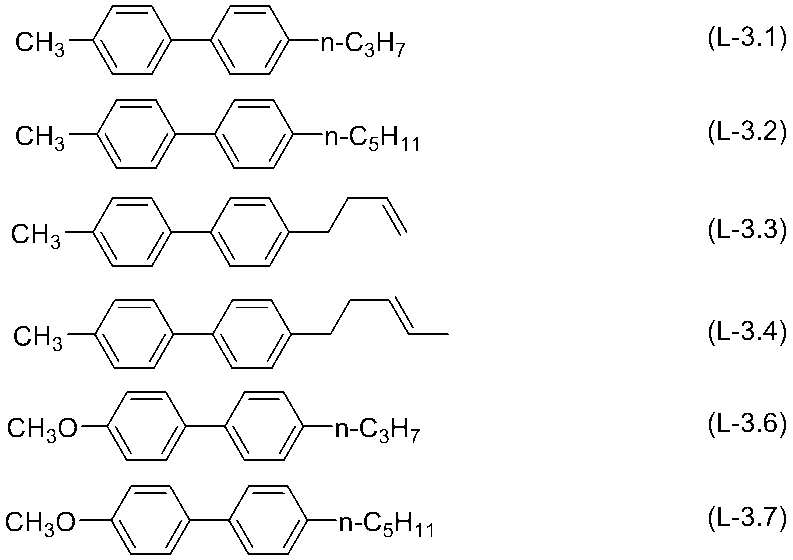
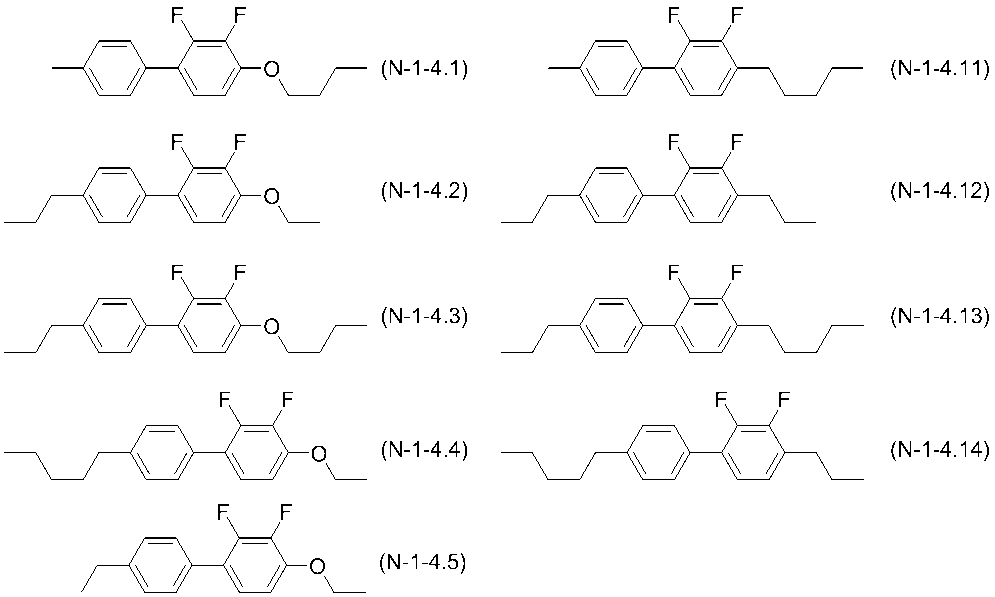
本発明の組成物の総量に対しての式(L-3.1)~式(L-3.7)で表される化合物の好ましい含有量の下限値は、1質量%であり、2質量%であり、3質量%であり、5質量%であり、7質量%であり、10質量%である。好ましい含有量の上限値は、本発明の組成物の総量に対して、20質量%であり、15質量%であり、13質量%であり、10質量%であり、8質量%であり、7質量%であり、6質量%であり、5質量%であり、3質量%である。
式(N-1-4.1)~(N-1-4.14)で表される化合物は単独で使用することも、組み合わせて使用することも可能であるが、本発明の組成物の総量に対しての単独又はこれら化合物の好ましい含有量の下限値は、3質量%であり、5質量%であり、7質量%であり、10質量%であり、13質量%であり、15質量%であり、17質量%であり、20質量%である。好ましい含有量の上限値は、本発明の組成物の総量に対して、35質量%であり、30質量%であり、28質量%であり、25質量%であり、23質量%であり、20質量%であり、18質量%であり、15質量%であり、13質量%であり、11質量%であり、10質量%であり、8質量%である。
上記(S-11)で表される化合物は、式(i-2.1)~(i-2.7)および式(N-1-1.1)から式(N-1-1.23)で表される化合物から選ばれる化合物であることが好ましい。


式(N-1-1.1)~(N-1-1.22)で表される化合物は単独で使用することも、組み合わせて使用することも可能であるが、本発明の組成物の総量に対しての単独又はこれら化合物の好ましい含有量の下限値は、5質量%であり、10質量%であり、13質量%であり、15質量%であり、17質量%であり、20質量%であり、23質量%であり、25質量%であり、27質量%であり、30質量%であり、33質量%であり、35質量%である。好ましい含有量の上限値は、本発明の組成物の総量に対して、50質量%であり、40質量%であり、38質量%であり、35質量%であり、33質量%であり、30質量%であり、28質量%であり、25質量%であり、23質量%であり、20質量%であり、18質量%であり、15質量%であり、13質量%であり、10質量%であり、8質量%であり、7質量%であり、6質量%であり、5質量%であり、3質量%である。
本発明の組成物の総量に対しての式(i-2.1)から式(i-2.7)で表される化合物の好ましい含有量の下限値は、1質量%であり、2質量%であり、3質量%であり、5質量%であり、7質量%であり、10質量%である。好ましい含有量の上限値は、本発明の組成物の総量に対して、20質量%であり、15質量%であり、13質量%であり、10質量%であり、8質量%であり、7質量%であり、6質量%であり、5質量%であり、3質量%である。
上記一般式(S-12)で表される化合物は、具体的には式(M-1.1)から式(M-1.4)で表される化合物であることが好ましく、式(M-1.1)又は式(M-1.2)で表される化合物が好ましく、式(M-1.2)で表される化合物がさらに好ましい。また、式(M-1.1)又は式(M-1.2)で表される化合物を同時に使用することも好ましい。
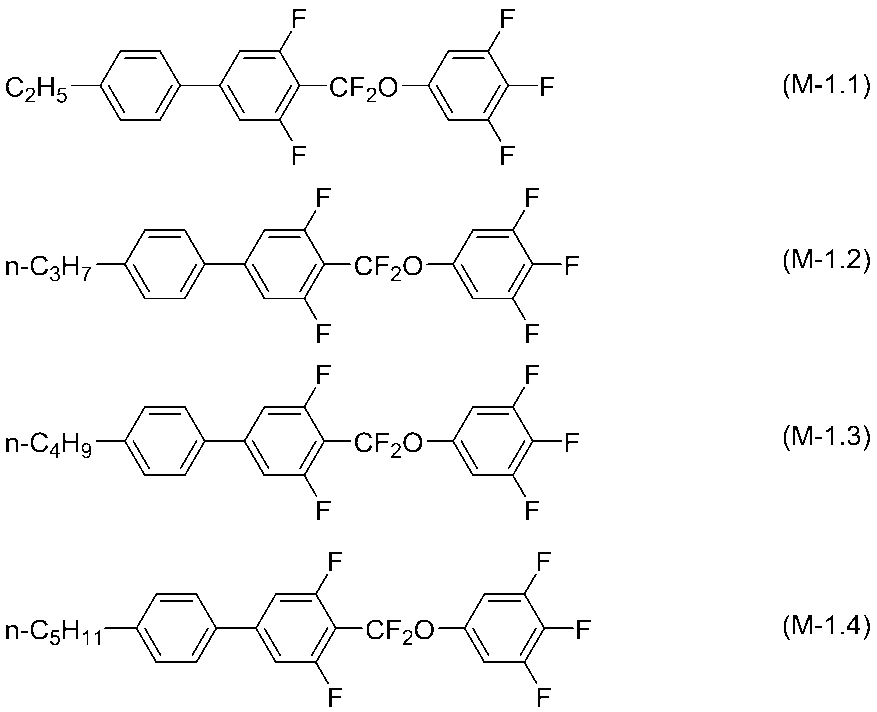
本発明の組成物の総量に対しての式(S-12)で表される化合物の好ましい含有量の下限値は、1質量%であり、2質量%であり、5質量%であり、6質量%である。好ましい含有量の上限値は、30質量%であり、25質量%であり、23質量%であり、20質量%であり、18質量%であり、15質量%であり、13質量%であり、10質量%であり、8質量%である。
本発明の組成物の総量に対しての式(M-1.1)及び式(M-1.2)で表される化合物の合計の好ましい含有量の下限値は、1質量%であり、2質量%であり、5質量%であり、6質量%である。好ましい含有量の上限値は、30質量%であり、25質量%であり、23質量%であり、20質量%であり、18質量%であり、15質量%であり、13質量%であり、10質量%であり、8質量%である。
上記一般式(S-13)で表される化合物は具体的には式(M-6.21)から式(M-6.34)で表される化合物が好ましい。


本発明の組成物の総量に対しての式(S-13)で表される化合物の好ましい含有量の下限値は、1質量%であり、2質量%であり、4質量%であり、5質量%であり、8質量%であり、10質量%であり、13質量%であり、15質量%であり、18質量%であり、20質量%である。好ましい含有量の上限値は、30質量%であり、28質量%であり、25質量%であり、23質量%であり、20質量%であり、18質量%であり、15質量%であり、13質量%であり、10質量%であり、8質量%であり、5質量%である。
上記一般式(S-14)で表される化合物は、式(M-7.1)から式(M-7.14)で表される化合物であることが好ましい。


本発明の組成物の総量に対しての一般式(S-14)の化合物の好ましい含有量の下限値は、1質量%であり、2質量%であり、4質量%であり、5質量%であり、8質量%であり、10質量%であり、13質量%であり、15質量%であり、18質量%であり、20質量%である。好ましい含有量の上限値は、30質量%であり、28質量%であり、25質量%であり、23質量%であり、20質量%であり、18質量%であり、15質量%であり、13質量%であり、10質量%であり、8質量%であり、5質量%である。
なお、本発明に係る工程(I)において、外部刺激が化合物同士の接触の場合、基準化合物と接触する化合物は、液晶組成物を構成する化合物のうち基準化合物とは異なる化合物である。したがって、本発明の工程(I)の好ましい実施形態としては、液晶組成物を構成する全化合物のうち、上記(1’)~(6’)からなる群から選択される少なくとも1つの条件を満たして選択された基準化合物と、当該基準化合物以外の化学構造を備えた化合物とを接触させることで流動性の高い相へ変化させて溶解促成成分を調製することが好ましい。
本発明の工程(I)の他の好ましい実施形態としては、液晶組成物を構成する全化合物のうち、一般式(Y-1)で表される基準化合物と、当該一般式(Y-1)以外の化学構造を備えた化合物とを接触させることで流動性の高い相へ変化させて溶解促成成分を調製する。
本発明の工程(I)の他の好ましい実施形態としては、液晶組成物を構成する全化合物のうち、一般式(Y-1-1)で表される基準化合物と、一般式(S-9)~(S-14)からなる群から選択される1種または2種以上の化合物とを接触させることで流動性の高い相へ変化させて溶解促成成分を調製する。
本発明の工程(I)の他の好ましい実施形態としては、液晶組成物を構成する全化合物のうち、一般式(Y-1-2)で表される基準化合物と、一般式(S-9)~(S-10)および一般式(S-12)~(S-14)からなる群から選択される1種または2種以上の化合物とを接触させることで流動性の高い相へ変化させて溶解促成成分を調製する。
本発明の工程(I)の他の好ましい実施形態としては、液晶組成物を構成する全化合物のうち、一般式(Y-1-3)で表される基準化合物と、一般式(S-9)および(S-11)~(S-14)からなる群から選択される1種または2種以上の化合物とを接触させることで流動性の高い相へ変化させて溶解促成成分を調製する。
また、本発明に係る工程(I)において、外部刺激が化合物同士の接触の場合、必要により、化合物同士の接触前、接触中または接触後のいずれにおいても加熱手段、撹拌手段、振動手段またはマイクロ波の照射を行っても良い。
本発明に係る工程(I)における雰囲気条件は、大気雰囲気または酸素を遮断した窒素や不活性ガス雰囲気下であってもよいが、液晶化合物の保護の観点から、不活性ガス雰囲気下であることが好ましい。
本発明に係る工程(I)における気圧条件は、特に制限されることはなく、減圧、常圧又は加圧下にて行うことができる。通常は、大気圧(約0.1MPa)近傍の圧力下で実施すればよいが、0.1MPa未満の減圧下においても円滑に工程(I)を進行させることができる。
特に、液晶組成物の構成成分である化合物に外部刺激として熱を加えて前記化合物単独の常態より流動性の高い相へ変化した溶解促進成分を調製する場合、最初から最後まで減圧下で行うか、または工程(I)の一部分を減圧下で行ってもよい。
以下、本発明に係る工程(I)の好ましい実施形態について説明する。
本発明に係る工程(I)の好ましい実施形態の一つは、液晶組成物の構成成分である基準化合物に対して、液晶組成物の構成成分であり、かつ前記基準化合物とは異なる外部刺激としての化合物とを接触させることにより、合計2~5種の化合物を混合して溶解促成成分を調製することが好ましい。
すなわち、基準化合物と、当該基準化合物とは異なる1~3種の化合物と、を混合することで外部刺激である異なる化合物同士の接触により共融現象が起こり、基準化合物の常態(例えば、固体またはスメクチック相)より流動性の高い相(例えば、ネマチック相)へ転移して、前記2~3種の化合物を含む(例えば、ネマチック相の)溶解促進成分を調製することができる。これにより、液晶組成物を構成する化合物に対して熱をかけずに溶解促進成分を調製することができるため、化合物の熱分解などを低減することができる。
また、液晶組成物を構成する2~3種の化合物を混合する際は、超音波振動や撹拌手段を併用することで流動性の高い相へ転移させるための時間を短縮してもよい。さらに、液晶組成物を構成する2~3種の化合物を混合する際または混合した後、混合物に対して外部刺激として加熱してもよい。複数種の液晶化合物が混合されているため、融点降下により最低限の加熱で溶解促進成分を調製することができるため、化合物の熱分解などを低減することができる。
本発明に係る工程(I)のより好ましい実施形態の一つは、液晶組成物の構成成分であり、一般式(Y-1-1)で表される基準化合物に対して、一般式(S-9)~(S-14)からなる群から選択される1種または2種以上の化合物を接触させることで前記基準化合物単独の常態より流動性の高い相へ変化した溶解促進成分を調製することが好ましい。また、必要により超音波振動や撹拌手段を用いて一般式(Y-1-1)で表される基準化合物を1種または2種以上と、一般式(S-9)~(S-14)からなる群から選択される1種または2種以上の化合物とを混合してもよい。
本発明に係る工程(I)のより好ましい他の実施形態の一つは、液晶組成物の構成成分であり、25℃でスメクチック相を呈する基準化合物に対して、一般式(S-9)~(S-14)からなる群から選択される1種または2種以上の化合物を接触させることでネマチック相へ変化した溶解促進成分を調製することが好ましい。また、必要により超音波振動や撹拌手段を用いて25℃でスメクチック相を呈する基準化合物と、一般式(S-9)~(S-14)からなる群から選択される1種または2種以上の化合物とを混合してもよい。
本発明に係る工程(I)の好ましい実施形態の一つは、液晶組成物の構成成分である基準化合物に対して、加熱手段により前記基準化合物単独の常態より流動性の高い相へ変化した溶解促進成分を調製することが好ましい。
すなわち、基準化合物に対して外部刺激である熱を加えることにより、当該基準化合物の常態(例えば、固体またはスメクチック相)より流動性の高い相(例えば、ネマチック相)へ転移して、(例えば、ネマチック相の)溶解促進成分を調製することができる。そのため、溶解促進成分自体が溶媒と熱媒体との役割を担うため、液晶組成物を構成する他の化合物に対して必要以上の熱をかけることなく液晶組成物を調製することができるため、化合物の熱分解などを低減することができる。
また、溶解促進成分を調製する際は、外部刺激としてさらに超音波振動や撹拌を併用することで流動性の高い相へ転移させるための時間を短縮してもよい。
本発明に係る基準化合物が複数種類の場合の態様の一つとしては、基準化合物それぞれに対して加熱することで流動性の高い相に変化させて、それぞれの溶解促進成分を調製した後混合しても、または、基準化合物を混合した後に加熱することで流動性の高い相に変化させて溶解促進成分を調製してもよい。
本発明に係る工程(I)のより好ましい実施形態の一つは、液晶組成物の構成成分であり、かつ一般式(Y-1-1)で表される基準化合物に対して、加熱手段により前記基準化合物単独の常態より流動性の高い相へ変化した溶解促進成分を調製することが好ましい。
本発明に係る工程(I)のより好ましい他の実施形態の一つは、液晶組成物の構成成分であり、25℃でスメクチック相を呈する基準化合物に対して、加熱手段によりネマチック相へ変化した溶解促進成分を調製することが好ましい。より具体的には、本発明に係る工程(I)は、液晶組成物の構成成分のうち、一般式(Y-1-1)で表されるスメクチック相を呈する化合物1種または2種以上を基準化合物とし、当該基準化合物を40~120℃に加熱してより流動性の高いネマチック相に転移させた溶解促進成分を調製する工程が好ましい。
本発明に係る工程(I)の好ましい実施形態の一つは、液晶組成物の構成成分である基準化合物に対して、液晶組成物の構成成分であり、かつ前記基準化合物とは異なる化合物とを接触させる際に、加熱しながら合計2~5種の化合物を混合して溶解促成成分を調製することが好ましい。
すなわち、基準化合物と、当該基準化合物とは異なる1~3種の化合物と、が接触することで、外部刺激である異なる化合物同士の接触により共融現象が起こり、基準化合物の常態(例えば、固体またはスメクチック相)より流動性の高い相(例えば、ネマチック相)へ転移して、前記2~3種の化合物を含む(例えば、ネマチック相の)溶解促進成分を調製することができる。また、基準化合物と、当該基準化合物とは異なる1~3種の化合物との接触の際に加熱しているため、最低限の加熱で溶解促進成分を調製することができ、化合物の熱分解などを低減することができる。
また、溶解促進成分を調製する際は、外部刺激としてさらに超音波振動や撹拌を併用することで流動性の高い相へ転移させるための時間を短縮してもよい。
本発明に係る工程(I)は、液晶組成物の構成成分のうち、一般式(Y-1-1)で表されるスメクチック相を呈する化合物1種を基準化合物とし、前記基準化合物とは異なる化合物とを接触させる際に、当該基準化合物および/または前記基準化合物とは異なる化合物を40~120℃に加熱してより流動性の高いネマチック相に転移させた溶解促進成分を調製する工程が好ましい。
本発明に係る工程(I)は、液晶組成物の構成成分のうち、一般式(Y-1-1)で表されるスメクチック相を呈する化合物2~5種、好ましくは2~4種、より好ましくは2~3種を基準化合物とし、前記基準化合物とは異なる化合物とを接触させる際に、当該基準化合物および/または前記基準化合物とは異なる化合物を40~120℃に加熱してより流動性の高いネマチック相に転移させた溶解促進成分を調製する工程が好ましい。
また、必要により本発明の工程(I)において、溶解促進成分に対して、公知の酸化防止剤を添加してもよく、さらには本発明の工程(I)において、基準化合物に対して、公知の酸化防止剤を添加した状態で流動性の高い溶解促進成分を調製してもよい。酸化防止剤の例は、以下の工程(II)で説明する化合物が挙げられる。
また、本発明に係る製造方法において、基準化合物を複数種類の混合物として使用する場合は、混合する基準化合物の順序は特に制限されることはない。
「工程(II)」
本発明に係る工程(II)は、前記液晶組成物の構成成分である基準化合物と異なる前記液晶組成物を構成する化合物および前記溶解促進成分を混合する工程(II)である。
本発明に係る工程(II)は、前記液晶組成物の構成成分である基準化合物と異なる前記液晶組成物を構成する化合物および前記溶解促進成分を混合する工程(II)である。
液晶組成物の構成成分でもある基準化合物自体を流動性の高い相に変化させた状態で、前記化合物とは異なる液晶組成物を構成する化合物と、工程(I)により得られた溶解促進成分と、を混合するため、信頼性の低下(例えば、不要な加熱による化合物の熱分解に起因する不純物なく効率的に製造することができる。
液晶組成物の構成成分でもある基準化合物自体を流動性の高い相に変化させた溶解促進成分は、溶媒または熱媒としても働くため前記基準化合物とは異なる液晶組成物を構成する化合物を容易に溶解させることができ、信頼性の低下(例えば、不要な加熱による化合物の熱分解に起因する不純物なく効率的に製造することができる。
上記液晶組成物の構成成分である基準化合物と異なる前記液晶組成物を構成する化合物とは、本発明の液晶組成物に含まれる全液晶化合物のうち、基準化合物を除く液晶組成物の構成化合物をいい、基準化合物に対する外部刺激に液晶組成物の構成成分の化合物を使用した場合は、基準化合物および外部刺激である液晶組成物の構成成分の化合物を除く液晶組成物の構成化合物をいう。
また、上記基準化合物とは異なる前記液晶組成物を構成する化合物は、前記溶解促進成分より流動性の低い相である化合物あることが好ましい。
溶解促進成分は、高い溶解性を示す溶媒および熱媒体でもあるため、不要な加熱による化合物の熱分解を軽減することができる。
上記基準化合物と相違し、かつ前記液晶組成物を構成する化合物と前記溶解促進成分とを混合する方法としては、特に制限されることなく、上記の工程(I)における撹拌手段や振動手段など公知の方法を使用することができる。また、上記の工程(I)における加熱手段を用いて加熱または温度制御しながら混合してもよい。
また、基準化合物と相違し、かつ前記液晶組成物を構成する化合物と、前記溶解促進成分とを混合する順序は特に制限されることはない。したがって、工程(II)において、前記基準化合物とは異なる前記液晶組成物を構成する化合物を前記溶解促進成分に添加して混合してもよく、または、前記溶解促進成分を前記基準化合物とは異なる前記液晶組成物を構成する化合物に添加して混合してもよい。
本発明に係る工程(II)は、常圧で行うこともできるが、最初から最後まで減圧下で行うか、または一部分を減圧下で行ってもよい。
本発明の工程(II)において、溶解促進成分に対して、公知の酸化防止剤を添加してもよく、下記一般式(IV)で表される末端構造を有する酸化防止剤を添加することがより好ましい。

上記液晶組成物の構成成分である基準化合物とは異なる前記液晶組成物を構成する化合物としては、一般式(H-1)から一般式(H-4)で表されるヒンダードフェノールが挙げられる。
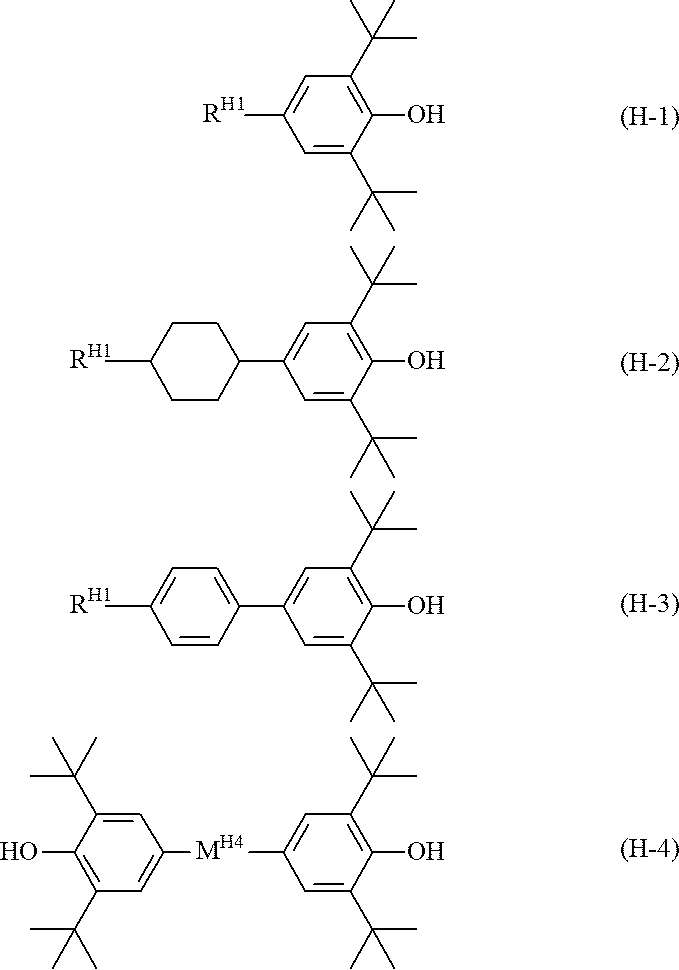
上記一般式(H-1)から一般式(H-4)中、RH1は炭素原子数1から10のアルキル基、炭素原子数1から10のアルコキシ基、炭素原子数2から10のアルケニル基又は炭素原子数2から10のアルケニルオキシ基を表すが、基中に存在する1個の-CH2-又は非隣接の2個以上の-CH2-はそれぞれ独立的に-O-又は-S-に置換されても良く、また、基中に存在する1個又は2個以上の水素原子はそれぞれ独立的にフッ素原子又は塩素原子に置換されても良い。更に具体的には、炭素原子数2から7のアルキル基、炭素原子数2から7のアルコキシ基、炭素原子数2から7のアルケニル基又は炭素原子数2から7のアルケニルオキシ基であることが好ましく、炭素原子数3から7のアルキル基又は炭素原子数2から7のアルケニル基であることが更に好ましい。
上記一般式(H-4)中、MH4は炭素原子数1から15のアルキレン基(該アルキレン基中の1つ又は2つ以上の-CH2-は、酸素原子が直接隣接しないように、-O-、-CO-、-COO-、-OCO-に置換されていても良い。)、-OCH2-、-CH2O-、-COO-、-OCO-、-CF2O-、-OCF2-、-CF2CF2-、-CH=CH-COO-、-CH=CH-OCO-、-COO-CH=CH-、-OCO-CH=CH-、-CH=CH-、-C≡C-、単結合、1,4-フェニレン基(1,4-フェニレン基中の任意の水素原子はフッ素原子により置換されていても良い。)又はトランス-1,4-シクロヘキシレン基を表すが、炭素原子数1から14のアルキレン基であることが好ましく、揮発性を考慮すると炭素原子数は大きい数値が好ましいが、粘度を考慮すると炭素原子数は大き過ぎない方が好ましいことから、炭素原子数2から12が更に好ましく、炭素原子数3から10が更に好ましく、炭素原子数4から10が更に好ましく、炭素原子数5から10が更に好ましく、炭素原子数6から10が更に好ましい。
一般式(H-1)から一般式(H-4)中、1,4-フェニレン基中の1個又は非隣接の2個以上の-CH=は-N=によって置換されていても良い。また、1,4-フェニレン基中の水素原子はそれぞれ独立的に、フッ素原子又は塩素原子で置換されていても良い。
一般式(H-1)から一般式(H-4)中、1,4-シクロヘキシレン基中の1個又は非隣接の2個以上の-CH2-は-O-又は-S-によって置換されていても良い。また、1,4-シクロヘキシレン基中の水素原子はそれぞれ独立的に、フッ素原子又は塩素原子で置換されていても良い。
更に具体的には、例えば、式(H-11)から式(H-15)が挙げられる。
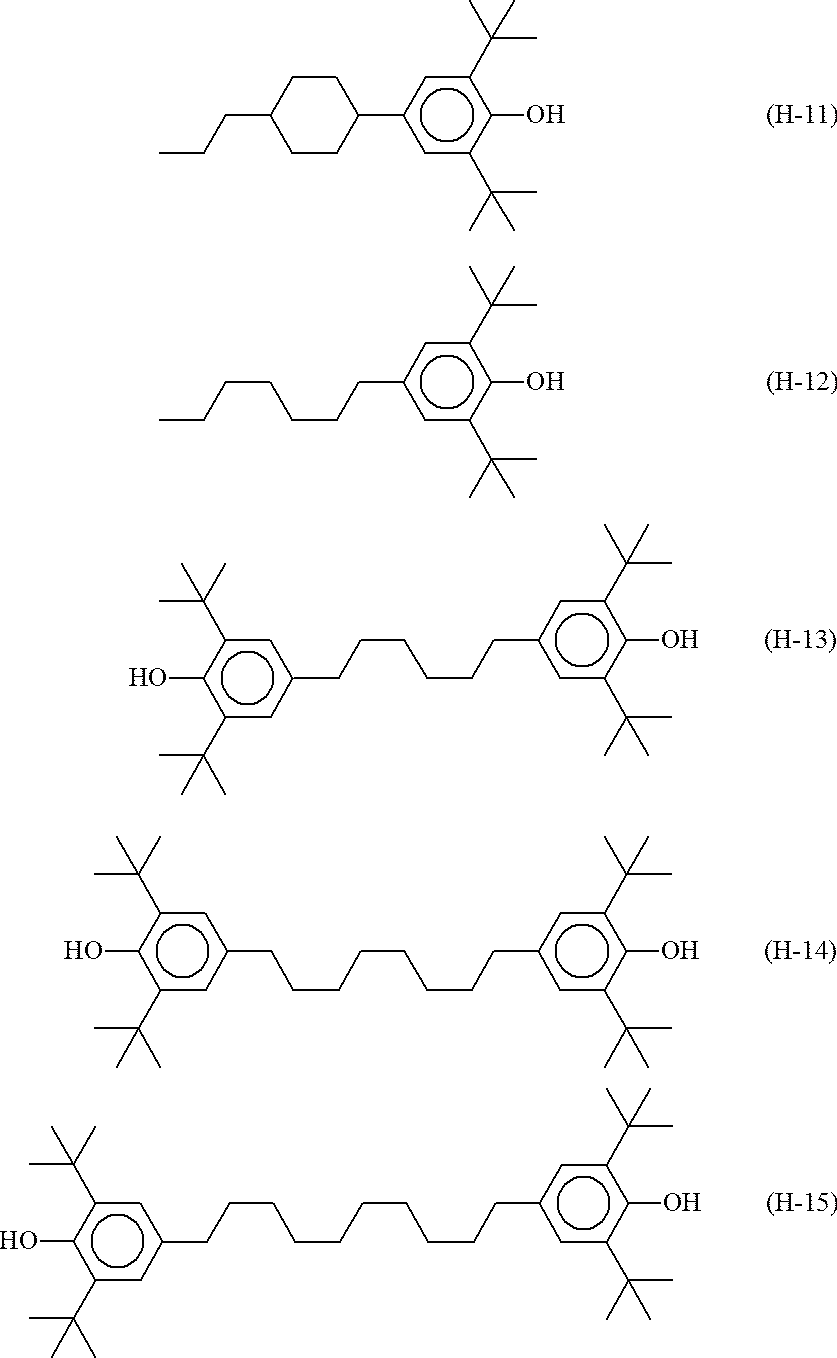
本発明の液晶組成物に酸化防止剤を含有させる場合、10質量ppm以上が好ましく、20質量ppm以上が好ましく、50質量ppm以上が好ましい。酸化防止剤の含有する場合の上限は10000質量ppmであるが、2000質量ppm以下が好ましく、1000質量ppm以下がより好ましく、500質量ppmが特に好ましい。
また、必要により本発明の工程(I)において、溶解促進成分に対して、上記の酸化防止剤を添加してもよく、さらには本発明の工程(I)において、基準化合物に対して、上記の酸化防止剤を添加してもよい。
本発明の液晶組成物に含まれる全液晶化合物のうち、基準化合物を除く液晶組成物の構成化合物(以下、本発明に係る液晶組成物の構成化合物と称する。)は、以下の誘電的にほぼ中性の化合物(Δεの値が-2~2)、誘電的に負の化合物(Δεの符号が負で、その絶対値が2より大きい。)および誘電的に正の化合物(Δεが2より大きい。)からなる群から選択される1種または2種以上の化合物であることが好ましい。
本発明に係る液晶組成物の構成化合物としては、上記一般式(Y-1-1)~(Y-1-3)で表される化合物以外に、例えば、以下に説明する一般式(L-3)~(L-4)、一般式(L-7)、一般式(N-1-2)~(N-1-22)、一般式(N-2-1)~(N-2-3)、一般式(N-3-2)、一般式(M-1)~(M-18)および一般式(K-1)~(K-6)からなる群から選択される1種または2種以上が好ましい。
本発明に係る液晶組成物の構成化合物は、以下で示される一般式(L-3)~(L-4)で表される化合物および一般式(L-7)で表される化合物を1種類又は2種類以上含有することが好ましい。これらの化合物は誘電的にほぼ中性の化合物(Δεの値が-2~2)に該当する。
本発明に係る液晶組成物の構成化合物は、一般式(L-3)で表される化合物であることが好ましい。

(式中、RL41は炭素原子数1~5のアルキル基、RL42は炭素原子数1~5のアルキル基、炭素原子数4~5のアルケニル基又は炭素原子数1~4のアルコキシ基が好ましい。)
本発明の組成物の総量に対しての式(L-3)で表される化合物の好ましい含有量の下限値は、1%であり、2%であり、3%であり、5%であり、7%であり、10%であり、14%であり、16%であり、20%であり、23%であり、26%であり、30%であり、35%であり、40%である。本発明の組成物の総量に対しての式(L-3)で表される化合物の好ましい含有量の上限値は、50%であり、40%であり、35%であり、30%であり、20%であり、15%であり、10%であり、5%である。
本発明の組成物の総量に対しての式(L-3)で表される化合物の好ましい含有量の下限値は、1%であり、2%であり、3%であり、5%であり、7%であり、10%であり、14%であり、16%であり、20%であり、23%であり、26%であり、30%であり、35%であり、40%である。本発明の組成物の総量に対しての式(L-3)で表される化合物の好ましい含有量の上限値は、50%であり、40%であり、35%であり、30%であり、20%であり、15%であり、10%であり、5%である。
本発明に係る液晶組成物の構成化合物は、一般式(L-4)で表される化合物であることが好ましい。

(式中、XL61及びXL62はそれぞれ独立して水素原子又はフッ素原子を表す。)
RL61及びRL62はそれぞれ独立して炭素原子数1~5のアルキル基又は炭素原子数2~5のアルケニル基が好ましく、XL61及びXL62のうち一方がフッ素原子他方が水素原子であることが好ましい。)
本発明の組成物の総量に対しての式(L-4)で表される化合物の好ましい含有量の下限値は、1%であり、2%であり、3%であり、5%であり、7%であり、10%であり、14%であり、16%であり、20%であり、23%であり、26%であり、30%であり、35%であり、40%である。本発明の組成物の総量に対しての式(L-4)で表される化合物の好ましい含有量の上限値は、50%であり、40%であり、35%であり、30%であり、20%であり、15%であり、10%であり、5%である。Δnを大きくすることに重点を置く場合には含有量を多くした方が好ましく、低温での析出に重点を置いた場合には含有量は少ない方が好ましい。
RL61及びRL62はそれぞれ独立して炭素原子数1~5のアルキル基又は炭素原子数2~5のアルケニル基が好ましく、XL61及びXL62のうち一方がフッ素原子他方が水素原子であることが好ましい。)
本発明の組成物の総量に対しての式(L-4)で表される化合物の好ましい含有量の下限値は、1%であり、2%であり、3%であり、5%であり、7%であり、10%であり、14%であり、16%であり、20%であり、23%であり、26%であり、30%であり、35%であり、40%である。本発明の組成物の総量に対しての式(L-4)で表される化合物の好ましい含有量の上限値は、50%であり、40%であり、35%であり、30%であり、20%であり、15%であり、10%であり、5%である。Δnを大きくすることに重点を置く場合には含有量を多くした方が好ましく、低温での析出に重点を置いた場合には含有量は少ない方が好ましい。
本発明に係る液晶組成物の構成化合物は、一般式(L-7)で表される化合物であることが好ましい。

(式中、RL71及びRL72はそれぞれ独立して炭素原子数1~5のアルキル基、炭素原子数2~5のアルケニル基又は炭素原子数1~4のアルコキシ基が好ましく、AL71及びAL72はそれぞれ独立して1,4-シクロヘキシレン基又は1,4-フェニレン基が好ましく、AL71及びAL72上の水素原子はそれぞれ独立してフッ素原子によって置換されていてもよく、ZL71は単結合又は-COO-が好ましく、単結合が好ましく、XL71及びXL72は水素原子が好ましい。)
本発明に係る液晶組成物の構成化合物は、以下の一般式(N-1-2)~(N-1-22)、一般式(N-2-1)~(N-2-3)および一般式(N-3-2)からなる群から選択される1種または2種以上の化合物であることが好ましい。これら化合物は誘電的に負の化合物(Δεの符号が負で、その絶対値が2より大きい。)に該当する。
本発明に係る液晶組成物の構成化合物は、以下の一般式(N-1-2)~(N-1-22)、一般式(N-2-1)~(N-2-3)および一般式(N-3-2)からなる群から選択される1種または2種以上の化合物であることが好ましい。これら化合物は誘電的に負の化合物(Δεの符号が負で、その絶対値が2より大きい。)に該当する。
本発明に係る液晶組成物の構成化合物は、一般式(N-1-2)で表される化合物であることが好ましい。

(式中、RN121は炭素原子数1~5のアルキル基又は炭素原子数2~5のアルケニル基が好ましく、エチル基、プロピル基、ブチル基又はペンチル基が好ましい。RN122は炭素原子数1~5のアルキル基、炭素原子数4~5のアルケニル基又は炭素原子数1~4のアルコキシ基が好ましく、メチル基、プロピル基、メトキシ基、エトキシ基又はプロポキシ基が好ましい。)
本発明の組成物の総量に対しての式(N-1-2)で表される化合物の好ましい含有量の下限値は、5%であり、7%であり、10%であり、13%であり、15%であり、17%であり、20%であり、23%であり、25%であり、27%であり、30%であり、33%であり、35%であり、37%であり、40%であり、42%である。好ましい含有量の上限値は、本発明の組成物の総量に対して、50%であり、48%であり、45%であり、43%であり、40%であり、38%であり、35%であり、33%であり、30%であり、28%であり、25%であり、23%であり、20%であり、18%であり、15%であり、13%であり、10%であり、8%であり、7%であり、6%であり、5%である。
本発明の組成物の総量に対しての式(N-1-2)で表される化合物の好ましい含有量の下限値は、5%であり、7%であり、10%であり、13%であり、15%であり、17%であり、20%であり、23%であり、25%であり、27%であり、30%であり、33%であり、35%であり、37%であり、40%であり、42%である。好ましい含有量の上限値は、本発明の組成物の総量に対して、50%であり、48%であり、45%であり、43%であり、40%であり、38%であり、35%であり、33%であり、30%であり、28%であり、25%であり、23%であり、20%であり、18%であり、15%であり、13%であり、10%であり、8%であり、7%であり、6%であり、5%である。
本発明に係る液晶組成物の構成化合物は、一般式(N-1-3)で表される化合物は下記の化合物であることが好ましい。

(式中、RN131は炭素原子数1~5のアルキル基又は炭素原子数2~5のアルケニル基が好ましく、エチル基、プロピル基又はブチル基が好ましい。RN132は炭素原子数1~5のアルキル基、炭素原子数4~5のアルケニル基又は炭素原子数1~4のアルコキシ基が好ましく、エトキシ基、プロポキシ基又はブトキシ基が好ましい。)
本発明の組成物の総量に対しての式(N-1-3)で表される化合物の好ましい含有量の下限値は、5%であり、10%であり、13%であり、15%であり、17%であり、20%である。好ましい含有量の上限値は、本発明の組成物の総量に対して、35%であり、30%であり、28%であり、25%であり、23%であり、20%であり、18%であり、15%であり、13%である。
本発明の組成物の総量に対しての式(N-1-3)で表される化合物の好ましい含有量の下限値は、5%であり、10%であり、13%であり、15%であり、17%であり、20%である。好ましい含有量の上限値は、本発明の組成物の総量に対して、35%であり、30%であり、28%であり、25%であり、23%であり、20%であり、18%であり、15%であり、13%である。
本発明に係る液晶組成物の構成化合物は、一般式(N-1-5)で表される化合物は下記の化合物であることが好ましい。

(式中、RN151及びRN152はそれぞれ独立して、炭素原子数1~5のアルキル基、炭素原子数4~5のアルケニル基又は炭素原子数1~4のアルコキシ基が好ましくエチル基、プロピル基又はブチル基が好ましい。)
本発明の組成物の総量に対しての式(N-1-5)で表される化合物の好ましい含有量の下限値は、5%であり、8%であり、10%であり、13%であり、15%であり、17%であり、20%である。好ましい含有量の上限値は、本発明の組成物の総量に対して、35%であり、33%であり、30%であり、28%であり、25%であり、23%であり、20%であり、18%であり、15%であり、13%である。
本発明の組成物の総量に対しての式(N-1-5)で表される化合物の好ましい含有量の下限値は、5%であり、8%であり、10%であり、13%であり、15%であり、17%であり、20%である。好ましい含有量の上限値は、本発明の組成物の総量に対して、35%であり、33%であり、30%であり、28%であり、25%であり、23%であり、20%であり、18%であり、15%であり、13%である。
本発明に係る液晶組成物の構成化合物は、一般式(N-1-10)で表される化合物であることが好ましい。

(式中、RN1101は炭素原子数1~5のアルキル基又は炭素原子数2~5のアルケニル基が好ましく、エチル基、プロピル基、ブチル基、ビニル基又は1-プロペニル基が好ましい。RN1102は炭素原子数1~5のアルキル基、炭素原子数4~5のアルケニル基又は炭素原子数1~4のアルコキシ基が好ましく、エトキシ基、プロポキシ基又はブトキシ基が好ましい。)
本発明の組成物の総量に対しての式(N-1-10)で表される化合物の好ましい含有量の下限値は、5質量%であり、10質量%であり、13質量%であり、15質量%であり、17質量%であり、20質量%である。好ましい含有量の上限値は、本発明の組成物の総量に対して、35質量%であり、30質量%であり、28質量%であり、25質量%であり、23質量%であり、20質量%であり、18質量%であり、15質量%であり、13質量%である。
本発明の組成物の総量に対しての式(N-1-10)で表される化合物の好ましい含有量の下限値は、5質量%であり、10質量%であり、13質量%であり、15質量%であり、17質量%であり、20質量%である。好ましい含有量の上限値は、本発明の組成物の総量に対して、35質量%であり、30質量%であり、28質量%であり、25質量%であり、23質量%であり、20質量%であり、18質量%であり、15質量%であり、13質量%である。
本発明に係る液晶組成物の構成化合物は、一般式(N-1-11)で表される化合物であることが好ましい。

(式中、RN1111は炭素原子数1~5のアルキル基又は炭素原子数2~5のアルケニル基が好ましく、エチル基、プロピル基、ブチル基、ビニル基又は1-プロペニル基が好ましい。RN1112は炭素原子数1~5のアルキル基、炭素原子数4~5のアルケニル基又は炭素原子数1~4のアルコキシ基が好ましく、エトキシ基、プロポキシ基又はブトキシ基が好ましい。)
本発明の組成物の総量に対しての式(N-1-11)で表される化合物の好ましい含有量の下限値は、5質量%であり、10質量%であり、13質量%であり、15質量%であり、17質量%であり、20質量%である。好ましい含有量の上限値は、本発明の組成物の総量に対して、35質量%であり、30質量%であり、28質量%であり、25質量%であり、23質量%であり、20質量%であり、18質量%であり、15質量%であり、13質量%である。
本発明の組成物の総量に対しての式(N-1-11)で表される化合物の好ましい含有量の下限値は、5質量%であり、10質量%であり、13質量%であり、15質量%であり、17質量%であり、20質量%である。好ましい含有量の上限値は、本発明の組成物の総量に対して、35質量%であり、30質量%であり、28質量%であり、25質量%であり、23質量%であり、20質量%であり、18質量%であり、15質量%であり、13質量%である。
本発明に係る液晶組成物の構成化合物は、一般式(N-1-12)で表される化合物であることが好ましい。

(式中、RN1121は炭素原子数1~5のアルキル基又は炭素原子数2~5のアルケニル基が好ましく、エチル基、プロピル基又はブチル基が好ましい。RN1122は炭素原子数1~5のアルキル基、炭素原子数4~5のアルケニル基又は炭素原子数1~4のアルコキシ基が好ましく、エトキシ基、プロポキシ基又はブトキシ基が好ましい。)
本発明の組成物の総量に対しての式(N-1-12)で表される化合物の好ましい含有量の下限値は、5質量%であり、10質量%であり、13質量%であり、15質量%であり、17質量%であり、20質量%である。好ましい含有量の上限値は、本発明の組成物の総量に対して、35質量%であり、30質量%であり、28質量%であり、25質量%であり、23質量%であり、20質量%であり、18質量%であり、15質量%であり、13質量%である。
本発明の組成物の総量に対しての式(N-1-12)で表される化合物の好ましい含有量の下限値は、5質量%であり、10質量%であり、13質量%であり、15質量%であり、17質量%であり、20質量%である。好ましい含有量の上限値は、本発明の組成物の総量に対して、35質量%であり、30質量%であり、28質量%であり、25質量%であり、23質量%であり、20質量%であり、18質量%であり、15質量%であり、13質量%である。
本発明に係る液晶組成物の構成化合物は、一般式(N-1-13)で表される化合物であることが好ましい。

(式中、RN1131は炭素原子数1~5のアルキル基又は炭素原子数2~5のアルケニル基が好ましく、エチル基、プロピル基又はブチル基が好ましい。RN1132は炭素原子数1~5のアルキル基、炭素原子数4~5のアルケニル基又は炭素原子数1~4のアルコキシ基が好ましく、エトキシ基、プロポキシ基又はブトキシ基が好ましい。)
本発明の組成物の総量に対しての式(N-1-13)で表される化合物の好ましい含有量の下限値は、5質量%であり、10質量%であり、13質量%であり、15質量%であり、17質量%であり、20質量%である。好ましい含有量の上限値は、本発明の組成物の総量に対して、35質量%であり、30質量%であり、28質量%であり、25質量%であり、23質量%であり、20質量%であり、18質量%であり、15質量%であり、13質量%である。
本発明の組成物の総量に対しての式(N-1-13)で表される化合物の好ましい含有量の下限値は、5質量%であり、10質量%であり、13質量%であり、15質量%であり、17質量%であり、20質量%である。好ましい含有量の上限値は、本発明の組成物の総量に対して、35質量%であり、30質量%であり、28質量%であり、25質量%であり、23質量%であり、20質量%であり、18質量%であり、15質量%であり、13質量%である。
本発明に係る液晶組成物の構成化合物は、一般式(N-1-14)で表される化合物であることが好ましい。

(式中、RN1141は炭素原子数1~5のアルキル基又は炭素原子数2~5のアルケニル基が好ましく、エチル基、プロピル基又はブチル基が好ましい。RN1142は炭素原子数1~5のアルキル基、炭素原子数4~5のアルケニル基又は炭素原子数1~4のアルコキシ基が好ましく、エトキシ基、プロポキシ基又はブトキシ基が好ましい。)
本発明の組成物の総量に対しての式(N-1-14)で表される化合物の好ましい含有量の下限値は、5質量%であり、10質量%であり、13質量%であり、15質量%であり、17質量%であり、20質量%である。好ましい含有量の上限値は、本発明の組成物の総量に対して、35質量%であり、30質量%であり、28質量%であり、25質量%であり、23質量%であり、20質量%であり、18質量%であり、15質量%であり、13質量%である。
本発明の組成物の総量に対しての式(N-1-14)で表される化合物の好ましい含有量の下限値は、5質量%であり、10質量%であり、13質量%であり、15質量%であり、17質量%であり、20質量%である。好ましい含有量の上限値は、本発明の組成物の総量に対して、35質量%であり、30質量%であり、28質量%であり、25質量%であり、23質量%であり、20質量%であり、18質量%であり、15質量%であり、13質量%である。
本発明に係る液晶組成物の構成化合物は、一般式(N-1-15)で表される化合物であることが好ましい。

(式中、RN1151は炭素原子数1~5のアルキル基又は炭素原子数2~5のアルケニル基が好ましく、エチル基、プロピル基又はブチル基が好ましい。RN1152は炭素原子数1~5のアルキル基、炭素原子数4~5のアルケニル基又は炭素原子数1~4のアルコキシ基が好ましく、エトキシ基、プロポキシ基又はブトキシ基が好ましい。)
本発明の組成物の総量に対しての式(N-1-15)で表される化合物の好ましい含有量の下限値は、5質量%であり、10質量%であり、13質量%であり、15質量%であり、17質量%であり、20質量%である。好ましい含有量の上限値は、本発明の組成物の総量に対して、35質量%であり、30質量%であり、28質量%であり、25質量%であり、23質量%であり、20質量%であり、18質量%であり、15質量%であり、13質量%である。
本発明の組成物の総量に対しての式(N-1-15)で表される化合物の好ましい含有量の下限値は、5質量%であり、10質量%であり、13質量%であり、15質量%であり、17質量%であり、20質量%である。好ましい含有量の上限値は、本発明の組成物の総量に対して、35質量%であり、30質量%であり、28質量%であり、25質量%であり、23質量%であり、20質量%であり、18質量%であり、15質量%であり、13質量%である。
本発明に係る液晶組成物の構成化合物は、一般式(N-1-16)で表される化合物であることが好ましい。

(式中、RN1161は炭素原子数1~5のアルキル基又は炭素原子数2~5のアルケニル基が好ましく、エチル基、プロピル基又はブチル基が好ましい。RN1162は炭素原子数1~5のアルキル基、炭素原子数4~5のアルケニル基又は炭素原子数1~4のアルコキシ基が好ましく、エトキシ基、プロポキシ基又はブトキシ基が好ましい。)
本発明の組成物の総量に対しての式(N-1-16)で表される化合物の好ましい含有量の下限値は、5質量%であり、10質量%であり、13質量%であり、15質量%であり、17質量%であり、20質量%である。好ましい含有量の上限値は、本発明の組成物の総量に対して、35質量%であり、30質量%であり、28質量%であり、25質量%であり、23質量%であり、20質量%であり、18質量%であり、15質量%であり、13質量%である。
本発明の組成物の総量に対しての式(N-1-16)で表される化合物の好ましい含有量の下限値は、5質量%であり、10質量%であり、13質量%であり、15質量%であり、17質量%であり、20質量%である。好ましい含有量の上限値は、本発明の組成物の総量に対して、35質量%であり、30質量%であり、28質量%であり、25質量%であり、23質量%であり、20質量%であり、18質量%であり、15質量%であり、13質量%である。
本発明に係る液晶組成物の構成化合物は、一般式(N-1-17)で表される化合物であることが好ましい。

(式中、RN1171は炭素原子数1~5のアルキル基又は炭素原子数2~5のアルケニル基が好ましく、エチル基、プロピル基又はブチル基が好ましい。RN1172は炭素原子数1~5のアルキル基、炭素原子数4~5のアルケニル基又は炭素原子数1~4のアルコキシ基が好ましく、エトキシ基、プロポキシ基又はブトキシ基が好ましい。)
本発明の組成物の総量に対しての式(N-1-17)で表される化合物の好ましい含有量の下限値は、5質量%であり、10質量%であり、13質量%であり、15質量%であり、17質量%であり、20質量%である。好ましい含有量の上限値は、本発明の組成物の総量に対して、35質量%であり、30質量%であり、28質量%であり、25質量%であり、23質量%であり、20質量%であり、18質量%であり、15質量%であり、13質量%である。
本発明の組成物の総量に対しての式(N-1-17)で表される化合物の好ましい含有量の下限値は、5質量%であり、10質量%であり、13質量%であり、15質量%であり、17質量%であり、20質量%である。好ましい含有量の上限値は、本発明の組成物の総量に対して、35質量%であり、30質量%であり、28質量%であり、25質量%であり、23質量%であり、20質量%であり、18質量%であり、15質量%であり、13質量%である。
本発明に係る液晶組成物の構成化合物は、一般式(N-1-18)で表される化合物であることが好ましい。

(式中、RN1181は炭素原子数1~5のアルキル基又は炭素原子数2~5のアルケニル基が好ましく、メチル基、エチル基、プロピル基又はブチル基が好ましい。RN1182は炭素原子数1~5のアルキル基、炭素原子数4~5のアルケニル基又は炭素原子数1~4のアルコキシ基が好ましく、エトキシ基、プロポキシ基又はブトキシ基が好ましい。)
本発明の組成物の総量に対しての式(N-1-18)で表される化合物の好ましい含有量の下限値は、5質量%であり、10質量%であり、13質量%であり、15質量%であり、17質量%であり、20質量%である。好ましい含有量の上限値は、本発明の組成物の総量に対して、35質量%であり、30質量%であり、28質量%であり、25質量%であり、23質量%であり、20質量%であり、18質量%であり、15質量%であり、13質量%である。
本発明の組成物の総量に対しての式(N-1-18)で表される化合物の好ましい含有量の下限値は、5質量%であり、10質量%であり、13質量%であり、15質量%であり、17質量%であり、20質量%である。好ましい含有量の上限値は、本発明の組成物の総量に対して、35質量%であり、30質量%であり、28質量%であり、25質量%であり、23質量%であり、20質量%であり、18質量%であり、15質量%であり、13質量%である。
本発明に係る液晶組成物の構成化合物は、一般式(N-1-20)で表される化合物であることが好ましい。

(式中、RN1201及びRN1202はそれぞれ独立して、炭素原子数1~5のアルキル基又は炭素原子数2~5のアルケニル基が好ましく、エチル基、プロピル基又はブチル基が好ましい。)
本発明の組成物の総量に対しての式(N-1-20)で表される化合物の好ましい含有量の下限値は、5質量%であり、10質量%であり、13質量%であり、15質量%であり、17質量%であり、20質量%である。好ましい含有量の上限値は、本発明の組成物の総量に対して、35質量%であり、30質量%であり、28質量%であり、25質量%であり、23質量%であり、20質量%であり、18質量%であり、15質量%であり、13質量%である。
本発明の組成物の総量に対しての式(N-1-20)で表される化合物の好ましい含有量の下限値は、5質量%であり、10質量%であり、13質量%であり、15質量%であり、17質量%であり、20質量%である。好ましい含有量の上限値は、本発明の組成物の総量に対して、35質量%であり、30質量%であり、28質量%であり、25質量%であり、23質量%であり、20質量%であり、18質量%であり、15質量%であり、13質量%である。
本発明に係る液晶組成物の構成化合物は、一般式(N-1-21)で表される化合物であることが好ましい。

(式中、RN1211及びRN1212はそれぞれ独立して、炭素原子数1~5のアルキル基又は炭素原子数2~5のアルケニル基が好ましく、エチル基、プロピル基又はブチル基が好ましい。)
本発明の組成物の総量に対しての式(N-1-21)で表される化合物の好ましい含有量の下限値は、5質量%であり、10質量%であり、13質量%であり、15質量%であり、17質量%であり、20質量%である。好ましい含有量の上限値は、本発明の組成物の総量に対して、35質量%であり、30質量%であり、28質量%であり、25質量%であり、23質量%であり、20質量%であり、18質量%であり、15質量%であり、13質量%である。
本発明の組成物の総量に対しての式(N-1-21)で表される化合物の好ましい含有量の下限値は、5質量%であり、10質量%であり、13質量%であり、15質量%であり、17質量%であり、20質量%である。好ましい含有量の上限値は、本発明の組成物の総量に対して、35質量%であり、30質量%であり、28質量%であり、25質量%であり、23質量%であり、20質量%であり、18質量%であり、15質量%であり、13質量%である。
本発明に係る液晶組成物の構成化合物は、一般式(N-1-22)で表される化合物であることが好ましい。

(式中、RN1221及びRN1222はそれぞれ独立して、炭素原子数1~5のアルキル基又は炭素原子数2~5のアルケニル基が好ましく、エチル基、プロピル基又はブチル基が好ましい。)
本発明の組成物の総量に対しての式(N-1-22)で表される化合物の好ましい含有量の下限値は、1質量%であり、5質量%であり、10質量%であり、13質量%であり、15質量%であり、17質量%であり20質量%である。好ましい含有量の上限値は、本発明の組成物の総量に対して、35質量%であり、30質量%であり、28質量%であり、25質量%であり、23質量%であり、20質量%であり、18質量%であり、15質量%であり、13質量%であり、10質量%であり、5質量%である。
で表される化合物群から選ばれる化合物であることが好ましい。
本発明の組成物の総量に対しての式(N-1-22)で表される化合物の好ましい含有量の下限値は、1質量%であり、5質量%であり、10質量%であり、13質量%であり、15質量%であり、17質量%であり20質量%である。好ましい含有量の上限値は、本発明の組成物の総量に対して、35質量%であり、30質量%であり、28質量%であり、25質量%であり、23質量%であり、20質量%であり、18質量%であり、15質量%であり、13質量%であり、10質量%であり、5質量%である。
で表される化合物群から選ばれる化合物であることが好ましい。
本発明に係る液晶組成物の構成化合物は、一般式(N-2-1)で表される化合物であることが好ましい。

(式中、RN211及びRN212はそれぞれ独立して、炭素原子数1~5のアルキル基又は炭素原子数2~5のアルケニル基が好ましく、プロピル基又はペンチル基が好ましい。)
本発明に係る液晶組成物の構成化合物は、一般式(N-2-2)で表される化合物であることが好ましい。
本発明に係る液晶組成物の構成化合物は、一般式(N-2-2)で表される化合物であることが好ましい。

(式中、RN221及びRN222はそれぞれ独立して、炭素原子数1~5のアルキル基又は炭素原子数2~5のアルケニル基が好ましく、プロピル基又はペンチル基が好ましい。)
本発明に係る液晶組成物の構成化合物は、一般式(N-2-3)で表される化合物であることが好ましい。
本発明に係る液晶組成物の構成化合物は、一般式(N-2-3)で表される化合物であることが好ましい。

(式中、RN231及びRN232はそれぞれ独立して、炭素原子数1~5のアルキル基又は炭素原子数2~5のアルケニル基が好ましく、プロピル基又はペンチル基が好ましい。)
本発明に係る液晶組成物の構成化合物は、一般式(N-3-2)で表される化合物群から選ばれる化合物であることが好ましい。
本発明に係る液晶組成物の構成化合物は、一般式(N-3-2)で表される化合物群から選ばれる化合物であることが好ましい。
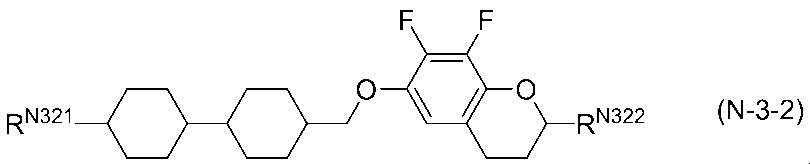
(式中、RN321及びRN322は炭素原子数1~5のアルキル基又は炭素原子数2~5のアルケニル基が好ましく、プロピル基又はペンチル基が好ましい。)
本発明の組成物の総量に対しての式(N-3-2)で表される化合物の好ましい含有量の下限値は、3質量%であり、5質量%であり、10質量%であり、13質量%であり、15質量%であり、17質量%であり、20質量%であり、23質量%であり、25質量%であり、27質量%であり、30質量%であり、33質量%であり、35質量%である。好ましい含有量の上限値は、本発明の組成物の総量に対して、50質量%であり、40質量%であり、38質量%であり、35質量%であり、33質量%であり、30質量%であり、28質量%であり、25質量%であり、23質量%であり、20質量%であり、18質量%であり、15質量%であり、13質量%であり、10質量%であり、8質量%であり、7質量%であり、6質量%であり、5質量%である。
本発明の組成物の総量に対しての式(N-3-2)で表される化合物の好ましい含有量の下限値は、3質量%であり、5質量%であり、10質量%であり、13質量%であり、15質量%であり、17質量%であり、20質量%であり、23質量%であり、25質量%であり、27質量%であり、30質量%であり、33質量%であり、35質量%である。好ましい含有量の上限値は、本発明の組成物の総量に対して、50質量%であり、40質量%であり、38質量%であり、35質量%であり、33質量%であり、30質量%であり、28質量%であり、25質量%であり、23質量%であり、20質量%であり、18質量%であり、15質量%であり、13質量%であり、10質量%であり、8質量%であり、7質量%であり、6質量%であり、5質量%である。
本発明に係る液晶組成物の構成化合物は、以下の一般式(M-1)~(M-18)および一般式(K-1)~(K-6)からなる群から選択される1種または2種以上の化合物であることが好ましい。これら化合物は誘電的に正の化合物(Δεが2より大きい。)に該当する。
本発明に係る液晶組成物の構成化合物は、例えば一般式(M-1)で表される化合物群から選ばれる化合物であることが好ましい。
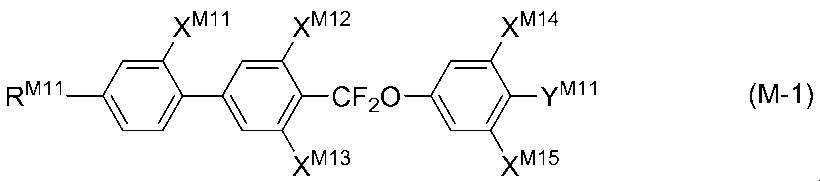
(式中、RM11は炭素原子数1~5のアルキル基、炭素原子数2~5のアルケニル基又は炭素原子数1~4のアルコキシ基を表し、XM11からXM15はそれぞれ独立して水素原子又はフッ素原子を表し、YM11はフッ素原子又はOCF3を表す。)
本発明の組成物の総量に対しての式(M-1)で表される化合物の好ましい含有量の下限値は、1%であり、2%であり、5%であり、8%であり、10%であり、13%であり、15%であり、18%であり、20%であり、22%であり、25%であり、30%である。好ましい含有量の上限値は、30%であり、28%であり、25%であり、23%であり、20%であり、18%であり、15%であり、13%であり、10%であり、8%であり、5%である。
本発明の組成物の総量に対しての式(M-1)で表される化合物の好ましい含有量の下限値は、1%であり、2%であり、5%であり、8%であり、10%であり、13%であり、15%であり、18%であり、20%であり、22%であり、25%であり、30%である。好ましい含有量の上限値は、30%であり、28%であり、25%であり、23%であり、20%であり、18%であり、15%であり、13%であり、10%であり、8%であり、5%である。
さらに、本発明に係る液晶組成物の構成化合物は、例えば一般式(M-2)で表される化合物群から選ばれる化合物であることが好ましい。

(式中、RM21は炭素原子数1~5のアルキル基、炭素原子数2~5のアルケニル基又は炭素原子数1~4のアルコキシ基を表し、XM21及びXM22はそれぞれ独立して水素原子又はフッ素原子を表し、YM21はフッ素原子、塩素原子又はOCF3を表す。)
本発明の組成物の総量に対しての式(M-2)で表される化合物の好ましい含有量の下限値は、1%であり、2%であり、5%であり、8%であり、10%であり、13%であり、15%であり、18%であり、20%であり、22%であり、25%であり、30%である。好ましい含有量の上限値は、30%であり、28%であり、25%であり、23%であり、20%であり、18%であり、15%であり、13%であり、10%であり、8%であり、5%である。
本発明の組成物の総量に対しての式(M-2)で表される化合物の好ましい含有量の下限値は、1%であり、2%であり、5%であり、8%であり、10%であり、13%であり、15%であり、18%であり、20%であり、22%であり、25%であり、30%である。好ましい含有量の上限値は、30%であり、28%であり、25%であり、23%であり、20%であり、18%であり、15%であり、13%であり、10%であり、8%であり、5%である。
本発明に係る液晶組成物の構成化合物は、一般式(M-3)で表される化合物であることが好ましい。

(式中、RM31は炭素原子数1~5のアルキル基、炭素原子数2~5のアルケニル基又は炭素原子数1~4のアルコキシ基を表し、XM31からXM36はそれぞれ独立して水素原子又はフッ素原子を表し、YM31はフッ素原子、塩素原子又はOCF3を表す。)
本発明の組成物の総量に対しての式(M-3)で表される化合物の好ましい含有量の下限値は、1%であり、2%であり、4%であり、5%であり、8%であり、10%であり、13%であり、15%であり、18%であり、20%である。好ましい含有量の上限値は、20%であり、18%であり、15%であり、13%であり、10%であり、8%であり、5%である。
本発明の組成物の総量に対しての式(M-3)で表される化合物の好ましい含有量の下限値は、1%であり、2%であり、4%であり、5%であり、8%であり、10%であり、13%であり、15%であり、18%であり、20%である。好ましい含有量の上限値は、20%であり、18%であり、15%であり、13%であり、10%であり、8%であり、5%である。
さらに、本発明に係る液晶組成物の構成化合物は、一般式(M-4)で表される群より選ばれる化合物であることが好ましい。

(式中、RM41は炭素原子数1~5のアルキル基、炭素原子数2~5のアルケニル基又は炭素原子数1~4のアルコキシ基を表し、XM41からXM48はそれぞれ独立してフッ素原子又は水素原子を表し、YM41はフッ素原子、塩素原子又はOCF3を表す。)
本発明の組成物の総量に対しての式(M-4)で表される化合物の好ましい含有量の下限値は、1%であり、2%であり、4%であり、5%であり、8%であり、10%であり、13%であり、15%であり、18%であり、20%である。好ましい含有量の上限値は、30%であり、28%であり、25%であり、23%であり、20%であり、18%であり、15%であり、13%であり、10%であり、8%であり、5%である。
本発明の組成物の総量に対しての式(M-4)で表される化合物の好ましい含有量の下限値は、1%であり、2%であり、4%であり、5%であり、8%であり、10%であり、13%であり、15%であり、18%であり、20%である。好ましい含有量の上限値は、30%であり、28%であり、25%であり、23%であり、20%であり、18%であり、15%であり、13%であり、10%であり、8%であり、5%である。
さらに、本発明に係る液晶組成物の構成化合物は、一般式(M-5)で表される化合物であることが好ましい。
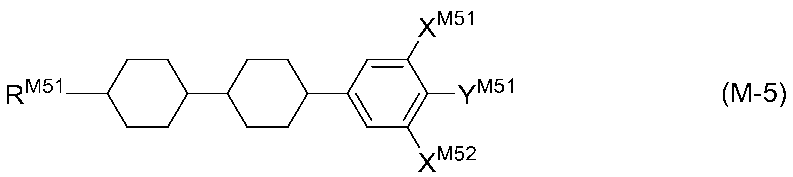
(式中、RM51は炭素原子数1~5のアルキル基、炭素原子数2~5のアルケニル基又は炭素原子数1~4のアルコキシ基を表し、XM51及びXM52はそれぞれ独立して水素原子又はフッ素原子を表し、YM51はフッ素原子、塩素原子又はOCF3を表す。)
本発明の組成物の総量に対しての式(M-5)で表される化合物の好ましい含有量の下限値は、1%であり、2%であり、5%であり、8%であり、10%であり、13%であり、15%であり、18%であり、20%であり、22%であり、25%であり、30%である。好ましい含有量の上限値は、50%であり、45%であり、40%であり、35%であり、33%であり、30%であり、28%であり、25%であり、23%であり、20%であり、18%であり、15%であり、13%であり、10%であり、8%であり、5%である。
本発明の組成物の総量に対しての式(M-5)で表される化合物の好ましい含有量の下限値は、1%であり、2%であり、5%であり、8%であり、10%であり、13%であり、15%であり、18%であり、20%であり、22%であり、25%であり、30%である。好ましい含有量の上限値は、50%であり、45%であり、40%であり、35%であり、33%であり、30%であり、28%であり、25%であり、23%であり、20%であり、18%であり、15%であり、13%であり、10%であり、8%であり、5%である。
さらに、本発明に係る液晶組成物の構成化合物は、一般式(M-6)で表される化合物であることが好ましい。

(式中、RM61は炭素原子数1~5のアルキル基、炭素原子数2~5のアルケニル基又は炭素原子数1~4のアルコキシ基を表し、XM61からXM64はそれぞれ独立してフッ素原子又は水素原子を表し、YM61はフッ素原子、塩素原子又はOCF3を表す。)
本発明の組成物の総量に対しての式(M-6)で表される化合物の好ましい含有量の下限値は、1%であり、2%であり、4%であり、5%であり、8%であり、10%であり、13%であり、15%であり、18%であり、20%である。好ましい含有量の上限値は、30%であり、28%であり、25%であり、23%であり、20%であり、18%であり、15%であり、13%であり、10%であり、8%であり、5%である。
本発明の組成物の総量に対しての式(M-6)で表される化合物の好ましい含有量の下限値は、1%であり、2%であり、4%であり、5%であり、8%であり、10%であり、13%であり、15%であり、18%であり、20%である。好ましい含有量の上限値は、30%であり、28%であり、25%であり、23%であり、20%であり、18%であり、15%であり、13%であり、10%であり、8%であり、5%である。
更に、本発明に係る液晶組成物の構成化合物は、一般式(M-7)で表される化合物群から選ばれる化合物であることが好ましい。

(式中、XM71からXM76はそれぞれ独立してフッ素原子又は水素原子を表し、RM71は炭素原子数1~5のアルキル基、炭素原子数2~5のアルケニル基又は炭素原子数1~4のアルコキシ基を表し、YM71はフッ素原子又はOCF3を表す。)
本発明の組成物の総量に対しての式(M-7)で表される化合物の好ましい含有量の下限値は、1%であり、2%であり、4%であり、5%であり、8%であり、10%であり、13%であり、15%であり、18%であり、20%である。好ましい含有量の上限値は、30%であり、28%であり、25%であり、23%であり、20%であり、18%であり、15%であり、13%であり、10%であり、8%であり、5%である。
本発明の組成物の総量に対しての式(M-7)で表される化合物の好ましい含有量の下限値は、1%であり、2%であり、4%であり、5%であり、8%であり、10%であり、13%であり、15%であり、18%であり、20%である。好ましい含有量の上限値は、30%であり、28%であり、25%であり、23%であり、20%であり、18%であり、15%であり、13%であり、10%であり、8%であり、5%である。
さらに、本発明に係る液晶組成物の構成化合物は、一般式(M-8)で表される化合物で表されることが好ましい。
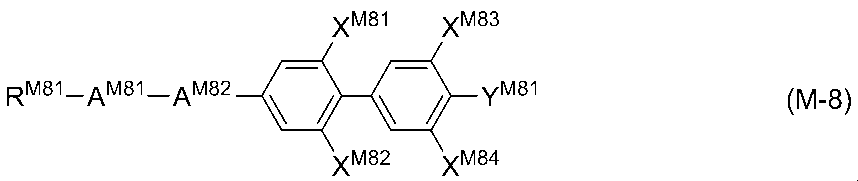
(式中、XM81からXM84はそれぞれ独立してフッ素原子又は水素原子を表し、YM81はフッ素原子、塩素原子又は-OCF3を表し、RM81は炭素原子数1~5のアルキル基、炭素原子数2~5のアルケニル基又は炭素原子数1~4のアルコキシ基を表し、AM81及びAM82はそれぞれ独立して、1,4-シクロヘキシレン基、1,4-フェニレン基又は

を表すが、1,4-フェニレン基上の水素原子はフッ素原子によって置換されていてもよい。)
本発明の組成物の総量に対しての一般式(M-8)で表される化合物の好ましい含有量の下限値は、1%であり、2%であり、4%であり、5%であり、8%であり、10%であり、13%であり、15%であり、18%であり、20%である。好ましい含有量の上限値は、30%であり、28%であり、25%であり、23%であり、20%であり、18%であり、15%であり、13%であり、10%であり、8%であり、5%である。
本発明の組成物の総量に対しての一般式(M-8)で表される化合物の好ましい含有量の下限値は、1%であり、2%であり、4%であり、5%であり、8%であり、10%であり、13%であり、15%であり、18%であり、20%である。好ましい含有量の上限値は、30%であり、28%であり、25%であり、23%であり、20%であり、18%であり、15%であり、13%であり、10%であり、8%であり、5%である。
本発明に係る液晶組成物の構成化合物は、一般式(M-10)で表される化合物で表されることが好ましい。
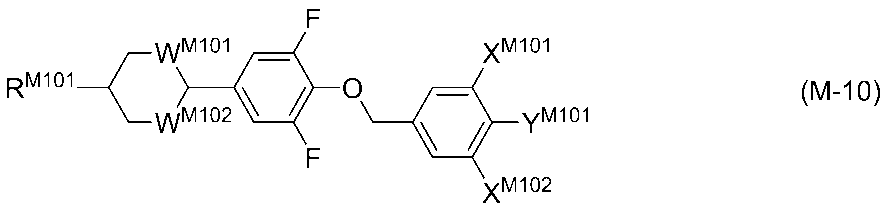
(式中、XM101及びXM102はそれぞれ独立してフッ素原子又は水素原子を表し、YM101はフッ素原子、塩素原子又は-OCF3を表し、RM101は炭素原子数1~5のアルキル基、炭素原子数2~5のアルケニル基又は炭素原子数1~4のアルコキシ基を表し、WM101及びWM102はそれぞれ独立して、-CH2-又は-O-を表す。)
本発明の組成物の総量に対しての一般式(M-10)で表される化合物の好ましい含有量の下限値は、1%であり、2%であり、4%であり、5%であり、8%であり、10%であり、13%であり、15%であり、18%であり、20%である。好ましい含有量の上限値は、30%であり、28%であり、25%であり、23%であり、20%であり、18%であり、15%であり、13%であり、10%であり、8%であり、5%である。
本発明の組成物の総量に対しての一般式(M-10)で表される化合物の好ましい含有量の下限値は、1%であり、2%であり、4%であり、5%であり、8%であり、10%であり、13%であり、15%であり、18%であり、20%である。好ましい含有量の上限値は、30%であり、28%であり、25%であり、23%であり、20%であり、18%であり、15%であり、13%であり、10%であり、8%であり、5%である。
本発明に係る液晶組成物の構成化合物は、一般式(M-11)で表される化合物で表されることが好ましい。
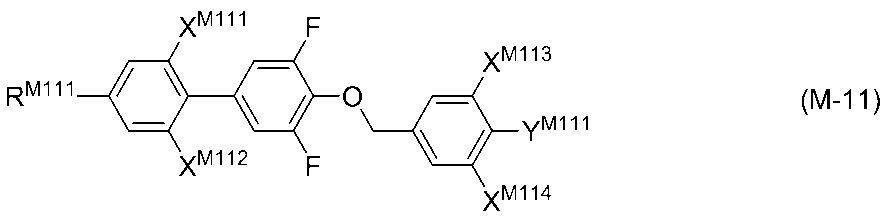
(式中、XM111~XM114はそれぞれ独立してフッ素原子又は水素原子を表し、YM111はフッ素原子、塩素原子又は-OCF3を表し、RM111は炭素原子数1~5のアルキル基、炭素原子数2~5のアルケニル基又は炭素原子数1~4のアルコキシ基を表す。)
本発明の組成物の総量に対しての一般式(M-11)で表される化合物の好ましい含有量の下限値は、1%であり、2%であり、4%であり、5%であり、8%であり、10%であり、13%であり、15%であり、18%であり、20%である。好ましい含有量の上限値は、30%であり、28%であり、25%であり、23%であり、20%であり、18%であり、15%であり、13%であり、10%であり、8%であり、5%である。
本発明の組成物の総量に対しての一般式(M-11)で表される化合物の好ましい含有量の下限値は、1%であり、2%であり、4%であり、5%であり、8%であり、10%であり、13%であり、15%であり、18%であり、20%である。好ましい含有量の上限値は、30%であり、28%であり、25%であり、23%であり、20%であり、18%であり、15%であり、13%であり、10%であり、8%であり、5%である。
本発明に係る液晶組成物の構成化合物は、一般式(M-12)で表される化合物であることが好ましい。

(式中、XM121及びXM122はそれぞれ独立してフッ素原子又は水素原子を表し、YM121はフッ素原子、塩素原子又は-OCF3を表し、RM121は炭素原子数1~5のアルキル基、炭素原子数2~5のアルケニル基又は炭素原子数1~4のアルコキシ基を表し、WM121及びWM122はそれぞれ独立して、-CH2-又は-O-を表す。)
本発明の組成物の総量に対しての一般式(M-12)で表される化合物の好ましい含有量の下限値は、1%であり、2%であり、4%であり、5%であり、8%であり、10%であり、13%であり、15%であり、18%であり、20%である。好ましい含有量の上限値は、30%であり、28%であり、25%であり、23%であり、20%であり、18%であり、15%であり、13%であり、10%であり、8%であり、5%である。
本発明の組成物の総量に対しての一般式(M-12)で表される化合物の好ましい含有量の下限値は、1%であり、2%であり、4%であり、5%であり、8%であり、10%であり、13%であり、15%であり、18%であり、20%である。好ましい含有量の上限値は、30%であり、28%であり、25%であり、23%であり、20%であり、18%であり、15%であり、13%であり、10%であり、8%であり、5%である。
本発明に係る液晶組成物の構成化合物は、一般式(M-13)で表される化合物であることが好ましい。
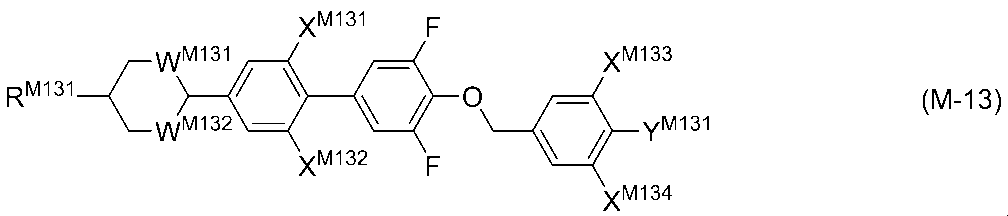
(式中、XM131~XM134はそれぞれ独立してフッ素原子又は水素原子を表し、YM131はフッ素原子、塩素原子又は-OCF3を表し、RM131は炭素原子数1~5のアルキル基、炭素原子数2~5のアルケニル基又は炭素原子数1~4のアルコキシ基を表し、WM131及びWM132はそれぞれ独立して、-CH2-又は-O-を表す。)
本発明の組成物の総量に対しての一般式(M-13)で表される化合物の好ましい含有量の下限値は、1%であり、2%であり、4%であり、5%であり、8%であり、10%であり、13%であり、15%であり、18%であり、20%である。好ましい含有量の上限値は、30%であり、28%であり、25%であり、23%であり、20%であり、18%であり、15%であり、13%であり、10%であり、8%であり、5%である。
本発明の組成物の総量に対しての一般式(M-13)で表される化合物の好ましい含有量の下限値は、1%であり、2%であり、4%であり、5%であり、8%であり、10%であり、13%であり、15%であり、18%であり、20%である。好ましい含有量の上限値は、30%であり、28%であり、25%であり、23%であり、20%であり、18%であり、15%であり、13%であり、10%であり、8%であり、5%である。
本発明に係る液晶組成物の構成化合物は、一般式(M-14)で表される化合物であることが好ましい。

(式中、XM141~XM144はそれぞれ独立してフッ素原子又は水素原子を表し、YM141はフッ素原子、塩素原子又は-OCF3を表し、RM141は炭素原子数1~5のアルキル基、炭素原子数2~5のアルケニル基又は炭素原子数1~4のアルコキシ基を表す。)
本発明の組成物の総量に対しての一般式(M-14)で表される化合物の好ましい含有量の下限値は、1%であり、2%であり、4%であり、5%であり、8%であり、10%であり、13%であり、15%であり、18%であり、20%である。好ましい含有量の上限値は、30%であり、28%であり、25%であり、23%であり、20%であり、18%であり、15%であり、13%であり、10%であり、8%であり、5%である。
本発明の組成物の総量に対しての一般式(M-14)で表される化合物の好ましい含有量の下限値は、1%であり、2%であり、4%であり、5%であり、8%であり、10%であり、13%であり、15%であり、18%であり、20%である。好ましい含有量の上限値は、30%であり、28%であり、25%であり、23%であり、20%であり、18%であり、15%であり、13%であり、10%であり、8%であり、5%である。
本発明に係る液晶組成物の構成化合物は、一般式(M-15)で表される化合物であることが好ましい。

(式中、XM151及びXM152はそれぞれ独立してフッ素原子又は水素原子を表し、YM151はフッ素原子、塩素原子又は-OCF3を表し、RM151は炭素原子数1~5のアルキル基、炭素原子数2~5のアルケニル基又は炭素原子数1~4のアルコキシ基を表し、WM151及びWM152はそれぞれ独立して、-CH2-又は-O-を表す。)
本発明の組成物の総量に対しての一般式(M-15)で表される化合物の好ましい含有量の下限値は、1%であり、2%であり、4%であり、5%であり、8%であり、10%であり、13%であり、15%であり、18%であり、20%である。好ましい含有量の上限値は、30%であり、28%であり、25%であり、23%であり、20%であり、18%であり、15%であり、13%であり、10%であり、8%であり、5%である。
本発明の組成物の総量に対しての一般式(M-15)で表される化合物の好ましい含有量の下限値は、1%であり、2%であり、4%であり、5%であり、8%であり、10%であり、13%であり、15%であり、18%であり、20%である。好ましい含有量の上限値は、30%であり、28%であり、25%であり、23%であり、20%であり、18%であり、15%であり、13%であり、10%であり、8%であり、5%である。
本発明に係る液晶組成物の構成化合物は、一般式(M-16)で表される化合物であることが好ましい。

(式中、XM161~XM164はそれぞれ独立してフッ素原子又は水素原子を表し、YM161はフッ素原子、塩素原子又は-OCF3を表し、RM161は炭素原子数1~5のアルキル基、炭素原子数2~5のアルケニル基又は炭素原子数1~4のアルコキシ基を表す。)
本発明の組成物の総量に対しての一般式(M-16)で表される化合物の好ましい含有量の下限値は、1%であり、2%であり、4%であり、5%であり、8%であり、10%であり、13%であり、15%であり、18%であり、20%である。好ましい含有量の上限値は、30%であり、28%であり、25%であり、23%であり、20%であり、18%であり、15%であり、13%であり、10%であり、8%であり、5%である。
本発明の組成物の総量に対しての一般式(M-16)で表される化合物の好ましい含有量の下限値は、1%であり、2%であり、4%であり、5%であり、8%であり、10%であり、13%であり、15%であり、18%であり、20%である。好ましい含有量の上限値は、30%であり、28%であり、25%であり、23%であり、20%であり、18%であり、15%であり、13%であり、10%であり、8%であり、5%である。
一般式(M-17)で表される化合物は下記のものである。
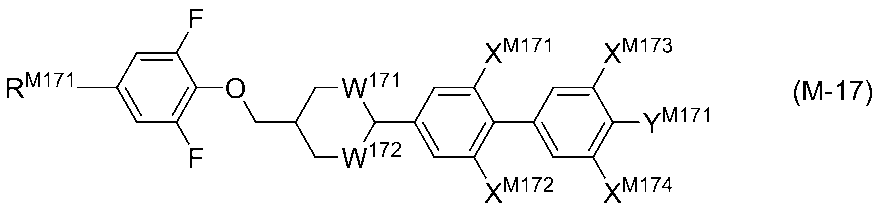
(式中、XM171~XM174はそれぞれ独立してフッ素原子又は水素原子を表し、YM171はフッ素原子、塩素原子又は-OCF3を表し、RM171は炭素原子数1~5のアルキル基、炭素原子数2~5のアルケニル基又は炭素原子数1~4のアルコキシ基を表し、WM171及びWM172はそれぞれ独立して、-CH2-又は-O-を表す。)
本発明の組成物の総量に対しての一般式(M-17)で表される化合物の好ましい含有量の下限値は、1%であり、2%であり、4%であり、5%であり、8%であり、10%であり、13%であり、15%であり、18%であり、20%である。好ましい含有量の上限値は、30%であり、28%であり、25%であり、23%であり、20%であり、18%であり、15%であり、13%であり、10%であり、8%であり、5%である。
本発明の組成物の総量に対しての一般式(M-17)で表される化合物の好ましい含有量の下限値は、1%であり、2%であり、4%であり、5%であり、8%であり、10%であり、13%であり、15%であり、18%であり、20%である。好ましい含有量の上限値は、30%であり、28%であり、25%であり、23%であり、20%であり、18%であり、15%であり、13%であり、10%であり、8%であり、5%である。
本発明に係る液晶組成物の構成化合物は、一般式(M-18)で表される化合物であることが好ましい。

(式中、XM181~XM186はそれぞれ独立してフッ素原子又は水素原子を表し、YM181はフッ素原子、塩素原子又は-OCF3を表し、RM181は炭素原子数1~5のアルキル基、炭素原子数2~5のアルケニル基又は炭素原子数1~4のアルコキシ基を表す。)
本発明の組成物の総量に対しての一般式(M-18)で表される化合物の好ましい含有量の下限値は、1%であり、2%であり、4%であり、5%であり、8%であり、10%であり、13%であり、15%であり、18%であり、20%である。好ましい含有量の上限値は、30%であり、28%であり、25%であり、23%であり、20%であり、18%であり、15%であり、13%であり、10%であり、8%であり、5%である。
本発明の組成物の総量に対しての一般式(M-18)で表される化合物の好ましい含有量の下限値は、1%であり、2%であり、4%であり、5%であり、8%であり、10%であり、13%であり、15%であり、18%であり、20%である。好ましい含有量の上限値は、30%であり、28%であり、25%であり、23%であり、20%であり、18%であり、15%であり、13%であり、10%であり、8%であり、5%である。
本発明の組成物の総量に対しての式(K)で表される化合物の好ましい含有量の下限値は、1%であり、10%であり、20%であり、30%であり、40%であり、50%であり、55%であり、60%であり、65%であり、70%であり、75%であり、80%である。好ましい含有量の上限値は、本発明の組成物の総量に対して、例えば本発明の一つの形態では95%であり、85%であり、75%であり、65%であり、55%であり、45%であり、35%であり、25%である。
本発明に係る液晶組成物の構成化合物は、例えば一般式(K-1)で表される化合物群から選ばれる化合物であることが好ましい。

(式中、RK11は炭素原子数1~5のアルキル基、炭素原子数2~5のアルケニル基又は炭素原子数1~4のアルコキシ基を表し、XK11~XK14はそれぞれ独立して水素原子又はフッ素原子を表し、YK11はフッ素原子又はOCF3を表す。)
本発明の組成物の総量に対しての式(K-1)で表される化合物の好ましい含有量の下限値は、1%であり、2%であり、5%であり、8%であり、10%であり、13%であり、15%であり、18%であり、20%であり、22%であり、25%であり、30%である。好ましい含有量の上限値は、30%であり、28%であり、25%であり、23%であり、20%であり、18%であり、15%であり、13%であり、10%であり、8%であり、5%である。
本発明の組成物の総量に対しての式(K-1)で表される化合物の好ましい含有量の下限値は、1%であり、2%であり、5%であり、8%であり、10%であり、13%であり、15%であり、18%であり、20%であり、22%であり、25%であり、30%である。好ましい含有量の上限値は、30%であり、28%であり、25%であり、23%であり、20%であり、18%であり、15%であり、13%であり、10%であり、8%であり、5%である。
本発明に係る液晶組成物の構成化合物は、例えば一般式(K-2)で表される化合物群から選ばれる化合物であることが好ましい。
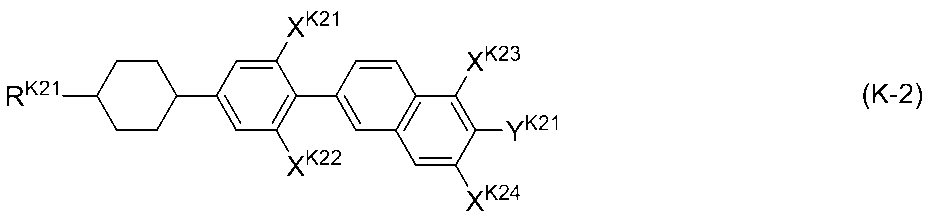
(式中、RK21は炭素原子数1~5のアルキル基、炭素原子数2~5のアルケニル基又は炭素原子数1~4のアルコキシ基を表し、XK21~XK24はそれぞれ独立して水素原子又はフッ素原子を表し、YK21はフッ素原子又はOCF3を表す。)
本発明の組成物の総量に対しての式(K-2)で表される化合物の好ましい含有量の下限値は、1%であり、2%であり、5%であり、8%であり、10%であり、13%であり、15%であり、18%であり、20%であり、22%であり、25%であり、30%である。好ましい含有量の上限値は、30%であり、28%であり、25%であり、23%であり、20%であり、18%であり、15%であり、13%であり、10%であり、8%であり、5%である。
本発明の組成物の総量に対しての式(K-2)で表される化合物の好ましい含有量の下限値は、1%であり、2%であり、5%であり、8%であり、10%であり、13%であり、15%であり、18%であり、20%であり、22%であり、25%であり、30%である。好ましい含有量の上限値は、30%であり、28%であり、25%であり、23%であり、20%であり、18%であり、15%であり、13%であり、10%であり、8%であり、5%である。
本発明に係る液晶組成物の構成化合物は、例えば一般式(K-3)で表される化合物群から選ばれる化合物であることが好ましい。

(式中、RK31は炭素原子数1~5のアルキル基、炭素原子数2~5のアルケニル基又は炭素原子数1~4のアルコキシ基を表し、XK31~XK36はそれぞれ独立して水素原子又はフッ素原子を表し、YK31はフッ素原子又はOCF3を表す。)
本発明の組成物の総量に対しての式(K-3)で表される化合物の好ましい含有量の下限値は、1%であり、2%であり、5%であり、8%であり、10%であり、13%であり、15%であり、18%であり、20%であり、22%であり、25%であり、30%である。好ましい含有量の上限値は、30%であり、28%であり、25%であり、23%であり、20%であり、18%であり、15%であり、13%であり、10%であり、8%であり、5%である。
本発明の組成物の総量に対しての式(K-3)で表される化合物の好ましい含有量の下限値は、1%であり、2%であり、5%であり、8%であり、10%であり、13%であり、15%であり、18%であり、20%であり、22%であり、25%であり、30%である。好ましい含有量の上限値は、30%であり、28%であり、25%であり、23%であり、20%であり、18%であり、15%であり、13%であり、10%であり、8%であり、5%である。
本発明に係る液晶組成物の構成化合物は、例えば一般式(K-4)で表される化合物群から選ばれる化合物であることが好ましい。
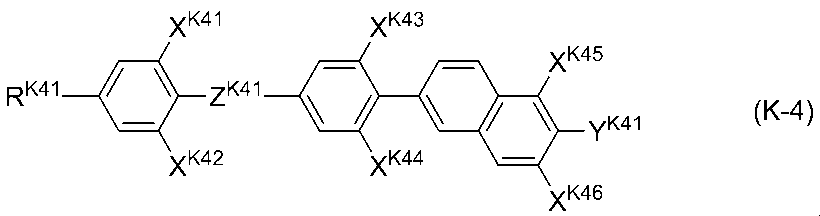
(式中、RK41は炭素原子数1~5のアルキル基、炭素原子数2~5のアルケニル基又は炭素原子数1~4のアルコキシ基を表し、XK41~XK46はそれぞれ独立して水素原子又はフッ素原子を表し、YK41はフッ素原子又はOCF3を表し、ZK41は-OCH2-、-CH2O-、-OCF2-又は-CF2O-を表す。)
本発明の組成物の総量に対しての式(K-4)で表される化合物の好ましい含有量の下限値は、1%であり、2%であり、5%であり、8%であり、10%であり、13%であり、15%であり、18%であり、20%であり、22%であり、25%であり、30%である。好ましい含有量の上限値は、30%であり、28%であり、25%であり、23%であり、20%であり、18%であり、15%であり、13%であり、10%であり、8%であり、5%である。
本発明の組成物の総量に対しての式(K-4)で表される化合物の好ましい含有量の下限値は、1%であり、2%であり、5%であり、8%であり、10%であり、13%であり、15%であり、18%であり、20%であり、22%であり、25%であり、30%である。好ましい含有量の上限値は、30%であり、28%であり、25%であり、23%であり、20%であり、18%であり、15%であり、13%であり、10%であり、8%であり、5%である。
本発明に係る液晶組成物の構成化合物は、例えば一般式(K-5)で表される化合物群から選ばれる化合物であることが好ましい。

(式中、RK51は炭素原子数1~5のアルキル基、炭素原子数2~5のアルケニル基又は炭素原子数1~4のアルコキシ基を表し、XK51~XK56はそれぞれ独立して水素原子又はフッ素原子を表し、YK51はフッ素原子又はOCF3を表し、ZK51は-OCH2-、-CH2O-、-OCF2-又は-CF2O-を表す。)
本発明の組成物の総量に対しての式(K-5)で表される化合物の好ましい含有量の下限値は、1%であり、2%であり、5%であり、8%であり、10%であり、13%であり、15%であり、18%であり、20%であり、22%であり、25%であり、30%である。好ましい含有量の上限値は、30%であり、28%であり、25%であり、23%であり、20%であり、18%であり、15%であり、13%であり、10%であり、8%であり、5%である。
本発明の組成物の総量に対しての式(K-5)で表される化合物の好ましい含有量の下限値は、1%であり、2%であり、5%であり、8%であり、10%であり、13%であり、15%であり、18%であり、20%であり、22%であり、25%であり、30%である。好ましい含有量の上限値は、30%であり、28%であり、25%であり、23%であり、20%であり、18%であり、15%であり、13%であり、10%であり、8%であり、5%である。
本発明に係る液晶組成物の構成化合物は、例えば一般式(K-6)で表される化合物群から選ばれる化合物であることが好ましい。

(式中、RK61は炭素原子数1~5のアルキル基、炭素原子数2~5のアルケニル基又は炭素原子数1~4のアルコキシ基を表し、XK61~XK68はそれぞれ独立して水素原子又はフッ素原子を表し、YK61はフッ素原子又はOCF3を表し、ZK61は-OCH2-、-CH2O-、-OCF2-又は-CF2O-を表す。)
本発明の組成物の総量に対しての式(K-6)で表される化合物の好ましい含有量の下限値は、1%であり、2%であり、5%であり、8%であり、10%であり、13%であり、15%であり、18%であり、20%であり、22%であり、25%であり、30%である。好ましい含有量の上限値は、30%であり、28%であり、25%であり、23%であり、20%であり、18%であり、15%であり、13%であり、10%であり、8%であり、5%である。
本発明の組成物の総量に対しての式(K-6)で表される化合物の好ましい含有量の下限値は、1%であり、2%であり、5%であり、8%であり、10%であり、13%であり、15%であり、18%であり、20%であり、22%であり、25%であり、30%である。好ましい含有量の上限値は、30%であり、28%であり、25%であり、23%であり、20%であり、18%であり、15%であり、13%であり、10%であり、8%であり、5%である。
以下、本発明に係る製造方法の好ましい実施形態について、変形例を含めて7例を例示するが、本発明の範囲はこれに限定されるものではない。
本発明に係る液晶組成物の製造方法の好ましい形態の一つは、液晶組成物の構成成分である1種または2種以上である基準化合物に対して、液晶組成物の構成成分であり、かつ前記基準化合物とは異なる外部刺激としての化合物とを接触させることにより、合計2~5種の化合物を必要により加熱手段および/または撹拌手段を用いて混合して溶解促成成分を調製する工程(I)と、
前記液晶組成物の構成成分である基準化合物と異なる前記液晶組成物を構成する化合物および前記溶解促進成分を混合する工程(II)と、を有する。
前記液晶組成物の構成成分である基準化合物と異なる前記液晶組成物を構成する化合物および前記溶解促進成分を混合する工程(II)と、を有する。
本発明に係る液晶組成物の製造方法の好ましい他の形態の一つは、液晶組成物の構成成分である基準化合物に対して、加熱手段により前記基準化合物単独の常態より流動性の高い相へ変化した溶解促進成分を必要により撹拌手段を用いて調製する工程(I)と、前記液晶組成物の構成成分である基準化合物と異なる前記液晶組成物を構成する化合物および前記溶解促進成分を混合する工程(II)と、を有する。
本発明に係る液晶組成物の製造方法の好ましい他の形態の変形例は、液晶組成物の構成成分である一般式(Y-1)で表される基準化合物に対して、加熱手段により前記基準化合物単独の常態より流動性の高い相へ変化した溶解促進成分を必要により撹拌手段を用いて調製する工程(I)と、前記液晶組成物の構成成分である基準化合物と異なる前記液晶組成物を構成する化合物および前記溶解促進成分を混合する工程(II)と、を有する。
本発明に係る液晶組成物の製造方法の好ましい他の形態の変形例は、液晶組成物の構成成分のうち、一般式(Y-1-1)で表されるスメクチック相を呈する化合物1種または2種以上を基準化合物とし、当該基準化合物を40~120℃に加熱してより流動性の高いネマチック相に転移させた溶解促進成分を必要により撹拌手段を用いて調製する工程(I)と、前記液晶組成物の構成成分である基準化合物と異なる前記液晶組成物を構成する化合物および前記溶解促進成分を混合する工程(II)と、を有する。
本発明に係る液晶組成物の製造方法の好ましいその他の形態の一つは、液晶組成物の構成成分である1種または2種以上の基準化合物に対して、液晶組成物の構成成分であり、かつ前記基準化合物とは異なる化合物を1種または2種以上とを接触させる際に、合計2~5種の化合物を混合して加熱手段により前記基準化合物単独の常態より流動性の高い相へ変化した溶解促進成分を必要により撹拌手段を用いて調製する工程(I)と、前記液晶組成物の構成成分である基準化合物と異なる前記液晶組成物を構成する化合物および前記溶解促進成分を混合する工程(II)と、を有する。
本発明に係る液晶組成物の製造方法の好ましいその他の形態の変形例は、液晶組成物の構成成分のうち、一般式(Y-1-1)で表されるスメクチック相を呈する化合物1種を基準化合物とし、前記基準化合物とは異なる化合物とを接触させる際に、当該基準化合物および/または前記基準化合物とは異なる化合物を40~120℃に加熱してより流動性の高いネマチック相に転移させた溶解促進成分を必要により撹拌手段を用いて調製する工程(I)と、前記液晶組成物の構成成分である基準化合物と異なる前記液晶組成物を構成する化合物および前記溶解促進成分を混合する工程(II)と、を有する。
本発明に係る液晶組成物の製造方法の好ましいその他の形態の変形例は、液晶組成物の構成成分のうち、一般式(Y-1-1)で表されるスメクチック相を呈する化合物2~5種、好ましくは2~4種、より好ましくは2~3種を基準化合物とし、前記基準化合物とは異なる化合物とを接触させる際に、当該基準化合物および/または前記基準化合物とは異なる化合物を40~120℃に加熱してより流動性の高いネマチック相に転移させた溶解促進成分を必要により撹拌手段を用いて調製する工程(I)と、前記液晶組成物の構成成分である基準化合物と異なる前記液晶組成物を構成する化合物および前記溶解促進成分を混合する工程(II)と、を有する。
本発明の製造方法の好ましい上記実施形態の7例における上記前記基準化合物は、以下の(A)~(F)からなる群から選択される少なくとも1つの条件を満たしている。
(A)上記一般式(S-1)~(S-8)からなる群から選択される少なくとも一つの部分化学構造を備えること
(B)上記一般式(Y-1)で表される化合物であること
(C)本発明に係る基準化合物の融点(常態より流動性の高い相へ変化する転移温度)の上限値が120℃以下であること
(D)液晶組成物における基準化合物の含有量が5~60質量%であること
(E)基準化合物の常温(25℃)または常温近傍(10~40℃)における相状態は、固体(粉体を含む)またはスメクチック相を呈していること
(F)基準化合物は、1~4種類の液晶化合物で構成されていること
上記(A)~(B)のうち、基準化合物は、(A)、(B)、(C)および(E)からなる群から選択される1種または2種以上の条件を満たすことがより好ましく、本発明に係る基準化合物は、上記一般式(Y-1)で表される化合物である、および/または基準化合物の常温(25℃)または常温近傍(10~40℃)における相状態は、固体(粉体を含む)またはスメクチック相を呈していることが特に好ましい。
(B)上記一般式(Y-1)で表される化合物であること
(C)本発明に係る基準化合物の融点(常態より流動性の高い相へ変化する転移温度)の上限値が120℃以下であること
(D)液晶組成物における基準化合物の含有量が5~60質量%であること
(E)基準化合物の常温(25℃)または常温近傍(10~40℃)における相状態は、固体(粉体を含む)またはスメクチック相を呈していること
(F)基準化合物は、1~4種類の液晶化合物で構成されていること
上記(A)~(B)のうち、基準化合物は、(A)、(B)、(C)および(E)からなる群から選択される1種または2種以上の条件を満たすことがより好ましく、本発明に係る基準化合物は、上記一般式(Y-1)で表される化合物である、および/または基準化合物の常温(25℃)または常温近傍(10~40℃)における相状態は、固体(粉体を含む)またはスメクチック相を呈していることが特に好ましい。
本発明の製造方法の好ましい上記実施形態の7例において、液晶組成物の構成成分であり、かつ前記基準化合物とは異なる外部刺激としての化合物は、上記一般式(S-9)~(S-14)からなる群から選択される1種または2種以上の化合物であることが好ましい。
本発明の製造方法の好ましい上記実施形態の7例において、必要により工程(I)において、溶解促進成分に対して酸化防止剤を添加してもよく、さらには必要により工程(I)において、基準化合物に対して、酸化防止剤を添加した状態で流動性の高い溶解促進成分を調製してもよい。さらには、必要により工程(II)の前、工程(II)中または工程(II)の後に酸化防止剤を添加してもよい。
本願発明の方法により調製した液晶組成物は、以下に示す項目を測定することにより評価を行った。
液晶組成物の比抵抗値(Ω・cm):室温におけるDC1V印加時の体積抵抗率を、エレクトロメーターを用いて測定した。
不純物量(ppm):ガスクロマトグラフィーにより液晶組成物中の主成分(混合液晶化合物)以外の不純物の総量を測定した。
電圧保持率(%):3.5ミクロンのTNセルに液晶組成物を注入し、60℃、1V-0.6Hzにおける電圧保持率を測定した。
パーティクル量(個数/g):溶媒に希釈した液晶組成物を液中パーティクルカウンターにて測定し、液晶1グラムあたりにおける0.5ミクロン以上のパーティクル数を求めた。
「比較例1」
クラス1000(アメリカ連邦規格Fed. Std. 209D)のクリーンルーム内で、容量20リットルのセパラブルフラスコに下記表1の化合物番号1~11番の化合物を表1に記載の投入順番で計量して投入した。表1における投入した化合物番号1~11番の化合物のガスクロマトグラフィー純度はいずれも99.9%以上である。さらに前記化合物番号1~11番の化合物を混合した液晶混合物中にセパラブルフラスコ外部でモーターに接続された熱伝対付き攪拌翼を埋没させた状態にして密閉した。その後、セパラブルフラスコにジャケットヒーターを巻き付け、内温95℃になるよう設定して加熱しながら、セパラブルフラスコ内を減圧状態にした。攪拌翼の回転数を30rpmに設定して混合物が攪拌可能か確認し、攪拌翼が一定速度で動くようになったことを確認してから、回転数を300rpmに設定して液晶を加熱攪拌した。その後、前記液晶混合物の外観が均質な液晶組成物に変化した事を確認して、攪拌工程を止めた。この時の各工程時間及び得られた液晶組成物の品質を測定した結果を表3に示す。
液晶組成物の比抵抗値(Ω・cm):室温におけるDC1V印加時の体積抵抗率を、エレクトロメーターを用いて測定した。
不純物量(ppm):ガスクロマトグラフィーにより液晶組成物中の主成分(混合液晶化合物)以外の不純物の総量を測定した。
電圧保持率(%):3.5ミクロンのTNセルに液晶組成物を注入し、60℃、1V-0.6Hzにおける電圧保持率を測定した。
パーティクル量(個数/g):溶媒に希釈した液晶組成物を液中パーティクルカウンターにて測定し、液晶1グラムあたりにおける0.5ミクロン以上のパーティクル数を求めた。
「比較例1」
クラス1000(アメリカ連邦規格Fed. Std. 209D)のクリーンルーム内で、容量20リットルのセパラブルフラスコに下記表1の化合物番号1~11番の化合物を表1に記載の投入順番で計量して投入した。表1における投入した化合物番号1~11番の化合物のガスクロマトグラフィー純度はいずれも99.9%以上である。さらに前記化合物番号1~11番の化合物を混合した液晶混合物中にセパラブルフラスコ外部でモーターに接続された熱伝対付き攪拌翼を埋没させた状態にして密閉した。その後、セパラブルフラスコにジャケットヒーターを巻き付け、内温95℃になるよう設定して加熱しながら、セパラブルフラスコ内を減圧状態にした。攪拌翼の回転数を30rpmに設定して混合物が攪拌可能か確認し、攪拌翼が一定速度で動くようになったことを確認してから、回転数を300rpmに設定して液晶を加熱攪拌した。その後、前記液晶混合物の外観が均質な液晶組成物に変化した事を確認して、攪拌工程を止めた。この時の各工程時間及び得られた液晶組成物の品質を測定した結果を表3に示す。
(表1)
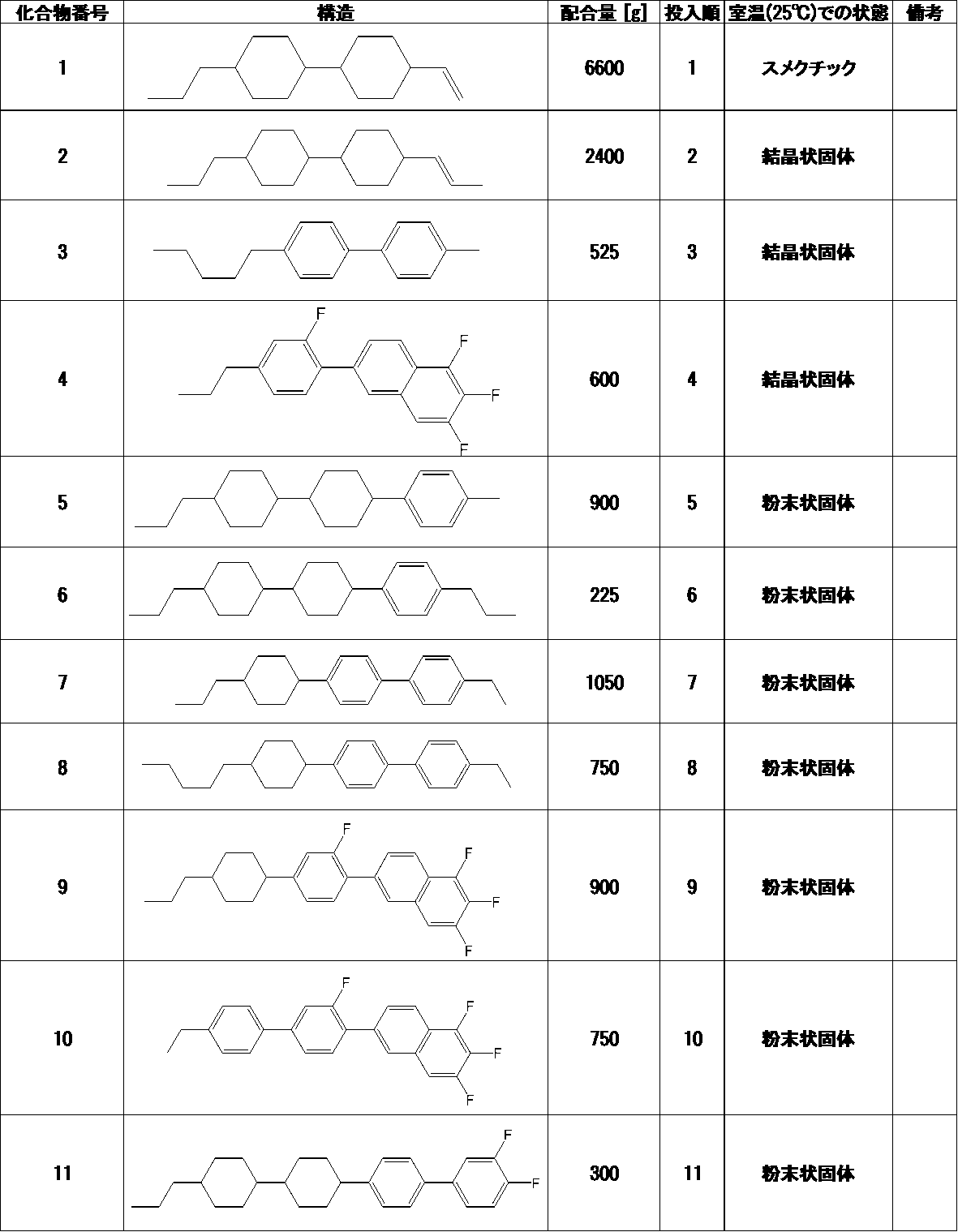
「実施例1」
クラス1000(アメリカ連邦規格Fed. Std. 209D)のクリーンルーム内で、容量20リットルのセパラブルフラスコに下記表2の化合物番号2~11番の化合物を表2に記載の投入順番で計量して投入した。
クラス1000(アメリカ連邦規格Fed. Std. 209D)のクリーンルーム内で、容量20リットルのセパラブルフラスコに下記表2の化合物番号2~11番の化合物を表2に記載の投入順番で計量して投入した。
一方、別途、化合物番号1番の化合物(基準化合物)を不活性ガスで置換し90℃に設定したクリーンオーブン内で3時間加温することにより液体状態へ変化させて溶解促進成分を調製した。化合物番号1番の化合物は加温終了時にアイソトロピック相を呈していた(外部刺激として熱)。この液体状態の溶解促進成分を前記化合物番号2~11番の化合物を含むセパラブルフラスコに投入し、さらに前記化合物番号1~11番の化合物を混合した液晶混合物中にセパラブルフラスコ外部でモーターに接続された熱伝対付き攪拌翼を埋没させた状態にして密閉した。この時点で、混合物は全体がほぼ液化した状態を呈した。その後、セパラブルフラスコにジャケットヒーターを巻き付け、内温95℃になるよう設定して加熱しながら、セパラブルフラスコ内を減圧状態にし、攪拌翼の回転数を300rpmに設定して攪拌翼が一定速度で動作できることを確認して攪拌を開始した。その後、前記液晶混合物の外観が均質な液晶組成物に変化した事を確認して、攪拌工程を止めた。この際の各工程時間及び得られた液晶組成物の品質を測定した結果を表3に示す。
表2における化合物番号1~11番の化合物のガスクロマトグラフィー純度はいずれも99.9%以上であった。
(表2)

「実施例2」
化合物番号1番の化合物(基準化合物)に以下の式(IV-1)で表される酸化防止剤500ppmを添加し、不活性ガスで置換し120℃に設定したクリーンオーブン内で2時間加温することにより液体状態へ変化させて溶解促進成分を調製した以外は、実施例1と同様の手順で液晶組成物を15kg製造した。この時の各工程時間及び得られた液晶組成物の品質を測定した結果を表3に示す。
化合物番号1番の化合物(基準化合物)に以下の式(IV-1)で表される酸化防止剤500ppmを添加し、不活性ガスで置換し120℃に設定したクリーンオーブン内で2時間加温することにより液体状態へ変化させて溶解促進成分を調製した以外は、実施例1と同様の手順で液晶組成物を15kg製造した。この時の各工程時間及び得られた液晶組成物の品質を測定した結果を表3に示す。
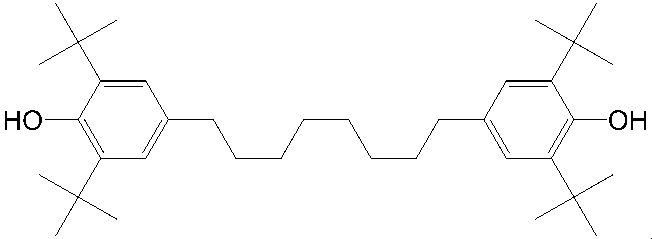
「実施例3」
化合物番号1番の化合物(基準化合物)に上記式(IV-1)で表される酸化防止剤200ppmを添加し、不活性ガスで置換し90℃に設定したクリーンオーブン内で2時間加温することにより液体状態へ変化させて溶解促進成分を調製したことおよび前記化合物番号1~11番の化合物を混合した液晶混合物の内温設定を70℃としたこと以外は、実施例1と同様の手順で液晶組成物を15kg製造した。この時の各工程時間及び得られた液晶組成物の品質を測定した結果を表3に示す。
化合物番号1番の化合物(基準化合物)に上記式(IV-1)で表される酸化防止剤200ppmを添加し、不活性ガスで置換し90℃に設定したクリーンオーブン内で2時間加温することにより液体状態へ変化させて溶解促進成分を調製したことおよび前記化合物番号1~11番の化合物を混合した液晶混合物の内温設定を70℃としたこと以外は、実施例1と同様の手順で液晶組成物を15kg製造した。この時の各工程時間及び得られた液晶組成物の品質を測定した結果を表3に示す。
(表3)

「比較例2」
クラス1000(アメリカ連邦規格Fed. Std. 209D)のクリーンルーム内で、容量20リットルのセパラブルフラスコに下記化合物番号1~11番の化合物を表4に記載の投入順番で計量した。投入した化合物のガスクロマトグラフィー純度はいずれも99.9%以上である。さらにセパラブルフラスコ外部でモーターに接続された熱伝対付き攪拌翼を液晶混合物中に埋没させた状態にして密閉した。その後、セパラブルフラスコにジャケットヒーターを巻き付け、内温90℃になるよう設定して加熱を開始すると同時に、セパラブルフラスコ内を減圧した後に窒素ガスでパージした。この時点で、液晶混合物はほぼ液体の状態を呈していた。攪拌翼の回転数を300rpmに設定しても混合物が攪拌可能であったため、そのまま回転数を300rpmで維持して液晶を加熱攪拌した。その後、外観が均質な液晶組成物に変化した事を確認して、攪拌工程を止めた。この時の各工程時間及び得られた液晶組成物の品質を測定した結果を表6に示す。
(表4)

「実施例4」
クラス1000(アメリカ連邦規格Fed. Std. 209D)のクリーンルーム内で、容量20リットルのセパラブルフラスコに下記化合物番号2番及び4~11番の化合物を表に記載の投入順番で計量した。一方、同時に化合物番号1の化合物(第1の基準化合物)及び化合物番号3の化合物を不活性ガスで置換し90℃に設定した別々のクリーンオーブン内で3時間加温することにより液体状態へ変化させて、第1の溶解促成成分および第2の溶解促進成分を調製した。これらの化合物のガスクロマトグラフィー純度はいずれも99.9%以上である。前記第1の基準化合物、前記第2の基準化合物は加温終了時にアイソトロピック相を呈していた。この第1の溶解促成成分および第2の溶解促進成分(液体状態の第1の基準化合物及び第2の基準化合物)を、表に記載の順番でセパラブルフラスコに投入し、セパラブルフラスコ外部でモーターに接続された熱伝対付き攪拌翼を混合物中に埋没させた状態にして密閉した。その後、セパラブルフラスコにジャケットヒーターを巻き付け、内温90℃になるよう設定して加熱を開始すると同時に、セパラブルフラスコ内を減圧状態にしてから窒素ガスでパージした。攪拌翼の回転数を30rpmに設定し、攪拌が可能となったことを確認してから、回転数を300rpmに設定して液晶を加熱攪拌し、外観が均質な液晶組成物に変化した事を確認して、攪拌工程を止めた。この時の各工程時間及び得られた液晶組成物の品質を測定した結果を表6に示す。
クラス1000(アメリカ連邦規格Fed. Std. 209D)のクリーンルーム内で、容量20リットルのセパラブルフラスコに下記化合物番号2番及び4~11番の化合物を表に記載の投入順番で計量した。一方、同時に化合物番号1の化合物(第1の基準化合物)及び化合物番号3の化合物を不活性ガスで置換し90℃に設定した別々のクリーンオーブン内で3時間加温することにより液体状態へ変化させて、第1の溶解促成成分および第2の溶解促進成分を調製した。これらの化合物のガスクロマトグラフィー純度はいずれも99.9%以上である。前記第1の基準化合物、前記第2の基準化合物は加温終了時にアイソトロピック相を呈していた。この第1の溶解促成成分および第2の溶解促進成分(液体状態の第1の基準化合物及び第2の基準化合物)を、表に記載の順番でセパラブルフラスコに投入し、セパラブルフラスコ外部でモーターに接続された熱伝対付き攪拌翼を混合物中に埋没させた状態にして密閉した。その後、セパラブルフラスコにジャケットヒーターを巻き付け、内温90℃になるよう設定して加熱を開始すると同時に、セパラブルフラスコ内を減圧状態にしてから窒素ガスでパージした。攪拌翼の回転数を30rpmに設定し、攪拌が可能となったことを確認してから、回転数を300rpmに設定して液晶を加熱攪拌し、外観が均質な液晶組成物に変化した事を確認して、攪拌工程を止めた。この時の各工程時間及び得られた液晶組成物の品質を測定した結果を表6に示す。

「実施例5」
第1の基準化合物に式(IV-2)で表される酸化防止剤500ppmを添加し加温条件を120℃2時間とした以外は、実施例1と同様の手順で液晶組成物を15kg製造した。この時の各工程時間及び得られた液晶組成物の品質を測定した結果を表5に示す。
第1の基準化合物に式(IV-2)で表される酸化防止剤500ppmを添加し加温条件を120℃2時間とした以外は、実施例1と同様の手順で液晶組成物を15kg製造した。この時の各工程時間及び得られた液晶組成物の品質を測定した結果を表5に示す。
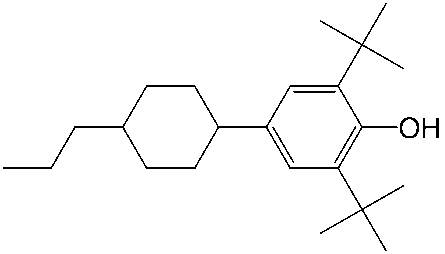
「実施例6」
化合物1に式(IV-2)で表される酸化防止剤200ppmを添加し加温条件を90℃2時間とした以外は、実施例1と同様の手順で液晶組成物を15kg製造した。この時の各工程時間及び得られた液晶組成物の品質を測定した結果を表6に示す。
化合物1に式(IV-2)で表される酸化防止剤200ppmを添加し加温条件を90℃2時間とした以外は、実施例1と同様の手順で液晶組成物を15kg製造した。この時の各工程時間及び得られた液晶組成物の品質を測定した結果を表6に示す。

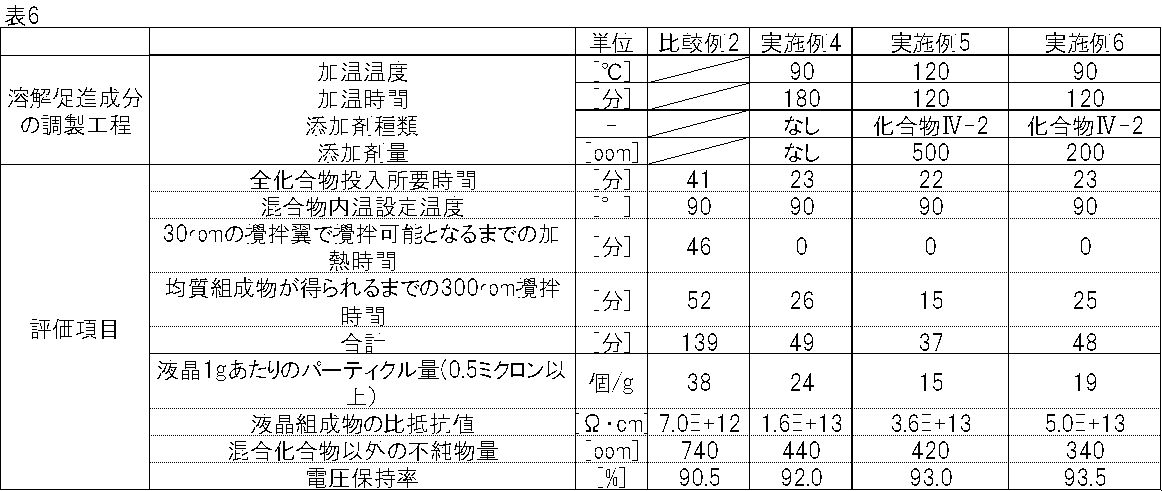
「比較例3」
クラス1000(アメリカ連邦規格Fed. Std. 209D)のクリーンルーム内で、容量20リットルのセパラブルフラスコに下記化合物番号1~9番の化合物を表に記載の投入順番で計量した。投入した化合物のガスクロマトグラフィー純度はいずれも99.9%以上である。さらにセパラブルフラスコ外部でモーターに接続された熱伝対付き攪拌翼を液晶混合物中に埋没させた状態にして密閉した。その後、セパラブルフラスコにジャケットヒーターを巻き付け、内温90℃になるよう設定して加熱を開始すると同時に、セパラブルフラスコ内を減圧状態にした。攪拌翼の回転数を30rpmに設定し、攪拌が可能となったことを確認してから、回転数を300rpmに設定して液晶を加熱攪拌し、外観が均質な液晶組成物に変化した事を確認して、攪拌工程を止めた。この時の各工程時間及び得られた液晶組成物の品質を測定した結果を表9に示す。
クラス1000(アメリカ連邦規格Fed. Std. 209D)のクリーンルーム内で、容量20リットルのセパラブルフラスコに下記化合物番号1~9番の化合物を表に記載の投入順番で計量した。投入した化合物のガスクロマトグラフィー純度はいずれも99.9%以上である。さらにセパラブルフラスコ外部でモーターに接続された熱伝対付き攪拌翼を液晶混合物中に埋没させた状態にして密閉した。その後、セパラブルフラスコにジャケットヒーターを巻き付け、内温90℃になるよう設定して加熱を開始すると同時に、セパラブルフラスコ内を減圧状態にした。攪拌翼の回転数を30rpmに設定し、攪拌が可能となったことを確認してから、回転数を300rpmに設定して液晶を加熱攪拌し、外観が均質な液晶組成物に変化した事を確認して、攪拌工程を止めた。この時の各工程時間及び得られた液晶組成物の品質を測定した結果を表9に示す。

「実施例7」
クラス1000(アメリカ連邦規格Fed. Std. 209D)のクリーンルーム内で、容量20リットルの蓋付SUS製ベゼルに下記化合物番号1~3番の化合物を化合物番号1~3の順番で投入して計量した。投入した化合物のガスクロマトフラフィー純度はいずれも99.9%以上である。このベゼルを真空脱泡機能付きのトルネード式振動攪拌機にセットし、真空へ減圧した後、蓋の頂点を支点として回転数500rpmで10分間のトルネード式攪拌により溶解促進成分を調製した(外部刺激である化合物番号2および化合物番号3の化合物との混合)。攪拌後、混合物である溶解促進成分は結晶の浮遊等のない均質なネマチック状態を示していた。このベゼルに下記化合物番号4~9番の化合物を表に記載の投入順番で計量した。投入した化合物のガスクロマトグラフィー純度はいずれも99.9%以上である。ベゼル蓋に、容器外部でモーターに接続された熱電対付き攪拌翼をセットし、攪拌翼を液晶混合物中に埋没させた状態にして密閉した。その後、ベゼルにジャケットヒーターを巻き付け、内温90℃になるよう設定して加熱を開始すると同時に、セパラブルフラスコ内を減圧状態にした。攪拌翼の回転数を30rpmに設定し、攪拌が可能となったことを確認してから、回転数を300rpmに設定して液晶を加熱攪拌し、外観が均質な液晶組成物に変化した事を確認して、攪拌工程を止めた。この時の各工程時間及び得られた液晶組成物の品質を測定した結果を表9に示す。
クラス1000(アメリカ連邦規格Fed. Std. 209D)のクリーンルーム内で、容量20リットルの蓋付SUS製ベゼルに下記化合物番号1~3番の化合物を化合物番号1~3の順番で投入して計量した。投入した化合物のガスクロマトフラフィー純度はいずれも99.9%以上である。このベゼルを真空脱泡機能付きのトルネード式振動攪拌機にセットし、真空へ減圧した後、蓋の頂点を支点として回転数500rpmで10分間のトルネード式攪拌により溶解促進成分を調製した(外部刺激である化合物番号2および化合物番号3の化合物との混合)。攪拌後、混合物である溶解促進成分は結晶の浮遊等のない均質なネマチック状態を示していた。このベゼルに下記化合物番号4~9番の化合物を表に記載の投入順番で計量した。投入した化合物のガスクロマトグラフィー純度はいずれも99.9%以上である。ベゼル蓋に、容器外部でモーターに接続された熱電対付き攪拌翼をセットし、攪拌翼を液晶混合物中に埋没させた状態にして密閉した。その後、ベゼルにジャケットヒーターを巻き付け、内温90℃になるよう設定して加熱を開始すると同時に、セパラブルフラスコ内を減圧状態にした。攪拌翼の回転数を30rpmに設定し、攪拌が可能となったことを確認してから、回転数を300rpmに設定して液晶を加熱攪拌し、外観が均質な液晶組成物に変化した事を確認して、攪拌工程を止めた。この時の各工程時間及び得られた液晶組成物の品質を測定した結果を表9に示す。


「比較例4」
クラス1000(アメリカ連邦規格Fed. Std. 209D)のクリーンルーム内で、容量20リットルの蓋付SUS製ベゼルに下記化合物番号1~9番の化合物を表に記載の投入順番で計量した。投入した化合物のガスクロマトグラフィー純度はいずれも99.9%以上である。さらにSUS製ベゼル外部でモーターに接続された熱伝対付き攪拌翼を液晶混合物中に埋没させた状態にして密閉した。その後、SUS製ベゼルにジャケットヒーターを巻き付け、内温90℃になるよう設定して加熱を開始すると同時に、SUS製ベゼル内を減圧状態にした。攪拌翼の回転数を30rpmに設定し、攪拌が可能となったことを確認してから、回転数を300rpmに設定して液晶を加熱攪拌し、外観が均質な液晶組成物に変化した事を確認して、攪拌工程を止めた。この時の各工程時間及び得られた液晶組成物の品質を測定した結果を表12に示す。
クラス1000(アメリカ連邦規格Fed. Std. 209D)のクリーンルーム内で、容量20リットルの蓋付SUS製ベゼルに下記化合物番号1~9番の化合物を表に記載の投入順番で計量した。投入した化合物のガスクロマトグラフィー純度はいずれも99.9%以上である。さらにSUS製ベゼル外部でモーターに接続された熱伝対付き攪拌翼を液晶混合物中に埋没させた状態にして密閉した。その後、SUS製ベゼルにジャケットヒーターを巻き付け、内温90℃になるよう設定して加熱を開始すると同時に、SUS製ベゼル内を減圧状態にした。攪拌翼の回転数を30rpmに設定し、攪拌が可能となったことを確認してから、回転数を300rpmに設定して液晶を加熱攪拌し、外観が均質な液晶組成物に変化した事を確認して、攪拌工程を止めた。この時の各工程時間及び得られた液晶組成物の品質を測定した結果を表12に示す。

「実施例8」
クラス1000(アメリカ連邦規格Fed. Std. 209D)のクリーンルーム内で、容量20リットルの蓋付SUS製ベゼルに下記化合物番号1、3、4番の化合物を表に記載の投入順番で計量した。投入した化合物のガスクロマトフラフィー純度はいずれも99.9%以上である。このベゼルを真空脱泡機能付きのトルネード式振動攪拌機にセットし、真空へ減圧した後、蓋の頂点を支点として回転数500rpmで10分間のトルネード式攪拌により溶解促進成分を調製した(外部刺激である化合物番号3および化合物番号4の化合物との混合)。攪拌後、混合物は結晶の浮遊等のない均質なネマチック状態を示していた。このベゼルに下記化合物番号2および5~9番の化合物を表に記載の投入順番で計量した。投入した化合物のガスクロマトグラフィー純度はいずれも99.9%以上である。ベゼル蓋に、容器外部でモーターに接続された熱電対付き攪拌翼をセットし、攪拌翼を液晶混合物中に埋没させた状態にして密閉した。その後、ベゼルにジャケットヒーターを巻き付け、内温90℃になるよう設定して加熱を開始すると同時に、セパラブルフラスコ内を減圧状態にした。攪拌翼の回転数を30rpmに設定し、攪拌が可能となったことを確認してから、回転数を300rpmに設定して液晶を加熱攪拌し、外観が均質な液晶組成物に変化した事を確認して、攪拌工程を止めた。この時の各工程時間及び得られた液晶組成物の品質を測定した結果を表12に示す。
クラス1000(アメリカ連邦規格Fed. Std. 209D)のクリーンルーム内で、容量20リットルの蓋付SUS製ベゼルに下記化合物番号1、3、4番の化合物を表に記載の投入順番で計量した。投入した化合物のガスクロマトフラフィー純度はいずれも99.9%以上である。このベゼルを真空脱泡機能付きのトルネード式振動攪拌機にセットし、真空へ減圧した後、蓋の頂点を支点として回転数500rpmで10分間のトルネード式攪拌により溶解促進成分を調製した(外部刺激である化合物番号3および化合物番号4の化合物との混合)。攪拌後、混合物は結晶の浮遊等のない均質なネマチック状態を示していた。このベゼルに下記化合物番号2および5~9番の化合物を表に記載の投入順番で計量した。投入した化合物のガスクロマトグラフィー純度はいずれも99.9%以上である。ベゼル蓋に、容器外部でモーターに接続された熱電対付き攪拌翼をセットし、攪拌翼を液晶混合物中に埋没させた状態にして密閉した。その後、ベゼルにジャケットヒーターを巻き付け、内温90℃になるよう設定して加熱を開始すると同時に、セパラブルフラスコ内を減圧状態にした。攪拌翼の回転数を30rpmに設定し、攪拌が可能となったことを確認してから、回転数を300rpmに設定して液晶を加熱攪拌し、外観が均質な液晶組成物に変化した事を確認して、攪拌工程を止めた。この時の各工程時間及び得られた液晶組成物の品質を測定した結果を表12に示す。
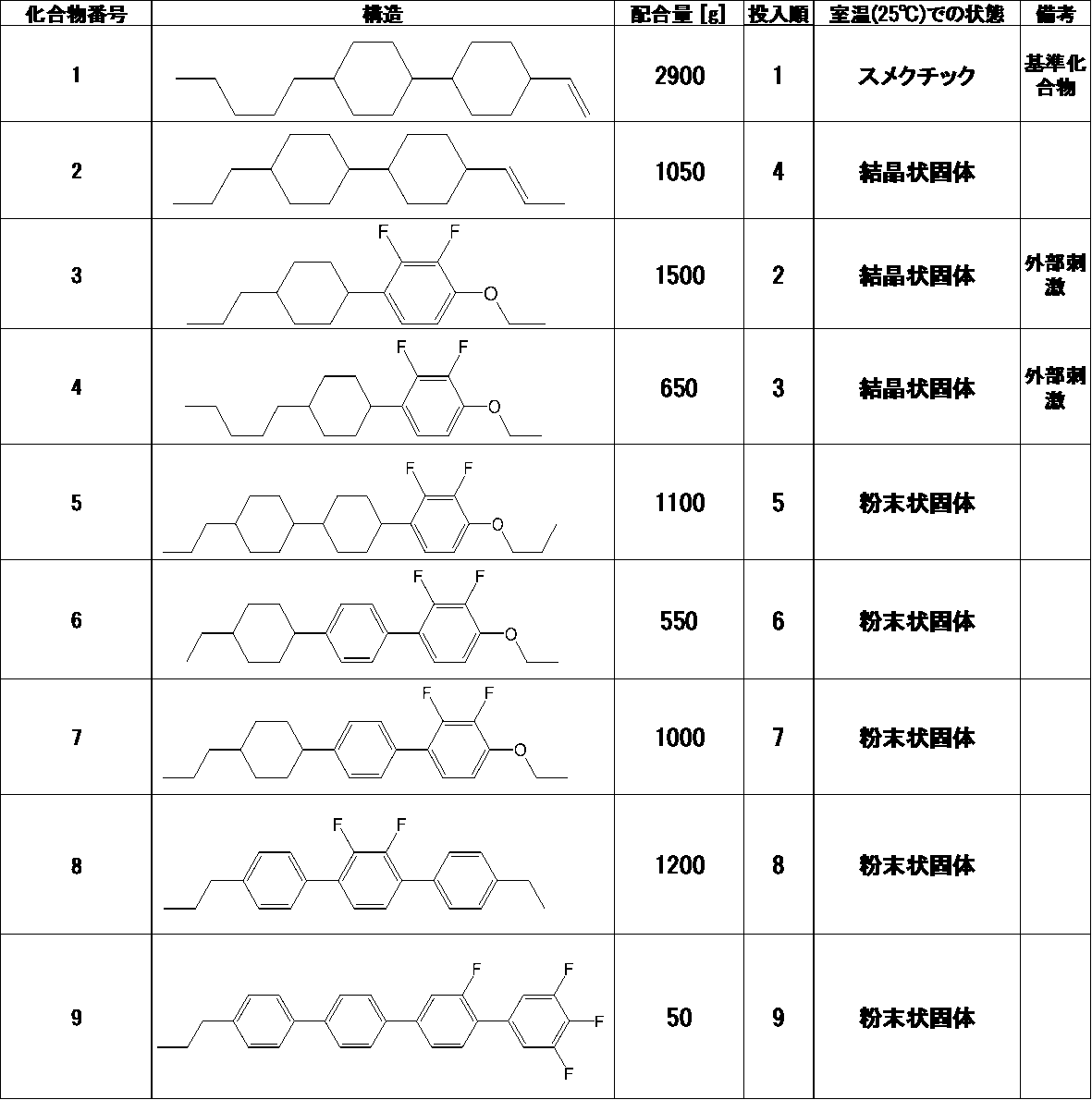

「比較例5」
クラス1000(アメリカ連邦規格Fed. Std. 209D)のクリーンルーム内で、容量20リットルの蓋付SUS製ベゼルに下記化合物番号1~12番の化合物を表に記載の投入順番で計量した。投入した化合物のガスクロマトグラフィー純度はいずれも99.9%以上である。さらにSUS製ベゼル外部でモーターに接続された熱伝対付き攪拌翼を液晶混合物中に埋没させた状態にして密閉した。その後、SUS製ベゼルにジャケットヒーターを巻き付け、内温95℃になるよう設定して加熱を開始すると同時に、SUS製ベゼル内を減圧状態にした。攪拌翼の回転数を30rpmに設定し、攪拌が可能となったことを確認してから、回転数を300rpmに設定して液晶を加熱攪拌し、外観が均質な液晶組成物に変化した事を確認して、攪拌工程を止めた。この時の各工程時間及び得られた液晶組成物の品質を測定した結果を表15に示す。
クラス1000(アメリカ連邦規格Fed. Std. 209D)のクリーンルーム内で、容量20リットルの蓋付SUS製ベゼルに下記化合物番号1~12番の化合物を表に記載の投入順番で計量した。投入した化合物のガスクロマトグラフィー純度はいずれも99.9%以上である。さらにSUS製ベゼル外部でモーターに接続された熱伝対付き攪拌翼を液晶混合物中に埋没させた状態にして密閉した。その後、SUS製ベゼルにジャケットヒーターを巻き付け、内温95℃になるよう設定して加熱を開始すると同時に、SUS製ベゼル内を減圧状態にした。攪拌翼の回転数を30rpmに設定し、攪拌が可能となったことを確認してから、回転数を300rpmに設定して液晶を加熱攪拌し、外観が均質な液晶組成物に変化した事を確認して、攪拌工程を止めた。この時の各工程時間及び得られた液晶組成物の品質を測定した結果を表15に示す。

「実施例9」
クラス1000(アメリカ連邦規格Fed. Std. 209D)のクリーンルーム内で、容量20リットルの蓋付SUS製ベゼルに下記1、5、7番の化合物を表に記載の投入順番で計量した。投入した化合物のガスクロマトフラフィー純度はいずれも99.9%以上である。このベゼルを真空脱泡機能付きのトルネード式振動攪拌機にセットし、真空へ減圧した後、蓋の頂点を支点として回転数500rpmで10分間のトルネード式攪拌により溶解促進成分を調製した(外部刺激である化合物番号5および7の化合物との混合)。攪拌後、混合物は結晶の浮遊等のない均質なネマチック状態を示していた。このベゼルに下記化合物番号2、3、4、6、8~12番の化合物を表に記載の投入順番で計量した。投入した化合物のガスクロマトグラフィー純度はいずれも99.9%以上である。ベゼル蓋に、容器外部でモーターに接続された熱電対付き攪拌翼をセットし、攪拌翼を液晶混合物中に埋没させた状態にして密閉した。その後、ベゼルにジャケットヒーターを巻き付け、内温95℃になるよう設定して加熱を開始すると同時に、セパラブルフラスコ内を減圧状態にした。攪拌翼の回転数を30rpmに設定し、攪拌が可能となったことを確認してから、回転数を300rpmに設定して液晶を加熱攪拌し、外観が均質な液晶組成物に変化した事を確認して、攪拌工程を止めた。この時の各工程時間及び得られた液晶組成物の品質を測定した結果を表15に示す。
クラス1000(アメリカ連邦規格Fed. Std. 209D)のクリーンルーム内で、容量20リットルの蓋付SUS製ベゼルに下記1、5、7番の化合物を表に記載の投入順番で計量した。投入した化合物のガスクロマトフラフィー純度はいずれも99.9%以上である。このベゼルを真空脱泡機能付きのトルネード式振動攪拌機にセットし、真空へ減圧した後、蓋の頂点を支点として回転数500rpmで10分間のトルネード式攪拌により溶解促進成分を調製した(外部刺激である化合物番号5および7の化合物との混合)。攪拌後、混合物は結晶の浮遊等のない均質なネマチック状態を示していた。このベゼルに下記化合物番号2、3、4、6、8~12番の化合物を表に記載の投入順番で計量した。投入した化合物のガスクロマトグラフィー純度はいずれも99.9%以上である。ベゼル蓋に、容器外部でモーターに接続された熱電対付き攪拌翼をセットし、攪拌翼を液晶混合物中に埋没させた状態にして密閉した。その後、ベゼルにジャケットヒーターを巻き付け、内温95℃になるよう設定して加熱を開始すると同時に、セパラブルフラスコ内を減圧状態にした。攪拌翼の回転数を30rpmに設定し、攪拌が可能となったことを確認してから、回転数を300rpmに設定して液晶を加熱攪拌し、外観が均質な液晶組成物に変化した事を確認して、攪拌工程を止めた。この時の各工程時間及び得られた液晶組成物の品質を測定した結果を表15に示す。
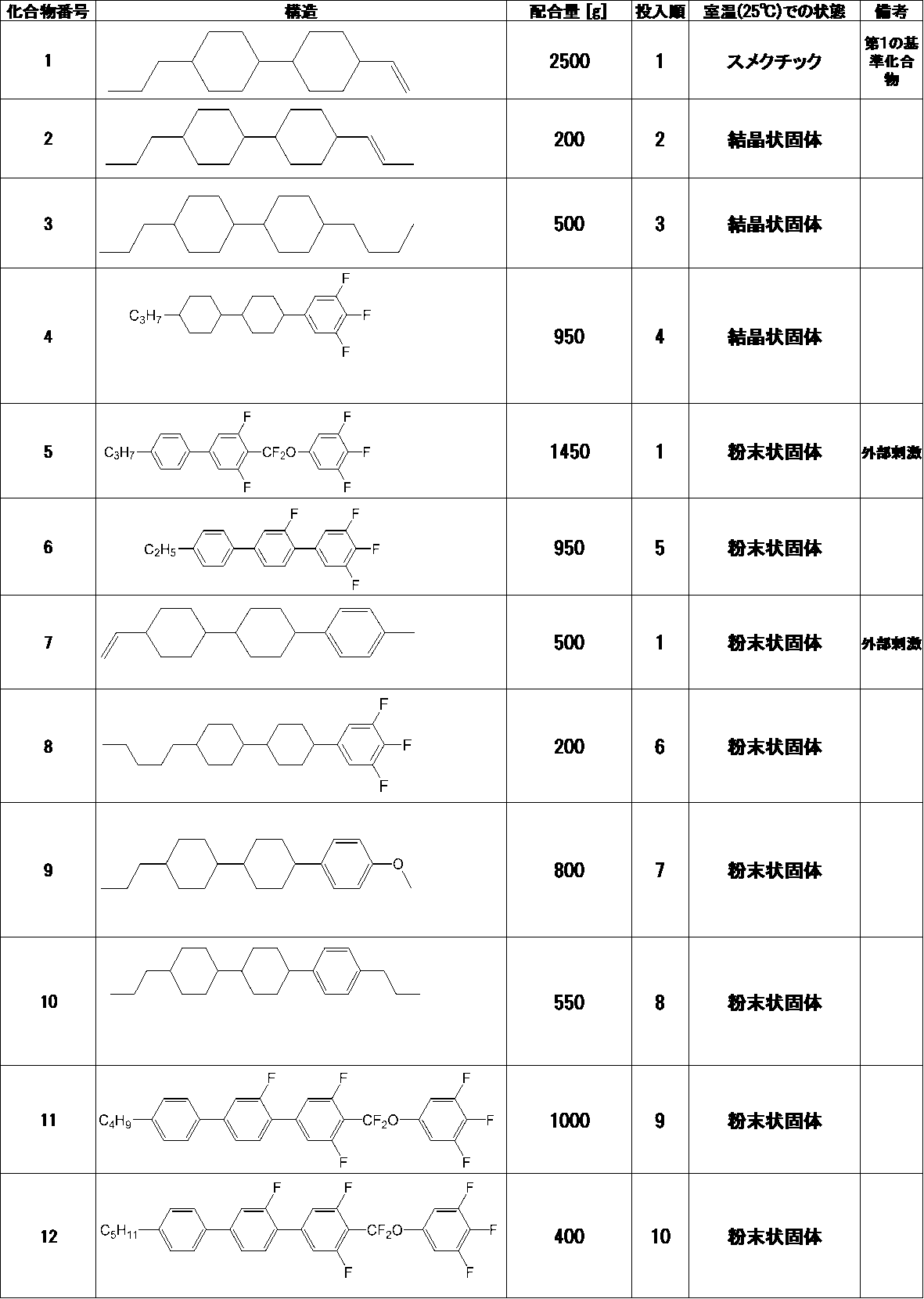
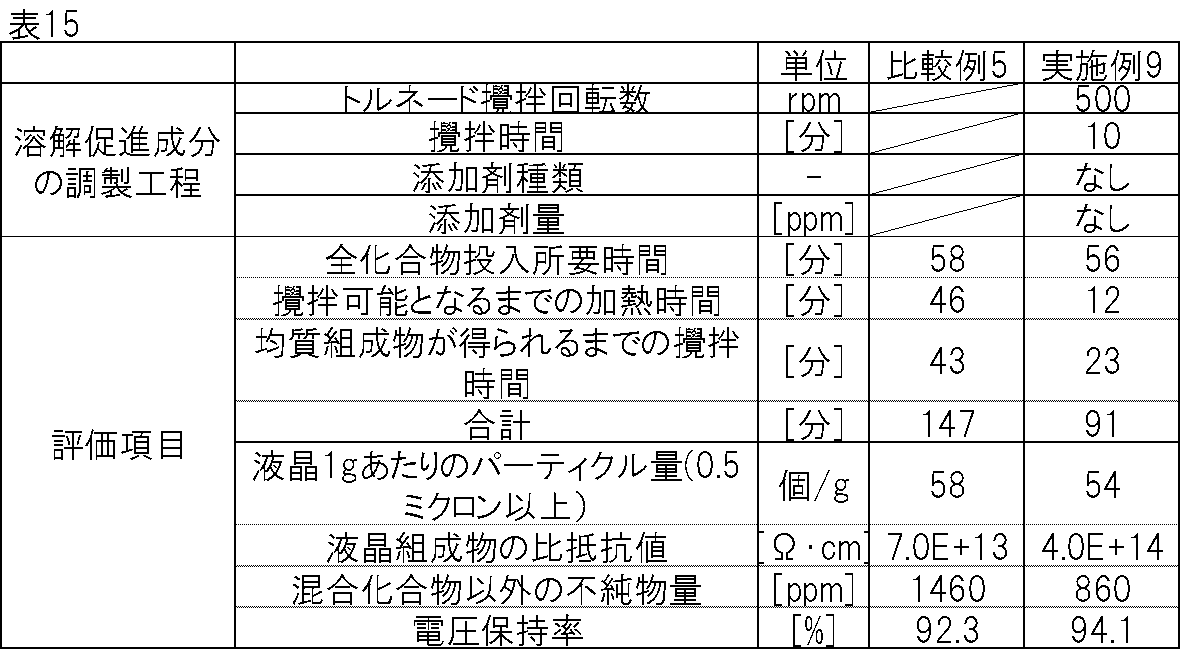
以上のことから本実施例の製造方法は、液晶組成物の信頼性を損ねることないまたは信頼性の低下を抑制することができることが確認された。
Claims (15)
- 少なくとも2種以上の化合物を含む液晶組成物を製造する方法であって、
前記液晶組成物の構成化合物のうち前記構成化合物単独の常態における流動性より高い相への転移が可能な基準化合物を、外部刺激に応答させることにより前記基準化合物単独の常態における流動性より高い相へ変化した溶解促進成分を調製する工程(I)と、
前記基準化合物とは異なる前記液晶組成物を構成する化合物および前記溶解促進成分を混合する工程(II)と、を含むことを特徴とする、液晶組成物の製造方法。 - 前記流動性の高い相は、ネマチック相または液相である、請求項1に記載の液晶組成物の製造方法。
- 前記外部刺激は、熱および液晶組成物の他の構成成分の化合物との接触からなる群から選択される少なくとも1種である、請求項1または2のいずれか1項に記載の液晶組成物の製造方法。
- 前記液晶組成物の構成成分である基準化合物の融点は、120℃以下である、請求項1~3のいずれか1項に記載の液晶組成物の製造方法。
- 前記溶解促進成分は、2種以上の前記基準化合物から形成される、請求項1~4のいずれか1項に記載の液晶組成物の製造方法。
- 前記工程(I)は、前記基準化合物を加温して溶解促進成分を調製する工程である、請求項1~5のいずれか1項に記載の液晶組成物の製造方法。
- 前記工程(I)は、2種以上の前記基準化合物を加温して溶解促進成分を調製する工程である、請求項1または6に記載の液晶組成物の製造方法。
- 前記工程(I)の加温は、40℃~150℃の範囲で行われる、請求項6または7に記載の液晶組成物の製造方法。
- 前記工程(I)の加温は、不活性ガス雰囲気下で行われる、請求項6~8のいずれか1項に記載の液晶組成物の製造方法。
- 前記工程(I)の加温は、減圧工程を経るかまたは減圧下で行われる、請求項6~9のいずれか1項に記載の液晶組成物の製造方法。
- 前記工程(I)は、前記基準化合物と、前記液晶組成物の構成成分であり、かつ前記基準化合物とは異なる化合物とを接触させることにより溶解促進成分を調製する工程である、請求項1に記載の液晶組成物の製造方法。
- 前記基準化合物と、前記液晶組成物の構成成分であり、かつ前記基準化合物とは異なる化合物とを接触する接触手段は、撹拌、回転および振動からなる群から選択される1種以上の手段により行われる、請求項11に記載の液晶組成物の製造方法。
- 前記基準化合物とは異なる前記液晶組成物を構成する化合物は、前記溶解促進成分より流動性の低い相である化合物ある、請求項1~12のいずれか1項に記載の液晶組成物の製造方法。
- 前記工程(II)は、前記基準化合物とは異なる前記液晶組成物を構成する化合物を前記溶解促進成分に添加して混合する工程である、請求項1~13のいずれか1項に記載の液晶組成物の製造方法。
- 前記工程(II)は、前記溶解促進成分を前記基準化合物とは異なる前記液晶組成物を構成する化合物に添加して混合する工程である、請求項1~13のいずれか1項に記載の液晶組成物の製造方法。
Priority Applications (2)
| Application Number | Priority Date | Filing Date | Title |
|---|---|---|---|
| CN201880018107.5A CN110418832B (zh) | 2017-05-09 | 2018-04-26 | 液晶组合物的制造方法 |
| JP2019507968A JP6544500B2 (ja) | 2017-05-09 | 2018-04-26 | 液晶組成物の製造方法 |
Applications Claiming Priority (2)
| Application Number | Priority Date | Filing Date | Title |
|---|---|---|---|
| JP2017-093019 | 2017-05-09 | ||
| JP2017093019 | 2017-05-09 |
Publications (1)
| Publication Number | Publication Date |
|---|---|
| WO2018207634A1 true WO2018207634A1 (ja) | 2018-11-15 |
Family
ID=64105319
Family Applications (1)
| Application Number | Title | Priority Date | Filing Date |
|---|---|---|---|
| PCT/JP2018/016955 Ceased WO2018207634A1 (ja) | 2017-05-09 | 2018-04-26 | 液晶組成物の製造方法 |
Country Status (3)
| Country | Link |
|---|---|
| JP (1) | JP6544500B2 (ja) |
| CN (1) | CN110418832B (ja) |
| WO (1) | WO2018207634A1 (ja) |
Citations (7)
| Publication number | Priority date | Publication date | Assignee | Title |
|---|---|---|---|---|
| JPS5227079A (en) * | 1975-08-28 | 1977-03-01 | Fujitsu Ltd | Mixing method of liquid crystals |
| JPS5728182A (en) * | 1980-07-28 | 1982-02-15 | Casio Comput Co Ltd | Mixing method of multicolor dye with liquid crystal |
| JPH08109380A (ja) * | 1994-10-12 | 1996-04-30 | Dainippon Printing Co Ltd | 液晶組成物及びその製造方法 |
| JP2001081468A (ja) * | 1999-09-16 | 2001-03-27 | Minolta Co Ltd | カイラルネマティック液晶の製造方法 |
| JP2002194356A (ja) * | 2000-12-26 | 2002-07-10 | Dainippon Ink & Chem Inc | 液晶組成物の製造方法 |
| WO2008117692A1 (ja) * | 2007-03-23 | 2008-10-02 | Dic Corporation | 液晶組成物の製造方法 |
| WO2009057573A1 (ja) * | 2007-10-31 | 2009-05-07 | Dic Corporation | 液晶組成物の製造方法 |
Family Cites Families (2)
| Publication number | Priority date | Publication date | Assignee | Title |
|---|---|---|---|---|
| EP2033707B1 (de) * | 2007-09-07 | 2011-03-09 | Merck Patent GmbH | Verfahren zur Herstellung einer homogenen flüssigen Mischung |
| CN105658679B (zh) * | 2013-10-17 | 2018-06-22 | Dic株式会社 | 聚合性液晶组合物的制造方法 |
-
2018
- 2018-04-26 WO PCT/JP2018/016955 patent/WO2018207634A1/ja not_active Ceased
- 2018-04-26 CN CN201880018107.5A patent/CN110418832B/zh active Active
- 2018-04-26 JP JP2019507968A patent/JP6544500B2/ja active Active
Patent Citations (7)
| Publication number | Priority date | Publication date | Assignee | Title |
|---|---|---|---|---|
| JPS5227079A (en) * | 1975-08-28 | 1977-03-01 | Fujitsu Ltd | Mixing method of liquid crystals |
| JPS5728182A (en) * | 1980-07-28 | 1982-02-15 | Casio Comput Co Ltd | Mixing method of multicolor dye with liquid crystal |
| JPH08109380A (ja) * | 1994-10-12 | 1996-04-30 | Dainippon Printing Co Ltd | 液晶組成物及びその製造方法 |
| JP2001081468A (ja) * | 1999-09-16 | 2001-03-27 | Minolta Co Ltd | カイラルネマティック液晶の製造方法 |
| JP2002194356A (ja) * | 2000-12-26 | 2002-07-10 | Dainippon Ink & Chem Inc | 液晶組成物の製造方法 |
| WO2008117692A1 (ja) * | 2007-03-23 | 2008-10-02 | Dic Corporation | 液晶組成物の製造方法 |
| WO2009057573A1 (ja) * | 2007-10-31 | 2009-05-07 | Dic Corporation | 液晶組成物の製造方法 |
Also Published As
| Publication number | Publication date |
|---|---|
| CN110418832A (zh) | 2019-11-05 |
| JPWO2018207634A1 (ja) | 2019-06-27 |
| CN110418832B (zh) | 2023-04-18 |
| JP6544500B2 (ja) | 2019-07-17 |
Similar Documents
| Publication | Publication Date | Title |
|---|---|---|
| KR101633095B1 (ko) | 균질한 액체 혼합물의 제조 방법 | |
| JP6435874B2 (ja) | 液晶組成物および液晶表示素子 | |
| JP6358034B2 (ja) | 液晶組成物および液晶表示素子 | |
| JP2015178589A (ja) | 液晶組成物および液晶表示素子 | |
| JP5999015B2 (ja) | 液晶組成物および液晶表示素子 | |
| JP5846452B2 (ja) | 液晶組成物の製造方法 | |
| JP6610057B2 (ja) | 液晶組成物および液晶表示素子 | |
| JP2017190420A (ja) | 液晶組成物および液晶表示素子 | |
| JP6544500B2 (ja) | 液晶組成物の製造方法 | |
| JPWO2017163663A1 (ja) | 液晶組成物および液晶表示素子 | |
| JP7073649B2 (ja) | 液晶組成物の製造方法 | |
| JP2009161765A (ja) | 液晶媒体および液晶ディスプレイ | |
| TWI392725B (zh) | 液晶組成物之製法 | |
| JPWO2016152299A1 (ja) | 液晶組成物および液晶表示素子 | |
| JP2018087289A (ja) | 液晶組成物および液晶表示素子 | |
| JP3192633U (ja) | 均一な液体混合物を調製する装置 | |
| WO2019069550A1 (ja) | 液晶組成物および液晶表示素子 |
Legal Events
| Date | Code | Title | Description |
|---|---|---|---|
| 121 | Ep: the epo has been informed by wipo that ep was designated in this application |
Ref document number: 18797844 Country of ref document: EP Kind code of ref document: A1 |
|
| ENP | Entry into the national phase |
Ref document number: 2019507968 Country of ref document: JP Kind code of ref document: A |
|
| NENP | Non-entry into the national phase |
Ref country code: DE |
|
| 122 | Ep: pct application non-entry in european phase |
Ref document number: 18797844 Country of ref document: EP Kind code of ref document: A1 |