WO2018189946A1 - 積層体 - Google Patents
積層体 Download PDFInfo
- Publication number
- WO2018189946A1 WO2018189946A1 PCT/JP2017/042028 JP2017042028W WO2018189946A1 WO 2018189946 A1 WO2018189946 A1 WO 2018189946A1 JP 2017042028 W JP2017042028 W JP 2017042028W WO 2018189946 A1 WO2018189946 A1 WO 2018189946A1
- Authority
- WO
- WIPO (PCT)
- Prior art keywords
- group
- formula
- substituted
- coat layer
- polyorganosilsesquioxane
- Prior art date
- Legal status (The legal status is an assumption and is not a legal conclusion. Google has not performed a legal analysis and makes no representation as to the accuracy of the status listed.)
- Ceased
Links
Images

Classifications
-
- B—PERFORMING OPERATIONS; TRANSPORTING
- B32—LAYERED PRODUCTS
- B32B—LAYERED PRODUCTS, i.e. PRODUCTS BUILT-UP OF STRATA OF FLAT OR NON-FLAT, e.g. CELLULAR OR HONEYCOMB, FORM
- B32B23/00—Layered products comprising a layer of cellulosic plastic substances, i.e. substances obtained by chemical modification of cellulose, e.g. cellulose ethers, cellulose esters, viscose
- B32B23/04—Layered products comprising a layer of cellulosic plastic substances, i.e. substances obtained by chemical modification of cellulose, e.g. cellulose ethers, cellulose esters, viscose comprising such cellulosic plastic substance as the main or only constituent of a layer, which is next to another layer of the same or of a different material
- B32B23/06—Layered products comprising a layer of cellulosic plastic substances, i.e. substances obtained by chemical modification of cellulose, e.g. cellulose ethers, cellulose esters, viscose comprising such cellulosic plastic substance as the main or only constituent of a layer, which is next to another layer of the same or of a different material of paper or cardboard
-
- B—PERFORMING OPERATIONS; TRANSPORTING
- B32—LAYERED PRODUCTS
- B32B—LAYERED PRODUCTS, i.e. PRODUCTS BUILT-UP OF STRATA OF FLAT OR NON-FLAT, e.g. CELLULAR OR HONEYCOMB, FORM
- B32B15/00—Layered products comprising a layer of metal
- B32B15/04—Layered products comprising a layer of metal comprising metal as the main or only constituent of a layer, which is next to another layer of the same or of a different material
- B32B15/08—Layered products comprising a layer of metal comprising metal as the main or only constituent of a layer, which is next to another layer of the same or of a different material of synthetic resin
-
- B—PERFORMING OPERATIONS; TRANSPORTING
- B32—LAYERED PRODUCTS
- B32B—LAYERED PRODUCTS, i.e. PRODUCTS BUILT-UP OF STRATA OF FLAT OR NON-FLAT, e.g. CELLULAR OR HONEYCOMB, FORM
- B32B15/00—Layered products comprising a layer of metal
- B32B15/04—Layered products comprising a layer of metal comprising metal as the main or only constituent of a layer, which is next to another layer of the same or of a different material
- B32B15/08—Layered products comprising a layer of metal comprising metal as the main or only constituent of a layer, which is next to another layer of the same or of a different material of synthetic resin
- B32B15/085—Layered products comprising a layer of metal comprising metal as the main or only constituent of a layer, which is next to another layer of the same or of a different material of synthetic resin comprising polyolefins
-
- B—PERFORMING OPERATIONS; TRANSPORTING
- B32—LAYERED PRODUCTS
- B32B—LAYERED PRODUCTS, i.e. PRODUCTS BUILT-UP OF STRATA OF FLAT OR NON-FLAT, e.g. CELLULAR OR HONEYCOMB, FORM
- B32B15/00—Layered products comprising a layer of metal
- B32B15/04—Layered products comprising a layer of metal comprising metal as the main or only constituent of a layer, which is next to another layer of the same or of a different material
- B32B15/08—Layered products comprising a layer of metal comprising metal as the main or only constituent of a layer, which is next to another layer of the same or of a different material of synthetic resin
- B32B15/088—Layered products comprising a layer of metal comprising metal as the main or only constituent of a layer, which is next to another layer of the same or of a different material of synthetic resin comprising polyamides
-
- B—PERFORMING OPERATIONS; TRANSPORTING
- B32—LAYERED PRODUCTS
- B32B—LAYERED PRODUCTS, i.e. PRODUCTS BUILT-UP OF STRATA OF FLAT OR NON-FLAT, e.g. CELLULAR OR HONEYCOMB, FORM
- B32B15/00—Layered products comprising a layer of metal
- B32B15/04—Layered products comprising a layer of metal comprising metal as the main or only constituent of a layer, which is next to another layer of the same or of a different material
- B32B15/08—Layered products comprising a layer of metal comprising metal as the main or only constituent of a layer, which is next to another layer of the same or of a different material of synthetic resin
- B32B15/09—Layered products comprising a layer of metal comprising metal as the main or only constituent of a layer, which is next to another layer of the same or of a different material of synthetic resin comprising polyesters
-
- B—PERFORMING OPERATIONS; TRANSPORTING
- B32—LAYERED PRODUCTS
- B32B—LAYERED PRODUCTS, i.e. PRODUCTS BUILT-UP OF STRATA OF FLAT OR NON-FLAT, e.g. CELLULAR OR HONEYCOMB, FORM
- B32B15/00—Layered products comprising a layer of metal
- B32B15/04—Layered products comprising a layer of metal comprising metal as the main or only constituent of a layer, which is next to another layer of the same or of a different material
- B32B15/08—Layered products comprising a layer of metal comprising metal as the main or only constituent of a layer, which is next to another layer of the same or of a different material of synthetic resin
- B32B15/092—Layered products comprising a layer of metal comprising metal as the main or only constituent of a layer, which is next to another layer of the same or of a different material of synthetic resin comprising epoxy resins
-
- B—PERFORMING OPERATIONS; TRANSPORTING
- B32—LAYERED PRODUCTS
- B32B—LAYERED PRODUCTS, i.e. PRODUCTS BUILT-UP OF STRATA OF FLAT OR NON-FLAT, e.g. CELLULAR OR HONEYCOMB, FORM
- B32B15/00—Layered products comprising a layer of metal
- B32B15/04—Layered products comprising a layer of metal comprising metal as the main or only constituent of a layer, which is next to another layer of the same or of a different material
- B32B15/08—Layered products comprising a layer of metal comprising metal as the main or only constituent of a layer, which is next to another layer of the same or of a different material of synthetic resin
- B32B15/098—Layered products comprising a layer of metal comprising metal as the main or only constituent of a layer, which is next to another layer of the same or of a different material of synthetic resin comprising condensation resins of aldehydes, e.g. with phenols, ureas or melamines
-
- B—PERFORMING OPERATIONS; TRANSPORTING
- B32—LAYERED PRODUCTS
- B32B—LAYERED PRODUCTS, i.e. PRODUCTS BUILT-UP OF STRATA OF FLAT OR NON-FLAT, e.g. CELLULAR OR HONEYCOMB, FORM
- B32B15/00—Layered products comprising a layer of metal
- B32B15/04—Layered products comprising a layer of metal comprising metal as the main or only constituent of a layer, which is next to another layer of the same or of a different material
- B32B15/10—Layered products comprising a layer of metal comprising metal as the main or only constituent of a layer, which is next to another layer of the same or of a different material of wood
-
- B—PERFORMING OPERATIONS; TRANSPORTING
- B32—LAYERED PRODUCTS
- B32B—LAYERED PRODUCTS, i.e. PRODUCTS BUILT-UP OF STRATA OF FLAT OR NON-FLAT, e.g. CELLULAR OR HONEYCOMB, FORM
- B32B15/00—Layered products comprising a layer of metal
- B32B15/04—Layered products comprising a layer of metal comprising metal as the main or only constituent of a layer, which is next to another layer of the same or of a different material
- B32B15/12—Layered products comprising a layer of metal comprising metal as the main or only constituent of a layer, which is next to another layer of the same or of a different material of paper or cardboard
-
- B—PERFORMING OPERATIONS; TRANSPORTING
- B32—LAYERED PRODUCTS
- B32B—LAYERED PRODUCTS, i.e. PRODUCTS BUILT-UP OF STRATA OF FLAT OR NON-FLAT, e.g. CELLULAR OR HONEYCOMB, FORM
- B32B21/00—Layered products comprising a layer of wood, e.g. wood board, veneer, wood particle board
- B32B21/04—Layered products comprising a layer of wood, e.g. wood board, veneer, wood particle board comprising wood as the main or only constituent of a layer, which is next to another layer of the same or of a different material
- B32B21/08—Layered products comprising a layer of wood, e.g. wood board, veneer, wood particle board comprising wood as the main or only constituent of a layer, which is next to another layer of the same or of a different material of synthetic resin
-
- B—PERFORMING OPERATIONS; TRANSPORTING
- B32—LAYERED PRODUCTS
- B32B—LAYERED PRODUCTS, i.e. PRODUCTS BUILT-UP OF STRATA OF FLAT OR NON-FLAT, e.g. CELLULAR OR HONEYCOMB, FORM
- B32B21/00—Layered products comprising a layer of wood, e.g. wood board, veneer, wood particle board
- B32B21/13—Layered products comprising a layer of wood, e.g. wood board, veneer, wood particle board all layers being exclusively wood
-
- B—PERFORMING OPERATIONS; TRANSPORTING
- B32—LAYERED PRODUCTS
- B32B—LAYERED PRODUCTS, i.e. PRODUCTS BUILT-UP OF STRATA OF FLAT OR NON-FLAT, e.g. CELLULAR OR HONEYCOMB, FORM
- B32B23/00—Layered products comprising a layer of cellulosic plastic substances, i.e. substances obtained by chemical modification of cellulose, e.g. cellulose ethers, cellulose esters, viscose
- B32B23/04—Layered products comprising a layer of cellulosic plastic substances, i.e. substances obtained by chemical modification of cellulose, e.g. cellulose ethers, cellulose esters, viscose comprising such cellulosic plastic substance as the main or only constituent of a layer, which is next to another layer of the same or of a different material
- B32B23/042—Layered products comprising a layer of cellulosic plastic substances, i.e. substances obtained by chemical modification of cellulose, e.g. cellulose ethers, cellulose esters, viscose comprising such cellulosic plastic substance as the main or only constituent of a layer, which is next to another layer of the same or of a different material of metal
-
- B—PERFORMING OPERATIONS; TRANSPORTING
- B32—LAYERED PRODUCTS
- B32B—LAYERED PRODUCTS, i.e. PRODUCTS BUILT-UP OF STRATA OF FLAT OR NON-FLAT, e.g. CELLULAR OR HONEYCOMB, FORM
- B32B23/00—Layered products comprising a layer of cellulosic plastic substances, i.e. substances obtained by chemical modification of cellulose, e.g. cellulose ethers, cellulose esters, viscose
- B32B23/04—Layered products comprising a layer of cellulosic plastic substances, i.e. substances obtained by chemical modification of cellulose, e.g. cellulose ethers, cellulose esters, viscose comprising such cellulosic plastic substance as the main or only constituent of a layer, which is next to another layer of the same or of a different material
- B32B23/044—Layered products comprising a layer of cellulosic plastic substances, i.e. substances obtained by chemical modification of cellulose, e.g. cellulose ethers, cellulose esters, viscose comprising such cellulosic plastic substance as the main or only constituent of a layer, which is next to another layer of the same or of a different material of wood
-
- B—PERFORMING OPERATIONS; TRANSPORTING
- B32—LAYERED PRODUCTS
- B32B—LAYERED PRODUCTS, i.e. PRODUCTS BUILT-UP OF STRATA OF FLAT OR NON-FLAT, e.g. CELLULAR OR HONEYCOMB, FORM
- B32B23/00—Layered products comprising a layer of cellulosic plastic substances, i.e. substances obtained by chemical modification of cellulose, e.g. cellulose ethers, cellulose esters, viscose
- B32B23/04—Layered products comprising a layer of cellulosic plastic substances, i.e. substances obtained by chemical modification of cellulose, e.g. cellulose ethers, cellulose esters, viscose comprising such cellulosic plastic substance as the main or only constituent of a layer, which is next to another layer of the same or of a different material
- B32B23/08—Layered products comprising a layer of cellulosic plastic substances, i.e. substances obtained by chemical modification of cellulose, e.g. cellulose ethers, cellulose esters, viscose comprising such cellulosic plastic substance as the main or only constituent of a layer, which is next to another layer of the same or of a different material of synthetic resin
-
- B—PERFORMING OPERATIONS; TRANSPORTING
- B32—LAYERED PRODUCTS
- B32B—LAYERED PRODUCTS, i.e. PRODUCTS BUILT-UP OF STRATA OF FLAT OR NON-FLAT, e.g. CELLULAR OR HONEYCOMB, FORM
- B32B27/00—Layered products comprising a layer of synthetic resin
- B32B27/06—Layered products comprising a layer of synthetic resin as the main or only constituent of a layer, which is next to another layer of the same or of a different material
-
- B—PERFORMING OPERATIONS; TRANSPORTING
- B32—LAYERED PRODUCTS
- B32B—LAYERED PRODUCTS, i.e. PRODUCTS BUILT-UP OF STRATA OF FLAT OR NON-FLAT, e.g. CELLULAR OR HONEYCOMB, FORM
- B32B27/00—Layered products comprising a layer of synthetic resin
- B32B27/06—Layered products comprising a layer of synthetic resin as the main or only constituent of a layer, which is next to another layer of the same or of a different material
- B32B27/08—Layered products comprising a layer of synthetic resin as the main or only constituent of a layer, which is next to another layer of the same or of a different material of synthetic resin
-
- B—PERFORMING OPERATIONS; TRANSPORTING
- B32—LAYERED PRODUCTS
- B32B—LAYERED PRODUCTS, i.e. PRODUCTS BUILT-UP OF STRATA OF FLAT OR NON-FLAT, e.g. CELLULAR OR HONEYCOMB, FORM
- B32B27/00—Layered products comprising a layer of synthetic resin
- B32B27/06—Layered products comprising a layer of synthetic resin as the main or only constituent of a layer, which is next to another layer of the same or of a different material
- B32B27/10—Layered products comprising a layer of synthetic resin as the main or only constituent of a layer, which is next to another layer of the same or of a different material of paper or cardboard
-
- B—PERFORMING OPERATIONS; TRANSPORTING
- B32—LAYERED PRODUCTS
- B32B—LAYERED PRODUCTS, i.e. PRODUCTS BUILT-UP OF STRATA OF FLAT OR NON-FLAT, e.g. CELLULAR OR HONEYCOMB, FORM
- B32B27/00—Layered products comprising a layer of synthetic resin
- B32B27/18—Layered products comprising a layer of synthetic resin characterised by the use of special additives
- B32B27/20—Layered products comprising a layer of synthetic resin characterised by the use of special additives using fillers, pigments, thixotroping agents
-
- B—PERFORMING OPERATIONS; TRANSPORTING
- B32—LAYERED PRODUCTS
- B32B—LAYERED PRODUCTS, i.e. PRODUCTS BUILT-UP OF STRATA OF FLAT OR NON-FLAT, e.g. CELLULAR OR HONEYCOMB, FORM
- B32B27/00—Layered products comprising a layer of synthetic resin
- B32B27/18—Layered products comprising a layer of synthetic resin characterised by the use of special additives
- B32B27/22—Layered products comprising a layer of synthetic resin characterised by the use of special additives using plasticisers
-
- B—PERFORMING OPERATIONS; TRANSPORTING
- B32—LAYERED PRODUCTS
- B32B—LAYERED PRODUCTS, i.e. PRODUCTS BUILT-UP OF STRATA OF FLAT OR NON-FLAT, e.g. CELLULAR OR HONEYCOMB, FORM
- B32B27/00—Layered products comprising a layer of synthetic resin
- B32B27/28—Layered products comprising a layer of synthetic resin comprising synthetic resins not wholly covered by any one of the sub-groups B32B27/30 - B32B27/42
-
- B—PERFORMING OPERATIONS; TRANSPORTING
- B32—LAYERED PRODUCTS
- B32B—LAYERED PRODUCTS, i.e. PRODUCTS BUILT-UP OF STRATA OF FLAT OR NON-FLAT, e.g. CELLULAR OR HONEYCOMB, FORM
- B32B27/00—Layered products comprising a layer of synthetic resin
- B32B27/28—Layered products comprising a layer of synthetic resin comprising synthetic resins not wholly covered by any one of the sub-groups B32B27/30 - B32B27/42
- B32B27/281—Layered products comprising a layer of synthetic resin comprising synthetic resins not wholly covered by any one of the sub-groups B32B27/30 - B32B27/42 comprising polyimides
-
- B—PERFORMING OPERATIONS; TRANSPORTING
- B32—LAYERED PRODUCTS
- B32B—LAYERED PRODUCTS, i.e. PRODUCTS BUILT-UP OF STRATA OF FLAT OR NON-FLAT, e.g. CELLULAR OR HONEYCOMB, FORM
- B32B27/00—Layered products comprising a layer of synthetic resin
- B32B27/28—Layered products comprising a layer of synthetic resin comprising synthetic resins not wholly covered by any one of the sub-groups B32B27/30 - B32B27/42
- B32B27/283—Layered products comprising a layer of synthetic resin comprising synthetic resins not wholly covered by any one of the sub-groups B32B27/30 - B32B27/42 comprising polysiloxanes
-
- B—PERFORMING OPERATIONS; TRANSPORTING
- B32—LAYERED PRODUCTS
- B32B—LAYERED PRODUCTS, i.e. PRODUCTS BUILT-UP OF STRATA OF FLAT OR NON-FLAT, e.g. CELLULAR OR HONEYCOMB, FORM
- B32B27/00—Layered products comprising a layer of synthetic resin
- B32B27/28—Layered products comprising a layer of synthetic resin comprising synthetic resins not wholly covered by any one of the sub-groups B32B27/30 - B32B27/42
- B32B27/285—Layered products comprising a layer of synthetic resin comprising synthetic resins not wholly covered by any one of the sub-groups B32B27/30 - B32B27/42 comprising polyethers
-
- B—PERFORMING OPERATIONS; TRANSPORTING
- B32—LAYERED PRODUCTS
- B32B—LAYERED PRODUCTS, i.e. PRODUCTS BUILT-UP OF STRATA OF FLAT OR NON-FLAT, e.g. CELLULAR OR HONEYCOMB, FORM
- B32B27/00—Layered products comprising a layer of synthetic resin
- B32B27/28—Layered products comprising a layer of synthetic resin comprising synthetic resins not wholly covered by any one of the sub-groups B32B27/30 - B32B27/42
- B32B27/286—Layered products comprising a layer of synthetic resin comprising synthetic resins not wholly covered by any one of the sub-groups B32B27/30 - B32B27/42 comprising polysulphones; polysulfides
-
- B—PERFORMING OPERATIONS; TRANSPORTING
- B32—LAYERED PRODUCTS
- B32B—LAYERED PRODUCTS, i.e. PRODUCTS BUILT-UP OF STRATA OF FLAT OR NON-FLAT, e.g. CELLULAR OR HONEYCOMB, FORM
- B32B27/00—Layered products comprising a layer of synthetic resin
- B32B27/28—Layered products comprising a layer of synthetic resin comprising synthetic resins not wholly covered by any one of the sub-groups B32B27/30 - B32B27/42
- B32B27/288—Layered products comprising a layer of synthetic resin comprising synthetic resins not wholly covered by any one of the sub-groups B32B27/30 - B32B27/42 comprising polyketones
-
- B—PERFORMING OPERATIONS; TRANSPORTING
- B32—LAYERED PRODUCTS
- B32B—LAYERED PRODUCTS, i.e. PRODUCTS BUILT-UP OF STRATA OF FLAT OR NON-FLAT, e.g. CELLULAR OR HONEYCOMB, FORM
- B32B27/00—Layered products comprising a layer of synthetic resin
- B32B27/30—Layered products comprising a layer of synthetic resin comprising vinyl (co)polymers; comprising acrylic (co)polymers
- B32B27/302—Layered products comprising a layer of synthetic resin comprising vinyl (co)polymers; comprising acrylic (co)polymers comprising aromatic vinyl (co)polymers, e.g. styrenic (co)polymers
-
- B—PERFORMING OPERATIONS; TRANSPORTING
- B32—LAYERED PRODUCTS
- B32B—LAYERED PRODUCTS, i.e. PRODUCTS BUILT-UP OF STRATA OF FLAT OR NON-FLAT, e.g. CELLULAR OR HONEYCOMB, FORM
- B32B27/00—Layered products comprising a layer of synthetic resin
- B32B27/30—Layered products comprising a layer of synthetic resin comprising vinyl (co)polymers; comprising acrylic (co)polymers
- B32B27/304—Layered products comprising a layer of synthetic resin comprising vinyl (co)polymers; comprising acrylic (co)polymers comprising vinyl halide (co)polymers, e.g. PVC, PVDC, PVF, PVDF
-
- B—PERFORMING OPERATIONS; TRANSPORTING
- B32—LAYERED PRODUCTS
- B32B—LAYERED PRODUCTS, i.e. PRODUCTS BUILT-UP OF STRATA OF FLAT OR NON-FLAT, e.g. CELLULAR OR HONEYCOMB, FORM
- B32B27/00—Layered products comprising a layer of synthetic resin
- B32B27/30—Layered products comprising a layer of synthetic resin comprising vinyl (co)polymers; comprising acrylic (co)polymers
- B32B27/308—Layered products comprising a layer of synthetic resin comprising vinyl (co)polymers; comprising acrylic (co)polymers comprising acrylic (co)polymers
-
- B—PERFORMING OPERATIONS; TRANSPORTING
- B32—LAYERED PRODUCTS
- B32B—LAYERED PRODUCTS, i.e. PRODUCTS BUILT-UP OF STRATA OF FLAT OR NON-FLAT, e.g. CELLULAR OR HONEYCOMB, FORM
- B32B27/00—Layered products comprising a layer of synthetic resin
- B32B27/32—Layered products comprising a layer of synthetic resin comprising polyolefins
- B32B27/325—Layered products comprising a layer of synthetic resin comprising polyolefins comprising polycycloolefins
-
- B—PERFORMING OPERATIONS; TRANSPORTING
- B32—LAYERED PRODUCTS
- B32B—LAYERED PRODUCTS, i.e. PRODUCTS BUILT-UP OF STRATA OF FLAT OR NON-FLAT, e.g. CELLULAR OR HONEYCOMB, FORM
- B32B27/00—Layered products comprising a layer of synthetic resin
- B32B27/34—Layered products comprising a layer of synthetic resin comprising polyamides
-
- B—PERFORMING OPERATIONS; TRANSPORTING
- B32—LAYERED PRODUCTS
- B32B—LAYERED PRODUCTS, i.e. PRODUCTS BUILT-UP OF STRATA OF FLAT OR NON-FLAT, e.g. CELLULAR OR HONEYCOMB, FORM
- B32B27/00—Layered products comprising a layer of synthetic resin
- B32B27/36—Layered products comprising a layer of synthetic resin comprising polyesters
-
- B—PERFORMING OPERATIONS; TRANSPORTING
- B32—LAYERED PRODUCTS
- B32B—LAYERED PRODUCTS, i.e. PRODUCTS BUILT-UP OF STRATA OF FLAT OR NON-FLAT, e.g. CELLULAR OR HONEYCOMB, FORM
- B32B27/00—Layered products comprising a layer of synthetic resin
- B32B27/36—Layered products comprising a layer of synthetic resin comprising polyesters
- B32B27/365—Layered products comprising a layer of synthetic resin comprising polyesters comprising polycarbonates
-
- B—PERFORMING OPERATIONS; TRANSPORTING
- B32—LAYERED PRODUCTS
- B32B—LAYERED PRODUCTS, i.e. PRODUCTS BUILT-UP OF STRATA OF FLAT OR NON-FLAT, e.g. CELLULAR OR HONEYCOMB, FORM
- B32B27/00—Layered products comprising a layer of synthetic resin
- B32B27/38—Layered products comprising a layer of synthetic resin comprising epoxy resins
-
- B—PERFORMING OPERATIONS; TRANSPORTING
- B32—LAYERED PRODUCTS
- B32B—LAYERED PRODUCTS, i.e. PRODUCTS BUILT-UP OF STRATA OF FLAT OR NON-FLAT, e.g. CELLULAR OR HONEYCOMB, FORM
- B32B27/00—Layered products comprising a layer of synthetic resin
- B32B27/42—Layered products comprising a layer of synthetic resin comprising condensation resins of aldehydes, e.g. with phenols, ureas or melamines
-
- B—PERFORMING OPERATIONS; TRANSPORTING
- B32—LAYERED PRODUCTS
- B32B—LAYERED PRODUCTS, i.e. PRODUCTS BUILT-UP OF STRATA OF FLAT OR NON-FLAT, e.g. CELLULAR OR HONEYCOMB, FORM
- B32B29/00—Layered products comprising a layer of paper or cardboard
- B32B29/002—Layered products comprising a layer of paper or cardboard as the main or only constituent of a layer, which is next to another layer of the same or of a different material
- B32B29/005—Layered products comprising a layer of paper or cardboard as the main or only constituent of a layer, which is next to another layer of the same or of a different material next to another layer of paper or cardboard layer
-
- B—PERFORMING OPERATIONS; TRANSPORTING
- B32—LAYERED PRODUCTS
- B32B—LAYERED PRODUCTS, i.e. PRODUCTS BUILT-UP OF STRATA OF FLAT OR NON-FLAT, e.g. CELLULAR OR HONEYCOMB, FORM
- B32B33/00—Layered products characterised by particular properties or particular surface features, e.g. particular surface coatings; Layered products designed for particular purposes not covered by another single class
-
- B—PERFORMING OPERATIONS; TRANSPORTING
- B32—LAYERED PRODUCTS
- B32B—LAYERED PRODUCTS, i.e. PRODUCTS BUILT-UP OF STRATA OF FLAT OR NON-FLAT, e.g. CELLULAR OR HONEYCOMB, FORM
- B32B38/00—Ancillary operations in connection with laminating processes
- B32B38/0008—Electrical discharge treatment, e.g. corona, plasma treatment; wave energy or particle radiation
-
- B—PERFORMING OPERATIONS; TRANSPORTING
- B32—LAYERED PRODUCTS
- B32B—LAYERED PRODUCTS, i.e. PRODUCTS BUILT-UP OF STRATA OF FLAT OR NON-FLAT, e.g. CELLULAR OR HONEYCOMB, FORM
- B32B7/00—Layered products characterised by the relation between layers; Layered products characterised by the relative orientation of features between layers, or by the relative values of a measurable parameter between layers, i.e. products comprising layers having different physical, chemical or physicochemical properties; Layered products characterised by the interconnection of layers
- B32B7/04—Interconnection of layers
- B32B7/12—Interconnection of layers using interposed adhesives or interposed materials with bonding properties
-
- B—PERFORMING OPERATIONS; TRANSPORTING
- B32—LAYERED PRODUCTS
- B32B—LAYERED PRODUCTS, i.e. PRODUCTS BUILT-UP OF STRATA OF FLAT OR NON-FLAT, e.g. CELLULAR OR HONEYCOMB, FORM
- B32B9/00—Layered products comprising a layer of a particular substance not covered by groups B32B11/00 - B32B29/00
- B32B9/005—Layered products comprising a layer of a particular substance not covered by groups B32B11/00 - B32B29/00 comprising one layer of ceramic material, e.g. porcelain, ceramic tile
-
- B—PERFORMING OPERATIONS; TRANSPORTING
- B32—LAYERED PRODUCTS
- B32B—LAYERED PRODUCTS, i.e. PRODUCTS BUILT-UP OF STRATA OF FLAT OR NON-FLAT, e.g. CELLULAR OR HONEYCOMB, FORM
- B32B9/00—Layered products comprising a layer of a particular substance not covered by groups B32B11/00 - B32B29/00
- B32B9/04—Layered products comprising a layer of a particular substance not covered by groups B32B11/00 - B32B29/00 comprising such particular substance as the main or only constituent of a layer, which is next to another layer of the same or of a different material
-
- B—PERFORMING OPERATIONS; TRANSPORTING
- B32—LAYERED PRODUCTS
- B32B—LAYERED PRODUCTS, i.e. PRODUCTS BUILT-UP OF STRATA OF FLAT OR NON-FLAT, e.g. CELLULAR OR HONEYCOMB, FORM
- B32B9/00—Layered products comprising a layer of a particular substance not covered by groups B32B11/00 - B32B29/00
- B32B9/04—Layered products comprising a layer of a particular substance not covered by groups B32B11/00 - B32B29/00 comprising such particular substance as the main or only constituent of a layer, which is next to another layer of the same or of a different material
- B32B9/041—Layered products comprising a layer of a particular substance not covered by groups B32B11/00 - B32B29/00 comprising such particular substance as the main or only constituent of a layer, which is next to another layer of the same or of a different material of metal
-
- B—PERFORMING OPERATIONS; TRANSPORTING
- B32—LAYERED PRODUCTS
- B32B—LAYERED PRODUCTS, i.e. PRODUCTS BUILT-UP OF STRATA OF FLAT OR NON-FLAT, e.g. CELLULAR OR HONEYCOMB, FORM
- B32B9/00—Layered products comprising a layer of a particular substance not covered by groups B32B11/00 - B32B29/00
- B32B9/04—Layered products comprising a layer of a particular substance not covered by groups B32B11/00 - B32B29/00 comprising such particular substance as the main or only constituent of a layer, which is next to another layer of the same or of a different material
- B32B9/042—Layered products comprising a layer of a particular substance not covered by groups B32B11/00 - B32B29/00 comprising such particular substance as the main or only constituent of a layer, which is next to another layer of the same or of a different material of wood
-
- B—PERFORMING OPERATIONS; TRANSPORTING
- B32—LAYERED PRODUCTS
- B32B—LAYERED PRODUCTS, i.e. PRODUCTS BUILT-UP OF STRATA OF FLAT OR NON-FLAT, e.g. CELLULAR OR HONEYCOMB, FORM
- B32B9/00—Layered products comprising a layer of a particular substance not covered by groups B32B11/00 - B32B29/00
- B32B9/04—Layered products comprising a layer of a particular substance not covered by groups B32B11/00 - B32B29/00 comprising such particular substance as the main or only constituent of a layer, which is next to another layer of the same or of a different material
- B32B9/045—Layered products comprising a layer of a particular substance not covered by groups B32B11/00 - B32B29/00 comprising such particular substance as the main or only constituent of a layer, which is next to another layer of the same or of a different material of synthetic resin
-
- B—PERFORMING OPERATIONS; TRANSPORTING
- B32—LAYERED PRODUCTS
- B32B—LAYERED PRODUCTS, i.e. PRODUCTS BUILT-UP OF STRATA OF FLAT OR NON-FLAT, e.g. CELLULAR OR HONEYCOMB, FORM
- B32B9/00—Layered products comprising a layer of a particular substance not covered by groups B32B11/00 - B32B29/00
- B32B9/04—Layered products comprising a layer of a particular substance not covered by groups B32B11/00 - B32B29/00 comprising such particular substance as the main or only constituent of a layer, which is next to another layer of the same or of a different material
- B32B9/06—Layered products comprising a layer of a particular substance not covered by groups B32B11/00 - B32B29/00 comprising such particular substance as the main or only constituent of a layer, which is next to another layer of the same or of a different material of paper or cardboard
-
- C—CHEMISTRY; METALLURGY
- C08—ORGANIC MACROMOLECULAR COMPOUNDS; THEIR PREPARATION OR CHEMICAL WORKING-UP; COMPOSITIONS BASED THEREON
- C08G—MACROMOLECULAR COMPOUNDS OBTAINED OTHERWISE THAN BY REACTIONS ONLY INVOLVING UNSATURATED CARBON-TO-CARBON BONDS
- C08G59/00—Polycondensates containing more than one epoxy group per molecule; Macromolecules obtained by polymerising compounds containing more than one epoxy group per molecule using curing agents or catalysts which react with the epoxy groups
- C08G59/18—Macromolecules obtained by polymerising compounds containing more than one epoxy group per molecule using curing agents or catalysts which react with the epoxy groups ; e.g. general methods of curing
- C08G59/20—Macromolecules obtained by polymerising compounds containing more than one epoxy group per molecule using curing agents or catalysts which react with the epoxy groups ; e.g. general methods of curing characterised by the epoxy compounds used
-
- C—CHEMISTRY; METALLURGY
- C08—ORGANIC MACROMOLECULAR COMPOUNDS; THEIR PREPARATION OR CHEMICAL WORKING-UP; COMPOSITIONS BASED THEREON
- C08G—MACROMOLECULAR COMPOUNDS OBTAINED OTHERWISE THAN BY REACTIONS ONLY INVOLVING UNSATURATED CARBON-TO-CARBON BONDS
- C08G77/00—Macromolecular compounds obtained by reactions forming a linkage containing silicon with or without sulfur, nitrogen, oxygen or carbon in the main chain of the macromolecule
- C08G77/04—Polysiloxanes
- C08G77/14—Polysiloxanes containing silicon bound to oxygen-containing groups
-
- C—CHEMISTRY; METALLURGY
- C08—ORGANIC MACROMOLECULAR COMPOUNDS; THEIR PREPARATION OR CHEMICAL WORKING-UP; COMPOSITIONS BASED THEREON
- C08K—Use of inorganic or non-macromolecular organic substances as compounding ingredients
- C08K3/00—Use of inorganic substances as compounding ingredients
- C08K3/34—Silicon-containing compounds
- C08K3/36—Silica
-
- C—CHEMISTRY; METALLURGY
- C08—ORGANIC MACROMOLECULAR COMPOUNDS; THEIR PREPARATION OR CHEMICAL WORKING-UP; COMPOSITIONS BASED THEREON
- C08K—Use of inorganic or non-macromolecular organic substances as compounding ingredients
- C08K5/00—Use of organic ingredients
- C08K5/04—Oxygen-containing compounds
- C08K5/15—Heterocyclic compounds having oxygen in the ring
- C08K5/151—Heterocyclic compounds having oxygen in the ring having one oxygen atom in the ring
-
- C—CHEMISTRY; METALLURGY
- C08—ORGANIC MACROMOLECULAR COMPOUNDS; THEIR PREPARATION OR CHEMICAL WORKING-UP; COMPOSITIONS BASED THEREON
- C08K—Use of inorganic or non-macromolecular organic substances as compounding ingredients
- C08K9/00—Use of pretreated ingredients
- C08K9/04—Ingredients treated with organic substances
- C08K9/06—Ingredients treated with organic substances with silicon-containing compounds
-
- C—CHEMISTRY; METALLURGY
- C09—DYES; PAINTS; POLISHES; NATURAL RESINS; ADHESIVES; COMPOSITIONS NOT OTHERWISE PROVIDED FOR; APPLICATIONS OF MATERIALS NOT OTHERWISE PROVIDED FOR
- C09D—COATING COMPOSITIONS, e.g. PAINTS, VARNISHES OR LACQUERS; FILLING PASTES; CHEMICAL PAINT OR INK REMOVERS; INKS; CORRECTING FLUIDS; WOODSTAINS; PASTES OR SOLIDS FOR COLOURING OR PRINTING; USE OF MATERIALS THEREFOR
- C09D133/00—Coating compositions based on homopolymers or copolymers of compounds having one or more unsaturated aliphatic radicals, each having only one carbon-to-carbon double bond, and at least one being terminated by only one carboxyl radical, or of salts, anhydrides, esters, amides, imides, or nitriles thereof; Coating compositions based on derivatives of such polymers
- C09D133/04—Homopolymers or copolymers of esters
-
- C—CHEMISTRY; METALLURGY
- C09—DYES; PAINTS; POLISHES; NATURAL RESINS; ADHESIVES; COMPOSITIONS NOT OTHERWISE PROVIDED FOR; APPLICATIONS OF MATERIALS NOT OTHERWISE PROVIDED FOR
- C09D—COATING COMPOSITIONS, e.g. PAINTS, VARNISHES OR LACQUERS; FILLING PASTES; CHEMICAL PAINT OR INK REMOVERS; INKS; CORRECTING FLUIDS; WOODSTAINS; PASTES OR SOLIDS FOR COLOURING OR PRINTING; USE OF MATERIALS THEREFOR
- C09D183/00—Coating compositions based on macromolecular compounds obtained by reactions forming in the main chain of the macromolecule a linkage containing silicon, with or without sulfur, nitrogen, oxygen, or carbon only; Coating compositions based on derivatives of such polymers
- C09D183/04—Polysiloxanes
- C09D183/06—Polysiloxanes containing silicon bound to oxygen-containing groups
-
- C—CHEMISTRY; METALLURGY
- C09—DYES; PAINTS; POLISHES; NATURAL RESINS; ADHESIVES; COMPOSITIONS NOT OTHERWISE PROVIDED FOR; APPLICATIONS OF MATERIALS NOT OTHERWISE PROVIDED FOR
- C09D—COATING COMPOSITIONS, e.g. PAINTS, VARNISHES OR LACQUERS; FILLING PASTES; CHEMICAL PAINT OR INK REMOVERS; INKS; CORRECTING FLUIDS; WOODSTAINS; PASTES OR SOLIDS FOR COLOURING OR PRINTING; USE OF MATERIALS THEREFOR
- C09D5/00—Coating compositions, e.g. paints, varnishes or lacquers, characterised by their physical nature or the effects produced; Filling pastes
- C09D5/002—Priming paints
-
- C—CHEMISTRY; METALLURGY
- C09—DYES; PAINTS; POLISHES; NATURAL RESINS; ADHESIVES; COMPOSITIONS NOT OTHERWISE PROVIDED FOR; APPLICATIONS OF MATERIALS NOT OTHERWISE PROVIDED FOR
- C09D—COATING COMPOSITIONS, e.g. PAINTS, VARNISHES OR LACQUERS; FILLING PASTES; CHEMICAL PAINT OR INK REMOVERS; INKS; CORRECTING FLUIDS; WOODSTAINS; PASTES OR SOLIDS FOR COLOURING OR PRINTING; USE OF MATERIALS THEREFOR
- C09D7/00—Features of coating compositions, not provided for in group C09D5/00; Processes for incorporating ingredients in coating compositions
- C09D7/40—Additives
- C09D7/60—Additives non-macromolecular
- C09D7/61—Additives non-macromolecular inorganic
- C09D7/62—Additives non-macromolecular inorganic modified by treatment with other compounds
-
- B—PERFORMING OPERATIONS; TRANSPORTING
- B32—LAYERED PRODUCTS
- B32B—LAYERED PRODUCTS, i.e. PRODUCTS BUILT-UP OF STRATA OF FLAT OR NON-FLAT, e.g. CELLULAR OR HONEYCOMB, FORM
- B32B2255/00—Coating on the layer surface
- B32B2255/06—Coating on the layer surface on metal layer
-
- B—PERFORMING OPERATIONS; TRANSPORTING
- B32—LAYERED PRODUCTS
- B32B—LAYERED PRODUCTS, i.e. PRODUCTS BUILT-UP OF STRATA OF FLAT OR NON-FLAT, e.g. CELLULAR OR HONEYCOMB, FORM
- B32B2255/00—Coating on the layer surface
- B32B2255/08—Coating on the layer surface on wood layer
-
- B—PERFORMING OPERATIONS; TRANSPORTING
- B32—LAYERED PRODUCTS
- B32B—LAYERED PRODUCTS, i.e. PRODUCTS BUILT-UP OF STRATA OF FLAT OR NON-FLAT, e.g. CELLULAR OR HONEYCOMB, FORM
- B32B2255/00—Coating on the layer surface
- B32B2255/10—Coating on the layer surface on synthetic resin layer or on natural or synthetic rubber layer
-
- B—PERFORMING OPERATIONS; TRANSPORTING
- B32—LAYERED PRODUCTS
- B32B—LAYERED PRODUCTS, i.e. PRODUCTS BUILT-UP OF STRATA OF FLAT OR NON-FLAT, e.g. CELLULAR OR HONEYCOMB, FORM
- B32B2255/00—Coating on the layer surface
- B32B2255/10—Coating on the layer surface on synthetic resin layer or on natural or synthetic rubber layer
- B32B2255/102—Coating on the layer surface on synthetic resin layer or on natural or synthetic rubber layer synthetic resin or rubber layer being a foamed layer
-
- B—PERFORMING OPERATIONS; TRANSPORTING
- B32—LAYERED PRODUCTS
- B32B—LAYERED PRODUCTS, i.e. PRODUCTS BUILT-UP OF STRATA OF FLAT OR NON-FLAT, e.g. CELLULAR OR HONEYCOMB, FORM
- B32B2255/00—Coating on the layer surface
- B32B2255/26—Polymeric coating
-
- B—PERFORMING OPERATIONS; TRANSPORTING
- B32—LAYERED PRODUCTS
- B32B—LAYERED PRODUCTS, i.e. PRODUCTS BUILT-UP OF STRATA OF FLAT OR NON-FLAT, e.g. CELLULAR OR HONEYCOMB, FORM
- B32B2255/00—Coating on the layer surface
- B32B2255/28—Multiple coating on one surface
-
- B—PERFORMING OPERATIONS; TRANSPORTING
- B32—LAYERED PRODUCTS
- B32B—LAYERED PRODUCTS, i.e. PRODUCTS BUILT-UP OF STRATA OF FLAT OR NON-FLAT, e.g. CELLULAR OR HONEYCOMB, FORM
- B32B2264/00—Composition or properties of particles which form a particulate layer or are present as additives
- B32B2264/10—Inorganic particles
- B32B2264/102—Oxide or hydroxide
-
- B—PERFORMING OPERATIONS; TRANSPORTING
- B32—LAYERED PRODUCTS
- B32B—LAYERED PRODUCTS, i.e. PRODUCTS BUILT-UP OF STRATA OF FLAT OR NON-FLAT, e.g. CELLULAR OR HONEYCOMB, FORM
- B32B2264/00—Composition or properties of particles which form a particulate layer or are present as additives
- B32B2264/10—Inorganic particles
- B32B2264/102—Oxide or hydroxide
- B32B2264/1021—Silica
-
- B—PERFORMING OPERATIONS; TRANSPORTING
- B32—LAYERED PRODUCTS
- B32B—LAYERED PRODUCTS, i.e. PRODUCTS BUILT-UP OF STRATA OF FLAT OR NON-FLAT, e.g. CELLULAR OR HONEYCOMB, FORM
- B32B2264/00—Composition or properties of particles which form a particulate layer or are present as additives
- B32B2264/40—Pretreated particles
- B32B2264/402—Pretreated particles with organic substances
-
- B—PERFORMING OPERATIONS; TRANSPORTING
- B32—LAYERED PRODUCTS
- B32B—LAYERED PRODUCTS, i.e. PRODUCTS BUILT-UP OF STRATA OF FLAT OR NON-FLAT, e.g. CELLULAR OR HONEYCOMB, FORM
- B32B2270/00—Resin or rubber layer containing a blend of at least two different polymers
-
- B—PERFORMING OPERATIONS; TRANSPORTING
- B32—LAYERED PRODUCTS
- B32B—LAYERED PRODUCTS, i.e. PRODUCTS BUILT-UP OF STRATA OF FLAT OR NON-FLAT, e.g. CELLULAR OR HONEYCOMB, FORM
- B32B2307/00—Properties of the layers or laminate
- B32B2307/40—Properties of the layers or laminate having particular optical properties
- B32B2307/412—Transparent
-
- B—PERFORMING OPERATIONS; TRANSPORTING
- B32—LAYERED PRODUCTS
- B32B—LAYERED PRODUCTS, i.e. PRODUCTS BUILT-UP OF STRATA OF FLAT OR NON-FLAT, e.g. CELLULAR OR HONEYCOMB, FORM
- B32B2307/00—Properties of the layers or laminate
- B32B2307/50—Properties of the layers or laminate having particular mechanical properties
- B32B2307/536—Hardness
-
- B—PERFORMING OPERATIONS; TRANSPORTING
- B32—LAYERED PRODUCTS
- B32B—LAYERED PRODUCTS, i.e. PRODUCTS BUILT-UP OF STRATA OF FLAT OR NON-FLAT, e.g. CELLULAR OR HONEYCOMB, FORM
- B32B2307/00—Properties of the layers or laminate
- B32B2307/50—Properties of the layers or laminate having particular mechanical properties
- B32B2307/546—Flexural strength; Flexion stiffness
-
- B—PERFORMING OPERATIONS; TRANSPORTING
- B32—LAYERED PRODUCTS
- B32B—LAYERED PRODUCTS, i.e. PRODUCTS BUILT-UP OF STRATA OF FLAT OR NON-FLAT, e.g. CELLULAR OR HONEYCOMB, FORM
- B32B2307/00—Properties of the layers or laminate
- B32B2307/50—Properties of the layers or laminate having particular mechanical properties
- B32B2307/554—Wear resistance
-
- B—PERFORMING OPERATIONS; TRANSPORTING
- B32—LAYERED PRODUCTS
- B32B—LAYERED PRODUCTS, i.e. PRODUCTS BUILT-UP OF STRATA OF FLAT OR NON-FLAT, e.g. CELLULAR OR HONEYCOMB, FORM
- B32B2307/00—Properties of the layers or laminate
- B32B2307/50—Properties of the layers or laminate having particular mechanical properties
- B32B2307/584—Scratch resistance
-
- B—PERFORMING OPERATIONS; TRANSPORTING
- B32—LAYERED PRODUCTS
- B32B—LAYERED PRODUCTS, i.e. PRODUCTS BUILT-UP OF STRATA OF FLAT OR NON-FLAT, e.g. CELLULAR OR HONEYCOMB, FORM
- B32B2307/00—Properties of the layers or laminate
- B32B2307/70—Other properties
- B32B2307/73—Hydrophobic
-
- B—PERFORMING OPERATIONS; TRANSPORTING
- B32—LAYERED PRODUCTS
- B32B—LAYERED PRODUCTS, i.e. PRODUCTS BUILT-UP OF STRATA OF FLAT OR NON-FLAT, e.g. CELLULAR OR HONEYCOMB, FORM
- B32B2307/00—Properties of the layers or laminate
- B32B2307/70—Other properties
- B32B2307/732—Dimensional properties
-
- B—PERFORMING OPERATIONS; TRANSPORTING
- B32—LAYERED PRODUCTS
- B32B—LAYERED PRODUCTS, i.e. PRODUCTS BUILT-UP OF STRATA OF FLAT OR NON-FLAT, e.g. CELLULAR OR HONEYCOMB, FORM
- B32B2307/00—Properties of the layers or laminate
- B32B2307/70—Other properties
- B32B2307/732—Dimensional properties
- B32B2307/734—Dimensional stability
-
- B—PERFORMING OPERATIONS; TRANSPORTING
- B32—LAYERED PRODUCTS
- B32B—LAYERED PRODUCTS, i.e. PRODUCTS BUILT-UP OF STRATA OF FLAT OR NON-FLAT, e.g. CELLULAR OR HONEYCOMB, FORM
- B32B2307/00—Properties of the layers or laminate
- B32B2307/70—Other properties
- B32B2307/746—Slipping, anti-blocking, low friction
-
- B—PERFORMING OPERATIONS; TRANSPORTING
- B32—LAYERED PRODUCTS
- B32B—LAYERED PRODUCTS, i.e. PRODUCTS BUILT-UP OF STRATA OF FLAT OR NON-FLAT, e.g. CELLULAR OR HONEYCOMB, FORM
- B32B2310/00—Treatment by energy or chemical effects
- B32B2310/14—Corona, ionisation, electrical discharge, plasma treatment
-
- B—PERFORMING OPERATIONS; TRANSPORTING
- B32—LAYERED PRODUCTS
- B32B—LAYERED PRODUCTS, i.e. PRODUCTS BUILT-UP OF STRATA OF FLAT OR NON-FLAT, e.g. CELLULAR OR HONEYCOMB, FORM
- B32B2457/00—Electrical equipment
- B32B2457/12—Photovoltaic modules
-
- B—PERFORMING OPERATIONS; TRANSPORTING
- B32—LAYERED PRODUCTS
- B32B—LAYERED PRODUCTS, i.e. PRODUCTS BUILT-UP OF STRATA OF FLAT OR NON-FLAT, e.g. CELLULAR OR HONEYCOMB, FORM
- B32B2457/00—Electrical equipment
- B32B2457/20—Displays, e.g. liquid crystal displays, plasma displays
-
- B—PERFORMING OPERATIONS; TRANSPORTING
- B32—LAYERED PRODUCTS
- B32B—LAYERED PRODUCTS, i.e. PRODUCTS BUILT-UP OF STRATA OF FLAT OR NON-FLAT, e.g. CELLULAR OR HONEYCOMB, FORM
- B32B2457/00—Electrical equipment
- B32B2457/20—Displays, e.g. liquid crystal displays, plasma displays
- B32B2457/202—LCD, i.e. liquid crystal displays
-
- B—PERFORMING OPERATIONS; TRANSPORTING
- B32—LAYERED PRODUCTS
- B32B—LAYERED PRODUCTS, i.e. PRODUCTS BUILT-UP OF STRATA OF FLAT OR NON-FLAT, e.g. CELLULAR OR HONEYCOMB, FORM
- B32B2457/00—Electrical equipment
- B32B2457/20—Displays, e.g. liquid crystal displays, plasma displays
- B32B2457/206—Organic displays, e.g. OLED
-
- B—PERFORMING OPERATIONS; TRANSPORTING
- B32—LAYERED PRODUCTS
- B32B—LAYERED PRODUCTS, i.e. PRODUCTS BUILT-UP OF STRATA OF FLAT OR NON-FLAT, e.g. CELLULAR OR HONEYCOMB, FORM
- B32B2457/00—Electrical equipment
- B32B2457/20—Displays, e.g. liquid crystal displays, plasma displays
- B32B2457/208—Touch screens
-
- B—PERFORMING OPERATIONS; TRANSPORTING
- B32—LAYERED PRODUCTS
- B32B—LAYERED PRODUCTS, i.e. PRODUCTS BUILT-UP OF STRATA OF FLAT OR NON-FLAT, e.g. CELLULAR OR HONEYCOMB, FORM
- B32B2509/00—Household appliances
-
- B—PERFORMING OPERATIONS; TRANSPORTING
- B32—LAYERED PRODUCTS
- B32B—LAYERED PRODUCTS, i.e. PRODUCTS BUILT-UP OF STRATA OF FLAT OR NON-FLAT, e.g. CELLULAR OR HONEYCOMB, FORM
- B32B2605/00—Vehicles
- B32B2605/003—Interior finishings
-
- C—CHEMISTRY; METALLURGY
- C08—ORGANIC MACROMOLECULAR COMPOUNDS; THEIR PREPARATION OR CHEMICAL WORKING-UP; COMPOSITIONS BASED THEREON
- C08G—MACROMOLECULAR COMPOUNDS OBTAINED OTHERWISE THAN BY REACTIONS ONLY INVOLVING UNSATURATED CARBON-TO-CARBON BONDS
- C08G77/00—Macromolecular compounds obtained by reactions forming a linkage containing silicon with or without sulfur, nitrogen, oxygen or carbon in the main chain of the macromolecule
- C08G77/70—Siloxanes defined by use of the MDTQ nomenclature
-
- C—CHEMISTRY; METALLURGY
- C08—ORGANIC MACROMOLECULAR COMPOUNDS; THEIR PREPARATION OR CHEMICAL WORKING-UP; COMPOSITIONS BASED THEREON
- C08G—MACROMOLECULAR COMPOUNDS OBTAINED OTHERWISE THAN BY REACTIONS ONLY INVOLVING UNSATURATED CARBON-TO-CARBON BONDS
- C08G77/00—Macromolecular compounds obtained by reactions forming a linkage containing silicon with or without sulfur, nitrogen, oxygen or carbon in the main chain of the macromolecule
- C08G77/80—Siloxanes having aromatic substituents, e.g. phenyl side groups
-
- Y—GENERAL TAGGING OF NEW TECHNOLOGICAL DEVELOPMENTS; GENERAL TAGGING OF CROSS-SECTIONAL TECHNOLOGIES SPANNING OVER SEVERAL SECTIONS OF THE IPC; TECHNICAL SUBJECTS COVERED BY FORMER USPC CROSS-REFERENCE ART COLLECTIONS [XRACs] AND DIGESTS
- Y10—TECHNICAL SUBJECTS COVERED BY FORMER USPC
- Y10T—TECHNICAL SUBJECTS COVERED BY FORMER US CLASSIFICATION
- Y10T428/00—Stock material or miscellaneous articles
- Y10T428/26—Web or sheet containing structurally defined element or component, the element or component having a specified physical dimension
-
- Y—GENERAL TAGGING OF NEW TECHNOLOGICAL DEVELOPMENTS; GENERAL TAGGING OF CROSS-SECTIONAL TECHNOLOGIES SPANNING OVER SEVERAL SECTIONS OF THE IPC; TECHNICAL SUBJECTS COVERED BY FORMER USPC CROSS-REFERENCE ART COLLECTIONS [XRACs] AND DIGESTS
- Y10—TECHNICAL SUBJECTS COVERED BY FORMER USPC
- Y10T—TECHNICAL SUBJECTS COVERED BY FORMER US CLASSIFICATION
- Y10T428/00—Stock material or miscellaneous articles
- Y10T428/31504—Composite [nonstructural laminate]
-
- Y—GENERAL TAGGING OF NEW TECHNOLOGICAL DEVELOPMENTS; GENERAL TAGGING OF CROSS-SECTIONAL TECHNOLOGIES SPANNING OVER SEVERAL SECTIONS OF THE IPC; TECHNICAL SUBJECTS COVERED BY FORMER USPC CROSS-REFERENCE ART COLLECTIONS [XRACs] AND DIGESTS
- Y10—TECHNICAL SUBJECTS COVERED BY FORMER USPC
- Y10T—TECHNICAL SUBJECTS COVERED BY FORMER US CLASSIFICATION
- Y10T428/00—Stock material or miscellaneous articles
- Y10T428/31504—Composite [nonstructural laminate]
- Y10T428/31652—Of asbestos
- Y10T428/31663—As siloxane, silicone or silane
Definitions
- the present invention relates to a laminate having a hard coat layer and a functional layer.
- This application claims the priority of Japanese Patent Application No. 2017-079165 for which it applied to Japan on April 12, 2017, and uses the content here.
- a hard coat film having a hard coat layer on one side or both sides of a base material and having a hard hardness of about 3H on the surface of the hard coat layer has been distributed.
- a material for forming a hard coat layer in such a hard coat film a UV acrylic monomer is mainly used (for example, see Patent Document 1).
- a leveling agent such as silicone or fluorine is generally used in order to smooth the surface and improve the appearance.
- the hard coat layer using the UV acrylic monomer described above still has sufficient surface hardness.
- a hard coat layer having a pencil hardness of about 5H and a higher surface hardness In addition, in the case of a hard coat layer using a leveling agent such as silicone or fluorine, if a functional layer is provided on the hard coat layer, the adhesion between the hard coat layer and the functional layer is weak and the functional layer is peeled off. There is a problem that there is no so-called recoatability.
- the object of the present invention is to provide a recoating property that provides good appearance such as surface smoothness (thickness uniformity), high surface hardness, and good functional layer adhesion on the hard coat layer. And it is providing the laminated body which has functions, such as abrasion resistance and antifouling property.
- the present inventor as a curable composition for forming a hard coat layer, includes a polyorganosilsesquioxane having a silsesquioxane structural unit (unit structure) containing an epoxy group, and a group containing a (meth) acryloyl group on the surface.
- a curable composition containing silica particles having a good surface appearance such as surface smoothness (thickness uniformity), high surface hardness, recoatability, scratch resistance and antifouling properties It has been found that a laminate having the functions described above can be obtained.
- the present invention has a laminated part composed of two or more layers having a hard coat layer and a functional layer in contact with the hard coat layer, and a base material in contact with the hard coat layer.
- the hard coat layer provides a laminate which is a cured product layer of a curable composition containing the following polyorganosilsesquioxane and silica particles having a group containing a (meth) acryloyl group on the surface.
- Polyorganosilsesquioxane having a structural unit represented by the following formula (1), a molar ratio of the structural unit represented by the following formula (I) and the structural unit represented by the following formula (II) [
- the constitutional unit represented by the following formula (1) with respect to the total amount (100 mol%) of the siloxane constitutional unit is 5 or more: the constitutional unit represented by the formula (I) / the constitutional unit represented by the formula (II)
- the ratio of the unit and the structural unit represented by the following formula (4) is 55 to 100 mol%, the number average molecular weight is 1000 to 3000, and the molecular weight dispersity (weight average molecular weight / number average molecular weight) is 1.0 to 3.0 [In Formula (1), R ⁇ 1 > shows group containing an epoxy group.
- R a is a group containing an epoxy group, a substituted or unsubstituted aryl group, a substituted or unsubstituted aralkyl group, a substituted or unsubstituted cycloalkyl group, a substituted or unsubstituted alkyl group. Represents a substituted or unsubstituted alkenyl group or a hydrogen atom.
- R b represents an epoxy group-containing group, a substituted or unsubstituted aryl group, a substituted or unsubstituted aralkyl group, a substituted or unsubstituted cycloalkyl group, a substituted or unsubstituted alkyl group. Represents a substituted or unsubstituted alkenyl group or a hydrogen atom.
- R c represents a hydrogen atom or an alkyl group having 1 to 4 carbon atoms.
- R 1 is the same as that in formula (1).
- R c is the same as in formula (II). ]
- the polyorganosilsesquioxane further has a structural unit represented by the following formula (2).
- R 2 represents a substituted or unsubstituted aryl group, a substituted or unsubstituted aralkyl group, a substituted or unsubstituted cycloalkyl group, a substituted or unsubstituted alkyl group, or a substituted or unsubstituted group.
- An alkenyl group of represents a substituted or unsubstituted aryl group, a substituted or unsubstituted aralkyl group, a substituted or unsubstituted cycloalkyl group, a substituted or unsubstituted alkyl group, or a substituted or unsubstituted group.
- An alkenyl group of is a substituted or unsubstituted aryl group, a substituted or unsubstituted aralkyl group, a substituted
- R 1 in the polyorganosilsesquioxane is represented by the group represented by the following formula (1a), the group represented by the following formula (1b), and the following formula (1c). It is preferably a group or a group represented by the following formula (1d).
- R 1a represents a linear or branched alkylene group.
- [In formula (1b), R 1b represents a linear or branched alkylene group.
- [In Formula (1c), R 1c represents a linear or branched alkylene group.
- [In formula (1d), R 1d represents a linear or branched alkylene group. ]
- R 2 in the polyorganosilsesquioxane is preferably a substituted or unsubstituted aryl group.
- the curable composition preferably contains an epoxy compound other than the polyorganosilsesquioxane.
- the curable composition preferably contains a cationic photopolymerization initiator.
- the hard coat layer preferably has a thickness of 1 to 100 ⁇ m.
- the functional layer preferably has a thickness of 0.1 to 50 ⁇ m.
- the laminate of the present invention preferably has a total thickness of 10 to 1000 ⁇ m.
- the laminate of the present invention has good appearance such as surface smoothness (thickness uniformity), high surface hardness, and recoatability that allows a functional layer to be provided with good adhesion on a hard coat layer. In addition, it has functions such as scratch resistance and antifouling properties.
- FIG. 1 is a conceptual cross-sectional view showing an example of an aspect of the laminate of the present invention.
- a laminated body 1 includes a laminated portion 4 composed of two or more layers having a hard coat layer 2 and a functional layer 3 in contact with the hard coat layer 2, and a base material 5 in contact with the hard coat layer 2.
- the functional layer 3 is a laminate that is the outermost surface of the laminate 1.
- the hard coat layer 2 is a cured product layer of a curable composition for forming a hard coat layer described later, which contains polyorganosilsesquioxane and silica particles having a group containing a (meth) acryloyl group on the surface. .
- the hard coat layer in the present invention is a cured product layer of a curable composition for forming a hard coat layer, which contains polyorganosilsesquioxane and silica particles having a group containing a (meth) acryloyl group on the surface as essential components. It is.
- the laminate of the present invention has good appearance such as surface smoothness (thickness uniformity), high surface hardness, and recoatability.
- the curable composition for forming a hard coat layer contains the following polyorganosilsesquioxane and silica particles having a group containing a (meth) acryloyl group on the surface as essential components.
- the curable composition for forming a hard coat layer is a cationic curable compound other than the photocationic polymerization initiator, the silica particles, and the polyorganosilsesquioxane described later (hereinafter referred to as “other cationic curable compounds”). And other components may be included.
- the polyorganosilsesquioxane (silsesquioxane) has a structural unit represented by the following formula (1), and is represented by a structural unit represented by the following formula (I) (sometimes referred to as “T3 body”).
- the molar ratio of the structural unit represented by the following formula (II) (sometimes referred to as “T2 form”) [the structural unit represented by the formula (I) / the structure represented by the formula (II)
- the unit: “may be described as“ T3 body / T2 body ”] is 5 or more, the structural unit represented by the following formula (1) with respect to the total amount (100 mol%) of the siloxane structural unit, and the formula (4) ) Is 55 to 100 mol%, the number average molecular weight is 1000 to 3000, and the molecular weight dispersity [weight average molecular weight / number average molecular weight] is 1.0 to 3.0. It is characterized by being.
- the structural unit represented by the above formula (1) is a silsesquioxane structural unit (so-called T unit) generally represented by [RSiO 3/2 ].
- R represents a hydrogen atom or a monovalent organic group, and the same applies to the following.
- the structural unit represented by the above formula (1) is formed by hydrolysis and condensation reaction of a corresponding hydrolyzable trifunctional silane compound (specifically, for example, a compound represented by the following formula (a)). Is done.
- R 1 in the formula (1) represents a group (monovalent group) containing an epoxy group. That is, the polyorganosilsesquioxane is a cationic curable compound (cationic polymerizable compound) having at least an epoxy group in the molecule. Examples of the group containing an epoxy group include known or conventional groups having an oxirane ring, and are not particularly limited.
- the group represented by (1a), the group represented by the following formula (1b), the group represented by the following formula (1c), and the group represented by the following formula (1d) are preferred, and more preferably the following formula ( The group represented by 1a), the group represented by the following formula (1c), and more preferably the group represented by the following formula (1a).
- R 1a represents a linear or branched alkylene group.
- the linear or branched alkylene group include a methylene group, a methylmethylene group, a dimethylmethylene group, an ethylene group, a propylene group, a trimethylene group, a tetramethylene group, a pentamethylene group, a hexamethylene group, and a decamethylene group.
- Examples thereof include a linear or branched alkylene group having 1 to 10 carbon atoms.
- R 1a is preferably a linear alkylene group having 1 to 4 carbon atoms or a branched alkylene group having 3 or 4 carbon atoms, more preferably from the viewpoint of the surface hardness or curability of the cured product.
- R 1b represents a linear or branched alkylene group, and examples thereof include the same groups as R 1a .
- R 1b is preferably a linear alkylene group having 1 to 4 carbon atoms or a branched alkylene group having 3 or 4 carbon atoms, more preferably from the viewpoint of the surface hardness or curability of the cured product.
- R ⁇ 1c> shows a linear or branched alkylene group, and the group similar to R ⁇ 1a> is illustrated.
- R 1c is preferably a linear alkylene group having 1 to 4 carbon atoms or a branched alkylene group having 3 or 4 carbon atoms, more preferably from the viewpoint of the surface hardness or curability of the cured product.
- An ethylene group, a trimethylene group, and a propylene group and more preferably an ethylene group and a trimethylene group.
- R 1d represents a linear or branched alkylene group, and examples thereof include the same groups as R 1a .
- R 1d is preferably a linear alkylene group having 1 to 4 carbon atoms or a branched alkylene group having 3 or 4 carbon atoms, more preferably from the viewpoint of the surface hardness or curability of the cured product.
- R 1 in formula (1) is particularly a group represented by the above formula (1a), wherein R 1a is an ethylene group [in particular, a 2- (3,4-epoxycyclohexyl) ethyl group ] Is preferable.
- the polyorganosilsesquioxane may have only one type of structural unit represented by the above formula (1), or may have two or more types of structural units represented by the above formula (1). It may be.
- the polyorganosilsesquioxane includes a structural unit represented by the following formula (2) in addition to the structural unit represented by the above formula (1) as a silsesquioxane structural unit [RSiO 3/2 ]. You may have.
- the structural unit represented by the above formula (2) is a silsesquioxane structural unit (T unit) generally represented by [RSiO 3/2 ]. That is, the structural unit represented by the above formula (2) is a hydrolysis and condensation reaction of a corresponding hydrolyzable trifunctional silane compound (specifically, for example, a compound represented by the following formula (b)). It is formed by.
- R 2 in the above formula (2) is a substituted or unsubstituted aryl group, a substituted or unsubstituted aralkyl group, a substituted or unsubstituted cycloalkyl group, a substituted or unsubstituted alkyl group, or a substituted or unsubstituted group
- An alkenyl group of As said aryl group, a phenyl group, a tolyl group, a naphthyl group etc. are mentioned, for example.
- Examples of the aralkyl group include a benzyl group and a phenethyl group.
- Examples of the cycloalkyl group include a cyclobutyl group, a cyclopentyl group, a cyclohexyl group, and the like.
- Examples of the alkyl group include linear or branched alkyl groups such as methyl group, ethyl group, propyl group, n-butyl group, isopropyl group, isobutyl group, s-butyl group, t-butyl group, and isopentyl group. Groups.
- alkenyl group linear or branched alkenyl groups, such as a vinyl group, an allyl group, and an isopropenyl group, are mentioned, for example.
- the above-mentioned substituted aryl group, substituted aralkyl group, substituted cycloalkyl group, substituted alkyl group, and substituted alkenyl group are each a hydrogen atom or main chain. Part or all of the case is an ether group, ester group, carbonyl group, siloxane group, halogen atom (fluorine atom, etc.), acrylic group, methacryl group, mercapto group, amino group, and hydroxy group (hydroxyl group). And a group substituted with at least one selected.
- R 2 is preferably a substituted or unsubstituted aryl group, a substituted or unsubstituted alkyl group, a substituted or unsubstituted alkenyl group, more preferably a substituted or unsubstituted aryl group, more preferably a phenyl group. is there.
- each silsesquioxane structural unit (the structural unit represented by formula (1) and the structural unit represented by formula (2)) in the polyorganosilsesquioxane forms these structural units. It is possible to adjust appropriately according to the composition of the raw material (hydrolyzable trifunctional silane) for
- the polyorganosilsesquioxane is further represented by the structural unit and formula represented by the formula (1).
- the structural unit represented by [RSiO 3/2 ], [R 3 SiO 1/2 ] (so-called M unit), [R 2 SiO] It may have at least one siloxane structural unit selected from the group consisting of a structural unit represented (so-called D unit) and a structural unit represented by [SiO 2 ] (so-called Q unit).
- the structural unit etc. which are represented by following formula (3) etc. are mentioned, for example. Can be mentioned.
- the ratio [T3 body / T2 body] of the structural unit (T3 body) represented by the above formula (I) and the structural unit (T2 body) represented by the above formula (II) in the polyorganosilsesquioxane is As described above, it is 5 or more, preferably 5 to 18, more preferably 6 to 16, and still more preferably 7 to 14.
- the ratio [T3 body / T2 body] is set to 5 or more, the surface hardness of the hard coat layer is remarkably improved.
- R a in the above formula (I) (formula (I ') in the R a same) and formula (II) in the R b (wherein (II') in the R b versa), respectively, an epoxy group A group containing, substituted or unsubstituted aryl group, substituted or unsubstituted aralkyl group, substituted or unsubstituted cycloalkyl group, substituted or unsubstituted alkyl group, substituted or unsubstituted alkenyl group, or hydrogen atom Show.
- R a and R b are the same as R 1 in the above formula (1) and R 2 in the above formula (2).
- R a in the formula (I) and R b in the formula (II) are groups bonded to silicon atoms in the hydrolyzable trifunctional silane compound used as a raw material for the polyorganosilsesquioxane ( A group other than an alkoxy group and a halogen atom; for example, R 1 , R 2 and a hydrogen atom in the following formulas (a) to (c).
- R c in the formula (II) is a hydrogen atom or an alkyl group having 1 to 4 carbon atoms.
- alkyl group having 1 to 4 carbon atoms include linear or branched alkyl groups having 1 to 4 carbon atoms such as a methyl group, an ethyl group, a propyl group, an isopropyl group, a butyl group, and an isobutyl group. .
- the alkyl group represented by R c in the formula (II) is generally an alkoxy group in the hydrolyzable silane compound used as a raw material for the polyorganosilsesquioxane (for example, as X 1 to X 3 described later). Derived from an alkyl group forming an alkoxy group or the like.
- the ratio [T3 body / T2 body] in the polyorganosilsesquioxane can be determined by, for example, 29 Si-NMR spectrum measurement. 29 In the Si-NMR spectrum, the silicon atom in the structural unit (T3 form) represented by the formula (I) is different from the silicon atom in the structural unit (T2 form) represented by the formula (II). In order to show a signal (peak) in (chemical shift), the ratio [T3 body / T2 body] can be obtained by calculating the integration ratio of these respective peaks.
- the polyorganosilsesquioxane has a structural unit represented by the above formula (1) and R 1 is a 2- (3 ′, 4′-epoxycyclohexyl) ethyl group.
- R 1 is a 2- (3 ′, 4′-epoxycyclohexyl) ethyl group.
- the silicon atom signal appears at ⁇ 64 to ⁇ 70 ppm
- the silicon atom signal in the structure (T2 form) represented by the above formula (II) is Appears at -54 to -60 ppm.
- the ratio [T3 body / T2 body] can be obtained by calculating the integral ratio of the signal (T3 body) of ⁇ 64 to ⁇ 70 ppm and the signal (T2 body) of ⁇ 54 to ⁇ 60 ppm. it can.
- the 29 Si-NMR spectrum of the polyorganosilsesquioxane can be measured by, for example, the following apparatus and conditions. Measuring apparatus: Trade name “JNM-ECA500NMR” (manufactured by JEOL Ltd.) Solvent: Deuterated chloroform Accumulated times: 1800 times Measurement temperature: 25 ° C
- the ratio [T3 body / T2 body] of the polyorganosilsesquioxane being 5 or more means that the polyorganosilsesquioxane has a certain amount of T2 body with respect to the T3 body.
- T2 body examples include a structural unit represented by the following formula (4), a structural unit represented by the following formula (5), a structural unit represented by the following formula (6), and the like.
- R 2 in R 1 and the following formula (5) in the following equation (4) is the same as R 2 in R 1 and the formula in the formula (1) (2).
- R c in the formula (4) to (6) like the R c in Formula (II), a hydrogen atom or an alkyl group having 1 to 4 carbon atoms.
- a complete cage silsesquioxane is a polyorganosilsesquioxane composed only of a T3 form, and no T2 form exists in the molecule. That is, the above ratio [T3 body / T2 body] is 5 or more, the number average molecular weight is 1000 to 3000, the molecular weight dispersity is 1.0 to 3.0, and in the FT-IR spectrum as described later. It is suggested that the polyorganosilsesquioxane having one intrinsic absorption peak near 1100 cm ⁇ 1 has an incomplete cage silsesquioxane structure.
- the polyorganosilsesquioxane cage (incomplete cage) silsesquioxane structure it said polyorganosilsesquioxane, the FT-IR spectrum in the vicinity of 1050 cm -1 and around 1150 cm -1 Each has no intrinsic absorption peak, and is confirmed by having one intrinsic absorption peak in the vicinity of 1100 cm ⁇ 1 [reference: R.R. H. Raney, M.M. Itoh, A.D. Sakakibara and T. Suzuki, Chem. Rev. 95, 1409 (1995)].
- the FT-IR spectrum when the FT-IR spectrum has intrinsic absorption peaks near 1050 cm ⁇ 1 and 1150 cm ⁇ 1 , it is identified as having a ladder-type silsesquioxane structure.
- the FT-IR spectrum of polyorganosilsesquioxane can be measured, for example, with the following apparatus and conditions.
- Measuring device Trade name “FT-720” (manufactured by Horiba, Ltd.) Measurement method: Transmission method Resolution: 4 cm -1 Measurement wavenumber range: 400-4000cm -1 Integration count: 16 times
- the total amount of siloxane structural units in the polyorganosilsesquioxane [total siloxane structural units; total amount of M units, D units, T units, and Q units] (100 mol%) is represented by the above formula (1).
- the proportion (total amount) of the structural unit and the structural unit represented by the above formula (4) is 55 to 100 mol%, preferably 65 to 100 mol%, more preferably 80 to 99 mol%. It is.
- the ratio is 55 mol% or more, the curability of the curable composition is improved and the surface hardness of the hard coat layer is remarkably increased.
- the ratio of each siloxane structural unit in the said polyorgano silsesquioxane is computable by the composition of a raw material, NMR spectrum measurement, etc., for example.
- the total amount of siloxane structural units in the polyorganosilsesquioxane [total siloxane structural units; total amount of M units, D units, T units, and Q units] (100 mol%) is represented by the above formula (2).
- the proportion (total amount) of the structural unit and the structural unit represented by the above formula (5) is not particularly limited, but is preferably 0 to 70 mol%, more preferably 0 to 60 mol%, still more preferably 0 to 40 mol. %, Particularly preferably 1 to 15 mol%.
- the ratio of the structural unit represented by the formula (1) and the structural unit represented by the formula (4) can be relatively increased by setting the ratio to 70 mol% or less, the curable composition There is a tendency that the surface hardness when the hard coat layer is made higher is improved. On the other hand, by setting the above ratio to 1 mol% or more, gas barrier properties when used as a hard coat layer tend to be improved.
- the total amount of siloxane structural units in the polyorganosilsesquioxane [total siloxane structural units; total amount of M units, D units, T units, and Q units] (100 mol%) is represented by the above formula (1).
- the proportion (total amount) of the structural unit, the structural unit represented by the formula (2), the structural unit represented by the formula (4), and the structural unit represented by the formula (5) is not particularly limited. 60 to 100 mol%, more preferably 70 to 100 mol%, and still more preferably 80 to 100 mol%. When the ratio is 60 mol% or more, the surface hardness when the hard coat layer is formed tends to be higher.
- the number average molecular weight (Mn) in terms of standard polystyrene by gel permeation chromatography of the polyorganosilsesquioxane is 1000 to 3000 as described above, preferably 1000 to 2800, more preferably 1100 to 2600. is there.
- Mn number average molecular weight
- the heat resistance, scratch resistance, and adhesiveness of the cured product are further improved.
- the number average molecular weight is set to 3000 or less, compatibility with other components in the curable composition is improved, and heat resistance when the hard coat layer is obtained is further improved.
- the molecular weight dispersity (Mw / Mn) in terms of standard polystyrene by gel permeation chromatography of the polyorganosilsesquioxane is 1.0 to 3.0, preferably 1.1 to 2. 0.0, more preferably 1.2 to 1.9.
- the molecular weight dispersity is 1.0 or more, it tends to be liquid and the handleability tends to be improved.
- the number average molecular weight and molecular weight dispersity of the polyorganosilsesquioxane can be measured by the following apparatus and conditions.
- Measuring device Product name “LC-20AD” (manufactured by Shimadzu Corporation)
- Eluent THF, sample concentration 0.1-0.2% by weight
- Flow rate 1 mL / min
- Detector UV-VIS detector (trade name “SPD-20A”, manufactured by Shimadzu Corporation)
- Molecular weight Standard polystyrene conversion
- the 5% weight loss temperature (T d5 ) of the polyorganosilsesquioxane in the air atmosphere is preferably 330 ° C. or higher (eg, 330 to 450 ° C.), more preferably 340 ° C. or higher, more preferably 350 ° C. or higher. It is. When the 5% weight reduction temperature is 330 ° C. or higher, the heat resistance of the cured product tends to be further improved.
- the polyorganosilsesquioxane has a ratio [T3 / T2] of 5 or more, a number average molecular weight of 1000 to 3000, a molecular weight dispersity of 1.0 to 3.0, and FT
- the 5% weight loss temperature is controlled to 330 ° C. or higher.
- the 5% weight reduction temperature is a temperature at the time when 5% of the weight before heating is reduced when heated at a constant rate of temperature increase, and serves as an index of heat resistance.
- the 5% weight loss temperature can be measured by TGA (thermogravimetric analysis) under an air atmosphere at a temperature rising rate of 5 ° C./min.
- the polyorganosilsesquioxane can be produced by a known or commonly used method for producing polysiloxanes, for example, by a method of hydrolyzing and condensing one or more hydrolyzable silane compounds.
- a hydrolyzable trifunctional silane compound compound represented by the following formula (a)
- a compound represented by the following formula (a) which is a hydrolyzable silane compound for forming a silsesquioxane structural unit (T unit) in the polyorganosilsesquioxane
- the polyorganosilsesquioxane can be produced by a method of hydrolyzing and condensing the compound represented by the following formula (b) and the compound represented by the following formula (c).
- the compound represented by the formula (a) is a compound that forms the structural unit represented by the formula (1) in the polyorganosilsesquioxane.
- R 1 in the formula (a) like that of R 1 in the formula (1), a group containing an epoxy group. That is, R 1 in the formula (a) is a group represented by the above formula (1a), a group represented by the above formula (1b), a group represented by the above formula (1c), or the above formula (1d).
- X 1 in the above formula (a) represents an alkoxy group or a halogen atom.
- the alkoxy group for X 1 include alkoxy groups having 1 to 4 carbon atoms such as a methoxy group, an ethoxy group, a propoxy group, an isopropyloxy group, a butoxy group, and an isobutyloxy group.
- the halogen atom in X 1 for example, a fluorine atom, a chlorine atom, a bromine atom, and an iodine atom.
- X 1 is preferably an alkoxy group, more preferably a methoxy group or an ethoxy group.
- the three X 1 may be the same or different.
- the compound represented by the said Formula (b) is a compound which forms the structural unit represented by Formula (2) in the said polyorgano silsesquioxane.
- R 2 in formula (b) like the R 2 in the formula (2), a substituted or unsubstituted aryl group, a substituted or unsubstituted aralkyl group, a substituted or unsubstituted cycloalkyl group, a substituted or unsubstituted An alkyl group, or a substituted or unsubstituted alkenyl group.
- R 2 in formula (b) is preferably a substituted or unsubstituted aryl group, a substituted or unsubstituted alkyl group, a substituted or unsubstituted alkenyl group, more preferably a substituted or unsubstituted aryl group, More preferred is a phenyl group.
- X 2 in the above formula (b) represents an alkoxy group or a halogen atom.
- Specific examples of X 2 include those exemplified as X 1 .
- X 2 is preferably an alkoxy group, more preferably a methoxy group or an ethoxy group.
- the three X 2 may be the same or different.
- the compound represented by the above formula (c) is a compound that forms the structural unit represented by the formula (3) in the polyorganosilsesquioxane.
- X 3 in the above formula (c) represents an alkoxy group or a halogen atom. Specific examples of X 3 include those exemplified as X 1 . Among them, X 3 is preferably an alkoxy group, more preferably a methoxy group or an ethoxy group. The three X 3 may be the same or different.
- hydrolyzable silane compound a hydrolyzable silane compound other than the compounds represented by the above formulas (a) to (c) may be used in combination.
- hydrolyzable trifunctional silane compounds other than the compounds represented by the above formulas (a) to (c) hydrolyzable monofunctional silane compounds that form M units, hydrolyzable bifunctional silanes that form D units
- hydrolyzable tetrafunctional silane compounds that form compounds and Q units.
- the amount and composition of the hydrolyzable silane compound can be appropriately adjusted according to the desired polyorganosilsesquioxane structure.
- the amount of the compound represented by the above formula (a) is not particularly limited, but is preferably 55 to 100 mol%, more preferably based on the total amount (100 mol%) of the hydrolyzable silane compound to be used. Is from 65 to 100 mol%, more preferably from 80 to 99 mol%.
- the amount of the compound represented by the above formula (b) is preferably 0 to 70 mol%, more preferably 0 to 60 mol based on the total amount (100 mol%) of the hydrolyzable silane compound used. %, More preferably 0 to 40 mol%, particularly preferably 1 to 15 mol%.
- the ratio (total ratio) of the compound represented by the formula (a) and the compound represented by the formula (b) to the total amount (100 mol%) of the hydrolyzable silane compound used is 60 to 100 mol%. Is more preferable, 70 to 100 mol%, more preferably 80 to 100 mol%.
- hydrolysis and condensation reaction of these hydrolysable silane compounds can also be performed simultaneously, or can also be performed sequentially.
- the order which performs reaction is not specifically limited.
- the hydrolysis and condensation reaction of the hydrolyzable silane compound can be performed in the presence or absence of a solvent.
- a solvent examples include aromatic hydrocarbons such as benzene, toluene, xylene and ethylbenzene; ethers such as diethyl ether, dimethoxyethane, tetrahydrofuran and dioxane; ketones such as acetone, methyl ethyl ketone and methyl isobutyl ketone; methyl acetate and ethyl acetate.
- aromatic hydrocarbons such as benzene, toluene, xylene and ethylbenzene
- ethers such as diethyl ether, dimethoxyethane, tetrahydrofuran and dioxane
- ketones such as acetone, methyl ethyl ketone and methyl isobutyl ketone
- Esters such as isopropyl acetate and butyl acetate; amides such as N, N-dimethylformamide and N, N-dimethylacetamide; nitriles such as acetonitrile, propionitrile and benzonitrile; alcohols such as methanol, ethanol, isopropyl alcohol and butanol Etc. Among them, ketone and ether are preferable.
- a solvent can also be used individually by 1 type and can also be used in combination of 2 or more type.
- the amount of the solvent used is not particularly limited, and can be appropriately adjusted in the range of 0 to 2000 parts by weight with respect to 100 parts by weight of the total amount of the hydrolyzable silane compound, depending on the desired reaction time. .
- the hydrolysis and condensation reaction of the hydrolyzable silane compound is preferably allowed to proceed in the presence of a catalyst and water.
- the catalyst may be an acid catalyst or an alkali catalyst.
- the acid catalyst include mineral acids such as hydrochloric acid, sulfuric acid, nitric acid, phosphoric acid and boric acid; phosphoric acid esters; carboxylic acids such as acetic acid, formic acid and trifluoroacetic acid; methanesulfonic acid, trifluoromethanesulfonic acid, p -Sulfonic acids such as toluenesulfonic acid; solid acids such as activated clay; Lewis acids such as iron chloride.
- alkali catalyst examples include alkali metal hydroxides such as lithium hydroxide, sodium hydroxide, potassium hydroxide, and cesium hydroxide; alkaline earth metals such as magnesium hydroxide, calcium hydroxide, and barium hydroxide. Hydroxides; carbonates of alkali metals such as lithium carbonate, sodium carbonate, potassium carbonate, cesium carbonate; carbonates of alkaline earth metals such as magnesium carbonate; lithium hydrogen carbonate, sodium hydrogen carbonate, potassium hydrogen carbonate, cesium hydrogen carbonate Alkali metal bicarbonates such as lithium acetate, sodium acetate, potassium acetate, cesium acetate, etc.
- alkali metal hydroxides such as lithium hydroxide, sodium hydroxide, potassium hydroxide, and cesium hydroxide
- alkaline earth metals such as magnesium hydroxide, calcium hydroxide, and barium hydroxide.
- Hydroxides carbonates of alkali metals such as lithium carbonate, sodium carbonate, potassium carbonate, cesium carbonate
- alkaline earth metal organic acid salts such as magnesium acetate (for example, Acetate); lithium methoxide, sodium methoxide, sodium ethoxide Alkali metal alkoxides such as sodium phenoxide, sodium isopropoxide, potassium ethoxide, potassium t-butoxide; alkali metal phenoxides such as sodium phenoxide; triethylamine, N-methylpiperidine, 1,8-diazabicyclo [5.4.0] Amines such as undec-7-ene and 1,5-diazabicyclo [4.3.0] non-5-ene (tertiary amine, etc.); pyridine, 2,2′-bipyridyl, 1,10-phenanthroline, etc.
- a catalyst can also be used individually by 1 type and can also be used in combination of 2 or more type. Further, the catalyst can be used in a state dissolved or dispersed in water, a solvent or the like.
- the amount of the catalyst used is not particularly limited and can be appropriately adjusted within a range of 0.002 to 0.200 mol with respect to 1 mol of the total amount of the hydrolyzable silane compound.
- the amount of water used in the hydrolysis and condensation reaction is not particularly limited and can be appropriately adjusted within a range of 0.5 to 20 mol with respect to 1 mol of the total amount of the hydrolyzable silane compound.
- the method for adding water is not particularly limited, and the total amount of water to be used (total amount used) may be added all at once or sequentially. When adding sequentially, you may add continuously and may add intermittently.
- the reaction conditions for the hydrolysis and condensation reaction of the hydrolyzable silane compound are, in particular, the reaction conditions such that the ratio [T3 / T2] in the polyorganosilsesquioxane is 5 or more. It is important to choose.
- the reaction temperature of the hydrolysis and condensation reaction is not particularly limited, but is preferably 40 to 100 ° C, more preferably 45 to 80 ° C. By controlling the reaction temperature within the above range, the ratio [T3 / T2] tends to be more efficiently controlled to 5 or more.
- the reaction time for the hydrolysis and condensation reaction is not particularly limited, but is preferably 0.1 to 10 hours, more preferably 1.5 to 8 hours.
- the hydrolysis and condensation reaction can be performed under normal pressure, or can be performed under pressure or under reduced pressure.
- the atmosphere at the time of performing the hydrolysis and condensation reaction is not particularly limited, and may be any of, for example, in an inert gas atmosphere such as a nitrogen atmosphere or an argon atmosphere, or in the presence of oxygen such as in the air.
- an inert gas atmosphere is preferred.
- Polyorganosilsesquioxane is obtained by hydrolysis and condensation reaction of the hydrolyzable silane compound. After completion of the hydrolysis and condensation reaction, it is preferable to neutralize the catalyst in order to suppress the ring opening of the epoxy group.
- the polyorganosilsesquioxane is separated into, for example, water washing, acid washing, alkali washing, filtration, concentration, distillation, extraction, crystallization, recrystallization, column chromatography, or a combination of these. It may be separated and purified by, for example.
- the content (blending amount) of the polyorganosilsesquioxane is preferably 70% by weight or more and less than 100% by weight with respect to the total amount (100% by weight) of the curable composition for forming a hard coat excluding the solvent, More preferably, it is 80 to 99.8% by weight, and still more preferably 90 to 99.5% by weight.
- the content of the polyorganosilsesquioxane is preferably 70% by weight or more and less than 100% by weight with respect to the total amount (100% by weight) of the curable composition for forming a hard coat excluding the solvent, More preferably, it is 80 to 99.8% by weight, and still more preferably 90 to 99.5% by weight.
- the content of the polyorganosilsesquioxane is preferably 70% by weight or more and less than 100% by weight with respect to the total amount (100% by weight) of the curable composition for forming a hard coat excluding the solvent, More preferably, it is 80 to 99.8% by weight, and still more preferably 90 to
- the ratio of the polyorganosilsesquioxane to the total amount (100% by weight) of the cationic curable compound is preferably 70 to 100% by weight, more preferably 75 to 98% by weight, and still more preferably 80 to 95% by weight. .
- the content of the polyorganosilsesquioxane By setting the content of the polyorganosilsesquioxane to 70% by weight or more, the surface hardness of the hard coat layer tends to be further improved.
- the polyorganosilsesquioxane Since the polyorganosilsesquioxane has the above-described configuration, it has high surface hardness and heat resistance by curing a curable composition containing the polyorganosilsesquioxane as an essential component. A hard coat layer having excellent properties and processability can be formed.
- the silica particles having a group containing a (meth) acryloyl group on the surface have a property of imparting recoatability and further improving scratch resistance and surface hardness.
- the silica particles have innumerable hydroxyl groups (Si—OH groups) on the surface of the silica particles, and the hydroxyl groups react with the polyorganosilsesquioxane at the time of curing, thereby curing the polyorganosilsesquioxane. Later crosslink density is improved.
- the crosslink density after hardening improves because the (meth) acryloyl group in several said silica particle couple
- the scratch resistance and recoatability in the hard coat layer are improved.
- the said silica particle can provide the stability in a curable composition by having a (meth) acryloyl group on the surface.
- the above-mentioned stability means that in the preparation stage of a curable composition before curing, the silica particles and polyorganosilsesquioxane react to increase the viscosity of the curable composition (gelation). Say, don't solidify.
- silica particles When normal silica particles (SiO 2 particles) having no functional group such as a group containing a (meth) acryloyl group are used, the silica particles may aggregate and the curable composition may be gelled. .
- the silica particles may have a functional group other than the (meth) acryloyl group (for example, a silicone-modified group).
- the (meth) acryloyl group is a general term for an acryloyl group (acrylic group) and a methacryloyl group (methacrylic group).
- the silica particles are included in the cationic curable compound.
- silica particles a dispersion liquid (dispersion) in a state of being dispersed in a known or commonly used general dispersion medium such as water or an organic solvent may be used. Moreover, you may use what made the silica particle react with the silane coupling agent which has group containing a (meth) acryloyl group as said silica particle.
- silica particles for example, trade names “BYK-LPX 22699”, “NANOBYK-3650”, “NANOBYK-3651”, and “NANOBYK-3652” (above, manufactured by BYK Japan Japan Co., Ltd.) may be used. it can.
- the particle size of the silica particles is, for example, 1 to 100 nm, preferably 3 to 50 nm, more preferably 5 to 30 nm. When the particle size of the silica particles is within the above range, the recoatability can be further improved.
- the ratio of the silica particles having a group containing a (meth) acryloyl group on the surface in the curable composition for forming a hard coat layer is, for example, 0.01 to 20 with respect to 100 parts by weight of the polyorganosilsesquioxane. Parts by weight, preferably 0.05 to 15 parts by weight, more preferably 0.01 to 10 parts by weight, and still more preferably 0.2 to 5 parts by weight.
- the ratio of the silica particles 0.01 parts by weight or more the surface appearance can be improved and sufficient recoatability can be imparted to the hard coat layer.
- the surface hardness of a hard-coat layer can be made high by the ratio of a silica particle being 20 weight part or less.
- the curable composition for forming a hard coat layer preferably contains a cationic photopolymerization initiator as a curing catalyst in that the curing time until tack-free can be shortened.
- photocationic polymerization initiator known or commonly used photocationic polymerization initiators can be used.
- sulfonium salts salts of sulfonium ions and anions
- iodonium salts salts of iodonium ions and anions
- Selenium salt senium ion and anion salt
- ammonium salt ammonium ion and anion salt
- phosphonium salt phosphonium ion and anion salt
- transition metal complex ion and anion salt etc.
- sulfonium salt examples include trade name “HS-1PC” (manufactured by San Apro Co., Ltd.), trade name “LW-S1” (manufactured by San Apro Co., Ltd.), triphenylsulfonium salt, tri-p-tolylsulfonium salt , Tri-o-tolylsulfonium salt, tris (4-methoxyphenyl) sulfonium salt, 1-naphthyldiphenylsulfonium salt, 2-naphthyldiphenylsulfonium salt, tris (4-fluorophenyl) sulfonium salt, tri-1-naphthylsulfonium salt Tri-2-naphthylsulfonium salt, tris (4-hydroxyphenyl) sulfonium salt, diphenyl [4- (phenylthio) phenyl] sulfonium salt, 4- (p
- diphenyl [4- (phenylthio) phenyl] sulfonium salt examples include a trade name “CPI-101A” (manufactured by San Apro Co., Ltd., diphenyl [4- (phenylthio) phenyl] sulfonium hexafluoroantimonate 50% propylene carbonate solution). ), Trade name “CPI-100P” (manufactured by San Apro Co., Ltd., diphenyl [4- (phenylthio) phenyl] sulfonium hexafluorophosphate 50% propylene carbonate solution) and the like can be used.
- triarylsulfonium salt for example, a commercial product such as a trade name “K1-S” (manufactured by San Apro Co., Ltd., non-antimony triarylsulfonium salt) may be used.
- UV9380C trade name “UV9380
- selenium salt examples include triaryl selenium such as triphenyl selenium salt, tri-p-tolyl selenium salt, tri-o-tolyl selenium salt, tris (4-methoxyphenyl) selenium salt, and 1-naphthyldiphenyl selenium salt.
- Salts Diaryl phenacyl selenium salts, diphenyl benzyl selenium salts, diaryl selenium salts such as diphenyl methyl selenium salts; monoaryl selenium salts such as phenyl methyl benzyl selenium salts; trialkyl selenium salts such as dimethyl phenacyl selenium salts, etc. .
- ammonium salt examples include tetramethylammonium salt, ethyltrimethylammonium salt, diethyldimethylammonium salt, triethylmethylammonium salt, tetraethylammonium salt, trimethyl-n-propylammonium salt, and trimethyl-n-butylammonium salt.
- Pyrodium salts such as alkylammonium salts; N, N-dimethylpyrrolidinium salts, N-ethyl-N-methylpyrrolidinium salts; N, N′-dimethylimidazolinium salts, N, N′-diethylimidazolinium salts, etc.
- Imidazolinium salts such as N, N′-dimethyltetrahydropyrimidinium salt, N, N′-diethyltetrahydropyrimidinium salt; N, N-dimethylmorpholinium salt, N, N -Diethylmorpholinium Morpholinium salts such as salts; piperidinium salts such as N, N-dimethylpiperidinium salts and N, N-diethylpiperidinium salts; pyridinium salts such as N-methylpyridinium salts and N-ethylpyridinium salts; N, N ′ -Imidazolium salts such as dimethylimidazolium salt; Quinolium salts such as N-methylquinolium salt; Isoquinolium salts such as N-methylisoquinolium salt; Thiazonium salts such as benzylbenzothiazonium salt; And an acridium salt.
- tetrahydropyrimidinium salts
- the phosphonium salts include tetraarylphosphonium salts such as tetraphenylphosphonium salts, tetra-p-tolylphosphonium salts, and tetrakis (2-methoxyphenyl) phosphonium salts; triarylphosphonium salts such as triphenylbenzylphosphonium salts; Examples thereof include tetraalkylphosphonium salts such as benzylphosphonium salt, tributylbenzylphosphonium salt, tetraethylphosphonium salt, tetrabutylphosphonium salt, and triethylphenacylphosphonium salt.
- tetraarylphosphonium salts such as tetraphenylphosphonium salts, tetra-p-tolylphosphonium salts, and tetrakis (2-methoxyphenyl) phosphonium salts
- triarylphosphonium salts such as triphen
- Examples of the salt of the transition metal complex ion include salts of chromium complex cations such as ( ⁇ 5-cyclopentadienyl) ( ⁇ 6-toluene) Cr + and ( ⁇ 5-cyclopentadienyl) ( ⁇ 6-xylene) Cr +. And salts of iron complex cations such as ( ⁇ 5-cyclopentadienyl) ( ⁇ 6-toluene) Fe + and ( ⁇ 5-cyclopentadienyl) ( ⁇ 6-xylene) Fe + .
- anion constituting the above-described salt examples include SbF 6 ⁇ , PF 6 ⁇ , BF 4 ⁇ , (CF 3 CF 2 ) 3 PF 3 ⁇ , (CF 3 CF 2 CF 2 ) 3 PF 3 ⁇ , (C 6 F 5 ) 4 B ⁇ , (C 6 F 5 ) 4 Ga ⁇ , sulfonate anion (trifluoromethanesulfonate anion, pentafluoroethanesulfonate anion, nonafluorobutanesulfonate anion, methanesulfonate anion, benzenesulfonate Anion, p-toluenesulfonate anion, etc.), (CF 3 SO 2 ) 3 C ⁇ , (CF 3 SO 2 ) 2 N ⁇ , perhalogenate ion, halogenated sulfonate ion, sulfate ion, carbonate
- the content (blending amount) of the cationic photopolymerization initiator is 0.01 to 3.0 parts by weight with respect to 100 parts by weight of the polyorganosilsesquioxane.
- the amount is preferably 0.05 to 3.0 parts by weight, more preferably 0.1 to 1.0 parts by weight (for example, 0.3 to 1.0 parts by weight).
- the curable composition for forming a hard coat layer may further contain a cationic curable compound other than the silica particles and the polyorganosilsesquioxane.
- a cationic curable compound other than the silica particles and the polyorganosilsesquioxane.
- known or commonly used cationic curable compounds can be used, and are not particularly limited.
- epoxy compounds other than the polyorganosilsesquioxane "other epoxy compounds” and Oxetane compounds, vinyl ether compounds, and the like.
- another cationic curable compound can also be used individually by 1 type, and can also be used in combination of 2 or more type.
- an alicyclic epoxy compound (alicyclic) Epoxy resin), aromatic epoxy compounds (aromatic epoxy resins), aliphatic epoxy compounds (aliphatic epoxy resins), and the like can be used, although it does not specifically limit,
- Examples of the alicyclic epoxy compound include known or conventional compounds having one or more alicyclic rings and one or more epoxy groups in the molecule, and are not particularly limited.
- a compound having an epoxy group (referred to as “alicyclic epoxy group”) composed of two adjacent carbon atoms and oxygen atoms constituting the alicyclic ring; (2) the epoxy group is directly bonded to the alicyclic ring by a single bond.
- compounds having an alicyclic ring and a glycidyl ether group in the molecule (glycidyl ether type epoxy compound) and the like.
- Y represents a single bond or a linking group (a divalent group having one or more atoms).
- the linking group include a divalent hydrocarbon group, an alkenylene group in which part or all of a carbon-carbon double bond is epoxidized, a carbonyl group, an ether bond, an ester bond, a carbonate group, an amide group, and the like. And a group in which a plurality of are connected.
- Examples of the divalent hydrocarbon group include a linear or branched alkylene group having 1 to 18 carbon atoms, a divalent alicyclic hydrocarbon group, and the like.
- Examples of the linear or branched alkylene group having 1 to 18 carbon atoms include a methylene group, a methylmethylene group, a dimethylmethylene group, an ethylene group, a propylene group, and a trimethylene group.
- divalent alicyclic hydrocarbon group examples include 1,2-cyclopentylene group, 1,3-cyclopentylene group, cyclopentylidene group, 1,2-cyclohexylene group, 1,3-cyclopentylene group, And divalent cycloalkylene groups (including cycloalkylidene groups) such as cyclohexylene group, 1,4-cyclohexylene group and cyclohexylidene group.
- alkenylene group in the alkenylene group in which part or all of the carbon-carbon double bond is epoxidized include, for example, vinylene group, propenylene group, 1-butenylene group And straight-chain or branched alkenylene groups having 2 to 8 carbon atoms such as 2-butenylene group, butadienylene group, pentenylene group, hexenylene group, heptenylene group, octenylene group and the like.
- the epoxidized alkenylene group is preferably an alkenylene group in which all of the carbon-carbon double bonds are epoxidized, more preferably 2 to 4 carbon atoms in which all of the carbon-carbon double bonds are epoxidized. Alkenylene group.
- alicyclic epoxy compound represented by the above formula (i) include 3,4,3 ′, 4′-diepoxybicyclohexane, and the following formulas (i-1) to (i-10): The compound etc. which are represented by these are mentioned.
- l and m each represents an integer of 1 to 30.
- R ′ in the following formula (i-5) is an alkylene group having 1 to 8 carbon atoms, and among them, a linear or branched chain having 1 to 3 carbon atoms such as a methylene group, an ethylene group, a propylene group, an isopropylene group, etc. -Like alkylene groups are preferred.
- n1 to n6 each represents an integer of 1 to 30.
- Other examples of the alicyclic epoxy compound represented by the above formula (i) include 2,2-bis (3,4-epoxycyclohexyl) propane and 1,2-bis (3,4-epoxycyclohexyl). ) Ethane, 2,3-bis (3,4-epoxycyclohexyl) oxirane, bis (3,4-epoxycyclohexylmethyl) ether and the like.
- Examples of the compound (2) in which the epoxy group is directly bonded to the alicyclic ring with a single bond include compounds represented by the following formula (ii).
- R ′′ is a group obtained by removing p hydroxyl groups (—OH) from the structural formula of p-valent alcohol (p-valent organic group), and p and n each represent a natural number.
- the divalent alcohol [R ′′ (OH) p ] include polyhydric alcohols (such as alcohols having 1 to 15 carbon atoms) such as 2,2-bis (hydroxymethyl) -1-butanol.
- p is preferably 1 to 6
- n is preferably 1 to 30.
- n in each group in () (inside the outer parenthesis) may be the same or different.
- Examples of the compound (3) having an alicyclic ring and a glycidyl ether group in the molecule include glycidyl ethers of alicyclic alcohols (particularly, alicyclic polyhydric alcohols). More specifically, for example, 2,2-bis [4- (2,3-epoxypropoxy) cyclohexyl] propane, 2,2-bis [3,5-dimethyl-4- (2,3-epoxypropoxy) Compound obtained by hydrogenating bisphenol A type epoxy compound such as cyclohexyl] propane (hydrogenated bisphenol A type epoxy compound); bis [o, o- (2,3-epoxypropoxy) cyclohexyl] methane, bis [o , P- (2,3-epoxypropoxy) cyclohexyl] methane, bis [p, p- (2,3-epoxypropoxy) cyclohexyl] methane, bis [3,5-dimethyl-4- (2, 3-Epoxypropoxy)
- aromatic epoxy compound examples include epibis type glycidyl ether type epoxy resins obtained by condensation reaction of bisphenols [for example, bisphenol A, bisphenol F, bisphenol S, fluorene bisphenol and the like] and epihalohydrin; High molecular weight epibis type glycidyl ether type epoxy resin obtained by addition reaction of bis type glycidyl ether type epoxy resin with the above bisphenols; phenols [eg, phenol, cresol, xylenol, resorcin, catechol, bisphenol A, bisphenol F, bisphenol S, etc.] and aldehyde [eg, formaldehyde, acetaldehyde, benzaldehyde, hydroxybenzaldehyde, salicy A novolak alkyl type glycidyl ether type epoxy resin obtained by further condensing a polyhydric alcohol obtained by condensation reaction with aldehyde and the like with an epihalohydrin; two phenol skeleton
- Examples of the aliphatic epoxy compound include glycidyl ether of q-valent alcohol (q is a natural number) having no cyclic structure; monovalent or polyvalent carboxylic acid [for example, acetic acid, propionic acid, butyric acid, stearic acid, Adipic acid, sebacic acid, maleic acid, itaconic acid, etc.] glycidyl ester; epoxidized oils and fats having double bonds such as epoxidized linseed oil, epoxidized soybean oil, epoxidized castor oil; polyolefins such as epoxidized polybutadiene (poly Epoxidized product of alkadiene).
- q-valent alcohol q is a natural number
- monovalent or polyvalent carboxylic acid for example, acetic acid, propionic acid, butyric acid, stearic acid, Adipic acid, sebacic acid, maleic acid, itaconic acid, etc.
- Examples of the q-valent alcohol having no cyclic structure include monohydric alcohols such as methanol, ethanol, 1-propyl alcohol, isopropyl alcohol and 1-butanol; ethylene glycol, 1,2-propanediol, 1 Divalent alcohols such as 1,3-propanediol, 1,4-butanediol, neopentyl glycol, 1,6-hexanediol, diethylene glycol, triethylene glycol, tetraethylene glycol, dipropylene glycol, polyethylene glycol, polypropylene glycol; Examples include trihydric or higher polyhydric alcohols such as glycerin, diglycerin, erythritol, trimethylolethane, trimethylolpropane, pentaerythritol, dipentaerythritol, and sorbitol. That.
- the q-valent alcohol may be polyether polyol, polyester polyol, polycarbonate polyo
- oxetane compound examples include known or commonly used compounds having one or more oxetane rings in the molecule, and are not particularly limited.
- the vinyl ether compound may be a known or conventional compound having one or more vinyl ether groups in the molecule, and is not particularly limited.
- 2-hydroxyethyl vinyl ether ethylene glycol monovinyl ether
- 3-hydroxy Propyl vinyl ether 2-hydroxypropyl vinyl ether
- 2-hydroxyisopropyl vinyl ether 4-hydroxybutyl vinyl ether, 3-hydroxybutyl vinyl ether, 2-hydroxybutyl vinyl ether, 3-hydroxyisobutyl vinyl ether, 2-hydroxyisobutyl vinyl ether, 1-methyl-3 -Hydroxypropyl vinyl ether, 1-methyl-2-hydroxypropyl vinyl ether, 1-hydroxymethylpropyl vinyl ether
- 4-hydroxycyclohexyl vinyl ether 1,6-hexanediol monovinyl ether, 1,6-hexanediol divinyl ether, 1,8-octanediol divinyl ether, 1,4-cyclohexanedimethanol monovinyl ether
- the content (blending amount) of the other epoxy compound (particularly, the alicyclic epoxy compound) in the curable composition for forming a hard coat layer is not particularly limited, but the polyorganosilsesquioxane and the other It is preferably 0.01 to 10% by weight, more preferably 0.05 to 9% by weight, still more preferably 1 to 8% by weight based on the total amount of the cationic curable compound (100% by weight; the total amount of the cationic curable compound). %.
- the said polyorgano silsesquioxane is not contained in the said other epoxy compound.
- the content (blending amount) of the other cation curable compound in the curable composition for forming a hard coat layer is not particularly limited, but is the total amount of the polyorganosilsesquioxane and the other cation curable compound (100).
- % By weight (the total amount of the cationically curable compound) is preferably 50% by weight or less (0 to 50% by weight), more preferably 30% by weight or less (0 to 30% by weight), and even more preferably 10% by weight or less. It is.
- the content of other cationic curable compounds By setting the content of other cationic curable compounds to 50% by weight or less (particularly 10% by weight or less), the scratch resistance of the cured product tends to be further improved.
- desired performance for the curable composition or the cured product for example, quick curability or viscosity adjustment for the curable composition). May be granted.
- the curable composition for forming a hard coat layer may have a leveling agent.
- the leveling agent include silicone leveling agents, fluorine leveling agents, and silicone leveling agents having a hydroxyl group.
- silicone leveling agent commercially available silicone leveling agents can be used. For example, trade names “BYK-300”, “BYK-301 / 302”, “BYK-306”, “BYK-307”, “BYK” -310 ",” BYK-315 “,” BYK-313 “,” BYK-320 “,” BYK-322 “,” BYK-323 “,” BYK-325 “,” BYK-330 “,” BYK-331 “ ”,“ BYK-333 ”,“ BYK-337 ”,“ BYK-341 ”,“ BYK-344 ”,“ BYK-345 / 346 ”,“ BYK-347 ”,“ BYK-348 ”,“ BYK-349 ” ”,“ BYK-370 ”,“ BYK-375 ”,“ BYK-377 ”,“ BYK-378 ”,“ BYK-UV3500 ”,“ BYK-UV3510 ”,“ “YK-UV3570", "B
- fluorine leveling agent commercially available fluorine leveling agents can be used.
- fluorine leveling agents commercially available fluorine leveling agents.
- trade names “OPTOOL DSX” and “OPTOOL DAC-HP” manufactured by Daikin Industries, Ltd.
- silicone-based leveling agent having a hydroxyl group examples include a polyether-modified polyorganosiloxane in which a polyether group is introduced into the main chain or side chain of a polyorganosiloxane skeleton (polydimethylsiloxane, etc.), and a polyorganosiloxane skeleton.
- examples thereof include polyester-modified polyorganosiloxane having a polyester group introduced in the chain or side chain.
- the hydroxyl group may have a polyorganosiloxane skeleton, or may have a polyether group or a polyester group.
- trade names “BYK-370”, “BYK-SILCLEAN3700”, “BYK-SILCLEAN3720” and the like can be used.
- the ratio of the leveling agent is, for example, 0.01 to 20 parts by weight, preferably 0.05 to 15 parts by weight, more preferably 0.01 to 100 parts by weight of the polyorganosilsesquioxane. -10 parts by weight, more preferably 0.2-5 parts by weight. If the ratio of the leveling agent is too small, the surface smoothness of the cured product may be lowered, and if too large, the surface hardness of the cured product may be lowered.
- the curable composition for forming a hard coat layer further includes, as other optional components, precipitated silica, wet silica, fumed silica, calcined silica, titanium oxide, alumina, glass, quartz, aluminosilicate, iron oxide, oxidation Inorganic fillers such as zinc, calcium carbonate, carbon black, silicon carbide, silicon nitride, boron nitride, etc., inorganic fillers obtained by treating these fillers with organosilicon compounds such as organohalosilanes, organoalkoxysilanes, organosilazanes; silicones Organic resin fine powder such as resin, epoxy resin, fluororesin; filler such as conductive metal powder such as silver and copper, curing aid, solvent (organic solvent, etc.), stabilizer (antioxidant, ultraviolet absorber) , Light stabilizer, heat stabilizer, heavy metal deactivator, etc.), flame retardant (phosphorous flame retardant, halogen flame retardant, inorganic)
- the curable composition for forming a hard coat layer is not particularly limited, but can be prepared by stirring and mixing each of the above components at room temperature or as necessary while heating.
- the curable composition can be used as a one-component composition in which each component is mixed in advance. For example, two or more components stored separately can be used before use. It can also be used as a multi-component (for example, two-component) composition used by mixing at a predetermined ratio.
- the curable composition for forming a hard coat layer is not particularly limited, but is preferably liquid at room temperature (about 25 ° C.). More specifically, the curable composition has a viscosity at 25 ° C. of a liquid diluted to 20% of a solvent [particularly, a curable composition (solution) in which the proportion of methyl isobutyl ketone is 20% by weight]. It is preferably 20000 mPa ⁇ s, more preferably 500 to 10000 mPa ⁇ s, and still more preferably 1000 to 8000 mPa ⁇ s. There exists a tendency for the heat resistance of hardened
- the viscosity of the curable composition was measured using a viscometer (trade name “MCR301”, manufactured by Anton Paar Co., Ltd.) with a swing angle of 5%, a frequency of 0.1 to 100 (1 / s), and a temperature of 25 ° C. Measured at conditions.
- the thickness of the hard coat layer in the present invention is, for example, 1 to 100 ⁇ m, preferably 2 to 80 ⁇ m, more preferably 3 to 60 ⁇ m, and further preferably 5 to 50 ⁇ m, from the viewpoint of surface hardness and scratch resistance.
- the hard coat layer in the present invention can be obtained by advancing the polymerization reaction of the cationic curable compound in the curable composition for forming a hard coat layer and curing the curable composition.
- the curing method can be appropriately selected from known methods, and examples thereof include irradiation with active energy rays and / or heating.
- active energy ray for example, any of infrared rays, visible rays, ultraviolet rays, X-rays, electron beams, ⁇ rays, ⁇ rays, ⁇ rays and the like can be used. Among these, ultraviolet rays are preferable in terms of excellent handleability.
- Conditions for curing by irradiation with active energy rays can be appropriately adjusted according to the type and energy of the active energy rays to be irradiated, the shape and size of the hard coat layer, etc., and are not particularly limited. Is preferably about 1 to 1000 mJ / cm 2 , for example.
- a high-pressure mercury lamp, an ultrahigh-pressure mercury lamp, a xenon lamp, a carbon arc, a metal halide lamp, sunlight, an LED lamp, a laser, or the like can be used.
- a heating treatment annealing or aging
- the conditions for curing by heating are not particularly limited, but are preferably 30 to 200 ° C, more preferably 50 to 190 ° C.
- the curing time can be appropriately set.
- surface treatment such as corona discharge treatment, plasma discharge treatment, ozone exposure treatment, excimer treatment for modifying the surface of the hard coat layer by corona discharge irradiation. It is preferable to Among these, corona discharge treatment is more preferable from the viewpoint that the recoatability can be easily improved.
- the corona discharge treatment is a treatment for processing the surface of the hard coat layer by generating a non-uniform electric field around a sharp electrode (needle electrode) and generating a discharge.
- the plasma discharge treatment is a treatment for processing the surface of the hard coat layer by generating positive and negative charged particles activated by discharging in the atmosphere.
- the ozone exposure treatment is, for example, a treatment for processing the surface of the hard coat layer by generating ozone by ultraviolet irradiation using a low-pressure mercury lamp or the like in the presence of oxygen.
- the excimer process is a process for processing the hard coat layer surface by ultraviolet irradiation or laser irradiation using an excimer lamp in a vacuum state.
- the functional layer is, for example, a functional layer having functions such as scratch resistance, abrasion resistance, antifouling property (contamination resistance), fingerprint resistance, and antireflection property (low reflection property).
- the functional layer is a general known or commonly used functional layer having the above-described functions used in a hard coat layer in a display device such as a mobile phone or a smartphone. Examples of the material constituting the functional layer include acrylic materials, fluorine materials, and silicone materials.
- the functional layer is not particularly limited, but can be produced by curing a curable composition (curable composition for forming a functional layer) containing a UV curable compound such as urethane acrylate or acrylate and a leveling agent.
- a curable composition curable composition for forming a functional layer
- a UV curable compound such as urethane acrylate or acrylate
- a leveling agent quoted by the said curable composition for hard-coat layer formation can be used.
- the leveling agents it is preferable to use a fluorine-based acrylate leveling agent or a fluorine-based leveling agent for the purpose of improving the antifouling property (contamination resistance).
- the fluorine-based acrylate leveling agent the trade name “KY-1203” (manufactured by Shin-Etsu Chemical Co., Ltd.) can be used.
- the fluorine leveling agent the trade name “Megafac RS-55” (manufactured by DIC) can be used.
- the curable composition for forming a functional layer may contain a polymerization initiator and an additive such as a radical polymerization initiator.
- an additive the additive quoted by the said curable composition for hard-coat layer formation is mentioned, for example.
- the thickness of the functional layer is, for example, 0.1 to 50 ⁇ m, preferably 0.5 to 30 ⁇ m, more preferably 1 to 20 ⁇ m, and further preferably 2 to 10 ⁇ m from the viewpoint of scratch resistance.
- the water contact angle of the functional layer is, for example, 60 ° or more (for example, 60 to 120 °), preferably 70 ° or more, more preferably 80 ° or more, and further preferably 90 ° or more.
- the antifouling function can be sufficiently exhibited.
- Base material examples include a plastic base material, a metal base material, a ceramic base material, a semiconductor base material, a glass base material, a paper base material, a wood base material (wood base material), and a base material whose surface is a painted surface. Thru
- or a usual base material can be used and it does not specifically limit. Among these, a plastic substrate is preferable.
- the base material may have a single layer configuration or a multilayer (lamination) configuration, and the configuration (structure) is not particularly limited.
- polyester such as a polyethylene terephthalate (PET) and a polyethylene naphthalate (PEN); Polyimide; Polycarbonate; Polyamide; Polyacetal; Polyphenylene oxide; Polyphenylene sulfide; Polyethersulfone; Polyetheretherketone: Homopolymers of norbornene monomers (addition polymers and ring-opening polymers, etc.), norbornene monomers such as norbornene and ethylene copolymers, and copolymers of olefin monomers (addition polymers and open polymers).
- PET polyethylene terephthalate
- PEN polyethylene naphthalate
- Polyimide Polycarbonate
- Polyamide Polyamide
- Polyacetal Polyphenylene oxide
- Polyphenylene sulfide Polyethersulfone
- Polyetheretherketone Homopolymers of norbornene monomers (addition polymers and ring-opening polymers, etc.), norbornene monomers
- Cyclic olefin copolymers such as ring polymers), cyclic polyolefins such as derivatives thereof; vinyl polymers (for example, acrylic resins such as polymethyl methacrylate (PMMA), polystyrene, Vinyl chloride, acrylonitrile-styrene-butadiene resin (ABS resin, etc.); vinylidene polymer (eg, polyvinylidene chloride, etc.); cellulose resin, such as triacetyl cellulose (TAC); epoxy resin; phenol resin; melamine resin Urea resin; maleimide resin; and various plastic materials such as silicone.
- the plastic substrate may be composed of only one kind of plastic material or may be composed of two or more kinds of plastic materials.
- the plastic substrate when it is intended to obtain a laminate having excellent transparency, it is preferable to use a substrate having transparency (transparent substrate), more preferably a polyester film.
- a substrate having transparency transparent substrate
- a polyester film Especially PET, PEN), cyclic polyolefin film, polycarbonate film, TAC film, PMMA film.
- the base material may be an antioxidant, an ultraviolet absorber, a light-resistant stabilizer, a heat stabilizer, a crystal nucleating agent, a flame retardant, a flame retardant aid, a filler, or a plasticizer, if necessary.
- Other additives such as impact resistance improvers, reinforcing agents, dispersants, antistatic agents, foaming agents, antibacterial agents and the like may be included.
- an additive can also be used individually by 1 type and can also be used in combination of 2 or more type.
- Roughening treatment, easy adhesion treatment, antistatic treatment, sand blast treatment (sand mat treatment), corona discharge treatment, plasma treatment, chemical etching treatment are performed on part or all of the surface of the substrate (particularly plastic substrate). Further, known or conventional surface treatments such as water mat treatment, flame treatment, acid treatment, alkali treatment, oxidation treatment, ultraviolet irradiation treatment, silane coupling agent treatment, etc. may be applied.
- the plastic substrate may be an unstretched film or a stretched film (uniaxially stretched film, biaxially stretched film, etc.). In addition, a commercial item can also be used as a base material.
- the thickness of the base material is, for example, about 1 to 1000 ⁇ m, preferably 5 to 500 ⁇ m.
- the thickness (total thickness) of the laminate of the present invention is, for example, 10 to 1000 ⁇ m, preferably 15 to 800 ⁇ m, more preferably 20 to 700 ⁇ m, and further preferably 30 to 500 ⁇ m.
- the laminate of the present invention has high adhesion between the hard coat layer and the functional layer.
- the laminate of the present invention is evaluated by a cross-cut tape test according to JIS K5400-8.5, the laminate of the present invention does not peel at all or the peel is less than 10%.
- the pencil hardness of the surface of the laminate of the present invention is preferably H or more, more preferably 2H or more, still more preferably 3H or more, particularly preferably 4H or more, and most preferably 6H or more.
- the pencil hardness can be evaluated according to the method described in JIS K5600-5-4.
- the scratch resistance of the surface of the laminate of the present invention is such that, for example, even if a load of 1 kg / cm 2 is applied and the surface is slid back and forth 100 times with steel wool # 0000 (even if rubbed), no noticeable scratches are attached. .
- the laminate of the present invention is excellent in surface smoothness, and the arithmetic average roughness Ra is, for example, 0.1 to 20 nm, preferably 0.1 to 10 nm in the method according to JIS B0601. More preferably, it is 0.1 to 5 nm.
- the laminate of the present invention is also excellent in surface slipperiness (antifouling property), and the surface water contact angle is, for example, 60 ° or more (eg, 60 to 120 °), preferably 70 ° or more. More preferably 80 ° or more, and still more preferably 90 ° or more.
- the surface water contact angle is 60 ° or more, the sliding property (antifouling property) is excellent and the scratch resistance is also excellent.
- the haze of the laminate of the present invention is not particularly limited, but is preferably 1.5% or less, more preferably 1.0% or less.
- the lower limit of haze is not particularly limited, but is 0.1%, for example.
- the haze of the laminate of the present invention can be easily controlled within the above range, for example, by using the above-mentioned transparent substrate as the substrate.
- the haze can be measured according to JIS K7136.
- the total light transmittance of the laminate of the present invention is not particularly limited, but is preferably 85% or more, more preferably 90% or more.
- the upper limit of the total light transmittance is not particularly limited, but is 99%, for example.
- the total light transmittance of the laminate of the present invention can be easily controlled within the above range by using, for example, the above-mentioned transparent substrate as a substrate.
- the total light transmittance can be measured according to JIS K7361-1.
- the laminate of the present invention may have other layers (for example, an intermediate layer, an undercoat layer, an adhesive layer, etc.) in addition to the base material, the hard coat layer, and the functional layer. Further, the hard coat layer and the functional layer may be formed only on a part of the laminate or may be formed on the entire surface.
- the laminate of the present invention may use a surface protective film for the purpose of protecting the surface and facilitating punching.
- a surface protective film a known or commonly used surface protective film can be used.
- a film having a pressure-sensitive adhesive layer on the surface of a plastic film can be used.
- the laminate of the present invention can be used as a glass substitute material for various products and components or components of parts.
- the products include display devices such as liquid crystal displays and organic EL displays; input devices such as touch panels; solar cells; various home appliances; various electric and electronic products; portable electronic terminals (for example, game machines, personal computers, tablets, Various electric / electronic products such as smartphones and mobile phones; various optical devices, automobile parts (for example, automobile interior parts such as instrument panels, center panels, and ceilings).
- the laminate of the present invention can be produced according to a known or commonly used method for producing a hard coat film, and the production method is not particularly limited.
- the hard coat layer is formed on at least one surface of the substrate.
- the composition can be produced by applying the curable composition for forming, removing the solvent by drying as necessary, and then curing the curable composition (curable composition layer).
- the conditions for curing the curable composition are not particularly limited, and can be appropriately selected from the conditions for producing the hard coat layer described above.
- the laminate of the present invention is composed of a hard coat layer formed from a curable composition for forming a hard coat layer capable of forming a cured product excellent in flexibility and workability, it is produced by a roll-to-roll method. Is possible. By producing the laminate of the present invention by the roll-to-roll method, the productivity can be remarkably increased.
- a known or conventional roll-to-roll method can be adopted, and although not particularly limited, a step of feeding a substrate wound in a roll shape (Step A) and applying a curable composition to at least one surface of the fed substrate, and then removing the solvent by drying as necessary, followed by curing the curable composition to hard coat It includes a step of forming a layer (step B) and then a step of winding the obtained laminate again on a roll (step C) as essential steps, and these steps (steps A to C) are carried out continuously. And the like.
- the method may include steps other than steps A to C.
- the functional layer in the laminate of the present invention can also be provided by the same method as the hard coat layer.
- the functional layer is formed by applying a functional layer-forming curable composition for forming a functional layer on the hard coat layer formed by the above method, and removing the solvent by drying as necessary. It can be provided by curing the curable composition.
- the molecular weight of the product was measured using Alliance HPLC system 2695 (manufactured by Waters), Refractive Index Detector 2414 (manufactured by Waters), column: Tskel GMH HR- M ⁇ 2 (manufactured by Tosoh Corp.), guard column: Tskel guard column H HR L (manufactured by Tosoh Corp.), column oven: COLUMN HEATER U-620 (manufactured by Sugai), solvent: THF, measurement conditions: 40 ° C.
- T2 body to T3 body [T3 body / T2 body] in the product was measured by 29 Si-NMR spectrum measurement using JEOL ECA500 (500 MHz).
- T d5 (5% weight loss temperature) of the product was measured by TGA (thermogravimetric analysis) under an air atmosphere at a temperature rising rate of 5 ° C./min.
- Synthesis Example 1 Synthesis of curable resin A 2- (3,4-epoxycyclohexyl) in a 300 ml flask (reaction vessel) equipped with a thermometer, a stirrer, a reflux condenser, and a nitrogen inlet tube under a nitrogen stream.
- EMS Ethyltrimethoxysilane
- PMS phenyltrimethoxysilane
- acetone 165.9 g was heated to 50 ° C.
- reaction solution is cooled, washed with water until the lower layer solution becomes neutral, and after the upper layer solution is separated, the solvent is distilled off from the upper layer solution under conditions of 1 mmHg and 40 ° C. to produce a colorless transparent liquid
- the product (epoxy group-containing polyorganosilsesquioxane) was obtained.
- the product had a T d5 of 370 ° C.
- Example 1 (Preparation of hard coat layer) 61.6 parts by weight of curable resin A (polyorganosilsesquioxane) obtained in Synthesis Example 1, 6.9 parts by weight of a compound having an alicyclic epoxy group (trade name “EHPE3150” manufactured by Daicel Corporation), 30 parts by weight of methyl isobutyl ketone (MIBK) (manufactured by Kanto Chemical Co., Inc.), 1 part by weight of a photocationic polymerization initiator (trade name “CPI-210S”, manufactured by San Apro Co., Ltd.), and an acrylic functional group on the surface of silica particles A mixed solution of 0.5 parts by weight of a leveling agent having a group (trade name “BYK-LPX 22699”, manufactured by Big Chemie Japan Co., Ltd.) was prepared and used as a curable composition for forming a hard coat layer.
- a compound having an alicyclic epoxy group trade name “EHPE3150” manufactured by Daicel Corporation
- a substrate having a hard coat layer was produced by heat treatment (aging) at 150 ° C. for 30 minutes.
- corona treatment on hard coat layer corona treatment on hard coat layer
- corona (discharge) treatment on the hard coat layer was performed under the following conditions.
- the surface wettability after the corona treatment was set to 42 dyn or more.
- Corona treatment environment High-frequency power output at room temperature and air atmosphere: 0.2 kW Distance between film (base material having hard coat layer) and corona generation location: 2 mm Number of processing: 4 times
- This functional layer forming curable composition was cast on the hard coat layer obtained above using a wire bar # 14 so that the thickness of the functional layer after curing was 5 ⁇ m, and then 70 ° C. In an oven for 1 minute (pre-bake), and then irradiated with ultraviolet rays for 5 seconds (UV irradiation amount: 120 mJ / cm 2 ). Thus, a laminate (functional layer / hard coat layer / base material) was produced.
- Examples 2, 3 and Comparative Examples 1-7 A curable composition for forming a hard coat layer was prepared in the same manner as in Example 1 except that the composition of the curable composition for forming a hard coat layer and the thickness of the hard coat layer were changed as shown in Table 1. A hard coat layer was produced, and a functional layer was laminated on the hard coat layer in the same manner as in Example 1 to produce a laminate. The presence or absence of corona treatment on the hard coat layer is shown in Table 1.
- “Surflon S-243” in the leveling agent of the curable composition for forming a hard coat layer in Table 1 is an ethylene oxide adduct of a fluorine compound, trade name “Surflon S-243” (manufactured by AGC Seimi Chemical Co., Ltd.). is there. Further, “KRM8479” in the silicone acrylate of the curable composition for forming a hard coat layer in Table 1 is a trade name “KRM8479” (manufactured by Daicel Ornex Co., Ltd.).
- MEK-ST in the silica particles is a trade name “MEK-ST” (manufactured by Nissan Chemical Industries, Ltd.) and is a silica particle having no group containing a (meth) acryloyl group.
- the unit of the compounding quantity of the raw material of the curable composition of Table 1 is a weight part.
- Adhesion cross-cut method The adhesion of the laminate (adhesion between the functional layer and the hard coat layer) was evaluated by a cross-cut tape test after cross-cutting according to JIS K5400-8.5. In the evaluation, a tape test was performed by cutting 100 squares with a cutter knife at an arbitrary position on the surface of the laminate, and the following evaluation was performed according to the number of squares that were not peeled off by the tape test. In Table 1, for example, when 100 squares were not peeled out of 100 squares, it was described as (100/100). ⁇ (Adhesiveness is good): 1 square out of 100 squares is not peeled ⁇ (Adhesiveness is poor): 1 square out of 100 squares is peeled off
- the hard coat layer is a cured product of a curable composition comprising the following polyorganosilsesquioxane and silica particles having a (meth) acryloyl group-containing group on the surface.
- Polyorganosilsesquioxane a structural unit represented by the formula (1), a structural unit represented by the formula (I) (T3 form), and a structural unit represented by the formula (II) (T2 form) ) Is 5 or more, and the ratio (total amount) of the structural unit represented by the formula (1) and the structural unit represented by the formula (4) to the total amount of the siloxane structural unit is 55 to 100 mol%
- the number average molecular weight is 1000 to 3000 and the molecular weight dispersity is 1.0 to 3.0.
- the polyorganosilsesquioxane further has a structural unit represented by the formula (2) The laminate according to [1].
- R 1 in the formulas (1) and (4) is a group represented by the formula (1a), a group represented by the formula (1b), a formula (1c ) Or a laminate according to [1] or [2], which is a group represented by the formula (1d).
- R 2 in the formula (2) is a substituted or unsubstituted aryl group (preferably a phenyl group) [2] or [3] laminate according to.
- the ratio (total amount) of the structural unit represented by the formula (2) and the structural unit represented by the formula (5) to the total amount of the siloxane structural unit in the polyorganosilsesquioxane is 0 to 70 mol. % Of the laminate according to any one of [1] to [5].
- the ratio (total amount) of the structural unit represented by the formula (5) is 60 to 100 mol%, according to any one of [1] to [6].
- the alicyclic epoxy compound is a compound having an epoxy group composed of two adjacent carbon atoms and oxygen atoms constituting the alicyclic ring in the molecule, and the epoxy group is directly bonded to the alicyclic ring with a single bond.
- the laminate according to [14] which is at least one selected from the group consisting of a compound having a alicyclic ring and a compound having a glycidyl ether group in the molecule.
- the curable composition contains a cationic photopolymerization initiator.
- the photocationic polymerization initiator is at least one selected from the group consisting of a sulfonium salt, an iodonium salt, a selenium salt, an ammonium salt, and a phosphonium salt.
- the content of the cationic photopolymerization initiator is 0.01 to 3.0 parts by weight with respect to 100 parts by weight of the polyorganosilsesquioxane. body.
- the substrate is a plastic substrate, a metal substrate, a ceramic substrate, a semiconductor substrate, a glass substrate, a paper substrate, a wood substrate, or a substrate whose surface is a painted surface
- the laminated body according to any one of [25] to [25].
- the laminate of the present invention can be used as a glass substitute material for various products such as display devices such as a liquid crystal display and an organic EL display, and components or constituent materials thereof.
Landscapes
- Chemical & Material Sciences (AREA)
- Engineering & Computer Science (AREA)
- Wood Science & Technology (AREA)
- Organic Chemistry (AREA)
- Life Sciences & Earth Sciences (AREA)
- Chemical Kinetics & Catalysis (AREA)
- Materials Engineering (AREA)
- Ceramic Engineering (AREA)
- Polymers & Plastics (AREA)
- Health & Medical Sciences (AREA)
- Medicinal Chemistry (AREA)
- Inorganic Chemistry (AREA)
- Physics & Mathematics (AREA)
- Plasma & Fusion (AREA)
- Thermal Sciences (AREA)
- Silicon Polymers (AREA)
- Laminated Bodies (AREA)
- Epoxy Resins (AREA)
Abstract
本発明の目的は、表面の平滑性(厚みの均一性)などの外観が良く、表面硬度が高く、ハードコート層の上に機能層を設けることができる、リコート性を有し、かつ耐擦傷性や防汚性などの機能を有する積層体を提供することにある。 本発明は、ハードコート層と、当該ハードコート層と接する機能層とを有する、2層以上で構成される積層部と、当該ハードコート層と接する基材とを有し、当該機能層が積層体の最表面である積層体であって、前記ハードコート層は、ポリオルガノシルセスキオキサンと、表面に(メタ)アクリロイル基を含む基を有するシリカ粒子とを含む硬化性組成物の硬化物層である積層体に関する。
Description
本発明は、ハードコート層と機能層とを有する積層体に関する。本願は、2017年4月12日に日本に出願した、特願2017-079165号の優先権を主張し、その内容をここに援用する。
従来、基材の片面又は両面にハードコート層を有する、当該ハードコート層表面の鉛筆硬度が3H程度のハードコートフィルムが流通している。このようなハードコートフィルムにおけるハードコート層を形成するための材料としては、主に、UVアクリルモノマーが使用されている(例えば、特許文献1参照)。
耐擦傷性、防汚性、反射防止性などの機能をハードコート層に付与するために、これらの機能を有する機能層をハードコート層上に設けることが一般的に行われている。また、上述のUVアクリルモノマーを用いたハードコート層では、表面を平滑にし、外観を向上させるために、シリコーン系やフッ素系などのレベリング剤が一般的に用いられている。
しかしながら、上述のUVアクリルモノマーを使用したハードコート層は未だ十分な表面硬度を有するものとは言えなかった。5H程度の鉛筆硬度を有し、より表面硬度が高いハードコート層が求められている。また、シリコーン系やフッ素系などのレベリング剤を用いたハードコート層の場合、ハードコート層の上に機能層を設けると、ハードコート層と機能層の密着性が弱く、機能層の剥がれが発生する場合があり、いわゆるリコート性がないという問題がある。
従って、本発明の目的は、表面の平滑性(厚みの均一性)などの外観が良く、表面硬度が高く、ハードコート層の上に機能層を密着性が良く設けることができるリコート性を有し、かつ耐擦傷性や防汚性などの機能を有する積層体を提供することにある。
本発明者は、ハードコート層形成用硬化性組成物として、エポキシ基を含むシルセスキオキサン構成単位(単位構造)を有するポリオルガノシルセスキオキサン、及び表面に(メタ)アクリロイル基を含む基を有するシリカ粒子を含む硬化性組成物を用いることによって、表面の平滑性(厚みの均一性)などの外観が良く、表面硬度が高く、リコート性を有し、かつ耐擦傷性や防汚性などの機能を有する積層体が得られることを見出した。
すなわち、本発明は、ハードコート層と、当該ハードコート層と接する機能層とを有する、2層以上で構成される積層部と、当該ハードコート層と接する基材とを有し、当該機能層が積層体の最表面である積層体であって、
前記ハードコート層は、下記ポリオルガノシルセスキオキサンと、表面に(メタ)アクリロイル基を含む基を有するシリカ粒子とを含む硬化性組成物の硬化物層である積層体を提供する。
ポリオルガノシルセスキオキサン:下記式(1)で表される構成単位を有し、下記式(I)で表される構成単位と、下記式(II)で表される構成単位のモル比[式(I)で表される構成単位/式(II)で表される構成単位]が5以上であり、シロキサン構成単位の全量(100モル%)に対する、下記式(1)で表される構成単位、及び下記式(4)で表される構成単位の割合が55~100モル%であり、数平均分子量が1000~3000、分子量分散度(重量平均分子量/数平均分子量)が1.0~3.0である

[式(1)中、R1は、エポキシ基を含有する基を示す。]

[式(I)中、Raは、エポキシ基を含有する基、置換若しくは無置換のアリール基、置換若しくは無置換のアラルキル基、置換若しくは無置換のシクロアルキル基、置換若しくは無置換のアルキル基、置換若しくは無置換のアルケニル基、又は水素原子を示す。]

[式(II)中、Rbは、エポキシ基を含有する基、置換若しくは無置換のアリール基、置換若しくは無置換のアラルキル基、置換若しくは無置換のシクロアルキル基、置換若しくは無置換のアルキル基、置換若しくは無置換のアルケニル基、又は水素原子を示す。Rcは、水素原子又は炭素数1~4のアルキル基を示す。]

[式(4)中、R1は、式(1)におけるものと同じ。Rcは、式(II)におけるものと同じ。]
前記ハードコート層は、下記ポリオルガノシルセスキオキサンと、表面に(メタ)アクリロイル基を含む基を有するシリカ粒子とを含む硬化性組成物の硬化物層である積層体を提供する。
ポリオルガノシルセスキオキサン:下記式(1)で表される構成単位を有し、下記式(I)で表される構成単位と、下記式(II)で表される構成単位のモル比[式(I)で表される構成単位/式(II)で表される構成単位]が5以上であり、シロキサン構成単位の全量(100モル%)に対する、下記式(1)で表される構成単位、及び下記式(4)で表される構成単位の割合が55~100モル%であり、数平均分子量が1000~3000、分子量分散度(重量平均分子量/数平均分子量)が1.0~3.0である
本発明の積層体は、前記ポリオルガノシルセスキオキサンは、さらに、下記式(2)で表される構成単位を有することが好ましい。

[式(2)中、R2は、置換若しくは無置換のアリール基、置換若しくは無置換のアラルキル基、置換若しくは無置換のシクロアルキル基、置換若しくは無置換のアルキル基、又は、置換若しくは無置換のアルケニル基を示す。]
本発明の積層体は、前記ポリオルガノシルセスキオキサンにおけるR1が、下記式(1a)で表される基、下記式(1b)で表される基、下記式(1c)で表される基、又は、下記式(1d)で表される基であることが好ましい。

[式(1a)中、R1aは、直鎖又は分岐鎖状のアルキレン基を示す。]

[式(1b)中、R1bは、直鎖又は分岐鎖状のアルキレン基を示す。]

[式(1c)中、R1cは、直鎖又は分岐鎖状のアルキレン基を示す。]

[式(1d)中、R1dは、直鎖又は分岐鎖状のアルキレン基を示す。]
本発明の積層体は、前記ポリオルガノシルセスキオキサンにおけるR2が、置換若しくは無置換のアリール基であることが好ましい。
本発明の積層体は、前記硬化性組成物が、前記ポリオルガノシルセスキオキサン以外のエポキシ化合物を含むことが好ましい。
本発明の積層体は、前記硬化性組成物が光カチオン重合開始剤を含むことが好ましい。
本発明の積層体は、前記ハードコート層の厚みが1~100μmであることが好ましい。
本発明の積層体は、前記機能層の厚みが0.1~50μmであることが好ましい。
本発明の積層体は、総厚みが10~1000μmであることが好ましい。
本発明の積層体は、表面の平滑性(厚みの均一性)などの外観が良く、表面硬度が高く、ハードコート層の上に機能層を密着性が良く設けることができるリコート性を有し、かつ耐擦傷性や防汚性などの機能を有する。
[積層体]
図1は、本発明の積層体の態様の一例を示す断面概念図である。図1において、積層体1は、ハードコート層2と、当該ハードコート層2と接する機能層3とを有する二層以上で構成される積層部4と、当該ハードコート層2と接する基材5とを有し、当該機能層3が積層体1の最表面である積層体である。前記ハードコート層2は、ポリオルガノシルセスキオキサンと、表面に(メタ)アクリロイル基を含む基を有するシリカ粒子とを含む、後記のハードコート層形成用硬化性組成物の硬化物層である。
図1は、本発明の積層体の態様の一例を示す断面概念図である。図1において、積層体1は、ハードコート層2と、当該ハードコート層2と接する機能層3とを有する二層以上で構成される積層部4と、当該ハードコート層2と接する基材5とを有し、当該機能層3が積層体1の最表面である積層体である。前記ハードコート層2は、ポリオルガノシルセスキオキサンと、表面に(メタ)アクリロイル基を含む基を有するシリカ粒子とを含む、後記のハードコート層形成用硬化性組成物の硬化物層である。
(ハードコート層)
本発明におけるハードコート層は、ポリオルガノシルセスキオキサンと、表面に(メタ)アクリロイル基を含む基を有するシリカ粒子とを必須成分として含む、ハードコート層形成用硬化性組成物の硬化物層である。本発明の積層体は、前記ハードコート層を有することで、表面の平滑性(厚みの均一性)などの外観が良く、表面硬度が高く、リコート性を有する。
本発明におけるハードコート層は、ポリオルガノシルセスキオキサンと、表面に(メタ)アクリロイル基を含む基を有するシリカ粒子とを必須成分として含む、ハードコート層形成用硬化性組成物の硬化物層である。本発明の積層体は、前記ハードコート層を有することで、表面の平滑性(厚みの均一性)などの外観が良く、表面硬度が高く、リコート性を有する。
(ハードコート層形成用硬化性組成物)
ハードコート層形成用硬化性組成物は、下記のポリオルガノシルセスキオキサン及び表面に(メタ)アクリロイル基を含む基を有するシリカ粒子を必須成分として含む。ハードコート層形成用硬化性組成物は、さらに、後述する、光カチオン重合開始剤、上記シリカ粒子及びポリオルガノシルセスキオキサン以外のカチオン硬化性化合物(「その他のカチオン硬化性化合物」と称する場合がある)等のその他の成分を含んでいてもよい。
ハードコート層形成用硬化性組成物は、下記のポリオルガノシルセスキオキサン及び表面に(メタ)アクリロイル基を含む基を有するシリカ粒子を必須成分として含む。ハードコート層形成用硬化性組成物は、さらに、後述する、光カチオン重合開始剤、上記シリカ粒子及びポリオルガノシルセスキオキサン以外のカチオン硬化性化合物(「その他のカチオン硬化性化合物」と称する場合がある)等のその他の成分を含んでいてもよい。
(ポリオルガノシルセスキオキサン)
前記ポリオルガノシルセスキオキサン(シルセスキオキサン)は、下記式(1)で表される構成単位を有し、下記式(I)で表される構成単位(「T3体」と称する場合がある)と、下記式(II)で表される構成単位(「T2体」と称する場合がある)のモル比[式(I)で表される構成単位/式(II)で表される構成単位;「T3体/T2体」と記載する場合がある]が5以上であり、シロキサン構成単位の全量(100モル%)に対する下記式(1)で表される構成単位及び後述の式(4)で表される構成単位の割合(総量)が55~100モル%であり、数平均分子量が1000~3000、分子量分散度[重量平均分子量/数平均分子量]が1.0~3.0であることを特徴とする。



前記ポリオルガノシルセスキオキサン(シルセスキオキサン)は、下記式(1)で表される構成単位を有し、下記式(I)で表される構成単位(「T3体」と称する場合がある)と、下記式(II)で表される構成単位(「T2体」と称する場合がある)のモル比[式(I)で表される構成単位/式(II)で表される構成単位;「T3体/T2体」と記載する場合がある]が5以上であり、シロキサン構成単位の全量(100モル%)に対する下記式(1)で表される構成単位及び後述の式(4)で表される構成単位の割合(総量)が55~100モル%であり、数平均分子量が1000~3000、分子量分散度[重量平均分子量/数平均分子量]が1.0~3.0であることを特徴とする。
上記式(1)で表される構成単位は、一般に[RSiO3/2]で表されるシルセスキオキサン構成単位(いわゆるT単位)である。なお、上記式中のRは、水素原子又は一価の有機基を示し、以下においても同じである。上記式(1)で表される構成単位は、対応する加水分解性三官能シラン化合物(具体的には、例えば、後述の式(a)で表される化合物)の加水分解及び縮合反応により形成される。
式(1)中のR1は、エポキシ基を含有する基(一価の基)を示す。即ち、前記ポリオルガノシルセスキオキサンは、分子内にエポキシ基を少なくとも有するカチオン硬化性化合物(カチオン重合性化合物)である。上記エポキシ基を含有する基としては、オキシラン環を有する公知乃至慣用の基が挙げられ、特に限定されないが、硬化性組成物の硬化性、硬化物の表面硬度や耐熱性の観点で、下記式(1a)で表される基、下記式(1b)で表される基、下記式(1c)で表される基、下記式(1d)で表される基が好ましく、より好ましくは下記式(1a)で表される基、下記式(1c)で表される基、さらに好ましくは下記式(1a)で表される基である。




上記式(1a)中、R1aは、直鎖又は分岐鎖状のアルキレン基を示す。直鎖又は分岐鎖状のアルキレン基としては、例えば、メチレン基、メチルメチレン基、ジメチルメチレン基、エチレン基、プロピレン基、トリメチレン基、テトラメチレン基、ペンタメチレン基、ヘキサメチレン基、デカメチレン基等の炭素数1~10の直鎖又は分岐鎖状のアルキレン基が挙げられる。中でも、R1aとしては、硬化物の表面硬度や硬化性の観点で、炭素数1~4の直鎖状のアルキレン基、炭素数3又は4の分岐鎖状のアルキレン基が好ましく、より好ましくはエチレン基、トリメチレン基、プロピレン基、さらに好ましくはエチレン基、トリメチレン基である。
上記式(1b)中、R1bは、直鎖又は分岐鎖状のアルキレン基を示し、R1aと同様の基が例示される。中でも、R1bとしては、硬化物の表面硬度や硬化性の観点で、炭素数1~4の直鎖状のアルキレン基、炭素数3又は4の分岐鎖状のアルキレン基が好ましく、より好ましくはエチレン基、トリメチレン基、プロピレン基、さらに好ましくはエチレン基、トリメチレン基である。
上記式(1c)中、R1cは、直鎖又は分岐鎖状のアルキレン基を示し、R1aと同様の基が例示される。中でも、R1cとしては、硬化物の表面硬度や硬化性の観点で、炭素数1~4の直鎖状のアルキレン基、炭素数3又は4の分岐鎖状のアルキレン基が好ましく、より好ましくはエチレン基、トリメチレン基、プロピレン基、さらに好ましくはエチレン基、トリメチレン基である。
上記式(1d)中、R1dは、直鎖又は分岐鎖状のアルキレン基を示し、R1aと同様の基が例示される。中でも、R1dとしては、硬化物の表面硬度や硬化性の観点で、炭素数1~4の直鎖状のアルキレン基、炭素数3又は4の分岐鎖状のアルキレン基が好ましく、より好ましくはエチレン基、トリメチレン基、プロピレン基、さらに好ましくはエチレン基、トリメチレン基である。
式(1)中のR1としては、特に、上記式(1a)で表される基であって、R1aがエチレン基である基[中でも、2-(3,4-エポキシシクロヘキシル)エチル基]が好ましい。
前記ポリオルガノシルセスキオキサンは、上記式(1)で表される構成単位を1種のみ有するものであってもよいし、上記式(1)で表される構成単位を2種以上有するものであってもよい。
前記ポリオルガノシルセスキオキサンは、シルセスキオキサン構成単位[RSiO3/2]として、上記式(1)で表される構成単位以外にも、下記式(2)で表される構成単位を有していてもよい。

上記式(2)で表される構成単位は、一般に[RSiO3/2]で表されるシルセスキオキサン構成単位(T単位)である。即ち、上記式(2)で表される構成単位は、対応する加水分解性三官能シラン化合物(具体的には、例えば、後述の式(b)で表される化合物)の加水分解及び縮合反応により形成される。
上記式(2)中のR2は、置換若しくは無置換のアリール基、置換若しくは無置換のアラルキル基、置換若しくは無置換のシクロアルキル基、置換若しくは無置換のアルキル基、又は、置換若しくは無置換のアルケニル基を示す。上記アリール基としては、例えば、フェニル基、トリル基、ナフチル基等が挙げられる。上記アラルキル基としては、例えば、ベンジル基、フェネチル基等が挙げられる。上記シクロアルキル基としては、例えば、シクロブチル基、シクロペンチル基、シクロヘキシル基等が挙げられる。上記アルキル基としては、例えば、メチル基、エチル基、プロピル基、n-ブチル基、イソプロピル基、イソブチル基、s-ブチル基、t-ブチル基、イソペンチル基等の直鎖又は分岐鎖状のアルキル基が挙げられる。上記アルケニル基としては、例えば、ビニル基、アリル基、イソプロペニル基等の直鎖又は分岐鎖状のアルケニル基が挙げられる。
上述の置換アリール基、置換アラルキル基、置換シクロアルキル基、置換アルキル基、置換アルケニル基としては、上述のアリール基、アラルキル基、シクロアルキル基、アルキル基、アルケニル基のそれぞれにおける水素原子又は主鎖骨格の一部若しくは全部が、エーテル基、エステル基、カルボニル基、シロキサン基、ハロゲン原子(フッ素原子等)、アクリル基、メタクリル基、メルカプト基、アミノ基、及びヒドロキシ基(水酸基)からなる群より選択された少なくとも1種で置換された基が挙げられる。
中でも、R2としては、置換若しくは無置換のアリール基、置換若しくは無置換のアルキル基、置換若しくは無置換のアルケニル基が好ましく、より好ましくは置換若しくは無置換のアリール基、さらに好ましくはフェニル基である。
前記ポリオルガノシルセスキオキサンにおける上述の各シルセスキオキサン構成単位(式(1)で表される構成単位、式(2)で表される構成単位)の割合は、これらの構成単位を形成するための原料(加水分解性三官能シラン)の組成により適宜調整することが可能である。
前記ポリオルガノシルセスキオキサンは、上記式(1)で表される構成単位及び式(2)で表される構成単位以外にも、さらに、上記式(1)で表される構成単位及び式(2)で表される構成単位以外のシルセスキオキサン構成単位[RSiO3/2]、[R3SiO1/2]で表される構成単位(いわゆるM単位)、[R2SiO]で表される構成単位(いわゆるD単位)、及び[SiO2]で表される構成単位(いわゆるQ単位)からなる群より選択される少なくとも1種のシロキサン構成単位を有していてもよい。なお、上記式(1)で表される構成単位及び式(2)で表される構成単位以外のシルセスキオキサン構成単位としては、例えば、下記式(3)で表される構成単位等が挙げられる。

前記ポリオルガノシルセスキオキサンにおける上記式(I)で表される構成単位(T3体)と、上記式(II)で表される構成単位(T2体)の割合[T3体/T2体]は、上述のように5以上であり、好ましくは5~18、より好ましくは6~16、さらに好ましくは7~14である。上記割合[T3体/T2体]を5以上とすることにより、ハードコート層としたときの表面硬度が著しく向上する。
なお、上記式(I)で表される構成単位をより詳細に記載すると、下記式(I')で表される。また、上記式(II)で表される構成単位をより詳細に記載すると、下記式(II')で表される。下記式(I')で表される構造中に示されるケイ素原子に結合した3つの酸素原子はそれぞれ、他のケイ素原子(式(I')に示されていないケイ素原子)と結合している。一方、下記式(II')で表される構造中に示されるケイ素原子の上と下に位置する2つの酸素原子はそれぞれ、他のケイ素原子(式(II')に示されていないケイ素原子)に結合している。即ち、上記T3体及びT2体は、いずれも対応する加水分解性三官能シラン化合物の加水分解及び縮合反応により形成される構成単位(T単位)である。
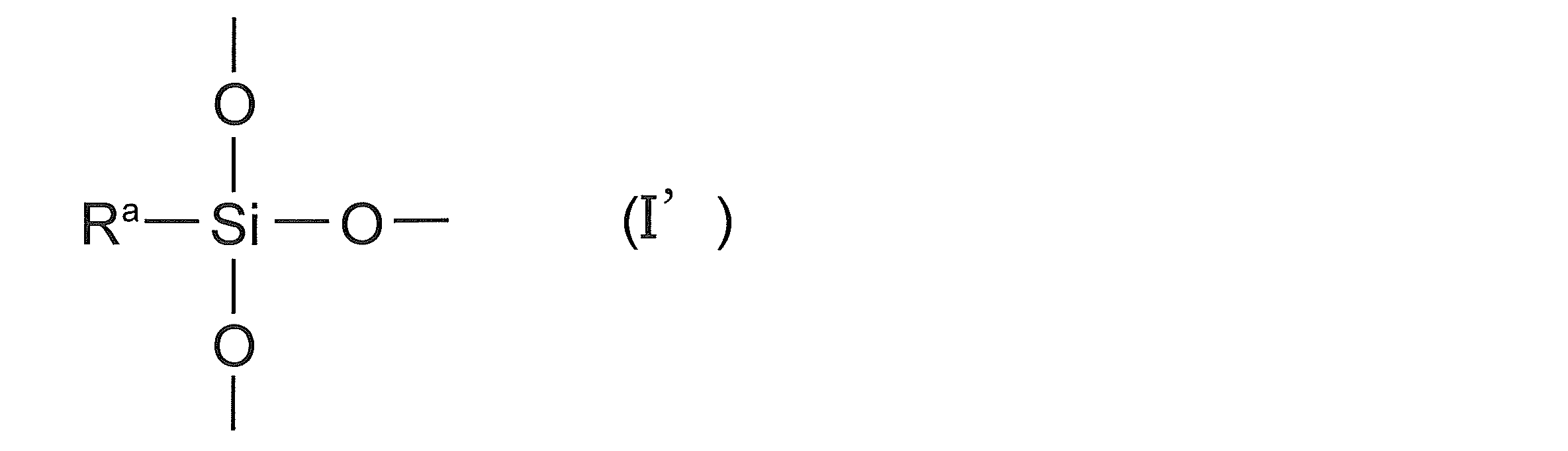
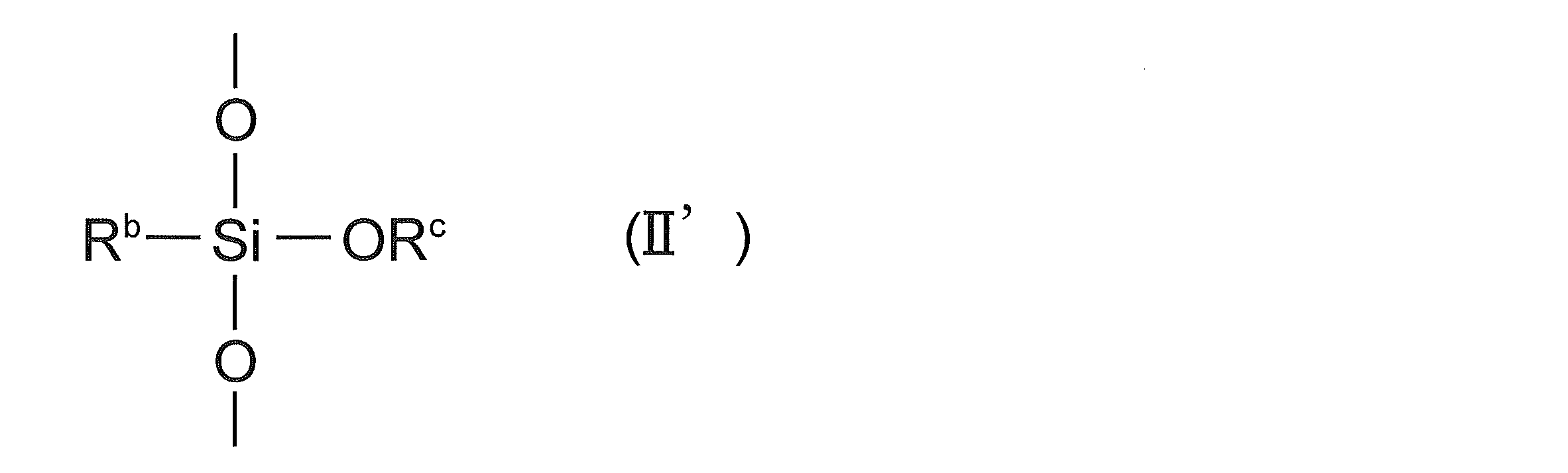
上記式(I)中のRa(式(I')中のRaも同じ)及び式(II)中のRb(式(II')中のRbも同じ)は、それぞれ、エポキシ基を含有する基、置換若しくは無置換のアリール基、置換若しくは無置換のアラルキル基、置換若しくは無置換のシクロアルキル基、置換若しくは無置換のアルキル基、置換若しくは無置換のアルケニル基、又は水素原子を示す。Ra及びRbの具体例としては、上記式(1)におけるR1、上記式(2)におけるR2と同様のものが例示される。なお、式(I)中のRa及び式(II)中のRbは、それぞれ、前記ポリオルガノシルセスキオキサンの原料として使用した加水分解性三官能シラン化合物におけるケイ素原子に結合した基(アルコキシ基及びハロゲン原子以外の基;例えば、後述の式(a)~(c)におけるR1、R2、水素原子等)に由来する。
上記式(II)中のRc(式(II')中のRcも同じ)は、水素原子又は炭素数1~4のアルキル基を示す。炭素数1~4のアルキル基としては、例えば、メチル基、エチル基、プロピル基、イソプロピル基、ブチル基、イソブチル基等の炭素数1~4の直鎖又は分岐鎖状のアルキル基が挙げられる。式(II)中のRcにおけるアルキル基は、一般的には、前記ポリオルガノシルセスキオキサンの原料として使用した加水分解性シラン化合物におけるアルコキシ基(例えば、後述のX1~X3としてのアルコキシ基等)を形成するアルキル基に由来する。
前記ポリオルガノシルセスキオキサンにおける上記割合[T3体/T2体]は、例えば、29Si-NMRスペクトル測定により求めることができる。29Si-NMRスペクトルにおいて、上記式(I)で表される構成単位(T3体)におけるケイ素原子と、上記式(II)で表される構成単位(T2体)におけるケイ素原子とは、異なる位置(化学シフト)にシグナル(ピーク)を示すため、これらそれぞれのピークの積分比を算出することにより、上記割合[T3体/T2体]が求められる。具体的には、例えば、前記ポリオルガノシルセスキオキサンが、上記式(1)で表され、R1が2-(3',4'-エポキシシクロヘキシル)エチル基である構成単位を有する場合には、上記式(I)で表される構造(T3体)におけるケイ素原子のシグナルは-64~-70ppmに現れ、上記式(II)で表される構造(T2体)におけるケイ素原子のシグナルは-54~-60ppmに現れる。従って、この場合、-64~-70ppmのシグナル(T3体)と-54~-60ppmのシグナル(T2体)の積分比を算出することによって、上記割合[T3体/T2体]を求めることができる。
前記ポリオルガノシルセスキオキサンの29Si-NMRスペクトルは、例えば、下記の装置及び条件により測定することができる。
測定装置:商品名「JNM-ECA500NMR」(日本電子(株)製)
溶媒:重クロロホルム
積算回数:1800回
測定温度:25℃
測定装置:商品名「JNM-ECA500NMR」(日本電子(株)製)
溶媒:重クロロホルム
積算回数:1800回
測定温度:25℃
前記ポリオルガノシルセスキオキサンの上記割合[T3体/T2体]が5以上であることは、前記ポリオルガノシルセスキオキサンにおいてT3体に対し一定以上のT2体が存在していることを意味する。このようなT2体としては、例えば、下記式(4)で表される構成単位、下記式(5)で表される構成単位、下記式(6)で表される構成単位等が挙げられる。下記式(4)におけるR1及び下記式(5)におけるR2は、それぞれ上記式(1)におけるR1及び上記式(2)におけるR2と同じである。下記式(4)~(6)におけるRcは、式(II)におけるRcと同じく、水素原子又は炭素数1~4のアルキル基を示す。



一般に、完全カゴ型シルセスキオキサンは、T3体のみにより構成されたポリオルガノシルセスキオキサンであり、分子中にT2体が存在しない。即ち、上記割合[T3体/T2体]が5以上であって、数平均分子量が1000~3000、分子量分散度が1.0~3.0であり、さらに後述のようにFT-IRスペクトルにおいて1100cm-1付近に一つの固有吸収ピークを有する場合の前記ポリオルガノシルセスキオキサンは、不完全カゴ型シルセスキオキサン構造を有することが示唆される。
前記ポリオルガノシルセスキオキサンがカゴ型(不完全カゴ型)シルセスキオキサン構造を有することは、前記ポリオルガノシルセスキオキサンが、FT-IRスペクトルにおいて1050cm-1付近と1150cm-1付近にそれぞれ固有吸収ピークを有せず、1100cm-1付近に一つの固有吸収ピークを有することから確認される[参考文献:R.H.Raney, M.Itoh, A.Sakakibara and T.Suzuki, Chem. Rev. 95, 1409(1995)]。これに対して、一般に、FT-IRスペクトルにおいて1050cm-1付近と1150cm-1付近にそれぞれ固有吸収ピークを有する場合には、ラダー型シルセスキオキサン構造を有すると同定される。なお、ポリオルガノシルセスキオキサンのFT-IRスペクトルは、例えば、下記の装置及び条件により測定することができる。
測定装置:商品名「FT-720」((株)堀場製作所製)
測定方法:透過法
分解能:4cm-1
測定波数域:400~4000cm-1
積算回数:16回
測定装置:商品名「FT-720」((株)堀場製作所製)
測定方法:透過法
分解能:4cm-1
測定波数域:400~4000cm-1
積算回数:16回
前記ポリオルガノシルセスキオキサンにおけるシロキサン構成単位の全量[全シロキサン構成単位;M単位、D単位、T単位、及びQ単位の全量](100モル%)に対する、上記式(1)で表される構成単位及び上記式(4)で表される構成単位の割合(総量)は、上述のように、55~100モル%であり、好ましくは65~100モル%、さらに好ましくは80~99モル%である。上記割合を55モル%以上とすることにより、硬化性組成物の硬化性が向上し、また、ハードコート層の表面硬度が著しく高くなる。なお、前記ポリオルガノシルセスキオキサンにおける各シロキサン構成単位の割合は、例えば、原料の組成やNMRスペクトル測定等により算出できる。
前記ポリオルガノシルセスキオキサンにおけるシロキサン構成単位の全量[全シロキサン構成単位;M単位、D単位、T単位、及びQ単位の全量](100モル%)に対する、上記式(2)で表される構成単位及び上記式(5)で表される構成単位の割合(総量)は、特に限定されないが、0~70モル%が好ましく、より好ましくは0~60モル%、さらに好ましくは0~40モル%、特に好ましくは1~15モル%である。上記割合を70モル%以下とすることにより、相対的に式(1)で表される構成単位及び式(4)で表される構成単位の割合を多くすることができるため、硬化性組成物の硬化性が向上し、ハードコート層としたときの表面硬度がより高くなる傾向がある。一方、上記割合を1モル%以上とすることにより、ハードコート層としたときのガスバリア性が向上する傾向がある。
前記ポリオルガノシルセスキオキサンにおけるシロキサン構成単位の全量[全シロキサン構成単位;M単位、D単位、T単位、及びQ単位の全量](100モル%)に対する、上記式(1)で表される構成単位、上記式(2)で表される構成単位、上記式(4)で表される構成単位、及び上記式(5)で表される構成単位の割合(総量)は、特に限定されないが、60~100モル%が好ましく、より好ましくは70~100モル%、さらに好ましくは80~100モル%である。上記割合を60モル%以上とすることにより、ハードコート層としたときの表面硬度がより高くなる傾向がある。
前記ポリオルガノシルセスキオキサンのゲルパーミエーションクロマトグラフィーによる標準ポリスチレン換算の数平均分子量(Mn)は、上述のように、1000~3000であり、好ましくは1000~2800、より好ましくは1100~2600である。数平均分子量を1000以上とすることにより、硬化物の耐熱性、耐擦傷性、接着性がより向上する。一方、数平均分子量を3000以下とすることにより、硬化性組成物における他の成分との相溶性が向上し、ハードコート層としたときの耐熱性がより向上する。
前記ポリオルガノシルセスキオキサンのゲルパーミエーションクロマトグラフィーによる標準ポリスチレン換算の分子量分散度(Mw/Mn)は、上述のように、1.0~3.0であり、好ましくは1.1~2.0、より好ましくは1.2~1.9である。分子量分散度を3.0以下とすることにより、ハードコート層としたときの表面硬度がより高くなる。一方、分子量分散度を1.0以上とすることにより、液状となりやすく、取り扱い性が向上する傾向がある。
なお、前記ポリオルガノシルセスキオキサンの数平均分子量、分子量分散度は、下記の装置及び条件により測定することができる。
測定装置:商品名「LC-20AD」((株)島津製作所製)
カラム:Shodex KF-801×2本、KF-802、及びKF-803(昭和電工(株)製)
測定温度:40℃
溶離液:THF、試料濃度0.1~0.2重量%
流量:1mL/分
検出器:UV-VIS検出器(商品名「SPD-20A」、(株)島津製作所製)
分子量:標準ポリスチレン換算
測定装置:商品名「LC-20AD」((株)島津製作所製)
カラム:Shodex KF-801×2本、KF-802、及びKF-803(昭和電工(株)製)
測定温度:40℃
溶離液:THF、試料濃度0.1~0.2重量%
流量:1mL/分
検出器:UV-VIS検出器(商品名「SPD-20A」、(株)島津製作所製)
分子量:標準ポリスチレン換算
前記ポリオルガノシルセスキオキサンの空気雰囲気下における5%重量減少温度(Td5)は、330℃以上(例えば、330~450℃)が好ましく、より好ましくは340℃以上、さらに好ましくは350℃以上である。5%重量減少温度が330℃以上であることにより、硬化物の耐熱性がより向上する傾向がある。特に、前記ポリオルガノシルセスキオキサンが、上記割合[T3体/T2体]が5以上であって、数平均分子量が1000~3000、分子量分散度が1.0~3.0であり、FT-IRスペクトルにおいて1100cm-1付近に一つの固有ピークを有するものであることにより、その5%重量減少温度は330℃以上に制御される。なお、5%重量減少温度は、一定の昇温速度で加熱した時に加熱前の重量の5%が減少した時点での温度であり、耐熱性の指標となる。上記5%重量減少温度は、TGA(熱重量分析)により、空気雰囲気下、昇温速度5℃/分の条件で測定することができる。
前記ポリオルガノシルセスキオキサンは、公知乃至慣用のポリシロキサンの製造方法により製造することができ、例えば、1種又は2種以上の加水分解性シラン化合物を加水分解及び縮合させる方法により製造できる。但し、上記加水分解性シラン化合物としては、上述の式(1)で表される構成単位を形成するための加水分解性三官能シラン化合物(下記式(a)で表される化合物)を必須の加水分解性シラン化合物として使用する必要がある。
より具体的には、例えば、前記ポリオルガノシルセスキオキサンにおけるシルセスキオキサン構成単位(T単位)を形成するための加水分解性シラン化合物である下記式(a)で表される化合物、必要に応じてさらに、下記式(b)で表される化合物、下記式(c)で表される化合物を、加水分解及び縮合させる方法により、前記ポリオルガノシルセスキオキサンを製造できる。



上記式(a)で表される化合物は、前記ポリオルガノシルセスキオキサンにおける式(1)で表される構成単位を形成する化合物である。式(a)中のR1は、上記式(1)におけるR1と同じく、エポキシ基を含有する基を示す。即ち、式(a)中のR1としては、上記式(1a)で表される基、上記式(1b)で表される基、上記式(1c)で表される基、上記式(1d)で表される基が好ましく、より好ましくは上記式(1a)で表される基、上記式(1c)で表される基、さらに好ましくは上記式(1a)で表される基、特に好ましくは上記式(1a)で表される基であって、R1aがエチレン基である基[中でも、2-(3',4'-エポキシシクロヘキシル)エチル基]である。
上記式(a)中のX1は、アルコキシ基又はハロゲン原子を示す。X1におけるアルコキシ基としては、例えば、メトキシ基、エトキシ基、プロポキシ基、イソプロピルオキシ基、ブトキシ基、イソブチルオキシ基等の炭素数1~4のアルコキシ基等が挙げられる。また、X1におけるハロゲン原子としては、例えば、フッ素原子、塩素原子、臭素原子、ヨウ素原子等が挙げられる。中でもX1としては、アルコキシ基が好ましく、より好ましくはメトキシ基、エトキシ基である。なお、3つのX1は、それぞれ同一であってもよいし、異なっていてもよい。
上記式(b)で表される化合物は、前記ポリオルガノシルセスキオキサンにおける式(2)で表される構成単位を形成する化合物である。式(b)中のR2は、上記式(2)におけるR2と同じく、置換若しくは無置換のアリール基、置換若しくは無置換のアラルキル基、置換若しくは無置換のシクロアルキル基、置換若しくは無置換のアルキル基、又は、置換若しくは無置換のアルケニル基を示す。即ち、式(b)中のR2としては、置換若しくは無置換のアリール基、置換若しくは無置換のアルキル基、置換若しくは無置換のアルケニル基が好ましく、より好ましくは置換若しくは無置換のアリール基、さらに好ましくはフェニル基である。
上記式(b)中のX2は、アルコキシ基又はハロゲン原子を示す。X2の具体例としては、X1として例示したものが挙げられる。中でも、X2としては、アルコキシ基が好ましく、より好ましくはメトキシ基、エトキシ基である。なお、3つのX2は、それぞれ同一であってもよいし、異なっていてもよい。
上記式(c)で表される化合物は、前記ポリオルガノシルセスキオキサンにおける式(3)で表される構成単位を形成する化合物である。上記式(c)中のX3は、アルコキシ基又はハロゲン原子を示す。X3の具体例としては、X1として例示したものが挙げられる。中でも、X3としては、アルコキシ基が好ましく、より好ましくはメトキシ基、エトキシ基である。なお、3つのX3は、それぞれ同一であってもよいし、異なっていてもよい。
上記加水分解性シラン化合物としては、上記式(a)~(c)で表される化合物以外の加水分解性シラン化合物を併用してもよい。例えば、上記式(a)~(c)で表される化合物以外の加水分解性三官能シラン化合物、M単位を形成する加水分解性単官能シラン化合物、D単位を形成する加水分解性二官能シラン化合物、Q単位を形成する加水分解性四官能シラン化合物等が挙げられる。
上記加水分解性シラン化合物の使用量や組成は、所望するポリオルガノシルセスキオキサンの構造に応じて適宜調整できる。例えば、上記式(a)で表される化合物の使用量は、特に限定されないが、使用する加水分解性シラン化合物の全量(100モル%)に対して、55~100モル%が好ましく、より好ましくは65~100モル%、さらに好ましくは80~99モル%である。
また、上記式(b)で表される化合物の使用量は、使用する加水分解性シラン化合物の全量(100モル%)に対して、0~70モル%が好ましく、より好ましくは0~60モル%、さらに好ましくは0~40モル%、特に好ましくは1~15モル%である。
さらに、使用する加水分解性シラン化合物の全量(100モル%)に対する式(a)で表される化合物と式(b)で表される化合物の割合(総量の割合)は、60~100モル%が好ましく、より好ましくは70~100モル%、さらに好ましくは80~100モル%である。
また、上記加水分解性シラン化合物として2種以上を併用する場合、これらの加水分解性シラン化合物の加水分解及び縮合反応は、同時に行うこともできるし、逐次行うこともできる。上記反応を逐次行う場合、反応を行う順序は特に限定されない。
上記加水分解性シラン化合物の加水分解及び縮合反応は、溶媒の存在下で行うこともできるし、非存在下で行うこともできる。中でも溶媒の存在下で行うことが好ましい。上記溶媒としては、例えば、ベンゼン、トルエン、キシレン、エチルベンゼン等の芳香族炭化水素;ジエチルエーテル、ジメトキシエタン、テトラヒドロフラン、ジオキサン等のエーテル;アセトン、メチルエチルケトン、メチルイソブチルケトン等のケトン;酢酸メチル、酢酸エチル、酢酸イソプロピル、酢酸ブチル等のエステル;N,N-ジメチルホルムアミド、N,N-ジメチルアセトアミド等のアミド;アセトニトリル、プロピオニトリル、ベンゾニトリル等のニトリル;メタノール、エタノール、イソプロピルアルコール、ブタノール等のアルコール等が挙げられる。上記溶媒としては、中でも、ケトン、エーテルが好ましい。なお、溶媒は1種を単独で使用することもできるし、2種以上を組み合わせて使用することもできる。
溶媒の使用量は、特に限定されず、加水分解性シラン化合物の全量100重量部に対して、0~2000重量部の範囲内で、所望の反応時間等に応じて、適宜調整することができる。
上記加水分解性シラン化合物の加水分解及び縮合反応は、触媒及び水の存在下で進行させることが好ましい。上記触媒は、酸触媒であってもアルカリ触媒であってもよい。上記酸触媒としては、例えば、塩酸、硫酸、硝酸、リン酸、ホウ酸等の鉱酸;リン酸エステル;酢酸、蟻酸、トリフルオロ酢酸等のカルボン酸;メタンスルホン酸、トリフルオロメタンスルホン酸、p-トルエンスルホン酸等のスルホン酸;活性白土等の固体酸;塩化鉄等のルイス酸等が挙げられる。上記アルカリ触媒としては、例えば、水酸化リチウム、水酸化ナトリウム、水酸化カリウム、水酸化セシウム等のアルカリ金属の水酸化物;水酸化マグネシウム、水酸化カルシウム、水酸化バリウム等のアルカリ土類金属の水酸化物;炭酸リチウム、炭酸ナトリウム、炭酸カリウム、炭酸セシウム等のアルカリ金属の炭酸塩;炭酸マグネシウム等のアルカリ土類金属の炭酸塩;炭酸水素リチウム、炭酸水素ナトリウム、炭酸水素カリウム、炭酸水素セシウム等のアルカリ金属の炭酸水素塩;酢酸リチウム、酢酸ナトリウム、酢酸カリウム、酢酸セシウム等のアルカリ金属の有機酸塩(例えば、酢酸塩);酢酸マグネシウム等のアルカリ土類金属の有機酸塩(例えば、酢酸塩);リチウムメトキシド、ナトリウムメトキシド、ナトリウムエトキシド、ナトリウムイソプロポキシド、カリウムエトキシド、カリウムt-ブトキシド等のアルカリ金属のアルコキシド;ナトリウムフェノキシド等のアルカリ金属のフェノキシド;トリエチルアミン、N-メチルピペリジン、1,8-ジアザビシクロ[5.4.0]ウンデカ-7-エン、1,5-ジアザビシクロ[4.3.0]ノナ-5-エン等のアミン類(第3級アミン等);ピリジン、2,2'-ビピリジル、1,10-フェナントロリン等の含窒素芳香族複素環化合物等が挙げられる。なお、触媒は1種を単独で使用することもできるし、2種以上を組み合わせて使用することもできる。また、触媒は、水や溶媒等に溶解又は分散させた状態で使用することもできる。
上記触媒の使用量は、特に限定されず、加水分解性シラン化合物の全量1モルに対して、0.002~0.200モルの範囲内で、適宜調整することができる。
上記加水分解及び縮合反応に際しての水の使用量は、特に限定されず、加水分解性シラン化合物の全量1モルに対して、0.5~20モルの範囲内で、適宜調整することができる。
上記水の添加方法は、特に限定されず、使用する水の全量(全使用量)を一括で添加してもよいし、逐次的に添加してもよい。逐次的に添加する際には、連続的に添加してもよいし、間欠的に添加してもよい。
上記加水分解性シラン化合物の加水分解及び縮合反応を行う際の反応条件としては、特に、前記ポリオルガノシルセスキオキサンにおける上記割合[T3体/T2体]が5以上となるような反応条件を選択することが重要である。上記加水分解及び縮合反応の反応温度は、特に限定されないが、40~100℃が好ましく、より好ましくは45~80℃である。反応温度を上記範囲に制御することにより、上記割合[T3体/T2体]をより効率的に5以上に制御できる傾向がある。また、上記加水分解及び縮合反応の反応時間は、特に限定されないが、0.1~10時間が好ましく、より好ましくは1.5~8時間である。また、上記加水分解及び縮合反応は、常圧下で行うこともできるし、加圧下又は減圧下で行うこともできる。なお、上記加水分解及び縮合反応を行う際の雰囲気は、特に限定されず、例えば、窒素雰囲気、アルゴン雰囲気等の不活性ガス雰囲気下、空気下等の酸素存在下等のいずれであってもよいが、不活性ガス雰囲気下が好ましい。
上記加水分解性シラン化合物の加水分解及び縮合反応により、ポリオルガノシルセスキオキサンが得られる。上記加水分解及び縮合反応の終了後には、エポキシ基の開環を抑制するために触媒を中和することが好ましい。また、前記ポリオルガノシルセスキオキサンを、例えば、水洗、酸洗浄、アルカリ洗浄、濾過、濃縮、蒸留、抽出、晶析、再結晶、カラムクロマトグラフィー等の分離手段や、これらを組み合わせた分離手段等により分離精製してもよい。
前記ポリオルガノシルセスキオキサンの含有量(配合量)は、溶媒を除くハードコート形成用硬化性組成物の全量(100重量%)に対して、70重量%以上、100重量%未満が好ましく、より好ましくは80~99.8重量%、さらに好ましくは90~99.5重量%である。前記ポリオルガノシルセスキオキサンの含有量を70重量%以上とすることにより、硬化物の表面硬度や接着性がより向上する傾向がある。一方、前記ポリオルガノシルセスキオキサンの含有量を100重量%未満とすることにより、硬化触媒を含有させることができ、これにより硬化性組成物の硬化をより効率的に進行させることができる傾向がある。
カチオン硬化性化合物の全量(100重量%)に対する前記ポリオルガノシルセスキオキサンの割合は、70~100重量%が好ましく、より好ましくは75~98重量%、さらに好ましくは80~95重量%である。前記ポリオルガノシルセスキオキサンの含有量を70重量%以上とすることにより、ハードコート層としたときの表面硬度がより向上する傾向がある。
前記ポリオルガノシルセスキオキサンは、上述の構成を有するため、当該ポリオルガノシルセスキオキサンを必須成分として含む硬化性組成物を硬化させることにより、高い表面硬度かつ耐熱性を有し、可とう性及び加工性に優れたハードコート層を形成できる。
(表面に(メタ)アクリロイル基を含む基を有するシリカ粒子)
本発明において表面に(メタ)アクリロイル基を含む基を有するシリカ粒子は、リコート性を付与し、耐擦傷性や表面硬度をより向上させる性質を有する。前記シリカ粒子は、シリカ粒子の表面に無数の水酸基(Si-OH基)が存在し、硬化時に当該水酸基と前記ポリオルガノシルセスキオキサンとが反応することで、ポリオルガノシルセスキオキサンの硬化後の架橋密度が向上する。さらに、硬化時に複数の前記シリカ粒子における(メタ)アクリロイル基どうしが結合することで、硬化後の架橋密度が向上する。このように硬化後の架橋密度が向上することで、ハードコート層における耐擦傷性やリコート性が向上する。また、前記シリカ粒子は、表面に(メタ)アクリロイル基を有することで、硬化性組成物における安定性を付与できると考えられる。前記の安定性とは、硬化前の硬化性組成物の調製段階において、前記シリカ粒子とポリオルガノシルセスキオキサンとが反応して、硬化性組成物の粘度が著しく上昇(ゲル化)したり、固化したりしないことを言う。(メタ)アクリロイル基を含む基などの官能基を表面に有さない通常のシリカ粒子(SiO2粒子)を用いた場合、シリカ粒子どうしが凝集し、硬化性組成物がゲル化するおそれがある。前記シリカ粒子は、(メタ)アクリロイル基以外の官能基(例えば、シリコーン変性基)を有していてもよい。なお、(メタ)アクリロイル基は、アクリロイル基(アクリル基)及びメタアクリロイル基(メタクリル基)の総称である。なお、本発明では、前記シリカ粒子は、カチオン硬化性化合物に含まれるものとする。
本発明において表面に(メタ)アクリロイル基を含む基を有するシリカ粒子は、リコート性を付与し、耐擦傷性や表面硬度をより向上させる性質を有する。前記シリカ粒子は、シリカ粒子の表面に無数の水酸基(Si-OH基)が存在し、硬化時に当該水酸基と前記ポリオルガノシルセスキオキサンとが反応することで、ポリオルガノシルセスキオキサンの硬化後の架橋密度が向上する。さらに、硬化時に複数の前記シリカ粒子における(メタ)アクリロイル基どうしが結合することで、硬化後の架橋密度が向上する。このように硬化後の架橋密度が向上することで、ハードコート層における耐擦傷性やリコート性が向上する。また、前記シリカ粒子は、表面に(メタ)アクリロイル基を有することで、硬化性組成物における安定性を付与できると考えられる。前記の安定性とは、硬化前の硬化性組成物の調製段階において、前記シリカ粒子とポリオルガノシルセスキオキサンとが反応して、硬化性組成物の粘度が著しく上昇(ゲル化)したり、固化したりしないことを言う。(メタ)アクリロイル基を含む基などの官能基を表面に有さない通常のシリカ粒子(SiO2粒子)を用いた場合、シリカ粒子どうしが凝集し、硬化性組成物がゲル化するおそれがある。前記シリカ粒子は、(メタ)アクリロイル基以外の官能基(例えば、シリコーン変性基)を有していてもよい。なお、(メタ)アクリロイル基は、アクリロイル基(アクリル基)及びメタアクリロイル基(メタクリル基)の総称である。なお、本発明では、前記シリカ粒子は、カチオン硬化性化合物に含まれるものとする。
前記シリカ粒子は、水や有機溶媒などの公知乃至慣用の一般的な分散媒に分散させた状態の分散液(ディスパージョン)を用いてもよい。また、シリカ粒子に(メタ)アクリロイル基を含む基を有するシランカップリング剤を反応させたものを前記シリカ粒子として用いてもよい。前記シリカ粒子としては、例えば、商品名「BYK-LPX 22699」、「NANOBYK-3650」、「NANOBYK-3651」、および「NANOBYK-3652」(以上、ビックケミー・ジャパン(株)製)を用いることができる。
前記シリカ粒子の粒径は、例えば、1~100nm、好ましくは3~50nm、より好ましくは5~30nmである。シリカ粒子の粒径が上記範囲であると、リコート性をより向上させることができる。
前記ハードコート層形成用硬化性組成物における、表面に(メタ)アクリロイル基を含む基を有するシリカ粒子の割合は、前記ポリオルガノシルセスキオキサン100重量部に対して、例えば0.01~20重量部であり、好ましくは0.05~15重量部であり、より好ましくは0.01~10重量部であり、さらに好ましくは0.2~5重量部である。前記シリカ粒子の割合を0.01重量部以上とすることにより、表面の外観を良くすることができ、ハードコート層に十分なリコート性を付与することができる。また、シリカ粒子の割合を20重量部以下とすることにより、ハードコート層の表面硬度を高くすることができる。
(光カチオン重合開始剤)
前記ハードコート層形成用硬化性組成物は、タックフリーとなるまでの硬化時間が短縮できる点で、硬化触媒として光カチオン重合開始剤を含むことが好ましい。
前記ハードコート層形成用硬化性組成物は、タックフリーとなるまでの硬化時間が短縮できる点で、硬化触媒として光カチオン重合開始剤を含むことが好ましい。
上記光カチオン重合開始剤としては、公知乃至慣用の光カチオン重合開始剤を使用することができ、例えば、スルホニウム塩(スルホニウムイオンとアニオンとの塩)、ヨードニウム塩(ヨードニウムイオンとアニオンとの塩)、セレニウム塩(セレニウムイオンとアニオンとの塩)、アンモニウム塩(アンモニウムイオンとアニオンとの塩)、ホスホニウム塩(ホスホニウムイオンとアニオンとの塩)、遷移金属錯体イオンとアニオンとの塩等が挙げられる。これらは1種を単独で又は2種以上を組み合わせて使用することができる。
上記スルホニウム塩としては、例えば、商品名「HS-1PC」(サンアプロ(株)製)、商品名「LW-S1」(サンアプロ(株)製)、トリフェニルスルホニウム塩、トリ-p-トリルスルホニウム塩、トリ-o-トリルスルホニウム塩、トリス(4-メトキシフェニル)スルホニウム塩、1-ナフチルジフェニルスルホニウム塩、2-ナフチルジフェニルスルホニウム塩、トリス(4-フルオロフェニル)スルホニウム塩、トリ-1-ナフチルスルホニウム塩、トリ-2-ナフチルスルホニウム塩、トリス(4-ヒドロキシフェニル)スルホニウム塩、ジフェニル[4-(フェニルチオ)フェニル]スルホニウム塩、4-(p-トリルチオ)フェニルジ-(p-フェニル)スルホニウム塩等のトリアリールスルホニウム塩;ジフェニルフェナシルスルホニウム塩、ジフェニル4-ニトロフェナシルスルホニウム塩、ジフェニルベンジルスルホニウム塩、ジフェニルメチルスルホニウム塩等のジアリールスルホニウム塩;フェニルメチルベンジルスルホニウム塩、4-ヒドロキシフェニルメチルベンジルスルホニウム塩、4-メトキシフェニルメチルベンジルスルホニウム塩等のモノアリールスルホニウム塩;ジメチルフェナシルスルホニウム塩、フェナシルテトラヒドロチオフェニウム塩、ジメチルベンジルスルホニウム塩等のトリアルキルスルホニウム塩等が挙げられる。
上記ジフェニル[4-(フェニルチオ)フェニル]スルホニウム塩としては、例えば、商品名「CPI-101A」(サンアプロ(株)製、ジフェニル[4-(フェニルチオ)フェニル]スルホニウムヘキサフルオロアンチモネート50%炭酸プロピレン溶液)、商品名「CPI-100P」(サンアプロ(株)製、ジフェニル[4-(フェニルチオ)フェニル]スルホニウムヘキサフルオロホスファート50%炭酸プロピレン溶液)等の市販品を使用できる。また、上記トリアリールスルホニウム塩としては、例えば、商品名「K1-S」(サンアプロ(株)製、非アンチモン系トリアリールスルホニウム塩)等の市販品を使用してもよい。
上記ヨードニウム塩としては、例えば、商品名「UV9380C」(モメンティブ・パフォーマンス・マテリアルズ・ジャパン合同会社製、ビス(4-ドデシルフェニル)ヨードニウム=ヘキサフルオロアンチモネート45%アルキルグリシジルエーテル溶液)、商品名「RHODORSIL PHOTOINITIATOR 2074」(ローディア・ジャパン(株)製、テトラキス(ペンタフルオロフェニル)ボレート=[(1-メチルエチル)フェニル](メチルフェニル)ヨードニウム)、商品名「WPI-124」(和光純薬工業(株)製)、ジフェニルヨードニウム塩、ジ-p-トリルヨードニウム塩、ビス(4-ドデシルフェニル)ヨードニウム塩、ビス(4-メトキシフェニル)ヨードニウム塩等が挙げられる。
上記セレニウム塩としては、例えば、トリフェニルセレニウム塩、トリ-p-トリルセレニウム塩、トリ-o-トリルセレニウム塩、トリス(4-メトキシフェニル)セレニウム塩、1-ナフチルジフェニルセレニウム塩等のトリアリールセレニウム塩;ジフェニルフェナシルセレニウム塩、ジフェニルベンジルセレニウム塩、ジフェニルメチルセレニウム塩等のジアリールセレニウム塩;フェニルメチルベンジルセレニウム塩等のモノアリールセレニウム塩;ジメチルフェナシルセレニウム塩等のトリアルキルセレニウム塩等が挙げられる。
上記アンモニウム塩としては、例えば、テトラメチルアンモニウム塩、エチルトリメチルアンモニウム塩、ジエチルジメチルアンモニウム塩、トリエチルメチルアンモニウム塩、テトラエチルアンモニウム塩、トリメチル-n-プロピルアンモニウム塩、トリメチル-n-ブチルアンモニウム塩等のテトラアルキルアンモニウム塩;N,N-ジメチルピロリジウム塩、N-エチル-N-メチルピロリジウム塩等のピロリジウム塩;N,N'-ジメチルイミダゾリニウム塩、N,N'-ジエチルイミダゾリニウム塩等のイミダゾリニウム塩;N,N'-ジメチルテトラヒドロピリミジウム塩、N,N'-ジエチルテトラヒドロピリミジウム塩等のテトラヒドロピリミジウム塩;N,N-ジメチルモルホリニウム塩、N,N-ジエチルモルホリニウム塩等のモルホリニウム塩;N,N-ジメチルピペリジニウム塩、N,N-ジエチルピペリジニウム塩等のピペリジニウム塩;N-メチルピリジニウム塩、N-エチルピリジニウム塩等のピリジニウム塩;N,N'-ジメチルイミダゾリウム塩等のイミダゾリウム塩;N-メチルキノリウム塩等のキノリウム塩;N-メチルイソキノリウム塩等のイソキノリウム塩;ベンジルベンゾチアゾニウム塩等のチアゾニウム塩;ベンジルアクリジウム塩等のアクリジウム塩等が挙げられる。
上記ホスホニウム塩としては、例えば、テトラフェニルホスホニウム塩、テトラ-p-トリルホスホニウム塩、テトラキス(2-メトキシフェニル)ホスホニウム塩等のテトラアリールホスホニウム塩;トリフェニルベンジルホスホニウム塩等のトリアリールホスホニウム塩;トリエチルベンジルホスホニウム塩、トリブチルベンジルホスホニウム塩、テトラエチルホスホニウム塩、テトラブチルホスホニウム塩、トリエチルフェナシルホスホニウム塩等のテトラアルキルホスホニウム塩等が挙げられる。
上記遷移金属錯体イオンの塩としては、例えば、(η5-シクロペンタジエニル)(η6-トルエン)Cr+、(η5-シクロペンタジエニル)(η6-キシレン)Cr+等のクロム錯体カチオンの塩;(η5-シクロペンタジエニル)(η6-トルエン)Fe+、(η5-シクロペンタジエニル)(η6-キシレン)Fe+等の鉄錯体カチオンの塩等が挙げられる。
上述の塩を構成するアニオンとしては、例えば、SbF6
-、PF6
-、BF4
-、(CF3CF2)3PF3
-、(CF3CF2CF2)3PF3
-、(C6F5)4B-、(C6F5)4Ga-、スルホン酸アニオン(トリフルオロメタンスルホン酸アニオン、ペンタフルオロエタンスルホン酸アニオン、ノナフルオロブタンスルホン酸アニオン、メタンスルホン酸アニオン、ベンゼンスルホン酸アニオン、p-トルエンスルホン酸アニオン等)、(CF3SO2)3C-、(CF3SO2)2N-、過ハロゲン酸イオン、ハロゲン化スルホン酸イオン、硫酸イオン、炭酸イオン、アルミン酸イオン、ヘキサフルオロビスマス酸イオン、カルボン酸イオン、アリールホウ酸イオン、チオシアン酸イオン、硝酸イオン等が挙げられる。
前記ハードコート層形成用硬化性組成物における、光カチオン重合開始剤の含有量(配合量)は、前記ポリオルガノシルセスキオキサン100重量部に対して、0.01~3.0重量部が好ましく、より好ましくは0.05~3.0重量部、さらに好ましくは0.1~1.0重量部(例えば、0.3~1.0重量部)である。光カチオン重合開始剤の含有量を0.01重量部以上とすることにより、硬化反応を効率的に十分に進行させることができ、ハードコート層としたときの表面硬度がより向上する傾向がある。一方、光カチオン重合開始剤の含有量を3.0重量部以下とすることにより、硬化性組成物の保存性がいっそう向上したり、ハードコート層としたときの着色が抑制される傾向がある。
(その他のカチオン硬化性化合物)
ハードコート層形成用硬化性組成物は、さらに、前記シリカ粒子及び前記ポリオルガノシルセスキオキサン以外のカチオン硬化性化合物を含んでいてもよい。その他のカチオン硬化性化合物としては、公知乃至慣用のカチオン硬化性化合物を使用することができ、特に限定されないが、例えば、前記ポリオルガノシルセスキオキサン以外のエポキシ化合物(「その他のエポキシ化合物」と称する場合がある)、オキセタン化合物、ビニルエーテル化合物等が挙げられる。なお、前記ハードコート層形成用硬化性組成物においてその他のカチオン硬化性化合物は、1種を単独で使用することもできるし、2種以上を組み合わせて使用することもできる。
ハードコート層形成用硬化性組成物は、さらに、前記シリカ粒子及び前記ポリオルガノシルセスキオキサン以外のカチオン硬化性化合物を含んでいてもよい。その他のカチオン硬化性化合物としては、公知乃至慣用のカチオン硬化性化合物を使用することができ、特に限定されないが、例えば、前記ポリオルガノシルセスキオキサン以外のエポキシ化合物(「その他のエポキシ化合物」と称する場合がある)、オキセタン化合物、ビニルエーテル化合物等が挙げられる。なお、前記ハードコート層形成用硬化性組成物においてその他のカチオン硬化性化合物は、1種を単独で使用することもできるし、2種以上を組み合わせて使用することもできる。
上記その他のエポキシ化合物としては、分子内に1以上のエポキシ基(オキシラン環)を有する公知乃至慣用の化合物を使用することができ、特に限定されないが、例えば、脂環式エポキシ化合物(脂環式エポキシ樹脂)、芳香族エポキシ化合物(芳香族エポキシ樹脂)、脂肪族エポキシ化合物(脂肪族エポキシ樹脂)等が挙げられる。
上記脂環式エポキシ化合物としては、分子内に1個以上の脂環と1個以上のエポキシ基とを有する公知乃至慣用の化合物が挙げられ、特に限定されないが、例えば、(1)分子内に脂環を構成する隣接する2つの炭素原子と酸素原子とで構成されるエポキシ基(「脂環エポキシ基」と称する)を有する化合物;(2)脂環にエポキシ基が直接単結合で結合している化合物;(3)分子内に脂環及びグリシジルエーテル基を有する化合物(グリシジルエーテル型エポキシ化合物)等が挙げられる。
上記(1)分子内に脂環エポキシ基を有する化合物としては、下記式(i)で表される化合物が挙げられる。

上記式(i)中、Yは単結合又は連結基(1以上の原子を有する二価の基)を示す。上記連結基としては、例えば、二価の炭化水素基、炭素-炭素二重結合の一部又は全部がエポキシ化されたアルケニレン基、カルボニル基、エーテル結合、エステル結合、カーボネート基、アミド基、これらが複数個連結した基等が挙げられる。
上記二価の炭化水素基としては、炭素数が1~18の直鎖又は分岐鎖状のアルキレン基、二価の脂環式炭化水素基等が挙げられる。炭素数が1~18の直鎖又は分岐鎖状のアルキレン基としては、例えば、メチレン基、メチルメチレン基、ジメチルメチレン基、エチレン基、プロピレン基、トリメチレン基等が挙げられる。上記二価の脂環式炭化水素基としては、例えば、1,2-シクロペンチレン基、1,3-シクロペンチレン基、シクロペンチリデン基、1,2-シクロヘキシレン基、1,3-シクロヘキシレン基、1,4-シクロヘキシレン基、シクロヘキシリデン基等の二価のシクロアルキレン基(シクロアルキリデン基を含む)等が挙げられる。
上記炭素-炭素二重結合の一部又は全部がエポキシ化されたアルケニレン基(「エポキシ化アルケニレン基」と称する場合がある)におけるアルケニレン基としては、例えば、ビニレン基、プロペニレン基、1-ブテニレン基、2-ブテニレン基、ブタジエニレン基、ペンテニレン基、ヘキセニレン基、ヘプテニレン基、オクテニレン基等の炭素数2~8の直鎖又は分岐鎖状のアルケニレン基等が挙げられる。特に、上記エポキシ化アルケニレン基としては、炭素-炭素二重結合の全部がエポキシ化されたアルケニレン基が好ましく、より好ましくは炭素-炭素二重結合の全部がエポキシ化された炭素数2~4のアルケニレン基である。
上記式(i)で表される脂環式エポキシ化合物の代表的な例としては、3,4,3',4'-ジエポキシビシクロヘキサン、下記式(i-1)~(i-10)で表される化合物等が挙げられる。なお、下記式(i-5)、(i-7)中のl、mは、それぞれ1~30の整数を表す。下記式(i-5)中のR'は炭素数1~8のアルキレン基であり、中でも、メチレン基、エチレン基、プロピレン基、イソプロピレン基等の炭素数1~3の直鎖又は分岐鎖状のアルキレン基が好ましい。下記式(i-9)、(i-10)中のn1~n6は、それぞれ1~30の整数を示す。また、上記式(i)で表される脂環式エポキシ化合物としては、その他、例えば、2,2-ビス(3,4-エポキシシクロヘキシル)プロパン、1,2-ビス(3,4-エポキシシクロヘキシル)エタン、2,3-ビス(3,4-エポキシシクロヘキシル)オキシラン、ビス(3,4-エポキシシクロヘキシルメチル)エーテル等が挙げられる。
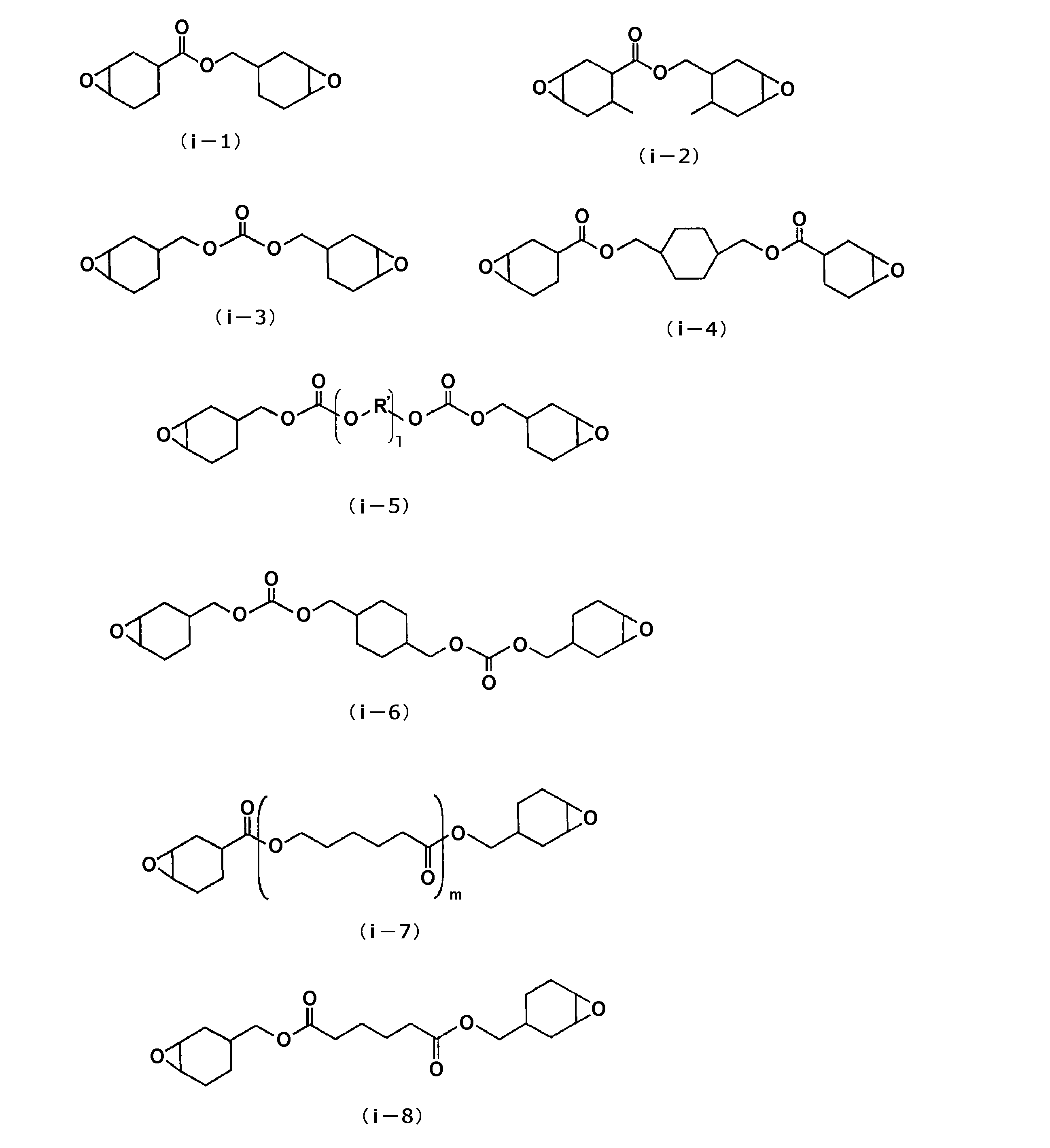
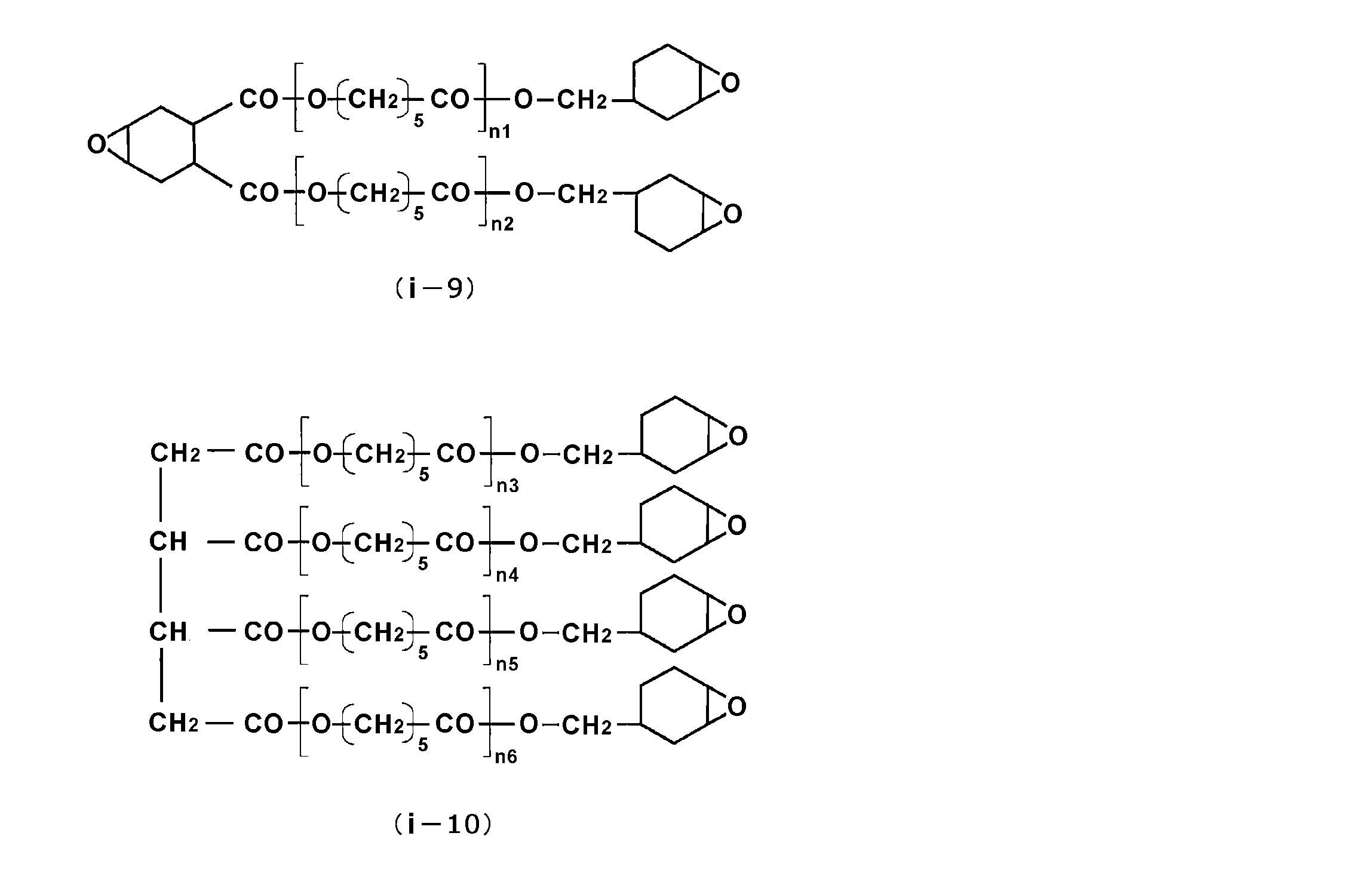
上述の(2)脂環にエポキシ基が直接単結合で結合している化合物としては、例えば、下記式(ii)で表される化合物等が挙げられる。

式(ii)中、R"は、p価のアルコールの構造式からp個の水酸基(-OH)を除いた基(p価の有機基)であり、p、nはそれぞれ自然数を表す。p価のアルコール[R"(OH)p]としては、2,2-ビス(ヒドロキシメチル)-1-ブタノール等の多価アルコール(炭素数1~15のアルコール等)等が挙げられる。pは1~6が好ましく、nは1~30が好ましい。pが2以上の場合、それぞれの( )内(外側の括弧内)の基におけるnは同一でもよく異なっていてもよい。上記式(ii)で表される化合物としては、具体的には、2,2-ビス(ヒドロキシメチル)-1-ブタノールの1,2-エポキシ-4-(2-オキシラニル)シクロヘキサン付加物[例えば、商品名「EHPE3150」((株)ダイセル製)等]等が挙げられる。
上述の(3)分子内に脂環及びグリシジルエーテル基を有する化合物としては、例えば、脂環式アルコール(特に、脂環式多価アルコール)のグリシジルエーテルが挙げられる。より詳しくは、例えば、2,2-ビス[4-(2,3-エポキシプロポキシ)シクロへキシル]プロパン、2,2-ビス[3,5-ジメチル-4-(2,3-エポキシプロポキシ)シクロへキシル]プロパンなどのビスフェノールA型エポキシ化合物を水素化した化合物(水素化ビスフェノールA型エポキシ化合物);ビス[o,o-(2,3-エポキシプロポキシ)シクロへキシル]メタン、ビス[o,p-(2,3-エポキシプロポキシ)シクロへキシル]メタン、ビス[p,p-(2,3-エポキシプロポキシ)シクロへキシル]メタン、ビス[3,5-ジメチル-4-(2,3-エポキシプロポキシ)シクロへキシル]メタンなどのビスフェノールF型エポキシ化合物を水素化した化合物(水素化ビスフェノールF型エポキシ化合物);水素化ビフェノール型エポキシ化合物;水素化フェノールノボラック型エポキシ化合物;水素化クレゾールノボラック型エポキシ化合物;ビスフェノールAの水素化クレゾールノボラック型エポキシ化合物;水素化ナフタレン型エポキシ化合物;トリスフェノールメタンから得られるエポキシ化合物の水素化エポキシ化合物;下記芳香族エポキシ化合物の水素化エポキシ化合物等が挙げられる。
上記芳香族エポキシ化合物としては、例えば、ビスフェノール類[例えば、ビスフェノールA、ビスフェノールF、ビスフェノールS、フルオレンビスフェノール等]と、エピハロヒドリンとの縮合反応により得られるエピビスタイプグリシジルエーテル型エポキシ樹脂;これらのエピビスタイプグリシジルエーテル型エポキシ樹脂を上記ビスフェノール類とさらに付加反応させることにより得られる高分子量エピビスタイプグリシジルエーテル型エポキシ樹脂;フェノール類[例えば、フェノール、クレゾール、キシレノール、レゾルシン、カテコール、ビスフェノールA、ビスフェノールF、ビスフェノールS等]とアルデヒド[例えば、ホルムアルデヒド、アセトアルデヒド、ベンズアルデヒド、ヒドロキシベンズアルデヒド、サリチルアルデヒド等]とを縮合反応させて得られる多価アルコール類を、さらにエピハロヒドリンと縮合反応させることにより得られるノボラック・アルキルタイプグリシジルエーテル型エポキシ樹脂;フルオレン環の9位に2つのフェノール骨格が結合し、かつこれらフェノール骨格のヒドロキシ基から水素原子を除いた酸素原子に、それぞれ、直接又はアルキレンオキシ基を介してグリシジル基が結合しているエポキシ化合物等が挙げられる。
上記脂肪族エポキシ化合物としては、例えば、環状構造を有しないq価のアルコール(qは自然数である)のグリシジルエーテル;一価又は多価カルボン酸[例えば、酢酸、プロピオン酸、酪酸、ステアリン酸、アジピン酸、セバシン酸、マレイン酸、イタコン酸等]のグリシジルエステル;エポキシ化亜麻仁油、エポキシ化大豆油、エポキシ化ひまし油等の二重結合を有する油脂のエポキシ化物;エポキシ化ポリブタジエン等のポリオレフィン(ポリアルカジエンを含む)のエポキシ化物等が挙げられる。なお、上記環状構造を有しないq価のアルコールとしては、例えば、メタノール、エタノール、1-プロピルアルコール、イソプロピルアルコール、1-ブタノール等の一価のアルコール;エチレングリコール、1,2-プロパンジオール、1,3-プロパンジオール、1,4-ブタンジオール、ネオペンチルグリコール、1,6-ヘキサンジオール、ジエチレングリコール、トリエチレングリコール、テトラエチレングリコール、ジプロピレングリコール、ポリエチレングリコール、ポリプロピレングリコール等の二価のアルコール;グリセリン、ジグリセリン、エリスリトール、トリメチロールエタン、トリメチロールプロパン、ペンタエリスリトール、ジペンタエリスリトール、ソルビトール等の三価以上の多価アルコール等が挙げられる。また、q価のアルコールは、ポリエーテルポリオール、ポリエステルポリオール、ポリカーボネートポリオール、ポリオレフィンポリオール等であってもよい。
上記オキセタン化合物としては、分子内に1以上のオキセタン環を有する公知乃至慣用の化合物が挙げられ、特に限定されないが、例えば、3,3-ビス(ビニルオキシメチル)オキセタン、3-エチル-3-(ヒドロキシメチル)オキセタン、3-エチル-3-(2-エチルヘキシルオキシメチル)オキセタン、3-エチル-3-[(フェノキシ)メチル]オキセタン、3-エチル-3-(ヘキシルオキシメチル)オキセタン、3-エチル-3-(クロロメチル)オキセタン、3,3-ビス(クロロメチル)オキセタン、1,4-ビス[(3-エチル-3-オキセタニルメトキシ)メチル]ベンゼン、ビス{[1-エチル(3-オキセタニル)]メチル}エーテル、4,4'-ビス[(3-エチル-3-オキセタニル)メトキシメチル]ビシクロヘキシル、1,4-ビス[(3-エチル-3-オキセタニル)メトキシメチル]シクロヘキサン、1,4-ビス{〔(3-エチル-3-オキセタニル)メトキシ〕メチル}ベンゼン、3-エチル-3-{〔(3-エチルオキセタン-3-イル)メトキシ〕メチル}オキセタン、キシリレンビスオキセタン、3-エチル-3-{[3-(トリエトキシシリル)プロポキシ]メチル}オキセタン、オキセタニルシルセスキオキサン、フェノールノボラックオキセタン等が挙げられる。
上記ビニルエーテル化合物としては、分子内に1以上のビニルエーテル基を有する公知乃至慣用の化合物を使用することができ、特に限定されないが、例えば、2-ヒドロキシエチルビニルエーテル(エチレングリコールモノビニルエーテル)、3-ヒドロキシプロピルビニルエーテル、2-ヒドロキシプロピルビニルエーテル、2-ヒドロキシイソプロピルビニルエーテル、4-ヒドロキシブチルビニルエーテル、3-ヒドロキシブチルビニルエーテル、2-ヒドロキシブチルビニルエーテル、3-ヒドロキシイソブチルビニルエーテル、2-ヒドロキシイソブチルビニルエーテル、1-メチル-3-ヒドロキシプロピルビニルエーテル、1-メチル-2-ヒドロキシプロピルビニルエーテル、1-ヒドロキシメチルプロピルビニルエーテル、4-ヒドロキシシクロヘキシルビニルエーテル、1,6-ヘキサンジオールモノビニルエーテル、1,6-ヘキサンジオールジビニルエーテル、1,8-オクタンジオールジビニルエーテル、1,4-シクロヘキサンジメタノールモノビニルエーテル、1,4-シクロヘキサンジメタノールジビニルエーテル、1,3-シクロヘキサンジメタノールモノビニルエーテル、1,3-シクロヘキサンジメタノールジビニルエーテル、1,2-シクロヘキサンジメタノールモノビニルエーテル、1,2-シクロヘキサンジメタノールジビニルエーテル、p-キシレングリコールモノビニルエーテル、p-キシレングリコールジビニルエーテル、m-キシレングリコールモノビニルエーテル、m-キシレングリコールジビニルエーテル、o-キシレングリコールモノビニルエーテル、o-キシレングリコールジビニルエーテル、エチレングリコールジビニルエーテル、ジエチレングリコールモノビニルエーテル、ジエチレングリコールジビニルエーテル、トリエチレングリコールモノビニルエーテル、トリエチレングリコールジビニルエーテル、テトラエチレングリコールモノビニルエーテル、テトラエチレングリコールジビニルエーテル、ペンタエチレングリコールモノビニルエーテル、ペンタエチレングリコールジビニルエーテル、オリゴエチレングリコールモノビニルエーテル、オリゴエチレングリコールジビニルエーテル、ポリエチレングリコールモノビニルエーテル、ポリエチレングリコールジビニルエーテル、ジプロピレングリコールモノビニルエーテル、ジプロピレングリコールジビニルエーテル、トリプロピレングリコールモノビニルエーテル、トリプロピレングリコールジビニルエーテル、テトラプロピレングリコールモノビニルエーテル、テトラプロピレングリコールジビニルエーテル、ペンタプロピレングリコールモノビニルエーテル、ペンタプロピレングリコールジビニルエーテル、オリゴプロピレングリコールモノビニルエーテル、オリゴプロピレングリコールジビニルエーテル、ポリプロピレングリコールモノビニルエーテル、ポリプロピレングリコールジビニルエーテル、イソソルバイドジビニルエーテル、オキサノルボルネンジビニルエーテル、フェニルビニルエーテル、n-ブチルビニルエーテル、イソブチルビニルエーテル、オクチルビニルエーテル、シクロヘキシルビニルエーテル、ハイドロキノンジビニルエーテル、1,4-ブタンジオールジビニルエーテル、シクロヘキサンジメタノールジビニルエーテル、トリメチロールプロパンジビニルエーテル、トリメチロールプロパントリビニルエーテル、ビスフェノールAジビニルエーテル、ビスフェノールFジビニルエーテル、ヒドロキシオキサノルボルナンメタノールジビニルエーテル、1,4-シクロヘキサンジオールジビニルエーテル、ペンタエリスリトールトリビニルエーテル、ペンタエリスリトールテトラビニルエーテル、ジペンタエリスリトールペンタビニルエーテル、ジペンタエリスリトールヘキサビニルエーテル等が挙げられる。
前記ハードコート層形成用硬化性組成物における、その他のエポキシ化合物(特に、上記脂環式エポキシ化合物)の含有量(配合量)は、特に限定されないが、前記ポリオルガノシルセスキオキサンとその他のカチオン硬化性化合物の総量(100重量%;カチオン硬化性化合物の全量)に対して、0.01~10重量%が好ましく、より好ましくは0.05~9重量%、さらに好ましくは1~8重量%である。なお、上記その他のエポキシ化合物には、前記ポリオルガノシルセスキオキサンは含まれない。
前記ハードコート層形成用硬化性組成物における、その他のカチオン硬化性化合物の含有量(配合量)は、特に限定されないが、前記ポリオルガノシルセスキオキサンとその他のカチオン硬化性化合物の総量(100重量%;カチオン硬化性化合物の全量)に対して、50重量%以下(0~50重量%)が好ましく、より好ましくは30重量%以下(0~30重量%)、さらに好ましくは10重量%以下である。その他のカチオン硬化性化合物の含有量を50重量%以下(特に10重量%以下)とすることにより、硬化物の耐擦傷性がより向上する傾向がある。一方、その他のカチオン硬化性化合物の含有量を10重量%以上とすることにより、硬化性組成物や硬化物に対して所望の性能(例えば、硬化性組成物に対する速硬化性や粘度調整等)を付与することができる場合がある。
(レベリング剤)
前記ハードコート層形成用硬化性組成物は、レベリング剤を有していてもよい。上記レベリング剤としては、例えば、シリコーン系レベリング剤、フッ素系レベリング剤、ヒドロキシル基を有するシリコーン系レベリング剤等が挙げられる。
前記ハードコート層形成用硬化性組成物は、レベリング剤を有していてもよい。上記レベリング剤としては、例えば、シリコーン系レベリング剤、フッ素系レベリング剤、ヒドロキシル基を有するシリコーン系レベリング剤等が挙げられる。
上記シリコーン系レベリング剤としては、市販のシリコーン系レベリング剤を使用でき、例えば、商品名「BYK-300」、「BYK-301/302」、「BYK-306」、「BYK-307」、「BYK-310」、「BYK-315」、「BYK-313」、「BYK-320」、「BYK-322」、「BYK-323」、「BYK-325」、「BYK-330」、「BYK-331」、「BYK-333」、「BYK-337」、「BYK-341」、「BYK-344」、「BYK-345/346」、「BYK-347」、「BYK-348」、「BYK-349」、「BYK-370」、「BYK-375」、「BYK-377」、「BYK-378」、「BYK-UV3500」、「BYK-UV3510」、「BYK-UV3570」、「BYK-3550」、「BYK-SILCLEAN3700」、「BYK-SILCLEAN3720」(以上、ビックケミー・ジャパン(株)製);商品名「AC FS 180」、「AC FS 360」、「AC S 20」(以上、Algin Chemie製);商品名「ポリフローKL-400X」、「ポリフローKL-400HF」、「ポリフローKL-401」、「ポリフローKL-402」、「ポリフローKL-403」、「ポリフローKL-404」(以上、共栄社化学(株)製);商品名「KP-323」、「KP-326」、「KP-341」、「KP-104」、「KP-110」、「KP-112」(以上、信越化学工業(株)製);商品名「LP-7001」、「LP-7002」、「8032 ADDITIVE」、「57 ADDITIVE」、「L-7604」、「FZ-2110」、「FZ-2105」、「67 ADDITIVE」、「8618 ADDITIVE」、「3 ADDITIVE」、「56 ADDITIVE」(以上、東レ・ダウコーニング(株)製)等の市販品を使用することができる。
上記フッ素系レベリング剤としては、市販のフッ素系レベリング剤を使用でき、例えば、商品名「オプツールDSX」、「オプツールDAC-HP」(以上、ダイキン工業(株)製);商品名「サーフロンS-242」、「サーフロンS-243」、「サーフロンS-420」、「サーフロンS-611」、「サーフロンS-651」、「サーフロンS-386」(以上、AGCセイミケミカル(株)製);商品名「BYK-340」(ビックケミー・ジャパン(株)製);商品名「AC 110a」、「AC 100a」(以上、Algin Chemie製);商品名「メガファックF-114」、「メガファックF-410」、「メガファックF-444」、「メガファックEXP TP-2066」、「メガファックF-430」、「メガファックF-472SF」、「メガファックF-477」、「メガファックF-552」、「メガファックF-553」、「メガファックF-554」、「メガファックF-555」、「メガファックR-94」、「メガファックRS-72-K」、「メガファックRS-75」、「メガファックF-556」、「メガファックEXP TF-1367」、「メガファックEXP TF-1437」、「メガファックF-558」、「メガファックEXP TF-1537」(以上、DIC(株)製);商品名「FC-4430」、「FC-4432」(以上、住友スリーエム(株)製);商品名「フタージェント 100」、「フタージェント 100C」、「フタージェント 110」、「フタージェント 150」、「フタージェント 150CH」、「フタージェント A-K」、「フタージェント 501」、「フタージェント 250」、「フタージェント 251」、「フタージェント 222F」、「フタージェント 208G」、「フタージェント 300」、「フタージェント 310」、「フタージェント 400SW」(以上、(株)ネオス製);商品名「PF-136A」、「PF-156A」、「PF-151N」、「PF-636」、「PF-6320」、「PF-656」、「PF-6520」、「PF-651」、「PF-652」、「PF-3320」(以上、北村化学産業(株)製)等の市販品を使用することができる。
上記ヒドロキシル基を有するシリコーン系レベリング剤としては、例えば、ポリオルガノシロキサン骨格(ポリジメチルシロキサン等)の主鎖又は側鎖にポリエーテル基を導入したポリエーテル変性ポリオルガノシロキサン、ポリオルガノシロキサン骨格の主鎖又は側鎖にポリエステル基を導入したポリエステル変性ポリオルガノシロキサン等を挙げることができる。これらのレベリング剤において、ヒドロキシル基は、ポリオルガノシロキサン骨格を有していてもよく、ポリエーテル基、ポリエステル基を有していてもよい。このようなレベリング剤の市販品としては、例えば、商品名「BYK-370」、「BYK-SILCLEAN3700」、「BYK-SILCLEAN3720」等を使用することができる。
上記レベリング剤の割合は、前記ポリオルガノシルセスキオキサン100重量部に対して、例えば0.01~20重量部であり、好ましくは0.05~15重量部であり、より好ましくは0.01~10重量部であり、さらに好ましくは0.2~5重量部である。レベリング剤の割合が少な過ぎると、硬化物の表面平滑性が低下するおそれがあり、多過ぎると、硬化物の表面硬度が低下するおそれがある。
(その他)
前記ハードコート層形成用硬化性組成物は、さらに、その他の任意の成分として、沈降シリカ、湿式シリカ、ヒュームドシリカ、焼成シリカ、酸化チタン、アルミナ、ガラス、石英、アルミノケイ酸、酸化鉄、酸化亜鉛、炭酸カルシウム、カーボンブラック、炭化ケイ素、窒化ケイ素、窒化ホウ素等の無機質充填剤、これらの充填剤をオルガノハロシラン、オルガノアルコキシシラン、オルガノシラザン等の有機ケイ素化合物により処理した無機質充填剤;シリコーン樹脂、エポキシ樹脂、フッ素樹脂等の有機樹脂微粉末;銀、銅等の導電性金属粉末等の充填剤、硬化助剤、溶剤(有機溶剤等)、安定化剤(酸化防止剤、紫外線吸収剤、耐光安定剤、熱安定化剤、重金属不活性化剤など)、難燃剤(リン系難燃剤、ハロゲン系難燃剤、無機系難燃剤など)、難燃助剤、補強材(他の充填剤など)、核剤、カップリング剤(シランカップリング剤等)、滑剤、ワックス、可塑剤、離型剤、耐衝撃改良剤、色相改良剤、透明化剤、レオロジー調整剤(流動性改良剤など)、加工性改良剤、着色剤(染料、顔料など)、帯電防止剤、分散剤、消泡剤、ワキ防止剤、表面改質剤(スリップ剤など)、艶消し剤、消泡剤、抑泡剤、脱泡剤、抗菌剤、防腐剤、粘度調整剤、増粘剤、光増感剤、発泡剤などの慣用の添加剤を含んでいてもよい。これらの添加剤は1種を単独で、又は2種以上を組み合わせて使用できる。
前記ハードコート層形成用硬化性組成物は、さらに、その他の任意の成分として、沈降シリカ、湿式シリカ、ヒュームドシリカ、焼成シリカ、酸化チタン、アルミナ、ガラス、石英、アルミノケイ酸、酸化鉄、酸化亜鉛、炭酸カルシウム、カーボンブラック、炭化ケイ素、窒化ケイ素、窒化ホウ素等の無機質充填剤、これらの充填剤をオルガノハロシラン、オルガノアルコキシシラン、オルガノシラザン等の有機ケイ素化合物により処理した無機質充填剤;シリコーン樹脂、エポキシ樹脂、フッ素樹脂等の有機樹脂微粉末;銀、銅等の導電性金属粉末等の充填剤、硬化助剤、溶剤(有機溶剤等)、安定化剤(酸化防止剤、紫外線吸収剤、耐光安定剤、熱安定化剤、重金属不活性化剤など)、難燃剤(リン系難燃剤、ハロゲン系難燃剤、無機系難燃剤など)、難燃助剤、補強材(他の充填剤など)、核剤、カップリング剤(シランカップリング剤等)、滑剤、ワックス、可塑剤、離型剤、耐衝撃改良剤、色相改良剤、透明化剤、レオロジー調整剤(流動性改良剤など)、加工性改良剤、着色剤(染料、顔料など)、帯電防止剤、分散剤、消泡剤、ワキ防止剤、表面改質剤(スリップ剤など)、艶消し剤、消泡剤、抑泡剤、脱泡剤、抗菌剤、防腐剤、粘度調整剤、増粘剤、光増感剤、発泡剤などの慣用の添加剤を含んでいてもよい。これらの添加剤は1種を単独で、又は2種以上を組み合わせて使用できる。
(ハードコート層の作製)
ハードコート層形成用硬化性組成物は、特に限定されないが、上記の各成分を室温で又は必要に応じて加熱しながら攪拌・混合することにより調製することができる。なお、硬化性組成物は、各成分があらかじめ混合されたものをそのまま使用する1液系の組成物として使用することもできるし、例えば、別々に保管しておいた2以上の成分を使用前に所定の割合で混合して使用する多液系(例えば、2液系)の組成物として使用することもできる。
ハードコート層形成用硬化性組成物は、特に限定されないが、上記の各成分を室温で又は必要に応じて加熱しながら攪拌・混合することにより調製することができる。なお、硬化性組成物は、各成分があらかじめ混合されたものをそのまま使用する1液系の組成物として使用することもできるし、例えば、別々に保管しておいた2以上の成分を使用前に所定の割合で混合して使用する多液系(例えば、2液系)の組成物として使用することもできる。
前記ハードコート層形成用硬化性組成物は、特に限定されないが、常温(約25℃)で液体であることが好ましい。より具体的には、硬化性組成物は、溶媒20%に希釈した液[特に、メチルイソブチルケトンの割合が20重量%である硬化性組成物(溶液)]の25℃における粘度として、300~20000mPa・sが好ましく、より好ましくは500~10000mPa・s、さらに好ましくは1000~8000mPa・sである。上記粘度を300mPa・s以上とすることにより、硬化物の耐熱性がより向上する傾向がある。一方、上記粘度を20000mPa・s以下とすることにより、硬化性組成物の調製や取り扱いが容易となり、また、硬化物中に気泡が残存しにくくなる傾向がある。なお、硬化性組成物の粘度は、粘度計(商品名「MCR301」、アントンパール社製)を用いて、振り角5%、周波数0.1~100(1/s)、温度:25℃の条件で測定される。
本発明におけるハードコート層の厚みは、表面硬度と耐擦傷性の観点から、例えば1~100μm、好ましくは2~80μm、より好ましくは3~60μm、さらに好ましくは5~50μmである。
本発明におけるハードコート層は、前記ハードコート層形成用硬化性組成物におけるカチオン硬化性化合物の重合反応を進行させ、該硬化性組成物を硬化させることで得られる。硬化の方法は、周知の方法より適宜選択でき、例えば、活性エネルギー線の照射、及び/又は、加熱する方法が挙げられる。上記活性エネルギー線としては、例えば、赤外線、可視光線、紫外線、X線、電子線、α線、β線、γ線等のいずれを使用することもできる。中でも、取り扱い性に優れる点で、紫外線が好ましい。
活性エネルギー線の照射による硬化の条件は、照射する活性エネルギー線の種類やエネルギー、ハードコート層の形状やサイズ等に応じて適宜調整することができ、特に限定されないが、紫外線を照射する場合には、例えば1~1000mJ/cm2程度とすることが好ましい。なお、活性エネルギー線の照射には、例えば、高圧水銀ランプ、超高圧水銀ランプ、キセノンランプ、カーボンアーク、メタルハライドランプ、太陽光、LEDランプ、レーザー等を使用することができる。活性エネルギー線の照射後には、さらに加熱処理(アニール、エイジング)を施してさらに硬化反応を進行させることができる。
加熱による硬化の条件は、特に限定されないが、30~200℃が好ましく、より好ましくは50~190℃である。硬化時間は適宜設定可能である。
本発明において、ハードコート層のリコート性をより向上させるために、ハードコート層の表面にコロナ放電照射により表面を改質させるコロナ放電処理、プラズマ放電処理、オゾン暴露処理、エキシマ処理等の表面処理をすることが好ましい。なかでも容易にリコート性を向上させることができる点よりコロナ放電処理がより好ましい。
コロナ放電処理は、尖った電極(針電極)の周りに不均一な電界を生じさせ、放電を発生させることでハードコート層表面を加工する処理である。プラズマ放電処理は、大気中で放電することによって活性化したプラスとマイナスの帯電粒子を発生させてハードコート層表面を加工する処理である。オゾン暴露処理は、例えば、酸素存在下で低圧水銀ランプ等を用いた紫外線照射によってオゾンを発生させてハードコート層表面を加工する処理である。エキシマ処理は、真空状態でエキシマランプを用いた紫外線照射やレーザー照射によってハードコート層表面を加工する処理である。
(機能層)
機能層は、例えば、耐擦傷性、耐摩耗性、防汚性(耐汚染性)、防指紋性、反射防止性(低反射性)等の機能を有する機能層である。機能層は、携帯電話やスマートフォンなどの表示装置におけるハードコート層において用いられる上記で挙げた機能を有する一般的な公知乃至慣用の機能層である。機能層を構成する材料としては、例えば、アクリル系材料、フッ素系材料、シリコーン系材料が挙げられる。
機能層は、例えば、耐擦傷性、耐摩耗性、防汚性(耐汚染性)、防指紋性、反射防止性(低反射性)等の機能を有する機能層である。機能層は、携帯電話やスマートフォンなどの表示装置におけるハードコート層において用いられる上記で挙げた機能を有する一般的な公知乃至慣用の機能層である。機能層を構成する材料としては、例えば、アクリル系材料、フッ素系材料、シリコーン系材料が挙げられる。
前記機能層は、特に限定されないが、ウレタンアクリレート、アクリレート等のUV硬化系化合物と、レベリング剤とを含む硬化性組成物(機能層形成用硬化性組成物)を硬化させて製造することができる。前記レベリング剤としては、前記のハードコート層形成用硬化性組成物で挙げたレベリング剤を用いることができる。前記レベリング剤のなかでも防汚性(耐汚染性)を向上させる目的で、フッ素系アクリレートレベリング剤やフッ素系レベリング剤を用いることが好ましい。フッ素系アクリレートレベリング剤としては、商品名「KY-1203」(信越化学工業(株)製)が使用できる。フッ素系レベリング剤としては、商品名「メガファック RS-55」(DIC製)が使用できる。前記の機能層形成用硬化性組成物は、上記以外にも、ラジカル重合開始剤などの重合開始剤や添加剤を含んでもよい。添加剤としては、例えば、前記のハードコート層形成用硬化性組成物で挙げた添加剤が挙げられる。
機能層の厚みは、耐擦傷性の観点から、例えば0.1~50μm、好ましくは0.5~30μm、より好ましくは1~20μm、さらに好ましくは2~10μmである。
前記機能層の水接触角は、例えば60°以上(例えば60~120°)、好ましくは70°以上、より好ましくは80°以上、さらに好ましくは90°以上である。機能層の水接触角が60°以上であると、防汚性の機能を十分に発揮することができる。
(基材)
前記基材としては、プラスチック基材、金属基材、セラミックス基材、半導体基材、ガラス基材、紙基材、木基材(木製基材)、表面が塗装表面である基材等の公知乃至慣用の基材を用いることができ、特に限定されない。中でも、プラスチック基材が好ましい。前記基材は、単層の構成を有していてもよいし、多層(積層)の構成を有していてもよく、その構成(構造)は特に限定されない。
前記基材としては、プラスチック基材、金属基材、セラミックス基材、半導体基材、ガラス基材、紙基材、木基材(木製基材)、表面が塗装表面である基材等の公知乃至慣用の基材を用いることができ、特に限定されない。中でも、プラスチック基材が好ましい。前記基材は、単層の構成を有していてもよいし、多層(積層)の構成を有していてもよく、その構成(構造)は特に限定されない。
上記プラスチック基材を構成するプラスチック材料は、特に限定されないが、ポリエチレンテレフタレート(PET)、ポリエチレンナフタレート(PEN)等のポリエステル;ポリイミド;ポリカーボネート;ポリアミド;ポリアセタール;ポリフェニレンオキサイド;ポリフェニレンサルファイド;ポリエーテルスルホン;ポリエーテルエーテルケトン;ノルボルネン系モノマーの単独重合体(付加重合体や開環重合体等)、ノルボルネンとエチレンの共重合体等のノルボルネン系モノマーとオレフィン系モノマーの共重合体(付加重合体や開環重合体等の環状オレフィンコポリマー等)、これらの誘導体等の環状ポリオレフィン;ビニル系重合体(例えば、ポリメチルメタクリレート(PMMA)等のアクリル樹脂、ポリスチレン、ポリ塩化ビニル、アクリロニトリル-スチレン-ブタジエン樹脂(ABS樹脂)等);ビニリデン系重合体(例えば、ポリ塩化ビニリデン等);トリアセチルセルロース(TAC)等のセルロース系樹脂;エポキシ樹脂;フェノール樹脂;メラミン樹脂;ユリア樹脂;マレイミド樹脂;シリコーン等の各種プラスチック材料が挙げられる。なお、上記プラスチック基材は、1種のみのプラスチック材料により構成されたものであってもよいし、2種以上のプラスチック材料により構成されたものであってもよい。
中でも、上記プラスチック基材としては、透明性に優れた積層体を得ることを目的とする場合には、透明性に優れた基材(透明基材)を用いることが好ましく、より好ましくはポリエステルフィルム(特に、PET、PEN)、環状ポリオレフィンフィルム、ポリカーボネートフィルム、TACフィルム、PMMAフィルムである。
前記基材(特に、プラスチック基材)は、必要に応じて、酸化防止剤、紫外線吸収剤、耐光安定剤、熱安定剤、結晶核剤、難燃剤、難燃助剤、充填剤、可塑剤、耐衝撃性改良剤、補強剤、分散剤、帯電防止剤、発泡剤、抗菌剤等のその他の添加剤を含んでいてもよい。なお、添加剤は1種を単独で使用することもできるし、2種以上を組み合わせて使用することもできる。
前記基材(特に、プラスチック基材)の表面の一部又は全部には、粗化処理、易接着処理、静電気防止処理、サンドブラスト処理(サンドマット処理)、コロナ放電処理、プラズマ処理、ケミカルエッチング処理、ウォーターマット処理、火炎処理、酸処理、アルカリ処理、酸化処理、紫外線照射処理、シランカップリング剤処理等の公知乃至慣用の表面処理が施されていてもよい。なお、上記プラスチック基材は、未延伸フィルムであってもよいし、延伸フィルム(一軸延伸フィルム、二軸延伸フィルム等)であってもよい。なお、基材としては、市販品を使用することもできる。
前記基材の厚みは、例えば、1~1000μm程度、好ましくは5~500μmである。
本発明の積層体の厚み(総厚み)は、例えば10~1000μm、好ましくは15~800μm、より好ましくは20~700μm、さらに好ましくは30~500μmである。
本発明の積層体は、ハードコート層と機能層の層間における密着性が高い。本発明の積層体は、当該密着性を、JIS K5400-8.5に従って、碁盤目テープ試験によって評価した場合、全く剥がれが生じない、もしくは剥がれが10%未満である。
本発明の積層体の表面の鉛筆硬度は、H以上が好ましく、より好ましくは2H以上、さらに好ましくは3H以上、特に好ましくは4H以上、最も好ましくは6H以上である。なお、鉛筆硬度は、JIS K5600-5-4に記載の方法に準じて評価することができる。
本発明の積層体の表面の耐擦傷性は、例えば、1kg/cm2の荷重をかけてスチールウール♯0000で表面を100回往復摺動しても(擦っても)目立った傷が付かない。
本発明の積層体は、表面の平滑性にも優れており、算術平均粗さRaが、JIS B0601に準拠した方法において、例えば0.1~20nmであり、好ましくは0.1~10nmであり、より好ましくは0.1~5nmである。
本発明の積層体は、表面の滑り性(防汚性)にも優れており、表面の水接触角が、例えば60°以上(例えば、60~120°)であり、好ましくは70°以上であり、より好ましくは80°以上、さらに好ましくは90°以上である。水接触角60°以上であると、滑り性(防汚性)に優れ、耐擦傷性にも優れる。
本発明の積層体のヘイズは、特に限定されないが、1.5%以下が好ましく、より好ましくは1.0%以下である。なお、ヘイズの下限は、特に限定されないが、例えば、0.1%である。ヘイズを特に1.0%以下とすることにより、例えば、非常に高い透明性が要求される用途(例えば、タッチパネル等のディスプレイの表面保護シート等)への使用に適する傾向がある。本発明の積層体のヘイズは、例えば、基材として上述の透明基材を使用することによって容易に上記範囲に制御することができる。なお、ヘイズは、JIS K7136に準拠して測定することができる。
本発明の積層体の全光線透過率は、特に限定されないが、85%以上が好ましく、より好ましくは90%以上である。なお、全光線透過率の上限は、特に限定されないが、例えば、99%である。全光線透過率を特に90%以上とすることにより、例えば、非常に高い透明性が要求される用途(例えば、タッチパネル等のディスプレイの表面保護シート等)への使用に適する傾向がある。本発明の積層体の全光線透過率は、例えば、基材として上述の透明基材を使用することによって容易に上記範囲に制御することができる。なお、全光線透過率は、JIS K7361-1に準拠して測定することができる。
本発明の積層体は、基材、ハードコート層、および機能層以外にも、その他の層(例えば、中間層、下塗り層、接着層等)を有するものであってもよい。また、前記ハードコート層及び機能層は、積層体の一部のみに形成されていてもよいし、全面に形成されていてもよい。本発明の積層体は、その表面を保護し、打ち抜き加工をし易くする目的で、表面保護フィルムを使用してもよい。表面保護フィルムとしては、公知乃至慣用の表面保護フィルムを使用することができ、例えば、プラスチックフィルムの表面に粘着剤層を有するものが使用できる。
本発明の積層体は、ガラス代替材料として各種製品やその部材又は部品の構成材に使用することができる。上記製品としては、例えば、液晶ディスプレイ、有機ELディスプレイなどの表示装置;タッチパネルなどの入力装置:太陽電池;各種家電製品;各種電気・電子製品;携帯電子端末(例えば、ゲーム機器、パソコン、タブレット、スマートフォン、携帯電話等)の各種電気・電子製品;各種光学機器、自動車部品(例えば、インストルメントパネル、センターパネル、天井等の自動車内装部品)等が挙げられる。
(積層体の製造方法)
本発明の積層体は、公知乃至慣用のハードコートフィルムの製造方法に準じて製造することができ、その製造方法は特に限定されないが、例えば、上記基材の少なくとも一方の表面に前記ハードコート層形成用硬化性組成物を塗布し、必要に応じて溶剤を乾燥によって除去した後、該硬化性組成物(硬化性組成物層)を硬化させることにより製造できる。硬化性組成物を硬化させる際の条件は、特に限定されず、上述のハードコート層の作製における条件から適宜選択可能である。
本発明の積層体は、公知乃至慣用のハードコートフィルムの製造方法に準じて製造することができ、その製造方法は特に限定されないが、例えば、上記基材の少なくとも一方の表面に前記ハードコート層形成用硬化性組成物を塗布し、必要に応じて溶剤を乾燥によって除去した後、該硬化性組成物(硬化性組成物層)を硬化させることにより製造できる。硬化性組成物を硬化させる際の条件は、特に限定されず、上述のハードコート層の作製における条件から適宜選択可能である。
本発明の積層体は、可とう性及び加工性に優れた硬化物を形成できるハードコート層形成用硬化性組成物より形成されたハードコート層から構成されるため、ロールトゥロール方式での製造が可能である。本発明の積層体をロールトゥロール方式で製造することにより、その生産性を著しく高めることが可能である。本発明の積層体をロールトゥロール方式で製造する方法としては、公知乃至慣用のロールトゥロール方式の製造方法を採用することができ、特に限定されないが、ロール状に巻いた基材を繰り出す工程(工程A)と、繰り出した基材の少なくとも一方の表面に硬化性組成物を塗布し、次いで、必要に応じて溶剤を乾燥によって除去した後、該硬化性組成物を硬化させることによりハードコート層を形成する工程(工程B)と、その後、得られた積層物を再びロールに巻き取る工程(工程C)とを必須の工程として含み、これら工程(工程A~C)を連続的に実施する方法等が挙げられる。なお、当該方法は、工程A~C以外の工程を含んでいてもよい。
また、本発明の積層体における機能層も上記ハードコート層と同様の方法で設けることができる。例えば、機能層は、上記の方法で形成したハードコート層上に機能層を形成するための機能層形成用硬化性組成物を塗布して、必要に応じて溶剤を乾燥によって除去した後、該硬化性組成物を硬化させることにより設けることができる。また、機能層は、上記の塗布による方法以外に、蒸着やスパッタリングなどによる方法で設けてもよい。
以下に、実施例に基づいて本発明をより詳細に説明するが、本発明はこれらの実施例により限定されるものではない。なお、生成物の分子量の測定は、Alliance HPLCシステム 2695(Waters製)、Refractive Index Detector 2414(Waters製)、カラム:Tskgel GMHHR-M×2(東ソー(株)製)、ガードカラム:Tskgel guard column HHRL(東ソー(株)製)、カラムオーブン:COLUMN HEATER U-620(Sugai製)、溶媒:THF、測定条件:40℃により行った。また、生成物におけるT2体とT3体の割合[T3体/T2体]の測定は、JEOL ECA500(500MHz)による29Si-NMRスペクトル測定により行った。生成物のTd5(5%重量減少温度)は、TGA(熱重量分析)により、空気雰囲気下、昇温速度5℃/分の条件で測定した。
合成例1:硬化性樹脂Aの合成
温度計、攪拌装置、還流冷却器、及び窒素導入管を取り付けた300ミリリットルのフラスコ(反応容器)に、窒素気流下で2-(3,4-エポキシシクロヘキシル)エチルトリメトキシシラン(以下、「EMS」と称する)161.5ミリモル(39.79g)、フェニルトリメトキシシラン(以下、「PMS」と称する)9ミリモル(1.69g)、及びアセトン165.9gを仕込み、50℃に昇温した。このようにして得られた混合物に、5%炭酸カリウム水溶液4.70g(炭酸カリウムとして1.7ミリモル)を5分で滴下した後、水1700ミリモル(30.60g)を20分かけて滴下した。なお、滴下の間、著しい温度上昇は起こらなかった。その後、50℃のまま、重縮合反応を窒素気流下で4時間行った。
重縮合反応後の反応溶液中の生成物を分析したところ、数平均分子量は1911であり、分子量分散度は1.47であった。上記生成物の29Si-NMRスペクトルから算出されるT2体とT3体の割合[T3体/T2体]は10.3であった。
その後、反応溶液を冷却し、下層液が中性になるまで水洗を行い、上層液を分取した後、1mmHg、40℃の条件で上層液から溶媒を留去し、無色透明の液状の生成物(エポキシ基含有ポリオルガノシルセスキオキサン)を得た。上記生成物のTd5は370℃であった。
温度計、攪拌装置、還流冷却器、及び窒素導入管を取り付けた300ミリリットルのフラスコ(反応容器)に、窒素気流下で2-(3,4-エポキシシクロヘキシル)エチルトリメトキシシラン(以下、「EMS」と称する)161.5ミリモル(39.79g)、フェニルトリメトキシシラン(以下、「PMS」と称する)9ミリモル(1.69g)、及びアセトン165.9gを仕込み、50℃に昇温した。このようにして得られた混合物に、5%炭酸カリウム水溶液4.70g(炭酸カリウムとして1.7ミリモル)を5分で滴下した後、水1700ミリモル(30.60g)を20分かけて滴下した。なお、滴下の間、著しい温度上昇は起こらなかった。その後、50℃のまま、重縮合反応を窒素気流下で4時間行った。
重縮合反応後の反応溶液中の生成物を分析したところ、数平均分子量は1911であり、分子量分散度は1.47であった。上記生成物の29Si-NMRスペクトルから算出されるT2体とT3体の割合[T3体/T2体]は10.3であった。
その後、反応溶液を冷却し、下層液が中性になるまで水洗を行い、上層液を分取した後、1mmHg、40℃の条件で上層液から溶媒を留去し、無色透明の液状の生成物(エポキシ基含有ポリオルガノシルセスキオキサン)を得た。上記生成物のTd5は370℃であった。
なお、合成例1で得られた硬化性樹脂A(ポリオルガノシルセスキオキサン)のFT-IRスペクトルを上述の方法で測定したところ、いずれも1100cm-1付近に一つの固有吸収ピークを有することが確認された。
実施例1
(ハードコート層の作製)
合成例1で得られた硬化性樹脂A(ポリオルガノシルセスキオキサン)61.6重量部、脂環エポキシ基を有する化合物(商品名「EHPE3150」(株)ダイセル製)6.9重量部、メチルイソブチルケトン(MIBK)(関東化学(株)製)30重量部、光カチオン重合開始剤(商品名「CPI-210S」、サンアプロ(株)製)1重量部、及びシリカ粒子の表面にアクリル官能基を有するレベリング剤(商品名「BYK-LPX 22699」、ビックケミー・ジャパン(株)製)0.5重量部の混合溶液を調製し、これをハードコート層形成用硬化性組成物とした。
上記で得られたハードコート層形成用硬化性組成物を、PEN(ポリエチレンナフタレート)フィルム(商品名「テオネックス」(登録商標)、帝人デュポンフィルム(株)製、厚み50μm)上に、硬化後のハードコート層の厚みが20μmとなるようにワイヤーバー#44を使用して流延塗布した後、80℃のオーブン内で1分間放置(プレベイク)し、次いで5秒間紫外線を照射した(紫外線照射量:400mJ/cm2)。最後に150℃で30分間熱処理(エイジング)することによって、ハードコート層を有する基材(ハードコート層/基材)を作製した。
(ハードコート層の作製)
合成例1で得られた硬化性樹脂A(ポリオルガノシルセスキオキサン)61.6重量部、脂環エポキシ基を有する化合物(商品名「EHPE3150」(株)ダイセル製)6.9重量部、メチルイソブチルケトン(MIBK)(関東化学(株)製)30重量部、光カチオン重合開始剤(商品名「CPI-210S」、サンアプロ(株)製)1重量部、及びシリカ粒子の表面にアクリル官能基を有するレベリング剤(商品名「BYK-LPX 22699」、ビックケミー・ジャパン(株)製)0.5重量部の混合溶液を調製し、これをハードコート層形成用硬化性組成物とした。
上記で得られたハードコート層形成用硬化性組成物を、PEN(ポリエチレンナフタレート)フィルム(商品名「テオネックス」(登録商標)、帝人デュポンフィルム(株)製、厚み50μm)上に、硬化後のハードコート層の厚みが20μmとなるようにワイヤーバー#44を使用して流延塗布した後、80℃のオーブン内で1分間放置(プレベイク)し、次いで5秒間紫外線を照射した(紫外線照射量:400mJ/cm2)。最後に150℃で30分間熱処理(エイジング)することによって、ハードコート層を有する基材(ハードコート層/基材)を作製した。
(ハードコート層へのコロナ処理)
本実施例において、ハードコート層へのコロナ(放電)処理は、以下の条件で行った。なお、コロナ処理後の表面濡れ性は、42dyn以上となるようにした。
コロナ処理環境: 室温、空気雰囲気下
高周波電源の出力: 0.2kW
フィルム(ハードコート層を有する基材)とコロナ発生場所の間隔: 2mm
処理回数: 4回
本実施例において、ハードコート層へのコロナ(放電)処理は、以下の条件で行った。なお、コロナ処理後の表面濡れ性は、42dyn以上となるようにした。
コロナ処理環境: 室温、空気雰囲気下
高周波電源の出力: 0.2kW
フィルム(ハードコート層を有する基材)とコロナ発生場所の間隔: 2mm
処理回数: 4回
(機能層の作製)
アクリレートモノマー(商品名「UA-1100H」、新中村化学(株)製)28.4重量部、環化重合性モノマー(商品名「FX-AO-MA」、日本触媒(株)製)0.3重量部、CAP(セルロースアセテートプロピオネート)、商品名「CAP-482-20」、イーストマンケミカルジャパン(株)製)0.3重量部、フッ素系アクリレート添加剤(商品名「KY-1203」、信越化学工業(株)製)0.1重量部、フッ素系添加剤(商品名「メガファック RS-55」、DIC製)0.1重量部、光重合開始剤として1-ヒドロキシ-シクロヘキシル-フェニル-ケトン(商品名「イルガキュア 184」、BASF製)0.6重量部、及び光重合開始剤として2-メチル-1-(4-メチルチオフェニル)-2-モルフォリノプロパン-1-オン(商品名「イルガキュア 907」、BASF製)0.3重量部を、メチルエチルケトン(MEK)30重量部に溶解させてこれを機能層形成用硬化性組成物とした。
この機能層形成用硬化性組成物を、上記で得たハードコート層上に、硬化後の機能層の厚みが5μmとなるようにワイヤーバー#14を使用して流延塗布した後、70℃のオーブン内で1分間放置(プレベイク)し、次いで5秒間紫外線を照射した(紫外線照射量:120mJ/cm2)。これにより積層体(機能層/ハードコート層/基材)を作製した。
アクリレートモノマー(商品名「UA-1100H」、新中村化学(株)製)28.4重量部、環化重合性モノマー(商品名「FX-AO-MA」、日本触媒(株)製)0.3重量部、CAP(セルロースアセテートプロピオネート)、商品名「CAP-482-20」、イーストマンケミカルジャパン(株)製)0.3重量部、フッ素系アクリレート添加剤(商品名「KY-1203」、信越化学工業(株)製)0.1重量部、フッ素系添加剤(商品名「メガファック RS-55」、DIC製)0.1重量部、光重合開始剤として1-ヒドロキシ-シクロヘキシル-フェニル-ケトン(商品名「イルガキュア 184」、BASF製)0.6重量部、及び光重合開始剤として2-メチル-1-(4-メチルチオフェニル)-2-モルフォリノプロパン-1-オン(商品名「イルガキュア 907」、BASF製)0.3重量部を、メチルエチルケトン(MEK)30重量部に溶解させてこれを機能層形成用硬化性組成物とした。
この機能層形成用硬化性組成物を、上記で得たハードコート層上に、硬化後の機能層の厚みが5μmとなるようにワイヤーバー#14を使用して流延塗布した後、70℃のオーブン内で1分間放置(プレベイク)し、次いで5秒間紫外線を照射した(紫外線照射量:120mJ/cm2)。これにより積層体(機能層/ハードコート層/基材)を作製した。
実施例2、3、及び比較例1~7
ハードコート層形成用硬化性組成物の組成、及びハードコート層の厚みを表1に示すように変更したこと以外は実施例1と同様にしてハードコート層形成用硬化性組成物を調製してハードコート層を作製し、さらに実施例1と同様にしてハードコート層上に機能層を積層させて積層体を作製した。ハードコート層へのコロナ処理の有無は、表1のとおりである。表1のハードコート層形成用硬化性組成物のレベリング剤における「サーフロン S-243」は、フッ素化合物のエチレンオキサイド付加物、商品名「サーフロン S-243」(AGCセイミケミカル(株)製)である。また、表1のハードコート層形成用硬化性組成物のシリコーンアクリレートにおける「KRM8479」は、商品名「KRM8479」(ダイセル・オルネクス(株)社製)である。シリカ粒子における、「MEK-ST」は、商品名「MEK-ST」(日産化学工業(株)製)であり、(メタ)アクリロイル基を含む基を有さないシリカ粒子である。なお、表1に記載の硬化性組成物の原料の配合量の単位は、重量部である。
ハードコート層形成用硬化性組成物の組成、及びハードコート層の厚みを表1に示すように変更したこと以外は実施例1と同様にしてハードコート層形成用硬化性組成物を調製してハードコート層を作製し、さらに実施例1と同様にしてハードコート層上に機能層を積層させて積層体を作製した。ハードコート層へのコロナ処理の有無は、表1のとおりである。表1のハードコート層形成用硬化性組成物のレベリング剤における「サーフロン S-243」は、フッ素化合物のエチレンオキサイド付加物、商品名「サーフロン S-243」(AGCセイミケミカル(株)製)である。また、表1のハードコート層形成用硬化性組成物のシリコーンアクリレートにおける「KRM8479」は、商品名「KRM8479」(ダイセル・オルネクス(株)社製)である。シリカ粒子における、「MEK-ST」は、商品名「MEK-ST」(日産化学工業(株)製)であり、(メタ)アクリロイル基を含む基を有さないシリカ粒子である。なお、表1に記載の硬化性組成物の原料の配合量の単位は、重量部である。
[評価]
上記で得た実施例1~3、及び比較例1~6の積層体について、以下の方法により各種評価を行った。結果を表1に示す。比較例7は、硬化性組成物がゲル化したためハードコート層を作製することができなかった。よって、比較例7については評価を行わなかった。
上記で得た実施例1~3、及び比較例1~6の積層体について、以下の方法により各種評価を行った。結果を表1に示す。比較例7は、硬化性組成物がゲル化したためハードコート層を作製することができなかった。よって、比較例7については評価を行わなかった。
(密着性 クロスカット法)
積層体の密着性(機能層とハードコート層の密着性)は、JIS K5400-8.5に従って、クロスカット後の碁盤目テープ試験によって評価した。評価は、積層体の表面の任意の箇所に、カッターナイフで100マスの切り込みを入れてテープ試験を行い、テープ試験により剥がれなかったマスの数により下記のとおり評価を行った。なお、表1では、例えば100マス中100マス剥がれなかった場合、(100/100)と記載した。
○(密着性が良好):100マス中1マスも剥がれがない
×(密着性が不良):100マス中1マス以上の剥がれがある
積層体の密着性(機能層とハードコート層の密着性)は、JIS K5400-8.5に従って、クロスカット後の碁盤目テープ試験によって評価した。評価は、積層体の表面の任意の箇所に、カッターナイフで100マスの切り込みを入れてテープ試験を行い、テープ試験により剥がれなかったマスの数により下記のとおり評価を行った。なお、表1では、例えば100マス中100マス剥がれなかった場合、(100/100)と記載した。
○(密着性が良好):100マス中1マスも剥がれがない
×(密着性が不良):100マス中1マス以上の剥がれがある
(外観)
積層体の表面を蛍光灯の下で目視することにより、外観を評価した。
○(外観が良好):表面に歪みや凹凸がない
×(外観が不良):表面に歪みや凹凸が見られる
積層体の表面を蛍光灯の下で目視することにより、外観を評価した。
○(外観が良好):表面に歪みや凹凸がない
×(外観が不良):表面に歪みや凹凸が見られる
(防汚性:水接触角)
上記で得られた積層体の機能層表面の水接触角(液滴法)を測定し、以下の基準で防汚性を評価した。
○(防汚性が良い):水接触角が90°以上
×(防汚性が悪い):水接触角が90°未満
上記で得られた積層体の機能層表面の水接触角(液滴法)を測定し、以下の基準で防汚性を評価した。
○(防汚性が良い):水接触角が90°以上
×(防汚性が悪い):水接触角が90°未満
(鉛筆硬度)
上記で得た積層体における表面の鉛筆硬度を、JIS K5600-5-4に準じて評価した。なお、荷重は750gで行った。
上記で得た積層体における表面の鉛筆硬度を、JIS K5600-5-4に準じて評価した。なお、荷重は750gで行った。
(耐擦傷性)
上記で得た積層体の表面に対し、荷重1000g/cm2にて表1に記載の所定の回数、#0000スチールウールを往復させた。100回毎に下記の基準にて表面に付いた傷の有無を確認し、耐擦傷性を評価した。
OK:所定の回数にて傷が見られない
NG:所定の回数にて傷が見られる
上記で得た積層体の表面に対し、荷重1000g/cm2にて表1に記載の所定の回数、#0000スチールウールを往復させた。100回毎に下記の基準にて表面に付いた傷の有無を確認し、耐擦傷性を評価した。
OK:所定の回数にて傷が見られない
NG:所定の回数にて傷が見られる
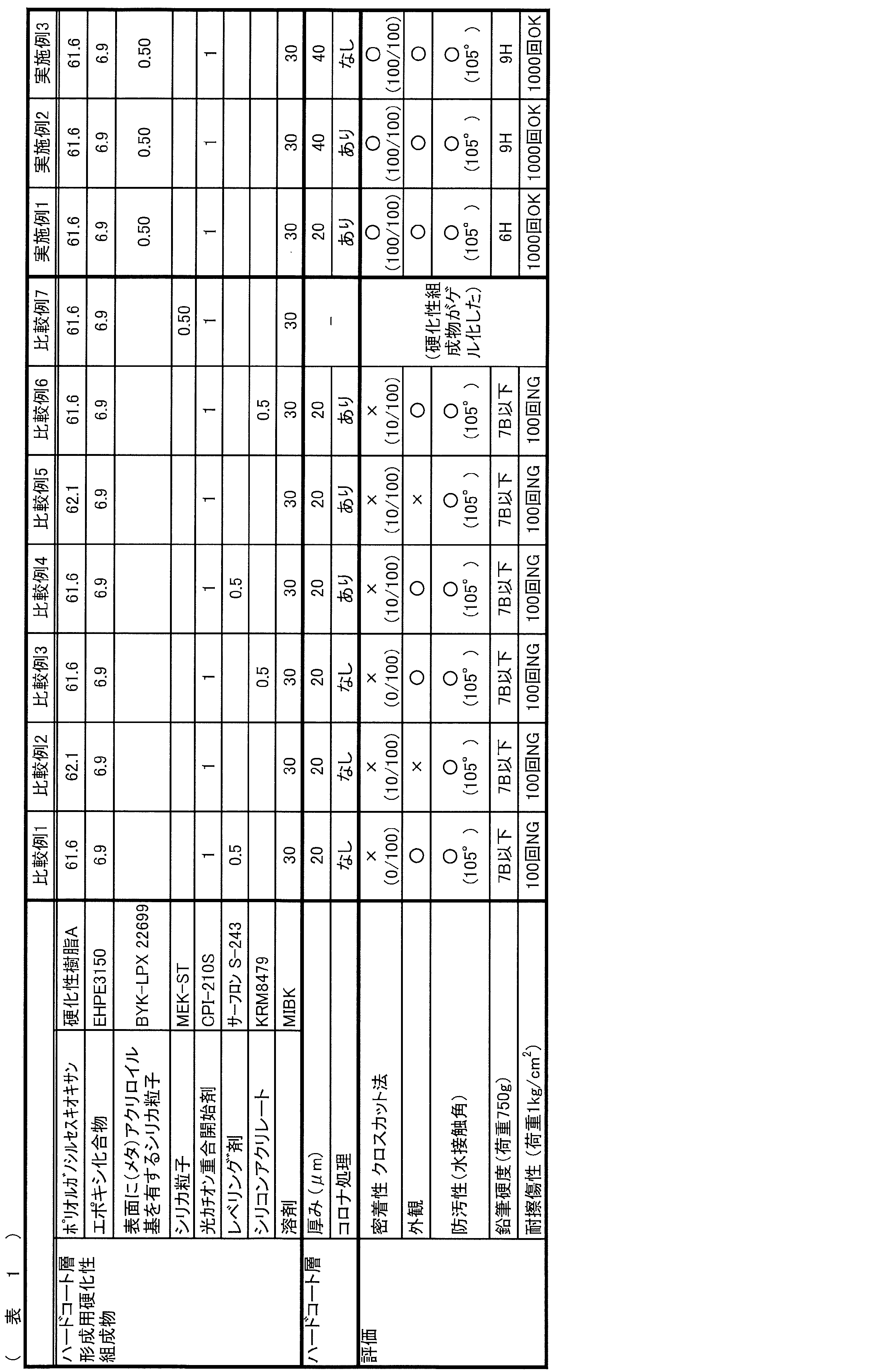
以上のまとめとして、本発明の構成及びそのバリエーションを以下に付記する。
[1]ハードコート層と、当該ハードコート層と接する機能層とを有する、2層以上で構成される積層部と、当該ハードコート層と接する基材とを有し、当該機能層が積層体の最表面である積層体であって、前記ハードコート層は、下記ポリオルガノシルセスキオキサンと、表面に(メタ)アクリロイル基を含む基を有するシリカ粒子とを含む硬化性組成物の硬化物層である積層体。
ポリオルガノシルセスキオキサン:式(1)で表される構成単位を有し、式(I)で表される構成単位(T3体)と、式(II)で表される構成単位(T2体)のモル比が5以上であり、シロキサン構成単位の全量に対する、式(1)で表される構成単位、及び式(4)で表される構成単位の割合(総量)が55~100モル%であり、数平均分子量が1000~3000、分子量分散度が1.0~3.0である
[2]前記ポリオルガノシルセスキオキサンは、さらに、式(2)で表される構成単位を有する[1]に記載の積層体。
[3]前記ポリオルガノシルセスキオキサンは、式(1)及び式(4)中のR1が、式(1a)で表される基、式(1b)で表される基、式(1c)で表される基、又は、式(1d)で表される基である[1]又は[2]に記載の積層体。
[4]前記ポリオルガノシルセスキオキサンは、式(2)中のR2が、置換若しくは無置換のアリール基(好ましくはフェニル基)である[2]又は[3]に記載の積層体。
[5]前記式(II)で表される構成単位(T2体)として、式(5)で表される構成単位を含む[1]~[4]のいずれか一つに記載の積層体。
[6]前記ポリオルガノシルセスキオキサンにおけるシロキサン構成単位の全量に対する、式(2)で表される構成単位及び式(5)で表される構成単位の割合(総量)は、0~70モル%である[1]~[5]のいずれか一つに記載の積層体。
[7]前記ポリオルガノシルセスキオキサンにおけるシロキサン構成単位の全量に対する、式(1)で表される構成単位、式(2)で表される構成単位、式(4)で表される構成単位、及び式(5)で表される構成単位の割合(総量)は、60~100モル%である[1]~[6]のいずれか一つに記載の積層体。
[8]前記ポリオルガノシルセスキオキサンの空気雰囲気下における5%重量減少温度(Td5)は、330℃以上である[1]~[7]のいずれか一つに記載の積層体。
[9]前記ポリオルガノシルセスキオキサンの含有量は、溶媒を除く硬化性組成物全量に対して、70重量%以上である[1]~[8]のいずれか一つに記載の積層体。
[10]前記シリカ粒子の粒径は、1~100nmである[1]~[9]のいずれか一つに記載の積層体。
[11]前記シリカ粒子の割合は、前記ポリオルガノシルセスキオキサン100重量部に対して、0.01~20重量部である[1]~[10]のいずれか一つに記載の積層体。
[12]前記硬化性組成物は、前記シリカ粒子及び前記ポリオルガノシルセスキオキサン以外のその他のカチオン硬化性化合物を含む[1]~[11]のいずれか一つに記載の積層体。
[13]前記硬化性組成物は、前記ポリオルガノシルセスキオキサン以外のエポキシ化合物(その他のエポキシ化合物)を含む[1]~[12]のいずれか一つに記載の積層体。
[14]前記エポキシ化合物は、脂環式エポキシ化合物、芳香族エポキシ化合物、及び脂肪族エポキシ化合物からなる群より選択される少なくとも1つである[13]に記載の積層体。
[15]前記脂環式エポキシ化合物は、分子内に脂環を構成する隣接する2つの炭素原子と酸素原子とで構成されるエポキシ基を有する化合物、脂環にエポキシ基が直接単結合で結合している化合物、及び分子内に脂環とグリシジルエーテル基を有する化合物からなる群より選択される少なくとも1つである[14]に記載の積層体。
[16]前記の脂環にエポキシ基が直接単結合で結合している化合物は、式(ii)で表される化合物である[15]に記載の積層体。
[17]カチオン硬化性化合物の全量に対する前記ポリオルガノシルセスキオキサンの割合は、70~100重量%である[1]~[16]のいずれか一つに記載の積層体。
[18]前記エポキシ化合物(特に、脂環式エポキシ化合物)の含有量は、前記ポリオルガノシルセスキオキサンとその他のカチオン硬化性化合物の総量に対して、0.01~10重量%である[13]~[17]のいずれか一つに記載の積層体。
[19]前記硬化性組成物は、光カチオン重合開始剤を含む[1]~[18]のいずれか一つに記載の積層体。
[20]前記光カチオン重合開始剤は、スルホニウム塩、ヨードニウム塩、セレニウム塩、アンモニウム塩、及びホスホニウム塩からなる群より選択される少なくとも1つである[19]に記載の積層体。
[21]前記光カチオン重合開始剤の含有量は、前記ポリオルガノシルセスキオキサン100重量部に対して、0.01~3.0重量部である[19]又は[20]に記載の積層体。
[22]前記硬化性組成物は、レベリング剤(シリコーン系レベリング剤、フッ素系レベリング剤、ヒドロキシル基を有するシリコーン系レベリング剤など)を含む[1]~[21]のいずれか一つに記載の積層体。
[23]前記レベリング剤の割合は、前記ポリオルガノシルセスキオキサン100重量部に対して、0.01~20重量部である[22]に記載の積層体。
[24]前記ハードコート層の厚みは、1~100μmである[1]~[23]のいずれか一つに記載の積層体。
[25]前記機能層の厚みは、0.1~50μmである[1]~[24]のいずれか一つに記載の積層体。
[26]前記基材は、プラスチック基材、金属基材、セラミックス基材、半導体基材、ガラス基材、紙基材、木基材、又は表面が塗装表面である基材である[1]~[25]のいずれか一つに記載の積層体。
[27]総厚みは、10~1000μmである[1]~[26]のいずれか一つに記載の積層体。
[1]ハードコート層と、当該ハードコート層と接する機能層とを有する、2層以上で構成される積層部と、当該ハードコート層と接する基材とを有し、当該機能層が積層体の最表面である積層体であって、前記ハードコート層は、下記ポリオルガノシルセスキオキサンと、表面に(メタ)アクリロイル基を含む基を有するシリカ粒子とを含む硬化性組成物の硬化物層である積層体。
ポリオルガノシルセスキオキサン:式(1)で表される構成単位を有し、式(I)で表される構成単位(T3体)と、式(II)で表される構成単位(T2体)のモル比が5以上であり、シロキサン構成単位の全量に対する、式(1)で表される構成単位、及び式(4)で表される構成単位の割合(総量)が55~100モル%であり、数平均分子量が1000~3000、分子量分散度が1.0~3.0である
[2]前記ポリオルガノシルセスキオキサンは、さらに、式(2)で表される構成単位を有する[1]に記載の積層体。
[3]前記ポリオルガノシルセスキオキサンは、式(1)及び式(4)中のR1が、式(1a)で表される基、式(1b)で表される基、式(1c)で表される基、又は、式(1d)で表される基である[1]又は[2]に記載の積層体。
[4]前記ポリオルガノシルセスキオキサンは、式(2)中のR2が、置換若しくは無置換のアリール基(好ましくはフェニル基)である[2]又は[3]に記載の積層体。
[5]前記式(II)で表される構成単位(T2体)として、式(5)で表される構成単位を含む[1]~[4]のいずれか一つに記載の積層体。
[6]前記ポリオルガノシルセスキオキサンにおけるシロキサン構成単位の全量に対する、式(2)で表される構成単位及び式(5)で表される構成単位の割合(総量)は、0~70モル%である[1]~[5]のいずれか一つに記載の積層体。
[7]前記ポリオルガノシルセスキオキサンにおけるシロキサン構成単位の全量に対する、式(1)で表される構成単位、式(2)で表される構成単位、式(4)で表される構成単位、及び式(5)で表される構成単位の割合(総量)は、60~100モル%である[1]~[6]のいずれか一つに記載の積層体。
[8]前記ポリオルガノシルセスキオキサンの空気雰囲気下における5%重量減少温度(Td5)は、330℃以上である[1]~[7]のいずれか一つに記載の積層体。
[9]前記ポリオルガノシルセスキオキサンの含有量は、溶媒を除く硬化性組成物全量に対して、70重量%以上である[1]~[8]のいずれか一つに記載の積層体。
[10]前記シリカ粒子の粒径は、1~100nmである[1]~[9]のいずれか一つに記載の積層体。
[11]前記シリカ粒子の割合は、前記ポリオルガノシルセスキオキサン100重量部に対して、0.01~20重量部である[1]~[10]のいずれか一つに記載の積層体。
[12]前記硬化性組成物は、前記シリカ粒子及び前記ポリオルガノシルセスキオキサン以外のその他のカチオン硬化性化合物を含む[1]~[11]のいずれか一つに記載の積層体。
[13]前記硬化性組成物は、前記ポリオルガノシルセスキオキサン以外のエポキシ化合物(その他のエポキシ化合物)を含む[1]~[12]のいずれか一つに記載の積層体。
[14]前記エポキシ化合物は、脂環式エポキシ化合物、芳香族エポキシ化合物、及び脂肪族エポキシ化合物からなる群より選択される少なくとも1つである[13]に記載の積層体。
[15]前記脂環式エポキシ化合物は、分子内に脂環を構成する隣接する2つの炭素原子と酸素原子とで構成されるエポキシ基を有する化合物、脂環にエポキシ基が直接単結合で結合している化合物、及び分子内に脂環とグリシジルエーテル基を有する化合物からなる群より選択される少なくとも1つである[14]に記載の積層体。
[16]前記の脂環にエポキシ基が直接単結合で結合している化合物は、式(ii)で表される化合物である[15]に記載の積層体。
[17]カチオン硬化性化合物の全量に対する前記ポリオルガノシルセスキオキサンの割合は、70~100重量%である[1]~[16]のいずれか一つに記載の積層体。
[18]前記エポキシ化合物(特に、脂環式エポキシ化合物)の含有量は、前記ポリオルガノシルセスキオキサンとその他のカチオン硬化性化合物の総量に対して、0.01~10重量%である[13]~[17]のいずれか一つに記載の積層体。
[19]前記硬化性組成物は、光カチオン重合開始剤を含む[1]~[18]のいずれか一つに記載の積層体。
[20]前記光カチオン重合開始剤は、スルホニウム塩、ヨードニウム塩、セレニウム塩、アンモニウム塩、及びホスホニウム塩からなる群より選択される少なくとも1つである[19]に記載の積層体。
[21]前記光カチオン重合開始剤の含有量は、前記ポリオルガノシルセスキオキサン100重量部に対して、0.01~3.0重量部である[19]又は[20]に記載の積層体。
[22]前記硬化性組成物は、レベリング剤(シリコーン系レベリング剤、フッ素系レベリング剤、ヒドロキシル基を有するシリコーン系レベリング剤など)を含む[1]~[21]のいずれか一つに記載の積層体。
[23]前記レベリング剤の割合は、前記ポリオルガノシルセスキオキサン100重量部に対して、0.01~20重量部である[22]に記載の積層体。
[24]前記ハードコート層の厚みは、1~100μmである[1]~[23]のいずれか一つに記載の積層体。
[25]前記機能層の厚みは、0.1~50μmである[1]~[24]のいずれか一つに記載の積層体。
[26]前記基材は、プラスチック基材、金属基材、セラミックス基材、半導体基材、ガラス基材、紙基材、木基材、又は表面が塗装表面である基材である[1]~[25]のいずれか一つに記載の積層体。
[27]総厚みは、10~1000μmである[1]~[26]のいずれか一つに記載の積層体。
本発明の積層体は、ガラス代替材料として、液晶ディスプレイ、有機ELディスプレイなどの表示装置等の各種製品やその部材又は部品の構成材に使用することができる。
1 積層体
2 ハードコート層
3 機能層
4 積層部
5 基材
2 ハードコート層
3 機能層
4 積層部
5 基材
Claims (9)
- ハードコート層と、当該ハードコート層と接する機能層とを有する、2層以上で構成される積層部と、当該ハードコート層と接する基材とを有し、当該機能層が積層体の最表面である積層体であって、
前記ハードコート層は、下記ポリオルガノシルセスキオキサンと、表面に(メタ)アクリロイル基を含む基を有するシリカ粒子とを含む硬化性組成物の硬化物層である積層体。
ポリオルガノシルセスキオキサン:下記式(1)で表される構成単位を有し、下記式(I)で表される構成単位と、下記式(II)で表される構成単位のモル比[式(I)で表される構成単位/式(II)で表される構成単位]が5以上であり、シロキサン構成単位の全量(100モル%)に対する、下記式(1)で表される構成単位、及び下記式(4)で表される構成単位の割合が55~100モル%であり、数平均分子量が1000~3000、分子量分散度(重量平均分子量/数平均分子量)が1.0~3.0である




- 前記ポリオルガノシルセスキオキサンは、さらに、下記式(2)で表される構成単位を有する請求項1に記載の積層体。

- 前記ポリオルガノシルセスキオキサンは、R1が、下記式(1a)で表される基、下記式(1b)で表される基、下記式(1c)で表される基、又は、下記式(1d)で表される基である請求項1又は2に記載の積層体。



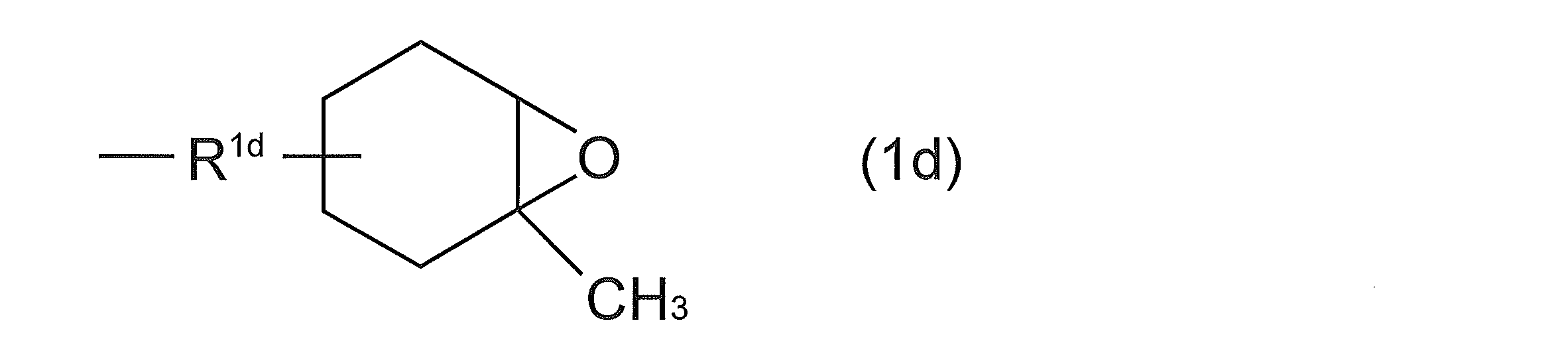
- 前記ポリオルガノシルセスキオキサンは、R2が、置換若しくは無置換のアリール基である請求項2又は3に記載の積層体。
- 前記硬化性組成物は、前記ポリオルガノシルセスキオキサン以外のエポキシ化合物を含む請求項1~4のいずれか1項に記載の積層体。
- 前記硬化性組成物は、光カチオン重合開始剤を含む請求項1~5のいずれか1項に記載の積層体。
- 前記ハードコート層の厚みは、1~100μmである請求項1~6のいずれか1項に記載の積層体。
- 前記機能層の厚みは、0.1~50μmである請求項1~7のいずれか1項に記載の積層体。
- 総厚みは、10~1000μmである請求項1~8のいずれか1項に記載の積層体。
Priority Applications (3)
| Application Number | Priority Date | Filing Date | Title |
|---|---|---|---|
| CN201780089441.5A CN110546001B (zh) | 2017-04-12 | 2017-11-22 | 层叠体 |
| KR1020197031820A KR20190138652A (ko) | 2017-04-12 | 2017-11-22 | 적층체 |
| US16/604,748 US20200062996A1 (en) | 2017-04-12 | 2017-11-22 | Laminate |
Applications Claiming Priority (2)
| Application Number | Priority Date | Filing Date | Title |
|---|---|---|---|
| JP2017079165A JP6842977B2 (ja) | 2017-04-12 | 2017-04-12 | 積層体 |
| JP2017-079165 | 2017-04-12 |
Publications (1)
| Publication Number | Publication Date |
|---|---|
| WO2018189946A1 true WO2018189946A1 (ja) | 2018-10-18 |
Family
ID=63792339
Family Applications (1)
| Application Number | Title | Priority Date | Filing Date |
|---|---|---|---|
| PCT/JP2017/042028 Ceased WO2018189946A1 (ja) | 2017-04-12 | 2017-11-22 | 積層体 |
Country Status (6)
| Country | Link |
|---|---|
| US (1) | US20200062996A1 (ja) |
| JP (1) | JP6842977B2 (ja) |
| KR (1) | KR20190138652A (ja) |
| CN (1) | CN110546001B (ja) |
| TW (1) | TW201841771A (ja) |
| WO (1) | WO2018189946A1 (ja) |
Cited By (1)
| Publication number | Priority date | Publication date | Assignee | Title |
|---|---|---|---|---|
| CN112055654A (zh) * | 2019-01-14 | 2020-12-08 | 株式会社Lg化学 | 光学层合体 |
Families Citing this family (11)
| Publication number | Priority date | Publication date | Assignee | Title |
|---|---|---|---|---|
| JP2018177952A (ja) * | 2017-04-12 | 2018-11-15 | 株式会社ダイセル | 硬化性組成物、硬化物及びハードコートフィルム |
| JP7138447B2 (ja) * | 2018-02-21 | 2022-09-16 | 株式会社ダイセル | 伸長性ハードコートフィルムならびに成形体およびその製造方法 |
| WO2020085257A1 (ja) | 2018-10-23 | 2020-04-30 | 株式会社ダイセル | 半導体装置製造方法 |
| JP7224138B2 (ja) * | 2018-10-23 | 2023-02-17 | 株式会社ダイセル | 半導体装置製造方法 |
| JP7201386B2 (ja) | 2018-10-23 | 2023-01-10 | 株式会社ダイセル | 半導体装置製造方法 |
| KR102602546B1 (ko) * | 2019-02-27 | 2023-11-16 | 후지필름 가부시키가이샤 | 적층체, 적층체를 구비한 물품, 및 화상 표시 장치 |
| JP7598888B2 (ja) * | 2019-06-26 | 2024-12-12 | アプライド マテリアルズ インコーポレイテッド | 折り畳み式ディスプレイ用の可撓性多層カバーレンズ積層体 |
| KR102154502B1 (ko) * | 2020-03-04 | 2020-09-10 | 성치헌 | 하드코팅 필름 |
| KR20210113512A (ko) * | 2020-03-06 | 2021-09-16 | 삼성디스플레이 주식회사 | 커버 윈도우 및 이를 포함하는 표시 장치 |
| JP2023019888A (ja) * | 2021-07-30 | 2023-02-09 | デクセリアルズ株式会社 | 積層体、屋外用積層体、及びハードコート層形成材料 |
| TWI846281B (zh) * | 2023-01-18 | 2024-06-21 | 國立臺灣科技大學 | 沉積方法、其連續式沉積系統與應用 |
Citations (4)
| Publication number | Priority date | Publication date | Assignee | Title |
|---|---|---|---|---|
| JP2009138059A (ja) * | 2007-12-04 | 2009-06-25 | Canon Inc | 成形用材料、それを用いた成形品およびその製造方法 |
| JP2009206197A (ja) * | 2008-02-26 | 2009-09-10 | Fujifilm Corp | ナノインプリント用硬化性組成物、硬化物およびその製造方法 |
| JP2013035274A (ja) * | 2011-07-13 | 2013-02-21 | Kansai Paint Co Ltd | 積層体及び積層体の製造方法 |
| JP2015212353A (ja) * | 2013-12-13 | 2015-11-26 | 株式会社ダイセル | ポリオルガノシルセスキオキサン、ハードコートフィルム、接着シート、及び積層物 |
Family Cites Families (8)
| Publication number | Priority date | Publication date | Assignee | Title |
|---|---|---|---|---|
| JPS5699263A (en) * | 1980-01-10 | 1981-08-10 | Nippon Sheet Glass Co Ltd | Coating composition |
| US7297731B2 (en) * | 2003-03-11 | 2007-11-20 | 3M Innovative Properties Company | Coating dispersions for optical fibers |
| JP2005133026A (ja) * | 2003-10-31 | 2005-05-26 | Lintec Corp | コーティング用組成物、ハードコートフィルムおよび光ディスク |
| JP5092440B2 (ja) * | 2007-02-16 | 2012-12-05 | Jsr株式会社 | 硬化性組成物、その硬化膜及び積層体 |
| JP5066484B2 (ja) | 2008-05-22 | 2012-11-07 | シーアイ化成株式会社 | 積層体及びその製造方法 |
| KR101585269B1 (ko) * | 2010-02-10 | 2016-01-14 | (주)엘지하우시스 | 하드코팅 형성용 수지 조성물 |
| JP5470166B2 (ja) * | 2010-06-11 | 2014-04-16 | 東亞合成株式会社 | 硬化型コーティング剤組成物 |
| JP2014191173A (ja) * | 2013-03-27 | 2014-10-06 | Daicel Corp | ハードコートフィルム及びその製造方法 |
-
2017
- 2017-04-12 JP JP2017079165A patent/JP6842977B2/ja active Active
- 2017-11-22 KR KR1020197031820A patent/KR20190138652A/ko not_active Ceased
- 2017-11-22 US US16/604,748 patent/US20200062996A1/en not_active Abandoned
- 2017-11-22 WO PCT/JP2017/042028 patent/WO2018189946A1/ja not_active Ceased
- 2017-11-22 CN CN201780089441.5A patent/CN110546001B/zh active Active
- 2017-12-20 TW TW106144718A patent/TW201841771A/zh unknown
Patent Citations (4)
| Publication number | Priority date | Publication date | Assignee | Title |
|---|---|---|---|---|
| JP2009138059A (ja) * | 2007-12-04 | 2009-06-25 | Canon Inc | 成形用材料、それを用いた成形品およびその製造方法 |
| JP2009206197A (ja) * | 2008-02-26 | 2009-09-10 | Fujifilm Corp | ナノインプリント用硬化性組成物、硬化物およびその製造方法 |
| JP2013035274A (ja) * | 2011-07-13 | 2013-02-21 | Kansai Paint Co Ltd | 積層体及び積層体の製造方法 |
| JP2015212353A (ja) * | 2013-12-13 | 2015-11-26 | 株式会社ダイセル | ポリオルガノシルセスキオキサン、ハードコートフィルム、接着シート、及び積層物 |
Cited By (3)
| Publication number | Priority date | Publication date | Assignee | Title |
|---|---|---|---|---|
| CN112055654A (zh) * | 2019-01-14 | 2020-12-08 | 株式会社Lg化学 | 光学层合体 |
| CN112055654B (zh) * | 2019-01-14 | 2023-04-18 | 株式会社Lg化学 | 光学层合体 |
| US11709294B2 (en) | 2019-01-14 | 2023-07-25 | Lg Chem, Ltd. | Optical laminate |
Also Published As
| Publication number | Publication date |
|---|---|
| JP6842977B2 (ja) | 2021-03-17 |
| CN110546001B (zh) | 2022-05-03 |
| TW201841771A (zh) | 2018-12-01 |
| KR20190138652A (ko) | 2019-12-13 |
| JP2018176540A (ja) | 2018-11-15 |
| US20200062996A1 (en) | 2020-02-27 |
| CN110546001A (zh) | 2019-12-06 |
Similar Documents
| Publication | Publication Date | Title |
|---|---|---|
| JP6219250B2 (ja) | ポリオルガノシルセスキオキサン、ハードコートフィルム、接着シート、及び積層物 | |
| JP6795498B2 (ja) | 硬化性組成物、及び成形体 | |
| JP6842977B2 (ja) | 積層体 | |
| JP6619955B2 (ja) | 傷回復フィルム | |
| CN110494466B (zh) | 固化性组合物、固化物及硬涂膜 | |
| JP6737926B2 (ja) | ポリオルガノシルセスキオキサン、ハードコートフィルム、接着シート、及び積層物 | |
| JP6619954B2 (ja) | 成形体 | |
| WO2018096729A1 (ja) | ハードコートフィルム | |
| WO2018207914A1 (ja) | カールが抑制されたハードコートフィルム及びその製造方法 | |
| JP2018189800A (ja) | 曲面ディスプレイ用ハードコートフィルム、ハードコートフィルム付き透明基板及びディスプレイ装置 | |
| JP6557521B2 (ja) | ポリオルガノシルセスキオキサン、ハードコートフィルム、接着シート、積層物及び装置 | |
| JP2018177952A (ja) | 硬化性組成物、硬化物及びハードコートフィルム | |
| KR102469951B1 (ko) | 적층 필름 및 폴더블 디바이스 | |
| JP2017008144A (ja) | ポリオルガノシルセスキオキサン、硬化性組成物、ハードコートフィルム、及び硬化物 | |
| JP6595812B2 (ja) | ポリオルガノシルセスキオキサン、硬化性組成物、ハードコートフィルム、及び硬化物 |
Legal Events
| Date | Code | Title | Description |
|---|---|---|---|
| 121 | Ep: the epo has been informed by wipo that ep was designated in this application |
Ref document number: 17905381 Country of ref document: EP Kind code of ref document: A1 |
|
| NENP | Non-entry into the national phase |
Ref country code: DE |
|
| ENP | Entry into the national phase |
Ref document number: 20197031820 Country of ref document: KR Kind code of ref document: A |
|
| 122 | Ep: pct application non-entry in european phase |
Ref document number: 17905381 Country of ref document: EP Kind code of ref document: A1 |