WO2018180763A1 - 二輪車用潤滑油組成物、該潤滑油組成物を用いた二輪車の燃費向上方法、及び該潤滑油組成物の製造方法 - Google Patents
二輪車用潤滑油組成物、該潤滑油組成物を用いた二輪車の燃費向上方法、及び該潤滑油組成物の製造方法 Download PDFInfo
- Publication number
- WO2018180763A1 WO2018180763A1 PCT/JP2018/011021 JP2018011021W WO2018180763A1 WO 2018180763 A1 WO2018180763 A1 WO 2018180763A1 JP 2018011021 W JP2018011021 W JP 2018011021W WO 2018180763 A1 WO2018180763 A1 WO 2018180763A1
- Authority
- WO
- WIPO (PCT)
- Prior art keywords
- lubricating oil
- oil composition
- calcium
- mass
- content
- Prior art date
- Legal status (The legal status is an assumption and is not a legal conclusion. Google has not performed a legal analysis and makes no representation as to the accuracy of the status listed.)
- Ceased
Links
Classifications
-
- C—CHEMISTRY; METALLURGY
- C10—PETROLEUM, GAS OR COKE INDUSTRIES; TECHNICAL GASES CONTAINING CARBON MONOXIDE; FUELS; LUBRICANTS; PEAT
- C10M—LUBRICATING COMPOSITIONS; USE OF CHEMICAL SUBSTANCES EITHER ALONE OR AS LUBRICATING INGREDIENTS IN A LUBRICATING COMPOSITION
- C10M169/00—Lubricating compositions characterised by containing as components a mixture of at least two types of ingredient selected from base-materials, thickeners or additives, covered by the preceding groups, each of these compounds being essential
- C10M169/04—Mixtures of base-materials and additives
- C10M169/044—Mixtures of base-materials and additives the additives being a mixture of non-macromolecular and macromolecular compounds
-
- C—CHEMISTRY; METALLURGY
- C10—PETROLEUM, GAS OR COKE INDUSTRIES; TECHNICAL GASES CONTAINING CARBON MONOXIDE; FUELS; LUBRICANTS; PEAT
- C10M—LUBRICATING COMPOSITIONS; USE OF CHEMICAL SUBSTANCES EITHER ALONE OR AS LUBRICATING INGREDIENTS IN A LUBRICATING COMPOSITION
- C10M169/00—Lubricating compositions characterised by containing as components a mixture of at least two types of ingredient selected from base-materials, thickeners or additives, covered by the preceding groups, each of these compounds being essential
- C10M169/04—Mixtures of base-materials and additives
- C10M169/047—Mixtures of base-materials and additives the additives being a mixture of compounds of unknown or incompletely defined constitution and macromolecular compounds
-
- C—CHEMISTRY; METALLURGY
- C10—PETROLEUM, GAS OR COKE INDUSTRIES; TECHNICAL GASES CONTAINING CARBON MONOXIDE; FUELS; LUBRICANTS; PEAT
- C10M—LUBRICATING COMPOSITIONS; USE OF CHEMICAL SUBSTANCES EITHER ALONE OR AS LUBRICATING INGREDIENTS IN A LUBRICATING COMPOSITION
- C10M129/00—Lubricating compositions characterised by the additive being an organic non-macromolecular compound containing oxygen
- C10M129/02—Lubricating compositions characterised by the additive being an organic non-macromolecular compound containing oxygen having a carbon chain of less than 30 atoms
- C10M129/26—Carboxylic acids; Salts thereof
- C10M129/48—Carboxylic acids; Salts thereof having carboxyl groups bound to a carbon atom of a six-membered aromatic ring
- C10M129/50—Carboxylic acids; Salts thereof having carboxyl groups bound to a carbon atom of a six-membered aromatic ring monocarboxylic
-
- C—CHEMISTRY; METALLURGY
- C10—PETROLEUM, GAS OR COKE INDUSTRIES; TECHNICAL GASES CONTAINING CARBON MONOXIDE; FUELS; LUBRICANTS; PEAT
- C10M—LUBRICATING COMPOSITIONS; USE OF CHEMICAL SUBSTANCES EITHER ALONE OR AS LUBRICATING INGREDIENTS IN A LUBRICATING COMPOSITION
- C10M135/00—Lubricating compositions characterised by the additive being an organic non-macromolecular compound containing sulfur, selenium or tellurium
- C10M135/08—Lubricating compositions characterised by the additive being an organic non-macromolecular compound containing sulfur, selenium or tellurium containing a sulfur-to-oxygen bond
- C10M135/10—Sulfonic acids or derivatives thereof
-
- C—CHEMISTRY; METALLURGY
- C10—PETROLEUM, GAS OR COKE INDUSTRIES; TECHNICAL GASES CONTAINING CARBON MONOXIDE; FUELS; LUBRICANTS; PEAT
- C10M—LUBRICATING COMPOSITIONS; USE OF CHEMICAL SUBSTANCES EITHER ALONE OR AS LUBRICATING INGREDIENTS IN A LUBRICATING COMPOSITION
- C10M141/00—Lubricating compositions characterised by the additive being a mixture of two or more compounds covered by more than one of the main groups C10M125/00 - C10M139/00, each of these compounds being essential
- C10M141/08—Lubricating compositions characterised by the additive being a mixture of two or more compounds covered by more than one of the main groups C10M125/00 - C10M139/00, each of these compounds being essential at least one of them being an organic sulfur-, selenium- or tellurium-containing compound
-
- C—CHEMISTRY; METALLURGY
- C10—PETROLEUM, GAS OR COKE INDUSTRIES; TECHNICAL GASES CONTAINING CARBON MONOXIDE; FUELS; LUBRICANTS; PEAT
- C10M—LUBRICATING COMPOSITIONS; USE OF CHEMICAL SUBSTANCES EITHER ALONE OR AS LUBRICATING INGREDIENTS IN A LUBRICATING COMPOSITION
- C10M143/00—Lubricating compositions characterised by the additive being a macromolecular hydrocarbon or such hydrocarbon modified by oxidation
- C10M143/04—Lubricating compositions characterised by the additive being a macromolecular hydrocarbon or such hydrocarbon modified by oxidation containing propene
-
- C—CHEMISTRY; METALLURGY
- C10—PETROLEUM, GAS OR COKE INDUSTRIES; TECHNICAL GASES CONTAINING CARBON MONOXIDE; FUELS; LUBRICANTS; PEAT
- C10M—LUBRICATING COMPOSITIONS; USE OF CHEMICAL SUBSTANCES EITHER ALONE OR AS LUBRICATING INGREDIENTS IN A LUBRICATING COMPOSITION
- C10M145/00—Lubricating compositions characterised by the additive being a macromolecular compound containing oxygen
- C10M145/02—Macromolecular compounds obtained by reactions only involving carbon-to-carbon unsaturated bonds
- C10M145/10—Macromolecular compounds obtained by reactions only involving carbon-to-carbon unsaturated bonds containing monomers having an unsaturated radical bound to a carboxyl radical, e.g. acrylate
- C10M145/12—Macromolecular compounds obtained by reactions only involving carbon-to-carbon unsaturated bonds containing monomers having an unsaturated radical bound to a carboxyl radical, e.g. acrylate monocarboxylic
- C10M145/14—Acrylate; Methacrylate
-
- C—CHEMISTRY; METALLURGY
- C10—PETROLEUM, GAS OR COKE INDUSTRIES; TECHNICAL GASES CONTAINING CARBON MONOXIDE; FUELS; LUBRICANTS; PEAT
- C10M—LUBRICATING COMPOSITIONS; USE OF CHEMICAL SUBSTANCES EITHER ALONE OR AS LUBRICATING INGREDIENTS IN A LUBRICATING COMPOSITION
- C10M157/00—Lubricating compositions characterised by the additive being a mixture of two or more macromolecular compounds covered by more than one of the main groups C10M143/00 - C10M155/00, each of these compounds being essential
-
- C—CHEMISTRY; METALLURGY
- C10—PETROLEUM, GAS OR COKE INDUSTRIES; TECHNICAL GASES CONTAINING CARBON MONOXIDE; FUELS; LUBRICANTS; PEAT
- C10M—LUBRICATING COMPOSITIONS; USE OF CHEMICAL SUBSTANCES EITHER ALONE OR AS LUBRICATING INGREDIENTS IN A LUBRICATING COMPOSITION
- C10M161/00—Lubricating compositions characterised by the additive being a mixture of a macromolecular compound and a non-macromolecular compound, each of these compounds being essential
-
- C—CHEMISTRY; METALLURGY
- C10—PETROLEUM, GAS OR COKE INDUSTRIES; TECHNICAL GASES CONTAINING CARBON MONOXIDE; FUELS; LUBRICANTS; PEAT
- C10M—LUBRICATING COMPOSITIONS; USE OF CHEMICAL SUBSTANCES EITHER ALONE OR AS LUBRICATING INGREDIENTS IN A LUBRICATING COMPOSITION
- C10M2203/00—Organic non-macromolecular hydrocarbon compounds and hydrocarbon fractions as ingredients in lubricant compositions
- C10M2203/003—Organic non-macromolecular hydrocarbon compounds and hydrocarbon fractions as ingredients in lubricant compositions used as base material
-
- C—CHEMISTRY; METALLURGY
- C10—PETROLEUM, GAS OR COKE INDUSTRIES; TECHNICAL GASES CONTAINING CARBON MONOXIDE; FUELS; LUBRICANTS; PEAT
- C10M—LUBRICATING COMPOSITIONS; USE OF CHEMICAL SUBSTANCES EITHER ALONE OR AS LUBRICATING INGREDIENTS IN A LUBRICATING COMPOSITION
- C10M2203/00—Organic non-macromolecular hydrocarbon compounds and hydrocarbon fractions as ingredients in lubricant compositions
- C10M2203/10—Petroleum or coal fractions, e.g. tars, solvents, bitumen
- C10M2203/102—Aliphatic fractions
-
- C—CHEMISTRY; METALLURGY
- C10—PETROLEUM, GAS OR COKE INDUSTRIES; TECHNICAL GASES CONTAINING CARBON MONOXIDE; FUELS; LUBRICANTS; PEAT
- C10M—LUBRICATING COMPOSITIONS; USE OF CHEMICAL SUBSTANCES EITHER ALONE OR AS LUBRICATING INGREDIENTS IN A LUBRICATING COMPOSITION
- C10M2203/00—Organic non-macromolecular hydrocarbon compounds and hydrocarbon fractions as ingredients in lubricant compositions
- C10M2203/10—Petroleum or coal fractions, e.g. tars, solvents, bitumen
- C10M2203/102—Aliphatic fractions
- C10M2203/1025—Aliphatic fractions used as base material
-
- C—CHEMISTRY; METALLURGY
- C10—PETROLEUM, GAS OR COKE INDUSTRIES; TECHNICAL GASES CONTAINING CARBON MONOXIDE; FUELS; LUBRICANTS; PEAT
- C10M—LUBRICATING COMPOSITIONS; USE OF CHEMICAL SUBSTANCES EITHER ALONE OR AS LUBRICATING INGREDIENTS IN A LUBRICATING COMPOSITION
- C10M2205/00—Organic macromolecular hydrocarbon compounds or fractions, whether or not modified by oxidation as ingredients in lubricant compositions
- C10M2205/02—Organic macromolecular hydrocarbon compounds or fractions, whether or not modified by oxidation as ingredients in lubricant compositions containing acyclic monomers
- C10M2205/022—Ethene
-
- C—CHEMISTRY; METALLURGY
- C10—PETROLEUM, GAS OR COKE INDUSTRIES; TECHNICAL GASES CONTAINING CARBON MONOXIDE; FUELS; LUBRICANTS; PEAT
- C10M—LUBRICATING COMPOSITIONS; USE OF CHEMICAL SUBSTANCES EITHER ALONE OR AS LUBRICATING INGREDIENTS IN A LUBRICATING COMPOSITION
- C10M2205/00—Organic macromolecular hydrocarbon compounds or fractions, whether or not modified by oxidation as ingredients in lubricant compositions
- C10M2205/02—Organic macromolecular hydrocarbon compounds or fractions, whether or not modified by oxidation as ingredients in lubricant compositions containing acyclic monomers
- C10M2205/024—Propene
-
- C—CHEMISTRY; METALLURGY
- C10—PETROLEUM, GAS OR COKE INDUSTRIES; TECHNICAL GASES CONTAINING CARBON MONOXIDE; FUELS; LUBRICANTS; PEAT
- C10M—LUBRICATING COMPOSITIONS; USE OF CHEMICAL SUBSTANCES EITHER ALONE OR AS LUBRICATING INGREDIENTS IN A LUBRICATING COMPOSITION
- C10M2207/00—Organic non-macromolecular hydrocarbon compounds containing hydrogen, carbon and oxygen as ingredients in lubricant compositions
- C10M2207/26—Overbased carboxylic acid salts
-
- C—CHEMISTRY; METALLURGY
- C10—PETROLEUM, GAS OR COKE INDUSTRIES; TECHNICAL GASES CONTAINING CARBON MONOXIDE; FUELS; LUBRICANTS; PEAT
- C10M—LUBRICATING COMPOSITIONS; USE OF CHEMICAL SUBSTANCES EITHER ALONE OR AS LUBRICATING INGREDIENTS IN A LUBRICATING COMPOSITION
- C10M2209/00—Organic macromolecular compounds containing oxygen as ingredients in lubricant compositions
- C10M2209/02—Macromolecular compounds obtained by reactions only involving carbon-to-carbon unsaturated bonds
- C10M2209/08—Macromolecular compounds obtained by reactions only involving carbon-to-carbon unsaturated bonds containing monomers having an unsaturated radical bound to a carboxyl radical, e.g. acrylate type
- C10M2209/084—Acrylate; Methacrylate
-
- C—CHEMISTRY; METALLURGY
- C10—PETROLEUM, GAS OR COKE INDUSTRIES; TECHNICAL GASES CONTAINING CARBON MONOXIDE; FUELS; LUBRICANTS; PEAT
- C10M—LUBRICATING COMPOSITIONS; USE OF CHEMICAL SUBSTANCES EITHER ALONE OR AS LUBRICATING INGREDIENTS IN A LUBRICATING COMPOSITION
- C10M2215/00—Organic non-macromolecular compounds containing nitrogen as ingredients in lubricant Compositions
- C10M2215/02—Amines, e.g. polyalkylene polyamines; Quaternary amines
- C10M2215/06—Amines, e.g. polyalkylene polyamines; Quaternary amines having amino groups bound to carbon atoms of six-membered aromatic rings
- C10M2215/064—Di- and triaryl amines
-
- C—CHEMISTRY; METALLURGY
- C10—PETROLEUM, GAS OR COKE INDUSTRIES; TECHNICAL GASES CONTAINING CARBON MONOXIDE; FUELS; LUBRICANTS; PEAT
- C10M—LUBRICATING COMPOSITIONS; USE OF CHEMICAL SUBSTANCES EITHER ALONE OR AS LUBRICATING INGREDIENTS IN A LUBRICATING COMPOSITION
- C10M2215/00—Organic non-macromolecular compounds containing nitrogen as ingredients in lubricant Compositions
- C10M2215/24—Organic non-macromolecular compounds containing nitrogen as ingredients in lubricant Compositions having hydrocarbon substituents containing thirty or more carbon atoms, e.g. nitrogen derivatives of substituted succinic acid
- C10M2215/28—Amides; Imides
-
- C—CHEMISTRY; METALLURGY
- C10—PETROLEUM, GAS OR COKE INDUSTRIES; TECHNICAL GASES CONTAINING CARBON MONOXIDE; FUELS; LUBRICANTS; PEAT
- C10M—LUBRICATING COMPOSITIONS; USE OF CHEMICAL SUBSTANCES EITHER ALONE OR AS LUBRICATING INGREDIENTS IN A LUBRICATING COMPOSITION
- C10M2219/00—Organic non-macromolecular compounds containing sulfur, selenium or tellurium as ingredients in lubricant compositions
- C10M2219/04—Organic non-macromolecular compounds containing sulfur, selenium or tellurium as ingredients in lubricant compositions containing sulfur-to-oxygen bonds, i.e. sulfones, sulfoxides
- C10M2219/044—Sulfonic acids, Derivatives thereof, e.g. neutral salts
-
- C—CHEMISTRY; METALLURGY
- C10—PETROLEUM, GAS OR COKE INDUSTRIES; TECHNICAL GASES CONTAINING CARBON MONOXIDE; FUELS; LUBRICANTS; PEAT
- C10M—LUBRICATING COMPOSITIONS; USE OF CHEMICAL SUBSTANCES EITHER ALONE OR AS LUBRICATING INGREDIENTS IN A LUBRICATING COMPOSITION
- C10M2219/00—Organic non-macromolecular compounds containing sulfur, selenium or tellurium as ingredients in lubricant compositions
- C10M2219/04—Organic non-macromolecular compounds containing sulfur, selenium or tellurium as ingredients in lubricant compositions containing sulfur-to-oxygen bonds, i.e. sulfones, sulfoxides
- C10M2219/046—Overbased sulfonic acid salts
-
- C—CHEMISTRY; METALLURGY
- C10—PETROLEUM, GAS OR COKE INDUSTRIES; TECHNICAL GASES CONTAINING CARBON MONOXIDE; FUELS; LUBRICANTS; PEAT
- C10M—LUBRICATING COMPOSITIONS; USE OF CHEMICAL SUBSTANCES EITHER ALONE OR AS LUBRICATING INGREDIENTS IN A LUBRICATING COMPOSITION
- C10M2223/00—Organic non-macromolecular compounds containing phosphorus as ingredients in lubricant compositions
- C10M2223/02—Organic non-macromolecular compounds containing phosphorus as ingredients in lubricant compositions having no phosphorus-to-carbon bonds
- C10M2223/04—Phosphate esters
- C10M2223/045—Metal containing thio derivatives
-
- C—CHEMISTRY; METALLURGY
- C10—PETROLEUM, GAS OR COKE INDUSTRIES; TECHNICAL GASES CONTAINING CARBON MONOXIDE; FUELS; LUBRICANTS; PEAT
- C10N—INDEXING SCHEME ASSOCIATED WITH SUBCLASS C10M RELATING TO LUBRICATING COMPOSITIONS
- C10N2010/00—Metal present as such or in compounds
- C10N2010/04—Groups 2 or 12
-
- C—CHEMISTRY; METALLURGY
- C10—PETROLEUM, GAS OR COKE INDUSTRIES; TECHNICAL GASES CONTAINING CARBON MONOXIDE; FUELS; LUBRICANTS; PEAT
- C10N—INDEXING SCHEME ASSOCIATED WITH SUBCLASS C10M RELATING TO LUBRICATING COMPOSITIONS
- C10N2020/00—Specified physical or chemical properties or characteristics, i.e. function, of component of lubricating compositions
- C10N2020/01—Physico-chemical properties
- C10N2020/02—Viscosity; Viscosity index
-
- C—CHEMISTRY; METALLURGY
- C10—PETROLEUM, GAS OR COKE INDUSTRIES; TECHNICAL GASES CONTAINING CARBON MONOXIDE; FUELS; LUBRICANTS; PEAT
- C10N—INDEXING SCHEME ASSOCIATED WITH SUBCLASS C10M RELATING TO LUBRICATING COMPOSITIONS
- C10N2020/00—Specified physical or chemical properties or characteristics, i.e. function, of component of lubricating compositions
- C10N2020/01—Physico-chemical properties
- C10N2020/04—Molecular weight; Molecular weight distribution
-
- C—CHEMISTRY; METALLURGY
- C10—PETROLEUM, GAS OR COKE INDUSTRIES; TECHNICAL GASES CONTAINING CARBON MONOXIDE; FUELS; LUBRICANTS; PEAT
- C10N—INDEXING SCHEME ASSOCIATED WITH SUBCLASS C10M RELATING TO LUBRICATING COMPOSITIONS
- C10N2030/00—Specified physical or chemical properties which is improved by the additive characterising the lubricating composition, e.g. multifunctional additives
- C10N2030/02—Pour-point; Viscosity index
-
- C—CHEMISTRY; METALLURGY
- C10—PETROLEUM, GAS OR COKE INDUSTRIES; TECHNICAL GASES CONTAINING CARBON MONOXIDE; FUELS; LUBRICANTS; PEAT
- C10N—INDEXING SCHEME ASSOCIATED WITH SUBCLASS C10M RELATING TO LUBRICATING COMPOSITIONS
- C10N2030/00—Specified physical or chemical properties which is improved by the additive characterising the lubricating composition, e.g. multifunctional additives
- C10N2030/04—Detergent property or dispersant property
-
- C—CHEMISTRY; METALLURGY
- C10—PETROLEUM, GAS OR COKE INDUSTRIES; TECHNICAL GASES CONTAINING CARBON MONOXIDE; FUELS; LUBRICANTS; PEAT
- C10N—INDEXING SCHEME ASSOCIATED WITH SUBCLASS C10M RELATING TO LUBRICATING COMPOSITIONS
- C10N2030/00—Specified physical or chemical properties which is improved by the additive characterising the lubricating composition, e.g. multifunctional additives
- C10N2030/06—Oiliness; Film-strength; Anti-wear; Resistance to extreme pressure
-
- C—CHEMISTRY; METALLURGY
- C10—PETROLEUM, GAS OR COKE INDUSTRIES; TECHNICAL GASES CONTAINING CARBON MONOXIDE; FUELS; LUBRICANTS; PEAT
- C10N—INDEXING SCHEME ASSOCIATED WITH SUBCLASS C10M RELATING TO LUBRICATING COMPOSITIONS
- C10N2030/00—Specified physical or chemical properties which is improved by the additive characterising the lubricating composition, e.g. multifunctional additives
- C10N2030/08—Resistance to extreme temperature
-
- C—CHEMISTRY; METALLURGY
- C10—PETROLEUM, GAS OR COKE INDUSTRIES; TECHNICAL GASES CONTAINING CARBON MONOXIDE; FUELS; LUBRICANTS; PEAT
- C10N—INDEXING SCHEME ASSOCIATED WITH SUBCLASS C10M RELATING TO LUBRICATING COMPOSITIONS
- C10N2030/00—Specified physical or chemical properties which is improved by the additive characterising the lubricating composition, e.g. multifunctional additives
- C10N2030/40—Low content or no content compositions
- C10N2030/45—Ash-less or low ash content
-
- C—CHEMISTRY; METALLURGY
- C10—PETROLEUM, GAS OR COKE INDUSTRIES; TECHNICAL GASES CONTAINING CARBON MONOXIDE; FUELS; LUBRICANTS; PEAT
- C10N—INDEXING SCHEME ASSOCIATED WITH SUBCLASS C10M RELATING TO LUBRICATING COMPOSITIONS
- C10N2030/00—Specified physical or chemical properties which is improved by the additive characterising the lubricating composition, e.g. multifunctional additives
- C10N2030/52—Base number [TBN]
-
- C—CHEMISTRY; METALLURGY
- C10—PETROLEUM, GAS OR COKE INDUSTRIES; TECHNICAL GASES CONTAINING CARBON MONOXIDE; FUELS; LUBRICANTS; PEAT
- C10N—INDEXING SCHEME ASSOCIATED WITH SUBCLASS C10M RELATING TO LUBRICATING COMPOSITIONS
- C10N2030/00—Specified physical or chemical properties which is improved by the additive characterising the lubricating composition, e.g. multifunctional additives
- C10N2030/54—Fuel economy
-
- C—CHEMISTRY; METALLURGY
- C10—PETROLEUM, GAS OR COKE INDUSTRIES; TECHNICAL GASES CONTAINING CARBON MONOXIDE; FUELS; LUBRICANTS; PEAT
- C10N—INDEXING SCHEME ASSOCIATED WITH SUBCLASS C10M RELATING TO LUBRICATING COMPOSITIONS
- C10N2040/00—Specified use or application for which the lubricating composition is intended
- C10N2040/04—Oil-bath; Gear-boxes; Automatic transmissions; Traction drives
- C10N2040/044—Oil-bath; Gear-boxes; Automatic transmissions; Traction drives for manual transmissions
-
- C—CHEMISTRY; METALLURGY
- C10—PETROLEUM, GAS OR COKE INDUSTRIES; TECHNICAL GASES CONTAINING CARBON MONOXIDE; FUELS; LUBRICANTS; PEAT
- C10N—INDEXING SCHEME ASSOCIATED WITH SUBCLASS C10M RELATING TO LUBRICATING COMPOSITIONS
- C10N2040/00—Specified use or application for which the lubricating composition is intended
- C10N2040/25—Internal-combustion engines
Definitions
- the present invention relates to a lubricating oil composition for a motorcycle, a fuel efficiency improvement method for a motorcycle using the lubricating oil composition, and a method for producing the lubricating oil composition.
- Patent Document 1 a specific base oil and (a) a number average molecular weight of 2, with the object of providing a lubricating oil composition that has excellent fuel economy and can suppress the occurrence of noise and vibration.
- a lubricating oil composition comprising an ethylene- ⁇ -olefin copolymer of 500 to 25,000 and / or (b) a polymethacrylate having a number average molecular weight of 10,000 to 30,000 is proposed.
- Patent Document 2 a lubricating oil composition for an internal combustion engine that reduces noise during traveling, suppresses fatigue damage such as gear pitching, reduces oil consumption, and has good fuel economy even if the viscosity is low.
- a specific base oil (A) an olefin polymer having 2 to 20 carbon atoms having a mass average molecular weight of 500 to 10,000, and / or (B) a mass average molecular weight of 10,
- the present invention proposes a lubricating oil composition for an internal combustion engine comprising a polymer compound having a molecular weight of 000 or more and less than 100,000.
- Patent Document 2 examines suppression of a decrease in fatigue life of engine parts, which is a problem particularly in motorcycles.
- Patent Documents 1 and 2 do not consider any improvement in fuel efficiency at low speeds.
- the present invention suppresses a decrease in fatigue life of engine parts while improving fuel efficiency (particularly fuel efficiency at low speed at which boundary lubrication regions are easily formed), and further improves clutch friction characteristics of a motorcycle. It is an object of the present invention to provide a lubricating oil composition for a motorcycle that can be made. Another object of the present invention is to provide a method for improving the fuel consumption of a motorcycle using the lubricating oil composition and a method for producing the lubricating oil composition.
- the present invention provides the following lubricating oil composition for a motorcycle, a method for improving the fuel consumption of a motorcycle using the lubricating oil composition, and a method for producing the lubricating oil composition.
- the mass ratio between the content in terms of conversion (Ca 1 ) and the content in terms of calcium atom (Ca 2 ) of the calcium sulfonate (C2) satisfies the relationship of 1.0 ⁇ Ca 1 / Ca 2 , and 100
- a lubricating oil composition for a motorcycle having a kinematic viscosity at °C of less than 9.3 mm 2 / s and an HTHS viscosity at 150 ° C of 2.9 mPa ⁇ s or more
- [2] A method for improving fuel efficiency of a motorcycle, comprising adding the lubricating oil composition for a motorcycle according to [1] above to an engine of the motorcycle.
- a step of preparing a lubricating oil composition comprising a base oil (A) having a viscosity index of 120 or more, an ethylene-propylene copolymer (B), and a metal detergent (C), and having the following conditions (i A method for producing a lubricating oil composition for a motorcycle, wherein the preparation is carried out so as to satisfy the requirements)) to (iv). (I) The content of the ethylene-propylene copolymer (B) is 0.30% by mass or more based on the total amount of the lubricating oil composition.
- the metal-based detergent (C) is a calcium finate (C1) and Mass of calcium sulfonate (C2), the content (Ca 1 ) in terms of calcium atom of the calcium finate (C1), and the content (Ca 2 ) in terms of calcium atom of the calcium sulfonate (C2)
- the ratio is 1.0 ⁇ Ca 1 / Ca 2
- the kinematic viscosity at 100 ° C. of the lubricating oil composition is less than 9.3 mm 2 / s
- the HTHS viscosity at 150 ° C. of the lubricating oil composition is 2.9 mPa ⁇ s or more.
- the lubricating oil composition for a motorcycle of the present invention it is possible to improve the fuel efficiency, suppress a reduction in the labor life of the engine parts, and further improve the clutch friction characteristics of the motorcycle.
- the lubricating oil composition for a motorcycle includes a base oil (A) having a viscosity index of 120 or more, an ethylene-propylene copolymer (B), and a metal-based detergent (C).
- the content of the coalescence (B) is 0.30% by mass or more based on the total amount of the lubricating oil composition, and includes calcium finate (C1) and calcium sulfonate (C2) as the metal-based detergent (C),
- the mass ratio of the content (Ca 1 ) in terms of calcium atom of the calcium finate (C1) and the content (Ca 2 ) in terms of calcium atom of the calcium sulfonate (C2) is 1.0 ⁇ Ca 1. / Ca 2 is satisfied, the kinematic viscosity at 100 ° C. is less than 9.3 mm 2 / s, and the HTHS viscosity at 150 ° C. is 2.9 mPa ⁇ s or more.
- the lubricating oil composition for motorcycles may be abbreviated as “lubricating oil composition”.
- the base oil (A) is not particularly limited as long as it has a viscosity index of 120 or more, and a mixture of mineral oil, synthetic oil, mineral oil and synthetic oil can be used.
- the viscosity index of the base oil (A) is less than 120, the viscosity of the lubricating oil composition at a high temperature is decreased, friction is increased, and it becomes difficult to satisfy fuel economy.
- the viscosity index of the base oil (A) is preferably 122 or more, more preferably 123 or more, and further preferably 125 or more.
- Mineral oils include paraffin-based mineral oils, intermediate-based mineral oils and naphthenic-based mineral oils obtained by ordinary refining methods such as solvent refining and hydrogenation refining; wax produced by the Fischer-Tropsch process (gas-tri-liquid wax) And wax isomerate oil produced by isomerizing wax such as mineral oil wax.
- synthetic oils include hydrocarbon synthetic oils and ether synthetic oils. Examples of the hydrocarbon-based synthetic oil include alkylbenzene and alkylnaphthalene. Examples of ether synthetic oils include polyoxyalkylene glycol and polyphenyl ether.
- mineral oils and synthetic oils classified into groups 3 to 5 of the API (American Petroleum Institute) base oil category from the viewpoint of fuel efficiency and improvement of low temperature startability of the engine. Is preferred.
- the base oil (A) may be a single system using one of the above-described mineral oils and synthetic oils, but is a mixture of two or more mineral oils, a mixture of two or more synthetic oils, a mineral oil, It may be a mixed system such as a mixture of one or more of synthetic oils.
- the 100 ° C. kinematic viscosity of the base oil (A) is preferably 2 to 20 mm 2 / s, more preferably 2 to 15 mm 2 / s, from the viewpoint of balance between fuel economy and evaporation loss. More preferably, it is 3 to 10 mm 2 / s.
- the base oil (A) is a base oil in which two or more kinds of base oils are mixed, it is preferable that the kinematic viscosity of the mixed base oil satisfies the above range.
- the kinematic viscosity of the base oil (A) or the like can be measured according to JIS K2283: 2000.
- the content of the base oil (A) is preferably 70 to 95% by mass, more preferably 75 to 93% by mass, and further preferably 80 to 90% by mass based on the total amount of the lubricating oil composition. preferable.
- the lubricating oil composition of this embodiment contains 0.30% by mass or more of the ethylene-propylene copolymer (B) based on the total amount of the lubricating oil composition.
- the content of the ethylene-propylene copolymer (B) based on the total amount of the lubricating oil composition is less than 0.30% by mass, an appropriate oil film is not held at the sliding portion inside the engine, and the fatigue life of the engine parts It is not possible to suppress the decrease in fuel consumption, and furthermore, the fuel efficiency cannot be satisfied. In particular, the above-described problem is likely to occur at a low speed at which the boundary lubrication region is easily formed.
- the content of the ethylene-propylene copolymer (B) is preferably 0.30% by mass or more and 3.00% by mass or less based on the total amount of the lubricating oil composition, and 0.50% by mass or more and 2. It is more preferably 00% by mass or less, and further preferably 0.80% by mass or more and 1.50% by mass or less.
- the mass average molecular weight (Mw) of the ethylene-propylene copolymer (B) is preferably 30,000 or less.
- Mw mass average molecular weight of the ethylene-propylene copolymer
- the mass average molecular weight (Mw) of the ethylene-propylene copolymer (B) is more preferably 8,000 or more and 25,000 or less, and further preferably 11,000 or more and 20,000 or less.
- the mass average molecular weight is a value measured by gel permeation chromatography and calculated in terms of polystyrene.
- Ethylene - 100 ° C. kinematic viscosity of the propylene copolymer (B) is preferably not more than 750 mm 2 / s or more 2,500 mm 2 / s, not more than 850 mm 2 / s or more 2,300mm 2 / s more preferably, it is more preferably not more than 1,000mm 2 / s or more 2,100mm 2 / s.
- the 100 ° C. kinematic viscosity of the ethylene-propylene copolymer (B) By setting the 100 ° C. kinematic viscosity of the ethylene-propylene copolymer (B) to 750 mm 2 / s or more, an appropriate oil film can be easily held at the sliding portion inside the engine, and the 100 ° C. kinematic viscosity is 2,500 mm 2. By setting it to / s or less, fuel economy can be easily improved.
- the ethylene-propylene copolymer (B) can be produced by any method.
- it can be produced by a non-catalytic thermal reaction, or an organic peroxide catalyst such as benzoyl peroxide; aluminum chloride, aluminum chloride-polyhydric alcohol, aluminum chloride-titanium tetrachloride, aluminum chloride-alkyltin Friedel-Crafts type catalysts such as halides and boron fluoride; Ziegler type catalysts such as organic aluminum chloride-titanium tetrachloride and organic aluminum-titanium tetrachloride; metallocenes such as aluminoxane-zirconocene and ionic compounds-zirconocene
- the catalyst can be produced by copolymerizing ethylene and propylene using a known catalyst system such as a Lewis acid complex catalyst such as an aluminum chloride-base system or a boron fluoride-base system.
- the proportion of ethylene is not
- the lubricating oil composition of the present embodiment contains calcium finate (C1) and calcium sulfonate (C2) as the metallic detergent (C), and the content of calcium finate (C1) in terms of calcium atoms (Ca 1 ) And the content (Ca 2 ) of calcium sulfonate (C2) in terms of calcium atoms are required to satisfy the relationship of 1.0 ⁇ Ca 1 / Ca 2 .
- Ca 1 / Ca 2 is less than 1.0, it is impossible to improve the clutch friction characteristics of motorcycles. Specifically, when Ca 1 / Ca 2 is less than 1.0, it is impossible to obtain friction characteristics satisfying MA of JASO T903: 2011 (MA1, MA2), and the clutch operability is caused by slipping of the clutch. Will fall.
- Ca 1 / Ca 2 is preferably 1.5 or more, more preferably 2.0 or more, and further preferably 3.0 or more. Incidentally, the Ca 1 / Ca 2 is too large, cleanability tends to decrease. For this reason, Ca 1 / Ca 2 is preferably 7.0 or less, more preferably 6.0 or less, and even more preferably 5.0 or less.
- the calcium content can be measured according to JIS-5S-38-92.
- Examples of calcium finate (C1) include alkylphenols, alkylphenol sulfides, and calcium salts of Mannich reaction products of alkylphenols.
- the alkyl group preferably has 4 to 30 carbon atoms, more preferably 10 to 26 carbon atoms, and these may be linear or branched. These may be primary alkyl groups, secondary alkyl groups or tertiary alkyl groups.
- the total base number is preferably 150 mgKOH / g or more, more preferably 150 to 500 mgKOH / g, and 150 to 450 mgKOH / g. More preferably.
- the calcium sulfonate (C2) is preferably a calcium salt of an alkyl aromatic sulfonic acid obtained by sulfonating an alkyl aromatic compound having a mass average molecular weight of 300 to 1,500, more preferably 400 to 700.
- the alkyl group preferably has 4 to 30 carbon atoms, more preferably 10 to 26 carbon atoms, and these may be linear or branched. These may be primary alkyl groups, secondary alkyl groups or tertiary alkyl groups.
- Examples of the calcium sulfonate (C2) include neutral calcium sulfonate, basic calcium sulfonate, and overbased calcium sulfonate. In this embodiment, it is preferable to use neutral calcium sulfonate and overbased calcium sulfonate in combination.
- the calcium sulfonate (C2) is an overbased calcium sulfonate, its total base number is preferably 150 mgKOH / g or more, more preferably 150 to 500 mgKOH / g, and more preferably 150 to 450 mgKOH / g. Further preferred.
- the total base number is preferably 80 mgKOH / g or less, more preferably 5 to 50 mgKOH / g, and further preferably 10 to 30 mgKOH / g. preferable.
- the ratio between the amount of calcium derived from neutral calcium sulfonate and the amount of calcium derived from overbased calcium sulfonate [neutral calcium
- the amount of calcium derived from sulfonate / the amount of calcium derived from overbased calcium sulfonate] is preferably 0.20 or more and less than 1.00, more preferably 0.30 or more and 0.80 or less. More preferably, it is 40 or more and 0.70 or less.
- the calcium finate (C1) preferably has a molecular weight of 300 to 1,500, more preferably 400 to 700.
- the calcium sulfonate (C2) preferably has a molecular weight of 300 to 1,500, more preferably 400 to 700.
- the lubricating oil composition of the present embodiment may contain a metallic detergent other than calcium finate (C1) and calcium sulfonate (C2) as long as the effects of the present invention are not impaired.
- metallic detergents other than calcium finate (C1) and calcium sulfonate (C2) include calcium salicylate, magnesium finate, magnesium sulfonate, magnesium salicylate, sodium finate, sodium sulfonate, sodium salicylate, and the like.
- the content of the metal detergent (C) in terms of metal atoms is 0.12% by mass based on the total amount of the lubricating oil composition from the viewpoint of suppressing the formation of deposits inside the engine and the suppression of sulfated ash. It is preferably more than 0.22% by mass, more preferably more than 0.14% by mass and 0.21% by mass or less, further preferably more than 0.15% by mass and 0.20% by mass or less. .
- the content (Ca 1 ) in terms of calcium atom of the calcium finate (C1) is preferably 0.10% by mass or more and 0.20% by mass or less based on the total amount of the lubricating oil composition, and 0.12% by mass.
- the content is more preferably 0.18% by mass or less, and further preferably 0.12% by mass or more and 0.16% by mass or less.
- the lubricating oil composition of the present embodiment preferably further contains a viscosity index improver (D) having a mass average molecular weight of 100,000 or more in order to easily maintain an oil film in a high temperature region. Further, by including the viscosity index improver (D) having a mass average molecular weight of 100,000 or more, the 150 ° C. HTHS viscosity of the lubricating oil composition can be easily increased to 2.9 mPa ⁇ s or more.
- the mass average molecular weight of the viscosity index improver (D) is more preferably 100,000 or more and 500,000 or less, and further preferably 200,000 or more and 400,000 or less.
- Viscosity index improvers (D) include poly (meth) acrylates (for example, polyalkyl methacrylates, polyalkyl acrylates, etc.), olefin copolymer systems (for example, ethylene-propylene copolymers, polybutylenes, etc.), styrene copolymers. Examples thereof include resins such as polymers (for example, polyalkylstyrene, styrene-diene copolymer, styrene-diene hydrogenated copolymer, styrene-maleic anhydride ester copolymer). Of these, poly (meth) acrylates are preferred.
- the structure of the viscosity index improver may be a straight chain or a branched chain.
- the monomer constituting the poly (meth) acrylate is an alkyl (meth) acrylate, and preferably a linear alkyl group having 1 to 18 carbon atoms or an alkyl (meth) acrylate having a branched alkyl group having 3 to 34 carbon atoms.
- alkyl (meth) acrylate for example, methyl (meth) acrylate, ethyl (meth) acrylate, propyl (meth) acrylate, butyl (meth) acrylate, pentyl (meth) acrylate, hexyl (meth) acrylate, Hexyl (meth) acrylate, heptyl (meth) acrylate, octyl (meth) acrylate, nonyl (meth) acrylate, decyl (meth) acrylate, dodecyl (meth) acrylate, tetra (meth) acrylate, hexa (meth) acrylate, octadecyl ( (Meth) acrylate and the like.
- the alkyl group of these monomers may be linear or branched.
- Examples of the alkyl (meth) acrylate having a branched alkyl group having 3 to 34 carbon atoms include isopropyl (meth) acrylate, 2-ethylhexyl (meth) acrylate, 3,5,5-trimethylhexyl (meth) acrylate, 2- Butyloctyl (meth) acrylate, 2-hexyldecyl (meth) acrylate, 2-octyldodecyl (meth) acrylate, 2-decyltetradecyl (meth) acrylate, 2-dodecylhexadecyl (meth) acrylate, 2-tetradecyloctadecyl (Meth) acrylate is mentioned.
- the content of the viscosity index improver (D) is preferably 1.0 to 8.0% by mass, more preferably 1.2 to 6.0% by mass based on the total amount of the lubricating oil composition.
- the content is more preferably 1.5 to 4.0% by mass, and still more preferably 1.5 to 3.0% by mass.
- the viscosity index improver (D) is commercially available in the form of a solution in which the main component resin is diluted with a diluent oil such as mineral oil, but the viscosity index improver (D) is contained.
- the amount refers to the resin content excluding the diluent.
- the content of the viscosity index improver (D) is 90 parts by mass relative to 100 parts by mass of the ethylene-propylene copolymer (B). It is preferably 500 parts by mass or less, more preferably 150 parts by mass or more and 450 parts by mass or less, and still more preferably 150 parts by mass or more and 250 parts by mass or less.
- the lubricating oil composition of the present embodiment preferably further contains an ashless friction modifier (E).
- an ashless friction modifier (E) when the ashless friction modifier (E) is contained, the clutch friction characteristic is lowered.
- the lubricating oil composition of the present embodiment contains an ashless friction modifier (E) by setting Ca 1 / Ca 2 to 1.0 or more, the deterioration of the clutch friction characteristics is suppressed. be able to. That is, since the lubricating oil composition of the present embodiment can suppress a decrease in clutch friction characteristics even if it contains an ashless friction modifier (E), it achieves both fuel savings due to low friction and clutch friction characteristics. Useful in that it can.
- Examples of the ashless friction modifier (E) include ester compounds, amine compounds, amide compounds, and the like.
- Specific examples of the ashless friction modifier (E) include glycerol fatty acid monoesters such as glycerol monolaurate, glycerol monostearate, glycerol monomysterate, and glycerol monooleate; octyl diethanolamide, decyl diethanolamide, dodecyl diethanolamine Amides having two 2-hydroxyalkyl groups such as tetradecyl diethanolamide, hexadecyl diethanolamide, stearyl diethanolamide, oleyl diethanolamide, coconut oil diethanolamide, palm oil diethanolamide, rapeseed oil diethanolamide, beef tallow diethanolamide, etc.
- polyoxyethylene octyl amide polyoxyethylene decyl amide, polyoxyethylene dodecyl amide, polyoxyethylene tetradec Luamide, polyoxyethylene hexadecylamide, polyoxyethylene stearylamide, polyoxyethylene oleylamide, polyoxyethylene beef tallow amide, polyoxyethylene palm oil amide, polyoxyethylene palm oil amide, polyoxyethylene laurylamide, polyoxyethylene And amide compounds having two polyalkylene oxide structures such as stearylamide, polyoxyethylene oleylamide, ethylene oxide propylene oxide stearylamide, and the like.
- the content of the ashless friction modifier (E) is preferably 0.1 to 1.0% by mass on the basis of the total amount of the lubricating oil composition, from the viewpoint of the balance between fuel economy and clutch friction characteristics.
- the content is more preferably 0.2 to 0.8% by mass, and further preferably 0.3 to 0.7% by mass.
- the lubricating oil composition of this embodiment may further contain one or more general-purpose additives selected from a cleaning dispersant, a pour point depressant, an antiwear agent, an antioxidant, and the like.
- the content of each of these additives can be appropriately adjusted, and is usually 0.001 to 10% by mass, preferably 0.005 to 5% by mass, based on the total amount of the composition.
- the total content of these additives is preferably 20% by mass or less, more preferably 10% by mass or less, further preferably 5% by mass or less, and still more preferably 2% by mass or less, based on the total amount of the composition. is there.
- the lubricating oil composition of this embodiment requires that the kinematic viscosity at 100 ° C. is less than 9.3 mm 2 / s.
- the kinematic viscosity at 100 ° C. of the lubricating oil composition is 9.3 mm 2 / s or more, fuel economy cannot be improved.
- the kinematic viscosity at 100 ° C. of the lubricating oil composition is too small, the lubricating oil composition tends to evaporate. Therefore, the kinematic viscosity of 100 ° C. of Namerayu composition, more preferably less than 5.0 mm 2 / s or more 9.3mm 2 / s, 7.0mm 2 / s or more 9.2 mm 2 / s or less More preferably.
- 40 ° C. kinematic viscosity of the lubricating oil composition is preferably 35.0 ⁇ 45.0mm 2 / s, more preferably from 36.0 ⁇ 44.0mm 2 / s, 38 More preferably, it is from 0 to 42.0 mm 2 / s.
- the viscosity index of the lubricating oil composition is preferably 145 or more, more preferably 150 or more, and further preferably 155 or more.
- the lubricating oil composition of the present embodiment requires that the HTHS viscosity at 150 ° C. is 2.9 mPa ⁇ s or more.
- the HTHS viscosity at 150 ° C. is less than 2.9 mPa ⁇ s, the oil film cannot be maintained under a high temperature region assuming high-speed operation of the engine, and it is difficult to suppress a decrease in fatigue life of the engine parts.
- the physicochemical properties defined in JASO T903: 2011 cannot be satisfied.
- the HTHS viscosity at 150 ° C. is too large, it becomes difficult to satisfy the fuel efficiency. For this reason, the HTHS viscosity at 150 ° C.
- the lubricating oil composition is preferably 2.9 mPa ⁇ s or more and 3.2 mPa ⁇ s or less, and more preferably 2.9 mPa ⁇ s or more and 3.1 mPa ⁇ s or less. More preferably, it is 2.9 mPa ⁇ s or more and 3.0 mPa ⁇ s or less.
- the lubricating oil composition of the present embodiment preferably has an HTHS viscosity at 100 ° C. of 4.0 mPa ⁇ s or more and 7.0 mPa ⁇ s or less, and 4.5 mPa ⁇ s or more and 6.5 mPa ⁇ s or less. More preferably, it is more preferably 5.0 mPa ⁇ s or more and 6.0 mPa ⁇ s or less.
- the HTHS viscosity at 150 ° C. or 100 ° C. is the value of the high temperature high viscosity at 150 ° C. or 100 ° C. measured according to JPI-5S-36-03, and specifically described in the examples. It is a value obtained by the measurement method.
- the lubricating oil composition of the present embodiment preferably has a CCS viscosity of ⁇ 35 ° C. of 13,000 mPa ⁇ s or less, preferably 10,000 mPa ⁇ s or less, from the viewpoint of improving fuel economy at high speeds. Is more preferable, and it is still more preferable that it is 6,000 mPa * s or less.
- the CCS viscosity at ⁇ 35 ° C. can be measured according to JIS K2010: 1993.
- the sulfated ash content is preferably 0.9% by mass or less, and more preferably 0.8% by mass or less.
- the sulfated ash content of the lubricating oil composition can be measured according to JIS K2272: 1998.
- the lubricating oil composition of the present embodiment is preferably xW-20 to xW-8 as classified by SAE J300: 2015 from the viewpoint of fuel economy. “X” is 0, 5 or 10. Specifically, the lubricating oil composition of the present embodiment is classified into 0W-20, 0W-16, 0W-12, 0W-8, 5W-20, 5W-16, 5W-12 in the classification according to SAE J300: 2015. The classification is preferably any one of 5W-8, 10W-20, 10W-16, 10W-12, and 10W-8.
- the lubricating oil composition of the present embodiment is used as a lubricating oil composition for motorcycles, and is particularly suitably used as a lubricating oil composition for motorcycle engines. Moreover, it is suitably used as a lubricating oil composition for a four-cycle engine even in a motorcycle engine.
- the motorcycle fuel efficiency improvement method of this embodiment adds the lubricating oil composition for motorcycles of this embodiment mentioned above with respect to the engine of a motorcycle.
- the clutch friction characteristics of the motorcycle can be improved. In particular, it exhibits a good effect on a four-cycle engine of a motorcycle.
- the method for producing a lubricating oil composition for a motorcycle is as follows: A step of preparing a lubricating oil composition comprising a base oil (A) having a viscosity index of 120 or more, an ethylene-propylene copolymer (B), and a metallic detergent (C), and comprising the following conditions (i) to ( A method for producing a lubricating oil composition for a motorcycle, wherein the preparation is performed so as to satisfy iv). (I) The content of the ethylene-propylene copolymer (B) is 0.30% by mass or more based on the total amount of the lubricating oil composition.
- the metal-based detergent (C) is a calcium finate (C1) and Mass of calcium sulfonate (C2), the content (Ca 1 ) in terms of calcium atom of the calcium finate (C1), and the content (Ca 2 ) in terms of calcium atom of the calcium sulfonate (C2)
- the ratio is 1.0 ⁇ Ca 1 / Ca 2
- the kinematic viscosity at 100 ° C. of the lubricating oil composition is less than 9.3 mm 2 / s
- the HTHS viscosity at 150 ° C. of the lubricating oil composition is 2.9 mPa ⁇ s or more.
- the ethylene-propylene copolymer (B) and the metal detergent (C) may be mixed, and the mixture may be added to the base oil (A), or the ethylene-propylene copolymer (B) and the metallic detergent (C) may be separately added to the base oil (A).
- the above-described steps are performed so that the content (Ca 1 ) of calcium finate (C1) in terms of calcium atom is 0.10% by mass or more and 0.20% by mass or less based on the total amount of the lubricating oil composition. Is preferred.
- a viscosity index improver (D) having a mass average molecular weight of 100,000 or more.
- a lubricating oil composition for a motorcycle According to the method for producing a lubricating oil composition for a motorcycle according to the present embodiment, fuel consumption is improved (particularly fuel consumption at low speed at which a boundary lubrication region is easily formed), and reduction in fatigue life of engine parts is suppressed. Furthermore, it is possible to easily produce a lubricating oil composition that can improve the clutch friction characteristics of a motorcycle.
- Measurement 1-1 Dynamic viscosity Based on JIS K2283: 2000, the 100 degreeC dynamic viscosity of the base oil (A) and the lubricating oil composition was measured. Moreover, the viscosity index of the base oil (A) was calculated.
- 1-2. HTHS viscosity In accordance with JPI-5S-36-03, using a TBS viscometer (Tapered Bearing Simulator Viscometer), shear rate 10 6 / s, rotation speed (motor) 3000 rpm, interval (interval between rotor and stator) 3 ⁇ m Under these conditions, the HTHS viscosity at an oil temperature of 100 ° C. and 150 ° C.
- the “MA2” is classified into those having a dynamic friction characteristic index of 1.85 or more and less than 2.50, a static friction characteristic index of 1.70 or more and less than 2.50, and a braking time index of 1.85 or more and less than 2.50.
- “MA” is classified into a mixture of a dynamic friction characteristic index, a static friction characteristic index, and a braking time index that satisfy the conditions of MA1 and those that satisfy the conditions of MA2.
- * 3 “MB” is classified as one of (i) to (ii). (I) Dynamic friction characteristic index of 0.50 or more and less than 1.30, static friction characteristic index of 0.50 or more and less than 1.25, braking time index of 0.50 or more and less than 1.45.
- the lubricating oil composition was added to the engine, the countershaft was driven by a motor, the torque applied to the countershaft at that time was measured, and the friction torque (N ⁇ m) was calculated from the value.
- the friction torque (N ⁇ m) was calculated in the same manner as at high speed except that the countershaft rotation speed was 1,500 rpm.
- High-speed friction torque and low-speed friction torque were added together.
- kinematic viscosity 4.15 mm 2 / s
- viscosity index 126 Mineral oil classified as Group 3 in the base oil 3 / API base oil category, kinematic viscosity at 100 ° C .: 5.88 mm 2 / s, viscosity index 130 ⁇ Other base oils> Mineral oil classified as Group 2 in the base oil 4 / API base oil category, kinematic viscosity at 100 ° C .: 5.25 mm 2 / s, viscosity index 115 Mineral oil classified as Group 2 of the base oil 5 / API base oil category, kinematic viscosity at 100 ° C .: 10.50 mm 2 / s, viscosity index 97 ⁇ Ethylene-propylene copolymer (B)> Ethylene-propylene copolymer, mass average molecular weight: 14,000, 100 ° C.
- the lubricating oil compositions for motorcycles of Examples 1 to 5 improve fuel efficiency (particularly fuel efficiency at low speeds) and suppress a decrease in fatigue life of engine parts. It can be confirmed that the clutch frictional characteristics of the motorcycle can be improved.
- the lubricating oil composition of Comparative Example 1 has a generally high viscosity and does not contain the ethylene-propylene copolymer (B), so that although it has good clutch friction characteristics and fatigue life, it can satisfy fuel consumption. It was not a thing.
- the lubricating oil composition of Comparative Example 2 viscosity index of 120 or more base oils (A), ethylene - propylene copolymer (B) and has a metal-based detergent (C) is contained respectively, Ca 1 / Ca Since 2 was less than 1.0, the clutch friction characteristics were not satisfactory. Since the lubricating oil composition of Comparative Example 3 does not contain the ethylene-propylene copolymer (B), an appropriate oil film cannot be formed (particularly, an appropriate oil film cannot be formed at a low speed), fatigue life and The fuel economy was not satisfactory.
- the lubricating oil composition of Comparative Example 4 does not contain the ethylene-propylene copolymer (B) and has a low HTHS viscosity at 150 ° C., thus satisfying the physicochemical properties specified in JASO T903. It wasn't possible. For this reason, an appropriate oil film cannot be formed.
- the lubricating oil composition of Comparative Example 5 contains a base oil (A) having a viscosity index of 120 or more, an ethylene-propylene copolymer (B), and a metal-based detergent (C). Since the viscosity was extremely low, the physicochemical properties defined in JASO T903 were not satisfied. For this reason, an appropriate oil film cannot be formed.
Landscapes
- Chemical & Material Sciences (AREA)
- Chemical Kinetics & Catalysis (AREA)
- General Chemical & Material Sciences (AREA)
- Oil, Petroleum & Natural Gas (AREA)
- Organic Chemistry (AREA)
- Lubricants (AREA)
Abstract
省燃費性(特に低速時の省燃費性)を良好にしつつ、エンジン部品の疲労寿命の低下を抑制し、さらには、二輪車のクラッチ摩擦特性を良好にできる二輪車用潤滑油組成物を提供する。 粘度指数120以上の基油(A)、エチレン-プロピレン共重合体(B)、及び金属系清浄剤(C)を含み、前記エチレン-プロピレン共重合体(B)の含有量が、潤滑油組成物全量基準で0.30質量%以上であり、前記金属系清浄剤(C)としてカルシウムフィネート(C1)及びカルシウムスルホネート(C2)を含み、前記カルシウムフィネート(C1)のカルシウム原子換算での含有量(Ca1)と、前記カルシウムスルホネート(C2)のカルシウム原子換算での含有量(Ca2)との質量比が、1.0≦Ca1/Ca2の関係を満たし、100℃の動粘度が9.3mm2/s未満であり、150℃のHTHS粘度が2.9mPa・s以上である、二輪車用潤滑油組成物。
Description
本発明は、二輪車用潤滑油組成物、該潤滑油組成物を用いた二輪車の燃費向上方法、及び該潤滑油組成物の製造方法に関する。
近年、環境負荷軽減のために、自動車用の潤滑油組成物には省燃費性の向上が求められている。省燃費性向上の一般的な手法として、潤滑油組成物を低粘度化して摩擦を下げる方法がある。
しかし、単に潤滑油組成物を低粘度化した場合、エンジンの騒音や振動が大きくなったり、エンジン内部の摺動部で適切な油膜が保持されなくなり、エンジン部品が疲労や摩耗により損傷したりする場合がある。
かかる問題を解決する手段として、特許文献1及び2の技術が提案されている。
かかる問題を解決する手段として、特許文献1及び2の技術が提案されている。
特許文献1では、優れた省燃費性を有すると共に、騒音・振動の発生を抑制し得る潤滑油組成物を提供することを課題として、特定の基油と、(a)数平均分子量が2,500~25,000のエチレン-α-オレフィン共重合体および/または(b)数平均分子量が10,000~30,000のポリメタクリレートとを含む潤滑油組成物を提案している。
しかし、特許文献1では、特に二輪車において問題となるピッチング(ピッチング=クランクシャフトやギヤ等が疲労により損傷する現象。ピッチングが生じることは、エンジン部品の疲労寿命が低下していることを意味している。)について何ら検討していない。
しかし、特許文献1では、特に二輪車において問題となるピッチング(ピッチング=クランクシャフトやギヤ等が疲労により損傷する現象。ピッチングが生じることは、エンジン部品の疲労寿命が低下していることを意味している。)について何ら検討していない。
特許文献2では、低粘度であっても走行時の騒音を低減し、ギヤピッチングなどの疲労損傷を抑制し、オイル消費を低減し、かつ、良好な省燃費性を有する内燃機関用潤滑油組成物を提供することを課題とし、特定の基油と、(A)質量平均分子量500以上10,000以下の炭素数2~20のオレフィン重合体、及び/又は(B)質量平均分子量が10,000以上100,000未満の高分子化合物とを含む内燃機関用潤滑油組成物を提案している。
特許文献2では、特に二輪車において問題となるエンジン部品の疲労寿命の低下の抑制について検討している。しかし、二輪車用の潤滑油組成物の粘度を低下した場合、エンジン部品の疲労という問題の他に、クラッチ摩擦特性を満足できなくなるという問題があるにも関わらず、特許文献2ではクラッチ摩擦特性について何ら検討していない。さらに、特許文献1及び2では、低速時の省燃費性の改善について何ら検討していない。
特許文献2では、特に二輪車において問題となるエンジン部品の疲労寿命の低下の抑制について検討している。しかし、二輪車用の潤滑油組成物の粘度を低下した場合、エンジン部品の疲労という問題の他に、クラッチ摩擦特性を満足できなくなるという問題があるにも関わらず、特許文献2ではクラッチ摩擦特性について何ら検討していない。さらに、特許文献1及び2では、低速時の省燃費性の改善について何ら検討していない。
本発明は、省燃費性(特に、境界潤滑領域を形成しやすい低速時の省燃費性)を良好にしつつ、エンジン部品の疲労寿命の低下を抑制し、さらには、二輪車のクラッチ摩擦特性を良好にできる二輪車用潤滑油組成物を提供することを目的とする。また、本発明は、該潤滑油組成物を用いた二輪車の燃費向上方法、及び該潤滑油組成物の製造方法を提供することを目的とする。
本発明は、以下の二輪車用潤滑油組成物、該潤滑油組成物を用いた二輪車の燃費向上方法、及び該潤滑油組成物の製造方法を提供する。
[1]粘度指数120以上の基油(A)、エチレン-プロピレン共重合体(B)、及び金属系清浄剤(C)を含み、前記エチレン-プロピレン共重合体(B)の含有量が、潤滑油組成物全量基準で0.30質量%以上であり、前記金属系清浄剤(C)としてカルシウムフィネート(C1)及びカルシウムスルホネート(C2)を含み、前記カルシウムフィネート(C1)のカルシウム原子換算での含有量(Ca1)と、前記カルシウムスルホネート(C2)のカルシウム原子換算での含有量(Ca2)との質量比が、1.0≦Ca1/Ca2の関係を満たし、100℃の動粘度が9.3mm2/s未満であり、150℃のHTHS粘度が2.9mPa・s以上である、二輪車用潤滑油組成物。
[2]二輪車のエンジンに対して、上記[1]に記載の二輪車用潤滑油組成物を添加する、二輪車の燃費向上方法。
[3]粘度指数120以上の基油(A)、エチレン-プロピレン共重合体(B)、及び金属系清浄剤(C)を含む潤滑油組成物を調製する工程を有し、下記条件(i)~(iv)を満たすように前記調製を行う、二輪車用潤滑油組成物の製造方法。
(i)前記エチレン-プロピレン共重合体(B)の含有量が、潤滑油組成物全量基準で0.30質量%以上
(ii)前記金属系清浄剤(C)がカルシウムフィネート(C1)及びカルシウムスルホネート(C2)を含み、前記カルシウムフィネート(C1)のカルシウム原子換算での含有量(Ca1)と、前記カルシウムスルホネート(C2)のカルシウム原子換算での含有量(Ca2)との質量比が、1.0≦Ca1/Ca2
(iii)前記潤滑油組成物の100℃の動粘度が9.3mm2/s未満
(iv)前記潤滑油組成物の150℃のHTHS粘度が2.9mPa・s以上
(i)前記エチレン-プロピレン共重合体(B)の含有量が、潤滑油組成物全量基準で0.30質量%以上
(ii)前記金属系清浄剤(C)がカルシウムフィネート(C1)及びカルシウムスルホネート(C2)を含み、前記カルシウムフィネート(C1)のカルシウム原子換算での含有量(Ca1)と、前記カルシウムスルホネート(C2)のカルシウム原子換算での含有量(Ca2)との質量比が、1.0≦Ca1/Ca2
(iii)前記潤滑油組成物の100℃の動粘度が9.3mm2/s未満
(iv)前記潤滑油組成物の150℃のHTHS粘度が2.9mPa・s以上
本発明の二輪車用潤滑油組成物によれば、省燃費性を良好にしつつ、エンジン部品の労性寿命の低下を抑制し、さらには、二輪車のクラッチ摩擦特性を良好にすることができる。
以下、本発明の実施の形態を説明する。
[二輪車用潤滑油組成物]
本実施形態の二輪車用潤滑油組成物は、粘度指数120以上の基油(A)、エチレン-プロピレン共重合体(B)、及び金属系清浄剤(C)を含み、前記エチレン-プロピレン共重合体(B)の含有量が、潤滑油組成物全量基準で0.30質量%以上であり、前記金属系清浄剤(C)としてカルシウムフィネート(C1)及びカルシウムスルホネート(C2)を含み、前記カルシウムフィネート(C1)のカルシウム原子換算での含有量(Ca1)と、前記カルシウムスルホネート(C2)のカルシウム原子換算での含有量(Ca2)との質量比が、1.0≦Ca1/Ca2の関係を満たし、100℃の動粘度が9.3mm2/s未満であり、150℃のHTHS粘度が2.9mPa・s以上であるものである。
なお、以下、二輪車用潤滑油組成物のことを「潤滑油組成物」と略称する場合がある。
[二輪車用潤滑油組成物]
本実施形態の二輪車用潤滑油組成物は、粘度指数120以上の基油(A)、エチレン-プロピレン共重合体(B)、及び金属系清浄剤(C)を含み、前記エチレン-プロピレン共重合体(B)の含有量が、潤滑油組成物全量基準で0.30質量%以上であり、前記金属系清浄剤(C)としてカルシウムフィネート(C1)及びカルシウムスルホネート(C2)を含み、前記カルシウムフィネート(C1)のカルシウム原子換算での含有量(Ca1)と、前記カルシウムスルホネート(C2)のカルシウム原子換算での含有量(Ca2)との質量比が、1.0≦Ca1/Ca2の関係を満たし、100℃の動粘度が9.3mm2/s未満であり、150℃のHTHS粘度が2.9mPa・s以上であるものである。
なお、以下、二輪車用潤滑油組成物のことを「潤滑油組成物」と略称する場合がある。
<基油(A)>
基油(A)としては、粘度指数120以上であれば特に制限されず、鉱油、合成油、鉱油及び合成油の混合物を用いることができる。
基油(A)の粘度指数が120未満の場合、潤滑油組成物の高温時の粘度が低下して摩擦が増加し、省燃費性を満足することが困難となる。
基油(A)の粘度指数は122以上であることが好ましく、123以上であることがより好ましく、125以上であることがさらに好ましい。
基油(A)としては、粘度指数120以上であれば特に制限されず、鉱油、合成油、鉱油及び合成油の混合物を用いることができる。
基油(A)の粘度指数が120未満の場合、潤滑油組成物の高温時の粘度が低下して摩擦が増加し、省燃費性を満足することが困難となる。
基油(A)の粘度指数は122以上であることが好ましく、123以上であることがより好ましく、125以上であることがさらに好ましい。
鉱油としては、溶剤精製、水添精製等の通常の精製法により得られるパラフィン基系鉱油、中間基系鉱油及びナフテン基系鉱油等;フィッシャートロプシュプロセス等により製造されるワックス(ガストゥリキッドワックス)、鉱油系ワックス等のワックスを異性化することによって製造されるワックス異性化系油;等が挙げられる。
合成油としては、炭化水素系合成油、エーテル系合成油等が挙げられる。炭化水素系合成油としては、アルキルベンゼン、アルキルナフタレン等を挙げることができる。エーテル系合成油としては、ポリオキシアルキレングリコール、ポリフェニルエーテル等が挙げられる。
合成油としては、炭化水素系合成油、エーテル系合成油等が挙げられる。炭化水素系合成油としては、アルキルベンゼン、アルキルナフタレン等を挙げることができる。エーテル系合成油としては、ポリオキシアルキレングリコール、ポリフェニルエーテル等が挙げられる。
これらの中でも、省燃費性、及びエンジンの低温始動性の向上の観点から、API(米国石油協会)基油カテゴリーのグループ3~5に分類される鉱油及び合成油から選ばれる少なくとも一種であることが好ましい。
基油(A)は、上述の鉱油及び合成油のうちの一種を用いた単一系でも良いが、鉱油の二種以上を混合したもの、合成油の二種以上を混合したもの、鉱油及び合成油のそれぞれの一種又は二種以上を混合したもののように、混合系であってもよい。
基油(A)の100℃動粘度は、省燃費性と蒸発損失とのバランスの観点から、2~20mm2/sであることが好ましく、2~15mm2/sであることがより好ましく、3~10mm2/sであることがさらに好ましい。
基油(A)が、二種以上の基油が混合された基油である場合、混合基油の動粘度が上記範囲を満たすことが好ましい。
なお、本実施形態において、基油(A)等の動粘度は、JIS K2283:2000に準拠して測定することができる。
基油(A)が、二種以上の基油が混合された基油である場合、混合基油の動粘度が上記範囲を満たすことが好ましい。
なお、本実施形態において、基油(A)等の動粘度は、JIS K2283:2000に準拠して測定することができる。
基油(A)の含有割合は、潤滑油組成物全量基準で70~95質量%であることが好ましく、75~93質量%であることがより好ましく、80~90質量%であることがさらに好ましい。
<エチレン-プロピレン共重合体(B)>
本実施形態の潤滑油組成物は、エチレン-プロピレン共重合体(B)を潤滑油組成物全量基準で0.30質量%以上含む。
エチレン-プロピレン共重合体(B)の潤滑油組成物全量基準での含有量が0.30質量%未満の場合、エンジン内部の摺動部で適切な油膜が保持されなくなり、エンジン部品の疲労寿命の低下を抑制できず、さらには、省燃費性を満足できなくなる。特に、境界潤滑領域を形成しやすい低速時に、前述した問題が生じやすい。
本実施形態の潤滑油組成物は、エチレン-プロピレン共重合体(B)を潤滑油組成物全量基準で0.30質量%以上含む。
エチレン-プロピレン共重合体(B)の潤滑油組成物全量基準での含有量が0.30質量%未満の場合、エンジン内部の摺動部で適切な油膜が保持されなくなり、エンジン部品の疲労寿命の低下を抑制できず、さらには、省燃費性を満足できなくなる。特に、境界潤滑領域を形成しやすい低速時に、前述した問題が生じやすい。
なお、エチレン-プロピレン共重合体(B)の含有量が多すぎると、低温環境下の粘度が増加してエンジンの低温始動性が悪化する傾向がある。このため、エチレン-プロピレン共重合体(B)の含有量は、潤滑油組成物全量基準で0.30質量%以上3.00質量%以下であることが好ましく、0.50質量%以上2.00質量%以下であることがより好ましく、0.80質量%以上1.50質量%以下であることがさらに好ましい。
エチレン-プロピレン共重合体(B)の質量平均分子量(Mw)は30,000以下であることが好ましい。
エチレン-プロピレン共重合体(B)の質量平均分子量(Mw)を30,000以下とすることにより、エンジン部品の疲労寿命の低下を抑制しやすくでき、さらに、省燃費性を良好にしやすくできる。なお、エチレン-プロピレン共重合体(B)の質量平均分子量(Mw)が小さすぎると、エンジン内部の摺動部で適切な油膜が保持されにくくなる。このため、エチレン-プロピレン共重合体(B)の質量平均分子量(Mw)は、8,000以上25,000以下であることがより好ましく、11,000以上20,000以下であることがさらに好ましい。
なお、本明細書において、質量平均分子量は、ゲルパーミュエーションクロマトグラフィーで測定し、ポリスチレン換算により算出した値とする。
エチレン-プロピレン共重合体(B)の質量平均分子量(Mw)を30,000以下とすることにより、エンジン部品の疲労寿命の低下を抑制しやすくでき、さらに、省燃費性を良好にしやすくできる。なお、エチレン-プロピレン共重合体(B)の質量平均分子量(Mw)が小さすぎると、エンジン内部の摺動部で適切な油膜が保持されにくくなる。このため、エチレン-プロピレン共重合体(B)の質量平均分子量(Mw)は、8,000以上25,000以下であることがより好ましく、11,000以上20,000以下であることがさらに好ましい。
なお、本明細書において、質量平均分子量は、ゲルパーミュエーションクロマトグラフィーで測定し、ポリスチレン換算により算出した値とする。
エチレン-プロピレン共重合体(B)の100℃動粘度は、750mm2/s以上2,500mm2/s以下であることが好ましく、850mm2/s以上2,300mm2/s以下であることがより好ましく、1,000mm2/s以上2,100mm2/s以下であることがさらに好ましい。
エチレン-プロピレン共重合体(B)の100℃動粘度を750mm2/s以上とすることにより、エンジン内部の摺動部で適切な油膜を保持しやすくでき、100℃動粘度を2,500mm2/s以下とすることにより、省燃費性を良好にしやすくできる。
エチレン-プロピレン共重合体(B)の100℃動粘度を750mm2/s以上とすることにより、エンジン内部の摺動部で適切な油膜を保持しやすくでき、100℃動粘度を2,500mm2/s以下とすることにより、省燃費性を良好にしやすくできる。
エチレン-プロピレン共重合体(B)は、任意の方法で製造することができる。例えば、無触媒による熱反応によって製造することができるほか、過酸化ベンゾイルなどの有機過酸化物触媒;塩化アルミニウム、塩化アルミニウム-多価アルコール系、塩化アルミニウム-四塩化チタン系、塩化アルミニウム-アルキル錫ハライド系、フッ化ホウ素などのフリーデルクラフツ型触媒;有機塩化アルミニウム-四塩化チタン系、有機アルミニウム-四塩化チタン系などのチーグラー型触媒;アルミノキサン-ジルコノセン系、イオン性化合物-ジルコノセン系などのメタロセン型触媒;塩化アルミニウム-塩基系、フッ化ホウ素-塩基系などのルイス酸コンプレックス型触媒などの公知の触媒系を用いて、エチレンとプロピレンとを共重合させることで製造することができる。エチレンの割合は特に限定されないが、15~80モル%であることが好ましい。
エチレン-プロピレン共重合体(B)は、ランダム共重合体、ブロック共重合体の何れであってもよい。
エチレン-プロピレン共重合体(B)は、ランダム共重合体、ブロック共重合体の何れであってもよい。
<金属系清浄剤(C)>
本実施形態の潤滑油組成物は、金属系清浄剤(C)としてカルシウムフィネート(C1)及びカルシウムスルホネート(C2)を含み、カルシウムフィネート(C1)のカルシウム原子換算での含有量(Ca1)と、カルシウムスルホネート(C2)のカルシウム原子換算での含有量(Ca2)との質量比が、1.0≦Ca1/Ca2の関係を満たすことを要する。
本実施形態の潤滑油組成物は、金属系清浄剤(C)としてカルシウムフィネート(C1)及びカルシウムスルホネート(C2)を含み、カルシウムフィネート(C1)のカルシウム原子換算での含有量(Ca1)と、カルシウムスルホネート(C2)のカルシウム原子換算での含有量(Ca2)との質量比が、1.0≦Ca1/Ca2の関係を満たすことを要する。
Ca1/Ca2が1.0未満の場合、二輪車のクラッチ摩擦特性を良好にすることができない。具体的には、Ca1/Ca2が1.0未満の場合、JASO T903:2011のMA以上(MA1、MA2)を満たす摩擦特性を得ることができず、クラッチが滑るなどしてクラッチ操作性が低下してしまう。
Ca1/Ca2は1.5以上であることが好ましく、2.0以上であることがより好ましく、3.0以上であることがさらに好ましい。
なお、Ca1/Ca2が大き過ぎると、清浄性が低下する傾向にある。このため、Ca1/Ca2は7.0以下であることが好ましく、6.0以下であることがより好ましく、5.0以下であることがさらに好ましい。
Ca1/Ca2は1.5以上であることが好ましく、2.0以上であることがより好ましく、3.0以上であることがさらに好ましい。
なお、Ca1/Ca2が大き過ぎると、清浄性が低下する傾向にある。このため、Ca1/Ca2は7.0以下であることが好ましく、6.0以下であることがより好ましく、5.0以下であることがさらに好ましい。
本実施形態においてカルシウム含有量は、JIS-5S-38-92に準拠して測定することができる。
カルシウムフィネート(C1)としては、アルキルフェノール、アルキルフェノールサルファイド、アルキルフェノールのマンニッヒ反応物のカルシウム塩が挙げられる。アルキル基としては、炭素数4~30のものが好ましく、より好ましくは炭素数10~26のものがより好ましく、これらは直鎖でも分枝でもよい。これらは1級アルキル基、2級アルキル基又は3級アルキル基でもよい。
また、カルシウムフィネート(C1)としては、中性カルシウムフィネート、塩基性カルシウムフィネート、過塩基性カルシウムフィネートが挙げられ、この中でも過塩基性カルシウムフィネートが好適である。
カルシウムフィネート(C1)が過塩基性カルシウムフィネートの場合、その全塩基価は150mgKOH/g以上であることが好ましく、150~500mgKOH/gであることがより好ましく、150~450mgKOH/gであることがさらに好ましい。
カルシウムフィネート(C1)が過塩基性カルシウムフィネートの場合、その全塩基価は150mgKOH/g以上であることが好ましく、150~500mgKOH/gであることがより好ましく、150~450mgKOH/gであることがさらに好ましい。
カルシウムスルホネート(C2)としては、好ましくは質量平均分子量が300~1,500、より好ましくは400~700のアルキル芳香族化合物をスルホン化することによって得られるアルキル芳香族スルホン酸のカルシウム塩が挙げられる。アルキル基としては、炭素数4~30のものが好ましく、より好ましくは炭素数10~26のものがより好ましく、これらは直鎖でも分枝でもよい。これらは1級アルキル基、2級アルキル基又は3級アルキル基でもよい。
また、カルシウムスルホネート(C2)としては、中性カルシウムスルホネート、塩基性カルシウムスルホネート、過塩基性カルシウムスルホネートが挙げられる。本実施形態では、中性カルシウムスルホネートと過塩基性カルシウムスルホネートとを併用することが好ましい。
カルシウムスルホネート(C2)が過塩基性カルシウムスルホネートの場合、その全塩基価は150mgKOH/g以上であることが好ましく、150~500mgKOH/gであることがより好ましく、150~450mgKOH/gであることがさらに好ましい。
カルシウムスルホネート(C2)が中性カルシウムスルホネートの場合、その全塩基価は80mgKOH/g以下であることが好ましく、5~50mgKOH/gであることがより好ましく、10~30mgKOH/gであることがさらに好ましい。
カルシウムスルホネート(C2)が過塩基性カルシウムスルホネートの場合、その全塩基価は150mgKOH/g以上であることが好ましく、150~500mgKOH/gであることがより好ましく、150~450mgKOH/gであることがさらに好ましい。
カルシウムスルホネート(C2)が中性カルシウムスルホネートの場合、その全塩基価は80mgKOH/g以下であることが好ましく、5~50mgKOH/gであることがより好ましく、10~30mgKOH/gであることがさらに好ましい。
カルシウムスルホネート(C2)が中性カルシウムスルホネートと過塩基性カルシウムスルホネートとを併用する場合、中性カルシウムスルホネートに由来するカルシウム量と、過塩基性カルシウムスルホネートに由来するカルシウム量との比[中性カルシウムスルホネートに由来するカルシウム量/過塩基性カルシウムスルホネートに由来するカルシウム量]は、0.20以上1.00未満であることが好ましく、0.30以上0.80以下であることがより好ましく、0.40以上0.70以下であることがさらに好ましい。
カルシウムフィネート(C1)は、分子量が300~1,500のものが好ましく、400~700のものがより好ましい。
カルシウムスルホネート(C2)は、分子量が300~1,500のものが好ましく、400~700のものがより好ましい。
カルシウムスルホネート(C2)は、分子量が300~1,500のものが好ましく、400~700のものがより好ましい。
本実施形態の潤滑油組成物は、本発明の効果を阻害しない範囲で、カルシウムフィネート(C1)及びカルシウムスルホネート(C2)以外の金属系清浄剤を含有してもよい。カルシウムフィネート(C1)及びカルシウムスルホネート(C2)以外の金属系清浄剤としては、カルシウムサリシレート、マグネシウムフィネート、マグネシウムスルホネート、マグネシウムサリシレート、ナトリウムフィネート、ナトリウムスルホネート、ナトリウムサリシレート等が挙げられる。
金属系清浄剤(C)の金属原子換算での含有量は、エンジン内部のデポジットの生成を抑制する観点、及び、硫酸灰分の抑制の観点から、潤滑油組成物全量基準で0.12質量%超0.22質量%以下であることが好ましく、0.14質量%超0.21質量%以下であることがより好ましく、0.15質量%超0.20質量%以下であることがさらに好ましい。
カルシウムフィネート(C1)のカルシウム原子換算での含有量(Ca1)は、潤滑油組成物全量基準で0.10質量%以上0.20質量%以下であることが好ましく、0.12質量%以上0.18質量%以下であることがより好ましく、0.12質量%以上0.16質量%以下であることがさらに好ましい。
Ca1を潤滑油組成物全量基準で0.10質量%以上とすることにより、二輪車のクラッチ摩擦特性を良好にしやすくでき、0.20質量%以下とすることにより、硫酸灰分を抑制することができる。
Ca1を潤滑油組成物全量基準で0.10質量%以上とすることにより、二輪車のクラッチ摩擦特性を良好にしやすくでき、0.20質量%以下とすることにより、硫酸灰分を抑制することができる。
<粘度指数向上剤(D)>
本実施形態の潤滑油組成物は、高温領域での油膜を保持しやすくするために、さらに、質量平均分子量が100,000以上の粘度指数向上剤(D)を含むことが好ましい。また、質量平均分子量が100,000以上の粘度指数向上剤(D)を含むことにより、潤滑油組成物の150℃HTHS粘度を2.9mPa・s以上にしやすくできる。
粘度指数向上剤(D)の質量平均分子量は、100,000以上500,000以下であることがより好ましく、200,000以上400,000以下であることがさらに好ましい。
本実施形態の潤滑油組成物は、高温領域での油膜を保持しやすくするために、さらに、質量平均分子量が100,000以上の粘度指数向上剤(D)を含むことが好ましい。また、質量平均分子量が100,000以上の粘度指数向上剤(D)を含むことにより、潤滑油組成物の150℃HTHS粘度を2.9mPa・s以上にしやすくできる。
粘度指数向上剤(D)の質量平均分子量は、100,000以上500,000以下であることがより好ましく、200,000以上400,000以下であることがさらに好ましい。
粘度指数向上剤(D)としては、ポリ(メタ)アクリレート系(例えば、ポリアルキルメタクリレート、ポリアルキルアクリレート等)、オレフィン共重合体系(例えば、エチレン-プロピレン共重合体、ポリブチレン等)、スチレン系共重合体(例えば、ポリアルキルスチレン、スチレン-ジエン共重合体、スチレン-ジエン水素化共重合体、スチレン-無水マレイン酸エステル共重合体等)等の樹脂が挙げられる。これらの中でもポリ(メタ)アクリレート系が好適である。
粘度指数向上剤の構造としては、直鎖であってもよく、分岐鎖を有するものであってもよい。また、高分子量の側鎖が出ている三叉分岐点を主鎖に数多くもつ構造を有する櫛形ポリマーや、分岐高分子の一種で1点で3本以上の鎖状高分子が結合している構造を有する星形ポリマー等といった特定の構造を有するポリマーであってもよい。
粘度指数向上剤の構造としては、直鎖であってもよく、分岐鎖を有するものであってもよい。また、高分子量の側鎖が出ている三叉分岐点を主鎖に数多くもつ構造を有する櫛形ポリマーや、分岐高分子の一種で1点で3本以上の鎖状高分子が結合している構造を有する星形ポリマー等といった特定の構造を有するポリマーであってもよい。
ポリ(メタ)アクリレートを構成するモノマーはアルキル(メタ)アクリレートであり、好ましくは炭素数1~18の直鎖アルキル基または炭素数3~34の分岐アルキル基のアルキル(メタ)アクリレートである。
アルキル(メタ)アクリレートを構成する好ましいモノマーとして、例えば、メチル(メタ)アクリレート、エチル(メタ)アクリレート、プロピル(メタ)アクリレート、ブチル(メタ)アクリレート、ペンチル(メタ)アクリレート、ヘキシル(メタ)アクリレート、ヘキシル(メタ)アクリレート、ヘプチル(メタ)アクリレート、オクチル(メタ)アクリレート、ノニル(メタ)アクリレート、デシル(メタ)アクリレート、ドデシル(メタ)アクリレート、テトラ(メタ)アクリレート、ヘキサ(メタ)アクリレート、オクタデシル(メタ)アクリレートなどが挙げられ、これらモノマーを2種類以上使用してコポリマーとしてもよい。これらモノマーのアルキル基は直鎖状でもよいし、分岐鎖状のものでもよい。
また、炭素数3~34の分岐アルキル基を有するアルキル(メタ)アクリレートとしては、イソプロピル(メタ)アクリレート、2-エチルヘキシル(メタ)アクリレート、3,5,5-トリメチルヘキシル(メタ)アクリレート、2-ブチルオクチル(メタ)アクリレート、2-ヘキシルデシル(メタ)アクリレート、2-オクチルドデシル(メタ)アクリレート、2-デシルテトラデシル(メタ)アクリレート、2-ドデシルヘキサデシル(メタ)アクリレート、2-テトラデシルオクタデシル(メタ)アクリレートが挙げられる。
アルキル(メタ)アクリレートを構成する好ましいモノマーとして、例えば、メチル(メタ)アクリレート、エチル(メタ)アクリレート、プロピル(メタ)アクリレート、ブチル(メタ)アクリレート、ペンチル(メタ)アクリレート、ヘキシル(メタ)アクリレート、ヘキシル(メタ)アクリレート、ヘプチル(メタ)アクリレート、オクチル(メタ)アクリレート、ノニル(メタ)アクリレート、デシル(メタ)アクリレート、ドデシル(メタ)アクリレート、テトラ(メタ)アクリレート、ヘキサ(メタ)アクリレート、オクタデシル(メタ)アクリレートなどが挙げられ、これらモノマーを2種類以上使用してコポリマーとしてもよい。これらモノマーのアルキル基は直鎖状でもよいし、分岐鎖状のものでもよい。
また、炭素数3~34の分岐アルキル基を有するアルキル(メタ)アクリレートとしては、イソプロピル(メタ)アクリレート、2-エチルヘキシル(メタ)アクリレート、3,5,5-トリメチルヘキシル(メタ)アクリレート、2-ブチルオクチル(メタ)アクリレート、2-ヘキシルデシル(メタ)アクリレート、2-オクチルドデシル(メタ)アクリレート、2-デシルテトラデシル(メタ)アクリレート、2-ドデシルヘキサデシル(メタ)アクリレート、2-テトラデシルオクタデシル(メタ)アクリレートが挙げられる。
粘度指数向上剤(D)の含有量は、潤滑油組成物の全量基準で1.0~8.0質量%であることが好ましく、1.2~6.0質量%であることがより好ましく、1.5~4.0質量%であることがさらに好ましく、1.5~3.0質量%であることがより更に好ましい。
粘度指数向上剤(D)の含有量を1.0質量%以上とすることにより、高温領域での油膜を保持しやすくでき、8.0質量%以下とすることにより、粘度が過度に上昇することを抑制できる。
なお、粘度指数向上剤(D)は、主成分である樹脂が、鉱油等の希釈油により希釈された溶液の状態で市販されていることが多いが、上記粘度指数向上剤(D)の含有量は、希釈液等を除いた樹脂分のことをいうものとする。
粘度指数向上剤(D)の含有量を1.0質量%以上とすることにより、高温領域での油膜を保持しやすくでき、8.0質量%以下とすることにより、粘度が過度に上昇することを抑制できる。
なお、粘度指数向上剤(D)は、主成分である樹脂が、鉱油等の希釈油により希釈された溶液の状態で市販されていることが多いが、上記粘度指数向上剤(D)の含有量は、希釈液等を除いた樹脂分のことをいうものとする。
また、エンジンの低温始動性と低速時の省燃費性のバランスの観点から、粘度指数向上剤(D)の含有量が、エチレン-プロピレン共重合体(B)100質量部に対し、90質量部以上500質量部以下であることが好ましく、150質量部以上450質量部以下であることがより好ましく、150質量部以上250質量部以下であることがより更に好ましい。
<無灰摩擦調整剤(E)>
本実施形態の潤滑油組成物は、さらに、無灰摩擦調整剤(E)を含有することが好ましい。
通常、無灰摩擦調整剤(E)を含有するとクラッチ摩擦特性が低下する。しかし、本実施形態の潤滑油組成物は、Ca1/Ca2を1.0以上とすることなどによって、無灰摩擦調整剤(E)を含有しても、クラッチ摩擦特性の低下を抑制することができる。すなわち、本実施形態の潤滑油組成物は、無灰摩擦調整剤(E)を含有してもクラッチ摩擦特性の低下を抑制できるため、低摩擦化による省燃費性と、クラッチ摩擦特性とを両立できる点で有用である。
本実施形態の潤滑油組成物は、さらに、無灰摩擦調整剤(E)を含有することが好ましい。
通常、無灰摩擦調整剤(E)を含有するとクラッチ摩擦特性が低下する。しかし、本実施形態の潤滑油組成物は、Ca1/Ca2を1.0以上とすることなどによって、無灰摩擦調整剤(E)を含有しても、クラッチ摩擦特性の低下を抑制することができる。すなわち、本実施形態の潤滑油組成物は、無灰摩擦調整剤(E)を含有してもクラッチ摩擦特性の低下を抑制できるため、低摩擦化による省燃費性と、クラッチ摩擦特性とを両立できる点で有用である。
無灰摩擦調整剤(E)としては、エステル系化合物、アミン系化合物、アミド系化合物等が挙げられる。
無灰摩擦調整剤(E)の具体例としては、グリセリンモノラウレート、グリセリンモノステアレート、グリセリンモノミステレート、グリセリンモノオレエート等のグリセリン脂肪酸モノエステル;オクチルジエタノールアミド、デシルジエタノールアミド、ドデシルジエタノールアミド、テトラデシルジエタノールアミド、ヘキサデシルジエタノールアミド、ステアリルジエタノールアミド、オレイルジエタノールアミド、ヤシ油ジエタノールアミド、パーム油ジエタノールアミド、ナタネ油ジエタノールアミド、牛脂ジエタノールアミド等の2-ヒドロキシアルキル基を2つ有するアミド化合物;ポリオキシエチレンオクチルアミド、ポリオキシエチレンデシルアミド、ポリオキシエチレンドデシルアミド、ポリオキシエチレンテトラデシルアミド、ポリオキシエチレンヘキサデシルアミド、ポリオキシエチレンステアリルアミド、ポリオキシエチレンオレイルアミド、ポリオキシエチレン牛脂アミド、ポリオキシエチレンヤシ油アミド、ポリオキシエチレンパーム油アミド、ポリオキシエチレンラウリルアミド、ポリオキシエチレンステアリルアミド、ポリオキシエチレンオレイルアミド、エチレンオキシドプロピレンオキシドステアリルアミド等のポリアルキレンオキサイド構造を2つ有するアミド化合物;等が挙げられる。
無灰摩擦調整剤(E)の具体例としては、グリセリンモノラウレート、グリセリンモノステアレート、グリセリンモノミステレート、グリセリンモノオレエート等のグリセリン脂肪酸モノエステル;オクチルジエタノールアミド、デシルジエタノールアミド、ドデシルジエタノールアミド、テトラデシルジエタノールアミド、ヘキサデシルジエタノールアミド、ステアリルジエタノールアミド、オレイルジエタノールアミド、ヤシ油ジエタノールアミド、パーム油ジエタノールアミド、ナタネ油ジエタノールアミド、牛脂ジエタノールアミド等の2-ヒドロキシアルキル基を2つ有するアミド化合物;ポリオキシエチレンオクチルアミド、ポリオキシエチレンデシルアミド、ポリオキシエチレンドデシルアミド、ポリオキシエチレンテトラデシルアミド、ポリオキシエチレンヘキサデシルアミド、ポリオキシエチレンステアリルアミド、ポリオキシエチレンオレイルアミド、ポリオキシエチレン牛脂アミド、ポリオキシエチレンヤシ油アミド、ポリオキシエチレンパーム油アミド、ポリオキシエチレンラウリルアミド、ポリオキシエチレンステアリルアミド、ポリオキシエチレンオレイルアミド、エチレンオキシドプロピレンオキシドステアリルアミド等のポリアルキレンオキサイド構造を2つ有するアミド化合物;等が挙げられる。
無灰摩擦調整剤(E)の含有量は、省燃費性とクラッチ摩擦特性とのバランスの観点から、潤滑油組成物の全量基準で0.1~1.0質量%であることが好ましく、0.2~0.8質量%であることがより好ましく、0.3~0.7質量%であることがさらに好ましい。
<添加剤>
本実施形態の潤滑油組成物は、さらに、清浄分散剤、流動点降下剤、耐摩耗剤及び酸化防止剤等から選ばれる1種以上の汎用の添加剤を含有してもよい。
これらの各添加剤の各含有量は、適宜調整することができ、組成物全量基準で、通常0.001~10質量%、好ましくは0.005~5質量%である。また、これらの添加剤の合計含有量は、組成物全量基準で、好ましくは20質量%以下、より好ましくは10質量%以下、さらに好ましくは5質量%以下、よりさらに好ましくは2質量%以下である。
本実施形態の潤滑油組成物は、さらに、清浄分散剤、流動点降下剤、耐摩耗剤及び酸化防止剤等から選ばれる1種以上の汎用の添加剤を含有してもよい。
これらの各添加剤の各含有量は、適宜調整することができ、組成物全量基準で、通常0.001~10質量%、好ましくは0.005~5質量%である。また、これらの添加剤の合計含有量は、組成物全量基準で、好ましくは20質量%以下、より好ましくは10質量%以下、さらに好ましくは5質量%以下、よりさらに好ましくは2質量%以下である。
<潤滑油組成物の性状>
本実施形態の潤滑油組成物は、100℃の動粘度が9.3mm2/s未満であることを要する。潤滑油組成物の100℃の動粘度が9.3mm2/s以上の場合、省燃費性を良好にすることができない。
なお、潤滑油組成物の100℃の動粘度が小さ過ぎる場合、潤滑油組成物が蒸発しやすくなる傾向にある。このため、滑油組成物の100℃の動粘度は、5.0mm2/s以上9.3mm2/s未満であることがより好ましく、7.0mm2/s以上9.2mm2/s以下であることがさらに好ましい。
本実施形態の潤滑油組成物は、100℃の動粘度が9.3mm2/s未満であることを要する。潤滑油組成物の100℃の動粘度が9.3mm2/s以上の場合、省燃費性を良好にすることができない。
なお、潤滑油組成物の100℃の動粘度が小さ過ぎる場合、潤滑油組成物が蒸発しやすくなる傾向にある。このため、滑油組成物の100℃の動粘度は、5.0mm2/s以上9.3mm2/s未満であることがより好ましく、7.0mm2/s以上9.2mm2/s以下であることがさらに好ましい。
本実施形態において、潤滑油組成物の40℃動粘度は、35.0~45.0mm2/sであることが好ましく、36.0~44.0mm2/sであることがより好ましく、38.0~42.0mm2/sであることがさらに好ましい。
また、本実施形態において、潤滑油組成物の粘度指数は、145以上であることが好ましく、150以上であることがより好ましく、155以上であることがさらに好ましい。
また、本実施形態において、潤滑油組成物の粘度指数は、145以上であることが好ましく、150以上であることがより好ましく、155以上であることがさらに好ましい。
本実施形態の潤滑油組成物は、150℃のHTHS粘度が2.9mPa・s以上であることを要する。
150℃におけるHTHS粘度が2.9mPa・s未満の場合、エンジンの高速運転時を想定した高温領域下での油膜が保持できず、エンジン部品の疲労寿命の低下の抑制が困難となる。さらには、JASO T903:2011で定められている物理化学性状も満足できない。
なお、150℃におけるHTHS粘度が大きすぎる場合、省燃費性を満足しにくくなる。このため、潤滑油組成物の150℃のHTHS粘度は2.9mPa・s以上3.2mPa・s以下であることが好ましく、2.9mPa・s以上3.1mPa・s以下であることがより好ましく、2.9mPa・s以上3.0mPa・s以下であることがさらに好ましい。
150℃におけるHTHS粘度が2.9mPa・s未満の場合、エンジンの高速運転時を想定した高温領域下での油膜が保持できず、エンジン部品の疲労寿命の低下の抑制が困難となる。さらには、JASO T903:2011で定められている物理化学性状も満足できない。
なお、150℃におけるHTHS粘度が大きすぎる場合、省燃費性を満足しにくくなる。このため、潤滑油組成物の150℃のHTHS粘度は2.9mPa・s以上3.2mPa・s以下であることが好ましく、2.9mPa・s以上3.1mPa・s以下であることがより好ましく、2.9mPa・s以上3.0mPa・s以下であることがさらに好ましい。
本実施形態の潤滑油組成物は、100℃のHTHS粘度が4.0mPa・s以上7.0mPa・s以下であることが好ましく、4.5mPa・s以上6.5mPa・s以下であることがより好ましく、5.0mPa・s以上6.0mPa・s以下であることがさらに好ましい。
150℃又は100℃におけるHTHS粘度は、JPI-5S-36-03に準拠して測定された、150℃又は100℃における高温高せん粘度の値であって、具体的には、実施例に記載の測定方法により得られる値である。
本実施形態の潤滑油組成物は、高速時の省燃費性を向上させる観点から、-35℃のCCS粘度が13,000mPa・s以下であることが好ましく、10,000mPa・s以下であることがより好ましく、6,000mPa・s以下であることがさらに好ましい。
-35℃におけるCCS粘度は、JIS K2010:1993に準拠して測定することができる。
-35℃におけるCCS粘度は、JIS K2010:1993に準拠して測定することができる。
本実施形態の潤滑油組成物は、硫酸灰分が0.9質量%以下であることが好ましく、0.8質量%以下であることがより好ましい。
潤滑油組成物の硫酸灰分を0.9質量%以下とすることにより、潤滑油組成物が劣化した際のデポジットの量を少なくすることができ、エンジン部材の摩耗を抑制しやすくできる。
潤滑油組成物の硫酸灰分は、JIS K2272:1998に準拠して測定できる。
潤滑油組成物の硫酸灰分を0.9質量%以下とすることにより、潤滑油組成物が劣化した際のデポジットの量を少なくすることができ、エンジン部材の摩耗を抑制しやすくできる。
潤滑油組成物の硫酸灰分は、JIS K2272:1998に準拠して測定できる。
本実施形態の潤滑油組成物は、省燃費性の観点から、SAE J300:2015による分類でxW-20~xW-8であることが好ましい。なお、「x」は、0、5又は10である。
具体的には、本実施形態の潤滑油組成物は、SAE J300:2015による分類において、0W-20、0W-16、0W-12、0W-8、5W-20、5W-16、5W-12、5W-8、10W-20、10W-16、10W-12及び10W-8の何れかの分類であることが好ましい。
具体的には、本実施形態の潤滑油組成物は、SAE J300:2015による分類において、0W-20、0W-16、0W-12、0W-8、5W-20、5W-16、5W-12、5W-8、10W-20、10W-16、10W-12及び10W-8の何れかの分類であることが好ましい。
本実施形態の潤滑油組成物は、二輪車用の潤滑油組成物として用いられ、特に、二輪車のエンジン用の潤滑油組成物として好適に用いられる。また、二輪車のエンジンでも4サイクルエンジン用の潤滑油組成物として好適に用いられる。
<二輪車の燃費向上方法>
本実施形態の二輪車の燃費向上方法は、二輪車のエンジンに対して、上述した本実施形態の二輪車用潤滑油組成物を添加するものである。
本実施形態の二輪車の燃費向上方法によれば、省燃費性(特に境界潤滑領域を形成しやすい低速時の省燃費性)を良好にしつつ、エンジン部品の疲労寿命の低下を抑制し、さらには、二輪車のクラッチ摩擦特性を良好にすることができる。特に、二輪車の4サイクルエンジンに対して良好な効果を発揮する。
本実施形態の二輪車の燃費向上方法は、二輪車のエンジンに対して、上述した本実施形態の二輪車用潤滑油組成物を添加するものである。
本実施形態の二輪車の燃費向上方法によれば、省燃費性(特に境界潤滑領域を形成しやすい低速時の省燃費性)を良好にしつつ、エンジン部品の疲労寿命の低下を抑制し、さらには、二輪車のクラッチ摩擦特性を良好にすることができる。特に、二輪車の4サイクルエンジンに対して良好な効果を発揮する。
<二輪車用潤滑油組成物の製造方法>
本実施形態の二輪車用潤滑油組成物の製造方法は、
粘度指数120以上の基油(A)、エチレン-プロピレン共重合体(B)、及び金属系清浄剤(C)を含む潤滑油組成物を調製する工程を有し、下記条件(i)~(iv)を満たすように前記調製を行う、二輪車用潤滑油組成物の製造方法。
(i)前記エチレン-プロピレン共重合体(B)の含有量が、潤滑油組成物全量基準で0.30質量%以上
(ii)前記金属系清浄剤(C)がカルシウムフィネート(C1)及びカルシウムスルホネート(C2)を含み、前記カルシウムフィネート(C1)のカルシウム原子換算での含有量(Ca1)と、前記カルシウムスルホネート(C2)のカルシウム原子換算での含有量(Ca2)との質量比が、1.0≦Ca1/Ca2
(iii)前記潤滑油組成物の100℃の動粘度が9.3mm2/s未満
(iv)前記潤滑油組成物の150℃のHTHS粘度が2.9mPa・s以上
本実施形態の二輪車用潤滑油組成物の製造方法は、
粘度指数120以上の基油(A)、エチレン-プロピレン共重合体(B)、及び金属系清浄剤(C)を含む潤滑油組成物を調製する工程を有し、下記条件(i)~(iv)を満たすように前記調製を行う、二輪車用潤滑油組成物の製造方法。
(i)前記エチレン-プロピレン共重合体(B)の含有量が、潤滑油組成物全量基準で0.30質量%以上
(ii)前記金属系清浄剤(C)がカルシウムフィネート(C1)及びカルシウムスルホネート(C2)を含み、前記カルシウムフィネート(C1)のカルシウム原子換算での含有量(Ca1)と、前記カルシウムスルホネート(C2)のカルシウム原子換算での含有量(Ca2)との質量比が、1.0≦Ca1/Ca2
(iii)前記潤滑油組成物の100℃の動粘度が9.3mm2/s未満
(iv)前記潤滑油組成物の150℃のHTHS粘度が2.9mPa・s以上
上記混合工程では、エチレン-プロピレン共重合体(B)と、金属系清浄剤(C)とを混合し、該混合物を基油(A)に添加してもよいし、エチレン-プロピレン共重合体(B)及び金属系清浄剤(C)を別々に基油(A)に添加してもよい。
本実施形態の二輪車用潤滑油組成物の製造方法は、さらに、上述した本実施形態の二輪車用潤滑油組成物の好適な実施態様を満たすように上記工程を行うことが好ましい。
例えば、カルシウムフィネート(C1)のカルシウム原子換算での含有量(Ca1)が、潤滑油組成物全量基準で0.10質量%以上0.20質量%以下となるように上記工程を行うことが好ましい。また、潤滑油組成物を調製する工程において、さらに、質量平均分子量が100,000以上の粘度指数向上剤(D)を含むようにすることが好ましい。
例えば、カルシウムフィネート(C1)のカルシウム原子換算での含有量(Ca1)が、潤滑油組成物全量基準で0.10質量%以上0.20質量%以下となるように上記工程を行うことが好ましい。また、潤滑油組成物を調製する工程において、さらに、質量平均分子量が100,000以上の粘度指数向上剤(D)を含むようにすることが好ましい。
本実施形態の二輪車用潤滑油組成物の製造方法によれば、省燃費性(特に境界潤滑領域を形成しやすい低速時の省燃費性)を良好にしつつ、エンジン部品の疲労寿命の低下を抑制し、さらには、二輪車のクラッチ摩擦特性を良好にすることができる潤滑油組成物を簡易に製造することができる。
次に、実施例により本実施形態をさらに具体的に説明する。
1.測定
1-1.動粘度
JIS K2283:2000に準拠して、基油(A)及び潤滑油組成物の100℃動粘度を測定した。また、基油(A)の粘度指数を算出した。
1-2.HTHS粘度
JPI-5S-36-03に準拠して、TBS粘度計(Tapered Bearing Simulator Viscometer)を用い、せん断速度106/s、回転数(モーター)3000rpm、間隔(ローターとステーターとの間隔)3μmの条件で、油温100℃及び150℃のHTHS粘度を測定した。
1-3.CCS粘度
JIS K2010:1993に準拠して、潤滑油組成物の-35℃におけるCCS粘度を測定した。
1-4.カルシウム含有量
JIS-5S-38-92に準拠して、潤滑油組成物のカルシウム含有量を測定した。
1-5:硫酸灰分
JIS K2272:1998に準拠して、潤滑油組成物の硫酸灰分を測定した。
1-6.SAE規格
アメリカ自動車技術者協会により定められた潤滑油の粘度に関する規格(SAE規格)に基づき、潤滑油組成物の粘度グレードを分類した。Wの前にある数字は低温側の粘度を示し、ハイフンの後の数字は高温側の粘度を示す。
1.測定
1-1.動粘度
JIS K2283:2000に準拠して、基油(A)及び潤滑油組成物の100℃動粘度を測定した。また、基油(A)の粘度指数を算出した。
1-2.HTHS粘度
JPI-5S-36-03に準拠して、TBS粘度計(Tapered Bearing Simulator Viscometer)を用い、せん断速度106/s、回転数(モーター)3000rpm、間隔(ローターとステーターとの間隔)3μmの条件で、油温100℃及び150℃のHTHS粘度を測定した。
1-3.CCS粘度
JIS K2010:1993に準拠して、潤滑油組成物の-35℃におけるCCS粘度を測定した。
1-4.カルシウム含有量
JIS-5S-38-92に準拠して、潤滑油組成物のカルシウム含有量を測定した。
1-5:硫酸灰分
JIS K2272:1998に準拠して、潤滑油組成物の硫酸灰分を測定した。
1-6.SAE規格
アメリカ自動車技術者協会により定められた潤滑油の粘度に関する規格(SAE規格)に基づき、潤滑油組成物の粘度グレードを分類した。Wの前にある数字は低温側の粘度を示し、ハイフンの後の数字は高温側の粘度を示す。
2.評価
2-1.クラッチ摩擦特性
JASO T903:2011に記載のクラッチ摩擦特性評価試験方法に準拠して、下記の試験条件により、潤滑油組成物のクラッチ摩擦特性のグレードを分類した。「MA」、「MA1」及び「MA2」はクラッチ摩擦特性が良好なグレードであることを示し、「MA2」はクラッチ摩擦特性が最良なグレードであることを示す
<試験条件>
・試験機:SAE No.2試験機(オートマックス株式会社製)
・動摩擦試験:JASO M348の3.3.1準拠
・静摩擦試験:JASO M348の3.3.2準拠
・試験サイクル:1,000回
・評価法:JASO T903:2011に準拠して、MB、MA、MA1及びMA2のグレードに分類。潤滑油組成物がJASO T903:2011に規定する物理化学性状を満たさないものは「規格外」とした。
※1:「MA1」には、動摩擦特性指数1.30以上1.85未満、静摩擦特性指数1.25以上1.70未満、制動時間指数1.45以上1.85未満であるものが分類される。「MA2」には、動摩擦特性指数1.85以上2.50未満、静摩擦特性指数1.70以上2.50未満、制動時間指数1.85以上2.50未満であるものが分類される。
※2:「MA」には、動摩擦特性指数、静摩擦特性指数及び制動時間指数が、MA1の条件を満たすものと、MA2の条件を満たすものとが混在しているものが分類される。
※3「MB」には、(i)~(ii)の何れかに該当するものが分類される。(i)動摩擦特性指数0.50以上1.30未満、静摩擦特性指数0.50以上1.25未満、制動時間指数0.50以上1.45未満であるもの。(ii)動摩擦特性指数、静摩擦特性指数及び制動時間指数の3つの指数のうちの1又は2の指数が(i)の範囲であり、残りの指数がMA1又はMA2の範囲であるもの。
なお、クラッチ摩擦特性のグレードがMBのもの(比較例2)、並びに、潤滑油組成物がJASO T903:2011に規定する物理化学性状を満たさないもの(比較例4及び5)については、後述の評価(省燃費性、疲労寿命)を行わなかった。
2-1.クラッチ摩擦特性
JASO T903:2011に記載のクラッチ摩擦特性評価試験方法に準拠して、下記の試験条件により、潤滑油組成物のクラッチ摩擦特性のグレードを分類した。「MA」、「MA1」及び「MA2」はクラッチ摩擦特性が良好なグレードであることを示し、「MA2」はクラッチ摩擦特性が最良なグレードであることを示す
<試験条件>
・試験機:SAE No.2試験機(オートマックス株式会社製)
・動摩擦試験:JASO M348の3.3.1準拠
・静摩擦試験:JASO M348の3.3.2準拠
・試験サイクル:1,000回
・評価法:JASO T903:2011に準拠して、MB、MA、MA1及びMA2のグレードに分類。潤滑油組成物がJASO T903:2011に規定する物理化学性状を満たさないものは「規格外」とした。
※1:「MA1」には、動摩擦特性指数1.30以上1.85未満、静摩擦特性指数1.25以上1.70未満、制動時間指数1.45以上1.85未満であるものが分類される。「MA2」には、動摩擦特性指数1.85以上2.50未満、静摩擦特性指数1.70以上2.50未満、制動時間指数1.85以上2.50未満であるものが分類される。
※2:「MA」には、動摩擦特性指数、静摩擦特性指数及び制動時間指数が、MA1の条件を満たすものと、MA2の条件を満たすものとが混在しているものが分類される。
※3「MB」には、(i)~(ii)の何れかに該当するものが分類される。(i)動摩擦特性指数0.50以上1.30未満、静摩擦特性指数0.50以上1.25未満、制動時間指数0.50以上1.45未満であるもの。(ii)動摩擦特性指数、静摩擦特性指数及び制動時間指数の3つの指数のうちの1又は2の指数が(i)の範囲であり、残りの指数がMA1又はMA2の範囲であるもの。
なお、クラッチ摩擦特性のグレードがMBのもの(比較例2)、並びに、潤滑油組成物がJASO T903:2011に規定する物理化学性状を満たさないもの(比較例4及び5)については、後述の評価(省燃費性、疲労寿命)を行わなかった。
2-2.省燃費性
二輪車用の4サイクルエンジンを用いたモータリング試験により、潤滑油組成物の高速及び低速の省燃費性を評価した。試験条件は下記の通りである。
<高速>
・供試エンジン:直列4気筒水冷式エンジン
・排気量:599cc
・動弁機構:DOHC(直打式)
・油水温:80℃
・変速機:6速に固定
・エンジン回転数:5,000rpm
・供試油量:8L
・評価法:動力計によりフリクショントルク(N・m)を計測。具体的には、上記エンジンに潤滑油組成物を添加してカウンターシャフトをモータで駆動し、その際にカウンターシャフトにかかるトルクを測定し、その値からフリクショントルク(N・m)を算出した。
<低速>
カウンターシャフトの回転数を1,500rpmとした以外は、高速と同様にしてフリクショントルク(N・m)を算出した。
<全体>
高速のフリクショントルクと、低速のフリクショントルクとを合算した。
二輪車用の4サイクルエンジンを用いたモータリング試験により、潤滑油組成物の高速及び低速の省燃費性を評価した。試験条件は下記の通りである。
<高速>
・供試エンジン:直列4気筒水冷式エンジン
・排気量:599cc
・動弁機構:DOHC(直打式)
・油水温:80℃
・変速機:6速に固定
・エンジン回転数:5,000rpm
・供試油量:8L
・評価法:動力計によりフリクショントルク(N・m)を計測。具体的には、上記エンジンに潤滑油組成物を添加してカウンターシャフトをモータで駆動し、その際にカウンターシャフトにかかるトルクを測定し、その値からフリクショントルク(N・m)を算出した。
<低速>
カウンターシャフトの回転数を1,500rpmとした以外は、高速と同様にしてフリクショントルク(N・m)を算出した。
<全体>
高速のフリクショントルクと、低速のフリクショントルクとを合算した。
2-3.疲労寿命
下記装置を用いて、下記条件で測定した。50%破損確率L50が大きいほど、疲労寿命に優れることを意味する。
・装置:(株)スペースクリエイション社製ラジアル式ニードルベアリング疲労評価試験機
・ベアリング:NTN製(外レースφ32、 内レースφ25)
・荷重:4000N
・温度:120℃
・回転速度:7500rpm
・測定回数:5回
・供試油量:600mL
・評価法:振動値が初期値の2倍に達した時点を疲労寿命として、5回の測定結果をワイブルプロットして、その近似直線から「L50値(累積損傷確率が50%に達する回転数)」を算出して評価した。
下記装置を用いて、下記条件で測定した。50%破損確率L50が大きいほど、疲労寿命に優れることを意味する。
・装置:(株)スペースクリエイション社製ラジアル式ニードルベアリング疲労評価試験機
・ベアリング:NTN製(外レースφ32、 内レースφ25)
・荷重:4000N
・温度:120℃
・回転速度:7500rpm
・測定回数:5回
・供試油量:600mL
・評価法:振動値が初期値の2倍に達した時点を疲労寿命として、5回の測定結果をワイブルプロットして、その近似直線から「L50値(累積損傷確率が50%に達する回転数)」を算出して評価した。
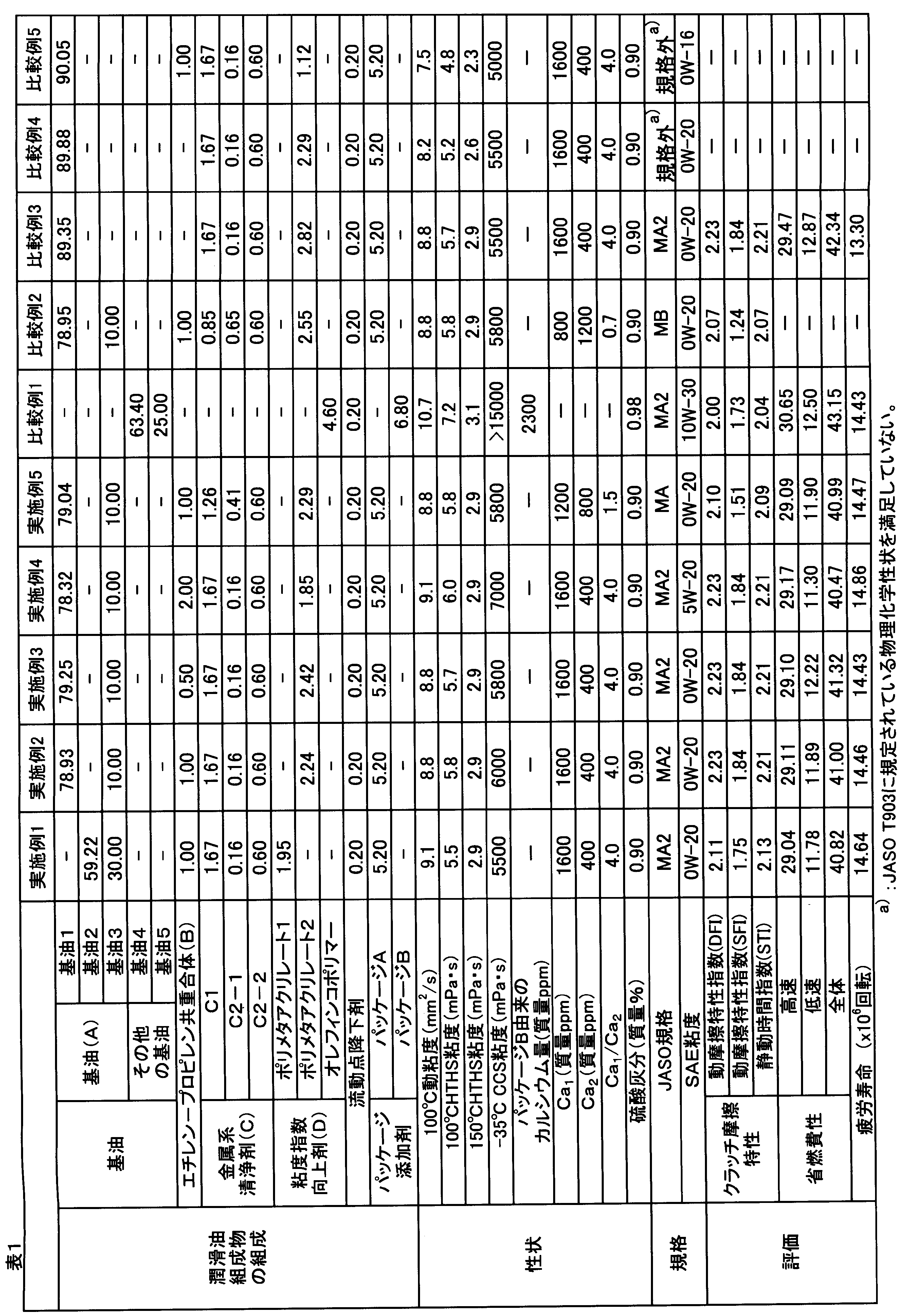
表1中、使用した材料等は、以下の通りである。
<基油(A)>
・基油1/API基油カテゴリーのグループ3に分類される鉱油、100℃動粘度:4.22mm2/s、粘度指数122
・基油2/API基油カテゴリーのグループ3に分類される鉱油、100℃動粘度:4.15mm2/s、粘度指数126
・基油3/API基油カテゴリーのグループ3に分類される鉱油、100℃動粘度:5.88mm2/s、粘度指数130
<その他の基油>
・基油4/API基油カテゴリーのグループ2に分類される鉱油、100℃動粘度:5.25mm2/s、粘度指数115
・基油5/API基油カテゴリーのグループ2に分類される鉱油、100℃動粘度:10.50mm2/s、粘度指数97
<エチレン-プロピレン共重合体(B)>
・エチレン-プロピレン共重合体、質量平均分子量:14,000、100℃動粘度:2,000mm2/s
<カルシウムフィネート(C1)>
・C1(過塩基性カルシウムフィネート、全塩基価:263mgKOH/g、カルシウム含有量9.6質量%)
<カルシウムスルホネート(C2)>
・C2-1(過塩基性カルシウムスルホネート、全塩基価:425mgKOH/g、カルシウム含有量16.1質量%)
・C2-2(中性カルシウムスルホネート、全塩基価:16mgKOH/g、カルシウム含有量2.4質量%)
<基油(A)>
・基油1/API基油カテゴリーのグループ3に分類される鉱油、100℃動粘度:4.22mm2/s、粘度指数122
・基油2/API基油カテゴリーのグループ3に分類される鉱油、100℃動粘度:4.15mm2/s、粘度指数126
・基油3/API基油カテゴリーのグループ3に分類される鉱油、100℃動粘度:5.88mm2/s、粘度指数130
<その他の基油>
・基油4/API基油カテゴリーのグループ2に分類される鉱油、100℃動粘度:5.25mm2/s、粘度指数115
・基油5/API基油カテゴリーのグループ2に分類される鉱油、100℃動粘度:10.50mm2/s、粘度指数97
<エチレン-プロピレン共重合体(B)>
・エチレン-プロピレン共重合体、質量平均分子量:14,000、100℃動粘度:2,000mm2/s
<カルシウムフィネート(C1)>
・C1(過塩基性カルシウムフィネート、全塩基価:263mgKOH/g、カルシウム含有量9.6質量%)
<カルシウムスルホネート(C2)>
・C2-1(過塩基性カルシウムスルホネート、全塩基価:425mgKOH/g、カルシウム含有量16.1質量%)
・C2-2(中性カルシウムスルホネート、全塩基価:16mgKOH/g、カルシウム含有量2.4質量%)
<粘度指数向上剤(D)>
・ポリメタアクリレート1(質量平均分子量:40万)
・ポリメタアクリレート2(質量平均分子量:23万)
・オレフィンコポリマー(質量平均分子量:58万)
<流動点降下剤>
・ポリメタアクリレート3(質量平均分子量:6.9万)
・ポリメタアクリレート1(質量平均分子量:40万)
・ポリメタアクリレート2(質量平均分子量:23万)
・オレフィンコポリマー(質量平均分子量:58万)
<流動点降下剤>
・ポリメタアクリレート3(質量平均分子量:6.9万)
<パッケージA>
・ジアルキルジチオリン酸亜鉛、アミン系酸化防止剤、イミド系分散剤を含む添加剤パッケージ(リン含有量:1.02質量%、亜鉛含有量:1.15質量%、窒素含有量:1.02質量%)
<パッケージB>
・ジアルキルジチオリン酸亜鉛、アミン系酸化防止剤、カルシウム系清浄剤、イミド系分散剤を含む添加剤パッケージ(リン含有量:1.39質量%、亜鉛含有量:1.54質量%、窒素含有量:0.85質量%、カルシウム含有量:3.45質量%)
・ジアルキルジチオリン酸亜鉛、アミン系酸化防止剤、イミド系分散剤を含む添加剤パッケージ(リン含有量:1.02質量%、亜鉛含有量:1.15質量%、窒素含有量:1.02質量%)
<パッケージB>
・ジアルキルジチオリン酸亜鉛、アミン系酸化防止剤、カルシウム系清浄剤、イミド系分散剤を含む添加剤パッケージ(リン含有量:1.39質量%、亜鉛含有量:1.54質量%、窒素含有量:0.85質量%、カルシウム含有量:3.45質量%)
表1の結果から、実施例1~5の二輪車用潤滑油組成物は、省燃費性(特に低速時の省燃費性)を良好にしつつ、エンジン部品の疲労寿命の低下を抑制し、さらには、二輪車のクラッチ摩擦特性を良好にできることが確認できる。
比較例1の潤滑油組成物は粘度が全般的に高く、エチレン-プロピレン共重合体(B)を含有していないため、クラッチ摩擦特性や疲労寿命は良好であるものの、省燃費性を満足できるものではなかった。
比較例2の潤滑油組成物は、粘度指数120以上の基油(A)、エチレン-プロピレン共重合体(B)及び金属系清浄剤(C)をそれぞれ含有しているが、Ca1/Ca2が1.0未満であるため、クラッチ摩擦特性を満足できるものではなかった。
比較例3の潤滑油組成物は、エチレン-プロピレン共重合体(B)を含有していないため、適切な油膜を形成できず(特に、低速時に適切な油膜を形成できず)、疲労寿命及び省燃費性を満足できるものではなかった。
比較例4の潤滑油組成物は、エチレン-プロピレン共重合体(B)を含有しておらず、かつ、150℃のHTHS粘度が低いことから、JASO T903に規定されている物理化学性状を満足できるものではなかった。このため、適切な油膜を形成できものではない。
比較例5の潤滑油組成物は、粘度指数120以上の基油(A)、エチレン-プロピレン共重合体(B)及び金属系清浄剤(C)をそれぞれ含有しているが、150℃のHTHS粘度が極めて低いことから、JASO T903に規定されている物理化学性状を満足できるものではなかった。このため、適切な油膜を形成できるものではない。
比較例1の潤滑油組成物は粘度が全般的に高く、エチレン-プロピレン共重合体(B)を含有していないため、クラッチ摩擦特性や疲労寿命は良好であるものの、省燃費性を満足できるものではなかった。
比較例2の潤滑油組成物は、粘度指数120以上の基油(A)、エチレン-プロピレン共重合体(B)及び金属系清浄剤(C)をそれぞれ含有しているが、Ca1/Ca2が1.0未満であるため、クラッチ摩擦特性を満足できるものではなかった。
比較例3の潤滑油組成物は、エチレン-プロピレン共重合体(B)を含有していないため、適切な油膜を形成できず(特に、低速時に適切な油膜を形成できず)、疲労寿命及び省燃費性を満足できるものではなかった。
比較例4の潤滑油組成物は、エチレン-プロピレン共重合体(B)を含有しておらず、かつ、150℃のHTHS粘度が低いことから、JASO T903に規定されている物理化学性状を満足できるものではなかった。このため、適切な油膜を形成できものではない。
比較例5の潤滑油組成物は、粘度指数120以上の基油(A)、エチレン-プロピレン共重合体(B)及び金属系清浄剤(C)をそれぞれ含有しているが、150℃のHTHS粘度が極めて低いことから、JASO T903に規定されている物理化学性状を満足できるものではなかった。このため、適切な油膜を形成できるものではない。
Claims (12)
- 粘度指数120以上の基油(A)、エチレン-プロピレン共重合体(B)、及び金属系清浄剤(C)を含み、
前記エチレン-プロピレン共重合体(B)の含有量が、潤滑油組成物全量基準で0.30質量%以上であり、
前記金属系清浄剤(C)としてカルシウムフィネート(C1)及びカルシウムスルホネート(C2)を含み、前記カルシウムフィネート(C1)のカルシウム原子換算での含有量(Ca1)と、前記カルシウムスルホネート(C2)のカルシウム原子換算での含有量(Ca2)との質量比が、1.0≦Ca1/Ca2の関係を満たし、
100℃の動粘度が9.3mm2/s未満であり、150℃のHTHS粘度が2.9mPa・s以上である、二輪車用潤滑油組成物。 - 前記エチレン-プロピレン共重合体(B)の質量平均分子量が30,000以下である請求項1に記載の二輪車用潤滑油組成物。
- 前記エチレン-プロピレン共重合体(B)の100℃動粘度が750mm2/s以上2,500mm2/s以下である請求項1又は2に記載の二輪車用潤滑油組成物。
- 前記金属系清浄剤(C)の金属原子換算での含有量が、潤滑油組成物全量基準で0.12質量%超0.22質量%以下である請求項1~3の何れか1項に記載の二輪車用潤滑油組成物。
- 前記カルシウムフィネート(C1)のカルシウム原子換算での含有量(Ca1)が、潤滑油組成物全量基準で0.10質量%以上0.20質量%以下である請求項1~4の何れか1項に記載の二輪車用潤滑油組成物。
- さらに、質量平均分子量が100,000以上の粘度指数向上剤(D)を含む請求項1~5の何れか1項に記載の二輪車用潤滑油組成物。
- 前記粘度指数向上剤(D)がポリ(メタ)アクリレート系粘度指数向上剤である請求項6に記載の二輪車用潤滑油組成物。
- 前記潤滑油組成物の硫酸灰分が0.9質量%以下である請求項1~7の何れか1項に記載の二輪車用潤滑油組成物。
- 前記潤滑油組成物の粘度グレードが、SAE J300:2015による分類でxW-20~xW-8であり、xが0、5又は10である請求項1~8の何れか1項に記載の二輪車用潤滑油組成物。
- エンジン用である請求項1~9の何れか1項に記載の二輪車用潤滑油組成物。
- 二輪車のエンジンに対して、請求項1~9の何れか1項に記載の二輪車用潤滑油組成物を添加する、二輪車の燃費向上方法。
- 粘度指数120以上の基油(A)、エチレン-プロピレン共重合体(B)、及び金属系清浄剤(C)を含む潤滑油組成物を調製する工程を有し、下記条件(i)~(iv)を満たすように前記調製を行う、二輪車用潤滑油組成物の製造方法。
(i)前記エチレン-プロピレン共重合体(B)の含有量が、潤滑油組成物全量基準で0.30質量%以上
(ii)前記金属系清浄剤(C)がカルシウムフィネート(C1)及びカルシウムスルホネート(C2)を含み、前記カルシウムフィネート(C1)のカルシウム原子換算での含有量(Ca1)と、前記カルシウムスルホネート(C2)のカルシウム原子換算での含有量(Ca2)との質量比が、1.0≦Ca1/Ca2
(iii)前記潤滑油組成物の100℃の動粘度が9.3mm2/s未満
(iv)前記潤滑油組成物の150℃のHTHS粘度が2.9mPa・s以上
Priority Applications (2)
| Application Number | Priority Date | Filing Date | Title |
|---|---|---|---|
| CN201880021074.XA CN110462013B (zh) | 2017-03-30 | 2018-03-20 | 两轮车用润滑油组合物以及该润滑油组合物的制造方法 |
| US16/498,181 US11130927B2 (en) | 2017-03-30 | 2018-03-20 | Lubricating oil composition for two wheeled vehicle, method for improving fuel economy of two wheeled vehicle using the lubricating oil composition, and method for producing the lubricating oil composition |
Applications Claiming Priority (2)
| Application Number | Priority Date | Filing Date | Title |
|---|---|---|---|
| JP2017-069228 | 2017-03-30 | ||
| JP2017069228A JP6927488B2 (ja) | 2017-03-30 | 2017-03-30 | 二輪車用潤滑油組成物、該潤滑油組成物を用いた二輪車の燃費向上方法、及び該潤滑油組成物の製造方法 |
Publications (1)
| Publication Number | Publication Date |
|---|---|
| WO2018180763A1 true WO2018180763A1 (ja) | 2018-10-04 |
Family
ID=63675786
Family Applications (1)
| Application Number | Title | Priority Date | Filing Date |
|---|---|---|---|
| PCT/JP2018/011021 Ceased WO2018180763A1 (ja) | 2017-03-30 | 2018-03-20 | 二輪車用潤滑油組成物、該潤滑油組成物を用いた二輪車の燃費向上方法、及び該潤滑油組成物の製造方法 |
Country Status (4)
| Country | Link |
|---|---|
| US (1) | US11130927B2 (ja) |
| JP (1) | JP6927488B2 (ja) |
| CN (1) | CN110462013B (ja) |
| WO (1) | WO2018180763A1 (ja) |
Families Citing this family (10)
| Publication number | Priority date | Publication date | Assignee | Title |
|---|---|---|---|---|
| WO2019089181A1 (en) * | 2017-10-30 | 2019-05-09 | Exxonmobil Research And Engineering Company | Lubricating oil compositions with engine wear protection |
| WO2020262639A1 (ja) * | 2019-06-28 | 2020-12-30 | 出光興産株式会社 | 潤滑油組成物 |
| CN115551976A (zh) * | 2020-05-14 | 2022-12-30 | 雪佛龙日本有限公司 | 包括梳状聚甲基丙烯酸酯和基于乙烯的烯烃共聚物粘度改性剂的润滑油组合物 |
| CN115698236B (zh) | 2020-07-09 | 2024-07-09 | 埃克森美孚技术与工程公司 | 具有优异发动机磨损保护和腐蚀保护的发动机油润滑剂组合物及其制备方法 |
| US12098347B2 (en) | 2022-09-21 | 2024-09-24 | Afton Chemical Corporation | Lubricating composition for fuel efficient motorcycle applications |
| US12024687B2 (en) | 2022-09-27 | 2024-07-02 | Afton Chemical Corporation | Lubricating composition for motorcycle applications |
| US11912955B1 (en) | 2022-10-28 | 2024-02-27 | Afton Chemical Corporation | Lubricating compositions for reduced low temperature valve train wear |
| US12110468B1 (en) | 2023-03-22 | 2024-10-08 | Afton Chemical Corporation | Antiwear systems for improved wear in medium and/or heavy duty diesel engines |
| FR3159172A1 (fr) * | 2024-07-05 | 2025-08-15 | Totalenergies Onetech | Composition lubrifiante pour moteur marin 2-temps |
| FR3159393A1 (fr) * | 2024-07-05 | 2025-08-22 | Totalenergies Onetech | Composition lubrifiante pour moteur marin 4-temps |
Citations (5)
| Publication number | Priority date | Publication date | Assignee | Title |
|---|---|---|---|---|
| JP2008525583A (ja) * | 2004-12-22 | 2008-07-17 | ザ ルブリゾル コーポレイション | 粘度制御方法 |
| JP2012131986A (ja) * | 2010-11-29 | 2012-07-12 | Chevron Japan Ltd | 自動車エンジン潤滑用潤滑油組成物 |
| JP2013185087A (ja) * | 2012-03-08 | 2013-09-19 | Chevron Japan Ltd | 自動車エンジン潤滑用潤滑油組成物 |
| WO2015152143A1 (ja) * | 2014-03-31 | 2015-10-08 | 出光興産株式会社 | 潤滑油組成物 |
| JP2017508053A (ja) * | 2014-03-19 | 2017-03-23 | ザ ルブリゾル コーポレイションThe Lubrizol Corporation | ポリマーのブレンドを含有する潤滑剤 |
Family Cites Families (20)
| Publication number | Priority date | Publication date | Assignee | Title |
|---|---|---|---|---|
| US4908146A (en) * | 1988-11-16 | 1990-03-13 | Exxon Chemical Patents Inc. | Oil additive compositions exhibiting reduced haze containing polymeric viscosity index improver |
| US5217636A (en) * | 1992-03-10 | 1993-06-08 | Albright & Wilson Americas Inc. | Lubricating oil viscosity index improver composition |
| JP4076634B2 (ja) * | 1998-09-09 | 2008-04-16 | 新日本石油株式会社 | 二輪車用4サイクルエンジン油組成物 |
| US20070142248A1 (en) * | 2005-11-09 | 2007-06-21 | Degonla David J | Lubricant composition |
| US8703669B2 (en) * | 2008-03-11 | 2014-04-22 | Afton Chemical Corporation | Ultra-low sulfur clutch-only transmission fluids |
| JP5330716B2 (ja) * | 2008-03-17 | 2013-10-30 | 出光興産株式会社 | 潤滑油組成物 |
| JP5044465B2 (ja) * | 2008-03-27 | 2012-10-10 | Jx日鉱日石エネルギー株式会社 | 潤滑油組成物及びその製造方法 |
| JP5249683B2 (ja) * | 2008-08-29 | 2013-07-31 | Jx日鉱日石エネルギー株式会社 | 銀含有材料と接触する潤滑油組成物 |
| JP5301305B2 (ja) * | 2009-02-03 | 2013-09-25 | コスモ石油ルブリカンツ株式会社 | 無段変速機用潤滑油組成物 |
| JP5727713B2 (ja) * | 2010-03-19 | 2015-06-03 | 出光興産株式会社 | 内燃機関用潤滑油組成物 |
| EP2705127A1 (en) * | 2011-05-04 | 2014-03-12 | The Lubrizol Corporation | Motorcycle engine lubricant |
| CN105121613A (zh) * | 2013-03-04 | 2015-12-02 | 出光兴产株式会社 | 润滑油组合物 |
| JP6016692B2 (ja) | 2013-03-29 | 2016-10-26 | Jxエネルギー株式会社 | 自動変速機用潤滑油組成物 |
| EP3115444A4 (en) * | 2014-03-04 | 2017-11-01 | Idemitsu Kosan Co., Ltd | Lubricant oil composition |
| JP6420964B2 (ja) * | 2014-03-31 | 2018-11-07 | 出光興産株式会社 | 内燃機関用潤滑油組成物 |
| JP6114330B2 (ja) | 2015-03-31 | 2017-04-12 | 出光興産株式会社 | 潤滑油組成物及び内燃機関の摩擦低減方法 |
| CN106318523B (zh) * | 2015-06-16 | 2019-03-22 | 中国石油化工股份有限公司 | 一种摩托车发动机润滑油组合物及其制备方法 |
| US10336959B2 (en) * | 2015-07-16 | 2019-07-02 | Afton Chemical Corporation | Lubricants with calcium-containing detergent and their use for improving low speed pre-ignition |
| US20170292083A1 (en) * | 2016-04-06 | 2017-10-12 | Afton Chemical Corporation | TBN and Performance Booster |
| US10323205B2 (en) * | 2016-05-05 | 2019-06-18 | Afton Chemical Corporation | Lubricant compositions for reducing timing chain stretch |
-
2017
- 2017-03-30 JP JP2017069228A patent/JP6927488B2/ja active Active
-
2018
- 2018-03-20 WO PCT/JP2018/011021 patent/WO2018180763A1/ja not_active Ceased
- 2018-03-20 CN CN201880021074.XA patent/CN110462013B/zh not_active Expired - Fee Related
- 2018-03-20 US US16/498,181 patent/US11130927B2/en not_active Expired - Fee Related
Patent Citations (5)
| Publication number | Priority date | Publication date | Assignee | Title |
|---|---|---|---|---|
| JP2008525583A (ja) * | 2004-12-22 | 2008-07-17 | ザ ルブリゾル コーポレイション | 粘度制御方法 |
| JP2012131986A (ja) * | 2010-11-29 | 2012-07-12 | Chevron Japan Ltd | 自動車エンジン潤滑用潤滑油組成物 |
| JP2013185087A (ja) * | 2012-03-08 | 2013-09-19 | Chevron Japan Ltd | 自動車エンジン潤滑用潤滑油組成物 |
| JP2017508053A (ja) * | 2014-03-19 | 2017-03-23 | ザ ルブリゾル コーポレイションThe Lubrizol Corporation | ポリマーのブレンドを含有する潤滑剤 |
| WO2015152143A1 (ja) * | 2014-03-31 | 2015-10-08 | 出光興産株式会社 | 潤滑油組成物 |
Also Published As
| Publication number | Publication date |
|---|---|
| CN110462013A (zh) | 2019-11-15 |
| CN110462013B (zh) | 2022-11-18 |
| JP2018168341A (ja) | 2018-11-01 |
| JP6927488B2 (ja) | 2021-09-01 |
| US20200048576A1 (en) | 2020-02-13 |
| US11130927B2 (en) | 2021-09-28 |
Similar Documents
| Publication | Publication Date | Title |
|---|---|---|
| JP6927488B2 (ja) | 二輪車用潤滑油組成物、該潤滑油組成物を用いた二輪車の燃費向上方法、及び該潤滑油組成物の製造方法 | |
| US9637702B2 (en) | Lubricant composition for marine engine | |
| ES2546852T3 (es) | Composición de aceite lubricante | |
| CN104334699B (zh) | 用于发动机的润滑剂组合物 | |
| KR102603888B1 (ko) | 윤활유 조성물 및 내연 기관의 마찰 저감 방법 | |
| JP2018141145A (ja) | 潤滑油組成物及びそれに関連する改善 | |
| CN109913293A (zh) | 汽油发动机用润滑油组合物及其制造方法 | |
| KR20170063575A (ko) | 윤활유 조성물 | |
| US12104137B2 (en) | Engine oil composition | |
| WO2018078434A1 (ja) | 潤滑油組成物 | |
| JP6223231B2 (ja) | エンジン油組成物 | |
| JP6362616B2 (ja) | ポリグリセロールエーテルをベースとする潤滑剤組成物 | |
| US20200190422A1 (en) | Lubricating oil composition for internal combustion engine | |
| JP6687347B2 (ja) | エンジン油組成物 | |
| JP6895861B2 (ja) | 内燃機関用潤滑油組成物 | |
| JP2022180774A (ja) | 内燃機関用潤滑油組成物 | |
| JP6940274B2 (ja) | 潤滑油組成物 | |
| FR2951456A1 (fr) | Lubrifiant moteur | |
| JP2012500315A (ja) | 潤滑組成物 | |
| JP2008075053A (ja) | クロスヘッド型ディーゼルエンジン用シリンダ油組成物 | |
| JP2002038180A (ja) | 潤滑油組成物 | |
| JP2023180554A (ja) | 潤滑油組成物 | |
| HK1199054B (en) | Lubricant composition for marine engine |
Legal Events
| Date | Code | Title | Description |
|---|---|---|---|
| 121 | Ep: the epo has been informed by wipo that ep was designated in this application |
Ref document number: 18774690 Country of ref document: EP Kind code of ref document: A1 |
|
| NENP | Non-entry into the national phase |
Ref country code: DE |
|
| 122 | Ep: pct application non-entry in european phase |
Ref document number: 18774690 Country of ref document: EP Kind code of ref document: A1 |