WO2018168207A1 - 表面処理組成物、その製造方法、およびこれを用いた表面処理方法 - Google Patents
表面処理組成物、その製造方法、およびこれを用いた表面処理方法 Download PDFInfo
- Publication number
- WO2018168207A1 WO2018168207A1 PCT/JP2018/001953 JP2018001953W WO2018168207A1 WO 2018168207 A1 WO2018168207 A1 WO 2018168207A1 JP 2018001953 W JP2018001953 W JP 2018001953W WO 2018168207 A1 WO2018168207 A1 WO 2018168207A1
- Authority
- WO
- WIPO (PCT)
- Prior art keywords
- surface treatment
- polishing
- acid
- group
- salt
- Prior art date
- Legal status (The legal status is an assumption and is not a legal conclusion. Google has not performed a legal analysis and makes no representation as to the accuracy of the status listed.)
- Ceased
Links
Classifications
-
- H—ELECTRICITY
- H10—SEMICONDUCTOR DEVICES; ELECTRIC SOLID-STATE DEVICES NOT OTHERWISE PROVIDED FOR
- H10P—GENERIC PROCESSES OR APPARATUS FOR THE MANUFACTURE OR TREATMENT OF DEVICES COVERED BY CLASS H10
- H10P70/00—Cleaning of wafers, substrates or parts of devices
- H10P70/20—Cleaning during device manufacture
-
- C—CHEMISTRY; METALLURGY
- C11—ANIMAL OR VEGETABLE OILS, FATS, FATTY SUBSTANCES OR WAXES; FATTY ACIDS THEREFROM; DETERGENTS; CANDLES
- C11D—DETERGENT COMPOSITIONS; USE OF SINGLE SUBSTANCES AS DETERGENTS; SOAP OR SOAP-MAKING; RESIN SOAPS; RECOVERY OF GLYCEROL
- C11D7/00—Compositions of detergents based essentially on non-surface-active compounds
- C11D7/22—Organic compounds
-
- C—CHEMISTRY; METALLURGY
- C11—ANIMAL OR VEGETABLE OILS, FATS, FATTY SUBSTANCES OR WAXES; FATTY ACIDS THEREFROM; DETERGENTS; CANDLES
- C11D—DETERGENT COMPOSITIONS; USE OF SINGLE SUBSTANCES AS DETERGENTS; SOAP OR SOAP-MAKING; RESIN SOAPS; RECOVERY OF GLYCEROL
- C11D17/00—Detergent materials or soaps characterised by their shape or physical properties
- C11D17/0008—Detergent materials or soaps characterised by their shape or physical properties aqueous liquid non soap compositions
- C11D17/0013—Liquid compositions with insoluble particles in suspension
-
- C—CHEMISTRY; METALLURGY
- C11—ANIMAL OR VEGETABLE OILS, FATS, FATTY SUBSTANCES OR WAXES; FATTY ACIDS THEREFROM; DETERGENTS; CANDLES
- C11D—DETERGENT COMPOSITIONS; USE OF SINGLE SUBSTANCES AS DETERGENTS; SOAP OR SOAP-MAKING; RESIN SOAPS; RECOVERY OF GLYCEROL
- C11D3/00—Other compounding ingredients of detergent compositions covered in group C11D1/00
- C11D3/16—Organic compounds
- C11D3/37—Polymers
- C11D3/3746—Macromolecular compounds obtained by reactions only involving carbon-to-carbon unsaturated bonds
- C11D3/3757—(Co)polymerised carboxylic acids, -anhydrides, -esters in solid and liquid compositions
- C11D3/3765—(Co)polymerised carboxylic acids, -anhydrides, -esters in solid and liquid compositions in liquid compositions
-
- C—CHEMISTRY; METALLURGY
- C11—ANIMAL OR VEGETABLE OILS, FATS, FATTY SUBSTANCES OR WAXES; FATTY ACIDS THEREFROM; DETERGENTS; CANDLES
- C11D—DETERGENT COMPOSITIONS; USE OF SINGLE SUBSTANCES AS DETERGENTS; SOAP OR SOAP-MAKING; RESIN SOAPS; RECOVERY OF GLYCEROL
- C11D3/00—Other compounding ingredients of detergent compositions covered in group C11D1/00
- C11D3/16—Organic compounds
- C11D3/37—Polymers
- C11D3/3746—Macromolecular compounds obtained by reactions only involving carbon-to-carbon unsaturated bonds
- C11D3/3769—(Co)polymerised monomers containing nitrogen, e.g. carbonamides, nitriles or amines
- C11D3/3773—(Co)polymerised monomers containing nitrogen, e.g. carbonamides, nitriles or amines in liquid compositions
-
- C—CHEMISTRY; METALLURGY
- C11—ANIMAL OR VEGETABLE OILS, FATS, FATTY SUBSTANCES OR WAXES; FATTY ACIDS THEREFROM; DETERGENTS; CANDLES
- C11D—DETERGENT COMPOSITIONS; USE OF SINGLE SUBSTANCES AS DETERGENTS; SOAP OR SOAP-MAKING; RESIN SOAPS; RECOVERY OF GLYCEROL
- C11D3/00—Other compounding ingredients of detergent compositions covered in group C11D1/00
- C11D3/16—Organic compounds
- C11D3/37—Polymers
- C11D3/3746—Macromolecular compounds obtained by reactions only involving carbon-to-carbon unsaturated bonds
- C11D3/378—(Co)polymerised monomers containing sulfur, e.g. sulfonate
-
- C—CHEMISTRY; METALLURGY
- C11—ANIMAL OR VEGETABLE OILS, FATS, FATTY SUBSTANCES OR WAXES; FATTY ACIDS THEREFROM; DETERGENTS; CANDLES
- C11D—DETERGENT COMPOSITIONS; USE OF SINGLE SUBSTANCES AS DETERGENTS; SOAP OR SOAP-MAKING; RESIN SOAPS; RECOVERY OF GLYCEROL
- C11D7/00—Compositions of detergents based essentially on non-surface-active compounds
- C11D7/02—Inorganic compounds
- C11D7/04—Water-soluble compounds
- C11D7/10—Salts
-
- C—CHEMISTRY; METALLURGY
- C11—ANIMAL OR VEGETABLE OILS, FATS, FATTY SUBSTANCES OR WAXES; FATTY ACIDS THEREFROM; DETERGENTS; CANDLES
- C11D—DETERGENT COMPOSITIONS; USE OF SINGLE SUBSTANCES AS DETERGENTS; SOAP OR SOAP-MAKING; RESIN SOAPS; RECOVERY OF GLYCEROL
- C11D7/00—Compositions of detergents based essentially on non-surface-active compounds
- C11D7/02—Inorganic compounds
- C11D7/04—Water-soluble compounds
- C11D7/10—Salts
- C11D7/105—Nitrates; Nitrites
-
- C—CHEMISTRY; METALLURGY
- C11—ANIMAL OR VEGETABLE OILS, FATS, FATTY SUBSTANCES OR WAXES; FATTY ACIDS THEREFROM; DETERGENTS; CANDLES
- C11D—DETERGENT COMPOSITIONS; USE OF SINGLE SUBSTANCES AS DETERGENTS; SOAP OR SOAP-MAKING; RESIN SOAPS; RECOVERY OF GLYCEROL
- C11D7/00—Compositions of detergents based essentially on non-surface-active compounds
- C11D7/02—Inorganic compounds
- C11D7/20—Water-insoluble oxides
-
- C—CHEMISTRY; METALLURGY
- C11—ANIMAL OR VEGETABLE OILS, FATS, FATTY SUBSTANCES OR WAXES; FATTY ACIDS THEREFROM; DETERGENTS; CANDLES
- C11D—DETERGENT COMPOSITIONS; USE OF SINGLE SUBSTANCES AS DETERGENTS; SOAP OR SOAP-MAKING; RESIN SOAPS; RECOVERY OF GLYCEROL
- C11D7/00—Compositions of detergents based essentially on non-surface-active compounds
- C11D7/22—Organic compounds
- C11D7/26—Organic compounds containing oxygen
-
- C—CHEMISTRY; METALLURGY
- C11—ANIMAL OR VEGETABLE OILS, FATS, FATTY SUBSTANCES OR WAXES; FATTY ACIDS THEREFROM; DETERGENTS; CANDLES
- C11D—DETERGENT COMPOSITIONS; USE OF SINGLE SUBSTANCES AS DETERGENTS; SOAP OR SOAP-MAKING; RESIN SOAPS; RECOVERY OF GLYCEROL
- C11D7/00—Compositions of detergents based essentially on non-surface-active compounds
- C11D7/22—Organic compounds
- C11D7/26—Organic compounds containing oxygen
- C11D7/265—Carboxylic acids or salts thereof
-
- C—CHEMISTRY; METALLURGY
- C11—ANIMAL OR VEGETABLE OILS, FATS, FATTY SUBSTANCES OR WAXES; FATTY ACIDS THEREFROM; DETERGENTS; CANDLES
- C11D—DETERGENT COMPOSITIONS; USE OF SINGLE SUBSTANCES AS DETERGENTS; SOAP OR SOAP-MAKING; RESIN SOAPS; RECOVERY OF GLYCEROL
- C11D7/00—Compositions of detergents based essentially on non-surface-active compounds
- C11D7/22—Organic compounds
- C11D7/26—Organic compounds containing oxygen
- C11D7/266—Esters or carbonates
-
- C—CHEMISTRY; METALLURGY
- C11—ANIMAL OR VEGETABLE OILS, FATS, FATTY SUBSTANCES OR WAXES; FATTY ACIDS THEREFROM; DETERGENTS; CANDLES
- C11D—DETERGENT COMPOSITIONS; USE OF SINGLE SUBSTANCES AS DETERGENTS; SOAP OR SOAP-MAKING; RESIN SOAPS; RECOVERY OF GLYCEROL
- C11D7/00—Compositions of detergents based essentially on non-surface-active compounds
- C11D7/22—Organic compounds
- C11D7/32—Organic compounds containing nitrogen
- C11D7/3218—Alkanolamines or alkanolimines
-
- C—CHEMISTRY; METALLURGY
- C11—ANIMAL OR VEGETABLE OILS, FATS, FATTY SUBSTANCES OR WAXES; FATTY ACIDS THEREFROM; DETERGENTS; CANDLES
- C11D—DETERGENT COMPOSITIONS; USE OF SINGLE SUBSTANCES AS DETERGENTS; SOAP OR SOAP-MAKING; RESIN SOAPS; RECOVERY OF GLYCEROL
- C11D7/00—Compositions of detergents based essentially on non-surface-active compounds
- C11D7/22—Organic compounds
- C11D7/34—Organic compounds containing sulfur
-
- C—CHEMISTRY; METALLURGY
- C11—ANIMAL OR VEGETABLE OILS, FATS, FATTY SUBSTANCES OR WAXES; FATTY ACIDS THEREFROM; DETERGENTS; CANDLES
- C11D—DETERGENT COMPOSITIONS; USE OF SINGLE SUBSTANCES AS DETERGENTS; SOAP OR SOAP-MAKING; RESIN SOAPS; RECOVERY OF GLYCEROL
- C11D7/00—Compositions of detergents based essentially on non-surface-active compounds
- C11D7/22—Organic compounds
- C11D7/36—Organic compounds containing phosphorus
-
- C—CHEMISTRY; METALLURGY
- C11—ANIMAL OR VEGETABLE OILS, FATS, FATTY SUBSTANCES OR WAXES; FATTY ACIDS THEREFROM; DETERGENTS; CANDLES
- C11D—DETERGENT COMPOSITIONS; USE OF SINGLE SUBSTANCES AS DETERGENTS; SOAP OR SOAP-MAKING; RESIN SOAPS; RECOVERY OF GLYCEROL
- C11D7/00—Compositions of detergents based essentially on non-surface-active compounds
- C11D7/50—Solvents
-
- H—ELECTRICITY
- H10—SEMICONDUCTOR DEVICES; ELECTRIC SOLID-STATE DEVICES NOT OTHERWISE PROVIDED FOR
- H10P—GENERIC PROCESSES OR APPARATUS FOR THE MANUFACTURE OR TREATMENT OF DEVICES COVERED BY CLASS H10
- H10P52/00—Grinding, lapping or polishing of wafers, substrates or parts of devices
-
- H—ELECTRICITY
- H10—SEMICONDUCTOR DEVICES; ELECTRIC SOLID-STATE DEVICES NOT OTHERWISE PROVIDED FOR
- H10P—GENERIC PROCESSES OR APPARATUS FOR THE MANUFACTURE OR TREATMENT OF DEVICES COVERED BY CLASS H10
- H10P70/00—Cleaning of wafers, substrates or parts of devices
- H10P70/20—Cleaning during device manufacture
- H10P70/23—Cleaning during device manufacture during, before or after processing of insulating materials
- H10P70/237—Cleaning during device manufacture during, before or after processing of insulating materials the processing being a planarisation of insulating layers
-
- H—ELECTRICITY
- H10—SEMICONDUCTOR DEVICES; ELECTRIC SOLID-STATE DEVICES NOT OTHERWISE PROVIDED FOR
- H10P—GENERIC PROCESSES OR APPARATUS FOR THE MANUFACTURE OR TREATMENT OF DEVICES COVERED BY CLASS H10
- H10P70/00—Cleaning of wafers, substrates or parts of devices
- H10P70/20—Cleaning during device manufacture
- H10P70/27—Cleaning during device manufacture during, before or after processing of conductive materials, e.g. polysilicon or amorphous silicon layers
- H10P70/277—Cleaning during device manufacture during, before or after processing of conductive materials, e.g. polysilicon or amorphous silicon layers the processing being a planarisation of conductive layers
-
- B—PERFORMING OPERATIONS; TRANSPORTING
- B08—CLEANING
- B08B—CLEANING IN GENERAL; PREVENTION OF FOULING IN GENERAL
- B08B1/00—Cleaning by methods involving the use of tools
- B08B1/10—Cleaning by methods involving the use of tools characterised by the type of cleaning tool
- B08B1/12—Brushes
-
- B—PERFORMING OPERATIONS; TRANSPORTING
- B08—CLEANING
- B08B—CLEANING IN GENERAL; PREVENTION OF FOULING IN GENERAL
- B08B3/00—Cleaning by methods involving the use or presence of liquid or steam
- B08B3/02—Cleaning by the force of jets or sprays
-
- B—PERFORMING OPERATIONS; TRANSPORTING
- B08—CLEANING
- B08B—CLEANING IN GENERAL; PREVENTION OF FOULING IN GENERAL
- B08B3/00—Cleaning by methods involving the use or presence of liquid or steam
- B08B3/04—Cleaning involving contact with liquid
- B08B3/08—Cleaning involving contact with liquid the liquid having chemical or dissolving effect
-
- C—CHEMISTRY; METALLURGY
- C11—ANIMAL OR VEGETABLE OILS, FATS, FATTY SUBSTANCES OR WAXES; FATTY ACIDS THEREFROM; DETERGENTS; CANDLES
- C11D—DETERGENT COMPOSITIONS; USE OF SINGLE SUBSTANCES AS DETERGENTS; SOAP OR SOAP-MAKING; RESIN SOAPS; RECOVERY OF GLYCEROL
- C11D2111/00—Cleaning compositions characterised by the objects to be cleaned; Cleaning compositions characterised by non-standard cleaning or washing processes
- C11D2111/10—Objects to be cleaned
- C11D2111/14—Hard surfaces
- C11D2111/22—Electronic devices, e.g. PCBs or semiconductors
Definitions
- the present invention relates to a surface treatment composition, a production method thereof, and a surface treatment method using the same.
- CMP chemical mechanical polishing
- Impurities are produced by polishing abrasive grains derived from the polishing composition used in CMP, organic substances such as metals, anticorrosives, and surfactants, silicon-containing materials that are objects to be polished, metal wiring, plugs, etc.
- silicon-containing materials, metals, and organic substances such as pad scraps generated from various pads are included.
- the surface of the semiconductor substrate is contaminated with these impurities, it may adversely affect the electrical characteristics of the semiconductor and reduce the reliability of the device. Therefore, it is desirable to introduce a cleaning process after the CMP process to remove these impurities from the surface of the semiconductor substrate.
- JP 2001-64689 A includes a sulfonic acid (salt) group and / or a carboxylic acid (salt) group.
- a semiconductor component cleaning liquid containing a water-soluble (co) polymer (a salt) as an essential constituent is disclosed.
- the semiconductor substrate is cleaned using such a semiconductor component cleaning solution, thereby reducing the environmental load and polishing grains such as silica and alumina remaining on the semiconductor substrate after CMP. It is disclosed that impurities based on metal impurities or metal wiring can be reduced.
- the polishing composition used for polishing the object to be polished contains ceria (CeO 2 ) as abrasive grains
- the cleaning liquid according to Japanese Patent Application Laid-Open No. 2001-64689 does not remove particle residues derived from ceria. There is a problem that is difficult. Therefore, in order to remove the particle residue derived from ceria, a surface treatment with a mixture of sulfuric acid and hydrogen peroxide solution is further required.
- the cleaning liquid according to Japanese Patent Laid-Open No. 2001-64689 has a problem that organic residues on the polished object cannot be sufficiently removed.
- an object of the present invention is to provide means capable of sufficiently suppressing organic residue while satisfactorily reducing ceria residue in a polished polishing object obtained after polishing with a polishing composition containing ceria. To do.
- the present inventors have intensively studied. As a result, by using a (co) polymer having a structural unit derived from a monomer having a carboxy group or a salt group thereof and a compound having a partial structure represented by SO x or NO y , The present inventors have found that the problem can be solved and have completed the present invention.
- the present invention A surface treatment composition for surface-treating a polished polishing object obtained after polishing with a polishing composition containing ceria, A carboxy group-containing (co) polymer having a structural unit derived from a monomer having a carboxy group or a salt group thereof; An SO x or NO y partial structure-containing compound having a partial structure represented by SO x or NO y , wherein x and y are each independently a real number of 1 to 5; A dispersion medium, pH is 1 or more and 8 or less, The present invention relates to a surface treatment composition.
- X to Y indicating a range means “X or more and Y or less”.
- measurement of operation and physical properties is performed under the conditions of room temperature (20 to 25 ° C.) / Relative humidity 40 to 50% RH.
- (meth) acryl is a generic name including acryl and methacryl
- (meth) acrylate is a generic name including acrylate and methacrylate.
- the surface treatment composition according to the present invention is used to reduce defects (impurities and foreign matters) remaining on the surface of a polished polishing object (hereinafter also referred to as “surface treatment object”).
- the surface treatment composition according to the present invention has a high removal effect regardless of the type of defect, it has a particularly high removal effect on ceria residues (for example, particle residues derived from ceria) and organic residues. Show. Therefore, the surface treatment composition according to the present invention is preferably used to reduce ceria residue and organic residue on the surface of the polished object.
- the ceria residue on the surface of the polished polishing object obtained after polishing with the polishing composition containing ceria usually exists as a particle residue. Therefore, the surface treatment composition according to the present invention is preferably used to reduce particle residues and organic residue on the surface of the polished object.
- the particle residue, organic residue, and other residues are greatly different in color and shape.
- the organic residue represents a component composed of an organic compound such as an organic low molecular compound or a high molecular compound, or a salt thereof, among the defects attached to the surface of the surface treatment target.
- the particle residue represents a component derived from granular inorganic substances such as abrasive grains (for example, abrasive grains containing ceria) contained in the polishing composition among defects attached to the surface of the surface treatment target.
- Other residues include residues composed of components other than particle residues and organic residues, mixtures of particle residues and organic residues, and the like.
- the type of defect can be determined visually from a photograph in SEM observation. Note that elemental analysis by an energy dispersive X-ray analyzer (EDX) may be used for the determination as necessary.
- EDX energy dispersive X-ray analyzer
- a surface treatment composition for surface-treating a polished polishing object obtained after polishing with a polishing composition containing ceria which has a carboxy group or a salt group thereof
- a carboxy group-containing (co) polymer having a structural unit derived from a monomer herein also simply referred to as “carboxy group-containing (co) polymer”
- SO x or NO y where x and y is a SO x or NO y partial structure-containing compound (herein referred to simply as “SO x or NO y partial structure-containing”), each having a partial structure represented by 1 to 5 independently.
- a dispersion medium, and a surface treatment composition having a pH of 1 or more and 8 or less is provided. According to one aspect of the present invention, there is provided means capable of sufficiently suppressing organic residue while satisfactorily reducing ceria residue in a polished polishing object obtained after polishing with a polishing composition containing ceria.
- the inventors presume the mechanism that can reduce both the particle residue and the organic residue in the polished polishing object obtained after polishing with the polishing composition containing ceria as described below. is doing.
- the polished polishing object or in the surface treatment composition it is derived from ceria residues contained in the polishing composition (particularly, particle residues derived from ceria), organic compounds or pad scraps contained in the polishing composition, etc. Impurities such as organic compounds (organic residues) are present.
- the SO x or NO y partial structure-containing compound Since the SO x or NO y partial structure-containing compound has the ability to form a complex with ceria, it forms a complex with the ceria residue. As a result, the dispersibility of the ceria residue is improved and the ceria residue is more easily removed.
- the carboxy group-containing (co) polymer is coordinated with the carboxy group directed to the organic residue side and the opposite side (surface treatment composition side).
- the carboxy group-containing (co) polymer is coordinated with the hydrophobic portion directed toward the organic residue and the carboxy group directed toward the opposite side (surface treatment composition side).
- the polished polishing object is hydrophilic
- the carboxy group is coordinated to the polished polishing object side and the opposite side (surface treatment composition side), which is hydrophobic.
- the hydrophobic site is coordinated toward the polished object to be polished, and the carboxy group is coordinated toward the opposite side (surface treatment composition side).
- the organic residue is more easily removed by the improvement in dispersibility and potential repulsion due to the coordination of the carboxy group-containing (co) polymer, and the organic residue is re-applied to the polished polishing object. Adhesion is suppressed.
- the surface treatment composition according to one embodiment of the present invention includes a carboxy group-containing (co) polymer having a structural unit derived from a monomer having a carboxy group or a salt group thereof.
- the carboxy group-containing (co) polymer has an action of facilitating removal of organic residues derived from organic compounds and pad scraps contained in the polishing composition.
- the monomer having a carboxy group or a salt thereof is not particularly limited, but is preferably a carboxy group-containing vinyl monomer having a carboxy group and a polymerizable double bond.
- the carboxy group-containing vinyl monomer is not particularly limited.
- examples include acetic acid, cinnamic acid, fumaric acid, fumaric acid monoalkyl ester, crotonic acid, itaconic acid, itaconic acid monoalkyl ester, itaconic acid glycol monoether, citraconic acid, citraconic acid monoalkyl ester, and the like. These may be used individually by 1 type and may be used in combination of 2 or more type.
- the carboxy group-containing (co) polymer is preferably a (co) polymer having a structural unit derived from (meth) acrylic acid or a salt thereof, and has a structural unit derived from acrylic acid or a salt thereof (copolymer). ) A polymer is more preferable.
- the main chain may be composed only of carbon atoms.
- oxygen atoms, nitrogen atoms, or phosphorus atoms may be partly contained.
- the structural unit derived from another monomer in the copolymer having a structural unit derived from a monomer having a carboxy group or a salt group thereof and a structural unit derived from another monomer is not particularly limited. Well-known ones can be used. Examples of other monomers constituting the structural units derived from other monomers include, for example, ethylenically unsaturated monomers other than carboxy group-containing vinyl monomers, diamines, diepoxides, hypophosphorous acid or the like. Examples include salts.
- the ethylenically unsaturated monomer is not particularly limited.
- Acid ester monomers Ethylene, propylene, isobutylene and other olefin monomers; vinyl propionate, vinyl acetate, vinyl benzoate, and other vinyl ester monomers; vinyl methyl ether, vinyl ethyl ether, and other vinyl ether monomers; Vinyl ketone monomers such as vinyl methyl ketone, vinyl ethyl ketone, vinyl hexyl ketone; N-vinyl monomers such as N-vinyl carbazole, N-vinyl indole, N-vinyl formamide, N-vinyl pyrrolidone; And heterocyclic vinyl monomers such as naphthalene and vinylpyridine; (meth) acrylic monomers such as acrylonitrile, methacrylonitrile, acrylamide and 2-acrylamido-2-methylpropanesulfonic acid.
- styrene monomer or a (meth) acrylic acid derivative is more preferable, styrenesulfonic acid or 2- More preferred is acrylamido-2-methylpropanesulfonic acid.
- Examples of the (co) polymer having a structural unit derived from a monomer having a carboxy group or a salt group thereof and a structural unit derived from another monomer include poly (meth) acrylic acid or a salt thereof, (meta ) A reaction product of a copolymer of acrylic acid and styrenesulfonic acid or a salt thereof, or hypophosphorous acid or a salt thereof, (meth) acrylic acid, and 2- (meth) acrylamido-2-methylpropanesulfonic acid It is preferable that the copolymer consists of or a salt thereof.
- polyacrylic acid or a salt thereof methacrylic acid and A copolymer of styrene sulfonic acid or a salt thereof, or a copolymer of a reaction product of hypophosphorous acid or a salt thereof, acrylic acid, and 2-acrylamido-2-methylpropane sulfonic acid, or a salt thereof. It is more preferable.
- the (co) polymer having a structural unit derived from a monomer having a carboxy group or a salt group thereof and a structural unit derived from another monomer may be polyacrylic acid or a salt thereof. Further preferred.
- a structural unit derived from a monomer having a carboxy group or a salt group thereof a structural unit derived from a monomer having a carboxy group or a salt group thereof, and other structural units Is preferably 1 mol% or more, more preferably 10 mol% or more, more preferably 20 mol% or more, and more preferably 50 mol% or more. Is more preferably 80 mol% or more (lower limit 0 mol%).
- the upper limit of the content ratio of the structural unit derived from the monomer having a carboxy group or a salt group thereof to the total of the structural unit derived from the monomer having a carboxy group or a salt group thereof and other structural units is preferably 100 mol% or less (upper limit of 100 mol%). If it is such a range, it will become possible to exhibit the effect of a carboxy group containing (co) polymer more favorably. Among these, a homopolymer having a structural unit derived from a monomer having a carboxy group or a salt group thereof is most preferable.
- a part or all of the structural unit derived from a monomer having a carboxy group or a salt group thereof may be a salt.
- the salt include alkali metal salts such as sodium salt and potassium salt, Group 2 element salts such as calcium salt and magnesium salt, amine salt, ammonium salt and the like. Among these, sodium salt is particularly preferable.
- the lower limit of the weight average molecular weight of the carboxy group-containing (co) polymer is preferably 400 or more, more preferably 1,000 or more, and further preferably 2,000 or more.
- the upper limit of the weight average molecular weight of the carboxy group-containing (co) polymer is preferably 2,000,000 or less, and more preferably 1,000,000 or less. If it is such a range, it will become possible to exhibit the effect of this invention more favorably.
- the weight average molecular weight of the carboxy group-containing (co) polymer can be measured by gel permeation chromatography (GPC). Details of the measurement method are described in the examples.
- a commercially available product may be used as the carboxy group-containing (co) polymer.
- limit especially as a commercial item,
- a copolymer which consists of a reaction material of hypophosphorous acid or its salt, and acrylic acid Belwalen (trademark) 500 or Belsperse (trademark) 164 by BWA company is made.
- Etc. as a copolymer composed of a reaction product of hypophosphorous acid or a salt thereof, acrylic acid, and 2-acrylamido-2-methylpropanesulfonic acid, Belclene (registered trademark) 400 manufactured by BWA, etc., respectively. be able to.
- the lower limit of the content of the carboxy group-containing (co) polymer in the surface treatment composition is preferably 0.0001 g / L or more, more preferably 0.001 g / L or more, and 0.1 g / L. More preferably, it is L or more. If it is this range, the removal effect of the organic compound derived from the organic compound contained in polishing composition, a pad waste, etc. will improve more.
- the upper limit of the content of the carboxy group-containing (co) polymer in the surface treatment composition is preferably 30 g / L or less, more preferably 10 g / L or less, and 5 g / L or less. More preferably. If it is this range, the removal of the carboxy group-containing (co) polymer after the surface treatment becomes easier, and the carboxy group-containing (co) polymer itself after the surface treatment itself is further suppressed from remaining as an organic residue. Can do.
- a surface treatment composition according to one embodiment of the present invention includes a compound (SO) having a partial structure represented by SO x or NO y (where x and y are each independently a real number of 1 to 5).
- SO SO
- NO y partial structure-containing compound The SO x or NO y partial structure-containing compound has an effect of facilitating the removal of ceria residues.
- the types of constituent elements are the same, and only two or more kinds differing only in the valence or number of sulfur atoms (S) or nitrogen atoms (N), the number of hydrogen atoms (H), or the number of oxygen atoms (O)
- S sulfur atoms
- N nitrogen atoms
- H hydrogen atoms
- O oxygen atoms
- x and y represent the average value.
- peroxomonosulfuric acid is a compound having a partial structure in which x of SO x is 5, and peroxomonosulfuric acid (H 2 SO 5 ) and peroxodisulfuric acid (H 2 S 2 O 8 )
- the equimolar mixture (H 2 SO 4.5 ) is treated as a compound having a partial structure in which x of SO x is 4.5.
- the “carboxy group-containing (co) polymer” described above is not included in the SO x or NO y partial structure-containing compound. That is, in this specification, the (co) polymer having a structural unit derived from a monomer having a carboxy group or a salt group thereof is SO x or NO y (where x and y are independently The compound is a “carboxy group-containing (co) polymer”, not a “SO x or NO y partial structure-containing compound”. It shall be handled.
- the SO x or NO y partial structure-containing compound is not particularly limited.
- sulfurous acid and its salt sulfuric acid and its salt, persulfuric acid and its salt, sulfonic acid group-containing compound (containing sulfo group or its salt group)
- sulfonic acid group-containing compound containing sulfo group or its salt group
- SO x or NO y partial structure-containing compound although not particularly limited, particularly preferred examples include a compound represented by the following chemical formula (1) and a salt thereof, a compound represented by the following chemical formula (2) and a salt thereof, A polymer comprising a structural unit represented by the chemical formula (3) and a salt thereof, a copolymer having a structural unit represented by the following chemical formula (3) and a structural unit derived from another monomer, and a salt thereof; And at least one compound selected from the group consisting of a compound represented by the following chemical formula (4) and a salt thereof;
- R 1 to R 6 are each independently a hydrogen atom, a hydroxy group, a sulfo group, an anionic group not containing a sulfo group, a cationic group, or 2 to 11 carbon atoms (preferably An alkoxycarbonyl group having 2 to 9, more preferably 2 to 6), or a hydrocarbon group having 1 to 20 carbon atoms (preferably 1 to 12, more preferably 1 to 10), (At this time, at least one of R 1 to R 6 is a sulfo group)
- R 7 to R 14 each independently represents a hydrogen atom, a hydroxy group, a sulfo group, an anionic group not containing a sulfo group, a cationic group, or a carbon number of 2 to 11 (preferably An alkoxycarbonyl group having 2 to 9, more preferably 2 to 6), or a hydrocarbon group having 1 to 20 carbon atoms (preferably 1 to 12, more preferably 1 to 10), At this time, at least one of R 7 to R 14 is a sulfo group).
- R 15 to R 19 are each independently a hydrogen atom, a hydroxy group, a sulfo group, a phosphoric acid group, a cationic group, 2 to 11 carbon atoms (preferably 2 to 9 or more).
- R 15 to R 19 is a sulfo group
- R 20 to R 22 are each independently a hydrogen atom, a hydroxy group, a phosphate group, an alkoxycarbonyl group having 2 to 11 carbon atoms (preferably 2 to 9, more preferably 2 to 6), or a hydroxy group, 1 to 20 carbon atoms (preferably 1 to 20 carbon atoms) substituted or unsubstituted with phosphoric acid groups, cationic groups, or alkoxycarbonyl groups having 2 to 11 carbon atoms (preferably 2 to 9, more preferably 2 to 6 carbon atoms) -12, more preferably 1-10) hydrocarbon groups).
- R 23 to R 28 are each independently a hydrogen atom, a hydroxy group, a sulfo group, an anionic group not containing a sulfo group, a cationic group, or a carbon number of 2 to 11 (preferably An alkoxycarbonyl group having 2 to 9, more preferably 2 to 6), or a hydrocarbon group having 1 to 20 carbon atoms (preferably 1 to 12, more preferably 1 to 10), At this time, at least one of R 23 to R 28 is a sulfo group).
- an anionic group means a functional group that becomes an anion by dissociating a counter ion
- a cationic group means that a counter ion is dissociated or by ionization of another ionic compound. It means a functional group that becomes a cation by binding to the generated cationic species.
- R 1 is a sulfo group
- R 2 to R 6 are each independently a hydrogen atom, a hydroxy group, or a sulfo group. It is preferably a compound or a salt thereof which is an anionic group, a cationic group, an alkoxycarbonyl group having 2 to 6 carbon atoms, or a hydrocarbon group having 1 to 10 carbon atoms.
- R 1 is a sulfo group
- R 2 to R 6 are each independently a hydrogen atom, a hydroxy group
- a compound or a salt thereof is more preferably a carboxy group, a phosphate group, an amino group, an alkoxycarbonyl group having 2 to 6 carbon atoms, or a hydrocarbon group having 1 to 10 carbon atoms.
- R 1 in the formula (1) is a sulfo group
- R 2 to R 6 are each independently a hydrogen atom, an amino group
- it is more preferably a compound or a salt thereof which is a hydrocarbon group having 1 to 10 carbon atoms.
- R 7 and R 8 in the formula (2) is a sulfo group
- the other of R 7 and R 8 is a hydrogen atom or a hydroxy group.
- one of R 7 and R 8 in the formula (2) is a sulfo group
- the other of R 7 and R 8 is a hydrogen atom
- R 9 to R 14 are each independently a hydrogen atom
- the compound is a hydroxy group, a carboxy group, a phosphate group, an amino group, an alkoxycarbonyl group having 2 to 6 carbon atoms, or a hydrocarbon group having 1 to 10 carbon atoms, or a salt thereof.
- R 7 and R 8 are a sulfo group
- the other of R 7 and R 8 are a hydrogen atom
- R 9 to R 14 are each independently a hydrogen atom or a hydroxy group, or a compound or a salt thereof.
- a polymer comprising the structural unit represented by the chemical formula (3) or a salt thereof, and a copolymer or a salt thereof having the structural unit represented by the chemical formula (3) and a structural unit derived from another monomer are each a polymer comprising a structural unit represented by the following chemical formula (5) or a salt thereof, and a co-polymer having a structural unit represented by the following chemical formula (5) and a structural unit derived from another monomer. It is preferably a coalescence or a salt thereof.
- R 16 to R 19 are each independently a hydrogen atom, a hydroxy group, a phosphate group, a cationic group, 2 to 11 carbon atoms (preferably 2 to 9, more preferably 2).
- R 16 to R 19 are each independently a hydrogen atom, a hydroxy group, a phosphate group, a cationic group, 2 to 11 carbon atoms (preferably 2 to 9, more preferably 2).
- R 16 to R 19 are each independently a hydrogen atom, a hydroxy group, a phosphate group, an amino group, an alkoxycarbonyl group having 2 to 6 carbon atoms, or a carbon number of 1 to 10
- the hydrocarbon group is more preferable.
- R 23 in the formula (4) is a sulfo group
- R 24 to R 28 are each independently a hydrogen atom, a hydroxy group, or a sulfo group. It is preferably a compound or a salt thereof which is an anionic group, a cationic group, an alkoxycarbonyl group having 2 to 6 carbon atoms, or a hydrocarbon group having 1 to 10 carbon atoms.
- R 23 in the formula (4) is a sulfo group
- R 24 to R 28 are each independently a hydrogen atom, a hydroxy group
- a compound or a salt thereof is more preferably a carboxy group, a phosphate group, an amino group, an alkoxycarbonyl group having 2 to 6 carbon atoms, or a hydrocarbon group having 1 to 10 carbon atoms.
- R 23 is a sulfo group
- R 24 to R 27 are hydrogen atoms
- R 28 is a hydroxy group. More preferably, it is a compound or a salt thereof.
- the amino group represents —NH 2 group, —NHR group, —NRR ′ group (R and R ′ represent substituents), and among these, —NH 2 Two groups are preferred.
- the alkoxycarbonyl group having 2 to 6 carbon atoms include a methoxycarbonyl group, an ethoxycarbonyl group, an n-propyloxycarbonyl group, an isopropyloxycarbonyl group, an n-butoxycarbonyl group, a sec-butoxycarbonyl group, and a tert-butoxycarbonyl group. It is preferably a group, more preferably a methoxycarbonyl group.
- the hydrocarbon group having 1 to 10 carbon atoms is preferably a methyl group, an ethyl group, an n-propyl group, an isopropyl group, an n-butyl group, a sec-butyl group, or a tert-butyl group. It is more preferable that
- the main chain of the copolymer having a structural unit represented by the above chemical formula (3) and a structural unit derived from another monomer or a salt thereof may be composed of only carbon atoms. In some cases, oxygen atoms or nitrogen atoms may be contained.
- the structural unit derived from another monomer is not particularly limited, and is publicly known. Things can be used. Examples of such other monomers include ethylenically unsaturated monomers, diamines, diepoxides, and the like. These may be used individually by 1 type and may be used in combination of 2 or more type.
- a polymer comprising the structural unit represented by the chemical formula (3) or a salt thereof, or a copolymer or a salt thereof having the structural unit represented by the chemical formula (3) and a structural unit derived from another monomer is 1 mol. % Or more is preferable (lower limit 0 mol%).
- the upper limit of the content ratio of the structural unit represented by the chemical formula (3) to the total number of moles of the structural unit represented by the chemical formula (3) and the structural unit derived from another monomer is 100 moles. % Or less (upper limit of 100 mol%).
- a polymer comprising the structural unit represented by the chemical formula (3) or a salt thereof, or a copolymer or a salt thereof having the structural unit represented by the chemical formula (3) and a structural unit derived from another monomer is preferably 1,000 or more.
- the upper limit of the weight average molecular weight of the salt is preferably 1,000,000 or less.
- the weight average molecular weight of the salt can be measured by gel permeation chromatography (GPC).
- the nitro group-containing compound is not particularly limited, and examples thereof include 2-hydroxymethyl-2-nitro-1,3-propanediol, 4,6-dinitroresorcinol, 2-nitro-p-xylylene glycol and the like. It is done.
- the upper limit of the molecular weight of the SO x or NO y partial structure-containing compound is particularly preferably less than 1,000.
- the SO x or NO y partial structure-containing compound is at least one selected from the group consisting of sulfites, sulfates, persulfates, sulfonic acid group-containing compounds, nitrites, nitrates, pernitrates, and nitro group-containing compounds. It is preferably a seed compound or a hydrate thereof.
- the SO x or NO y partial structure-containing compound is more preferably at least one compound selected from the group consisting of sulfates, sulfonic acid group-containing compounds, nitrates, and nitro group-containing compounds.
- SO x or NO y partial structure-containing compound examples include sulfate, isethionic acid and its salt, m-xylenesulfonic acid and its salt, 1-naphthalenesulfonic acid and its salt, 2-naphthol-6-sulfonic acid and Salts thereof, p-toluidine-2-sulfonic acid and salts thereof, benzenesulfonic acid and salts thereof, dodecylbenzenesulfonic acid and salts thereof, di (2-ethylhexyl) sulfosuccinic acid and salts thereof, nitrates, and 2-hydroxymethyl- More preferably, it is at least one compound selected from the group consisting of 2-nitro-1,3-propanediol.
- SO x or NO y partial structure-containing compound examples include sulfate, isethionic acid and its salt, m-xylenesulfonic acid and its salt, 1-naphthalenesulfonic acid and its salt, and 2-naphthol-6-sulfonic acid. And at least one compound selected from the group consisting of and salts thereof is particularly preferred.
- the SO x or NO y partial structure-containing compound may be in the form of a salt (including a partial salt).
- the salt include alkali metal salts such as sodium salt and potassium salt, Group 2 element salts such as calcium salt and magnesium salt, amine salt, ammonium salt and the like.
- a sodium salt or an ammonium salt is preferable.
- the organic salt a sodium salt is more preferable, and a sodium salt of the compounds represented by the general formulas (1) to (4) is more preferable.
- an inorganic salt an ammonium salt is preferable, an ammonium sulfate salt or an ammonium nitrate salt is more preferable, and an ammonium sulfate salt is further more preferable.
- the SO x or NO y partial structure-containing compound according to one embodiment of the present invention may be in the state of the SO x or NO y partial structure-containing compound itself or in the state of these hydrates.
- the lower limit of the content of the SO x or NO y partial structure-containing compound in the surface treatment composition is preferably 0.01 g / L or more, more preferably 0.1 g / L or more, and 0.6 g / L or more is more preferable. If it is this range, the removal effect of ceria residues, such as an abrasive grain contained in polishing composition, will improve more.
- the upper limit of the content of the SO x or NO y partial structure-containing compound in the surface treatment composition is preferably 100 g / L or less, more preferably 10 g / L or less, and 5 g / L or less. More preferably it is. Within this range, the SO x or NO y partial structure-containing compound becomes easier, and the surface-treated SO x or NO y partial structure-containing compound itself is further suppressed from remaining as a defect.
- the above preferred polishing composition represents the content calculated from the mass excluding hydrated water.
- the surface treatment composition according to one embodiment of the present invention preferably further contains abrasive grains.
- the abrasive has an action of mechanically cleaning the surface treatment object, and further improves the effect of removing the particle residue and organic residue by the surface treatment composition.
- the lower limit value of the average primary particle diameter of the abrasive grains in the surface treatment composition is preferably 5 nm or more. Within this range, the defect removal energy by the abrasive grains is further improved, and the effect of removing the particle residue and organic residue by the surface treatment composition is further improved. Accordingly, the lower limit value of the average primary particle diameter of the abrasive grains in the surface treatment composition is more preferably 7 nm or more, and further preferably 10 nm or more. Moreover, it is preferable that the upper limit of the average primary particle diameter of the abrasive grains in the surface treatment composition is 50 nm or less.
- the contact area between the abrasive grains and the surface treatment composition is further increased, so that the removal effect of the particle residue and organic residue by the surface treatment composition is further improved.
- the upper limit value of the average primary particle diameter of the abrasive grains in the surface treatment composition is more preferably 45 nm or less, and further preferably 40 nm or less.
- the value of the average primary particle diameter of an abrasive grain is calculated based on the specific surface area of the abrasive grain measured by BET method, for example.
- the average secondary particle diameter of the abrasive grains in the surface treatment composition is preferably 5 nm or more, more preferably 10 nm or more, still more preferably 15 nm or more, and particularly preferably 20 nm or more. As the average secondary particle diameter of the abrasive grains increases, the energy of defect removal by the abrasive grains is further improved, so that the cleaning effect by the surface treatment composition is further improved.
- the average secondary particle diameter of the abrasive grains in the surface treatment composition is preferably 100 nm or less, more preferably 90 nm or less, and still more preferably 80 nm or less.
- the value of the average secondary particle diameter of an abrasive grain is calculated based on the specific surface area of the abrasive grain measured by the light-scattering method using a laser beam, for example.
- the abrasive grains are not particularly limited as long as they do not contain ceria, and may be any of inorganic particles, organic particles, and organic-inorganic composite particles.
- the inorganic particles include particles made of metal oxides such as silica, alumina, and titania, silicon nitride particles, silicon carbide particles, and boron nitride particles.
- Specific examples of the organic particles include polymethyl methacrylate (PMMA) particles.
- PMMA polymethyl methacrylate
- silica is preferable and colloidal silica is more preferable from the viewpoint of availability and cost.
- These abrasive grains may be used alone or in combination of two or more.
- a commercial item may be used for an abrasive grain and a synthetic product may be used.
- Abrasive grains may be surface-modified. Since ordinary colloidal silica has a zeta potential value close to zero under acidic conditions, silica particles are not electrically repelled with each other under acidic conditions and are likely to agglomerate. In contrast, abrasive grains that have been surface-modified so that the zeta potential has a relatively large negative value even under acidic conditions are strongly repelled and dispersed well even under acidic conditions, resulting in polishing of the surface treatment composition. Speed and storage stability can be further improved. Among these, silica having an organic acid immobilized on the surface (silica modified with an organic acid) is particularly preferable.
- the silica having an organic acid immobilized on the surface includes fumed silica, colloidal silica, and the like, and colloidal silica is particularly preferable.
- the organic acid is not particularly limited, and examples thereof include sulfonic acid, carboxylic acid, and phosphoric acid, and sulfonic acid or carboxylic acid is preferable.
- the surface of the silica which fixed the organic acid contained in the surface treatment composition of this invention on the surface has the acidic group (for example, a sulfo group, a carboxy group, a phosphoric acid group etc.) derived from the said organic acid. (Depending on the linker structure), it is fixed by a covalent bond.
- the method for introducing these organic acids onto the silica surface is not particularly limited.
- the compound used when introducing the organic acid to the silica surface is not particularly limited, but it has at least one functional group that can be an organic acid group, and further a functional group used for bonding with a hydroxyl group on the silica surface. It is preferable to include a functional group introduced to control a group, hydrophobicity / hydrophilicity, a functional group introduced to control steric bulk, and the like.
- silica As a specific method for synthesizing silica with an organic acid immobilized on the surface, if sulfonic acid, a kind of organic acid, is immobilized on the silica surface, for example, “Sulfonic acid-functionalized silica through quantitative oxidation of thiol groups” , ⁇ Chem. Commun. 246-247 (2003). Specifically, a silane coupling agent having a thiol group such as 3-mercaptopropyltrimethoxysilane is coupled to silica, and then the thiol group is oxidized with hydrogen peroxide, whereby the sulfonic acid is immobilized on the surface. Silica can be obtained.
- silica having a carboxylic acid immobilized on the surface can be obtained by coupling a silane coupling agent containing a photoreactive 2-nitrobenzyl ester to silica, followed by light irradiation.
- the silica which fixed the organic acid on the surface when using the silica which fixed the organic acid on the surface as an abrasive grain, you may use together the silica which has not fixed the organic acid on the surface.
- the content ratio of silica fixing the organic acid to the entire surface of the abrasive grains on the surface is preferably 50% by mass or more, more preferably 80% by mass or more, and 90% by mass or more. Is more preferably 95% by mass or more, and most preferably 100% by mass.
- the lower limit value of the content of abrasive grains in the surface treatment composition is preferably 0.01 g / L or more, more preferably 0.1 g / L or more, More preferably, it is 0.5 g / L or more.
- the content of the abrasive grains in the surface treatment composition is preferably 10 g / L or less, more preferably 5 g / L or less, further preferably 2 g / L or less, and particularly preferably 1.5 g / L or less. .
- the abrasive content decreases, the number of particle residues not derived from ceria and the number of other residues are further reduced.
- the surface treatment composition according to one embodiment of the present invention preferably further includes a wetting agent.
- the wetting agent improves the removal effect of the organic residue by the surface treatment composition. It is speculated that this effect stems from the action of increasing the potential repulsion between the organic residue and the surface treatment target by covering the surface of the surface treatment target with a wetting agent, but this mechanism is based on speculation.
- the embodiment of the present invention is not limited to the above mechanism.
- the wetting agent is not particularly limited, and examples thereof include polysaccharides, (co) polymers of N-vinyl compounds, and hydroxy group-containing (co) polymers.
- wetting agent does not include the above-described “carboxy group-containing (co) polymer” and the above-described "SO x or NO y moiety containing compound”.
- wetting agent examples include polysaccharides, polyvinyl alcohol and derivatives thereof, and polyvinylpyrrolidone and derivatives thereof.
- Polysaccharide refers to a saccharide in which a number of monosaccharide molecules are polymerized by glycosidic bonds.
- the polysaccharide is not particularly limited as long as it satisfies the above definition, and examples thereof include polysaccharides such as cellulose derivatives and starch derivatives.
- Cellulose derivatives are polymers that contain ⁇ -glucose units as the main repeating unit.
- Specific examples of the cellulose derivative include hydroxyethyl cellulose (HEC), hydroxypropyl cellulose, hydroxyethyl methyl cellulose, hydroxypropyl methyl cellulose, methyl cellulose, ethyl cellulose, ethyl hydroxyethyl cellulose and the like.
- Starch derivatives are polymers that contain ⁇ -glucose units as the main repeating unit. Specific examples of starch derivatives include pregelatinized starch, pullulan, and cyclodextrin.
- Polyvinyl alcohol and derivatives thereof are not particularly limited as long as they are polymers having a structural unit derived from vinyl alcohol as a main component, and examples thereof include ordinary polyvinyl alcohol; polyvinyl alcohol derivatives such as modified polyvinyl alcohol.
- modified vinyl alcohol examples include polyvinyl alcohol modified with a water-soluble group such as acetoacetyl group, acetyl group, and ethylene oxide group; butenediol / vinyl alcohol copolymer.
- the polyvinyl pyrrolidone and derivatives thereof are not particularly limited as long as the polymer has a structural unit derived from vinyl pyrrolidone as a main component, and examples thereof include polyvinyl pyrrolidone; polyvinyl alcohol graft polymers such as polyvinyl pyrrolidone / polyvinyl alcohol copolymer, etc. Derivatives of polyvinyl pyrrolidone are mentioned.
- the wetting agent may be a copolymer having both a polyvinyl alcohol skeleton and a polyvinylpyrrolidone skeleton.
- polyvinyl alcohol or polyvinyl pyrrolidone is particularly preferable, and polyvinyl pyrrolidone is most preferable.
- the lower limit value of the weight average molecular weight of the wetting agent is not particularly limited, but is preferably, for example, 1,000 or more, more preferably 8,000 or more, and further preferably 10,000 or more. . As the value of the weight average molecular weight of the wetting agent increases, the effect of removing organic residues derived from organic compounds and pad scraps contained in the polishing composition is further improved. Further, the upper limit value of the weight average molecular weight of the wetting agent is preferably 1,000,000 or less, more preferably 100,000 or less, and further preferably 50,000 or less. As the value of the weight average molecular weight of the wetting agent increases, it becomes easier to remove the wetting agent after the surface treatment, and the wetting agent itself is further suppressed from remaining as an organic residue.
- the weight average molecular weight of the wetting agent can be measured by gel permeation chromatography (GPC).
- wetting agent a commercially available product may be used. Although it does not restrict
- wetting agents may be used alone or in combination of two or more.
- the lower limit of the content of the wetting agent in the surface treatment composition is preferably 0.01 g / L or more, more preferably 0.1 g / L or more, and 0.5 g / L or more. Further preferred. Further, the upper limit of the content of the wetting agent in the surface treatment composition is preferably 50 g / L or less, more preferably 10 g / L or less, and further preferably 5 g / L or less. If it is such a range, it will become possible to exhibit the effect of a wetting agent more favorably.
- the surface treatment composition according to an aspect of the present invention preferably further includes a pH adjuster in order to adjust to a desired pH value.
- the pH adjuster is not particularly limited, and a known pH adjuster used in the field of surface treatment compositions can be used. Among these, it is preferable to use known acids, bases, salts, amines, chelating agents and the like.
- pH adjusters include formic acid, acetic acid, propionic acid, butyric acid, valeric acid, caproic acid, enanthic acid, caprylic acid, pelargonic acid, capric acid, lauric acid, myristic acid, palmitic acid, margaric acid, stearic acid, Oleic acid, linoleic acid, linolenic acid, arachidonic acid, docosahexaenoic acid, eicosapentaenoic acid, lactic acid, malic acid, citric acid, benzoic acid, phthalic acid, isophthalic acid, terephthalic acid, salicylic acid, gallic acid, melittic acid, cinnamic acid Carboxylic
- ammonia, potassium hydroxide, acetic acid, citric acid, malonic acid, iminodiacetic acid or maleic acid are preferable, and ammonia, quaternary ammonium hydroxide or potassium hydroxide, acetic acid, citric acid, More preferred is a combination with acid, malonic acid, iminodiacetic acid or maleic acid.
- the content of the pH adjusting agent in the surface treatment composition may be appropriately selected so that the pH value of the desired surface treatment composition is obtained, and is such an amount that the preferred pH value of the surface treatment composition described later is obtained. Is preferably added.
- the surface treatment composition according to an embodiment of the present invention may contain other additives in any proportion as necessary within a range not inhibiting the effects of the present invention.
- components other than the essential components of the surface treatment composition according to one embodiment of the present invention may cause defects, it is desirable not to add them as much as possible. Therefore, the addition amount is preferably as small as possible and not included. Is more preferable.
- other additives include preservatives, dissolved gases, reducing agents, oxidizing agents, and alkanolamines.
- the surface treatment composition according to one embodiment of the present invention includes a dispersion medium (solvent).
- the dispersion medium has a function of dispersing or dissolving each component.
- the dispersion medium is not particularly limited, and a known solvent can be used. Among these, it is preferable that a dispersion medium contains water, and it is more preferable that it is only water.
- the dispersion medium may be a mixed solvent of water and an organic solvent for dispersing or dissolving each component.
- examples of the organic solvent used include acetone, acetonitrile, ethanol, methanol, isopropanol, glycerin, ethylene glycol, propylene glycol and the like, which are organic solvents miscible with water. Further, these organic solvents may be used without being mixed with water, and each component may be dispersed or dissolved and then mixed with water. These organic solvents can be used alone or in combination of two or more.
- the water is preferably water containing as little impurities as possible from the viewpoint of inhibiting the contamination of the surface treatment target and the action of other components.
- water having a total content of transition metal ions of 100 ppb or less is preferable.
- the purity of water can be increased by operations such as removal of impurity ions using an ion exchange resin, removal of foreign matters by a filter, distillation, and the like.
- deionized water ion exchange water
- pure water ultrapure water, distilled water, or the like is preferably used as the water.
- the pH of the surface treatment composition according to one embodiment of the present invention is 1 or more and 8 or less.
- the pH of the surface treatment composition is less than 1, the possibility of deteriorating consumable members such as a polishing apparatus and a polishing pad that comes into contact with the surface treatment composition increases. Further, the product generated by the deterioration increases the possibility of generation of a residue or scratches.
- the lower limit of the pH of the surface treatment composition is 1 or more, preferably 2 or more, and more preferably 3 or more.
- the pH value of the surface treatment composition is more than 8, the effects of the present invention are not exhibited, and ceria residues such as abrasive grains contained in the polishing composition, organic compounds contained in the polishing composition, Organic residue derived from pad scraps or the like cannot be removed satisfactorily.
- the upper limit of the pH of the surface treatment composition is 8 or less, preferably 7 or less, and more preferably 6 or less.
- the pH value of the surface treatment composition can be confirmed with a pH meter (product name: LAQUA (registered trademark) manufactured by Horiba, Ltd.).
- the surface treatment target is preferably a polished polishing target obtained after polishing with a polishing composition containing ceria.
- the polished polishing object means a polishing object after being polished in the polishing process. Although it does not restrict
- the polished object to be polished is preferably a polished semiconductor substrate, and more preferably a semiconductor substrate after CMP.
- defects, in particular ceria residues and organic residue can cause a decrease in performance of the semiconductor device. Therefore, when the polished object to be polished is a polished semiconductor substrate, it is desirable to reduce ceria residue and organic residue as much as possible in the surface treatment process of the semiconductor substrate. Since the surface treatment composition according to an embodiment of the present invention has an effect of removing these, the surface treatment composition is suitable for surface treatment of such a polished semiconductor substrate (for example, cleaning treatment or rinse polishing treatment described later). Can be used.
- the surface treatment composition according to one embodiment of the present invention is not particularly limited, but is applied to a polished object to be polished containing silicon nitride, silicon oxide, or polysilicon because the effects of the present invention are more effectively exhibited. It is preferable to apply to a polished polishing object containing silicon nitride.
- Examples of the polished polishing object containing silicon nitride, silicon oxide, or polysilicon include, for example, a polished polishing object made of silicon nitride, silicon oxide, and polysilicon, and silicon nitride, silicon oxide, or polysilicon. Examples thereof include a polished polishing object in which a material other than these is exposed on the surface.
- examples of the former include a silicon nitride substrate, a silicon oxide substrate, or a polysilicon substrate that is a semiconductor substrate, and a substrate having a silicon nitride film, a silicon oxide film, or a polysilicon film formed on the outermost surface.
- materials other than silicon nitride, silicon oxide or polysilicon are not particularly limited, but examples include tungsten and the like.
- a silicon nitride film or a silicon oxide film is formed on tungsten.
- TEOS TEOS type silicon oxide film
- HDP film a TEOS type silicon oxide film
- USG film examples thereof include a PSG film, a BPSG film, and an RTO film.
- Another aspect of the present invention is a method for producing the above-described surface treatment composition, which comprises mixing a carboxy group-containing (co) polymer, a SO x or NO y partial structure-containing compound, and a dispersion medium.
- a carboxy group-containing (co) polymer e.g., a polystyrene-butadiene-styrene-styrene-styrene-sulfate, a dispersion medium.
- the above-described abrasive grains, hydrophilizing agent, wetting agent, pH adjusting agent, other additives, and the like may be further mixed. Details of various additives to be added are as described above.
- the mixing of the SO x or NO y moiety containing compounds in addition to mixing in the form of itself SO x or NO y moiety-containing compound, also be mixed in these hydrates state Shall be included.
- mixing conditions and mixing methods such as mixing order are not particularly limited, and known methods can be used.
- the process of adding the said pH adjuster may become "adjusting pH to 1-8" in the manufacturing method which concerns on one form of this invention.
- the adjustment to other preferable pH ranges is also the same.
- the method for adjusting the pH is not limited to this.
- the temperature at the time of mixing each component is not particularly limited, but is preferably 10 to 40 ° C., and may be heated to increase the dissolution rate.
- ⁇ Surface treatment method> is a surface treatment method including surface treatment of a surface treatment object (polished polishing object) using the surface treatment composition.
- the surface treatment method refers to a method of reducing defects on the surface of a surface treatment object, and is a method of performing cleaning in a broad sense.
- the surface treatment method of one embodiment of the present invention it is possible to easily remove ceria residues and organic residue in a polished polishing object obtained after polishing with a polishing composition containing ceria. That is, according to another aspect of the present invention, the polished polishing object obtained after polishing with a polishing composition containing ceria, which is used to surface-treat the polished polishing object using the surface treatment composition. A method for reducing ceria residue and organic residue on a surface is provided.
- the surface treatment method according to an embodiment of the present invention is performed by a method in which the surface treatment composition according to the present invention is brought into direct contact with the surface treatment object.
- the surface treatment method mainly, (I) a method by rinsing and (II) a method by cleaning treatment may be mentioned. That is, the surface treatment according to one embodiment of the present invention is preferably performed by rinsing or cleaning. The rinsing polishing process and the cleaning process are performed to remove defects on the surface of the surface treatment target, particularly ceria residues (particularly, ceria-derived particle residues) and organic residues, and obtain a clean surface.
- the above (I) and (II) will be described below.
- the surface treatment composition according to one embodiment of the present invention is suitably used in a rinse polishing treatment. That is, the surface treatment composition according to one embodiment of the present invention can be preferably used as a rinse polishing composition.
- the rinse polishing treatment is performed on a polishing platen (platen) to which a polishing pad is attached for the purpose of removing defects on the surface of the polished polishing object after performing final polishing (finish polishing) on the polishing object. Preferably, it is done.
- the rinsing polishing treatment is performed by bringing the rinsing polishing composition into direct contact with the surface treatment object.
- the surface defect of the surface treatment object is removed by the frictional force (physical action) by the polishing pad and the chemical action by the rinse polishing composition.
- the defects in particular, particle residues and organic residue are easily removed by physical action. Therefore, in the rinsing polishing process, particle residues and organic residue can be effectively removed by utilizing friction with the polishing pad on the polishing platen (platen).
- the rinse polishing treatment is performed by placing the surface after the polishing step on a polishing platen (platen) of a polishing apparatus, bringing the polishing pad and the surface treatment target into contact with each other, and rinsing polishing composition at the contact portion. This can be performed by relatively sliding the surface treatment object and the polishing pad while supplying the object.
- a polishing apparatus As a polishing apparatus, a general polishing apparatus having a polishing surface plate on which a holder for holding an object to be polished and a motor capable of changing the number of rotations is attached and a polishing pad (polishing cloth) can be attached is used. can do.
- the rinse polishing treatment can be performed using either a single-side polishing apparatus or a double-side polishing apparatus.
- the polishing apparatus preferably includes a discharge nozzle for a rinsing composition in addition to a discharge nozzle for a polishing composition.
- a cleaning apparatus integrated polishing apparatus MirrorMesa (registered trademark) manufactured by Applied Materials, Inc. can be preferably used.
- polishing pad a general nonwoven fabric, polyurethane, porous fluororesin, or the like can be used without particular limitation. It is preferable that the polishing pad is grooved so that the rinse polishing composition is accumulated.
- Rinse polishing conditions are not particularly limited.
- the rotation speed of the polishing surface plate and the rotation speed of the head (carrier) are preferably 10 rpm or more and 100 rpm or less, and the pressure applied to the object to be polished (polishing pressure) is 0. It is preferably 5 psi or more and 10 psi or less.
- the method of supplying the rinse polishing composition to the polishing pad is not particularly limited, and for example, a method of continuously supplying (pouring) with a pump or the like is employed.
- the surface of a polishing pad is always covered with the rinse polishing composition, and it is preferable that they are 10 mL / min or more and 5000 mL / min or less.
- the polishing time is not particularly limited, but it is preferably 5 seconds or more and 180 seconds or less for the step of using the rinse polishing composition.
- the rinsing polishing treatment water (preferably deionized water) is used as the rinsing polishing composition, and after the rinsing polishing treatment is performed under the same conditions as the rinsing polishing treatment as the surface treatment method described above, It is preferable to use the surface treatment composition according to one aspect of the invention as a rinse polishing composition and perform a rinse polishing process under the above-described rinse polishing conditions.
- the rinsing polishing process using water and the rinsing polishing process using the surface treatment composition according to one embodiment of the present invention may be performed using a different polishing surface plate even if the same polishing surface plate is used.
- a rinse polishing process may be performed.
- the composition for rinse polishing is performed before performing the next grinding
- pad conditioning for 5 seconds or more with pure water to clean the polishing pad.
- the surface treatment target is preferably pulled up and taken out while applying the surface treatment composition according to one aspect of the present invention.
- the surface treatment composition according to one embodiment of the present invention is suitably used in the cleaning treatment. That is, the surface treatment composition according to one embodiment of the present invention can be preferably used as a cleaning composition.
- the cleaning treatment is performed after the final polishing (finish polishing) is performed on the object to be polished, or after the rinsing polishing treatment with the surface treatment composition according to one embodiment of the present invention or another rinsing polishing composition is performed. This is performed for the purpose of removing defects on the surface of the polished object.
- the cleaning process and the rinsing process are classified according to the place where these processes are performed, and the cleaning process is a surface process performed at a place not on the polishing platen (platen).
- the surface treatment is preferably performed after removal from the polishing surface plate (platen). Also in the cleaning treatment, the cleaning composition can be brought into direct contact with the surface treatment object to remove defects on the surface of the object.
- a method for performing the cleaning treatment (i) with the surface treatment object held, the cleaning brush and one or both surfaces of the surface treatment object are brought into contact with each other, and the cleaning composition is supplied to the contact portion.
- Examples thereof include a method of rubbing the surface of the surface treatment object with a cleaning brush, and (ii) a method of immersing the surface treatment object in the cleaning composition and performing ultrasonic treatment and stirring (dip type).
- a method of rubbing the surface of the surface treatment object with a cleaning brush examples thereof include a method of rubbing the surface of the surface treatment object with a cleaning brush, and (ii) a method of immersing the surface treatment object in the cleaning composition and performing ultrasonic treatment and stirring (dip type).
- a method for performing the cleaning treatment defects on the surface of the object to be polished are removed by frictional force generated by a cleaning brush or mechanical force generated by ultrasonic treatment or agitation, and chemical action by a surface treatment composition.
- the method of contacting the cleaning composition with the surface treatment target is not particularly limited, but the surface treatment target is moved at high speed while flowing the cleaning composition from the nozzle onto the surface treatment target.
- Examples thereof include a spin type for rotating, and a spray type for cleaning by spraying a cleaning composition on a surface treatment object.
- a spin method or a spray method for the cleaning treatment it is preferable to employ a spin method or a spray method for the cleaning treatment, and more preferably a spin method.
- a batch-type cleaning apparatus for simultaneously surface-treating a plurality of surface treatment objects accommodated in a cassette, a surface treatment by mounting one surface treatment object on a holder.
- a polishing apparatus provided with a cleaning facility capable of rubbing the target object with a cleaning brush after removing the target object from the polishing platen (platen) can be cited.
- the surface treatment object can be cleaned more efficiently.
- a polishing apparatus As such a polishing apparatus, a general polishing apparatus having a holder for holding a surface treatment target, a motor capable of changing the rotation speed, a cleaning brush, and the like can be used. As the polishing apparatus, either a single-side polishing apparatus or a double-side polishing apparatus may be used. In the case where a rinse polishing step is performed after the CMP step, it is more efficient and preferable that the cleaning treatment is performed using an apparatus similar to the polishing apparatus used in the rinse polishing step.
- the cleaning brush is not particularly limited, but a resin brush is preferably used.
- the material of the resin brush is not particularly limited, but for example, PVA (polyvinyl alcohol) is preferably used. And as a washing brush, it is especially preferable to use the sponge made from PVA.
- the cleaning conditions are not particularly limited, and can be appropriately set according to the type of the surface treatment target and the type and amount of the defect to be removed.
- the conditions of the cleaning method by immersion are not particularly limited, and a known method can be used.
- the surface treatment target is after the rinsing process is performed. It is preferable.
- Rinsing with water may be performed before the surface treatment by the above method (I) or (II).
- post-cleaning treatment Moreover, as a surface treatment method, it is preferable to further wash the polished object after the surface treatment (I) or (II) using the surface treatment composition according to one embodiment of the present invention. In this specification, this cleaning process is referred to as a post-cleaning process.
- a post-cleaning process for example, a method of simply pouring water or a cleaning composition different from the surface treatment composition according to the present invention (hereinafter also referred to as a post-cleaning composition) over the surface treatment object, or simply surface treatment. Examples include a method of immersing an object in water or a post-cleaning composition.
- the cleaning brush is brought into contact with one or both surfaces of the surface treatment object, and water or A method of rubbing the surface of the surface treatment object with a cleaning brush while supplying the post-cleaning composition, a method of immersing the surface treatment object in water or the post-cleaning composition, and performing ultrasonic treatment or stirring (dip type) ) And the like.
- the surface treatment object is brought into contact with one surface or both surfaces of the surface treatment object while holding the surface treatment object, and water or a composition for post-cleaning is supplied to the contact portion. It is preferable that the surface is rubbed with a cleaning brush.
- the same apparatus and conditions as the surface treatment (II) described above can be used.
- water or a known cleaning composition can be used as the water or the post-cleaning composition used for the post-cleaning treatment.
- water, particularly deionized water is preferably used.
- the surface treatment target after washing is dried by removing water droplets adhering to the surface with a spin dryer or the like. Moreover, you may dry the surface of a surface treatment target object by air blow drying.
- a surface treatment method is a surface treatment method including surface-treating a surface treatment target (polished polishing target) obtained after polishing with a polishing composition containing ceria. From this, it is more preferable that the surface treatment method according to an embodiment of the present invention includes polishing an object to be polished by a polishing method described later before performing the surface treatment.
- the polishing process is not particularly limited as long as it is a process for polishing a semiconductor substrate, but is preferably a chemical mechanical polishing (CMP) process.
- the polishing process may be a polishing process consisting of a single process or a polishing process consisting of a plurality of processes.
- a polishing process consisting of a plurality of processes for example, a polishing process in which a final polishing process is performed after a preliminary polishing process (rough polishing process), or a secondary polishing process of one or more times after a primary polishing process is performed. Then, a polishing process or the like in which a final polishing process is performed is included.
- the surface treatment step using the surface treatment composition according to one embodiment of the present invention is preferably performed after the finish polishing.
- the polishing composition is a known polishing composition depending on the characteristics of the semiconductor substrate as long as it is a polishing composition containing ceria which is a premise for obtaining the effect of the surface treatment method according to one embodiment of the present invention. Can be used as appropriate.
- water as a dispersion medium 1.0% by mass of MIREK (registered trademark) E05 (Mitsui Metal Mining Co., Ltd.), sodium polyacrylate (weight average molecular weight 10,000)
- MIREK registered trademark
- E05 Mitsubishi Metal Mining Co., Ltd.
- sodium polyacrylate weight average molecular weight 10,000
- a polishing apparatus As a polishing apparatus, a general polishing apparatus having a polishing surface plate on which a holder for holding an object to be polished and a motor capable of changing the number of rotations is attached and a polishing pad (polishing cloth) can be attached is used. can do.
- the polishing apparatus either a single-side polishing apparatus or a double-side polishing apparatus may be used. Specifically, for example, a cleaning device-integrated polishing device, MirraMesa (registered trademark) manufactured by Applied Materials, Inc. can be preferably used.
- MirraMesa registered trademark
- the polishing apparatus used for the polishing process it is more efficient and preferable to use the same polishing apparatus as that used for the above-described rinse polishing process.
- polishing pad a general nonwoven fabric, polyurethane, porous fluororesin, or the like can be used without particular limitation. It is preferable that the polishing pad is grooved so that the polishing composition accumulates.
- the polishing conditions are not particularly limited.
- the rotation speed of the polishing platen and the rotation speed of the head (carrier) are preferably 10 rpm or more and 100 rpm or less, and the pressure applied to the object to be polished (polishing pressure) is 0. It is preferably 5 psi or more and 10 psi or less.
- the method of supplying the polishing composition to the polishing pad is not particularly limited, and for example, a method of continuously supplying (pouring) with a pump or the like is employed.
- polishing pad is always covered with polishing composition, and it is preferable that they are 10 mL / min or more and 5000 mL / min or less.
- polishing time is not particularly limited, it is preferably 5 seconds or more and 180 seconds or less for the step using the polishing composition.
- the surface treatment composition according to one embodiment of the present invention is preferable as the effect of removing ceria residues (particularly, particle residues derived from ceria) and organic residues on the surface of the surface treatment object is higher. It is preferable that the number of particle residues and organic residue after the surface treatment of the surface treatment object using the surface treatment composition (after that when post-cleaning treatment or drying is performed thereafter) is in the ranges described below.
- the upper limit value of the number of particle residues is preferably 100 or less, more preferably 80 or less, further preferably 70 or less, still more preferably 60 or less, The number is particularly preferably 50 or less, very preferably 40 or less, and most preferably 30 or less (lower limit 0).
- the upper limit of the number of organic residues is preferably 80 or less, more preferably 50 or less, further preferably 25 or less, and even more preferably 15 or less. It is preferably 10 or less, particularly preferably 5 or less, and most preferably 3 or less (lower limit 0).
- the number of particle residues and organic residue can be measured using a wafer defect inspection apparatus and SEM or EDX elemental analysis. Details of these measurement methods will be described in Examples described later.
- Still another embodiment of the present invention is a semiconductor substrate in which the surface treatment object (polished polishing object) is a polished semiconductor substrate, and the surface treatment is performed by the surface treatment method according to one aspect of the present invention. It is a manufacturing method. That is, a method for manufacturing a semiconductor substrate according to one embodiment of the present invention includes polishing a semiconductor substrate with a polishing composition containing ceria to obtain a polished semiconductor substrate, and a surface treatment method according to one embodiment of the present invention. Surface-treating the polished semiconductor substrate.
- ⁇ Surface treatment composition No. Preparation of 1-35> The (co) polymer and various additives shown in Tables 1 to 3 were added to water as a solvent so as to have the contents shown in Tables 1 to 3, and were mixed by stirring to obtain a surface treatment composition (mixing temperature). About 25 ° C., mixing time: about 10 minutes).
- the pH of the surface treatment composition was adjusted with a pH adjusting agent shown in Tables 1 to 3, and was confirmed with a pH meter (model number: LAQUA (registered trademark) manufactured by Horiba, Ltd.).
- polyacrylate and polystyrene sulfonate polyacrylic acid was ammonium salt and polystyrene sulfonic acid was sodium salt, respectively.
- Belclene (registered trademark) 400 manufactured by BWA is used, and as hydroxyethylidene-diphosphonic acid, Kirest (registered trademark) PH210 manufactured by Kirest Co., Ltd. is used as polyvinylpyrrolidone. K30 manufactured by Tokyo Chemical Industry Co., Ltd. was used.
- Weight average molecular weight The measurement conditions of the weight average molecular weight (Mw) (in terms of polyethylene glycol) of the (co) polymer are as follows. The results are shown as molecular weights in Tables 1 to 3 below.
- GPC device manufactured by Shimadzu Corporation Model: Prominence + ELSD detector (ELSD-LTII) Column: VP-ODS (manufactured by Shimadzu Corporation) Mobile phase A: MeOH B: Acetic acid 1% aqueous solution Flow rate: 1 mL / min Detector: ELSD temp. 40 ° C., Gain 8, N2GAS 350 kPa Oven temperature: 40 ° C Injection volume: 40 ⁇ L.
- the weight average molecular weight (Mw) of the polyvinyl alcohol used as the wetting agent is a value obtained under the following conditions according to a known gel permeation chromatography (GPC) measurement method for obtaining the weight average molecular weight of the polyvinyl alcohol. is there.
- a polished silicon nitride substrate, a polished TEOS substrate, and a polished polysilicon substrate after being polished by the following chemical mechanical polishing (CMP) process were prepared as surface treatment objects.
- Polishing composition C containing ceria (MIREK (registered trademark) E05 (Mitsui Metals Mining Co., Ltd.) 1.0 mass% in water as a dispersion medium) for silicon nitride substrate, TEOS substrate and polysilicon substrate which are semiconductor substrates Polishing composition containing 0.1% by mass of sodium polyacrylate (weight average molecular weight 10000) and adjusted to pH 4 using acetic acid) was performed under the following conditions, respectively. It was. Here, 200 mm wafers were used as the silicon nitride substrate, TEOS substrate, and polysilicon substrate.
- LPCVD low pressure chemical vapor deposition
- PVD physical vapor deposition
- Polysilicon substrate manufactured by low pressure chemical vapor deposition (LPCV
- Polishing Treatment 1 Rinse Polishing Device and Rinse Polishing Conditions
- Cleaning device integrated polishing device MirrorMesa (registered trademark) manufactured by Applied Materials Polishing pad: Hard polyurethane pad IC1010 manufactured by Nitta Haas Co., Ltd.
- Polishing pressure 1.0 psi Polishing platen rotation speed: 60rpm Head rotation speed: 60rpm
- Type of polishing composition water (deionized water) Polishing composition supply: pouring Polishing composition supply amount: 100 mL / min Polishing time: 30 seconds.
- Rinse Polishing Treatment 2 Rinse Polishing Device and Rinse Polishing Conditions
- the rinse polishing process 2 was performed continuously from the rinse polishing process 1 under the following conditions.
- Cleaning device integrated polishing device MirrorMesa (registered trademark) manufactured by Applied Materials Polishing pad: Hard polyurethane pad IC1010 manufactured by Nitta Haas Co., Ltd. Polishing pressure: 1.0 psi Polishing platen rotation speed: 60rpm Head rotation speed: 60rpm Type of polishing composition: surface treatment composition No. 1-35 Polishing composition supply: pouring Polishing composition supply amount: 100 mL / min Polishing time: 60 seconds.
- Cleaning device integrated polishing device MirrorMesa (registered trademark) manufactured by Applied Materials Cleaning brush rotation speed: 100rpm Polished object rotation speed: 50rpm Cleaning composition type: water (deionized water) Cleaning composition supply rate: 1000 mL / min Cleaning time: 60 seconds.
- the number of defects of 0.13 ⁇ m or more was measured on the polished object after the surface treatment using each surface treatment composition and the post-cleaning treatment.
- a wafer defect inspection apparatus SP-2 manufactured by KLA TENCOR was used for measuring the number of defects. The measurement was performed on the remaining portion excluding the portion having a width of 5 mm from the outer peripheral end portion of one side of the polished object to be polished (the portion from the width 0 mm to the width 5 mm when the outer peripheral end portion was 0 mm).
- the surface treatment is performed using each surface treatment composition, and the number of particle residues is determined for the polished polishing object after the post-cleaning treatment, and Review SEM RS6000 manufactured by Hitachi, Ltd. was measured by SEM observation.
- the remaining portion excluding the portion having a width of 5 mm from the outer peripheral end portion of one side of the polished substrate to be polished (the portion from the width 0 mm to the width 5 mm when the outer peripheral end portion is 0 mm) is removed. 100 existing defects were sampled.
- particle residues were visually determined from 100 sampled defects by SEM observation, and the number (%) of the particle residues in the defects was calculated by confirming the number.
- the number of organic residues is determined for the polished polishing object after the surface treatment is performed using each surface treatment composition and the post-cleaning treatment is performed.
- the remaining portion excluding the portion having a width of 5 mm from the outer peripheral end portion of one side of the polished object to be polished (the portion from the width 0 mm to the width 5 mm when the outer peripheral end portion is 0 mm) 100 existing defects were sampled.
- organic residue was visually discriminated from 100 sampled defects by SEM observation, and the number of organic residues in the defect was calculated by confirming the number.
- Tables 4 and 5 For each surface treatment composition, the evaluation results when a polished silicon nitride substrate is used as the surface treatment object are shown in Tables 4 and 5, and the evaluation results when a polished TEOS substrate is used are shown in Table 6.
- Table 7 shows the evaluation results when using a polysilicon substrate.
- the surface treatment composition No. 1 As shown in Table 4 and Table 5, when a polished silicon nitride substrate is used as the surface treatment object, the surface treatment composition No. 1 according to one embodiment of the present invention is used. 6-22, 24-28, 31 and 33 are surface treatment composition Nos. Which are outside the scope of the present invention. Compared with 1 to 5, 23, 29, 30 and 32, the effect of reducing the number of particle residues and the number of organic residues after surface treatment of a polished polishing object obtained after polishing with a polishing composition containing ceria It was confirmed that
- the organic residue is sufficiently reduced while the ceria residue is reduced well. Confirmed to suppress.
Landscapes
- Chemical & Material Sciences (AREA)
- Organic Chemistry (AREA)
- Engineering & Computer Science (AREA)
- Chemical Kinetics & Catalysis (AREA)
- Oil, Petroleum & Natural Gas (AREA)
- Wood Science & Technology (AREA)
- Life Sciences & Earth Sciences (AREA)
- Inorganic Chemistry (AREA)
- Health & Medical Sciences (AREA)
- Emergency Medicine (AREA)
- Mechanical Treatment Of Semiconductor (AREA)
- Finish Polishing, Edge Sharpening, And Grinding By Specific Grinding Devices (AREA)
- Detergent Compositions (AREA)
- Cleaning Or Drying Semiconductors (AREA)
Abstract
Description
セリアを含む研磨用組成物で研磨した後に得られる研磨済研磨対象物を表面処理するための表面処理組成物であって、
カルボキシ基またはその塩の基を有する単量体由来の構造単位を有する、カルボキシ基含有(共)重合体と、
SOxまたはNOy(ただし、xおよびyは、それぞれ独立して、1~5の実数である)で表される部分構造を有する、SOxまたはNOy部分構造含有化合物と、
分散媒と
を含み、
pHが1以上8以下である、
表面処理組成物に関する。
本発明に係る表面処理組成物は、研磨済研磨対象物(以下、「表面処理対象物」とも称する)の表面に残留するディフェクト(不純物、異物)を低減するのに用いられるものである。
本発明の一形態によれば、セリアを含む研磨用組成物で研磨した後に得られる研磨済研磨対象物を表面処理するための表面処理組成物であって、カルボキシ基またはその塩の基を有する単量体由来の構造単位を有する、カルボキシ基含有(共)重合体(本明細書では、単に「カルボキシ基含有(共)重合体」とも称する)と、SOxまたはNOy(ただし、xおよびyは、それぞれ独立して、1~5の実数である)で表される部分構造を有する、SOxまたはNOy部分構造含有化合物(本明細書では、単に「SOxまたはNOy部分構造含有化合物」とも称する。)と、分散媒とを含み、pHが1以上8以下である、表面処理組成物が提供される。本発明の一形態によれば、セリアを含む研磨用組成物で研磨した後に得られる研磨済研磨対象物において、セリア残渣を良好に低減しつつ、有機物残渣を十分に抑制しうる手段が提供される。
本発明の一形態に係る表面処理組成物は、カルボキシ基またはその塩の基を有する単量体由来の構造単位を有する、カルボキシ基含有(共)重合体を含む。カルボキシ基含有(共)重合体は、研磨用組成物に含まれる有機化合物やパット屑等に由来する有機物残渣の除去を容易にする作用を有する。
本発明の一形態に係る表面処理組成物は、SOxまたはNOy(ただし、xおよびyは、それぞれ独立して、1~5の実数である)で表される部分構造を有する化合物(SOxまたはNOy部分構造含有化合物)を含む。SOxまたはNOy部分構造含有化合物は、セリア残渣の除去を容易にする作用を有する。
この際、R1~R6の少なくとも1つが、スルホ基である)

この際、R7~R14の少なくとも1つが、スルホ基である)。

この際、R15~R19の少なくとも1つが、スルホ基であり、
R20~R22は、それぞれ独立して、水素原子、ヒドロキシ基、リン酸基、炭素数2~11(好ましくは2~9、より好ましくは2~6)のアルコキシカルボニル基、またはヒドロキシ基、リン酸基、カチオン性基、もしくは炭素数2~11(好ましくは2~9、より好ましくは2~6)のアルコキシカルボニル基で置換されているかもしくは非置換の炭素数1~20(好ましくは1~12、より好ましくは1~10)の炭化水素基である)。
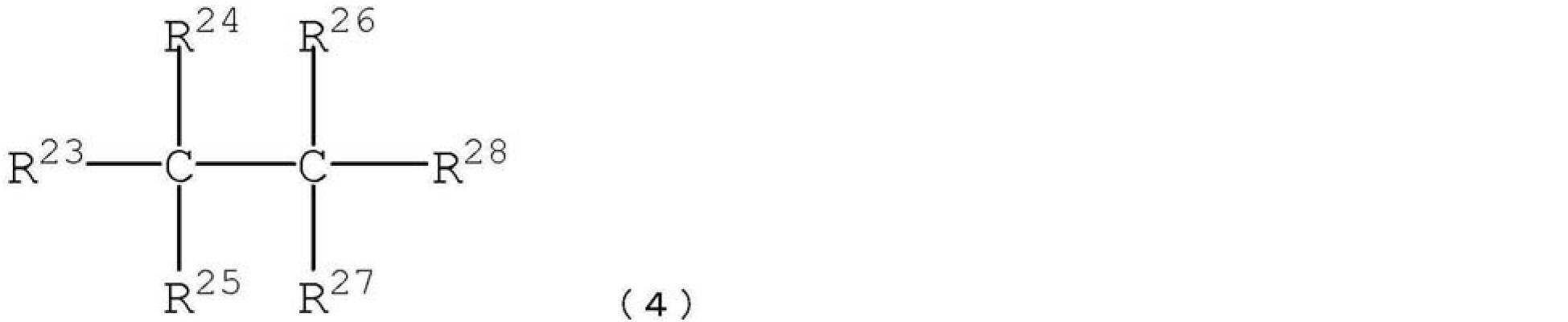
この際、R23~R28の少なくとも1つが、スルホ基である)。

(砥粒)
本発明の一形態に係る表面処理組成物は、砥粒をさらに含むことが好ましい。砥粒は、表面処理対象物を機械的に洗浄する作用を有し、表面処理組成物によるパーティクル残渣および有機物残渣の除去効果をより向上させる。
本発明の一形態に係る表面処理組成物は、濡れ剤をさらに含むことが好ましい。濡れ剤は、表面処理組成物による有機物残渣の除去効果を向上させる。この効果は、濡れ剤で表面処理対象物の表面を覆うことで、有機物残渣と表面処理対象物との電位反発を強める作用に由来すると推測しているが、このメカニズムは推測に基づくものであり、本発明の一形態は上記メカニズムに何ら限定されるものではない。
本発明の一形態に係る表面処理組成物は、所望のpH値へと調整するため、pH調整剤をさらに含むことが好ましい。
本発明の一形態に係る表面処理組成物は、本発明の効果を阻害しない範囲内において、必要に応じて、他の添加剤を任意の割合で含有していてもよい。ただし、本発明の一形態に係る表面処理組成物の必須成分以外の成分は、ディフェクトの原因となりうるためできる限り添加しないことが望ましいため、その添加量はできる限り少ないことが好ましく、含まないことがより好ましい。他の添加剤としては、例えば、防腐剤、溶存ガス、還元剤、酸化剤およびアルカノールアミン類等が挙げられる。
本発明の一形態に係る表面処理組成物は、分散媒(溶媒)を含む。分散媒は、各成分を分散または溶解させる機能を有する。分散媒は、特に制限されず、公知の溶媒を用いることができる。これらの中でも、分散媒は、水を含むものであることが好ましく、水のみであることがより好ましい。また、分散媒は、各成分の分散または溶解のために、水と有機溶媒との混合溶媒であってもよい。この場合、用いられる有機溶媒としては、水と混和する有機溶媒であるアセトン、アセトニトリル、エタノール、メタノール、イソプロパノール、グリセリン、エチレングリコール、プロピレングリコール等が挙げられる。また、これらの有機溶媒を水と混合せずに用いて、各成分を分散または溶解した後に、水と混合してもよい。これら有機溶媒は、単独でもまたは2種以上組み合わせても用いることができる。
本発明の一形態に係る表面処理組成物のpHは、1以上8以下である。表面処理組成物のpHが1未満であると、研磨装置や接触する研磨パッドなどの消耗部材を劣化させる可能性が高まる。さらに、劣化により生じた生成物により、残渣の発生や、傷などが発生する可能性が高まる。これより、表面処理組成物のpHの下限は1以上であり、2以上であることが好ましく、3以上であることがより好ましい。また、表面処理組成物のpH値が8超であると、本発明の作用効果は発揮されず、研磨用組成物に含まれる砥粒等のセリア残渣、研磨用組成物に含まれる有機化合物やパット屑等に由来する有機物残渣を良好に除去することができない。これより、表面処理組成物のpHの上限は8以下であり、7以下であることが好ましく、6以下であることがより好ましい。なお、表面処理組成物のpH値は、pHメーター(株式会社堀場製作所製 製品名:LAQUA(登録商標))により確認することができる。
表面処理対象物は、セリアを含む研磨用組成物で研磨した後に得られる研磨済研磨対象物であることが好ましい。研磨済研磨対象物とは、研磨工程において研磨された後の研磨対象物を意味する。研磨工程としては、特に制限されないが、CMP工程であることが好ましい。
本発明の他の一形態は、カルボキシ基含有(共)重合体、SOxまたはNOy部分構造含有化合物、および分散媒を混合することを含む、上記の表面処理組成物の製造方法である。本発明の一形態に係る表面処理組成物の製造方法においては、上記した砥粒、親水化剤、濡れ剤、pH調整剤、他の添加剤等をさらに混合してもよい。添加される各種添加剤の詳細については、上述した通りである。
(表面処理)
本発明の他の一形態は、上記表面処理組成物を用いて、表面処理対象物(研磨済研磨対象物)を表面処理することを含む、表面処理方法である。本明細書において、表面処理方法とは、表面処理対象物の表面におけるディフェクトを低減する方法をいい、広義の洗浄を行う方法である。
本発明の一形態に係る表面処理組成物は、リンス研磨処理において好適に用いられる。すなわち、本発明の一形態に係る表面処理組成物は、リンス研磨用組成物として好ましく用いることができる。リンス研磨処理は、研磨対象物について最終研磨(仕上げ研磨)を行った後、研磨済研磨対象物の表面上のディフェクトの除去を目的として、研磨パッドが取り付けられた研磨定盤(プラテン)上で行われることが好ましい。このとき、リンス研磨用組成物を表面処理対象物に直接接触させることにより、リンス研磨処理が行われる。その結果、表面処理対象物の表面のディフェクトは、研磨パッドによる摩擦力(物理的作用)およびリンス研磨用組成物による化学的作用によって除去される。ディフェクトのなかでも、特にパーティクル残渣や有機物残渣は、物理的な作用により除去されやすい。したがって、リンス研磨処理では、研磨定盤(プラテン)上で研磨パッドとの摩擦を利用することで、パーティクル残渣や有機物残渣を効果的に除去することができる。
本発明の一形態に係る表面処理組成物は、洗浄処理において好適に用いられる。すなわち、本発明の一形態に係る表面処理組成物は、洗浄用組成物として好ましく用いることができる。洗浄処理は、研磨対象物について最終研磨(仕上げ研磨)を行った後、または、本発明の一形態に係る表面処理組成物もしくは他のリンス研磨用組成物によるリンス研磨処理を行った後、研磨済研磨対象物の表面上のディフェクトの除去を目的として行われる。なお、洗浄処理と、上記リンス研磨処理とは、これらの処理を行う場所によって分類され、洗浄処理は、研磨定盤(プラテン)上ではない場所で行われる表面処理であり、表面処理対象物を研磨定盤(プラテン)上から取り外した後に行われる表面処理であることが好ましい。洗浄処理においても、洗浄用組成物を表面処理対象物に直接接触させて、当該対象物の表面上のディフェクトを除去することができる。
また、表面処理方法としては、本発明の一形態に係る表面処理組成物を用いた前記(I)または(II)の表面処理の後、研磨済研磨対象物をさらに洗浄処理することが好ましい。本明細書では、この洗浄処理を後洗浄処理と称する。後洗浄処理としては、例えば、単に表面処理対象物に水または本発明に係る表面処理組成物とは異なる洗浄用組成物(以下、後洗浄用組成物とも称する)を掛け流す方法、単に表面処理対象物を水または後洗浄用組成物に浸漬する方法等が挙げられる。また、上記説明した(II)の方法による表面処理と同様に、表面処理対象物を保持した状態で、洗浄ブラシと表面処理対象物の片面または両面とを接触させて、その接触部分に水または後洗浄用組成物を供給しながら表面処理対象物の表面を洗浄ブラシで擦る方法、表面処理対象物を水または後洗浄用組成物中に浸漬させ、超音波処理や攪拌を行う方法(ディップ式)等が挙げられる。これらの中でも、表面処理対象物を保持した状態で、洗浄ブラシと表面処理対象物の片面または両面とを接触させて、その接触部分に水または後洗浄用組成物を供給しながら表面処理対象物の表面を洗浄ブラシで擦る方法であることが好ましい。なお、後洗浄処理の装置および条件としては、前述の(II)の表面処理と同様の装置および条件を用いることができる。ここで、後洗浄処理に用いる水または後洗浄用組成物としては、水または公知の洗浄用組成物を用いることができるが、これらの中でも水、特に脱イオン水を用いることが好ましい。本発明の一形態に係る表面処理によって、セリア残渣および有機物残渣が直接除去され、またその後極少量として残存するこれらの残渣も極めて除去されやすい状態となる。このため、本発明の一形態の表面処理の後、水または後洗浄用組成物を用いてさらなる洗浄処理を行うことで、セリア残渣および有機物残渣が極めて良好に除去されることとなる。
本発明の一形態に係る表面処理方法は、セリアを含む研磨用組成物で研磨した後に得られる表面処理対象物(研磨済研磨対象物)を表面処理することを含む、表面処理方法である。これより、本発明の一形態に係る表面処理方法は、前記表面処理を行う前に、後述の研磨方法にて研磨対象物を研磨することを含むことがより好ましい。
本発明の一形態に係る表面処理組成物は、表面処理対象物の表面上のセリア残渣(特に、セリアに由来するパーティクル残渣)および有機物残渣を除去する効果が高いほど好ましい。表面処理組成物を用いて表面処理対象物を表面処理した後(その後に後洗浄処理または乾燥を行う場合はその後)のパーティクル残渣および有機物残渣の数は、それぞれ後述する範囲であることが好ましい。パーティクル残渣の個数の上限の値は、100個以下であることが好ましく、80個以下であることがより好ましく、70個以下であることがさらに好ましく、60個以下であることがよりさらに好ましく、50個以下であることが特に好ましく、40個以下であることが極めて好ましく、30個以下であることが最も好ましい(下限0個)。また、有機物残渣の個数の上限の値は、80個以下であることが好ましく、50個以下であることがより好ましく、25個以下であることがさらに好ましく、15個以下であることがよりさらに好ましく、10個以下であることが特に好ましく、5個以下であることが極めて好ましく、3個以下であることが最も好ましい(下限0個)。なお、パーティクル残渣および有機物残渣の数は、ウェーハ欠陥検査装置、およびSEMまたはEDX元素分析を用いて測定することができる。これらの測定方法の詳細は、後述の実施例に記載する。
本発明のさらなる他の一形態は、表面処理対象物(研磨済研磨対象物)が研磨済半導体基板であり、本発明の一形態に係る表面処理方法によって表面処理を行うことを含む、半導体基板の製造方法である。すなわち、本発明の一形態に係る半導体基板の製造方法は、セリアを含む研磨用組成物で半導体基板を研磨して研磨済半導体基板を得ることと、本発明の一形態に係る表面処理方法によって研磨済半導体基板を表面処理することと、を含む。
溶媒としての水に、表1~3に示す(共)重合体および各種添加剤を表1~3に示す含有量となるよう添加し、攪拌混合して表面処理組成物を得た(混合温度約25℃、混合時間:約10分)。ここで、表面処理組成物のpHは表1~3に示すpH調整剤で調整し、pHメーター(株式会社堀場製作所製 型番:LAQUA(登録商標))により確認した。
上記(共)重合体の重量平均分子量(Mw)(ポリエチレングリコール換算)の測定条件は、下記の通りである。この結果を下記表1~表3中に分子量として記載した。
型式:Prominence + ELSD検出器(ELSD-LTII)
カラム:VP-ODS(株式会社島津製作所製)
移動相 A:MeOH
B:酢酸1%水溶液
流量:1mL/min
検出器:ELSD temp.40℃、Gain 8、N2GAS 350kPa
オーブン温度:40℃
注入量:40μL。
移動相:0.1M NaCl 水溶液
流量:1.0mL/min
検出器:Shodex(登録商標) RI(昭和電工株式会社製)
カラム温度:40℃。

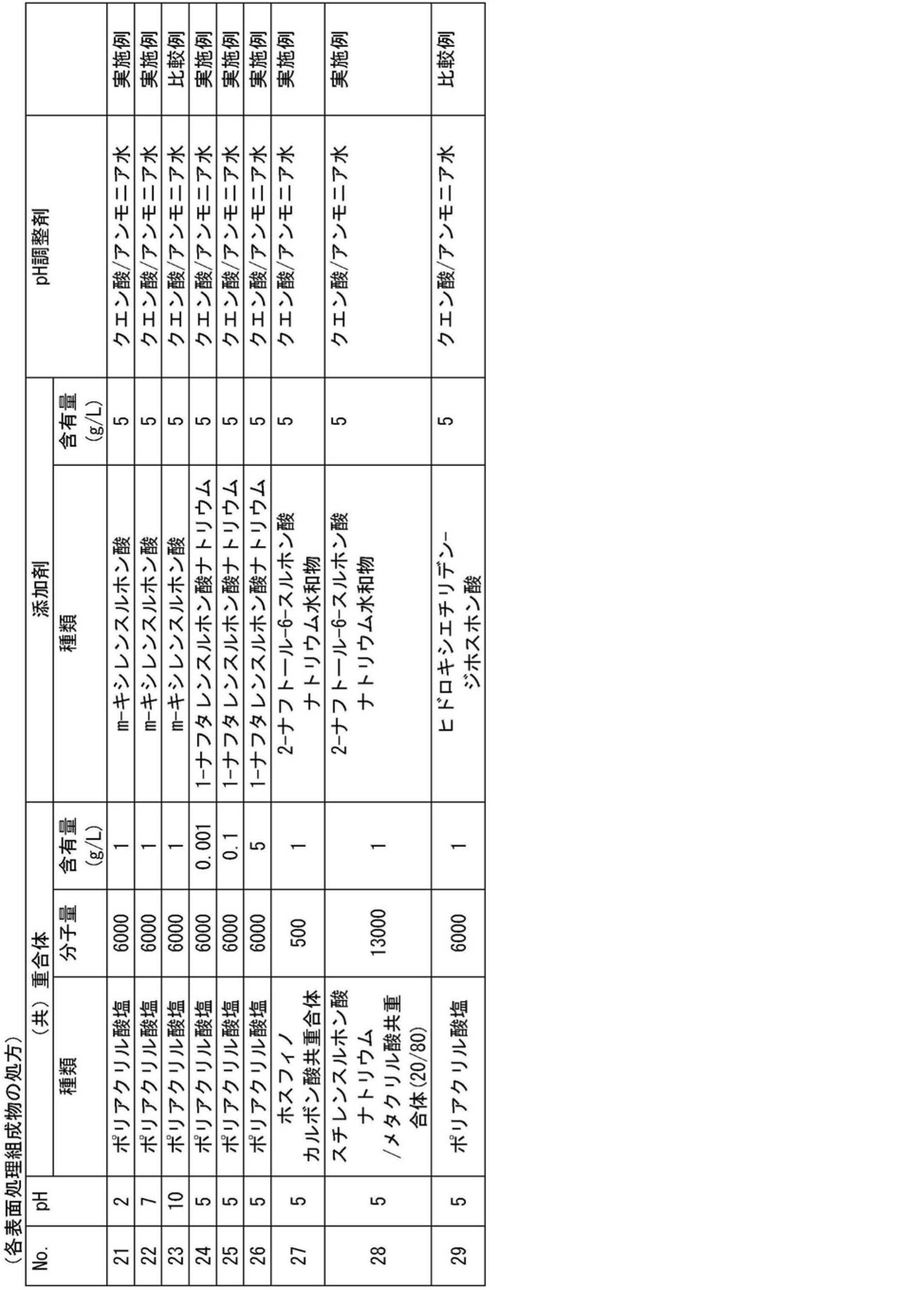


下記化学的機械的研磨(CMP)工程によって研磨された後の、研磨済窒化珪素基板、研磨済TEOS基板および研磨済ポリシリコン基板を、それぞれ表面処理対象物として準備した。
半導体基板である窒化珪素基板、TEOS基板およびポリシリコン基板について、セリアを含む研磨用組成物C(分散媒としての水に、MIREK(登録商標)E05(三井金属鉱業株式会社)1.0質量%、ポリアクリル酸ナトリウム(重量平均分子量10000)0.1質量%を含有する、酢酸を用いてpH=4となるよう調整した研磨用組成物)を使用し、それぞれ下記の条件にて研磨を行った。ここで、窒化珪素基板、TEOS基板およびポリシリコン基板は、200mmウェーハを使用した。
洗浄装置一体型研磨装置:アプライドマテリアルズ社製 MirraMesa(登録商標)
研磨パッド:ニッタ・ハース株式会社製 硬質ポリウレタンパッド IC1010
研磨圧力:2.0psi(1psi=6894.76Pa、以下同様)
研磨定盤回転数:60rpm
ヘッド回転数:60rpm
研磨用組成物の供給:掛け流し
研磨用組成物供給量:100mL/分
研磨時間:60秒間、
研磨対象物:200mmウェーハ;
窒化珪素基板:低圧化学気相成長法(LPCVD)で製造されたもの(厚さ2500Å)、
TEOS基板:物理気相成長法(PVD)で製造されたもの(厚さ10000Å)、
ポリシリコン基板:低圧化学気相成長法(LPCVD)で製造されたもの(厚さ5000Å)。
前記CMP工程によって研磨された後の研磨済窒化珪素基板、研磨済TEOS基板および研磨済ポリシリコン基板について、下記の条件でリンス研磨を行った。
(リンス研磨処理1:リンス用研磨装置およびリンス研磨条件)
洗浄装置一体型研磨装置:アプライドマテリアルズ社製 MirraMesa(登録商標)
研磨パッド:ニッタ・ハース株式会社製 硬質ポリウレタンパッド IC1010
研磨圧力:1.0psi
研磨定盤回転数:60rpm
ヘッド回転数:60rpm
研磨用組成物の種類:水(脱イオン水)
研磨用組成物の供給:掛け流し
研磨用組成物供給量:100mL/分
研磨時間:30秒間。
リンス研磨処理1とは異なる研磨定盤を用いて、リンス研磨処理1から連続して下記条件でリンス研磨処理2を行った。
研磨パッド:ニッタ・ハース株式会社製 硬質ポリウレタンパッド IC1010
研磨圧力:1.0psi
研磨定盤回転数:60rpm
ヘッド回転数:60rpm
研磨用組成物の種類:表面処理組成物No.1~35
研磨用組成物の供給:掛け流し
研磨用組成物供給量:100mL/分
研磨時間:60秒間。
(後洗浄処理:後洗浄装置および後洗浄条件)
リンス研磨処理2の後に、前記リンス研磨工程によって研磨された後の研磨済窒化珪素基板、研磨済TEOS基板および研磨済ポリシリコン基板に表面処理組成物をかけながら引き上げて取り出した。続いて、リンス研磨工程2によって研磨された後の研磨済窒化珪素基板、研磨済TEOS基板および研磨済ポリシリコン基板について、水(脱イオン水)を用いて、洗浄ブラシであるポリビニルアルコール(PVA)製スポンジで圧力をかけながら下記条件で各研磨済研磨対象物をこする洗浄方法によって、各研磨済研磨対象物を洗浄した。
洗浄ブラシ回転数:100rpm
研磨済研磨対象物回転数:50rpm
洗浄用組成物の種類:水(脱イオン水)
洗浄用組成物供給量:1000mL/分
洗浄時間:60秒間。
上記後洗浄処理後の各研磨済研磨対象物について、下記項目について測定し評価を行った。評価結果を表1に合わせて示す。
上記に示す表面処理方法で、各表面処理組成物を用いて表面処理をし、さらに後洗浄処理をした後の研磨済研磨対象物について、0.13μm以上のディフェクト数を測定した。ディフェクト数の測定にはKLA TENCOR社製ウェーハ欠陥検査装置SP-2を使用した。測定は、研磨済研磨対象物の片面の外周端部から幅5mmの部分(外周端部を0mmとしたときに、幅0mmから幅5mmまでの部分)を除外した残りの部分について測定を行った。
上記に示す表面処理方法で、各表面処理組成物を用いて表面処理をし、さらに後洗浄処理をした後の研磨済研磨対象物について、パーティクル残渣の数を、株式会社日立製作所製Review SEM RS6000を使用し、SEM観察によって測定した。まず、SEM観察にて、研磨済研磨対象基板の片面の外周端部から幅5mmの部分(外周端部を0mmとしたときに、幅0mmから幅5mmまでの部分)を除外した残りの部分に存在するディフェクトを100個サンプリングした。次いで、サンプリングした100個のディフェクトの中からSEM観察にて目視にてパーティクル残渣を判別し、その個数を確認することで、ディフェクト中のパーティクル残渣の割合(%)を算出した。そして、上述のディフェクト数の評価にてKLA TENCOR社製ウェーハ欠陥検査装置SP-2を用いて測定した0.13μm以上のディフェクト数(個)と、前記SEM観察結果より算出したディフェクト中のパーティクル残渣の割合(%)との積を、パーティクル残渣数(個)として算出した。
上記に示す表面処理方法で、各表面処理組成物を用いて表面処理をし、さらに後洗浄処理をした後の研磨済研磨対象物について、有機物残渣の数を、株式会社日立製作所製Review SEM RS6000を使用し、SEM観察によって測定した。まず、SEM観察にて、研磨済研磨対象物の片面の外周端部から幅5mmの部分(外周端部を0mmとしたときに、幅0mmから幅5mmまでの部分)を除外した残りの部分に存在するディフェクトを100個サンプリングした。次いで、サンプリングした100個のディフェクトの中からSEM観察にて目視にて有機物残渣を判別し、その個数を確認することで、ディフェクト中の有機物残渣の割合(%)を算出した。そして、上述のディフェクト数の評価にてKLA TENCOR社製ウェーハ欠陥検査装置SP-2を用いて測定した0.13μm以上のディフェクト数(個)と、前記SEM観察結果より算出したディフェクト中の有機物残渣の割合(%)との積を、有機物残渣数(個)として算出した。
総ディフェクト数の値より、パーティクル残渣数の値および有機物残渣数の値を減じることで、その他の残渣数(個)を算出した。
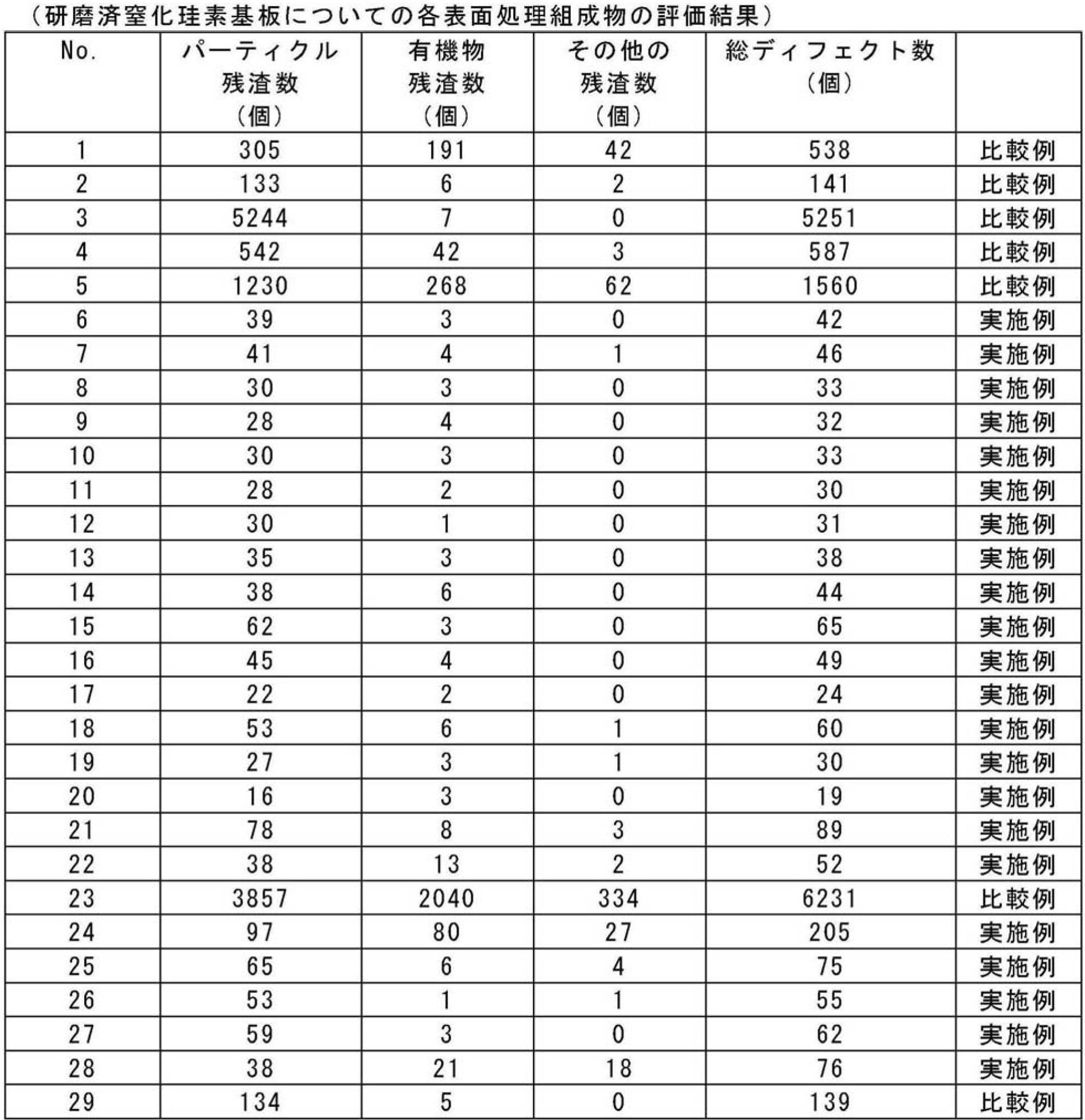
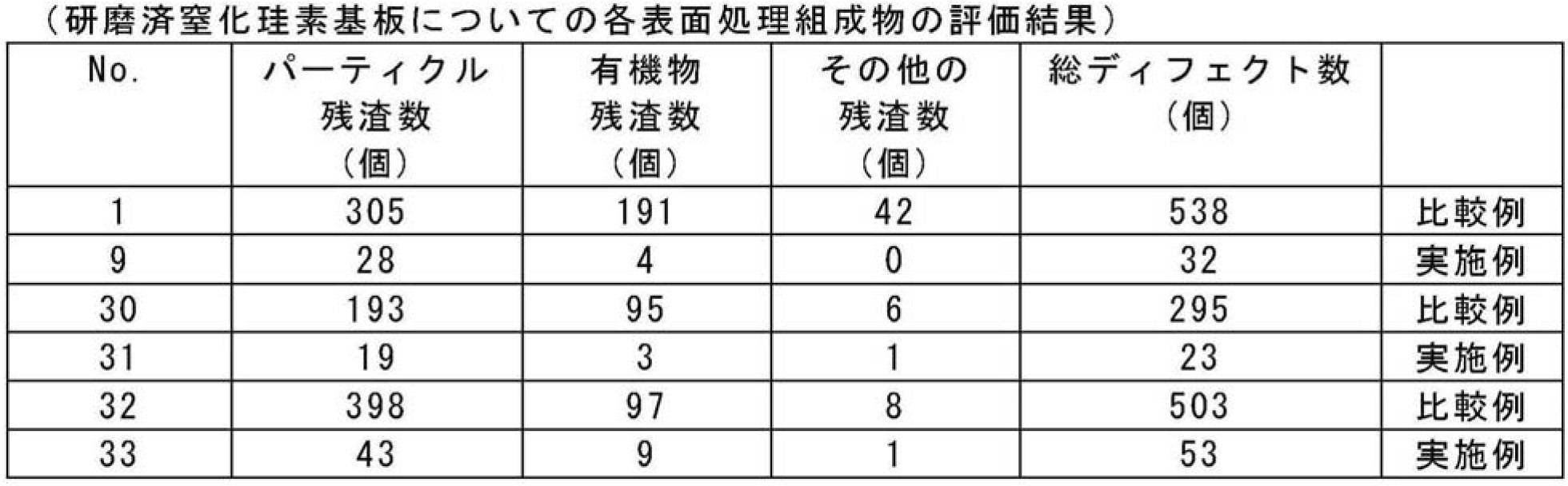


Claims (10)
- セリアを含む研磨用組成物で研磨した後に得られる研磨済研磨対象物を表面処理するための表面処理組成物であって、
カルボキシ基またはその塩の基を有する単量体由来の構造単位を有する、カルボキシ基含有(共)重合体と、
SOxまたはNOy(ただし、xおよびyは、それぞれ独立して、1~5の実数である)で表される部分構造を有する、SOxまたはNOy部分構造含有化合物と、
分散媒と
を含み、
pHが1以上8以下である、表面処理組成物。 - 前記カルボキシ基含有(共)重合体が、(メタ)アクリル酸またはその塩由来の構造単位を有する(共)重合体である、請求項1に記載の表面処理組成物。
- 前記SOxまたはNOy部分構造含有化合物が、亜硫酸塩、硫酸塩、過硫酸塩、スルホン酸基含有化合物、亜硝酸塩、硝酸塩、過硝酸塩、およびニトロ基含有化合物からなる群より選択される少なくとも1種の化合物である、請求項1または2に記載の表面処理組成物。
- 前記SOxまたはNOy部分構造含有化合物は、硫酸塩、イセチオン酸およびその塩、m-キシレンスルホン酸およびその塩、1-ナフタレンスルホン酸およびその塩、ならびに2-ナフトール-6-スルホン酸およびその塩からなる群より選択される少なくとも1種の化合物である、請求項3に記載の表面処理組成物。
- 有機酸を表面に固定したシリカをさらに含む、請求項1~4のいずれか1項に記載の表面処理組成物。
- 濡れ剤をさらに含む、請求項1~5のいずれか1項に記載の表面処理組成物。
- 前記SOxまたはNOy部分構造含有化合物の分子量は1000未満である、請求項1~6のいずれか1項に記載の表面処理組成物。
- 前記カルボキシ基含有(共)重合体、前記SOxまたはNOy部分構造含有化合物、および前記分散媒を混合することを含む、請求項1~7のいずれか1項に記載の表面処理組成物の製造方法。
- 請求項1~7のいずれか1項に記載の表面処理組成物を用いて、研磨済研磨対象物を表面処理する、表面処理方法。
- 前記表面処理の後、研磨済研磨対象物をさらに後洗浄処理することを含む、請求項9に記載の表面処理方法。
Priority Applications (4)
| Application Number | Priority Date | Filing Date | Title |
|---|---|---|---|
| KR1020197026469A KR102480644B1 (ko) | 2017-03-14 | 2018-01-23 | 표면 처리 조성물, 그의 제조 방법, 및 이를 사용한 표면 처리 방법 |
| US16/492,338 US11377627B2 (en) | 2017-03-14 | 2018-01-23 | Composition for surface treatment, method for producing the same, and surface treatment method using the same |
| CN201880018263.1A CN110419094B (zh) | 2017-03-14 | 2018-01-23 | 表面处理组合物、其制造方法、及使用其的表面处理方法 |
| JP2019505740A JP7093765B2 (ja) | 2017-03-14 | 2018-01-23 | 表面処理組成物、その製造方法、およびこれを用いた表面処理方法 |
Applications Claiming Priority (2)
| Application Number | Priority Date | Filing Date | Title |
|---|---|---|---|
| JP2017048630 | 2017-03-14 | ||
| JP2017-048630 | 2017-03-14 |
Publications (1)
| Publication Number | Publication Date |
|---|---|
| WO2018168207A1 true WO2018168207A1 (ja) | 2018-09-20 |
Family
ID=63522940
Family Applications (1)
| Application Number | Title | Priority Date | Filing Date |
|---|---|---|---|
| PCT/JP2018/001953 Ceased WO2018168207A1 (ja) | 2017-03-14 | 2018-01-23 | 表面処理組成物、その製造方法、およびこれを用いた表面処理方法 |
Country Status (6)
| Country | Link |
|---|---|
| US (1) | US11377627B2 (ja) |
| JP (1) | JP7093765B2 (ja) |
| KR (1) | KR102480644B1 (ja) |
| CN (1) | CN110419094B (ja) |
| TW (1) | TWI741139B (ja) |
| WO (1) | WO2018168207A1 (ja) |
Cited By (4)
| Publication number | Priority date | Publication date | Assignee | Title |
|---|---|---|---|---|
| WO2020213487A1 (ja) * | 2019-04-15 | 2020-10-22 | 三菱ケミカル株式会社 | 洗浄液、洗浄方法及び半導体ウェハの製造方法 |
| JPWO2024024759A1 (ja) * | 2022-07-25 | 2024-02-01 | ||
| WO2025188728A1 (en) * | 2024-03-04 | 2025-09-12 | Entegris, Inc. | Silane modification of ceria nanoparticles in colloidally stable solutions |
| WO2025188720A1 (en) * | 2024-03-04 | 2025-09-12 | Cmc Materials Llc | Silane modification of ceria nanoparticles in colloidally stable solutions |
Families Citing this family (6)
| Publication number | Priority date | Publication date | Assignee | Title |
|---|---|---|---|---|
| US11634670B2 (en) * | 2018-11-16 | 2023-04-25 | Toagosei Co. Ltd. | Cleaning agent for semiconductor component, and use thereof |
| US11702570B2 (en) * | 2019-03-27 | 2023-07-18 | Fujimi Incorporated | Polishing composition |
| KR102337949B1 (ko) * | 2019-07-10 | 2021-12-14 | 주식회사 케이씨텍 | 멀티 필름 연마용 cmp 슬러리 조성물 및 그를 이용한 연마 방법 |
| KR20220150962A (ko) * | 2020-03-13 | 2022-11-11 | 가부시키가이샤 후지미인코퍼레이티드 | 연마용 조성물 및 연마 방법 |
| JP7495317B2 (ja) * | 2020-09-25 | 2024-06-04 | 株式会社フジミインコーポレーテッド | 表面処理組成物、表面処理組成物の製造方法、表面処理方法、および半導体基板の製造方法 |
| TW202313942A (zh) * | 2021-08-05 | 2023-04-01 | 日商福吉米股份有限公司 | 表面處理方法、包含此表面處理方法的半導體基板之製造方法、表面處理組合物及包含此表面處理組合物之半導體基板的製造系統 |
Citations (3)
| Publication number | Priority date | Publication date | Assignee | Title |
|---|---|---|---|---|
| JP2005255983A (ja) * | 2004-02-10 | 2005-09-22 | Jsr Corp | 洗浄用組成物、半導体基板の洗浄方法および半導体装置の製造方法 |
| JP2013008751A (ja) * | 2011-06-22 | 2013-01-10 | Hitachi Chem Co Ltd | 洗浄液及び基板の研磨方法 |
| JP2017011225A (ja) * | 2015-06-25 | 2017-01-12 | 株式会社フジミインコーポレーテッド | 研磨方法及び不純物除去用組成物並びに基板及びその製造方法 |
Family Cites Families (17)
| Publication number | Priority date | Publication date | Assignee | Title |
|---|---|---|---|---|
| JP4250831B2 (ja) | 1999-06-23 | 2009-04-08 | Jsr株式会社 | 半導体部品用洗浄液 |
| US6440856B1 (en) | 1999-09-14 | 2002-08-27 | Jsr Corporation | Cleaning agent for semiconductor parts and method for cleaning semiconductor parts |
| JP2004182958A (ja) * | 2002-12-04 | 2004-07-02 | Mizuho Chemical:Kk | 洗浄剤組成物 |
| CN1654617A (zh) * | 2004-02-10 | 2005-08-17 | 捷时雅株式会社 | 清洗用组合物和半导体基板的清洗方法及半导体装置的制造方法 |
| TW200734448A (en) * | 2006-02-03 | 2007-09-16 | Advanced Tech Materials | Low pH post-CMP residue removal composition and method of use |
| WO2010070819A1 (ja) * | 2008-12-19 | 2010-06-24 | 三洋化成工業株式会社 | 電子材料用洗浄剤 |
| JP5894369B2 (ja) * | 2011-02-03 | 2016-03-30 | ステラケミファ株式会社 | 洗浄液及び洗浄方法 |
| TW201307237A (zh) * | 2011-05-24 | 2013-02-16 | Asahi Glass Co Ltd | 洗淨劑及玻璃基板之洗淨方法 |
| JPWO2013088928A1 (ja) * | 2011-12-14 | 2015-04-27 | 旭硝子株式会社 | 洗浄剤、および炭化ケイ素単結晶基板の製造方法 |
| US20160122696A1 (en) * | 2013-05-17 | 2016-05-05 | Advanced Technology Materials, Inc. | Compositions and methods for removing ceria particles from a surface |
| JP2015181079A (ja) * | 2014-03-05 | 2015-10-15 | 三洋化成工業株式会社 | 磁気ディスク基板用洗浄剤組成物 |
| JP6343160B2 (ja) * | 2014-03-28 | 2018-06-13 | 株式会社フジミインコーポレーテッド | 研磨用組成物 |
| EP3394879A2 (en) * | 2015-12-22 | 2018-10-31 | Basf Se | Composition for post chemical-mechanical-polishing cleaning |
| US10916435B2 (en) * | 2016-03-30 | 2021-02-09 | Fujimi Incorporated | Surface treatment composition, method of producing surface treatment composition, method of treating surface, and method of producing semiconductor substrate |
| US10319605B2 (en) * | 2016-05-10 | 2019-06-11 | Jsr Corporation | Semiconductor treatment composition and treatment method |
| KR102588218B1 (ko) * | 2017-09-22 | 2023-10-13 | 가부시키가이샤 후지미인코퍼레이티드 | 표면 처리 조성물, 표면 처리 조성물의 제조 방법, 표면 처리 방법 및 반도체 기판의 제조 방법 |
| US11446708B2 (en) * | 2017-12-04 | 2022-09-20 | Entegris, Inc. | Compositions and methods for reducing interaction between abrasive particles and a cleaning brush |
-
2018
- 2018-01-23 WO PCT/JP2018/001953 patent/WO2018168207A1/ja not_active Ceased
- 2018-01-23 KR KR1020197026469A patent/KR102480644B1/ko active Active
- 2018-01-23 JP JP2019505740A patent/JP7093765B2/ja active Active
- 2018-01-23 US US16/492,338 patent/US11377627B2/en active Active
- 2018-01-23 CN CN201880018263.1A patent/CN110419094B/zh active Active
- 2018-01-31 TW TW107103446A patent/TWI741139B/zh active
Patent Citations (3)
| Publication number | Priority date | Publication date | Assignee | Title |
|---|---|---|---|---|
| JP2005255983A (ja) * | 2004-02-10 | 2005-09-22 | Jsr Corp | 洗浄用組成物、半導体基板の洗浄方法および半導体装置の製造方法 |
| JP2013008751A (ja) * | 2011-06-22 | 2013-01-10 | Hitachi Chem Co Ltd | 洗浄液及び基板の研磨方法 |
| JP2017011225A (ja) * | 2015-06-25 | 2017-01-12 | 株式会社フジミインコーポレーテッド | 研磨方法及び不純物除去用組成物並びに基板及びその製造方法 |
Cited By (10)
| Publication number | Priority date | Publication date | Assignee | Title |
|---|---|---|---|---|
| WO2020213487A1 (ja) * | 2019-04-15 | 2020-10-22 | 三菱ケミカル株式会社 | 洗浄液、洗浄方法及び半導体ウェハの製造方法 |
| JPWO2020213487A1 (ja) * | 2019-04-15 | 2020-10-22 | ||
| CN113692640A (zh) * | 2019-04-15 | 2021-11-23 | 三菱化学株式会社 | 清洗液、清洗方法和半导体晶片的制造方法 |
| JP7400813B2 (ja) | 2019-04-15 | 2023-12-19 | 三菱ケミカル株式会社 | 洗浄液、洗浄方法及び半導体ウェハの製造方法 |
| TWI902688B (zh) * | 2019-04-15 | 2025-11-01 | 日商三菱化學股份有限公司 | 洗淨液、洗淨方法及半導體晶圓之製造方法 |
| JPWO2024024759A1 (ja) * | 2022-07-25 | 2024-02-01 | ||
| WO2024024759A1 (ja) * | 2022-07-25 | 2024-02-01 | 株式会社日本触媒 | 半導体用洗浄剤組成物 |
| JP7805460B2 (ja) | 2022-07-25 | 2026-01-23 | 株式会社日本触媒 | 半導体用洗浄剤組成物 |
| WO2025188728A1 (en) * | 2024-03-04 | 2025-09-12 | Entegris, Inc. | Silane modification of ceria nanoparticles in colloidally stable solutions |
| WO2025188720A1 (en) * | 2024-03-04 | 2025-09-12 | Cmc Materials Llc | Silane modification of ceria nanoparticles in colloidally stable solutions |
Also Published As
| Publication number | Publication date |
|---|---|
| JP7093765B2 (ja) | 2022-06-30 |
| US11377627B2 (en) | 2022-07-05 |
| CN110419094A (zh) | 2019-11-05 |
| KR20190124237A (ko) | 2019-11-04 |
| CN110419094B (zh) | 2023-12-19 |
| US20210130751A1 (en) | 2021-05-06 |
| KR102480644B1 (ko) | 2022-12-26 |
| JPWO2018168207A1 (ja) | 2020-01-16 |
| TWI741139B (zh) | 2021-10-01 |
| TW201840835A (zh) | 2018-11-16 |
Similar Documents
| Publication | Publication Date | Title |
|---|---|---|
| KR102480644B1 (ko) | 표면 처리 조성물, 그의 제조 방법, 및 이를 사용한 표면 처리 방법 | |
| JP7645682B2 (ja) | 表面処理組成物、表面処理組成物の製造方法、表面処理方法、及び半導体基板の製造方法 | |
| JP7168370B2 (ja) | 表面処理組成物、その製造方法、およびこれを用いた表面処理方法 | |
| WO2018061365A1 (ja) | 表面処理組成物 | |
| TWI722138B (zh) | 研磨用組合物 | |
| CN114250124B (zh) | 表面处理组合物、表面处理组合物的制造方法、表面处理方法和半导体基板的制造方法 | |
| TW200804575A (en) | Metal polishing composition and chemical mechanical polishing method using the same | |
| JP2007258451A (ja) | 金属用研磨液 | |
| WO2017169539A1 (ja) | 表面処理組成物、表面処理組成物の製造方法、表面処理方法および半導体基板の製造方法 | |
| JP7330668B2 (ja) | 表面処理組成物、表面処理組成物の製造方法、表面処理方法および半導体基板の製造方法 | |
| TWI485761B (zh) | 研磨液及研磨方法 | |
| JP6849564B2 (ja) | 表面処理組成物およびこれを用いた表面処理方法 | |
| JPWO2018163781A1 (ja) | 表面処理組成物、およびその製造方法、ならびに表面処理組成物を用いた表面処理方法および半導体基板の製造方法 | |
| TW201840836A (zh) | 表面處理組成物、其製造方法、使用表面處理組成物的表面處理方法及半導體基板的製造方法 | |
| TW202018054A (zh) | 中間原料以及使用此的研磨用組成物及表面處理組成物 | |
| JP2023024267A (ja) | 表面処理方法、その表面処理方法を含む半導体基板の製造方法、表面処理組成物およびその表面処理組成物を含む半導体基板の製造システム | |
| TWI917583B (zh) | 表面處理組合物、表面處理組合物之製造方法、表面處理方法、及半導體基板之製造方法 | |
| JP5030431B2 (ja) | 研磨用組成物 | |
| WO2026079146A1 (ja) | 砥粒の製造方法、化学機械研磨用組成物および研磨方法 | |
| CN115715423A (zh) | 研磨粒的制造方法、化学机械研磨用组合物及化学机械研磨方法 |
Legal Events
| Date | Code | Title | Description |
|---|---|---|---|
| 121 | Ep: the epo has been informed by wipo that ep was designated in this application |
Ref document number: 18768402 Country of ref document: EP Kind code of ref document: A1 |
|
| ENP | Entry into the national phase |
Ref document number: 2019505740 Country of ref document: JP Kind code of ref document: A |
|
| ENP | Entry into the national phase |
Ref document number: 20197026469 Country of ref document: KR Kind code of ref document: A |
|
| NENP | Non-entry into the national phase |
Ref country code: DE |
|
| 122 | Ep: pct application non-entry in european phase |
Ref document number: 18768402 Country of ref document: EP Kind code of ref document: A1 |