WO2018105441A1 - 活性エネルギー線硬化型樹脂組成物及び積層体 - Google Patents
活性エネルギー線硬化型樹脂組成物及び積層体 Download PDFInfo
- Publication number
- WO2018105441A1 WO2018105441A1 PCT/JP2017/042552 JP2017042552W WO2018105441A1 WO 2018105441 A1 WO2018105441 A1 WO 2018105441A1 JP 2017042552 W JP2017042552 W JP 2017042552W WO 2018105441 A1 WO2018105441 A1 WO 2018105441A1
- Authority
- WO
- WIPO (PCT)
- Prior art keywords
- meth
- acrylate
- compound
- poly
- resin
- Prior art date
- Legal status (The legal status is an assumption and is not a legal conclusion. Google has not performed a legal analysis and makes no representation as to the accuracy of the status listed.)
- Ceased
Links
Classifications
-
- B—PERFORMING OPERATIONS; TRANSPORTING
- B05—SPRAYING OR ATOMISING IN GENERAL; APPLYING FLUENT MATERIALS TO SURFACES, IN GENERAL
- B05D—PROCESSES FOR APPLYING FLUENT MATERIALS TO SURFACES, IN GENERAL
- B05D7/00—Processes, other than flocking, specially adapted for applying liquids or other fluent materials to particular surfaces or for applying particular liquids or other fluent materials
- B05D7/24—Processes, other than flocking, specially adapted for applying liquids or other fluent materials to particular surfaces or for applying particular liquids or other fluent materials for applying particular liquids or other fluent materials
-
- C—CHEMISTRY; METALLURGY
- C08—ORGANIC MACROMOLECULAR COMPOUNDS; THEIR PREPARATION OR CHEMICAL WORKING-UP; COMPOSITIONS BASED THEREON
- C08F—MACROMOLECULAR COMPOUNDS OBTAINED BY REACTIONS ONLY INVOLVING CARBON-TO-CARBON UNSATURATED BONDS
- C08F2/00—Processes of polymerisation
- C08F2/46—Polymerisation initiated by wave energy or particle radiation
- C08F2/48—Polymerisation initiated by wave energy or particle radiation by ultraviolet or visible light
- C08F2/50—Polymerisation initiated by wave energy or particle radiation by ultraviolet or visible light with sensitising agents
-
- C—CHEMISTRY; METALLURGY
- C08—ORGANIC MACROMOLECULAR COMPOUNDS; THEIR PREPARATION OR CHEMICAL WORKING-UP; COMPOSITIONS BASED THEREON
- C08F—MACROMOLECULAR COMPOUNDS OBTAINED BY REACTIONS ONLY INVOLVING CARBON-TO-CARBON UNSATURATED BONDS
- C08F299/00—Macromolecular compounds obtained by interreacting polymers involving only carbon-to-carbon unsaturated bond reactions, in the absence of non-macromolecular monomers
- C08F299/02—Macromolecular compounds obtained by interreacting polymers involving only carbon-to-carbon unsaturated bond reactions, in the absence of non-macromolecular monomers from unsaturated polycondensates
- C08F299/06—Macromolecular compounds obtained by interreacting polymers involving only carbon-to-carbon unsaturated bond reactions, in the absence of non-macromolecular monomers from unsaturated polycondensates from polyurethanes
-
- C—CHEMISTRY; METALLURGY
- C09—DYES; PAINTS; POLISHES; NATURAL RESINS; ADHESIVES; COMPOSITIONS NOT OTHERWISE PROVIDED FOR; APPLICATIONS OF MATERIALS NOT OTHERWISE PROVIDED FOR
- C09D—COATING COMPOSITIONS, e.g. PAINTS, VARNISHES OR LACQUERS; FILLING PASTES; CHEMICAL PAINT OR INK REMOVERS; INKS; CORRECTING FLUIDS; WOODSTAINS; PASTES OR SOLIDS FOR COLOURING OR PRINTING; USE OF MATERIALS THEREFOR
- C09D133/00—Coating compositions based on homopolymers or copolymers of compounds having one or more unsaturated aliphatic radicals, each having only one carbon-to-carbon double bond, and at least one being terminated by only one carboxyl radical, or of salts, anhydrides, esters, amides, imides, or nitriles thereof; Coating compositions based on derivatives of such polymers
- C09D133/04—Homopolymers or copolymers of esters
- C09D133/06—Homopolymers or copolymers of esters of esters containing only carbon, hydrogen and oxygen, the oxygen atom being present only as part of the carboxyl radical
- C09D133/08—Homopolymers or copolymers of acrylic acid esters
-
- G—PHYSICS
- G02—OPTICS
- G02B—OPTICAL ELEMENTS, SYSTEMS OR APPARATUS
- G02B1/00—Optical elements characterised by the material of which they are made; Optical coatings for optical elements
- G02B1/10—Optical coatings produced by application to, or surface treatment of, optical elements
- G02B1/14—Protective coatings, e.g. hard coatings
-
- C—CHEMISTRY; METALLURGY
- C08—ORGANIC MACROMOLECULAR COMPOUNDS; THEIR PREPARATION OR CHEMICAL WORKING-UP; COMPOSITIONS BASED THEREON
- C08G—MACROMOLECULAR COMPOUNDS OBTAINED OTHERWISE THAN BY REACTIONS ONLY INVOLVING UNSATURATED CARBON-TO-CARBON BONDS
- C08G18/00—Polymeric products of isocyanates or isothiocyanates
- C08G18/06—Polymeric products of isocyanates or isothiocyanates with compounds having active hydrogen
- C08G18/28—Polymeric products of isocyanates or isothiocyanates with compounds having active hydrogen characterised by the compounds used containing active hydrogen
- C08G18/67—Unsaturated compounds having active hydrogen
Definitions
- the present invention relates to an active energy ray-curable resin composition having high adhesion to an inorganic material and excellent in storage stability, a paint containing the same, a coating film and a laminate using the paint.
- Inorganic material thin films composed of various metals, glass, inorganic compounds such as SiO x , Al 2 O 3 , TiO 2 , and ITO are used in various applications such as optical films, packaging materials, semiconductors, insulators, electrodes, and wiring. ing. These inorganic material thin films are usually formed on a certain substrate by a method such as vacuum deposition, plasma assisted deposition (CVD) or sputtering. Examples of the substrate include various materials such as glass, metal, and plastic.
- CVD plasma assisted deposition
- sputtering examples of the substrate include various materials such as glass, metal, and plastic.
- a technique of using a plastic film as a base and laminating an inorganic material thin film, a resin coating film, or the like as a functional film has been widely studied. In such a technique, the adhesion between the inorganic material thin film layer and the plastic film layer or the resin coating layer is important, but in reality, the adhesion between the two is often insufficient, and the resin that
- Patent Document 1 contains acrylic resin, dipentaerythritol hexaacrylate, bis (2-methacryloyloxyethyl) acid phosphate and 3-acryloxypropyltrimethoxysilane as resin materials having excellent adhesion to various substrates. It is disclosed that the active energy ray-curable resin composition to be used is excellent in adhesion to a glass substrate. However, even the active energy ray-curable resin composition described in Patent Document 1 does not have sufficient adhesion to glass or other inorganic materials, and development of better resin materials has been demanded. In addition, the active energy ray-curable resin composition described in Patent Document 1 is not sufficient in storage stability, and turbidity is likely to occur over time.
- the problem to be solved by the present invention is an active energy ray-curable resin composition having high adhesion to various inorganic materials and excellent in storage stability, a paint containing the same, and a coating film using the paint And providing a laminate.
- the inventor of the present application as a result of intensive studies to solve the above problems, is a resin composition containing a (meth) acryloyl group-containing compound, a phosphate ester compound, and a silane coupling agent, wherein the (meth) acryloyl Those using (poly) ester (meth) acrylate resin as the group-containing compound are thin films of inorganic materials made of various metals and inorganic compounds such as SiO x , Al 2 O 3 , TiO 2 and ITO, as well as glass and silicon wafers.
- the present invention was completed.
- the present invention contains a (meth) acryloyl group-containing compound (A), a phosphate ester compound (B) and a silane coupling agent (C), and the (meth) acryloyl group-containing compound (A) is (poly).
- the present invention relates to an active energy ray-curable resin composition having an ester (meth) acrylate resin (A1) as an essential component.
- the present invention further relates to a paint containing the active energy ray-curable resin composition.
- the present invention further relates to a coating film comprising the paint.
- the present invention further relates to a laminate having a layer made of the coating film and an inorganic material layer adjacent thereto.
- an active energy ray-curable resin composition having high adhesion to various inorganic materials and excellent in storage stability, a paint containing the same, a coating film and a laminate using the paint. be able to.
- the active energy ray-curable resin composition of the present invention contains a (meth) acryloyl group-containing compound (A), a phosphate ester compound (B), and a silane coupling agent (C), and contains the (meth) acryloyl group.
- the compound (A) has a (poly) ester (meth) acrylate resin (A1) as an essential component.
- the (meth) acryloyl group means one or both of an acryloyl group and a methacryloyl group.
- (Meth) acrylate is a general term for acrylate and methacrylate.
- the (poly) ester (meth) acrylate resin (A1) is not particularly limited as long as it is a (meth) acrylate compound having a (poly) ester structure in the molecular structure, and a wide variety of compounds can be used.
- a lactone-modified urethane (meth) acrylate resin which is a reaction product of a polyisocyanate compound (x1) and a lactone-modified hydroxy (meth) acrylate compound (x2), or a hydroxyl-containing polyester resin
- examples thereof include a polyester (meth) acrylate resin which is a meth) acrylic acid adduct, and a polyester (meth) acrylate resin which is a glycidyl (meth) acrylate adduct of a carboxy group-containing polyester resin.
- the polyisocyanate compound (x1) is, for example, butane diisocyanate, hexamethylene diisocyanate, 2,2,4-trimethylhexamethylene diisocyanate, 2,4,4-trimethylhexamethylene diisocyanate.
- Aliphatic diisocyanate compounds such as norbornane diisocyanate, isophorone diisocyanate, hydrogenated xylylene diisocyanate, hydrogenated diphenylmethane diisocyanate; tolylene diisocyanate, xylylene diisocyanate, tetramethylxylylene diisocyanate, diphenylmethane diisocyanate, 1, Aromatic diisocyanate compounds such as 5-naphthalene diisocyanate; Polymethylene polyphenyl polyisocyanate having a repeating structure represented by the formula (1); these isocyanurate modified product, a biuret modified product, and allophanate modified compounds and the like. These may be used alone or in combination of two or more.
- R 1 is independently a hydrogen atom or a hydrocarbon group having 1 to 6 carbon atoms.
- R 2 is each independently an alkyl group having 1 to 4 carbon atoms, or a bonding point that is linked to the structural moiety represented by the structural formula (1) via a methylene group marked with *.
- l is 0 or an integer of 1 to 3
- m is an integer of 1 or more.
- the active energy ray-curable resin composition is further excellent in adhesion to inorganic materials, the aliphatic diisocyanate compound, the alicyclic diisocyanate compound, or their isocyanurate modification The body is preferred.
- lactone-modified hydroxy (meth) acrylate compound (x2) examples include hydroxyethyl (meth) acrylate, hydroxypropyl (meth) acrylate, trimethylolpropane di (meth) acrylate, pentaerythritol tri (meth) acrylate, and ditrimethylolpropane.
- lactone-modified hydroxy (meth) acrylate compound (x2) examples include hydroxyethyl (meth) acrylate, hydroxypropyl (meth) acrylate, trimethylolpropane di (meth) acrylate, pentaerythritol tri (meth) acrylate, and ditrimethylolpropane.
- examples thereof include aliphatic hydroxy (meth) acrylate compounds such as tri (meth) acrylate and dipentaerythritol penta (meth) acrylate or those obtained by adding a lactone compound to these (poly) oxyalkylene
- lactone compound examples include ⁇ -butyrolactone, ⁇ -valerolactone, ⁇ -valerolactone, ⁇ -caprolactone, ⁇ -methylcaprolactone, ⁇ -ethylcaprolactone, ⁇ -propylcaprolactone, 3-pentene-4-olide, 12- Examples include dodecanolide and ⁇ -dodecanolactone. These may be used alone or in combination of two or more.
- the active energy ray-curable resin composition is further excellent in adhesion to inorganic materials, so that hydroxyethyl (meta) is used as the aliphatic hydroxy (meth) acrylate compound. It is preferable to use mono (meth) acrylate compounds such as acrylate and hydroxypropyl (meth) acrylate.
- the lactone compound is particularly preferably ⁇ -caprolactone.
- the average number of moles added of the lactone compound is preferably in the range of 1 to 10, more preferably in the range of 1 to 5.
- the average number of moles added of the lactone compound is a value calculated from the reaction ratio of the aliphatic hydroxy (meth) acrylate compound or these (poly) oxyalkylene modified products with the lactone compound.
- the lactone-modified urethane (meth) acrylate resin contains other compounds such as a polyol compound in addition to the polyisocyanate compound (x1) and the lactone-modified hydroxy (meth) acrylate compound (x2) as part of the reaction raw material. May be.
- the reaction raw material contains other compounds, it becomes an active energy ray-curable resin composition having high adhesion to inorganic materials and excellent heat and moisture resistance, so the total of the reaction raw materials of the lactone-modified urethane (meth) acrylate resin
- the total mass of the polyisocyanate compound (x1) and the lactone-modified hydroxy (meth) acrylate compound (x2) is preferably 70% by mass or more, and more preferably 90% by mass or more.
- the production of the lactone-modified urethane (meth) acrylate resin can be carried out under the same reaction conditions as in general urethanization reactions.
- reaction conditions raw materials are charged at a ratio such that the molar ratio of isocyanate group to hydroxyl group [(NCO) / (OH)] is in the range of 1 / 0.95 to 1 / 1.05.
- Examples include a method of reacting with a known and usual urethanization catalyst under a temperature condition of about 0 ° C., if necessary.
- the lactone-modified urethane (meth) acrylate resin preferably has a weight average molecular weight (Mw) in the range of 600 to 5,000, more preferably in the range of 1,000 to 4,800.
- Mw weight average molecular weight
- the theoretical value of the (meth) acryloyl group equivalent calculated from the raw material charge ratio is preferably in the range of 300 to 2,500 g / equivalent, and more preferably in the range of 300 to 800 g / equivalent.
- the weight average molecular weight (Mw), number average molecular weight (Mn), and molecular weight distribution (Mn / Mw) are values measured by gel permeation chromatography (GPC) under the following conditions.
- Measuring device HLC-8220 manufactured by Tosoh Corporation Column: Tosoh Corporation guard column H XL -H + Tosoh Corporation TSKgel G5000H XL + Tosoh Corporation TSKgel G4000H XL + Tosoh Corporation TSKgel G3000H XL + Tosoh Corporation TSKgel G2000H XL Detector: RI (differential refractometer) Data processing: Tosoh Corporation SC-8010 Measurement conditions: Column temperature 40 ° C Solvent Tetrahydrofuran Flow rate 1.0 ml / min Standard; Polystyrene sample; 0.4% by mass tetrahydrofuran solution in terms of resin solids filtered through microfilter (100 ⁇ l)
- polyester (meth) acrylate resin which is a (meth) acrylic acid adduct of the hydroxyl group-containing polyester resin
- polyester (meth) acrylate resin which is a glycidyl (meth) acrylate adduct of the carboxy group-containing polyester resin
- carboxy group-containing polyester resin examples include those using a polybasic acid and a polyhydric alcohol as reaction raw materials, and the specific structure thereof is not particularly limited, and a wide variety can be used.
- polybasic acid raw material examples include aliphatic dicarboxylic acids such as oxalic acid, malonic acid, succinic acid, maleic acid, fumaric acid, glutaric acid, adipic acid, pimelic acid, suberic acid, azelaic acid, and sebacic acid. Acid compounds and derivatives of these acid anhydrides, acid halides, alkyl esters, etc .;
- Alicyclic dicarboxylic acid compounds such as tetrahydrophthalic acid, hexahydrophthalic acid and methyltetrahydrophthalic acid, and derivatives such as acid anhydrides, acid halides and alkyl esters thereof;
- Aromatic dicarboxylic acid compounds such as phthalic acid, isophthalic acid and terephthalic acid, and derivatives of these acid anhydrides, acid halides, alkyl esters, etc .;
- Trifunctional or higher functional aliphatic polycarboxylic acid compounds such as 1,2,5-hexanetricarboxylic acid, and derivatives of these acid anhydrides, acid halides, alkyl esters, etc .;
- Trifunctional or higher alicyclic polycarboxylic acid compounds such as 1,2,4-cyclohexanetricarboxylic acid, and derivatives of these acid anhydrides, acid halides, alkyl esters, etc .;
- Trifunctional or higher aromatic polycarboxylic acid compounds such as trimellitic acid, trimellitic anhydride, 1,2,5-benzenetricarboxylic acid, 2,5,7-naphthalenetricarboxylic acid, and acid anhydrides and acid halogens thereof And derivatives of alkyl ester and the like. These may be used alone or in combination of two or more.
- polyol raw material examples include, for example, ethylene glycol, 1,4-butanediol, 1,5-pentanediol, 1,6-hexanediol, 1,7-heptanediol, 1,8-octanediol, Linear aliphatic diol compounds such as 1,9-nonanediol, 1,10-decanediol, 1,11-undecanediol, 1,12-dodecanediol;
- An alicyclic structure-containing diol compound such as cyclohexanediol or cyclohexanedimethanol;
- Aromatic ring-containing diol compounds such as biphenol and bisphenol
- Trifunctional or higher functional aliphatic polyol compounds such as trimethylolethane, trimethylolpropane, glycerin, hexanetriol, pentaerythritol;
- Trifunctional or higher functional aromatic polyol compounds such as trihydroxybenzene
- cyclic ether compounds such as ethylene oxide, propylene oxide, tetrahydrofuran, ethyl glycidyl ether, propyl glycidyl ether, butyl glycidyl ether, phenyl glycidyl ether, and allyl glycidyl ether.
- Examples include polycarbonate polyol. These may be used alone or in combination of two or more.
- the polyester (meth) acrylate resin that is a (meth) acrylic acid adduct of the hydroxyl group-containing polyester resin and the polyester (meth) acrylate resin that is a glycidyl (meth) acrylate adduct of the carboxy group-containing polyester resin are storage stable. Or 20 mgKOH / g or less, because it becomes an active energy ray-curable resin composition having excellent heat and moisture resistance.
- a polyester (meth) acrylate resin that is a (meth) acrylic acid adduct of the hydroxyl group-containing polyester resin and a polyester (meth) acrylate resin that is a glycidyl (meth) acrylate adduct of the carboxy group-containing polyester resin are
- the weight average molecular weight (Mw) is preferably in the range of 1,000 to 10,000.
- the theoretical value of the (meth) acryloyl group equivalent is preferably in the range of 300 to 2,000 g / equivalent.
- the (meth) acryloyl group-containing compound (A) used in the present invention may contain other (meth) acrylate compounds other than the (poly) ester (meth) acrylate resin (A1).
- the other (meth) acrylate compounds include dendrimer type (meth) acrylate resin (A2), (meth) acryloyl group-containing acrylic resin (A3), urethane (meth) acrylate resin (A4), and epoxy (meth) acrylate.
- Resin (A5) mono (meth) acrylate compound and modified product (A6), aliphatic hydrocarbon type poly (meth) acrylate compound and modified product (A7), alicyclic poly (meth) acrylate compound and modified product thereof And (A8), an aromatic poly (meth) acrylate compound, and a modified product (A9) thereof. These may be used alone or in combination of two or more.
- the dendrimer type (meth) acrylate resin (A2) refers to a resin having a regular multi-branched structure and having a (meth) acryloyl group at the end of each branched chain. It is called a branch type or a star polymer. Examples of such compounds include, but are not limited to, those represented by the following structural formulas (2-1) to (2-8), and a regular multi-branched structure is not limited thereto. Any resin can be used as long as it has a (meth) acryloyl group at the end of each branched chain.
- R 3 is a hydrogen atom or a methyl group
- R 4 is a hydrocarbon group having 1 to 4 carbon atoms.
- dendrimer type (meth) acrylate resin (A2) “Viscoat # 1000” manufactured by Osaka Organic Chemical Co., Ltd. [weight average molecular weight (Mw) 1,500 to 2,000, average (meth) acryloyl per molecule Radix 14], “Biscoat 1020” [weight average molecular weight (Mw) 1,000 to 3,000], “SIRIUS501” [weight average molecular weight (Mw) 15,000 to 23,000], “SP-1106 manufactured by MIWON [Weight average molecular weight (Mw) 1,630, average number of (meth) acryloyl groups 18 per molecule], “CN2301”, “CN2302” [average number of (meth) acryloyl groups 16 per molecule] manufactured by SARTOMER, “ CN2303 ”[average number of 6 (meth) acryloyl groups per molecule],“ CN2304 ”[ Average number of (meth) acryloyl groups per molecule 18], “Esdrimer
- the dendrimer type (meth) acrylate resin (A2) preferably has a weight average molecular weight (Mw) in the range of 1,000 to 30,000. Further, those having an average (meth) acryloyl group number per molecule of 5 to 30 are preferable.
- the (meth) acryloyl group-containing acrylic resin (A3) is obtained by polymerizing, for example, a (meth) acrylate monomer ( ⁇ ) having a reactive functional group such as a hydroxyl group, a carboxy group, an isocyanate group, or a glycidyl group as an essential component. What can be obtained by introducing a (meth) acryloyl group by further reacting the resulting acrylic resin intermediate with a (meth) acrylate monomer ( ⁇ ) having a reactive functional group capable of reacting with these functional groups. It is done.
- the (meth) acrylate monomer ( ⁇ ) having a reactive functional group is, for example, a hydroxyl group-containing (meth) acrylate monomer such as hydroxyethyl (meth) acrylate or hydroxypropyl (meth) acrylate; a carboxy such as (meth) acrylic acid Group-containing (meth) acrylate monomer; isocyanate group-containing (meth) acrylate monomer such as 2-acryloyloxyethyl isocyanate, 2-methacryloyloxyethyl isocyanate, 1,1-bis (acryloyloxymethyl) ethyl isocyanate; glycidyl (meth) acrylate And glycidyl group-containing (meth) acrylate monomers such as 4-hydroxybutyl acrylate glycidyl ether. These may be used alone or in combination of two or more.
- the acrylic resin intermediate may be a copolymer obtained by copolymerizing other polymerizable unsaturated group-containing compound as required in addition to the (meth) acrylate monomer ( ⁇ ).
- the other polymerizable unsaturated group-containing compound include (meth) methyl (meth) acrylate, ethyl (meth) acrylate, propyl (meth) acrylate, butyl (meth) acrylate, 2-ethylhexyl (meth) acrylate, and the like.
- Acrylic acid alkyl ester Cyclo ring-containing (meth) acrylate such as cyclohexyl (meth) acrylate, isobornyl (meth) acrylate, dicyclopentanyl (meth) acrylate; phenyl (meth) acrylate, benzyl (meth) acrylate, phenoxyethyl acrylate Aromatic ring-containing (meth) acrylates; silyl group-containing (meth) acrylates such as 3-methacryloxypropyltrimethoxysilane; styrene derivatives such as styrene, ⁇ -methylstyrene, chlorostyrene, etc. . These may be used alone or in combination of two or more.
- the reaction ratio of both is excellent in curability. Since it becomes the (meth) acryloyl group-containing acrylic resin (A3), the ratio of the (meth) acrylate monomer ( ⁇ ) to the total of both is preferably in the range of 20 to 70 parts by mass, preferably 30 to 60% by mass. More preferably, it is in the range of part%.
- the acrylic resin intermediate can be produced by the same method as a general acrylic resin.
- it can be produced, for example, by polymerizing various monomers in the temperature range of 60 ° C. to 150 ° C. in the presence of a polymerization initiator.
- the polymerization method include a bulk polymerization method, a solution polymerization method, a suspension polymerization method, and an emulsion polymerization method.
- the polymerization mode include random copolymers, block copolymers, and graft copolymers.
- a ketone solvent such as methyl ethyl ketone or methyl isobutyl ketone
- a glycol ether solvent such as propylene glycol monomethyl ether, propylene glycol dimethyl ether, propylene glycol monopropyl ether or propylene glycol monobutyl ether is preferably used.
- a ketone solvent such as methyl ethyl ketone or methyl isobutyl ketone
- a glycol ether solvent such as propylene glycol monomethyl ether, propylene glycol dimethyl ether, propylene glycol monopropyl ether or propylene glycol monobutyl ether is preferably used.
- the (meth) acrylate monomer ( ⁇ ) is not particularly limited as long as it can react with the reactive functional group of the (meth) acrylate monomer ( ⁇ ), but is the following combination from the viewpoint of reactivity. Is preferred. That is, when the hydroxyl group-containing (meth) acrylate is used as the (meth) acrylate monomer ( ⁇ ), it is preferable to use an isocyanate group-containing (meth) acrylate as the (meth) acrylate monomer ( ⁇ ).
- the carboxy group-containing (meth) acrylate is used as the (meth) acrylate monomer ( ⁇ )
- the isocyanate group-containing (meth) acrylate is used as the (meth) acrylate monomer ( ⁇ )
- the hydroxyl group-containing (meth) acrylate is preferably used as the (meth) acrylate monomer ( ⁇ ).
- the carboxy group-containing (meth) acrylate is preferably used as the (meth) acrylate monomer ( ⁇ ).
- the reaction between the acrylic resin intermediate and the (meth) acrylate monomer ( ⁇ ) is, for example, an esterification catalyst such as triphenylphosphine in a temperature range of 60 to 150 ° C. when the reaction is an esterification reaction. Can be used as appropriate. Further, when the reaction is a urethanization reaction, a method of reacting the acrylic resin intermediate while dropping the compound ( ⁇ ) in a temperature range of 50 to 120 ° C. can be used.
- the (meth) acryloyl group-containing acrylic resin (A3) preferably has a weight average molecular weight (Mw) in the range of 5,000 to 80,000.
- the (meth) acryloyl group equivalent is preferably in the range of 200 to 500 g / equivalent.
- Examples of the urethane (meth) acrylate resin (A4) include those obtained by reacting various polyisocyanate compounds, hydroxyl group-containing (meth) acrylate compounds, and, if necessary, various polyol compounds.
- Examples of the polyisocyanate compound include various polyisocyanate compounds exemplified as the polyisocyanate compound (x1).
- hydroxyl group-containing (meth) acrylate compound examples include hydroxyethyl (meth) acrylate, hydroxypropyl (meth) acrylate, trimethylolpropane di (meth) acrylate, pentaerythritol tri (meth) acrylate, and ditrimethylolpropane tri (meth).
- Hydroxyl group-containing (meth) acrylate compounds such as acrylate and dipentaerythritol penta (meth) acrylate; in the molecular structure of the various hydroxyl group-containing (meth) acrylate compounds, (poly) oxyethylene chain, (poly) oxypropylene chain, ( And a (poly) oxyalkylene-modified product in which a (poly) oxyalkylene chain such as a poly) oxytetramethylene chain is introduced.
- polyol compound examples include aliphatic polyol compounds such as ethylene glycol, propylene glycol, butanediol, hexanediol, glycerin, trimethylolpropane, ditrimethylolpropane, pentaerythritol, and dipentaerythritol; aromatics such as biphenol and bisphenol.
- poly) oxyalkylene in which (poly) oxyethylene chain, (poly) oxypropylene chain, (poly) oxytetramethylene chain, or other (poly) oxyalkylene chain is introduced into the molecular structure of the various polyol compounds. Examples include modified products.
- Examples of the epoxy (meth) acrylate resin (A5) include those obtained by reacting an epoxy resin with (meth) acrylic acid or its anhydride.
- Examples of the epoxy resin include diglycidyl ethers of dihydric phenols such as hydroquinone and catechol; diglycidyl ethers of biphenol compounds such as 3,3′-biphenyldiol and 4,4′-biphenyldiol; bisphenol A type epoxy resins; Bisphenol type epoxy resins such as bisphenol B type epoxy resin, bisphenol F type epoxy resin and bisphenol S type epoxy resin; 1,4-naphthalenediol, 1,5-naphthalenediol, 1,6-naphthalenediol, 2,6-naphthalene Polyglycidyl ethers of naphthol compounds such as diols, 2,7-naphthalenediol, binaphthol, bis (2,7-dihydroxynaphthyl) methane; triglycid
- Examples of the mono (meth) acrylate compound and the modified product (A6) include methyl (meth) acrylate, ethyl (meth) acrylate, hydroxyethyl (meth) acrylate, propyl (meth) acrylate, hydroxypropyl (meth) acrylate, Aliphatic mono (meth) acrylate compounds such as butyl (meth) acrylate and 2-ethylhexyl (meth) acrylate; cycloaliphatic mono (meta) such as cyclohexyl (meth) acrylate, isobornyl (meth) acrylate and adamantyl mono (meth) acrylate ) Acrylate compounds; heterocyclic mono (meth) acrylate compounds such as glycidyl (meth) acrylate and tetrahydrofurfuryl acrylate; phenyl (meth) acrylate, benzyl (meth) acrylate, pheno
- R 3 is a hydrogen atom or a methyl group.
- Mono (meth) acrylate compounds such as compounds represented by: (poly) oxyethylene chain, (poly) oxypropylene chain, (poly) oxytetramethylene chain, etc. in the molecular structure of the various mono (meth) acrylate compounds (Poly) oxyalkylene-modified products in which a (poly) oxyalkylene chain is introduced; lactone-modified products in which a (poly) lactone structure is introduced into the molecular structure of the various mono (meth) acrylate compounds.
- the aliphatic hydrocarbon type poly (meth) acrylate compound and the modified product (A7) are, for example, ethylene glycol di (meth) acrylate, propylene glycol di (meth) acrylate, butanediol di (meth) acrylate, hexanediol di Aliphatic di (meth) acrylate compounds such as (meth) acrylate and neopentyl glycol di (meth) acrylate; trimethylolpropane tri (meth) acrylate, glycerin tri (meth) acrylate, pentaerythritol tri (meth) acrylate, ditrimethylol Aliphatic tri (meth) acrylate compounds such as propane tri (meth) acrylate and dipentaerythritol tri (meth) acrylate; pentaerythritol tetra (meth) acrylate and ditrimethylol Four or more functional aliphatic poly (me
- Examples of the alicyclic poly (meth) acrylate compound and the modified product (A8) include 1,4-cyclohexanedimethanol di (meth) acrylate, norbornane di (meth) acrylate, norbornane dimethanol di (meth) acrylate, Cycloaliphatic di (meth) acrylate compounds such as cyclopentanyl di (meth) acrylate and tricyclodecane dimethanol di (meth) acrylate; in the molecular structure of the various alicyclic poly (meth) acrylate compounds (poly ) (Poly) oxyalkylene modified products in which a (poly) oxyalkylene chain such as an oxyethylene chain, (poly) oxypropylene chain, or (poly) oxytetramethylene chain is introduced; various alicyclic poly (meth) acrylate compounds described above Modified lactone with (poly) lactone structure in the molecular structure And the like.
- aromatic poly (meth) acrylate compound and the modified product (A9) are, for example, biphenol di (meth) acrylate, bisphenol di (meth) acrylate, the following structural formula (4)
- each R 5 independently represents any of a (meth) acryloyl group, a (meth) acryloyloxy group, and a (meth) acryloyloxyalkyl group.
- each R 5 independently represents any of a (meth) acryloyl group, a (meth) acryloyloxy group, and a (meth) acryloyloxyalkyl group.
- An aromatic di (meth) acrylate compound such as a fluorene compound represented by: (poly) oxyethylene chain, (poly) oxypropylene chain, (poly) in the molecular structure of the various aromatic poly (meth) acrylate compounds (Poly) oxyalkylene modified products in which (poly) oxyalkylene chains such as oxytetramethylene chains are introduced; lactone modified products in which (poly) lactone structures are introduced into the molecular structures of the various aromatic poly (meth) acrylate compounds Etc.
- the adhesiveness to the inorganic material exhibited by the present invention is high.
- the content of the (poly) ester (meth) acrylate resin (A1) with respect to the total mass of the (meth) acryloyl group-containing compound (A) is 5 to The range is preferably 80% by mass.
- the lactone-modified urethane (meth) acrylate resin (A1) is the lactone-modified urethane (meth) acrylate resin
- the lactone-modified urethane with respect to the total mass of the (meth) acryloyl group-containing compound (A) ( The content of the (meth) acrylate resin is preferably in the range of 5 to 80% by mass, and more preferably in the range of 5 to 60% by mass.
- the other (meth) acrylate compounds other than the lactone-modified urethane (meth) acrylate resin it is preferable to use the aliphatic hydrocarbon type poly (meth) acrylate compound or a modified body thereof (A7).
- the mass ratio [(lactone-modified urethane (meth) acrylate resin) / (aliphatic hydrocarbon type poly (meth) acrylate compound or modified product thereof (A7))] is in the range of 5/95 to 80/20. Preferably, it is in the range of 5/95 to 60/40.
- the (meth) acryloyl group-containing compound (A) preferably contains a structural portion derived from the lactone compound contained in the lactone-modified urethane (meth) acrylate resin in an amount of 2 to 30% by mass. It is preferable to contain in the range of%.
- the lactone structure ratio (mass%) in the (meth) acryloyl group-containing compound (A) is [total mass of structural sites derived from the lactone compound possessed by the lactone-modified urethane (meth) acrylate resin] / [(meth) acryloyl group-containing
- the total mass of the compound (A) component] ⁇ 100 (mass%) is a value calculated from the above [total mass of structural sites derived from the lactone compound possessed by the lactone-modified urethane (meth) acrylate resin]. It is a value calculated from the raw material charge ratio at the time of calculation, or a value calculated from the sales maker's published structural formula.
- the (meth) acryloyl group-containing compound (A) includes a component containing a structural portion derived from a lactone compound in addition to the lactone-modified urethane (meth) acrylate resin
- the (meth) acryloyl group-containing compound (A ) Is preferably in the range of 2 to 30% by mass, and more preferably in the range of 2 to 20% by mass.
- the (poly) ester (meth) acrylate resin (A1) is a (meth) acrylic acid adduct of the hydroxyl group-containing polyester resin, or the glycidyl (meth) of the carboxy group-containing polyester resin.
- the polyester (meth) acrylate resin is an acrylate adduct
- the content of the polyester (meth) acrylate resin with respect to the total mass of the (meth) acryloyl group-containing compound (A) is in the range of 5 to 80% by mass. Preferably, it is in the range of 5 to 50% by mass.
- the mass ratio [(polyester (meth) acrylate resin) / (aliphatic hydrocarbon type poly (meth) acrylate compound or modified product thereof (A7))] of the two is in the range of 5/95 to 80/20. The range is preferably 5/95 to 50/50.
- the phosphoric acid ester compound (B) is not particularly limited as long as it has a phosphoric acid ester structure in the molecular structure, and may be any compound.
- the compound which has both a phosphate ester structure and a (meth) acryloyl group in molecular structure is classified into the phosphate ester compound (B) in this invention.
- phosphate ester compound (B) examples include, for example, the following structural formula (6)
- the phosphate ester compound (B) may be used alone or in combination of two or more.
- R 6 in the structural formula (6) is not particularly limited, and may be any structural site.
- R 6 include, for example, an aliphatic hydrocarbon group, an aromatic hydrocarbon group, a (meth) acryloyl group, a glycidyl group, a (poly) oxyalkylene structure, a (poly) thioalkylene structure, and a (poly) ester structure. And a structural part composed of a combination of these.
- R 6 may have a functional group such as a hydroxyl group, an amino group, a carboxy group, or a halogen atom.
- an active energy ray-curable resin composition that is more excellent in adhesion to inorganic materials and storage stability, and therefore is a compound having a polymerizable group such as a (meth) acryloyl group or an allyl group in the molecular structure. Is preferred.
- Examples of commercially available products of the phosphoric ester compound (B) include, for example, “Kayamar PM-2” and “Kayamar” manufactured by Nippon Kayaku Co., Ltd., which are phosphoric ester compounds having a (meth) acryloyl group in the molecular structure. "PM-21”, Kyoeisha Chemical Co., Ltd.
- the content of the phosphate ester compound (B) is appropriately adjusted according to desired performance and the like.
- the active energy ray-curable resin composition since the active energy ray-curable resin composition has high adhesion to inorganic materials and is excellent in storage stability, the active energy ray-curable resin composition has a content of 0.5 to The range is preferably 10% by mass, and more preferably in the range of 1 to 5% by mass.
- the silane coupling agent (C) for example, [(meth) acryloyloxyalkyl] trialkylsilane, [(meth) acryloyloxyalkyl] dialkylalkoxysilane, [(meth) acryloyloxyalkyl] alkyldialkoxysilane, [(meta ) Acryloyloxyalkyl] trialkoxysilane (meth) acryloyloxy silane coupling agents; trialkylvinylsilane, dialkylalkoxyvinylsilane, alkyldialkoxyvinylsilane, trialkoxyvinylsilane, trialkylallylsilane, dialkylalkoxyallylsilane, alkyldialkoxyallylsilane , Vinyl silane coupling agents such as trialkoxyallylsilane; styryltrialkyl, styryldialkylalkoxy Styrene silane coupling agents such as silane,
- a (meth) acryloyloxy-based silane coupling agent is preferable because it is an active energy ray-curable resin composition that is further excellent in adhesion to inorganic materials and storage stability.
- [(Meth) acryloyloxyalkyl] trialkoxysilanes such as-(meth) acryloyloxypropyltrimethoxysilane and 3- (meth) acryloyloxypropyltriethoxysilane are particularly preferred.
- the content of the silane coupling agent (C) is appropriately adjusted according to desired performance and the like.
- the active energy ray-curable resin composition has high adhesion to inorganic materials and is excellent in storage stability, so 1 to 15 mass based on the total amount of components other than the solvent of the active energy ray-curable resin composition. % Is preferable, and a range of 2 to 8% by mass is more preferable.
- the phosphate ester compound (B) and the silane coupling agent with respect to the total of components other than the solvent.
- the total with (C) is preferably in the range of 2 to 20% by mass, more preferably in the range of 4 to 10% by mass.
- the mass ratio [(B) / (C)] of the phosphate ester compound (B) and the silane coupling agent (C) is preferably in the range of 1 / 1.1-1 / 10. A range of 1 / 1.2 to 1/7 is more preferable.
- the active energy ray-curable resin composition of the present invention contains other components in addition to the (meth) acryloyl group-containing compound (A), the phosphoric ester compound (B) and the silane coupling agent (C). You may do it.
- the other components include other resin components other than the (meth) acryloyl group-containing compound (A), inorganic fine particles, a photopolymerization initiator, a solvent, an ultraviolet absorber, an antioxidant, a silicon-based additive, Fluorine-based additives, antistatic agents, organic beads, quantum dots (QD), rheology control agents, defoaming agents, antifogging agents, colorants and the like can be mentioned.
- the other resin components are added for the purpose of improving desired performance such as substrate adhesion, gas barrier property, heat and humidity resistance, flexibility, etc. of the active energy ray-curable resin composition.
- These resins can be used. Examples include acrylic resins, polyester resins, urethane resins, petroleum resins, and the like. These may be used alone or in combination of two or more.
- the amount added is preferably in the range of 0.5 to 100% by mass with respect to the total mass of the (meth) acryloyl group-containing compound (A).
- the inorganic fine particles are added for the purpose of adjusting the hardness, refractive index and the like in the cured coating film of the active energy ray-curable resin composition, and various known and conventional inorganic fine particles can be used.
- fine particles such as silica, alumina, zirconia, titania, barium titanate, and antimony trioxide. These may be used alone or in combination of two or more.
- silica particles having particularly high versatility include various types such as fumed silica, wet silica called precipitation method silica, gel silica, sol-gel silica, and the like, and any of them may be used.
- the surface of the inorganic fine particles may be modified with a silane coupling agent or the like.
- the particle size of the inorganic fine particles is appropriately adjusted according to the desired coating film performance and the like, but the measured value by the dynamic light scattering method is preferably in the range of 10 to 250 nm.
- the amount added is preferably in the range of 0.1 to 60% by mass with respect to the total of components other than the solvent of the active energy ray-curable resin composition.
- the photopolymerization initiator may be selected and used according to the type of active energy ray to be irradiated. Moreover, you may use together with photosensitizers, such as an amine compound, a urea compound, a sulfur-containing compound, a phosphorus-containing compound, a chlorine-containing compound, a nitrile compound.
- photosensitizers such as an amine compound, a urea compound, a sulfur-containing compound, a phosphorus-containing compound, a chlorine-containing compound, a nitrile compound.
- photopolymerization initiator examples include, for example, 1-hydroxy-cyclohexyl-phenyl-ketone, 2-benzyl-2-dimethylamino-1- (4-morpholinophenyl) -butanone-1, 2- (dimethylamino) Alkylphenone photopolymerization initiators such as -2-[(4-methylphenyl) methyl] -1- [4- (4-morpholinyl) phenyl] -1-butanone; 2,4,6-trimethylbenzoyl-diphenyl- Examples include acylphosphine oxide photopolymerization initiators such as phosphine oxide; intramolecular hydrogen abstraction type photopolymerization initiators such as benzophenone compounds. These may be used alone or in combination of two or more.
- photopolymerization initiators include, for example, “IRGACURE127”, “IRGACURE184”, “IRGACURE250”, “IRGACURE270”, “IRGACURE290”, “IRGACURE369E”, “IRGACURE379EG”, “IRGACURE500”, “IRGACURE500”, manufactured by BASF. , “IRGACURE 754”, “IRGACURE 819”, “IRGACURE 907”, “IRGACURE 1173”, “IRGACURE 2959”, “IRGACURE MBF”, “IRGACURE TPO”, “IRGACURE OXE 01”, “IRGACURE OX”, etc.
- the addition amount of the photopolymerization initiator is preferably in the range of 0.05 to 15% by mass, preferably 0.1 to 10% by mass with respect to the total of components other than the solvent of the active energy ray-curable resin composition. A range is more preferable.
- the solvent is added for the purpose of adjusting the coating viscosity of the active energy ray-curable resin composition, and the type and amount of the solvent are appropriately adjusted according to the desired performance. Generally, it is used in the range of 10 to 90% by mass with respect to the total of the active energy ray-curable resin composition.
- Specific examples of the solvent include, for example, ketone solvents such as acetone, methyl ethyl ketone and methyl isobutyl ketone; cyclic ether solvents such as tetrahydrofuran and dioxolane; esters such as methyl acetate, ethyl acetate and butyl acetate; aromatics such as toluene and xylene.
- Solvents include cycloaliphatic, methylcyclohexane and other alicyclic solvents; carbitol, cellosolve, methanol, isopropanol, butanol, propylene glycol monomethyl ether and other alcohol solvents; ethylene glycol monoethyl ether, ethylene glycol monobutyl ether, propylene glycol monomethyl ether, propylene Examples include glycol ether solvents such as glycol monopropyl ether. These may be used alone or in combination of two or more.
- Examples of the ultraviolet absorber include 2- [4- ⁇ (2-hydroxy-3-dodecyloxypropyl) oxy ⁇ -2-hydroxyphenyl] -4,6-bis (2,4-dimethylphenyl) -1, 3,5-triazine, 2- [4- ⁇ (2-hydroxy-3-tridecyloxypropyl) oxy ⁇ -2-hydroxyphenyl] -4,6-bis (2,4-dimethylphenyl) -1,3 Triazine derivatives such as 1,5-triazine, 2- (2'-xanthenecarboxy-5'-methylphenyl) benzotriazole, 2- (2'-o-nitrobenzyloxy-5'-methylphenyl) benzotriazole, 2- And xanthenecarboxy-4-dodecyloxybenzophenone, 2-o-nitrobenzyloxy-4-dodecyloxybenzophenone, and the like. These may be used alone or in combination of two or more.
- antioxidants examples include hindered phenol-based antioxidants, hindered amine-based antioxidants, organic sulfur-based antioxidants, and phosphate ester-based antioxidants. These may be used alone or in combination of two or more.
- silicon-based additive examples include dimethylpolysiloxane, methylphenylpolysiloxane, cyclic dimethylpolysiloxane, methylhydrogenpolysiloxane, polyether-modified dimethylpolysiloxane copolymer, polyester-modified dimethylpolysiloxane copolymer, and fluorine-modified dimethyl.
- examples include polyorganosiloxanes having alkyl groups and phenyl groups, such as polysiloxane copolymers and amino-modified dimethylpolysiloxane copolymers, polydimethylsiloxanes having polyether-modified acrylic groups, and polydimethylsiloxanes having polyester-modified acrylic groups. It is done. These may be used alone or in combination of two or more.
- fluorine-based additive examples include DIC Corporation “Megaface” series. These may be used alone or in combination of two or more.
- antistatic agent examples include pyridinium, imidazolium, phosphonium, ammonium, or lithium salts of bis (trifluoromethanesulfonyl) imide or bis (fluorosulfonyl) imide. These may be used alone or in combination of two or more.
- organic beads examples include polymethyl methacrylate beads, polycarbonate beads, polystyrene beads, polyacryl styrene beads, silicone beads, glass beads, acrylic beads, benzoguanamine resin beads, melamine resin beads, polyolefin resin beads, Examples thereof include polyester resin beads, polyamide resin beads, polyimide resin beads, polyfluorinated ethylene resin beads, and polyethylene resin beads. These may be used alone or in combination of two or more. These organic beads preferably have an average particle size in the range of 1 to 10 ⁇ m.
- the quantum dot is a group II-V semiconductor compound, a group II-VI semiconductor compound, a group III-IV semiconductor compound, a group III-V semiconductor compound, a group III-VI semiconductor compound, a group IV-VI semiconductor compound, Examples include I-III-VI group semiconductor compounds, II-IV-VI group semiconductor compounds, II-IV-V group semiconductor compounds, I-II-IV-VI group semiconductor compounds, group IV elements or compounds containing these. .
- Examples of the II-VI group semiconductor compound include binary compounds such as ZnO, ZnS, ZnSe, ZnTe, CdS, CdSe, CdTe, HgS, HgSe, HgTe; ZnSeS, ZnSeTe, ZnSTe, CdZnSe, CdZnSe, CdZnTe, CdSeTe, CdSTe, CdHgS, CdHgSe, CdHgTe, HgSeS, HgSeTe, HgSTe, HgZnS, HgZnSe, ternary compounds such as HgZnTe; CdZnSeS, CdZnSeTe, CdZnSTe, CdHgSeS, CdHgSeTe, CdHgSTe, CdHgZnTe, HgZnSeS, HgZnSeTe, such HgZn
- the group III-IV semiconductor compound examples include B 4 C 3 , Al 4 C 3 , and Ga 4 C 3 .
- the III-V group semiconductor compound is, for example, a binary compound such as BP, BN, AlN, AlP, AlAs, AlSb, GaN, GaP, GaAs, GaSb, InN, InP, InAs, InSb; GANP, GANAS, GaNSb, Ternary compounds such as GaPAs, GaPSb, AlNP, AlNAs, AlNSb, AlPAs, AlPSb, InNP, InNAs, InNSb, InPAs, InPSb, GaAlNP; GaAlNAs, GaAlNSb, GaAlPAs, GaAlPSb, GaInNP, GaInPAsInGas And quaternary compounds such as InAlNAs, InAlNSb, InAlPAs, and InAlPSb.
- III-VI semiconductor compound examples include Al 2 S 3 , Al 2 Se 3 , Al 2 Te 3 , Ga 2 S 3 , Ga 2 Se 3 , Ga 2 Te 3 , GaTe, In 2 S 3 , In 2.
- examples include Se 3 , In 2 Te 3 , InTe, and the like.
- IV-VI group semiconductor compound examples include binary compounds such as SnS, SnSe, SnTe, PbS, PbSe, PbTe; SnSeS, SnSeTe, SnSTe, PbSeS, PbSeTe, PbSTe, SnPbSe, SnPbSe, SnPbSe, SnPbSe Quaternary compounds such as SnPbSSe, SnPbSeTe, and SnPbSTe;
- I-III-VI group semiconductor compound examples include CuInS 2 , CuInSe 2 , CuInTe 2 , CuGaS 2 , CuGaSe 2 , CuGaSe 2 , AgInS 2 , AgInSe 2 , AgInTe 2 , AgGaSe 2 , AgGaTe 2 , AgGaTe 2, etc.
- Examples of the group IV element or the compound containing the element include C, Si, Ge, SiC, and SiGe.
- the quantum dot may be composed of a single semiconductor compound or may have a core-shell structure composed of a plurality of semiconductor compounds. Moreover, the surface may be modified with an organic compound.
- the active energy ray-curable resin composition of the present invention is produced by mixing the above-described blending components.
- the mixing method is not particularly limited, and a paint shaker, a disper, a roll mill, a bead mill, a ball mill, an attritor, a sand mill, a bead mill, or the like may be used.
- the coating material containing the active energy ray-curable resin composition of the present invention has various metal and glass, SiO x , Al 2 O 3 , TiO 2 , ITO, etc. as well as adhesion to plastic films and resin molded products. It has the characteristic also excellent in the adhesiveness with respect to the inorganic compound. As an application that makes use of such characteristics, there is a use of a laminate having a coating film layer using the coating material of the present invention and an inorganic material layer adjacent thereto.
- the laminate made of the paint of the present invention is interposed between the glass or metal substrate and the resin coating. By installing, both can be stuck more firmly.
- a coating that is made of the coating material of the present invention is placed between the inorganic material thin film and the resin coating film so that peeling does not easily occur. You can get a body. Among them, particularly high adhesion is exhibited when the inorganic material layer is made of a silicon-based compound such as silicate glass or SiO x film.
- the laminate As an example of the laminate, a method for producing a laminate in which a coating film made of the paint of the present invention is installed between an inorganic material thin film and a resin coating film will be described.
- the inorganic material thin film include a vapor deposition film of a metal or an inorganic compound. Since such a vapor deposition film is difficult to form independently, for example, the vapor deposition film is formed on a plastic film. It is preferable.
- the plastic film include triacetyl cellulose film, polyester film, acrylic film, cycloolefin polymer film, polyamide film, polyimide film, polystyrene film, polycarbonate film, and polypropylene film. The thickness of the plastic film is appropriately adjusted according to the material and the use of the laminate, but generally a thickness of about 30 to 300 ⁇ m is used.
- Examples of the inorganic material forming the inorganic material thin film include BN, MgFe 2 , Al, Al 2 O 3 , Si, SiO, SiO 2 , SiC, Si 3 N 4 , Ti, TiN, TiO 2 , Cr—SiO, Mn—Zn, Fe, Fe—Si—Al, Co—Cr, Co—Cr—Ta, Ni, Ni—Zn, Ni—Cr, Ni—Fe—Mo, Cu, ZnO, GaAs—Al, SeTiO 3 , Ag , SnO 2, Ta, TaN, Ta 2 O 5, Ta-Si, Ta-Al, W, Au, PbTiO 3, Bi 2 O 3, ITO, GZO, AZO, PZT , and the like.
- the inorganic material thin film may be formed by any method, such as plasma assisted method (CVD), old and new deposition (MBE method, flash method, etc.), sputtering, anodization, electroless plating, electroplating, etc. A method is mentioned.
- the thickness of the inorganic material thin film is appropriately adjusted according to the material and the use of the laminate, but is generally preferably about 30 nm to 3 ⁇ m.
- the coating method when applying the coating material of the present invention on the inorganic material thin film is not particularly limited, and bar coater coating, Mayer bar coating, air knife coating, gravure coating, reverse gravure coating, offset printing. , Flexographic printing, screen printing method and the like.
- Examples of the active energy rays irradiated for curing the paint of the present invention include ultraviolet rays and electron beams.
- an ultraviolet irradiation device having a xenon lamp, a high-pressure mercury lamp, a metal halide lamp, an LED lamp or the like as a light source is used, and the amount of light, the arrangement of the light source, etc. are adjusted as necessary.
- a high-pressure mercury lamp it is preferable to cure at a conveyance speed of 5 to 50 m / min with respect to one lamp having a light quantity that is usually in the range of 80 to 160 W / cm.
- the paint in the case of curing with an electron beam, it is preferably cured with an electron beam accelerator having an accelerating voltage that is usually in the range of 10 to 300 kV at a conveyance speed of 5 to 50 m / min.
- an electron beam accelerator having an accelerating voltage that is usually in the range of 10 to 300 kV at a conveyance speed of 5 to 50 m / min.
- the paint contains an organic solvent, it is dried for several tens of seconds to several minutes under a temperature condition of about 50 to 100 ° C. and then irradiated with active energy rays.
- the thickness of the coating film made of the paint of the present invention is appropriately adjusted according to the use of the laminate and desired performance, but is generally preferably about 1 ⁇ m to 100 ⁇ m.
- a wide variety of resin coatings can be used depending on the use of the laminate and the desired performance.
- the form of the resin material forming the resin coating include thermosetting materials, active energy ray-curable materials, and lacquers.
- the active energy ray-curable resin material the same compounds as those exemplified as the (meth) acryloyl group-containing compound (A) are used as a matrix resin, and the other resins or the above-described resins can be used depending on desired performance. Examples include inorganic fine particles, the organic beads, the quantum dots (QD), and other additives.
- the resin material When an active energy ray-curable material is used as the resin material, the resin material may be applied before the coating material of the present invention is cured, and both may be cured at once by irradiation with active energy rays.
- the thickness of the resin coating film is appropriately adjusted according to the use of the laminate and the desired performance, but is generally preferably about 1 ⁇ m to 100 ⁇ m.
- Example of this invention it is the value measured on condition of the following using a weight average molecular weight (Mw) and a gel permeation chromatograph (GPC).
- Mw weight average molecular weight
- GPC gel permeation chromatograph
- Measuring device HLC-8220 manufactured by Tosoh Corporation Column: Tosoh Corporation guard column H XL -H + Tosoh Corporation TSKgel G5000HXL + Tosoh Corporation TSKgel G4000HXL + Tosoh Corporation TSKgel G3000HXL + Tosoh Corporation TSKgel G2000HXL Detector: RI (differential refractometer) Data processing: Tosoh Corporation SC-8010 Measurement conditions: Column temperature 40 ° C Solvent Tetrahydrofuran Flow rate 1.0 ml / min Standard; Polystyrene sample; 0.4% by mass tetrahydrofuran solution in terms of resin solids filtered through microfilter (100 ⁇ l)
- the lactone structure ratio (% by mass) in the (meth) acryloyl group-containing compound (A) is [the total mass of the structural sites derived from the lactone compound possessed by the lactone-modified urethane (meth) acrylate resin] / [ (Meth) acryloyl group-containing compound (A) Total mass of component] ⁇ 100 (% by mass), which is a value calculated from the lactone compound-derived structural sites derived from the [lactone-modified urethane (meth) acrylate resin and the like]
- [Mass] is a value calculated from the raw material charge ratio at the time of producing the resin, or a value calculated from the official structural formula of the sales manufacturer.
- Production Example 1 Production of Lactone Modified Hydroxy (meth) acrylate Compound (x2-1)
- a reaction apparatus equipped with a stirrer 400 parts by mass of ⁇ -caprolactone, 208 parts by mass of hydroxyethyl acrylate, 0.1 part by mass of dibutyltin dilaurate and 0.1 part by weight of methoquinone was added and reacted at 130 ° C. for 8 hours with stirring to obtain a lactone-modified hydroxy (meth) acrylate compound (x2-1).
- the reaction was terminated, and the (poly) ester (meth) acrylate resin (A1-2) Got.
- the weight average molecular weight (Mw) of the (poly) ester (meth) acrylate resin (A1-2) was 1,500, and the theoretical value of the (meth) acryloyl group equivalent calculated from the raw material charge ratio was 460 g / equivalent. .
- Examples 1 to 6 and Comparative Example 1 Production and Evaluation of Active Energy Ray Curable Resin Composition An active energy ray curable resin composition and a laminated film were produced in the following manner, and various evaluation tests were performed. The results are shown in Tables 1 and 2.
- Composition / acrylic resin “Acridick WXU-880” manufactured by DIC
- a and b are each 0 or an integer of 1 to 3, and a + b is 3.
- Silane coupling agent (C-1) “KBE-503” manufactured by Shin-Etsu Chemical Co., Ltd., 3-methacryloxypropyltriethoxysilane Photopolymerization initiator: “Irgacure # 184” manufactured by BASF
- the active energy ray-curable resin composition was stored at 40 ° C. for 3 days, and the change in appearance and acid value of the composition was evaluated. Moreover, the laminated film was created on condition of the following using the active energy ray hardening-type resin composition after storage for 3 days on 40 degreeC conditions, and the presence or absence of the repellency defect in a coating layer was evaluated.
Landscapes
- Chemical & Material Sciences (AREA)
- Organic Chemistry (AREA)
- Life Sciences & Earth Sciences (AREA)
- Health & Medical Sciences (AREA)
- Engineering & Computer Science (AREA)
- Chemical Kinetics & Catalysis (AREA)
- Medicinal Chemistry (AREA)
- Wood Science & Technology (AREA)
- Physics & Mathematics (AREA)
- Polymers & Plastics (AREA)
- Laminated Bodies (AREA)
- Materials Engineering (AREA)
- Optics & Photonics (AREA)
- Macromonomer-Based Addition Polymer (AREA)
- General Physics & Mathematics (AREA)
- Paints Or Removers (AREA)
Abstract
無機材料に対する密着性が高く、保存安定性にも優れる活性エネルギー線硬化型樹脂組成物、これを含有する塗料、前記塗料を用いてなる塗膜及び積層体を提供すること。(メタ)アクリロイル基含有化合物(A)、リン酸エステル化合物(B)及びシランカップリング剤(C)を含有し、前記(メタ)アクリロイル基含有化合物(A)が(ポリ)エステル(メタ)アクリレート樹脂(A1)を必須の成分とする活性エネルギー線硬化型樹脂組成物、これを含有する塗料、前記塗料を用いてなる塗膜及び積層体。
Description
本発明は、無機材料に対する密着性が高く、保存安定性にも優れる活性エネルギー線硬化型樹脂組成物、これを含有する塗料、前記塗料を用いてなる塗膜及び積層体に関する。
各種金属やガラス、SiOx、Al2O3、TiO2、ITO等の無機化合物からなる無機材料薄膜は、光学フィルムや包装材、半導体、絶縁体、電極、配線等の様々な用途に用いられている。これらの無機材料薄膜は、通常、何かしらの基体上に真空蒸着やプラズマ支援法(CVD)、スパッタリング等の方法により形成される。前記基体としては、ガラスや金属、プラスチック等様々な材質のものが挙げられる。このうち、プラスチックフィルムを基体とし、無機材料薄膜や樹脂塗膜等を積層して機能性フィルムとして利用する技術が広く検討されている。このような技術においては、無機材料薄膜層とプラスチックフィルム層或いは樹脂塗膜層との密着性が重要であるが、実際には両者の密着性は十分でないことが多く、これを解決し得る樹脂材料の開発が求められている。
各種基材への密着性に優れる樹脂材料として、例えば、特許文献1にはアクリル樹脂、ジペンタエリスリトールヘキサアクリレート、ビス(2-メタクリロイルオキシエチル)アシッドホスフェート及び3-アクリロキシプロピルトリメトキシシランを含有する活性エネルギー線硬化型樹脂組成物がガラス基材への密着性に優れることが開示されている。しかしながら、特許文献1に記載された活性エネルギー線硬化型樹脂組成物であってもガラス或いはその他無機材料への密着性は十分ではなく、更に優れた樹脂材料の開発が求められていた。また、特許文献1に記載された活性エネルギー線硬化型樹脂組成物は保存安定性も十分なものではなく、経時的に濁り等が生じやすいものであった。
従って、本発明が解決しようとする課題は、各種無機材料に対する密着性が高く、保存安定性にも優れる活性エネルギー線硬化型樹脂組成物、これを含有する塗料、前記塗料を用いてなる塗膜及び積層体を提供することにある。
本願の発明者は、上記課題を解決するために鋭意検討した結果、(メタ)アクリロイル基含有化合物、リン酸エステル化合物及びシランカップリング剤を含有する樹脂組成物であって、前記(メタ)アクリロイル基含有化合物として(ポリ)エステル(メタ)アクリレート樹脂を用いたものは、各種金属やSiOx、Al2O3、TiO2、ITO等の無機化合物からなる無機材料薄膜の他、ガラスやシリコンウエハ等に対しても高い密着性を示すうえ、保存安定性にも優れることを見出し、本発明を完成するに至った。
即ち本発明は、(メタ)アクリロイル基含有化合物(A)、リン酸エステル化合物(B)及びシランカップリング剤(C)を含有し、前記(メタ)アクリロイル基含有化合物(A)が(ポリ)エステル(メタ)アクリレート樹脂(A1)を必須の成分とする活性エネルギー線硬化型樹脂組成物に関する。
本発明は更に、前記活性エネルギー線硬化型樹脂組成物を含む塗料に関する。
本発明は更に、前記塗料からなる塗膜に関する。
本発明は更に、前記塗膜からなる層と、それに隣接する無機材料層とを有する積層体に関する。
本発明によれば、各種無機材料に対する密着性が高く、保存安定性にも優れる活性エネルギー線硬化型樹脂組成物、これを含有する塗料、前記塗料を用いてなる塗膜及び積層体を提供することができる。
本発明の活性エネルギー線硬化型樹脂組成物は、(メタ)アクリロイル基含有化合物(A)、リン酸エステル化合物(B)及びシランカップリング剤(C)を含有し、前記(メタ)アクリロイル基含有化合物(A)が(ポリ)エステル(メタ)アクリレート樹脂(A1)を必須の成分とすることを特徴とする。
本発明において(メタ)アクリロイル基は、アクリロイル基、メタクリロイル基の一方或いは両方のことをいう。また、(メタ)アクリレートとは、アクリレート及びメタクリレートの総称である。
前記(ポリ)エステル(メタ)アクリレート樹脂(A1)は、分子構造中に(ポリ)エステル構造を有する(メタ)アクリレート化合物であれば特に限定なく、多種多様な化合物を用いることができる。このような化合物の一例としては、ポリイソシアネート化合物(x1)とラクトン変性ヒドロキシ(メタ)アクリレート化合物(x2)との反応生成物であるラクトン変性ウレタン(メタ)アクリレート樹脂や、水酸基含有ポリエステル樹脂の(メタ)アクリル酸付加物であるポリエステル(メタ)アクリレート樹脂、カルボキシ基含有ポリエステル樹脂のグリシジル(メタ)アクリレート付加物であるポリエステル(メタ)アクリレート樹脂等が挙げられる。
前記ラクトン変性ウレタン(メタ)アクリレート樹脂について、前記ポリイソシアネート化合物(x1)は、例えば、ブタンジイソシアネート、ヘキサメチレンジイソシアネート、2,2,4-トリメチルヘキサメチレンジイソシアネート、2,4,4-トリメチルヘキサメチレンジイソシアネート等の脂肪族ジイソシアネート化合物;ノルボルナンジイソシアネート、イソホロンジイソシアネート、水添キシリレンジイソシアネート、水添ジフェニルメタンジイソシアネート等の脂環式ジイソシアネート化合物;トリレンジイソシアネート、キシリレンジイソシアネート、テトラメチルキシリレンジイソシアネート、ジフェニルメタンジイソシアネート、1,5-ナフタレンジイソシアネート等の芳香族ジイソシアネート化合物;下記構造式(1)で表される繰り返し構造を有するポリメチレンポリフェニルポリイソシアネート;これらのイソシアヌレート変性体、ビウレット変性体、アロファネート変性体等が挙げられる。これらはそれぞれ単独で用いても良いし、2種類以上を併用しても良い。

前記ポリイソシアネート化合物(x1)の中でも、無機材料に対する密着性に一層優れる活性エネルギー線硬化型樹脂組成物となることから、前記脂肪族ジイソシアネート化合物、前記脂環式ジイソシアネート化合物、又はこれらのイソシアヌレート変性体が好ましい。
前記ラクトン変性ヒドロキシ(メタ)アクリレート化合物(x2)は、例えば、ヒドロキシエチル(メタ)アクリレート、ヒドロキシプロピル(メタ)アクリレート、トリメチロールプロパンジ(メタ)アクリレート、ペンタエリスリトールトリ(メタ)アクリレート、ジトリメチロールプロパントリ(メタ)アクリレート、ジペンタエリスリトールペンタ(メタ)アクリレート等の脂肪族ヒドロキシ(メタ)アクリレート化合物或いはこれらの(ポリ)オキシアルキレン変性体に、ラクトン化合物を付加させて得られるものが挙げられる。前記ラクトン化合物は、例えば、γ-ブチロラクトン、γ-バレロラクトン、δ-バレロラクトン、ε-カプロラクトン、ε-メチルカプロラクトン、ε-エチルカプロラクトン、ε-プロピルカプロラクトン、3-ペンテン-4-オリド、12-ドデカノリド、γ-ドデカノラクトン等が挙げられる。これらはそれぞれ単独で用いても良いし、2種類以上を併用しても良い。
前記ラクトン変性ヒドロキシ(メタ)アクリレート化合物(x2)の中でも、無機材料に対する密着性に一層優れる活性エネルギー線硬化型樹脂組成物となることから、前記脂肪族ヒドロキシ(メタ)アクリレート化合物としてヒドロキシエチル(メタ)アクリレート、ヒドロキシプロピル(メタ)アクリレート等のモノ(メタ)アクリレート化合物を用いることが好ましい。また、前記ラクトン化合物としてはε-カプロラクトンが特に好ましい。ラクトン化合物の付加モル数の平均値は1~10の範囲であることが好ましく、1~5の範囲であることがより好ましい。ラクトン化合物の付加モル数の平均値は、脂肪族ヒドロキシ(メタ)アクリレート化合物或いはこれらの(ポリ)オキシアルキレン変性体と、前記ラクトン化合物との反応割合から算出される値である。
前記ラクトン変性ウレタン(メタ)アクリレート樹脂は、前記ポリイソシアネート化合物(x1)と前記ラクトン変性ヒドロキシ(メタ)アクリレート化合物(x2)の他、ポリオール化合物等のその他の化合物を反応原料の一部に含んでいてもよい。反応原料にその他の化合物を含む場合、無機材料に対する密着性が高く、耐湿熱性にも優れる活性エネルギー線硬化型樹脂組成物となることから、前記ラクトン変性ウレタン(メタ)アクリレート樹脂の反応原料の合計に対し、前記ポリイソシアネート化合物(x1)と前記ラクトン変性ヒドロキシ(メタ)アクリレート化合物(x2)との合計質量が70質量%以上であることが好ましく、90質量%以上であることがより好ましい。
前記ラクトン変性ウレタン(メタ)アクリレート樹脂の製造は、一般的なウレタン化反応と同様の反応条件で行うことができる。反応条件の一例としては、イソシアネート基と水酸基とのモル比[(NCO)/(OH)]が、1/0.95~1/1.05の範囲となる割合で原料を仕込み、20~120℃程度の温度条件下、必要に応じて公知慣用のウレタン化触媒を用いて反応させる方法などが挙げられる。
ラクトン変性ウレタン(メタ)アクリレート樹脂は、その重量平均分子量(Mw)が600~5,000の範囲であることが好ましく、1,000~4,800の範囲であることがより好ましい。また、原料の仕込み比から算出される(メタ)アクリロイル基当量の理論値は300~2,500g/当量の範囲であることが好ましく、300~800g/当量の範囲であることがより好ましい。
本発明において、重量平均分子量(Mw)、数平均分子量(Mn)、分子量分布(Mn/Mw)は、下記条件のゲルパーミエーションクロマトグラフ(GPC)により測定される値である。
測定装置 ; 東ソー株式会社製 HLC-8220
カラム ; 東ソー株式会社製ガードカラムHXL-H
+東ソー株式会社製 TSKgel G5000HXL
+東ソー株式会社製 TSKgel G4000HXL
+東ソー株式会社製 TSKgel G3000HXL
+東ソー株式会社製 TSKgel G2000HXL
検出器 ; RI(示差屈折計)
データ処理:東ソー株式会社製 SC-8010
測定条件: カラム温度 40℃
溶媒 テトラヒドロフラン
流速 1.0ml/分
標準 ;ポリスチレン
試料 ;樹脂固形分換算で0.4質量%のテトラヒドロフラン溶液をマイクロフィルターでろ過したもの(100μl)
カラム ; 東ソー株式会社製ガードカラムHXL-H
+東ソー株式会社製 TSKgel G5000HXL
+東ソー株式会社製 TSKgel G4000HXL
+東ソー株式会社製 TSKgel G3000HXL
+東ソー株式会社製 TSKgel G2000HXL
検出器 ; RI(示差屈折計)
データ処理:東ソー株式会社製 SC-8010
測定条件: カラム温度 40℃
溶媒 テトラヒドロフラン
流速 1.0ml/分
標準 ;ポリスチレン
試料 ;樹脂固形分換算で0.4質量%のテトラヒドロフラン溶液をマイクロフィルターでろ過したもの(100μl)
前記水酸基含有ポリエステル樹脂の(メタ)アクリル酸付加物であるポリエステル(メタ)アクリレート樹脂及び前記カルボキシ基含有ポリエステル樹脂のグリシジル(メタ)アクリレート付加物であるポリエステル(メタ)アクリレート樹脂について、水酸基含有ポリエステル樹脂或いはカルボキシ基含有ポリエステル樹脂は、多塩基酸と多価アルコールとを反応原料とするものが挙げられ、その具体構造は特に限定されず、多種多様なものを用いることができる。
前記多塩基酸原料の具体例としては、例えば、シュウ酸、マロン酸、コハク酸、マレイン酸、フマル酸、グルタル酸、アジピン酸、ピメリン酸、スベリン酸、アゼライン酸、セバシン酸等の脂肪族ジカルボン酸化合物、及びこれらの酸無水物や酸ハロゲン化物、アルキルエステル等の誘導体;
テトラヒドロフタル酸、ヘキサヒドロフタル酸、メチルテトラヒドロフタル酸等の脂環族ジカルボン酸化合物、及びこれらの酸無水物や酸ハロゲン化物、アルキルエステル等の誘導体;
フタル酸、イソフタル酸、テレフタル酸等の芳香族ジカルボン酸化合物、及びこれらの酸無水物や酸ハロゲン化物、アルキルエステル等の誘導体;
1,2,5-ヘキサントリカルボン酸等の3官能以上の脂肪族ポリカルボン酸化合物、及びこれらの酸無水物や酸ハロゲン化物、アルキルエステル等の誘導体;
1,2,4-シクロヘキサントリカルボン酸等の3官能以上の脂環族ポリカルボン酸化合物、及びこれらの酸無水物や酸ハロゲン化物、アルキルエステル等の誘導体;
トリメリット酸、無水トリメリット酸、1,2,5-ベンゼントリカルボン酸、2,5,7-ナフタレントリカルボン酸等の3官能以上の芳香族ポリカルボン酸化合物、及びこれらの酸無水物や酸ハロゲン化物、アルキルエステル等の誘導体等が挙げられる。これらはそれぞれ単独で用いても良いし、二種類以上を併用しても良い。
前記ポリオール原料の具体例としては、例えば、エチレングリコール、1,4-ブタンジオール、1,5-ペンタンジオール、1,6-ヘキサンジオール、1,7-ヘプタンジオール、1,8-オクタンジオール、1,9-ノナンジオール、1,10-デカンジオール、1,11-ウンデカンジオール、1,12-ドデカンジオール等の直鎖の脂肪族ジオール化合物;
プロピレングリコール、2-メチル-1,3-プロパンジオール、ネオペンチルグリコール、2-エチル-1,3-プロパンジオール、2-メチル-1,4-ブタンジオール、2-エチル-2-メチル-1,3-プロパンジオール、2-エチルブタン-14-ブタンジオール、2,3-ジメチル-1,4-ブタンジオール、3-メチル-1,5-ペンタンジオール、2,4-ジメチル-1,5-ペンタンジオール、3,3-ジメチルペンタン-1,5-ジオール、2,2-ジエチル-1,3-プロパンジオール、3-プロピルペンタン-1,5-ジオール、2,2-ジエチル-1,4-ブタンジオール、2,4-ジエチル-1,5-ペンタンジオール、2,2-ジプロピル-1,3-プロパンジオール、2-エチル-2-ブチル-1,3-プロパンジオール、2,5-ジエチル-1,6-ヘキサンジオール等の分岐鎖を有する脂肪族炭化水素のジオール化合物;
シクロヘキサンジオールやシクロヘキサンジメタノール等の脂環構造含有ジオール化合物;
ビフェノールやビスフェノール等の芳香環含有ジオール化合物;
トリメチロールエタン、トリメチロールプロパン、グリセリン、ヘキサントリオール、ペンタエリスリトール等の3官能以上の脂肪族ポリオール化合物;
トリヒドロキシベンゼン等の3官能以上の芳香族ポリオール化合物;
前記各種のジオール又は3官能以上のポリオール化合物と、エチレンオキシド、プロピレンオキシド、テトラヒドロフラン、エチルグリシジルエーテル、プロピルグリシジルエーテル、ブチルグリシジルエーテル、フェニルグリシジルエーテル、アリルグリシジルエーテル等の環状エーテル化合物との開環重合によって得られるポリエーテル変性ポリオール化合物;
ポリカーボネートポリオール等が挙げられる。これらはそれぞれ単独で用いても良いし、二種類以上を併用しても良い。
前記水酸基含有ポリエステル樹脂の(メタ)アクリル酸付加物であるポリエステル(メタ)アクリレート樹脂や、前記カルボキシ基含有ポリエステル樹脂のグリシジル(メタ)アクリレート付加物であるポリエステル(メタ)アクリレート樹脂は、保存安定性や耐湿熱性に優れる活性エネルギー線硬化型樹脂組成物となることから、20mgKOH/g以下であることが好ましい。
また、前記水酸基含有ポリエステル樹脂の(メタ)アクリル酸付加物であるポリエステル(メタ)アクリレート樹脂や、前記カルボキシ基含有ポリエステル樹脂のグリシジル(メタ)アクリレート付加物であるポリエステル(メタ)アクリレート樹脂は、その重量平均分子量(Mw)が1,000~10,000の範囲であることが好ましい。また、(メタ)アクリロイル基当量の理論値は300~2,000g/当量の範囲であることが好ましい。
本発明で用いる(メタ)アクリロイル基含有化合物(A)は、前記(ポリ)エステル(メタ)アクリレート樹脂(A1)以外のその他の(メタ)アクリレート化合物を含有していてもよい。前記その他の(メタ)アクリレート化合物は、例えば、デンドリマー型(メタ)アクリレート樹脂(A2)、(メタ)アクリロイル基含有アクリル樹脂(A3)、ウレタン(メタ)アクリレート樹脂(A4)、エポキシ(メタ)アクリレート樹脂(A5)、モノ(メタ)アクリレート化合物及びその変性体(A6)、脂肪族炭化水素型ポリ(メタ)アクリレート化合物及びその変性体(A7)、脂環式ポリ(メタ)アクリレート化合物及びその変性体(A8)、芳香族ポリ(メタ)アクリレート化合物及びその変性体(A9)等が挙げられる。これらはそれぞれ単独で用いても良いし、2種類以上を併用しても良い。
前記デンドリマー型(メタ)アクリレート樹脂(A2)とは、規則性のある多分岐構造を有し、各分岐鎖の末端に(メタ)アクリロイル基を有する樹脂のことをいい、デンドリマー型の他、ハイパーブランチ型或いはスターポリマーなどと呼ばれている。このような化合物は、例えば、下記構造式(2-1)~(2-8)で表されるものなどが挙げられるが、これらに限定されるものではなく、規則性のある多分岐構造を有し、各分岐鎖の末端に(メタ)アクリロイル基を有する樹脂であればいずれのものも用いることができる。
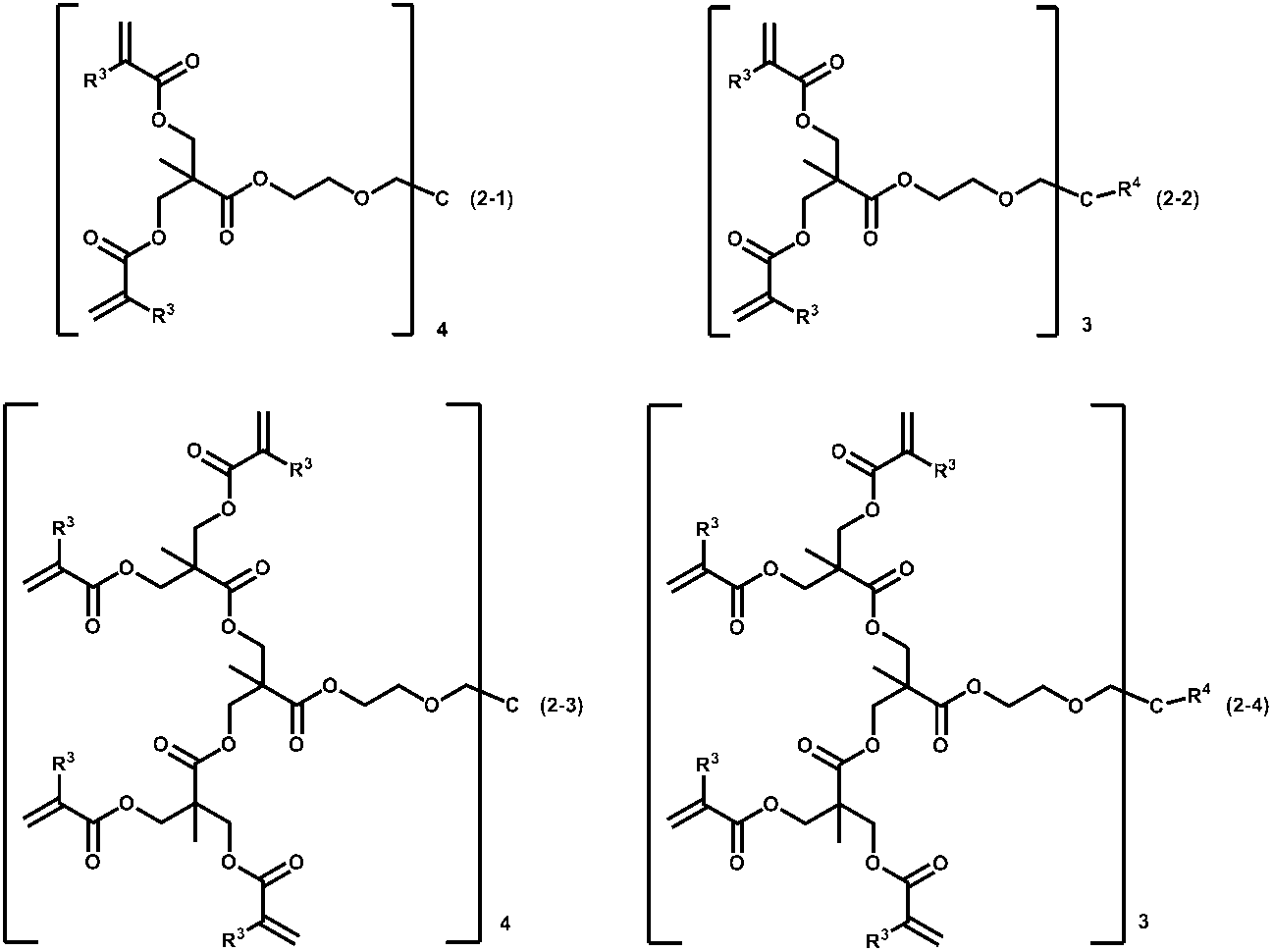
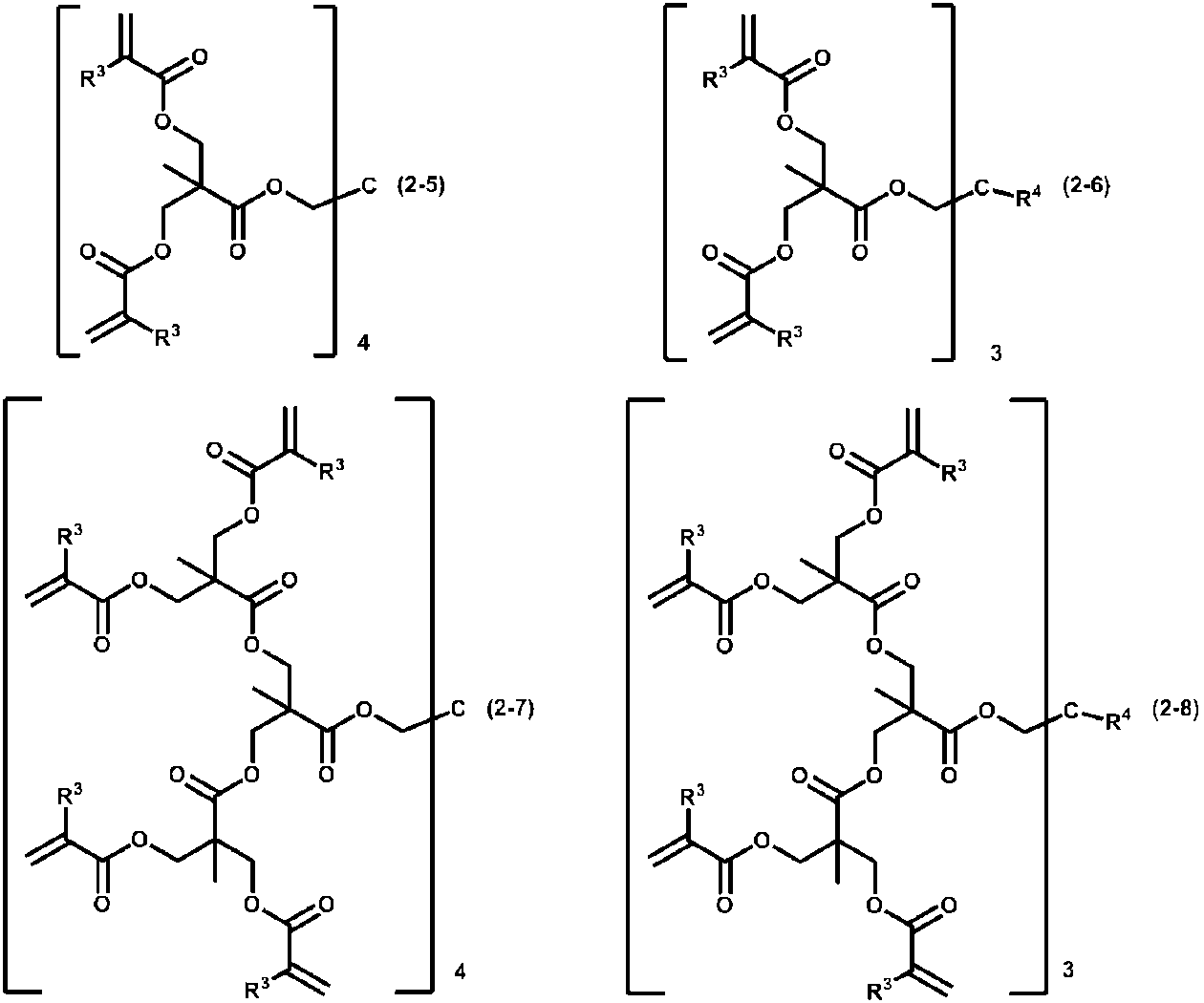
このようなデンドリマー型(メタ)アクリレート樹脂(A2)として、大阪有機化学株式会社製「ビスコート#1000」[重量平均分子量(Mw)1,500~2,000、一分子あたりの平均(メタ)アクリロイル基数14]、「ビスコート1020」[重量平均分子量(Mw)1,000~3,000]、「SIRIUS501」[重量平均分子量(Mw)15,000~23,000]、MIWON社製「SP-1106」[重量平均分子量(Mw)1,630、一分子あたりの平均(メタ)アクリロイル基数18]、SARTOMER社製「CN2301」、「CN2302」[一分子あたりの平均(メタ)アクリロイル基数16]、「CN2303」[一分子あたりの平均(メタ)アクリロイル基数6]、「CN2304」[一分子あたりの平均(メタ)アクリロイル基数18]、新日鉄住金化学株式会社製「エスドリマーHU-22」、新中村化学株式会社製「A-HBR-5」、第一工業製薬株式会社製「ニューフロンティアR-1150」、日産化学株式会社製「ハイパーテックUR-101」等の市販品を用いても良い。
前記デンドリマー型(メタ)アクリレート樹脂(A2)は、重量平均分子量(Mw)が1,000~30,000の範囲であることが好ましい。また、一分子あたりの平均(メタ)アクリロイル基数が5~30の範囲であるものが好ましい。
前記(メタ)アクリロイル基含有アクリル樹脂(A3)は、例えば、水酸基やカルボキシ基、イソシアネート基、グリシジル基等の反応性官能基を有する(メタ)アクリレートモノマー(α)を必須の成分として重合させて得られるアクリル樹脂中間体に、これらの官能基と反応し得る反応性官能基を有する(メタ)アクリレートモノマー(β)を更に反応させることにより(メタ)アクリロイル基を導入して得られるものが挙げられる。
前記反応性官能基を有する(メタ)アクリレートモノマー(α)は、例えば、ヒドロキシエチル(メタ)アクリレート、ヒドロキシプロピル(メタ)アクリレート等の水酸基含有(メタ)アクリレートモノマー;(メタ)アクリル酸等のカルボキシ基含有(メタ)アクリレートモノマー;2-アクリロイルオキシエチルイソシアネート、2-メタクリロイルオキシエチルイソシアネート、1,1-ビス(アクリロイルオキシメチル)エチルイソシアネート等のイソシアネート基含有(メタ)アクリレートモノマー;グリシジル(メタ)アクリレート、4-ヒドロキシブチルアクリレートグリシジルエーテル等のグリシジル基含有(メタ)アクリレートモノマー等が挙げられる。これらはそれぞれ単独で用いても良いし、2種類以上を併用しても良い。
前記アクリル樹脂中間体は、前記(メタ)アクリレートモノマー(α)の他、必要に応じてその他の重合性不飽和基含有化合物を共重合させたものであってもよい。前記その他の重合性不飽和基含有化合物は、例えば、メチル(メタ)アクリレート、エチル(メタ)アクリレート、プロピル(メタ)アクリレート、ブチル(メタ)アクリレート、2-エチルヘキシル(メタ)アクリレート等の(メタ)アクリル酸アルキルエステル;シクロヘキシル(メタ)アクリレート、イソボロニル(メタ)アクリレート、ジシクロペンタニル(メタ)アクリレート等のシクロ環含有(メタ)アクリレート;フェニル(メタ)アクリレート、ベンジル(メタ)アクリレート、フェノキシエチルアクリレート等の芳香環含有(メタ)アクリレート;3-メタクリロキシプロピルトリメトキシシラン等のシリル基含有(メタ)アクリレート;スチレン、α-メチルスチレン、クロロスチレン等のスチレン誘導体等が挙げられる。これらはそれぞれ単独で用いても良いし、二種類以上を併用しても良い。
前記アクリル樹脂中間体が前記(メタ)アクリレートモノマー(α)と、前記その他の重合性不飽和基含有化合物とを共重合させて得られるものである場合、両者の反応割合は、硬化性に優れる(メタ)アクリロイル基含有アクリル樹脂(A3)となることから、両者の合計に対する前記(メタ)アクリレートモノマー(α)の割合が20~70質量部%の範囲であることが好ましく、30~60質量部%の範囲であることがより好ましい。
前記アクリル樹脂中間体は一般的なアクリル樹脂と同様の方法にて製造することができる。製造条件の一例としては、例えば、重合開始剤の存在下、60℃~150℃の温度領域で各種モノマーを重合させることにより製造することができる。重合の方法は、例えば、塊状重合法、溶液重合法、懸濁重合法、乳化重合法等が挙げられる。また、重合様式は、例えば、ランダム共重合体、ブロック共重合体、グラフト共重合体等が挙げられる。溶液重合法で行う場合には、例えば、メチルエチルケトン、メチルイソブチルケトン等のケトン溶媒や、プロピレングリコールモノメチルエーテル、プロピレングリコールジメチルエーテル、プロピレングリコールモノプロピルエーテル、プロピレングリコールモノブチルエーテル等のグリコールエーテル溶媒を好ましく用いることができる。
前記(メタ)アクリレートモノマー(β)は、前記(メタ)アクリレートモノマー(α)が有する反応性官能基と反応し得るものでれば特に限定されないが、反応性の観点から以下の組み合わせであることが好ましい。即ち、前記(メタ)アクリレートモノマー(α)として前記水酸基含有(メタ)アクリレートを用いた場合には、(メタ)アクリレートモノマー(β)としてイソシアネート基含有(メタ)アクリレートを用いることが好ましい。前記(メタ)アクリレートモノマー(α)として前記カルボキシ基含有(メタ)アクリレートを用いた場合には、(メタ)アクリレートモノマー(β)として前記グリシジル基含有(メタ)アクリレートを用いることが好ましい。前記(メタ)アクリレートモノマー(α)として前記イソシアネート基含有(メタ)アクリレートを用いた場合には、(メタ)アクリレートモノマー(β)として前記水酸基含有(メタ)アクリレートを用いることが好ましい。前記(メタ)アクリレートモノマー(α)として前記グリシジル基含有(メタ)アクリレートを用いた場合には、(メタ)アクリレートモノマー(β)として前記カルボキシ基含有(メタ)アクリレートを用いることが好ましい。
前記アクリル樹脂中間体と(メタ)アクリレートモノマー(β)との反応は、例えば、該反応がエステル化反応である場合には、60~150℃の温度範囲で、トリフェニルホスフィン等のエステル化触媒を適宜用いるなどの方法が挙げられる。また、該反応がウレタン化反応である場合には、50~120℃の温度範囲で、アクリル樹脂中間体に化合物(α)を滴下しながら反応させる等の方法が挙げられる。
前記(メタ)アクリロイル基含有アクリル樹脂(A3)は、重量平均分子量(Mw)が5,000~80,000の範囲であることが好ましい。また、(メタ)アクリロイル基当量が200~500g/当量の範囲であることが好ましい。
前記ウレタン(メタ)アクリレート樹脂(A4)は、例えば、各種のポリイソシアネート化合物、水酸基含有(メタ)アクリレート化合物、及び必要に応じて各種のポリオール化合物を反応させて得られるものが挙げられる。前記ポリイソシアネート化合物は、前記ポリイソシアネート化合物(x1)として例示したような各種のポリイソシアネート化合物が挙げられる。
前記水酸基含有(メタ)アクリレート化合物は、例えば、ヒドロキシエチル(メタ)アクリレート、ヒドロキシプロピル(メタ)アクリレート、トリメチロールプロパンジ(メタ)アクリレート、ペンタエリスリトールトリ(メタ)アクリレート、ジトリメチロールプロパントリ(メタ)アクリレート、ジペンタエリスリトールペンタ(メタ)アクリレート等の水酸基含有(メタ)アクリレート化合物;前記各種の水酸基含有(メタ)アクリレート化合物の分子構造中に(ポリ)オキシエチレン鎖、(ポリ)オキシプロピレン鎖、(ポリ)オキシテトラメチレン鎖等の(ポリ)オキシアルキレン鎖を導入した(ポリ)オキシアルキレン変性体挙げられる。
前記ポリオール化合物は、例えば、エチレングリコール、プロプレングリコール、ブタンジオール、ヘキサンジオール、グリセリン、トリメチロールプロパン、ジトリメチロールプロパン、ペンタエリスリトール、ジペンタエリスリトール等の脂肪族ポリオール化合物;ビフェノール、ビスフェノール等の芳香族ポリオール化合物;前記各種のポリオール化合物の分子構造中に(ポリ)オキシエチレン鎖、(ポリ)オキシプロピレン鎖、(ポリ)オキシテトラメチレン鎖等の(ポリ)オキシアルキレン鎖を導入した(ポリ)オキシアルキレン変性体等が挙げられる。
前記エポキシ(メタ)アクリレート樹脂(A5)は、例えば、エポキシ樹脂に(メタ)アクリル酸又はその無水物を反応させて得られるものが挙げられる。前記エポキシ樹脂は、例えば、ヒドロキノン、カテコール等の2価フェノールのジグリシジルエーテル;3,3’-ビフェニルジオール、4,4’-ビフェニルジオール等のビフェノール化合物のジグリシジルエーテル;ビスフェノールA型エポキシ樹脂、ビスフェノールB型エポキシ樹脂、ビスフェノールF型エポキシ樹脂、ビスフェノールS型エポキシ樹脂等のビスフェノール型エポキシ樹脂;1,4-ナフタレンジオール、1,5-ナフタレンジオール、1,6-ナフタレンジオール、2,6-ナフタレンジオール、2,7-ナフタレンジオール、ビナフトール、ビス(2,7-ジヒドロキシナフチル)メタン等のナフトール化合物のポリグリジシルエーテル;4,4’,4”-メチリジントリスフェノール等のトリグリシジルエーテル;フェノールノボラック型エポキシ樹脂、クレゾールノボラック樹脂等のノボラック型エポキシ樹脂;前記各種のエポキシ樹脂の分子構造中に(ポリ)オキシエチレン鎖、(ポリ)オキシプロピレン鎖、(ポリ)オキシテトラメチレン鎖等の(ポリ)オキシアルキレン鎖を導入した(ポリ)オキシアルキレン変性体;前記各種のエポキシ樹脂の分子構造中に(ポリ)ラクトン構造を導入したラクトン変性体等が挙げられる。
前記モノ(メタ)アクリレート化合物及びその変性体(A6)は、例えば、メチル(メタ)アクリレート、エチル(メタ)アクリレート、ヒドロキシエチル(メタ)アクリレート、プロピル(メタ)アクリレート、ヒドロキシプロピル(メタ)アクリレート、ブチル(メタ)アクリレート、2-エチルヘキシル(メタ)アクリレート等の脂肪族モノ(メタ)アクリレート化合物;シクロヘキシル(メタ)アクリレート、イソボルニル(メタ)アクリレート、アダマンチルモノ(メタ)アクリレート等の脂環型モノ(メタ)アクリレート化合物;グリシジル(メタ)アクリレート、テトラヒドロフルフリルアクリレート等の複素環型モノ(メタ)アクリレート化合物;フェニル(メタ)アクリレート、ベンジル(メタ)アクリレート、フェノキシ(メタ)アクリレート、フェノキシエチル(メタ)アクリレート、フェノキシエトキシエチル(メタ)アクリレート、2-ヒドロキシ-3-フェノキシプロピル(メタ)アクリレート、フェニルフェノール(メタ)アクリレート、フェニルフェノールアルキル(メタ)アクリレート、フェニルベンジル(メタ)アクリレート、フェノキシベンジル(メタ)アクリレート、ベンジルベンジル(メタ)アクリレート、フェニルフェノキシエチル(メタ)アクリレート、パラクミルフェノール(メタ)アクリレート等の芳香族モノ(メタ)アクリレート化合物;下記構造式(3)
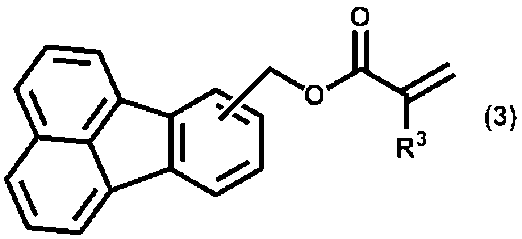
で表される化合物等のモノ(メタ)アクリレート化合物:前記各種のモノ(メタ)アクリレート化合物の分子構造中に(ポリ)オキシエチレン鎖、(ポリ)オキシプロピレン鎖、(ポリ)オキシテトラメチレン鎖等の(ポリ)オキシアルキレン鎖を導入した(ポリ)オキシアルキレン変性体;前記各種のモノ(メタ)アクリレート化合物の分子構造中に(ポリ)ラクトン構造を導入したラクトン変性体等が挙げられる。
前記脂肪族炭化水素型ポリ(メタ)アクリレート化合物及びその変性体(A7)は、例えば、エチレングリコールジ(メタ)アクリレート、プロピレングリコールジ(メタ)アクリレート、ブタンジオールジ(メタ)アクリレート、ヘキサンジオールジ(メタ)アクリレート、ネオペンチルグリコールジ(メタ)アクリレート等の脂肪族ジ(メタ)アクリレート化合物;トリメチロールプロパントリ(メタ)アクリレート、グリセリントリ(メタ)アクリレート、ペンタエリスリトールトリ(メタ)アクリレート、ジトリメチロールプロパントリ(メタ)アクリレート、ジペンタエリスリトールトリ(メタ)アクリレート等の脂肪族トリ(メタ)アクリレート化合物;ペンタエリスリトールテトラ(メタ)アクリレート、ジトリメチロールプロパンテトラ(メタ)アクリレート、ジペンタエリスリトールテトラ(メタ)アクリレート、ジペンタエリスリトールペンタ(メタ)アクリレート、ジペンタエリスリトールヘキサ(メタ)アクリレート等の4官能以上の脂肪族ポリ(メタ)アクリレート化合物;前記各種の脂肪族炭化水素型ポリ(メタ)アクリレート化合物の分子構造中に(ポリ)オキシエチレン鎖、(ポリ)オキシプロピレン鎖、(ポリ)オキシテトラメチレン鎖等の(ポリ)オキシアルキレン鎖を導入した(ポリ)オキシアルキレン変性体;前記各種の脂肪族炭化水素型ポリ(メタ)アクリレート化合物の分子構造中に(ポリ)ラクトン構造を導入したラクトン変性体等が挙げられる。
脂環式ポリ(メタ)アクリレート化合物及びその変性体(A8)は、例えば、1,4-シクロヘキサンジメタノールジ(メタ)アクリレート、ノルボルナンジ(メタ)アクリレート、ノルボルナンジメタノールジ(メタ)アクリレート、ジシクロペンタニルジ(メタ)アクリレート、トリシクロデカンジメタノールジ(メタ)アクリレート等の脂環型ジ(メタ)アクリレート化合物;前記各種の脂環式ポリ(メタ)アクリレート化合物の分子構造中に(ポリ)オキシエチレン鎖、(ポリ)オキシプロピレン鎖、(ポリ)オキシテトラメチレン鎖等の(ポリ)オキシアルキレン鎖を導入した(ポリ)オキシアルキレン変性体;前記各種の脂環式ポリ(メタ)アクリレート化合物の分子構造中に(ポリ)ラクトン構造を導入したラクトン変性体等が挙げられる。
芳香族ポリ(メタ)アクリレート化合物及びその変性体(A9)は、例えば、ビフェノールジ(メタ)アクリレート、ビスフェノールジ(メタ)アクリレート、下記構造式(4)

で表されるビカルバゾール化合物、下記構造式(5-1)又は(5-2)
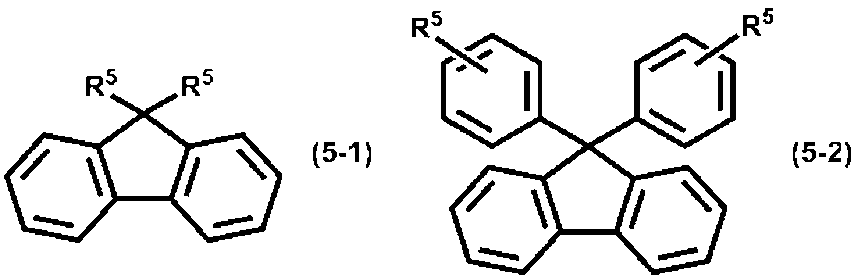
で表されるフルオレン化合物等の芳香族ジ(メタ)アクリレート化合物;前記各種の芳香族ポリ(メタ)アクリレート化合物の分子構造中に(ポリ)オキシエチレン鎖、(ポリ)オキシプロピレン鎖、(ポリ)オキシテトラメチレン鎖等の(ポリ)オキシアルキレン鎖を導入した(ポリ)オキシアルキレン変性体;前記各種の芳香族ポリ(メタ)アクリレート化合物の分子構造中に(ポリ)ラクトン構造を導入したラクトン変性体等が挙げられる。
前記(メタ)アクリロイル基含有化合物(A)が前記(ポリ)エステル(メタ)アクリレート樹脂(A1)以外のその他の(メタ)アクリレート化合物を含有する場合、本発明が奏する無機材料に対する密着性が高く、保存安定性にも優れる効果が十分に発揮されることから、(メタ)アクリロイル基含有化合物(A)の総質量に対する前記(ポリ)エステル(メタ)アクリレート樹脂(A1)の含有量が5~80質量%の範囲であることが好ましい。
特に、前記(ポリ)エステル(メタ)アクリレート樹脂(A1)が前記ラクトン変性ウレタン(メタ)アクリレート樹脂である場合には、(メタ)アクリロイル基含有化合物(A)の総質量に対する前記ラクトン変性ウレタン(メタ)アクリレート樹脂の含有量が5~80質量%の範囲であることが好ましく、5~60質量%の範囲であることがより好ましい。また、前記ラクトン変性ウレタン(メタ)アクリレート樹脂以外のその他の(メタ)アクリレート化合物としては、前記脂肪族炭化水素型ポリ(メタ)アクリレート化合物又はその変性体(A7)を用いることが好ましい。この時、両者の質量比[(ラクトン変性ウレタン(メタ)アクリレート樹脂)/(脂肪族炭化水素型ポリ(メタ)アクリレート化合物又はその変性体(A7))は5/95~80/20の範囲であることが好ましく、5/95~60/40の範囲であることがより好ましい。
更に、前記(メタ)アクリロイル基含有化合物(A)は、ラクトン変性ウレタン(メタ)アクリレート樹脂が有するラクトン化合物由来の構造部位を2~30質量%の範囲で含有することが好ましく、2~20質量%の範囲で含有することが好ましい。(メタ)アクリロイル基含有化合物(A)中のラクトン構造比率(質量%)は、[ラクトン変性ウレタン(メタ)アクリレート樹脂が有するラクトン化合物由来の構造部位の総質量]/[(メタ)アクリロイル基含有化合物(A)成分の総質量]×100(質量%)により算出される値であり、前記[ラクトン変性ウレタン(メタ)アクリレート樹脂が有するラクトン化合物由来の構造部位の総質量]は、樹脂を製造する際の原料仕込み比から算出される値、或いは販売メーカーの公表構造式から算出される値である。また、前記(メタ)アクリロイル基含有化合物(A)が前記ラクトン変性ウレタン(メタ)アクリレート樹脂以外にもラクトン化合物由来の構造部位を含む成分を含む場合には、(メタ)アクリロイル基含有化合物(A)中のラクトン化合物由来の構造部位の総量が2~30質量%の範囲であることが好ましく、2~20質量%の範囲であることが好ましい。
また、前記(ポリ)エステル(メタ)アクリレート樹脂(A1)が前記水酸基含有ポリエステル樹脂の(メタ)アクリル酸付加物であるポリエステル(メタ)アクリレート樹脂や、前記カルボキシ基含有ポリエステル樹脂のグリシジル(メタ)アクリレート付加物であるポリエステル(メタ)アクリレート樹脂である場合には、(メタ)アクリロイル基含有化合物(A)の総質量に対する前記ポリエステル(メタ)アクリレート樹脂の含有量が5~80質量%の範囲であることが好ましく、5~50質量%の範囲であることがより好ましい。また、前記ポリエステル(メタ)アクリレート樹脂以外のその他の(メタ)アクリレート化合物としては、前記脂肪族炭化水素型ポリ(メタ)アクリレート化合物又はその変性体(A7)を用いることが好ましい。この時、両者の質量比[(ポリエステル(メタ)アクリレート樹脂)/(脂肪族炭化水素型ポリ(メタ)アクリレート化合物又はその変性体(A7))]は5/95~80/20の範囲であることが好ましく、5/95~50/50の範囲であることがより好ましい。
前記リン酸エステル化合物(B)は、分子構造中にリン酸エステル構造を有するものであれば、その他の構造部位は特に限定なく、どのような化合物であってもよい。なお、分子構造中にリン酸エステル構造と(メタ)アクリロイル基との両方を有する化合物は、本発明においてはリン酸エステル化合物(B)に分類される。
前記リン酸エステル化合物(B)の具体例としては、例えば、下記構造式(6)
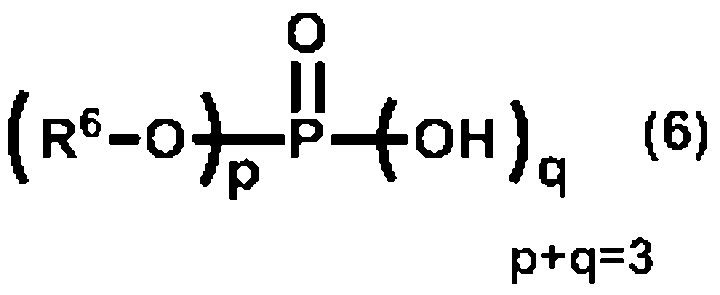
前記構造式(6)中のR6は特に限定されず、どのような構造部位であってもよい。R6の具体例としては、例えば、脂肪族炭化水素基、芳香族炭化水素基、(メタ)アクリロイル基、グリシジル基、(ポリ)オキシアルキレン構造、(ポリ)チオアルキレン構造、(ポリ)エステル構造、これらの組み合わせからなる構造部位等が挙げられる。また、R6は水酸基やアミノ基、カルボキシ基、ハロゲン原子等の官能基を有していてもよい。中でも、無機材料に対する密着性や保存安定性に一層優れる活性エネルギー線硬化型樹脂組成物となることから、分子構造中に(メタ)アクリロイル基やアリル基等の重合性基を有する化合物であることが好ましい。
前記リン酸エステル化合物(B)の市販品の例としては、例えば、分子構造中に(メタ)アクリロイル基を有するリン酸エステル化合物である日本化薬株式会社製「カヤマーPM-2」、「カヤマーPM-21」、共栄社化学株式会社製「ライトエステルP-1M」「ライトエステルP-2M」、「ライトアクリレートP-1A(N)」、SOLVAY社製「SIPOMER PAM 100」、「SIPOMER PAM 200」、「SIPOMER PAM 300」、「SIPOMER PAM 4000」、大阪有機化学工業社製「ビスコート#3PA」、「ビスコート#3PMA」、第一工業製薬社製「ニューフロンティア S-23A」;分子構造中にアリルエーテル基を有するリン酸エステル化合物であるSOLVAY社製「SIPOMER PAM 5000」等が挙げられる。
本発明の活性エネルギー線硬化型樹脂組成物において前記リン酸エステル化合物(B)の含有量は所望の性能等に応じて適宜調整される。特に、無機材料に対する密着性が高く、保存安定性にも優れる活性エネルギー線硬化型樹脂組成物となることから、活性エネルギー線硬化型樹脂組成物の溶剤以外の成分の合計に対し0.5~10質量%の範囲であることが好ましく、1~5質量%の範囲であることがより好ましい。
前記シランカップリング剤(C)例えば、[(メタ)アクリロイルオキシアルキル]トリアルキルシラン、[(メタ)アクリロイルオキシアルキル]ジアルキルアルコキシシラン、[(メタ)アクリロイルオキシアルキル]アルキルジアルコキシシラン、[(メタ)アクリロイルオキシアルキル]トリアルコキシシラン等の(メタ)アクリロイルオキシ系シランカップリング剤;トリアルキルビニルシラン、ジアルキルアルコキシビニルシラン、アルキルジアルコキシビニルシラン、トリアルコキシビニルシラン、トリアルキルアリルシラン、ジアルキルアルコキシアリルシラン、アルキルジアルコキシアリルシラン、トリアルコキシアリルシラン等のビニル系シランカップリング剤;スチリルトリアルキル、スチリルジアルキルアルコキシシラン、スチリルアルキルジアルコキシシラン、スチリルトリアルコキシシラン等のスチレン系シランカップリング剤;(グリシジルオキシアルキル)トリアルキルシラン、(グリシジルオキシアルキル)ジアルキルアルコキシシラン、(グリシジルオキシアルキル)アルキルジアルコキシシラン、(グリシジルオキシアルキル)トリアルコキシシラン、[(3,4-エポキシシクロヘキシル)アルキル]トリメトキシシラン、[(3,4-エポキシシクロヘキシル)アルキル]トリアルキルシラン、[(3,4-エポキシシクロヘキシル)アルキル]ジアルキルアルコキシシラン、[(3,4-エポキシシクロヘキシル)アルキル]アルキルジアルコキシシラン、[(3,4-エポキシシクロヘキシル)アルキル]トリアルコキシシラン等のエポキシ系シランカップリング剤;(イソシアネートアルキル)トリアルキルシラン、(イソシアネートアルキル)ジアルキルアルコキシシラン、(イソシアネートアルキル)アルキルジアルコキシシラン、(イソシアネートアルキル)トリアルコキシシラン等のイソシアネート系シランカップリング剤等が挙げられる。これらそれぞれ単独で用いても良いし、2種類以上を併用しても良い。
前記シランカップリング剤(C)の中でも、無機材料に対する密着性や保存安定性に一層優れる活性エネルギー線硬化型樹脂組成物となることから、(メタ)アクリロイルオキシ系シランカップリング剤が好ましく、3-(メタ)アクリロイルオキシプロピルトリメトキシシラン、3-(メタ)アクリロイルオキシプロピルトリエトキシシラン等の[(メタ)アクリロイルオキシアルキル]トリアルコキシシランが特に好ましい。
本発明の活性エネルギー線硬化型樹脂組成物において前記シランカップリング剤(C)の含有量は所望の性能等に応じて適宜調整される。特に、無機材料に対する密着性が高く、保存安定性にも優れる活性エネルギー線硬化型樹脂組成物となることから、活性エネルギー線硬化型樹脂組成物の溶剤以外の成分の合計に対し1~15質量%の範囲であることが好ましく、2~8質量%の範囲であることがより好ましい。
更に、本発明の活性エネルギー線硬化型樹脂組成物は、無機材料に対する密着性が一層高くなることから、溶剤以外の成分の合計に対し、前記リン酸エステル化合物(B)と前記シランカップリング剤(C)との合計が2~20質量%の範囲であることが好ましく、4~10質量%の範囲であることがより好ましい。また、前記リン酸エステル化合物(B)と前記シランカップリング剤(C)との質量比[(B)/(C)]が1/1.1~1/10の範囲であることが好ましく、1/1.2~1/7の範囲であることがより好ましい。
本発明の活性エネルギー線硬化型樹脂組成物は、前記(メタ)アクリロイル基含有化合物(A)、前記リン酸エステル化合物(B)及び前記シランカップリング剤(C)の他、その他の成分を含有していてもよい。前記その他の成分は、例えば、前記(メタ)アクリロイル基含有化合物(A)以外のその他の樹脂成分や、無機微粒子、光重合開始剤、溶剤、紫外線吸収剤、酸化防止剤、シリコン系添加剤、フッ素系添加剤、帯電防止剤、有機ビーズ、量子ドット(QD)、レオロジーコントロール剤、脱泡剤、防曇剤、着色剤等が挙げられる。
前記その他の樹脂成分は、活性エネルギー線硬化型樹脂組成物の基材密着性やガスバリヤ性、耐湿熱性、柔軟性等、所望の性能を向上させる目的で添加されるものであり、公知慣用の種々の樹脂を用いることができる。一例としては、アクリル樹脂、ポリエステル樹脂、ウレタン樹脂、石油樹脂等が挙げられる。これらはそれぞれ単独で用いてもよいし、2種類以上を併用してもよい。その他の樹脂成分を用いる場合、その添加量は、前記(メタ)アクリロイル基含有化合物(A)の総質量に対し0.5~100質量%の範囲で用いることが好ましい。
前記無機微粒子は、活性エネルギー線硬化型樹脂組成物の硬化塗膜における硬度や屈折率等を調整する等の目的で添加されるものであり、公知慣用の種々の無機微粒子を用いることができる。一例としては、シリカ、アルミナ、ジルコニア、チタニア、チタン酸バリウム、三酸化アンチモン等の微粒子が挙げられる。これらはそれぞれ単独で用いても良いし、二種類以上を併用しても良い。このうち特に汎用性が高いシリカ粒子は、フュームドシリカや、沈殿法シリカ、ゲルシリカ、ゾルゲルシリカ等と呼ばれる湿式シリカなど様々な種類があるが、いずれを用いてもよい。また、無機微粒子の表面はシランカップリング剤等で修飾されていてもよい。無機微粒子の粒子径は所望の塗膜性能等に応じて適宜調節されるが、動的光散乱法による測定値が10~250nmの範囲であることが好ましい。無機微粒子を用いる場合、その添加量は、活性エネルギー線硬化型樹脂組成物の溶剤以外の成分の合計に対し、0.1~60質量%の範囲であることが好ましい。
前記光重合開始剤は、照射する活性エネルギー線の種類等により適切なものを選択して用いればよい。また、アミン化合物、尿素化合物、含硫黄化合物、含燐化合物、含塩素化合物、ニトリル化合物等の光増感剤と併用してもよい。光重合開始剤の具体例としては、例えば、1-ヒドロキシ-シクロヘキシル-フェニル-ケトン、2-ベンジル-2-ジメチルアミノ-1-(4-モルホリノフェニル)-ブタノン-1、2-(ジメチルアミノ)-2-[(4-メチルフェニル)メチル]-1-[4-(4-モルホリニル)フェニル]-1-ブタノン等のアルキルフェノン系光重合開始剤;2,4,6-トリメチルベンゾイル-ジフェニル-ホスフィンオキサイド等のアシルホスフィンオキサイド系光重合開始剤;ベンゾフェノン化合物等の分子内水素引き抜き型光重合開始剤等が挙げられる。これらはそれぞれ単独で用いても良いし、2種類以上を併用しても良い。
前記光重合開始剤の市販品は、例えば、BASF社製「IRGACURE127」、「IRGACURE184」、「IRGACURE250」、「IRGACURE270」、「IRGACURE290」、「IRGACURE369E」、「IRGACURE379EG」、「IRGACURE500」、「IRGACURE651」、「IRGACURE754」、「IRGACURE819」、「IRGACURE907」、「IRGACURE1173」、「IRGACURE2959」、「IRGACURE MBF」、「IRGACURE TPO」、「IRGACURE OXE 01」、「IRGACURE OXE 02」等が挙げられる。
前記光重合開始剤の添加量は、活性エネルギー線硬化型樹脂組成物の溶剤以外の成分の合計に対し0.05~15質量%の範囲であることが好ましく、0.1~10質量%の範囲であることがより好ましい。
前記溶剤は、活性エネルギー線硬化型樹脂組成物の塗工粘度調節等の目的で添加されるものであり、その種類や添加量は、所望の性能に応じて適宜調整される。一般には、活性エネルギー線硬化型樹脂組成物の合計に対し10~90質量%の範囲で用いられる。前記溶剤の具体例としては、例えば、アセトン、メチルエチルケトン、メチルイソブチルケトン等のケトン溶剤;テトラヒドロフラン、ジオキソラン等の環状エーテル溶剤;酢酸メチル、酢酸エチル、酢酸ブチル等のエステル;トルエン、キシレン等の芳香族溶剤;シクロヘキサン、メチルシクロヘキサン等の脂環族溶剤;カルビトール、セロソルブ、メタノール、イソプロパノール、ブタノール、プロピレングリコールモノメチルエーテルなどのアルコール溶剤;エチレングリコールモノエチルエーテル、エチレングリコールモノブチルエーテル、プロピレングリコールモノメチルエーテル、プロピレングリコールモノプロピルエーテル等のグリコールエーテル系溶剤が挙げられる。これらはそれぞれ単独で使用しても良いし、2種類以上を併用しても良い。
前記紫外線吸収剤は、例えば、2-[4-{(2-ヒドロキシ-3-ドデシルオキシプロピル)オキシ}-2-ヒドロキシフェニル]-4,6-ビス(2,4-ジメチルフェニル)-1,3,5-トリアジン、2-[4-{(2-ヒドロキシ-3-トリデシルオキシプロピル)オキシ}-2-ヒドロキシフェニル]-4,6-ビス(2,4-ジメチルフェニル)-1,3,5-トリアジン等のトリアジン誘導体、2-(2′-キサンテンカルボキシ-5′-メチルフェニル)ベンゾトリアゾール、2-(2′-o-ニトロベンジロキシ-5′-メチルフェニル)ベンゾトリアゾール、2-キサンテンカルボキシ-4-ドデシロキシベンゾフェノン、2-o-ニトロベンジロキシ-4-ドデシロキシベンゾフェノン等が挙げられる。これらはそれぞれ単独で使用しても良いし、2種類以上を併用しても良い。
前記酸化防止剤は、例えば、ヒンダードフェノール系酸化防止剤、ヒンダードアミン系酸化防止剤、有機硫黄系酸化防止剤、リン酸エステル系酸化防止剤等が挙げられる。これらはそれぞれ単独で使用しても良いし、2種類以上を併用しても良い。
前記シリコン系添加剤は、例えば、ジメチルポリシロキサン、メチルフェニルポリシロキサン、環状ジメチルポリシロキサン、メチルハイドロゲンポリシロキサン、ポリエーテル変性ジメチルポリシロキサン共重合体、ポリエステル変性ジメチルポリシロキサン共重合体、フッ素変性ジメチルポリシロキサン共重合体、アミノ変性ジメチルポリシロキサン共重合体など如きアルキル基やフェニル基を有するポリオルガノシロキサン、ポリエーテル変性アクリル基を有するポリジメチルシロキサン、ポリエステル変性アクリル基を有するポリジメチルシロキサン等が挙げられる。これらはそれぞれ単独で使用しても良いし、2種類以上を併用しても良い。
前記フッ素系添加剤は、例えば、DIC株式会社「メガフェース」シリーズ等が挙げられる。これらはそれぞれ単独で使用しても良いし、2種類以上を併用しても良い。
前記帯電防止剤は、例えば、ビス(トリフルオロメタンスルホニル)イミド又はビス(フルオロスルホニル)イミドのピリジニウム、イミダゾリウム、ホスホニウム、アンモニウム、又はリチウム塩が挙げられる。これらはそれぞれ単独で使用しても良いし、二種類以上を併用しても良い。
前記有機ビーズは、例えば、ポリメタクリル酸メチルビーズ、ポリカーボネートビーズ、ポリスチレンビーズ、ポリアクリルスチレンビーズ、シリコーンビ-ズ、ガラスビーズ、アクリルビーズ、ベンゾグアナミン系樹脂ビーズ、メラミン系樹脂ビーズ、ポリオレフィン系樹脂ビーズ、ポリエステル系樹脂ビーズ、ポリアミド樹脂ビーズ、ポリイミド系樹脂ビーズ、ポリフッ化エチレン樹脂ビーズ、ポリエチレン樹脂ビーズ等が挙げられる。これらはそれぞれ単独で使用しても良いし、2種類以上を併用しても良い。これら有機ビーズの平均粒径は1~10μmの範囲であることが好ましい。
前記量子ドット(QD)は、II-V族半導体化合物、II-VI族半導体化合物、III-IV族半導体化合物、III-V族半導体化合物、III-VI族半導体化合物、IV-VI族半導体化合物、I-III-VI族半導体化合物、II-IV-VI族半導体化合物、II-IV-V族半導体化合物、I-II-IV-VI族半導体化合物、IV族元素又はこれを含む化合物等が挙げられる。前記II-VI族半導体化合物は、例えば、ZnO、ZnS、ZnSe、ZnTe、CdS、CdSe、CdTe、HgS、HgSe、HgTe等の二元化合物;ZnSeS、ZnSeTe、ZnSTe、CdZnS、CdZnSe、CdZnTe、CdSeS、CdSeTe、CdSTe、CdHgS、CdHgSe、CdHgTe、HgSeS、HgSeTe、HgSTe、HgZnS、HgZnSe、HgZnTe等の三元化合物;CdZnSeS、CdZnSeTe、CdZnSTe、CdHgSeS、CdHgSeTe、CdHgSTe、CdHgZnTe、HgZnSeS、HgZnSeTe、HgZnSTe等の四元化合物等が挙げられる。前記III-IV族半導体化合物は、例えば、B4C3、Al4C3、Ga4C3等が挙げられる。前記III-V族半導体化合物は、例えば、BP、BN、AlN、AlP、AlAs、AlSb、GaN、GaP、GaAs、GaSb、InN、InP、InAs、InSb等の二元化合物;GaNP、GaNAs、GaNSb、GaPAs、GaPSb、AlNP、AlNAs、AlNSb、AlPAs、AlPSb、InNP、InNAs、InNSb、InPAs、InPSb、GaAlNP等の三元化合物;GaAlNAs、GaAlNSb、GaAlPAs、GaAlPSb、GaInNP、GaInNAs、GaInNSb、GaInPAs、GaInPSb、InAlNP、InAlNAs、InAlNSb、InAlPAs、InAlPSb等の四元化合物等が挙げられる。前記III-VI族半導体化合物は、例えば、Al2S3、Al2Se3、Al2Te3、Ga2S3、Ga2Se3、Ga2Te3、GaTe、In2S3、In2Se3、In2Te3、InTe等が挙げられる。前記IV-VI族半導体化合物は、例えば、SnS、SnSe、SnTe、PbS、PbSe、PbTe等の二元化合物;SnSeS、SnSeTe、SnSTe、PbSeS、PbSeTe、PbSTe、SnPbS、SnPbSe、SnPbTe等の三元化合物;SnPbSSe、SnPbSeTe、SnPbSTe等の四元化合物等が挙げられる。前記I-III-VI族半導体化合物は、例えば、CuInS2、CuInSe2、CuInTe2、CuGaS2、CuGaSe2、CuGaSe2、AgInS2、AgInSe2、AgInTe2、AgGaSe2、AgGaS2、AgGaTe2等が挙げられる。前記IV族元素又はこれを含む化合物は、例えば、C、Si、Ge、SiC、SiGe等が挙げられる。量子ドットは単一の半導体化合物からなっていてもよいし、複数の半導体化合物からなるコアシェル構造を有していてもよい。また、その表面を有機化合物にて修飾したものであってもよい。
本発明の活性エネルギー線硬化型樹脂組成物は、前記各配合成分を混合して製造される。混合方法は特に限定されず、ペイントシェイカー、ディスパー、ロールミル、ビーズミル、ボールミル、アトライター、サンドミル、ビーズミル等を用いてもよい。
本発明の活性エネルギー線硬化型樹脂組成物の用途は特に限定されないが、例えば、塗料用に広く用いることができる。本発明の活性エネルギー線硬化型樹脂組成物を含有する塗料は、プラスチックフィルムや樹脂成形品等に対する密着性はもちろんのこと、各種金属やガラス、SiOx、Al2O3、TiO2、ITO等の無機化合物に対する密着性にも優れる特徴を有する。このような特徴を生かした用途としては、本発明の塗料を用いてなる塗膜層と、それに隣接する無機材料層とを有する積層体用途が挙げられる。
前記積層体について、より具体的には、例えば、ガラスや金属基板上に何かしらの樹脂塗膜を設けたい場合、本発明の塗料からなる塗膜をガラスや金属基板と樹脂塗膜との間に設置することにより、両者をより強固に密着させることができる。或いは、金属蒸着膜等の無機材料薄膜と樹脂塗膜とを積層したい場合、本発明の塗料からなる塗膜を無機材料薄膜と樹脂塗膜との間に設置することにより、剥がれの生じにくい積層体を得ることができる。中でも、無機材料層がケイ酸ガラスやSiOx膜等のケイ素系化合物からなる場合に、特に高い密着性を発現する。
前記積層体の一例として、本発明の塗料からなる塗膜を無機材料薄膜と樹脂塗膜との間に設置した積層体の製造法について説明する。前記無機材料薄膜は、金属又は無機化合物の蒸着膜等が挙げられるが、このような蒸着膜は独立して製膜することが困難であるため、例えば、プラスチックフィルム上に当該蒸着膜を形成させることが好ましい。前記プラスチックフィルムは、例えば、トリアセチルセルロースフィルム、ポリエステルフィルム、アクリルフィルム、シクロオレフィンポリマーフィルム、ポリアミドフィルム、ポリイミドフィルム、ポリスチレンフィルム、ポリカーボネートフィルム、ポリプロピレンフィルム等が挙げられる。これらプラスチックフィルムの厚さは、その材質や積層体の用途に応じて適宜調整されるが、一般には30~300μm程度のものが用いられる。
前記無機材料薄膜を形成する無機材料は、例えば、BN、MgFe2、Al、Al2O3、Si、SiO、SiO2、SiC、Si3N4、Ti、TiN、TiO2、Cr-SiO、Mn-Zn、Fe、Fe-Si-Al、Co-Cr、Co-Cr-Ta、Ni、Ni-Zn、Ni-Cr、Ni-Fe-Mo、Cu、ZnO、GaAs-Al、SeTiO3、Ag、SnO2、Ta、TaN、Ta2O5、Ta-Si、Ta-Al、W、Au、PbTiO3、Bi2O3、ITO、GZO、AZO、PZT等が挙げられる。無機材料薄膜はどのような方法にて形成してもよいが、例えば、プラズマ支援法(CVD)、新旧蒸着(MBE法やフラッシュ法等)、スパッタリング、陽極酸化、無電解めっき、電気メッキ等の方法が挙げられる。前記無機材料薄膜の厚さは、その材質や積層体の用途に応じて適宜調整されるが、一般には30nm~3μm程度であることが好ましい。
前記無機材料薄膜上に本発明の塗料を塗工する際の塗工方法は特に限定されず、バーコーター塗工、メイヤーバー塗工、エアナイフ塗工、グラビア塗工、リバースグラビア塗工、オフセット印刷、フレキソ印刷、スクリーン印刷法等が挙げられる。
本発明の塗料を硬化させるために照射する活性エネルギー線は、例えば、紫外線や電子線が挙げられる。紫外線により硬化させる場合には、光源としてキセノンランプ、高圧水銀灯、メタルハライドランプ、LEDランプ等を有する紫外線照射装置が使用され、必要に応じて光量、光源の配置などが調整される。高圧水銀灯を使用する場合には、通常80~160W/cmの範囲である光量を有したランプ1灯に対して搬送速度5~50m/分の範囲で硬化させることが好ましい。一方、電子線により硬化させる場合には、通常10~300kVの範囲である加速電圧を有する電子線加速装置にて、搬送速度5~50m/分の範囲で硬化させることが好ましい。塗料が有機溶剤を含有する場合には、50~100℃程度の温度条件下で数十秒から数分程度乾燥させた後、活性エネルギー線を照射する。本発明の塗料からなる塗膜の厚さは、積層体の用途や所望の性能に応じて適宜調整されるが、一般には1μm~100μm程度であることが好ましい。
本発明の塗料からなる層に重ねて設置する樹脂塗膜は、積層体の用途や所望の性能に応じて多種多様なものを用いることができる。樹脂塗膜を形成する樹脂材料の形態としては、熱硬化性のものや、活性エネルギー線硬化性のもの、ラッカー等が挙げられる。このうち、活性エネルギー線硬化性の樹脂材料としては、前記(メタ)アクリロイル基含有化合物(A)として例示した化合物と同様のものをマトリックス樹脂とし、所望の性能に応じて前記その他の樹脂や前記無機微粒子、前記有機ビーズ、前記量子ドット(QD)、その他の添加剤等を配合したものが挙げられる。樹脂材料として活性エネルギー線硬化性のものを用いる場合には、本発明の塗料を硬化させる前に前記樹脂材料を塗工し、活性エネルギー線を照射して両者を一度に硬化させてもよい。樹脂塗膜の厚さは、積層体の用途や所望の性能に応じて適宜調整されるが、一般には1μm~100μm程度であることが好ましい。
以下に本発明を具体的な製造例、実施例を挙げてより具体的に説明するが、本発明はこれら実施例に限定されるものではない。例中の部及び%は、特に記載のない限り、すべて質量基準である。
尚、本発明の実施例では、重量平均分子量(Mw)、ゲルパーミエーションクロマトグラフ(GPC)を用い、下記の条件により測定した値である。
測定装置 ; 東ソー株式会社製 HLC-8220
カラム ; 東ソー株式会社製ガードカラムHXL-H
+東ソー株式会社製 TSKgel G5000HXL
+東ソー株式会社製 TSKgel G4000HXL
+東ソー株式会社製 TSKgel G3000HXL
+東ソー株式会社製 TSKgel G2000HXL
検出器 ; RI(示差屈折計)
データ処理:東ソー株式会社製 SC-8010
測定条件: カラム温度 40℃
溶媒 テトラヒドロフラン
流速 1.0ml/分
標準 ;ポリスチレン
試料 ;樹脂固形分換算で0.4質量%のテトラヒドロフラン溶液をマイクロフィルターでろ過したもの(100μl)
カラム ; 東ソー株式会社製ガードカラムHXL-H
+東ソー株式会社製 TSKgel G5000HXL
+東ソー株式会社製 TSKgel G4000HXL
+東ソー株式会社製 TSKgel G3000HXL
+東ソー株式会社製 TSKgel G2000HXL
検出器 ; RI(示差屈折計)
データ処理:東ソー株式会社製 SC-8010
測定条件: カラム温度 40℃
溶媒 テトラヒドロフラン
流速 1.0ml/分
標準 ;ポリスチレン
試料 ;樹脂固形分換算で0.4質量%のテトラヒドロフラン溶液をマイクロフィルターでろ過したもの(100μl)
本願実施例において(メタ)アクリロイル基含有化合物(A)中のラクトン構造比率(質量%)とは、[ラクトン変性ウレタン(メタ)アクリレート樹脂等が有するラクトン化合物由来の構造部位の総質量]/[(メタ)アクリロイル基含有化合物(A)成分の総質量]×100(質量%)により算出される値であり、前記[ラクトン変性ウレタン(メタ)アクリレート樹脂等が有するラクトン化合物由来の構造部位の総質量]は、樹脂を製造する際の原料仕込み比から算出される値、或いは販売メーカーの公表構造式から算出される値である。
製造例1 ラクトン変性ヒドロキシ(メタ)アクリレート化合物(x2-1)の製造
攪拌装置を備えた反応装置に、ε-カプロラクトン400質量部、ヒドロキシエチルアクリレート208質量部、ジブチル錫ジラウリート0.1質量部及びメトキノン0.1質量部を加え、攪拌しながら130℃で8時間反応させて、ラクトン変性ヒドロキシ(メタ)アクリレート化合物(x2-1)を得た。
攪拌装置を備えた反応装置に、ε-カプロラクトン400質量部、ヒドロキシエチルアクリレート208質量部、ジブチル錫ジラウリート0.1質量部及びメトキノン0.1質量部を加え、攪拌しながら130℃で8時間反応させて、ラクトン変性ヒドロキシ(メタ)アクリレート化合物(x2-1)を得た。
製造例2 (ポリ)エステル(メタ)アクリレート樹脂(A1-1)の製造
撹拌装置を備えた反応装置に、ポリイソシアネート化合物(DIC株式会社製「バーノックDN-901S」ヘキサメチレンジイソシアネートのイソシアヌレート変性体、イソシアネート基含有量23.5質量%)342質量部、ジブチル錫ジラウリート2質量部及びメトキノン2質量部を加え、攪拌しながら60℃まで昇温した。次いで、前記ラクトン変性ヒドロキシ(メタ)アクリレート化合物(x2-1)658質量部を約一時間かけて分割投入した。80℃まで加熱して更に3時間反応させ、赤外線スペクトルで2250cm-1のイソシアネート基の吸収が消失したことを確認して反応を終了し(ポリ)エステル(メタ)アクリレート樹脂(A1-1)を得た。(ポリ)エステル(メタ)アクリレート樹脂(A1-1)の重量平均分子量(Mw)は4,000、原料の仕込み比から算出される(メタ)アクリロイル基当量の理論値は523g/当量であった。
撹拌装置を備えた反応装置に、ポリイソシアネート化合物(DIC株式会社製「バーノックDN-901S」ヘキサメチレンジイソシアネートのイソシアヌレート変性体、イソシアネート基含有量23.5質量%)342質量部、ジブチル錫ジラウリート2質量部及びメトキノン2質量部を加え、攪拌しながら60℃まで昇温した。次いで、前記ラクトン変性ヒドロキシ(メタ)アクリレート化合物(x2-1)658質量部を約一時間かけて分割投入した。80℃まで加熱して更に3時間反応させ、赤外線スペクトルで2250cm-1のイソシアネート基の吸収が消失したことを確認して反応を終了し(ポリ)エステル(メタ)アクリレート樹脂(A1-1)を得た。(ポリ)エステル(メタ)アクリレート樹脂(A1-1)の重量平均分子量(Mw)は4,000、原料の仕込み比から算出される(メタ)アクリロイル基当量の理論値は523g/当量であった。
製造例3 (ポリ)エステル(メタ)アクリレート樹脂(A1-2)の製造
撹拌装置を備えた反応装置に、ジシクロヘキシルメタン-4,4’-ジイソシアネート252質量部、ジブチル錫ジラウリート2質量部及びメトキノン2質量部を加え、攪拌しながら60℃まで昇温した。次いで、前記ラクトン変性ヒドロキシ(メタ)アクリレート化合物(x2-1)757質量部を約一時間かけて分割投入した。80℃まで加熱して更に3時間反応させ、赤外線スペクトルで2250cm-1のイソシアネート基の吸収が消失したことを確認して反応を終了し、(ポリ)エステル(メタ)アクリレート樹脂(A1-2)を得た。(ポリ)エステル(メタ)アクリレート樹脂(A1-2)の重量平均分子量(Mw)は1,500、原料の仕込み比から算出される(メタ)アクリロイル基当量の理論値は460g/当量であった。
撹拌装置を備えた反応装置に、ジシクロヘキシルメタン-4,4’-ジイソシアネート252質量部、ジブチル錫ジラウリート2質量部及びメトキノン2質量部を加え、攪拌しながら60℃まで昇温した。次いで、前記ラクトン変性ヒドロキシ(メタ)アクリレート化合物(x2-1)757質量部を約一時間かけて分割投入した。80℃まで加熱して更に3時間反応させ、赤外線スペクトルで2250cm-1のイソシアネート基の吸収が消失したことを確認して反応を終了し、(ポリ)エステル(メタ)アクリレート樹脂(A1-2)を得た。(ポリ)エステル(メタ)アクリレート樹脂(A1-2)の重量平均分子量(Mw)は1,500、原料の仕込み比から算出される(メタ)アクリロイル基当量の理論値は460g/当量であった。
実施例1~6及び比較例1 活性エネルギー線硬化型樹脂組成物の製造と評価
下記要領で活性エネルギー線硬化型樹脂組成物及び積層フィルムを製造し、各種評価試験を行った。結果を表1、2に示す。
下記要領で活性エネルギー線硬化型樹脂組成物及び積層フィルムを製造し、各種評価試験を行った。結果を表1、2に示す。
表1、2中の各成分の詳細は以下の通り。
・(ポリ)エステル(メタ)アクリレート樹脂(A1-3):東亞合成株式会社製「アロニックス M-8030」、水酸基含有ポリエステル樹脂のアクリル酸付加物であるポリエステル(メタ)アクリレート樹脂とその他のポリ(メタ)アクリレート化合物との組成物、酸価7mgKOH/g以下、前記分子量測定と同条件のゲルパーミエーションクロマトグラフ(GPC)を用いて測定したポリエステル(メタ)アクリレート樹脂の含有率は16%
・(ポリ)エステル(メタ)アクリレート樹脂(A1-4):東亞合成株式会社製「アロニックス M-8060」、水酸基含有ポリエステル樹脂のアクリル酸付加物であるポリエステル(メタ)アクリレート樹脂とその他のポリ(メタ)アクリレート化合物との組成物、酸価16mgKOH/g以下、前記分子量測定と同条件のゲルパーミエーションクロマトグラフ(GPC)を用いて測定したポリエステル(メタ)アクリレート樹脂の含有率は13%
・脂肪族炭化水素型ポリ(メタ)アクリレート化合物(A7-1):東亞合成株式会社製「DPA-600」、ジペンタエリスリトールペンタアクリレートとジペンタエリスリトールヘキサアクリレートとをモル比40/60で含有する組成物
・アクリル樹脂:DIC社製「アクリディックWXU-880」不揮発分50質量%
・リン酸エステル化合物(B-1):日本化薬株式会社製「KAYAMER PM-2」、下記構造式で表される化合物であって、aとbとが異なる化合物の混合物。aとbとの平均値はそれぞれ約1.5。
・(ポリ)エステル(メタ)アクリレート樹脂(A1-3):東亞合成株式会社製「アロニックス M-8030」、水酸基含有ポリエステル樹脂のアクリル酸付加物であるポリエステル(メタ)アクリレート樹脂とその他のポリ(メタ)アクリレート化合物との組成物、酸価7mgKOH/g以下、前記分子量測定と同条件のゲルパーミエーションクロマトグラフ(GPC)を用いて測定したポリエステル(メタ)アクリレート樹脂の含有率は16%
・(ポリ)エステル(メタ)アクリレート樹脂(A1-4):東亞合成株式会社製「アロニックス M-8060」、水酸基含有ポリエステル樹脂のアクリル酸付加物であるポリエステル(メタ)アクリレート樹脂とその他のポリ(メタ)アクリレート化合物との組成物、酸価16mgKOH/g以下、前記分子量測定と同条件のゲルパーミエーションクロマトグラフ(GPC)を用いて測定したポリエステル(メタ)アクリレート樹脂の含有率は13%
・脂肪族炭化水素型ポリ(メタ)アクリレート化合物(A7-1):東亞合成株式会社製「DPA-600」、ジペンタエリスリトールペンタアクリレートとジペンタエリスリトールヘキサアクリレートとをモル比40/60で含有する組成物
・アクリル樹脂:DIC社製「アクリディックWXU-880」不揮発分50質量%
・リン酸エステル化合物(B-1):日本化薬株式会社製「KAYAMER PM-2」、下記構造式で表される化合物であって、aとbとが異なる化合物の混合物。aとbとの平均値はそれぞれ約1.5。

・シランカップリング剤(C-1):信越化学工業株式会社製「KBE-503」、3-メタクリロキシプロピルトリエトキシシラン
・光重合開始剤:BASF社製「イルガキュア#184」
・光重合開始剤:BASF社製「イルガキュア#184」
活性エネルギー線硬化型樹脂組成物の製造
表1に示す割合で各成分を配合し、酢酸エチルを加えて不揮発分30質量%に調整して、活性エネルギー線硬化型樹脂組成物を得た。
表1に示す割合で各成分を配合し、酢酸エチルを加えて不揮発分30質量%に調整して、活性エネルギー線硬化型樹脂組成物を得た。
保存安定性評価
前記活性エネルギー線硬化型樹脂組成物を40℃条件下3日間保存し、組成物の外観と酸価の変化を評価した。また、40℃条件下3日間保存後の活性エネルギー線硬化型樹脂組成物を用い、下記条件で積層フィルムを作成し、塗膜層におけるハジキ欠陥の有無を評価した。
A:ハジキ欠陥が全くない
B:わずかにハジキ欠陥が見られる
C:塗膜全体にハジキ欠陥が見られる
(積層フィルムの製造)
厚さ100nmのSiO2薄膜が形成されたポリエチレンテレフタレートフィルムのSiO2薄膜上に、硬化後の膜厚が2μmとなるように前記活性エネルギー線硬化型樹脂組成物バーコーターで塗布し、90℃で3分乾燥させた。窒素雰囲気下で高圧水銀灯を用いて500mJ/cm2の紫外線を照射し、塗膜層を有する積層フィルムを得た。
前記活性エネルギー線硬化型樹脂組成物を40℃条件下3日間保存し、組成物の外観と酸価の変化を評価した。また、40℃条件下3日間保存後の活性エネルギー線硬化型樹脂組成物を用い、下記条件で積層フィルムを作成し、塗膜層におけるハジキ欠陥の有無を評価した。
A:ハジキ欠陥が全くない
B:わずかにハジキ欠陥が見られる
C:塗膜全体にハジキ欠陥が見られる
(積層フィルムの製造)
厚さ100nmのSiO2薄膜が形成されたポリエチレンテレフタレートフィルムのSiO2薄膜上に、硬化後の膜厚が2μmとなるように前記活性エネルギー線硬化型樹脂組成物バーコーターで塗布し、90℃で3分乾燥させた。窒素雰囲気下で高圧水銀灯を用いて500mJ/cm2の紫外線を照射し、塗膜層を有する積層フィルムを得た。
密着性の評価
(積層フィルムの製造)
厚さ100nmのSiO2薄膜が形成されたポリエチレンテレフタレートフィルムのSiO2薄膜上に、硬化後の膜厚が2μmとなるように前記活性エネルギー線硬化型樹脂組成物バーコーターで塗布し、90℃で3分乾燥させた。窒素雰囲気下で高圧水銀灯を用いて500mJ/cm2の紫外線を照射し、塗膜層を有する積層フィルムを得た。
(試験方法)
積層フィルムの塗膜層側に1mm間隔で10×10の碁盤目状にカッターナイフで切れ目を入れ、4mm2の碁盤目を100個作成した。次いで、碁盤目上にセロハンテープを貼りつけた後、急速に剥がす試験を行い、100個の碁盤目のうち剥がれなかったものの数で、SiO2薄膜と塗膜との密着性を評価した。
また、65℃、湿度90%条件下に72時間晒した後の積層フィルムを用いて同様の試験を行い、湿熱試験後の密着性を評価した。
(積層フィルムの製造)
厚さ100nmのSiO2薄膜が形成されたポリエチレンテレフタレートフィルムのSiO2薄膜上に、硬化後の膜厚が2μmとなるように前記活性エネルギー線硬化型樹脂組成物バーコーターで塗布し、90℃で3分乾燥させた。窒素雰囲気下で高圧水銀灯を用いて500mJ/cm2の紫外線を照射し、塗膜層を有する積層フィルムを得た。
(試験方法)
積層フィルムの塗膜層側に1mm間隔で10×10の碁盤目状にカッターナイフで切れ目を入れ、4mm2の碁盤目を100個作成した。次いで、碁盤目上にセロハンテープを貼りつけた後、急速に剥がす試験を行い、100個の碁盤目のうち剥がれなかったものの数で、SiO2薄膜と塗膜との密着性を評価した。
また、65℃、湿度90%条件下に72時間晒した後の積層フィルムを用いて同様の試験を行い、湿熱試験後の密着性を評価した。
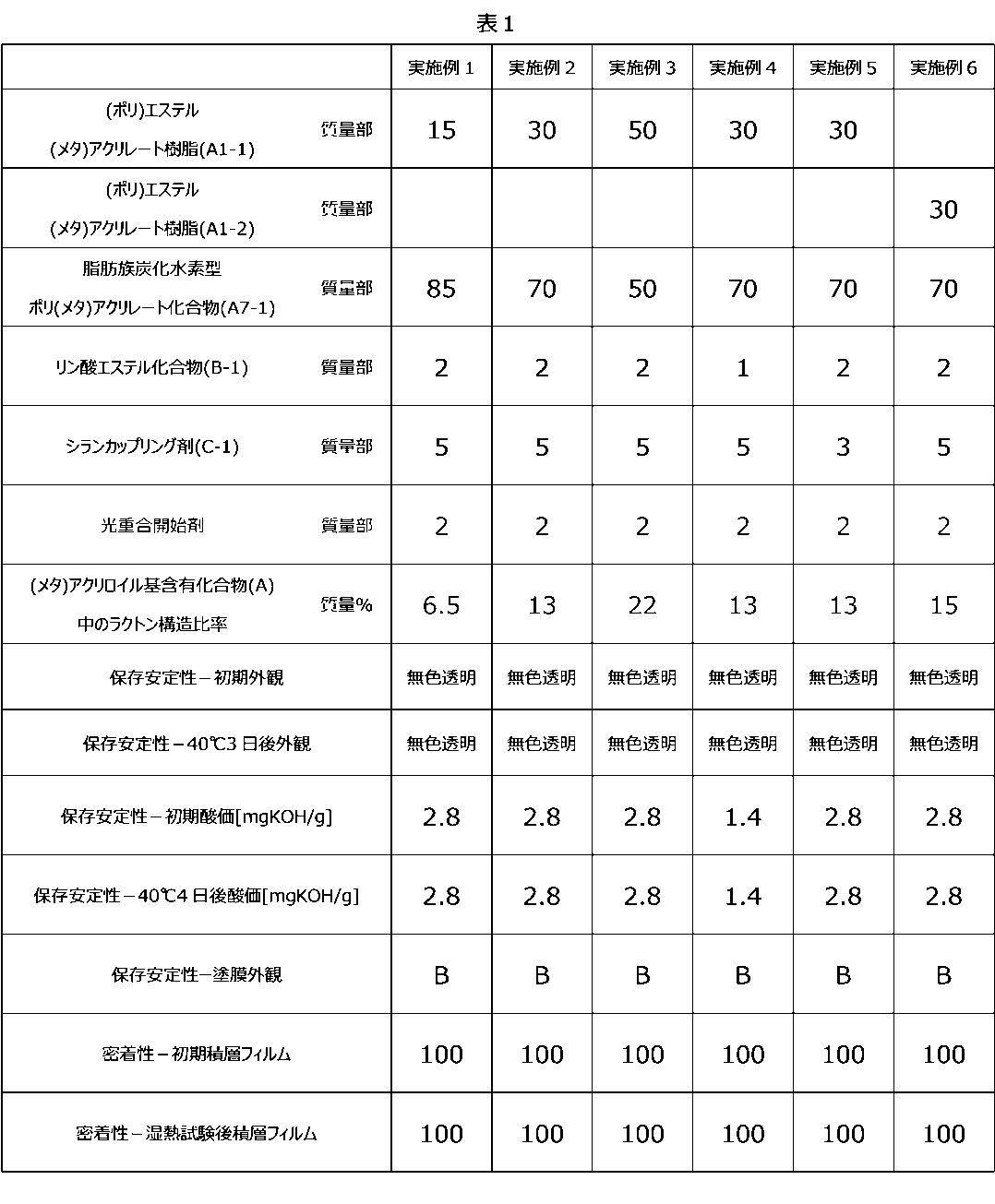

Claims (9)
- (メタ)アクリロイル基含有化合物(A)、リン酸エステル化合物(B)及びシランカップリング剤(C)を含有し、前記(メタ)アクリロイル基含有化合物(A)が(ポリ)エステル(メタ)アクリレート樹脂(A1)を必須の成分とする活性エネルギー線硬化型樹脂組成物。
- 前記(ポリ)エステル(メタ)アクリレート樹脂(A1)が、ポリイソシアネート化合物(x1)とラクトン変性ヒドロキシ(メタ)アクリレート化合物(x2)との反応生成物であるラクトン変性ウレタン(メタ)アクリレート樹脂である請求項1記載の活性エネルギー線硬化型樹脂組成物。
- 前記(ポリ)エステル(メタ)アクリレート樹脂(A1)が、水酸基含有ポリエステル樹脂の(メタ)アクリル酸付加物であるポリエステル(メタ)アクリレート樹脂である請求項1記載の活性エネルギー線硬化型樹脂組成物。
- (メタ)アクリロイル基含有化合物(A)が、前記(ポリ)エステル(メタ)アクリレート樹脂(A1)の他、脂肪族炭化水素型ポリ(メタ)アクリレート化合物又はその変性体(A7)を含有する請求項1記載の活性エネルギー線硬化型樹脂組成物。
- 前記(メタ)アクリロイル基含有化合物(A)中、前記(ポリ)エステル(メタ)アクリレート樹脂(A1)の割合が5~80質量%の範囲である請求項1記載の活性エネルギー線硬化型樹脂組成物。
- 請求項1~5の何れか一つ記載の活性エネルギー線硬化型樹脂組成物を含有する塗料。
- 請求項6記載の塗料からなる塗膜。
- 請求項7記載の塗膜からなる層と、それに隣接する無機材料層とを有する積層体。
- 前記無機材料層がケイ酸ガラス又はSiOx膜である請求項8記載の積層体。
Priority Applications (1)
| Application Number | Priority Date | Filing Date | Title |
|---|---|---|---|
| JP2018554933A JP7338154B2 (ja) | 2016-12-08 | 2017-11-28 | 活性エネルギー線硬化型樹脂組成物及び積層体 |
Applications Claiming Priority (4)
| Application Number | Priority Date | Filing Date | Title |
|---|---|---|---|
| JP2016-238463 | 2016-12-08 | ||
| JP2016238463 | 2016-12-08 | ||
| JP2017-019496 | 2017-02-06 | ||
| JP2017019496 | 2017-02-06 |
Publications (1)
| Publication Number | Publication Date |
|---|---|
| WO2018105441A1 true WO2018105441A1 (ja) | 2018-06-14 |
Family
ID=62492172
Family Applications (1)
| Application Number | Title | Priority Date | Filing Date |
|---|---|---|---|
| PCT/JP2017/042552 Ceased WO2018105441A1 (ja) | 2016-12-08 | 2017-11-28 | 活性エネルギー線硬化型樹脂組成物及び積層体 |
Country Status (2)
| Country | Link |
|---|---|
| JP (1) | JP7338154B2 (ja) |
| WO (1) | WO2018105441A1 (ja) |
Cited By (6)
| Publication number | Priority date | Publication date | Assignee | Title |
|---|---|---|---|---|
| JPWO2021157632A1 (ja) * | 2020-02-06 | 2021-08-12 | ||
| WO2021246154A1 (ja) * | 2020-06-05 | 2021-12-09 | 出光興産株式会社 | 硬化性組成物、射出成形用金型及び熱硬化性組成物の射出成形方法 |
| WO2022138082A1 (ja) * | 2020-12-21 | 2022-06-30 | 東洋インキScホールディングス株式会社 | 活性エネルギー線硬化性ハードコート剤、ハードコート層および積層体 |
| JP2022151932A (ja) * | 2021-03-29 | 2022-10-12 | リケンテクノス株式会社 | 防曇性塗料、塗膜、及び物品 |
| JP2023088831A (ja) * | 2021-12-15 | 2023-06-27 | 株式会社リコー | 活性エネルギー線硬化型組成物、活性エネルギー線硬化型インク組成物、インクジェット用インク組成物、組成物収容容器、2次元又は3次元の像形成装置、2次元又は3次元の像形成方法、硬化物、加飾体、積層体、フレキシブルデバイス用部材、及びフレキシブルデバイス |
| CN118652174A (zh) * | 2024-08-21 | 2024-09-17 | 兰州大学 | 一种酸性树脂催化ε-己内酯接枝丙烯酸羟乙酯类化合物的方法 |
Citations (7)
| Publication number | Priority date | Publication date | Assignee | Title |
|---|---|---|---|---|
| JPH10287718A (ja) * | 1997-02-13 | 1998-10-27 | Jsr Corp | 光硬化型樹脂組成物 |
| JPH11100419A (ja) * | 1997-09-26 | 1999-04-13 | Jsr Corp | 放射線硬化性樹脂組成物 |
| JP2002501556A (ja) * | 1998-02-12 | 2002-01-15 | ディーエスエム エヌ.ブイ. | 光硬化性樹脂組成物 |
| JP2002012797A (ja) * | 2000-04-27 | 2002-01-15 | Dainippon Ink & Chem Inc | 活性エネルギー線硬化性水性塗料組成物、該組成物の硬化塗膜を有する塗装金属材料、製造方法および塗装金属材料の接合方法 |
| JP2009007567A (ja) * | 2007-05-31 | 2009-01-15 | Sanyo Chem Ind Ltd | 活性エネルギー線硬化型樹脂組成物 |
| CN103525274A (zh) * | 2013-09-30 | 2014-01-22 | 安徽蓝柯复合材料有限公司 | 一种uv光固化五金涂料及其制备方法 |
| JP2014141666A (ja) * | 2012-12-27 | 2014-08-07 | Nippon Synthetic Chem Ind Co Ltd:The | 活性エネルギー線硬化性樹脂組成物およびコーティング剤組成物 |
Family Cites Families (1)
| Publication number | Priority date | Publication date | Assignee | Title |
|---|---|---|---|---|
| JP6154793B2 (ja) * | 2014-09-29 | 2017-06-28 | オリジン電気株式会社 | 金属用紫外線硬化型塗料及び該塗料でコーティングした金属材、金属製品 |
-
2017
- 2017-11-28 JP JP2018554933A patent/JP7338154B2/ja active Active
- 2017-11-28 WO PCT/JP2017/042552 patent/WO2018105441A1/ja not_active Ceased
Patent Citations (7)
| Publication number | Priority date | Publication date | Assignee | Title |
|---|---|---|---|---|
| JPH10287718A (ja) * | 1997-02-13 | 1998-10-27 | Jsr Corp | 光硬化型樹脂組成物 |
| JPH11100419A (ja) * | 1997-09-26 | 1999-04-13 | Jsr Corp | 放射線硬化性樹脂組成物 |
| JP2002501556A (ja) * | 1998-02-12 | 2002-01-15 | ディーエスエム エヌ.ブイ. | 光硬化性樹脂組成物 |
| JP2002012797A (ja) * | 2000-04-27 | 2002-01-15 | Dainippon Ink & Chem Inc | 活性エネルギー線硬化性水性塗料組成物、該組成物の硬化塗膜を有する塗装金属材料、製造方法および塗装金属材料の接合方法 |
| JP2009007567A (ja) * | 2007-05-31 | 2009-01-15 | Sanyo Chem Ind Ltd | 活性エネルギー線硬化型樹脂組成物 |
| JP2014141666A (ja) * | 2012-12-27 | 2014-08-07 | Nippon Synthetic Chem Ind Co Ltd:The | 活性エネルギー線硬化性樹脂組成物およびコーティング剤組成物 |
| CN103525274A (zh) * | 2013-09-30 | 2014-01-22 | 安徽蓝柯复合材料有限公司 | 一种uv光固化五金涂料及其制备方法 |
Cited By (17)
| Publication number | Priority date | Publication date | Assignee | Title |
|---|---|---|---|---|
| WO2021157632A1 (ja) * | 2020-02-06 | 2021-08-12 | Dic株式会社 | 活性エネルギー線硬化性樹脂組成物、硬化物、積層体及びレンズ |
| CN115066329A (zh) * | 2020-02-06 | 2022-09-16 | Dic株式会社 | 活性能量线硬化性树脂组合物、硬化物、层叠体及透镜 |
| JPWO2021157632A1 (ja) * | 2020-02-06 | 2021-08-12 | ||
| JP7388456B2 (ja) | 2020-02-06 | 2023-11-29 | Dic株式会社 | 活性エネルギー線硬化性樹脂組成物、硬化物、積層体及びレンズ |
| JP7627092B2 (ja) | 2020-06-05 | 2025-02-05 | 出光興産株式会社 | 射出成形用金型及び熱硬化性組成物の射出成形方法 |
| WO2021246154A1 (ja) * | 2020-06-05 | 2021-12-09 | 出光興産株式会社 | 硬化性組成物、射出成形用金型及び熱硬化性組成物の射出成形方法 |
| JP2021191820A (ja) * | 2020-06-05 | 2021-12-16 | 出光興産株式会社 | 硬化性組成物、射出成形用金型及び熱硬化性組成物の射出成形方法 |
| WO2022138082A1 (ja) * | 2020-12-21 | 2022-06-30 | 東洋インキScホールディングス株式会社 | 活性エネルギー線硬化性ハードコート剤、ハードコート層および積層体 |
| JP2022097848A (ja) * | 2020-12-21 | 2022-07-01 | 東洋インキScホールディングス株式会社 | 活性エネルギー線硬化性ハードコート剤、ハードコート層および積層体 |
| CN116406391A (zh) * | 2020-12-21 | 2023-07-07 | 东洋油墨Sc控股株式会社 | 活性能量线硬化性硬涂剂、硬涂层及层叠体 |
| JP2022151932A (ja) * | 2021-03-29 | 2022-10-12 | リケンテクノス株式会社 | 防曇性塗料、塗膜、及び物品 |
| JP7738399B2 (ja) | 2021-03-29 | 2025-09-12 | リケンテクノス株式会社 | 防曇性塗料、塗膜、及び物品 |
| JP2023088831A (ja) * | 2021-12-15 | 2023-06-27 | 株式会社リコー | 活性エネルギー線硬化型組成物、活性エネルギー線硬化型インク組成物、インクジェット用インク組成物、組成物収容容器、2次元又は3次元の像形成装置、2次元又は3次元の像形成方法、硬化物、加飾体、積層体、フレキシブルデバイス用部材、及びフレキシブルデバイス |
| JP2024056057A (ja) * | 2021-12-15 | 2024-04-19 | 株式会社リコー | 活性エネルギー線硬化型組成物、活性エネルギー線硬化型インク組成物、インクジェット用インク組成物、組成物収容容器、2次元又は3次元の像形成装置、2次元又は3次元の像形成方法、硬化物、加飾体、積層体、フレキシブルデバイス用部材、及びフレキシブルデバイス |
| JP7452587B2 (ja) | 2021-12-15 | 2024-03-19 | 株式会社リコー | 活性エネルギー線硬化型組成物、活性エネルギー線硬化型インク組成物、インクジェット用インク組成物、組成物収容容器、2次元又は3次元の像形成装置、2次元又は3次元の像形成方法、硬化物、加飾体、積層体、フレキシブルデバイス用部材、及びフレキシブルデバイス |
| US12486418B2 (en) | 2021-12-15 | 2025-12-02 | Ricoh Company, Ltd. | Active energy ray curing composition, comprising a polymerizable monomer and a polyester resin |
| CN118652174A (zh) * | 2024-08-21 | 2024-09-17 | 兰州大学 | 一种酸性树脂催化ε-己内酯接枝丙烯酸羟乙酯类化合物的方法 |
Also Published As
| Publication number | Publication date |
|---|---|
| JPWO2018105441A1 (ja) | 2019-11-07 |
| JP7338154B2 (ja) | 2023-09-05 |
Similar Documents
| Publication | Publication Date | Title |
|---|---|---|
| JP7338154B2 (ja) | 活性エネルギー線硬化型樹脂組成物及び積層体 | |
| TWI842870B (zh) | 活性能量線硬化性樹脂組成物、硬化物、積層體及具有積層體之物品 | |
| CN110741025B (zh) | 固化性组合物和层叠薄膜 | |
| JP2023143911A (ja) | 活性エネルギー線硬化性樹脂組成物、積層フィルム、その製造方法、及び加飾フィルムの製造方法 | |
| JP2014141666A (ja) | 活性エネルギー線硬化性樹脂組成物およびコーティング剤組成物 | |
| JP7024729B2 (ja) | 活性エネルギー線硬化型樹脂組成物及び積層フィルム | |
| TWI907652B (zh) | 無機微粒子分散體、活性能量線硬化性組成物、硬化物、積層體及物品 | |
| JP7346817B2 (ja) | 積層体及びその用途 | |
| JP7003453B2 (ja) | ウレタン(メタ)アクリレート樹脂 | |
| JP6919308B2 (ja) | (メタ)アクリロイル基含有樹脂及び積層フィルム | |
| JP7364098B2 (ja) | アクリル(メタ)アクリレート樹脂、活性エネルギー線硬化性樹脂組成物、硬化物及び物品 | |
| JP7495016B2 (ja) | 活性エネルギー線硬化性樹脂組成物、硬化塗膜及び物品 | |
| JP7707537B2 (ja) | 活性エネルギー線硬化性樹脂組成物、硬化物及び物品 | |
| JP7013682B2 (ja) | ウレタン(メタ)アクリレート樹脂 |
Legal Events
| Date | Code | Title | Description |
|---|---|---|---|
| 121 | Ep: the epo has been informed by wipo that ep was designated in this application |
Ref document number: 17877418 Country of ref document: EP Kind code of ref document: A1 |
|
| ENP | Entry into the national phase |
Ref document number: 2018554933 Country of ref document: JP Kind code of ref document: A |
|
| NENP | Non-entry into the national phase |
Ref country code: DE |
|
| 122 | Ep: pct application non-entry in european phase |
Ref document number: 17877418 Country of ref document: EP Kind code of ref document: A1 |