WO2018105256A1 - ゲル状口腔用組成物 - Google Patents
ゲル状口腔用組成物 Download PDFInfo
- Publication number
- WO2018105256A1 WO2018105256A1 PCT/JP2017/038277 JP2017038277W WO2018105256A1 WO 2018105256 A1 WO2018105256 A1 WO 2018105256A1 JP 2017038277 W JP2017038277 W JP 2017038277W WO 2018105256 A1 WO2018105256 A1 WO 2018105256A1
- Authority
- WO
- WIPO (PCT)
- Prior art keywords
- salt
- gel
- mass
- composition
- ascorbic acid
- Prior art date
- Legal status (The legal status is an assumption and is not a legal conclusion. Google has not performed a legal analysis and makes no representation as to the accuracy of the status listed.)
- Ceased
Links
Classifications
-
- A—HUMAN NECESSITIES
- A61—MEDICAL OR VETERINARY SCIENCE; HYGIENE
- A61K—PREPARATIONS FOR MEDICAL, DENTAL OR TOILETRY PURPOSES
- A61K8/00—Cosmetics or similar toiletry preparations
- A61K8/02—Cosmetics or similar toiletry preparations characterised by special physical form
- A61K8/04—Dispersions; Emulsions
-
- A—HUMAN NECESSITIES
- A61—MEDICAL OR VETERINARY SCIENCE; HYGIENE
- A61K—PREPARATIONS FOR MEDICAL, DENTAL OR TOILETRY PURPOSES
- A61K8/00—Cosmetics or similar toiletry preparations
- A61K8/18—Cosmetics or similar toiletry preparations characterised by the composition
- A61K8/19—Cosmetics or similar toiletry preparations characterised by the composition containing inorganic ingredients
- A61K8/24—Phosphorous; Compounds thereof
-
- A—HUMAN NECESSITIES
- A61—MEDICAL OR VETERINARY SCIENCE; HYGIENE
- A61K—PREPARATIONS FOR MEDICAL, DENTAL OR TOILETRY PURPOSES
- A61K8/00—Cosmetics or similar toiletry preparations
- A61K8/18—Cosmetics or similar toiletry preparations characterised by the composition
- A61K8/19—Cosmetics or similar toiletry preparations characterised by the composition containing inorganic ingredients
- A61K8/25—Silicon; Compounds thereof
-
- A—HUMAN NECESSITIES
- A61—MEDICAL OR VETERINARY SCIENCE; HYGIENE
- A61K—PREPARATIONS FOR MEDICAL, DENTAL OR TOILETRY PURPOSES
- A61K8/00—Cosmetics or similar toiletry preparations
- A61K8/18—Cosmetics or similar toiletry preparations characterised by the composition
- A61K8/30—Cosmetics or similar toiletry preparations characterised by the composition containing organic compounds
- A61K8/67—Vitamins
-
- A—HUMAN NECESSITIES
- A61—MEDICAL OR VETERINARY SCIENCE; HYGIENE
- A61K—PREPARATIONS FOR MEDICAL, DENTAL OR TOILETRY PURPOSES
- A61K8/00—Cosmetics or similar toiletry preparations
- A61K8/18—Cosmetics or similar toiletry preparations characterised by the composition
- A61K8/72—Cosmetics or similar toiletry preparations characterised by the composition containing organic macromolecular compounds
- A61K8/73—Polysaccharides
-
- A—HUMAN NECESSITIES
- A61—MEDICAL OR VETERINARY SCIENCE; HYGIENE
- A61K—PREPARATIONS FOR MEDICAL, DENTAL OR TOILETRY PURPOSES
- A61K8/00—Cosmetics or similar toiletry preparations
- A61K8/18—Cosmetics or similar toiletry preparations characterised by the composition
- A61K8/72—Cosmetics or similar toiletry preparations characterised by the composition containing organic macromolecular compounds
- A61K8/81—Cosmetics or similar toiletry preparations characterised by the composition containing organic macromolecular compounds obtained by reactions involving only carbon-to-carbon unsaturated bonds
-
- A—HUMAN NECESSITIES
- A61—MEDICAL OR VETERINARY SCIENCE; HYGIENE
- A61Q—SPECIFIC USE OF COSMETICS OR SIMILAR TOILETRY PREPARATIONS
- A61Q11/00—Preparations for care of the teeth, of the oral cavity or of dentures; Dentifrices, e.g. toothpastes; Mouth rinses
Definitions
- the present invention relates to a gel-free composition for oral cavity containing no abrasives, in which discoloration of a preparation due to ascorbic acid ester or a salt thereof is suppressed even over time and the preparation characteristics are good.
- Ascorbic acid plays an important role in the expression of enzyme activity in the living body and is known to have various physiological activities.
- ascorbic acid acts as a coenzyme for prolyl and dil hydroxylase and is essential for collagen synthesis.
- Ascorbic acid is useful for the prevention or treatment of periodontal diseases such as gingivitis and periodontitis associated with collagen destruction.
- various ascorbic acid derivatives have been developed and used in oral compositions.
- ascorbic acid esters such as ascorbic acid phosphates or salts thereof have attracted attention.
- oral preparations containing ascorbic acid esters or salts thereof have a problem of causing discoloration over time.
- the degree of the preparation discoloration varies depending on the preparation form, dosage form, and compounding components, and does not necessarily match the degree of decrease in the residual rate of ascorbic acid esters.
- an oral composition such as a toothpaste generally contains an abrasive to remove dirt such as plaque, and the use of this abrasive may invade a weak gum surface.
- an abrasive to remove dirt such as plaque
- a gel-like composition for oral cavity containing an ascorbic acid ester or a salt thereof and not containing an abrasive is desirable for safe use even for persons with high risk of periodontal disease.
- Patent Documents 1 to 4 propose techniques for stabilizing ascorbic acid esters or salts thereof using orthophosphoric acid or salts thereof.
- Patent Document 1 discloses that coloring immediately after preparation of a liquid oral composition containing an ascorbic acid ester or a salt thereof and a cationic bactericide is suppressed by orthophosphoric acid or a salt thereof. Is described as containing no abrasive.
- Patent Literature 2 ascorbic acid phosphate or a salt thereof is stabilized in a liquid oral composition not containing an abrasive by a combined system of an orthophosphate and an organic acid or a salt thereof. It is a suppression of the decrease, and it is described that the degree of decrease in the residual rate does not necessarily coincide with the intensity of coloring of the preparation.
- the present invention has been made in view of the above circumstances, and provides a gel-like composition for an oral cavity that does not contain an abrasive and can be prevented from being discolored by ascorbic acid ester or a salt thereof over time and has good formulation characteristics. Objective.
- the present inventors have obtained a gel-like composition for oral cavity containing no abrasive, ascorbic acid ester or a salt thereof, orthophosphoric acid or a salt thereof, xanthan gum and a polyacrylic acid. Or by combining the salt and thickening silica in combination, the discoloration of the preparation due to ascorbic acid ester or its salt can be suppressed over time, and the gel properties can be kept good and the preparation characteristics can be maintained. I found out.
- (C), (D), and (E) components are used in combination with (B) component, and the above four components are combined and blended, so that the mass of (C) / (D) The ratio is within a specific range, and as described above, without causing deterioration of gel properties, the (B) component suppresses the discoloration of the preparation due to the (A) component even over time, gives an excellent discoloration inhibiting effect, and at the same time is good Special formulation characteristics, specifically shape retention that keeps the shape of the toothbrush without changing or dripping when it is pushed out of the container even after storage, liquid separation that suppresses the occurrence of liquid separation after storage Provides stability and low stringing when discharged from the container, and provides excellent properties for use.
- the concealing effect of a white powder that is common as an abrasive cannot be expected, and the problem of the discoloration of the preparation due to ascorbic acid ester or its salt is solved compared to the abrasive-containing preparation. Not only will it be a strict level, but there will also be a problem with gel properties, for example, a problem with the formulation characteristics as compared to a toothpaste containing an abrasive.
- the components (A), (B), (C), (D), (E) are contained in a specific amount and (C) / ( The combination of the mass ratios of D) within a specific range gives an excellent discoloration suppressing effect and formulation characteristics, so that a simple addition of orthophosphoric acid salt or hydrogen salt, or the addition of an inappropriate binder is added. In this case, there is a remarkable effect that cannot be achieved.
- the present invention provides the following gel oral composition.
- a gel-like composition for oral cavity containing no abrasive (A) Ascorbic acid ester or salt thereof 0.1 to 3% by mass, (B) orthophosphoric acid or a salt thereof 0.1 to 3% by mass, (C) xanthan gum 0.7-2% by mass, (D) Polyacrylic acid or a salt thereof 0.1 to 1% by mass And (E) thickening silica 0.1 to 10% by mass
- a gel-like composition for oral cavity wherein (C) / (D) is 1.0 to 10 in terms of mass ratio.
- polyoxyethylene hydrogenated castor oil having an average addition mole number of ethylene oxide of 10 to 60 moles and an alkyl group having 14 to 18 carbon atoms and an average addition mole number of ethylene oxide of 5 to 10 moles
- the gel oral composition according to any one of [I] to [V] which is a gel dentifrice.
- discoloration of the preparation due to ascorbic acid ester or a salt thereof is suppressed even with time, excellent appearance stability, and preparation characteristics (time retention, liquid separation stability, spinnability) are also good.
- a gel-like composition for oral cavity containing no abrasive containing ascorbic acid ester or a salt thereof can be provided.
- the gel composition for oral cavity of the present invention is also suitable for use by persons with high risk of periodontal disease, and can be effectively used widely for the prevention or suppression of periodontal disease.
- the gel composition for oral cavity of the present invention does not contain an abrasive, (A) ascorbic acid ester or salt thereof, (B) orthophosphoric acid or salt thereof, (C) xanthan gum, (D) polyacrylic acid or salt thereof. And (E) thickening silica.
- the gel-like composition for oral cavity according to the present invention is an composition for oral cavity having a time-retaining property that does not sag from the toothbrush when placed on a toothbrush, although it contains no abrasive.
- Ascorbic acid ester or a salt thereof can be used ascorbic acid phosphoric acid ester or a salt thereof having an effect of preventing or ameliorating periodontal disease and suitable for oral use.
- Ascorbic acid phosphoric acid ester and its salt Salts may be used.
- As said salt ascorbic acid phosphate magnesium and ascorbic acid sodium phosphate are preferable, and ascorbic acid phosphate magnesium is especially preferable.
- Examples of ascorbic acid phosphate esters include those in which one or more of the hydroxyl groups at positions 2, 3, 5, and 6 of ascorbic acid are esters of compounds such as phosphoric acid and polyphosphoric acid.
- Acid-2-phosphate ester ascorbic acid-3-phosphate ester, ascorbic acid-6-phosphate ester, ascorbic acid-2-polyphosphate ester, and the like.
- These salts include sodium salt and potassium salt.
- Alkali metal salts such as calcium salts and magnesium salts, and alkaline earth metal salts. 1 type (s) or 2 or more types chosen from these can be used as (A) ascorbic acid ester or its salt.
- a derivative in which the hydroxyl group at the 2-position or 3-position of ascorbic acid is converted to a phosphate ester is preferable, and a magnesium salt or sodium salt of ascorbyl 2-phosphate ester is more preferable.
- Particularly preferred is a magnesium salt.
- the blending amount of ascorbic acid ester or a salt thereof is 0.1 to 3% (mass%, hereinafter the same) of the whole composition, preferably 0.2 to 2%. As the amount is increased, the effect of preventing or ameliorating periodontal disease is sufficiently exhibited, but when it is 3% or less, the shape retention property with time is excellent.
- Orthophosphoric acid or a salt thereof is a discoloration inhibitor, and one or more selected from orthophosphoric acid, orthophosphoric orthophosphate and orthophosphoric hydrogen salt can be used.
- orthophosphates include orthophosphates such as sodium phosphate, potassium phosphate, and ammonium phosphate, disodium monohydrogen phosphate, monosodium dihydrogen phosphate, monopotassium dihydrogen phosphate, monohydrogen phosphate Examples thereof include hydrogen salts such as dipotassium, and these may be hydrates. These can be used individually by 1 type or in mixture of 2 or more types from the point of effect expression.
- a hydrogen salt of orthophosphoric acid, particularly sodium dihydrogen phosphate is particularly preferred from the viewpoint of the effect of suppressing discoloration of the preparation.
- the blending amount of orthophosphoric acid or a salt thereof is 0.1 to 3%, preferably 0.2 to 2% of the entire composition. If the blending amount is less than 0.1%, the discoloration suppressing effect of the preparation is inferior, and if it exceeds 3%, the shape retention property of the preparation is inferior.
- (B) orthophosphoric acid or a salt thereof, (C) xanthan gum, (D) polyacrylic acid or a salt thereof, and (E) a thickening silica are used in combination, and (A) component-containing preparation
- the formulation properties are all excellent in temporal retention, liquid separation stability, and stringiness. If any of the components (C), (D), and (E) is lacked, the gel physical properties are deteriorated. If the component (C) is absent, the liquid separation stability is inferior. If the component (D) is absent, the spinnability is inferior. If the component (E) is absent, the shape retention with time is inferior.
- the xanthan gum may be any as long as it is usually used in oral compositions, but the viscosity at 25 ° C. of a 1% xanthan gum 1% aqueous solution containing 1% potassium chloride is 600 to 2,000 mPa ⁇ s. Those of 1,000 to 2,000 mPa ⁇ s are preferred.
- the thixotropic index (apparent viscosity at 5 rpm ( ⁇ 1) / apparent viscosity at 50 rpm ( ⁇ 2)) is preferably 4 to 6.
- the above viscosity is a value measured by a Brookfield type rotational viscometer (rotor No.
- the amount of xanthan gum blended is 0.7 to 2%, preferably 0.8 to 1.5% of the entire composition. If the blending amount is less than 0.7%, the liquid separation stability is inferior, and if it exceeds 2%, the discoloration suppressing effect of the preparation is lowered.
- sodium polyacrylate can be used as polyacrylic acid or a salt thereof. Any sodium polyacrylate may be used as long as it is usually used in oral compositions, but the viscosity of a 0.5% aqueous solution at 25 ° C. is 5,000 to 15,000 mPa ⁇ s, particularly 7,000 to The thing of 10,000 mPa * s is preferable.
- the thixotropic index (apparent viscosity at 5 rpm ( ⁇ 1) / apparent viscosity at 50 rpm ( ⁇ 2)) is preferably 4 to 6.
- the said viscosity is the value measured with the Brookfield type rotational viscometer (rotor No.
- the blending amount of polyacrylic acid or a salt thereof is 0.1 to 1%, preferably 0.2 to 0.8% of the whole composition.
- the spinnability is inferior, and when it exceeds 1%, the discoloration suppressing effect of the preparation is lowered.
- (C) / (D) indicating the blending ratio of the component (C) and the component (D) is 1.0 to 10, preferably 1.5 to 8, as a mass ratio. If it is less than 1.0 or exceeds 10, shape retention properties with time are inferior.
- the thickening silica is not particularly limited, precipitated silica having a BET specific surface area of 300 to 450 m 2 / g, particularly 350 to 450 m 2 / g is preferable.
- the BET specific surface area is within the above range, the retention with time is particularly excellent after low-temperature storage, and when it is less than 300 m 2 / g, sufficient retention with time may not be obtained. Those exceeding 450 m 2 / g are difficult to obtain as commercial products.
- the BET specific surface area is a value measured at 25 ° C. using a specific surface area measuring device (manufactured by Nikkiso Co., Ltd., automatic specific surface area meter, BET multipoint method, measurement gas; nitrogen). Examples of such thickening silica include DSL. Commercial products such as CARPLEX # 67 manufactured by Japan Corporation may be used.
- the blending amount of the thickening silica is 0.1 to 10%, preferably 0.5 to 7% of the whole composition.
- the blending amount is less than 0.1%, the shape retention property with time is inferior, and when it exceeds 10%, the discoloration suppressing effect of the preparation is lowered.
- composition of the present invention further comprises, as a surfactant, (F) polyoxyethylene hydrogenated castor oil having an average addition mole number of ethylene oxide of 10 to 60 moles, an alkyl group having 14 to 18 carbon atoms and an average of ethylene oxide It is preferable to add one or more nonionic surfactants selected from polyoxyethylene alkyl ethers having an addition mole number of 5 to 10 moles, in combination with polyoxyethylene hydrogenated castor oil and polyoxyethylene alkyl ether May be. (F) By mix
- the nonionic surfactant (F) is a polyoxyethylene hydrogenated castor oil having an average added mole number of ethylene oxide of 10 to 20, especially from the viewpoint of no irritation in the oral cavity, and the carbon number of the alkyl group is the above-mentioned.
- Polyoxyethylene alkyl ethers having an average addition mole number of ethylene oxide within the range of 5 to 10 moles are preferred.
- the blending amount of the nonionic surfactant as the component (F) is preferably 0.1 to 4%, more preferably 0.1 to 3% of the entire composition.
- the blending amount is within the above range, the absence of oral irritation is more excellent, and the discoloration of the preparation can be sufficiently suppressed.
- it exceeds 4% the discoloration suppressing effect of the preparation may be lowered.
- (G) alginic acid or a salt thereof it is preferable to further blend (G) alginic acid or a salt thereof.
- (G) alginic acid or a salt thereof is added in addition to the components (C), (D), and (E), the smoothness of the skin surface of the preparation is also improved.
- Sodium alginate has a viscosity of 2% aqueous solution at 25 ° C. (Brookfield type rotational viscometer, rotor No. 3, rotation speed 12 rpm, measurement time 3 minutes) of 1,000 to 4,000 mPa ⁇ s, particularly 2,000 to What is 4,000 mPa * s is good.
- the blending amount is preferably 0.1 to 2%, more preferably 0.5 to 1.5% of the entire composition.
- the gel oral composition of the present invention is not particularly limited in dosage form, but is particularly suitable as a gel dentifrice.
- the composition of the present invention contains known additive components (pharmacologically acceptable carriers) that can be used in oral compositions within a range that does not impair the effects of the present invention. It can be blended depending on the type. Specifically, binders other than the components (C), (D), (E) and (G), surfactants other than the component (F), thickeners, pigments, sweeteners, fragrances, (B ), A pH adjuster other than the component, and an active ingredient other than the component (A).
- the specific example of an additional component is shown below, the component which can be mix
- binder examples include cellulose binders such as sodium carboxymethylcellulose, hydroxyethylcellulose, hydroxypropylcellulose, hydroxypropylmethylcellulose, hydroxymethylethylcellulose, methylcellulose, and cationized cellulose, carrageenan, guar gum, montmorillonite, and gelatin. These binders do not need to be blended, but the amount added when blended is preferably 0.1 to 2%.
- the total amount of the binder is preferably 0.9% or more, particularly 1.5% or more, more preferably 5% or less of the whole composition. In particular, it is 3.8% or less.
- the components (C), (D), (E), and further the component (G) also act as a binder, so that (C) within a range satisfying the total blending amount of the binder.
- (D), (E) component, and further, (G) component are particularly preferable from the viewpoint of effect expression.
- the surfactant examples include an anionic surfactant, a cationic surfactant, and an amphoteric surfactant.
- the anionic surfactant examples include alkyl sulfates such as sodium lauryl sulfate and sodium myristyl sulfate, sodium dodecylbenzene sulfonate, hydrogenated coconut fatty acid monoglyceride sodium monosulfate, sodium lauryl sulfoacetate, sodium ⁇ -olefin sulfonate, and the like.
- the cationic surfactant examples include distearylmethylammonium chloride and stearyldimethylbenzylammonium chloride.
- Examples of the zwitterionic surfactant include 2-alkyl-N-carboxymethyl-N-hydroxyethylimidazolium betaine and N-lauryl.
- N-alkyldiaminoethylglycine such as diaminoethylglycine and N-myristyldiaminoethylglycine, N-alkyl-1-hydroxyethylimidazoline betaine sodium and the like.
- the amount of these surfactants is usually 0.6 to 7%, particularly 1.1 to 5%.
- the thickener examples include propylene glycol, pentylene glycol, hexylene glycol, octylene glycol, polyethylene glycol having an average molecular weight of 200 to 6,000 (average molecular weight described in Quasi-drug Raw Material Standard 2006), ethylene glycol, 1, Examples thereof include polyhydric alcohols such as 3-butylene glycol and glycerin, reduced starch saccharified products, sugar alcohols such as sorbitol, xylitol and erythritol.
- the blending amount of the thickener is usually 30 to 60%, particularly 40 to 50%.
- dyes legal dyes such as Blue No. 1, Yellow No. 4 and Green No. 3, natural dyes such as caramel, titanium oxide, etc.
- Sweeteners include saccharin sodium, aspartame, stevioside, stevia extract, paramethoxycinnamic aldehyde , Neohesperidyl dihydrochalcone, perilartin and the like.
- fragrance those generally used as oral fragrances can be used.
- menthol anethole, carvone, eugenol, limonene, n-decyl alcohol, citronellol, ⁇ -terpineol, citronellyl acetate, cineol, linalool, ethyl linalool, vanillin , Thymol, spearmint oil, peppermint oil, lemon oil, orange oil, sage oil, rosemary oil, cinnamon oil, pimento oil, cinnamon oil, perilla oil, winter green oil, clove oil, eucalyptus oil and the like.
- the blending amount of the fragrance is a normal amount, and it is preferable to use 0.000001 to 2%.
- Active ingredients include enzymes such as dextranase, amylase, protease and mutanase, alkali metal monofluorophosphates such as sodium monofluorophosphate, fluorides such as sodium fluoride and stannous fluoride, tranexamic acid, epsilon -Aminocaproic acid, allantoin, aluminum chlorohydroxy allantoin, azulene, glycyrrhizinate, glycyrrhetinic acid, sodium chloride, anti-inflammatory agents such as vitamins other than component (A), cetylpyridinium chloride, benzalkonium chloride, triclosan, hinokitiol, Examples include bactericides such as lysozyme chloride, anticalculus agents such as polyphosphates, tobacco spider removers such as polyvinylpyrrolidone, and amino acids such as glycine and proline. These can be blended in an effective amount as long as the effects
- the pH (25 ° C.) of the composition is preferably 6.5 to 9.0, more preferably 7.0 to 8.6, and still more preferably 8.1 to 8.6. You may adjust by adding a pH adjuster.
- the pH adjuster include organic acids such as citric acid, lactic acid and malic acid or salts thereof, and inorganic compounds such as hydrochloric acid, sodium hydroxide and potassium hydroxide.
- the water content of the gel oral composition is usually 20 to 60%, particularly 30 to 50%.
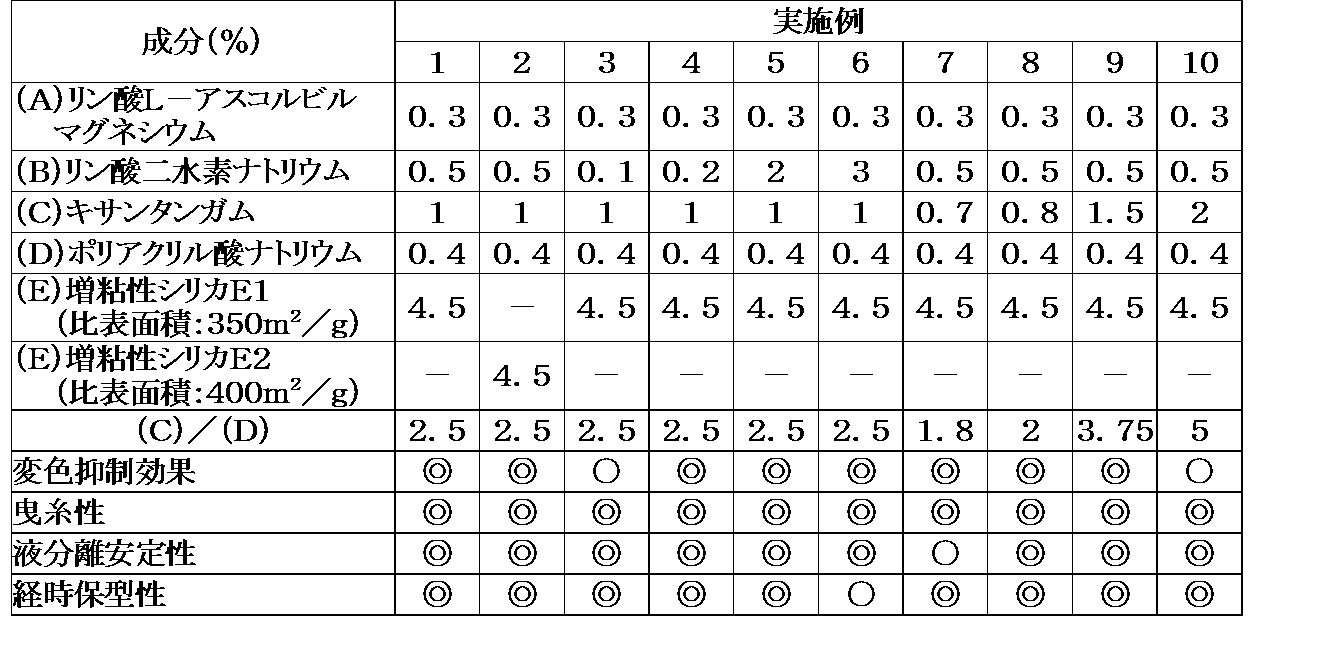
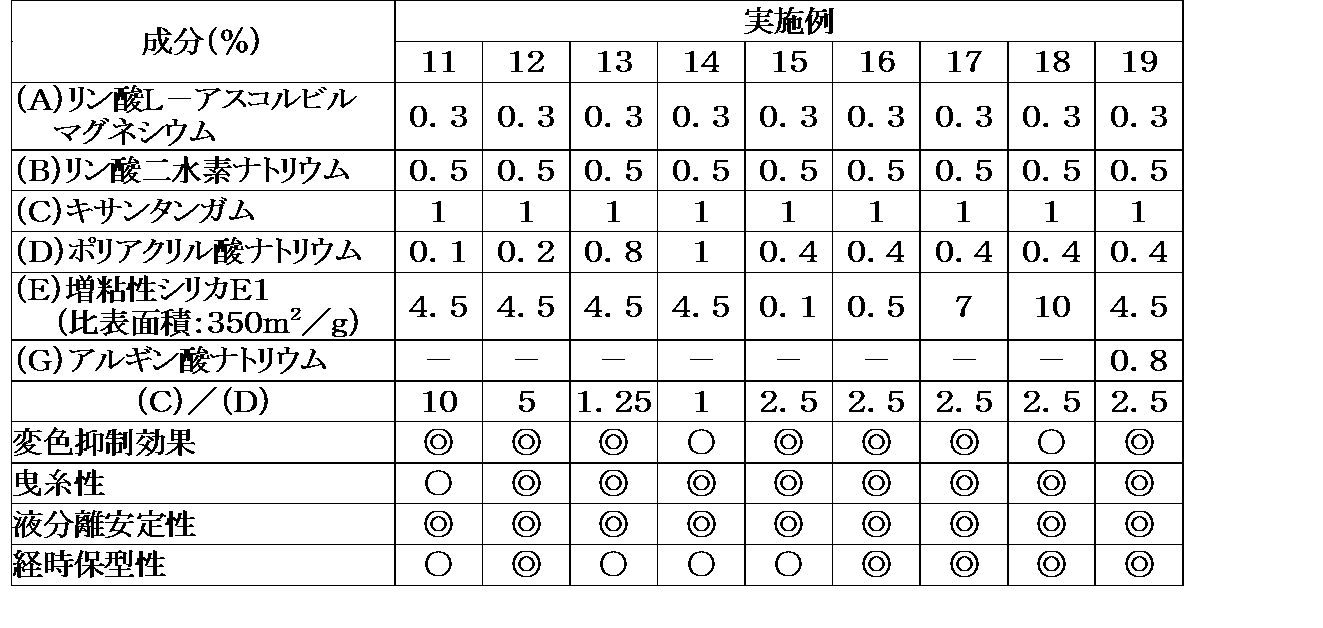
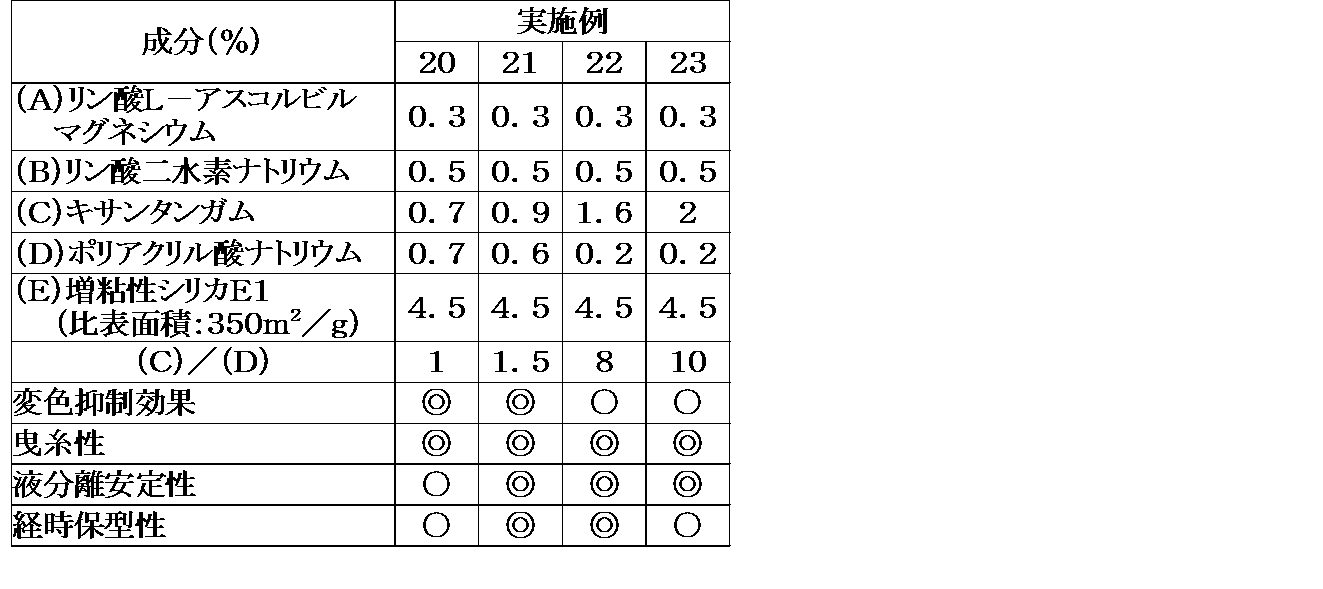
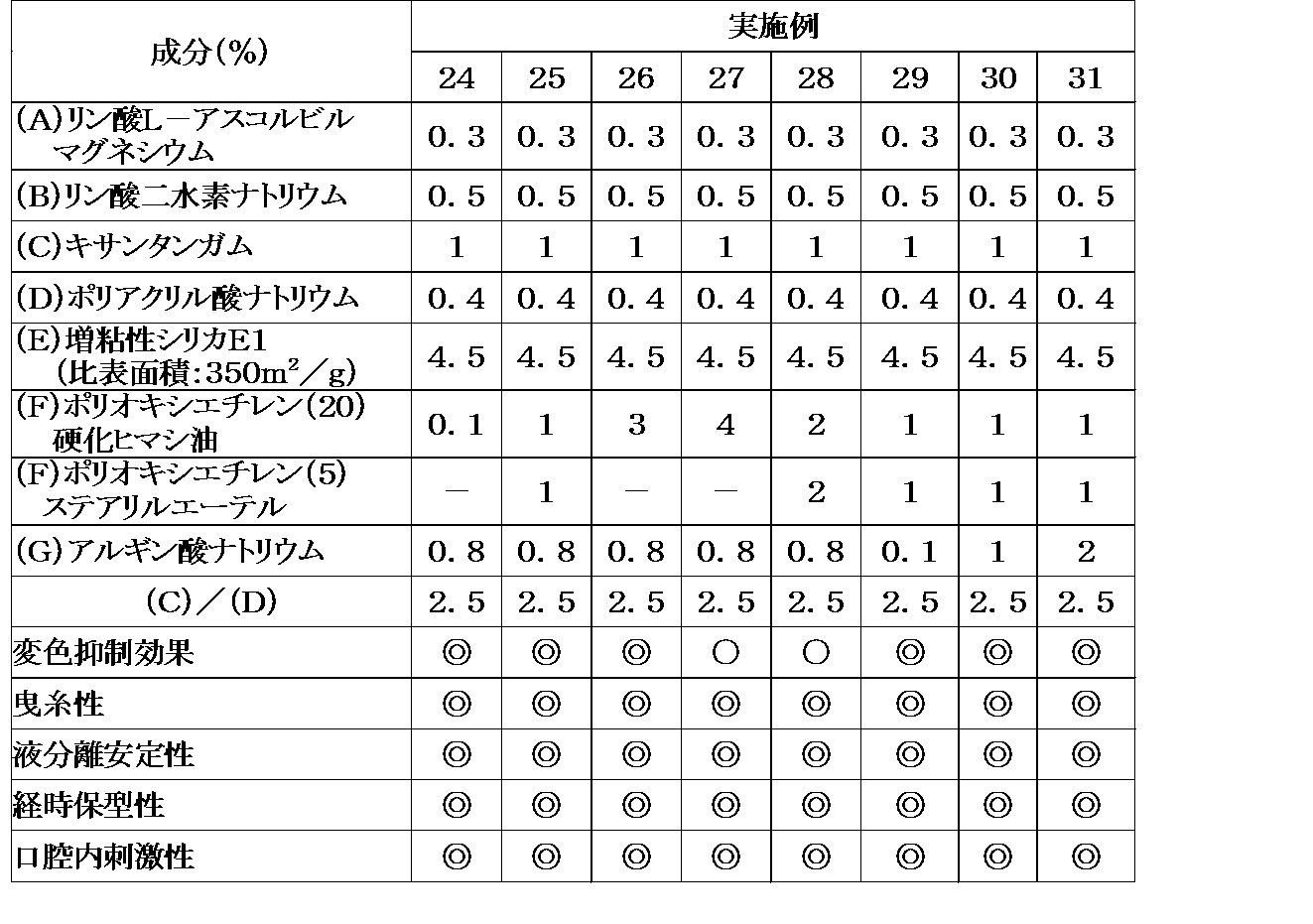
- Examples and Comparative Examples A gel dentifrice composition having the composition shown in Table 1 and the components shown in Tables 2 to 7 was prepared by a conventional method, and the evaluations shown in (1) to (4) below were performed. Furthermore, about the gel-like dentifrice composition of Table 5, evaluation shown to following (5) was also performed. The results are shown in the table.
- 3 points The yarn length is 0.5 cm or more and less than 1 cm, but there is no problem in use.
- 2 points The length of the yarn is 1 cm or more and less than 1.5 cm, which is problematic in use.
- 1 point The length of the yarn is 1.5 cm or more, which is problematic in use. (Evaluation criteria) ⁇ : 3.5 points or more and 4.0 points or less ⁇ : 3.0 points or more and less than 3.5 points ⁇ : 2.0 points or more and less than 3.0 points ⁇ : Less than 2.0 points
- CARPLEX # 67 manufactured by Japan Specific surface area 350 m 2 / g
- E Thickening silica
- E2 DSL.
- CARPLEX # 67 manufactured by Japan Specific surface area 400m 2 / g
- F Polyoxyethylene (20) hydrogenated castor oil: NIKKOL HCO 20 manufactured by Nikko Chemicals Co., Ltd.
- F Polyoxyethylene (5) stearyl ether: EMALEX 605, manufactured by Nippon Emulsion Co., Ltd.
- G Sodium alginate: Kimika Argin manufactured by Kimika Co., Ltd.
- Viscosity (25 ° C): 2,600 mPa ⁇ s
- the viscosity of xanthan gum is the viscosity of a 1% aqueous solution of xanthan gum containing 1% potassium chloride, and was measured with a Brookfield rotary viscometer (rotor No. 3, rotation speed 60 rpm, measurement time 30 seconds).
- the viscosity of sodium polyacrylate is the viscosity of a 0.5% aqueous solution, and was measured with a Brookfield type rotational viscometer (rotor No. 5, rotation speed 20 rpm, measurement time 2 minutes).
- Each thixotropic index (apparent viscosity ( ⁇ 1) at 5 rpm / apparent viscosity ( ⁇ 2) at 50 rpm) is a B-type viscometer (manufactured by Toki Sangyo Co., Ltd., VISCOMETER TVB-10, H2 rotor, measurement time 3 Min).
- the specific surface area of the thickening silica was measured at 25 ° C. using a specific surface area measuring device (manufactured by Nikkiso Co., Ltd., automatic specific surface area meter, BET multipoint method, measurement gas; nitrogen).
- the viscosity of sodium alginate is the viscosity of a 2% aqueous solution, and was measured with a Brookfield type rotational viscometer (rotor No. 3, rotation speed 12 rpm, measurement time 3 minutes).
- the pH (25 ° C.) of each gel dentifrice composition was about 8.3.
- a prescription example is shown below.
- the raw materials used are the same as in the examples.
Landscapes
- Health & Medical Sciences (AREA)
- Life Sciences & Earth Sciences (AREA)
- Veterinary Medicine (AREA)
- Animal Behavior & Ethology (AREA)
- General Health & Medical Sciences (AREA)
- Public Health (AREA)
- Birds (AREA)
- Epidemiology (AREA)
- Chemical & Material Sciences (AREA)
- Inorganic Chemistry (AREA)
- Dispersion Chemistry (AREA)
- Oral & Maxillofacial Surgery (AREA)
- Cosmetics (AREA)
Abstract
研磨剤を含まないゲル状口腔用組成物であって、
(A)アスコルビン酸エステル又はその塩 0.1~3質量%、
(B)オルトリン酸又はその塩 0.1~3質量%、
(C)キサンタンガム 0.7~2質量%、
(D)ポリアクリル酸又はその塩 0.1~1質量%
及び
(E)増粘性シリカ 0.1~10質量%
を含有し、(C)/(D)が質量比として1.0~10であることを特徴とするゲル状口腔用組成物。本発明によれば、アスコルビン酸エステル又はその塩による製剤変色が経時においても抑制され、製剤特性も良好な研磨剤を含まないゲル状口腔用組成物を提供できる。
Description
本発明は、アスコルビン酸エステル又はその塩による製剤変色が経時でも抑制され、製剤特性も良好な研磨剤無含有のゲル状口腔用組成物に関する。
アスコルビン酸は、生体中で酵素活性発現に重要な役割を演じ、多様な生理活性を持つことが知られており、特にプロリル及びジルヒドロキシラーゼの補酵素として作用し、コラーゲン合成に必須であるとされている。このため、アスコルビン酸は、コラーゲンの破壊に伴う歯肉炎、歯周炎等の歯周疾患の予防又は治療に有用である。従来から、アスコルビン酸誘導体が種々開発され、口腔用組成物に用いられており、特にアスコルビン酸リン酸エステル等のアスコルビン酸エステル又はその塩が注目されている。
しかしながら、アスコルビン酸エステル又はその塩を配合した口腔用製剤は、経時で変色を招くという問題があった。この製剤変色の度合いは、製剤形態や剤型、配合成分によっても異なり、また、アスコルビン酸エステル類の残存率の低下度合いと必ずしも一致しない。
一方、練歯磨剤等の口腔用組成物には、歯垢をはじめとする汚れを除去するために研磨剤が一般的に配合され、この研磨剤の使用によって弱った歯茎表面が侵襲されるおそれがあり、特に歯肉炎、歯周炎を発症しているハイリスク者への使用には懸念があると考えられる。このため、歯周病ハイリスク者に対しても安心して使用するには、アスコルビン酸エステル又はその塩を含有し、研磨剤を含まないゲル状口腔用組成物が望ましい。
特許文献1~4には、オルトリン酸又はその塩を使用したアスコルビン酸エステル又はその塩の安定化技術が提案されている。特許文献1には、アスコルビン酸エステル又はその塩とカチオン性殺菌剤とを配合した液体口腔用組成物の調製直後の着色が、オルトリン酸又はその塩によって抑制されることが開示され、この組成物が研磨剤を含まないことが記載されている。特許文献2では、オルトリン酸塩と有機酸又はその塩との併用系によって、研磨剤を含まない液体口腔用組成物でアスコルビン酸リン酸エステル又はその塩が安定化しているが、これは残存率低下の抑制であり、しかも、残存率の低下度合いが製剤の着色の強弱とは必ずしも一致しないことを記載している。
しかしながら、従来の技術では、研磨剤を含まないゲル状口腔用組成物において、ゲル物性を良好に保持して製剤特性を維持しつつアスコルビン酸エステル又はその塩による製剤変色を経時で抑制することは難しかった。
本発明は上記事情に鑑みなされたもので、アスコルビン酸エステル又はその塩による製剤変色が経時においても抑制され、製剤特性も良好である研磨剤を含まないゲル状口腔用組成物を提供することを目的とする。
本発明者らは上記目的を達成するため鋭意検討を行った結果、研磨剤無含有のゲル状口腔用組成物に、アスコルビン酸エステル又はその塩と共にオルトリン酸又はその塩と、キサンタンガムとポリアクリル酸又はその塩と増粘性シリカとを組み合わせて配合することによって、アスコルビン酸エステル又はその塩による製剤変色を経時的に抑制し、また、ゲル物性を良好に保って製剤特性を維持することもできることを知見した。即ち、本発明によれば、研磨剤を含まないゲル状口腔用組成物に(A)アスコルビン酸エステル又はその塩、(B)オルトリン酸又はその塩、(C)キサンタンガム、(D)ポリアクリル酸又はその塩、及び(E)増粘性シリカをそれぞれ特定量で配合し、(C)/(D)が質量比として1.0~10であることで、(A)成分による製剤変色が経時においても抑制され、かつ製剤特性として経時保型性、液分離安定性及び曳糸性が良好なゲル状口腔用組成物が得られることを見出し、本発明をなすに至った。
更に詳述すると、研磨剤を含まないゲル状口腔用組成物に、アスコルビン酸エステル又はその塩を配合すると共に、製剤の変色抑制剤としてオルトリン酸の正塩や水素塩を添加すると、ゲル物性が悪くなって経時保型性を良好に維持できなくなるという問題が生じる。これに対して、本発明では、(B)成分に(C)、(D)、(E)成分を併用し、前記4者を組み合わせて配合することで、(C)/(D)の質量比が特定範囲内で、前記のようにゲル物性を悪化させることなく、(B)成分によって(A)成分による製剤の変色を経時でも抑制し、優れた変色抑制効果を与え、また、同時に良好な製剤特性、具体的には保存後においても容器から押し出した際に歯ブラシ上で形状が変化したり垂れることがなく保持される経時保型性、保存後にも液分離の発生が抑えられる液分離安定性及び容器から排出時の糸曳きが少なく、使用性に優れる特性を与える。
研磨剤を含まないゲル状口腔用組成物では、研磨剤として一般的な白色粉末による隠蔽効果が望めず、アスコルビン酸エステル又はその塩による製剤変色の課題解決は、研磨剤含有製剤に比較して厳しいレベルとなるばかりでなく、ゲル物性にも問題が生じ易く、例えば研磨剤含有の練歯磨剤に比べて製剤特性に問題が生じ易い。しかし、本発明によれば、研磨剤を含まないゲル状口腔用組成物において、(A)、(B)、(C)、(D)、(E)成分を特定量かつ(C)/(D)の質量比が特定範囲内で組み合わせることで、優れた変色抑制効果及び製剤特性を与え、これにより、オルトリン酸の正塩や水素塩の単なる添加、更には不適切な粘結剤の添加では達成されない格別顕著な作用効果を奏する。
従って、本発明は、下記のゲル状口腔用組成物を提供する。
〔I〕
研磨剤を含まないゲル状口腔用組成物であって、
(A)アスコルビン酸エステル又はその塩 0.1~3質量%、
(B)オルトリン酸又はその塩 0.1~3質量%、
(C)キサンタンガム 0.7~2質量%、
(D)ポリアクリル酸又はその塩 0.1~1質量%
及び
(E)増粘性シリカ 0.1~10質量%
を含有し、(C)/(D)が質量比として1.0~10であることを特徴とするゲル状口腔用組成物。
〔II〕
(B)オルトリン酸又はその塩が、オルトリン酸、その正塩及び水素塩から選ばれる1種又は2種以上である〔I〕記載のゲル状口腔用組成物。
〔III〕
(B)オルトリン酸又はその塩が、リン酸水素塩である〔II〕記載のゲル状口腔用組成物。
〔IV〕
更に、(F)エチレンオキサイドの平均付加モル数が10~60モルであるポリオキシエチレン硬化ヒマシ油及びアルキル基の炭素数が14~18でエチレンオキサイドの平均付加モル数が5~10モルであるポリオキシエチレンアルキルエーテルから選ばれる1種又は2種以上のノニオン性界面活性剤を0.1~4質量%含有する〔I〕~〔III〕のいずれかに記載のゲル状口腔用組成物。
〔V〕
更に、(G)アルギン酸又はその塩を0.1~2質量%含有する〔I〕~〔IV〕のいずれかに記載のゲル状口腔用組成物。
〔VI〕
ゲル状歯磨剤である〔I〕~〔V〕のいずれかに記載のゲル状口腔用組成物。
〔I〕
研磨剤を含まないゲル状口腔用組成物であって、
(A)アスコルビン酸エステル又はその塩 0.1~3質量%、
(B)オルトリン酸又はその塩 0.1~3質量%、
(C)キサンタンガム 0.7~2質量%、
(D)ポリアクリル酸又はその塩 0.1~1質量%
及び
(E)増粘性シリカ 0.1~10質量%
を含有し、(C)/(D)が質量比として1.0~10であることを特徴とするゲル状口腔用組成物。
〔II〕
(B)オルトリン酸又はその塩が、オルトリン酸、その正塩及び水素塩から選ばれる1種又は2種以上である〔I〕記載のゲル状口腔用組成物。
〔III〕
(B)オルトリン酸又はその塩が、リン酸水素塩である〔II〕記載のゲル状口腔用組成物。
〔IV〕
更に、(F)エチレンオキサイドの平均付加モル数が10~60モルであるポリオキシエチレン硬化ヒマシ油及びアルキル基の炭素数が14~18でエチレンオキサイドの平均付加モル数が5~10モルであるポリオキシエチレンアルキルエーテルから選ばれる1種又は2種以上のノニオン性界面活性剤を0.1~4質量%含有する〔I〕~〔III〕のいずれかに記載のゲル状口腔用組成物。
〔V〕
更に、(G)アルギン酸又はその塩を0.1~2質量%含有する〔I〕~〔IV〕のいずれかに記載のゲル状口腔用組成物。
〔VI〕
ゲル状歯磨剤である〔I〕~〔V〕のいずれかに記載のゲル状口腔用組成物。
本発明によれば、アスコルビン酸エステル又はその塩による製剤変色が経時においても抑制され、優れた外観安定性を有し、製剤特性(経時保型性、液分離安定性、曳糸性)も良好な、アスコルビン酸エステル又はその塩含有の研磨剤を含まないゲル状口腔用組成物を提供できる。本発明のゲル状口腔用組成物は、歯周病ハイリスク者の使用にも適切であり、歯周病の予防又は抑制用として幅広く有効に利用可能である。
以下、本発明につき更に詳述する。本発明のゲル状口腔用組成物は、研磨剤を含まず、(A)アスコルビン酸エステル又はその塩、(B)オルトリン酸又はその塩、(C)キサンタンガム、(D)ポリアクリル酸又はその塩、及び(E)増粘性シリカを含有する。
ここで、本発明に係わるゲル状口腔用組成物とは、研磨剤は無配合であるが、歯ブラシに載せた際に歯ブラシから垂れない経時保型性を有する口腔用組成物である。
ここで、本発明に係わるゲル状口腔用組成物とは、研磨剤は無配合であるが、歯ブラシに載せた際に歯ブラシから垂れない経時保型性を有する口腔用組成物である。
(A)アスコルビン酸エステル又はその塩としては、歯周疾患の予防又は改善作用を有し口腔用として好適なアスコルビン酸リン酸エステル又はその塩を使用することができ、アスコルビン酸リン酸エステル及びその塩を使用してもよい。前記塩としては、アスコルビン酸リン酸エステルマグネシウム、アスコルビン酸リン酸エステルナトリウムが好ましく、アスコルビン酸リン酸エステルマグネシウムが特に好ましい。
アスコルビン酸リン酸エステルとしては、アスコルビン酸の2,3,5,6位のいずれかの水酸基の1つ又は2つ以上がリン酸、ポリリン酸等の化合物のエステルとなったもの、例えば、アスコルビン酸-2-リン酸エステル、アスコルビン酸-3-リン酸エステル、アスコルビン酸-6-リン酸エステル、アスコルビン酸-2-ポリリン酸エステル等が挙げられ、これらの塩類としては、ナトリウム塩、カリウム塩、カルシウム塩、マグネシウム塩等のアルカリ金属塩、アルカリ土類金属塩が挙げられる。これらから選ばれる1種又は2種以上を、(A)アスコルビン酸エステル又はその塩として使用することができる。特に、組成物の安定性の点から、アスコルビン酸の2位又は3位の水酸基がリン酸エステル化された誘導体が好ましく、より好ましくはアスコルビン酸-2-リン酸エステルのマグネシウム塩やナトリウム塩であり、とりわけ好ましくはマグネシウム塩である。
アスコルビン酸リン酸エステルとしては、アスコルビン酸の2,3,5,6位のいずれかの水酸基の1つ又は2つ以上がリン酸、ポリリン酸等の化合物のエステルとなったもの、例えば、アスコルビン酸-2-リン酸エステル、アスコルビン酸-3-リン酸エステル、アスコルビン酸-6-リン酸エステル、アスコルビン酸-2-ポリリン酸エステル等が挙げられ、これらの塩類としては、ナトリウム塩、カリウム塩、カルシウム塩、マグネシウム塩等のアルカリ金属塩、アルカリ土類金属塩が挙げられる。これらから選ばれる1種又は2種以上を、(A)アスコルビン酸エステル又はその塩として使用することができる。特に、組成物の安定性の点から、アスコルビン酸の2位又は3位の水酸基がリン酸エステル化された誘導体が好ましく、より好ましくはアスコルビン酸-2-リン酸エステルのマグネシウム塩やナトリウム塩であり、とりわけ好ましくはマグネシウム塩である。
(A)アスコルビン酸エステル又はその塩の配合量は、組成物全体の0.1~3%(質量%、以下同様)であり、好ましくは0.2~2%である。配合量が多いほど歯周疾患の予防又は改善効果が十分に発揮されるが、3%以下であると経時保型性が優れる。
(B)オルトリン酸又はその塩は、変色抑制剤であり、オルトリン酸、オルトリン酸の正塩及びオルトリン酸の水素塩から選ばれる1種以上を使用できる。
オルトリン酸塩として具体的には、リン酸ナトリウム、リン酸カリウム、リン酸アンモニウム等の正塩、リン酸一水素二ナトリウム、リン酸二水素一ナトリウム、リン酸二水素一カリウム、リン酸一水素二カリウム等の水素塩が挙げられ、これらは水和物であってもよい。これらは、1種単独で、又は効果発現の点から2種以上を混合して用いることができる。
(B)オルトリン酸又はその塩としては、特に、製剤の変色抑制効果の点から、オルトリン酸の水素塩、とりわけリン酸二水素ナトリウムが好ましい。
オルトリン酸塩として具体的には、リン酸ナトリウム、リン酸カリウム、リン酸アンモニウム等の正塩、リン酸一水素二ナトリウム、リン酸二水素一ナトリウム、リン酸二水素一カリウム、リン酸一水素二カリウム等の水素塩が挙げられ、これらは水和物であってもよい。これらは、1種単独で、又は効果発現の点から2種以上を混合して用いることができる。
(B)オルトリン酸又はその塩としては、特に、製剤の変色抑制効果の点から、オルトリン酸の水素塩、とりわけリン酸二水素ナトリウムが好ましい。
(B)オルトリン酸又はその塩の配合量は、組成物全体の0.1~3%であり、好ましくは0.2~2%である。配合量が0.1%に満たないと、製剤の変色抑制効果が劣り、3%を超えると、製剤の経時保型性が劣る。
本発明では、(B)オルトリン酸又はその塩に、(C)キサンタンガムと(D)ポリアクリル酸又はその塩と(E)増粘性シリカとを組み合わせて使用することで、(A)成分含有製剤の変色抑制効果が優れると同時に製剤特性として経時保型性、液分離安定性及び曳糸性の全てが優れる。(C)、(D)、(E)成分のいずれかを欠くとゲル物性が悪くなり、(C)成分を欠くと液分離安定性が劣り、(D)成分を欠くと曳糸性が劣り、(E)成分を欠くと経時保型性が劣る。
(C)キサンタンガムは、通常、口腔用組成物に使用されるものであれば何れでもよいが、塩化カリウムを1%含むキサンタンガム1%水溶液の25℃における粘度が600~2,000mPa・s、特に1,000~2,000mPa・sのものが好ましい。また、チキソトロピック指数(5rpmの見掛け粘度(η1)/50rpmの見掛け粘度(η2))が4~6であるものがよい。
なお、上記粘度は、ブルックフィールド型回転粘度計(ローターNo.3、回転数60rpm、測定時間30秒)によって測定した値であり、また、チキソトロピック指数は、B型粘度計(東機産業(株)製、VISCOMETER TVB-10、H2ローター、測定時間3分)によって測定した値である(以下同様)。
このようなキサンタンガムとしては、DSP五協フード&ケミカルズ(株)製のモナートガムDA、GSなどの市販品を使用し得る。
なお、上記粘度は、ブルックフィールド型回転粘度計(ローターNo.3、回転数60rpm、測定時間30秒)によって測定した値であり、また、チキソトロピック指数は、B型粘度計(東機産業(株)製、VISCOMETER TVB-10、H2ローター、測定時間3分)によって測定した値である(以下同様)。
このようなキサンタンガムとしては、DSP五協フード&ケミカルズ(株)製のモナートガムDA、GSなどの市販品を使用し得る。
(C)キサンタンガムの配合量は、組成物全体の0.7~2%であり、好ましくは0.8~1.5%である。配合量が0.7%に満たないと、液分離安定性が劣り、2%を超えると、製剤の変色抑制効果が低下する。
(D)ポリアクリル酸又はその塩としては、ポリアクリル酸ナトリウムを使用し得る。
ポリアクリル酸ナトリウムは、通常口腔用組成物に使用されるものであれば何れでもよいが、0.5%水溶液の25℃における粘度が5,000~15,000mPa・s、特に7,000~10,000mPa・sのものが好ましい。また、チキソトロピック指数(5rpmの見掛け粘度(η1)/50rpmの見掛け粘度(η2))が4~6であるものがよい。
なお、上記粘度は、ブルックフィールド型回転粘度計(ローターNo.5、回転数20rpm、測定時間2分)によって測定した値であり、また、チキソトロピック指数は、(C)キサンタンガムと同様の方法によって測定した値である(以下同様)。
このようなポリアクリル酸ナトリウムとしては、東亞合成(株)製のレオジック260Hなどの市販品を使用し得る。
ポリアクリル酸ナトリウムは、通常口腔用組成物に使用されるものであれば何れでもよいが、0.5%水溶液の25℃における粘度が5,000~15,000mPa・s、特に7,000~10,000mPa・sのものが好ましい。また、チキソトロピック指数(5rpmの見掛け粘度(η1)/50rpmの見掛け粘度(η2))が4~6であるものがよい。
なお、上記粘度は、ブルックフィールド型回転粘度計(ローターNo.5、回転数20rpm、測定時間2分)によって測定した値であり、また、チキソトロピック指数は、(C)キサンタンガムと同様の方法によって測定した値である(以下同様)。
このようなポリアクリル酸ナトリウムとしては、東亞合成(株)製のレオジック260Hなどの市販品を使用し得る。
(D)ポリアクリル酸又はその塩の配合量は、組成物全体の0.1~1%であり、好ましくは0.2~0.8%である。配合量が0.1%に満たないと、曳糸性が劣り、1%を超えると、製剤の変色抑制効果が低下する。
本発明において、(C)成分と(D)成分との配合割合を示す(C)/(D)は、質量比として1.0~10であり、好ましくは1.5~8である。1.0に満たなかったり、10を超えると、経時保型性が劣る。
(E)増粘性シリカとしては、特に限定されないが、BET比表面積が300~450m2/g、特に350~450m2/gある沈降性シリカが好ましい。BET比表面積が上記範囲内であると、特に低温保存後で経時保型性がより優れ、300m2/g未満であると十分な経時保型性が得られない場合がある。450m2/gを超えるものは市販品として入手困難である。
なお、このBET比表面積は、比表面積測定装置(日機装(株)製、自動比表面積計、BET多点法、測定ガス;窒素)を用いて、25℃で測定した値である。
このような増粘性シリカとしては、DSL.ジャパン(株)製のCARPLEX#67などの市販品を使用し得る。
なお、このBET比表面積は、比表面積測定装置(日機装(株)製、自動比表面積計、BET多点法、測定ガス;窒素)を用いて、25℃で測定した値である。
このような増粘性シリカとしては、DSL.ジャパン(株)製のCARPLEX#67などの市販品を使用し得る。
(E)増粘性シリカの配合量は、組成物全体の0.1~10%であり、好ましくは0.5~7%である。配合量が0.1%に満たないと、経時保型性が劣り、10%を超えると、製剤の変色抑制効果が低下する。
本発明組成物は、更に、界面活性剤として、(F)エチレンオキサイドの平均付加モル数が10~60モルのポリオキシエチレン硬化ヒマシ油、アルキル基の炭素数が14~18でエチレンオキサイドの平均付加モル数が5~10モルのポリオキシエチレンアルキルエーテルから選ばれる1種又は2種以上のノニオン性界面活性剤を配合することが好ましく、ポリオキシエチレン硬化ヒマシ油及びポリオキシエチレンアルキルエーテルを併用してもよい。(F)成分を配合することで、口腔内刺激も十分に抑制できる。
(F)成分のノニオン性界面活性剤としては、特に、口腔内刺激のなさの点から、エチレンオキサイドの平均付加モル数が10~20のポリオキシエチレン硬化ヒマシ油、アルキル基の炭素数が前記範囲内でエチレンオキサイドの平均付加モル数が5~10モルであるポリオキシエチレンアルキルエーテルが好ましい。
(F)成分のノニオン性界面活性剤としては、特に、口腔内刺激のなさの点から、エチレンオキサイドの平均付加モル数が10~20のポリオキシエチレン硬化ヒマシ油、アルキル基の炭素数が前記範囲内でエチレンオキサイドの平均付加モル数が5~10モルであるポリオキシエチレンアルキルエーテルが好ましい。
(F)成分のノニオン性界面活性剤の配合量は、組成物全体の0.1~4%が好ましく、より好ましくは0.1~3%である。配合量が上記範囲内であると、口腔内刺激のなさがより優れ、また、製剤変色を十分に抑制できる。4%を超えると、製剤の変色抑制効果が低下する場合がある。
本発明では、更に、(G)アルギン酸又はその塩を配合することが好ましい。(C)、(D)、(E)成分に加えて(G)アルギン酸又はその塩を配合すると、製剤の肌表面の滑らかさも向上する。
アルギン酸ナトリウムは、2%水溶液の25℃における粘度(ブルックフィールド型回転粘度計、ローターNo.3、回転数12rpm、測定時間3分)が1,000~4,000mPa・s、特に2,000~4,000mPa・sであるものがよい。
(G)アルギン酸又はその塩を配合する場合、その配合量は、組成物全体の0.1~2%が好ましく、より好ましくは0.5~1.5%である。
アルギン酸ナトリウムは、2%水溶液の25℃における粘度(ブルックフィールド型回転粘度計、ローターNo.3、回転数12rpm、測定時間3分)が1,000~4,000mPa・s、特に2,000~4,000mPa・sであるものがよい。
(G)アルギン酸又はその塩を配合する場合、その配合量は、組成物全体の0.1~2%が好ましく、より好ましくは0.5~1.5%である。
本発明のゲル状口腔用組成物は、剤型が特に限定されないが、特にゲル状歯磨剤として好適である。また、本発明組成物には、上記各成分に加えて、本発明の効果を損なわない範囲において、口腔用組成物に使用し得る公知の添加成分(薬理学的に許容される担体)を剤型等に応じて配合できる。具体的には、(C),(D),(E)及び(G)成分以外の粘結剤、(F)成分以外の界面活性剤、粘稠剤、色素、甘味剤、香料、(B)成分以外のpH調整剤、(A)成分以外の有効成分等が挙げられる。以下に添加成分の具体例を示すが、本発明の口腔用組成物に配合可能な成分はこれらに制限されるものではない。
粘結剤としては、カルボキシメチルセルロースナトリウム、ヒドロキシエチルセルロース、ヒドロキシプロピルセルロース、ヒドロキシプロピルメチルセルロース、ヒドロキシメチルエチルセルロース、メチルセルロース、カチオン化セルロース等のセルロース系粘結剤、カラギーナン、グアガム、モンモリロナイト、ゼラチン等が挙げられる。これらの粘結剤は配合しなくてもよいが、配合する場合の添加量は0.1~2%が好ましい。
なお、本発明のゲル状口腔用組成物では、粘結剤の総配合量が、組成物全体の0.9%以上、特に1.5%以上であることが好ましく、更に好ましくは5%以下、特に3.8%以下である。本発明において、(C)、(D)、(E)成分、更には(G)成分は粘結剤としても作用することから、上記粘結剤の総配合量を満たす範囲内で(C)、(D)、(E)成分、更には(G)成分を配合することが、効果発現性の点からも、とりわけ好ましい。
なお、本発明のゲル状口腔用組成物では、粘結剤の総配合量が、組成物全体の0.9%以上、特に1.5%以上であることが好ましく、更に好ましくは5%以下、特に3.8%以下である。本発明において、(C)、(D)、(E)成分、更には(G)成分は粘結剤としても作用することから、上記粘結剤の総配合量を満たす範囲内で(C)、(D)、(E)成分、更には(G)成分を配合することが、効果発現性の点からも、とりわけ好ましい。
界面活性剤としては、アニオン性界面活性剤、カチオン性界面活性剤、両イオン性界面活性剤が挙げられる。
アニオン性界面活性剤は、例えばラウリル硫酸ナトリウム、ミリスチル硫酸ナトリウム等のアルキル硫酸塩、ドデシルベンゼンスルホン酸ナトリウム、水素添加ココナッツ脂肪酸モノグリセリドモノ硫酸ナトリウム、ラウリルスルホ酢酸ナトリウム、α-オレフィンスルホン酸ナトリウム等である。カチオン性界面活性剤は、例えば塩化ジステアリルメチルアンモニウム、塩化ステアリルジメチルベンジルアンモニウム等、両イオン性界面活性剤は、例えば2-アルキル-N-カルボキシメチル-N-ヒドロキシエチルイミダゾリウムベタイン、N-ラウリルジアミノエチルグリシン、N-ミリスチルジアミノエチルグリシン等のN-アルキルジアミノエチルグリシン、N-アルキル-1-ヒドロキシエチルイミダゾリンベタインナトリウムなどである。
これら界面活性剤の配合量は、通常、0.6~7%、特に1.1~5%である。
アニオン性界面活性剤は、例えばラウリル硫酸ナトリウム、ミリスチル硫酸ナトリウム等のアルキル硫酸塩、ドデシルベンゼンスルホン酸ナトリウム、水素添加ココナッツ脂肪酸モノグリセリドモノ硫酸ナトリウム、ラウリルスルホ酢酸ナトリウム、α-オレフィンスルホン酸ナトリウム等である。カチオン性界面活性剤は、例えば塩化ジステアリルメチルアンモニウム、塩化ステアリルジメチルベンジルアンモニウム等、両イオン性界面活性剤は、例えば2-アルキル-N-カルボキシメチル-N-ヒドロキシエチルイミダゾリウムベタイン、N-ラウリルジアミノエチルグリシン、N-ミリスチルジアミノエチルグリシン等のN-アルキルジアミノエチルグリシン、N-アルキル-1-ヒドロキシエチルイミダゾリンベタインナトリウムなどである。
これら界面活性剤の配合量は、通常、0.6~7%、特に1.1~5%である。
粘稠剤としては、プロピレングリコール、ペンチレングリコール、ヘキシレングリコール、オクチレングリコール、平均分子量200~6,000(医薬部外品原料規格2006記載の平均分子量)のポリエチレングリコール、エチレングリコール、1,3-ブチレングリコール、グリセリン等の多価アルコール、還元でんぷん糖化物、ソルビット、キシリトール、エリスリトール等の糖アルコールが挙げられる。粘稠剤の配合量は、通常、30~60%、特に40~50%である。
色素としては、青色1号、黄色4号、緑色3号等の法定色素、カラメル等の天然色素、酸化チタンなど、甘味剤としては、サッカリンナトリウム、アスパラテーム、ステビオサイド、ステビアエキス、パラメトキシシンナミックアルデヒド、ネオヘスペリジルジヒドロカルコン、ペリラルチン等が挙げられる。
香料としては、口腔用香料として一般的なものを使用でき、例えばメントール、アネトール、カルボン、オイゲノール、リモネン、n-デシルアルコール、シトロネロール、α-テレピネオール、シトロネリルアセテート、シネオール、リナロール、エチルリナロール、ワニリン、チモール、スペアミント油、ペパーミント油、レモン油、オレンジ油、セージ油、ローズマリー油、桂皮油、ピメント油、桂葉油、シソ油、冬緑油、丁字油、ユーカリ油等が挙げられる。香料の配合量は、通常量であり、0.000001~2%使用するのが好ましい。
有効成分としては、デキストラナーゼ、アミラーゼ、プロテアーゼ、ムタナーゼ等の酵素、モノフルオロリン酸ナトリウム等のアルカリ金属モノフルオロフォスフェート、フッ化ナトリウム、フッ化第1スズ等のフッ化物、トラネキサム酸、イプシロン-アミノカプロン酸、アラントイン、アルミニウムクロルヒドロキシアラントイン、アズレン、グリチルリチン酸塩、グリチルレチン酸、塩化ナトリウム、(A)成分以外のビタミン類等の抗炎症剤、塩化セチルピリジニウム、塩化ベンザルコニウム、トリクロサン、ヒノキチオール、塩化リゾチーム等の殺菌剤、ポリリン酸塩類等の歯石予防剤、ポリビニルピロリドン等のタバコヤニ除去剤、グリシン、プロリン等のアミノ酸類が挙げられる。これらは、本発明の効果を妨げない範囲で有効量配合できる。
なお、組成物のpH(25℃)は、好ましくは6.5~9.0、より好ましくは7.0~8.6、更に好ましくは8.1~8.6であり、必要に応じてpH調整剤を添加して調整してもよい。pH調整剤としては、クエン酸、乳酸、リンゴ酸等の有機酸又はその塩類、塩酸、水酸化ナトリウム、水酸化カリウム等の無機化合物が挙げられる。
また、ゲル状口腔用組成物の水分量は、通常、20~60%、特に30~50%である。
以下、実施例及び比較例、処方例を示し、本発明を具体的に説明するが、本発明は下記の実施例に制限されるものではない。なお、下記の例において%は特に断らない限りいずれも質量%を示す。
[実施例、比較例]
表1に示す組成で表2~7に示す成分を配合したゲル状歯磨剤組成物を常法によって調製し、下記の(1)~(4)に示す評価を行った。更に、表5のゲル状歯磨剤組成物については、下記の(5)に示す評価も行った。結果を表に併記した。
表1に示す組成で表2~7に示す成分を配合したゲル状歯磨剤組成物を常法によって調製し、下記の(1)~(4)に示す評価を行った。更に、表5のゲル状歯磨剤組成物については、下記の(5)に示す評価も行った。結果を表に併記した。
(1)製剤の変色抑制効果の評価
口径8mmのラミネートチューブに充填したゲル状歯磨剤組成物の各組成3本を、50℃で1ヶ月間又は-5℃で1ヶ月間保存した後、常温(20℃)に戻し、わら半紙上にゲル状歯磨剤組成物を10cm押し出し、専門家パネラー5名の官能評価により、-5℃保存品に比べた50℃保存品の色調変化を観察し、下記の4段階の評点基準に従って変色度合いを官能評価した。3本についての5名の評点結果の平均値を求め、下記の4段階の評価基準で製剤の変色抑制効果を判定した。
(評点基準)
4点:変色がまったくない。
3点:変色がほとんど認められない。
2点:変色が認められる。
1点:著しく変色が認められる。
(評価基準)
◎:3.5点以上4.0点以下
○:3.0点以上3.5点未満
△:2.0点以上3.0点未満
×:2.0点未満
口径8mmのラミネートチューブに充填したゲル状歯磨剤組成物の各組成3本を、50℃で1ヶ月間又は-5℃で1ヶ月間保存した後、常温(20℃)に戻し、わら半紙上にゲル状歯磨剤組成物を10cm押し出し、専門家パネラー5名の官能評価により、-5℃保存品に比べた50℃保存品の色調変化を観察し、下記の4段階の評点基準に従って変色度合いを官能評価した。3本についての5名の評点結果の平均値を求め、下記の4段階の評価基準で製剤の変色抑制効果を判定した。
(評点基準)
4点:変色がまったくない。
3点:変色がほとんど認められない。
2点:変色が認められる。
1点:著しく変色が認められる。
(評価基準)
◎:3.5点以上4.0点以下
○:3.0点以上3.5点未満
△:2.0点以上3.0点未満
×:2.0点未満
(2)曳糸性の評価
口径8mmのラミネートチューブに充填したゲル状歯磨剤組成物の各組成3本を市販の歯ブラシの上にそれぞれ約1gずつ載せた後、上方向にチューブとブラシを引き離した際のゲル状歯磨剤組成物の曳糸性を試験した。曳糸性とは、チューブから取り出した時、歯磨剤組成物が糸を曳くように伸びる性状をいい、その長さを測定し、下記の4段階の評点基準に従って評価した。3本の平均値を下記の4段階の評価基準で評価し、曳糸性(曳糸性のなさ)を判定した。
(評点基準)
4点:糸の長さが0.5cm未満であり、練り切れが良い。
3点:糸の長さが0.5cm以上、1cm未満であるが、使用上問題な
い。
2点:糸の長さが1cm以上、1.5cm未満であり、使用上問題があ
る。
1点:糸の長さが1.5cm以上であり、使用上問題がある。
(評価基準)
◎:3.5点以上4.0点以下
○:3.0点以上3.5点未満
△:2.0点以上3.0点未満
×:2.0点未満
口径8mmのラミネートチューブに充填したゲル状歯磨剤組成物の各組成3本を市販の歯ブラシの上にそれぞれ約1gずつ載せた後、上方向にチューブとブラシを引き離した際のゲル状歯磨剤組成物の曳糸性を試験した。曳糸性とは、チューブから取り出した時、歯磨剤組成物が糸を曳くように伸びる性状をいい、その長さを測定し、下記の4段階の評点基準に従って評価した。3本の平均値を下記の4段階の評価基準で評価し、曳糸性(曳糸性のなさ)を判定した。
(評点基準)
4点:糸の長さが0.5cm未満であり、練り切れが良い。
3点:糸の長さが0.5cm以上、1cm未満であるが、使用上問題な
い。
2点:糸の長さが1cm以上、1.5cm未満であり、使用上問題があ
る。
1点:糸の長さが1.5cm以上であり、使用上問題がある。
(評価基準)
◎:3.5点以上4.0点以下
○:3.0点以上3.5点未満
△:2.0点以上3.0点未満
×:2.0点未満
(3)液分離安定性の評価
口径8mmのラミネートチューブに充填したゲル状歯磨剤組成物の各組成3本を、50℃で1ヶ月間保存した後、わら半紙上にゲル状歯磨剤組成物を10cm押し出し、わら半紙に染み出した液の面積を測定し、液分離の度合いを下記の4段階の評点基準に従って評価した。3本の評点結果の平均値を求め、下記の4段階の評価基準で液分離安定性を判定した。
(評点基準)
4点:液分離は全く観察されない。
3点:押し出した時、液分離はほとんど認められず、使用上問題ない。
2点:押し出した時、口元部分に液分離が1~3cm2認められる。
1点:押し出した時、口元部分に液分離が3cm2を超えて認められる。
(評価基準)
◎:3.5点以上4.0点以下
○:3.0点以上3.5点未満
△:2.0点以上3.0点未満
×:2.0点未満
口径8mmのラミネートチューブに充填したゲル状歯磨剤組成物の各組成3本を、50℃で1ヶ月間保存した後、わら半紙上にゲル状歯磨剤組成物を10cm押し出し、わら半紙に染み出した液の面積を測定し、液分離の度合いを下記の4段階の評点基準に従って評価した。3本の評点結果の平均値を求め、下記の4段階の評価基準で液分離安定性を判定した。
(評点基準)
4点:液分離は全く観察されない。
3点:押し出した時、液分離はほとんど認められず、使用上問題ない。
2点:押し出した時、口元部分に液分離が1~3cm2認められる。
1点:押し出した時、口元部分に液分離が3cm2を超えて認められる。
(評価基準)
◎:3.5点以上4.0点以下
○:3.0点以上3.5点未満
△:2.0点以上3.0点未満
×:2.0点未満
(4)経時保型性の評価
ゲル状歯磨剤組成物の各組成3本をブラシヘッド幅10mm、長さ20mmの歯ブラシ上に10mmずつ押し出し、3分間経過後の形状を目視にて確認した。3本の平均値を下記の4段階の評価基準に従って評価し、経時保型性を判定した。
(評価基準)
◎:形状に変化がなく、歯ブラシから垂れない。
○:形状にほとんど変化がなく、歯ブラシから垂れない。
△:やや形状に変化があり、若干歯ブラシから垂れる。
×:形状に変化があり、歯ブラシから垂れる。
ゲル状歯磨剤組成物の各組成3本をブラシヘッド幅10mm、長さ20mmの歯ブラシ上に10mmずつ押し出し、3分間経過後の形状を目視にて確認した。3本の平均値を下記の4段階の評価基準に従って評価し、経時保型性を判定した。
(評価基準)
◎:形状に変化がなく、歯ブラシから垂れない。
○:形状にほとんど変化がなく、歯ブラシから垂れない。
△:やや形状に変化があり、若干歯ブラシから垂れる。
×:形状に変化があり、歯ブラシから垂れる。
(5)口腔内刺激性の評価
評価者として専門家パネラー10名を用いた官能試験を実施した。ゲル状歯磨剤組成物約0.5gを市販品の歯ブラシに載せて3分間ブラッシングを行い、使用中に感じた口腔内刺激を下記の4段階の評点基準に従って官能評価した。10名の評点結果の平均値を求めて下記の4段階の評価基準で口腔内刺激のなさを判定した。○以上のものを口腔内刺激性が低く合格であると判定した。
(評点基準)
4点:刺激がまったくない。
3点:刺激がほとんどない。
2点:刺激がややある。
1点:刺激がかなりある。
(評価基準)
◎:3.5点以上4.0点以下
○:3.0点以上3.5点未満
△:2.0点以上3.0点未満
×:2.0点未満
評価者として専門家パネラー10名を用いた官能試験を実施した。ゲル状歯磨剤組成物約0.5gを市販品の歯ブラシに載せて3分間ブラッシングを行い、使用中に感じた口腔内刺激を下記の4段階の評点基準に従って官能評価した。10名の評点結果の平均値を求めて下記の4段階の評価基準で口腔内刺激のなさを判定した。○以上のものを口腔内刺激性が低く合格であると判定した。
(評点基準)
4点:刺激がまったくない。
3点:刺激がほとんどない。
2点:刺激がややある。
1点:刺激がかなりある。
(評価基準)
◎:3.5点以上4.0点以下
○:3.0点以上3.5点未満
△:2.0点以上3.0点未満
×:2.0点未満
使用原料の詳細を下記に示す。
(A)リン酸L-アスコルビルマグネシウム:
和光純薬工業(株)製、生化学用
(B)リン酸二水素ナトリウム:
和光純薬工業(株)製、生化学用
(C)キサンタンガム:
DSP五協フード&ケミカルズ(株)製、モナートガムDA
粘度(25℃);1,300mPa・s
チキソトロピック指数;4.7
(D)ポリアクリル酸ナトリウム:
東亞合成(株)製、レオジック260H
粘度(25℃);8,800mPa・s
チキソトロピック指数;5.1
(E)増粘性シリカE1:
DSL.ジャパン(株)製、CARPLEX#67
比表面積350m2/g
(E)増粘性シリカE2:
DSL.ジャパン(株)製、CARPLEX#67
比表面積400m2/g
(F)ポリオキシエチレン(20)硬化ヒマシ油:
日光ケミカルズ(株)製、NIKKOL HCO 20
(F)ポリオキシエチレン(5)ステアリルエーテル:
日本エマルジョン(株)製、EMALEX 605
(G)アルギン酸ナトリウム:
(株)キミカ製、キミカアルギン
粘度(25℃):2,600mPa・s
なお、キサンタンガムの粘度は、塩化カリウムを1%含むキサンタンガム1%水溶液の粘度であり、ブルックフィールド型回転粘度計(ローターNo.3、回転数60rpm、測定時間30秒)で測定した。ポリアクリル酸ナトリウムの粘度は、0.5%水溶液の粘度であり、ブルックフィールド型回転粘度計(ローターNo.5、回転数20rpm、測定時間2分)で測定した。また、それぞれのチキソトロピック指数(5rpmの見掛け粘度(η1)/50rpmの見掛け粘度(η2))は、B型粘度計(東機産業(株)製、VISCOMETER TVB-10、H2ローター、測定時間3分)によって測定した。
増粘性シリカの比表面積は、比表面積測定装置(日機装(株)製、自動比表面積計、BET多点法、測定ガス;窒素)を用いて、25℃で測定した。
アルギン酸ナトリウムの粘度は、2%水溶液の粘度であり、ブルックフィールド型回転粘度計(ローターNo.3、回転数12rpm、測定時間3分)で測定した。
各ゲル状歯磨剤組成物のpH(25℃)は、約8.3であった。
(A)リン酸L-アスコルビルマグネシウム:
和光純薬工業(株)製、生化学用
(B)リン酸二水素ナトリウム:
和光純薬工業(株)製、生化学用
(C)キサンタンガム:
DSP五協フード&ケミカルズ(株)製、モナートガムDA
粘度(25℃);1,300mPa・s
チキソトロピック指数;4.7
(D)ポリアクリル酸ナトリウム:
東亞合成(株)製、レオジック260H
粘度(25℃);8,800mPa・s
チキソトロピック指数;5.1
(E)増粘性シリカE1:
DSL.ジャパン(株)製、CARPLEX#67
比表面積350m2/g
(E)増粘性シリカE2:
DSL.ジャパン(株)製、CARPLEX#67
比表面積400m2/g
(F)ポリオキシエチレン(20)硬化ヒマシ油:
日光ケミカルズ(株)製、NIKKOL HCO 20
(F)ポリオキシエチレン(5)ステアリルエーテル:
日本エマルジョン(株)製、EMALEX 605
(G)アルギン酸ナトリウム:
(株)キミカ製、キミカアルギン
粘度(25℃):2,600mPa・s
なお、キサンタンガムの粘度は、塩化カリウムを1%含むキサンタンガム1%水溶液の粘度であり、ブルックフィールド型回転粘度計(ローターNo.3、回転数60rpm、測定時間30秒)で測定した。ポリアクリル酸ナトリウムの粘度は、0.5%水溶液の粘度であり、ブルックフィールド型回転粘度計(ローターNo.5、回転数20rpm、測定時間2分)で測定した。また、それぞれのチキソトロピック指数(5rpmの見掛け粘度(η1)/50rpmの見掛け粘度(η2))は、B型粘度計(東機産業(株)製、VISCOMETER TVB-10、H2ローター、測定時間3分)によって測定した。
増粘性シリカの比表面積は、比表面積測定装置(日機装(株)製、自動比表面積計、BET多点法、測定ガス;窒素)を用いて、25℃で測定した。
アルギン酸ナトリウムの粘度は、2%水溶液の粘度であり、ブルックフィールド型回転粘度計(ローターNo.3、回転数12rpm、測定時間3分)で測定した。
各ゲル状歯磨剤組成物のpH(25℃)は、約8.3であった。



以下に処方例を示す。なお、使用原料は実施例と同様である。
[処方例]ゲル状歯磨剤(pH8.3)
(A)リン酸L-アスコルビルマグネシウム 0.3%
(B)リン酸二水素ナトリウム 0.5
(C)キサンタンガム 1
(D)ポリアクリル酸ナトリウム 0.4
(E)増粘性シリカE1(比表面積:350m2/g) 4.5
(F)ポリオキシエチレン(20)硬化ヒマシ油 1
(F)ポリオキシエチレン(5)ステアリルエーテル 1
(G)アルギン酸ナトリウム 0.8
ソルビット液(70%) 60
サッカリンナトリウム 0.1
プロピレングリコール 4
ポリエチレングリコール4000 0.4
ラウリル硫酸ナトリウム 1.5
硫酸ナトリウム 1
クエン酸 0.1
水酸化ナトリウム 0.3
香料 1
精製水 バランス
合計 100%
(C)/(D)=2.5
(A)リン酸L-アスコルビルマグネシウム 0.3%
(B)リン酸二水素ナトリウム 0.5
(C)キサンタンガム 1
(D)ポリアクリル酸ナトリウム 0.4
(E)増粘性シリカE1(比表面積:350m2/g) 4.5
(F)ポリオキシエチレン(20)硬化ヒマシ油 1
(F)ポリオキシエチレン(5)ステアリルエーテル 1
(G)アルギン酸ナトリウム 0.8
ソルビット液(70%) 60
サッカリンナトリウム 0.1
プロピレングリコール 4
ポリエチレングリコール4000 0.4
ラウリル硫酸ナトリウム 1.5
硫酸ナトリウム 1
クエン酸 0.1
水酸化ナトリウム 0.3
香料 1
精製水 バランス
合計 100%
(C)/(D)=2.5
Claims (6)
- 研磨剤を含まないゲル状口腔用組成物であって、
(A)アスコルビン酸エステル又はその塩 0.1~3質量%、
(B)オルトリン酸又はその塩 0.1~3質量%、
(C)キサンタンガム 0.7~2質量%、
(D)ポリアクリル酸又はその塩 0.1~1質量%
及び
(E)増粘性シリカ 0.1~10質量%
を含有し、(C)/(D)が質量比として1.0~10であることを特徴とするゲル状口腔用組成物。 - (B)オルトリン酸又はその塩が、オルトリン酸、その正塩及び水素塩から選ばれる1種又は2種以上である請求項1記載のゲル状口腔用組成物。
- (B)オルトリン酸又はその塩が、リン酸水素塩である請求項2記載のゲル状口腔用組成物。
- 更に、(F)エチレンオキサイドの平均付加モル数が10~60モルであるポリオキシエチレン硬化ヒマシ油及びアルキル基の炭素数が14~18でエチレンオキサイドの平均付加モル数が5~10モルであるポリオキシエチレンアルキルエーテルから選ばれる1種又は2種以上のノニオン性界面活性剤を0.1~4質量%含有する請求項1~3のいずれか1項記載のゲル状口腔用組成物。
- 更に、(G)アルギン酸又はその塩を0.1~2質量%含有する請求項1~4のいずれか1項記載のゲル状口腔用組成物。
- ゲル状歯磨剤である請求項1~5のいずれか1項記載のゲル状口腔用組成物。
Applications Claiming Priority (2)
| Application Number | Priority Date | Filing Date | Title |
|---|---|---|---|
| JP2016238936 | 2016-12-09 | ||
| JP2016-238936 | 2016-12-09 |
Publications (1)
| Publication Number | Publication Date |
|---|---|
| WO2018105256A1 true WO2018105256A1 (ja) | 2018-06-14 |
Family
ID=62490967
Family Applications (1)
| Application Number | Title | Priority Date | Filing Date |
|---|---|---|---|
| PCT/JP2017/038277 Ceased WO2018105256A1 (ja) | 2016-12-09 | 2017-10-24 | ゲル状口腔用組成物 |
Country Status (1)
| Country | Link |
|---|---|
| WO (1) | WO2018105256A1 (ja) |
Cited By (1)
| Publication number | Priority date | Publication date | Assignee | Title |
|---|---|---|---|---|
| JP2020033295A (ja) * | 2018-08-29 | 2020-03-05 | ライオン株式会社 | 口腔内マッサージ用組成物、口腔内マッサージ用組成物入り容器、及び口腔内マッサージセット |
Citations (4)
| Publication number | Priority date | Publication date | Assignee | Title |
|---|---|---|---|---|
| JP2013256466A (ja) * | 2012-06-13 | 2013-12-26 | Lion Corp | 液体口腔用組成物 |
| JP2015205826A (ja) * | 2014-04-17 | 2015-11-19 | ライオン株式会社 | 口腔用組成物 |
| JP2016098208A (ja) * | 2014-11-25 | 2016-05-30 | ライオン株式会社 | 歯面塗布用水性ゲル組成物 |
| JP2016117697A (ja) * | 2014-12-24 | 2016-06-30 | ライオン株式会社 | 口腔用組成物及び口腔用組成物の変色防止方法 |
-
2017
- 2017-10-24 WO PCT/JP2017/038277 patent/WO2018105256A1/ja not_active Ceased
Patent Citations (4)
| Publication number | Priority date | Publication date | Assignee | Title |
|---|---|---|---|---|
| JP2013256466A (ja) * | 2012-06-13 | 2013-12-26 | Lion Corp | 液体口腔用組成物 |
| JP2015205826A (ja) * | 2014-04-17 | 2015-11-19 | ライオン株式会社 | 口腔用組成物 |
| JP2016098208A (ja) * | 2014-11-25 | 2016-05-30 | ライオン株式会社 | 歯面塗布用水性ゲル組成物 |
| JP2016117697A (ja) * | 2014-12-24 | 2016-06-30 | ライオン株式会社 | 口腔用組成物及び口腔用組成物の変色防止方法 |
Cited By (1)
| Publication number | Priority date | Publication date | Assignee | Title |
|---|---|---|---|---|
| JP2020033295A (ja) * | 2018-08-29 | 2020-03-05 | ライオン株式会社 | 口腔内マッサージ用組成物、口腔内マッサージ用組成物入り容器、及び口腔内マッサージセット |
Similar Documents
| Publication | Publication Date | Title |
|---|---|---|
| JP5790455B2 (ja) | 歯磨剤組成物 | |
| WO2013094504A1 (ja) | 口腔用組成物 | |
| WO2015099152A1 (ja) | 口腔用組成物 | |
| JP5867546B2 (ja) | 歯磨剤組成物、口腔用抗炎症剤及び口臭改善剤 | |
| JP2018043933A (ja) | 口腔用組成物 | |
| WO2018066341A1 (ja) | 口腔用組成物、及びその製剤変色及び液分離の抑制方法 | |
| JP7558059B2 (ja) | 口腔用組成物 | |
| WO2018151076A1 (ja) | ジェル状歯磨剤組成物及びそのべたつき抑制剤 | |
| JPWO2017110582A1 (ja) | 口腔用組成物 | |
| WO2018105256A1 (ja) | ゲル状口腔用組成物 | |
| JPWO2015133358A1 (ja) | 練歯磨組成物 | |
| WO2019194068A1 (ja) | 口腔用組成物及びα-オレフィンスルホン酸塩の苦味改善剤 | |
| JP7539829B2 (ja) | 口腔用組成物 | |
| JP7602910B2 (ja) | 口腔用組成物 | |
| JP6435852B2 (ja) | 口腔用組成物及び口腔用組成物の変色防止方法 | |
| WO2023100799A1 (ja) | 歯磨剤組成物 | |
| JP7371351B2 (ja) | 口腔用組成物 | |
| JP7779029B2 (ja) | 口腔用組成物 | |
| JP6237286B2 (ja) | 口腔用組成物及び酸化ストレス抑制剤 | |
| JP2010150146A (ja) | 歯磨剤組成物 | |
| JP2017007992A (ja) | 口腔用組成物及びその殺菌力向上方法 | |
| JPWO2016136719A1 (ja) | 歯磨剤組成物 | |
| JP5625818B2 (ja) | 歯磨剤組成物 | |
| WO2021132067A1 (ja) | 口腔用組成物 | |
| JP2011006328A (ja) | 歯磨組成物 |
Legal Events
| Date | Code | Title | Description |
|---|---|---|---|
| 121 | Ep: the epo has been informed by wipo that ep was designated in this application |
Ref document number: 17878529 Country of ref document: EP Kind code of ref document: A1 |
|
| NENP | Non-entry into the national phase |
Ref country code: DE |
|
| 122 | Ep: pct application non-entry in european phase |
Ref document number: 17878529 Country of ref document: EP Kind code of ref document: A1 |
|
| NENP | Non-entry into the national phase |
Ref country code: JP |