WO2018096725A1 - 光架橋性液晶性ポリマー - Google Patents
光架橋性液晶性ポリマー Download PDFInfo
- Publication number
- WO2018096725A1 WO2018096725A1 PCT/JP2017/025650 JP2017025650W WO2018096725A1 WO 2018096725 A1 WO2018096725 A1 WO 2018096725A1 JP 2017025650 W JP2017025650 W JP 2017025650W WO 2018096725 A1 WO2018096725 A1 WO 2018096725A1
- Authority
- WO
- WIPO (PCT)
- Prior art keywords
- liquid crystalline
- crystalline polymer
- group
- containing compound
- photocrosslinkable liquid
- Prior art date
- Legal status (The legal status is an assumption and is not a legal conclusion. Google has not performed a legal analysis and makes no representation as to the accuracy of the status listed.)
- Ceased
Links
Classifications
-
- C—CHEMISTRY; METALLURGY
- C08—ORGANIC MACROMOLECULAR COMPOUNDS; THEIR PREPARATION OR CHEMICAL WORKING-UP; COMPOSITIONS BASED THEREON
- C08F—MACROMOLECULAR COMPOUNDS OBTAINED BY REACTIONS ONLY INVOLVING CARBON-TO-CARBON UNSATURATED BONDS
- C08F299/00—Macromolecular compounds obtained by interreacting polymers involving only carbon-to-carbon unsaturated bond reactions, in the absence of non-macromolecular monomers
- C08F299/02—Macromolecular compounds obtained by interreacting polymers involving only carbon-to-carbon unsaturated bond reactions, in the absence of non-macromolecular monomers from unsaturated polycondensates
- C08F299/06—Macromolecular compounds obtained by interreacting polymers involving only carbon-to-carbon unsaturated bond reactions, in the absence of non-macromolecular monomers from unsaturated polycondensates from polyurethanes
-
- C—CHEMISTRY; METALLURGY
- C08—ORGANIC MACROMOLECULAR COMPOUNDS; THEIR PREPARATION OR CHEMICAL WORKING-UP; COMPOSITIONS BASED THEREON
- C08G—MACROMOLECULAR COMPOUNDS OBTAINED OTHERWISE THAN BY REACTIONS ONLY INVOLVING UNSATURATED CARBON-TO-CARBON BONDS
- C08G18/00—Polymeric products of isocyanates or isothiocyanates
- C08G18/06—Polymeric products of isocyanates or isothiocyanates with compounds having active hydrogen
- C08G18/28—Polymeric products of isocyanates or isothiocyanates with compounds having active hydrogen characterised by the compounds used containing active hydrogen
- C08G18/30—Low-molecular-weight compounds
- C08G18/32—Polyhydroxy compounds; Polyamines; Hydroxyamines
-
- C—CHEMISTRY; METALLURGY
- C08—ORGANIC MACROMOLECULAR COMPOUNDS; THEIR PREPARATION OR CHEMICAL WORKING-UP; COMPOSITIONS BASED THEREON
- C08G—MACROMOLECULAR COMPOUNDS OBTAINED OTHERWISE THAN BY REACTIONS ONLY INVOLVING UNSATURATED CARBON-TO-CARBON BONDS
- C08G18/00—Polymeric products of isocyanates or isothiocyanates
- C08G18/06—Polymeric products of isocyanates or isothiocyanates with compounds having active hydrogen
- C08G18/28—Polymeric products of isocyanates or isothiocyanates with compounds having active hydrogen characterised by the compounds used containing active hydrogen
- C08G18/67—Unsaturated compounds having active hydrogen
-
- C—CHEMISTRY; METALLURGY
- C09—DYES; PAINTS; POLISHES; NATURAL RESINS; ADHESIVES; COMPOSITIONS NOT OTHERWISE PROVIDED FOR; APPLICATIONS OF MATERIALS NOT OTHERWISE PROVIDED FOR
- C09K—MATERIALS FOR MISCELLANEOUS APPLICATIONS, NOT PROVIDED FOR ELSEWHERE
- C09K19/00—Liquid crystal materials
- C09K19/04—Liquid crystal materials characterised by the chemical structure of the liquid crystal components, e.g. by a specific unit
- C09K19/38—Polymers
Definitions
- the present invention relates to a photocrosslinkable liquid crystalline polymer.
- a liquid crystalline polymer having a mesogenic group in the molecular structure changes in physical properties with a change in the degree of orientation of the liquid crystal (mesogenic group). Paying attention to such properties, attempts have been made to use liquid crystalline polymers as elastomers in various applications.
- liquid crystalline polyurethane elastomer obtained by a reaction of a diisocyanate component, a high molecular weight polyol component, and a mesogenic diol (see, for example, Patent Document 1).
- the liquid crystalline polyurethane elastomer of Patent Document 1 was developed by the present applicant and has rubber elasticity in the liquid crystal expression temperature range. This liquid crystalline polyurethane elastomer has a lower liquid crystal expression temperature than conventional liquid crystalline polyurethane.
- liquid crystalline polymer In order to obtain a liquid crystalline polymer, it is necessary to cure (crosslink) the raw material of the liquid crystalline polymer in the liquid crystal expression temperature range (liquid crystal phase). Moreover, in order to make a liquid crystalline polymer easy to use industrially, it is required that it can be processed into various shapes while maintaining a liquid crystal phase.
- the liquid crystalline polymer of Patent Document 1 is designed to lower the liquid crystal expression temperature, and as a means therefor, using a trifunctional or higher functional isocyanate as the isocyanate component, A high molecular weight polyol component having 3 or more hydroxyl groups is used as the high molecular weight polyol component.
- a cross-linking reaction proceeds between the raw materials while maintaining a liquid crystal phase during thermoforming, and a liquid crystalline polymer (liquid crystalline elastomer having rubber elasticity) ) Can be obtained.
- thermosetting method the melt viscosity of the polymer increases with the progress of cross-linking.
- the polymers adhere to each other there is a problem that handling becomes difficult due to the adhesive force. For this reason, when industrial production of a liquid crystalline polymer is carried out, an improvement measure is required so that continuous production is not hindered by the tackiness of the polymer itself.
- the liquid crystalline polymer of the above-mentioned Patent Document 1 is one in which molding and curing (crosslinking) of raw materials are performed simultaneously inside the molding machine. However, if molding and curing (crosslinking) can be performed separately, Since the increase in the melt viscosity of the polymer inside is suppressed and the adhesiveness of the liquid crystalline polymer does not increase, it is considered that it can be applied to industrial continuous production.
- An object of the present invention is to provide a low-adhesive liquid crystalline polymer produced by separating molding and curing (crosslinking).
- the characteristic constitution of the photocrosslinkable liquid crystalline polymer according to the present invention for solving the above problems is as follows: A photocrosslinkable liquid crystalline polymer containing a site cured by photocrosslinking, The following tests: (1) Prepare two test pieces having a width of 15 to 20 mm and a length of 100 mm; (2) One test piece is affixed to the surface of an aluminum flat plate, and the other test piece is affixed to the peripheral surface of an aluminum disk (diameter 50 mm, thickness 14 mm); (3) The peripheral surface of the disk is pressed against the surface of the flat plate with a load of 100 g, and the two test pieces are brought into close contact with each other; (4) The disk is pulled up at a speed of 3000 mm / min, and the force when the disk leaves the flat plate is read as a tack value; The tack value measured at the time of carrying out is that it is 0.3 kg or less.
- the present inventors examined a photocrosslinkable (photocurable) liquid crystalline polymer as a new liquid crystalline polymer produced without using the thermosetting method. If it is a photocrosslinkable liquid crystalline polymer, the molding of the raw material and the photocrosslinking (curing) can be carried out as separate steps, so the increase in the melt viscosity of the polymer inside the molding machine is suppressed, and as a result An increase in the tackiness of the liquid crystalline polymer is prevented.
- the tack value serving as an index of adhesiveness was set to be 0.3 kg or less.
- the photocrosslinkable liquid crystalline polymer of this configuration is kept low in adhesiveness, for example, the polymer is processed into a sheet or fiber and wound into a roll, and then again from the roll. Even when pulled out, the polymers do not adhere to each other, so that handling becomes easy.
- the raw material can be cured in a state where the temperature after molding is sufficiently lowered (that is, in a state where a liquid crystal phase is expressed), it becomes easy to form a monodomain, and the resulting photocrosslinkable liquid crystalline polymer
- the temperature range of the liquid crystal phase is a relatively low temperature range including normal temperature.
- Such a photocrosslinkable liquid crystalline polymer having low-temperature liquid crystal developability can be suitably used, for example, as a heat-responsive material utilizing a phase transition between a liquid crystal phase and an isotropic phase.
- cured by the said photocrosslinking is 80% or more.
- the gel fraction is set to 80% or more, so that the portion cured by photocrosslinking in the polymer occupies most, so the strength of the polymer is increased. It can withstand work such as winding and pulling out.
- liquid crystalline elastomer raw material composition it is preferable to include a reaction product of a mesogen group-containing compound having an active hydrogen group, an isocyanate compound, a photopolymerizable group-containing compound, and a photocuring initiator.
- a liquid crystalline polymer is obtained by reacting a mesogenic group-containing compound having an active hydrogen group, an isocyanate compound, a photopolymerizable group-containing compound, and a photocuring initiator.
- a liquid crystalline polyurethane having a wide application range can be produced.
- the mesogenic group-containing compound having an active hydrogen group is represented by the following general formula (1): (Wherein X is an active hydrogen group, R 1 is a single bond that forms part of an adjacent linking group, —N ⁇ N—, —CO—, —CO—O—, or —CH ⁇ N— R 2 is a single bond that forms part of an adjacent linking group, or —O—, and R 3 is a single bond that forms part of an adjacent linking group, or an alkylene group having 1 to 20 carbon atoms. (However, the case where R 2 is —O— and R 3 is a single bond forming a part of the adjacent linking group is excluded.) It is preferable that it is a compound represented by these.
- the photocrosslinkable liquid crystalline polymer of this configuration since the compound having the appropriate structure described above is used as the mesogenic group-containing compound having an active hydrogen group, the practicality of having liquid crystallinity in a low temperature region including normal temperature High photocrosslinkable liquid crystalline polymer can be prepared.
- the photopolymerizable group-containing compound is preferably at least one selected from the group consisting of acryloyl group-containing compounds, methacryloyl group-containing compounds, and allyl group-containing compounds.
- the above-mentioned appropriate compound is used as the photopolymerizable group-containing compound, so that the photocrosslinking reaction by light irradiation proceeds quickly and reliably, and low temperature liquid crystal expression
- a photocrosslinkable liquid crystalline polymer having both properties and rubber elasticity can be produced.
- liquid crystalline elastomer raw material composition according to the present invention, It is preferable to contain 1 to 10% by weight of the photocuring initiator.
- photocrosslinkable liquid crystalline polymer of this configuration by containing 1 to 10% by weight of a photocuring initiator, a photocrosslinkable liquid crystalline polymer having an excellent balance between low temperature liquid crystal developability and rubber elasticity is produced. be able to.
- liquid crystalline elastomer raw material composition In the liquid crystalline elastomer raw material composition according to the present invention, It is preferably configured in a fiber shape or a sheet shape.
- the photocrosslinkable liquid crystalline polymer of this configuration even when it is configured in a fibrous or sheet form, the adhesiveness between the polymers is low. Can be wound or laminated, and the handling becomes easy.
- the photocrosslinkable liquid crystalline polymer of the present invention includes a mesogen group-containing compound having an active hydrogen group (hereinafter simply referred to as “mesogen group-containing compound”), an isocyanate compound, a photopolymerizable group-containing compound, and a photocuring initiator. Is a liquid crystalline polyurethane elastomer obtained by reacting these four raw materials.
- the photocrosslinkable liquid crystalline polymer (liquid crystalline polyurethane elastomer) of the present invention has liquid crystallinity generated from a mesogen group-containing compound and elasticity generated due to a reaction between the mesogen group-containing compound, an isocyanate compound, and a photopolymerizable group-containing compound. And the physical properties change due to the phase transition of the liquid crystal, and the temperature range where the liquid crystal phase appears is a relatively low temperature range including normal temperature.
- Such a liquid crystalline polymer having a low-temperature liquid crystal display property exhibits a specific behavior in which the physical properties change due to the phase transition of the liquid crystal, for example, utilizing the phase transition between the liquid crystal phase and the isotropic phase. It can be suitably used as a thermoresponsive material.
- the photocrosslinkable liquid crystalline polymer (liquid crystalline polyurethane elastomer) of the present invention and the mesogen group-containing compound, isocyanate compound, photopolymerizable group-containing compound, and photocuring initiator that are raw materials thereof will be described. .
- mesogenic group-containing compound for example, a compound represented by the following general formula (1) is used.
- X is an active hydrogen group
- R 1 is a single bond that forms part of an adjacent linking group, —N ⁇ N—, —CO—, —CO—O—, or —CH ⁇ .
- N— is a single bond that forms part of an adjacent linking group, or —O—
- R 3 is a single bond that forms part of an adjacent linking group, or alkylene having 1 to 20 carbon atoms. It is a group. However, the case where R 2 is —O— and R 3 is a single bond forming a part of the adjacent linking group is excluded.
- the “single bond forming a part of the adjacent linking group” means a state in which the single bond is shared with a part of the adjacent linking group.
- R 1 when R 1 is a single bond forming part of the coupling group adjacent, R 1 is a single bond in a state of being shared with both sides of the benzene ring, of the sides benzene A biphenyl structure is formed with the ring.
- X include OH, SH, NH 2 , COOH, secondary amine and the like.
- the blending amount of the mesogen group-containing compound is adjusted so as to be 30 to 80% by weight, preferably 40 to 70% by weight, based on the total raw material of the photocrosslinkable liquid crystalline polymer.
- the blending amount of the mesogen group-containing compound is less than 30% by weight, liquid crystallinity is hardly exhibited in the produced polymer.
- the phase transition temperature (Ti) between the liquid crystal phase and the isotropic phase becomes high, and it becomes difficult to mold the polymer in a low temperature region including normal temperature.
- alkylene oxide and / or styrene oxide in combination with the mesogenic group-containing compound. Since the alkylene oxide and / or styrene oxide functions to lower the liquid crystallinity expression temperature in the photocrosslinkable liquid crystalline polymer, the photocrosslinkability produced by using the alkylene oxide and / or styrene oxide in combination with the mesogen group-containing compound.
- the liquid crystalline polymer can be a product excellent in practicality at room temperature.
- the alkylene oxide for example, ethylene oxide, propylene oxide, or butylene oxide can be used.
- the above alkylene oxides may be used alone or in combination of two or more.
- styrene oxide you may have substituents, such as an alkyl group, an alkoxy group, and a halogen, in a benzene ring.
- alkylene oxide a mixture of the above-mentioned alkylene oxide and the above-mentioned styrene oxide can be used.
- the blending amount of alkylene oxide and / or styrene oxide is adjusted so that 1 to 10 mol, preferably 2 to 6 mol, of alkylene oxide and / or styrene oxide is added to 1 mol of the mesogen group-containing compound.
- the added mole number of alkylene oxide and / or styrene oxide is less than 1 mole, it is difficult to sufficiently reduce the temperature range in which the liquid crystallinity of the photocrosslinkable liquid crystalline polymer is exhibited. It becomes difficult to continuously mold a liquid crystalline polymer (liquid crystalline polyurethane) in a state where the above has developed.
- the added mole number of alkylene oxide and / or styrene oxide exceeds 10 moles, the liquid crystallinity of the photocrosslinkable liquid crystalline polymer may be difficult to be exhibited.
- isocyanate compound for example, a diisocyanate compound or a trifunctional or higher functional isocyanate compound can be used.
- diisocyanate compounds include 2,4-toluene diisocyanate, 2,6-toluene diisocyanate, 2,2′-diphenylmethane diisocyanate, 2,4′-diphenylmethane diisocyanate, 4,4′-diphenylmethane diisocyanate, 1,5-naphthalene diisocyanate.
- Aromatic diisocyanates such as p-phenylene diisocyanate, m-phenylene diisocyanate, p-xylylene diisocyanate, and m-xylylene diisocyanate, ethylene diisocyanate, 2,2,4-trimethylhexamethylene-1,6-diisocyanate, 2, Aliphatic diisocyanates such as 4,4-trimethylhexamethylene-1,6-diisocyanate and 1,6-hexamethylene diisocyanate; B hexane diisocyanate, cyclohexane diisocyanate, 4,4'-dicyclohexyl methane diisocyanate, isophorone diisocyanate, and include alicyclic diisocyanates such as norbornane diisocyanate.
- diisocyanate compounds may be used alone or in combination of two or more.
- trifunctional or higher functional isocyanate compounds include triphenylmethane triisocyanate, tris (isocyanatephenyl) thiophosphate, lysine ester triisocyanate, 1,3,6-hexamethylene triisocyanate, 1,6,11-undecane triisocyanate, Examples thereof include triisocyanates such as 1,8-diisocyanate-4-isocyanate methyloctane and bicycloheptane triisocyanate, and tetraisocyanates such as tetraisocyanate silane.
- the above trifunctional or higher functional isocyanate compounds may be used singly or as a mixture of plural kinds.
- As the isocyanate compound it is possible to use a mixture of the above-mentioned diisocyanate compound and the above-described trifunctional or higher isocyanate compound.
- the compounding amount of the isocyanate compound is adjusted so as to be 10 to 40% by weight, preferably 15 to 30% by weight in the whole raw material of the photocrosslinkable liquid crystalline polymer. When the blending amount of the isocyanate compound is less than 10% by weight, the polymerization by the urethane reaction becomes insufficient, so that it becomes difficult to continuously mold the liquid crystalline polymer (liquid crystalline polyurethane).
- the blending amount of the isocyanate compound exceeds 40% by weight, the blending amount of the mesogen group-containing compound in the entire raw material of the photocrosslinkable liquid crystalline polymer becomes relatively small, so that the liquid crystallinity of the liquid crystalline polymer (liquid crystalline polyurethane) Decreases.
- Photopolymerizable group-containing compound for example, an acryloyl group-containing compound, a methacryloyl group-containing compound, or an allyl group-containing compound can be used.
- acryloyl group-containing compounds examples include propylene glycol diglycidyl ether acrylic acid adduct, ethylene glycol diglycidyl ether methacrylic acid adduct, tripropylene glycol diglycidyl ether acrylic acid adduct, glycerin diglycidyl ether acrylic acid adduct, bisphenol A PO 2 mol adduct diglycidyl ether acrylic acid adduct, 2-acryloyloxyethyl succinate, ⁇ -carboxyethyl acrylate, 2-hydroxyethyl acrylate, 2-hydroxypropyl acrylate, 2-hydroxybutyl acrylate, 2-hydroxy-3-phenoxy Propyl acrylate, 2-acryloyloxyethyl-succinic acid, 2-acryloyloxyethyl hexahydrophthalic acid, 2-acrylo Rokishiechiru - phthalic acid, 2-acryloyloxyethyl-2-hydroxyethyl
- methacryloyl group-containing compounds examples include 2-hydroxyethyl methacrylate, 2-hydroxypropyl methacrylate, 2-hydroxybutyl methacrylate, 2-methacryloyloxyethyl succinic acid, 2-methacryloyloxyethyl hexahydrophthalic acid, 2-methacryloic acid.
- allyl group-containing compounds include glycerin monoallyl ether, trimethylolpropane diallyl ether, pentaerythritol triallyl ether and the like.
- the blending amount of the photopolymerizable group-containing compound is adjusted so as to be 0.1 to 10% by weight, preferably 0.3 to 7% by weight, in the whole raw material of the photocrosslinkable liquid crystalline polymer.
- the blending amount of the photopolymerizable group-containing compound is less than 0.1% by weight, the raw material is not sufficiently cured even when irradiated with light, and thus the produced polymer is less likely to exhibit thermal responsiveness.
- the blending amount of the photopolymerizable group-containing compound exceeds 10% by weight, the crosslink density in the polymer after light irradiation becomes too high, so that also in this case, the produced polymer is difficult to exhibit thermal responsiveness.
- photocuring initiator examples include 1-hydroxy-cyclohexyl-phenyl-ketone, bis (2,4,6-trimethylbenzoyl) -phenylphosphonic oxide, 2,4,6-trimethylbenzoyl-diphenyl-phosphine oxide, 2,2-dimethoxy-1,2-diphenylethane-1-one, 2-hydroxy-2-methyl-1-phenyl-propan-1-one, 1-hydroxy-cyclohexyl-phenyl-ketone / benzophenone, 1- [ 4- (2-hydroxyethoxy) -phenyl] -2-hydroxy-2-methyl-1-propan-1-one, 2-hydroxy-1- ⁇ 4- [4- (2-hydroxy-2-methyl-propionyl) ) -Benzyl] -phenyl ⁇ -2-methyl-propan-1-one, oxy-phenyl-acetic Cyd 2- [2-oxo-2-phenyl-acetoxy-ethoxy] -ethyl ester
- the blending amount of the photocuring initiator is adjusted so as to be 0.5 to 10% by weight, preferably 1 to 8% by weight in the whole raw material of the photocrosslinkable liquid crystalline polymer.
- the blending amount of the photocuring initiator is less than 0.5% by weight, the polymerization reaction does not proceed uniformly at the time of light irradiation or the curing becomes insufficient, so that the produced polymer is less likely to exhibit thermal responsiveness.
- the blending amount of the photocuring initiator exceeds 10% by weight, the content of mesogenic groups in the produced polymer is decreased, so that liquid crystal properties are hardly exhibited.
- the photocuring initiator preferably has an absorption wavelength of 200 to 600 nm.
- the photocuring initiator has an absorption wavelength in the above range, the photocuring initiator emits light even if the photocrosslinkable liquid crystalline polymer or its raw material has low transparency (transmittance of visible light). It can absorb and reliably advance the photocrosslinking reaction.
- the photocrosslinkable liquid crystalline polymer is produced by irradiating a raw material containing a mesogen group-containing compound, an isocyanate compound, a photopolymerizable group-containing compound, and a photocuring initiator with light. Specifically, the raw material is kneaded and heated, formed into a predetermined shape using an extruder, and then irradiated with light to cause a photocrosslinking reaction between the raw materials to be cured.
- the light applied to the raw material is preferably ultraviolet light or visible light having a wavelength of 200 to 600 nm.
- the raw material can be kneaded and heated, then stretched and molded, and then cured in a state where the temperature is sufficiently lowered by cooling. That is, molding and photocrosslinking (curing) can be performed as separate steps. Therefore, it is possible to obtain a crosslinkable liquid crystalline polymer in which a liquid crystal phase is surely developed in a low temperature region.
- the photocrosslinkable liquid crystalline polymer of the present invention is set so that the tack value measured by the tack test is not more than a predetermined value.
- the tack test is performed according to the following procedure. (1) Prepare two test pieces having a width of 15 to 20 mm and a length of 100 mm. (2) One test piece is attached to the surface of an aluminum flat plate, and the other test piece is attached to the peripheral surface of an aluminum disk (diameter 50 mm, thickness 14 mm). (3) The circumferential surface of the disk is pressed against the surface of the flat plate with a load of 100 g, and the two test pieces are brought into close contact with each other. (4) The disk is pulled up at a speed of 3000 mm / min, and the force when the disk leaves the flat plate is read as a tack value.
- the above tack test is based on the tack test (Mitsuhashi method) described in JIS T9233, but the measurement conditions and the like are partially modified.
- the tack value of the photocrosslinkable liquid crystalline polymer measured by the above tack test is set to 0.3 kg or less, preferably 0.2 kg or less.
- the tack value can be adjusted by selecting the type of each raw material, optimizing the blending ratio of each raw material, and the like. If the tack value is set to 0.3 kg or less, the adhesiveness of the photocrosslinkable liquid crystalline polymer is maintained low. For example, the polymer is processed into a fiber or sheet and wound into a roll.
- the photocrosslinkable liquid crystalline polymer of the present invention is easy to handle. Moreover, in the present invention, since the raw material can be cured in a state where the temperature after molding is sufficiently lowered (that is, in a state where a liquid crystal phase is expressed), it becomes easy to make a monodomain, and the generated photocrosslinking
- the temperature range of the liquid crystal phase of the liquid crystalline polymer is a relatively low temperature range including normal temperature.
- Such a photocrosslinkable liquid crystalline polymer having low-temperature liquid crystal developability can be suitably used, for example, as a heat-responsive material utilizing a phase transition between a liquid crystal phase and an isotropic phase.
- the kneading and heating of the raw material of the photocrosslinkable liquid crystalline polymer can be performed simultaneously with the molding in an extruder.
- raw materials are put into an extruder and sufficiently kneaded and heated.
- the kneaded melt is extruded while being stretched in a temperature range in which liquid crystallinity develops (that is, a glass transition temperature (T g ) or more and a phase transition temperature (T i ) or less).
- T g glass transition temperature
- T i phase transition temperature
- the stretched kneaded melt is formed into an appropriate shape, cooled, and irradiated with light having a wavelength of 200 to 600 nm while maintaining the stretched state, the crosslinking reaction proceeds between the raw materials while maintaining the orientation, and the low temperature liquid crystal A liquid crystalline polymer having both expression and elasticity is completed.
- This is a continuous manufacturing method.
- the raw material of the photocrosslinkable liquid crystalline polymer is previously kneaded and heated to be formed into a pellet, and after the pelletized raw material is molded into a predetermined shape using an extruder, the temperature at which liquid crystallinity is manifested Stretching in the region (that is, not less than the glass transition temperature (T g ) and not more than the phase transition temperature (T i )) and irradiating with light having a wavelength of 200 to 600 nm while maintaining the stretched state produces a photocrosslinkable liquid crystalline polymer. It is also possible. This is a batch manufacturing method.
- the mesogenic group is oriented in the stretching direction in the low temperature region, but when heated and exceeds the phase transition temperature (T i ), the orientation of the mesogenic group collapses. When it shrinks (roughly) in the stretching direction, cools and falls below the phase transition temperature (T i ), the orientation of the mesogenic group is restored and exhibits a specific thermal responsive behavior in which it stretches in the stretching direction.
- the orientation of the photocrosslinkable liquid crystalline polymer can be evaluated by the degree of orientation of the mesogenic group.
- the degree of orientation was determined by one-time total reflection measurement (ATR) using a Fourier transform infrared spectrophotometer (FT-IR), the absorbance (0 °, 90 °) of the antisymmetric stretching vibration of the aromatic ether, and methyl Absorbance (0 °, 90 °) of the symmetrical bending vibration of the group is measured, and is calculated based on the following calculation formula using these absorbances as parameters.
- ATR one-time total reflection measurement
- FT-IR Fourier transform infrared spectrophotometer
- the degree of orientation of the mesogenic group is preferably 0.05 or more, and more preferably 0.1 or more.
- the photocrosslinkable liquid crystalline polymer preferably has a gel fraction of 80% or more, which is a ratio of a portion cured by photocrosslinking.
- the portion cured by photocrosslinking in the polymer occupies the most part, so the strength of the polymer can be increased and it can withstand operations such as winding and pulling out. be able to.
- the photocrosslinkable liquid crystalline polymer (liquid crystalline polyurethane elastomer) of the present invention was prepared and its characteristics were confirmed.
- the unit of the blending amount of each raw material is “g”, but the present invention can be scaled up at an arbitrary magnification. That is, the unit of the blending amount of each raw material can be read as “parts by weight”.
- Example 1 In a reaction vessel, BH6 (500 g) in which R 1 of formula (1) is a single bond as a mesogen group-containing compound having an active hydrogen group, potassium hydroxide (19 g), and N, N-dimethylformamide (3000 ml) as a solvent
- R 1 of formula (1) is a single bond as a mesogen group-containing compound having an active hydrogen group
- potassium hydroxide (19 g) potassium hydroxide (19 g)
- N, N-dimethylformamide (3000 ml) as a solvent
- 5 equivalents of propylene oxide as alkylene oxide with respect to 2 moles of BH6 that is, 2.5 equivalents with respect to 1 mole of BH6
- Reacted at 120 ° C. for 2 hours (addition reaction).
- mesogenic diol A A synthesis scheme of mesogenic diol A is shown in Formula (2).
- the mesogen diol A shown in Formula (2) is typical, and may contain various structural isomers.
- mesogenic diol A 100 g
- 2-hydroxyethyl acrylate (2 g) as a photopolymerizable group-containing compound
- propylene glycol diglycidyl ether acrylic acid adduct 1 g
- 2,4,6- Trimethylbenzoyl-diphenyl-phosphine oxide 3 g
- 1,6-hexamethylene diisocyanate 35 g
- the resin was pulverized with a plastic pulverizer (product name: ZI-420, manufactured by Horai Co., Ltd.) to be pelletized. Subsequently, the resin pellets were put into a single-screw extruder (product name: SZW25GT-24MG-STD, manufactured by Technobell Co., Ltd.) set at 80 to 120 ° C., and molded into a resin sheet having a thickness of 1.0 mm. The resin sheet was passed through a cooling roll set at 15 ° C., cooled to a glass transition temperature (Tg) or higher and a phase transition temperature (Ti) or lower, and taken up with a take-up roll.
- Tg glass transition temperature
- Ti phase transition temperature
- the resin sheet was stretched 1.5 to 10 times by providing a rotational difference between the cooling roll and the take-up roll. Further, a desktop UV curing device (product name: imini grantage (ESC-1511U), manufactured by iGraphics Co., Ltd.) is installed between the cooling roll and the take-up roll, and the stretched resin sheet has a wavelength of 200 to The photocrosslinkable liquid crystalline polymer of Example 1 was obtained by being irradiated with light of 600 nm and photocrosslinked (cured).
- a desktop UV curing device product name: imini grantage (ESC-1511U), manufactured by iGraphics Co., Ltd.
- Example 2 In preparing the raw material of the photocrosslinkable liquid crystalline polymer, 2-hydroxyethyl acrylate (1.5 g) and propylene glycol diglycidyl ether acrylic acid adduct (6 g) as the photopolymerizable group-containing compound, and 1, 6-hexamethylene diisocyanate (38 g) was blended. Other raw materials, blending amounts, and production conditions were the same as in Example 1, and the photocrosslinkable liquid crystalline polymer of Example 2 was obtained.
- Example 3 In preparing the raw material of the photocrosslinkable liquid crystalline polymer, 2-hydroxyethyl acrylate (1 g) and propylene glycol diglycidyl ether acrylic acid adduct (3 g) as the photopolymerizable group-containing compound, and 1,6- Hexamethylene diisocyanate (36 g) was blended. Other raw materials, blending amounts, and production conditions were the same as in Example 1, and the photocrosslinkable liquid crystalline polymer of Example 3 was obtained.
- Example 4 In preparing the raw material of the photocrosslinkable liquid crystalline polymer, propylene glycol diglycidyl ether acrylic acid adduct (8 g) and 2-hydroxyethyl methacrylate (2 g) as the photopolymerizable group-containing compound, and 1,6- Hexamethylene diisocyanate (39 g) was blended. Other raw materials, blending amounts, and production conditions were the same as in Example 1, and the photocrosslinkable liquid crystalline polymer of Example 4 was obtained.
- Example 5 In preparing the raw material of the photocrosslinkable liquid crystalline polymer, 2-hydroxyethyl acrylate (0.5 g) and glyceryl monoallyl ether (2 g) as the photopolymerizable group-containing compound and 1,6-hexamethylene diisocyanate as the isocyanate compound (36 g) was blended. Other raw materials, blending amounts, and production conditions were the same as in Example 1, and the photocrosslinkable liquid crystalline polymer of Example 5 was obtained.
- Example 6 In a reaction vessel, BH6 (500 g) in which R 1 of formula (1) is a single bond as a mesogen group-containing compound having an active hydrogen group, potassium hydroxide (19 g), and N, N-dimethylformamide (3000 ml) as a solvent
- R 1 of formula (1) is a single bond as a mesogen group-containing compound having an active hydrogen group
- potassium hydroxide (19 g) potassium hydroxide (19 g)
- N, N-dimethylformamide (3000 ml) as a solvent
- 5 equivalents of propylene oxide as alkylene oxide with respect to 4 moles of BH6 ie, 1.25 equivalents with respect to 1 mole of BH6 were added.
- Reacted at 120 ° C. for 2 hours (addition reaction).
- mesogenic diol B A synthesis scheme of mesogenic diol B is shown in Formula (3).
- the mesogen diol B shown in Formula (3) is typical, and may contain various structural isomers.
- mesogenic diol B 100 g
- 2-hydroxyethyl acrylate 1.5 g
- propylene glycol diglycidyl ether acrylic acid adduct 2 g
- 2,4,4 as a photocuring initiator
- 6-Trimethylbenzoyl-diphenyl-phosphine oxide 3 g
- 1,6-hexamethylene diisocyanate 41 g
- Example 7 In a reaction vessel, BH6 (500 g) in which R 1 of formula (1) is a single bond as a mesogen group-containing compound having an active hydrogen group, potassium hydroxide (19 g), and N, N-dimethylformamide (3000 ml) as a solvent
- R 1 of formula (1) is a single bond as a mesogen group-containing compound having an active hydrogen group
- potassium hydroxide (19 g) potassium hydroxide (19 g)
- N, N-dimethylformamide (3000 ml) as a solvent
- 3 equivalents of propylene oxide as alkylene oxide with respect to 4 moles of BH6 ie, 0.75 equivalent with respect to 1 mole of BH6 were added, and these mixtures were subjected to pressure conditions. , Reacted at 120 ° C. for 2 hours (addition reaction).
- mesogenic diol C A synthesis scheme of mesogenic diol C is shown in Formula (4).
- the mesogen diol C shown in Formula (4) is typical, and may contain various structural isomers.
- Example 8 In a reaction vessel, BHBA6 (500 g) in which R 1 in formula (1) is —CH ⁇ N—, potassium hydroxide (19 g) as a mesogen group-containing compound having an active hydrogen group, and N, N-dimethylformamide as a solvent (3000 ml) is added and mixed, and further 5 equivalents of propylene oxide as alkylene oxide to 2 moles of BHBA6 (that is, 2.5 equivalents to 1 mole of BHBA6) are added, and the mixture is added. The reaction was carried out at 120 ° C. for 2 hours under pressure (addition reaction).
- mesogenic diol D A synthesis scheme of mesogenic diol D is shown in Formula (5).
- the mesogen diol D shown in Formula (5) is typical, and may contain various structural isomers.
- mesogendiol D 100 g
- 2-hydroxyethyl acrylate (1 g) as a photopolymerizable group-containing compound
- propylene glycol diglycidyl ether acrylic acid adduct 3 g
- 2,4,6- Trimethylbenzoyl-diphenyl-phosphine oxide 3 g
- 1,6-hexamethylene diisocyanate 34 g
- the cured state was evaluated by measuring the gel fraction. The gel fraction was calculated from the weight before and after immersion by immersing the sample after UV irradiation in N, N-dimethylformamide (DMF) to elute the non-gelled product, thoroughly drying the sample taken out from DMF. The gel fraction of 80% or more was judged as “cured ( ⁇ )”.
- ⁇ Tack value> In the atmosphere set at a temperature of 23 ° C., the tack values of the photocrosslinkable liquid crystalline polymers of Examples 1 to 8 and the liquid crystalline polymers of Comparative Examples 1 and 2 were measured according to the above-described tack test method. In the evaluation of tackiness, those having a tack value of 0.3 kg or less were judged as “no tackiness ( ⁇ )”, and those having a tack value exceeding 0.3 kg were judged as “sticky ( ⁇ )”. .
- the photocrosslinkable liquid crystalline polymers of Examples 1 to 8 were all cured well and had a gel fraction of 80% or more. Further, the tack value was 0.3 kg or less, and no tackiness causing a problem in practical use was found.
- the liquid crystalline polymer after irradiation with light has a glass transition temperature (Tg) and a phase transition temperature (Ti) with room temperature (about 20 to 30 ° C.) interposed therebetween, and thus is an excellent material for usability.
- the expansion / contraction ratio was 9 to 85%, and the thermal responsiveness of the liquid crystalline polymer was confirmed in all Examples, suggesting that it is useful as a thermoresponsive material.
- the liquid crystalline polymer of Comparative Example 2 was not sufficiently cured, and the gel fraction was less than 80%. Further, the tack value exceeded 0.3 kg, and it was difficult to handle because it had tackiness.
- the photocrosslinkable liquid crystalline polymer of the present invention can be formed and cured (crosslinked) separately, and as a result, the tack value is low, so it can be used for industrial continuous production. Yes, it is a highly practical material.
- the photocrosslinkable liquid crystalline polymer of the present invention may be used in the fields of clothing products (fibers), actuators, filters and the like.
Landscapes
- Chemical & Material Sciences (AREA)
- Organic Chemistry (AREA)
- Health & Medical Sciences (AREA)
- Chemical Kinetics & Catalysis (AREA)
- Medicinal Chemistry (AREA)
- Polymers & Plastics (AREA)
- Crystallography & Structural Chemistry (AREA)
- Engineering & Computer Science (AREA)
- Materials Engineering (AREA)
- Macromonomer-Based Addition Polymer (AREA)
- Polyurethanes Or Polyureas (AREA)
Abstract
成形と硬化(架橋)とを分離して作製される低粘着性の液晶性ポリマーを提供する。 光架橋によって硬化された部位を含む光架橋性液晶性ポリマーであって、以下の試験:(1)幅15~20mm、長さ100mmの試験片を二枚準備する;(2)一方の試験片をアルミニウム製の平板の表面に貼り付けるとともに、他方の試験片をアルミニウム製の円盤(直径50mm、厚さ14mm)の周面に貼り付ける;(3)円盤の周面を平板の表面に向けて100gの荷重で押圧し、二枚の試験片を互いに密着させる;(4)円盤を3000mm/分の速度で引き上げ、円盤が平板から離れるときの力をタック値として読み取る;を実施したときに測定されるタック値が0.3kg以下である光架橋性液晶性ポリマー。
Description
本発明は、光架橋性液晶性ポリマーに関する。
分子構造内にメソゲン基を有する液晶性ポリマーは、液晶(メソゲン基)の配向度の変化に伴って物性が変化する。このような性質に着目し、液晶性ポリマーをエラストマーとして様々な用途で利用する試みがなされている。
例えば、液晶性ポリマーとして、ジイソシアネート成分と、高分子量ポリオール成分と、メソゲンジオールとの反応によって得られる液晶性ポリウレタンエラストマーがある(例えば、特許文献1を参照)。特許文献1の液晶性ポリウレタンエラストマーは、本出願人が開発したものであり、液晶発現温度領域でゴム弾性を有するものである。この液晶性ポリウレタンエラストマーは、従来の液晶性ポリウレタンと比べて、液晶発現温度を低下させたものである。
液晶性ポリマーを得るためには、液晶発現温度領域(液晶相)で液晶性ポリマーの原材料を硬化(架橋)させる必要がある。また、液晶性ポリマーを工業的に利用し易いものとするためには、液晶相を維持しながら様々な形状に加工できることが求められる。
この点に関し、特許文献1の液晶性ポリマーは、上述のとおり、液晶発現温度を低下させるように設計されたものであり、そのための手段として、イソシアネート成分として3官能以上のイソシアネートを使用するとともに、高分子量ポリオール成分として水酸基数が3以上の高分子量ポリオール成分を使用している。このように、架橋可能な官能基を多く含む原材料を使用することで、熱成形加工時に液晶相を維持したまま原材料間で架橋反応が進行し、ゴム弾性を備えた液晶性ポリマー(液晶性エラストマー)を得ることができる。
ところが、熱成形加工時に架橋反応を進行させる方法(すなわち、熱硬化法)では、架橋の進行に伴ってポリマーの溶融粘度が増加するため、生成した液晶性ポリマーの粘着性が増大し、液晶性ポリマーどうしが付着すると、その粘着力のため取扱いが困難になるという問題があった。このため、液晶性ポリマーの工業的生産を行うにあたっては、ポリマー自身が有する粘着性によって連続生産が妨げられないような改善策が求められている。
そこで、本発明者らは、従来の熱硬化法による液晶性ポリマーにおいて見られた上記懸念事項を改善すべく、粘着性の指標となるタック値の観点から種々の検討を行った。上記特許文献1の液晶性ポリマーは、原材料の成形と硬化(架橋)とを成形機の内部で同時に行うものであったが、成形と硬化(架橋)とを分離して実施できれば、成形機の内部でのポリマーの溶融粘度の増加が抑えられて液晶性ポリマーの粘着性が増大しないため、工業的な連続生産にも対応できると考えられる。
本発明は、成形と硬化(架橋)とを分離して作製される低粘着性の液晶性ポリマーを提供することを目的とする。
上記課題を解決するための本発明にかかる光架橋性液晶性ポリマーの特徴構成は、
光架橋によって硬化された部位を含む光架橋性液晶性ポリマーであって、
以下の試験:
(1)幅15~20mm、長さ100mmの試験片を二枚準備する;
(2)一方の試験片をアルミニウム製の平板の表面に貼り付けるとともに、他方の試験片をアルミニウム製の円盤(直径50mm、厚さ14mm)の周面に貼り付ける;
(3)前記円盤の周面を前記平板の表面に向けて100gの荷重で押圧し、二枚の試験片を互いに密着させる;
(4)前記円盤を3000mm/分の速度で引き上げ、前記円盤が前記平板から離れるときの力をタック値として読み取る;
を実施したときに測定される前記タック値が0.3kg以下であることにある。
光架橋によって硬化された部位を含む光架橋性液晶性ポリマーであって、
以下の試験:
(1)幅15~20mm、長さ100mmの試験片を二枚準備する;
(2)一方の試験片をアルミニウム製の平板の表面に貼り付けるとともに、他方の試験片をアルミニウム製の円盤(直径50mm、厚さ14mm)の周面に貼り付ける;
(3)前記円盤の周面を前記平板の表面に向けて100gの荷重で押圧し、二枚の試験片を互いに密着させる;
(4)前記円盤を3000mm/分の速度で引き上げ、前記円盤が前記平板から離れるときの力をタック値として読み取る;
を実施したときに測定される前記タック値が0.3kg以下であることにある。
本発明者らは、熱硬化法によらずに作製される新たな液晶性ポリマーとして、光架橋性(光硬化性)の液晶性ポリマーについて検討した。光架橋性液晶性ポリマーであれば、原材料の成形と光架橋(硬化)とを別々の工程として実施できるため、成形機の内部でのポリマーの溶融粘度の増加が抑制され、その結果、生成した液晶性ポリマーの粘着性の増大が防止される。
ここで、液晶性ポリマーを取り扱い容易なものとし、工業的に生産可能とするためには、ポリマーの粘着性を適切な範囲に調整することが必要である。そこで、本構成の光架橋性液晶性ポリマーでは、粘着性の指標となるタック値が0.3kg以下となるように設定した。この場合、本構成の光架橋性液晶性ポリマーは、粘着性が低く維持されているため、例えば、ポリマーをシート状又は繊維状に加工し、これをロール状に巻き取った後、再びロールから引き出しても、ポリマーどうしが付着しないため、取り扱いが容易なものとなる。しかも、成形後の温度が十分に低下した状態(すなわち、液晶相が発現した状態)で原材料を硬化させることが可能なため、モノドメイン化が容易なものとなり、生成した光架橋性液晶性ポリマーの液晶相の発現温度領域は常温を含む比較的低い温度領域となる。このような低温液晶発現性を有する光架橋性液晶性ポリマーは、例えば、液晶相と等方相との間での相転移を利用した熱応答性材料として好適に利用することができる。
ここで、液晶性ポリマーを取り扱い容易なものとし、工業的に生産可能とするためには、ポリマーの粘着性を適切な範囲に調整することが必要である。そこで、本構成の光架橋性液晶性ポリマーでは、粘着性の指標となるタック値が0.3kg以下となるように設定した。この場合、本構成の光架橋性液晶性ポリマーは、粘着性が低く維持されているため、例えば、ポリマーをシート状又は繊維状に加工し、これをロール状に巻き取った後、再びロールから引き出しても、ポリマーどうしが付着しないため、取り扱いが容易なものとなる。しかも、成形後の温度が十分に低下した状態(すなわち、液晶相が発現した状態)で原材料を硬化させることが可能なため、モノドメイン化が容易なものとなり、生成した光架橋性液晶性ポリマーの液晶相の発現温度領域は常温を含む比較的低い温度領域となる。このような低温液晶発現性を有する光架橋性液晶性ポリマーは、例えば、液晶相と等方相との間での相転移を利用した熱応答性材料として好適に利用することができる。
本発明にかかる液晶性エラストマー原材料組成物において、
前記光架橋によって硬化された部位の割合であるゲル分率が80%以上であることが好ましい。
前記光架橋によって硬化された部位の割合であるゲル分率が80%以上であることが好ましい。
本構成の光架橋性液晶性ポリマーによれば、ゲル分率を80%以上とすることで、ポリマー中の光架橋によって硬化された部位が大部分を占めることになるため、ポリマーの強度を高めることができ、巻き取りや引き出し等の作業に耐えることができる。
本発明にかかる液晶性エラストマー原材料組成物において、
活性水素基を有するメソゲン基含有化合物と、イソシアネート化合物と、光重合性基含有化合物と、光硬化開始剤との反応物を含むことが好ましい。
活性水素基を有するメソゲン基含有化合物と、イソシアネート化合物と、光重合性基含有化合物と、光硬化開始剤との反応物を含むことが好ましい。
本構成の光架橋性液晶性ポリマーによれば、活性水素基を有するメソゲン基含有化合物と、イソシアネート化合物と、光重合性基含有化合物と、光硬化開始剤とを反応させることにより、液晶性ポリマーとして適用範囲が広い液晶性ポリウレタンを作製することができる。
本発明にかかる液晶性エラストマー原材料組成物において、
前記活性水素基を有するメソゲン基含有化合物は、下記一般式(1):

(ここで、Xは活性水素基であり、R1は隣接する結合基の一部をなす単結合、-N=N-、-CO-、-CO-O-、又は-CH=N-であり、R2は隣接する結合基の一部をなす単結合、又は-O-であり、R3は隣接する結合基の一部をなす単結合、又は炭素数1~20のアルキレン基である。ただし、R2が-O-であり、且つR3が隣接する結合基の一部をなす単結合であるものを除く。)
で表される化合物であることが好ましい。
前記活性水素基を有するメソゲン基含有化合物は、下記一般式(1):
で表される化合物であることが好ましい。
本構成の光架橋性液晶性ポリマーによれば、活性水素基を有するメソゲン基含有化合物として、上記の適切な構造を有する化合物が使用されるため、常温を含む低温領域で液晶性を有する実用性の高い光架橋性液晶性ポリマーを作製することができる。
本発明にかかる液晶性エラストマー原材料組成物において、
前記光重合性基含有化合物は、アクリロイル基含有化合物、メタクリロイル基含有化合物、及びアリル基含有化合物からなる群から選択される少なくとも一種であることが好ましい。
前記光重合性基含有化合物は、アクリロイル基含有化合物、メタクリロイル基含有化合物、及びアリル基含有化合物からなる群から選択される少なくとも一種であることが好ましい。
本構成の光架橋性液晶性ポリマーによれば、光重合性基含有化合物として、上記の適切な化合物が使用されるため、光の照射による光架橋反応が迅速且つ確実に進行し、低温液晶発現性とゴム弾性とを兼ね備えた光架橋性液晶性ポリマーを作製することができる。
本発明にかかる液晶性エラストマー原材料組成物において、
前記光硬化開始剤を1~10重量%含有することが好ましい。
前記光硬化開始剤を1~10重量%含有することが好ましい。
本構成の光架橋性液晶性ポリマーによれば、光硬化開始剤を1~10重量%含有することにより、低温液晶発現性とゴム弾性とのバランスに優れた光架橋性液晶性ポリマーを作製することができる。
本発明にかかる液晶性エラストマー原材料組成物において、
繊維状又はシート状に構成されていることが好ましい。
繊維状又はシート状に構成されていることが好ましい。
本構成の光架橋性液晶性ポリマーによれば、繊維状又はシート状に構成されている場合でも、ポリマーどうしの粘着性が低いため、工業的生産を行う際に、繊維状又はシート状のポリマーを巻回したり、積層したりすることができ、取り扱いが容易なものとなる。
以下、本発明の光架橋性液晶性ポリマーについて説明する。ただし、本発明は、以下の実施形態に記載される構成に限定されることを意図しない。
<光架橋性液晶性ポリマー>
本発明の光架橋性液晶性ポリマーは、活性水素基を有するメソゲン基含有化合物(以下、単に「メソゲン基含有化合物」と称する。)、イソシアネート化合物、光重合性基含有化合物、及び光硬化開始剤を原材料とし、これら4種の原材料を反応させることによって得られる液晶性ポリウレタンエラストマーである。本発明の光架橋性液晶性ポリマー(液晶性ポリウレタンエラストマー)は、メソゲン基含有化合物から生じる液晶性と、メソゲン基含有化合物とイソシアネート化合物及び光重合性基含有化合物との反応に起因して生じる弾性とを兼ね備えており、液晶の相転移によって物性が変化し、液晶相の発現温度領域は常温を含む比較的低い温度領域となる。このような低温液晶発現性を有する液晶性ポリマーは、液晶の相転移によって物性が変化する特異的な挙動を示すものとなり、例えば、液晶相と等方相との間での相転移を利用した熱応答性材料として好適に利用することができる。
本発明の光架橋性液晶性ポリマーは、活性水素基を有するメソゲン基含有化合物(以下、単に「メソゲン基含有化合物」と称する。)、イソシアネート化合物、光重合性基含有化合物、及び光硬化開始剤を原材料とし、これら4種の原材料を反応させることによって得られる液晶性ポリウレタンエラストマーである。本発明の光架橋性液晶性ポリマー(液晶性ポリウレタンエラストマー)は、メソゲン基含有化合物から生じる液晶性と、メソゲン基含有化合物とイソシアネート化合物及び光重合性基含有化合物との反応に起因して生じる弾性とを兼ね備えており、液晶の相転移によって物性が変化し、液晶相の発現温度領域は常温を含む比較的低い温度領域となる。このような低温液晶発現性を有する液晶性ポリマーは、液晶の相転移によって物性が変化する特異的な挙動を示すものとなり、例えば、液晶相と等方相との間での相転移を利用した熱応答性材料として好適に利用することができる。
以下の実施形態では、本発明の光架橋性液晶性ポリマー(液晶性ポリウレタンエラストマー)、並びにその原材料であるメソゲン基含有化合物、イソシアネート化合物、光重合性基含有化合物、及び光硬化開始剤について説明する。
〔メソゲン基含有化合物〕
メソゲン基含有化合物は、例えば、下記の一般式(1)で表される化合物が使用される。
メソゲン基含有化合物は、例えば、下記の一般式(1)で表される化合物が使用される。

一般式(1)において、Xは活性水素基であり、R1は隣接する結合基の一部をなす単結合、-N=N-、-CO-、-CO-O-、又は-CH=N-であり、R2は隣接する結合基の一部をなす単結合、又は-O-であり、R3は隣接する結合基の一部をなす単結合、又は炭素数1~20のアルキレン基である。ただし、R2が-O-であり、且つR3が隣接する結合基の一部をなす単結合であるものを除く。なお、「隣接する結合基の一部をなす単結合」とは、当該単結合が隣接する結合基の一部と共有されている状態を意味する。例えば、上記一般式(1)において、R1が隣接する結合基の一部をなす単結合である場合、単結合であるR1は両側のベンゼン環と共有された状態となり、当該両側のベンゼン環とともにビフェニル構造を形成する。Xとしては、例えば、OH、SH、NH2、COOH、二級アミン等が挙げられる。メソゲン基含有化合物の配合量は、光架橋性液晶性ポリマーの原材料全体の中で、30~80重量%、好ましくは40~70重量%となるように調整される。メソゲン基含有化合物の配合量が30重量%未満の場合、生成したポリマーに液晶性が発現し難くなる。メソゲン基含有化合物の配合量が80重量%を超える場合、液晶相-等方相間の相転移温度(Ti)が高くなり、常温を含む低温領域でポリマーを成形することが困難となる。
メソゲン基含有化合物には、アルキレンオキシド及び/又はスチレンオキシドを併用することが好ましい。アルキレンオキシド及び/又はスチレンオキシドは、光架橋性液晶性ポリマーにおける液晶性発現温度を低下させるように機能するため、メソゲン基含有化合物にアルキレンオキシド及び/又はスチレンオキシドを併用して生成した光架橋性液晶性ポリマーは、常温での実用性に優れた製品となり得る。アルキレンオキシドは、例えば、エチレンオキシド、プロピレンオキシド、又はブチレンオキシドを使用することができる。上掲のアルキレンオキシドは、単独で使用してもよいし、複数種を混合して使用してもよい。スチレンオキシドについては、ベンゼン環にアルキル基、アルコキシ基、ハロゲン等の置換基を有するものでもよい。アルキレンオキシドは、上掲のアルキレンオキシドと、上掲のスチレンオキシドとを混合したものを使用することも可能である。アルキレンオキシド及び/又はスチレンオキシドの配合量は、メソゲン基含有化合物1モルに対して、アルキレンオキシド及び/又はスチレンオキシドが1~10モル、好ましくは2~6モル付加されるように調整される。アルキレンオキシド及び/又はスチレンオキシドの付加モル数が1モル未満の場合、光架橋性液晶性ポリマーの液晶性が発現する温度範囲を十分に低下させることが困難となり、そのため、無溶媒で且つ液晶性が発現した状態で液晶性ポリマー(液晶性ポリウレタン)を連続成形することが困難となる。アルキレンオキシド及び/又はスチレンオキシドの付加モル数が10モルを超える場合、光架橋性液晶性ポリマーの液晶性が発現し難くなる虞がある。
〔イソシアネート化合物〕
イソシアネート化合物は、例えば、ジイソシアネート化合物、又は3官能以上のイソシアネート化合物を使用することができる。ジイソシアネート化合物を例示すると、2,4-トルエンジイソシアネート、2,6-トルエンジイソシアネート、2,2’-ジフェニルメタンジイソシアネート、2,4’-ジフェニルメタンジイソシアネート、4,4’-ジフェニルメタンジイソシアネート、1,5-ナフタレンジイソシアネート、p-フェニレンジイソシアネート、m-フェニレンジイソシアネート、p-キシリレンジイソシアネート、及びm-キシリレンジイソシアネート等の芳香族ジイソシアネート、エチレンジイソシアネート、2,2,4-トリメチルヘキサメチレン-1,6-ジイソシアネート、2,4,4-トリメチルヘキサメチレン-1,6-ジイソシアネート、及び1,6-ヘキサメチレンジイソシアネート等の脂肪族ジイソシアネート、並びに1,4-シクロヘキサンジイソシアネート、4,4’-ジシクロへキシルメタンジイソシアネート、イソホロンジイソシアネート、及びノルボルナンジイソシアネート等の脂環式ジイソシアネートが挙げられる。上掲のジイソシアネート化合物は、単独で使用してもよいし、複数種を混合して使用してもよい。3官能以上のイソシアネート化合物を例示すると、トリフェニルメタントリイソシアネート、トリス(イソシアネートフェニル)チオホスフェート、リジンエステルトリイソシアネート、1,3,6-ヘキサメチレントリイソシアネート、1,6,11-ウンデカントリイソシアネート、1,8-ジイソシアネート-4-イソシアネートメチルオクタン、ビシクロヘプタントリイソシアネート等のトリイソシアネート、及びテトライソシアネートシラン等のテトライソシアネートが挙げられる。上掲の3官能以上のイソシアネート化合物は、単独で使用してもよいし、複数種を混合して使用してもよい。イソシアネート化合物は、上掲のジイソシアネート化合物と、上掲の3官能以上のイソシアネート化合物とを混合したものを使用することも可能である。イソシアネート化合物の配合量は、光架橋性液晶性ポリマーの原材料全体の中で、10~40重量%、好ましくは15~30重量%となるように調整される。イソシアネート化合物の配合量が10重量%未満の場合、ウレタン反応による高分子化が不十分となるため、液晶性ポリマー(液晶性ポリウレタン)を連続成形することが困難となる。イソシアネート化合物の配合量が40重量%を超える場合、光架橋性液晶性ポリマーの原材料全体に占めるメソゲン基含有化合物の配合量が相対的に少なくなるため、液晶性ポリマー(液晶性ポリウレタン)の液晶性が低下する。
イソシアネート化合物は、例えば、ジイソシアネート化合物、又は3官能以上のイソシアネート化合物を使用することができる。ジイソシアネート化合物を例示すると、2,4-トルエンジイソシアネート、2,6-トルエンジイソシアネート、2,2’-ジフェニルメタンジイソシアネート、2,4’-ジフェニルメタンジイソシアネート、4,4’-ジフェニルメタンジイソシアネート、1,5-ナフタレンジイソシアネート、p-フェニレンジイソシアネート、m-フェニレンジイソシアネート、p-キシリレンジイソシアネート、及びm-キシリレンジイソシアネート等の芳香族ジイソシアネート、エチレンジイソシアネート、2,2,4-トリメチルヘキサメチレン-1,6-ジイソシアネート、2,4,4-トリメチルヘキサメチレン-1,6-ジイソシアネート、及び1,6-ヘキサメチレンジイソシアネート等の脂肪族ジイソシアネート、並びに1,4-シクロヘキサンジイソシアネート、4,4’-ジシクロへキシルメタンジイソシアネート、イソホロンジイソシアネート、及びノルボルナンジイソシアネート等の脂環式ジイソシアネートが挙げられる。上掲のジイソシアネート化合物は、単独で使用してもよいし、複数種を混合して使用してもよい。3官能以上のイソシアネート化合物を例示すると、トリフェニルメタントリイソシアネート、トリス(イソシアネートフェニル)チオホスフェート、リジンエステルトリイソシアネート、1,3,6-ヘキサメチレントリイソシアネート、1,6,11-ウンデカントリイソシアネート、1,8-ジイソシアネート-4-イソシアネートメチルオクタン、ビシクロヘプタントリイソシアネート等のトリイソシアネート、及びテトライソシアネートシラン等のテトライソシアネートが挙げられる。上掲の3官能以上のイソシアネート化合物は、単独で使用してもよいし、複数種を混合して使用してもよい。イソシアネート化合物は、上掲のジイソシアネート化合物と、上掲の3官能以上のイソシアネート化合物とを混合したものを使用することも可能である。イソシアネート化合物の配合量は、光架橋性液晶性ポリマーの原材料全体の中で、10~40重量%、好ましくは15~30重量%となるように調整される。イソシアネート化合物の配合量が10重量%未満の場合、ウレタン反応による高分子化が不十分となるため、液晶性ポリマー(液晶性ポリウレタン)を連続成形することが困難となる。イソシアネート化合物の配合量が40重量%を超える場合、光架橋性液晶性ポリマーの原材料全体に占めるメソゲン基含有化合物の配合量が相対的に少なくなるため、液晶性ポリマー(液晶性ポリウレタン)の液晶性が低下する。
〔光重合性基含有化合物〕
光重合性基含有化合物は、例えば、アクリロイル基含有化合物、メタクリロイル基含有化合物、アリル基含有化合物を使用することができる。アクリロイル基含有化合物を例示すると、プロピレングリコールジグリシジルエーテルアクリル酸付加物、エチレングリコールジグリシジルエーテルメタクリル酸付加物、トリプロピレングリコールジグリシジルエーテルアクリル酸付加物、グリセリンジグリシジルエーテルアクリル酸付加物、ビスフェノールA PO2mol付加物ジグリシジルエーテルアクリル酸付加物、2-アクリロイルオキシエチルサクシネート、β-カルボキシエチルアクリレート、2-ヒドロキシエチルアクリレート、2-ヒドロキシプロピルアクリレート、2-ヒドロキシブチルアクリレート、2-ヒドロキシ-3-フェノキシプロピルアクリレート、2-アクリロイロキシエチル-コハク酸、2-アクリロイロキシエチルヘキサヒドロフタル酸、2-アクリロイロキシエチル-フタル酸、2-アクリロイロキシエチル-2-ヒドロキシエチル-フタル酸、2-アクリロイルオキシエチルアシッドフォスフェート、2-ヒドロキシ-3-アクリロイロキシプロピルメタクリレート、ペンタエリスリトールトリアクリレート等が挙げられる。メタクリロイル基含有化合物を例示すると、2-ヒドロキシエチルメタクリレート、2-ヒドロキシプロピルメタクリレート、2-ヒドロキシブチルメタクリレート、2-メタクリロイロキシエチルコハク酸、2-メタクリロイロキシエチルヘキサヒドロフタル酸、2-メタクロイロキシエチルアシッドホスフェート、グリセリンジメタクリレート、ビスフェノールA PO2mol付加物ジグリシジルエーテルメタクリル酸付加物、ビスフェノールAジグリシジルエーテルメタクリル酸付加物、2-ヒドロキシ-3-アクリロイロキシプロピルメタクリレート、2-メタクリロイルオキシエチルサクシネート等が挙げられる。アリル基含有化合物を例示すると、グリセリンモノアリルエーテル、トリメチロールプロパンジアリルエーテル、ペンタエリスリトールトリアリルエーテル等が挙げられる。光重合性基含有化合物の配合量は、光架橋性液晶性ポリマーの原材料全体の中で、0.1~10重量%、好ましくは0.3~7重量%となるように調整される。光重合性基含有化合物の配合量が0.1重量%未満の場合、原材料に光照射を行っても十分に硬化しないため、生成したポリマーは熱応答性を発現し難くなる。光重合性基含有化合物の配合量が10重量%を超える場合、光照射後のポリマー中の架橋密度が高くなり過ぎるため、この場合も生成したポリマーは熱応答性を発現し難くなる。
光重合性基含有化合物は、例えば、アクリロイル基含有化合物、メタクリロイル基含有化合物、アリル基含有化合物を使用することができる。アクリロイル基含有化合物を例示すると、プロピレングリコールジグリシジルエーテルアクリル酸付加物、エチレングリコールジグリシジルエーテルメタクリル酸付加物、トリプロピレングリコールジグリシジルエーテルアクリル酸付加物、グリセリンジグリシジルエーテルアクリル酸付加物、ビスフェノールA PO2mol付加物ジグリシジルエーテルアクリル酸付加物、2-アクリロイルオキシエチルサクシネート、β-カルボキシエチルアクリレート、2-ヒドロキシエチルアクリレート、2-ヒドロキシプロピルアクリレート、2-ヒドロキシブチルアクリレート、2-ヒドロキシ-3-フェノキシプロピルアクリレート、2-アクリロイロキシエチル-コハク酸、2-アクリロイロキシエチルヘキサヒドロフタル酸、2-アクリロイロキシエチル-フタル酸、2-アクリロイロキシエチル-2-ヒドロキシエチル-フタル酸、2-アクリロイルオキシエチルアシッドフォスフェート、2-ヒドロキシ-3-アクリロイロキシプロピルメタクリレート、ペンタエリスリトールトリアクリレート等が挙げられる。メタクリロイル基含有化合物を例示すると、2-ヒドロキシエチルメタクリレート、2-ヒドロキシプロピルメタクリレート、2-ヒドロキシブチルメタクリレート、2-メタクリロイロキシエチルコハク酸、2-メタクリロイロキシエチルヘキサヒドロフタル酸、2-メタクロイロキシエチルアシッドホスフェート、グリセリンジメタクリレート、ビスフェノールA PO2mol付加物ジグリシジルエーテルメタクリル酸付加物、ビスフェノールAジグリシジルエーテルメタクリル酸付加物、2-ヒドロキシ-3-アクリロイロキシプロピルメタクリレート、2-メタクリロイルオキシエチルサクシネート等が挙げられる。アリル基含有化合物を例示すると、グリセリンモノアリルエーテル、トリメチロールプロパンジアリルエーテル、ペンタエリスリトールトリアリルエーテル等が挙げられる。光重合性基含有化合物の配合量は、光架橋性液晶性ポリマーの原材料全体の中で、0.1~10重量%、好ましくは0.3~7重量%となるように調整される。光重合性基含有化合物の配合量が0.1重量%未満の場合、原材料に光照射を行っても十分に硬化しないため、生成したポリマーは熱応答性を発現し難くなる。光重合性基含有化合物の配合量が10重量%を超える場合、光照射後のポリマー中の架橋密度が高くなり過ぎるため、この場合も生成したポリマーは熱応答性を発現し難くなる。
〔光硬化開始剤〕
光硬化開始剤は、例えば、1-ヒドロキシ-シクロヘキシル-フェニル-ケトン、ビス(2,4,6-トリメチルベンゾイル)-フェニルフォスフォンオキサイド、2,4,6-トリメチルベンゾイル-ジフェニル-フォスフィンオキサイド、2,2-ジメトキシ-1,2-ジフェニルエタン-1-オン、2-ヒドロキシ-2-メチル-1-フェニル-プロパン-1-オン、1-ヒドロキシ-シクロヘキシル-フェニル-ケトン/ベンゾフェノン、1-[4-(2-ヒドロキシエトキシ)-フェニル]-2-ヒドロキシ-2-メチル-1-プロパン-1-オン、2-ヒドロキシ-1-{4-[4-(2-ヒドロキシ-2-メチル-プロピオニル)-ベンジル]-フェニル}-2-メチル-プロパン-1-オン、オキシ-フェニル-アセチックアシッド2-[2-オキソ-2-フェニル-アセトキシ-エトキシ]-エチルエステル/オキシ-フェニル-アセチックアシッド2-[2-ヒドロキシ-エトキシ]-エチルエステル、フェニルグリオキシリックアシッドメチルエステル、2-メチル-1-[4-(メチルチオ)フェニル]-2-モルフォリノプロパン-1-オン、2-ベンジル-2-ジメチルアミノ-1-(4-モルフォリノフェニル)-ブタノン-1、2-ジメチルアミノ-2-(4-メチル-ベンジル)-1-(4-モリフォリン-4-イル-フェニル)-ブタン-1-オン、ビス(η5-2,4-シクロペンタジエン-1-イル)-ビス(2,6-ジフルオロ-3-(1H-ピロール-1-イル)-フェニル)チタニウム、1,2-オクタンジオン,1-[4-(フェニルチオ)フェニル-,2-(O-ベンゾイルオキシム)]、エタノン,1-[9-エチル-6-(2-メチルベンゾイル)-9H-カルバゾール-3-イル]-,1-(O-アセチルオキシム)、ヨードニウム,(4-メチルフェニル)[4-(2-メチルプロピル)フェニル]-ヘキサフルオロフォスフェート(1-)/プロピレンカーボネート、トリアリールスルフォニウムヘキサフルオロフォスフェート、トリアリールスルフォニウムテトラキス-(ペンタフルオロフェニル)ボレート、オキシムスルホネート系光酸発生剤を使用することができる。光硬化開始剤の配合量は、光架橋性液晶性ポリマーの原材料全体の中で、0.5~10重量%、好ましくは1~8重量%となるように調整される。光硬化開始剤の配合量が0.5重量%未満の場合、光照射時に均一に重合反応が進行しないため、あるいは硬化が不十分となるため、生成したポリマーは熱応答性を発現し難くなる。光硬化開始剤の配合量が10重量%を超える場合、生成したポリマー中のメソゲン基の含有量が減少するため、液晶性が発現し難くなる。光硬化開始剤は、200~600nmに吸収波長を有するものが好ましい。光硬化開始剤が上記範囲の吸収波長を有していれば、光架橋性液晶性ポリマー又はその原材料の透明度(可視光の透過率)が低いものであっても、光硬化開始剤が光を吸収し、確実に光架橋反応を進行させることができる。
光硬化開始剤は、例えば、1-ヒドロキシ-シクロヘキシル-フェニル-ケトン、ビス(2,4,6-トリメチルベンゾイル)-フェニルフォスフォンオキサイド、2,4,6-トリメチルベンゾイル-ジフェニル-フォスフィンオキサイド、2,2-ジメトキシ-1,2-ジフェニルエタン-1-オン、2-ヒドロキシ-2-メチル-1-フェニル-プロパン-1-オン、1-ヒドロキシ-シクロヘキシル-フェニル-ケトン/ベンゾフェノン、1-[4-(2-ヒドロキシエトキシ)-フェニル]-2-ヒドロキシ-2-メチル-1-プロパン-1-オン、2-ヒドロキシ-1-{4-[4-(2-ヒドロキシ-2-メチル-プロピオニル)-ベンジル]-フェニル}-2-メチル-プロパン-1-オン、オキシ-フェニル-アセチックアシッド2-[2-オキソ-2-フェニル-アセトキシ-エトキシ]-エチルエステル/オキシ-フェニル-アセチックアシッド2-[2-ヒドロキシ-エトキシ]-エチルエステル、フェニルグリオキシリックアシッドメチルエステル、2-メチル-1-[4-(メチルチオ)フェニル]-2-モルフォリノプロパン-1-オン、2-ベンジル-2-ジメチルアミノ-1-(4-モルフォリノフェニル)-ブタノン-1、2-ジメチルアミノ-2-(4-メチル-ベンジル)-1-(4-モリフォリン-4-イル-フェニル)-ブタン-1-オン、ビス(η5-2,4-シクロペンタジエン-1-イル)-ビス(2,6-ジフルオロ-3-(1H-ピロール-1-イル)-フェニル)チタニウム、1,2-オクタンジオン,1-[4-(フェニルチオ)フェニル-,2-(O-ベンゾイルオキシム)]、エタノン,1-[9-エチル-6-(2-メチルベンゾイル)-9H-カルバゾール-3-イル]-,1-(O-アセチルオキシム)、ヨードニウム,(4-メチルフェニル)[4-(2-メチルプロピル)フェニル]-ヘキサフルオロフォスフェート(1-)/プロピレンカーボネート、トリアリールスルフォニウムヘキサフルオロフォスフェート、トリアリールスルフォニウムテトラキス-(ペンタフルオロフェニル)ボレート、オキシムスルホネート系光酸発生剤を使用することができる。光硬化開始剤の配合量は、光架橋性液晶性ポリマーの原材料全体の中で、0.5~10重量%、好ましくは1~8重量%となるように調整される。光硬化開始剤の配合量が0.5重量%未満の場合、光照射時に均一に重合反応が進行しないため、あるいは硬化が不十分となるため、生成したポリマーは熱応答性を発現し難くなる。光硬化開始剤の配合量が10重量%を超える場合、生成したポリマー中のメソゲン基の含有量が減少するため、液晶性が発現し難くなる。光硬化開始剤は、200~600nmに吸収波長を有するものが好ましい。光硬化開始剤が上記範囲の吸収波長を有していれば、光架橋性液晶性ポリマー又はその原材料の透明度(可視光の透過率)が低いものであっても、光硬化開始剤が光を吸収し、確実に光架橋反応を進行させることができる。
<光架橋性液晶性ポリマーのタック値>
光架橋性液晶性ポリマーは、メソゲン基含有化合物、イソシアネート化合物、光重合性基含有化合物、及び光硬化開始剤を含む原材料に光を照射することにより作製される。具体的には、原材料を混練及び加熱し、押出成形機を用いて所定の形状に成形した後、これに光を照射して原材料間で光架橋反応を進行させ、硬化させる。原材料に照射する光は、波長が200~600nmである紫外光ないし可視光が好ましい。このような光架橋による硬化法であれば、原材料を混練及び加熱し、次いで延伸して成形を行った後、冷却により温度が十分に低下した状態で硬化させることができる。すなわち、成形と光架橋(硬化)とを別々の工程として行うことができる。従って、低温領域において液晶相が確実に発現する架橋性液晶性ポリマーを得ることができる。
光架橋性液晶性ポリマーは、メソゲン基含有化合物、イソシアネート化合物、光重合性基含有化合物、及び光硬化開始剤を含む原材料に光を照射することにより作製される。具体的には、原材料を混練及び加熱し、押出成形機を用いて所定の形状に成形した後、これに光を照射して原材料間で光架橋反応を進行させ、硬化させる。原材料に照射する光は、波長が200~600nmである紫外光ないし可視光が好ましい。このような光架橋による硬化法であれば、原材料を混練及び加熱し、次いで延伸して成形を行った後、冷却により温度が十分に低下した状態で硬化させることができる。すなわち、成形と光架橋(硬化)とを別々の工程として行うことができる。従って、低温領域において液晶相が確実に発現する架橋性液晶性ポリマーを得ることができる。
本発明の光架橋性液晶性ポリマーは、タック試験によって測定されるタック値が所定の値以下となるように設定される。タック試験は、以下の手順により実施される。
(1)幅15~20mm、長さ100mmの試験片を二枚準備する。
(2)一方の試験片をアルミニウム製の平板の表面に貼り付けるとともに、他方の試験片をアルミニウム製の円盤(直径50mm、厚さ14mm)の周面に貼り付ける。
(3)前記円盤の周面を前記平板の表面に向けて100gの荷重で押圧し、二枚の試験片を互いに密着させる。
(4)前記円盤を3000mm/分の速度で引き上げ、前記円盤が前記平板から離れるときの力をタック値として読み取る。
(1)幅15~20mm、長さ100mmの試験片を二枚準備する。
(2)一方の試験片をアルミニウム製の平板の表面に貼り付けるとともに、他方の試験片をアルミニウム製の円盤(直径50mm、厚さ14mm)の周面に貼り付ける。
(3)前記円盤の周面を前記平板の表面に向けて100gの荷重で押圧し、二枚の試験片を互いに密着させる。
(4)前記円盤を3000mm/分の速度で引き上げ、前記円盤が前記平板から離れるときの力をタック値として読み取る。
上記のタック試験は、JIS T9233内に記載されているタック試験(三橋法)に準拠したものであるが、測定条件等を一部改変している。本発明において、上記のタック試験によって測定される光架橋性液晶性ポリマーのタック値は、0.3kg以下に設定され、好ましくは0.2kg以下に設定される。なお、タック値は、各原材料の種類の選択、各原材料の配合比の最適化等によって調整することができる。タック値が0.3kg以下に設定されていれば、光架橋性液晶性ポリマーの粘着性が低く維持されるため、例えば、ポリマーを繊維状又はシート状に加工し、これをロール状に巻き取った後、再びロールから引き出しても、あるいは、繊維状又はシート状のポリマーを積層しても、ポリマーどうしが付着し難いものとなる。従って、工業的生産を行う上で、本発明の光架橋性液晶性ポリマーは、取り扱いが容易なものとなる。しかも、本発明では、成形後の温度が十分に低下した状態(すなわち、液晶相が発現した状態)で原材料を硬化させることが可能なため、モノドメイン化が容易なものとなり、生成した光架橋性液晶性ポリマーの液晶相の発現温度領域は常温を含む比較的低い温度領域となる。このような低温液晶発現性を有する光架橋性液晶性ポリマーは、例えば、液晶相と等方相との間での相転移を利用した熱応答性材料として好適に利用することができる。
光架橋性液晶性ポリマーの原材料の混練及び加熱は、押出成形機の中で成形と同時に行うことができる。初めに、押出成形機に原材料を投入して十分に混練及び加熱する。次いで、混練溶融物を液晶性が発現する温度領域(すなわち、ガラス転移温度(Tg)以上かつ相転移温度(Ti)以下)で延伸しながら押出成形する。このとき、メソゲン基含有化合物に含まれるメソゲン基が延伸方向に沿うように動くため、高度な配向性が得られる。そして、延伸した混練溶融物を適切な形状に成形して冷却し、延伸状態を保ったまま波長200~600nm光を照射すると、配向性を維持したまま原材料間で架橋反応が進行し、低温液晶発現性と弾性とを兼ね備えた液晶性ポリマーが完成する。これは、連続式による製造方法である。一方、光架橋性液晶性ポリマーの原材料を予め混練及び加熱してペレット状に成形しておき、ペレット化した原材料を押出成形機を用いて所定の形状に成形した後、液晶性が発現する温度領域(すなわち、ガラス転移温度(Tg)以上かつ相転移温度(Ti)以下)で延伸し、延伸状態を保ったまま波長200~600nm光を照射して光架橋性液晶性ポリマーを製造することも可能である。これは、バッチ式による製造方法である。このようにして製造された光架橋性液晶性ポリマーは、低温領域ではメソゲン基が延伸方向に配向しているが、加熱して相転移温度(Ti)を上回るとメソゲン基の配向が崩れて(不規則となって)延伸方向に収縮し、冷却して相転移温度(Ti)を下回るとメソゲン基の配向が復活して延伸方向に伸張するという特異的な熱応答性挙動を示す。
ちなみに、光架橋性液晶性ポリマーの配向性は、メソゲン基の配向度によって評価することができる。配向度の値が大きいものは、メソゲン基が一軸方向に高度に配向している。配向度は、フーリエ変換赤外分光光度計(FT-IR)を用いた1回全反射測定法(ATR)により、芳香族エーテルの逆対称伸縮振動の吸光度(0°、90°)、及びメチル基の対称変角振動の吸光度(0°、90°)を測定し、これらの吸光度をパラメータとする以下の計算式に基づいて算出される。
配向度=(A-B)/(A+2B)
A:0°で測定したときの芳香族エーテルの逆対称伸縮振動の吸光度/0°で測定したときのメチル基の対称変角振動の吸光度
B:90°で測定したときの芳香族エーテルの逆対称伸縮振動の吸光度/90°で測定したときのメチル基の対称変角振動の吸光度
配向度=(A-B)/(A+2B)
A:0°で測定したときの芳香族エーテルの逆対称伸縮振動の吸光度/0°で測定したときのメチル基の対称変角振動の吸光度
B:90°で測定したときの芳香族エーテルの逆対称伸縮振動の吸光度/90°で測定したときのメチル基の対称変角振動の吸光度
光架橋性液晶性ポリマーが有意な伸縮性を発現するためには、メソゲン基の配向度が0.05以上であることが好ましく、0.1以上であることがより好ましい。
また、光架橋性液晶性ポリマーは、光架橋によって硬化された部位の割合であるゲル分率が80%以上であることが好ましい。ゲル分率を80%以上とすることで、ポリマー中の光架橋によって硬化された部位が大部分を占めることになるため、ポリマーの強度を高めることができ、巻き取りや引き出し等の作業に耐えることができる。
本発明の光架橋性液晶性ポリマー(液晶性ポリウレタンエラストマー)を調製し、その特性について確認した。なお、以下の実施例及び比較例では、各原材料の配合量の単位を「g」としているが、本発明は、任意の倍率でスケールアップが可能である。すなわち、各原材料の配合量の単位については、「重量部」と読み替えることができる。
〔実施例1〕
反応容器に、活性水素基を有するメソゲン基含有化合物として式(1)のR1が単結合であるBH6(500g)、水酸化カリウム(19g)、及び溶媒としてN,N-ジメチルホルムアミド(3000ml)を入れて混合し、さらに、アルキレンオキシドとしてプロピレンオキシドを2モルのBH6に対して5当量(すなわち、1モルのBH6に対して2.5当量)添加し、これらの混合物を、加圧条件下、120℃で2時間反応させた(付加反応)。次いで、反応容器にシュウ酸(15g)を添加して付加反応を停止させ、反応液中の不溶な塩を吸引ろ過によって除去し、さらに、反応液中のN,N-ジメチルホルムアミドを減圧蒸留法により除去することにより、メソゲンジオールAを得た。メソゲンジオールAの合成スキームを式(2)に示す。なお、式(2)中に示したメソゲンジオールAは代表的なものであり、種々の構造異性体を含み得る。
反応容器に、活性水素基を有するメソゲン基含有化合物として式(1)のR1が単結合であるBH6(500g)、水酸化カリウム(19g)、及び溶媒としてN,N-ジメチルホルムアミド(3000ml)を入れて混合し、さらに、アルキレンオキシドとしてプロピレンオキシドを2モルのBH6に対して5当量(すなわち、1モルのBH6に対して2.5当量)添加し、これらの混合物を、加圧条件下、120℃で2時間反応させた(付加反応)。次いで、反応容器にシュウ酸(15g)を添加して付加反応を停止させ、反応液中の不溶な塩を吸引ろ過によって除去し、さらに、反応液中のN,N-ジメチルホルムアミドを減圧蒸留法により除去することにより、メソゲンジオールAを得た。メソゲンジオールAの合成スキームを式(2)に示す。なお、式(2)中に示したメソゲンジオールAは代表的なものであり、種々の構造異性体を含み得る。
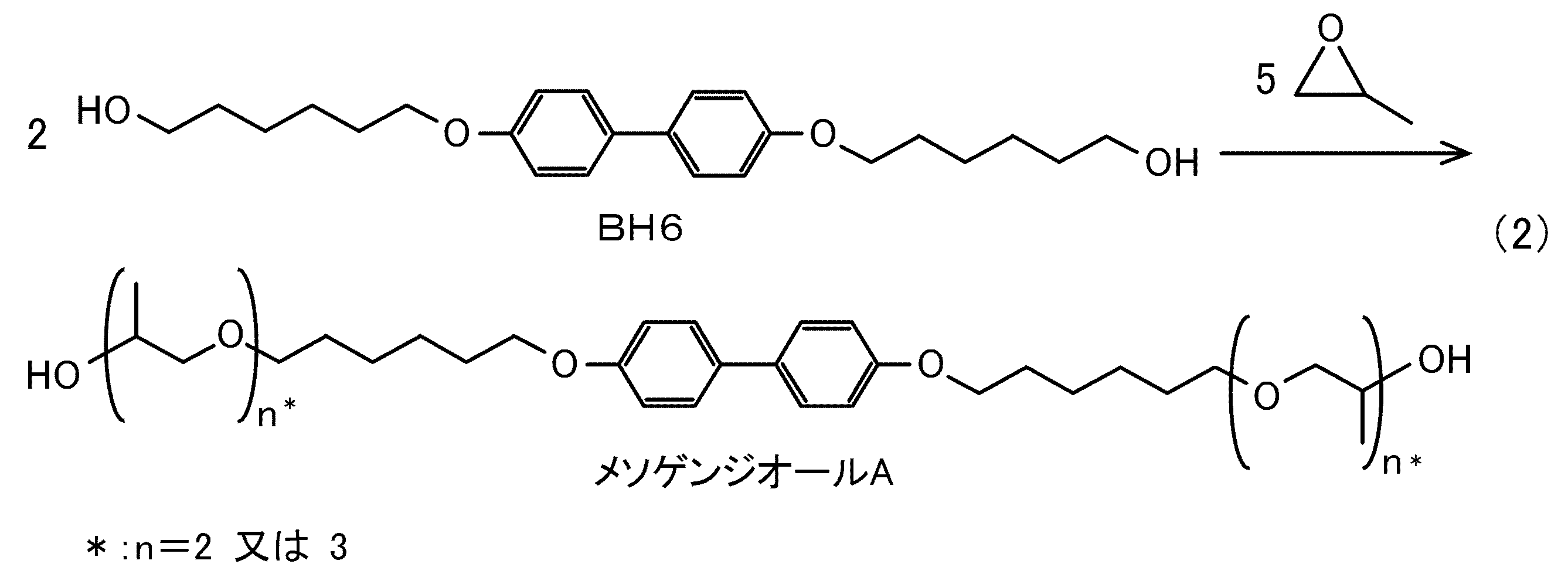
次に、メソゲンジオールA(100g)、光重合性基含有化合物として2-ヒドロキシエチルアクリレート(2g)及びプロピレングリコールジグリシジルエーテルアクリル酸付加物(1g)、光硬化開始剤として2,4,6-トリメチルベンゾイル-ジフェニル-フォスフィンオキサイド(3g)、並びにイソシアネート化合物として1,6-ヘキサメチレンジイソシアネート(35g)を混合し、光架橋性液晶性ポリマーの原材料を調製した。この原材料を撹拌しながら80℃で加熱溶融し、冷却後、樹脂をプラスチック粉砕機(品名:ZI-420、株式会社ホーライ製)で粉砕してペレット化した。次いで、樹脂ペレットを80~120℃に設定した単軸押出機(品名:SZW25GT-24MG-STD、株式会社テクノベル製)に投入し、厚み1.0mmの樹脂シートに成形した。この樹脂シートを15℃に設定した冷却ロールに通してガラス転移温度(Tg)以上且つ相転移温度(Ti)以下に冷却し、引取りロールで巻き取った。このとき、冷却ロールと引取りロールとの間に回転差を付けることにより、樹脂シートを1.5~10倍に延伸した。さらに、冷却ロールと引取りロールとの間に卓上型UV硬化装置(品名:アイminiグランテージ(ESC-1511U)、アイグラフィックス株式会社製)を設置し、延伸された樹脂シートに波長200~600nmの光を照射し、光架橋(硬化)された実施例1の光架橋性液晶性ポリマーを得た。
〔実施例2〕
光架橋性液晶性ポリマーの原材料を調製するに際し、光重合性基含有化合物として2-ヒドロキシエチルアクリレート(1.5g)及びプロピレングリコールジグリシジルエーテルアクリル酸付加物(6g)、並びにイソシアネート化合物として1,6-ヘキサメチレンジイソシアネート(38g)を配合した。その他の原材料及び配合量、並びに製造条件については実施例1と同様とし、実施例2の光架橋性液晶性ポリマーを得た。
光架橋性液晶性ポリマーの原材料を調製するに際し、光重合性基含有化合物として2-ヒドロキシエチルアクリレート(1.5g)及びプロピレングリコールジグリシジルエーテルアクリル酸付加物(6g)、並びにイソシアネート化合物として1,6-ヘキサメチレンジイソシアネート(38g)を配合した。その他の原材料及び配合量、並びに製造条件については実施例1と同様とし、実施例2の光架橋性液晶性ポリマーを得た。
〔実施例3〕
光架橋性液晶性ポリマーの原材料を調製するに際し、光重合性基含有化合物として2-ヒドロキシエチルアクリレート(1g)及びプロピレングリコールジグリシジルエーテルアクリル酸付加物(3g)、並びにイソシアネート化合物として1,6-ヘキサメチレンジイソシアネート(36g)を配合した。その他の原材料及び配合量、並びに製造条件については実施例1と同様とし、実施例3の光架橋性液晶性ポリマーを得た。
光架橋性液晶性ポリマーの原材料を調製するに際し、光重合性基含有化合物として2-ヒドロキシエチルアクリレート(1g)及びプロピレングリコールジグリシジルエーテルアクリル酸付加物(3g)、並びにイソシアネート化合物として1,6-ヘキサメチレンジイソシアネート(36g)を配合した。その他の原材料及び配合量、並びに製造条件については実施例1と同様とし、実施例3の光架橋性液晶性ポリマーを得た。
〔実施例4〕
光架橋性液晶性ポリマーの原材料を調製するに際し、光重合性基含有化合物としてプロピレングリコールジグリシジルエーテルアクリル酸付加物(8g)及び2-ヒドロキシエチルメタクリレート(2g)、並びにイソシアネート化合物として1,6-ヘキサメチレンジイソシアネート(39g)を配合した。その他の原材料及び配合量、並びに製造条件については実施例1と同様とし、実施例4の光架橋性液晶性ポリマーを得た。
光架橋性液晶性ポリマーの原材料を調製するに際し、光重合性基含有化合物としてプロピレングリコールジグリシジルエーテルアクリル酸付加物(8g)及び2-ヒドロキシエチルメタクリレート(2g)、並びにイソシアネート化合物として1,6-ヘキサメチレンジイソシアネート(39g)を配合した。その他の原材料及び配合量、並びに製造条件については実施例1と同様とし、実施例4の光架橋性液晶性ポリマーを得た。
〔実施例5〕
光架橋性液晶性ポリマーの原材料を調製するに際し、光重合性基含有化合物として2-ヒドロキシエチルアクリレート(0.5g)及びグリセリンモノアリルエーテル(2g)、並びにイソシアネート化合物として1,6-ヘキサメチレンジイソシアネート(36g)を配合した。その他の原材料及び配合量、並びに製造条件については実施例1と同様とし、実施例5の光架橋性液晶性ポリマーを得た。
光架橋性液晶性ポリマーの原材料を調製するに際し、光重合性基含有化合物として2-ヒドロキシエチルアクリレート(0.5g)及びグリセリンモノアリルエーテル(2g)、並びにイソシアネート化合物として1,6-ヘキサメチレンジイソシアネート(36g)を配合した。その他の原材料及び配合量、並びに製造条件については実施例1と同様とし、実施例5の光架橋性液晶性ポリマーを得た。
〔実施例6〕
反応容器に、活性水素基を有するメソゲン基含有化合物として式(1)のR1が単結合であるBH6(500g)、水酸化カリウム(19g)、及び溶媒としてN,N-ジメチルホルムアミド(3000ml)を入れて混合し、さらに、アルキレンオキシドとしてプロピレンオキシドを4モルのBH6に対して5当量(すなわち、1モルのBH6に対して1.25当量)添加し、これらの混合物を、加圧条件下、120℃で2時間反応させた(付加反応)。次いで、反応容器にシュウ酸(15g)を添加して付加反応を停止させ、反応液中の不溶な塩を吸引ろ過によって除去し、さらに、反応液中のN,N-ジメチルホルムアミドを減圧蒸留法により除去することにより、メソゲンジオールBを得た。メソゲンジオールBの合成スキームを式(3)に示す。なお、式(3)中に示したメソゲンジオールBは代表的なものであり、種々の構造異性体を含み得る。
反応容器に、活性水素基を有するメソゲン基含有化合物として式(1)のR1が単結合であるBH6(500g)、水酸化カリウム(19g)、及び溶媒としてN,N-ジメチルホルムアミド(3000ml)を入れて混合し、さらに、アルキレンオキシドとしてプロピレンオキシドを4モルのBH6に対して5当量(すなわち、1モルのBH6に対して1.25当量)添加し、これらの混合物を、加圧条件下、120℃で2時間反応させた(付加反応)。次いで、反応容器にシュウ酸(15g)を添加して付加反応を停止させ、反応液中の不溶な塩を吸引ろ過によって除去し、さらに、反応液中のN,N-ジメチルホルムアミドを減圧蒸留法により除去することにより、メソゲンジオールBを得た。メソゲンジオールBの合成スキームを式(3)に示す。なお、式(3)中に示したメソゲンジオールBは代表的なものであり、種々の構造異性体を含み得る。
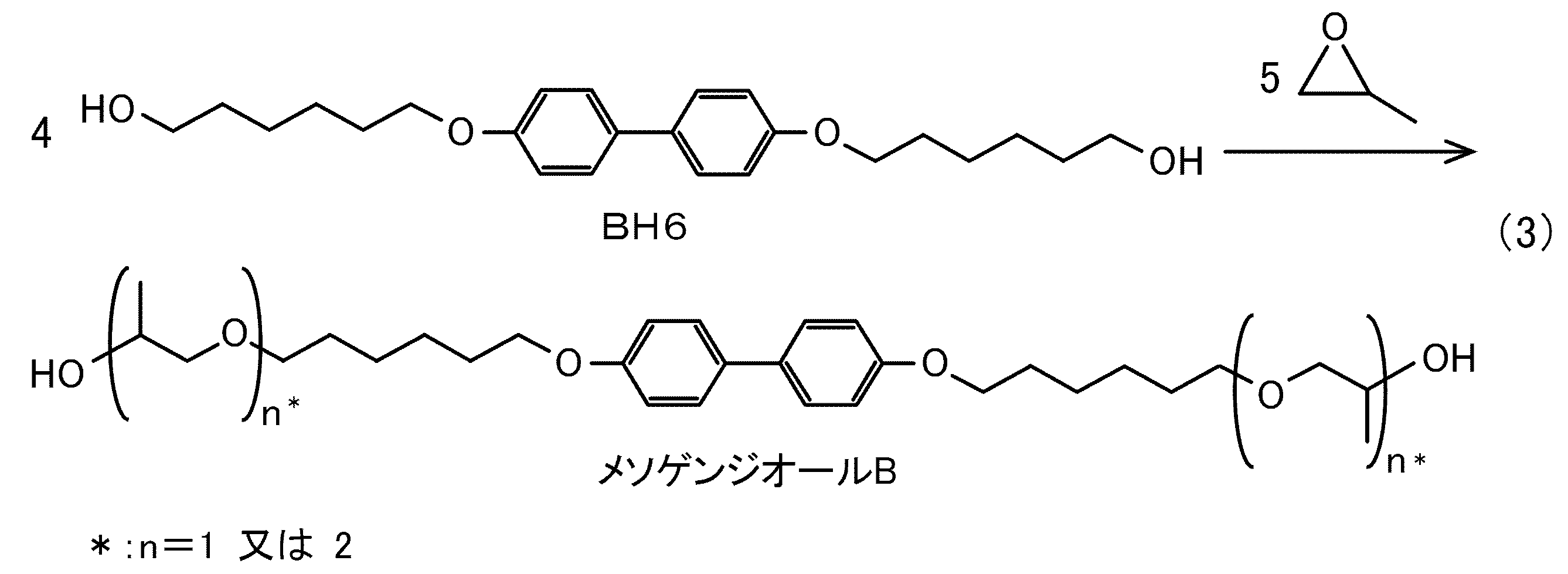
次に、メソゲンジオールB(100g)、光重合性基含有化合物として2-ヒドロキシエチルアクリレート(1.5g)及びプロピレングリコールジグリシジルエーテルアクリル酸付加物(2g)、光硬化開始剤として2,4,6-トリメチルベンゾイル-ジフェニル-フォスフィンオキサイド(3g)、並びにイソシアネート化合物として1,6-ヘキサメチレンジイソシアネート(41g)を混合し、光架橋性液晶性ポリマーの原材料を調製した。その後の操作及び製造条件は実施例1と同様とし、光架橋(硬化)された実施例6の光架橋性液晶性ポリマーを得た。
〔実施例7〕
反応容器に、活性水素基を有するメソゲン基含有化合物として式(1)のR1が単結合であるBH6(500g)、水酸化カリウム(19g)、及び溶媒としてN,N-ジメチルホルムアミド(3000ml)を入れて混合し、さらに、アルキレンオキシドとしてプロピレンオキシドを4モルのBH6に対して3当量(すなわち、1モルのBH6に対して0.75当量)添加し、これらの混合物を、加圧条件下、120℃で2時間反応させた(付加反応)。次いで、反応容器にシュウ酸(15g)を添加して付加反応を停止させ、反応液中の不溶な塩を吸引ろ過によって除去し、さらに、反応液中のN,N-ジメチルホルムアミドを減圧蒸留法により除去することにより、メソゲンジオールCを得た。メソゲンジオールCの合成スキームを式(4)に示す。なお、式(4)中に示したメソゲンジオールCは代表的なものであり、種々の構造異性体を含み得る。
反応容器に、活性水素基を有するメソゲン基含有化合物として式(1)のR1が単結合であるBH6(500g)、水酸化カリウム(19g)、及び溶媒としてN,N-ジメチルホルムアミド(3000ml)を入れて混合し、さらに、アルキレンオキシドとしてプロピレンオキシドを4モルのBH6に対して3当量(すなわち、1モルのBH6に対して0.75当量)添加し、これらの混合物を、加圧条件下、120℃で2時間反応させた(付加反応)。次いで、反応容器にシュウ酸(15g)を添加して付加反応を停止させ、反応液中の不溶な塩を吸引ろ過によって除去し、さらに、反応液中のN,N-ジメチルホルムアミドを減圧蒸留法により除去することにより、メソゲンジオールCを得た。メソゲンジオールCの合成スキームを式(4)に示す。なお、式(4)中に示したメソゲンジオールCは代表的なものであり、種々の構造異性体を含み得る。
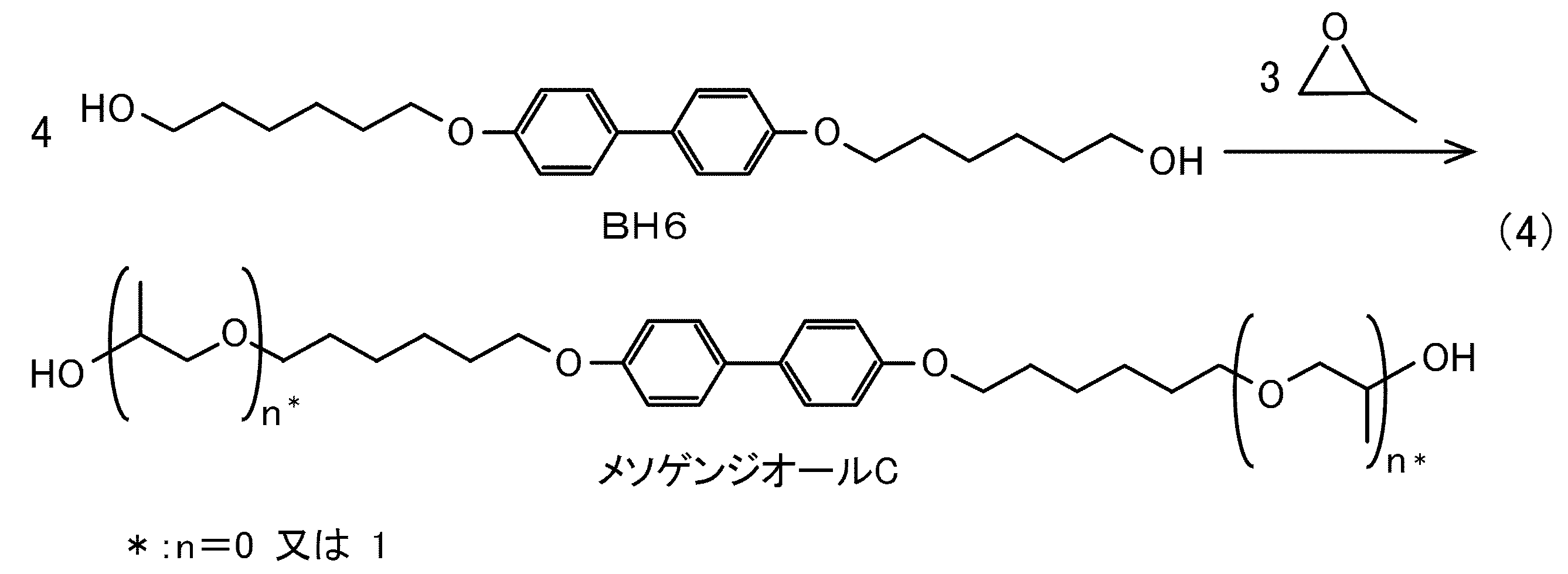
次に、メソゲンジオールC(100g)、光重合性基含有化合物として2-ヒドロキシエチルアクリレート(2g)及びプロピレングリコールジグリシジルエーテルアクリル酸付加物(2g)、光硬化開始剤として2,4,6-トリメチルベンゾイル-ジフェニル-フォスフィンオキサイド(3g)、並びにイソシアネート化合物として1,6-ヘキサメチレンジイソシアネート(44g)を混合し、光架橋性液晶性ポリマーの原材料を調製した。その後の操作及び製造条件は実施例1と同様とし、光架橋(硬化)された実施例7の光架橋性液晶性ポリマーを得た。
〔実施例8〕
反応容器に、活性水素基を有するメソゲン基含有化合物として式(1)のR1が-CH=N-であるBHBA6(500g)、水酸化カリウム(19g)、及び溶媒としてN,N-ジメチルホルムアミド(3000ml)を入れて混合し、さらに、アルキレンオキシドとしてプロピレンオキシドを2モルのBHBA6に対して5当量(すなわち、1モルのBHBA6に対して2.5当量)添加し、これらの混合物を、加圧条件下、120℃で2時間反応させた(付加反応)。次いで、反応容器にシュウ酸(15g)を添加して付加反応を停止させ、反応液中の不溶な塩を吸引ろ過によって除去し、さらに、反応液中のN,N-ジメチルホルムアミドを減圧蒸留法により除去することにより、メソゲンジオールDを得た。メソゲンジオールDの合成スキームを式(5)に示す。なお、式(5)中に示したメソゲンジオールDは代表的なものであり、種々の構造異性体を含み得る。
反応容器に、活性水素基を有するメソゲン基含有化合物として式(1)のR1が-CH=N-であるBHBA6(500g)、水酸化カリウム(19g)、及び溶媒としてN,N-ジメチルホルムアミド(3000ml)を入れて混合し、さらに、アルキレンオキシドとしてプロピレンオキシドを2モルのBHBA6に対して5当量(すなわち、1モルのBHBA6に対して2.5当量)添加し、これらの混合物を、加圧条件下、120℃で2時間反応させた(付加反応)。次いで、反応容器にシュウ酸(15g)を添加して付加反応を停止させ、反応液中の不溶な塩を吸引ろ過によって除去し、さらに、反応液中のN,N-ジメチルホルムアミドを減圧蒸留法により除去することにより、メソゲンジオールDを得た。メソゲンジオールDの合成スキームを式(5)に示す。なお、式(5)中に示したメソゲンジオールDは代表的なものであり、種々の構造異性体を含み得る。

次に、メソゲンジオールD(100g)、光重合性基含有化合物として2-ヒドロキシエチルアクリレート(1g)及びプロピレングリコールジグリシジルエーテルアクリル酸付加物(3g)、光硬化開始剤として2,4,6-トリメチルベンゾイル-ジフェニル-フォスフィンオキサイド(3g)、並びにイソシアネート化合物として1,6-ヘキサメチレンジイソシアネート(34g)を混合し、光架橋性液晶性ポリマーの原材料を調製した。その後の操作及び製造条件は実施例1と同様とし、光架橋(硬化)された実施例8の光架橋性液晶性ポリマーを得た。
〔比較例1〕
液晶性ポリマーの原材料を調製するに際し、光重合性基含有化合物として2-ヒドロキシエチルアクリレート(0.1g)、及びイソシアネート化合物として1,6-ヘキサメチレンジイソシアネート(33g)を配合した。ただし、樹脂シートへの光照射は行わなかった。その他の原材料及び配合量、並びに製造条件については実施例1と同様とし、比較例1の液晶性ポリマーを得た。
液晶性ポリマーの原材料を調製するに際し、光重合性基含有化合物として2-ヒドロキシエチルアクリレート(0.1g)、及びイソシアネート化合物として1,6-ヘキサメチレンジイソシアネート(33g)を配合した。ただし、樹脂シートへの光照射は行わなかった。その他の原材料及び配合量、並びに製造条件については実施例1と同様とし、比較例1の液晶性ポリマーを得た。
〔比較例2〕
液晶性ポリマーの原材料を調製するに際し、光重合性基含有化合物として2-ヒドロキシエチルアクリレート(4g)及びプロピレングリコールジグリシジルエーテルアクリル酸付加物(16g)、並びにイソシアネート化合物として1,6-ヘキサメチレンジイソシアネート(45g)を配合した。ただし、樹脂シートへの光照射は行わなかった。その他の原材料及び配合量、並びに製造条件については実施例1と同様とし、比較例2の液晶性ポリマーを得た。
液晶性ポリマーの原材料を調製するに際し、光重合性基含有化合物として2-ヒドロキシエチルアクリレート(4g)及びプロピレングリコールジグリシジルエーテルアクリル酸付加物(16g)、並びにイソシアネート化合物として1,6-ヘキサメチレンジイソシアネート(45g)を配合した。ただし、樹脂シートへの光照射は行わなかった。その他の原材料及び配合量、並びに製造条件については実施例1と同様とし、比較例2の液晶性ポリマーを得た。
〔液晶性エラストマー原材料組成物の特性評価〕
実施例1~8の光架橋性液晶性ポリマー、及び比較例1~2の液晶性ポリマーについて、光照射後の液晶性ポリマーの硬化状態及びタック値を測定し、粘着性を評価した。また、実施例1~8の光架橋性液晶性ポリマーについて、光照射後の液晶性ポリマーのガラス転移温度(Tg)及び相転移温度(Ti)、並びに伸縮率を測定し、熱応答性の有無を確認した。各測定項目の測定方法及び測定条件を以下に説明する。
実施例1~8の光架橋性液晶性ポリマー、及び比較例1~2の液晶性ポリマーについて、光照射後の液晶性ポリマーの硬化状態及びタック値を測定し、粘着性を評価した。また、実施例1~8の光架橋性液晶性ポリマーについて、光照射後の液晶性ポリマーのガラス転移温度(Tg)及び相転移温度(Ti)、並びに伸縮率を測定し、熱応答性の有無を確認した。各測定項目の測定方法及び測定条件を以下に説明する。
<硬化状態>
実施例1~8、及び比較例1~2において成膜された試料(厚み0.5mm)を10mm×10mmに切り出し、卓上型UV硬化装置(品名:アイminiグランテージ(ESC-1511U)、アイグラフィックス株式会社製)にセットして、照射エネルギーが500mJとなるようにUV照射を行った。硬化状態の評価は、ゲル分率の測定により行った。ゲル分率は、UV照射後の試料をN,N-ジメチルホルムアミド(DMF)に浸漬して非ゲル化物を溶出し、DMFから取り出したものを十分に乾燥させて浸漬前後の重量から算出した。そして、ゲル分率が80%以上となったものを「硬化している(○)」と判断した。
実施例1~8、及び比較例1~2において成膜された試料(厚み0.5mm)を10mm×10mmに切り出し、卓上型UV硬化装置(品名:アイminiグランテージ(ESC-1511U)、アイグラフィックス株式会社製)にセットして、照射エネルギーが500mJとなるようにUV照射を行った。硬化状態の評価は、ゲル分率の測定により行った。ゲル分率は、UV照射後の試料をN,N-ジメチルホルムアミド(DMF)に浸漬して非ゲル化物を溶出し、DMFから取り出したものを十分に乾燥させて浸漬前後の重量から算出した。そして、ゲル分率が80%以上となったものを「硬化している(○)」と判断した。
<タック値>
気温23℃に設定した雰囲気下において、上述したタック試験法に従い、実施例1~8の光架橋性液晶性ポリマー、及び比較例1~2の液晶性ポリマーのタック値を測定した。粘着性の評価は、タック値が0.3kg以下であるものを「粘着性なし(○)」と判断し、タック値が0.3kgを超えるものを「粘着性あり(×)」と判断した。
気温23℃に設定した雰囲気下において、上述したタック試験法に従い、実施例1~8の光架橋性液晶性ポリマー、及び比較例1~2の液晶性ポリマーのタック値を測定した。粘着性の評価は、タック値が0.3kg以下であるものを「粘着性なし(○)」と判断し、タック値が0.3kgを超えるものを「粘着性あり(×)」と判断した。
<ガラス転移温度(Tg)・相転移温度(Ti)>
実施例1~8の光架橋性液晶性ポリマーについて、示唆走査熱量分析計[DSC](品名:X-DSC 7000、株式会社日立ハイテクサイエンス製)を使用し、光照射後の各試料のガラス転移温度(Tg)及び相転移温度(Ti)を測定した。測定時の昇温速度は、20℃/分とした。
実施例1~8の光架橋性液晶性ポリマーについて、示唆走査熱量分析計[DSC](品名:X-DSC 7000、株式会社日立ハイテクサイエンス製)を使用し、光照射後の各試料のガラス転移温度(Tg)及び相転移温度(Ti)を測定した。測定時の昇温速度は、20℃/分とした。
<伸縮率・熱応答性>
実施例1~8の光架橋性液晶性ポリマーについて、液晶相(Ti-20 ℃)及び等方相(Ti+20 ℃)における配向方向のサイズをスケールで測定し、伸縮率を下記の式によって算出した。液晶相から等方相への相転移に伴って長さに減少(収縮)が認められたものを「熱応答性あり(○)」と判断した。
伸縮率(%) = (L1-L2)/L2 × 100
L1:液晶相におけるサンプルの配向方向の長さ(mm)
L2:等方相におけるサンプルの配向方向の長さ(mm)
実施例1~8の光架橋性液晶性ポリマーについて、液晶相(Ti-20 ℃)及び等方相(Ti+20 ℃)における配向方向のサイズをスケールで測定し、伸縮率を下記の式によって算出した。液晶相から等方相への相転移に伴って長さに減少(収縮)が認められたものを「熱応答性あり(○)」と判断した。
伸縮率(%) = (L1-L2)/L2 × 100
L1:液晶相におけるサンプルの配向方向の長さ(mm)
L2:等方相におけるサンプルの配向方向の長さ(mm)
実施例1~8、及び比較例1~2における測定結果を以下の表1にまとめる。

実施例1~8の光架橋性液晶性ポリマーは、何れも良好に硬化しており、ゲル分率は80%以上であった。また、タック値は0.3kg以下であり、実用上で問題となるような粘着性は見られなかった。光照射後の液晶性ポリマーは、常温(約20~30℃)を挟んでガラス転移温度(Tg)と相転移温度(Ti)とが存在するため、使い勝手に優れた材料であった。また、伸縮率は9~85%となり、すべての実施例において液晶性ポリマーの熱応答性が確認され、熱応答性材料として有用であることが示唆された。
これに対し、比較例1の液晶性ポリマーは、十分に硬化しておらず、DMFに浸漬すると全て溶解し、ゲル分率は測定できなかった。また、タック値は0.3kgを超えており、粘着性を有するため取り扱い難いものであった。
比較例2の液晶性ポリマーは、十分に硬化しておらず、ゲル分率は80%未満であった。また、タック値は0.3kgを超えており、粘着性を有するため取り扱い難いものであった。
本発明の光架橋性液晶性ポリマーは、成形と硬化(架橋)とを分離して実施できるものであり、その結果、タック値が低いものとなるため、工業的な連続生産にも対応可能であり、実用性の高い材料である。
本発明の光架橋性液晶性ポリマーは、衣料製品(繊維)、アクチュエータ、フィルター等の分野において利用できる可能性がある。
Claims (7)
- 光架橋によって硬化された部位を含む光架橋性液晶性ポリマーであって、
以下の試験:
(1)幅15~20mm、長さ100mmの試験片を二枚準備する;
(2)一方の試験片をアルミニウム製の平板の表面に貼り付けるとともに、他方の試験片をアルミニウム製の円盤(直径50mm、厚さ14mm)の周面に貼り付ける;
(3)前記円盤の周面を前記平板の表面に向けて100gの荷重で押圧し、二枚の試験片を互いに密着させる;
(4)前記円盤を3000mm/分の速度で引き上げ、前記円盤が前記平板から離れるときの力をタック値として読み取る;
を実施したときに測定される前記タック値が0.3kg以下である光架橋性液晶性ポリマー。 - 前記光架橋によって硬化された部位の割合であるゲル分率が80%以上である請求項1に記載の光架橋性液晶性ポリマー。
- 活性水素基を有するメソゲン基含有化合物と、イソシアネート化合物と、光重合性基含有化合物と、光硬化開始剤との反応物を含む請求項1又は2に記載の光架橋性液晶性ポリマー。
- 前記活性水素基を有するメソゲン基含有化合物は、下記一般式(1):

で表される化合物である請求項3に記載の光架橋性液晶性ポリマー。 - 前記光重合性基含有化合物は、アクリロイル基含有化合物、メタクリロイル基含有化合物、及びアリル基含有化合物からなる群から選択される少なくとも一種である請求項3又は4に記載の光架橋性液晶性ポリマー。
- 前記光硬化開始剤を1~10重量%含有する請求項3~5の何れか一項に記載の光架橋性液晶性ポリマー。
- 繊維状又はシート状に構成されている請求項1~6の何れか一項に記載の光架橋性液晶性ポリマー。
Priority Applications (1)
| Application Number | Priority Date | Filing Date | Title |
|---|---|---|---|
| JP2018552402A JP6746711B2 (ja) | 2016-11-28 | 2017-07-14 | 光架橋性液晶性ポリマー |
Applications Claiming Priority (2)
| Application Number | Priority Date | Filing Date | Title |
|---|---|---|---|
| JP2016230219 | 2016-11-28 | ||
| JP2016-230219 | 2016-11-28 |
Publications (1)
| Publication Number | Publication Date |
|---|---|
| WO2018096725A1 true WO2018096725A1 (ja) | 2018-05-31 |
Family
ID=62196046
Family Applications (1)
| Application Number | Title | Priority Date | Filing Date |
|---|---|---|---|
| PCT/JP2017/025650 Ceased WO2018096725A1 (ja) | 2016-11-28 | 2017-07-14 | 光架橋性液晶性ポリマー |
Country Status (2)
| Country | Link |
|---|---|
| JP (1) | JP6746711B2 (ja) |
| WO (1) | WO2018096725A1 (ja) |
Cited By (2)
| Publication number | Priority date | Publication date | Assignee | Title |
|---|---|---|---|---|
| JP2019112605A (ja) * | 2017-12-22 | 2019-07-11 | Toyo Tire株式会社 | 液晶性ポリマー、及び液晶性ポリマーの製造方法 |
| JP2019112606A (ja) * | 2017-12-22 | 2019-07-11 | Toyo Tire株式会社 | シリコーン含有液晶性ポリマー、及びシリコーン含有液晶性ポリマーの製造方法 |
Citations (9)
| Publication number | Priority date | Publication date | Assignee | Title |
|---|---|---|---|---|
| JPH05247168A (ja) * | 1991-12-30 | 1993-09-24 | Akzo Nv | 液晶ポリウレタン、該液晶ポリウレタンの組成物、及び光学データ貯蔵のための液晶ポリウレタン含有デバイス |
| JPH07258369A (ja) * | 1994-03-18 | 1995-10-09 | Nitta Ind Corp | 高分子液晶ポリウレタン |
| JPH11166028A (ja) * | 1997-12-04 | 1999-06-22 | Sanyo Chem Ind Ltd | 光架橋性ポリウレタン樹脂組成物 |
| JP2001509128A (ja) * | 1995-10-17 | 2001-07-10 | デンツプライ インターナショナル インコーポレーテッド | 液晶(メタ)アクリル酸エステル化合物、組成物および方法 |
| JP2003002927A (ja) * | 2001-06-18 | 2003-01-08 | Nitto Denko Corp | 側鎖型液晶ポリマー、液晶性組成物、ホメオトロピック配向液晶フィルムの製造方法およびホメオトロピック配向液晶フィルム |
| JP2007063155A (ja) * | 2005-08-29 | 2007-03-15 | Hyogo Prefecture | 液晶性重合性低分子化合物、該化合物を用いた複屈折性フィルム及び複屈折性セル、並びにこれらの製造方法 |
| JP2012185459A (ja) * | 2010-03-10 | 2012-09-27 | Fujifilm Corp | 感光性組成物、感光性フィルム、感光性積層体、永久パターン形成方法、及びプリント基板 |
| WO2015093099A1 (ja) * | 2013-12-18 | 2015-06-25 | 東洋ゴム工業株式会社 | 液晶ポリウレタンエラストマー及びその製造方法 |
| JP2016056113A (ja) * | 2014-09-05 | 2016-04-21 | 東洋ゴム工業株式会社 | 液晶性化合物、熱応答性材料及びその製造方法 |
-
2017
- 2017-07-14 JP JP2018552402A patent/JP6746711B2/ja active Active
- 2017-07-14 WO PCT/JP2017/025650 patent/WO2018096725A1/ja not_active Ceased
Patent Citations (9)
| Publication number | Priority date | Publication date | Assignee | Title |
|---|---|---|---|---|
| JPH05247168A (ja) * | 1991-12-30 | 1993-09-24 | Akzo Nv | 液晶ポリウレタン、該液晶ポリウレタンの組成物、及び光学データ貯蔵のための液晶ポリウレタン含有デバイス |
| JPH07258369A (ja) * | 1994-03-18 | 1995-10-09 | Nitta Ind Corp | 高分子液晶ポリウレタン |
| JP2001509128A (ja) * | 1995-10-17 | 2001-07-10 | デンツプライ インターナショナル インコーポレーテッド | 液晶(メタ)アクリル酸エステル化合物、組成物および方法 |
| JPH11166028A (ja) * | 1997-12-04 | 1999-06-22 | Sanyo Chem Ind Ltd | 光架橋性ポリウレタン樹脂組成物 |
| JP2003002927A (ja) * | 2001-06-18 | 2003-01-08 | Nitto Denko Corp | 側鎖型液晶ポリマー、液晶性組成物、ホメオトロピック配向液晶フィルムの製造方法およびホメオトロピック配向液晶フィルム |
| JP2007063155A (ja) * | 2005-08-29 | 2007-03-15 | Hyogo Prefecture | 液晶性重合性低分子化合物、該化合物を用いた複屈折性フィルム及び複屈折性セル、並びにこれらの製造方法 |
| JP2012185459A (ja) * | 2010-03-10 | 2012-09-27 | Fujifilm Corp | 感光性組成物、感光性フィルム、感光性積層体、永久パターン形成方法、及びプリント基板 |
| WO2015093099A1 (ja) * | 2013-12-18 | 2015-06-25 | 東洋ゴム工業株式会社 | 液晶ポリウレタンエラストマー及びその製造方法 |
| JP2016056113A (ja) * | 2014-09-05 | 2016-04-21 | 東洋ゴム工業株式会社 | 液晶性化合物、熱応答性材料及びその製造方法 |
Non-Patent Citations (1)
| Title |
|---|
| LITT ET AL.: "Crosslinked Liquid Crystal Polymers from Liquid Crystal Monomers: Synthesis and Mechanical Properties", JOURNAL )F POLYMER SCIENCE , PART A: POLYMER CHEMISTRY, vol. 31, no. 1, 1993, pages 183 - 91, XP000331766 * |
Cited By (2)
| Publication number | Priority date | Publication date | Assignee | Title |
|---|---|---|---|---|
| JP2019112605A (ja) * | 2017-12-22 | 2019-07-11 | Toyo Tire株式会社 | 液晶性ポリマー、及び液晶性ポリマーの製造方法 |
| JP2019112606A (ja) * | 2017-12-22 | 2019-07-11 | Toyo Tire株式会社 | シリコーン含有液晶性ポリマー、及びシリコーン含有液晶性ポリマーの製造方法 |
Also Published As
| Publication number | Publication date |
|---|---|
| JPWO2018096725A1 (ja) | 2019-06-24 |
| JP6746711B2 (ja) | 2020-08-26 |
Similar Documents
| Publication | Publication Date | Title |
|---|---|---|
| WO2018096724A1 (ja) | 光架橋性液晶性ポリマー、及び光架橋性液晶性ポリマーの製造方法 | |
| JP6629991B2 (ja) | 液晶性エラストマー原材料組成物 | |
| JP2010116528A (ja) | 光学フィルム及び該光学フィルムの製造方法 | |
| JP7112332B2 (ja) | 光架橋性液晶性ポリマー、及び光架橋液晶性ポリマーの製造方法 | |
| WO2018062068A1 (ja) | 液晶組成物、光学フィルム、偏光板および画像表示装置 | |
| JP2010128417A (ja) | 光学フィルム | |
| Kim et al. | Preparation and properties of UV-curable di-functional sulfur-containing thioacrylate and thiourethane acrylate monomers with high refractive indices | |
| JP6746711B2 (ja) | 光架橋性液晶性ポリマー | |
| JP5566701B2 (ja) | 位相差フィルム | |
| WO2017002681A1 (ja) | 液晶性ウレタン化合物、熱応答性液晶ポリウレタンエラストマー及びその製造方法 | |
| TWI688581B (zh) | (甲基)丙烯酸酯樹脂之製造方法及光學構件之製造方法、硬化性組成物之製造方法、硬化物之製造方法 | |
| JP2019112606A (ja) | シリコーン含有液晶性ポリマー、及びシリコーン含有液晶性ポリマーの製造方法 | |
| JP2023178316A (ja) | (メタ)アクリル系樹脂組成物、及び(メタ)アクリル系樹脂フィルム | |
| JP7382313B2 (ja) | 光学樹脂組成物及び光学レンズ | |
| JPS6114210A (ja) | 光ファイバユニット緩衝材用紫外線硬化型樹脂組成物 | |
| JP2011085894A (ja) | 光学フィルム及び該光学フィルムの製造方法 | |
| JP7027160B2 (ja) | 熱応答性液晶性ポリマー、及び熱応答性液晶性ポリマーの製造方法 | |
| JP2024089997A (ja) | 熱応答性液晶エラストマー用組成物および熱応答性液晶エラストマー | |
| JP2019112605A (ja) | 液晶性ポリマー、及び液晶性ポリマーの製造方法 | |
| JP7189739B2 (ja) | 熱可塑性液晶ポリマー組成物および熱可塑性液晶ポリマーの製造方法 | |
| JP6937228B2 (ja) | 熱応答性布帛 | |
| JP7753334B2 (ja) | 硬化性樹脂組成物及び接合レンズ | |
| JP7425595B2 (ja) | 光架橋性液晶ポリマー組成物、架橋型液晶ポリマーおよびその製造方法 | |
| JP2023093924A (ja) | 光架橋性液晶ポリマーおよび熱応答性液晶ポリマー | |
| JP2023093910A (ja) | 液晶性ポリウレタンを含有するペレットおよびその製造方法、ならびに液晶ポリウレタンエラストマー |
Legal Events
| Date | Code | Title | Description |
|---|---|---|---|
| 121 | Ep: the epo has been informed by wipo that ep was designated in this application |
Ref document number: 17873575 Country of ref document: EP Kind code of ref document: A1 |
|
| ENP | Entry into the national phase |
Ref document number: 2018552402 Country of ref document: JP Kind code of ref document: A |
|
| NENP | Non-entry into the national phase |
Ref country code: DE |
|
| 122 | Ep: pct application non-entry in european phase |
Ref document number: 17873575 Country of ref document: EP Kind code of ref document: A1 |