WO2018084013A1 - ポリカーボネートイミド樹脂及びそれを含む樹脂組成物 - Google Patents
ポリカーボネートイミド樹脂及びそれを含む樹脂組成物 Download PDFInfo
- Publication number
- WO2018084013A1 WO2018084013A1 PCT/JP2017/038185 JP2017038185W WO2018084013A1 WO 2018084013 A1 WO2018084013 A1 WO 2018084013A1 JP 2017038185 W JP2017038185 W JP 2017038185W WO 2018084013 A1 WO2018084013 A1 WO 2018084013A1
- Authority
- WO
- WIPO (PCT)
- Prior art keywords
- resin
- mol
- polycarbonate
- imide resin
- acid
- Prior art date
- Legal status (The legal status is an assumption and is not a legal conclusion. Google has not performed a legal analysis and makes no representation as to the accuracy of the status listed.)
- Ceased
Links
Classifications
-
- C—CHEMISTRY; METALLURGY
- C08—ORGANIC MACROMOLECULAR COMPOUNDS; THEIR PREPARATION OR CHEMICAL WORKING-UP; COMPOSITIONS BASED THEREON
- C08G—MACROMOLECULAR COMPOUNDS OBTAINED OTHERWISE THAN BY REACTIONS ONLY INVOLVING UNSATURATED CARBON-TO-CARBON BONDS
- C08G73/00—Macromolecular compounds obtained by reactions forming a linkage containing nitrogen with or without oxygen or carbon in the main chain of the macromolecule, not provided for in groups C08G12/00 - C08G71/00
- C08G73/06—Polycondensates having nitrogen-containing heterocyclic rings in the main chain of the macromolecule
- C08G73/10—Polyimides; Polyester-imides; Polyamide-imides; Polyamide acids or similar polyimide precursors
- C08G73/16—Polyester-imides
-
- C—CHEMISTRY; METALLURGY
- C08—ORGANIC MACROMOLECULAR COMPOUNDS; THEIR PREPARATION OR CHEMICAL WORKING-UP; COMPOSITIONS BASED THEREON
- C08G—MACROMOLECULAR COMPOUNDS OBTAINED OTHERWISE THAN BY REACTIONS ONLY INVOLVING UNSATURATED CARBON-TO-CARBON BONDS
- C08G18/00—Polymeric products of isocyanates or isothiocyanates
- C08G18/06—Polymeric products of isocyanates or isothiocyanates with compounds having active hydrogen
- C08G18/28—Polymeric products of isocyanates or isothiocyanates with compounds having active hydrogen characterised by the compounds used containing active hydrogen
- C08G18/30—Low-molecular-weight compounds
- C08G18/34—Carboxylic acids; Esters thereof with monohydroxyl compounds
-
- C—CHEMISTRY; METALLURGY
- C08—ORGANIC MACROMOLECULAR COMPOUNDS; THEIR PREPARATION OR CHEMICAL WORKING-UP; COMPOSITIONS BASED THEREON
- C08G—MACROMOLECULAR COMPOUNDS OBTAINED OTHERWISE THAN BY REACTIONS ONLY INVOLVING UNSATURATED CARBON-TO-CARBON BONDS
- C08G73/00—Macromolecular compounds obtained by reactions forming a linkage containing nitrogen with or without oxygen or carbon in the main chain of the macromolecule, not provided for in groups C08G12/00 - C08G71/00
- C08G73/06—Polycondensates having nitrogen-containing heterocyclic rings in the main chain of the macromolecule
- C08G73/10—Polyimides; Polyester-imides; Polyamide-imides; Polyamide acids or similar polyimide precursors
-
- C—CHEMISTRY; METALLURGY
- C08—ORGANIC MACROMOLECULAR COMPOUNDS; THEIR PREPARATION OR CHEMICAL WORKING-UP; COMPOSITIONS BASED THEREON
- C08K—Use of inorganic or non-macromolecular organic substances as compounding ingredients
- C08K5/00—Use of organic ingredients
- C08K5/49—Phosphorus-containing compounds
- C08K5/51—Phosphorus bound to oxygen
- C08K5/53—Phosphorus bound to oxygen bound to oxygen and to carbon only
- C08K5/5313—Phosphinic compounds, e.g. R2=P(:O)OR'
-
- C—CHEMISTRY; METALLURGY
- C08—ORGANIC MACROMOLECULAR COMPOUNDS; THEIR PREPARATION OR CHEMICAL WORKING-UP; COMPOSITIONS BASED THEREON
- C08K—Use of inorganic or non-macromolecular organic substances as compounding ingredients
- C08K5/00—Use of organic ingredients
- C08K5/49—Phosphorus-containing compounds
- C08K5/5399—Phosphorus bound to nitrogen
-
- C—CHEMISTRY; METALLURGY
- C08—ORGANIC MACROMOLECULAR COMPOUNDS; THEIR PREPARATION OR CHEMICAL WORKING-UP; COMPOSITIONS BASED THEREON
- C08L—COMPOSITIONS OF MACROMOLECULAR COMPOUNDS
- C08L63/00—Compositions of epoxy resins; Compositions of derivatives of epoxy resins
-
- C—CHEMISTRY; METALLURGY
- C08—ORGANIC MACROMOLECULAR COMPOUNDS; THEIR PREPARATION OR CHEMICAL WORKING-UP; COMPOSITIONS BASED THEREON
- C08L—COMPOSITIONS OF MACROMOLECULAR COMPOUNDS
- C08L79/00—Compositions of macromolecular compounds obtained by reactions forming in the main chain of the macromolecule a linkage containing nitrogen with or without oxygen or carbon only, not provided for in groups C08L61/00 - C08L77/00
- C08L79/04—Polycondensates having nitrogen-containing heterocyclic rings in the main chain; Polyhydrazides; Polyamide acids or similar polyimide precursors
-
- C—CHEMISTRY; METALLURGY
- C08—ORGANIC MACROMOLECULAR COMPOUNDS; THEIR PREPARATION OR CHEMICAL WORKING-UP; COMPOSITIONS BASED THEREON
- C08L—COMPOSITIONS OF MACROMOLECULAR COMPOUNDS
- C08L79/00—Compositions of macromolecular compounds obtained by reactions forming in the main chain of the macromolecule a linkage containing nitrogen with or without oxygen or carbon only, not provided for in groups C08L61/00 - C08L77/00
- C08L79/04—Polycondensates having nitrogen-containing heterocyclic rings in the main chain; Polyhydrazides; Polyamide acids or similar polyimide precursors
- C08L79/08—Polyimides; Polyester-imides; Polyamide-imides; Polyamide acids or similar polyimide precursors
Definitions
- the present invention relates to a polycarbonate imide resin and an adhesive using the same, and more specifically, it has excellent insulation, flexibility, flame retardancy, and fluidity, and a coverlay film, an adhesive film, and a three-layer copper-clad
- the present invention relates to an adhesive suitable for laminates and the like.
- FPC flexible printed wiring boards
- device mounting substrates for display devices used for liquid crystal display devices, plasma displays, organic EL displays, etc. inter-substrate relay cables for smart phones, tablet device terminals, digital cameras, portable game machines, operation switch unit substrates, etc. Widely used.
- the adhesive used for FPC is a roll-off of a B-stage adhesive film obtained by applying a liquid resin composition on a release film and volatilizing the solvent. Is temporarily attached to a circuit material such as copper foil or polyimide film and used by thermocompression bonding.
- a circuit material such as copper foil or polyimide film
- thermocompression bonding the amount of adhesive flowing out from the CL end face is small. Desired.
- a resin used for CL and an interlayer insulating layer As a resin used for CL and an interlayer insulating layer, a ring-closed polyimide resin which is excellent in heat resistance, insulation and chemical resistance and is soluble in a solvent has been proposed.
- a solvent for a wholly aromatic polyimide resin varnish polymerized from only aromatic monomers a high boiling point solvent such as N-methyl-2-pyrrolidone is used.
- N-methyl-2-pyrrolidone is used as a high boiling point solvent such as N-methyl-2-pyrrolidone.
- the wholly aromatic polyimide resin generally has a high glass transition temperature, the embedding property when the adhesive is thermocompression bonded to a substrate such as a polyimide film or copper foil is deteriorated, and the adhesive strength is lowered. was there.
- polysiloxane-modified polyimide resins are disclosed in, for example, (Patent Document 1), (Patent Document 2), and the like, in order to solve the problem of such adhesive deterioration.
- Patent Document 3 For improving the solvent solubility in a low-boiling solvent, for example (Patent Document 3) or the like, an acrylonitrile butadiene having a reactive functional group is copolymerized with a wholly aromatic polyamide-imide resin having excellent solvent solubility. A method has been proposed.
- Patent Document 4 proposes a method of copolymerizing a polycarbonate diol having a reactive functional group with a wholly aromatic polyimide resin having excellent solvent solubility.
- the polysiloxane-modified polyimide resins described in Patent Documents 1 and 2 use an expensive diamine having a dimethylsiloxane structure as a starting material, and are inferior in economic efficiency.
- the adhesiveness decreases with an increase in the amount of polysiloxane copolymerization.
- the polyamideimide resin described in Patent Document 3 it is necessary to increase the copolymerization amount of acrylonitrile butadiene, and as a result, there is a concern that the insulation reliability is lowered.
- the polyimide precursor solution described in Patent Document 4 has a large amount of an amic acid structure, there is a concern that the storage stability of the resin solution (hereinafter also referred to as varnish) is lowered.
- the present invention has been made against the background of the problems of the prior art. That is, the object of the present invention is (1) adhesiveness (2) insulation reliability (3) humidified solder heat resistance (4) solvent solubility, (5) flame retardancy (6) B stage adhesive film Polycarbonate imide resin excellent in embrittlement resistance and resin composition containing the same.
- An object of the present invention is to provide an electronic component having a solder resist layer, a surface protective layer, an interlayer insulating layer or an adhesive layer obtained by curing the resin composition.
- this invention consists of the following structures.
- the polycarbonate imide resin (A) having the structure described in the general formula [I], wherein the total of the amide structure, the imide structure, the amide acid structure, and the urea structure in the polycarbonate imide resin (A) is 100 mol%.
- the polycarbonate imide resin (A) is characterized in that the content of the urea structure is 3 mol% or less.
- a plurality of R's are each independently a divalent organic group having 1 or more carbon atoms, and n is an integer of 1 or more.
- the total component of the polycarbonate imide resin (A) is 200 mol%, it is preferable to contain 15 mol% or more of the structure described in the general formula [I].
- a resin composition comprising the polycarbonate imide resin (A) and an epoxy resin (B) having two or more epoxy groups per molecule.
- a phosphorus-based flame retardant (C) is preferable to contain a phosphorus-based flame retardant (C).
- the polycarbonate imide resin (A) of the present invention is a resin having a skeleton having a specific structure and a urea structure having a specific amount or less.
- the resin composition of the present invention is a composition containing a polycarbonate imide resin (A) and an epoxy resin (B) and, if necessary, a phosphorus flame retardant (C).
- the polycarbonate imide resin (A) of the present invention will be described.
- the polycarbonate imide resin (A) is a resin having a structure represented by the general formula [I] in the skeleton of the resin.
- the polycarbonate imide resin (A) can exhibit excellent adhesiveness and flexibility.
- a plurality of R's each independently represents a divalent organic group having 1 or more carbon atoms.
- a preferable carbon number is 2 or more, more preferably 4 or more. Moreover, it is preferable that it is 20 or less, More preferably, it is 10 or less, More preferably, it is 8 or less, Especially preferably, it is 6 or less.
- Specific examples of the divalent organic group having 1 or more carbon atoms are not particularly limited, and a methylene group, an ethylene group, a propylene group, a butylene group, a pentylene group, a hexylene group, a heptylene group or an optionally substituted substituent.
- Examples thereof include an aliphatic group such as an octylene group, an aromatic group such as a phenylene group and a biphenylene group, and an alicyclic group such as a cyclohexylene group. Of these, an aliphatic group is preferable, and an n-pentylene group and an n-hexylene group are more preferable.
- N is an integer of 1 or more, preferably 2 or more, and more preferably 4 or more.
- An upper limit is not specifically limited, It is preferable that it is 20 or less, More preferably, it is 15 or less. By making it within the above range, the excellent adhesiveness and flexibility of the polycarbonate imide resin (A) can be expressed.
- the polycarbonate skeleton represented by the general formula [I] (hereinafter, the weight ratio of the portion obtained by removing the hydroxyl group from the polycarbonate diol in the general formula [I] is referred to as the polycarbonate diol content) is the entire constitution of the polycarbonate imide resin (A).
- the structure described in the general formula [I] is preferably contained in an amount of 15 mol% or more, more preferably 16 mol% or more, and further preferably 17 mol% or more. If the amount is too small, adhesiveness and flexibility may be lowered.
- the component (structural unit) of the polycarbonate imide resin (A) is the following (a) trivalent and / or tetravalent polycarboxylic acid derivative having an acid anhydride group, (b) general formula [II] An acid dianhydride having a polycarbonate skeleton represented by the formula (c), an isocyanate compound, and other acid components or flexible components, and the total amount of these components is 200 mol%.
- the urea structure needs to be 3 mol% or less. Preferably it is 2.8 mol% or less, More preferably, it is 2.6 mol% or less. By making the urea structure 3 mol% or less, excellent solder heat resistance can be expressed. Since it is preferable that the amount of urea structure is small, the lower limit is not particularly limited, but 1 mol% is sufficient.
- the amount of urea structure depends on the amount of water in the polymerization system and the amidimidization reaction rate, and can be reduced by adding a polymerization catalyst or a polymerization catalyst in a low hygroscopic solvent.
- the water content in the polymerization system is preferably 1000 ppm or less, more preferably 800 ppm or less, still more preferably 600 ppm or less, and particularly preferably 400 ppm or less.
- the amount of water in the polymerization system can be reduced by drying the inside of the polymerization system at 150 ° C. for 2 hours before charging the raw materials.
- the urea structure can be determined by 1 H-NMR measurement at a resonance frequency of 500 MHz and 13 C-NMR measurement at a resonance frequency of 125 MHz.
- the preparation method of the measurement liquid can be performed as follows.
- 13 C-NMR measurement 200 mg of a sample is dissolved in 2,7 mL of heavy DMSO, and then the solution is filled in an NMR tube for measurement. In any measurement, it is preferable that heavy DMSO is used as the lock solvent, and the number of integration is 64 times ( 1 H-NMR) or 1024 times ( 13 C-NMR).
- the quantification of the urea structure can be calculated as follows.
- a deuterated chloroform / deuterated DMSO mixed solvent measured by 1 H-NMR when the peak of deuterated DMSO is 2.5 ppm, the peak near 7.4 ppm is the peak of imide structure (A), and the peak near 7.7 ppm is the amide peak. It is the peak (B) of the structure.
- a and B be the integrated values of each peak.
- the peak near 10.6 ppm is the peak of amide structure (C)
- the peak near 10.4 ppm is the peak of amic acid structure (D).
- C and D be the integrated values of each peak.
- the amic acid structure is preferably 10 mol% or less, more preferably 8 mol% or less, and further preferably 6 mol% or less for the convenience of storage stability of the resin varnish.
- the polycarbonate imide resin (A) of the present invention is not particularly limited, but (a) a trivalent and / or tetravalent polycarboxylic acid derivative having an acid anhydride group, (b) a polycarbonate represented by the general formula [II] A resin having a skeleton of an acid dianhydride and (c) an isocyanate compound as a copolymerization component is preferable.
- the component (a) constituting the polycarbonate imide resin (A) of the present invention is generally a trivalent or quaternary polycarboxylic acid derivative having an acid anhydride group that reacts with an isocyanate component to form a polyimide resin. (Hereinafter, it is also simply referred to as the component (a)), and an aromatic polycarboxylic acid derivative, an aliphatic polycarboxylic acid derivative or an alicyclic polycarboxylic acid derivative can be used.
- the aromatic polycarboxylic acid derivative is not particularly limited.
- trimellitic anhydride, pyromellitic dianhydride, ethylene glycol bisanhydro trimellitate, propylene glycol bisan hydrotrimellitate, 1,4- Alkylene glycol bisan hydrotrimellitate such as butanediol bisanhydro trimellitate, hexamethylene glycol bis anhydro trimellitate, polyethylene glycol bis anhydro trimellitate, polypropylene glycol bis anhydro trimellitate, 3, 3 '-4,4'-benzophenonetetracarboxylic dianhydride, 3,3'-4,4'-biphenyltetracarboxylic dianhydride, 1,2,5,6-naphthalenetetracarboxylic dianhydride, , 4,5,8-Naphthalene Tracarboxylic dianhydride, 2,3,5,6-pyridinetetracarboxylic dianhydride, 3,4,9,10-perylenet
- the aliphatic or alicyclic polycarboxylic acid derivative is not particularly limited, but for example, butane-1,2,3,4-tetracarboxylic dianhydride, pentane-1,2,4,5-tetracarboxylic acid Dianhydride, cyclobutanetetracarboxylic dianhydride, hexahydropyromellitic dianhydride, cyclohex-1-ene-2,3,5,6-tetracarboxylic dianhydride, 3-ethylcyclohex-1- Ene-3- (1,2), 5,6-tetracarboxylic dianhydride, 1-methyl-3-ethylcyclohexane-3- (1,2), 5,6-tetracarboxylic dianhydride, 1-methyl-3-ethylcyclohex-1-ene-3- (1,2), 5,6-tetracarboxylic dianhydride, 1-methyl-3-ethylcyclohex-1-ene-3- (1
- trivalent and / or tetravalent polycarboxylic acid derivatives having an acid anhydride group may be used alone or in combination of two or more.
- pyromellitic anhydride, trimellitic anhydride, ethylene glycol bisanhydro trimellitate, 3,3'-4, 4'- Benzophenone tetracarboxylic dianhydride and 3,3 ′, 4,4′-biphenyltetracarboxylic dianhydride are preferred, and trimellitic anhydride and ethylene glycol bisahydrohydrotrimellitate are more preferred.
- the copolymerization amount of the component (a) is preferably 10 mol% or more and 90 mol% or less, and 20 mol% or more and 80 mol% or less, when the total acid component to be reacted is 100 mol%. More preferably, it is 30 mol% or more and 70 mol% or less. If the amount is less than 10 mol%, humidified solder heat resistance and insulation reliability may not be obtained. If the amount exceeds 90 mol%, the components (b) and (c) described later cannot be copolymerized in a sufficient amount. There is. Therefore, adhesiveness and solvent solubility may be reduced.
- the component (b) constituting the polycarbonate imide resin (A) of the present invention is an acid dianhydride having a polycarbonate skeleton represented by the general formula [II] (hereinafter also simply referred to as the component (b)). Is preferred.
- the acid dianhydride of the general formula [II] is copolymerized as a flexible component that imparts adhesiveness, tackiness and the like to the polycarbonate polyimide resin (A).
- Component (b) is preferably an acid dianhydride having a polycarbonate skeleton represented by the general formula [II].
- a plurality of R's each independently represents a divalent organic group having 1 or more carbon atoms.
- a preferable carbon number is 2 or more, more preferably 4 or more.
- divalent organic group having 1 or more carbon atoms are not particularly limited, and a methylene group, an ethylene group, a propylene group, a butylene group, a pentylene group, a hexylene group, a heptylene group or an optionally substituted substituent.
- examples thereof include an aliphatic group such as an octylene group, an aromatic group such as a phenylene group and a biphenylene group, and an alicyclic group such as a cyclohexylene group. Of these, an aliphatic group is preferable, and an n-pentylene group and an n-hexylene group are more preferable.
- N is an integer of 1 or more, preferably 2 or more, and more preferably 4 or more.
- An upper limit is not specifically limited, It is preferable that it is 20 or less, More preferably, it is 10 or less.
- aliphatic polycarbonate diols for synthesize
- aliphatic polycarbonate diols, aromatic polycarbonate diols, and its mixture for example, aliphatic polycarbonate diols, aromatic polycarbonate diols, and its mixture (Daicel Chemical Industries Ltd. make, goods Name PLACEL (registered trademark) -CD220, manufactured by Kuraray Co., Ltd., trade name C-1015N, etc., manufactured by Ube Industries, Ltd., trade name ETERRNACOLL (registered trademark) -UH-100, etc., manufactured by Mitsubishi Chemical Corporation Name BENEBiOL-NLDB, etc., trade name DURANOL-T5651 manufactured by Asahi Kasei Chemicals Corporation.
- PLACEL registered trademark
- ETERRNACOLL registered trademark
- DURANOL-T5651 manufactured by Asahi Kasei Chemicals Corporation.
- (B) Although it does not specifically limit as a method to manufacture a component, It can synthesize
- the reaction temperature is ⁇ 20 to 50 ° C., and more preferably 20 to 40 ° C. from the viewpoint of reaction selectivity.
- the reaction ratio between the trimellitic anhydride chloride and the diol compound it is preferable to perform the reaction by using 2 mol or more of trimellitic anhydride chloride with respect to 1 mol of the diol compound.
- the concentration of the solute in the reaction is preferably 5 to 80% by weight, more preferably 40 to 60% by weight.
- the precipitated hydrochloride is filtered off, and the solvent is concentrated to concentrate the acid dianhydride having the polycarbonate skeleton represented by the general formula [I] (hereinafter also referred to as polycarbonate skeleton-containing tetracarboxylic dianhydride). Say).
- the amount of copolymerization of component (b) is preferably 15 mol% or more and 90 mol% or less, and preferably 16 mol% or more and 70 mol% or less when the total acid component to be reacted is 100 mol%. More preferably, it is 17 mol% or more and 50 mol% or less. If it is less than 15 mol% or exceeds 90 mol%, the solvent solubility may be reduced.
- the weight ratio of carbonate diol contained in component (b) is preferably 18% to 40% by weight, more preferably 20% to 35% by weight, based on the solid content of the adhesive. . If it is less than 18% by weight, the adhesive modulus may be lowered without sufficiently reducing the elastic modulus of the adhesive. On the other hand, if it exceeds 40% by weight, the humidified solder heat resistance and insulation reliability of the adhesive may be lowered.
- component (c) constituting the polycarbonate imide resin (A) of the present invention is not particularly limited as long as it is an isocyanate compound (hereinafter also simply referred to as component (c)), and aromatic polyisocyanate, aliphatic polyisocyanate, Or alicyclic polyisocyanate is mentioned. Aromatic polyisocyanates are preferably used.
- aromatic polyisocyanates include, but are not limited to, diphenylmethane-2,4′-diisocyanate, 3,2′- or 3,3′- or 4,2′- or 4,3′- or 5,2'- or 5,3'- or 6,2'- or 6,3'-dimethyldiphenylmethane-2,4'-diisocyanate, 3,2'- or 3,3'- or 4,2'- Or 4,3'- or 5,2'- or 5,3'- or 6,2'- or 6,3'-diethyldiphenylmethane-2,4'-diisocyanate, 3,2'- or 3,3 ' -Or 4,2'- or 4,3'- or 5,2'- or 5,3'- or 6,2'- or 6,3'-dimethoxydiphenylmethane-2,4'-diisocyanate, diphenylmethane-4 , 4'-diisocyanate, diphenylmethane-3,3'--
- diphenylmethane-4,4′-diisocyanate, tolylene-2,4-diisocyanate, m-xylylene diisocyanate, 3,3′- or 2,2 ′ -Dimethylbiphenyl-4,4'-diisocyanate is preferred, and 3,3'-dimethylbiphenyl-4,4'-diisocyanate and tolylene-2,4-diisocyanate are more preferred.
- diphenylmethane-4,4′-diisocyanate, tolylene-2,4-diisocyanate, m-xylylene diisocyanate, 3,3′- or 2,2 ′ -Dimethylbiphenyl-4,4'-diisocyanate is preferred, and 3,3'-dimethylbiphenyl-4,4'-diisocyanate and tolylene-2,4-diisocyanate are more preferred.
- These can be used alone or in combination
- the polycarbonate imide resin (A) of the present invention may be further copolymerized with aliphatic, alicyclic, or aromatic polycarboxylic acids as necessary within the range not impairing the intended performance.
- the aliphatic dicarboxylic acid include succinic acid, glutaric acid, adipic acid, suberic acid, azelaic acid, sebacic acid, decanedioic acid, dodecanedioic acid, eicosanedioic acid, 2-methylsuccinic acid, 2-methyladipic acid, 3-methyladipic acid, 3-methylpentanedicarboxylic acid, 2-methyloctanedicarboxylic acid, 3,8-dimethyldecanedicarboxylic acid, 3,7-dimethyldecanedicarboxylic acid, 9,12-dimethyleicosane diacid, fumaric acid
- alicyclic dicarboxylic acids such as male
- aromatic dicarboxylic acids such as dicarboxylic acid and 4,4′-dicyclohexyldicarboxylic acid
- isophthalic acid Terephthalic acid, orthophthalic acid, naphthalenedicarboxylic acid, oxydibenzoic acid, stilbene dicarboxylic acid and the like. These dicarboxylic acids may be used alone or in combination of two or more. In view of heat resistance, adhesion, solubility, cost, etc., sebacic acid, 1,4-cyclohexanedicarboxylic acid, dimer acid, or isophthalic acid is preferable.
- aliphatic / aromatic polyester diols (trade name VYLON (registered trademark) 200 manufactured by Toyobo Co., Ltd.), aliphatic / aromatic polycarbonate diols (trade name PLACEL (registered trademark) manufactured by Daicel Chemical Industries, Ltd.) ) -CD220, manufactured by Kuraray Co., Ltd., trade name C-2015N, etc.), polycaprolactone diols (produced by Daicel Chemical Industries, Ltd., trade name PLACEL®-220, etc.), carboxy-modified acrylonitrile butadiene rubbers ( And polysiloxane derivatives such as polydimethylsiloxane diol, polymethylphenylsiloxane diol, and carboxy-modified polydimethylsiloxanes (Ube Industries, Ltd., trade name Hy
- a method for producing the polycarbonate imide resin (A) a method for producing a polycarboxylic acid component having acid anhydride groups (component (a) and component (b)) and an isocyanate component (component (c)) (isocyanate method).
- a method for producing a polycarboxylic acid component having acid anhydride groups (component (a) and component (b)) and an isocyanate component (component (c)) isocyanate method.
- an amine compound as the component (c). That is, there is a method (direct method) in which a polycarboxylic acid component having an acid anhydride group (component (a) and component (b)) and an amine component (component (c)) are reacted to form an amic acid, followed by ring closure.
- the isocyanate method is industrially advantageous because it does not require a ring closing step of an amic acid and can shorten the reaction time.
- the blending amount of the component (a), the component (b), and the component (c) is preferably such that the ratio of the number of isocyanate groups to the total number of acid anhydride groups (number of isocyanate groups / total number of acid anhydride groups) is less than 1. That is, it is preferable to reduce the number of isocyanate groups relative to the number of acid anhydride groups.
- the urea structure content can be reduced to 3 mol% or less. That is, the urea structure is an amine compound when the isocyanate compound is decomposed by moisture in the polymerization system, and is generated when the amine compound further reacts with the isocyanate compound.
- the ratio of the number of isocyanate groups to the number of acid anhydride groups is more preferably 0.98 or less, further preferably 0.95 or less, and particularly preferably 0.9 or less.
- a minimum is not specifically limited, It is preferable that it is 0.7 or more, More preferably, it is 0.75 or more, More preferably, it is 0.8 or more. If it is less than 0.7, it becomes difficult to increase the molecular weight of the polycarbonate imide resin (A), and the coating film may become brittle.
- the polymerization reaction of the polycarbonate imide resin (A) used in the present invention is preferably carried out by heat condensation in the presence of one or more organic solvents while removing the liberated carbon dioxide gas from the reaction system.
- any solvent having low reactivity with isocyanate can be used.
- a solvent containing no basic compound such as amine is preferable.
- solvents include toluene, xylene, ethylbenzene, nitrobenzene, cyclohexane, isophorone, diethylene glycol dimethyl ether, ethylene glycol diethyl ether, propylene glycol methyl ether acetate, propylene glycol ethyl ether acetate, dipropylene glycol methyl ether acetate, diethylene glycol ethyl.
- the polymerization solvent is preferably N, N-dimethylacetamide, N-methylpyrrolidone, N-ethylpyrrolidone, or ⁇ -butyrolactone because of its volatility when dried, polymer polymerizability, and good solubility. More preferred are N, N-dimethylacetamide and ⁇ -butyrolactone.
- the amount of the solvent used is preferably 0.8 to 5.0 times (mass ratio), more preferably 0.9 to 2.0 times that of the polycarbonate imide resin (A) to be produced. If it is less than 0.8 times, the viscosity at the time of synthesis is too high, and the synthesis tends to be difficult due to the inability to stir, and if it exceeds 5.0 times, the reaction rate tends to decrease.
- the reaction temperature is preferably 60 to 200 ° C, more preferably 100 to 180 ° C. If it is less than 60 ° C., the reaction time becomes too long, and if it exceeds 200 ° C., the monomer component may be decomposed during the reaction. In addition, a three-dimensional reaction occurs and gelation is likely to occur.
- the reaction temperature may be performed in multiple stages. The reaction time can be appropriately selected depending on the scale of the batch, the reaction conditions employed, particularly the reaction concentration.
- Triethylamine Triethylamine, lutidine, picoline, undecene, triethylenediamine (1,4-diazabicyclo [2,2,2] octane), DBU (1,8-diazabicyclo [5,4,0] -7-undecene to accelerate the reaction )
- DBU 1,8-diazabicyclo [5,4,0] -7-undecene to accelerate the reaction
- other amines lithium methylate, sodium methylate, sodium ethylate, potassium butoxide, potassium fluoride, sodium fluoride, and other alkali metals, alkaline earth metal compounds or titanium, cobalt, tin, zinc, aluminum You may carry out in presence of catalysts, such as metals, metalloid compounds, etc.
- the target polycarbonate imide resin (A) can be obtained by diluting to a suitable solvent viscosity with a polymerization solvent and cooling.
- the polycarbonate imide resin (A) of the present invention preferably has a molecular weight corresponding to a logarithmic viscosity of 0.3 to 2.0 dl / g at 30 ° C., more preferably 0.4 to 1.5 dl / g. It has a molecular weight corresponding to logarithmic viscosity. If the logarithmic viscosity is less than 0.3 dl / g, the B-stage adhesive film may become brittle. On the other hand, when it exceeds 2.0 dl / g, it becomes difficult to dissolve in a solvent, and it tends to become insoluble during polymerization. Moreover, the viscosity of a varnish may become high and handling may become difficult.
- the glass transition temperature of the polycarbonate imide resin (A) of the present invention is preferably 0 ° C. or higher, more preferably 20 ° C. or higher. If it is less than 0 ° C, the humidified solder heat resistance may be lowered.
- the upper limit is preferably 200 ° C. or lower because it is necessary to impart adhesiveness under general press lamination temperature conditions.
- the acid value of the polycarbonate imide resin (A) of the present invention is preferably 150 eq / t or more, more preferably 160 eq / t or more, and further preferably 180 eq / t or more. If it is too small, the crosslinking density of the coating film after thermosetting becomes insufficient, and the humidified solder heat resistance and insulation reliability may be lowered. Moreover, 400 eq / t or less is preferable, More preferably, it is 380 eq / t or less, More preferably, it is 350 eq / t or less. If it is too large, it will be difficult to increase the molecular weight, and the coating film may become brittle.
- Epoxy resin (B) component The epoxy resin of component (B) used in the present invention is not particularly limited as long as it is an epoxy resin having two or more epoxy groups per molecule. Although it does not specifically limit as an epoxy resin (B), For example, you may modify
- bisphenol A type epoxy resin bisphenol F type epoxy resin, bisphenol S type, or those obtained by hydrogenation, phenol novolac type epoxy resin, cresol novolak type epoxy resin, etc., glycidyl hexahydrophthalate
- examples thereof include glycidyl ester epoxy resins such as esters and dimer acid glycidyl esters, linear aliphatic epoxy resins such as epoxidized polybutadiene and epoxidized soybean oil, and the like.
- Examples of these commercially available products include bisphenol A type epoxy resins such as trade names jER828 and 1001 manufactured by Mitsubishi Chemical Corporation, and hydrogenated bisphenol A such as trade names ST-2004 and 2007 manufactured by Nippon Steel & Sumikin Chemical Co., Ltd.
- the amount of the epoxy resin (B) used is preferably 1.1 to 5.0 in the following formula 2, and preferably 1.2 to 4.0. More preferably it is.
- a phenanthrene-type phosphinic acid derivative is preferable.
- 9,10-dihydro-9-oxa-10 phosphaphenanthrene-10-oxide (manufactured by Sanko Co., Ltd., trade name: HCA)
- 10- Benzyl-10-hydro-9-oxa-10-phosphaphenanthrene-10-oxide (manufactured by Sanko Co., Ltd., trade name: BCA) 10- (2,5-dihydroxyphenyl) -10-H-9-oxa-
- Examples thereof include 10-phosphaphenanthrene-10-oxide (manufactured by Sanko Co., Ltd., trade name HCA-HQ).
- HCA has reactivity with the epoxy resin (B), but it causes bleed out and may be inferior in high temperature and high humidity resistance. There is a need to.
- other phosphorus compounds may be used singly or in combination of two or more, as needed, within a range that does not impair flame retardancy, solder heat resistance, and bleed out.
- the hydroxyl value of the phosphorus flame retardant is not particularly limited as long as the above formula 2 is satisfied.
- a preferable hydroxyl value is 4000 eq / t or more, more preferably 4200 eq / t, and still more preferably 4500 eq / t.
- 7000 eq / t or less is preferable, More preferably, it is 6800 eq / t or less, More preferably, it is 6500 eq / t or less.
- the phosphorus-based flame retardant (C) includes (i) a phosphorus-based flame retardant that does not have a functional group that reacts with an epoxy group, and (ii) a phosphorus that has two or more, particularly three, functional groups that react with an epoxy group. It is preferable to use a flame retardant together.
- the ratio of the phosphorus-based flame retardants (i) and (ii) is preferably 1: 9 to 9: 1, more preferably 2: 8 to 8: 2 in terms of mass ratio. If the amount of the phosphorus flame retardant (i) is large, the insulation reliability may be lowered, and if the amount of the phosphorus flame retardant (ii) is large, the adhesiveness may be lowered.
- the phosphorus-based flame retardant having no functional group that reacts with the epoxy group has a role of imparting flexibility to the adhesive after thermosetting because it is not incorporated into the crosslinked structure during thermosetting.
- cyclic phenoxyphosphazenes manufactured by Otsuka Chemical Co., Ltd., trade names: SPB-100, SPE-100
- cyclic cyanophenoxyphosphazenes manufactured by Fushimi Pharmaceutical Co., Ltd., trade names: FP-300
- 10- Benzyl-10-hydro-9-oxa-10-phosphaphenanthrene-10-oxide manufactured by Sanko Co., Ltd., trade name: BCA
- phosphate ester made by Daihachi Chemical Co., trade name: PX-200
- a phosphorus-based flame retardant having two or more functional groups that react with an epoxy group has a role of suppressing bleeding and reducing heat resistance by being incorporated into a crosslinked structure during thermosetting.
- the above-mentioned cyclic hydroxyphenoxyphosphazene manufactured by Otsuka Chemical Co., Ltd., trade name: SPH-100
- 10- (2,5-dihydroxyphenyl) -10-H-9-oxa-10-phosphaphenanthrene-10 -Oxide falls under this category.
- one functional group that reacts with epoxy it becomes a terminal of the crosslinked structure and cuts the network, so that the effect of not reducing the heat resistance of (ii) may be insufficient. .
- the compounding amount of the phosphorus-based flame retardant (C) used in the present invention is preferably such that the phosphorus content of the adhesive solid content is 1.1 to 5.0, preferably 1.2 to 4.0. More preferably.
- the phosphorus content of the adhesive solid content is less than 1.1, the flame retardancy may decrease, and when it exceeds 5.0, the B-stage adhesive film embrittlement resistance may decrease.
- the resin composition of the present invention further improves properties such as adhesion, chemical resistance, and heat resistance.
- a curing accelerator polymerization catalyst
- the curing accelerator used in the present invention is not particularly limited as long as it can accelerate the curing reaction of the polycarbonate imide resin (A) and the epoxy resin (B).
- Such a curing accelerator include, for example, 2MZ, 2E4MZ, C11Z, C17Z, 2PZ, 1B2MZ, 2MZ-CN, 2E4MZ-CN, C11Z-CN, 2PZ-CN, manufactured by Shikoku Chemical Industry Co., Ltd.
- Quaternary ammonium salts such as quaternary phosphonium salts, benzyltrimethylammonium chloride, phenyltributylammonium chloride, the polycarboxylic acid anhydride, diphenyliodonium tetrafluoroboroate, triphenylsulfonium hexafluoroantimonate, 2,4,6-triphenyl Thiopyrylium hexafluorophosphate, Irgacure 261 (Ciba Specialty Chemicals Co., Ltd.), Optoma-SP 170 (manufactured by ADEKA), photocationic polymerization catalyst, styrene-maleic anhydride resin, equimolar reaction product of phenyl isocyanate and dimethylamine, organic polyisocyanate such as tolylene diisocyanate, isophorone diisocyanate and dimethylamine, etc.
- Molar reactants and the like You may use these individually or in combination of 2 or more types.
- it is a curing accelerator having latent curability, and examples thereof include DBU, DBN organic acid salts and / or tetraphenylboronate, and a photocationic polymerization catalyst.
- the amount of the curing accelerator used is preferably 0 to 20 parts by mass when the polycarbonate imide resin (A) is 100 parts by mass. If it exceeds 20 parts by mass, the storage stability of the resin composition and the humidified solder heat resistance of the coating film may be lowered.
- a high heat-resistant resin can be added in order to increase the insulation reliability under a high temperature and high humidity at a higher level as long as the effects of the present invention are not impaired.
- the high heat-resistant resin is preferably a resin having a glass transition temperature of 200 ° C. or higher, more preferably a resin having a temperature of 250 ° C. or higher.
- Specific examples include, but are not limited to, polyimide resins, polyamideimide resins, polyetherimide resins, and polyetheretherketone resins.
- a resin satisfying these conditions is preferably a resin in which the polycarboxylic acid anhydride having an aromatic ring is 90% by mole or more when the structural unit derived from the total acid component is 100% by mole. Resins are most preferred. Specific raw materials are as described above.
- the blending amount of these high heat resistant resins is preferably 10 to 80 parts by mass, more preferably 20 to 60 parts by mass with respect to 100 parts by mass of the polycarbonate imide resin (A). When the blending amount is too small, it is difficult to obtain the effect, and when it is too large, lamination becomes difficult and the adhesiveness may be lowered.
- glycidylamine can be added in addition to the above-mentioned epoxy resin (B) for the purpose of reducing the flow of the adhesive during lamination within a range not impairing the effects of the present invention.
- the amount of glycidylamine to be added is preferably 0.01% by weight to 5% by weight, more preferably 0.05% by weight to 2%, based on the total weight of the polycarbonate imide resin (A) and the epoxy resin (B) in the adhesive. More preferred is mass%.
- silane coupling agents examples include 3-aminopropyltrimethoxysilane, 3-aminopropyltriethoxysilane, 3-aminopropylmethyldimethoxysilane, 3-aminopropylethyldiethoxysilane, bistrimethoxysilylpropylamine.
- the resin composition (adhesive) containing the polycarbonate imide resin (A) of the present invention contains the above-described polycarbonate imide resin (A) component, epoxy resin (B) component, and phosphorus flame retardant (C) component. It is a thing. Further, if necessary, other blending components can be blended preferably in the above proportions. Thereby, it can be used as an adhesive suitable for a flexible printed wiring board.
- the adhesive solution in the present invention is obtained by dissolving the resin composition (adhesive) in the polymerization solvent.
- the adhesive solution has a B-type viscometer viscosity at 25 ° C. of preferably 5 dPa ⁇ s to 30 dPa ⁇ s, more preferably 8 dPa ⁇ s to 20 dPa ⁇ s. If the viscosity is less than 5 dPa ⁇ s, the amount of solution flowing out during application tends to increase, and the film thickness tends to be reduced. When the viscosity exceeds 30 dPa ⁇ s, the leveling property to the substrate tends to be lowered during coating.
- thermocompression bonding For the purpose of adjusting the fluidity of the adhesive at the time of thermocompression bonding, a heat treatment may be performed after drying the solvent to cause a partial reaction between the polycarbonate imide resin and the epoxy resin.
- the state before thermocompression bonding is called a B stage.
- a CL film As a part where an adhesive is used in FPC, a CL film, an adhesive film, a three-layer copper-clad laminate can be cited.
- CL film consists of insulating plastic film / adhesive layer or insulating plastic film / adhesive layer / protective film.
- the insulating plastic film is a film having a thickness of 1 to 200 ⁇ m made of plastic such as polyimide, polyamideimide, polyester, polyphenylene sulfide, polyethersulfone, polyetheretherketone, aramid, polycarbonate, polyarylate, and the like. A plurality of films may be laminated.
- the protective film is not particularly limited as long as it can be peeled without impairing the properties of the adhesive.
- the three-layer copper-clad laminate has a structure in which a copper foil is bonded to at least one surface of an insulating plastic film with an adhesive.
- the copper foil is not particularly limited, and a rolled copper foil and an electrolytic copper foil conventionally used for flexible printed wiring boards can be used.
- the polycarbonate imide resin layer of FPC thus obtained becomes a solder resist layer, a surface protective layer, an interlayer insulating layer or an adhesive layer of a flexible printed wiring board.
- the polycarbonate imide resin composition of the present invention is useful as a film-forming material for semiconductor elements, overcoat inks for various electronic components, solder resist inks, interlayer insulating films, paints, coating agents, adhesives, etc. Can also be used.
- the solder resist layer is a film formed on the entire surface excluding the part to be soldered of the circuit conductor, and when wiring electronic parts on the printed wiring board, the solder adheres to unnecessary parts. It is used as a protective coating that prevents the circuit from being directly exposed to air.
- the surface protective layer is used for mechanically and chemically protecting the electronic member from a processing step or a use environment by being attached to the surface of the circuit member.
- the interlayer insulating layer is used to prevent energization between layers in the package substrate where fine wiring is formed.
- the adhesive layer is mainly used when a metal layer and a film layer are bonded and a bonding process is performed.
- the polycarbonate diol content in the polycarbonate imide resin (A) was also determined as a molar ratio and converted to a content (% by mass).
- C and D be the integrated values of each peak.
- the peak near 121.8 ppm is the peak of amide structure (E)
- the peak near 119.6 ppm is the peak of urea structure (F).
- E and F be the integrated values of each peak.
- Carbonatediol content Y (mass%) was calculated as follows: mass (G) of polycarbonate imide resin (A), mass ratio (H) of component (b) contained in polycarbonate imide resin, component (b)
- the molecular weight (J) and the molecular weight (K) of the polycarbonate skeleton in the component (b) can be represented by the following formula.
- Y G ⁇ H ⁇ K / J
- the adhesive solution was applied to a polyimide film (Kaneka Apical 12.5 NPI) so that the thickness after drying was 20 ⁇ m, and dried with a hot air dryer at 140 ° C. for 3 minutes to obtain a B-stage adhesive film.
- the adhesive-coated surface of this B-stage adhesive film and the glossy surface of copper foil (BHY thickness 18 ⁇ m, manufactured by JX Nippon Mining & Co., Ltd.) were thermocompressed under reduced pressure at 160 ° C., 3 MPa for 30 seconds with a vacuum press laminator, Heat curing at 150 ° C. for 4 hours.
- ⁇ Resistance value after 250 hours is 1 ⁇ 10 8 ⁇ or more and no dendrite
- ⁇ Resistance value after 250 hours is less than 1 ⁇ 10 8 ⁇ or there is dendrite
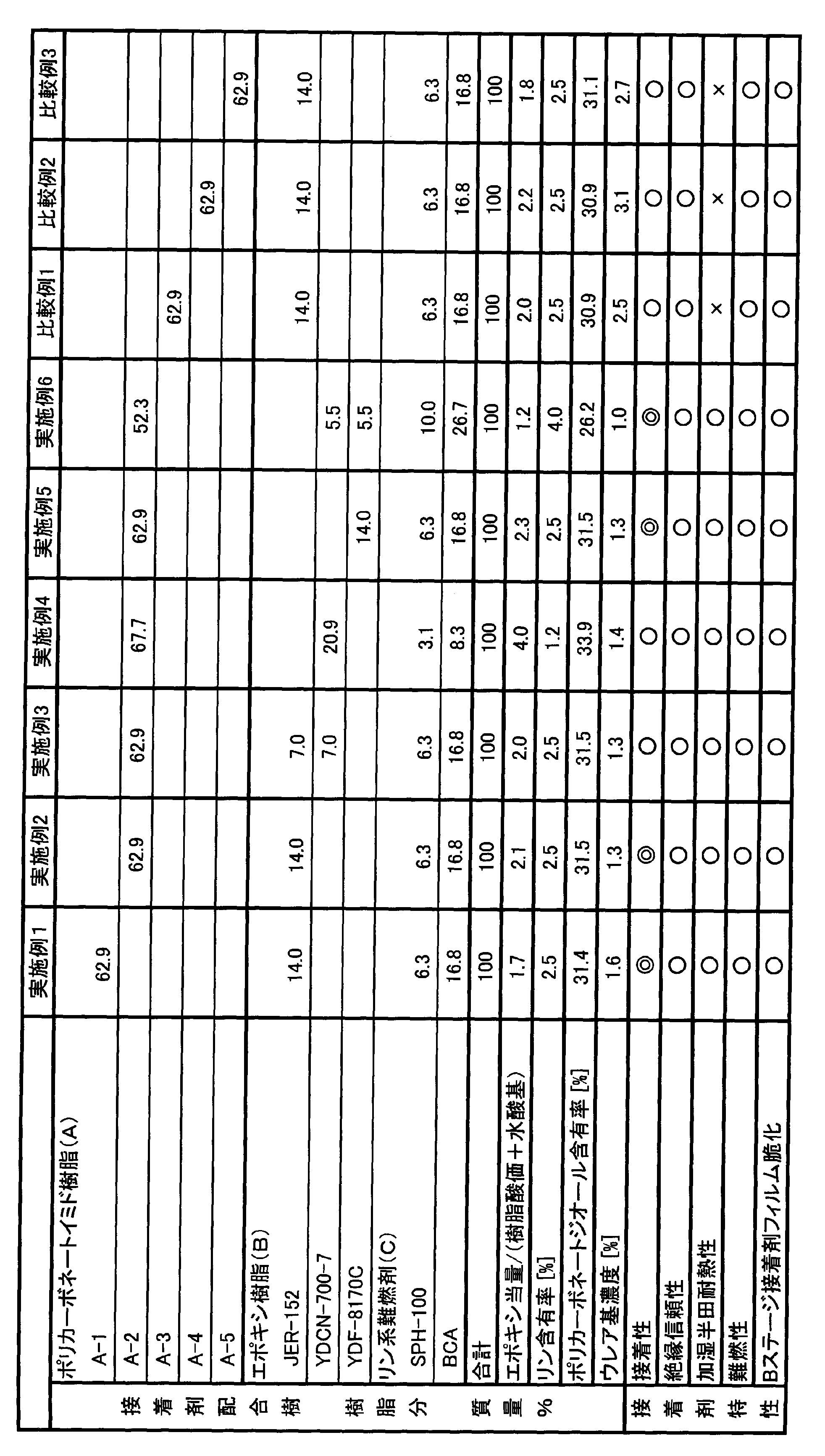
- Examples 1 to 6 A polycarbonate imide resin (A), an epoxy resin (B), and a flame retardant (C) were mixed in the proportions shown in Table 2, to prepare an adhesive solution, and the above-described property evaluation was performed.
- the polycarbonate imide resin paste obtained by the present invention has both excellent heat resistance and flexibility as a film forming material. For this reason, in addition to being useful for overcoat inks for various electronic parts such as flexible printed wiring boards, solder resist inks, and interlayer insulation films, it can be used in a wide range of electronic equipment as paints, coating agents, adhesives, etc. It is expected to contribute greatly to the world.
Landscapes
- Chemical & Material Sciences (AREA)
- Health & Medical Sciences (AREA)
- Chemical Kinetics & Catalysis (AREA)
- Medicinal Chemistry (AREA)
- Polymers & Plastics (AREA)
- Organic Chemistry (AREA)
- Macromolecular Compounds Obtained By Forming Nitrogen-Containing Linkages In General (AREA)
- Adhesives Or Adhesive Processes (AREA)
- Compositions Of Macromolecular Compounds (AREA)
- Polyurethanes Or Polyureas (AREA)
Abstract
Description
すなわち、本発明は、以下の構成からなる。
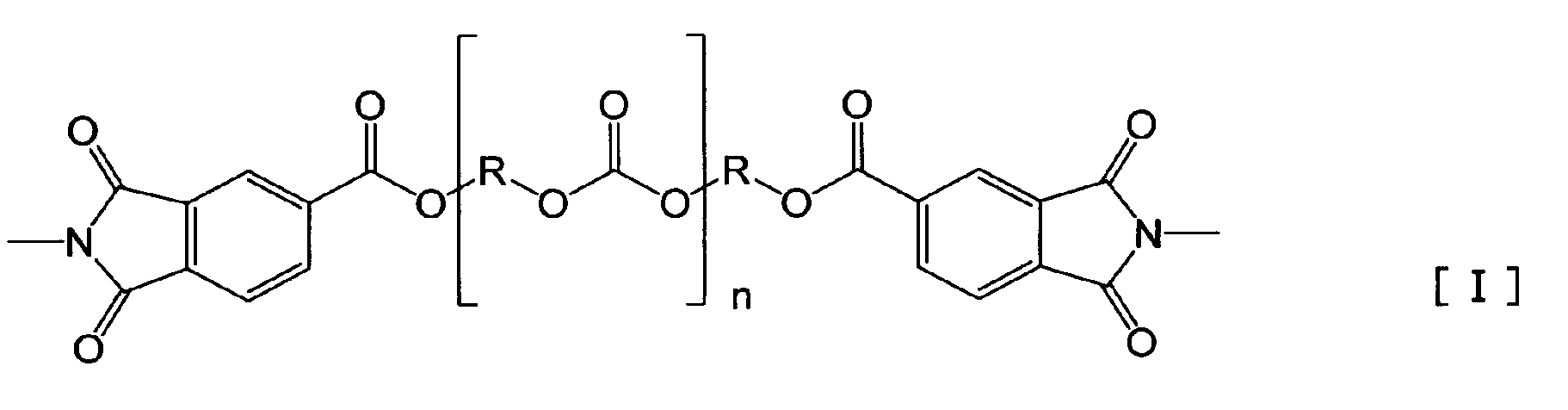
(一般式[I]において、複数個のRはそれぞれ独立に、炭素数1以上の2価の有機基であり、nは1以上の整数である。)
本発明のポリカーボネートイミド樹脂(A)について説明する。ポリカーボネートイミド樹脂(A)は、該樹脂の骨格中に一般式[I]に記載の構造を有する樹脂である。一般式[I]で示されるポリカーボネート骨格を有することで、ポリカーボネートイミド樹脂(A)が優れた接着性、および可とう性を発現することができる。
X={(B×F/E)×100}/(A/2+B+B×D/C+B×F/E)
本発明のポリカーボネートイミド樹脂(A)を構成する(a)成分としては、一般にイソシアネート成分と反応してポリイミド系樹脂を形成する、酸無水物基を有する3価及び/4価のポリカルボン酸誘導体(以下、単に(a)成分ともいう。)であることが好ましく、芳香族ポリカルボン酸誘導体、脂肪族ポリカルボン酸誘導体または脂環族ポリカルボン酸誘導体を用いることができる。
本発明のポリカーボネートイミド樹脂(A)を構成する、(b)成分は、一般式[II]で示されるポリカーボネート骨格を有する酸二無水物(以下、単に(b)成分ともいう。)であることが好ましい。一般式[II]の酸二無水物は、ポリカーボネートポリイミド系樹脂(A)に接着性、仮付け性等を付与する可とう性成分として共重合される。
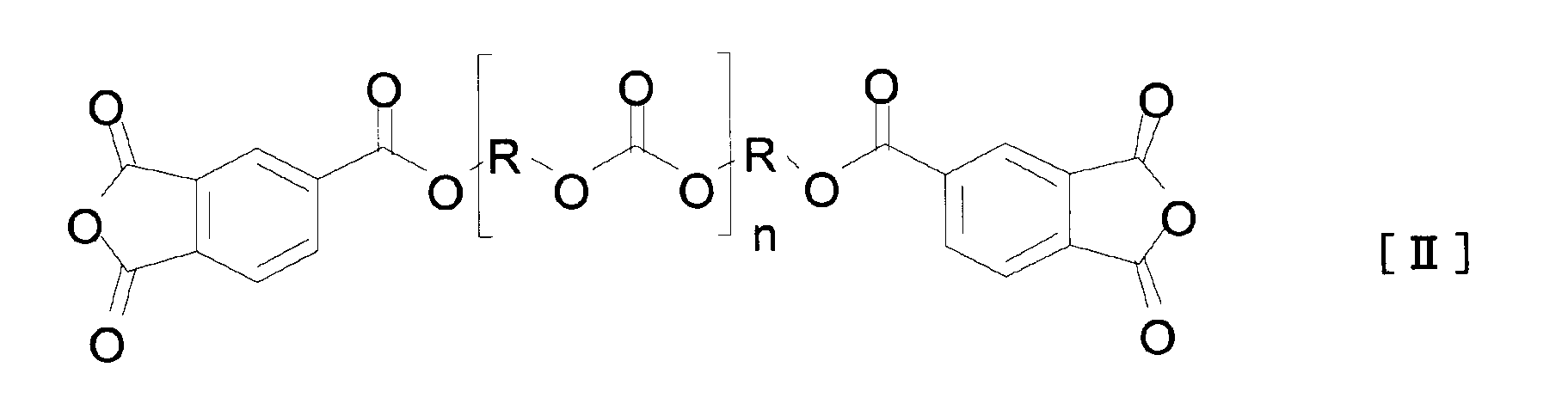
一般式[II]において、複数個のRはそれぞれ独立に、炭素数1以上の2価の有機基を示す。好ましい炭素数は2以上であり、より好ましくは4以上である。また、20以下であることが好ましく、より好ましくは10以下であり、さらに好ましくは8以下であり、特に好ましくは6以下である。炭素数1以上の2価の有機基の具体例としては、特に限定されず、置換基を有しても良いメチレン基、エチレン基、プロピレン基、ブチレン基、ペンチレン基、ヘキシレン基、ヘプチレン基またはオクチレン基等の脂肪族基、フェニレン基、ビフェニレン基等の芳香族基、シクロヘキシレン基等の脂環族基が挙げられる。なかでも脂肪族基が好ましく、n-ペンチレン基、n-ヘキシレン基がより好ましい。また、nは1以上の整数であり、好ましくは2以上であり、さらに好ましくは4以上である。上限は特に限定されず、20以下であることが好ましく、より好ましくは10以下である。上記範囲内にすることで、ポリカーボネートイミド樹脂(A)の優れた接着性および可とう性を発現することができる。
本発明のポリカーボネートイミド樹脂(A)を構成する、(c)成分はイソシアネート化合物(以下、単に(c)成分ともいう。)であれば特に限定されず、芳香族ポリイソシアネート、脂肪族ポリイソシアネート、または脂環族ポリイソシアネートが挙げられる。好ましくは芳香族ポリイソシアネートが用いられる。特に限定されないが、具体的には、芳香族ポリイソシアネートでは例えば、ジフェニルメタン-2,4’-ジイソシアネート、3,2’-又は3,3’-又は4,2’-又は4,3’-又は5,2’-又は5,3’-又は6,2’-又は6,3’-ジメチルジフェニルメタン-2,4’-ジイソシアネート、3,2’-又は3,3’-又は4,2’-又は4,3’-又は5,2’-又は5,3’-又は6,2’-又は6,3’-ジエチルジフェニルメタン-2,4’-ジイソシアネート、3,2’-又は3,3’-又は4,2’-又は4,3’-又は5,2’-又は5,3’-又は6,2’-又は6,3’-ジメトキシジフェニルメタン-2,4’-ジイソシアネート、ジフェニルメタン-4,4’-ジイソシアネート、ジフェニルメタン-3,3’-ジイソシアネート、ジフェニルメタン-3, 4’-ジイソシアネート、ジフェニルエーテル-4,4’-ジイソシアネート、ベンゾフェノン-4,4’-ジイソシアネート、ジフェニルスルホン-4,4’-ジイソシアネート、トリレン-2,4-ジイソシアネート、トリレン-2,6-ジイソシアネート、m-キシリレンジイソシアネート、p-キシリレンジイソシアネート、ナフタレン-2,6-ジイソシアネート、4,4’-[2,2ビス(4-フェノキシフェニル)プロパン]ジイソシアネート、3,3’または2,2’-ジメチルビフェニル-4,4’-ジイソシアネート、3,3’-または2,2’-ジエチルビフェニル-4,4’-ジイソシアネート、3,3’-ジメトキシビフェニル-4,4’-ジイソシアネート、3,3’-ジエトキシビフェニル-4,4’-ジイソシアネート等が挙げられる。耐熱性、密着性、溶解性、コスト面などを考慮すれば、ジフェニルメタン-4,4’-ジイソシアネート、トリレン-2,4-ジイソシアネート、m-キシリレンジイソシアネート、3,3’-または2,2’-ジメチルビフェニル-4,4’-ジイソシアネートが好ましく、3,3’-ジメチルビフェニル-4,4’-ジイソシアネート、トリレン-2,4-ジイソシアネートが更に好ましい。これらを単独で、または2種以上を併用することができる。
本発明のポリカーボネートイミド系樹脂(A)には、目的とする性能を損なわない範囲で必要に応じ、さらに脂肪族、脂環族、または芳香族ポリカルボン酸類を共重合しても構わない。脂肪族ジカルボン酸としては、例えば、コハク酸、グルタル酸、アジピン酸、スベリン酸、アゼライン酸、セバシン酸、デカン二酸、ドデカン二酸、エイコサン二酸、2-メチルコハク酸、2-メチルアジピン酸、3-メチルアジピン酸、3-メチルペンタンジカルボン酸、2-メチルオクタンジカルボン酸、3,8-ジメチルデカンジカルボン酸、3,7-ジメチルデカンジカルボン酸、9,12-ジメチルエイコサン二酸、フマル酸、マレイン酸、ダイマー酸、水添ダイマー酸等、脂環族ジカルボン酸としては、例えば、1,4-シクロへキサンジカルボン酸、1,3-シクロへキサンジカルボン酸、1,2-シクロへキサンジカルボン酸、4,4‘-ジシクロへキシルジカルボン酸等、芳香族ジカルボン酸としては、例えばイソフタル酸、テレフタル酸、オルソフタル酸、ナフタレンジカルボン酸、オキシジ安息香酸、スチルベンジカルボン酸等が挙げられる。これらのジカルボン酸類は単独でも二種以上を組み合わせて用いても構わない。耐熱性、密着性、溶解性、コスト面などを考慮すれば、セバシン酸、1,4-シクロへキサンジカルボン酸、ダイマー酸、またはイソフタル酸が好ましい。
ポリカーボネートイミド樹脂(A)の製造方法の一例を挙げるならば、(a)成分と(b)成分、(c)成分とを縮合反応(ポリイミド化)させて得ることができる。以下、本発明のポリカーボネートイミド樹脂(A)の製造方法を例示するが、本発明はこれにより限定されるものではない。
本発明で用いられる(B)成分のエポキシ樹脂は、1分子あたり2個以上のエポキシ基を有するエポキシ樹脂であれば特に限定されない。エポキシ樹脂(B)としては、特に限定されないが、例えば、シリコーン、ウレタン、ポリイミド、ポリアミド等で変性されていてもよく、また分子骨格内に硫黄原子、窒素原子等を含んでいてもよい。例えば、ビスフェノールA 型エポキシ樹脂、ビスフェノールF 型エポキシ樹脂、ビスフェノールS 型、またはそれらに水素添加したもの、フェノールノボラック型エポキシ樹脂、クレゾールノボラック型エポキシ樹脂等のグリシジルエーテル系エポキシ樹脂、ヘキサヒドロフタル酸グリシジルエステル、ダイマー酸グリシジルエステル等のグリシジルエステル系エポキシ樹脂、エポキシ化ポリブタジエン、エポキシ化大豆油等の線状脂肪族エポキシ樹脂等が挙げられる。これらの市販品としては、例えば、三菱化学( 株) 製の商品名jER828、1001等のビスフェノールA 型エポキシ樹脂、新日鉄住金化学(株)製の商品名ST-2004、2007等の水添ビスフェノールA型エポキシ樹脂、DIC(株)製のEXA-9726、新日鉄住金化学(株)製の商品名YDF-170、2004等のビスフェノールF型エポキシ樹脂、三菱化学(株)製の商品名jER152、154、ダウケミカル社製の商品名DEN-438、DIC(株)製の商品名HP7200、HP7200H等のフェノールノボラック型エポキシ樹脂、新日鉄住金化学(株)製の商品名YDCN-700シリーズ、日本化薬(株)製の商品名EOCN-125S、103S、104S等のクレゾールノボラック型エポキシ樹脂、新日鉄住金化学(株)製の商品名YD-171等の可撓性エポキシ樹脂、三菱化学(株)製の商品名Epon1031S 、チバ・スペシャルティ・ケミカルズ(株)製の商品名アラルダイト0163、ナガセケムテック(株)製の商品名デナコールEX-611、EX-614、EX-622、EX-512、EX-521、EX-421、EX-411、EX-321等の多官能エポキシ樹脂、三菱化学(株)製の商品名エピコート604 、新日鉄住金化学(株)製の商品名YH-434、チバ・スペシャルティ・ケミカルズ(株)製の商品名アラルダイトPT810等の複素環含有エポキシ樹脂、ダイセル化学工業(株)製の商品名セロキサイド2021、EHPE3150、UCC社製のERL4234等の脂環式エポキシ樹脂、DIC(株)製の商品名エピクロンEXA-1514等のビスフェノールS型エポキシ樹脂、日産化学工業(株)製のTEPIC等のトリグリシジルイソシアヌレート、三菱化学(株)製の商品名YX-4000等のビキシレノール型エポキシ樹脂、三菱化学(株)製の商品名YL-6056等のビスフェノール型エポキシ樹脂等が挙げられ、これらは単独で使用してもよいし、複数を組み合わせて使用しても構わない。
式1
エポキシ樹脂固形分(質量部)の接着剤固形分(質量部)に対する配合比率×エポキシ当量[eq/t]/{ポリカーボネートイミド樹脂(A)固形分(質量部)の接着剤固形分(質量部)に対する配合比率×ポリカーボネートイミド樹脂(A)の酸価[eq/t]}
式2
エポキシ樹脂固形分(質量部)の接着剤固形分(質量部)に対する配合比率×エポキシ当量[eq/t]/{ポリカーボネートイミド樹脂(A)固形分(質量部)の接着剤固形分(質量部)に対する配合比率×ポリカーボネートイミド樹脂(A)の酸価[eq/t]+水酸基を有する化合物固形分の接着剤固形分(質量部)に対する配合比率×水酸基価[eq/t]}
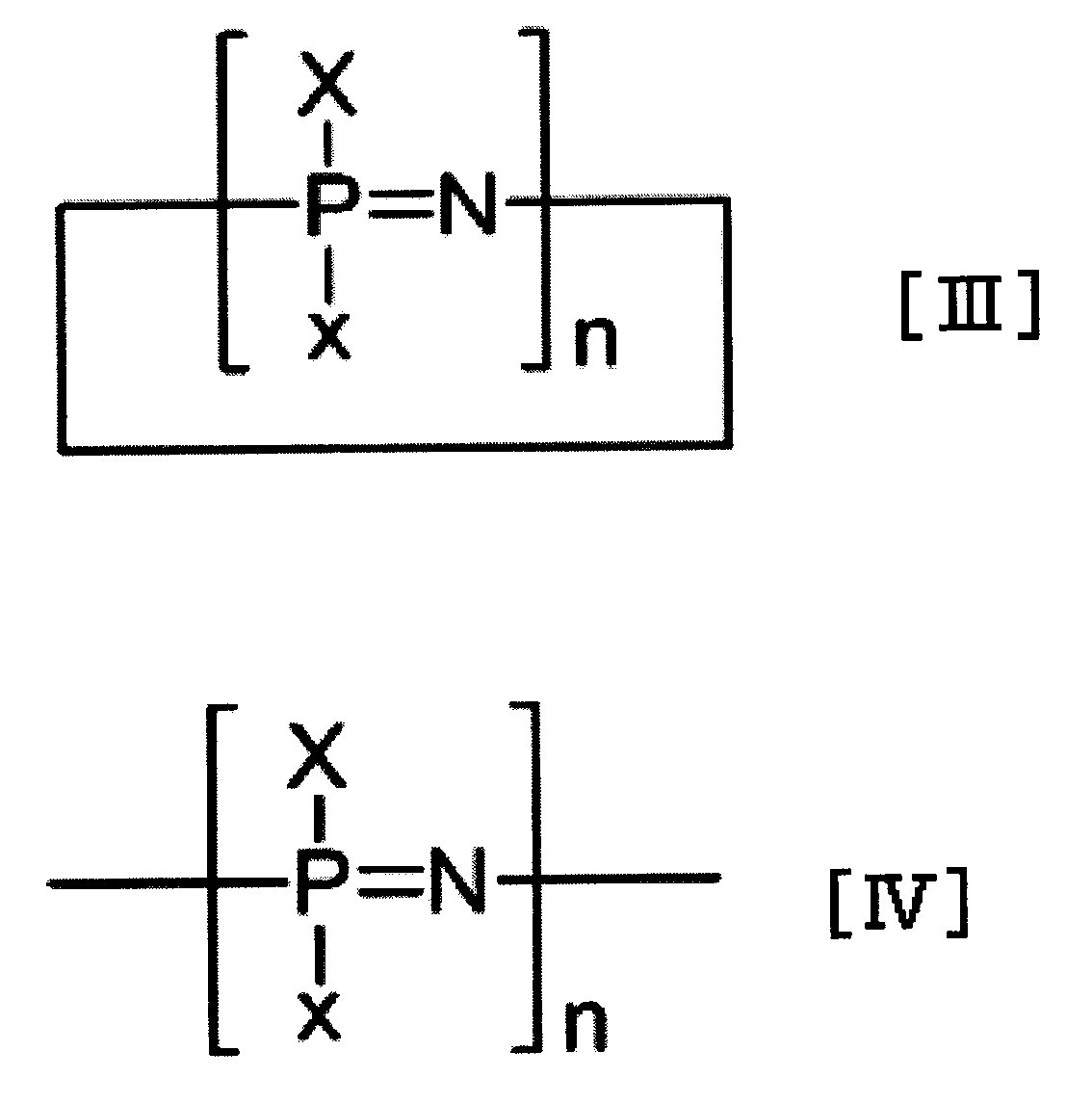
本発明の樹脂組成物は、さらにリン系難燃剤(C)を配合することが好ましい。リン系難燃剤(C)を配合することで、本発明の接着剤の難燃性を向上することができる。本発明で用いられるリン系難燃剤(C)としては、構造中にリン原子を含むものであれば特に限定されないが、耐加水分解性、耐熱性、ブリードアウトといった点から、ホスファゼン、またはホスフィン酸誘導体が好ましい。これらは単独でまたは2 種類以上組み合わせて用いても構わない。
本発明の樹脂組成物には、前記ポリカーボネートイミド樹脂(A)、エポキシ樹脂(B)およびリン系難燃剤(C)の他に、密着性、耐薬品性、耐熱性等の特性をよりいっそう向上するために、硬化促進剤(重合触媒)を添加することができる。本発明で用いられる硬化促進剤としては、上記のポリカーボネートイミド樹脂(A)、エポキシ樹脂(B)の硬化反応を促進できるものであればよく、特に制限はない。
本発明のポリカーボネートイミド樹脂(A)を含有する樹脂組成物(接着剤)は、前述したポリカーボネートイミド樹脂(A)成分、エポキシ樹脂(B)成分、リン系難燃剤(C)成分を含有する組成物である。さらに必要に応じて、その他の配合成分を好ましくは前記の割合で配合することができる。これにより、フレキシブルプリント配線板に好適な接着剤として用いることができる。
Y=G×H×K/J
本発明における接着剤溶液は、前記樹脂組成物(接着剤)を前記重合溶媒に溶解したものである。接着剤溶液は、B型粘度計での粘度が25℃で5dPa・s~30dPa・sの範囲が好ましく、8dPa・s~20dPa・sの範囲がさらに好ましい。粘度が5dPa・s未満であると、塗布時の溶液の流れ出し量が大きくなり、膜厚が薄膜化する傾向がある。粘度が30dPa・sを超えると塗布の際、基材へのレベリング性が低下する傾向がある。
本発明の接着剤溶液は、例えば、次のようにして溶剤を留去し、接着剤フィルムを得ることができる。即ち、離型フィルムに、スクリーン印刷法、スプレー法、ロールコート法、静電塗装法、カーテンコート法等の方法により5~80μmの膜厚で本発明のポリカーボネートイミド樹脂組成物溶液を塗布し、塗膜を60~150℃で3~10分間乾燥し、溶剤を留去する。乾燥は空気中でも不活性雰囲気中でもよい。
ポリカーボネートイミド樹脂(A)を、ポリマー濃度が0.5g/dlとなるようにN-メチル-2-ピロリドンに溶解した。その溶液の溶液粘度及び溶媒粘度を30℃で、ウベローデ型粘度管により測定して、下記の式で計算した。
対数粘度(dl/g)=[ln(V1/V2)]/V3
上記式中、V1はウベローデ型粘度管により測定した溶媒粘度を示すが、V1及びV2はポリマー溶液及び溶媒(N-メチル-2-ピロリドン)が粘度管のキャピラリーを通過する時間から求めた。また、V3はポリマー濃度(g/dl)である。
ポリカーボネートイミド樹脂(A)0.2gを20mlのN-メチルピロリドンに溶解し、0.1Nの水酸化カリウムエタノール溶液で滴定し、(A)成分10^6gあたりの当量(当量/10^6g)を求めた。
ウレア構造の定量は、ポリカーボネートイミド樹脂(A)ワニスをCDCl3/DMSO-d(1/1vol%)に溶解し、共鳴周波数500MHzの1H-NMR及び共鳴周波数125MHzの13C-NMR測定を行い求めた。1H-NMR測定により、アミド構造比率、イミド構造比率を算出し、13C-NMR測定により、アミド構造比率に対するウレア構造比率、アミド構造比率に対するアミド酸構造比率を算出した。同様に、ポリカーボネートイミド樹脂(A)中のポリカーボネートジオール含有率も、モル比を求め、含有率(質量%)に換算した。測定液の調製方法は以下の通りに行った。1H-NMR測定に関しては、試料10mgを重クロロホルムと重DMSOの混合溶媒(重クロロホルム/重DMSO=1/1(体積比))0.6mL、または重DMSO 0.6mLに溶解後、その溶液をNMRチューブに充填し測定を行った。13C-NMR測定に関しては、試料200mgを重DMSO 2,7mLに溶解後、その溶液をNMRチューブに充填し測定を行った。いずれの測定においても、ロック溶媒には重DMSOを用い、積算回数は64回(1H-NMR)または1024回(13C-NMR)行った。測定装置はBRUKER社製NMR装置AVANCE-500を用いた。
ウレア構造の定量は以下の通り計算した。1H-NMR測定の重クロロホルム/重DMSO混合溶媒において、重DMSOのピークを2.5ppmとした時、7.4ppm付近のピークがイミド構造のピーク(A)、7.7ppm付近のピークがアミド構造のピーク(B)である。A、Bを各ピークの積分値とする。1H-NMR測定の重DMSO溶媒において、重DMSOのピークを2.5ppmとした時、10.6ppm付近のピークがアミド構造のピーク(C)、10.4ppm付近のピークがアミド酸構造のピーク(D)である。C、Dを各ピークの積分値とする。13C-NMR測定において、重DMSOのピークを40.8ppmとした時、121.8ppm付近のピークがアミド構造のピーク(E)、119.6ppm付近のピークがウレア構造のピーク(F)である。E、Fを各ピークの積分値とする。各構造のピークの積分値を用いて、ウレア構造の濃度X(モル%)は下式で表す事ができる。
X={(B×F/E)×100}/(A/2+B+B×D/C+B×F/E)
カーボネートジオール含有率Y(質量%)は、以下の通り計算した、ポリカーボネートイミド樹脂(A)の質量(G)、ポリカーボネートイミド樹脂に含まれる(b)成分の質量比(H)、(b)成分の分子量(J)、(b)成分中のポリカーボネート骨格の分子量(K)としたとき、下式で表すことができる。
Y=G×H×K/J
ポリカーボネートイミド系樹脂(A)重合時、反応容器内に(a)成分、(b)成分、(c)成分および重合溶媒を加えて昇温し、内温140℃で5時間反応させた時点で原料((a)成分、(b)成分、(c)成分)を含む溶液が透明か霞みを生じたかどうかで評価した。
○:透明
×:霞みを生じる
接着剤溶液をポリイミドフィルム(カネカ製 アピカル12.5NPI)に乾燥後の厚みが20μmとなるように塗布し、140℃、3分間熱風乾燥機で乾燥させ、Bステージ接着剤フィルムを得た。このBステージ接着剤フィルムの接着剤塗布面と銅箔(JX日鉱日石製 BHY 厚み18μm)の光沢面を真空プレスラミネート機で、160℃、3MPa、30秒間減圧下で熱圧着させ、その後、150℃、4時間加熱硬化した。硬化後の積層材を、引っ張り試験機(島津製オートグラフAG-X plus)を用いて25℃の雰囲気下でポリイミドフィルムを90°の方向に50mm/minの速度で引き剥がし、接着強度を測定した。
◎:接着強度1.0N/mm以上
○:接着強度0.8N/mm以上1.0N/mm未満
△:接着強度0.6N/mm以上0.8N/mm未満
×:接着強度0.6N/mm未満
接着性評価と同様にBステージ接着剤フィルムを作製し、L/S=50/50μmのくし型パターンに真空プレスラミネート機を用いて、160℃、3MPa、30秒間減圧下で熱圧着させ、その後、150℃ で4時間加熱硬化した。温度85℃ 、湿度85%の環境下、200Vの電圧を250 時間印加した。
○:250時間後の抵抗値1×10⁸Ω以上かつデンドライトなし
×:250時間後の抵抗値が1×10⁸Ω 未満もしくはデンドライトあり
接着性の評価と同様に加熱硬化させた積層材を作製し、20mm角に切断し、温度40℃、湿度80%RHの環境下に2日間静置後、280℃の半田浴にポリイミド面を上にしてフロートさせた。
○:膨れや剥がれなし、
×:膨れもしくは剥がれあり
接着性の評価と同様にBステージ接着剤フィルムを調製し、接着剤塗布面とポリイミドフィルム(カネカ製 アピカル12.5NPI)とを真空プレスラミネート機を用いて、160℃、3MPa、30秒間減圧下で熱圧着させ、その後、150℃で4時間加熱硬化した。硬化後のサンプルをUL-94VTM規格に準拠して、難燃性を評価した。
○:VTM-0相当
×:VTM-0を満足しない
接着剤の溶液をPETフィルム(東洋紡製 E5101 厚み50μm)に乾燥後の厚みが20μmとなるように塗布し、140℃で3分間熱風乾燥機で乾燥させ、Bステージ接着剤フィルムを得た。接着剤面を巻き外側にして180°折り曲げて、1kgの鐘を乗せた。
○:接着剤フィルムに割れが発生しない
×:接着剤フィルムに割れが発生
反応容器にトリメリット酸無水物167g(0.87モル)と塩化チオニルとを仕込み、反応させてトリメリット酸無水物の塩化物を合成した。次いでトリメリット酸無水物の塩化物183g(0.87モル)とジオール化合物としてDURANOL-T5651(旭化成(製)、分子量1000)434g(0.43モル)とをトルエン中で、30℃でエステル化させることでポリカーボネート骨格含有テトラカルボン酸二無水物を合成した。
製造例1で合成した、(b)成分110.7g(0.08モル)、トリメリット酸無水物22.67g(0.12モル)、ジイソシアネートとして4,4’-ジフェニルメタンジイソシアネート(MDI)47.55g(0.19モル)、重合触媒として1,8-ジアザビシクロ[5,4,0]-7-ウンデセン0.30gを入れ、N-メチル-2-ピロリドン246.29gに溶解した。その後、窒素気流下、撹拌しながら、140℃で5時間反応させた後、ジメチルアセトアミド136.83g加えて希釈し、室温まで冷却することにより、不揮発分30質量%の褐色で粘調なポリカーボネートイミド樹脂溶液A-1を得た。
製造例1で合成した、(b)成分110.7g(0.08モル)、トリメリット酸無水物22.67g(0.12モル)、ジイソシアネートとして4,4’-ジフェニルメタンジイソシアネート(MDI)46.55g(0.19モル)、重合触媒として1,8-ジアザビシクロ[5,4,0]-7-ウンデセン0.30gを入れ、γ-ブチロラクトン245.32gに溶解した。その後、窒素気流下、撹拌しながら、140℃で5時間反応させた後、γ-ブチロラクトン136.29g加えて希釈し、室温まで冷却することにより、不揮発分30質量%の褐色で粘調なポリカーボネートイミド樹脂溶液A-2を得た。
製造例1で合成した、(b)成分110.7g(0.08モル)、トリメリット酸無水物22.67g(0.12モル)、ジイソシアネートとして4,4’-ジフェニルメタンジイソシアネート(MDI)51.55g(0.21モル)、重合触媒として1,8-ジアザビシクロ[5,4,0]-7-ウンデセン0.30gを入れ、ジメチルアセトアミド250.19gに溶解した。その後、窒素気流下、撹拌しながら、140℃で5時間反応させた後、ジメチルアセトアミド138.99g加えて希釈し、室温まで冷却することにより、不揮発分30質量%の褐色で粘調なポリカーボネートイミド樹脂溶液A-3を得た。
製造例1で合成した、(b)成分110.7g(0.08モル)、トリメリット酸無水物22.67g(0.12モル)、ジイソシアネートとして4,4’-ジフェニルメタンジイソシアネート(MDI)52.05g(0.21モル)を入れ、ジメチルアセトアミド250.67gに溶解した。その後、窒素気流下、撹拌しながら、140℃で5時間反応させた後、ジメチルアセトアミド139.26g加えて希釈し、室温まで冷却することにより、不揮発分30質量%の褐色で粘調なポリカーボネートイミド樹脂溶液A-4を得た。
製造例1で合成した、(b)成分37.80g(0.03モル)、トリメリット酸無水物33.05g(0.17モル)、ジイソシアネートとして4,4’-ジフェニルメタンジイソシアネート(MDI)47.55g(0.19モル)を入れ、γ-ブチロラクトン152.51gに溶解した。その後、窒素気流下、撹拌しながら、140℃で反応させたところ、γ-ブチロラクトンに溶解せず、溶液にかすみが生じた。
ポリカーボネートイミド樹脂(A)、エポキシ樹脂(B)、難燃剤(C)を表2に記載の割合で混合し、接着剤溶液を調製し、上記の特性評価を行った。
実施例1と同様にして、接着剤溶液を調製し、上記の特性評価を行った。比較例1、比較例2は共に、ポリカーボネートイミド樹脂(A)中に含まれるウレア基濃度が3モル%超と高い。吸湿性が高く、耐熱性が低いウレア構造比率の増加に伴って、加湿半田耐熱性が低下した。評価結果を表2に示す。

Claims (4)
- 一般式[I]に記載の構造を有するポリカーボネートイミド樹脂(A)であって、前記ポリカーボネートイミド樹脂(A)中のアミド構造、イミド構造、アミド酸構造、及びウレア構造の合計を100モル%としたときに、ウレア構造の含有量が3モル%以下であることを特徴とするポリカーボネートイミド樹脂(A)。
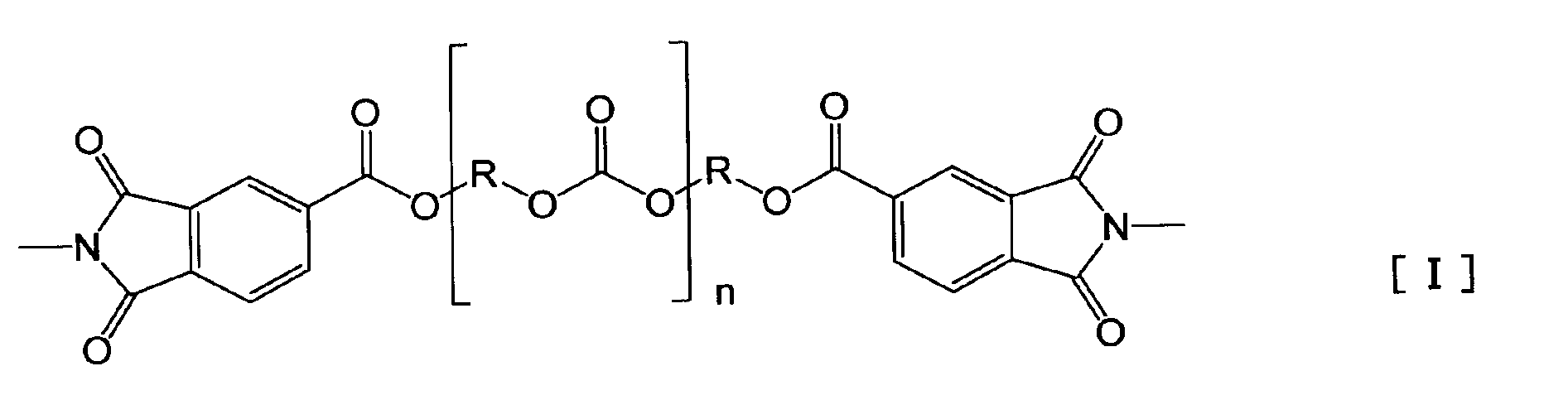
(一般式[I]において、複数個のRはそれぞれ独立に、炭素数1以上の2価の有機基であり、nは1以上の整数である。) - ポリカーボネートイミド樹脂(A)の全構成成分を200モル%としたとき、一般式[I]に記載の構造を15モル%以上含有することを特徴とする請求項1に記載のポリカーボネートイミド樹脂(A)。
- 請求項1または2に記載のポリカーボネートイミド樹脂(A)、および1分子あたり2個以上のエポキシ基を有するエポキシ樹脂(B)を含む樹脂組成物。
- 更にリン系難燃剤(C)を含む請求項3に記載の樹脂組成物。
Priority Applications (3)
| Application Number | Priority Date | Filing Date | Title |
|---|---|---|---|
| CN201780063685.6A CN109843981B (zh) | 2016-11-04 | 2017-10-23 | 聚碳酸酯酰亚胺树脂及含有该树脂的树脂组合物 |
| KR1020197000573A KR102422913B1 (ko) | 2016-11-04 | 2017-10-23 | 폴리카보네이트이미드 수지 및 그것을 포함하는 수지 조성물 |
| JP2018548633A JP7028182B2 (ja) | 2016-11-04 | 2017-10-23 | ポリカーボネートイミド樹脂及びそれを含む樹脂組成物 |
Applications Claiming Priority (2)
| Application Number | Priority Date | Filing Date | Title |
|---|---|---|---|
| JP2016216097 | 2016-11-04 | ||
| JP2016-216097 | 2016-11-04 |
Publications (1)
| Publication Number | Publication Date |
|---|---|
| WO2018084013A1 true WO2018084013A1 (ja) | 2018-05-11 |
Family
ID=62076737
Family Applications (1)
| Application Number | Title | Priority Date | Filing Date |
|---|---|---|---|
| PCT/JP2017/038185 Ceased WO2018084013A1 (ja) | 2016-11-04 | 2017-10-23 | ポリカーボネートイミド樹脂及びそれを含む樹脂組成物 |
Country Status (5)
| Country | Link |
|---|---|
| JP (1) | JP7028182B2 (ja) |
| KR (1) | KR102422913B1 (ja) |
| CN (1) | CN109843981B (ja) |
| TW (1) | TWI749090B (ja) |
| WO (1) | WO2018084013A1 (ja) |
Cited By (1)
| Publication number | Priority date | Publication date | Assignee | Title |
|---|---|---|---|---|
| CN112313302A (zh) * | 2018-06-21 | 2021-02-02 | 东洋纺株式会社 | 包含丙烯腈丁二烯橡胶共聚聚酰胺酰亚胺树脂的粘接剂组合物 |
Families Citing this family (1)
| Publication number | Priority date | Publication date | Assignee | Title |
|---|---|---|---|---|
| CN113467022B (zh) * | 2021-09-02 | 2021-11-23 | 长飞光纤光缆股份有限公司 | 一种光缆及其制备方法 |
Citations (4)
| Publication number | Priority date | Publication date | Assignee | Title |
|---|---|---|---|---|
| JP2013095894A (ja) * | 2011-11-04 | 2013-05-20 | Asahi Kasei E-Materials Corp | ポリイミド前駆体又はポリイミド及び感光性樹脂組成物 |
| JP2014180846A (ja) * | 2013-03-21 | 2014-09-29 | Toyobo Co Ltd | 透明フレキシブル金属張積層体、及びフレキシブルプリント配線板 |
| WO2016067925A1 (ja) * | 2014-10-28 | 2016-05-06 | 東洋紡株式会社 | ポリカーボネートイミド系樹脂ペーストおよび該ペーストを硬化して得られるソルダーレジスト層、表面保護層、層間絶縁層または接着層を有する電子部品 |
| WO2017068999A1 (ja) * | 2015-10-19 | 2017-04-27 | 東洋紡株式会社 | ポリカーボネートイミド樹脂、およびこれを用いたペースト |
Family Cites Families (7)
| Publication number | Priority date | Publication date | Assignee | Title |
|---|---|---|---|---|
| US3849218A (en) | 1973-03-13 | 1974-11-19 | Conversion Chem Corp | Composition and method for stripping nickel, zinc and cadmium from substrates of iron and copper |
| JP3136942B2 (ja) | 1994-03-18 | 2001-02-19 | 宇部興産株式会社 | ポリイミドシロキサンの組成物 |
| JP2865198B2 (ja) | 1996-07-19 | 1999-03-08 | 宇部興産株式会社 | 高分子膜を有するフレキシブル配線板 |
| JP2003289594A (ja) | 2002-01-24 | 2003-10-10 | Matsushita Electric Ind Co Ltd | スピーカ用振動板とそれに用いるポリアミドイミド樹脂及びポリイミド樹脂 |
| US9267004B2 (en) * | 2008-07-22 | 2016-02-23 | Kaneka Corporation | Polyimide precursor composition and use thereof |
| JP5672701B2 (ja) * | 2008-10-01 | 2015-02-18 | 東洋紡株式会社 | ポリアミドイミド樹脂、該樹脂組成物、難燃性接着剤組成物並びに該組成物からなる接着剤シート、カバーレイフィルム及びプリント配線板 |
| TWI623567B (zh) * | 2014-09-05 | 2018-05-11 | Toyobo Co., Ltd. | 聚酯醯亞胺樹脂膜及使用於此樹脂膜之樹脂與樹脂組成物 |
-
2017
- 2017-10-23 JP JP2018548633A patent/JP7028182B2/ja active Active
- 2017-10-23 CN CN201780063685.6A patent/CN109843981B/zh active Active
- 2017-10-23 KR KR1020197000573A patent/KR102422913B1/ko active Active
- 2017-10-23 WO PCT/JP2017/038185 patent/WO2018084013A1/ja not_active Ceased
- 2017-10-27 TW TW106137002A patent/TWI749090B/zh active
Patent Citations (4)
| Publication number | Priority date | Publication date | Assignee | Title |
|---|---|---|---|---|
| JP2013095894A (ja) * | 2011-11-04 | 2013-05-20 | Asahi Kasei E-Materials Corp | ポリイミド前駆体又はポリイミド及び感光性樹脂組成物 |
| JP2014180846A (ja) * | 2013-03-21 | 2014-09-29 | Toyobo Co Ltd | 透明フレキシブル金属張積層体、及びフレキシブルプリント配線板 |
| WO2016067925A1 (ja) * | 2014-10-28 | 2016-05-06 | 東洋紡株式会社 | ポリカーボネートイミド系樹脂ペーストおよび該ペーストを硬化して得られるソルダーレジスト層、表面保護層、層間絶縁層または接着層を有する電子部品 |
| WO2017068999A1 (ja) * | 2015-10-19 | 2017-04-27 | 東洋紡株式会社 | ポリカーボネートイミド樹脂、およびこれを用いたペースト |
Cited By (2)
| Publication number | Priority date | Publication date | Assignee | Title |
|---|---|---|---|---|
| CN112313302A (zh) * | 2018-06-21 | 2021-02-02 | 东洋纺株式会社 | 包含丙烯腈丁二烯橡胶共聚聚酰胺酰亚胺树脂的粘接剂组合物 |
| CN112313302B (zh) * | 2018-06-21 | 2022-06-03 | 东洋纺株式会社 | 包含丙烯腈丁二烯橡胶共聚聚酰胺酰亚胺树脂的粘接剂组合物 |
Also Published As
| Publication number | Publication date |
|---|---|
| JPWO2018084013A1 (ja) | 2019-09-19 |
| KR20190077302A (ko) | 2019-07-03 |
| KR102422913B1 (ko) | 2022-07-21 |
| CN109843981A (zh) | 2019-06-04 |
| TW201823301A (zh) | 2018-07-01 |
| CN109843981B (zh) | 2022-05-31 |
| JP7028182B2 (ja) | 2022-03-02 |
| TWI749090B (zh) | 2021-12-11 |
Similar Documents
| Publication | Publication Date | Title |
|---|---|---|
| JP5672701B2 (ja) | ポリアミドイミド樹脂、該樹脂組成物、難燃性接着剤組成物並びに該組成物からなる接着剤シート、カバーレイフィルム及びプリント配線板 | |
| KR102218936B1 (ko) | 폴리아미드이미드 수지를 이용한 접착제 조성물 | |
| KR102171631B1 (ko) | 폴리아미드이미드 수지를 이용한 접착제 조성물 | |
| KR102587386B1 (ko) | 아크릴로니트릴 부타디엔 고무 공중합 폴리아미드 이미드 수지를 포함하는 접착제 조성물 | |
| JP5782583B1 (ja) | ポリアミドイミド樹脂を用いた接着剤組成物 | |
| JP6592640B1 (ja) | アクリロニトリルブタジエンゴム共重合ポリアミドイミド樹脂を含む接着剤組成物 | |
| JP6130980B1 (ja) | ポリアミドイミド樹脂を用いた接着剤組成物 | |
| JP7028182B2 (ja) | ポリカーボネートイミド樹脂及びそれを含む樹脂組成物 | |
| CN112534019B (zh) | 使用了具有酰亚胺键的树脂及磷化合物的粘接剂组合物 | |
| TW202022006A (zh) | 使用了具有醯亞胺鍵之樹脂及磷化合物之黏接劑組成物 | |
| TW202436579A (zh) | 接著劑組成物 |
Legal Events
| Date | Code | Title | Description |
|---|---|---|---|
| ENP | Entry into the national phase |
Ref document number: 2018548633 Country of ref document: JP Kind code of ref document: A |
|
| 121 | Ep: the epo has been informed by wipo that ep was designated in this application |
Ref document number: 17867293 Country of ref document: EP Kind code of ref document: A1 |
|
| ENP | Entry into the national phase |
Ref document number: 20197000573 Country of ref document: KR Kind code of ref document: A |
|
| NENP | Non-entry into the national phase |
Ref country code: DE |
|
| 122 | Ep: pct application non-entry in european phase |
Ref document number: 17867293 Country of ref document: EP Kind code of ref document: A1 |