WO2018079428A1 - ポリイソシアネート組成物およびそれを用いた塗料組成物、及び該ポリイソシアネート組成物の製造方法 - Google Patents
ポリイソシアネート組成物およびそれを用いた塗料組成物、及び該ポリイソシアネート組成物の製造方法 Download PDFInfo
- Publication number
- WO2018079428A1 WO2018079428A1 PCT/JP2017/037963 JP2017037963W WO2018079428A1 WO 2018079428 A1 WO2018079428 A1 WO 2018079428A1 JP 2017037963 W JP2017037963 W JP 2017037963W WO 2018079428 A1 WO2018079428 A1 WO 2018079428A1
- Authority
- WO
- WIPO (PCT)
- Prior art keywords
- group
- producing
- polyisocyanate
- butyl
- reaction
- Prior art date
- Legal status (The legal status is an assumption and is not a legal conclusion. Google has not performed a legal analysis and makes no representation as to the accuracy of the status listed.)
- Ceased
Links
Classifications
-
- C—CHEMISTRY; METALLURGY
- C08—ORGANIC MACROMOLECULAR COMPOUNDS; THEIR PREPARATION OR CHEMICAL WORKING-UP; COMPOSITIONS BASED THEREON
- C08G—MACROMOLECULAR COMPOUNDS OBTAINED OTHERWISE THAN BY REACTIONS ONLY INVOLVING UNSATURATED CARBON-TO-CARBON BONDS
- C08G18/00—Polymeric products of isocyanates or isothiocyanates
- C08G18/06—Polymeric products of isocyanates or isothiocyanates with compounds having active hydrogen
- C08G18/08—Processes
- C08G18/09—Processes comprising oligomerisation of isocyanates or isothiocyanates involving reaction of a part of the isocyanate or isothiocyanate groups with each other in the reaction mixture
-
- C—CHEMISTRY; METALLURGY
- C08—ORGANIC MACROMOLECULAR COMPOUNDS; THEIR PREPARATION OR CHEMICAL WORKING-UP; COMPOSITIONS BASED THEREON
- C08G—MACROMOLECULAR COMPOUNDS OBTAINED OTHERWISE THAN BY REACTIONS ONLY INVOLVING UNSATURATED CARBON-TO-CARBON BONDS
- C08G18/00—Polymeric products of isocyanates or isothiocyanates
- C08G18/06—Polymeric products of isocyanates or isothiocyanates with compounds having active hydrogen
- C08G18/08—Processes
- C08G18/16—Catalysts
- C08G18/18—Catalysts containing secondary or tertiary amines or salts thereof
-
- C—CHEMISTRY; METALLURGY
- C08—ORGANIC MACROMOLECULAR COMPOUNDS; THEIR PREPARATION OR CHEMICAL WORKING-UP; COMPOSITIONS BASED THEREON
- C08G—MACROMOLECULAR COMPOUNDS OBTAINED OTHERWISE THAN BY REACTIONS ONLY INVOLVING UNSATURATED CARBON-TO-CARBON BONDS
- C08G18/00—Polymeric products of isocyanates or isothiocyanates
- C08G18/06—Polymeric products of isocyanates or isothiocyanates with compounds having active hydrogen
- C08G18/28—Polymeric products of isocyanates or isothiocyanates with compounds having active hydrogen characterised by the compounds used containing active hydrogen
-
- C—CHEMISTRY; METALLURGY
- C08—ORGANIC MACROMOLECULAR COMPOUNDS; THEIR PREPARATION OR CHEMICAL WORKING-UP; COMPOSITIONS BASED THEREON
- C08G—MACROMOLECULAR COMPOUNDS OBTAINED OTHERWISE THAN BY REACTIONS ONLY INVOLVING UNSATURATED CARBON-TO-CARBON BONDS
- C08G18/00—Polymeric products of isocyanates or isothiocyanates
- C08G18/06—Polymeric products of isocyanates or isothiocyanates with compounds having active hydrogen
- C08G18/70—Polymeric products of isocyanates or isothiocyanates with compounds having active hydrogen characterised by the isocyanates or isothiocyanates used
- C08G18/72—Polyisocyanates or polyisothiocyanates
- C08G18/73—Polyisocyanates or polyisothiocyanates acyclic
-
- C—CHEMISTRY; METALLURGY
- C09—DYES; PAINTS; POLISHES; NATURAL RESINS; ADHESIVES; COMPOSITIONS NOT OTHERWISE PROVIDED FOR; APPLICATIONS OF MATERIALS NOT OTHERWISE PROVIDED FOR
- C09D—COATING COMPOSITIONS, e.g. PAINTS, VARNISHES OR LACQUERS; FILLING PASTES; CHEMICAL PAINT OR INK REMOVERS; INKS; CORRECTING FLUIDS; WOODSTAINS; PASTES OR SOLIDS FOR COLOURING OR PRINTING; USE OF MATERIALS THEREFOR
- C09D175/00—Coating compositions based on polyureas or polyurethanes; Coating compositions based on derivatives of such polymers
- C09D175/04—Polyurethanes
-
- C—CHEMISTRY; METALLURGY
- C09—DYES; PAINTS; POLISHES; NATURAL RESINS; ADHESIVES; COMPOSITIONS NOT OTHERWISE PROVIDED FOR; APPLICATIONS OF MATERIALS NOT OTHERWISE PROVIDED FOR
- C09D—COATING COMPOSITIONS, e.g. PAINTS, VARNISHES OR LACQUERS; FILLING PASTES; CHEMICAL PAINT OR INK REMOVERS; INKS; CORRECTING FLUIDS; WOODSTAINS; PASTES OR SOLIDS FOR COLOURING OR PRINTING; USE OF MATERIALS THEREFOR
- C09D7/00—Features of coating compositions, not provided for in group C09D5/00; Processes for incorporating ingredients in coating compositions
- C09D7/40—Additives
Definitions
- the present invention relates to a polyisocyanate composition containing an isocyanurate structure having chemical and thermal stability as a curing agent in the case of obtaining a polyurethane resin, a coating composition using the polyisocyanate composition as a curing agent, and the polyisocyanate composition.
- the present invention relates to a manufacturing method for stabilizing color.
- Non-yellowing polyisocyanates derived from aliphatic isocyanates such as 1,6-hexamethylene diisocyanate (hereinafter referred to as HDI) are excellent in weather resistance, and among them, polyisocyanates containing isocyanurate bonds are chemically. High thermal stability, especially excellent weather resistance, heat resistance, and durability, so it is widely used in the paint / painting and adhesive fields according to its application, and further application development is expected. Yes.
- Patent Documents 1 and 2 when a catalyst is added to convert the diisocyanate to isocyanurate, there is a problem that insoluble matter is generated during the reaction due to the poor affinity between the catalyst and HDI and the strong catalytic activity (Patent Documents 1 and 2). ).
- urethanized polyisocyanate can be suitably used as a cocatalyst.
- the hydroxyl group-containing compound is highly hydrophilic during urethanization, when a highly hydrophilic catalyst is added, there is also a problem that sudden heat generation occurs during the reaction, and insoluble matter is generated ( Patent Document 3).
- modified organic polyisocyanates obtained by modifying organic polyisocyanates such as HDI are useful in the field of polyurethane plastics and are used in various fields. For example, it is used with polyols in the production of foams, fibers, films, elastomers and paints.
- the modified organic polyisocyanate is often diluted with an organic solvent.
- the modified organic polyisocyanate when it is diluted with an organic solvent, it tends to discolor during storage. This property is particularly noticeable when the modified organic polyisocyanate must be stored at relatively high temperatures.
- the problems with BHT are that it is relatively volatile, tends to migrate into a support covered with polyurethane, and tends to turn yellow when stored diluted with an organic solvent. That is. For these reasons, there has been a demand for a stabilizer and a production method that can overcome the problems with stability after dilution with an organic solvent and BHT.
- the present invention has been made in view of the background art described above, and in the case of the isocyanuration reaction, an insoluble matter or the like is not generated, and the polyisocyanate can be efficiently reacted and has excellent storage stability. It aims at providing the composition and the two-component coating composition which uses this as a hardening
- modified organic polyisocyanate which improves the color stability at the time of diluting and storing modified organic polyisocyanate, and makes this a 2nd subject.
- the present inventors have used a specific hydroxyl group-containing compound and a specific isocyanurate-forming catalyst when obtaining a reaction product of HDI and a hydroxyl group-containing compound, and production of a modified organic polyisocyanate.
- the inventors have found that the above problem can be solved by adding a specific compound at a specific timing, and have reached the present invention.
- the present invention includes the following embodiments [1] to [16].
- An isocyanurate group-containing polyisocyanate composition containing a reaction product of hexamethylene diisocyanate, a hydroxyl group-containing compound having a water / octanol partition coefficient of 0.5 or more, and a quaternary ammonium salt represented by Formula 1.
- R 1 to R 4 each independently represents an alkyl group having 1 to 18 carbon atoms, any one or more of R 1 to R 4 have 8 or more carbon atoms, and R 1 The total carbon number of ⁇ R 4 is 11 or more, and A ⁇ represents a carbonic acid ester represented by Formula 2.
- R 5 represents an alkyl group
- Isocyanurate group-containing polyisocyanate composition obtained by reacting hexamethylene diisocyanate with a hydroxyl group-containing compound having a water / octanol partition coefficient of 0.5 or more in the presence of a quaternary ammonium salt represented by formula 1 Manufacturing method.
- R 1 to R 4 each independently represents an alkyl group having 1 to 18 carbon atoms, any one or more of R 1 to R 4 have 8 or more carbon atoms, and R 1 The total number of carbon atoms of ⁇ R 4 is 11 or more, and A ⁇ represents a carbonic acid ester represented by Formula 2)
- R 5 represents an alkyl group
- a two-component coating composition comprising the isocyanurate group-containing polyisocyanate composition described in [1] or [2] above and a polyol.
- the compound having a sterically hindered phenol structure is tetrakis [methylene-3- (3 ′, 5′-di-t-butyl-4′-hydroxyphenyl) propionate] methane, 3- (3,5-di- tert-butyl-4-hydroxyphenyl) octadecyl propanoate, octyl 3- (4-hydroxy-3,5-diisopropylphenyl) propionate, 1,3,5-tris (3,5-di-tert-butyl-4 -Hydroxybenzyl) isocyanuric acid, 2,4,6-tris (3 ', 5'-di-tert-butyl-4'-hydroxybenzyl) mesitylene, at least one selected from the above, [8] A process for producing a modified organic polyisocyanate according to [8].
- modified organic polyisocyanate according to any one of the above [8] to [10], wherein the modified organic polyisocyanate contains at least one selected from the group consisting of isocyanurate groups and allophanate groups. Manufacturing method.
- the compound having a sterically hindered phenol structure is tetrakis [methylene-3- (3 ′, 5′-di-t-butyl-4′-hydroxyphenyl) propionate] methane, 3- (3,5-di- tert-butyl-4-hydroxyphenyl) octadecyl propanoate, octyl 3- (4-hydroxy-3,5-diisopropylphenyl) propionate, 1,3,5-tris (3,5-di-tert-butyl-4 -Hydroxybenzyl) isocyanuric acid, 2,4,6-tris (3 ', 5'-di-tert-butyl-4'-hydroxybenzyl) mesitylene, at least one selected from the above, [12] A process for producing an isocyanurate group-containing polyisocyanate composition according to [12].
- a method for producing a two-component coating composition comprising the modified organic polyisocyanate obtained by the production method of any one of [8] to [13] above and a polyol.
- Embodiment 1 means for solving the first problem is referred to as Embodiment 1
- Embodiment 2 means for solving the second problem is referred to as Embodiment 2.
- an insoluble matter or the like is not generated during the isocyanuration reaction, and the reaction can proceed efficiently, and the polyisocyanate composition having excellent mechanical properties and storage stability, and curing thereof.
- a two-component coating composition used as an agent, and a coating film and coating material comprising the same, ensuring hardness and excellent glossiness can be obtained.
- the modified organic polyisocyanate produced by adding a specific compound at a specific timing greatly reduces the tendency of discoloration during storage at high temperatures after dilution with an organic solvent, and is advantageous for the subsequent production of polyurethane. Can be used.
- the polyisocyanate used in the polyisocyanate composition that solves the first problem of the present invention is HDI, which is a kind of aliphatic diisocyanate.
- aliphatic diisocyanate examples include, besides HDI, tetramethylene diisocyanate, 2-methyl-pentane-1,5-diisocyanate, 3-methyl-pentane-1,5-diisocyanate, lysine diisocyanate, trioxyethylene diisocyanate, and the like. be able to.
- These aliphatic diisocyanates may be used in combination with HDI.
- the quaternary ammonium salt (hereinafter also simply referred to as quaternary ammonium salt) having a cation structure represented by the above formula 1 and an anion structure represented by the above formula 2 contained in the polyisocyanate composition of the present invention is isocyanurated. It can be suitably used as a reaction catalyst.
- the quaternary ammonium salt in the present invention has strong catalytic activity and high hydrophilicity, so it is poorly compatible with HDI, and insoluble matter is likely to be generated due to local reaction. Also, the reaction efficiency is deteriorated. For this reason, the carbon number of the alkyl group (R 1 to R 4 ) in the cation structure of the quaternary ammonium salt is obtained from the viewpoint of obtaining good compatibility and suppressing insoluble matter generation while avoiding these problems. Is 11 or more.
- alkyl groups examples include methyl, ethyl, propyl, butyl, pentyl, hexyl, heptyl, octyl, nonyl, decyl, undecyl, dodecyl, tridecyl, tetradecyl, and the like.
- Cycloalkyl groups such as cyclopentyl group, cyclohexyl group, cycloheptyl group, cyclooctyl group, etc. It is done.
- At least one of R 1 to R 4 has 8 or more carbon atoms from the viewpoint of compatibility and activity.
- an alkyl group having 8 to 12 carbon atoms is most preferred because the activity may be lowered if the alkyl group has too many carbon atoms.
- the number of carbon atoms of the other alkyl group is not particularly limited, but if the number of carbon atoms is too large, the activity may decrease. Therefore, the number of carbon atoms in the other alkyl groups is preferably 1-8.
- the anion structure of the quaternary ammonium salt of the present invention is an alkyl carbonate represented by the above formula 2 as a weak acid salt.
- alkyl group (R 5 ) of the alkyl carbonate include methyl group, ethyl group, propyl group, butyl group, pentyl group, hexyl group, heptyl group, octyl group, nonyl group, decyl group, undecyl group, dodecyl group, Alkyl groups (including various isomers) such as tridecyl group, tetradecyl group, pentadecyl group, hexadecyl group, heptadecyl group, octadecyl group, nonadecyl group, eicosyl group, cyclopentyl group, cyclohexyl group, cycloheptyl group, cyclooctyl group, cyclonon
- Examples of the hydroxyl group-containing compound that can be used in the polyisocyanate composition that solves the first problem of the present invention include those having a water / octanol partition coefficient of 0.5 or more.
- the water / octanol partition coefficient (hereinafter also referred to as log P value) is a parameter that represents a measure of the hydrophobicity / hydrophilicity of a compound. The larger the value, the more hydrophobic, the smaller the value. It shows that it is hydrophilic.
- the water / octanol partition coefficient is a well-known compound parameter and can be determined by measurement or calculation.
- the partition coefficient of the substance in two solvent systems of n-octanol and water is In some cases, the distribution coefficient calculated as the logP value by the above calculation formula and the distribution coefficient that can be obtained by measurement do not completely match, and there is a slight difference between the calculated value and the measured value. However, since the difference is not large, the present invention employs a distribution coefficient that can be obtained from a calculated value.
- log P value is also described in literatures, etc., as described above, methods for obtaining log P by calculation have been proposed in recent years, such as those based on molecular orbital calculation, the fragment method using Hansch data, And HPLC method.
- the logP value in the present invention means a value calculated using the simple calculation method of the chemical structural formula software ChemDraw Prime 15.1 (manufactured by PerkinElmer).
- Examples of the hydroxyl group-containing compound having a log P value of 0.5 or more include 1-butanol, isobutanol, 1-pentanol, 2-pentanol, 1-hexanol, 2-hexanol, 1-heptanol, 1-octanol, 2 -Ethyl-1-hexanol, 3,3,5-trimethyl-1-hexanol, 1-tridecanol, 2-tridecanol, 2-octyldodecanol, pentadecanol, palmityl alcohol, stearyl alcohol, cyclopentanol, cyclohexanol Monoalcohols such as methylcyclohexanol and trimethylcyclohexanol, and C6 to C18 alkanediols.
- the log P value is less than 0.5, for example, after adding an isocyanuration catalyst, the compatibility with isocyanates such as HDI deteriorates, so a local reaction occurs, and an insoluble matter is generated due to rapid heat generation. There is a risk of lowering productivity and reaction efficiency. Since the crystallinity of the hydroxyl group-containing compound tends to increase as the log P value increases, the low-temperature stability of the polyisocyanate using the compound may deteriorate, and the isocyanate content in the polyisocyanate decreases. The amount of urethane bonds in the urethane coating film used as a curing agent decreases, and there is a concern that the mechanical properties will deteriorate. Accordingly, the LogP value is particularly preferably 0.5 to 3.5.
- an organic diisocyanate and a hydroxyl group-containing compound are charged with an excess amount of isocyanate groups relative to the hydroxyl groups, and urethanized at 20 to 60 ° C. in the presence or absence of an organic solvent to give isocyanate.
- Base end prepolymer I is produced.
- the presence or absence of completion is judged by the isocyanate group content and the refractive index increase value by the neutralization titration method.
- the isocyanate group-terminated prepolymer I is charged with an allophanate / isocyanurate catalyst, and isocyanurate / allophanate is formed at 50 to 150 ° C. until the desired isocyanate group content and molecular weight are reached. Isocyanate group-terminated prepolymer II is produced.
- the reaction is stopped by adding a reaction terminator to the isocyanate group-terminated prepolymer II.
- reaction proceeds under nitrogen gas or a dry air stream.
- the isocyanate group-terminated prepolymer II is removed by thin film distillation or solvent extraction until the content of free organic diisocyanate is less than 1% by mass.
- reaction temperature of the urethanization reaction of the present invention is preferably 20 to 70 ° C., more preferably 30 to 60 ° C.
- the reaction time of the urethanization reaction varies depending on the presence or absence of the catalyst, the type, and the temperature, but is generally within 10 hours, preferably 1 to 5 hours is sufficient.
- the amount of the isocyanurate-forming catalyst used is preferably 0.001 to 1.0 mass%, more preferably 0.005 to 0.1 mass%, based on the total mass of the organic diisocyanate and monoalcohol.
- the isocyanuration reaction does not proceed sufficiently, which may lead to a decrease in productivity and yield.
- the upper limit is exceeded, the isocyanurate reaction occurs rapidly, making it difficult to control the reaction. Further, the amount of the isocyanurate polymer is larger than that of the target product, and the isocyanate content of the polyisocyanate composition may be lowered. Therefore, the amount of urethane bonds in the urethane coating film using this as a curing agent is reduced, and there is a concern that mechanical properties are lowered.
- reaction temperature of the isocyanuration reaction is preferably 50 to 150 ° C., more preferably 60 to 100 ° C. from the viewpoint of reactivity control.
- a method of performing the reaction without including an organic solvent or a method of performing the reaction in the presence of the organic solvent is appropriately selected.
- an organic solvent that does not affect the reaction can be used.
- the organic solvent include aliphatic hydrocarbons such as octane, alicyclic hydrocarbons such as cyclohexane and methylcyclohexane, ketones such as methyl isobutyl ketone and cyclohexanone, esters such as butyl acetate and isobutyl acetate, Ethylene glycol ethyl ether acetate, propylene glycol monomethyl ether acetate, 3-methyl-3-methoxybutyl acetate, glycol ether esters such as ethyl-3-ethoxypropionate, ethers such as dioxane, methylene iodide, monochlorobenzene, etc.
- a polar aprotic solvent such as N-methylpyrrolidone, dimethylformamide, dimethylacetamide, dimethylsulfoxide, hexamethylphosphonilamide, and the like. These solvents can be used alone or in combination of two or more.
- the organic solvent used in the reaction is removed simultaneously with the removal of free organic diisocyanate in the fourth step.
- the reaction terminator in the third step has a function of deactivating the activity of the catalyst.
- the organic acid has an inorganic acid such as phosphoric acid or hydrochloric acid, a sulfonic acid group, a sulfamic acid group, or the like.
- known compounds such as esters and acyl halides are used.
- These reaction terminators can be used alone or in combination of two or more.
- the addition time is preferably a rapid addition after completion of the reaction.
- the addition amount of the reaction terminator varies depending on the type of the reaction terminator and the catalyst used, but is preferably 0.5 to 10 equivalents, and particularly preferably 0.8 to 5.0 equivalents. When there are few reaction terminators, the storage stability of the obtained polyisocyanate composition tends to be lowered, and when it is too much, the obtained polyisocyanate composition may be colored.
- the purification step of the fourth step is a step of removing free unreacted organic diisocyanate present in the reaction mixture.
- the residual unreacted organic diisocyanate residual content is 1.0 mass by a thin film distillation at 120 to 150 ° C. under a high vacuum of 10 to 100 Pa or an extraction method with an organic solvent. % Or less.
- the residual content rate of free unreacted organic diisocyanate exceeds the upper limit, there is a possibility that odor is generated or storage stability is lowered.
- the polyisocyanate composition obtained by purification can be made into a blocked isocyanate using a known blocking agent for the purpose of extending the pot life or making the two-component coating composition one component.
- a known blocking agent for the purpose of extending the pot life or making the two-component coating composition one component.
- the blocked polyisocyanate is inactive at room temperature, but when heated, the blocking agent dissociates, and the isocyanate group is activated again, thereby causing a potential function to react with the active hydrogen group. Can be added.
- the blocking agent that can be used in the present invention is a compound having one active hydrogen in the molecule, for example, an alcohol, alkylphenol, phenol, active methylene, mercaptan, acid amide, acid imide, There are imidazole, urea, oxime, amine, imide, and pyrazole compounds.
- the polyisocyanate composition that solves the first problem obtained by a series of reactions can obtain the two-component coating composition of the present invention by blending a polyol.
- the polyol used in the two-component coating composition of the present invention is not particularly limited, but is a compound containing an active hydrogen group as a reactive group with an isocyanate group, such as a polyester polyol
- Suitable examples include ether polyols, polycarbonate polyols, polyolefin polyols, acrylic polyols, silicone polyols, castor oil-based polyols, fluorine-based polyols, transesterification products of two or more polyols, and hydroxyl-terminated prepolymers that are urethanated with polyisocyanates. Used, and these can be used as one kind or a mixture of two or more kinds.
- polyester polyol examples include phthalic acid, isophthalic acid, terephthalic acid, naphthalenedicarboxylic acid, succinic acid, tartaric acid, oxalic acid, malonic acid, glutaric acid, adipic acid, pimelic acid, suberic acid, glutaconic acid, azelaic acid, sebacic acid 1,4-cyclohexyldicarboxylic acid, ⁇ -hydromuconic acid, ⁇ -hydromuconic acid, ⁇ -butyl- ⁇ -ethylglutaric acid, ⁇ , ⁇ -diethylsuccinic acid, maleic acid, fumaric acid, and other dicarboxylic acids or these
- One or more anhydrides such as ethylene glycol, 1,2-propanediol, 1,3-propanediol, 1,2-butanediol, 1,3-butanediol, 1,4-
- lactone polyester polyols obtained from ring-opening polymerization of cyclic ester (so-called lactone) monomers such as ⁇ -caprolactone, alkyl-substituted ⁇ -caprolactone, ⁇ -valerolactone, and alkyl-substituted ⁇ -valerolactone.
- lactone cyclic ester
- a polyester-amide polyol obtained by replacing a part of the low molecular polyol with a low molecular polyamine such as hexamethylene diamine, isophorone diamine or monoethanolamine or a low molecular amino alcohol can also be used.
- polyether polyol examples include ethylene glycol, 1,2-propanediol, 1,3-propanediol, 1,2-butanediol, 1,3-butanediol, 1,4-butanediol, and 1,5-pentane.
- Diol 1,6-hexanediol, 1,8-octanediol, 1,9-nonanediol, 3-methyl-1,5-pentanediol, 3,3-dimethylolheptane, diethylene glycol, dipropylene glycol, neopentyl Low in glycol, cyclohexane-1,4-diol, cyclohexane-1,4-dimethanol, dimer acid diol, bisphenol A, bis ( ⁇ -hydroxyethyl) benzene, xylylene glycol, glycerol, trimethylolpropane, pentaerythritol, etc.
- polyether polyols obtained by addition polymerization of alkylene oxides such as ethylene oxide, propylene oxide and butylene oxide, alkyl glycidyl ethers such as methyl glycidyl ether, aryl glycidyl ethers such as phenyl glycidyl ether, tetrahydrofuran And polyether polyols obtained by ring-opening polymerization of cyclic ether monomers such as
- Polycarbonate polyol examples include ethylene glycol, 1,2-propanediol, 1,3-propanediol, 1,2-butanediol, 1,3-butanediol, 1,4-butanediol, and 1,5-pentanediol.
- low molecular polyols such as rupropane and pentaerythritol
- dialkyl carbonates such as dimethyl carbonate and diethyl carbonate
- alkylene carbonates such as ethylene carbonate and propylene carbonate
- diphenyl carbonate dinaphthy
- a polyol obtained by a transesterification reaction between a polycarbonate polyol, a polyester polyol, and a low molecular weight polyol can be suitably used.
- polyolefin polyol examples include polybutadiene having two or more hydroxyl groups, hydrogenated polybutadiene, polyisoprene, and hydrogenated polyisoprene.
- acrylic polyol examples include acrylic acid ester and / or methacrylic acid ester (hereinafter referred to as (meth) acrylic acid ester), acrylic acid hydroxy compound having at least one hydroxyl group in the molecule and / or methacrylic acid which can be a reaction point.
- An acid hydroxy compound hereinafter referred to as a (meth) acrylic acid hydroxy compound
- a polymerization initiator may be used in which an acrylic monomer is copolymerized using thermal energy, light energy such as ultraviolet rays or electron beams, and the like. .
- Examples of (meth) acrylic acid esters include alkyl esters having 1 to 20 carbon atoms.
- Examples of such (meth) acrylic acid esters include methyl (meth) acrylate, ethyl (meth) acrylate, propyl (meth) acrylate, butyl (meth) acrylate, pentyl (meth) acrylate, (meth Alkyl (meth) acrylates such as hexyl acrylate, 2-ethylhexyl (meth) acrylate, octyl (meth) acrylate, nonyl (meth) acrylate, decyl (meth) acrylate, dodecyl (meth) acrylate Esters; esters of (meth) acrylic acid such as cyclohexyl (meth) acrylate with alicyclic alcohols; (meth) acrylic acid aryl esters such as phenyl (meth) acrylate
- the (meth) acrylic acid hydroxy compound has, for example, at least one hydroxyl group in the molecule which can be a reaction point with polyisocyanate, and specifically includes, for example, 2-hydroxyethyl acrylate, 2-hydroxypropyl Examples thereof include acrylic acid hydroxy compounds such as acrylate, 4-hydroxybutyl acrylate, 3-hydroxy-2,2-dimethylpropyl acrylate, and pentaerythritol triacrylate.
- Examples thereof also include hydroxy methacrylate compounds such as 2-hydroxyethyl methacrylate, 2-hydroxypropyl methacrylate, 4-hydroxybutyl methacrylate, 3-hydroxy-2,2-dimethylpropyl methacrylate, and pentaerythritol trimethacrylate.
- hydroxy methacrylate compounds such as 2-hydroxyethyl methacrylate, 2-hydroxypropyl methacrylate, 4-hydroxybutyl methacrylate, 3-hydroxy-2,2-dimethylpropyl methacrylate, and pentaerythritol trimethacrylate.
- hydroxy methacrylate compounds such as 2-hydroxyethyl methacrylate, 2-hydroxypropyl methacrylate, 4-hydroxybutyl methacrylate, 3-hydroxy-2,2-dimethylpropyl methacrylate, and pentaerythritol trimethacrylate.
- acrylic acid hydroxy compounds one or a combination of two or more may be mentioned.
- silicone polyol examples include a vinyl group-containing silicone compound obtained by polymerizing ⁇ -methacryloxypropyltrimethoxysilane and the like, and ⁇ , ⁇ -dihydroxypolydimethylsiloxane having at least one terminal hydroxyl group in the molecule, ⁇ , ⁇ - Examples thereof include polysiloxanes such as dihydroxypolydiphenylsiloxane.
- Castor oil-based polyol examples include linear or branched polyester polyols obtained by the reaction of castor oil fatty acid and polyol. Dehydrated castor oil, partially dehydrated castor oil partially dehydrated, and hydrogenated castor oil added with hydrogen can also be used.
- the fluorine-based polyol is, for example, a linear or branched polyol obtained by a copolymerization reaction using a fluorine-containing monomer and a monomer having a hydroxy group as essential components.
- the fluorine-containing monomer is preferably a fluoroolefin, for example, tetrafluoroethylene, chlorotrifluoroethylene, trichlorofluoroethylene, hexafluoropropylene, vinylidene fluoride, vinyl fluoride, trifluoromethyl trifluoroethylene.
- Examples of the monomer having a hydroxyl group include hydroxyalkyl vinyl ethers such as hydroxyethyl vinyl ether, 4-hydroxybutyl vinyl ether and cyclohexanediol monovinyl ether, hydroxyalkyl allyl ethers such as 2-hydroxyethyl allyl ether, and hydroxyalkyl vinyl crotonates. And monomers having a hydroxyl group, such as a hydroxyl group-containing vinyl carboxylate or allyl ester.
- the polyol preferably has an active hydrogen group number (average functional group number) in one molecule of 1.9 to 6.0.
- the number of active hydrogen groups is less than the lower limit, the physical properties of the coating film may be reduced.
- an upper limit there exists a possibility that adhesiveness may fall.
- the number average molecular weight of the polyol is preferably in the range of 750 to 50,000. If it is less than the lower limit, the adhesion may be reduced, and if it exceeds the upper limit, the solubility in a low-polar organic solvent may be lowered or the adhesion may be lowered.
- organic solvent used as a diluting solvent ketones such as acetone, methyl ethyl ketone and methyl isobutyl ketone, esters such as ethyl acetate, butyl acetate and cellosolve, alcohols such as butanol and isopropyl alcohol, toluene, xylene, From the group consisting of hydrocarbons such as cyclohexane, mineral spirits, naphtha and the like, it can be appropriately selected and used according to the purpose and application. These solvents may be used alone or in combination of two or more.
- the two-component coating composition of the present invention can use a known urethanization catalyst as appropriate in consideration of pot life, curing conditions, working conditions, and the like.
- a known urethanization catalyst as appropriate in consideration of pot life, curing conditions, working conditions, and the like.
- organic metal compounds such as dibutyltin diacetate, dibutyltin dilaurate and dioctyltin dilaurate, organic amines such as triethylenediamine and triethylamine, and salts thereof are selected and used.
- These catalysts can be used alone or in combination of two or more.
- the curing conditions for the two-component coating composition are not particularly limited, but the curing temperature is -5 to 120 ° C., the humidity is 10 to 95% RH, and the curing time is 0.5 to 168 hours. Preferably there is.
- the two-component coating composition obtained by the present invention may contain, for example, an antioxidant such as 2,6-di-tert-butyl-4-methylphenol, an ultraviolet absorber, a pigment, a dye, Additives such as a solvent, a flame retardant, a hydrolysis inhibitor, a lubricant, a plasticizer, a filler, an antistatic agent, a dispersant, a catalyst, a storage stabilizer, a surfactant, and a leveling agent can be appropriately blended.
- an antioxidant such as 2,6-di-tert-butyl-4-methylphenol
- an ultraviolet absorber such as 2,6-di-tert-butyl-4-methylphenol
- Additives such as a solvent, a flame retardant, a hydrolysis inhibitor, a lubricant, a plasticizer, a filler, an antistatic agent, a dispersant, a catalyst, a storage stabilizer, a surfactant, and a leveling agent can be appropriately blended.
- the two-component coating composition obtained by the present invention is applied on the surface of the adherend by a known method such as spraying, brushing, dipping, or coater to form a coating film.
- the adherend is not particularly limited, and is stainless steel, phosphated steel, zinc steel, iron, copper, aluminum, brass, glass, slate, acrylic resin, polycarbonate resin, polyethylene terephthalate resin, polyethylene naphthalate resin. , Polybutylene phthalate resin, polystyrene resin, AS resin, ABS resin, polycarbonate-ABS resin, 6-nylon resin, 6,6-nylon resin, MXD6 nylon resin, polyvinyl chloride resin, polyvinyl alcohol resin, polyurethane resin, phenol resin , Melamine resin, polyacetal resin, chlorinated polyolefin resin, polyolefin resin, polyamide resin, polyether ether ketone resin, polyphenylene sulfide resin, NBR resin, chloroprene resin, SBR resin, SE An adherend formed of a material such as S resin, an olefin resin such as polyethylene or polypropylene subjected to corona discharge treatment or other surface treatment, or an intermediate layer such as
- the film thickness of the coating film formed on the adherend surface layer is excellent in recoatability and durability, the film thickness of at least 10 ⁇ m may be formed on the adherend.
- the film thickness is less than 10 ⁇ m, the durability is lowered, and there is a possibility that the coating film is torn by impact.
- the modified organic polyisocyanate produced by this production method can be obtained by adding a compound having a sterically hindered phenol structure excluding BHT after the organic diisocyanate monomer is isocyanurated or allophanated.
- an organic diisocyanate monomer and a hydroxyl group-containing compound are charged in an excess amount of isocyanate groups relative to hydroxyl groups, and urethanated, isocyanated at 50 to 150 ° C. in the presence or absence of an organic solvent.
- An isocyanate group-terminated prepolymer I is produced by at least one of a nurating and allophanating reaction. As a measure of the reaction here, the completion is judged by the isocyanate group content and the refractive index increase value by the neutralization titration method.
- the reaction is stopped by adding a reaction terminator to the isocyanate group-terminated prepolymer I.
- a compound having a sterically hindered phenol structure excluding BHT is added to the isocyanate group-terminated prepolymer I.
- reaction proceeds under nitrogen gas or a dry air stream.
- the isocyanate group-terminated prepolymer I obtained in the third step is removed by thin film distillation or solvent extraction until the content of free organic diisocyanate monomer is less than 1% by mass, and the modified organic polyisocyanate is removed. obtain.
- the “amount of excess isocyanate group” in the first step is different in the case of the isocyanurate reaction and in the case of the allophanate reaction, and in the case of the isocyanurate reaction, the molar ratio of the isocyanate group to the hydroxyl group.
- R isocyanate group / hydroxyl group
- R 200 to 2000.
- the amount When the amount is less than the lower limit, the amount of a polyisocyanate composition having a molecular weight higher than that of the target product is increased, which may increase the viscosity. If the upper limit is exceeded, the viscosity increases and the product yield decreases, which may lead to a decrease in productivity.
- the organic diisocyanate monomer used in the first step is not particularly limited, and examples thereof include aliphatic diisocyanate, alicyclic diisocyanate, aromatic diisocyanate, and araliphatic diisocyanate.
- aliphatic diisocyanate examples include hexamethylene diisocyanate, tetramethylene diisocyanate, 2-methyl-pentane-1,5-diisocyanate, 3-methyl-pentane-1,5-diisocyanate, lysine diisocyanate, and trioxyethylene diisocyanate. A mixture of these can also be used.
- alicyclic diisocyanate examples include isophorone diisocyanate, cyclohexane diisocyanate, hydrogenated diphenylmethane diisocyanate, norbornane diisocyanate, hydrogenated tolylene diisocyanate, hydrogenated xylene diisocyanate, hydrogenated tetramethylxylene diisocyanate, and the like. Mixtures can also be used.
- aromatic diisocyanate examples include 2,4-tolylene diisocyanate, 2,6-tolylene diisocyanate, 4,4′-diphenylmethane diisocyanate, 2,4′-diphenylmethane diisocyanate, 2,2′-diphenylmethane diisocyanate, 4 , 4′-diphenyl ether diisocyanate, 2-nitrodiphenyl-4,4′-diisocyanate, 2,2′-diphenylpropane-4,4′-diisocyanate, 3,3′-dimethyldiphenylmethane-4,4′-diisocyanate, 4, , 4'-diphenylpropane diisocyanate, m-phenylene diisocyanate, p-phenylene diisocyanate, naphthylene-1,4-diisocyanate, naphthylene-1,5-diisocyan
- araliphatic diisocyanate examples include 1,3- or 1,4-xylylene diisocyanate, 1,3- or 1,4-bis (1-isocyanato-1-methylethyl) benzene, ⁇ , ⁇ '- Examples thereof include diisocyanato-1,4-diethylbenzene, and a mixture thereof can also be used.
- aliphatic or alicyclic isocyanates that are less colored over time, and from the viewpoint of handling reaction products obtained by the reaction. More preferably, an aliphatic isocyanate is used.
- the hydroxyl group-containing compound used in the first step is not particularly limited, and examples thereof include compounds containing one or more hydroxyl groups in one molecule.
- examples of such a hydroxyl group-containing compound include methanol, ethanol, propanol, n-butanol, isobutanol, n-pentanol, 2-pentanol, n-hexanol, 2-hexanol, n-heptanol, n-octanol, 2-ethyl-1-hexanol, 3,3,5-trimethyl-1-hexanol, n-tridecanol, 2-tridecanol, 2-octyldodecanol, pentadecanol, palmityl alcohol, stearyl alcohol, cyclopentanol, cyclo
- monoalcohols such as hexanol, methylcyclohexanol, and trimethylcyclohexanol, and
- the catalyst used for the reaction can be appropriately selected from known catalysts according to the reaction to be performed.
- a quaternary ammonium salt or the like can be used as the isocyanuration catalyst, and a basic catalyst such as a carboxylic acid metal salt can be used as the allophanate catalyst.
- quaternary ammonium salts include commercially available products such as 2-hydroxypropyltrimethylammonium octylate (DABCO TMR, manufactured by Sankyo Air Products), tetramethylammonium acetate, tetrabutyltylammonium acetate, and the like. .
- DABCO TMR 2-hydroxypropyltrimethylammonium octylate
- tetramethylammonium acetate tetrabutyltylammonium acetate
- carboxylic acid metal salt examples include zinc salts, tin salts, and zirconium salts of carboxylic acids such as acetic acid, propionic acid, undecyl acid, capric acid, octylic acid, and myristic acid.
- the first step reaction can be performed in various organic solvents that do not affect the reaction.
- the organic solvent include aliphatic hydrocarbons, alicyclic hydrocarbons, ketones, esters, glycols.
- examples include ether esters, ethers, halogenated hydrocarbons, and polar aprotic solvents.
- aliphatic hydrocarbons examples include n-hexane and octane.
- Examples of the alicyclic hydrocarbons include cyclohexane and methylcyclohexane.
- ketones include acetone, methyl ethyl ketone, methyl isobutyl ketone, and cyclohexanone.
- esters examples include methyl acetate, ethyl acetate, butyl acetate, and isobutyl acetate.
- glycol ether esters examples include ethylene glycol ethyl ether acetate, propylene glycol methyl ether acetate, 3-methyl-3-methoxybutyl acetate, ethyl-3-ethoxypropionate, and the like.
- ethers examples include diethyl ether, tetrahydrofuran, dioxane and the like.
- halogenated hydrocarbons include methyl chloride, methylene chloride, chloroform, carbon tetrachloride, methyl bromide, methylene iodide, dichloroethane, and the like.
- polar aprotic solvent examples include N-methylpyrrolidone, dimethylformamide, dimethylacetamide, dimethylsulfoxide, hexamethylphosphonilamide and the like.
- solvents can be used alone or in combination of two or more.
- the organic solvent used in the reaction is removed simultaneously with the removal of free organic diisocyanate in the fourth step.
- the reaction terminator in the second step has a function of deactivating the activity of the catalyst.
- the organic acid has an inorganic acid such as phosphoric acid or hydrochloric acid, a sulfonic acid group, a sulfamic acid group, or the like.
- known compounds such as esters and acyl halides are used.
- These reaction terminators can be used alone or in combination of two or more.
- the addition time is preferably a rapid addition after completion of the reaction.
- the addition amount of the reaction terminator varies depending on the kind of the reaction terminator and the catalyst used, but is preferably 0.5 to 10 equivalents, particularly preferably 0.8 to 5.0 equivalents of the catalyst.
- the storage stability of the obtained polyisocyanate composition tends to be lowered, and when it is too much, the modified polyisocyanate may be colored.
- Examples of the compound having a sterically hindered phenol structure excluding BHT to be added in the third step include tetrakis [methylene-3- (3 ′, 5′-di-t-butyl-4′-hydroxyphenyl) propionate] methane.
- adding a compound having a sterically hindered phenol structure excluding BHT after the production of the modified organic polyisocyanate means this third step, which is to add after stopping the reaction in the second step.
- free unreacted organic diisocyanate monomer present in the reaction mixture is removed, for example, by thin film distillation at 120 to 150 ° C. under a high vacuum of 10 to 100 Pa or with an organic solvent.
- the residual content is adjusted to 1.0 mass% or less by an extraction method.
- the residual content rate of an organic diisocyanate monomer exceeds an upper limit, there exists a possibility of causing the generation
- the modified organic polyisocyanate obtained by purification can be converted to a blocked isocyanate using a known blocking agent for the purpose of extending the pot life and making the two-component coating composition one component.
- a known blocking agent for the purpose of extending the pot life and making the two-component coating composition one component.
- the blocked polyisocyanate is inactive at room temperature, but when heated, the blocking agent dissociates, and the isocyanate group is activated again, thereby causing a potential function to react with the active hydrogen group. Can be added.
- the blocking agent is a compound having one active hydrogen group in the molecule, for example, alcohol, alkylphenol, phenol, active methylene, mercaptan, acid amide, acid imide, imidazole, urea, There are oxime, amine, imide, and pyrazole compounds.
- the modified organic polyisocyanate obtained by a series of reactions can be made into a two-component coating composition by blending a polyol.
- the polyol used in the two-component coating composition is not particularly limited, but is a compound containing an active hydrogen group as a reactive group with an isocyanate group, such as a polyester polyol or a polyether polyol.
- Polycarbonate polyol, polyolefin polyol, acrylic polyol, silicone polyol, castor oil-based polyol, fluorine-based polyol, and the like Specific examples of these polyols include the various polyols described above.
- a transesterification product of two or more kinds of polyols, a hydroxyl-terminated prepolymer that has undergone a urethanation reaction with polyisocyanate, and the like are suitably used, and these can also be used as one kind or a mixture of two or more kinds.
- the polyol preferably has an active hydrogen group number (average functional group number) in one molecule of 1.9 to 6.0.
- the number of active hydrogen groups is less than the lower limit, the physical properties of the coating film may be reduced.
- an upper limit there exists a possibility that adhesiveness may fall.
- the number average molecular weight of the polyol is preferably in the range of 750 to 50,000. If it is less than the lower limit, the adhesion may be reduced, and if it exceeds the upper limit, the solubility in a low-polar organic solvent may be lowered or the adhesion may be lowered.
- organic solvent used as a diluting solvent ketones such as acetone, methyl ethyl ketone and methyl isobutyl ketone, esters such as ethyl acetate, butyl acetate and cellosolve, alcohols such as butanol and isopropyl alcohol, toluene, xylene, From the group consisting of hydrocarbons such as cyclohexane, mineral spirits, naphtha and the like, it can be appropriately selected and used according to the purpose and application. These solvents may be used alone or in combination of two or more.
- a known urethanization catalyst can be appropriately used in consideration of pot life, curing conditions, working conditions, and the like.
- organic metal compounds such as dibutyltin diacetate, dibutyltin dilaurate and dioctyltin dilaurate, organic amines such as triethylenediamine and triethylamine, and salts thereof are selected and used. These catalysts can be used alone or in combination of two or more.
- the curing conditions for the two-component coating composition are not particularly limited, but the curing temperature is -5 to 120 ° C., the humidity is 10 to 95% RH, and the curing time is 0.5 to 168 hours. Preferably there is.
- the two-component coating composition obtained by the present invention is applied onto the surface of an adherend by a known method such as spraying, brushing, dipping, or coater to form a coating film.
- the adherend is not particularly limited, and is stainless steel, phosphate-treated steel, zinc steel, iron, copper, aluminum, brass, glass, slate, acrylic resin, polycarbonate resin, polyethylene terephthalate resin, polyethylene naphthalate.
- the film thickness of the coating film formed on the adherend surface layer is excellent in recoatability and durability, the film thickness of at least 10 ⁇ m may be formed on the adherend.
- the film thickness is less than 10 ⁇ m, the durability is lowered, and there is a possibility that the coating film is torn by impact.
- the method for producing a modified polyisocyanate with improved color stability that solves the second problem can also be applied to obtain a polyisocyanate composition that solves the first problem.
- acrylic polyol (trade name: Acrydic A-801, hydroxyl value: 50 mg KOH / g, solid content: 50%, manufactured by DIC) is used as the polyol, and butyl acetate is used as the organic solvent.
- methyl ethyl ketone JIS G3141, trade name: SPCC-SB, treatment method: PF-1077, manufactured by Partec Co., Ltd.
- heat treatment was carried out in a dryer at a temperature of 60 ° C. for 1 hour, followed by curing for 7 days in an environment at a temperature of 23 ° C. and a relative humidity of 50% to obtain a coating film.
- the coating film hardness was measured by a pencil method according to JIS K5600.
- the anion species and cation species in Tables 1 to 3 are as follows.
- Examples 2 to 5 and Comparative Examples 1 to 15 Synthesis was carried out in the same procedure as in Example 1 under the conditions shown in Tables 1 to 3, and evaluated.
- the insoluble matter is not generated in the reaction stage for obtaining the polyisocyanate, the storage stability is good, and the hardness and gloss value of the coating film obtained from the polyisocyanate are also good.
- tetrakis [methylene-3- (3 ′, 5′-di-t-butyl-4′-hydroxyphenyl) propionate] methane (IRGANOX 1010, manufactured by BASF) was added, and 1 at 60 ° C. was added. Stir and mix for hours. Thereafter, excess HDI was removed from the reaction product by thin film distillation (conditions: 140 ° C., 0.04 kPa) to obtain 400 g of modified organic polyisocyanate P-1.
Landscapes
- Chemical & Material Sciences (AREA)
- Organic Chemistry (AREA)
- Health & Medical Sciences (AREA)
- Chemical Kinetics & Catalysis (AREA)
- Medicinal Chemistry (AREA)
- Polymers & Plastics (AREA)
- Life Sciences & Earth Sciences (AREA)
- Engineering & Computer Science (AREA)
- Materials Engineering (AREA)
- Wood Science & Technology (AREA)
- Polyurethanes Or Polyureas (AREA)
Abstract
イソシアヌレート化反応の際、不溶解物などが生成せず、効率的に反応させることができ、貯蔵安定性に優れたポリイソシアネート組成物、及びこれを硬化剤とした二液型塗料組成物を提供すること、及び、変性有機ポリイソシアネートを希釈して貯蔵した際の色安定性を改善する製造方法を提供すること。 HDIと、水・オクタノール分配係数が0.5以上の水酸基含有化合物との反応生成物、及び特定の4級アンモニウム塩を含むイソシアヌレート基含有ポリイソシアネート組成物であること、また、有機ジイソシアネートモノマーをイソシアヌレート化、又はアロファネート化する変性有機ポリイソシアネートの製造方法において、変性有機ポリイソシアネートの生成後に、2,6-ジ-tert-ブチル-4-メチルフェノールを除く立体障害フェノール構造を有する化合物を添加することを特徴とする、変性有機ポリイソシアネートの製造方法により解決できる。
Description
本発明は、ポリウレタン樹脂を得る場合などの硬化剤として化学的、熱安定性を有するイソシアヌレート構造を含むポリイソシアネート組成物と、これを硬化剤とした塗料組成物、及び該ポリイソシアネート組成物の色を安定化するための製造方法に関する。
1,6-ヘキサメチレンジイソアネート(以下HDIという)などの脂肪族イソシアネートより誘導される無黄変ポリイソシアネートは耐候性に優れており、その中でもイソシアヌレート結合を含有するポリイソシアネートが化学的、熱的安定性が高く、特に耐候性、耐熱性、耐久性に優れているため、塗料・塗装及び接着剤分野において、その用途に応じて幅広く使用されており、一層の用途展開が期待されている。
イソシアヌレート構造を有するポリイソシアネートを生成させるための技術として現在、カルボン酸塩触媒を用いた方法が使用されている。しかし、カルボン酸塩を触媒として用いた場合、HDIを反応させた後、未反応のHDIを除去して得られたポリイソシアネートの貯蔵安定性が悪くなるという問題があった。
さらに、ジイソシアネートをイソシアヌレート化させるため触媒を加えた際、触媒とHDIとの親和性が悪いことと触媒活性が強いことから反応中に不溶解物が生じる問題があった(特許文献1、2)。
また、イソシアヌレート化をより効率的に行うにあたり、ウレタン化されたポリイソシアネートを助触媒として好適に使用することができる。しかし、ウレタン化を行う際の水酸基含有化合物の親水性が高い場合、親水性が高い触媒を加えた際、反応時に急激な発熱が生じ、不溶解物が発生してしまうという問題もあった(特許文献3)。
また、HDI等の有機ポリイソシアネートを変性した変性有機ポリイソシアネートは、ポリウレタンプラスチックの分野において有用であり、各方面で使用されている。例えば、発泡体、繊維、フィルム、エラストマー及びペイントを製造するにあたり、ポリオールとともに用いられる。その使用の際には、変性有機ポリイソシアネートは度々有機溶剤にて希釈され使用される。しかしながら、変性有機ポリイソシアネートを有機溶剤で希釈すると、貯蔵中に変色する傾向がある。この性質は、変性有機ポリイソシアネートが比較的高温において貯蔵されなければならない場合、特に顕著である。
変性有機ポリイソシアネートの変色傾向を低減させるために種々の安定剤を該変性有機ポリイソシアネートに添加する、ということが既に提案されている。公知の安定剤としては、2,6-ジ-tert-ブチル-4-メチルフェノール(以下BHTともいう)に代表される立体障害フェノール、ジアルキルジフェニルアミン、フェノチアジン、ホスファイト並びにこれらの化合物の代表的なものの混合物がある(特許文献4、5)。しかし、変性有機ポリイソシアネートを有機溶剤に希釈した際の変色傾向を低減させること、その変色傾向を低減させるために安定剤を添加するタイミングをコントロールすることについて明らかにされていない。
また、BHTの問題点は、揮発性が比較的高いこと、ポリウレタンで覆われる支持体中に移行する傾向があること、並びに有機溶剤に希釈して貯蔵した際に、黄色に変化する傾向があることである。これらのことから、有機溶剤での希釈後の安定性、及びBHTの抱える問題点を克服した安定剤や製法が求められていた。
本発明は、上記した背景技術に鑑みてなされたものであり、イソシアヌレート化反応の際、不溶解物などが生成せず、効率的に反応させることができ、貯蔵安定性に優れたポリイソシアネート組成物、及びこれを硬化剤とした二液型塗料組成物を提供することを目的とし、これを第一の課題とする。
さらに、変性有機ポリイソシアネートを希釈して貯蔵した際の色安定性を改善する、変性有機ポリイソシアネートの製造方法を提供することを目的とし、これを第二の課題とする。
本発明者らは、検討を重ねた結果、HDIと水酸基含有化合物との反応生成物を得る際、特定の水酸基含有化合物、及び特定のイソシアヌレート化触媒を用いること、及び変性有機ポリイソシアネート製造の際に、特定の化合物を、特定のタイミングで添加することにより、前記課題が解決できることを見出し、本発明に到達した。
すなわち本発明は、以下の[1]~[16]の実施形態を含むものである。
[1]ヘキサメチレンジイソシアネートと、水・オクタノール分配係数が0.5以上の水酸基含有化合物との反応生成物、及び式1で示される4級アンモニウム塩とを含むイソシアヌレート基含有ポリイソシアネート組成物。
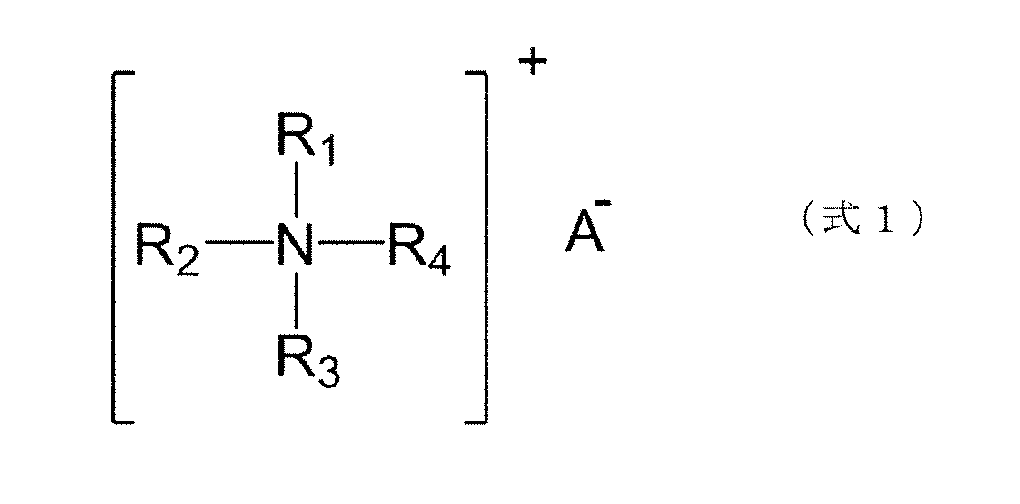
(式1中、R1~R4は各々独立して炭素数1~18のアルキル基を表し、R1~R4のうちいずれか一つ以上が炭素数8以上を有し、且つR1~R4の合計炭素数が11以上である。A-は式2で示される炭酸エステルを表す。)

(式2中、R5はアルキル基を表す)。
[2]式2で示される炭酸エステルがメチル炭酸であることを特徴とする上記[1]に記載のイソシアヌレート基含有ポリイソシアネート組成物。
[3]ヘキサメチレンジイソシアネートと水・オクタノール分配係数が0.5以上の水酸基含有化合物とを、式1で示される4級アンモニウム塩の存在下、反応させて得られるイソシアヌレート基含有ポリイソシアネート組成物の製造方法。
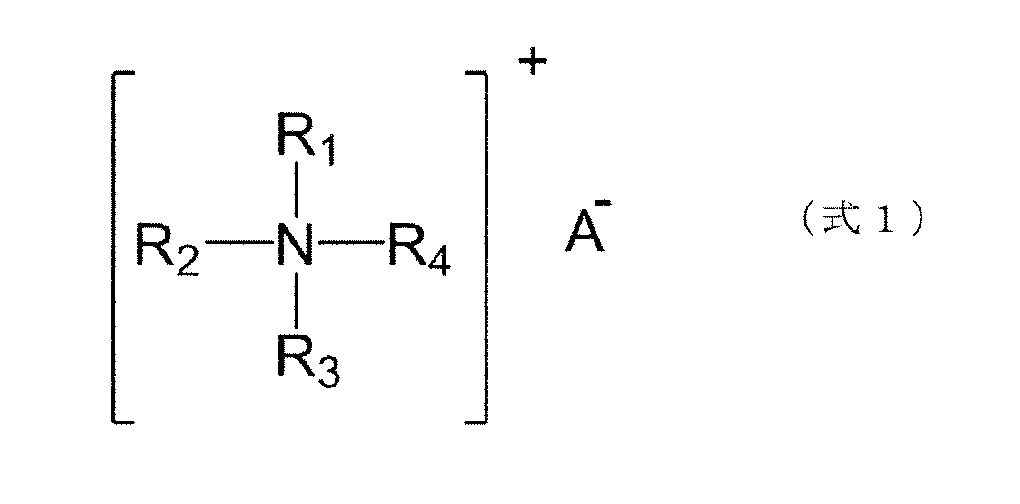
(式1中、R1~R4は各々独立して炭素数1~18のアルキル基を表し、R1~R4のうちいずれか一つ以上が炭素数8以上を有し、且つR1~R4の合計炭素数が11以上である。A-は式2で示される炭酸エステルを表す)

(式2中、R5はアルキル基を表す)。
[4]式2で示される炭酸エステルがメチル炭酸であることを特徴とする上記[3]に記載のイソシアヌレート基含有ポリイソシアネート組成物の製造方法。
[5]上記[1]又は[2]に記載のイソシアヌレート基含有ポリイソシアネート組成物とポリオールとを含む二液型塗料組成物。
[6]上記[5]に記載の二液型塗料組成物から得られる塗膜。
[7]上記[5]に記載の二液型塗料組成物から得られるコーティング物。
[8]有機ジイソシアネートモノマーをイソシアヌレート化、又はアロファネート化する変性有機ポリイソシアネートの製造方法において、変性有機ポリイソシアネートの生成後に、立体障害フェノール構造を有する化合物(但し、2,6-ジ-tert-ブチル-4-メチルフェノールを除く)を添加することを特徴とする、変性有機ポリイソシアネートの製造方法。
[9]立体障害フェノール構造を有する化合物が、テトラキス[メチレン-3-(3’,5’-ジ-t-ブチル-4’-ヒドロキシフェニル)プロピオネート]メタン、3-(3,5-ジ-tert-ブチル-4-ヒドロキシフェニル)プロパン酸オクタデシル、3-(4-ヒドロキシ-3,5-ジイソプロピルフェニル)プロピオン酸オクチル、1,3,5-トリス(3,5-ジ-tert-ブチル-4-ヒドロキシベンジル)イソシアヌル酸、2,4,6-トリス(3’,5’-ジ-tert-ブチル-4’-ヒドロキシベンジル)メシチレンから選ばれる、少なくとも一種であることを特徴とする、上記[8]に記載の変性有機ポリイソシアネートの製造方法。
[10]変性有機ポリイソシアネートが、ヘキサメチレンジイソシアネートの変性体であることを特徴とする、上記[8]又は[9]に記載の変性有機ポリイソシアネートの製造方法。
[11]変性有機ポリイソシアネートが、イソシアヌレート基、及びアロファネート基からなる群より選ばれる少なくとも一種を含むことを特徴とする、上記[8]乃至[10]のいずれかに記載の変性有機ポリイソシアネートの製造方法。
[12]上記[3]又は[4]に記載のイソシアヌレート基含有ポリイソシアネート組成物の製造方法において、イソシアヌレート基含有ポリイソシアネート組成物の生成後に、立体障害フェノール構造を有する化合物(但し、2,6-ジ-tert-ブチル-4-メチルフェノールを除く)を添加することを特徴とする、イソシアヌレート基含有ポリイソシアネート組成物の製造方法。
[13]立体障害フェノール構造を有する化合物が、テトラキス[メチレン-3-(3’,5’-ジ-t-ブチル-4’-ヒドロキシフェニル)プロピオネート]メタン、3-(3,5-ジ-tert-ブチル-4-ヒドロキシフェニル)プロパン酸オクタデシル、3-(4-ヒドロキシ-3,5-ジイソプロピルフェニル)プロピオン酸オクチル、1,3,5-トリス(3,5-ジ-tert-ブチル-4-ヒドロキシベンジル)イソシアヌル酸、2,4,6-トリス(3’,5’-ジ-tert-ブチル-4’-ヒドロキシベンジル)メシチレンから選ばれる、少なくとも一種であることを特徴とする、上記[12]に記載のイソシアヌレート基含有ポリイソシアネート組成物の製造方法。
[14]上記[8]乃至[13]のいずれかの製造方法で得られた変性有機ポリイソシアネートと、ポリオールとを含む二液型塗料組成物の製造方法。
[15]上記[14]に記載の製造方法で得られた二液型塗料組成物から得られる塗膜の製造方法。
[16]上記[14]に記載の製造方法で得られた二液型塗料組成物から得られるコーティング物の製造方法。
なお、本発明においては、第一の課題を解決する手段を実施形態1といい、第二の課題を解決する手段を実施形態2という。
本発明によれば、イソシアヌレート化反応の際に不溶解物などが生成せず、効率的に反応を進めることができ、機械物性、貯蔵安定性に優れたポリイソシアネート組成物、及びこれを硬化剤とした二液型塗料組成物と、それからなる、硬度を確保し、光沢性に優れた塗膜及びコーティング物を得ることができる。
また、イソシアヌレート化時に生成される不溶解物が抑制されるため、特別な濾過等をせずに製造することも可能となる。
さらに、特定の化合物を、特定のタイミングで添加することにより製造された変性有機ポリイソシアネートは、有機溶剤希釈後、高温における貯蔵中の変色傾向が大きく低減され、その後のポリウレタンの製造のために有利に用いられ得る。
以下、本発明について詳しく説明する。
本発明の第一の課題を解決するポリイソシアネート組成物に用いるポリイソシアネートは、脂肪族ジイソシアネートの一種であるHDIである。
脂肪族ジイソシアネートとしては、HDIの他に、例えばテトラメチレンジイソシアネート、2-メチル-ペンタン-1,5-ジイソシアネート、3-メチル-ペンタン-1,5-ジイソシアネート、リジンジイソシアネート、トリオキシエチレンジイソシアネート等を挙げることができる。これら脂肪族ジイソシアネートは、HDIと組み合わせて使用してもよい。また、イソホロンジイソシアネートやノルボルネンジイソシアネートに代表される脂環族ジイソシアネートを併用してもよい。
本発明のポリイソシアネート組成物に含まれる、上記式1で示されるカチオン構造と上記式2で示されるアニオン構造を有する4級アンモニウム塩(以下、単に4級アンモニウム塩とも言う)は、イソシアヌレート化反応触媒として好適に使用できる。
本発明における4級アンモニウム塩は触媒活性が強く、親水性が高いことからHDIとの相溶性に乏しく、局所的に反応が起こることにより不溶解物が発生しやすい。また、反応効率も悪くなる。このため、これらの不具合を回避しつつ、良好な相溶性を得、不溶解物発生を抑制するという観点から、4級アンモニウム塩のカチオン構造中のアルキル基(R1~R4)の炭素数の合計が11以上である。
このようなアルキル基としては、例えば、メチル基、エチル基、プロピル基、ブチル基、ペンチル基、ヘキシル基、ヘプチル基、オクチル基、ノニル基、デシル基、ウンデシル基、ドデシル基、トリデシル基、テトラデシル基、ペンタデシル基、ヘキサデシル基、ヘプタデシル基、オクタデシル基、ノナデシル基、エイコシル基等のアルキル基(各種異性体含む)、シクロペンチル基、シクロヘキシル基、シクロヘプチル基、シクロオクチル基等のシクロアルキル基が挙げられる。
さらに、相溶性や活性の点からR1~R4のうち少なくとも一つの基の炭素数が8以上であることが特に好ましい。触媒活性の点から、アルキル基の炭素数が多すぎると活性が低下する恐れがあることから、炭素数8~12のアルキル基が最も好ましい。
R1~R4のうち少なくとも一つの基の炭素数が8以上である場合、その他のアルキル基の炭素数は特に制限されるものではないが、炭素数が多すぎると活性が低下する恐れがあることから、その他のアルキル基の炭素数は1~8が好ましい。
本発明の4級アンモニウム塩のアニオン構造は、弱酸塩として上記式2で表されるアルキル炭酸エステルである。アルキル炭酸エステルのアルキル基(R5)の例として、メチル基、エチル基、プロピル基、ブチル基、ペンチル基、ヘキシル基、ヘプチル基、オクチル基、ノニル基、デシル基、ウンデシル基、ドデシル基、トリデシル基、テトラデシル基、ペンタデシル基、ヘキサデシル基、ヘプタデシル基、オクタデシル基、ノナデシル基、エイコシル基などのアルキル基(各種異性体含む)、シクロペンチル基、シクロヘキシル基、シクロヘプチル基、シクロオクチル基、シクロノニル基、シクロデシル基等のシクロアルキル基が挙げられる。反応活性や入手の容易さの観点から、R5の炭素数が1~8のアルキル炭酸エステルが特に好ましく、メチル炭酸塩が最も好ましい。
なお、上記式1で示される4級アンモニウム塩としては、市販品、もしくは公知の合成方法によって得ることができるものを用いることができる。
本発明の第一の課題を解決するポリイソシアネート組成物に用いることのできる水酸基含有化合物としては、水・オクタノール分配係数が0.5以上のものが挙げられる。
ここで、水・オクタノール分配係数(以下logP値とも言う)とは、化合物の疎水性/親水性の尺度を表すパラメータであり、数値が大きいほど疎水性であることを示し、逆に数値が小さいほど親水性であることを示す。水・オクタノール分配係数は広く知られた化合物のパラメータであり、測定、又は計算によって求めることができる。
水・オクタノール分配係数=logP (P=So/Sw)
So:25℃におけるn-オクタノール中での該有機化合物の溶解度
Sw:25℃における純水中での該有機化合物の溶解度
また、n-オクタノールと水の二つの溶媒系における物質の分配係数は、上記計算式によりlogP値として算出される分配係数と、測定により求めることができる分配係数との間で完全に一致せず、計算値と測定値にやや差がある場合もある。しかしながらその違いは大きくないため、本発明においては、計算値により求めることができる分配係数を採用した。
So:25℃におけるn-オクタノール中での該有機化合物の溶解度
Sw:25℃における純水中での該有機化合物の溶解度
また、n-オクタノールと水の二つの溶媒系における物質の分配係数は、上記計算式によりlogP値として算出される分配係数と、測定により求めることができる分配係数との間で完全に一致せず、計算値と測定値にやや差がある場合もある。しかしながらその違いは大きくないため、本発明においては、計算値により求めることができる分配係数を採用した。
文献等にもlogP値は記載されているが、上述したように近年logPを計算により求める方法が提案されており、分子軌道計算をベースにするものや、Hanschのデータを利用するフラグメント法、又、HPLCによる方法などがある。
本発明におけるlogP値は、化学構造式ソフトウェアChemDraw Prime 15.1(PerkinElmer社製)の簡易計算法を用い算出したものを意味する。
logP値が0.5以上の水酸基含有化合物としては、例えば、1-ブタノール、イソブタノール、1-ペンタノール、2-ペンタノール、1-ヘキサノール、2-ヘキサノール、1-ヘプタノール、1-オクタノール、2-エチル-1-ヘキサノール、3,3,5-トリメチル-1-ヘキサノール、1-トリデカノール、2-トリデカノール、2-オクチルドデカノール、ペンタデカノール、パルミチルアルコール、ステアリルアルコール、シクロペンタノール、シクロヘキサノール、メチルシクロヘキサノール、トリメチルシクロヘキサノール等のモノアルコール、C6~C18のアルカンジオール等が挙げられる。
logP値が0.5未満の場合、例えばイソシアヌレート化触媒を添加後、HDIなどのイソシアネートとの相溶性が悪くなるため、局所的な反応がおこり、急激な発熱により不溶解物が発生し、生産性の低下、反応効率の悪化を引き起こす恐れがある。logP値が大きくなると水酸基含有化合物の結晶性が上がる傾向があるため、これを用いたポリイソシアネートの低温安定性が悪くなる恐れがあり、さらにポリイソシアネート中のイソシアネート含有量が低くなることからこれを硬化剤としたウレタン塗膜中のウレタン結合の量が減少し、機械物性の低下が懸念される。これらより、LogP値は0.5~3.5が特に好ましい。
次に、第一の課題を解決するポリイソシアネート組成物の具体的な製造方法について説明する。
第1工程では、有機ジイソシアネートと水酸基含有化合物とを、水酸基に対してイソシアネート基が過剰になる量を仕込んで、有機溶剤の存在下または非存在下、20~60℃でウレタン化反応させてイソシアネート基末端プレポリマーIを製造する。ここでウレタン化反応の目安としては、中和滴定法によるイソシアネート基含有量と屈折率上昇値により完結の有無を判断する。
第2工程では、イソシアネート基末端プレポリマーIにアロファネート・イソシアヌレート化触媒を仕込み、目的とするイソシアネート基含有量、及び分子量になるまで、50~150℃にてイソシアヌレート化・アロファネート化を行ってイソシアネート基末端プレポリマーIIを製造する。
第3工程では、イソシアネート基末端プレポリマーIIに反応停止剤を添加することによって、反応の停止を行う。
これら第1工程~第3工程においては、窒素ガス、若しくは、乾燥空気気流下で反応を進行させる。
第4工程では、イソシアネート基末端プレポリマーIIを薄膜蒸留又は溶剤抽出によって、遊離の有機ジイソシアネートの含有量を1質量%未満になるまで除去する。
ここで、第1工程における「イソシアネート基が過剰になる量」とは、原料仕込みの際、有機ジイソシアネートのイソシアネート基とモノオールの水酸基とのモル比が、R=イソシアネート基/水酸基で100~2000になるように仕込むことが好ましく、R=200~2000になるように仕込むことがさらに好ましい。下限未満の場合には、目的物よりもポリイソシアネート組成物のイソシアネート含量が低くなりこれを硬化剤としたウレタン塗膜中のウレタン結合の量が減少し、機械物性の低下が懸念される。上限を超える場合には、イソシアヌレート化反応が効率的に進行しない恐れがある。
また、本発明のウレタン化反応の反応温度は、20~70℃が好ましく、30~60℃がさらに好ましい。
ウレタン化反応の反応時間は、触媒の有無、種類、および温度により異なるが、一般には10時間以内、好ましくは1~5時間で十分である。
第2工程におけるイソシアヌレート化触媒としては上述した4級アンモニウム塩を使用することが好ましい。
イソシアヌレート化触媒の使用量は、有機ジイソシアネートと、モノアルコールとの合計質量に対して0.001~1.0質量%が好ましく、0.005~0.1質量%がより好ましい。
下限未満の場合には、イソシアヌレート化反応が十分に進行せず、生産性や収率の低下を招く恐れがある。また、上限値を超える場合には、イソシアヌレート化反応が急激に起こり、反応制御が困難となる。また、目的物よりもイソシアヌレート体の重合物量が多くなり、ポリイソシアネート組成物のイソシアネート含量が低くなる恐れがある。よって、これを硬化剤としたウレタン塗膜中のウレタン結合の量が減少し、機械物性の低下を招く恐れがある。
また、イソシアヌレート化反応の反応温度は50~150℃が好ましく、反応性制御の観点から60~100℃がさらに好ましい。
また、ポリイソシアネート組成物の製造においては、有機溶媒等を含まずに反応を行う方法や有機溶媒の存在下で反応を行う方法が適宜選ばれる。
有機溶媒の存在下で反応を行う場合には、反応に影響を与えない有機溶媒を用いることができる。有機溶媒の具体例としては、オクタン等の脂肪族炭化水素類、シクロヘキサン、メチルシクロヘキサン等の脂環族炭化水素類、メチルイソブチルケトン、シクロヘキサノン等のケトン類、酢酸ブチル、酢酸イソブチル等のエステル類、エチレングリコールエチルエーテルアセテート、プロピレングリコールモノメチルエーテルアセテート、3-メチル-3-メトキシブチルアセテート、エチル-3-エトキシプロピオネート等のグリコールエーテルエステル類、ジオキサン等のエーテル類、ヨウ化メチレン、モノクロロベンゼン等のハロゲン化炭化水素類、N-メチルピロリドン、ジメチルホルムアミド、ジメチルアセトアミド、ジメチルスルホキシド、ヘキサメチルホスホニルアミド等の極性非プロトン溶媒などが挙げられる。これらの溶媒は単独で、または2種以上を組み合わせて用いることができる。
反応で使用した有機溶媒は、第4工程における遊離の有機ジイソシアネートの除去時に同時に除去される。
第3工程におけるに反応停止剤は、触媒の活性を失活させる作用があるものであり、具体的には、リン酸、塩酸等の無機酸、スルホン酸基、スルファミン酸基等を有する有機酸およびこれらのエステル類、アシルハライド等公知の化合物が使用される。これらの反応停止剤は、単独または2種以上を併用することができる。尚、添加時期は、反応終了後、速やかな添加が好ましい。
また、反応停止剤の添加量としては、反応停止剤や使用した触媒の種類によって異なるが、触媒の0.5~10当量となるのが好ましく、0.8~5.0当量が特に好ましい。反応停止剤が少ない場合には、得られたポリイソシアネート組成物の貯蔵安定性が低下しやすく、多すぎる場合は得られたポリイソシアネート組成物が着色する場合がある。
第4工程の精製工程は、反応混合物中に存在している遊離の未反応の有機ジイソシアネートを除去する工程である。具体的には、例えば、10~100Paの高真空下、120~150℃で薄膜蒸留することによる除去法や、有機溶剤による抽出法により遊離の未反応の有機ジイソシアネート残留含有率を1.0質量%以下にする方法が挙げられる。尚、遊離の未反応の有機ジイソシアネートの残留含有率が上限値を超える場合は、臭気の発生や貯蔵安定性の低下を招く恐れがある。
精製して得られたポリイソシアネート組成物は、ポットライフの延長や二液型塗料組成物の一液化を目的として、公知のブロック剤を用いてブロックイソシアネートとすることも可能である。これにより、ブロック化されたポリイソシアネートは、常温時は不活性であるが、加熱することでブロック剤が解離し、再びイソシアネート基が活性化することで、活性水素基と反応する潜在的な機能を付加することができる。
本発明に用いることができるブロック剤としては、活性水素を分子内に1個有する化合物であり、例えば、アルコール系、アルキルフェノール系、フェノール系、活性メチレン、メルカプタン系、酸アミド系、酸イミド系、イミダゾール系、尿素系、オキシム系、アミン系、イミド系、ピラゾール系化合物等がある。
また、一連の反応で得られた第一の課題を解決するポリイソシアネート組成物は、ポリオールを配合することによって、本発明の二液型塗料組成物を得ることができる。
ここで、本発明の二液型塗料組成物に使用されるポリオールとしては、特に限定されるものではないが、イソシアネート基との反応基として活性水素基を含有する化合物であり、ポリエステルポリオール、ポリエーテルポリオール、ポリカーボネートポリオール、ポリオレフィンポリオール、アクリルポリオール、シリコーンポリオール、ヒマシ油系ポリオール、フッ素系ポリオール、2種類以上のポリオールのエステル交換物、及びポリイソシアネートとウレタン化反応した水酸基末端プレポリマー等が好適に用いられ、これらは1種類又は2種類以上の混合物として使用することもできる。
<ポリエステルポリオール>
ポリエステルポリオールとしては、例えばフタル酸、イソフタル酸、テレフタル酸、ナフタレンジカルボン酸、コハク酸、酒石酸、シュウ酸、マロン酸、グルタル酸、アジピン酸、ピメリン酸、スベリン酸、グルタコン酸、アゼライン酸、セバシン酸、1,4-シクロヘキシルジカルボン酸、α-ハイドロムコン酸、β-ハイドロムコン酸、α-ブチル-α-エチルグルタル酸、α,β-ジエチルサクシン酸、マレイン酸、フマル酸等のジカルボン酸またはこれらの無水物等の1種類以上と、エチレングリコール、1,2-プロパンジオール、1,3-プロパンジオール、1,2-ブタンジオール、1,3-ブタンジオール、1,4-ブタンジオール、1,5-ペンタンジオール、1,6-ヘキサンジオール、1,8-オクタンジオール、1,9-ノナンジオール、3-メチル-1,5-ペンタンジオール、3,3-ジメチロールヘプタン、ジエチレングリコール、ジプロピレングリコール、ネオペンチルグリコール、シクロヘキサン-1,4-ジオール、シクロヘキサン-1,4-ジメタノール、ダイマー酸ジオール、ビスフェノールAのエチレンオキサイドやプロピレンオキサイド付加物、ビス(β-ヒドロキシエチル)ベンゼン、キシリレングリコール、グリセリン、トリメチロールプロパン、ペンタエリスリトール等の分子量500以下の低分子ポリオール類の1種類以上との縮重合反応から得られるもの等を挙げることができる。また、ε-カプロラクトン、アルキル置換ε-カプロラクトン、δ-バレロラクトン、アルキル置換δ-バレロラクトン等の環状エステル(いわゆるラクトン)モノマーの開環重合から得られるラクトン系ポリエステルポリオール等を挙げることができる。更に、低分子ポリオールの一部をヘキサメチレンジアミン、イソホロンジアミン、モノエタノールアミン等の低分子ポリアミンや低分子アミノアルコールに代えて得られるポリエステル-アミドポリオールを使用することもできる。
ポリエステルポリオールとしては、例えばフタル酸、イソフタル酸、テレフタル酸、ナフタレンジカルボン酸、コハク酸、酒石酸、シュウ酸、マロン酸、グルタル酸、アジピン酸、ピメリン酸、スベリン酸、グルタコン酸、アゼライン酸、セバシン酸、1,4-シクロヘキシルジカルボン酸、α-ハイドロムコン酸、β-ハイドロムコン酸、α-ブチル-α-エチルグルタル酸、α,β-ジエチルサクシン酸、マレイン酸、フマル酸等のジカルボン酸またはこれらの無水物等の1種類以上と、エチレングリコール、1,2-プロパンジオール、1,3-プロパンジオール、1,2-ブタンジオール、1,3-ブタンジオール、1,4-ブタンジオール、1,5-ペンタンジオール、1,6-ヘキサンジオール、1,8-オクタンジオール、1,9-ノナンジオール、3-メチル-1,5-ペンタンジオール、3,3-ジメチロールヘプタン、ジエチレングリコール、ジプロピレングリコール、ネオペンチルグリコール、シクロヘキサン-1,4-ジオール、シクロヘキサン-1,4-ジメタノール、ダイマー酸ジオール、ビスフェノールAのエチレンオキサイドやプロピレンオキサイド付加物、ビス(β-ヒドロキシエチル)ベンゼン、キシリレングリコール、グリセリン、トリメチロールプロパン、ペンタエリスリトール等の分子量500以下の低分子ポリオール類の1種類以上との縮重合反応から得られるもの等を挙げることができる。また、ε-カプロラクトン、アルキル置換ε-カプロラクトン、δ-バレロラクトン、アルキル置換δ-バレロラクトン等の環状エステル(いわゆるラクトン)モノマーの開環重合から得られるラクトン系ポリエステルポリオール等を挙げることができる。更に、低分子ポリオールの一部をヘキサメチレンジアミン、イソホロンジアミン、モノエタノールアミン等の低分子ポリアミンや低分子アミノアルコールに代えて得られるポリエステル-アミドポリオールを使用することもできる。
<ポリエーテルポリオール>
ポリエーテルポリオールとしては、例えばエチレングリコール、1,2-プロパンジオール、1,3-プロパンジオール、1,2-ブタンジオール、1,3-ブタンジオール、1,4-ブタンジオール、1,5-ペンタンジオール、1,6-ヘキサンジオール、1,8-オクタンジオール、1,9-ノナンジオール、3-メチル-1,5-ペンタンジオール、3,3-ジメチロールヘプタン、ジエチレングリコール、ジプロピレングリコール、ネオペンチルグリコール、シクロヘキサン-1,4-ジオール、シクロヘキサン-1,4-ジメタノール、ダイマー酸ジオール、ビスフェノールA、ビス(β-ヒドロキシエチル)ベンゼン、キシリレングリコール、グリセリン、トリメチロールプロパン、ペンタエリスリトール等の低分子ポリオール類、またはエチレンジアミン、プロピレンジアミン、トルエンジアミン、メタフェニレンジアミン、ジフェニルメタンジアミン、キシリレンジアミン等の低分子ポリアミン類等のような活性水素基を2個以上、好ましくは2~3個有する化合物等を開始剤として、エチレンオキサイド、プロピレンオキサイド、ブチレンオキサイド等のアルキレンオキサイド類を付加重合させることによって得られるポリエーテルポリオール、或いはメチルグリシジルエーテル等のアルキルグリシジルエーテル類、フェニルグリシジルエーテル等のアリールグリシジルエーテル類、テトラヒドロフラン等の環状エーテルモノマーを開環重合することで得られるポリエーテルポリオール等を挙げることができる。
ポリエーテルポリオールとしては、例えばエチレングリコール、1,2-プロパンジオール、1,3-プロパンジオール、1,2-ブタンジオール、1,3-ブタンジオール、1,4-ブタンジオール、1,5-ペンタンジオール、1,6-ヘキサンジオール、1,8-オクタンジオール、1,9-ノナンジオール、3-メチル-1,5-ペンタンジオール、3,3-ジメチロールヘプタン、ジエチレングリコール、ジプロピレングリコール、ネオペンチルグリコール、シクロヘキサン-1,4-ジオール、シクロヘキサン-1,4-ジメタノール、ダイマー酸ジオール、ビスフェノールA、ビス(β-ヒドロキシエチル)ベンゼン、キシリレングリコール、グリセリン、トリメチロールプロパン、ペンタエリスリトール等の低分子ポリオール類、またはエチレンジアミン、プロピレンジアミン、トルエンジアミン、メタフェニレンジアミン、ジフェニルメタンジアミン、キシリレンジアミン等の低分子ポリアミン類等のような活性水素基を2個以上、好ましくは2~3個有する化合物等を開始剤として、エチレンオキサイド、プロピレンオキサイド、ブチレンオキサイド等のアルキレンオキサイド類を付加重合させることによって得られるポリエーテルポリオール、或いはメチルグリシジルエーテル等のアルキルグリシジルエーテル類、フェニルグリシジルエーテル等のアリールグリシジルエーテル類、テトラヒドロフラン等の環状エーテルモノマーを開環重合することで得られるポリエーテルポリオール等を挙げることができる。
<ポリカーボネートポリオール>
ポリカーボネートポリオールとしては、例えばエチレングリコール、1,2-プロパンジオール、1,3-プロパンジオール、1,2-ブタンジオール、1,3-ブタンジオール、1,4-ブタンジオール、1,5-ペンタンジオール、1,6-ヘキサンジオール、1,8-オクタンジオール、1,9-ノナンジオール、3-メチル-1,5-ペンタンジオール、3,3-ジメチロールヘプタン、ジエチレングリコール、ジプロピレングリコール、ネオペンチルグリコール、シクロヘキサン-1,4-ジオール、シクロヘキサン-1,4-ジメタノール、ダイマー酸ジオール、ビスフェノールAのエチレンオキサイドやプロピレンオキサイド付加物、ビス(β-ヒドロキシエチル)ベンゼン、キシリレングリコール、グリセリン、トリメチロールプロパン、ペンタエリスリトール等の低分子ポリオール等の1種類以上と、ジメチルカーボネート、ジエチルカーボネート等のジアルキルカーボネート類、エチレンカーボネート、プロピレンカーボネート等のアルキレンカーボネート類、ジフェニルカーボネート、ジナフチルカーボネート、ジアントリルカーボネート、ジフェナントリルカーボネート、ジインダニルカーボネート、テトラヒドロナフチルカーボネート等のジアリールカーボネート類等との脱アルコール反応や脱フェノール反応から得られるもの等を挙げることができる。
ポリカーボネートポリオールとしては、例えばエチレングリコール、1,2-プロパンジオール、1,3-プロパンジオール、1,2-ブタンジオール、1,3-ブタンジオール、1,4-ブタンジオール、1,5-ペンタンジオール、1,6-ヘキサンジオール、1,8-オクタンジオール、1,9-ノナンジオール、3-メチル-1,5-ペンタンジオール、3,3-ジメチロールヘプタン、ジエチレングリコール、ジプロピレングリコール、ネオペンチルグリコール、シクロヘキサン-1,4-ジオール、シクロヘキサン-1,4-ジメタノール、ダイマー酸ジオール、ビスフェノールAのエチレンオキサイドやプロピレンオキサイド付加物、ビス(β-ヒドロキシエチル)ベンゼン、キシリレングリコール、グリセリン、トリメチロールプロパン、ペンタエリスリトール等の低分子ポリオール等の1種類以上と、ジメチルカーボネート、ジエチルカーボネート等のジアルキルカーボネート類、エチレンカーボネート、プロピレンカーボネート等のアルキレンカーボネート類、ジフェニルカーボネート、ジナフチルカーボネート、ジアントリルカーボネート、ジフェナントリルカーボネート、ジインダニルカーボネート、テトラヒドロナフチルカーボネート等のジアリールカーボネート類等との脱アルコール反応や脱フェノール反応から得られるもの等を挙げることができる。
また、ポリカーボネートポリオールとポリエステルポリオールと低分子ポリオールとのエステル交換反応により得られたポリオールも好適に用いることができる。
<ポリオレフィンポリオール>
ポリオレフィンポリオールとしては、例えば水酸基を2個以上有するポリブタジエン、水素添加ポリブタジエン、ポリイソプレン、水素添加ポリイソプレン等を挙げることができる。
ポリオレフィンポリオールとしては、例えば水酸基を2個以上有するポリブタジエン、水素添加ポリブタジエン、ポリイソプレン、水素添加ポリイソプレン等を挙げることができる。
<アクリルポリオール>
アクリルポリオールとしては、例えばアクリル酸エステル及び/又はメタクリル酸エステル〔以下(メタ)アクリル酸エステルという〕と、反応点となりうる少なくとも分子内に1個以上の水酸基を有するアクリル酸ヒドロキシ化合物及び/又はメタクリル酸ヒドロキシ化合物〔以下(メタ)アクリル酸ヒドロキシ化合物という〕と、重合開始剤とを熱エネルギーや紫外線または電子線などの光エネルギー等を使用し、アクリルモノマーを共重合したもの等を挙げることができる。
アクリルポリオールとしては、例えばアクリル酸エステル及び/又はメタクリル酸エステル〔以下(メタ)アクリル酸エステルという〕と、反応点となりうる少なくとも分子内に1個以上の水酸基を有するアクリル酸ヒドロキシ化合物及び/又はメタクリル酸ヒドロキシ化合物〔以下(メタ)アクリル酸ヒドロキシ化合物という〕と、重合開始剤とを熱エネルギーや紫外線または電子線などの光エネルギー等を使用し、アクリルモノマーを共重合したもの等を挙げることができる。
<(メタ)アクリル酸エステル>
(メタ)アクリル酸エステルとしては、例えば炭素数1~20のアルキルエステル等を挙げることができる。このような(メタ)アクリル酸エステルとしては、例えば(メタ)アクリル酸メチル、(メタ)アクリル酸エチル、(メタ)アクリル酸プロピル、(メタ)アクリル酸ブチル、(メタ)アクリル酸ペンチル、(メタ)アクリル酸ヘキシル、(メタ)アクリル酸-2-エチルヘキシル、(メタ)アクリル酸オクチル、(メタ)アクリル酸ノニル、(メタ)アクリル酸デシル、(メタ)アクリル酸ドデシル等の(メタ)アクリル酸アルキルエステル;シクロヘキシル(メタ)アクリレート等の(メタ)アクリル酸の脂環属アルコールとのエステル;(メタ)アクリル酸フェニル、(メタ)アクリル酸ベンジル等の(メタ)アクリル酸アリールエステル等を挙げることができる。このような(メタ)アクリル酸エステルは単独または2種類以上組み合わせたものを挙げることができる。
(メタ)アクリル酸エステルとしては、例えば炭素数1~20のアルキルエステル等を挙げることができる。このような(メタ)アクリル酸エステルとしては、例えば(メタ)アクリル酸メチル、(メタ)アクリル酸エチル、(メタ)アクリル酸プロピル、(メタ)アクリル酸ブチル、(メタ)アクリル酸ペンチル、(メタ)アクリル酸ヘキシル、(メタ)アクリル酸-2-エチルヘキシル、(メタ)アクリル酸オクチル、(メタ)アクリル酸ノニル、(メタ)アクリル酸デシル、(メタ)アクリル酸ドデシル等の(メタ)アクリル酸アルキルエステル;シクロヘキシル(メタ)アクリレート等の(メタ)アクリル酸の脂環属アルコールとのエステル;(メタ)アクリル酸フェニル、(メタ)アクリル酸ベンジル等の(メタ)アクリル酸アリールエステル等を挙げることができる。このような(メタ)アクリル酸エステルは単独または2種類以上組み合わせたものを挙げることができる。
<(メタ)アクリル酸ヒドロキシ化合物>
(メタ)アクリル酸ヒドロキシ化合物としては、例えばポリイソシアネートとの反応点となりうる少なくとも分子内に1個以上の水酸基を有しており、具体的には、例えば2-ヒドロキシエチルアクリレート、2-ヒドロキシプロピルアクリレート、4-ヒドロキシブチルアクリレート、3-ヒドロキシ-2,2-ジメチルプロピルアクリレート、ペンタエリスリトールトリアクリレート等のアクリル酸ヒドロキシ化合物等が挙げられる。また、2-ヒドロキシエチルメタクリレート、2-ヒドロキシプロピルメタクリレート、4-ヒドロキシブチルメタクリレート、3-ヒドロキシ-2,2-ジメチルプロピルメタクリレート、ペンタエリスリトールトリメタクリレート等のメタクリル酸ヒドロキシ化合物等が挙げられる。これら(メタ)アクリル酸ヒドロキシ化合物は、単独または2種以上を組み合わせたものを挙げることができる。
(メタ)アクリル酸ヒドロキシ化合物としては、例えばポリイソシアネートとの反応点となりうる少なくとも分子内に1個以上の水酸基を有しており、具体的には、例えば2-ヒドロキシエチルアクリレート、2-ヒドロキシプロピルアクリレート、4-ヒドロキシブチルアクリレート、3-ヒドロキシ-2,2-ジメチルプロピルアクリレート、ペンタエリスリトールトリアクリレート等のアクリル酸ヒドロキシ化合物等が挙げられる。また、2-ヒドロキシエチルメタクリレート、2-ヒドロキシプロピルメタクリレート、4-ヒドロキシブチルメタクリレート、3-ヒドロキシ-2,2-ジメチルプロピルメタクリレート、ペンタエリスリトールトリメタクリレート等のメタクリル酸ヒドロキシ化合物等が挙げられる。これら(メタ)アクリル酸ヒドロキシ化合物は、単独または2種以上を組み合わせたものを挙げることができる。
<シリコーンポリオール>
シリコーンポリオールとしては、例えばγ-メタクリロキシプロピルトリメトキシシラン等を重合したビニル基含有シリコーン化合物、及び分子中に少なくとも1個の末端水酸基を有する、α,ω-ジヒドロキシポリジメチルシロキサン、α,ω-ジヒドロキシポリジフェニルシロキサン等のポリシロキサン等を挙げることができる。
シリコーンポリオールとしては、例えばγ-メタクリロキシプロピルトリメトキシシラン等を重合したビニル基含有シリコーン化合物、及び分子中に少なくとも1個の末端水酸基を有する、α,ω-ジヒドロキシポリジメチルシロキサン、α,ω-ジヒドロキシポリジフェニルシロキサン等のポリシロキサン等を挙げることができる。
<ヒマシ油系ポリオール>
ヒマシ油系ポリオールとしては、例えばヒマシ油脂肪酸とポリオールとの反応により得られる線状または分岐状ポリエステルポリオール等が挙げられる。また、脱水ヒマシ油、一部分を脱水した部分脱水ヒマシ油、水素を付加させた水添ヒマシ油も使用することができる。
ヒマシ油系ポリオールとしては、例えばヒマシ油脂肪酸とポリオールとの反応により得られる線状または分岐状ポリエステルポリオール等が挙げられる。また、脱水ヒマシ油、一部分を脱水した部分脱水ヒマシ油、水素を付加させた水添ヒマシ油も使用することができる。
<フッ素系ポリオール>
フッ素系ポリオールとしては、例えば含フッ素モノマーとヒドロキシ基を有するモノマーとを必須成分として共重合反応により得られる線状または分岐状のポリオールである。ここで、含フッ素モノマーとしては、フルオロオレフィンであることが好ましく、例えば、テトラフルオロエチレン、クロロトリフルオロエチレン、トリクロロフルオロエチレン、ヘキサフルオロプロピレン、フッ化ビニリデン、フッ化ビニル、トリフルオロメチルトリフルオロエチレン等が挙げられる。また、ヒドロキシル基を有するモノマーとしては、例えばヒドロキシエチルビニルエーテル、4-ヒドロキシブチルビニルエーテル、シクロヘキサンジオールモノビニルエーテル等のヒドロキシアルキルビニルエーテル、2-ヒドロキシエチルアリルエーテル等のヒドロキシアルキルアリルエーテル、ヒドロキシアルキルクロトン酸ビニル等のヒドロキシル基含有カルボン酸ビニル又はアリルエステル等のヒドロキシル基を有するモノマー等が挙げられる。
フッ素系ポリオールとしては、例えば含フッ素モノマーとヒドロキシ基を有するモノマーとを必須成分として共重合反応により得られる線状または分岐状のポリオールである。ここで、含フッ素モノマーとしては、フルオロオレフィンであることが好ましく、例えば、テトラフルオロエチレン、クロロトリフルオロエチレン、トリクロロフルオロエチレン、ヘキサフルオロプロピレン、フッ化ビニリデン、フッ化ビニル、トリフルオロメチルトリフルオロエチレン等が挙げられる。また、ヒドロキシル基を有するモノマーとしては、例えばヒドロキシエチルビニルエーテル、4-ヒドロキシブチルビニルエーテル、シクロヘキサンジオールモノビニルエーテル等のヒドロキシアルキルビニルエーテル、2-ヒドロキシエチルアリルエーテル等のヒドロキシアルキルアリルエーテル、ヒドロキシアルキルクロトン酸ビニル等のヒドロキシル基含有カルボン酸ビニル又はアリルエステル等のヒドロキシル基を有するモノマー等が挙げられる。
また、ポリオールは、1分子中の活性水素基数(平均官能基数)が1.9~6.0であることが好ましい。活性水素基数が下限値未満の場合には、塗膜物性が低下する恐れがある。また、上限値を超える場合には、密着性が低下する恐れがある。
また、ポリオールの数平均分子量は、750~50000の範囲にあることが好ましい。下限値未満の場合には、密着性低下の恐れがあり、上限値を超えると低極性有機溶剤に対する溶解性の低下や密着性低下を招く恐れがある。
また、本発明の二液型塗料組成物のポリイソシアネート組成物と、ポリオールとの配合割合は、特に限定するものではないが、イソシアネート組成物中のイソシアネート基とポリオール中の水酸基のモル比が、R=イソシアネート基/水酸基で0.5~2.5となるように配合することが好ましい。下限値未満の場合には水酸基が過剰になり、密着性の低下を招く恐れがある。また、架橋密度が低下し耐久性の低下や塗膜の機械的強度が低下する恐れがある。上限値を超える場合にはイソシアネート基が過剰になり、空気中の水分と反応し、塗膜の膨れやこれに伴う密着性の低下を生じる恐れがある。
また、希釈溶剤として使用する有機溶剤としては、アセトン、メチルエチルケトン、メチルイソブチルケトン等のケトン類、酢酸エチル、酢酸ブチル、酢酸セロソルブ等のエステル類、ブタノール、イソプロピルアルコール等のアルコール類、トルエン、キシレン、シクロヘキサン、ミネラルスピリット、ナフサ等の炭化水素類等からなる群から、目的及び用途に応じて適宜選択して使用することができる。これらの溶剤は単独で用いてもよく、2種以上を併用してもよい。
また、本発明の二液型塗料組成物は、ポットライフ、硬化条件、及び作業条件等を考慮し、適宜に公知のウレタン化触媒を用いることができる。具体的には、ジブチル錫ジアセテート、ジブチル錫ジラウレート、ジオクチル錫ジラウレート等の有機金属化合物や、トリエチレンジアミンやトリエチルアミン等の有機アミンやその塩を選択して用いる。これらの触媒は、単独または2種以上併用することができる。
また、二液型塗料組成物の硬化条件としては、特に限定されるものではないが、硬化温度が-5~120℃、湿度が10~95%RH、養生時間が0.5~168時間であることが好ましい。
本発明によって得られた二液型塗料組成物には、必要に応じて、例えば、2,6-ジ-tert-ブチル-4-メチルフェノール等の酸化防止剤、紫外線吸収剤、顔料、染料、溶剤、難燃剤、加水分解抑制剤、潤滑剤、可塑剤、充填材、帯電防止剤、分散剤、触媒、貯蔵安定剤、界面活性剤、レベリング剤等の添加剤を適宜配合することができる。
また、本発明によって得られた二液型塗料組成物は、スプレー、刷毛、浸漬、コーター等の公知の方法により被着体の表面上に塗布され、塗膜を形成する。
ここで被着体は特に限定されるものではなく、ステンレス、リン酸処理鋼、亜鉛鋼、鉄、銅、アルミニウム、真鍮、ガラス、スレート、アクリル樹脂、ポリカーボネート樹脂、ポリエチレンテレフタレート樹脂、ポリエチレンナフタレート樹脂、ポリブチレンフタレート樹脂、ポリスチレン樹脂、AS樹脂、ABS樹脂、ポリカーボネート-ABS樹脂、6-ナイロン樹脂、6,6-ナイロン樹脂、MXD6ナイロン樹脂、ポリ塩化ビニル樹脂、ポリビニルアルコール樹脂、ポリウレタン樹脂、フェノール樹脂、メラミン樹脂、ポリアセタール樹脂、塩素化ポリオレフィン樹脂、ポリオレフィン樹脂、ポリアミド樹脂、ポリエーテルエーテルケトン樹脂、ポリフェニレンスルフィド樹脂、NBR樹脂、クロロプレン樹脂、SBR樹脂、SEBS樹脂などの素材で成形された被着体、コロナ放電処理やその他表面処理を施されたポリエチレン、ポリプロピレン等のオレフィン樹脂、または前記被着体表面にプライマ―層などの中間層が形成された被着体を用いることができる。
被着体表層に形成される塗膜の膜厚は、リコート性や耐久性に優れるため、被着体に少なくとも10μmの膜厚を形成すれば良い。膜厚が10μm未満である場合には耐久性が低下し、衝撃により塗膜の破れ等を生じる恐れがある。
次に、本発明の第二の課題を解決する変性有機ポリイソシアネートの具体的な製造方法について説明する。
本製造方法にて製造された変性有機ポリイソシアネートは、有機ジイソシアネートモノマーをイソシアヌレート化又はアロファネート化反応させた後、BHTを除く立体障害フェノール構造を有する化合物を添加し得られる。
第1工程では、有機ジイソシアネートモノマーと水酸基含有化合物とを、水酸基に対してイソシアネート基が過剰になる量を仕込んで、有機溶剤の存在下または非存在下、50~150℃で、ウレタン化、イソシアヌレート化、及びアロファネート化反応のうち少なくとも一種の反応をさせてイソシアネート基末端プレポリマーIを製造する。ここでの反応の目安としては、中和滴定法によるイソシアネート基含有量と屈折率上昇値により完結を判断する。
第2工程では、イソシアネート基末端プレポリマーIに反応停止剤を添加することによって、反応の停止を行う。
第3工程では、イソシアネート基末端プレポリマーIに、BHTを除く立体障害フェノール構造を有する化合物を添加する。
これら第1工程~第3工程においては、窒素ガス、若しくは、乾燥空気気流下で反応を進行させる。
第4工程では、第3工程で得られたイソシアネート基末端プレポリマーIを薄膜蒸留又は溶剤抽出によって、遊離の有機ジイソシアネートモノマーの含有量を1質量%未満になるまで除去し、変性有機ポリイソシアネートを得る。
ここで、第1工程における「イソシアネート基が過剰になる量」とは、イソシアヌレート化反応の場合と、アロファネート化反応の場合で異なり、イソシアヌレート化反応の場合、イソシアネート基と水酸基とのモル比が、R=イソシアネート基/水酸基で100~2000になるように仕込むことが好ましく、R=200~2000になるように仕込むことがさらに好ましい。アロファネート化反応の場合、イソシアネート基と水酸基とのモ
ル比が、R=イソシアネート基/水酸基で5~75になるように仕込むことが好ましく、R=5~50になるように仕込むことがさらに好ましい。下限未満の場合には、目的物よりも分子量の高いポリイソシアネート組成物の生成量が多くなり、粘度の上昇を招く恐れがある。上限を超える場合には、粘度の上昇及び製品収率が下がり、生産性の低下を招く恐れがある。
ル比が、R=イソシアネート基/水酸基で5~75になるように仕込むことが好ましく、R=5~50になるように仕込むことがさらに好ましい。下限未満の場合には、目的物よりも分子量の高いポリイソシアネート組成物の生成量が多くなり、粘度の上昇を招く恐れがある。上限を超える場合には、粘度の上昇及び製品収率が下がり、生産性の低下を招く恐れがある。
第1工程で用いる有機ジイソシアネートモノマーは、特に限定するものではないが、例えば、脂肪族ジイソシアネート、脂環族ジイソシアネート、芳香族ジイソシアネート、芳香脂肪族ジイソシアネート等が挙げられる。
<脂肪族ジイソシアネート>
脂肪族ジイソシアネートの具体例としては、ヘキサメチレンジイソシアネート、テトラメチレンジイソシアネート、2-メチル-ペンタン-1,5-ジイソシアネート、3-メチル-ペンタン-1,5-ジイソシアネート、リジンジイソシアネート、トリオキシエチレンジイソシアネート等を挙げることができ、これらの混合物も使用することができる。
脂肪族ジイソシアネートの具体例としては、ヘキサメチレンジイソシアネート、テトラメチレンジイソシアネート、2-メチル-ペンタン-1,5-ジイソシアネート、3-メチル-ペンタン-1,5-ジイソシアネート、リジンジイソシアネート、トリオキシエチレンジイソシアネート等を挙げることができ、これらの混合物も使用することができる。
<脂環族ジイソシアネート>
脂環族ジイソシアネートの具体例としては、イソホロンジイソシアネート、シクロヘキサンジイソシアネート、水素添加ジフェニルメタンジイソシアネート、ノルボルナンジイソシアネート、水素添加トリレンジイソシアネート、水素添加キシレンジイソシアネート、水素添加テトラメチルキシレンジイソシアネート等を挙げることができ、これらの混合物も使用することができる。
脂環族ジイソシアネートの具体例としては、イソホロンジイソシアネート、シクロヘキサンジイソシアネート、水素添加ジフェニルメタンジイソシアネート、ノルボルナンジイソシアネート、水素添加トリレンジイソシアネート、水素添加キシレンジイソシアネート、水素添加テトラメチルキシレンジイソシアネート等を挙げることができ、これらの混合物も使用することができる。
<芳香族ジイソシアネート>
芳香族ジイソシアネートの具体例としては、2,4-トリレンジイソシアネート、2,6-トリレンジイソシアネート、4,4’-ジフェニルメタンジイソシアネート、2,4’-ジフェニルメタンジイソシアネート、2,2’-ジフェニルメタンジイソシアネート、4,4’-ジフェニルエーテルジイソシアネート、2-ニトロジフェニル-4,4’-ジイソシアネート、2,2’-ジフェニルプロパン-4,4’-ジイソシアネート、3,3’-ジメチルジフェニルメタン-4,4’-ジイソシアネート、4,4’-ジフェニルプロパンジイソシアネート、m-フェニレンジイソシアネート、p-フェニレンジイソシアネート、ナフチレン-1,4-ジイソシアネート、ナフチレン-1,5-ジイソシアネート、3,3’-ジメトキシジフェニル-4,4’-ジイソシアネート等を挙げることができ、これらの混合物も使用することができる。
芳香族ジイソシアネートの具体例としては、2,4-トリレンジイソシアネート、2,6-トリレンジイソシアネート、4,4’-ジフェニルメタンジイソシアネート、2,4’-ジフェニルメタンジイソシアネート、2,2’-ジフェニルメタンジイソシアネート、4,4’-ジフェニルエーテルジイソシアネート、2-ニトロジフェニル-4,4’-ジイソシアネート、2,2’-ジフェニルプロパン-4,4’-ジイソシアネート、3,3’-ジメチルジフェニルメタン-4,4’-ジイソシアネート、4,4’-ジフェニルプロパンジイソシアネート、m-フェニレンジイソシアネート、p-フェニレンジイソシアネート、ナフチレン-1,4-ジイソシアネート、ナフチレン-1,5-ジイソシアネート、3,3’-ジメトキシジフェニル-4,4’-ジイソシアネート等を挙げることができ、これらの混合物も使用することができる。
<芳香脂肪族ジイソシアネート>
芳香脂肪族ジイソシアネートの具体例としては、1,3-又は1,4-キシリレンジイソシアネート、1,3-又は1,4-ビス(1-イソシアナト-1-メチルエチル)ベンゼン、ω,ω’-ジイソシアナト-1,4-ジエチルベンゼン等を挙げることができ、これらの混合物も使用することができる。
芳香脂肪族ジイソシアネートの具体例としては、1,3-又は1,4-キシリレンジイソシアネート、1,3-又は1,4-ビス(1-イソシアナト-1-メチルエチル)ベンゼン、ω,ω’-ジイソシアナト-1,4-ジエチルベンゼン等を挙げることができ、これらの混合物も使用することができる。
本発明においては、塗料としての使用範囲を限定しないという観点から、経時での着色の少ない脂肪族や脂環族系イソシアネートを用いることが好ましく、また反応により得られる反応生成物のハンドリングの観点から、脂肪族イソシアネートを用いることが更に好ましい。
第1工程で用いる水酸基含有化合物としては、特に限定するものではないが、一分子中に水酸基を1つ以上含有する化合物を挙げることができる。このような水酸基含有化合物としては、例えば、メタノール、エタノール、プロパノール、n-ブタノール、イソブタノール、n-ペンタノール、2-ペンタノール、n-ヘキサノール、2-ヘキサノール、n-ヘプタノール、n-オクタノール、2-エチル-1-ヘキサノール、3,3,5-トリメチル-1-ヘキサノール、n-トリデカノール、2-トリデカノール、2-オクチルドデカノール、ペンタデカノール、パルミチルアルコール、ステアリルアルコール、シクロペンタノール、シクロヘキサノール、メチルシクロヘキサノール、トリメチルシクロヘキサノール等のモノアルコール、C2~C18のアルカンジオール等が挙げられる。
反応に用いる触媒は、実施する反応に応じて、公知の触媒から適宜選択して用いることができる。例えばイソシアヌレート化触媒としては4級アンモニウム塩等を用いることができ、アロファネート化触媒としては、例えばカルボン酸金属塩等の塩基性触媒等を用いることができる。
4級アンモニウム塩は、例えば市販品として2-ヒドロキシプロピルトリメチルアンモニウム・オクチル酸塩(DABCO TMR、三共エアープロダクツ社製)や、テトラメチルアンモニウム・酢酸塩、テトラブチルチルアンモニウム・酢酸塩等が挙げられる。
カルボン酸金属塩としては、例えば酢酸、プロピオン酸、ウンデシル酸、カプリン酸、オクチル酸、ミリスチル酸等のカルボン酸の亜鉛塩、スズ塩、ジルコニウム塩等を挙げることができる。
第1工程反応は、反応に影響を与えない各種有機溶媒中で行うこともでき、有機溶媒の例としては、例えば脂肪族炭化水素類、脂環族炭化水素類、ケトン類、エステル類、グリコールエーテルエステル類、エーテル類、ハロゲン化炭化水素類、極性非プロトン溶媒等が挙げられる。
脂肪族炭化水素類としては、例えばn-ヘキサン、オクタン等が挙げられる。
脂環族炭化水素類としては、例えばシクロヘキサン、メチルシクロヘキサン等が挙げられる。
ケトン類としては、例えばアセトン、メチルエチルケトン、メチルイソブチルケトン、シクロヘキサノン等が挙げられる。
エステル類としては、例えば酢酸メチル、酢酸エチル、酢酸ブチル、酢酸イソブチル等が挙げられる。
グリコールエーテルエステル類としては、例えばエチレングリコールエチルエーテルアセテート、プロピレングリコールメチルエーテルアセテート、3-メチル-3-メトキシブチルアセテート、エチル-3-エトキシプロピオネート等が挙げられる。
エーテル類としては、例えばジエチルエーテル、テトラヒドロフラン、ジオキサン等が挙げられる。
ハロゲン化炭化水素類としては例えば、塩化メチル、塩化メチレン、クロロホルム、四塩化炭素、臭化メチル、ヨウ化メチレン、ジクロロエタン等が挙げられる。
極性非プロトン溶媒としては、例えばN-メチルピロリドン、ジメチルホルムアミド、ジメチルアセトアミド、ジメチルスルホキシド、ヘキサメチルホスホニルアミド等が挙げられる。
これらの溶媒は単独で、または2種以上組み合わせて用いることができる。
反応で使用した有機溶媒は、第4工程における遊離の有機ジイソシアネートの除去時に同時に除去される。
第2工程における反応停止剤としては、触媒の活性を失活させる作用があるものであり、具体的には、リン酸、塩酸等の無機酸、スルホン酸基、スルファミン酸基等を有する有機酸およびこれらのエステル類、アシルハライド等公知の化合物が使用される。これらの反応停止剤は、単独または2種以上を併用することができる。尚、添加時期は、反応終了後、速やかな添加が好ましい。
また、反応停止剤の添加量は、反応停止剤や使用した触媒の種類によって異なるが、触媒の0.5~10当量となるのが好ましく、0.8~5.0当量が特に好ましい。反応停止剤が少ない場合には、得られるポリイソシアネート組成物の貯蔵安定性が低下しやすく、多すぎる場合は変性ポリイソシアネートが着色する場合がある。
第3工程において添加する、BHTを除く立体障害フェノール構造を有する化合物としては、例えば、テトラキス[メチレン-3-(3’,5’-ジ-t-ブチル-4’-ヒドロキシフェニル)プロピオネート]メタン、3-(3,5-ジ-tert-ブチル-4-ヒドロキシフェニル)プロパン酸オクタデシル、3-(4-ヒドロキシ-3,5-ジイソプロピルフェニル)プロピオン酸オクチル、1,3,5-トリス(3,5-ジ-tert-ブチル-4-ヒドロキシベンジル)イソシアヌル酸、2,4,6-トリス(3’,5’-ジ-tert-ブチル-4’-ヒドロキシベンジル)メシチレン等が挙げられる。また、IRGANOXの商品名(BASF社製)で入手できるものや、アデカスタブの商品名(Adeka社製)で入手できる立体障害フェノール構造を有する化合物も含まれる。
本発明において、BHTを除く立体障害フェノール構造を有する化合物を、変性有機ポリイソシアネート生成後に添加するとは、この第3工程を意味し、第2工程で反応を停止させた後に添加することである。
第4工程の精製工程では、反応混合物中に存在している遊離の未反応の有機ジイソシアネートモノマーを、例えば、10~100Paの高真空下、120~150℃で薄膜蒸留による除去法や有機溶剤による抽出法により、残留含有率を1.0質量%以下にする。尚、有機ジイソシアネートモノマーの残留含有率が上限値を超える場合は、臭気の発生や貯蔵安定性の低下を招く恐れがある。
精製して得られた変性有機ポリイソシアネートは、ポットライフの延長や二液型塗料組成物の一液化を目的として、公知のブロック剤を用いてブロックイソシアネートとすることも可能である。これにより、ブロック化されたポリイソシアネートは、常温時は不活性であるが、加熱することでブロック剤が解離し、再びイソシアネート基が活性化することで、活性水素基と反応する潜在的な機能を付加することができる。
ブロック剤としては、活性水素基を分子内に1個有する化合物であり、例えば、アルコール系、アルキルフェノール系、フェノール系、活性メチレン、メルカプタン系、酸アミド系、酸イミド系、イミダゾール系、尿素系、オキシム系、アミン系、イミド系、ピラゾール系化合物等がある。
また、一連の反応で得られた変性有機ポリイソシアネートは、ポリオールを配合することによって、二液型塗料組成物とすることができる。
ここで、二液型塗料組成物に使用されるポリオールとしては、特に限定されるものではないが、イソシアネート基との反応基として活性水素基を含有する化合物であり、例えばポリエステルポリオール、ポリエーテルポリオール、ポリカーボネートポリオール、ポリオレフィンポリオール、アクリルポリオール、シリコーンポリオール、ヒマシ油系ポリオール、フッ素系ポリオール等を挙げることができる。これらのポリオールの具体例としては、前記した各種ポリオールを挙げることができる。また、2種類以上のポリオールのエステル交換物、及びポリイソシアネートとウレタン化反応した水酸基末端プレポリマー等が好適に用いられ、これらは1種類又は2種類以上の混合物として使用することもできる。
また、ポリオールは、1分子中の活性水素基数(平均官能基数)が1.9~6.0であることが好ましい。活性水素基数が下限値未満の場合には、塗膜物性が低下する恐れがある。また、上限値を超える場合には、密着性が低下する恐れがある。
また、ポリオールの数平均分子量は、750~50000の範囲にあることが好ましい。下限値未満の場合には、密着性低下の恐れがあり、上限値を超えると低極性有機溶剤に対する溶解性の低下や密着性低下を招く恐れがある。
また、二液型塗料組成物のポリイソシアネート組成物と、ポリオールとの配合割合は、特に限定するものではないが、イソシアネート組成物中のイソシアネート基とポリオール中の水酸基のモル比が、R=イソシアネート基/水酸基で0.5~2.5となるように配合することが好ましい。下限値未満の場合には水酸基が過剰になり、密着性の低下を招く恐れがある。また、架橋密度が低下し耐久性の低下や塗膜の機械的強度が低下する恐れがある。上限値を超える場合にはイソシアネート基が過剰になり、空気中の水分と反応し、塗膜の膨れやこれに伴う密着性の低下を生じる恐れがある。
また、希釈溶剤として使用する有機溶剤としては、アセトン、メチルエチルケトン、メチルイソブチルケトン等のケトン類、酢酸エチル、酢酸ブチル、酢酸セロソルブ等のエステル類、ブタノール、イソプロピルアルコール等のアルコール類、トルエン、キシレン、シクロヘキサン、ミネラルスピリット、ナフサ等の炭化水素類等からなる群から、目的及び用途に応じて適宜選択して使用することができる。これらの溶剤は単独で用いてもよく、2種以上を併用してもよい。
また、二液型塗料組成物は、ポットライフ、硬化条件、及び作業条件等を考慮し、適宜に公知のウレタン化触媒を用いることができる。具体的には、ジブチル錫ジアセテート、ジブチル錫ジラウレート、ジオクチル錫ジラウレート等の有機金属化合物や、トリエチレンジアミンやトリエチルアミン等の有機アミンやその塩を選択して用いる。これらの触媒は、単独または2種以上併用することができる。
また、二液型塗料組成物の硬化条件としては、特に限定されるものではないが、硬化温度が-5~120℃、湿度が10~95%RH、養生時間が0.5~168時間であることが好ましい。
本発明によって得られた二液型塗料組成物は、スプレー、刷毛、浸漬、コーター等の公知の方法により被着体の表面上に塗布され、塗膜を形成する。
ここで、被着体は特に限定されるものではなく、ステンレス、リン酸処理鋼、亜鉛鋼、鉄、銅、アルミニウム、真鍮、ガラス、スレート、アクリル樹脂、ポリカーボネート樹脂、ポリエチレンテレフタレート樹脂、ポリエチレンナフタレート樹脂、ポリブチレンフタレート樹脂、ポリスチレン樹脂、AS樹脂、ABS樹脂、ポリカーボネート-ABS樹脂、6-ナイロン樹脂、6,6-ナイロン樹脂、MXD6ナイロン樹脂、ポリ塩化ビニル樹脂、ポリビニルアルコール樹脂、ポリウレタン樹脂、フェノール樹脂、メラミン樹脂、ポリアセタール樹脂、塩素化ポリオレフィン樹脂、ポリオレフィン樹脂、ポリアミド樹脂、ポリエーテルエーテルケトン樹脂、ポリフェニレンスルフィド樹脂、NBR樹脂、クロロプレン樹脂、SBR樹脂、SEBS樹脂などの素材で成形された被着体、コロナ放電処理やその他表面処理を施されたポリエチレン、ポリプロピレン等のオレフィン樹脂、または前記被着体表面にプライマ―層などの中間層が形成された被着体を用いることができる。
被着体表層に形成される塗膜の膜厚は、リコート性や耐久性に優れるため、被着体に少なくとも10μmの膜厚を形成すれば良い。膜厚が10μm未満である場合には耐久性が低下し、衝撃により塗膜の破れ等を生じる恐れがある。
第二の課題を解決する色安定性が改善された変性ポリイソシアネートの製造方法は、第一の課題を解決するポリイソシアネート組成物を得る際にも適用可能である。
以下に、実施例に基づいて本発明を更に詳細に説明するが、本発明は、以下の実施例に限定されるものではない。なお、実施例における%表記は、特に断りのない限り質量基準である。
[実施形態1]
<ポリイソシアネート組成物の合成>
<実施例1>
攪拌機、温度計、冷却管、および窒素ガス導入管を備えた容量1リットルの四つ口フラスコに、ヘキサメチレンジイソシアネート(東ソー社製、NCO含量:49.9質量%、以下HDIという)984.5g、及びn-オクタノール14.5gを仕込み、これらを撹拌しながら60℃に加熱し、1時間ウレタン化反応を行った。その後この反応液中にイソシアヌレート化触媒であるトリメチルオクチルアンモニウムメチル炭酸塩(2-エチルヘキサノール10%希釈、広栄化学社製)1gを使用し、60℃にて所定の反応転化率に達するまで反応させた後、反応停止剤である酸性リン酸エステル(JP-508、城北化学工業社製)0.17gを添加し、60℃で1時間停止反応を行った。ここで反応生成物から、薄膜蒸留(条件:140℃,0.04kPa)により過剰のHDIを除去し、NCO含量21.7質量%、粘度(25℃)1660mPa・s、遊離のHDI含量0.2質量%の変性ポリイソシアネートP-1を400g得た。
<ポリイソシアネート組成物の合成>
<実施例1>
攪拌機、温度計、冷却管、および窒素ガス導入管を備えた容量1リットルの四つ口フラスコに、ヘキサメチレンジイソシアネート(東ソー社製、NCO含量:49.9質量%、以下HDIという)984.5g、及びn-オクタノール14.5gを仕込み、これらを撹拌しながら60℃に加熱し、1時間ウレタン化反応を行った。その後この反応液中にイソシアヌレート化触媒であるトリメチルオクチルアンモニウムメチル炭酸塩(2-エチルヘキサノール10%希釈、広栄化学社製)1gを使用し、60℃にて所定の反応転化率に達するまで反応させた後、反応停止剤である酸性リン酸エステル(JP-508、城北化学工業社製)0.17gを添加し、60℃で1時間停止反応を行った。ここで反応生成物から、薄膜蒸留(条件:140℃,0.04kPa)により過剰のHDIを除去し、NCO含量21.7質量%、粘度(25℃)1660mPa・s、遊離のHDI含量0.2質量%の変性ポリイソシアネートP-1を400g得た。
<反応液の不溶解物評価>
触媒投入時に反応液中に不溶解物発生の有無を目視で確認した。
析出なし:○
析出あり:×。
触媒投入時に反応液中に不溶解物発生の有無を目視で確認した。
析出なし:○
析出あり:×。
<触媒投入時の発熱温度の評価>
使用した全触媒量中の0.1mmolを初期触媒として加えた時点での発熱温度の評価を実施。触媒を加える直前と加えた直後の温度差を測定した。なお、上記反応液の不溶解物評価において、不溶解物の析出が認められたものについては触媒の反応効率低下のため、発熱温度の測定ができないことから評価は未実施。
1.0℃未満:○
1.0~4.9℃:△
5.0℃以上:×。
使用した全触媒量中の0.1mmolを初期触媒として加えた時点での発熱温度の評価を実施。触媒を加える直前と加えた直後の温度差を測定した。なお、上記反応液の不溶解物評価において、不溶解物の析出が認められたものについては触媒の反応効率低下のため、発熱温度の測定ができないことから評価は未実施。
1.0℃未満:○
1.0~4.9℃:△
5.0℃以上:×。
<貯蔵安定性評価>
得られたポリイソシアネートを170℃の条件で9時間保管し、保管開始前後の粘度を測定し、増粘倍率としての評価を実施。なお、上記反応液の不溶解物評価において、不溶解物の析出が認められたものについては合成段階で不合格とみなし、評価は未実施。
増粘倍率125%未満:○
増粘倍率125%以上:×。
得られたポリイソシアネートを170℃の条件で9時間保管し、保管開始前後の粘度を測定し、増粘倍率としての評価を実施。なお、上記反応液の不溶解物評価において、不溶解物の析出が認められたものについては合成段階で不合格とみなし、評価は未実施。
増粘倍率125%未満:○
増粘倍率125%以上:×。
<塗膜光沢値及び塗膜硬度の測定>
得られたポリイソシアネート組成物とポリオールをR(イソシアネート基/水酸基のモル比)=1になるように配合し、更に顔料として酸化チタンを固形分に対し40%になるように加え(商品名:CR-90、結晶構造:ルチル型、石原産業社製)、及び有機溶剤で固形分が50%になるように配合し、二液型塗料組成物(S-1~S-14)を調製した(配合量の単位はg)。ここで、ポリオールには、アクリルポリオール(商品名:アクリディックA-801、水酸基価:50mgKOH/g、固形分:50%、DIC社製)を使用し、有機溶剤には、酢酸ブチルを使用し調製した。調製した二液型塗料組成物を、それぞれメチルエチルケトンで脱脂した鋼板(JIS G3141、商品名:SPCC-SB、処理方法:PF-1077、パルテック社製)アプリケーターを用い、任意の膜厚になるように塗布した。その後、温度60℃の乾燥機中で1時間加熱処理を行い、続いて温度23℃、相対湿度50%の環境下で7日間養生し、コーティング塗膜を得た。
得られたポリイソシアネート組成物とポリオールをR(イソシアネート基/水酸基のモル比)=1になるように配合し、更に顔料として酸化チタンを固形分に対し40%になるように加え(商品名:CR-90、結晶構造:ルチル型、石原産業社製)、及び有機溶剤で固形分が50%になるように配合し、二液型塗料組成物(S-1~S-14)を調製した(配合量の単位はg)。ここで、ポリオールには、アクリルポリオール(商品名:アクリディックA-801、水酸基価:50mgKOH/g、固形分:50%、DIC社製)を使用し、有機溶剤には、酢酸ブチルを使用し調製した。調製した二液型塗料組成物を、それぞれメチルエチルケトンで脱脂した鋼板(JIS G3141、商品名:SPCC-SB、処理方法:PF-1077、パルテック社製)アプリケーターを用い、任意の膜厚になるように塗布した。その後、温度60℃の乾燥機中で1時間加熱処理を行い、続いて温度23℃、相対湿度50%の環境下で7日間養生し、コーティング塗膜を得た。
<塗膜光沢値評価方法>
JIS Z8741に準じて、ヘイズ-グロスリフレクトメーターで60°における光沢度を測定した。
JIS Z8741に準じて、ヘイズ-グロスリフレクトメーターで60°における光沢度を測定した。
<塗膜硬度評価方法>
JIS K5600に準じ、鉛筆法にて塗膜硬度を測定した。
JIS K5600に準じ、鉛筆法にて塗膜硬度を測定した。
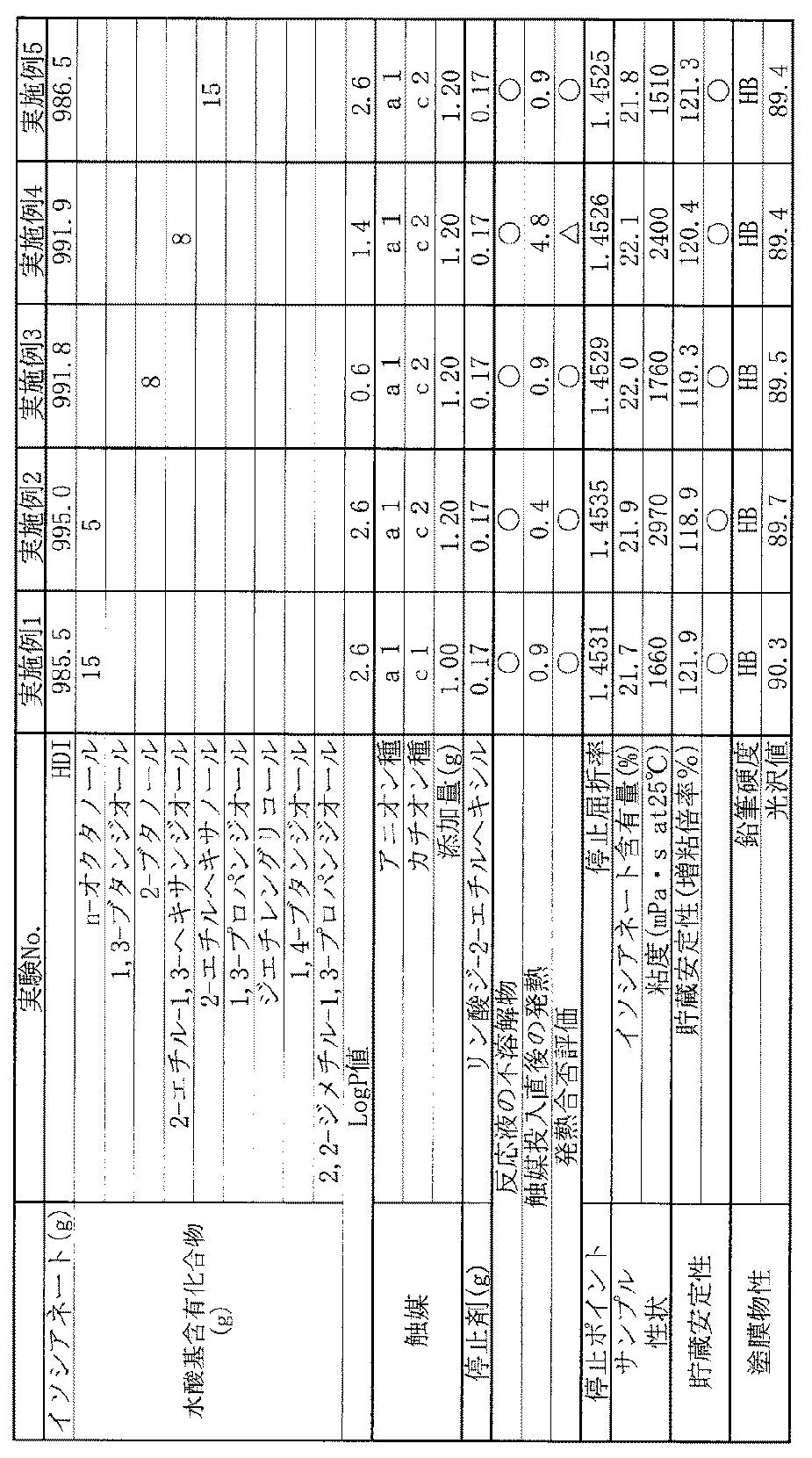

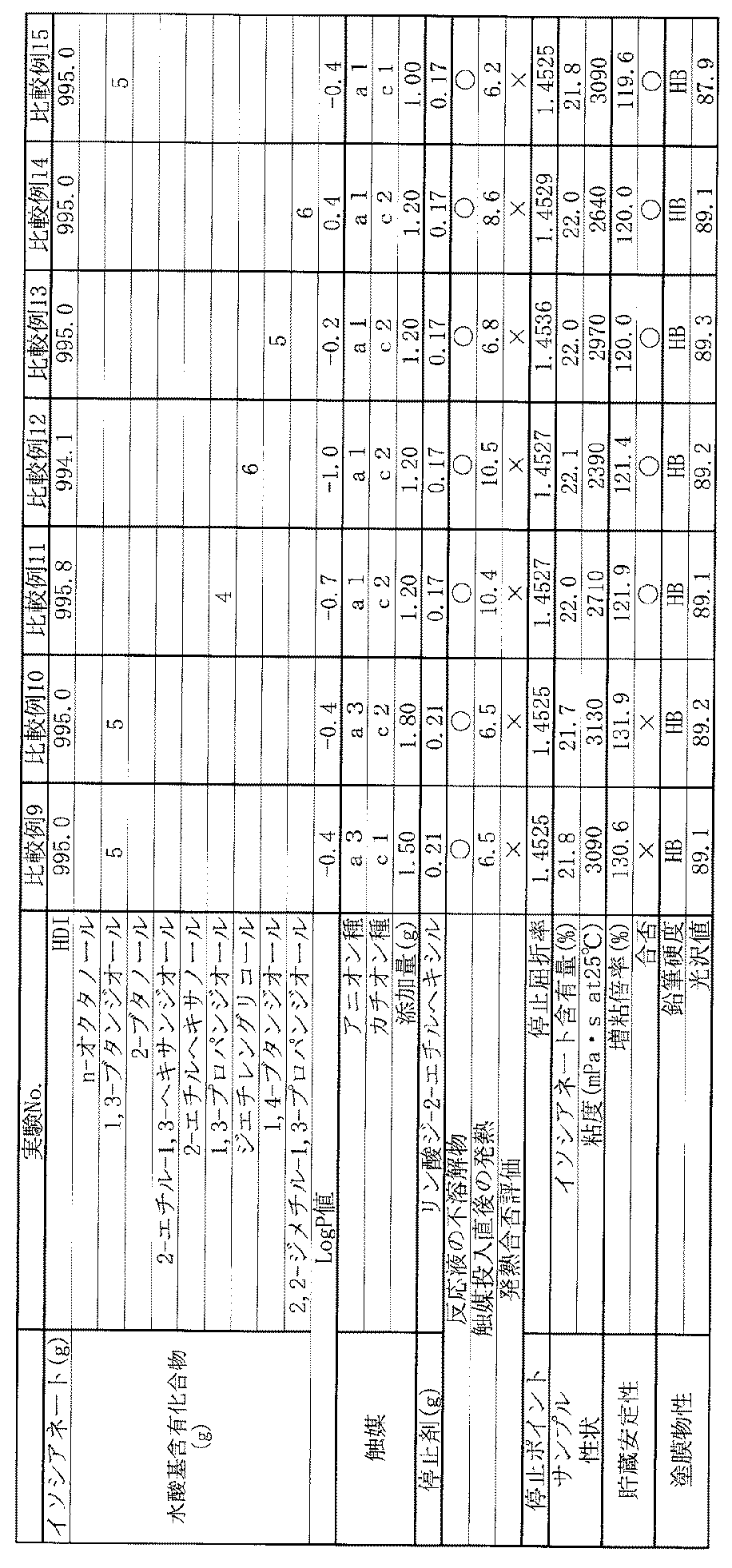
表1~3におけるアニオン種、カチオン種は、以下の通り。
・a1:メチル炭酸
・a2:酢酸
・a3:n-オクチル酸
・c1:オクチルトリメチルアンモニウム
・c2:ドデシルトリメチルアンモニウム
・c3:テトラメチルアンモニウム
・c4:メチルトリエチルアンモニウム
・c5:ベンジルトリメチルアンモニウム。
・a1:メチル炭酸
・a2:酢酸
・a3:n-オクチル酸
・c1:オクチルトリメチルアンモニウム
・c2:ドデシルトリメチルアンモニウム
・c3:テトラメチルアンモニウム
・c4:メチルトリエチルアンモニウム
・c5:ベンジルトリメチルアンモニウム。
<実施例2~5、比較例1~15>
表1~表3に示す条件で、実施例1と同様な手順にて合成を実施し、評価を行った。各実施例においては、ポリイソシアネートを得る反応段階において不溶解物を発生させることなく、かつ貯蔵安定性が良好で、そのポリイソシアネートから得られる塗膜の硬度や光沢値も良好である。
表1~表3に示す条件で、実施例1と同様な手順にて合成を実施し、評価を行った。各実施例においては、ポリイソシアネートを得る反応段階において不溶解物を発生させることなく、かつ貯蔵安定性が良好で、そのポリイソシアネートから得られる塗膜の硬度や光沢値も良好である。
[実施形態2]
<ポリイソシアネート組成物の合成>
<実施例6>
攪拌機、温度計、冷却管、および窒素ガス導入管を備えた容量1リットルの四つ口フラスコに、HDI985g、及びn-オクタノール(三洋化成工業社製)15gを仕込み、これらを撹拌しながら60℃に加熱し、1時間ウレタン化反応を行った。その後、この反応液中にイソシアヌレート化触媒であるトリメチルオクチルアンモニウムメチル炭酸塩(2-エチルヘキサノール10%希釈、広栄化学社製)1gを使用し、60℃にて所定の反応転化率に達するまで反応させた後、反応停止剤である酸性リン酸エステル(JP-508、城北化学工業社製)0.17gを添加し、60℃で1時間停止反応を行った。ここで、テトラキス[メチレン-3-(3’,5’-ジ-t-ブチル-4’-ヒドロキシフェニル)プロピオネート]メタン(IRGANOX 1010、BASF社製)を0.1g添加し、60℃で1時間撹拌混合した。その後、反応生成物から、薄膜蒸留(条件:140℃,0.04kPa)により過剰のHDIを除去し、変性有機ポリイソシアネートP-1を400g得た。
<ポリイソシアネート組成物の合成>
<実施例6>
攪拌機、温度計、冷却管、および窒素ガス導入管を備えた容量1リットルの四つ口フラスコに、HDI985g、及びn-オクタノール(三洋化成工業社製)15gを仕込み、これらを撹拌しながら60℃に加熱し、1時間ウレタン化反応を行った。その後、この反応液中にイソシアヌレート化触媒であるトリメチルオクチルアンモニウムメチル炭酸塩(2-エチルヘキサノール10%希釈、広栄化学社製)1gを使用し、60℃にて所定の反応転化率に達するまで反応させた後、反応停止剤である酸性リン酸エステル(JP-508、城北化学工業社製)0.17gを添加し、60℃で1時間停止反応を行った。ここで、テトラキス[メチレン-3-(3’,5’-ジ-t-ブチル-4’-ヒドロキシフェニル)プロピオネート]メタン(IRGANOX 1010、BASF社製)を0.1g添加し、60℃で1時間撹拌混合した。その後、反応生成物から、薄膜蒸留(条件:140℃,0.04kPa)により過剰のHDIを除去し、変性有機ポリイソシアネートP-1を400g得た。
<実施例7、8、比較例16>
表4に示す条件で合成を行い,実施例1と同様な手順にて各変性ポリイソシアネートP-2、P-3、P-4を得た。
表4に示す条件で合成を行い,実施例1と同様な手順にて各変性ポリイソシアネートP-2、P-3、P-4を得た。
<比較例17>
攪拌機、温度計、冷却管、および窒素ガス導入管を備えた容量1リットルの四つ口フラスコに、HDI(NCO含量:49.9質量%、東ソー社製)985g、及びn-オクタノール(三洋化成工業社製)15g、テトラキス[メチレン-3-(3’,5’-ジ-t-ブチル-4’-ヒドロキシフェニル)プロピオネート]メタン(IRGANOX 1010、BASF社製)0.1gを仕込み、これらを撹拌しながら60℃に加熱し、1時間ウレタン化反応を行った。その後、この反応液中にイソシアヌレート化触媒であるトリメチルオクチルアンモニウムメチル炭酸塩(2-エチルヘキサノール10%希釈、広栄化学社製)1gを使用し、60℃にて所定の反応転化率に達するまで反応させた後、反応停止剤である酸性リン酸エステル(JP-508、城北化学工業社製)0.17gを添加し、60℃で1時間停止反応を行った。その後、反応生成物から、薄膜蒸留(条件:140℃,0.04kPa)により過剰のHDIを除去し、変性有機ポリイソシアネートP-5を400g得た。
攪拌機、温度計、冷却管、および窒素ガス導入管を備えた容量1リットルの四つ口フラスコに、HDI(NCO含量:49.9質量%、東ソー社製)985g、及びn-オクタノール(三洋化成工業社製)15g、テトラキス[メチレン-3-(3’,5’-ジ-t-ブチル-4’-ヒドロキシフェニル)プロピオネート]メタン(IRGANOX 1010、BASF社製)0.1gを仕込み、これらを撹拌しながら60℃に加熱し、1時間ウレタン化反応を行った。その後、この反応液中にイソシアヌレート化触媒であるトリメチルオクチルアンモニウムメチル炭酸塩(2-エチルヘキサノール10%希釈、広栄化学社製)1gを使用し、60℃にて所定の反応転化率に達するまで反応させた後、反応停止剤である酸性リン酸エステル(JP-508、城北化学工業社製)0.17gを添加し、60℃で1時間停止反応を行った。その後、反応生成物から、薄膜蒸留(条件:140℃,0.04kPa)により過剰のHDIを除去し、変性有機ポリイソシアネートP-5を400g得た。
<比較例18~20>
表4に示す条件で合成を行い,比較例2と同様な手順にて各変性ポリイソシアネートP-6、P-7、P-8を得た。
表4に示す条件で合成を行い,比較例2と同様な手順にて各変性ポリイソシアネートP-6、P-7、P-8を得た。

表4で使用した原料は以下の通り。
・酸性リン酸エステル:リン酸ジ-2-エチルヘキシル (JP-508、城北化学工業社製)
・触媒-1:トリメチルオクチルアンモニウムメチル炭酸塩(広栄化学社製)
・PHA-1:テトラキス[メチレン-3-(3’,5’-ジ-t-ブチル-4’-ヒドロキシフェニル)プロピオネート]メタン (IRGANOX 1010、BASF社製)
・PHA-2:3-(3,5-ジ-tert-ブチル-4-ヒドロキシフェニル)プロパン酸オクタデシル (IRGANOX 1076、BASF社製)
・PHA-3:3-(4-ヒドロキシ-3,5-ジイソプロピルフェニル)プロピオン酸オクチル (IRGANOX 1135、BASF社製)
・PHA-4:2,6-ジ-tert-ブチル-4-メチルフェノール (H-BHT、本州化学工業社製)。
・酸性リン酸エステル:リン酸ジ-2-エチルヘキシル (JP-508、城北化学工業社製)
・触媒-1:トリメチルオクチルアンモニウムメチル炭酸塩(広栄化学社製)
・PHA-1:テトラキス[メチレン-3-(3’,5’-ジ-t-ブチル-4’-ヒドロキシフェニル)プロピオネート]メタン (IRGANOX 1010、BASF社製)
・PHA-2:3-(3,5-ジ-tert-ブチル-4-ヒドロキシフェニル)プロパン酸オクタデシル (IRGANOX 1076、BASF社製)
・PHA-3:3-(4-ヒドロキシ-3,5-ジイソプロピルフェニル)プロピオン酸オクチル (IRGANOX 1135、BASF社製)
・PHA-4:2,6-ジ-tert-ブチル-4-メチルフェノール (H-BHT、本州化学工業社製)。
なお、表4における立体障害フェノール構造を有する化合物の添加のタイミングは、変性有機ポリイソシアネート生成後に酸化防止剤を添加したものを「後」、生成前に添加したものを「前」と表記した。
<色数評価>
色数の評価は、JIS K 0071-1に示されるハーゼン単位色数(白金-コバルトスケール)の方法を使用した。
色数の評価は、JIS K 0071-1に示されるハーゼン単位色数(白金-コバルトスケール)の方法を使用した。
<溶剤希釈安定性>
<初期値>
それぞれ得られた変性有機ポリイソシアネートP-1~P-8をメチルエチルケトン(MEK)に固形分20%になるよう希釈し、その色数を測定した。
<初期値>
それぞれ得られた変性有機ポリイソシアネートP-1~P-8をメチルエチルケトン(MEK)に固形分20%になるよう希釈し、その色数を測定した。
<50℃×3ヶ月後>
変性有機ポリイソシアネートP-1~P-8を、MEKに固形分20%に希釈したものを、50℃で3ヶ月保管した後、その色数を測定した。
変性有機ポリイソシアネートP-1~P-8を、MEKに固形分20%に希釈したものを、50℃で3ヶ月保管した後、その色数を測定した。
各実施例においては、変性有機ポリイソシアネートP-1~P-3をMEKに希釈したものを、50℃で3ヶ月保管した後の色数にも、大きな変化がみられなかった。
本発明を詳細に、また特定の実施態様を参照して説明したが、本発明の本質と範囲を逸脱することなく様々な変更や修正を加えることができることはいわゆる当業者にとって明らかである。
なお、2016年10月25日に出願された日本特許出願2016-208837号、2017年01月25日に出願された日本特許出願2017-010890号の明細書、特許請求の範囲及び要約書の全内容をここに引用し、本発明の明細書の開示として、取り入れるものである。
Claims (16)
- ヘキサメチレンジイソシアネートと、水・オクタノール分配係数が0.5以上の水酸基含有化合物との反応生成物、及び式1で示される4級アンモニウム塩とを含むイソシアヌレート基含有ポリイソシアネート組成物。

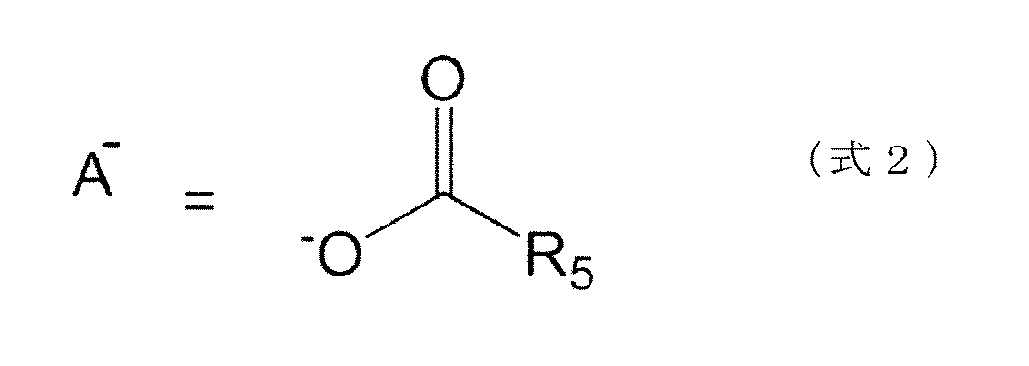
- 式2で示される炭酸エステルがメチル炭酸であることを特徴とする請求項1に記載のイソシアヌレート基含有ポリイソシアネート組成物。
- ヘキサメチレンジイソシアネートと水・オクタノール分配係数が0.5以上の水酸基含有化合物とを、式1で示される4級アンモニウム塩の存在下、反応させて得られるイソシアヌレート基含有ポリイソシアネート組成物の製造方法。
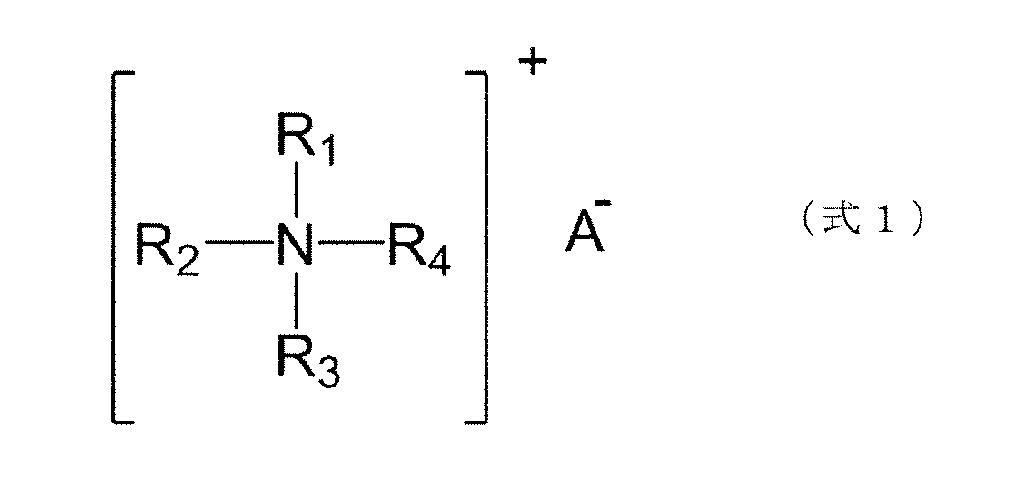
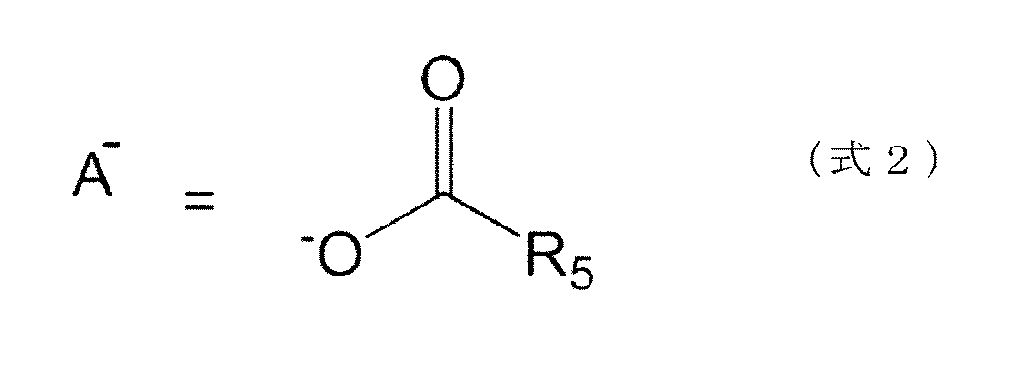
- 式2で示される炭酸エステルがメチル炭酸であることを特徴とする請求項3に記載のイソシアヌレート基含有ポリイソシアネート組成物の製造方法。
- 請求項1又は2に記載のイソシアヌレート基含有ポリイソシアネート組成物とポリオールとを含む二液型塗料組成物。
- 請求項5に記載の二液型塗料組成物から得られる塗膜。
- 請求項5に記載の二液型塗料組成物から得られるコーティング物。
- 有機ジイソシアネートモノマーをイソシアヌレート化、又はアロファネート化する変性有機ポリイソシアネートの製造方法において、変性有機ポリイソシアネートの生成後に、立体障害フェノール構造を有する化合物(但し、2,6-ジ-tert-ブチル-4-メチルフェノールを除く)を添加することを特徴とする、変性有機ポリイソシアネートの製造方法。
- 立体障害フェノール構造を有する化合物が、テトラキス[メチレン-3-(3’,5’-ジ-t-ブチル-4’-ヒドロキシフェニル)プロピオネート]メタン、3-(3,5-ジ-tert-ブチル-4-ヒドロキシフェニル)プロパン酸オクタデシル、3-(4-ヒドロキシ-3,5-ジイソプロピルフェニル)プロピオン酸オクチル、1,3,5-トリス(3,5-ジ-tert-ブチル-4-ヒドロキシベンジル)イソシアヌル酸、2,4,6-トリス(3’,5’-ジ-tert-ブチル-4’-ヒドロキシベンジル)メシチレンから選ばれる、少なくとも一種であることを特徴とする、請求項8に記載の変性有機ポリイソシアネートの製造方法。
- 変性有機ポリイソシアネートが、ヘキサメチレンジイソシアネートの変性体であることを特徴とする、請求項8又は9に記載の変性有機ポリイソシアネートの製造方法。
- 変性有機ポリイソシアネートが、イソシアヌレート基、及びアロファネート基からなる群より選ばれる少なくとも一種を含むことを特徴とする、請求項8乃至10のいずれかに記載の変性有機ポリイソシアネートの製造方法。
- 請求項3又は4に記載のイソシアヌレート基含有ポリイソシアネート組成物の製造方法において、イソシアヌレート基含有ポリイソシアネート組成物の生成後に、立体障害フェノール構造を有する化合物(但し、2,6-ジ-tert-ブチル-4-メチルフェノールを除く)を添加することを特徴とする、イソシアヌレート基含有ポリイソシアネート組成物の製造方法。
- 立体障害フェノール構造を有する化合物が、テトラキス[メチレン-3-(3’,5’-ジ-t-ブチル-4’-ヒドロキシフェニル)プロピオネート]メタン、3-(3,5-ジ-tert-ブチル-4-ヒドロキシフェニル)プロパン酸オクタデシル、3-(4-ヒドロキシ-3,5-ジイソプロピルフェニル)プロピオン酸オクチル、1,3,5-トリス(3,5-ジ-tert-ブチル-4-ヒドロキシベンジル)イソシアヌル酸、2,4,6-トリス(3’,5’-ジ-tert-ブチル-4’-ヒドロキシベンジル)メシチレンから選ばれる、少なくとも一種であることを特徴とする、請求項12に記載のイソシアヌレート基含有ポリイソシアネート組成物の製造方法。
- 請求項8乃至13のいずれかの製造方法で得られた変性有機ポリイソシアネートと、ポリオールとを含む二液型塗料組成物の製造方法。
- 請求項14に記載の製造方法で得られた二液型塗料組成物から得られる塗膜の製造方法。
- 請求項14に記載の製造方法で得られた二液型塗料組成物から得られるコーティング物の製造方法。
Applications Claiming Priority (4)
| Application Number | Priority Date | Filing Date | Title |
|---|---|---|---|
| JP2016208837A JP2018070689A (ja) | 2016-10-25 | 2016-10-25 | ポリイソシアネート組成物およびそれを用いた塗料組成物 |
| JP2016-208837 | 2016-10-25 | ||
| JP2017-010890 | 2017-01-25 | ||
| JP2017010890A JP6926489B2 (ja) | 2017-01-25 | 2017-01-25 | 変性有機ポリイソシアネートの製造方法 |
Publications (1)
| Publication Number | Publication Date |
|---|---|
| WO2018079428A1 true WO2018079428A1 (ja) | 2018-05-03 |
Family
ID=62024782
Family Applications (1)
| Application Number | Title | Priority Date | Filing Date |
|---|---|---|---|
| PCT/JP2017/037963 Ceased WO2018079428A1 (ja) | 2016-10-25 | 2017-10-20 | ポリイソシアネート組成物およびそれを用いた塗料組成物、及び該ポリイソシアネート組成物の製造方法 |
Country Status (1)
| Country | Link |
|---|---|
| WO (1) | WO2018079428A1 (ja) |
Citations (7)
| Publication number | Priority date | Publication date | Assignee | Title |
|---|---|---|---|---|
| US20130109806A1 (en) * | 2011-10-28 | 2013-05-02 | Harald Schaefer | Color-stable curing agent compositions comprising polyisocyanates of (cyclo)aliphatic diisocyanates |
| JP2014530944A (ja) * | 2011-10-28 | 2014-11-20 | ビーエーエスエフ ソシエタス・ヨーロピアBasf Se | (環式)脂肪族ジイソシアナートのポリイソシアナートを含む色安定性の硬化剤組成物 |
| WO2015093107A1 (ja) * | 2013-12-19 | 2015-06-25 | 東ソー株式会社 | アロファネート・イソシアヌレート化触媒、ポリイソシアネート組成物及び該組成物の製造方法、並びに、二液型塗料組成物 |
| JP2016008300A (ja) * | 2014-06-26 | 2016-01-18 | 東ソー株式会社 | ポリイソシアヌレート変性イソシアネート組成物 |
| JP2016044264A (ja) * | 2014-08-25 | 2016-04-04 | 東ソー株式会社 | ポリイソシアヌレート変性イソシアネート組成物の製造方法 |
| JP2016056242A (ja) * | 2014-09-05 | 2016-04-21 | 東ソー株式会社 | ポリイソシアヌレート変性イソシアネート組成物 |
| JP2016069497A (ja) * | 2014-09-29 | 2016-05-09 | 東ソー株式会社 | ポリイソシアヌレート変性イソシアネート組成物及びその製造方法 |
-
2017
- 2017-10-20 WO PCT/JP2017/037963 patent/WO2018079428A1/ja not_active Ceased
Patent Citations (7)
| Publication number | Priority date | Publication date | Assignee | Title |
|---|---|---|---|---|
| US20130109806A1 (en) * | 2011-10-28 | 2013-05-02 | Harald Schaefer | Color-stable curing agent compositions comprising polyisocyanates of (cyclo)aliphatic diisocyanates |
| JP2014530944A (ja) * | 2011-10-28 | 2014-11-20 | ビーエーエスエフ ソシエタス・ヨーロピアBasf Se | (環式)脂肪族ジイソシアナートのポリイソシアナートを含む色安定性の硬化剤組成物 |
| WO2015093107A1 (ja) * | 2013-12-19 | 2015-06-25 | 東ソー株式会社 | アロファネート・イソシアヌレート化触媒、ポリイソシアネート組成物及び該組成物の製造方法、並びに、二液型塗料組成物 |
| JP2016008300A (ja) * | 2014-06-26 | 2016-01-18 | 東ソー株式会社 | ポリイソシアヌレート変性イソシアネート組成物 |
| JP2016044264A (ja) * | 2014-08-25 | 2016-04-04 | 東ソー株式会社 | ポリイソシアヌレート変性イソシアネート組成物の製造方法 |
| JP2016056242A (ja) * | 2014-09-05 | 2016-04-21 | 東ソー株式会社 | ポリイソシアヌレート変性イソシアネート組成物 |
| JP2016069497A (ja) * | 2014-09-29 | 2016-05-09 | 東ソー株式会社 | ポリイソシアヌレート変性イソシアネート組成物及びその製造方法 |
Similar Documents
| Publication | Publication Date | Title |
|---|---|---|
| CN105829375B (zh) | 脲基甲酸酯-异氰脲酸酯化催化剂、多异氰酸酯组合物和该组合物的制造方法以及双组分型涂料组合物 | |
| JP6664509B2 (ja) | ポリイソシアネート組成物、ブロックポリイソシアネート組成物、親水性ポリイソシアネート組成物、塗料組成物、および塗膜 | |
| JP7670233B2 (ja) | ブタンジイソシアネート誘導体、ブタンジイソシアネート誘導体の製造方法、ポリイソシアネート組成物、ポリウレタン樹脂形成性組成物、塗料組成物及び塗膜 | |
| JP6840939B2 (ja) | ポリイソシアネート組成物およびそれを用いた塗料組成物 | |
| JP7354578B2 (ja) | ポリイソシアネート組成物およびそれを用いた塗料組成物 | |
| JP4123509B2 (ja) | 自己乳化型ブロックポリイソシアネート組成物及びそれを用いた水性塗料 | |
| EP3738682B1 (en) | Coating method and coating film | |
| JP7069653B2 (ja) | ポリイソシアネート組成物およびそれを用いた二液型塗料組成物 | |
| WO2018079428A1 (ja) | ポリイソシアネート組成物およびそれを用いた塗料組成物、及び該ポリイソシアネート組成物の製造方法 | |
| JP7435117B2 (ja) | 変性ポリイソシアネート組成物 | |
| JP2019218437A (ja) | ポリイソシアネート組成物およびそれを用いた塗料組成物 | |
| JP7852208B2 (ja) | 変性ポリイソシアネート組成物およびそれを用いた塗料組成物 | |
| JP5539281B2 (ja) | 水分散性イソシアネート組成物および水性ポリウレタン樹脂組成物 | |
| JP6926489B2 (ja) | 変性有機ポリイソシアネートの製造方法 | |
| JP7159613B2 (ja) | ポリイソシアネート組成物およびそれを用いた塗料組成物 | |
| JP7613642B1 (ja) | ポリウレタン塗膜用表面平滑化剤、組成物、硬化剤、ポリウレタン樹脂形成性組成物、塗料組成物及び塗膜 | |
| JP2018070689A (ja) | ポリイソシアネート組成物およびそれを用いた塗料組成物 | |
| JP2003253200A (ja) | 水性一液コーティング剤及びそれを用いたコーティング方法 | |
| JP7183532B2 (ja) | 変性有機ポリイソシアネート組成物及びそれを用いた二液型塗料組成物 | |
| WO2025204587A1 (ja) | ブタンジイソシアネート組成物、ポリイソシアネート組成物、ポリウレタン樹脂形成性組成物、塗料組成物及び塗膜 | |
| WO2018070533A1 (ja) | ポリイソシアネート組成物、塗料組成物、および塗膜 | |
| WO2025204589A1 (ja) | ブタンジイソシアネート組成物、ポリイソシアネート組成物、ポリウレタン樹脂形成性組成物、塗料組成物及び塗膜 | |
| US20260125508A1 (en) | Modified blocked polyisocyanate, coating composition, coating film, and method for forming a coating film | |
| JP2025098769A (ja) | 下地用塗料組成物、コーティング塗料組成物、塗膜積層体及び塗膜積層体の製造方法 | |
| WO2025028519A1 (ja) | ブロックイソシアネート組成物、塗料組成物及び塗膜 |
Legal Events
| Date | Code | Title | Description |
|---|---|---|---|
| 121 | Ep: the epo has been informed by wipo that ep was designated in this application |
Ref document number: 17864032 Country of ref document: EP Kind code of ref document: A1 |
|
| NENP | Non-entry into the national phase |
Ref country code: DE |
|
| 122 | Ep: pct application non-entry in european phase |
Ref document number: 17864032 Country of ref document: EP Kind code of ref document: A1 |