WO2018055941A1 - 表面処理組成物 - Google Patents
表面処理組成物 Download PDFInfo
- Publication number
- WO2018055941A1 WO2018055941A1 PCT/JP2017/029003 JP2017029003W WO2018055941A1 WO 2018055941 A1 WO2018055941 A1 WO 2018055941A1 JP 2017029003 W JP2017029003 W JP 2017029003W WO 2018055941 A1 WO2018055941 A1 WO 2018055941A1
- Authority
- WO
- WIPO (PCT)
- Prior art keywords
- surface treatment
- group
- treatment composition
- polished
- soluble polymer
- Prior art date
- Legal status (The legal status is an assumption and is not a legal conclusion. Google has not performed a legal analysis and makes no representation as to the accuracy of the status listed.)
- Ceased
Links
Classifications
-
- C—CHEMISTRY; METALLURGY
- C08—ORGANIC MACROMOLECULAR COMPOUNDS; THEIR PREPARATION OR CHEMICAL WORKING-UP; COMPOSITIONS BASED THEREON
- C08L—COMPOSITIONS OF MACROMOLECULAR COMPOUNDS
- C08L29/00—Compositions of homopolymers or copolymers of compounds having one or more unsaturated aliphatic radicals, each having only one carbon-to-carbon double bond, and at least one being terminated by an alcohol, ether, aldehydo, ketonic, acetal or ketal radical; Compositions of hydrolysed polymers of esters of unsaturated alcohols with saturated carboxylic acids; Compositions of derivatives of such polymers
- C08L29/02—Homopolymers or copolymers of unsaturated alcohols
- C08L29/04—Polyvinyl alcohol; Partially hydrolysed homopolymers or copolymers of esters of unsaturated alcohols with saturated carboxylic acids
-
- C—CHEMISTRY; METALLURGY
- C11—ANIMAL OR VEGETABLE OILS, FATS, FATTY SUBSTANCES OR WAXES; FATTY ACIDS THEREFROM; DETERGENTS; CANDLES
- C11D—DETERGENT COMPOSITIONS; USE OF SINGLE SUBSTANCES AS DETERGENTS; SOAP OR SOAP-MAKING; RESIN SOAPS; RECOVERY OF GLYCEROL
- C11D7/00—Compositions of detergents based essentially on non-surface-active compounds
- C11D7/22—Organic compounds
-
- C—CHEMISTRY; METALLURGY
- C08—ORGANIC MACROMOLECULAR COMPOUNDS; THEIR PREPARATION OR CHEMICAL WORKING-UP; COMPOSITIONS BASED THEREON
- C08G—MACROMOLECULAR COMPOUNDS OBTAINED OTHERWISE THAN BY REACTIONS ONLY INVOLVING UNSATURATED CARBON-TO-CARBON BONDS
- C08G61/00—Macromolecular compounds obtained by reactions forming a carbon-to-carbon link in the main chain of the macromolecule
- C08G61/02—Macromolecular compounds containing only carbon atoms in the main chain of the macromolecule, e.g. polyxylylenes
- C08G61/04—Macromolecular compounds containing only carbon atoms in the main chain of the macromolecule, e.g. polyxylylenes only aliphatic carbon atoms
-
- C—CHEMISTRY; METALLURGY
- C08—ORGANIC MACROMOLECULAR COMPOUNDS; THEIR PREPARATION OR CHEMICAL WORKING-UP; COMPOSITIONS BASED THEREON
- C08L—COMPOSITIONS OF MACROMOLECULAR COMPOUNDS
- C08L31/00—Compositions of homopolymers or copolymers of compounds having one or more unsaturated aliphatic radicals, each having only one carbon-to-carbon double bond, and at least one being terminated by an acyloxy radical of a saturated carboxylic acid, of carbonic acid or of a haloformic acid; Compositions of derivatives of such polymers
- C08L31/02—Homopolymers or copolymers of esters of monocarboxylic acids
- C08L31/04—Homopolymers or copolymers of vinyl acetate
-
- C—CHEMISTRY; METALLURGY
- C08—ORGANIC MACROMOLECULAR COMPOUNDS; THEIR PREPARATION OR CHEMICAL WORKING-UP; COMPOSITIONS BASED THEREON
- C08L—COMPOSITIONS OF MACROMOLECULAR COMPOUNDS
- C08L33/00—Compositions of homopolymers or copolymers of compounds having one or more unsaturated aliphatic radicals, each having only one carbon-to-carbon double bond, and only one being terminated by only one carboxyl radical, or of salts, anhydrides, esters, amides, imides or nitriles thereof; Compositions of derivatives of such polymers
- C08L33/02—Homopolymers or copolymers of acids; Metal or ammonium salts thereof
-
- C—CHEMISTRY; METALLURGY
- C08—ORGANIC MACROMOLECULAR COMPOUNDS; THEIR PREPARATION OR CHEMICAL WORKING-UP; COMPOSITIONS BASED THEREON
- C08L—COMPOSITIONS OF MACROMOLECULAR COMPOUNDS
- C08L33/00—Compositions of homopolymers or copolymers of compounds having one or more unsaturated aliphatic radicals, each having only one carbon-to-carbon double bond, and only one being terminated by only one carboxyl radical, or of salts, anhydrides, esters, amides, imides or nitriles thereof; Compositions of derivatives of such polymers
- C08L33/24—Homopolymers or copolymers of amides or imides
-
- C—CHEMISTRY; METALLURGY
- C08—ORGANIC MACROMOLECULAR COMPOUNDS; THEIR PREPARATION OR CHEMICAL WORKING-UP; COMPOSITIONS BASED THEREON
- C08L—COMPOSITIONS OF MACROMOLECULAR COMPOUNDS
- C08L39/00—Compositions of homopolymers or copolymers of compounds having one or more unsaturated aliphatic radicals, each having only one carbon-to-carbon double bond, and at least one being terminated by a single or double bond to nitrogen or by a heterocyclic ring containing nitrogen; Compositions of derivatives of such polymers
- C08L39/04—Homopolymers or copolymers of monomers containing heterocyclic rings having nitrogen as ring member
- C08L39/06—Homopolymers or copolymers of N-vinyl-pyrrolidones
-
- C—CHEMISTRY; METALLURGY
- C11—ANIMAL OR VEGETABLE OILS, FATS, FATTY SUBSTANCES OR WAXES; FATTY ACIDS THEREFROM; DETERGENTS; CANDLES
- C11D—DETERGENT COMPOSITIONS; USE OF SINGLE SUBSTANCES AS DETERGENTS; SOAP OR SOAP-MAKING; RESIN SOAPS; RECOVERY OF GLYCEROL
- C11D3/00—Other compounding ingredients of detergent compositions covered in group C11D1/00
- C11D3/16—Organic compounds
- C11D3/26—Organic compounds containing nitrogen
- C11D3/30—Amines; Substituted amines ; Quaternized amines
-
- C—CHEMISTRY; METALLURGY
- C11—ANIMAL OR VEGETABLE OILS, FATS, FATTY SUBSTANCES OR WAXES; FATTY ACIDS THEREFROM; DETERGENTS; CANDLES
- C11D—DETERGENT COMPOSITIONS; USE OF SINGLE SUBSTANCES AS DETERGENTS; SOAP OR SOAP-MAKING; RESIN SOAPS; RECOVERY OF GLYCEROL
- C11D7/00—Compositions of detergents based essentially on non-surface-active compounds
- C11D7/22—Organic compounds
- C11D7/26—Organic compounds containing oxygen
-
- C—CHEMISTRY; METALLURGY
- C11—ANIMAL OR VEGETABLE OILS, FATS, FATTY SUBSTANCES OR WAXES; FATTY ACIDS THEREFROM; DETERGENTS; CANDLES
- C11D—DETERGENT COMPOSITIONS; USE OF SINGLE SUBSTANCES AS DETERGENTS; SOAP OR SOAP-MAKING; RESIN SOAPS; RECOVERY OF GLYCEROL
- C11D7/00—Compositions of detergents based essentially on non-surface-active compounds
- C11D7/22—Organic compounds
- C11D7/26—Organic compounds containing oxygen
- C11D7/261—Alcohols; Phenols
-
- C—CHEMISTRY; METALLURGY
- C11—ANIMAL OR VEGETABLE OILS, FATS, FATTY SUBSTANCES OR WAXES; FATTY ACIDS THEREFROM; DETERGENTS; CANDLES
- C11D—DETERGENT COMPOSITIONS; USE OF SINGLE SUBSTANCES AS DETERGENTS; SOAP OR SOAP-MAKING; RESIN SOAPS; RECOVERY OF GLYCEROL
- C11D7/00—Compositions of detergents based essentially on non-surface-active compounds
- C11D7/22—Organic compounds
- C11D7/34—Organic compounds containing sulfur
-
- H—ELECTRICITY
- H10—SEMICONDUCTOR DEVICES; ELECTRIC SOLID-STATE DEVICES NOT OTHERWISE PROVIDED FOR
- H10P—GENERIC PROCESSES OR APPARATUS FOR THE MANUFACTURE OR TREATMENT OF DEVICES COVERED BY CLASS H10
- H10P52/00—Grinding, lapping or polishing of wafers, substrates or parts of devices
-
- H—ELECTRICITY
- H10—SEMICONDUCTOR DEVICES; ELECTRIC SOLID-STATE DEVICES NOT OTHERWISE PROVIDED FOR
- H10P—GENERIC PROCESSES OR APPARATUS FOR THE MANUFACTURE OR TREATMENT OF DEVICES COVERED BY CLASS H10
- H10P70/00—Cleaning of wafers, substrates or parts of devices
- H10P70/20—Cleaning during device manufacture
- H10P70/23—Cleaning during device manufacture during, before or after processing of insulating materials
- H10P70/237—Cleaning during device manufacture during, before or after processing of insulating materials the processing being a planarisation of insulating layers
-
- H—ELECTRICITY
- H10—SEMICONDUCTOR DEVICES; ELECTRIC SOLID-STATE DEVICES NOT OTHERWISE PROVIDED FOR
- H10P—GENERIC PROCESSES OR APPARATUS FOR THE MANUFACTURE OR TREATMENT OF DEVICES COVERED BY CLASS H10
- H10P70/00—Cleaning of wafers, substrates or parts of devices
- H10P70/20—Cleaning during device manufacture
- H10P70/27—Cleaning during device manufacture during, before or after processing of conductive materials, e.g. polysilicon or amorphous silicon layers
- H10P70/277—Cleaning during device manufacture during, before or after processing of conductive materials, e.g. polysilicon or amorphous silicon layers the processing being a planarisation of conductive layers
-
- C—CHEMISTRY; METALLURGY
- C08—ORGANIC MACROMOLECULAR COMPOUNDS; THEIR PREPARATION OR CHEMICAL WORKING-UP; COMPOSITIONS BASED THEREON
- C08G—MACROMOLECULAR COMPOUNDS OBTAINED OTHERWISE THAN BY REACTIONS ONLY INVOLVING UNSATURATED CARBON-TO-CARBON BONDS
- C08G2261/00—Macromolecular compounds obtained by reactions forming a carbon-to-carbon link in the main chain of the macromolecule
- C08G2261/10—Definition of the polymer structure
- C08G2261/14—Side-groups
- C08G2261/145—Side-chains containing sulfur
- C08G2261/1452—Side-chains containing sulfur containing sulfonyl or sulfonate-groups
-
- C—CHEMISTRY; METALLURGY
- C11—ANIMAL OR VEGETABLE OILS, FATS, FATTY SUBSTANCES OR WAXES; FATTY ACIDS THEREFROM; DETERGENTS; CANDLES
- C11D—DETERGENT COMPOSITIONS; USE OF SINGLE SUBSTANCES AS DETERGENTS; SOAP OR SOAP-MAKING; RESIN SOAPS; RECOVERY OF GLYCEROL
- C11D2111/00—Cleaning compositions characterised by the objects to be cleaned; Cleaning compositions characterised by non-standard cleaning or washing processes
- C11D2111/10—Objects to be cleaned
- C11D2111/14—Hard surfaces
- C11D2111/22—Electronic devices, e.g. PCBs or semiconductors
-
- H—ELECTRICITY
- H10—SEMICONDUCTOR DEVICES; ELECTRIC SOLID-STATE DEVICES NOT OTHERWISE PROVIDED FOR
- H10P—GENERIC PROCESSES OR APPARATUS FOR THE MANUFACTURE OR TREATMENT OF DEVICES COVERED BY CLASS H10
- H10P90/00—Preparation of wafers not covered by a single main group of this subclass, e.g. wafer reinforcement
Definitions
- the present invention relates to a surface treatment composition.
- CMP chemical mechanical polishing
- Impurities remain on the surface of the semiconductor substrate after the CMP process. Impurities are generated by polishing abrasive grains and metals derived from the polishing composition used in CMP; organic substances such as anticorrosives and surfactants; silicon-containing materials that are objects to be polished; metal wiring and plugs, etc. In addition, silicon-containing materials and metals; and organic substances such as pad scraps generated from various pads are included.
- the surface of the semiconductor substrate is contaminated with these impurities, it may adversely affect the electrical characteristics of the semiconductor and reduce the reliability of the device. Therefore, it is desirable to remove these impurities from the surface of the polished polishing object (polished polishing object) after the CMP process.
- cleaning compositions for removing these impurities for example, those disclosed in Patent Documents 1 to 4 are known.
- the conventional technique has a problem that defects remaining on the polished object having a silicon-silicon bond and a nitrogen-silicon bond cannot be sufficiently removed.
- the problem to be solved by the present invention is to treat the surface of the polished object by sufficiently removing defects on the surface of the polished object having both silicon-silicon bonds and nitrogen-silicon bonds. It is to provide a surface treatment composition that can be used.
- a nonionic water-soluble polymer (A) having a main chain composed of only carbon atoms or a carbon atom and a nitrogen atom also referred to as nonionic water-soluble polymer (A)
- the inventors have found that the above problems can be solved by providing a surface treatment composition, and have reached the object of the present invention.
- a surface treatment composition capable of treating a surface of a polished polishing object by sufficiently removing defects on the surface of the polished polishing object having both a silicon-silicon bond and a nitrogen-silicon bond. Can be provided.
- the present invention relates to a nonionic water-soluble polymer (A) having a main chain consisting of only carbon atoms or a carbon atom and a nitrogen atom; a main chain consisting only of carbon atoms, and a main chain consisting only of the carbon atoms
- the surface of the polished polishing object can be treated by sufficiently removing defects on the surface of the polished polishing object having both silicon-silicon bonds and nitrogen-silicon bonds.
- composition according to the present invention removes impurities (defects) remaining on the polished polishing object (substrate), but from this viewpoint, the surface state of the polished polishing object (substrate) surface is changed ( Processing). Therefore, the composition is referred to as a “surface treatment composition”.
- the surface treatment composition according to the present invention is used after the CMP process.
- the CMP step may be a polishing step consisting of a single step or a polishing step consisting of a plurality of steps.
- a polishing process comprising a plurality of processes, for example, a process of performing a final polishing process after a preliminary polishing process (rough polishing process) or a secondary polishing process of one or more times after a primary polishing process is performed. Then, there is a step of performing a finish polishing step.
- the polishing composition used in the CMP process a known polishing composition for appropriately polishing a polishing object having both silicon-silicon bond and nitrogen-silicon bond is appropriately used.
- polishing apparatus a general polishing apparatus can be used, and either a single-side polishing apparatus or a double-side polishing apparatus may be used.
- polishing pad polyurethane or the like is suitable.
- a polished polishing object is produced by subjecting the polishing object to a CMP process.
- a “polishing object” to which the CMP process is applied includes both a silicon-silicon bond and a nitrogen-silicon bond. Therefore, the “polished polishing object” that has been subjected to the CMP process also includes a silicon-silicon bond and a nitrogen-silicon bond. In addition, the “surface treatment object” that is surface-treated by removing the remaining impurities also includes a silicon-silicon bond and a nitrogen-silicon bond.
- polishing object having a silicon-silicon bond Si such as polysilicon, amorphous silicon, single crystal silicon, n-type doped single crystal silicon, p-type doped single crystal silicon, SiGe, etc. Based alloys and the like.
- polishing object having a silicon-nitrogen bond examples include a silicon nitride film and SiCN (silicon carbonitride).
- the “polished polishing object including both a silicon-silicon bond and a nitrogen-silicon bond” is a polished polishing object, and a certain region in the polished polishing object is “silicon "Silicon bond” is included, and another region means "Nitrogen-silicon bond”.
- the surface treatment composition of the present invention it is possible to sufficiently remove defects on the surface of a polished object that contains both silicon-silicon bonds and nitrogen-silicon bonds, which could not be achieved conventionally. .
- the surface treatment composition of the present invention contains a nonionic water-soluble polymer (A) having a main chain composed of only carbon atoms or carbon atoms and nitrogen atoms.
- the “main chain” means the main chain of the chain compound constituting the polymer.
- the main chain of the nonionic water-soluble polymer (A) of the present invention consists of only carbon atoms, or carbon atoms and nitrogen atoms. According to this embodiment, the desired effect of the present invention can be efficiently achieved.
- nonionic water-soluble polymer (A) is represented by the following formula (1):
- R 1 to R 6 are each independently a hydrogen atom or —J, wherein —J is a hydroxyl group
- R 7 and R 8 are each independently a hydrogen atom or —E, and —E is represented by the following formula:
- the structural unit includes at least one of -J and -E.
- X is the following:
- R 1 to R 4 is —J, and —J is a hydroxyl group.
- X is the following:
- R 1 to R 4 is -J, -J is
- X is the following:
- R 1 , R 2 , R 5 and R 6 is a hydrogen atom
- R 8 is -E
- -E is represented by the following formula:
- (1) of the present embodiment and (2) of the present embodiment are preferable, and (1) of the present embodiment is more preferable.
- the nonionic water-soluble polymer (A) is a polyvinyl alcohol (PVA), a copolymer containing a structural unit derived from polyvinyl alcohol (PVA) as part of its structure, polyvinyl pyrrolidone (PVP).
- PVA polyvinyl alcohol
- PVP polyvinyl pyrrolidone
- PVP polyvinylpyrrolidone
- nonionic water-soluble polymer (A) is a copolymer
- the form thereof may be any of a block copolymer, a random copolymer, a graft copolymer, and an alternating copolymer.
- the nonionic water-soluble polymer (A) is a polyvinyl alcohol (PVA) or a copolymer containing a structural unit derived from polyvinyl alcohol (PVA) as part of its structure, or polyvinyl pyrrolidone ( PVP) or polyvinylpyrrolidone (PVP) is preferably a copolymer containing a structural unit in a part of the structure, and the nonionic water-soluble polymer (A) is polyvinyl alcohol (PVA) or polyvinyl alcohol (PVA). More preferably, it is a copolymer containing the derived structural unit as part of its structure. According to this embodiment, the desired effect of the present invention can be efficiently achieved.
- PVA polyvinyl alcohol
- PVP polyvinyl pyrrolidone
- PVP polyvinylpyrrolidone
- PVP polyvinylpyrrolidone
- PVP polyvinylpyrrolidone
- PVP polyvinylpyrrol
- the saponification degree of the polyvinyl alcohol (PVA) or a copolymer containing a structural unit derived from the polyvinyl alcohol (PVA) as a part of the structure is 60% or more. According to this embodiment, the desired effect of the present invention can be efficiently achieved. Moreover, in preferable embodiment of this invention, it is preferable that a saponification degree is 80% or more, and it is more preferable that it is 90% or more.
- the weight average molecular weight of the nonionic water-soluble polymer (A) is preferably 800 or more, more preferably 2,000 or more, and 4,000 or more from the viewpoint of sufficiently removing defects. Is more preferably 6,000 or more, and further preferably 8,000 or more. Further, from the viewpoint of sufficiently removing defects, it is preferably 80,000 or less, more preferably 60,000 or less, further preferably 45,000 or less, and 30,000 or less. Is still more preferable, and it is especially preferable that it is 20,000 or less.
- the weight average molecular weight is measured by gel permeation chromatography (GPC) using polystyrene having a known molecular weight as a reference substance.
- the content of the nonionic water-soluble polymer (A) is preferably 0.01% by mass or more, and 0.05% by mass with respect to the total mass of the surface treatment composition from the viewpoint of sufficiently removing defects. More preferably, it is more preferably 0.08% by mass or more. Further, it is preferably 5% by mass or less, more preferably 1% by mass or less, still more preferably 0.6% by mass or less, still more preferably 0.3% by mass or less, More preferably, it is 0.2 mass% or less.
- the surface treatment composition of the present invention includes an anion water-soluble polymer (B), and the anion water-soluble polymer (B) includes a main chain composed of only carbon atoms and a side chain, And bonded to the main chain composed of only the carbon atom, and has a sulfonic acid group or a salt group thereof, or a carboxyl group or a salt group thereof.
- the mechanism by which such a surface treatment composition exhibits the desired effect of the present invention is presumed as follows. Of course, the protection scope of the present invention is not limited to such a mechanism. That is, it is presumed that the anionic water-soluble polymer (B) functions as a dispersant and removes impurities remaining on the polished object to be polished.
- the “side chain” refers to a chain branched from the “main chain”.
- the salt is not particularly limited, and examples thereof include ammonium salts and sodium salts.
- a sulfonic acid group or a salt group thereof, or a carboxyl group or a salt group thereof may be directly bonded to the main chain consisting of only the carbon atom as a side chain, or through another bonding group, You may couple
- the linking group include an arylene group having 6 to 24 carbon atoms and a divalent acid amide. As the arylene group having 6 to 24 carbon atoms, a phenylene group, a naphthalenediyl group, and the like are preferable.
- anionic water-soluble polymer (B) is represented by the following formula (2):
- R 9 is a hydrogen atom or a methyl group
- R 10 and R 11 are each independently a hydrogen atom, —COOR 12 or —G, provided that R 10 and R 11 11 is not a hydrogen atom at the same time
- -G is:
- R 12 , R 13 and R 15 are each independently a hydrogen atom, an alkyl group having 1 to 12 carbon atoms, a hydroxyalkyl group having 1 to 12 carbon atoms or a counter cation, and R 14 is Is a valent group. According to this embodiment, the desired effect of the present invention can be efficiently achieved.
- the alkyl group having 1 to 12 carbon atoms may be linear or branched, and examples thereof include a methyl group, an ethyl group, a propyl group, a butyl group, a pentyl group, a hexyl group, and a heptyl group.
- octyl group nonyl group, decyl group, undecyl group, dodecyl group, tridecyl group, tetradecyl group, hexadecyl group, stearyl group, icosyl group, docosyl group, tetracosyl group, triacontyl group, isopropyl group, isobutyl group, tertiary butyl Group, isopentyl group, neopentyl group, tertiary pentyl group, isoheptyl group, 2-ethylhexyl group and isodecyl group.
- examples of the hydroxyalkyl group having 1 to 12 carbon atoms include those in which at least one hydrogen atom of the alkyl group having 1 to 12 carbon atoms is substituted with a hydroxyl group.
- examples of the divalent group include an alkylene group having 1 to 12 carbon atoms and an arylene group having 6 to 24 carbon atoms.
- the alkylene group having 1 to 12 carbon atoms is a divalent substituent obtained by removing one hydrogen from the alkyl group having 1 to 12 carbon atoms.
- the arylene group having 6 to 24 carbon atoms a phenylene group, a naphthalenediyl group, or the like is preferable.
- examples of counter cations include ammonium ions and sodium ions.
- R 9 is a hydrogen atom or a methyl group
- R 10 and R 11 are —COOR 12 and a hydrogen atom, respectively
- R 12 is a hydrogen atom or a counter cation.
- the pH is preferably less than 7.0, and more preferably less than 5.0.
- R 9 is a hydrogen atom or a methyl group, and R 10 and R 11 are —COOR 12 and hydrogen atom, respectively.
- R 9 is a hydrogen atom or a methyl group
- R 10 and R 11 are both —COOR 12
- R 12 is a hydrogen atom or a counter cation.
- R 9 is a hydrogen atom or a methyl group
- R 10 and R 11 are —COOR 12 and hydrogen atom, respectively.
- R 9 is a hydrogen atom or a methyl group, and at least one of R 10 and R 11 is —COOR 12 ;
- R 9 is a hydrogen atom or a methyl group, at least one of R 10 and R 11 is -G, -G is
- R 14 is a divalent group
- R 15 is a hydrogen atom, an alkyl group having 1 to 12 carbon atoms, a hydroxyalkyl group having 1 to 12 carbon atoms, or a counter cation.
- R 9 is a hydrogen atom or a methyl group
- at least one of R 10 and R 11 is —G
- —G is the following:
- R 13 is a hydrogen atom, an alkyl group having 1 to 12 carbon atoms, a hydroxyalkyl group having 1 to 12 carbon atoms, or a counter cation.
- R 9 is a hydrogen atom or a methyl group
- at least one of R 10 and R 11 is -G
- -G is
- R 14 is a divalent group
- R 15 is a hydrogen atom, an alkyl group having 1 to 12 carbon atoms, a hydroxyalkyl group having 1 to 12 carbon atoms, or a counter cation.
- the pH is preferably less than 7.0, and more preferably less than 5.0.
- At least one of R 10 and R 11 in the anionic water-soluble polymer (B) is —G, and —G is the following:
- R 13 is the same as described above, and the weight-average molecular weight of the anionic water-soluble polymer (B) is 100,000 or more. According to this embodiment, the desired effect of the present invention can be efficiently achieved.
- the weight average molecular weight of the anionic water-soluble polymer (B) is preferably 400 or more, more preferably 1,000 or more, and 2,000 or more from the viewpoint of sufficiently removing defects. More preferably, it is more preferably 2,500 or more. Further, it may be 8,000 or more, 10,000 or more, 30,000 or more, 50,000 or more, or 80,000 or more. It may be 100,000 or more. In addition, from the viewpoint of sufficiently removing defects, it is preferably 1,000,000 or less, more preferably 900,000 or less, 300,000 or less, or 150,000 or less. It may be 80,000 or less. Moreover, in order to obtain the desired effect of the present invention more efficiently, it is preferably 50,000 or less, more preferably 30,000 or less, still more preferably 10,000 or less, and particularly preferably 8,000 or less.
- the weight average molecular weight is measured by gel permeation chromatography (GPC) using polystyrene having a known molecular weight as a reference substance.
- the content of the anionic water-soluble polymer (B) is preferably 0.01% by mass or more and 0.05% by mass with respect to the total mass of the surface treatment composition from the viewpoint of sufficiently removing defects. More preferably. Further, it is preferably 5% by mass or less, more preferably 1% by mass or less, still more preferably 0.6% by mass or less, still more preferably 0.3% by mass or less, More preferably, it is 0.2 mass% or less.
- the surface treatment composition of the present invention has a pH of less than 9.0. If the pH is 9.0 or more, the desired effect of the present invention cannot be achieved. In addition, the value measured by the method of an Example shall be employ
- the surface treatment composition of the present invention is not particularly limited as long as the pH is less than 9.0, but is preferably less than 8.0, more preferably less than 7.0, and even more preferably less than 6.0. Yes, it may be less than 4.0 or less than 3.5. According to a preferred embodiment of the present invention, the pH of the surface treatment composition is less than 7.0.
- the pH of the surface treatment composition of the present invention is preferably 1.5 or more, and more preferably 2.0 or more.
- a pH adjuster When adjusting pH, it is preferable to use a pH adjuster.
- a pH adjuster known acids, bases, or salts thereof can be used.
- inorganic acids such as hydrochloric acid, sulfuric acid, nitric acid, hydrofluoric acid, boric acid, carbonic acid, hypophosphorous acid, phosphorous acid, and phosphoric acid, formic acid, and acetic acid.
- an inorganic acid When an inorganic acid is used as a pH adjuster, sulfuric acid, nitric acid, phosphoric acid, etc. are particularly preferable from the viewpoint of improving the polishing rate, and when an organic acid is used as a pH adjuster, glycolic acid, succinic acid, maleic acid, citric acid is used. Acid, tartaric acid, malic acid, gluconic acid, itaconic acid and the like are preferable.
- Bases that can be used as pH adjusters include amines such as aliphatic amines and aromatic amines, ammonium solutions, organic bases such as quaternary ammonium hydroxide, alkali metal hydroxides such as potassium hydroxide, and group 2 elements. And amino acids such as histidine, ammonia and the like.
- amino acids such as nitric acid, ammonium solution, and histidine are more preferable from the viewpoint of easy pH adjustment and further reduction of impurities.
- the pH adjusters may be used alone or in combination of two or more.
- the addition amount of the pH adjusting agent is not particularly limited, and may be appropriately adjusted so that the polishing composition has a desired pH.
- the surface treatment composition according to one embodiment of the present invention usually contains a dispersion medium (solvent).
- the dispersion medium has a function of dispersing or dissolving each component. More preferably, the dispersion medium is only water.
- the dispersion medium may be a mixed solvent of water and an organic solvent for dispersing or dissolving each component.
- the water is preferably water containing as little impurities as possible from the viewpoint of inhibiting the contamination of the surface treatment target and the action of other components.
- water having a total content of transition metal ions of 100 ppb or less is preferable.
- the purity of water can be increased by operations such as removal of impurity ions using an ion exchange resin, removal of foreign matters by a filter, distillation, and the like.
- deionized water ion exchange water
- pure water ultrapure water, distilled water, or the like is preferably used as the water.
- the surface treatment composition according to an embodiment of the present invention may contain other additives in any proportion as necessary within a range not inhibiting the effects of the present invention. However, since it causes impurities, the addition amount is preferably as small as possible and more preferably not contained. Examples of other additives include preservatives, dissolved gases, reducing agents, oxidizing agents, and the like.
- the surface treatment composition of the present invention does not contain abrasive granules (abrasive grains).
- a method for producing a surface treatment composition which is used for surface treatment of a polished object to be polished, which contains a silicon-silicon bond and a nitrogen-silicon bond, having a ratio of less than 9.0.
- the method for producing the surface treatment composition is not particularly limited, and can be obtained by stirring and mixing each component constituting the surface treatment composition and, if necessary, other components with a dispersion medium.
- the temperature at which each component is mixed is not particularly limited, but is preferably 10 to 40 ° C., and may be heated to increase the dissolution rate. Further, the mixing time is not particularly limited.
- a surface treatment method for polished objects As described above, the surface condition of the polished polishing object (substrate) surface is changed by removing impurities from the surface of the polished polishing object using the surface treatment composition of the present invention. This method is referred to as a “surface treatment method”. Therefore, in the present invention, there is also provided a surface treatment method for a polished polishing object, which comprises performing a surface treatment on the polished polishing object using the surface treatment composition.
- a general method can be used except that the surface treatment composition is used.
- a polished polishing object hereinafter also referred to as “surface treatment object”
- a method of performing ultrasonic treatment or a surface treatment object is attached to a pad.
- Examples thereof include a method of pouring the surface treatment composition while using the rotation treatment.
- the pad a general nonwoven fabric, polyurethane, porous fluororesin, or the like can be used without particular limitation.
- a general polishing apparatus having a polishing surface plate on which a holder for holding a polished object to be polished and a motor capable of changing the number of rotations can be attached and a pad can be attached is used. be able to.
- the processing conditions in the method of pouring the surface treatment composition while rotating using the pad there is no particular limitation on the processing conditions in the method of pouring the surface treatment composition while rotating using the pad.
- the pressure between the polished polishing object and the pad is 0.5 to 10 psi is preferred.
- the head rotation speed is preferably 10 to 100 rpm.
- the platen rotational speed is preferably 10 to 100 rpm.
- the amount of supply of pouring but the surface of the surface treatment object is preferably covered with the surface treatment composition, for example, 10 to 5000 ml / min.
- the surface treatment time is not particularly limited, but is preferably 5 to 180 seconds.
- the temperature of the surface treatment composition at the time of the surface treatment is not particularly limited, and may usually be room temperature.
- the water washing step with water may be performed before, after or both of the surface treatment method of the present invention.
- the surface subjected to the surface treatment can be washed with pure water using a brush (for example, made of polyvinyl alcohol) at a rotational speed of 10 to 200 rpm for 10 to 120 seconds. Thereafter, it can be dried by rotating the polished polishing object subjected to the surface treatment for 10 to 120 seconds at a rotation speed of 100 to 2000 rpm.
- a brush for example, made of polyvinyl alcohol
- the polishing object to be subjected to the CMP process includes a silicon-silicon bond and a nitrogen-silicon bond, but is preferably intended to be used as a semiconductor substrate. Impurities remain on the surface of the polished polishing object after the CMP process, and the semiconductor substrate is manufactured by sufficiently removing defects on the polished polishing object surface with the surface treatment composition of the present invention. The reliability of the device can be improved without adversely affecting the electrical characteristics of the semiconductor.
- a method for producing a semiconductor substrate which comprises treating the surface of a polished object by the surface treatment method.
- a semiconductor substrate with significantly reduced impurities can be manufactured, and as a result, the semiconductor The adverse effect of the electrical characteristics of the device can be suppressed and the reliability of the device can be improved.
- the present invention relates to a nonionic water-soluble polymer (A) having a main chain consisting of only a carbon atom or a carbon atom and a nitrogen atom; a main chain consisting only of a carbon atom; An anion water-soluble polymer (B) having a sulfonic acid group or a salt thereof or a side chain having a carboxyl group or a salt thereof bonded to a silicon-silicon bond; A surface treatment composition having a pH of less than 9.0, which is used for the surface treatment of a polished object to be polished, containing a nitrogen-silicon bond and containing a silicon-silicon bond and a nitrogen-silicon bond It is suitably used for surface treatment of a polished object to be polished.
- the surface treatment composition of the present invention is also suitably used for surface treatment of a polished polishing object containing at least one of a silicon-silicon bond and a nitrogen-silicon bond. Therefore, in the present application, a nonionic water-soluble polymer (A) having a main chain consisting of only carbon atoms or a carbon atom and a nitrogen atom; a main chain consisting only of carbon atoms, and a main chain consisting only of the carbon atoms.
- An anion water-soluble polymer (B) having a sulfonic acid group or a salt thereof or a side chain having a carboxyl group or a salt thereof, and a silicon-silicon bond and nitrogen -Also is a surface treatment composition having a pH of less than 9.0, which is used for the surface treatment of a polished object to be polished, comprising at least one of silicon bonds. What was performed above is applicable to the specific description of the surface treatment composition.
- a 12-inch polysilicon wafer (thickness: 20 ⁇ 10 3 mm) and a 12-inch silicon nitride wafer (thickness: 3 ⁇ 10 3 mm) were prepared.
- Each polished object was obtained by polishing with the polishing slurry A under the following polishing conditions.
- Polishing equipment FREX 300E manufactured by Ebara Corporation Polishing pad: Dow IC1010 Head rotation speed: 91 rpm Polishing platen rotation speed: 90rpm Pressure between polished object and polishing pad: 2 psi Polishing composition supply amount: 300 ml / min Supply of polishing composition: pouring Polishing time: 1 minute.
- Table 1 shows PVA (component (A)) shown in Table 1 as Component 1, poly (sodium methacrylate salt) (Component (B)) shown in Table 1 as Component 2, and nitric acid as a pH adjuster.
- the surface treatment composition was prepared by mixing in pure water so as to have the composition shown in (mixing temperature: about 25 ° C., mixing time: about 3 minutes).
- the degree of saponification of “PVA” used in Examples and Comparative Examples was 95% or more.
- the pH was confirmed with a pH meter (model number: LAQUA, manufactured by Horiba, Ltd.) (liquid temperature: 25 ° C.).
- weight average molecular weight a value measured by gel permeation chromatography (GPC) using polystyrene as a standard substance is adopted.
- the LPD (large particle distribution) value was measured by dark field measurement (Dark-field composed obliqué channel). The results are shown in Table 1.
- evaluation was performed using each of a polysilicon wafer and a silicon nitride wafer. However, the same applies to the case where a polished object having both a silicon-silicon bond and a nitrogen-silicon bond is used. It can be assumed that the evaluation result is obtained.
- Example 1 a surface treatment composition was prepared by mixing the components shown in Table 1 and optionally a pH adjuster. Thereafter, surface treatment and water washing were performed in the same manner as described above, and evaluation was performed. The results are shown in Table 1.
Landscapes
- Chemical & Material Sciences (AREA)
- Chemical Kinetics & Catalysis (AREA)
- Organic Chemistry (AREA)
- Health & Medical Sciences (AREA)
- Life Sciences & Earth Sciences (AREA)
- Engineering & Computer Science (AREA)
- Oil, Petroleum & Natural Gas (AREA)
- Wood Science & Technology (AREA)
- Medicinal Chemistry (AREA)
- Polymers & Plastics (AREA)
- Emergency Medicine (AREA)
- Mechanical Treatment Of Semiconductor (AREA)
- Cleaning Or Drying Semiconductors (AREA)
- Finish Polishing, Edge Sharpening, And Grinding By Specific Grinding Devices (AREA)
- Detergent Compositions (AREA)
- Dental Preparations (AREA)
- Transition And Organic Metals Composition Catalysts For Addition Polymerization (AREA)
Abstract
Description
上記のように、本発明に係る表面処理組成物は、CMP工程後に使用される。
CMP工程が施される対象である「研磨対象物」は、ケイ素-ケイ素結合と、窒素-ケイ素結合とをいずれも含む。よって、CMP工程が施された「研磨済研磨対象物」も、ケイ素-ケイ素結合と、窒素-ケイ素結合とを含む。また、残留する不純物を除去することによって表面処理される「表面処理対象物」も、ケイ素-ケイ素結合と、窒素-ケイ素結合とを含む。
(ノニオン水溶性高分子(A))
本発明の表面処理組成物は、炭素原子のみ、または炭素原子と窒素原子とからなる主鎖を有するノニオン水溶性高分子(A)を含む。ここで「主鎖」とは、高分子を構成する鎖式化合物の主要な鎖を意味する。本発明のノニオン水溶性高分子(A)の主鎖は、炭素原子のみ、または炭素原子と窒素原子とからなる。かかる実施形態によれば、本発明の所期の効果を効率的に奏することができる。









本発明の表面処理組成物は、アニオン水溶性高分子(B)を含み、前記アニオン水溶性高分子(B)は、炭素原子のみからなる主鎖と、側鎖とを含み、当該側鎖は、前記炭素原子のみからなる主鎖に結合し、かつ、スルホン酸基もしくはその塩の基またはカルボキシル基もしくはその塩の基を有する。かような表面処理組成物が、本発明の所期の効果を奏するメカニズムは以下のとおりと推測される。無論、本発明の保護範囲がかかるメカニズムに制限されない。すなわち、アニオン水溶性高分子(B)は分散剤として機能し、研磨済研磨対象物に残留する不純物を除去するものと推測される。なお、「側鎖」とは、「主鎖」から枝分かれしている鎖を言う。





本発明の表面処理組成物は、pHが9.0未満である。pHが9.0以上であると、本発明の所期の効果を奏することができない。なお、pHの値は、実施例の方法で測定された値を採用するものとする。
本発明の一形態に係る表面処理組成物は、通常、分散媒(溶媒)を含む。分散媒は、各成分を分散または溶解させる機能を有する。分散媒は、水のみであることがより好ましい。また、分散媒は、各成分の分散または溶解のために、水と有機溶媒との混合溶媒であってもよい。
本発明の一形態に係る表面処理組成物は、本発明の効果を阻害しない範囲内において、必要に応じて、他の添加剤を任意の割合で含有していてもよい。ただし、不純物の原因となるため、その添加量はできる限り少ないことが好ましく、含まないことがより好ましい。他の添加剤としては、例えば、防腐剤、溶存ガス、還元剤、酸化剤等が挙げられる。
なお、本発明においては、炭素原子のみ、または炭素原子と窒素原子とからなる主鎖を有するノニオン水溶性高分子(A)と;炭素原子のみからなる主鎖と、当該炭素原子のみからなる主鎖に結合している、スルホン酸基もしくはその塩を有する基またはカルボキシル基もしくはその塩を有する基を有する側鎖とを有するアニオン水溶性高分子(B)と;を混合させること、および、pHを9.0未満とすることを有する、ケイ素-ケイ素結合と、窒素-ケイ素結合とを含む、研磨済研磨対象物の表面処理に用いられる、表面処理組成物の製造方法が提供される。
上記のように、本発明の表面処理組成物を用いて、研磨済研磨対象物の表面から不純物を除去することによって、当該研磨済研磨対象物(基板)表面の表面状態を変化させる。その方法を「表面処理方法」と称する。よって、本発明においては、上記表面処理組成物を用いて、研磨済研磨対象物の表面処理を行うことを有する、研磨済研磨対象物の表面処理方法も提供される。
本発明においては、水による水洗工程を、本発明の表面処理方法の前、後またはその両方において行ってもよい。
本発明において、CMP工程が施される対象である研磨対象物は、ケイ素-ケイ素結合と、窒素-ケイ素結合とを含むが、好ましくは、半導体基板として供されることを意図している。CMP工程後の研磨済研磨対象物の表面には、不純物が残留するが、本発明の表面処理組成物で、研磨済研磨対象物表面のディフェクトを十分に除去して半導体基板を製造することによって、半導体の電気特性に悪影響を与えることなく、デバイスの信頼性を向上させることができる。
研磨対象物として、12インチのポリシリコンウェハ(厚さ:20×103Å)および12インチの窒化ケイ素ウェハ(厚さ:3×10³Å)を準備し、これら研磨対象物をそれぞれ下記の研磨用スラリーAで下記の研磨条件で研磨することによって、それぞれの研磨済研磨対象物を得た。
各原料を、混合温度:約25℃、混合時間:約10分で、純水中で混合することによって、砥粒(コロイダルシリカ;平均一次粒子径:35nm 平均二次粒子径:70nm)2質量%と、PVP0.1質量%とを含む、スラリーAを得た。
研磨装置:荏原製作所製 FREX 300E
研磨パッド:Dow IC1010
ヘッド回転数:91rpm
研磨定盤回転数:90rpm
研磨済研磨対象物と、研磨パッドとの圧力:2psi
研磨用組成物供給量:300ml/分
研磨用組成物の供給:掛け流し
研磨時間:1分。
(表面処理組成物の調製)
成分1として表1に示されるPVA(成分(A))と、成分2として表1に示されるポリ(メタクリル酸ナトリウム塩)(成分(B))と、pH調整剤として硝酸と、を表1に示される組成となるように、純水中で混合することによって、表面処理組成物を調製した(混合温度:約25℃、混合時間:約3分)。なお、実施例、比較例で用いた「PVA」のけん化度は、95%以上であった。
上記で準備した各研磨済研磨対象物を、上記で調製した表面処理組成物を用いて、下記表面処理条件によって、表面処理を行った。
表面処理装置:荏原製作所製 FREX 300E
研磨パッド:Dow IC1010
ヘッド回転数:61rpm
定盤回転数:60rpm
研磨済研磨対象物と、研磨パッドとの圧力:1psi
表面処理組成物供給量:300ml/分
表面処理組成物の供給:掛け流し
表面処理時間:1分。
表面処理を行った面を、ポリビニルアルコール製ブラシを使用して、純水を使って、回転数100rpmで、50秒間水洗を行った。その後、回転数1500rpmで60秒間、表面処理を行った研磨済研磨対象物を回転させることによって乾燥を行った。
表面処理を行い、水洗を行った後の研磨済研磨対象物である12インチウェハ全面におけるディフェクト(ポリシリコンウェハについては0.23μm以上のもの、窒化ケイ素ウェハについては、0.16μm以上のもの)の数を、KLA TENCOR社製SP-1を使用することによって評価した。
実施例1と同様に、表1に示される成分と、場合によってpH調整剤とを混合することによって、表面処理組成物を調製した。その後、上記と同様の方法で、表面処理、水洗を行い、評価を行った。結果を表1に示す。


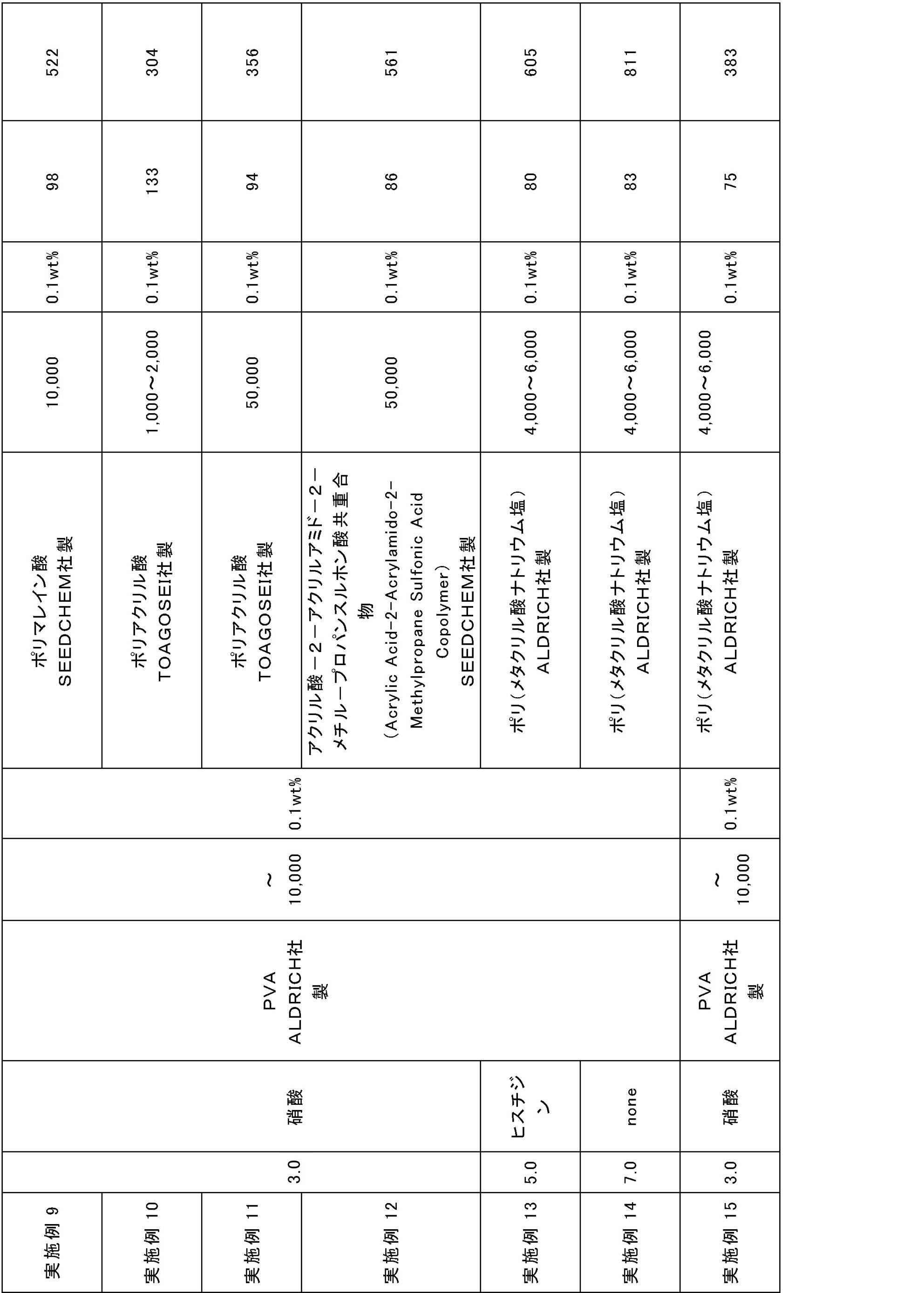
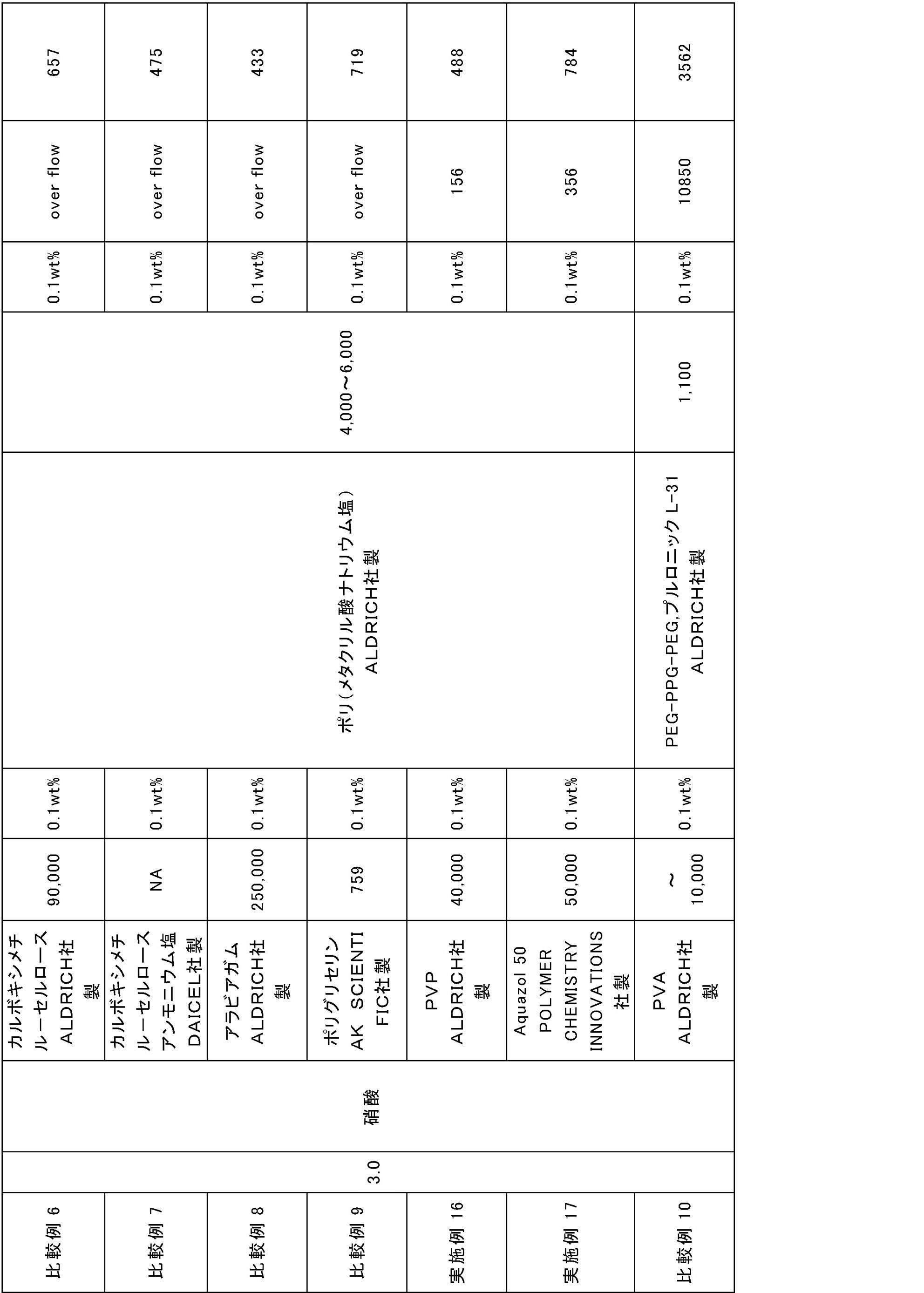

本発明の表面処理組成物であれば、ポリシリコンウェハにおけるディフェクトの数が360個以下であり、かつ、窒化ケイ素ウェハにおけるディフェクトの数が820個以下であるため、ケイ素-ケイ素結合および窒素-ケイ素結合のいずれをも有する研磨済研磨対象物表面のディフェクトを十分に除去することが示唆される。これに対し、比較例の組成物を用いると、ポリシリコンウェハにおけるディフェクトの数が360個超であったり、窒化ケイ素ウェハにおけるディフェクトの数が820個超であったりして、ケイ素-ケイ素結合および窒素-ケイ素結合のいずれをも有する研磨済研磨対象物表面のディフェクトを十分に除去することができないことが示唆される。
Claims (10)
- 炭素原子のみ、または炭素原子と窒素原子とからなる主鎖を有するノニオン水溶性高分子(A)と;
炭素原子のみからなる主鎖と、当該炭素原子のみからなる主鎖に結合している、スルホン酸基もしくはその塩を有する基またはカルボキシル基もしくはその塩を有する基を有する側鎖とを有するアニオン水溶性高分子(B)と;
を含有し、
ケイ素-ケイ素結合と、窒素-ケイ素結合とを含む、研磨済研磨対象物の表面処理に用いられる、pHが9.0未満である、表面処理組成物。 - 前記ノニオン水溶性高分子(A)が、下記式(1):

Xが、下記:

R1~R6は、それぞれ独立して、水素原子または-Jであり、
-Jが、水酸基、

R7およびR8は、それぞれ独立して、水素原子または-Eであり、
-Eが、下記式:

前記構成単位が、-Jおよび-Eの少なくとも一方を含む、請求項1に記載の表面処理組成物。 - 前記ノニオン水溶性高分子(A)が、ポリビニルアルコール(PVA)、ポリビニルアルコール(PVA)由来の構成単位を構造の一部に含む共重合体、ポリビニルピロリドン(PVP)、ポリビニルピロリドン(PVP)由来の構成単位を構造の一部に含む共重合体、ポリビニルカプロラクタム、ポリビニルカプロラクタム由来の構成単位を構造の一部に含む共重合体、ポリN-ビニルホルムアミドおよびポリN-ビニルホルムアミド由来の構成単位を構造の一部に含む共重合体からなる群から選択される少なくとも1種である、請求項1または2に記載の表面処理組成物。
- 前記ノニオン水溶性高分子(A)が、ポリビニルアルコール(PVA)またはポリビニルアルコール(PVA)由来の構成単位を構造の一部に含む共重合体である、請求項1~3のいずれか1項に記載の表面処理組成物。
- 前記ポリビニルアルコール(PVA)または前記ポリビニルアルコール(PVA)由来の構成単位を構造の一部に含む共重合体のけん化度が、60%以上である、請求項4に記載の表面処理組成物。
- 前記アニオン水溶性高分子(B)が、下記式(2):

R9は、水素原子またはメチル基であり、
R10およびR11は、それぞれ独立して、水素原子、-COOR12もしくは-Gであり、ただし、R10およびR11が、同時に水素原子になることはなく、
-Gは、以下:

R12、R13およびR15は、それぞれ独立して、水素原子、炭素数1~12のアルキル基、炭素数1~12のヒドロキシアルキル基またはカウンターカチオンであり、
R14は、二価の基である、請求項1~5のいずれか1項に記載の表面処理組成物。 - 前記アニオン水溶性高分子(B)におけるR10およびR11の少なくとも一方が、-Gであり、
-Gが、以下:

R13は上記と同じであり、ただし、*は結合位置を表し、
当該アニオン水溶性高分子(B)の重量平均分子量が、10万以上である、請求項6に記載の表面処理組成物。 - pHが、7.0未満である、請求項1~7のいずれか1項に記載の表面処理組成物。
- 請求項1~8のいずれか1項に記載の表面処理組成物を用いて、研磨済研磨対象物の表面処理を行うことを有する、研磨済研磨対象物の表面処理方法。
- 請求項9に記載の表面処理方法によって、研磨済研磨対象物の表面を処理することを有する、半導体基板の製造方法。
Priority Applications (5)
| Application Number | Priority Date | Filing Date | Title |
|---|---|---|---|
| CN201780057387.6A CN109716487B (zh) | 2016-09-21 | 2017-08-09 | 表面处理组合物 |
| SG11201901590SA SG11201901590SA (en) | 2016-09-21 | 2017-08-09 | Composition for surface treatment |
| KR1020197007768A KR102305256B1 (ko) | 2016-09-21 | 2017-08-09 | 표면 처리 조성물 |
| JP2018540908A JP6880047B2 (ja) | 2016-09-21 | 2017-08-09 | 表面処理組成物 |
| US16/330,034 US11326049B2 (en) | 2016-09-21 | 2017-08-09 | Composition for surface treatment |
Applications Claiming Priority (2)
| Application Number | Priority Date | Filing Date | Title |
|---|---|---|---|
| JP2016184768 | 2016-09-21 | ||
| JP2016-184768 | 2016-09-21 |
Publications (1)
| Publication Number | Publication Date |
|---|---|
| WO2018055941A1 true WO2018055941A1 (ja) | 2018-03-29 |
Family
ID=61690250
Family Applications (1)
| Application Number | Title | Priority Date | Filing Date |
|---|---|---|---|
| PCT/JP2017/029003 Ceased WO2018055941A1 (ja) | 2016-09-21 | 2017-08-09 | 表面処理組成物 |
Country Status (7)
| Country | Link |
|---|---|
| US (1) | US11326049B2 (ja) |
| JP (1) | JP6880047B2 (ja) |
| KR (1) | KR102305256B1 (ja) |
| CN (1) | CN109716487B (ja) |
| SG (1) | SG11201901590SA (ja) |
| TW (1) | TWI805556B (ja) |
| WO (1) | WO2018055941A1 (ja) |
Cited By (3)
| Publication number | Priority date | Publication date | Assignee | Title |
|---|---|---|---|---|
| JP2020164780A (ja) * | 2019-03-27 | 2020-10-08 | 株式会社フジミインコーポレーテッド | 研磨用組成物 |
| JP2023046519A (ja) * | 2021-09-24 | 2023-04-05 | 富士フイルム株式会社 | 薬液、処理方法 |
| US11702570B2 (en) | 2019-03-27 | 2023-07-18 | Fujimi Incorporated | Polishing composition |
Families Citing this family (5)
| Publication number | Priority date | Publication date | Assignee | Title |
|---|---|---|---|---|
| US10920179B2 (en) * | 2016-11-10 | 2021-02-16 | Tokyo Ohka Kogyo Co., Ltd. | Cleaning solution and method for cleaning substrate |
| TWI827126B (zh) * | 2017-09-26 | 2023-12-21 | 日商福吉米股份有限公司 | 表面處理組合物、其製造方法以及使用此組合物的表面處理方法 |
| US11634670B2 (en) * | 2018-11-16 | 2023-04-25 | Toagosei Co. Ltd. | Cleaning agent for semiconductor component, and use thereof |
| CN112457930A (zh) * | 2019-09-06 | 2021-03-09 | 福吉米株式会社 | 表面处理组合物、表面处理组合物的制造方法、表面处理方法和半导体基板的制造方法 |
| JP7609683B2 (ja) * | 2021-03-30 | 2025-01-07 | 株式会社フジミインコーポレーテッド | 半導体基板の製造方法および当該製造方法より得られる半導体基板 |
Citations (2)
| Publication number | Priority date | Publication date | Assignee | Title |
|---|---|---|---|---|
| JP2012094852A (ja) * | 2010-10-01 | 2012-05-17 | Mitsubishi Chemicals Corp | 半導体デバイス用基板洗浄液及び洗浄方法 |
| JP2012227291A (ja) * | 2011-04-18 | 2012-11-15 | Fujifilm Corp | 洗浄組成物、これを用いた洗浄方法及び半導体素子の製造方法 |
Family Cites Families (27)
| Publication number | Priority date | Publication date | Assignee | Title |
|---|---|---|---|---|
| EP1036836B1 (en) * | 1999-03-18 | 2004-11-03 | Kabushiki Kaisha Toshiba | Aqueous dispersion for chemical mechanical polishing |
| SG91279A1 (en) * | 1999-06-09 | 2002-09-17 | Kuraray Co | Polyvinyl alcohol polymer production method and polyvinyl alcohol polymer |
| JP4147369B2 (ja) | 1999-06-23 | 2008-09-10 | Jsr株式会社 | 半導体部品用洗浄剤および半導体部品の洗浄方法 |
| US20020068454A1 (en) * | 2000-12-01 | 2002-06-06 | Applied Materials, Inc. | Method and composition for the removal of residual materials during substrate planarization |
| TWI339680B (en) | 2002-02-19 | 2011-04-01 | Kanto Kagaku | Washing liquid composition for semiconductor substrate |
| JP2003313542A (ja) * | 2002-04-22 | 2003-11-06 | Jsr Corp | 化学機械研磨用水系分散体 |
| JP2005303060A (ja) | 2004-04-13 | 2005-10-27 | Nitta Haas Inc | リンス研磨溶液 |
| JP2006005246A (ja) | 2004-06-18 | 2006-01-05 | Fujimi Inc | リンス用組成物及びそれを用いたリンス方法 |
| JP4613744B2 (ja) * | 2005-08-10 | 2011-01-19 | 株式会社Sumco | シリコンウェーハの洗浄方法 |
| CN101346806B (zh) * | 2005-12-27 | 2010-09-29 | 日立化成工业株式会社 | 金属用研磨液以及被研磨膜的研磨方法 |
| JPWO2008013226A1 (ja) * | 2006-07-28 | 2009-12-17 | 昭和電工株式会社 | 研磨組成物 |
| US20100086813A1 (en) * | 2006-08-30 | 2010-04-08 | Kyocera Corporation | Reaction Apparatus, Fuel Cell System and Electronic Device |
| JP4777197B2 (ja) * | 2006-09-11 | 2011-09-21 | 富士フイルム株式会社 | 洗浄液及びそれを用いた洗浄方法 |
| US8614653B1 (en) * | 2007-10-04 | 2013-12-24 | Leah Salgado | Electronic display device for special events |
| US8614053B2 (en) * | 2009-03-27 | 2013-12-24 | Eastman Chemical Company | Processess and compositions for removing substances from substrates |
| US8444768B2 (en) * | 2009-03-27 | 2013-05-21 | Eastman Chemical Company | Compositions and methods for removing organic substances |
| DE102009022477A1 (de) * | 2009-05-25 | 2010-12-16 | Universität Konstanz | Verfahren zum Texturieren einer Oberfläche eines Halbleitersubstrates sowie Vorrichtung zum Durchführen des Verfahrens |
| US8765653B2 (en) * | 2009-07-07 | 2014-07-01 | Air Products And Chemicals, Inc. | Formulations and method for post-CMP cleaning |
| JP4772156B1 (ja) * | 2010-07-05 | 2011-09-14 | 花王株式会社 | シリコンウエハ用研磨液組成物 |
| WO2012161135A1 (ja) * | 2011-05-26 | 2012-11-29 | 日立化成工業株式会社 | 半導体基板用パッシベーション膜形成用材料、半導体基板用パッシベーション膜及びその製造方法、並びに太陽電池素子及びその製造方法 |
| JP6407503B2 (ja) * | 2011-06-14 | 2018-10-17 | 株式会社フジミインコーポレーテッド | 研磨用組成物 |
| WO2013118042A1 (en) * | 2012-02-06 | 2013-08-15 | Basf Se | A post chemical-mechanical-polishing (post-cmp) cleaning composition comprising a specific sulfur-containing compound and comprising no significant amounts of specific nitrogen-containing compounds |
| KR102239045B1 (ko) * | 2013-06-07 | 2021-04-12 | 가부시키가이샤 후지미인코퍼레이티드 | 실리콘 웨이퍼 연마용 조성물 |
| JP5920840B2 (ja) * | 2013-09-30 | 2016-05-18 | 株式会社フジミインコーポレーテッド | 研磨用組成物およびその製造方法 |
| WO2015050260A2 (ja) * | 2013-10-04 | 2015-04-09 | 株式会社Sumco | 研磨剤組成物、シリコンウェハー用研磨剤組成物、およびシリコンウェハー製品の製造方法 |
| JP6245939B2 (ja) * | 2013-10-25 | 2017-12-13 | 花王株式会社 | シリコンウェーハ用研磨液組成物 |
| US10319605B2 (en) * | 2016-05-10 | 2019-06-11 | Jsr Corporation | Semiconductor treatment composition and treatment method |
-
2017
- 2017-08-09 WO PCT/JP2017/029003 patent/WO2018055941A1/ja not_active Ceased
- 2017-08-09 KR KR1020197007768A patent/KR102305256B1/ko active Active
- 2017-08-09 US US16/330,034 patent/US11326049B2/en active Active
- 2017-08-09 JP JP2018540908A patent/JP6880047B2/ja active Active
- 2017-08-09 SG SG11201901590SA patent/SG11201901590SA/en unknown
- 2017-08-09 CN CN201780057387.6A patent/CN109716487B/zh active Active
- 2017-08-21 TW TW106128239A patent/TWI805556B/zh active
Patent Citations (2)
| Publication number | Priority date | Publication date | Assignee | Title |
|---|---|---|---|---|
| JP2012094852A (ja) * | 2010-10-01 | 2012-05-17 | Mitsubishi Chemicals Corp | 半導体デバイス用基板洗浄液及び洗浄方法 |
| JP2012227291A (ja) * | 2011-04-18 | 2012-11-15 | Fujifilm Corp | 洗浄組成物、これを用いた洗浄方法及び半導体素子の製造方法 |
Cited By (5)
| Publication number | Priority date | Publication date | Assignee | Title |
|---|---|---|---|---|
| JP2020164780A (ja) * | 2019-03-27 | 2020-10-08 | 株式会社フジミインコーポレーテッド | 研磨用組成物 |
| JP7267893B2 (ja) | 2019-03-27 | 2023-05-02 | 株式会社フジミインコーポレーテッド | 研磨用組成物 |
| US11702570B2 (en) | 2019-03-27 | 2023-07-18 | Fujimi Incorporated | Polishing composition |
| JP2023046519A (ja) * | 2021-09-24 | 2023-04-05 | 富士フイルム株式会社 | 薬液、処理方法 |
| JP7692323B2 (ja) | 2021-09-24 | 2025-06-13 | 富士フイルム株式会社 | 薬液、処理方法 |
Also Published As
| Publication number | Publication date |
|---|---|
| JP6880047B2 (ja) | 2021-06-02 |
| CN109716487A (zh) | 2019-05-03 |
| TWI805556B (zh) | 2023-06-21 |
| SG11201901590SA (en) | 2019-03-28 |
| JPWO2018055941A1 (ja) | 2019-07-04 |
| US20190203027A1 (en) | 2019-07-04 |
| TW201814034A (zh) | 2018-04-16 |
| CN109716487B (zh) | 2023-12-01 |
| KR20190055089A (ko) | 2019-05-22 |
| KR102305256B1 (ko) | 2021-09-29 |
| US11326049B2 (en) | 2022-05-10 |
Similar Documents
| Publication | Publication Date | Title |
|---|---|---|
| JP6880047B2 (ja) | 表面処理組成物 | |
| JP5002175B2 (ja) | 研磨スラリーおよびウエハ再生方法 | |
| TWI780194B (zh) | 研磨液、研磨液套組及研磨方法 | |
| TWI720248B (zh) | 表面處理組合物與使用該組合物的表面處理方法以及半導體基板之製造方法 | |
| JP6797811B2 (ja) | 研磨方法 | |
| TWI882986B (zh) | 研磨用組成物 | |
| JP6908592B2 (ja) | 研磨用組成物 | |
| TWI871278B (zh) | 表面處理組成物、表面處理組成物之製造方法、表面處理方法及半導體基板之製造方法 | |
| JP6279156B2 (ja) | 研磨用組成物 | |
| TWI775908B (zh) | 研磨用組合物的製造方法 | |
| TWI842349B (zh) | 中間原料以及使用此的研磨用組成物及表面處理組成物 | |
| JP2026056895A (ja) | ポストcmp洗浄組成物及びポストcmp洗浄方法 |
Legal Events
| Date | Code | Title | Description |
|---|---|---|---|
| 121 | Ep: the epo has been informed by wipo that ep was designated in this application |
Ref document number: 17852722 Country of ref document: EP Kind code of ref document: A1 |
|
| ENP | Entry into the national phase |
Ref document number: 2018540908 Country of ref document: JP Kind code of ref document: A |
|
| ENP | Entry into the national phase |
Ref document number: 20197007768 Country of ref document: KR Kind code of ref document: A |
|
| NENP | Non-entry into the national phase |
Ref country code: DE |
|
| 122 | Ep: pct application non-entry in european phase |
Ref document number: 17852722 Country of ref document: EP Kind code of ref document: A1 |