WO2018052136A1 - 有害生物防除剤組成物及び有害生物防除方法 - Google Patents
有害生物防除剤組成物及び有害生物防除方法 Download PDFInfo
- Publication number
- WO2018052136A1 WO2018052136A1 PCT/JP2017/033541 JP2017033541W WO2018052136A1 WO 2018052136 A1 WO2018052136 A1 WO 2018052136A1 JP 2017033541 W JP2017033541 W JP 2017033541W WO 2018052136 A1 WO2018052136 A1 WO 2018052136A1
- Authority
- WO
- WIPO (PCT)
- Prior art keywords
- compound
- active ingredient
- active compound
- rot
- ingredient group
- Prior art date
- Legal status (The legal status is an assumption and is not a legal conclusion. Google has not performed a legal analysis and makes no representation as to the accuracy of the status listed.)
- Ceased
Links
- 0 CC(N(*)C1=*)=NC1=CC(*)=* Chemical compound CC(N(*)C1=*)=NC1=CC(*)=* 0.000 description 6
Classifications
-
- A—HUMAN NECESSITIES
- A01—AGRICULTURE; FORESTRY; ANIMAL HUSBANDRY; HUNTING; TRAPPING; FISHING
- A01N—PRESERVATION OF BODIES OF HUMANS OR ANIMALS OR PLANTS OR PARTS THEREOF; BIOCIDES, e.g. AS DISINFECTANTS, AS PESTICIDES OR AS HERBICIDES; PEST REPELLANTS OR ATTRACTANTS; PLANT GROWTH REGULATORS
- A01N63/00—Biocides, pest repellants or attractants, or plant growth regulators containing microorganisms, viruses, microbial fungi, animals or substances produced by, or obtained from, microorganisms, viruses, microbial fungi or animals, e.g. enzymes or fermentates
- A01N63/20—Bacteria; Substances produced thereby or obtained therefrom
- A01N63/22—Bacillus
-
- A—HUMAN NECESSITIES
- A01—AGRICULTURE; FORESTRY; ANIMAL HUSBANDRY; HUNTING; TRAPPING; FISHING
- A01N—PRESERVATION OF BODIES OF HUMANS OR ANIMALS OR PLANTS OR PARTS THEREOF; BIOCIDES, e.g. AS DISINFECTANTS, AS PESTICIDES OR AS HERBICIDES; PEST REPELLANTS OR ATTRACTANTS; PLANT GROWTH REGULATORS
- A01N47/00—Biocides, pest repellants or attractants, or plant growth regulators containing organic compounds containing a carbon atom not being member of a ring and having no bond to a carbon or hydrogen atom, e.g. derivatives of carbonic acid
- A01N47/08—Biocides, pest repellants or attractants, or plant growth regulators containing organic compounds containing a carbon atom not being member of a ring and having no bond to a carbon or hydrogen atom, e.g. derivatives of carbonic acid the carbon atom having one or more single bonds to nitrogen atoms
- A01N47/28—Ureas or thioureas containing the groups >N—CO—N< or >N—CS—N<
- A01N47/38—Ureas or thioureas containing the groups >N—CO—N< or >N—CS—N< containing the group >N—CO—N< where at least one nitrogen atom is part of a heterocyclic ring; Thio analogues thereof
-
- A—HUMAN NECESSITIES
- A01—AGRICULTURE; FORESTRY; ANIMAL HUSBANDRY; HUNTING; TRAPPING; FISHING
- A01N—PRESERVATION OF BODIES OF HUMANS OR ANIMALS OR PLANTS OR PARTS THEREOF; BIOCIDES, e.g. AS DISINFECTANTS, AS PESTICIDES OR AS HERBICIDES; PEST REPELLANTS OR ATTRACTANTS; PLANT GROWTH REGULATORS
- A01N41/00—Biocides, pest repellants or attractants, or plant growth regulators containing organic compounds containing a sulfur atom bound to a hetero atom
- A01N41/02—Biocides, pest repellants or attractants, or plant growth regulators containing organic compounds containing a sulfur atom bound to a hetero atom containing a sulfur-to-oxygen double bond
- A01N41/10—Sulfones; Sulfoxides
-
- A—HUMAN NECESSITIES
- A01—AGRICULTURE; FORESTRY; ANIMAL HUSBANDRY; HUNTING; TRAPPING; FISHING
- A01N—PRESERVATION OF BODIES OF HUMANS OR ANIMALS OR PLANTS OR PARTS THEREOF; BIOCIDES, e.g. AS DISINFECTANTS, AS PESTICIDES OR AS HERBICIDES; PEST REPELLANTS OR ATTRACTANTS; PLANT GROWTH REGULATORS
- A01N43/00—Biocides, pest repellants or attractants, or plant growth regulators containing heterocyclic compounds
- A01N43/02—Biocides, pest repellants or attractants, or plant growth regulators containing heterocyclic compounds having rings with one or more oxygen or sulfur atoms as the only ring hetero atoms
- A01N43/04—Biocides, pest repellants or attractants, or plant growth regulators containing heterocyclic compounds having rings with one or more oxygen or sulfur atoms as the only ring hetero atoms with one hetero atom
- A01N43/22—Biocides, pest repellants or attractants, or plant growth regulators containing heterocyclic compounds having rings with one or more oxygen or sulfur atoms as the only ring hetero atoms with one hetero atom rings with more than six members
-
- A—HUMAN NECESSITIES
- A01—AGRICULTURE; FORESTRY; ANIMAL HUSBANDRY; HUNTING; TRAPPING; FISHING
- A01N—PRESERVATION OF BODIES OF HUMANS OR ANIMALS OR PLANTS OR PARTS THEREOF; BIOCIDES, e.g. AS DISINFECTANTS, AS PESTICIDES OR AS HERBICIDES; PEST REPELLANTS OR ATTRACTANTS; PLANT GROWTH REGULATORS
- A01N43/00—Biocides, pest repellants or attractants, or plant growth regulators containing heterocyclic compounds
- A01N43/34—Biocides, pest repellants or attractants, or plant growth regulators containing heterocyclic compounds having rings with one nitrogen atom as the only ring hetero atom
- A01N43/36—Biocides, pest repellants or attractants, or plant growth regulators containing heterocyclic compounds having rings with one nitrogen atom as the only ring hetero atom five-membered rings
-
- A—HUMAN NECESSITIES
- A01—AGRICULTURE; FORESTRY; ANIMAL HUSBANDRY; HUNTING; TRAPPING; FISHING
- A01N—PRESERVATION OF BODIES OF HUMANS OR ANIMALS OR PLANTS OR PARTS THEREOF; BIOCIDES, e.g. AS DISINFECTANTS, AS PESTICIDES OR AS HERBICIDES; PEST REPELLANTS OR ATTRACTANTS; PLANT GROWTH REGULATORS
- A01N43/00—Biocides, pest repellants or attractants, or plant growth regulators containing heterocyclic compounds
- A01N43/34—Biocides, pest repellants or attractants, or plant growth regulators containing heterocyclic compounds having rings with one nitrogen atom as the only ring hetero atom
- A01N43/40—Biocides, pest repellants or attractants, or plant growth regulators containing heterocyclic compounds having rings with one nitrogen atom as the only ring hetero atom six-membered rings
-
- A—HUMAN NECESSITIES
- A01—AGRICULTURE; FORESTRY; ANIMAL HUSBANDRY; HUNTING; TRAPPING; FISHING
- A01N—PRESERVATION OF BODIES OF HUMANS OR ANIMALS OR PLANTS OR PARTS THEREOF; BIOCIDES, e.g. AS DISINFECTANTS, AS PESTICIDES OR AS HERBICIDES; PEST REPELLANTS OR ATTRACTANTS; PLANT GROWTH REGULATORS
- A01N43/00—Biocides, pest repellants or attractants, or plant growth regulators containing heterocyclic compounds
- A01N43/48—Biocides, pest repellants or attractants, or plant growth regulators containing heterocyclic compounds having rings with two nitrogen atoms as the only ring hetero atoms
- A01N43/56—1,2-Diazoles; Hydrogenated 1,2-diazoles
-
- A—HUMAN NECESSITIES
- A01—AGRICULTURE; FORESTRY; ANIMAL HUSBANDRY; HUNTING; TRAPPING; FISHING
- A01N—PRESERVATION OF BODIES OF HUMANS OR ANIMALS OR PLANTS OR PARTS THEREOF; BIOCIDES, e.g. AS DISINFECTANTS, AS PESTICIDES OR AS HERBICIDES; PEST REPELLANTS OR ATTRACTANTS; PLANT GROWTH REGULATORS
- A01N43/00—Biocides, pest repellants or attractants, or plant growth regulators containing heterocyclic compounds
- A01N43/48—Biocides, pest repellants or attractants, or plant growth regulators containing heterocyclic compounds having rings with two nitrogen atoms as the only ring hetero atoms
- A01N43/58—1,2-Diazines; Hydrogenated 1,2-diazines
-
- A—HUMAN NECESSITIES
- A01—AGRICULTURE; FORESTRY; ANIMAL HUSBANDRY; HUNTING; TRAPPING; FISHING
- A01N—PRESERVATION OF BODIES OF HUMANS OR ANIMALS OR PLANTS OR PARTS THEREOF; BIOCIDES, e.g. AS DISINFECTANTS, AS PESTICIDES OR AS HERBICIDES; PEST REPELLANTS OR ATTRACTANTS; PLANT GROWTH REGULATORS
- A01N43/00—Biocides, pest repellants or attractants, or plant growth regulators containing heterocyclic compounds
- A01N43/64—Biocides, pest repellants or attractants, or plant growth regulators containing heterocyclic compounds having rings with three nitrogen atoms as the only ring hetero atoms
- A01N43/707—1,2,3- or 1,2,4-triazines; Hydrogenated 1,2,3- or 1,2,4-triazines
-
- A—HUMAN NECESSITIES
- A01—AGRICULTURE; FORESTRY; ANIMAL HUSBANDRY; HUNTING; TRAPPING; FISHING
- A01N—PRESERVATION OF BODIES OF HUMANS OR ANIMALS OR PLANTS OR PARTS THEREOF; BIOCIDES, e.g. AS DISINFECTANTS, AS PESTICIDES OR AS HERBICIDES; PEST REPELLANTS OR ATTRACTANTS; PLANT GROWTH REGULATORS
- A01N43/00—Biocides, pest repellants or attractants, or plant growth regulators containing heterocyclic compounds
- A01N43/72—Biocides, pest repellants or attractants, or plant growth regulators containing heterocyclic compounds having rings with nitrogen atoms and oxygen or sulfur atoms as ring hetero atoms
- A01N43/80—Biocides, pest repellants or attractants, or plant growth regulators containing heterocyclic compounds having rings with nitrogen atoms and oxygen or sulfur atoms as ring hetero atoms five-membered rings with one nitrogen atom and either one oxygen atom or one sulfur atom in positions 1,2
-
- A—HUMAN NECESSITIES
- A01—AGRICULTURE; FORESTRY; ANIMAL HUSBANDRY; HUNTING; TRAPPING; FISHING
- A01N—PRESERVATION OF BODIES OF HUMANS OR ANIMALS OR PLANTS OR PARTS THEREOF; BIOCIDES, e.g. AS DISINFECTANTS, AS PESTICIDES OR AS HERBICIDES; PEST REPELLANTS OR ATTRACTANTS; PLANT GROWTH REGULATORS
- A01N43/00—Biocides, pest repellants or attractants, or plant growth regulators containing heterocyclic compounds
- A01N43/90—Biocides, pest repellants or attractants, or plant growth regulators containing heterocyclic compounds having two or more relevant hetero rings, condensed among themselves or with a common carbocyclic ring system
-
- A—HUMAN NECESSITIES
- A01—AGRICULTURE; FORESTRY; ANIMAL HUSBANDRY; HUNTING; TRAPPING; FISHING
- A01N—PRESERVATION OF BODIES OF HUMANS OR ANIMALS OR PLANTS OR PARTS THEREOF; BIOCIDES, e.g. AS DISINFECTANTS, AS PESTICIDES OR AS HERBICIDES; PEST REPELLANTS OR ATTRACTANTS; PLANT GROWTH REGULATORS
- A01N47/00—Biocides, pest repellants or attractants, or plant growth regulators containing organic compounds containing a carbon atom not being member of a ring and having no bond to a carbon or hydrogen atom, e.g. derivatives of carbonic acid
- A01N47/08—Biocides, pest repellants or attractants, or plant growth regulators containing organic compounds containing a carbon atom not being member of a ring and having no bond to a carbon or hydrogen atom, e.g. derivatives of carbonic acid the carbon atom having one or more single bonds to nitrogen atoms
- A01N47/10—Carbamic acid derivatives, i.e. containing the group —O—CO—N<; Thio analogues thereof
- A01N47/24—Carbamic acid derivatives, i.e. containing the group —O—CO—N<; Thio analogues thereof containing the groups, or; Thio analogues thereof
-
- A—HUMAN NECESSITIES
- A01—AGRICULTURE; FORESTRY; ANIMAL HUSBANDRY; HUNTING; TRAPPING; FISHING
- A01N—PRESERVATION OF BODIES OF HUMANS OR ANIMALS OR PLANTS OR PARTS THEREOF; BIOCIDES, e.g. AS DISINFECTANTS, AS PESTICIDES OR AS HERBICIDES; PEST REPELLANTS OR ATTRACTANTS; PLANT GROWTH REGULATORS
- A01N47/00—Biocides, pest repellants or attractants, or plant growth regulators containing organic compounds containing a carbon atom not being member of a ring and having no bond to a carbon or hydrogen atom, e.g. derivatives of carbonic acid
- A01N47/40—Biocides, pest repellants or attractants, or plant growth regulators containing organic compounds containing a carbon atom not being member of a ring and having no bond to a carbon or hydrogen atom, e.g. derivatives of carbonic acid the carbon atom having a double or triple bond to nitrogen, e.g. cyanates, cyanamides
-
- A—HUMAN NECESSITIES
- A01—AGRICULTURE; FORESTRY; ANIMAL HUSBANDRY; HUNTING; TRAPPING; FISHING
- A01N—PRESERVATION OF BODIES OF HUMANS OR ANIMALS OR PLANTS OR PARTS THEREOF; BIOCIDES, e.g. AS DISINFECTANTS, AS PESTICIDES OR AS HERBICIDES; PEST REPELLANTS OR ATTRACTANTS; PLANT GROWTH REGULATORS
- A01N51/00—Biocides, pest repellants or attractants, or plant growth regulators containing organic compounds having the sequences of atoms O—N—S, X—O—S, N—N—S, O—N—N or O-halogen, regardless of the number of bonds each atom has and with no atom of these sequences forming part of a heterocyclic ring
-
- A—HUMAN NECESSITIES
- A01—AGRICULTURE; FORESTRY; ANIMAL HUSBANDRY; HUNTING; TRAPPING; FISHING
- A01N—PRESERVATION OF BODIES OF HUMANS OR ANIMALS OR PLANTS OR PARTS THEREOF; BIOCIDES, e.g. AS DISINFECTANTS, AS PESTICIDES OR AS HERBICIDES; PEST REPELLANTS OR ATTRACTANTS; PLANT GROWTH REGULATORS
- A01N63/00—Biocides, pest repellants or attractants, or plant growth regulators containing microorganisms, viruses, microbial fungi, animals or substances produced by, or obtained from, microorganisms, viruses, microbial fungi or animals, e.g. enzymes or fermentates
- A01N63/20—Bacteria; Substances produced thereby or obtained therefrom
- A01N63/22—Bacillus
- A01N63/23—B. thuringiensis
Definitions
- the present invention includes a pesticide composition characterized by comprising a condensed heterocyclic compound represented by the specific formula (1) and an active ingredient compound of a known pest control agent, and these two components. It relates to the pest control method used.
- the condensed heterocyclic compound represented by the formula (1) (hereinafter abbreviated as “compound (1)”), which is the first active ingredient compound in the composition of the present invention, is a known compound and its pest control.
- the activity is known as an agent (for example, refer to Patent Document 1).
- compounds having pest control activity such as insecticidal activity, acaricidal activity, nematicidal activity, molluscicidal activity, bactericidal activity, and bactericidal activity, which are the second active ingredient compounds in the composition of the present invention. (For example, see Non-Patent Document 1).
- the present inventors have eagerly developed a pest control agent that exhibits excellent pest control activity and has less adverse effects on non-target organisms such as mammals, fish, natural enemies and beneficial insects.
- the composition containing the compound (1) and a compound having a specific pest control activity has an excellent synergistic pest control effect that cannot be predicted from use alone.
- the present invention has been completed. That is, the present invention relates to the following compositions [1] to [6] (hereinafter referred to as the present composition) and the control methods [7] to [19] (hereinafter referred to as the present method). Is.
- a pest control composition comprising a synergistically effective amount of at least two active compounds of a first active ingredient and a second active ingredient,
- the first active ingredient comprises at least one active compound I selected from a condensed heterocyclic compound represented by the following formula (1) or an N-oxide thereof or a salt thereof
- the second active ingredient consists of at least one active compound II selected from the following active ingredient groups BI to B-XXVI: Said composition.
- Q represents a ring represented by either Q1 or Q3;
- a 1a represents C 1 -C 6 alkyl
- a 4 represents a nitrogen atom or CH
- a 5 represents a nitrogen atom or CH
- R 1 represents C 1 -C 6 alkyl
- R 3 represents halo (C 1 -C 6 ) alkyl, halo (C 1 -C 6 ) alkylthio, halo (C 1 -C 6 ) alkylsulfinyl or halo (C 1 -C 6 ) alkylsulfonyl
- Y2, Y3 and Y4 each independently represent a hydrogen atom, a halogen atom, halo (C 1 -C 6 ) alkyl or cyano
- n represents an integer of 0, 1 or 2.
- Active ingredient group BI metalaxyl-M and hymexazole.
- Active ingredient group B-II Benomyl, thiophanate-methyl, dietofencarb, ethaboxam, zoxamide, penciclone and fluopicolide.
- Active ingredient group B-III benzovindiflupyr, bixafen, boscalid, fluindapir, fluopyram, flutolanil, fluxapyroxad, furametopil, isoflucipram, impylfluxam, isofetamide, isopyrazam, mepronil, penflufen, pentiopyrad, sedaxane, Tifluzamide, azoxystrobin, cumoxystrobin, dimoxystrobin, enestrobine, enoxastrobin, famoxadone, phenamidon, phenaminestrobin, fluphenoxystrobin, fluoxastrobin, cresoxime-methyl, mandestrobin, metomi Nostrobin, orissastrobin, picoxystrobin, pyraclostrobin, pyramethostrobin, pyroxystrobin, pyribencarb methyl, pyrimino Thrombin, trichloride pyridinium
- Active ingredient group B-IV mepanipyrim and kasugamycin. Active ingredient group BV: quinoxyphene and fludioxonil. Active ingredient group B-VI: iprodione and procymidone. Active ingredient group B-VII: Torquelophos-methyl and Bacillus subtilis.
- Active ingredient group B-VIII bromconazole, cyproconazole, difenoconazole, diniconazole-M, epoxiconazole, phenarimol, fenbuconazole, fluquinconazole, hexaconazole, imazalyl, imibenconazole, ipconazole, metconazole, microbutanyl , Penconazole, prochloraz, propiconazole, prothioconazole, cimeconazole, tebuconazole, tetraconazole, triflumizole, fenpropidin, fenhexamide, fenpyrazamine, ipfentrifluconazole and mefentrifluconazole.
- Active ingredient group B-IX Validamycin, polyoxin, polyoxin-D, benchavaricarb-isopropyl, dimethomorph, iprovaricarb and mandipropamide.
- Active ingredient group BX fusaride, tricyclazole, carpropamide and diclocimet.
- Active ingredient group B-XI Acibenzoral-S-methyl, probenazole, isotianil, diclobenchazox and thiazinyl.
- Active ingredient group B-XII Bordeaux liquid, basic copper carbonate, cupric hydroxide, copper naphthenate, copper oleate, basic copper chloride, copper sulfate, basic copper sulfate, oxyquinoline copper, lime sulfur mixture, Sulfur, mancozeb, mannebu, polycarbamate, propineb, captan, phorpet, chlorothalonil, iminoctadine-albesylate and iminoctadine acetate.
- Active ingredient group B-XIII aminopyrifen, cyflufenamide, simoxanyl, fursulfamide, fluthianyl, fosetyl-aluminum, metraphenone, oxathiapiproline, pyriophenone, picalbutradox, dipimethitrone, quinofumerin, lipopeptide, phosphorous acid, BCF- 082 (test name), NF-180 (test name), S-2399 (test name), AKD-5195 (test name) and S-2190 (test name).
- Active ingredient group B-XIV acephate, kazusafos, chlorpyrifos, diazinon, dichlorvos, dimethoate, EPN, malathion, methamidophos, parathion-methyl, phentoate, folate, phosmet, oxime, profenofos and terbufos.
- Active ingredient group B-XV aldicarb, benfuracarb, carbaryl, carbofuran, carbosulfan, mesomil, pirimicarb and thiodicarb.
- Active ingredient group B-XVI Acrinatrin, bifenthrin, cyfluthrin, cypermethrin, deltamethrin, esfenvalerate, etofenprox, permethrin, teflutrin, lambda-cyhalothrin and tau-fulvalinate.
- Active ingredient group B-XVII bensultap, cartap and thiocyclam.
- Active ingredient group B-XVIII Acetamiprid, clothianidin, dinotefuran, flupirmine, imidacloprid, nitenpyram, thiacloprid, thiamethoxam, sulfoxafurol, flupiradiflon, triflumezopyrim and dichloromezothiaz.
- Active ingredient group B-XIX Spinetoram and spinosad
- Active ingredient group B-XX Ethiprole, fipronil and brofuranilide.
- Active ingredient group B-XXI Abamectin, emamectin benzoate, repimectin and milbemectin.
- Active ingredient group B-XXII chlorantraniliprole, cyantraniliprole, fulvendiamide, cyclaniliprol, tetraniliprol and cyhalodiamide.
- Active ingredient group B-XXIII diafenthiuron, fenpyroximate, pyridaben, tolfenpyrad, sienopyrafen, cyflumethofene, piflumide, hydramethylnon, acequinosyl and chlorfenapyr.
- Active ingredient group B-XXIV benzpyrimoxane, pyriproxyfen, methoxyphenozide, diflubenzuron, flufenoxuron, lufenuron, nobarulone, teflubenzuron, buprofezin, hexathiazox and etoxazole.
- Active ingredient group B-XXV Bacillus thuringiensis and Bacillus sphaericus.
- Active ingredient group B-XXVI Acinonapyr, Pymetrozine, Pyrifluquinazone, Afidopyropene, Flonicamid, Spirodiclofen, Spiromesifene, Spiropidione, Spirotetramat, Indoxacarb, Metaflumizone, Siromazine, Azadilactin, Pyridalil, Bifenazate, Floxamethamide, Aldehyde, ME-5382 (test name), NA-89 (test name), NNI-1501 (test name), BAI1602 (test name), DKN-2601 (test name) and DAI-1601 (test name).
- the condensed heterocyclic compound represented by the formula (I) is Q is a ring represented by Q1, A 4 is CH, A 5 is a nitrogen atom, R 3 is halo (C 1 -C 6 ) alkyl or halo (C 1 -C 6 ) alkylsulfinyl; Y2 and Y3 are each independently a hydrogen atom, a halogen atom or halo (C 1 -C 6 ) alkyl; Y4 is a hydrogen atom, a halogen atom or cyano, and n is 2.
- the condensed heterocyclic compound represented by the formula (I) is Q is a ring represented by Q1, A 4 is a nitrogen atom, A 5 is CH, R 3 is halo (C 1 -C 6 ) alkyl; Y2, Y3 and Y4 are each independently a hydrogen atom or halo (C 1 -C 6 ) alkyl, and n is 2.
- the condensed heterocyclic compound represented by the formula (I) is Q is a ring represented by Q3; R 3 is halo (C 1 -C 6 ) alkyl; Y2, Y3 and Y4 are each independently a hydrogen atom or a halogen atom, n is 2.
- the active compound II is acetamiprid, clothianidin, imidacloprid, thiamethoxam, sulfoxafurol, spinetoram, emamectin benzoate, chlorantraniliprole, cyantraniliprole, fulvendiamide, pyridaben, cienopyrafen, chlorfenapyr, bacillus thuringiensis pyromidensis, pimetrozin
- the composition according to any one of [1] to [4] above, which is an active compound selected from tetramat, indoxacarb, pyridalyl, bifenazate and fluxamethamide.
- the combination ratio of active compound I and active compound II is 100: 1 to 1: 100, expressed as a weight ratio of active compound I: active compound II, according to any one of [1] to [5] above Composition.
- the control method according to [7], wherein the active compound I according to [1] is the active compound I according to [4].
- the combination ratio of active compound I and active compound II is 100: 1 to 1: 100, expressed as a weight ratio of active compound I: active compound II, according to any one of [7] to [11] above Control method.
- composition of the present invention and the method of the present invention have an excellent synergistic control effect against various pests, and are also sufficiently synergistic with respect to pests that have acquired resistance to existing pest control agents. Demonstrates control effect. Therefore, the present invention provides a useful novel pest control composition and an effective pest control method using the composition and components of the composition.
- n- means normal
- i- means iso
- s- means secondary
- tert- means tertiary.
- halogen atom in the present specification include a fluorine atom, a chlorine atom, a bromine atom and an iodine atom.
- the notation “halo” also represents these halogen atoms.
- C a -C b alkyl represents a linear or branched hydrocarbon having a carbon number of a to b, for example, methyl, ethyl, n-propyl, i Specific examples include -propyl, n-butyl, i-butyl, s-butyl, tert-butyl, n-pentyl, 1,1-dimethylpropyl, n-hexyl, etc., each having a specified number of carbon atoms Selected.
- halo (C a -C b ) alkyl refers to a straight chain composed of a to b carbon atoms in which a hydrogen atom bonded to a carbon atom is optionally substituted with a halogen atom, or A branched hydrocarbon is represented, and when substituted by two or more halogen atoms, these halogen atoms may be the same as or different from each other.
- halo (C a -C b ) alkylthio represents the above-mentioned haloalkyl-S— consisting of a to b carbon atoms, and includes, for example, difluoromethylthio, trifluoromethylthio, Chlorodifluoromethylthio, bromodifluoromethylthio, 2,2,2-trifluoroethylthio, 1,1,2,2-tetrafluoroethylthio, 2-chloro-1,1,2-trifluoroethylthio, pentafluoroethyl Thio, 1,1,2,3,3,3-hexafluoropropylthio, heptafluoropropylthio, 1,2,2,2-tetrafluoro-1- (trifluoromethyl) ethylthio, nonafluorobutylthio, etc. Specific examples are given, each selected
- halo (C a -C b ) alkylsulfinyl represents the above-mentioned haloalkyl-S (O) — having from a to b carbon atoms, for example, difluoromethylsulfinyl.
- Trifluoromethylsulfinyl Trifluoromethylsulfinyl, chlorodifluoromethylsulfinyl, bromodifluoromethylsulfinyl, 2,2,2-trifluoroethylsulfinyl, 1,2,2,2-tetrafluoro-1- (trifluoromethyl) ethylsulfinyl, nonafluoro Specific examples include butylsulfinyl and the like, each selected within the range of the designated number of carbon atoms.
- halo (C a -C b ) alkylsulfonyl represents the above-mentioned haloalkyl-SO 2 — having a carbon number of a to b, such as difluoromethylsulfonyl, tri Fluoromethylsulfonyl, chlorodifluoromethylsulfonyl, bromodifluoromethylsulfonyl, 2,2,2-trifluoroethylsulfonyl, 1,1,2,2-tetrafluoroethylsulfonyl, 2-chloro-1,1,2-trifluoro Specific examples include ethylsulfonyl and the like, and each is selected within the range of the designated number of carbon atoms.
- C a -C b alkylcarbonyl represents alkyl-C (O) — having the above-mentioned meanings consisting of a to b carbon atoms, such as acetyl, propionyl, pivaloyl, etc. Are given as specific examples and are selected within the range of each designated number of carbon atoms.
- the condensed heterocyclic compound represented by the formula (1) is also referred to as “compound (1)”, and “the compound represented by the formula (1-Q1)” is “compound (1)”. -Q1) ".
- the other compounds are similarly described.
- Compound (1) contained in the active compound I which is the first active ingredient of the composition of the present invention will be described in detail below.
- Compound (1) includes an optically active substance resulting from the presence of one or more asymmetric carbon atoms or an asymmetric sulfur atom, but the present invention includes all optically active substances or racemates. .
- those which can be converted into acid addition salts according to a conventional method are, for example, hydrohalic acid salts such as hydrofluoric acid, hydrochloric acid, hydrobromic acid and hydroiodic acid, nitric acid , Inorganic acid salts such as sulfuric acid, phosphoric acid, chloric acid, perchloric acid, sulfonic acid salts such as methanesulfonic acid, ethanesulfonic acid, trifluoromethanesulfonic acid, benzenesulfonic acid, p-toluenesulfonic acid, formic acid, Acetic acid, propionic acid, trifluoroacetic acid, fumaric acid, tartaric acid, succinic acid, maleic acid, malic acid, succinic acid, benzoic acid, mandelic acid, ascorbic acid, lactic acid, gluconic acid, citric acid and other salts of carboxylic acids or glutamic acid, It can be a salt
- N-oxide is a compound in which a nitrogen atom constituting a ring on a heterocyclic ring is oxidized.
- heterocyclic ring that can form an N-oxide include condensed rings including a pyridine ring.
- the compound (1) contained in the active compound I which is the first active ingredient of the composition of the present invention can be produced, for example, by the following production methods 1 to 8.
- a compound (1-Q1-b) in which Q is Q1 and n is an integer of 0 and a compound (1-Q1-b1) in which Q is Q1 and n is an integer of 1 or 2 a) can be produced, for example, by the following production method. (Wherein R 1 , R 3 , A 4 , A 5 , A 1a , Y 2, Y 3 and Y 4 represent the same meaning as described above, and m represents 1 or 2).
- Step 1 Compound (2-Q1-b) is obtained by dehydrating and condensing compound (30) and compound (31-1-b) in the presence of a base (eg, pyridine, triethylamine, potassium carbonate, cesium carbonate, etc.).
- a base eg, pyridine, triethylamine, potassium carbonate, cesium carbonate, etc.
- 1H-benzotriazol-1-yloxytris (dimethylamino) phosphonium hexafluorophosphate, N, N′-dicyclohexylcarbodiimide, 1-ethyl-3- (3-dimethylaminopropyl) carbodiimide hydrochloride, etc.] Can be produced by reacting with each other.
- Step 2 Compound (1-Q1-b) is prepared in the presence of an acid (eg, paratoluenesulfonic acid, polyphosphoric acid, acetic acid, propionic acid, etc.) or a dehydrating agent (eg, phosphorus oxychloride, acetic anhydride, etc.) It can be produced by subjecting 2-Q1-b) to a dehydration cyclization reaction.
- an acid eg, paratoluenesulfonic acid, polyphosphoric acid, acetic acid, propionic acid, etc.
- a dehydrating agent eg, phosphorus oxychloride, acetic anhydride, etc.
- Step 3 Compound (1-Q1-a) is an oxidizing agent [for example, peracid such as metachloroperbenzoic acid, peracetic acid, hydrogen peroxide, OXONE, trade name of EI Dupont; potassium peroxosulfate
- peracid such as metachloroperbenzoic acid, peracetic acid, hydrogen peroxide, OXONE, trade name of EI Dupont
- potassium peroxosulfate The compound (1-Q1-b) can be produced by oxidation using the In some cases, a catalyst (such as sodium tungstate) can be used.
- the compound (1-Q1) in which Q is Q1 can be produced by the following production method.
- R 1 , R 3 , A 4 , A 5 , A 1a , Y 2, Y 3, Y 4 and n represent the same meaning as described above, and J represents a leaving group such as a halogen atom.
- Step 1 Compound (2-Q1) is produced by reacting Compound (30) with Compound (31) in the presence of a base (for example, pyridine, triethylamine, sodium hydrogen carbonate, potassium carbonate, cesium carbonate, etc.). be able to.
- a base for example, pyridine, triethylamine, sodium hydrogen carbonate, potassium carbonate, cesium carbonate, etc.
- Some of the compounds (30) are known compounds, and some of them are available as commercial products.
- Step 2 Compound (1-Q1) can be produced by a method analogous to production method 1, step 2.
- compound (1-Q1-a) and compound (1-Q1-b) can be produced by the following production method.
- R 1 , R 3 , A 4 , A 5 , A 1a , Y 2, Y 3, Y 4 and m represent the same meaning as described above, and X 1 represents a halogen atom.
- Step 1 Compound (4) can be produced by reacting Compound (9) with Compound (34) under heating conditions according to the method described in International Publication No. 2007/148755.
- a base for example, pyridine, triethylamine, potassium carbonate, cesium carbonate, etc.
- Some of the compounds (34) are known compounds, and some of them can be obtained as commercial products.
- Step 2 Of compound (1), compound (1-Q1-b) is a halogenating agent (for example, chlorine, bromine, iodine, iodine monochloride, N-chlorosuccinimide, N-bromosuccinimide, N-iodosuccinimide, Compound (4) and compound in the presence of 1,3-dichloro-5,5-dimethylhydantoin, 1,3-dibromo-5,5-dimethylhydantoin, 1,3-diiodo-5,5-dimethylhydantoin, etc. (50) or by reacting with compound (59). Some of compound (50) and compound (59) are known compounds, and some of them are commercially available.
- Step 3 Compound (1-Q1-a) can be produced by a method analogous to step 3 of Production Method 1.
- compound (1-Q1-a) and compound (1-Q1-b) can be produced by the following production method. (In the formula, R 1 , R 3 , A 4 , A 5 , A 1a , Y 2, Y 3, Y 4, m, and X 1 represent the same meaning as described above.)
- Step 1 Compound (1-Q1-b) can be produced by reacting compound (5) with compound (34) by a method analogous to production method 3, step 1. Some of the compounds (34) are known compounds, and some of them can be obtained as commercial products.
- Step 2 Compound (1-Q1-a) can be produced by a method analogous to Production Method 1, Step 3.
- Step 1 Compound (6-2) can be obtained according to Organic Letters 2007, 9, 3687, Tetrahedron 1998, 44, 1187, International Publication No. 2011/159839, etc.
- the compound (6-1) produced according to the method described in Production Method 2 and a thiolating agent (for example, 2-ethylhexyl 3-mercaptopropionate, sodium hydrogen sulfide, sodium sulfide, etc.) Can be made to react.
- Step 2 Compound (1-Q1-d) is prepared according to the method described in International Publication No. 2013/043962, International Publication No. 2013/040863, International Publication No. 2012/082566, etc.
- Step 3 Compound (1-Q1-c) can be produced by a method according to Step 3 of Production Method 1.
- compound (1-Q1) can be produced, for example, by reacting compound (8-1) with compound (35).
- R 1 , R 3 , A 4 , A 5 , A 1a , Y 2, Y 3 and Y 4 represent the same meaning as described above, and R 10 represents C 1 -C 6 alkylcarbonyl.
- Compound (1-Q1) is prepared according to the method described in Organic Letters 2013, Vol. 15, page 6254, oxygen and a copper catalyst [for example, copper chloride (I), copper bromide (I), By reacting compound (8-1) with compound (35) in the presence of copper (I) iodide, copper (I) oxide, copper (II) chloride, copper (II) trifluoromethanesulfonate, etc.] Can be manufactured. In some cases, an acylating agent (for example, acetic anhydride, propionic anhydride, isobutyric anhydride, pivalic anhydride, etc.) may be used.
- the compound (8-1) includes E-form, Z-form or a mixture containing E-form and Z-form in an arbitrary ratio. Some of the compounds (35) are known compounds, and some of them can be obtained as commercial products.
- the compound (1-Q1-e) can be produced, for example, by the following production method. (Wherein R 1 , R 3 , A 4 , A 5 , A 1a , Y 2, n and X 2 represent the same meaning as described above, and R 10 and R 11 are each independently C 1 -C 6 alkyl. Represents carbonyl.)
- Step 1 Compound (7-1) is prepared by reacting oxygen, a copper catalyst [for example, copper chloride (I), copper bromide (I), copper iodide (I), copper oxide (I), copper chloride (II), trifluoro
- a copper catalyst for example, copper chloride (I), copper bromide (I), copper iodide (I), copper oxide (I), copper chloride (II), trifluoro
- an acylating agent for example, acetic anhydride, propionic anhydride, isobutyric anhydride, pivalic anhydride, etc.
- compound (8-1) and compound (35- It can be produced by reacting with 2).
- the compound (8-1) includes E-form, Z-form or a mixture containing E-form and Z-form in an arbitrary ratio.
- Step 2 Compound (7-2) can be produced by hydrolyzing Compound (7-1) in the presence of an acid (eg, acetic acid, hydrochloric acid, sulfuric acid, etc.). In some cases, the acid may be used as a solvent.
- an acid eg, acetic acid, hydrochloric acid, sulfuric acid, etc.
- the acid may be used as a solvent.
- Step 3 A halogenating agent (for example, chlorine, bromine, iodine, iodine monochloride) according to the method described in The Journal of Organic Chemistry, 1965, 30, 1101, etc.
- Compound (7-3) can be produced by reacting compound (7-2) with 5-dimethylhydantoin or the like.
- Step 4 Compound (1-Q1-e) is an acid (for example, acetic acid, hydrochloric acid, sulfuric acid, etc.) according to the method described in Russian Chemical Bulletin 2004, 53, 471. It can be produced by reacting nitrite (for example, sodium nitrite) with compound (7-3) in the presence.
- nitrite for example, sodium nitrite
- copper catalyst eg, copper (I) chloride, copper bromide (I), copper iodide (I), copper oxide (I), copper chloride (II), copper trifluoromethanesulfonate (II), etc.
- a compound (1-Q2-a) in which Q is Q2 and n is an integer of 1 or 2 and a compound (1-Q2- in which Q is Q2 and n is 0) b) can be produced, for example, by the following production method. (Wherein R 1 , R 3 , Y 2, Y 3 , Y 4, n and X 1 represent the same meaning as described above.)
- Step 1 Compound (33-2) can be produced by reacting compound (33-1) with sodium azide according to a known method.
- Step 2 Compound (3) is prepared from a base (for example, pyridine, triethylamine, sodium hydrogen carbonate, potassium carbonate, cesium carbonate, etc.) and a Lewis acid (for example, titanium tetrachloride) according to the method described in International Publication No. 2012/066061. Etc.) in the presence of the compound (33-2) and the compound (32).
- Compound (3) includes E-form, Z-form, or a mixture containing E-form and Z-form in an arbitrary ratio.
- Step 3 Compound (1-Q2-b) can be produced by cyclizing compound (3) according to the method described in International Publication No. 2012/066061.
- Step 4 Compound (1-Q2-a) can be produced by a method analogous to production method 1, step 3.
- Compound (31-1-b) used in Production Method 1 can be produced, for example, according to the following production method.
- [Reaction Formula 1] (In the formula, R 1 , Y 2, Y 3, Y 4 and X 1 represent the same meaning as described above, R a represents C 1 -C 6 alkyl, and L 1 represents a halogen atom.)
- Step 1 Compound (42) is obtained by reacting Compound (34) with Compound (57) under heating conditions according to the methods described in International Publication No. 2013/087772, International Publication No. 2012/096929, etc. Can be manufactured. Some of the compound (34) and the compound (57) are known compounds, and some of them are commercially available.
- Step 2 Compound (42) and a halogenating agent (for example, chlorine, bromine, iodine) according to the method described in International Publication No. 2010/033978, International Publication No. 2011/075643, International Publication No. 2007/0875548, etc.
- a halogenating agent for example, chlorine, bromine, iodine
- N-chlorosuccinimide, N-bromosuccinimide, N-iodosuccinimide, 1,3-dichloro-5,5-dimethylhydantoin, 1,3-dibromo-5,5-dimethylhydantoin, 1,3-diiodo-5, Compound (43) can be produced by reacting with 5-dimethylhydantoin or the like.
- Step 3 In accordance with the method described in Organic Letters 2007, Vol. 9, p. 3687, etc., a palladium catalyst [for example, palladium-carbon, palladium (II) chloride, palladium (II) acetate, bis (tri Phenylphosphine) palladium (II) dichloride, tetrakis (triphenylphosphine) palladium (0), bis (dibenzylideneacetone) palladium (0), tris (dibenzylideneacetone) dipalladium (0) etc.] and a base (eg pyridine, Compound (31-2-b) can be produced by reacting compound (43) with compound (50) in the presence of triethylamine, sodium hydrogen carbonate, potassium carbonate, cesium carbonate or the like.
- a palladium catalyst for example, palladium-carbon, palladium (II) chloride, palladium (II) acetate, bis (tri Phenylpho
- Step 4 Compound (31-1-b) can be produced by hydrolyzing compound (31-2-b) according to a known method.
- the above compound (31-2-b) can also be produced, for example, by the following method.
- [Reaction Formula 2] (In the formula, R 1 , Y 2, Y 3, Y 4 and R a represent the same meaning as described above.)
- Compound (31-2-b) can be produced by reacting compound (42) with compound (50) or compound (59) according to the method described in Step 2 of Production Method 3.
- compound (31-a) wherein n is 1 or 2 can be produced, for example, according to the following production method.
- reaction Formula 3 (Wherein R 1 , Y 2, Y 3, Y 4, m, R a and J represent the same meaning as described above).
- Step 1 Compound (31-2-a) can be produced by oxidizing compound (31-2-b) according to the method described in Production Method 1.
- Step 2 Compound (31-1-a) can be produced by hydrolyzing compound (31-2-a) according to a known method.
- Step 3 According to a known method, compound (31-1-a) and a halogenating agent (for example, hydrogen fluoride, potassium fluorinated, oxalyl dichloride, thionyl chloride, phosphorus oxychloride, phosphorus oxybromide, bromide)
- a halogenating agent for example, hydrogen fluoride, potassium fluorinated, oxalyl dichloride, thionyl chloride, phosphorus oxychloride, phosphorus oxybromide, bromide
- Compound (31-a) can be produced by reacting with acetyl and the like.
- compound (31-b) in which n is 0 can be produced, for example, according to the following production method.
- Reaction Formula 4 (In the formula, R 1 , Y 2, Y 3, Y 4 and J represent the same meaning as described above.)
- Compound (31-b) can be produced by reacting compound (31-1-b) according to the method described in the step of Reaction Scheme 3.
- Compound (9) used in production method 3 can be produced, for example, according to the production route represented by the following reaction formula.
- reaction Formula 5 In the formula, R 3 , A 4 , A 5 , A 1a , X 1 and J represent the same meaning as described above.
- Step 1 Compound (30) and Compound (52) are condensed according to a known method, then Synthesis 1991, page 465, Bioorganic & Medicinal Chemistry Letters ) Deacetylation reaction according to the method described in 2011, Vol. 21, p. 4602, etc., followed by dehydration cyclization reaction according to the method described in Step 2 of the above production method 1, thereby yielding a compound ( 38) can be produced.
- Some of the compounds (52) are known compounds, and some of them can be obtained as commercial products.
- Step 2 Compound (39) is produced by oxidizing compound (38) according to the method described in Journal of Medicinal Chemistry 1982, Vol. 25, page 1342, etc. Can do.
- Step 3 Compound (9) comprises compound (39) and a halogenating agent (for example, chlorine, bromine, iodine, iodine monochloride, N-chlorosuccinimide, N-bromosuccinimide, N-iodosuccinimide, 1,3-dichloro- 5,5-dimethylhydantoin, 1,3-dibromo-5,5-dimethylhydantoin, 1,3-diiodo-5,5-dimethylhydantoin, trimethylphenylammonium tribromide, hydrobromic acid, acetic acid solution of hydrogen bromide Etc.) can be reacted.
- a halogenating agent for example, chlorine, bromine, iodine, iodine monochloride, N-chlorosuccinimide, N-bromosuccinimide, N-iodosuccinimide, 1,3-dichloro- 5,5-di
- additives such as hydrobromic acid and acetic acid solution of hydrogen bromide may be used.
- This step is produced by reacting compound (39) in the presence of a silylating agent (for example, trimethylsilyl trifluoromethanesulfonate) and a base (for example, pyridine, triethylamine, sodium bicarbonate, potassium carbonate, cesium carbonate, etc.).
- a silylating agent for example, trimethylsilyl trifluoromethanesulfonate
- a base for example, pyridine, triethylamine, sodium bicarbonate, potassium carbonate, cesium carbonate, etc.
- the silylated compound (39) may be directly reacted with a halogenating agent without isolation / purification.
- the compound (52) and the compound (38) have optically active substances resulting from the presence of one asymmetric carbon, they include all optically active substances and racemates.
- Compound (5) used in production method 4 can be produced, for example, according to the production route represented by the following reaction formula.
- reaction Scheme 6 (Wherein R 1 , R 3 , A 4 , A 5 , A 1a and X 1 represent the same meaning as described above, X 3 represents a halogen atom, and W 1 represents a hydrogen atom, a sodium atom or a potassium atom. .)
- Step 1 Compound (10) can be produced by reacting compound (9) with compound (51) according to a known method.
- a base for example, pyridine, triethylamine, sodium hydrogen carbonate, potassium carbonate, cesium carbonate, etc.
- Some of the compounds (51) are known compounds, and some of them are available as commercial products.
- Step 2 Compound (5) can be produced by reacting Compound (10) according to the method described in Step 3 of Reaction Scheme 5.
- reaction Scheme 7 (Wherein R 1 , R 3 , A 4 , A 5 , A 1a , m, R 10 and X 1 represent the same meaning as described above.)
- Step 1 Compound (54) is prepared by reacting Compound (55) and Compound (56) in the presence of a base (for example, pyridine, triethylamine, sodium bicarbonate, sodium hydroxide, potassium carbonate, potassium hydroxide, cesium carbonate, etc.). It can be produced by reacting. Some of the compound (55) and the compound (56) are known compounds, and some of them are commercially available.
- Step 2 Compound (40-1) can be produced by performing a dehydration condensation reaction between Compound (30) and Compound (54) in the presence of an acid (for example, acetic acid, hydrochloric acid, sulfuric acid, etc.).
- an acid for example, acetic acid, hydrochloric acid, sulfuric acid, etc.
- a dehydrating agent for example, anhydrous magnesium sulfate, anhydrous sodium sulfate, molecular sieve, silica gel, etc.
- the amount of the dehydrating agent used can be 0.1 to 100 parts by weight, preferably 0.1 to 20 parts by weight, based on the compound (30).
- Step 3 Compound (41-1) can be produced by reacting compound (40-1) according to the method described in Step 2 of Production Method 1.
- Step 4 Compound (8-2-a) can be produced by oxidizing compound (41-1) according to the method described in Step 3 of Production Method 1.
- Step 5 Compound (8-1-a) is prepared in the presence of a base (eg, pyridine, triethylamine, sodium bicarbonate, sodium hydroxide, potassium carbonate, potassium hydroxide, cesium carbonate, etc.) ) And an acylating agent (for example, acetyl chloride, propionyl chloride, isobutyryl chloride, pivaloyl chloride, acetic anhydride, propionic anhydride, isobutyric anhydride, pivalic anhydride, etc.) be able to.
- Compound (55), Compound (54), Compound (40-1) and Compound (41-1) have optically active substances resulting from the presence of one asymmetric carbon. Body and racemate.
- the compound (8-2-a) and the compound (8-1-a) include E-form, Z-form, or a mixture containing E-form and Z-form in an arbitrary ratio.
- Step 1 Compound (8-2-b) is prepared from a base (for example, pyridine, triethylamine, sodium bicarbonate, sodium hydroxide) according to the method described in International Publication No. 2001/83479, Japanese Patent No. 4237497, etc. In the presence of potassium carbonate, potassium hydroxide, cesium carbonate, etc.), hydroxylamine or a salt thereof (for example, hydrochloride, sulfate) and compound (10) produced by the method described in Reaction Scheme 6, Step 1 It can be produced by reacting.
- Step 2 Compound (8-2-a) can be produced by oxidizing compound (8-2-b) according to the method described in Step 3 of Production Method 1.
- Step 3 Compound (8-1-a) can be synthesized by acylating compound (8-2-a) according to the method described in Step 5 of Reaction Scheme 7.
- the compound (8-2-b), the compound (8-2-a) and the compound (8-1-a) include E-form, Z-form or a mixture containing E-form and Z-form in an arbitrary ratio. .
- Reaction Scheme 9 (In the formula, R 1 , R 3 , A 4 , A 5 , A 1a , R 11 and J have the same meaning as described above.)
- Step 1 A compound produced by the method according to Step 1 of Reaction Scheme 7 in the presence of a base (for example, pyridine, triethylamine, sodium bicarbonate, sodium hydroxide, potassium carbonate, potassium hydroxide, cesium carbonate, etc.) ( 54) and an acylating agent (for example, acetyl chloride, propionyl chloride, isobutyryl chloride, pivaloyl chloride, acetic anhydride, propionic anhydride, isobutyric anhydride, pivalic anhydride, etc.) in a known manner.
- the compound (60) can be produced by reacting accordingly.
- Step 2 Compound (40-2) can be produced by subjecting Compound (30) and Compound (60) to a condensation reaction according to the method described in Step 2 of Reaction Scheme 7.
- Step 3 Compound (41-2) can be produced by subjecting compound (40-2) to a dehydration cyclization reaction according to the method described in Step 2 of Production Method 1.
- Step 4 Compound (41-1) can be produced by subjecting compound (41-2) to a deacylation reaction according to the method described in Step 2 of Production Method 7.
- Compound (54), Compound (60), Compound (40-2), Compound (41-2) and Compound (41-1) above have optically active substances resulting from the presence of one asymmetric carbon. However, all optically active forms and racemates are included.
- Compound (32) used in production method 8 can be produced, for example, according to the production route represented by the following reaction formula.
- reaction Formula 10 (Wherein R 1 , Y2, Y3 and Y4 represent the same meaning as described above, and R b represents C 1 -C 6 alkyl)
- Step 1 Compound (44) is compound (31-1-b), which can be produced according to Reaction Scheme 1, in the presence of an alcohol (eg, methanol, ethanol, propanol, tertiary butanol, etc.) in the presence of diphenylphosphoryl azide ( It can be produced by reacting with (DPPA).
- Step 2 Compound (32) is prepared from Compound (44) in the presence of an acid (for example, hydrochloric acid, sulfuric acid, etc.) according to the methods described in International Publication Nos. 2012/174312 and 2003/018021. It can be produced by hydrolysis.
- an alcohol eg, methanol, ethanol, propanol, tertiary butanol, etc.
- diphenylphosphoryl azide It can be produced by reacting with (DPPA).
- Step 2 Compound (32) is prepared from Compound (44) in the presence of an acid (for example, hydrochloric acid, sulfuric acid, etc.) according to the methods described in International Public
- reaction mixture after completion of the reaction is directly concentrated or dissolved in an organic solvent, washed with water, poured into ice water, or concentrated after extraction with an organic solvent. To obtain the desired compound. Moreover, when the necessity for purification arises, it can be separated and purified by a purification method such as recrystallization, column chromatograph, thin layer chromatograph, liquid chromatographic fractionation or the like.
- Step 1 2- [3- (Ethylthio) -6- (trifluoromethyl) imidazo [1,2-a] pyridine-2- Yl] -3-methyl-6- (trifluoromethyl) -3H-imidazo [4,5-b] pyridine Synthesis N 2 -methyl-5- (trifluoromethyl) pyridine-2,3-diamine 191 mg, 3 To a mixed solution of 291 mg of-(ethylthio) -6- (trifluoromethyl) imidazo [1,2-a] pyridine-2-carboxylic acid, 40 mg of 4- (dimethylamino) pyridine and 10 ml of pyridine at room temperature 1-ethyl-3- (3-dimethylaminopropyl) carbodiimide hydrochloride 384 mg was added.
- Step 2 2- [3- (Ethylsulfonyl) -6- (trifluoromethyl) imidazo [1,2-a] pyridin-2-yl] -3-methyl-6- (trifluoromethyl) -3H-imidazo Synthesis of [4,5-b] pyridine (Compound No. 1-004)
- Tokyo metachloroperbenzoic acid
- Tokyo metachloroperbenzoic acid
- Step 1 2- [3- (Ethylthio) -7- (trifluoromethyl) imidazo [1,2-a] pyridine-2- Synthesis of Nyl] -3-methyl-6- (trifluoromethyl) -3H-imidazo [4,5-c] pyridine 303 mg of N 3 -methyl-6- (trifluoromethyl) pyridine-3,4-diamine and pyridine To 15 ml of the mixed solution at room temperature, 552 mg of 3- (ethylthio) -7- (trifluoromethyl) imidazo [1,2-a] pyridine-2-carboxylic acid and 1-ethyl-3- (3-dimethyla 732 mg of minopropyl) carbodiimide hydrochloride was added.
- Step 2 2- [3- (Ethylsulfonyl) -7- (trifluoromethyl) imidazo [1,2-a] pyridin-2-yl] -3-methyl-6- (trifluoromethyl) -3H-imidazo Synthesis of [4,5-c] pyridine (Compound No. 2-001)
- 323 mg of 65 wt% metachloroperbenzoic acid was added under ice cooling. did. After the addition was complete, the mixture was stirred at room temperature for 1 hour.
- Step 2 3- (Ethylthio) -6-iodo-2- [3-methyl-6- (trifluoromethyl) -3H-imidazo [4,5-b] pyridin-2-yl] imidazo [1,2- a] Synthesis of pyridine-8-carbonitrile To a mixed solution of 337 mg of the white solid obtained in Step 1 and 5 ml of 1,2-dichloroethane, 264 mg of diethyl disulfide and 192 mg of N-chlorosuccinimide were sequentially added at room temperature. After the addition was complete, the mixture was stirred for 1.5 hours under heating to reflux.
- the obtained organic layer was washed with 10 ml of a 1 mol / L sodium hydroxide aqueous solution, dehydrated and dried over anhydrous sodium sulfate, and then the solvent was distilled off under reduced pressure.
- Step 3 3- (Ethylsulfonyl) -6-iodo-2- [3-methyl-6- (trifluoromethyl) -3H-imidazo [4,5-b] pyridin-2-yl] imidazo [1,2 -A] Synthesis of pyridine-8-carbonitrile (Compound No. 1-007) To a mixed solution of 182 mg of the white solid obtained in Step 2 and 5 ml of chloroform, 201 mg of 65 wt% metachloroperbenzoic acid was added under ice cooling. Added. After the addition was complete, the mixture was stirred at room temperature for 4 hours.
- Step 1 2- [3- (Ethylthio) -6-iodoimidazo [1,2-a] pyridin-2-yl] -3-methyl-6 Synthesis of-(trifluoromethyl) -3H-imidazo [4,5-b] pyridine 2-Bromo-2- (ethylthio) -1- [3-methyl-6- (trifluoromethyl) -3H-imidazo [4 , 5-b] pyridin-2-yl] ethane-1-one and a mixed solution of 25 ml of acetonitrile at room temperature were added 3.17 g of 5-iodopyridin-2-amine. After the addition was complete, the mixture was stirred for 7 hours under heating to reflux.
- Step 2 2- [3- (Ethylsulfonyl) -6-iodoimidazo [1,2-a] pyridin-2-yl] -3-methyl-6- (trifluoromethyl) -3H-imidazo [4,5 -B] Synthesis of Pyridine (Compound No. 1-003) 1.29 g of 65 wt% metachloroperbenzoic acid was added to a mixed solution of 1.36 g of the light brown solid obtained in Step 1 and 10 ml of chloroform under ice cooling. Added. After the addition was complete, the mixture was stirred at room temperature for 2 hours.
- Step 1 2- [3- (Ethylthio) -7-iodoimidazo [1,2-a] pyridin-2-yl] -3-methyl-6 Synthesis of-(trifluoromethyl) -3H-imidazo [4,5-b] pyridine 2-Bromo-2- (ethylthio) -1- [3-methyl-6- (trifluoromethyl) -3H-imidazo [4 , 5-b] pyridin-2-yl] ethane-1-one and 1.7 ml of 4-iodo-2-aminopyridine were added at room temperature to a mixed solution of 3.0 g of acetonitrile and 26 ml of acetonitrile.
- Step 2 2- [3- (Ethylsulfonyl) -7-iodoimidazo [1,2-a] pyridin-2-yl] -3-methyl-6- (trifluoromethyl) -3H-imidazo [4,5 -B] Synthesis of pyridine (Compound No. 1-006) To a mixed solution of 1.56 g of the light brown solid obtained in Step 1 and 10 ml of chloroform, 1.73 g of 65 wt% metachloroperbenzoic acid was added under ice cooling. Added. After the addition was complete, the reaction mixture was stirred at room temperature for 3 hours.
- Step 1 2- [7-Chloro-3- (ethylthio) imidazo [1,2-a] pyridin-2-yl] -3-methyl-6 Synthesis of-(trifluoromethyl) -3H-imidazo [4,5-b] pyridine 2-Bromo-2- (ethylthio) -1- [3-methyl-6- (trifluoromethyl) -3H-imidazo [4 , 5-b] pyridin-2-yl] ethane-1-one (828 mg) and acetonitrile (7 ml) were mixed with 4-chloropyridin-2-amine (334 mg) at room temperature. After the addition was complete, the mixture was stirred for 5 hours under heating to reflux.
- Step 2 2- [7-Chloro-3- (ethylsulfonyl) imidazo [1,2-a] pyridin-2-yl] -3-methyl-6- (trifluoromethyl) -3H-imidazo [4,5 -B] Synthesis of pyridine (Compound No. 1-005) To a mixed solution of 4.18 g of the yellow solid synthesized by the method of Step 1 and 20 ml of chloroform, 6.20 g of 65 wt% metachloroperbenzoic acid was added under ice cooling. Was added. After the addition was complete, the reaction mixture was stirred at room temperature for 1 hour.
- Step 2 2- [3- (Ethylthio) -7- (trifluoromethyl) imidazo [1,2-a] pyridin-2-yl] -6-iodo-3-methyl-3H-imidazo [4,5- b] Synthesis of pyridine
- a mixed solution of 2.49 g of the gray solid obtained in Step 1 and 15 ml of acetic acid was stirred for 3.5 hours under heating to reflux. After completion of the reaction, water was added to the reaction mixture. The precipitated solid was filtered, and the obtained solid was washed with n-hexane to obtain 2.02 g of the desired product as a brown solid.
- Step 3 2-ethylhexyl 3-[(2- [3- (ethylthio) -7- (trifluoromethyl) imidazo [1,2-a] pyridin-2-yl] -3-methyl-3H-imidazo Synthesis of [4,5-b] pyridin-6-yl) thio] propanoate
- 387 mg of diisopropylethylamine, 4,5 -58 mg of bis (diphenylphosphino) -9,9-dimethylxanthene, 92 mg of tris (dibenzylideneacetone) dipalladium (0) and 262 mg of 2-ethylhexyl 3-mercaptopropionate were sequentially added.
- Step 4 2- [3- (Ethylthio) -7- (trifluoromethyl) imidazo [1,2-a] pyridin-2-yl] -3-methyl-6-[(trifluoromethyl) thio] -3H -Synthesis of imidazo [4,5-b] pyridine Under a nitrogen atmosphere, 159 mg of potassium tert-butoxide was added to a mixed solution of 560 mg of the yellow solid obtained in Step 3 and 5 ml of tetrahydrofuran under ice cooling. After completion of the addition, the mixture was stirred for 30 minutes under ice cooling.
- Step 5 2- [3- (Ethylsulfonyl) -7- (trifluoromethyl) imidazo [1,2-a] pyridin-2-yl] -3-methyl-6-[(trifluoromethyl) thio]- Synthesis of 3H-imidazo [4,5-b] pyridine
- 38 mg of 65 wt% metachloroperbenzoic acid was added under ice cooling. After the addition was complete, the mixture was stirred at room temperature for 2 hours.
- Step 6 2- [3- (Ethylsulfonyl) -7- (trifluoromethyl) imidazo [1,2-a] pyridin-2-yl] -3-methyl-6-[(trifluoromethyl) sulfinyl]- Synthesis of 3H-imidazo [4,5-b] pyridine (Compound No. 1-009)
- a white solid synthesized by the method of Step 5 and 5 ml of chloroform 65 wt% metachloroperoxide was added under ice cooling. 43 mg of benzoic acid was added. After the addition was complete, the mixture was stirred at room temperature for 24 hours.
- the reaction mixture was filtered through celite, and the celite was washed with 100 ml of ethyl acetate.
- the obtained filtrate and washing solution were combined and the solvent was distilled off under reduced pressure.
- 30 ml of water was added to the obtained residue, and the mixture was extracted with ethyl acetate (30 ml ⁇ 3).
- the obtained organic layer was dehydrated and dried in the order of saturated brine and then anhydrous sodium sulfate, and the solvent was distilled off under reduced pressure.
- Step 1 N- [3- (Ethylsulfonyl) -2- (3-methyl-6- (trifluoromethyl) -3H-imidazo [4,5 Synthesis of -b] pyridin-2-yl) imidazo [1,2-a] pyridin-8-yl] acetamide (Z) -2- (ethylsulfonyl) -1- [3-methyl-6- (trifluoromethyl ) -3H-imidazo [4,5-b] pyridin-2-yl] ethane-1-one O-acetyl oxime 90 mg, 3-aminopyridine 70 mg, copper trifluoromethanesulfonate (II) 30 mg and N-methylpyro In a mixed solution of Don 1 ml, at room temperature, it was added acetic anhydride 70 mg.
- Step 2 3- (Ethylsulfonyl) -2- [3-methyl-6- (trifluoromethyl) -3H-imidazo [4,5-b] pyridin-2-yl] imidazo [1,2-a] pyridine Synthesis of -8-amine
- 3.72 g of trifluoroacetic acid was added at room temperature. After the addition was complete, the mixture was stirred at room temperature for 1 hour. Thereafter, 1.49 g of trifluoroacetic acid was added to the reaction mixture, and the reaction mixture was stirred at room temperature for 1 hour.
- Step 3 3- (Ethylsulfonyl) -7-iodo-2- [3-methyl-6- (trifluoromethyl) -3H-imidazo [4,5-b] pyridin-2-yl] imidazo [1,2 -A] Synthesis of Pyridin-8-amine To a mixed solution of 1.27 g of the yellow resinous substance obtained in Step 2 and 50 ml of N, N-dimethylformamide at room temperature, 1,3-diiodo-5,5- 494 mg of dimethylhydantoin was added. After the addition was complete, the mixture was stirred at room temperature for 3 hours.
- Step 4 2- [3- (Ethylsulfonyl) -7-iodoimidazo [1,2-a] pyridin-2-yl] -3-methyl-6- (trifluoromethyl) -3H-imidazo [4,5 -B] Synthesis of pyridine (Compound No. 1-006)
- a mixed solution of 80 mg of the yellow solid obtained in Step 3 3 ml of ethanol and 0.5 ml of acetic acid, 46 mg of copper (I) oxide and sodium nitrite at room temperature. 100 mg water 0.5 ml solution was added sequentially. After the addition was complete, the mixture was stirred at room temperature for 17 hours.
- Step 2 2- [6-Bromo-3- (ethylthio) imidazo [1,2-a] pyridin-2-yl] -6- (trifluoromethyl) -2H-pyrazolo [4,3-c] pyridine Synthesis A mixture of 400 mg of white solid obtained in Step 1, 6-bromo-3- (ethylthio) imidazo [1,2-a] pyridin-2-amine 503 mg and dichloromethane 10 ml is mixed with 562 mg of triethylamine under ice cooling. Then, 1.11 ml of a dichloromethane solution (manufactured by Tokyo Chemical Industry Co., Ltd.) of about 1 mol / L titanium chloride (IV) was sequentially added.
- a dichloromethane solution manufactured by Tokyo Chemical Industry Co., Ltd.
- reaction mixture was stirred at room temperature for 3 hours. After completion of the reaction, the solvent was distilled off from the reaction mixture under reduced pressure. The obtained residue was filtered through celite, and the celite was washed with 30 ml of xylene. The obtained washing liquid was stirred for 3 hours under heating to reflux. After completion of the reaction, 10 ml of water was added to the reaction mixture and extracted with chloroform (30 ml ⁇ 2). The obtained organic layer was dehydrated and dried in the order of saturated brine and then anhydrous sodium sulfate, and the solvent was distilled off under reduced pressure.
- Step 3 2- [6-Bromo-3- (ethylsulfonyl) imidazo [1,2-a] pyridin-2-yl] -6- (trifluoromethyl) -2H-pyrazolo [4,3-c] pyridine Synthesis of (Compound No. 3-001)
- 483 mg of 65 wt% metachloroperbenzoic acid was added under ice cooling. After the addition was complete, the mixture was stirred at room temperature overnight. After completion of the reaction, a saturated aqueous sodium thiosulfate solution was added to the reaction mixture, and the mixture was extracted with chloroform (10 ml ⁇ 2).
- the obtained organic layer was washed with a saturated aqueous sodium hydrogen carbonate solution.
- the organic layer was dehydrated and dried over anhydrous sodium sulfate, and the solvent was distilled off under reduced pressure.
- Step 2 Synthesis of ethyl 3-iodo-7- (trifluoromethyl) imidazo [1,2-a] pyridine-2-carboxylate 3.73 g of yellow solid obtained in Step 1 and 20 ml of N, N-dimethylformamide 6.5 g of N-iodosuccinimide was added to the mixed solution at room temperature. After the addition was complete, the mixture was stirred at 80 ° C. for 5 hours. After completion of the reaction, water was added to the reaction mixture, and the precipitated solid was filtered. The obtained solid was dissolved in 20 ml of chloroform, and washed with a saturated aqueous sodium thiosulfate solution and then with saturated sodium hydrogen carbonate.
- Step 3 Synthesis of ethyl 3- (ethylthio) -7- (trifluoromethyl) imidazo [1,2-a] pyridine-2-carboxylate 5.73 g of light orange solid obtained in Step 2 and 1,4- To a solution of 40 ml of dioxane, 5.79 g of diisopropylethylamine, 862 mg of 4,5-bis (diphenylphosphino) -9,9-dimethylxanthene, 682 mg of tris (dibenzylideneacetone) dipalladium (0) and ethanethiol at room temperature 1.85 g was added sequentially.
- the inside of the reaction vessel was replaced with nitrogen gas, and then stirred for 2 hours under heating and reflux.
- the reaction mixture was filtered through celite, and the celite was washed with 30 ml of chloroform.
- the obtained filtrate and washing solution were combined and the solvent was distilled off under reduced pressure.
- Step 4 Synthesis of 3- (ethylthio) -7- (trifluoromethyl) imidazo [1,2-a] pyridine-2-carboxylic acid 5.58 g of the brown solid obtained in Step 3, 60 ml of ethanol and 30 ml of tetrahydrofuran To the mixed solution, 10 ml of 3 mol / L aqueous sodium hydroxide solution was added at room temperature. After the addition was complete, the mixture was stirred at room temperature for 5 hours. After completion of the reaction, the solvent was distilled off from the reaction mixture under reduced pressure.
- Step 2 Synthesis of 3- (ethylsulfonyl) -7- (trifluoromethyl) imidazo [1,2-a] pyridine-2-carboxylic acid 7.07 g of yellow solid obtained in Step 1, ethanol 40 ml and tetrahydrofuran 40 ml 10 ml of a 4 mol / L aqueous sodium hydroxide solution was added to the mixed solution at room temperature. After the addition was complete, the mixture was stirred at room temperature for 16 hours. After completion of the reaction, the solvent was distilled off from the reaction mixture under reduced pressure. 1 mol / L hydrochloric acid was added to the obtained residue to adjust the pH of the aqueous layer to 2, followed by extraction with chloroform (20 ml ⁇ 2). The obtained organic layer was dehydrated and dried over anhydrous sodium sulfate, and then the solvent was distilled off under reduced pressure to obtain 6.43 g of the desired product as a white solid. Melting point: 158-160 ° C
- Step 3 Synthesis of 3- (ethylsulfonyl) -7- (trifluoromethyl) imidazo [1,2-a] pyridine-2-carboxylic acid chloride Mixing 5.36 g of the white solid obtained in Step 2 and 110 ml of dichloromethane To the solution, 5.28 g of oxalyl dichloride and 30 mg of N, N-dimethylformamide were sequentially added under ice cooling. After the addition was complete, the mixture was stirred at room temperature for 3 hours. After completion of the stirring, the solvent was distilled off from the reaction mixture under reduced pressure. The precipitated solid was added with 20 ml of n-hexane and filtered to obtain 5.22 g of the desired product as a white solid. Melting point: 171-175 ° C
- Step 2 Synthesis of 1- [3-methyl-6- (trifluoromethyl) -3H-imidazo [4,5-b] pyridin-2-yl] ethane-1-one Black solid 48 obtained in Step 1
- a mixed solution of .3 g and 200 ml of acetic acid was heated to 90 ° C., and 14.8 g of chromium (VI) oxide dissolved in 50 ml of water was added. After the addition was complete, the mixture was stirred for 1.5 hours under heating to reflux. Thereafter, 5 g of chromium (VI) oxide dissolved in 10 ml of water was added to the reaction mixture at 90 ° C., and the reaction mixture was stirred for 1.5 hours under heating to reflux.
- Step 3 Synthesis of 2-bromo-1- [3-methyl-6- (trifluoromethyl) -3H-imidazo [4,5-b] pyridin-2-yl] ethan-1-one obtained in Step 2
- 17.2 g of triethylamine and 180 ml of dichloromethane 17.2 g of trimethylsilyl trifluoromethanesulfonate was added under ice cooling. After completion of the addition, the mixture was stirred for 1 hour under ice cooling. After completion of the stirring, 28.7 g of trimethylphenylammonium tribromide was added to the reaction mixture under ice cooling.
- Step 2 of 2-bromo-2- (ethylthio) -1- [3-methyl-6- (trifluoromethyl) -3H-imidazo [4,5-b] pyridin-2-yl] ethane-1-one Synthesis 8.8 g of trimethylsilyl trifluoromethanesulfonate was added to a mixed solution of 11.4 g of the pale yellow solid obtained in Step 1, 4.2 g of triethylamine and 100 ml of dichloromethane at ⁇ 20 ° C. After completion of the addition, the reaction mixture was stirred for 20 minutes under ice cooling. After stirring, the reaction mixture was cooled to ⁇ 20 ° C.
- Step 2 Synthesis of (R) -2-amino-3- (ethylthio) -N- [2- (methylamino) -5- (trifluoromethyl) pyridin-3-yl] propanamide N 2 -Methyl-5
- 50 mg of magnesium sulfate was added at room temperature. After the addition was complete, the mixture was heated to 110 ° C. and 551 mg of sulfuric acid was added. After the addition was complete, the mixture was stirred at 110 ° C.
- Step 4 Synthesis of 2- (ethylsulfonyl) -1- [3-methyl-6- (trifluoromethyl) -3H-imidazo [4,5-b] pyridin-2-yl] ethane-1-one oxime
- 43 mg of sodium tungstate dihydrate and 372 mg of 30 wt% hydrogen peroxide solution were sequentially added at room temperature. After the addition was complete, the reaction mixture was stirred at 50 ° C. for 3 hours.
- the obtained target product was a mixture of two geometric isomers derived from the oxime structure, and the geometric isomer ratio was 99: 1 (geometric isomer A: geometric isomer B).
- the geometric isomer ratio was calculated from the integrated value of the 1 H-NMR spectrum signal of the geometric isomer mixture.
- Step 5 (Z) -2- (Ethylsulfonyl) -1- [3-methyl-6- (trifluoromethyl) -3H-imidazo [4,5-b] pyridin-2-yl] ethane-1-one Synthesis of O-acetyl oxime
- 101 mg of triethylamine and 51 mg of acetic anhydride were sequentially added at room temperature. After the addition was complete, the mixture was stirred at room temperature for 30 minutes. After completion of the reaction, 10 ml of water was added to the reaction mixture and extracted with dichloromethane (20 ml).
- the obtained target product was a mixture of two geometric isomers derived from the oxime structure, and the geometric isomer ratio was 6: 4 (geometric isomer A: geometric isomer B).
- the geometric isomer ratio was calculated from the integrated value of the 1 H-NMR spectrum signal of the geometric isomer mixture.
- Step 2 Synthesis of 2- (ethylsulfonyl) -1- [3-methyl-6- (trifluoromethyl) -3H-imidazo [4,5-b] pyridin-2-yl] ethane-1-one oxime
- a mixed solution of 1.15 g of the white solid obtained in 1 and 20 ml of dichloromethane 1.8 g of 65 wt% metachloroperbenzoic acid was added under ice cooling. After the addition was complete, the reaction mixture was stirred at room temperature for 4 hours. After completion of the reaction, 20 ml of a saturated aqueous sodium thiosulfate solution was added to the reaction mixture, followed by extraction with chloroform (20 ml ⁇ 2).
- the obtained organic layer was washed with a saturated aqueous solution of sodium bicarbonate, dehydrated and dried over anhydrous sodium sulfate, and the solvent was distilled off under reduced pressure to obtain a crude product of the intended product.
- the obtained crude product of the target product was a mixture of two geometric isomers derived from the oxime structure.
- Step 2 Synthesis of (R) -2-acetamido-3- (ethylthio) -N- [2- (methylamino) -5- (trifluoromethyl) pyridin-3-yl] propanamide N 2 -Methyl-5
- Step 3 (R) -N- [2- (Ethylthio) -1- (3-methyl-6- (trifluoromethyl) -3H-imidazo [4,5-b] pyridin-2-yl) ethyl] acetamide
- a mixed solution of 2.0 g of the white solid obtained in Step 2 and 10 ml of acetic acid was stirred at 80 ° C. for 3 hours. After completion of the reaction, the solvent was distilled off from the reaction mixture. 10 ml of ethyl acetate was added to the precipitated solid, followed by filtration to obtain 1.23 g of the target product (estimated configuration) as a light yellow solid.
- Step 4 (R) -2- (Ethylthio) -1- [3-methyl-6- (trifluoromethyl) -3H-imidazo [4,5-b] pyridin-2-yl] ethan-1-amine Synthesis 5 ml of 12 mol / L hydrochloric acid was added at 80 ° C. to a mixed solution of 1.13 g of light yellow solid obtained in Step 3 and 10 ml of ethanol. After the addition was complete, the mixture was stirred at 80 ° C. for 4 hours. After completion of the reaction, the solvent was distilled off from the reaction mixture. To the obtained residue, 10 ml of water was added and washed with ethyl acetate (10 ml).
- a 1 mol / L aqueous sodium hydroxide solution was added to the obtained aqueous layer to adjust the pH of the aqueous layer to 10 to 11, and the mixture was extracted with ethyl acetate (5 ml ⁇ 3).
- the obtained organic layer was dehydrated and dried over anhydrous sodium sulfate, and then the solvent was distilled off under reduced pressure to obtain 634 mg of the desired product (stereo configuration estimated) as a yellow solid.
- Step 2 Synthesis of 6-bromo-3- (ethylthio) imidazo [1,2-a] pyridin-2-amine To a mixed solution of 2.05 g of the brown resinous material obtained in Step 1 and 10 ml of dichloromethane, Below, 10 ml of trifluoroacetic acid was added. After the addition was complete, the mixture was stirred at room temperature for 18 hours. After completion of the reaction, the solvent was distilled off from the reaction mixture. To the obtained residue, 4 ml / L hydrochloric acid (10 ml) was added and washed with ethyl acetate (10 ml ⁇ 2).
- Compound (1) is a known compound described in International Patent Application No. 2016/129684, and specific examples thereof include compounds shown in Tables 1 to 3.
- the condensed heterocyclic compound used as the first active ingredient of the composition of the present invention is not limited to these.
- “Et” represents ethyl and “Me” represents methyl.
- “mp” represents a melting point (unit: ° C.).
- the compound contained in the active compound II which is the second active ingredient of the composition of the present invention is a compound known as a compound having pest control activity, and is selected from the following active ingredient groups BI to B-XXVI It is. Specific examples thereof are shown in the following Tables 4 to 29 together with Compound Nos. These compounds tend to increase the amount of sprayed medicine and the number of spraying due to the emergence of resistant pests or resistant bacteria, and the lack of insecticidal sterilization spectrum and residual effects. There are also cases where improvements are required from the viewpoint of environmental safety, such as an increase in the risk to aquatic organisms.
- Active ingredient group BI [Table 4] ⁇ No. Compound name (generic name) ⁇ A01 Metalaxyl-M A02 Hymexazol ⁇
- Active ingredient group B-II [Table 5] ⁇ No. Compound name (generic name) ⁇ B01 benomyl B02 Thiophanate-methyl B03 Diethofencarb B04 ethaboxam B05 Zoxamide B06 Pencicuron B07 fluopicolide ⁇
- Active ingredient group B-III [Table 6] ⁇ No. Compound name (generic name) ⁇ C01 Benzovindiflupyr C02 Bixafen C03 Boscalid C04 fluopyram C05 Flutolanil C06 Fluxapyroxad C07 Furametpyr C08 Isofetamid C09 Isopyrazam C10 mepronil C11 penflufen C12 penthiopyrad C13 sedaxane C14 thifluzamide C15 Azoxystrobin C16 coumoxystrobin C17 dimoxystrobin C18 enestrobin C19 enoxastrobin C20 Famoxadone C21 fenamidone C22 phenaminstrobin C23 flufenoxystrobin C24 fluoxastrobin C25 kresoxim-methyl C26 mandestrobin C27 Metominostrobin C28 orysastrobin C29 picoxystrobin C30 pyraclostrobin C31 pyrametostro
- Active ingredient group B-IV [Table 7] ⁇ No. Compound name (generic name) ⁇ D01 Mepanipyrim D02 kasugamycin ⁇
- Active ingredient group BV [Table 8] ⁇ No. Compound name (generic name) ⁇ E01 Quinoxyfen E02 Fludioxonil ⁇
- Active ingredient group B-VI [Table 9] ⁇ No. Compound name (generic name) ⁇ F01 iprodione F02 Procymidone ⁇
- Active ingredient group B-VII [Table 10] ⁇ No. Compound name (generic name) ⁇ G01 tolclofos-methyl G02 Bacillus subtilis, Strain: D747, FZB24, GBO3, HAI0404, MBI600, QST713, Y1336, etc.) ⁇
- Active ingredient group B-VIII [Table 11] ⁇ No. Compound name (generic name) ⁇ H01 Bromuconazole H02 Cyproconazole H03 Difenoconazole H04 Diniconazole-M H05 Epoxiconazole H06 Fenarimol H07 Fenbuconazole H08 fluquinconazole H09 hexaconazole H10 Imazalil H11 imibenconazole H12 ipconazole H13 metconazole H14 myclobutanil H15 penconazole H16 prochloraz H17 propiconazole H18 prothioconazole H19 simeconazole H20 tebuconazole H21 tetraconazole H22 Triflumizole H23 Fenpropidin H24 Fenhexamid H25 Fenpyrazamine H26 ipfentrifluconazole H27 mefentrifluconazole ⁇
- Active ingredient group B-IX [Table 12] ⁇ No. Compound name (generic name) ⁇ I01 Validamycin I02 Polyoxins I03 Polyoxin-D (polyoxorim) I04 Benthiavalicarb-isopropyl I05 Dimethomorph I06 iprovalicarb I07 mandipropamid ⁇
- Active ingredient group BX [Table 13] ⁇ No. Compound name (generic name) ⁇ J01 phthalide J02 tricyclazole J03 Carpropamid J04 diclocymet ⁇
- Active ingredient group B-XI [Table 14] ⁇ No. Compound name (generic name) ⁇ K01 Acibenzolar-S-methyl K02 probenazole K03 Isotianil K04 Diclobentiazox K05 Thiadinil ⁇
- Active ingredient group B-XII [Table 15] ⁇ No. Compound name (generic name) ⁇ L01 Bordeaux mixture L02 Copper carbonate, basic L03 Copper hydroxide L04 Copper naphthenate L05 Copper oleate L06 Basic oxychloride L07 copper sulfate L08 Copper sulfate, basic L09 oxine copper L10 calcium polysulfide L11 sulfur L12 mancozeb L13 maneb L14 polycarbamate L15 propineb L16 captan L17 folpet L18 chlorothalonil L19 iminoctadine-albesilate L20 iminoctadine-triacetate ⁇
- Active ingredient group B-XIII [Table 16] ⁇ No. Compound name (generic name) ⁇ M01 Cyflufenamid M02 Simoxanil M03 flusulfamide M04 Flutianil M05 Fosetyl-aluminium M06 metrafenone M07 Oxathiapiprolin M08 Pyriophenone M09 Picarbutrazox M10 dipymetitrone M11 quinofumelin M12 Lipopeptide M13 Phosphorous acid M14 BCF-082 (test name) M15 NF-180 (test name) M16 S-2399 (test name) M17 AKD-5195 (test name) M18 S-2190 (test name) M19 aminopyrifen ⁇
- Active ingredient group B-XIV [Table 17] ⁇ No. Compound name (generic name) ⁇ N01 Acephate N02 Cadusafos N03 Chlorpyrifos N04 Diazinon N05 Dichlorvos N06 Dimethoate N07 EPN (EPN) N08 Malathion N09 Methamidophos N10 Parathion-methyl N12 Phenthoate N13 Phorate N14 Phosmet N15 Phoxim N16 Profenofos N17 Terbufos ⁇
- Active ingredient group B-XV [Table 18] ⁇ No. Compound name (generic name) ⁇ O01 Aldicarb O02 Benfuracarb O03 Carbaryl O04 Carbofuran O05 Carbosulfan O06 Methomyl O07 Pirimicarb O08 Thiodicarb ⁇
- Active ingredient group B-XVI [Table 19] ⁇ No. Compound name (generic name) ⁇ P01 Acrinathrin P02 Bifenthrin P03 Cyfluthrin P04 Cypermethrin P05 Deltamethrin P06 Esfenvalerate P07 Etofenprox P08 Permethrin P09 Tefluthrin P10 Lambda-Cyhalothrin P11 tau-Fluvalinate ⁇
- Active ingredient group B-XVII [Table 20] ⁇ No. Compound name (generic name) ⁇ Q01 Bensultap Q02 Cartap hydrochloride Q03 Thiocyclam ⁇
- Active ingredient group B-XVIII [Table 21] ⁇ No. Compound name (generic name) ⁇ R01 Acetamiprid R02 Clothianidin R03 Dinotefuran R04 Imidacloprid R05 Nitenpyram R06 Thiacloprid R07 Thiamethoxam R08 Sulfoxaflor R09 Flupyradifurone R10 Triflumezopyrim R11 Dicloromezotiaz R12 flupyrimin ⁇
- Active ingredient group B-XIX [Table 22] ⁇ No. Compound name (generic name) ⁇ S01 Spinetoram S02 Spinosad ⁇
- Active ingredient group B-XX [Table 23] ⁇ No. Compound name (generic name) ⁇ T01 Ethiprole T02 Fipronil T03 Broflanilide ⁇
- Active ingredient group B-XXI [Table 24] ⁇ No. Compound name (generic name) ⁇ U01 Abamectin U02 Emamectin benzoate U03 Lepimectin U04 Milbemectin ⁇
- Active ingredient group B-XXII [Table 25] ⁇ No. Compound name (generic name) ⁇ V01 Chlorantraniliprole V02 Cyantraniliprole V03 Flubendiamide V04 Cyclaniliprole V05 Tetraniliprole V06 Cyhalodiamide ⁇
- Active ingredient group B-XXIII [Table 26] ⁇ No. Compound name (generic name) ⁇ W01 Diafenthiuron W02 Fenpyroximate W03 Pyridaben W04 Torfenpyrad W05 Cyenopyrafen W06 Cyflumetofen W07 Pyflubumide W08 Hydramethylnon W09 Acequinocyl W10 Chlorfenapyr ⁇
- Active ingredient group B-XXIV [Table 27] ⁇ No. Compound name (generic name) ⁇ X01 Pyriproxyfen X02 Methoxyfenozide X03 Diflubenzuron X04 Flufenoxuron X05 Lufenuron X06 Novaluron X07 Teflubenzuron X08 Buprofezin X09 Hexathiazox X10 Etoxazole X11 benzpyrimoxan ⁇
- Active ingredient group B-XXV [Table 28] ⁇ No. Compound name (generic name) ⁇ Y01 Bacillus thuringensis Y02 Bacillus sphaericus ⁇
- Active ingredient group B-XXVI [Table 29] ⁇ No. Compound name (generic name) ⁇ Z01 Pymetrozine Z02 Pyrifluquinazon Z03 aphidopyropen Z04 Flonicamid Z05 Spirodiclofen Z06 Spiromesifen Z07 Spirotetramat Z08 Indoxacarb Z09 Metaflumizone Z10 Cyromazine Z11 Azadirachtin Z12 Pyridalyl Z13 Bifenazate Z14 Fluxametamide Z15 Metaldehyde Z16 ME-5382 (Exam name) Z17 NA-89 (Exam name) Z18 NNI-1501 (Exam name) Z19 BAI-1602 (Exam name) Z20 DKN-2601 (test name) Z21 DAI-1601 (Exam name) Z22 Asinonapyr (acynonapyr) Z23 spiropidion ⁇
- pests to be controlled in the present invention include arthropods such as insects and mites, mollusks, nematodes, basidiomycetes, ascomycetes, fungi such as zygomycetes, eukaryotic microorganisms such as oomycete, and bacteria Prokaryotic microorganisms may be mentioned.
- arthropods such as insects and mites, mollusks, nematodes, basidiomycetes, ascomycetes, fungi such as zygomycetes, eukaryotic microorganisms such as oomycete, and bacteria Prokaryotic microorganisms may be mentioned.
- specific examples of these pests include so-called agricultural pests that harm agricultural and horticultural crops and trees, agricultural diseases, so-called livestock pests parasitic on livestock and poultry, so-called sanitary pests that adversely affect the human living environment such as houses, And mites, nematodes, and molluscs that
- composition of the present invention and the method of the present invention are characterized in that, firstly, pests such as insecticidal, acaricidal, nematicidal, molluscicidal, bactericidal, bactericidal, etc., compared to the case where each drug is applied alone.
- the control effect is clearly enhanced and an immediate pest control effect is imparted.
- a wide pest control spectrum and a long residual effect that are not observed in existing pest control agents are induced.
- the active compound I as the first active ingredient and the active compound II as the second active ingredient in the present invention can be applied by various application methods as follows. 1. Simultaneous application, ie a) Mixed application (ie as a mixture, eg ready-to-use formulations or as a tank mix) b) Individual application (ie application in separate tanks), or 2. The continuous individual application, in this case the sequence, generally does not have any influence on the results of the control method. Therefore, the method for controlling pests is to apply active compound I and active compound II separately or together, or by mixed application of active compound I and active compound II, before or after sowing, or It is carried out by spraying or dusting plants or soil before or after plant emergence.
- a suitable combination ratio (weight ratio) of the active compound I which is the first active ingredient and the active compound II which is the second active ingredient in the composition of the present invention and the method of the present invention is 100: It can be used in the range of 1 to 1: 100, preferably 20: 1 to 1:20, particularly 10: 1 to 1:10.
- the preferred application amount of the active ingredient compound in the composition of the present invention and the method of the present invention depends on the type of the target pest to be controlled, but usually the active compound I as the first active ingredient is 0.1 to 1000 gai / ha, the active compound II as the second active ingredient is 0.1 to 1000 gai / ha, preferably the former is 1 to 300 gai / ha, and the latter is 1 to 300 gai / ha.
- “Gai / ha” means “gram active ingredient per hectare”.
- the active compound I which is the first active ingredient and the active compound II which is the second active ingredient in the present invention can be treated on the seeds before sowing.
- the method for treating the seed include a coating granulation method, a gel coating method (see JP-A-2002-0010011), a dressing treatment, and the like.
- the method is not particularly limited as long as it can be attached to the seed.
- the coating granulation method is a method in which a coating material made of an active compound, a binder, or the like is used to fix the seed surface and then blown or forcedly dried.
- granulating apparatuses such as a seed dresser, a fluidized bed granulator, a rolling granulator, and a bread granulator can be used.
- agrochemical active compounds and binders extenders, surfactants, plasticizers, colorants, preservatives, water repellents, anti-caking agents, decomposition inhibitors and the like can also be added to the coating material.
- the gel coating method requires plant seeds to be enclosed in an aqueous gel capsule.
- An aqueous gel capsule containing seeds is formed, for example, by forming a droplet of an aqueous solution having an aqueous gel-forming polymer at the tip of a thin tube, and adding one or more seeds to the liquid droplet using the thin tube, It can be produced by dripping into a coagulating liquid having a function of coagulating the droplets. At this time, a gas such as air or oxygen can be sealed as required.
- Powder coating treatment is a method in which a powder or wettable powder containing an agrochemical active compound is sprinkled directly on plant seeds. In principle, seeds or seeds moistened with water and solid or liquid pesticide preparations are put in a container.
- the powder coating process in the present invention includes a powder coating method, a smearing method (slurry method), and a liquid immersion method.
- the treatment agent for dressing plant seeds may be prepared by diluting with an agrochemical formulation itself or with water. Examples of a method for dressing seeds with a liquid preparation or a liquid preparation obtained by diluting a solid preparation in water include a smearing method and a liquid immersion method.
- the smearing method is an improvement of the powder coating method, in which a solid preparation is immersed in a small amount of water (slurry or liquid) and stirred together with seeds in a container to adhere the agrochemical active compound.
- a solid preparation is immersed in a small amount of water (slurry or liquid) and stirred together with seeds in a container to adhere the agrochemical active compound.
- the preparation itself or a solution diluted with water is placed in a container, the plant seeds are immersed, and the drug penetrates into the seeds. After the chemical solution is immersed, it may be air-dried.
- the immersion time is not particularly limited.
- a surfactant or the like can be added at the time of dilution.
- the powder coating treatment can be carried out using a seed treatment mixer, a fertilizer blender, a plastic bag, or a vinyl sheet, but the type of container is not particularly limited.
- the seeds that have been powdered can be dried and stored, but may be sown without drying.
- the above agrochemical formulation When the above agrochemical formulation is treated on plant seeds by a smearing method or a liquid soaking method, it can be applied usually diluted 1 to 20000 times with water.
- the amount of the active ingredient to be adhered by the coating granulation method, the gel-like coating method and the dressing treatment is preferably 1 to 10000 g per 100 kg of seeds.
- the composition of the present invention and the method of the present invention are a so-called agricultural pest that harms agricultural and horticultural crops, trees, etc., an agricultural disease, a so-called livestock pest parasitic on livestock and poultry, and a so-called sanitary pest that adversely affects the human living environment such as a house. It can be applied to mites, nematodes and molluscs that occur and harm in similar situations. Specific examples of pests, mites, nematodes, molluscs, and diseases caused by the pests that can be controlled using the composition of the present invention and the method of the present invention include the following, but are not limited thereto. It is not something.
- insect pests include the following insects.
- Hymenoptera insect Chestnut gall wasp (Dryocosmus kuriphilus), Argentine ant Argentine ant (Linepithema humile), Gunmy ant Army ant (Eciton burchelli, E.
- Lepidoptera insects Pear leaf miner (Bucculatrix pyrivorella), Chanohosoga Tea leafroller (Caloptilia theivora), kingfisher Apple leafminer (Phyllonorycter ringoniter), Citrusella leaflet Pink bollworm (Pectinophora gossypiella), Persimmon fruit moth (Stathmopoda niessa), Peach fruit moth (Carposina sasakii), Allium leafminer (Acrolepiopsis sapporensis), ⁇ epiella moss Ginmon-spotted moth (Lyonetia prunifoliella malinella), diamondback moth (Plutella xylostella), green moth Rice stem borer (Chilo suppressalis), Shibatatsuga Blue grass webworm (Parapediasia teterrella), red eel moth Cabbage webworm (Hellula undalis), white moth Rice leaf
- Diptera insects the fruit fly Melon fly (Bactrocera cucurbitae), the fruit fly Oriental fruit fly (Bactrocera dorsalis), the Queensland fruit fly Queensland fruit fly (Bactrocera tryoni), the fruit fly Japanese ⁇ orange fly Ceratitis capitata), Mexican fruit fly Mexican fruit fly (Anastrepha ludens), Ring fly, Apple ⁇ ⁇ maggot (Rhagoletis pomonella), Rice leaf fly, Rice leaf miner (Agromyza oryzae), Salamander, Pealeaf Eggplant leaf fly Tomato leaf miner (Liriomyza bryoniae), green leaffly Stone leek leafminer (Liriomyza chinensis), sand leaflet Pea leafminer (Liriomyza huidobrensis), tomato leaffly Tomato leafminer (Liriom yza sativae), beetle leaflet Serpentine leafminer (Liriomyza tri
- Coleoptera insects Tobacco beetle (Lasioderma serricorne), common bean weevil Common bean weevil (Acanthoscelides obtectus), adzuki bean weevil Adzuki bean beetle (Callosobruchus chinensis), Grape -horn beetle (Anoplophora glabripennis), White-spotted longicorn beetle (Anoplophora malasiaca), Japanese pine ⁇ sawyer (Monochamus alternatus) ), Mustard leaf beetle Mustard leaf beetle (Phaedon cochleariae), rice beetle Rice leaf beetle (Oulema oryzae), spotted beetle Reaf beetle (Demotina fasciculata), cucumber ham Cucurbit leaf beetle (Aulacophora femoralis), Beet flea beetle (Chaetocnema concinna), Northern corn root
- Hemiptera insects citrus white owl Asian citrus ll Silverleaf whitefly (Bemisia argentifolii), tobacco whitefly Sweetpotato whitefly (Bemisia tabaci), citrus whitefly Citrus whitefly (Dialeurodes ⁇ citri), green ⁇ white fly (Trialeurodes vaporcrum pea phipi ), Bean aphid Black bean aphid (Aphis fabae), soybean aphid Soybean aphid (Aphis glycines), cotton aphid Cotton aphid (Aphis gossypii), apple aphid Green apple ap hid (Aphis pomi), snowy spider eagle beetle Spiraea aphid (Aphis spiraecola), potato beetle aphid Foxglove aphid (Aulacorthum solani), wheat mullet aphid aphid (Chrom
- Thysanoptera insects Thysanoptera Flower thrips (Frankliniella intonsa), Western flower thrips (Frankliniella occidentalis), Croton thrips Greenhouse thrips (Heliothrips haemorrhoidalis), Tea rips Melon thrips (Thrips palmi), Japanese thrips, Onion thrips (Thrips tabaci), Japanese gall-forming thrips (Ponticulothrips diospyrosi), etc.
- Orthoptera insects desert locust (Schistocerca gregaria), Australian locust Australian plague locust (Chortoicetes terminifera), locust migratory locust (Locusta migratoria), red sea grasshopper Lesser paddy grasshopper (Oxya janena) Oxya yezoensis), Emma field cricket (Teleogryllus emma), Kera Oriental mole cricket (Gryllotalpa orientalis), etc.
- Dictyoptera insects German cockroach (Blattella germanica), American cockroach (Periplaneta americana), Black cockroach Smoky-brown cockroach (Periplaneta fuliginosa), Japanese cockroach (Periplaneta japonica) -Daiko termite (Cryptotermes domesticus), American white-tailed termite Western dry-wood termite (Incisitermes minor), Japanese termite Forosan subterranean termite (Coptotermes formosanus), Japanese termite termite Japanese subterranean termite (Reticulitermes speratus), Thai-white termite Black-es .
- Collembola hexapod Rootfeeding springtail (Onychiurus folsomi), Siberian whitefly, Onychiurus sibiricus, Garden springtail (Bourletiella hortensis), etc.
- Examples of harmful arthropods other than insects include the following arthropods.
- Isopoda crustaceans Pill bug (Armadillidium vulgare), common rough woodlouse (Porcellio scaber), etc.
- Scolopendromorpha polypods Tobism cadets, Chinese red-headed centipede (Scolopendra subspinipes mutilans), Scolopendra japonica, Scolopendra multidens, etc.
- Lithobiomorpha polypods Bothropolys asperatus and the like.
- Scutigeromorpha polypod Gedi House centipede (Thereuonema tuberculata) etc.
- Astigmata mites Brown-legged grain mite (Aleuroglyphus ovatus), spinach mite (Tyrophagus similis), Robin mite Bulb mite (Rhizoglyphus robini) and the like.
- Prostigmata ticks Tulip rust mite Waccurl mite (Aceria tulipae), Pear rust mite (Eriophyes chibaensis), Peach bud mite (Eriophyes insidiosus), Pearleaf blister mate Pearleaf blister mite (Eriophyes) pyri), Chinese rust mite Tea rust mite (Acaphylla theavagrans), tomato rust mite Tomato russet mite (Aculops lycopersici), citrus red mite Pink citrus rust mite (Aculops pelekassi), apple rust mite Apple rust mite (Aculus pointedend rust rustle mite (Phyllocoptruta oleivora), mite dust mit
- Examples of harmful molluscs include the following gastropods: Architaenioglossa gastropod: Apple snail (Pomacea canaliculata) etc.
- Stylommatophora gastropods Giant African snail (Achatina fulica), terrestrial slug (Limax marginatus), slug (Meghimatium bilineatum), round round snail (Acusta and snail mys) (Euhadra peliomphala) etc.
- Examples of harmful nematodes include the following nematodes.
- Aphelenchida nematode Rice white nematode (Aphelenchoides besseyi), Pine wood nematode (Bursaphelenchus xylophilus), etc.
- Tylenchida nematode Potato cyst nematode (Globodera rostochiensis), wheat cyst nematode, Cereal cyst nematode (Heterodera avenae), soybean cyst nematode, Soybean cyst nematode (Heterodera glycines), Arenaria nematode (Meloidogyne arenaria), Northern root-knot nematode (Meloidogyne hapla), Southern root-knot nematode (Meloidogyne incognita), Java root-knot nematode (Meloidogyne javanea dene-lesion) (Pratylenchus coffeae), tea root-lesion nematode (Pratylenchus loosi), red-breasted nematode Cobb's root-lesion nematode (Pratylenchus penetrans), Walnut root-
- specific plant diseases that can be controlled by using the composition of the present invention and the method of the present invention include, but are not limited to, the following plant diseases.
- Diseases of konjac dry rot Dry rot (Fusarium oxysporum, F. solani f. Sp. Radicicola), white silkworm Stem rot (Athelia rolfsii), root rot Root rot (Pythium aristosporum), leaf blight Bacterial leaf blight ( Acidovorax konjaci), rot soft rot (Erwinia carotovora subsp. Carotovora).
- Leaf mold (Cladosporium colocasiae), dry rot Dry rot (Fusarium oxysporum f. Sp. Colocasiae), black rot Black rot (Ceratocystis sp.), Plague Phytophthora blight (Phytophthora colocasiae), root rot Disease (Pythium aristosporum, P. myriotylum), soft rot Bacterial soft rot (Pectobacterium carotovorum).
- Yellow spot Leaf spot (Heterosporium allii), Black spot disease Alternaria leaf spot (Alternaria porri), Leaf blight Leaf spot (Pleospora herbarum, Stemphylium botryosum, S. vesicarium), Pink root rot (Pyrenochaeta terrestris, Pyrenochaeta sp.), Leaf blight leaf blight (Botrytis cinerea, B. byssoidea, B.
- Stem rot Helminthosporium sigmoideum var. Irregulare
- Brown spot Cochliobolus miyabeanus
- Seedling blight Phoma sp., Trichoderma viride, Fusarium solani, Gibberella avenacea, Mucor
- Rhizopus arrhizus R. chinensis
- R. oryzae Pythium arrhenomanes
- P. graminicola P. irregulare
- P. spinosum P.
- Eye spot disease Eyespot (Tapesia acuformis, T. yallundae), snow rot large-sized mycobacterial disease Sclerotinia snow blight (Sclerotinia borealis), ergot disease Ergot (Claviceps purpurea), Fusarium blight (Fusarium crookwellense, F. culmorum, Gibberella avenacea, G.
- zeae blight Take-all (Gaeumannomyces graminis), red snow rot Snow mold (Monographella nivalis), streak disease Cephalosporium stripe (Cephalospori) um gramineum), cloudy disease Scald (Rhynchosporium secalis), black rust Stem rust (Puccinia graminis), barley leaf rust (Puccinia hordei), red rust Brown rust (Puccinia recondita), yellow rust Stripe rust (Puccinia) striiformis var.
- Sugarcane diseases Leaf scorch leaf scorch (Stagonospora sacchari), top rot (Fusarium moniliforme var. Majus, Gibberella fujikuroi, G. fujikuroi var. Subglutinans), yellow rust Orange rust (Puccinia kuehnii) Brown rust (Puccinia melanocephala), smut Sugarcane smut (Sporisorium scitamineum).
- Maize diseases sesame leaf blight, Southern leaf blight (Cochliobolus heterostrophus), soot scab, Northern leaf blight (Setosphaeria turcica), seedling blight Seedling blight (Gibberella avenacea, Penicillium sp.), Southern rust (Puccinia polysora) ), Smut, Corn smut (Ustilago maydis), coat blight, Sheath blight (Thanatephorus cucumeris), root rot, Browning root rot (Pythium arrhenomanes, P. graminicola).
- Banana disease Sigatoka disease Black sigatoka (Mycosphaerella fijiensis), yellow leaf sigatoka leaf spot (Mycosphaerella musicola), Panama disease (Fusarium oxysporum f. Sp. Cubense).
- Diseases of ginger crops Leaf spot (Mycosphaerella zingiberis), Ginger white spot disease (Phyllosticta zingiberis), Blast (Pyricularia zingiberis), Blight (Rhizoctonia solani), Root rot (Pythiumul) , P. zingiberis).
- Sugar beet diseases brown spot disease Cercospora leaf spot (Cercospora beticola), spot disease Ramularia leaf spot (Ramularia beticola), snake eye disease Leaf spot (Pleospora betae), powdery mildew Powdery mildew (Erysiphe betae), leaf rot leaf blight Root rot Root rot (Thanatephorus cucumeris), black root disease Aphanomyces root rot (Aphanomyces cochlioides), seedling blight Damping-off (Pleospora betae, Fusarium sp., Colletotrichum dematium, Rhizoctonia solani, Aphanomyces cochliobaryanum, Pythium) Diseases of spinach: Brown spot disease Leaf spot (Cercospora beticola), Spot disease Leaf mold (Cladosporium variabile), wilt disease Fusarium wilt (Fusarium oxysporum f.
- Sp. Spinaciae anthracnose disease Anthracnose (Colletotrichum dematium f. Spinacia) Diseases Foot rot (Rhizoctonia solani), root rot Root rot (Aphanomyces cochlioides), downy mildew (Peronospora farinosa f. Sp. Spinaciae), withering disease Damping-off (Pythium aphanidermatum, P. myriotylum, P. paroecandrum) , P. ultimum var. Ultimum), Bacterial leaf spot (Pseudomonas syringae pv. Spinaciae).
- Brown Spot Disease Isariopsis leaf spot (Pseudocercospora vitis), Black Mold Anthracnose (Elsinoe ampelina), Powdery Mildew Powdery mildew (Uncinula necator), Gray Mold (Botrytis cinerea), Swelling Arm (Diaporthe) kyushuensis), bud blight Bud blight (Diaporthe rudis), vine split disease Dead arm (Phomopsis viticola), late rot Ripe rot (Colletotrichum acutatum, Glomerella cingulata), rust disease Rust (Physopella ampelopsidis), downy mildew (downy mildew) Plasmopara viticola).
- kidney bean anthracnose Anthracnose (Colletotrichum lindemuthianum), azuki bean anthracnose (Colletotrichum phaseolorum. ), Deciduous leaf disease Brown stem rot (Phialophora gregata), soybean rust, soybean rust (Phakopsora pachyrhizi), azuki rust Rust (Uromyces phaseoli var. Azukicola), kidney bean rust Rust (Uromyces phaseoli var. Phaseust), Uromyces viciae-fabae var.
- Viciae-fabae white silkworm Southern blight (Athelia rolfsii), downy mildew Downy mildew (Peronospora manshuric) a), soybean stem blight Phytophthorathroot and stem rot (Phytophthora sojae), azuki bean plague (Phytophthora vignae f. sp. adzukicola), soybean leaf burning Bacterial pustule (Xanthomonas campestris pv. Pseudomonas savastanoi pv. Glycinea), common bean pod blight, Halo ⁇ blight (Pseudomonas savastanoi pv. Phaseolicola), azuki bean bacterial disease (Pseudomonas syringae pv. Syringae).
- Hop diseases powdery mildew (Oidium sp., Sphaerotheca intermedia), gray mold (Botrytis cinerea), wilt disease, Hop wilt (Verticillium albo-atrum), downy mildew (Pseudoperonospora humuli).
- Fig disease yeast rot Souring (Candida sorbosa, Candida sp., Pichia kluyveri), common scab Fig scab (Sphaceloma caricae), gray mold (Botrytis cinerea), bacterial wilt Ceratocystis canker (Ceratocystis fimbriata), White root rot (Rosellinia necatrix), anthracnose Anthracnose (Glomerella cingulata), rust Rust (Phakopsora nishidana), black mold Rhizopus rot (Rhizopus stolonifer var. Stolonifer), plague White powdery rot (Phytophthora palmiv).
- Rose diseases Stem blight Stem canker (Leptosphaeria coniothyrium), powdery mildew Powdery mildew (Podosphaera pannosa, Uncinuliella simulans), black spot disease Black spot (Diplocarpon rosae), gray mold disease Botrytis blight (Botrytis cinerea), rust disease Rust ( Kuehneola japonica, Phragmidium fusiforme, P. mucronatum, P. rosae-multiflorae), downy mildew (Peronospora sparsa), root gall disease Crown gall (Agrobacterium tumefaciens).
- Strawberry Diseases Janame Disease Leaf spot (Mycosphaerella fragariae), Powdery Mildew Powdery mildew (Sphaerotheca aphanis var. Aphanis), Gray Mold (Botrytis cinerea), Dwarf Fusarium wilt (Fusarium oxysporum f. Sp. Fragariae) ), Leaf spot leaf blight (Phomopsis obscurans), anthrax Crown rot (Colletotrichum acutatum, C. fragariae, Glomerella cingulata), plague Phytophthora rot (Phytophthora cactorum, P.
- Piricola soot spot Fly speck (Schizothyrium pomi), powdery mildew (Podosphaera leucotricha), brown spot Blotch (Diplocarpon mali), moniliosis Blossom blight (Monilinia mali), rot Valsa canker (Valsa ceratosperma), white root rot (Rosellinia necatrix), anthrax Bitter rot (Colletotrichum acutatum, Glomerella cingulata), soot spot Sooty blotch (Phyllachora pomigena), purple leaf rot Violet root rot (Helicobasidium longisporum), red rot Rust (Gymnosporangium yamadae) blight (Erwinia amylovora).
- Black spot disease Black spot (Alternaria kikuchiana), Brown spot disease Brown spot (Stemphylium sp.), Black star disease Scab (Venturia nashicola), Ring rot Ring rot (Botryosphaeria berengeriana f. Sp.
- Piricola Diseases Shoot blight (Botryosphaeria dothidea), powdery mildew Powdery mildew (Phyllactinia mali), blight disease Phomopsis canker (Phomopsis fukushii), keratocarcinoma Coral spot (Nectria cinnabarina), white root rot (Rosellinia) necatrix), Anthracnose (Colletotrichum acutatum, Glomerella cingulata), Rust (Gymnosporangium asiaticum), Plague Phytophthora fruit rot (Phytophthora cactorum, P. syringae), Bacterial black spot (syringae p. syringae. Fire blight (Erwinia amylovora).
- Plum disease Scab (Venturia carpophila), Gray mold (Botrytis cinerea), Zonate leaf spot (Grovesinia pruni), Brown rot (Monilia mumecola, Monilinia fructicola, M. laxa) ), Anthracnose (Colletotrichum acutatum, Glomerella cingulata), Sooty blotch (Peltaster sp.), Chloranthy (Blastospora smilacis), Bacterial canker (Pseudomonas syringae pv.
- tridactyla var tridactyla
- ash blight Brown rot Monilinia fructicola, M. fructigena
- homoposis rot Phomopsis rot Phomopsis sp.
- blight Cytospora canker Leucostoma persoonii
- anthracnose Anthracnose Coldletotrichum acutatum, Glomerella cing
- Fruit red spot Ellisembia sp.
- Brown rust Tranzschelia discolor
- Bacterial shot hole Xanthomonas arboricola pv. Pruni, Pseudomonas syringae pv. Syringae, Brenneria nigrifluens).
- Brown perforated disease Cylindrosporium leaf spot (Mycosphaerella cerasella, Blumeriella jaapii), brown rot (Monilinia fructicola, M. fructigena, M. laxa), juvenile sclerotia young-fruit rot (Monilinia kusanoi), White root rot (Rosellinia necatrix), anthracnose Anthracnose (Colletotrichum acutatum, Glomerella cingulata), black mold Rhizopus rot (Rhizopus stolonifer var. Stolonifer), resinous bacterial disease Bacterial canker (Pseudomonas syringae, P. s. P. S. syringae, P. viridiflava).
- ishikarien ishikariensis mycorrhizal disease Sclerotinia rot (Sclerotinia sclerotiorum), yellowish disease Yellows (Fusarium oxysporum f. sp. conglutinans), Japanese radish yellowish disease Yellows (Fusarium oxysporum f. sp. raphani), blackberry Verticillium black spot Verticillium albo-atrum, V. dahliae), Chinese cabbage yellow disease Yellows (Verticillium dahliae), cabbage verticillium wilt llium longisporum), anthracnose Anthracnose (Colletotrichum dematium, C. destructivum, C.
- Papaya disease soft rot Phytophthora blight (Phytophthora nicotianae).
- Diseases of okra Leaf leaf mold (Pseudocercospora abelmoschi), fruit black spot disease Alternaria rot (Alternaria alternata), ring rot pod spot (Phoma exigua var. Exigua), powdery mildew Powdery mildew (Leveillula taurica), gray Mold mold Gray mold (Botrytis cinerea), black root disease Black root rot (Thielaviopsis basicola), seedling blight Damping-off (Rhizoctonia solani, Pythium ultimum var.
- Citrus canker Xanthomonas citri subsp. Citri.
- Diseases of kiwifruit Sooty spot disease (Pseudocercospora actinidiae), soft rot of fruit soft rot (Botryosphaeria dothidea, Lasiodiplodia theobromae, Diaporthe sp.), Gray mold (Botrytis cinerea), white root rot (white root rot) Rosellinia necatrix), Anthracnose (Colletotrichum acutatum, Glomerella cingulata), Bacterial bacterial disease Bacterial blossom blight (Pseudomonas marginalis pv. Marginalis, P. syringae pv. Syringae, P. viridiflava) actinidiae).
- Oyster diseases angular leaf spot (Cercospora kaki), circular leaf spot (Mycosphaerella nawae), black spot (Fusicladium levieri), soot spot Fly speck (Schizothyrium pomi), powdery mildew Powdery mildew (Phyllactinia kakicola), gray mold (Botrytis cinerea), black leaf spot (Discostroma sp.), Anthracnose Anthracnose (Glomerella cingulata). Blueberry diseases: Gray mold (Botrytis cinerea), Valdensia leaf blight (Valdensia heterodoxa).
- Tea diseases Brown round spot (Cercospora chaae, Pseudocercospora ocellata), Anthracnose (Discula theae-sinensis), Ring blight Gray blight (Pestalotiopsis longiseta, P.
- Sesame Diseases White Silk Disease Stem rot (Athelia rolfsii), Bacterial wilt (Ralstonia solanacearum), Bacterial leaf spot (Pseudomonas syringae pv. Sesami).
- stem rot (Fusarium oxysporum f. Sp. Batatas, F. solani), black spot black rot (Ceratocystis fimbriata), purple leaf rot Violet root rot (Helicobasidium longisporum), soft rot Soft rot ( Rhizopus stolonifer var. Stolonifer, R. tritici), withering disease Soil rot (Streptomyces ipomoeae).
- Tomato diseases Leaf mold (Mycovellosiella fulva), mold mold Cercospora leaf mold (Pseudocercospora fuligena), brown ring disease Corynespora target spot (Corynespora cassiicola), ring blight disease Early blight (Alternaria solani), leaf spot disease spot (Stemphylium lycopersici, S.
- Radicis-lycopersici Verticillium wilt Verticillium dahliae), white silk disease Southern blight (Athelia rolfsii), seedling blight Damping-off (Rhizoctonia solani, Pythium vexans), plague Late blight (Phytophthora infestans), scab disease Bacterial canker (Clavibacter michig) anensis subsp. michiganensis), bacterial wilt (Ralstonia solanacearum), bacterial spot Bacterial spot (Xanthomonas campestris pv. vesicatoria), soft rot Bacterial soft rot (Pectobacterium carotovorum).
- Potato Diseases Summer blight Early blight (Alternaria solani), Dry rot Dry rot (Fusarium oxysporum, Fusarium solani f. Sp. Eumartii, f. Sp. Radicicola), Anthracnose (Colletotrichum coccodes), Black scurf (Thanatephorus cucumeris), powdery scab, Powdery Scab (Spongospora subterranea f. Sp. Subterranea), plague Late blight (Phytophthora infestans), ring rot Ring rot (Clavibacter michiganensis subsp.
- Sepedonicus Sepedonicus
- scab Scab Streptomyces sp
- Bacterial wilt Ralstonia solanacearum
- black leg Dickeya dianthicola, Pectobacterium atrosepticum, P. carotovorum
- soft rot Bacterial soft rot Pectobacterium carotovorum.
- Tobacco disease Red spot disease Brown spot (Alternaria alternata), back fracture Sore shin (Rhizoctonia solani), plague Black shank (Phytophthora nicotianae), blight Bacterial wilt (Ralstonia solanacearum).
- Black spot disease spot spot (Alternaria panax, Alternaria sp.), Sclerotia disease Sclerotinia rot (Sclerotinia sclerotiorum), wilt disease Verticillium wilt (Verticillium dahliae, V. nigrescens), white silk disease Southern blight (Athelia rolfsii) The plague Phytophthora rot (Phytophthora cactorum).
- Lettuce diseases Gray mold (Botrytis cinerea), sclerotia Stem rot (Sclerotinia sclerotiorum), root rot Root rot (Fusarium oxysporum f. Sp. Lactucae), bottom rot Bottom rot (Rhizoctonia solani) Downy mildew (Bremia lactucae), Bacterial spot (Xanthomonas axonopodis pv. Vitians), rot Bacterial rot (Pseudomonas cichorii, P. marginalis pv. Marginalis, P. viridiflava), soft rot Bacterial soft carrot (Pectobacterium) ).
- Cichoracearum gray mold disease Botrytis blight (Botrytis cinerea), sclerotia Stem rot (Sclerotinia sclerotiorum), half body wilt Wilt (Verticillium dahliae), brown rust Rust (Phakopsora artemisiae), white rust Rust (Puccinia horiana), black rust Rust (Puccinia) tanaceti var.
- Leaf blight Leaf blight (Cercospora chrysanthemi), anthracnose Anthracnose (Colletotrichum acutatum), downy mildew (Peronospora chrysanthemi-coronarii).
- Diseases of sunflower Brown spot disease (Septoria helianthi), black spot disease spot spot (Alternaria helianthi), powdery mildew Powdery mildew (Erysiphe cichoracearum, Golovinomyces cichoracearum var.
- Buffalo disease Verticillium wilt (Verticillium dahliae), white silkworm Southern blight (Athelia rolfsii). Burdock Diseases: Black Spot Disease Spot (Phoma exigua var. Exigua), Powdery Mildew Powdery mildew (Podosphaera fusca), Black Stripe Black streak (Itersonilia perplexans), Black Pill Black scurf (Rhizoctonia solani), Root Rot (Pythium irregulare), Bacterial spot (Xanthomonas campestris pv. Nigromaculans).
- composition of the present invention and the method of the present invention are also extremely effective against pests that have developed resistance to existing insecticides such as organophosphorus compounds, carbamate compounds, or pyrethroid compounds, and Coleoptera ( (Coleoptera), Hymenoptera (Hymenoptera), Lepidoptera (Lepidoptera), Diptera (Flyes), Hemiptera (Thysanoptera), Hemiptera (Hymenoptera and Hemiptera), Straight ( Grasshoppers), reticulates (roaches), isopods (termites), insects such as slime (Coleoptera), crustaceans such as isopoda (aphididae), centipedes, scorpiones, Reduces pests belonging to gastropods and other ticks, gastroids (Acaridaceae), mites (Apisidae, Dustidae, Acaridaceae, Midarididae, Azalea) and gastropod
- composition of the present invention and the method of the present invention have extremely adverse effects on mammals, fish, crustaceans and beneficial insects (useful insects such as honeybees, bumblebees, natural enemies such as honeybees, wasps, mistletoe, and stink bugs). Has few useful features.
- Plant in this specification refers to cereals and fruit trees / vegetables cultivated as human food, feed crops such as livestock and poultry, appreciation plants that love their form and shape, or planting in parks, streets, etc. It means vascular plant (Tracheophyta). Specific examples include the following plants, but are not limited thereto.
- Pinaceae plants belonging to Pinaceae such as Japanese red pine (Pinus densiflora), European red pine Scots Pine (Pinus sylvestris), Japanese black pine (Pinus thunbergii).
- Pepper (Piper nigrum) such as Pepperaceae (Piperaceae), Avocado Avocado (Persea americana) and other magnoliaceae (Lauraceae) etc., magnoliids, Konjac (Amorphophallus konjac), taro edode (Colocasia esculenta) and other taro (Araceae), Chinese yam (Dioscorea batatas), yam Japanese yam (Dioscorea japonica) and other yam (Dioscoreacesum var) porrum), Onion Onion (Allium cepa), Rakkyo Rakkyo (Allium chinense), Leek Welsh onion (Allium fistulosum), Garlic
- Lotus root such as Lotus root (Nelumbo nucifera) (Nelumbonaceae), groundnut Peanut (Arachis hypogaea), chickpea Chickpea (Cicer arietinum), lentil Lentil (Lens culinaris), pea Pea (Pisum sativum) , Soybean Soybean (Glycine max), common bean Common bean (Phaseolus vulgaris), adzuki bean (Vigna angularis) adzuki bean, cowpea (Vigna unguiculata), legaceae (Fabaceae), aceae such as Hop Hop (Humulus lupulus) ), Fig Fig Tree (Ficus carica), Mulberry (Moraceae) such as Mulberry (Morus spp.), Mameaceae (Rhamnaceae) such as jujuba (Rhamnaceae), Strawberry Strawberry (Fragaria), Rose Rose (Rosa) s
- Tougan Winter melon (Benincasa hispida), Watermelon Watermelon (Citrullus lanatus), Yuugao Bottle gourd (Lagenaria siceraria var. Hispida), Loofah Luffa (Luffa cylindrica), Pumpkin Pumpkin (Cucurbita spp. melon (Momordica charantia var. pavel), melon Muskmelon (Cucumis ⁇ melo), white candy Oriental pickling melon (Cucumis melo var. conomon), cucumber Oriental melon (Cucumis melo var.
- Rutaceae Henruda subfamily (Rutoideae), Daidai Bitter orange (Citrus aurantium), Lime Lime (Citrus aurantifolia), Hassaku Hassaku orange (Citrus hassaku), Yuzu Yuzu (Citrusemons) Citrus limon), Natsumikan (Citrus natsudaidai), Grapefruit Grapefruit (Citrus x paradisi), Orange Orange (Citrus sinensis), Kavos Kabosu (Citrus sphaerocarpa), Sudachi Sudachi (Citrus sudachi), Ponkan Mandarin t Satsuma (Citrus unshiu), Kumquat Kumquat (Fortunella spp.), Etc. Rutaceae, Rutaceae (Aurantioideae).
- Horseradish (Armoracia rusticana), mustard (Brassica juncea), Takana Takana (Brassica juncea var. Integrifolia), Brassica rapeseed (Brassica napus), cauliflower (Brassica oleraceaageractis capitata), brussels sprout (Brassica oleracea var. gemmifera), broccoli Broccoli (Brassica oleracea var. Brassica rapa var. Nippo-oleifera), Mizuna Potherb Mustard (Brassica rapa var. Nipposinica), Chinese cabbage Napa cabbage (Brassica rapa var.
- Persimmon such as oyster Kaki Persimmon (Diospyros kaki); Azalea (Ericaceae) such as Blueberry (Vacciniumberryspp.), Cranberry (Vaccinium spp.), Rubiaceae such as Coffee ⁇ plants (Coffea spp.), Lemon balm Lemon balm (Melissa officinalis), Mint Mint (Mentha spp.), Basil Basil (Ocimum basilicum), Shiso Shiso (Perilla frutescens var. crispa), Sesame (Perilla frutescens var.
- Sesame Pedaliaceae
- Sesame Sesame (Sesamum indicum)
- Oleaceae such as Olive Olive (Olea europaea)
- Satsu Convolvulaceae Tomato (Solanum lycopersicum)
- Eggplant Eggplant Solanum melongena
- Potato Potato Solanum tuberosum
- Pepper chili pepper Capsicum annuum
- Carrot Dacus carota subsp.
- plant in the present specification refers to an HPPD inhibitor such as isoxaflutol, an ALS inhibitor such as imazetapyr and thifensulfuron / methyl, an EPSP synthase inhibitor such as glyphosate, and a glutamine synthase such as glufosinate.
- HPPD inhibitor such as isoxaflutol
- ALS inhibitor such as imazetapyr and thifensulfuron / methyl
- EPSP synthase inhibitor such as glyphosate
- glutamine synthase such as glufosinate.
- Resistant to inhibitors acetyl-CoA carboxylase inhibitors such as cetoxidim, PPO inhibitors such as flumioxazin, herbicides such as bromoxynil, dicamba and 2,4-D by classical breeding methods and gene recombination techniques Plants are also included.
- Examples of “agricultural and horticultural plants” that have been given resistance by classical breeding methods include rapeseed, wheat, sunflower, rice, and corn that are resistant to imidazolinone-based ALS-inhibiting herbicides such as imazetapil. It has already been sold under the product name>. Similarly, there are soybeans resistant to sulfonylurea ALS-inhibiting herbicides such as thifensulfuron-methyl by classical breeding methods and are already sold under the trade name STS soybeans.
- SR corn and the like are examples of agricultural and horticultural plants to which resistance has been imparted to acetyl CoA carboxylase inhibitors such as trion oxime and aryloxyphenoxypropionic acid herbicides by classical breeding methods.
- acetyl CoA carboxylase inhibitors such as trion oxime and aryloxyphenoxypropionic acid herbicides by classical breeding methods.
- Agro-horticultural plants tolerated by acetyl-CoA carboxylase inhibitors are the Proceedings of the National Academy of Sciences of the United States of America (Proc.Natl.Acad Sci. USA) 87, 7175-7179 (1990).
- a mutant acetyl CoA carboxylase resistant to acetyl CoA carboxylase inhibitors has been reported in Weed Science 53, 728-746 (2005).
- a plant resistant to the acetyl-CoA carboxylase inhibitor By introducing a mutation into the plant acetyl-CoA carboxylase by introducing into the plant by resistance or resistance, a plant resistant to the acetyl-CoA carboxylase inhibitor can be produced. Furthermore, a nucleic acid introduced with a base substitution mutation represented by chimera plastic technology (Gura T. 1999. Repairing the Genome's Spelling Mistakes. Science 285: 316-318) is introduced into a plant cell to produce a crop (acetyl CoA carboxylase / herbicide). Plants that are resistant to acetyl-CoA carboxylase inhibitors / herbicides can be created by inducing site-specific amino acid substitution mutations in the target) gene.
- Examples of agricultural and horticultural plants imparted with resistance by genetic recombination technology include glyphosate-resistant corn, soybean, cotton, rapeseed, sugar beet varieties, Roundup Ready (registered trademark), Aglisher GT ( (Agriculture GT) ⁇ registered trademark> and the like.
- glyphosate-resistant corn, soybean, cotton, rapeseed, sugar beet varieties Roundup Ready (registered trademark)
- Aglisher GT (Agriculture GT) ⁇ registered trademark>
- bromoxynyl-resistant cotton by gene recombination technology is already sold under the trade name BXN.
- the “agricultural and horticultural plant” includes a plant that can synthesize, for example, a selective toxin known in the genus Bacillus using a gene recombination technique.
- insecticidal toxins expressed in such genetically modified plants include, for example, insecticidal proteins derived from Bacillus cereus and Bacillus popilliae; Cry1Ab, Cry1Ac derived from Bacillus thuringiensis, Cry1F, Cry1Fa2, Cry2Ab, Cry3A, Cry3Bb1 or Cry9C and other ⁇ -endotoxins, insecticidal proteins such as VIP1, VIP2, VIP3 or VIP3A; nematode-derived insecticidal proteins; Toxins produced by animals such as neurotoxins; filamentous fungi toxins; plant lectins; agglutinins; protease inhibitors such as trypsin inhibitors, serine protease inhibitors, patatin, cystatin,
- toxins expressed in such transgenic plants insecticidal proteins such as Cry1Ab, Cry1Ac, Cry1F, Cry1Fa2, Cry2Ab, Cry3A, Cry3Bb1 or Cry9C, ⁇ -endotoxin proteins, VIP1, VIP2, VIP3 or VIP3A
- Hybrid toxins are produced by new combinations of different domains of these proteins using recombinant techniques.
- Cry1Ab lacking a part Cry1Ab lacking a part of the amino acid sequence is known.
- the modified toxin one or more amino acids of the natural toxin are substituted.
- Examples of these toxins and recombinant plants capable of synthesizing these toxins include, for example, EP-A-0374753, WO93 / 07278, WO95 / 34656, EP-A-0427529, EP-A-451878, WO03 / 052073, etc. It is described in the patent literature. Toxins contained in these recombinant plants particularly confer resistance to Coleoptera, Diptera pests, and Lepidoptera pests.
- genetically modified plants that contain one or more insecticidal pest resistance genes and express one or more toxins are already known and some are commercially available.
- these genetically modified plants include Yieldgard (registered trademark) (a corn variety that expresses Cry1Ab toxin), YieldGuard rootworm (registered trademark) (a corn variety that expresses Cry3Bb1 toxin), YieldGuard Plus (registered trademark) (a corn variety expressing Cry1Ab and Cry3Bb1 toxin), Herculex I (registered trademark) (phosphino to confer resistance to Cry1Fa2 toxin and glufosinate Corn varieties expressing Tricine N-acetyltransferase (PAT)), NuCOTN33B ⁇ registered trademark> (cotton varieties expressing Cry1Ac toxin), Volgaard I (Bollgard I) ⁇ registered trademark> (cotton varieties expressing Cry1Ac toxin), Bolgard II (Bo
- RNAi is an example of a gene recombination technique that provides nematode resistance.
- the plants include those that have been imparted with the ability to produce anti-pathogenic substances having a selective action using genetic recombination techniques.
- anti-pathogenic substances include PR proteins (described in PRPs, EP-A-0392225); sodium channel inhibitors, calcium channel inhibitors (virus-produced KP1, KP4, KP6 toxins, etc.) Ion channel inhibitors; stilbene synthase; bibenzyl synthase; chitinase; glucanase; peptide antibiotics, heterocyclic antibiotics, protein factors involved in plant disease resistance (called plant disease resistance genes) And the like, which are produced by microorganisms such as those described in WO 03/000906).
- Such anti-pathogenic substances and genetically modified plants that produce them are described in EP-A-0392225, WO95 / 33818, EP-A-0353191, and the like.
- the plants include crops to which useful traits such as oil component modification and amino acid content enhancing traits have been imparted using genetic recombination techniques. Examples include VISTIVE ⁇ (R)> (low linolenic soybean with reduced linolenic content) or high-lysine (high hoil) corn (corn with increased lysine or oil content).
- VISTIVE ⁇ (R)> low linolenic soybean with reduced linolenic content
- high hoil high hoil corn (corn with increased lysine or oil content).
- the above-mentioned classic herbicide traits or herbicide resistance genes, insecticidal pest resistance genes, anti-pathogenic substance production genes, oil component modification and amino acid content enhancement traits Combined stack varieties are also included. Also included are plants into which RNAi technology has been introduced.
- composition of the present invention can be used as it is as a mixture of at least one active compound I as the first active ingredient and at least one active compound II as the second active ingredient.
- solid carrier examples include quartz, calcite, gypsum, dolomite, chalk, kaolinite, pyrophyllite, sericite, halosite, metahalosite, kibushi clay, glazed clay, porcelain stone, nostirite, and allophane.
- Natural minerals such as shirasu, kira, talc, bentonite, activated clay, acid clay, pumice, attapulgite, zeolite and diatomaceous earth, for example, calcined clay, perlite, shirasu balloon, vermiculite, attapulgus clay and calcined diatomaceous earth
- Baked products such as magnesium carbonate, calcium carbonate, sodium carbonate, sodium bicarbonate, ammonium sulfate, sodium sulfate, magnesium sulfate, diammonium hydrogen phosphate, ammonium dihydrogen phosphate and potassium chloride, such as glucose, fructose , And Sugars such as sugar and lactose, polysaccharides such as starch, powdered cellulose and dextrin, organic materials such as urea, urea derivatives, benzoic acid and benzoic acid salts, such as wood flour, cork flour, corn cobs, walnut shells and Examples include plants such
- liquid carrier examples include xylene, alkyl (C 9 or C 10 etc.) benzene, phenyl xylyl ethane and alkyl (C 1 or C 3 etc.) naphthalene and other aromatic hydrocarbons, machine oil, normal paraffin, isoparaffin and Aliphatic hydrocarbons such as naphthene, mixtures of aromatic and aliphatic hydrocarbons such as kerosene, alcohols such as ethanol, isopropanol, cyclohexanol, phenoxyethanol and benzyl alcohol, ethylene glycol, propylene glycol, diethylene glycol, hexylene glycol , Polyhydric alcohols such as polyethylene glycol and polypropylene glycol, propyl cellosolve, butyl cellosolve, phenyl cellosolve, propylene glycol monomethyl ether, propylene glycol Ethers such as ethyl monoethyl ether, propylene glycol mono
- surfactant examples include polyoxyethylene alkyl ether, polyoxyethylene alkyl (mono or di) phenyl ether, polyoxyethylene (mono, di or tri) styryl phenyl ether, polyoxyethylene polyoxypropylene block copolymer, polyoxyethylene Ethylene fatty acid (mono or di) ester, sorbitan fatty acid ester, polyoxyethylene sorbitan fatty acid ester, castor oil ethylene oxide adduct, acetylene glycol, acetylene alcohol, ethylene oxide adduct of acetylene glycol, ethylene oxide adduct of acetylene alcohol and alkyl
- Nonionic surfactants such as glycosides, alkyl sulfate esters, alkylbenzene sulfonates, lignin sulfonates, alkyls Rufosuccinate, naphthalene sulfonate, alkyl naphthalene
- formulation examples of the preparation when using the composition of the present invention are shown. However, the formulation examples of the present invention are not limited to these.
- “parts” means parts by weight
- “active ingredient compound” means active compound I as the first active ingredient and active compound II as the second active ingredient in the composition of the present invention. It is a generic name.
- Surfactant 1 to 12 parts Others 0.01 to 30 parts Others include, for example, antifreezing agents and thickeners.
- the wettable powder, emulsion, flowable powder and granular wettable powder are diluted 1 to 20000 times with water and sprayed so that the active ingredient is 0.005 to 50 kg per hectare (ha).
- the composition of the present invention containing the active compound I as the first active ingredient and the active compound II as the second active ingredient can be formulated and used as described above, A drug containing each of active compound I and active compound II as active ingredients is prepared separately, and these drugs are used or treated or applied at the same time or close to each other in time to obtain a synergistic excellent control effect. You can also.
- a leaf disk (3 cm in diameter) made of green beans was placed on the filter paper, and a leaf disk carrying the nymph mite larvae prepared in the above-described procedure was placed on the filter paper overnight to release the nymph mite larvae.
- the compounds described in Tables 1 to 3 and the active ingredients described in Tables 4 to 29 were prepared according to formulation examples.
- the preparation was diluted with water to prepare a chemical solution having a predetermined concentration. Using a spraying device, spraying solution was uniformly sprayed for each test container (2.5 ml / cup).
- the survey was conducted 6 days after spraying, and the death rate and expected value were calculated using the formulas described in Test Example 1.
- the test was conducted in a two ward system. The results regarding the mortality of each chemical solution are shown in Tables 54 to 65 below.
- the compounds described in Tables 1 to 3 and the active ingredients described in Tables 4 to 29 were prepared according to formulation examples.
- the preparation was diluted with water to prepare a chemical solution having a predetermined concentration.
- spraying solution was uniformly sprayed for each test container (2.5 ml / cup).
- the survey was conducted 6 days after spraying, and the death rate and expected value were calculated using the formulas described in Test Example 1.
- the test was conducted in a two ward system. Tables 90 to 101 show the results regarding the death rate of each chemical solution.
- composition of the present invention and the method of the present invention can be used for controlling various pests. It should be noted that all of the description, claims and abstract of Japanese Patent Application No. 2016-180834 filed on September 15, 2016 and Japanese Patent Application No. 2017-137176 filed on July 13, 2017. The contents of which are hereby incorporated herein by reference.
Landscapes
- Life Sciences & Earth Sciences (AREA)
- Engineering & Computer Science (AREA)
- General Health & Medical Sciences (AREA)
- Health & Medical Sciences (AREA)
- Zoology (AREA)
- Dentistry (AREA)
- Agronomy & Crop Science (AREA)
- Environmental Sciences (AREA)
- Pest Control & Pesticides (AREA)
- Plant Pathology (AREA)
- Wood Science & Technology (AREA)
- Microbiology (AREA)
- Virology (AREA)
- Biotechnology (AREA)
- Agricultural Chemicals And Associated Chemicals (AREA)
Abstract
新規な有害生物防除剤組成物及び有害生物の防除方法を提供する。 式(1): [化1] [式中、Qは、Q1又はQ3の何れかで表される環を表し、A1aはC1~C6アルキルを表し、A4及びA5は、各々独立して、窒素原子等を表し、R1はC1~C6アルキルを表し、R3はハロ(C1~C6)アルキル等を表し、Y2、Y3及びY4は、各々独立して、水素原子、ハロゲン原子等を表し、nは、0、1又は2の整数を表す。]で表される縮合複素環化合物若しくはN-オキシド又はそれらの塩より選ばれる活性化合物Iの少なくとも1種と、公知の殺虫剤等より選ばれる活性化合物IIの少なくとも1種とを含有する、有害生物防除剤組成物。
Description
本発明は、特定の式(1)で表される縮合複素環化合物と、公知の有害生物防除剤の有効成分化合物とを含むことを特徴とする有害生物防除剤組成物、及びそれら2成分を用いた有害生物防除方法に関する。
本発明の組成物における第一の有効成分化合物である、式(1)で表される縮合複素環化合物(以下、「化合物(1)」と略称する)は公知化合物であり、その有害生物防除剤として活性が知られている(例えば、特許文献1参照。)。
また、本発明の組成物における第二の有効成分化合物である殺虫活性、殺ダニ活性、殺線虫活性、殺軟体動物活性、殺菌活性、殺バクテリア活性等の有害生物防除活性を有する化合物も公知である(例えば、非特許文献1参照。)。
また、本発明の組成物における第二の有効成分化合物である殺虫活性、殺ダニ活性、殺線虫活性、殺軟体動物活性、殺菌活性、殺バクテリア活性等の有害生物防除活性を有する化合物も公知である(例えば、非特許文献1参照。)。
ザ・ペスティサイド・マニュアル(The Pesticide Manual)16版、The British Crop Protection Council、2012年
今日、農園芸病害虫、森林病害虫、あるいは衛生病害虫等各種病害虫の防除を目的とする殺虫・殺ダニ・殺菌剤の開発が広く進められ、多種多様な薬剤が実用に供されている。しかしながら、近年、こうした薬剤の長年にわたる使用により害虫が殺虫剤抵抗性を、また病原菌が殺菌剤耐性を獲得した結果、従来の薬剤による防除が困難となる場面が増えてきている。またこうした薬剤の一部は毒性が高く、あるものは環境中に長期に残留することにより生態系を撹乱しつつある。よって、高度な病害虫防除効果を有するだけではなく、低毒性であり且つ環境残留性の低い新規な薬剤の開発が常に期待されている。
一方、生物群としての害虫や病原菌の多様性、その加害様式、加害場面の多様性を考えれば、これら新規の薬剤、あるいは既存の公知薬剤を単独で使用するだけでは、全ての防除場面で全ての病害虫を有効に防除することははなはだ難しい。そこで、複数の殺虫剤、殺ダニ剤、殺線虫剤、殺軟体動物剤、殺菌剤、殺バクテリア剤等を適切に組み合わせてより高い防除効力を誘導し、防除困難な有害生物を防除する新たな方法もまた、強く要望されるに至っている。
一方、生物群としての害虫や病原菌の多様性、その加害様式、加害場面の多様性を考えれば、これら新規の薬剤、あるいは既存の公知薬剤を単独で使用するだけでは、全ての防除場面で全ての病害虫を有効に防除することははなはだ難しい。そこで、複数の殺虫剤、殺ダニ剤、殺線虫剤、殺軟体動物剤、殺菌剤、殺バクテリア剤等を適切に組み合わせてより高い防除効力を誘導し、防除困難な有害生物を防除する新たな方法もまた、強く要望されるに至っている。
本発明者らは、このような状況に鑑み、優れた有害生物防除活性を示し、且つ哺乳動物、魚類、天敵・益虫等の非標的生物に対する悪影響の少ない有害生物防除剤を開発する為に鋭意研究を続けた結果、化合物(1)と、特定の有害生物防除活性を有する化合物とを含有する組成物が、それぞれ単独での使用からは予測し得ない、優れた相乗的な有害生物防除効果を奏することを見いだし、本発明を完成した。
すなわち、本発明は下記〔1〕~〔6〕の組成物(以下、本発明組成物と称する。)、及び〔7〕~〔19〕の防除方法(以下、本発明方法と称する。)に関するものである。
すなわち、本発明は下記〔1〕~〔6〕の組成物(以下、本発明組成物と称する。)、及び〔7〕~〔19〕の防除方法(以下、本発明方法と称する。)に関するものである。
〔1〕
相乗的に有効な量の第一の有効成分と第二の有効成分の少なくとも2種の活性化合物を含む有害生物防除剤組成物であって、
前記第一の有効成分が、下記式(1)で表される縮合複素環化合物若しくはそのN-オキシド又はそれらの塩から選択される活性化合物Iの少なくとも1種からなり、
前記第二の有効成分が、下記の有効成分群B-I乃至B-XXVIから選択される活性化合物IIの少なくとも1種からなる、
前記組成物。
相乗的に有効な量の第一の有効成分と第二の有効成分の少なくとも2種の活性化合物を含む有害生物防除剤組成物であって、
前記第一の有効成分が、下記式(1)で表される縮合複素環化合物若しくはそのN-オキシド又はそれらの塩から選択される活性化合物Iの少なくとも1種からなり、
前記第二の有効成分が、下記の有効成分群B-I乃至B-XXVIから選択される活性化合物IIの少なくとも1種からなる、
前記組成物。
(1)
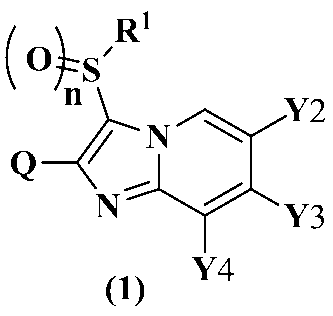
[式中、Qは、Q1又はQ3の何れかで表される環を表し、

A1aは、C1~C6アルキルを表し、
A4は、窒素原子又はCHを表し、
A5は、窒素原子又はCHを表し、
R1は、C1~C6アルキルを表し、
R3は、ハロ(C1~C6)アルキル、ハロ(C1~C6)アルキルチオ、ハロ(C1~C6)アルキルスルフィニル又はハロ(C1~C6)アルキルスルホニルを表し、
Y2、Y3及びY4は、各々独立して、水素原子、ハロゲン原子、ハロ(C1~C6)アルキル又はシアノを表し、
nは、0、1又は2の整数を表す。]
A4は、窒素原子又はCHを表し、
A5は、窒素原子又はCHを表し、
R1は、C1~C6アルキルを表し、
R3は、ハロ(C1~C6)アルキル、ハロ(C1~C6)アルキルチオ、ハロ(C1~C6)アルキルスルフィニル又はハロ(C1~C6)アルキルスルホニルを表し、
Y2、Y3及びY4は、各々独立して、水素原子、ハロゲン原子、ハロ(C1~C6)アルキル又はシアノを表し、
nは、0、1又は2の整数を表す。]
(2)
有効成分群B-I:メタラキシル-M及びヒメキサゾール。
有効成分群B-II:ベノミル、チオファネート-メチル、ジエトフェンカルブ、エタボキサム、ゾキサミド、ペンシクロン及びフルオピコリド。
有効成分群B-III:ベンゾビンジフルピル、ビキサフェン、ボスカリド、フルインダピル、フルオピラム、フルトラニル、フルキサピロキサド、フラメトピル、イソフルシプラム、インピルフルキサム、イソフェタミド、イソピラザム、メプロニル、ペンフルフェン、ペンチオピラド、セダキサン、チフルザミド、アゾキシストロビン、クモキシストロビン、ジモキシストロビン、エネストロビン、エノキサストロビン、ファモキサドン、フェナミドン、フェナミンストロビン、フルフェノキシストロビン、フルオキサストロビン、クレソキシム-メチル、マンデストロビン、メトミノストロビン、オリサストロビン、ピコキシストロビン、ピラクロストロビン、ピラメトストロビン、ピラオキシストロビン、ピリベンカルブメチル、ピリミノストロビン、トリクロピリカルブ、トリフロキシストロビン、アミスルブロム、シアゾファミド、フルアジナム、フェンピコキサミド、アメトクトラジン、ピジフルメトフェン及びピラジフルミド。
有効成分群B-IV:メパニピリム及びカスガマイシン。
有効成分群B-V:キノキシフェン及びフルジオキソニル。
有効成分群B-VI:イプロジオン及びプロシミドン。
有効成分群B-VII:トルクロホス-メチル及びバチルス ズブチリス。
有効成分群B-VIII:ブロムコナゾール、シプロコナゾール、ジフェノコナゾール、ジニコナゾール-M、エポキシコナゾール、フェナリモル、フェンブコナゾール、フルキンコナゾール、ヘキサコナゾール、イマザリル、イミベンコナゾール、イプコナゾール、メトコナゾール、ミクロブタニル、ペンコナゾール、プロクロラズ、プロピコナゾール、プロチオコナゾール、シメコナゾール、テブコナゾール、テトラコナゾール、トリフルミゾール、フェンプロピジン、フェンヘキサミド、フェンピラザミン、イプフェントリフルコナゾール及びメフェントリフルコナゾール。
有効成分群B-IX:バリダマイシン、ポリオキシン、ポリオキシン-D、ベンチアバリカルブ-イソプロピル、ジメトモルフ、イプロバリカルブ及びマンジプロパミド。
有効成分群B-X:フサライド、トリシクラゾール、カルプロパミド及びジクロシメット。
有効成分群B-XI:アシベンゾラル-S-メチル、プロベナゾール、イソチアニル、ジクロベンチアゾクス及びチアジニル。
有効成分群B-XII:ボルドー液、塩基性炭酸銅、水酸化第二銅、カッパーナフテネート、カッパーオレエート、塩基性塩化銅、硫酸銅、塩基性硫酸銅、オキシキノリン銅、石灰硫黄合剤、硫黄、マンコゼブ、マンネブ、ポリカーバメート、プロピネブ、キャプタン、フォルペット、クロロタロニル、イミノクタジン-アルベシル酸塩及びイミノクタジン酢酸塩。
有効成分群B-XIII:アミノピリフェン、シフルフェナミド、シモキサニル、フルスルファミド、フルチアニル、ホセチル-アルミニウム、メトラフェノン、オキサチアピプロリン、ピリオフェノン、ピカルブトラドクス、ジピメチトロン、キノフメリン、リポペプチド、亜リン酸、BCF-082(試験名)、NF-180(試験名)、S-2399(試験名)、AKD-5195(試験名)及びS-2190(試験名)。
有効成分群B-XIV:アセフェート、カズサホス、クロルピリホス、ダイアジノン、ジクロルボス、ジメトエート、イーピーエヌ、マラチオン、メタミドホス、パラチオン-メチル、フェントエート、ホレート、ホスメット、ホキシム、プロフェノホス及びテルブホス。
有効成分群B-XV:アルジカルブ、ベンフラカルブ、カルバリル、カルボフラン、カルボスルファン、メソミル、ピリミカルブ及びチオジカルブ。
有効成分群B-XVI:アクリナトリン、ビフェントリン、シフルトリン、シペルメトリン、デルタメトリン、エスフェンバレレート、エトフェンプロックス、ペルメトリン、テフルトリン、ラムダ-シハロトリン及びタウ-フルバリネート。
有効成分群B-XVII:ベンスルタップ、カルタップ及びチオシクラム。
有効成分群B-XVIII:アセタミプリド、クロチアニジン、ジノテフラン、フルピリミン、イミダクロプリド、ニテンピラム、チアクロプリド、チアメトキサム、スルホキサフロル、フルピラジフロン、トリフルメゾピリム及びジクロロメゾチアズ。
有効成分群B-XIX:スピネトラム及びスピノサド
有効成分群B-XX:エチプロール、フィプロニル及びブロフラニリド。
有効成分群B-XXI:アバメクチン、エマメクチンベンゾエート、レピメクチン及びミルベメクチン。
有効成分群B-XXII:クロラントラニリプロール、シアントラニリプロール、フルベンジアミド、シクラニリプロール、テトラニリプロール及びシハロジアミド。
有効成分群B-XXIII:ジアフェンチウロン、フェンピロキシメート、ピリダベン、トルフェンピラド、シエノピラフェン、シフルメトフェン、ピフルブミド、ヒドラメチルノン、アセキノシル及びクロルフェナピル。
有効成分群B-XXIV:ベンズピリモキサン、ピリプロキシフェン、メトキシフェノジド、ジフルベンズロン、フルフェノクスロン、ルフェヌロン、ノバルロン、テフルベンズロン、ブプロフェジン、ヘキサチアゾクス及びエトキサゾール。
有効成分群B-XXV:バチルス チューリンゲンシス及びバチルス スファエリクス。
有効成分群B-XXVI:アシノナピル、ピメトロジン、ピリフルキナゾン、アフィドピロペン、フロニカミド、スピロジクロフェン、スピロメシフェン、スピロピジオン、スピロテトラマト、インドキサカルブ、メタフルミゾン、シロマジン、アザディラクチン、ピリダリル、ビフェナゼート、フルキサメタミド、メタアルデヒド、ME-5382(試験名)、NA-89(試験名)、NNI-1501(試験名)、BAI-1602(試験名)、DKN-2601(試験名)及びDAI-1601(試験名)。
〔2〕
前記式(I)で表される縮合複素環化合物が、
Qが、Q1で表される環であり、
A4が、CHであり、
A5が、窒素原子であり、
R3が、ハロ(C1~C6)アルキル又はハロ(C1~C6)アルキルスルフィニルであり、
Y2及びY3が、各々独立して、水素原子、ハロゲン原子又はハロ(C1~C6)アルキルであり、
Y4が、水素原子、ハロゲン原子又はシアノであり、かつ、
nが、2である、
縮合複素環化合物である、上記〔1〕に記載の組成物。
〔3〕
前記式(I)で表される縮合複素環化合物が、
Qが、Q1で表される環であり、
A4が、窒素原子であり、
A5が、CHであり、
R3が、ハロ(C1~C6)アルキルであり、
Y2、Y3及びY4が、各々独立して、水素原子又はハロ(C1~C6)アルキルであり、かつ、
nが、2である、
縮合複素環化合物である、上記〔1〕に記載の組成物。
〔4〕
前記式(I)で表される縮合複素環化合物が、
Qが、Q3で表される環であり、
R3が、ハロ(C1~C6)アルキルであり、
Y2、Y3及びY4が、各々独立して、水素原子又はハロゲン原子であり、
nが、2である、
縮合複素環化合物である、上記〔1〕に記載の組成物。
〔5〕
前記活性化合物IIが、アセタミプリド、クロチアニジン、イミダクロプリド、チアメトキサム、スルホキサフロル、スピネトラム、エマメクチンベンゾエート、クロラントラニリプロール、シアントラニリプロール、フルベンジアミド、ピリダベン、シエノピラフェン、クロルフェナピル、バチルス チューリンゲンシス、ピメトロジン、フロニカミド、スピロテトラマト、インドキサカルブ、ピリダリル、ビフェナゼート及びフルキサメタミドから選択される活性化合物である、上記〔1〕~〔4〕のいずれかに記載の組成物。
〔6〕
活性化合物I及び活性化合物IIの組合せ割合が、活性化合物I:活性化合物IIの重量比で表して、100:1~1:100である、上記〔1〕~〔5〕のいずれかに記載の組成物。
前記式(I)で表される縮合複素環化合物が、
Qが、Q1で表される環であり、
A4が、CHであり、
A5が、窒素原子であり、
R3が、ハロ(C1~C6)アルキル又はハロ(C1~C6)アルキルスルフィニルであり、
Y2及びY3が、各々独立して、水素原子、ハロゲン原子又はハロ(C1~C6)アルキルであり、
Y4が、水素原子、ハロゲン原子又はシアノであり、かつ、
nが、2である、
縮合複素環化合物である、上記〔1〕に記載の組成物。
〔3〕
前記式(I)で表される縮合複素環化合物が、
Qが、Q1で表される環であり、
A4が、窒素原子であり、
A5が、CHであり、
R3が、ハロ(C1~C6)アルキルであり、
Y2、Y3及びY4が、各々独立して、水素原子又はハロ(C1~C6)アルキルであり、かつ、
nが、2である、
縮合複素環化合物である、上記〔1〕に記載の組成物。
〔4〕
前記式(I)で表される縮合複素環化合物が、
Qが、Q3で表される環であり、
R3が、ハロ(C1~C6)アルキルであり、
Y2、Y3及びY4が、各々独立して、水素原子又はハロゲン原子であり、
nが、2である、
縮合複素環化合物である、上記〔1〕に記載の組成物。
〔5〕
前記活性化合物IIが、アセタミプリド、クロチアニジン、イミダクロプリド、チアメトキサム、スルホキサフロル、スピネトラム、エマメクチンベンゾエート、クロラントラニリプロール、シアントラニリプロール、フルベンジアミド、ピリダベン、シエノピラフェン、クロルフェナピル、バチルス チューリンゲンシス、ピメトロジン、フロニカミド、スピロテトラマト、インドキサカルブ、ピリダリル、ビフェナゼート及びフルキサメタミドから選択される活性化合物である、上記〔1〕~〔4〕のいずれかに記載の組成物。
〔6〕
活性化合物I及び活性化合物IIの組合せ割合が、活性化合物I:活性化合物IIの重量比で表して、100:1~1:100である、上記〔1〕~〔5〕のいずれかに記載の組成物。
〔7〕
上記〔1〕に記載の活性化合物Iの少なくとも1種と、上記〔1〕に記載の活性化合物IIの少なくとも1種とを同時に、又は時間的に近接して施用又は処理することによる、有害生物の防除方法。
〔8〕
上記〔1〕に記載の活性化合物Iが上記〔2〕に記載の活性化合物Iである、上記〔7〕に記載の防除方法。
〔9〕
上記〔1〕に記載の活性化合物Iが上記〔3〕に記載の活性化合物Iである、上記〔7〕に記載の防除方法。
〔10〕
上記〔1〕に記載の活性化合物Iが上記〔4〕に記載の活性化合物Iである、上記〔7〕に記載の防除方法。
〔11〕
上記〔1〕に記載の活性化合物IIが上記〔5〕に記載の活性化合物IIである、上記〔7〕~〔10〕のいずれかに記載の防除方法。
〔12〕
活性化合物I及び活性化合物IIの組合せ割合が、活性化合物I:活性化合物IIの重量比で表して、100:1~1:100である、上記〔7〕~〔11〕のいずれかに記載の防除方法。
〔13〕
活性化合物Iの施用量が0.1~1000gai/haであり、活性化合物IIの施用量が0.1~1000gai/haである、上記〔7〕~〔12〕のいずれかに記載の防除方法。
〔14〕
上記〔1〕に記載の活性化合物Iの少なくとも1種と、上記〔1〕に記載の活性化合物IIの少なくとも1種とを同時に、又は時間的に近接して種子を処理することによる、上記〔7〕~〔12〕のいずれかに記載の防除方法。
〔15〕
上記〔1〕に記載の活性化合物Iが上記〔2〕に記載の活性化合物Iである、上記〔14〕に記載の防除方法。
〔16〕
上記〔1〕に記載の活性化合物Iが上記〔3〕に記載の活性化合物Iである、上記〔14〕に記載の防除方法。
〔17〕
上記〔1〕に記載の活性化合物Iが上記〔4〕に記載の活性化合物Iである、上記〔14〕に記載の防除方法。
〔18〕
上記〔1〕に記載の活性化合物IIが上記〔5〕に記載の活性化合物IIである、上記〔14〕~〔17〕のいずれかに記載の防除方法。
〔19〕
上記〔1〕に記載の活性化合物Iが上記〔2〕に記載の活性化合物Iであり、上記〔1〕に記載の活性化合物IIが上記〔5〕に記載の活性化合物IIである、上記〔14〕に記載の防除方法。
本発明組成物及び本発明方法は、各種有害生物に対して優れた相乗的防除効果を奏するとともに、既存の有害生物防除剤に対して抵抗性を獲得した有害生物に対しても十分な相乗的防除効果を発揮する。
従って、本発明は有用な新規有害生物防除剤組成物及び該組成物や該組成物の構成成分を用いた有効な有害生物防除方法を提供する。
従って、本発明は有用な新規有害生物防除剤組成物及び該組成物や該組成物の構成成分を用いた有効な有害生物防除方法を提供する。
本明細書において示した各置換基の具体例を以下に示す。ここで、n-はノルマル、i-はイソ、s-はセカンダリー及びtert-はターシャリーを各々意味する。
本明細書におけるハロゲン原子としては、フッ素原子、塩素原子、臭素原子及びヨウ素原子が挙げられる。尚、本明細書中「ハロ」の表記もこれらのハロゲン原子を表す。
本明細書における「Ca~Cbアルキル」の表記は、炭素原子数がa~b個よりなる直鎖状又は分岐鎖状の炭化水素を表し、例えば、メチル、エチル、n-プロピル、i-プロピル、n-ブチル、i-ブチル、s-ブチル、tert-ブチル、n-ペンチル、1,1-ジメチルプロピル、n-ヘキシル等が具体例として挙げられ、各々の指定の炭素原子数の範囲で選択される。
本明細書におけるハロゲン原子としては、フッ素原子、塩素原子、臭素原子及びヨウ素原子が挙げられる。尚、本明細書中「ハロ」の表記もこれらのハロゲン原子を表す。
本明細書における「Ca~Cbアルキル」の表記は、炭素原子数がa~b個よりなる直鎖状又は分岐鎖状の炭化水素を表し、例えば、メチル、エチル、n-プロピル、i-プロピル、n-ブチル、i-ブチル、s-ブチル、tert-ブチル、n-ペンチル、1,1-ジメチルプロピル、n-ヘキシル等が具体例として挙げられ、各々の指定の炭素原子数の範囲で選択される。
本明細書における「ハロ(Ca~Cb)アルキル」の表記は、炭素原子に結合した水素原子がハロゲン原子によって任意に置換された、炭素原子数がa~b個よりなる直鎖状又は分岐鎖状の炭化水素を表し、このとき、2個以上のハロゲン原子によって置換されている場合、それらのハロゲン原子は互いに同一でも、又は互いに相異なっていてもよい。例えば、フルオロメチル、クロロメチル、ブロモメチル、ヨードメチル、ジフルオロメチル、ジクロロメチル、トリフルオロメチル、クロロジフルオロメチル、トリクロロメチル、ブロモジフルオロメチル、1-フルオロエチル、2-フルオロエチル、2-クロロエチル、2-ブロモエチル、2,2-ジフルオロエチル、2,2,2-トリフルオロエチル、2-クロロ-2,2-ジフルオロエチル、2,2,2-トリクロロエチル、2-ブロモ-2,2-ジフルオロエチル、1,1,2,2-テトラフルオロエチル、2-クロロ-1,1,2-トリフルオロエチル、2-クロロ-1,1,2,2-テトラフルオロエチル、ペンタフルオロエチル、2,2-ジフルオロプロピル、3,3,3-トリフルオロプロピル、3-ブロモ-3,3-ジフルオロプロピル、2,2,3,3-テトラフルオロプロピル、2,2,3,3,3-ペンタフルオロプロピル、1,1,2,3,3,3-ヘキサフルオロプロピル、ヘプタフルオロプロピル、2,2,2-トリフルオロ-1-(メチル)エチル、2,2,2-トリフルオロ-1-(トリフルオロメチル)エチル、1,2,2,2-テトラフルオロ-1-(トリフルオロメチル)エチル、2,2,3,4,4,4-ヘキサフルオロブチル、2,2,3,3,4,4,4-ヘプタフルオロブチル、ノナフルオロブチル等が具体例として挙げられ、各々の指定の炭素原子数の範囲で選択される。
本明細書における「ハロ(Ca~Cb)アルキルチオ」の表記は、炭素原子数がa~b個よりなる前記の意味であるハロアルキル-S-を表し、例えば、ジフルオロメチルチオ、トリフルオロメチルチオ、クロロジフルオロメチルチオ、ブロモジフルオロメチルチオ、2,2,2-トリフルオロエチルチオ、1,1,2,2-テトラフルオロエチルチオ、2-クロロ-1,1,2-トリフルオロエチルチオ、ペンタフルオロエチルチオ、1,1,2,3,3,3-ヘキサフルオロプロピルチオ、ヘプタフルオロプロピルチオ、1,2,2,2-テトラフルオロ-1-(トリフルオロメチル)エチルチオ、ノナフルオロブチルチオ等が具体例として挙げられ、各々の指定の炭素原子数の範囲で選択される。
本明細書における「ハロ(Ca~Cb)アルキルチオ」の表記は、炭素原子数がa~b個よりなる前記の意味であるハロアルキル-S-を表し、例えば、ジフルオロメチルチオ、トリフルオロメチルチオ、クロロジフルオロメチルチオ、ブロモジフルオロメチルチオ、2,2,2-トリフルオロエチルチオ、1,1,2,2-テトラフルオロエチルチオ、2-クロロ-1,1,2-トリフルオロエチルチオ、ペンタフルオロエチルチオ、1,1,2,3,3,3-ヘキサフルオロプロピルチオ、ヘプタフルオロプロピルチオ、1,2,2,2-テトラフルオロ-1-(トリフルオロメチル)エチルチオ、ノナフルオロブチルチオ等が具体例として挙げられ、各々の指定の炭素原子数の範囲で選択される。
本明細書における「ハロ(Ca~Cb)アルキルスルフィニル」の表記は、炭素原子数がa~b個よりなる前記の意味であるハロアルキル-S(O)-を表し、例えば、ジフルオロメチルスルフィニル、トリフルオロメチルスルフィニル、クロロジフルオロメチルスルフィニル、ブロモジフルオロメチルスルフィニル、2,2,2-トリフルオロエチルスルフィニル、1,2,2,2-テトラフルオロ-1-(トリフルオロメチル)エチルスルフィニル、ノナフルオロブチルスルフィニル等が具体例として挙げられ、各々の指定の炭素原子数の範囲で選択される。
本明細書における「ハロ(Ca~Cb)アルキルスルホニル」の表記は、炭素原子数がa~b個よりなる前記の意味であるハロアルキル-SO2-を表し、例えば、ジフルオロメチルスルホニル、トリフルオロメチルスルホニル、クロロジフルオロメチルスルホニル、ブロモジフルオロメチルスルホニル、2,2,2-トリフルオロエチルスルホニル、1,1,2,2-テトラフルオロエチルスルホニル、2-クロロ-1,1,2-トリフルオロエチルスルホニル等が具体例として挙げられ、各々の指定の炭素原子数の範囲で選択される。
本明細書における「Ca~Cbアルキルカルボニル」の表記は、炭素原子数がa~b個よりなる前記の意味であるアルキル-C(O)-を表し、例えば、アセチル、プロピオニル、ピバロイル等が具体例として挙げられ、各々の指定の炭素原子数の範囲で選択される。
本明細書において、「式(1)で表される縮合複素環化合物」は「化合物(1)」とも記載され、また、「式(1-Q1)で表される化合物」は「化合物(1-Q1)」とも記載される。他の化合物についてもこれに準じて同様に記載される。
本発明組成物の第一の有効成分である活性化合物Iに含まれる化合物(1)について、以下に詳細に説明する。
化合物(1)には、1個又は2個以上の不斉炭素原子又は不斉硫黄原子の存在に起因する光学活性体が存在するが、本発明は全ての光学活性体又はラセミ体を包含する。
化合物(1)のうちで、常法に従って酸付加塩にすることができるものは、例えば、フッ化水素酸、塩酸、臭化水素酸、ヨウ化水素酸等のハロゲン化水素酸の塩、硝酸、硫酸、リン酸、塩素酸、過塩素酸等の無機酸の塩、メタンスルホン酸、エタンスルホン酸、トリフルオロメタンスルホン酸、ベンゼンスルホン酸、p-トルエンスルホン酸等のスルホン酸の塩、ギ酸、酢酸、プロピオン酸、トリフルオロ酢酸、フマール酸、酒石酸、蓚酸、マレイン酸、リンゴ酸、コハク酸、安息香酸、マンデル酸、アスコルビン酸、乳酸、グルコン酸、クエン酸等のカルボン酸の塩又はグルタミン酸、アスパラギン酸等のアミノ酸の塩とすることができる。
化合物(1)のうちで、常法に従って金属塩にすることができるものは、例えば、リチウム、ナトリウム、カリウムといったアルカリ金属の塩、カルシウム、バリウム、マグネシウムといったアルカリ土類金属の塩又はアルミニウムの塩とすることができる。
化合物(1)において、N-オキシドとは、複素環上の環を構成する窒素原子が酸化された化合物である。N-オキシドを形成しうる複素環としては、例えば、ピリジン環を含む縮合環が挙げられる。
本発明組成物の第一の有効成分である活性化合物Iに含まれる化合物(1)は、例えば下記の製造法1~8により製造することができる。
[製造法1]
化合物(1)のうち、QがQ1であり且つnが0の整数である化合物(1-Q1-b)及びQがQ1であり且つnが1又は2の整数である化合物(1-Q1-a)は、例えば下記の製造法により製造することができる。

(式中、R1、R3、A4、A5、A1a、Y2、Y3及びY4は前記と同じ意味を表し、mは1又は2を表す。)
[製造法1]
化合物(1)のうち、QがQ1であり且つnが0の整数である化合物(1-Q1-b)及びQがQ1であり且つnが1又は2の整数である化合物(1-Q1-a)は、例えば下記の製造法により製造することができる。
工程1:化合物(2-Q1-b)は、化合物(30)と化合物(31-1-b)とを、塩基(例えばピリジン、トリエチルアミン、炭酸カリウム、炭酸セシウム等)の存在下で脱水縮合剤[例えば1H-ベンゾトリアゾール-1-イルオキシトリス(ジメチルアミノ)ホスホニウムヘキサフルオロホスファート、N,N’-ジシクロヘキシルカルボジイミド、1-エチル-3-(3-ジメチルアミノプロピル)カルボジイミド塩酸塩等]を用いて反応させることにより製造することができる。場合によっては1-ヒドロキシベンゾトリアゾール、4-(ジメチルアミノ)ピリジン等の添加剤を用いてもよい。化合物(30)の或るものは公知化合物であり、一部は市販品として入手できる。
工程2:化合物(1-Q1-b)は、酸(例えばパラトルエンスルホン酸、ポリリン酸、酢酸、プロピオン酸等)又は脱水剤(例えばオキシ塩化リン、無水酢酸等)の存在下で、化合物(2-Q1-b)に対して脱水環化反応を行うことにより製造することができる。
工程3:化合物(1-Q1-a)は、酸化剤[例えばメタクロロ過安息香酸、過酢酸等の過酸、過酸化水素、オキソン(OXONE、イー・アイ・デュポン社商品名;ペルオキソ硫酸水素カリウム含有物)等]を用いて化合物(1-Q1-b)を酸化することにより製造することができる。場合によっては触媒(例えばタングステン酸ナトリウム等)用いることができる。
工程2:化合物(1-Q1-b)は、酸(例えばパラトルエンスルホン酸、ポリリン酸、酢酸、プロピオン酸等)又は脱水剤(例えばオキシ塩化リン、無水酢酸等)の存在下で、化合物(2-Q1-b)に対して脱水環化反応を行うことにより製造することができる。
工程3:化合物(1-Q1-a)は、酸化剤[例えばメタクロロ過安息香酸、過酢酸等の過酸、過酸化水素、オキソン(OXONE、イー・アイ・デュポン社商品名;ペルオキソ硫酸水素カリウム含有物)等]を用いて化合物(1-Q1-b)を酸化することにより製造することができる。場合によっては触媒(例えばタングステン酸ナトリウム等)用いることができる。
[製造法2]
化合物(1)のうち、QがQ1である化合物(1-Q1)は下記の製造法により製造することができる。

(式中、R1、R3、A4、A5、A1a、Y2、Y3、Y4及びnは前記と同じ意味を表し、Jはハロゲン原子等の脱離基を表す。)
化合物(1)のうち、QがQ1である化合物(1-Q1)は下記の製造法により製造することができる。
工程1:化合物(2-Q1)は、塩基(例えばピリジン、トリエチルアミン、炭酸水素ナトリウム、炭酸カリウム、炭酸セシウム等)の存在下で化合物(30)と化合物(31)とを反応させることにより製造することができる。化合物(30)の或るものは公知化合物であり、一部は市販品として入手できる。
工程2:製造法1の工程2に準じた方法により化合物(1-Q1)を製造することができる。
工程2:製造法1の工程2に準じた方法により化合物(1-Q1)を製造することができる。
[製造法3]
化合物(1)のうち、化合物(1-Q1-a)及び化合物(1-Q1-b)は、下記の製造法により製造することができる。
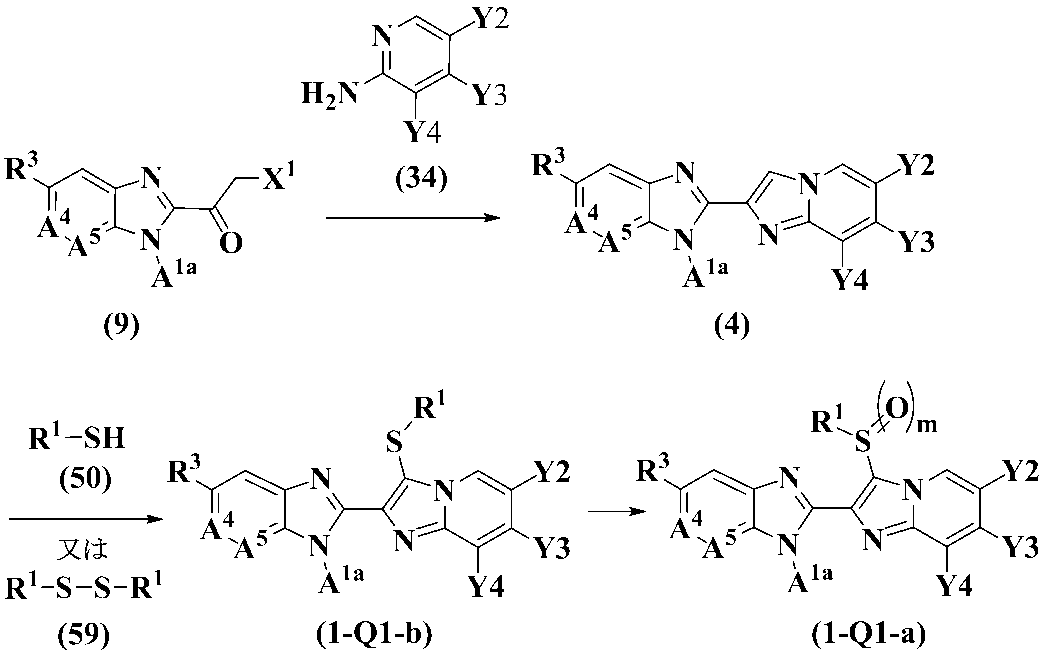
(式中、R1、R3、A4、A5、A1a、Y2、Y3、Y4及びmは前記と同じ意味を表し、X1はハロゲン原子を表す。)
化合物(1)のうち、化合物(1-Q1-a)及び化合物(1-Q1-b)は、下記の製造法により製造することができる。
工程1:化合物(4)は、国際公開第2007/148755号に記載の方法に準じて加熱条件下で、化合物(9)と化合物(34)とを反応させることにより製造することができる。場合によっては塩基(例えばピリジン、トリエチルアミン、炭酸カリウム、炭酸セシウム等)を用いてもよい。化合物(34)の或るものは公知化合物であり、一部は市販品として入手することができる。
工程2:化合物(1)のうち、化合物(1-Q1-b)は、ハロゲン化剤(例えば塩素、臭素、ヨウ素、一塩化ヨウ素、N-クロロスクシンイミド、N-ブロモスクシンイミド、N-ヨードスクシンイミド、1,3-ジクロロ-5,5-ジメチルヒダントイン、1,3-ジブロモ-5,5-ジメチルヒダントイン、1,3-ジヨード-5,5-ジメチルヒダントイン等)の存在下、化合物(4)と化合物(50)若しくは化合物(59)とを反応させることにより製造することができる。化合物(50)及び化合物(59)の或るものは公知化合物であり、一部は市販品として入手できる。
工程3:化合物(1-Q1-a)は製造法1の工程3に準じた方法により製造することができる。
[製造法4]
化合物(1)のうち、化合物(1-Q1-a)及び化合物(1-Q1-b)は、下記の製造法により製造することができる。
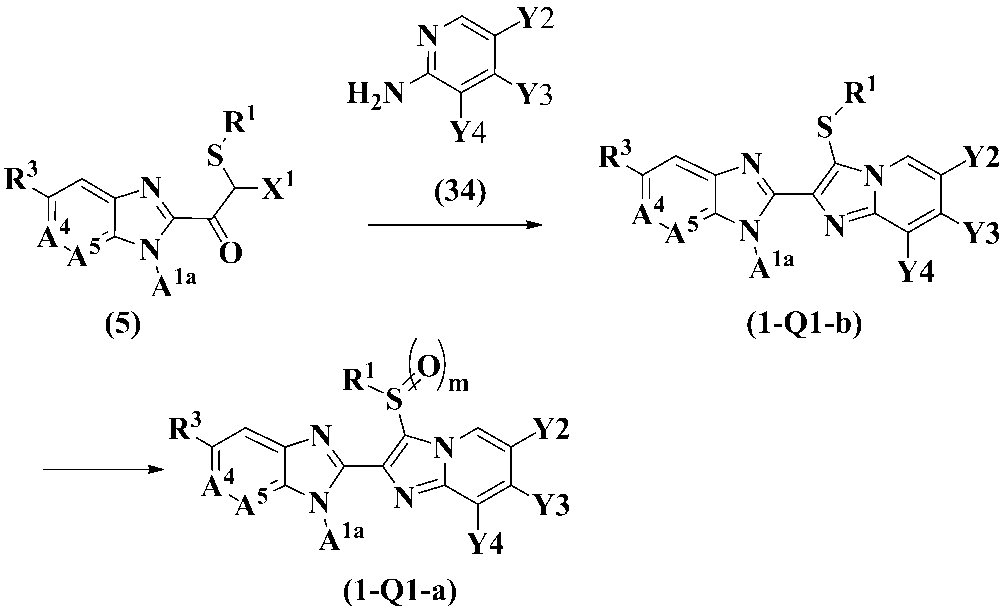
(式中、R1、R3、A4、A5、A1a、Y2、Y3、Y4、m及びX1は前記と同じ意味を表す。)
化合物(1)のうち、化合物(1-Q1-a)及び化合物(1-Q1-b)は、下記の製造法により製造することができる。
工程1:化合物(1-Q1-b)は、製造法3の工程1に準じた方法により、化合物(5)と化合物(34)とを反応させることにより製造することができる。化合物(34)の或るものは公知化合物であり、一部は市販品として入手することができる。
工程2:化合物(1-Q1-a)は製造法1の工程3に準じた方法により製造することができる。
工程2:化合物(1-Q1-a)は製造法1の工程3に準じた方法により製造することができる。
[製造法5]
上記化合物(1-Q1)のうち、R3がトリフルオロメタンスルフィニル又はトリフルオロメタンスルホニルである化合物(1-Q1-c)及びR3がトリフルオロメチルチオである化合物(1-Q1-d)は、例えば下記の製造法により製造することができる。
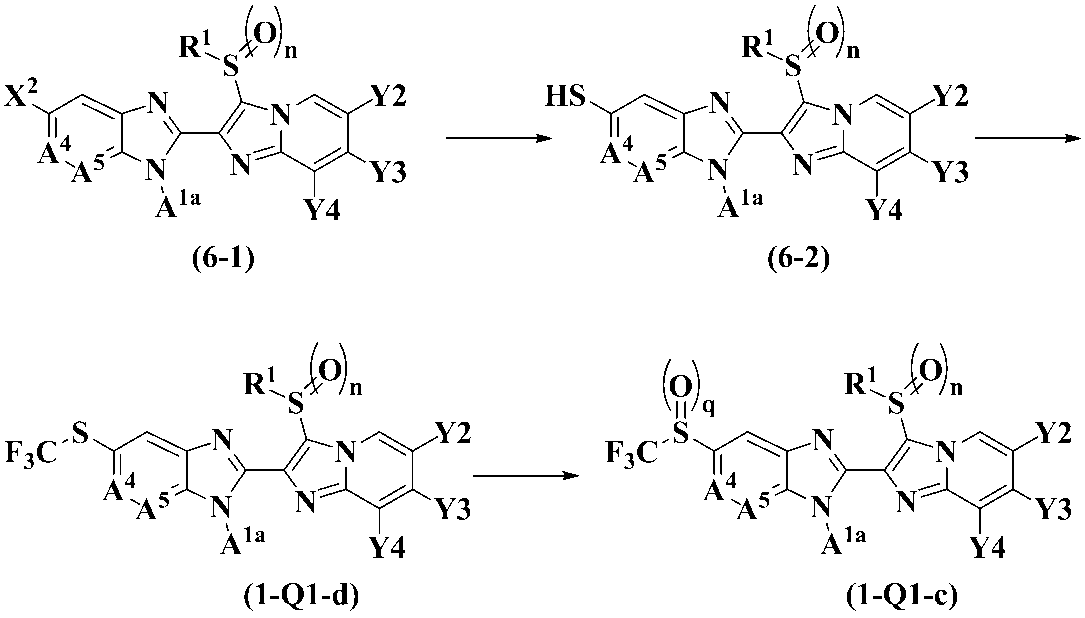
(式中、R1、A4、A5、A1a、Y2、Y3、Y4及びnは前記と同じ意味を表し、X2はハロゲン原子を表し、qは1又は2の整数を表す。)
上記化合物(1-Q1)のうち、R3がトリフルオロメタンスルフィニル又はトリフルオロメタンスルホニルである化合物(1-Q1-c)及びR3がトリフルオロメチルチオである化合物(1-Q1-d)は、例えば下記の製造法により製造することができる。
工程1:化合物(6-2)は、オーガニック・レターズ(Organic Letters)2007年,9巻,3687頁、テトラヘドロン(Tetrahedron)1998年、44巻、1187頁、国際公開第2011/159839号等に記載の方法に準じて、製造法2に記載の方法に準じて製造された化合物(6-1)とチオール化剤(例えば3-メルカプトプロピオン酸 2-エチルヘキシル、硫化水素ナトリウム、硫化ナトリウム等)とを反応させることにより製造することができる。
工程2:化合物(1-Q1-d)は、国際公開第2013/043962号、国際公開第2013/040863号、国際公開第2012/082566号等に記載の方法に準じて、化合物(6-2)とトリフルオロメチル化剤[例えば梅本試薬(5-[トリフルオロメチル]ジベンゾチオフェニウム トリフルオロメタンスルホネート)、Togni試薬(1-トリフルオロメチル-3,3-ジメチル-1,2-ベンゾヨードキソール)等]とを反応させることにより製造することができる。
工程3:製造法1の工程3に準じた方法により化合物(1-Q1-c)を製造することができる。
工程2:化合物(1-Q1-d)は、国際公開第2013/043962号、国際公開第2013/040863号、国際公開第2012/082566号等に記載の方法に準じて、化合物(6-2)とトリフルオロメチル化剤[例えば梅本試薬(5-[トリフルオロメチル]ジベンゾチオフェニウム トリフルオロメタンスルホネート)、Togni試薬(1-トリフルオロメチル-3,3-ジメチル-1,2-ベンゾヨードキソール)等]とを反応させることにより製造することができる。
工程3:製造法1の工程3に準じた方法により化合物(1-Q1-c)を製造することができる。
[製造法6]
化合物(1)のうち、化合物(1-Q1)は、例えば化合物(8-1)と化合物(35)とを反応させることにより製造することができる。
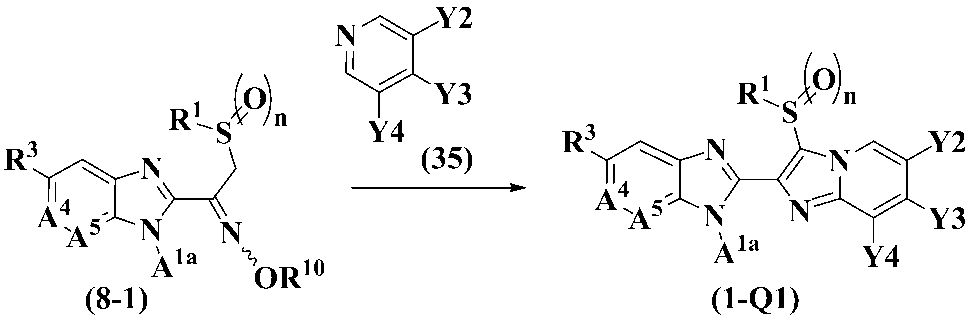
(式中、R1、R3、A4、A5、A1a、Y2、Y3及びY4は前記と同じ意味を表し、R10は、C1~C6アルキルカルボニルを表す。)
化合物(1)のうち、化合物(1-Q1)は、例えば化合物(8-1)と化合物(35)とを反応させることにより製造することができる。
化合物(1-Q1)は、オーガニック・レターズ(Organic Letters)2013年,15巻,6254頁に記載の方法に準じて、酸素及び銅触媒[例えば塩化銅(I)、臭化銅(I)、ヨウ化銅(I)、酸化銅(I)、塩化銅(II)、トリフルオロメタンスルホン酸銅(II)等]存在下で、化合物(8-1)と化合物(35)とを反応させることにより製造することができる。場合によってはアシル化剤(例えば無水酢酸、プロピオン酸無水物、イソ酪酸無水物、ピバル酸無水物等)を用いてもよい。上記化合物(8-1)は、E体、Z体又はE体及びZ体を任意の割合で含む混合物を包含する。また、化合物(35)の或るものは公知化合物であり、一部は市販品として入手することができる。
[製造法7]
化合物(1)のうち、化合物(1-Q1-e)は、例えば下記の製造法により製造することができる。
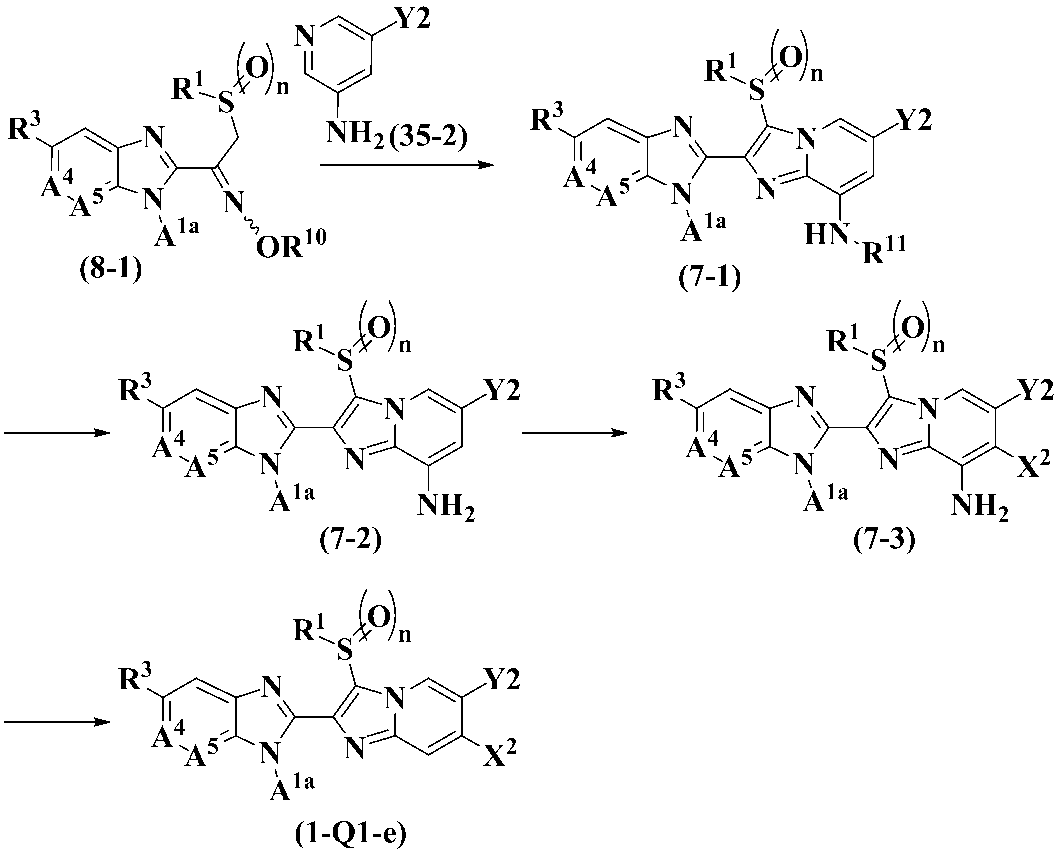
(式中、R1、R3、A4、A5、A1a、Y2、n及びX2は前記と同じ意味を表し、R10及びR11は、各々独立してC1~C6アルキルカルボニルを表す。)
化合物(1)のうち、化合物(1-Q1-e)は、例えば下記の製造法により製造することができる。
工程1:化合物(7-1)は、酸素、銅触媒[例えば塩化銅(I)、臭化銅(I)、ヨウ化銅(I)、酸化銅(I)、塩化銅(II)、トリフルオロメタンスルホン酸銅(II)等]及びアシル化剤(例えば無水酢酸、プロピオン酸無水物、イソ酪酸無水物、ピバル酸無水物等)の存在下で、化合物(8-1)と化合物(35-2)とを反応させることにより製造することができる。上記化合物(8-1)は、E体、Z体又はE体及びZ体を任意の割合で含む混合物を包含する。また、化合物(35-2)の或るものは公知化合物であり、一部は市販品として入手することができる。
工程2:化合物(7-2)は、酸(例えば酢酸、塩酸、硫酸等)の存在下で、化合物(7-1)を加水分解することにより製造することができる。場合によっては前記酸を溶媒として用いてもよい。
工程2:化合物(7-2)は、酸(例えば酢酸、塩酸、硫酸等)の存在下で、化合物(7-1)を加水分解することにより製造することができる。場合によっては前記酸を溶媒として用いてもよい。
工程3:ザ・ジャーナル・オブ・オーガニック・ケミストリー(The Journal of Organic Chemistry)1965年,30巻,1101頁等に記載の方法に準じて、ハロゲン化剤(例えば塩素、臭素、ヨウ素、一塩化ヨウ素、N-クロロスクシンイミド、N-ブロモスクシンイミド、N-ヨードスクシンイミド、1,3-ジクロロ-5,5-ジメチルヒダントイン、1,3-ジブロモ-5,5-ジメチルヒダントイン、1,3-ジヨード-5,5-ジメチルヒダントイン等)と化合物(7-2)とを反応させることにより、化合物(7-3)を製造することができる。
工程4:化合物(1-Q1-e)は、ロシアン・ケミカル・ブルテン(Russian Chemical Bulletin)2004年,53巻,471頁等に記載の方法に準じて酸(例えば酢酸、塩酸、硫酸等)の存在下で、亜硝酸塩(例えば亜硝酸ナトリウム等)と化合物(7-3)とを反応させることにより製造することができる。場合によっては銅触媒[例えば塩化銅(I)、臭化銅(I)、ヨウ化銅(I)、酸化銅(I)、塩化銅(II)、トリフルオロメタンスルホン酸銅(II)等]用いてもよい。
工程4:化合物(1-Q1-e)は、ロシアン・ケミカル・ブルテン(Russian Chemical Bulletin)2004年,53巻,471頁等に記載の方法に準じて酸(例えば酢酸、塩酸、硫酸等)の存在下で、亜硝酸塩(例えば亜硝酸ナトリウム等)と化合物(7-3)とを反応させることにより製造することができる。場合によっては銅触媒[例えば塩化銅(I)、臭化銅(I)、ヨウ化銅(I)、酸化銅(I)、塩化銅(II)、トリフルオロメタンスルホン酸銅(II)等]用いてもよい。
[製造法8]
化合物(1)のうち、QがQ2であり且つnが1又は2の整数である化合物(1-Q2-a)及びQがQ2であり且つnが0の整数である化合物(1-Q2-b)は、例えば下記の製造法により製造することができる。
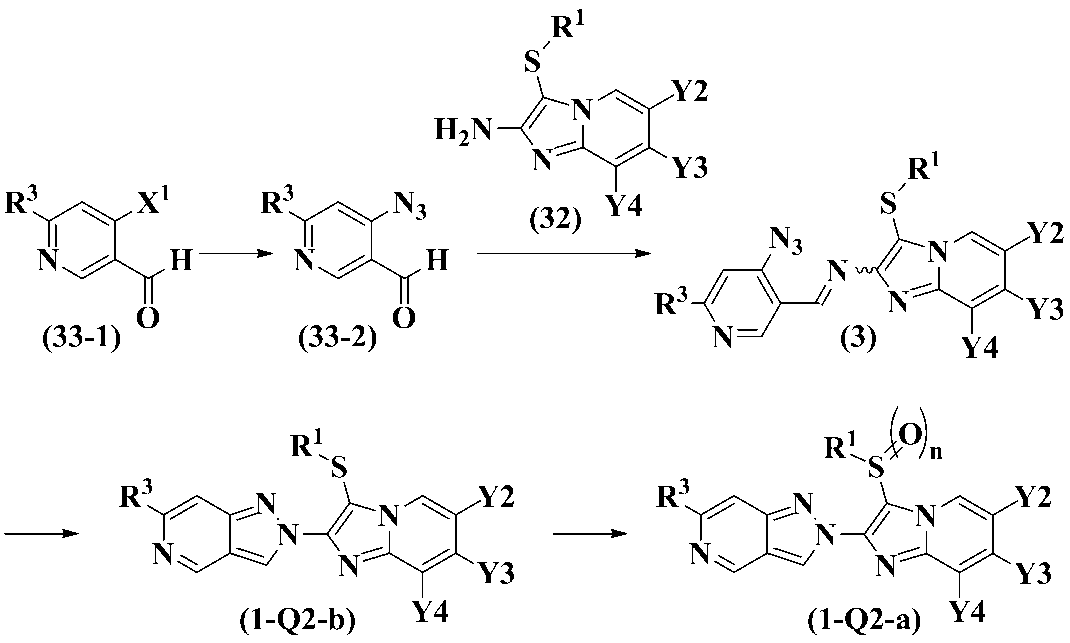
(式中、R1、R3、Y2、Y3、Y4、n及びX1は前記と同じ意味を表す。)
化合物(1)のうち、QがQ2であり且つnが1又は2の整数である化合物(1-Q2-a)及びQがQ2であり且つnが0の整数である化合物(1-Q2-b)は、例えば下記の製造法により製造することができる。
工程1:化合物(33-2)は、公知の方法に準じて、化合物(33-1)とアジ化ナトリウムとを反応させることにより製造することができる。
工程2:化合物(3)は、国際公開第2012/066061号に記載の方法に準じて、塩基(例えばピリジン、トリエチルアミン、炭酸水素ナトリウム、炭酸カリウム、炭酸セシウム等)及びルイス酸(例えば四塩化チタン等)の存在下で化合物(33-2)と化合物(32)とを反応させることにより製造することができる。化合物(3)は、E体、Z体又はE体及びZ体を任意の割合で含む混合物を包含する。
工程3:化合物(1-Q2-b)は、国際公開第2012/066061号に記載の方法に準じて化合物(3)を環化させることにより製造することができる。
工程4:化合物(1-Q2-a)は製造法1の工程3に準じた方法により製造することができる。
製造法1に用いられる化合物(31-1-b)は、例えば下記の製造法にしたがって製造することができる。
[反応式1]
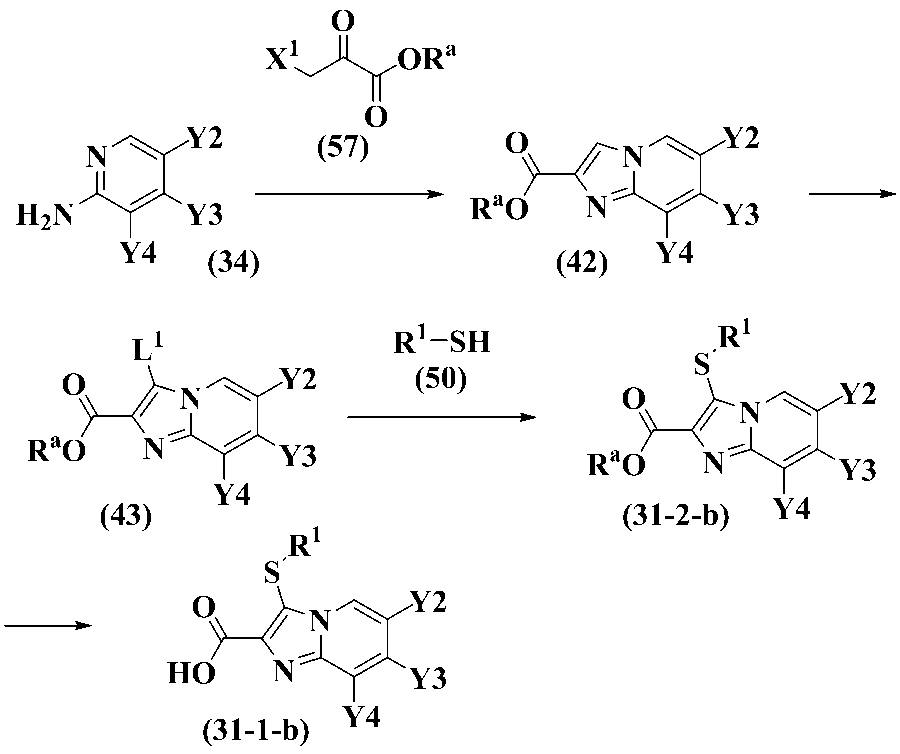
(式中、R1、Y2、Y3、Y4及びX1は前記と同じ意味を表し、RaはC1~C6アルキルを表し、L1はハロゲン原子を表す。)
[反応式1]
工程1:化合物(42)は、国際公開第2013/087792号、国際公開第2012/096929号等に記載の方法に準じて加熱条件下で化合物(34)と化合物(57)とを反応させることにより製造することができる。化合物(34)及び化合物(57)の或るものは公知化合物であり、一部は市販品として入手できる。
工程2:国際公開第2010/033978号、国際公開第2011/075643号、国際公開第2007/087548号等に記載の方法に準じて、化合物(42)とハロゲン化剤(例えば塩素、臭素、ヨウ素、N-クロロスクシンイミド、N-ブロモスクシンイミド、N-ヨードスクシンイミド、1,3-ジクロロ-5,5-ジメチルヒダントイン、1,3-ジブロモ-5,5-ジメチルヒダントイン、1,3-ジヨード-5,5-ジメチルヒダントイン等)とを反応させることにより、化合物(43)を製造することができる。
工程2:国際公開第2010/033978号、国際公開第2011/075643号、国際公開第2007/087548号等に記載の方法に準じて、化合物(42)とハロゲン化剤(例えば塩素、臭素、ヨウ素、N-クロロスクシンイミド、N-ブロモスクシンイミド、N-ヨードスクシンイミド、1,3-ジクロロ-5,5-ジメチルヒダントイン、1,3-ジブロモ-5,5-ジメチルヒダントイン、1,3-ジヨード-5,5-ジメチルヒダントイン等)とを反応させることにより、化合物(43)を製造することができる。
工程3:オーガニック・レターズ(Organic Letters)2007年,9巻,3687頁等に記載の方法に準じて、パラジウム触媒[例えばパラジウム-炭素、塩化パラジウム(II)、酢酸パラジウム(II)、ビス(トリフェニルホスフィン)パラジウム(II)ジクロリド、テトラキス(トリフェニルホスフィン)パラジウム(0)、ビス(ジベンジリデンアセトン)パラジウム(0)、トリス(ジベンジリデンアセトン)ジパラジウム(0)等]及び塩基(例えばピリジン、トリエチルアミン、炭酸水素ナトリウム、炭酸カリウム、炭酸セシウム等)の存在下で、化合物(43)と化合物(50)とを反応させることにより、化合物(31-2-b)を製造することができる。場合によっては配位子(例えば4,5-ビス(ジフェニルホスフィノ)-9,9-ジメチルキサンテン、1,10-フェナントロリン等)を用いてもよい。
工程4:化合物(31-1-b)は、公知の方法に準じて化合物(31-2-b)を加水分解することにより製造することができる。
工程4:化合物(31-1-b)は、公知の方法に準じて化合物(31-2-b)を加水分解することにより製造することができる。
上記化合物(31-2-b)は、例えば下記の方法によっても製造することができる。
[反応式2]
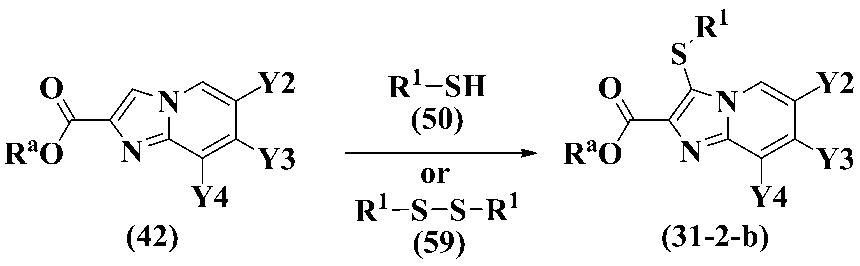
(式中、R1、Y2、Y3、Y4及びRaは前記と同じ意味を表す。)
化合物(31-2-b)は、製造法3の工程2に記載の方法に準じて、化合物(42)と化合物(50)若しくは化合物(59)とを反応させることにより製造することができる。
[反応式2]
化合物(31-2-b)は、製造法3の工程2に記載の方法に準じて、化合物(42)と化合物(50)若しくは化合物(59)とを反応させることにより製造することができる。
製造法2に用いられる化合物(31)のうち、nが1又は2である化合物(31-a)は、例えば下記の製造法にしたがって製造することができる。
[反応式3]

(式中、R1、Y2、Y3、Y4、m、Ra及びJは前記と同じ意味を表す。)
[反応式3]
工程1:化合物(31-2-a)は、製造法1に記載の方法に準じて、化合物(31-2-b)を酸化することにより製造することができる。
工程2:化合物(31-1-a)は、公知の方法に準じて、化合物(31-2-a)を加水分解することにより製造することができる。
工程3:公知の方法に準じて、化合物(31-1-a)とハロゲン化剤(例えばフッ化水素、フッ素化カリウム、二塩化オキサリル、塩化チオニル、オキシ塩化リン、オキシ臭化リン、臭化アセチル等)とを反応させることにより、化合物(31-a)を製造することができる。
工程2:化合物(31-1-a)は、公知の方法に準じて、化合物(31-2-a)を加水分解することにより製造することができる。
工程3:公知の方法に準じて、化合物(31-1-a)とハロゲン化剤(例えばフッ化水素、フッ素化カリウム、二塩化オキサリル、塩化チオニル、オキシ塩化リン、オキシ臭化リン、臭化アセチル等)とを反応させることにより、化合物(31-a)を製造することができる。
化合物(31)のうち、nが0である化合物(31-b)は、例えば下記の製造法にしたがって製造することができる。
[反応式4]
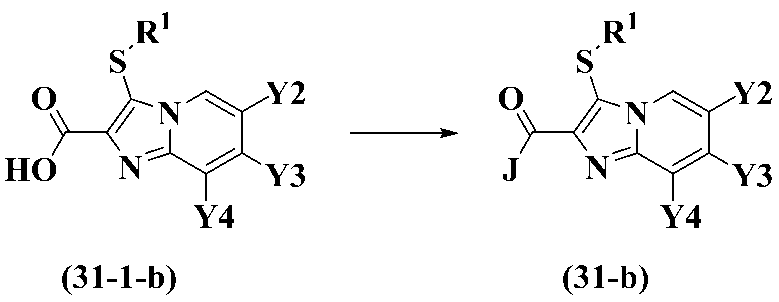
(式中、R1、Y2、Y3、Y4及びJは前記と同じ意味を表す。)
化合物(31-b)は、反応式3の工程に記載の方法に準じて化合物(31-1-b)を反応させることにより製造することができる。
[反応式4]
化合物(31-b)は、反応式3の工程に記載の方法に準じて化合物(31-1-b)を反応させることにより製造することができる。
製造法3に用いられる化合物(9)は、例えば下記の反応式で示される製造ルートにしたがって製造することができる。
[反応式5]

(式中、R3、A4、A5、A1a、X1及びJは前記と同じ意味を表す。)
[反応式5]
工程1:公知の方法に準じて化合物(30)と化合物(52)とを縮合した後、シンセシス(Synthesis)1991年、465頁、バイオオーガニック・アンド・メディシナル・ケミストリー・レターズ(Bioorganic & Medicinal Chemistry Letters)2011年、21巻、4602頁等に記載の方法に準じて脱アセチル化反応を行い、次いで上記製造法1の工程2に記載の方法に準じて脱水環化反応を行うことにより、化合物(38)を製造することができる。化合物(52)の或るものは公知化合物であり、一部は市販品として入手することができる。
工程2:化合物(39)は、ジャーナル・オブ・メディシナル・ケミストリー(Journal of Medicinal Chemistry)1982年,25巻,1342頁等に記載の方法に準じて化合物(38)を酸化することにより製造することができる。
工程3:化合物(9)は、化合物(39)とハロゲン化剤(例えば塩素、臭素、ヨウ素、一塩化ヨウ素、N-クロロスクシンイミド、N-ブロモスクシンイミド、N-ヨードスクシンイミド、1,3-ジクロロ-5,5-ジメチルヒダントイン、1,3-ジブロモ-5,5-ジメチルヒダントイン、1,3-ジヨード-5,5-ジメチルヒダントイン、トリメチルフェニルアンモニウムトリブロミド、臭化水素酸、臭化水素の酢酸溶液等)とを反応させることにより製造することができる。場合によっては例えば臭化水素酸、臭化水素の酢酸溶液等の添加剤を用いてもよい。
本工程は、化合物(39)をシリル化剤(例えばトリフルオロメタンスルホン酸トリメチルシリル等)及び塩基(例えばピリジン、トリエチルアミン、炭酸水素ナトリウム、炭酸カリウム、炭酸セシウム等)の存在下で反応させて製造されるシリル化された化合物(39)とした後、上記ハロゲン化剤との反応を行うこともできる。シリル化された化合物(39)は単離・精製することなく、そのままハロゲン化剤と反応させてもよい。
上記の化合物(52)及び化合物(38)は、1個の不斉炭素の存在に起因する光学活性体が存在するが、全ての光学活性体及びラセミ体を包含する。
製造法4に用いられる化合物(5)は、例えば下記の反応式で示される製造ルートにしたがって製造することができる。
[反応式6]
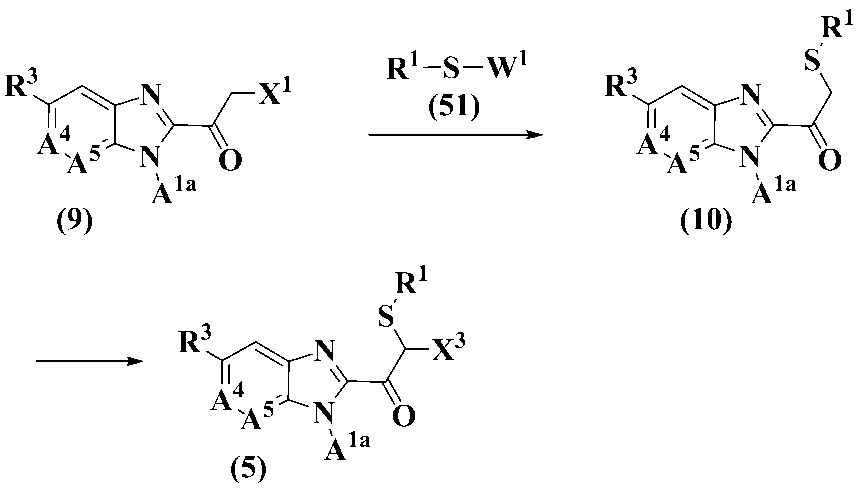
(式中、R1、R3、A4、A5、A1a及びX1は前記と同じ意味を表し、X3はハロゲン原子を表し、W1は水素原子、ナトリウム原子又はカリウム原子を表す。)
[反応式6]
工程1:化合物(10)は、公知の方法に準じて、化合物(9)と化合物(51)とを反応させることにより製造することができる。場合によっては塩基(例えばピリジン、トリエチルアミン、炭酸水素ナトリウム、炭酸カリウム、炭酸セシウム等)を用いてもよい。化合物(51)の或るものは公知化合物であり、一部は市販品として入手することができる。
工程2:化合物(5)は、化合物(10)を反応式5の工程3に記載の方法に準じて反応させることにより製造することができる。
工程2:化合物(5)は、化合物(10)を反応式5の工程3に記載の方法に準じて反応させることにより製造することができる。
製造法6及び製造法7の工程1に用いられる化合物(8-1)のうち、nが1又は2の整数である化合物(8-1-a)は、例えば、下記の反応式で示される製造ルートにしたがって製造することができる。
[反応式7]
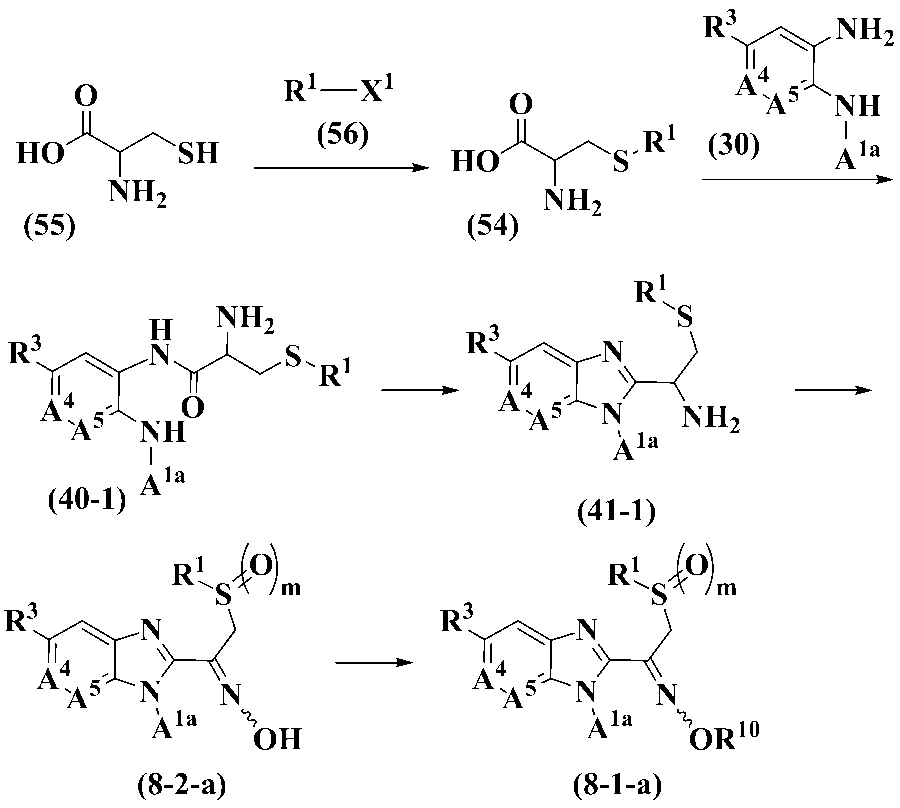
(式中、R1、R3、A4、A5、A1a、m、R10及びX1は前記と同じ意味を表す。)
[反応式7]
工程1:化合物(54)は、塩基(例えばピリジン、トリエチルアミン、炭酸水素ナトリウム、水酸化ナトリウム、炭酸カリウム、水酸化カリウム、炭酸セシウム等)の存在下で化合物(55)と化合物(56)とを反応させることにより製造することができる。
化合物(55)及び化合物(56)の或るものは公知化合物であり、一部は市販品として入手できる。
工程2:化合物(40-1)は、酸(例えば酢酸、塩酸、硫酸等)の存在下で化合物(30)と化合物(54)との脱水縮合反応を行うことにより製造することができる。場合によっては脱水剤(例えば無水硫酸マグネシウム、無水硫酸ナトリウム、モレキュラーシーブ、シリカゲル等)用いてもよい。脱水剤の使用量は、化合物(30)に対して0.1~100質量部で用いることができ、0.1~20質量部が好ましい。
化合物(55)及び化合物(56)の或るものは公知化合物であり、一部は市販品として入手できる。
工程2:化合物(40-1)は、酸(例えば酢酸、塩酸、硫酸等)の存在下で化合物(30)と化合物(54)との脱水縮合反応を行うことにより製造することができる。場合によっては脱水剤(例えば無水硫酸マグネシウム、無水硫酸ナトリウム、モレキュラーシーブ、シリカゲル等)用いてもよい。脱水剤の使用量は、化合物(30)に対して0.1~100質量部で用いることができ、0.1~20質量部が好ましい。
工程3:化合物(41-1)は、化合物(40-1)を、製造法1の工程2に記載の方法に準じて反応させることにより製造することができる。
工程4:化合物(8-2-a)は、製造法1の工程3に記載の方法に準じて、化合物(41-1)を酸化することにより製造することができる。
工程5:化合物(8-1-a)は、塩基(例えばピリジン、トリエチルアミン、炭酸水素ナトリウム、水酸化ナトリウム、炭酸カリウム、水酸化カリウム、炭酸セシウム等)の存在下で化合物(8-2-a)とアシル化剤(例えば塩化アセチル、プロピオニルクロリド、イソブチリルクロリド、ピバロイルクロリド、無水酢酸、プロピオン酸無水物、イソ酪酸無水物、ピバル酸無水物等)とを反応させることにより製造することができる。
上記の化合物(55)、化合物(54)、化合物(40-1)及び化合物(41-1)は、1個の不斉炭素の存在に起因する光学活性体が存在するが、全ての光学活性体及びラセミ体を包含する。また、化合物(8-2-a)及び化合物(8-1-a)は、E体、Z体又はE体及びZ体を任意の割合で含む混合物を包含する。
[反応式8]
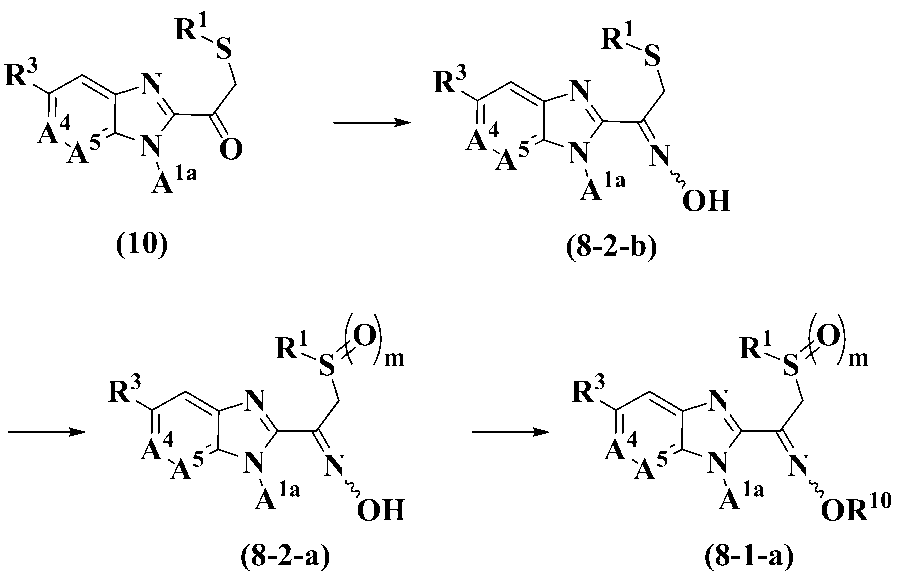
(式中、R1、R3、R10、A4、A5、A1a及びmは前記と同じ意味を表す。)
工程1:化合物(8-2-b)は、国際公開第2001/83479号、特許第4237497号明細書等に記載の方法に準じて、塩基(例えばピリジン、トリエチルアミン、炭酸水素ナトリウム、水酸化ナトリウム、炭酸カリウム、水酸化カリウム、炭酸セシウム等)の存在下でヒドロキシルアミン又はその塩(例えば塩酸塩、硫酸塩)と反応式6の工程1に記載した方法により製造される化合物(10)とを反応させることにより製造することができる。
工程2:化合物(8-2-a)は、製造法1の工程3に記載の方法に準じて、化合物(8-2-b)を酸化することにより製造することができる。
工程3:化合物(8-1-a)は、化合物(8-2-a)を、反応式7の工程5に記載の方法に準じて、アシル化することにより合成することができる。
上記化合物(8-2-b)、化合物(8-2-a)及び化合物(8-1-a)は、E体、Z体又はE体及びZ体を任意の割合で含む混合物を包含する。
工程2:化合物(8-2-a)は、製造法1の工程3に記載の方法に準じて、化合物(8-2-b)を酸化することにより製造することができる。
工程3:化合物(8-1-a)は、化合物(8-2-a)を、反応式7の工程5に記載の方法に準じて、アシル化することにより合成することができる。
上記化合物(8-2-b)、化合物(8-2-a)及び化合物(8-1-a)は、E体、Z体又はE体及びZ体を任意の割合で含む混合物を包含する。
反応式7に用いられる化合物(41-1)は、例えば下記の反応式で示される製造ルートにしたがって製造することができる。
[反応式9]
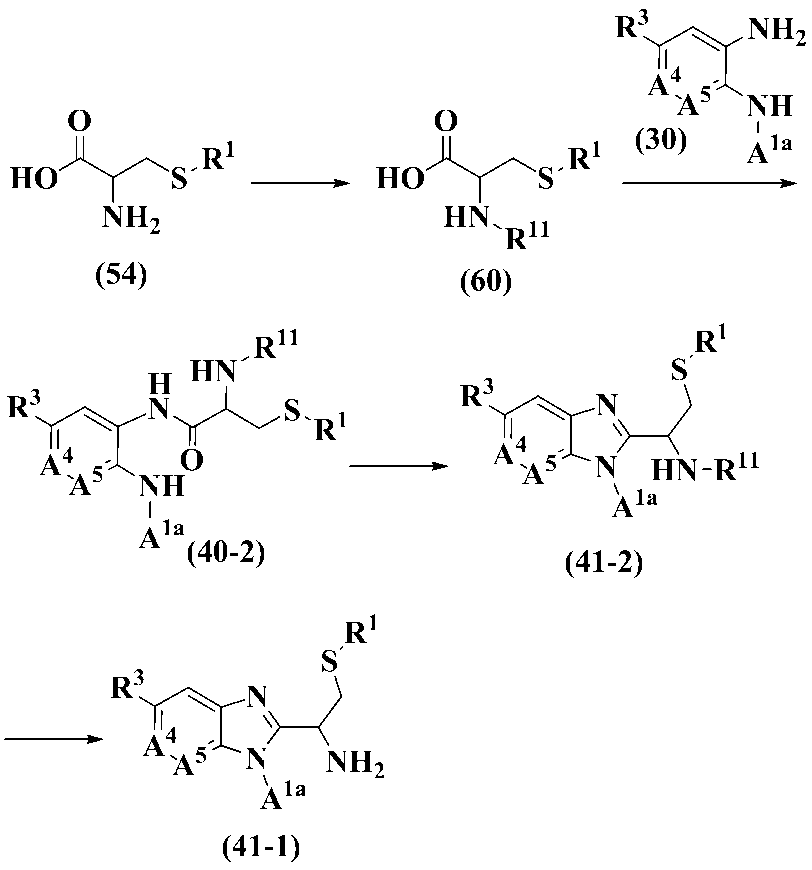
(式中、R1、R3、A4、A5、A1a、R11及びJは前記と同じ意味を表す。)
[反応式9]
工程1:塩基(例えばピリジン、トリエチルアミン、炭酸水素ナトリウム、水酸化ナトリウム、炭酸カリウム、水酸化カリウム、炭酸セシウム等)の存在下で、反応式7の工程1に記載の方法により製造される化合物(54)とアシル化剤(例えば塩化アセチル、プロピオニルクロリド、イソブチリルクロリド、ピバロイルクロリド、無水酢酸、プロピオン酸無水物、イソ酪酸無水物、ピバル酸無水物等)とを、公知の方法に準じて反応させることにより、化合物(60)を製造することができる。
工程2:化合物(40-2)は、反応式7の工程2に記載の方法に準じて、化合物(30)と化合物(60)との縮合反応を行うことにより製造することができる。
工程3:化合物(41-2)は、製造法1の工程2に記載の方法に準じて、化合物(40-2)に対して脱水環化反応を行うことにより製造することができる。
工程4:化合物(41-1)は、製造法7の工程2に記載の方法に準じて、化合物(41-2)に対して脱アシル化反応を行うことにより製造することができる。
上記の化合物(54)、化合物(60)、化合物(40-2)、化合物(41-2)及び化合物(41-1)は、1個の不斉炭素の存在に起因する光学活性体が存在するが、全ての光学活性体及びラセミ体を包含する。
製造法8に用いられる化合物(32)は、例えば下記の反応式で示される製造ルートにしたがって製造することができる。
[反応式10]

(式中、R1、Y2、Y3及びY4は前記と同じ意味を表し、RbはC1~C6アルキルを表す。)
[反応式10]
工程1:化合物(44)は、反応式1に従って製造することのできる化合物(31-1-b)を、アルコール(例えばメタノール、エタノール、プロパノール、ターシャリーブタノール等)の存在下でジフェニルホスホリルアジド(DPPA)と反応させることにより製造することができる。
工程2:化合物(32)は、国際公開第2012/174312号、国際公開第2003/018021号等に記載の方法に準じて、酸(例えば塩酸、硫酸等)の存在下で化合物(44)を加水分解することにより製造することができる。
工程2:化合物(32)は、国際公開第2012/174312号、国際公開第2003/018021号等に記載の方法に準じて、酸(例えば塩酸、硫酸等)の存在下で化合物(44)を加水分解することにより製造することができる。
製造法1~8及び反応式1~10の反応において、反応終了後の反応混合物は、直接濃縮又は有機溶媒に溶解し、水洗後濃縮又は氷水に投入、有機溶媒抽出後濃縮といった通常の後処理を行ない、目的の化合物を得ることができる。また、精製の必要が生じたときには、再結晶、カラムクロマトグラフ、薄層クロマトグラフ、液体クロマトグラフ分取等の精製方法によって分離、精製できる。
以下に、本発明組成物の第一の有効成分である活性化合物Iに含まれる化合物(1)の合成例について具体的に説明する。
中圧分取液体クロマトグラフィーは、中圧分取装置(YFLC-Wprep、山善社製;流速18ml/min;シリカゲル40μmのカラム)を使用した。
プロトン核磁気共鳴スペクトル(以下、1H-NMRと記載する。)は、300MHz(JNM-ECX300又はJNM-ECP300、JEOL社製)にて測定した。測定溶媒には、重クロロホルム、重ジメチルスルホキシド又は重水を用いた。溶媒に重クロロホルムを用いた場合には、基準物質としてテトラメチルシランを用いた。
1H-NMRのケミカルシフト値における記号は、下記の意味を表す。
s:シングレット、brs:ブロードシングレット、d:ダブレット、dd:ダブルダブレット、t:トリプレット、q:カルテット、m:マルチプレット
合成例1:2-[3-(エチルスルホニル)-6-(トリフルオロメチル)イミダゾ[1,2-a]ピリジン-2-イル]-3-メチル-6-(トリフルオロメチル)-3H-イミダゾ[4,5-b]ピリジン(化合物No.1-004)の合成
工程1:2-[3-(エチルチオ)-6-(トリフルオロメチル)イミダゾ[1,2-a]ピリジン-2-イル]-3-メチル-6-(トリフルオロメチル)-3H-イミダゾ[4,5-b]ピリジンの合成
N2-メチル-5-(トリフルオロメチル)ピリジン-2,3-ジアミン191mg、3-(エチルチオ)-6-(トリフルオロメチル)イミダゾ[1,2-a]ピリジン-2-カルボン酸291mg、4-(ジメチルアミノ)ピリジン40mg及びピリジン10mlの混合溶液に、室温にて、1-エチル-3-(3-ジメチルアミノプロピル)カルボジイミド塩酸塩384mgを添加した。添加終了後、該混合物を室温にて16時間攪拌した。反応終了後、減圧下にて溶媒を留去した。得られた残留物に水10mlを添加し、酢酸エチル(10ml×2)にて抽出した。得られた有機層を、1mol/L塩酸で洗浄した後、飽和食塩水、次いで無水硫酸ナトリウムの順で脱水・乾燥した後、減圧下にて溶媒を留去し、3-(エチルチオ)-N-[2-(メチルアミノ)-5-(トリフルオロメチル)ピリジン-3-イル]-6-(トリフルオロメチル)イミダゾ[1,2-a]ピリジン-2-カルボキサミドの粗生成物を300mg得た。この粗生成物300mg及び酢酸10mlの混合溶液を、加熱還流下にて5時間攪拌した。反応終了後、減圧下にて溶媒を留去した。得られた残留物に水10mlを添加し、酢酸エチル(10ml×2)にて抽出した。得られた有機層を、飽和炭酸水素ナトリウム水溶液で洗浄し、無水硫酸ナトリウムで脱水・乾燥した後、減圧下にて溶媒を留去し、目的物220mgを薄灰色固体として得た。
1H-NMR(CDCl3) : δ9.05-8.95(m, 1H), 8.72(s, 1H), 8.40(s, 1H), 7.82(d, J=9.7Hz, 1H), 7.52(dd, J=9.7, 1.9Hz, 1H), 4.31(s, 3H), 3.14(q, J=7.4Hz, 2H), 1.22(t, J=7.4Hz, 3H).
工程2:2-[3-(エチルスルホニル)-6-(トリフルオロメチル)イミダゾ[1,2-a]ピリジン-2-イル]-3-メチル-6-(トリフルオロメチル)-3H-イミダゾ[4,5-b]ピリジン(化合物No.1-004)の合成
工程1で得られた薄灰色固体150mg及びクロロホルム10mlの混合溶液に、氷冷下にて65重量%メタクロロ過安息香酸(東京化成工業社製;約30重量%の水を含む。以下同様である。)134mgを添加した。添加終了後、該混合物を室温にて3時間攪拌した。反応終了後、該反応混合物に飽和チオ硫酸ナトリウム水溶液5mlを添加し、クロロホルムにて抽出(10ml×2)した。得られた有機層を、1mol/Lの水酸化ナトリウム水溶液10mlで洗浄した。該有機層を無水硫酸ナトリウムで脱水・乾燥した後、減圧下にて溶媒を留去した。得られた残留物を中圧分取液体クロマトグラフィー[n-ヘキサン:酢酸エチル=100:0~50:50(体積比。以下同様である。)のグラジエント]にて精製し、目的物69mgを白色固体として得た。
1H-NMR(CDCl3) : δ9.68-9.63(m, 1H), 8.76(s, 1H), 8.35(s, 1H), 7.95(d, J=9.5Hz, 1H), 7.71(d, J=9.5Hz, 1H), 4.17(s, 3H), 4.12(q, J=7.2Hz, 2H), 1.26(t, J=7.2Hz, 3H).
合成例2:2-[3-(エチルスルホニル)-7-(トリフルオロメチル)イミダゾ[1,2-a]ピリジン-2-イル]-3-メチル-6-(トリフルオロメチル)-3H-イミダゾ[4,5-c]ピリジン(化合物No.2-001)の合成
工程1:2-[3-(エチルチオ)-7-(トリフルオロメチル)イミダゾ[1,2-a]ピリジン-2-イル]-3-メチル-6-(トリフルオロメチル)-3H-イミダゾ[4,5-c]ピリジンの合成
N3-メチル-6-(トリフルオロメチル)ピリジン-3,4-ジアミン303mg及びピリジン15mlの混合溶液に、室温にて、3-(エチルチオ)-7-(トリフルオロメチル)イミダゾ[1,2-a]ピリジン-2-カルボン酸552mg及び1-エチル-3-(3-ジメチルアミノプロピル)カルボジイミド塩酸塩732mgを添加した。添加終了後、該混合物を室温にて終夜攪拌した。反応終了後、減圧下にて溶媒を留去した。得られた残留物に水10mlを添加し、クロロホルム(10ml×2)にて抽出した。得られた有機層を無水硫酸ナトリウムで脱水・乾燥後、減圧下にて溶媒を留去し、3-(エチルチオ)-N-[5-(メチルアミノ)-2-(トリフルオロメチル)ピリジン-4-イル]-7-(トリフルオロメチル)イミダゾ[1,2-a]ピリジン-2-カルボキサミドの粗生成物を986mg得た。この粗生成物986mg及び酢酸15mlの混合溶液を、加熱還流下にて22時間攪拌した。撹拌終了後、該反応混合物を室温にて16時間撹拌した。反応終了後、減圧下にて溶媒を留去した。得られた残留物に水10mlを添加し、クロロホルム(10ml×2)にて抽出した。得られた有機層を無水硫酸ナトリウムで脱水・乾燥後、減圧下にて溶媒を留去した。得られた残留物を中圧分取液体クロマトグラフィー(n-ヘキサン:酢酸エチル=100:0~70:30のグラジエント)にて精製し、目的物358mgを黄色固体として得た。
融点:217-219℃
1H-NMR(CDCl3) : δ8.97(s, 1H), 8.78(d, J=7.2Hz, 1H), 8.20(s, 1H), 8.05(s, 1H), 7.22(d, J=7.2Hz, 1H), 4.37(s, 3H), 3.15(q, J=7.5Hz, 2H), 1.22(t, J=7.5Hz, 3H).
工程2:2-[3-(エチルスルホニル)-7-(トリフルオロメチル)イミダゾ[1,2-a]ピリジン-2-イル]-3-メチル-6-(トリフルオロメチル)-3H-イミダゾ[4,5-c]ピリジン(化合物No.2-001)の合成
工程1で得られた黄色固体258mg及びクロロホルム8mlの混合溶液に、氷冷下にて65重量%メタクロロ過安息香酸323mgを添加した。添加終了後、該混合物を室温にて1時間攪拌した。反応終了後、該反応混合物に飽和チオ硫酸ナトリウム水溶液を添加し、クロロホルムにて抽出(10ml)した。得られた有機層を、飽和炭酸水素ナトリウム水溶液で洗浄し、無水硫酸ナトリウムで脱水・乾燥した後、減圧下にて溶媒を留去した。得られた残留物を中圧分取液体クロマトグラフィー(n-ヘキサン:酢酸エチル=100:0~50:50のグラジエント)にて精製し、目的物200mを黄色固体として得た。
融点:245-247℃
1H-NMR(CDCl3) : δ9.39(d, J=7.2Hz, 1H), 9.00(s, 1H), 8.14(s, 2H), 7.33(d, J=7.2Hz, 1H), 4.20(s, 3H), 4.07(q, J=7.5Hz, 2H), 1.46(t, J=7.5Hz, 3H).
合成例3:2-[3-(エチルスルホニル)-7-(トリフルオロメチル)イミダゾ[1,2-a]ピリジン-2-イル]-3-メチル-6-(トリフルオロメチル)-3H-イミダゾ[4,5-c]ピリジン(化合物No.2-001)の合成
N3-メチル-6-(トリフルオロメチル)ピリジン-3,4-ジアミン200mg及び1,3-ジメチル-2-イミダゾリジノン5mlの混合溶液に、室温にて、3-(エチルスルホニル)-7-(トリフルオロメチル)イミダゾ[1,2-a]ピリジン-2-カルボン酸クロリド340mgを添加した。添加終了後、該混合物を140℃にて5時間攪拌した。反応終了後、該反応混合物に水10mlを添加し、クロロホルム(10ml×2)にて抽出した。得られた有機層を、無水硫酸ナトリウムで脱水・乾燥した後、減圧下にて溶媒を留去した。得られた残留物を中圧分取液体クロマトグラフィー(n-ヘキサン:酢酸エチル=100:0~50:50のグラジエント)にて精製し、目的物226mgを白色固体として得た。
1H-NMR(CDCl3) : δ9.39(d, J=7.2Hz, 1H), 9.00(s, 1H), 8.14(s, 2H), 7.33(d, J=7.2Hz, 1H), 4.20(s, 3H), 4.07(q, J=7.5Hz, 2H), 1.46(t, J=7.5Hz, 3H).
合成例4:3-(エチルスルホニル)-6-ヨード-2-[3-メチル-6-(トリフルオロメチル)-3H-イミダゾ[4,5-b]ピリジン-2-イル]イミダゾ[1,2-a]ピリジン-8-カルボニトリル(化合物No.1-007)の合成
工程1:6-ヨード-2-[3-メチル-6-(トリフルオロメチル)-3H-イミダゾ[4,5-b]ピリジン-2-イル]イミダゾ[1,2-a]ピリジン-8-カルボニトリルの合成
2-アミノ-3-シアノ-5-ヨードピリジン380mg及びアセトニトリル5mlの混合溶液に、室温にて、2-ブロモ-1-[3-メチル-6-(トリフルオロメチル)-3H-イミダゾ[4,5-b]ピリジン-2-イル]エタン-1-オン500mgを添加した。添加終了後、該混合物を加熱還流下にて5時間攪拌した。反応終了後、該反応混合物に水10mlを添加し、析出した固体をろ過することにより、目的物337mgを白色固体として得た。
融点:284-285℃
工程2:3-(エチルチオ)-6-ヨード-2-[3-メチル-6-(トリフルオロメチル)-3H-イミダゾ[4,5-b]ピリジン-2-イル]イミダゾ[1,2-a]ピリジン-8-カルボニトリルの合成
工程1で得られた白色固体337mg及び1,2-ジクロロエタン5mlの混合溶液に、室温にて、ジエチルジスルフィド264mg及びN-クロロスクシンイミド192mgを順次添加した。添加終了後、該混合物を加熱還流下にて1.5時間攪拌した。その後、室温にて該反応混合物にジエチルジスルフィド440mg及びN-クロロスクシンイミド385mgを順次添加し、該混合物を加熱還流下にて1時間攪拌した。さらにその後、室温にて該反応混合物にジエチルジスルフィド880mg及びN-クロロスクシンイミド770mgを順次添加し、該混合物を加熱還流下にて2時間攪拌した。反応終了後、該反応混合物に水10mlを添加し、クロロホルムにて抽出(10ml×2)した。得られた有機層を、1mol/Lの水酸化ナトリウム水溶液10mlで洗浄し、無水硫酸ナトリウムで脱水・乾燥した後、減圧下にて溶媒を留去した。得られた残留物を中圧分取液体クロマトグラフィー(n-ヘキサン:酢酸エチル=100:0~50:50のグラジエント)にて精製し、目的物197mgを白色固体として得た。
1H-NMR (CDCl3) : δ9.08(d, J=1.7Hz, 1H), 8.76-8.73(m, 1H), 8.42-8.39(m, 1H), 7.96(d, J=1.7Hz, 1H), 4.40(s, 3H), 3.20(q, J=7.4Hz, 2H), 1.25(t, J=7.4Hz, 3H).
工程3:3-(エチルスルホニル)-6-ヨード-2-[3-メチル-6-(トリフルオロメチル)-3H-イミダゾ[4,5-b]ピリジン-2-イル]イミダゾ[1,2-a]ピリジン-8-カルボニトリル(化合物No.1-007)の合成
工程2で得られた白色固体182mg及びクロロホルム5mlの混合溶液に、氷冷下にて65重量%メタクロロ過安息香酸201mgを添加した。添加終了後、該混合物を室温にて4時間攪拌した。反応終了後、該反応混合物に飽和チオ硫酸ナトリウム水溶液5mlを添加し、クロロホルムにて抽出(10ml×2)した。得られた有機層を、1mol/Lの水酸化ナトリウム水溶液10mlで洗浄した。該有機層を無水硫酸ナトリウムで脱水・乾燥した後、減圧下にて溶媒を留去した。得られた残留物を中圧分取液体クロマトグラフィー(n-ヘキサン:酢酸エチル=100:0~50:50のグラジエント)にて精製し、目的物155mを白色固体として得た。
1H-NMR(CDCl3) : δ9.74(d, J=1.5Hz, 1H), 8.78(d, J=1.8Hz, 1H), 8.36(d, J=1.8Hz, 1H), 8.14(d, J=1.5Hz, 1H), 4.25(s, 3H), 4.19(q, J=7.5Hz, 2H), 1.48(t, J=7.5Hz, 3H).
合成例5:2-[3-(エチルスルホニル)-6-ヨードイミダゾ[1,2-a]ピリジン-2-イル]-3-メチル-6-(トリフルオロメチル)-3H-イミダゾ[4,5-b]ピリジン(化合物No.1-003)の合成
工程1:2-[3-(エチルチオ)-6-ヨードイミダゾ[1,2-a]ピリジン-2-イル]-3-メチル-6-(トリフルオロメチル)-3H-イミダゾ[4,5-b]ピリジンの合成
2-ブロモ-2-(エチルチオ)-1-[3-メチル-6-(トリフルオロメチル)-3H-イミダゾ[4,5-b]ピリジン-2-イル]エタン-1-オン3.0g及びアセトニトリル25mlの混合溶液に、室温にて、5-ヨードピリジン-2-アミン3.17gを添加した。添加終了後、該混合物を加熱還流下にて7時間攪拌した。反応終了後、該反応混合物に水40mlを添加した。析出した固体をろ過した後、得られた固体をジイソプロピルエーテルで洗浄し、目的物1.36gを薄茶色固体として得た。
1H-NMR (CDCl3) : δ8.91-8.88(m, 1H), 8.73-8.70(m, 1H), 8.41-8.39(m, 1H), 7.56(dd, J=9.3, 1.8Hz, 1H), 7.50(d, J=9.3Hz, 1H), 4.29(s, 3H), 3.08(q, J=7.2Hz, 2H), 1.21(t, J=7.2Hz, 3H).
工程2:2-[3-(エチルスルホニル)-6-ヨードイミダゾ[1,2-a]ピリジン-2-イル]-3-メチル-6-(トリフルオロメチル)-3H-イミダゾ[4,5-b]ピリジン(化合物No.1-003)の合成
工程1で得られた薄茶色固体1.36g及びクロロホルム10mlの混合溶液に、氷冷下にて65重量%メタクロロ過安息香酸1.29gを添加した。添加終了後、該混合物を室温にて2時間攪拌した。反応終了後、該反応混合物に飽和チオ硫酸ナトリウム水溶液10mlを添加し、クロロホルムにて抽出(20ml×2)した。得られた有機層を、1mol/Lの水酸化ナトリウム水溶液20mlで洗浄した。該有機層を無水硫酸ナトリウムで脱水・乾燥した後、減圧下にて溶媒を留去した。析出した固体をろ過した後、得られた固体をジイソプロピルエーテルで洗浄し、目的物972mgを淡黄色固体として得た。
1H-NMR (CDCl3) : δ9.49(s, 1H), 8.75(s, 1H), 8.35(s, 1H), 7.75(dd, J=9.3, 1.2Hz, 1H), 7.61(d, J=9.3Hz, 1H), 4.13(s, 3H), 4.01(q, J=7.2Hz, 2H), 1.46(t, J=7.2Hz, 3H).
合成例6:2-[3-(エチルスルホニル)-7-ヨードイミダゾ[1,2-a]ピリジン-2-イル]-3-メチル-6-(トリフルオロメチル)-3H-イミダゾ[4,5-b]ピリジン(化合物No.1-006)の合成
工程1:2-[3-(エチルチオ)-7-ヨードイミダゾ[1,2-a]ピリジン-2-イル]-3-メチル-6-(トリフルオロメチル)-3H-イミダゾ[4,5-b]ピリジンの合成
2-ブロモ-2-(エチルチオ)-1-[3-メチル-6-(トリフルオロメチル)-3H-イミダゾ[4,5-b]ピリジン-2-イル]エタン-1-オン3.0g及びアセトニトリル26mlの混合溶液に、室温にて4-ヨード-2-アミノピリジン1.7gを添加した。添加終了後、該混合物を加熱還流下にて7時間攪拌した。反応終了後、該反応混合物に室温にて水100mlを添加した。析出した固体をろ過することで、目的物1.56gを薄茶色固体として得た。
1H-NMR (CDCl3) : δ8.75-8.65(m, 1H), 8.40-8.35(m, 2H), 8.20-8.10(m, 1H), 7.30-7.20(m, 1H), 4.28(s, 3H), 3.08(q, J=7.8Hz, 2H), 1.18(t, J=7.8Hz, 3H).
工程2:2-[3-(エチルスルホニル)-7-ヨードイミダゾ[1,2-a]ピリジン-2-イル]-3-メチル-6-(トリフルオロメチル)-3H-イミダゾ[4,5-b]ピリジン(化合物No.1-006)の合成
工程1で得られた薄茶色固体1.56g及びクロロホルム10mlの混合溶液に、氷冷下にて65重量%メタクロロ過安息香酸1.73gを添加した。添加終了後、該反応混合物を室温にて3時間攪拌した。反応終了後、該反応混合物に飽和チオ硫酸ナトリウム水溶液10mlを添加し、クロロホルムにて抽出(10ml×2)した。得られた有機層を1mol/L水酸化ナトリウム水溶液10mlで洗浄し、無水硫酸ナトリウムで脱水・乾燥した後、減圧下にて溶媒を留去した。析出した固体をろ過した後、得られた固体をジイソプロピルエーテル10mlで洗浄し、目的物1.24gを薄黄色固体として得た。
1H-NMR (CDCl3) : δ8.99(dd, J=7.5, 0.6Hz, 1H), 8.75(d, J=1.2Hz, 1H), 8.33(d, J=1.2Hz, 1H), 8.30-8.26(m, 1H), 7.38(dd, J=7.2, 1.2Hz, 1H), 4.13(s, 3H), 4.02(q, J=7.5Hz, 2H), 1.43(t, J=7.5Hz, 3H).
合成例7:2-[7-クロロ-3-(エチルスルホニル)イミダゾ[1,2-a]ピリジン-2-イル]-3-メチル-6-(トリフルオロメチル)-3H-イミダゾ[4,5-b]ピリジン(化合物No.1-005)の合成
工程1:2-[7-クロロ-3-(エチルチオ)イミダゾ[1,2-a]ピリジン-2-イル]-3-メチル-6-(トリフルオロメチル)-3H-イミダゾ[4,5-b]ピリジンの合成
2-ブロモ-2-(エチルチオ)-1-[3-メチル-6-(トリフルオロメチル)-3H-イミダゾ[4,5-b]ピリジン-2-イル]エタン-1-オン828mg及びアセトニトリル7mlの混合溶液に、室温にて4-クロロピリジン-2-アミン334mgを添加した。添加終了後、該混合物を加熱還流下にて5時間攪拌した。反応終了後、該反応混合物に室温にて水30mlを添加した。析出した固体をろ過した後、得られた固体をジイソプロピルエーテル10mlで洗浄し、目的物447mgを黄色固体として得た。
1H-NMR (CDCl3) : δ8.70(d, J=1.6Hz, 1H), 8.57(d, J=7.4Hz, 1H), 8.37(s, 1H), 7.71(d, J=1.6Hz, 1H), 7.02(dd, J=7.4, 1.6Hz, 1H), 4.28(s, 3H), 3.07(q, J=7.5Hz, 2H), 1.19(t, J=7.5Hz, 3H).
工程2:2-[7-クロロ-3-(エチルスルホニル)イミダゾ[1,2-a]ピリジン-2-イル]-3-メチル-6-(トリフルオロメチル)-3H-イミダゾ[4,5-b]ピリジン(化合物No.1-005)の合成
工程1の方法により合成した黄色固体4.18g、及びクロロホルム20mlの混合溶液に、氷冷下にて65重量%メタクロロ過安息香酸6.20gを添加した。添加終了後、該反応混合物を室温にて1時間攪拌した。反応終了後、該反応混合物に飽和チオ硫酸ナトリウム水溶液30mlを添加し、クロロホルムにて抽出(30ml×2)した。得られた有機層を1mol/L水酸化ナトリウム水溶液50mlで洗浄し、無水硫酸ナトリウムで脱水・乾燥した後、減圧下にて溶媒を留去した。得られた残留物を中圧分取液体クロマトグラフィー(n-ヘキサン:酢酸エチル=100:0~30:70のグラジエント)にて精製し、目的物2.89gを白色固体として得た。
1H-NMR (CDCl3) : δ9.18(d, J=7.4Hz, 1H), 8.74(s, 1H), 8.33(d, J=1.2Hz, 1H), 7.85-7.80(m, 1H), 7.15-7.10(m, 1H), 4.14(s, 3H), 4.03(q, J=7.4Hz, 2H), 1.43(t, J=7.4Hz, 3H).
合成例8:2-[3-(エチルスルホニル)-7-(トリフルオロメチル)イミダゾ[1,2-a]ピリジン-2-イル]-3-メチル-6-((トリフルオロメチル)スルフィニル)-3H-イミダゾ[4,5-b]ピリジン(化合物No.1-009)の合成
工程1:3-(エチルチオ)-N-[5-ヨード-2-(メチルアミノ)ピリジン-3-イル]-7-(トリフルオロメチル)イミダゾ[1,2-a]ピリジン-2-カルボキサミドの合成
5-ヨード-N2-メチルピリジン-2,3-ジアミン1.59g及びピリジン15mlの混合溶液に、室温にて、3-(エチルチオ)-7-(トリフルオロメチル)イミダゾ[1,2-a]ピリジン-2-カルボン酸1.54g及び1-エチル-3-(3-ジメチルアミノプロピル)カルボジイミド塩酸塩2.45gを順次添加した。添加終了後、該混合物を室温にて終夜攪拌した。反応終了後、該反応混合物に水を添加し、析出した固体をろ過することで、目的物の粗生成物を灰色固体2.49gとして得た。
1H-NMR(CDCl3) : δ8.97(brs, 1H), 8.71(d, J=7.2Hz, 1H), 8.27(d, J=2.0Hz, 1H), 8.07(d, J=2.0Hz, 1H), 7.96(s, 1H), 7.19(dd, J=7.2, 2.0Hz, 1H), 4.78(brs, 1H), 3.08(q, J=7.4Hz, 2H), 3.03(d, J=4.8Hz, 3H), 1.22(t, J=7.4Hz, 3H).
工程2:2-[3-(エチルチオ)-7-(トリフルオロメチル)イミダゾ[1,2-a]ピリジン-2-イル]-6-ヨード-3-メチル-3H-イミダゾ[4,5-b]ピリジンの合成
工程1で得られた灰色固体2.49g及び酢酸15mlの混合溶液を、加熱還流下にて3.5時間攪拌した。反応終了後、該反応混合物に水を添加した。析出した固体をろ過した後、得られた固体をn-ヘキサンで洗浄し、目的物2.02gを茶色固体として得た。
融点:230-233℃
1H-NMR(CDCl3) : δ8.76(d, J=7.2Hz, 1H), 8.62(d, J=1.7Hz, 1H), 8.47(d, J=1.7Hz, 1H), 8.03(s, 1H), 7.19(dd, J=7.2, 1.7Hz, 1H), 4.25(s, 3H), 3.11(q, J=7.5Hz, 2H), 1.20(t, J=7.5Hz, 3H).
工程3:2-エチルへキシル 3-[(2-[3-(エチルチオ)-7-(トリフルオロメチル)イミダゾ[1,2-a]ピリジン-2-イル]-3-メチル-3H-イミダゾ[4,5-b]ピリジン-6-イル)チオ]プロパノエートの合成
工程2で得られた茶色固体503mg及び1,4-ジオキサン10mlの混合溶液に、室温にて、ジイソプロピルエチルアミン387mg、4,5-ビス(ジフェニルホスフィノ)-9,9-ジメチルキサンテン58mg、トリス(ジベンジリデンアセトン)ジパラジウム(0)92mg及び3-メルカプトプロピオン酸 2-エチルヘキシル262mgを順次添加した。添加終了後、反応容器内を窒素ガスで置換した後、加熱還流下にて4時間撹拌した。反応終了後、該反応混合物に水10mlを添加し、ジエチルエーテル(10ml×2)にて抽出した。得られた有機層を飽和食塩水、次いで無水硫酸ナトリウムの順で脱水・乾燥後、減圧下にて溶媒を留去した。得られた残留物を中圧分取液体クロマトグラフィー(n-ヘキサン:酢酸エチル=100:0~80:20のグラジエント)にて精製し、目的物599mgを黄色固体として得た。
融点:94-96℃
1H-NMR(CDCl3) : δ8.76(d, J=7.2Hz, 1H), 8.53(d, J=2.0Hz, 1H), 8.27(d, J=2.0Hz, 1H), 8.03(s, 1H), 7.18(dd, J=7.2, 1.9Hz, 1H), 4.27(s, 3H), 4.01(dd, J=5.8, 1.7Hz, 2H), 3.20-3.05(m, 4H), 2.62(t, J=7.3Hz, 2H), 1.45-1.20(m, 12H), 0.89(t, J=7.5Hz, 6H).
工程4:2-[3-(エチルチオ)-7-(トリフルオロメチル)イミダゾ[1,2-a]ピリジン-2-イル]-3-メチル-6-[(トリフルオロメチル)チオ]-3H-イミダゾ[4,5-b]ピリジンの合成
窒素雰囲気下、工程3で得られた黄色固体560mg及びテトラヒドロフラン5mlの混合溶液に、氷冷下にて、カリウム tert-ブトキシド159mgを添加した。添加終了後、該混合物を氷冷下にて30分間撹拌した。その後、同温度にて該反応混合物に5-(トリフルオロメチル)ジベンゾチオフェニウム トリフルオロメタンスルホナート756mgを添加し、該反応混合物を室温にて16時間撹拌した。反応終了後、該反応混合物に水を添加し、クロロホルム(10ml×2)にて抽出した。得られた有機層を飽和炭酸水素ナトリウム水溶液で洗浄した。該有機層を無水硫酸ナトリウムで脱水・乾燥した後、減圧下にて溶媒を留去した。得られた残留物を中圧分取液体クロマトグラフィー(n-ヘキサン:酢酸エチル=100:0~80:20のグラジエント)にて精製し、目的物69mgを薄黄色固体として得た。
融点:209-210℃
1H-NMR(CDCl3) : δ8.77(d, J=7.2Hz, 1H), 8.66(d, J=2.0Hz, 1H), 8.46(d, J=2.0Hz, 1H), 8.05-8.02(m, 1H), 7.20(dd, J=7.2, 1.9Hz, 1H), 4.31(s, 3H), 3.14(q, J=7.4Hz, 2H), 1.21(t, J=7.4Hz, 3H).
工程5:2-[3-(エチルスルホニル)-7-(トリフルオロメチル)イミダゾ[1,2-a]ピリジン-2-イル]-3-メチル-6-[(トリフルオロメチル)チオ]-3H-イミダゾ[4,5-b]ピリジンの合成
工程4で得られた薄黄色固体31mg及びクロロホルム3mlの混合溶液に、氷冷下にて、65重量%メタクロロ過安息香酸38mgを添加した。添加終了後、該混合物を室温にて2時間攪拌した。反応終了後、該反応混合物に飽和チオ硫酸ナトリウム水溶液を添加し、クロロホルム(10ml×2)にて抽出した。得られた有機層を1mol/Lの水酸化ナトリウム水溶液で洗浄した。該有機層を無水硫酸ナトリウムで脱水・乾燥した後、減圧下にて溶媒を留去した。得られた残留物を中圧分取液体クロマトグラフィー(n-ヘキサン:酢酸エチル=100:0~50:50のグラジエント)にて精製し、目的物34mgを白色固体として得た。
融点:220-223℃
1H-NMR(CDCl3) : δ9.41(d, J=7.4Hz, 1H), 8.70(d, J=2.0Hz, 1H), 8.41(d.J=2.0Hz, 1H), 8.14(s, 1H), 7.31(dd, J=7.4, 1.6Hz, 1H), 4.16(s, 3H), 4.11(q, J=7.4Hz, 2H), 1.45(t, J=7.4Hz, 3H).
工程6:2-[3-(エチルスルホニル)-7-(トリフルオロメチル)イミダゾ[1,2-a]ピリジン-2-イル]-3-メチル-6-[(トリフルオロメチル)スルフィニル]-3H-イミダゾ[4,5-b]ピリジン(化合物No.1-009)の合成
工程5の方法により合成した白色固体75mg、及びクロロホルム5mlの混合溶液に、氷冷下にて65重量%メタクロロ過安息香酸43mgを添加した。添加終了後、該混合物を室温にて24時間攪拌した。その後、該反応混合物に65重量%メタクロロ過安息香酸8mgを添加し、該反応混合物を室温にて24時間攪拌した。反応終了後、該反応混合物に飽和チオ硫酸ナトリウム水溶液5mlを添加し、クロロホルムにて抽出(10ml×2)した。得られた有機層を1mol/Lの水酸化ナトリウム水溶液10mlで洗浄した。該有機層を無水硫酸ナトリウムで脱水・乾燥した後、減圧下にて溶媒を留去した。得られた残留物を中圧分取液体クロマトグラフィー(n-ヘキサン:酢酸エチル=100:0~50:50のグラジエント)にて精製し、目的物35mgを白色固体として得た。
1H-NMR(CDCl3) : δ9.42 (d, J=7.5Hz, 1H), 8.79 (d, J=2.0Hz, 1H), 8.60 (d, J=2.0Hz, 1H), 8.19-8.15 (m, 1H), 7.34 (dd, J=7.5, 1.7Hz, 1H), 4.21 (s, 3H), 4.12 (q, J=7.5Hz, 2H), 1.48 (t, J=7.5Hz, 3H).
合成例9:2-[3-(エチルスルホニル)-7-ヨードイミダゾ[1,2-a]ピリジン-2-イル]-3-メチル-6-(トリフルオロメチル)-3H-イミダゾ[4,5-b]ピリジン(化合物No.1-006)の合成
(Z)-2-(エチルスルホニル)-1-[3-メチル-6-(トリフルオロメチル)-3H-イミダゾ[4,5-b]ピリジン-2-イル]エタン-1-オン O-アセチル オキシム589mg、4-ヨードピリジン922mg、ヨウ化銅(I)76mg及びN-メチルピロリドン15mlの混合溶液を、60℃にて18時間撹拌した。その後、該反応混合物を80℃にて24時間撹拌した。さらにその後、該反応混合物を100℃にて4時間撹拌した。反応終了後、該反応混合物をセライトでろ過し、セライトを酢酸エチル100mlで洗浄した。得られたろ液と洗浄液を合わせ、減圧下にて溶媒を留去した。得られた残留物に水30mlを添加し、酢酸エチル(30ml×3)にて抽出した。得られた有機層を飽和食塩水、次いで無水硫酸ナトリウムの順で脱水・乾燥した後、減圧下にて溶媒を留去した。得られた残留物を中圧分取液体クロマトグラフィー(n-ヘキサン:酢酸エチル=100:0~50:50のグラジエント)にて精製し、目的物10mgを白色固体として得た。
1H-NMR (CDCl3) : δ8.99(dd, J=7.5, 0.6Hz, 1H), 8.75(d, J=1.2Hz, 1H), 8.33(d, J=1.2Hz, 1H), 8.30-8.26(m, 1H), 7.38(dd, J=7.2, 1.2Hz, 1H), 4.13(s, 3H), 4.02(q, J=7.5Hz, 2H), 1.43(t, J=7.5Hz, 3H).
合成例10:2-[3-(エチルスルホニル)-7-ヨードイミダゾ[1,2-a]ピリジン-2-イル]-3-メチル-6-(トリフルオロメチル)-3H-イミダゾ[4,5-b]ピリジン(化合物No.1-006)の合成
工程1:N-[3-(エチルスルホニル)-2-(3-メチル-6-(トリフルオロメチル)-3H-イミダゾ[4,5-b]ピリジン-2-イル)イミダゾ[1,2-a]ピリジン-8-イル]アセトアミドの合成
(Z)-2-(エチルスルホニル)-1-[3-メチル-6-(トリフルオロメチル)-3H-イミダゾ[4,5-b]ピリジン-2-イル]エタン-1-オン O-アセチル オキシム90mg、3-アミノピリジン70mg、トリフルオロメタンスルホン酸銅(II)30mg及びN-メチルピロリドン1mlの混合溶液に、室温にて、無水酢酸70mgを添加した。添加終了後、該混合物を室温にて20時間撹拌した。その後、該反応混合物を60℃にて4時間撹拌した。さらにその後、該反応混合物を80℃にて11時間撹拌した。反応終了後、該反応混合物に飽和塩化アンモニウム水溶液10mlを添加し、クロロホルムにて抽出(20ml×2)した。得られた有機層を無水硫酸ナトリウムで脱水・乾燥した後、減圧下にて溶媒を留去した。得られた残留物を中圧分取液体クロマトグラフィー(n-ヘキサン:酢酸エチル=100:0~30:70のグラジエント)にて精製し、目的物43mgを黄色固体として得た。
1H-NMR(CDCl3) : δ8.82(dd, J=6.9, 1.2Hz, 1H), 8.75(d, J=1.8Hz, 1H), 8.52(d, J=6.9Hz, 1H), 8.47(brs, 1H), 8.34(d, J=1.8Hz, 1H), 7.20-7.10(m, 1H), 4.07(s, 3H), 3.81(q, J=7.2Hz, 2H), 2.33(s, 3H), 1.40(t, J=7.2Hz, 3H).
工程2:3-(エチルスルホニル)-2-[3-メチル-6-(トリフルオロメチル)-3H-イミダゾ[4,5-b]ピリジン-2-イル]イミダゾ[1,2-a]ピリジン-8-アミンの合成
工程1の方法により合成した黄色固体1.36g、及びジクロロメタン10mlの混合溶液に、室温にて、トリフルオロ酢酸3.72gを添加した。添加終了後、該混合物を室温にて1時間撹拌した。その後、該反応混合物にトリフルオロ酢酸1.49gを添加し、該反応混合物を室温にて1時間撹拌した。反応終了後、該反応混合物にトルエン10mlを添加し、減圧下にて溶媒を留去した。得られた残留物に飽和炭酸水素ナトリウム水溶液を添加し、クロロホルム(10ml×2)にて抽出した。得られた有機層を無水硫酸ナトリウムで脱水・乾燥した後、減圧下にて溶媒を留去し、目的物1.27gを黄色樹脂状物質として得た。
1H-NMR(CDCl3) : δ8.74(s, 1H), 8.58(d, J=7.0Hz, 1H), 8.34(s, 1H), 6.96(t, J=7.2Hz, 1H), 6.67(d, J=7.4Hz, 1H), 4.71(s, 2H), 4.10(s, 3H), 3.85(q, J=7.4Hz, 2H), 1.41(t, J=7.6Hz, 3H).
工程3:3-(エチルスルホニル)-7-ヨード-2-[3-メチル-6-(トリフルオロメチル)-3H-イミダゾ[4,5-b]ピリジン-2-イル]イミダゾ[1,2-a]ピリジン-8-アミンの合成
工程2で得られた黄色樹脂状物質1.27g及びN,N-ジメチルホルムアミド50mlの混合溶液に、室温にて、1,3-ジヨード-5,5-ジメチルヒダントイン494mgを添加した。添加終了後、該混合物を室温にて3時間攪拌した。反応終了後、該反応混合物に飽和チオ硫酸ナトリウム水溶液50mlを添加し、酢酸エチル(100ml×3)にて抽出した。得られた有機層を無水硫酸ナトリウムで脱水・乾燥した後、減圧下にて溶媒を留去した。得られた残留物を中圧分取液体クロマトグラフィー(n-ヘキサン:酢酸エチル=90:10~0:100のグラジエント)にて精製し、目的物1.39gを黄色固体として得た。
1H-NMR(CDCl3) : δ 8.74(d, J=2.0Hz, 1H), 8.38(d, J=7.4Hz, 1H), 8.34(d, J=2.0Hz, 1H), 7.26(d, J=7.4 Hz, 1H), 5.12(s, 2H), 4.09(s, 3H), 3.89(q, J=7.5Hz, 2H), 1.40(t, J = 7.4 Hz, 3H).
工程4:2-[3-(エチルスルホニル)-7-ヨードイミダゾ[1,2-a]ピリジン-2-イル]-3-メチル-6-(トリフルオロメチル)-3H-イミダゾ[4,5-b]ピリジン(化合物No.1-006)の合成
工程3で得られた黄色固体80mg、エタノール3ml及び酢酸0.5mlの混合溶液に、室温にて、酸化銅(I)46mg及び亜硝酸ナトリウム100mgの水0.5ml溶液を順次添加した。添加終了後、該混合物を室温にて17時間攪拌した。反応終了後、該反応混合物に尿素87mgの水3ml溶液を添加し、減圧下にて溶媒を留去した。得られた残留物に酢酸エチル(50ml)を添加し、28重量%アンモニア水50mlで洗浄した。得られた有機層を飽和食塩水、次いで無水硫酸ナトリウムの順で脱水・乾燥した後、減圧下にて溶媒を留去した。得られた残留物を中圧分取液体クロマトグラフィー(n-ヘキサン:酢酸エチル=80:20~60:40のグラジエント)にて精製し、目的物41mgを白色固体として得た。
1H-NMR (CDCl3) : δ8.99(dd, J=7.5, 0.6Hz, 1H), 8.75(d, J=1.2Hz, 1H), 8.33(d, J=1.2Hz, 1H), 8.30-8.26(m, 1H), 7.38(dd, J=7.2, 1.2Hz, 1H), 4.13(s, 3H), 4.02(q, J=7.5Hz, 2H), 1.43(t, J=7.5Hz, 3H).
合成例11:2-[6-ブロモ-3-(エチルスルホニル)イミダゾ[1,2-a]ピリジン-2-イル]-6-(トリフルオロメチル)-2H-ピラゾロ[4,3-c]ピリジン(化合物No.3-001)の合成
工程1:4-アジド-6-(トリフルオロメチル)ニコチンアルデヒドの合成
4-クロロ-6-(トリフルオロメチル)ニコチンアルデヒド1.50g及びN,N-ジメチルホルムアミド10mlの混合溶液に、氷冷下にてアジ化ナトリウム511mgを添加した。添加終了後、該混合物を室温にて3時間撹拌した。反応終了後、該反応混合物に水10mlを添加し、ジエチルエーテル(20ml×2)にて抽出した。得られた有機層を飽和食塩水、次いで無水硫酸ナトリウムの順で脱水・乾燥した後、減圧下にて溶媒を留去した。得られた残留物を中圧分取液体クロマトグラフィー(n-ヘキサン:酢酸エチル=100:0~80:20のグラジエント)にて精製し、目的物2.13gを白色固体として得た。
融点:54-56℃
1H-NMR(CDCl3) : δ10.39(s, 1H), 9.06(s, 1H), 7.54(s, 1H).
工程2:2-[6-ブロモ-3-(エチルチオ)イミダゾ[1,2-a]ピリジン-2-イル]-6-(トリフルオロメチル)-2H-ピラゾロ[4,3-c]ピリジンの合成
工程1で得られた白色個体400mg、6-ブロモ-3-(エチルチオ)イミダゾ[1,2-a]ピリジン-2-アミン503mg及びジクロロメタン10mlの混合溶液に、氷冷下にて、トリエチルアミン562mg及び約1mol/L塩化チタン(IV)のジクロロメタン溶液(東京化成工業社製)1.11mlを順次添加した。添加終了後、該反応混合物を室温にて3時間撹拌した。反応終了後、減圧下にて該反応混合物から溶媒を留去した。得られた残留物をセライトでろ過し、セライトをキシレン30mlで洗浄した。得られた洗浄液を、加熱還流下にて3時間攪拌した。反応終了後、該反応混合物に水10mlを添加し、クロロホルム(30ml×2)にて抽出した。得られた有機層を飽和食塩水、次いで無水硫酸ナトリウムの順で脱水・乾燥した後、減圧下にて溶媒を留去した。得られた残留物を中圧分取液体クロマトグラフィー(n-ヘキサン:酢酸エチル=100:0~50:50のグラジエント)にて精製し、目的物441mgを茶色固体として得た。
1H-NMR (CDCl3) : δ9.38-9.36(m, 1H), 9.27(d, J=1.0Hz, 1H), 8.77(d, J=1.0Hz, 1H), 8.14(s, 1H), 7.61(d, J=9.5Hz, 1H), 7.52(dd, J=9.5, 1.9Hz, 1H), 2.98(q, J=7.4Hz, 2H), 1.22(t, J=7.4Hz, 3H).
工程3:2-[6-ブロモ-3-(エチルスルホニル)イミダゾ[1,2-a]ピリジン-2-イル]-6-(トリフルオロメチル)-2H-ピラゾロ[4,3-c]ピリジン(化合物No.3-001)の合成
工程1で得られた茶色固体350mg及びクロロホルム5mlの混合溶液に、氷冷下にて65重量%メタクロロ過安息香酸483mgを添加した。添加終了後、該混合物を室温にて終夜攪拌した。反応終了後、該反応混合物に飽和チオ硫酸ナトリウム水溶液を添加し、クロロホルム(10ml×2)にて抽出した。得られた有機層を飽和炭酸水素ナトリウム水溶液で洗浄した。該有機層を無水硫酸ナトリウムで脱水・乾燥した後、減圧下にて溶媒を留去した。得られた残留物を中圧分取液体クロマトグラフィー(n-ヘキサン:酢酸エチル=100:0~50:50のグラジエント)にて精製し、目的物268mgを黄色固体として得た。
1H-NMR (CDCl3) : δ9.42-9.41(m, 1H), 9.39-9.37(m, 1H), 9.03(d, J=1.0Hz, 1H), 8.08(s, 1H), 7.71-7.69(m, 2H), 3.96(q, J=7.5Hz, 2H), 1.48(t, J=7.5Hz, 3H).
次に本発明組成物の第一の有効成分である化合物(1)の合成中間体の合成例を具体的に記載する。
中間体合成例1:3-(エチルチオ)-7-(トリフルオロメチル)イミダゾ[1,2-a]ピリジン-2-カルボン酸の合成
工程1:エチル 7-(トリフルオロメチル)イミダゾ[1,2-a]ピリジン-2-カルボキシレートの合成
4-(トリフルオロメチル)ピリジン-2-アミン5.0g及びクロロベンゼン50mlの混合溶液に、室温にて、エチル 3-ブロモ-2-オキソプロパノエート6.67gを添加した。添加終了後、該混合物を加熱還流下にて6.5時間攪拌した。反応終了後、該反応混合物に1mol/L水酸化ナトリウム水溶液20mlを添加し、酢酸エチル(20ml×2)にて抽出した。得られた有機層を飽和食塩水、次いで無水硫酸ナトリウムの順で脱水・乾燥した後、減圧下にて溶媒を留去した。得られた残留物に3mol/L塩酸を添加し、酢酸エチル10mlで洗浄した。水層を10mol/L水酸化ナトリウム水溶液でpHを2~3とした後、酢酸エチル(10ml×2)で抽出した。得られた有機層を、飽和食塩水、次いで無水硫酸ナトリウムの順で脱水・乾燥した後、減圧下にて溶媒を留去し、目的物3.94gを黄色固体として得た。
融点:170-175℃
1H-NMR(CDCl3) : δ8.29(s, 1H), 8.27(d, J=7.2Hz, 1H), 8.01(s, 1H), 7.07(dd, J=7.2, 1.7Hz, 1H), 4.49(q, J=7.2Hz, 2H), 1.46(t, J=7.2Hz, 3H).
工程2:エチル 3-ヨード-7-(トリフルオロメチル)イミダゾ[1,2-a]ピリジン-2-カルボキシレートの合成
工程1で得られた黄色固体3.73g及びN,N-ジメチルホルムアミド20mlの混合溶液に、室温にて、N-ヨードスクシンイミド6.5gを添加した。添加終了後、該混合物を80℃にて5時間攪拌した。反応終了後、該反応混合物に水を添加し、析出した固体をろ過した。得られた固体をクロロホルム20mlに溶解させ、飽和チオ硫酸ナトリウム水溶液、次いで飽和炭酸水素ナトリウムの順で洗浄した。得られた有機層を無水硫酸ナトリウムで脱水・乾燥した後、減圧下にて溶媒を留去することで、目的物5.08gを薄橙色固体として得た。
融点:183-185℃
1H-NMR(CDCl3) : δ8.40(d, J=7.2Hz, 1H), 7.99(s, 1H), 7.17(dd, J=7.2, 1.7Hz, 1H), 4.53(q, J=7.2Hz, 2H), 1.50(t, J=7.2Hz, 3H).
工程3:エチル 3-(エチルチオ)-7-(トリフルオロメチル)イミダゾ[1,2-a]ピリジン-2-カルボキシレートの合成
工程2で得られた薄橙色固体5.73g及び1,4-ジオキサン40mlの溶液に、室温にて、ジイソプロピルエチルアミン5.79g、4,5-ビス(ジフェニルホスフィノ)-9,9-ジメチルキサンテン862mg、トリス(ジベンジリデンアセトン)ジパラジウム(0)682mg及びエタンチオール1.85gを順次添加した。添加終了後、反応容器内を窒素ガスで置換した後、加熱還流下にて2時間撹拌した。反応終了後、該反応混合物をセライトでろ過し、セライトをクロロホルム30mlで洗浄した。得られたろ液と洗浄液を合わせ、減圧下にて溶媒を留去した。得られた残留物を中圧分取液体クロマトグラフィー(n-ヘキサン:酢酸エチル=100:0~50:50のグラジエント)にて精製し、目的物5.58gを茶色固体として得た。
融点:50-52℃
1H-NMR(CDCl3) : δ8.67(d, J=7.4Hz, 1H), 8.02-8.00(m, 1H), 7.15(dd, J=7.4, 1.8Hz, 1H), 4.52(q, J=7.0Hz, 2H), 2.98(q, J=7.5Hz, 2H), 1.48(t, J=7.0Hz, 3H), 1.20(t, J=7.5Hz, 3H).
工程4:3-(エチルチオ)-7-(トリフルオロメチル)イミダゾ[1,2-a]ピリジン-2-カルボン酸の合成
工程3で得られた茶色固体5.58g、エタノール60ml及びテトラヒドロフラン30mlの混合溶液に、室温にて、3mol/L水酸化ナトリウム水溶液10mlを添加した。添加終了後、該混合物を室温にて5時間撹拌した。反応終了後、減圧下にて該反応混合物から溶媒を留去した。得られた残留物に1mol/L塩酸を添加し、水層のpHを2とした後、酢酸エチル(20ml×2)にて抽出した。得られた有機層を飽和食塩水、次いで無水硫酸ナトリウムの順で脱水・乾燥した後、減圧下にて溶媒を留去し、目的物3.40gを黄色固体として得た。
融点:163-171℃
1H-NMR(CDCl3) : δ8.69(d, J=7.2Hz, 1H), 8.19(s, 1H), 7.22(dd, J=7.2, 1.4Hz, 1H), 3.06(q, J=7.4Hz, 2H), 1.23(t, J=7.4Hz, 3H)(CO2Hのプロトンのピークは観測できなかった).
中間体合成例2:3-(エチルスルホニル)-7-(トリフルオロメチル)イミダゾ[1,2-a]ピリジン-2-カルボン酸クロリドの合成
工程1:エチル 3-(エチルスルホニル)-7-(トリフルオロメチル)イミダゾ[1,2-a]ピリジン-2-カルボキシレートの合成
エチル 3-(エチルチオ)-7-(トリフルオロメチル)イミダゾ[1,2-a]ピリジン-2-カルボキシレート7.19g及び酢酸40mlの混合溶液に、氷冷下にて、タングステン酸ナトリウム二水和物746mg及び30重量%過酸化水素水5.64gを順次添加した。添加終了後、該混合物を室温にて16時間攪拌した。その後、該反応混合物を50℃にて2時間撹拌した。さらにその後、該反応混合物を80℃にて1時間撹拌した。撹拌終了後、該反応混合物に、室温にて30重量%過酸化水素水2.82gを添加し、該反応混合物を80℃にて3時間攪拌した。反応終了後、該反応混合物に飽和チオ硫酸ナトリウム水溶液30mlを添加し、クロロホルムにて抽出(50ml×2)した。得られた有機層を飽和炭酸水素ナトリウム水溶液で洗浄した。該有機層を無水硫酸ナトリウムで脱水・乾燥した後、減圧下にて溶媒を留去し、目的物7.07gを黄色固体として得た。
融点:129-131℃
工程2:3-(エチルスルホニル)-7-(トリフルオロメチル)イミダゾ[1,2-a]ピリジン-2-カルボン酸の合成
工程1で得られた黄色固体7.07g、エタノール40ml及びテトラヒドロフラン40mlの混合溶液に、室温にて、4mol/L水酸化ナトリウム水溶液10mlを添加した。添加終了後、室温にて、該混合物を16時間撹拌した。反応終了後、減圧下にて該反応混合物から溶媒を留去した。得られた残留物に1mol/L塩酸を添加し、水層のpHを2とした後、クロロホルム(20ml×2)にて抽出した。得られた有機層を無水硫酸ナトリウムで脱水・乾燥した後、減圧下にて溶媒を留去し、目的物6.43gを白色固体として得た。
融点:158-160℃
工程1で得られた黄色固体7.07g、エタノール40ml及びテトラヒドロフラン40mlの混合溶液に、室温にて、4mol/L水酸化ナトリウム水溶液10mlを添加した。添加終了後、室温にて、該混合物を16時間撹拌した。反応終了後、減圧下にて該反応混合物から溶媒を留去した。得られた残留物に1mol/L塩酸を添加し、水層のpHを2とした後、クロロホルム(20ml×2)にて抽出した。得られた有機層を無水硫酸ナトリウムで脱水・乾燥した後、減圧下にて溶媒を留去し、目的物6.43gを白色固体として得た。
融点:158-160℃
工程3:3-(エチルスルホニル)-7-(トリフルオロメチル)イミダゾ[1,2-a]ピリジン-2-カルボン酸クロリドの合成
工程2で得られた白色固体5.36g及びジクロロメタン110mlの混合溶液に、氷冷下にて、二塩化オキサリル5.28g及びN,N-ジメチルホルムアミド30mgを順次添加した。添加終了後、該混合物を室温にて3時間撹拌した。撹拌終了後、減圧下にて、該反応混合物から溶媒を留去した。析出した固体にn-ヘキサン20mlを加え、ろ過することにより、目的物5.22gを白色固体として得た。
融点:171-175℃
工程2で得られた白色固体5.36g及びジクロロメタン110mlの混合溶液に、氷冷下にて、二塩化オキサリル5.28g及びN,N-ジメチルホルムアミド30mgを順次添加した。添加終了後、該混合物を室温にて3時間撹拌した。撹拌終了後、減圧下にて、該反応混合物から溶媒を留去した。析出した固体にn-ヘキサン20mlを加え、ろ過することにより、目的物5.22gを白色固体として得た。
融点:171-175℃
中間体合成例3:2-ブロモ-1-[3-メチル-6-(トリフルオロメチル)-3H-イミダゾ[4,5-b]ピリジン-2-イル]エタン-1-オンの合成
工程1:(S)-1-[3-メチル-6-(トリフルオロメチル)-3H-イミダゾ[4,5-b]ピリジン-2-イル]エタン-1-オールの合成
N2-メチル-5-(トリフルオロメチル)ピリジン-2,3-ジアミン37.7g及びピリジン150mlの混合溶液に、-20℃にて(S)-1-クロロ-1-オキソプロパン-2-イル アセテート32.8gを添加した。添加終了後、該混合物を室温にて30分間攪拌した。撹拌終了後、減圧下にて、該反応混合物から溶媒を留去した。得られた残留物をエタノール150mlに溶解させ、室温にて10mol/L水酸化ナトリウム水溶液39.4mlを添加した。添加終了後、該反応混合物を加熱還流下にて2時間攪拌した。撹拌終了後、該反応混合物に、室温にて10mol/L水酸化ナトリウム水溶液20mlを添加した。添加終了後、該反応混合物を加熱還流下にて4.5時間攪拌した。反応終了後、減圧下にて、該反応混合物から溶媒を留去した。得られた残留物に12mol/L塩酸を添加し、水層のpHを4とした後、酢酸エチル(100ml×2)にて抽出した。得られた有機層を飽和食塩水、次いで無水硫酸ナトリウムの順で脱水・乾燥した後、減圧下にて溶媒を留去することで、目的物59.8gを黒色固体として得た。
1H-NMR(CDCl3) : δ8.65(s, 1H), 8.23(s, 1H), 5.20(brs, 1H), 3.97(s, 3H), 2.99(brs, 1H), 1.75(d, J=6.3Hz, 3H).
工程2:1-[3-メチル-6-(トリフルオロメチル)-3H-イミダゾ[4,5-b]ピリジン-2-イル]エタン-1-オンの合成
工程1で得られた黒色固体48.3g及び酢酸200mlの混合溶液を90℃まで加熱し、水50mlに溶解させた酸化クロム(VI)14.8gを添加した。添加終了後、該混合物を加熱還流下にて1.5時間撹拌した。その後、90℃にて該反応混合物に、水10mlに溶解させた酸化クロム(VI)5gを添加し、該反応混合物を加熱還流下にて1.5時間撹拌した。反応終了後、室温にて該反応混合物を水800mlに滴下した。析出した固体をろ過した。得られた固体を水で洗浄することで、目的物35.6gを茶色固体として得た。
融点:106-108℃
1H-NMR(CDCl3) : δ8.82(d, J=1.5Hz, 1H), 8.43(d, J=1.5Hz, 1H), 4.23(s, 3H), 2.86(s, 3H).
工程3:2-ブロモ-1-[3-メチル-6-(トリフルオロメチル)-3H-イミダゾ[4,5-b]ピリジン-2-イル]エタン-1-オンの合成
工程2で得られた茶色固体17.95g、トリエチルアミン8.2g及びジクロロメタン180mlの混合溶液に、氷冷下にて、トリフルオロメタンスルホン酸トリメチルシリル17.2gを添加した。添加終了後、該混合物を氷冷下にて1時間撹拌した。撹拌終了後、該反応混合物に、氷冷下にてトリメチルフェニルアンモニウムトリブロミド28.7gを添加した。添加終了後、該反応混合物を氷冷下にて30分間撹拌した。反応終了後、該反応混合物に水200mlを添加し、ジクロロメタン(200ml×2)にて抽出した。得られた有機層を無水硫酸ナトリウムで脱水・乾燥した後、減圧下にて溶媒を留去した。得られた残留物を中圧分取液体クロマトグラフィー(n-ヘキサン:酢酸エチル=100:0~50:50のグラジエント)にて精製し、目的物21.3gを白色固体として得た。
融点:90-91℃
1H-NMR(CDCl3) : δ8.86(d, J=1.8Hz, 1H), 8.47(d, J=1.8Hz, 1H), 4.85(s, 2H), 4.26(s, 3H).
中間体合成例4:2-ブロモ-2-(エチルチオ)-1-[3-メチル-6-(トリフルオロメチル)-3H-イミダゾ[4,5-b]ピリジン-2-イル]エタン-1-オンの合成
工程1:2-(エチルチオ)-1-[3-メチル-6-(トリフルオロメチル)-3H-イミダゾ[4,5-b]ピリジン-2-イル]エタン-1-オンの合成
2-ブロモ-1-[3-メチル-6-(トリフルオロメチル)-3H-イミダゾ[4,5-b]ピリジン-2-イル]エタン-1-オン20g及びN,N-ジメチルホルムアミド80mlの混合溶液に、氷冷下にて、エタンチオール4.2g及び炭酸カリウム9.4gを順次添加した。添加終了後、該混合物を氷冷下にて30分間攪拌した。その後、該反応混合物を室温にて1時間攪拌した。反応終了後、該反応混合物に水100mlを添加し、酢酸エチル(100ml×2)にて抽出した。得られた有機層を飽和食塩水、次いで無水硫酸ナトリウムの順で脱水・乾燥した後、減圧下にて溶媒を留去した。得られた残留物を中圧分取液体クロマトグラフィー(n-ヘキサン:酢酸エチル=100:0~80:20のグラジエント)にて精製し、目的物13.8gを薄黄色固体として得た。
融点:67-69℃
1H-NMR(CDCl3) : δ8.85-8.80(m, 1H), 8.45-8.40(m, 1H), 4.24(s, 3H), 4.07(s, 2H), 2.66(q, J=7.4Hz, 2H), 1.31(t, J=7.4Hz, 3H).
工程2:2-ブロモ-2-(エチルチオ)-1-[3-メチル-6-(トリフルオロメチル)-3H-イミダゾ[4,5-b]ピリジン-2-イル]エタン-1-オンの合成
工程1で得られた薄黄色固体11.4g、トリエチルアミン4.2g及びジクロロメタン100mlの混合溶液に、-20℃にて、トリフルオロメタンスルホン酸トリメチルシリル8.8gを添加した。添加終了後、該反応混合物を氷冷下にて20分間撹拌した。撹拌終了後、該反応混合物を-20℃に冷却し、トリメチルフェニルアンモニウムトリブロミド14.1gを添加した。添加終了後、該反応混合物を氷冷下にて30分間撹拌した。反応終了後、氷冷下にて該反応混合物を水100mlに滴下し、クロロホルム(100ml×2)にて抽出した。得られた有機層を無水硫酸ナトリウムで脱水・乾燥した後、減圧下にて溶媒を留去することで、目的物13.4gを赤茶色油状物として得た。
1H-NMR(CDCl3) : δ8.90-8.80(m, 1H), 8.50-8.40(m, 1H), 7.14(s, 1H), 4.27(s, 3H), 3.05-2.80(m, 2H), 1.39(t, J=7.6Hz, 3H).
中間体合成例5:(Z)-2-(エチルスルホニル)-1-[3-メチル-6-(トリフルオロメチル)-3H-イミダゾ[4,5-b]ピリジン-2-イル]エタン-1-オン O-アセチル オキシムの合成
工程1:S-エチル-L-システインの合成
L-システイン4.0g及びエタノール100mlの混合溶液に、室温にて、25mol/L水酸化ナトリウム水溶液4mlを添加した。添加終了後、該混合物を60℃に加熱し、エチルブロマイド3.96gを添加した。添加終了後、該混合物を60℃にて1時間撹拌した。反応終了後、該反応混合物を室温まで冷却し、酢酸を加えてpHが5となるように調整した。析出した固体をろ過した後、得られた固体をエタノール20mlで洗浄し、目的物(立体配置は推定)3.83gを白色固体として得た。
1H-NMR(D2O) : δ 3.85-3.70(m, 1H), 3.10-2.85(m, 2H), 2.52(q, J=7.2Hz, 2H), 1.15(t, J=7.2 Hz, 3H) (NH2及びCO2Hのプロトンのシグナルは観測できなかった).
工程2:(R)-2-アミノ-3-(エチルチオ)-N-[2-(メチルアミノ)-5-(トリフルオロメチル)ピリジン-3-イル]プロパンアミドの合成
N2-メチル-5-(トリフルオロメチル)ピリジン-2,3-ジアミン180mg、工程1の方法で合成したS-エチル-L-システイン210mg、及びトルエン3mlの混合溶液に、室温にて、硫酸マグネシウム50mgを添加した。添加終了後、該混合物を110℃に加熱し、硫酸551mgを添加した。添加終了後、該混合物を110℃にて11時間撹拌した。その後、該混合物を130℃にて9時間撹拌した。反応終了後、室温にて該反応混合物に水20mlを添加し、トルエン(20ml)にて洗浄した。得られた水層に1mol/L水酸化ナトリウム水溶液を添加し、水層のpHを13とした後、クロロホルム(20ml×2)にて抽出した。得られた有機層を無水硫酸ナトリウムで脱水・乾燥した後、減圧下にて溶媒を留去することで、目的物(立体配置は推定)236mgを茶色油状物として得た。
1H-NMR(CDCl3) : δ9.20(brs, 1H), 8.32(d, J=1.8Hz,1H), 7.63(d, J=1.8Hz,1H), 5.29(brs, 1H), 3.77(dd, J=6.9, 4.2Hz,1H), 3.15-2.90(m, 2H), 3.04(d, J=4.8Hz,3H), 2.70(q, J=7.8Hz, 2H), 1.92(brs, 2H), 1.29(t, J=7.8Hz, 3H).
工程3:(R)-2-(エチルチオ)-1-[3-メチル-6-(トリフルオロメチル)-3H-イミダゾ[4,5-b]ピリジン-2-イル]エタン-1-アミンの合成
工程2で得られた茶色油状物236mg及び酢酸3mlの混合溶液を、80℃にて3時間撹拌した。反応終了後、該反応混合物から溶媒を留去した。得られた残留物を中圧分取液体クロマトグラフィー(クロロホルム:メタノール=10:1)にて精製し、目的物(立体配置は推定)50mgを黄色固体として得た。
1H-NMR(CDCl3) : δ8.65(s, 1H), 8.23(s, 1H), 4.34(t, J=6.8Hz, 1H), 4.00(s, 3H), 3.21(dd, J=13.5, 5.7Hz, 1H), 3.03(dd, J=13.3, 8.1Hz, 1H), 2.56(q, J=7.4Hz, 2H), 1.95(brs, 2H), 1.27(t, J=7.4Hz, 3H).
工程4:2-(エチルスルホニル)-1-[3-メチル-6-(トリフルオロメチル)-3H-イミダゾ[4,5-b]ピリジン-2-イル]エタン-1-オン オキシムの合成
工程3の方法で合成した黄色固体200mg、及び1,2-ジクロロエタン5mlの混合溶液に、室温にて、タングステン酸ナトリウム二水和物43mg及び30重量%過酸化水素水372mgを順次添加した。添加終了後、該反応混合物を50℃にて3時間攪拌した。その後、同温度にて該反応混合物にタングステン酸ナトリウム二水和物43mg及び30重量%過酸化水素水186mgを順次添加し、該反応混合物を50℃にて30分間攪拌した。反応終了後、該反応混合物に室温にて亜硫酸水素ナトリウム680mgの水10ml溶液を添加し、ジクロロメタンにて抽出(10ml×3)した。得られた有機層を無水硫酸ナトリウムで脱水・乾燥した後、減圧下にて溶媒を留去した。得られた残留物を中圧分取液体クロマトグラフィー(n-ヘキサン:酢酸エチル=15:85~0:100のグラジエント)にて精製し、目的物38mgを黄色固体として得た。得られた目的物はオキシム構造に由来する2種の幾何異性体の混合物であり、幾何異性体比は99:1(幾何異性体A:幾何異性体B)であった。尚、幾何異性体比は幾何異性体混合物の1H-NMRスペクトルのシグナルの積分値から算出した。
幾何異性体A
1H-NMR(DMSO-d6) : 1H-NMR(DMSO-d6) : δ 13.3(s, 1H), 8.83(d, J=2.1Hz, 1H), 8.62(d, J=2.1Hz, 1H), 4.86(s, 2H), 4.04(s, 3H), 3.24(q, J=7.2Hz, 2H),1.27(t, J=7.2Hz, 3H).
幾何異性体B
1H-NMR(DMSO-d6) : δ 12.9(s, 1H), 8.82(d, J=2.1Hz, 1H), 8.59(d, J=2.1Hz, 1H), 4.63(s, 2H), 3.78(s, 3H), 3.22(q, J=7.2Hz, 2H), 1.22(t, J=7.2Hz, 3H).
工程5:(Z)-2-(エチルスルホニル)-1-[3-メチル-6-(トリフルオロメチル)-3H-イミダゾ[4,5-b]ピリジン-2-イル]エタン-1-オン O-アセチル オキシムの合成
工程4の方法で合成した黄色固体145mg、及びジクロロメタン4mlの混合溶液に、室温にて、トリエチルアミン101mg及び無水酢酸51mgを順次添加した。添加終了後、該混合物を室温にて30分間攪拌した。反応終了後、該反応混合物に水10mlを添加し、ジクロロメタンにて抽出(20ml)した。得られた有機層を無水硫酸ナトリウムで脱水・乾燥した後、減圧下にて溶媒を留去することで、目的物160mgを白色固体として得た。
1H-NMR(CDCl3) : δ8.79(d, J=2.1Hz, 1H), 8.33(d, J=2.1Hz, 1H),5.00(s, 2H), 4.28(s, 3H), 3.20(q, J=7.2Hz,2H), 2.37(s,3H),1.48(t, J=7.2Hz, 3H).
中間体合成例6:2-(エチルスルホニル)-1-[3-メチル-6-(トリフルオロメチル)-3H-イミダゾ[4,5-b]ピリジン-2-イル]エタン-1-オン オキシムの合成
工程1:2-(エチルチオ)-1-[3-メチル-6-(トリフルオロメチル)-3H-イミダゾ[4,5-b]ピリジン-2-イル]エタン-1-オン オキシムの合成
2-(エチルチオ)-1-[3-メチル-6-(トリフルオロメチル)-3H-イミダゾ[4,5-b]ピリジン-2-イル]エタン-1-オン10.0g、酢酸カリウム3.24g及びエタノール55mlの混合溶液に、室温にて、ヒドロキシルアミン塩酸塩2.75gを添加した。添加終了後、該混合物を室温にて22時間撹拌した。さらに該反応混合物にヒドロキシルアミン塩酸塩458mgを添加し、室温にて5時間撹拌した。反応終了後、該反応混合物から溶媒を留去した。得られた残留物に水100mlを添加し、酢酸エチル(50ml×2)にて抽出した。得られた有機層を飽和食塩水、次いで無水硫酸ナトリウムの順で脱水・乾燥した後、減圧下にて溶媒を留去することで、目的物10.4gを白色固体として得た。得られた目的物はオキシム構造に由来する2種の幾何異性体の混合物であり、幾何異性体比は6:4(幾何異性体A:幾何異性体B)であった。尚、幾何異性体比は幾何異性体混合物の1H-NMRスペクトルのシグナルの積分値から算出した。
幾何異性体A
1H-NMR(CDCl3) : δ9.05(brs, 1H), 8.70(d, J=2.1Hz, 1H), 8.32(s, 1H), 4.09(s, 3H), 3.95 (s, 2H), 2.67(q, J=7.2Hz, 2H), 1.29(t, J=7.2Hz, 3H).
幾何異性体B
1H-NMR(CDCl3) : δ 9.35 (brs, 1H), 8.73(d, J=2.1Hz, 1H), 8.32(s, 1H), 4.13(s, 3H), 3.80(s, 2H), 2.55(q, J=7.2Hz, 2H), 1.24(t, J=7.2Hz, 3H).
工程2:2-(エチルスルホニル)-1-[3-メチル-6-(トリフルオロメチル)-3H-イミダゾ[4,5-b]ピリジン-2-イル]エタン-1-オン オキシムの合成
工程1で得られた白色固体1.15g及びジクロロメタン20mlの混合溶液に、氷冷下にて65重量%メタクロロ過安息香酸1.8gを添加した。添加終了後、該反応混合物を室温にて4時間攪拌した。反応終了後、該反応混合物に飽和チオ硫酸ナトリウム水溶液20mlを添加し、クロロホルムにて抽出(20ml×2)した。得られた有機層を飽和炭酸水素ナトリウム水溶液で洗浄し、無水硫酸ナトリウムで脱水・乾燥した後、減圧下にて溶媒を留去することにより、目的物の粗生成物を得た。得られた目的物の粗生成物はオキシム構造に由来する2種の幾何異性体の混合物であった。該粗生成物を中圧分取液体クロマトグラフィー(n-ヘキサン:酢酸エチル=100:0~65:35のグラジエント)にて精製し、2種の幾何異性体を分離した。各々白色固体として、519mg(幾何異性体A)、282mg(幾何異性体B)得た。
幾何異性体A
1H-NMR(DMSO-d6) : δ 13.3(s, 1H), 8.83(d, J=2.1Hz, 1H), 8.62(d, J=2.1Hz, 1H), 4.86(s, 2H), 4.04(s, 3H), 3.24(q, J=7.2Hz, 2H),1.27(t, J=7.2Hz, 3H).
幾何異性体B
1H-NMR(DMSO-d6) : δ 12.9(s, 1H), 8.82(d, J=2.1Hz, 1H), 8.59(d, J=2.1Hz, 1H), 4.63(s, 2H), 3.78(s, 3H), 3.22(q, J=7.2Hz, 2H), 1.22(t, J=7.2Hz, 3H).
中間体合成例7:(R)-2-(エチルチオ)-1-[3-メチル-6-(トリフルオロメチル)-3H-イミダゾ[4,5-b]ピリジン-2-イル]エタン-1-アミンの合成
工程1:N-アセチル-S-エチル-L-システインの合成
中間体合成例5の工程1で得られた白色固体450mg及び1mol/L水酸化ナトリウム水溶液5mlの混合溶液に、氷冷下にて、無水酢酸339mgを添加した。添加終了後、該混合物を室温にて1時間撹拌した。反応終了後、該反応混合物に濃塩酸を添加し、水層のpHを1~2とした後、クロロホルム(30ml)にて抽出した。得られた有機層を、無水硫酸ナトリウムにて脱水・乾燥した後、減圧下にて溶媒を留去した。析出した固体をろ過した後、得られた固体をジイソプロピルエーテルで洗浄し、目的物(立体配置は推定)359mgを白色固体として得た。
1H-NMR(CDCl3) : δ8.34(brs, 1H), 6.51(d, J=7.0Hz, 1H), 4.85-4.75(m, 1H), 3.05(dd, J= 5.1, 1.8Hz, 2H), 2.65-2.50 (m, 2H), 2.10(s, 3H), 1.26(t, J=7.2Hz, 3H).
工程2:(R)-2-アセトアミド-3-(エチルチオ)-N-[2-(メチルアミノ)-5-(トリフルオロメチル)ピリジン-3-イル]プロパンアミドの合成
N2-メチル-5-(トリフルオロメチル)ピリジン-2,3-ジアミン1.92g、工程1の方法で合成した白色固体2.49g、及びジクロロメタン20mlの混合溶液に、室温にて、1-エチル-3-(3-ジメチルアミノプロピル)カルボジイミド塩酸塩2.49gを添加した。添加終了後、該混合物を室温にて1.5時間攪拌した。反応終了後、該反応混合物に水30mlを添加し、ジクロロメタン(50ml×2)にて抽出した。得られた有機層を無水硫酸ナトリウムで脱水・乾燥した後、減圧下にて溶媒を留去した。得られた残留物を中圧分取液体クロマトグラフィー(n-ヘキサン:酢酸エチル=50:50~20:80のグラジエント)にて精製し、目的物(立体配置は推定)2.17gを白色固体として得た。
1H-NMR(CDCl3) : δ 8.41(brs, 1H), 8.30(s, 1H), 7.70(brs, 1H), 6.69(brs, 1H), 5.62(brs, 1H), 4.80-4.65(m, 1H), 3.02(d, J=4.5Hz, 3H), 3.00-2.90(m, 2H), 2.63(q, J=7.4Hz, 2H), 2.08(s, 3H), 1.29(t, J=7.4Hz, 3H).
工程3:(R)-N-[2-(エチルチオ)-1-(3-メチル-6-(トリフルオロメチル)-3H-イミダゾ[4,5-b]ピリジン-2-イル)エチル]アセトアミドの合成
工程2で得られた白色固体2.0g及び酢酸10mlの混合溶液を、80℃にて3時間撹拌した。反応終了後、該反応混合物から溶媒を留去した。析出した固体に酢酸エチル10mlを加え、ろ過することで目的物(立体配置は推定)1.23gを薄黄色固体として得た。
1H-NMR(CDCl3) : δ8.68(d, J=1.5Hz, 1H), 8.22(d, J=1.5Hz, 1H), 6.74(d, J=7.4Hz, 1H), 5.57(q, J=7.5Hz, 1H), 4.03(s, 3H), 3.17(d, J=7.0Hz, 2H), 2.50(q, J=7.4Hz, 2H), 2.04(s, 3H), 1.22(t, J=7.4Hz, 3H).
工程4:(R)-2-(エチルチオ)-1-[3-メチル-6-(トリフルオロメチル)-3H-イミダゾ[4,5-b]ピリジン-2-イル]エタン-1-アミンの合成
工程3で得られた薄黄色固体1.13g及びエタノール10mlの混合溶液に、80℃にて12mol/L塩酸5mlを添加した。添加終了後、該混合物を80℃にて4時間攪拌した。反応終了後、該反応混合物から溶媒を留去した。得られた残留物に水10mlを加え、酢酸エチル(10ml)にて洗浄した。得られた水層に1mol/L水酸化ナトリウム水溶液を添加し、水層のpHを10~11とした後、酢酸エチル(5ml×3)にて抽出した。得られた有機層を無水硫酸ナトリウムで脱水・乾燥した後、減圧下にて溶媒を留去することで、目的物(立体配置は推定)634mgを黄色固体として得た。
1H-NMR(CDCl3) : δ8.65(s, 1H), 8.23(s, 1H), 4.34(t, J=6.8Hz, 1H), 4.00(s, 3H), 3.21(dd, J=13.5, 5.7Hz, 1H), 3.03(dd, J=13.3, 8.1Hz, 1H), 2.56(q, J=7.4Hz, 2H), 1.95(brs, 2H), 1.27(t, J=7.4Hz, 3H).
中間体合成例8:6-ブロモ-3-(エチルチオ)イミダゾ[1,2-a]ピリジン-2-アミンの合成
工程1:tert-ブチル [6-ブロモ-3-(エチルチオ)イミダゾ[1,2-a]ピリジン-2-イル]カーバメートの合成
5-ブロモピリジン-2-アミンを出発原料に用い、中間体合成例1に記載の方法に準じて合成した6-ブロモ-3-(エチルチオ)イミダゾ[1,2-a]ピリジン-2-カルボン酸1.5g、及び2-メチル-2-プロパノール10mlの混合溶液に、室温にて、トリエチルアミン1.51g及びジフェニルホスホリルアジド1.64gを順次添加した。添加終了後、該混合物を加熱還流下にて2時間撹拌した。反応終了後、該反応混合物から溶媒を留去した。得られた残留物に水20mlを添加し、ジクロロメタン(20ml×2)にて抽出した。得られた有機層を飽和炭酸水素ナトリウム水溶液で洗浄した後、無水硫酸ナトリウムで脱水・乾燥後、減圧下にて溶媒を留去した。得られた残留物を中圧分取液体クロマトグラフィー(n-ヘキサン:酢酸エチル=100:0~20:80のグラジエント)にて精製し、目的物2.05gを茶色樹脂状物質として得た。
1H-NMR(CDCl3) : δ8.44(d, J=2.1Hz, 1H), 7.52(d, J=9.3Hz, 1H), 7.31(dd, J=9.3, 2.1Hz, 1H), 7.01(brs, 1H), 2.66(q, J=7.2Hz, 2H), 1.56(s, 9H), 1.22(t, J=7.2Hz, 3H).
工程2:6-ブロモ-3-(エチルチオ)イミダゾ[1,2-a]ピリジン-2-アミンの合成
工程1で得られた茶色樹脂状物質2.05g及びジクロロメタン10mlの混合溶液に、氷冷下にて、トリフルオロ酢酸10mlを添加した。添加終了後、該混合物を室温にて18時間撹拌した。反応終了後、該反応混合物から溶媒を留去した。得られた残留物に4mol/L塩酸10mlを加え、酢酸エチル(10ml×2)にて洗浄した。得られた水層に10mol/L水酸化ナトリウム水溶液を添加し、水層のpHを9とした後、クロロホルム(10ml×2)にて抽出した。得られた有機層を無水硫酸ナトリウムで脱水・乾燥した後、減圧下にて溶媒を留去することで、目的物990mgを茶色固体として得た。
融点:88-92℃
工程1で得られた茶色樹脂状物質2.05g及びジクロロメタン10mlの混合溶液に、氷冷下にて、トリフルオロ酢酸10mlを添加した。添加終了後、該混合物を室温にて18時間撹拌した。反応終了後、該反応混合物から溶媒を留去した。得られた残留物に4mol/L塩酸10mlを加え、酢酸エチル(10ml×2)にて洗浄した。得られた水層に10mol/L水酸化ナトリウム水溶液を添加し、水層のpHを9とした後、クロロホルム(10ml×2)にて抽出した。得られた有機層を無水硫酸ナトリウムで脱水・乾燥した後、減圧下にて溶媒を留去することで、目的物990mgを茶色固体として得た。
融点:88-92℃
化合物(1)は、国際特許出願2016/129684号に記載の公知化合物であり、具体的には、第1表乃至第3表の化合物が挙げられる。しかし本発明組成物の第一の有効成分として用いられる縮合複素環化合物は、これらのみに限定されるものではない。
尚、表中「Et」の記載はエチルを表し、「Me」の記載はメチルを表す。また、表中の「m.p.」は融点(単位は℃)を表す。
尚、表中「Et」の記載はエチルを表し、「Me」の記載はメチルを表す。また、表中の「m.p.」は融点(単位は℃)を表す。
[第1表]
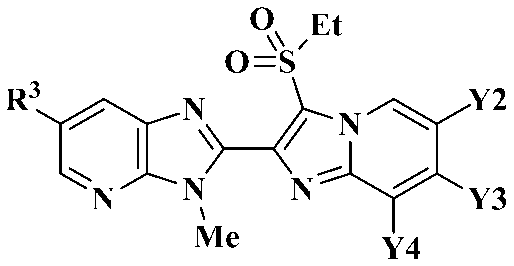
――――――――――――――――――――――――――――――
No. R3 Y2 Y3 Y4 m.p.
――――――――――――――――――――――――――――――
1-001 CF3 Cl H H 217-218
1-002 CF3 Br H H 205-207
1-003 CF3 I H H 215-218
1-004 CF3 CF3 H H 212-213
1-005 CF3 H Cl H 214-215
1-006 CF3 H I H 208-211
1-007 CF3 I H CN 253-256
1-008 CF3 CF3 H F 195-196
1-009 SOCF3 H CF3 H 218-219
――――――――――――――――――――――――――――――
[第2表]
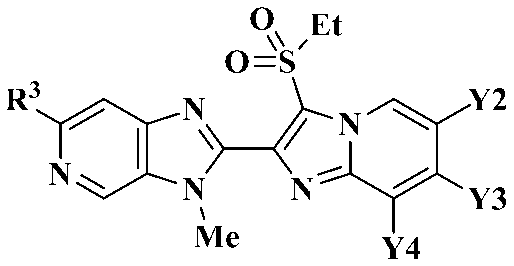
――――――――――――――――――――――――――――――
No. R3 Y2 Y3 Y4 m.p.
――――――――――――――――――――――――――――――
2-001 CF3 H CF3 H 245-247
――――――――――――――――――――――――――――――
No. R3 Y2 Y3 Y4 m.p.
――――――――――――――――――――――――――――――
2-001 CF3 H CF3 H 245-247
――――――――――――――――――――――――――――――
[第3表]
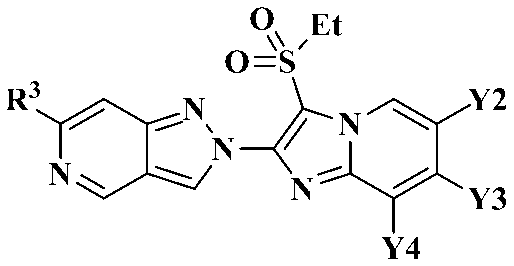
――――――――――――――――――――――――――――――
No. R3 Y2 Y3 Y4 m.p.
――――――――――――――――――――――――――――――
3-001 CF3 Br H H 250-255
――――――――――――――――――――――――――――――
No. R3 Y2 Y3 Y4 m.p.
――――――――――――――――――――――――――――――
3-001 CF3 Br H H 250-255
――――――――――――――――――――――――――――――
本発明組成物の第二の有効成分である活性化合物IIに含まれる化合物は、有害生物防除活性を有する化合物として公知のものであり、以下の有効成分群B-I乃至B-XXVIから選択される化合物である。その具体例を下記の第4表乃至第29表に化合物No.と共に示す。そして、これらの化合物には抵抗性害虫あるいは耐性菌の出現、更に殺虫殺菌スペクトラムや残効性の不足により、薬剤の散布薬量、散布回数が増加する傾向にあり、防除効果のみならず、人畜あるいは水生生物に対する危険性の増加など、環境安全性の面からも改善が求められているものもある。
有効成分群B-I
[第4表]
――――――――――――――――――――――――――――――――――
No. 化合物名(一般名)
――――――――――――――――――――――――――――――――――
A01 メタラキシル-M(metalaxyl-M)
A02 ヒメキサゾール(hymexazol)
――――――――――――――――――――――――――――――――――
[第4表]
――――――――――――――――――――――――――――――――――
No. 化合物名(一般名)
――――――――――――――――――――――――――――――――――
A01 メタラキシル-M(metalaxyl-M)
A02 ヒメキサゾール(hymexazol)
――――――――――――――――――――――――――――――――――
有効成分群B-II
[第5表]
――――――――――――――――――――――――――――――――――
No. 化合物名(一般名)
――――――――――――――――――――――――――――――――――
B01 ベノミル(benomyl)
B02 チオファネート-メチル(thiophanate-methyl)
B03 ジエトフェンカルブ(diethofencarb)
B04 エタボキサム(ethaboxam)
B05 ゾキサミド(zoxamide)
B06 ペンシクロン(pencycuron)
B07 フルオピコリド(fluopicolide)
――――――――――――――――――――――――――――――――――
[第5表]
――――――――――――――――――――――――――――――――――
No. 化合物名(一般名)
――――――――――――――――――――――――――――――――――
B01 ベノミル(benomyl)
B02 チオファネート-メチル(thiophanate-methyl)
B03 ジエトフェンカルブ(diethofencarb)
B04 エタボキサム(ethaboxam)
B05 ゾキサミド(zoxamide)
B06 ペンシクロン(pencycuron)
B07 フルオピコリド(fluopicolide)
――――――――――――――――――――――――――――――――――
有効成分群B-III
[第6表]
――――――――――――――――――――――――――――――――――
No. 化合物名(一般名)
――――――――――――――――――――――――――――――――――
C01 ベンゾビンジフルピル(benzovindiflupyr)
C02 ビキサフェン(bixafen)
C03 ボスカリド(boscalid)
C04 フルオピラム(fluopyram)
C05 フルトラニル(flutolanil)
C06 フルキサピロキサド(fluxapyroxad)
C07 フラメトピル(furametpyr)
C08 イソフェタミド(isofetamid)
C09 イソピラザム(isopyrazam)
C10 メプロニル(mepronil)
C11 ペンフルフェン(penflufen)
C12 ペンチオピラド(penthiopyrad)
C13 セダキサン(sedaxane)
C14 チフルザミド(thifluzamide)
C15 アゾキシストロビン(azoxystrobin)
C16 クモキシストロビン(coumoxystrobin)
C17 ジモキシストロビン(dimoxystrobin)
C18 エネストロビン(enestrobin)
C19 エノキサストロビン(enoxastrobin)
C20 ファモキサドン(famoxadone)
C21 フェナミドン(fenamidone)
C22 フェナミンストロビン(fenaminstrobin)
C23 フルフェノキシストロビン(flufenoxystrobin)
C24 フルオキサストロビン(fluoxastrobin)
C25 クレソキシム-メチル(kresoxim-methyl)
C26 マンデストロビン(mandestrobin)
C27 メトミノストロビン(metominostrobin)
C28 オリサストロビン(orysastrobin)
C29 ピコキシストロビン(picoxystrobin)
C30 ピラクロストロビン(pyraclostrobin)
C31 ピラメトストロビン(pyrametostrobin)
C32 ピラオキシストロビン(pyraoxystrobin)
C33 ピリベンカルブメチル(pyribencarb-methyl)
C34 ピリミノストロビン(pyriminostrobin)
C35 トリクロピリカルブ(triclopyricab)
C36 トリフロキシストロビン(trifloxystrobin)
C37 アミスルブロム(amisulbrom)
C38 シアゾファミド(cyazofamid)
C39 フルアジナム(fluazinam)
C40 アメトクトラジン(ametoctradin)
C41 ピジフルメトフェン(pydiflumetofen)
C42 ピラジフルミド(pyraziflumid)
C43 フルインダピル(fluindapyr)
C44 インピルフルキサム(inpyrfluxam)
C45 イソフルシプラム(isoflucypram)
C46 フェンピコキサミド(fenpicoxamid)
――――――――――――――――――――――――――――――――――
有効成分群B-IV
[第7表]
――――――――――――――――――――――――――――――――――
No. 化合物名(一般名)
――――――――――――――――――――――――――――――――――
D01 メパニピリム(mepanipyrim)
D02 カスガマイシン(kasugamycin)
――――――――――――――――――――――――――――――――――
[第7表]
――――――――――――――――――――――――――――――――――
No. 化合物名(一般名)
――――――――――――――――――――――――――――――――――
D01 メパニピリム(mepanipyrim)
D02 カスガマイシン(kasugamycin)
――――――――――――――――――――――――――――――――――
有効成分群B-V
[第8表]
――――――――――――――――――――――――――――――――――
No. 化合物名(一般名)
――――――――――――――――――――――――――――――――――
E01 キノキシフェン(quinoxyfen)
E02 フルジオキソニル(fludioxonil)
――――――――――――――――――――――――――――――――――
[第8表]
――――――――――――――――――――――――――――――――――
No. 化合物名(一般名)
――――――――――――――――――――――――――――――――――
E01 キノキシフェン(quinoxyfen)
E02 フルジオキソニル(fludioxonil)
――――――――――――――――――――――――――――――――――
有効成分群B-VI
[第9表]
――――――――――――――――――――――――――――――――――
No. 化合物名(一般名)
――――――――――――――――――――――――――――――――――
F01 イプロジオン(iprodione)
F02 プロシミドン(procymidone)
――――――――――――――――――――――――――――――――――
[第9表]
――――――――――――――――――――――――――――――――――
No. 化合物名(一般名)
――――――――――――――――――――――――――――――――――
F01 イプロジオン(iprodione)
F02 プロシミドン(procymidone)
――――――――――――――――――――――――――――――――――
有効成分群B-VII
[第10表]
――――――――――――――――――――――――――――――――――
No. 化合物名(一般名)
――――――――――――――――――――――――――――――――――
G01 トルクロホス-メチル(tolclofos-methyl)
G02 バチルス ズブチリス(Bacillus subtilis,
Strain:D747, FZB24, GBO3, HAI0404, MBI600, QST713, Y1336等)
――――――――――――――――――――――――――――――――――
[第10表]
――――――――――――――――――――――――――――――――――
No. 化合物名(一般名)
――――――――――――――――――――――――――――――――――
G01 トルクロホス-メチル(tolclofos-methyl)
G02 バチルス ズブチリス(Bacillus subtilis,
Strain:D747, FZB24, GBO3, HAI0404, MBI600, QST713, Y1336等)
――――――――――――――――――――――――――――――――――
有効成分群B-VIII
[第11表]
――――――――――――――――――――――――――――――――――
No. 化合物名(一般名)
――――――――――――――――――――――――――――――――――
H01 ブロムコナゾール(bromuconazole)
H02 シプロコナゾール(cyproconazole)
H03 ジフェノコナゾール(difenoconazole)
H04 ジニコナゾール-M(diniconazole-M)
H05 エポキシコナゾール(epoxiconazole)
H06 フェナリモル(fenarimol)
H07 フェンブコナゾール(fenbuconazole)
H08 フルキンコナゾール(fluquinconazole)
H09 ヘキサコナゾール(hexaconazole)
H10 イマザリル(imazalil)
H11 イミベンコナゾール(imibenconazole)
H12 イプコナゾール(ipconazole)
H13 メトコナゾール(metconazole)
H14 ミクロブタニル(myclobutanil)
H15 ペンコナゾール(penconazole)
H16 プロクロラズ(prochloraz)
H17 プロピコナゾール(propiconazole)
H18 プロチオコナゾール(prothioconazole)
H19 シメコナゾール(simeconazole)
H20 テブコナゾール(tebuconazole)
H21 テトラコナゾール(tetraconazole)
H22 トリフルミゾール(triflumizole)
H23 フェンプロピジン(fenpropidin)
H24 フェンヘキサミド(fenhexamid
H25 フェンピラザミン(fenpyrazamine)
H26 イプフェントリフルコナゾール(ipfentrifluconazole)
H27 メフェントリフルコナゾール(mefentrifluconazole)
――――――――――――――――――――――――――――――――――
有効成分群B-IX
[第12表]
――――――――――――――――――――――――――――――――――
No. 化合物名(一般名)
――――――――――――――――――――――――――――――――――
I01 バリダマイシン(validamycin)
I02 ポリオキシン(polyoxins)
I03 ポリオキシン-D(polyoxorim)
I04 ベンチアバリカルブ-イソプロピル(benthiavalicarb-isopropyl)
I05 ジメトモルフ(dimethomorph)
I06 イプロバリカルブ(iprovalicarb)
I07 マンジプロパミド(mandipropamid)
――――――――――――――――――――――――――――――――――
有効成分群B-X
[第13表]
――――――――――――――――――――――――――――――――――
No. 化合物名(一般名)
――――――――――――――――――――――――――――――――――
J01 フサライド(phthalide)
J02 トリシクラゾール(tricyclazole)
J03 カルプロパミド(carpropamid)
J04 ジクロシメット(diclocymet)
――――――――――――――――――――――――――――――――――
[第13表]
――――――――――――――――――――――――――――――――――
No. 化合物名(一般名)
――――――――――――――――――――――――――――――――――
J01 フサライド(phthalide)
J02 トリシクラゾール(tricyclazole)
J03 カルプロパミド(carpropamid)
J04 ジクロシメット(diclocymet)
――――――――――――――――――――――――――――――――――
有効成分群B-XI
[第14表]
――――――――――――――――――――――――――――――――――
No. 化合物名(一般名)
――――――――――――――――――――――――――――――――――
K01 アシベンゾラル-S-メチル(acibenzolar-S-methyl)
K02 プロベナゾール(probenazole)
K03 イソチアニル(isotianil)
K04 ジクロベンチアゾクス(dichlobentiazox)
K05 チアジニル(tiadinil)
――――――――――――――――――――――――――――――――――
[第14表]
――――――――――――――――――――――――――――――――――
No. 化合物名(一般名)
――――――――――――――――――――――――――――――――――
K01 アシベンゾラル-S-メチル(acibenzolar-S-methyl)
K02 プロベナゾール(probenazole)
K03 イソチアニル(isotianil)
K04 ジクロベンチアゾクス(dichlobentiazox)
K05 チアジニル(tiadinil)
――――――――――――――――――――――――――――――――――
有効成分群B-XII
[第15表]
――――――――――――――――――――――――――――――――――
No. 化合物名(一般名)
――――――――――――――――――――――――――――――――――
L01 ボルドー液(bordeaux mixture)
L02 塩基性炭酸銅(copper carbonate, basic)
L03 水酸化第二銅(copper hydroxide)
L04 カッパーナフテネート(copper naphthenate)
L05 カッパーオレエート(copper oleate)
L06 塩基性塩化銅(copper oxychloride)
L07 硫酸銅(copper sulfate)
L08 塩基性硫酸銅(copper sulfate, basic)
L09 オキシキノリン銅(oxine copper)
L10 石灰硫黄合剤(calcium polysulfide)
L11 硫黄(sulfur)
L12 マンコゼブ(mancozeb)
L13 マンネブ(maneb)
L14 ポリカーバメート(polycarbamate)
L15 プロピネブ(propineb)
L16 キャプタン(captan)
L17 フォルペット(folpet)
L18 クロロタロニル(chlorothalonil)
L19 イミノクタジン-アルベシル酸塩(iminoctadine-albesilate)
L20 イミノクタジン酢酸塩(iminoctadine-triacetate)
――――――――――――――――――――――――――――――――――
有効成分群B-XIII
[第16表]
――――――――――――――――――――――――――――――――――
No. 化合物名(一般名)
――――――――――――――――――――――――――――――――――
M01 シフルフェナミド(cyflufenamid)
M02 シモキサニル(cymoxanil)
M03 フルスルファミド(flusulfamide)
M04 フルチアニル(flutianil)
M05 ホセチル-アルミニウム(fosetyl-aluminium)
M06 メトラフェノン(metrafenone)
M07 オキサチアピプロリン(oxathiapiprolin)
M08 ピリオフェノン(pyriofenone)
M09 ピカルブトラドクス(picarbutrazox)
M10 ジピメチトロン(dipymetitrone)
M11 キノフメリン(quinofumelin)
M12 リポペプチド(Lipopeptide)
M13 亜リン酸(Phosphorous acid)
M14 BCF-082(試験名)
M15 NF-180(試験名)
M16 S-2399(試験名)
M17 AKD-5195(試験名)
M18 S-2190(試験名)
M19 アミノピリフェン(aminopyrifen)
――――――――――――――――――――――――――――――――――
有効成分群B-XIV
[第17表]
――――――――――――――――――――――――――――――――――
No. 化合物名(一般名)
――――――――――――――――――――――――――――――――――
N01 アセフェート(Acephate)
N02 カズサホス(Cadusafos)
N03 クロルピリホス(Chlorpyrifos)
N04 ダイアジノン(Diazinon)
N05 ジクロルボス(Dichlorvos)
N06 ジメトエート(Dimethoate)
N07 イーピーエヌ(EPN)
N08 マラチオン(Malathion)
N09 メタミドホス(Methamidophos)
N10 パラチオン-メチル(Parathion-methyl)
N12 フェントエート(Phenthoate)
N13 ホレート(Phorate)
N14 ホスメット(Phosmet)
N15 ホキシム(Phoxim)
N16 プロフェノホス(Profenofos)
N17 テルブホス(Terbufos)
――――――――――――――――――――――――――――――――――
有効成分群B-XV
[第18表]
――――――――――――――――――――――――――――――――――
No. 化合物名(一般名)
――――――――――――――――――――――――――――――――――
O01 アルジカルブ(Aldicarb)
O02 べンフラカルブ(Benfuracarb)
O03 カルバリル(Carbaryl)
O04 カルボフラン(Carbofuran)
O05 カルボスルファン(Carbosulfan)
O06 メソミル(Methomyl)
O07 ピリミカルブ(Pirimicarb)
O08 チオジカルブ(Thiodicarb)
――――――――――――――――――――――――――――――――――
有効成分群B-XVI
[第19表]
――――――――――――――――――――――――――――――――――
No. 化合物名(一般名)
――――――――――――――――――――――――――――――――――
P01 アクリナトリン(Acrinathrin)
P02 ビフェントリン(Bifenthrin)
P03 シフルトリン(Cyfluthrin)
P04 シペルメトリン(Cypermethrin)
P05 デルタメトリン(Deltamethrin)
P06 エスフェンバレレート(Esfenvalerate)
P07 エトフェンプロックス(Etofenprox)
P08 ペルメトリン(Permethrin)
P09 テフルトリン(Tefluthrin)
P10 ラムダ-シハロトリン(lambda-Cyhalothrin)
P11 タウ-フルバリネート(tau-Fluvalinate)
――――――――――――――――――――――――――――――――――
有効成分群B-XVII
[第20表]
――――――――――――――――――――――――――――――――――
No. 化合物名(一般名)
――――――――――――――――――――――――――――――――――
Q01 ベンスルタップ(Bensultap )
Q02 カルタップ(Cartap hydrochloride)
Q03 チオシクラム(Thiocyclam)
――――――――――――――――――――――――――――――――――
[第20表]
――――――――――――――――――――――――――――――――――
No. 化合物名(一般名)
――――――――――――――――――――――――――――――――――
Q01 ベンスルタップ(Bensultap )
Q02 カルタップ(Cartap hydrochloride)
Q03 チオシクラム(Thiocyclam)
――――――――――――――――――――――――――――――――――
有効成分群B-XVIII
[第21表]
――――――――――――――――――――――――――――――――――
No. 化合物名(一般名)
――――――――――――――――――――――――――――――――――
R01 アセタミプリド(Acetamiprid)
R02 クロチアニジン(Clothianidin)
R03 ジノテフラン(Dinotefuran)
R04 イミダクロプリド(Imidacloprid)
R05 ニテンピラム(Nitenpyram)
R06 チアクロプリド(Thiacloprid)
R07 チアメトキサム(Thiamethoxam)
R08 スルホキサフロル(Sulfoxaflor)
R09 フルピラジフロン(Flupyradifurone)
R10 トリフルメゾピリム(Triflumezopyrim)
R11 ジクロロメゾチアズ(Dicloromezotiaz)
R12 フルピリミン(flupyrimin)
――――――――――――――――――――――――――――――――――
有効成分群B-XIX
[第22表]
――――――――――――――――――――――――――――――――――
No. 化合物名(一般名)
――――――――――――――――――――――――――――――――――
S01 スピネトラム(Spinetoram)
S02 スピノサド(Spinosad)
――――――――――――――――――――――――――――――――――
[第22表]
――――――――――――――――――――――――――――――――――
No. 化合物名(一般名)
――――――――――――――――――――――――――――――――――
S01 スピネトラム(Spinetoram)
S02 スピノサド(Spinosad)
――――――――――――――――――――――――――――――――――
有効成分群B-XX
[第23表]
――――――――――――――――――――――――――――――――――
No. 化合物名(一般名)
――――――――――――――――――――――――――――――――――
T01 エチプロール(Ethiprole)
T02 フィプロニル(Fipronil)
T03 ブロフラニリド(Broflanilide)
――――――――――――――――――――――――――――――――――
[第23表]
――――――――――――――――――――――――――――――――――
No. 化合物名(一般名)
――――――――――――――――――――――――――――――――――
T01 エチプロール(Ethiprole)
T02 フィプロニル(Fipronil)
T03 ブロフラニリド(Broflanilide)
――――――――――――――――――――――――――――――――――
有効成分群B-XXI
[第24表]
――――――――――――――――――――――――――――――――――
No. 化合物名(一般名)
――――――――――――――――――――――――――――――――――
U01 アバメクチン(Abamectin)
U02 エマメクチンベンゾエート(Emamectin benzoate)
U03 レピメクチン(Lepimectin)
U04 ミルベメクチン(Milbemectin)
――――――――――――――――――――――――――――――――――
[第24表]
――――――――――――――――――――――――――――――――――
No. 化合物名(一般名)
――――――――――――――――――――――――――――――――――
U01 アバメクチン(Abamectin)
U02 エマメクチンベンゾエート(Emamectin benzoate)
U03 レピメクチン(Lepimectin)
U04 ミルベメクチン(Milbemectin)
――――――――――――――――――――――――――――――――――
有効成分群B-XXII
[第25表]
――――――――――――――――――――――――――――――――――
No. 化合物名(一般名)
――――――――――――――――――――――――――――――――――
V01 クロラントラニリプロール(Chlorantraniliprole)
V02 シアントラニリプロール(Cyantraniliprole)
V03 フルベンジアミド(Flubendiamide)
V04 シクラニリプロール(Cyclaniliprole)
V05 テトラニリプロール(Tetraniliprole)
V06 シハロジアミド(Cyhalodiamide)
――――――――――――――――――――――――――――――――――
有効成分群B-XXIII
[第26表]
――――――――――――――――――――――――――――――――――
No. 化合物名(一般名)
――――――――――――――――――――――――――――――――――
W01 ジアフェンチウロン(Diafenthiuron)
W02 フェンピロキシメート(Fenpyroximate)
W03 ピリダベン(Pyridaben)
W04 トルフェンピラド(Tolfenpyrad)
W05 シエノピラフェン(Cyenopyrafen)
W06 シフルメトフェン(Cyflumetofen)
W07 ピフルブミド(Pyflubumide)
W08 ヒドラメチルノン(Hydramethylnon)
W09 アセキノシル(Acequinocyl)
W10 クロルフェナピル(Chlorfenapyr)
――――――――――――――――――――――――――――――――――
有効成分群B-XXIV
[第27表]
――――――――――――――――――――――――――――――――――
No. 化合物名(一般名)
――――――――――――――――――――――――――――――――――
X01 ピリプロキシフェン(Pyriproxyfen)
X02 メトキシフェノジド(Methoxyfenozide)
X03 ジフルベンズロン(Diflubenzuron)
X04 フルフェノクスロン(Flufenoxuron)
X05 ルフェヌロン(Lufenuron)
X06 ノバルロン(Novaluron)
X07 テフルベンズロン(Teflubenzuron)
X08 ブプロフェジン(Buprofezin)
X09 ヘキサチアゾクス(Hexythiazox)
X10 エトキサゾール(Etoxazole)
X11 ベンズピリモキサン(benzpyrimoxan)
――――――――――――――――――――――――――――――――――
有効成分群B-XXV
[第28表]
――――――――――――――――――――――――――――――――――
No. 化合物名(一般名)
――――――――――――――――――――――――――――――――――
Y01 バチルス チューリンゲンシス(Bacillus thuringensis)
Y02 バチルス スファエリクス(Bacillus sphaericus)
――――――――――――――――――――――――――――――――――
[第28表]
――――――――――――――――――――――――――――――――――
No. 化合物名(一般名)
――――――――――――――――――――――――――――――――――
Y01 バチルス チューリンゲンシス(Bacillus thuringensis)
Y02 バチルス スファエリクス(Bacillus sphaericus)
――――――――――――――――――――――――――――――――――
有効成分群B-XXVI
[第29表]
――――――――――――――――――――――――――――――――――
No. 化合物名(一般名)
――――――――――――――――――――――――――――――――――
Z01 ピメトロジン(Pymetrozine)
Z02 ピリフルキナゾン(Pyrifluquinazon)
Z03 アフィドピロペン(aphidopyropen)
Z04 フロニカミド(Flonicamid)
Z05 スピロジクロフェン(Spirodiclofen)
Z06 スピロメシフェン(Spiromesifen)
Z07 スピロテトラマト(Spirotetramat)
Z08 インドキサカルブ(Indoxacarb)
Z09 メタフルミゾン(Metaflumizone)
Z10 シロマジン(Cyromazine)
Z11 アザディラクチン(Azadirachtin)
Z12 ピリダリル(Pyridalyl)
Z13 ビフェナゼート(Bifenazate)
Z14 フルキサメタミド(Fluxametamide)
Z15 メタアルデヒド(Metaldehyde)
Z16 ME-5382(試験名)
Z17 NA-89(試験名)
Z18 NNI-1501(試験名)
Z19 BAI-1602(試験名)
Z20 DKN-2601(試験名)
Z21 DAI-1601(試験名)
Z22 アシノナピル(acynonapyr)
Z23 スピロピジオン(spiropidion)
――――――――――――――――――――――――――――――――――
次に本発明組成物の第一の有効成分である活性化合物Iと、第二の有効成分である活性化合物IIとの組合せの例を以下に挙げる。以下の標記において、例えば「1-001+(A01)」との表記は活性化合物Iが第1表のNo.1-001の化合物であり、活性化合物IIが第4表のNo.A01のメタラキシル-M(metalaxyl-M)である組合せを表す。
化合物の組み合わせ例:
「1-001+(A01)」、「1-001+(A02)」、「1-001+(B01)」、「1-001+(B02)」、「1-001+(B03)」、「1-001+(B04)」、「1-001+(B05)」、「1-001+(B06)」、「1-001+(B07)」、「1-001+(C01)」、「1-001+(C02)」、「1-001+(C03)」、「1-001+(C04)」、「1-001+(C05)」、「1-001+(C06)」、「1-001+(C07)」、「1-001+(C08)」、「1-001+(C09)」、「1-001+(C10)」、「1-001+(C11)」、「1-001+(C12)」、「1-001+(C13)」、「1-001+(C14)」、「1-001+(C15)」、「1-001+(C16)」、「1-001+(C17)」、「1-001+(C18)」、「1-001+(C19)」、「1-001+(C20)」、「1-001+(C21)」、「1-001+(C22)」、「1-001+(C23)」、「1-001+(C24)」、「1-001+(C25)」、「1-001+(C26)」、「1-001+(C27)」、「1-001+(C28)」、「1-001+(C29)」、「1-001+(C30)」、「1-001+(C31)」、「1-001+(C32)」、「1-001+(C33)」、「1-001+(C34)」、「1-001+(C35)」、「1-001+(C36)」、「1-001+(C37)」、「1-001+(C38)」、「1-001+(C39)」、「1-001+(C40)」、「1-001+(C41)」、「1-001+(C42)」、「1-001+(C43)」、「1-001+(C44)」、「1-001+(C45)」、「1-001+(C46)」、「1-001+(D01)」、「1-001+(D02)」、「1-001+(E01)」、「1-001+(E02)」、「1-001+(F01)」、「1-001+(F02)」、「1-001+(G01)」、「1-001+(G02)」、「1-001+(H01)」、「1-001+(H02)」、「1-001+(H03)」、「1-001+(H04)」、「1-001+(H05)」、「1-001+(H06)」、「1-001+(H07)」、「1-001+(H08)」、「1-001+(H09)」、「1-001+(H10)」、「1-001+(H11)」、「1-001+(H12)」、「1-001+(H13)」、「1-001+(H14)」、「1-001+(H15)」、「1-001+(H16)」、「1-001+(H17)」、「1-001+(H18)」、「1-001+(H19)」、「1-001+(H20)」、「1-001+(H21)」、「1-001+(H22)」、「1-001+(H23)」、「1-001+(H24)」、「1-001+(H25)」、「1-001+(H26)」、「1-001+(H27)」、「1-001+(I01)」、「1-001+(I02)」、「1-001+(I03)」、「1-001+(I04)」、「1-001+(I05)」、「1-001+(I06)」、「1-001+(I07)」、「1-001+(J01)」、「1-001+(J02)」、「1-001+(J03)」、「1-001+(J04)」、「1-001+(K01)」、「1-001+(K02)」、「1-001+(K03)」、「1-001+(K04)」、「1-001+(K05)」。
「1-001+(A01)」、「1-001+(A02)」、「1-001+(B01)」、「1-001+(B02)」、「1-001+(B03)」、「1-001+(B04)」、「1-001+(B05)」、「1-001+(B06)」、「1-001+(B07)」、「1-001+(C01)」、「1-001+(C02)」、「1-001+(C03)」、「1-001+(C04)」、「1-001+(C05)」、「1-001+(C06)」、「1-001+(C07)」、「1-001+(C08)」、「1-001+(C09)」、「1-001+(C10)」、「1-001+(C11)」、「1-001+(C12)」、「1-001+(C13)」、「1-001+(C14)」、「1-001+(C15)」、「1-001+(C16)」、「1-001+(C17)」、「1-001+(C18)」、「1-001+(C19)」、「1-001+(C20)」、「1-001+(C21)」、「1-001+(C22)」、「1-001+(C23)」、「1-001+(C24)」、「1-001+(C25)」、「1-001+(C26)」、「1-001+(C27)」、「1-001+(C28)」、「1-001+(C29)」、「1-001+(C30)」、「1-001+(C31)」、「1-001+(C32)」、「1-001+(C33)」、「1-001+(C34)」、「1-001+(C35)」、「1-001+(C36)」、「1-001+(C37)」、「1-001+(C38)」、「1-001+(C39)」、「1-001+(C40)」、「1-001+(C41)」、「1-001+(C42)」、「1-001+(C43)」、「1-001+(C44)」、「1-001+(C45)」、「1-001+(C46)」、「1-001+(D01)」、「1-001+(D02)」、「1-001+(E01)」、「1-001+(E02)」、「1-001+(F01)」、「1-001+(F02)」、「1-001+(G01)」、「1-001+(G02)」、「1-001+(H01)」、「1-001+(H02)」、「1-001+(H03)」、「1-001+(H04)」、「1-001+(H05)」、「1-001+(H06)」、「1-001+(H07)」、「1-001+(H08)」、「1-001+(H09)」、「1-001+(H10)」、「1-001+(H11)」、「1-001+(H12)」、「1-001+(H13)」、「1-001+(H14)」、「1-001+(H15)」、「1-001+(H16)」、「1-001+(H17)」、「1-001+(H18)」、「1-001+(H19)」、「1-001+(H20)」、「1-001+(H21)」、「1-001+(H22)」、「1-001+(H23)」、「1-001+(H24)」、「1-001+(H25)」、「1-001+(H26)」、「1-001+(H27)」、「1-001+(I01)」、「1-001+(I02)」、「1-001+(I03)」、「1-001+(I04)」、「1-001+(I05)」、「1-001+(I06)」、「1-001+(I07)」、「1-001+(J01)」、「1-001+(J02)」、「1-001+(J03)」、「1-001+(J04)」、「1-001+(K01)」、「1-001+(K02)」、「1-001+(K03)」、「1-001+(K04)」、「1-001+(K05)」。
「1-001+(L01)」、「1-001+(L02)」、「1-001+(L03)」、「1-001+(L04)」、「1-001+(L05)」、「1-001+(L06)」、「1-001+(L07)」、「1-001+(L08)」、「1-001+(L09)」、「1-001+(L10)」、「1-001+(L11)」、「1-001+(L12)」、「1-001+(L13)」、「1-001+(L14)」、「1-001+(L15)」、「1-001+(L16)」、「1-001+(L17)」、「1-001+(L18)」、「1-001+(L19)」、「1-001+(L20)」、「1-001+(M01)」、「1-001+(M02)」、「1-001+(M03)」、「1-001+(M04)」、「1-001+(M05)」、「1-001+(M06)」、「1-001+(M07)」、「1-001+(M08)」、「1-001+(M09)」、「1-001+(M10)」、「1-001+(M11)」、「1-001+(M12)」、「1-001+(M13)」、「1-001+(M14)」、「1-001+(M15)」、「1-001+(M16)」、「1-001+(M17)」、「1-001+(M18)」、「1-001+(M19)」、「1-001+(N01)」、「1-001+(N02)」、「1-001+(N03)」、「1-001+(N07)」、「1-001+(N08)」、「1-001+(N12)」、「1-001+(O03)」、「1-001+(O05)」、「1-001+(P02)」、「1-001+(P03)」、「1-001+(P04)」、「1-001+(P07)」、「1-001+(P10)」、「1-001+(Q02)」、「1-001+(R01)」、「1-001+(R02)」、「1-001+(R03)」、「1-001+(R04)」、「1-001+(R05)」、「1-001+(R06)」、「1-001+(R07)」、「1-001+(R08)」、「1-001+(R09)」、「1-001+(R10)」、「1-001+(R11)」、「1-001+(R12)」、「1-001+(S01)」、「1-001+(S02)」、「1-001+(T01)」、「1-001+(T02)」、「1-001+(T03)」、「1-001+(U01)」、「1-001+(U02)」、「1-001+(U03)」、「1-001+(V01)」、「1-001+(V02)」、「1-001+(V03)」、「1-001+(V04)」、「1-001+(V05)」、「1-001+(V06)」、「1-001+(W03)」、「1-001+(W04)」、「1-001+(W05)」、「1-001+(W09)」、「1-001+(W10)」、「1-001+(X01)」、「1-001+(X02)」、「1-001+(X04)」、「1-001+(X05)」、「1-001+(X08)」、「1-001+(X10)」、「1-001+(X11)」、「1-001+(Y01)」、「1-001+(Z01)」、「1-001+(Z02)」、「1-001+(Z03)」、「1-001+(Z04)」、「1-001+(Z05)」、「1-001+(Z06)」、「1-001+(Z07)」、「1-001+(Z08)」、「1-001+(Z09)」、「1-001+(Z10)」、「1-001+(Z12)」、「1-001+(Z13)」、「1-001+(Z14)」、「1-001+(Z15)」、「1-001+(Z16)」、「1-001+(Z17)」、「1-001+(Z18)」、「1-001+(Z19)」、「1-001+(Z20)」、「1-001+(Z21)」。
「1-002+(A01)」、「1-002+(A02)」、「1-002+(B01)」、「1-002+(B02)」、「1-002+(B03)」、「1-002+(B04)」、「1-002+(B05)」、「1-002+(B06)」、「1-002+(B07)」、「1-002+(C01)」、「1-002+(C02)」、「1-002+(C03)」、「1-002+(C04)」、「1-002+(C05)」、「1-002+(C06)」、「1-002+(C07)」、「1-002+(C08)」、「1-002+(C09)」、「1-002+(C10)」、「1-002+(C11)」、「1-002+(C12)」、「1-002+(C13)」、「1-002+(C14)」、「1-002+(C15)」、「1-002+(C16)」、「1-002+(C17)」、「1-002+(C18)」、「1-002+(C19)」、「1-002+(C20)」、「1-002+(C21)」、「1-002+(C22)」、「1-002+(C23)」、「1-002+(C24)」、「1-002+(C25)」、「1-002+(C26)」、「1-002+(C27)」、「1-002+(C28)」、「1-002+(C29)」、「1-002+(C30)」、「1-002+(C31)」、「1-002+(C32)」、「1-002+(C33)」、「1-002+(C34)」、「1-002+(C35)」、「1-002+(C36)」、「1-002+(C37)」、「1-002+(C38)」、「1-002+(C39)」、「1-002+(C40)」、「1-002+(C41)」、「1-002+(C42)」、「1-002+(C43)」、「1-002+(C44)」、「1-002+(C45)」、「1-002+(C46)」、「1-002+(D01)」、「1-002+(D02)」、「1-002+(E01)」、「1-002+(E02)」、「1-002+(F01)」、「1-002+(F02)」、「1-002+(G01)」、「1-002+(G02)」、「1-002+(H01)」、「1-002+(H02)」、「1-002+(H03)」、「1-002+(H04)」、「1-002+(H05)」、「1-002+(H06)」、「1-002+(H07)」、「1-002+(H08)」、「1-002+(H09)」、「1-002+(H10)」、「1-002+(H11)」、「1-002+(H12)」、「1-002+(H13)」、「1-002+(H14)」、「1-002+(H15)」、「1-002+(H16)」、「1-002+(H17)」、「1-002+(H18)」、「1-002+(H19)」、「1-002+(H20)」、「1-002+(H21)」、「1-002+(H22)」、「1-002+(H23)」、「1-002+(H24)」、「1-002+(H25)」、「1-002+(H26)」、「1-002+(H27)」、「1-002+(I01)」、「1-002+(I02)」、「1-002+(I03)」、「1-002+(I04)」、「1-002+(I05)」、「1-002+(I06)」、「1-002+(I07)」、「1-002+(J01)」、「1-002+(J02)」、「1-002+(J03)」、「1-002+(J04)」、「1-002+(K01)」、「1-002+(K02)」、「1-002+(K03)」、「1-002+(K04)」、「1-002+(K05)」。
「1-002+(L01)」、「1-002+(L02)」、「1-002+(L03)」、「1-002+(L04)」、「1-002+(L05)」、「1-002+(L06)」、「1-002+(L07)」、「1-002+(L08)」、「1-002+(L09)」、「1-002+(L10)」、「1-002+(L11)」、「1-002+(L12)」、「1-002+(L13)」、「1-002+(L14)」、「1-002+(L15)」、「1-002+(L16)」、「1-002+(L17)」、「1-002+(L18)」、「1-002+(L19)」、「1-002+(L20)」、「1-002+(M01)」、「1-002+(M02)」、「1-002+(M03)」、「1-002+(M04)」、「1-002+(M05)」、「1-002+(M06)」、「1-002+(M07)」、「1-002+(M08)」、「1-002+(M09)」、「1-002+(M10)」、「1-002+(M11)」、「1-002+(M12)」、「1-002+(M13)」、「1-002+(M14)」、「1-002+(M15)」、「1-002+(M16)」、「1-002+(M17)」、「1-002+(M18)」、「1-002+(M19)」、「1-002+(N01)」、「1-002+(N02)」、「1-002+(N03)」、「1-002+(N07)」、「1-002+(N08)」、「1-002+(N12)」、「1-002+(O03)」、「1-002+(O05)」、「1-002+(P02)」、「1-002+(P03)」、「1-002+(P04)」、「1-002+(P07)」、「1-002+(P10)」、「1-002+(Q02)」、「1-002+(R01)」、「1-002+(R02)」、「1-002+(R03)」、「1-002+(R04)」、「1-002+(R05)」、「1-002+(R06)」、「1-002+(R07)」、「1-002+(R08)」、「1-002+(R09)」、「1-002+(R10)」、「1-002+(R11)」、「1-002+(R12)」、「1-002+(S01)」、「1-002+(S02)」、「1-002+(T01)」、「1-002+(T02)」、「1-002+(T03)」、「1-002+(U01)」、「1-002+(U02)」、「1-002+(U03)」、「1-002+(V01)」、「1-002+(V02)」、「1-002+(V03)」、「1-002+(V04)」、「1-002+(V05)」、「1-002+(V06)」、「1-002+(W03)」、「1-002+(W04)」、「1-002+(W05)」、「1-002+(W09)」、「1-002+(W10)」、「1-002+(X01)」、「1-002+(X02)」、「1-002+(X04)」、「1-002+(X05)」、「1-002+(X08)」、「1-002+(X10)」、「1-002+(X11)」、「1-002+(Y01)」、「1-002+(Z01)」、「1-002+(Z02)」、「1-002+(Z03)」、「1-002+(Z04)」、「1-002+(Z05)」、「1-002+(Z06)」、「1-002+(Z07)」、「1-002+(Z08)」、「1-002+(Z09)」、「1-002+(Z10)」、「1-002+(Z12)」、「1-002+(Z13)」、「1-002+(Z14)」、「1-002+(Z15)」、「1-002+(Z16)」、「1-002+(Z17)」、「1-002+(Z18)」、「1-002+(Z19)」、「1-002+(Z20)」、「1-002+(Z21)」。
「1-003+(A01)」、「1-003+(A02)」、「1-003+(B01)」、「1-003+(B02)」、「1-003+(B03)」、「1-003+(B04)」、「1-003+(B05)」、「1-003+(B06)」、「1-003+(B07)」、「1-003+(C01)」、「1-003+(C02)」、「1-003+(C03)」、「1-003+(C04)」、「1-003+(C05)」、「1-003+(C06)」、「1-003+(C07)」、「1-003+(C08)」、「1-003+(C09)」、「1-003+(C10)」、「1-003+(C11)」、「1-003+(C12)」、「1-003+(C13)」、「1-003+(C14)」、「1-003+(C15)」、「1-003+(C16)」、「1-003+(C17)」、「1-003+(C18)」、「1-003+(C19)」、「1-003+(C20)」、「1-003+(C21)」、「1-003+(C22)」、「1-003+(C23)」、「1-003+(C24)」、「1-003+(C25)」、「1-003+(C26)」、「1-003+(C27)」、「1-003+(C28)」、「1-003+(C29)」、「1-003+(C30)」、「1-003+(C31)」、「1-003+(C32)」、「1-003+(C33)」、「1-003+(C34)」、「1-003+(C35)」、「1-003+(C36)」、「1-003+(C37)」、「1-003+(C38)」、「1-003+(C39)」、「1-003+(C40)」、「1-003+(C41)」、「1-003+(C42)」、「1-003+(C43)」、「1-003+(C44)」、「1-003+(C45)」、「1-003+(C46)」、「1-003+(D01)」、「1-003+(D02)」、「1-003+(E01)」、「1-003+(E02)」、「1-003+(F01)」、「1-003+(F02)」、「1-003+(G01)」、「1-003+(G02)」、「1-003+(H01)」、「1-003+(H02)」、「1-003+(H03)」、「1-003+(H04)」、「1-003+(H05)」、「1-003+(H06)」、「1-003+(H07)」、「1-003+(H08)」、「1-003+(H09)」、「1-003+(H10)」、「1-003+(H11)」、「1-003+(H12)」、「1-003+(H13)」、「1-003+(H14)」、「1-003+(H15)」、「1-003+(H16)」、「1-003+(H17)」、「1-003+(H18)」、「1-003+(H19)」、「1-003+(H20)」、「1-003+(H21)」、「1-003+(H22)」、「1-003+(H23)」、「1-003+(H24)」、「1-003+(H25)」、「1-003+(H26)」、「1-003+(H27)」、「1-003+(I01)」、「1-003+(I02)」、「1-003+(I03)」、「1-003+(I04)」、「1-003+(I05)」、「1-003+(I06)」、「1-003+(I07)」、「1-003+(J01)」、「1-003+(J02)」、「1-003+(J03)」、「1-003+(J04)」、「1-003+(K01)」、「1-003+(K02)」、「1-003+(K03)」、「1-003+(K04)」、「1-003+(K05)」。
「1-003+(L01)」、「1-003+(L02)」、「1-003+(L03)」、「1-003+(L04)」、「1-003+(L05)」、「1-003+(L06)」、「1-003+(L07)」、「1-003+(L08)」、「1-003+(L09)」、「1-003+(L10)」、「1-003+(L11)」、「1-003+(L12)」、「1-003+(L13)」、「1-003+(L14)」、「1-003+(L15)」、「1-003+(L16)」、「1-003+(L17)」、「1-003+(L18)」、「1-003+(L19)」、「1-003+(L20)」、「1-003+(M01)」、「1-003+(M02)」、「1-003+(M03)」、「1-003+(M04)」、「1-003+(M05)」、「1-003+(M06)」、「1-003+(M07)」、「1-003+(M08)」、「1-003+(M09)」、「1-003+(M10)」、「1-003+(M11)」、「1-003+(M12)」、「1-003+(M13)」、「1-003+(M14)」、「1-003+(M15)」、「1-003+(M16)」、「1-003+(M17)」、「1-003+(M18)」、「1-003+(M19)」、「1-003+(N01)」、「1-003+(N02)」、「1-003+(N03)」、「1-003+(N07)」、「1-003+(N08)」、「1-003+(N12)」、「1-003+(O03)」、「1-003+(O05)」、「1-003+(P02)」、「1-003+(P03)」、「1-003+(P04)」、「1-003+(P07)」、「1-003+(P10)」、「1-003+(Q02)」、「1-003+(R01)」、「1-003+(R02)」、「1-003+(R03)」、「1-003+(R04)」、「1-003+(R05)」、「1-003+(R06)」、「1-003+(R07)」、「1-003+(R08)」、「1-003+(R09)」、「1-003+(R10)」、「1-003+(R11)」、「1-003+(R12)」、「1-003+(S01)」、「1-003+(S02)」、「1-003+(T01)」、「1-003+(T02)」、「1-003+(T03)」、「1-003+(U01)」、「1-003+(U02)」、「1-003+(U03)」、「1-003+(V01)」、「1-003+(V02)」、「1-003+(V03)」、「1-003+(V04)」、「1-003+(V05)」、「1-003+(V06)」、「1-003+(W03)」、「1-003+(W04)」、「1-003+(W05)」、「1-003+(W09)」、「1-003+(W10)」、「1-003+(X01)」、「1-003+(X02)」、「1-003+(X04)」、「1-003+(X05)」、「1-003+(X08)」、「1-003+(X10)」、「1-003+(X11)」、「1-003+(Y01)」、「1-003+(Z01)」、「1-003+(Z02)」、「1-003+(Z03)」、「1-003+(Z04)」、「1-003+(Z05)」、「1-003+(Z06)」、「1-003+(Z07)」、「1-003+(Z08)」、「1-003+(Z09)」、「1-003+(Z10)」、「1-003+(Z12)」、「1-003+(Z13)」、「1-003+(Z14)」、「1-003+(Z15)」、「1-003+(Z16)」、「1-003+(Z17)」、「1-003+(Z18)」、「1-003+(Z19)」、「1-003+(Z20)」、「1-003+(Z21)」。
「1-004+(A01)」、「1-004+(A02)」、「1-004+(B01)」、「1-004+(B02)」、「1-004+(B03)」、「1-004+(B04)」、「1-004+(B05)」、「1-004+(B06)」、「1-004+(B07)」、「1-004+(C01)」、「1-004+(C02)」、「1-004+(C03)」、「1-004+(C04)」、「1-004+(C05)」、「1-004+(C06)」、「1-004+(C07)」、「1-004+(C08)」、「1-004+(C09)」、「1-004+(C10)」、「1-004+(C11)」、「1-004+(C12)」、「1-004+(C13)」、「1-004+(C14)」、「1-004+(C15)」、「1-004+(C16)」、「1-004+(C17)」、「1-004+(C18)」、「1-004+(C19)」、「1-004+(C20)」、「1-004+(C21)」、「1-004+(C22)」、「1-004+(C23)」、「1-004+(C24)」、「1-004+(C25)」、「1-004+(C26)」、「1-004+(C27)」、「1-004+(C28)」、「1-004+(C29)」、「1-004+(C30)」、「1-004+(C31)」、「1-004+(C32)」、「1-004+(C33)」、「1-004+(C34)」、「1-004+(C35)」、「1-004+(C36)」、「1-004+(C37)」、「1-004+(C38)」、「1-004+(C39)」、「1-004+(C40)」、「1-004+(C41)」、「1-004+(C42)」、「1-004+(C43)」、「1-004+(C44)」、「1-004+(C45)」、「1-004+(C46)」、「1-004+(D01)」、「1-004+(D02)」、「1-004+(E01)」、「1-004+(E02)」、「1-004+(F01)」、「1-004+(F02)」、「1-004+(G01)」、「1-004+(G02)」、「1-004+(H01)」、「1-004+(H02)」、「1-004+(H03)」、「1-004+(H04)」、「1-004+(H05)」、「1-004+(H06)」、「1-004+(H07)」、「1-004+(H08)」、「1-004+(H09)」、「1-004+(H10)」、「1-004+(H11)」、「1-004+(H12)」、「1-004+(H13)」、「1-004+(H14)」、「1-004+(H15)」、「1-004+(H16)」、「1-004+(H17)」、「1-004+(H18)」、「1-004+(H19)」、「1-004+(H20)」、「1-004+(H21)」、「1-004+(H22)」、「1-004+(H23)」、「1-004+(H24)」、「1-004+(H25)」、「1-004+(H26)」、「1-004+(H27)」、「1-004+(I01)」、「1-004+(I02)」、「1-004+(I03)」、「1-004+(I04)」、「1-004+(I05)」、「1-004+(I06)」、「1-004+(I07)」、「1-004+(J01)」、「1-004+(J02)」、「1-004+(J03)」、「1-004+(J04)」、「1-004+(K01)」、「1-004+(K02)」、「1-004+(K03)」、「1-004+(K04)」、「1-004+(K05)」。
「1-004+(L01)」、「1-004+(L02)」、「1-004+(L03)」、「1-004+(L04)」、「1-004+(L05)」、「1-004+(L06)」、「1-004+(L07)」、「1-004+(L08)」、「1-004+(L09)」、「1-004+(L10)」、「1-004+(L11)」、「1-004+(L12)」、「1-004+(L13)」、「1-004+(L14)」、「1-004+(L15)」、「1-004+(L16)」、「1-004+(L17)」、「1-004+(L18)」、「1-004+(L19)」、「1-004+(L20)」、「1-004+(M01)」、「1-004+(M02)」、「1-004+(M03)」、「1-004+(M04)」、「1-004+(M05)」、「1-004+(M06)」、「1-004+(M07)」、「1-004+(M08)」、「1-004+(M09)」、「1-004+(M10)」、「1-004+(M11)」、「1-004+(M12)」、「1-004+(M13)」、「1-004+(M14)」、「1-004+(M15)」、「1-004+(M16)」、「1-004+(M17)」、「1-004+(M18)」、「1-004+(M19)」、「1-004+(N01)」、「1-004+(N02)」、「1-004+(N03)」、「1-004+(N07)」、「1-004+(N08)」、「1-004+(N12)」、「1-004+(O03)」、「1-004+(O05)」、「1-004+(P02)」、「1-004+(P03)」、「1-004+(P04)」、「1-004+(P07)」、「1-004+(P10)」、「1-004+(Q02)」、「1-004+(R01)」、「1-004+(R02)」、「1-004+(R03)」、「1-004+(R04)」、「1-004+(R05)」、「1-004+(R06)」、「1-004+(R07)」、「1-004+(R08)」、「1-004+(R09)」、「1-004+(R10)」、「1-004+(R11)」、「1-004+(R12)」、「1-004+(S01)」、「1-004+(S02)」、「1-004+(T01)」、「1-004+(T02)」、「1-004+(T03)」、「1-004+(U01)」、「1-004+(U02)」、「1-004+(U03)」、「1-004+(V01)」、「1-004+(V02)」、「1-004+(V03)」、「1-004+(V04)」、「1-004+(V05)」、「1-004+(V06)」、「1-004+(W03)」、「1-004+(W04)」、「1-004+(W05)」、「1-004+(W09)」、「1-004+(W10)」、「1-004+(X01)」、「1-004+(X02)」、「1-004+(X04)」、「1-004+(X05)」、「1-004+(X08)」、「1-004+(X10)」、「1-004+(X11)」、「1-004+(Y01)」、「1-004+(Z01)」、「1-004+(Z02)」、「1-004+(Z03)」、「1-004+(Z04)」、「1-004+(Z05)」、「1-004+(Z06)」、「1-004+(Z07)」、「1-004+(Z08)」、「1-004+(Z09)」、「1-004+(Z10)」、「1-004+(Z12)」、「1-004+(Z13)」、「1-004+(Z14)」、「1-004+(Z15)」、「1-004+(Z16)」、「1-004+(Z17)」、「1-004+(Z18)」、「1-004+(Z19)」、「1-004+(Z20)」、「1-004+(Z21)」。
「1-005+(A01)」、「1-005+(A02)」、「1-005+(B01)」、「1-005+(B02)」、「1-005+(B03)」、「1-005+(B04)」、「1-005+(B05)」、「1-005+(B06)」、「1-005+(B07)」、「1-005+(C01)」、「1-005+(C02)」、「1-005+(C03)」、「1-005+(C04)」、「1-005+(C05)」、「1-005+(C06)」、「1-005+(C07)」、「1-005+(C08)」、「1-005+(C09)」、「1-005+(C10)」、「1-005+(C11)」、「1-005+(C12)」、「1-005+(C13)」、「1-005+(C14)」、「1-005+(C15)」、「1-005+(C16)」、「1-005+(C17)」、「1-005+(C18)」、「1-005+(C19)」、「1-005+(C20)」、「1-005+(C21)」、「1-005+(C22)」、「1-005+(C23)」、「1-005+(C24)」、「1-005+(C25)」、「1-005+(C26)」、「1-005+(C27)」、「1-005+(C28)」、「1-005+(C29)」、「1-005+(C30)」、「1-005+(C31)」、「1-005+(C32)」、「1-005+(C33)」、「1-005+(C34)」、「1-005+(C35)」、「1-005+(C36)」、「1-005+(C37)」、「1-005+(C38)」、「1-005+(C39)」、「1-005+(C40)」、「1-005+(C41)」、「1-005+(C42)」、「1-005+(C43)」、「1-005+(C44)」、「1-005+(C45)」、「1-005+(C46)」、「1-005+(D01)」、「1-005+(D02)」、「1-005+(E01)」、「1-005+(E02)」、「1-005+(F01)」、「1-005+(F02)」、「1-005+(G01)」、「1-005+(G02)」、「1-005+(H01)」、「1-005+(H02)」、「1-005+(H03)」、「1-005+(H04)」、「1-005+(H05)」、「1-005+(H06)」、「1-005+(H07)」、「1-005+(H08)」、「1-005+(H09)」、「1-005+(H10)」、「1-005+(H11)」、「1-005+(H12)」、「1-005+(H13)」、「1-005+(H14)」、「1-005+(H15)」、「1-005+(H16)」、「1-005+(H17)」、「1-005+(H18)」、「1-005+(H19)」、「1-005+(H20)」、「1-005+(H21)」、「1-005+(H22)」、「1-005+(H23)」、「1-005+(H24)」、「1-005+(H25)」、「1-005+(H26)」、「1-005+(H27)」、「1-005+(I01)」、「1-005+(I02)」、「1-005+(I03)」、「1-005+(I04)」、「1-005+(I05)」、「1-005+(I06)」、「1-005+(I07)」、「1-005+(J01)」、「1-005+(J02)」、「1-005+(J03)」、「1-005+(J04)」、「1-005+(K01)」、「1-005+(K02)」、「1-005+(K03)」、「1-005+(K04)」、「1-005+(K05)」。
「1-005+(L01)」、「1-005+(L02)」、「1-005+(L03)」、「1-005+(L04)」、「1-005+(L05)」、「1-005+(L06)」、「1-005+(L07)」、「1-005+(L08)」、「1-005+(L09)」、「1-005+(L10)」、「1-005+(L11)」、「1-005+(L12)」、「1-005+(L13)」、「1-005+(L14)」、「1-005+(L15)」、「1-005+(L16)」、「1-005+(L17)」、「1-005+(L18)」、「1-005+(L19)」、「1-005+(L20)」、「1-005+(M01)」、「1-005+(M02)」、「1-005+(M03)」、「1-005+(M04)」、「1-005+(M05)」、「1-005+(M06)」、「1-005+(M07)」、「1-005+(M08)」、「1-005+(M09)」、「1-005+(M10)」、「1-005+(M11)」、「1-005+(M12)」、「1-005+(M13)」、「1-005+(M14)」、「1-005+(M15)」、「1-005+(M16)」、「1-005+(M17)」、「1-005+(M18)」、「1-005+(M19)」、「1-005+(N01)」、「1-005+(N02)」、「1-005+(N03)」、「1-005+(N07)」、「1-005+(N08)」、「1-005+(N12)」、「1-005+(O03)」、「1-005+(O05)」、「1-005+(P02)」、「1-005+(P03)」、「1-005+(P04)」、「1-005+(P07)」、「1-005+(P10)」、「1-005+(Q02)」、「1-005+(R01)」、「1-005+(R02)」、「1-005+(R03)」、「1-005+(R04)」、「1-005+(R05)」、「1-005+(R06)」、「1-005+(R07)」、「1-005+(R08)」、「1-005+(R09)」、「1-005+(R10)」、「1-005+(R11)」、「1-005+(R12)」、「1-005+(S01)」、「1-005+(S02)」、「1-005+(T01)」、「1-005+(T02)」、「1-005+(T03)」、「1-005+(U01)」、「1-005+(U02)」、「1-005+(U03)」、「1-005+(V01)」、「1-005+(V02)」、「1-005+(V03)」、「1-005+(V04)」、「1-005+(V05)」、「1-005+(V06)」、「1-005+(W03)」、「1-005+(W04)」、「1-005+(W05)」、「1-005+(W09)」、「1-005+(W10)」、「1-005+(X01)」、「1-005+(X02)」、「1-005+(X04)」、「1-005+(X05)」、「1-005+(X08)」、「1-005+(X10)」、「1-005+(X11)」、「1-005+(Y01)」、「1-005+(Z01)」、「1-005+(Z02)」、「1-005+(Z03)」、「1-005+(Z04)」、「1-005+(Z05)」、「1-005+(Z06)」、「1-005+(Z07)」、「1-005+(Z08)」、「1-005+(Z09)」、「1-005+(Z10)」、「1-005+(Z12)」、「1-005+(Z13)」、「1-005+(Z14)」、「1-005+(Z15)」、「1-005+(Z16)」、「1-005+(Z17)」、「1-005+(Z18)」、「1-005+(Z19)」、「1-005+(Z20)」、「1-005+(Z21)」。
「1-006+(A01)」、「1-006+(A02)」、「1-006+(B01)」、「1-006+(B02)」、「1-006+(B03)」、「1-006+(B04)」、「1-006+(B05)」、「1-006+(B06)」、「1-006+(B07)」、「1-006+(C01)」、「1-006+(C02)」、「1-006+(C03)」、「1-006+(C04)」、「1-006+(C05)」、「1-006+(C06)」、「1-006+(C07)」、「1-006+(C08)」、「1-006+(C09)」、「1-006+(C10)」、「1-006+(C11)」、「1-006+(C12)」、「1-006+(C13)」、「1-006+(C14)」、「1-006+(C15)」、「1-006+(C16)」、「1-006+(C17)」、「1-006+(C18)」、「1-006+(C19)」、「1-006+(C20)」、「1-006+(C21)」、「1-006+(C22)」、「1-006+(C23)」、「1-006+(C24)」、「1-006+(C25)」、「1-006+(C26)」、「1-006+(C27)」、「1-006+(C28)」、「1-006+(C29)」、「1-006+(C30)」、「1-006+(C31)」、「1-006+(C32)」、「1-006+(C33)」、「1-006+(C34)」、「1-006+(C35)」、「1-006+(C36)」、「1-006+(C37)」、「1-006+(C38)」、「1-006+(C39)」、「1-006+(C40)」、「1-006+(C41)」、「1-006+(C42)」、「1-006+(C43)」、「1-006+(C44)」、「1-006+(C45)」、「1-006+(C46)」、「1-006+(D01)」、「1-006+(D02)」、「1-006+(E01)」、「1-006+(E02)」、「1-006+(F01)」、「1-006+(F02)」、「1-006+(G01)」、「1-006+(G02)」、「1-006+(H01)」、「1-006+(H02)」、「1-006+(H03)」、「1-006+(H04)」、「1-006+(H05)」、「1-006+(H06)」、「1-006+(H07)」、「1-006+(H08)」、「1-006+(H09)」、「1-006+(H10)」、「1-006+(H11)」、「1-006+(H12)」、「1-006+(H13)」、「1-006+(H14)」、「1-006+(H15)」、「1-006+(H16)」、「1-006+(H17)」、「1-006+(H18)」、「1-006+(H19)」、「1-006+(H20)」、「1-006+(H21)」、「1-006+(H22)」、「1-006+(H23)」、「1-006+(H24)」、「1-006+(H25)」、「1-006+(H26)」、「1-006+(H27)」、「1-006+(I01)」、「1-006+(I02)」、「1-006+(I03)」、「1-006+(I04)」、「1-006+(I05)」、「1-006+(I06)」、「1-006+(I07)」、「1-006+(J01)」、「1-006+(J02)」、「1-006+(J03)」、「1-006+(J04)」、「1-006+(K01)」、「1-006+(K02)」、「1-006+(K03)」、「1-006+(K04)」、「1-006+(K05)」。
「1-006+(L01)」、「1-006+(L02)」、「1-006+(L03)」、「1-006+(L04)」、「1-006+(L05)」、「1-006+(L06)」、「1-006+(L07)」、「1-006+(L08)」、「1-006+(L09)」、「1-006+(L10)」、「1-006+(L11)」、「1-006+(L12)」、「1-006+(L13)」、「1-006+(L14)」、「1-006+(L15)」、「1-006+(L16)」、「1-006+(L17)」、「1-006+(L18)」、「1-006+(L19)」、「1-006+(L20)」、「1-006+(M01)」、「1-006+(M02)」、「1-006+(M03)」、「1-006+(M04)」、「1-006+(M05)」、「1-006+(M06)」、「1-006+(M07)」、「1-006+(M08)」、「1-006+(M09)」、「1-006+(M10)」、「1-006+(M11)」、「1-006+(M12)」、「1-006+(M13)」、「1-006+(M14)」、「1-006+(M15)」、「1-006+(M16)」、「1-006+(M17)」、「1-006+(M18)」、「1-006+(M19)」、「1-006+(N01)」、「1-006+(N02)」、「1-006+(N03)」、「1-006+(N07)」、「1-006+(N08)」、「1-006+(N12)」、「1-006+(O03)」、「1-006+(O05)」、「1-006+(P02)」、「1-006+(P03)」、「1-006+(P04)」、「1-006+(P07)」、「1-006+(P10)」、「1-006+(Q02)」、「1-006+(R01)」、「1-006+(R02)」、「1-006+(R03)」、「1-006+(R04)」、「1-006+(R05)」、「1-006+(R06)」、「1-006+(R07)」、「1-006+(R08)」、「1-006+(R09)」、「1-006+(R10)」、「1-006+(R11)」、「1-006+(R12)」、「1-006+(S01)」、「1-006+(S02)」、「1-006+(T01)」、「1-006+(T02)」、「1-006+(T03)」、「1-006+(U01)」、「1-006+(U02)」、「1-006+(U03)」、「1-006+(V01)」、「1-006+(V02)」、「1-006+(V03)」、「1-006+(V04)」、「1-006+(V05)」、「1-006+(V06)」、「1-006+(W03)」、「1-006+(W04)」、「1-006+(W05)」、「1-006+(W09)」、「1-006+(W10)」、「1-006+(X01)」、「1-006+(X02)」、「1-006+(X04)」、「1-006+(X05)」、「1-006+(X08)」、「1-006+(X10)」、「1-006+(X11)」、「1-006+(Y01)」、「1-006+(Z01)」、「1-006+(Z02)」、「1-006+(Z03)」、「1-006+(Z04)」、「1-006+(Z05)」、「1-006+(Z06)」、「1-006+(Z07)」、「1-006+(Z08)」、「1-006+(Z09)」、「1-006+(Z10)」、「1-006+(Z12)」、「1-006+(Z13)」、「1-006+(Z14)」、「1-006+(Z15)」、「1-006+(Z16)」、「1-006+(Z17)」、「1-006+(Z18)」、「1-006+(Z19)」、「1-006+(Z20)」、「1-006+(Z21)」。
「1-007+(A01)」、「1-007+(A02)」、「1-007+(B01)」、「1-007+(B02)」、「1-007+(B03)」、「1-007+(B04)」、「1-007+(B05)」、「1-007+(B06)」、「1-007+(B07)」、「1-007+(C01)」、「1-007+(C02)」、「1-007+(C03)」、「1-007+(C04)」、「1-007+(C05)」、「1-007+(C06)」、「1-007+(C07)」、「1-007+(C08)」、「1-007+(C09)」、「1-007+(C10)」、「1-007+(C11)」、「1-007+(C12)」、「1-007+(C13)」、「1-007+(C14)」、「1-007+(C15)」、「1-007+(C16)」、「1-007+(C17)」、「1-007+(C18)」、「1-007+(C19)」、「1-007+(C20)」、「1-007+(C21)」、「1-007+(C22)」、「1-007+(C23)」、「1-007+(C24)」、「1-007+(C25)」、「1-007+(C26)」、「1-007+(C27)」、「1-007+(C28)」、「1-007+(C29)」、「1-007+(C30)」、「1-007+(C31)」、「1-007+(C32)」、「1-007+(C33)」、「1-007+(C34)」、「1-007+(C35)」、「1-007+(C36)」、「1-007+(C37)」、「1-007+(C38)」、「1-007+(C39)」、「1-007+(C40)」、「1-007+(C41)」、「1-007+(C42)」、「1-007+(C43)」、「1-007+(C44)」、「1-007+(C45)」、「1-007+(C46)」、「1-007+(D01)」、「1-007+(D02)」、「1-007+(E01)」、「1-007+(E02)」、「1-007+(F01)」、「1-007+(F02)」、「1-007+(G01)」、「1-007+(G02)」、「1-007+(H01)」、「1-007+(H02)」、「1-007+(H03)」、「1-007+(H04)」、「1-007+(H05)」、「1-007+(H06)」、「1-007+(H07)」、「1-007+(H08)」、「1-007+(H09)」、「1-007+(H10)」、「1-007+(H11)」、「1-007+(H12)」、「1-007+(H13)」、「1-007+(H14)」、「1-007+(H15)」、「1-007+(H16)」、「1-007+(H17)」、「1-007+(H18)」、「1-007+(H19)」、「1-007+(H20)」、「1-007+(H21)」、「1-007+(H22)」、「1-007+(H23)」、「1-007+(H24)」、「1-007+(H25)」、「1-007+(H26)」、「1-007+(H27)」、「1-007+(I01)」、「1-007+(I02)」、「1-007+(I03)」、「1-007+(I04)」、「1-007+(I05)」、「1-007+(I06)」、「1-007+(I07)」、「1-007+(J01)」、「1-007+(J02)」、「1-007+(J03)」、「1-007+(J04)」、「1-007+(K01)」、「1-007+(K02)」、「1-007+(K03)」、「1-007+(K04)」、「1-007+(K05)」。
「1-007+(L01)」、「1-007+(L02)」、「1-007+(L03)」、「1-007+(L04)」、「1-007+(L05)」、「1-007+(L06)」、「1-007+(L07)」、「1-007+(L08)」、「1-007+(L09)」、「1-007+(L10)」、「1-007+(L11)」、「1-007+(L12)」、「1-007+(L13)」、「1-007+(L14)」、「1-007+(L15)」、「1-007+(L16)」、「1-007+(L17)」、「1-007+(L18)」、「1-007+(L19)」、「1-007+(L20)」、「1-007+(M01)」、「1-007+(M02)」、「1-007+(M03)」、「1-007+(M04)」、「1-007+(M05)」、「1-007+(M06)」、「1-007+(M07)」、「1-007+(M08)」、「1-007+(M09)」、「1-007+(M10)」、「1-007+(M11)」、「1-007+(M12)」、「1-007+(M13)」、「1-007+(M14)」、「1-007+(M15)」、「1-007+(M16)」、「1-007+(M17)」、「1-007+(M18)」、「1-007+(M19)」、「1-007+(N01)」、「1-007+(N02)」、「1-007+(N03)」、「1-007+(N07)」、「1-007+(N08)」、「1-007+(N12)」、「1-007+(O03)」、「1-007+(O05)」、「1-007+(P02)」、「1-007+(P03)」、「1-007+(P04)」、「1-007+(P07)」、「1-007+(P10)」、「1-007+(Q02)」、「1-007+(R01)」、「1-007+(R02)」、「1-007+(R03)」、「1-007+(R04)」、「1-007+(R05)」、「1-007+(R06)」、「1-007+(R07)」、「1-007+(R08)」、「1-007+(R09)」、「1-007+(R10)」、「1-007+(R11)」、「1-007+(R12)」、「1-007+(S01)」、「1-007+(S02)」、「1-007+(T01)」、「1-007+(T02)」、「1-007+(T03)」、「1-007+(U01)」、「1-007+(U02)」、「1-007+(U03)」、「1-007+(V01)」、「1-007+(V02)」、「1-007+(V03)」、「1-007+(V04)」、「1-007+(V05)」、「1-007+(V06)」、「1-007+(W03)」、「1-007+(W04)」、「1-007+(W05)」、「1-007+(W09)」、「1-007+(W10)」、「1-007+(X01)」、「1-007+(X02)」、「1-007+(X04)」、「1-007+(X05)」、「1-007+(X08)」、「1-007+(X10)」、「1-007+(X11)」、「1-007+(Y01)」、「1-007+(Z01)」、「1-007+(Z02)」、「1-007+(Z03)」、「1-007+(Z04)」、「1-007+(Z05)」、「1-007+(Z06)」、「1-007+(Z07)」、「1-007+(Z08)」、「1-007+(Z09)」、「1-007+(Z10)」、「1-007+(Z12)」、「1-007+(Z13)」、「1-007+(Z14)」、「1-007+(Z15)」、「1-007+(Z16)」、「1-007+(Z17)」、「1-007+(Z18)」、「1-007+(Z19)」、「1-007+(Z20)」、「1-007+(Z21)」。
「1-008+(A01)」、「1-008+(A02)」、「1-008+(B01)」、「1-008+(B02)」、「1-008+(B03)」、「1-008+(B04)」、「1-008+(B05)」、「1-008+(B06)」、「1-008+(B07)」、「1-008+(C01)」、「1-008+(C02)」、「1-008+(C03)」、「1-008+(C04)」、「1-008+(C05)」、「1-008+(C06)」、「1-008+(C07)」、「1-008+(C08)」、「1-008+(C09)」、「1-008+(C10)」、「1-008+(C11)」、「1-008+(C12)」、「1-008+(C13)」、「1-008+(C14)」、「1-008+(C15)」、「1-008+(C16)」、「1-008+(C17)」、「1-008+(C18)」、「1-008+(C19)」、「1-008+(C20)」、「1-008+(C21)」、「1-008+(C22)」、「1-008+(C23)」、「1-008+(C24)」、「1-008+(C25)」、「1-008+(C26)」、「1-008+(C27)」、「1-008+(C28)」、「1-008+(C29)」、「1-008+(C30)」、「1-008+(C31)」、「1-008+(C32)」、「1-008+(C33)」、「1-008+(C34)」、「1-008+(C35)」、「1-008+(C36)」、「1-008+(C37)」、「1-008+(C38)」、「1-008+(C39)」、「1-008+(C40)」、「1-008+(C41)」、「1-008+(C42)」、「1-008+(C43)」、「1-008+(C44)」、「1-008+(C45)」、「1-008+(C46)」、「1-008+(D01)」、「1-008+(D02)」、「1-008+(E01)」、「1-008+(E02)」、「1-008+(F01)」、「1-008+(F02)」、「1-008+(G01)」、「1-008+(G02)」、「1-008+(H01)」、「1-008+(H02)」、「1-008+(H03)」、「1-008+(H04)」、「1-008+(H05)」、「1-008+(H06)」、「1-008+(H07)」、「1-008+(H08)」、「1-008+(H09)」、「1-008+(H10)」、「1-008+(H11)」、「1-008+(H12)」、「1-008+(H13)」、「1-008+(H14)」、「1-008+(H15)」、「1-008+(H16)」、「1-008+(H17)」、「1-008+(H18)」、「1-008+(H19)」、「1-008+(H20)」、「1-008+(H21)」、「1-008+(H22)」、「1-008+(H23)」、「1-008+(H24)」、「1-008+(H25)」、「1-008+(H26)」、「1-008+(H27)」、「1-008+(I01)」、「1-008+(I02)」、「1-008+(I03)」、「1-008+(I04)」、「1-008+(I05)」、「1-008+(I06)」、「1-008+(I07)」、「1-008+(J01)」、「1-008+(J02)」、「1-008+(J03)」、「1-008+(J04)」、「1-008+(K01)」、「1-008+(K02)」、「1-008+(K03)」、「1-008+(K04)」、「1-008+(K05)」。
「1-008+(L01)」、「1-008+(L02)」、「1-008+(L03)」、「1-008+(L04)」、「1-008+(L05)」、「1-008+(L06)」、「1-008+(L07)」、「1-008+(L08)」、「1-008+(L09)」、「1-008+(L10)」、「1-008+(L11)」、「1-008+(L12)」、「1-008+(L13)」、「1-008+(L14)」、「1-008+(L15)」、「1-008+(L16)」、「1-008+(L17)」、「1-008+(L18)」、「1-008+(L19)」、「1-008+(L20)」、「1-008+(M01)」、「1-008+(M02)」、「1-008+(M03)」、「1-008+(M04)」、「1-008+(M05)」、「1-008+(M06)」、「1-008+(M07)」、「1-008+(M08)」、「1-008+(M09)」、「1-008+(M10)」、「1-008+(M11)」、「1-008+(M12)」、「1-008+(M13)」、「1-008+(M14)」、「1-008+(M15)」、「1-008+(M16)」、「1-008+(M17)」、「1-008+(M18)」、「1-008+(M19)」、「1-008+(N01)」、「1-008+(N02)」、「1-008+(N03)」、「1-008+(N07)」、「1-008+(N08)」、「1-008+(N12)」、「1-008+(O03)」、「1-008+(O05)」、「1-008+(P02)」、「1-008+(P03)」、「1-008+(P04)」、「1-008+(P07)」、「1-008+(P10)」、「1-008+(Q02)」、「1-008+(R01)」、「1-008+(R02)」、「1-008+(R03)」、「1-008+(R04)」、「1-008+(R05)」、「1-008+(R06)」、「1-008+(R07)」、「1-008+(R08)」、「1-008+(R09)」、「1-008+(R10)」、「1-008+(R11)」、「1-008+(R12)」、「1-008+(S01)」、「1-008+(S02)」、「1-008+(T01)」、「1-008+(T02)」、「1-008+(T03)」、「1-008+(U01)」、「1-008+(U02)」、「1-008+(U03)」、「1-008+(V01)」、「1-008+(V02)」、「1-008+(V03)」、「1-008+(V04)」、「1-008+(V05)」、「1-008+(V06)」、「1-008+(W03)」、「1-008+(W04)」、「1-008+(W05)」、「1-008+(W09)」、「1-008+(W10)」、「1-008+(X01)」、「1-008+(X02)」、「1-008+(X04)」、「1-008+(X05)」、「1-008+(X08)」、「1-008+(X10)」、「1-008+(X11)」、「1-008+(Y01)」、「1-008+(Z01)」、「1-008+(Z02)」、「1-008+(Z03)」、「1-008+(Z04)」、「1-008+(Z05)」、「1-008+(Z06)」、「1-008+(Z07)」、「1-008+(Z08)」、「1-008+(Z09)」、「1-008+(Z10)」、「1-008+(Z12)」、「1-008+(Z13)」、「1-008+(Z14)」、「1-008+(Z15)」、「1-008+(Z16)」、「1-008+(Z17)」、「1-008+(Z18)」、「1-008+(Z19)」、「1-008+(Z20)」、「1-008+(Z21)」。
「1-009+(A01)」、「1-009+(A02)」、「1-009+(B01)」、「1-009+(B02)」、「1-009+(B03)」、「1-009+(B04)」、「1-009+(B05)」、「1-009+(B06)」、「1-009+(B07)」、「1-009+(C01)」、「1-009+(C02)」、「1-009+(C03)」、「1-009+(C04)」、「1-009+(C05)」、「1-009+(C06)」、「1-009+(C07)」、「1-009+(C08)」、「1-009+(C09)」、「1-009+(C10)」、「1-009+(C11)」、「1-009+(C12)」、「1-009+(C13)」、「1-009+(C14)」、「1-009+(C15)」、「1-009+(C16)」、「1-009+(C17)」、「1-009+(C18)」、「1-009+(C19)」、「1-009+(C20)」、「1-009+(C21)」、「1-009+(C22)」、「1-009+(C23)」、「1-009+(C24)」、「1-009+(C25)」、「1-009+(C26)」、「1-009+(C27)」、「1-009+(C28)」、「1-009+(C29)」、「1-009+(C30)」、「1-009+(C31)」、「1-009+(C32)」、「1-009+(C33)」、「1-009+(C34)」、「1-009+(C35)」、「1-009+(C36)」、「1-009+(C37)」、「1-009+(C38)」、「1-009+(C39)」、「1-009+(C40)」、「1-009+(C41)」、「1-009+(C42)」、「1-009+(C43)」、「1-009+(C44)」、「1-009+(C45)」、「1-009+(C46)」、「1-009+(D01)」、「1-009+(D02)」、「1-009+(E01)」、「1-009+(E02)」、「1-009+(F01)」、「1-009+(F02)」、「1-009+(G01)」、「1-009+(G02)」、「1-009+(H01)」、「1-009+(H02)」、「1-009+(H03)」、「1-009+(H04)」、「1-009+(H05)」、「1-009+(H06)」、「1-009+(H07)」、「1-009+(H08)」、「1-009+(H09)」、「1-009+(H10)」、「1-009+(H11)」、「1-009+(H12)」、「1-009+(H13)」、「1-009+(H14)」、「1-009+(H15)」、「1-009+(H16)」、「1-009+(H17)」、「1-009+(H18)」、「1-009+(H19)」、「1-009+(H20)」、「1-009+(H21)」、「1-009+(H22)」、「1-009+(H23)」、「1-009+(H24)」、「1-009+(H25)」、「1-009+(H26)」、「1-009+(H27)」、「1-009+(I01)」、「1-009+(I02)」、「1-009+(I03)」、「1-009+(I04)」、「1-009+(I05)」、「1-009+(I06)」、「1-009+(I07)」、「1-009+(J01)」、「1-009+(J02)」、「1-009+(J03)」、「1-009+(J04)」、「1-009+(K01)」、「1-009+(K02)」、「1-009+(K03)」、「1-009+(K04)」、「1-009+(K05)」。
「1-009+(L01)」、「1-009+(L02)」、「1-009+(L03)」、「1-009+(L04)」、「1-009+(L05)」、「1-009+(L06)」、「1-009+(L07)」、「1-009+(L08)」、「1-009+(L09)」、「1-009+(L10)」、「1-009+(L11)」、「1-009+(L12)」、「1-009+(L13)」、「1-009+(L14)」、「1-009+(L15)」、「1-009+(L16)」、「1-009+(L17)」、「1-009+(L18)」、「1-009+(L19)」、「1-009+(L20)」、「1-009+(M01)」、「1-009+(M02)」、「1-009+(M03)」、「1-009+(M04)」、「1-009+(M05)」、「1-009+(M06)」、「1-009+(M07)」、「1-009+(M08)」、「1-009+(M09)」、「1-009+(M10)」、「1-009+(M11)」、「1-009+(M12)」、「1-009+(M13)」、「1-009+(M14)」、「1-009+(M15)」、「1-009+(M16)」、「1-009+(M17)」、「1-009+(M18)」、「1-009+(M19)」、「1-009+(N01)」、「1-009+(N02)」、「1-009+(N03)」、「1-009+(N07)」、「1-009+(N08)」、「1-009+(N12)」、「1-009+(O03)」、「1-009+(O05)」、「1-009+(P02)」、「1-009+(P03)」、「1-009+(P04)」、「1-009+(P07)」、「1-009+(P10)」、「1-009+(Q02)」、「1-009+(R01)」、「1-009+(R02)」、「1-009+(R03)」、「1-009+(R04)」、「1-009+(R05)」、「1-009+(R06)」、「1-009+(R07)」、「1-009+(R08)」、「1-009+(R09)」、「1-009+(R10)」、「1-009+(R11)」、「1-009+(R12)」、「1-009+(S01)」、「1-009+(S02)」、「1-009+(T01)」、「1-009+(T02)」、「1-009+(T03)」、「1-009+(U01)」、「1-009+(U02)」、「1-009+(U03)」、「1-009+(V01)」、「1-009+(V02)」、「1-009+(V03)」、「1-009+(V04)」、「1-009+(V05)」、「1-009+(V06)」、「1-009+(W03)」、「1-009+(W04)」、「1-009+(W05)」、「1-009+(W09)」、「1-009+(W10)」、「1-009+(X01)」、「1-009+(X02)」、「1-009+(X04)」、「1-009+(X05)」、「1-009+(X08)」、「1-009+(X10)」、「1-009+(X11)」、「1-009+(Y01)」、「1-009+(Z01)」、「1-009+(Z02)」、「1-009+(Z03)」、「1-009+(Z04)」、「1-009+(Z05)」、「1-009+(Z06)」、「1-009+(Z07)」、「1-009+(Z08)」、「1-009+(Z09)」、「1-009+(Z10)」、「1-009+(Z12)」、「1-009+(Z13)」、「1-009+(Z14)」、「1-009+(Z15)」、「1-009+(Z16)」、「1-009+(Z17)」、「1-009+(Z18)」、「1-009+(Z19)」、「1-009+(Z20)」、「1-009+(Z21)」。
「2-001+(A01)」、「2-001+(A02)」、「2-001+(B01)」、「2-001+(B02)」、「2-001+(B03)」、「2-001+(B04)」、「2-001+(B05)」、「2-001+(B06)」、「2-001+(B07)」、「2-001+(C01)」、「2-001+(C02)」、「2-001+(C03)」、「2-001+(C04)」、「2-001+(C05)」、「2-001+(C06)」、「2-001+(C07)」、「2-001+(C08)」、「2-001+(C09)」、「2-001+(C10)」、「2-001+(C11)」、「2-001+(C12)」、「2-001+(C13)」、「2-001+(C14)」、「2-001+(C15)」、「2-001+(C16)」、「2-001+(C17)」、「2-001+(C18)」、「2-001+(C19)」、「2-001+(C20)」、「2-001+(C21)」、「2-001+(C22)」、「2-001+(C23)」、「2-001+(C24)」、「2-001+(C25)」、「2-001+(C26)」、「2-001+(C27)」、「2-001+(C28)」、「2-001+(C29)」、「2-001+(C30)」、「2-001+(C31)」、「2-001+(C32)」、「2-001+(C33)」、「2-001+(C34)」、「2-001+(C35)」、「2-001+(C36)」、「2-001+(C37)」、「2-001+(C38)」、「2-001+(C39)」、「2-001+(C40)」、「2-001+(C41)」、「2-001+(C42)」、「2-001+(C43)」、「2-001+(C44)」、「2-001+(C45)」、「2-001+(C46)」、「2-001+(D01)」、「2-001+(D02)」、「2-001+(E01)」、「2-001+(E02)」、「2-001+(F01)」、「2-001+(F02)」、「2-001+(G01)」、「2-001+(G02)」、「2-001+(H01)」、「2-001+(H02)」、「2-001+(H03)」、「2-001+(H04)」、「2-001+(H05)」、「2-001+(H06)」、「2-001+(H07)」、「2-001+(H08)」、「2-001+(H09)」、「2-001+(H10)」、「2-001+(H11)」、「2-001+(H12)」、「2-001+(H13)」、「2-001+(H14)」、「2-001+(H15)」、「2-001+(H16)」、「2-001+(H17)」、「2-001+(H18)」、「2-001+(H19)」、「2-001+(H20)」、「2-001+(H21)」、「2-001+(H22)」、「2-001+(H23)」、「2-001+(H24)」、「2-001+(H25)」、「2-001+(H26)」、「2-001+(H27)」、「2-001+(I01)」、「2-001+(I02)」、「2-001+(I03)」、「2-001+(I04)」、「2-001+(I05)」、「2-001+(I06)」、「2-001+(I07)」、「2-001+(J01)」、「2-001+(J02)」、「2-001+(J03)」、「2-001+(J04)」、「2-001+(K01)」、「2-001+(K02)」、「2-001+(K03)」、「2-001+(K04)」、「2-001+(K05)」。
「2-001+(L01)」、「2-001+(L02)」、「2-001+(L03)」、「2-001+(L04)」、「2-001+(L05)」、「2-001+(L06)」、「2-001+(L07)」、「2-001+(L08)」、「2-001+(L09)」、「2-001+(L10)」、「2-001+(L11)」、「2-001+(L12)」、「2-001+(L13)」、「2-001+(L14)」、「2-001+(L15)」、「2-001+(L16)」、「2-001+(L17)」、「2-001+(L18)」、「2-001+(L19)」、「2-001+(L20)」、「2-001+(M01)」、「2-001+(M02)」、「2-001+(M03)」、「2-001+(M04)」、「2-001+(M05)」、「2-001+(M06)」、「2-001+(M07)」、「2-001+(M08)」、「2-001+(M09)」、「2-001+(M10)」、「2-001+(M11)」、「2-001+(M12)」、「2-001+(M13)」、「2-001+(M14)」、「2-001+(M15)」、「2-001+(M16)」、「2-001+(M17)」、「2-001+(M18)」、「2-001+(M19)」、「2-001+(N01)」、「2-001+(N02)」、「2-001+(N03)」、「2-001+(N07)」、「2-001+(N08)」、「2-001+(N12)」、「2-001+(O03)」、「2-001+(O05)」、「2-001+(P02)」、「2-001+(P03)」、「2-001+(P04)」、「2-001+(P07)」、「2-001+(P10)」、「2-001+(Q02)」、「2-001+(R01)」、「2-001+(R02)」、「2-001+(R03)」、「2-001+(R04)」、「2-001+(R05)」、「2-001+(R06)」、「2-001+(R07)」、「2-001+(R08)」、「2-001+(R09)」、「2-001+(R10)」、「2-001+(R11)」、「2-001+(R12)」、「2-001+(S01)」、「2-001+(S02)」、「2-001+(T01)」、「2-001+(T02)」、「2-001+(T03)」、「2-001+(U01)」、「2-001+(U02)」、「2-001+(U03)」、「2-001+(V01)」、「2-001+(V02)」、「2-001+(V03)」、「2-001+(V04)」、「2-001+(V05)」、「2-001+(V06)」、「2-001+(W03)」、「2-001+(W04)」、「2-001+(W05)」、「2-001+(W09)」、「2-001+(W10)」、「2-001+(X01)」、「2-001+(X02)」、「2-001+(X04)」、「2-001+(X05)」、「2-001+(X08)」、「2-001+(X10)」、「2-001+(X11)」、「2-001+(Y01)」、「2-001+(Z01)」、「2-001+(Z02)」、「2-001+(Z03)」、「2-001+(Z04)」、「2-001+(Z05)」、「2-001+(Z06)」、「2-001+(Z07)」、「2-001+(Z08)」、「2-001+(Z09)」、「2-001+(Z10)」、「2-001+(Z12)」、「2-001+(Z13)」、「2-001+(Z14)」、「2-001+(Z15)」、「2-001+(Z16)」、「2-001+(Z17)」、「2-001+(Z18)」、「2-001+(Z19)」、「2-001+(Z20)」、「2-001+(Z21)」。
「3-001+(A01)」、「3-001+(A02)」、「3-001+(B01)」、「3-001+(B02)」、「3-001+(B03)」、「3-001+(B04)」、「3-001+(B05)」、「3-001+(B06)」、「3-001+(B07)」、「3-001+(C01)」、「3-001+(C02)」、「3-001+(C03)」、「3-001+(C04)」、「3-001+(C05)」、「3-001+(C06)」、「3-001+(C07)」、「3-001+(C08)」、「3-001+(C09)」、「3-001+(C10)」、「3-001+(C11)」、「3-001+(C12)」、「3-001+(C13)」、「3-001+(C14)」、「3-001+(C15)」、「3-001+(C16)」、「3-001+(C17)」、「3-001+(C18)」、「3-001+(C19)」、「3-001+(C20)」、「3-001+(C21)」、「3-001+(C22)」、「3-001+(C23)」、「3-001+(C24)」、「3-001+(C25)」、「3-001+(C26)」、「3-001+(C27)」、「3-001+(C28)」、「3-001+(C29)」、「3-001+(C30)」、「3-001+(C31)」、「3-001+(C32)」、「3-001+(C33)」、「3-001+(C34)」、「3-001+(C35)」、「3-001+(C36)」、「3-001+(C37)」、「3-001+(C38)」、「3-001+(C39)」、「3-001+(C40)」、「3-001+(C41)」、「3-001+(C42)」、「3-001+(C43)」、「3-001+(C44)」、「3-001+(C45)」、「3-001+(C46)」、「3-001+(D01)」、「3-001+(D02)」、「3-001+(E01)」、「3-001+(E02)」、「3-001+(F01)」、「3-001+(F02)」、「3-001+(G01)」、「3-001+(G02)」、「3-001+(H01)」、「3-001+(H02)」、「3-001+(H03)」、「3-001+(H04)」、「3-001+(H05)」、「3-001+(H06)」、「3-001+(H07)」、「3-001+(H08)」、「3-001+(H09)」、「3-001+(H10)」、「3-001+(H11)」、「3-001+(H12)」、「3-001+(H13)」、「3-001+(H14)」、「3-001+(H15)」、「3-001+(H16)」、「3-001+(H17)」、「3-001+(H18)」、「3-001+(H19)」、「3-001+(H20)」、「3-001+(H21)」、「3-001+(H22)」、「3-001+(H23)」、「3-001+(H24)」、「3-001+(H25)」、「3-001+(H26)」、「3-001+(H27)」、「3-001+(I01)」、「3-001+(I02)」、「3-001+(I03)」、「3-001+(I04)」、「3-001+(I05)」、「3-001+(I06)」、「3-001+(I07)」、「3-001+(J01)」、「3-001+(J02)」、「3-001+(J03)」、「3-001+(J04)」、「3-001+(K01)」、「3-001+(K02)」、「3-001+(K03)」、「3-001+(K04)」、「3-001+(K05)」。
「3-001+(L01)」、「3-001+(L02)」、「3-001+(L03)」、「3-001+(L04)」、「3-001+(L05)」、「3-001+(L06)」、「3-001+(L07)」、「3-001+(L08)」、「3-001+(L09)」、「3-001+(L10)」、「3-001+(L11)」、「3-001+(L12)」、「3-001+(L13)」、「3-001+(L14)」、「3-001+(L15)」、「3-001+(L16)」、「3-001+(L17)」、「3-001+(L18)」、「3-001+(L19)」、「3-001+(L20)」、「3-001+(M01)」、「3-001+(M02)」、「3-001+(M03)」、「3-001+(M04)」、「3-001+(M05)」、「3-001+(M06)」、「3-001+(M07)」、「3-001+(M08)」、「3-001+(M09)」、「3-001+(M10)」、「3-001+(M11)」、「3-001+(M12)」、「3-001+(M13)」、「3-001+(M14)」、「3-001+(M15)」、「3-001+(M16)」、「3-001+(M17)」、「3-001+(M18)」、「3-001+(M19)」、「3-001+(N01)」、「3-001+(N02)」、「3-001+(N03)」、「3-001+(N07)」、「3-001+(N08)」、「3-001+(N12)」、「3-001+(O03)」、「3-001+(O05)」、「3-001+(P02)」、「3-001+(P03)」、「3-001+(P04)」、「3-001+(P07)」、「3-001+(P10)」、「3-001+(Q02)」、「3-001+(R01)」、「3-001+(R02)」、「3-001+(R03)」、「3-001+(R04)」、「3-001+(R05)」、「3-001+(R06)」、「3-001+(R07)」、「3-001+(R08)」、「3-001+(R09)」、「3-001+(R10)」、「3-001+(R11)」、「3-001+(R12)」、「3-001+(S01)」、「3-001+(S02)」、「3-001+(T01)」、「3-001+(T02)」、「3-001+(T03)」、「3-001+(U01)」、「3-001+(U02)」、「3-001+(U03)」、「3-001+(V01)」、「3-001+(V02)」、「3-001+(V03)」、「3-001+(V04)」、「3-001+(V05)」、「3-001+(V06)」、「3-001+(W03)」、「3-001+(W04)」、「3-001+(W05)」、「3-001+(W09)」、「3-001+(W10)」、「3-001+(X01)」、「3-001+(X02)」、「3-001+(X04)」、「3-001+(X05)」、「3-001+(X08)」、「3-001+(X10)」、「3-001+(X11)」、「3-001+(Y01)」、「3-001+(Z01)」、「3-001+(Z02)」、「3-001+(Z03)」、「3-001+(Z04)」、「3-001+(Z05)」、「3-001+(Z06)」、「3-001+(Z07)」、「3-001+(Z08)」、「3-001+(Z09)」、「3-001+(Z10)」、「3-001+(Z12)」、「3-001+(Z13)」、「3-001+(Z14)」、「3-001+(Z15)」、「3-001+(Z16)」、「3-001+(Z17)」、「3-001+(Z18)」、「3-001+(Z19)」、「3-001+(Z20)」、「3-001+(Z21)」。
本発明における防除対象の有害生物としては、昆虫やダニ等の節足動物、軟体動物、線虫、担子菌、子嚢菌、接合菌等の菌類、卵菌等の真核細胞微生物、バクテリア等の原核細胞微生物が挙げられる。
これら有害生物の具体例としては、農園芸作物および樹木などを加害するいわゆる農業害虫、農業病害、家畜家禽類に寄生するいわゆる家畜害虫、家屋等の人間の生活環境で悪影響を与えるいわゆる衛生害虫、および同様の場面で発生加害するダニ類や線虫類、軟体動物類が挙げられる。
これら有害生物の具体例としては、農園芸作物および樹木などを加害するいわゆる農業害虫、農業病害、家畜家禽類に寄生するいわゆる家畜害虫、家屋等の人間の生活環境で悪影響を与えるいわゆる衛生害虫、および同様の場面で発生加害するダニ類や線虫類、軟体動物類が挙げられる。
本発明組成物及び本発明方法の特徴は、第1に、各薬剤の単独での施用の場合に比べ、その殺虫、殺ダニ、殺線虫、殺軟体動物、殺菌、殺バクテリア等の有害生物防除効果が明らかに増強されるとともに、即効的な有害生物防除効果が付与されることである。第2に、既存の有害生物防除剤に観られない広い有害生物防除スペクトラムや、長い残効性が誘導されることである。第3に、各薬剤を単独で使用した場合に比べ、投下薬量を低下させうることである。
即ち、本発明組成物及び本発明方法は、相乗的有害生物防除効果を奏するものである。この相乗的有害生物防除効果は、各単剤の有する有害生物防除効果からは予測し得ぬものであり、本発明組成物及び本発明方法の有用性は各種有害生物に対して各化合物を単独で使用するよりも確実な防除効果を発揮し得る点にあるといえる。
即ち、本発明組成物及び本発明方法は、相乗的有害生物防除効果を奏するものである。この相乗的有害生物防除効果は、各単剤の有する有害生物防除効果からは予測し得ぬものであり、本発明組成物及び本発明方法の有用性は各種有害生物に対して各化合物を単独で使用するよりも確実な防除効果を発揮し得る点にあるといえる。
本発明における第一の有効成分である活性化合物I及び第二の有効成分である活性化合物IIは、次の様にして様々な施用方法により施用することができる。
1.同時施用、即ち、
a)混合施用(すなわち、例えばすぐに利用可能な製剤などの混合物として、又はタンク混合として)
b)個別施用(すなわち、別々のタンクによる施用)、あるいは、
2.連続的な個別施用、この場合、その順序は、一般に本防除方法の結果にいかなる影響も及ぼさない。
したがって、有害生物を防除する方法は、活性化合物I及び活性化合物IIを別々に、又は一緒に施用することにより、あるいは、活性化合物I及び活性化合物IIの混合施用により、播種の前若しくは後に、あるいは植物出芽の前若しくは後に、植物又は土壌に散布又は散粉することによって行われる。
本発明組成物及び本発明方法における第一の有効成分である活性化合物I及び第二の有効成分である活性化合物IIの好適な組合せ割合(重量比)は、化合物の性質に応じて、100:1~1:100、好ましくは20:1~1:20、特に10:1~1:10の範囲で用いることが出来る。
本発明組成物及び本発明方法における有効成分化合物の好ましい施用量は、防除すべき対象有害生物の種類などにより左右されるが、通常、第一の有効成分である活性化合物Iが0.1~1000gai/ha、第二の有効成分である活性化合物IIが0.1~1000gai/haであり、好ましくは前者が1~300gai/haであり、後者が1~300gai/haである。なお、「gai/ha」は「gram active ingredient per hectare」をいう。
本発明における第一の有効成分である活性化合物I及び第二の有効成分である活性化合物IIは、播種の前の種子に処理することができる。
種子に処理する方法としては被覆造粒法、ゲル被覆法(特開2002-000011号公報参照)、粉衣処理などが挙げられるが、種子に付着させることができる方法であれば、特に限定されない。
被覆造粒法は、活性化合物、結合剤等からなるコート材を用いて、種子の表面に固着させ後、送風または強制乾燥させる方法である。シードドレッサー、流動層造粒機、転動造粒機、パン型造粒機等の種々の造粒装置を用いることができる。コート材には農薬活性化合物、結合剤の他、増量剤、界面活性剤、可塑剤、着色剤、防腐剤、撥水剤、固結防止剤、分解防止剤等を添加することもできる。
ゲル被覆法は、植物種子は水性ゲルカプセル内に封入される必要がある。種子を含有した水性ゲルカプセルは、例えば、細管先端に水性ゲル形成性高分子を有する水溶液の液滴を形成させ、この液滴中に細管を用いて種子1粒あるいは複数粒を添加後、液滴を凝固させる作用を有する凝固液に滴下することにより作製することができる。この際に必要に応じて空気、酸素などの気体を封入することができる。
粉衣処理は、農薬活性化合物を含有する粉剤や水和剤を植物種子に直接振り掛ける方法であり、原理的には水で湿らせた種子あるいは種子そのものと固体あるいは液体の農薬製剤を容器に入れて攪拌し、種子表面あるいは種子内部に農薬活性化合物を付着させる方法である。本発明での粉衣処理には、粉衣法、塗沫法(スラリー法)および液剤浸漬法が含まれる。植物種子に粉衣処理する処理剤は、農薬製剤そのものあるいは水で希釈して調製したものであっても良い。液体製剤あるいは固体製剤を水に希釈した薬液を種子に粉衣する方法として、塗沫法および液剤浸漬法が挙げられる。塗沫法は、粉衣法を改良した方法であり、固体製剤を少量の水に浸し(スラリー状あるいは液状)、容器内で種子とともに攪拌し、農薬活性化合物を付着させる方法である。液剤浸漬法は、製剤そのものあるいは水で希釈した溶液を容器内に入れ、植物種子を浸漬し、種子内部まで薬剤を浸透させるものである。薬液を浸漬した後に、風乾しても良い。浸漬時間については、特に限定されない。希釈時に水の他に、界面活性剤等を添加することも可能である。粉衣処理には、種子処理用ミキサー、肥料混和機、ビニール袋、ビニールシートを使用し、処理することができるが、容器の種類には特に限定されない。粉衣処理した種子を乾燥させ、保存することもできるが、乾燥しないまま、播種しても良い。塗沫法および液剤浸漬法で植物種子に上記農薬製剤を処理する場合、通常水で1~20000倍に希釈して施用することができる。
被覆造粒法、ゲル状被覆法および粉衣処理により、付着する有効成分の量としては、種子100kgあたり1g~10000gが望ましい。
本発明組成物及び本発明方法は、農園芸作物および樹木などを加害するいわゆる農業害虫、農業病害、家畜家禽類に寄生するいわゆる家畜害虫、家屋等の人間の生活環境で悪影響を与えるいわゆる衛生害虫、および同様の場面で発生加害するダニ類や線虫類、軟体動物類に対して適用できる。
本発明組成物及び本発明方法を用いて防除しうる害虫、ダニ類、線虫類、軟体動物類、及びそれらによる病害には具体的には次に示すものがあるが、それらのみに限定されるものではない。
本発明組成物及び本発明方法を用いて防除しうる害虫、ダニ類、線虫類、軟体動物類、及びそれらによる病害には具体的には次に示すものがあるが、それらのみに限定されるものではない。
有害生物である昆虫としては、下記の昆虫が挙げられる。
膜翅目(Hymenoptera)昆虫:クリタマバチChestnut gall wasp(Dryocosmus kuriphilus)、アルゼンチンアリArgentine ant(Linepithema humile)、グンタイアリArmy ant(Eciton burchelli, E. schmitti)、クロオオアリJapanese carpenter ant(Camponotus japonicus)、イエヒメアリPharaoh ant(Monomorium pharaonis)、ブルドックアント類Bulldog ant(Myrmecia spp.)、ファイヤーアント類Fire ant(Solenopsis spp.)、オオスズメバチAsian giant hornet(Vespa mandarina)、キイロスズメバチJapanese yellow hornet(Vespa simillima)、チュウレンジハバチLarge rose sawfly(Arge pagana)、マツノキハバチEuropean pine sawfly(Neodiprion sertifer)、クリハバチChestnut sawfly(Apethymus kuri)、セグロカブラハバチCabbage sawfly(Athalia infumata)、カブラハバチTurnip sawfly(Athalia rosae)等。
膜翅目(Hymenoptera)昆虫:クリタマバチChestnut gall wasp(Dryocosmus kuriphilus)、アルゼンチンアリArgentine ant(Linepithema humile)、グンタイアリArmy ant(Eciton burchelli, E. schmitti)、クロオオアリJapanese carpenter ant(Camponotus japonicus)、イエヒメアリPharaoh ant(Monomorium pharaonis)、ブルドックアント類Bulldog ant(Myrmecia spp.)、ファイヤーアント類Fire ant(Solenopsis spp.)、オオスズメバチAsian giant hornet(Vespa mandarina)、キイロスズメバチJapanese yellow hornet(Vespa simillima)、チュウレンジハバチLarge rose sawfly(Arge pagana)、マツノキハバチEuropean pine sawfly(Neodiprion sertifer)、クリハバチChestnut sawfly(Apethymus kuri)、セグロカブラハバチCabbage sawfly(Athalia infumata)、カブラハバチTurnip sawfly(Athalia rosae)等。
鱗翅目(Lepidoptera)昆虫:ナシチビガPear leaf miner(Bucculatrix pyrivorella)、チャノホソガTea leafroller(Caloptilia theivora)、キンモンホソガApple leafminer(Phyllonorycter ringoniella)、ミカンハモグリガCitrus leafminer(Phyllocnistis citrella)、イモキバガSweetpotato leaffolder(Helcystogramma triannulella)、ワタアカミムシPink bollworm(Pectinophora gossypiella)、カキノヘタムシガPersimmon fruit moth(Stathmopoda masinissa)、モモシンクイガPeach fruit moth(Carposina sasakii)、ネギコガAllium leafminer(Acrolepiopsis sapporensis)、ヤマノイモコガYam leafminer(Acrolepiopsis suzukiella)、モモハモグリガPeach leafminer(Lyonetia clerkella)、ギンモンハモグリガ(Lyonetia prunifoliella malinella)、コナガDiamondback moth(Plutella xylostella)、ニカメイガRice stem borer(Chilo suppressalis)、シバツトガBluegrass webworm(Parapediasia teterrella)、ハイマダラノメイガCabbage webworm(Hellula undalis)、コブノメイガRice leafroller(Cnaphalocrocis medinalis)、モモノゴマダラノメイガYellow peach moth(Conogethes punctiferalis)、ワタヘリクロノメイガCucumber moth(Diaphania indica)、クワノメイガMulberry pyralid(Glyphodes pyloalis)、アワノメイガAsian corn borer(Ostrinia furnacalis)、ヨーロッパアワノメイガEuropean corn borer(Ostrinia nubilalis)、アズキノメイガAdzuki bean borer(Ostrinia scapulalis)、モロコシマダラメイガLesser corn stalk borer(Elasmopalpus lignosellus)、シロイチモジマダラメイガLimabean pod borer(Etiella zinckenella)、ピーチツリーボーラーPeach tree borer(Synanthedon exitiosa)、コスカシバCherry tree borer(Synanthedon hector)、クビアカスカシバ(Toleria romanovi)、イラガOriental moth(Monema flavescens)、アオイラガ(Parasa consocia)、ヒロヘリアオイラガ(Parasa lepida)、クロシタアオイラガ(Parasa siniea)、タケノホソクロバ(Artona martini)、リンゴハマキクロバ(Illiberis pruni)、ウメスカシクロバ(Illiberis rotundata)、ヒメボクトウCarpenter moth(Cossus insularis)、コドリンガCodling moth(Cydia pomonella)、スモモヒメシンクイPlum fruit moth(Grapholita dimorpha)、ナシヒメシンクイOriental fruit moth(Grapholita molesta)、マメシンクイガSoybean pod borer(Leguminivora glycinivorella)、マメヒメサヤムシガSoybean podworm(Matsumuraeses phaseoli)、グレープベリーモスGrape berry moth(Endopiza viteana)、チャノコカクモンハマキSmaller tea tortrix(Adoxophyes honmai)、リンゴコカクモンハマキSummer fruit tortrix(Adoxophyes orana fasciata)、リンゴモンハマキAsiatic leafroller(Archips breviplicanus)、ミダレカクモンハマキApple tortrix(Archips fuscocupreanus)、チャハマキOriental tea tortrix(Homona magnanima)、トビハマキDark fruit-tree tortrix(Pandemis heparana)、マツカレハPine moth(Dendrolimus spectabilis)、ツガカレハJananese hemlock caterpillar(Dendrolimus superans)、タケカレハJapanese bamboo lappet moth(Euthrix albomaculata)、ヨシカレハDrinker moth(Euthrix potatoria)、カレハガOriental lappet(Gastropacha orientalis)、クヌギカレハ(Kunugia undans)、ヤマダカレハ(Kunugia yamadai)、トマトホーンワームTomato hornworm(Manduca quinquemaculata)、タバコスズメガTobacco hornworm(Manduca sexta)、アメリカシロヒトリFall webworm moth(Hyphantria cunea)、クワゴマダラヒトリMulberry tiger moth(Lemyra imparilis)、ヤネホソバ(Eilema fuscodorsalis)、ツマキホソバ(Eilema laevis)、ドクガOriental tussock moth(Artaxa subflava)、キドクガ(Euproctis piperita)、チャドクガTea tussock moth(Euproctis pseudoconspersa)、モンシロドクガSwan moth(Sphrageidus similis)、マイマイガGypsy moth(Lymantria dispar)、ヒメシロモンドクガWhite-spotted tussock moth(Orgyia thyellina)、フタオビコヤガRice green caterpillar(Naranga aenescens)、アケビコノハ(Adris tyrannus)、ナカジロシタバSweet potato leaf worm(Aedia leucomelas)、ヨトウガCabbage armyworm(Mamestra brassicae)、アワヨトウOriental armyworm(Pseudaletia separata)、スジキリヨトウLawn grass cutworm(Spodoptera depravata)、サザンアーミーワームSouthern armyworm(Spodoptera eridania)、シロイチモジヨトウBeet armyworm(Spodoptera exigua)、フォールアーミーワームFall armyworm(Spodoptera frugiperda)、コットンリーフワームCotton leafworm(Spodoptera littoralis)、ハスモンヨトウCommon cutworm(Spodoptera litura)、オオタバコガCotton bollworm(Helicoverpa armigera)、タバコガOriental tobacco budworm(Helicoverpa assulta)、タバコバッドワームTobacco budworm(Heliothis virescens)、アメリカタバコガCorn earworm(Helicoverpa zea)、タマナヤガBlack cutworm(Agrotis ipsilon)、カブラヤガTurnip moth(Agrotis segetum)、タマナギンウワバAsiatic common looper(Autographa nigrisigna)、ミツモンキンウワバThreespotted plusia(Ctenoplusia agnata)、ソイビーンルーパーSoybean looper(Pseudoplusia includens)、イラクサギンウワバCabbage looper(Trichoplusia ni)、ヨモギエダシャクJapanese giant looper(Ascotis selenaria)、オオモンシロチョウLarge white(Pieris brassicae)、モンシロチョウCabbage white butterfly(Pieris rapae crucivora)、イチモンジセセリStraight swift(Parnara guttata)、コットンリーフワームcotton leafworm (Alabama argillacea)、サトウキビメイガsugarcane borer(Diatraea sacharalis)等。
双翅目(Diptera)昆虫:ウリミバエMelon fly(Bactrocera cucurbitae)、ミカンコミバエOriental fruit fly(Bactrocera dorsalis)、クイーンズランドミバエQueensland fruit fly(Bactrocera tryoni)、ミカンバエJapanese orange fly(Bactrocera tsuneonis)、チチュウカイミバエMediterranean fruit fly(Ceratitis capitata)、メキシコミバエMexican fruit fly(Anastrepha ludens)、リンゴミバエApple maggot(Rhagoletis pomonella)、イネハモグリバエRice leaf miner(Agromyza oryzae)、ナモグリバエPea leaf miner(Chromatomyia horticola)、アブラナハモグリバエCabbage leafminer(Liriomyza brassicae)、ナスハモグリバエTomato leaf miner(Liriomyza bryoniae)、ネギハモグリバエStone leek leafminer(Liriomyza chinensis)、アシグロハモグリバエPea leafminer(Liriomyza huidobrensis)、トマトハモグリバエTomato leafminer(Liriomyza sativae)、マメハモグリバエSerpentine leafminer(Liriomyza trifolii)、オウトウショウジョウバエJapanese fruit fly(Drosophila suzukii)、イネヒメハモグリバエSmaller rice leaf miner(Hydrellia griseola)、ツェツェバエTsetse fly(Glossina morsitans, G. palpalis)、ウマシラミバエForest fly(Hippobosca equina)、ヒツジシラミバエSheep ked(Melophagus ovinus)、タマネギバエOnion fly(Delia antiqua)、タネバエSeed corn maggot(Delia platura)、テンサイモグリハナバエBeet leaf miner(Pegomya cunicularia)、ヒメイエバエLesser house fly(Fannia canicularis)、シープヘッドフライSheep headfly(Hydrotaea irritans)、スウィートフライSweat fly(Morellia simplex)、フェイスフライFace fly(Musca autumnalis)、イエバエHousefly(Musca domestica)、オーストラリアブッシュフライAustralian bush fly(Musca vetustissima)、ノサシバエHorn fly(Haematobia irritans)、サシバエStable fly(Stomoxys calcitrans)、オオクロバエ(Calliphora lata)、ホホアカクロバエBottle fly(Calliphora vicina)、旧世界ラセンウジバエOld World screw-worm fly(Chrysomya bezziana)、ブロウフライBlow fly(Chrysomya chloropyga)、オビキンバエOriental latrine fly(Chrysomya megacephala)、アメリカオビキンバエNew World screw-worm fly(Cochliomyia hominivorax)、クロキンバエBlack blow fly(Phormia regina)、ルリキンバエNorthern blowfly(Protophormia terraenovae)、ヒツジキンバエAustralian sheep blowfly(Lucilia cuprina)、ミドリキンバエGreen bottle fly(Lucilia illustris)、ヒロズキンバエCommon green bottle fly(Lucilia sericata)、ボットフライBot flies(Cuterebra spp.)、ヒトヒフバエHuman botfly(Dermatobia hominis)、アトアカウマバエHorse nose bot fly(Gasterophilus haemorrhoidalis)、ウマバエHorse bot fly(Gasterophilus intestinalis)、アカウマバエThroat bot fly(Gasterophilus nasalis)、ウシヒフバエWarble fly(Hypoderma bovis)、キスジウシバエCommon cattle grub(Hypoderma lineatum)、ヒツジバエSheep nasal bot fly(Oestrus ovis)、フレッシュフライFlesh fly(Sarcophaga carnaria)、センチニクバエFlesh fly(Sarcophaga peregrina)、スプレイドディアーフライSplayed deerfly(Chrysops caecutiens)、メクラアブDeer fly(Chrysops suavis)、コモンホースフライCommon horse fly(Haematopota pluvialis)、グリーンヘッドホースフライGreenhead horse fly(Tabanus nigrovittatus)、ウシアブHorse fly(Tabanus trigonus)、ダイズサヤタマバエSoybean pod gall midge(Asphondylia yushimai)、ヘシアンバエHessian fly(Mayetiola destructor)、ムギアカタマバエOrange wheat blossom midge(Sitodiplosis mosellana)、ニワトリヌカカBiting midge(Culicoides arakawae)、トクナガクロヌカカBlack gnat(Leptoconops nipponensis)、キアシオオブユ(Prosimulium yezoensis)、ブラックフライBlack fly(Simulium ochraceum)、ガンビエハマダラカAfrican malaria mosquito(Anopheles gambiae)、シナハマダラカ(Anopheles hyrcanus sinesis)、オオツルハマダラカ(Anopheles lesteri)、ネッタイシマカYellow fever mosquito(Aedes aegypti)、ヒトスジシマカAsian tiger mosquito(Aedes albopictus)、チカイエカHouse mosquito(Culex pipiens molestus)、アカイエカHouse mosquito(Culex pipiens pallens)、コガタアカイエカ(Culex tritaeniorhynchus)、サシチョウバエSandfly(Phlebotomus spp.)、オオチョウバエMoth fly(Telmatoscopus albipunctatus)等。
鞘翅目(Coleoptera)昆虫:タバコシバンムシTobacco beetle(Lasioderma serricorne)、インゲンマメゾウムシCommon bean weevil(Acanthoscelides obtectus)、アズキゾウムシAdzuki bean beetle(Callosobruchus chinensis)、ブドウトラカミキリGrape borer(Xylotrechus pyrrhoderus)、ツヤハダゴマダラカミキリAsian long-horn beetle(Anoplophora glabripennis)、ゴマダラカミキリWhite-spotted longicorn beetle(Anoplophora malasiaca)、マツノマダラカミキリJapanese pine sawyer(Monochamus alternatus)、キボシカミキリYellow-spotted longicorn beetle(Psacothea hilaris)、コロラドハムシColorado potato beetle(Leptinotarsa decemlineata)、マスタードリーフビートルMustard leaf beetle(Phaedon cochleariae)、イネドロオイムシRice leaf beetle(Oulema oryzae)、マダラカサハラハムシReaf beetle(Demotina fasciculata)、ウリハムシCucurbit leaf beetle(Aulacophora femoralis)、テンサイトビハムシBeet flea beetle(Chaetocnema concinna)、ノーザンコーンルートワームNorthern corn rootworm(Diabrotica barberi)、ジュウイチホシウリハムシSouthern corn rootworm(Diabrotica undecimpunctata)、ウエスタンコーンルートワームWestern corn rootworm(Diabrotica virgifera)、キスジノミハムシStriped flea beetle(Phyllotreta striolata)、ナスナガスネトビハムシSolanum flea beetle(Psylliodes angusticollis)、インゲンテントウMexican been beetle(Epilachna varivestis)、オオニジュウヤホシテントウLarge twenty-eight-spotted ladybird(Epilachna vigintioctomaculata)、ニジュウヤホシテントウTwentyeight-spotted ladybird(Epilachna vigintioctopunctata)、ヒメヒラタケシキスイ(Epuraea domina)、ポーレンビートルPollen beetle(Meligethes aeneus)、モモチョッキリゾウムシPeach curculio(Rhynchites heros)、アリモドキゾウムシSweetpotato weevil(Cylas formicarius)、イモゾウムシWest Indian sweet potato weevil(Euscepes postfasciatus)、ワタミゾウムシBoll weevil(Anthonomus grandis)、シロヘリクチブトゾウムシWhite-fringed beetle(Graphognatus leucoloma)、キンケクチブトゾウムシBlack vine weevil(Otiorhynchus sulcatus)、アルファルファタコゾウムシAlfalfa weevil(Hypera postica)、グラナリアコクゾウGranary weevil(Sitophilus granarius)、コクゾウムシMaize weevil(Sitophilus zeamais)、シバオサゾウムシHunting billbug(Sphenophorus venatus vestitus)、イネゾウムシRice plant weevil(Echinocnemus squameus)、イネミズゾウムシRice water weevil(Lissohoptrus oryzophilus)、チャイロコメノゴミムシダマシYellow mealworm(Tenebrio molitor)、コクヌストモドキRed flour beetle(Tribolium castaneum)、マルクビクシコメツキSweetpotato wireworm(Melanotus fortnumi)、カンシャクシコメツキSugarcane wireworm(Melanotus tamsuyensis)、コアオハナムグリCitrus flower chafer(Gametis jucunda)、ナガチャコガネYellowish elongate chafer(Heptophylla picea)、ドウガネブイブイCupreous chafer(Anomala cuprea)、ヒメコガネSoybean beetle(Anomala rufocuprea)、マメコガネJapanese beetle(Popillia japonica)、アオバアリガタハネカクシRove beetle(Paederus fuscipes)等。
半翅目(Hemiptera)昆虫:ミカンキジラミAsian citrus psyllid(Diaphorina citri)、ナシキジラミPear sucker(Psylla pyrisuga)、チャトゲコナジラミCamellia spiny whitefly(Aleurocanthus camelliae)、ミカントゲコナジラミOrange spiny whitefly(Aleurocanthus spiniferus)、シルバーリーフコナジラミSilverleaf whitefly(Bemisia argentifolii)、タバココナジラミSweetpotato whitefly(Bemisia tabaci)、ミカンコナジラミCitrus whitefly(Dialeurodes citri)、オンシツコナジラミGreenhouse whitefly(Trialeurodes vaporariorum)、エンドウヒゲナガアブラムシPea aphid(Acyrthosiphon pisum)、マメアブラムシCowpea aphid(Aphis craccivora)、マメクロアブラムシBlack bean aphid(Aphis fabae)、ダイズアブラムシSoybean aphid(Aphis glycines)、ワタアブラムシCotton aphid(Aphis gossypii)、リンゴアブラムシGreen apple aphid(Aphis pomi)、ユキヤナギアブラムシSpiraea aphid(Aphis spiraecola)、ジャガイモヒゲナガアブラムシFoxglove aphid(Aulacorthum solani)、ムギワラギクオマルアブラムシLeafcurl plum aphid(Brachycaudus helichrysi)、ダイコンアブラムシCabbage aphid(Brevicoryne brassicae)、ウォールナットアフィッドWalnut aphid(Chromaphis juglandicola)、ロシアンウィートアフィッドRussian wheat aphid(Diuraphis noxia)、オオバコアブラムシRosy apple aphid(Dysaphis plantaginea)、モモコフキアブラムシMealy plum aphid(Hyalopterus pruni)、ニセダイコンアブラムシTurnip aphid(Lipaphis erysimi)、チューリップヒゲナガアブラムシPotato aphid(Macrosiphum euphorbiae)、ブラックマージンドアフィッドBlackmargined aphid(Monellia caryella)、モモアカアブラムシGreen peach aphid(Myzus persicae)、レタスヒゲナガアブラムシLettuce aphid(Nasonovia ribisnigri)、ネギアブラムシOnion aphid(Neotoxoptera formosana)、ムギクビレアブラムシBird cherry-oat aphid(Rhopalosiphum padi)、オカボノアカアブラムシRice root aphid(Rhopalosiphum rufiabdominalis)、ムギヒゲナガアブラムシCorn leaf aphid(Sitobion akebiae)、イングリッシュグレインアフィッドEnglish grain aphid(Sitobion avenae)、ムギミドリアブラムシGreenbug(Schizaphis graminum)、コミカンアブラムシBlack citrus aphid(Toxoptera aurantii)、ミカンクロアブラムシBrown citrus aphid(Toxoptera citricida)、リンゴワタムシWooly apple aphid(Eriosoma lanigerum)、ブドウネアブラムシGrape phylloxera(Viteus vitifolii)、ツノロウムシIndian wax scale(Ceroplastes ceriferus)、ルビーロウムシRed wax scale(Ceroplastes rubens)、カンキツカタカイガラムシCitricola scale(Coccus pseudomagnoliarum)、アカマルカイガラムシCalifornia red scale(Aonidiella aurantii)、ナシマルカイガラムシSan jose scale(Comstockaspis perniciosa)、チャコノハカイガラムシTea scale(Fiorinia theae)、チャノマルカイガラムシPeony scale(Pseudaonidia paeoniae)、クワシロカイガラムシMulberry scale(Pseudaulacaspis pentagona)、ウメシロカイガラムシWhite peach scale(Pseudaulacaspis prunicola)、ニセヤノネカイガラムシCitrus snow scale(Unaspis citri)、マサキナガカイガラムシEuonymus scale(Unaspis euonymi)、ヤノネカイガラムシArrowhead scale(Unaspis yanonensis)、オオワラジカイガラムシGiant margarodid scale(Drosicha corpulenta)、イセリアカイガラムシCottony cushion scale(Icerya purchasi)、ナスコナカイガラムシCotton mealy bug(Phenacoccus solani)、ミカンコナカイガラムシCitrus mealybug(Planococcus citri)、フジコナカイガラムシJapanese mealybug(Planococcus kuraunhiae)、クワコナカイガラムシComstock mealybug(Pseudococcus comstocki)、グレープミールバグGrape mealybug(Pseudococcus maritimus)、ヒメトビウンカSmall brown planthopper(Laodelphax striatella)、トビイロウンカBrown rice planthopper(Nilaparvata lugens)、セジロウンカWhite-backed rice planthopper(Sogatella furcifera)、フタテンオオヨコバイGrape Leafhopper(Epiacanthus stramineus)、インディアンコットンリーフホッパーIndian cotton leafhopper(Amrasca devastans)、ミドリナガヨコバイBeardsley leafhopper(Balclutha saltuella)、フタテンヨコバイAster leafhopper(Macrosteles fascifrons)、ヒメフタテンヨコバイ(Macrosteles striifrons)、ツマグロヨコバイGreen rice leafhopper(Nephotettix cincticeps)、フタテンヒメヨコバイGrape Leafhopper(Arboridia apicalis)、ポテトリーフホッパーPotato Leafhopper(Empoasca fabae)、カキノヒメヨコバイ(Empoasca nipponica)、チャノミドリヒメヨコバイTea green leafhopper(Empoasca onukii)、マメノミドリヒメヨコバイBean's smaller green leafhopper(Empoasca sakaii)、ブチヒゲカメムシSloe bug(Dolycoris baccarum)、ナガメCabbage bug(Eurydema rugosa)、トゲシラホシカメムシWhitespotted spined bug(Eysarcoris aeneus)、オオトゲシラホシカメムシ(Eysarcoris lewisi)、シラホシカメムシWhite-spotted stink bug(Eysarcoris ventralis)、ツヤアオカメムシSheild bug(Glaucias subpunctatus)、クサギカメムシBrown marmorated stink bug(Halyomorpha halys)、アオクサカメムシEastern green stink bug(Nezara antennata)、ミナミアオカメムシSouthern green stink bug(Nezara viridula)、レッドバンディドスティンクバグRedbanded stink bug(Piezodorus guildinii)、イチモンジカメムシRedbanded shield bug(Piezodorus hybneri)、チャバネアオカメムシBrown-winged green bug(Plautia crossota)、イネクロカメムシJapanese black rice bug(Scotinophora lurida)、ホソヘリカメムシBean bug(Riptortus clavatus)、クモヘリカメムシRice bug(Leptocorisa chinensis)、ホソハリカメムシRice stink bug(Cletus punctiger)、ミナミトゲヘリカメムシSquash bug(Paradasynus spinosus)、アカヒメヘリカメムシRhopalid bug(Rhopalus maculatus)、アメリカコバネナガカメムシTrue chinch bug(Blissus leucopterus)、カンシャコバネナガカメムシOriental chinch bug(Cavelerius saccharivorus)、コバネヒョウタンナガカメムシSeed bug(Togo hemipterus)、アカホシカメムシRed cotton bug(Dysdercus cingulatus)、ベネズエラサシガメBlood-sucking bug(Rhodnius prolixus)、メキシコサシガメKissing bug(Triatoma dimidiata)、ブラジルサシガメKissing bug(Triatoma infestans)、グリーンスティンクバッグgreen stink bug (Acrosternum hilare)、ブロウンスティンクバッグbrown stink bug (Euschistus servus)、サウザングリーンスティンクバッグsouthern green stink bug (Nezara viridula)、ターニッシュプラントバッグTarnished plant bug (Lygus lineolaris)、スティンクバッグ(Dichelops furcatus)、シュガーカンスピットルバッグsugarcane spittlebug (Mahanarva fimbriolata)、ツツジグンバイAzalea lace bug(Stephanitis pyrioides)、トコジラミBed bug(Cimex lectularius)、ツマグロアオカスミカメPale greenplant bug(Apolygus spinolae)、ウェスタンターニッシュドプラントバグWestern tarnished plant bug(Lygus hesperus)、サビイロカスミカメTarnished plant bug(Lygus lineolaris)、ナガムギカスミカメRice stink bug(Stenodema sibiricum)、アカスジカスミカメSorghum plant bug(Stenotus rubrovittatus)、イネホソミドリカスミカメRice leaf bug(Trigonotylus caelestialium)、クロトビカスミカメIsland fleahopper(Halticus insularis)、ワタノミハムシCotton fleahopper(Pseudatomoscelis seriatus)等。
総翅目(Thysanoptera)昆虫:ヒラズハナアザミウマFlower thrips(Frankliniella intonsa)、ミカンキイロアザミウマWestern flower thrips(Frankliniella occidentalis)、クロトンアザミウマGreenhouse thrips(Heliothrips haemorrhoidalis)、チャノキイロアザミウマYellow tea thrips(Scirtothrips dorsalis)、ミナミキイロアザミウマMelon thrips(Thrips palmi)、ネギアザミウマOnion thrips(Thrips tabaci)、カキクダアザミウマJapanese gall-forming thrips(Ponticulothrips diospyrosi)等。
直翅目(Orthoptera)昆虫:サバクトビバッタDesert locust(Schistocerca gregaria)、オーストラリアトビバッタAustralian plague locust(Chortoicetes terminifera)、トノサマバッタMigratory locust(Locusta migratoria)、ハネナガイナゴLesser paddy grasshopper(Oxya japonica)、コバネイナゴRice grasshopper(Oxya yezoensis)、エンマコオロギEmma field cricket(Teleogryllus emma)、ケラOriental mole cricket(Gryllotalpa orientalis)等。
網翅目(Dictyoptera)昆虫:チャバネゴキブリGerman cockroach(Blattella germanica)、ワモンゴキブリAmerican cockroach(Periplaneta americana)、クロゴキブリSmoky-brown cockroach(Periplaneta fuliginosa)、ヤマトゴキブリJapanese cockroach(Periplaneta japonica)、ダイコクシロアリDaikoku dry-wood termite(Cryptotermes domesticus)、アメリカカンザイシロアリWestern dry-wood termite(Incisitermes minor)、イエシロアリFormosan subterranean termite(Coptotermes formosanus)、ヤマトシロアリJapanese subterranean termite(Reticulitermes speratus)、タイワンシロアリBlack-winged subterranean termite(Odontotermes formosanus)等。
粘管目(Collembola)六脚類:トゲナシシロトビムシRootfeeding springtail(Onychiurus folsomi)、シベリアシロトビムシ(Onychiurus sibiricus)、キボシマルトビムシGarden springtail(Bourletiella hortensis)等。
昆虫以外の、有害な節足動物としては、下記の節足動物が挙げられる。
等脚目(Isopoda)甲殻類:オカダンゴムシPill bug(Armadillidium vulgare)、ワラジムシCommon rough woodlouse(Porcellio scaber)等。
オオムカデ目(Scolopendromorpha)多足類:トビズムカデChinese red-headed centipede(Scolopendra subspinipes mutilans)、アオズムカデ(Scolopendra japonica)、アカズムカデ(Scolopendra multidens)等。
イシムカデ目(Lithobiomorpha)多足類:イッスンムカデ(Bothropolys asperatus)等。
ゲジ目(Scutigeromorpha)多足類:ゲジHouse centipede(Thereuonema tuberculata)等。
コナダニ亜目(Astigmata)ダニ類:ムギコナダニBrown-legged grain mite(Aleuroglyphus ovatus)、ホウレンソウケナガコナダニ(Tyrophagus similis)、ロビンネダニBulb mite(Rhizoglyphus robini)等。
ケダニ亜目(Prostigmata)ダニ類:チューリップサビダニWheat curl mite(Aceria tulipae)、ニセナシサビダニPear rust mite(Eriophyes chibaensis)、ピーチバドマイトPeach bud mite(Eriophyes insidiosus)、ペアリーフブリスターマイトPearleaf blister mite(Eriophyes pyri)、チャノナガサビダニTea rust mite(Acaphylla theavagrans)、トマトサビダニTomato russet mite(Aculops lycopersici)、ミカンサビダニPink citrus rust mite(Aculops pelekassi)、リンゴサビダニApple rust mite(Aculus schlechtendali)、シトラスラストマイトCitrus rust mite(Phyllocoptruta oleivora)、チャノホコリダニBroad mite(Polyphagotarsonemus latus)、シクラメンホコリダニCyclamen mite(Phytonemus pallidus)、スジブトホコリダニTarsonemid mite(Tarsonemus bilobatus)、イネハダニ(Oligonychus shinkajii)、ミカンハダニCitrus red mite(Panonychus citri)、クワオオハダニSpider mite(Panonychus mori)、リンゴハダニEuropean red mite(Panonychus ulmi)、カンザワハダニKanzawa spider mite(Tetranychus kanzawai)、ナミハダニTwo-spotted spider mite(Tetranychus urticae)、ハクサイダニ(Penthaleus erythrocephalus)、ムギダニWinter grain mite(Penthaleus major)、ナンヨウツツガムシ(Eutrombicula wichmanni)、ミヤガワタマツツガムシTrombiculid mite(Helenicula miyagawai)、アカツツガムシ(Leptotrombidium akamushi)、フトゲツツガムシ(Leptotrombidium pallida)、タテツツガムシTsutsugamushi mite(Leptotrombidium scutellare)等。
ケダニ亜目(Prostigmata)ダニ類:チューリップサビダニWheat curl mite(Aceria tulipae)、ニセナシサビダニPear rust mite(Eriophyes chibaensis)、ピーチバドマイトPeach bud mite(Eriophyes insidiosus)、ペアリーフブリスターマイトPearleaf blister mite(Eriophyes pyri)、チャノナガサビダニTea rust mite(Acaphylla theavagrans)、トマトサビダニTomato russet mite(Aculops lycopersici)、ミカンサビダニPink citrus rust mite(Aculops pelekassi)、リンゴサビダニApple rust mite(Aculus schlechtendali)、シトラスラストマイトCitrus rust mite(Phyllocoptruta oleivora)、チャノホコリダニBroad mite(Polyphagotarsonemus latus)、シクラメンホコリダニCyclamen mite(Phytonemus pallidus)、スジブトホコリダニTarsonemid mite(Tarsonemus bilobatus)、イネハダニ(Oligonychus shinkajii)、ミカンハダニCitrus red mite(Panonychus citri)、クワオオハダニSpider mite(Panonychus mori)、リンゴハダニEuropean red mite(Panonychus ulmi)、カンザワハダニKanzawa spider mite(Tetranychus kanzawai)、ナミハダニTwo-spotted spider mite(Tetranychus urticae)、ハクサイダニ(Penthaleus erythrocephalus)、ムギダニWinter grain mite(Penthaleus major)、ナンヨウツツガムシ(Eutrombicula wichmanni)、ミヤガワタマツツガムシTrombiculid mite(Helenicula miyagawai)、アカツツガムシ(Leptotrombidium akamushi)、フトゲツツガムシ(Leptotrombidium pallida)、タテツツガムシTsutsugamushi mite(Leptotrombidium scutellare)等。
有害な軟体動物としては、下記の腹足類が挙げられる。
盤足目(Architaenioglossa)腹足類:スクミリンゴガイApple snail(Pomacea canaliculata)等。
マイマイ目(Stylommatophora)腹足類:アフリカマイマイGiant African snail(Achatina fulica)、チャコウラナメクジTerrestrial slug(Limax marginatus)、ナメクジSlug(Meghimatium bilineatum)、ウスカワマイマイKorean round snail(Acusta despecta sieboldiana)、ミスジマイマイLand snail(Euhadra peliomphala)等。
有害な線虫としては、下記の線虫が挙げられる。
葉線虫目(Aphelenchida)線虫:イネシンガレセンチュウRice white tip nematode(Aphelenchoides besseyi)、マツノザイセンチュウPine wood nematode(Bursaphelenchus xylophilus)等。
ハリセンチュウ目(Tylenchida)線虫:ジャガイモシストセンチュウPotato cyst nematode(Globodera rostochiensis)、ムギシストセンチュウCereal cyst nematode(Heterodera avenae)、ダイズシストセンチュウSoybean cyst nematode(Heterodera glycines)、アレナリアネコブセンチュウPeanut root-knot nematode(Meloidogyne arenaria)、キタネコブセンチュウNorthern root-knot nematode(Meloidogyne hapla)、サツマイモネコブセンチュウSouthern root-knot nematode(Meloidogyne incognita)、ジャワネコブセンチュウJavanese root-knot nematode(Meloidogyne javanica)、ミナミネグサレセンチュウCoffee root-lesion nematode(Pratylenchus coffeae)、チャネグサレセンチュウTea root-lesion nematode(Pratylenchus loosi)、キタネグサレセンチュウCobb's root-lesion nematode(Pratylenchus penetrans)、クルミネグサレセンチュウWalnut root-lesion nematode(Pratylenchus vulnus)等。
一方、本発明組成物及び本発明方法を用いて防除しうる具体的な植物病害としては、例えば、以下の植物病害が挙げられるが、これらのみに限定されるものではない。
コンニャクの病害:乾腐病Dry rot(Fusarium oxysporum, F. solani f. sp. radicicola)、白絹病Stem rot(Athelia rolfsii)、根腐病Root rot(Pythium aristosporum)、葉枯病Bacterial leaf blight(Acidovorax konjaci)、腐敗病Soft rot(Erwinia carotovora subsp. carotovora)。
サトイモの病害:汚斑病Leaf mold(Cladosporium colocasiae)、乾腐病Dry rot(Fusarium oxysporum f. sp. colocasiae)、黒斑病Black rot(Ceratocystis sp.)、疫病Phytophthora blight(Phytophthora colocasiae)、根腐病(Pythium aristosporum, P. myriotylum)、軟腐病Bacterial soft rot(Pectobacterium carotovorum)。
ネギ科作物の病害:黄斑病Leaf spot(Heterosporium allii)、黒斑病Alternaria leaf spot(Alternaria porri)、葉枯病Leaf spot(Pleospora herbarum, Stemphylium botryosum, S. vesicarium)、紅色根腐病Pink root rot(Pyrenochaeta terrestris, Pyrenochaeta sp.)、白斑葉枯病Leaf blight(Botrytis cinerea, B. byssoidea, B. squamosa)、ラッキョウ灰色かび病Gray mold(Botrytis cinerea)、タマネギ灰色腐敗病Onion gray mold neck rot(Botrytis allii)、小菌核腐敗病Small sclerotial rot(Botrytis squamosa)、小菌核病Leaf blight(Ciborinia allii)、ニラ乾腐病Dry rot(Fusarium oxysporum)、ラッキョウ乾腐病Fusarium basal rot(Fusarium oxysporum f. sp. allii, F. solani f. sp. radicicola)、タマネギ乾腐病Onion fusarium basal rot(Fusarium oxysporum f. sp. cepae)、さび病Rust(Puccinia allii)、黒穂病Smut(Urocystis cepulae)、黒腐菌核病Allium white rot(Sclerotium cepivorum)、白絹病Southern blight(Athelia rolfsii)、苗立枯病Damping-off(Rhizoctonia solani, Pythium sp.)、べと病Downy mildew(Peronospora destructor)、疫病Phytophthora blight(Phytophthora nicotianae)、白色疫病Leaf blight(Phytophthora porri)、タマネギ腐敗病Onion soft rot(Burkholderia cepacia)、春腐病Bacterial rot(Pseudomonas cichorii, P. marginalis pv. marginalis, Erwinia sp.)、ニラ株腐細菌病Bacterial basal bulb rot(Pseudomonas sp.)、軟腐病Bacterial soft rot(Pectobacterium carotovorum)。
アスパラガスの病害:褐斑病Leaf spot(Cercospora asparagi)、斑点病Stemphylium leaf spot(Stemphylium botryosum)、茎枯病Stem blight(Phomopsis asparagi)。
ナガイモの病害:褐色腐敗病Brown rot(Fusarium oxysporum, F. solani f. sp. pisi, f. sp. radicicola)、炭疽病Anthracnose(Glomerella cingulata)、葉渋病Leaf spot(Pseudophloeosporella dioscoreae)。
イネの病害:小黒菌核病Stem rot(Helminthosporium sigmoideum var. irregulare)、ごま葉枯病Brown spot(Cochliobolus miyabeanus)、苗立枯病Seedling blight(Phoma sp., Trichoderma viride, Fusarium solani, Gibberella avenacea, Mucor fragilis, Rhizopus arrhizus, R. chinensis, R. oryzae, Pythium arrhenomanes, P. graminicola, P. irregulare, P. spinosum, P. sylvaticum)、稲こうじ病False smut(Villosiclava virens)、ばか苗病“Bakanae”disease(Gibberella fujikuroi)、いもち病Blast(Magnaporthe grisea)、小球菌核病Stem rot(Magnaporthe salvinii)、紋枯病Sheath blight(Thanatephorus cucumeris)、もみ枯細菌病Bacterial grain rot(Burkholderia gladioli, B. glumae)、苗立枯細菌病Bacterial seedling blight(Burkholderia plantarii)、褐条病Bacterial brown stripe(Acidovorax avenae subsp. avenae)、白葉枯病Bacterial leaf blight(Xanthomonas oryzae pv. oryzae)、内穎褐変病Bacterial palea browning(Pantoea ananatis)。
ムギ類の病害:コムギ葉枯病Speckled leaf blotch(Mycosphaerella graminicola)、ふ枯病Glume blotch(Phaeosphaeria nodorum)、斑点病Spot blotch(Cochliobolus sativus)、オオムギ斑葉病Barley stripe(Pyrenophora graminea)、オオムギ網斑病Barley net blotch(Pyrenophora teres)、オオムギうどんこ病Barley powdery mildew(Blumeria graminis f. sp. hordei)、コムギうどんこ病Wheat powdery mildew(Blumeria graminis f. sp. tritici)、ライムギうどんこ病Rye powdery mildew(Blumeria graminis f. sp. secalis)、眼紋病Eyespot(Tapesia acuformis, T. yallundae)、雪腐大粒菌核病Sclerotinia snow blight(Sclerotinia borealis)、麦角病Ergot(Claviceps purpurea)、赤かび病Fusarium blight(Fusarium crookwellense, F. culmorum, Gibberella avenacea, G. zeae )、立枯病Take-all(Gaeumannomyces graminis)、紅色雪腐病Snow mold(Monographella nivalis)、条斑病Cephalosporium stripe(Cephalosporium gramineum)、雲形病Scald(Rhynchosporium secalis)、黒さび病Stem rust(Puccinia graminis)、オオムギ小さび病Barley leaf rust(Puccinia hordei)、赤さび病Brown rust(Puccinia recondita)、黄さび病Stripe rust(Puccinia striiformis var. striiformis)、から黒穂病Flag smut(Urocystis agropyri)、堅黒穂病Covered smut(Ustilago hordei)、裸黒穂病Loose smut(Ustilago nuda)、コムギなまぐさ黒穂病Bunt(Tilletia caries, T. laevis)、オオムギなまぐさ黒穂病Stinking smut(Tilletia controversa)、雪腐小粒菌核病Typhula snow blight(Typhula incarnate, T. ishikariensis var. ishikariensis)、株腐病Foot-rot(Ceratobasidium cornigerum)、褐色雪腐病Browning root rot(Pythium graminicola, P. horinouchiense, P. iwayamai, P. okanoganense, P. paddicum, P. vanterpoolii, P. volutum)、ライムギかさ枯病Bacterial halo blight(Pseudomonas syringae pv. coronafaciens)、黒節病Bacterial black node(Pseudomonas syringae pv. syringae)。
ムギ類の病害:コムギ葉枯病Speckled leaf blotch(Mycosphaerella graminicola)、ふ枯病Glume blotch(Phaeosphaeria nodorum)、斑点病Spot blotch(Cochliobolus sativus)、オオムギ斑葉病Barley stripe(Pyrenophora graminea)、オオムギ網斑病Barley net blotch(Pyrenophora teres)、オオムギうどんこ病Barley powdery mildew(Blumeria graminis f. sp. hordei)、コムギうどんこ病Wheat powdery mildew(Blumeria graminis f. sp. tritici)、ライムギうどんこ病Rye powdery mildew(Blumeria graminis f. sp. secalis)、眼紋病Eyespot(Tapesia acuformis, T. yallundae)、雪腐大粒菌核病Sclerotinia snow blight(Sclerotinia borealis)、麦角病Ergot(Claviceps purpurea)、赤かび病Fusarium blight(Fusarium crookwellense, F. culmorum, Gibberella avenacea, G. zeae )、立枯病Take-all(Gaeumannomyces graminis)、紅色雪腐病Snow mold(Monographella nivalis)、条斑病Cephalosporium stripe(Cephalosporium gramineum)、雲形病Scald(Rhynchosporium secalis)、黒さび病Stem rust(Puccinia graminis)、オオムギ小さび病Barley leaf rust(Puccinia hordei)、赤さび病Brown rust(Puccinia recondita)、黄さび病Stripe rust(Puccinia striiformis var. striiformis)、から黒穂病Flag smut(Urocystis agropyri)、堅黒穂病Covered smut(Ustilago hordei)、裸黒穂病Loose smut(Ustilago nuda)、コムギなまぐさ黒穂病Bunt(Tilletia caries, T. laevis)、オオムギなまぐさ黒穂病Stinking smut(Tilletia controversa)、雪腐小粒菌核病Typhula snow blight(Typhula incarnate, T. ishikariensis var. ishikariensis)、株腐病Foot-rot(Ceratobasidium cornigerum)、褐色雪腐病Browning root rot(Pythium graminicola, P. horinouchiense, P. iwayamai, P. okanoganense, P. paddicum, P. vanterpoolii, P. volutum)、ライムギかさ枯病Bacterial halo blight(Pseudomonas syringae pv. coronafaciens)、黒節病Bacterial black node(Pseudomonas syringae pv. syringae)。
シバの病害:ダラースポット病Dollar spot(Sclerotinia homoeocarpa)、フェアリーリング病Fairy rings(Bovista dermoxantha, Conocybe apala, Lepista subnuda, Lycoperdon curtisii, L. perlatum, Marasmius oreades)、擬似葉腐病Rhizoctonia patch(Ceratobasidium spp.)、葉腐病Brown patch, Large patch(Rhizoctonia solani)、さび病Rust(Puccinia zoysiae)、ピシウム病Pythium blight(Pythium graminicola, P. periplocum, P. vanterpoolii)。
サトウキビの病害:葉焼病Leaf scorch(Stagonospora sacchari)、梢頭腐敗病Top rot(Fusarium moniliforme var. majus, Gibberella fujikuroi, G. fujikuroi var. subglutinans)、黄さび病Orange rust(Puccinia kuehnii)、褐さび病Brown rust(Puccinia melanocephala)、黒穂病Sugarcane smut(Sporisorium scitamineum)。
トウモロコシの病害:ごま葉枯病Southern leaf blight(Cochliobolus heterostrophus)、すす紋病Northern leaf blight(Setosphaeria turcica)、苗立枯病Seedling blight(Gibberella avenacea, Penicillium sp.)、南方さび病Southern rust(Puccinia polysora)、黒穂病Corn smut(Ustilago maydis)、紋枯病Sheath blight(Thanatephorus cucumeris)、根腐病Browning root rot(Pythium arrhenomanes, P. graminicola)。
バナナの病害:シガトカ病Black sigatoka(Mycosphaerella fijiensis)、斑葉病Yellow sigatoka leaf spot(Mycosphaerella musicola)、パナマ病Panama disease(Fusarium oxysporum f. sp. cubense)。
ショウガ科作物の病害:葉枯病Leaf spot(Mycosphaerella zingiberis)、ショウガ白星病Leaf spot(Phyllosticta zingiberis)、いもち病Blast(Pyricularia zingiberis)、紋枯病(Rhizoctonia solani)、根茎腐敗病Root rot(Pythium ultimum, P. zingiberis)。
テンサイの病害:褐斑病Cercospora leaf spot(Cercospora beticola)、斑点病Ramularia leaf spot(Ramularia beticola)、蛇の眼病Leaf spot(Pleospora betae)、うどんこ病Powdery mildew(Erysiphe betae)、葉腐病Leaf blight・根腐病Root rot(Thanatephorus cucumeris)、黒根病Aphanomyces root rot(Aphanomyces cochlioides)、苗立枯病Damping-off(Pleospora betae, Fusarium sp., Colletotrichum dematium, Rhizoctonia solani, Aphanomyces cochlioides, Pythium debaryanum)。
ホウレンソウの病害:褐斑病Leaf spot(Cercospora beticola)、斑点病Leaf mold(Cladosporium variabile)、萎凋病Fusarium wilt(Fusarium oxysporum f. sp. spinaciae)、炭疽病Anthracnose(Colletotrichum dematium f. spinaciae)、株腐病Foot rot(Rhizoctonia solani)、根腐病Root rot(Aphanomyces cochlioides)、べと病Downy mildew(Peronospora farinosa f. sp. spinaciae)、立枯病Damping-off(Pythium aphanidermatum, P. myriotylum, P. paroecandrum, P. ultimum var. ultimum)、斑点細菌病Bacterial leaf spot(Pseudomonas syringae pv. spinaciae)。
ブドウの病害:褐斑病Isariopsis leaf spot(Pseudocercospora vitis)、黒とう病Anthracnose(Elsinoe ampelina)、うどんこ病Powdery mildew(Uncinula necator)、灰色かび病Gray mold(Botrytis cinerea)、枝膨病Swelling arm(Diaporthe kyushuensis)、芽枯病Bud blight(Diaporthe rudis)、つる割病Dead arm(Phomopsis viticola)、晩腐病Ripe rot(Colletotrichum acutatum, Glomerella cingulata)、さび病Rust(Physopella ampelopsidis)、べと病Downy mildew(Plasmopara viticola)。
マメ科作物の病害:ダイズ紫斑病Purple stain(Cercospora kikuchii)、ソラマメ輪紋病Ring spot(Cercospora zonata)、ラッカセイ褐斑病Brown Leaf spot(Mycosphaerella arachidis)、ラッカセイ黒渋病Leaf spot(Mycosphaerella berkeleyi)、エンドウ褐紋病Mycosphaerella blight(Mycosphaerella pinodes)、角斑病Angular leaf spot(Phaeoisariopsis griseola)、エンドウ褐斑病Ascochyta blight(Ascochyta pisi)、ソラマメ褐斑病Brown spot(Didymella fabae)、うどんこ病Powdery mildew(Erysiphe pisi, Sphaerotheca fuliginea)、灰色かび病Gray mold(Botrytis cinerea)、ソラマメ赤色斑点病Chocolate spot(Botrytis cinerea, B. elliptica, B. fabae)、菌核病Stem rot(Sclerotinia sclerotiorum)、黒根腐病Crown and root rot(Calonectria ilicicola)、エンドウ立枯病Root rot(Fusarium arthrosporioides, F. avenaceum, F. sporotrichioides)、インゲンマメ根腐病Fusarium root-rot(Fusarium cuneirostrum)、アズキ萎凋病Fusarium wilt(Fusarium oxysporum f. sp. adzukicola)、ソラマメ立枯病Stem wilt(Fusarium avenaceum, F. oxysporum f. sp. fabae)、エンドウ根腐病Root rot(Fusarium solani f. sp. pisi)、インゲンマメ炭疽病Anthracnose(Colletotrichum lindemuthianum)、アズキ炭疽病Anthracnose(Colletotrichum phaseolorum)、ダイズ炭疽病Anthracnose(Colletotrichum trifolii, C. truncatum, Glomerella glycines, Gloeosporium sp.)、落葉病Brown stem rot(Phialophora gregata)、ダイズさび病Soybean rust(Phakopsora pachyrhizi)、アズキさび病Rust(Uromyces phaseoli var. azukicola)、インゲンマメさび病Rust(Uromyces phaseoli var. phaseoli)、さび病Rust(Uromyces viciae-fabae var. viciae-fabae)、白絹病Southern blight(Athelia rolfsii)、ダイズべと病Downy mildew(Peronospora manshurica)、ダイズ茎疫病Phytophthora root and stem rot(Phytophthora sojae)、アズキ茎疫病(Phytophthora vignae f. sp. adzukicola)、ダイズ葉焼病Bacterial pustule(Xanthomonas campestris pv. glycines)、ダイズ斑点細菌病Bacterial blight(Pseudomonas savastanoi pv. glycinea)、インゲンマメかさ枯病Halo blight(Pseudomonas savastanoi pv. phaseolicola)、アズキ褐斑細菌病(Pseudomonas syringae pv. syringae)。
ホップの病害:うどんこ病Powdery mildew(Oidium sp., Sphaerotheca intermedia)、灰色かび病Gray mold(Botrytis cinerea)、萎凋病Hop wilt(Verticillium albo-atrum)、べと病Downy mildew(Pseudoperonospora humuli)。
イチジクの病害:酵母腐敗病Souring(Candida sorbosa, Candida sp., Pichia kluyveri)、そうか病Fig scab(Sphaceloma caricae)、灰色かび病Gray mold(Botrytis cinerea)、株枯病Ceratocystis canker(Ceratocystis fimbriata)、白紋羽病White root rot(Rosellinia necatrix)、炭疽病Anthracnose(Glomerella cingulata)、さび病Rust(Phakopsora nishidana)、黒かび病Rhizopus rot(Rhizopus stolonifer var. stolonifer)、疫病White powdery rot(Phytophthora palmivora)。
クワの病害:裏うどんこ病Powdery mildew(Phyllactinia moricola)、芽枯病Twig blight(Hypomyces solani f. sp. mori, f. sp. pisi, Gibberella baccata)、胴枯病Dieback(Diaporthe nomurai)、白紋羽病White root rot(Rosellinia necatrix)、紫紋羽病Violet root rot(Helicobasidium longisporum)、赤渋病Red rust(Aecidium mori)、縮葉細菌病Bacterial blight(Pseudomonas syringae pv. mori)、枝軟腐病Shoot soft rot(Pectobacterium carotovorum)。
バラの病害:枝枯病Stem canker(Leptosphaeria coniothyrium)、うどんこ病Powdery mildew(Podosphaera pannosa, Uncinuliella simulans)、黒星病Black spot(Diplocarpon rosae)、灰色かび病Botrytis blight(Botrytis cinerea)、さび病Rust(Kuehneola japonica, Phragmidium fusiforme, P. mucronatum, P. rosae-multiflorae)、べと病Downy mildew(Peronospora sparsa)、根頭がんしゅ病Crown gall(Agrobacterium tumefaciens)。
イチゴの病害:じゃのめ病Leaf spot(Mycosphaerella fragariae)、うどんこ病Powdery mildew(Sphaerotheca aphanis var. aphanis)、灰色かび病Gray mold(Botrytis cinerea)、萎黄病Fusarium wilt(Fusarium oxysporum f. sp. fragariae)、輪斑病Leaf blight(Phomopsis obscurans)、炭疽病Crown rot(Colletotrichum acutatum, C. fragariae, Glomerella cingulata)、疫病Phytophthora rot(Phytophthora cactorum, P. nicotianae, Phytophthora sp.)、根腐病Red stele(Phytophthora fragariae)。
ビワの病害:ごま色斑点病Entomosporium leaf spot(Diplocarpon mespili)、灰斑病Gray leaf spot(Pestalotia eriobotrifolia, Pestalotiopsis funereal, P. neglecta)、白紋羽病White root rot(Rosellinia necatrix)、炭疽病Anthracnose(Colletotrichum acutatum, Glomerella cingulata)、がんしゅ病Canker(Pseudomonas syringae pv. eriobotryae)。
リンゴの病害:黒点病Fruit spot(Mycosphaerella pomi)、斑点落葉病Alternaria blotch(Alternaria mali)、黒星病Scab(Venturia Inaequalis)、輪紋病Ring rot(Botryosphaeria berengeriana f. sp. piricola)、すす点病Fly speck(Schizothyrium pomi)、うどんこ病Powdery mildew(Podosphaera leucotricha)、褐斑病Blotch(Diplocarpon mali)、モニリア病Blossom blight(Monilinia mali)、腐らん病Valsa canker(Valsa ceratosperma)、白紋羽病White root rot(Rosellinia necatrix)、炭疽病Bitter rot(Colletotrichum acutatum, Glomerella cingulata)、すす斑病Sooty blotch(Phyllachora pomigena)、紫紋羽病Violet root rot(Helicobasidium longisporum)、赤星病Rust(Gymnosporangium yamadae)、火傷病Fire blight(Erwinia amylovora)。
ナシの病害:黒斑病Black spot(Alternaria kikuchiana)、褐色斑点病Brown spot(Stemphylium sp.)、黒星病Scab(Venturia nashicola)、輪紋病Ring rot(Botryosphaeria berengeriana f. sp. piricola)、枝枯病Shoot blight(Botryosphaeria dothidea)、うどんこ病Powdery mildew(Phyllactinia mali)、胴枯病Phomopsis canker(Phomopsis fukushii)、紅粒がんしゅ病Coral spot(Nectria cinnabarina)、白紋羽病White root rot(Rosellinia necatrix)、炭疽病Anthracnose(Colletotrichum acutatum, Glomerella cingulata)、赤星病Rust(Gymnosporangium asiaticum)、疫病Phytophthora fruit rot(Phytophthora cactorum, P. syringae)、黒斑細菌病Bacterial black spot(Pseudomonas syringae pv. syringae)、火傷病Fire blight(Erwinia amylovora)。
アンズの病害:黒星病Scab(Venturia carpophila)、環紋葉枯病Zonate leaf spot(Grovesinia pruni)、灰星病Brown rot(Monilinia fructicola, M. fructigena, M. laxa)、黒粒枝枯病Shoot blight(Coryneum sp.)、炭疽病Anthracnose(Gloeosporium sp., Colletotrichum acutatum)、せん孔細菌病Bacterial shot hole(Xanthomonas campestris pv. pruni)。
ウメの病害:黒星病Scab(Venturia carpophila)、灰色かび病Gray mold(Botrytis cinerea)、環紋葉枯病Zonate leaf spot(Grovesinia pruni)、灰星病Brown rot(Monilia mumecola, Monilinia fructicola, M. laxa)、炭疽病Anthracnose(Colletotrichum acutatum, Glomerella cingulata)、すす斑病Sooty blotch(Peltaster sp.)、変葉病Chloranthy(Blastospora smilacis)、かいよう病Bacterial canker(Pseudomonas syringae pv. morsprunorum, Erwinia sp.)。
スモモの病害:ふくろ実病Plum pockets(Taphrina pruni)、灰星病Brown rot(Monilinia fructicola, M. fructigena)、炭疽病Anthracnose(Colletotrichum acutatum)、黒斑病Bacterial leaf spot(Xanthomonas arboricola pv. pruni)。
モモの病害:縮葉病Leaf curl(Taphrina deformans)、黒星病Scab(Venturia carpophila)、いぼ皮病Blister canker(Botryosphaeria berengeriana f. sp. perscicae)、うどんこ病Powdery mildew(Podosphaera pannosa, P. tridactyla var. tridactyla)、灰星病Brown rot(Monilinia fructicola, M. fructigena)、ホモプシス腐敗病Phomopsis rot(Phomopsis sp.)、胴枯病Cytospora canker(Leucostoma persoonii)、炭疽病Anthracnose(Colletotrichum acutatum, Glomerella cingulata)、果実赤点病Fruit red spot(Ellisembia sp.)、褐さび病Brown rust(Tranzschelia discolor)、せん孔細菌病Bacterial shot hole(Xanthomonas arboricola pv. pruni, Pseudomonas syringae pv. syringae, Brenneria nigrifluens)。
オウトウの病害:褐色せん孔病Cylindrosporium leaf spot(Mycosphaerella cerasella, Blumeriella jaapii)、灰星病Brown rot(Monilinia fructicola, M. fructigena, M. laxa)、幼果菌核病Young-fruit rot(Monilinia kusanoi)、白紋羽病White root rot(Rosellinia necatrix)、炭疽病Anthracnose(Colletotrichum acutatum, Glomerella cingulata)、黒かび病Rhizopus rot(Rhizopus stolonifer var. stolonifer)、樹脂細菌病Bacterial canker(Pseudomonas syringae, P. s. pv. syringae, P. viridiflava)。
ウリ類の病害:黒星病Scab(Cladosporium cucumerinum)、褐斑病Corynespora leaf spot(Corynespora cassiicola)、つる枯病Gummy stem blight(Didymella bryoniae)、うどんこ病Powdery mildew(Erysiphe betae, Leveillula taurica, Oidium sp., Podosphaera xanthii, Sphaerotheca fuliginea)、灰色かび病Gray mold(Botrytis cinerea)、菌核病Sclerotinia rot(Sclerotinia sclerotiorum)、つる割病Fusarium wilt(Fusarium oxysporum f. sp. cucumerinum, f. sp. lagenariae, f. sp. luffae, f. sp. melonis, f. sp. niveum)、立枯病Fusarium basal rot(Fusarium solani f. sp. cucurbitae)、キュウリホモプシス根腐病(Phomopsis sp.)、黒点根腐病Root rot(Monosporascus cannonballus)、カボチャ白斑病Plectosporium blight(Monographella cucumerina)、炭疽病Anthracnose(Colletotrichum orbiculare, Glomerella cingulata)、白絹病Southern blight(Athelia rolfsii)、苗立枯病Damping-off(Rhizoctonia solani, Pythium cucurbitacearum, P. debaryanum, P. spinosum)、べと病Downy mildew(Pseudoperonospora cubensis)、スイカ褐色腐敗病Brown rot(Phytophthora capsici)、疫病Phytophthora rot(Phytophthora capsici, P. cryptogea, P. melonis, P. nicotianae)、綿腐病Pythium fruit rot(Pythium aphanidermatum)、果実汚斑細菌病Bacterial fruit blotch(Acidovorax avenae subsp. citrulli)、褐斑細菌病Bacterial spot(Xanthomonas campestris pv. cucurbitae)、キュウリ縁枯細菌病Marginal blight(Pseudomonas marginalis pv. marginalis, P. viridiflava)、斑点細菌病Angular leaf spot(Pseudomonas syringae pv. lachrymans)。
クリの病害:胴枯病Endothia canker(Cryphonectria parasitica)、炭疽病Anthracnose(Glomerella cingulata)。
クリの病害:胴枯病Endothia canker(Cryphonectria parasitica)、炭疽病Anthracnose(Glomerella cingulata)。
アブラナ科野菜の病害:白斑病White spot(Pseudocercosporella capsellae)、根朽病Black leg(Leptosphaeria maculans)、黒斑病Alternaria leaf spot(Alternaria brassicae, A. brassicicola, A. japonica)、黒すす病Alternaria sooty spot(Alternaria brassicicola)、ワサビ墨入病Black leg(Phoma wasabiae)、灰色かび病Gray mold(Botrytis cinerea)、ナタネ雪腐菌核病Snow mold(Sclerotinia nivalis, Typhula japonica, T. incarnate, T. ishikariensis var. ishikariensis)、菌核病Sclerotinia rot(Sclerotinia sclerotiorum)、萎黄病Yellows(Fusarium oxysporum f. sp. conglutinans)、ダイコン萎黄病Yellows(Fusarium oxysporum f. sp. raphani)、ダイコンバーティシリウム黒点病Verticillium black spot(Verticillium albo-atrum, V. dahliae)、ハクサイ黄化病Yellows(Verticillium dahliae)、キャベツバーティシリウム萎凋病Verticillium wilt(Verticillium longisporum)、炭疽病Anthracnose(Colletotrichum dematium, C. destructivum, C. higginsianum)、苗立枯病Damping-off(Rhizoctonia solani)、根こぶ病Club root(Plasmodiophora brassicae)、白さび病White rust(Albugo macrospora)、ワサビ白さび病White rust(Albugo wasabiae)、コマツナべと病Downy mildew(Hyaloperonospora brassicae)、ワサビべと病Downy mildew(Peronospora alliariae-wasabi)、べと病Downy mildew(Peronospora parasitica)、キャベツ苗立枯病Damping-off(Pythium buismaniae, P. zingiberis, Rhizoctonia solani)、立枯病Damping-off(Pythium sp.)、黒腐病Black rot(Xanthomonas campestris pv. campestris)、ブロッコリー花蕾腐敗病Head rot(Pseudomonas fluorescens, P. viridiflava, Pectobacterium carotovorum)、黒斑細菌病Bacterial black spot(Pseudomonas syringae pv. maculicola)、軟腐病Bacterial soft rot(Pectobacterium carotovorum, P. wasabiae)。
パパイアの病害:軟腐病Phytophthora blight(Phytophthora nicotianae)。
オクラの病害:葉すす病Brown leaf mold(Pseudocercospora abelmoschi)、果実黒斑病Alternaria rot(Alternaria alternata)、輪紋病Pod spot(Phoma exigua var. exigua)、うどんこ病Powdery mildew(Leveillula taurica)、灰色かび病Gray mold(Botrytis cinerea)、黒根病Black root rot(Thielaviopsis basicola)、苗立枯病Damping-off(Rhizoctonia solani, Pythium ultimum var. ultimum, Pythium sp.)、葉枯細菌病(Pseudomonas cichorii, P. viridiflava)。
マンゴーの病害:炭疽病Anthracnose(Colletotrichum acutatum, Glomerella cingulata)。
カンキツ類の病害:黄斑病Greasy spot(Mycosphaerella citri, M. horii)、そうか病Scab(Elsinoe fawcettii)、黒腐病Black rot(Alternaria citri)、緑かび病Common green mold(Penicillium digitatum)、青かび病Blue mold(Penicillium italicum)、灰色かび病Gray mold(Botrytis cinerea)、黒点病Melanose(Diaporthe citri)、小黒点病Melanose like blemish(Alternaria citri, Diaporthe rudis)、白紋羽病White root rot(Rosellinia necatrix)、炭疽病Anthracnose(Glomerella cingulata)、褐色腐敗病Brown rot(Phytophthora citricola, P. citrophthora, P. nicotianae, P. palmivora)、かいよう病Citrus canker(Xanthomonas citri subsp. citri)。
キウイフルーツの病害:すす斑病Sooty spot(Pseudocercospora actinidiae)、果実軟腐病Soft rot(Botryosphaeria dothidea, Lasiodiplodia theobromae, Diaporthe sp.)、灰色かび病Gray mold(Botrytis cinerea)、白紋羽病White root rot(Rosellinia necatrix)、炭疽病Anthracnose(Colletotrichum acutatum, Glomerella cingulata)、花腐細菌病Bacterial blossom blight(Pseudomonas marginalis pv. marginalis, P. syringae pv. syringae, P. viridiflava)、かいよう病Bacterial canker(Pseudomonas syringae pv. actinidiae)。
カキの病害:角斑落葉病Angular leaf spot(Cercospora kaki)、円星落葉病Circular leaf spot(Mycosphaerella nawae)、黒星病Black spot(Fusicladium levieri)、すす点病Fly speck(Schizothyrium pomi)、うどんこ病Powdery mildew(Phyllactinia kakicola)、灰色かび病Gray mold(Botrytis cinerea)、黒星落葉病Black leaf spot(Discostroma sp.)、炭疽病Anthracnose(Glomerella cingulata)。
ブルーベリーの病害:灰色かび病Gray mold(Botrytis cinerea)、バルデンシア葉枯病Valdensia leaf blight(Valdensia heterodoxa)。
チャの病害:褐色円星病Brown round spot(Cercospora chaae, Pseudocercospora ocellata)、炭疽病Anthracnose(Discula theae-sinensis)、輪斑病Gray blight(Pestalotiopsis longiseta, P. theae)、白紋羽病White root rot(Rosellinia necatrix)、赤葉枯病Brown blight(Glomerella cingulata)、網もち病Net blister blight(Exobasidium reticulatum)、もち病Blister blight(Exobasidium vexans)、黒葉腐病Black rot(Ceratobasidium sp.)、赤焼病Bacterial shoot blight(Pseudomonas syringae pv. theae)。
シソの病害:斑点病Corynespora leaf spot(Corynespora cassiicola)、さび病Rust(Coleosporium plectranthi)。
ゴマの病害:白絹病Stem rot(Athelia rolfsii)、青枯病Bacterial wilt(Ralstonia solanacearum)、斑点細菌病Bacterial leaf spot(Pseudomonas syringae pv. sesami)。
サツマイモの病害:つる割病Stem rot(Fusarium oxysporum f. sp. batatas, F. solani)、黒斑病Black rot(Ceratocystis fimbriata)、紫紋羽病Violet root rot(Helicobasidium longisporum)、軟腐病Soft rot(Rhizopus stolonifer var. stolonifer, R. tritici)、立枯病Soil rot(Streptomyces ipomoeae)。
トマトの病害:葉かび病Leaf mold(Mycovellosiella fulva)、すすかび病Cercospora leaf mold(Pseudocercospora fuligena)、褐色輪紋病Corynespora target spot(Corynespora cassiicola)、輪紋病Early blight(Alternaria solani)、斑点病Leaf spot(Stemphylium lycopersici, S. solani)、褐色根腐病Brown root rot(Pyrenochaeta lycopersici)、うどんこ病Powdery mildew(Leveillula taurica, Oidium neolycopersici, Oidium sp.)、灰色かび病Gray mold(Botrytis cinerea)、菌核病Stem rot(Sclerotinia sclerotiorum)、萎凋病Fusarium wilt(Fusarium oxysporum f. sp. lycopersici)、根腐萎凋病Crown and root rot(Fusarium oxysporum f. sp. radicis-lycopersici)、半身萎凋病Verticillium wilt(Verticillium dahliae)、白絹病Southern blight(Athelia rolfsii)、苗立枯病Damping-off(Rhizoctonia solani, Pythium vexans)、疫病Late blight(Phytophthora infestans)、かいよう病Bacterial canker(Clavibacter michiganensis subsp. michiganensis)、青枯病Bacterial wilt(Ralstonia solanacearum)、斑点細菌病Bacterial spot(Xanthomonas campestris pv. vesicatoria)、軟腐病Bacterial soft rot(Pectobacterium carotovorum)。
ナスの病害:すすかび病Leaf mold(Mycovellosiella nattrassii)、褐色円星病Leaf spot(Paracercospora egenula)、黒枯病Black blight(Corynespora cassiicola)、褐斑病Early blight(Alternaria solani)、うどんこ病Powdery mildew(Erysiphe cichoracearum, Leveillula taurica, Sphaerotheca fuliginea)、灰色かび病Gray mold(Botrytis cinerea)、菌核病Stem rot(Sclerotinia sclerotiorum)、半枯病(Fusarium oxysporum f. sp. melongenae)、半身萎凋病Verticillium wilt(Verticillium dahliae)、褐紋病Brown spot(Phomopsis vexans)、白絹病Southern blight(Athelia rolfsii)、苗立枯病Damping-off(Rhizoctonia solani)、褐色腐敗病Brown rot(Phytophthora capsici)、疫病Late blight(Phytophthora infestans)、青枯病Bacterial wilt(Ralstonia solanacearum)、褐斑細菌病Necrotic leaf spot(Pseudomonas cichorii)。
ジャガイモの病害:夏疫病Early blight(Alternaria solani)、乾腐病Dry rot(Fusarium oxysporum, Fusarium solani f. sp. eumartii, f. sp. radicicola)、炭疽病Anthracnose(Colletotrichum coccodes)、黒あざ病Black scurf(Thanatephorus cucumeris)、粉状そうか病Powdery Scab(Spongospora subterranea f. sp. subterranea)、疫病Late blight(Phytophthora infestans)、輪腐病Ring rot(Clavibacter michiganensis subsp. Sepedonicus)、そうか病Scab(Streptomyces spp.)、青枯病Bacterial wilt(Ralstonia solanacearum)、黒あし病Black leg(Dickeya dianthicola, Pectobacterium atrosepticum, P. carotovorum)、軟腐病Bacterial soft rot(Pectobacterium carotovorum)。
トウガラシ・ピーマンの病害:斑点病Frogeye leaf spot(Cercospora capsici)、黒枯病Corynespora blight(Corynespora cassiicola)、白斑病Stemphyrium leaf spot(Stemphylium lycopersici)、うどんこ病Powdery mildew(Leveillula taurica)、灰色かび病Gray mold(Botrytis cinerea)、菌核病Sclerotinia rot(Sclerotinia sclerotiorum)、萎凋病Fusarium wilt(Fusarium oxysporum)、炭疽病Anthracnose(Colletotrichum acutatum, C. capsici, C. nigrum)、白絹病Southern blight(Athelia rolfsii)、苗立枯病Damping-off(Rhizoctonia solani)、疫病Phytophthora blight(Phytophthora capsici)、青枯病Bacterial wilt(Ralstonia solanacearum)、斑点細菌病Bacterial spot(Xanthomonas campestris pv. vesicatoria)、軟腐病Bacterial soft rot(Pectobacterium carotovorum)。
タバコの病害:赤星病Brown spot(Alternaria alternata)、腰折病Sore shin(Rhizoctonia solani)、疫病Black shank(Phytophthora nicotianae)、立枯病Bacterial wilt(Ralstonia solanacearum)。
セロリーの病害:斑点病Early blight(Cercospora apii)、葉枯病Late blight(Septoria apiicola)、軟腐病Bacterial soft rot(Pectobacterium carotovorum)。
ミツバの病害:菌核病Sclerotinia rot(Sclerotinia sclerotiorum)、株枯病(Fusarium oxysporum f. sp. apii)、さび病Rust(Puccinia tokyensis)、立枯病(Rhizoctonia solani)、べと病Downy mildew(Plasmopara nivea)、根腐病(Pythium aphanidermatum, P. apleroticum, Pythium sp.)。
ニンジンの病害:斑点病Cercospora blight(Cercospora carotae)、黒葉枯病Leaf blight(Alternaria dauci)、黒斑病Alternaria black rot(Alternaria radicina)、うどんこ病Powdery mildew(Erysiphe heraclei)、菌核病Sclerotinia rot(Sclerotinia minor, S. sclerotiorum)、乾腐病Dry rot(Fusarium solani f. sp. radicicola, Gibberella avenacea)、紫紋羽病Violet root rot(Helicobasidium longisporum)、白絹病Southern blight(Athelia rolfsii)、白絹病Southern blight(Athelia rolfsii)、根腐病Damping-off(Rhizoctonia solani)、しみ腐病Brown blotted root rot(Pythium sulcatum)、根頭がんしゅ病Crown gall(Agrobacterium tumefaciens)、軟腐病Bacterial soft rot(Pectobacterium carotovorum)。
パセリの病害:斑点病Leaf spot(Cercospora apii)、うどんこ病Powdery mildew(Erysiphe heraclei)、疫病(Phytophthora nicotianae)、軟腐病Bacterial soft rot(Pectobacterium carotovorum)。
タラノキの病害:そうか病Spot anthracnose(Elsinoe araliae)、立枯疫病(Phytophthora cactorum)。
ウドの病害:黒斑病Leaf spot(Alternaria panax, Alternaria sp.)、菌核病Sclerotinia rot(Sclerotinia sclerotiorum)、萎凋病Verticillium wilt(Verticillium dahliae, V. nigrescens)、白絹病Southern blight(Athelia rolfsii)、疫病Phytophthora rot(Phytophthora cactorum)。
レタスの病害:灰色かび病Gray mold(Botrytis cinerea)、菌核病Stem rot(Sclerotinia sclerotiorum)、根腐病Root rot(Fusarium oxysporum f. sp. lactucae)、すそ枯病Bottom rot(Rhizoctonia solani)、べと病Downy mildew(Bremia lactucae)、斑点細菌病Bacterial spot(Xanthomonas axonopodis pv. vitians)、腐敗病Bacterial rot(Pseudomonas cichorii, P. marginalis pv. Marginalis, P. viridiflava)、軟腐病Bacterial soft rot(Pectobacterium carotovorum)。
キクの病害:黒斑病Leaf spot(Septoria chrysanthemella)、褐斑病Leaf blight(Septoria obesa)、花腐病Ray blight(Didymella chrysanthemi)、うどんこ病Powdery mildew(Erysiphe cichoracearum var. cichoracearum)、灰色かび病Botrytis blight(Botrytis cinerea)、菌核病Stem rot(Sclerotinia sclerotiorum)、半身萎凋病Wilt(Verticillium dahliae)、褐さび病Rust(Phakopsora artemisiae)、白さび病Rust(Puccinia horiana)、黒さび病Rust(Puccinia tanaceti var. tanaceti)、花枯病Petal blight(Itersonilia perplexans)、白絹病Southern blight(Athelia rolfsii)、立枯病Root and stem rot(Ceratobasidium cornigerum, Rhizoctonia solani)、べと病Downy mildew(Peronospora danica)、疫病Phytophthora rot(Phytophthora cactorum, Phytophthora sp.)、根頭がんしゅ病Crown gall(Agrobacterium tumefaciens)、青枯病Bacterial wilt(Ralstonia solanacearum)、軟腐病Bacterial stem rot(Pectobacterium carotovorum)。
シュンギクの病害:葉枯病Leaf blight(Cercospora chrysanthemi)、炭疽病Anthracnose(Colletotrichum acutatum)、べと病Downy mildew(Peronospora chrysanthemi-coronarii)。
ヒマワリの病害:褐斑病Leaf spot(Septoria helianthi)、黒斑病Leaf spot(Alternaria helianthi)、うどんこ病Powdery mildew(Erysiphe cichoracearum, Golovinomyces cichoracearum var. latisporus, Oidium sp., Podosphaera fusca)、灰色かび病Gray mold(Botrytis cinerea)、菌核病Sclerotinia rot(Sclerotinia sclerotiorum)、苗立枯病Root and stem rot(Rhizoctonia solani)、べと病Downy mildew(Plasmopara halstedii)、斑点細菌病Bacterial leaf spot(Pseudomonas syringae pv. helianthi)、空胴病(Pectobacterium carotovorum)。
フキの病害:半身萎凋病Verticillium wilt(Verticillium dahliae)、白絹病Southern blight(Athelia rolfsii)。
ゴボウの病害:黒斑病Leaf spot(Phoma exigua var. exigua)、うどんこ病Powdery mildew(Podosphaera fusca)、黒条病Black streak(Itersonilia perplexans)、黒あざ病Black scurf(Rhizoctonia solani)、根腐病(Pythium irregulare)、黒斑細菌病Bacterial spot(Xanthomonas campestris pv. nigromaculans)。
本発明組成物及び本発明方法は、有機燐系化合物、カーバメート系化合物又はピレスロイド系化合物等の既存の殺虫剤に対して抵抗性の発達した有害生物に対しても極めて有効であり、鞘翅目(コウチュウ目)、膜翅目(ハチ目)、鱗翅目(チョウ目)、双翅目(ハエ目)、総翅目(アザミウマ目)、半翅目(カメムシ目及びヨコバイ目)、直翅目(バッタ目)、網翅目(ゴキブリ目)、等翅目(シロアリ目)、粘管目(トビムシ目)等の昆虫類、等脚目(ワラジムシ目)等の甲殻類、オオムカデ目、イシムカデ目、ゲジ目等の多足類、コナダニ亜目(コナダニ科)、ケダニ亜目(フシダニ科、ホコリダニ科、ハダニ科、ミドリハシリダニ科、ツツガムシ科)等のダニ類、及び腹足類に属する有害生物を低濃度で有効に防除することが出来る。一方、本発明組成物及び本発明方法は、ホ乳類、魚類、甲殻類及び益虫(ミツバチ、マルハナバチ等の有用昆虫やツヤコバチ、アブラバチ、ヤドリバエ、ヒメハナカメムシ等の天敵)に対して極めて悪影響の少ない有用な特徴を有している。
本明細書における「植物」とは、ヒトの食料として栽培される穀類や果樹・野菜、家畜・家禽等の飼料作物、その姿や形を愛でる鑑賞植物、或いは公園・街路等の植栽等の維管束植物(Tracheophyta)を意味する。具体的には、例えば、以下の植物が挙げられるが、これらに限定されるものではない。
アカマツJapanese Red Pine(Pinus densiflora)、ヨーロッパアカマツScots Pine(Pinus sylvestris)、クロマツJapanese Black Pine(Pinus thunbergii)等のマツ科(Pinaceae)等に属するマツ目(Pinales)植物。
コショウPepper(Piper nigrum)等のコショウ科(Piperaceae)、アボカドAvocado(Persea americana)等のクスノキ科(Lauraceae)等に属するモクレン類(magnoliids)、
コンニャクKonjac(Amorphophallus konjac)、サトイモEddoe(Colocasia esculenta)等のサトイモ科(Araceae)、ナガイモChinese yam(Dioscorea batatas)、ヤマノイモJapanese yam(Dioscorea japonica)等のヤマノイモ科(Dioscoreaceae)、リーキLeek(Allium ampeloprasum var. porrum)、タマネギOnion(Allium cepa)、ラッキョウRakkyo(Allium chinense)、ネギWelsh onion(Allium fistulosum)、ニンニクGarlic(Allium sativum)、チャイブChives(Allium schoenoprasum)、アサツキChive(Allium schoenoprasum var. foliosum)、ニラOriental garlic(Allium tuberosum)、ワケギScallion(Allium x wakegi)等のネギ科(Alliaceae)、アスパラガスAsparagus(Asparagus officinalis)等のクサスギカズラ科(Asparagaceae)、ココヤシCoconut palm(Cocos nucifera)、ギニアアブラヤシOil palm(Elaeis guineensis)等のヤシ科(Arecaceae)アレカヤシ亜科(Arecoideae)、ナツメヤシDate palm(Phoenix dactylifera)等のヤシ科(Arecaceae)タリポットヤシ亜科(Coryphoideae)、パイナップルPineapple(Ananas comosus)等のパイナップル科(Bromeliaceae)、イネRice(Oryza sativa)等のイネ科(Poaceae)エールハルタ亜科(Ehrhartoideae)、ベントグラスBent grass(Agrostis spp.)、ブルーグラスBlue grass(Poa spp.)、オオムギBarley(Hordeum vulgare)、コムギWheat(Triticum aestivum, T. durum)、ライムギRye(Secale cereale)等のイネ科(Poaceae)イチゴツナギ亜科(Pooideae)、ギョウギシバBermuda grass(Cynodon dactylon)、シバGrass(Zoysia spp.)等のイネ科(Poaceae)ヒゲシバ亜科(Chloridoideae)、サトウキビSugarcane(Saccharum officinarum)、ソルガムSorgum(Sorghum bicolor)、トウモロコシCorn(Zea mays)等のイネ科(Poaceae)キビ亜科(Panicoideae)、バナナBanana(Musa spp.)等のバショウ科(Musaceae)、ミョウガMyoga(Zingiber mioga)、ショウガGinger(Zingiber officinale)等のショウガ科(Zingiberaceae)等に属する単子葉類(monocots)。
レンコンLotus root(Nelumbo nucifera)等のハス科(Nelumbonaceae)、ラッカセイPeanut(Arachis hypogaea)、ヒヨコマメChickpea(Cicer arietinum)、ヒラマメLentil(Lens culinaris)、エンドウPea(Pisum sativum)、ソラマメBroad bean(Vicia faba)、ダイズSoybean(Glycine max)、インゲンマメCommon bean(Phaseolus vulgaris)、アズキAdzuki bean(Vigna angularis)、ササゲCowpea(Vigna unguiculata)等のマメ科(Fabaceae)、ホップHop(Humulus lupulus)等のアサ科(Cannabaceae)、イチジクFig Tree(Ficus carica)、クワMulberry(Morus spp.)等のクワ科(Moraceae)、ナツメCommon jujube(Ziziphus jujuba)等のクロウメモドキ科(Rhamnaceae)、イチゴStrawberry(Fragaria)、バラRose(Rosa spp.)等のバラ科(Rosaceae)バラ亜科(Rosoideae)、ビワJapanese loquat(Eriobotrya japonica)、リンゴApple(Malus pumila)、セイヨウナシEuropean Pear(Pyrus communis)、ナシNashi Pear(Pyrus pyrifolia var. culta)等のバラ科(Rosaceae)ナシ亜科(Maloideae)、モモPeach(Amygdalus persica)、アンズApricot(Prunus armeniaca)、オウトウCherry(Prunus avium)、プルーンPrune(Prunus domestica)、アーモンドAlmond(Prunus dulcis)、ウメJapanese Apricot(Prunus mume)、スモモJapanese Plum(Prunus salicina)、オオシマザクラ(Cerasus speciosa)、ソメイヨシノ(Cerasus x yedoensis‘Somei-yoshino’)等のバラ科(Rosaceae)サクラ亜科(Prunoideae)。
トウガンWinter melon(Benincasa hispida)、スイカWatermelon(Citrullus lanatus)、ユウガオBottle gourd(Lagenaria siceraria var. hispida)、ヘチマLuffa(Luffa cylindrica)、カボチャPumpkin(Cucurbita spp.)、ズッキーニZucchini(Cucurbita pepo)、ニガウリBitter melon(Momordica charantia var. pavel)、メロンMuskmelon(Cucumis melo)、シロウリOriental pickling melon(Cucumis melo var. conomon)、マクワウリOriental melon(Cucumis melo var. makuwa)、キュウリCucumber(Cucumis sativus)等のウリ科(Cucurbitaceae)、クリJapanese Chestnut(Castanea crenata)等のブナ科(Fagaceae)、クルミWalnut(Juglans spp.)等のクルミ科(Juglandaceae)、カシューナッツCashew(Anacardium occidentale)、マンゴーMango(Mangifera indica)、ピスタチオPistachio(Pistacia vera)等のウルシ科(Anacardiaceae)、サンショウJapanese pepper(Zanthoxylum piperitum)等のミカン科(Rutaceae)ヘンルーダ亜科(Rutoideae)、ダイダイBitter orange(Citrus aurantium)、ライムLime(Citrus aurantifolia)、ハッサクHassaku orange(Citrus hassaku)、ユズYuzu(Citrus junos)、レモンLemon(Citrus limon)、ナツミカンNatsumikan(Citrus natsudaidai)、グレープフルーツGrapefruit(Citrus x paradisi)、オレンジOrange(Citrus sinensis)、カボスKabosu(Citrus sphaerocarpa)、スダチSudachi(Citrus sudachi)、ポンカンMandarin Orange(Citrus tangerina)、ウンシュウミカンSatsuma(Citrus unshiu)、キンカンKumquat(Fortunella spp.)等のミカン科(Rutaceae)ミカン亜科(Aurantioideae)。
セイヨウワサビHorseradish(Armoracia rusticana)、カラシナMustard(Brassica juncea)、タカナTakana(Brassica juncea var. integrifolia)、セイヨウアブラナRapeseed(Brassica napus)、カリフラワーCauliflower(Brassica oleracea var. botrytis)、キャベツCabbage(Brassica oleracea var. capitata)、メキャベツBrussels sprout(Brassica oleracea var. gemmifera)、ブロッコリーBroccoli(Brassica oleracea var. italica)、チンゲンサイGreen pak choi(Brassica rapa var. chinensis)、ノザワナNozawana(Brassica rapa var. hakabura)、アブラナNapa cabbage(Brassica rapa var. nippo-oleifera)、ミズナPotherb Mustard(Brassica rapa var. nipposinica)、ハクサイNapa cabbage(Brassica rapa var. pekinensis)、コマツナTurnip leaf(Brassica rapa var. perviridis)、カブTurnip(Brassica rapa var. rapa)、ルッコラGarden rocket(Eruca vesicaria)、ダイコンDaikon(Raphanus sativus var. longipinnatus)、ワサビWasabi(Wasabia japonica)等のアブラナ科(Brassicaceae)、パパイアPapaya(Carica papaya)等のパパイア科(Caricaceae)、オクラOkra(Abelmoschus esculentus)、ワタCotton plant(Gossypium spp.)、カカオCacao(Theobroma cacao)等のアオイ科(Malvaceae)、ブドウGrape(Vitis spp.)等のブドウ科(Vitaceae)、テンサイSugar beet(Beta vulgaris ssp. vulgaris var. altissima)、テーブルビートTable beet(Beta vulgaris ssp. vulgaris var. vulgaris)、ホウレンソウSpinach(Spinacia oleracea)等のヒユ科(Amaranthaceae)、ソバBuckweat(Fagopyrum esculentum)等のタデ科(Polygonaceae)。
カキKaki Persimmon(Diospyros kaki)等のカキノキ科(Ebenaceae)、チャTea plant(Camellia sinensis)等のツバキ科(Theaceae)、キウイフルーツKiwifruit(Actinidia deliciosa, A. chinensis)等のマタタビ科(Actinidiaceae)、ブルーベリーBlueberry(Vaccinium spp.)、クランベリーCranberry(Vaccinium spp.)等のツツジ科(Ericaceae)、コーヒーノキCoffee plants(Coffea spp.)等のアカネ科(Rubiaceae)、レモンバームLemon balm(Melissa officinalis)、ミントMint(Mentha spp.)、バジルBasil(Ocimum basilicum)、シソShiso(Perilla frutescens var. crispa)、エゴマ(Perilla frutescens var. frutescens)、セージCommon Sage(Salvia officinalis)、タイムThyme(Thymus spp.)等のシソ科(Lamiaceae)、ゴマSesame(Sesamum indicum)等のゴマ科(Pedaliaceae)、オリーブOlive(Olea europaea)等のモクセイ科(Oleaceae)、サツマイモSweet potato(Ipomoea batatas)等のヒルガオ科(Convolvulaceae)、トマトTomato(Solanum lycopersicum)、ナスEggplant(Solanum melongena)、ジャガイモPotato(Solanum tuberosum)、トウガラシChili pepper(Capsicum annuum)、ピーマンBell pepper(Capsicum annuum var. 'grossum')、タバコTobacco(Nicotiana tabacum)等のナス科(Solanaceae)、セロリCelery(Apium graveolens var. dulce)、コリアンダーCoriander(Coriandrum sativum)、ミツバJapanese honeywort(Cryptotaenia Canadensis subsp. japonica)、ニンジンCarrot(Daucus carota subsp. sativus)、パセリParsley(Petroselium crispum)、イタリアンパセリItalian parsley(Petroselinum neapolitanum)等のセリ科(Apiaceae)、ウドUdo(Aralia cordata)、タラノキ(Aralia elata)等のウコギ科(Araliaceae)、アーティチョークArtichoke(Cynara scolymus)等のキク科(Asteraceae)アザミ亜科(Carduoideae)、キクニガナChicory(Cichorium intybus)、レタスLettuce(Lactuca sativa)等のキク科(Asteraceae)タンポポ亜科(Asteraceae)、キクFlorists’ daisy(Dendranthema grandiflorum)、シュンギクCrown daisy(Glebionis coronaria)、ヒマワリSunflower(Helianthus annuus)、フキFuki(Petasites japonicus)、ゴボウBurdock(Arctium lappa)等のキク科(Asteraceae)キク亜科(Asteraceae)等に属する真正双子葉類(eudicots)。
また、本明細書における「植物」とは、イソキサフルトール等のHPPD阻害剤、イマゼタピル、チフェンスルフロン・メチル等のALS阻害剤、グリホサート等のEPSP合成酵素阻害剤、グルホシネート等のグルタミン合成酵素阻害剤、セトキシジム等のアセチルCoAカルボキシラーゼ阻害剤、フルミオキサジン等のPPO阻害剤、ブロモキシニル、ジカンバ及び2,4-D等の除草剤に対する耐性を古典的な育種法、ならびに遺伝子組換え技術により付与された植物も含まれる。
古典的な育種法により耐性を付与された「農園芸用植物」の例として、イマゼタピル等のイミダゾリノン系ALS阻害型除草剤に耐性のナタネ、コムギ、ヒマワリ、イネ、トウモロコシがありClearfield<登録商標>の商品名で既に販売されている。
同様に、古典的な育種法によるチフェンスルフロン・メチル等のスルホニルウレア系ALS阻害型除草剤に耐性のダイズがあり、STSダイズの商品名で既に販売されている。同様に古典的な育種法によりトリオンオキシム系、アリールオキシフェノキシプロピオン酸系除草剤などのアセチルCoAカルボキシラーゼ阻害剤に耐性が付与された農園芸用植物の例としてSRコーン等がある。アセチルCoAカルボキシラーゼ阻害剤に耐性が付与された農園芸用植物はプロシーディングズ・オブ・ザ・ナショナル・アカデミー・オブ・サイエンシーズ・オブ・ジ・ユナイテッド・ステーツ・オブ・アメリカ(Proc.Natl.Acad.Sci.USA)87巻、7175~7179頁(1990年)等に記載されている。又アセチルCoAカルボキシラーゼ阻害剤に耐性の変異アセチルCoAカルボキシラーゼがウィード・サイエンス(Weed Science)53巻、728~746頁(2005年)等に報告されており、こうした変異アセチルCoAカルボキシラーゼ遺伝子を遺伝子組換え技術により植物に導入するか若しくは抵抗性付与に関わる変異を作物アセチルCoAカルボキシラーゼに導入する事により、アセチルCoAカルボキシラーゼ阻害剤に耐性の植物を作出することができる。更に、キメラプラスティ技術(Gura T. 1999. Repairing the Genome's Spelling Mistakes. Science 285: 316-318)に代表される塩基置換変異導入核酸を植物細胞内に導入して作物(アセチルCoAカルボキシラーゼ/除草剤標的)遺伝子に部位特異的アミノ酸置換変異を引き起こすことにより、アセチルCoAカルボキシラーゼ阻害剤/除草剤に耐性の植物を作出することができる。
遺伝子組換え技術により耐性を付与された農園芸用植物の例として、グリホサート耐性のトウモロコシ、ダイズ、ワタ、ナタネ、テンサイ品種があり、ラウンドアップレディ(RoundupReady)<登録商標>、アグリシュアー・GT(AgrisureGT)<登録商標>等の商品名で既に販売されている。同様に遺伝子組換え技術によるグルホシネート耐性のトウモロコシ、ダイズ、ワタ、ナタネ品種があり、リバティーリンク(LibertyLink)<登録商標>等の商品名で既に販売されている。同様に遺伝子組換え技術によるブロモキシニル耐性のワタはBXNの商品名で既に販売されている。
上記「農園芸用植物」には、遺伝子組換え技術を用いて、例えば、バチルス属で知られている選択的毒素等を合成する事が可能となった植物も含まれる。
この様な遺伝子組換え植物で発現される殺虫性毒素としては、例えばバチルス セレウス(Bacillus cereus)やバチルス ポピリエ(Bacillus popilliae)由来の殺虫性タンパク;バチルス チューリンゲンシス(Bacillus thuringiensis)由来のCry1Ab、Cry1Ac、Cry1F、Cry1Fa2、Cry2Ab、Cry3A、Cry3Bb1又はCry9C等のδ-エンドトキシン、VIP1、VIP2、VIP3又はVIP3A等の殺虫性タンパク;線虫由来の殺虫性タンパク;さそり毒素、クモ毒素、ハチ毒素又は昆虫特異的神経毒素等の動物によって産生される毒素;糸条菌類毒素;植物レクチン;アグルチニン;トリプシン阻害剤、セリンプロテアーゼ阻害剤、パタチン、シスタチン、パパイン阻害剤等のプロテアーゼ阻害剤;リシン、トウモロコシ-RIP、アブリン、サポリン、ブリオジン等のリボゾーム不活性化タンパク(RIP);3-ヒドロキシステロイドオキシダーゼ、エクジステロイド-UDP-グルコシルトランスフェラーゼ、コレステロールオキシダーゼ等のステロイド代謝酵素;エクダイソン阻害剤;HMG-CoAリダクターゼ;ナトリウムチャネル阻害剤、カルシウムチャネル阻害剤等のイオンチャネル阻害剤;幼若ホルモンエステラーゼ;利尿ホルモン受容体;スチルベンシンターゼ;ビベンジルシンターゼ;キチナーゼ;グルカナーゼ等が挙げられる。
また、この様な遺伝子組換え植物で発現される毒素として、Cry1Ab、Cry1Ac、Cry1F、Cry1Fa2、Cry2Ab、Cry3A、Cry3Bb1又はCry9C等のδ-エンドトキシンタンパク、VIP1、VIP2、VIP3又はVIP3A等の殺虫性タンパクのハイブリッド毒素、一部を欠損した毒素、修飾された毒素も含まれる。ハイブリッド毒素は組換え技術を用いて、これらタンパクの異なるドメインの新しい組み合わせによって作り出される。一部を欠損した毒素としては、アミノ酸配列の一部を欠損したCry1Abが知られている。修飾された毒素としては、天然型毒素のアミノ酸の1つ又は複数が置換されている。
これら毒素の例及びこれら毒素を合成する事ができる組換え植物は、例えばEP-A-0374753、WO93/07278、WO95/34656、EP-A-0427529、EP-A-451878、WO03/052073等の特許文献に記載されている。これらの組換え植物に含まれる毒素は、特に、鞘翅目害虫、双翅目害虫、鱗翅目害虫への耐性を植物へ付与する。
これら毒素の例及びこれら毒素を合成する事ができる組換え植物は、例えばEP-A-0374753、WO93/07278、WO95/34656、EP-A-0427529、EP-A-451878、WO03/052073等の特許文献に記載されている。これらの組換え植物に含まれる毒素は、特に、鞘翅目害虫、双翅目害虫、鱗翅目害虫への耐性を植物へ付与する。
また、1つ又は複数の殺虫性の害虫抵抗性遺伝子を含み、1つ又は複数の毒素を発現する遺伝子組換え植物は既に知られており、いくつかのものは市販されている。これら遺伝子組換え植物の例として、イールドガード(YieldGard)<登録商標>(Cry1Ab毒素を発現するトウモロコシ品種)、イールドガードルートワーム(YieldGard Rootworm)<登録商標>(Cry3Bb1毒素を発現するトウモロコシ品種)、イールドガードプラス(YieldGard Plus)<登録商標>(Cry1AbとCry3Bb1毒素を発現するトウモロコシ品種)、ハーキュレックスI(Herculex I)<登録商標>(Cry1Fa2毒素とグルホシネートへの耐性を付与するためのホスフィノトリシン N-アセチルトランスフェラーゼ(PAT)を発現するトウモロコシ品種)、NuCOTN33B<登録商標>(Cry1Ac毒素を発現するワタ品種)、ボルガードI(Bollgard I)<登録商標>(Cry1Ac毒素を発現するワタ品種)、ボルガードII(Bollgard II)<登録商標>(Cry1AcとCry2Ab毒素を発現するワタ品種)、ボルガードIII(Bollgard III)<登録商標>(Cry1AcとCry2AbとVIP3A毒素とを発現するワタ品種)VIPCOT<登録商標>(VIP毒素を発現するワタ品種)、ワイドストライク(WideStrike)<登録商標>(Cry1AcとCry1F毒素を発現するワタ品種)、ニューリーフ(NewLeaf)<登録商標>(Cry3A毒素を発現するジャガイモ品種)、ネイチャーガード アグリシュアー GT アドバンテージ(NatureGard<登録商標>Agrisure<登録商標>GT Advantage)(GA21グリホサート耐性形質)、アグリシュアー CB アドバンテージ(Agrisure<登録商標> CB Advantage)(Bt11コーンボーラー(CB)形質)、プロテクタ(Protecta)<登録商標>等が挙げられる。
Rag1(Resistance Aphid Gene 1)遺伝子が導入されたダイズ等のアブラムシに対する体制が付与されたものも含まれる。線虫耐性を与える遺伝子組換え技術としてはRNAiが挙げられる。
Rag1(Resistance Aphid Gene 1)遺伝子が導入されたダイズ等のアブラムシに対する体制が付与されたものも含まれる。線虫耐性を与える遺伝子組換え技術としてはRNAiが挙げられる。
上記植物には、遺伝子組換え技術を用いて、選択的な作用を有する抗病原性物質を産生する能力を付与されたものも含まれる。
抗病原性物質としては、例えばPRタンパク(PRPs、EP-A-0392225に記載されている);ナトリウムチャネル阻害剤、カルシウムチャネル阻害剤(ウイルスが産生するKP1、KP4、KP6毒素等が知られている)等のイオンチャネル阻害剤;スチルベンシンターゼ;ビベンジルシンターゼ;キチナーゼ;グルカナーゼ;ペプチド抗生物質、ヘテロ環を有する抗生物質、植物病害抵抗性に関与するタンパク因子(植物病害抵抗性遺伝子と呼ばれ、WO03/000906に記載されている)等の微生物が産生する物質等が挙げられる。このような抗病原性物質とそれを産生する遺伝子組換え植物は、EP-A-0392225、WO95/33818、EP-A-0353191等に記載されている。
上記植物には、遺伝子組換え技術を用いて、油糧成分改質やアミノ酸含量増強形質などの有用形質を付与した作物も含まれる。例として、VISTIVE<登録商標>(リノレン含量を低減させた低リノレン大豆)或いは、high-lysine(hig hoil) corn(リジン或いはオイル含有量を増量したコーン)等が挙げられる。
更に、上記の古典的な除草剤形質或いは除草剤耐性遺伝子、殺虫性害虫抵抗性遺伝子、抗病原性物質産生遺伝子、油糧成分改質やアミノ酸含量増強形質などの有用形質について、これらを複数組み合わせたスタック品種も含まれる。またRNAi技術が導入された植物も含まれる。
本発明組成物は、第一の有効成分である活性化合物Iの少なくとも1種と、第二の有効成分である活性化合物IIの少なくとも1種の混合物としてそのまま使用することもできるが、通常適当な固体担体又は液体担体と混合し、更に所望により界面活性剤、浸透剤、展着剤、増粘剤、凍結防止剤、結合剤、固結防止剤、崩壊剤、消泡剤、防腐剤および分解防止剤等を添加して、液剤(soluble concentrate)、乳剤(emulsifiable concentrate)、水和剤(wettable powder)、水溶剤(water soluble powder)、顆粒水和剤(water dispersible granule)、顆粒水溶剤(water soluble granule)、懸濁剤(suspension concentrate)、乳濁剤(concentrated emulsion)、サスポエマルジョン(suspoemulsion)、マイクロエマルジョン(microemulsion)、粉剤(dustable powder)、粒剤(granule)、錠剤(tablet)および乳化性ゲル剤(emulsifiable gel)等任意の剤型の製剤にて実用に供することができる。また、省力化および安全性向上の観点から、上記任意の剤型の製剤を、水溶性カプセルおよび水溶性フィルムの袋等の水溶性包装体に封入して供することもできる。
固体担体としては、例えば石英、方解石、海泡石、ドロマイト、チョーク、カオリナイト、パイロフィライト、セリサイト、ハロサイト、メタハロサイト、木節粘土、蛙目粘土、陶石、ジークライト、アロフェン、シラス、きら、タルク、ベントナイト、活性白土、酸性白土、軽石、アタパルジャイト、ゼオライトおよび珪藻土等の天然鉱物質、例えば焼成クレー、パーライト、シラスバルーン、バーミキュライト、アタパルガスクレーおよび焼成珪藻土等の天然鉱物質の焼成品、例えば炭酸マグネシウム、炭酸カルシウム、炭酸ナトリウム、炭酸水素ナトリウム、硫酸アンモニウム、硫酸ナトリウム、硫酸マグネシウム、リン酸水素二アンモニウム、リン酸二水素アンモニウムおよび塩化カリウム等の無機塩類、例えばブドウ糖、果糖、しょ糖および乳糖などの糖類、例えば澱粉、粉末セルロースおよびデキストリン等の多糖類、例えば尿素、尿素誘導体、安息香酸および安息香酸の塩等の有機物、例えば木粉、コルク粉、トウモロコシ穂軸、クルミ殻およびタバコ茎等の植物類、フライアッシュ、ホワイトカーボン(例えば、含水合成シリカ、無水合成シリカおよび含水合成シリケート等)ならびに肥料等が挙げられる。
液体担体としては、例えばキシレン、アルキル(C9又はC10等)ベンゼン、フェニルキシリルエタンおよびアルキル(C1又はC3等)ナフタレン等の芳香族炭化水素類、マシン油、ノルマルパラフィン、イソパラフィンおよびナフテン等の脂肪族炭化水素類、ケロシン等の芳香族炭化水素と脂肪族炭化水素の混合物、エタノール、イソプロパノール、シクロヘキサノール、フェノキシエタノールおよびベンジルアルコール等のアルコール、エチレングリコール、プロピレングリコール、ジエチレングリコール、ヘキシレングリコール、ポリエチレングリコールおよびポリプロピレングリコール等の多価アルコール、プロピルセロソルブ、ブチルセロソルブ、フェニルセロソルブ、プロピレングリコールモノメチルエーテル、プロピレングリコールモノエチルエーテル、プロピレングリコールモノプロピルエーテル、プロピレングリコールモノブチルエーテルおよびプロピレングリコールモノフェニルエーテル等のエーテル、アセトフェノン、シクロヘキサノンおよびγ-ブチロラクトン等のケトン、脂肪酸メチルエステル、コハク酸ジアルキルエステル、グルタミン酸ジアルキルエステル、アジピン酸ジアルキルエステルおよびフタル酸ジアルキルエステル等のエステル、N-アルキル(C1、C8又はC12等)ピロリドン等の酸アミド、大豆油、アマニ油、ナタネ油、ヤシ油、綿実油およびヒマシ油等の油脂、ジメチルスルホキシドならびに水が挙げられる。
これら固体および液体担体は、単独で用いても2種以上を併用してもよい。
界面活性剤としては、例えばポリオキシエチレンアルキルエーテル、ポリオキシエチレンアルキル(モノ又はジ)フェニルエーテル、ポリオキシエチレン(モノ、ジ又はトリ)スチリルフェニルエーテル、ポリオキシエチレンポリオキシプロピレンブロックコポリマー、ポリオキシエチレン脂肪酸(モノ又はジ)エステル、ソルビタン脂肪酸エステル、ポリオキシエチレンソルビタン脂肪酸エステル、ヒマシ油エチレンオキサイド付加物、アセチレングリコール、アセチレンアルコール、アセチレングリコールのエチレンオキサイド付加物、アセチレンアルコールのエチレンオキサイド付加物およびアルキルグリコシド等のノニオン性界面活性剤、アルキル硫酸エステル塩、アルキルベンゼンスルホン酸塩、リグニンスルホン酸塩、アルキルスルホコハク酸塩、ナフタレンスルホン酸塩、アルキルナフタレンスルホン酸塩、ナフタレンスルホン酸のホルマリン縮合物の塩、アルキルナフタレンスルホン酸のホルマリン縮合物の塩、ポリオキシエチレンアルキルエーテル硫酸又は燐酸エステル塩、ポリオキシエチレン(モノ又はジ)アルキルフェニルエーテル硫酸又は燐酸エステル塩、ポリオキシエチレン(モノ、ジ又はトリ)スチリルフェニルエーテル硫酸又は燐酸エステル塩、ポリカルボン酸塩(例えば、ポリアクリル酸塩、ポリマレイン酸塩およびマレイン酸とオレフィンとの共重合物等)およびポリスチレンスルホン酸塩等のアニオン性界面活性剤、アルキルアミン塩およびアルキル4級アンモニウム塩等のカチオン性界面活性剤、アミノ酸型およびベタイン型等の両性界面活性剤、シリコーン系界面活性剤ならびにフッ素系界面活性剤が挙げられる。
これら界面活性剤の含有量は、特に限定されるものではないが、本発明の製剤100重量部に対し、通常0.05~20重量部の範囲が望ましい。また、これら界面活性剤は、単独で用いても2種以上を併用してもよい。
これら界面活性剤の含有量は、特に限定されるものではないが、本発明の製剤100重量部に対し、通常0.05~20重量部の範囲が望ましい。また、これら界面活性剤は、単独で用いても2種以上を併用してもよい。
次に本発明組成物を用いる場合の製剤の配合例を示す。但し本発明の配合例は、これらのみに限定されるものではない。なお、以下の配合例において「部」は重量部を意味し、「有効成分化合物」は本発明組成物の第一の有効成分である活性化合物I及び第二の有効成分である活性化合物IIの総称である。
〔水和剤(wettable powder)〕
有効成分化合物 0.1~80部
固体担体 5~98.9部
界面活性剤 1~10部
その他 0~ 5部
その他として、例えば固結防止剤、分解防止剤等があげれらる。
〔乳 剤(emulsifiable concentrate)〕
有効成分化合物 0.1~30部
液体担体 45~95部
界面活性剤 4.9~15部
その他 0~10部
その他として、例えば展着剤、分解防止剤等が挙げられる。
〔懸濁剤(suspension concentrate)〕
有効成分化合物 0.1~70部
液体担体 15~98.89部
界面活性剤 1~12部
その他 0.01~30部
その他として、例えば凍結防止剤、増粘剤等が挙げられる。
〔顆粒水和剤(water dispersible granule)〕
有効成分化合物 0.1~90部
固体担体 0~98.9部
界面活性剤 1~20部
その他 0~10部
その他として、例えば結合剤、分解防止剤等が挙げられる。
〔液 剤(soluble concentrate)〕
有効成分化合物 0.01~70部
液体担体 20~99.99部
その他 0~10部
その他として、例えば凍結防止剤、展着剤等が挙げられる。
〔粒 剤(granule)〕
有効成分化合物 0.01~80部
固体担体 10~99.99部
その他 0~10部
その他として、例えば結合剤、分解防止剤等が挙げられる。
〔粉 剤(dustable powder)〕
有効成分化合物 0.01~30部
固体担体 65~99.99部
その他 0~5部
その他として、例えばドリフト防止剤、分解防止剤等が挙げられる。
次に、本発明組成物を有効成分とする農薬製剤例をより具体的に示すが、本発明はこれらに限定されるものではない。
尚、以下の配合例において、「部」は重量部を意味する。
尚、以下の配合例において、「部」は重量部を意味する。
〔配合例1〕水和剤
化合物(1-001) 10部
化合物No.A01 10部
パイロフィライト 76部
ソルポール5039 2部
(非イオン性界面活性剤とアニオン性界面活性剤との混合物:東邦化学工業(株)商品名)
カープレックス#80D 2部
(合成含水珪酸:塩野義製薬(株)商品名)
以上を均一に混合粉砕して水和剤とする。
〔配合例2〕乳 剤(emulsifiable concentrate)
化合物(1-001) 3部
化合物No.B01 2部
キシレン 75部
N-メチルピロリドン 15部
ソルポール2680 5部
(非イオン性界面活性剤とアニオン性界面活性剤との混合物:東邦化学工業(株)商品名)
以上を均一に混合して乳剤とする。
〔配合例3〕懸濁剤(suspension concentrate)
化合物(1-001) 15部
化合物No.C01 10部
アグリゾールS-710 10部
(非イオン性界面活性剤:花王(株)商品名)
ルノックス1000C 0.5部
(アニオン性界面活性剤:東邦化学工業(株)商品名)
キサンタンガム 0.2部
水 64.3部
以上を均一に混合した後、湿式粉砕して懸濁剤とする。
〔配合例4〕顆粒水和剤(water dispersible granule)
化合物(1-001) 40部
化合物No.D01 35部
ハイテノールNE-15 5部
(アニオン性界面活性剤:第一工業製薬(株)商品名)
バニレックスN 10部
(アニオン性界面活性剤:日本製紙(株)商品名)
カープレックス#80D 10部
(合成含水珪酸:塩野義製薬(株)商品名)
以上を均一に混合粉砕した後、少量の水を加えて攪拌混合し、押出式造粒機で造粒し、乾燥して顆粒水和剤とする。
〔配合例5〕粒 剤(granule)
化合物(1-001) 3部
化合物No.E01 2部
ベントナイト 50部
タルク 45部
以上を均一に混合粉砕した後、少量の水を加えて攪拌混合し、押出式造粒機で造粒し、乾燥して粒剤とする。
〔配合例6〕粉 剤(dustable powder)
化合物(1-001) 2部
化合物No.F01 1部
カープレックス#80D 0.5部
(ホワイトカーボン:塩野義製薬(株)商品名)
カオリナイト 95部
リン酸ジイソプロピル 1.5部
以上を均一に混合粉砕して粉剤とする。
使用に際しては上記水和剤、乳剤、フロアブル剤、粒状水和剤は水で1~20000倍に希釈して有効成分が1ヘクタール(ha)当たり0.005~50kgになるように散布する。
また本発明では、第一の有効成分である活性化合物Iと、第二の有効成分である活性化合物IIとを含有する本発明組成物を、上記の様に製剤化し使用することもできるが、活性化合物Iと活性化合物IIを各々有効成分として含有する薬剤を別々に調製し、これらの薬剤を用い、同時に、又は時間的に近接して処理若しくは施用し、相乗的な優れた防除効果が得ることもできる。なお、時間的に近接して施用する場合、防除手段や防除すべき対象有害生物にもよるが、最初に散布した薬剤が十分に乾いた後に次の散布を行うことが望ましい。
また本発明では、第一の有効成分である活性化合物Iと、第二の有効成分である活性化合物IIとを含有する本発明組成物を、上記の様に製剤化し使用することもできるが、活性化合物Iと活性化合物IIを各々有効成分として含有する薬剤を別々に調製し、これらの薬剤を用い、同時に、又は時間的に近接して処理若しくは施用し、相乗的な優れた防除効果が得ることもできる。なお、時間的に近接して施用する場合、防除手段や防除すべき対象有害生物にもよるが、最初に散布した薬剤が十分に乾いた後に次の散布を行うことが望ましい。
[試験例]
次に、本発明の有用性を明らかにするため、以下の効力試験例において具体的に説明するが、本発明はこれらのみに限定されるものではない。
次に、本発明の有用性を明らかにするため、以下の効力試験例において具体的に説明するが、本発明はこれらのみに限定されるものではない。
〔試験例1〕 ハスモンヨトウに対する効力試験
前記の第1表乃至第3表に記載された化合物と、第4表乃至第29表に記載された有効成分を製剤例に準じて調製した。その製剤を展着剤の入った水で希釈して、所定濃度の薬液を調製した。該薬液にキャベツ葉を入れて10秒間浸漬した。次に処理したキャベツ葉を、ろ紙を敷いた7cmシャーレに、1シャーレ当たり1枚移し、風乾した。風乾終了後、ハスモンヨトウ3令幼虫を1シャーレ当たり7頭放虫した。放虫した後、シャーレを25℃の恒温室に収容した。処理6日後の幼虫の死虫数を調査し、下記の計算式から死虫率を求めた。尚、試験は2連制で行なった。
死虫率(%)=死虫数/供試虫数×100
以下に各薬液の死虫率に関する結果を第30表乃至第41表に示す。
なお、各薬液濃度に対する死虫率から、コルビー法(Colby S.R.1967,Weeds15,20-22)を用いて、相乗作用を算出することができる。計算方法は以下の通りである。
E=X+Y-XY/100
X:x濃度におけるA剤の観察値(死虫率)
Y:y濃度におけるB剤の観察値(死虫率)
E:A剤とB剤の混合処理時に期待される死虫率(期待値)
試験例1~7において得られた結果(死虫率)が、期待値よりも観察値が大きければ相乗作用、観察値よりも期待値が大きければ拮抗作用、観察値と期待値が同じであれば相加作用と解析される。
[第30表]
―――――――――――――――――――――
化合物番号 濃度 (ppm) 死虫率 (%)
―――――――――――――――――――――
1-001 300 100
1-002 300 100
1-003 300 100
1-004 300 100
1-005 300 100
1-006 300 100
1-007 300 100
1-008 300 100
1-009 300 100
2-001 300 100
3-001 300 100
S01 3 100
U02 3 100
V01 5 100
V02 5 100
V03 10 100
W10 10 100
X02 30 100
X05 10 100
Y01 20 100
Z08 5 100
Z12 20 100
Z14 10 100
―――――――――――――――――――――
―――――――――――――――――――――
化合物番号 濃度 (ppm) 死虫率 (%)
―――――――――――――――――――――
1-001 300 100
1-002 300 100
1-003 300 100
1-004 300 100
1-005 300 100
1-006 300 100
1-007 300 100
1-008 300 100
1-009 300 100
2-001 300 100
3-001 300 100
S01 3 100
U02 3 100
V01 5 100
V02 5 100
V03 10 100
W10 10 100
X02 30 100
X05 10 100
Y01 20 100
Z08 5 100
Z12 20 100
Z14 10 100
―――――――――――――――――――――
[第31表]
―――――――――――――――――――――――――――
化合物番号 濃度 (ppm) 死虫率 (%) 期待値
―――――――――――――――――――――――――――
1-001 + S01 300 + 3 100 100
1-001 + U02 300 + 3 100 100
1-001 + V01 300 + 5 100 100
1-001 + V02 300 + 5 100 100
1-001 + V03 300 + 10 100 100
1-001 + W10 300 + 10 100 100
1-001 + X02 300 + 30 100 100
1-001 + X05 300 + 10 100 100
1-001 + Y01 300 + 20 100 100
1-001 + Z08 300 + 5 100 100
1-001 + Z12 300 + 20 100 100
1-001 + Z14 300 + 10 100 100
―――――――――――――――――――――――――――
―――――――――――――――――――――――――――
化合物番号 濃度 (ppm) 死虫率 (%) 期待値
―――――――――――――――――――――――――――
1-001 + S01 300 + 3 100 100
1-001 + U02 300 + 3 100 100
1-001 + V01 300 + 5 100 100
1-001 + V02 300 + 5 100 100
1-001 + V03 300 + 10 100 100
1-001 + W10 300 + 10 100 100
1-001 + X02 300 + 30 100 100
1-001 + X05 300 + 10 100 100
1-001 + Y01 300 + 20 100 100
1-001 + Z08 300 + 5 100 100
1-001 + Z12 300 + 20 100 100
1-001 + Z14 300 + 10 100 100
―――――――――――――――――――――――――――
[第32表]
―――――――――――――――――――――――――――
化合物番号 濃度 (ppm) 死虫率 (%) 期待値
―――――――――――――――――――――――――――
1-002 + S01 300 + 3 100 100
1-002 + U02 300 + 3 100 100
1-002 + V01 300 + 5 100 100
1-002 + V02 300 + 5 100 100
1-002 + V03 300 + 10 100 100
1-002 + W10 300 + 10 100 100
1-002 + X02 300 + 30 100 100
1-002 + X05 300 + 10 100 100
1-002 + Y01 300 + 20 100 100
1-002 + Z08 300 + 5 100 100
1-002 + Z12 300 + 20 100 100
1-002 + Z14 300 + 10 100 100
―――――――――――――――――――――――――――
―――――――――――――――――――――――――――
化合物番号 濃度 (ppm) 死虫率 (%) 期待値
―――――――――――――――――――――――――――
1-002 + S01 300 + 3 100 100
1-002 + U02 300 + 3 100 100
1-002 + V01 300 + 5 100 100
1-002 + V02 300 + 5 100 100
1-002 + V03 300 + 10 100 100
1-002 + W10 300 + 10 100 100
1-002 + X02 300 + 30 100 100
1-002 + X05 300 + 10 100 100
1-002 + Y01 300 + 20 100 100
1-002 + Z08 300 + 5 100 100
1-002 + Z12 300 + 20 100 100
1-002 + Z14 300 + 10 100 100
―――――――――――――――――――――――――――
[第33表]
―――――――――――――――――――――――――――
化合物番号 濃度 (ppm) 死虫率 (%) 期待値
―――――――――――――――――――――――――――
1-003 + S01 300 + 3 100 100
1-003 + U02 300 + 3 100 100
1-003 + V01 300 + 5 100 100
1-003 + V02 300 + 5 100 100
1-003 + V03 300 + 10 100 100
1-003 + W10 300 + 10 100 100
1-003 + X02 300 + 30 100 100
1-003 + X05 300 + 10 100 100
1-003 + Y01 300 + 20 100 100
1-003 + Z08 300 + 5 100 100
1-003 + Z12 300 + 20 100 100
1-003 + Z14 300 + 10 100 100
―――――――――――――――――――――――――――
―――――――――――――――――――――――――――
化合物番号 濃度 (ppm) 死虫率 (%) 期待値
―――――――――――――――――――――――――――
1-003 + S01 300 + 3 100 100
1-003 + U02 300 + 3 100 100
1-003 + V01 300 + 5 100 100
1-003 + V02 300 + 5 100 100
1-003 + V03 300 + 10 100 100
1-003 + W10 300 + 10 100 100
1-003 + X02 300 + 30 100 100
1-003 + X05 300 + 10 100 100
1-003 + Y01 300 + 20 100 100
1-003 + Z08 300 + 5 100 100
1-003 + Z12 300 + 20 100 100
1-003 + Z14 300 + 10 100 100
―――――――――――――――――――――――――――
[第34表]
―――――――――――――――――――――――――――
化合物番号 濃度 (ppm) 死虫率 (%) 期待値
―――――――――――――――――――――――――――
1-004 + S01 300 + 3 100 100
1-004 + U02 300 + 3 100 100
1-004 + V01 300 + 5 100 100
1-004 + V02 300 + 5 100 100
1-004 + V03 300 + 10 100 100
1-004 + W10 300 + 10 100 100
1-004 + X02 300 + 30 100 100
1-004 + X05 300 + 10 100 100
1-004 + Y01 300 + 20 100 100
1-004 + Z08 300 + 5 100 100
1-004 + Z12 300 + 20 100 100
1-004 + Z14 300 + 10 100 100
―――――――――――――――――――――――――――
―――――――――――――――――――――――――――
化合物番号 濃度 (ppm) 死虫率 (%) 期待値
―――――――――――――――――――――――――――
1-004 + S01 300 + 3 100 100
1-004 + U02 300 + 3 100 100
1-004 + V01 300 + 5 100 100
1-004 + V02 300 + 5 100 100
1-004 + V03 300 + 10 100 100
1-004 + W10 300 + 10 100 100
1-004 + X02 300 + 30 100 100
1-004 + X05 300 + 10 100 100
1-004 + Y01 300 + 20 100 100
1-004 + Z08 300 + 5 100 100
1-004 + Z12 300 + 20 100 100
1-004 + Z14 300 + 10 100 100
―――――――――――――――――――――――――――
[第35表]
―――――――――――――――――――――――――――
化合物番号 濃度 (ppm) 死虫率 (%) 期待値
―――――――――――――――――――――――――――
1-005 + S01 300 + 3 100 100
1-005 + U02 300 + 3 100 100
1-005 + V01 300 + 5 100 100
1-005 + V02 300 + 5 100 100
1-005 + V03 300 + 10 100 100
1-005 + W10 300 + 10 100 100
1-005 + X02 300 + 30 100 100
1-005 + X05 300 + 10 100 100
1-005 + Y01 300 + 20 100 100
1-005 + Z08 300 + 5 100 100
1-005 + Z12 300 + 20 100 100
1-005 + Z14 300 + 10 100 100
―――――――――――――――――――――――――――
―――――――――――――――――――――――――――
化合物番号 濃度 (ppm) 死虫率 (%) 期待値
―――――――――――――――――――――――――――
1-005 + S01 300 + 3 100 100
1-005 + U02 300 + 3 100 100
1-005 + V01 300 + 5 100 100
1-005 + V02 300 + 5 100 100
1-005 + V03 300 + 10 100 100
1-005 + W10 300 + 10 100 100
1-005 + X02 300 + 30 100 100
1-005 + X05 300 + 10 100 100
1-005 + Y01 300 + 20 100 100
1-005 + Z08 300 + 5 100 100
1-005 + Z12 300 + 20 100 100
1-005 + Z14 300 + 10 100 100
―――――――――――――――――――――――――――
[第36表]
―――――――――――――――――――――――――――
化合物番号 濃度 (ppm) 死虫率 (%) 期待値
―――――――――――――――――――――――――――
1-006 + S01 300 + 3 100 100
1-006 + U02 300 + 3 100 100
1-006 + V01 300 + 5 100 100
1-006 + V02 300 + 5 100 100
1-006 + V03 300 + 10 100 100
1-006 + W10 300 + 10 100 100
1-006 + X02 300 + 30 100 100
1-006 + X05 300 + 10 100 100
1-006 + Y01 300 + 20 100 100
1-006 + Z08 300 + 5 100 100
1-006 + Z12 300 + 20 100 100
1-006 + Z14 300 + 10 100 100
―――――――――――――――――――――――――――
―――――――――――――――――――――――――――
化合物番号 濃度 (ppm) 死虫率 (%) 期待値
―――――――――――――――――――――――――――
1-006 + S01 300 + 3 100 100
1-006 + U02 300 + 3 100 100
1-006 + V01 300 + 5 100 100
1-006 + V02 300 + 5 100 100
1-006 + V03 300 + 10 100 100
1-006 + W10 300 + 10 100 100
1-006 + X02 300 + 30 100 100
1-006 + X05 300 + 10 100 100
1-006 + Y01 300 + 20 100 100
1-006 + Z08 300 + 5 100 100
1-006 + Z12 300 + 20 100 100
1-006 + Z14 300 + 10 100 100
―――――――――――――――――――――――――――
[第37表]
―――――――――――――――――――――――――――
化合物番号 濃度 (ppm) 死虫率 (%) 期待値
―――――――――――――――――――――――――――
1-007 + S01 300 + 3 100 100
1-007 + U02 300 + 3 100 100
1-007 + V01 300 + 5 100 100
1-007 + V02 300 + 5 100 100
1-007 + V03 300 + 10 100 100
1-007 + W10 300 + 10 100 100
1-007 + X02 300 + 30 100 100
1-007 + X05 300 + 10 100 100
1-007 + Y01 300 + 20 100 100
1-007 + Z08 300 + 5 100 100
1-007 + Z12 300 + 20 100 100
1-007 + Z14 300 + 10 100 100
―――――――――――――――――――――――――――
―――――――――――――――――――――――――――
化合物番号 濃度 (ppm) 死虫率 (%) 期待値
―――――――――――――――――――――――――――
1-007 + S01 300 + 3 100 100
1-007 + U02 300 + 3 100 100
1-007 + V01 300 + 5 100 100
1-007 + V02 300 + 5 100 100
1-007 + V03 300 + 10 100 100
1-007 + W10 300 + 10 100 100
1-007 + X02 300 + 30 100 100
1-007 + X05 300 + 10 100 100
1-007 + Y01 300 + 20 100 100
1-007 + Z08 300 + 5 100 100
1-007 + Z12 300 + 20 100 100
1-007 + Z14 300 + 10 100 100
―――――――――――――――――――――――――――
[第38表]
―――――――――――――――――――――――――――
化合物番号 濃度 (ppm) 死虫率 (%) 期待値
―――――――――――――――――――――――――――
1-008 + S01 300 + 3 100 100
1-008 + U02 300 + 3 100 100
1-008 + V01 300 + 5 100 100
1-008 + V02 300 + 5 100 100
1-008 + V03 300 + 10 100 100
1-008 + W10 300 + 10 100 100
1-008 + X02 300 + 30 100 100
1-008 + X05 300 + 10 100 100
1-008 + Y01 300 + 20 100 100
1-008 + Z08 300 + 5 100 100
1-008 + Z12 300 + 20 100 100
1-008 + Z14 300 + 10 100 100
―――――――――――――――――――――――――――
―――――――――――――――――――――――――――
化合物番号 濃度 (ppm) 死虫率 (%) 期待値
―――――――――――――――――――――――――――
1-008 + S01 300 + 3 100 100
1-008 + U02 300 + 3 100 100
1-008 + V01 300 + 5 100 100
1-008 + V02 300 + 5 100 100
1-008 + V03 300 + 10 100 100
1-008 + W10 300 + 10 100 100
1-008 + X02 300 + 30 100 100
1-008 + X05 300 + 10 100 100
1-008 + Y01 300 + 20 100 100
1-008 + Z08 300 + 5 100 100
1-008 + Z12 300 + 20 100 100
1-008 + Z14 300 + 10 100 100
―――――――――――――――――――――――――――
[第39表]
―――――――――――――――――――――――――――
化合物番号 濃度 (ppm) 死虫率 (%) 期待値
―――――――――――――――――――――――――――
1-009 + S01 300 + 3 100 100
1-009 + U02 300 + 3 100 100
1-009 + V01 300 + 5 100 100
1-009 + V02 300 + 5 100 100
1-009 + V03 300 + 10 100 100
1-009 + W10 300 + 10 100 100
1-009 + X02 300 + 30 100 100
1-009 + X05 300 + 10 100 100
1-009 + Y01 300 + 20 100 100
1-009 + Z08 300 + 5 100 100
1-009 + Z12 300 + 20 100 100
1-009 + Z14 300 + 10 100 100
―――――――――――――――――――――――――――
―――――――――――――――――――――――――――
化合物番号 濃度 (ppm) 死虫率 (%) 期待値
―――――――――――――――――――――――――――
1-009 + S01 300 + 3 100 100
1-009 + U02 300 + 3 100 100
1-009 + V01 300 + 5 100 100
1-009 + V02 300 + 5 100 100
1-009 + V03 300 + 10 100 100
1-009 + W10 300 + 10 100 100
1-009 + X02 300 + 30 100 100
1-009 + X05 300 + 10 100 100
1-009 + Y01 300 + 20 100 100
1-009 + Z08 300 + 5 100 100
1-009 + Z12 300 + 20 100 100
1-009 + Z14 300 + 10 100 100
―――――――――――――――――――――――――――
[第40表]
―――――――――――――――――――――――――――
化合物番号 濃度 (ppm) 死虫率 (%) 期待値
―――――――――――――――――――――――――――
2-001 + S01 300 + 3 100 100
2-001 + U02 300 + 3 100 100
2-001 + V01 300 + 5 100 100
2-001 + V02 300 + 5 100 100
2-001 + V03 300 + 10 100 100
2-001 + W10 300 + 10 100 100
2-001 + X02 300 + 30 100 100
2-001 + X05 300 + 10 100 100
2-001 + Y01 300 + 20 100 100
2-001 + Z08 300 + 5 100 100
2-001 + Z12 300 + 20 100 100
2-001 + Z14 300 + 10 100 100
―――――――――――――――――――――――――――
―――――――――――――――――――――――――――
化合物番号 濃度 (ppm) 死虫率 (%) 期待値
―――――――――――――――――――――――――――
2-001 + S01 300 + 3 100 100
2-001 + U02 300 + 3 100 100
2-001 + V01 300 + 5 100 100
2-001 + V02 300 + 5 100 100
2-001 + V03 300 + 10 100 100
2-001 + W10 300 + 10 100 100
2-001 + X02 300 + 30 100 100
2-001 + X05 300 + 10 100 100
2-001 + Y01 300 + 20 100 100
2-001 + Z08 300 + 5 100 100
2-001 + Z12 300 + 20 100 100
2-001 + Z14 300 + 10 100 100
―――――――――――――――――――――――――――
[第41表]
―――――――――――――――――――――――――――
化合物番号 濃度 (ppm) 死虫率 (%) 期待値
―――――――――――――――――――――――――――
3-001 + S01 300 + 3 100 100
3-001 + U02 300 + 3 100 100
3-001 + V01 300 + 5 100 100
3-001 + V02 300 + 5 100 100
3-001 + V03 300 + 10 100 100
3-001 + W10 300 + 10 100 100
3-001 + X02 300 + 30 100 100
3-001 + X05 300 + 10 100 100
3-001 + Y01 300 + 20 100 100
3-001 + Z08 300 + 5 100 100
3-001 + Z12 300 + 20 100 100
3-001 + Z14 300 + 10 100 100
―――――――――――――――――――――――――――
―――――――――――――――――――――――――――
化合物番号 濃度 (ppm) 死虫率 (%) 期待値
―――――――――――――――――――――――――――
3-001 + S01 300 + 3 100 100
3-001 + U02 300 + 3 100 100
3-001 + V01 300 + 5 100 100
3-001 + V02 300 + 5 100 100
3-001 + V03 300 + 10 100 100
3-001 + W10 300 + 10 100 100
3-001 + X02 300 + 30 100 100
3-001 + X05 300 + 10 100 100
3-001 + Y01 300 + 20 100 100
3-001 + Z08 300 + 5 100 100
3-001 + Z12 300 + 20 100 100
3-001 + Z14 300 + 10 100 100
―――――――――――――――――――――――――――
〔試験例2〕 モモアカアブラムシ幼虫に対する効力試験
前記の第1表乃至第3表に記載された化合物と、第4表乃至第29表に記載された有効成分を製剤例に準じて調製した。その製剤を展着剤の入った水で希釈して、所定濃度の薬液を調製した。
内径3cmのガラスシャーレに湿った濾紙を敷き、その上に同径のキャベツの葉を置いた。モモアカアブラムシ無翅雌成虫を5頭放虫し、一晩置く事で、モモアカアブラムシ幼虫を産仔させた。散布直前にモモアカアブラムシ雌成虫を取り除き、ここに散布装置を用いて薬液を均一に散布処理(2.5mg/cm2)した。処理6日後の幼虫の死虫数を調査し、試験例1に記載の計算式を用いて死虫率及び期待値を算出した。尚、試験は2連制で行なった。
以下に各薬液の死虫率に関する結果を第42表乃至第53表に示す。
[第42表]
―――――――――――――――――――――
化合物番号 濃度 (ppm) 死虫率 (%)
―――――――――――――――――――――
1-001 500 100
1-002 500 100
1-003 500 100
1-004 500 100
1-005 500 100
1-006 500 100
1-007 500 93
1-008 500 88
1-009 500 100
2-001 500 100
3-001 500 96
N03 100 100
N08 100 100
P04 10 100
P07 30 100
P10 10 100
R01 5 100
R02 5 100
R03 10 100
R04 5 100
R05 10 100
R06 5 100
R07 5 100
R08 5 100
R09 30 100
Z01 5 100
Z04 5 100
Z07 5 100
―――――――――――――――――――――
―――――――――――――――――――――
化合物番号 濃度 (ppm) 死虫率 (%)
―――――――――――――――――――――
1-001 500 100
1-002 500 100
1-003 500 100
1-004 500 100
1-005 500 100
1-006 500 100
1-007 500 93
1-008 500 88
1-009 500 100
2-001 500 100
3-001 500 96
N03 100 100
N08 100 100
P04 10 100
P07 30 100
P10 10 100
R01 5 100
R02 5 100
R03 10 100
R04 5 100
R05 10 100
R06 5 100
R07 5 100
R08 5 100
R09 30 100
Z01 5 100
Z04 5 100
Z07 5 100
―――――――――――――――――――――
[第43表]
―――――――――――――――――――――――――――
化合物番号 濃度 (ppm) 死虫率 (%) 期待値
―――――――――――――――――――――――――――
1-001 + N03 500 + 100 100 100
1-001 + N08 500 + 100 100 100
1-001 + P04 500 + 10 100 100
1-001 + P07 500 + 30 100 100
1-001 + P10 500 + 10 100 100
1-001 + R01 500 + 5 100 100
1-001 + R02 500 + 5 100 100
1-001 + R03 500 + 10 100 100
1-001 + R04 500 + 5 100 100
1-001 + R05 500 + 10 100 100
1-001 + R06 500 + 5 100 100
1-001 + R07 500 + 5 100 100
1-001 + R08 500 + 5 100 100
1-001 + R09 500 + 30 100 100
1-001 + Z01 500 + 20 100 100
1-001 + Z04 500 + 5 100 100
1-001 + Z08 500 + 10 100 100
―――――――――――――――――――――――――――
―――――――――――――――――――――――――――
化合物番号 濃度 (ppm) 死虫率 (%) 期待値
―――――――――――――――――――――――――――
1-001 + N03 500 + 100 100 100
1-001 + N08 500 + 100 100 100
1-001 + P04 500 + 10 100 100
1-001 + P07 500 + 30 100 100
1-001 + P10 500 + 10 100 100
1-001 + R01 500 + 5 100 100
1-001 + R02 500 + 5 100 100
1-001 + R03 500 + 10 100 100
1-001 + R04 500 + 5 100 100
1-001 + R05 500 + 10 100 100
1-001 + R06 500 + 5 100 100
1-001 + R07 500 + 5 100 100
1-001 + R08 500 + 5 100 100
1-001 + R09 500 + 30 100 100
1-001 + Z01 500 + 20 100 100
1-001 + Z04 500 + 5 100 100
1-001 + Z08 500 + 10 100 100
―――――――――――――――――――――――――――
[第44表]
―――――――――――――――――――――――――――
化合物番号 濃度 (ppm) 死虫率 (%) 期待値
―――――――――――――――――――――――――――
1-002 + N03 500 + 100 100 100
1-002 + N08 500 + 100 100 100
1-002 + P04 500 + 10 100 100
1-001 + P04 500 + 30 100 100
1-002 + P10 500 + 10 100 100
1-002 + R01 500 + 5 100 100
1-002 + R02 500 + 5 100 100
1-002 + R03 500 + 10 100 100
1-002 + R04 500 + 5 100 100
1-002 + R05 500 + 10 100 100
1-002 + R06 500 + 5 100 100
1-002 + R07 500 + 5 100 100
1-002 + R08 500 + 5 100 100
1-002 + R09 500 + 30 100 100
1-002 + Z01 500 + 20 100 100
1-002 + Z04 500 + 5 100 100
1-002 + Z08 500 + 10 100 100
―――――――――――――――――――――――――――
―――――――――――――――――――――――――――
化合物番号 濃度 (ppm) 死虫率 (%) 期待値
―――――――――――――――――――――――――――
1-002 + N03 500 + 100 100 100
1-002 + N08 500 + 100 100 100
1-002 + P04 500 + 10 100 100
1-001 + P04 500 + 30 100 100
1-002 + P10 500 + 10 100 100
1-002 + R01 500 + 5 100 100
1-002 + R02 500 + 5 100 100
1-002 + R03 500 + 10 100 100
1-002 + R04 500 + 5 100 100
1-002 + R05 500 + 10 100 100
1-002 + R06 500 + 5 100 100
1-002 + R07 500 + 5 100 100
1-002 + R08 500 + 5 100 100
1-002 + R09 500 + 30 100 100
1-002 + Z01 500 + 20 100 100
1-002 + Z04 500 + 5 100 100
1-002 + Z08 500 + 10 100 100
―――――――――――――――――――――――――――
[第45表]
―――――――――――――――――――――――――――
化合物番号 濃度 (ppm) 死虫率 (%) 期待値
―――――――――――――――――――――――――――
1-003 + N03 500 + 100 100 100
1-003 + N08 500 + 100 100 100
1-003 + P04 500 + 10 100 100
1-003 + P04 500 + 30 100 100
1-003 + P10 500 + 10 100 100
1-003 + R01 500 + 5 100 100
1-003 + R02 500 + 5 100 100
1-003 + R03 500 + 10 100 100
1-003 + R04 500 + 5 100 100
1-003 + R05 500 + 10 100 100
1-003 + R06 500 + 5 100 100
1-003 + R07 500 + 5 100 100
1-003 + R08 500 + 5 100 100
1-003 + R09 500 + 30 100 100
1-003 + Z01 500 + 20 100 100
1-003 + Z04 500 + 5 100 100
1-003 + Z08 500 + 10 100 100
―――――――――――――――――――――――――――
―――――――――――――――――――――――――――
化合物番号 濃度 (ppm) 死虫率 (%) 期待値
―――――――――――――――――――――――――――
1-003 + N03 500 + 100 100 100
1-003 + N08 500 + 100 100 100
1-003 + P04 500 + 10 100 100
1-003 + P04 500 + 30 100 100
1-003 + P10 500 + 10 100 100
1-003 + R01 500 + 5 100 100
1-003 + R02 500 + 5 100 100
1-003 + R03 500 + 10 100 100
1-003 + R04 500 + 5 100 100
1-003 + R05 500 + 10 100 100
1-003 + R06 500 + 5 100 100
1-003 + R07 500 + 5 100 100
1-003 + R08 500 + 5 100 100
1-003 + R09 500 + 30 100 100
1-003 + Z01 500 + 20 100 100
1-003 + Z04 500 + 5 100 100
1-003 + Z08 500 + 10 100 100
―――――――――――――――――――――――――――
[第46表]
―――――――――――――――――――――――――――
化合物番号 濃度 (ppm) 死虫率 (%) 期待値
―――――――――――――――――――――――――――
1-004 + N03 500 + 100 100 100
1-004 + N08 500 + 100 100 100
1-004 + P04 500 + 10 100 100
1-004 + P04 500 + 30 100 100
1-004 + P10 500 + 10 100 100
1-004 + R01 500 + 5 100 100
1-004 + R02 500 + 5 100 100
1-004 + R03 500 + 10 100 100
1-004 + R04 500 + 5 100 100
1-004 + R05 500 + 10 100 100
1-004 + R06 500 + 5 100 100
1-004 + R07 500 + 5 100 100
1-004 + R08 500 + 5 100 100
1-004 + R09 500 + 30 100 100
1-004 + Z01 500 + 20 100 100
1-004 + Z04 500 + 5 100 100
1-004 + Z08 500 + 10 100 100
―――――――――――――――――――――――――――
―――――――――――――――――――――――――――
化合物番号 濃度 (ppm) 死虫率 (%) 期待値
―――――――――――――――――――――――――――
1-004 + N03 500 + 100 100 100
1-004 + N08 500 + 100 100 100
1-004 + P04 500 + 10 100 100
1-004 + P04 500 + 30 100 100
1-004 + P10 500 + 10 100 100
1-004 + R01 500 + 5 100 100
1-004 + R02 500 + 5 100 100
1-004 + R03 500 + 10 100 100
1-004 + R04 500 + 5 100 100
1-004 + R05 500 + 10 100 100
1-004 + R06 500 + 5 100 100
1-004 + R07 500 + 5 100 100
1-004 + R08 500 + 5 100 100
1-004 + R09 500 + 30 100 100
1-004 + Z01 500 + 20 100 100
1-004 + Z04 500 + 5 100 100
1-004 + Z08 500 + 10 100 100
―――――――――――――――――――――――――――
[第47表]
―――――――――――――――――――――――――――
化合物番号 濃度 (ppm) 死虫率 (%) 期待値
―――――――――――――――――――――――――――
1-005 + N03 500 + 100 100 100
1-005 + N08 500 + 100 100 100
1-005 + P04 500 + 10 100 100
1-005 + P04 500 + 30 100 100
1-005 + P10 500 + 10 100 100
1-005 + R01 500 + 5 100 100
1-005 + R02 500 + 5 100 100
1-005 + R03 500 + 10 100 100
1-005 + R04 500 + 5 100 100
1-005 + R05 500 + 10 100 100
1-005 + R06 500 + 5 100 100
1-005 + R07 500 + 5 100 100
1-005 + R08 500 + 5 100 100
1-005 + R09 500 + 30 100 100
1-005 + Z01 500 + 20 100 100
1-005 + Z04 500 + 5 100 100
1-005 + Z08 500 + 10 100 100
―――――――――――――――――――――――――――
―――――――――――――――――――――――――――
化合物番号 濃度 (ppm) 死虫率 (%) 期待値
―――――――――――――――――――――――――――
1-005 + N03 500 + 100 100 100
1-005 + N08 500 + 100 100 100
1-005 + P04 500 + 10 100 100
1-005 + P04 500 + 30 100 100
1-005 + P10 500 + 10 100 100
1-005 + R01 500 + 5 100 100
1-005 + R02 500 + 5 100 100
1-005 + R03 500 + 10 100 100
1-005 + R04 500 + 5 100 100
1-005 + R05 500 + 10 100 100
1-005 + R06 500 + 5 100 100
1-005 + R07 500 + 5 100 100
1-005 + R08 500 + 5 100 100
1-005 + R09 500 + 30 100 100
1-005 + Z01 500 + 20 100 100
1-005 + Z04 500 + 5 100 100
1-005 + Z08 500 + 10 100 100
―――――――――――――――――――――――――――
[第48表]
―――――――――――――――――――――――――――
化合物番号 濃度 (ppm) 死虫率 (%) 期待値
―――――――――――――――――――――――――――
1-006 + N03 500 + 100 100 100
1-006 + N08 500 + 100 100 100
1-006 + P04 500 + 10 100 100
1-006 + P04 500 + 30 100 100
1-006 + P10 500 + 10 100 100
1-006 + R01 500 + 5 100 100
1-006 + R02 500 + 5 100 100
1-006 + R03 500 + 10 100 100
1-006 + R04 500 + 5 100 100
1-006 + R05 500 + 10 100 100
1-006 + R06 500 + 5 100 100
1-006 + R07 500 + 5 100 100
1-006 + R08 500 + 5 100 100
1-006 + R09 500 + 30 100 100
1-006 + Z01 500 + 20 100 100
1-006 + Z04 500 + 5 100 100
1-006 + Z08 500 + 10 100 100
―――――――――――――――――――――――――――
―――――――――――――――――――――――――――
化合物番号 濃度 (ppm) 死虫率 (%) 期待値
―――――――――――――――――――――――――――
1-006 + N03 500 + 100 100 100
1-006 + N08 500 + 100 100 100
1-006 + P04 500 + 10 100 100
1-006 + P04 500 + 30 100 100
1-006 + P10 500 + 10 100 100
1-006 + R01 500 + 5 100 100
1-006 + R02 500 + 5 100 100
1-006 + R03 500 + 10 100 100
1-006 + R04 500 + 5 100 100
1-006 + R05 500 + 10 100 100
1-006 + R06 500 + 5 100 100
1-006 + R07 500 + 5 100 100
1-006 + R08 500 + 5 100 100
1-006 + R09 500 + 30 100 100
1-006 + Z01 500 + 20 100 100
1-006 + Z04 500 + 5 100 100
1-006 + Z08 500 + 10 100 100
―――――――――――――――――――――――――――
[第49表]
―――――――――――――――――――――――――――
化合物番号 濃度 (ppm) 死虫率 (%) 期待値
―――――――――――――――――――――――――――
1-007 + N03 500 + 100 100 100
1-007 + N08 500 + 100 100 100
1-007 + P04 500 + 10 100 100
1-007 + P04 500 + 30 100 100
1-007 + P10 500 + 10 100 100
1-007 + R01 500 + 5 100 100
1-007 + R02 500 + 5 100 100
1-007 + R03 500 + 10 100 100
1-007 + R04 500 + 5 100 100
1-007 + R05 500 + 10 100 100
1-007 + R06 500 + 5 100 100
1-007 + R07 500 + 5 100 100
1-007 + R08 500 + 5 100 100
1-007 + R09 500 + 30 100 100
1-007 + Z01 500 + 20 100 100
1-007 + Z04 500 + 5 100 100
1-007 + Z08 500 + 10 100 100
―――――――――――――――――――――――――――
―――――――――――――――――――――――――――
化合物番号 濃度 (ppm) 死虫率 (%) 期待値
―――――――――――――――――――――――――――
1-007 + N03 500 + 100 100 100
1-007 + N08 500 + 100 100 100
1-007 + P04 500 + 10 100 100
1-007 + P04 500 + 30 100 100
1-007 + P10 500 + 10 100 100
1-007 + R01 500 + 5 100 100
1-007 + R02 500 + 5 100 100
1-007 + R03 500 + 10 100 100
1-007 + R04 500 + 5 100 100
1-007 + R05 500 + 10 100 100
1-007 + R06 500 + 5 100 100
1-007 + R07 500 + 5 100 100
1-007 + R08 500 + 5 100 100
1-007 + R09 500 + 30 100 100
1-007 + Z01 500 + 20 100 100
1-007 + Z04 500 + 5 100 100
1-007 + Z08 500 + 10 100 100
―――――――――――――――――――――――――――
[第50表]
―――――――――――――――――――――――――――
化合物番号 濃度 (ppm) 死虫率 (%) 期待値
―――――――――――――――――――――――――――
1-008 + N03 500 + 100 100 100
1-008 + N08 500 + 100 100 100
1-008 + P04 500 + 10 100 100
1-008 + P04 500 + 30 100 100
1-008 + P10 500 + 10 100 100
1-008 + R01 500 + 5 100 100
1-008 + R02 500 + 5 100 100
1-008 + R03 500 + 10 100 100
1-008 + R04 500 + 5 100 100
1-008 + R05 500 + 10 100 100
1-008 + R06 500 + 5 100 100
1-008 + R07 500 + 5 100 100
1-008 + R08 500 + 5 100 100
1-008 + R09 500 + 30 100 100
1-008 + Z01 500 + 20 100 100
1-008 + Z04 500 + 5 100 100
1-008 + Z08 500 + 10 100 100
―――――――――――――――――――――――――――
―――――――――――――――――――――――――――
化合物番号 濃度 (ppm) 死虫率 (%) 期待値
―――――――――――――――――――――――――――
1-008 + N03 500 + 100 100 100
1-008 + N08 500 + 100 100 100
1-008 + P04 500 + 10 100 100
1-008 + P04 500 + 30 100 100
1-008 + P10 500 + 10 100 100
1-008 + R01 500 + 5 100 100
1-008 + R02 500 + 5 100 100
1-008 + R03 500 + 10 100 100
1-008 + R04 500 + 5 100 100
1-008 + R05 500 + 10 100 100
1-008 + R06 500 + 5 100 100
1-008 + R07 500 + 5 100 100
1-008 + R08 500 + 5 100 100
1-008 + R09 500 + 30 100 100
1-008 + Z01 500 + 20 100 100
1-008 + Z04 500 + 5 100 100
1-008 + Z08 500 + 10 100 100
―――――――――――――――――――――――――――
[第51表]
―――――――――――――――――――――――――――
化合物番号 濃度 (ppm) 死虫率 (%) 期待値
―――――――――――――――――――――――――――
1-009 + N03 500 + 100 100 100
1-009 + N08 500 + 100 100 100
1-009 + P04 500 + 10 100 100
1-009 + P04 500 + 30 100 100
1-009 + P10 500 + 10 100 100
1-009 + R01 500 + 5 100 100
1-009 + R02 500 + 5 100 100
1-009 + R03 500 + 10 100 100
1-009 + R04 500 + 5 100 100
1-009 + R05 500 + 10 100 100
1-009 + R06 500 + 5 100 100
1-009 + R07 500 + 5 100 100
1-009 + R08 500 + 5 100 100
1-009 + R09 500 + 30 100 100
1-009 + Z01 500 + 20 100 100
1-009 + Z04 500 + 5 100 100
1-009 + Z08 500 + 10 100 100
―――――――――――――――――――――――――――
―――――――――――――――――――――――――――
化合物番号 濃度 (ppm) 死虫率 (%) 期待値
―――――――――――――――――――――――――――
1-009 + N03 500 + 100 100 100
1-009 + N08 500 + 100 100 100
1-009 + P04 500 + 10 100 100
1-009 + P04 500 + 30 100 100
1-009 + P10 500 + 10 100 100
1-009 + R01 500 + 5 100 100
1-009 + R02 500 + 5 100 100
1-009 + R03 500 + 10 100 100
1-009 + R04 500 + 5 100 100
1-009 + R05 500 + 10 100 100
1-009 + R06 500 + 5 100 100
1-009 + R07 500 + 5 100 100
1-009 + R08 500 + 5 100 100
1-009 + R09 500 + 30 100 100
1-009 + Z01 500 + 20 100 100
1-009 + Z04 500 + 5 100 100
1-009 + Z08 500 + 10 100 100
―――――――――――――――――――――――――――
[第52表]
―――――――――――――――――――――――――――
化合物番号 濃度 (ppm) 死虫率 (%) 期待値
―――――――――――――――――――――――――――
2-001 + N03 500 + 100 100 100
2-001 + N08 500 + 100 100 100
2-001 + P04 500 + 10 100 100
2-001 + P07 500 + 30 100 100
2-001 + P10 500 + 10 100 100
2-001 + R01 500 + 5 100 100
2-001 + R02 500 + 5 100 100
2-001 + R03 500 + 10 100 100
2-001 + R04 500 + 5 100 100
2-001 + R05 500 + 10 100 100
2-001 + R06 500 + 5 100 100
2-001 + R07 500 + 5 100 100
2-001 + R08 500 + 5 100 100
2-001 + R09 500 + 30 100 100
2-001 + Z01 500 + 20 100 100
2-001 + Z04 500 + 5 100 100
2-001 + Z08 500 + 10 100 100
―――――――――――――――――――――――――――
―――――――――――――――――――――――――――
化合物番号 濃度 (ppm) 死虫率 (%) 期待値
―――――――――――――――――――――――――――
2-001 + N03 500 + 100 100 100
2-001 + N08 500 + 100 100 100
2-001 + P04 500 + 10 100 100
2-001 + P07 500 + 30 100 100
2-001 + P10 500 + 10 100 100
2-001 + R01 500 + 5 100 100
2-001 + R02 500 + 5 100 100
2-001 + R03 500 + 10 100 100
2-001 + R04 500 + 5 100 100
2-001 + R05 500 + 10 100 100
2-001 + R06 500 + 5 100 100
2-001 + R07 500 + 5 100 100
2-001 + R08 500 + 5 100 100
2-001 + R09 500 + 30 100 100
2-001 + Z01 500 + 20 100 100
2-001 + Z04 500 + 5 100 100
2-001 + Z08 500 + 10 100 100
―――――――――――――――――――――――――――
[第53表]
―――――――――――――――――――――――――――
化合物番号 濃度 (ppm) 死虫率 (%) 期待値
―――――――――――――――――――――――――――
3-001 + N03 500 + 100 100 100
3-001 + N08 500 + 100 100 100
3-001 + P04 500 + 10 100 100
3-001 + P07 500 + 30 100 100
3-001 + P10 500 + 10 100 100
3-001 + R01 500 + 5 100 100
3-001 + R02 500 + 5 100 100
3-001 + R03 500 + 10 100 100
3-001 + R04 500 + 5 100 100
3-001 + R05 500 + 10 100 100
3-001 + R06 500 + 5 100 100
3-001 + R07 500 + 5 100 100
3-001 + R08 500 + 5 100 100
3-001 + R09 500 + 30 100 100
3-001 + Z01 500 + 20 100 100
3-001 + Z04 500 + 5 100 100
3-001 + Z08 500 + 10 100 100
―――――――――――――――――――――――――――
―――――――――――――――――――――――――――
化合物番号 濃度 (ppm) 死虫率 (%) 期待値
―――――――――――――――――――――――――――
3-001 + N03 500 + 100 100 100
3-001 + N08 500 + 100 100 100
3-001 + P04 500 + 10 100 100
3-001 + P07 500 + 30 100 100
3-001 + P10 500 + 10 100 100
3-001 + R01 500 + 5 100 100
3-001 + R02 500 + 5 100 100
3-001 + R03 500 + 10 100 100
3-001 + R04 500 + 5 100 100
3-001 + R05 500 + 10 100 100
3-001 + R06 500 + 5 100 100
3-001 + R07 500 + 5 100 100
3-001 + R08 500 + 5 100 100
3-001 + R09 500 + 30 100 100
3-001 + Z01 500 + 20 100 100
3-001 + Z04 500 + 5 100 100
3-001 + Z08 500 + 10 100 100
―――――――――――――――――――――――――――
〔試験例3〕 ナミハダニ幼虫に対する効力試験
予めインゲン葉で作成したリーフディスク(直径1cm)にナミハダニ雌成虫を5頭放虫し、25度の恒温室内で一晩産卵させた。翌日、ナミハダニ雌成虫をリーフディスクから取り除いた後、5日間リーフディスクを維持し、卵を孵化させた。
薬剤処理日の前日に、スチロール製カップ(蓋直径7.5cm×高さ4cm)いっぱいに水道水を入れ,これに中心部分に穴が開いた蓋をし,その蓋の上に水道水を吸い取るように濾紙を敷いた。この濾紙の上にインゲン葉で作成したリーフディスク(直径3cm)を乗せ、ここに前述の手順で準備したナミハダニ幼虫の乗ったリーフディスクを一晩置く事で、ナミハダニ幼虫を放虫した。
前記の第1表乃至第3表に記載された化合物と、第4表乃至第29表に記載された有効成分を製剤例に準じて調製した。その製剤を水で希釈して、所定濃度の薬液を調製した。散布装置を用いて,1つの試験容器ごとに散布液を均一に散布処理した(2.5ml/カップ)。調査は散布6日経過後に行い,試験例1に記載の計算式を用いて死虫率及び期待値を算出した。尚,試験は2区制でおこなった。
以下に各薬液の死虫率に関する結果を第54表乃至第65表に示す。
[第54表]
―――――――――――――――――――――
化合物番号 濃度 (ppm) 死虫率 (%)
―――――――――――――――――――――
1-001 500 8
1-002 500 15
1-003 500 2
1-004 500 4
1-005 500 4
1-006 500 6
1-007 500 8
1-008 500 13
1-009 500 6
2-001 500 10
3-001 500 4
U01 5 100
W03 20 100
W05 20 100
Z06 30 100
Z13 20 100
―――――――――――――――――――――
―――――――――――――――――――――
化合物番号 濃度 (ppm) 死虫率 (%)
―――――――――――――――――――――
1-001 500 8
1-002 500 15
1-003 500 2
1-004 500 4
1-005 500 4
1-006 500 6
1-007 500 8
1-008 500 13
1-009 500 6
2-001 500 10
3-001 500 4
U01 5 100
W03 20 100
W05 20 100
Z06 30 100
Z13 20 100
―――――――――――――――――――――
[第55表]
―――――――――――――――――――――――――――
化合物番号 濃度 (ppm) 死虫率 (%) 期待値
―――――――――――――――――――――――――――
1-001 + U01 500 + 5 100 100
1-001 + W03 500 + 20 100 100
1-001 + W05 500 + 20 100 100
1-001 + Z06 500 + 30 100 100
1-001 + Z13 500 + 20 100 100
―――――――――――――――――――――――――――
―――――――――――――――――――――――――――
化合物番号 濃度 (ppm) 死虫率 (%) 期待値
―――――――――――――――――――――――――――
1-001 + U01 500 + 5 100 100
1-001 + W03 500 + 20 100 100
1-001 + W05 500 + 20 100 100
1-001 + Z06 500 + 30 100 100
1-001 + Z13 500 + 20 100 100
―――――――――――――――――――――――――――
[第56表]
―――――――――――――――――――――――――――
化合物番号 濃度 (ppm) 死虫率 (%) 期待値
―――――――――――――――――――――――――――
1-002 + U01 500 + 5 100 100
1-002 + W03 500 + 20 100 100
1-002 + W05 500 + 20 100 100
1-002 + Z06 500 + 30 100 100
1-002 + Z13 500 + 20 100 100
―――――――――――――――――――――――――――
―――――――――――――――――――――――――――
化合物番号 濃度 (ppm) 死虫率 (%) 期待値
―――――――――――――――――――――――――――
1-002 + U01 500 + 5 100 100
1-002 + W03 500 + 20 100 100
1-002 + W05 500 + 20 100 100
1-002 + Z06 500 + 30 100 100
1-002 + Z13 500 + 20 100 100
―――――――――――――――――――――――――――
[第57表]
―――――――――――――――――――――――――――
化合物番号 濃度 (ppm) 死虫率 (%) 期待値
―――――――――――――――――――――――――――
1-003 + U01 500 + 5 100 100
1-003 + W03 500 + 20 100 100
1-003 + W05 500 + 20 100 100
1-003 + Z06 500 + 30 100 100
1-003 + Z13 500 + 20 100 100
―――――――――――――――――――――――――――
―――――――――――――――――――――――――――
化合物番号 濃度 (ppm) 死虫率 (%) 期待値
―――――――――――――――――――――――――――
1-003 + U01 500 + 5 100 100
1-003 + W03 500 + 20 100 100
1-003 + W05 500 + 20 100 100
1-003 + Z06 500 + 30 100 100
1-003 + Z13 500 + 20 100 100
―――――――――――――――――――――――――――
[第58表]
―――――――――――――――――――――――――――
化合物番号 濃度 (ppm) 死虫率 (%) 期待値
―――――――――――――――――――――――――――
1-004 + U01 500 + 5 100 100
1-004 + W03 500 + 20 100 100
1-004 + W05 500 + 20 100 100
1-004 + Z06 500 + 30 100 100
1-004 + Z13 500 + 20 100 100
―――――――――――――――――――――――――――
―――――――――――――――――――――――――――
化合物番号 濃度 (ppm) 死虫率 (%) 期待値
―――――――――――――――――――――――――――
1-004 + U01 500 + 5 100 100
1-004 + W03 500 + 20 100 100
1-004 + W05 500 + 20 100 100
1-004 + Z06 500 + 30 100 100
1-004 + Z13 500 + 20 100 100
―――――――――――――――――――――――――――
[第59表]
―――――――――――――――――――――――――――
化合物番号 濃度 (ppm) 死虫率 (%) 期待値
―――――――――――――――――――――――――――
1-005 + U01 500 + 5 100 100
1-005 + W03 500 + 20 100 100
1-005 + W05 500 + 20 100 100
1-005 + Z06 500 + 30 100 100
1-005 + Z13 500 + 20 100 100
―――――――――――――――――――――――――――
―――――――――――――――――――――――――――
化合物番号 濃度 (ppm) 死虫率 (%) 期待値
―――――――――――――――――――――――――――
1-005 + U01 500 + 5 100 100
1-005 + W03 500 + 20 100 100
1-005 + W05 500 + 20 100 100
1-005 + Z06 500 + 30 100 100
1-005 + Z13 500 + 20 100 100
―――――――――――――――――――――――――――
[第60表]
―――――――――――――――――――――――――――
化合物番号 濃度 (ppm) 死虫率 (%) 期待値
―――――――――――――――――――――――――――
1-006 + U01 500 + 5 100 100
1-006 + W03 500 + 20 100 100
1-006 + W05 500 + 20 100 100
1-006 + Z06 500 + 30 100 100
1-006 + Z13 500 + 20 100 100
―――――――――――――――――――――――――――
―――――――――――――――――――――――――――
化合物番号 濃度 (ppm) 死虫率 (%) 期待値
―――――――――――――――――――――――――――
1-006 + U01 500 + 5 100 100
1-006 + W03 500 + 20 100 100
1-006 + W05 500 + 20 100 100
1-006 + Z06 500 + 30 100 100
1-006 + Z13 500 + 20 100 100
―――――――――――――――――――――――――――
[第61表]
―――――――――――――――――――――――――――
化合物番号 濃度 (ppm) 死虫率 (%) 期待値
―――――――――――――――――――――――――――
1-007 + U01 500 + 5 100 100
1-007 + W03 500 + 20 100 100
1-007 + W05 500 + 20 100 100
1-007 + Z06 500 + 30 100 100
1-007 + Z13 500 + 20 100 100
―――――――――――――――――――――――――――
―――――――――――――――――――――――――――
化合物番号 濃度 (ppm) 死虫率 (%) 期待値
―――――――――――――――――――――――――――
1-007 + U01 500 + 5 100 100
1-007 + W03 500 + 20 100 100
1-007 + W05 500 + 20 100 100
1-007 + Z06 500 + 30 100 100
1-007 + Z13 500 + 20 100 100
―――――――――――――――――――――――――――
[第62表]
―――――――――――――――――――――――――――
化合物番号 濃度 (ppm) 死虫率 (%) 期待値
―――――――――――――――――――――――――――
1-008 + U01 500 + 5 100 100
1-008 + W03 500 + 20 100 100
1-008 + W05 500 + 20 100 100
1-008 + Z06 500 + 30 100 100
1-008 + Z13 500 + 20 100 100
―――――――――――――――――――――――――――
―――――――――――――――――――――――――――
化合物番号 濃度 (ppm) 死虫率 (%) 期待値
―――――――――――――――――――――――――――
1-008 + U01 500 + 5 100 100
1-008 + W03 500 + 20 100 100
1-008 + W05 500 + 20 100 100
1-008 + Z06 500 + 30 100 100
1-008 + Z13 500 + 20 100 100
―――――――――――――――――――――――――――
[第63表]
―――――――――――――――――――――――――――
化合物番号 濃度 (ppm) 死虫率 (%) 期待値
―――――――――――――――――――――――――――
1-009 + U01 500 + 5 100 100
1-009 + W03 500 + 20 100 100
1-009 + W05 500 + 20 100 100
1-009 + Z06 500 + 30 100 100
1-009 + Z13 500 + 20 100 100
―――――――――――――――――――――――――――
―――――――――――――――――――――――――――
化合物番号 濃度 (ppm) 死虫率 (%) 期待値
―――――――――――――――――――――――――――
1-009 + U01 500 + 5 100 100
1-009 + W03 500 + 20 100 100
1-009 + W05 500 + 20 100 100
1-009 + Z06 500 + 30 100 100
1-009 + Z13 500 + 20 100 100
―――――――――――――――――――――――――――
[第64表]
―――――――――――――――――――――――――――
化合物番号 濃度 (ppm) 死虫率 (%) 期待値
―――――――――――――――――――――――――――
2-001 + U01 500 + 5 100 100
2-001 + W03 500 + 20 100 100
2-001 + W05 500 + 20 100 100
2-001 + Z06 500 + 30 100 100
2-001 + Z13 500 + 20 100 100
―――――――――――――――――――――――――――
―――――――――――――――――――――――――――
化合物番号 濃度 (ppm) 死虫率 (%) 期待値
―――――――――――――――――――――――――――
2-001 + U01 500 + 5 100 100
2-001 + W03 500 + 20 100 100
2-001 + W05 500 + 20 100 100
2-001 + Z06 500 + 30 100 100
2-001 + Z13 500 + 20 100 100
―――――――――――――――――――――――――――
[第65表]
―――――――――――――――――――――――――――
化合物番号 濃度 (ppm) 死虫率 (%) 期待値
―――――――――――――――――――――――――――
3-001 + U01 500 + 5 100 100
3-001 + W03 500 + 20 100 100
3-001 + W05 500 + 20 100 100
3-001 + Z06 500 + 30 100 100
3-001 + Z13 500 + 20 100 100
―――――――――――――――――――――――――――
―――――――――――――――――――――――――――
化合物番号 濃度 (ppm) 死虫率 (%) 期待値
―――――――――――――――――――――――――――
3-001 + U01 500 + 5 100 100
3-001 + W03 500 + 20 100 100
3-001 + W05 500 + 20 100 100
3-001 + Z06 500 + 30 100 100
3-001 + Z13 500 + 20 100 100
―――――――――――――――――――――――――――
〔試験例4〕 コナガに対する効力試験
前記の第1表乃至第3表に記載された化合物と、第4表乃至第29表に記載された有効成分を製剤例に準じて調製した。その製剤を展着剤の入った水で希釈して、所定濃度の薬液を調製した。該薬液にキャベツ葉を入れて10秒間浸漬した。次に処理したキャベツ葉を、ろ紙を敷いた7cmシャーレに、1シャーレ当たり1枚移し、風乾した。風乾終了後、コナガ3令幼虫を1シャーレ当たり7頭放虫した。放虫した後、シャーレを25℃の恒温室に収容した。処理6日後の幼虫の死虫数を調査し、試験例1に記載の計算式を用いて死虫率及び期待値を算出した。尚、試験は2連制で行なった。
死虫率(%)=死虫数/供試虫数×100
以下に各薬液の死虫率に関する結果を第66表乃至第77表に示す。
[第66表]
―――――――――――――――――――――
化合物番号 濃度 (ppm) 死虫率 (%)
―――――――――――――――――――――
1-001 300 100
1-002 300 100
1-003 300 100
1-004 300 100
1-005 300 100
1-006 300 100
1-007 300 100
1-008 300 100
1-009 300 100
2-001 300 100
3-001 300 100
N12 100 100
P02 10 100
S02 1 100
T02 5 100
T03 10 100
V05 10 100
X04 10 100
―――――――――――――――――――――
―――――――――――――――――――――
化合物番号 濃度 (ppm) 死虫率 (%)
―――――――――――――――――――――
1-001 300 100
1-002 300 100
1-003 300 100
1-004 300 100
1-005 300 100
1-006 300 100
1-007 300 100
1-008 300 100
1-009 300 100
2-001 300 100
3-001 300 100
N12 100 100
P02 10 100
S02 1 100
T02 5 100
T03 10 100
V05 10 100
X04 10 100
―――――――――――――――――――――
[第67表]
―――――――――――――――――――――――――――
化合物番号 濃度 (ppm) 死虫率 (%) 期待値
―――――――――――――――――――――――――――
1-001 + N12 300 + 100 100 100
1-001 + P02 300 + 10 100 100
1-001 + S02 300 + 1 100 100
1-001 + T02 300 + 5 100 100
1-001 + T03 300 + 10 100 100
1-001 + V05 300 + 10 100 100
1-001 + X04 300 + 10 100 100
―――――――――――――――――――――――――――
―――――――――――――――――――――――――――
化合物番号 濃度 (ppm) 死虫率 (%) 期待値
―――――――――――――――――――――――――――
1-001 + N12 300 + 100 100 100
1-001 + P02 300 + 10 100 100
1-001 + S02 300 + 1 100 100
1-001 + T02 300 + 5 100 100
1-001 + T03 300 + 10 100 100
1-001 + V05 300 + 10 100 100
1-001 + X04 300 + 10 100 100
―――――――――――――――――――――――――――
[第68表]
―――――――――――――――――――――――――――
化合物番号 濃度 (ppm) 死虫率 (%) 期待値
―――――――――――――――――――――――――――
1-002 + N12 300 + 100 100 100
1-002 + P02 300 + 10 100 100
1-002 + S02 300 + 1 100 100
1-002 + T02 300 + 5 100 100
1-002 + T03 300 + 10 100 100
1-002 + V05 300 + 10 100 100
1-002 + X04 300 + 10 100 100
―――――――――――――――――――――――――――
―――――――――――――――――――――――――――
化合物番号 濃度 (ppm) 死虫率 (%) 期待値
―――――――――――――――――――――――――――
1-002 + N12 300 + 100 100 100
1-002 + P02 300 + 10 100 100
1-002 + S02 300 + 1 100 100
1-002 + T02 300 + 5 100 100
1-002 + T03 300 + 10 100 100
1-002 + V05 300 + 10 100 100
1-002 + X04 300 + 10 100 100
―――――――――――――――――――――――――――
[第69表]
―――――――――――――――――――――――――――
化合物番号 濃度 (ppm) 死虫率 (%) 期待値
―――――――――――――――――――――――――――
1-003 + N12 300 + 100 100 100
1-003 + P02 300 + 10 100 100
1-003 + S02 300 + 1 100 100
1-003 + T02 300 + 5 100 100
1-003 + T03 300 + 10 100 100
1-003 + V05 300 + 10 100 100
1-003 + X04 300 + 10 100 100
―――――――――――――――――――――――――――
―――――――――――――――――――――――――――
化合物番号 濃度 (ppm) 死虫率 (%) 期待値
―――――――――――――――――――――――――――
1-003 + N12 300 + 100 100 100
1-003 + P02 300 + 10 100 100
1-003 + S02 300 + 1 100 100
1-003 + T02 300 + 5 100 100
1-003 + T03 300 + 10 100 100
1-003 + V05 300 + 10 100 100
1-003 + X04 300 + 10 100 100
―――――――――――――――――――――――――――
[第70表]
―――――――――――――――――――――――――――
化合物番号 濃度 (ppm) 死虫率 (%) 期待値
―――――――――――――――――――――――――――
1-004 + N12 300 + 100 100 100
1-004 + P02 300 + 10 100 100
1-004 + S02 300 + 1 100 100
1-004 + T02 300 + 5 100 100
1-004 + T03 300 + 10 100 100
1-004 + V05 300 + 10 100 100
1-004 + X04 300 + 10 100 100
―――――――――――――――――――――――――――
―――――――――――――――――――――――――――
化合物番号 濃度 (ppm) 死虫率 (%) 期待値
―――――――――――――――――――――――――――
1-004 + N12 300 + 100 100 100
1-004 + P02 300 + 10 100 100
1-004 + S02 300 + 1 100 100
1-004 + T02 300 + 5 100 100
1-004 + T03 300 + 10 100 100
1-004 + V05 300 + 10 100 100
1-004 + X04 300 + 10 100 100
―――――――――――――――――――――――――――
[第71表]
―――――――――――――――――――――――――――
化合物番号 濃度 (ppm) 死虫率 (%) 期待値
―――――――――――――――――――――――――――
1-005 + N12 300 + 100 100 100
1-005 + P02 300 + 10 100 100
1-005 + S02 300 + 1 100 100
1-005 + T02 300 + 5 100 100
1-005 + T03 300 + 10 100 100
1-005 + V05 300 + 10 100 100
1-005 + X04 300 + 10 100 100
―――――――――――――――――――――――――――
―――――――――――――――――――――――――――
化合物番号 濃度 (ppm) 死虫率 (%) 期待値
―――――――――――――――――――――――――――
1-005 + N12 300 + 100 100 100
1-005 + P02 300 + 10 100 100
1-005 + S02 300 + 1 100 100
1-005 + T02 300 + 5 100 100
1-005 + T03 300 + 10 100 100
1-005 + V05 300 + 10 100 100
1-005 + X04 300 + 10 100 100
―――――――――――――――――――――――――――
[第72表]
―――――――――――――――――――――――――――
化合物番号 濃度 (ppm) 死虫率 (%) 期待値
―――――――――――――――――――――――――――
1-006 + N12 300 + 100 100 100
1-006 + P02 300 + 10 100 100
1-006 + S02 300 + 1 100 100
1-006 + T02 300 + 5 100 100
1-006 + T03 300 + 10 100 100
1-006 + V05 300 + 10 100 100
1-006 + X04 300 + 10 100 100
―――――――――――――――――――――――――――
―――――――――――――――――――――――――――
化合物番号 濃度 (ppm) 死虫率 (%) 期待値
―――――――――――――――――――――――――――
1-006 + N12 300 + 100 100 100
1-006 + P02 300 + 10 100 100
1-006 + S02 300 + 1 100 100
1-006 + T02 300 + 5 100 100
1-006 + T03 300 + 10 100 100
1-006 + V05 300 + 10 100 100
1-006 + X04 300 + 10 100 100
―――――――――――――――――――――――――――
[第73表]
―――――――――――――――――――――――――――
化合物番号 濃度 (ppm) 死虫率 (%) 期待値
―――――――――――――――――――――――――――
1-007 + N12 300 + 100 100 100
1-007 + P02 300 + 10 100 100
1-007 + S02 300 + 1 100 100
1-007 + T02 300 + 5 100 100
1-007 + T03 300 + 10 100 100
1-007 + V05 300 + 10 100 100
1-007 + X04 300 + 10 100 100
―――――――――――――――――――――――――――
―――――――――――――――――――――――――――
化合物番号 濃度 (ppm) 死虫率 (%) 期待値
―――――――――――――――――――――――――――
1-007 + N12 300 + 100 100 100
1-007 + P02 300 + 10 100 100
1-007 + S02 300 + 1 100 100
1-007 + T02 300 + 5 100 100
1-007 + T03 300 + 10 100 100
1-007 + V05 300 + 10 100 100
1-007 + X04 300 + 10 100 100
―――――――――――――――――――――――――――
[第74表]
―――――――――――――――――――――――――――
化合物番号 濃度 (ppm) 死虫率 (%) 期待値
―――――――――――――――――――――――――――
1-008 + N12 300 + 100 100 100
1-008 + P02 300 + 10 100 100
1-008 + S02 300 + 1 100 100
1-008 + T02 300 + 5 100 100
1-008 + T03 300 + 10 100 100
1-008 + V05 300 + 10 100 100
1-008 + X04 300 + 10 100 100
―――――――――――――――――――――――――――
―――――――――――――――――――――――――――
化合物番号 濃度 (ppm) 死虫率 (%) 期待値
―――――――――――――――――――――――――――
1-008 + N12 300 + 100 100 100
1-008 + P02 300 + 10 100 100
1-008 + S02 300 + 1 100 100
1-008 + T02 300 + 5 100 100
1-008 + T03 300 + 10 100 100
1-008 + V05 300 + 10 100 100
1-008 + X04 300 + 10 100 100
―――――――――――――――――――――――――――
[第75表]
―――――――――――――――――――――――――――
化合物番号 濃度 (ppm) 死虫率 (%) 期待値
―――――――――――――――――――――――――――
1-009 + N12 300 + 100 100 100
1-009 + P02 300 + 10 100 100
1-009 + S02 300 + 1 100 100
1-009 + T02 300 + 5 100 100
1-009 + T03 300 + 10 100 100
1-009 + V05 300 + 10 100 100
1-009 + X04 300 + 10 100 100
―――――――――――――――――――――――――――
―――――――――――――――――――――――――――
化合物番号 濃度 (ppm) 死虫率 (%) 期待値
―――――――――――――――――――――――――――
1-009 + N12 300 + 100 100 100
1-009 + P02 300 + 10 100 100
1-009 + S02 300 + 1 100 100
1-009 + T02 300 + 5 100 100
1-009 + T03 300 + 10 100 100
1-009 + V05 300 + 10 100 100
1-009 + X04 300 + 10 100 100
―――――――――――――――――――――――――――
[第76表]
―――――――――――――――――――――――――――
化合物番号 濃度 (ppm) 死虫率 (%) 期待値
―――――――――――――――――――――――――――
2-001 + N12 300 + 100 100 100
2-001 + P02 300 + 10 100 100
2-001 + S02 300 + 1 100 100
2-001 + T02 300 + 5 100 100
2-001 + T03 300 + 10 100 100
2-001 + V05 300 + 10 100 100
2-001 + X04 300 + 10 100 100
―――――――――――――――――――――――――――
―――――――――――――――――――――――――――
化合物番号 濃度 (ppm) 死虫率 (%) 期待値
―――――――――――――――――――――――――――
2-001 + N12 300 + 100 100 100
2-001 + P02 300 + 10 100 100
2-001 + S02 300 + 1 100 100
2-001 + T02 300 + 5 100 100
2-001 + T03 300 + 10 100 100
2-001 + V05 300 + 10 100 100
2-001 + X04 300 + 10 100 100
―――――――――――――――――――――――――――
[第77表]
―――――――――――――――――――――――――――
化合物番号 濃度 (ppm) 死虫率 (%) 期待値
―――――――――――――――――――――――――――
3-001 + N12 300 + 100 100 100
3-001 + P02 300 + 10 100 100
3-001 + S02 300 + 1 100 100
3-001 + T02 300 + 5 100 100
3-001 + T03 300 + 10 100 100
3-001 + V05 300 + 10 100 100
3-001 + X04 300 + 10 100 100
―――――――――――――――――――――――――――
―――――――――――――――――――――――――――
化合物番号 濃度 (ppm) 死虫率 (%) 期待値
―――――――――――――――――――――――――――
3-001 + N12 300 + 100 100 100
3-001 + P02 300 + 10 100 100
3-001 + S02 300 + 1 100 100
3-001 + T02 300 + 5 100 100
3-001 + T03 300 + 10 100 100
3-001 + V05 300 + 10 100 100
3-001 + X04 300 + 10 100 100
―――――――――――――――――――――――――――
〔試験例5〕 ミカンハダニ幼虫に対する効力試験
予めミカン葉で作成したリーフディスク(直径2cm)にミカンハダニ雌成虫を20頭放虫し、25度の恒温室内で一晩産卵させた。翌日、ミカンハダニ雌成虫をリーフディスクから取り除いた後、6日間リーフディスクを維持し、卵を孵化させた。
薬剤処理日の前日に、スチロール製カップ(蓋直径7.5cm×高さ4cm)いっぱいに水道水を入れ,これに中心部分に穴が開いた蓋をし,その蓋の上に水道水を吸い取るように濾紙を敷いた。この濾紙の上に綿を敷き、ミカン葉で作成したリーフディスク(直径3cm)を乗せ、ここに前述の手順で準備したミカンハダニ幼虫の乗ったリーフディスクを一晩置く事で、ナミハダニ幼虫を放虫した。
前記の第1表乃至第3表に記載された化合物と、第4表乃至第29表に記載された有効成分を製剤例に準じて調製した。その製剤を水で希釈して、所定濃度の薬液を調製した。散布装置を用いて,1つの試験容器ごとに散布液を均一に散布処理した(2.5ml/カップ)。調査は散布6日経過後に行い,試験例1に記載の計算式を用いて死虫率及び期待値を算出した。尚,試験は2区制でおこなった。
以下に各薬液の死虫率に関する結果を第78表乃至第89表に示す
[第78表]
―――――――――――――――――――――
化合物番号 濃度 (ppm) 死虫率 (%)
―――――――――――――――――――――
1-001 500 3
1-002 500 9
1-003 500 6
1-004 500 3
1-005 500 3
1-006 500 3
1-007 500 3
1-008 500 6
1-009 500 3
2-001 500 9
3-001 500 6
W05 10 100
Z05 10 100
―――――――――――――――――――――
―――――――――――――――――――――
化合物番号 濃度 (ppm) 死虫率 (%)
―――――――――――――――――――――
1-001 500 3
1-002 500 9
1-003 500 6
1-004 500 3
1-005 500 3
1-006 500 3
1-007 500 3
1-008 500 6
1-009 500 3
2-001 500 9
3-001 500 6
W05 10 100
Z05 10 100
―――――――――――――――――――――
[第79表]
―――――――――――――――――――――――――――
化合物番号 濃度 (ppm) 死虫率 (%) 期待値
―――――――――――――――――――――――――――
1-001 + W05 500 + 100 100 100
1-001 + Z05 500 + 10 100 100
―――――――――――――――――――――――――――
―――――――――――――――――――――――――――
化合物番号 濃度 (ppm) 死虫率 (%) 期待値
―――――――――――――――――――――――――――
1-001 + W05 500 + 100 100 100
1-001 + Z05 500 + 10 100 100
―――――――――――――――――――――――――――
[第80表]
―――――――――――――――――――――――――――
化合物番号 濃度 (ppm) 死虫率 (%) 期待値
―――――――――――――――――――――――――――
1-002 + W05 500 + 100 100 100
1-002 + Z05 500 + 10 100 100
―――――――――――――――――――――――――――
―――――――――――――――――――――――――――
化合物番号 濃度 (ppm) 死虫率 (%) 期待値
―――――――――――――――――――――――――――
1-002 + W05 500 + 100 100 100
1-002 + Z05 500 + 10 100 100
―――――――――――――――――――――――――――
[第81表]
―――――――――――――――――――――――――――
化合物番号 濃度 (ppm) 死虫率 (%) 期待値
―――――――――――――――――――――――――――
1-003 + W05 500 + 100 100 100
1-003 + Z05 500 + 10 100 100
―――――――――――――――――――――――――――
―――――――――――――――――――――――――――
化合物番号 濃度 (ppm) 死虫率 (%) 期待値
―――――――――――――――――――――――――――
1-003 + W05 500 + 100 100 100
1-003 + Z05 500 + 10 100 100
―――――――――――――――――――――――――――
[第82表]
―――――――――――――――――――――――――――
化合物番号 濃度 (ppm) 死虫率 (%) 期待値
―――――――――――――――――――――――――――
1-004 + W05 500 + 100 100 100
1-004 + Z05 500 + 10 100 100
―――――――――――――――――――――――――――
―――――――――――――――――――――――――――
化合物番号 濃度 (ppm) 死虫率 (%) 期待値
―――――――――――――――――――――――――――
1-004 + W05 500 + 100 100 100
1-004 + Z05 500 + 10 100 100
―――――――――――――――――――――――――――
[第83表]
―――――――――――――――――――――――――――
化合物番号 濃度 (ppm) 死虫率 (%) 期待値
―――――――――――――――――――――――――――
1-005 + W05 500 + 100 100 100
1-005 + Z05 500 + 10 100 100
―――――――――――――――――――――――――――
―――――――――――――――――――――――――――
化合物番号 濃度 (ppm) 死虫率 (%) 期待値
―――――――――――――――――――――――――――
1-005 + W05 500 + 100 100 100
1-005 + Z05 500 + 10 100 100
―――――――――――――――――――――――――――
[第84表]
―――――――――――――――――――――――――――
化合物番号 濃度 (ppm) 死虫率 (%) 期待値
―――――――――――――――――――――――――――
1-006 + W05 500 + 100 100 100
1-006 + Z05 500 + 10 100 100
―――――――――――――――――――――――――――
―――――――――――――――――――――――――――
化合物番号 濃度 (ppm) 死虫率 (%) 期待値
―――――――――――――――――――――――――――
1-006 + W05 500 + 100 100 100
1-006 + Z05 500 + 10 100 100
―――――――――――――――――――――――――――
[第85表]
―――――――――――――――――――――――――――
化合物番号 濃度 (ppm) 死虫率 (%) 期待値
―――――――――――――――――――――――――――
1-007 + W05 500 + 100 100 100
1-007 + Z05 500 + 10 100 100
―――――――――――――――――――――――――――
―――――――――――――――――――――――――――
化合物番号 濃度 (ppm) 死虫率 (%) 期待値
―――――――――――――――――――――――――――
1-007 + W05 500 + 100 100 100
1-007 + Z05 500 + 10 100 100
―――――――――――――――――――――――――――
[第86表]
―――――――――――――――――――――――――――
化合物番号 濃度 (ppm) 死虫率 (%) 期待値
―――――――――――――――――――――――――――
1-008 + W05 500 + 100 100 100
1-008 + Z05 500 + 10 100 100
―――――――――――――――――――――――――――
―――――――――――――――――――――――――――
化合物番号 濃度 (ppm) 死虫率 (%) 期待値
―――――――――――――――――――――――――――
1-008 + W05 500 + 100 100 100
1-008 + Z05 500 + 10 100 100
―――――――――――――――――――――――――――
[第87表]
―――――――――――――――――――――――――――
化合物番号 濃度 (ppm) 死虫率 (%) 期待値
―――――――――――――――――――――――――――
1-009 + W05 500 + 100 100 100
1-009 + Z05 500 + 10 100 100
―――――――――――――――――――――――――――
―――――――――――――――――――――――――――
化合物番号 濃度 (ppm) 死虫率 (%) 期待値
―――――――――――――――――――――――――――
1-009 + W05 500 + 100 100 100
1-009 + Z05 500 + 10 100 100
―――――――――――――――――――――――――――
[第88表]
―――――――――――――――――――――――――――
化合物番号 濃度 (ppm) 死虫率 (%) 期待値
―――――――――――――――――――――――――――
2-001 + W05 500 + 100 100 100
2-001 + Z05 500 + 10 100 100
―――――――――――――――――――――――――――
―――――――――――――――――――――――――――
化合物番号 濃度 (ppm) 死虫率 (%) 期待値
―――――――――――――――――――――――――――
2-001 + W05 500 + 100 100 100
2-001 + Z05 500 + 10 100 100
―――――――――――――――――――――――――――
[第89表]
―――――――――――――――――――――――――――
化合物番号 濃度 (ppm) 死虫率 (%) 期待値
―――――――――――――――――――――――――――
3-001 + W05 500 + 100 100 100
3-001 + Z05 500 + 10 100 100
―――――――――――――――――――――――――――
―――――――――――――――――――――――――――
化合物番号 濃度 (ppm) 死虫率 (%) 期待値
―――――――――――――――――――――――――――
3-001 + W05 500 + 100 100 100
3-001 + Z05 500 + 10 100 100
―――――――――――――――――――――――――――
〔試験例6〕 タバココナジラミ幼虫に対する効力試験
スチロール製カップ(蓋直径7.5cm×高さ4cm)いっぱいに水道水を入れ,これに中心部分に穴が開いた蓋をし,その蓋の上に水道水を吸い取るように濾紙を敷いた。この濾紙の上に綿を敷き、インゲン葉で作成したリーフディスク(直径3cm)を乗せた。ここにタバココナジラミ雌成虫を10頭放虫し、逃亡防止のため蓋をして、25度の恒温室内で一晩産卵させた。翌日、タバココナジラミ雌成虫をリーフディスクから取り除いた後、6日間リーフディスクを維持し、卵を孵化させた。
前記の第1表乃至第3表に記載された化合物と、第4表乃至第29表に記載された有効成分を製剤例に準じて調製した。その製剤を水で希釈して、所定濃度の薬液を調製した。散布装置を用いて,1つの試験容器ごとに散布液を均一に散布処理した(2.5ml/カップ)。調査は散布6日経過後に行い,試験例1に記載の計算式を用いて死虫率及び期待値を算出した。尚,試験は2区制でおこなった。
以下に各薬液の死虫率に関する結果を第90表乃至第101表に示す
[第90表]
―――――――――――――――――――――
化合物番号 濃度 (ppm) 死虫率 (%)
―――――――――――――――――――――
1-001 500 28
1-002 500 42
1-003 500 23
1-004 500 32
1-005 500 48
1-006 500 25
1-008 500 20
1-009 500 36
1-010 500 27
2-001 500 18
3-001 500 26
R01 20 100
W03 30 100
X01 10 100
X08 50 100
Z07 30 100
Z14 20 100
―――――――――――――――――――――
―――――――――――――――――――――
化合物番号 濃度 (ppm) 死虫率 (%)
―――――――――――――――――――――
1-001 500 28
1-002 500 42
1-003 500 23
1-004 500 32
1-005 500 48
1-006 500 25
1-008 500 20
1-009 500 36
1-010 500 27
2-001 500 18
3-001 500 26
R01 20 100
W03 30 100
X01 10 100
X08 50 100
Z07 30 100
Z14 20 100
―――――――――――――――――――――
[第91表]
―――――――――――――――――――――――――――
化合物番号 濃度 (ppm) 死虫率 (%) 期待値
―――――――――――――――――――――――――――
1-001 + R01 500 + 20 100 100
1-001 + W03 500 + 30 100 100
1-001 + X01 500 + 10 100 100
1-001 + X08 500 + 50 100 100
1-001 + Z07 500 + 30 100 100
1-001 + Z14 500 + 20 100 100
―――――――――――――――――――――――――――
―――――――――――――――――――――――――――
化合物番号 濃度 (ppm) 死虫率 (%) 期待値
―――――――――――――――――――――――――――
1-001 + R01 500 + 20 100 100
1-001 + W03 500 + 30 100 100
1-001 + X01 500 + 10 100 100
1-001 + X08 500 + 50 100 100
1-001 + Z07 500 + 30 100 100
1-001 + Z14 500 + 20 100 100
―――――――――――――――――――――――――――
[第92表]
―――――――――――――――――――――――――――
化合物番号 濃度 (ppm) 死虫率 (%) 期待値
―――――――――――――――――――――――――――
1-002 + R01 500 + 20 100 100
1-002 + W03 500 + 30 100 100
1-002 + X01 500 + 10 100 100
1-002 + X08 500 + 50 100 100
1-002 + Z07 500 + 30 100 100
1-002 + Z14 500 + 20 100 100
―――――――――――――――――――――――――――
―――――――――――――――――――――――――――
化合物番号 濃度 (ppm) 死虫率 (%) 期待値
―――――――――――――――――――――――――――
1-002 + R01 500 + 20 100 100
1-002 + W03 500 + 30 100 100
1-002 + X01 500 + 10 100 100
1-002 + X08 500 + 50 100 100
1-002 + Z07 500 + 30 100 100
1-002 + Z14 500 + 20 100 100
―――――――――――――――――――――――――――
[第93表]
―――――――――――――――――――――――――――
化合物番号 濃度 (ppm) 死虫率 (%) 期待値
―――――――――――――――――――――――――――
1-003 + R01 500 + 20 100 100
1-003 + W03 500 + 30 100 100
1-003 + X01 500 + 10 100 100
1-003 + X08 500 + 50 100 100
1-003 + Z07 500 + 30 100 100
1-003 + Z14 500 + 20 100 100
―――――――――――――――――――――――――――
―――――――――――――――――――――――――――
化合物番号 濃度 (ppm) 死虫率 (%) 期待値
―――――――――――――――――――――――――――
1-003 + R01 500 + 20 100 100
1-003 + W03 500 + 30 100 100
1-003 + X01 500 + 10 100 100
1-003 + X08 500 + 50 100 100
1-003 + Z07 500 + 30 100 100
1-003 + Z14 500 + 20 100 100
―――――――――――――――――――――――――――
[第94表]
―――――――――――――――――――――――――――
化合物番号 濃度 (ppm) 死虫率 (%) 期待値
―――――――――――――――――――――――――――
1-004 + R01 500 + 20 100 100
1-004 + W03 500 + 30 100 100
1-004 + X01 500 + 10 100 100
1-004 + X08 500 + 50 100 100
1-004 + Z07 500 + 30 100 100
1-004 + Z14 500 + 20 100 100
―――――――――――――――――――――――――――
―――――――――――――――――――――――――――
化合物番号 濃度 (ppm) 死虫率 (%) 期待値
―――――――――――――――――――――――――――
1-004 + R01 500 + 20 100 100
1-004 + W03 500 + 30 100 100
1-004 + X01 500 + 10 100 100
1-004 + X08 500 + 50 100 100
1-004 + Z07 500 + 30 100 100
1-004 + Z14 500 + 20 100 100
―――――――――――――――――――――――――――
[第95表]
―――――――――――――――――――――――――――
化合物番号 濃度 (ppm) 死虫率 (%) 期待値
―――――――――――――――――――――――――――
1-005 + R01 500 + 20 100 100
1-005 + W03 500 + 30 100 100
1-005 + X01 500 + 10 100 100
1-005 + X08 500 + 50 100 100
1-005 + Z07 500 + 30 100 100
1-005 + Z14 500 + 20 100 100
―――――――――――――――――――――――――――
―――――――――――――――――――――――――――
化合物番号 濃度 (ppm) 死虫率 (%) 期待値
―――――――――――――――――――――――――――
1-005 + R01 500 + 20 100 100
1-005 + W03 500 + 30 100 100
1-005 + X01 500 + 10 100 100
1-005 + X08 500 + 50 100 100
1-005 + Z07 500 + 30 100 100
1-005 + Z14 500 + 20 100 100
―――――――――――――――――――――――――――
[第96表]
―――――――――――――――――――――――――――
化合物番号 濃度 (ppm) 死虫率 (%) 期待値
―――――――――――――――――――――――――――
1-006 + R01 500 + 20 100 100
1-006 + W03 500 + 30 100 100
1-006 + X01 500 + 10 100 100
1-006 + X08 500 + 50 100 100
1-006 + Z07 500 + 30 100 100
1-006 + Z14 500 + 20 100 100
―――――――――――――――――――――――――――
―――――――――――――――――――――――――――
化合物番号 濃度 (ppm) 死虫率 (%) 期待値
―――――――――――――――――――――――――――
1-006 + R01 500 + 20 100 100
1-006 + W03 500 + 30 100 100
1-006 + X01 500 + 10 100 100
1-006 + X08 500 + 50 100 100
1-006 + Z07 500 + 30 100 100
1-006 + Z14 500 + 20 100 100
―――――――――――――――――――――――――――
[第97表]
―――――――――――――――――――――――――――
化合物番号 濃度 (ppm) 死虫率 (%) 期待値
―――――――――――――――――――――――――――
1-007 + R01 500 + 20 100 100
1-007 + W03 500 + 30 100 100
1-007 + X01 500 + 10 100 100
1-007 + X08 500 + 50 100 100
1-007 + Z07 500 + 30 100 100
1-007 + Z14 500 + 20 100 100
―――――――――――――――――――――――――――
―――――――――――――――――――――――――――
化合物番号 濃度 (ppm) 死虫率 (%) 期待値
―――――――――――――――――――――――――――
1-007 + R01 500 + 20 100 100
1-007 + W03 500 + 30 100 100
1-007 + X01 500 + 10 100 100
1-007 + X08 500 + 50 100 100
1-007 + Z07 500 + 30 100 100
1-007 + Z14 500 + 20 100 100
―――――――――――――――――――――――――――
[第98表]
―――――――――――――――――――――――――――
化合物番号 濃度 (ppm) 死虫率 (%) 期待値
―――――――――――――――――――――――――――
1-008 + R01 500 + 20 100 100
1-008 + W03 500 + 30 100 100
1-008 + X01 500 + 10 100 100
1-008 + X08 500 + 50 100 100
1-008 + Z07 500 + 30 100 100
1-008 + Z14 500 + 20 100 100
―――――――――――――――――――――――――――
―――――――――――――――――――――――――――
化合物番号 濃度 (ppm) 死虫率 (%) 期待値
―――――――――――――――――――――――――――
1-008 + R01 500 + 20 100 100
1-008 + W03 500 + 30 100 100
1-008 + X01 500 + 10 100 100
1-008 + X08 500 + 50 100 100
1-008 + Z07 500 + 30 100 100
1-008 + Z14 500 + 20 100 100
―――――――――――――――――――――――――――
[第99表]
―――――――――――――――――――――――――――
化合物番号 濃度 (ppm) 死虫率 (%) 期待値
―――――――――――――――――――――――――――
1-009 + R01 500 + 20 100 100
1-009 + W03 500 + 30 100 100
1-009 + X01 500 + 10 100 100
1-009 + X08 500 + 50 100 100
1-009 + Z07 500 + 30 100 100
1-009 + Z14 500 + 20 100 100
―――――――――――――――――――――――――――
―――――――――――――――――――――――――――
化合物番号 濃度 (ppm) 死虫率 (%) 期待値
―――――――――――――――――――――――――――
1-009 + R01 500 + 20 100 100
1-009 + W03 500 + 30 100 100
1-009 + X01 500 + 10 100 100
1-009 + X08 500 + 50 100 100
1-009 + Z07 500 + 30 100 100
1-009 + Z14 500 + 20 100 100
―――――――――――――――――――――――――――
[第100表]
―――――――――――――――――――――――――――
化合物番号 濃度 (ppm) 死虫率 (%) 期待値
―――――――――――――――――――――――――――
2-001 + R01 500 + 20 100 100
2-001 + W03 500 + 30 100 100
2-001 + X01 500 + 10 100 100
2-001 + X08 500 + 50 100 100
2-001 + Z07 500 + 30 100 100
2-001 + Z14 500 + 20 100 100
―――――――――――――――――――――――――――
―――――――――――――――――――――――――――
化合物番号 濃度 (ppm) 死虫率 (%) 期待値
―――――――――――――――――――――――――――
2-001 + R01 500 + 20 100 100
2-001 + W03 500 + 30 100 100
2-001 + X01 500 + 10 100 100
2-001 + X08 500 + 50 100 100
2-001 + Z07 500 + 30 100 100
2-001 + Z14 500 + 20 100 100
―――――――――――――――――――――――――――
[第101表]
―――――――――――――――――――――――――――
化合物番号 濃度 (ppm) 死虫率 (%) 期待値
―――――――――――――――――――――――――――
3-001 + R01 500 + 20 100 100
3-001 + W03 500 + 30 100 100
3-001 + X01 500 + 10 100 100
3-001 + X08 500 + 50 100 100
3-001 + Z07 500 + 30 100 100
3-001 + Z14 500 + 20 100 100
―――――――――――――――――――――――――――
―――――――――――――――――――――――――――
化合物番号 濃度 (ppm) 死虫率 (%) 期待値
―――――――――――――――――――――――――――
3-001 + R01 500 + 20 100 100
3-001 + W03 500 + 30 100 100
3-001 + X01 500 + 10 100 100
3-001 + X08 500 + 50 100 100
3-001 + Z07 500 + 30 100 100
3-001 + Z14 500 + 20 100 100
―――――――――――――――――――――――――――
〔試験例7〕 ツマグロヨコバイに対する効力試験
前記の第1表乃至第3表に記載された化合物と、第4表乃至第29表に記載された有効成分を製剤例に準じて調製した。その製剤を展着剤の入った水で希釈して、所定濃度の薬液を調製した。該薬液にイネ葉鞘を入れて10秒間浸漬した。風乾後、処理したイネ葉鞘を1試験管当たり1本移した。そこへツマグロヨコバイ3令幼虫を1試験管当たり7頭放虫し、スポンジ製の蓋をした。放虫した後、試験管を25℃の恒温室に収容した。処理6日後の幼虫の死虫数を調査し、試験例1に記載の計算式を用いて死虫率及び期待値を算出した。尚、試験は2連制で行なった。
以下に各薬液の死虫率に関する結果を第102表乃至第113表に示す。
前記の第1表乃至第3表に記載された化合物と、第4表乃至第29表に記載された有効成分を製剤例に準じて調製した。その製剤を展着剤の入った水で希釈して、所定濃度の薬液を調製した。該薬液にイネ葉鞘を入れて10秒間浸漬した。風乾後、処理したイネ葉鞘を1試験管当たり1本移した。そこへツマグロヨコバイ3令幼虫を1試験管当たり7頭放虫し、スポンジ製の蓋をした。放虫した後、試験管を25℃の恒温室に収容した。処理6日後の幼虫の死虫数を調査し、試験例1に記載の計算式を用いて死虫率及び期待値を算出した。尚、試験は2連制で行なった。
以下に各薬液の死虫率に関する結果を第102表乃至第113表に示す。
[第102表]
―――――――――――――――――――――
化合物番号 濃度 (ppm) 死虫率 (%)
―――――――――――――――――――――
1-001 300 100
1-002 300 100
1-003 300 100
1-004 300 100
1-005 300 100
1-006 300 100
1-007 300 100
1-008 300 100
1-009 300 100
2-001 300 100
3-001 300 100
R10 10 100
T01 30 100
V01 20 100
V02 20 100
W03 30 100
W04 20 100
Z14 20 100
―――――――――――――――――――――
―――――――――――――――――――――
化合物番号 濃度 (ppm) 死虫率 (%)
―――――――――――――――――――――
1-001 300 100
1-002 300 100
1-003 300 100
1-004 300 100
1-005 300 100
1-006 300 100
1-007 300 100
1-008 300 100
1-009 300 100
2-001 300 100
3-001 300 100
R10 10 100
T01 30 100
V01 20 100
V02 20 100
W03 30 100
W04 20 100
Z14 20 100
―――――――――――――――――――――
[第103表]
―――――――――――――――――――――――――――
化合物番号 濃度 (ppm) 死虫率 (%) 期待値
―――――――――――――――――――――――――――
1-001 + R10 300 + 10 100 100
1-001 + T01 300 + 30 100 100
1-001 + V01 300 + 20 100 100
1-001 + V02 300 + 20 100 100
1-001 + W03 300 + 30 100 100
1-001 + W04 300 + 20 100 100
1-001 + Z14 300 + 20 100 100
―――――――――――――――――――――――――――
―――――――――――――――――――――――――――
化合物番号 濃度 (ppm) 死虫率 (%) 期待値
―――――――――――――――――――――――――――
1-001 + R10 300 + 10 100 100
1-001 + T01 300 + 30 100 100
1-001 + V01 300 + 20 100 100
1-001 + V02 300 + 20 100 100
1-001 + W03 300 + 30 100 100
1-001 + W04 300 + 20 100 100
1-001 + Z14 300 + 20 100 100
―――――――――――――――――――――――――――
[第104表]
―――――――――――――――――――――――――――
化合物番号 濃度 (ppm) 死虫率 (%) 期待値
―――――――――――――――――――――――――――
1-002 + R10 300 + 10 100 100
1-002 + T01 300 + 30 100 100
1-002 + V01 300 + 20 100 100
1-002 + V02 300 + 20 100 100
1-002 + W03 300 + 30 100 100
1-002 + W04 300 + 20 100 100
1-002 + Z14 300 + 20 100 100
―――――――――――――――――――――――――――
―――――――――――――――――――――――――――
化合物番号 濃度 (ppm) 死虫率 (%) 期待値
―――――――――――――――――――――――――――
1-002 + R10 300 + 10 100 100
1-002 + T01 300 + 30 100 100
1-002 + V01 300 + 20 100 100
1-002 + V02 300 + 20 100 100
1-002 + W03 300 + 30 100 100
1-002 + W04 300 + 20 100 100
1-002 + Z14 300 + 20 100 100
―――――――――――――――――――――――――――
[第105表]
―――――――――――――――――――――――――――
化合物番号 濃度 (ppm) 死虫率 (%) 期待値
―――――――――――――――――――――――――――
1-003 + R10 300 + 10 100 100
1-003 + T01 300 + 30 100 100
1-003 + V01 300 + 20 100 100
1-003 + V02 300 + 20 100 100
1-003 + W03 300 + 30 100 100
1-003 + W04 300 + 20 100 100
1-003 + Z14 300 + 20 100 100
―――――――――――――――――――――――――――
―――――――――――――――――――――――――――
化合物番号 濃度 (ppm) 死虫率 (%) 期待値
―――――――――――――――――――――――――――
1-003 + R10 300 + 10 100 100
1-003 + T01 300 + 30 100 100
1-003 + V01 300 + 20 100 100
1-003 + V02 300 + 20 100 100
1-003 + W03 300 + 30 100 100
1-003 + W04 300 + 20 100 100
1-003 + Z14 300 + 20 100 100
―――――――――――――――――――――――――――
[第106表]
―――――――――――――――――――――――――――
化合物番号 濃度 (ppm) 死虫率 (%) 期待値
―――――――――――――――――――――――――――
1-004 + R10 300 + 10 100 100
1-004 + T01 300 + 30 100 100
1-004 + V01 300 + 20 100 100
1-004 + V02 300 + 20 100 100
1-004 + W03 300 + 30 100 100
1-004 + W04 300 + 20 100 100
1-004 + Z14 300 + 20 100 100
―――――――――――――――――――――――――――
―――――――――――――――――――――――――――
化合物番号 濃度 (ppm) 死虫率 (%) 期待値
―――――――――――――――――――――――――――
1-004 + R10 300 + 10 100 100
1-004 + T01 300 + 30 100 100
1-004 + V01 300 + 20 100 100
1-004 + V02 300 + 20 100 100
1-004 + W03 300 + 30 100 100
1-004 + W04 300 + 20 100 100
1-004 + Z14 300 + 20 100 100
―――――――――――――――――――――――――――
[第107表]
―――――――――――――――――――――――――――
化合物番号 濃度 (ppm) 死虫率 (%) 期待値
―――――――――――――――――――――――――――
1-005 + R10 300 + 10 100 100
1-005 + T01 300 + 30 100 100
1-005 + V01 300 + 20 100 100
1-005 + V02 300 + 20 100 100
1-005 + W03 300 + 30 100 100
1-005 + W04 300 + 20 100 100
1-005 + Z14 300 + 20 100 100
―――――――――――――――――――――――――――
―――――――――――――――――――――――――――
化合物番号 濃度 (ppm) 死虫率 (%) 期待値
―――――――――――――――――――――――――――
1-005 + R10 300 + 10 100 100
1-005 + T01 300 + 30 100 100
1-005 + V01 300 + 20 100 100
1-005 + V02 300 + 20 100 100
1-005 + W03 300 + 30 100 100
1-005 + W04 300 + 20 100 100
1-005 + Z14 300 + 20 100 100
―――――――――――――――――――――――――――
[第108表]
―――――――――――――――――――――――――――
化合物番号 濃度 (ppm) 死虫率 (%) 期待値
―――――――――――――――――――――――――――
1-006 + R10 300 + 10 100 100
1-006 + T01 300 + 30 100 100
1-006 + V01 300 + 20 100 100
1-006 + V02 300 + 20 100 100
1-006 + W03 300 + 30 100 100
1-006 + W04 300 + 20 100 100
1-006 + Z14 300 + 20 100 100
―――――――――――――――――――――――――――
―――――――――――――――――――――――――――
化合物番号 濃度 (ppm) 死虫率 (%) 期待値
―――――――――――――――――――――――――――
1-006 + R10 300 + 10 100 100
1-006 + T01 300 + 30 100 100
1-006 + V01 300 + 20 100 100
1-006 + V02 300 + 20 100 100
1-006 + W03 300 + 30 100 100
1-006 + W04 300 + 20 100 100
1-006 + Z14 300 + 20 100 100
―――――――――――――――――――――――――――
[第109表]
―――――――――――――――――――――――――――
化合物番号 濃度 (ppm) 死虫率 (%) 期待値
―――――――――――――――――――――――――――
1-007 + R10 300 + 10 100 100
1-007 + T01 300 + 30 100 100
1-007 + V01 300 + 20 100 100
1-007 + V02 300 + 20 100 100
1-007 + W03 300 + 30 100 100
1-007 + W04 300 + 20 100 100
1-007 + Z14 300 + 20 100 100
―――――――――――――――――――――――――――
―――――――――――――――――――――――――――
化合物番号 濃度 (ppm) 死虫率 (%) 期待値
―――――――――――――――――――――――――――
1-007 + R10 300 + 10 100 100
1-007 + T01 300 + 30 100 100
1-007 + V01 300 + 20 100 100
1-007 + V02 300 + 20 100 100
1-007 + W03 300 + 30 100 100
1-007 + W04 300 + 20 100 100
1-007 + Z14 300 + 20 100 100
―――――――――――――――――――――――――――
[第110表]
―――――――――――――――――――――――――――
化合物番号 濃度 (ppm) 死虫率 (%) 期待値
―――――――――――――――――――――――――――
1-008 + R10 300 + 10 100 100
1-008 + T01 300 + 30 100 100
1-008 + V01 300 + 20 100 100
1-008 + V02 300 + 20 100 100
1-008 + W03 300 + 30 100 100
1-008 + W04 300 + 20 100 100
1-008 + Z14 300 + 20 100 100
―――――――――――――――――――――――――――
―――――――――――――――――――――――――――
化合物番号 濃度 (ppm) 死虫率 (%) 期待値
―――――――――――――――――――――――――――
1-008 + R10 300 + 10 100 100
1-008 + T01 300 + 30 100 100
1-008 + V01 300 + 20 100 100
1-008 + V02 300 + 20 100 100
1-008 + W03 300 + 30 100 100
1-008 + W04 300 + 20 100 100
1-008 + Z14 300 + 20 100 100
―――――――――――――――――――――――――――
[第111表]
―――――――――――――――――――――――――――
化合物番号 濃度 (ppm) 死虫率 (%) 期待値
―――――――――――――――――――――――――――
1-009 + R10 300 + 10 100 100
1-009 + T01 300 + 30 100 100
1-009 + V01 300 + 20 100 100
1-009 + V02 300 + 20 100 100
1-009 + W03 300 + 30 100 100
1-009 + W04 300 + 20 100 100
1-009 + Z14 300 + 20 100 100
―――――――――――――――――――――――――――
―――――――――――――――――――――――――――
化合物番号 濃度 (ppm) 死虫率 (%) 期待値
―――――――――――――――――――――――――――
1-009 + R10 300 + 10 100 100
1-009 + T01 300 + 30 100 100
1-009 + V01 300 + 20 100 100
1-009 + V02 300 + 20 100 100
1-009 + W03 300 + 30 100 100
1-009 + W04 300 + 20 100 100
1-009 + Z14 300 + 20 100 100
―――――――――――――――――――――――――――
[第112表]
―――――――――――――――――――――――――――
化合物番号 濃度 (ppm) 死虫率 (%) 期待値
―――――――――――――――――――――――――――
2-001 + R10 300 + 10 100 100
2-001 + T01 300 + 30 100 100
2-001 + V01 300 + 20 100 100
2-001 + V02 300 + 20 100 100
2-001 + W03 300 + 30 100 100
2-001 + W04 300 + 20 100 100
2-001 + Z14 300 + 20 100 100
―――――――――――――――――――――――――――
[第113表]
―――――――――――――――――――――――――――
化合物番号 濃度 (ppm) 死虫率 (%) 期待値
―――――――――――――――――――――――――――
3-001 + R10 300 + 10 100 100
3-001 + T01 300 + 30 100 100
3-001 + V01 300 + 20 100 100
3-001 + V02 300 + 20 100 100
3-001 + W03 300 + 30 100 100
3-001 + W04 300 + 20 100 100
3-001 + Z14 300 + 20 100 100
―――――――――――――――――――――――――――
―――――――――――――――――――――――――――
化合物番号 濃度 (ppm) 死虫率 (%) 期待値
―――――――――――――――――――――――――――
2-001 + R10 300 + 10 100 100
2-001 + T01 300 + 30 100 100
2-001 + V01 300 + 20 100 100
2-001 + V02 300 + 20 100 100
2-001 + W03 300 + 30 100 100
2-001 + W04 300 + 20 100 100
2-001 + Z14 300 + 20 100 100
―――――――――――――――――――――――――――
[第113表]
―――――――――――――――――――――――――――
化合物番号 濃度 (ppm) 死虫率 (%) 期待値
―――――――――――――――――――――――――――
3-001 + R10 300 + 10 100 100
3-001 + T01 300 + 30 100 100
3-001 + V01 300 + 20 100 100
3-001 + V02 300 + 20 100 100
3-001 + W03 300 + 30 100 100
3-001 + W04 300 + 20 100 100
3-001 + Z14 300 + 20 100 100
―――――――――――――――――――――――――――
本発明組成物及び本発明方法は、各種有害生物の防除に使用できる。
なお、2016年9月15日に出願された日本特許出願2016-180834号及び2017年7月13日に出願された日本特許出願2017-137176号の明細書、特許請求の範囲及び要約書の全内容をここに引用し、本発明の明細書の開示として、取り入れるものである。
なお、2016年9月15日に出願された日本特許出願2016-180834号及び2017年7月13日に出願された日本特許出願2017-137176号の明細書、特許請求の範囲及び要約書の全内容をここに引用し、本発明の明細書の開示として、取り入れるものである。
Claims (15)
- 相乗的に有効な量の第一の有効成分と第二の有効成分の少なくとも2種の活性化合物を含む有害生物防除剤組成物であって、
前記第一の有効成分が、下記式(1)で表される縮合複素環化合物若しくはそのN-オキシド又はそれらの塩から選択される活性化合物Iの少なくとも1種からなり、
前記第二の有効成分が、下記の有効成分群B-I乃至B-XXVIから選択される活性化合物IIの少なくとも1種からなる、
前記組成物。
(1)

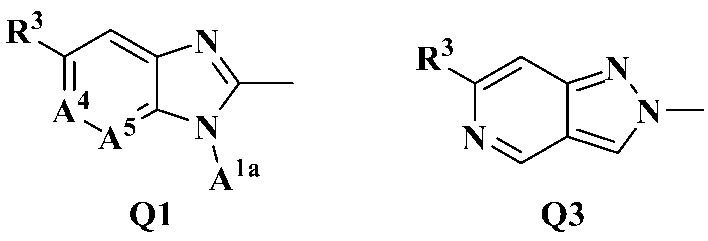
A4は、窒素原子又はCHを表し、
A5は、窒素原子又はCHを表し、
R1は、C1~C6アルキルを表し、
R3は、ハロ(C1~C6)アルキル、ハロ(C1~C6)アルキルチオ、ハロ(C1~C6)アルキルスルフィニル又はハロ(C1~C6)アルキルスルホニルを表し、
Y2、Y3及びY4は、各々独立して、水素原子、ハロゲン原子、ハロ(C1~C6)アルキル又はシアノを表し、
nは、0、1又は2の整数を表す。]
(2)
有効成分群B-I:メタラキシル-M及びヒメキサゾール。
有効成分群B-II:ベノミル、チオファネート-メチル、ジエトフェンカルブ、エタボキサム、ゾキサミド、ペンシクロン及びフルオピコリド。
有効成分群B-III:ベンゾビンジフルピル、ビキサフェン、ボスカリド、フルインダピル、フルオピラム、フルトラニル、フルキサピロキサド、フラメトピル、イソフルシプラム、インピルフルキサム、イソフェタミド、イソピラザム、メプロニル、ペンフルフェン、ペンチオピラド、セダキサン、チフルザミド、アゾキシストロビン、クモキシストロビン、ジモキシストロビン、エネストロビン、エノキサストロビン、ファモキサドン、フェナミドン、フェナミンストロビン、フルフェノキシストロビン、フルオキサストロビン、クレソキシム-メチル、マンデストロビン、メトミノストロビン、オリサストロビン、ピコキシストロビン、ピラクロストロビン、ピラメトストロビン、ピラオキシストロビン、ピリベンカルブメチル、ピリミノストロビン、トリクロピリカルブ、トリフロキシストロビン、アミスルブロム、シアゾファミド、フルアジナム、フェンピコキサミド、アメトクトラジン、ピジフルメトフェン及びピラジフルミド。
有効成分群B-IV:メパニピリム及びカスガマイシン。
有効成分群B-V:キノキシフェン及びフルジオキソニル。
有効成分群B-VI:イプロジオン及びプロシミドン。
有効成分群B-VII:トルクロホス-メチル及びバチルス ズブチリス。
有効成分群B-VIII:ブロムコナゾール、シプロコナゾール、ジフェノコナゾール、ジニコナゾール-M、エポキシコナゾール、フェナリモル、フェンブコナゾール、フルキンコナゾール、ヘキサコナゾール、イマザリル、イミベンコナゾール、イプコナゾール、メトコナゾール、ミクロブタニル、ペンコナゾール、プロクロラズ、プロピコナゾール、プロチオコナゾール、シメコナゾール、テブコナゾール、テトラコナゾール、トリフルミゾール、フェンプロピジン、フェンヘキサミド、フェンピラザミン、イプフェントリフルコナゾール及びメフェントリフルコナゾール。
有効成分群B-IX:バリダマイシン、ポリオキシン、ポリオキシン-D、ベンチアバリカルブ-イソプロピル、ジメトモルフ、イプロバリカルブ及びマンジプロパミド。
有効成分群B-X:フサライド、トリシクラゾール、カルプロパミド及びジクロシメット。
有効成分群B-XI:アシベンゾラル-S-メチル、プロベナゾール、イソチアニル、ジクロベンチアゾクス及びチアジニル。
有効成分群B-XII:ボルドー液、塩基性炭酸銅、水酸化第二銅、カッパーナフテネート、カッパーオレエート、塩基性塩化銅、硫酸銅、塩基性硫酸銅、オキシキノリン銅、石灰硫黄合剤、硫黄、マンコゼブ、マンネブ、ポリカーバメート、プロピネブ、キャプタン、フォルペット、クロロタロニル、イミノクタジン-アルベシル酸塩及びイミノクタジン酢酸塩。
有効成分群B-XIII:アミノピリフェン、シフルフェナミド、シモキサニル、フルスルファミド、フルチアニル、ホセチル-アルミニウム、メトラフェノン、オキサチアピプロリン、ピリオフェノン、ピカルブトラドクス、ジピメチトロン、キノフメリン、リポペプチド、亜リン酸、BCF-082(試験名)、NF-180(試験名)、S-2399(試験名)、AKD-5195(試験名)及びS-2190(試験名)。
有効成分群B-XIV:アセフェート、カズサホス、クロルピリホス、ダイアジノン、ジクロルボス、ジメトエート、イーピーエヌ、マラチオン、メタミドホス、パラチオン-メチル、フェントエート、ホレート、ホスメット、ホキシム、プロフェノホス及びテルブホス。
有効成分群B-XV:アルジカルブ、ベンフラカルブ、カルバリル、カルボフラン、カルボスルファン、メソミル、ピリミカルブ及びチオジカルブ。
有効成分群B-XVI:アクリナトリン、ビフェントリン、シフルトリン、シペルメトリン、デルタメトリン、エスフェンバレレート、エトフェンプロックス、ペルメトリン、テフルトリン、ラムダ-シハロトリン及びタウ-フルバリネート。
有効成分群B-XVII:ベンスルタップ、カルタップ及びチオシクラム。
有効成分群B-XVIII:アセタミプリド、クロチアニジン、ジノテフラン、フルピリミン、イミダクロプリド、ニテンピラム、チアクロプリド、チアメトキサム、スルホキサフロル、フルピラジフロン、トリフルメゾピリム及びジクロロメゾチアズ。
有効成分群B-XIX:スピネトラム及びスピノサド
有効成分群B-XX:エチプロール、フィプロニル及びブロフラニリド。
有効成分群B-XXI:アバメクチン、エマメクチンベンゾエート、レピメクチン及びミルベメクチン。
有効成分群B-XXII:クロラントラニリプロール、シアントラニリプロール、フルベンジアミド、シクラニリプロール、テトラニリプロール及びシハロジアミド。
有効成分群B-XXIII:ジアフェンチウロン、フェンピロキシメート、ピリダベン、トルフェンピラド、シエノピラフェン、シフルメトフェン、ピフルブミド、ヒドラメチルノン、アセキノシル及びクロルフェナピル。
有効成分群B-XXIV:ベンズピリモキサン、ピリプロキシフェン、メトキシフェノジド、ジフルベンズロン、フルフェノクスロン、ルフェヌロン、ノバルロン、テフルベンズロン、ブプロフェジン、ヘキサチアゾクス及びエトキサゾール。
有効成分群B-XXV:バチルス チューリンゲンシス及びバチルス スファエリクス。
有効成分群B-XXVI:アシノナピル、ピメトロジン、ピリフルキナゾン、アフィドピロペン、フロニカミド、スピロジクロフェン、スピロメシフェン、スピロピジオン、スピロテトラマト、インドキサカルブ、メタフルミゾン、シロマジン、アザディラクチン、ピリダリル、ビフェナゼート、フルキサメタミド、メタアルデヒド、ME-5382(試験名)、NA-89(試験名)、NNI-1501(試験名)、BAI-1602(試験名)、DKN-2601(試験名)及びDAI-1601(試験名)。 - 前記式(I)で表される縮合複素環化合物が、
Qが、Q1で表される環であり、
A4が、CHであり、
A5が、窒素原子であり、
R3が、ハロ(C1~C6)アルキル又はハロ(C1~C6)アルキルスルフィニルであり、
Y2及びY3が、各々独立して、水素原子、ハロゲン原子又はハロ(C1~C6)アルキルであり、
Y4が、水素原子、ハロゲン原子又はシアノであり、かつ、
nが、2である、
縮合複素環化合物である、請求項1に記載の組成物。 - 前記式(I)で表される縮合複素環化合物が、
Qが、Q1で表される環であり、
A4が、窒素原子であり、
A5が、CHであり、
R3が、ハロ(C1~C6)アルキルであり、
Y2、Y3及びY4が、各々独立して、水素原子又はハロ(C1~C6)アルキルであり、かつ、
nが、2である、
縮合複素環化合物である、請求項1に記載の組成物。 - 前記式(I)で表される縮合複素環化合物が、
Qが、Q3で表される環であり、
R3が、ハロ(C1~C6)アルキルであり、
Y2、Y3及びY4が、各々独立して、水素原子又はハロゲン原子であり、
nが、2である、
縮合複素環化合物である、請求項1に記載の組成物。 - 前記活性化合物IIが、アセタミプリド、クロチアニジン、イミダクロプリド、チアメトキサム、スルホキサフロル、スピネトラム、エマメクチンベンゾエート、クロラントラニリプロール、シアントラニリプロール、フルベンジアミド、ピリダベン、シエノピラフェン、クロルフェナピル、バチルス チューリンゲンシス、ピメトロジン、フロニカミド、スピロテトラマト、インドキサカルブ、ピリダリル、ビフェナゼート及びフルキサメタミドから選択される活性化合物である、請求項1~4のいずれか一項に記載の組成物。
- 活性化合物I及び活性化合物IIの組合せ割合が、活性化合物I:活性化合物IIの重量比で表して、100:1~1:100である、請求項1~5のいずれか一項に記載の組成物。
- 請求項1に記載の活性化合物Iの少なくとも1種と、請求項1に記載の活性化合物IIの少なくとも1種とを同時に、又は時間的に近接して施用又は処理することによる、有害生物の防除方法。
- 前記請求項1に記載の活性化合物Iが前記請求項2に記載の活性化合物Iである、請求項7に記載の防除方法。
- 前記請求項1に記載の活性化合物Iが前記請求項3に記載の活性化合物Iである、請求項7に記載の防除方法。
- 前記請求項1に記載の活性化合物Iが前記請求項4に記載の活性化合物Iである、請求項7に記載の防除方法。
- 前記請求項1に記載の活性化合物IIが前記請求項5に記載の活性化合物IIである、請求項7~10のいずれか一項に記載の防除方法。
- 活性化合物I及び活性化合物IIの組合せ割合が、活性化合物I:活性化合物IIの重量比で表して、100:1~1:100である、請求項7~11のいずれか一項に記載の防除方法。
- 活性化合物Iの施用量が0.1~1000gai/haであり、活性化合物IIの施用量が0.1~1000gai/haである、請求項7~12のいずれか一項に記載の防除方法。
- 請求項1に記載の活性化合物Iの少なくとも1種と、請求項1に記載の活性化合物IIの少なくとも1種とを同時に、又は時間的に近接して種子を処理することによる、請求項7~12のいずれか一項に記載の防除方法。
- 前記請求項1に記載の活性化合物Iが前記請求項2に記載の活性化合物Iであり、前記請求項1に記載の活性化合物IIが前記請求項5に記載の活性化合物IIである、請求項14に記載の防除方法。
Applications Claiming Priority (4)
| Application Number | Priority Date | Filing Date | Title |
|---|---|---|---|
| JP2016180834 | 2016-09-15 | ||
| JP2016-180834 | 2016-09-15 | ||
| JP2017137176A JP2019196310A (ja) | 2016-09-15 | 2017-07-13 | 殺虫、殺ダニ、殺線虫、殺軟体動物、殺菌又は殺バクテリア組成物及び病害虫の防除方法 |
| JP2017-137176 | 2017-07-13 |
Publications (1)
| Publication Number | Publication Date |
|---|---|
| WO2018052136A1 true WO2018052136A1 (ja) | 2018-03-22 |
Family
ID=61619605
Family Applications (1)
| Application Number | Title | Priority Date | Filing Date |
|---|---|---|---|
| PCT/JP2017/033541 Ceased WO2018052136A1 (ja) | 2016-09-15 | 2017-09-15 | 有害生物防除剤組成物及び有害生物防除方法 |
Country Status (1)
| Country | Link |
|---|---|
| WO (1) | WO2018052136A1 (ja) |
Cited By (60)
| Publication number | Priority date | Publication date | Assignee | Title |
|---|---|---|---|---|
| CN110029078A (zh) * | 2019-05-31 | 2019-07-19 | 河南科技大学 | 具有防病杀虫双重作用的链霉菌及其应用、培养方法、生防菌剂 |
| WO2019219689A1 (en) | 2018-05-18 | 2019-11-21 | Syngenta Participations Ag | Pesticidally active heterocyclic derivatives with sulfoximine containing substituents |
| WO2019219529A1 (en) | 2018-05-15 | 2019-11-21 | Basf Se | Mixtures comprising benzpyrimoxan and oxazosulfyl and uses and methods of applying them |
| WO2019234158A1 (en) | 2018-06-06 | 2019-12-12 | Syngenta Crop Protection Ag | Pesticidally active heterocyclic derivatives with sulfoximine containing substituents |
| JP2020002122A (ja) * | 2018-06-20 | 2020-01-09 | 日本農薬株式会社 | ネギ科植物の病害防除方法 |
| US10544163B2 (en) | 2016-03-10 | 2020-01-28 | Nissan Chemical Corporation | Condensed heterocyclic compounds and pesticides |
| WO2020058010A1 (en) | 2018-09-19 | 2020-03-26 | Basf Se | Pesticidal mixtures comprising a mesoionic compound |
| WO2020141135A1 (en) | 2018-12-31 | 2020-07-09 | Syngenta Crop Protection Ag | Pesticidally active heterocyclic derivatives with sulfur containing substituents |
| WO2020158889A1 (ja) * | 2019-01-31 | 2020-08-06 | 住友化学株式会社 | 複素環化合物及びそれを含有する有害節足動物防除組成物 |
| EP3696177A1 (en) | 2019-02-12 | 2020-08-19 | Basf Se | Heterocyclic compounds for the control of invertebrate pests |
| WO2020171077A1 (ja) * | 2019-02-19 | 2020-08-27 | 住友化学株式会社 | 複素環化合物及びそれを含有する有害節足動物防除組成物 |
| WO2020203763A1 (ja) | 2019-03-29 | 2020-10-08 | 住友化学株式会社 | 複素環化合物及びそれを含有する有害節足動物防除組成物 |
| WO2020239517A1 (en) | 2019-05-29 | 2020-12-03 | Basf Se | Mesoionic imidazolium compounds and derivatives for combating animal pests |
| EP3766879A1 (en) | 2019-07-19 | 2021-01-20 | Basf Se | Pesticidal pyrazole derivatives |
| EP3769623A1 (en) | 2019-07-22 | 2021-01-27 | Basf Se | Mesoionic imidazolium compounds and derivatives for combating animal pests |
| WO2021130143A1 (en) | 2019-12-23 | 2021-07-01 | Basf Se | Enzyme enhanced root uptake of agrochemical active compound |
| WO2021140122A1 (en) | 2020-01-06 | 2021-07-15 | Syngenta Crop Protection Ag | Pesticidally active heterocyclic derivatives with sulfur containing substituents |
| WO2021170463A1 (en) | 2020-02-28 | 2021-09-02 | BASF Agro B.V. | Methods and uses of a mixture comprising alpha-cypermethrin and dinotefuran for controlling invertebrate pests in turf |
| CN113416612A (zh) * | 2021-07-13 | 2021-09-21 | 詹卫浩 | 一种抑菌型洗衣留香珠及其制备方法 |
| WO2021209265A1 (en) | 2020-04-14 | 2021-10-21 | Basf Se | Tricyclic pesticidal compounds |
| WO2021219513A1 (en) | 2020-04-28 | 2021-11-04 | Basf Se | Pesticidal compounds |
| EP3909950A1 (en) | 2020-05-13 | 2021-11-17 | Basf Se | Heterocyclic compounds for the control of invertebrate pests |
| CN113773988A (zh) * | 2021-08-27 | 2021-12-10 | 微生物肥料技术研究推广中心 | 一种枯草芽孢杆菌及其在辣椒防病增产中的应用 |
| WO2022049144A1 (en) | 2020-09-02 | 2022-03-10 | Syngenta Crop Protection Ag | Pesticidally active heterocyclic derivatives with sulfur containing substituents |
| WO2022071434A1 (ja) | 2020-09-30 | 2022-04-07 | 住友化学株式会社 | 複素環化合物及びそれを含有する有害節足動物防除組成物 |
| JP2022528170A (ja) * | 2019-04-10 | 2022-06-08 | シンジェンタ クロップ プロテクション アクチェンゲゼルシャフト | 殺有害生物組成物 |
| EP4043444A1 (en) | 2021-02-11 | 2022-08-17 | Basf Se | Substituted isoxazoline derivatives |
| EP4119547A1 (en) | 2021-07-12 | 2023-01-18 | Basf Se | Triazole compounds for the control of invertebrate pests |
| WO2023017094A1 (en) | 2021-08-10 | 2023-02-16 | Syngenta Crop Protection Ag | 2,2-difluoro-5h-[1,3]dioxolo[4,5-f]isoindol-7-one derivatives as pesticides |
| EP4140986A1 (en) | 2021-08-23 | 2023-03-01 | Basf Se | Pyrazine compounds for the control of invertebrate pests |
| EP4140995A1 (en) | 2021-08-27 | 2023-03-01 | Basf Se | Pyrazine compounds for the control of invertebrate pests |
| EP4151631A1 (en) | 2021-09-20 | 2023-03-22 | Basf Se | Heterocyclic compounds for the control of invertebrate pests |
| EP4194453A1 (en) | 2021-12-08 | 2023-06-14 | Basf Se | Pyrazine compounds for the control of invertebrate pests |
| WO2023105065A1 (en) | 2021-12-10 | 2023-06-15 | Syngenta Crop Protection Ag | Insect, acarina and nematode pest control |
| EP4198023A1 (en) | 2021-12-16 | 2023-06-21 | Basf Se | Pesticidally active thiosemicarbazone compounds |
| EP4198033A1 (en) | 2021-12-14 | 2023-06-21 | Basf Se | Heterocyclic compounds for the control of invertebrate pests |
| EP4238971A1 (en) | 2022-03-02 | 2023-09-06 | Basf Se | Substituted isoxazoline derivatives |
| WO2023208447A1 (en) | 2022-04-25 | 2023-11-02 | Basf Se | An emulsifiable concentrate having a (substituted) benzaldehyde-based solvent system |
| CN117098759A (zh) * | 2021-04-02 | 2023-11-21 | 组合化学工业株式会社 | 杂环化合物及其用途 |
| WO2024028243A1 (en) | 2022-08-02 | 2024-02-08 | Basf Se | Pyrazolo pesticidal compounds |
| EP4342885A1 (en) | 2022-09-20 | 2024-03-27 | Basf Se | N-(3-(aminomethyl)-phenyl)-5-(4-phenyl)-5-(trifluoromethyl)-4,5-dihydroisoxazol-3-amine derivatives and similar compounds as pesticides |
| WO2024071393A1 (ja) | 2022-09-30 | 2024-04-04 | 住友化学株式会社 | 複素環化合物及びそれを含有する有害節足動物防除組成物 |
| EP4389210A1 (en) | 2022-12-21 | 2024-06-26 | Basf Se | Heteroaryl compounds for the control of invertebrate pests |
| WO2024156664A1 (en) | 2023-01-23 | 2024-08-02 | Syngenta Crop Protection Ag | Pesticidally active heterocyclic derivatives with sulfur containing substituents |
| EP4455137A1 (en) | 2023-04-24 | 2024-10-30 | Basf Se | Pyrimidine compounds for the control of invertebrate pests |
| EP4467535A1 (en) | 2023-05-25 | 2024-11-27 | Basf Se | Lactam pesticidal compounds |
| EP4488269A1 (en) | 2023-07-06 | 2025-01-08 | Basf Se | Triazole compounds for the control of invertebrate pests |
| EP4488270A1 (en) | 2023-07-06 | 2025-01-08 | Basf Se | Triazole compounds for the control of invertebrate pests |
| EP4488273A1 (en) | 2023-07-06 | 2025-01-08 | Basf Se | Triazole compounds for the control of invertebrate pests |
| WO2025117659A1 (en) | 2023-11-29 | 2025-06-05 | Basf Corporation | Insecticide delivery by nanocarriers |
| EP4574819A1 (en) | 2023-12-22 | 2025-06-25 | Basf Se | Diazinone compounds for the control of invertebrate pests |
| WO2025242699A1 (en) | 2024-05-22 | 2025-11-27 | Basf Se | Method for improving rainfastness of an agrochemical active ingredient |
| WO2026037853A1 (en) | 2024-08-14 | 2026-02-19 | Basf Se | Benzoxazole derivatives as pesticidal compounds |
| WO2026041702A1 (en) | 2024-08-21 | 2026-02-26 | Basf Se | Benzoxazole derivatives as pesticidal compounds |
| WO2026093251A1 (en) | 2024-10-28 | 2026-05-07 | Basf Se | Pesticidal compounds and uses thereof |
| WO2026109530A1 (en) | 2024-11-21 | 2026-05-28 | Basf Se | Heterobicyclic compounds for the control of invertebrate pests |
| WO2026132258A1 (en) | 2024-12-20 | 2026-06-25 | Basf Se | Heterocyclic compounds for combating invertebrate pests |
| WO2026162563A1 (en) | 2025-01-30 | 2026-08-06 | Basf Agricultural Solutions Deutschland Gmbh | Diazinone derivatives for the control of invertebrate pests |
| WO2026162559A1 (en) | 2025-01-30 | 2026-08-06 | Basf Agricultural Solutions Deutschland Gmbh | Diazinone derivatives for the control of invertebrate pests |
| WO2026162627A1 (en) | 2025-01-30 | 2026-08-06 | Basf Agricultural Solutions Deutschland Gmbh | Heterocyclic compounds for combating invertebrate pests |
Citations (3)
| Publication number | Priority date | Publication date | Assignee | Title |
|---|---|---|---|---|
| JP2016056197A (ja) * | 2016-01-12 | 2016-04-21 | 住友化学株式会社 | 有害生物防除組成物及びその用途 |
| JP2016102104A (ja) * | 2015-09-08 | 2016-06-02 | 住友化学株式会社 | 有害生物防除組成物およびその用途 |
| WO2016129684A1 (ja) * | 2015-02-12 | 2016-08-18 | 日産化学工業株式会社 | 縮合複素環化合物及び有害生物防除剤 |
-
2017
- 2017-09-15 WO PCT/JP2017/033541 patent/WO2018052136A1/ja not_active Ceased
Patent Citations (3)
| Publication number | Priority date | Publication date | Assignee | Title |
|---|---|---|---|---|
| WO2016129684A1 (ja) * | 2015-02-12 | 2016-08-18 | 日産化学工業株式会社 | 縮合複素環化合物及び有害生物防除剤 |
| JP2016102104A (ja) * | 2015-09-08 | 2016-06-02 | 住友化学株式会社 | 有害生物防除組成物およびその用途 |
| JP2016056197A (ja) * | 2016-01-12 | 2016-04-21 | 住友化学株式会社 | 有害生物防除組成物及びその用途 |
Cited By (78)
| Publication number | Priority date | Publication date | Assignee | Title |
|---|---|---|---|---|
| US10544163B2 (en) | 2016-03-10 | 2020-01-28 | Nissan Chemical Corporation | Condensed heterocyclic compounds and pesticides |
| US10759815B2 (en) | 2016-03-10 | 2020-09-01 | Nissan Chemical Corporation | Condensed heterocyclic compounds and pesticides |
| US10640518B2 (en) | 2016-03-10 | 2020-05-05 | Nissan Chemical Corporation | Condensed heterocyclic compounds and pesticides |
| WO2019219529A1 (en) | 2018-05-15 | 2019-11-21 | Basf Se | Mixtures comprising benzpyrimoxan and oxazosulfyl and uses and methods of applying them |
| WO2019219689A1 (en) | 2018-05-18 | 2019-11-21 | Syngenta Participations Ag | Pesticidally active heterocyclic derivatives with sulfoximine containing substituents |
| EP4342297A2 (en) | 2018-06-06 | 2024-03-27 | Syngenta Crop Protection AG | Pesticidally active heterocyclic derivatives with sulfoximine containing substituents |
| WO2019234158A1 (en) | 2018-06-06 | 2019-12-12 | Syngenta Crop Protection Ag | Pesticidally active heterocyclic derivatives with sulfoximine containing substituents |
| JP2020002122A (ja) * | 2018-06-20 | 2020-01-09 | 日本農薬株式会社 | ネギ科植物の病害防除方法 |
| JP2024038242A (ja) * | 2018-06-20 | 2024-03-19 | 日本農薬株式会社 | ネギ科植物の病害防除方法 |
| JP7566443B2 (ja) | 2018-06-20 | 2024-10-15 | 日本農薬株式会社 | ネギ科植物の病害防除方法 |
| WO2020058010A1 (en) | 2018-09-19 | 2020-03-26 | Basf Se | Pesticidal mixtures comprising a mesoionic compound |
| US12144349B2 (en) | 2018-09-19 | 2024-11-19 | Basf Se | Pesticidal mixtures comprising a mesoionic compound |
| WO2020141135A1 (en) | 2018-12-31 | 2020-07-09 | Syngenta Crop Protection Ag | Pesticidally active heterocyclic derivatives with sulfur containing substituents |
| CN113412050A (zh) * | 2019-01-31 | 2021-09-17 | 住友化学株式会社 | 杂环化合物和含有该杂环化合物的有害节肢动物防除组合物 |
| US12144350B2 (en) | 2019-01-31 | 2024-11-19 | Sumitomo Chemical Company, Limited | Heterocyclic compound and harmful arthropod control composition containing same |
| WO2020158889A1 (ja) * | 2019-01-31 | 2020-08-06 | 住友化学株式会社 | 複素環化合物及びそれを含有する有害節足動物防除組成物 |
| EP3696177A1 (en) | 2019-02-12 | 2020-08-19 | Basf Se | Heterocyclic compounds for the control of invertebrate pests |
| US12234247B2 (en) | 2019-02-19 | 2025-02-25 | Sumitomo Chemical Company, Limited | Heterocyclic compound and harmful arthropod-controlling composition containing same |
| JPWO2020171077A1 (ja) * | 2019-02-19 | 2021-12-16 | 住友化学株式会社 | 複素環化合物及びそれを含有する有害節足動物防除組成物 |
| JP7492946B2 (ja) | 2019-02-19 | 2024-05-30 | 住友化学株式会社 | 複素環化合物及びそれを含有する有害節足動物防除組成物 |
| WO2020171077A1 (ja) * | 2019-02-19 | 2020-08-27 | 住友化学株式会社 | 複素環化合物及びそれを含有する有害節足動物防除組成物 |
| WO2020203763A1 (ja) | 2019-03-29 | 2020-10-08 | 住友化学株式会社 | 複素環化合物及びそれを含有する有害節足動物防除組成物 |
| JP7600139B2 (ja) | 2019-04-10 | 2024-12-16 | シンジェンタ クロップ プロテクション アクチェンゲゼルシャフト | 殺有害生物組成物 |
| AU2020272104B2 (en) * | 2019-04-10 | 2026-02-12 | Syngenta Crop Protection Ag | Pesticidal compositions |
| JP2022528170A (ja) * | 2019-04-10 | 2022-06-08 | シンジェンタ クロップ プロテクション アクチェンゲゼルシャフト | 殺有害生物組成物 |
| WO2020239517A1 (en) | 2019-05-29 | 2020-12-03 | Basf Se | Mesoionic imidazolium compounds and derivatives for combating animal pests |
| CN110029078A (zh) * | 2019-05-31 | 2019-07-19 | 河南科技大学 | 具有防病杀虫双重作用的链霉菌及其应用、培养方法、生防菌剂 |
| WO2021013561A1 (en) | 2019-07-19 | 2021-01-28 | Basf Se | Pesticidal pyrazole and triazole derivatives |
| EP3766879A1 (en) | 2019-07-19 | 2021-01-20 | Basf Se | Pesticidal pyrazole derivatives |
| EP3769623A1 (en) | 2019-07-22 | 2021-01-27 | Basf Se | Mesoionic imidazolium compounds and derivatives for combating animal pests |
| WO2021130143A1 (en) | 2019-12-23 | 2021-07-01 | Basf Se | Enzyme enhanced root uptake of agrochemical active compound |
| WO2021140122A1 (en) | 2020-01-06 | 2021-07-15 | Syngenta Crop Protection Ag | Pesticidally active heterocyclic derivatives with sulfur containing substituents |
| CN115023426A (zh) * | 2020-01-06 | 2022-09-06 | 先正达农作物保护股份公司 | 具有含硫取代基的杀有害生物活性的杂环衍生物 |
| CN115023426B (zh) * | 2020-01-06 | 2024-11-12 | 先正达农作物保护股份公司 | 具有含硫取代基的杀有害生物活性的杂环衍生物 |
| US12696901B2 (en) | 2020-01-06 | 2026-08-04 | Syngenta Crop Protection Ag | Pesticidally active heterocyclic derivatives with sulfur containing substituents |
| WO2021170463A1 (en) | 2020-02-28 | 2021-09-02 | BASF Agro B.V. | Methods and uses of a mixture comprising alpha-cypermethrin and dinotefuran for controlling invertebrate pests in turf |
| WO2021209265A1 (en) | 2020-04-14 | 2021-10-21 | Basf Se | Tricyclic pesticidal compounds |
| WO2021219513A1 (en) | 2020-04-28 | 2021-11-04 | Basf Se | Pesticidal compounds |
| US12564191B2 (en) | 2020-04-28 | 2026-03-03 | Basf Se | Pesticidal compounds |
| EP3909950A1 (en) | 2020-05-13 | 2021-11-17 | Basf Se | Heterocyclic compounds for the control of invertebrate pests |
| WO2022049144A1 (en) | 2020-09-02 | 2022-03-10 | Syngenta Crop Protection Ag | Pesticidally active heterocyclic derivatives with sulfur containing substituents |
| WO2022071434A1 (ja) | 2020-09-30 | 2022-04-07 | 住友化学株式会社 | 複素環化合物及びそれを含有する有害節足動物防除組成物 |
| EP4043444A1 (en) | 2021-02-11 | 2022-08-17 | Basf Se | Substituted isoxazoline derivatives |
| CN117098759A (zh) * | 2021-04-02 | 2023-11-21 | 组合化学工业株式会社 | 杂环化合物及其用途 |
| EP4119547A1 (en) | 2021-07-12 | 2023-01-18 | Basf Se | Triazole compounds for the control of invertebrate pests |
| CN113416612A (zh) * | 2021-07-13 | 2021-09-21 | 詹卫浩 | 一种抑菌型洗衣留香珠及其制备方法 |
| WO2023017094A1 (en) | 2021-08-10 | 2023-02-16 | Syngenta Crop Protection Ag | 2,2-difluoro-5h-[1,3]dioxolo[4,5-f]isoindol-7-one derivatives as pesticides |
| EP4140986A1 (en) | 2021-08-23 | 2023-03-01 | Basf Se | Pyrazine compounds for the control of invertebrate pests |
| CN113773988A (zh) * | 2021-08-27 | 2021-12-10 | 微生物肥料技术研究推广中心 | 一种枯草芽孢杆菌及其在辣椒防病增产中的应用 |
| EP4140995A1 (en) | 2021-08-27 | 2023-03-01 | Basf Se | Pyrazine compounds for the control of invertebrate pests |
| EP4151631A1 (en) | 2021-09-20 | 2023-03-22 | Basf Se | Heterocyclic compounds for the control of invertebrate pests |
| EP4194453A1 (en) | 2021-12-08 | 2023-06-14 | Basf Se | Pyrazine compounds for the control of invertebrate pests |
| WO2023105065A1 (en) | 2021-12-10 | 2023-06-15 | Syngenta Crop Protection Ag | Insect, acarina and nematode pest control |
| EP4198033A1 (en) | 2021-12-14 | 2023-06-21 | Basf Se | Heterocyclic compounds for the control of invertebrate pests |
| EP4198023A1 (en) | 2021-12-16 | 2023-06-21 | Basf Se | Pesticidally active thiosemicarbazone compounds |
| EP4238971A1 (en) | 2022-03-02 | 2023-09-06 | Basf Se | Substituted isoxazoline derivatives |
| WO2023208447A1 (en) | 2022-04-25 | 2023-11-02 | Basf Se | An emulsifiable concentrate having a (substituted) benzaldehyde-based solvent system |
| WO2024028243A1 (en) | 2022-08-02 | 2024-02-08 | Basf Se | Pyrazolo pesticidal compounds |
| EP4342885A1 (en) | 2022-09-20 | 2024-03-27 | Basf Se | N-(3-(aminomethyl)-phenyl)-5-(4-phenyl)-5-(trifluoromethyl)-4,5-dihydroisoxazol-3-amine derivatives and similar compounds as pesticides |
| WO2024071393A1 (ja) | 2022-09-30 | 2024-04-04 | 住友化学株式会社 | 複素環化合物及びそれを含有する有害節足動物防除組成物 |
| EP4389210A1 (en) | 2022-12-21 | 2024-06-26 | Basf Se | Heteroaryl compounds for the control of invertebrate pests |
| WO2024156664A1 (en) | 2023-01-23 | 2024-08-02 | Syngenta Crop Protection Ag | Pesticidally active heterocyclic derivatives with sulfur containing substituents |
| EP4455137A1 (en) | 2023-04-24 | 2024-10-30 | Basf Se | Pyrimidine compounds for the control of invertebrate pests |
| EP4467535A1 (en) | 2023-05-25 | 2024-11-27 | Basf Se | Lactam pesticidal compounds |
| EP4488270A1 (en) | 2023-07-06 | 2025-01-08 | Basf Se | Triazole compounds for the control of invertebrate pests |
| EP4488273A1 (en) | 2023-07-06 | 2025-01-08 | Basf Se | Triazole compounds for the control of invertebrate pests |
| EP4488269A1 (en) | 2023-07-06 | 2025-01-08 | Basf Se | Triazole compounds for the control of invertebrate pests |
| WO2025117659A1 (en) | 2023-11-29 | 2025-06-05 | Basf Corporation | Insecticide delivery by nanocarriers |
| EP4574819A1 (en) | 2023-12-22 | 2025-06-25 | Basf Se | Diazinone compounds for the control of invertebrate pests |
| WO2025242699A1 (en) | 2024-05-22 | 2025-11-27 | Basf Se | Method for improving rainfastness of an agrochemical active ingredient |
| WO2026037853A1 (en) | 2024-08-14 | 2026-02-19 | Basf Se | Benzoxazole derivatives as pesticidal compounds |
| WO2026041702A1 (en) | 2024-08-21 | 2026-02-26 | Basf Se | Benzoxazole derivatives as pesticidal compounds |
| WO2026093251A1 (en) | 2024-10-28 | 2026-05-07 | Basf Se | Pesticidal compounds and uses thereof |
| WO2026109530A1 (en) | 2024-11-21 | 2026-05-28 | Basf Se | Heterobicyclic compounds for the control of invertebrate pests |
| WO2026132258A1 (en) | 2024-12-20 | 2026-06-25 | Basf Se | Heterocyclic compounds for combating invertebrate pests |
| WO2026162563A1 (en) | 2025-01-30 | 2026-08-06 | Basf Agricultural Solutions Deutschland Gmbh | Diazinone derivatives for the control of invertebrate pests |
| WO2026162559A1 (en) | 2025-01-30 | 2026-08-06 | Basf Agricultural Solutions Deutschland Gmbh | Diazinone derivatives for the control of invertebrate pests |
| WO2026162627A1 (en) | 2025-01-30 | 2026-08-06 | Basf Agricultural Solutions Deutschland Gmbh | Heterocyclic compounds for combating invertebrate pests |
Similar Documents
| Publication | Publication Date | Title |
|---|---|---|
| JP6628048B2 (ja) | 殺虫、殺ダニ、殺線虫、殺軟体動物、殺菌又は殺バクテリア組成物及び病害虫の防除方法 | |
| CN105960169B (zh) | 杀菌或杀细菌组合物以及病害的防除方法 | |
| CN107207506B (zh) | 稠合杂环化合物和有害生物防除剂 | |
| JP7070405B2 (ja) | 殺菌又は殺バクテリア組成物及び病害の防除方法 | |
| JP2010083883A (ja) | イソキサゾリン置換ベンズアミド化合物及び有害生物防除剤 | |
| JP2014114246A (ja) | 殺虫、殺ダニ、殺線虫、殺軟体動物、殺菌又は殺バクテリア組成物及び病害虫の防除方法 | |
| JP2012153620A (ja) | 殺虫、殺ダニ、殺線虫、殺軟体動物、殺菌又は殺バクテリア組成物 | |
| TW202603154A (zh) | 微生物及其用途 | |
| JP2014037382A (ja) | 殺虫、殺ダニ、殺線虫、殺軟体動物、殺菌又は殺バクテリア剤組成物及び病害虫の防除方法 | |
| JP2012153621A (ja) | 殺虫、殺ダニ、殺線虫、殺軟体動物、殺菌又は殺バクテリア組成物及び病害虫の防除方法 | |
| JP2019085371A (ja) | 環状アミン化合物および有害生物防除剤 | |
| JPWO2017213137A1 (ja) | 新規化合物およびこれを有効成分とする農園芸用薬剤 | |
| JP2019196310A (ja) | 殺虫、殺ダニ、殺線虫、殺軟体動物、殺菌又は殺バクテリア組成物及び病害虫の防除方法 | |
| JPWO2014065411A1 (ja) | 農園芸用の有害生物防除剤としてのスルホンアミド誘導体 | |
| JP2019094322A (ja) | 殺虫、殺ダニ、殺線虫、殺軟体動物、殺菌又は殺バクテリア組成物及び病害虫の防除方法 | |
| JP2023132936A (ja) | 有害生物防除剤組成物及び有害生物防除方法 | |
| JP2006306850A (ja) | 置換ベンズアニリド化合物及び有害生物防除剤 | |
| JP2014159413A (ja) | アゾリルオキシム化合物またはその塩、有害生物防除剤、殺虫剤または殺ダニ剤、殺菌剤、および外部寄生虫防除剤 | |
| JP2005008630A (ja) | シクロアルキル置換ベンズアニリド化合物及び有害生物防除剤 | |
| WO2018230555A1 (ja) | オキサジアゾリン化合物および有害生物防除剤 | |
| JP2017031193A (ja) | 有害生物防除組成物およびその用途 |
Legal Events
| Date | Code | Title | Description |
|---|---|---|---|
| 121 | Ep: the epo has been informed by wipo that ep was designated in this application |
Ref document number: 17851033 Country of ref document: EP Kind code of ref document: A1 |
|
| NENP | Non-entry into the national phase |
Ref country code: DE |
|
| 122 | Ep: pct application non-entry in european phase |
Ref document number: 17851033 Country of ref document: EP Kind code of ref document: A1 |
|
| NENP | Non-entry into the national phase |
Ref country code: JP |