WO2018043302A1 - リチウムニッケル系複合酸化物及びその製造方法 - Google Patents
リチウムニッケル系複合酸化物及びその製造方法 Download PDFInfo
- Publication number
- WO2018043302A1 WO2018043302A1 PCT/JP2017/030417 JP2017030417W WO2018043302A1 WO 2018043302 A1 WO2018043302 A1 WO 2018043302A1 JP 2017030417 W JP2017030417 W JP 2017030417W WO 2018043302 A1 WO2018043302 A1 WO 2018043302A1
- Authority
- WO
- WIPO (PCT)
- Prior art keywords
- lithium
- composite oxide
- nickel
- nickel composite
- positive electrode
- Prior art date
- Legal status (The legal status is an assumption and is not a legal conclusion. Google has not performed a legal analysis and makes no representation as to the accuracy of the status listed.)
- Ceased
Links
Images



Classifications
-
- C—CHEMISTRY; METALLURGY
- C01—INORGANIC CHEMISTRY
- C01G—COMPOUNDS CONTAINING METALS NOT COVERED BY SUBCLASSES C01D OR C01F
- C01G53/00—Compounds of nickel
-
- H—ELECTRICITY
- H01—ELECTRIC ELEMENTS
- H01M—PROCESSES OR MEANS, e.g. BATTERIES, FOR THE DIRECT CONVERSION OF CHEMICAL ENERGY INTO ELECTRICAL ENERGY
- H01M4/00—Electrodes
- H01M4/02—Electrodes composed of, or comprising, active material
- H01M4/36—Selection of substances as active materials, active masses, active liquids
- H01M4/48—Selection of substances as active materials, active masses, active liquids of inorganic oxides or hydroxides
- H01M4/52—Selection of substances as active materials, active masses, active liquids of inorganic oxides or hydroxides of nickel, cobalt or iron
- H01M4/525—Selection of substances as active materials, active masses, active liquids of inorganic oxides or hydroxides of nickel, cobalt or iron of mixed oxides or hydroxides containing iron, cobalt or nickel for inserting or intercalating light metals, e.g. LiNiO2, LiCoO2 or LiCoOxFy
-
- Y—GENERAL TAGGING OF NEW TECHNOLOGICAL DEVELOPMENTS; GENERAL TAGGING OF CROSS-SECTIONAL TECHNOLOGIES SPANNING OVER SEVERAL SECTIONS OF THE IPC; TECHNICAL SUBJECTS COVERED BY FORMER USPC CROSS-REFERENCE ART COLLECTIONS [XRACs] AND DIGESTS
- Y02—TECHNOLOGIES OR APPLICATIONS FOR MITIGATION OR ADAPTATION AGAINST CLIMATE CHANGE
- Y02E—REDUCTION OF GREENHOUSE GAS [GHG] EMISSIONS, RELATED TO ENERGY GENERATION, TRANSMISSION OR DISTRIBUTION
- Y02E60/00—Enabling technologies; Technologies with a potential or indirect contribution to GHG emissions mitigation
- Y02E60/10—Energy storage using batteries
Definitions
- the present invention relates to a lithium nickel composite oxide and a method for producing the same.
- the lithium-containing composite oxide is used as a positive electrode active material for lithium ion secondary batteries.
- Lithium ion secondary batteries are not only used for power supplies for mobile phones and laptop computers, but are also expected to be used for medium and large power supplies such as in-vehicle and power load leveling systems. Has been made.
- lithium nickelate is expected as a 4V class positive electrode material having a high specific capacity (200 mAh / g).
- a high voltage upper limit voltage: 4.3 V
- the cycle characteristics are remarkably deteriorated.
- the present invention has been made in view of the above-described conventional state of the art, and an object of the present invention is to provide a lithium-containing composite oxide having a high capacity and in which deterioration of cycle characteristics is remarkably suppressed.
- the present inventors have surprisingly found that a lithium nickel-based composite oxide having a specific composition has a high capacity and remarkable deterioration in cycle characteristics. It was found to be suppressed.
- the inventors of the present invention have completed the present invention by repeating further research based on such knowledge.
- Item 1 General formula (1): Li x NiO 2 + ⁇ (1) [Wherein x represents 0.8 ⁇ x ⁇ 1.3, and ⁇ represents ⁇ 0.20 ⁇ ⁇ ⁇ 0.20. ] A lithium nickel composite oxide represented by: Including crystal phases of hexagonal layered rock salt structure, A lithium nickel-based composite oxide having a lattice constant c of 14.130 to ⁇ 14.190. Item 2. Item 2. The lithium nickel composite oxide according to Item 1, wherein the lattice volume is 100.00 3 or more and less than 100.50 3 . Item 3. Item 3. Item 3. The lithium nickel composite oxide according to Item 1 or 2, comprising only a crystal phase having a hexagonal layered rock salt structure.
- Item 4 The method for producing a lithium nickel composite oxide according to any one of Items 1 to 3, A first step of mixing a lithium compound with nickel hydroxide and / or a water-soluble nickel salt in an aqueous solvent; and a second step of firing the mixture obtained by the first step in an oxidizing atmosphere. ,Production method. Item 5. Item 5. The method according to Item 4, wherein the first step is a step of adding nickel hydroxide and / or a water-soluble nickel salt to an aqueous solution containing a lithium compound. Item 6. Item 6. The method according to Item 4 or 5, wherein the firing temperature in the second step is 600 ° C or higher and 690 ° C or lower. Item 7. A positive electrode material for a lithium ion secondary battery, comprising the lithium nickel composite oxide according to any one of Items 1 to 3. Item 8. The lithium ion secondary battery containing the positive electrode material for lithium ion secondary batteries of the said claim
- the lithium nickel-based composite oxide of the present invention as a positive electrode active material for a lithium ion secondary battery, it is possible to provide a lithium ion secondary battery having a high capacity and exhibiting high cycle stability. Become.
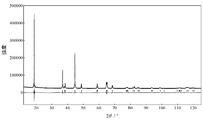
- FIG. 2 is a diagram showing an X-ray diffraction pattern of a sample obtained in Example 1.
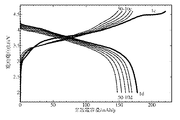
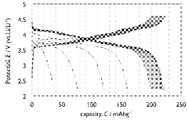
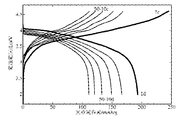
- FIG. It is a figure which shows the result of the charging / discharging test (negative electrode: lithium metal) of the sample obtained in Example 1. It is a figure which shows the result of the charging / discharging test (negative electrode: graphite) of the sample obtained in Example 1. It is a figure which shows the result of the charging / discharging test (negative electrode: lithium metal) of the sample obtained in Example 1. It is a figure which shows the X-ray-diffraction pattern of the sample obtained by the comparative example 1. It is a figure which shows the result of the charging / discharging test (negative electrode: lithium metal) of the sample obtained by the comparative example 1. It is a figure which shows the result of the charging / discharging test (negative electrode: graphite) of the sample obtained by the comparative example 1.
- Lithium nickel composite oxide The present invention includes lithium nickel composite oxide.
- the lithium nickel composite oxide of the present invention has the general formula (1): Li x NiO 2 + ⁇ (1) [Wherein x represents 0.8 ⁇ x ⁇ 1.4, and ⁇ represents ⁇ 0.20 ⁇ ⁇ ⁇ 0.20. ] It is a compound represented by these.
- x corresponds to the molar ratio of Li to Ni (Li / Ni).
- x is less than 0.8, the capacity is reduced, and when x exceeds 1.4, the crystal structure changes to a monoclinic LiNiO 2 —Li 2 NiO 3 based solid solution having poor battery characteristics.
- 0.8 ⁇ x ⁇ 1.4 is preferable, and 0.9 ⁇ x ⁇ 1.3 is more preferable.
- ⁇ corresponds to the non-stoichiometry of the oxygen amount.
- ⁇ is ⁇ 0.20 ⁇ ⁇ ⁇ 0.20, preferably ⁇ 0.15 ⁇ ⁇ ⁇ 0.15, more preferably ⁇ 0.10 ⁇ ⁇ ⁇ 0.10.
- lithium nickel composite oxide represented by the general formula (1) examples include Li 1.1 NiO 2 and Li 1.16 NiO 2 .
- the lithium nickel composite oxide of the present invention has a space group:
- the crystal phase of the hexagonal layered rock salt structure belonging to The lithium nickel-based composite oxide of the present invention only needs to contain a crystal phase of the above hexagonal layered rock salt structure, and a mixture containing a crystal phase of another rock salt structure (for example, a cubic rock salt structure). It may be a phase.
- a mixed phase the ratio of the crystal phase of the hexagonal layered rock salt structure is 50 to 90% by weight based on the whole mixed phase (100% by weight) from the viewpoint of capacity, cycle characteristics, manufacturing process, etc. preferable.
- the lithium nickel composite oxide of the present invention may be composed of only the crystal phase of the above hexagonal layered rock salt structure.
- the lithium nickel composite oxide of the present invention is based on the total amount of elements present in the Ni layer (3b site) as a reference (100%).
- the occupation ratio is preferably 99.9% or less, particularly preferably 80.0 to 99.0%.
- the lattice constant a is preferably 2.800 to 2.870, more preferably 2.830 to 2.865, and particularly preferably 2.840 to 2.860.
- the lattice constant a is in this range, a positive electrode active material having excellent cycle characteristics can be obtained.
- the lattice constant c is 14.130 to 14.190, preferably 14.131 to 14.180. More preferably, it is not less than 14.132 and not more than 14.160, more preferably not less than 14.133 and not more than 14.150, and particularly preferably not less than 14.135 and not more than 14.140.
- the lithium nickel composite oxide of the present invention preferably has a value (c / a) obtained by dividing the lattice constant c by the lattice constant a (c / a) from 4.940 to 4.960 from the viewpoints of capacity, cycle characteristics, production process and the like. It is more preferably 4.942 or more and 4.950 or less.
- the lattice volume is 100.00A 3 or more 100.50 ⁇ less than 3 are preferred, 100.01A 3 or more 100.40A 3 or less , still more preferably 100.02A 3 or more 100.30A 3 or less, more preferably 100.03A 3 or more 100.20A 3 or less, 100.04A 3 or more 100.10A 3 or less is particularly preferred.
- the crystal structure, the Ni ion occupancy in the Ni layer, the lattice constants a and c, and the lattice volume are all CuK ⁇ as a radiation source, and the measurement range of the diffraction angle 2 ⁇ is 10 ° to 125 °. Powder X-ray diffraction measurement is performed, and determination or calculation is performed by performing Rietveld analysis based on the measurement result.
- the present invention further includes a method for producing the lithium nickel composite oxide described above.
- the method for producing a lithium nickel composite oxide of the present invention includes a step of mixing a lithium compound with nickel hydroxide and / or a water-soluble nickel salt in an aqueous solvent (described as “first step” in the present specification). And a step of firing the mixture in an oxidizing atmosphere (may be referred to as “second step” in this specification).
- the lithium compound used in the first step is not particularly limited, and examples thereof include lithium hydroxide (including hydrate), lithium carbonate, lithium acetate (including hydrate), and lithium nitrate. Moreover, it is preferable to add the lithium compound used in the first step so as to be 1.5 times or more and 2.5 times or less with respect to the number of moles of charged nickel.
- nickel hydroxide can be used as the nickel hydroxide used in the first step. Moreover, you may use what is obtained by neutralizing water-soluble nickel salt with an alkali as needed. In this case, nickel hydroxide obtained by neutralizing a water-soluble nickel salt with an alkali in advance can be used in the first step, or the water-soluble nickel salt is charged into an aqueous solvent and alkali in the system. Nickel hydroxide can also be obtained by neutralizing with. Examples of the water-soluble nickel salt include nitrates, chlorides, sulfates, acetates, and hydrates thereof. Moreover, water-soluble nickel salt may be used individually by 1 type, and 2 or more types may be mixed and used for it.
- the alkali used for neutralizing the water-soluble nickel salt is not particularly limited, and for example, sodium hydroxide, potassium hydroxide, lithium hydroxide, ammonia and the like can be used.
- the concentration of the alkali may be a concentration that can maintain pH 11 or more during the neutralization step in which the water-soluble nickel salt is dropped into the alkali.
- the temperature during the neutralization step is preferably -10 ° C or higher and 50 ° C or lower. By reducing the neutralization temperature, the nucleation rate of nickel hydroxide is increased, and finer and more reactive nickel hydroxide can be obtained.
- an antifreeze such as ethanol may be added to the alkaline aqueous solution.
- lithium hydroxide when making it react at low temperature, it is preferable to use lithium hydroxide as an alkali. There is no need to remove other alkali ions as lithium hydroxide impurities, and the remaining lithium hydroxide can be used as the above-described lithium compound.
- finish of dripping as needed in order to mature
- the specific method of the first step is not particularly limited, but nickel hydroxide is added to the aqueous solution containing the lithium compound from the viewpoint of easy availability of the lithium nickel composite oxide of the present invention and the ease of the manufacturing process. And / or it is preferable to set it as the process of adding water-soluble nickel salt.
- the aqueous solution containing the lithium compound used in the first step is preferably alkaline.
- the alkali source is not particularly limited, and for example, sodium hydroxide, potassium hydroxide, lithium hydroxide, ammonia and the like can be used. Further, lithium hydroxide is preferable because it acts not only as an alkali source but also as a lithium compound.
- the manufacturing method of the lithium nickel type complex oxide of the present invention includes a step of drying the mixture, if necessary, before the second step described later after the first step.
- the drying method is not particularly limited and can be performed according to a conventional method. For example, a method of transferring the mixture obtained in the first step to a container such as a petri dish and putting it in a drier kept at 50 ° C. or more and drying for several hours can be mentioned.
- the dry powder of the mixture obtained at the 1st process can be prepared.
- the mixture obtained in the first step is baked in an oxidizing atmosphere.
- the oxidizing atmosphere is not particularly limited, and examples thereof include an atmospheric atmosphere and an oxygen stream. If the firing temperature exceeds 690 ° C, the cycle characteristics may be deteriorated, so the temperature is 690 ° C or less, preferably 600 ° C or more and 690 ° C or less, more preferably 620 ° C or more and 680 ° C or less. Further, the firing time is not particularly limited, and can be, for example, about 1 hour to 30 hours. In addition, it is preferable to perform this baking only once instead of performing multiple times from the viewpoint of further improving cycle characteristics without excessive baking.
- the method for producing a lithium nickel composite oxide of the present invention preferably includes a step of cooling the fired product obtained in the second step.
- the method for cooling the fired product is not particularly limited, and can be performed according to a conventional method. For example, a method of leaving the fired product in a furnace to near room temperature can be used.
- the obtained fired product is pulverized, washed, filtered, and dried. It is preferable to include at least one step.
- the specific method of these steps is not particularly limited, and can be performed according to a conventional method.
- Positive electrode material for lithium ion secondary battery and lithium ion secondary battery can be used as a positive electrode material for lithium ion secondary battery. Furthermore, by combining with the positive electrode material for lithium ion secondary battery, negative electrode, electrolyte (including solid electrolyte), and separator, the lithium ion secondary battery having high capacity and excellent cycle characteristics (non-aqueous lithium ion secondary battery) And an all-solid-state lithium ion secondary battery).
- the negative electrode is not particularly limited, and examples thereof include metallic lithium, graphite, Si—SiO negative electrode, and LTO negative electrode.
- the electrolyte is not particularly limited, and is an organic electrolytic solution in which LiPF 6 is used as a supporting salt and dissolved in various solvents such as ethyl carbonate (EC) and dimethyl carbonate (DMC), Li 2 S—P 2 S 5 , Li 2.
- solvents such as ethyl carbonate (EC) and dimethyl carbonate (DMC), Li 2 S—P 2 S 5 , Li 2.
- examples thereof include inorganic sulfide-based solid electrolytes such as S—GeS 2 —P 2 S 5 and Li 2 S—SiS 2 —Li 3 PO 4, and polymer polymers having lithium ion conductivity.
- the separator is not particularly limited, and examples thereof include polyethylene and polypropylene.
- Example 1 Sample Preparation 20.98 g (0.50 mol) of lithium hydroxide monohydrate was added to 200 ml of distilled water and completely dissolved. To the lithium hydroxide solution, 23.18 g (0.25 mol) of nickel hydroxide was added and dispersed by stirring. The obtained mixture was transferred to a petri-tetrafluoroethylene petri dish, and the petri dish was placed in a drier kept at 100 ° C. and dried for 3 hours. The obtained dry powder was pulverized and mixed, heated to 650 ° C. over 1 hour in an oxygen stream in an electric furnace, fired for 20 hours, and then cooled to near room temperature in the furnace to obtain a fired product. . The obtained fired product was pulverized, washed with distilled water, filtered, and dried at 100 ° C. to obtain a product.
- FIG. 1 shows an actual measurement (+) and a calculated (solid line) X-ray diffraction pattern of the product obtained above. Further, by Rietveld analysis, the obtained product is a hexagonal LiNiO 2 single phase having a layered rock salt structure, a lattice constant a is 2.85856 (7) 7, and a lattice constant c is 14.1383 (3 ) ⁇ , lattice volume is 100.051 (4) ⁇ 3 , c / a value is 4.946, Ni ion occupancy in Ni layer is 90.4 (2)%, Ni ion occupancy in Li layer is It was found to be 1.27 (7)%.
- the product obtained above, ketjen black, and polytetrafluoroethylene were mixed at a weight ratio of 84: 8: 8, and the charge capacity was set to 40 mAh after the stage charge method (starting from 40 mAh / g charge and discharging.
- the battery is then activated by charging to 4.6 V and then discharged to 2.0 V), and then charged for 20 cycles at 2.0 to 4.6 V. Discharged.
- the results are shown in FIG.
- the initial discharge capacity reached 222 mAh / g, and the discharge capacity after 20 cycles was maintained at 89%. From this, it was found that even when the amount of the active material in the positive electrode material was increased to 84%, good charge / discharge characteristics were exhibited.
- the temperature is again raised to 700 ° C. in an oxygen stream over 1 hour in an electric furnace, fired for 20 hours, and then cooled to near room temperature in the furnace to obtain a fired product. It was.
- the obtained fired product was pulverized, washed with distilled water, filtered, and dried at 100 ° C. to obtain a product.
- FIG. 5 shows an actual measurement (+) and calculation (solid line) X-ray diffraction pattern of the product obtained above. Further, by Rietveld analysis, the obtained product is a hexagonal LiNiO 2 single phase having a layered rock salt structure, the lattice constant a is 2.87589 (3) ⁇ , and the lattice constant c is 14.19150 (13 ), Lattice volume is 100.6489 (18) 3 , c / a value is 4.935, Ni ion occupancy in Ni layer is 100%, Ni ion occupancy in Li layer is 0.56 (5 )%.
- Example 1 was compared with the sample of Comparative Example 1 in both cases where the negative electrode was metallic lithium and graphite, the initial charge / discharge capacity, the initial average discharge voltage, and the initial discharge.
- the energy density is somewhat inferior, it is a level that can be sufficiently used as a positive electrode material for a lithium ion secondary battery, the initial charge / discharge efficiency is comparable, and the discharge capacity after 50 cycles and the discharge capacity maintenance rate after 50 cycles are excellent. I found out.
Landscapes
- Chemical & Material Sciences (AREA)
- Inorganic Chemistry (AREA)
- Organic Chemistry (AREA)
- Chemical Kinetics & Catalysis (AREA)
- Electrochemistry (AREA)
- General Chemical & Material Sciences (AREA)
- Battery Electrode And Active Subsutance (AREA)
- Inorganic Compounds Of Heavy Metals (AREA)
Abstract
一般式(1): LixNiO2+δ (1) [式中、xは0.8≦x≦1.3を示し、δは-0.20≦δ≦0.20を示す。] で表されるリチウムニッケル系複合酸化物であって、 六方晶層状岩塩型構造の結晶相を含み、 格子定数cが14.130Å以上14.190未満である、リチウムニッケル系複合酸化物は、高容量を有し、かつサイクル特性の劣化が顕著に抑制されている。
Description
本発明は、リチウムニッケル系複合酸化物及びその製造方法に関する。
リチウム含有複合酸化物はリチウムイオン二次電池用の正極活物質として用いられている。リチウムイオン二次電池は、携帯電話、ノートパソコン用電源に使用されるだけでなく、車載用、電力負荷平準化システム用などの中型・大型電源用としても期待されており、一部実用化がなされている。
リチウム含有複合酸化物の中でもニッケル酸リチウムは、高い比容量(200mAh/g)を有する4V級正極材料として期待されている。しかしながら、ニッケル酸リチウムは、高容量を得るために高い電圧(上限電圧:4.3V)以上まで充電するとサイクル特性が著しく劣化することが知られている。
このような中、本発明者らは、特定の結晶構造を有し、かつ特定のパラメータを有するリチウム複合金属酸化物が、高容量を維持しつつ、サイクル特性の劣化を抑制することを見出している(下記特許文献1参照)。
しかしながら、車載用などの長寿命が要求される用途においては、サイクル特性の劣化がさらに抑制された材料が必要である。
本発明は上記した従来技術の現状に鑑みてなされたものであり、高容量を有し、かつサイクル特性の劣化が顕著に抑制されたリチウム含有複合酸化物を提供することを目的とする。
本発明者らは上記した目的を達成すべく鋭意研究を重ねた結果、驚くべきことに、特定の組成を有するリチウムニッケル系複合酸化物が、高容量を有し、かつサイクル特性の劣化が顕著に抑制されることを見出した。本発明者らは、かかる知見に基づきさらなる研究を重ねることにより、本発明を完成させるに至った。
即ち、本発明は、以下の項に記載の発明を包含する。
項1.一般式(1):
LixNiO2+δ (1)
[式中、xは0.8≦x≦1.3を示し、δは-0.20≦δ≦0.20を示す。]
で表されるリチウムニッケル系複合酸化物であって、
六方晶層状岩塩型構造の結晶相を含み、
格子定数cが14.130Å以上14.190未満である、リチウムニッケル系複合酸化物。
項2.格子体積が100.00Å3以上100.50Å3未満である、上記項1に記載のリチウムニッケル系複合酸化物。
項3.六方晶層状岩塩型構造の結晶相のみからなる、上記項1又は2に記載のリチウムニッケル系複合酸化物。
項4.上記項1~3のいずれかに記載のリチウムニッケル系複合酸化物の製造方法であって、
水性溶媒中で、リチウム化合物と、水酸化ニッケル及び/又は水溶性ニッケル塩とを混合する第1工程、及び
前記第1工程により得られた混合物を酸化性雰囲気下で焼成する第2工程
を含む、製造方法。
項5.前記第1工程が、リチウム化合物を含む水溶液に水酸化ニッケル及び/又は水溶性ニッケル塩を添加する工程である、上記項4に記載の製造方法。
項6.前記第2工程における焼成温度が600℃以上690℃以下である、上記項4又は5に記載の製造方法。
項7.上記項1~3のいずれかに記載のリチウムニッケル系複合酸化物を含む、リチウムイオン二次電池用正極材料。
項8.上記項7に記載のリチウムイオン二次電池用正極材料を含む、リチウムイオン二次電池。
項1.一般式(1):
LixNiO2+δ (1)
[式中、xは0.8≦x≦1.3を示し、δは-0.20≦δ≦0.20を示す。]
で表されるリチウムニッケル系複合酸化物であって、
六方晶層状岩塩型構造の結晶相を含み、
格子定数cが14.130Å以上14.190未満である、リチウムニッケル系複合酸化物。
項2.格子体積が100.00Å3以上100.50Å3未満である、上記項1に記載のリチウムニッケル系複合酸化物。
項3.六方晶層状岩塩型構造の結晶相のみからなる、上記項1又は2に記載のリチウムニッケル系複合酸化物。
項4.上記項1~3のいずれかに記載のリチウムニッケル系複合酸化物の製造方法であって、
水性溶媒中で、リチウム化合物と、水酸化ニッケル及び/又は水溶性ニッケル塩とを混合する第1工程、及び
前記第1工程により得られた混合物を酸化性雰囲気下で焼成する第2工程
を含む、製造方法。
項5.前記第1工程が、リチウム化合物を含む水溶液に水酸化ニッケル及び/又は水溶性ニッケル塩を添加する工程である、上記項4に記載の製造方法。
項6.前記第2工程における焼成温度が600℃以上690℃以下である、上記項4又は5に記載の製造方法。
項7.上記項1~3のいずれかに記載のリチウムニッケル系複合酸化物を含む、リチウムイオン二次電池用正極材料。
項8.上記項7に記載のリチウムイオン二次電池用正極材料を含む、リチウムイオン二次電池。
本発明のリチウムニッケル系複合酸化物をリチウムイオン二次電池用の正極活物質として用いることにより、高容量を有し、かつ高いサイクル安定性を示すリチウムイオン二次電池を提供することが可能となる。
以下、本発明について詳細に説明する。
1.リチウムニッケル系複合酸化物
本発明は、リチウムニッケル系複合酸化物を包含する。本発明のリチウムニッケル系複合酸化物は、一般式(1):
LixNiO2+δ (1)
[式中、xは0.8≦x≦1.4を示し、δは-0.20≦δ≦0.20を示す。]
で表される化合物である。
本発明は、リチウムニッケル系複合酸化物を包含する。本発明のリチウムニッケル系複合酸化物は、一般式(1):
LixNiO2+δ (1)
[式中、xは0.8≦x≦1.4を示し、δは-0.20≦δ≦0.20を示す。]
で表される化合物である。
上記一般式(1)において、xは、LiとNiとのモル比(Li/Ni)に相当する。xが0.8未満であると容量の低下を招き、xが1.4を超えると結晶構造が電池特性の劣る単斜晶LiNiO2-Li2NiO3系固溶体に変化することから、xは、0.8≦x≦1.4である。また、サイクル特性の高い正極活物質とする観点からは、0.8≦x≦1.3が好ましく、0.9≦x≦1.3がより好ましい。
上記一般式(1)において、δは、酸素量の不定比性に相当する。δは、-0.20≦δ≦0.20、好ましくは-0.15≦δ≦0.15、より好ましくは-0.10≦δ≦0.10である。
上記一般式(1)で表されるリチウムニッケル系複合酸化物としては、例えば、Li1.1NiO2、Li1.16NiO2などが挙げられる。
本発明のリチウムニッケル系複合酸化物は、空間群:

に帰属する六方晶層状岩塩型構造の結晶相を含む。本発明のリチウムニッケル系複合酸化物は、上記の六方晶層状岩塩型構造の結晶相を含んでいればよく、他の岩塩型構造の結晶相(例えば、立方晶岩塩型構造等)を含む混合相であってもよい。混合相である場合、六方晶層状岩塩型構造の結晶相の割合は、容量、サイクル特性、製造工程等の観点から、当該混合相全体を基準(100重量%)として、50~90重量%が好ましい。また、本発明のリチウムニッケル系複合酸化物は、上記の六方晶層状岩塩型構造の結晶相のみからなるものであってもよい。
本発明のリチウムニッケル系複合酸化物は、容量、サイクル特性、製造工程等の観点から、Ni層(3bサイト)に存在する元素の総量を基準(100%)として、Ni層内におけるNiイオンの占有率が99.9%以下、特に80.0~99.0%であることが好ましい。
本発明のリチウムニッケル系複合酸化物は、格子定数aが2.800Å以上2.870Å以下が好ましく、2.830Å以上2.865Å以下がより好ましく、2.840Å以上2.860Å以下が特に好ましい。格子定数aが当該範囲にあることにより、サイクル特性に優れた正極活物質とすることができる。
本発明のリチウムニッケル系複合酸化物は、容量、サイクル特性、製造工程等の観点から、格子定数cが14.130Å以上14.190未満であり、14.131Å以上14.180以下が好ましく、14.132Å以上14.170Å以下がより好ましく、14.133Å以上14.160Å以下がさらに好ましく、14.134Å以上14.150Å以下が一層好ましく、14.135Å以上14.140Å以下が特に好ましい。
本発明のリチウムニッケル系複合酸化物は、容量、サイクル特性、製造工程等の観点から、格子定数cを格子定数aで除した値(c/a)が4.940以上4.960以下が好ましく、4.942以上4.950以下がより好ましい。
本発明のリチウムニッケル系複合酸化物は、容量、サイクル特性、製造工程等の観点から、格子体積が100.00Å3以上100.50Å3未満が好ましく、100.01Å3以上100.40Å3以下がより好ましく、100.02Å3以上100.30Å3以下がさらに好ましく、100.03Å3以上100.20Å3以下が一層好ましく、100.04Å3以上100.10Å3以下が特に好ましい。
なお、上記した結晶構造、Ni層内におけるNiイオンの占有率、格子定数a及びc、並びに格子体積は、いずれもCuKαを線源とし、回折角2θの測定範囲を10°以上125°以下とする粉末X線回折測定を行い、当該測定結果を元にリートベルト解析を行うことにより決定又は算出したものである。
2.リチウムニッケル系複合酸化物の製造方法
本発明は、さらに、上記したリチウムニッケル系複合酸化物の製造方法を包含する。本発明のリチウムニッケル系複合酸化物の製造方法は、水性溶媒中で、リチウム化合物と、水酸化ニッケル及び/又は水溶性ニッケル塩とを混合する工程(本明細書において「第1工程」と記載する場合がある。)、及び当該混合物を酸化性雰囲気下で焼成する工程(本明細書において「第2工程」と記載する場合がある。)を含む。
本発明は、さらに、上記したリチウムニッケル系複合酸化物の製造方法を包含する。本発明のリチウムニッケル系複合酸化物の製造方法は、水性溶媒中で、リチウム化合物と、水酸化ニッケル及び/又は水溶性ニッケル塩とを混合する工程(本明細書において「第1工程」と記載する場合がある。)、及び当該混合物を酸化性雰囲気下で焼成する工程(本明細書において「第2工程」と記載する場合がある。)を含む。
第1工程において用いるリチウム化合物としては特に限定的ではなく、例えば、水酸化リチウム(水和物を含む)、炭酸リチウム、酢酸リチウム(水和物を含む)、硝酸リチウムなどが挙げられる。また、第1工程において用いるリチウム化合物は、仕込みニッケルのモル数に対して1.5倍以上2.5倍以下となるように添加することが好ましい。
第1工程において用いる水酸化ニッケルとしては、市販のものを用いることができる。また、必要に応じて、水溶性ニッケル塩をアルカリで中和することにより得られるものを用いてもよい。この場合、あらかじめ水溶性ニッケル塩をアルカリで中和することにより得られた水酸化ニッケルを第1工程に使用することもできるし、水性溶媒中に水溶性ニッケル塩を投入して系中でアルカリで中和することで水酸化ニッケルを得ることもできる。水溶性ニッケル塩としては、例えば、硝酸塩、塩化物、硫酸塩、酢酸塩、及びその水和物などが挙げられる。また、水溶性ニッケル塩は1種単独で用いてもよいし、2種以上を混合して用いてもよい。
水溶性ニッケル塩を中和する際に用いるアルカリとしては特に限定的ではなく、例えば、水酸化ナトリウム、水酸化カリウム、水酸化リチウム、アンモニアなどを用いることができる。アルカリの濃度は、アルカリに対して水溶性ニッケル塩を滴下していく中和工程の間中、pH11以上を維持できる濃度であればよい。また、中和工程時の温度は-10℃以上50℃以下とすることが好ましい。中和温度を低下させることにより水酸化ニッケルの核生成速度が速くなり、より微細な反応性の高い水酸化ニッケルを得ることができる。特に反応温度を0℃以下に保持するために、アルカリ水溶液にエタノールなどの不凍液を加えても良い。このように、低温で反応させる場合、アルカリとしては水酸化リチウムを用いることが好ましい。水酸化リチウム不純物として他のアルカリイオンを除去する必要がないうえに、残存する水酸化リチウムは上記したリチウム化合物として使用することもできるという工程上のメリットがある。中和工程時にアルカリ溶液に水溶性ニッケル塩を加えるには、均一な水酸化ニッケルを得るために滴下工程により数時間かけて徐々に行うことが好ましい。また、必要に応じて滴下終了後、沈殿を熟成するために沈殿を室温にて空気を吹き込みながら数時間以上撹拌してもよい。さらに、必要に応じて、沈殿を調製した後、残留アルカリを除去するために、沈殿を蒸留水で水洗後、濾過してもよい。
このような第1工程の具体的な方法としては、特に制限されないが、本発明のリチウムニッケル系複合酸化物の得やすさと製造工程の容易さの観点から、リチウム化合物を含む水溶液に水酸化ニッケル及び/又は水溶性ニッケル塩を添加する工程とすることが好ましい。この場合、第1工程において用いるリチウム化合物を含む水溶液は、アルカリ性であることが好ましい。アルカリ源としては特に限定的ではなく、例えば、水酸化ナトリウム、水酸化カリウム、水酸化リチウム、アンモニアなどを用いることができる。また、水酸化リチウムは、アルカリ源としてだけではなく、リチウム化合物としても作用するため好ましい。
また、本発明のリチウムニッケル系複合酸化物の製造方法は、上記した第1工程の後、後述する第2工程に供する前に、必要に応じて、混合物を乾燥する工程を含むことが好ましい。乾燥方法としては特に限定的ではなく常法に従って行うことができる。例えば、第1工程で得られた混合物をシャーレ等の容器に移し、50℃以上に保温した乾燥機に入れて数時間乾燥を行う方法などが挙げられる。当該乾燥工程により、第1工程で得られた混合物の乾燥粉末を調製することができる。また、乾燥後、第2工程に供する前に、必要に応じて得られた乾燥粉末を粉砕してもよい。
第2工程では、第1工程で得られた混合物を酸化性雰囲気下で焼成する。酸化性雰囲気としては特に限定的ではなく、例えば、大気中雰囲気、酸素気流中などが挙げられる。焼成温度としては、690℃を超えるとサイクル特性が劣化するおそれがあるため、690℃以下の温度であり、好ましくは600℃以上690℃以下、より好ましくは620℃以上680℃以下である。また、焼成時間としては特に限定的ではなく、例えば、1時間~30時間程度とすることができる。なお、この焼成は、過度の焼成をしないことでサイクル特性をより向上させる観点からは、複数回行わず、1回だけ行うことが好ましい。
また、本発明のリチウムニッケル系複合酸化物の製造方法は、上記した第2工程により得られた焼成物を冷却する工程を含むことが好ましい。焼成物の冷却方法としては特に限定的ではなく常法に従って行うことができ、例えば、焼成後、炉内で室温付近まで放置する方法などが挙げられる。
さらに、本発明のリチウムニッケル系複合酸化物の製造方法は、必要に応じて、上記した冷却工程を経た後、得られた焼成物を粉砕する工程、洗浄する工程、濾過する工程、及び乾燥する工程の少なくとも1つの工程を含むことが好ましい。これらの工程の具体的な方法としては特に限定的ではなく、常法に従って行うことができる。
3.リチウムイオン二次電池用正極材料及びリチウムイオン二次電池
上記した本発明のリチウムニッケル系複合酸化物は、リチウムイオン二次電池用正極材料として用いることができる。さらに、当該リチウムイオン二次電池用正極材料、負極、電解質(固体電解質を含む)、及びセパレータと組み合わせることにより、高容量かつサイクル特性に優れたリチウムイオン二次電池(非水系リチウムイオン二次電池及び全固体リチウムイオン二次電池)とすることができる。負極としては特に限定的ではなく、例えば、金属リチウム、黒鉛、Si-SiO系負極、LTO系負極などが挙げられる。電解質としては特に限定的ではなく、LiPF6を支持塩とし、炭酸エチル(EC)や炭酸ジメチル(DMC)などの各種溶媒に溶解させた有機電解液、Li2S-P2S5、Li2S-GeS2-P2S5、Li2S-SiS2-Li3PO4などの無機硫化物系固体電解質、リチウムイオン導電性を有する高分子ポリマーなどが挙げられる。セパレータとしては特に限定的ではなく、ポリエチレン、ポリプロピレンなどが挙げられる。
上記した本発明のリチウムニッケル系複合酸化物は、リチウムイオン二次電池用正極材料として用いることができる。さらに、当該リチウムイオン二次電池用正極材料、負極、電解質(固体電解質を含む)、及びセパレータと組み合わせることにより、高容量かつサイクル特性に優れたリチウムイオン二次電池(非水系リチウムイオン二次電池及び全固体リチウムイオン二次電池)とすることができる。負極としては特に限定的ではなく、例えば、金属リチウム、黒鉛、Si-SiO系負極、LTO系負極などが挙げられる。電解質としては特に限定的ではなく、LiPF6を支持塩とし、炭酸エチル(EC)や炭酸ジメチル(DMC)などの各種溶媒に溶解させた有機電解液、Li2S-P2S5、Li2S-GeS2-P2S5、Li2S-SiS2-Li3PO4などの無機硫化物系固体電解質、リチウムイオン導電性を有する高分子ポリマーなどが挙げられる。セパレータとしては特に限定的ではなく、ポリエチレン、ポリプロピレンなどが挙げられる。
以下、実施例を挙げて本発明をさらに詳細に説明するが、本発明は下記の例に限定されるものではない。
[実施例1]
試料の調製
水酸化リチウム1水和物20.98g(0.50mol)を200mlの蒸留水に加え完全に溶解させた。当該水酸化リチウム溶液に水酸化ニッケル23.18g(0.25mol)を加えて撹拌して分散させた。得られた混合物をポリテトラフルオロエチレン製シャーレに移し、当該シャーレを100℃に保たれた乾燥機に入れ、3時間かけて乾燥を行った。得られた乾燥粉末を粉砕混合し、電気炉にて酸素気流中1時間かけて650℃に昇温し、20時間焼成を行い、その後、炉内で室温付近まで冷却して焼成物を得た。得られた焼成物を粉砕後、蒸留水を用いて水洗処理を行った後、濾過し、100℃で乾燥することにより生成物を得た。
試料の調製
水酸化リチウム1水和物20.98g(0.50mol)を200mlの蒸留水に加え完全に溶解させた。当該水酸化リチウム溶液に水酸化ニッケル23.18g(0.25mol)を加えて撹拌して分散させた。得られた混合物をポリテトラフルオロエチレン製シャーレに移し、当該シャーレを100℃に保たれた乾燥機に入れ、3時間かけて乾燥を行った。得られた乾燥粉末を粉砕混合し、電気炉にて酸素気流中1時間かけて650℃に昇温し、20時間焼成を行い、その後、炉内で室温付近まで冷却して焼成物を得た。得られた焼成物を粉砕後、蒸留水を用いて水洗処理を行った後、濾過し、100℃で乾燥することにより生成物を得た。
X線回折による評価
上記で得られた生成物の実測(+)及び計算(実線)X線回折パターンを図1に示す。また、リートベルト解析により、得られた生成物が層状岩塩型構造を有する六方晶LiNiO2単相であること、格子定数aが2.85856(7)Å、格子定数cが14.1383(3)Å、格子体積が100.051(4)Å3、c/a値が4.946、Ni層内のNiイオン占有率が90.4(2)%、Li層内のNiイオン占有率が1.27(7)%であることが分かった。
上記で得られた生成物の実測(+)及び計算(実線)X線回折パターンを図1に示す。また、リートベルト解析により、得られた生成物が層状岩塩型構造を有する六方晶LiNiO2単相であること、格子定数aが2.85856(7)Å、格子定数cが14.1383(3)Å、格子体積が100.051(4)Å3、c/a値が4.946、Ni層内のNiイオン占有率が90.4(2)%、Li層内のNiイオン占有率が1.27(7)%であることが分かった。
化学分析
ICP発光分析により上記で得られた生成物の化学組成を求めたところ、Li/Ni比が1.16であることが分かった。
ICP発光分析により上記で得られた生成物の化学組成を求めたところ、Li/Ni比が1.16であることが分かった。
充放電特性評価
上記で得られた生成物5mgをアセチレンブラック5mgと混合した後、ポリテトラフルオロエチレン0.5mgを用いて正極合材を作製し、当該正極合材をアルミニウムメッシュに圧着して正極とした。次いで、当該正極、負極として金属リチウム、電解液として1M LiPF6/EC+DMC系、及びセパレータを用いてコイン型電池を作製し、充放電試験を行った。充放電試験は充電開始で、電位範囲:2.2~4.8V、正極活物質あたりの電流密度:40mA/g、試験温度:30℃の条件で50サイクルまで行った。結果を図2に示す。また、負極として黒鉛を用い、電位範囲を2.0~4.6Vとしたこと以外は上記と同様にして充放電試験を行った。結果を図3に示す。
上記で得られた生成物5mgをアセチレンブラック5mgと混合した後、ポリテトラフルオロエチレン0.5mgを用いて正極合材を作製し、当該正極合材をアルミニウムメッシュに圧着して正極とした。次いで、当該正極、負極として金属リチウム、電解液として1M LiPF6/EC+DMC系、及びセパレータを用いてコイン型電池を作製し、充放電試験を行った。充放電試験は充電開始で、電位範囲:2.2~4.8V、正極活物質あたりの電流密度:40mA/g、試験温度:30℃の条件で50サイクルまで行った。結果を図2に示す。また、負極として黒鉛を用い、電位範囲を2.0~4.6Vとしたこと以外は上記と同様にして充放電試験を行った。結果を図3に示す。
また、上記で得られた生成物、ケッチェンブラック、ポリテトラフルオロエチレンを84:8:8の重量比で混合し、段階充電法(40mAh/g充電からスタートし、放電後、充電容量を40mAh/gずつ上昇させて200mAh/gまで充電容量を伸ばしサイクルさせ、次に4.6Vまで充電後2.0Vまで放電させる方法)にて活性化後、2.0~4.6Vで20サイクル充放電させた。結果を図4に示す。初期放電容量は222mAh/gに達し、20サイクル後の放電容量は89%を維持していた。このことから、正極材料中の活物質量を84%にまで上げても良好な充放電特性を示すことがわかった。
[比較例1]
試料の調製
水酸化リチウム1水和物10.70g(0.255mol)を200mlの蒸留水に加え完全に溶解させた。当該水酸化リチウム溶液に水酸化ニッケル23.18g(0.25mol)を加えて撹拌して分散させた。得られた混合物をポリテトラフルオロエチレン製シャーレに移し、当該シャーレを100℃に保たれた乾燥機に入れ、3時間かけて乾燥を行った。得られた乾燥粉末を粉砕混合し、電気炉にて酸素気流中1時間かけて700℃に昇温し、20時間焼成を行い、その後、炉内で室温付近まで冷却して焼成物を得た。得られた焼成物を粉砕後、再度、電気炉にて酸素気流中1時間かけて700℃に昇温し、20時間焼成を行い、その後、炉内で室温付近まで冷却して焼成物を得た。得られた焼成物を粉砕後、蒸留水を用いて水洗処理を行った後、濾過し、100℃で乾燥することにより生成物を得た。
試料の調製
水酸化リチウム1水和物10.70g(0.255mol)を200mlの蒸留水に加え完全に溶解させた。当該水酸化リチウム溶液に水酸化ニッケル23.18g(0.25mol)を加えて撹拌して分散させた。得られた混合物をポリテトラフルオロエチレン製シャーレに移し、当該シャーレを100℃に保たれた乾燥機に入れ、3時間かけて乾燥を行った。得られた乾燥粉末を粉砕混合し、電気炉にて酸素気流中1時間かけて700℃に昇温し、20時間焼成を行い、その後、炉内で室温付近まで冷却して焼成物を得た。得られた焼成物を粉砕後、再度、電気炉にて酸素気流中1時間かけて700℃に昇温し、20時間焼成を行い、その後、炉内で室温付近まで冷却して焼成物を得た。得られた焼成物を粉砕後、蒸留水を用いて水洗処理を行った後、濾過し、100℃で乾燥することにより生成物を得た。
X線回折による評価
上記で得られた生成物の実測(+)及び計算(実線)X線回折パターンを図5に示す。また、リートベルト解析により、得られた生成物が層状岩塩型構造を有する六方晶LiNiO2単相であること、格子定数aが2.87589(3)Å、格子定数cが14.19150(13)Å、格子体積が100.6489(18)Å3、c/a値が4.935、Ni層内のNiイオン占有率が100%、Li層内のNiイオン占有率が0.56(5)%であることが分かった。
上記で得られた生成物の実測(+)及び計算(実線)X線回折パターンを図5に示す。また、リートベルト解析により、得られた生成物が層状岩塩型構造を有する六方晶LiNiO2単相であること、格子定数aが2.87589(3)Å、格子定数cが14.19150(13)Å、格子体積が100.6489(18)Å3、c/a値が4.935、Ni層内のNiイオン占有率が100%、Li層内のNiイオン占有率が0.56(5)%であることが分かった。
化学分析
ICP発光分析により上記で得られた生成物の化学組成を求めたところ、Li/Ni比が1.02であることが分かった。
ICP発光分析により上記で得られた生成物の化学組成を求めたところ、Li/Ni比が1.02であることが分かった。
充放電特性評価
上記で得られた生成物5mgをアセチレンブラック5mgと混合した後、ポリテトラフルオロエチレン0.5mgを用いて正極合材を作製し、当該正極合材をアルミニウムメッシュに圧着して正極とした。次いで、当該正極、負極として金属リチウム、電解液として1M LiPF6/EC+DMC系、及びセパレータを用いてコイン型電池を作製し、充放電試験を行った。充放電試験は充電開始で、電位範囲:2.2~4.8V、正極活物質あたりの電流密度:40mA/g、試験温度:30℃の条件で50サイクルまで行った。結果を図6に示す。また、負極として黒鉛を用い、電位範囲を2.0~4.6Vとしたこと以外は上記と同様にして充放電試験を行った。結果を図7に示す。
上記で得られた生成物5mgをアセチレンブラック5mgと混合した後、ポリテトラフルオロエチレン0.5mgを用いて正極合材を作製し、当該正極合材をアルミニウムメッシュに圧着して正極とした。次いで、当該正極、負極として金属リチウム、電解液として1M LiPF6/EC+DMC系、及びセパレータを用いてコイン型電池を作製し、充放電試験を行った。充放電試験は充電開始で、電位範囲:2.2~4.8V、正極活物質あたりの電流密度:40mA/g、試験温度:30℃の条件で50サイクルまで行った。結果を図6に示す。また、負極として黒鉛を用い、電位範囲を2.0~4.6Vとしたこと以外は上記と同様にして充放電試験を行った。結果を図7に示す。
[結果及び考察]
以上の実施例1及び比較例1の試料のX線回折による評価結果及び化学分析結果を下記表1に、充放電特性評価の結果を下記表2に示す。
以上の実施例1及び比較例1の試料のX線回折による評価結果及び化学分析結果を下記表1に、充放電特性評価の結果を下記表2に示す。
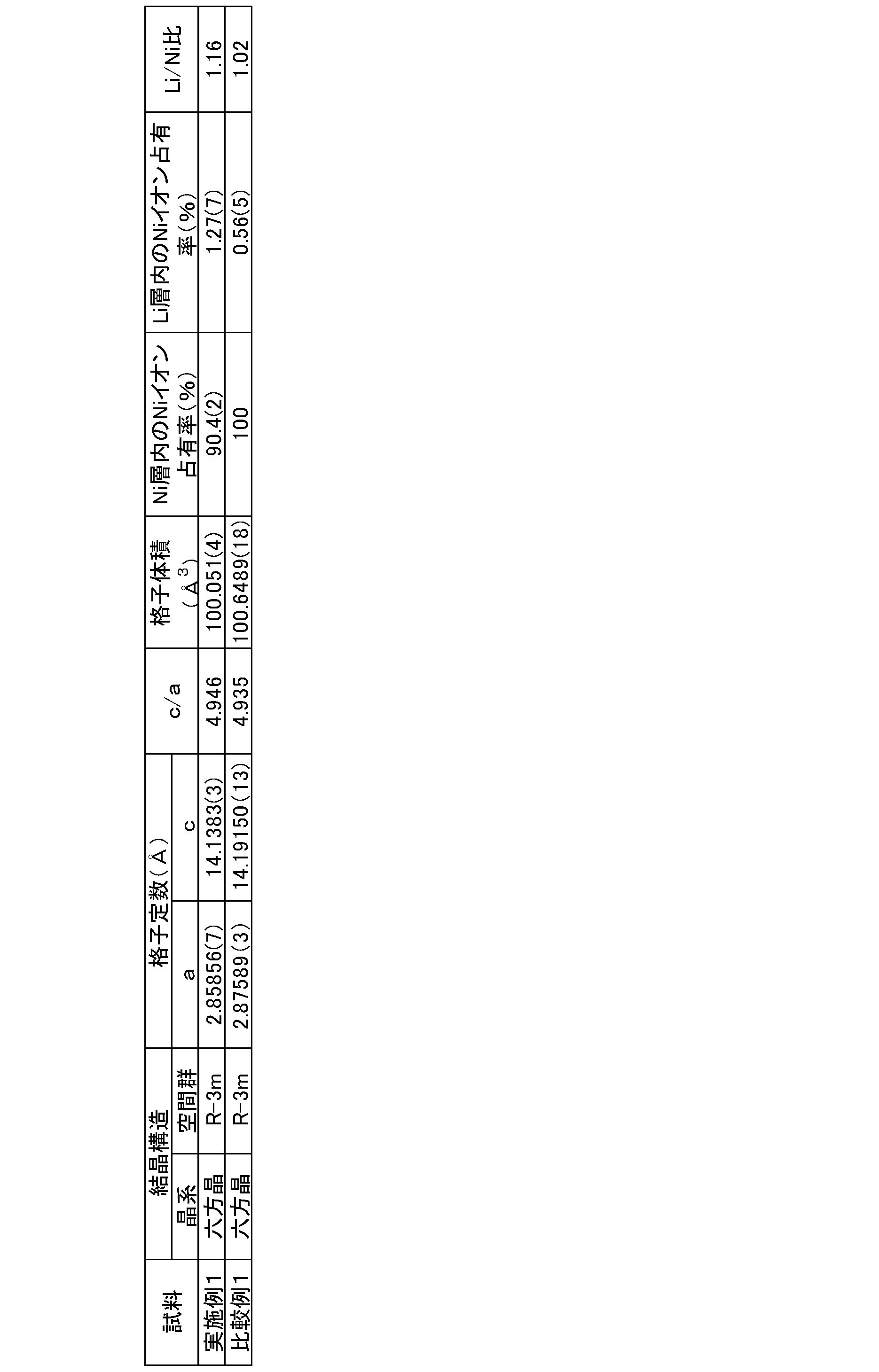

以上の結果から、実施例1の試料は、比較例1の試料と比較して、負極が金属リチウムの場合及び黒鉛の場合のいずれにおいても、初期充放電容量、初期放電平均電圧、及び初期放電エネルギー密度はやや劣るもののリチウムイオン二次電池用正極材料として十分使用可能な水準であり、初期充放電効率は同程度であり、50サイクル後の放電容量及び50サイクル後の放電容量維持率が優れていることが分かった。
Claims (8)
- 一般式(1):
LixNiO2+δ (1)
[式中、xは0.8≦x≦1.3を示し、δは-0.20≦δ≦0.20を示す。]
で表されるリチウムニッケル系複合酸化物であって、
六方晶層状岩塩型構造の結晶相を含み、
格子定数cが14.130Å以上14.190未満である、リチウムニッケル系複合酸化物。 - 格子体積が100.00Å3以上100.50Å3未満である、請求項1に記載のリチウムニッケル系複合酸化物。
- 六方晶層状岩塩型構造の結晶相のみからなる、請求項1又は2に記載のリチウムニッケル系複合酸化物。
- 請求項1~3のいずれかに記載のリチウムニッケル系複合酸化物の製造方法であって、
水性溶媒中で、リチウム化合物と、水酸化ニッケル及び/又は水溶性ニッケル塩とを混合する第1工程、及び
前記第1工程により得られた混合物を酸化性雰囲気下で焼成する第2工程
を含む、製造方法。 - 前記第1工程が、リチウム化合物を含む水溶液に水酸化ニッケル及び/又は水溶性ニッケル塩を添加する工程である、請求項4に記載の製造方法。
- 前記第2工程における焼成温度が600℃以上690℃以下である、請求項4又は5に記載の製造方法。
- 請求項1~3のいずれかに記載のリチウムニッケル系複合酸化物を含む、リチウムイオン二次電池用正極材料。
- 請求項7に記載のリチウムイオン二次電池用正極材料を含む、リチウムイオン二次電池。
Priority Applications (1)
| Application Number | Priority Date | Filing Date | Title |
|---|---|---|---|
| JP2018537210A JP7043076B2 (ja) | 2016-08-30 | 2017-08-24 | リチウムニッケル系複合酸化物及びその製造方法 |
Applications Claiming Priority (2)
| Application Number | Priority Date | Filing Date | Title |
|---|---|---|---|
| JP2016168503 | 2016-08-30 | ||
| JP2016-168503 | 2016-08-30 |
Publications (1)
| Publication Number | Publication Date |
|---|---|
| WO2018043302A1 true WO2018043302A1 (ja) | 2018-03-08 |
Family
ID=61300792
Family Applications (1)
| Application Number | Title | Priority Date | Filing Date |
|---|---|---|---|
| PCT/JP2017/030417 Ceased WO2018043302A1 (ja) | 2016-08-30 | 2017-08-24 | リチウムニッケル系複合酸化物及びその製造方法 |
Country Status (2)
| Country | Link |
|---|---|
| JP (1) | JP7043076B2 (ja) |
| WO (1) | WO2018043302A1 (ja) |
Cited By (1)
| Publication number | Priority date | Publication date | Assignee | Title |
|---|---|---|---|---|
| CN110931738A (zh) * | 2019-11-20 | 2020-03-27 | 广东邦普循环科技有限公司 | 一种复相高压正极材料及其制备方法 |
Citations (7)
| Publication number | Priority date | Publication date | Assignee | Title |
|---|---|---|---|---|
| JPH05283076A (ja) * | 1992-02-07 | 1993-10-29 | Matsushita Electric Ind Co Ltd | 非水電解液二次電池およびその正極活物質の製造法 |
| JPH09298061A (ja) * | 1996-03-04 | 1997-11-18 | Sharp Corp | 非水系二次電池 |
| JPH103921A (ja) * | 1996-06-13 | 1998-01-06 | Japan Storage Battery Co Ltd | リチウム電池用正極活物質およびその製造方法ならびに前記活物質を備えた電池 |
| JP2001332259A (ja) * | 2000-05-22 | 2001-11-30 | Nippon Telegr & Teleph Corp <Ntt> | ニッケル含有酸化物電極材料の製造方法及びその電極材料を用いる電池 |
| JP2004531034A (ja) * | 2001-06-15 | 2004-10-07 | 呉羽化学工業株式会社 | リチウム二次電池用正極材 |
| JP2013056801A (ja) * | 2011-09-08 | 2013-03-28 | Sumitomo Chemical Co Ltd | リチウム複合金属酸化物およびその製造方法 |
| JP2014041831A (ja) * | 2008-04-17 | 2014-03-06 | Jx Nippon Mining & Metals Corp | リチウムイオン電池用正極活物質、二次電池用正極及びリチウムイオン電池 |
-
2017
- 2017-08-24 WO PCT/JP2017/030417 patent/WO2018043302A1/ja not_active Ceased
- 2017-08-24 JP JP2018537210A patent/JP7043076B2/ja active Active
Patent Citations (7)
| Publication number | Priority date | Publication date | Assignee | Title |
|---|---|---|---|---|
| JPH05283076A (ja) * | 1992-02-07 | 1993-10-29 | Matsushita Electric Ind Co Ltd | 非水電解液二次電池およびその正極活物質の製造法 |
| JPH09298061A (ja) * | 1996-03-04 | 1997-11-18 | Sharp Corp | 非水系二次電池 |
| JPH103921A (ja) * | 1996-06-13 | 1998-01-06 | Japan Storage Battery Co Ltd | リチウム電池用正極活物質およびその製造方法ならびに前記活物質を備えた電池 |
| JP2001332259A (ja) * | 2000-05-22 | 2001-11-30 | Nippon Telegr & Teleph Corp <Ntt> | ニッケル含有酸化物電極材料の製造方法及びその電極材料を用いる電池 |
| JP2004531034A (ja) * | 2001-06-15 | 2004-10-07 | 呉羽化学工業株式会社 | リチウム二次電池用正極材 |
| JP2014041831A (ja) * | 2008-04-17 | 2014-03-06 | Jx Nippon Mining & Metals Corp | リチウムイオン電池用正極活物質、二次電池用正極及びリチウムイオン電池 |
| JP2013056801A (ja) * | 2011-09-08 | 2013-03-28 | Sumitomo Chemical Co Ltd | リチウム複合金属酸化物およびその製造方法 |
Non-Patent Citations (1)
| Title |
|---|
| BIANCHI, V. ET AL.: "Synthesis, structural characterization and magnetic properties of quasistoichiometric LiNiO2", SOLID STATE IONICS, vol. 140, no. 1 / 2, March 2001 (2001-03-01), pages 1 - 17, XP004232134, ISSN: 0167-2738, DOI: doi:10.1016/S0167-2738(01)00706-8 * |
Cited By (2)
| Publication number | Priority date | Publication date | Assignee | Title |
|---|---|---|---|---|
| CN110931738A (zh) * | 2019-11-20 | 2020-03-27 | 广东邦普循环科技有限公司 | 一种复相高压正极材料及其制备方法 |
| CN110931738B (zh) * | 2019-11-20 | 2021-08-03 | 广东邦普循环科技有限公司 | 一种复相高压正极材料及其制备方法 |
Also Published As
| Publication number | Publication date |
|---|---|
| JP7043076B2 (ja) | 2022-03-29 |
| JPWO2018043302A1 (ja) | 2019-06-24 |
Similar Documents
| Publication | Publication Date | Title |
|---|---|---|
| JP6162402B2 (ja) | 高い比容量および優れたサイクルを有する積層リチウムリッチ錯体金属酸化物 | |
| CN101689631B (zh) | 非水电解质二次电池和正极的制造方法 | |
| CN104704659B (zh) | Li‑Ni复合氧化物颗粒粉末及其制造方法、以及非水电解质二次电池 | |
| CN103354958B (zh) | 用于锂二次电池的具有全粒子浓度梯度的正极活性材料,其制备方法及具有其的锂二次电池 | |
| JP5987401B2 (ja) | 非水系電解質二次電池用正極活物質とその製造方法および二次電池 | |
| JP5737513B2 (ja) | 非水電解質二次電池用正極活物質粒子粉末及びその製造方法、並びに非水電解質二次電池 | |
| KR20170102293A (ko) | 리튬 이온 배터리용 분급 구조를 갖는 다성분 재료, 이의 제조 방법, 리튬 이온 배터리 및 리튬 이온 배터리의 양극 | |
| JP2013503449A (ja) | 金属酸化物でコーティングされたリチウム系電池用正極材料 | |
| WO2008039808A2 (en) | Cation-substituted spinel oxide and oxyfluoride cathodes for lithium ion batteries | |
| KR20030083476A (ko) | 수명 특성과 안전성이 우수한 리튬 금속 복합 산화물 및이의 제조 방법 | |
| CN101542788A (zh) | 具有低不可逆容量损失的经表面和整体改性的高容量层状氧化物阴极 | |
| KR20060133615A (ko) | 불소화합물이 첨가된 리튬이차전지 양극 활물질 및 그제조방법 | |
| KR20140135180A (ko) | 비수전해질 이차 전지용 리튬 복합 산화물 입자 분말 및 그의 제조 방법, 및 비수전해질 이차 전지 | |
| JPWO2011096522A1 (ja) | リチウムイオン電池用正極活物質、リチウムイオン電池用正極、及び、リチウムイオン電池 | |
| CN104393277A (zh) | 表面包覆金属氧化物的锂离子电池三元材料及其制备方法 | |
| JP2009217981A (ja) | 非水電解質二次電池 | |
| JP2018014322A (ja) | 非水電解質二次電池用正極活物質粒子粉末及びその製造方法、並びに非水電解質二次電池 | |
| JP6872816B2 (ja) | ニッケルマンガン系複合酸化物及びその製造方法 | |
| CN108807928B (zh) | 一种金属氧化物及锂离子电池的合成 | |
| JP2012209242A (ja) | リチウムマンガンチタンニッケル複合酸化物及びその製造方法、並びにそれを部材として使用したリチウム二次電池 | |
| KR20180111552A (ko) | 금속이 코팅된 리튬 이차 전지용 양극활물질의 제조방법 및 이의 의하여 제조된 리튬 이차 전지용 양극활물질 | |
| JP2013087040A (ja) | リチウム複合酸化物とその製造方法、及びリチウムイオン二次電池 | |
| CN105226269A (zh) | 一种镍锰酸锂制造工艺 | |
| JP7163624B2 (ja) | リチウムイオン二次電池用正極活物質及びその製造方法、並びにその正極活物質を用いたリチウムイオン二次電池 | |
| WO2018043436A1 (ja) | 異種金属含有リチウムニッケル複合酸化物及びその製造方法 |
Legal Events
| Date | Code | Title | Description |
|---|---|---|---|
| ENP | Entry into the national phase |
Ref document number: 2018537210 Country of ref document: JP Kind code of ref document: A |
|
| 121 | Ep: the epo has been informed by wipo that ep was designated in this application |
Ref document number: 17846307 Country of ref document: EP Kind code of ref document: A1 |
|
| NENP | Non-entry into the national phase |
Ref country code: DE |
|
| 122 | Ep: pct application non-entry in european phase |
Ref document number: 17846307 Country of ref document: EP Kind code of ref document: A1 |