WO2018025673A1 - 含窒素化合物を含有するポリケトン組成物、ポリケトン硬化物、光学素子及び画像表示装置 - Google Patents
含窒素化合物を含有するポリケトン組成物、ポリケトン硬化物、光学素子及び画像表示装置 Download PDFInfo
- Publication number
- WO2018025673A1 WO2018025673A1 PCT/JP2017/026540 JP2017026540W WO2018025673A1 WO 2018025673 A1 WO2018025673 A1 WO 2018025673A1 JP 2017026540 W JP2017026540 W JP 2017026540W WO 2018025673 A1 WO2018025673 A1 WO 2018025673A1
- Authority
- WO
- WIPO (PCT)
- Prior art keywords
- group
- polyketone
- carbon atoms
- hydrocarbon group
- general formula
- Prior art date
- Legal status (The legal status is an assumption and is not a legal conclusion. Google has not performed a legal analysis and makes no representation as to the accuracy of the status listed.)
- Ceased
Links
Classifications
-
- C—CHEMISTRY; METALLURGY
- C08—ORGANIC MACROMOLECULAR COMPOUNDS; THEIR PREPARATION OR CHEMICAL WORKING-UP; COMPOSITIONS BASED THEREON
- C08K—Use of inorganic or non-macromolecular organic substances as compounding ingredients
- C08K5/00—Use of organic ingredients
- C08K5/16—Nitrogen-containing compounds
-
- C—CHEMISTRY; METALLURGY
- C08—ORGANIC MACROMOLECULAR COMPOUNDS; THEIR PREPARATION OR CHEMICAL WORKING-UP; COMPOSITIONS BASED THEREON
- C08L—COMPOSITIONS OF MACROMOLECULAR COMPOUNDS
- C08L61/00—Compositions of condensation polymers of aldehydes or ketones; Compositions of derivatives of such polymers
- C08L61/18—Condensation polymers of aldehydes or ketones with aromatic hydrocarbons or their halogen derivatives only
-
- C—CHEMISTRY; METALLURGY
- C08—ORGANIC MACROMOLECULAR COMPOUNDS; THEIR PREPARATION OR CHEMICAL WORKING-UP; COMPOSITIONS BASED THEREON
- C08L—COMPOSITIONS OF MACROMOLECULAR COMPOUNDS
- C08L65/00—Compositions of macromolecular compounds obtained by reactions forming a carbon-to-carbon link in the main chain; Compositions of derivatives of such polymers
-
- G—PHYSICS
- G02—OPTICS
- G02B—OPTICAL ELEMENTS, SYSTEMS OR APPARATUS
- G02B1/00—Optical elements characterised by the material of which they are made; Optical coatings for optical elements
- G02B1/04—Optical elements characterised by the material of which they are made; Optical coatings for optical elements made of organic materials, e.g. plastics
Definitions
- the present invention relates to a polyketone composition containing a nitrogen-containing compound, a polyketone cured product, an optical element, and an image display device.
- An aromatic polyketone having an aromatic ring and a carbonyl group in the main chain has excellent heat resistance and mechanical properties and is used as an engineering plastic.
- Most of the polymers belonging to the aromatic polyketone are aromatic polyether ketones polymerized using a nucleophilic aromatic substitution reaction, and have an ether bond in the main chain.
- aromatic polyketone having no ether bond in the main chain is superior in heat resistance and chemical resistance to aromatic polyether ketone (for example, Patent Document 1 and Patent Document 2).
- an aromatic polyketone when used as a film, it may be desired to have a high elongation in addition to transparency, heat resistance and chemical resistance.
- the present invention has been made in view of the above-mentioned present situation.
- a cured film is used, the polyketone composition, the polyketone cured product, and the polyketone cured product that are excellent in heat resistance, transparency, and chemical resistance and exhibit a high elongation rate. It is an object to provide an optical element and an image display apparatus having the above.
- the means for solving the above problems include the following embodiments.
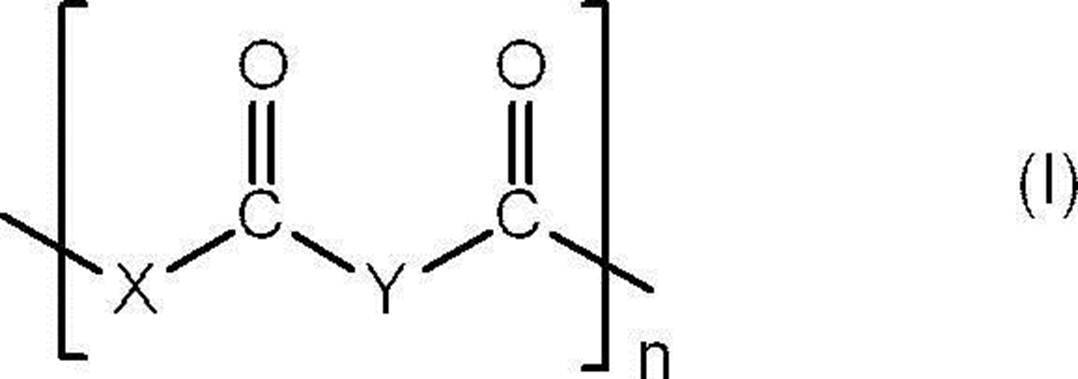
- a polyketone containing a structural unit represented by the following general formula (I) in the main chain and A nitrogen-containing compound having a nitrogen atom and at least one group selected from the group consisting of a hydroxymethyl group and an alkoxymethyl group bonded to the nitrogen atom, Containing a polyketone composition.
- each X independently represents a divalent group having 1 to 50 carbon atoms that may have a substituent, and each Y independently has a substituent.
- each X independently includes a bivalent group having 6 to 50 carbon atoms including an aromatic ring.
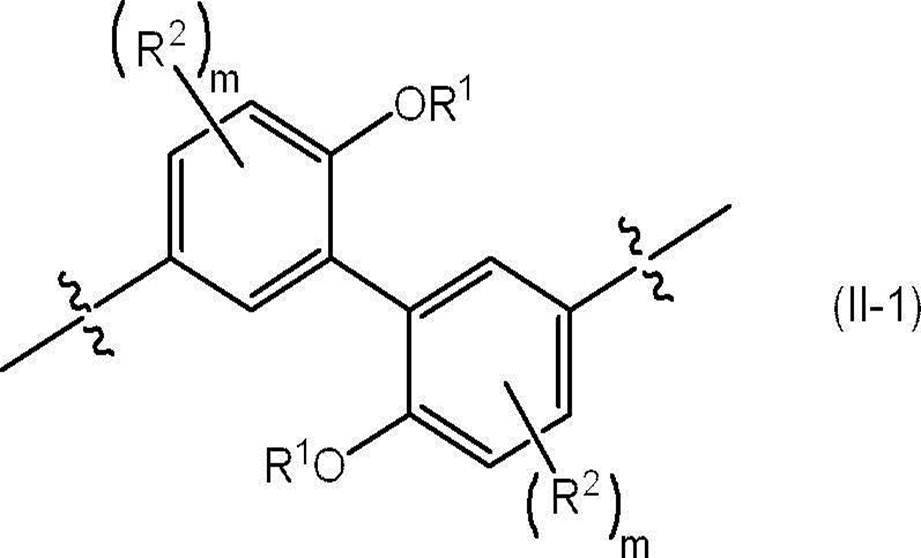
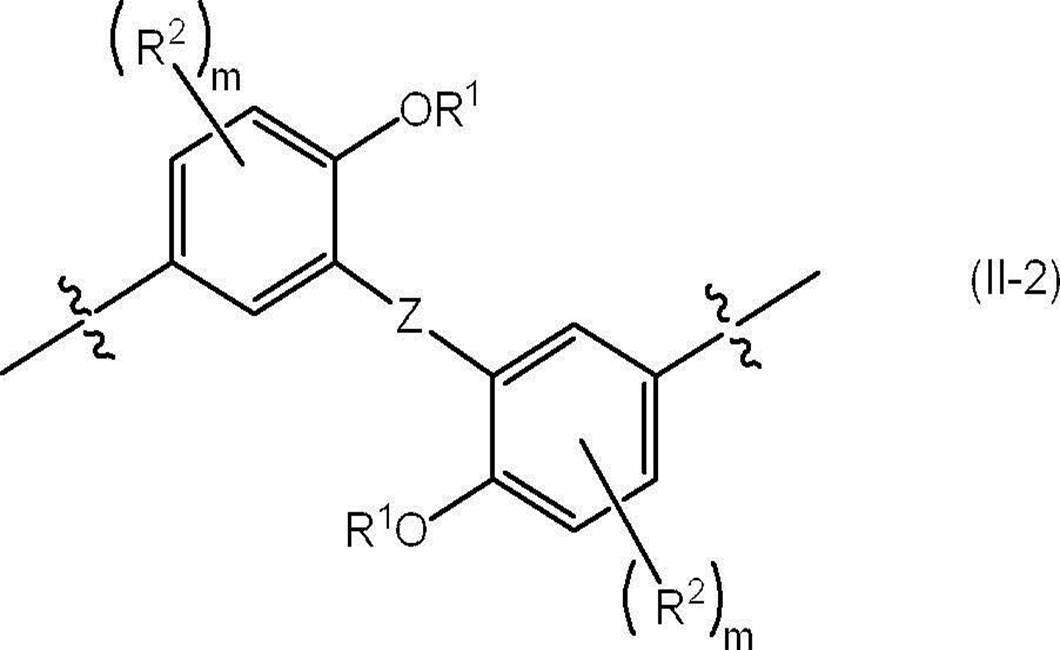
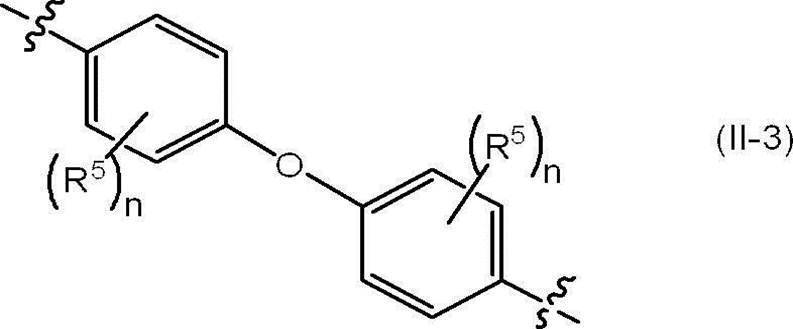
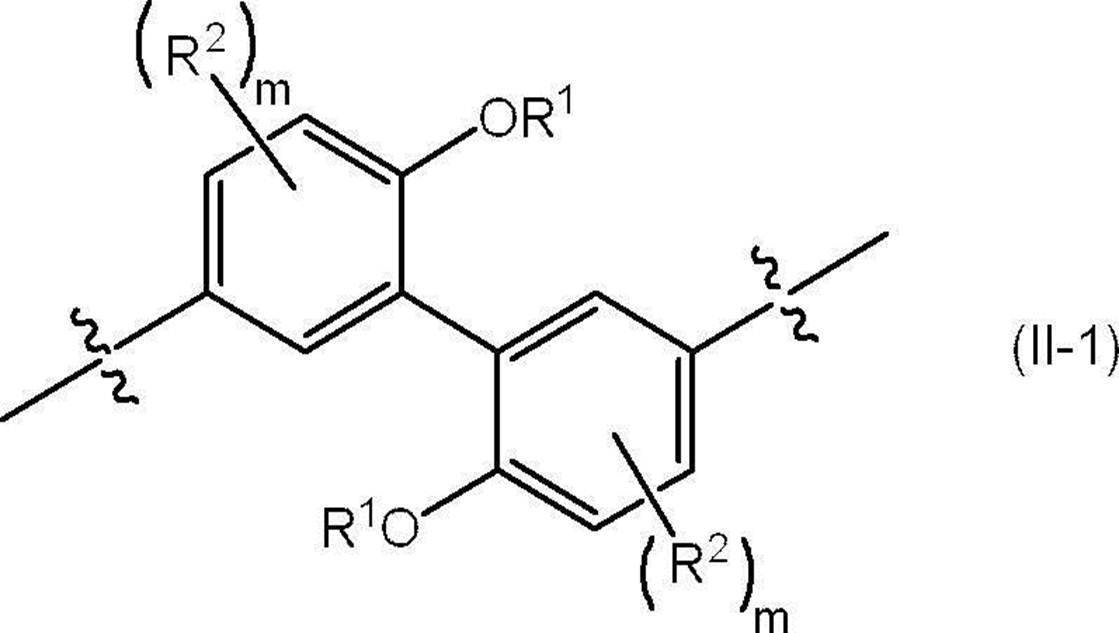
- each X is independently a divalent group represented by at least one selected from the group consisting of the following general formulas (II-1) to (II-3)
- each R 1 independently represents a hydrogen atom or an optionally substituted hydrocarbon group having 1 to 30 carbon atoms
- each R 2 independently represents a substituted group.
- each m independently represents an integer of 0 to 3.
- each R 1 independently represents a hydrogen atom or an optionally substituted hydrocarbon group having 1 to 30 carbon atoms
- each R 2 independently represents a substituted group.
- each R 1 independently represents a hydrogen atom or an optionally substituted hydrocarbon group having 1 to 30 carbon atoms
- R 2 represents Each independently represents a hydrocarbon group having 1 to 30 carbon atoms which may have a substituent
- R 3 and R 4 each independently represents a carbon atom which may have a hydrogen atom or a substituent.
- m independently represents an integer of 0 to 3
- n independently represents an integer of 0 to 4
- p independently represents an integer of 0 to 2, respectively.
- each R 5 independently represents a hydrocarbon group having 1 to 30 carbon atoms which may have a substituent, and n is each independently an integer of 0 to 4 Indicates.
- ⁇ 6> The polyketone composition according to any one of ⁇ 1> to ⁇ 5>, wherein in the general formula (I), Y has 6 to 30 carbon atoms.
- ⁇ 7> The polyketone composition according to any one of ⁇ 1> to ⁇ 6>, wherein the nitrogen-containing compound has a total number of hydroxymethyl groups and alkoxymethyl groups bonded to nitrogen atoms of 2 to 6. object.
- a cured polyketone which is a cured product of the polyketone composition according to any one of ⁇ 1> to ⁇ 9>.
- ADVANTAGE OF THE INVENTION when it is set as a cured film, it is excellent in heat resistance, transparency, and chemical resistance, and shows the high elongation rate, the polyketone composition and polyketone hardened
- the content of each component in the composition is the total of the plurality of substances present in the composition unless there is a specific indication when there are a plurality of substances corresponding to each component in the composition. Mean content.
- the term “layer” or “film” includes only a part of the region in addition to the case where the layer or film is formed over the entire region. The case where it is formed is also included.
- a plurality of aromatic rings are non-conjugated to each other or weakly conjugated to each other” means that two aromatic rings are via an ether bond or a methylene bond, or 2,2′-substituted It means that conjugation between aromatic rings is suppressed by being twisted moderately like biphenyl.
- excellent transparency means that the transmittance of visible light (transmittance of visible light having a wavelength of 400 nm) is 80% or more (in terms of a film thickness of 1 ⁇ m).
- heat resistance means that the thermal decomposition temperature of the member containing polyketone is 400 ° C. or higher.
- “high elongation” means that the elongation at break of the formed film is 5% or more.
- “chemical resistance of the cured film” means that the polyketone film does not peel from the base material even when the film-like polyketone cured product (polyketone film) formed on the silicon substrate is exposed to a chemical solution. Does not dissolve.
- the polyketone composition of the present embodiment binds to a polyketone (hereinafter, also referred to as “specific polyketone”) containing a structural unit represented by the following general formula (I) in the main chain, a nitrogen atom, and the nitrogen atom.
- a nitrogen-containing compound having a hydroxymethyl group or an alkoxymethyl group hereinafter also referred to as “specific nitrogen-containing compound”.
- each X independently represents an optionally substituted divalent group having 1 to 50 carbon atoms
- each Y independently represents a substituent.
- n represents an integer of 3 to 1000.
- the polyketone composition of this embodiment is excellent in heat resistance, transparency, and chemical resistance when it is used as a cured film by having the above-described configuration, and exhibits a high elongation rate.
- the reason is not clear, but is presumed as follows. Since the specific polyketone contains a carbonyl group in the main chain, it is excellent in heat resistance and transparency. In addition, since the main chain of the specific polyketone is formed with almost C—C bonds, the molecular chain itself is stable against a chemical solution. And it is thought that the nitrogen atom in a specific nitrogen-containing compound acts, the cohesion force of specific polyketone becomes strong, and elongation rate when a polyketone composition is used as a cured film becomes large.
- the specific nitrogen-containing compound functions as a crosslinking agent
- the polyketone main chains are cross-linked, and as a result, the specific polyketone is entangled with each other. Conceivable. Therefore, by using a polyketone composition in which a specific nitrogen-containing compound is combined with a specific polyketone, when it is a cured film, it is excellent in heat resistance, transparency and chemical resistance, and can exhibit a higher elongation. Conceivable.
- each component will be described.
- the polyketone composition contains a specific polyketone.
- the specific polyketone contains a structural unit represented by the following general formula (I) in the main chain.
- each X independently represents a divalent group having 1 to 50 carbon atoms which may have a substituent.
- Y independently represents a divalent hydrocarbon group having 1 to 30 carbon atoms which may have a substituent.
- n represents an integer of 3 to 1000.
- the number of carbon atoms of the divalent group represented by X is 1 to 50, preferably 1 to 30, and more preferably 1 to 24.
- the substituent that X may have is not particularly limited, and specific examples include a halogen atom, an alkoxy group having 1 to 5 carbon atoms, an acyl group having 2 to 5 carbon atoms, and the like.
- the divalent group represented by X is preferably a hydrocarbon group, and more preferably contains an aromatic ring. When X has an aromatic ring, higher heat resistance tends to be realized.
- X preferably contains a divalent group having 6 to 50 carbon atoms including an aromatic ring from the viewpoint of achieving high heat resistance.
- the aromatic ring include a benzene ring, a naphthalene ring, an anthracene ring, a phenanthrene ring, a naphthacene ring, a chrysene ring, a pyrene ring, a triphenylene ring, a pentacene ring, and a benzopyrene ring.
- X preferably contains a plurality of aromatic rings, and the plurality of aromatic rings are non-conjugated with each other or are divalent groups having a weak conjugated relationship (hereinafter also referred to as “specific aromatic ring groups”). ) Is more preferable. Thereby, good diacylation can be realized at a low reaction temperature during the synthesis of the polyketone, and the polyketone has a high molecular weight and excellent heat resistance.
- the specific aromatic ring group preferably has 12 to 50 carbon atoms.
- a plurality of aromatic rings are non-conjugated with each other or have a weak conjugated relationship
- a plurality of aromatic rings are bonded via an ether bond or a methylene bond; It means that conjugation between aromatic rings is suppressed by steric hindrance by a substituent such as 2′-substituted biphenyl.
- X includes divalent groups represented by the following general formulas (II-1) to (II-3).
- each R 1 independently represents a hydrogen atom or an optionally substituted hydrocarbon group having 1 to 30 carbon atoms
- each R 2 independently represents a substituted group.
- the part with a wavy line means a bond. The same applies thereafter.
- the hydrocarbon group represented by R 1 has 1 to 30 carbon atoms, preferably 1 to 10 carbon atoms, more preferably 1 to 6 carbon atoms.
- the carbon number of the hydrocarbon group does not include the carbon number of the substituent. The same applies thereafter.
- Examples of the hydrocarbon group represented by R 1 include a saturated aliphatic hydrocarbon group, an unsaturated aliphatic hydrocarbon group, and an alicyclic hydrocarbon group.
- saturated aliphatic hydrocarbon group represented by R 1 examples include methyl group, ethyl group, n-propyl group, isopropyl group, n-butyl group, isobutyl group, sec-butyl group, t-butyl group, and n-pentyl.
- Group, isopentyl group, sec-pentyl group, neo-pentyl group, t-pentyl group, n-hexyl group, n-heptyl group, n-octyl group, n-nonyl group, n-decyl group, n-icosanyl group Examples include an n-triacontanyl group.
- the saturated aliphatic hydrocarbon group may have an alicyclic hydrocarbon group described below at the terminal portion.
- Examples of the unsaturated aliphatic hydrocarbon group represented by R 1 include an alkenyl group such as a vinyl group and an allyl group, and an alkynyl group such as an ethynyl group. Further, the unsaturated aliphatic hydrocarbon group may have an alicyclic hydrocarbon group to be described later at its terminal portion.
- Examples of the alicyclic hydrocarbon group represented by R 1 include cycloalkyl groups such as cyclohexyl group, cycloheptyl group, cyclooctyl group and norbornyl group, and cycloalkenyl groups such as cyclohexenyl group.
- the alicyclic hydrocarbon group may have at least one selected from the group consisting of a saturated aliphatic hydrocarbon group and an unsaturated aliphatic hydrocarbon group in the alicyclic ring.
- the substituent that the hydrocarbon group represented by R 1 may have is not particularly limited, and examples thereof include a halogen atom, an alkoxy group having 1 to 5 carbon atoms, and an acyl group having 2 to 5 carbon atoms.
- each R 2 independently represents a hydrocarbon group having 1 to 30 carbon atoms which may have a substituent.
- the hydrocarbon group represented by R 2 preferably has 1 to 10 carbon atoms, and more preferably 1 to 5 carbon atoms.
- Examples of the hydrocarbon group having 1 to 30 carbon atoms represented by R 2 include those similar to the hydrocarbon group having 1 to 30 carbon atoms exemplified for R 1 .
- examples of the substituent that the hydrocarbon group represented by R 2 may have include a halogen atom, an alkoxy group having 1 to 5 carbon atoms, and an acyl group having 2 to 5 carbon atoms.
- each m independently represents an integer of 0 to 3, preferably an integer of 0 to 2, and more preferably 0 or 1.
- each R 1 independently represents a hydrogen atom or an optionally substituted hydrocarbon group having 1 to 30 carbon atoms, and each R 2 independently represents a substituted group.
- each R 1 independently represents a hydrogen atom or an optionally substituted hydrocarbon group having 1 to 30 carbon atoms
- R 2 represents Each independently represents a hydrocarbon group having 1 to 30 carbon atoms which may have a substituent
- R 3 and R 4 each independently represents a carbon atom which may have a hydrogen atom or a substituent.
- m independently represents an integer of 0 to 3
- n independently represents an integer of 0 to 4
- p independently represents an integer of 0 to 2, respectively.
- R 3 and R 4 in the general formula (III-1) are preferably a hydrocarbon group having 1 to 5 carbon atoms which may have a substituent from the viewpoint of heat resistance.
- Examples of the hydrocarbon group having 1 to 30 carbon atoms represented by R 3 and R 4 include the same hydrocarbon groups having 1 to 30 carbon atoms as exemplified for R 1 in the general formula (II-1). It is done.
- Examples of the substituent that R 3 and R 4 may have include a halogen atom, an alkoxy group having 1 to 5 carbon atoms, and an acyl group having 2 to 5 carbon atoms.
- N in the general formulas (III-2) and (III-3) each independently represents an integer of 0 to 4, preferably an integer of 0 to 2, and more preferably 0 or 1.
- P in the general formulas (III-4), (III-5) and (III-7) each independently represents an integer of 0 to 2, and is preferably 0 or 1.
- R 1, R 2, and m in formula (II-2), is the same as R 1, R 2, and m in Formula (II-1).
- each R 5 independently represents a hydrocarbon group having 1 to 30 carbon atoms which may have a substituent, and n is each independently an integer of 0 to 4 Indicates.
- the hydrocarbon group represented by R 5 preferably has 1 to 10 carbon atoms, and more preferably 1 to 5 carbon atoms.
- the hydrocarbon group having 1 to 30 carbon atoms represented by R 5 include the same hydrocarbon groups having 1 to 30 carbon atoms as exemplified for R 1 in formula (II-1).
- the substituent that R 5 may have include a halogen atom, an alkoxy group having 1 to 5 carbon atoms, and an acyl group having 2 to 5 carbon atoms.
- each n independently represents an integer of 0 to 4, preferably an integer of 1 to 4, more preferably an integer of 1 to 3, or 1 or 2. More preferably.
- each Y independently represents a divalent hydrocarbon group having 1 to 30 carbon atoms which may have a substituent.
- the hydrocarbon group represented by Y has 1 to 30 carbon atoms, preferably 4 to 30 carbon atoms, and more preferably 6 to 30 carbon atoms from the viewpoint of heat resistance.
- the hydrocarbon group represented by Y preferably contains a saturated hydrocarbon group from the viewpoint of transparency.
- the saturated hydrocarbon group may be a saturated aliphatic hydrocarbon group or a saturated alicyclic hydrocarbon group.
- the hydrocarbon group represented by Y preferably includes a saturated alicyclic hydrocarbon group. Since the alicyclic hydrocarbon group is bulky as compared with the aliphatic hydrocarbon group having the same carbon number, it tends to be excellent in solubility in a nitrogen-containing compound and a solvent while maintaining high heat resistance and transparency.
- the hydrocarbon group represented by Y may include a plurality of types of saturated aliphatic hydrocarbon groups or a plurality of types of saturated alicyclic hydrocarbon groups. Y may contain a combination of a saturated aliphatic hydrocarbon group and a saturated alicyclic hydrocarbon group.
- the saturated aliphatic hydrocarbon group represented by Y has 1 to 30 carbon atoms, and preferably 3 to 30 carbon atoms.
- Saturated aliphatic hydrocarbon groups include methylene, ethylene, trimethylene, methylethylene, tetramethylene, 1-methyltrimethylene, 2-methyltrimethylene, ethylethylene, 1,1-dimethylethylene Group, 1,2-dimethylethylene group, pentylene group, 1-methyltetramethylene group, 2-methyltetramethylene group, 1-ethyltrimethylene group, 2-ethyltrimethylene group, 1,1-dimethyltrimethylene group, 2,2-dimethyltrimethylene group, 1,2-dimethyltrimethylene group, propylethylene group, ethylmethylethylene group, hexylene group, 1-methylpentylene group, 2-methylpentylene group, 3-methylpentylene group 1-ethyltetramethylene group, 2-ethyltetramethylene group, 1-propyltrimethylene
- the saturated aliphatic hydrocarbon group is preferably a hexylene group, a methylpentylene group, an ethyltetramethylene group, a propyltrimethylene group, a butylethylene group, a dimethyltetramethylene group, a trimethyltrimethylene group, Examples thereof include an ethylmethyltrimethylene group, a heptylene group, an octylene group, a nonylene group, a decylene group, an icosanylene group, and a triacontanilene group.
- the saturated alicyclic hydrocarbon group represented by Y has 3 to 30 carbon atoms, preferably 4 to 30 carbon atoms, more preferably 6 to 30 carbon atoms.
- the saturated alicyclic hydrocarbon group includes a cyclopropane skeleton, a cyclobutane skeleton, a cyclopentane skeleton, a cyclohexane skeleton, a cycloheptane skeleton, a cyclooctane skeleton, a cubane skeleton, a norbornane skeleton, and a tricyclo [5.2.1.0] decane skeleton.
- the saturated alicyclic hydrocarbon group is preferably a cyclohexane skeleton, a cycloheptane skeleton, a cyclooctane skeleton, a cubane skeleton, a norbornane skeleton, a tricyclo [5.2.1.0] decane skeleton, or an adamantane skeleton.
- divalent groups such as a diadamantane skeleton, a bicyclo [2.2.2] octane skeleton, and a decahydronaphthalene skeleton.
- Examples of the substituent that the hydrocarbon group represented by Y may have include an amino group, an oxo group, a hydroxyl group, and a halogen atom.
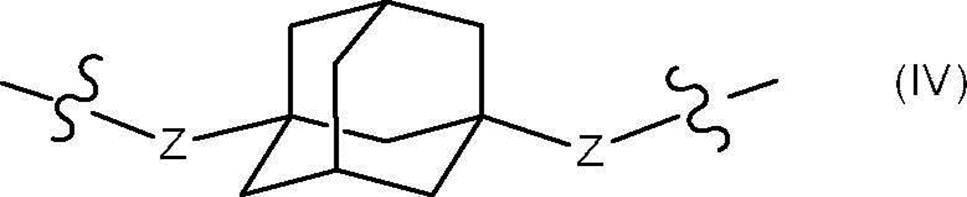
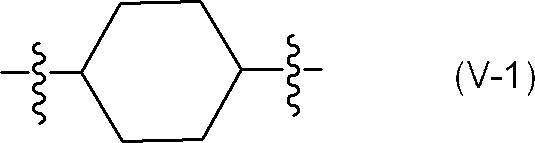
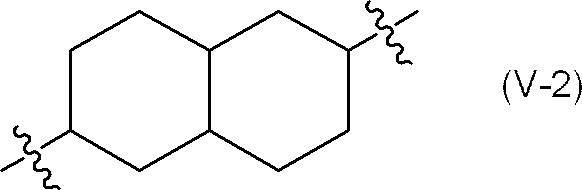
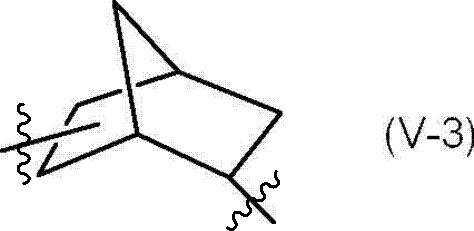
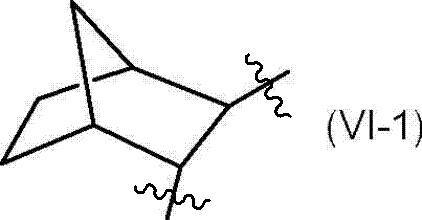
- Y preferably contains at least a divalent group represented by at least one selected from the group consisting of the following general formula (IV) and the following general formulas (V-1) to (V-3). More preferably, it contains at least a divalent hydrocarbon group represented by the general formula (IV).
- the hydrogen atom of the skeleton may be substituted with a hydrocarbon group, an amino group, an oxo group, a hydroxyl group or a halogen atom, respectively.
- each Z independently represents a single bond or a divalent saturated hydrocarbon group having 1 to 10 carbon atoms which may have a substituent.
- each Z is preferably independently a divalent saturated hydrocarbon group having 1 to 10 carbon atoms which may have a substituent, from the viewpoint of heat resistance. Therefore, Z is preferably a divalent saturated hydrocarbon group having 1 to 5 carbon atoms.
- Examples of the divalent saturated hydrocarbon group represented by Z include a methylene group, an ethylene group, a trimethylene group, a methylethylene group, a tetramethylene group, a 1-methyltrimethylene group, a 2-methyltrimethylene group, an ethylethylene group, 1,1-dimethylethylene group, 1,2-dimethylethylene group, pentylene group, 1-methyltetramethylene group, 2-methyltetramethylene group, 1-ethyltrimethylene group, 2-ethyltrimethylene group, 1,1 -Dimethyltrimethylene group, 2,2-dimethyltrimethylene group, 1,2-dimethyltrimethylene group, propylethylene group, ethylmethylethylene group, hexylene group, 1-methylpentylene group, 2-methylpentylene group, 3-methylpentylene group, 1-ethyltetramethylene group, 2-ethyltetramethylene group, 1-propyltrimethyl group Tylene group, 2-propylt
- Examples of the substituent that Z may have include a halogen atom, an alkoxy group having 1 to 5 carbon atoms, and an acyl group having 2 to 5 carbon atoms.
- the carbon number of the divalent saturated hydrocarbon group of Z does not include the carbon number of the substituent.
- the divalent group represented by the general formula (V-3) may be the following general formula (VI-1).
- Y may include both the general formula (IV) and at least one divalent group selected from the group consisting of the general formulas (V-1) to (V-3).
- the general formula (IV) and the mass ratio ((IV) :( V-1) to (V-3)) of the total content of general formulas (V-1) to (V-3) is not particularly limited. From the viewpoints of heat resistance and elongation, the mass ratio is preferably 5:95 to 95: 5, and more preferably 5:95 to 90:10 from the viewpoint of heat resistance and solubility.
- the specific polyketone may be a commercially available product or may be synthesized by a known method.
- the weight average molecular weight (Mw) of the specific polyketone is preferably 500 or more in terms of polystyrene standard GPC (gel permeation chromatograph) from the viewpoint of maintaining heat resistance. From the viewpoint of solubility in a nitrogen compound and a solvent, it is more preferably 10,000 to 1,000,000. When higher heat resistance is required, the weight average molecular weight (Mw) is more preferably 20,000 to 1,000,000.
- the weight average molecular weight (Mw) of the specific polyketone refers to a value measured by the method described in Examples.
- Specific polyketone may be used individually by 1 type, and may be used in combination of 2 or more type. Moreover, the polyketone composition may contain other polyketones other than the specific polyketone. Hereinafter, the specific polyketone and other polyketones may be collectively referred to as “polyketone”. From the viewpoint of heat resistance, transparency, and chemical resistance when a cured film is used, the content of the specific polyketone relative to the total amount of polyketone is preferably 50% by mass or more, and preferably 60% by mass or more. More preferably, it is more preferably 70% by mass or more.
- the total content of polyketone is 50 to 99 parts by mass with respect to 100 parts by mass of the total amount of polyketone and nitrogen-containing compound. It is preferably 50 parts by mass to 95 parts by mass.
- the polyketone composition of the present embodiment contains a nitrogen-containing compound (specific nitrogen-containing compound) having a nitrogen atom and a hydroxymethyl group or an alkoxymethyl group bonded to the nitrogen atom.
- the specific nitrogen-containing compound is preferably a compound having both a hydroxymethyl group and an alkoxymethyl group, or a compound having no hydroxymethyl group and having an alkoxymethyl group, more preferably a compound having no hydroxymethyl group and having an alkoxymethyl group. preferable.
- the total number of hydroxymethyl groups and alkoxymethyl groups contained in the molecule of the specific nitrogen-containing compound is not particularly limited as long as it is 1 or more.
- the total number of hydroxymethyl groups and alkoxymethyl groups contained in the molecule is preferably 2 to 6, and 4 to 6 from the viewpoint of elongation and chemical resistance when used as a cured film. It is more preferable.
- the number of carbon atoms of the alkoxy group in the alkoxymethyl group is preferably 1-30, more preferably 1-15, still more preferably 1-10, and particularly preferably 1-3. 1 is very particularly preferred.
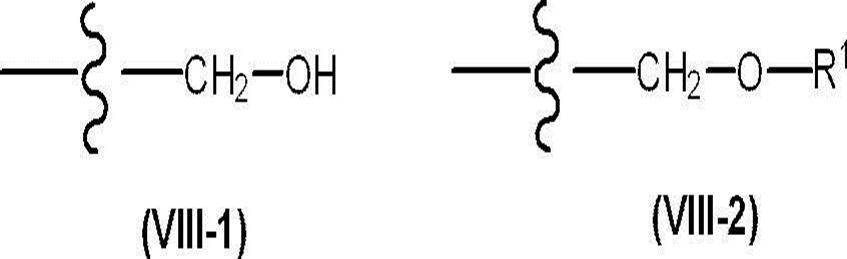
- Specific nitrogen-containing compounds include compounds represented by the following general formulas (VII-1) and (VII-2).
- A represents an n-valent organic group
- W 1 and W 2 are each independently a hydrogen atom or the following general formula (VIII-1) or (VIII-2)
- N represents 2 or 3.
- at least one is a group represented by the following general formula (VIII-1) or (VIII-2), 2 of the plurality of W 1 and W 2
- the above is preferably a group represented by the following general formula (VIII-1) or (VIII-2).
- R 1 represents an alkyl group having 1 to 30 carbon atoms which may have a substituent.
- the alkyl group represented by R 1 preferably has 1 to 30 carbon atoms, more preferably 1 to 15 carbon atoms, still more preferably 1 to 10 carbon atoms, and particularly preferably 1 to 3 carbon atoms. 1 is very preferable.
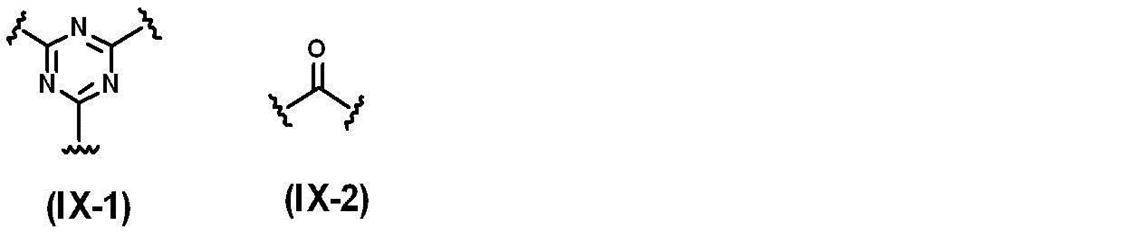
- examples of the organic group represented by A include groups represented by the following general formulas (IX-1) and (IX-2).
- W 3 to W 6 are each independently a hydrogen atom or a group represented by general formula (VIII-1) or (VIII-2). However, among the W 3 ⁇ W 6, at least one is a group represented by the following general formula (VIII-1) or (VIII-2), 2 or more of W 3 ⁇ W 6 is the following A group represented by the general formula (VIII-1) or (VIII-2) is preferable.
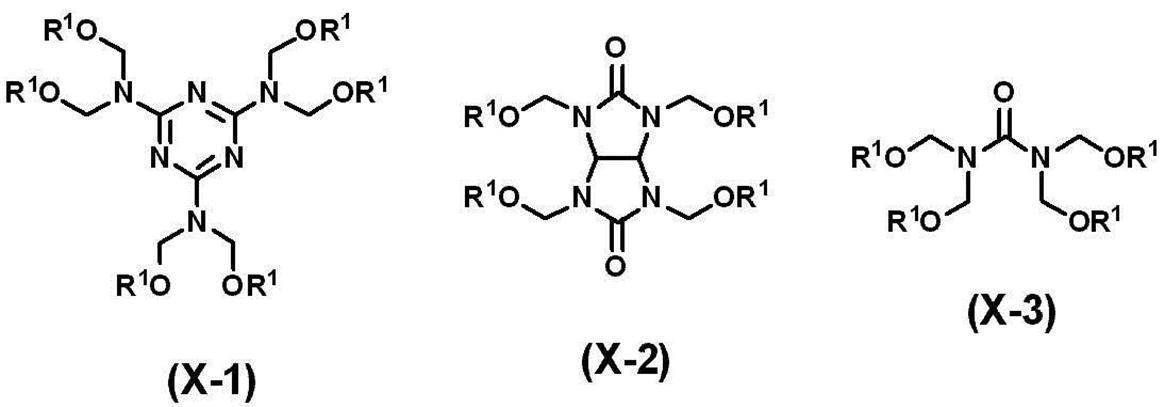
- Examples of the specific nitrogen-containing compound include compounds represented by the following general formulas (X-1) to (X-3).
- each R 1 independently represents an alkyl group having 1 to 30 carbon atoms which may have a substituent. Details of R 1, is the same as R 1 in the general formula (VIII-2).
- the specific nitrogen-containing compound may be a monomer or an oligomer, or a mixture of a monomer and an oligomer.
- oligomers include those formed by self-reaction of monomers.
- the specific nitrogen-containing compound may be used alone or in combination of two or more.
- the content of the specific nitrogen-containing compound is from 1 part by mass to 50 parts per 100 parts by mass of the total amount of the polyketone and the specific nitrogen-containing compound from the viewpoint of heat resistance, transparency, and chemical resistance when used as a cured film.
- the mass is preferably 5 parts by mass, more preferably 5 parts by mass to 50 parts by mass, and still more preferably 5 parts by mass to 20 parts by mass.
- the polyketone composition may further contain a thermal latent acid generator.
- the thermal latent acid generator is a compound that generates an acid by heating.
- the polyketone composition contains a thermal latent acid generator, the crosslinking reaction by the specific nitrogen-containing compound is promoted, and a stronger cured product can be obtained, so that the chemical resistance of the cured film tends to be improved. .
- Examples of the acid generated from the thermal latent acid generator include aryl sulfonic acids such as p-toluenesulfonic acid and benzenesulfonic acid, and paroxyls such as ( ⁇ ) -10-camphorsulfonic acid, trifluoromethanesulfonic acid, and nonafluorobutanesulfonic acid.
- aryl sulfonic acids such as p-toluenesulfonic acid and benzenesulfonic acid
- paroxyls such as ( ⁇ ) -10-camphorsulfonic acid, trifluoromethanesulfonic acid, and nonafluorobutanesulfonic acid.
- alkyl sulfonic acids such as fluoroalkyl sulfonic acid, methane sulfonic acid, ethane sulfonic acid, and butane sulfonic acid.
- the thermal latent acid generator may be used alone or in combination of two or more.
- the content of the thermal latent acid generator is preferably 0.05 to 30 parts by mass with respect to 100 parts by mass of the total amount of the polyketone, the nitrogen-containing compound, and the thermal latent acid generator. More preferably, it is from 20 parts by weight to 20 parts by weight, and even more preferably from 0.2 to 10 parts by weight.
- the polyketone composition may further contain a solvent.
- the solvent is not particularly limited as long as it dissolves or disperses each component.
- Solvents include ⁇ -butyrolactone, ethyl lactate, propylene glycol monomethyl ether acetate, butyl acetate, benzyl acetate, n-butyl acetate, ethoxyethyl propionate, 3-methylmethoxypropionate, N-methyl-2-pyrrolidone, N-cyclohexyl-2-pyrrolidone, N, N-dimethylformamide, N, N-dimethylacetamide, hexamethylphosphorylamide, tetramethylene sulfone, diethyl ketone, diisobutyl ketone, methyl amyl ketone, cyclopentanone, cyclohexanone, propylene glycol monomethyl Ether, propylene glycol monopropyl ether, propylene glycol
- the content of the solvent is 5 mass with respect to 100 mass parts of the total amount of the polyketone, the nitrogen-containing compound, and the latent thermal acid generator contained as necessary, and the solvent. Part to 95 parts by weight, preferably 10 parts to 90 parts by weight.
- the polyketone composition may further contain other additives.
- additives include adhesion assistants, surfactants, leveling agents, antioxidants, and UV degradation inhibitors.
- the polyketone cured product of the present embodiment is a cured product of the polyketone composition of the present embodiment.
- the polyketone cured product can be produced, for example, by the following method.
- First, the polyketone composition is applied to at least a part of the surface of the substrate to form a composition layer.
- the method for applying the polyketone composition to the substrate is not particularly limited as long as the composition layer can be formed in an arbitrary shape at an arbitrary location on the substrate. Examples of the method for applying the polyketone composition to the substrate include an immersion method, a spray method, a screen printing method, a spin coating method, a spin coating method, and a bar coating method.
- the base material to which the polyketone composition is applied is not particularly limited, and glass, semiconductor, metal oxide insulator (titanium oxide, silicon oxide, etc.), inorganic materials such as silicon nitride, triacetyl cellulose, transparent polyimide, polycarbonate, Examples thereof include a transparent substrate composed of a transparent resin such as an acrylic polymer and a cycloolefin resin.
- the shape of the substrate is not particularly limited, and may be a plate shape or a film shape. Since the polyketone composition of the present embodiment exhibits a high elongation when it is used as a cured film and is excellent in chemical resistance, it can be suitably used as a coating material for a substrate, a molded product, and the like.
- the polyketone composition When the polyketone composition contains a solvent, it may be dried before and after curing.
- the drying method is not particularly limited, and examples thereof include a heat treatment method using an apparatus such as a hot plate or an oven.
- the drying conditions are not particularly limited as long as the solvent in the polyketone composition is sufficiently volatilized, and is usually about 50 to 150 ° C. for about 1 to 90 minutes.
- the curing method is not particularly limited and can be cured by heat treatment or the like.
- ovens such as box dryers, hot air conveyor dryers, quartz tube furnaces, hot plates, rapid thermal annealing, vertical diffusion furnaces, infrared curing furnaces, electron beam curing furnaces, microwave curing furnaces, etc. Can be used.
- the atmosphere for curing may be selected from the air or an inert atmosphere such as nitrogen, and is preferably performed in a nitrogen atmosphere from the viewpoint of preventing oxidation of the polyketone composition.
- the temperature and time of the heat treatment for curing can be arbitrarily set in consideration of the composition conditions, work efficiency, etc., and are usually about 60 minutes to 200 ° C. for about 30 minutes to 2 hours.
- the obtained polyketone cured product can be used as a substrate with a polyketone cured product with the substrate attached, and can be used after being peeled off from the substrate, if necessary.
- the polyketone cured product may be provided on at least a part of the surface of the base material, and may be provided on only one surface of the base material or on both surfaces.
- the polyketone cured product may have a single-layer structure or a multi-layer structure in which two or more layers are laminated.
- the optical element and the image display device of the present embodiment each have the polyketone cured product of the present embodiment.
- the polyketone cured product applied to the optical element and the image display device may be the above-described base material with a polyketone cured product.
- a base material is a transparent base material, it can use suitably for an optical element.
- the transparent substrate include those exemplified in the production of the polyketone cured product.
- Optical element and image display device for example, paste the base material side of the base material with polyketone cured product to the application location such as LCD (Liquid Crystal Display), ELD (Electro Luminescence Display) etc. via adhesive, adhesive, etc. Can be obtained.
- LCD Liquid Crystal Display
- ELD Electro Luminescence Display
- the polyketone cured product and various optical elements such as a polarizing plate using the polyketone can be preferably used for various image display devices such as a liquid crystal display device.
- the image display device may have the same configuration as the conventional image display device except that the polyketone cured product of the present embodiment is used.
- the image display device is a liquid crystal display device, by appropriately assembling each component such as a liquid crystal cell, an optical element such as a polarizing plate, and an illumination system (backlight, etc.) as necessary, and incorporating a drive circuit, etc. Can be manufactured.
- the liquid crystal cell is not particularly limited, and various types such as a TN type, an STN type, and a ⁇ type can be used.
- OA equipment such as desktop personal computers, notebook personal computers, and copiers, mobile phones, watches, digital cameras, personal digital assistants (PDAs), portable devices such as portable game machines, video cameras, televisions, and electronic devices.
- PDAs personal digital assistants
- Household electrical equipment such as a range, back monitor, car navigation system monitor, in-vehicle equipment such as car audio, display equipment such as information monitors for commercial stores, security equipment such as monitoring monitors, nursing care such as nursing monitors Examples thereof include medical devices and medical devices such as medical monitors.
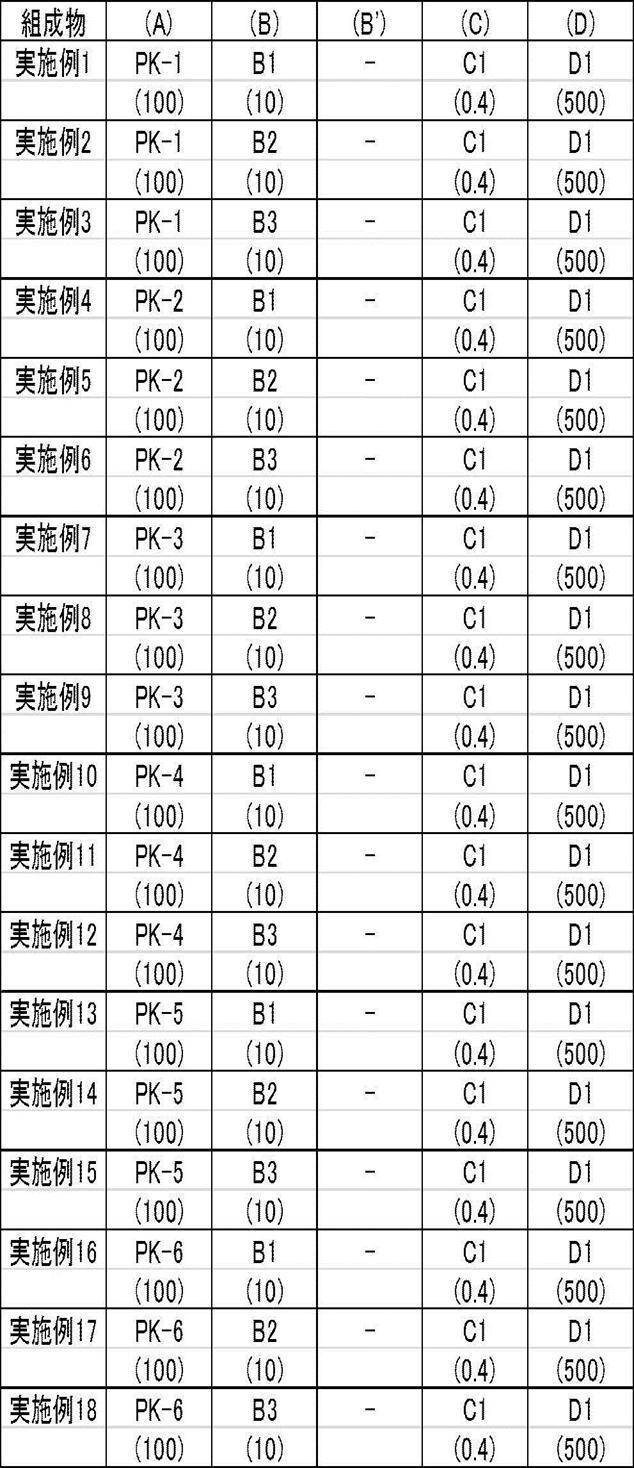
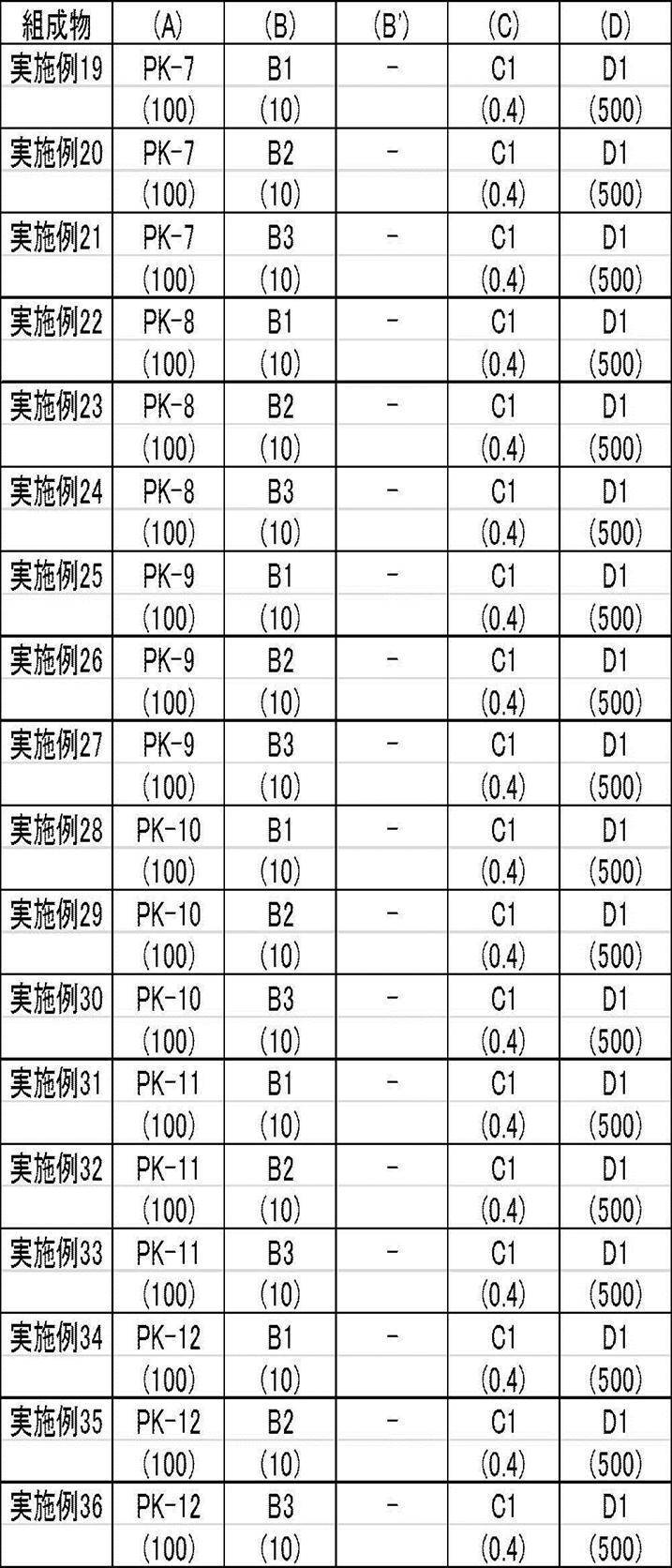
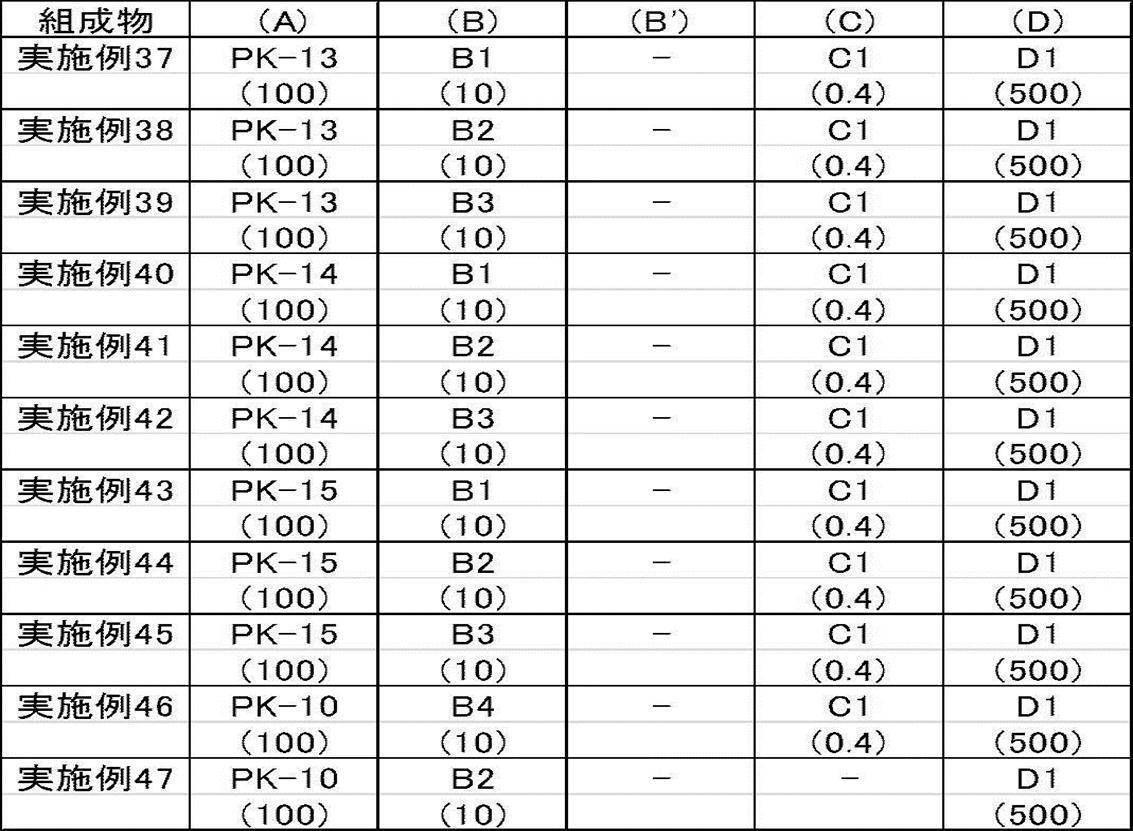
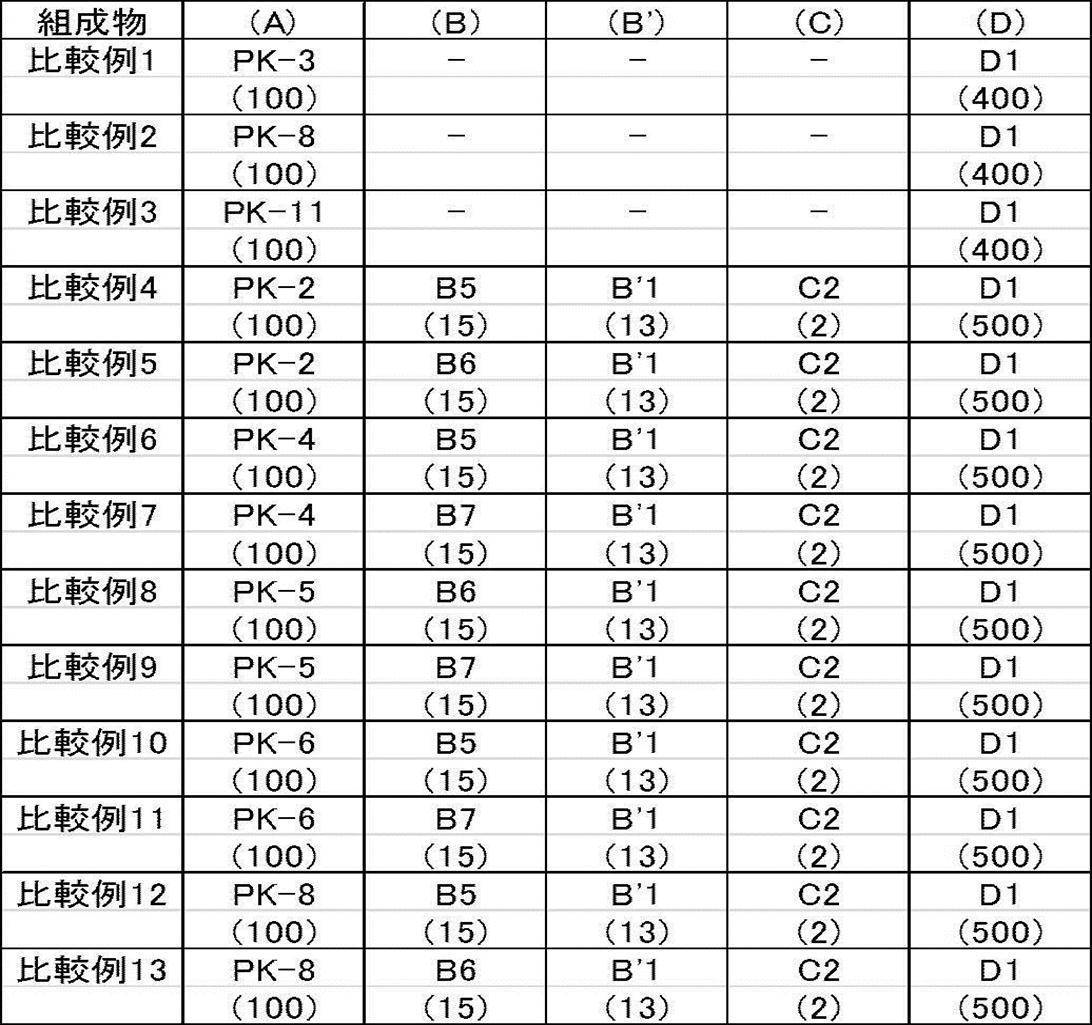
- ⁇ Polyketone composition Components (A) to (D) were blended in the proportions shown in Tables 1 to 4 and filtered through a PTFE (polytetrafluoroethylene) filter to obtain polyketone compositions of Examples and Comparative Examples.
- the numerical value in the parenthesis represents the blending ratio (part by mass, solid content ratio). “-” Indicates that the component is not contained.
- Each component in Tables 1 to 4 is as follows.
- the resulting polyketone PK-1 had a weight average molecular weight of 20,000 and a number average molecular weight of 8,000. In addition, a weight average molecular weight and a number average molecular weight are measured and calculated by the method described later. The weight average molecular weight (Mw) and number average molecular weight (Mn) of polyketone PK-2 to polyketone PK-15 described later were also measured in the same manner.
- Synthesis Example 2 Synthesis of Polyketone PK-2
- Polyketone PK-2 was obtained in the same manner as in Example 1, except that 10 mmol of 2,2′-dimethoxybiphenyl and 13 mmol of 1,3-adamantanedicarboxylic acid were used as monomers. It was.
- the resulting polyketone PK-2 had a weight average molecular weight of 280,000 and a number average molecular weight of 44,000.
- Synthesis Example 4 Synthesis of Polyketone PK-4 Example 1 except that 10 mmol of 2,2′-dimethoxybiphenyl, 5 mmol of 1,3-adamantane dicarboxylic acid and 5 mmol of cis-1,4-cyclohexanedicarboxylic acid were used as monomers. In the same manner as above, polyketone PK-4 was obtained. The resulting polyketone PK-4 had a weight average molecular weight of 36,000 and a number average molecular weight of 12,000.
- Synthesis Example 6 Synthesis of Polyketone PK-6
- the polyketone was obtained in the same manner as in Example 1 except that 10 mmol of 2,2′-dimethoxybiphenyl, 5 mmol of 1,3-adamantanediacetic acid, and 5 mmol of dodecanedioic acid were used as monomers.
- PK-6 was obtained.
- the resulting polyketone PK-6 had a weight average molecular weight of 39,000 and a number average molecular weight of 12,000.
- Synthesis Example 7 Synthesis of Polyketone PK-7 A polyketone was obtained in the same manner as in Example 1 except that 10 mmol of 2,2′-dimethoxybiphenyl, 5 mmol of 1,3-adamantanediacetic acid, and 5 mmol of hexanedioic acid were used as monomers. PK-7 was obtained. The resulting polyketone PK-7 had a weight average molecular weight of 39,000 and a number average molecular weight of 12,000.
- Synthesis Example 8 Synthesis of Polyketone PK-8 Except that 10 mmol of 2,2′-dimethoxybiphenyl, 5 mmol of 1,3-adamantanediacetic acid and 5 mmol of cis-1,4-cyclohexanedicarboxylic acid were used, the same procedure as in Example 1 was performed. Polyketone PK-8 was obtained. The resulting polyketone PK-8 had a weight average molecular weight of 45,000 and a number average molecular weight of 11,000.
- Synthesis Example 11 Synthesis of Polyketone PK-11 Example 1 was used except that 10 mmol of 2,2′-dimethoxybiphenyl, 5 mmol of 1,3-adamantanediacetic acid, and 5 mmol of decalin-2,6-dicarboxylic acid were used as monomers. Similarly, polyketone PK-11 was obtained. The resulting polyketone PK-11 had a weight average molecular weight of 33,000 and a number average molecular weight of 10,000.
- Synthesis Example 12 Synthesis of Polyketone PK-12 As a monomer, 10 mmol of 2,2′-dimethoxybiphenyl, 5 mmol of 1,3-adamantanediacetic acid, and 5 mmol of norbornane dicarboxylic acid (2,4-, 2,5-mixture) A polyketone PK-12 was obtained in the same manner as in Example 1 except that it was used. The resulting polyketone PK-12 had a weight average molecular weight of 27,000 and a number average molecular weight of 9,200.
- Synthesis Example 13 Synthesis of Polyketone PK-13 Example 1 except that 10 mmol of 2,2′-dimethoxybiphenyl, 5 mmol of 1,3-adamantanediacetic acid, and 5 mmol of trans-2,3-norbornane dicarboxylic acid were used as monomers. In the same manner as above, polyketone PK-13 was obtained. The resulting polyketone PK-13 had a weight average molecular weight of 26,000 and a number average molecular weight of 8,100.
- a polyketone cured product was prepared by the following method, and a sample for evaluation described later was prepared.
- the molecular weight (weight average molecular weight and number average molecular weight) of the polyketone was measured by GPC method using tetrahydrofuran (THF) as an eluent, and was determined in terms of standard polystyrene. Details are as follows.
Landscapes
- Chemical & Material Sciences (AREA)
- Physics & Mathematics (AREA)
- Chemical Kinetics & Catalysis (AREA)
- Medicinal Chemistry (AREA)
- Polymers & Plastics (AREA)
- Organic Chemistry (AREA)
- Health & Medical Sciences (AREA)
- General Physics & Mathematics (AREA)
- Optics & Photonics (AREA)
- Compositions Of Macromolecular Compounds (AREA)
- Electroluminescent Light Sources (AREA)
- Manufacture Of Macromolecular Shaped Articles (AREA)
- Devices For Indicating Variable Information By Combining Individual Elements (AREA)
Abstract
Description
窒素原子と、前記窒素原子と結合するヒドロキシメチル基及びアルコキシメチル基からなる群より選択される少なくとも1種の基と、を有する含窒素化合物、
を含有するポリケトン組成物。


本開示中に段階的に記載されている数値範囲において、一つの数値範囲で記載された上限値又は下限値は、他の段階的な記載の数値範囲の上限値又は下限値に置き換えてもよい。また、本開示中に記載されている数値範囲において、その数値範囲の上限値又は下限値は、実施例に示されている値に置き換えてもよい。
本開示において組成物中の各成分の含有率は、組成物中に各成分に該当する物質が複数種存在する場合、特に断らない限り、組成物中に存在する当該複数種の物質の合計の含有率を意味する。
本開示において「層」又は「膜」との語には、当該層又は膜が存在する領域を観察したときに、当該領域の全体に形成されている場合に加え、当該領域の一部にのみ形成されている場合も含まれる。
本実施形態のポリケトン組成物は、下記一般式(I)で表される構造単位を主鎖に含むポリケトン(以下、「特定ポリケトン」ともいう)、並びに、窒素原子と、前記窒素原子と結合するヒドロキシメチル基又はアルコキシメチル基と、を有する含窒素化合物(以下、「特定含窒素化合物」ともいう)、を含有する。
特定ポリケトンは、主鎖にカルボニル基を含むため、耐熱性及び透明性に優れる。また、特定ポリケトンは、主鎖がほぼC-C結合で形成されるため、分子鎖自身は薬液に対して安定である。そして、特定含窒素化合物中の窒素原子が作用して特定ポリケトンの凝集力が強くなり、ポリケトン組成物を硬化膜としたときの伸び率が大きくなると考えられる。なお、特定含窒素化合物が架橋剤として機能する場合には、ポリケトン主鎖どうしが架橋し、その結果、特定ポリケトンどうしの絡み合いが多くなることから、硬化膜としたときの伸び率がより大きくなると考えられる。
そのため、特定ポリケトンに特定含窒素化合物を組み合わせたポリケトン組成物を用いることで、硬化膜としたときに、耐熱性、透明性及び耐薬品性に優れ、さらに高い伸び率を示すことが可能になると考えられる。
以下、各成分について説明する。
ポリケトン組成物は、特定ポリケトンを含有する。特定ポリケトンは、下記一般式(I)で表される構造単位を主鎖に含む。



一般式(III-4)、(III-5)及び(III-7)におけるpは、それぞれ独立に、0~2の整数を示し、0又は1であることが好ましい。

耐熱性の観点から、R5で表される炭化水素基の炭素数は、1~10であることが好ましく、1~5であることがより好ましい。
R5で表される炭素数1~30の炭化水素基としては、一般式(II-1)中のR1で例示した炭素数1~30の炭化水素基と同様のものが挙げられる。また、R5が有し得る置換基としては、ハロゲン原子、炭素数1~5のアルコキシ基、炭素数2~5のアシル基等が挙げられる。
また、Yで表される炭化水素基は、複数種の飽和脂肪族炭化水素基、又は、複数種の飽和脂環式炭化水素基を含んでいてもよい。また、Yは、飽和脂肪族炭化水素基と、飽和脂環式炭化水素基と、を組み合わせて含んでいてもよい。
飽和脂肪族炭化水素基としては、メチレン基、エチレン基、トリメチレン基、メチルエチレン基、テトラメチレン基、1-メチルトリメチレン基、2-メチルトリメチレン基、エチルエチレン基、1,1-ジメチルエチレン基、1,2-ジメチルエチレン基、ペンチレン基、1-メチルテトラメチレン基、2-メチルテトラメチレン基、1-エチルトリメチレン基、2-エチルトリメチレン基、1,1-ジメチルトリメチレン基、2,2-ジメチルトリメチレン基、1,2-ジメチルトリメチレン基、プロピルエチレン基、エチルメチルエチレン基、ヘキシレン基、1-メチルペンチレン基、2-メチルペンチレン基、3-メチルペンチレン基、1-エチルテトラメチレン基、2-エチルテトラメチレン基、1-プロピルトリメチレン基、2-プロピルトリメチレン基、ブチルエチレン基、1,1-ジメチルテトラメチレン基、2,2-ジメチルテトラメチレン基、1,2-ジメチルテトラメチレン基、1,3-ジメチルテトラメチレン基、1,4-ジメチルテトラメチレン基、1,2,3-トリメチルトリメチレン基、1,1,2-トリメチルトリメチレン基、1,1,3-トリメチルトリメチレン基、1,2,2-トリメチルトリメチレン基、1-エチル-1-メチルトリメチレン基、2-エチル-2-メチルトリメチレン基、1-エチル-2-メチルトリメチレン基、2-エチル-1-メチルトリメチレン基、2,2-エチルメチルトリメチレン基、ヘプチレン基、オクチレン基、ノニレン基、デシレン基、イコサニレン基、トリアコンタニレン基等が挙げられる。
飽和脂環式炭化水素基としては、シクロプロパン骨格、シクロブタン骨格、シクロペンタン骨格、シクロヘキサン骨格、シクロヘプタン骨格、シクロオクタン骨格、キュバン骨格、ノルボルナン骨格、トリシクロ[5.2.1.0]デカン骨格、アダマンタン骨格、ジアダマンタン骨格、ビシクロ[2.2.2]オクタン骨格、デカヒドロナフタレン骨格等を有する2価の基が挙げられる。
柔軟な硬化膜が得られる観点からは、Zは、それぞれ独立に、置換基を有していてもよい炭素数1~10の2価の飽和炭化水素基であることが好ましく、耐熱性の観点から、Zは炭素数1~5の2価の飽和炭化水素基であることが好ましい。
また、ポリケトン組成物は、特定ポリケトン以外の他のポリケトンを含んでいてもよい。以降、特定ポリケトンと他のポリケトンを総称して「ポリケトン」という場合がある。硬化膜としたときの耐熱性、透明性、及び耐薬品性の観点からは、ポリケトンの総量に対する特定ポリケトンの含有率は、50質量%以上であることが好ましく、60質量%以上であることがより好ましく、70質量%以上であることがさらに好ましい。
本実施形態のポリケトン組成物は、窒素原子と、前記窒素原子と結合するヒドロキシメチル基又はアルコキシメチル基と、を有する含窒素化合物(特定含窒素化合物)を含有する。
特定含窒素化合物は、ヒドロキシメチル基とアルコキシメチル基の両方を有する化合物又はヒドロキシメチル基を有さずアルコキシメチル基を有する化合物が好ましく、ヒドロキシメチル基を有さずアルコキシメチル基を有する化合物がより好ましい。

ポリケトン組成物は、さらに熱潜在酸発生剤を含有してもよい。熱潜在酸発生剤は、加熱により酸を発生する化合物である。ポリケトン組成物が熱潜在酸発生剤を含有すると、特定含窒素化合物による架橋反応が促進され、より強固な硬化物を得ることが可能となるため、硬化膜の耐薬品性が向上する傾向にある。
ポリケトン組成物は、さらに溶剤を含有してもよい。溶剤は、各成分を溶解又は分散するものであれば特に制限されない。溶剤としては、γ-ブチロラクトン、乳酸エチル、プロピレングリコールモノメチルエーテルアセテート、酢酸ブチル、酢酸ベンジル、n-ブチルアセテート、エトキシエチルプロピオネート、3-メチルメトキシプロピオネート、N-メチル-2-ピロリドン、N-シクロヘキシル-2-ピロリドン、N,N-ジメチルホルムアミド、N,N-ジメチルアセトアミド、ヘキサメチルホスホリルアミド、テトラメチレンスルホン、ジエチルケトン、ジイソブチルケトン、メチルアミルケトン、シクロペンタノン、シクロヘキサノン、プロピレングリコールモノメチルエーテル、プロピレングリコールモノプロピルエーテル、プロピレングリコールモノブチルエーテル、ジプロピレングリコールモノメチルエーテル、キシレン、メシチレン、エチルベンゼン、プロピルベンゼン、クメン、ジイソプロピルベンゼン、ヘキシルベンゼン、アニソール、ジグライム、ジメチルスルホキシド、クロロホルム、ジクロロメタン、ジクロロエタン、クロロベンゼン等が挙げられる。これらの溶剤は1種を単独で使用してもよく、又は2種以上を組み合わせて使用してもよい。
ポリケトン組成物は、さらにその他の添加剤を含有してもよい。その他の添加剤としては、接着助剤、界面活性剤、レベリング剤、酸化防止剤、紫外線劣化防止剤等が挙げられる。
本実施形態のポリケトン硬化物は、本実施形態のポリケトン組成物の硬化物である。
ポリケトン硬化物は、例えば、以下の方法で作製することができる。まず、ポリケトン組成物を基材の表面の少なくとも一部に付与して組成物層を形成する。ポリケトン組成物を基材に付与する方法としては、組成物層を基材上の任意の場所に任意の形状で形成可能な手法であれば特に限定されない。ポリケトン組成物を基材に付与する方法としては、例えば、浸漬法、スプレー法、スクリーン印刷法、回転塗布法、スピンコート法、及びバーコート法が挙げられる。
硬化のための熱処理の温度及び時間は、組成条件、作業効率等を鑑みて、任意に設定でき、通常、60℃~200℃で30分~2時間程度である。
ポリケトン硬化物付基材において、ポリケトン硬化物は、基材の表面の少なくとも一部に設けられていればよく、基材の一方の面のみに設けられても、両面に設けられてもよい。また、ポリケトン硬化物は、一層の単層構造であっても、二層以上が積層された複数層構造であってもよい。
本実施形態の光学素子及び画像表示装置は、それぞれ本実施形態のポリケトン硬化物を有する。光学素子及び画像表示装置に適用されるポリケトン硬化物は、上述のポリケトン硬化物付基材であってもよい。また、基材が透明基材であれば、光学素子に好適に用いることができる。透明基材としては、ポリケトン硬化物の製造で例示したものが挙げられる。
本開示における全ての文献、特許出願、及び技術規格は、個々の文献、特許出願、及び技術規格が参照により取り込まれることが具体的かつ個々に記された場合と同程度に、本開示中に参照により取り込まれる。
(A)成分~(D)成分を、表1~4に示した割合で配合し、PTFE(ポリテトラフルオロエチレン)製のフィルターで濾過し、実施例及び比較例のポリケトン組成物を得た。括弧内の数値は、配合比(質量部、固形分比)を表す。「-」はその成分を含有しないことを表す。表1~4中の各成分は、以下に示すものである。
(合成例1)ポリケトンPK-1の合成
モノマとして、2,2’-ジメトキシビフェニル10mmolとcis-1,4-シクロヘキサンジカルボン酸10mmolが入ったフラスコに、五酸化二リン及びメタンスルホン酸の混合液(質量比1:10)を30ml加え、60℃で撹拌した。反応後、内容物をメタノール500ml中に投じ、生成した析出物を濾取した。得られた固体を蒸留水とメタノールで洗浄した後、乾燥し、ポリケトンPK-1を得た。
得られたポリケトンPK-1の重量平均分子量は20,000、数平均分子量は8,000であった。なお、重量平均分子量及び数平均分子量は、後述の方法で測定し、算出したものである。後述のポリケトンPK-2~ポリケトンPK-15の重量平均分子量(Mw)及び数平均分子量(Mn)についても同様の方法で測定した。
モノマとして、2,2’-ジメトキシビフェニル10mmolと1,3-アダマンタンジカルボン酸13mmolを用いた以外は実施例1と同様にして、ポリケトンPK-2を得た。得られたポリケトンPK-2の重量平均分子量は280,000であり、数平均分子量は44,000であった。
モノマとして、2,2’-ジメトキシビフェニル10mmolと1,3-アダマンタン二酢酸10mmolを用いた以外は実施例1と同様にして、ポリケトンPK-3を得た。得られたポリケトンPK-3の重量平均分子量は42,000であり、数平均分子量は12,000であった。
モノマとして、2,2’-ジメトキシビフェニル10mmolと1,3-アダマンタンジカルボン酸5mmolとcis-1,4-シクロヘキサンジカルボン酸5mmolを用いた以外は実施例1と同様にして、ポリケトンPK-4を得た。得られたポリケトンPK-4の重量平均分子量は36,000であり、数平均分子量は12,000であった。
モノマとして、2,2’-ジメトキシビフェニル10mmolと1,3-アダマンタンジカルボン酸5mmolとドデカン二酸5mmolを用いた以外は実施例1と同様にして、ポリケトンPK-5を得た。得られたポリケトンPK-5の重量平均分子量は36,000であり、数平均分子量は13,000であった。
モノマとして、2,2’-ジメトキシビフェニル10mmolと1,3-アダマンタン二酢酸5mmolとドデカン二酸5mmolを用いた以外は実施例1と同様にして、ポリケトンPK-6を得た。得られたポリケトンPK-6の重量平均分子量は39,000であり、数平均分子量は12,000であった。
モノマとして、2,2’-ジメトキシビフェニル10mmolと1,3-アダマンタン二酢酸5mmolとヘキサン二酸5mmolを用いた以外は実施例1と同様にして、ポリケトンPK-7を得た。得られたポリケトンPK-7の重量平均分子量は39,000であり、数平均分子量は12,000であった。
2,2’-ジメトキシビフェニル10mmolと1,3-アダマンタン二酢酸5mmolとcis-1,4-シクロヘキサンジカルボン酸5mmol用いた以外は実施例1と同様にして、ポリケトンPK-8を得た。得られたポリケトンPK-8の重量平均分子量は45,000であり、数平均分子量は11,000であった。
モノマとして、2,2’-ジメトキシビフェニル10mmolと1,3-アダマンタン二酢酸5mmolとtrans-1,4-シクロヘキサンジカルボン酸5mmolを用いた以外は実施例1と同様にして、ポリケトンPK-9を得た。得られたポリケトンPK-9の重量平均分子量は37,000、数平均分子量は10,000であった。
モノマとして、2,2’-ジメトキシビフェニル10mmolと1,3-アダマンタン二酢酸5mmolと1,4-シクロヘキサンジカルボン酸(cisとtransの混合体、cis:trans(モル比)=7:3)5mmolを用いた以外は実施例1と同様にして、ポリケトンPK-10を得た。得られたポリケトンPK-10の重量平均分子量は33,000であり、数平均分子量は11,000であった。
モノマとして、2,2’-ジメトキシビフェニル10mmolと1,3-アダマンタン二酢酸5mmolとデカリン-2,6-ジカルボン酸5mmolを用いた以外は実施例1と同様にして、ポリケトンPK-11を得た。得られたポリケトンPK-11の重量平均分子量は33,000であり、数平均分子量は10,000であった。
モノマとして、2,2’-ジメトキシビフェニル10mmolと1,3-アダマンタン二酢酸5mmolとノルボルナンジカルボン酸(2,4-、2,5-混合体)5mmolを用いた以外は実施例1と同様にして、ポリケトンPK-12を得た。得られたポリケトンPK-12の重量平均分子量は27,000であり、数平均分子量は9,200であった。
モノマとして、2,2’-ジメトキシビフェニル10mmolと1,3-アダマンタン二酢酸5mmolとtrans-2,3-ノルボルナンジカルボン酸5mmolを用いた以外は実施例1と同様にして、ポリケトンPK-13を得た。得られたポリケトンPK-13の重量平均分子量は26,000であり、数平均分子量は8,100であった。
モノマとして、2,2’-ビス(2-メトキシフェニル)プロパン10mmolと1,3-アダマンタン二酢酸5mmolと1,4-シクロヘキサンジカルボン酸(cisとtransの混合体、cis:trans(モル比)=7:3)5mmolを用いた以外は実施例1と同様にして、ポリケトンPK-14を得た。得られたポリケトンPK-14の重量平均分子量は28,000であり、数平均分子量は8,300であった。
モノマとして、ジフェニルエーテル10mmolと1,3-アダマンタン二酢酸5mmolと1,4-シクロヘキサンジカルボン酸(cisとtransの混合体、cis:trans(モル比)=7:3)5mmolを用いた以外は実施例1と同様にして、ポリケトンPK-15を得た。得られたポリケトンPK-15の重量平均分子量は27,000であり、数平均分子量は8,000であった。
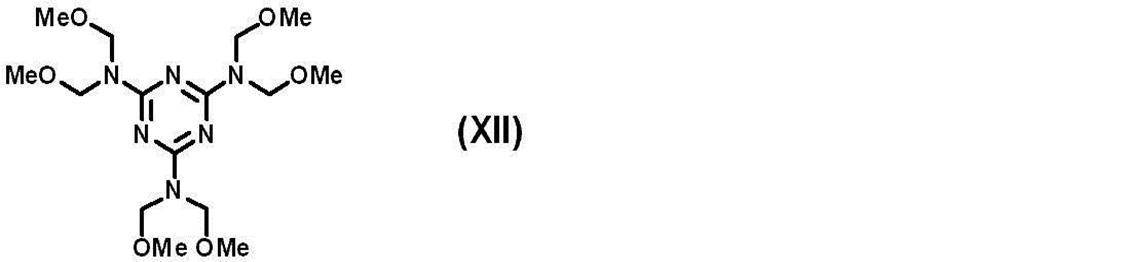
B1:下記式(XII)で表される化合物


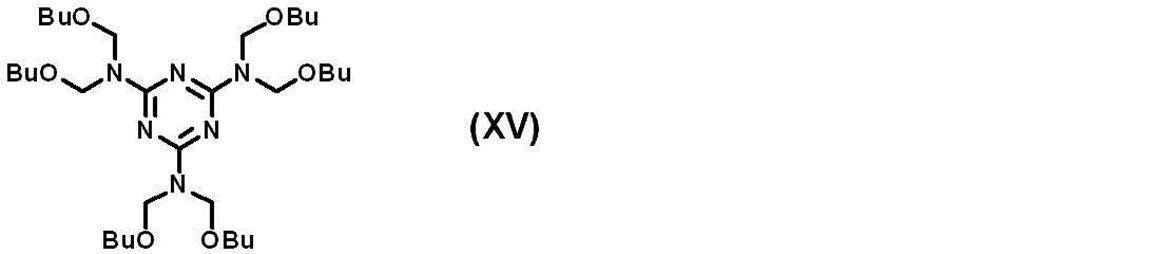

B’1:下記式(XVIII)で表される化合物

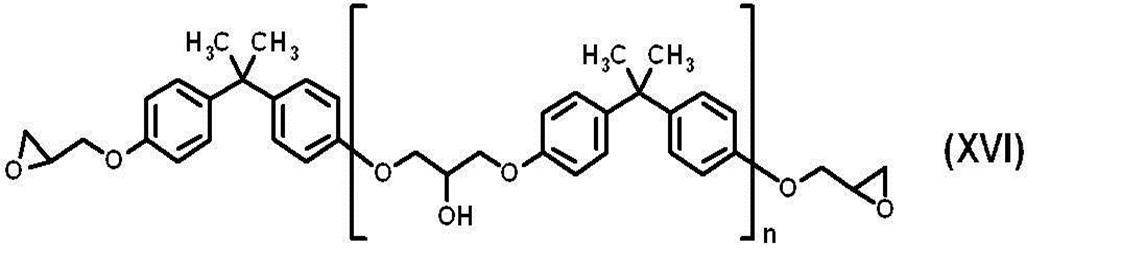
C1:下記式(XVIV)で表される化合物


D1:N-メチル-2-ピロリドン
得られたポリケトン組成物を用いて、以下の方法によりポリケトン硬化物を作製し、後述の評価用のサンプルを準備した。
シリコン基板にポリケトン組成物をスピンコート法により塗布した。得られたシリコン基板を120℃に加熱したホットプレート上で3分間乾燥した。さらに、乾燥後のシリコン基板をイナートガスオーブン(光洋サーモシステム(株))を用いて窒素気流下、200℃で1時間熱処理することで、ポリケトン硬化物付シリコン基板を得て、これを耐薬品性試験用サンプルとした。
ガラス基板にポリケトン組成物をスピンコート法により塗布した。得られたガラス基板を(1)と同様に乾燥し、熱処理して、ポリケトン硬化物付ガラス基板を得て、これを透過率測定用サンプルとした。
ポリケトン組成物をアルミカップに滴下し、(1)と同様に乾燥し、熱処理して、アルミカップ内に成形されたポリケトン硬化物(ポリケトン成形体)を得た。このポリケトン成形体をアルミカップから剥がして、これを熱分解温度測定用サンプルとした。
ポリケトン組成物をバーコート法によりポリイミドフィルム上に塗布し、(1)と同様に乾燥し、熱処理して、ポリケトン硬化物付きポリイミドフィルムを得た。このポリケトン硬化物をポリイミドフィルムから剥がし、ポリケトン硬化物(ポリケトン膜)を得て、これを伸び率測定用サンプルとした。
ポリケトンの分子量(重量平均分子量及び数平均分子量)は、溶離液としてテトラヒドロフラン(THF)を用いて、GPC法によって測定し、標準ポリスチレン換算にて求めた。詳細は次のとおりである。
・カラム:TSKgel Supermultipore HZ-M(東ソー(株))
・検出器:UV検出器、RI検出器併用
・流速:0.4ml/min
ポリケトン硬化物付シリコン基板を個片化して試験片を作製した。試験片をそれぞれ、以下の条件(a)及び(b)で薬液に浸漬した。浸漬中にポリケトン硬化物であるポリケトン膜が溶解するか、又はポリケトン膜がシリコン基板から剥離するかを観察した。観察結果を表5及び表6に示す。本試験において、溶解及び剥離が見られない場合は「変化なし」とした。
条件(b);23℃の0.5質量%のフッ酸(HF)水溶液に試験片を30分間浸漬した。
ポリケトン硬化物付ガラス基板の400nmにおける可視光の透過率を、分光光度計(V-570、日本分光(株))を用いた紫外可視吸収スペクトル法によって測定した。ポリケトン硬化物を有さないガラス基板をリファレンスとして、膜厚1μmに換算した膜の透過率を表5及び表6に示す。
熱重量天秤TG-DTA6300((株)日立ハイテクサイエンス((株)日立ハイテクノロジーズ))を用いて、ポリケトン硬化物の重量減少を測定した。加熱により重量が大きく減少する曲線の接線の交点を熱分解温度と定義する。その結果を表5及び表6に示す。
引張試験機(AUTOGRAPH EZ-TEST EZ-S、(株)島津製作所製)を用いて、ポリケトン硬化物(ポリケトン膜)を5mm/minの速度で引張り試験を行い、伸び率を測定した。その結果を表5及び表6に示す。

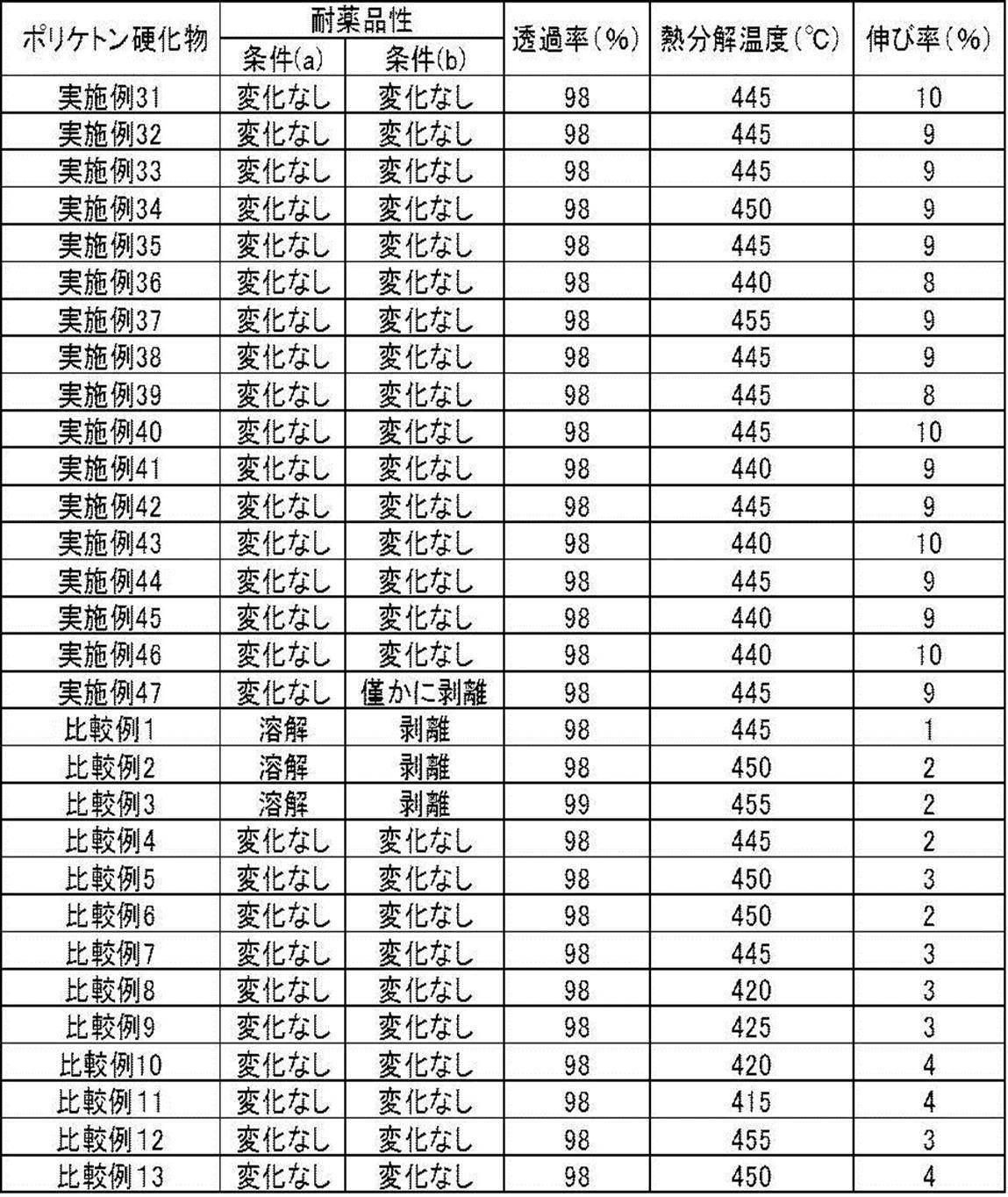
一方、特定含窒素化合物を含有しない比較例1~3では、耐薬品性に劣り、伸び率も低くなっていた。また、特定含窒素化合物の代わりにエポキシ化合物を含む比較例4~13では、耐薬品性、透明性及び耐熱性については実施例と同等であったが、伸び率が低いことが分かった。
Claims (12)
- 下記一般式(I)で表される構造単位を主鎖に含むポリケトン、並びに、
窒素原子と、前記窒素原子と結合するヒドロキシメチル基及びアルコキシメチル基からなる群より選択される少なくとも1種の基と、を有する含窒素化合物、
を含有するポリケトン組成物。

〔一般式(I)中、Xは、それぞれ独立に、置換基を有していてもよい炭素数1~50の2価の基を示し、Yは、それぞれ独立に、置換基を有していてもよい炭素数1~30の2価の炭化水素基を示し、nは3~1000の整数を示す。〕 - 前記一般式(I)において、Xが、それぞれ独立に、芳香環を含む炭素数6~50の2価の基を含む、請求項1に記載のポリケトン組成物。
- 前記一般式(I)において、Xが、それぞれ独立に、下記一般式(II-1)~(II-3)からなる群より選択される少なくとも1種で表される2価の基を含む、請求項1又は請求項2に記載のポリケトン組成物。

〔一般式(II-1)中、R1は、それぞれ独立に、水素原子又は置換基を有していてもよい炭素数1~30の炭化水素基を示し、R2は、それぞれ独立に、置換基を有していてもよい炭素数1~30の炭化水素基を示し、mは、それぞれ独立に、0~3の整数を示す。〕
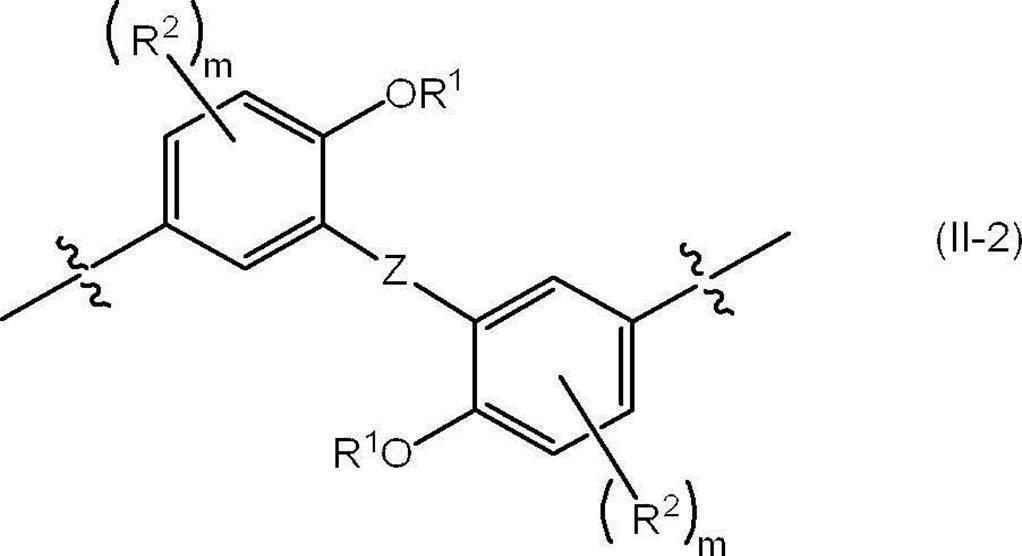
〔一般式(II-2)中、R1は、それぞれ独立に、水素原子又は置換基を有していてもよい炭素数1~30の炭化水素基を示し、R2は、それぞれ独立に、置換基を有していてもよい炭素数1~30の炭化水素基を示し、mは、それぞれ独立に、0~3の整数を示し、Zは、酸素原子又は下記一般式一般式(III-1)~(III-7)で表される2価の基を示す。〕

〔一般式(III-1)~(III-7)中、R1は、それぞれ独立に、水素原子又は置換基を有していてもよい炭素数1~30の炭化水素基を示し、R2は、それぞれ独立に、置換基を有していてもよい炭素数1~30の炭化水素基を示し、R3及びR4は、それぞれ独立に、水素原子又は置換基を有していてもよい炭素数1~30の炭化水素基を表す。mは、それぞれ独立に、0~3の整数を示し、nは、それぞれ独立に、0~4の整数を示し、pは、それぞれ独立に、0~2の整数を示す。〕
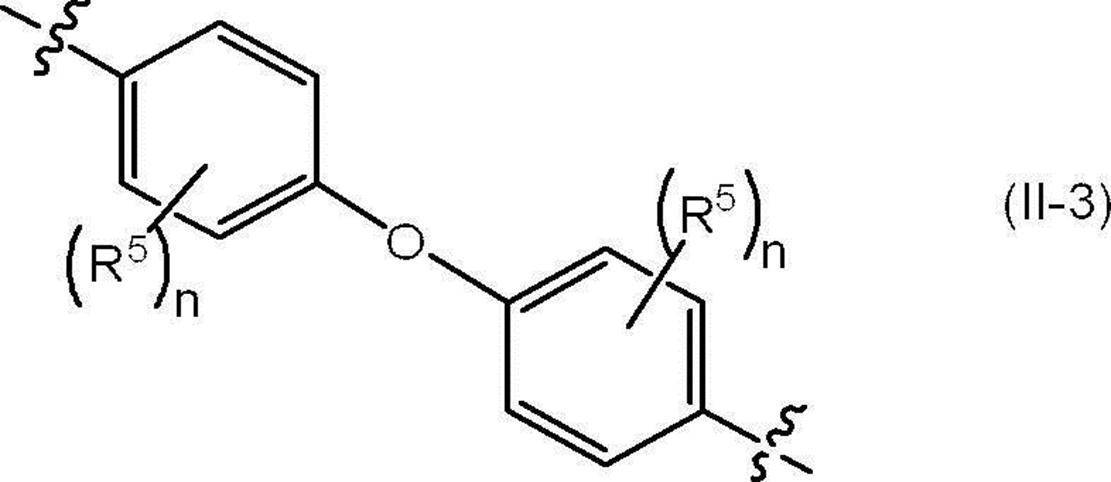
〔一般式(II-3)中、R5は、それぞれ独立に、置換基を有していてもよい炭素数1~30の炭化水素基を示し、nは、それぞれ独立に、0~4の整数を示す。〕 - 前記一般式(I)において、Yが、2価の飽和炭化水素基を含む、請求項1~請求項3のいずれか1項に記載のポリケトン組成物。
- 前記一般式(I)において、Yが、2価の飽和脂環式炭化水素基を含む、請求項4に記載のポリケトン組成物。
- 前記一般式(I)において、Yの炭素数が6~30である、請求項1~請求項5のいずれか1項に記載のポリケトン組成物。
- 前記含窒素化合物は、窒素原子と結合するヒドロキシメチル基及びアルコキシメチル基の総数が、2個~6個である、請求項1~請求項6のいずれか1項に記載のポリケトン組成物。
- 熱潜在酸発生剤をさらに含有する、請求項1~請求項7のいずれか1項に記載のポリケトン組成物。
- 溶剤をさらに含有する、請求項1~請求項8のいずれか1項に記載のポリケトン組成物。
- 請求項1~請求項9のいずれか1項に記載のポリケトン組成物の硬化物である、ポリケトン硬化物。
- 請求項10に記載のポリケトン硬化物を有する光学素子。
- 請求項10に記載のポリケトン硬化物を有する画像表示装置。
Priority Applications (2)
| Application Number | Priority Date | Filing Date | Title |
|---|---|---|---|
| JP2018531837A JPWO2018025673A1 (ja) | 2016-08-04 | 2017-07-21 | 含窒素化合物を含有するポリケトン組成物、ポリケトン硬化物、光学素子及び画像表示装置 |
| KR1020197006295A KR20190036554A (ko) | 2016-08-04 | 2017-07-21 | 질소 함유 화합물을 함유하는 폴리케톤 조성물, 폴리케톤 경화물, 광학 소자 및 화상 표시 장치 |
Applications Claiming Priority (2)
| Application Number | Priority Date | Filing Date | Title |
|---|---|---|---|
| JP2016-153622 | 2016-08-04 | ||
| JP2016153622 | 2016-08-04 |
Publications (1)
| Publication Number | Publication Date |
|---|---|
| WO2018025673A1 true WO2018025673A1 (ja) | 2018-02-08 |
Family
ID=61073624
Family Applications (1)
| Application Number | Title | Priority Date | Filing Date |
|---|---|---|---|
| PCT/JP2017/026540 Ceased WO2018025673A1 (ja) | 2016-08-04 | 2017-07-21 | 含窒素化合物を含有するポリケトン組成物、ポリケトン硬化物、光学素子及び画像表示装置 |
Country Status (4)
| Country | Link |
|---|---|
| JP (1) | JPWO2018025673A1 (ja) |
| KR (1) | KR20190036554A (ja) |
| TW (1) | TW201821524A (ja) |
| WO (1) | WO2018025673A1 (ja) |
Cited By (1)
| Publication number | Priority date | Publication date | Assignee | Title |
|---|---|---|---|---|
| JP2020105287A (ja) * | 2018-12-26 | 2020-07-09 | 日立化成株式会社 | ヒドラジド化合物を含有するポリケトン組成物、ポリケトン硬化物、光学素子、及び画像表示装置 |
Citations (7)
| Publication number | Priority date | Publication date | Assignee | Title |
|---|---|---|---|---|
| JP2008004279A (ja) * | 2006-06-20 | 2008-01-10 | Kaneka Corp | 燃料電池用組成物、それを用いた燃料電池用高分子電解質膜、触媒層、あるいは燃料電池。 |
| JP2013053194A (ja) * | 2011-09-01 | 2013-03-21 | Yamagata Univ | 芳香族ポリケトンの製造方法と芳香族ポリケトン |
| WO2014109143A1 (ja) * | 2013-01-09 | 2014-07-17 | Jsr株式会社 | 感光性組成物、重合体、樹脂膜およびその製造方法ならびに電子部品 |
| JP2015052694A (ja) * | 2013-09-06 | 2015-03-19 | Jsr株式会社 | 感光性樹脂組成物、重合体、樹脂膜およびその製造方法、ならびに電子部品 |
| JP2016037517A (ja) * | 2014-08-05 | 2016-03-22 | 日立化成株式会社 | 硬化性樹脂組成物及び硬化物 |
| US20160365242A1 (en) * | 2015-06-11 | 2016-12-15 | Sk Innovation Co., Ltd. | Novel Polymer with a Good Heat Resistance and Storage Stability, Underlayer Film Composition Containing the Polymer and Process for Forming Underlayer Film Using the Composition |
| WO2017154709A1 (ja) * | 2016-03-09 | 2017-09-14 | 日立化成株式会社 | エポキシ化合物を含有するポリケトン組成物、ポリケトン硬化物、光学素子及び画像表示装置 |
Family Cites Families (4)
| Publication number | Priority date | Publication date | Assignee | Title |
|---|---|---|---|---|
| JPS627730A (ja) | 1985-07-05 | 1987-01-14 | Asahi Chem Ind Co Ltd | 結晶性芳香族ポリエ−テルケトンの製造方法 |
| JP4382376B2 (ja) * | 2003-03-13 | 2009-12-09 | 富士通株式会社 | 低誘電率膜用組成物、低誘電率膜及びその製造方法、並びに、半導体装置 |
| JP4339729B2 (ja) | 2004-03-25 | 2009-10-07 | Tdk株式会社 | 芳香族ポリケトン及びその中間体、芳香族ポリケトンの製造方法、電気化学素子用ガスケット、電気化学素子用セパレータ、並びに、電気化学素子 |
| CN107463066B (zh) * | 2011-10-11 | 2020-10-30 | 日产化学工业株式会社 | 形成固化膜的组合物、取向材及相位差材 |
-
2017
- 2017-07-21 JP JP2018531837A patent/JPWO2018025673A1/ja active Pending
- 2017-07-21 KR KR1020197006295A patent/KR20190036554A/ko not_active Ceased
- 2017-07-21 WO PCT/JP2017/026540 patent/WO2018025673A1/ja not_active Ceased
- 2017-07-26 TW TW106125032A patent/TW201821524A/zh unknown
Patent Citations (7)
| Publication number | Priority date | Publication date | Assignee | Title |
|---|---|---|---|---|
| JP2008004279A (ja) * | 2006-06-20 | 2008-01-10 | Kaneka Corp | 燃料電池用組成物、それを用いた燃料電池用高分子電解質膜、触媒層、あるいは燃料電池。 |
| JP2013053194A (ja) * | 2011-09-01 | 2013-03-21 | Yamagata Univ | 芳香族ポリケトンの製造方法と芳香族ポリケトン |
| WO2014109143A1 (ja) * | 2013-01-09 | 2014-07-17 | Jsr株式会社 | 感光性組成物、重合体、樹脂膜およびその製造方法ならびに電子部品 |
| JP2015052694A (ja) * | 2013-09-06 | 2015-03-19 | Jsr株式会社 | 感光性樹脂組成物、重合体、樹脂膜およびその製造方法、ならびに電子部品 |
| JP2016037517A (ja) * | 2014-08-05 | 2016-03-22 | 日立化成株式会社 | 硬化性樹脂組成物及び硬化物 |
| US20160365242A1 (en) * | 2015-06-11 | 2016-12-15 | Sk Innovation Co., Ltd. | Novel Polymer with a Good Heat Resistance and Storage Stability, Underlayer Film Composition Containing the Polymer and Process for Forming Underlayer Film Using the Composition |
| WO2017154709A1 (ja) * | 2016-03-09 | 2017-09-14 | 日立化成株式会社 | エポキシ化合物を含有するポリケトン組成物、ポリケトン硬化物、光学素子及び画像表示装置 |
Cited By (1)
| Publication number | Priority date | Publication date | Assignee | Title |
|---|---|---|---|---|
| JP2020105287A (ja) * | 2018-12-26 | 2020-07-09 | 日立化成株式会社 | ヒドラジド化合物を含有するポリケトン組成物、ポリケトン硬化物、光学素子、及び画像表示装置 |
Also Published As
| Publication number | Publication date |
|---|---|
| KR20190036554A (ko) | 2019-04-04 |
| JPWO2018025673A1 (ja) | 2019-05-30 |
| TW201821524A (zh) | 2018-06-16 |
Similar Documents
| Publication | Publication Date | Title |
|---|---|---|
| JP6785423B2 (ja) | 芳香族ポリケトン及びその製造方法、芳香族ポリケトン組成物、芳香族ポリケトン膜、光学素子並びに画像表示装置 | |
| JPWO2018142908A1 (ja) | ポリケトン組成物、ポリケトン膜、ポリケトン膜付基材、光学素子、画像表示装置、被覆部材、及び成形体 | |
| WO2018025673A1 (ja) | 含窒素化合物を含有するポリケトン組成物、ポリケトン硬化物、光学素子及び画像表示装置 | |
| JP2018168270A (ja) | 芳香族ポリケトン及びその製造方法、芳香族ポリケトン組成物、芳香族ポリケトン硬化物、光学素子並びに画像表示装置 | |
| JP6879303B2 (ja) | 異なる二種類の構造単位を有する芳香族ポリケトン | |
| JP2020105517A (ja) | 鎖状基を有する構造単位を含むポリケトンとヒドラジド化合物とを含有するポリケトン組成物、ポリケトン硬化物、光学素子、及び画像表示装置 | |
| US10759937B2 (en) | Polyketone composition including epoxy compound, cured polyketone, optical element, and image display device | |
| JP6874470B2 (ja) | ポリケトン樹脂組成物、ポリケトン硬化物、光学素子、画像表示装置、被覆材料及び成形体 | |
| WO2019009079A1 (ja) | ヒドラジド化合物を含有するポリケトン組成物、ポリケトン硬化物、光学素子及び画像表示装置 | |
| JP6520495B2 (ja) | 芳香族ポリケトンの製造方法 | |
| JP6778377B2 (ja) | 主鎖中にアルキレン基を有する芳香族ポリケトン、芳香族ポリケトンワニス、芳香族ポリケトン膜及び芳香族ポリケトンの製造方法 | |
| JP2020105286A (ja) | 芳香環及び鎖状基を有する構造単位を含むポリケトン、ポリケトン組成物、ポリケトン膜、光学素子、画像表示装置、及びポリケトンの製造方法 | |
| JP6759682B2 (ja) | 分岐型芳香族ポリケトン、分岐型芳香族ポリケトンの製造方法、分岐型芳香族ポリケトン組成物、分岐型芳香族ポリケトン膜、光学素子、画像表示装置及び分岐型芳香族ポリケトン膜付基材 | |
| JP2019014819A (ja) | デカリン骨格を有する芳香族ポリケトン及びその製造方法、デカリン骨格を有する芳香族ポリケトン組成物、デカリン骨格を有する芳香族ポリケトン膜、光学素子並びに画像表示装置 | |
| JP6769075B2 (ja) | 芳香族ポリケトン、芳香族ポリケトンの製造方法、芳香族ポリケトン組成物、芳香族ポリケトン膜、芳香族ポリケトン膜付基材、光学素子、画像表示装置及び被覆材料 | |
| JP2020105287A (ja) | ヒドラジド化合物を含有するポリケトン組成物、ポリケトン硬化物、光学素子、及び画像表示装置 | |
| JP2017197687A (ja) | 芳香環及び四級炭素原子含有脂環を含む重合体、重合体の製造方法、組成物、膜、膜付基材、光学素子、画像表示装置、被覆材料及び成形体 |
Legal Events
| Date | Code | Title | Description |
|---|---|---|---|
| ENP | Entry into the national phase |
Ref document number: 2018531837 Country of ref document: JP Kind code of ref document: A |
|
| 121 | Ep: the epo has been informed by wipo that ep was designated in this application |
Ref document number: 17836779 Country of ref document: EP Kind code of ref document: A1 |
|
| NENP | Non-entry into the national phase |
Ref country code: DE |
|
| ENP | Entry into the national phase |
Ref document number: 20197006295 Country of ref document: KR Kind code of ref document: A |
|
| 122 | Ep: pct application non-entry in european phase |
Ref document number: 17836779 Country of ref document: EP Kind code of ref document: A1 |