WO2018021077A1 - 車両用シート制御装置 - Google Patents
車両用シート制御装置 Download PDFInfo
- Publication number
- WO2018021077A1 WO2018021077A1 PCT/JP2017/025801 JP2017025801W WO2018021077A1 WO 2018021077 A1 WO2018021077 A1 WO 2018021077A1 JP 2017025801 W JP2017025801 W JP 2017025801W WO 2018021077 A1 WO2018021077 A1 WO 2018021077A1
- Authority
- WO
- WIPO (PCT)
- Prior art keywords
- seat
- vehicle
- seating
- rear seat
- ecu
- Prior art date
- Legal status (The legal status is an assumption and is not a legal conclusion. Google has not performed a legal analysis and makes no representation as to the accuracy of the status listed.)
- Ceased
Links
Images




Classifications
-
- B—PERFORMING OPERATIONS; TRANSPORTING
- B60—VEHICLES IN GENERAL
- B60N—SEATS SPECIALLY ADAPTED FOR VEHICLES; VEHICLE PASSENGER ACCOMMODATION NOT OTHERWISE PROVIDED FOR
- B60N2/00—Seats specially adapted for vehicles; Arrangement or mounting of seats in vehicles
- B60N2/02—Seats specially adapted for vehicles; Arrangement or mounting of seats in vehicles the seat or part thereof being movable, e.g. adjustable
- B60N2/04—Seats specially adapted for vehicles; Arrangement or mounting of seats in vehicles the seat or part thereof being movable, e.g. adjustable the whole seat being movable
- B60N2/06—Seats specially adapted for vehicles; Arrangement or mounting of seats in vehicles the seat or part thereof being movable, e.g. adjustable the whole seat being movable slidable
-
- B—PERFORMING OPERATIONS; TRANSPORTING
- B60—VEHICLES IN GENERAL
- B60N—SEATS SPECIALLY ADAPTED FOR VEHICLES; VEHICLE PASSENGER ACCOMMODATION NOT OTHERWISE PROVIDED FOR
- B60N2/00—Seats specially adapted for vehicles; Arrangement or mounting of seats in vehicles
- B60N2/02—Seats specially adapted for vehicles; Arrangement or mounting of seats in vehicles the seat or part thereof being movable, e.g. adjustable
- B60N2/22—Seats specially adapted for vehicles; Arrangement or mounting of seats in vehicles the seat or part thereof being movable, e.g. adjustable the back-rest being adjustable
Definitions
- the present invention relates to a vehicle seat control device.
- Patent Document 1 includes a map that defines a sliding range in which a seat cushion (seat) can be slid and a reclining range in which a seat back can be reclined, and the seat is set according to a threshold set in the map.
- a control device for controlling the sliding operation of the cushion and the reclining operation of the seat back is disclosed.
- the threshold value is set so that the reclining range is larger than when the seat cushion is on the rear side of the vehicle. While avoiding, the operating range of each seat element is enlarged to improve the convenience.
- Patent Document 2 when there is an operation input to an operation switch, the operation position of each sheet element is detected, and each sheet element is set to a predetermined sheet position stored (held) in a memory.
- a control device that performs an automatic operation for automatically controlling the operation position is disclosed.
- the threshold value of the map is set on the assumption that no occupant is seated on the rear seat.
- the map threshold is set on the assumption that a passenger is seated on the rear seat. In this case, it is possible to suppress giving a tight feeling to the occupant seated on the rear seat.
- the operating range of each seat element of the front seat is reduced, which reduces the convenience of the occupant of the front seat.
- An object of the present invention is to provide a vehicle seat control device capable of improving convenience while suppressing a rear seat occupant from being cramped.
- the vehicle seat control device includes a seating detection unit, an operation position detection unit, a storage unit, a control unit, and a limiting unit.
- the said seating detection part detects the seating of the passenger
- the operation position detection unit detects an operation position of each seat element of the front seat and the rear seat that can be adjusted by a driving force from a driving source.
- the storage unit stores a predetermined front seat position of the front seat and a predetermined rear seat position of the rear seat.
- the control unit is configured to automatically move the front seat to the predetermined front seat position when a predetermined front auto operation start condition is satisfied, and to move the rear seat to the predetermined rear seat position when a predetermined rear auto operation start condition is satisfied. Carry out the rear auto operation that automatically moves to.
- the limiting unit is configured to adjust at least one of the position adjustment of the front seat and the position adjustment of the rear seat based on the detection result of the operation position detection unit.
- the position adjustment of the at least one is limited so as to be smaller than the case where the seating of the passenger on the rear seat is not detected.
- the position adjustment of the front seat is a position adjustment of the seat element of the front seat in the vehicle rear direction by the front auto operation.
- the position adjustment of the rear seat is a position adjustment of the seat element of the rear seat in the vehicle front direction by the rear auto operation.
- the schematic block diagram of the vehicle seat control apparatus (A) is a schematic diagram which shows a small space map, (b) is a schematic diagram which shows a large space map.
- a front seat 1f of the present embodiment shown in FIG. 1 is used for a front seat of a vehicle.
- the front seat 1f includes a seat cushion 2f, a seat back 3f provided to be tiltable with respect to a rear end portion of the seat cushion 2f, and a headrest 4f provided at an upper end of the seat back 3f.
- Two lower rails 6f extending in the vehicle front-rear direction are provided in parallel on the floor portion Fl of the vehicle.
- Each of the lower rails 6f is provided with an upper rail 7f that can be relatively moved in the vehicle longitudinal direction on the lower rail 6f.
- the seat cushion 2f is supported on both the upper rails 7f, and can be relatively moved (sliding) in the vehicle front-rear direction on the lower rail 6f integrally with the both upper rails 7f.
- the rear seat 1r of the present embodiment is used for a rear seat arranged side by side in the rear direction of the front seat 1f.
- the rear seat 1r includes a seat cushion 2r, a seat back 3r provided to be tiltable with respect to a rear end portion of the seat cushion 2r, and a headrest 4r provided at an upper end of the seat back 3r.
- the rear seat 1r includes an ottoman 5r that is provided so as to be tiltable with respect to the front end portion of the seat cushion 2r and is configured to be extendable.
- two lower rails 6r extending in the vehicle front-rear direction are provided in parallel on the vehicle floor Fl, and an upper rail 7r is attached to the lower rail 6r.
- the seat cushion 2r is connected to the upper rail 7r. It is integrally movable (sliding operation) on the lower rail 6r in the vehicle front-rear direction.
- the front seat 1f is provided with a seat slide actuator 11f and a seat reclining actuator 12f.
- the front seat 1f is configured as a power seat that can adjust the operating position of each seat element SE by each actuator 11f, 12f. .
- the seat slide actuator 11f has a motor M1f as a drive source, and slides a seat cushion 2f (the entire front seat 1f) as a seat element in the front-rear direction of the vehicle (left-right direction in FIG. 1). Let Thereby, the front seat 1f can adjust the slide position in the front-rear direction of the vehicle.
- the seat reclining actuator 12f has a motor M2f as a driving source, and the reclining operation is performed so that the position of the upper end portion of the seat back 3f moves in the front-rear direction of the vehicle. (In FIG. 1, tilting in the left-right direction). Thereby, the reclining position of the seat back 3f can be adjusted for the front seat 1f.
- the rear seat 1r is provided with a seat slide actuator 11r, a seat reclining actuator 12r, and an ottoman actuator 13r.
- the rear seat 1r is a power seat that can adjust the operating position of each seat element SE by each actuator 11r to 13r. It is configured.
- the seat slide actuator 11r has a motor M1r as a driving source, and slides the seat cushion 2r (the entire rear seat 1r) as a seat element in the front-rear direction of the vehicle (left-right direction in FIG. 1). .
- the rear seat 1r can adjust the slide position in the front-rear direction of the vehicle.
- the seat reclining actuator 12r has a motor M2r as a drive source, and the reclining operation is performed so that the position of the upper end portion of the seat back 3r moves in the front-rear direction of the vehicle. (In FIG. 1, tilting in the left-right direction). Thereby, the reclining position of the seat back 3r of the rear seat 1r can be adjusted.
- the ottoman actuator 13r has a motor M3r as a drive source, and tilts the ottoman 5r as a seat element so that the position of its lower end portion moves in the front-rear direction of the vehicle (in FIG. Tilt) and extend and contract in a direction crossing the tilt direction. Thereby, the rear seat 1r can adjust the tilting position and the expansion / contraction position (tilting expansion / contraction position) of the ottoman 5r.
- the front seat 1f is provided with a front ECU 15f that controls the operation of the actuators 11f and 12f.
- the front ECU 15f is connected to the motors M1f and M2f, respectively, and through the supply of driving power to the motors M1f and M2f, the operation of the actuators 11f and 12f, that is, the seat elements SE (the seat cushion 2f and the seat back 3f). Control the operating position.
- the front ECU 15f moves the seat position of the front seat 1f through control of the operation position of each seat element SE.
- each of the motors M1f and M2f is provided with rotation sensors S1f and S2f that output a pulse signal synchronized with the rotation. That is, the pulse signals Sp1f and Sp2f output from the rotation sensors S1f and S2f are synchronized with the operations of the sheet elements SE driven by the actuators 11f and 12f.
- the front ECU 15f detects the operating position of each seat element SE by counting (integrating) the pulse changes of the pulse signals Sp1f and Sp2f based on the preset initial values. That is, the front ECU 15f and the pulse signals Sp1f and Sp2f constitute an operation position detector.
- the front ECU 15f is connected with a plurality of front operation switches 21f for adjusting the operation position of each seat element SE by the operation of the occupant.
- the front operation switch 21f corresponds to the front operation unit, and is provided, for example, on the side of the front seat 1f.
- the rear seat 1r is provided with a rear ECU 15r that controls the operation of the actuators 11r to 13r.
- the rear ECU 15r is connected to each of the motors M1r to M3r, and operates the actuators 11r to 13r through the supply of driving power to the motors M1r to M3r, that is, the seat elements SE (seat cushion 2r, seat back 3r, ottoman). 5r) is controlled. Then, the rear ECU 15r moves the seat position of the rear seat 1r through control of the operation position of each seat element SE.
- each of the motors M1r to M3r is provided with rotation sensors S1r to S3r for outputting a pulse signal synchronized with the rotation, like the motors M1f and M2f.
- the rear ECU 15r detects the operation position of each seat element SE by counting the pulse changes of the pulse signals Sp1r to Sp3r based on preset initial values. That is, the operation position detection unit is configured by the rear ECU 15r and the pulse signals Sp1r to Sp3r.
- the rear ECU 15r is connected to a seating sensor 22 that forms a pressure sensitive part on the seating surface 2ra of the seat cushion 2r of the rear seat 1r.
- the seating sensor 22 of the present embodiment uses a membrane switch that switches on and off when the seating surface 2ra is pressed, and outputs a seating signal S_si that switches on and off depending on whether or not the rear seat 1r is seated.
- the rear ECU 15r is connected to a plurality of rear operation switches 21r for adjusting the operation position of each seat element SE by an occupant's operation.
- the rear operation switch 21r corresponds to the rear operation unit, and is provided, for example, on the side portion of the rear seat 1r.
- the rear ECU 15r is connected to the front ECU 15f via the in-vehicle network 23.
- the front ECU 15f receives, for example, the vehicle start state (for example, the operation position of the ignition key and the start switch on / off) via the in-vehicle network 23.
- the vehicle start state for example, the operation position of the ignition key and the start switch on / off
- Various signals such as an ignition signal S_ig indicating the signal and a signal from the rear ECU 15r are input.
- the front ECU 15f moves the front seat 1f by controlling the operation position of each seat element SE of the front seat 1f based on various input signals.
- the rear ECU 15r receives, for example, an ignition signal S_ig, Various signals such as a signal from the front ECU 15f are input. Then, the rear ECU 15r controls the operation position of each seat element SE of the rear seat 1r based on various signals that are input, and moves the rear seat 1r. The rear ECU 15r detects the seating of the passenger on the rear seat 1r based on the seating signal S_si. That is, in the present embodiment, the seating detection unit is configured by the rear ECU 15r and the seating signal S_si.
- the front ECU 15f adjusts the position of the seat element SE of the front seat 1f according to the input, that is, performs a front manual operation. Further, a plurality of predetermined front seat positions of the front seat 1f are stored (held) in the memory 31f as a storage unit of the front ECU 15f.
- the front ECU 15f controls the actuators 11f and 12f when a predetermined front auto operation start condition predetermined for each predetermined front seat position is satisfied, and the operation position of each seat element SE is set to the predetermined front seat. The position is automatically adjusted to be the operation position corresponding to the position. That is, the front ECU 15f performs a front auto operation for moving the front seat 1f to the predetermined front seat position.
- the rear ECU 15r adjusts the position of the seat element SE of the rear seat 1r according to the input, that is, performs a rear manual operation.
- a plurality of predetermined rear seat positions of the rear seat 1r are stored in the memory 31r as a storage unit of the rear ECU 15r.
- the rear ECU 15r controls the actuators 11r to 13r when a predetermined rear auto operation start condition predetermined for each predetermined rear seat position is satisfied, and the operation position of each seat element SE corresponds to the predetermined rear seat position.
- the position is automatically adjusted so that it becomes the operating position. That is, the rear ECU 15r performs a rear auto operation for moving the rear seat 1r to the predetermined rear seat position.
- the predetermined front seat position and the predetermined rear seat position include, for example, a getting-off position set in advance as a position where the occupant easily gets off when getting out of the vehicle, a registered seat position registered according to the occupant's preference, and the like. Further, as the predetermined front auto operation start condition and the predetermined rear auto operation start condition, for example, there is an operation input to the front operation switch 21f for performing the front auto operation or the rear operation switch 21r for performing the rear auto operation. And the ignition signal S_ig indicates an off state and the door is opened.
- the front ECU 15f and the rear ECU 15r constitute a control unit that performs a front auto operation and a rear auto operation.
- the rear ECU 15r suppresses the feeling of being cramped to the occupant of the rear seat 1r, and improves the convenience of each occupant of the front seat 1f and the rear seat 1r based on each map, during the front auto operation.
- the position adjustment of the seat element SE of the 1f and the seat element of the rear seat 1r during the rear auto operation is limited. That is, the rear ECU 15r functions as a limiting unit. Note that the position adjustment is limited to the operation stop of the seat element SE that is about to enter the operation limit range of the map and the operation limit range of the sheet element SE stopped at the boundary position with the map operation limit range. Including not permitting the start of operation.
- the small space map and the large space map are respectively in the vehicle longitudinal direction between the reclining position of the seat back 3f of the front seat 1f and the front seat 1f and the rear seat 1r. It is set based on relative distance.
- the reclining position on the vertical axis indicates that the seat back 3f is inclined more toward the rear of the vehicle as it goes upward in the figure, and the relative distance on the horizontal axis indicates the front seat 1f as it goes to the right side in the figure. It shows that the relative distance in the vehicle front-rear direction between the rear seat 1r and the rear seat 1r is short.
- the vehicle front-rear direction position of the rear seat 1r of the present embodiment is calculated based on the slide position of the seat cushion 2r and the tilting expansion / contraction position of the ottoman 5r, and the rear ECU 15r has the tilting position of the ottoman 5r in the vehicle upward direction. It is determined that the rear seat 1r is positioned in the forward direction of the vehicle as it is positioned and as the ottoman 5r extends.
- an operation range in which the position of the seat element SE of the front seat 1f can be adjusted and an operation range in which the position of the seat element SE of the rear seat 1r can be adjusted indicate the space between the front seat 1f and the rear seat 1r. It is set to be smaller than the space between the front seat 1f and the rear seat 1r in the large space map.
- the range in which the reclining operation of the seat back 3f can be performed so that the space between the front seat 1f and the rear seat 1r is smaller than the space between the front seat 1f and the rear seat 1r in the large space map A relative distance at which 1f and the rear seat 1r can be closest to each other and a range in which the ottoman 5r can be tilted and expanded are set.
- the seat back 3f has a range in the vehicle rearward direction from the first reclining position P1.
- the operation limit range is set such that the range on the vehicle front direction side of the same position P1 is the reclining operation permission range.
- the reclining operation permission range of the seat back 3f is set so as to gradually decrease toward the vehicle front side as the relative distance becomes shorter. Yes.
- the relative distance at which the front seat 1f and the rear seat 1r are closest to each other is The seat back 3f is set so as to gradually increase as the seat back 3 largely falls in the vehicle rearward direction.
- the relative distance that the front seat 1f and the rear seat 1r can be closest to each other is A range shorter than the first relative distance L1 is set as an operation restriction range, and a range equal to or greater than the distance L1 is set as an operation permission range. That is, in the small space map, there is a range in which the reclining position of the seat back 3f and the relative distance between the front seat 1f and the rear seat 1r are on the inner side of the boundary line B1 (the front side of the reclining position or the relative distance increasing side). This is the operation permission range of the sheet element SE. Further, the range that is outside the boundary line B1 (the vehicle reclining position side or the relative distance decreasing side) is the operation limit range of the seat element SE.
- an auxiliary boundary line SB1 that is substantially parallel (similar) to the boundary line B1 is set inside the boundary line B1.
- the tilting expansion / contraction operation of the ottoman 5r is the maximum possible in the mechanism of the ottoman 5r. Allowed in range. That is, the inside of the auxiliary boundary line SB1 is the maximum operation permission range of the ottoman 5r.
- the tilting expansion / contraction operation of the ottoman 5r is smaller than the maximum range. Only allowed in range. That is, the inner side of the boundary line B1 and the outer side of the auxiliary boundary line SB1 are the partial operation permission range of the ottoman 5r.
- the partial operation permission range for example, the tilting range of the ottoman 5r can be set to 50% of the maximum possible range for the mechanism, and the expansion / contraction range can be set to 50% of the maximum possible range for the mechanism. The ratio can be changed as appropriate.
- the tilting / extending operation of the ottoman 5r is restricted, and the tilting / extending position of the ottoman 5r is the most.
- the vehicle is in the downward direction and the most contracted state (stored state). That is, the outside of the boundary line B1 is the operation restriction range of the ottoman 5r.
- the large space map has the same tendency as the small space map, and the operation range in which the position of the seat element SE of the front seat 1f can be adjusted and the position of the seat element SE of the rear seat 1r.
- the adjustable range is set so that the space between the front seat 1f and the rear seat 1r is larger than the small space map.
- the seat back 3f is a range in the vehicle rearward direction with respect to the second reclining position P2 located on the vehicle front side with respect to the first reclining position P1.
- the reclining operation permission range of the seat back 3f is set so as to gradually decrease toward the vehicle front side as the relative distance becomes shorter. Yes.
- the relative distance at which the front seat 1f and the rear seat 1r are closest to each other is A range shorter than the second relative distance L2 that is longer than the first relative distance L1 is set as an operation restriction range, and a range equal to or greater than the distance L2 is set as an operation permission range.
- an auxiliary boundary line SB2 that is substantially parallel to the boundary line B2 is set inside the boundary line B2, and the maximum operation permission range and partial operation permission range of the ottoman 5r are set as in the small space map.
- an operation restriction range are set.
- the front ECU 15f detects the slide position of the seat cushion 2f and the reclining position of the seat back 3f on the basis of the pulse signals Sp1f and Sp2f at predetermined sampling cycles, and indicates the operation positions thereof.
- the position signal S_sp is output.
- the front ECU 15f of this embodiment is not a strict operating position of the sliding position of the seat cushion 2f and the reclining position of the seat back 3f, but slides into any of the ranges obtained by dividing the sliding range and the reclining range into a plurality of ranges, respectively.
- a rough operation position indicating whether the position and the reclining position are located is output.
- the rear ECU 15r detects the sliding position of the seat cushion 2r, the reclining position of the seat back 3r, and the tilting expansion / contraction position of the ottoman 5r for each predetermined sampling period based on the pulse signals Sp1r to Sp3r. Subsequently, the relative distance between the front seat 1f and the rear seat 1r is calculated based on the detected operation position of each seat element SE and the operation position signal S_sp from the front ECU 15f. Further, the relative distance and the reclining position of the seat back 3f are applied to the small space map and the large space map, respectively, and it is determined whether or not to restrict the movement of the front seat 1f and the rear seat 1r.
- the rear ECU 15r When the rear ECU 15r needs to restrict the sliding operation of the seat cushion 2r or the tilting extension / contraction operation of the ottoman 5r on the small space map, the rear ECU 15r does not matter whether the rear manual operation or the rear auto operation is performed. The position adjustment of the sheet element SE is limited. At this time, the rear ECU 15r also outputs a first restriction signal S_li1 instructing that it is necessary to restrict the sliding operation of the seat cushion 2f or the reclining operation of the seat back 3f on the small space map.
- the rear ECU 15r when the rear ECU 15r needs to restrict the sliding operation of the seat cushion 2r or the tilting expansion / contraction operation of the ottoman 5r on the large space map, the rear ECU 15r is seated on the rear seat 1r, and the rear auto operation is performed. The position adjustment of the sheet element SE is limited. At this time, the rear ECU 15r also outputs a second restriction signal S_li2 instructing that it is necessary to restrict the sliding operation of the seat cushion 2f or the reclining operation of the seat back 3f on the large space map.
- the position adjustment of the element SE is not limited.
- the rear ECU 15r adjusts the position of the seat cushion 2r in the vehicle rear direction (rear operation), adjusts the position of the seat back 3r in the vehicle front and rear direction (front and rear operation), and adjusts the position of the ottoman 5r in the vehicle lower direction (lower operation).
- the position adjustment in the contraction direction (contraction operation) is not limited.
- the tilting position of the ottoman 5r is moved downward so that the tilting expansion / contraction position of the ottoman 5r is within the partial operation permission range, and the expansion / contraction position is contracted. Operate.
- the rear ECU 15r continues the front operation of the seat cushion 2r if it is a rear manual operation.
- the lower operation and the contraction operation are performed until the tilting expansion / contraction position of the ottoman 5r is in the retracted state, and the front operation of the seat cushion 2r is stopped.
- the rear ECU 15r outputs the second limit signal S_li2.
- the rear ECU 15r operates downward so that the tilting expansion / contraction position of the ottoman 5r is within the partial operation permission range even in the rear manual operation. And contraction. Then, when the front seat 1f and the rear seat 1r are in the state of the point X5, the rear ECU 15r operates downward and contracts until the tilting expansion / contraction position of the ottoman 5r is in the retracted state even in the rear manual operation. The front operation of the cushion 2r is stopped. At this time, the rear ECU 15r outputs a first limit signal S_li1.
- the front ECU 15f receives the first limit signal regardless of whether the front manual operation or the front auto operation is performed.
- the position adjustment of the sheet element SE indicated by S_li1 is limited.
- the front ECU 15f continues the manual operation and adjusts the position of the seat element when the front manual operation is being executed. .
- the front auto operation is being executed, the position adjustment of the sheet element SE instructed by the second restriction signal S_li2 is restricted.
- the front ECU 15f does not restrict the front operation of the seat cushion 2f and the front operation of the seat back 3f.
- the seat back 3f is operated after the front seat 1f and the rear seat 1r are at the point Y1, as shown in FIGS. 2 (a) and 2 (b).
- the front seat 1f and the rear seat 1r are in the middle of the point Y2
- the rear ECU 15r outputs the second restriction signal S_li2.
- the front ECU 15f continues the rear operation of the seat back 3f according to the operation input to the front operation switch 21f even if the second restriction signal S_li2 is input.
- the rear operation of the seat back 3f is stopped when the second limit signal S_li2 is input. Thereafter, when the front seat 1f and the rear seat 1r are at the point Y3, the first restriction signal S_li1 is output from the rear ECU 15r. At this time, the front ECU 15f stops the rear operation of the seat back 3f even if the position adjustment is a front manual operation.
- the processing procedure of the operation range restriction control by the rear ECU 15r will be described.
- the rear ECU 15r acquires various signals from the various sensors and the in-vehicle network 23 (step 101)
- the front seat 1f and the rear seat are based on the operating positions of the seat elements SE of the front seat 1f and the rear seat 1r.
- the relative distance between 1r is calculated (step 102).
- 103: NO) it is determined whether or not an occupant is seated on the rear seat 1r (step 104).
- step 104 When a passenger is seated on the rear seat 1r (step 104: YES), the second restriction signal S_li2 is output (step 105), and the front seat 1f and the rear seat 1r are within the permitted operation range on the small space map. It is determined whether it is within (inside the boundary line B1) (step 106). In addition, when it exists in the operation
- step 106: NO the first limit signal S_li1 is output (step 107). After outputting the first limit signal S_li1 or when it is within the operation permission range on the small space map (step 106: YES), it is determined whether or not the rear auto 1r is being operated at that time (step 106: YES). Step 108).
- step 108 when the rear ECU 15r is performing the rear auto operation (step 108: YES), there is no output of the limit signal (at least one of the first limit signal S_li1 and the second limit signal S_li2) in the current calculation cycle. Whether or not (step 109). If there is no limit signal output (step 109: YES), the pre-operation of the seat cushion 2r is permitted (step 110).
- step 111 determines whether or not the tilt extension / contraction position of the ottoman 5r is within the permitted operation range on the large space map, that is, whether the front seat 1f and the rear seat 1r are within the maximum permitted operation range on the large space map. If it is within the operation permission range, it is determined whether or not the tilting expansion / contraction position exceeds the partial operation permission range (step 111).
- the tilting expansion / contraction position of the ottoman 5r is within the permitted operation range on the large space map (step 111: YES)
- the position adjustment (upward operation) of the ottoman 5r in the vehicle upward direction and the position adjustment in the extension direction The extension operation is permitted (step 112), and the rear auto operation is continued (step 113).
- the rear ECU 15r adjusts the position of the tilting expansion / contraction position of the ottoman 5r within the permitted operation range (step 111).
- Step 114 That is, when the front seat 1f and the rear seat 1r are in the motion restriction range on the large space map, the ottoman 5r is set in the retracted state, and in the partial motion permission range, the ottoman is allowed to the tilting expansion / contraction position permitted in the partial motion permission range. Adjust the position of 5r. Subsequently, the upper operation and the extension operation of the ottoman 5r are limited (step 115), and the process proceeds to step 113 to continue the rear auto operation.
- step 109 when there is a limit signal output (step 109: NO), the rear ECU 15r limits the front operation of the seat cushion 2r (step 116), and limits the upper operation and extension operation of the ottoman 5r. (Step 117), the process proceeds to Step 113 and the rear auto operation is continued.
- step 118 determines whether or not the rear manual operation is performed.
- step 118: YES it is determined whether or not the first limit signal S_li1 is output in the current calculation cycle (step 119), and the first limit signal S_li1 is not output. In this case (step 119: NO), the front operation of the seat cushion 2r is permitted (step 120).
- step 121 it is determined whether or not the tilt extension / contraction position of the ottoman 5r is within the operation permission range on the small space map (step 121), and the tilt extension / contraction position of the ottoman 5r is within the operation permission range on the large space map.
- step 121: YES the upper operation and the extension operation of the ottoman 5r are permitted (step 122), and the rear manual operation is continued (step 123).
- step 121: NO when the tilting expansion / contraction position of the ottoman 5r is not within the permitted operation range on the small space map (step 121: NO), the rear ECU 15r adjusts the position of the tilting expansion / contraction position of the ottoman 5r within the permitted operation range (step 121). Step 124). Subsequently, the upper operation and the extension operation of the ottoman 5r are restricted (step 125), and the process proceeds to step 123 to continue the rear manual operation.
- step 119: YES when the first restriction signal S_li1 is output (step 119: YES), the rear ECU 15r restricts the front operation of the seat cushion 2r (step 126), and restricts the upper operation and the extension operation of the ottoman 5r. After that (step 127), the process proceeds to step 123 to continue the rear manual operation.
- step 118: NO the position of the rear seat 1r is held (step 128).
- the front ECU 15f determines whether or not the front auto operation of the front seat 1f is being performed (step 202).
- the front auto operation is being performed (step 202: YES)
- it is determined whether or not the limit signal (at least one of the first limit signal S_li1 and the second limit signal S_li2) is not input in the current calculation cycle. (Step 203).
- step 203: NO If a limit signal is input (step 203: NO), the rear operation of the seat cushion 2f and the rear operation of the seat back 3f are limited (step 204), and the front auto operation is continued (step 205). . If there is no limit signal input (step 203: YES), the process goes to step 205 without going to step 204.
- step 206 determines whether the front manual operation is performed.
- step 207 it is determined whether or not the first limit signal S_li1 is input in the current calculation cycle. If the first limit signal S_li1 is input (step 207: YES), the rear operation of the seat cushion 2f and the rear operation of the seat back 3f are limited (step 208), and the front manual operation is continued (step 208). 209).
- step 207: NO when the first limit signal S_li1 is not input (step 207: NO), the process proceeds to step 209 without continuing to step 208, and the front manual operation is continued.
- step 206: NO the position of the front seat 1f is held (step 210).
- the front ECU 15f is configured so that the rear operation of the seat cushion 2f and the seat back 3f by the front auto operation is smaller than that when the occupant is not seated on the rear seat 1r.
- the operation was restricted.
- the rear ECU 15r operates when the occupant is seated on the rear seat 1r, when the seat cushion 2r of the rear seat 1r is actuated by the rear auto operation, and when the ottoman 5r is operated upward and extended, the occupant is not seated on the rear seat 1r.
- the operation was limited to be smaller than the previous one.
- the front seat 1f and the rear seat 1r performs the automatic operation with the occupant seated on the rear seat 1r, a large space is secured between the front seat 1f and the rear seat 1r. Giving a tight feeling to the occupant can be suitably suppressed.
- the rear operation of the seat cushion 2f and the seat back 3f by the front auto operation is not limited as compared with the case where the occupant is seated in the rear seat 1r. The convenience of the occupant of the seat 1f can be improved suitably.
- the front ECU 15f does not allow the occupant to sit on the rear seat 1r when adjusting the position of the seat cushion 2f and the seat back 3f by the front manual operation at the will of the occupant.
- the position adjustment in the rear direction of the vehicle is not restricted as in the case where it is not.
- the convenience of the occupant of the front seat 1f can be further enhanced.
- the front manual operation since it depends on the will of the occupant of the front seat 1f, for example, communication between the occupant of the front seat 1f and the occupant of the rear seat 1r can be achieved, and the occupant seated on the rear seat 1r is cramped. It is hard to give a feeling.
- the rear ECU 15r does not restrict position adjustment in the front direction of the vehicle when adjusting the position of the seat cushion 2r and the ottoman 5r of the rear seat 1r by the rear manual operation by the occupant seated on the rear seat 1r.
- the convenience of the occupant of the rear seat 1r can be further enhanced.
- a small space map and a large space map are stored in the memory 31r. Based on these maps, the seat cushion 2f and the seat back 3f are actuated by the front auto operation, the seat cushion 2r is actuated before the rear seat 1r, and the ottoman 5r. Since the upper operation and the extension operation are restricted, the calculation load on the rear ECU 15r can be reduced.
- one partial operation permission range for the ottoman 5r is provided in each of the small space map and the large space map.
- the present invention is not limited to this, and a plurality of partial operation permission ranges may be provided.
- each partial operation permission range can be set to an appropriate ratio of the maximum possible range for the ottoman 5r and an appropriate ratio of the maximum possible range for the extension / contraction range.
- only the maximum operation permission range and the operation restriction range may be provided without providing the partial operation permission range.
- the boundary lines B1 and B2 of the small space map and the large space map are set so that the reclining position is constant when the relative distance is relatively long, and the reclining operation permission range is the relative distance when the relative distance is relatively short. It was set to move gradually toward the front of the vehicle as the distance decreased.
- the present invention is not limited to this, and the setting of the boundary lines B1 and B2, that is, the range for limiting the position adjustment of the sheet element SE can be changed as appropriate.
- the reclining position may be set to gradually move toward the front of the vehicle as the relative distance decreases in the range where the relative distance is relatively long, and the reclining operation permission range in the range where the relative distance is relatively short. May be set so as to move stepwise toward the front of the vehicle as the relative distance decreases.
- the small space map and the large space map are provided only for the rear ECU 15r, but the small space map and the large space map are provided only for the front ECU 15f, and the front ECU 15f outputs the first and second limit signals S_li1 and S_li2. It may be output.
- the rear ECU 15r notifies the front ECU 15f of the operating position of the seat element SE of the rear seat 1r.
- a small space map and a large space map may be provided in the front ECU 15f and the rear ECU 15r, respectively, and the position adjustment of the seat element SE may be restricted by each ECU without outputting the restriction signal.
- the front seat 1f and the rear seat 1r may be controlled by one ECU.
- the front ECU 15f outputs the rough operation position of the slide position of the seat cushion 2f and the reclining position of the seat back 3f as the operation position signal S_sp.
- the exact position obtained based on the pulse signals Sp1f and Sp2f A correct operation position may be output.
- the position adjustment of the seat element SE of the front seat 1f in the vehicle rear direction by the front auto operation or the seat element SE of the rear seat 1r by the rear auto operation is performed. Only one of the position adjustments in the vehicle front direction may be limited.
- the restriction may be made based on the large space map.
- the restriction may be made based on the large space map.
- the position of the seat element SE of the front seat 1f in the vehicle rear direction by the front auto operation, and the front of the seat element SE of the rear seat 1r by the rear auto operation Limited position adjustment in direction is not limited to this.
- the position adjustments of the front seat 1f and the rear seat 1r are limited by substituting the seat elements SE of the front seat 1f and the rear seat 1r into a predetermined function expression and comparing them with threshold values. It may be determined whether or not, and the method can be changed as appropriate.
- the actuators 11f and 12f using the motors M1f and M2f as the drive sources and the actuators 11r to 13r using the motors M1r to M3r as the drive sources are used. If it can be adjusted, the configuration of the actuator can be changed as appropriate. Further, the operation position of each sheet element SE is not detected based on the pulse signals Sp1f and Sp2f and the pulse signals Sp1r to Sp3r. For example, a displacement sensor may be provided in each sheet element SE to directly detect the operation position. The position detection method can be changed as appropriate.
- a membrane switch that forms a pressure-sensitive portion on the seating surface 2ra of the seat cushion 2r is used as the seating sensor 22.
- the present invention is not limited thereto, and for example, a load sensor or a capacitance sensor may be used. .
- control of the present configuration may be applied to a vehicle having three or more rows of seats.
- the first row seat may be a front seat. If the row seat is the rear seat, and the second row seat is the front seat, the third row seat is the rear seat.
- the front seat 1f is configured as a seat capable of adjusting the slide position of the seat cushion 2f and the reclining position of the seat back 3f.
- the seat element SE is not limited to this and is at least accompanied by displacement in the vehicle longitudinal direction. It is sufficient that the position of the front seat can be adjusted, and the configuration of the front seat 1f can be changed as appropriate.
- the lift position of the seat cushion 2f may be adjustable, and in this case, the adjustment of the lift position that accompanies displacement in the rearward direction of the vehicle is limited.
- the configuration of the rear seat 1r can be changed as appropriate as long as the position of the seat element SE with at least displacement in the vehicle front-rear direction can be adjusted.
Landscapes
- Engineering & Computer Science (AREA)
- Aviation & Aerospace Engineering (AREA)
- Transportation (AREA)
- Mechanical Engineering (AREA)
- Seats For Vehicles (AREA)
- Chair Legs, Seat Parts, And Backrests (AREA)
- Passenger Equipment (AREA)
Abstract
車両用シート制御装置は、着座検知部(22)と、動作位置検出部と、記憶部(31f、31r)と、制御部と、制限部とを含む。着座検知部(22)は、リアシート(1r)への乗員の着座を検知する。動作位置検出部は、フロントシート(1f)及びリアシート(1r)の動作位置を検出する。記憶部(31f、31r)は、フロントシート位置及びリアシート位置を記憶する。制御部は、フロントオート動作及びリアオート動作を行う。制限部は、リアシート(1r)への乗員の着座が検知された場合、フロントシート(1f)の位置調整及びリアシート(1r)の位置調整の少なくとも一方がリアシート(1r)への乗員の着座が検知されない場合に比べて小さくなるよう少なくとも一方の位置調整を制限する。
Description
本発明は、車両用シート制御装置に関する。
従来、シートクッションやシートバック等、駆動源からの駆動力により位置調整可能に設けられたシート要素の動作位置を制御する車両用シート制御装置がある。
例えば特許文献1には、シートクッション(シート)のスライド動作可能なスライド範囲とシートバックのリクライニング動作可能なリクライニング範囲とを規定するマップを備え、同マップに設定されたしきい値に応じてシートクッションのスライド動作及びシートバックのリクライニング動作を制御する制御装置が開示されている。具体的には、例えばシートクッションがスライド範囲における車両前方側にある場合には、車両後方側にある場合よりもリクライニング範囲が大きくなるようにしきい値が設定されており、リアシート等との干渉を避けつつ、各シート要素の動作範囲を大きくしてその利便性の向上が図られている。
例えば特許文献1には、シートクッション(シート)のスライド動作可能なスライド範囲とシートバックのリクライニング動作可能なリクライニング範囲とを規定するマップを備え、同マップに設定されたしきい値に応じてシートクッションのスライド動作及びシートバックのリクライニング動作を制御する制御装置が開示されている。具体的には、例えばシートクッションがスライド範囲における車両前方側にある場合には、車両後方側にある場合よりもリクライニング範囲が大きくなるようにしきい値が設定されており、リアシート等との干渉を避けつつ、各シート要素の動作範囲を大きくしてその利便性の向上が図られている。
また、例えば特許文献2には、操作スイッチへの操作入力があった場合等に、各シート要素の動作位置を検出し、メモリに記憶(保持)された所定シート位置となるように各シート要素の動作位置を自動で制御するオート動作を行う制御装置が開示されている。
ところで、上記特許文献1の構成において、リアシートに乗員が着座していない状態を想定して前記マップのしきい値が設定されていると仮定する。この場合であって且つリアシートに乗員が着座している場合には、例えばオート動作によりフロントシートが自動で車両後方向のシート位置に移動すると、リアシートに着座した乗員に窮屈な感じを与え易い。一方、リアシートに乗員が着座している状態を想定して前記マップのしきい値が設定されていると仮定する。この場合には、リアシートに着座した乗員に窮屈な感じを与えることを抑制できる。しかしながら、実際にはリアシートに乗員が着座していない場合にもフロントシートの各シート要素の動作範囲が小さくなるため、フロントシートの乗員の利便性が低下する。
本発明の目的は、リアシートの乗員が窮屈になることを抑制しつつ、利便性を高めることのできる車両用シート制御装置を提供することにある。
本発明の一態様にかかる車両用シート制御装置は、着座検知部と、動作位置検出部と、記憶部と、制御部と、制限部とを含む。前記着座検知部は、車両前部側のフロントシートの後方向に並んで配置されるリアシートへの乗員の着座を検知する。前記動作位置検出部は、駆動源からの駆動力により位置調整が可能な前記フロントシート及び前記リアシートの各シート要素の動作位置を検出する。前記記憶部は、前記フロントシートの所定フロントシート位置及び前記リアシートの所定リアシート位置を記憶する。前記制御部は、所定のフロントオート動作開始条件の成立により前記フロントシートを前記所定フロントシート位置に自動で移動するフロントオート動作、及び所定のリアオート動作開始条件の成立により前記リアシートを前記所定リアシート位置に自動で移動するリアオート動作を行う。前記制限部は、前記着座検知部により前記リアシートへの乗員の着座が検知された場合、前記動作位置検出部の検出結果に基づいて、前記フロントシートの位置調整及び前記リアシートの位置調整の少なくとも一方が前記リアシートへの乗員の着座が検知されない場合に比べて小さくなるよう前記少なくとも一方の位置調整を制限する。前記フロントシートの位置調整は前記フロントオート動作による前記フロントシートのシート要素の車両後方向への位置調整である。前記リアシートの位置調整は前記リアオート動作による前記リアシートのシート要素の車両前方向への位置調整である。
以下、車両用シート制御装置の一実施形態を図面に従って説明する。
図1に示す本実施形態のフロントシート1fは、車両の前部座席に用いられるものである。フロントシート1fは、シートクッション2fと、シートクッション2fの後端部に対して傾動可能に設けられたシートバック3fと、シートバック3fの上端に設けられたヘッドレスト4fとを備えている。車両の床部Flには、車両前後方向に延びる二本のロアレール6fが並列に設けられている。ロアレール6fには、それぞれロアレール6f上を車両前後方向に相対移動可能なアッパレール7fが装着されている。そして、シートクッション2fは、両アッパレール7f上に支持されており、両アッパレール7fと一体にロアレール6f上を車両前後方向に相対移動(スライド動作)可能となっている。
図1に示す本実施形態のフロントシート1fは、車両の前部座席に用いられるものである。フロントシート1fは、シートクッション2fと、シートクッション2fの後端部に対して傾動可能に設けられたシートバック3fと、シートバック3fの上端に設けられたヘッドレスト4fとを備えている。車両の床部Flには、車両前後方向に延びる二本のロアレール6fが並列に設けられている。ロアレール6fには、それぞれロアレール6f上を車両前後方向に相対移動可能なアッパレール7fが装着されている。そして、シートクッション2fは、両アッパレール7f上に支持されており、両アッパレール7fと一体にロアレール6f上を車両前後方向に相対移動(スライド動作)可能となっている。
また、本実施形態のリアシート1rは、フロントシート1fの後方向に並んで配置される後部座席に用いられるものである。リアシート1rは、シートクッション2rと、シートクッション2rの後端部に対して傾動可能に設けられたシートバック3rと、シートバック3rの上端に設けられたヘッドレスト4rとを備えている。また、リアシート1rは、シートクッション2rの前端部に対して傾動可能に設けられるとともに伸縮可能に構成されたオットマン5rを備えている。フロントシート1fと同様に、車両の床部Flには車両前後方向に延びる二本のロアレール6rが並列に設けられるとともにロアレール6rにはアッパレール7rが装着されており、シートクッション2rは、アッパレール7rと一体にロアレール6r上を車両前後方向に相対移動(スライド動作)可能となっている。
フロントシート1fには、シートスライドアクチュエータ11f及びシートリクライニングアクチュエータ12fが設けられており、フロントシート1fは、各アクチュエータ11f,12fにより各シート要素SEの作動位置を調整可能なパワーシートとして構成されている。
詳しくは、シートスライドアクチュエータ11fは、駆動源となるモータM1fを有しており、シート要素としてのシートクッション2f(フロントシート1f全体)を車両の前後方向にスライド動作(図1中、左右方向)させる。これにより、フロントシート1fは、車両の前後方向におけるスライド位置が調整可能となっている。
シートリクライニングアクチュエータ12fは、駆動源となるモータM2fを有しており、シート要素としてのシートバック3fの全体を、該シートバック3fの上端部分の位置が車両の前後方向に移動するようにリクライニング動作(図1中、左右方向の傾動)させる。これにより、フロントシート1fは、シートバック3fのリクライニング位置が調整可能となっている。
また、リアシート1rには、シートスライドアクチュエータ11r、シートリクライニングアクチュエータ12r及びオットマンアクチュエータ13rが設けられており、リアシート1rは、各アクチュエータ11r~13rにより各シート要素SEの作動位置を調整可能なパワーシートとして構成されている。
詳しくは、シートスライドアクチュエータ11rは、駆動源となるモータM1rを有しており、シート要素としてのシートクッション2r(リアシート1r全体)を車両の前後方向にスライド動作(図1中、左右方向)させる。これにより、リアシート1rは、車両の前後方向におけるスライド位置が調整可能となっている。
シートリクライニングアクチュエータ12rは、駆動源となるモータM2rを有しており、シート要素としてのシートバック3rの全体を、該シートバック3rの上端部分の位置が車両の前後方向に移動するようにリクライニング動作(図1中、左右方向の傾動)させる。これにより、リアシート1rのシートバック3rのリクライニング位置が調整可能となっている。
オットマンアクチュエータ13rは、駆動源となるモータM3rを有しており、シート要素としてのオットマン5rを、その下端部分の位置が車両の前後方向に移動するように傾動動作(図1中、左右方向の傾動)させるとともに傾動方向と交差する方向に伸縮動作させる。これにより、リアシート1rは、オットマン5rの傾動位置及び伸縮位置(傾動伸縮位置)が調整可能となっている。
次に、本実施形態の車両用シート制御装置の電気的構成について説明する。
フロントシート1fには、上記アクチュエータ11f,12fの作動を制御するフロントECU15fが設けられている。フロントECU15fは、モータM1f,M2fにそれぞれ接続されており、各モータM1f,M2fに対する駆動電力の供給を通じて、各アクチュエータ11f,12fの作動、すなわち各シート要素SE(シートクッション2f、シートバック3f)の動作位置を制御する。そして、フロントECU15fは、各シート要素SEの動作位置の制御を通じてフロントシート1fのシート位置を移動する。
フロントシート1fには、上記アクチュエータ11f,12fの作動を制御するフロントECU15fが設けられている。フロントECU15fは、モータM1f,M2fにそれぞれ接続されており、各モータM1f,M2fに対する駆動電力の供給を通じて、各アクチュエータ11f,12fの作動、すなわち各シート要素SE(シートクッション2f、シートバック3f)の動作位置を制御する。そして、フロントECU15fは、各シート要素SEの動作位置の制御を通じてフロントシート1fのシート位置を移動する。
詳しくは、各モータM1f,M2fには、その回転に同期したパルス信号を出力する回転センサS1f,S2fが設けられている。すなわち、各回転センサS1f,S2fが出力するパルス信号Sp1f,Sp2fは、各アクチュエータ11f,12fにより駆動される各シート要素SEの動作に同期したものとなる。そして、フロントECU15fは、予め設定された初期値を基にパルス信号Sp1f,Sp2fのパルス変化をカウント(積算)することにより、各シート要素SEの動作位置を検出する。つまり、フロントECU15f及びパルス信号Sp1f,Sp2fにより、動作位置検出部が構成されている。
また、フロントECU15fには、乗員の操作により各シート要素SEの動作位置を調整するための複数のフロント操作スイッチ21fが接続されている。なお、フロント操作スイッチ21fがフロント操作部に相当し、例えばフロントシート1fの側部等に設けられている。
リアシート1rには、上記アクチュエータ11r~13rの作動を制御するリアECU15rが設けられている。リアECU15rは、モータM1r~M3rにそれぞれ接続されており、各モータM1r~M3rに対する駆動電力の供給を通じて、各アクチュエータ11r~13rの作動、すなわち各シート要素SE(シートクッション2r、シートバック3r、オットマン5r)の動作位置を制御する。そして、リアECU15rは、各シート要素SEの動作位置の制御を通じてリアシート1rのシート位置を移動する。
詳しくは、各モータM1r~M3rには、上記モータM1f,M2fと同様に、その回転に同期したパルス信号を出力する回転センサS1r~S3rが設けられている。そして、リアECU15rは、フロントECU15fと同様に、予め設定された初期値を基にパルス信号Sp1r~Sp3rのパルス変化をカウントすることにより、各シート要素SEの動作位置を検出する。つまり、リアECU15r及びパルス信号Sp1r~Sp3rにより、動作位置検知部が構成されている。
また、リアECU15rには、リアシート1rのシートクッション2rの着座面2raに感圧部を形成する着座センサ22が接続されている。なお、本実施形態の着座センサ22には、着座面2raが押圧されることによりオンオフが切り替わるメンブレンスイッチが用いられており、リアシート1rへの着座の有無によりオンオフが切り替わる着座信号S_siを出力する。また、リアECU15rには、乗員の操作により各シート要素SEの動作位置を調整するための複数のリア操作スイッチ21rが接続されている。なお、リア操作スイッチ21rがリア操作部に相当し、例えばリアシート1rの側部等に設けられている。さらに、リアECU15rは、車内ネットワーク23を介して、フロントECU15fに接続されている。
フロントECU15fには、フロント操作スイッチ21fへの操作入力に応じた操作入力信号S_swfのほか、車内ネットワーク23を介して、例えば車両の起動状態(例えばイングニッションキーの操作位置やスタートスイッチのオンオフ)を示すイグニッション信号S_igやリアECU15rからの信号等の各種信号が入力される。そして、フロントECU15fは、入力される各種信号に基づいてフロントシート1fの各シート要素SEの動作位置を制御し、フロントシート1fを移動する。
リアECU15rには、リア操作スイッチ21rへの操作入力に応じた操作入力信号S_swr及び着座センサ22からの乗員の着座に応じた着座信号S_siのほか、車内ネットワーク23を介して、例えばイグニッション信号S_igやフロントECU15fからの信号等の各種信号が入力される。そして、リアECU15rは、入力される各種信号に基づいてリアシート1rの各シート要素SEの動作位置を制御し、リアシート1rを移動する。なお、リアECU15rは、着座信号S_siに基づいてリアシート1rへの乗員の着座を検出する。つまり、本実施形態では、リアECU15r及び着座信号S_siにより着座検知部が構成されている。
(マニュアル動作及びオート動作)
フロントECU15fは、乗員等によるフロント操作スイッチ21fへの入力があった場合には、その入力に応じてフロントシート1fのシート要素SEを位置調整する、すなわちフロントマニュアル動作を行う。また、フロントECU15fの記憶部としてのメモリ31fには、フロントシート1fの所定フロントシート位置が複数記憶(保持)されている。そして、フロントECU15fは、所定フロントシート位置毎に予め決められた所定のフロントオート動作開始条件の成立した場合に、各アクチュエータ11f,12fを制御し、各シート要素SEの動作位置が当該所定フロントシート位置に対応する動作位置となるように自動で位置調整する。すなわち、フロントECU15fは、フロントシート1fを当該所定フロントシート位置に移動するフロントオート動作を行う。
フロントECU15fは、乗員等によるフロント操作スイッチ21fへの入力があった場合には、その入力に応じてフロントシート1fのシート要素SEを位置調整する、すなわちフロントマニュアル動作を行う。また、フロントECU15fの記憶部としてのメモリ31fには、フロントシート1fの所定フロントシート位置が複数記憶(保持)されている。そして、フロントECU15fは、所定フロントシート位置毎に予め決められた所定のフロントオート動作開始条件の成立した場合に、各アクチュエータ11f,12fを制御し、各シート要素SEの動作位置が当該所定フロントシート位置に対応する動作位置となるように自動で位置調整する。すなわち、フロントECU15fは、フロントシート1fを当該所定フロントシート位置に移動するフロントオート動作を行う。
リアECU15rは、乗員等によるリア操作スイッチ21rへの入力があった場合には、その入力に応じてリアシート1rのシート要素SEを位置調整する、すなわちリアマニュアル動作を行う。リアECU15rの記憶部としてのメモリ31rには、リアシート1rの所定リアシート位置が複数記憶されている。そして、リアECU15rは、所定リアシート位置毎に予め決められた所定のリアオート動作開始条件の成立した場合に、各アクチュエータ11r~13rを制御し、各シート要素SEの動作位置が当該所定リアシート位置に対応する動作位置となるように自動で位置調整する。すなわち、リアECU15rは、リアシート1rを当該所定リアシート位置に移動するリアオート動作を行う。
なお、所定フロントシート位置及び所定リアシート位置としては、例えば乗員が車両から降りる際に降りやすい位置として予め設定された降車位置や、乗員の好みに応じて登録された登録シート位置等をそれぞれ含む。また、所定のフロントオート動作開始条件及び所定のリアオート動作開始条件としては、例えばフロントオート動作を行うためのフロント操作スイッチ21f又はリアオート動作を行うためのリア操作スイッチ21rへの操作入力があったことや、イグニッション信号S_igがオフ状態を示すとともにドアが開状態とされたこと等をそれぞれ含む。そして、フロントECU15f及びリアECU15rにより、フロントオート動作及びリアオート動作を行う制御部が構成されている。
(動作範囲制限制御)
ここで、リアECU15rのメモリ31rには、小空間マップ及び大空間マップが記憶されている。そして、リアECU15rは、リアシート1rの乗員に窮屈な感じを与えることを抑制しつつ、フロントシート1f及びリアシート1rの各乗員の利便性を高めるべく、各マップに基づいてフロントオート動作時のフロントシート1fのシート要素SE及びリアオート動作時のリアシート1rのシート要素の位置調整を制限する。つまり、リアECU15rが制限部として機能する。なお、位置調整の制限は、マップの動作制限範囲内に進入しようとするシート要素SEの動作停止、及びマップの動作制限範囲との境界位置に停止しているシート要素SEによる当該動作制限範囲内への動作開始を許可しないことを含む。
ここで、リアECU15rのメモリ31rには、小空間マップ及び大空間マップが記憶されている。そして、リアECU15rは、リアシート1rの乗員に窮屈な感じを与えることを抑制しつつ、フロントシート1f及びリアシート1rの各乗員の利便性を高めるべく、各マップに基づいてフロントオート動作時のフロントシート1fのシート要素SE及びリアオート動作時のリアシート1rのシート要素の位置調整を制限する。つまり、リアECU15rが制限部として機能する。なお、位置調整の制限は、マップの動作制限範囲内に進入しようとするシート要素SEの動作停止、及びマップの動作制限範囲との境界位置に停止しているシート要素SEによる当該動作制限範囲内への動作開始を許可しないことを含む。
詳しくは、図2(a),(b)に示すように、小空間マップ及び大空間マップは、それぞれフロントシート1fのシートバック3fのリクライニング位置とフロントシート1f及びリアシート1r間の車両前後方向の相対距離とに基づいて設定されている。縦軸のリクライニング位置は、同図中の上側に向かうほどシートバック3fが車両後方向に大きく傾斜していることを示し、横軸の相対距離は、同図中の右側に向かうほどフロントシート1fとリアシート1rとの車両前後方向の相対距離が短いことを示す。なお、本実施形態のリアシート1rの車両前後方向位置は、シートクッション2rのスライド位置及びオットマン5rの傾動伸縮位置に基づいて算出しており、リアECU15rは、オットマン5rの傾動位置が車両上方向に位置するほど、またオットマン5rが伸張しているほど、リアシート1rが車両前方向に位置していると判断する。
そして、小空間マップでは、フロントシート1fのシート要素SEを位置調整可能な動作範囲とリアシート1rのシート要素SEを位置調整可能な動作範囲とが、フロントシート1fとリアシート1rとの間の空間を大空間マップにおけるフロントシート1fとリアシート1rとの間の空間よりも小さくするように設定されている。換言すれば、フロントシート1fとリアシート1rとの間の空間が大空間マップにおけるフロントシート1fとリアシート1rとの間の空間よりも小さくなるように、シートバック3fのリクライニング動作可能な範囲、フロントシート1fとリアシート1rとが最も近接可能な相対距離、及びオットマン5rの傾動伸縮動作可能な範囲が設定されている。
具体的には、図2(a)に示すように、フロントシート1f及びリアシート1r間の相対距離が比較的長い範囲では、シートバック3fは、第1リクライニング位置P1よりも車両後方向の範囲が動作制限範囲となり、同位置P1の車両前方向側の範囲がリクライニング動作許可範囲となるように設定されている。また、フロントシート1f及びリアシート1r間の相対距離が比較的短い範囲では、シートバック3fのリクライニング動作許可範囲は、当該相対距離が短くなるにつれて徐々に車両前方向側に減少するように設定されている。換言すると、シートバック3fが車両後方向に倒れている範囲、すなわちシートバック3fのリクライニング位置が車両後方向に位置している範囲では、フロントシート1fとリアシート1rとの最も近接可能な相対距離は、シートバック3fが車両後方向に大きく倒れるにつれて徐々に大きくなるように設定されている。そして、シートバック3fが車両前方向に立っている範囲、すなわちシートバック3fのリクライニング位置が車両前方向に位置している範囲では、フロントシート1fとリアシート1rとの最も近接可能な相対距離は、第1相対距離L1よりも短い範囲が動作制限範囲となり、同距離L1以上の範囲が動作許可範囲となるように設定されている。つまり、小空間マップでは、シートバック3fのリクライニング位置とフロントシート1f及びリアシート1r間の相対距離とが境界線B1の内側(リクライニング位置の車両前方向側又は相対距離の増大側)になる範囲がシート要素SEの動作許可範囲となっている。また、境界線B1の外側(リクライニング位置の車両後方向側又は相対距離の減少側)になる範囲がシート要素SEの動作制限範囲となっている。
また、小空間マップでは、境界線B1の内側に該境界線B1と略平行(相似)な補助境界線SB1が設定されている。そして、シートバック3fのリクライニング位置とフロントシート1f及びリアシート1r間の相対距離とが補助境界線SB1の内側にある状態では、オットマン5rの傾動伸縮動作が、該オットマン5rの機構上可能な最大の範囲で許可される。つまり、補助境界線SB1の内側は、オットマン5rの最大動作許可範囲となる。一方、シートバック3fのリクライニング位置とフロントシート1f及びリアシート1r間の相対距離とが境界線B1の内側かつ補助境界線SB1の外側にある状態では、オットマン5rの傾動伸縮動作が最大範囲よりも小さな範囲でのみ許可される。つまり、境界線B1の内側かつ補助境界線SB1の外側は、オットマン5rの部分動作許可範囲となる。なお、部分動作許可範囲としては、例えばオットマン5rの傾動範囲が機構上可能な最大の範囲の50%、かつ伸縮範囲が機構上可能な最大の範囲の50%等に設定することができるが、その割合は適宜変更可能である。また、シートバック3fのリクライニング位置とフロントシート1f及びリアシート1r間の相対距離とが境界線B1外側にある状態では、オットマン5rの傾動伸縮動作が制限されており、オットマン5rの傾動伸縮位置を最も車両下方向かつ最も収縮した状態(格納状態)とする。つまり、境界線B1の外側は、オットマン5rの動作制限範囲となる。
図2(b)に示すように、大空間マップは、小空間マップと同様の傾向を有しつつ、フロントシート1fのシート要素SEの位置調整可能な動作範囲とリアシート1rのシート要素SEの位置調整可能な範囲とが、フロントシート1fとリアシート1rとの間の空間を小空間マップよりも大きくするように設定されている。
詳しくは、フロントシート1f及びリアシート1r間の相対距離が比較的長い範囲では、シートバック3fは、第1リクライニング位置P1より車両前方向側に位置する第2リクライニング位置P2よりも車両後方向の範囲が動作制限範囲となり、同位置P2の車両前方向側の範囲がリクライニング動作許可範囲となるように設定されている。また、フロントシート1f及びリアシート1r間の相対距離が比較的短い範囲では、シートバック3fのリクライニング動作許可範囲は、当該相対距離が短くなるにつれて徐々に車両前方向側に減少するように設定されている。そして、シートバック3fが車両前方向に立っている範囲、すなわちシートバック3fのリクライニング位置が車両前方向に位置している範囲では、フロントシート1fとリアシート1rとが最も近接可能な相対距離は、第1相対距離L1より長い第2相対距離L2よりも短い範囲が動作制限範囲となり、同距離L2以上の範囲が動作許可範囲となるように設定されている。さらに、大空間マップでは、境界線B2の内側に該境界線B2と略平行な補助境界線SB2が設定されており、小空間マップと同様に、オットマン5rの最大動作許可範囲、部分動作許可範囲、及び動作制限範囲が設定されている。
図1に示すように、フロントECU15fは、所定のサンプリング周期毎に、パルス信号Sp1f,Sp2fに基づいてシートクッション2fのスライド位置及びシートバック3fのリクライニング位置を検出し、これらの動作位置を示す動作位置信号S_spを出力する。なお、本実施形態のフロントECU15fは、シートクッション2fのスライド位置及びシートバック3fのリクライニング位置の厳密な動作位置ではなく、スライド範囲及びリクライニング範囲をそれぞれ複数の範囲に分割した内のどの範囲にスライド位置及びリクライニング位置が位置するかの大まかな動作位置を出力する。
リアECU15rは、所定のサンプリング周期毎に、パルス信号Sp1r~Sp3rに基づいてシートクッション2rのスライド位置、シートバック3rのリクライニング位置及びオットマン5rの傾動伸縮位置を検出する。続いて、検出した各シート要素SEの動作位置とフロントECU15fからの動作位置信号S_spとに基づいて、フロントシート1f及びリアシート1r間の相対距離が算出される。さらに、当該相対距離及びシートバック3fのリクライニング位置を上記小空間マップ及び大空間マップのそれぞれに当てはめ、フロントシート1f及びリアシート1rの移動を制限するか否かを判定する。
そして、リアECU15rは、小空間マップ上でシートクッション2rのスライド動作又はオットマン5rの傾動伸縮動作の制限が必要な場合には、リアマニュアル動作を行っているかリアオート動作を行っているかを問わず、当該シート要素SEの位置調整を制限する。このとき、リアECU15rは、小空間マップ上でシートクッション2fのスライド動作又はシートバック3fのリクライニング動作の制限が必要である旨を指示する第1制限信号S_li1を併せて出力する。
一方、リアECU15rは、大空間マップ上でシートクッション2rのスライド動作又はオットマン5rの傾動伸縮動作の制限が必要な場合には、リアシート1rへの着座があり、かつリアオート動作の実行時であれば、当該シート要素SEの位置調整を制限する。このとき、リアECU15rは、大空間マップ上でシートクッション2fのスライド動作又はシートバック3fのリクライニング動作の制限が必要である旨を指示する第2制限信号S_li2を併せて出力する。ただし、大空間マップ上でシートクッション2rのスライド動作又はオットマン5rの傾動伸縮動作の制限が必要な場合でも、リアシート1rへの着座がない場合、又はリアマニュアル動作の実行時であれば、当該シート要素SEの位置調整を制限しない。なお、リアECU15rは、シートクッション2rの車両後方向の位置調整(後作動)、シートバック3rの車両前後方向の位置調整(前後作動)、及びオットマン5rの車両下方向の位置調整(下作動)及び収縮方向の位置調整(収縮作動)は制限しない。
一例として、図2(a),(b)に示すように、フロントシート1f及びリアシート1rが点X1にある状態からシートクッション2r(リアシート1r)を車両前方向に位置調整(前作動)する場合を考える。シートクッション2rが前作動されて途中の点X2になったとき(大空間マップ上でオットマン部分動作許可範囲に入ったとき)、リアマニュアル動作であれば、リアECU15rは、シートクッション2rの前作動をそのまま継続する。一方、リアシート1rに乗員が着座しており、かつリアオート動作であれば、オットマン5rの傾動伸縮位置が部分動作許可範囲内の動作位置となるように傾動位置を下作動するとともに、伸縮位置を収縮作動する。
その後、リアECU15rは、フロントシート1f及びリアシート1rが点X3の状態になったとき、リアマニュアル動作であれば、シートクッション2rの前作動をそのまま継続する。一方、リアシート1rに乗員が着座しており、かつリアオート動作であれば、オットマン5rの傾動伸縮位置が格納状態となるまで下作動及び収縮作動し、シートクッション2rの前作動を停止する。このとき、リアECU15rは第2制限信号S_li2を出力する。
さらに、リアECU15rは、フロントシート1f及びリアシート1rが点X4の状態になったとき、リアマニュアル動作であっても、オットマン5rの傾動伸縮位置が部分動作許可範囲内の位置になるように下作動するとともに収縮作動する。そして、リアECU15rは、フロントシート1f及びリアシート1rが点X5の状態になったとき、リアマニュアル動作であっても、オットマン5rの傾動伸縮位置が格納状態となるまで下作動及び収縮作動し、シートクッション2rの前作動を停止する。このとき、リアECU15rは第1制限信号S_li1を出力する。
フロントECU15fは、リアECU15rから車内ネットワーク23を介して第1制限信号S_li1が入力された場合には、フロントマニュアル動作を行っているか、フロントオート動作を行っているかを問わず、当該第1制限信号S_li1で指示されたシート要素SEの位置調整を制限する。また、フロントECU15fは、リアECU15rから車内ネットワーク23を介して第2制限信号S_li2が入力された場合、フロントマニュアル動作の実行時であれば、当該マニュアル動作を継続し、シート要素の位置調整を行う。一方、フロントオート動作の実行時であれば、当該第2制限信号S_li2で指示されたシート要素SEの位置調整を制限する。なお、フロントECU15fは、シートクッション2fの前作動、シートバック3fの前作動は制限しない。
一例として、図2(a),(b)に示すように、フロントシート1f及びリアシート1rが点Y1にある状態からシートバック3fを後作動する場合を考える。フロントシート1f及びリアシート1rが途中の点Y2にある状態になったとき、リアシート1rへの着座があれば、リアECU15rから第2制限信号S_li2が出力される。このとき、フロントECU15fは、当該位置調整がフロントマニュアル動作であれば、第2制限信号S_li2が入力されても、フロント操作スイッチ21fへの操作入力に応じてシートバック3fの後作動を継続する。一方、当該位置調整がフロントオート動作であれば、第2制限信号S_li2が入力された時点で、シートバック3fの後作動を停止する。その後、フロントシート1f及びリアシート1rが点Y3にある状態になると、リアECU15rから第1制限信号S_li1が出力される。このとき、フロントECU15fは、当該位置調整がフロントマニュアル動作であっても、シートバック3fの後作動を停止する。
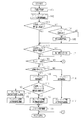
次に、リアECU15rによる動作範囲制限制御の処理手順について説明する。
図3に示すように、リアECU15rは、各種センサ及び車内ネットワーク23から各種信号を取得すると(ステップ101)、フロントシート1f及びリアシート1rの各シート要素SEの動作位置に基づいてフロントシート1f及びリアシート1r間の相対距離を算出する(ステップ102)。続いて、フロントシート1f及びリアシート1rが大空間マップ上で動作許可範囲内(境界線B2の内側)にあるか否かを判定し(ステップ103)、動作許可範囲内にない場合には(ステップ103:NO)、リアシート1rへの乗員の着座の有無を判定する(ステップ104)。そして、リアシート1rへの乗員の着座があった場合には(ステップ104:YES)、第2制限信号S_li2を出力し(ステップ105)、フロントシート1f及びリアシート1rが小空間マップ上で動作許可範囲内(境界線B1の内側)にあるか否かを判定する(ステップ106)。なお、大空間マップ上で動作許可範囲内にある場合(ステップ103:YES)、及びリアシート1rへの乗員の着座がない場合には(ステップ104:NO)、ステップ105に移行せずに、ステップ106に移行する。続いて、フロントシート1f及びリアシート1rが小空間マップ上で動作許可範囲内にない場合には(ステップ106:NO)、第1制限信号S_li1を出力する(ステップ107)。第1制限信号S_li1を出力した後、又は小空間マップ上で動作許可範囲内にある場合には(ステップ106:YES)、そのときにリアシート1rのリアオート動作を行っているか否かを判定する(ステップ108)。
図3に示すように、リアECU15rは、各種センサ及び車内ネットワーク23から各種信号を取得すると(ステップ101)、フロントシート1f及びリアシート1rの各シート要素SEの動作位置に基づいてフロントシート1f及びリアシート1r間の相対距離を算出する(ステップ102)。続いて、フロントシート1f及びリアシート1rが大空間マップ上で動作許可範囲内(境界線B2の内側)にあるか否かを判定し(ステップ103)、動作許可範囲内にない場合には(ステップ103:NO)、リアシート1rへの乗員の着座の有無を判定する(ステップ104)。そして、リアシート1rへの乗員の着座があった場合には(ステップ104:YES)、第2制限信号S_li2を出力し(ステップ105)、フロントシート1f及びリアシート1rが小空間マップ上で動作許可範囲内(境界線B1の内側)にあるか否かを判定する(ステップ106)。なお、大空間マップ上で動作許可範囲内にある場合(ステップ103:YES)、及びリアシート1rへの乗員の着座がない場合には(ステップ104:NO)、ステップ105に移行せずに、ステップ106に移行する。続いて、フロントシート1f及びリアシート1rが小空間マップ上で動作許可範囲内にない場合には(ステップ106:NO)、第1制限信号S_li1を出力する(ステップ107)。第1制限信号S_li1を出力した後、又は小空間マップ上で動作許可範囲内にある場合には(ステップ106:YES)、そのときにリアシート1rのリアオート動作を行っているか否かを判定する(ステップ108)。
続いて、リアECU15rは、リアオート動作を行っている場合には(ステップ108:YES)、現在の演算周期において制限信号(第1制限信号S_li1及び第2制限信号S_li2の少なくとも一方)の出力がないか否かを判定する(ステップ109)。そして、制限信号の出力がない場合には(ステップ109:YES)、シートクッション2rの前作動を許可する(ステップ110)。続いて、オットマン5rの傾動伸縮位置が大空間マップ上で動作許可範囲内にあるか否か、すなわちフロントシート1f及びリアシート1rが大空間マップ上の最大動作許可範囲にあるか否か、及び部分動作許可範囲にある場合には傾動伸縮位置が部分動作許可範囲を超えていないか否かを判定する(ステップ111)。オットマン5rの傾動伸縮位置が大空間マップ上で動作許可範囲内にある場合には(ステップ111:YES)、オットマン5rの車両上方向への位置調整(上作動)及び伸張方向への位置調整(伸張作動)を許可し(ステップ112)、リアオート動作を継続する(ステップ113)。
一方、リアECU15rは、オットマン5rの傾動伸縮位置が大空間マップ上で動作許可範囲内にない場合には(ステップ111:NO)、オットマン5rの傾動伸縮位置を動作許可範囲内に位置調整する(ステップ114)。すなわち、フロントシート1f及びリアシート1rが大空間マップ上の動作制限範囲にある状態ではオットマン5rを格納状態とし、部分動作許可範囲にある状態では、部分動作許可範囲で許可された傾動伸縮位置までオットマン5rを位置調整する。続いて、オットマン5rの上作動及び伸張作動を制限し(ステップ115)、ステップ113に移行してリアオート動作を継続する。
また、リアECU15rは、制限信号の出力があった場合には(ステップ109:NO)、シートクッション2rの前作動を制限し(ステップ116)、オットマン5rの上作動及び伸張作動を制限してから(ステップ117)、ステップ113に移行してリアオート動作を継続する。
図4に示すように、リアECU15rは、リアオート動作を行っていない場合には(ステップ108:NO)、リアマニュアル動作を行っているか否かを判定する(ステップ118)。リアマニュアル動作を行っている場合には(ステップ118:YES)、現在の演算周期において第1制限信号S_li1の出力があったか否かを判定し(ステップ119)、第1制限信号S_li1の出力がない場合には(ステップ119:NO)、シートクッション2rの前作動を許可する(ステップ120)。続いて、オットマン5rの傾動伸縮位置が小空間マップ上で動作許可範囲内にあるか否かを判定し(ステップ121)、オットマン5rの傾動伸縮位置が大空間マップ上で動作許可範囲内にある場合には(ステップ121:YES)、オットマン5rの上作動及び伸張作動を許可し(ステップ122)、リアマニュアル動作を継続する(ステップ123)。
一方、リアECU15rは、オットマン5rの傾動伸縮位置が小空間マップ上で動作許可範囲内にない場合には(ステップ121:NO)、オットマン5rの傾動伸縮位置を動作許可範囲内に位置調整する(ステップ124)。続いて、オットマン5rの上作動及び伸張作動を制限し(ステップ125)、ステップ123に移行してリアマニュアル動作を継続する。
また、リアECU15rは、第1制限信号S_li1の出力があった場合には(ステップ119:YES)、シートクッション2rの前作動を制限し(ステップ126)、オットマン5rの上作動及び伸張作動を制限してから(ステップ127)、ステップ123に移行してリアマニュアル動作を継続する。なお、リアマニュアル動作を行っていない場合には(ステップ118:NO)、リアシート1rの位置を保持する(ステップ128)。
次に、フロントECU15fによる動作範囲制限制御の処理手順について説明する。
図5に示すように、フロントECU15fは、各種センサ及び車内ネットワーク23から各種信号を取得すると(ステップ201)、フロントシート1fのフロントオート動作を行っているか否かを判定する(ステップ202)。フロントオート動作を行っている場合には(ステップ202:YES)、現在の演算周期において制限信号(第1制限信号S_li1及び第2制限信号S_li2の少なくとも一方)の入力がないか否かを判定する(ステップ203)。そして、制限信号の入力があった場合には(ステップ203:NO)、シートクッション2fの後作動及びシートバック3fの後作動を制限し(ステップ204)、フロントオート動作を継続する(ステップ205)。なお、制限信号の入力がない場合には(ステップ203:YES)、ステップ204に移行せずにステップ205に移行する。
図5に示すように、フロントECU15fは、各種センサ及び車内ネットワーク23から各種信号を取得すると(ステップ201)、フロントシート1fのフロントオート動作を行っているか否かを判定する(ステップ202)。フロントオート動作を行っている場合には(ステップ202:YES)、現在の演算周期において制限信号(第1制限信号S_li1及び第2制限信号S_li2の少なくとも一方)の入力がないか否かを判定する(ステップ203)。そして、制限信号の入力があった場合には(ステップ203:NO)、シートクッション2fの後作動及びシートバック3fの後作動を制限し(ステップ204)、フロントオート動作を継続する(ステップ205)。なお、制限信号の入力がない場合には(ステップ203:YES)、ステップ204に移行せずにステップ205に移行する。
一方、リアECU15rは、フロントオート動作を行っていない場合には(ステップ202:NO)、フロントマニュアル動作を行っているか否かを判定する(ステップ206)。フロントマニュアル動作を行っている場合には(ステップ206:YES)、第1制限信号S_li1が現在の演算周期において入力されたか否かを判定する(ステップ207)。そして、第1制限信号S_li1が入力された場合には(ステップ207:YES)、シートクッション2fの後作動及びシートバック3fの後作動を制限し(ステップ208)、フロントマニュアル動作を継続する(ステップ209)。一方、第1制限信号S_li1が入力されていない場合には(ステップ207:NO)、ステップ208に移行せずにステップ209に移行してフロントマニュアル動作を継続する。なお、フロントマニュアル動作を行っていない場合には(ステップ206:NO)、フロントシート1fの位置を保持する(ステップ210)。
以上記述したように、本実施形態によれば、以下の利点を得ることができる。
(1)フロントECU15fは、リアシート1rに乗員が着座している場合、フロントオート動作によるシートクッション2f及びシートバック3fの後作動がリアシート1rに乗員が着座していない場合に比べて小さくなるよう同作動を制限するようにした。また、リアECU15rは、リアシート1rに乗員が着座している場合、リアオート動作によるリアシート1rのシートクッション2rの前作動、オットマン5rの上作動及び伸張作動がリアシート1rに乗員が着座していない場合に比べて小さくなるよう同作動を制限するようにした。そのため、リアシート1rに乗員が着座した状態でフロントシート1f及びリアシート1rの少なくとも一方がオート動作を行った場合に、フロントシート1fとリアシート1rとの間の空間が大きく確保されるため、リアシート1rの乗員に窮屈な感じを与えることを好適に抑制できる。一方、リアシート1rに乗員が着座していない場合には、フロントオート動作によるシートクッション2f及びシートバック3fの後作動が、リアシート1rに乗員が着座している場合に比べて小さく制限されないため、フロントシート1fの乗員の利便性を好適に高めることができる。
(1)フロントECU15fは、リアシート1rに乗員が着座している場合、フロントオート動作によるシートクッション2f及びシートバック3fの後作動がリアシート1rに乗員が着座していない場合に比べて小さくなるよう同作動を制限するようにした。また、リアECU15rは、リアシート1rに乗員が着座している場合、リアオート動作によるリアシート1rのシートクッション2rの前作動、オットマン5rの上作動及び伸張作動がリアシート1rに乗員が着座していない場合に比べて小さくなるよう同作動を制限するようにした。そのため、リアシート1rに乗員が着座した状態でフロントシート1f及びリアシート1rの少なくとも一方がオート動作を行った場合に、フロントシート1fとリアシート1rとの間の空間が大きく確保されるため、リアシート1rの乗員に窮屈な感じを与えることを好適に抑制できる。一方、リアシート1rに乗員が着座していない場合には、フロントオート動作によるシートクッション2f及びシートバック3fの後作動が、リアシート1rに乗員が着座している場合に比べて小さく制限されないため、フロントシート1fの乗員の利便性を好適に高めることができる。
(2)フロントECU15fは、リアシート1rに乗員が着座している場合でも、乗員の意志によるフロントマニュアル動作によりシートクッション2f及びシートバック3fの位置調整を行う際には、リアシート1rに乗員が着座していない場合と同様に車両後方向への位置調整を制限しないようにした。そのため、フロントシート1fの乗員の利便性をより高めることができる。なお、フロントマニュアル動作では、フロントシート1fの乗員の意志によるため、例えばフロントシート1fの乗員とリアシート1rの乗員との間で意思疎通を図ることも可能であり、リアシート1rに着座した乗員に窮屈な感じを与え難い。
(3)リアECU15rは、リアシート1rに着座した乗員の意志によるリアマニュアル動作によりリアシート1rのシートクッション2r及びオットマン5rの位置調整を行う際に、車両前方向への位置調整を制限しないようにしたため、リアシート1rの乗員の利便性をより高めることができる。
(4)メモリ31rに小空間マップ及び大空間マップを記憶し、これらマップに基づいて、フロントオート動作によるシートクッション2f及びシートバック3fの後作動、リアシート1rのシートクッション2rの前作動、オットマン5rの上作動及び伸張作動を制限するようにしたため、リアECU15rでの演算負荷を軽減できる。
なお、上記実施形態は、これを適宜変更した以下の態様にて実施することもできる。
・上記実施形態では、小空間マップ及び大空間マップにそれぞれオットマン5rの部分動作許可範囲を1つ設けたが、これに限らず、複数の部分動作許可範囲を設けてもよい。この場合、各部分動作許可範囲は、オットマン5rの傾動範囲を機構上可能な最大範囲の適宜の割合、伸縮範囲を機構上可能な最大範囲の適宜の割合とすることができる。また、部分動作許可範囲を設けず、最大動作許可範囲及び動作制限範囲のみを設けてもよい。
・上記実施形態では、小空間マップ及び大空間マップにそれぞれオットマン5rの部分動作許可範囲を1つ設けたが、これに限らず、複数の部分動作許可範囲を設けてもよい。この場合、各部分動作許可範囲は、オットマン5rの傾動範囲を機構上可能な最大範囲の適宜の割合、伸縮範囲を機構上可能な最大範囲の適宜の割合とすることができる。また、部分動作許可範囲を設けず、最大動作許可範囲及び動作制限範囲のみを設けてもよい。
・上記実施形態では、小空間マップ及び大空間マップの境界線B1,B2をそれぞれ、相対距離が比較的長い範囲ではリクライニング位置を一定、相対距離が比較的短い範囲ではリクライニング動作許可範囲が当該相対距離の減少に伴い徐々に車両前方向側に移動するように設定した。しかし、これに限らず、境界線B1,B2、すなわちシート要素SEの位置調整を制限する範囲の設定は適宜変更可能である。例えば、相対距離が比較的長い範囲においてリクライニング位置が相対距離の減少に伴って徐々に車両前方向側に移動するように設定してもよく、また相対距離が比較的短い範囲においてリクライニング動作許可範囲が当該相対距離の減少に伴い段階的に車両前方向側に移動するように設定してもよい。
・上記実施形態では、リアECU15rのみに小空間マップ及び大空間マップを設けたが、フロントECU15fのみに小空間マップ及び大空間マップを設け、フロントECU15fが第1及び第2制限信号S_li1,S_li2を出力してもよい。この場合、リアECU15rは、リアシート1rのシート要素SEの動作位置をフロントECU15fに通知する。また、フロントECU15f及びリアECU15rにそれぞれ小空間マップ及び大空間マップを設け、制限信号を出力せず、各ECUでシート要素SEの位置調整を制限してもよい。さらに、フロントシート1f及びリアシート1rを1つのECUで制御してもよい。
・上記実施形態では、フロントECU15fは、シートクッション2fのスライド位置及びシートバック3fのリクライニング位置の大まかな動作位置を動作位置信号S_spとして出力したが、パルス信号Sp1f,Sp2fに基づいて得られた厳密な動作位置を出力してもよい。
・上記実施形態において、リアシート1rへの乗員の着座が検知された場合に、フロントオート動作によるフロントシート1fのシート要素SEの車両後方向への位置調整、又はリアオート動作によるリアシート1rのシート要素SEの車両前方向への位置調整のいずれか一方のみを制限するようにしてもよい。
・上記実施形態において、リアシート1rへの乗員の着座が検知された場合、フロントマニュアル動作によるフロントシート1fのシート要素SEの車両後方向への位置調整を、フロントオート動作によるフロントシート1fのシート要素SEの車両後方向への位置調整と同様に、大空間マップに基づいて制限してもよい。
・上記実施形態において、リアシート1rへの乗員の着座が検知された場合に、リアマニュアル動作によるリアシート1rのシート要素SEの車両前方向への位置調整を、リアオート動作によるリアシート1rのシート要素SEの車両前方向への位置調整と同様に、大空間マップに基づいて制限してもよい。
・上記実施形態では、小空間マップ及び大空間マップに基づいて、フロントオート動作によるフロントシート1fのシート要素SEの車両後方向への位置調整、及びリアオート動作によるリアシート1rのシート要素SEの車両前方向への位置調整を制限した。しかし、これに限らず、例えばフロントシート1fの及びリアシート1rの各シート要素SEを所定の関数式に代入し、しきい値と比較することで、フロントシート1f及びリアシート1rの位置調整を制限するか否かを判断するようにしてもよく、その方法は適宜変更可能である。
・上記実施形態では、モータM1f,M2fを駆動源としたアクチュエータ11f,12f、モータM1r~M3rを駆動源としたアクチュエータ11r~13rを用いたが、これに限らず、各シート要素の動作位置を調整できれば、アクチュエータの構成は適宜変更可能である。また、パルス信号Sp1f,Sp2f、パルス信号Sp1r~Sp3rに基づいて各シート要素SEの動作位置を検出せず、例えば各シート要素SEに変位センサを設けて動作位置を直接検出してもよく、動作位置の検出方法は適宜変更可能である。
・上記実施形態では、着座センサ22としてシートクッション2rの着座面2raに感圧部を形成するメンブレンスイッチを用いたが、これに限らず、例えば荷重センサや静電容量センサ等を用いてもよい。
・上記実施形態において、3列以上のシートがある車両に本構成の制御を適用してもよく、例えば3列シートの車両に本構成を適用する場合、一列目シートをフロントシートとすれば二列目シートがリアシートとなり、また、二列目シートをフロントシートとすれば三列目シートがリアシートとなる。
・上記実施形態では、フロントシート1fをシートクッション2fのスライド位置、シートバック3fのリクライニング位置を調整可能なシートとして構成したが、これに限らず、少なくとも車両前後方向への変位を伴うシート要素SEの位置を調整可能であればよく、フロントシート1fの構成は適宜変更可能である。例えばシートクッション2fのリフト位置を調整可能としてもよく、この場合には、車両後方向への変位を伴うリフト位置の調整を制限することになる。同様に、リアシート1rの構成も、少なくとも車両前後方向への変位を伴うシート要素SEの位置を調整可能であれば、適宜変更可能である。
Claims (5)
- 車両前部側のフロントシートの後方向に並んで配置されるリアシートへの乗員の着座を検知する着座検知部と、
駆動源からの駆動力により位置調整が可能な前記フロントシート及び前記リアシートの各シート要素の動作位置を検出する動作位置検出部と、
前記フロントシートの所定フロントシート位置及び前記リアシートの所定リアシート位置を記憶する記憶部と、
所定のフロントオート動作開始条件の成立により前記フロントシートを前記所定フロントシート位置に自動で移動するフロントオート動作、及び所定のリアオート動作開始条件の成立により前記リアシートを前記所定リアシート位置に自動で移動するリアオート動作を行う制御部と、
前記着座検知部により前記リアシートへの乗員の着座が検知された場合、前記動作位置検出部の検出結果に基づいて、前記フロントシートの位置調整及び前記リアシートの位置調整の少なくとも一方が前記リアシートへの乗員の着座が検知されない場合に比べて小さくなるよう前記少なくとも一方の位置調整を制限する制限部であって、前記フロントシートの位置調整は前記フロントオート動作による前記フロントシートのシート要素の車両後方向への位置調整であり、前記リアシートの位置調整は前記リアオート動作による前記リアシートのシート要素の車両前方向への位置調整である、前記制限部と、を備えた車両用シート制御装置。 - 請求項1に記載の車両用シート制御装置において、
前記制御部は、フロント操作部への操作入力に応じて前記フロントシートのシート要素の動作位置を調整するフロントマニュアル動作を行うように構成されており、
前記制限部は、前記着座検知部により前記リアシートへの乗員の着座が検知された場合でも、前記フロントマニュアル動作による前記フロントシートのシート要素の車両後方向への位置調整が、前記リアシートへの乗員の着座が検知されない場合に比べて小さくなるように制限しない車両用シート制御装置。 - 請求項1又は2に記載の車両用シート制御装置において、
前記制御部は、リア操作部への操作入力に応じて前記リアシートのシート要素の動作位置を調整するリアマニュアル動作を行うように構成されており、
前記制限部は、前記着座検知部により前記リアシートへの乗員の着座が検知された場合でも、前記リアマニュアル動作による前記リアシートのシート要素の車両前方向への位置調整が、前記リアシートへの乗員の着座が検知されない場合に比べて小さくなるように制限しない車両用シート制御装置。 - 請求項1~3のいずれか一項に記載の車両用シート制御装置において、
前記フロントシートのシート要素は、車両前後方向の変位を含むスライド動作によりスライド位置を調整可能なシートクッション、及び車両前後方向の変位を含むリクライニング動作によりリクライニング位置を調整可能なシートバックを含み、
前記リアシートのシート要素は、車両前後方向の変位を含むスライド動作によりスライド位置を調整可能なシートクッション、及び車両前後方向の変位を含む傾動伸縮動作により傾動伸縮位置を調整可能なオットマンを含む車両用シート制御装置。 - 請求項1~4のいずれか一項に記載の車両用シート制御装置において、
前記記憶部は、小空間マップと大空間マップとを記憶しており、
前記小空間マップにおいて、前記フロントシートのシート要素を位置調整可能な動作範囲と前記リアシートのシート要素を位置調整可能な動作範囲とが、該フロントシートと該リアシートとの間の空間を小さくするように設定されており、
前記大空間マップにおいて、前記フロントシートのシート要素を位置調整可能な動作範囲と前記リアシートのシート要素を位置調整可能な動作範囲とが、該フロントシートと該リアシートとの間の空間が前記小空間マップにおける前記フロントシートと前記リアシートとの間の空間よりも大きくするように設定されており、
前記制限部は、
前記着座検知部により前記リアシートへの乗員の着座が検知されない場合には前記小空間マップに基づいて、前記フロントオート動作による前記フロントシートのシート要素の車両後方向への位置調整及び前記リアオート動作による前記リアシートのシート要素の車両前方向への位置調整の少なくとも一方を制限し、
前記着座検知部により前記リアシートへの乗員の着座が検知された場合には前記大空間マップに基づいて、前記フロントオート動作による前記フロントシートのシート要素の車両後方向への位置調整及び前記リアオート動作による前記リアシートのシート要素の車両前方向への位置調整の少なくとも一方を制限する車両用シート制御装置。
Applications Claiming Priority (2)
| Application Number | Priority Date | Filing Date | Title |
|---|---|---|---|
| JP2016-146402 | 2016-07-26 | ||
| JP2016146402A JP6392276B2 (ja) | 2016-07-26 | 2016-07-26 | 車両用シート制御装置 |
Publications (1)
| Publication Number | Publication Date |
|---|---|
| WO2018021077A1 true WO2018021077A1 (ja) | 2018-02-01 |
Family
ID=61015992
Family Applications (1)
| Application Number | Title | Priority Date | Filing Date |
|---|---|---|---|
| PCT/JP2017/025801 Ceased WO2018021077A1 (ja) | 2016-07-26 | 2017-07-14 | 車両用シート制御装置 |
Country Status (2)
| Country | Link |
|---|---|
| JP (1) | JP6392276B2 (ja) |
| WO (1) | WO2018021077A1 (ja) |
Families Citing this family (2)
| Publication number | Priority date | Publication date | Assignee | Title |
|---|---|---|---|---|
| JP7079339B2 (ja) * | 2018-09-28 | 2022-06-01 | コイト電工株式会社 | 座席装置および座席システム |
| JP7424244B2 (ja) * | 2020-08-07 | 2024-01-30 | 株式会社デンソー | シートリクライニング位置制御装置 |
Citations (5)
| Publication number | Priority date | Publication date | Assignee | Title |
|---|---|---|---|---|
| JPS63141840A (ja) * | 1986-12-04 | 1988-06-14 | Aisin Seiki Co Ltd | 車上シ−トの姿勢制御装置 |
| JPS63149237A (ja) * | 1986-12-12 | 1988-06-22 | Delta Kogyo Kk | パワ−シ−トの安全装置 |
| JPS6417839U (ja) * | 1987-07-24 | 1989-01-30 | ||
| JP2010035970A (ja) * | 2008-08-08 | 2010-02-18 | Mazda Motor Corp | オットマンを備えた車両用シート装置 |
| JP2010083297A (ja) * | 2008-09-30 | 2010-04-15 | Denso Corp | シート制御システム |
Family Cites Families (1)
| Publication number | Priority date | Publication date | Assignee | Title |
|---|---|---|---|---|
| JPH0513631Y2 (ja) * | 1987-09-28 | 1993-04-12 |
-
2016
- 2016-07-26 JP JP2016146402A patent/JP6392276B2/ja active Active
-
2017
- 2017-07-14 WO PCT/JP2017/025801 patent/WO2018021077A1/ja not_active Ceased
Patent Citations (5)
| Publication number | Priority date | Publication date | Assignee | Title |
|---|---|---|---|---|
| JPS63141840A (ja) * | 1986-12-04 | 1988-06-14 | Aisin Seiki Co Ltd | 車上シ−トの姿勢制御装置 |
| JPS63149237A (ja) * | 1986-12-12 | 1988-06-22 | Delta Kogyo Kk | パワ−シ−トの安全装置 |
| JPS6417839U (ja) * | 1987-07-24 | 1989-01-30 | ||
| JP2010035970A (ja) * | 2008-08-08 | 2010-02-18 | Mazda Motor Corp | オットマンを備えた車両用シート装置 |
| JP2010083297A (ja) * | 2008-09-30 | 2010-04-15 | Denso Corp | シート制御システム |
Also Published As
| Publication number | Publication date |
|---|---|
| JP6392276B2 (ja) | 2018-09-19 |
| JP2018016135A (ja) | 2018-02-01 |
Similar Documents
| Publication | Publication Date | Title |
|---|---|---|
| RU2724521C1 (ru) | Способ регулировки позиции переключателя и устройство для его реализации | |
| KR102153621B1 (ko) | 자동차 시트의 제어방법 | |
| US10124704B2 (en) | Vehicle seat for a motor vehicle | |
| KR102296140B1 (ko) | 특성 맵 제어가 행해지는 시트 조절기 및 시트 조절 방법 | |
| JP6346226B2 (ja) | 車両用シート制御装置 | |
| US11390191B2 (en) | Vehicle seat control device | |
| CN107020977A (zh) | 车辆用座椅控制装置 | |
| JP7648934B2 (ja) | アームレスト装置および車両用シート | |
| US20200324669A1 (en) | Vehicle seat control device | |
| JP2019127101A (ja) | 車両用シート及び車両 | |
| CN110525278A (zh) | 车辆座椅控制器 | |
| JP6392276B2 (ja) | 車両用シート制御装置 | |
| JP2013244886A (ja) | 車両用シート | |
| JP2014184774A (ja) | 車両シート制御装置及び車両シート制御方法 | |
| JP7131152B2 (ja) | 車両シート制御装置 | |
| JP6089797B2 (ja) | 操作スイッチ | |
| CN113784872A (zh) | 与身体适应的扶手装置 | |
| JP5418826B2 (ja) | シート状態変更装置 | |
| JP6916084B2 (ja) | 車両用シート制御装置 | |
| JP2019077308A (ja) | 車両用シート制御装置 | |
| JP2021095085A (ja) | 車両用シートの制御装置 | |
| KR102125846B1 (ko) | 볼스터 제어방법 | |
| JPH03262774A (ja) | シートスライド連動式のステアリング装置 | |
| JP2017019301A (ja) | シート位置調整システム | |
| JP2023075745A (ja) | パワーシート制御装置及びパワーシート |
Legal Events
| Date | Code | Title | Description |
|---|---|---|---|
| 121 | Ep: the epo has been informed by wipo that ep was designated in this application |
Ref document number: 17834085 Country of ref document: EP Kind code of ref document: A1 |
|
| NENP | Non-entry into the national phase |
Ref country code: DE |
|
| 122 | Ep: pct application non-entry in european phase |
Ref document number: 17834085 Country of ref document: EP Kind code of ref document: A1 |