WO2018016281A1 - 熱収縮性多層フィルム - Google Patents
熱収縮性多層フィルム Download PDFInfo
- Publication number
- WO2018016281A1 WO2018016281A1 PCT/JP2017/023816 JP2017023816W WO2018016281A1 WO 2018016281 A1 WO2018016281 A1 WO 2018016281A1 JP 2017023816 W JP2017023816 W JP 2017023816W WO 2018016281 A1 WO2018016281 A1 WO 2018016281A1
- Authority
- WO
- WIPO (PCT)
- Prior art keywords
- heat
- multilayer film
- shrinkable multilayer
- layer
- eva
- Prior art date
- Legal status (The legal status is an assumption and is not a legal conclusion. Google has not performed a legal analysis and makes no representation as to the accuracy of the status listed.)
- Ceased
Links
Images
Classifications
-
- B—PERFORMING OPERATIONS; TRANSPORTING
- B32—LAYERED PRODUCTS
- B32B—LAYERED PRODUCTS, i.e. PRODUCTS BUILT-UP OF STRATA OF FLAT OR NON-FLAT, e.g. CELLULAR OR HONEYCOMB, FORM
- B32B27/00—Layered products comprising a layer of synthetic resin
- B32B27/36—Layered products comprising a layer of synthetic resin comprising polyesters
-
- B—PERFORMING OPERATIONS; TRANSPORTING
- B32—LAYERED PRODUCTS
- B32B—LAYERED PRODUCTS, i.e. PRODUCTS BUILT-UP OF STRATA OF FLAT OR NON-FLAT, e.g. CELLULAR OR HONEYCOMB, FORM
- B32B1/00—Layered products having a non-planar shape
- B32B1/08—Tubular products
-
- B—PERFORMING OPERATIONS; TRANSPORTING
- B32—LAYERED PRODUCTS
- B32B—LAYERED PRODUCTS, i.e. PRODUCTS BUILT-UP OF STRATA OF FLAT OR NON-FLAT, e.g. CELLULAR OR HONEYCOMB, FORM
- B32B27/00—Layered products comprising a layer of synthetic resin
- B32B27/06—Layered products comprising a layer of synthetic resin as the main or only constituent of a layer, which is next to another layer of the same or of a different material
- B32B27/08—Layered products comprising a layer of synthetic resin as the main or only constituent of a layer, which is next to another layer of the same or of a different material of synthetic resin
-
- B—PERFORMING OPERATIONS; TRANSPORTING
- B32—LAYERED PRODUCTS
- B32B—LAYERED PRODUCTS, i.e. PRODUCTS BUILT-UP OF STRATA OF FLAT OR NON-FLAT, e.g. CELLULAR OR HONEYCOMB, FORM
- B32B27/00—Layered products comprising a layer of synthetic resin
- B32B27/16—Layered products comprising a layer of synthetic resin specially treated, e.g. irradiated
-
- B—PERFORMING OPERATIONS; TRANSPORTING
- B32—LAYERED PRODUCTS
- B32B—LAYERED PRODUCTS, i.e. PRODUCTS BUILT-UP OF STRATA OF FLAT OR NON-FLAT, e.g. CELLULAR OR HONEYCOMB, FORM
- B32B27/00—Layered products comprising a layer of synthetic resin
- B32B27/18—Layered products comprising a layer of synthetic resin characterised by the use of special additives
- B32B27/20—Layered products comprising a layer of synthetic resin characterised by the use of special additives using fillers, pigments, thixotroping agents
-
- B—PERFORMING OPERATIONS; TRANSPORTING
- B32—LAYERED PRODUCTS
- B32B—LAYERED PRODUCTS, i.e. PRODUCTS BUILT-UP OF STRATA OF FLAT OR NON-FLAT, e.g. CELLULAR OR HONEYCOMB, FORM
- B32B27/00—Layered products comprising a layer of synthetic resin
- B32B27/30—Layered products comprising a layer of synthetic resin comprising vinyl (co)polymers; comprising acrylic (co)polymers
- B32B27/304—Layered products comprising a layer of synthetic resin comprising vinyl (co)polymers; comprising acrylic (co)polymers comprising vinyl halide (co)polymers, e.g. PVC, PVDC, PVF, PVDF
-
- B—PERFORMING OPERATIONS; TRANSPORTING
- B32—LAYERED PRODUCTS
- B32B—LAYERED PRODUCTS, i.e. PRODUCTS BUILT-UP OF STRATA OF FLAT OR NON-FLAT, e.g. CELLULAR OR HONEYCOMB, FORM
- B32B27/00—Layered products comprising a layer of synthetic resin
- B32B27/30—Layered products comprising a layer of synthetic resin comprising vinyl (co)polymers; comprising acrylic (co)polymers
- B32B27/306—Layered products comprising a layer of synthetic resin comprising vinyl (co)polymers; comprising acrylic (co)polymers comprising vinyl acetate or vinyl alcohol (co)polymers
-
- B—PERFORMING OPERATIONS; TRANSPORTING
- B32—LAYERED PRODUCTS
- B32B—LAYERED PRODUCTS, i.e. PRODUCTS BUILT-UP OF STRATA OF FLAT OR NON-FLAT, e.g. CELLULAR OR HONEYCOMB, FORM
- B32B27/00—Layered products comprising a layer of synthetic resin
- B32B27/30—Layered products comprising a layer of synthetic resin comprising vinyl (co)polymers; comprising acrylic (co)polymers
- B32B27/308—Layered products comprising a layer of synthetic resin comprising vinyl (co)polymers; comprising acrylic (co)polymers comprising acrylic (co)polymers
-
- B—PERFORMING OPERATIONS; TRANSPORTING
- B32—LAYERED PRODUCTS
- B32B—LAYERED PRODUCTS, i.e. PRODUCTS BUILT-UP OF STRATA OF FLAT OR NON-FLAT, e.g. CELLULAR OR HONEYCOMB, FORM
- B32B27/00—Layered products comprising a layer of synthetic resin
- B32B27/32—Layered products comprising a layer of synthetic resin comprising polyolefins
-
- B—PERFORMING OPERATIONS; TRANSPORTING
- B32—LAYERED PRODUCTS
- B32B—LAYERED PRODUCTS, i.e. PRODUCTS BUILT-UP OF STRATA OF FLAT OR NON-FLAT, e.g. CELLULAR OR HONEYCOMB, FORM
- B32B27/00—Layered products comprising a layer of synthetic resin
- B32B27/34—Layered products comprising a layer of synthetic resin comprising polyamides
-
- B—PERFORMING OPERATIONS; TRANSPORTING
- B32—LAYERED PRODUCTS
- B32B—LAYERED PRODUCTS, i.e. PRODUCTS BUILT-UP OF STRATA OF FLAT OR NON-FLAT, e.g. CELLULAR OR HONEYCOMB, FORM
- B32B7/00—Layered products characterised by the relation between layers; Layered products characterised by the relative orientation of features between layers, or by the relative values of a measurable parameter between layers, i.e. products comprising layers having different physical, chemical or physicochemical properties; Layered products characterised by the interconnection of layers
- B32B7/02—Physical, chemical or physicochemical properties
-
- B—PERFORMING OPERATIONS; TRANSPORTING
- B32—LAYERED PRODUCTS
- B32B—LAYERED PRODUCTS, i.e. PRODUCTS BUILT-UP OF STRATA OF FLAT OR NON-FLAT, e.g. CELLULAR OR HONEYCOMB, FORM
- B32B7/00—Layered products characterised by the relation between layers; Layered products characterised by the relative orientation of features between layers, or by the relative values of a measurable parameter between layers, i.e. products comprising layers having different physical, chemical or physicochemical properties; Layered products characterised by the interconnection of layers
- B32B7/04—Interconnection of layers
- B32B7/12—Interconnection of layers using interposed adhesives or interposed materials with bonding properties
-
- B—PERFORMING OPERATIONS; TRANSPORTING
- B32—LAYERED PRODUCTS
- B32B—LAYERED PRODUCTS, i.e. PRODUCTS BUILT-UP OF STRATA OF FLAT OR NON-FLAT, e.g. CELLULAR OR HONEYCOMB, FORM
- B32B2250/00—Layers arrangement
- B32B2250/03—3 layers
-
- B—PERFORMING OPERATIONS; TRANSPORTING
- B32—LAYERED PRODUCTS
- B32B—LAYERED PRODUCTS, i.e. PRODUCTS BUILT-UP OF STRATA OF FLAT OR NON-FLAT, e.g. CELLULAR OR HONEYCOMB, FORM
- B32B2250/00—Layers arrangement
- B32B2250/04—4 layers
-
- B—PERFORMING OPERATIONS; TRANSPORTING
- B32—LAYERED PRODUCTS
- B32B—LAYERED PRODUCTS, i.e. PRODUCTS BUILT-UP OF STRATA OF FLAT OR NON-FLAT, e.g. CELLULAR OR HONEYCOMB, FORM
- B32B2250/00—Layers arrangement
- B32B2250/05—5 or more layers
-
- B—PERFORMING OPERATIONS; TRANSPORTING
- B32—LAYERED PRODUCTS
- B32B—LAYERED PRODUCTS, i.e. PRODUCTS BUILT-UP OF STRATA OF FLAT OR NON-FLAT, e.g. CELLULAR OR HONEYCOMB, FORM
- B32B2250/00—Layers arrangement
- B32B2250/24—All layers being polymeric
-
- B—PERFORMING OPERATIONS; TRANSPORTING
- B32—LAYERED PRODUCTS
- B32B—LAYERED PRODUCTS, i.e. PRODUCTS BUILT-UP OF STRATA OF FLAT OR NON-FLAT, e.g. CELLULAR OR HONEYCOMB, FORM
- B32B2307/00—Properties of the layers or laminate
- B32B2307/30—Properties of the layers or laminate having particular thermal properties
- B32B2307/31—Heat sealable
-
- B—PERFORMING OPERATIONS; TRANSPORTING
- B32—LAYERED PRODUCTS
- B32B—LAYERED PRODUCTS, i.e. PRODUCTS BUILT-UP OF STRATA OF FLAT OR NON-FLAT, e.g. CELLULAR OR HONEYCOMB, FORM
- B32B2307/00—Properties of the layers or laminate
- B32B2307/40—Properties of the layers or laminate having particular optical properties
- B32B2307/412—Transparent
-
- B—PERFORMING OPERATIONS; TRANSPORTING
- B32—LAYERED PRODUCTS
- B32B—LAYERED PRODUCTS, i.e. PRODUCTS BUILT-UP OF STRATA OF FLAT OR NON-FLAT, e.g. CELLULAR OR HONEYCOMB, FORM
- B32B2307/00—Properties of the layers or laminate
- B32B2307/50—Properties of the layers or laminate having particular mechanical properties
- B32B2307/514—Oriented
- B32B2307/518—Oriented bi-axially
-
- B—PERFORMING OPERATIONS; TRANSPORTING
- B32—LAYERED PRODUCTS
- B32B—LAYERED PRODUCTS, i.e. PRODUCTS BUILT-UP OF STRATA OF FLAT OR NON-FLAT, e.g. CELLULAR OR HONEYCOMB, FORM
- B32B2307/00—Properties of the layers or laminate
- B32B2307/70—Other properties
- B32B2307/732—Dimensional properties
- B32B2307/734—Dimensional stability
- B32B2307/736—Shrinkable
-
- B—PERFORMING OPERATIONS; TRANSPORTING
- B32—LAYERED PRODUCTS
- B32B—LAYERED PRODUCTS, i.e. PRODUCTS BUILT-UP OF STRATA OF FLAT OR NON-FLAT, e.g. CELLULAR OR HONEYCOMB, FORM
- B32B2439/00—Containers; Receptacles
- B32B2439/70—Food packaging
Definitions
- the present invention relates to a heat-shrinkable multilayer film used for food packaging.
- packaging materials such as heat-shrinkable multilayer bags and pouches are used for food packaging.
- the heat-shrinkable multilayer film used for these packaging materials is a tubular heat-shrinkable multilayer film obtained by extruding a resin laminate from a tubular die into a film shape and biaxially stretching by an inflation method Folds the tubular heat-shrinkable multilayer film, and (1) primarily seals the tubular heat-shrinkable multilayer film by heat sealing or impulse sealing in a direction perpendicular to the extrusion direction extruded into a film shape.
- the heat-shrinkable multilayer film is a flat film extruded from a T-die and stretched by a tenter method, the flat film is folded with the sealing surface facing inward, or the sealing surfaces of two flat films are
- a typical packaging material such as a pouch is obtained by stacking facing each other and performing primary sealing and cutting along the shape of the pouch.
- heat-shrinkable packaging material is filled with the contents in the packaging material, vacuum-packed, and the vacuum-packed product is passed through a hot water shower or immersed in hot water. Is used to obtain a food package.
- the heat-shrinkable multilayer film for example, in Patent Document 1, the heat-shrinkable multilayer film comprises at least three layers of an inner surface layer in contact with the filler, an intermediate layer adjacent thereto, and an outer surface layer.
- a packaging laminate is described in which an inorganic lubricant and an organic lubricant are included, an intermediate layer has an organic lubricant, and an inner surface layer is selected from single-site catalyst polyethylene, LLDPE, and the like.
- the outer surface layer is made of a heat-resistant thermoplastic resin
- the intermediate layer is made of a polyamide-based resin
- the inner surface layer is made of an ethylene-based copolymer
- a heat-shrinkable multilayer film is described in which the adhesive force between the inner surface layers is 0.1 to 3.5 N / 15 mm.
- Patent Document 3 describes a film comprising an ethylene-vinyl acetate copolymer or the like as an innermost layer as a coextruded multilayer film for skin pack lid materials.
- Patent Documents 1 to 3 do not describe providing the heat-shrinkable multilayer film with a high seal strength so that the primary seal portion does not peel off at high temperatures.
- Patent Document 2 has an insufficient area shrinkage rate at high temperatures.
- Patent Document 3 does not describe the fact that it has a high area shrinkage rate at high temperatures.
- the present invention has been made in view of the above problems, and an object of the present invention is to provide a heat-shrinkable multilayer film having a high seal strength and a high area shrinkage ratio of the primary seal portion at high temperatures.
- the content of vinyl acetate monomer units in the ethylene-vinyl acetate copolymer is a specific ratio
- the barrier layer is a specific substance. It has been found that it has a sealing strength that the primary seal part does not peel off even in a high temperature environment such as when immersed in high temperature hot water, and has a high area shrinkage rate at a high temperature. Reached.
- the heat-shrinkable multilayer film according to the present invention is a heat-shrinkable multilayer film comprising an inner surface layer in contact with a filler and a barrier layer, the inner surface layer comprising an ethylene-vinyl acetate copolymer, and the barrier
- the layer includes a vinylidene chloride resin, and the content of the vinyl acetate monomer unit in the ethylene-vinyl acetate copolymer is 7 wt% or more and 14 wt% or less.
- the heat-shrinkable multilayer film according to the present invention has an effect that the seal strength and the area shrinkage ratio of the primary seal portion at high temperature are high.
- FIG. 3 is a diagram schematically showing a heat-shrinked package in which processed meat is packaged with a film using an ethylene-vinyl alcohol copolymer as a barrier layer.
- the heat-shrinkable multilayer film according to the present embodiment is a heat-shrinkable multilayer film including an inner surface layer and a barrier layer in contact with the filler, the inner surface layer including an ethylene-vinyl acetate copolymer, and the barrier layer is The content of vinyl acetate monomer units in the ethylene-vinyl acetate copolymer is 7 wt% or more and 14 wt% or less, including vinylidene chloride resin. Thereby, the seal strength and area shrinkage ratio of the primary seal portion at high temperatures are high.
- the primary seal means to seal one end of the heat-shrinkable multilayer film that is not heat-sealed, and the primary seal portion means a primary sealed portion.
- a sealing method for example, there is a method of heat-sealing a portion where heat-shrinkable multilayer films overlap each other by heat sealing or impulse sealing.
- examples of the packaging material obtained by first sealing the above heat-shrinkable multilayer film include a bottom seal bag and a side seal bag.
- the bottom seal bag is formed by extruding a resin laminate in a film form from a tubular die and biaxially stretching by an inflation method to fold a tubular heat-shrinkable multilayer film, against the tubular heat-shrinkable multilayer film, Form a bottom seal part of the bag by primary sealing by heat seal or impulse seal in a direction perpendicular to the extrusion direction extruded into a film, and the extrusion direction at a position different from the position of the bottom seal part in the extrusion direction It is obtained by cutting the film in a direction perpendicular to the surface to form an opening of the bag.
- the side seal bag is primarily sealed to the tubular heat-shrinkable multilayer film by a heat seal or impulse seal in a direction perpendicular to the extrusion direction to form a side seal portion (bag side surface) of the bag, It is obtained by cutting the film in a direction parallel to the extrusion direction to form an opening of the bag.
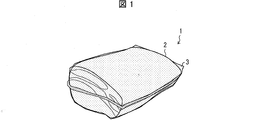
- FIG. 1 is a diagram schematically showing a heat-shrinked package 1 in which raw meat (filler) 2 is packaged without leaving an excessive portion (hereinafter referred to as “ear part”) 3 of a film. .
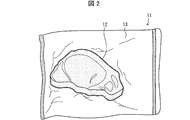
- FIG. 2 is a diagram schematically showing a heat-shrinked package 11 in which processed meat 12 such as grilled pork is packaged so that a surplus portion (ear portion) 13 of the film is large.
- FIG. 1 there are almost no ears 3 of the package 1 after heat shrinkage that wraps the raw meat 2 other than the ends of the raw meat 2.
- a heat-shrinkable film used for the package 1 is used as a form that heat-shrinks along the outline of the raw meat 2. That is, the heat-shrinkable film used for the package 1 in FIG. 1 is required to have a high area shrinkage rate at high temperatures.
- the ear part 13 is larger than the ear part 3 of the package 1 in FIG.
- the closeness of the film to the surface of the filling is not required as much as the raw meat packaging 1 such as the packaging 1 shown in FIG. That is, the film used in the packaging form as shown in FIG. 2 is not required to have a higher area shrinkage rate at a higher temperature than the heat-shrinkable film used in the package 1 shown in FIG. Therefore, as the film used for the package 11 shown in FIG. 2, for example, a film containing an ethylene-vinyl alcohol copolymer (EVOH) in the barrier layer as described in Patent Documents 2 and 3 is used. ing.
- EVOH ethylene-vinyl alcohol copolymer
- the heat-shrinkable multilayer film according to this embodiment contains a vinylidene chloride resin in the barrier layer, and has a higher area shrinkage rate at a higher temperature than a film containing EVOH in the barrier layer. Therefore, the heat-shrinkable multilayer film according to this embodiment is suitably used for a film that forms a package 1 as shown in FIG.
- the seal strength sufficient to prevent the primary seal portion from being peeled specifically means that the maximum point strength and the maximum point energy of the primary seal portion naturally contracted in hot water at 80 ° C. Is in a preferred range.
- the maximum point strength means the maximum load (N / 15 mm) when a tensile load is applied to the primary seal portion that is naturally contracted in hot water at 80 ° C. until the seal portion is broken.
- the maximum point energy means energy (J) applied to the primary seal portion up to the maximum point strength.
- the maximum point strength is preferably 2.0 N / 15 mm or more and 5.0 N / 15 mm or less, more preferably 2.0 N / 15 mm or more and 4.5 N / 15 mm or less, and 2.1 N / 15 mm or more and 4 or less. More preferably, it is 0.0 N / 15 mm or less.
- the maximum point energy is preferably 0.013 J or more and 0.20 J or less, more preferably 0.015 J or more and 0.18 J or less, and further preferably 0.017 J or more and 0.16 J or less. preferable.
- the sealing strength of the primary seal part at high temperature is, for example, 3 in a hot water tank heated to 80 ° C. after filling the packaging material into which the heat-shrinkable multilayer film is primarily sealed and then vacuum-sealing the sample for filling test. It can also be confirmed by immersing for 2 seconds and immersing in a 2 ° C. cold water bath for 10 seconds, and then confirming whether the primary seal portion is broken. In this case, for example, when three samples are prepared and the test is performed three times, if no bag is torn at the primary seal portion, it can be considered that the seal strength of the primary seal portion is sufficiently high.
- the area shrinkage rate of the heat-shrinkable multilayer film according to the present embodiment is preferably 55% or more and 90% or less, and preferably 60% or more and 90% when immersed in hot water at 80 ° C. for 10 seconds. Or less, more preferably 61% or more and 88% or less.
- the area shrinkage referred to here is [1 ⁇ (length in the longitudinal direction (MD) of the heat-shrinkable multilayer film after shrinking ⁇ length in the transverse direction (TD) after shrinking) / (MD before shrinking]. Length ⁇ length of TD before contraction)] ⁇ 100.
- Adhesion between the inner surface layer of the heat-shrinkable multilayer film and the filler filled in the heat-shrinkable multilayer film when the area shrinkage rate when immersed in hot water at 80 ° C. for 10 seconds is 55% or more By doing, the outflow amount of the drip in the meat package can be reduced. Further, when the area shrinkage rate is 90% or less, the heat-shrinkable multilayer film does not shrink excessively, and does not promote the drip outflow due to the compression action of tightening the filler. Therefore, the heat-shrinkable multilayer film and the filler can be brought into close contact with each other without pressing the filler as much as possible, and the amount of drip flowing out can be reduced.
- the heat-shrinkable multilayer film according to this embodiment is excellent in appearance after being immersed in hot water at 80 ° C. and contracted.
- the excellent appearance means, for example, that the Haze (film haze) after shrinking in hot water at 80 ° C. is low. The smaller the value of Haze, the better the transparency, and the larger the value, the worse the transparency.
- the haze of the heat-shrinkable multilayer film after shrinkage is preferably 35% or less, more preferably 33% or less, and even more preferably 30% or less.
- the heat-shrinkable multilayer film was immersed in hot water at 80 ° C. for 10 seconds and then taken out and immediately cooled with normal temperature water, and the resulting shrinkage was obtained.
- the measured film is measured by using a haze meter (Haze Meter NDH2000 manufactured by Nippon Denshoku Industries Co., Ltd.) in accordance with the method described in JIS K-7136: 2000 “How to determine haze of plastic-transparent material”. Can do.
- the external appearance of the package body filled with the contents in the heat-shrinkable multilayer film according to the present embodiment can be measured by checking whether or not the filler is in close contact with the heat-shrinkable multilayer film.
- the heat-shrinkable multilayer film according to this embodiment has a small haze before shrinkage and is excellent in appearance.
- the haze of the heat-shrinkable multilayer film before shrinkage is preferably 15% or less, more preferably 10% or less, and even more preferably 8% or less.
- the heat-shrinkable multilayer film before shrinkage at room temperature was measured in the same manner as described above in accordance with JIS K 7136: 2000 “Phaze of transparent plastic material— In accordance with the method described in “How”, measurement can be performed by using a haze meter (Haze Meter NDH2000 manufactured by Nippon Denshoku Industries Co., Ltd.).
- the heat-shrinkable multilayer film before shrinkage is excellent in cold seal strength. How excellent the cold-proof seal strength can be confirmed by, for example, performing a falling ball test on the seal portion at 5 ° C. The falling ball test is performed when the user of the bottom seal bag vigorously drops and fills the bottom seal bag with 5 kg of raw meat at a place around 5 ° C. where the raw meat is filled. This is a test for confirming whether or not the seal part is torn.
- test bottom seal bags made from a heat-shrinkable multilayer film before shrinkage are stored in a refrigerator at 5 ° C. for 24 hours.
- the heat-shrinkable multilayer film before shrinkage can be judged to have excellent cold-resistant seal strength. If the number of seal tears is 2 or less, the cold-resistant seal strength is superior, and if the number of seal tears is 1 or less, the cold-resistant seal strength is further superior.
- Heat-shrinkable multilayer film before shrinkage for example, heat before shrinkage of a layer structure containing VLDPE / EVA / EMA / PVDC / EMA / EVA / 14 wt% EVA in each layer in order from outside to inside According to the shrinkable multilayer film, no seal breakage occurs in 1 out of 10 films.
- a film before shrinkage other than the film according to the present embodiment for example, linear ultra-low density polyethylene (SSC-VLDPE) / EVA-1 (an organic lubricant is added in advance from the outside to the inside) EVA) / ethylene-ethyl acrylate copolymer (EEA) / vinylidene chloride resin (PVDC) / EEA / EVA-2 (EVA with no lubricant added) / IO (ionomer resin) in each layer
- SSC-VLDPE linear ultra-low density polyethylene
- EVA-1 an organic lubricant is added in advance from the outside to the inside
- EVA / ethylene-ethyl acrylate copolymer
- PVDC vinylidene chloride resin
- EVA-2 vinylidene chloride resin
- IO ionomer resin
- the heat-shrinkable multilayer film before shrinkage according to the present embodiment is clearly superior in cold-resistant seal strength as compared to other films before shrinkage.
- the heat-shrinkable multilayer film according to the present embodiment may include an inner surface layer and a barrier layer in contact with the filler, but the inner surface layer, the barrier layer, and an intermediate layer between the inner surface layer and the barrier layer. It is preferable that at least 3 layers of these are included. Moreover, you may have the outer layer which touches the outer side of a barrier layer, the outermost layer in the outermost side of a heat-shrinkable multilayer film, the contact bonding layer etc. which adhere
- the thickness of the heat-shrinkable multilayer film varies depending on the type of film, but is usually 5 ⁇ m or more and 300 ⁇ m or less, and preferably 20 ⁇ m or more and 150 ⁇ m or less. Moreover, when a film is formed by the multilayer of 3 layers or more, each layer has preferable 0.1 micrometer or more and 200 micrometers or less, and 0.5 micrometer or more and 100 micrometers or less are more preferable.
- each layer which comprises the heat-shrinkable multilayer film which concerns on this embodiment is demonstrated in detail.
- the inner surface layer included in the heat-shrinkable multilayer film according to the present embodiment is a layer in contact with the filler.
- the inner surface layer is a copolymer having a structural unit derived from ethylene and a structural unit derived from vinyl acetate (hereinafter referred to as vinyl acetate monomer unit), an ethylene-vinyl acetate copolymer (EVA). including.
- the content of vinyl acetate monomer units in EVA is 7% by weight to 14% by weight, preferably 8% by weight to 14% by weight, and more preferably 10% by weight to 14% by weight.
- the content of the vinyl acetate monomer unit is 7% by weight or more, the area shrinkage rate is sufficiently high, and it can be extruded during the production of the heat-shrinkable multilayer film.
- the content of the vinyl acetate monomer unit is 14% by weight or less, the seal strength of the primary seal portion in hot water is sufficiently high, and there is no possibility that the primary seal portion is peeled off even at high temperatures.
- the intermediate layer is adjacent to the inner surface layer in contact with the filler, and is a layer between the inner surface layer and the barrier layer.
- the intermediate layer may be a single layer structure or a multilayer structure.
- the resin constituting the intermediate layer is not particularly limited as long as it is a general resin.
- linear low density polyethylene SSC-LLDPE
- SSC-VLDPE ethylene- ⁇ olefin copolymer
- EVA ethylene-methyl acrylate copolymer
- EAA ethylene-methyl acrylate copolymer
- EMA ethylene-acrylic acid ester copolymer
- EMAA ethylene-methacrylic acid copolymer
- IO ethylene-methacrylic acid-acrylic acid ester copolymer
- the intermediate layer is a flexible resin that can ensure a high area shrinkage rate at a high temperature, and EVA, IO, EMAA, EMA, and the like are preferable from the viewpoint that the heat-shrinkable multilayer film is not significantly affected. EVA and EMA are more preferable.
- These resins constituting the intermediate layer can be used alone or in combination of two or more.
- the thickness of the intermediate layer is preferably 1.4 times or less, more preferably 1.2 times or less, and further preferably 1.0 times or less the thickness of the inner surface layer.
- the balance between the intermediate layer and the inner surface layer is an important factor. Since the intermediate layer generally has a lot of flexible resin, when the ratio increases, stretching proceeds and the inflation bubble becomes unstable. Therefore, when the thickness of the intermediate layer is 1.4 times or less than the thickness of the inner surface layer, the intermediate layer can be appropriately stretched, and the production becomes easy. That is, there is an effect that the inflation bubble at the time of stretching is stabilized.
- the barrier layer is a heat-shrinkable multilayer film and has a gas barrier function.
- the barrier layer may have a single-layer structure or a multilayer structure, and at least one barrier layer may be a vinylidene chloride resin (PVDC).
- PVDC is generally a copolymer of 65% by weight or more and 95% by weight or less of vinylidene chloride and at least one type of unsaturated monomer copolymerizable therewith of 5% by weight or more and 35% by weight or less.
- the copolymerizable unsaturated monomer include (meth) acrylic acid alkyl esters such as vinyl chloride and methyl (meth) acrylate.
- a polyolefin resin such as EVA, a plasticizer, a stabilizer and the like may be added to PVDC as necessary.
- barrier layer examples include EVOH and polyamide-based resins other than PVDC.
- PVDC is preferable from the viewpoint that a high area shrinkage rate can be imparted particularly at high temperatures.
- the thickness of the barrier layer is, for example, preferably 1 ⁇ m or more and 20 ⁇ m or less, more preferably 3 ⁇ m or more and 15 ⁇ m or less, and further preferably 4 ⁇ m or more and 10 ⁇ m or less.
- the barrier layer containing the rigid PVDC has a sufficient thickness, so that the maximum point strength and the maximum point energy of the primary seal portion naturally contracted in hot water at 80 ° C. are sufficiently high. Get higher. That is, it is possible to obtain sufficient seal strength that the primary seal portion of the heat-shrinkable multilayer film is not peeled off.
- the heat-shrinkable multilayer film according to this embodiment may further include other layers in addition to the inner surface layer, the intermediate layer, and the barrier layer.
- the other layers include an outer layer adjacent to the outer side of the barrier layer, an outermost layer adjacent to the outer side of the outer layer, and an adhesive layer that bonds the layers to each other. Note that the adhesive layer can be appropriately provided between the layers.
- the resin constituting the other layer is not particularly limited as long as it is a general resin.
- very low density polyethylene VLDPE
- low density polyethylene LLDPE
- high density polyethylene SSC-LLDPE
- Polyolefins such as polypropylene
- polyamides such as nylon 6, nylon 66, nylon 46, nylon 6-66, nylon MXD and nylon 6I6T (where I represents isophthalic acid and T represents terephthalic acid)
- polyesters such as copolymerized polyethylene terephthalate, which is a copolymer of ethylene terephthalate; ethylene-methyl acrylate copolymer; PVDC; EVOH; EVA; and ionomers.
- the adhesive layer that can be provided as appropriate can be used between a barrier layer containing PVDC and other resin layers, between polyolefin resin layers, and the like. It may be further provided in between.
- the resin forming the adhesive layer include ethylene-acrylic acid ester copolymers.
- components other than the resin may be included in the layers constituting the heat-shrinkable multilayer film.
- components other than the resin include various additives, such as lubricants, antifogging agents, antioxidants, ultraviolet absorbers, light stabilizers, antistatic agents, antiblocking agents, dyes and pigments.
- the layer structure of the heat-shrinkable multilayer film according to the present embodiment is such that the inner surface layer contains EVA, the barrier layer contains PVDC, and the content of vinyl acetate monomer units in EVA is 7 wt% or more and 14 wt% or less. If it is, it will not be specifically limited.
- EMA ethylene-methyl acrylate copolymer
- PVDC ethylene-methyl acrylate copolymer
- Heat-shrinkable multilayer film having a layer structure including VLDPE / EVA / EMA / PVDC / EMA / EVA in each layer, and a layer structure including EVA / PVDC / EVA in each layer
- a heat-shrinkable multilayer film having a layer structure each containing nylon / EVA / PVDC / EVA in each layer.
- the filling is packaged in the heat-shrinkable multilayer film according to this embodiment.
- examples of the filling include meat such as livestock meat, and more specifically meat such as beef, pig, sheep, and birds (for example, chicken, turkey and duck).
- each meat is not limited.
- cut 5 kg to 15 kg meat chunk cut from carcass
- block less than 5 kg meat chunk cut from carcass
- slice mince
- holes such as holes from which the head, feathers and internal organs have been removed
- blocks such as blocks, slices, mince and the like.
- a resin for forming each layer is melt-extruded with a plurality of extruders, and then the melted resin is introduced into a circular die or the like and co-extruded. It is drawn and manufactured.
- the temperature at the time of melt-extrusion is not particularly limited as long as it is equal to or higher than the temperature at which the resin contained in each layer melts and is lower than the temperature at which it thermally decomposes.
- EVA for forming it is preferably 100 ° C. or higher and 200 ° C. or lower, and more preferably 110 ° C. or higher and 185 ° C. or lower.
- the temperature is preferably 100 ° C. or higher and 195 ° C. or lower, and more preferably 110 ° C. or higher and 185 ° C. or lower.
- the temperature is preferably 130 ° C. or higher and 175 ° C. or lower, and more preferably 140 ° C. or higher and 165 ° C. or lower.
- the temperature for coextrusion with the annular die is preferably 155 ° C. or higher and 190 ° C. or lower, more preferably 165 ° C. or higher and 180 ° C. or lower.
- the annular body obtained by coextrusion is cooled in a water bath.
- the cooling temperature is not higher than the melting point of the resin constituting each layer, and the cooling temperature of the PVDC for constituting the barrier layer may be any temperature that can suppress crystallization, for example, 3 ° C. or more and 20 ° C.
- the temperature is preferably 5 ° C. or lower and more preferably 15 ° C. or lower.
- the annular body after cooling in a water bath may be irradiated with radiation by a known method before or after stretching.
- a known method before or after stretching.
- the radiation known radiation such as ⁇ -ray, ⁇ -ray, electron beam, ⁇ -ray, and X-ray can be used. From the viewpoint of the crosslinking effect before and after irradiation, electron beam and ⁇ -ray are preferable, An electron beam is more preferable in terms of workability and high production capacity in producing a heat-shrinkable multilayer film.
- the radiation conditions may be set as appropriate according to the intended application.
- the acceleration voltage is 150 to 500 kiloelectron volts (hereinafter referred to as “keV”).
- the following range and the irradiation dose range of 10 to 200 kiloGray (hereinafter referred to as “kGy”) are preferable, and in the case of ⁇ rays, the dose rate is preferably 0.05 to 3 kGy / hour.
- the heating is performed by, for example, passing warm water and stretching.
- the reheating temperature is preferably 85 ° C. or higher and 89 ° C. or lower, more preferably 85 ° C. or higher and 87 ° C. or lower, from the viewpoint of stretchability.
- the tubular body stretched by heating is stopped to a predetermined size and cooled in order to stabilize the inflation bubble.
- the cooling temperature is preferably 6 ° C. or higher and 14 ° C. or lower, and more preferably 8 ° C. or higher and 12 ° C. or lower.
- an inflation method in which the tubular body is pulled out in the vertical direction while fluid is put into the tubular body. It is preferable to manufacture by uniaxial stretching or biaxial stretching.
- the area shrinkage rate of the heat-shrinkable multilayer film can be within the above-mentioned preferable range.
- the molecules are oriented, so biaxial stretching is more preferable from the viewpoints of transparency, barrier properties, and strength.
- the stretching ratio is not particularly limited, but the stretching ratio in the machine direction (MD) is preferably 2.5 times or more and 4.0 times or less, and preferably 2.7 times or more and 3.8 times or less. Is more preferable. Moreover, as a draw ratio of a horizontal direction (TD), it is preferable that they are 2.6 times or more and 3.8 times or less, and it is more preferable that they are 2.8 times or more and 3.6 times or less.
- a heat-shrinkable multilayer film that has been stretched contracts when a heat amount exceeding the temperature applied during stretching is applied.
- the shrinkage ratio of the heat-shrinkable multilayer film can be appropriately adjusted not only by the material constituting the heat-shrinkable multilayer film but also by the production conditions such as the draw ratio.
- the heat-shrinkable multilayer film according to the present invention is a heat-shrinkable multilayer film comprising an inner surface layer in contact with a filler and a barrier layer, the inner surface layer comprising an ethylene-vinyl acetate copolymer, and the barrier
- the layer includes a vinylidene chloride resin, and the content of the vinyl acetate monomer unit in the ethylene-vinyl acetate copolymer is 7 wt% or more and 14 wt% or less.
- the barrier layer preferably has a thickness of 1 ⁇ m or more and 20 ⁇ m or less.
- an intermediate layer is included between the inner surface layer and the barrier layer, and the thickness of the intermediate layer is not more than 1.4 times the thickness of the inner surface layer. Preferably there is.
- the area shrinkage rate when immersed in hot water at 80 ° C. for 10 seconds is preferably 60% or more and 90% or less.
- the heat-shrinkable multilayer film according to the present invention it is preferable that the heat-shrinkable multilayer film has a haze of 35% or less after being immersed in hot water at 80 ° C. for shrinkage.
- the vinyl acetate content in Table 1 refers to the content of vinyl acetate monomer units in EVA.
- VLDPE For the outermost layer, VLDPE made by Moretech V0398CN manufactured by Prime Polymer Co., Ltd. was used.
- PVDC For the barrier layer, PVDC of Kureha Co., Ltd. PVDC resin Kurehalon FB-12 was used.
- EMA For the adhesive layer, Elvalloy 1218AC (density: 0.94 g / cm 3 , melting point: 94 ° C.) and Elvalloy 1209AC (density: 0.927 g / cm 3 , melting point: 101 ° C.) manufactured by Mitsui DuPont Polychemical Co., Ltd. was used at a weight ratio of 33:67.
- EVA Other EVA
- EVA (hereinafter, simply referred to as “EVA”) of Polene N8038F and Polene N8036 manufactured by TPI Polene Co., Ltd. was used for the outer layer and the intermediate layer.
- Example 1 In Example 1, 14% by weight EVA in Table 1 was used for the inner surface layer.
- VLDPE As a structure of a laminated body, VLDPE (2.0) / EVA (24) / EMA (1.5) / PVDC (7) / EMA (thickness (unit: ⁇ m) shown in parentheses in order from outside to inside) 1.5) / EVA (9.5) / 14 wt% EVA (9.5) was included in each layer.
- Each resin was melt-extruded by a plurality of extruders so as to obtain a heat-shrinkable multilayer film having the layer structure.
- the melt-extruded resin was introduced into an annular die, melt-bonded so as to have the above-described layer structure, and co-extruded.
- the molten annular body having a temperature of 180 ° C.
- the flowing out from the die outlet was cooled to 10 ° C. in a water bath to obtain a flat annular body having a flat width of about 137 mm.
- the obtained flat annular body was irradiated with an electron beam from the outside of the flat annular body in an electron beam irradiation apparatus with an acceleration voltage of 275 KeV to give an irradiation dose of 100 kGy, and the outermost layer VLDPE and EVA inside thereof Were crosslinked.
- the flat annular body was heated while passing warm water at about 86 ° C., and then formed into a tubular body.
- tubular body While this tubular body was cooled using an air ring at 10 ° C., it was simultaneously biaxially stretched at a stretch ratio of 3.5 times in the machine direction (MD) and 3.1 times in the transverse direction (TD) by an inflation method.
- An annular biaxially stretched film (heat-shrinkable multilayer film) having a flat width of about 424 mm was obtained.
- a bottom seal bag was produced by cutting the obtained heat-shrinkable multilayer film into a folding width of 424 mm and a length of 800 mm using a bag making machine.
- Example 2 A heat-shrinkable multilayer film was obtained in the same manner as in Example 1 except that the inner surface layer was changed to 13% by weight EVA instead of 14% by weight EVA in Table 1.
- EVA Ultrasen 630 (manufactured by Tosoh Corporation) and 10% by weight EVA described in Table 1 so that the content of vinyl acetate monomer units in EVA is 13% by weight.
- Ultrasen 540 manufactured by Tosoh Corporation
- Example 3 A heat-shrinkable multilayer film was obtained in the same manner as in Example 1 except that the inner surface layer was changed to 12% by weight EVA instead of 14% by weight EVA in Table 1.
- 12 wt% EVA is a weight ratio of 50:50 between 14 wt% EVA and 10 wt% EVA in Table 1 so that the content of vinyl acetate monomer units in EVA is 12 wt%.
- Example 4 A heat-shrinkable multilayer film was obtained in the same manner as in Example 1 except that the inner surface layer was changed to 10% by weight EVA instead of 14% by weight EVA in Table 1.
- Example 5 A heat-shrinkable multilayer film was obtained in the same manner as in Example 1 except that the inner surface layer was changed to 8% by weight EVA instead of 14% by weight EVA in Table 1.
- the maximum point strength was evaluated according to the following criteria. The results are shown in Table 2. ⁇ : Maximum point intensity is 2.0 (N) or more ⁇ : Maximum point intensity is less than 2.0 (N) Further, the maximum point energy was evaluated according to the following criteria. ⁇ : The maximum point energy is 0.015 (J) or more ⁇ : The maximum point energy is less than 0.015 (J). Yes.
- the haze of the heat-shrinkable multilayer film after shrinkage was evaluated according to the following criteria. The results are shown in Table 2. ⁇ : Haze is 35% or less ⁇ : Haze is larger than 35% Note that the Haze value of the heat-shrinkable multilayer film after shrinkage is described as a numerical value in parentheses in Table 2.
- the area shrinkage rate of the heat-shrinkable multilayer film was measured by the following method.
- the heat-shrinkable multilayer film cut out to 100 mm (longitudinal direction: MD) ⁇ 100 mm (lateral direction: TD) was immersed in hot water at 80 ° C. for 10 seconds, then taken out, and cooled in normal temperature water.
- the length of MD and the length of TD are measured with a ruler. From the length of MD and the length of TD before immersion, the shrinkage ratio of MD and TD The shrinkage rate was obtained, and the area shrinkage rate was calculated based on this.
- the area shrinkage rate was determined by [1 ⁇ (length of MD after shrinkage ⁇ length of TD after shrinkage) / (length of MD before shrinkage ⁇ length of TD before shrinkage)] ⁇ 100.
- the area shrinkage rate was evaluated according to the following criteria. The results are shown in Table 2. ⁇ : Area shrinkage rate is 60% or more and 90% or less. X: Area shrinkage rate is less than 60% or greater than 90%.
- the seal strength of the primary seal part by the filling test was evaluated according to the following criteria. The results are shown in Table 2. ⁇ : Bags were not torn at one primary seal part ⁇ : Bags were torn at one or more primary seal parts [Evaluation of appearance of package] The appearance of the package after heat shrinkage obtained in the filling test was evaluated according to the following criteria. The results are shown in Table 2. ⁇ : Heat-shrinkable multilayer film adheres to beef thigh, and heat-shrinkable multi-layer film does not sag.
- the present invention can be used as a film for vacuum packaging materials such as meat.
Landscapes
- Engineering & Computer Science (AREA)
- Mechanical Engineering (AREA)
- Laminated Bodies (AREA)
- Wrappers (AREA)
- Packages (AREA)
Priority Applications (3)
| Application Number | Priority Date | Filing Date | Title |
|---|---|---|---|
| CN201780035738.3A CN109328137B (zh) | 2016-07-20 | 2017-06-28 | 热收缩性多层膜 |
| EP17830801.1A EP3489012B1 (en) | 2016-07-20 | 2017-06-28 | Heat-shrinkable multilayer film |
| AU2017300427A AU2017300427B2 (en) | 2016-07-20 | 2017-06-28 | Heat-shrinkable multilayer film |
Applications Claiming Priority (2)
| Application Number | Priority Date | Filing Date | Title |
|---|---|---|---|
| JP2016-142648 | 2016-07-20 | ||
| JP2016142648A JP6810546B2 (ja) | 2016-07-20 | 2016-07-20 | 熱収縮性多層フィルム |
Publications (1)
| Publication Number | Publication Date |
|---|---|
| WO2018016281A1 true WO2018016281A1 (ja) | 2018-01-25 |
Family
ID=60992119
Family Applications (1)
| Application Number | Title | Priority Date | Filing Date |
|---|---|---|---|
| PCT/JP2017/023816 Ceased WO2018016281A1 (ja) | 2016-07-20 | 2017-06-28 | 熱収縮性多層フィルム |
Country Status (5)
| Country | Link |
|---|---|
| EP (1) | EP3489012B1 (https=) |
| JP (1) | JP6810546B2 (https=) |
| CN (1) | CN109328137B (https=) |
| AU (1) | AU2017300427B2 (https=) |
| WO (1) | WO2018016281A1 (https=) |
Families Citing this family (3)
| Publication number | Priority date | Publication date | Assignee | Title |
|---|---|---|---|---|
| DE102019111458A1 (de) * | 2019-05-03 | 2020-11-05 | Kuhne Anlagenbau Gmbh | Verfahren zur Herstellung einer mehrschichtigen Verbundfolie, mehrschichtige Verbundfolie und deren Verwendung |
| JP2022145155A (ja) * | 2021-03-19 | 2022-10-03 | 住友ベークライト株式会社 | 樹脂フィルム、包装体、生肉包装体及び生肉の保存方法 |
| JP7751827B2 (ja) * | 2021-03-19 | 2025-10-09 | 住友ベークライト株式会社 | 冷凍生肉用真空包装体、生肉包装体及び生肉の保存方法 |
Citations (9)
| Publication number | Priority date | Publication date | Assignee | Title |
|---|---|---|---|---|
| JPH01168229A (ja) * | 1987-11-30 | 1989-07-03 | Viskase Corp | 肉製品パッケージ及び被調理肉製品の製法 |
| JPH0326542A (ja) * | 1989-06-16 | 1991-02-05 | Viskase Corp | 架橋度の異なる多層フィルム |
| JPH08239493A (ja) * | 1990-08-22 | 1996-09-17 | Kureha Chem Ind Co Ltd | 熱収縮性フィルム |
| WO2000047406A1 (fr) | 1999-02-12 | 2000-08-17 | Kureha Chemical Industry Co., Ltd. | Stratifie d'emballage |
| JP2003523290A (ja) * | 1999-12-15 | 2003-08-05 | スポロス・エス・エイ | 多層熱収縮性フィルム |
| WO2012085240A1 (en) * | 2010-12-22 | 2012-06-28 | Cryovac, Inc. | Multilayer heat shrinkable films comprising a plurality of microlayers |
| WO2013121874A1 (ja) * | 2012-02-16 | 2013-08-22 | 株式会社クレハ | 熱収縮性多層フィルム |
| WO2014178379A1 (ja) | 2013-05-02 | 2014-11-06 | 株式会社クレハ | 熱収縮性多層フィルム |
| JP2015174678A (ja) | 2014-03-15 | 2015-10-05 | 三菱樹脂株式会社 | スキンパック蓋材用共押出多層フィルム |
Family Cites Families (7)
| Publication number | Priority date | Publication date | Assignee | Title |
|---|---|---|---|---|
| US4640856A (en) * | 1985-04-29 | 1987-02-03 | W. R. Grace & Co., Cryovac Div. | Multi-layer packaging film and receptacles made therefrom |
| US4915963A (en) * | 1987-11-30 | 1990-04-10 | Viskase Corporation | Method for preparing a cooked meat product package |
| CN1225354C (zh) * | 1998-01-29 | 2005-11-02 | 吴羽化学工业株式会社 | 热收缩性多层薄膜 |
| US20060177612A1 (en) * | 2005-02-04 | 2006-08-10 | Matt Peterka | Curl-resistant heat-shrinkable packaging |
| EP1857270B1 (en) * | 2006-05-17 | 2013-04-17 | Curwood, Inc. | Myoglobin blooming agent, films, packages and methods for packaging |
| CN102963092A (zh) * | 2012-12-10 | 2013-03-13 | 张建岭 | 多层共挤片状肠衣膜 |
| CN103042791B (zh) * | 2012-12-21 | 2015-04-08 | 江阴升辉包装材料有限公司 | 一种多层共挤抗凝血高阻隔热收缩薄膜及其制备方法 |
-
2016
- 2016-07-20 JP JP2016142648A patent/JP6810546B2/ja not_active Expired - Fee Related
-
2017
- 2017-06-28 WO PCT/JP2017/023816 patent/WO2018016281A1/ja not_active Ceased
- 2017-06-28 EP EP17830801.1A patent/EP3489012B1/en not_active Not-in-force
- 2017-06-28 CN CN201780035738.3A patent/CN109328137B/zh not_active Expired - Fee Related
- 2017-06-28 AU AU2017300427A patent/AU2017300427B2/en not_active Ceased
Patent Citations (9)
| Publication number | Priority date | Publication date | Assignee | Title |
|---|---|---|---|---|
| JPH01168229A (ja) * | 1987-11-30 | 1989-07-03 | Viskase Corp | 肉製品パッケージ及び被調理肉製品の製法 |
| JPH0326542A (ja) * | 1989-06-16 | 1991-02-05 | Viskase Corp | 架橋度の異なる多層フィルム |
| JPH08239493A (ja) * | 1990-08-22 | 1996-09-17 | Kureha Chem Ind Co Ltd | 熱収縮性フィルム |
| WO2000047406A1 (fr) | 1999-02-12 | 2000-08-17 | Kureha Chemical Industry Co., Ltd. | Stratifie d'emballage |
| JP2003523290A (ja) * | 1999-12-15 | 2003-08-05 | スポロス・エス・エイ | 多層熱収縮性フィルム |
| WO2012085240A1 (en) * | 2010-12-22 | 2012-06-28 | Cryovac, Inc. | Multilayer heat shrinkable films comprising a plurality of microlayers |
| WO2013121874A1 (ja) * | 2012-02-16 | 2013-08-22 | 株式会社クレハ | 熱収縮性多層フィルム |
| WO2014178379A1 (ja) | 2013-05-02 | 2014-11-06 | 株式会社クレハ | 熱収縮性多層フィルム |
| JP2015174678A (ja) | 2014-03-15 | 2015-10-05 | 三菱樹脂株式会社 | スキンパック蓋材用共押出多層フィルム |
Also Published As
| Publication number | Publication date |
|---|---|
| CN109328137A (zh) | 2019-02-12 |
| CN109328137B (zh) | 2020-12-29 |
| EP3489012A4 (en) | 2019-07-17 |
| AU2017300427B2 (en) | 2020-02-27 |
| EP3489012B1 (en) | 2020-08-05 |
| AU2017300427A1 (en) | 2019-01-03 |
| JP6810546B2 (ja) | 2021-01-06 |
| EP3489012A1 (en) | 2019-05-29 |
| JP2018012253A (ja) | 2018-01-25 |
Similar Documents
| Publication | Publication Date | Title |
|---|---|---|
| ES2663514T3 (es) | Películas termocontraíbles de barrera de multicapa PVDC | |
| RU2725588C2 (ru) | Многослойные упаковочные пленки с нейтрализацией запаха и изготовленные из них упаковки | |
| JP6436719B2 (ja) | スキンパック用熱収縮性延伸多層フィルム、それを用いたスキンパック包装体、及びスキンパック用熱収縮性延伸多層フィルムの製造方法 | |
| ES2648187T3 (es) | Película asimétrica termorretráctil multicapa | |
| BR112017010224B1 (pt) | Filme de poliéster revestido biaxialmente orientado, seu uso e seu processo de fabricação, e saco ou embalagem sem bandeja de múltiplos compartimentos | |
| JP6826894B2 (ja) | 熱収縮性多層フィルム | |
| JP2005246969A (ja) | スチレンポリマー又はスチレンポリマーブレンドを含む多層熱収縮フィルム | |
| JP2018114699A5 (https=) | ||
| BR112019011060A2 (pt) | filmes para embalagens termorretráteis não reticulados multicamadas | |
| BR112018068696B1 (pt) | Película termoplástica para embalagem de filme a vácuo, método de embalagem e uso do mesmo | |
| JP6656356B2 (ja) | 食品包装用熱収縮性フィルム及び食品包装用熱収縮フィルムの製造方法 | |
| WO2000047406A1 (fr) | Stratifie d'emballage | |
| WO2018016281A1 (ja) | 熱収縮性多層フィルム | |
| KR102189385B1 (ko) | 열수축성 적층 필름 및 주머니 | |
| JP2016128330A (ja) | 食品包装体 | |
| JP7189673B2 (ja) | フィルム、包装体、フィルム巻回体 | |
| WO2016143661A1 (ja) | 食品包装体およびその製造方法 |
Legal Events
| Date | Code | Title | Description |
|---|---|---|---|
| 121 | Ep: the epo has been informed by wipo that ep was designated in this application |
Ref document number: 17830801 Country of ref document: EP Kind code of ref document: A1 |
|
| ENP | Entry into the national phase |
Ref document number: 2017300427 Country of ref document: AU Date of ref document: 20170628 Kind code of ref document: A |
|
| NENP | Non-entry into the national phase |
Ref country code: DE |
|
| ENP | Entry into the national phase |
Ref document number: 2017830801 Country of ref document: EP Effective date: 20190220 |