WO2017221696A1 - 電線被覆材組成物、絶縁電線およびワイヤーハーネス - Google Patents
電線被覆材組成物、絶縁電線およびワイヤーハーネス Download PDFInfo
- Publication number
- WO2017221696A1 WO2017221696A1 PCT/JP2017/021062 JP2017021062W WO2017221696A1 WO 2017221696 A1 WO2017221696 A1 WO 2017221696A1 JP 2017021062 W JP2017021062 W JP 2017021062W WO 2017221696 A1 WO2017221696 A1 WO 2017221696A1
- Authority
- WO
- WIPO (PCT)
- Prior art keywords
- wire
- covering material
- bending
- maximum value
- tan
- Prior art date
- Legal status (The legal status is an assumption and is not a legal conclusion. Google has not performed a legal analysis and makes no representation as to the accuracy of the status listed.)
- Ceased
Links
Images
Classifications
-
- C—CHEMISTRY; METALLURGY
- C08—ORGANIC MACROMOLECULAR COMPOUNDS; THEIR PREPARATION OR CHEMICAL WORKING-UP; COMPOSITIONS BASED THEREON
- C08L—COMPOSITIONS OF MACROMOLECULAR COMPOUNDS
- C08L23/00—Compositions of homopolymers or copolymers of unsaturated aliphatic hydrocarbons having only one carbon-to-carbon double bond; Compositions of derivatives of such polymers
-
- C—CHEMISTRY; METALLURGY
- C08—ORGANIC MACROMOLECULAR COMPOUNDS; THEIR PREPARATION OR CHEMICAL WORKING-UP; COMPOSITIONS BASED THEREON
- C08L—COMPOSITIONS OF MACROMOLECULAR COMPOUNDS
- C08L25/00—Compositions of, homopolymers or copolymers of compounds having one or more unsaturated aliphatic radicals, each having only one carbon-to-carbon double bond, and at least one being terminated by an aromatic carbocyclic ring; Compositions of derivatives of such polymers
- C08L25/02—Homopolymers or copolymers of hydrocarbons
-
- H—ELECTRICITY
- H01—ELECTRIC ELEMENTS
- H01B—CABLES; CONDUCTORS; INSULATORS; SELECTION OF MATERIALS FOR THEIR CONDUCTIVE, INSULATING OR DIELECTRIC PROPERTIES
- H01B3/00—Insulators or insulating bodies characterised by the insulating materials; Selection of materials for their insulating or dielectric properties
- H01B3/18—Insulators or insulating bodies characterised by the insulating materials; Selection of materials for their insulating or dielectric properties mainly consisting of organic substances
- H01B3/28—Insulators or insulating bodies characterised by the insulating materials; Selection of materials for their insulating or dielectric properties mainly consisting of organic substances natural or synthetic rubbers
-
- H—ELECTRICITY
- H01—ELECTRIC ELEMENTS
- H01B—CABLES; CONDUCTORS; INSULATORS; SELECTION OF MATERIALS FOR THEIR CONDUCTIVE, INSULATING OR DIELECTRIC PROPERTIES
- H01B3/00—Insulators or insulating bodies characterised by the insulating materials; Selection of materials for their insulating or dielectric properties
- H01B3/18—Insulators or insulating bodies characterised by the insulating materials; Selection of materials for their insulating or dielectric properties mainly consisting of organic substances
- H01B3/30—Insulators or insulating bodies characterised by the insulating materials; Selection of materials for their insulating or dielectric properties mainly consisting of organic substances plastics; resins; waxes
- H01B3/44—Insulators or insulating bodies characterised by the insulating materials; Selection of materials for their insulating or dielectric properties mainly consisting of organic substances plastics; resins; waxes vinyl resins; acrylic resins
-
- H—ELECTRICITY
- H01—ELECTRIC ELEMENTS
- H01B—CABLES; CONDUCTORS; INSULATORS; SELECTION OF MATERIALS FOR THEIR CONDUCTIVE, INSULATING OR DIELECTRIC PROPERTIES
- H01B7/00—Insulated conductors or cables characterised by their form
- H01B7/02—Disposition of insulation
Definitions
- the present invention relates to a wire covering material composition, an insulated wire, and a wire harness, and more particularly, to a wire covering material composition, an insulated wire, and a wire harness that are suitable as a covering material for an electric wire routed in a vehicle such as an automobile. It is.
- Patent Literature 1 presents an insulated wire that is excellent in flexibility by using a low-density resin for the wire covering material. Thereby, the load by bending can be made small.
- the problem to be solved by the present invention is to provide an electric wire covering material composition, an insulated wire, and a wire harness that can reduce the load applied to the electric wire connection portion or the like even during a sharp bend arrangement.
- the base resin is a polyolefin resin and / or a styrene thermoplastic elastomer, and the base resin contains a component having a maximum value of tan ⁇ of 1 or more.
- the wire covering material composition according to the present invention preferably has a flexural modulus of 50 MPa or less. Moreover, it is preferable that the value after 1 hour of the reaction force produced by bending is 1/2 or less with respect to the maximum value of the bending load. Moreover, it is preferable that the value of the reaction force generated by bending after 1 hour of energization is 1 ⁇ 2 or less with respect to the maximum value of the bending load. And it is preferable that the base resin contains a component having a maximum value of tan ⁇ of less than 1. The content of the component having the maximum value of tan ⁇ of 1 or more is preferably in the range of 5 to 30% by mass with respect to the entire base resin. Examples of the component having the maximum value of tan ⁇ of 1 or more include polypropylene elastomers.
- the insulated wire which concerns on this invention makes it a summary to have an electric wire coating
- the other insulated wire which concerns on this invention makes it a summary to have an electric wire coating
- the polyolefin resin and / or the base resin of the styrene thermoplastic elastomer contains a component having a maximum value of tan ⁇ of 1 or more, at the time of rapid bending arrangement The stress decreases with time, and the load applied to the wire connection portion or the like can be reduced.
- the flexural modulus of the wire coating material composition is 50 MPa or less, sufficient flexibility is provided, so that the reaction force due to the initial bending can be reduced. Thereby, the load concerning an electric wire connection part etc. can be reduced further.
- the load applied to the electric wire connecting portion or the like can be further reduced.
- the load concerning an electric wire connection part etc. can be reduced more as the value of the energization 1 hour after the energization of the reaction force generated by bending is 1/2 or less with respect to the maximum value of the bending load.
- the base resin contains a component having a maximum value of tan ⁇ of less than 1, deformation can be suppressed, so that the outer shape of the wire can be easily maintained.
- the content of the component having a maximum value of tan ⁇ of 1 or more is in the range of 5 to 30% by mass with respect to the entire base resin, the effect of reducing the load applied to the electric wire connecting portion, etc. Excellent balance of effects that can be maintained.
- the insulated wire which concerns on this invention has a wire-coating material using one of the said wire-coating-material compositions, it can reduce the load concerning a wire connection part etc. also at the time of rapid bending arrangement
- the wire harness which concerns on this invention has the insulated wire which concerns on this invention, the load concerning an electric wire connection part etc. can be reduced also at the time of a rapid bending arrangement
- the base resin is a polyolefin resin and / or a styrene thermoplastic elastomer, and the maximum value of tan ⁇ is 1 in the base resin.
- Tan ⁇ is a value obtained by dividing the viscous component of the resin by the elastic component.
- the viscous component deforms plastically (irreversibly) with respect to stress (oil / wax property).
- the elastic component deforms reversibly with respect to stress (spring property).
- tan ⁇ is 1 or more, the viscous component is larger in the resin. Therefore, the relaxation time is short, and it responds quickly to stresses such as bending.
- This composition has the same softness and high stress absorbability by including a component having a maximum value of tan ⁇ of 1 or more in the base resin. That is, by increasing the stress absorption performance, the reaction force can be reduced, and the load on the connection portion or the like can be reduced.
- Tan ⁇ can be obtained by performing dynamic viscoelasticity measurement at a temperature rising rate of 2 ° C./min and a measurement frequency of 1.6 Hz.
- Tan ⁇ is temperature dependent. If the temperature region in which tan ⁇ is 1 or more includes normal temperature, the reaction force is reduced even after energization and before energization, and the load on the connection portion and the like can be reduced. On the other hand, even if the temperature range where tan ⁇ is 1 or more does not include room temperature, if it includes the heat generation temperature range of the electric wire due to energization (if it overlaps), the reaction force decreases during energization, and so on. The load on can be reduced. Even when the electric wire temperature is low during non-energization and tan ⁇ is less than 1, the reaction force is reduced by energizing it once, so the load on the connection portion and the like can be reduced. Therefore, it is preferable that the temperature range where tan ⁇ is 1 or more includes the normal temperature or the heat generation temperature range of the electric wire by energization.
- the base resin may be composed of only a component having a maximum value of tan ⁇ of 1 or more, or may be composed of a combination of a component having a maximum value of tan ⁇ of 1 or more and a component having a maximum value of tan ⁇ of less than 1. Good. A component having a maximum value of tan ⁇ of less than 1 has a larger elastic component. For this reason, when the base resin contains a component having a maximum value of tan ⁇ of less than 1, deformation is easily suppressed and the outer shape of the electric wire is easily maintained.
- the content of a component having a maximum value of tan ⁇ of 1 or more is preferably 5% by mass or more based on the entire base resin. Thereby, it is excellent in the effect that the load concerning an electric wire connection part etc. can be reduced.
- the content of the component having a maximum value of tan ⁇ of 1 or more is more preferably 10% by mass or more with respect to the entire base resin.
- the content of the component having a maximum value of tan ⁇ of 1 or more is preferably 30% by mass or less based on the entire base resin. Thereby, it is excellent in the effect which can maintain the external shape of an electric wire.
- the content of the component having a maximum value of tan ⁇ of 1 or more is more preferably 25% by mass or less based on the entire base resin.
- the content of the component having a maximum value of tan ⁇ of 1 or more is in the range of 5 to 30% by mass with respect to the entire base resin, the effect of reducing the load applied to the wire connection portion and the like and the outer shape of the wire Excellent balance of effects that can be maintained.
- the present composition preferably has a flexural modulus of 50 MPa or less from the viewpoint of improving flexibility. More preferably, it is 20 MPa or less.
- the flexural modulus is 50 MPa or less, sufficient flexibility is provided, so that the reaction force due to the initial bending can be reduced. Thereby, the load concerning an electric wire connection part etc. can be reduced further.
- a base resin having a low flexural modulus may be used. The flexural modulus of the resin and the composition is measured at room temperature according to JIS K 7171 using a plate-like sample prepared according to JIS K 7171.
- the reaction force generated by bending for one hour is preferably 1 ⁇ 2 or less of the maximum bending load. More preferably, it is 1/4 or less. Thereby, the load concerning an electric wire connection part etc. can be reduced more.
- the value of the reaction force generated by bending after 1 hour of energization is 1 ⁇ 2 or less with respect to the maximum value of the bending load. More preferably, it is 1/4 or less. Thereby, the load concerning an electric wire connection part etc. can be reduced more.
- the bending load is measured according to JIS K 7171 using a plate-like sample produced from an insulating material according to JIS K 7171.
- the bending reaction force is measured by measuring the three-point bending reaction force with reference to JIS K 7171.
- Base resin polyolefin-based resins include polyethylene, polypropylene, other olefin homopolymers, ethylene- ⁇ olefin copolymers, ethylene-vinyl acetate copolymers, ethylene-acrylic acid ester copolymers, ethylene-methacrylic acid.
- Propylene copolymers such as ethylene copolymers such as ester copolymers, propylene- ⁇ olefin copolymers, propylene-vinyl acetate copolymers, propylene-acrylic acid ester copolymers, propylene-methacrylic acid ester copolymers, etc.
- a polymer etc. are mentioned. These may be used alone as a base resin or in combination of two or more.
- polyolefin resin a polyolefin elastomer based on olefin may be used.
- Polyolefin elastomer can impart more flexibility. Thereby, the reaction force by an initial bending can be made small, and the load concerning an electric wire connection part etc. can further be reduced.
- polyolefin elastomers include olefinic thermoplastic elastomers (TPO) such as ethylene elastomers (PE elastomers) and propylene elastomers (PP elastomers), ethylene-propylene copolymers (EPM, EPR), and ethylene propylene-diene copolymers. (EPDM, EPT) and the like.
- polyethylene examples include high density polyethylene (HDPE), medium density polyethylene (MDPE), low density polyethylene (LDPE), linear low density polyethylene (LLDPE), very low density polyethylene (VLDPE), and metallocene very low density polyethylene. Can be mentioned. These may be used alone as a base resin or in combination of two or more. Of these, low density polyethylene represented by metallocene ultra-low density polyethylene is more preferred. When low density polyethylene is used, more flexibility can be imparted. Thereby, the reaction force by an initial bending can be made small, and the load concerning an electric wire connection part etc. can further be reduced.
- HDPE high density polyethylene
- MDPE medium density polyethylene
- LDPE low density polyethylene
- LLDPE linear low density polyethylene
- VLDPE very low density polyethylene
- metallocene very low density polyethylene metallocene very low density polyethylene.
- the polyolefin resin preferably has a density of 0.860 to 0.900 g / cm 3 .
- the low density makes it excellent in flexibility.
- the density of the polyolefin-based resin is a value measured in accordance with ASTM standard D792.
- the polyolefin resin preferably has a crystallinity of 10 to 50%.
- a crystallinity of 10 to 40% is more preferable, and a crystallinity of 10 to 25% is more preferable.
- the crystallinity of the polyolefin-based resin has a correlation with the density. When the crystallinity is low, the density is low, and when the crystallinity is high, the density is high.
- the crystallinity of the polyolefin resin can be measured using a differential scanning calorimeter. Specifically, the heat of fusion of the resin pellets is measured.
- the polyolefin resin may be cross-linked after being formed into a wire shape. By cross-linking, heat resistance is improved.
- the crosslinking method is not particularly limited. A known crosslinking method such as silane crosslinking, peroxide crosslinking, or electron beam crosslinking can be appropriately selected. In the case of performing silane crosslinking, a silane-modified polyolefin resin modified with silane is used as the polyolefin resin.
- Styrenic thermoplastic elastomers include polystyrene-poly (ethylene / propylene) block (SEP), polystyrene-poly (ethylene / propylene) block-polystyrene (SEPS), polystyrene-poly (ethylene / butylene) block-polystyrene (SEBS). And those containing an olefin component such as polystyrene-poly (ethylene-ethylene / propylene) block-polystyrene (SEEPS). These may be used alone or in combination of two or more.
- the styrenic thermoplastic elastomer may be acid-modified. When the acid is modified, the adhesion between the conductor and the insulating layer becomes better.
- an unsaturated carboxylic acid or a derivative thereof can be used. Examples of the unsaturated carboxylic acid include maleic acid and fumaric acid. Examples of the unsaturated carboxylic acid derivative include maleic anhydride (MAH) and maleic acid ester. These may be used alone or in combination of two or more. Of the acid modifiers, maleic acid and maleic anhydride (MAH) are preferred.
- polyethylene and polypropylene can be suitably used among the polyolefin resins and styrene thermoplastic elastomers described above.
- polyethylene is particularly preferably low density polyethylene (LDPE), linear low density polyethylene (LLDPE), very low density polyethylene (VLDPE), or metallocene ultra low density polyethylene.
- the elastic modulus of the component having a maximum value of tan ⁇ of 1 or more in the base resin is preferably 100 MPa or less from the viewpoint of excellent flexibility. More preferably, it is 80 MPa or less.
- the bending elastic modulus is 0.5 MPa or more from the viewpoint of easily securing the outer shape of the electric wire. More preferably, it is 1.0 MPa or more.
- the component having a maximum value of tan ⁇ of less than 1 preferably has a flexural modulus of 100 MPa or less from the viewpoint of excellent flexibility. More preferably, it is 80 MPa or less.
- the bending elastic modulus is 0.5 MPa or more from the viewpoint of easily securing the outer shape of the electric wire. More preferably, it is 1.0 MPa or more.
- the base resin may contain a resin other than the polyolefin resin and the styrene thermoplastic elastomer as long as the physical properties are not affected.
- the insulated wire and wire harness which concern on this invention can be obtained using this composition of the above structure.
- the insulated wire according to the present invention has a wire covering material made of a crosslinked or non-crosslinked product of the above composition. From the viewpoint of excellent heat resistance, the wire covering material is preferably composed of a crosslinked product of the present composition.
- the crosslinking method is not particularly limited. A known crosslinking method such as silane crosslinking, peroxide crosslinking, or electron beam crosslinking can be appropriately selected. In the case of performing silane crosslinking, a silane-modified polyolefin resin modified with silane is used as the polyolefin resin. And the wire harness which concerns on this invention has the insulated wire which concerns on said this invention.
- the conductor of the insulated wire is not particularly limited with respect to the conductor diameter, the material of the conductor, and the like, and can be appropriately determined according to the use of the insulated wire.
- Examples of the conductor include copper, copper alloy, aluminum, aluminum alloy and the like.
- the wire covering material may be a single layer or a plurality of layers of two or more layers.
- ISO 6722 is an international standard used for electric wires for automobiles, and is classified into classes from A to E depending on the allowable heat-resistant temperature.
- An insulated wire having a wire covering material composed of a cross-linked product of this composition is excellent in heat resistance and is optimal for a battery cable or the like to which high voltage is applied. It is possible to obtain The thing of the structure excellent in a softness
- flexibility is suitable for a thick thing, for example, an electric wire with a conductor cross-sectional area of 3 cm ⁇ 2 > or more.
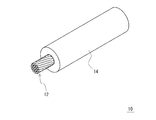
- FIG. 1 shows an insulated wire according to an embodiment of the present invention.
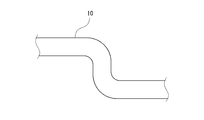
- FIG. 2 shows an example of a method of rapid bending and routing of insulated wires.
- the insulated wire 10 according to the present invention includes a conductor 12 and a wire covering material 14 disposed on the outer periphery of the conductor 12.
- the insulated wire 10 may be routed by a sharp bend as shown in FIG. 2 from a space for a vehicle such as an automobile.
- a reaction force due to the bending is greatly generated in the electric wire. If this reaction force continues to the electric wire, a load may be applied to the connecting portion of the electric wire (such as the fitting portion of the connecting terminal).
- the electric wire becomes thicker due to an increase in current, the electric wire becomes harder, and thus the reaction force due to bending and the load on the electric wire connection portion further increase.
- this composition contains a component with a maximum value of tan ⁇ of 1 or more in the base resin, the stress decreases with time during such a sharp bending arrangement, and the load on the wire connection portion and the like is reduced. it can. And when the bending elastic modulus of this composition is 50 MPa or less, since sufficient flexibility is also provided, the reaction force due to the initial bending can be reduced. Thereby, the load concerning an electric wire connection part etc. can be reduced further. If the base resin contains a component having a maximum value of tan ⁇ of less than 1, deformation can be suppressed, and the outer shape of the electric wire can be easily maintained.
- the insulated wire which concerns on this invention has the electric wire coating material which consists of a crosslinked body of this composition, it is excellent in heat resistance.
- the reaction force due to bending can be reduced during energization using heat generated by energization.
- the material composition may be adjusted so that the heat generation temperature region of the wire and the temperature region where the tan ⁇ of the wire coating material is 1 or more overlap.
- a crosslinked body becomes large in rubber elasticity and an elastic component becomes large compared with a non-crosslinked body. If it does so, the reaction force by the bending at the time of arrangement tends to become large.
- the base resin contains a component having a maximum value of tan ⁇ of 1 or more, the stress is sufficiently reduced with time even during the rapid bending treatment in the crosslinked body. In addition, it is possible to reduce the load applied to the wire connection portion and the like.
- test materials and manufacturers The test materials used in the present examples and comparative examples are shown together with the manufacturer, product name, and the like.
- Silane Graft Polyethylene (1) 1 to 4 parts by mass of vinyltrimethoxysilane (“KBM1003” manufactured by Shin-Etsu Chemical), 100 parts by mass of polyethylene (1) (“ENR7256.02” manufactured by Dow Elastomer), dicumyl peroxide (“PARK Mill D” manufactured by NOF Corporation)
- the silane-grafted polyethylene (1) was prepared by mixing 0.1 to 0.5 parts by mass of the dry blended material with a single screw extruder having an inner diameter of 25 mm at 190 ° C.
- Silane grafted polyethylene (2) was prepared in the same manner as in the preparation of silane grafted polyethylene (1) except that polyethylene (2) (“ENR8440” manufactured by Dow Elastomer) was used instead of polyethylene (1).
- Measurement of flexural modulus was performed in accordance with JIS K 7171 using a plate-like sample prepared from an insulating material in accordance with JIS K 7171.
- Measurement of bending load was performed in accordance with JIS K 7171 using a plate-like sample prepared from an insulating material in accordance with JIS K 7171.
- Comparative Examples 1 to 3 do not have a component having a maximum value of tan ⁇ of 1 or more in the base resin. For this reason, even when a certain amount of time has passed since the decrease width of the bending reaction force is small, the reaction force remains large.
- the base resin has a component having a maximum value of tan ⁇ of 1 or more. For this reason, the reduction range of the bending reaction force is large, and almost no reaction force remains when a certain time elapses. That is, the stress decreases with time at the time of a sharp bending arrangement, and deforms so as to follow the deformation. Thereby, stress is relieved and the load concerning an electric wire connection part etc. can be reduced.
- the shape is adapted to the external wiring environment because it is deformed according to the wiring environment when the heat is generated during the electric current. For this reason, it is possible to reduce the load applied to the wire connection portion and the like.
- Insulation wire 12 Insulated wire 12 Conductor 14 Insulation coating material
Landscapes
- Chemical & Material Sciences (AREA)
- Physics & Mathematics (AREA)
- Spectroscopy & Molecular Physics (AREA)
- Health & Medical Sciences (AREA)
- Chemical Kinetics & Catalysis (AREA)
- Medicinal Chemistry (AREA)
- Polymers & Plastics (AREA)
- Organic Chemistry (AREA)
- Organic Insulating Materials (AREA)
- Compositions Of Macromolecular Compounds (AREA)
- Insulated Conductors (AREA)
Abstract
急曲げ配策時にも電線接続部等にかかる負荷を低減できる電線被覆材組成物、絶縁電線およびワイヤーハーネスを提供する。 ベース樹脂がポリオレフィン系樹脂および/またはスチレン系熱可塑性エラストマーであり、ベース樹脂中にtanδの最大値が1以上の成分を含んでいる電線被覆材組成物を用い、絶縁電線およびワイヤーハーネスを構成する。電線被覆材組成物は、曲げ弾性率が50MPa以下であることが好ましい。
Description
本発明は、電線被覆材組成物、絶縁電線およびワイヤーハーネスに関し、さらに詳しくは、自動車等の車両に配索される電線の被覆材料として好適な電線被覆材組成物、絶縁電線およびワイヤーハーネスに関するものである。
車載ユニットの高機能化や車両の小型化等により、自動車等の車両において電線の配策スペースが減少している。そのため、曲げがきつい急曲げなどを行って電線が配策されることがある。このような急曲げによる配策を行うと、曲げによる反力が電線に大きく生じる。この反力が電線に継続していると、電線の接続部にも負荷が大きくかかる。大電流化により電線が太物化すると電線が硬くなるので、曲げによる反力や電線接続部への負荷がさらに大きくなる。
例えば特許文献1では、電線被覆材に低密度の樹脂を用いることで柔軟性に優れる絶縁電線を提示している。これにより、曲げによる負荷を小さくすることができる。
電線被覆材の柔軟化には限界がある。また、柔軟化によって初期の曲げによる反力は小さくできても、その反力が電線に継続していると、電線の接続部に負荷は残る。
本発明の解決しようとする課題は、急曲げ配策時にも電線接続部等にかかる負荷を低減できる電線被覆材組成物、絶縁電線およびワイヤーハーネスを提供することにある。
上記課題を解決するため本発明に係る電線被覆材組成物は、ベース樹脂がポリオレフィン系樹脂および/またはスチレン系熱可塑性エラストマーであり、前記ベース樹脂中にtanδの最大値が1以上の成分を含んでいることを要旨とするものである。
本発明に係る電線被覆材組成物は、曲げ弾性率が50MPa以下であることが好ましい。また、曲げ荷重の最大値に対し、曲げにより生じる反力の1時間後の値が1/2以下であることが好ましい。また、曲げ荷重の最大値に対し、曲げにより生じる反力の通電1時間後の値が1/2以下であることが好ましい。そして、前記ベース樹脂中にtanδの最大値が1未満の成分を含んでいることが好ましい。そして、前記tanδの最大値が1以上の成分の含有量は、前記ベース樹脂全体に対し5~30質量%の範囲内であることが好ましい。前記tanδの最大値が1以上の成分としては、ポリプロピレン系エラストマーが挙げられる。
そして、本発明に係る絶縁電線は、上記いずれかの電線被覆材組成物を用いた電線被覆材を有することを要旨とするものである。また、本発明に係る他の絶縁電線は、上記いずれかの電線被覆材組成物の架橋体からなる電線被覆材を有することを要旨とするものである。
そして、本発明に係るワイヤーハーネスは、上記いずれかの絶縁電線を有することを要旨とするものである。
本発明に係る電線被覆材組成物によれば、ポリオレフィン系樹脂および/またはスチレン系熱可塑性エラストマーのベース樹脂中にtanδの最大値が1以上の成分を含んでいることから、急曲げ配策時に経時的に応力が低下し、電線接続部等にかかる負荷を低減できる。
この際、電線被覆材組成物の曲げ弾性率が50MPa以下であると、十分な柔軟性も備えるため、初期の曲げによる反力を小さくすることができる。これにより、電線接続部等にかかる負荷をさらに低減できる。
そして、曲げ荷重の最大値に対し、曲げにより生じる反力の1時間後の値が1/2以下であると、電線接続部等にかかる負荷をより低減できる。また、曲げ荷重の最大値に対し、曲げにより生じる反力の通電1時間後の値が1/2以下であると、電線接続部等にかかる負荷をより低減できる。
そして、ベース樹脂中にtanδの最大値が1未満の成分を含んでいると、変形が抑えられるので、電線の外形を維持しやすくなる。このとき、tanδの最大値が1以上の成分の含有量がベース樹脂全体に対し5~30質量%の範囲内であると、電線接続部等にかかる負荷を低減できる効果と、電線の外形を維持できる効果のバランスに優れる。
そして、本発明に係る絶縁電線は、上記いずれかの電線被覆材組成物を用いた電線被覆材を有することから、急曲げ配策時にも電線接続部等にかかる負荷を低減できる。また、本発明に係るワイヤーハーネスは、本発明に係る絶縁電線を有することから、急曲げ配策時にも電線接続部等にかかる負荷を低減できる。
次に、本発明の実施形態について詳細に説明する。
本発明に係る電線被覆材組成物(以下、本組成物ということがある。)は、ベース樹脂がポリオレフィン系樹脂および/またはスチレン系熱可塑性エラストマーであり、ベース樹脂中にtanδの最大値が1以上の成分を含んでいる。
tanδは、樹脂の粘性成分を弾性成分で割った値である。粘性成分は、応力に対し塑性的(不可逆的)に変形する(オイル・ワックス性)。弾性成分は、応力に対し可逆的に変形する(バネ性)。tanδが1以上であると、樹脂において粘性成分のほうが大きい。そのため、緩和時間が短く、曲げなどの応力に迅速に対応する。本組成物は、ベース樹脂中にtanδの最大値が1以上の成分を含むことで、同じ柔らかさで応力吸収性が高いものとなる。つまり、応力吸収性能を高めることで反力を低下させ、接続部等への負荷を低減することができる。tanδは、昇温速度2℃/min、測定周波数1.6Hzで動的粘弾性測定を実施することにより求めることができる。
tanδは、温度依存性がある。tanδが1以上になる温度領域が常温を含んでいれば、電線配策後、通電前にも反力が低下し、接続部等への負荷を低減することができる。一方、tanδが1以上になる温度領域が常温を含んでいなくても、通電による電線の発熱温度領域を含んでいれば(重なっていれば)、通電時に反力が低下し、接続部等への負荷を低減することができる。非通電時に電線温度が低く、tanδが1未満であっても、一度通電することで反力が低下するので、接続部等への負荷を低減することができる。したがって、tanδが1以上になる温度領域は、常温あるいは通電による電線の発熱温度領域を含むようにするとよい。
ベース樹脂は、tanδの最大値が1以上の成分のみで構成されていてもよいし、tanδの最大値が1以上の成分とtanδの最大値が1未満の成分の組み合わせで構成されていてもよい。tanδの最大値が1未満の成分は、弾性成分のほうが大きい。そのため、ベース樹脂中にtanδの最大値が1未満の成分を含んでいると、変形が抑えられやすく、電線の外形を維持しやすい。tanδの最大値が1未満の成分を含む場合、tanδの最大値が1以上の成分の含有量は、ベース樹脂全体に対し5質量%以上であることが好ましい。これにより、電線接続部等にかかる負荷を低減できる効果に優れる。この観点から、tanδの最大値が1以上の成分の含有量は、ベース樹脂全体に対し、より好ましくは10質量%以上である。また、tanδの最大値が1以上の成分の含有量は、ベース樹脂全体に対し30質量%以下であることが好ましい。これにより、電線の外形を維持できる効果に優れる。この観点から、tanδの最大値が1以上の成分の含有量は、ベース樹脂全体に対しより好ましくは25質量%以下である。そして、tanδの最大値が1以上の成分の含有量が、ベース樹脂全体に対し5~30質量%の範囲内であると、電線接続部等にかかる負荷を低減できる効果と、電線の外形を維持できる効果のバランスに優れる。
本組成物は、柔軟性の向上などの観点から、曲げ弾性率が50MPa以下であることが好ましい。より好ましくは20MPa以下である。曲げ弾性率が50MPa以下であると、十分な柔軟性も備えるため、初期の曲げによる反力を小さくすることができる。これにより、電線接続部等にかかる負荷をさらに低減できる。本組成物を曲げ弾性率の小さいものとするには、例えば曲げ弾性率の小さいベース樹脂を用いるとよい。樹脂および組成物の曲げ弾性率は、JIS K 7171に準拠して作製した板状サンプルを用い、JIS K 7171に準拠して常温で測定される。
本組成物は、応力吸収性が高いものとしており、成形品の急曲げ等による、曲げにより生じる反力が減衰しやすいものとなっている。本組成物は、曲げ荷重の最大値に対し、曲げにより生じる反力の1時間後の値が1/2以下であることが好ましい。より好ましくは1/4以下である。これにより、電線接続部等にかかる負荷をより低減できる。また、曲げ荷重の最大値に対し、曲げにより生じる反力の通電1時間後の値が1/2以下であることが好ましい。より好ましくは1/4以下である。これにより、電線接続部等にかかる負荷をより低減できる。曲げ荷重は、JIS K 7171に準拠して絶縁材料から作製した板状サンプルを用い、JIS K 7171に準拠して測定される。曲げ反力は、JIS K 7171を参考に、3点曲げ反力測定により測定される。
ベース樹脂のポリオレフィン系樹脂としては、ポリエチレン、ポリプロピレン、その他のオレフィンの単独重合体、エチレン-αオレフィン共重合体、エチレン-酢酸ビニル共重合体、エチレン-アクリル酸エステル共重合体、エチレン-メタクリル酸エステル共重合体等のエチレン系共重合体、プロピレン-αオレフィン共重合体、プロピレン-酢酸ビニル共重合体、プロピレン-アクリル酸エステル共重合体、プロピレン-メタクリル酸エステル共重合体等のプロピレン系共重合体などが挙げられる。これらはベース樹脂として1種単独で用いてもよいし、2種以上を併用してもよい。
ポリオレフィン系樹脂としては、オレフィンをベースとするポリオレフィンエラストマーを用いてもよい。ポリオレフィンエラストマーは、より柔軟性を付与することができる。これにより、初期の曲げによる反力を小さくすることができ、電線接続部等にかかる負荷をさらに低減できる。ポリオレフィンエラストマーとしては、エチレン系エラストマー(PEエラストマー)、プロピレン系エラストマー(PPエラストマー)等のオレフィン系熱可塑性エラストマー(TPO)、エチレン-プロピレン共重合体(EPM、EPR)、エチレンプロピレン-ジエン共重合体(EPDM、EPT)等が挙げられる。
ポリエチレンとしては、高密度ポリエチレン(HDPE)、中密度ポリエチレン(MDPE)、低密度ポリエチレン(LDPE)、直鎖状低密度ポリエチレン(LLDPE)、超低密度ポリエチレン(VLDPE)、メタロセン超低密度ポリエチレンなどが挙げられる。これらはベース樹脂として1種単独で用いてもよいし、2種以上を併用してもよい。これらのうちでは、メタロセン超低密度ポリエチレンを代表とする低密度ポリエチレンがより好ましい。低密度ポリエチレンを用いると、より柔軟性を付与することができる。これにより、初期の曲げによる反力を小さくすることができ、電線接続部等にかかる負荷をさらに低減できる。
柔軟性を付与することができる観点から、ポリオレフィン系樹脂は、密度0.860~0.900g/cm3であることが好ましい。低密度であることで、柔軟性に優れるものとなる。ポリオレフィン系樹脂の密度は、ASTM規格のD792に準拠して測定される値である。
ポリオレフィン系樹脂は、結晶化度10~50%であることが好ましい。より好ましくは結晶化度10~40%、さらに好ましくは結晶化度10~25%である。ポリオレフィン系樹脂の結晶化度は、密度と相関関係があり、結晶化度が低いものは密度も低くなり、結晶化度が高いものは密度も高くなる。ポリオレフィン系樹脂の結晶化度は、示差走査熱量計を用いて測定することができる。具体的には、樹脂ペレットの融解熱量を測定し、ポリエチレン系樹脂の場合は、高密度ポリエチレン(HDPE)の完全結晶体理論熱量文献値293J/gから算出し、ポリプロピレン系樹脂の場合はホモポリプロピレンの209J/gから算出することができる。示差走査熱量計としては、日立ハイテクサイエンス社製、製品名「DSC6200」などを用いることができる。
ポリオレフィン系樹脂は、電線形状への成形後において架橋していてもよい。架橋することで、耐熱性が向上する。架橋方法としては、特に限定されるものではない。シラン架橋、過酸化物架橋、電子線架橋などの公知の架橋方法を適宜選択することができる。シラン架橋を行う場合には、ポリオレフィン系樹脂としてシラン変性されたシラン変性ポリオレフィン系樹脂を用いる。
スチレン系熱可塑性エラストマーとしては、ポリスチレン-ポリ(エチレン/プロピレン)ブロック(SEP)、ポリスチレン-ポリ(エチレン/プロピレン)ブロック-ポリスチレン(SEPS)、ポリスチレン-ポリ(エチレン/ブチレン)ブロック-ポリスチレン(SEBS)、ポリスチレン-ポリ(エチレン-エチレン/プロピレン)ブロック-ポリスチレン(SEEPS)などのオレフィン成分を含むものが挙げられる。これらは単独で用いてもよいし、2種以上を組み合わせて用いてもよい。
スチレン系熱可塑性エラストマーは、酸変性されていてもよい。酸変性されていると、導体と絶縁層の密着性がより良好になる。酸変性剤としては、不飽和カルボン酸やその誘導体を用いることができる。不飽和カルボン酸としては、マレイン酸、フマル酸などが挙げられる。不飽和カルボン酸の誘導体としては、無水マレイン酸(MAH)、マレイン酸エステルなどが挙げられる。これらは単独で用いてもよいし、2種以上を組み合わせて用いてもよい。酸変性剤のうちでは、マレイン酸、無水マレイン酸(MAH)が好ましい。
ベース樹脂におけるtanδの最大値が1以上の成分としては、上記するポリオレフィン系樹脂やスチレン系熱可塑性エラストマーのうちでも、ポリプロピレン系エラストマー、スチレン・ブタジエン系エラストマーを好適に用いることができる。また、tanδの最大値が1未満の成分としては、上記するポリオレフィン系樹脂やスチレン系熱可塑性エラストマーのうちでも、ポリエチレン、ポリプロピレンを好適に用いることができる。ポリエチレンは、柔軟性に優れるなどの観点から、低密度ポリエチレン(LDPE)、直鎖状低密度ポリエチレン(LLDPE)、超低密度ポリエチレン(VLDPE)、メタロセン超低密度ポリエチレンが特に好ましい。
ベース樹脂におけるtanδの最大値が1以上の成分の弾性率は、柔軟性に優れるなどの観点から、曲げ弾性率が100MPa以下であることが好ましい。より好ましくは80MPa以下である。一方、電線外形を確保しやすいなどの観点から、曲げ弾性率が0.5MPa以上であることが好ましい。より好ましくは1.0MPa以上である。また、tanδの最大値が1未満の成分としては、柔軟性に優れるなどの観点から、曲げ弾性率が100MPa以下であることが好ましい。より好ましくは80MPa以下である。一方、電線外形を確保しやすいなどの観点から、曲げ弾性率が0.5MPa以上であることが好ましい。より好ましくは1.0MPa以上である。
本組成物は、本発明の目的を阻害しない範囲であれば、ベース樹脂に加え、その他の成分を添加してもよい。その他の成分としては、難燃剤、充填剤、酸化防止剤、金属不活性剤、滑剤、老化防止剤などが挙げられる。また、物性に影響しない範囲であれば、ベース樹脂にポリオレフィン系樹脂およびスチレン系熱可塑性エラストマー以外の樹脂が含まれていてもよい。
以上の構成の本組成物を用いて、本発明に係る絶縁電線およびワイヤーハーネスを得ることができる。
本発明に係る絶縁電線は、上記の本組成物の架橋体もしくは非架橋体からなる電線被覆材を有するものである。耐熱性に優れるなどの観点から、電線被覆材は上記の本組成物の架橋体からなることが好ましい。架橋方法としては、特に限定されるものではない。シラン架橋、過酸化物架橋、電子線架橋などの公知の架橋方法を適宜選択することができる。シラン架橋を行う場合には、ポリオレフィン系樹脂としてシラン変性されたシラン変性ポリオレフィン系樹脂を用いる。そして、本発明に係るワイヤーハーネスは、上記の本発明に係る絶縁電線を有するものである。絶縁電線の導体は、その導体径や導体の材質等は特に限定されるものではなく、絶縁電線の用途等に応じて適宜定めることができる。導体としては例えば、銅、銅合金、アルミニウム、アルミニウム合金等が挙げられる。また電線被覆材は、単層であっても、2層以上の複数層であってもいずれでも良い。
ISO6722は自動車用電線に用いられる国際規格であり、許容耐熱温度によってAからEまでのクラスに分類される。本組成物の架橋体からなる電線被覆材を有する絶縁電線は、耐熱性に優れ、高電圧がかかるバッテリーケーブル等に最適であり、耐熱温度125℃のCクラスや、150℃のDクラスの特性を得ることが可能である。柔軟性に優れる構成のものは、太物、例えば導体断面積3cm2以上の電線に好適である。
図1は、本発明の一実施形態に係る絶縁電線を示したものである。そして、図2は、絶縁電線の急曲げ配策方法の一例を示したものである。本発明に係る絶縁電線10は、導体12と、導体12の外周に配置された電線被覆材14と、を有する。絶縁電線10は、自動車等の車両における配策スペースなどから、図2に示すような急曲げによる配策が行われることがある。このような急曲げによる配策を行うと、曲げによる反力が電線に大きく生じる。この反力が電線に継続していると、電線の接続部(接続端子の嵌合部など)にも負荷が大きくかかることがある。大電流化により電線が太物化すると電線が硬くなるので、曲げによる反力や電線接続部への負荷がさらに大きくなる。
本組成物は、ベース樹脂中にtanδの最大値が1以上の成分を含んでいることから、このような急曲げ配策時に経時的に応力が低下し、電線接続部等にかかる負荷を低減できる。そして、本組成物の曲げ弾性率が50MPa以下であると、十分な柔軟性も備えるため、初期の曲げによる反力を小さくすることができる。これにより、電線接続部等にかかる負荷をさらに低減できる。そして、ベース樹脂中にtanδの最大値が1未満の成分を含んでいると、変形が抑えられるので、電線の外形を維持しやすくなる。そして、本発明に係る絶縁電線が本組成物の架橋体からなる電線被覆材を有すると、耐熱性に優れる。耐熱性に優れる絶縁電線であると、通電による発熱を利用して、通電時に曲げによる反力を緩和することができる。この場合、電線の発熱温度領域と電線被覆材のtanδが1以上になる温度領域とが重なるように材料配合を調整すればよい。なお、架橋体は、非架橋体と比べてゴム弾性が大きくなり、弾性成分が大きくなる。そうすると、配策時の曲げによる反力は大きくなる傾向にある。この場合でも、本発明では、上記するように、ベース樹脂中にtanδの最大値が1以上の成分を含ませているので、架橋体における急曲げ配策時にも経時的に応力が十分に低下し、電線接続部等にかかる負荷を低減できる。
以下、実施例により本発明を説明するが、本発明は、実施例により限定されるものではない。
〔供試材料及び製造元等〕
本実施例及び比較例において使用した供試材料を製造元、商品名等とともに示す。
本実施例及び比較例において使用した供試材料を製造元、商品名等とともに示す。
〔シラングラフトポリエチレン(1)の調製〕
ポリエチレン(1)(ダウエラストマー製「ENR7256.02」)100質量部に対し、ビニルトリメトキシシラン(信越化学製「KBM1003」)1~4質量部、ジクミルパーオキサイド(日油製「パークミルD」)0.1~0.5質量部をドライブレンドした材料を190℃の内径25mmの単軸押出機で混合して、シラングラフトポリエチレン(1)を調製した。
ポリエチレン(1)(ダウエラストマー製「ENR7256.02」)100質量部に対し、ビニルトリメトキシシラン(信越化学製「KBM1003」)1~4質量部、ジクミルパーオキサイド(日油製「パークミルD」)0.1~0.5質量部をドライブレンドした材料を190℃の内径25mmの単軸押出機で混合して、シラングラフトポリエチレン(1)を調製した。
〔シラングラフトポリエチレン(2)の調製〕
ポリエチレン(1)に代えてポリエチレン(2)(ダウエラストマー製「ENR8440」)を用いた以外はシラングラフトポリエチレン(1)の調製と同様にして、シラングラフトポリエチレン(2)を調製した。
ポリエチレン(1)に代えてポリエチレン(2)(ダウエラストマー製「ENR8440」)を用いた以外はシラングラフトポリエチレン(1)の調製と同様にして、シラングラフトポリエチレン(2)を調製した。
〔触媒バッチの調製〕
三菱化学製「リンクロンLZ082」、バインダー樹脂としてポリエチレンを含み、シラン架橋触媒(D)として錫化合物を1%未満含有している。
三菱化学製「リンクロンLZ082」、バインダー樹脂としてポリエチレンを含み、シラン架橋触媒(D)として錫化合物を1%未満含有している。
〔絶縁電線の作製〕
表1に示す質量比で、シラングラフトポリエチレン、ポリプロピレン系エラストマー、触媒バッチを押出機のホッパーで混合して押出機の温度を約140~200℃に設定して、押出加工を行った。押出加工は外径2.4mmの導体上に、厚さ0.7mmの絶縁体として押出被覆して被覆材を形成した(被覆外径3.65mm)。その後、60℃95%湿度の高湿高温槽で24時間水架橋処理を施して絶縁電線を作製した。
・ポリプロピレン系エラストマー(1):三井化学(株)製「アブソートマー1」
・ポリプロピレン系エラストマー(2):三井化学(株)製「アブソートマー2」
・ポリプロピレン系エラストマー(3):日本ポリプロ(株)製「NAR6」
・ポリプロピレン系エラストマー(4):日本ポリプロ(株)製「EC9」
・ポリプロピレン系エラストマー(5):三菱化学(株)製「サーモラン3555」
表1に示す質量比で、シラングラフトポリエチレン、ポリプロピレン系エラストマー、触媒バッチを押出機のホッパーで混合して押出機の温度を約140~200℃に設定して、押出加工を行った。押出加工は外径2.4mmの導体上に、厚さ0.7mmの絶縁体として押出被覆して被覆材を形成した(被覆外径3.65mm)。その後、60℃95%湿度の高湿高温槽で24時間水架橋処理を施して絶縁電線を作製した。
・ポリプロピレン系エラストマー(1):三井化学(株)製「アブソートマー1」
・ポリプロピレン系エラストマー(2):三井化学(株)製「アブソートマー2」
・ポリプロピレン系エラストマー(3):日本ポリプロ(株)製「NAR6」
・ポリプロピレン系エラストマー(4):日本ポリプロ(株)製「EC9」
・ポリプロピレン系エラストマー(5):三菱化学(株)製「サーモラン3555」
(曲げ弾性率の測定)
JIS K 7171に準拠して絶縁材料から作製した板状サンプルを用い、JIS K 7171に準拠して測定した。
JIS K 7171に準拠して絶縁材料から作製した板状サンプルを用い、JIS K 7171に準拠して測定した。
(曲げ荷重の測定)
JIS K 7171に準拠して絶縁材料から作製した板状サンプルを用い、JIS K 7171に準拠して測定した。
JIS K 7171に準拠して絶縁材料から作製した板状サンプルを用い、JIS K 7171に準拠して測定した。
(曲げ反力の測定)
JIS K 7171を参考に作製した電線を100mmの長さに切り取り、3本を横一列に並べ先端をポリ塩化ビニルテープで固定した状態で、支柱間50mmの治具上にセットし支柱間の中心から1mm/分の速度で上方からサンプルを押し込み、反力を測定した。
JIS K 7171を参考に作製した電線を100mmの長さに切り取り、3本を横一列に並べ先端をポリ塩化ビニルテープで固定した状態で、支柱間50mmの治具上にセットし支柱間の中心から1mm/分の速度で上方からサンプルを押し込み、反力を測定した。

比較例1~3は、ベース樹脂にtanδの最大値が1以上の成分を有していない。このため、曲げ反力の低下幅が小さく、一定時間が経過したとしても、反力が大きく残る。一方、実施例は、ベース樹脂にtanδの最大値が1以上の成分を有している。このため、曲げ反力の低下幅が大きく、一定時間が経過したときに、反力がほとんど残らない。つまり、急曲げ配策時に経時的に応力が低下し、変形に追随するように変形する。これにより応力が緩和され、電線接続部等にかかる負荷を低減できる。そして、実施例どうしの比較をすると、組成物全体の弾性率が低くなると、柔軟性が向上し、初期の曲げによる反力(最大荷重)を小さくすることができる(反発力そのものを小さくすることができる)。これにより、電線接続部等にかかる負荷をさらに低減できる。
そして、実施例から、tanδの最大値が1以上となる温度領域は通電によって生じる発熱温度領域と重なるため、通電時に曲げによる負担は緩和される。非通電時に電線温度が低下し、tanδが1未満となっても、通電時の発熱時に配策環境に沿った変形をしていることから、外部の配策環境に適応した形状になっているため、電線接続部等にかかる負荷を低減できる。
以上、本発明の実施の形態について詳細に説明したが、本発明は上記実施の形態に何ら限定されるものではなく、本発明の要旨を逸脱しない範囲で種々の改変が可能である。
10 絶縁電線
12 導体
14 絶縁被覆材
12 導体
14 絶縁被覆材
Claims (10)
- ベース樹脂がポリオレフィン系樹脂および/またはスチレン系熱可塑性エラストマーであり、前記ベース樹脂中にtanδの最大値が1以上の成分を含んでいることを特徴とする電線被覆材組成物。
- 曲げ弾性率が50MPa以下であることを特徴とする請求項1に記載の電線被覆材組成物。
- 曲げ荷重の最大値に対し、曲げにより生じる反力の1時間後の値が1/2以下であることを特徴とする請求項1または2に記載の電線被覆材組成物。
- 曲げ荷重の最大値に対し、曲げにより生じる反力の通電1時間後の値が1/2以下であることを特徴とする請求項1または2に記載の電線被覆材組成物。
- 前記ベース樹脂中にtanδの最大値が1未満の成分を含んでいることを特徴とする請求項1から4のいずれか1項に記載の電線被覆材組成物。
- 前記tanδの最大値が1以上の成分の含有量が、前記ベース樹脂全体に対し5~30質量%の範囲内であることを特徴とする請求項1から5のいずれか1項に記載の電線被覆材組成物。
- 前記tanδの最大値が1以上の成分が、ポリプロピレン系エラストマーであることを特徴とする電線被覆材組成物。
- 請求項1から7のいずれか1項に記載の電線被覆材組成物を用いた電線被覆材を有することを特徴とする絶縁電線。
- 請求項1から7のいずれか1項に記載の電線被覆材組成物の架橋体からなる電線被覆材を有することを特徴とする絶縁電線。
- 請求項8または9に記載の絶縁電線を有することを特徴とするワイヤーハーネス。
Applications Claiming Priority (2)
| Application Number | Priority Date | Filing Date | Title |
|---|---|---|---|
| JP2016-124176 | 2016-06-23 | ||
| JP2016124176A JP2017228445A (ja) | 2016-06-23 | 2016-06-23 | 電線被覆材組成物、絶縁電線およびワイヤーハーネス |
Publications (1)
| Publication Number | Publication Date |
|---|---|
| WO2017221696A1 true WO2017221696A1 (ja) | 2017-12-28 |
Family
ID=60784687
Family Applications (1)
| Application Number | Title | Priority Date | Filing Date |
|---|---|---|---|
| PCT/JP2017/021062 Ceased WO2017221696A1 (ja) | 2016-06-23 | 2017-06-07 | 電線被覆材組成物、絶縁電線およびワイヤーハーネス |
Country Status (2)
| Country | Link |
|---|---|
| JP (1) | JP2017228445A (ja) |
| WO (1) | WO2017221696A1 (ja) |
Citations (4)
| Publication number | Priority date | Publication date | Assignee | Title |
|---|---|---|---|---|
| JPH09286882A (ja) * | 1996-04-19 | 1997-11-04 | Mitsui Petrochem Ind Ltd | 電気絶縁ゴム |
| JP2002093239A (ja) * | 2000-09-18 | 2002-03-29 | Mitsui Chemicals Inc | 電線被覆材 |
| JP2013234334A (ja) * | 2004-11-25 | 2013-11-21 | Mitsui Chemicals Inc | プロピレン系樹脂組成物からなる成形体 |
| WO2013191222A1 (ja) * | 2012-06-20 | 2013-12-27 | 積水化学工業株式会社 | 衝撃吸収材及びシール材 |
-
2016
- 2016-06-23 JP JP2016124176A patent/JP2017228445A/ja active Pending
-
2017
- 2017-06-07 WO PCT/JP2017/021062 patent/WO2017221696A1/ja not_active Ceased
Patent Citations (4)
| Publication number | Priority date | Publication date | Assignee | Title |
|---|---|---|---|---|
| JPH09286882A (ja) * | 1996-04-19 | 1997-11-04 | Mitsui Petrochem Ind Ltd | 電気絶縁ゴム |
| JP2002093239A (ja) * | 2000-09-18 | 2002-03-29 | Mitsui Chemicals Inc | 電線被覆材 |
| JP2013234334A (ja) * | 2004-11-25 | 2013-11-21 | Mitsui Chemicals Inc | プロピレン系樹脂組成物からなる成形体 |
| WO2013191222A1 (ja) * | 2012-06-20 | 2013-12-27 | 積水化学工業株式会社 | 衝撃吸収材及びシール材 |
Also Published As
| Publication number | Publication date |
|---|---|
| JP2017228445A (ja) | 2017-12-28 |
Similar Documents
| Publication | Publication Date | Title |
|---|---|---|
| JP5343327B2 (ja) | 難燃性シラン架橋オレフィン系樹脂の製造方法および絶縁電線ならびに絶縁電線の製造方法 | |
| US6646205B2 (en) | Electrical wire having a resin composition covering | |
| JP6523407B2 (ja) | 耐熱性シラン架橋樹脂成形体及びその製造方法、耐熱性シラン架橋性樹脂組成物及びその製造方法、シランマスターバッチ、並びに耐熱性シラン架橋樹脂成形体を用いた耐熱性製品 | |
| JP6569129B2 (ja) | 電線被覆材組成物、絶縁電線およびワイヤーハーネス | |
| JP7032038B2 (ja) | ケーブル | |
| JP2016181413A (ja) | 電線被覆材組成物、絶縁電線及びワイヤーハーネス | |
| JP6350129B2 (ja) | 電線被覆材用組成物、絶縁電線およびワイヤーハーネス | |
| WO2016056635A1 (ja) | 架橋樹脂成形体及び架橋性樹脂組成物とそれらの製造方法、シランマスターバッチ、並びに、成形品 | |
| WO2015159788A1 (ja) | 絶縁性樹脂組成物及び絶縁電線 | |
| JP2009280631A (ja) | 難燃性ポリオレフィン組成物および電線・ケーブル | |
| JP6800081B2 (ja) | シラン架橋樹脂成形体調製用キット及びシラン架橋樹脂成形体の製造方法 | |
| JP2020161447A (ja) | キャブタイヤケーブル、キャブタイヤケーブル用絶縁電線及びこれらの製造方法 | |
| WO2016056634A1 (ja) | 難燃性架橋樹脂成形体及び難燃性架橋性樹脂組成物とそれらの製造方法、難燃性シランマスターバッチ、並びに、成形品 | |
| JP2016001560A (ja) | 絶縁電線 | |
| CN106463206B (zh) | 车载用电线和电缆 | |
| JP2015193689A (ja) | 難燃性組成物およびこれを用いた絶縁電線 | |
| WO2017221696A1 (ja) | 電線被覆材組成物、絶縁電線およびワイヤーハーネス | |
| JP6699074B2 (ja) | 絶縁性樹脂組成物及び絶縁電線 | |
| JP6952070B2 (ja) | 電線・ケーブルの製造方法 | |
| JP7157541B2 (ja) | 配線材 | |
| JP7192780B2 (ja) | ケーブル | |
| JP3786252B2 (ja) | ポリオレフィン系絶縁被覆電線 | |
| JP2016134312A (ja) | 電線被覆材組成物、絶縁電線及びワイヤーハーネス | |
| JP6895920B2 (ja) | 耐熱性シラン架橋ポリオレフィン樹脂成形体の製造方法、シラン架橋性ポリオレフィン樹脂組成物、耐熱性シラン架橋ポリオレフィン樹脂成形体、耐熱性製品、電線及び光ファイバケーブル | |
| JP2010144088A (ja) | ポリオレフィン系組成物及びそれを用いた電線並びにケーブル |
Legal Events
| Date | Code | Title | Description |
|---|---|---|---|
| 121 | Ep: the epo has been informed by wipo that ep was designated in this application |
Ref document number: 17815165 Country of ref document: EP Kind code of ref document: A1 |
|
| NENP | Non-entry into the national phase |
Ref country code: DE |
|
| 122 | Ep: pct application non-entry in european phase |
Ref document number: 17815165 Country of ref document: EP Kind code of ref document: A1 |