WO2017200316A1 - 두통의 예방학적 치료를 위한 카바메이트 화합물의 용도 - Google Patents
두통의 예방학적 치료를 위한 카바메이트 화합물의 용도 Download PDFInfo
- Publication number
- WO2017200316A1 WO2017200316A1 PCT/KR2017/005171 KR2017005171W WO2017200316A1 WO 2017200316 A1 WO2017200316 A1 WO 2017200316A1 KR 2017005171 W KR2017005171 W KR 2017005171W WO 2017200316 A1 WO2017200316 A1 WO 2017200316A1
- Authority
- WO
- WIPO (PCT)
- Prior art keywords
- formula
- headache
- migraine
- pharmaceutical composition
- carbamate compound
- Prior art date
- Legal status (The legal status is an assumption and is not a legal conclusion. Google has not performed a legal analysis and makes no representation as to the accuracy of the status listed.)
- Ceased
Links
Images


Classifications
-
- A—HUMAN NECESSITIES
- A61—MEDICAL OR VETERINARY SCIENCE; HYGIENE
- A61K—PREPARATIONS FOR MEDICAL, DENTAL OR TOILETRY PURPOSES
- A61K31/00—Medicinal preparations containing organic active ingredients
- A61K31/33—Heterocyclic compounds
- A61K31/395—Heterocyclic compounds having nitrogen as a ring hetero atom, e.g. guanethidine or rifamycins
- A61K31/41—Heterocyclic compounds having nitrogen as a ring hetero atom, e.g. guanethidine or rifamycins having five-membered rings with two or more ring hetero atoms, at least one of which being nitrogen, e.g. tetrazole
-
- A—HUMAN NECESSITIES
- A61—MEDICAL OR VETERINARY SCIENCE; HYGIENE
- A61K—PREPARATIONS FOR MEDICAL, DENTAL OR TOILETRY PURPOSES
- A61K31/00—Medicinal preparations containing organic active ingredients
- A61K31/16—Amides, e.g. hydroxamic acids
-
- A—HUMAN NECESSITIES
- A61—MEDICAL OR VETERINARY SCIENCE; HYGIENE
- A61K—PREPARATIONS FOR MEDICAL, DENTAL OR TOILETRY PURPOSES
- A61K9/00—Medicinal preparations characterised by special physical form
-
- A—HUMAN NECESSITIES
- A61—MEDICAL OR VETERINARY SCIENCE; HYGIENE
- A61K—PREPARATIONS FOR MEDICAL, DENTAL OR TOILETRY PURPOSES
- A61K9/00—Medicinal preparations characterised by special physical form
- A61K9/0012—Galenical forms characterised by the site of application
- A61K9/0019—Injectable compositions; Intramuscular, intravenous, arterial, subcutaneous administration; Compositions to be administered through the skin in an invasive manner
-
- A—HUMAN NECESSITIES
- A61—MEDICAL OR VETERINARY SCIENCE; HYGIENE
- A61K—PREPARATIONS FOR MEDICAL, DENTAL OR TOILETRY PURPOSES
- A61K9/00—Medicinal preparations characterised by special physical form
- A61K9/0012—Galenical forms characterised by the site of application
- A61K9/0019—Injectable compositions; Intramuscular, intravenous, arterial, subcutaneous administration; Compositions to be administered through the skin in an invasive manner
- A61K9/0021—Intradermal administration, e.g. through microneedle arrays or needleless injectors
-
- A—HUMAN NECESSITIES
- A61—MEDICAL OR VETERINARY SCIENCE; HYGIENE
- A61K—PREPARATIONS FOR MEDICAL, DENTAL OR TOILETRY PURPOSES
- A61K9/00—Medicinal preparations characterised by special physical form
- A61K9/20—Pills, tablets, discs, rods
- A61K9/28—Dragees; Coated pills or tablets, e.g. with film or compression coating
-
- A—HUMAN NECESSITIES
- A61—MEDICAL OR VETERINARY SCIENCE; HYGIENE
- A61P—SPECIFIC THERAPEUTIC ACTIVITY OF CHEMICAL COMPOUNDS OR MEDICINAL PREPARATIONS
- A61P25/00—Drugs for disorders of the nervous system
- A61P25/06—Antimigraine agents
Definitions
- the present invention relates to a use for the purpose of preventing the occurrence of headache including migraine by administering a pharmaceutical composition comprising a carbamate compound of formula (I):
- R 1 , R 2 , A 1 and A 2 are as defined herein.
- Migraine is a common disease with a prevalence of 8-18% worldwide. It occurs more frequently in women than in men, and can occur in both children and adults. Migraine symptoms are headaches as well as accompanying symptoms such as nausea, vomiting, photosensitivity, sound sensitization, and odor sensitization, which are obstacles to physical activity. Such migraine disorders cause socioeconomic loss worldwide and are a serious detriment to quality of life (Krymchantowski et al., New and emerging prophylactic agents for migraine, CNS Drugs, 2002; Jackson et al. ., A comparative effectiveness meta-analysis of drugs for the prophylaxis of migraine headache, PLOS ONE, 2015).
- Drug treatment for migraine headaches is divided into acute abortive treatment and preventive or prophylactic treatment.
- Acute care is used for the relief of symptoms when migraine headaches occur.
- simple analgesics such as nonsteroidal anti-inflammatory drugs (NSAIDs) are used in cases of mild migraine attacks, and migraine-specific drugs such as triptans should be considered if they do not respond to simple analgesics. do.
- NSAIDs nonsteroidal anti-inflammatory drugs
- Prophylactic treatment is used during the dosing period to reduce the frequency or intensity of migraine attacks.
- Prophylactic treatment should be applied when repeated daily migraine attacks interfere with daily life during acute treatment, when the frequency of headaches is more than twice a week or when there is concern over the use of acute medications due to frequent headaches.
- Severe side effects or contraindications to the patient when the patient prefers prophylactic treatment, or when the duration is long, or when there are less common migraine conditions such as hemiplegic migraines, basal migraine headaches, persistent migraine headaches, and migraine headaches. J.L.
- Valproate has been used to prevent migraine headache, but valproate has been known to have side effects such as liver damage and congenital malformations.
- the present invention seeks to provide a method for the prophylactic treatment of headache, more particularly headaches caused by cortical proliferation inhibition, in particular chronic headaches including migraine headaches.
- the present invention also provides a carbamate compound of Formula 1, or a pharmaceutically acceptable salt, solvate or hydrate thereof, for headaches, more particularly headaches caused by cortical proliferation inhibition, in particular chronic headaches including migraine headaches. It is intended to provide a use for use in the prophylactic treatment of:
- R 1 , R 2 , A 1 and A 2 are as defined herein.
- the present invention provides a medicament for the prophylactic treatment of headache, comprising a therapeutically effective amount of a carbamate compound of Formula 1, or a pharmaceutically acceptable salt, solvate or hydrate thereof:
- R 1 and R 2 are each independently selected from the group consisting of hydrogen, halogen, C 1 -C 8 alkyl, halo-C 1 -C 8 alkyl, C 1 -C 8 thioalkoxy and C 1 -C 8 alkoxy,
- One of A 1 and A 2 is CH and the other is N.
- the present invention comprises a therapeutically effective amount of the carbamate compound of Formula 1, or a pharmaceutically acceptable salt, solvate or hydrate thereof, and at least one pharmaceutically acceptable carrier, prophylactic treatment of headache It provides a pharmaceutical composition.
- the present invention also provides a method of prophylactically treating a headache in a subject comprising administering to the subject a therapeutically effective amount of a carbamate compound of Formula 1, or a pharmaceutically acceptable salt, solvate or hydrate thereof. to provide.
- the frequency or intensity of headache in a subject comprising administering to the subject a therapeutically effective amount of a carbamate compound of Formula 1, or a pharmaceutically acceptable salt, solvate or hydrate thereof: It provides a way to reduce or eliminate.
- the present invention also provides a use for the prophylactic treatment of headache of the carbamate compound of Formula 1, or a pharmaceutically acceptable salt, solvate or hydrate thereof.
- R 1 and R 2 are each independently selected from the group consisting of hydrogen, halogen and C 1 -C 8 alkyl.
- halo C 1 -C 8 alkyl is perfluoroalkyl.
- the carbamate compound of formula 1 is carbamic acid (R) -1- (2-chlorophenyl) -2-tetrazol-2-yl) ethyl ester of formula
- Preparation of the carbamate compounds of Formulas 1 and 2 can be prepared using those known in the art, or compounds that can be easily prepared from those skilled in the art.
- methods for the preparation of compounds of formula 1 are described in detail in International Publication Nos. WO 2006/112685 A1, WO 2010/150946 A1 and WO 2011/046380 A2, which are incorporated herein by reference.
- the compound of the present invention may be chemically synthesized by the method described in the above document, but this is merely to present one exemplary method, and the order of the unit operation and the like may be selectively changed as necessary. It is not intended to be limiting.
- the compound of the present invention is a headache and / or condition associated with cortical spreading depression (CSD) and / or caused by cortical spreading inhibition, in particular chronic headaches such as migraine Can be used for the prevention of cortical spreading depression (CSD) and / or caused by cortical spreading inhibition, in particular chronic headaches such as migraine Can be used for the prevention of cortical spreading depression (CSD) and / or caused by cortical spreading inhibition, in particular chronic headaches such as migraine Can be used for the prevention of
- CSD cortical spreading depression
- migraine Can chronic headaches
- Cortical Diffuse Inhibition is a secondary phenomenon caused by excessive excitability of the cranial nerve and is known as a trigger that causes chronic headaches including migraine headaches. Therefore, it is possible to prevent the occurrence of chronic headaches including migraines when inhibiting the cortical proliferation inhibitory (CSD), and drugs that can prevent the artificially induced cortical proliferation inhibitory (CSD) in laboratory animals, especially symptoms
- CSD Cortical Diffuse Inhibition
- Several examples have demonstrated that migraines with aura and chronic headaches can be prevented (Ayata et al., Suppression of cortical spreading depression in migraine prophylaxis, Ann Neurol. 2006; Mathew, Pathophysiology of chronic migraine and mode of action of preventive medications, Headache.
- Chronic daily headache consists of two main categories, long-term and short-term persistent headaches, each of which includes the following clinical subtypes: Long-lasting headaches (ie, longer than four hours of onset) include transformed migraine (TM), chronic strain-type headaches, new daily persistent headaches, hemicrania continua, and analgesic round headaches. Included. Short-term headaches (ie, durations of less than 4 hours) include chronic cluster headaches, chronic paroxysmal hemicrania, hypnic headaches, and idiopathic stabbing headaches. (Mathew, Cephalalgia 13 (suppl 12): 78-83 (1993)).
- migraine migraine without accompanying aura
- Classic migraine migraine with symptoms
- Chronic migraine migraine (migraines that occur over longer time intervals)
- So-called vascular headaches Severe migraine, cluster headache, hemiplegic migraine, basal migraine; Chronic daily headache; All migraine syndromes (eg, pain, nausea, phobia, photophobia); Retinal migraine; Pediatric migraine; Migraine headache status (status migrainosus); Modified migraine; Drug abuse headaches; Migraine prodrome; And any other recurrent and / or chronic headache or headache symptoms generally known to those skilled in the art.
- Migraine headaches are repetitive headaches that can be lateral or bilateral.
- prevention or prophylaxis means reducing or eliminating the frequency or intensity of headache or migraine by administering a drug to a patient with headache or migraine or It means inhibiting the development of a disease or condition in a person prone to a condition.
- This preventive therapy lowers the excitability of the sensitive brain and blood vessels in migraine patients, thereby raising the threshold for migraine attacks, preventing the occurrence of cortical spreading depression (CSD), stabilizing the nervous system and activating the trigeminal nervous system. Prevents and strengthens the analgesic system, blocks neuroinflammation and prevents central sensitization. These mechanisms can reduce the number of migraine attacks, the intensity and duration of pain, improve the response to acute medications, and improve the quality of life of patients.
- CSD cortical spreading depression
- Dosages of the present compounds for prophylactic treatment of such diseases will typically depend on the severity of the disease, the subject's weight and metabolic status.
- therapeutically effective amount for an individual patient is meant an amount of active compound or pharmaceutical agent sufficient to achieve the pharmacological effect, ie prophylactically therapeutic effect, as described above.
- a therapeutically effective amount of the compound of the present invention is preferably 10 to 500 mg, more preferably 20 to 300 mg, 50 to 500 mg, 50 to 400 mg, or 50 to 300 mg, more once daily, when administered to a human Preferably 50 to 200 mg.
- the compounds of the present invention can be administered by conventional methods used for the administration of therapeutic agents, such as oral, parenteral, intravenous, intramuscular, subcutaneous or rectal administration.
- a medicament or pharmaceutical composition according to one embodiment of the invention may comprise a therapeutically effective amount of a compound selected from the group consisting of the compounds herein, pharmaceutically acceptable salts, solvates, hydrates and combinations thereof. .
- Pharmaceutically acceptable salts of carbamate compounds of Formula 1 include, for example, independently, acetate, benzenesulfonate, benzoate, bitartrate, calcium acetate, camsylate, carbonate, citrate, edde Tate, Edsylate, Estoleate, Ecylate, Fumarate, Gluceptate, Gluconate, Glutamate, Glycoylarsanylate, Hexyl resornate, Hydrabamine, Hydrobromide, Hydrochloride, Hydrogencar Carbonate, hydroxynaphthoate, iodide, isethionate, lactate, lactobionate, malate, maleate, mandelate, mesylate, methylnitrate, methylsulfate, no catenate, lead silicate, nitrate Latex, pamoate (embonate), pantothenate, phosphate / diphosphate, polygalacturone Yew.
- Salicylates stearates, subacetates, succinates or hemi-succinates, sulfates or hemi-sulfates, tannates, tartrates, oxalates or hemi-tartrates, the thiolates, triethiodes , Benzatin, chloroprocaine, choline, diethanolamine, ethylenediamine, meglumine, procaine, aluminum, ammonium, tetramethylammonium, calcium, lithium, magnesium, potassium, sodium and zinc and the like.
- the pharmaceutical or pharmaceutical composition according to one embodiment of the present invention may be administered orally or parenterally, and in the case of parenteral administration, intravenous injection, subcutaneous injection, intramuscular injection, intraperitoneal injection, endothelial administration, topical administration, intranasal administration , Intravaginal administration, pulmonary administration and rectal administration.
- parenteral administration intravenous injection, subcutaneous injection, intramuscular injection, intraperitoneal injection, endothelial administration, topical administration, intranasal administration , Intravaginal administration, pulmonary administration and rectal administration.
- the pharmaceutical composition according to one embodiment may be formulated to coat the active agent or protect it from degradation in the stomach.
- the composition may be administered by any device in which the active substance may migrate to the target cell.
- the route to be administered may vary depending on the general conditions and age of the subject to be treated, the nature of the treatment condition and the active ingredient selected.
- Suitable dosages of the medicament or pharmaceutical composition according to one embodiment of the invention may be formulated, such as formulation method, mode of administration, age, weight, sex, morbidity, food, time of administration, route of administration, rate of excretion and response to the patient. Depending on the factors, usually skilled practitioners can readily determine and prescribe a dosage effective for the desired treatment or prevention.
- the medicament or pharmaceutical composition may be administered in one or several doses, for example, divided into one to four times a day.
- the pharmaceutical composition according to one embodiment may include 50 to 500 mg, preferably 50 to 400 mg, more preferably 50 to 300 mg, more preferably 50 to 200 mg of the compound of Formula 1.
- the pharmaceutical or pharmaceutical composition according to one embodiment of the present invention may be carried out using a pharmaceutically acceptable carrier and / or excipient according to a method which can be easily carried out by those skilled in the art.
- a pharmaceutically acceptable carrier and / or excipient By formulating it may be prepared in unit dose form or may be prepared within a multi-dose container.
- the formulation may be in the form of a solution, suspension or emulsion in an oil or aqueous medium, or may be in the form of extracts, powders, granules, tablets or capsules, and may further include a dispersant or stabilizer.
- the pharmaceutical compositions may be administered in the form of suppositories, sprays, ointments, creams, gels, inhalants or skin patches.
- the pharmaceutical compositions may be prepared for mammalian administration, more preferably for human administration.
- Pharmaceutically acceptable carriers may be solid or liquid, excipients, antioxidants, buffers, bactericides, dispersants, adsorbents, surfactants, binders, preservatives, disintegrants, sweeteners, flavoring agents, glidants, release controlling agents, wetting agents, It may be at least one selected from stabilizers, suspending agents and lubricants.
- the pharmaceutically acceptable carrier may be selected from saline, sterile water, Ringer's solution, buffered saline, dextrose solution, maltodextrin solution, glycerol, ethanol and mixtures thereof.
- suitable excipients include sugars (eg dextrose, sucrose, maltose and lactose), starch (eg corn starch), sugar-alcohols (eg mannitol, sorbitol, maltitol, erythritol and Xylitol), starch hydrolysates (such as dextrin and maltodextrin), cellulose or cellulose derivatives (such as microcrystalline cellulose), or mixtures thereof, may be used.
- sugars eg dextrose, sucrose, maltose and lactose
- starch eg corn starch
- sugar-alcohols eg mannitol, sorbitol, maltitol, erythritol and Xylitol
- starch hydrolysates such as dextrin and maltodextrin
- cellulose or cellulose derivatives such as microcrystalline cellulose
- suitable binders include povidone, copovidone, methylcellulose, hydroxymethylcellulose, hydroxypropylmethylcellulose, hydroxypropylcellulose, hydroxyethylcellulose, gelatin, gums, sucrose, starch or Mixtures thereof may be used, but are not limited thereto.
- suitable preservatives include benzoic acid, sodium benzoate, benzyl alcohol, butylated hydroxyanisole, butylated hydroxytoluene, chlorbutol, gallate, hydroxybenzoate, EDTA, or mixtures thereof. May be used, but is not limited thereto.
- starch glycolate sodium salt crosslinked polyvinyl pyrrolidone, crosslinked carboxymethylcellulose, starch, microcrystalline cellulose or mixtures thereof may be used.
- the present invention is not limited thereto.
- suitable sweeteners may include sucralose, saccharin, sodium or potassium or calcium saccharin, acesulfame potassium or sodium cyclamate, mannitol, fructose, sucrose, maltose or mixtures thereof, but It is not limited.
- suitable glidants may include, but are not limited to, silica, colloidal silicon dioxide, talc, and the like.
- suitable lubricants may include, but are not limited to, long chain fatty acids and salts thereof such as magnesium stearate and stearic acid, talc, glyceride wax or mixtures thereof.
- the term “subject” refers to an animal, preferably a mammal (eg, primates (eg, humans), cattle, sheep, goats, horses, dogs, cats, which are the subjects of prophylaxis or treatment). , Rabbit, rat, mouse, etc.), most preferably human.
- a mammal eg, primates (eg, humans), cattle, sheep, goats, horses, dogs, cats, which are the subjects of prophylaxis or treatment).
- Rabbit, rat, mouse, etc. most preferably human.
- compositions according to the invention can effectively prevent chronic headaches associated with cortical proliferation inhibition, including headaches, and more particularly migraine headaches.
- pharmaceutical or pharmaceutical composition according to the present invention does not affect the normal brain blood circulation or synaptic transmission.
- test compound carbamic acid (R) -1- (2-chlorophenyl) -2-tetrazol-2-yl) ethyl ester
- test compound positive control prepared in Preparation Example Induced cortical proliferation inhibition (CSD) in rats treated with compound topiramate for three weeks, and then measured the change in the number of cerebro blood flow (CBF) increase events.
- CBF cerebro blood flow
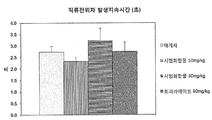
- Figure 2 is a result of inducing cortical diffusivity inhibition in rats administered the test compound and the positive control compound Topiramate for 3 weeks and then measured the change in the degree of increase in the total cerebral blood flow is compared with the mediator-negative control.
- Rats were anesthetized with 5% isoflurane (containing 70% N 2 O and 30% O 2 , dosing rate 300 ml / min) at the end of the 3 weeks of administration of the compound and mediator (30% PEG400) After fixing to the stereotactic frame (stereotactic frame) was performed the following surgery. During surgery, the concentration of the anesthetic was reduced to 1-1.5%, and the rectal temperature was maintained at 37.0 ⁇ 1.0 ° C using a homeothermic blanket system.
- the skin of the rat head was incised and flipped on both sides, and three holes were drilled in the right hemisphere of the open skull, the location of which is expressed in mm distance from the bregma as follows; (1) 4.5 in the posterior and 2.0 in the lateral aspect of the occipital cortex; (2) 0.5 to the rear and 2.0 to the lateral in the parietal cortex; (3) In the frontal cortex, 2 positions in the front and 2 in the side. Parisian laser-Doppler flow probes (Oxyflow, Oxford Optronics, UK) to monitor CBF and invasive Ag / AgCl electrodes for measuring DC potential changes The perforations in the parietal and frontal cortex were placed on the intact dura and in the cortex, respectively.
- the laser-Doppler flow probe was placed in an area free of large smoke and dural veins to minimize interference of large vessels to the signal.
- a reference electrode was fixed to the neck.
- the dura mater located on the occipital cortex was carefully removed and care was taken to minimize bleeding.
- the cortex was recovered by washing with saline for 15 minutes.
- Spherical (2 mm diameter) cotton was soaked in 1M KCl solution and placed on the smoke screen and 5 ⁇ l of KCl solution was added every 15 minutes to prevent drying.
- the incidence of cortical proliferation inhibition (CSD) induced by KCl was measured for 2 hours.
- CBF and DC potential were monitored continuously 5 minutes prior to KCl treatment. The last drug administration took place 30 minutes before treatment with KCl solution.
- the analyzed parameters are (1) the number of DC-potential occurrences, the duration of development, and the magnitude of amplitude. All values were expressed as standard error of mean (SEM), and the difference was considered statistically significant when P ⁇ 0.05.
- SEM standard error of mean
- FIGS. 1 and 2 After the administration of the compounds and the mediators were completed, the results of measuring the change in the total cerebral blood flow (CBF) after inducing cortical proliferation inhibition (CSD) are shown in FIGS. 1 and 2. -potential) is shown in Figures 3, 4 and 5.
- the test compound significantly reduced the number of events of increased global cerebral blood flow at the dose of 30 mg / kg compared to the mediator administration group (negative control group) (FIG. 1). This is comparable to the reduction effect on the number of events in the increase in global cerebral blood flow caused by a high dose of topiramate 80 mg / kg.
- the test compound significantly reduced the number of DC-potential occurrences compared to the mediator-administered group at the dose of 30 mg / kg, and this effect was similar to the effect by 80 mg / kg of topiramate (FIG. 3).
- the present compound (test compound) is useful as a drug for the prevention of migraine by showing sufficient effect to prevent the improvement of migraine indicator and the prevention of cortical proliferation at low dose compared to topiramate in migraine disease model. It could be confirmed that it can be used.
Landscapes
- Health & Medical Sciences (AREA)
- Animal Behavior & Ethology (AREA)
- Public Health (AREA)
- Veterinary Medicine (AREA)
- General Health & Medical Sciences (AREA)
- Life Sciences & Earth Sciences (AREA)
- Medicinal Chemistry (AREA)
- Chemical & Material Sciences (AREA)
- Pharmacology & Pharmacy (AREA)
- Epidemiology (AREA)
- Bioinformatics & Cheminformatics (AREA)
- Engineering & Computer Science (AREA)
- Dermatology (AREA)
- Organic Chemistry (AREA)
- General Chemical & Material Sciences (AREA)
- Neurosurgery (AREA)
- Neurology (AREA)
- Nuclear Medicine, Radiotherapy & Molecular Imaging (AREA)
- Pain & Pain Management (AREA)
- Biomedical Technology (AREA)
- Chemical Kinetics & Catalysis (AREA)
- Pharmaceuticals Containing Other Organic And Inorganic Compounds (AREA)
- Acyclic And Carbocyclic Compounds In Medicinal Compositions (AREA)
Priority Applications (7)
| Application Number | Priority Date | Filing Date | Title |
|---|---|---|---|
| ES17799673T ES2893456T3 (es) | 2016-05-19 | 2017-05-18 | Uso de un compuesto de carbamato para tratar preventivamente los dolores de cabeza |
| EP17799673.3A EP3459541B1 (en) | 2016-05-19 | 2017-05-18 | Use of carbamate compound in order to preventatively treat headaches |
| US16/302,842 US10456376B2 (en) | 2016-05-19 | 2017-05-18 | Use of carbamate compound in order to preventatively treat headaches |
| JP2018560644A JP6986521B2 (ja) | 2016-05-19 | 2017-05-18 | 頭痛の予防的治療のためのカルバメート化合物の使用 |
| CN201780030914.4A CN109310670B (zh) | 2016-05-19 | 2017-05-18 | 氨基甲酸酯化合物用于预防性治疗头痛的用途 |
| CA3024278A CA3024278A1 (en) | 2016-05-19 | 2017-05-18 | Use of carbamate compound in order to preventatively treat headaches |
| US16/571,347 US20200009113A1 (en) | 2016-05-19 | 2019-09-16 | Use of carbamate compound in order to preventatively treat headaches |
Applications Claiming Priority (2)
| Application Number | Priority Date | Filing Date | Title |
|---|---|---|---|
| KR20160061374 | 2016-05-19 | ||
| KR10-2016-0061374 | 2016-05-19 |
Related Child Applications (2)
| Application Number | Title | Priority Date | Filing Date |
|---|---|---|---|
| US16/302,842 A-371-Of-International US10456376B2 (en) | 2016-05-19 | 2017-05-18 | Use of carbamate compound in order to preventatively treat headaches |
| US16/571,347 Continuation US20200009113A1 (en) | 2016-05-19 | 2019-09-16 | Use of carbamate compound in order to preventatively treat headaches |
Publications (1)
| Publication Number | Publication Date |
|---|---|
| WO2017200316A1 true WO2017200316A1 (ko) | 2017-11-23 |
Family
ID=60325338
Family Applications (1)
| Application Number | Title | Priority Date | Filing Date |
|---|---|---|---|
| PCT/KR2017/005171 Ceased WO2017200316A1 (ko) | 2016-05-19 | 2017-05-18 | 두통의 예방학적 치료를 위한 카바메이트 화합물의 용도 |
Country Status (8)
| Country | Link |
|---|---|
| US (2) | US10456376B2 (enExample) |
| EP (1) | EP3459541B1 (enExample) |
| JP (1) | JP6986521B2 (enExample) |
| KR (1) | KR102421006B1 (enExample) |
| CN (1) | CN109310670B (enExample) |
| CA (1) | CA3024278A1 (enExample) |
| ES (1) | ES2893456T3 (enExample) |
| WO (1) | WO2017200316A1 (enExample) |
Cited By (1)
| Publication number | Priority date | Publication date | Assignee | Title |
|---|---|---|---|---|
| CN113015524A (zh) * | 2018-09-21 | 2021-06-22 | 爱思开生物制药株式会社 | 氨基甲酸酯化合物和包含其的制剂在预防、缓解或治疗急性应激障碍或创伤后应激障碍中的用途 |
Families Citing this family (3)
| Publication number | Priority date | Publication date | Assignee | Title |
|---|---|---|---|---|
| ES2973111T3 (es) * | 2017-11-14 | 2024-06-18 | Sk Biopharmaceuticals Co Ltd | Uso de un compuesto de carbamato para prevenir o tratar enfermedades asociadas con el aumento de la corriente tardía de sodio |
| CN113242735A (zh) * | 2018-09-21 | 2021-08-10 | 爱思开生物制药株式会社 | 使用氨基甲酸酯化合物预防、缓解或治疗并发的癫痫发作 |
| AU2020389425B2 (en) * | 2019-11-22 | 2026-03-05 | Sk Biopharmaceuticals Co., Ltd. | Oral pharmaceutical composition comprising carbamate compound and preparation method therefor |
Citations (4)
| Publication number | Priority date | Publication date | Assignee | Title |
|---|---|---|---|---|
| US3415840A (en) * | 1965-10-22 | 1968-12-10 | American Home Prod | Pyrazole-1-ethanol derivatives |
| WO2006112685A1 (en) | 2005-04-22 | 2006-10-26 | Sk Holdings Co., Ltd. | Neurotherapeutic azole compounds |
| US20100323410A1 (en) * | 2009-06-22 | 2010-12-23 | Sang Chul Lim | Method for preparation of carbamic acid (r)-1-aryl-2-tetrazolyl-ethyl ester |
| WO2011046380A2 (en) | 2009-10-15 | 2011-04-21 | Sk Holdings Co.,Ltd. | Method for preparation of carbamic acid (r)-1-aryl-2-tetrazolyl-ethyl ester |
Family Cites Families (5)
| Publication number | Priority date | Publication date | Assignee | Title |
|---|---|---|---|---|
| DE2628420A1 (de) * | 1976-06-24 | 1978-01-05 | Bayer Ag | 1-acyloxy-2-imidazolyl-1-phenyl- aethane, verfahren zu ihrer herstellung sowie ihre verwendung als fungizide und nematizide |
| US4349556A (en) * | 1976-06-24 | 1982-09-14 | Bayer Aktiengesellschaft | Pesticidally active 1-acyloxy-1-phenyl-2-azolyl-ethanes |
| WO2003053916A1 (en) * | 2001-12-21 | 2003-07-03 | Ortho-Mcneil Pharmaceutical, Inc. | Process for preparing 2-(substituted phenyl) - 2 - hydroxy-ethyl carbamates |
| PT1809273E (pt) * | 2004-09-16 | 2010-05-10 | Janssen Pharmaceutica Nv | Utililização de 2-fenil-1,2-etanodiol-(di)carbamatos para tratamento de epileptogénese |
| WO2011045380A1 (en) | 2009-10-16 | 2011-04-21 | Novartis Ag | Apparatus and method for transporting contact lenses through dipping baths |
-
2017
- 2017-05-16 KR KR1020170060706A patent/KR102421006B1/ko active Active
- 2017-05-18 WO PCT/KR2017/005171 patent/WO2017200316A1/ko not_active Ceased
- 2017-05-18 ES ES17799673T patent/ES2893456T3/es active Active
- 2017-05-18 JP JP2018560644A patent/JP6986521B2/ja active Active
- 2017-05-18 US US16/302,842 patent/US10456376B2/en active Active
- 2017-05-18 EP EP17799673.3A patent/EP3459541B1/en active Active
- 2017-05-18 CA CA3024278A patent/CA3024278A1/en active Pending
- 2017-05-18 CN CN201780030914.4A patent/CN109310670B/zh active Active
-
2019
- 2019-09-16 US US16/571,347 patent/US20200009113A1/en not_active Abandoned
Patent Citations (7)
| Publication number | Priority date | Publication date | Assignee | Title |
|---|---|---|---|---|
| US3415840A (en) * | 1965-10-22 | 1968-12-10 | American Home Prod | Pyrazole-1-ethanol derivatives |
| WO2006112685A1 (en) | 2005-04-22 | 2006-10-26 | Sk Holdings Co., Ltd. | Neurotherapeutic azole compounds |
| KR101286499B1 (ko) * | 2005-04-22 | 2013-07-16 | 에스케이바이오팜 주식회사 | 신경치료용 아졸 화합물 |
| US20100323410A1 (en) * | 2009-06-22 | 2010-12-23 | Sang Chul Lim | Method for preparation of carbamic acid (r)-1-aryl-2-tetrazolyl-ethyl ester |
| WO2010150946A1 (en) | 2009-06-22 | 2010-12-29 | Sk Holdings Co., Ltd. | Method for preparation of carbamic acid (r)-1-aryl-2-tetrazolyl-ethyl ester |
| WO2011046380A2 (en) | 2009-10-15 | 2011-04-21 | Sk Holdings Co.,Ltd. | Method for preparation of carbamic acid (r)-1-aryl-2-tetrazolyl-ethyl ester |
| US20110111467A1 (en) * | 2009-10-15 | 2011-05-12 | Sang Chul Lim | Method for Preparation of Carbamic Acid (R)-1-Aryl-2-Tetrazolyl-Ethyl Ester |
Non-Patent Citations (11)
Cited By (4)
| Publication number | Priority date | Publication date | Assignee | Title |
|---|---|---|---|---|
| CN113015524A (zh) * | 2018-09-21 | 2021-06-22 | 爱思开生物制药株式会社 | 氨基甲酸酯化合物和包含其的制剂在预防、缓解或治疗急性应激障碍或创伤后应激障碍中的用途 |
| EP3854391A4 (en) * | 2018-09-21 | 2022-06-29 | SK Biopharmaceuticals Co., Ltd. | Carbamate compound and use of formulation comprising same in preventing, alleviating, or treating acute stress disorder or post-traumatic stress disorder |
| CN113015524B (zh) * | 2018-09-21 | 2024-09-17 | 爱思开生物制药株式会社 | 氨基甲酸酯化合物和包含其的制剂在预防、缓解或治疗急性应激障碍或创伤后应激障碍中的用途 |
| AU2019344261B2 (en) * | 2018-09-21 | 2025-03-27 | Sk Biopharmaceuticals Co., Ltd. | Carbamate compound and use of formulation comprising same in preventing, alleviating, or treating acute stress disorder or post-traumatic stress disorder |
Also Published As
| Publication number | Publication date |
|---|---|
| KR20170131240A (ko) | 2017-11-29 |
| US20200009113A1 (en) | 2020-01-09 |
| JP2019516726A (ja) | 2019-06-20 |
| EP3459541B1 (en) | 2021-09-15 |
| CN109310670A (zh) | 2019-02-05 |
| US10456376B2 (en) | 2019-10-29 |
| ES2893456T3 (es) | 2022-02-09 |
| EP3459541A4 (en) | 2020-01-08 |
| JP6986521B2 (ja) | 2021-12-22 |
| US20190216780A1 (en) | 2019-07-18 |
| CN109310670B (zh) | 2022-03-29 |
| CA3024278A1 (en) | 2017-11-23 |
| EP3459541A1 (en) | 2019-03-27 |
| KR102421006B1 (ko) | 2022-07-14 |
Similar Documents
| Publication | Publication Date | Title |
|---|---|---|
| WO2017200318A1 (ko) | 섬유근육통 또는 섬유근육통의 연관된 기능적 증후군을 예방 또는 치료하기 위한 카바메이트 화합물의 용도 | |
| US20200009113A1 (en) | Use of carbamate compound in order to preventatively treat headaches | |
| KR20200074154A (ko) | 취약 x 증후군, 엔젤만 증후군 또는 렛 증후군을 포함하는 발달 장애의 경감 또는 치료를 위한 카바메이트 화합물의 용도 | |
| WO2018111008A1 (ko) | 양극성 장애의 예방, 경감 또는 치료를 위한 카바메이트 화합물의 용도 | |
| JP2717844B2 (ja) | 新規な治療用医薬組成物 | |
| JP7417595B2 (ja) | てんかん重積状態の予防、軽減又は治療のためのカルバメート化合物の使用 | |
| WO2017200317A1 (ko) | 삼차신경통을 예방 또는 치료하기 위한 카바메이트 화합물의 용도 | |
| WO2019098628A1 (ko) | 결신 발작 또는 결신 발작을 나타내는 뇌전증의 예방, 경감 또는 치료를 위한 카바메이트 화합물의 용도 | |
| WO2018111009A1 (ko) | 진전 또는 진전 증후군의 예방, 경감 또는 치료를 위한 카바메이트 화합물의 용도 | |
| WO2018111003A1 (ko) | 가려움증의 예방, 경감 또는 치료를 위한 카바메이트 화합물의 용도 | |
| WO2019098633A1 (ko) | 내장통 또는 내장 질환에서 기인한 통증을 예방, 경감 또는 치료하기 위한 카바메이트 화합물의 용도 | |
| WO2019098632A1 (ko) | 근긴장증의 예방, 경감 또는 치료를 위한 카바메이트 화합물의 용도 | |
| WO2020080866A1 (ko) | 카바메이트 화합물의 당뇨병성 말초 신경병증 또는 화학요법 유발 말초 신경병증의 예방, 완화 또는 치료를 위한 용도 | |
| WO2020060251A1 (ko) | 카바메이트 화합물 및 이를 포함하는 배합물의 급성 스트레스 장애 또는 외상 후 스트레스 장애의 예방, 경감 또는 치료를 위한 용도 | |
| HK40003858B (en) | Use of carbamate compound in order to preventatively treat headaches | |
| HK40003858A (en) | Use of carbamate compound in order to preventatively treat headaches | |
| WO2018111006A1 (ko) | 탈수초성 질환의 예방, 경감 또는 치료를 위한 카바메이트 화합물의 용도 | |
| RU2774970C2 (ru) | Применение карбаматных соединений для профилактики, облегчения или лечения биполярного расстройства | |
| WO2019098626A1 (ko) | 후기 나트륨 전류의 증가와 관련된 질환을 예방 또는 치료하기 위한 카바메이트 화합물의 용도 | |
| HK40015213A (en) | Use of carbamate compounds for prevention, alleviation or treatment of bipolar disorder | |
| HK40005640B (en) | Use of carbamate compound for preventing or treating fibromyalgia or functional syndrome associated with fibromyalgia | |
| HK40005640A (en) | Use of carbamate compound for preventing or treating fibromyalgia or functional syndrome associated with fibromyalgia |
Legal Events
| Date | Code | Title | Description |
|---|---|---|---|
| ENP | Entry into the national phase |
Ref document number: 3024278 Country of ref document: CA |
|
| ENP | Entry into the national phase |
Ref document number: 2018560644 Country of ref document: JP Kind code of ref document: A |
|
| NENP | Non-entry into the national phase |
Ref country code: DE |
|
| 121 | Ep: the epo has been informed by wipo that ep was designated in this application |
Ref document number: 17799673 Country of ref document: EP Kind code of ref document: A1 |
|
| ENP | Entry into the national phase |
Ref document number: 2017799673 Country of ref document: EP Effective date: 20181219 |